GD USA
GD USA GRAPHIC DESIGN USA
2026 PA C K A G E DESIGN AWA R D S SPONSORED BY
NEENAH AUGUST 2026
C R E AT I V E C O M M E N T S T H E I M PA C T O F A I BRANDING TRENDS CLIENT CHALLENGES B U S I N E S S VA L U E S MORE INSIGHTS & OPINIONS
www.gdusa.com
LETTER FROM THE EDITORS | WELCOME TO THE AMERICAN PACKAGE DESIGN ANNUAL
Welcome to the 63rd Anniversary Package Design Awards™ showcase. This competition celebrates the power of design to tell the story, advance the brand, amplify the experience, make and reinforce the sale — to forge a connection at the moment of truth.
GORDON KAYE AND SASHA KAYE-WALSH ARE EDITORS AT GDUSA Comments, suggestions and letters can be sent to editorial@gdusa.com.
In 2026, package designers are more challenged and, at the same time, more empowered than ever before. They sit at the intersection of many disciplines and competing demands: balancing creativity and aesthetics with commerce and consumer behavior, translating brand strategy into a tangible experience, responding to growing expectations around sustainability and responsible materials, collaborating with engineering to make ideas into reality, working with and around regulation. Now, with the rapid rise of AI, more elements are added to the equation — the ability to generate endless possibilities, ideas, variations and directions but also the responsibility to separate the wheat from the chaff. To understand when to assert human intuition, judgment, taste and originality. Package design is no longer about creating a container, if it ever was. It is about navigating a complex ecosystem where creativity, business, technology, and responsibility must come together in a single, compelling solution. Spend some time with our winners showcase and you will see how the best and brightest — winnowed from a couple of thousand entries — grapple with these challenges and exceed expectations. TIMES CHANGE, NEEDS CHANGE GDUSA is becoming less of a traditional industry news magazine and more of a home for creative commentary, ideas, and conversations shaping the design profession. As daily news migrates to our website, we are using all our assets — print, digital, website and enewsletter — to publish columns, op-eds and viewpoints that explore the questions designers are asking now and the forces redefining their work. To underscore the point, today we present dozen select opinion pieces, also running on our website. Not surprisingly, the topic du jour is AI and its impact creativity and process. But others discuss branding and logo trends, the meaning of value-based design, the travails of dealing with clients, the future of inhouse teams, and more. Our goal: to provide perspective, provoke thought, and give the community a place to consider where the profession is headed. We intend to be here another six decades. If that means evolving to be of service, then so be it.
GDUSA 2
CONTENTS | AUGUST 2026
08 PACKAGE DESIGN AWARDS Our 63rd Anniversary Package Design Awards showcase of more than 150 winning projects from talented design firms, advertising agencies, inhouse departments, institutions, freelancers and students — selected from a field more than ten times that number. Winning pieces run the gamut from food and beverages and spirits, to beauty and cosmetics and personal care, to toys and games and sports, to home and garden and industrial goods, to health and pharmaceuticals and CBD, to wine and beer and cannabis, to luxury and sustainability and student work, and all points in between. Why is package design so vital and so vibrant? Makers, marketers and sellers are challenged as never before to convey the message, tell the story, enhance the brand, create the experience and, ultimately, make the sale. Our competition recognizes beauty and style, of course, but more importantly, it celebrates the power of smart and strategic design to forge an emotional connection at the moment of truth.
58 CREATIVE COMMENTS Five quotes from design thinkers and do’ers in this edition of GDUSA: (1) “It has never been easier to create more but harder to create meaning.” (2) “AI’s greatest risk is not poor design, it’s convergent design.” (3) “Most tech brands are marketing a version of themselves that no longer exists.” (4) “Leading with values is a powerful business advantage.” (5) “This is not a profession. It is a personality disorder with a portfolio.” Intrigued? Then please join us for a dozen ‘Creative Comments’ appearing in today’s print edition. It is all part GDUSA-Graphic Design USA Volume 63/No.4 July/August 2026 Kaye Publishing Corporation (ISSN0274-7499/USPS227020). Published 6 times a year with combined issues in January/February, March/April, May/June, July/August, September/October, November/December. Executive, editorial and advertising offices at 594 Dean Street, Office 22, Brooklyn NY 11238. Phone: 212.696.4380. Website: www.gdusa.com. SUBSCRIPTION: Domestic, $72 one year. Canada and Mexico $140 per year. Periodicals postage paid at New York NY and additional mailing office. POSTMASTER: Send address changes to GDUSA - Graphic Design USA, PO Box 3072, Langhorne PA 19047. Permit #224.
of GDUSA’s evolution from an industry news magazine to news-plus-commentary — a robust source of opinions and op-eds that explores the questions designers are asking now and the forces redefining their work. You can find many more such commentaries and insights in our print magazine, digital magazine and website all year long.
MATCHING TALENT WITH SUCCESS ® NATIONWIDE The Great Resignation has left companies scrambling for talented designers and creatives searching for fulfilling projects. That's where Artisan Talent comes in. We're a boutique creative staffing agency here to make things easier for you - whether you’re hiring talent or finding work. From small agencies to major corporations, our team is in the business of connecting people. That’s what makes us Artisan. TO P P L AC ED T I T L ES Art Director
Product Designer
Senior Designer
Brand Designer
Digital Designer
Visual Designer
Copywriter
Graphic Designer
UI/UX Designer
ARTISANTALENT.COM
THANK YOU TO THE SPONSOR Neenah Paper was the founding sponsor of our American Package Design Awards™ and is the 2026 exclusive sponsor of today’s showcase. For more than 100 years, Neenah, Inc. has been the market leader in the creation and manufacturing of papers for premium writing, text, cover, digital, packaging and label applications. The Neenah signature portfolio includes market leading premium paper brands such as CLASSIC®, ENVIRONMENT®, and ROYAL SUNDANCE® Papers. Neenah Packaging provides unique and sustainable packaging papers, boards and labels as well as custom solutions for premium and luxury packaging. Neenah luxury and fine paper brands inspire businesses to visually engage their customers and create a lasting connection. For package designers, the Idea Shop is an especially valuable resource. It’s a place to browse and explore innovative ideas for paper-based products. It’s a one-stop destination to find inspiration for your next project. It’s a digital community where designers, artists, printers and others can connect and discover Neenah’s wide array of solutions. The Idea Shop showcases a curated selection of work from our global community of designers and creatives. Contact: neenahpaper.com, neenahpaper.com/packaging, and theideashop.com
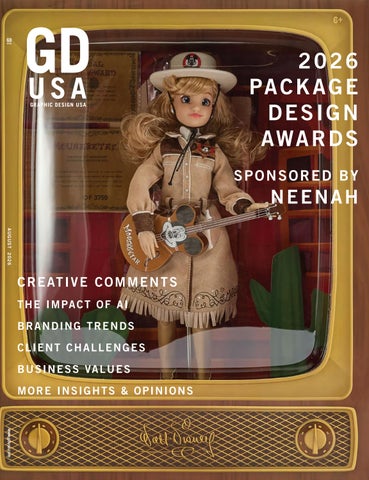
Packaging by Disney Consumer Products cele-
USA
GD USA
known as “Mouseketeers.” All winners of our
2026 PA C K A G E DESIGN AWA R D S
63rd anniversary package design awards show-
SPONSORED BY
brates the Mickey Mouse Club’s 70th anniversary,
GRAPHIC DESIGN USA
a pioneer of early television featuring child actors
NEENAH
case are featured starting at page 8.
GRAPHIC DESIGN USA
Gordon Kaye PUBLISHER Sasha Kaye-Walsh EDITOR/WEBSITE & SOCIAL MEDIA Gordon Kaye EDITOR/PRINT Charlotte Kaye GRAPHIC DESIGN Kyle Redfield CHIEF TECHNOLOGY OFFICER Althea Edwards READER SERVICES Angelo Abbondante ACCOUNTS MANAGER
ABOUT THE COVER GD
GD USA
AUGUST 2026
C R E AT I V E C O M M E N T S T H E I M PA C T O F A I BRANDING TRENDS CLIENT CHALLENGES B U S I N E S S VA L U E S MORE INSIGHTS & OPINIONS
www.gdusa.com
COVER PAPER CREDIT: The cover of this edition of GDUSA is printed on FSC-certified Kallima
Coated Cover C2S, part of the Kallima Paper family of coated cover paperboard. Kallima products are proudly manufactured by Rayonier Advanced Materials, a global leader in sustainable forest management practices. Their light-weight, fully bleached coated board products are used in commercial printing, publishing, prestige packaging, high-impact graphic corrugated containers, pointof-purchase displays and litho-laminated packaging. Kallima has a distinct low-density high-bulk construction resulting in less trees used and signficant cost savings to the customer. Contact: kallimapaper.com and 1.800.411.7011
Shane Lukas Yara-Nee Dennis A Great Idea INTERNET SERVICES Maliya Malik DESIGN/SOCIAL MEDIA ASSOCIATE Jeff Rosenberg Virtual360 PHOTOGRAPHY Ron Andriani AD SALES + INTEGRATED MARKETING 201.669.9884 randriani@gdusa.com Milton L. Kaye 1921-2016 FOUNDER Jay Lewis PHOTOGRAPHER EMERITUS
COPYRIGHT 2026 KAYE PUBLISHING CORPORATION
| 2026 |
AMERICAN PACKAGE DESIGN AWARDS PACKAGING, P-O-P + RETAIL GRAPHICS Makers, marketers and sellers are challenged as never before to convey the message, advance the brand, amplify the experience, close the deal. Think fragmented audiences, information overload, media clutter, increased competition, economic dislocation, disruptive technologies, political and regulatory uncertainty, changing practices and preferences. Package design is increasingly called upon to be the difference maker — and designers are increasingly at the center of it all. The outstanding work showcased here is testimony to this phenomenon. Our 63rd annivesary competition celebrates beauty and style, of course, but more importantly, the power of smart, strategic, effective design to forge an emotional connection at the moment of truth.
SPONSORED BY NEENAH For more than 100 years, Neenah, Inc. has been the market leader in the creation and manufacturing of papers for premium writing, text, cover, digital, packaging and label applications. The Neenah signature portfolio includes market leading premium paper brands such as CLASSIC®, ENVIRONMENT®, and ROYAL SUNDANCE® Papers. Neenah Packaging provides unique and sustainable packaging papers, boards and labels as well as custom solutions for premium and luxury packaging. Neenah brands inspire businesses to visually engage their customers and create a lasting connection. Visit neenahpaper.com, neenahpaper.com/packaging and theideashop. com
8 GDUSA
GDUSA 9
PACKAGE DESIGN AWARDS | INDEX
12 GDUSA
Academy of Art University
14, 15
Auburn University School of Industrial + Graphic Design Behr Paint Company - Marketing Creative
16
Big Easy Foods
16
Bonavita Design LLC
18
Brand Force 5
17, 18
Brandettes
18, 19
CBX Worldwide
19, 20
Central Garden & Pet
20
Chaewon Lee
21
Chase Design Group
21
CircleCI
21
Carol Sullivan Design
22
Corrumed SAS
22
Dailey Gen Graphics
22
Dell Technologies, Experience Design Group
22, 23
Diamond Packaging
23
Disney Consumer Products
23, 24, 25
DMH
25
FoodStory Brands
25, 26
FORCEpkg
26, 27
Fortnight Collective
27
Funky Buddha Brewery - Marketing
27
GAF Creative Services
27, 28, 29
Gina McKinna Design
29
Huffy Corporation/United Wheels Inc.
29
Invok Brands
29, 30
Jennifer Redding Design
30
Judy Olsen Design
31
Kimono Mom Inc.
31
Lynda Hodge, LLC
31
16
Peacock Creative Co.
35
Pennsylvania College of Art & Design
35, 36
Phillips
36
Printed by ProAmpac
36
Pulp+Wire
37, 38, 39, 40
RAS Communications
36
Roland Foods, LLC
37, 41
Romeo and Company International
42
Sam’s Club, Member’s Mark
42
Sana Karnawat
42
Savannah College of Art and Design (SCAD)
42, 43, 44
Seedhouse
44, 45
Smurfit Westrock Colombia
45
Smurfit Westrock Dominican Republic
45
Smurfit Westrock El Salvador
45
Spark
46
Squeaky
46
Stacy Karzen LLC
46
Sterling Brands
47
studio Chartreuse
48
Sukle Advertising & Design
48
Sung-Ho Chang
48
The Biondo Group
48
The Creative Pack LLC
49
The Republik
49
Third Street
49
Topco Associates LLC
50, 51
Truly
52
TUX Creative House
52
Visual Harmony
52
Voodoo Brands
52, 53
WFM, Inc.
53
Zack Group LLC
53
ZLINE Kitchen and Bath
54
GDUSA 13
2026 | AMERICAN PACKAGE DESIGN AWARDS
Design School: Academy of Art University Winning Entry: Casa Nueva Wine Designer: Sofia Balli Montalvo Other Instructor: Thomas McNulty Category: Student Work
Design School: Academy of Art University Winning Entry: Ducati Strada Skincare Designer: Linda Phuong Thao Nguyen Instructor: Thomas McNulty Category: Student Work
Design School: Academy of Art University Winning Entry: Eggers Beer Designer: Jihyeon Park Instructor: Thomas McNulty Category: Student Work
Design School: Academy of Art University Winning Entry: Jack In The Box Designer: Lizbeth Jayne Columna Instructor: Thomas McNulty Category: Student Work
14 GDUSA
Design School: Academy of Art University Winning Entry: Magnolia Brewing Designer: Linda Phuong Thao Nguyen Instructor: Thomas McNulty Category: Student Work
Design School: Academy of Art University Winning Entry: Peloton Skincare Designer: Hannah Martinez Instructor: Thomas McNulty Category: Student Work
Design School: Academy of Art University Winning Entry: Snowden Winery Label Design Designer: Samantha Wu Instructor: Thomas McNulty Category: Student Work
Design School: Academy of Art University Winning Entry: Vivani Chocolates & Shipper Display Designer: Jisoo Cho Instructor: Thomas McNulty Category: Student Work
GDUSA 15
2026 | AMERICAN PACKAGE DESIGN AWARDS
Design Firm: Bonavita Design LLC Client: Unimac, A Command Company Winning Entry: A Joyful Lift Holiday Champagne Package Creative Director: Donna Bonavita Art Director: Donna Bonavita Designer: Donna Bonavita Writer: Donna Bonavita Printing/Client: Unimac, A Command Company President: Greg Matonti VP Sales: Steven Broomhead Photography: istock.com/NEYYA Category: Wines, Beer + Liquor
Design Firm: Bonavita Design LLC Client: Unimac, A Command Company Winning Entry: Unimac’s ‘Gratitude Flows, Drink it In’ Travel Cup Gift Package Creative Director: Donna Bonavita Art Director: Donna Bonavita Designer: Donna Bonavita Printing/Client: Unimac, A Command Company President: Greg Matonti Photography: Alison Shaw, AlisonShaw.com Category: Open
Design Firm: Brand Force 5 Client: Silvio & Filomena’s Winning Entry: Silvio & Filomena’s Olive Oil Packaging System Creative Director: Michael Maloney Designer: Michael Maloney Category: Food + Beverages
Design School: Auburn University School of Industrial + Graphic Design Winning Entry: The Black Tail Bourbon Collection Gift Set Designer: Morgan Lockhart Professor: Mario Bocanegra Category: Student Work
16 GDUSA
BRAND FORCE 5 | SILVIO & FILOMENA’S OLIVE OIL The best brands begin with a story worth telling. Silvio & Filomena’s Olive Oil was never meant to be just another product on a crowded shelf. It began with two people, their family, and a legacy built through hard work, tradition, and love. Brand Force 5’s responsibility was to capture that legacy in a way that felt timeless, authentic, and worthy of the name on the bottle. The process began with the logo itself. Two Fs come together to create an S. One F represents Filomena and the other represents their daughter Florence. The S represents both Silvio and their daughter Sue. More than a monogram, the logo became a symbol of family, representing the people who define the brand. The packaging was built around that identity, with every design decision supporting the story rather than competing with it. The result is a brand that feels as timeless and enduring as the family legacy that inspired it.
GDUSA 17
2026 | AMERICAN PACKAGE DESIGN AWARDS
Design Firm: Behr Paint Company - Marketing Creative Client: Behr Paint Company Winning Entry: BEHR PREMIUM COMPLETE COAT Creative Director: Marianne Hales Designer: Jeffrey Chhan Designer: Leah Tackabery Photography: Reshni Aryamane Photography: Rudy Rodriguez Photography: Larayne Boaz Production: Jason Garrison 3D CGI Artist: Adrian Covarrubias Project Coordinator: Katherine Dimapilis Category: Home + Garden
Design Firm: Behr Paint Company - Marketing Creative Client: Behr Paint Company Winning Entry: BEHR ECOMIX Creative Director: Marianne Hales Designer: Katelyn Grover Production: Jason Garrison 3D CGI Artist: Rose Castaneda Project Coordinator: Katherine Dimapilis Category: Home + Garden
Design Firm: Big Easy Foods Winning Entry: Big Easy Foods Jalapeno Cheddar Sausage and Maple Sugar Sausage Kolaches Creative Director: Fredrick J. Werquin Art Director: Fredrick J. Werquin Designer: Fredrick J. Werquin Writer: Fredrick J. Werquin Category: Food + Beverages
Design Firm: Brandettes Client: Ample Hydration Winning Entry: Maple Water Package Design Creative Director: Lindsay Sullivan Writer: Nikola Cline Category: Food + Beverages
18 GDUSA
Design Firm: Brandettes Client: Flávia Aurea Winning Entry: Flávia Aurea Skincare Package Design Creative Director: Lindsay Sullivan Writer: Alanah Campagnuolo Category: Beauty + Cosmetics + Personal Care
Design Firm: CBX Worldwide Client: KitchenAid Winning Entry: KitchenAid Packaging Redesign Creative Director: Chad Klehr Strategy: Izzie Wragg Production: Dan Moore, Nathan Teske Client Service: Mahek Parekh, Melissa Braun Short Client: Sophia Costabal Category: Home + Garden
Design Firm: CBX Worldwide Client: Organicville Winning Entry: Organicville Brand and Package Redesign Creative Director: Steve Swanson Designer: Michelle Carlson, Chloe Gross Client Service Team: Celia Bertsch Strategy Team: Izzie Wragg Production Team: Dan Moore, Nathan Teske Client: Meryl Winslow, Camille Balfanz Category: Food + Beverages
Design Firm: CBX Worldwide Client: RePhresh Winning Entry: RePhresh Package Design Creative Director: Audra Nebolini Production Team: Dan Moore, Nathan Teske Client Service Team: Celia Bertsch, Abbie Schwartz Client: Ryan Guijo, Tim O’Donnell, Alison O’Brien Category: Beauty + Cosmetics + Personal Care
GDUSA 19
2026 | AMERICAN PACKAGE DESIGN AWARDS
20 GDUSA
Design Firm: CBX Worldwide Client: Trojan Winning Entry: Trojan Package Design Creative Director: Audra Nebolini Design Manager: Brian Hauck Senior Designer: Jamie Connell Client Director: Celia Bertsch Client Manager: Abbie Schwartz Client: Ryan Guijo, Tim O’Donnell, Lauren Beaulieu Category: Health + Pharmaceuticals
Design Firm: CBX Worldwide Client: Waterloo Winning Entry: Waterloo Brand and Package Design Creative Director: Chris Cook Designer: Tim Bayon, Brendan Reilly Client Service: Melissa Braun Short, Izzy Arnowitz Production Team: Dan Moore, Nathan Teske Client: Kathy Maurella, Andrea Feldman, Brianna Asciutto Category: Food + Beverages
Design Firm: Central Garden & Pet Client: Aqueon Winning Entry: Aqueon PRO Foods Package Design Creative Director: Stacy Blint Designer: Robert Lenz Category: Pets + Petcare
Design Firm: Central Garden & Pet Client: Kaytee Winning Entry: Kaytee Aviary Wellness Care Bars Package Design Creative Director: Stacy Blint Designer: Leann Geissler Category: Pets + Petcare
Design Firm: Chaewon Lee Winning Entry: 21st Century Vitamins Healthcare Packaging Rebrand Creative Director: Chaewon Lee Art Director: Chaewon Lee Designer: Chaewon Lee Writer: Chaewon Lee Note: Concept Project Category: Health + Pharmaceuticals
Design Firm: Chase Design Group Client: Black Chalk Winning Entry: Package Design For Black Chalk New Still Wine Range Art Director: Peter Hawkins Designer: Peter Hawkins, Saranna Drury, Jordan Cox Illustrators: Saranna Drury Production Team: Simon Ward Category: Wines, Beer + Liquor
Design Firm: Chase Design Group Client: Otoki Winning Entry: Otoki Brand and Package Redesign Creative Director: Jon Arriaza Art Director: Annie Dodge, Sarah Hade Designer: Amber Wang, Ardine Keyla Photographer: Jennifer Davick Production Team: Mario Soto Managing Director: Narae Park Sr. Account Manager: Natalie Le Category: Food + Beverages
Design Firm: CircleCI Winning Entry: Chunk Branded Packaging and Tech Creative Director: Monica Russo-Dunphy Designer: Birdy Wheeler-Wolowicz, Ruby Jazz, Toni Cater Director, Brand Marketing: Gillian Kieser Category: Consumer Electronics + Tech
GDUSA 21
2026 | AMERICAN PACKAGE DESIGN AWARDS
Design Firm: Carol Sullivan Design Client: Kilwins Chocolates Franchise Winning Entry: Kilwins Gummy Candy Packaging Art Director: Carol Sullivan Designer: Connor Sullivan Category: Food + Beverages
Design Firm: Corrumed SAS Client: Mecánicos Unidos SAS Winning Entry: Amazonia Series by Victoria Packaging Solution Designer: Ana María Marín Arcila Note: Corrugated cardboard folder with an integrated insert that optimizes material usage Category: Sustainable Packaging
Design Firm: Dailey Gen Graphics Client: Jasm 77 Winning Entry: Jasm 77 Wine Label Design Designer: Dejah Entzminger Category: Wines, Beer + Liquor
Design Firm: Dell Technologies, Experience Design Group Winning Entry: Alienware Area-51 Laptop Packaging Designer: Experience Design Group Category: Consumer Electronics + Tech
22 GDUSA
Design Firm: Dell Technologies, Experience Design Group Winning Entry: Dell Soft Goods Packaging Designer: Experience Design Group Category: Consumer Electronics + Tech
Design Firm: Diamond Packaging Client: The Recipe for American Craft Winning Entry: Recipe Cards and Premium Paperboard Box Creative Director: Dennis Bacchetta Art Director: Dennis Bacchetta Designer: Maddy Beikirch Concept Development: Jill Krzemien Project Management: Audrey Hardenburg Prepress and Artwork Preparation: Sean Pieken Embossing and Stamping, Universal Engraving, Embossing, Debossing & Stamping Dies: Jason Guessford Category: Open
Design Firm: Disney Consumer Products Winning Entry: Buzz Lightyear Talking Action Figure, Toy Story 30th Anniversary Designer: Rob Ross Packaging Engineer: Alan Fenner Manager Technical Packaging: Cole Fenton Sr. Manager, Product Design: Dan Vega Project Managers: Matt Sturniolo, Josh Mann Category: Toys + Games
Design Firm: Disney Consumer Products Winning Entry: Disney Castle Playsets, Plastic Reduction Art Director: Lizzy Dukesherer Designer: Clara Jimenez Packaging Engineer: Alan Fenner Sr. Manager, Technical Packaging: Steve Saco Product Design Manager: Kaitlyn Rosette Project Managers: Emma Hallson, Tenis Kopansky Category: Sustainable Packaging
GDUSA 23
2026 | AMERICAN PACKAGE DESIGN AWARDS
Design Firm: Disney Consumer Products Winning Entry: Disney Designer Collection Dance Series, Limited Edition Dolls Packaging Art Director: Lizzy Dukesherer Designer: Rachel Bristol Manager, Technical Packaging Engineer: Cole Fenton Character Artist: Steve Thompson. Product Design Manager: J Fuchs Project Manager: Gabby Cannon Category: Toys + Games
Design Firm: Disney Consumer Products Winning Entry: Disney Parks Skyliner Gondola, Plastic Reduction Manager, Technical Packaging Engineer: Cole Fenton Project Manager: Matt Sturniolo Category: Sustainable Packaging
Design Firm: Disney Consumer Products Winning Entry: Disney Tree Topper, Plastic Reduction Designer: Ximena Romero Packaging Engineer: Alan Fenner Manager, Technical Packaging: Cole Fenton Manager, Product Design: Donna Kozatek Project Manager: Jennifer Truman Category: Sustainable Packaging
Design Firm: Disney Consumer Products Winning Entry: Disney Wishables Packaging Art Director: Steve Carsella Designer: Rob Ross Packaging Engineer: Alan Fenner Category: Toys + Games
24 GDUSA
Design Firm: Disney Consumer Products Winning Entry: Disney’s Sharpay Evans Limited Edition Collector Doll, High School Musical 20th Anniversary Designer: Rachel Bristol, Jackie Ma Associate Packaging Engineer: Maddie Davenport Product Design Manager: Kaitlyn Rosette Project Managers: Gabby Cannan, Alexa Rodriguez Category: Toys + Games
Design Firm: Disney Consumer Products Winning Entry: The Mickey Mouse Club 70th Anniversary, Mouseketeer Limited Edition Doll Art Director: Lizzy Dukesherer Designer: Ximena Romero Manager, Technical Packaging Engineer: Cole Fenton Product Design Manager: Harmony Hines-Slattery Project Manager: Gabby Cannon Category: Toys + Games
Design Firm: DMH Client: Amuse by Prairie Allergy Winning Entry: Amuse: Early Allergen Introduction System Creative Director: Paul Diamond Art Director: Erica Gonzales Designer: Erica Gonzales Project Management: Michael Nay Account Management: Illinois Blasdel Category: Baby + Kids
Design Firm: FoodStory Brands Winning Entry: Upper Cut Tapas Snack Packs Creative Director: Dina Osinski Art Director: Greg Reed Designer: Megan French Vice President of Creative: Dina Osinski Director of Package Design: Greg Reed Creative Manager: Megan French CMO & Co-Founder: Jay Whitney COO & President: Nicole Parker Vice President of Marketing: Caitlyn Hufford Director of Brand Marketing: Catalina Morris Photography: J. Tatum Studios Video Content: First Story Films Category: Food + Beverages
GDUSA 25
2026 | AMERICAN PACKAGE DESIGN AWARDS
Design Firm: FoodStory Brands Client: Bluey, TrailBlazer Foods Winning Entry: Bluey Fruit Spreads Packaging Creative Director: Dina Osinski Art Director: Greg Reed Designer: Megan French FOODSTORY TEAM | Jennifer Robinson: Business Development Manager; Michelle Gomez: VP of Business Development; Jordan Jedeikin: EVP of Business Development BBC STUDIOS TEAM | SVP, Consumer Products North America: Dion Vlachos; Senior Director Licensing: Jill K. Cook; Senior Director, Product Development: Katie Scalerie; Director, Product Development: Carolina Cabal; Product Development Coordinator, Jadyn Blair LUDO STUDIO TEAM | Art Direction: Rhiannon Steffensen, Sam Moore, Molly Nevin Category: Food + Beverages
Design Firm: FORCEpkg Winning Entry: Armor Specialties Suppressor Packaging Creative Director: Tom Newmaster Art Director: Brian Harper Designer: Jinger Guigley Category: Sports + Sporting Goods
Design Firm: FORCEpkg Winning Entry: Fresh Solutions Network | Flavorables Potato Packaging Creative Director: Tom Newmaster Art Director: Brian Harper Designer: Maranda Nieves, Stephanie Bennett Category: Food + Beverages
Design Firm: FORCEpkg Winning Entry: Square One (SQ1) Black Label Coffee Packaging Creative Director: Tom Newmaster Art Director: Brian Harper Designer: Stephanie Bennett Category: Home + Garden
26 GDUSA
Design Firm: FORCEpkg Winning Entry: Stoner Car Care Packaging Redesign Creative Director: Tom Newmaster Art Director: Brian Harper Designer: Stephanie Bennett Category: Food + Beverages
Design Firm: Fortnight Collective Client: Gaia Herbs Winning Entry: Gaia Herbs Brand Evolution Creative Director: Matt Kubis, Becca Schepps Sr. Art Director: Brandon Gorthy Head of Design: Matt Kubis Designer: Fabien Dodard Writer: Becca Schepps Brand Director: Marci Andress Sr. Director of Strategy and Insights: Sam Emrich President: Devin Reiter Associate Creative Director: Steph Strange Retouching: Casey Kerrick Category: Health + Pharmaceuticals
Design Firm: Funky Buddha Brewery - Marketing Winning Entry: Funky Buddha Pregame Pilsner Packaging Creative Director: Andres Rios Sr. Designer: Andres Rios Photography: Mitch Wilkison Category: Wines, Beer + Liquor
Design Firm: GAF Creative Services Winning Entry: FT Solutions Packaging Creative Director: Mike Comiskey Designer: Carol Monza Kean, Heather Weissman, Bri Dougherty 3D Rendering: Carol Monza Kean Director Creative Services: Natalie Cruz VP Marketing Services: Carolyn Eckert Category: Industrial Goods
GDUSA 27
2026 | AMERICAN PACKAGE DESIGN AWARDS
Design Firm: GAF Creative Services Client: GAF Winning Entry: GAF Coatings Packaging Art Director: David Shin Designer: Carol Monza Kean 3D Modeling: Patricia Patalinjug 3D Rendering: Carol Monza Kean Director Creative Services: Natalie Cruz Lead Creative Production Manager: Marla Christiansen VP Marketing Services: Carolyn Eckert Category: Industrial Goods
Design Firm: GAF Creative Services Client: GAF Winning Entry: GAF EverGuard AEROSOL Packaging Designer: Carol Monza Kean 3D Modeling: Patricia Patalinjug 3D Rendering: Carol Monza Kean Director Creative Services: Natalie Cruz Lead Creative Production Manager: Marla Christiansen VP Marketing Services: Carolyn Eckert Category: Industrial Goods
Design Firm: GAF Creative Services Client: GAF Winning Entry: GAF PMMA Packaging Designer: Carol Monza Kean 3D Modeling and 3D Rendering: Carol Monza Kean Graphic Designer: Regina Newlin Director Creative Services: Natalie Cruz VP Marketing Services: Carolyn Eckert Category: Industrial Goods
Design Firm: GAF Creative Services Client: GAF Winning Entry: GAF TimberSteel Packaging Creative Director: Mike Comiskey Designer: Carol Monza Kean 3D Rendering: Carol Monza Kean Director Creative Services: Natalie Cruz VP Marketing Services: Carolyn Eckert Category: Industrial Goods
28 GDUSA
Design Firm: GAF Creative Services Client: GAF Winning Entry: Quix Packaging Creative Director: Mike Comiskey Designer: Carol Monza Kean Product Photography: Jeff Herbert 3D Rendering: Carol Monza Kean Director Creative Services: Natalie Cruz VP Marketing Services: Carolyn Eckert Category: Industrial Goods
Design Firm: Huffy Corporation/United Wheels Inc. Winning Entry: Huffy GRM (Grow. Ride. Move.) Packaging SVP Product Development, Engineering, Design & Quality: John Fowler Design Director: Lara Gilman Senior Packaging Designer: Zac Henne Senior Category Manager, ESG Communications: Shu Ju Yu Photographer: Matthew Helton Director, Engineering & Product Development: Jason Jewell Note: ‘We replaced poly bags with paper, zip ties with fiber ties, plastic tape with paper tape, and bubble wrap with paper wrap, while incorporating FSC-certified materials, recyclable cartons, and biodegradable inks’ Category: Sustainable Packaging
Design Firm: Gina McKinna Design Client: Grandma Mae’s Country Naturals Winning Entry: Grandma Mae’s Country Naturals Lickable Treats Category: Pets + Petcare
Design Firm: Invok Brands Client: Jack Link’s Winning Entry: Jack Link’s Core Packaging Redesign Creative Director: John Witherow Designer: Becky Caunce, Luke Severin Production Artist: Tom Masters Category: Food + Beverages
GDUSA 29
2026 | AMERICAN PACKAGE DESIGN AWARDS
Design Firm: Invok Brands Client: Three Farmers Foods Winning Entry: Three Farmers Foods Packaging Redesign Creative Director: John Witherow Designer: Becky Caunce, Carolina Blomberg Production Artist: Tom Masters Category: Food + Beverages
Design Firm: Invok Brands Client: Vitakraft Winning Entry: Vitakraft US Dog Treat Packaging Creative Director: John Witherow Design Director: Tim McLaughlin Designer: Carolina Blomberg Category: Pets + Petcare
30 GDUSA
Design Firm: Invok Brands Client: Tim Hortons Winning Entry: Tim Hortons RTD Iced Coffee Packaging Creative Director: John Witherow Designer: Becky Caunce, Carolina Blomberg Production Artist: Tom Masters Category: Food + Beverages
Design Firm: Jennifer Redding Design Client: Steamboat Legends, LLC. Winning Entry: The Skeleton Dance Arcana Game Packaging Art Director: Jennifer Redding Designer: Jennifer Redding Writer: Mark Andrew Smith Illustration: Daniela Montesi Category: Toys + Games
Design Firm: Judy Olsen Design Client: Lost Cowboy Whiskey Winning Entry: Lost Cowboy Cattleman’s Blend Whiskey Packaging Creative Director: Judy Olsen Designer: Judy Olsen Print & Design Collaboration: Nick McCormick, McCormick Print & Design Category: Wines, Beer + Liquor
Design Firm: Kimono Mom Inc. Winning Entry: Kimono Mom’s UMANI SAUCE Package Design Creative Director: Motoki Yamada Art Director: Motoki Yamada Designer: Motoki Yamada Brand Owner: Moe Yamada Product Development: Motoki Yamada Category: Food + Beverages
Design Firm: Lynda Hodge, LLC Client: Cashiers Historical Society Winning Entry: Cashiers Historical Society Candle Set Art Director: Lynda Hodge Designer: Lynda Hodge Category: Fundraising + Philanthropy
Design Firm: Meyocks Client: Fireside Winery Winning Entry: Sparks Canned Wine Design Creative Director: Trenton Burd Design: The Meyocks Package Design Team Category: Wines, Beer + Liquor
GDUSA 31
2026 | AMERICAN PACKAGE DESIGN AWARDS
Design Firm: Meyocks Client: Hy-Vee Winning Entry: Hy-Vee Bloody Mary Mix Packaging Creative Director: Nicole Mueller Design: The Meyocks Package Design Team Category: Private Label Packaging
Design Firm: Meyocks Client: Hy-Vee Winning Entry: Hy-Vee Caitlin Clark Cereal Box Creative Director: Rawley King Design: The Meyocks Package Design Team Category: Private Label Packaging
Design Firm: Meyocks Client: Hy-Vee Winning Entry: Hy-Vee Cozy Spoon Soups Packaging Creative Director: Rawley King Design: The Meyocks Package Design Team Category: Private Label Packaging
Design Firm: Meyocks Client: Hy-Vee Winning Entry: Hy-Vee Trail Mix Packaging Creative Director: Rawley King Design: The Meyocks Package Design Team Category: Private Label Packaging
32 GDUSA
Design Firm: Mishimoto Winning Entry: Parallel Port Oil Catch Can Packaging Creative Director: Kristin Valis Art Director: Lars Nilsen Designer: Lars Nilsen Product Photography: Lars Nilsen Category: Luxury Packaging
Design Firm: Newton Design Client: Papa Romeo Spirits, LLC Winning Entry: John Battle Spirits Packaging Creative Director: Drew Hibbert Art Director: Nick Newton Designer: Nick Newton Illustrator: Phil Roberts Category: Wines, Beer + Liquor
Design Firm: One Flight Up Design Client: Cra-Z-Art Winning Entry: GRINCH Themed Advent Calendar for CraZSlimy Creative Director: Lynn Schmieder Designer: Pam Costello Category: Toys + Games
Design Firm: One Flight Up Design Client: Cra-Z-Art Winning Entry: My Look Brand Visual Identity Refresh Creative Director: Lynn Schmieder Account Services: Barbara DeVos Category: Toys + Games
GDUSA 33
2026 | AMERICAN PACKAGE DESIGN AWARDS
Design Firm: One Flight Up Design Client: Hometown Foods Company Winning Entry: Pillsbury Sour Dough Bread Mix Packaging Creative Director: Lynn Schmieder Designer: Keri Davis Retouching: Lynn Lohmeyer VP, Director of Client Services: Susan Ramos Category: Food + Beverages
Design Firm: One Flight Up Design Client: Mondelez International Winning Entry: CLIF Run The World Limited Edition Packaging Creative Director: Lynn Schmieder Art Director: Jeff Ferentz Designer: Tiffany London Illustration: Chris Spliedt VP, Director of Client Services: Susan Ramos Category: Food + Beverages
Design Firm: One Flight Up Design Client: Mondelez International Winning Entry: Wheat Thins Star Wars Limited Edition Creative Director: Lynn Schmieder Designer: Jennifer Dietlein VP, Director of Client Services: Susan Ramos Production: Jason Malmström Category: Food + Beverages
Design Firm: One Flight Up Design Client: Profaci Food Company Winning Entry: Profaci Olive Oil Branding and Packaging Creative Director: Lynn Schmieder Designer: Carin Manetti VP, Director of Client Services: Susan Ramos Production: Jason Malmström Category: Food + Beverages
34 GDUSA
Design Firm: Peacock Creative Co. Client: Cleve’s Gourmet Products Winning Entry: Cleve’s Label Design and Packaging System Creative Director: Medea Peabody Art Director: Medea Peabody Designer: Medea Peabody Writer: Medea Peabody, Jon Cleveland Chief Operations Officer: Robert Turner Chief Marketing Officer: Sheila Rondeau Category: Food + Beverages
Design School: Pennsylvania College of Art & Design (PCAD) Winning Entry: Boom Buds Earbuds Packaging Designer: Jaileiyah Rodriguez Chair of Graphic Design: Maria Hostetter Instructor: Tom Newmaster Category: Student Work
Design School: Pennsylvania College of Art & Design (PCAD) Winning Entry: Clef Earbuds Packaging Designer: Lee Santillo Chair of Graphic Design: Maria Hostetter Instructor: Tom Newmaster Category: Student Work
Design School: Pennsylvania College of Art & Design (PCAD) Winning Entry: Spritz Personal Care Packaging Designer: Emma Ries Chair of Graphic Design: Maria Hostetter Instructor: Tom Newmaster Category: Student Work
GDUSA 35
2026 | AMERICAN PACKAGE DESIGN AWARDS
Design Firm: Pulp+Wire Client: Elevate Organic Winning Entry: Elevate Organic Supplements Packaging Creative Director: Taja Dockedorf Art Director: Sara Rosario Designer: Anna Taylor Writer: Michelle Geosits Director of Accounts: Ashton Bean Category: Health + Pharmaceuticals
Design Firm: Pulp+Wire Client: Evie’s Snacks Winning Entry: Evie’s Snacks Packaging Creative Director: Taja Dockedorf Art Director: Sara Rosario Designer: Anna Taylor, Kanya Zillmer Writer: Michelle Geosits Director of Accounts: Ashton Bean Category: Food + Beverages
Design Firm: Pulp+Wire Client: Bold Coast Spirits Winning Entry: Bold Coast Marine Vodka Packaging Creative Director: Taja Dockedorf Art Director: Sara Rosario Designer: Anna Taylor, Kanya Zillmer Writer: Michelle Geosits Director of Accounts: Ashton Bean Category: Wines, Beer + Liquor
Design School: Pennsylvania College of Art & Design (PCAD) Winning Entry: Wise Monkey Earbuds Packaging Designer: Paul Bonilla Chair of Graphic Design: Maria Hostetter Instructor: Tom Newmaster Category: Student Work
36 GDUSA
PULP+WIRE | EVIE’S SNACKS BRAND AND PACKAGING
Breaking through in the crowded snack aisle requires more than beautiful packaging. It requires a brand consumers instantly recognize, remember, and reach for.
rooted in consumer behavior, helping shoppers quickly understand the product while creating a memorable brand experience that feels both premium and approachable.
Pulp+Wire partnered with Evie’s Snacks to reimagine what premium pecans could look and feel like for a new generation of shoppers. Moving away from expected heritage-inspired packaging, the agency created a bold, joyful identity that celebrates the product while bringing unmistakable energy to the category.
Beyond launching a refreshed package, Pulp+Wire developed a scalable brand system capable of supporting new flavors, retail expansion, and future product innovation while maintaining consistency across every consumer touchpoint.
Oversized pecan photography, vibrant color palettes, playful typography, and confident messaging transformed the package into an immediate shelf standout. Every design decision was
Evie’s demonstrates how strategic branding can redefine an entire category, proving that even the most familiar products can become exciting again when creativity and consumer insight come together. GDUSA 37
PULP+WIRE | ELEVATE ORGANIC PACKAGING SYSTEM As the wellness category continues to expand, standing out requires more than premium ingredients. It demands a brand consumers trust from the moment they see it. That’s exactly what Pulp+Wire set out to achieve with Elevate Organic. Tasked with creating a complete packaging system for a growing portfolio of supplements, proteins, and wellness products, the team developed a sophisticated brand architecture designed to balance scientific credibility with elevated lifestyle appeal. Rather than creating individual packages, Pulp+Wire built a scalable visual system capable of supporting future innovation while maintaining a consistent premium presence across retail and e-commerce. Every detail was considered, from velvet-touch finishes and copper foil accents to refined typography and disciplined information hierarchy. The result is packaging that communicates quality, transparency, and efficacy while remaining approachable to today’s wellness consumer. As a leading CPG branding and packaging design agency, Pulp+Wire believes packaging should do more than attract attention. It should create confidence, simplify purchase decisions,
38 GDUSA
and establish a brand platform capable of growing alongside the business. The Elevate Organic identity demonstrates how thoughtful strategy and purposeful design can transform a product portfolio into a cohesive consumer experience. It’s a packaging system built not only for today’s shelf, but for tomorrow’s innovation, proving that exceptional design is one of the most valuable investments a wellness brand can make.
PULP+WIRE | BOLD COAST SPIRITS BRAND AND PACKAGING
Few spirits have a story as distinctive as Bold Coast Spirits. The brainchild of Jay Lombard and master blender Stuart Littlefield, Bold Coast vodka is infused with Maine oyster shells; the brand needed packaging that could match its remarkable innovation while earning a place among premium spirits. Pulp+Wire approached the challenge by looking beyond the bottle. Rather than focusing solely on ingredients, the agency created a brand rooted in Maine’s rugged coastline, maritime heritage, and enduring craftsmanship. The resulting identity reflects understated luxury, allowing consumers to experience a sense of place before ever tasting the product. Clean typography, refined materials, restrained color palettes, and elegant watercolor illustrations by artist Anna Farba work together to communicate authenticity, sustainability, and premium quality
without relying on clichés often found within the craft spirits category. Pulp+Wire believes that every branding project begins with a simple question: What story deserves to be told? For Bold Coast Spirits, the answer wasn’t simply a unique distillation process. It was the character of Maine itself. The result is a premium spirits brand that transforms regional authenticity into a compelling consumer experience while demonstrating how strategic branding and thoughtful packaging design can elevate product innovation into an unforgettable brand story. Photography credit: Evan Kalman GDUSA 39
2026 | AMERICAN PACKAGE DESIGN AWARDS
Design Firm: Printed by ProAmpac Client: Black Magic Winning Entry: Black Magic Organic Potting Soil Sustainable Packaging Note: Black Magic’s packaging was transitioned into a ProAmpac Pro-EVO FL recyclable bag structure Category: Sustainable Packaging
Design Firm: RAS Communications Client: Cadence Coffee USA Winning Entry: Cadence Coffee USA Package Design Series Creative Director: Russell A Schultz Production Artist: Daniel Del Torro Category: Food + Beverages
40 GDUSA
Design Firm: Phillips Client: Phillips Asia Winning Entry: Phillips Lunar New Year Red Envelope Box Creative Director: Martin Schott Designer: Cherry Ng Chief Marketing Officer: Amy Wexler Category: Luxury Packaging
Design Firm: Roland Foods, LLC Winning Entry: Roland Foods Eggplant Line Creative Director: Julie Dernigoghossian, Eling Lee Designer: Julie Dernigoghossian Category: Food + Beverages
Design Firm: Roland Foods, LLC Winning Entry: Roland Foods Fruit Line Cre-ative Director: Eling Lee Designer: Eling Lee Illustrator: Bex Morley Category: Food + Beverages
Design Firm: Roland Foods, LLC Winning Entry: Roland Foods Ramen Line Creative Director: Sergey Grigoryan (TNKR), Sandi Grigoryan (TNKR), Eling Lee Designer: Sergey Grigoryan (TNKR) Photography: YtC Creative: Paul H. Christian Category: Food + Beverages
Design Firm: Roland Foods, LLC Winning Entry: Roland Foods Skewer Line Cre-ative Director: Eling Lee Illustration: Eling Lee, Getty Images Multiple Artists Category: Food + Beverages
Design Firm: Roland Foods, LLC Winning Entry: Roland Foods Steelcut Oat Line Creative Director: Eling Lee Designer: Eling Lee Category: Food + Beverages
GDUSA 41
2026 | AMERICAN PACKAGE DESIGN AWARDS
Design Firm: Romeo and Company International Winning Entry: Spikeball Retail Packaging Creative Director: Vincent Romeo Designer: Vincent Romeo Category: Toys + Games
Design Firm: Sam’s Club, Member’s Mark Winning Entry: Lemon Drop, Ready-ToDrink Bottle Creative Director: Jonathan Stiers Designer: Angie Lagle Category: Food + Beverages
Design Firm: Sana Karnawat Client: Nutriangle Winning Entry: Nutriangle Botanical Packaging System Designer: Sana Karnawat Category: Food + Beverages
Design School: Savannah College of Art and Design (SCAD) Winning Entry: After Bottles Designer: Emma Story Overseeing Professor: Corey Perez-Vergara Category: Student Work
42 GDUSA
Design School: Savannah College of Art and Design (SCAD) Winning Entry: Bear Minimum Packaging Designer: Colden Woolf Overseeing Professor: Michael Whitney Category: Student Work
Design School: Savannah College of Art and Design (SCAD) Winning Entry: Caliber Writing Tools System Designer: Koen Roach Overseeing Professor: Michael Whitney Category: Student Work
Design School: Savannah College of Art and Design (SCAD) Winning Entry: Kubo and The Two Strings Premium Movie Box Designer: Colette Correa Trocha Overseeing Professor: Peter Wong Category: Student Work
Design School: Savannah College of Art and Design (SCAD) Winning Entry: Lord of the Rings Extended Edition Collector’s Item Designer: Talitha Arnott Overseeing Professor: Peter Wong Category: Student Work
GDUSA 43
2026 | AMERICAN PACKAGE DESIGN AWARDS
Design School: Savannah College of Art and Design (SCAD) Winning Entry: Raspberry Pi Pico Starter Kit Designer: Desmond Wendt Overseeing Professor: Michael Whitney Category: Student Work
Design School: Savannah College of Art and Design (SCAD) Winning Entry: Sweet Baby Rays Rebrand Designer: Lily Souther Overseeing Professor: Tim Hiltabiddle Category: Student Work
Design School: Savannah College of Art and Design (SCAD) Winning Entry: Vignoli Tuscan Olive Oil Rebranding Designer: Diana Haltiwanger Overseeing Professor: Tim Hiltabiddle Category: Student Work
Design Firm: Seedhouse Client: Butter + Sugar Winning Entry: Butter + Sugar Gluten Free Packaging Art Director: Krissy Vanderwarker Designer: Laurea McLeland Writer: Krissy Vanderwarker Designer: Ash Miyagawa Strategist: Bryan Vanderwarker Category: Food + Beverages
44 GDUSA
Design Firm: Seedhouse Client: Victory Lap Winning Entry: Victory Lap Branding and Packaging Art Director: Krissy Vanderwarker Designer: Ash Miyagawa Writer: Krissy Vanderwarker Designer & Production: Laurea McLeland Strategist: Bryan Vanderwarker Category: Health + Pharmaceuticals
Design Firm: Smurfit Westrock Dominican Republic Client: Cementos Argos Winning Entry: Building On Values Social Impact Themed Bag Designer: Jadeth Salce Note: In recognition of International Women’s Day 2025 Category: Industrial Goods
Design Firm: Smurfit Westrock Colombia Client: Ramo Winning Entry: Tostacos Point of Sale Designer: Juliana Ordonez Category: Food + Beverages
Design Firm: Smurfit Westrock El Salvador Client: Santa Eduvigas Winning Entry: Sivar Gift Box Designer: Vivian Custodio Category: Open
GDUSA 45
2026 | AMERICAN PACKAGE DESIGN AWARDS
Design Firm: Spark Client: TH Foods Winning Entry: Crunchmaster Chickpea Crisps Packaging Creative Director: Craig Tollenaar Art Director: Zeynep Tangun-Kaplan Designer: Zeynep Tangun-Kaplan Photographer: Dave Tracy Food Stylist: Stef Endres Category: Food + Beverages
Design Firm: Squeaky Winning Entry: Always Be Nice Beer Can w/ Detachable Sticker Creative Director: Anthony Del Monte Lynn Serra Art Director: Gabriela Vega Founder & CEO: Anthony Del Monte Executive Creative Director: Lynn Serra Art Director: Gabriela Vega Category: Wines, Beer + Liquor
Design Firm: Stacy Karzen LLC Client: Double R Brand Foods Winning Entry: Holmes Smokehouse Sliced & Ready Smoked Sausages Line Extension Creative Director: Stacy Karzen Director of Marketing: Gavin Roth Category: Food + Beverages
Design Firm: Stacy Karzen LLC Client: Greyston Bakery Winning Entry: Greyston Bakery Gift Box Mailer Creative Director: Stacy Karzen Category: Food + Beverages
46 GDUSA
Design Firm: Sterling Brands Client: Campbell’s Winning Entry: Goldfish Redesigned Identity and Packaging Category: Food + Beverages
Design Firm: Sterling Brands Client: Nestlé Winning Entry: Natural Bliss Packaging Category: Food + Beverages
Design Firm: Sterling Brands Client: Oliver Winery Winning Entry: Oliver Ciderworks Packaging Category: Food + Beverages
Design Firm: Sterling Brands Client: The Hershey Company Winning Entry: Shaq-A-licious Slams Packaging Category: Food + Beverages
GDUSA 47
2026 | AMERICAN PACKAGE DESIGN AWARDS
Design Firm: studio Chartreuse Client: Dicky T’s Spices Winning Entry: Dicky T’s Spices Branding and Packaging Creative Director: Charity D’Amato Art Director: Ali Forbes Designer: Ali Forbes Writer: Jenny Buck Photography: Megann Galehouse, Lady Luck Studios Category: Food + Beverages
Design Firm: Sukle Advertising & Design Client: Wild Oats / KeHE Distributors Winning Entry: Wild Oats Brand Identity & Packaging System Creative Director: Melanie Simonich Art Director: Dain Williams Designer: Josh Jevons, Dain Williams, Evan Olea, Greg Jesse Writer: Melanie Simonich Founder and Chief Creative Officer: Mike Sukle Digital Artist: Matt Carpenter Category: Food + Beverages
Design Firm: Sung-Ho Chang Winning Entry: Gorae Soju Label & Can Design Creative Director: Sung-Ho Chang Designer: Sung-Ho Chang Illustrator: Sung-Ho Chang Category: Wines, Beer + Liquor
Design Firm: The Biondo Group Client: Blacktop Holdings Winning Entry: Sipli Beverage Packaging Creative Director: Charles Biondo Art Director: Kevin Lenahan Designer: Meg Russell Category: Food + Beverages
48 GDUSA
Design Firm: The Creative Pack LLC Client: INFRA - Independent Natural Foods Retailers Association Winning Entry: The Good Collective Protein Powders Packaging Creative Director: Danielle Kidney Designer: Emma Tung, Casey Chui, Heather Storie, Paola Ip, Joshua Manalang Category: Health + Pharmaceuticals
Design Firm: The Creative Pack LLC Client: San Francisco Bay Coffee Winning Entry: San Francisco Bay Coffee Packaging Creative Director: Danielle Kidney Designer: Heather Storie, Emma Tung, Casey Chui, Paola Ip Photographer: JXL Creative LLC Category: Food + Beverages
Design Firm: The Republik Client: Happy Dirt Winning Entry: Happy Dirt Identity and Packaging System Creative Director: Robert Shaw West Art Director: Matt Shapiro Designer: Matt Shapiro Writer: Dwayne Fry Illustrator: Matt Shapiro Category: Food + Beverages
Design Firm: Third Street Client: Naturipe Snacks Winning Entry: Naturipe Snacks Snackbites Packaging Design Creative Director: David T. Jones Designer: Amanda Grable Writer: David T. Jones Category: Food + Beverages
GDUSA 49
2026 | AMERICAN PACKAGE DESIGN AWARDS
Design Firm: Topco Associates LLC Winning Entry: Cape Covelle Sockeye Salmon Packaging Category: Private Label Packaging
Design Firm: Topco Associates LLC Winning Entry: Crav’n Flavor Peanut Butter Cups Packaging Category: Private Label Packaging
Design Firm: Topco Associates LLC Winning Entry: Food Club Smash Burgers Packaging Category: Private Label Packaging
Design Firm: Topco Associates LLC Winning Entry: Full Circle Market Protein Energy Bars, Crunchy Peanut Butter Packaging Category: Health + Pharmaceuticals
50 GDUSA
Design Firm: Topco Associates LLC Winning Entry: Paws Happy Life Scented Cat Litter Packaging Category: Pets + Petcare
Design Firm: Topco Associates LLC Winning Entry: Simply Done Fresh Linen Dryer Sheets Packaging Category: Home + Garden
Design Firm: Topco Associates LLC Winning Entry: Sweet P’s Bake Shop, Gabby’s Dollhouse Frosted Pink Sugar Cookies Packaging Category: Private Label Packaging
Design Firm: Topco Associates LLC Winning Entry: TopCare Seasonal Hand Soaps Packaging Category: Beauty + Cosmetics + Personal Care
GDUSA 51
2026 | AMERICAN PACKAGE DESIGN AWARDS
Design Firm: Truly Client: Gold Ridge Organic Farms Winning Entry: Gold Ridge Organic Farms Olive Oil Design Creative Director: Carrie Dufour Designer: Annika Greenawalt Illustrator: Teri Sloat Category: Food + Beverages
Design Firm: TUX Creative House Client: Sunski Winning Entry: Sunski SPF Brand Identity CCO: Ludwig Ciupka VP, Creative: Chelsea Matthews Senior Art Director: Mariana Serrano Graphic Designer: Mateusz Markiewicz Co-Founder: Tom Steward Co-Founder: Michael Charley Client Partnership Director: Emma Olender Senior Client Partner: Jeff Rogers Strategy Director: Stacy Gagnidze Category: Beauty + Cosmetics + Personal Care
Design Firm: Visual Harmony Client: Paul Metsa Winning Entry: Paul Metsa Songs of Resistance & Resolve CD Packaging Creative Director: Mike Goebel Art Director: Mike Goebel, Paul Metsa Designer: Mike Goebel Writer: Paul Metsa Photographer: Howard Christopherson Category: Music + Media + Entertainment
Design Firm: Voodoo Brands Client: Conifer Specialties Winning Entry: Snoqualmie Falls Lodge Packaging Creative Director: David Lemley Art Director: Jay Hilburn Writer: David Lemley Category: Food + Beverages
52 GDUSA
Design Firm: Voodoo Brands Client: Magic Chocolate Winning Entry: Magic Chocolate Packaging Creative Director: David Lemley Art Director: Jay Hilburn Designer: Steve Gehret Writer: David Lemley Category: Food + Beverages
Design Firm: Voodoo Brands Client: Top Fox Snacks Winning Entry: Top Fox Snacks Packaging Creative Director: David Lemley Art Director: Jay Hilburn Designer: Eric Wyttenbach Writer: Samuel Cohen Category: Food + Beverages
Design Firm: WFM, Inc. Client: The Magni Group Winning Entry: MagniLife Packaging Refresh Creative Director: Matt Kennedy Art Director: Rebecca Doran Designer: Katie Bertolet, Molly Lubinsky, Erika Mabus Category: Health + Pharmaceuticals
Design Firm: Zack Group LLC Client: Tyson Foods Winning Entry: Nature Raised Farms Packaging Creative Director: Jeff Zack Designer: The Zack Group Team Category: Food + Beverages
GDUSA 53
2026 | AMERICAN PACKAGE DESIGN AWARDS
Design Firm: ZLINE Kitchen and Bath Winning Entry: ZLINE Artisan Collection Handle Packaging Director of Design: Moritz Merkert Art Director: Misato Morita Senior Designer: Zakiya Stubbs Writer: Kevin MacMillan Category: Luxury Packaging
54 GDUSA
Design Firm: ZLINE Kitchen and Bath Winning Entry: ZLINE Palisades Collection Packaging Director of Design: Moritz Merkert Art Director: Misato Morita Senior Designer: Zakiya Stubbs Writer: Kevin MacMillan Photography: Daniel Britton Category: Ecommerce + Shipping
CREATIVE COMMENT | AI VS. AGENCY: WHAT AI CAN AND CANNOT DO
AI’s greatest risk to brands is not poor design, it is convergent design. AI has made design more accessible than ever before. What once required time, teams, and significant investment can now be generated in seconds. For many businesses, that shift is not only appealing, it’s practical. But the growing narrative that AI can fully replace design expertise oversimplifies what design actually is.
RACHEL TEOH
At a surface level, AI performs impressively. It can generate logos, color palettes and graphic elements that appear polished and complete at a glance.
Rachel Teoh is Partner and Strategy Director at The Agency of Love and Logic (LOLO), a female-led studio based in Toronto. She leads a diverse portfolio of clients across all areas of brand strategy, applying an approach that reflects the agency’s ethos of balancing business acumen with a human-centered perspective.
In practice, however, these outputs are often inconsistent, lack the structure of a cohesive system, and require significant refinement before they are production-ready. For businesses operating under tight timelines or constraints, they may still be sufficient — but they are rarely final. AI operates by identifying and recombining patterns from existing data. While it can generate outputs that feel new, those outputs are rooted in what is already familiar, already validated, and already seen. Without strong direction, this tendency leads toward convergence rather than distinction. And over time, that convergence becomes visible. Brands begin to share similar visual languages, tones of voice, and structures. Nothing is technically wrong, but very little stands apart. In a crowded market, that lack of differentiation can erode a brand’s ability to be remembered. This is where the role of expertise becomes more important. AI is not an independent system. Its effectiveness is directly tied to the person using it. Knowing what to ask, how to guide it, and when to push beyond its outputs requires judgment that extends beyond the tool itself. Prompting is often framed as a skill, but in practice, it’s also an expression of taste. Taste shows up in decisions — what to pursue, what to discard, and what aligns within a specific context. AI can generate options, but it cannot determine which option carries meaning or relevance. That layer of discernment still belongs to the per-
58 GDUSA
son behind the process. Two individuals can use the same AI tools and arrive at entirely different results. The difference is not in the technology, but in the perspective guiding it. This distinction reframes the role of agencies and designers. Our value is not only in producing design assets, but in interpreting problems, challenging assumptions, and shaping direction before solutions are created. The output is only one part of the equation — the thinking behind it is what gives it weight. None of this suggests that AI should be dismissed. It is an incredibly powerful tool. It can accelerate workflows, expand exploration, and support creative processes. But it is most effective when paired with expertise not used as a substitute for it. Ultimately, the decision to rely on AI for design comes down to what a business is trying to achieve. For some, speed and accessibility will outweigh the need for differentiation. For others, especially those competing on brand and perception, that trade-off may carry more consequence. AI can produce what is possible within a given set of inputs. What it cannot do is define what truly matters for a brand. That decision still requires human judgment — and over time, that difference shows in how a brand is recognized, remembered, and valued.
GDUSA 59
CREATIVE COMMENT | THE NEED TO BE DIFFERENT BY DESIGN
It has never been easier to create more but harder to create meaning. AI has fundamentally changed the way brands operate. Tools that once took days or weeks of human effort can now produce competent marketing assets in seconds. Copy, design, campaign variants, audience targeting — many of the most resource-intensive tasks in marketing have become fast, automated, and scalable. It’s a remarkable shift in capability.
KATE WATTS
Kate Watts is CEO of Fifty Thousand Feet. A 25-year veteran of the digital agency world
Yet with that capability comes a paradox: when every brand has access to the same tools, algorithms, and optimization playbooks, they begin to sound and feel the same. Efficiency alone no longer distinguishes you. As content production accelerates, sameness becomes the unintended consequence. Brands risk flooding their own channels with technically correct but emotionally empty work.
having started her career at MarchFirst and Digitas. She then went on to the presidency of Huge US where she oversaw their domestic offices and worked with major brands including Target, HBO, Audi, and Pfizer. Leaving Huge, Watts founded Faire Design, an integrated brand experience consultancy, which she later sold to The Atlantic. She then led digital transformation, GTM, prod-
What sets brands apart in this environment is not how much they can automate, but how clearly they understand what should remain untouched by machines. Identity, rooted in values, voice, and human understanding, is still the ultimate differentiator. And it is up to people, not platforms, to protect it. WHY EFFICIENCY ≠ DISTINCTIVENESS
uct design & development, UX, marketing, branding, and communications projects for Fortune 500 & SMB clients across various industries. Fifty Thousand Feet has offices in Chicago, New York, and London; clients include BCG, Mastercard and Google.
Marketers face increasing pressure to deliver faster, cheaper, and with greater scale. AI answers that call with measurable results. Bain says that marketers using generative AI have seen campaign time to market reduced by up to 50%, and that content creation time has dropped by 30%–50%. These benefits are real, and they’re not going away. But faster content is not necessarily better content. AI can replicate tone, repackage content, and generate endless versions. What it lacks is intuition. It doesn’t know when a message feels flat or out of step with the audience. It can produce language but not meaning. It can mimic your brand’s voice, but it can’t recognize when that voice has lost credibility. Without the right guidance, AI leads to volume, not value. That’s the risk: achieving more output, but less impact. WHAT TIMELESS BRANDS ALREADY KNOW Some brands have managed to remain distinct even as the tools around them evolve. Their longevity has less to do with resisting change and more to do with being clear about what matters. Nike has consistently adapted to new technologies and cultural shifts, but empowerment remains its foundation. Whether through shoes, digital
60 GDUSA
fitness tools, or AI-powered personalization, the brand knows its promise, and every new channel must serve it. LVMH, the parent company of luxury brands like Louis Vuitton, Dior, and Tiffany & Co., has adopted AI across its operations to improve logistics, optimizing inventory, and power personalization in ecommerce. But it hasn’t diluted what its brands stand for. Every use of AI serves the purpose of elevating craftsmanship, exclusivity, and emotion... American Express has integrated AI into fraud detection and customer engagement, but the core idea of membership and trust continues to define its brand experience. Tools support the promise; they don’t set it. These brands succeed because they adopt new capabilities with discernment. Their values act as a filter. Technology is used in service of identity, not as a substitute for it. HOW TO BUILD DEFENSIBLE DIFFERENTIATION For marketers navigating this new terrain, the first step is clarity. Before introducing AI into workflows, define what makes the brand distinct. Codify tone, voice, and values. Identify the non-negotiables. This isn’t about creating rigid rules. It’s about drawing a clear line between what can flex and what must remain constant. Then apply AI where it enhances, not replaces, your existing strengths. Use it to reduce friction in repetitive tasks, assist with early drafts, or explore variations. Let it speed up the work that benefits from automation but leave room for human interpretation where judgment is critical. Create systems for feedback. AI should not operate on autopilot. Curate its output. Review how it performs not just in metrics, but in meaning. Pay attention to consistency across touchpoints and how well each message reinforces the brand promise. Finally, use the time saved by AI to double down on cultural awareness. Read customer reviews. Listen to sales calls. Observe how people live, search, and scroll. What resonates today may not show up in your dashboards until much later. Insight is earned through attention, not automation. DISTINCTIVENESS IS A DISCIPLINE The future of brand building will depend on how wisely we use our tools. Technology can amplify a message, but it can’t define what that message should be. That responsibility still belongs to people. Brands that break through will be those with the discipline to stay grounded in their purpose. They’ll set clear boundaries for automation and make space for observation, reflection, and refinement. They’ll be intentional not just about what they say, but how they say it, and why it matters. In a world of endless content, it’s not enough to be productive. You have to be recognizable. And recognition comes from coherence, character, and conviction, none of which can be generated on demand.
GDUSA 61
CREATIVE COMMENT | REFLECTIONS OF AN IN-HOUSE VETERAN
Like many inhouse agency leaders, my in-house career started as a random accident. I was working as a freelance illustrator and designer for a toy company at a time of business growth that led them to establishing a small in-house team to meet their expanding marketing needs. They asked if I’d take on all their packaging, catalog, and product marketing projects and I, jonesing for a full-time gig, said, “Yeah…sure…why not!”
ANDY EPSTEIN
Unfortunately, at that time, (we’re talking the early 1990s – yep, I’m that old) that was how many in-house agencies (IHAs) were born – as a knee-jerk reaction to immediate business circumstances with absolutely no strategic mandate for these newbie creative departments.
Andy Epstein has had an illustrious career as a designer, inhouse design manager, and advocate for the inhouse design value proposition. He now consults with inhouse agencies supporting their efforts to establish and enhance their organizational and operational infrastructure and team culture. He also publishes a Substack dedicated to supporting middle and frontline managers in all disciplines at https://epsteina.substack.com/
My experience was just one example of what was occurring throughout corporate America. That with no long-term business rationale for investing in an IHA, bean counters across corporate America, who were getting annoyed at the ever-increasing cost of ad agencies and design firms, saw the creation of internal creative teams as a means to reduce overhead. Unfortunately, after all these years, no matter what design business thought leaders tell you, that is still the primary IHA value proposition. For us in-house creatives, it ignores and devalues the true contributions we bring to our host companies. Upper management naively assumed you could throw a bunch of creative professionals together in a cube farm and voila! – you’d have a high-performing team without even knowing or establishing what success would look like (let alone the means to measure it). More to the point, though, the lack of a clear strategic vision for internal creative teams left these business-critical groups rudderless, with their very existence subject to the whims of Procurement and the C-suite. These circumstances made it almost impossible for creative professionals with little or no leadership training or support, to step into management roles and design appropriate org structures and operational infrastructure for their newly formed in-house agencies. So, we muddled through. We started to band together through organizations like InSource, the INitiative at AIGA, and HOW Design Live’s programming. We gained expertise through on-the-job boot camps and well, basically, baptism by fire. We called each other up and shared war stories and best practices. Riffing off of those early industry organizational successes, new groups like IHAF were established and staffing and consulting firms such as
62 GDUSA
Cella, The Creative Group, and Aquent put an increased focus on the inhouse community by pushing out relevant content and designing professional development programming. In their comprehensive surveys, the ANA captured a big swing towards the adoption and growth of IHAs from the late 90s to the mid 2000s. Though this growth was still driven primarily by cost savings goals... IHAs started to achieve the holy grail of strategic positioning often referred to as “a seat at the table.” Design Thinking, as championed by the Stanford School of Business and the design firm IDEO, accelerated the growth of IHAs, both in terms of headcount but, more importantly, in the level of strategic assignments being shifted from external agencies to IHAs. Adding to that accelerant was the advent of social media and the associated need for quick on-brand marketing responsiveness that in-house teams were best positioned to address. Both driving and as a response to these hard-won successes, IHA leadership adopted, albeit reluctantly, the language and metrics of business. We defined KPIs (Key Performance Indicators) and the means to track them, we took a page from the agency world and established and elevated account and project management as core functions, we expanded the umbrella of our services to include video, social media, and environmental design. At the same time our community, with support from publications like GDUSA and organizations like IHAF, established competitions that showcased our creativity, innovation, and company contributions. The inhouse cohort built on these successes, and we expanded our value proposition beyond the 3 pillars of quality, speed, and cost savings to now include adaptability and innovation – critical drivers of business success given a changing economic and technological landscape. We even evangelized the value of an enterprise-wide culture of design as a means to increased profitability and overall business success. Those heady days of growth and success, I’m sorry to say, are largely now behind us. Senior executive-level design and creative positions established within companies are dwindling. Inhouse design leaders are finding themselves sidelined and struggling to reestablish quality creative as a driving force of business success. Speed to market and “good enough” are now the mantras of marketing departments with AI not only impacting IHA headcount but also in increasing unrealistic expectations of productivity while making creative output generic. These realities underscore the call to action: we must all recommit to the early practices and behaviors that previously bolstered our community just a couple of decades ago if we are to maintain our relevance and very existence. If we are to regain stature and strategic positioning in our organizations we must double-down on establishing our value in ways that resonate with business leaders. We must strategically embrace AI in ways that augment rather than automate how we create high-quality communication and marketing materials, and we must proactively and aggressively insert ourselves into the strategic decision-making process within our organizations. This is occurring in pockets in the business world, but to scale these successes we need to extend our personal and professional networks, support and reignite existing industry organizations and even establish new ones that address the current realities, opportunities and challenges of our collective professional community. It won’t be easy, but we did it before and we can certainly do it again. The first step each of us can take is to personally reach out to our colleagues, recommit to existing industry organizations, and together, create a path forward. Given the value great creative brings to business and society as whole, this will be, as they say in the business world, a real win-win.
GDUSA 63
CREATIVE COMMENT | THE RISK OF CULTURAL BIAS IN AI
Upholding cultural understanding in the age of AI is critical. Diverse perspectives and collaborations are key in any industry, organization, and in our communities. Too often, diverse communities are neglected, overlooked, or denied the same opportunities. A similar lack of diversity exists in STEM roles, and is negatively impacting AI training and development. The Equal Employment Opportunity Commission report in 2024, which MOSES EVERETT
Moses Everett is Vice President of Digital Services at KQ Communications. Tapping
analyzed Census data and annual surveys, found that Hispanic or Latinx workers in the tech industry made up 10%, Black workers made up 7.4%, and women made up less than 23% between 2014 and 2022, and found more underrepresentation in management roles.
into more than 15 years of experience in graphic design, digital marketing, web
The gaps in diversity within teams can impact progress and innovation.
development, and social media management, Moses successfully collaborates with clients of all sizes, including start-ups, nonprofits and Fortune 500 companies.
An example of this is with Large Language Models (LLMs), which are generating content or responses with bias. Specifically, we have witnessed subconscious cultural bias appearing in outputs. A recent article in Nature shared findings of a study conducted by researchers at the University of California, Berkeley’s AI Research Lab that examined how two versions of GPT responded to texts written in eight widely spoken English dialects, alongside Standard American and British English. They found that the versions consistently defaulted to American spelling, and some of their findings detected stereotypes in the responses. This is also why AI tools shouldn’t replace our teams; they must work with our strategic judgement and cultural awareness. Otherwise, the biased content you may accept will contradict the voice, language, tone, values, culture, and experiences of those the work represenAlthough AI is regarded as a tool, an ideation partner, and collaborator to help identify pain points for improving the efficiency of processes and productivity, we cannot ignore its weaknesses. Increasing diversity in the engineering of LLMs and enhancing the development and training of LLMs, are essential and would lead to better outputs in this age of AI. AI’s issue of bias changes what is generated to assist communication and creative work from authentically relating to and connecting with target audiences or representing the people behind the brands or organizations, especially if teams are not effectively using AI – that’s where the risk is high.
64 GDUSA
Because AI can’t automatically detect our ethnicities when we initiate a chat, our prompts must have plenty of context and details for our desired output we’re looking for. However, since bias has occurred, the work doesn’t stop when responses are given. We have to ensure AI adoption is not replacing people who bring inclusive storytelling, strategic decision-making, or creativity, just for convenience. DIVERSITY ADVANCES INNOVATION IN EVERY INDUSTRY It is important for development teams and the tech industry to prioritize the need to address disparities, as AI tools are rapidly being released, invested in, and adapted in our work. A recent study from Adobe found that 99% of creative professionals are using generative AI in their creative process. And, almost 70% of marketers have integrated AI into their operations, according to data from MarTech. Creative teams are still driving the designs, personas, tone, and concepts of the work. WHILE LEVERAGING AI, KEEP IN MIND THE FOLLOWING: - Give as much detail as possible in your prompt. - Teach AI to avoid tropes and bias for a better output for analysis. - Don’t forget you’re still taking the lead. - Analyze and refine AI’s outputs. - Don’t forget, or exclude, culture. For marketing and communications agencies, in-house teams, or any professional in our field, it is critical as strategic creatives and brand ambassadors, corporations, or organizations, to ensure AI use doesn’t let representation, trust, and authenticity slip through the cracks. We have to keep shining a light on cultures being overlooked and the perpetual importance of diversity in every field. Use LLMs as a tool, but they cannot erase or dominate our cultural, creative, and strategic direction.
GDUSA 65
CREATIVE COMMENT | NAVIGATING THE CROSSROADS: DESIGN THROUGH COLLABORATION
Design teams are frequently faced with the same challenge. A client, product manager or technical stakeholder asks the design team to implement a solution “just because.” As designers, we quickly realize that meaningful impact requires involvement earlier in the process. Yet, when design is brought further upstream, teams find themselves tossed around between conflicting requirements and told to “work their magic.” Meanwhile, every stakeholder arrives armed with their own metrics, priorities, and constraints.
AMY HUANG
Amy Huang is Creative Director and Vice President at Citibank. She specializes in human-centered systems at the intersection of design, technology, and business. With a background in both fin-tech and health-tech, her experience spans across digital marketing, brand strategy, user experience (UX), design systems, operational integration, and more. Her simple mantra is to “make things work for people” both in her personal design practice and in her approach to fostering connections, mentoring emerging designers, and leading design organizations.
So how do design teams avoid the trap of either solving everyone else’s problems at the expense of design considerations or being reduced to simply “making things look good”? The reality is that this is often the role of design: to sit at the cross-functional crossroads and find a solution that works. COLLABORATION NOT COMPROMISE Collaboration and compromise are often treated as interchangeable concepts, but they produce very different outcomes. Compromise frequently leaves both sides partially dissatisfied, with each giving up something important. Collaboration, on the other hand, combines expertise to create solutions neither side could have reached independently. In simple terms: compromise can feel like 1 + 1 = 0.5, while collaboration creates opportunities for 1 + 1 = 3. The key to collaboration is consistently re-centering discussions around a shared objective: the success of the project. When design quality is compromised, it is not only the design team that loses. The overall product experience suffers. Likewise, when technical feasibility, legal considerations, marketing objectives, or operational constraints are ignored, the product itself becomes weaker. Framing conversations around shared outcomes changes the nature of trade-off discussions. Instead of functions competing to have their priorities win, each discipline contributes its expertise toward a common goal. SEEK OUT THE VALUE BROUGHT BY OTHERS As a designer, you are not just working for everyone else, they are also working for you. Use their knowledge to your advantage. Rather than waiting for technical or legal constraints to surface late in the process, or risk partners sidelining design completely, involve partners intentionally and early. Use their expertise to improve the design itself. For example, a design team might establish the overall information architecture and interaction hierarchy while collaborating closely with legal stakeholders to shape how sensitive content is presented within that structure. Design leads the experience vision while incorporating specialized
66 GDUSA
expertise where it matters most. Similarly, designers are often presented with rough mockups, slide decks, or “designs”. Instead of dismissing these artifacts, effective designers use them as opportunities to uncover the underlying problem being communicated. The goal is not to defend ownership of design work, but to understand intent and evolve the idea through a stronger design process. This approach helps cross-functional partners feel heard while also demonstrating the unique value design contributes: the ability to synthesize problems, identify patterns, and transform fragmented ideas into cohesive experiences. ... WHILE BEING CLEAR ABOUT THE VALUE OF DESIGN Part of the challenge design teams face is that good design can appear effortless from the outside. The “magic” is visible, but the systems behind it often are not. To make the value of design more visible, actively document the principles, processes, and systems that guide the team’s work. Strong outcomes are rarely the result of instinct alone. They come from a combination of research, design expertise, established principles, iteration, and structured decision-making. No two design teams will operate in exactly the same way — a flexibility which both helps design flourish and makes it seem “fluffy”. However, a team that has documented processes, shared principles, and established systems has at least a baseline for productive conversations. This allows teams to evaluate changes constructively rather than debating every decision from scratch. More importantly, they help organizations understand that effective design is not arbitrary — it is intentional, repeatable, and strategically grounded. TRANSLATE YOUR LANGUAGE Finally, none of these things is possible without effective communication. This is not something that can be done independently. All cross-functional partners need to be on board. That requires translating design language into terms that other disciplines already understand. Designers do not need to become experts in every field, but they do need to understand how design decisions connect to broader organizational goals. Visual consistency can be framed in terms of brand recognition and customer trust. Information architecture and navigational clarity can be tied to conversion rates, engagement metrics, or support reduction. Design system decisions can be aligned with engineering efficiency and scalability. When teams understand how design contributes to their goals — not just aesthetic outcomes— design becomes easier to advocate for and collaborate around. None of these approaches guarantees perfect cross-functional relationships or flawless outcomes. However, much like the design process itself, consistently applying them moves teams closer to a stronger and better version of the working model. You might also find that everyone likes feeling valued and own part of a successful outcome, and by reaching out to your partners first and collaborating with them on the idea, you have been establishing rapport and getting buy in along the way to help make the next iteration of your collaboration even better.
GDUSA 67
CREATIVE COMMENT | THE MEANING OF TASTE IN THE AGE OF AI
There is a growing idea that, as AI makes everything, taste becomes the differentiator. That’s probably true, but the way we are defining taste right now is off. Most people talk about taste like it’s refinement. Curation. Knowing what’s good. But that version of taste is exactly what AI is getting very good at replicating. It can absorb patterns, learn what’s been validated, and generate something that looks right. That’s not taste. That’s criteria. BRENNAN MCGRATH
Take something like Claude Design. You can describe what you want, from a landing page to a pitch deck to a campaign visual, and it will
Brennan McGrath is a Partner at Combo, where he helps brands grow by blending cultural insight with creative ambition. Guided by a deep belief in empathy, he approaches every project with a relentless curiosity about what drives people — what moves them, inspires them, and ultimately shapes their behavior. It’s a principle that has defined his work across a wide range
generate something polished, on-brand, and structurally sound in seconds. No design background required. That’s incredible! It’s also the point. Because what Claude Design is actually doing is operationalizing what we’ve been calling “taste” for years: alignment to patterns, consistency with a system, adherence to what’s already been validated.
of clients, including Diageo, Target, and Tishman Speyer. A former architect and lifelong builder, Brennan brings a hands-on,
It’s very good at making something that looks “right”. But it doesn’t have the ability to believe in something that isn’t right yet.
systems-level perspective to branding.
AI doesn’t have taste. Not in any real sense. It doesn’t have a tongue that can like and dislike flavors. It doesn’t have a heart that can break. It doesn’t have the relationship with consciousness and survival necessary to understand why one thing is better than another. It can be told what’s good, but being told isn’t the same as knowing. So when people say “AI doesn’t have taste,” they’re not really defending some precious creative instinct. They’re reacting to something else: the realization that we’ve spent a long time using curation as a proxy for relevance. And now that proxy is being automated. The truth is, we’ve already been living in a world where taste is flattened. Every H&M plays the same music. Every city has the same Scandinavian-looking coffee shop. Algorithmic media has pushed us into a place where everything is oddly unique and uniform at the same time. We’re surrounded by signals of taste that all point in the same direction. AI doesn’t break that system. It accelerates it.
68 GDUSA
As AI makes it easier to produce competent, on-brand work at scale, “good” becomes the baseline. The middle flattens. There are more options, more outputs, more things that look right. So the advantage shifts. Not to the people or brands who can make the best-looking thing, but to the ones who can make the most unexpected decision. Because real taste isn’t about knowing what’s good. It’s the ability to see value in something underappreciated. To look at something overlooked, underdeveloped, or even a little wrong — and understand what it could become. It’s the person who picks up a necklace at a flea market because they love it, not because they recognize it. Years later, they find out it’s an original Alexander Calder. That instinct, the ability to assign value before it’s validated, is taste. AI can tell you what something resembles. It can map it to patterns. But it can’t love the curious genius of the thing itself. More importantly, it can’t misunderstand. Humans have an innate ability to misunderstand things and embrace contradiction. Those two qualities — misunderstanding and contradiction — are the source of so much that’s actually new. Every good joke. A lot of new music. Every counterintuitive business. Without them, you don’t get a Liquid Death. You don’t get a Cowboy Carter. You don’t get ideas that don’t immediately make sense, but end up reshaping categories. That’s the gap. As AI gets better at replicating “good taste,” the brands that win won’t be the most tasteful in the traditional sense. They’ll be the ones willing to choose something that doesn’t immediately read as correct. The ones that can hold a little contradiction without smoothing it out. The ones that can believe in something before it makes sense. We are not entering a taste economy. We’re entering a belief economy. And most brands are still optimizing for approval.
GDUSA 69
CREATIVE COMMENT | BRANDING THROUGH TRANSFORMATION
Most tech brands are marketing a version of themselves that no longer exists. The product has evolved. The roadmap has expanded. The strategy has sharpened. Yet the story in market still reflects who the company was two years ago. That disconnect doesn’t just create confusion. It creates drag. Teams are building at one altitude while the brand operates at another. Clients evaluate you based on yesterday’s capabilities, on the website from VINCENT ROFFERS
Vincent Roffers is driven by a simple obsession: uncovering what makes a brand impossible to ignore. As Head of Strategy at Agenda, he partners with organizations navigating moments of transformational change, defining the strategy that creates momentum — then turning it into ideas
years ago. Growth slows — not because the business lacks ambition, but because the narrative hasn’t caught up. The challenge becomes even sharper when the transformation isn’t linear. We saw this firsthand in our work with Medecision. WHEN TRANSFORMATION EXPANDS MID-STREAM
that resonate in the real world.
Medecision had just undergone a years-long reinvention of its healthcare data platform. What had once been an at-parity legacy system was rebuilt end-to-end. The platform could ingest disparate data sources, harmonize them and translate fragmented information into real-time, actionable intelligence. Not simply reporting. Direction. Action. Impact. But as we were shaping the new brand around that shift, the business evolved again. Medecision announced the strategic acquisition of Excell Healthcare Advisors, a nationally recognized healthcare consultancy. The story immediately broadened. Medecision was no longer solely a technology platform. It now paired an advanced data platform with advisory expertise. Technology plus consulting. Intelligence plus implementation. This is where many organizations hesitate. When strategy shifts midstream, brand work can feel instantly outdated. The instinct is to pause, reorganize and rebuild…or even restart. But transformation doesn’t wait for brand.
70 GDUSA
ANCHOR THE STORY IN OUTCOMES The real question wasn’t how to reorganize navigation or rewrite capability lists. It was: what enduring value connects the platform and advisory? What outcome remains true regardless of configuration? For Medecision, that clarity was captured in the idea of Data to doing. The platform turns complex data into insight and action. The advisory ensures that the whole process is implemented for success in a way that creates lasting adoption. Together, they create an enduring reduction of the distance between information and impact. By anchoring the narrative in outcome rather than organizational structure, the acquisition strengthened the story instead of complicating it. The business expanded, but the promise remained coherent. LET’S ACCEPT THAT STABILITY IS A MYTH Branding through transformation requires a mindset shift. In high-growth, fast-moving environments, certainty rarely (if ever) arrives. By the time messaging is finalized, the roadmap has shifted. By the time the website launches, the organization has evolved again. Waiting for stability delays relevance. Instead, define a core narrative durable enough to stretch as the company stretches. Build from there. Refine as needed. Brand becomes your strategic coherence — a way to ensure that when the business accelerates, the story accelerates with it. THE REAL RISK? The true, uncomfortable risk here during periods of rapid change isn’t that your brand evolves too often. It’s that it doesn’t evolve at all. When strategy advances — through reinvention, expansion or acquisition — perception must advance with it. Otherwise, growth can be constrained not by capability but by narrative. If your business has changed and your story hasn’t, you are underselling your future.
GDUSA 71
CREATIVE COMMENT | LEADING WITH VALUES IS GOOD BUSINESS FOR AGENCIES
Running a small agency means wearing a lot of hats. Some days, I’m deep in brand strategy and proposals. Other days, I’m reviewing logo concepts and revising reports. Balancing the need to land the next project while delivering excellent work can be a lot for me and my team. Ten years ago, I started A Great Idea (AGI) with the belief that good work can do great things. In other words, design that speaks to communities and builds connection. This mission has stayed with us and become one of our biggest differentiators in an industry that can be deeply competitive and chaotic. SHANE LUKAS
Shane Lukas is the Owner/Creative Strat-
What’s made AGI’s growth sustainable this last decade is our values. When I say values, I don’t mean bullet points on a proposal; I mean values as a lived, daily
egist at A Great Idea, bringing more than
practice. Literally. We begin every weekly team meeting by reading our values out
25 years of award-winning brand strategy,
loud. It may seem small, but by continually grounding ourselves in our values,
graphic design, and development. He is
we make sure the work we do stays purpose-driven and that we keep showing up
also a public speaker and lifelong harm
for what matters.
reduction advocate for social justice through community organizing and education.
Leading with values is a powerful business advantage. It keeps us a sustainable business. It attracts incredible, mission-driven collaborators. And it makes all the work we do meaningful for us, our partners, and the creative communities we serve. WHY VALUES MATTER I get it. When you’re running a small or mid-sized creative agency, it’s easy to put your “values” on the website and focus on the more urgent stuff: serving clients, hitting deadlines, paying invoices. But in my experience, when you don’t have a clear framework for what matters to you, you end up conducting business from a reactive place that can get messy or overwhelming easily. Having clearly-articulated values has helped us avoid that. Here’s how: DECISION MAKING Our values serve as our compass. As mentioned, we ground into our four values — “Together, We Will Do Great Things,” “Good Is a Great Start,” “Greatness Lives in Every Body,” and “Create with Great-itude” — at the start of our weekly team meeting.We do this not because we like rituals (okay, maybe a little), but because they help us make easier, faster decisions. When we’re unsure how to move forward on a project, our values cut through the noise and help us stay aligned.
72 GDUSA
SERVICE QUALITY Our values keep our work excellent. We serve a mix of for-profit and non-profit groups working with all kinds of budgets. No matter the project, we prioritize quality service provision. Values like “Good Is a Great Start” hold us accountable to this standard. This means that when, for example, a nonprofit has a small budget or needs pro-bono support, we give them the same level of care and creative energy we would give a national for-profit brand. This is important because bold, professional creative solutions can be a powerful force for community mobilization. Our mission-driven partners who are out there doing incredible work deserve dignified, high-quality creative solutions. TEAM COHESION Clearly-articulated values keep our team passionate and cohesive. By being up front about our beliefs, we attract people who are on the same page. I find this to be true across employees, contractors, and clients. This alignment minimizes turnover and burnout. AGI’s team knows why we’re here, what matters, and how our work contributes to something bigger. CLIENT SELECTION Similarly, centering our values helps us be intentional about our collaborators. We work with clients whose values resonate with our own, making the work joyful, more impactful, and more collaborative. Some of AGI’s clients have been with us for the entire decade we’ve been in business — and that’s not a coincidence. *** Ten years into running AGI, I can say with certainty that leading with our values has made us a more strategic, impactful, and sustainable business. These values set the tone of our partnerships. They build trust in our work. They provide clarity in moments of uncertainty. In a creative industry whose practices often create burnout and client churn, our values keep us steady. They’ve helped us build some of our longest, most impactful partnerships and show up with integrity across all projects. As we celebrate this milestone year, we didn’t get here by accident. We got here by staying aligned with our values, choosing purpose over panic, and designing a business that reflects what we actually believe.
GDUSA 73
CREATIVE COMMENT | THE NEW NOSTALGIA OF TACTILE DESIGN
This last decade of graphic design has taught businesses to strip everything back and embrace minimalism. But somewhere along the way, “less is more” became “less is identical,” and it has become more difficult to distinguish one brand from another. Research from VistaPrint’s community of designers reveals that in 2026, the trends that resonate with customers are designs with personality, sincerity, emotion, and a human touch. The handmade, textured, and imperfect have become valuable precisely because they can’t be automated or easily recreated.
ERIN SHEA
By Erin Shea, Senior Director of North America Marketing at VistaPrint. The company helps small business owners and entrepreneurs create custom designs and professional marketing.
Three particular trends indicate a fundamental shift in how businesses communicate through visual design. It’s a return to nostalgia, but not the kind that feels outdated. This new nostalgia is intentional, tactile, and rooted in story. And for small business owners, it’s becoming a powerful way to stand out. ELEMENTAL FOLK PACKAGING THAT TELL A STORY OF A PLACE One of the most prominent design shifts is the ‘Elemental Folk’ trend, which is a move toward folk art, regional craft traditions, and heritage-inspired visuals. This trend features hand-drawn motifs inspired by flora and fauna, ornamental borders with symmetrical arrangements that create visual rhythm, and rustic, artisanal typography with a handcrafted flair. The result is eclectic yet modern, with traditional marks living comfortably alongside clean layouts and contemporary branding. Elemental Folk packaging borrows from the visual language of craft and heritage but applies it with modern restraint. Instead of flat icons and abstract shapes, this style leans into natural motifs and structured ornamentation that feel rooted rather than generic. The defining features tend to include hand-drawn elements inspired by plants, animals, or regional symbolism; decorative borders that create rhythm and balance; and typography that feels carved, pressed, or inked rather than digitally neutral. Color palettes often combine earthy neutrals with deeper, saturated tones that add warmth. These features work because they communicate a story without explanation. You don’t need to read a brand manifesto to sense that a product is thoughtfully made because the packaging does that work visually. TACTILE CRAFT: PHYSICAL IN A DIGITAL WORLD The ‘Tactile Craft’ trend focuses on how branding feels both literally and emotionally. This trend introduces texture and depth in ways that mimic handmade materials, even when produced at scale. Key characteristics include visuals that reference stitching, fabric, paper, or layered materials; subtle dimensionality through embossing or raised details; and finishes that feel soft, matte, or natural rather than glossy. Colors tend to look printed or dyed, not digitally saturated, reinforcing the sense of materiality.
74 GDUSA
These features matter because texture creates a pause. When customers touch packaging that feels intentional, it signals care and credibility. In a marketplace filled with AI-generated visuals and frictionless e-commerce, that tactile moment builds immediate trust. Small business owners can focus on a single tactile upgrade to implement this trend. One thoughtful choice is often more effective than multiple-layered effects. DISTORTED CUT: ADDING ENERGY THROUGH DELIBERATE DISRUPTION Distorted Cut graphic design takes a more expressive approach, using fragmentation and layering to create movement and personality. It’s less about comfort and more about confidence. This trend is defined by sharp or angular cuts, overlapping elements, and unexpected juxtapositions of imagery and text. Proportions may be intentionally exaggerated, and compositions often feel dynamic rather than orderly. While bold, these features are still controlled because they are intentionally designed to feel energetic, not chaotic. For small businesses, this style works best when used selectively. It can inject freshness into seasonal packaging, flyers, and other promotional materials or limited runs without redefining the entire brand. Even subtle nods like an angular label shape or layered graphic element can make the ensign feel current and expressive. This trend is best used as an accent, not a foundation. Entrepreneurs can keep core design consistent and experiment with distorted or layered elements in campaigns or special editions where energy matters most. WHY THESE FEATURES MATTER FOR SMALL BUSINESS PACKAGING Across all three trends, the common thread is intentional imperfection. Each uses visual or tactile cues to signal that a brand values craft, thoughtfulness, and individuality. You don’t need to abandon modern branding to embrace this shift. The most effective design today blends old and new: folk motifs in clean layouts, handcrafted textures paired with contemporary typography, and nostalgia reimagined for the present. Designers and print experts working with small businesses consistently see stronger engagement when design communicates care through its details. These features don’t require abandoning modern branding principles because they enhance them by adding depth and personality. In 2026, the brands customers remember won’t be the most minimal – they’ll be the ones that felt human. Warmth, texture, and story aren’t just design trends; they’re a competitive advantage.
GDUSA 75
CREATIVE COMMENT | WHEN BRAND AND PRODUCT DESIGN BECOME ONE
For many brands today, websites, digital experiences, and digital products are the primary way people interact with them. Successful brands today are shrinking the divide between the expressiveness of the brand and the functionality and usability of the digital product, creating a cohesive system of elements, motion and behaviors across touchpoints. To go a step further, there’s an even deeper opportunity to leverage the product experience as part of the brand identity, using it as a core storytelling element and an extension of the palette of imagery and ALLISON CONNELL
Allison Connell is Creative Director, Athletics. Her work spans interactive, brand,
illustration. The goal is to shift from simply showcasing the product to using it as raw material for elements within the brand to better express the benefits or the product itself.
and print. A Minnesotan, Allison studied graphic design at Iowa State before flying
Integrating brand and product can help serve two audiences at once:
to New York with a single suitcase and an
those already familiar with the product can recognize it in the brand
aspiration to work in a small studio tackling big challenges. Joining Athletics in 2011, Allison has helped deepen its approach to design for digital contexts across a series of complex projects for clients ranging from
and connect more deeply with the messaging and storytelling. For those new to the product, it can give the audience a much clearer sense of the value or what to expect before diving in, and there’s some
Pulitzer Arts Foundation to Music Together.
familiarity when learning the product itself. Both of these can only serve
She describes the firm’s work for Google
to strengthen the relationship between the brand and the product.
Chrome, Figma and Link here.
Athletics’ identity work for Google Chrome was rooted in the existing digital product: Chrome was no longer just a place for browsing, but a more personalized experience for targeted discovery and real-world action-taking, and the identity needed to showcase that. Our new identity has four modes that reflect how people use their Chrome: Find, Curate, Connect, and Act. These are then expressed using elements familiar to the digital product — buttons, link previews, icons to represent aspects of Chrome like the shopping tab, your calendar, the search bar. Those elements were simplified and slightly abstracted to live in a brand expression — along with imagery and language to build individualized stories that can communicate brand and product messages. By shifting familiar UI into the visual language of the brand, you can build recognition with users who are already familiar, and start to teach new users how to better interact with the product itself. Our work for Link was solving a different challenge: building familiarity with a new brand and experience. Link was a new consumer-facing one-click checkout experience from Stripe, but most people would be encountering the brand in such a small format: a button in other e-com76 GDUSA
merce checkout flows. This brand identity needed to start with the payment surface in mind, with the logo working well at small-scale, and considering that moment’s micro-interactions. Outside of a payment experience, it needed to make a case for why someone might choose and trust Link over more familiar payment methods. The logo, contained within a UI-like pill shape, directly references the digital product. In brand expressions, the logo’s contents change to hint at payment information and the transaction, helping to explain what Link is — alongside more traditional brand elements like photography and language. Figma’s own brand identity is a fantastic example of this approach; they’ve fully integrated language of the product into the brand identity. Expressive elements of the brand demonstrate what you’ll do with the product: build, assemble, design — as well as reflect key details about how it works, from object bounds to multiplayer cursors and more. What makes this most successful is that how each of these product elements is portrayed is abstracted and expressive — it’s reminiscent enough of the experience, but twisted to a more unique, colorful, and delightful version that helps the brand resonate with the product. Ultimately, brand designers today must become more familiar with the product they’re designing for, how people use it, and what benefits it can bring. The opportunity is to understand the product deeply enough to extract the core essence or benefit, and turn that into brand work that’s expressive, beautiful, and unmistakably connected to the experience it represents. When done well, the experience of the brand and the experience of the product are deeply linked.
GDUSA 77
CREATIVE COMMENT | YOU ARE NOT AS GOOD AS YOU THINK
This profession is sick. Not struggling Not evolving, Not going through growing pains. Sick. And the sickness is this: we have built an entire industry around pretending we are something we are not.. We are not visionaries. We are not misunderstood artists. We are not the last line of defense between the world and visual chaos. We are people who chose a career, learned some tools, developed some taste, and then constructed an identity so fragile that a single critique can send us spiraling for days. SAMRADDHI SHROTRIYA
That is not a profession. That is a personality disorder with a portfolio.
Samraddhi Shrotriya is a graphic and prod-
It starts with how we attach to ideas. A designer comes up with a concept
uct designer based in Las Vegas. Her work
and within hours that concept is no longer a concept. It is a piece of their
has been recognized with seven international design awards including MUSE Creative Awards Gold, London Design Awards Gold, GDUSA Digital Design Award, and TITAN Health Awards Silver. She has published work in The Branding Journal and UX Collective and is a Professional Member of AIGA.
identity. It is evidence that they are talented, that the degree was worth it, that the years of being told you should do something more practical were wrong. A single idea, barely formed, is now carrying the full weight of a designer’s professional self-worth. And then someone says it is not working. Not that you are not working. That the idea is not working. But we cannot hear the difference. We buried ourselves inside the idea before it was even finished, and now every critique of the work is a critique of the person who made it. Here is something that will make you uncomfortable if you are honest with yourself: we confuse aesthetic taste with intelligence. A designer looks at a piece of work and within seconds they have judged it. Not evaluated it. Judged it. Good type choices, bad type choices. Sophisticated palette, amateur palette. And in that judgment is an unspoken equation: if I can see what is wrong with this, I must be smarter than the person who made it. We walk through the world reading menus and signage and packaging and websites, and every time we spot a bad kern or a clumsy layout, we feel a small private thrill of superiority. But taste is not intelligence. Taste is pattern recognition. It is accumulated exposure. A sommelier is not smarter than someone who drinks cheap wine. They have simply spent more time paying attention to a specific domain. The knowledge is real. The superiority is invented. And yet we build our entire professional identity on it, and it poisons every relationship we have, with clients, with collaborators, with anyone who dares to have an opinion about visual work without having gone to design school first.
78 GDUSA
When a doctor tells you something, you listen. When a lawyer advises you, you follow. When an engineer says a structure is unsound, you do not argue. Nobody trusts designers like that. Nobody. People will override our judgment with total confidence. Not because they are arrogant or ignorant. But because something about this profession has failed to earn the kind of respect that other professions carry into a room without even trying. Maybe the answer is uncomfortable. Maybe the reason people do not trust us is that we have not given them reason to. Maybe we have spent so long performing confidence that we forgot to build the thing confidence is supposed to come from. I do not have the answer. But I know we are not even asking the question. And that, by itself, tells you everything. This profession talks constantly. Conferences, manifestos, podcasts, LinkedIn essays, Instagram carousels about creativity. The volume is deafening. And almost none of it says anything honest. We talk about empathy and do not practice it. We talk about vulnerability in keynote speeches and perform invincibility in our studios. We talk about failure as a learning opportunity on stage and refuse to name a single real failure in private. We are not a profession that lacks self-awareness. We are a profession that has self-awareness and chooses, deliberately, to perform its opposite. Every ounce of exhaustion we feel from this profession is self-inflicted. The weight of performing confidence we do not feel. The energy spent defending an image instead of doing honest work. The loneliness of being surrounded by peers and trusting none of them with the truth. We built this. Every wall, every mask, every polished post that hides a designer who is not sure they belong. And we keep building it, every day, because tearing it down would mean standing in the open with nothing between us and the terrifying possibility that we are ordinary. That our taste is just taste. That our talent is just effort. That the identity we constructed around being a designer is not the same thing as being good at design. We would rather be exhausted than exposed. The most uncomfortable part of reading this is not that it describes the profession. It is that it describes you. And you already knew that. You have known it for a long time.
GDUSA 79
CREATIVE COMMENT | DISNEY x HEINZ IS ABOUT MORE THAN REACH
The Disney and Kraft Heinz partnership feels less like a traditional brand collaboration, and more like the formalization of a relationship that’s existed in consumers’ lives for decades.
CHARLIE SKINNER
Charlie Skinner is Head of Brand Strategy at Conran Design Group. As a seasoned brand strategist with a background in insight, Charlie has worked globally on corporate rebranding, purpose, brand architecture, positioning, naming, visual identity, and messaging projects. In July 2026, The
While the commercial rationale is clear, the deeper appeal lies in the convergence of two pillars of Americana. One has helped create some of the world’s most memorable stories; the other has been present at kitchen tables, family gatherings and everyday moments for generations. Both brands have played a role in family rituals, childhood experiences and shared moments across generations. Together, they create a partnership built on familiarity, nostalgia and shared memory, giving it a level of authenticity many brand collaborations struggle to achieve. In a period marked by uncertainty, familiarity has become one of the most valuable brand assets. That’s one reason why nostalgia plays such a powerful role in brand strategy today. Not as a way of looking backwards, but as a way of creating emotional relevance in the present.
Kraft Heinz Company and The Walt Disney Company announced a major, multi-year strategic alliance. The partnership integrates ten Kraft Heinz food brands across North American Disney parks, resorts, cruise lines, and media platforms.
For Kraft Heinz, Disney isn’t simply providing audience reach. It’s providing access to one of the world’s most powerful storytelling engines. Through characters, film launches, theme parks and fan experiences, Disney creates a renewable platform for relevance that extends far beyond traditional advertising. That not only benefits individual brands like Heinz and Philadelphia, but also helps strengthen Kraft Heinz’s wider portfolio story, building on campaigns such as United Tastes of America and deepening its connection to culture. It’s also reflective of a broader shift in how brands approach partnerships. The goal isn’t just visibility, it’s building meaningful associations. Brands want to show up where memories are made and emotional connections already exist. The challenge for Kraft Heinz will be maintaining the distinctive identity that makes them instantly recognizable. The best partnerships strengthen both brands rather than allowing one to overshadow the other. Ultimately, the success of this partnership will come down to whether it can combine Disney’s storytelling power with Kraft Heinz’s familiarity and trust. The real opportunity is making everyday family rituals feel a bit more magical, and in doing so, building stronger emotional connections with both brands.
80 GDUSA
Your brain on Kallima Perfect for packaging, creative prints, and special design projects. Smooth finish, premium feel, and lower carbon footprint than competitors. See how Kallima paperboard can elevate your next project, 1 800 411-7011
kallimapaper.com