SEP 2026
w w w. g d a y i n d i a . c o m . a u
VOL 20 ISSUE 233
FREE
AUSTRALIAN INDIAN PERSPECTIVE
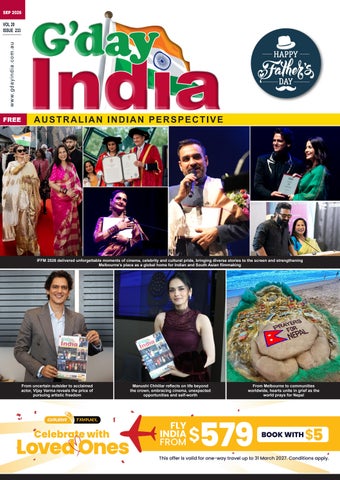
IFFM 2026 delivered unforgettable moments of cinema, celebrity and cultural pride, bringing diverse stories to the screen and strengthening Melbourne’s place as a global home for Indian and South Asian filmmaking
From uncertain outsider to acclaimed actor, Vijay Varma reveals the price of pursuing artistic freedom
Manushi Chhillar reflects on life beyond the crown, embracing cinema, unexpected opportunities and self-worth
From Melbourne to communities worldwide, hearts unite in grief as the world prays for Nepal
G’DAY INDIA | SEP 2026
2
www.gdayindia.com.au | M: 0412-114-383
G’DAY INDIA | SEP 2026
www.gdayindia.com.au | M: 0412-114-383
3
NEWS VICTORIA
4
G’DAY INDIA PTY LTD FOR
NEWS, FEATURES, EDITORIAL, COMMENTS, REPORTS, FEEDBACK & ADVERTISING
CALL: TONEE SETHI Tel: (03) 9841 6263 Mob: 0412 114 383
G’DAY INDIA | SEP 2026
A Wilson Government will fast-track permits and licenses for Victorian businesses
Email: info@gdayindia.com.au Postal Address: PO BOX 1500, Doncaster East, VIC, 3109
Editor in Chief: Tonee Sethi E: editor@gdayindia.com.au Advertising: Amandeep Sethi E: info@gdayindia.com.au Contributors:
Anmol Anand, Debasree Das, Dileep Narayan, Dr Raj Kotharu, Gary Nair, Harpal Sandhu, Manjit Sethi, Narisa Dawar, Sanchita Abrol, Karthik Arasu, Abhi Narayan, Gurpal Singh, Monisha Iswaran, P. Harsora, Nandita Chakraborty, Archita Baweja, Barinderjeet Kaur, Gurpal Singh, Muktesh Chibber, Shivani Prabhu, Payel Ghosh Disclaimer: Opinions published in G’Day India are not necessarily endorsed by the publisher. No advertising design or material is to be reproduced without the written consent of the editor. All copyrights reserved to G’Day India. Articles, pictures, photographs and advertisements accepted by G’Day India Pty Ltd are on the understanding that the supplier of such materials has obtained all the relevant copyrights, permissions and grants permission to G’Day India Pty Ltd to publish them. Any liability arising from failure to obtain such permission lies entirely and exclusively with the supplier. Qualities of products and services advertised in G’Day India are not guaranteed by G’Day India Pty Ltd.
MELBOURNE, Sep 1: Under a Jess Wilsonled Government, Victoria’s maze of 79 separate local business laws will be replaced with one clear set of sensible, statewide rules. Businesses will also be given a single front door to state government. The plan targets an approvals process that can cost Victorian businesses months of delays and thousands of dollars before they serve a single customer. As part of our team’s plan to make Victoria the best place to do business, a Jess Wilson-led Government will: Standardise local business laws across Victoria, lifting model provisions for footpath trading, skip bins and construction sites into state legislation. Councils will continue to administer and enforce these rules and will not be financially disadvantaged by the transition to a consistent, statewide framework. • Turn Service Victoria into a genuine onestop shop, where a restaurant can lodge a single application covering planning, food registration, footpath trading and liquor licensing, provide its information once, and track every approval on one platform against published processing times. • Establish a Business Approvals Concierge, providing a single statewide point of contact to coordinate approvals, resolve delays and settle conflicting advice businesses receive from different arms of government. The Concierge will work directly with councils and state agencies to resolve bottlenecks, rather than creating another layer of bureaucracy or bypassing councils. • Modernise planning rules for homebased businesses, lifting caps on business floor space and commercial vehicles, and allowing the display of goods, the in-person sale of goods made off-site, and customer collection of goods bought online, as long as the relevant council
www.gdayindia.com.au | M: 0412-114-383
is satisfied there will be no adverse impact on neighbourhood amenity. Existing heritage protections will be maintained, ensuring reforms will not compromise heritage places or important local character. The announcement builds on the Liberals and Nationals’ ten-year economic plan. The plan includes no new or increased taxes, scrapping the emergency services tax, lifting the payroll tax threshold to $1.2 million by 2028-29, cutting the metropolitan payroll tax rate to 4.8% from 2030-31, lifting the land tax threshold to $300,000 over five years, introducing a $50 weekly toll cap for two years from 1 July 2027, and restoring energy choice to businesses by enabling new conventional gas projects and establishing an Energy Security Requirement. Leader of the Opposition, Jess Wilson, said: “Victorian businesses should be spending their time serving customers, not filling in multiple forms or navigating different websites. “Our plan means one set of sensible rules, one application, and one team to help small businesses get going. “Victoria needs a fresh start, and my team has a plan to deliver it.” Shadow Minister for Small Business and Local Government, Bev McArthur, said: “Everywhere I go, businesses tell me the same thing: government needs to be an enabler, not a blocker. “You shouldn’t need a lawyer to put chairs on a footpath or put a skip bin on a construction site. “We can make it easier to do business without leaving councils worse off or compromising the heritage and character of our communities. “We have worked closely with small businesses and councils to develop this plan, because the people dealing with red tape every day are the ones who know best how to cut it.” (MEDIA RELEASE)
G’DAY INDIA | SEP 2026
More trains, more seats and greater capacity for Melbourne’s west
MELBOURNE, Sep 1: Commuters across Melbourne’s booming western suburbs will get more trains, more seats and greater capacity under a major announcement from Jess Wilson’s Liberal and Nationals team. A future Liberal and Nationals Government will invest $1.7 billion to deliver 25 new hybrid electric trains for the Melton and Wyndham Vale lines. This investment will finally deliver suburban rail services for these communities and means additional, potential City Loop services every hour during peaks on the Melton and Wyndham Vale lines, increasing passenger capacity by more than double. Labor promised to electrify the Melton and Wyndham Vale lines in both 2018, and 2022 – yet eight years later, these communities are still reliant on V/Line diesel trains. Under our team’s plan, the trains will be electric, with hybrid capability allowing them to operate on existing electrified and nonelectrified lines across the suburban network. Importantly, this commitment doesn’t preclude electrification of the Melton and Wyndham Vale lines upon completion of the upgrades to Sunshine station but delivers
electrified train services to these communities sooner. A Liberal and Nationals Government will also establish a new and independent Public Transport Victoria (PTV) board to ensure Victoria’s public transport system is fully focused on better service delivery for commuters and taxpayers.
www.gdayindia.com.au | M: 0412-114-383
5
Leader of the Opposition, Jess Wilson said: “My Liberal and Nationals team has a plan to get Melbourne’s west moving. “Labor has twice promised and twice failed to deliver the modern train services communities across Melton and Wyndham Vale deserve. Labor says one thing before an election then does another afterwards. “Our plan will deliver metro-quality train services to Melbourne’s west sooner – meaning more trains, more seats and greater capacity.” Shadow Minister for Public Transport, Matthew Guy, said: “Suburban passengers need suburban trains. Labor has promised electrification but broken it time and again, our Liberal and Nationals team will deliver more trains, more seats and greater capacity for Melbourne’s west. “Our hybrid suburban trains will deliver metro-quality services now and are able to run seamlessly across both electrified and non-electrified train lines. “The only way to deliver the quality train services Melton and Wyndham Vale communities deserve is to change the government this November.”
(MEDIA RELEASE)
6
LOCAL LAUNCH
G’DAY INDIA | SEP 2026
BIBA Arrives in Australia:
Iconic Indian Fashion Brand Opens Its First Store at Westfield Fountain Gate A new chapter begins for Indian fashion retail as BIBA brings its celebrated style to Australian shoppers
A
new chapter in Indian fashion retail is set to begin as BIBA, one of India’s most recognised fashion brands, opens its first Australian store at Melbourne’s Westfield Fountain Gate on September 12, 2026. The landmark launch brings BIBA’s distinctive interpretation of contemporary Indian fashion directly to Australian consumers, marking a significant milestone for the brand and the growing presence of Indian fashion within Australia’s mainstream retail landscape. Leading this exciting new chapter are Meetali and Abhishek Jain, founders of BIBA Melbourne, who are bringing the established Indian fashion label to Australian shoppers and creating a new destination for contemporary Indian clothing. Founded in 1988, BIBA has grown into a household name in India, with more than 430 stores across 150 cities. The brand has also established an international presence
in markets including the USA, Canada, UAE and Malaysia. Its arrival in Australia represents another important step in its global journey. The new BIBA store at Westfield Fountain Gate offers Australian customers the opportunity to experience the brand in person—discovering its collections, colours, craftsmanship and contemporary take on Indian style without having to shop online or wait for their next trip overseas. The launch also carries significance beyond BIBA itself. With Indian fashion and jewellery retailers now establishing a presence within Westfield Fountain Gate, the centre is beginning to emerge as a destination where shoppers can find important elements of the Indian occasion-wear experience under one roof. For Australia’s growing Indian and South Asian communities, the arrival of BIBA represents greater access to fashion that reflects heritage while embracing modern lifestyles. For the wider Australian market, it offers an invitation to discover the richness, versatility and contemporary appeal of Indian fashion. The opening could also signal a broader shift in the Australian retail sector. As established Indian brands increasingly look towards international expansion,
www.gdayindia.com.au | M: 0412-114-383
their move from predominantly online and overseas shopping into permanent Australian retail spaces could reshape how Indian fashion is experienced and purchased in the country. For Meetali and Abhishek Jain, the opening is both a business milestone and the beginning of an exciting new journey for BIBA in Australia. BIBA at Westfield Fountain Gate opens on September 12, 2026—bringing the colour, creativity and contemporary spirit of Indian fashion to Australia. GDI
COMMUNITY PULSE
G’DAY INDIA | SEP 2026
7
New Health Hub Opens in Springvale South Multidisciplinary centre brings general practice, allied health, mental health and specialist services under one roof.
MELBOURNE, Aug 29: A new multidisciplinary Health Hub has officially opened at 578 Springvale Road, Springvale South, giving local families easier access to a wide range of healthcare services in one location. Six years in the making, the purpose-built centre was founded by experienced general practitioner and educator Dr Manish Bhasin. The facility brings together Doctors on Springvale, Health Buddies, Cure N Care, pathology, radiology and specialist consulting services. Doctors on Springvale will provide bulk-billed GP services, including childhood vaccinations, chronic disease management, skin cancer care, pain management and general family healthcare. Allied health services include physiotherapy, osteopathy, exercise physiology and Pilates. The centre will also offer access to psychologists, psychiatrists, behavioural psychologists, paediatricians and other specialists. Planned radiology services include CT scans, ultrasounds, X-rays and DEXA scans, along with selected interventional radiology procedures for pain management. Dr Bhasin said Springvale South was chosen for its multicultural community and the need to
make specialist healthcare more accessible. “Many patients currently have to travel elsewhere to see specialists or access diagnostic services,” he said. “We wanted to bring those services closer to the people who need them.” Dr Bhasin brings almost 20 years of Australian general practice experience to the centre. He and his colleagues are also medical educators affiliated with the University of Melbourne.
www.gdayindia.com.au | M: 0412-114-383
The project’s four doctor partners are Dr Manish Bhasin, Dr Jitendra Kumar, Dr Santosh Gone and Dr Bharat Saluja. “Our aim is to provide accessible, highquality healthcare and add genuine value to the community,” Dr Bhasin said. Health Hub 578 Springvale Road, Springvale South, VIC 3172 Tel: (03) 75 047 599
8
NEWS AUSTRALIA
G’DAY INDIA | SEP 2026
NSW Premier Chris Minns visits Nadiadwala Grandson Entertainment, Sajid Nadiadwala announces three films to be shot in Australia
MUMBAI, Sep 3: Premier Chris Minns visited Nadiadwala Grandson Entertainment's Mumbai office, where producer Sajid Nadiadwala announced a three-film deal to shoot upcoming productions in Australia, including ‘Heyy Babyy 2’. The announcement marks another step in the production house's association with Australia and comes as Nadiadwala Grandson Entertainment looks to strengthen its production ties with the country through a collaboration with Sydney-based TEMPLE. The three-film deal includes ‘Heyy Babyy 2’, the sequel to the 2007 comedy ‘Heyy Babyy’. The original film was also shot in Australia, making the upcoming production a return to a country that was part of the franchise's first instalment. Minns, who was in India from August 31 to September 3, toured the Nadiadwala Grandson Entertainment office and interacted with the team before the announcement of the three-film deal, as per the press release. Speaking on the development, Sajid Nadiadwala said Australia offers a favourable environment for filmmakers. "Australia is not only breathtakingly beautiful, but also an incredibly film-friendly country with a highly professional, efficient and welcoming environment for filmmakers. From our directors, to EP had all had a fantastic time shooting there, and the support and warmth extended to our team made the entire process truly memorable," he said in a
statement. "The experience has encouraged us to look at Australia as a key destination for our future productions, and we are now looking forward to taking three of our upcoming films there to shoot. It is a country we would be delighted to return to, time and again," Nadiadwala added. "It was also our pleasure to host Premier Chris Minns at Nadiadwala Grandson Entertainment and engage in a meaningful conversation about our future productions especially now that there is a co-production treaty," he said. NSW Premier Chris Minns said the decision by Nadiadwala Grandson Entertainment to shoot three films in Australia was a positive development for the state's screen industry. "Nadiadwala Grandson Entertainment is one of the great names in Indian cinema, so having them choose Australia for three upcoming films is a big vote of confidence in our screen industry," Minns said. "They've had a long relationship with Australia, including filming the original ‘Heyy Babyy’ here almost 20 years ago, and we're really pleased they want to come back," he added. Minns said the productions would create opportunities for local crews, creatives and businesses while showcasing New South Wales to Indian audiences. "These are big productions that employ a lot of people, from local crews and creatives
www.gdayindia.com.au | M: 0412-114-383
to businesses on the ground, while putting NSW in front of audiences right across India. We've got incredible locations, world-class crews and a strong Indian community," he said. "We want to make NSW an easy choice for Indian filmmakers looking to shoot their next big production," Minns added. Australian filmmaker Anupam Sharma, who has supported Nadiadwala Grandson Entertainment's plans in Sydney and was involved in the first ‘Heyy Babyy’ shoot, also welcomed the development. "Sajid Nadiadwala and his crew not only brought the biggest ensemble of stars to NSW ever, they also left the fondest memories with their professionalism and respect for the Australian way of working. It is a delight to be working with them again at a time when the Co-Production Treaty is providing substantial benefits for AustralianIndian co-productions," Sharma said. The latest announcement builds on Nadiadwala Grandson Entertainment's previous filming experience in Australia and comes amid efforts to strengthen collaboration between the Indian and Australian film industries. Nadiadwala Grandson Entertainment, which has completed 75 years in the entertainment industry, continues to build on its multi-generational legacy under Sajid Nadiadwala's leadership. (ANI)
G’DAY INDIA | SEP 2026
9
India, Australia have huge potential for cooperation in critical minerals, high-tech metals: NSW Premier Chris Minns
NEW DELHI, Aug 31: India and Australia have significant opportunities to deepen cooperation in critical minerals and high-tech metals, with New South Wales looking to strengthen economic ties and support India's growing industrial requirements, said New South Wales Premier Chris Minns. Speaking at the Energy Transition, Critical Minerals and High-Tech Metals meeting in New Delhi, Minns highlighted the potential for greater collaboration between the two regions, particularly in the mining and resources sector. He said New South Wales, Australia's largest state, has a strong presence in sectors such as technology, biomedicine,
education and mining, and shares a strong relationship with Indian industries. "It's a big economy, but whilst we have big sectors in technology, biomedicine and education, we are world leaders in mining," Minns said. He further noted that several engineers trained in New South Wales have gone on to work with Indian firms, reflecting the existing links between the Indian mining sector and companies in the Australian state. Highlighting areas of cooperation, Minns said there is "great complementarity" between India's critical minerals goals and New South Wales' resources potential. He pointed to minerals identified under the
www.gdayindia.com.au | M: 0412-114-383
state's Critical Minerals and High-Tech Metals Strategy, including copper, gold, rare earths, scandium, silver and metallurgical coal deposits. "Whether it's a customer or an investor in New South Wales, there are wonderful opportunities in the New South Wales economy and it is exciting for us because we see India as the fastest growing large economy in the world, being dependent on a lot of those critical deposits," he said adding New South Wales wants to help Indian industries achieve their full potential by leveraging the advantages available in the state. "We want to see the relationship, the economic relationship, meet its full potential. I think there's the signs of a strong opening relationship, and obviously there's the presence of Indian firms in New South Wales," he said. However, he added that to see the relationship grow, particularly in line with the projected growth of the Indian economy, "we probably need to make the relationship deeper and stronger." He also highlighted ongoing cooperation with Indian public sector undertakings, saying New South Wales is looking forward to further exploration opportunities in the region.
(ANI)
10
NEWS AUSTRALIA
G’DAY INDIA | SEP 2026
India, Australia discuss deepening army-to-army cooperation, training
CANBERRA, Sep 3: India's High Commissioner to Australia, Nagesh Singh, on Thursday met Lieutenant General Susan Coyle, Chief of the Australian Army and discussed the strong and growing defence partnership between both nations. "High Commissioner of India Nagesh Singh met Lieutenant General Susan Coyle AM CSC DSM, Chief of the Australian Army, and congratulated her on assuming the leadership of the Australian Army," the High Commission of India in Canberra stated on X. "Discussions focused on the strong and growing India-Australia defence partnership, deepening army-to-army cooperation, training
and exchanges, and further strengthening collaboration towards a secure and stable Indo-Pacific," it added. Last month, India and Australia reaffirmed their strong maritime partnership and discussed further strengthening cooperation between the navies of the two nations. The discussions were held during a meeting between High Commissioner Singh and Australia's Chief of Navy, Vice Admiral Matthew Paul Buckley. It was the first meeting between the two officials after Vice Admiral Buckley assumed the leadership of the Royal Australian Navy (RAN) on July 7, succeeding Vice Admiral Mark Hammond. "High Commissioner of India Nagesh Singh paid a courtesy call on Vice Admiral Matthew Buckley AM CSC RAN, Chief of Navy, Royal Australian Navy, on his assuming the leadership of the RAN," the Indian High Commission in Australia posted on X. "The meeting reaffirmed the strong IndiaAustralia maritime partnership and discussed further strengthening cooperation and engagement between the Indian Navy and Australian Navy," it added. Earlier in August the Indian and Australian navies held discussions on strengthening
www.gdayindia.com.au | M: 0412-114-383
operational interoperability and expanding bilateral cooperation in capability building and training, with a focus on further deepening maritime collaboration between the two countries. The discussions were held during the 17th Navy-to-Navy Staff Talks between the Indian Navy and the Royal Australian Navy in Sydney from August 11-12. The Indian Navy spokesperson said: "The 17th Indian Navy-Royal Australian Navy Navy-to-Navy Staff Talks were held in Sydney from 11-12 Aug 26, co-chaired by RAdm Sachin Reuben Sequeira, ACNS (FCI), and RAdm Christopher Smith, Commander Australian Fleet. Building on the strong India-Australia maritime partnership, discussions focused on enhancing operational interoperability, increasing the complexity of bilateral exercises, and advancing cooperation in capability building and training." "The engagement reaffirmed the shared commitment of Indian Navy and Australian Navy towards a stronger and more interoperable maritime partnership," it added. (IANS)
G’DAY INDIA | SEP 2026
11
Indian envoy Nagesh Singh meets South Australia leadership
CANBERRA, Sep 4: India's High Commissioner to Australia Nagesh Singh held a meeting with South Australia's Minister for State Development Chris Picton and discussed opportunities to further strengthen economic ties through trade and investment, critical minerals, defence, space, education, technology and innovation sectors. "High Commissioner of India Nagesh Singh met the Minister for State Development Hon. Chris Picton MP. They discussed existing India-South Australia economic ties, and opportunities to strengthen it further through trade and investment,
critical minerals, defence, space, education, technology and innovation sectors," the Indian High Commission in Canberra wrote on X after the meeting. Singh also participated in a Trade and Investment Roundtable facilitated by Adelaide's Department of State Development. "High Commissioner of India Nagesh Singh participated in a Trade and Investment Roundtable facilitated by Department of State Development, Adelaide. Discussions explored opportunities to further expand India-South Australia trade, investment and business partnerships across sectors," the High Commission wrote on X. He met the team of 'Study Adelaide' and interacted with several Indian international students. Singh was briefed about Study Adelaide's initiatives to help international students on arrival, the contribution of Indian students to South Australia's education ecosystem and the India-Australia education partnership. The High Commissioner also held a meeting with South Australia's Assistant Minister for Copper, Steel, Critical Metals and Minerals, Lawrence Ben, with discussions focused on building cooperation between the
www.gdayindia.com.au | M: 0412-114-383
two sides in resilient supply chains, critical minerals, copper and steel. During the meeting, Ben appreciated contribution of the Indian diaspora in building people-to-people ties and further strengthening the India-South Australia partnership. In his meeting with South Australia's Minister for Multicultural Affairs, Nadia Clancy, Singh held discussions focused on various aspects of Indian culture, the importance of people-to-people ties, and the Indian community as an important cultural bridge between India and South Australia. He also called on South Australia's Governor Frances Adamson and discussed opportunities to deepen cooperation in various sectors. "They reflected on the strong and growing India-Australia relationship, its future aspirations, opportunities to deepen the cooperation across diverse sectors and significance of India-South Australia especially in the fields of education, space, critical minerals and defence," the Indian High Commission in Canberra posted on X. (IANS)
12
NEWS WORLD
G’DAY INDIA | SEP 2026
When the Mountains Unleashed Their Fury A catastrophic glacier collapse unleashed a wall of water, rock and ice through northern Nepal, destroying entire communities and leaving thousands of families waiting for news of the missing
Nepal is confronting one of the deadliest natural disasters in its recent history after catastrophic flash floods tore through the Himalayan nation on the morning of 26 August 2026. The disaster began near the Nepal-Tibet border, where scientists believe a large section of glacier collapsed at an altitude of approximately 5,200 metres. The falling
mass of ice and rock plunged more than a kilometre into the Lhende Khola valley, reportedly blocking the river before releasing an immense surge of water, boulders and mud. The torrent swept into the Bhote Koshi and Trishuli river system, gathering force as it travelled downstream. Within minutes, settlements, markets, roads, bridges and
hydropower facilities were overwhelmed. Rasuwa and Nuwakot were among the worst-hit districts, with widespread damage also reported across Dhading, Gorkha and Tanahun. The border settlements of Timure and Syabrubesi were virtually erased, while destruction continued along the Trishuli Valley. The World Meteorological Organization said preliminary evidence indicated that an ice-and-rock avalanche may have created a temporary river blockage before unleashing the devastating surge. As of 4 September, Nepalese authorities had confirmed at least 1,250 deaths, while more than 4,200 people remained missing. The figures have continued to change as isolated communities are reached and bodies are recovered from layers of debris. At least 583 foreign nationals, many believed to be pilgrims or trekkers, were among those unaccounted for. Reuters reported that more than 9,300 Nepalese Army personnel had been deployed across the disaster zone. Particular concern surrounds approximately 900 workers believed to be missing around six damaged hydropower projects. Some may have sought refuge inside tunnels, but collapsed access roads, unstable ground and enormous deposits of rock and mud have made rescue operations dangerously slow. Specialists from India, China, South Korea and the United States have joined efforts to locate survivors. The scale of destruction is staggering. Authorities estimate that 7,500 homes have been completely washed away or buried, while approximately 20,000 houses may need to be rebuilt in safer locations. A preliminary United Nations Development Programme assessment calculated that the floods left at least 2.2 million tonnes of debris across the affected areas. More than 4,500 displaced people are sheltering in 38 relief centres, where shortages of medicine, clean water and cash are adding to their hardship. Temporary zip lines have been installed across sections of the Trishuli River because bridges and regular transport routes have disappeared. UNICEF estimates that 65,000 people have been affected, including more than 22,000 children requiring urgent water, sanitation and hygiene assistance. The immediate search for survivors continues, but Nepal’s attention is also turning towards an immense rebuilding challenge. The tragedy has exposed the growing danger facing Himalayan communities as warming temperatures destabilise glaciers, steep mountain slopes and river systems. For thousands of Nepalese families, however, the crisis remains painfully personal: homes have vanished, livelihoods have been buried, and loved ones are still missing.
(AGENCIES)
www.gdayindia.com.au | M: 0412-114-383
G’DAY INDIA | SEP 2026
13
Victoria Unites for Nepal: Major Flood Vigil in Melbourne
Melbourne’s Nepalese community mourns flash-flood victims as Victoria and Australia mobilise humanitarian assistance
tarpaulins and shelter tools. Australia deployed advisers, consular officers, Defence personnel, Australian Federal Police and a 15-member Disaster Assistance Response Team. Specialist drone operators from New South Wales and Queensland were sent to produce aerial maps and images supporting Nepal’s search operations. Australians donated more than $4 million through the Emergency Action Alliance, while the Australian Red Cross supported relief and familyreconnection services. The Federation Square memorial reflected both grief and generosity. Yet its overwhelmingly Nepalese attendance also highlighted a challenge: ensuring that multicultural solidarity reaches beyond communities when tragedy strikes. (AGENCIES)
MELBOURNE, Aug 30: On Sunday evening, several thousand members of Melbourne’s Nepalese community gathered at Federation Square to honour those killed in Nepal’s catastrophic flash floods. The vigil, held beneath the message “Victoria Unites For Nepal”, transformed the square into a sea of battery-operated candles, flowers and quiet reflection. Political and community leaders joined a diaspora mourning the dead and awaiting news. Victorian Premier Ben Carroll announced $100,000 in emergency assistance, assuring the community that Nepal was not alone. Victoria’s Multicultural Minister, the Shadow Multicultural Minister, a Victorian Multicultural Commission representative and Nepal’s Consul-General in Melbourne also addressed the gathering, expressing sympathy and solidarity. The vigil came as Australia expanded its response. By 4 September, the Australian Government had committed $11 million in humanitarian assistance, including funding for food, shelter, healthcare, sanitation, clean water and temporary learning spaces. A Royal Australian Air Force C-17 transported 23.9 tonnes of supplies, including hygiene kits, solar lights, phone chargers,
www.gdayindia.com.au | M: 0412-114-383
14
FEATURE
G’DAY INDIA | SEP 2026
Siyer Unveils 'Flow of Nectar', a Powerful Journey Through Sacred Sound
I
ndo-Australian singer, composer and performer Siyer (a.k.a. Shriram) has released his new album Flow of Nectar, a contemporary take on timeless devotional chants. Built around soulful vocals, minimal arrangements and ambient textures, the album creates a meditative soundscape that is peaceful yet powerful. Each track invites listeners to slow down, turn inward and reconnect with a sense of stillness. The seven-track album features: 1. The Journey (Ram Lakshman Janaki) 2. The Sacred Name (Bolo Raam) 3. Cosmic Silence (Mahadev) 4. Forty-Tude (Hanuman Chalisa) 5. The Call of Krishna (Radha Radha) 6. The Unshaken (Hanumaana) 7. Surrender (Jo Aagya) For Siyer, Flow of Nectar is also deeply personal. While exploring ways to manage the impact of sleep apnoea in his own life, he became increasingly interested in stillness, relaxation and calming sound. That journey inspired him to create music that could help create an atmosphere conducive to rest and reflection. Siyer shares, “Flow of Nectar comes from a very personal journey of finding stillness. I wanted to create music that quietens the mind and creates a space for deep rest and relaxation. It is not a treatment for sleep apnoea, but an expression of my own search for calm. Something I could turn to myself and share with others.”
Siyer’s career includes more than 700 live performances across Australia, including at the Melbourne Cricket Ground, Sydney Cricket Ground and St Kilda Festival. He is the first Indian-Australian to be featured on a GRAMMY® nominated album, Shayan by Charu Suri, and won the World Entertainment Awards’ Best Global Traditional Album in 2026 for Rain of Bhakti (Timeless Mantras). With five studio albums and collaborations with artists including Shankar Mahadevan, Udit Narayan and Sadhna Sargam, Siyer continues to build a distinctive space for Indian-rooted music on the global stage. With ‘Flow of Nectar’, Siyer continues his exploration of Indian spiritual and musical traditions, but approaches them through a sonic language that is contemporary and accessible. In an increasingly fastpaced world, ‘Flow of Nectar’ arrives with a deliberately different proposition. For Siyer, the power of the album lies not necessarily in asking
www.gdayindia.com.au | M: 0412-114-383
listeners to do anything, but in giving them permission to simply be. The chants are ancient. The soundscape is modern. And somewhere between the two lies the stillness that inspired the album. ‘Flow of Nectar’ Ancient in its roots. Global in its sound. Peaceful yet powerful. It is music to reflect with, breathe with, unwind with or simply be with. GDI
G’DAY INDIA | SEP 2026
15
LEGACY Leaves Melbourne Audiences Spellbound — and Calls for an Encore
MELBOURNE, August 2026: There was little time for the artists of Chandrabhanu Bharatalaya to pause after the success of LEGACY – Odissi Festival. Within days, the company moved from celebrating four acclaimed performances to rehearsing for Mavi Rasa’s Bharata Natya Arangetram on August 22. Staged at Darebin Arts Centre on August 1, 2 and 8, LEGACY celebrated the 60th birthday of Krushna Chandra Ray while honouring the extraordinary artistic legacy created by Dr Chandrabhanu OAM and Ray through Odissi dance and music. The festival drew enthusiastic audience responses, with praise for the dancers’ professionalism, sophisticated staging, costumes, lighting and music. Several audience members described LEGACY as the company’s best production yet.
A major highlight was Dashamahavidya, featuring seven senior Odissi dancers — Anu Pande, Anupriya Ravindran, Jayshree Khoosal, Nidhya Sakathevan, Priya Chakraborty, Roshni Vellore and Soumya Veeraraghavan. First taught to the dancers last year, the demanding work returned with greater depth and maturity, as the performers increasingly internalised its complex spiritual and philosophical dimensions. The following week brought Navadurga, with nine dancers portraying the divine manifestations of Goddess Durga in a powerful and moving ensemble performance. Another major success was the premiere of Ravana Tandava Stotram, featuring a new musical composition by Krushna Chandra Ray and choreography by Dr Chandrabhanu. Enhanced by Dr Chandrabhanu’s lighting design and insightful commentary, the work emerged as one of the festival’s grandest moments. Across four performances, audiences experienced four Pallavi ensemble works
www.gdayindia.com.au | M: 0412-114-383
and eight Ashtapadis from Jayadeva’s Geeta Govinda, performed by accomplished soloists. The demanding repertoire also placed enormous demands on the musicians, who mastered and rehearsed numerous complex scores within a remarkably short period. The production celebrated the breadth of the Odissi tradition, incorporating Sanskrit songs, sacred verses and shlokas alongside music in the Odia language. For Ambika Docherty, the festival also marked a deeply personal return to the stage after almost two decades — an experience that rekindled a long-dormant part of her artistic identity. Adding another emotional dimension was the restoration of an original Ganesha artwork by the late Geoffrey Goldie, created in the early 1970s as one of his first stage designs for Chandrabhanu. Its unveiling on opening night prompted an immediate gasp and applause from the audience. With more than 20 works presented, LEGACY explored only a fraction of the vast body of work created by Chandrabhanu and Krushna Chandra Ray. The response has already suggested what comes next: LEGACY Part 2.
(GDI)
16
DIWALI LEGACY
G’DAY INDIA | SEP 2026
Celebrate India Marks 21 Years of Diwali at Federation Square Melbourne’s Festival of Lights returns with culture, music, dance and fireworks
F
ederation Square will come alive with colour, culture and community when Celebrate India presents the 21st Victorian Festival of Diwali on Saturday, 31 October 2026. The free, day-long celebration will bring Victorians together for an exciting showcase of Indian culture. The program will feature colourful folk and classical performances, Bollywood dancing, live music and Bhajan jamming. Visitors can also participate in yoga, meditation and Bollywood dance workshops, while children can enjoy craft activities, a magic show and interactive entertainment. Artists from Bangladesh, Sri Lanka, Nepal, Vietnam and other communities will join Indian performers for collaborative music and dance presentations, reflecting Melbourne’s rich multicultural identity. A festival bazaar will showcase
handicrafts, jewellery and traditional products, alongside food stalls offering flavours from different regions of India. The celebration will conclude with a spectacular fireworks finale over the Yarra. To mark the festival’s 21st year, some of Melbourne’s most iconic landmarks will be illuminated in purple and pink. The full list of participating landmarks will be announced closer to the event. The festivities will begin early with Dance for Diwali Season 6, proudly sponsored by AIA Health Australia. Running from 14 to 30 September, the competition invites Victorians to share a Diwali-inspired dance for the opportunity to perform at Federation Square. Celebrate India is also proud to support Kids Helpline as its charity partner, helping raise awareness of youth mental health and wellbeing. The festival is supported by City of
www.gdayindia.com.au | M: 0412-114-383
Melbourne, Federation Square, Government of India, AIA Health Australia, Carbone Lawyers, Aussizz Group, Indya Food, Asia Pacific Group, Remitly, Gaura Travels, Channel 31, Radio Hanji and G’day India. Event: 21st Victorian Festival of Diwali Date: Saturday, 31 October 2026 Venue: Federation Square, Melbourne Website: celebrateindia.org.au
G’DAY INDIA | SEP 2026
www.gdayindia.com.au | M: 0412-114-383
17
G’DAY INDIA | SEP 2026
18
Getting married in Australia
G’Day Mate !
Important notes for Celebrant’s separate meeting with each party The celebrant should not say anything that may expose the party to risk. Instead, consider following up with the party if celebrant have concerns. Remember that other people may read celebrant’s emails, text messages or may listen to their voice messages, so it is important to limit such communications requesting that the party contact you. For privacy and safety reasons, celebrant should not contact third parties such as family members of the party, interpreters etc., without the express consent of the party. Separate meetings are to take place in a culturally appropriate context and in line with the preferences of the party. It can be in a public setting provided the privacy of the conversation can be maintained. This could be a public space agreed to by the party, such as a coffee shop or similar venue. The meeting should be held in a way in which the
www.gdayindia.com.au | M: 0412-114-383
party feels safe, respected, and comfortable. People from different cultures and backgrounds may have different requirements including preferences about where to meet, whether they bring a trusted person with them, and how they wish to engage with you. If the celebrant is unsure, ask the party what they need and whether your expectations and proposed approach to the meeting is acceptable to them. If you have further questions, you may contact me on 0425 853 086 or navee64@ gmail.com
LEGAL
G’DAY INDIA | SEP 2026
Testamentary capacity and suspicious circumstances – Last Will
19 19
BY GURPAL SINGH
One of the preconditions of a valid will is that the testator had testamentary capacity at the time when will was made. That the testator - understands the nature of the act and its effects; understands the extent of the property of which one is disposing; able to comprehend and appreciate the claims to which one ought to give effect; and, with a view to the latter object, no disorder of the mind poison one’s affections, prevent his sense of right, or prevent the exercise of one’s natural faculties – that no insane delusion shall influence one’s will in disposing of the property and bring about a disposal of it which, if the mind had been sound, would not have been made. The courts have time and again reinforced the test being authoritative to encompass the elements to include the capacity to understand the nature of the act of making a will and its effects; the capacity to understand the extent of the property the subject of the will; the capacity to comprehend moral claims of potential beneficiaries; and the absence of mental disorders or delusions which affect the testator’s “mental faculties to make them unequal to the task of disposing of their property. The test of testamentary capacity needs application in a task-specific way. The simpler the will, the easier it will be to establish testamentary capacity. In a recent case of Pusterla aged 92 executed a will few weeks prior to her death raised an important question as to the integrity of the whole transaction in preparation and signing the will bypassing
previous five wills executed by the testator in previous years. The testator didn’t have any contact with the solicitor who drew the will rather all the transaction in preparing was handled by her stepson who liaised with the solicitor and provided necessary instructions. The Judge ruled that this conduct itself make the whole exercise as ‘suspicious’ and make the will invalid. The case raises concerns over the wills made without necessary contact between the testator and the solicitor drafting the will on some conspicuous instructions other than the testator. The courts are troubled by a solicitor preparing a will for someone whom they never met. The onus is cast on the proponent of the will to remove the suspicion by positively proving that the testator instructed, knew, and approved the contents of the will.
However, in the case of Pusterla, the court found that the solicitor was instrumental in preparation and execution of the document; in arranging the document, the solicitor was arranging the will to be signed in which stepson ‘Smith’ was bestowed all the estate for himself in serious contrast with previous five wills in which he was not provided with anything. The testator did not speak or communicated with the solicitor about her intentions and willingness to change her will and provided no such instruction to the solicitor. Interestingly, the testator chose not to rely upon the solicitors she had trusted and used for many years and allowed the associates of the present solicitor to witness the document. The testator was not given an opportunity to seek legal advice in relation to the changing the will and was not allowed to read and have time to consider or reflect on the benefits of changing the will whereby all the previous charities were removed as beneficiaries despite the lifelong association of the testator with those organisations. Also, the will seemed irrational as it bore no relationship to any will which the deceased had ever made before. This case raises significant concerns about ONLINE wills as it’s not often possible to show who has submitted the information. It further implies that one need to provide much greater evidence of the checks and balances at the time of the instructions, preparation and signing of the document. It is therefore advised that the proper use of technology be taken and all transaction video graphed. Don’t go for the quick or cheap wills. Seek proper legal advice. By Gurpal Singh
Gurpal Singh is the principal lawyer of Melbourne law firm, Saundh Singh & Smith Lawyers | W: www.sssl.com.au
www.gdayindia.com.au | M: 0412-114-383
20
IFFM 2026
G’DAY INDIA | SEP 2026
A Celebration of Cinema, Culture and Shared Humanity
T
he curtain came down on the 17th Indian Film Festival of Melbourne (IFFM) on August 23, bringing to a close eleven days of cinema, celebrity, culture and conversation across Melbourne and regional Victoria. Held under the powerful theme “Shared Stories, Shared Humanity,” the festival once again demonstrated why it has become one of the most significant celebrations of Indian and South Asian cinema outside India. From Rekha’s celebrated presence and flag-hoisting at Federation Square to Rani Mukerji’s 30 Years in Cinema celebration, the festival brought some of Indian cinema’s most recognisable names together with emerging filmmakers and independent voices. The programme featured 79 feature films and 56 short films across 35 languages, reflecting the extraordinary diversity of the subcontinent’s storytelling traditions. The awards were equally reflective of this diversity. Rishab Shetty emerged as one of the major winners, taking Best Director and the Leadership in Cinema honour, while Dulquer
Salmaan won Best Actor and Kirti Kulhari Best Actress. Lokah Chapter 1: Chandra took Best Film, while Rima Das’s Not a Hero was recognised as Best Indie Film. The festival also celebrated streaming talent, with Vijay Varma and Rasika Dugal receiving acting honours for their series work. Beyond the red carpet, IFFM 2026 broadened its cultural reach through Indigenous Indian cinema, Pride programming, low-sensory screenings, filmmaker conversations and Regional Rhapsody screenings in Geelong, Bendigo and Shepparton—taking Indian storytelling beyond Melbourne's CBD and into regional Victoria. The festival's closing night provided a fitting final note. Benu Bindra’s Graveyard Shift, a world-premiere short about the loneliness and resilience of immigrant women in Melbourne, was paired with Tannishtha Chatterjee’s Full Plate, starring Kirti Kulhari—a story exploring identity, discrimination, family and a woman's fight for independence. Ultimately, IFFM 2026 proved that its
www.gdayindia.com.au | M: 0412-114-383
greatest strength lies not simply in bringing India's stars to Melbourne, but in bringing India's many voices to the world. From mainstream cinema to regional, Indigenous, independent and emerging storytelling, the festival offered a richer portrait of contemporary India—while creating a shared cultural space for Australian audiences and the Indian diaspora. As the lights dimmed on August 23, one message remained clear: when stories cross borders, humanity finds common ground. G’day India
G’DAY INDIA | SEP 2026
www.gdayindia.com.au | M: 0412-114-383
21
22
IFFM 2026
G’DAY INDIA | SEP 2026
Stars, Stories and Standout Moments IFFM 2026 brought star power, cultural pride and powerful storytelling to Melbourne. Here are the defining moments from a festival that celebrated Indian cinema in all its diversity.
Bipartisan Funding Pledges Secure IFFM’s Future Victoria’s major political parties have pledged significant funding to support the future of the Indian Film Festival of Melbourne (IFFM). Labor has committed $600,000 over two years to continue the festival and expand regional screenings in Geelong, Bendigo and Shepparton. The Victorian Liberal and Nationals Coalition has offered $2.8 million over four years, providing $700,000 annually to support the festival’s growth, attract international talent and strengthen cultural and screen-industry ties between Victoria and India. Both commitments recognise IFFM’s cultural, economic and tourism value, although delivery depends on the outcome of the Victorian election.
Rani Mukerji Honoured for Three Decades of Excellence Bollywood star Rani Mukerji received a Special Citation for Excellence in Acting at the Indian Film Festival of Melbourne 2026, celebrating her remarkable 30-year contribution to Indian cinema. The honour recognised her memorable performances, enduring connection with audiences and role in bringing Indian stories to the global stage. From Black and Hum Tum to Mardaani and Mrs Chatterjee vs Norway, Mukerji’s career has been distinguished by powerful portrayals of women marked by strength, courage and emotional depth.
Rekha Hoists Indian Flag at Federation Square Bollywood icon Rekha led India’s Independence Day celebrations at Melbourne’s Federation Square during the 2026 Indian Film Festival of Melbourne. Joined by actor Pankaj Tripathi, members of the Indian diaspora, Australian dignitaries and film personalities, she hoisted the Tricolour before singing Jana Gana Mana with the gathering. Rekha’s visit also celebrated her remarkable cinematic legacy. She received IFFM’s Excellence in Cinema Award, while her acclaimed 1981 classic Umrao Jaan, which earned her the National Film Award for Best Actress, was screened during the festival.
www.gdayindia.com.au | M: 0412-114-383
G’DAY INDIA | SEP 2026
Double Honour for Rishab Shetty at IFFM 2026 Actor-filmmaker Rishab Shetty received the Best Director Award for Kantara: Chapter 1 and the Leadership in Cinema Award at the Indian Film Festival of Melbourne 2026. The recognition celebrated his creative vision and contribution to Kannada cinema. Shetty dedicated the honours to his filmmaking team, Kannada cinema and the cultural traditions that inspire his stories. A prequel to the 2022 blockbuster Kantara, the film explores the origins of Daiva worship in Tulunadu while depicting the struggle to protect its forest, tribal communities and spiritual heritage.
Dulquer Salmaan Shines at IFFM 2026 Dulquer Salmaan was among the major highlights of IFFM 2026, winning Best Actor for his acclaimed performance in Kaantha. His production Lokah Chapter 1: Chandra also received the Best Film award, strengthening his reputation as both an accomplished performer and an ambitious producer. Salmaan further surprised fans by making an unannounced appearance during the Independence Day celebrations and unveiling the first-look teaser of his new film I’m Game, drawing an enthusiastic response from the crowd.
Mitu Bhowmick Lange: Connecting Cultures Through Cinema IFFM Founder and Festival Director Mitu Bhowmick Lange AM has transformed the festival into one of the world’s leading celebrations of Indian and South Asian cinema. The 2026 program presented more than 130 films across 35 languages, championing diversity, inclusion and emerging storytellers under the theme Shared Humanity, Shared Stories. “At IFFM, we believe that great storytelling transcends language, geography and identity,” Lange said. She described cinema as a powerful bridge between cultures, capable of encouraging empathy, expanding perspectives and reminding audiences of the humanity that unites them.
Together, these highlights made IFFM 2026 a celebration not only of cinematic excellence, but also of identity, inclusion and shared humanity. The festival once again demonstrated the remarkable power of storytelling to cross borders, connect communities and bring India and Australia closer together. - G’day India
www.gdayindia.com.au | M: 0412-114-383
23
24
IFFM 2026 INTERVIEW
G’DAY INDIA | SEP 2026
The Quiet Roar of Vijay Varma From an uncertain outsider to one of India’s most compelling screen performers, Vijay Varma speaks about his struggle, artistic freedom and the price of following a dream ones beside him during major moments in his own life. It is a difficult but unavoidable price he has paid for his career. The early years brought long periods without substantial work or recognition. One of his hardest lessons came through Monsoon Shootout, in which he played the lead. The film remained unreleased for several years, while Varma turned down other opportunities in anticipation of its arrival. “Don’t wait for one thing to work. Keep moving,” he said. Even a project that does not transform an actor’s life, he explained, can provide another month of survival or become a stepping stone towards something greater. Today, success has given Varma the freedom to be selective. He does not see fearlessness as accepting everything that comes his way, but as choosing without the anxiety that refusing one role could end his career. He is equally determined to avoid being stereotyped. “I want to have fun while shooting something,” he said. “I don’t want to do something I’ve already done before.” Varma described an actor through a striking observation once shared by his friend and fellow FTII alumnus Jaideep Ahlawat: an actor is like a prism. The actor does not create the light; the light touches them and emerges in many colours. Their task is simply to remain clear and correctly positioned.
When Vijay Varma appeared in the short film ‘Shor’ in 2008, he was still a student at the Film and Television Institute of India. Eighteen years later, the actor has certainly made enough “Shor” for audiences far beyond Bollywood to take notice. Speaking with G’day India during the Indian Film Festival of Melbourne 2026, Varma reflected on a career shaped not by overnight success, but by persistence, difficult choices and a refusal to repeat himself.
are intimate, realistic and distinctive.
“I don’t know whether I’ve made enough ‘Shor’,” he joked, “but I’ve made enough noise for people to at least whisper good things about me.”
His journey into the film industry was anything but conventional. Born into a Marwari family, Varma was expected to remain at home and join the family business. Leaving to pursue acting meant breaking a pattern followed for generations.
Varma believes the growing international appetite for Indian cinema has allowed more diverse stories to travel. While traditional song-and-dance Bollywood has long enjoyed global recognition, he says audiences are now embracing Indian films and series that
With acclaimed performances across cinema and streaming, Varma has found himself at the forefront of that change. Yet success has not diminished his curiosity. “As I grow older, I feel there are more possibilities within me,” he said. “I’ve lived a little more and learned more about people, places and relationships. I understand art better now than I did as a young adult.”
For Varma, the biggest sacrifice has been living away from his family. Following his dream meant missing important family celebrations and not always having his loved
www.gdayindia.com.au | M: 0412-114-383
Among those who illuminated his own artistic path, Varma named the late Irrfan Khan as his greatest inspiration. “We’ve never had anybody like him,” he said. “He walked so that all of us could walk too.” Australia, meanwhile, first entered Varma’s imagination through cricket and cinema. He grew up watching matches from Melbourne, Sydney and Brisbane, but it was Dil Chahta Hai—released during his teenage years—that gave him another memorable glimpse of the country. In Melbourne, Vijay Varma won the Best Performance (Male) – Series award at the Indian Film Festival of Melbourne (IFFM) 2026 for his role in Matka King. Varma stood as proof that the outsider can not only enter the frame but transform it—quietly, patiently and in colours entirely his own. Tonee Sethi
IFFM 2026 INTERVIEW
G’DAY INDIA | SEP 2026
25
Manushi Chhillar: Beyond the Crown, a Career Led by the Heart From Miss World to the movies, Manushi Chhillar speaks at IFFM2026 about unexpected opportunities, delayed beginnings and discovering a sense of worth beyond success a deeper examination of how easily personal worth can become connected to external validation. A high achiever at school, she excelled academically, participated in extracurricular activities and represented her school in numerous competitions. Winning Miss World and returning home to offers from leading filmmakers appeared to continue that pattern of achievement. “When things keep going well, you start attaching your worth to those external outcomes,” she reflected. Cinema challenged that mindset. Delayed projects and results that did not always match her expectations taught Chhillar to separate her identity from the commercial fate of her films. Rather than allowing a Friday boxoffice result to define her, she began asking more personal questions: Does she still look forward to arriving on set? Does she enjoy performing? Does she value the people with whom she collaborates? The answer remains an emphatic yes. Despite difficult situations and occasional disappointments, Chhillar says she continues to love being in front of the camera. She is also conscious of how uncommon such an opportunity is for a young woman from her background. “I’ve started seeking joy,” she said. “I don’t attach my value as an individual to my films anymore.”
When Manushi Chhillar won the Miss World crown in 2017, a future in Bollywood was not part of a carefully constructed career plan. Raised in a family where success traditionally meant becoming a doctor, engineer, lawyer or civil servant, acting had always seemed far removed from her reality. Yet life after Miss World presented possibilities, she had never seriously considered. Speaking with G’day India during the Indian Film Festival of Melbourne (IFFM 2026), Chhillar described her journey into cinema as “neither accidental nor premeditated”. “I wanted to be Miss World because Miss World was my dream,” she said. “I never thought it would become a platform for entering films.” Although former Miss World winners had successfully transitioned into acting, Chhillar was too young to have closely followed their
journeys. By the time she began watching their work, they were already established stars. It was only after returning to India and receiving offers from prominent filmmakers that she began to see acting as a genuine possibility. Chhillar signed her first film only months after winning the pageant, but her Bollywood debut in Samrat Prithviraj did not arrive until 2022. The five-year gap was not due to a lack of opportunity. The scale of the historical production required a lengthy filming schedule, and when the global pandemic struck, approximately 15 per cent of the shoot remained unfinished. With cinemas closed and production suspended, her debut was delayed by more than two years. The interruption was an early lesson in the unpredictability of an industry where careers, relationships and public perceptions can change rapidly. For Chhillar, it also prompted
www.gdayindia.com.au | M: 0412-114-383
She now views herself as an instrument in the hands of a director—someone willing to train, work hard and deliver what the role requires. Once the work is complete, however, she wants to return home, spend time with family and friends, and reconnect with the person beyond the performer. Looking five years ahead, Chhillar has a clear ambition. She hopes to reach a position where creative instinct alone determines the films she accepts—not money, commercial calculations or the names attached to a project. “The most beautiful decisions are made when they come from your heart and not your mind,” she said. For Chhillar, the crown may have opened the door, but the journey ahead is about something more enduring: building a career defined not by external approval, but by purpose, freedom and joy. Tonee Sethi
26
IFFM 2026 - SILENT COURAGE
G’DAY INDIA | SEP 2026
When Silence Works the Graveyard Shift
In her deeply personal debut film, Melbourne-based filmmaker Benu Bindra turns the hidden struggles of migrant women into a powerful story of courage, survival and hope
When Graveyard Shift premiered on the closing night of the Indian Film Festival of Melbourne (IFFM2026), Benu Bindra felt excitement, pride and nervousness, but above all, relief. The ten-minute short film took almost two years to reach the screen. Bindra wrote and directed it while also playing one of its central characters. With no formal training in screenwriting, directing or acting, it marked an extraordinary leap into the unknown. “I still have to pinch myself,” she says. “I never imagined I would become a filmmaker.” Bindra moved from Amritsar to Melbourne almost 18 years ago as an international student. Today, she works in cybersecurity with the Victorian Government and is raising her two-year-old son as a single mother. Growing up in a conservative Punjabi family, Bindra loved dancing and dreamed of becoming an actor. Her father was uncomfortable with her entering show business, but she now recognises that his resistance came from a desire to protect his daughters. He died in a road accident soon after she moved to Melbourne and never witnessed this chapter of her life. Inspired by true events, Graveyard Shift follows two migrant women facing different forms of isolation. One is an international student struggling with grief and the pressures of life overseas. The other appears to have a secure home, marriage and career, but behind closed doors is trapped in an abusive relationship. “On paper, every box seems to be ticked,” Bindra says. “But underneath, there is so much more happening.”
Drawing from her own experiences and situations affecting people close to her, Bindra made one character Indian and the other Filipino to show that abuse is not confined to one culture or community. The film unfolds without dialogue, relying on images, sound and performance. Bindra believed spoken words could over-explain the women’s experiences and restrict the audience’s interpretation. “Film is a visual medium,” she says. “If we can tell the story through images, then dialogue is not always necessary.” Produced independently without funding, the film demanded persistence. Casting was difficult, with some performers reluctant to be associated with its confronting subject matter. Bindra eventually stepped into one of the roles herself. Above all, Graveyard Shift is intended to offer hope. Bindra wants those experiencing abuse to understand they do not deserve it and that the cycle can be broken. Now developing a feature film about a migrant family in Melbourne, Bindra is ready to continue telling stories inspired by the city she calls her second
www.gdayindia.com.au | M: 0412-114-383
home. Her debut explores life’s darkest hours, but its final message is unmistakably one of light. Tonee Sethi
IFFM 2026 STORY - INDIE SPIRIT
G’DAY INDIA | SEP 2026
27
The Noise Behind the Lights Rohan Bakshi and Jaskirat Singh Bhatia illuminate the secrets and struggles of a Delhi family in their striking debut feature, Diwali Ke Shor Mein
Speaking with G’day India following the film’s Australian premiere at the Indian Film Festival of Melbourne (IFFM2026), producer and DOP Jaskirat Singh revealed that the story began as three separate narratives connected by a common theme. “As I continued writing, they gradually became one story told from three different perspectives,” Writer Rohan Bakshi said. The chaos of the narrative, including its unsettling exploration of gun culture, reminded him of the Diwali celebrations he had witnessed growing up in Delhi. Setting the entire story across one festival day gave the film both its structure and restless energy. For Bakshi, Delhi is more than a backdrop. Its neighbourhoods, social tensions and complicated family relationships give the film its distinct identity. “It is difficult for me to imagine this story taking place anywhere else,” he said. The film also marks an important creative milestone for producer, cinematographer and colourist Jaskirat Singh Bhatia. He and Bakshi met while studying at Whistling Woods International in Mumbai, where they discovered that their creative instincts complemented one another. Bakshi arrived at filmmaking after studying commerce and attending a ten-day filmmaking course in Delhi. During the COVID lockdowns, he made several short films at home with his family and limited resources. Bhatia, meanwhile, moved away from engineering after recognising that his lifelong fascination with cameras was more than a hobby. That independent spirit became essential when making Diwali Ke Shor Mein. Financed largely through crowdfunding from friends and family, the production relied heavily on goodwill. Neighbours offered locations, friends supplied food, and family members stayed until the early hours of the morning to appear as extras.
The filmmakers surrendered their own fees and completed principal photography in roughly 20 to 23 days, followed by several additional days of patchwork. Post-production took another seven to eight months. The process was not without difficult decisions. Guided by mentor Paresh Kamdar, the team drastically shortened the final portion of the film after being told its ending was too drawn out. They did, however, trust their instincts on one critical choice: preserving the film’s open ending. Bhatia represented the film at its Melbourne premiere after Bakshi’s visa application was rejected. Before the screening, his greatest fear was simple: that nobody would come. Instead, he found himself facing a strong and engaged audience. “For the first half, I was watching the audience,” he recalled. “Then I decided to stop
www.gdayindia.com.au | M: 0412-114-383
worrying and enjoy the film.” For both filmmakers, the premiere represented more than international recognition. It affirmed a partnership built on persistence and a refusal to be discouraged by those who believed they were too young or inexperienced to make a feature film. When the noise of Diwali Ke Shor Mein finally fades, Bakshi hopes audiences will remember its gripping story, recognisable characters and emotional truth. For him and Bhatia, the film will also remain something deeply personal: the first decisive step in what they hope will be long filmmaking careers. Tonee Sethi
28
HEALTH
G’DAY INDIA | SEP 2026
FAULTY GENE COPY CAN MAKE THE HEART’S DNA FOLD THE WRONG WAY
Researchers have discovered that a gene linked to congenital heart disease acts like an architect for the heart’s DNA, and losing just one copy can cause its carefully organised 3D structure to fold incorrectly, potentially leading to birth defects.
The study, published in Science by researchers at the Gladstone Institutes, offers fresh insight into why some children develop congenital heart disease even when they still have one healthy copy of the TBX5 gene. Congenital heart disease is the world’s most common birth defect, affecting about one in every 100 babies. While TBX5 has long been known to help switch on genes needed for heart development, scientists have now found that it also organises the genome’s three-dimensional structure inside heart cells. Rather than acting only as a genetic “on-off switch,” TBX5 helps fold DNA into the correct shape, allowing distant stretches of DNA to connect with the
genes they regulate. When one copy of TBX5 is missing—a condition known as haploinsufficiency—that structure begins to break down.
“Many different birth defects might happen for the same reason: the cell’s 3D instruction manual simply gets folded the wrong way,” said senior author Dr Benoit Bruneau, director of the Gladstone Institute of Cardiovascular Disease. Mapping the Heart’s 3D Genome The team studied human stem cells that were transformed into heart muscle cells. Some cells had two working copies of TBX5, while others had one or none. Using high-resolution 3D genome mapping and advanced computational analysis, researchers examined millions of data points from thousands of individual cells. They found that reducing TBX5 by half was enough to disrupt DNA organisation at multiple levels, including large DNA compartments, smaller domains and chromatin loops that help activate important heart-development genes.
www.gdayindia.com.au | M: 0412-114-383
TBX5 was also found to guide a molecular protein called cohesin, which creates these crucial DNA loops. Without enough TBX5, the loops failed to form properly, preventing key genes from switching on at the right time. Why Heart Defects Can Differ One of the study’s most surprising findings was that individual heart cells did not all respond the same way. Atrial and ventricular heart cells reacted differently, and even cells of the same type showed variation. Researchers say this could help explain why people carrying the same TBX5 mutation can develop different types of heart defects. The team believes this mechanism could extend beyond heart disease. If confirmed, it suggests that some birth defects may result not only from faulty genes but from the way DNA is physically folded inside cells, opening new avenues for future research into developmental disorders.
(ANI)
G’DAY INDIA | SEP 2026
29
LOW-FAT VEGAN DIET MAY HELP WEIGHT LOSS WITHOUT EATING LESS A low-fat vegan diet may help people lose weight without counting calories, reducing portion sizes or constantly feeling hungry, according to new research published in JAMA Network Open. In a 16-week randomised clinical trial involving adults with overweight, participants following an unrestricted low-fat vegan diet consumed about 357 fewer calories per day, despite eating nearly the same amount of food by weight as before. The diet focused on fruits, vegetables, grains and legumes, while excluding meat, dairy and eggs. Participants were not given calorie targets or instructed to limit their portions. Researchers found that the diet reduced the energy density of food—the number of calories contained in each gram—by about 30%. Greater reductions in energy density were associated with lower calorie intake and greater weight loss. “Plant foods are rich in water and fibre, so you can fill your plate, feel full, and still take in fewer calories,” said Hana Kahleova, MD, PhD, director of clinical research at the Physicians Committee for Responsible Medicine and lead author of the study, as quoted by ScienceDaily. Same Amount of Food, Fewer Calories The trial compared adults following an
ad libitum low-fat vegan diet with a control group that made no dietary changes. Neither group was asked to count calories or restrict food intake. Although the total weight of food consumed did not change significantly, calorie intake fell by approximately 357 kcal per day in the vegan group. Energy density remained largely unchanged in the control group but declined by around 30% among those following the vegan diet.
Researchers also found that greater reductions in energy density were linked to greater weight loss, even after accounting for changes in calorie intake. The difference was largely attributed to replacing calorie-dense animal products with water- and fibre-rich plant foods, particularly vegetables and legumes. These foods generally contain fewer calories per gram, allowing people to eat satisfying portions while consuming less energy. “This isn’t about willpower or smaller portions,” Kahleova said. “It’s about choosing foods that naturally deliver fewer calories in every bite.” Why Energy Density Matters Energy density refers to the number of calories in a given weight of food. Foods with high water and fibre content generally have lower energy density and can provide greater food volume for fewer calories. The researchers suggest that shifting toward lower-energy-density foods may offer an alternative approach to weight management, rather than relying solely on calorie counting or portion restriction. However, the study was limited to 16 weeks and does not establish that a vegan diet is suitable or effective for everyone. Longer-term research is needed to assess whether the effects can be maintained. The findings suggest that changing the types of foods eaten—toward more waterrich, high-fibre plant foods—may help reduce calorie intake and support weight loss without deliberately eating smaller portions. (ANI)
www.gdayindia.com.au | M: 0412-114-383
30
HEALTH
G’DAY INDIA | SEP 2026
Daily Glass of Fruit Juice May Be Linked to Lower Depression Scores A daily glass of 100% fruit juice or a smoothie, as part of a healthier diet, may help support mental well-being, according to a small four-week trial by researchers at Newcastle University in the UK. The randomised controlled trial involved 42 adults who typically consumed two or fewer portions of fruit and vegetables a day. Participants were randomly divided into three groups of 14. One group continued their usual diet, while the other two received financial and educational support to increase their intake to five portions of fruit and vegetables a day. One of the intervention groups was also asked to include a daily glass of 100% fruit juice or a smoothie. After four weeks, both intervention groups had increased their fruit and vegetable intake. However, those who included fruit juice or smoothies recorded significantly lower depression scores compared with the control group. Their depression scores were 2.52 points lower on a 27-point scale—an adjusted mean score of 2.93 compared with 5.45 in the control
group. Researchers described the difference as modest but statistically significant. The peer-reviewed findings were published in the British Journal of Nutrition. The study was funded by the Fruit Juice Science Centre. Dr Courtney Neal, who conducted the research while at Newcastle University and is now at the University of Liverpool, said simple and affordable options such as a small glass of 100% fruit juice or a smoothie could help people overcome barriers to achieving the recommended five daily portions. Fibre Intake Also Increased Dietary assessments suggested that both groups receiving dietary support increased their daily fibre intake by an estimated 8–10 grams. This indicates that adding juice did not prevent participants from consuming other fibre-rich fruits and vegetables. Researchers also reported no adverse effects on metabolic health markers after four weeks among participants consuming fruit juice or smoothies. Dr Oliver Shannon, Lecturer in Nutrition and
www.gdayindia.com.au | M: 0412-114-383
Ageing at Newcastle University and a senior study author, said the findings were promising, particularly amid the cost-of-living pressures that can make fresh produce less affordable. “The finding that fruit juice drinkers had reduced depression scores is promising and worthy of further exploration,” he said, noting that previous research has also reported potential benefits of citrus juices for brain blood flow and cognitive function. Study Limitations The researchers emphasised that the trial was small and lasted only four weeks. The findings therefore do not establish that fruit juice directly prevents or treats depression. Larger and longer-term studies will be needed to determine whether the association is sustained and whether fruit juice itself is responsible for the improvement. The study nevertheless suggests that practical dietary changes that help people increase their overall fruit and vegetable intake may have potential benefits for mental wellbeing. (ANI)
G’DAY INDIA | SEP 2026
31
Weight regain after dieting may be driven by brain biology, research finds Losing weight is not simply a matter of willpower. New research suggests the human brain is biologically programmed to defend body fat, making it difficult for many people to maintain weight loss even after successful dieting. According to an article published by The Conversation, the human brain evolved to protect energy reserves during periods of food scarcity. While this mechanism once helped early humans survive, researchers say it now works against people living in environments where calorie-dense food is widely available and physical activity is less common. The researchers explain that when a person loses weight, the body responds as though it is facing a threat to survival. Hunger signals increase, food cravings become stronger and the body reduces its energy expenditure in an effort to conserve fat stores. The article also highlights findings from recent research suggesting that the brain can effectively “remember” a person’s previous higher body weight. Once the body has reached a heavier weight, the brain may begin treating that weight as its normal state and attempt to restore it after weight loss. “The fact that our bodies have this capacity to ‘remember’ our previous heavier weight helps to explain why so many people regain weight after dieting,” the authors wrote. They added: “This weight regain is not due to a lack of discipline; rather, our biology is doing exactly what it evolved to do: defend against weight loss.” The researchers say these biological mechanisms help explain why maintaining longterm weight loss is often more challenging than losing weight in the first place. The article also discusses newer obesity medications such as Wegovy and Mounjaro, which work by mimicking gut hormones that signal the brain to reduce appetite. While these treatments have shown promise for many patients, the authors note that they are not effective for everyone. Some people experience side effects, while others see limited benefit. In many cases, weight can return after treatment ends as the body’s biological signals resume. Researchers believe ongoing advances in obesity and metabolism research could eventually lead to therapies that reduce the brain’s drive to regain lost weight, even after medication is stopped. Beyond medications, the authors stress that health should not be measured solely by body weight. They point to evidence showing that regular exercise, sufficient sleep, balanced nutrition and good mental well-being can improve heart and metabolic health even when
body weight changes little. The article also argues that obesity requires a broader public health response rather than being viewed solely as an individual responsibility. Suggested measures include healthier school meals, limiting junk food marketing aimed at children, designing communities that encourage walking and cycling, and standardising restaurant portion sizes. Researchers are also focusing on early childhood, from pregnancy through around seven years of age, when the body’s weight regulation systems are considered especially adaptable. According to the article, parental
www.gdayindia.com.au | M: 0412-114-383
diet, infant feeding practices and early lifestyle habits may all influence how the brain regulates appetite and fat storage later in life. The authors conclude that obesity should be understood as “a biological condition shaped by our brains, our genes, and the environments we live in.” They add that advances in neuroscience, pharmacology and preventive public health strategies are creating new opportunities for improving obesity treatment and reducing future risk. (ANI)
G’DAY INDIA | SEP 2026
32
RAJPAL YADAV REITERATES HIS DEDICATION TO CINEMA AMID FINANCIAL STRUGGLES Rajpal Yadav described himself as an artist who is deeply committed to Indian cinema and believes that his financial difficulties should not become a reason to diminish an artist’s reputation or entire career. Rajpal Yadav called himself a student of Indian cinema and a responsible actor of the world. While referring to his cheque bounce case, the actor said that his temporary financial or legal struggles should not overshadow an artist’s identity or dedication to his career. Rajpal Yadav said, “I am dedicated to my career. I am an art student of Indian cinema. If I owe money to 100-200 people in the last 30-40 years, from the village to here, then it will reach their homes. It doesn’t matter, because I know where it is. But I would like to say that when the fund is in trouble, how can they bet on the artist’s entire bio-data? Rajpal Yadav, whether in trouble or in goodness, he gets 500 selfies clicked at every airport. Rajpal is such a responsible actor of this world. No one can buy me for 5 crores, 10 crores, 100 crores, 250 crores because I have been sold in the name of art since childhood. No one can buy me for money. Believe me on this.” He continued, “I know because we are the disciples of Bharat Muni. We grew up listening to his plays. I always remember one line of Daddaji, that life is a journey, a stage. We are born in this. Gradually, as you grew up, you became a character. The journey between life and death, some live for 100 years, some live for 75 years. I n that, you can examine yourself and see what you did, what was good and what was bad. “ Rajpal Yadav described himself as a priest of theatre and films and expressed his intention to present his complete journey from 2000 to 2026 through his work, showing what he has achieved and contributed over the years. “So, in my life journey, taking the journey of acting, taking the journey of acting, in which I am a priest of theatre and films, even if you call it a loss, whatever you call it, but 100% I will definitely make
something and give it to you, so that you can see what Rajpal has done from 2000 to 2026. It may take a year or two for that. I said from the first day that I was never lost. Neither by making films, nor by making a house, nor by making a career,” said Rajpal Yadav. “I am saying from the first day, I always say, that I have a lot of love for this world, and I have my entire Indian film industry and Indian theatre. I live in that,” added Rajpal Yadav. In July, the Delhi High Court upheld the conviction and sentence of Bollywood actor Rajpal Naurang Yadav and his wife Radha Rajpal Yadav in multiple cheque dishonour cases arising out of a financial dispute with Murli Projects Pvt. Ltd. According to the judgment, Rajpal Yadav repeatedly sought time to arrange funds and, both personally and through
www.gdayindia.com.au | M: 0412-114-383
his senior counsel, assured the Court on several occasions that he was bound to repay the complainant. Relying on these assurances, the Court granted him repeated adjournments and extended protection by suspending his sentence. However, the Court found that despite multiple opportunities spread over a considerable period, Yadav failed to honour the undertakings furnished before the Court, forcing it to eventually direct him to surrender before the jail authorities. Although further indulgence was later shown after certain payments were made, no final settlement could ultimately be reached. On the work front, Rajpal Yadav was last seen in the film ‘Welcome to the Jungle’ alongside Akshay Kumar, Suniel Shetty and others in the lead roles. (ANI)
G’DAY INDIA | SEP 2026
33
AMITABH BACHCHAN ON FAILING EXAM, IFS DREAM ON KBC 18 Megastar Amitabh Bachchan took a candid trip down memory lane on Kaun Banega Crorepati Season 18, recalling his academic struggles and revealing that he once wanted to pursue a career in the Indian Foreign Service.
Many contestants come here saying that they want to appear for the UPSC examination. The Foreign Service is a very beautiful field. And let me tell you something, there was a time when I too had the thought of pursuing the IFS. But I didn’t even know the ‘I’ of IFS, so I gave up and left the idea.
The megastar shared the anecdote while speaking about his younger days and his experiences during his graduation. He recalled how his father, legendary poet Dr Harivansh Rai Bachchan, had emphasised the importance of completing graduation.
The conversation was prompted by contestant Pragati Kalpekar, who spoke about her ambitions and her plans to continue her education. When asked how she intended to use her prize money, Pragati said that she wanted to pursue her studies and work towards becoming an IFS officer.
Back in our time, my father used to tell me that completing graduation was very important. I had taken science, and in the very first lecture, everything I had studied in school over 10 years was covered.
I want to continue my studies, and I want to become an IFS officer, the Indian Foreign Service. It has always been my wish to become an IFS officer because you get a maroon passport and it says ‘Diplomat’ on it.
I thought I had made a mistake by choosing the subject and failed the examination. Then, through what we called ATKT, I managed to pass by just two marks. Amitabh Bachchan also recalled that there was a time when he had considered appearing for the civil services and pursuing the Foreign Service. However, he admitted that he was not familiar enough with the field to take the idea forward.
Pragati’s aspirations thus led Bachchan to share his own long-standing memories of considering the Foreign Service and his struggles during his student years. (IANS)
ANUPAM KHER SHAVES OFF HIS MOUSTACHE FOR NEW ROLE Actor Anupam Kher is all set to be seen in a new avatar in one of his upcoming projects. For the character, the veteran actor had to bid goodbye to his signature moustache. While shaving off his moustache wasn’t easy, as it has always given him a sense of comfort, Kher is now enjoying his new look and seems to be liking the transformation. “I rarely shave off my moustache. It has always given me the comforting feeling that, technically, I do have hair!! But a film demanded a new look, so the moustache had to make the sacrifice. And I must confess... I’m quite liking these pictures without it! What do you think? Should the moustache make a comeback, or enjoy an extended holiday? #HairTodayGoneTomorrow #Moustache,” Kher posted, sharing a few pictures in which is seen flaunting his new look. Though Kher did not reveal which film he shaved off his moustache for, it appears that the new look could be for his 555th film.
www.gdayindia.com.au | M: 0412-114-383
The actor shared a poster on Instagram, announcing his “landmark 555th film”. However, he did not reveal the title, cast or any other details about the project, asking fans to wait for the right time.
Sharing the announcement, Kher wrote that he had been keeping the news to himself for some time and wanted to reveal it only when the time was right. “ANNOUNCEMENT!!Some things are better kept close to the heart for a little while!! Because the joy of revealing them at the right time is something else!,” he wrote. Kher then revealed that the upcoming project will mark his 555th film. He also asked fans to enjoy the suspense along with him until more details are announced. “So, for now, all I will say is: I am delighted to announce my landmark 555th film. Details at the right time. Till then, please allow me to enjoy the suspense too! Jai Ho!,” the actor added.
(ANI)
G’DAY INDIA | SEP 2026
34
NO CAREER WITHOUT WOMENCENTRIC FILMS: TAAPSEE PANNU Bollywood’s stellar performer Taapsee Pannu seems to not mince words, even if it meant about stating facts about her career. The actress openly admitted that she would not have had a career like hers if women-centric films had not been made, further also adding that she has never been offered roles that of conventional and quintessential Bollywood heroines. Talking about women centric movies being made in the industry, Taapsee in an exclusive interview said, “I wouldn’t have had a career like mine if such films hadn’t
been made. Some people had the courage to make it and some people had the courage to watch it. So, that’s why actors like me are still working a little. Some years are good, some are not.” The actress said the industry has come a long way in terms of the frequency of female-led films, while admitting that the journey has not always been consistent. “But if you give up now, maybe it will never change. So, on that hope, me and my colleagues who try and keep attempting it because we have no other option,” she
said. Taapsee also spoke about actresses who have largely found opportunities in challenging, women-led stories rather than conventional heroine roles. “There are many actresses like me, I feel, who don’t get the role of conventional heroines. So, I am not going to be on that higher pedestal and say, ‘I refused those films’. No, I didn’t get it. I have always got challenging movies and I chose the one that I liked,” she said. The actress further said that the success of one female-driven film is celebrated as one unit as it gives investors’ confidence to back more such projects. “We are in this hope that it will work. That’s when even one of them works. So, trust me, all of us celebrate it. Because we feel, at least one has worked. At least, investors will have hope that, yes, such films work. So, let’s invest in a little more,” she said. She further added, “Everyone feels the failure of one of them is a setback. Because if one of them fails, everyone feels, then our project should not get dropped. Because people should not feel that female-driven cinema is not working,” she added. For the uninitiated, Taapsee has over the years built a filmography around women-led and unconventional stories, with her powerful characters in films such as Pink, Naam Shabana, Mulk, Thappad, Rashmi Rocket, Haseen Dillruba and Dobaaraa amongst many more. She essayed the role of a woman standing up against patriarchal attitudes in Pink and a wife confronting the realities of her marriage and choosing self respect over everything else in Thappad to an athlete fighting societal barriers in Rashmi Rocket, the actress has repeatedly chosen characters that have allowed her to explore different shades of women beyond the conventional heroine. Taapsee is now set to bring that intensity to her upcoming movie, Gandhari, in which she will be seen in an action-packed role while portraying the raw and emotional journey of a mother whose child has been abducted. The film follows her character’s quest to find her child, with Taapsee’s performance combining the physical demands of an action role with the heartbreaking desperation of a mother fighting to bring her child back. (IANS)
www.gdayindia.com.au | M: 0412-114-383
G’DAY INDIA | SEP 2026
35
‘I’VE ACCEPTED THAT MY BODY HAS CHANGED’: LISA RAY ON MIDLIFE FITNESS
Actress and model Lisa Ray has opened up about her approach to fitness in her fifties. She shared how her perspective on exercise, ageing and body image has evolved over the years. In a candid social media post, Lisa emphasized the importance of listening to her body, staying consistent and embracing change. Reflecting on her fitness journey, Lisa said that working out in her 50s “looks very, very different” from how it did earlier. She explained that she once celebrated pushing her body harder but now finds greater value in understanding and listening to it. Sharing a series of her photos, the ‘Four More Shots Please!’ actor wrote, “ Fitness in my 50s looks very,
very different. If I had to boil it down to two things, it’s this: I used to celebrate pushing my body harder. Now I celebrate listening to it better. And secondly: consistency. Which comes easier when you stop exercising for the body you had - and start training for the life you still want.” “The future me who wants to keep dancing, exploring, travelling, carrying her own bags and, ideally, not breaking a bone. But there’s one part of midlife fitness we don’t talk about enough: acceptance. Acceptance isn’t defeat. I’ve accepted that my body has changed. My face has changed. I have changed. I’m not at war with any of it. I’m working with this body. Listening to it better. Loving it deeper. And
www.gdayindia.com.au | M: 0412-114-383
living my PrimeTime out loud,” added Lisa. Lisa Ray had earlier spoken about entering marriage while navigating the aftermath of menopause. In an Instagram post, the actress reflected on how a lack of awareness about the changes in her body affected the early years of her relationship. Lisa revealed that she experienced chemo-induced menopause at the age of thirty-seven. She later met and married her husband at 40, a period she described as challenging as she continued to navigate the physical and emotional effects of menopause. (IANS)
36
FOOD
G’DAY INDIA | SEP 2026
BEYOND BUTTER CHICKEN: HOW INDIAN CUISINE IS CONQUERING THE WORLD From regional recipes and ancient grains to fermentation and fine dining, Indian food is shedding its old global stereotypes—and finding a bold new voice.
For decades, the world’s idea of Indian food could be summed up rather conveniently: curry, naan, samosas, butter chicken and perhaps a vindaloo for the adventurous. But that familiar formula is rapidly becoming yesterday’s menu. Indian cuisine is entering a new global era—one in which region, provenance, technique and storytelling matter as much as spice.
New York and elsewhere that are championing everything from Kerala comfort food to highly technical interpretations of regional Indian classics.
nutritional and environmental credentials. Meanwhile, chefs are forging closer relationships with farmers, fishermen and local producers, making provenance an increasingly important part of the Indian dining experience.
From Spice to Technique Another misconception is finally being Indian Fine Dining Finds Its Seat at dismantled: that Indian food is simply about heat. the Table Perhaps the most significant change is From London and New York to Dubai, Singapore Modern Indian chefs are increasingly presenting psychological. Indian food is no longer asking and Melbourne, diners are discovering that there spice as architecture rather than ammunition. global gastronomy for permission to be taken is no single thing called “Indian cuisine”. There Roasting, tempering, smoking, pickling, slow seriously. are hundreds of culinary traditions shaped by cooking and fermentation are being treated as geography, religion, community, climate and sophisticated culinary techniques. Restaurants such as Dubai’s Trèsind Studio history. Increasingly, restaurants are putting that and Bangkok’s Gaggan have demonstrated that diversity front and centre. Fermentation, in particular, is having a moment. Indian flavours can sit comfortably alongside— Long-established Indian foods such as idli, and challenge—the world’s most ambitious fineThe Rise of the Regional Indian dosa, dhokla, curd and kanji demonstrate that dining traditions. Trèsind Studio was ranked No. Kitchen fermentation has always been embedded 27 in The World’s 50 Best Restaurants 2026 and Perhaps the biggest trend is the move from in Indian food culture. Today, chefs are remains a major force in contemporary Indian generic Indian menus to hyper-regional cooking. rediscovering lesser-known regional ferments for gastronomy. Yet the future may not belong their complexity, acidity and depth. exclusively to white-tablecloth restaurants. Kerala’s Mappila cuisine, Nagaland’s distinctive The real revolution could be happening flavours, Chettinad cooking from Tamil Nadu, Ancient Ingredients, Modern Plates everywhere—from neighbourhood eateries and Kumaoni food from Uttarakhand, Bengali Health and sustainability are also bringing diaspora kitchens to contemporary cafés and seafood and coastal Konkan traditions are traditional Indian ingredients back into the home kitchens. finding new audiences. Diners are becoming spotlight. more curious—and chefs are responding with The world is no longer merely discovering Indian menus that tell a specific story rather than Millets, lentils, indigenous grains, seasonal food. It is discovering India through food. And the attempting to represent an entire country on one vegetables and regional produce are being next chapter promises to be far more diverse, plate. That change is also visible at the highest transformed into contemporary dishes. The regional, sustainable and exciting than the word levels of global gastronomy. Chef Himanshu humble millet, once associated largely with rural “curry” could ever suggest. Saini recently highlighted restaurants in London, diets, is increasingly being celebrated for both its
(GDI)
www.gdayindia.com.au | M: 0412-114-383
G’DAY INDIA | SEP 2026
37
THE HEALING KITCHEN: WHY INDIAN FOOD HAS ALWAYS KNOWN THE POWER OF SPICE
Long before “functional foods” became a global wellness trend, Indian kitchens were quietly combining flavour, fragrance and nature’s most intriguing ingredients. Walk into an Indian kitchen and you are likely to encounter a small army of roots, seeds, bark and leaves: ginger, garlic, turmeric, cumin, coriander, cardamom, cinnamon, cloves, black pepper and fenugreek. They are there to make food taste extraordinary—but their story goes far beyond flavour. For generations, Indian culinary traditions have understood that what makes food delicious can also contribute to wellbeing. Modern nutrition science is now taking a closer look at many of these ingredients and the bioactive compounds they contain. A recent review of clinical research found promising evidence for several commonly used culinary spices, including ginger, turmeric, cinnamon, fenugreek and cardamom, particularly in areas related to inflammation and metabolic health. Ginger: The Warming Root Few ingredients are as versatile as ginger. Fresh, dried, grated or ground, it brings warmth and a gentle heat to curries, dals,
chai and marinades.
at work: black pepper contains piperine, which can increase the absorption of curcumin. Fat can also improve its absorption—another reason turmeric traditionally finds its way into richly flavoured dishes rather than being eaten in isolation.
Its characteristic compounds, including gingerols and shogaols, have attracted considerable scientific interest. Research suggests ginger may be useful for nausea and vomiting and may have antiinflammatory effects, although much of the clinical research has examined supplements A Symphony of Spices rather than ordinary culinary quantities. Cumin brings earthy warmth. Coriander contributes citrusy freshness. Cardamom Garlic: Small Bulb, Big Character perfumes everything from biryani to chai, Crushed into a masala, roasted in a while cinnamon and cloves add sweetness tandoor or slowly cooked with onions, garlic and complexity. Fenugreek contributes its provides one of Indian cuisine’s deepest distinctive bittersweet character. savoury notes. What makes Indian cuisine particularly Its sulphur-containing compounds— fascinating is that these ingredients are particularly those formed when garlic rarely consumed alone. They are layered— is crushed—are being investigated for tempered in oil, roasted, ground, blended cardiovascular effects. Evidence suggests and cooked together. garlic supplements may produce modest reductions in cholesterol and blood pressure Perhaps that is the real genius of the in some people. Indian kitchen. It never needed to choose between Turmeric: The Golden Treasure pleasure and wellbeing. Then there is turmeric—the golden heart of countless Indian dishes. The spices were chosen because they made food irresistible. Their potential health Its colour comes largely from curcuminoids, benefits are an extraordinary bonus—one particularly curcumin, a compound that modern science is still working to fully extensively studied for antioxidant and anti- understand. So, the next time ginger meets inflammatory properties. Human research garlic, turmeric meets black pepper and has found potential benefits in areas such cumin crackles in hot oil, remember you are as osteoarthritis symptoms, although not simply watching dinner being prepared. researchers caution that evidence for many other claimed benefits remains incomplete. You are witnessing centuries of culinary wisdom, one spice at a time. And there is an elegant culinary partnership (GDI)
www.gdayindia.com.au | M: 0412-114-383
38
NUTRITION
G’DAY INDIA | SEP 2026
Bone Strength Down Under:
Keeping Your Frame Solid for the Long Haul BY DEEVYA GUPTA
Living in Australia brings fantastic perks such as: great outdoors, an active lifestyle, and access to incredible fresh produce year-round. Yet beneath the surface, many of us are carrying an overlooked health risk: weakening bone density. Maintaining a strong frame through every stage of life comes down to two key nutrients working in tandem: calcium and vitamin D. Without adequate vitamin D, your gut simply cannot absorb the calcium you consume, regardless of how many dairy products or rich home-cooked dishes sit on your dinner table. The Sunshine Paradox Australia is famous for its bright climate, but vitamin D deficiency remains remarkably widespread here. Melanin acts as a natural shield against UV radiation. This means if you have naturally deeper or darker skin tones, your body requires significantly more sun exposure to produce the same amount of vitamin D compared to someone with fair skin. Combine that with office jobs, modest dressing habits, and essential sun-smart awareness, and many of us end up well below where we need to be. During peak summer, around 10 to 15 minutes of mid-day sun on exposed arms or hands can keep your levels topped up. Come
winter, however, that requirement stretches past an hour—something that rarely fits into a busy weekly schedule. While small amounts of vitamin D exist in egg yolks, oily fish like salmon and mackerel, sun-exposed mushrooms, and fortified milks, food sources alone usually aren't enough to correct a deficiency. For many people, a simple daily supplement advised by a GP or dietitian is the most practical way forward. Hitting Your Daily Calcium Targets Calcium provides the structural framework for your bones and teeth, keeping them dense and resilient as the years roll on. Australian dietary guidelines recommend adults aim for 2.5 to 4 serves of calciumrich foods every day, depending on age and gender. Dairy is a quick way to get there, but it is by no means the only option. One standard serve of calcium looks like:
1 cup (250ml) cow’s milk or calciumfortified plant milk (soy, oat, or almond) 200g tub of plain or natural yoghurt 40g (about 2 slices) of hard cheese 100g (about ½ cup) of firm tofu prepared with calcium salts 100g canned sardines or pink salmon (including the soft bones) Plant foods like dark leafy greens (spinach, kale, mustard greens), raw almonds, and dried figs also supply valuable calcium. While they contain smaller amounts per serving compared to dairy or fortified options, adding them into your everyday cooking helps build up your total daily intake. Practical Steps for Everyday Health Check your baseline: Ask your GP for a blood test to review your vitamin D status before starting high-dose supplements. Check the label on plant milks: If you prefer soy, almond, or oat milk, choose brands that list at least 100mg of added calcium per 100ml. Get smart with sun exposure: Expose forearms and hands during lower-UV periods in winter, balancing bone needs with skin safety. Pair nutrients for maximum benefit: Include healthy fats in meals containing vitamin D, as it is a fat-soluble nutrient that absorbs best with food. Looking after your skeleton today ensures you stay mobile and independent for decades to come, whether that means managing a busy work routine, working in the garden, or playing with your family at the local park. Small, consistent additions to your plate each day make all the difference. (Please note this advice is of a general nature. If you have any concerns or queries you should get tailored advice from an accredited practicing dietitian and always consult with your General Practitioner before making any changes.)
Deevya Gupta is an Accredited Practicing Dietitian in Melbourne | W: www.abcofnutrition.com.au
www.gdayindia.com.au | M: 0412-114-383
RECIPE
G’DAY INDIA | SEP 2026
39
Chicken Jhat Phat Tasty chicken in no time! For a really quick meal try this chicken dish cooked with vegies in a mild sauce.
Serves 2
Making chicken doesn’t has to be always an elaborate process. I have used skinless chicken breast fillet with a mixture of Indian spices and cooked it like Chinese style stir fry! It’s different, tasty, easy, quick and makes a wonderful dish. A must try chicken with vegies
INGREDIENTS 500 gm chicken fillet cubed or sliced handful of beans sliced 1 med red onion sliced 1 red capsicum sliced 1/2 cup sliced mushrooms 1 tbs ginger sliced 1 tsp ground coriander 1 tsp ground chilli 1 tsp ginger/garlic paste each little grated rind of lime (opt) salt to taste olive oil to cook SAUCE
1 cup stock 2-3 tbsp sweet chilli sauce 1 tsp ground all spice 1 tbsp lime juice pinch nutmeg 1 tsp arrowroot or cornflour Salt to taste Olive oil to cook
METHOD
Marinate chicken with ginger,garlic. coriander,chilli and lime rind for about 30 mins. Heat oil in wok or pan. Add sliced ginger, onion and capsicum and stir fry about 2-3 mins. Set aside. In the same wok heat a little oil and stir fry the chicken pieces till tender. Whisk all the ingredients for the sauce in a bowl
and pour over the chicken and mix well. Add the veges to the chicken and toss well. Pour cornflour mixed with 2 tbsp water and cook until thickens.
GARNISH: chopped spring onion or coriander leaves SERVE:
Hot with basmati rice or brown rice.
TASTY TIP
This dish taste best served immediately. You may use tender pork or beef and vegetables of your choice. BY MANJIT SETHI
recipe
from the private collection
LOVE YOUR SNACKS WITH A DIP? STUDY SHOWS IT MAY SPIKE YOUR CALORIE INTAKE
If you are looking to limit your calorie intake, skipping the dip with salty snacks may help, suggests a study. The latest study conducted at the Penn
State Sensory Evaluation Center in the US investigated how eating behaviour changes when consumers are served a dip with a salty snack.
www.gdayindia.com.au | M: 0412-114-383
The findings showed that people who ate chips and dip together had a 77 per cent greater caloric intake, and a faster total eating rate compared to those who just had chips. However, there was no difference in chip intake, revealed the study, forthcoming in the journal Food Quality and Preference. John Hayes, professor of food science and director of the Center said that "people didn't eat fewer chips when dip was available -- they ate the same amount of chips, plus the dip". This means that "adding dip to chips can substantially increase overall energy intake without people realising it", he noted. The study assessed 46 adult participants who were served 70 grams of ranch-flavoured chips, or about 2.5 servings, with or without about a third of a cup of ranch dip. The team found that people ate as many chips as they would without the dip, leading to much greater energy intake when the dip was available. On average, the people consumed 345 calories of chips and dip per eating session as compared to 195 calories of chips alone.
(IANS)
40
ASTROLOGY
G’DAY INDIA | SEP 2026
By D. Narayan (Tantracharya) Mesha (Aries)
Vrishabh (Taurus)
Mithuna (Gemini)
M: 0425 660 220
Karkat (Cancer)
The ensuring month does not augur well for your financial prospects. Any litigation or dispute is bound to be decided against you. Therefore, you should strive to get the decision deferred to a later period. Dealings with government bodies or departments would also be fraught with problems of various kind.
Nothing very auspicious about the augury, for your financial prospects this month. Those dealing with government bodies or departments would have extremely rough sailing and even suffer losses. If dealings can be postponed, do that failing which make whatever allowances you can. Litigations and disputes would also be decided against you.
The outlook for financial gains, is fairly bright this month. Practitioners of the fine arts, would have an extremely satisfying time. Writers, painters, musicians, sculptors and the like can look forward to substantial gains. Those dealing with government can similarly look forward to big profits. The realization of expected gains is a virtual certainty for all of you.
A month full of profitable opportunities, which you should go on to beneficially exploit. Those dealing with government bodies and departments would stand to gain a great deal. Push through any such propositions without loss of time. You would also stand to gain substantially from any litigation or disputes. These would win, for at least some of you, fairly handsome profits.
Best days: 3, 12, 30 Lucky Colour: Red, Orange, Cream
Best days: 9, 18, 27 Lucky Colour: Green, Blue
Best days: 2, 7, 9 Lucky Colour: Red, White, Yellow
Best days: 9, 18 Lucky Colour: Red, Blue
Simha (Leo)
Kanya (Virgo)
Tula (Libra)
Vrishchik (Scorpio)
Nothing very favourable for your financial affairs in the augury, from the stars this month. You would have a lot of difficulty in realizing expected profits. Some hurdle or the other would prevent this. Even small gains would be difficult to come by. Gains from any litigation or disputes would also not be forthcoming.
A pretty bleak scenario, made perhaps more so by the fact that any dispute or litigation that you might be involved in would go against you. You can only try to get the decision deferred to a more auspicious and later period. The climate would also not be congenial for investment or new ventures.
This month you should be able to make a great deal of money, since good fortune would bless your financial prospects. First of all, any dispute on litigation that you might be involved in is virtually certain to go in your favour. Not only that, you would stand to gain financially in a big way, from such a decision.
This month the prospects for your financial affairs are quite bright. Those dealing with Government would stand to gain quite a bit. As would people employed in the steel industry, or trading or dealing in steel goods. There is a distinct possibility that any litigation or dispute that you might be involved in would be decided in your favour.
Best days: 5,3 Lucky Colour: White & Orange
Best days: 3, 12 Lucky Colour: Orange, Green
Best days: 9, 18 Lucky Colour: Red, Blue
Best days: 1, 3, 4 Lucky Colour: Red, Orange
Dhanu (Sagittarius)
Makara (Capricorn)
Kumbha (Aquarius)
Meen (Pisces)
This month you not only have excellent prospects of financial gain, but also the chance of making profits by doing good deeds and in the company of learned people of spiritual stature. Any disputes or litigation that you might be involved in would go in your favour. This means that you should manage your affairs in a manner so that any such disputes come up for decision during this period. Best days: 9, 18 Lucky Colour: Red, Blue
An month during which not only are the prospects for your career advancement nonexistent but if you are not careful you could well come several rungs down the ladder from your present station. There is a distinct possibility that some of you would be inclined to operate outside the law for quick profits. Should this come about, the consequences can only be disastrous.
There is nothing particularly favourable for your financial prospects in the combination of stars, facing you this month. In all your dealings a lack of self- confidence and the ability to take initiatives would be missing. This would make for stagnation and retard all progress. There would also be a storage of any worthwhile opportunities.
Most important, this month you would surely lack whatever normal selfconfidence you possess, and also miss the ability to take the initiative. This would make for stagnation and no growth. The climate would also not be at all congenial for the investment and launching of new ventures, which should be shelved for a more opportune moment.
Best days: 1, 3, 4 Lucky Colour: White, Green, Blue
Lucky Colour: White, Green, Blue Lucky Numbers - 5, 3, 6
Best days: 2, 7, 9 Lucky Colour: Red, Yellow, White
www.gdayindia.com.au | M: 0412-114-383
Just Think A bout It!
HAVE A LAUGH
WONDERFUL ENGLISH FROM AROUND THE WORLD In a Bangkok Temple: IT IS FORBIDDEN TO ENTER A WOMAN, EVEN A FOREIGNER, IF DRESSED AS A MAN. Cocktail Lounge, Norway: LADIES ARE REQUESTED NOT TO HAVE CHILDREN IN THE BAR. Doctor's Office, Rome: SPECIALIST IN WOMEN AND OTHER DISEASES. Dry Cleaners, Bangkok: DROP YOUR TROUSERS HERE FOR THE BEST RESULTS. A Nairobi Restaurant: CUSTOMERS WHO FIND OUR WAITRESSES RUDE, OUGHT TO SEE THE MANAGER. On the main road to Mombasa, leaving Nairobi: TAKE NOTICE: WHEN THIS SIGN IS UNDER WATER, THIS ROAD IS IMPASSABLE. On a poster at Kencom: ARE YOU AN ADULT THAT CANNOT READ? IF SO, WE CAN HELP. In a City restaurant: OPEN SEVEN DAYS A WEEK AND WEEKENDS. In a Cemetery: PERSONS ARE PROHIBITED FROM PICKING FLOWERS, FROM ANY BUT THEIR OWN GRAVES. Tokyo hotel's rules and regulations: GUESTS ARE REQUESTED NOT TO SMOKE, OR DO OTHER DISGUSTING BEHAVIOURS, IN BED. On the menu of a Swiss Restaurant: OUR WINES LEAVE YOU NOTHING TO HOPE FOR.
In a Tokyo Bar: SPECIAL COCKTAILS FOR THE LADIES WITH NUTS. Hotel, Japan: YOU ARE INVITED TO TAKE ADVANTAGE OF THE CHAMBERMAID. In the lobby of a Moscow Hotel, across from a Russian Orthodox Monastery: YOU ARE WELCOME TO VISIT THE CEMETERY, WHERE FAMOUS RUSSIAN AND SOVIET COMPOSERS, ARTISTS AND WRITERS ARE BURIED DAILY, EXCEPT THURSDAY. A sign posted in Germany's Black Forest: IT IS STRICTLY FORBIDDEN ON OUR BLACK FOREST CAMPING SITE, THAT PEOPLE OF DIFFERENT SEX, FOR INSTANCE, MEN AND WOMEN, LIVE TOGETHER IN ONE TENT, UNLESS THEY ARE MARRIED WITH EACH OTHER FOR THIS PURPOSE. Hotel, Zurich: BECAUSE OF THE IMPROPRIETY OF ENTERTAINING GUESTS OF THE OPPOSITE SEX IN THE BEDROOM, IT IS SUGGESTED THAT THE LOBBY BE USED FOR THIS PURPOSE. Advertisement for donkey rides, Thailand: WOULD YOU LIKE TO RIDE ON YOUR OWN ASS? Airline ticket office, Copenhagen: WE TAKE YOUR BAGS AND SEND THEM IN ALL DIRECTIONS. A Laundry in Rome: LADIES, LEAVE YOUR CLOTHES HERE AND THEN SPEND THE AFTERNOON HAVING A GOOD TIME.
www.gdayindia.com.au | M: 0412-114-383
G’DAY INDIA | SEP 2026
41 41
G’DAY INDIA | SEP 2026
42
www.gdayindia.com.au | M: 0412-114-383
G’DAY INDIA | SEP 2026
www.gdayindia.com.au | M: 0412-114-383
43 43