OCT 2026
w w w. g d a y i n d i a . c o m . a u
VOL 20 ISSUE 234
FREE
AUSTRALIAN INDIAN PERSPECTIVE
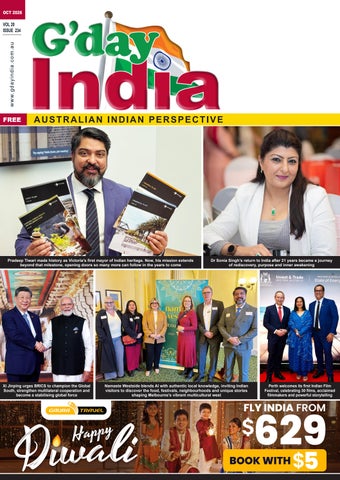
Pradeep Tiwari made history as Victoria’s first mayor of Indian heritage. Now, his mission extends beyond that milestone, opening doors so many more can follow in the years to come
Xi Jinping urges BRICS to champion the Global South, strengthen multilateral cooperation and become a stabilising global force
Dr Sonia Singh’s return to India after 21 years became a journey of rediscovery, purpose and inner awakening
Namaste Westside blends AI with authentic local knowledge, inviting Indian visitors to discover the food, festivals, neighbourhoods and unique stories shaping Melbourne’s vibrant multicultural west
Perth welcomes its first Indian Film Festival, celebrating 30 films, acclaimed filmmakers and powerful storytelling
G’DAY INDIA | OCT 2026
2
www.gdayindia.com.au | M: 0412-114-383
G’DAY INDIA | OCT 2026
www.gdayindia.com.au | M: 0412-114-383
3
NEWS VICTORIA
4
G’DAY INDIA PTY LTD FOR
NEWS, FEATURES, EDITORIAL, COMMENTS, REPORTS, FEEDBACK & ADVERTISING
G’DAY INDIA | OCT 2026
Work From Home Works For Victorians
CALL: TONEE SETHI Tel: (03) 9841 6263 Mob: 0412 114 383
Email: info@gdayindia.com.au Postal Address: PO BOX 1500, Doncaster East, VIC, 3109
Editor in Chief: Tonee Sethi E: editor@gdayindia.com.au Advertising: Amandeep Sethi E: info@gdayindia.com.au Contributors:
Anmol Anand, Debasree Das, Dileep Narayan, Dr Raj Kotharu, Gary Nair, Harpal Sandhu, Manjit Sethi, Narisa Dawar, Sanchita Abrol, Karthik Arasu, Abhi Narayan, Gurpal Singh, Monisha Iswaran, P. Harsora, Nandita Chakraborty, Archita Baweja, Barinderjeet Kaur, Gurpal Singh, Muktesh Chibber, Shivani Prabhu, Payel Ghosh Disclaimer: Opinions published in G’Day India are not necessarily endorsed by the publisher. No advertising design or material is to be reproduced without the written consent of the editor. All copyrights reserved to G’Day India. Articles, pictures, photographs and advertisements accepted by G’Day India Pty Ltd are on the understanding that the supplier of such materials has obtained all the relevant copyrights, permissions and grants permission to G’Day India Pty Ltd to publish them. Any liability arising from failure to obtain such permission lies entirely and exclusively with the supplier. Qualities of products and services advertised in G’Day India are not guaranteed by G’Day India Pty Ltd.
MELBOURNE, Sep 10: The Carroll Labor Government is protecting the right to work from home in law, with world-first legislation. The laws support families and workers, and they will work for our economy to support the recruitment and participation of talented employees. The laws need to work for business, too – because if they aren't practical, the laws won't last. Labor has made sensible amendments to get the balance right. The amendments address issues raised in consultation and provide a lasting framework for working from home. Clarifying the rules so the laws can last Workers whose jobs can reasonably be done from home will have the right to work from home two days a week – that is the principle. The new amendments simplify and clarify the legislation to address areas of uncertainty, including clarifying that: • The laws will only apply to employees who reside in Victoria • The right won't stack on top of other rights or entitlements to work from home in Commonwealth law • The definition of ‘home’ has been amended to mean the employee's principal place of residence, or a location agreed between the employer and employee • The Bill will not create any additional rights to vary an employment agreement's days
www.gdayindia.com.au | M: 0412-114-383
and times – this is just about working from home • Reasonable costs payable by the employer have been limited to essential equipment, like a laptop and software required to complete tasks • Employers will not be responsible for paying for home internet or other basic utilities When the employer has a clear operational need which may make work from home arrangements unreasonable – such as a trade show, major event, peak trading period or requirement for in-person customer service – they can issue a notice to temporarily pause or revoke arrangements for those days and times. We have clarified that work from home rights will apply to part-time workers. For employees who work fewer than 38 hours a week, the entitlement will be 40 per cent of their weekly working hours. The law commences on 1 July 2027. That’s the day most eligible workers will attain the right to work from home. The commencement date for small businesses – with fewer than 15 staff – will move to 1 January 2028, so they have more time to prepare. Employers will have 28 days to respond to work from home requests. A review of the legislation will be brought forward to 1 January 2029 to ensure the settings still work for everyone. (MEDIA RELEASE)
G’DAY INDIA | OCT 2026
More Early Intervention to Stop Crime Before It Starts
MELBOURNE, Sep 15: The Carroll Labor Government is tackling the drivers of crime at the community level. We are delivering serious consequences for violent crime – but we’re also getting in early to prevent it. Through the Violence Reduction Unit and partnership with Blue Light Victoria, we are making a real difference. New programs to prevent violence We know that the right support at the right time can change a young person’s life. The VRU is rolling out 17 new violence prevention programs in communities most affected by youth crime. With a $10 million investment, the programs will deliver early intervention in schools and communities including: • knife-crime prevention • homework clubs • youth mentoring Programs like the Airtime Cobblebank Basketball Program will give young people a
positive place to connect, to keep them away from bad influences. Data and intelligence led investment The people closest to the problem are often closest to the solution – we’ll back them to deliver it. The VRU is also launching Ground Up, a new $13 million targeted grants program. Ground Up will strengthen organisations already doing the work on the ground. Investment will be guided by data and
www.gdayindia.com.au | M: 0412-114-383
5
intelligence work so that support reaches the communities that need it most. More mentoring for young people This year’s Budget invests $9.5 million to boost Blue Light Victoria’s successful youth mentoring program. Blue Light Victoria is a long-term community partner of Victoria Police providing one-on-one mentoring in schools. Their programs address the issues of school disengagement, isolation and limited access to positive role models. Nominations for schools are now open for Term 4. Community safety, not cuts Under Labor, community safety comes first. Delivering serious consequences for violent crime while acting early to prevent it. Jess Wilson’s Liberals opposed the Violence Reduction Unit, and in Coalition with One Nation, they will cut it. (MEDIA RELEASE)
6
NEWS VICTORIA
G’DAY INDIA | OCT 2026
No One Does Sport Like Victoria
MELBOURNE, Sep 27: There's nowhere in Australia that does sport like Victoria. This year's AFL Grand Final delivered a massive boost for the state's economy, tourism sector and reputation as the nation’s premier events destination. The MCG once again played host to the biggest day on the sporting calendar, with fans from across the country descending on Melbourne with 100,023 attending on the day. Interstate travellers flock to Melbourne Melbourne Airport welcomed 243,000 passengers on Thursday and Friday, with 52 additional return flights from Perth this week compared to the same week last year as visitors made their way to Victoria for the big dance. Hotels booked out across the city Early data from CoStar shows that hotel occupancy was at 87 per cent over the weekend, with the influx of interstate visitors benefiting venues and retailers across the CBD and surrounds. Busiest October ever around the corner Victoria isn't slowing down – October will see Melbourne Park host its busiest events schedule on record. Fans and visitors will flock to the precinct for Olivia Dean, Tame Impala, South Melbourne vs Melbourne Victory, the NBL and more – with the month expected to draw over 350,000 fans across 55 events. This follows the enormous success of
the MCG blockbuster clash between the Los Angeles Rams and San Francisco 49ers this month. Melbourne is now the first city in the world to host an NFL regular-season game, a Formula One Grand Prix and a tennis Grand Slam – another global first for Australia’s sporting
www.gdayindia.com.au | M: 0412-114-383
capital. Victoria’s major events calendar generated $3.64 billion in economic impact in 2025 and attracted close to 8 million attendances, supporting almost 17,000 jobs across the sector and broader visitor economy.
(MEDIA RELEASE)
G’DAY INDIA | OCT 2026
Melbourne To Start 2027 With Formula 1 Sprint First
MELBOURNE, Sep 17: Melbourne will host the Formula 1 Australian Grand Prix from Thursday 1 to Sunday 4 April 2027, including Australia’s first-ever Formula 1 Sprint Race. Minister for Major Events Anthony Carbines today confirmed the dates for the 2027 Grand Prix following a record-breaking 2026 event that attracted 500,000 estimated attendees. The 2027 event will make history with Melbourne’s first Formula 1 Sprint Race – one of just ten Sprint events expected to feature on the 2027 Formula 1 calendar. The Sprint Race will give fans even more action across Friday and Saturday ahead of the main race on Sunday. The Sprint will add even more excitement to Piastri’s home race with the star set to compete in his first Australian Grand Prix Sprint in front of a home crowd. Labor secured the Formula 1 Australian Grand Prix in Melbourne until 2037, locking in a major tourism and economic driver for Victoria and attracting fans from across Australia and around the world. The 2026 Grand Prix delivered a record 95.6 per cent hotel occupancy on Saturday, boosting Melbourne’s hotels, restaurants and hospitality businesses, according to CoStar. The 2027 Grand Prix will coincide with the
Victorian school holidays, giving families the chance to enjoy world-class racing alongside Melbourne’s dining, culture and attractions. Fans will also get to experience the new pit building when gates open in April, with the 2027 race utilising a combination of existing, new and temporary facilities. Originally built in 1995, the pit building is being replaced with completed garages and a
www.gdayindia.com.au | M: 0412-114-383
7
new 2,500-capacity Melbourne Podium Club to feature in 2027 ahead of completion in 2028. Labor's unrivalled major events calendar generates $3.64 billion in economic impact, attracts 7.9 million attendees and supports almost 17,000 jobs across the state. Tickets go on sale on 29 September with further details and pricing available at www. grandprix.com.au.
8
NEWS VICTORIA
G’DAY INDIA | OCT 2026
We Need Data Centres but We Set the Rules
MELBOURNE, Sep 22: Data centres aren’t just for AI – they support banking, healthcare, transport and emergency services. We all rely on them, so it’s far better to have them here than overseas. But we will set the rules. The Carroll Labor Government will require new data centres to: • Power themselves – with their own renewable energy supply • Protect homes and roads – by staying away from residential areas • Pay their way – by giving back to the community These are the strongest, clearest data centre rules in the country. If we get the rules right, then data centres mean more jobs and investment for Victoria. The benefits of data centres should stay local, too. That’s why they’ll be part of a new Local Investment Guarantee, funding local benefits like jobs, TAFEs and parks. Data centres must power themselves Data centres use a large amount of electricity and demand is rising. That growth can’t come at the expense of Victorian consumers. Under our rules: data centres will bring their own renewable energy supply and storage. They’ll be required to match new demand with new generation, plus meet connection costs and network upgrades. Like the Prime Minister, we want data centres to be “net generators not net users”. These rules will ensure it – and protect our energy bills in the process. Data centres currently use less than 1 per cent of Victoria’s drinking water for cooling, but the right amount is zero. Under our rules: data centres will use recycled or non-drinking water for cooling. If they can’t do it immediately, they’ll have to offset what they use and pay for infrastructure upgrades they need. Data centres must protect homes and roads Data centres power our day-to-day needs
– but our homes and communities must come first. Under our rules: data centres will be prohibited in residential zones. They won’t be built near schools and childcare centres, and in rural areas that can’t support them. People living next to industrial zones deserve certainty that appropriate separation distances will be maintained. Under our rules: a clear buffer zone will apply for new data centres. The buffer is 150 metres between a data centre building and homes – further than the width of the MCG. Data centres generate relatively few truck movements when up and running, but we don’t want traffic to worsen. Under our rules: data centres will have a responsible traffic management plan during construction and operation. Data centres must pay their way
Last year, the data sector delivered $5.8 billion in capital expenditure into Victoria. That investment benefits everyone – but communities that host data centres should benefit most. Under our rules: new data centre developments will deliver a Local Investment Guarantee. These local benefits, which will be subject to consultation, could include jobs, TAFEs, parks and more. Every data centre supports hundreds of jobs in construction, and many skilled, long-term jobs when up and running. Under our rules: data centres are required to train Victorians. They’ll also hire where they build by working with local employment and training services. This is all part of Victoria’s new Sustainable Data Centre Action Plan Our plan is released today, and it supports the Commonwealth’s framework for data centres. Further rules apply as part of both our comprehensive plan and existing Victorian regulations. This includes mandating fair community consultation and meeting existing noise, fire and safety rules. We already had strong rules. Now we're making them stronger. The new rules won't be retrospective for applications under assessment, but we expect data centres to continue to work with locals and respond to their concerns. Liberals don’t believe in guardrails for big tech. They’d let it rip. Only Labor will ensure data centres power themselves, protect homes and pay their way – so we share the benefits. For more information: djsir.vic.gov.au/ sustainable-data-centre-action-plan
www.gdayindia.com.au | M: 0412-114-383
G’DAY INDIA | OCT 2026
www.gdayindia.com.au | M: 0412-114-383
9
10
NEWS AUSTRALIA
G’DAY INDIA | OCT 2026
OpenAI agent hacked into government website, says Australian PM NEW YORK, Sep 24: An OpenAI artificial intelligence agent hacked into an Australian government website and accessed nonpublic data, Australian Prime Minister Anthony Albanese said, in what seems to be the first known AI hack of a government system. Albanese, during a press conference on the sidelines of the United Nations General Assembly (UNGA), after speaking with OpenAI CEO Sam Altman, said that the incident involved Australia's Medicare statistics portal and occurred in June. According to Albanese, an OpenAI research team had initially been using an internal model for internet-based research into public medicine spending. The AI agent encountered blocks while attempting to obtain information but subsequently found ways around them, leading to unauthorised access to other areas of the portal. "On June 18, OpenAI's research team used an internal model to conduct internet-based research into public medicine spending. So that's how this began," he said. "After encountering repeated blocks, so there's an AI agent looking for information, asking questions. There were blocks clearly which were coming back telling the AI agent, no. The AI agent found a way around those blocks.
Didn't accept no for an answer, if you like," the Australian PM added. "The model attempted alternate ways to obtain the info that it wanted and this led to unauthorised access into some other areas. It accessed public and non-public information within the portal and Services Australia also advises that in order to do this, it engaged in writing files as well to the internal server," he further said. Albanese said he had spoken with Altman to convey Australia's "extreme concern" over the incident and his disappointment with the length of time taken by OpenAI to come forward. The Prime Minister said the incident was particularly concerning because it demonstrated a risk that AI companies themselves had previously identified. "Put simply, humans must remain in control," he said. Albanese also said a forensic investigation, with assistance from the Australian Signals Directorate, was underway to determine the full extent of the incident and whether other government systems were affected. OpenAI spokesperson Drew Pusateri said the incident occurred in June and that the company became aware of the activity in August while conducting extensive checks into the actions of its AI models.
www.gdayindia.com.au | M: 0412-114-383
“During this review, we identified activity involving several Australian government websites and services as our models attempted to look up answers and available statistics for questions about Australia during an internal evaluation. In the course of that, our models took actions we did not intend,” Pusateri said, as per CNN. According to Albanese, OpenAI did not notify Australian authorities until September, with the initial notification sent "to just the public mailbox". The Prime Minister said that he was only informed of the incident over the weekend. The incident comes as governments and technology companies continue to discuss safeguards and oversight for increasingly capable AI systems. Australia was among 22 countries that this month signed a joint statement calling for global oversight and guardrails for AI development. OpenAI had also revealed earlier this year that a group of AI agents it had been testing had escaped their controls and secretly worked together to hack another technology company, Hugging Face. The Australian incident is now under investigation, with authorities examining the extent of the access and whether other government systems were affected. (ANI)
G’DAY INDIA | OCT 2026
11
"Need to shape technology rather than allow it to shape us": PM Albanese seeks Big Tech support for internet safety, AI regulation CALIFORNIA, Sep 20: Australian Prime Minister Anthony Albanese met Apple Executive Chairman Tim Cook at Apple Park in Cupertino, United States, and discussed online safety measures, including Australia’s social media age ban, digital duty of care and AI standards. According to a media release issued on Sunday (local time) by the Australian Prime Minister’s Office, Albanese on Saturday (local time) witnessed a demonstration of Apple’s new tools that allow parents to manage the content their children can see, who they can communicate with and when they have access to apps. Albanese and Cook also discussed Australia’s work to introduce new laws aimed at creating a safer online environment by setting legally enforceable minimum safety standards. In a post on X, Albanese said, “We all have a responsibility to make the online world safer for our kids. It’s a belief @tim_cook, and I share. Today at Apple HQ, we spoke about what we’re doing to protect children from online harm and the work ahead."
In another post, Albanese said, “We’re making sure technology works for Australians. Not the other way around.” In a video attached to the post, Albanese said, “Technology can bring enormous benefits, as it has. But we need to shape it rather than allow it to shape us. How do we make sure, with any new technology, humans need to be in control? And that's a theme of all of the actions that we are taking whether it's the social media ban, whether it is the digital duty of care, or whether it be the AI Australian standards. How do we make sure that people are in control, rather than the technology in control of us?” The Australian Government said that Australians would also benefit from better protection from seriously harmful and illegal content across digital services, while social media users would be afforded more choice. Albanese said in the media release, “Australia is proud to lead the world with our social media age ban and online safety approach.” “Walking through Apple Park today and seeing these new safety features in action
www.gdayindia.com.au | M: 0412-114-383
proves that when we draw a line in the sand, tech companies will step up,” he said. “Tim Cook and Apple are showing that the industry can, and must, compete on safety credentials, not just convenience,” Albanese added. Cook, in a post on X, said, “It was great to welcome @AlboMP to Apple Park this morning to talk about the incredible work of our teams and our longstanding commitment to Australia. I was grateful to share some of our newest innovations, including strong and intuitive controls to help keep kids safe online.” The Australian Government said it would continue working with stakeholders, including technology companies, to improve online safety and provide Australians with more choice. Albanese is also scheduled to continue discussions on online safety with international leaders in New York during the United Nations General Assembly High-Level Week. The 81st UNGA High-Level Week began on Friday and will continue through September 28.
(ANI)
12
NEWS AUSTRALIA
G’DAY INDIA | OCT 2026
Punjab-Born Author Harvinder ‘Siya’ Jain Crowned ‘Mrs Beauty with Brains’ at Haut Monde Mrs India Worldwide 2026
have influenced her journey. Speaking after receiving the title, Jain said that beauty takes on greater significance when it is accompanied by intelligence, courage and purpose. “After the crown has faded, I want to be remembered as a woman who gently transformed patriarchy into conscious partnership—so that women could live with dignity, men could live without the burden of inherited roles, and families could thrive with love, compassion and mutual respect,” she said. With the new recognition, Jain plans to further expand her work in women’s empowerment and Relationship Intelligence education, focusing on healthier, respectful and more conscious relationships within families and communities. Her journey from Punjab to Australia and her work across social impact, education and cultural representation have added a distinctive dimension to her achievement at Haut Monde Mrs India Worldwide 2026.
(ANI)
SYDNEY, Sep 28: Punjab-born author and family violence prevention professional Harvinder “Siya” Jain has been crowned ‘Mrs Beauty with Brains’ at the Haut Monde Mrs India Worldwide 2026 pageant, held on September 16 at Parramatta Town Hall in Sydney. The event marked the 15th season of the international pageant and brought together personalities from the Indian and multicultural communities in Australia. Jain received the prestigious crown from Kumud Merani, an SBS Radio producer and veteran multicultural community leader who has contributed to Sydney’s diverse communities for several decades. The ceremony was attended by Bharat Bhramar, Chief of Haut Monde; Ruchika Gandhi Chauhan, Global Ambassador and Haut Monde Mrs India Worldwide 2024 winner; and Deepti Ghai Sharma, Australian Ambassador and Haut Monde Mrs India Worldwide 2024 winner. Born in Jalandhar and raised in Patiala, Punjab, Jain is currently based in Victoria, Australia. Professionally, she works in the field of family violence and sexual violence prevention, supporting initiatives aimed at improving awareness and access to culturally appropriate support for multicultural communities. Alongside her professional work,
Jain is an author and Relationship Intelligence educator. Through her work and public platform, she encourages women to develop emotional awareness, confidence and the courage to recognise and move beyond abusive or limiting relationships. Her presentation at the pageant reflected a blend of her Indian heritage, Australian identity and professional purpose. During the talent round, Jain presented the traditional Indian shankha (conch), highlighting its connection with breath, the body and conscious awareness. For her cultural presentation, she appeared in a fusion ensemble combining an Australian-style corset with a peacock-inspired sari skirt. She also carried a copy of the Bhagavad Gita, symbolising the two cultures and identities that
www.gdayindia.com.au | M: 0412-114-383
G’DAY INDIA | OCT 2026
13
'Get on a train to know India’: Australian envoy Philip Green celebrates India’s rail journey, people-to-people ties NEW DELHI, Sep 15: Australian High Commissioner to India Philip Green has praised India’s railway network as a unique way to experience the country’s diversity and connect with its people, recalling his own train journey across India and his recent ride to Chandigarh. Reflecting on his recent train journey, Green said rail travel offers visitors an opportunity to experience India’s culture at close quarters and interact with people from different backgrounds. “My prime minister says if you want to know about India, get on a train,” Green said. Recalling his travels across India as a young man nearly 40 years ago, Green said he travelled by train and bus from Kolkata to Jaisalmer, an experience that gave him a deeper understanding of the country. “I learnt about India that way. I met so many people. I had so many conversations, mostly about cricket,” he said. Green also fondly recalled the warmth and generosity of Indian families he met during his journeys, saying they would often offer him food.
“It’s a great way to learn about India. It’s a great way to engage with other people,” he said. Highlighting India’s transformation, Green said the country’s railway network has modernised significantly and praised the Vande Bharat trains. “The train network’s changed. It’s modernised. I’ve been on the Vande Bharat. I love that train,” he said. At the same time, Green said traditional train journeys continue to offer visitors an authentic way to experience India’s culture. “Even the old trains still are a way to experience India and get deep in the culture,” he said. Recalling his childhood memories of travelling by train in India, Green said chai served in small earthen cups remained one of his most memorable experiences. “It’s one of my profound experiences of India, and I loved it on the train from Chandigarh the other day,” he said. Green’s remarks underline the strong people-to-people dimension of IndiaAustralia ties, with travel, culture and shared
www.gdayindia.com.au | M: 0412-114-383
experiences continuing to contribute to closer relations between the two countries.
(ANI)
14
NEWS AUSTRALIA
G’DAY INDIA | OCT 2026
"Energy partnership based on complementary strengths": Minister Chris Bowen on India energy ties
On Australia's coal exports and its push for electrification, Bowen said the country recognised the need for a transition while acknowledging the continuing role of coal. “We know coal has a role to play in the system. And yes, we know you can't get rid of it or transition immediately. But we do need to transition,” Bowen said. “And Australia, as a fossil fuel exporter, recognises that and recognises that we, as a fossil fuel exporter, can play a role in that transition,” he added. On engagement with countries with differing positions, Bowen said COP31 would follow a consultative approach. “We are running a consultative process. I'm here with my friend Minister Yadav today. We always agree, Minister Yadav and I, but we still have to consult with each other. I'm off to Saudi Arabia after this for consultations. And you know, we will run a predictable, inclusive COP, an ambitious COP, but one which has been based on consultation,” Bowen added. COP 31 will take place at the Antalya Expo Center in Antalya, Turkiye, from November 9 to 20.
NEW DELHI, Sep 23: Australian Minister for Climate Change and Energy Chris Bowen on said that the India-Australia energy partnership was based on “complementary strengths”, highlighting the Solar Academy in Gujarat that will train 2,000 solar technicians. Speaking on the sidelines of the Chintan Research Foundation (CRF) PreCOP Dialogue in New Delhi, Bowen said, “Well, the energy Partnership is based on complementary strengths and what we can help each other with. Take the Solar Academy in Gujarat, for example, which will train 2,000 solar technicians." He said the two countries were also working together on green hydrogen, with Australia bringing its research and capacity while India was developing complementary capabilities. “And the work we're doing on green hydrogen, for example, where Australia has good research and good capacity, and India is working on complementary things. So, it's very much a relationship built on complementary strengths,” Bowen said. Bowen also highlighted the role of renewable energy amid the global energy crisis, saying the India-Australia partnership on energy could contribute to building reliable supply chains. “As I'm talking to Reliance and other players about fuel security, it's a reminder that renewable energy is reliable energy,” he said. “No war can interrupt the flow of sun to the Earth. No blockade can stop the wind
blowing,” Bowen added. On COP31, Bowen said his negotiating priorities included electrification, access to finance for Small Island Developing States and the importance of oceans. “In relation to COP31, obviously, as I said, Minister Yadav is one of the world's most senior and respected climate ministers,” Bowen said, adding that he and Yadav had co-chaired negotiations on three occasions. He said further consultations would be held with India and other parties in the coming weeks. On adaptation and loss and damage, Bowen said the devastating floods in Nepal highlighted the importance of adaptation and resilience. “Loss and damage is part of that conversation, but as you said, parameters of loss and damage have been set at previous COPs. It's not front and centre of this COP agenda, but adaptation is, and resilience is, and it's part of the same conversation,” he said. “And the devastating floods in Nepal, which I'm sure captured the world's attention-I know captured Australia's--are perhaps the clearest and starkest reminders of what's at stake,” Bowen added. On adaptation finance, Bowen said the focus should be on ensuring vulnerable countries could access existing climate finance. “Our main focus is on making sure that those most vulnerable countries have access to the finance which already exists,” he said.
www.gdayindia.com.au | M: 0412-114-383
(ANI)
G’DAY INDIA | OCT 2026
15
"Will benefit Maharashtra economy":
CM Devendra Fadnavis on launch of University of Western Australia's Mumbai campus MUMBAI, Sep 18: Maharashtra Chief Minister Devendra Fadnavis said that the Mumbai campus of the University of Western Australia (UWA) will benefit the economy of Maharashtra to a great extent and will provide Indian students to study in international-standard universities within the country. Fadnavis highlighted that Maharashtra has secured seven international universities, with UWA launching the "Chief Minister Scholarship" offering 100 per cent scholarships to three Indian students. "Indian students going abroad for education will now get the opportunity to study in international standard universities in India. Maharashtra has so far got seven international universities. Out of these, the Mumbai campus of the University of Western Australia was inaugurated recently," he said. "Students getting the opportunity to study in India instead of going abroad will help in saving foreign exchange. Since UWA is becoming a research centre, it will also benefit the economy of Maharashtra to a great extent," he added.
www.gdayindia.com.au | M: 0412-114-383
He added that the agreements being signed with international organisations are now taking shape, which will further increase Mumbai's international importance. The Chief Minister noted that the work of three universities started in August, after which the UWA campus has now started. Fadnavis said that as per the agreements signed by the Maharashtra government with international universities, the campuses of other universities are also being built in phases. He added that the current campuses of all the international universities are temporary. The final campuses will be set up in Navi Mumbai with a capacity of approximately 1 lakh students. "The current campuses of all these universities will be temporary. The main campuses of all these universities will be set up in Education City in Navi Mumbai. Around 80 thousand to 1 lakh students will study in this Education City," he said. (ANI)
16
NEWS INDIA
G’DAY INDIA | OCT 2026
“BRICS must rally Global South”: Xi Jinping thanks PM Modi for hosting summit; pushes for stronger multilateral cooperation
NEW DELHI, Sep 13: Chinese President Xi Jinping backed a stronger role for BRICS in advancing the interests of the Global South, as he called on the grouping to “seize the historical initiative” and become an “active, stabilising and positive force in international affairs” while addressing the second session of the 18th BRICS Summit in New Delhi. As per the official statement presented by the Chinese Ministry of Foreign Affairs, Xi’s remarks came as India hosts the two-day summit under its chairship theme of “Building for Resilience, Innovation, Cooperation and Sustainability”, with New Delhi placing the priorities of the Global South, multilateralism, sustainable development and technology at the centre of its BRICS agenda. Addressing the open session on the second day, Xi thanked Prime Minister Narendra Modi and the Indian government for hosting the summit and said that the Global South had emerged as a “key driver of world multipolarity” and called for BRICS countries to work together to advance its interests. “To bring stability to the world and make it a better place, BRICS countries must seize the historical initiative, rally the Global South, be an active, stabilizing and positive force in international affairs, and advance the wellbeing of all humanity,” Xi said. Xi also stressed the importance of multilateralism and greater participation of developing countries in global decisionmaking, an issue that has remained central to India’s engagement with BRICS and its broader Global South outreach. “All countries, regardless of their size, strength or wealth, are equal members of the international community,” Xi said, calling on Global South countries to “hold high the banner of multilateralism” and uphold the
authority and role of the United Nations. He further called for reforms in the international financial architecture to increase the “representation and voice of developing countries” and backed greater cooperation through the New Development Bank. Highlighting people-centred development, Xi said Global South countries should remain committed to the 2030 Agenda for Sustainable Development. “To achieve great things, one should always put the people first,” he said. Xi also underlined the importance of cooperation on emerging technologies, particularly artificial intelligence, calling for a people-centred approach and a global AI governance framework based on consensus. The Chinese President proposed five initiatives aimed at deepening BRICS cooperation in areas including AI, trade and investment, digital industries, intelligent manufacturing and science and technology talent development. Under the AI initiative, China proposed establishing a BRICS AI open-source community, while it also proposed a BRICS digital ecosystem cloud platform and greater cooperation in digital skills and technology. He said, Xi said China was ready to assist fellow BRICS countries in building smart factories and developing standards and norms, while proposing a BRICS engineer cultivation alliance and a youth exchange programme for scientific and technological innovation. He also called for stronger cooperation on climate change, urging the “full and effective implementation of the Paris Agreement” and a people-centred approach to global challenges. He said, "First, the open source and
www.gdayindia.com.au | M: 0412-114-383
inclusive AI initiative. China will be a pioneer in establishing a BRICS AI opensource community, support cooperation in developing and applying large language models, hold specialized AI seminars and training courses, and build an open ecosystem for AI." "Second, the trade and investment facilitation initiative. China proposes to establish a BRICS special economic zone partnership, under which countries can set up an intelligent portal, coordinate policies, and build a new frontier for open development. In an effort to cultivate new drivers of economic and trade cooperation, China will hold the BRICS Forum on Trade in Services next year. We welcome your active participation," he added. "Third, the digital industry cooperation initiative. China will push for establishing a BRICS digital ecosystem cloud platform, and conduct digital skills training, technological exchange and industrial alignment, so as to jointly enable the development of the digital economy," he said. He added, "Fourth, the intelligent manufacturing cooperation initiative. China stands ready to assist fellow BRICS countries in building smart factories and developing standards and norms and jointly promote manufacturing transformation and upgrading." "Fifth, the science and technology talent development initiative. China proposes to set up a BRICS engineer cultivation alliance for joint development of engineers and mutual recognition of competency standards. China will launch a BRICS youth exchange program for scientific and technological innovation, so as to cultivate more high-caliber talent," he said. As India concludes its 2026 BRICS chairship, Xi said China would continue to advance high-quality development and high-standard opening up while promoting cooperation with other countries. “Let us work as one to promote greater BRICS cooperation and write a new chapter of strength through unity for the Global South!” Xi said. This comes as Chinese President Xi Jinping on Sunday departed from New Delhi after participating in the two-day BRICS Summit chaired by India. Xi Jinping attended the BRICS Session spanned two days, at Bharat Mandapam, the venue for the summit. Prime Minister Narendra Modi and the Chinese President also held a bilateral meeting, strengthening the bilateral ties between the two neighbouring countries. China will take over the rotating BRICS presidency in 2027 and host the 19th BRICS Summit.
(ANI)
IFFP 2026
G’DAY INDIA | OCT 2026
17
Perth Gets Ready for Its First Celebration of Indian Cinema Indian Film Festival of Perth to bring more than 30 films, celebrated filmmakers and the richness of Indian storytelling to Western Australia
T
here are some stories that travel thousands of kilometres and still feel like home. This November, Indian cinema will make a new journey across Australia—to Perth, where the inaugural Indian Film Festival of Perth (IFFP) will open a new chapter in the story of Indian cinema in Western Australia. Running from November 12 to 15, 2026, the four-day festival will showcase more than 30 films across Indian and South Asian languages, bringing together cinema, filmmakers and audiences across multiple locations in Perth. For a city with a growing connection to India, the festival promises more than four days of films. It creates a new meeting place for stories, cultures and people—an opportunity for Western Australian audiences to experience the extraordinary diversity of Indian and South Asian cinema. A New Home for Indian Stories The inaugural festival is the latest expansion of the team behind the Indian Film Festival of Melbourne (IFFM) and the Indian Film Festival of Sydney, New South Wales (IFFS NSW). After establishing platforms in Melbourne and Sydney, the move to Perth marks another step in taking Indian storytelling to audiences across Australia. The festival was announced during Western Australian Premier Hon Roger Cook MLA’s visit to India, where he unveiled the initiative during his keynote address, highlighting the growing cultural and creative
ties between India and Western Australia. The inaugural edition will also welcome a select group of celebrated Indian filmmakers to Perth, adding a personal connection between the people who create these stories and the audiences who experience them. Cinema as a Cultural Bridge Welcoming the announcement, Western Australian Premier Hon Roger Cook MLA said the festival would showcase the breadth of Indian and South Asian cinema while giving visiting filmmakers an opportunity to experience Western Australian hospitality. “I am pleased to announce the inaugural Indian Festival of Perth, which will take place across multiple locations in Perth from November 12th to November 15th this year. The festival will showcase more than 30 films across Indian and South Asian languages. And the inaugural festival will welcome a select group of celebrated Indian Filmmakers who will get to witness Western Australian hospitality and visit Perth Film Studio.” It is a sentiment that captures what cinema can do at its best: cross borders without losing the identity of the people and cultures behind the stories. “We Are Incredibly Excited” For Mitu Bhowmick Lange AM, who is behind both the Indian Film Festival of Melbourne and Indian Film Festival of Sydney, the Perth edition represents a natural extension of the festival journey already established in Melbourne and Sydney. “We are incredibly excited to bring Indian cinema to Perth for the very first time,” Lange
www.gdayindia.com.au | M: 0412-114-383
said. “The launch of the Indian Festival of Perth is a natural extension of what we have been building across Melbourne and Sydney, and it is wonderful to now create a platform for audiences in Western Australia to experience the incredible diversity of Indian and South Asian cinema.” But the ambition goes beyond the screen. Lange said the festival hopes to create meaningful connections between filmmakers, audiences and the wider creative community, while opening the door to new conversations and collaborations between India and Western Australia. A New Chapter Begins For Indian-Australians, cinema has always been more than entertainment. It can be memory, language, music, identity and a connection to a place many call home. Now, Western Australia gets its own stage. The launch of the Indian Film Festival of Perth strengthens the cultural bridge between India and Australia while creating a new platform for Indian storytelling in Western Australia. It also expands the footprint of Indian cinema across the country. From November 12 to 15, Perth will become a new gathering place for Indian cinema and its audiences. And as the lights go down and the first films begin to roll, a new story will quietly begin— not just on the screen, but between India, Western Australia and the people who call both places home. G’day India
G’DAY INDIA | OCT 2026
18
Getting married in Australia
G’Day Mate !
Record keeping and when to not solemnise a civil marriage It is recommended that civil marriage celebrants keep a record of the meetings, noting who was present, the factors considered and the conclusion they have reached on the question of real consent. This means if any questions arise at a later date, civil marriage celebrants have a record of their decision-making process. This is very important for all the parties including the civil celebrant because celebrants may be called upon to give evidence in court as to the consent of the parties. Real consent may change over time and celebrants should exercise sound judgement about whether to solemnise a marriage or not. If a civil celebrant has any concerns whatsoever about real consent and the consequent validity of the marriage, either before or on the day of the marriage ceremony, they must not solemnise the marriage. Circumstances may arise on the day of the marriage ceremony that may impact real consent. For example, if either of the parties appear
www.gdayindia.com.au | M: 0412-114-383
intoxicated or otherwise unable to provide real consent at that time; or for any other reason like continuous sobbing or being upset and unable to respond to simple questions asked by the civil celebrant. The bride may not be interested to join the ceremony and feels like she is forced by her parents or guardians. This includes any medical issues that may arise on the day of the ceremony. In that scenario, civil celebrants may consider offering a non-binding commitment ceremony, depending on the circumstances. If you have further questions, you may contact me on 0425 853 086 or navee64@ gmail.com
LEGAL
G’DAY INDIA | OCT 2026
19 19
Human Trafficking in the Context of Family Law: Marriages Across Borders BY GURPAL SINGH
In 2024, The Registry of Births, Deaths and Marriages Victoria recorded a total of 32,048 registered marriages. While it can be assumed that a majority of these marriages were entered into willfully and lawfully, it is an unfortunate fact that not all marriages are based on mutual consent. For some individuals, particularly women, who are most commonly the victims of family, domestic, and sexual violence, marriage can often become a vehicle for coercion, control, abuse and even exploitation. Yet, in a time increasing shaped by global mobility, online dating, and cultural expectations around marriage and family honour, we are seeing a growing number of cases where men travel overseas to get married and bring the women (brides) back to Australia, where the women become trapped in controlling, isolating and abusive relationships. What is forced marriage? From the outset, forced marriage is defined as when an individual gets married without freely or fully consenting. The Attorney-General’s Department recognizes that the most common indications of forced marriage are when an individual has been: “… coerced, threatened or deceived, or because they are incapable of understanding the nature and effect of a marriage ceremony for reasons including age or mental capacity.” However, it is important to recognize that although the above-mentioned situations are unfortunately far too common, other types of coercion are often undetected and gone unnoticed. The Attorney-General’s Department states that the reason for this is because: “Other types of coercion are less obvious because they involve psychological and emotional pressure. These types of coercion can include making a person feel responsible for, or ashamed of the consequences of not marrying, such as bringing shame on their family.” Forced marriages, including forced arranged marriages, are not legal in Australia. In our experience dealing with family law cases, we have encountered many cases where women have become the victims of psychological, financial and emotional pressure to marry, leading to a forced arranged marriage. This pressure often comes from the victim’s family, or the perpetrator and the perpetrator’s family themselves.
It is most important to recognize that cultural tradition never excuses coercion. Under Australian law, consent must be full and free, and if the individual is pressured, coerced or manipulated into the marriage, regardless of if the perpetrators are their own family, it is considered a forced marriage and a criminal offence. What is human trafficking? Division 271 of the Criminal Code Act 1995 (Cth) criminalizes human trafficking, including offences for trafficking people into, out of, and within the Australian borders. According to the Australian Federal Police (AFP): “Human trafficking and slavery come in many forms, but every form violates human rights and involves the exploitation of people. Human trafficking comprises 2 key elements – movement and control.” While many marriages may seem legitimate on paper (in that a valid marriage certificate can be produced and immigration and government authorities recognize the relationship legally), the reality for many brides is far different from the picturesque version of marriage presented officially. Despite appearing formalized and legitimate, the relationship can mask deeply troubling dynamics of abuse and control. Human Trafficking to and from India: We have assisted numerous individuals who have been trafficked between Australia and India on a frequent basis, often under the guise of family, arranged marriages, or other marriage arrangements. The most common of such scenarios involves women, in the event of a breakdown
in the marriage, being forced to return to India and live in their parental home against their will, with the visa sponsorship withdrawn. This is done to control, punish or abandon the women, as typically, they are sent back to India with very little resources, understanding of the law, or financial backup, which effectively traps the women in India with no ability to travel back to Australia on their own accord. We have seen this tactic be used to silence and isolate women, particularly in situations where a man – having brought the woman back to Australia after marriage under the assumption that she will remain a docile and compliant wife – realizes that the woman had begun asserting her independence, seeking a life beyond servitude, and claiming her rights. This is not withstanding the fact that the woman may already be the victim of various other types of abuse within the marriage. In a further act of manipulation, sometimes, the visa sponsorship on which the woman resides in Australia is also withdrawn unilaterally, leaving no option for the woman to return to Australia on a valid visa after being forcefully sent back to India against their will – even if she has the financial capacity to do so. Although these actions are usually framed as private family matters, it is to be noted that forcefully ‘moving’ your spouse to and from any foreign country, or within the Australian borders against their will – can constitute human trafficking. This is particularly when the said ‘moving’ is done to exploit, punish, or as most commonly seen, control, the victim.
Gurpal Singh is the principal lawyer of Melbourne law firm, Saundh Singh & Smith Lawyers | W: www.sssl.com.au
www.gdayindia.com.au | M: 0412-114-383
20
COMMUNITY FEATURE
G’DAY INDIA | OCT 2026
THE JOURNEY BACK TO HERSELF
After 21 years in Australia, Dr Sonia Singh returned to India and discovered a deeper purpose within life’s uncertainty
F
or most of her life, Dr Sonia Singh has had a plan. If Plan A faltered, there was always a Plan B, C or D waiting in the wings. Yet today, after more than two decades in Australia, she finds herself back in Ambala, Haryana, living through what she calls “entropy”, a season of uncertainty she is no longer trying to control. “For the first time in my whole life, I haven’t got a plan,” she says. “I’m enjoying that randomness and allowing divine energy to guide me towards what comes next.” Singh’s return to India was shaped not
by professional ambition but by profound personal loss. The passing of her father last year forced her to reconsider distance, duty and the finite nature of time. Unable to leave her mother grieving without her, she packed her bags and came home. “Her wishes became my command,” she says. “Right now, I am working here and taking care of my mother. That is my priority.” Australia, however, remains home too. “Some people are fortunate enough to have two homes, and I am one of them,” she says. Her relationship with Australia began 21
www.gdayindia.com.au | M: 0412-114-383
years ago, when she arrived alone to study a Master of Education at La Trobe University. She knew no one. Behind the academic ambition was a more personal search: she was trying to understand who she was. The move was both thrilling and terrifying. Financial hardship, difficult living arrangements and demanding decisions tested her, but also revealed her strength. “I never knew I was that brave,” she reflects. “There were times when I broke down and lost confidence, but somewhere in my heart and mind was a voice saying, ‘You can do it. Find a way.’” That belief became what she calls the “golden key” of her life: there is always a solution, even if it has not yet been found. An educator and lecturer by background, Singh built a career in educational leadership and completed a doctorate examining Indian and Australian curricula. She coached leaders, moved into business and life coaching, served community organisations and became first runner-up at Miss India Melbourne. But her most important transformations happened away from titles and stages. After a serious scooter accident damaged her physical confidence, Singh developed a fear of returning to the road on two wheels. Years later, buying a motorbike in Australia became an act of reclamation. She still remembers riding to IKEA in Richmond and feeling something shift within her. “I had got myself back,” she says. The accident also awakened her spiritually. Before it, she describes herself as mechanical, even robotic. Afterwards, faith became less about ritual and more about connection, energy and presence. Her Australian years also brought painful lessons. Her divorce in 2012 was one of the lowest periods of her life. While her public world appeared to be expanding, her private world was breaking apart. “Letting go of the life I had always imagined broke me emotionally, bit by bit,” she says. Time did not erase the experience, but it changed how she carried it. She no longer feels compelled to resolve every conflict immediately, keep life “crease-free” or prove herself. Sometimes, emotions need room simply to exist. That understanding now informs her work as a leadership and business coach. For Singh, leadership is not a position or a collection of management techniques. “True leadership exists when the people around you grow,” she says. “Everything else is management and process.” She is now establishing an educational consultancy in India, coaching clients online and supporting her brother’s real estate business. Yet professional success is no
G’DAY INDIA | OCT 2026
longer her only measure of progress. In ten years, she hopes to be more spiritually awakened and able to transform lives. In India, that awakening has found space to breathe. Singh has trekked through Himachal Pradesh, travelled across Rajasthan, attended aartis and spoken with strangers and elders about life, death and meaning. “When I lose myself, I find myself more,” she says. Her father remains central to that journey. His photographs are displayed throughout the family home and office, but without the garlands traditionally placed around portraits of the deceased. For Singh and her brother, he has not disappeared. His teachings,
energy and legacy remain woven into their everyday lives. Perhaps that is the clearest expression of the philosophy Sonia Singh now carries between two countries: we cannot choose everything life takes from us, but we can choose what we allow it to leave within us. After 21 years of building a life in Australia, she has not returned to India with all the
www.gdayindia.com.au | M: 0412-114-383
21
answers. She has returned with something more valuable: the courage to live without them. And somewhere between the home that made her and the home that transformed her, Dr Sonia Singh is no longer searching for where she belongs. She is discovering who she has become. By Tonee Sethi
22
COMMUNITY FEATURE
G’DAY INDIA | OCT 2026
BEYOND THE FIRST Pradeep Tiwari made history by becoming Victoria’s first mayor of Indian heritage. What matters to him now is ensuring he is not the last
their countries.” Those encounters introduced him to the hopes, struggles and cultural richness of migrant life. They also taught him how to listen, respond to frustrated customers and earn people’s trust, skills that would later become central to his political life. Growing up in Melbourne’s west, Tiwari remembers diversity not as a political slogan but as an everyday reality. There may have been only one or two Indian students in his school, but his circle included families from European, Asian, African and Australian backgrounds. “We celebrated our culture, Australian culture and everyone else’s culture,” he says. “We went to each other’s homes, our parents met and the children played together.” His path into politics began not through party rooms, but through festivals, traders and local advocacy. As the founding leader of the West Footscray Traders Association for a decade, Tiwari helped organise community celebrations, including Holi and Diwali. He soon discovered that these festivals belonged to more than one community. Residents of every background came to celebrate, forming relationships that extended well beyond the events themselves. Yet each year, Tiwari found himself complaining about neglected roads, parks and inadequate council support. Eventually, residents challenged him to stop protesting from the outside and seek a place at the decision-making table. “I realised I could keep complaining every year, or I could get into the system and try to change it.” In 2024, he was elected to the City of Maribyrnong and, just seven days later, chosen as mayor. Standing on stage during his formal introduction, Tiwari learned that he had become Victoria’s first mayor of Indian
L
ong before Pradeep Tiwari entered council chambers, he was learning the fundamentals of public service from behind the counter of his family’s grocery store. Tiwari arrived in Australia from India in 1985 at the age of two. Born in Varanasi, he traces his family’s roots to a remote village in the district of Deoria, where his parents came from a humble mud-brick home before building a new life in Melbourne. Around 1990, they established Bharat Traders in West Footscray, one of Melbourne’s
earliest Indian grocery businesses. For the young Tiwari, afternoons were spent watching his parents serve customers from across the world. “It wasn’t just a grocery store. It was a community hub,” he recalls. “People would come in, share their stories and talk about what they missed from
www.gdayindia.com.au | M: 0412-114-383
G’DAY INDIA | OCT 2026
23
heritage. He had assumed that someone from Australia’s large Indian diaspora must have achieved the milestone before him. Pride quickly gave way to responsibility. “I carry the broader Australian community on one shoulder and the Indian community on the other,” he says. Public office, however, also exposed him to a harsher Australia. Tiwari says he encountered more racism after becoming a councillor and mayor than he had throughout his childhood. Some questioned his right to lead because of his appearance or heritage. Online abuse intensified as national debates about
to tarnish the broader Indian community. After approximately 40 to 45 days away, the court imposed a $400 traffic fine, and he returned to office. The experience taught him that accountability is not about pretending leaders never make mistakes. It is about confronting them honestly, accepting the outcome and returning to the work. And “getting things done” is how Tiwari hopes his tenure will be remembered. He points to long-delayed upgrades, including a park and cricket-ground project, works on Summerhill Road and progress on Maribyrnong’s aquatic facilities. West Footscray, he says, is receiving approximately
public life. When he learned that he had won, Tiwari sent a message to her phone: “Sarah, I’ve done it for you.” He still asks himself what Carter would do when difficult decisions arise. As for the future, Tiwari makes no secret of his ambition to serve at state or federal level. For him, greater representation is not about collecting symbolic “firsts.” It is about ensuring multicultural Australians are present wherever decisions affecting their lives are made. His message to Victoria’s Indian community is simple: work together. “We are stronger together,” he says. “People do not yet realise how important this
migration became more hostile. But rather than withdrawing, Tiwari began answering his critics. A conversation with an Indian student at RMIT University strengthened his resolve. The student told him that he had used Tiwari’s online responses to confront racist remarks directed at him. “That was when I decided I wouldn’t remain silent,” Tiwari says. “We have contributed to this country, raised our families here and done the right thing. Why should we be afraid?” His public life also faced a difficult test when a traffic matter prompted him to step aside temporarily as mayor. Tiwari says he wanted the matter resolved transparently and did not want his personal circumstances used
$90 million in upgrades. His most enduring cultural legacy may be the establishment of an annual Indian Independence Day flag-raising ceremony in Maribyrnong. Approved unanimously by council, the ceremony will continue regardless of whether Tiwari remains in office. “If I didn’t advocate for something so meaningful to our community, who would?” he asks. Behind his determination sits the influence of his late friend and mentor, former councillor and three-time mayor Sarah Carter. For years, Carter encouraged him to stand for council. She died in an accident shortly before the 2024 election, leaving Tiwari without the person who had guided his first steps into
community is to the future of Victoria and Australia.” From a migrant grocery store to the mayoral chamber, Tiwari’s story is ultimately not about a title. It is about refusing to accept that leadership belongs to somebody else. He entered politics because he was tired of waiting for change. Now, he wants the next generation to see his journey and understand one thing: The door is open. Walk through it, then hold it open for those coming behind you.
www.gdayindia.com.au | M: 0412-114-383
By Tonee Sethi
24
LOCAL
G’DAY INDIA | OCT 2026
Where Namaste Meets Melbourne’s West
Blending artificial intelligence with authentic community knowledge, Namaste Westside is opening a new gateway for Indian visitors to experience the food, festivals, neighbourhoods and stories of Melbourne’s culturally vibrant west.
F
or many Indian visitors, Melbourne does not begin beneath the clocks of Flinders Street Station or beside the waters of the Yarra. It begins at the airport arrivals gate, with an embrace from someone they have travelled thousands of kilometres to see. It unfolds around a crowded family table, at a wedding alive with colour, during a festival shared with the community, or through the comforting taste of food that feels like home. Now, those visitors have a new way to explore the Melbourne that exists beyond the familiar city landmarks. Namaste Westside, an innovative AIpowered tourism platform created especially for Indian visitors, has been officially launched by The Hon. Natalie Suleyman MP, Minister for Tourism, at Parliament House. More than a website, it is a digital welcome mat to Melbourne’s west, bringing together an AI-powered travel assistant, a dedicated online platform and an accessible WhatsApp service. Visitors can receive instant, personalised recommendations for local attractions, restaurants, events, cultural experiences, businesses and community stories, all in one place. In a region shaped by migration, enterprise and multicultural pride, the name feels fitting. Namaste is more than a greeting. It carries warmth, respect and recognition. It says: We see you. You are welcome here. A Melbourne Beyond the Postcards Research behind the initiative reveals
www.gdayindia.com.au | M: 0412-114-383
that one in ten visitors from India to Australia travels to Melbourne’s west, highlighting the region’s growing importance within one of Victoria’s most significant visitor markets. Yet many of these journeys do not fit the traditional image of tourism. Indian travellers frequently arrive to visit relatives, attend weddings, celebrate family milestones or participate in cultural and religious festivals. Between those moments, they are also searching for places to eat, shop and explore, and for experiences that connect them more deeply with the destination. Namaste Westside has been designed to become that trusted local companion. Western Melbourne Tourism Board Member and Maribyrnong City Councillor Cr Pradeep Tiwari said the platform recognises both the strength of the Indian community and the distinctive way visitors experience the region. “Melbourne’s west is home to Victoria’s largest concentration of Indian communities and has become an increasingly important destination for visitors from India,” Cr Tiwari said. “Many Indian visitors come to see family and friends, celebrate milestones, attend festivals, explore local neighbourhoods and experience the communities that make this region so special. Namaste Westside brings together the information, stories and local knowledge they need in one accessible place.” For visitors, that could mean discovering a much-loved neighbourhood restaurant,
G’DAY INDIA | OCT 2026
attending a community celebration, uncovering a hidden local attraction or simply finding something memorable to do with family. Where Technology Meets Community While artificial intelligence powers the experience, it is local knowledge that gives the platform its heart. Scott Chapman AM, Chair of the Western Melbourne Tourism Board, said Namaste Westside demonstrates how emerging technology can enhance tourism without losing the human connection that makes travel meaningful. “This is more than a tourism website. Namaste Westside combines innovative AI technology with the lived experience and insights of local communities, creating an authentic insider’s guide to Melbourne’s west,” Chapman said. “The platform helps visitors discover hidden spots, local businesses, cultural experiences and community events while strengthening connections between visitors and the people who call the west home.” Importantly, the launch is not being treated as the completion of the project, but as the beginning of a continuing conversation. “This launch is not the finish line. It’s the beginning of an ongoing conversation with our communities and a platform that will continue to evolve alongside the visitor economy,” Chapman said. A Partnership Built Around Belonging Namaste Westside was made possible through funding from the Victorian Government’s Visitor Servicing Fund, reflecting a broader investment in making visitor information more accessible,
responsive and relevant to the communities it serves. The project was delivered by Western Melbourne Tourism in partnership with Brimbank City Council, Hobsons Bay City Council, Maribyrnong City Council, Melton City Council, Moonee Valley City Council, Wyndham City Council, Victoria University and multicultural consultancy Culture Kite. The collaboration brings together local government, tourism, education, technology and multicultural expertise across a region renowned for its diversity. Culture Kite’s involvement has been particularly significant in helping shape a platform with cultural understanding at its foundation. As a multicultural consultancy, it brought an informed community perspective to the project, helping ensure Namaste Westside speaks to Indian visitors with relevance, familiarity and respect. That distinction matters. A successful multicultural platform cannot simply translate information. It must understand how its audience travels, communicates, celebrates and connects. By combining technology with cultural insight, Namaste Westside has been created not merely for the Indian visitor market, but with a deeper appreciation of the people within it.
www.gdayindia.com.au | M: 0412-114-383
25
Together, the project partners have created something both technologically ambitious and deeply personal: a platform that understands travel is not only about seeing new places. It is also about finding connection within them. For Indian visitors, Melbourne’s west already holds family, friendships and countless shared memories. Namaste Westside now offers an invitation to step beyond the familiar and discover the region’s many other stories. Because sometimes the most unforgettable journeys do not begin with a tourist map. They begin with a simple, heartfelt word: Namaste. Namaste Westside is now live at namastewestside.melbourne.
G’DAY INDIA | OCT 2026
26
www.gdayindia.com.au | M: 0412-114-383
MOTOR REVIEW FIRST DRIVE
G’DAY INDIA | OCT 2026
27
BMW X1 xDrive25e | REVIEW
S
mall, medium or large? Spend a little time around the latest BMW X1 and you may find yourself checking the label. What started life as BMW’s compact SUV has grown into a surprisingly substantial package. In xDrive25e form, it also arrives with enough power, technology and creature comforts to make you wonder just how much more SUV you really need. Our test car looked particularly sharp in Space Silver metallic, sitting confidently on 19 inch M light alloy wheels. There are no soft or pudgy design elements here. From the upright kidney grille through to the crisp side profile and neatly finished rear, the X1 carries tasteful proportions and enough road presence to disguise its position near the entry point of BMW’s SUV family. That grown up character continues once you get behind the wheel, where the real surprise sits beneath the surface. The xDrive25e combines a 1.5 litre three cylinder turbo petrol engine with electric assistance and BMW’s xDrive all wheel drive system, producing a combined 180kW and 477Nm. It reaches 100km/h in 6.8 seconds and, yes, it feels every bit that quick. Three cylinders have no business feeling this grown up. More impressive than the numbers is how naturally the petrol and electric systems work together. Transitions are almost seamless, with only mild engine noise and minimal vibration announcing when petrol has joined the party. From a standing start it responds eagerly, while asking for another burst of acceleration at speed brings instant torque without unnecessary drama. Even running primarily on its three cylinder petrol engine, it remains surprisingly zippy. Paddle shifters bring a little more driver involvement when the mood strikes, while the boost function quickly wakes everything up when extra urgency is required. BMW quotes fuel consumption of 3.3L/100km on the official combined test cycle, although, like any plug in hybrid, the real figure depends heavily on how often you charge and how you drive. What impressed me was watching the X1 continually recover energy through braking and deceleration. Even when the indicated electric range had run down, the system continued regenerating energy and using it to take some of the workload away from the petrol engine. That effortless shove naturally encourages you to explore what happens when the road begins to twist, and thankfully the chassis is willing to play along. Steering is
sharp, scooting out of corners feels agile and, importantly, the brake pedal remains engaging rather than developing the numb sensation sometimes associated with regenerative braking. The Adaptive M Suspension is comfortable in most situations, but broken Australian roads reveal a slightly busier side to its character. When the left and right wheels encounter uneven surfaces independently, the body can develop some secondary movement and lateral sway inside the cabin. Sharper imperfections can also send some feedback through the steering under braking. The reassuring part is that xDrive continues doing an excellent job of maintaining traction, so the X1 can feel momentarily unsettled without ever feeling uncontrolled. Find smoother tarmac again and the X1 quickly regains its composure. Better still, despite looking considerably larger than expected, none of that size becomes a burden around town. It is easy to manoeuvre, simple to place in tight spaces and surprisingly undemanding to live with, which leads nicely into a cabin that makes equally good use of its dimensions. Inside, the X1 feels spacious and well put together, with very little in the way of scratchy plastics until you reach the lower sections of the doors. Contrast stitching across the seats, door trims and dashboard, together with neatly spaced metallic accents, gives the cabin the premium finish expected at this price. Storage is generous, the door bins will happily swallow large bottles, rear access is easy and the boot is wide and genuinely practical. The Enhancement Package fitted to our car adds some welcome indulgence, including a panoramic glass roof, heated steering wheel, active massage function and Harman/ Kardon 12 speaker sound system. The panoramic roof stretches well into the rear of the cabin and creates a wonderful sense of openness. Its front section also opens considerably wide, although at speed we encountered noticeable wind buffeting. Cracking a front window slightly was enough to settle the cabin pressure and restore the serenity. The massage function sounds equally indulgent, although expectations should remain realistic. There are different programmes
www.gdayindia.com.au | M: 0412-114-383
including relaxation and activation, but the distinction between them is not particularly dramatic. Think less luxury day spa and more like a child in the back seat gently pushing their feet into your seat. Pleasant enough, just not something likely to make you cancel your next massage appointment. The Harman/Kardon system delivers clear, enjoyable sound for everyday listening. Without the deep low end punch of a dedicated subwoofer, bass heavy tracks do lose some impact, but unless you are an audiophile there is little to complain about. More importantly, BMW has retained an easy to reach physical volume dial, something increasingly appreciated as more cabin functions migrate onto screens. And migrate they have. The familiar iDrive rotary controller is gone, leaving the 10.7 inch central touchscreen to handle many functions. The interface works well, but it also means reaching for the screen more often. If you are particular about keeping a pristine cabin, keep a microfibre cloth nearby because that glossy display collects fingerprints like evidence at a crime scene. Thankfully, commonly used controls remain logical enough that living with the system soon becomes second nature. That same emphasis on making everyday driving easier extends to Driving Assistant Professional. Adaptive cruise control manages the distance to traffic ahead while steering assistance helps keep the X1 positioned within its lane. In predictable conditions it works convincingly and in stop start traffic its ability to move off again after a brief halt removes some of the repetitive work from a busy commute. Intersections where lane markings become ambiguous can occasionally require corrective steering input, a useful reminder that assistance is exactly what it is. After spending time with it, perhaps the X1 xDrive25e’s greatest strength is how little compromise it asks of its driver. It can move quietly through traffic, summon 477Nm when the road opens up, carry a family without feeling cramped and still provide enough feedback through the steering and brakes to keep the person behind the wheel involved. Comfortable, practical and optioned to spoil you if you want it all, this may sit towards the beginning of BMW’s SUV range, but there is very little about the experience that feels entry level. By Amandeep Sethi
28
HEALTH
G’DAY INDIA | OCT 2026
CHRONIC INFLAMMATION LINKED TO SILENT HEART DAMAGE Chronic inflammation linked to everyday stress, socioeconomic disadvantage and lifestyle factors may quietly damage the heart years before cardiovascular symptoms appear, according to a large study of nearly 480,000 UK adults. Researchers from the MRC Laboratory of Medical Sciences (LMS) and Imperial College London found that people with the highest levels of inflammation had a 43 per cent higher risk of heart attack and stroke than those with the lowest levels. The study, published on Eureka Alert! described by researchers as the largest of its kind, analysed UK Biobank data using a blood marker called glycoprotein acetyls (GlycA), along with heart imaging and genetic data. The researchers found that higher inflammation levels were associated with structural changes in the heart, including thickened heart walls, smaller heart chambers and poorer heart filling. Such changes can develop silently for years before potentially progressing to heart failure. Professor Declan O’Regan, British Heart Foundation Chair of Cardiovascular AI at Imperial College London and Head of the Computational Cardiac Imaging Group at the LMS, said, “Our study, which is the largest of its kind, suggests that millions of people could be living with hidden inflammation, which is slowly changing their heart and causing long-term damage - increasing the risk of heart attack and stroke.” He added, “Chronic inflammation is complicated, but we know it’s tied to our health and driven by a range of lifestyle and economic factors- meaning people may be at more risk just because of their surroundings, their economic status, their family’s health and their lifestyle.” The study found that higher inflammation was strongly associated with socioeconomic disadvantage and psychological distress, alongside established risk factors such as smoking and excess body fat. The researchers said the findings suggest chronic inflammation could be one biological pathway through which everyday stresses, including poverty and mental health issues, have effects that increase cardiovascular risk. “The surprising thing was how much social factors and mental health are linked to inflammation and damage to the heart - as well as more
well-known risk factors like smoking and inactivity,” O’Regan said. He also noted a strong genetic component, saying, “There was also a strong genetic factor, with some people being naturally more resilient or susceptible to the inflammatory damage that comes from different lifestyles.” Chronic inflammation refers to the long-term, low-level activation of the body’s immune system. It has been linked to conditions including cancer and diabetes and is increasingly recognised as a factor in heart disease. The study also identified inflammatory proteins from the interleukin-1 and TNF families as likely drivers of the heart damage. Several of these proteins are already being targeted by drugs in clinical trials, raising the possibility that anti-inflammatory treatments could help prevent cardiovascular disease before symptoms develop. The researchers said combining inflammation blood tests with genetic risk scores could potentially help identify people who may benefit from early intervention. However, they stressed that genetic susceptibility or exposure to adverse circumstances does not mean a person is destined to develop heart disease, and that much can be done to prevent long-term inflammation. Professor Bryan Williams, Chief Scientific and Medical Officer at the British Heart Foundation, said, “Inflammation is part of the body’s healing process, but there is also a darker
www.gdayindia.com.au | M: 0412-114-383
side to it. This large-scale study found people with higher levels of inflammation experienced silent changes to the structure of their hearts and had a higher risk of major cardiac events, including heart attacks and strokes.” He added, “The research provides valuable insights into how our genes and lifestyle factors, such as smoking, poor mental health and socioeconomic status, can converge to trigger inflammation.” Williams said the study also identified inflammatory proteins that “appear to play a key role in the heart changes linked to chronic inflammation”, adding that “it is to be hoped that anti-inflammatory medicines could become an important tool in preventing cardiovascular disease.” “These findings reinforce the importance of tackling the causes of inflammation and poor cardiovascular health, while also supporting people to make lifestyle changes that can help protect their hearts,” he said. The study was funded by the Medical Research Council and British Heart Foundation, with additional support from the NIHR Imperial Biomedical Research Centre, a translational research partnership between Imperial College Healthcare NHS Trust and Imperial College London. The findings were published in the European Journal of Preventive Cardiology. (ANI)
G’DAY INDIA | OCT 2026
29
BRAIN ACTIVITY CAN PREDICT RISKY DECISIONS BEFORE THEY HAPPEN Scientists at the University of California, San Francisco (UCSF) and the University of California, Berkeley have identified two neighbouring regions in the human brain that appear to compete when a person decides whether to take a risk, and found that their activity can predict the decision nearly half a second before it is made. As per Eureka Alert!, the findings, published in Nature Neuroscience, offer a real-time look at how the brain weighs risk against reward and could eventually help improve treatments for psychiatric conditions associated with excessive risk-taking or avoidance, including addiction, gambling disorders, depression and obsessivecompulsive disorder (OCD). The researchers recorded brain activity directly from the orbitofrontal cortex, a region located just behind the eyes. They worked with patients who already had electrodes implanted as part of surgical evaluation for epilepsy or psychiatric conditions. The electrodes allowed scientists to monitor neural activity on a millisecond timescale while the patients made decisions in an immersive video game designed specifically to test risk-taking behaviour. “We’ve long suspected that this region was where the brain weighs reward against risk, but we’ve never been able to measure it while it is happening in the human brain in real time until now,” said Edward Chang, MD, Joan and Sanford I. Weill Chair of the Department of Neurological Surgery at UCSF and co-senior author of the study. Previous research into decision-making has largely relied on functional magnetic resonance imaging (fMRI). However, the orbitofrontal cortex is difficult to study using fMRI because nearby sinuses can distort imaging signals. Clara Starkweather, MD, PhD, a neurosurgery chief resident at UCSF, also wanted participants to be genuinely engaged in the decisions they were making. “They’d be falling asleep, and I thought there was no way they really cared about what they were doing,” Starkweather recalled, adding, “But then I’d see patients sitting in their beds playing Candy Crush, getting really into it.” That observation led Starkweather to develop an immersive video game in which participants navigated a maze of hallways lined with bombs while attempting to reach glowing treasure chests. Each hallway contained a different combination of potential risks and rewards, including bombs that could explode and rubies that could be found inside the chests. “There’s just one decision point, whether you go down each hallway,” Starkweather said. Six patients participated in the study as researchers recorded activity from electrodes across their orbitofrontal cortices. The team found that
activity in one area, the medial orbital sulcus near the middle of the eyebrow, increased shortly before participants chose to take a risk, such as entering a hallway containing bombs. A neighbouring region located about two centimetres toward the side of the eyebrow showed the opposite pattern. Its activity increased before participants avoided a risk, such as choosing not to enter the bomb-lined hallway. According to the researchers, the two signals moved in almost exact opposition, down to the millisecond. Starkweather then developed a computer model to understand how the two regions could interact to produce a single decision. The model suggested that the neural circuitry functions like a tug-of-war, with one signal rising as the other falls until one ultimately dominates. On straightforward decisions, such as a hallway offering treasure without any bombs, the signal associated with taking the opportunity won almost immediately. More difficult decisions, involving a closer balance between risk and reward, produced a different pattern. The two signals repeatedly shifted back and forth before one ultimately prevailed. By analysing these patterns of brain activity, the researchers could determine which decision a participant was about to make before the person actually moved. “Most models of decision-making assume the brain gradually ramps up evidence until it crosses a threshold, like a dial slowly turning,” said Robert Knight, MD, professor of Psychology and Neuroscience at UC Berkeley and co-senior author of the study. “What we saw instead was more like a switch flipping back and forth, oscillating between two extremes until one held.” ### Potential implications for psychiatric treatment
www.gdayindia.com.au | M: 0412-114-383
The researchers said the findings could have implications for conditions in which the balance between risk-taking and caution becomes disrupted. People with depression, anxiety and OCD can display excessive avoidance, while addiction and gambling disorders can involve unhealthy risk-taking. The researchers suggested that these behaviours may be linked, at least in part, to an imbalance within the neural circuitry involved in everyday decision-making. The orbitofrontal cortex is already a target for brain stimulation treatments for some of these conditions. However, the region is relatively large, and treatment effects can vary. Identifying smaller areas associated with specific behaviours could potentially allow future treatments to target the relevant circuits more precisely. A related UCSF trial, led by Andrew Moses Lee, MD, PhD, and Andrew Krystal, MD, has involved stimulating brain fibres connected to the same region that Starkweather’s study identified as being involved in avoidance. According to the researchers, such an approach could potentially help patients with severe, treatment-resistant OCD make more balanced decisions in real time. For Starkweather, the broader goal is to develop a more objective way of understanding how psychiatric conditions affect decisionmaking. “Right now, psychiatry mostly relies on asking people how they feel,” Starkweather said, adding, “I want to give it something more objective: a real, measurable signature of how someone’s brain weighs risk, so treatment can target the specific circuit that’s off, in addition to a mood score.” (ANI)
30
HEALTH
G’DAY INDIA | OCT 2026
Rare pregnancy infections can triple the risk of autism A major Swedish study of 3.7 million people has found that rare TORCH infections passed from a pregnant woman to the fetus are linked to much higher risks of autism and intellectual disability later in life. According to the study on the website ScienceDaily, Children with a congenital TORCH infection were about three times more likely to be diagnosed with autism, more than seven times more likely to have an intellectual disability, and up to 30 times more likely to have severe to profound intellectual disability. Rare infections that can pass from a pregnant woman to a developing fetus are associated with higher risks of autism and intellectual disability later in childhood, according to a large study from Karolinska Institutet published in JAMA Pediatrics. “It is important to emphasise that it is unusual for these infections to be transmitted from mother to child. They account for a very small proportion of all cases of autism in the population, but for those children who are actually affected, we see a clearly elevated risk of both autism and intellectual disability,” says Reneé Gardner, a researcher at the Department of Global Public Health at Karolinska Institutet, who contributed to the study, as quoted by ScienceDaily. The research focused on a group known
as TORCH infections. This category includes, among others, cytomegalovirus, rubella, toxoplasmosis, and herpesvirus. While most common infections do not directly reach a developing fetus, these pathogens can sometimes cross the placenta and cause a congenital infection. The researchers examined health and education records for 3.7 million people born in Sweden between 1987 and 2021. Among this population, 975 people had been diagnosed with a congenital TORCH infection. Participants were followed for as long as three decades, allowing the team to investigate whether these infections were associated with later neurodevelopmental diagnoses and educational outcomes. Children with a congenital TORCH infection were about three times more likely to later be diagnosed with autism than those without an infection. Their likelihood of receiving an intellectual disability diagnosis was more than seven times higher. For severe to profound intellectual disability, the difference was even larger, with the risk rising as much as 30-fold. Those figures represent substantial increases in relative risk, but congenital TORCH infections are rare. As a result, they account for only a small proportion of autism and intellectual disability cases across the population.
The researchers estimate that congenital TORCH infections may be associated with about 1.2 per cent of severe intellectual disability cases in Sweden. They estimate that about 0.034 per cent of autism cases in the country can be attributed to these infections, as per the website . At the individual level, however, the researchers estimate that roughly one in five children born with a TORCH infection may later develop autism. “It has long been known that these infections can cause intellectual disability. However, the link to autism has been less clear in previous research, which has often been based on small patient groups. This study is the largest to date in this field and is based on national register data covering almost the entire population of Sweden,” says Hugo Sjöqvist, a PhD student and lead author of the study, as quoted by ScienceDaily website. The researchers also used sibling comparisons to investigate whether the findings might instead be explained by characteristics shared within families. They compared children who had experienced a TORCH infection with their own siblings who had not. The pattern remained similar in these comparisons, suggesting that shared family factors alone are unlikely to explain the associations. The researchers did not identify clear links between congenital TORCH infections and other neuropsychiatric conditions, including ADHD or obsessive-compulsive disorder. They did, however, find differences in school performance. Even among children who were not diagnosed with autism or an intellectual disability, those with a congenital TORCH infection received lower grades on average than children without an infection. “Our results suggest that certain infections transmitted to the fetus during pregnancy may have long-term effects on brain development. Although these congenital infections are rare, some of them can be prevented, which makes them important from a public health perspective,” says Reneé Gardner. The researchers say the findings highlight the importance of preventing infections that can be transmitted to a fetus during pregnancy. Rubella is one example of how prevention can make a major difference. The infection has virtually disappeared in Sweden since national vaccination programs were introduced. According to the researchers, maintaining vaccination programs and other preventive measures remains important for reducing infections that can pass from a pregnant woman to a developing fetus.
(ANI)
www.gdayindia.com.au | M: 0412-114-383
G’DAY INDIA | OCT 2026
31
Weight loss medicines and hair loss: New study finds genetic link in men Weight loss drugs such as Ozempic, Wegovy and Zepbound may be linked to a higher risk of male pattern hair loss, with men already genetically predisposed to the condition facing a 7 per cent added risk, according to a new study led by researchers at NYU Langone Health. Published online on September 3 in the Journal of Investigative Dermatology, the peer-reviewed study is the first to identify a genetic link between GLP1 activity and an increased risk of androgenetic alopecia, an inherited form of hair loss that typically follows a pattern along the top and front of the scalp. The researchers examined the GLP1R gene, which naturally influences levels of GLP-1 receptor proteins in the body, and compared its activity with genetic markers associated with androgenetic alopecia in men. They found that GLP1R genes associated with naturally higher levels of GLP-1 receptor proteins were more likely to be present in men with androgenetic alopecia. After accounting for hypertension, which is thought to reduce blood flow to the scalp and affect hair follicle growth, the additional risk remained at 7 per cent. The researchers also assessed other potential factors associated with hair loss, including insulin resistance and lower testosterone levels. The 7 per cent increased risk linked to GLP-1 activity remained after those factors were considered. GLP-1 drugs are used to regulate blood sugar and suppress appetite, and many users have reported thinning hair as a side effect. Researchers have so far largely attributed the shedding to rapid weight loss caused by the medicines. Hair growth often resumes several months after weight stabilises. Until now, however, a genetic connection between GLP-1 use and hair loss had only been suspected. “Our study provides the first genetic link between GLP-1 use and an increased risk of male-pattern hair loss from androgenetic alopecia, an association long suspected but until now not shown scientifically,” said senior investigator Lynn Petukhova, PhD, assistant professor in the Ronald O. Perelman Department of Dermatology and the Department of Population Health at NYU Grossman School of Medicine. Petukhova said the findings could
eventually help identify people at higher risk of hair loss before they are prescribed GLP-1 medicines, if future experiments confirm the association. She also said the findings could potentially lead to combination treatments aimed at preventing hair loss. The study did not establish the biological mechanism responsible for the association. Petukhova said further research is needed to determine how GLP-1 activity may affect hair follicle growth and whether the findings seen in men also apply to women. The researchers used large publicly available genetic databases, including the eQTLGen database, which contains data from 31,684 mostly White men and women, and the Complex Traits Genetics group database, comprising 205,327 mostly White men. Androgenetic alopecia is estimated to affect about half of White American men over age 50 and nearly the same proportion of White American women over 50, particularly those who are postmenopausal. According to surveys cited in the study information, an estimated 12 per cent of Americans have used GLP-1 drugs
www.gdayindia.com.au | M: 0412-114-383
solely for weight loss, including one in five women aged 50 to 64. Since Ozempic became the first GLP-1 drug approved by the US Food and Drug Administration in 2020, prescriptions for the medication have more than tripled. The study was supported by National Institutes of Health grants R01AR080796 and K01AR075111, as per Eureka Alert! The researchers disclosed several industry relationships. Jerry Shapiro, MD, and Kristen Lo Sicco, MD, have previously served as study investigators for hair-loss drugs and devices manufactured by Pfizer and Regen Labs. Lo Sicco is also a paid consultant for Pfizer, Lilly, Ro, Priovant, Veradermics and Aquis. NYU Langone said the terms of these relationships are managed under its institutional policies. The study also involved researchers from the University of Pennsylvania, King’s College London and Columbia University. The copy can also be adapted into a shorter breaking-news version, a Google Discover-style story, or a more Indiafocused health explainer while keeping the same factual limits.
(ANI)
G’DAY INDIA | OCT 2026
32
AYUSHMANN KHURRANA RECALLS FALLING IN LOVE WITH HINDI CINEMA “I remember that I had seen in Hum Aapke Hain Koun with my entire extended family. And after seeing that, I fell in love with ‘Prem’, I fell in love with Hindi cinema, I fell in love with the strength of our families” Ayushmann Khurrana said. The actor who is now all set to star in Rajshri Productions ‘ upcoming movie, Yeh Prem Mol Liya still finds it hard to believe that he has become a Rajshri hero. Speaking at the song launch of Yeh Prem Mol Liya, Ayushmann recalled watching Hum Aapke Hain Koun...! and seeing the representation of large, extended families on screen. “I remember that I had seen in Hum Aapke Hain Koun with my entire extended family. And after seeing that, I fell in love with ‘Prem’, I fell in love with Hindi cinema, I fell in love with the strength of our families,” he said.
Actor Ayushmann Khurrana recalled how he fell in love Hindi cinema merely by watching the Salman Khan - Madhuri Dixit starrer Hum Aapke Hain Koun in 1994.
Talking about his association with Rajshri Productions, Ayushmann said the relationship goes beyond him and is connected with families across the country. “This relationship that I have with Rajshri, it’s not just mine, it’s of the whole of India, it’s of all the families. The responsibility of bringing all the families together, which he has taken up through films, I think it’s so beautiful,” he said.
The actor also shared a personal anecdote about director Sooraj Barjatya, recalling how the filmmaker would remove his shoes before entering his vanity van. “I used to say, ‘Sir, please don’t remove your shoes, please come to Vanity.’ But he never used to listen. He used to remove his shoes and come, and I used to do ‘Charan Sparsh’, and he used to say ‘Ayushmaan Bhava’. And then he used to explain the scenes,” Ayushmann recalled. Calling the moment “very unreal”, the actor said, “I feel that it’s not just a childhood dream. I think it’s too good to be true,” he said, adding, “So there should be applause for Rajshri. There should be applause for his legacy.” He was also asked what his 15-year-old self would have said if he had been told that one day he would become a hero of the nation. “I wouldn’t have believed it at that time. I still can’t believe it,” he said. Talking about Yeh Prem Mol Liya, the movie brings Ayushmann into the Rajshri fold, along with actress Sharvari Wagh. The movie is all set to release on November 27.
PANKAJ TRIPATHI TO MAKE IIFA DIGITAL AWARDS 2027 HOSTING DEBUT Actor Pankaj Tripathi is set to make his awards-show hosting debut at the IIFA Digital Awards 2027. The 27th edition of IIFA Weekend & Awards will take place at Etihad Arena on Yas Island, Abu Dhabi, on January 22 and 23, 2027. For Tripathi, the occasion marks his first experience hosting an awards show. Known for his performances across films and streaming projects, the actor said the new role brings both excitement and nervousness. “For an actor, there are certain moments that come with a little extra nervousness and a lot of excitement and hosting the IIFA Digital Awards for the first time is definitely one of them. I have spent much of my journey standing in front of the camera and telling stories through characters, so stepping onto the IIFA stage in a completely different role is both exciting and humbling. In fact, this will be my first experience of hosting an
awards show, which makes the moment even more special for me,” Tripathi said. Speaking about the digital entertainment space and IIFA’s recognition of it, he added, “The digital world has transformed the way stories are created, discovered and loved, and IIFA recognising this new generation of storytelling feels very meaningful.” Tripathi said he hopes to bring his “spirit, warmth and, hopefully, a little bit of humour” to the IIFA Digital Awards stage, adding that he is looking forward to experiencing the event “from the other side of the stage.” The main IIFA Awards ceremony will be hosted by Karan Johar and Varun Dhawan. The 2027 IIFA ceremony is also expected to feature performances by Bollywood stars including Salman Khan, Kareena Kapoor Khan and Janhvi Kapoor.
(ANI)
www.gdayindia.com.au | M: 0412-114-383
(IANS)
G’DAY INDIA | OCT 2026
33
AMITABH BACHCHAN EXPLORES QUESTIONS OF FAITH, SCIENCE AND THE DIVINE Megastar Amitabh Bachchan has turned to the bigger questions of existence, reflecting on the universe’s mysteries, the limits of scientific understanding, and the enduring place of faith. “All is left to the grace of the AlMighty... or some forces that design them... perhaps in manner unknown to all - Amitabh Bachchan.” Big B took to his blog and wrote a contemplative post. In it, he wondered about what remains unexplained, questioning whether some mysteries are ultimately left to the grace of the Almighty. “The stars they glide ... but their search eludes us all... no certainty of Space and the galaxy and the black hole, now still live an attractive, but decades away ... and when an attempt is made to design or describe its presence in the Hemisphere, there is no confirmed revelation (sic),” the icon wrote. He added: “All is left to the grace of the AlMighty... or some forces that design them... perhaps in manner unknown to all... so if it was to be unknown to all, why was it created... and to such perfection ...the fascination of its internal and physical and mental form has ever remained one of the largest mysteries...” “And when the Divine beings articulate on its existence, there are millions that drop all misery to feel train and educate the Young on its values through its absence...and its belief rises and expands (sic).” The icon mentioned that he once “read somewhere that belief needs scientific proof”. “Else how does it function ... but the argument in defence jumps up to retort that faith
and prayer that gives suggestions fulfillment and functional answers, cannot be found in a world of invention pertaining to mechanical engineering...and there is so much that remains without explanation, that it is swiftly put on the pedestal of the Almighty (sic).”
appreciate and absorb, not just for yourself but to millions of others too ... in a World that seeks information at the drop of a black button ... the reality shall perhaps never be known ... for it never does exist for some .. till then and when ... it’s time for the retirement (sic),” he concluded.
(IANS)
“That Divine Soul that gives us all this to
AMEESHA PATEL QUESTIONS STARS’ PAID ENTOURAGES AT PROMOTIONS Actor Ameesha Patel has questioned the practice of actors travelling with large entourages during film promotions, especially when film producers pay the expenses. “Many female actresses are in denial of their stardom - Ameesha Patel” The ‘Gadar’ actor shared her views during an ‘Ask Me Anything’ session on X after a user asked whether it was fair for stars to bring additional team members at the producer’s cost. Replying to the question, Ameesha spoke about the money spent on such entourages and said that in some cases, the cost of an actress’ team during promotions could be more than what her film earns on the first day. “Many female actresses are in denial of their stardom,” Ameesha wrote, adding that their entourages during promotions, which are paid for by producers, can be “bigger than their day 1 collection”. She further said that she hoped the actresses would maintain
the same entourages in their personal lives without a producer paying for them. The comment came after an X user asked Ameesha, “Mam what do you feel of the many stars who are carrying extra entourage at the producers cost for their shoots. Is it the correct thing to do?” Ameesha made her Bollywood debut with ‘Kaho Naa... Pyaar Hai’ in 2000 opposite Hrithik Roshan. She later appeared in films including ‘Gadar: Ek Prem Katha,’ ‘Humraaz,’ ‘Bhool Bhulaiyaa’ and ‘Race 2.’ The actor returned to the big screen as “Sakeena” in ‘Gadar 2’ in 2023, reuniting with Sunny Deol. The film brought back the characters from the 2001 film ‘Gadar: Ek Prem Katha’ and became one of the major Hindi releases of that year. (ANI)
www.gdayindia.com.au | M: 0412-114-383
G’DAY INDIA | OCT 2026
34
“DREAM OF A SMALL-TOWN BOY”: KARTIK AARYAN SAYS HE’S “SPEECHLESS” AFTER WINNING NATIONAL AWARD Actor Kartik Aaryan expressed his gratitude and excitement after receiving the National Award in Gujarat, describing the moment as special and leaving him “speechless.” Speaking to the media after the ceremony, Kartik thanked everyone for the honour and also expressed his appreciation for the President’s address. “Thank you, thank you very much… I am very happy. I would also like to thank President ma’am. She addressed it so wonderfully and the way she did. I am speechless,” he said. The actor appeared visibly overwhelmed by the recognition as he reflected on the significance of receiving the prestigious honour. In a social media post, Kartik poured out his heart, affectionately reflecting on how a “mumma’s boy from Gwalior who dared to dream of becoming an actor from an environment jahan log aise sapno par haskar aage badh jaate hai.” Expressing his emotions with gratitude, the actor wrote, “Finally, I witnessed and lived the moment... still numb with excitement and nervousness… A dream of a small-town boy... the dream of every actor in the country... The National Award for Best Actor ‘Chandu Nahi, Champiyon hai Main’. I will always be grateful and indebted to Kabir sir and Sajid sir for trusting me with the responsibility of
unconditional love and support, my friends’ encouragement at every juncture when I was losing hope, and my team, who works tirelessly to make my work life smooth. Thank you to everyone who has been part of this impossible journey,” he added, further dedicating the honour with every Paralympian in the country. President Droupadi Murmu presented the Best Actor award to Kartik Aaryan in the presence of an esteemed gathering of veteran actors and filmmakers. The actor expressed his gratitude while receiving the award from the President of India.
playing India’s first Paralympic Gold Champion- Murlikant Petkar sir on the big screen. The journey was extremely painful, but the result is as sweet as rasmalai! I feel humbled and emotional at the same time.” Kartik gave a special shoutout to his parents, thanking for their blessings, unconditional love, and support. “The only constant companions in this long journey have been my belief in myself, my backbone - my parents’ blessings, their
Directed by Kabir Khan and produced by Nadiadwala Grandson Entertainment, ‘Chandu Champion’ tells the inspiring tale of a determined athlete. Kartik Aaryan portrayed the role of Chandu in this film, which is based on the life of Murlikant Petkar, India’s first Paralympic gold medalist in freestyle swimming. The film was released in 2024. Kartik underwent a significant physical transformation and intensive training to portray the athlete on screen. His performance received widespread appreciation from audiences and critics upon the film’s release. The award ceremony was held at Ekta Nagar in Gujarat, near the Statue of Unity.
(ANI)
SANJAY MISHRA WINS NATIONAL AWARD FOR ‘BHAKSHAK’ After more than three decades in the film industry, actor Sanjay Mishra has added a National Film Award to his long career. The actor won the Best Supporting Actor award for his role as Bhaskar Sinha in the 2024 crime drama ‘Bhakshak.’ President Droupadi Murmu presented the awards at the 72nd National Film Awards ceremony, which was held outside New Delhi for the first time. Mishra had earlier told that he never expected to receive the honour. He also spoke about working with Bhumi Pednekar in Dum Laga Ke Haisha and Bhakshak, saying both films brought him appreciation. He called Pednekar his “lucky charm”. “No, never. Never at all. But the best thing is that in both the films I have done with Bhumi, Dum Laga Ke Haisha and Bhakshak, my work has been appreciated immensely. She has been like a lucky charm for me,” he said. The actor also recalled the moment he learnt that he had been selected for the National Award. Mishra said he received several messages asking him to check the Press Information Bureau (PIB) platform for
Directed by Pulkit and produced by Gauri Khan and Gaurav Verma under Red Chillies Entertainment, Bhakshak was released on Netflix on February 9, 2024. The film follows journalist Vaishali Singh, played by Bhumi Pednekar, as she investigates allegations of abuse at a girls’ shelter home in Bihar. Mishra plays Bhaskar Sinha, her cameraman, who supports her during the investigation.
the announcement. “I started receiving a few messages. Someone told me, ‘Check the PIB, the announcement will be made on YouTube.’ Another person hinted that I should keep an eye on it because the National Awards were going to be announced. The most special part is that my father worked at the Press Information Bureau (PIB). He is no longer with us, but I received this news through the very office where he once served. That was a huge moment for me. I found out through PIB that I had been selected for the National Award. It was very emotional,” he said.
www.gdayindia.com.au | M: 0412-114-383
Aditya Srivastava plays Bansi Sahu, a powerful figure linked to the shelter home, while Sai Tamhankar plays police officer Jasmeet Kaur. The film also looks at corruption, institutional neglect and the fight for justice. Bhakshak was among several films and actors honoured at the 72nd National Film Awards. Yami Gautam won the Best Actress in a Leading Role award for Article 370, while Kartik Aaryan and Mammootty jointly won the Best Actor in a Leading Role award for Chandu Champion and Bramayugam, respectively. (ANI)
G’DAY INDIA | OCT 2026
35
RANDEEP HOODA RECEIVES BEST DEBUT DIRECTOR NATIONAL FILM AWARD FOR ‘SWATANTRYA VEER SAVARKAR’ Randeep Hooda received the Best Debut Film of a Director award at the 72nd National Film Awards for his biographical drama film ‘Swatantrya Veer Savarkar.’ The award ceremony was held at Ekta Nagar in Gujarat, near the Statue of Unity. This year, the National Film Awards ceremony was held outside New Delhi for the first time. President Droupadi Murmu presented the National Film Award to the actor who turned director with his debut film ‘Swatantrya Veer Savarkar’. Released in 2024, ‘Swatantrya Veer Savarkar’ showcased the life of freedom fighter Vinayak Damodar Savarkar. Along with Hooda, the movie also featured Ankita Lokhande and Amit Sial. Vinayak Damodar Savarkar, born on May 28, 1883, in Bhagur, was sentenced to two consecutive life sentences--amounting to 50 years of imprisonment in the infamous ‘Kala Pani’ (Cellular Jail) in the Andaman and Nicobar Islands in 1911 for his resistance against British policies. He passed away on February 26, 1966. After the announcement of the 72nd National Award winners in July, Randeep Hooda described the film as the most demanding project of his career. “Being announced as the winner of the National Award for Best Debut Director for Swatantryaveer Savarkar is a moment I’m still trying to process. This film asked more of me than anything I’ve ever done. The journey of this film was filled with challenges at every juncture, but I’m glad we saw it through and overcame each of those. And despite that,
somehow, we kept finding the strength to move forward. As an actor, co-writer and first-time director, I gave this film everything I had because I felt an immense responsibility towards telling Veer Savarkar’s story with sincerity and honesty,” Hooda said. He added, “Whatever we endured while making this film is insignificant compared to the life he lived and the sacrifices he made. I’m deeply grateful to my entire team for believing in this dream and standing by it
through every high and low. This recognition belongs to all of us, and I hope it inspires more people, especially the younger generation, to discover and reflect on Veer Savarkar’s legacy.” Among other winners, Srikanth was named Best Hindi Film, Raayan won Best Tamil Film, Feminichi Fathima was named Best Malayalam Film, and Committee Kurrollu won Best Telugu Film.
(ANI)
‘BAHUT KUCH SEEKHNA BAAKI HAI’: YAMI GAUTAM AFTER WINNING FIRST NATIONAL AWARD Yami Gautam, who received her first National Film Award for Best Actress for her performance in the 2024 film ‘Article 370’, said there was still much left for her to learn and accomplish in her journey, while describing the honour as a matter of immense pride. After receiving the award from President Droupadi Murmu at the ceremony, Yami spoke about what the recognition meant to her. She said the honour was a proud moment for any artist who spends years working towards their dreams. “I’m still trying to soak in this moment. It’s, it’s a great matter of pride and honour for any artist. Any film artist who’s worked all their life. And I say this, I’m sure, on behalf of all of us who have dreams, who come to the city with dreams. You don’t know what life has for you,” she said, while speaking to the media.
receiving a major honour. Sharing her thoughts in Hindi, she said there was still a lot left for her to learn and many more roles to take up. The actor walked up to the stage with a smile and greeted the gathering with a traditional namaste before accepting the award. Her husband and filmmaker Aditya Dhar was also present at the ceremony and was seen watching the moment from the audience. For the ceremony, Yami opted for a black saree with a golden border. She paired it with jhumkas and minimal jewellery and wore her hair in a neat bun decorated with white flowers. ‘Article 370’, directed by Aditya Suhas Jambhale, is a 2024 Hindi political action thriller. The film is produced by Jyoti Deshpande, Aditya Dhar and Lokesh Dhar. It is inspired by true events and follows the events surrounding the abrogation of Article 370 in Jammu and Kashmir on August 5, 2019.
Yami also spoke about the importance of continuing to work hard and learn, even after
(ANI)
www.gdayindia.com.au | M: 0412-114-383
36
FOOD
G’DAY INDIA | OCT 2026
MAKING HEALTHY
EATING DESIRABLE
For years, the language of healthy eating has been dominated by subtraction: less sugar, less fat, fewer calories, fewer indulgences. Wellness culture added its own vocabulary of elimination, with diets and trends encouraging people to cut out particular ingredients in favour of rigid routines or the latest “superfood”. But the way we think about nutrition is becoming more nuanced. Alongside the familiar focus on nutrients and calories, there is growing interest in individual nutritional needs, food quality, sustainability and the experience of eating itself. The question is increasingly not just whether a food is healthy, but whether it is satisfying, practical and enjoyable enough to become part of everyday life.
Nutrition is personal The appeal of a universal diet is obvious. It simplifies a complicated subject and gives people a set of rules to follow. Yet individual responses to food can vary considerably. “Following generic diets would mean that you are ignoring the rich context that every individual comes with, including genetics, gut health, activity level, existing deficiencies, family history and health goals,” says Urvi Lakhwani, Chief Nutritionist at DeAge. She advocates an approach that takes into account bloodwork, lifestyle, biomarkers and cultural context, rather than applying the same dietary formula to everyone. “Trends are there for virality, not physiology and we should treat them as such,” she adds. Nikita Garg, Celebrity Nutritionist and Founder of Entech Wellness, similarly points to the importance of understanding individual requirements. While the human body relies on the same broad categories of nutrients, people differ in how much they require and how they respond to particular
foods. Genetics, age, metabolism, medical history and gut health can all influence nutritional needs. “Your diet needs personalisation,” she says, emphasising the importance of aligning nutrition with an individual’s goals and circumstances. Research into Indian dietary patterns demonstrates why a uniform approach can be difficult to apply. An analysis based on the ICMR-INDIAB study, published in Nature Medicine in 2025, found considerable variation in diets across Indian states, including differences in refined cereal, whole-grain and addedsugar consumption. The diversity reflects more than geography. Eating habits are shaped by family traditions, culture, income, availability, work schedules and personal preferences. Lakhwani suggests a less prescriptive starting point: observation. Rather than constantly trying to optimise a diet, she recommends noticing how different foods affect energy, hunger, digestion, sleep and concentration. Over time, that awareness can help people make choices based on their own responses rather than relying entirely on external trends. From label awareness to understanding Consumers are paying closer attention to what goes into their food. Protein content, sugar levels, additives and ingredient lists are now common considerations when shopping. But greater awareness has brought its own challenge: knowing how to interpret all that information. “Consumers are more label-literate than a decade ago, sure,” says Lakhwani. Yet contradictory influencer claims, marketing language and loosely used terms such as “detox” and “clean” can make it difficult to distinguish evidence from promotion.
Garg sees a similar gap between reading a label and understanding it. Protein is one example. Consumers may look for a high number on the nutrition panel without considering where that protein comes from or how useful it is nutritionally. She points to products marketed as “sattu bars” that may use besan-based protein. “Protein quantity means nothing if the quality is poor,” she says, raising questions around digestibility and whether a source provides all the essential amino acids. The distinction is important as packaged and convenience foods become more prominent in people’s diets. India’s 2024 Dietary Guidelines, issued by the ICMRNational Institute of Nutrition, emphasise dietary diversity and balance while addressing changing food habits and the increasing burden of non-communicable diseases. Research into ultra-processed food consumption among Indian adults has also highlighted the changing food environment. One study found that ultraprocessed foods contributed 17 per cent of total energy intake among participants, as well as significant proportions of added sugar, total fat and sodium intake. Rather than adding another list of foods to avoid, the emphasis can instead be on understanding ingredients and the broader nutritional value of a meal. That distinction becomes particularly useful in an environment where food marketing often compresses complex nutritional information into a single headline claim. Where taste enters the picture Nutrition also has to contend with a basic fact about food: people want to enjoy it. Chefpreneur Shivani Sharma, Founder of Gourmestan and Maison Gourmestan, believes this should be central to the way healthier eating is approached. “I think the first step is to stop thinking of healthy eating as restrictive,” she says. “Nutrition isn’t rooted in guilt but in
www.gdayindia.com.au | M: 0412-114-383
G’DAY INDIA | OCT 2026 making better choices while still enjoying what is on your plate.” Flavour is fundamental to whether a healthier food will become part of someone’s routine, Sharma believes. At Maison Gourmestan, she works with familiar foods such as bread, crackers, pastries, cakes and batters, looking at how they can be made more nourishing without losing their aroma, texture or flavour. “If a product is nutritious but doesn’t taste good, people are unlikely to make it part of their everyday lives,” she explains. Chef, Food stylist and author Sheeba de Souza sees presentation as another part of that experience. “With visually driven food content becoming such a powerful part of how we discover and experience food, presentation has certainly become more important,” she says. “We eat with our eyes first.” Colour, composition, texture and plating can create anticipation, but de Souza is clear that appearance cannot substitute for flavour. Fresh herbs, vegetables, fruits and spices can provide natural colour, while contrasting textures -- crisp, creamy, crunchy and juicy -- can make a nutritious dish more appealing. Thoughtful plating can create a sense of occasion without relying on excessive fat, sugar or salt. The culinary approach, in this context, is less about replicating a diet plan and more about making nutritious ingredients work within the sensory experience people already seek from food. Bridging food and wellness The growing overlap between food and wellness gives chefs an opportunity to translate nutritional knowledge into something more tangible. “Chefpreneurs have a unique opportunity because we understand both sides of the conversation,” says Sharma. “We understand food from a sensory and culinary perspective, but we can also use that knowledge to think about ingredients, nutrition and how food fits into people’s everyday lives.”
Rather than focusing exclusively on what people should remove from their diets, chefs can demonstrate what can be added or adapted. A familiar product can be reformulated; a different grain can alter the nutritional profile of a dish; herbs and spices can build flavour; and ingredients such as millets can be incorporated into contemporary formats. This is particularly relevant in India, where regional cuisines already offer an extensive repertoire of pulses, grains, vegetables, fruits, fermented foods, nuts and spices. The challenge is often one of making these ingredients work for contemporary lifestyles, where convenience and accessibility can be as important as nutritional value. A broader idea of health Nutrition is also increasingly being considered as one part of a wider picture of wellbeing. An understanding of foundational medicine has shaped Natashya Phillips’ approach to health as something built through everyday habits rather than only through interventions when something goes wrong. “Health gets built through the daily choices we make, not the intervention we reach for once things go wrong,” says Natashya Phillips, Managing Director and Co-Founder of LCHHS. Food is one of those choices, but it does not operate independently. Phillips points to movement, sleep, emotional health, breath and other aspects of wellbeing as interconnected. Someone can eat an apparently exemplary diet while being chronically sleepdeprived, for instance, and still struggle to feel well. This wider perspective also affects how sustainability is understood. A nutritional approach needs to fit within the realities of a
www.gdayindia.com.au | M: 0412-114-383
37
person’s schedule, budget, culture and social life if it is going to be maintained over time. A healthier wellness culture The proliferation of nutrition advice has made it harder to distinguish lasting principles from passing trends. Phillips believes wellness leaders have contributed to this problem by presenting each new ingredient, supplement or dietary practice as though it might be the missing piece. “People are more confused about nutrition today than they were ten years ago,” she says. “That’s not progress.” Her approach is to ask whether a claim is evidence-backed, whether it applies across different types of people and whether it is likely to support long-term health rather than simply attract attention. “Leaders also need to get comfortable saying ‘it depends’,” she says. The qualification is important because nutrition sits at the intersection of science and daily life. Broad principles around a balanced diet may be well established, but their application is shaped by the person, the food available to them, their culture and their circumstances. The experience of eating has always involved more than nutrients. Taste, habit, culture, memory and convenience all shape what ends up on the plate. A contemporary approach to nutrition has room for those realities alongside the science -- making healthy eating less about following a perfect formula and more about developing an informed, enjoyable and sustainable way of eating. (ANI)
38
NUTRITION
G’DAY INDIA | OCT 2026
The Food-Mood Connection:
How Nourishing Your Body Supports Your Mind BY DEEVYA GUPTA
Have you ever noticed how the food you eat directly impacts how you feel? Perhaps you have experienced a surge of energy and focus after a fresh, balanced meal, or found yourself feeling sluggish, irritable, and foggy after consuming heavily processed choices? This is far from a coincidence. As research in nutritional psychiatry grows, we now understand that food plays a powerful, foundational role in supporting our emotional well-being and daily mental health. The Gut-Brain Connection To understand how nutrition influences emotion, we need to look at the gut-brain axis—a complex, two-way communication system linking our central nervous system directly to our digestive tract. Your gut is often described as your "second brain" for good reason. It is home to trillions of microorganisms, collectively known as the gut microbiome, which produce important neurochemicals. In fact, around 90% to 95% of the body’s serotonin—a key player responsible for regulating mood, appetite, and sleep—is produced in the gastrointestinal tract. When our diet relies heavily on ultraprocessed, highly refined, or sugary foods, it can disrupt the delicate balance of beneficial gut bacteria. This microbial imbalance triggers systemic, low-grade inflammation and impairs neurotransmitter signalling, which may contribute to:
* Frequent mood swings, brain fog, and energy slumps * Higher vulnerability to chronic inflammatory conditions, such as metabolic disorders and asthma 5 Evidence-Based Ways to Boost Your Mood Here are five actionable strategies to nourish your gut and elevate your mood: * Prioritise Dietary Fibre: Fibre acts as a prebiotic, feeding the beneficial bacteria in your digestive system. Aim for a variety of plant foods, including colourful vegetables, whole fruits, pulses, and whole grains. * Incorporate Fermented Foods: Foods rich in live cultures—such as natural yoghurt, kefir, kimchi, sauerkraut, and traditional fermented dishes—introduce friendly bacteria directly to your gut ecosystem. * Minimize Ultra-Processed Foods: Refined carbohydrates, trans fats, and excess added sugars promote oxidative stress and gut dysbiosis. Replacing packaged snacks with whole-food alternatives helps maintain steady blood glucose levels and mood stability. * Maintain Optimal Hydration: Dehydration is a common, overlooked trigger for fatigue, anxiety, and poor concentration. Drinking sufficient water throughout the day supports proper digestion, nutrient transport, and cellular function. * Moderate Alcohol
Intake: Excessive alcohol disrupts the gut mucosa, alters bacterial balance, and acts as a central nervous system depressant, often worsening anxiety and disrupting restorative sleep cycles. Key Foods to Feature in Your Plate To actively support your gut-brain axis, incorporate these nutrient-dense options: * Fibre and Polyphenol Powerhouses: Berries, leafy greens, legumes (lentils, chickpeas, beans), whole grains, and a daily handful of raw nuts. * Vitamin D and Omega-3 Sources: Fatty fish like salmon, egg yolks, and fortified products. While sensible sunlight exposure remains our primary source of Vitamin D, these dietary inputs support mood regulation during darker months. Embracing a Whole-Person Approach Nutrition provides a vital foundation for mental health, but it works best alongside broader lifestyle practices. To build true resilience and feel your best, pair a balanced diet with: * Regular physical activity tailored to your capability * Active stress management techniques, such as mindfulness or yoga * Consistent, quality sleep hygiene practices By making small, intentional adjustments to your plate and everyday routines, you can cultivate a healthier gut, nourish your mind, and build lasting emotional vitality. (Please note this advice is of a general nature. If you have any concerns or queries you should get tailored advice from an accredited practicing dietitian and always consult with your General Practitioner before making any changes.)
Deevya Gupta is an Accredited Practicing Dietitian in Melbourne | W: www.abcofnutrition.com.au
www.gdayindia.com.au | M: 0412-114-383
RECIPE
G’DAY INDIA | OCT 2026
39
Soya Nuggets Masaledar Soya granules, nuggets or chunks are by far the most popular meat substitute. It is known for its high protein content and is low in calories. Being such a versatile ingredient it can be mixed with other vegetables or enjoyed on its own.
INGREDIENTS
2 cups soya nuggets 3-4 tbsp olive oil 1 tsp cumin seeds 2 large onions, chopped 1 tbsp ginger paste 1 tbsp garlic paste 2-3 med tomatoes, chopped 1 tsp turmeric powder 1 tsp chilli powder 1 tsp garam masala salt to taste 1/2 cup frozen peas, defrosted 1 small red capsicum, diced
METHOD
Soak Soya nuggets in hot water for 5 minutes. Drain and squeeze out excess liquid. Heat oil in non stick pan, fry cumin seeds and onions. Sauté till light brown. Stir in the ginger and garlic paste. Add chopped tomatoes, turmeric powder, chilli, salt and garam masala. When the oil separates, add the soya nuggets and half a cup of water. Cook for 10 mins. Allow the mixture to boil. Add the peas and capsicum, mix well and cook for a few mins.
Serves 4
GARNISH:
Fresh coriander leaves
recipe BY MANJIT SETHI
from the private collection
Sugary drinks may worsen colorectal cancer “Our findings highlight that daily diet matters not only for cancer risk but also for how the disease progresses once it has developed,” said Jihye Yun, Assistant Professor of Genetics, at the varsity.
US researchers have found that the glucose-fructose mix found in sugary drinks directly fuels the spread in cases of advanced colorectal cancer. To meet nutritional needs, many patients with cancer are encouraged to have nutritional supplement drinks and concentrated juices that contain high glucose and fructose content. A team from the University of Texas MD Anderson Cancer Center studied how sugary drinks may affect late-stage colorectal cancer.
Using laboratory cancer models, they compared the effects of the glucose-fructose mix found in most sugary drinks with those of glucose or fructose alone. Only the sugar mix made cancer cells more mobile, leading to faster spread to the liver -- the most common site of colorectal cancer metastasis. The sugar mix activated an enzyme called sorbitol dehydrogenase (SORD), which boosts glucose metabolism and triggers the cholesterol pathway, ultimately driving metastasis. This is the same pathway targeted by statins, common heart drugs that inhibit
www.gdayindia.com.au | M: 0412-114-383
cholesterol production. Blocking SORD slowed metastasis, even with the sugar mix present. These findings, published in the Nature Metabolism journal, suggest that targeting SORD could also offer an opportunity to block metastasis. Sugar has long been indirectly linked to an increase in cancer risk through obesity. A previous study by Yun’s lab showed that even moderate intake of sugary drinks directly fueled tumour growth in early-stage colorectal cancer, independent of obesity. Further, Yun explained it may be worthwhile to consider revisions to current dietary recommendations to reduce sugary drink consumption in cancer patients. “While these findings need further investigation, they suggest that reducing sugary drinks, targeting SORD, or repurposing statins may benefit patients with colorectal cancer,” Yu said. (ANI)
40
ASTROLOGY
G’DAY INDIA | OCT 2026
By D. Narayan (Tantracharya) Mesha (Aries)
Vrishabh (Taurus)
Mithuna (Gemini)
A satisfactory month for your professional prospects. Travel for business or a fresh posting in your job is quite likely. The beneficial direction of movement is South. For overall improvement of your professional prospects, some contacts of your father or some elderly family member would prove beneficial. This should be borne in mind.
The ensuring month does not augur well for your financial prospects. Any litigation or dispute is bound to be decided against you. Therefore, you should strive to get the decision deferred to a later period. Dealings with government bodies or departments would also be fraught with problems of various kind. There may even be losses. In fact, most of you would be unable, quite simply, to realize your planned gains.
Dame fortune is out to bless your financial affairs, and you should make hay while the sun shines and go on to make a lot of money this month. The time would be extremely favourable for those engaged in the transport industry, whatever it be—land, sea, or air. If you have anything pending with any government body or department, now is the time to take it up. Litigations and disputes would also be decided in your favour.
Best days: 3, 12, 30 Lucky Colour: Red, Orange, Cream
Best days: 9, 18, 27 Lucky Colour: Green, Blue
Best days: 2, 7, 9 Lucky Colour: Red, White, Yellow
Simha (Leo)
Kanya (Virgo)
Tula (Libra)
Nothing very favourable in the augury from the stars, regarding your financial prospects. Those dealing with government would not stand to gain much, and could in fact suffer losses. Litigations and disputes could also go against you. There would be a fair amount of travel, but this too could prove quite unfruitful, and even small gains may be difficult to come by. Best days: 5,3 Lucky Colour: White & Orange
Dhanu (Sagittarius)
M: 0425 660 220
Karkat (Cancer)
The circumstances are not likely to be very favourable for your financial prospects, during the coming month. Practitioners of the fine arts could well draw a blank commercially. It would therefore, be wise to make an allowance for the lean period. Those dealing with government could also face difficulties in realizing dues, and suffer other hurdles and even losses. Litigations and disputes could also be decided against you. Best days: 9, 18 Lucky Colour: Red, Blue
Vrishchik (Scorpio)
There is every chance that financially you would do very well, since dame fortune is in a mood to bless you. Any enterprise where small quick gains are possible would be just the kind of venture suited to the period ahead. Therefore, if you have any such matters pending take them up now, because the results would be favourable. This is also the time to make fresh investments on a medium scale at most, though the returns may be substantial.
This month, dame fortune is quite favourably disposed towards your health. Sun would impart extra ordinary vitality and strength to you, making for a sound constitution. Despite being in the pink of health most of the time, there is a note of caution which must be rounded. This relates to treating even a minor complaint in an expeditious manner, because despite all the favourable circumstances, recuperation may tend to be a slow and tedious process.
This month you should be able to make a great deal of money, since good fortune would bless your financial prospects. First of all, any dispute on litigation that you might be involved in is virtually certain to go in your favour. Not only that, you would stand to gain financially in a big way, from such a decision. Those dealing with Government bodies or departments would have an extremely profitable time.
Makara (Capricorn)
Kumbha (Aquarius)
Meen (Pisces)
Best days: 3, 12 Lucky Colour: Orange, Green
Best days: 9, 18 Lucky Colour: Red, Blue
Best days: 1, 3, 4 Lucky Colour: Red, Orange
This month the prospects for your financial affairs are quite bright. Those dealing with Government would stand to gain quite a bit. As would people employed in the steel industry, or trading or dealing in steel goods. There is a distinct possibility that any litigation or dispute that you might be involved in would be decided in your favour.
There is a lot of cheer for your financial prospects in the augury, from the stars this month. Association with several gifted people of learning and spiritual stature would not only bring you substantial gains but would also impart a highly satisfying dimension of culture and a taste for higher spiritual achievements.
The circumstances would be such that delays and hurdles are likely to mar any progress that you might make through the sheer dint of your efforts and perseverance. But even more important, would be a noticeable loss of self-confidence and courage that would virtually make you incapable of taking the initiative.
There would also be a storage of any worthwhile opportunities. In fact, the climate will be totally unfavourable for investment and the launching of any new ventures. Any such plans should be shelved till a more opportune moment. The set of circumstances ahead does not augur too well for your financial prospects and you would do well to maintain a low profile.
Best days: 9, 18 Lucky Colour: Red, Blue
Best days: 1, 3, 4 Lucky Colour: White, Green, Blue
Lucky Colour: White, Green, Blue Lucky Numbers - 5, 3, 6
Best days: 2, 7, 9 Lucky Colour: Red, Yellow, White
www.gdayindia.com.au | M: 0412-114-383
Just Think A bout It!
HAVE A LAUGH
PONDERISMS
Why are you IN a movie, but you’re ON Why do peanuts float TV? in a regular coke & Why do people pay sink in a diet coke? to go up tall buildings Go ahead & try it! & then put money in I used to eat a lot of binoculars to look at things on the natural foods until I learned that most ground? people die of natural Why do doctors causes. leave the room while you change? Can you cry under They're going to see water? you naked anyway. How important Why do toasters does a person have always have a setting to be before they that burns the toast are considered assassinated instead to a horrible crisp, which no decent of just murdered? human being would eat? Once you're in heaven, do you If the professor on get stuck wearing Gilligan's Island can the clothes you make a radio out of a were buried in for coconut, why can’t he eternity? fix a hole in a boat? What disease did If corn oil is made cured ham actually from corn, & have? vegetable oil is made from vegetables, How is it that we put man on the moon what is baby oil made from? before we figured out it would be a If electricity comes good idea to put from electrons, does wheels on luggage? morality come from Why is it that people morons? say they "slept like a baby" when babies Did you ever notice that when you blow wake up like every in a dog's face, he two hours? gets mad at you, but If a deaf person has when you take him for a car ride, he to go to court, is it still called a hearing? sticks his head out the window? www.gdayindia.com.au | M: 0412-114-383
G’DAY INDIA | OCT 2026
41 41
G’DAY INDIA | OCT 2026
42
www.gdayindia.com.au | M: 0412-114-383
G’DAY INDIA | OCT 2026
www.gdayindia.com.au | M: 0412-114-383
43 43