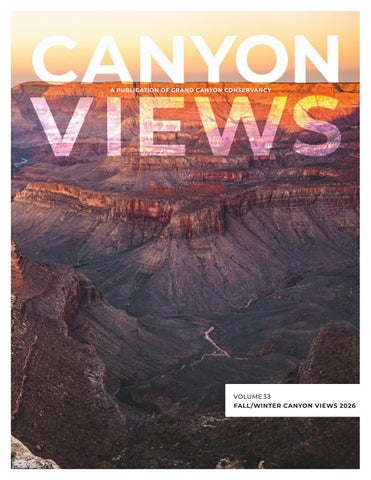
A PUBLICATION OF GRAND CANYON CONSERVANCY
VOLUME 33 FALL/WINTER CANYON VIEWS 2026
Canyon Views is published by Grand Canyon Conservancy (GCC). For more information about Grand Canyon Conservancy, visit grandcanyon.org. 2026 Board of Directors: Randall Brown, Chair – Dallas, TX Pamela Kerr, Vice Chair – Tucson, AZ Stan Sutherland, Secretary – Flagstaff, AZ David Cermak – Denver, CO Aaron Craft – Cave Creek, AZ Charlie Galbraith – Washington, D.C. David Gonzales – Tucson, AZ Dennis A. Johnson – Sacramento, CA Stephanie Quincy – Phoenix, AZ Mick Rusing – Tucson, AZ Jessica Turner – Baltimore, MD Kevin Washburn – Flagstaff, AZ Chief Executive Officer: Elizabeth Silkes Chief Philanthropy Officer: Bonnie Baker Chief Communications Officer: Mindy Riesenberg Canyon Views Editor & Writer: Lauren Cisneros Graphic Design: Lori Hale Printing: Prisma Copyright © 2026 Grand Canyon Conservancy
Grand Canyon Conservancy P.O. Box 399 Grand Canyon, AZ 86023 EIN #86-0179548 (800) 858-2808 grandcanyon.org
Cover photo: Corinna Haines
Powell Point Sunset. Photo: NPS/M.Quinn
04 In This Issue
06
02
From the CEO
04
Stronger Together: Supporting the South Rim Community
06
Grand Canyon is for Everyone: Expanding Access, Deepening Connection
09
Canyon Compass Awards 2026
11
More Than a View: 33 Years of Grand Canyon Conservancy Field Institute
15
Ways to Give
18
Grand Canyon Conservancy: Then & Now – From Interpretation to Impact
21
Making More Possible: A Partnership with Lasting Impact
24
Residency Program from Inception to Current Day at Grand Canyon National Park
11 18 21
26
Visiting with Respect: Protecting Cultural Heritage at Grand Canyon National Park
31
One Year Later: Resilience and Recovery on the North Rim
33
Shop Grand Canyon Conservancy
24 26 31
A PUBLICATION OF GRAND CANYON CONSERVANCY
1
02 From the CEO Dear Friends, Grand Canyon belongs to everyone. Whether you arrive at the rim in a wheelchair, holding a child’s hand, accompanied by a service animal, or carrying generations of cultural connections to this landscape, Grand Canyon National Park is a place where we can all come to experience wonder, reflection, and connection. Ensuring that everyone has the opportunity to access and engage with this extraordinary place is one of the most important responsibilities we share with our partners at the park. At Grand Canyon Conservancy, we often talk about preservation, stewardship, education, and science. At the core of all those efforts is access.
Access ensures visitors of all abilities have the opportunity to experience Grand Canyon safely and meaningfully. It is achieved through support for projects that enhance trails, viewpoints, exhibits, transportation systems, and visitor facilities so that visitors can connect with the canyon’s beauty and significance in a range of ways. These efforts help ensure that age, mobility, or circumstance are not barriers to discovering one of the world’s most iconic and inspiring landscapes. Access also means investing in educational opportunities that welcome learners of every age. Through GCC’s support of field trips, educational programming, publications, and the Field Institute, we help connect students, families, and lifelong learners to the stories, science, and history of Grand Canyon. Every visitor who gains a deeper understanding of this place can begin to see themselves as part of its future. Importantly, access extends beyond recreation and education. It includes committing to more opportunities for Indigenous communities to share their voices, perspectives, and cultural connections to the canyon. Grand Canyon has been home to Indigenous peoples since time immemorial, and their stories – past and present – are essential to understanding this place and its history. Through partnerships with the park and the Intertribal Working Group, GCC supports initiatives that elevate Indigenous voices, foster cultural understanding, and strengthen relationships rooted in respect and collaboration.
2
CANYON VIEWS FALL /WINTER 2026
Access also means ensuring that future generations can experience Grand Canyon. The scientific research, conservation projects, historic preservation, and infrastructure improvements funded by members like you help protect the resources that make this place special. By caring for the canyon today, we are preserving access for tomorrow.
Photo: GCC/L.Cisneros
Every gift made to GCC contributes to this vision. Whether supporting infrastructure improvements, educational programs, cultural initiatives, scientific research, or visitor experience enhancements, your engagement is essential to making Grand Canyon more welcoming, more inclusive, and more accessible to all. As you read this issue of Canyon Views, you’ll discover stories that reflect many dimensions of access – people connecting with Grand Canyon through art, science, learning, culture, and stewardship. These stories remind us that access is not simply about reaching a destination. It is about creating opportunities for everyone to experience belonging, inspiration, and connection. Thank you for helping ensure that Grand Canyon remains a place where all people can learn, explore, and be transformed by one of the world’s greatest natural wonders. With gratitude,
Elizabeth Silkes Chief Executive Officer Grand Canyon Conservancy
A PUBLICATION OF GRAND CANYON CONSERVANCY
3
04
Stronger Together: Supporting the South Rim Community
Two community members enjoy a GCC community dinner.
GRAND CANYON IS MORE THAN A PLACE, IT’S A COMMUNITY. On August 29, 2026, a significant flash flood affected Bright Angel Canyon and the Phantom Ranch area, causing substantial damage to trails, bridges, infrastructure, and the waterline that provides drinking water for Grand Canyon. Tragically, the flood also resulted in loss of life. The South Rim is home to approximately 2,000 people, including families with children who attend the local K–12 school. From park rangers and concession employees to Grand Canyon Conservancy staff and others who live and work here, this is a community that calls this place home. The water crisis has deeply affected the people who live and work here. “I have a lot of fond memories of community events growing up, and these dinners have really brought back the positive energy that has been missing for many years. Living in such a remote area makes it hard to really develop strong social connections. So, events like these really help during busy and challenging times.” – Grand Canyon Community member
4
CANYON VIEWS FALL /WINTER 2026
In the immediate aftermath of the devastating flooding, Grand Canyon Conservancy stepped in to support the South Rim community where help was needed most. With the support of our donors and partners, we facilitated the donation of thousands of gallons of drinking water, and increased the frequency of our free community dinners, creating more opportunities for people to come together, share a meal, and support one another.
Our distribution center team has worked with local partners to receive donations of compostable plates, cups, and cutlery, and then incorporated that into water distribution. We also partnered with Xanterra to offer free shuttle buses for residents from the park to the community dinners in Tusayan, as many park residents do not own vehicles. This partnership significantly expanded access to community dinners, especially for some of the most at-risk Grand Canyon community members.
GCC employee Duncan Petrie's daughter with a GCC water delivery. Photo: D.Petrie
Delaware North partnered with GCC to offer day-use passes for community members, along with free laundry services and pool and shower access at Squire Resort in Tusayan. These efforts are about more than meeting immediate needs. They’re about supporting our community and making sure the people who live and work at Grand Canyon know they are not facing this alone. GCC also recognized an opportunity to help build a stronger, more connected South Rim community that is better prepared to navigate future challenges. Grand Canyon Conservancy took the lead in convening South Rim community leaders to develop a coalition focused on community responsiveness
GCC employees staff a table at a community dinner. Photo: GCC/C.Maragos
and resilience. This group brings together the organizations and individuals serving the South Rim community to better coordinate resources, identify gaps, strengthen communication, and build the capacity to respond to challenges. We believe the entire Grand Canyon community will benefit from having a coalition of local organizations working together over the long term to strengthen coordination, preparedness, and community resilience.
The Dragon Bravo Fire, the recent flash-flooding, and the water restrictions have put extraordinary pressure on the people who live and work at Grand Canyon. Throughout these challenges, GCC has continued to look for ways to support not only the park itself, but the community that makes Grand Canyon possible. Because Grand Canyon is more than a place. It’s a community — and we’re stronger when we take care of it, together.
A PUBLICATION OF GRAND CANYON CONSERVANCY
5
06
Grand Canyon is for Everyone: EXPANDING ACCESS, DEEPENING CONNECTION
Photo: @billyb4access (Instagram)
While exploring Hermit Road at Grand Canyon with his family, Billy leaned back and popped a wheelie in his wheelchair for a photo. For many visitors, it’s a bucket list destination to visit Grand Canyon. For Billy Bogdan, it represented something more: the freedom to experience one of the world’s most iconic landscapes alongside his family. “As a person with a disability and as a father, I was so impressed by Grand Canyon,” he said. “Being able to use my access pass, get a special code for the Hermit gate, and enjoy it with my family meant everything.” Billy visited Grand Canyon National Park in April 2024 and quickly discovered that many of the experiences he had hoped
6
for were within reach. After stopping at the visitor center, he received information about accessibility accommodations, including access through the Hermit Road gate. From there, he and his family were able to drive their personal vehicle to viewpoints along the route, allowing them to explore at their own pace. “For people with disabilities, being able to use your own vehicle is a godsend,” he said. “It gives you independence and flexibility.” At Hermit Road, paved pathways connect viewpoints and overlooks, making it easier for Billy to navigate
CANYON VIEWS FALL /WINTER 2026
while exploring together with his children. “At a lot of parks, I might do an ADA (Americans with Disabilities Act) trail while my kids go off and do their own thing,” he said. “At Grand Canyon, we did everything together.” That sense of connection is at the heart of accessibility efforts throughout Grand Canyon National Park. Accessibility is more than ramps, pathways, and parking spaces. It is about creating opportunities for people of all abilities to experience Grand Canyon alongside friends and family.
Over the years, accessibility improvements throughout the park have helped make that possible. Paved sections of the Rim Trail, the paved greenway trails, accessible viewpoints, visitor facilities, and pathways connecting key destinations have made it easier for more visitors to experience Grand Canyon. Grand Canyon Conservancy is proud to support many of these efforts through its partnership with Grand Canyon National Park. One example is the greenway trail system,
Photo: NPS
which provides accessible paved pathways connecting destinations throughout Grand Canyon Village. The trail helps visitors navigate the South Rim more easily while offering opportunities to experience the canyon and surrounding forested areas at their own pace. For Billy, accessible pathways create something invaluable: independence. “I always tell people that nature is for everyone,” he said. “A lot of people assume national parks aren’t accessible, but many parks have so much to offer.”
Accessibility improvements continue to expand opportunities for visitors across Grand Canyon. At Lipan Point, which offers one of the most expansive views of the canyon, a major accessibility improvement project is underway. The project includes reconstructing pathways and viewing areas, improving surfaces, and redesigning access routes between the parking area and the overlook. Lipan Point is currently closed while park staff work to create a route that meets accessibility standards.
A PUBLICATION OF GRAND CANYON CONSERVANCY
7
The closure is expected to remain in effect through December 23, 2026. When completed, this project will make it easier for more visitors to reach and enjoy one of Grand Canyon’s most spectacular viewpoints. Accessibility improvements at Lipan Point are part of ongoing efforts to make Grand Canyon more accessible to all visitors. While Billy noted that some challenges remain – including the need for additional accessible restroom facilities and continued improvements at certain overlooks – his overall experience was overwhelmingly positive.
Photo: @billyb4access (Instagram)
“My experience was nine out of ten,” he said. He also believes the future of accessibility is stronger than ever. Growing innovations in adaptive recreation, mobility technology, and outdoor accessibility are creating new opportunities for people with disabilities to explore the outdoors. From adaptive skiing and mountain biking to handcycling and kayaking, more experiences are becoming possible every year.
Photo: NPS
“I tell people this is the best time in history to be disabled because there’s so much out there now,” Billy said. “And there’s even more coming in the future.” That future is one Grand Canyon National Park and Grand Canyon Conservancy continue to help build. One pathway, one viewpoint, and one shared experience at a time. Everyone deserves the opportunity to experience Grand Canyon, take in the vast and dramatic landscape, and create memories with the people they love.
8
CANYON VIEWS FALL /WINTER 2026
Photo: @billyb4access (Instagram)
Canyon Compass Awards 2026 Just as a compass provides direction, orientation, and unwavering guidance, Grand Canyon Superintendent Ed Keable, the Canyon Compass Award recognizes Elizabeth Sweeney and Grand Canyon Conservancy CEO Elizabeth Silkes. Photo: John Segesta exceptional individuals who have served as enduring guides and steady forces in support of Grand Canyon Conservancy’s mission. We are thrilled to announce our newest additions to the Canyon Compass Award recipient list. Elizabeth and William Sweeney, A Thoughtful and Enduring Legacy For more than a decade, Elizabeth and William Sweeney have reflected on the spirit of the Canyon Compass Award through their enduring generosity and meaningful, long-standing connection to Grand Canyon Conservancy. Since 2011, they have provided
15 years of consecutive support. Their philanthropy reflects both breadth and purpose – from establishing the Grand Canyon Science Endowment to championing the restoration of Kolb Studio and Desert View Watchtower and contributing to the Grand Vision Campaign.
“Liz and Bill Sweeney embody true partnership with the park. For over fifteen years, they’ve shown up with both generosity and heart – their giving is deeply personal and profoundly lasting. From launching our first donor match to championing the trails Liz has walked, I’m honored to have them as part of the Grand Canyon Conservancy family.” – Bonnie Baker, Chief Philanthropy Officer
Liz brings a lifelong passion for the canyon, shaped in part by her time in Sedona and leadership as “Trail Boss” of the Sedona Westerners. Her Rim-to-Rim hike in 2012 reflects a lasting connection to the landscape – one shared with Bill through their support of the Bright Angel Trailhead renovation and Trails Forever Endowment. Through the years, Liz and Bill’s donations have helped protect treasured landmarks, expand knowledge through research, and enhance the experiences of millions who visit each year. The impact of their generosity will be felt for decades to come.
A PUBLICATION OF GRAND CANYON CONSERVANCY
9
Sheila and Allen Henry, A Life Shaped by the Canyon
For more than a decade, Sheila and Allen Henry embodied the spirit of the Canyon Compass Award through deep personal connection, enduring generosity, and unwavering commitment to Grand Canyon Conservancy (GCC). Their journey began with transformative experiences in the canyon – hiking to Phantom Ranch, rafting the Colorado River, and experiencing the Milky Way in one of the world’s darkest skies.
“Grand Canyon truly is a unique and very special place, one of the 7 Wonders of the World, and it needs to be protected.” – Allen Henry
Since their first Grand Gathering in 2018, they have actively participated in programs, events, and educational experiences, inspiring others through their enthusiasm and advocacy. From underwriting presentations about the discovery of the
Allen Henry and Grand Canyon Conservancy CEO Elizabeth Silkes. Photo: John Segesta
10
CANYON VIEWS FALL /WINTER 2026
canyon’s desiccated bats and hidden caves to supporting the restoration of the ceremony area overlooking the canyon at Desert View, Sheila and Allen are amazing contributors to GCC’s efforts to engage and inspire. For over 14 consecutive years, they have contributed transformative support for the Desert View Intertribal Cultural Heritage Site and Trails Forever, among other initiatives. As Grand Guardians, they have also supported unrestricted funding and matching challenges, amplifying GCC’s impact. Through changing times – organizational shifts, evolving park priorities, and personnel transitions – their commitment has never wavered. Their legacy will endure through a planned estate gift, ensuring future generations benefit from the canyon they cherish. Their connection to Grand Canyon is deeply personal. They describe it as a place of awe, a “natural sanctuary” that has shaped their appreciation for wilderness, community, and stewardship.
11
An early Grand Canyon Field Institute class of nine poses by the Bright Angel Trailhead before a hike on Oct. 1, 1994. Photo: NPS/M.Quinn
More Than a View: 33 Years of Grand Canyon Conservancy Field Institute
When the Grand Canyon Field Institute launched in the fall of 1993, its goal was simple: help people experience Grand Canyon in a deeper, more meaningful way. TODAY, MORE THAN THREE DECADES LATER, THAT MISSION REMAINS UNCHANGED. Thousands of participants have explored the canyon alongside geologists, historians, archaeologists, artists, scientists, photographers, and experienced backcountry guides. They’ve learned about Indigenous perspectives, discovered hidden corners of the canyon, developed confidence in the backcountry, and, perhaps most importantly, formed lasting connections with one of the world’s most remarkable landscapes. The Field Institute has grown tremendously since those first programs – but its purpose has stayed the same: helping people build relationships
with Grand Canyon through education. In the early 1990s, Grand Canyon Conservancy (then Grand Canyon Natural History Association) recognized an opportunity. Visitors could attend ranger talks or join concessionaire tours, but there wasn’t a program dedicated to immersive learning led by experts. “I learned that other parks had field seminar programs,” recalled John Frazier, who helped establish the Field Institute. “It seemed clear that Grand Canyon National Park should have a similar program.”
Field Institute logo in the mid-1990s.
Working with Executive Director Sandra Scott, Frazier began developing the concept. When Grand Canyon Superintendent Robert Chandler arrived from Olympic National Park where a similar program already existed, he encouraged Grand Canyon Conservancy to bring the idea to life.
A PUBLICATION OF GRAND CANYON CONSERVANCY
11
1994 image of a program offering, “Life in Stone: Fossils of the Grand Canyon.”
With support from the National Park Service, the organization gained access to classrooms, group campsites, and backcountry permits.
“I had a dream,” Sadler said. “I wanted multiple instructors with different backgrounds of expertise—a full immersion river trip.”
In the fall of 1993, the first Grand Canyon Field Institute classes officially began.
Those trips quickly became some of the Field Institute’s most sought-after adventures.
There were just six programs: two geology classes, two archaeology classes, and two photography classes.
For Sadler, however, the goal was never simply covering miles.
No one imagined they were laying the foundation for a program that would inspire thousands of people over the next three decades.
“Human Rainbow” on a GCFI river trip in the early 2000s. Photo: Karen Greig
Among those original instructors was geologist and river guide Christa Sadler. Having worked as a Colorado River boatman since the late 1980s, she had come to an important realization.
1996 river trip “Prom.” Photo: Christa Sadler
“You can look at the canyon, take pictures, run the rapids, it’s beautiful,” she said. “But it’s so much more interesting when someone helps you understand what you’re seeing and make a connection to it.” Within a year, backpacking programs were added. Soon after came river trips, including an 18-day expedition that brought together instructors with expertise in geology, ecology, archaeology, history, and other disciplines to create a fully immersive learning experience.
Former GRCA Interpreter Susan Lamb prepares to lead a Field Institute hike into the canyon. Oct. 1, 1994. Photo: NPS/M.Quinn
“It’s about taking your pack off, exploring side canyons, learning, and really seeing the place.” The Field Institute has always been about more than adventure. Participants learn how to backpack safely and confidently, but they also discover the stories that make Grand Canyon unlike anywhere else. “Backpacking can be intimidating,” Sadler said. “Other organizations may plan everything for you. We teach people how to do it themselves.” Even experienced hikers leave with a deeper understanding of the canyon. “You can be the world’s best backpacker and go on your own,” she said. “But you won’t learn as much. You won’t hear the untold stories. You won’t understand the geology or Indigenous history in the same way.” That educational approach has helped countless participants become lifelong canyon stewards.
“I’ve watched people start out totally intimidated by backpacking,” Sadler said. “Now they’re experienced backpackers and subject matter experts.” Many have returned year after year. Some have become instructors themselves. Others have supported trail restoration, historic preservation, educational programming, and conservation efforts after developing a deeper relationship with Grand Canyon. Few instructors have witnessed that transformation more than geologist Wayne Ranney, who spent 19 years leading Field Institute trips. “My time as a Field Institute instructor and trail guide allowed me to share my passion for Grand Canyon in the most profound ways,” Ranney said. “I count my 19 years with GCCFI as among the most rewarding – for myself and the hundreds of trail companions who joined me on these adventures.” For Sadler, who continues leading trips after more than 33 years, the greatest reward has been watching participants discover not only Grand Canyon, but themselves. “Grand Canyon Conservancy Field Institute has been incredibly important to me,” she said. “I’ve led trips and taught classes for the organization for more than half my life. I feel as though
this is some of the most meaningful work I do.” She has watched participants gain confidence, build lifelong friendships, and fall in love with the canyon.
1996 Rim to Rim Field Institute trip. Photo: Christa Sadler
“I get to watch them come to love and care for the canyon even more in the process.” “This opens the door to a greater connection not just to Grand Canyon, but even to the little natural places in their own worlds that are also so important.”
2005 Field Institute group with Wayne Ranney (old trailhead before restoration).
For Sadler, that’s what makes organizations like the Field Institute so valuable. “Educational organizations like this are incredibly important,” she said. “In providing depth and meaning and helping people connect to our planet, they offer a counter to the social media crowd that just wants pictures of a place.” “It’s these natural places that remind us who we are, and as more and more of the natural world is threatened, it’s even more important for us to protect it. I’ve seen that protection comes most easily for people who have created a relationship with the natural world, something the Field Institute encourages every day.” Thirty-three years after the first six classes, the Field Institute continues to evolve while staying true to its original purpose.
Having fun on a 2009 river trip. Photo: Christa Sadler
This past summer marked the beginning of an exciting new chapter. Grand Canyon National Park’s interpretive rangers do extraordinary work, helping visitors discover the stories, science, and cultural significance of the canyon. But with growing visitation and limited staffing, the demand for free educational programs has outpaced the park’s capacity to provide them. To help meet that need, Grand Canyon Conservancy’s Field Institute launched a new
A PUBLICATION OF GRAND CANYON CONSERVANCY
13
series of free public programs on the South Rim in partnership with the National Park Service. Designed for visitors of all ages and abilities, these experiences expand opportunities for people to connect more deeply with Grand Canyon while supporting the park’s interpretive mission. Visitors can now choose from several different types of programs throughout the day. Walk & Talk Programs bring the canyon’s stories to life through guided walks centered on geology, wildlife, history, and other topics. Programs like Little Explorers invite young visitors and their caregivers to discover the canyon together, helping inspire the next generation of park champions. Story Time Programs offer engaging presentations where visitors can learn about the canyon and the people who call it home. Stories Under the Stars transforms an evening at Mather Campground into an unforgettable learning experience capturing the feeling of gathering around a campfire without the need for a fire.
Come & Explore Programs invite visitors to stop by interactive learning stations where naturalists use props, specimens, and hands-on activities to spark curiosity. The first program launched, Unlocking Plant Secrets, quickly proved how eager visitors are to engage with the canyon in new ways. During the busy summer season, visitors had multiple opportunities every day to participate in free guided experiences, with four to eight programs offered daily, seven days a week. Just as Grand Canyon changes with the seasons, so will the programming. New topics and experiences will rotate throughout the year, giving returning visitors fresh opportunities to learn and explore. The programs represent exactly what John Frazier envisioned more than 30 years ago: creating more opportunities for visitors to connect with Grand Canyon through meaningful educational experiences.
A Field Institute group takes a photo on the Bright Angel Trail during a “Meet the Canyon” day trip. Photo: GCC/L.Cisneros
This ensures that more visitors leave Grand Canyon not only inspired by what they’ve seen, but with a deeper understanding of why this extraordinary place matters. More than three decades after the first six classes welcomed curious learners, the Field Institute continues to do what it has always done best: inspire people to explore, understand, and protect Grand Canyon, one meaningful connection at a time.
That vision continued because of Grand Canyon Conservancy members and donors, who help make everything from immersive backpacking adventures to free public programs possible. Free Day Program: Unlocking Plant Secrets, with GCCFI Instructor, Lindsay. Photo: GCC/C.Haines
14
CANYON VIEWS FALL /WINTER 2026
Ways to Give: Bright Angel Circle Bright Angel Circle recognizes the extraordinary individuals who have chosen to include Grand Canyon Conservancy in their estate plans, ensuring that the wonder, beauty, and significance of Grand Canyon will inspire future generations. Through bequests, An avid horsewoman and lifelong adventurer, Karen Olek embraced the outdoors with passion and purpose. beneficiary designations, charitable Her love for Grand Canyon became a lasting legacy through her planned gift to Grand Canyon Conservancy. trusts, retirement assets, and other planned giving options, Bright Angel Circle members make one of the most meaningful commitments possible – a gift that reflects both their values and their vision for the future.
Planned gifts are often the culmination of a lifetime of connection to Grand Canyon. They represent a deeply personal expression of gratitude for the experiences, memories, and inspiration found within this extraordinary place. These legacy gifts provide lasting support for Grand Canyon Conservancy’s mission to protect, preserve, and enhance Grand Canyon National Park for generations to come. In 2025, Grand Canyon Conservancy was honored
to receive a planned gift from Karen Olek, whose lifelong love of Grand Canyon became her enduring legacy. Karen’s story reminds us that the impact of a planned gift extends far beyond financial support – it reflects a passion for a place that shaped a life. At least every other year, Karen Olek traveled from New York state to immerse herself in the beauty and adventures of Arizona. It was Grand Canyon National Park that continually called to her, piquing her love of adventure.
As an avid horsewoman, riding a mule to Phantom Ranch on several occasions was her delight. However, these hooved journeys could not be overshadowed by her meticulous physical training, research, and preparations for the terrain and wonders that would unfold on her treks and river rafting. Summoned back time and again, “Grand Canyon was Karen’s home away from home, her heart and soul place on earth, and now it is her legacy.”
A PUBLICATION OF GRAND CANYON CONSERVANCY
15
Sunset near Mather Point. Photo: GCC/L.Cisneros
16
CANYON VIEWS FALL/WINTER 2026
A PUBLICATION OF GRAND CANYON CONSERVANCY
17
18 Grand Canyon Conservancy: Then & Now – From Interpretation to Impact
Park naturalist Edwin McKee, giving a program to a group of 13 visitors outside of the Yavapai Museum and observation station in September 1932. Photo: NPS
HOW EDUCATION, EXPLORATION, AND DONOR SUPPORT HELPED SHAPE THE STEWARDSHIP OF GRAND CANYON NATIONAL PARK.
Almost a century ago, geologist and educator Edwin “Eddie” McKee descended Grand Canyon’s trails week after week, studying the canyon layer by layer while helping visitors understand the landscape around them. Nearly a century later, the mission remains the same: connecting people to Grand Canyon so future generations can experience, understand, and protect this extraordinary place. “Usually, at least once a week, I’d go down one of the trails,” McKee recalled years later in an oral history interview. At the time, Grand Canyon was already inspiring. McKee and other early naturalists believed awe alone was not enough. If people understood more
18
about the canyon—its geology, ecology, history, and cultural significance—they would be more likely to care for and protect it. That belief became foundational in the creation of what we now know as Grand Canyon Conservancy. Founded in 1932 as the Grand Canyon Natural History Association by naturalist Edwin McKee, the organization began with a simple but ambitious mission: support education, interpretation, research, and
CANYON VIEWS FALL /WINTER 2026
Edwin McKee in field clothes holding a small bird (Pygmy Nuthatch) in his hand. Photo: NPS
public understanding at Grand Canyon National Park. Early efforts included publications, exhibits, lectures, trailside interpretation, and educational programming designed to deepen visitors’ connection to the canyon. In those early years, interpretation looked very different than it does today. Visitors attended campfire talks, joined auto caravans along the South Rim, explored
GRAND CANYON CONSERVANCY:
THEN & NOW 1932 Grand Canyon Natural History Association is founded to support education, interpretation, and research at Grand Canyon National Park. THEN ––––––––––––––––––––––––––– • Campfire talks and guided caravans • Nature Notes publications • Trailside exhibits • Educational booklets written by naturalists • Early geology interpretation led by naturalists like Edwin McKee NOW ––––––––––––––––––––––––––– • Field Institute programs and guided experiences • Residency Program Expansion (Artist, Astronomer, and Educator) • Canyon Conversations speaker series • Star Party – the largest Dark Sky Celebration in the U.S. • Celebration of Art • Scientific research such as dye tracing and LiDAR monitoring • Elevating Indigenous Voices • Trail improvements • Wildlife and resource monitoring • Digital storytelling and educational outreach • & so much more. THEN ––––––––––––––––––––––––––– Understanding the canyon inspired visitors to become stewards. NOW ––––––––––––––––––––––––––– That same principle continues to guide Grand Canyon Conservancy’s work across education, preservation, research, and philanthropy.
trailside exhibits, and purchased educational booklets written by canyon scientists and naturalists. Publications like Grand Canyon Nature Notes brought geology, wildlife, archaeology, and canyon stories to a growing audience eager to learn more about the landscape before them. McKee’s work reflected the spirit of the era. As a dedicated geologist, he spent decades studying the canyon’s rock layers and landscapes. As an educator, he helped transform scientific knowledge into stories visitors could understand and remember. Through exhibits at Yavapai Geology Museum, interpretive programs, and countless conversations along canyon trails, McKee and his naturalist friends helped create a culture of learning at Grand Canyon that still exists today. Over time, the organization evolved alongside Grand Canyon National Park. As visitation increased and stewardship needs expanded, so did the scope of the organization’s work. As the years went by, the organization was renamed Grand Canyon Association, supporting educational programs, publications, interpretation, and park initiatives throughout the canyon. In 2018, the organization adopted the name
Grand Canyon Nature Notes cover from September 1932.
Grand Canyon Conservancy, marking another chapter in its evolution as the official nonprofit partner of Grand Canyon National Park. While the name changed over time, the core mission remained remarkably consistent: helping people connect more deeply to Grand Canyon through education, preservation, and stewardship. As visitation to the park increased throughout the 20th century, so did the need for preservation, research, visitor education, and stewardship. What began as a small educational association gradually expanded its role in supporting the park through publications, interpretation, cultural preservation, conservation projects, and scientific initiatives that helped protect the canyon
A PUBLICATION OF GRAND CANYON CONSERVANCY
19
for future generations.
Dianna Sue Uqualla and James Uqualla of the Havasupai Tribe perform a traditional dance at the Tribal Medallion. Photo: NPS/M.Quinn
2013 Bright Angel Trailhead dedication ceremony. Photo: Terri Attridge
By the latter half of the century, GCC’s work reflected a growing understanding that protecting Grand Canyon required more than preserving scenic views alone. Efforts increasingly supported research, historic preservation, wildlife monitoring, trail improvements, and opportunities for visitors to connect more meaningfully with the landscape and its stories. Supporters remained central to that work.
2014 North Rim Grand Canyon Association Volunteer Week. Photo: Barry Oleksak
The Junior Ranger program is made possible by GCC. Photo: GCC
The Milky Way photo booth at Star Party 2026. Photo: GCC/C.Haines
20
From early memberships and educational donations to today’s philanthropic partnerships and community support, generations of donors helped sustain projects that shaped both the visitor experience and the long-term preservation of Grand Canyon National Park. The evolution of the organization could also be seen through the changing ways people experienced and learned about the canyon. Printed booklets and trailside exhibits eventually expanded into larger educational publications, cultural programs, art exhibitions, and immersive opportunities that invited visitors to engage more deeply with the canyon’s geology, ecology, and cultural history.
CANYON VIEWS FALL /WINTER 2026
Throughout those changes, one idea remained the same: education inspires stewardship. Visitors engage through Field Institute programs, virtual events like Canyon Conversations and Dark Sky livestreams, cultural demonstrations, and Celebration of Art, while National Park staff study and protect Grand Canyon’s wildlife, water, geology, cultural sites, and historic trails. Yet the goal remains remarkably similar to the one envisioned by Edwin McKee and the organization’s founders nearly a century ago: to help people understand Grand Canyon deeply so they will care for it more thoughtfully. As Grand Canyon Conservancy approaches its 95th anniversary in 2027, the organization continues to build upon the foundation established by generations of educators, scientists, supporters, and park partners. Their collective efforts have helped ensure that Grand Canyon remains not only a place that visitors check off their bucket list, but also a place of learning, discovery, and stewardship for generations to come.
21 Making More Possible: A Partnership with Lasting Impact BEHIND MANY OF THE IMPROVEMENTS VISITORS SEE, AND SOME THEY NEVER NOTICE, IS THE POWER OF PARTNERSHIP.
Grand Canyon Conservancy (GCC) works alongside partners like the National Park Foundation (NPF), the official nonprofit partner of the National Park Service, to support priority projects at Grand Canyon National Park. Over the last 15 years, NPF has helped invest $6.4 million in initiatives ranging from visitor experience upgrades to major infrastructure and cultural site restoration, including Desert View.
WHAT PARTNERSHIP MAKES POSSIBLE: Grand Canyon Train Depot Restoration HISTORIC PRESERVATION RESTORATION • 2019
Preserved on purpose
THEN: ORIGINAL 1910
NOW: RESTORED, NOT REINVENTED
From these photos, it appears that not much has changed since the depot was built in 1910, and that was exactly the goal. Funding from NPF supported historic preservation work that restored and stabilized the Grand Canyon Train Depot while maintaining its original 1910 character. Today, it continues to welcome rail visitors as it has for more than a century.
A PUBLICATION OF GRAND CANYON CONSERVANCY
21
Expanding Access to Youth Education YOUTH EDUCATION • 2019–2025 THEN:
Gateway communities
58%
of students who visited Grand Canyon
NOW:
80%+
of students who visit Grand Canyon
on ranger-led field trips were from on ranger-led field trips are from Through NPF’s Open OutDoors gateway communities gateway communities for Kids program, Grand Canyon National Park has expanded opportunities for students from Title I and Tribal schools in gateway communities to experience the canyon firsthand. Funding has supported transportation and outreach efforts, helping remove barriers that often prevent students from visiting the park.
As a result, more local youth – including many visiting for the first time – have been able to participate in place-based learning experiences that foster deeper connections to Grand Canyon. For students with ancestral ties to the canyon, these visits are especially meaningful.
Wildlife-Resistant Water-Filling Stations VISITOR EXPERIENCE • 2023
A safer place to refill Visitors hiking from the Bright Angel and South Kaibab THEN: SHARED ACCESS NOW: PROTECTED STATIONS trailheads once shared water filling stations with an unexpected user: elk. As wildlife became habituated to these water sources, concerns grew about both visitor safety and impacts to wildlife behavior. In 2023, a grant from the National Park Foundation funded the installation of wildlife-resistant waterfilling stations at both trailheads. The upgraded stations allow visitors to refill their water bottles while preventing wildlife from accessing the water, helping keep both people and animals safer.
The impact of partnerships can be seen across Grand Canyon, from cultural heritage sites to classrooms and trailheads. This summer, NPF awarded GCC an additional $1.3 million in transformational gifts: a $720,000 Innovation Grant will help GCC bring free public Wi-Fi and digital interpretation to the Grand Canyon visitor experience; and NPF’s Partner Housing Catalyst Grant of $580,000 will support planning for new NPS staff housing on the North Rim, and on-site, short-term housing for the Cultural Demonstration Program at Desert View.
22
CANYON VIEWS FALL/WINTER 2026
Roof Replacement for Historic Kolb Studio HISTORIC PRESERVATION • 2025
A roof built to last
THEN: CRITICAL REPAIRS UNDERWAY
NOW: ORIGINAL CHARACTER RESTORED
Built in 1905, Kolb Studio required critical roof repairs to preserve its structure and historic character. New cedar shingles match the original design while protecting the building from fire, moisture, and weather damage, ensuring its continued presence on the South Rim.
Desert View Intertribal Cultural Heritage Site INTERTRIBAL COLLABORATION • ONGOING
A shared vision takes shape Grand Canyon National Park, Tribal partners, and GCC are THEN: DESIGNED TOGETHER NOW: COMING TO LIFE working together to transform Desert View into the first Intertribal Cultural Heritage Site in the National Park System. Funding has supported infrastructure improvements, an Ancestral Lands Conservation Corps crew, and the design of a new orientation area at the main entry to Desert View. Construction of a Tribal Welcome Center is underway and is expected to open early next year. This ongoing effort will create new opportunities for visitors to engage with the living cultures, histories, and perspectives of the Tribal communities that have deep connections to Grand Canyon.
We are grateful to the National Park Foundation for helping make these projects possible and for sharing our commitment to inspiring people to connect with Grand Canyon, engaging communities in its stewardship, and protecting this remarkable place for future generations.
A PUBLICATION OF GRAND CANYON CONSERVANCY
23
24 Residency Program from Inception to Current Day at Grand Canyon National Park Since 2021, Grand Canyon Conservancy’s Residency Program has quietly grown into a powerful force for education, inspiration, and community engagement within Grand Canyon National Park. Each year, the program invites a select group of artists, astronomers, and environmental educators to immerse themselves in the landscape and share their expertise, perspectives, and creative interpretations with both visitors and local residents. Through public programs, talks, workshops, and creative projects, residents help deepen understanding of the canyon’s natural and cultural significance. As our National Park Service partners have faced funding reductions and increasing demands on limited resources, providing the same level of resource education and creative interpretation for Grand Canyon’s 4.5 million annual visitors and 2,000 community members has become increasingly challenging. In response, Grand Canyon Conservancy has expanded its role as a vital partner, delivering meaningful educational and cultural experiences through the Field Institute, public and community Events, and the award-winning Residency Program – ensuring that opportunities for learning, discovery, and connection continue to thrive.
24
CANYON VIEWS FALL /WINTER 2026
2025 Artist in Residence, Patricia Villalobos Echeverria at a printmaking pop-up. Photo: John Segesta
If you’re reading this because you’re a member of Grand Canyon Conservancy, your voice matters! What kind of programs would you like to participate in on-site? Please email us your ideas: residency@grandcanyon.org We hope to see you at a program soon.
2025 Astronomer in Residence, Laura-May Abron shows a young boy an up-close view of the moon. Photo: Clover Morell
Between 2021 and 2025, Grand Canyon Conservancy hosted 18 artists and 15 astronomers, experts in their field, from throughout the world. Guests and community members have experienced the canyon through their own interpretations in a variety of formats: workshops, visual art, publications, performances, videos, special-topic hikes, sky tours, and lectures. Their reflections on the canyon help us better understand the awe that many of us feel when immersed in the resource. As we continue this important work of building a global community of Grand Canyon stewards in the arts and sciences, we are pleased to share the recent expansion of the program, which includes an Environmental Educator
in Residence and two artist residency tracks focused specifically on our local creators. Already this Astronomer in Residence, Dr. Logan Pearce year, some gives a program at Star Party 2026. Photo: GCC/L.Cisneros incredible work has been created on site, approaching Logan Pearce, Rain Orchard, complex relationships with a Sidney Rainey, Alessandra rapidly changing environment, Vertrees, Lauren Camp; and our our growing interest in returning alumni: elijah jamal astronomy and understanding asani, Dean Regas, Laura-May of our place in the universe, and Abron, Dr. Jennifer Hoffman, reflections on the preservation Dan Fleisch, Mark Chen, and of time, culture, and place Amy Monaghan. through group art projects We look forward to a fall and and performances. winter season of dynamic, We celebrate the contributions of creative, and educational our most recent 2026 residents: programming with the arrival Nicole Banowetz and Devin of new residents and the Reilly, Orquidia Velasquez, Dr. return of alumni.
A PUBLICATION OF GRAND CANYON CONSERVANCY
25
26 Visiting with Respect: Protecting Cultural Heritage at Grand Canyon National Park
Havasupai tribal members at Havasupai Gardens naming ceremony. Photo: NPS
For generations, Indigenous peoples have maintained deep cultural, spiritual, and ancestral connections to Grand Canyon. Today, efforts to protect the park’s cultural resources increasingly center Indigenous voices, perspectives, and knowledge, helping visitors understand that Grand Canyon is not only a natural wonder, but also a living cultural landscape that continues to hold deep meaning today. Grand Canyon is home to thousands of archaeological and cultural sites that help tell that story. For the 11 Tribal communities at Grand Canyon National Park, these places are far more than historic sites. They are living connections to ancestors, traditions, and cultures that continue today. As Radmilla Cody, a Grammy-nominated Diné singer, Grand Canyon Cultural Demonstrator, model, and the 46th Miss Navajo Nation, said: “What the National Park Service brings to Grand Canyon is a cultural
26
program that is Indigenousled. This program creates a truthful space that centers and elevates Indigenous voices that are connected to this sacred place through stories, songs, dances, artwork, advocacy of the land, lifeways and are shared with visitors from all over the world. These demonstrations are critical elements to the missing pieces of Indigenous history and intergenerational knowledge directly tied to Grand Canyon.” As visitation to Grand Canyon continues to grow, protecting these irreplaceable cultural resources has become increasingly important.
CANYON VIEWS FALL /WINTER 2026
Archaeological sites provide valuable insight into the rich human history of Grand Canyon, but they are also fragile. Unlike the canyon’s geologic features, which have endured for millions of years, cultural resources can be damaged in a single moment. A pottery fragment moved from its original location can lose critical context. A rock cairn built on an ancient structure can add damaging weight. Social trails can accelerate erosion. Even sharing sensitive site locations online can unintentionally put resources at risk. Although Tribal members may not always be physically present in the canyon, these cultural and agroecological sites are
not forgotten. Many Tribes continue to pray for these places in ceremony and believe they remain spiritually occupied.
Key protections include:
Protecting Resources
• The National Historic Preservation Act (NHPA)
Cultural resources throughout Grand Canyon are protected through federal law, active management, and collaboration with Tribal Nations.
• The Archaeological Resources Protection Act (ARPA)
• The Native American Graves Protection and Repatriation Act (NAGPRA)
Together, these laws help ensure cultural resources are preserved, respected, and accessible for future generations.
“We have not abandoned these places as the archaeologists say.” – The late Ronnie Cachini, Zuni Tribal Member
Photo: Radmilla Cody
A PUBLICATION OF GRAND CANYON CONSERVANCY
27
Each year, Grand Canyon National Park archaeologists, Tribal representatives, and law enforcement personnel monitor cultural sites throughout the park. Their work helps identify threats, document site conditions, and protect resources from vandalism, looting, and other forms of damage. Protecting Grand Canyon’s cultural heritage means safeguarding more than archaeological sites. It also means ensuring that the voices, knowledge, and traditions connected to these places continue to be shared. Partnership plays a critical role in this work. Through the Grand Canyon Intertribal Working Group (ITWG), representatives from the park’s 11 Tribal Communities
work alongside Grand Canyon National Park and Grand Canyon Conservancy to discuss cultural resource protection, stewardship, interpretation, and education. Indigenous ways of knowing are rooted in Journal entry from Ali Upshaw, a Navajo runner – guest on the Grand Canyon Speaks Podcast in 2025. knowledge that has been Conservancy are committed passed down to acknowledging, respecting, through generations by the and helping protect these living Tribal communities connected knowledge traditions. to this place. This place-based wisdom reflects a holistic way One of the most visible of understanding, relating examples of this partnership to, and caring for the natural is the Cultural Demonstration world. Grand Canyon National Program. Throughout Park and Grand Canyon the year, Tribal artists, musicians, dancers, and cultural practitioners share their traditions and stories with visitors through demonstrations, performances, and conversations. These experiences give visitors the opportunity to learn directly from Tribal community members while gaining a deeper understanding of the enduring cultural connections that continue to shape Grand Canyon.
Photo: NPS
28
CANYON VIEWS FALL /WINTER 2026
These conversations don’t end when visitors leave the park. Many of the stories
opportunities for visitors to learn directly from Indigenous voices.
A visitor interacts with Zuni acrylic painting artist, Tiyana Haloo, at Desert View Watchtower. Photo: GCC/C.Haines
shared through the Cultural Demonstration Program continue through Grand Canyon Speaks, a podcast produced through a collaboration between Grand Canyon National Park and Grand Canyon Conservancy that brings Indigenous perspectives to listeners around the world. By centering Indigenous voices, the Cultural Demonstration Program helps visitors understand that Grand Canyon is not only a place of extraordinary natural beauty, but also a living cultural landscape. Thanks to donor support, these programs continue to expand
In 2025, Indigenous cultural programs reached 4,757 visitors through 22 programs over 27 days, representing six tribes. In addition, cultural demonstrations took place over 265 days and featured 107 demonstrators from six of the eleven tribes traditionally associated: Hopi, San Juan Southern Paiute, Zuni, Diné, Yavapai-Apache, and Hualapai.
They are entering a place that has sustained communities, traditions, and cultural connections since time immemorial. Small actions make a lasting difference in preserving fragile resources and honoring the deep connections Tribal Nations maintain with this landscape.
Through donor support, $21,840 was distributed directly to Tribal artists, supporting honoraria, travel, and participation. Programs elevated Tribal voices through music, dance, storytelling, and film shared directly by cultural knowledge holders. These perspectives offer an important reminder: visitors are not only exploring a national park.
Journal entry from Hopi Cultural Demonstrator Gerald Dawavendewa in 2023.
HOW VISITORS CAN HELP
Protecting Grand Canyon’s cultural heritage is a responsibility shared by everyone who visits. Leave artifacts where they are found Avoid touching rock imagery, structures, or artifacts
Refrain from building rock cairns or moving stones Pack out all trash and food waste
Stay on designated trails and avoid creating social trails
Avoid sharing sensitive archaeological site locations on social media
A PUBLICATION OF GRAND CANYON CONSERVANCY
29
Learning More Visitors can deepen their understanding of Grand Canyon’s cultural significance by hearing directly from Indigenous voices.
From informational pamphlet about Unkar Delta, the largest habitation site along the Colorado River inside Grand Canyon National Park.
WATCH:
LISTEN:
We Are Grand Canyon
Grand Canyon Speaks
Behind the Scenery
VISIT:
Our project page
For many visitors, these experiences provide their first opportunity to hear Indigenous voices speaking directly about the meaning of Grand Canyon. By listening, learning, and visiting with respect, each of us can help protect the cultural heritage, living traditions, and enduring stories that continue to shape Grand Canyon for generations to come.
30
CANYON VIEWS FALL/WINTER 2026
Throughout the year, the Cultural Demonstration Program offers opportunities to meet Tribal artists, musicians, storytellers, and cultural demonstrators who share their knowledge and lived experience. For those unable to attend in person, Grand Canyon Conservancy supports additional opportunities to hear these stories year-round. The visitor education film We Are Grand Canyon features Indigenous community members sharing their personal connections to this place, while Grand Canyon Speaks – a storytelling podcast produced through a collaboration between Grand Canyon National Park and Grand Canyon Conservancy – offers in-depth conversations with Tribal artists, cultural practitioners, musicians, athletes, and community members whose lives and histories are deeply connected to the canyon. Together, these resources extend the Cultural Demonstration Program beyond the park, allowing people around the world to learn directly from Indigenous voices and gain a deeper understanding of Grand Canyon as a living cultural landscape.
31 One Year Later: Resilience and Recovery on the North Rim ONE YEAR AGO, THE NORTH RIM NEEDED HELP.
The park fee station behind the North Rim Visitor Center was destroyed by the Dragon Bravo Fire on July 12–13, 2025. Photo: NPS/M. Jenkins
In July 2025, the Dragon Bravo Fire moved across the North Rim, reshaping familiar places and disrupting the lives of those who live and work there. The historic North Rim Lodge, employee housing, and critical infrastructure were lost. Trails were damaged. Essential systems that support daily operations in one of the most remote areas of Grand Canyon National Park were severely impacted. For many, it meant the loss of home, stability, and daily life in a place they care deeply about.
“When the North Rim needed help, the response was immediate.”
When Grand Canyon Conservancy launched the North Rim Recovery Fund, the response was immediate. Supporters from across the country stepped forward – many for the first time. More than $925,000 was raised, and over 2,000 new supporters joined the GCC community.
That generosity made it possible to act quickly and with purpose. At the same time, cultural and archaeological assessments are ongoing, and long-term research efforts are helping guide recovery from water quality monitoring to sustained scientific studies. This is not just rebuilding. It is learning, adapting, and preparing for the future. Recovery has also meant caring for the people most directly impacted. In the days following evacuation, many North Rim employees
were displaced, having lost both homes and personal belongings. GCC responded quickly with essential supplies distributed through retail operations to meet immediate needs. Meals were coordinated in partnership with Delaware North, and additional support was directed to the Flagstaff Family Food Center’s Grand Canyon Food Pantry as community needs grew. Through partnerships with United Way of Northern Arizona and crisis response funding, financial assistance reached displaced National
A PUBLICATION OF GRAND CANYON CONSERVANCY
31
Dragon Bravo Fire on July 11, 2025, as residents went into GO status around 4 P.M. Photo taken from helipad RV site. Photo: GCC/L.Cisneros
Kaibab squirrels on the North Rim of Grand Canyon on a ponderosa tree. Photo: GCC/L.Cisneros
Because of you, recovery is underway.
North Rim evacuees at a GCC community meal. Photo: GCC
Bison on the North Rim lying in the meadow. Photo: GCC/L.Cisneros
Cynthia looks out at the canyon on the North Rim. Photo: Cynthia Stirns
“Recovery meant caring for the people who care for the canyon.”
Park Service and concessioner employees.
for the future. And planning continues for the years to come.
Even in a year marked by loss, the emotional connection to the North Rim remained strong.
When the North Rim reopens fully, it will reflect more than recovery. It will reflect what is possible when people come together to care for a place, and for one another.
The North Rim is beginning to heal. Trails are being restored. Research is guiding decisions
32
CANYON VIEWS FALL /WINTER 2026
“The North Rim is magical. I feel blessed to have spent time in this very special place. It truly is unmatched, and I look forward to the day we return.” – Cynthia Stirns
Celebrate Grand Canyon All Year Long!
HEADS UP!
NEW HATS JUST DROPPED:
GRAND CANYON SKETCH HAT
GRAND CANYON WILDFLOWER CAP
GRAND CANYON EMBROIDERED PANORAMIC HAT
Grand Canyon gets a fresh new look in a clean pencil sketch design. Simple, striking, and timeless. This structured 5-panel trucker hat features embroidered front detailing.
Grand Canyon National Park is home to hundreds of flowering plants. There are approximately 650 herbaceous wildflowers in the park. This hat features from left to right: Penstemon, Sego lily and Wood betony.
This embroidered scene captures sunset from Yaki Point, with layered rock formations, the Colorado River, and a California condor riding the evening air. The design reflects Grand Canyon’s shifting light, dramatic depth, and immense scale.
A PUBLICATION OF GRAND CANYON CONSERVANCY
33
Grand Canyon Conservancy P.O. Box 399, Grand Canyon, AZ 86023 We inspire generations of park champions to cherish and support the natural and cultural wonder of Grand Canyon. grandcanyon.org
INSPIRE. ENGAGE. PROTECT.