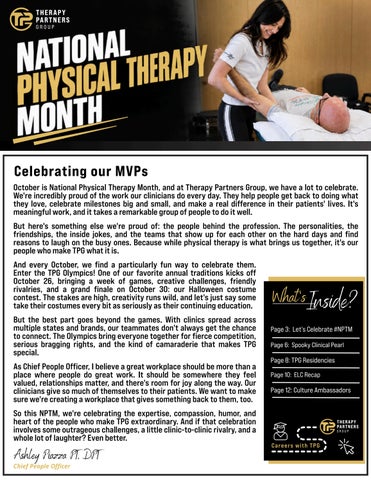
Celebrating our MVPs October is National Physical Therapy Month, and at Therapy Partners Group, we have a lot to celebrate. We're incredibly proud of the work our clinicians do every day. They help people get back to doing what they love, celebrate milestones big and small, and make a real difference in their patients' lives. It's meaningful work, and it takes a remarkable group of people to do it well. But here's something else we're proud of: the people behind the profession. The personalities, the friendships, the inside jokes, and the teams that show up for each other on the hard days and find reasons to laugh on the busy ones. Because while physical therapy is what brings us together, it's our people who make TPG what it is. And every October, we find a particularly fun way to celebrate them. Enter the TPG Olympics! One of our favorite annual traditions kicks off October 26, bringing a week of games, creative challenges, friendly rivalries, and a grand finale on October 30: our Halloween costume contest. The stakes are high, creativity runs wild, and let's just say some take their costumes every bit as seriously as their continuing education. But the best part goes beyond the games. With clinics spread across multiple states and brands, our teammates don't always get the chance to connect. The Olympics bring everyone together for fierce competition, serious bragging rights, and the kind of camaraderie that makes TPG special. As Chief People Officer, I believe a great workplace should be more than a place where people do great work. It should be somewhere they feel valued, relationships matter, and there's room for joy along the way. Our clinicians give so much of themselves to their patients. We want to make sure we're creating a workplace that gives something back to them, too. So this NPTM, we're celebrating the expertise, compassion, humor, and heart of the people who make TPG extraordinary. And if that celebration involves some outrageous challenges, a little clinic-to-clinic rivalry, and a whole lot of laughter? Even better.
Ashley Piazza PT, DPT
Chief People Officer
What’s Inside? Page 3: Let’s Celebrate #NPTM Page 6: Spooky Clinical Pearl
Page 8: TPG Residencies Page 10: ELC Recap
Page 12: Culture Ambassadors
Careers with TPG
W W O O H H S S TT HH II SS II E TE T A A R R B B E E L L E E C C E WE W !! M M T T P P N N
TPG OLYMPICS 2 26
Oct.
26-30
Monday
A A I I V V I I R R T G T G P P T T Tuesday
N N O O I I T T A RA DR D Y Y E E H H G G N N E E L L L L A A H H C C da Wednes
y
R R E E D D R R U Y MU M TY RT R A A P P Y Y R R E E T ST S Y Y M M hursday T
N IN AI A R R B T B PT P S RS R E E S S A EA TE T
N EN E E E W W O O L L T L L ST A A ES E T T H H N ON O C C E E M UM TU T S S EK O 0 9 CO C E E 78 A LL W E G G 6 N N E E 5 L L 4 LO L -A A 3H H 2C 1 C + : P P L E E L T T TOHHUUN T S & OR O CA S T T N &EENNPPHHG R E E CAAVV G SC S
Friday
TPG CAREER PATHWAYS Career growth, your way! Residency Program Sports Orthopedics Women’s Health
New Grad Success Program Staff Clinician
New Graduate
Leadership Pathway Emerging Leaders Clinical Leadership Program Clinical Director Regional Director
Advanced Clinical Pathways Sports Neurology Pelvic Health Orthopedics Hand Therapy Pediatrics Geriatrics
Educational Leadership Clinical Instructor New Grad Success Mentor TPGU Faculty
1+ Years Experience
Local Impact. National Support. Limitless Growth.
HOT JOBS
PTAs, this one’s for you! Click any TPG partner to view open PTA roles for that team!
7 Scary Statistics Every Physical Therapist Should Know It's October, and while everyone else fears haunted houses and horror movies, physical therapists have their own nightmares: ACL reinjuries, scary MRI findings, and stats straight out of a horror film. In honor of National Physical Therapy Month and Halloween, we're revealing seven frightening findings from musculoskeletal research. Some are alarming, others reassuring, but all are worth knowing.
1. THE ACL CURSE: The Injury That Comes Back for a Sequel
23% — N ea r ly 1 i n 4 yo u n g at h l e t e s . A meta-analysis found that 23% of athletes under 25 returning to high-risk sports after ACL reconstruction sustained a second ACL injury. That's a sequel nobody asked for. Return-to-sport decisions should consider strength, function, psychological readiness, and sport-specific loading— not just time.
2. THE SILENT SHOULDER: The Tear That Doesn't Hurt
6 5% — F u l l -t h i c k n e s s t ea r s w i t h o u t s y m p to ms . One study found approximately 65% of identified full-thickness rotator cuff tears were asymptomatic. A tear that doesn't hurt? Now that's a plot twist. Imaging must be considered alongside symptoms, function, and clinical examination. A tear doesn't automatically mean surgery.
3. THE SKELETONS IN YOUR SPINE: The MRI Monster
37 % at a g e 2 0 . 9 6% at a g e 8 0 . A systematic review found disc degeneration in 37% of asymptomatic 20year-olds and 96% of asymptomatic 80-year-olds. Even pain-free backs can look scary on MRI. Degenerative findings are common with age. Education helps reduce unnecessary fear, movement avoidance, and catastrophizing.
4. THE FALL THAT HAUNTS US: A Growing Threat
2 1 % — A n i n c r ease i n fa l l - r e l at e d d eat h r at e s . The CDC reported a 21% increase in age-adjusted fall death rates among adults 65 and older between 2018 and 2024. This is one statistic that's no laughing matter. Balance training, strengthening, fall-risk screening, and addressing risk factors can help prevent falls. Prevention is part of the mission.
5. THE CRACKING KNEE: When Your Joints Sound Haunted
3 6% — N o i s y k n e e s w i t h o u t pa i n . A systematic review in the British Journal of Sports Medicine estimated knee crepitus in 36% of painfree individuals, though evidence certainty was very low. Snap, crackle, pop—it's not cereal. It's someone's knees during a squat. Joint noise alone doesn't establish pathology or predict pain. Not every sound is a warning.
6. THE 843 MILLION NIGHTMARE: The Back Pain Epidemic 8 43 m i l l i o n — P r o j e ct e d c ase s by 2 0 5 0 . The WHO projects global low back pain cases will rise from 619 million in 2020 to 843 million by 2050. That's a lot of backs—and no magic spell to fix them. Exercise, education, self-management, and accessible rehabilitation will be increasingly important. The future needs more movement experts.
7. THE PLOT TWIST: Physical Therapy Might Be the Hero 4 5% — L o w e r i m a g i n g r at e s w i t h f i r st- c o n ta ct P T. A 2025 meta-analysis found that first-contact physical therapy patients had a 45% lower relative rate of clinical imaging than patients receiving usual primary care. Prescription medication rates were also lower, though evidence certainty varied. First-contact PT can provide timely, evidence-based care while potentially reducing unnecessary healthcare use. Sometimes the hero isn't carrying a silver bullet. They're carrying a goniometer.
Some statistics reveal real dangers. Others remind us that a frightening imaging report, a noisy joint, or a complicated diagnosis doesn't always mean what patients fear it means. And that's where great physical therapists come in. We interpret the evidence. We see beyond the scan. We help patients understand their bodies, restore confidence, and keep moving. The real horror story isn't what the research reveals. It's what happens when we don't use it.
Happy Halloween and National Physical Therapy Month from TPG!
RESIDENCY PROGRAMS Advance Your Expertise. Elevate Patient Care.
Our 12-month Residency Programs provide advanced clinical training, mentorship, and education to help clinicians develop specialty expertise and prepare for board certification. TPG also offers Fellowship opportunities for clinicians pursuing the highest level of specialized training.
CLICK HERE TO APPLY
OUR PROGRAMS: Sports Residency Orthopedic Residency Pelvic Health Residency
Take the Next Step in Your Clinical Journey Contact Melissa Buss →
Email for more Information: mbuss@bodycentralpt.net
WHY CHOOSE A TPG RESIDENCY? Participants benefit from a comprehensive learning experience that includes:
RESIDENCY PROGRAMS OFFERED
One-on-One Clinical Mentorship Structured Didactic Education Case Reviews & Clinical Discussions Preparation for Board Cert Exams Guest Speakers & Expert Faculty
SPORTS RESIDENCY Designed for clinicians seeking advanced training in sports physical therapy, athlete management, return-to-sport decision making, and performance optimization.
Sports Residency Coordinator Tyler Goslinga, SCS, PT, DPT
ORTHOPEDIC RESIDENCY Focused on advanced orthopedic evaluation, treatment, manual therapy, and clinical reasoning for musculoskeletal conditions.
Orthopedic Residency Coordinator Michael Ko, DPT, OCS, AT-RET
PELVIC HEALTH RESIDENCY Designed for clinicians seeking advanced training in sports physical therapy, athlete management, return-to-sport decision making, and performance optimization. Pelvic Health Residency Coordinator & Sr Director of Residencies & Fellowship Melissa Buss PT, DPT, PWCS
Washington D.C.
ELC 2026
You were a good time! Met us at ELC? Don’t be a stranger! Let’s stay connected and keep the conversation going now that you’ve had time to unpack your swag haul.
October 16-18, 2026
LOOKING FOR YOUR NEXT OPPORTUNITY? TPG is a family of outpatient PT brands committed to advancing clinical excellence at every stage of your career. Whether you’re a student seeking a hands-on clinical rotation or an experienced clinician ready for your next growth opportunity, we provide the mentorship, leadership, and real-world experience to help you thrive.
Are you a DCE looking for placements? Email Fatema Ghani, Dir. University Relations
fghani@tpgpt.com
PT SPECIALTY CLINICAL EXPERIENCE Orthopedics
Pelvic Health
All TPG Brand Regions
Tucson, AZ St. George, UT Spokane, WA
Sports
Orange County, CA Fresno, CA Ripon, CA Neurology Salem, OR Salem, OR Tucson, AZ St. George, UT
Ventura, CA Saratoga, CA Las Vegas, NV
Ventura, CA Tucson, AZ
Opportunity awaits
Pediatrics
Chronic Pain
Ventura, CA
St. George, UT
Careers at TPG
CULTURE AMBASSADOR PROGRAM Connect, Empower, Exceed The TPG Culture Ambassadors Program is all about bringing our teams closer, celebrating what makes us special, and creating a workplace where everyone feels valued, appreciated, and connected!
Our mission is to create Unforgettable Interactions inside and outside of our clinics
Give back to your colleagues and community
REGISTRATION DEADLINE: AUG 25
Make a difference beyond patient care
THE POWER OF CLINICAL PRIORITIZATION Why Do New Graduates Struggle With Clinical Efficiency? One of the most common challenges I see when working with new graduate physical therapists is not a lack of clinical knowledge. It is learning how to use that knowledge efficiently. Think about what we ask of new clinicians during a typical treatment session. They need to assess the patient, interpret new information, select interventions, monitor responses, make adjustments, educate the patient, and plan for the next visit. All while managing the time available. As experienced clinicians, we sometimes forget how much of our efficiency comes from years of recognizing patterns and learning which information matters most. For a new graduate, that process is not nearly as automatic. Clinical efficiency is not simply about doing things faster. It is about learning which decisions deserve the most attention. When I work with developing clinicians, there are three areas I think deserve particular attention. 1. Prioritization: Not every finding needs to be reassessed during every visit. Not every impairment needs to be addressed in a single session. Learning to identify what matters most for the current presentation is essential to clinical reasoning. 2. Planning with flexibility: Having a plan before the patient arrives can make treatment more efficient. But that plan needs to be adaptable. 3. Recognizing when you have enough information to act: New clinicians sometimes get caught searching for additional information before committing to a decision. But clinical practice rarely provides perfect information. Learning to make a reasonable decision, assess the response, and adjust accordingly is a skill developed through experience. As mentors and clinic leaders, we need to be intentional about teaching these skills. Rather than telling a new clinician to improve their time management, we should be asking: "What was your primary objective for that session?" | "Which information actually changed your treatment plan?" | "What could you have done differently to accomplish the same goal more efficiently?" Ultimately, we should not be teaching new graduates how to squeeze more interventions into a 45-minute appointment. We should be teaching them how to make better decisions within those 45 minutes. And that is a very different conversation.
TYLER GOSLINGA PT, DPT CLINIC DIRECTOR | SPORTS RESIDENCY DIRECTOR | BOARD CERTIFIED SPORTS SPECIALIST
INSTA: @TYLER_SPORTS.MED
s ’ t Le
l a i c o S e B
FOLLOW TPG