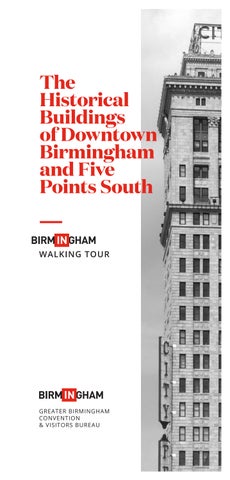
The Historical Buildings of Downtown Birmingham and Five Points South
WALKING TOUR
GREATER BIRMINGHAM CONVENTION & VISITORS BUREAU
3 4
10
Map 1
3 4
10
About Birmingham Birmingham is the state’s largest city, a lively center for arts, entertainment, dining, and shopping. It is also rich in history, known for its post-Civil War industrial past and for its role in the Civil Rights Movement. The walking tours that follow invite you to explore some of the most interesting parts of the city —Upper Downtown, Downtown West, Lower Downtown, and the Heart of Five Points South. While you are discovering the buildings and the stories they tell, keep an eye out for popular restaurants and shops that are fun to browse. Feel free to combine tours or to pick and choose the sites that interest you most. Be aware that often the best view of a building’s architecture is from across the VWUHHW ORRNLQJ DERYH PRGHUQ VLJQV DQG JURXQG ȵRRU UHPRGHOLQJ WR VHH RUQDPHQWDWLRQ RQ WKH XSSHU ȵRRUV
Featured Tours UPPER DOWNTOWN DOWNTOWN WEST LOWER DOWNTOWN HEART OF FIVE POINTS SOUTH
Downtown Overview In 1871 ten men bought some 4,000 acres of undeveloped land in north central Alabama, staking their futures on the promise of nearby mineral resources and the coming of two railroad lines. The minerals were the ingredients for making iron, the basic material driving the country’s industrial economy. The men laid out a town and called it Birmingham. The early businesses and residences clustered within blocks RI RQH DQRWKHU VWDUWLQJ QHDU WKH UDLOURDG WUDFNV ZLWK ȵHGJOLQJ industries nearby. As the city grew, newer and larger buildings replaced most of those structures. Today what remains from WKH FLW\ȇV ȴUVW WKUHH GHFDGHV DUH GRZQWRZQ FKXUFKHV EXLOW in the 1880s and ‘90s, in what used to be neighborhoods of Victorian houses; a scattering of warehouses and buildings of the same period that tell of the city’s pioneer days; and Sloss Furnaces National Historic Landmark, reminding us of the booming furnaces and foundries that once lined the tracks.
In addition to the tours that follow, you may want to visit these nearby sites:
Uptown Entertainment District 2221 Richard Arrington Jr. Blvd. N. 7he Uptown Entertainment 'LVWULFW RIIHUV HQGOHVV RSSRUWXQLWLHV WR HQMR\ EHDXWLIXO architecture and landscaping, diverse dining options and entertainment for the whole family. The walkable campus includes the Alabama Sports Hall of Fame, Protective Stadium, TopGolf, CityWalk, Legacy Arena, BJCC, and two hotels.
The Greater Birmingham Convention & Visitors Bureau Visitors Information Center – 2200 9th Avenue North. The Greater Birmingham Convention & Visitors Bureau is the go-to place for travelers in the greater Birmingham area. Stop in one of three convenient Visitor Information Centers operated by the CVB for maps brochures, and information from a wellYHUVHG VWD 2QH FHQWHU LV ORFDWHG LQ 8SWRZQ DW WKH FRUQHU RI 22nd Street and 9th Avenue North, with another at Vulcan Park and Museum, and a third at the Birmingham-Shuttlesworth International Airport.
Oak Hill Cemetery WK 6W 1 3HGHVWULDQ DQG DXWRPRELOH HQWUDQFH R WK 6W 1 SHGHVWULDQ RQO\ R WK $YH 1 $V WKH FLW\ȇV ȴUVW FHPHWHU\ HVWDEOLVKHG 2DN +LOO EHFDPH WKH UHVWLQJ SODFH IRU PRVW %LUPLQJKDP SLRQHHUV DQG OHDGLQJ FLWL]HQV LQFOXGLQJ WKH ȴUVW mayor, entrepreneurs, industrialists, and governors, as well as a well-known madam. Leading civil rights advocate Rev. Fred Shuttlesworth is among more recent burials of note there. The Birmingham Public Library maintains searchable online data from 2DN +LOO LQWHUPHQW UHFRUGV
Railroad Park Along 1st Ave S between 14th and 18th St. Railroad Park is an award-winning 19-acre green space downtown, running parallel to the tracks that gave birth to the city. This historical setting is a venue for recreation, family activities, concerts, and cultural events. The park is 30% water, with a lake, a rain curtain, a bioȴOWUDWLRQ ZHWODQGV DUHD DQG SRQGV DQG VWUHDPV DOO LUULJDWHG E\ onsite wells. In addition to winding paths through the park, the Rail Trail extending the length of the park serves runners and ZDONHUV $W LWV KLJKHVW SRLQW LW DRUGV LPSUHVVLYH FLW\ YLHZV
Regions Field 1401 1st Ave S. Birmingham’s acclaimed minor league baseball park, which opened in 2013, is across 1st Ave S from Railroad Park. Home to the Birmingham Barons, Regions Field is a state-of-the-art 8,500 seat facility, with a backdrop of downtown skyscrapers and, to the south, of Red Mountain.
Negro Southern League Museum At Regions Field on the corner of 1st Ave S and 16th St. Part of the Regions Field complex is the Negro Southern League Museum. This interactive facility tells the story of the Birmingham Black Barons and other baseball greats who played at Birmingham’s Rickwood Field, the oldest ballpark in the country. Displays include the oldest Negro League trophy, along with uniforms and artifacts. The museum also houses a restaurant and gift shop.
Upper Downtown DOWNTOWN TOUR 1 | MAP 1 ( Inside Front Cover)
Linn Park Bounded by Rev. Abraham Woods Jr Blvd, the park side of Richard Arrington Jr Blvd, Park Place, and 20th St N. Start the tour on the north side of Linn Park near Rev Abraham :RRGV -U %OYG :KHQ LW ZDV ȴUVW ODLG RXW DV D SXEOLF SDUN in 1871, it was surrounded by residences of early settlers. Today, Linn Park anchors a civic complex and is the site of festivals and special events. The park holds a variety of statues, monuments, and markers connected to the history of the city, including a marble sculpture of Mary Cahalan (facing the library entrance), a former school teacher and principal, by Guiseppe Moretti, who also created the statue of Vulcan on Red Mountain. A long-standing monument to Confederate soldiers was removed from the park in the wake of the 2020 killing of George Floyd in Minneapolis.
Birmingham Museum of Art 2000 Rev. Abraham Woods Jr Blvd. Facing the north side of /LQQ 3DUN LV WKH %LUPLQJKDP 0XVHXP RI $UW RQH RI WKH ȴQHVW regional museums in the United States. It houses a diverse collection of paintings, sculptures, prints, drawings, and decorative arts, as well as a café and a museum store.
Jefferson County Courthouse 716 Richard Arrington Jr Blvd N. 7KH -HHUVRQ &RXQW\ Courthouse (1929-32) followed on the heels of the library in beginning to transform the park from residential to a civic center of public buildings. Bas-relief panels over the park-side entrance depict aspects of the state’s and county’s history, including ties to Native Americans; the Spanish, French, and English; and early American settlement.
UPPER DOWNTOWN
Birmingham Civil Rights Heritage Trail In many locations downtown. In front of the courthouse is a pair of tall free-standing signs with life-sized photographs. Here and elsewhere in the park and downtown, signs like these mark places of importance in the 1960s Civil Rights Movement in the city. Be on the watch for the signs in other spots on Tours 1 and 2.
Linn-Henley Library SE corner of the park. The Linn-Henley Research Library (1927) served as the central library for the Birmingham Public Library system until a new central library was built across Richard Arrington Jr Blvd N. Today the original building houses historical research resources in its rare books and maps collections and departments of Archives and Manuscripts and of Southern History, which, among other focuses, is a center for genealogical UHVHDUFK *R LQVLGH WKH OLEUDU\ WR HQMR\ (]UD :LQWHU PXUDOV illustrating children’s fairy tales (in the entrance area) and scenes from world literature (in the main reading room).
Central Library 2100 Park Place. Walk east to the corner of Park Place and Richard Arrington Jr Blvd N, stopping to view other Civil 5LJKWV +HULWDJH 7UDLO PDUNHUV 2Q WKH 1( FRUQHU RI WKH intersection you will see the Central Library (1984) of the Birmingham Public Library system.
BIRMINGHAM MUSEUM OF ART
Tutwiler Hotel SW corner Park Place & Richard Arrington Jr Blvd N. Turning south on Richard Arrington Jr Blvd N, note the Tutwiler Hotel (1914), which was originally the Ridgely Apartments. It was renovated in 1986 and renamed for the city’s premier hotel, which had been demolished about a decade earlier.
Whilldin Building 513 & 517 Richard Arrington Jr Blvd N. In the next block is the Whilldin Building (1924). Its north half (517) has a recessed brick-and-terra-cotta ID©DGH /RRN IRU WKH QDPH RI WKH DUFKLWHFW ' 2 :KLOOGLQ incised in the terra cotta above the windows to the left of the GRRU WKDW OHG WR KLV RɝFH 7KH VRXWKHUQ KDOI RI WKH EXLOGLQJ KDV D OLPHVWRQH ID©DGH 2Q WKH EXLOGLQJȇV VRXWK ZDOO LV a mural celebrating the New York Yankees, commissioned by the lawyer (and Yankees fan) who owns the building.
Redmont Hotel 2101 5th Ave N. 2Q WKH 6( FRUQHU RI WK $YH 1 WKH 5HGPRQW Hotel (1925) is a remnant of what was once, during the heyday of train travel, a six-block stretch of hotels, from the Terminal Station to the heart of the city. The hotel is named for Red Mountain, on the southern edge of the city, where iron ore was mined for Birmingham furnaces and today the statue of Vulcan stands. The singer Hank Williams spent the night here on Dec. 30, 1952, on his way to perform in West 9LUJLQLD DQG 2KLR KH GLHG WZR GD\V ODWHU RQ -DQ DW age 29.
UPPER DOWNTOWN
Age-Herald Building 2107 5th Ave N. Next to the Redmont Hotel stands the AgeHerald Building (1910), originally home to one of the city’s leading newspapers. The sculptures on the façade—owls ȵDQNLQJ WKH JOREH WRSSHG HQWUDQFH SHGLPHQW DQG RZOV DQG globes at the cornice—are said to signify the wise publication of news gathered from all over the world.
Cathedral Church of the Advent SE corner of 20th St & 6th Ave N. Walk a block west on 5th Ave N and then turn right to walk a block north on 20th St to the Cathedral Church of the Advent (1893), one of several pioneer churches that maintain an active presence downtown. In 1982 this parish church became the cathedral of the Episcopal Diocese of Alabama. The nave is usually open during the week, as is the Rector’s Garden that links the church and the Diocesan headquarters to the south. There is a bookstore and a school (K-8) within the complex.
First United Methodist Church SW corner of 19th St & 6th Ave N. Walk a block west on 6th Ave to 19th St N WR ȴQG DQRWKHU SLRQHHU church, First United Methodist (1893). An example of the Richardsonian Romanesque style, it characteristically features textured brownstone, rhythmic curves, and bold, deep-set arches. The interior centers on a large auditorium with striking rose windows.
From First United Methodist Church, return to your starting point in Linn Park by walking north to Park Place, turn right to walk to the park, and then return along the west side of the park. Or if you wish to continue with Tour 2, walk 2 blocks west on 6th Ave N to Kelly Ingram Park.
Downtown West DOWNTOWN TOUR 2 | MAP 1 ( Inside Front Cover)
DOWNTOWN WEST
Kelly Ingram Park %RXQGHG E\ WK $YH 1 WK 6W 1 WK $YH 1 DQG WK 6W 1 6WDUW DW WKH FRUQHU RI WK $YH DQG WK 6W 1 .HOO\ ΖQJUDP 3DUN LV RQH RI WKH FLW\ȇV WKUHH RULJLQDO SDUNV EHVW NQRZQ DV WKH VWDJLQJ JURXQG IRU FLYLO ULJKWV GHPRQVWUDWLRQV LQ :DON DURXQG WKH SDUN WR VHH VFXOSWXUHV FRPPHPRUDWLQJ KHURHV DQG KLVWRULF HYHQWV DV ZHOO DV %LUPLQJKDP &LYLO 5LJKWV +HULWDJH 7UDLO PDUNHUV 'LDO IRU D IUHH DXGLR WRXU
Sixteenth Street Baptist Church 1530 6th Ave N. Sixteenth Street Baptist Church (1911) is where four little girls died when the church was bombed during the FLYLO ULJKWV SURWHVWV RI 1963. Designed by a local AfricanAmerican architect and built by a local black-owned construction company, its sophistication makes it an architectural landmark as well as a landmark in civil rights history. Tours of the facility can be scheduled.
Birmingham Civil Rights Institute 520 16th St N. Birmingham Civil Rights Institute (1992) is an interpretive museum and research center dedicated to civil and human rights. Its moving multimedia exhibits provide a VHOI GLUHFWHG MRXUQH\ IURP WKH &LYLO 5LJKWV 0RYHPHQW RI WKH 1950s and ‘60s to the human rights struggles of today. When you leave, head next door to the A.G. Gaston Motel (1510 5th Ave.), a site that served as headquarters for the 1963 Birmingham Civil Rights Campaign.
Fourth Avenue Historic District 1600-1800 blocks of 4th Ave N & parts of the 300 blocks of 17th & 18th St N. Walk around to the south side of Kelly Ingram Park and take 17th Street a block to the Fourth Avenue Historic District. The district, which is listed in the National Register of Historic Places, is a remnant of what was once the heart of Birmingham’s black social, cultural, and professional life, during the Jim Crow era of racial segregation.
Masonic Temple Building 1630 4th Ave N. Built by the same African-American construction company as Sixteenth Street Baptist Church, the Masonic Temple Building (1922) was designed by two black architects RQH WKH ȴUVW EODFN JUDGXDWH RI 0Ζ7 WDXJKW DW 7XVNHJHH ΖQVWLWXWH /DZ\HUV GRFWRUV GHQWLVWV MRXUQDOLVWV DQG RWKHU LQȵXHQWLDO PHPEHUV RI WKH $IULFDQ $PHULFDQ FRPPXQLW\ KDG WKHLU RɝFHV KHUH 7KLV LQFOXGHV WKH RɝFH RI DWWRUQH\ $UWKXU Shores, who prepared milestone civil rights cases that helped HQG OHJDO VHJUHJDWLRQ 7KH EXLOGLQJȇV VHFRQG ȵRRU EDOOURRP ZKHUH MD]] JUHDWV VXFK DV 'XNH (OOLQJWRQ DQG &RXQW %DVLH played, was a center of black social life as well.
Carver Cinema / Jazz Hall of Fame 1631 4th Ave N. The Carver Cinema/Jazz Hall of Fame (ca. 1941) is notable for its Art Moderne architecture as well as exhibits that tell WKH VWRU\ RI MD]] DQG WKH well-known musicians with ties to Birmingham and Alabama.
DOWNTOWN WEST
Eddie Kendrick Memorial Park SW corner 4th Ave and 18th St N. Walking on the south side RI WKH VWUHHW WR JHW D ȵDYRU RI GLVWULFW OLIH JR D EORFN HDVW WR WKH FRUQHU RI WK $YH DQG WK 6WUHHW WR ȴQG (GGLH .HQGULFN Memorial Park, honoring the Birmingham native and 7HPSWDWLRQV OHDG VLQJHU 6WHS LQVLGH WKH SDUN WR IXOO\ HQMR\ the lively sculpture. (Kendrick added an “s” to his name for the stage.)
Alabama Penny Savings Bank / Pythian Temple Building 310 18th St N. Mid-block to the south on 18th Street is the Alabama Penny Savings Bank (1913; later Pythian Temple), also designed by an African-American architect and built by a black construction company. A pastor of Sixteenth Street Baptist Church was among the founders of the Alabama 3HQQ\ 6DYLQJV %DQN WKH VWDWHȇV ȴUVW EODFN RZQHG EDQN DQG the second largest African-American bank in the country LQ 7KH EXLOGLQJ LQLWLDOO\ KRXVHG WKH RɝFHV RI 7KH Birmingham Reporter and the Colored Citizens’ League of %LUPLQJKDP DV ZHOO DV WKH RɝFHV RI WKH ȴUVW EODFN DWWRUQH\ WR practice in Birmingham. The building was later acquired by the Knights of Pythias, a fraternal organization.
Lyric Theatre 1800 3rd Ave N. At the corner of 18th Street and 3rd Ave N, the Lyric Theatre (1913) recalls the entertainment district that once boasted a dozen or more theaters within a few blocks of here. The Lyric opened in January 1914 as a vaudeville venue, where stars such as Will Rogers, Jack Benny, Mae West, and the Marx brothers, among others, played in its elegant interior. When vaudeville declined, it became a movie house. After years of neglect and deterioration, an $11 million restoration has given the Lyric a new life. The Lyric and Alabama Theatres are part of the Birmingham Theater District, which also includes the nearby Sidewalk Film Center + Cinema showing independent DQG DUWKRXVH ȴOPV 6LGHZDON &LQHPD LV ORFDWHG LQ WKH basement of the Pizitz building (12).
Alabama Theatre 1817 3rd Ave N. Midblock on the opposite side of the avenue is the Alabama Theatre (1927), a PDJQLȴFHQW PRYLH SDODFH that today hosts a variety of movies, concerts, dance recitals, and special events. If you are able, visit the lavish interior to see its ornate decoration and grand spaces, and, if you are lucky, hear someone playing its Mighty :XUOLW]HU RUJDQ 2Q WKH VLGHZDON LQ IURQW LV D KLVWRULF PDUNHU and a walkway of stars with names of famous Alabamians connected to movies, television, and the theater.
3rd & 19th Retail Intersection 3rd Ave & 19th St N. At the end of the block, at the intersection of 3rd Ave and 19th St, is the retail corner that was once the heart of downtown shopping. Three structures built during the Great Depression make this one of the city’s most memorable expressions of urban design (others being the Heaviest Corner and Five Points Circle). To best appreciate the sensitive way the buildings compliment and relate to each other’s streamlined forms, stand on the corner with your back to the parking lot. Look at how the three buildings “talk” to one another, how their corners are canted or FXUYHG WR DFNQRZOHGJH RQH DQRWKHU 7KH\ȇUH DOO GLHUHQW EXW their scale, orientation, materials, and coloration are compatible, NQLWWLQJ WKHP WRJHWKHU WR FUHDWH D XQLȴHG EDFNGURS IRU OLIH on the street. McWane Science Center SW corner (originally Loveman’s Department Store; 1935) is today full of hands-on, science-learning experiences for children of all ages. The Kress Building NE corner ZDV UHQRYDWHG E\ WKH ODZ ȴUP WKDW now occupies it. Meanwhile, the Woolworth Building SE corner (1939) awaits renovation.
DOWNTOWN WEST
Pizitz Building SW corner 2nd Ave & 19th St N. Before you leave the intersection, look south to see another former department store, Pizitz (1923, 1926), which now houses the popular 3L]LW] )RRG +DOO RQ WKH ȴUVW ȵRRU DQG WKH 6LGHZDON &LQHPD Film Center in the basement of the building.
Old U. S. Post Office/now Robert S. Vance Federal Building & U. S. Courthouse 1800 5th Ave N. :DON WZR EORFNV QRUWK RQ WK 6WUHHW WR WKH 2OG 8 6 3RVW 2ɝFH QRZ WKH 5REHUW 6 9DQFH )HGHUDO %OGJ 8 6 &RXUWKRXVH 7KLV GLJQLȴHG JRYHUQPHQW EXLOGLQJ RI ZKLWH marble, with its monumental row of Ionic columns, occupies the entire block along 5th Ave between 18th and 19th Streets. In 1990, the building was dedicated to Federal Judge Robert S. Vance, who was assassinated in 1989.
Old Federal Reserve Bank of Atlanta Birmingham Branch 1801 5th Ave N. An example of 20th-century classicism with Art Deco LQȵXHQFHV WKH IRUPHU %LUPLQJKDP Branch of the Federal Reserve Bank of Atlanta (1926) is awaiting adaptation to a new use. The building was designed by the same architects as the Alabama Power Company building, the next stop on the tour.
FOUR SPIRITS STATUE, KELLY INGRAM PARK
Alabama Power Company 600 18th St N. Walk a block north on 18th Street to see the headquarters of Alabama Power Company (1925, 1985). In its old and new headquarters buildings, the company has given WKH VWDWH VRPH RI LWV ȴQHVW XUEDQ DUFKLWHFWXUH 3URPLQHQW ORFDO ȴUP :DUUHQ .QLJKW DQG 'DYLV GHVLJQHG WKH $UW 'HFR 1925 skyscraper, with its eye-catching form and colorful brick-and-tile ornamentation near the top. New York sculptor (GZDUG )LHOG 6DQIRUG FUHDWHG WKH WKUHH OLPHVWRQH ȴJXUHV DW the building’s main entrance, representing power, light, and heat, and, crowning the building, the gilded statue of Electra holding sheaves of lightning bolts. The huge 1985 addition goes out of its way not to overwhelm the historic 1925 VWUXFWXUH ZKLOH LW PHHWV WKH RɝFH QHHGV RI RQH RI WKH VWDWHȇV largest companies. A slanted glass atrium full of light on the interior aids the transition between old and new.
Return to your starting point at Kelly Ingram Park by walking one block west to 17th St and 6th Ave N.
Morris Avenue at 20th Street Start the tour at the corner of Morris and 20th St N. Take time to read both sides of the historic marker. Then explore a block or two RI WKH FLW\ȇV ȴUVW ZDUHKRXVH GLVWULFW EXLOW DORQJ WKH railroad tracks that connected the city to markets and fed its growth. You may want to stop in The Peanut Place for boiled and roasted peanuts and to admire the old roasting machinery. (To see more of the trains that sparked the birth of the city, visit award-winning Railroad Park, some three-to-four blocks south and west.)
Heaviest Corner on Earth 20th St & 1st Ave N. A block north of Morris on 20th Street is a group of buildings that tells about Birmingham emerging as an urban center in the early 20th century. It’s easy to imagine how the nickname Heaviest Corner on Earth came about as, in the span of a single decade, four steel-frame towers rose to dwarf the city’s existing two-to-four-story buildings, and WKULYLQJ EXVLQHVVHV ȴOOHG WKHP WR FDSDFLW\ 7KLV LV WKH PRVW distinctive concentration of skyscrapers in the city. The oldest, the Woodward Building SW corner 20th St & 1st Ave N (1902), expresses clearly the structural frame that characterizes what is known as the Chicago school. The Brown-Marx Building NE corner 20th St & 1st Ave N KDV VXHUHG IURP remodeling, including removal of an exceptionally large and handsome cornice and of architectural treatment on the lower ȵRRUV 7KH (PSLUH %XLOGLQJ NW corner 20th St & 1st Ave N (1909) showcases the decorative versatility of architectural terra cotta in its twisted columns, sculpted busts, and molded details. Notice how the multicolored accents enliven the glazed white surface near the top, and look for the E’s (for Empire) along the edge of the cornice. The American Trust & Savings Building SE corner 20th St & 1st Ave N (1912), also faced in white terra cotta, with marble pilasters at its base, is the last and the tallest of the four buildings. The building’s clock was a popular meeting place.
LOWER DOWNTOWN
McAdory and Caldwell-Milner Buildings 2013 1st Ave N and 2015 1st Ave N. Walk east on 1st Ave. About mid-block (best seen from across the street) are two RI WKH FLW\ȇV ȴQHVW UHPDLQLQJ 9LFWRULDQ EXLOGLQJV 0F$GRU\ (1888) and Caldwell-Milner (1887). Look above the ground ȵRRU IRU WKH GDWH DQG RZQHUVȇ LQLWLDOV RQ RQH RI WKH IDFDGHV and the owner’s name on the other. These buildings show the scale of the city before the Heaviest Corner was built.
Steiner Building 2101 1st Ave N. At the end of this block, on the SE corner where Richard Arrington Jr Blvd crosses, stands another Victorian structure, the Steiner Building (1890). It is the city’s only Richardsonian Romanesque style commercial building, GLVWLQJXLVKHG E\ LWV ȴQH EULFNZRUN DQG PDVVLYH URXJK FXW PDVRQU\ DUFKHV ΖW ZDV EXLOW WR KRXVH WKH EDQNLQJ RɝFHV of Burghard and Sigfried Steiner.
Birmingham Railway, Light & Power Building 2100 1st Ave N. The Birmingham Railway, Light and Power Building (ca. 1928; now called the Landmark Center) is another downtown structure faced in gleaming white terra cotta with classical details.
STEINER BUILDING
Old Protective Life Building 2027 1st Ave N. The old Protective Life Building (1928), on the SW corner of the intersection, is an Art Deco VN\VFUDSHU ZLWK *RWKLF LQȵXHQFHV GHVLJQHG E\ WKH WDOHQWHG ȴUP :DUUHQ .QLJKW DQG 'DYLV
Phenix Insurance Co. Building and Dewberry Drugs Building 118 Richard Arrington Jr Blvd N and SW corner Richard Arrington Jr Blvd & 2nd Ave N. Near the next intersection, one block north, read the historic marker about two of the oldest buildings downtown, Dewberry Drugs (ca. 1880) and Phenix Insurance Co. (ca. 1884).
City Federal Building 2024 2nd Ave N. Across the street, on the NW corner, stands the City Federal Building (1913), the last and most monumental of the city’s early skyscrapers. At 25 stories, it claimed the title of tallest in the South for decades and held Birmingham’s record until 1969.
LOWER DOWNTOWN
Florentine Building 2101 2nd Ave N. 2Q WKH 6( FRUQHU WKH )ORUHQWLQH %XLOGLQJ H[HPSOLȴHV V H[XEHUDQFH ZLWK LWV ULFK XVH RI terra cotta and marble and abundant classical Renaissance references.
Denechaud Building 2107 2nd Ave N. Walk along the north side of 2nd Ave to get the best view of the Victorian buildings in this block. Next to the Florentine Building stands the Denechaud Building (ca. 1887), built as a European-style restaurant and hotel.
Zinszer Building 2117 2nd Ave N. The PDJQLȴFHQW FDVW LURQ IURQW Zinszer Building (1889), originally Peter Zinszer’s Mammoth Furniture House, had rooms to rent above WKH JURXQG ȵRRU ΖW LV D great example of how cast iron can be formed in molds to create classical columns and ornamentation.
2121 2nd Ave N. 2121 2nd Ave N. Next door, an elaborate pressed metal cornice crowns the brick and stone striped façade of 2121 2nd Ave N (1889), which, like several other buildings of the same age nearby, originally had retail uses on the ground ȵRRU DQG URRPV IRU ERDUGHUV RQ WKH XSSHU ȵRRUV
Levy’s Fine Jewelry Building 2116 2nd Ave N. Across the street, Levy’s Fine Jewelry Building (1883) is one of the oldest remaining downtown, along with Dewberry Drugs and the Phenix Insurance Co. Notice the narrow door between the two storefronts, which originally OHG WR UHVLGHQWLDO URRPV RQ WKH VHFRQG ȵRRU 7KRXJK WKH building is modest, there are decorative hood molds above the windows. Look for the mark of a Birmingham foundry near the base of a cast-iron column attached to the building.
Waters Building 211 22nd St N. Continue east to 22nd Street and then turn left to walk toward 3rd Ave N. Midway up the block is the :DWHUV %XLOGLQJ ZKLFK OLNH RWKHUV MXVW YLHZHG ZDV built as the city was beginning to prosper in its second decade. Like others, the building originally had retail on the JURXQG ȵRRU ZLWK URRPV IRU ERDUGHUV DERYH 1RWH WKH KRRG PROGLQJV DERYH WKH ZLQGRZV DQG WKH ȴQHO\ GHWDLOHG FRUQLFH DW WKH URRȵLQH
Cathedral of St. Paul 2120 3rd Ave N. Continue north to 3rd Ave, where the Cathedral of St. Paul (1893) anchors the northwest corner. Built as a church for Birmingham’s Catholic population, it became the cathedral of the Catholic Diocese of Birmingham in 1969. This bold Victorian Gothic structure, with sharply pointed twin spires and contrasting red brick and white stone, featured prominently on the city skyline until more recent times when high-rise buildings came to dominate. $GMDFHQW WR WKH FDWKHGUDO VWDQGV ZKDW ZDV RULJLQDOO\ WKH rectory (1922) and buildings behind the cathedral originally housed a school (1925) and a convent (1935).
LOWER DOWNTOWN
Massey Building SW corner 3rd Ave & Richard Arrington Jr Blvd N. At the western end of the block, at the intersection of 3rd Avenue at Richard Arrington Jr Blvd, you will VHH WKH RUQDWH URRȵLQH of the 10-story Massey Building (1920). The main entrance is even more elaborate, with twisted columns and grand classical motifs in molded terra cotta.
Title Building NW corner 3rd Ave & Richard Arrington Jr Blvd N. 2Q WKH QRUWK side of 3rd Ave is the city’s second steel-frame skyscraper, the nine-story Title Building (1903). Designed by the architect RI WKH ȴUVW WZR EXLOGLQJV DW WKH +HDYLHVW &RUQHU LW KDV ȴQH brickwork but is regrettably missing its cornice, removed in 1956.
First Presbyterian Church 2100 4th Ave N. A block north, at Richard Arrington Jr Blvd and 4th Ave N, First Presbyterian Church (1888) is the oldest church building downtown. Its red pressed brick, terra cotta tiles, and multicolor slate roof are characteristic of the Victorian Gothic style. The church’s most distinctive feature, its handsome bell tower, marked the original HQWUDQFH R ZKDW LV QRZ 5LFKDUG $UULQJWRQ -U %OYG ΖQ WKH entrance was relocated to 4th Ave because of street widening. You can still see the terra cotta decoration and broad arch that marked the old entrance on what is now the side of the church. In 1924 a 25-bell carillon was installed in the tower.
LOWER DOWNTOWN
Birmingham Green 20th St. N. Walk west one block to 20th Street, and turn left again to return to your starting point. Historically 20th Street served as the city’s primary north-south axis, running from the railroad tracks to the park. In the 1970s the street was landscaped DV SDUW RI D GRZQWRZQ UHYLWDOL]DWLRQ HRUW DQG EHFDPH NQRZQ DV Birmingham Green.
Age Building 212 20th St N. Along the way, you pass the Age Building (ca. 1889) a narrow structure of tall, elegant proportions, molded classical decoration, and large areas of glass characteristic of cast-iron-front façades, one of only two that survive downtown.
Return to your starting point by continuing south to Morris Ave.
ALABAMA POWER COMPANY
OWN
Heart of Five Points South FIVE POINTS TOUR | MAP 2 ( Inside Back Cover)
Five Points Overview Nowhere in Birmingham, outside of downtown, is there such a rich concentration of historic buildings and design quality as Five Points South. It grew up as a “streetcar suburb,” as people who had come to Birmingham to seek their fortunes began moving south to what was often called South Highlands because of its location south of downtown and its higher elevations. They sought to escape the dirt, noise, and crime of the raw, young industrial town, aided by early street railway connections. In 1887 the area incorporated as the Town of Highland and in 1893 it was annexed into the city of Birmingham. In the 1920s retail stores in the latest trendsetting architecture began changing the residential character of the Five Points Circle and nearby streets. The Great 'HSUHVVLRQ DQG SRVW :RUOG :DU ΖΖ VXEXUEDQ ȵLJKW EURXJKW setbacks, but in recent decades Five Points has begun reclaiming its vitality, thanks to renewed investment and the appeal of urban life, its restaurant and entertainment scene, and its varied architecture. 2Q WKLV ZDON \RX ZLOO VHH WXUUHWHG 9LFWRULDQ KRXVHV KDQGVRPH skyscraper apartments, buildings with Art Deco motifs, and KLVWRULF SODFHV RI ZRUVKLS DOO ZLWKLQ D IHZ EORFNV 2QH KRXVH and two churches on the tour date from the short-lived Town of Highland period.
Five Points Circle Intersection of 11th Ave, Magnolia Ave & 20th St S. The buildings around the Five Points Circle create a sense of place resembling a sophisticated European plaza. By HQFLUFOLQJ WKH ODQG ZKHUH ȴYH VWUHHWV FRQYHUJH WKH EXLOGLQJVȇ bending and curving facades relate to the center (once a WUDɝF FLUFOH DQG WR RQH DQRWKHU 6LPLODULWLHV LQ IRUP DQG materials add to the visual unity.
Studio Arts Building NW corner of 11th Ave & 20th St S. The Studio Arts Building is a 1994 interpretation of the 1910 building that it replaced DIWHU WKH ODWWHU VXHUHG VHYHUH ȴUH GDPDJH 7KH RULJLQDO building’s curving façade responded to its circular setting and established a precedent for future buildings.
Hotel Indigo 1023 20th St S. Looking north down 20th Street you see the Hotel Indigo (1931; originally the Medical Arts Building, which housed RɝFHV RI SK\VLFLDQV surgeons, and pharmacists). The chevron patterns in the JURXQG ȵRRU WHUUD FRWWD DQG WKH DOXPLQXP VSDQGUHOV EHQHDWK the windows are clues to its Art Deco identity.
Ware Building NE corner of 20th St & Magnolia Ave S. The Ware Building (1930) features materials and mid-to-late-1920s Art Deco motifs similar to those of other buildings on and near the circle.
HEART OF FIVE POINTS SOUTH
The Storyteller Fountain Eastern side of the circle.In front of the church is The Storyteller Fountain (1991), the work of acclaimed Alabama artist and long-time Birmingham resident, the late Frank Fleming.
Highlands United Methodist Church Eastern side of the circle, behind the fountain. Highlands United Methodist Church (1909; bell tower 1921) provides the circle’s dominant focus. The architect of Birmingham’s grand Terminal Station (1907; demolished 1969) designed the church shortly after Terminal Station’s completion. (He designed Atlanta’s Fox Theatre some two decades later).
Spanish Stores SE corner of 20th St & 11th Ave S. To the right of the church— echoing its red tile roof and stucco walls—are the Spanish Stores (1926, 1930). The way the building sits on its site helps GHȴQH WKH FLUFOH DV D SOD]D
Munger Building SW corner of 20th St & 11th Ave S. Across 20th Street the 0XQJHU %XLOGLQJ FD DOVR UHȵHFWV WKH FXUYHV RI WKH FLUFOH in the way its façade bends away in reverse. Notice the use RI VXFK SRSXODU $UW 'HFR PRWLIV DV VXQȵRZHUV FKHYURQV DQG plant forms, some of which recur on other nearby buildings.
Terrace Court Apartments NW corner of Highland Ave & 20th St S. A block down 20th Street from the circle, the Terrace Court Apartments (1907) brought apartment living, along with heightened sophistication and a more urban scale to the character of WKH QHLJKERUKRRG ΖW ZDV WKH ȴUVW VN\VFUDSHU DSDUWPHQW house built in Birmingham and possibly the Southeast. Tenants had a roof garden for entertaining, a dining room RQ WKH ȴUVW ȵRRU DQG FDUG DQG ELOOLDUG URRPV RQ WKH JURXQG ȵRRU
St. Mary’s-on-the-Highlands Episcopal Church NE corner of 12th Ave & 19th St S. A block up the hill from Terrace Court (Highland Avenue becomes 12th Avenue South) is St. Mary’s-on-the-Highlands Episcopal Church (1892), EXLOW LQ WKH KHDUW RI VRPH RI WKH ȴQHVW UHVLGHQFHV QRZ demolished) in the Town of Highland. The church was designed by an Englishman to resemble an English parish church.
Shepherd-Sloss Building SE corner of Highland Ave & 20th St S. Retrace your footsteps down the hill to Highland Ave, where the Shepherd-Sloss Building (1928) stands caddy-corner from Terrace Court. It was inspired by a trip to California, where one of the GHYHORSHUV KDG VHHQ VRPH RI WKH ȴUVW VKRSSLQJ FHQWHUV WKDW provided parking.
SOUTH HIGHLAND PRESBYTERIAN CHURCH
HEART OF FIVE POINTS SOUTH
Hassinger-Daniels House/Carousel Carving School 2028 Highland Ave. Walk east on Highland to view the Hassinger-Daniels House (1898), now a bed and breakfast.
Richmond Apartments 2030 Highland Ave. Next door is another early apartment building, the Richmond Apartments (ca. 1914), one of the best examples of a Craftsman style apartment building in the city. Attractive features include the grassy courtyard, open balconies, and spacious apartments that provided a suitable housing alternative for those who could not—or chose not to—own a home.
South Highland Presbyterian Church 2035 Highland Ave. South Highland Presbyterian Church (1892), like St. Mary’s, dates from the Town of Highland. %XLOW RI VSOLW IDFHG OLPHVWRQH LW IHDWXUHV D PDJQLȴFHQW URVH window within a pointed arch facing Highland Avenue.
Temple Emanu-El NE corner Highland Ave & Richard Arrington Jr Blvd S. Caddy-corner across Highland is Temple Emanu-El (1913), built for Birmingham’s Reform Jewish congregation. The handsome historic structure was designed by the architect of Terrace Court Apartments and several downtown skyscrapers.
Southern Life and Health Building 2121 Highland Ave. Across Highland, the Southern Life and +HDOWK %XLOGLQJ EURXJKW WKH ȴUVW ODUJH RɝFH EXLOGLQJ (for an insurance company) to residential Highland Avenue. The building draws on classical architecture for its symmetry, proportions, columns, and ornament.
Bradshaw House 2154 Highland Ave. The Bradshaw House (ca. 1890) H[HPSOLȴHV WKH 4XHHQ $QQH VW\OH ZLWK LWV WUDGHPDUN exuberance and variety, expressed here in vertical massing, steep roof and gables, cupola, scalloped shingles, and gingerbread trim. Along with the Hassinger-Daniels House, the Bradshaw House reminds us that Highland Avenue was, in its earliest days, the city’s grandest residential boulevard.
Temple Beth-El 2179 Highland Ave. At the end of this block on the other side of the street is Temple Beth-El (1927), built for the city’s Conservative Jewish congregation.
First Church of Christ, Scientist 2031 11th Ave S. Go back down Highland to Richard Arrington Jr Blvd and turn to head north a block. At 11th $YH WXUQ OHIW WRZDUG WKH )LYH 3RLQWV &LUFOH 2Q WKH FRUQHU LV DQ RɝFH WKDW ZDV RULJLQDOO\ )LUVW &KXUFK RI &KULVW 6FLHQWLVW (1911).
HEART OF FIVE POINTS SOUTH
Dulion Apartments and LaSalle Apartments 2030 11th Ave S & 2028 11th Ave S. Directly across the street DUH WKH 'XOLRQ $SDUWPHQWV WKH ȴUVW RI VHYHUDO V skyscraper apartments built on the city’s Southside, and to the west, the LaSalle Apartments (1926).
Fred Jones Building 1901 11th Ave S. Continue west beyond the circle intersection WR WKH FRUQHU RI WK $YH DQG WK 6W 6 2Q WKH 6( FRUQHU of the intersection is the Fred Jones Building (1928; now Golden Temple), another of the Five Points retail buildings VSRUWLQJ VXQȵRZHUV DQG RWKHU $UW 'HFR VW\OH PRWLIV 7KH original owner, Fred Jones, was the proprietor of a popular GHOLFDWHVVHQ DQG LFH FUHDP VKRS 7KH VHFRQG ȵRRU ZKHUH baking, salad making, and ice cream freezing took place, now houses the Birmingham Festival Theatre.
Southside Baptist Church Convergence of 19th St & 10th Court S, facing 11th Ave S. Across the street, Southside Baptist Church (1911) rises impressively as an imposing Roman Ionic temple. From here you can make your way back to the starting point or explore the Five Points neighborhood further.
SOUTHSIDE BAPTIST CHURCH
3 4 5
2 22
6
1
7
8 21
12 13 9
10
11
Map 2
17 15 13 16 14
18
Greater Birmingham Convention & Visitors Bureau 800.458.8085 INBIRMINGHAM.COM @INBIRMINGHAM #INBIRMINGHAM