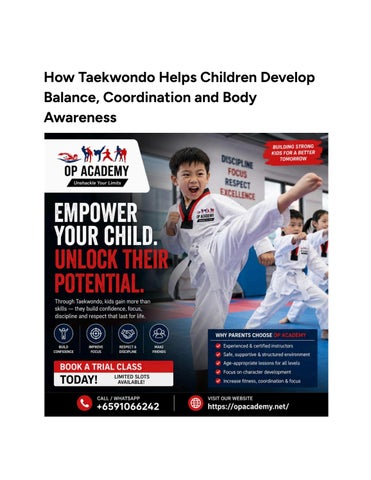
How Taekwondo Helps Children Develop Balance, Coordination and Body Awareness
Children develop physical skills through everyday activities such as walking, running, climbing, jumping and playing. As they grow, opportunities to practise different types of movement can help them become more familiar with how their bodies work. Taekwondo offers a structured activity where children learn to control their movements through stances, footwork, kicking techniques and coordinated sequences. For parents searching for Taekwondo classes for kids in Singapore, understanding the role of balance and coordination can provide another perspective on the value of martial arts training. Taekwondo is not simply about performing powerful kicks or learning self-defence movements. Students need to understand their body positioning, maintain balance and coordinate different movements while following instructions. A technique that appears simple can involve several physical elements, including posture, timing, direction and controlled movement. Through appropriate practice, children have opportunities to become more familiar with these skills while learning the fundamentals of a traditional martial art.
What Are Balance, Coordination and Body Awareness? These three physical abilities are connected, but they describe different aspects of movement. ● Balance refers to the ability to maintain body stability while standing still or moving. ● Coordination involves using different body parts together to perform an action smoothly. ● Body awareness refers to understanding body position and movement in relation to the surrounding space. Children use these abilities during many everyday activities, from walking up stairs to participating in playground games. Taekwondo provides structured opportunities to practise them through specific martial arts movements.
How Taekwondo Training Develops Physical Control Taekwondo techniques require students to pay attention to how they position and move their bodies. Beginners usually start with foundational movements before progressing towards more demanding combinations.
1. Practising Stances and Maintaining Balance A Taekwondo stance provides a foundation for performing techniques. Students learn how to position their feet, adjust their posture and maintain stability while preparing for movement. These exercises encourage children to pay attention to their body position. They gradually become more familiar with how small changes in foot placement or posture can influence their stability.
2. Learning Kicking Techniques With Control Kicking is one of the best-known features of Taekwondo. However, performing a kick involves more than lifting a leg. Students need to coordinate their supporting foot, posture, hip movement and balance. Beginners learn basic kicking movements before attempting more advanced techniques. The focus should be on suitable execution and control rather than simply trying to kick higher or faster.
3. Improving Footwork and Directional Movement Footwork helps students move into suitable positions when practising techniques. Children may need to step forward, move backwards, change direction or adjust their stance according to an exercise. These activities encourage awareness of distance and movement. They also introduce children to the importance of controlling their bodies rather than moving without considering their positioning.
4. Connecting Movements Through Poomsae Poomsae consists of organised movement sequences that combine different Taekwondo techniques. Students need to remember the order of movements while maintaining appropriate posture, direction and control. For children, learning a sequence provides an opportunity to practise coordination and concentration together. They must understand how one movement connects to the next rather than treating every technique as a separate action.
Why Body Awareness Matters Beyond Martial Arts Physical control is useful in many everyday situations. Children rely on balance and coordination when participating in recreational activities, navigating their surroundings and learning new physical skills. Taekwondo can provide additional opportunities to practise these abilities in a structured setting. However, it should be viewed as one part of a child's overall physical development rather than a replacement for varied play, outdoor activity or other suitable exercise.
Becoming More Familiar With Movement When children practise a technique, they receive opportunities to understand how their body moves. Repeating movements under appropriate guidance can help them become more familiar with positioning and control.
Learning to Adjust Physical Effort Martial arts training involves following instructions about how movements should be performed. Students learn that effective technique requires suitable control rather than using maximum force for every action.
Developing Confidence in Trying New Movements Some techniques may initially feel unfamiliar. With gradual instruction and practice, children can become more comfortable attempting movements appropriate to their ability. This experience may support a more positive attitude towards physical learning, although every child develops confidence at their own pace.
How Parents Can Support Physical Development Outside Class Parents can encourage children's movement development through everyday activities without turning every experience into formal training.
Walking, playground activities, cycling, dancing and age-appropriate recreational games can provide different movement experiences. Children should also have enough time for rest and recovery. If a child shows interest in practising Taekwondo techniques at home, parents should follow the instructor's guidance and avoid encouraging advanced movements without suitable supervision or preparation.
What to Look for in a Children's Taekwondo Programme When choosing a programme, parents should consider whether the training introduces physical skills progressively. Beginners should have opportunities to learn foundational movements before being expected to perform more challenging techniques. It is also worth asking how instructors correct technique, manage differences in ability and explain safe movement practices. Children should receive guidance that reflects their experience and physical readiness. Parents can also enquire about class schedules, training venues and programme expectations to determine whether the academy fits their family's routine.
Discover Children's Taekwondo Training at OP Academy OP Academy offers Taekwondo programmes for different age groups, with published training information covering foundational techniques and further development according to the relevant level. Programme elements include basic movements, Poomsae and physical conditioning. For families researching Taekwondo classes for kids in Singapore, OP Academy provides an opportunity to learn more about how children can develop their martial arts techniques through structured training. Parents can contact the academy to confirm current age-group arrangements, class schedules and programme details.
Frequently Asked Questions Does Taekwondo Help Children Improve Balance?
Taekwondo includes stances, footwork and kicking exercises that require students to practise maintaining balance during different movements. Individual results depend on participation and physical readiness.
Can Taekwondo Improve a Child's Coordination? Training involves combining different movements, following sequences and controlling body positioning. These activities provide opportunities to practise coordination.
What Is Body Awareness in Children's Physical Development? Body awareness is the ability to understand body position and movement in relation to the surrounding environment. It is useful when performing physical activities and learning new movements.
Do Children Need to Be Flexible Before Starting Taekwondo? Not necessarily. Beginners can learn foundational movements according to their current ability. Parents should ask how the academy introduces flexibility exercises and develops techniques progressively.
Can Children Practise Taekwondo Movements at Home? Children can reinforce suitable movements if their instructor recommends it. More advanced techniques should be learnt under appropriate supervision to reduce the risk of practising incorrectly.
Support Your Child's Physical Development With OP Academy Balance, coordination and body awareness are important parts of children's physical development. Taekwondo offers a structured way to explore these skills while introducing children to technical movements and the learning traditions of a martial art. If you are looking for Taekwondo classes for children Singapore, contact OP Academy to find out more about its programmes and available training arrangements. Visit OP Academy or call +65 9106 6242 to enquire about current classes, locations and enrolment. Give your child an opportunity to develop physical skills through purposeful movement and guided Taekwondo training.