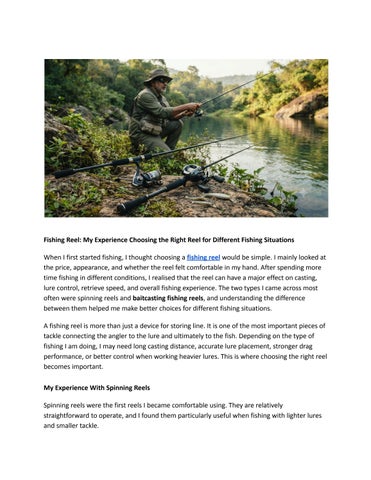
Fishing Reel: My Experience Choosing the Right Reel for Different Fishing Situations When I first started fishing, I thought choosing a fishing reel would be simple. I mainly looked at the price, appearance, and whether the reel felt comfortable in my hand. After spending more time fishing in different conditions, I realised that the reel can have a major effect on casting, lure control, retrieve speed, and overall fishing experience. The two types I came across most often were spinning reels and baitcasting fishing reels, and understanding the difference between them helped me make better choices for different fishing situations. A fishing reel is more than just a device for storing line. It is one of the most important pieces of tackle connecting the angler to the lure and ultimately to the fish. Depending on the type of fishing I am doing, I may need long casting distance, accurate lure placement, stronger drag performance, or better control when working heavier lures. This is where choosing the right reel becomes important. My Experience With Spinning Reels Spinning reels were the first reels I became comfortable using. They are relatively straightforward to operate, and I found them particularly useful when fishing with lighter lures and smaller tackle.
One of the biggest advantages I noticed was how easy it was to cast without spending too much time adjusting the reel. Once the bail was opened and the line was controlled with my finger, I could make a cast and concentrate more on where the lure was going. For beginners, this simplicity can make a big difference. When I was learning, I did not want to spend most of my fishing session dealing with complicated settings or line problems. A spinning reel allowed me to focus on casting technique and learning how fish reacted to different lures. I also found spinning reels useful when fishing with lighter lures. Soft plastics, small spoons, lightweight jigs and other finesse presentations can be easier to cast using suitable spinning tackle. However, as I started using heavier lures and wanted more control over where my lure landed, I became interested in baitcasting tackle. Why I Started Looking at Baitcasting Reels My first impression of a baitcaster reel was that it looked more complicated than the spinning reels I was used to. The spool sits differently, and there are additional controls that need to be adjusted. But after understanding how the reel works, I began to see why many experienced anglers prefer baitcasting equipment for certain types of fishing. The main attraction for me was control. A baitcasting reel allows the spool to rotate during the cast, and the angler controls that rotation using the reel's braking system and thumb. With practice, this can provide excellent control over the lure during casting. I particularly noticed the difference when trying to place a lure close to structure. Instead of simply trying to cast as far as possible, I could concentrate on placing the lure near a particular target. That kind of accuracy can be useful when fishing around vegetation, rocks, docks, submerged structures, mangroves, or other areas where fish may be holding. Understanding Baitcasting Fishing Reels When people talk about baitcasting fishing reels, they are generally referring to reels designed to provide greater casting control and accuracy compared with traditional spinning tackle.
One of the things I learned quickly is that baitcasters require some adjustment according to the lure weight, line, and casting technique. The spool needs to rotate freely enough for the lure to travel properly, but if it rotates faster than the line is leaving the spool, the result can be a backlash or what anglers commonly call a bird's nest. This was one of the biggest learning curves for me. At first, I was tempted to think that a backlash meant I had chosen the wrong reel. Eventually, I realised that baitcasting requires practice. Learning how to adjust the braking system, spool tension and thumb pressure made a noticeable difference. Once I became more familiar with the reel, casting started to feel much more controlled. Baitcaster Reel Control Takes Practice One reason I would not recommend judging a baitcaster after only a few casts is that it has a learning curve. With a spinning reel, I could pick up the tackle and start casting fairly quickly. With a baitcaster, I had to understand what each adjustment did. The spool tension control affects how freely the spool rotates. The braking system helps control spool speed during casting. My thumb also became an important part of the system because I could apply pressure to the spool when I needed to slow it down or stop it. This combination eventually gave me much better control. The important lesson I learned was that baitcasters are not necessarily difficult; they simply require a different casting technique. Accuracy vs Distance Before spending more time with baitcasting equipment, I assumed the main benefit would be casting distance. After using it, I realised that accuracy can be just as important. When I am fishing around structure, I do not always need the longest possible cast. Sometimes I need to place the lure into a very specific area.
For example, if I see a likely holding spot beside vegetation or a structure, an accurate cast can put the lure where I want it. A controlled pitch or short cast can sometimes be more useful than trying to send the lure as far as possible. This is one area where I started appreciating baitcasting fishing reels more. Choosing the Right Reel for the Lure Another lesson I learned is that there is no single reel that is perfect for every fishing situation. The lure weight is an important consideration. For lighter lures, I often find suitable spinning tackle easier to use. As lure weights increase and I want greater casting control, a suitable baitcasting setup becomes more interesting. The rod and line also need to match the reel. Looking at the reel alone does not tell me whether the complete setup will work well. A balanced rod, reel and line combination generally feels more comfortable and predictable. For this reason, I now look at the complete setup instead of buying a reel based only on its appearance or specifications. Gear Ratio Matters One specification I pay more attention to now is gear ratio. The gear ratio determines how many times the spool rotates for each turn of the handle. Different gear ratios can suit different lure presentations and retrieve styles. A faster retrieve can be useful when I need to recover line quickly or work certain lures at a higher speed. A slower retrieve can provide more control for presentations where I want to keep the lure moving at a slower pace. The important thing I learned is not to automatically assume that a higher gear ratio is better. It depends on the type of fishing I am doing. Drag Performance Is Also Important The drag system is another feature I consider when choosing a reel.
The drag allows line to be released under pressure when a fish pulls hard. A smooth and consistent drag can help prevent sudden pressure from being transferred directly to the line. However, maximum drag is not the only thing I look at. For me, smooth operation and consistency are more useful than simply choosing a reel because it has a large maximum drag number. The target species, line strength, rod power and fishing environment all influence what kind of drag performance is appropriate. Fishing Around Heavy Cover When fishing around heavy cover, I pay more attention to the complete tackle setup. Fish holding near vegetation, rocks, timber or other structures may need to be turned away from the cover quickly. In these situations, I want a reel and rod combination that gives me sufficient control. This is one reason baitcasting tackle is popular among anglers who regularly fish with heavier lures and stronger line. A baitcaster can provide a compact setup and good control during casting and lure presentation. But the reel still needs to be matched with the rod, line and target species. Simply buying a powerful reel does not automatically make the setup suitable for heavy-cover fishing. What I Look for When Buying a Fishing Reel When I am comparing reels now, I do not look at just one specification. I normally consider: ● The type of fishing I plan to do ● Lure weight ● Target fish ● Rod power and action ● Line type and strength ● Gear ratio ● Drag system
● Reel weight ● Spool capacity ● Braking system on baitcasting reels ● Handle and grip comfort ● Corrosion resistance when fishing around saltwater ● Availability of replacement parts and service ● Overall build quality ● Price and long-term value This approach has helped me avoid buying equipment simply because it looks impressive. Spinning Reel or Baitcasting Reel? For someone new to fishing, I would first think about the type of fishing they actually plan to do. If I am fishing with lighter lures and want a straightforward casting experience, a spinning reel can be a practical choice. If I am interested in accurate casting, heavier lure presentations and developing more control over the casting process, baitcasting tackle can be worth learning. There is no universal answer because different anglers have different needs. Even experienced anglers often carry both types of reels because each has situations where it makes sense. My Learning Curve With Baitcasters The biggest difference I noticed when switching to baitcasters was the amount of involvement during casting. With a spinning reel, I could concentrate mainly on the rod movement and release. With a baitcaster, I became more aware of spool speed, braking and thumb control. At first, that meant more mistakes. But the mistakes were part of the learning process.
After spending time practising, I became more comfortable adjusting the reel according to the lure. I also learned that casting smoothly rather than trying to generate maximum power often produced better results. This was probably one of the most useful lessons I learned about baitcasting. Buying a Reel Based on Your Fishing Style I now believe that the best way to choose a fishing reel is to start with the fishing situation rather than the reel itself. Ask what type of water you fish, what species you target, what lure weights you normally use, how much casting accuracy you need, and whether you fish freshwater or saltwater. For example, someone fishing small freshwater species with lightweight lures may have completely different requirements from an angler targeting larger fish around heavy cover. Similarly, someone fishing saltwater needs to consider corrosion resistance and maintenance more carefully. These questions can narrow down the choices much faster than simply browsing through dozens of reels. Final Thoughts My experience with fishing tackle has taught me that choosing a reel is really about matching equipment to the way I fish. Spinning reels remain extremely useful because they are straightforward and versatile. At the same time, learning to use baitcasting fishing reels opened up a different style of fishing for me, particularly when I wanted more control and accuracy. A good baitcaster reel is not automatically the right choice for every angler, and a spinning reel is not limited to beginners. Both have their own strengths depending on the fishing situation. For anyone considering baitcasters for the first time, I would recommend spending time learning the braking system, practising with an appropriate lure weight, and developing thumb control gradually. Once the basics become familiar, casting can become much more enjoyable and precise.
Ultimately, the reel should match the rod, line, lure and target species. Instead of choosing equipment simply because a particular model is popular, I find it more useful to understand what I actually need from my tackle. That approach has made buying fishing gear much easier for me and has helped me build setups that are better suited to the way I actually fish.