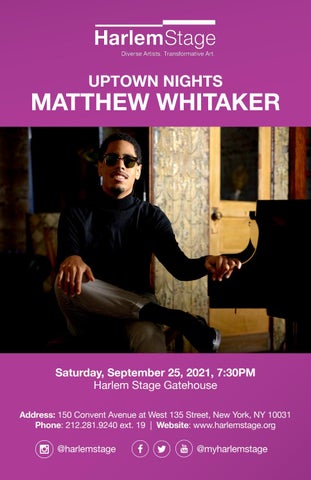
UPTOWN NIGHTS
MATTHEW WHITAKER
Saturday, September 25, 2021, 7:30PM Harlem Stage Gatehouse Address: 150 Convent Avenue at West 135 Street, New York, NY 10031 Phone: 212.281.9240 ext. 19 | Website: www.harlemstage.org
@harlemstage
@myharlemstage
ABOUT THE EVENT
Welcome back to live performances at Harlem Stage! You are part of the first live audience that we’ve hosted in over a year. Tonight we celebrate the return of our Uptown Nights series and are thrilled to present Matthew Whitaker performing works from his new album, Connections. Matthew’s previous performance in this space occurred in 2018 when we honored him with the Harlem Stage Emerging Artist Award. Since then he has received numerous accolades. Having been musically trained in Harlem, it’s fitting that he debut his new album here at the Harlem Stage Gatehouse. He is joined tonight by Marcos Robinson on guitar, Karim Hutton on bass, and Isaiah Johnson on drums. Matthew Whitaker is a Yamaha Artist and performs tonight on a Yamaha piano.
FROM THE ARTIST The music recorded on this project is special and has its own “connections” to Matthew. Those connections are highlighted through collaborations with artists like Gabe Stone Shayer, a dancer with The American Ballet Theater, whose idea for a song was Matthew’s incentive for Journey Uptown. Long-time friendships with Jon Batiste inspired the excitement on Thelonius Monk’s, Bye-Ya, and the deft swing of guest violinist Regina Carter on Duke Ellington’s Don’t Get Around Much Anymore. There are connections to Matthew’s musical heroes, Stevie Wonder, Lately, mentor Dr. Lonnie Smith, A New Day and It Will Be Okay, and Chick Corea, Spain. There is also the desire for improvisation on songs like the title track Connections and Acceptance and to play different styles, as in his arrangements of Blue Rondo a la Turk and Garden Wall. Then there’s the connection to Matthew’s roots in R&B, I’m Sorry, Latin music, in Jeannine, with a horn section expertly co-arranged with his big band instructor Steve Oquendo from his days at Harlem School of the Arts, and Gospel, Trust Me, and His Eye Is on The Sparrow. Finally, there is a connection to what’s happening in the world today, songs for the times, like Stop Fighting, It Will Be Okay, A New Day, and His Eye Is On The Sparrow.
BIOGRAPHIES
MATTHEW WHITAKER Born in 2001, Matthew Whitaker’s love for playing music first began at the young age of 3 after his grandfather gave him a small Yamaha keyboard. At 9, Matthew began teaching himself how to play the Hammond B3 organ. Four years later, he became the youngest artist to be endorsed by Hammond—in its 80+ year history. He was also named a Yamaha Artist at 15, becoming the youngest musician to join the stellar group of jazz pianists. He’s already toured both here in the US and abroad, performing before The Youth Assembly at the United Nations headquarters in NYC, and on other world renowned stages, including: Lincoln Center for the Performing Arts, the Apollo Theater, Carnegie Hall, and Jazz at Lincoln Center in NYC; SFJAZZ Center in San Francisco; the John F. Kennedy Center for the Performing Arts
in Washington, DC; The Raymond F. Kravis Center for the Performing Arts, Monterey Jazz Festival, Newport Jazz Festival, Playboy Jazz Festival, Telluride Jazz Festival and at international venues in France, Italy, Germany, Indonesia, UK, Australia, Switzerland, Portugal, Japan, Spain, Morocco and South Korea. Matthew has performed with an array of outstanding musicians: Ray Chew, Christian McBride, Dr. Lonnie Smith, Rhoda Scott, Cameron Carpenter, Regina Carter, Jason Moran, Jon Batiste, Cory Henry, Marc Cary, Arturo O’Farrill, James Carter, Roy Ayers, D.D. Jackson, The New York Pops Orchestra, EFG London Jazz Festival at Royal Albert Hall in London, where he was a featured soloist with their 42 piece big band and with Hamiet Bluiett and his Bio-Electric Ensemble. Matthew was the 1st place winner at the Apollo for Fox TV’s revival of Showtime at the Apollo in 2016; he has been on national and international radio and television, which includes the The Today Show documentary series “Boys Changing the World,” Harry Connick Jr. Show, an appearance on the syndicated TV talk show Ellen, and a segment on the most watched news magazine on television 60 Minutes! In 2017, he was named 1 of the 17 people to watch in New Jersey by The Record, one of New Jersey’s largest newspapers and added to Crain’s Business New York’s breakout list of 20 under 20 as a performing artist. In 2018, The Root added Matthew to its list of 1 of 25 Young Futurist Leaders and was named as 1 of 7 rising stars for 2018 by USA Today network’s 201 Magazine. In 2019 & 2020, Matthew was a winner of The ASCAP Foundation Herb Alpert Young Jazz Composers Award for his original compositions “Emotions & Underground!
BIOGRAPHIES KARIM HUTTON BASSIST
New York native and Cornell University alumnus, Karim “Kace” Hutton, is a musician songwriter and multi-faceted bassist who strongly believes in the power of music and the role it plays in connecting our world. He is best known for his versatility in musical tastes and abilities, sensibility to detail, and ability to carefully execute the artist’s vision whether in the studio or on stage. Karim developed a passion for music from the tender age of six years old and has been honing his craft ever since. He has had the pleasure of collaborating with numerous creatives such as Omari Hardwick, Summer Walker, Cordae, Matthew Whitaker, Vojtech Dyk, and many others. His ultimate goal is to be a vessel of love and hope through the gift of music and to give back to the larger community.
ISAIAH JOHNSON DRUMMER
Isaiah Johnson, born September 16, 1991 in Brooklyn, NY, has been sharpening his drumming skills since age five. The drums have been Isaiah’s first instrument of choice since age three. Being inspired by his father, Isaiah gives praise to him for his early exposure, knowledge and coaching. At the age of six Isaiah became the primary drummer in his local assembly; then moving on to play for other churches, groups and ensembles. In 2005, at the age of fourteen, Isaiah was a recorded drummer on the “Katrina Relief” album. In 2006, Isaiah was a recorded drummer for the St. Mary’s Church of God in Christ youth choir “Fulfilled.”
Also, in 2006, Isaiah played drums for the “Stephanie Simpson and New Worship” project. In 2007, he recorded with “Voices of Promise” and “Angela Hall.” In 2008, Isaiah laid down the drum parts for “Earl Jones Jr., and Forever Anointed”. In 2010, he worked with “Mike Willis and the Called.” In 2011, Isaiah won the Sam Ash “Best in Drums” National Competition. Some of Isaiah’s expansive work extends to Off Broadway where he has been heard in the play, “Tell It, Sing It, Shout It. Isaiah has been on tour with the New York Gospel Stars, touring throughout Germany. He has been the drummer for Pastor Donnie McClurkin, Fred Hammond, The Winans Brothers, Bee Bee Winans, Dorinda Clarke-Cole, Hezekiah Walker, Tina Campbell, James Hall (toured Italy, and China) David Bratton, Casey J., Fifth Harmony, Chris Blue, the Pattie Labelle, tribute held in Atlanta, GA and Nina Sky. Isaiah currently holds down the drum chair as part of the Matthew Whitaker Quartet, and when not on tour, can be heard as the house drummer at many venues around the New York /Tri-state area.
MARCOS ROBINSON
GUITARIST
Having been raised by a Godfearing family, Marcos Robinson was surrounded by gospel music since birth. At the age of 14 his mom gave him a starter guitar kit and he began taking lessons right away. He continued his studies and in 2016 he graduated from the New School for Jazz and Contemporary Music. He has performed with artists such as Bebe Winans, Michelle Williams, Kelly Rowland, Mario, and Lloyd. He has recorded with artists such as Le’Andria Johnson, Doobie Powell, and Naomi Raine. He is currently the guitarist for Pianist/Organist Matthew Whitaker.
ABOUT THE MUSIC As more than a year of lockdown and collective isolation appears to be ending, Matthew Whitaker—the twenty-year old keyboardist from Hackensack, New Jersey—has released an exciting, expansive new recording entitled Connections. Aptly titled for this pivotal moment, the sixteen-track collection is his third album and serves as both a bold declaration of Whitaker’s maturity as a player, composer and bandleader, and as a statement of musical connection—and re-connection, as Whitaker points out. “Connections is really about this idea of community, of musicians and family and everyone really, coming back together after being separated for so long,” Whitaker says. “It’s about how grateful I am for the connections we have with each other musically and spiritually as well. More than my other albums, this one has music that was created in the studio, improv moments that happened live. A few of these songs I wrote during the pandemic so I’m happy we were able to record those, and I’m excited. This album is more expansive than anything else I’ve done!” Connections features music composed both before and during (and in reaction to) the pandemic, and recorded mostly between March 2 and 4, 2021. It includes a generous mix of original compositions with message-driven titles of uplift and instruction (“A New Day,” “Acceptance,” “It Will be Okay,” “Stop Fighting”), balanced with familiar melodies by Whitaker’s musical heroes, from Duke Ellington (“Don’t Get Around Much Anymore”), Stevie Wonder (“Lately”), and gospel singer Richard Smallwood (“Trust Me”), to Duke Pearson (“Jeannine”), Chick Corea (“Spain”), and Thelonious Monk (“Bye-Ya”)—this last one a sparkling, standout duet with pianist Jon Batiste. The performances on Connections reveal Whitaker’s burgeoning musical identity: one filled with deepening confidence, rhythmic vigor, and a marked melodic clarity. Dramatic entrances have become an aspect of his musical approach. Whether on piano, Hammond organ, Fender Rhodes or synthesizer, he doesn’t kick off a tune or improvisation as much as plunge into the music, twisting time and navigating structural shifts with fluidity. Relative to past recordings, he now pulls from a noticeably wider palette of
*Performed tonight
modern jazz, Latin, and R&B sounds, still with a heady top-note of gospel—staying true to his roots. Fittingly, Whitaker offers a version of the venerable spiritual “His Eye Is On The Sparrow” as the album’s closing track. Whitaker is buttressed on Connections by an A-level circle of talent that speaks to the pandemic-defying power of community. Many are familiar names in Whitaker’s lineups—guitarist Marcos Robinson, bassists Karim Hutton and Endea Jones, and drummers Isaiah Johnson, Otis Brown III, and Johnathan Blake. Special guests include keyboardist Jon Batiste, violinist Regina Carter, drummer Alvester Garnett and trumpeter Steve Oquendo—who provided arrangements on, and leads the punchy horn ensemble on “Jeannine.” Connections Track-by-Track Comments by Matthew Whitaker 1. Journey Uptown * “Journey Uptown” is a song I originally composed for one of my friends, Gabe Stone Shayer who’s a dancer. He and his partner Skylar Brandt reached out to me because they were creating a dance for an event and obviously whatever I compose they have to work with, because I can’t see what they’re doing. We were on Zoom coming up with different ideas of how to do this. They said things like, “Make sure the piano is in the forefront” and “Add some percussion parts” and “Make it like you’re somewhere in New York, feeling and hearing the city.” I immediately went upstairs to the piano and this polyrhythm came into my head, different layers on top of one another. Everything came out of that pulse, different sections and sounds. The original song for the dancers is in 4/4 time and a bit faster and more energetic. which is different from the version on the album. When we got to the studio and were still getting the sound together, Alvester started playing this groove in 7 and I went, “Oh! That’s it, that’s it!” It also gave the song more of a sigh of relief between the sections and helped the song weave a bit more. So when Johnathan played it on the record, I showed him what Alvester had come up with and he said, “Okay.”
2. A New Day * This song is something I wrote and worked out before the pandemic and just added some finishing touches since I had more time to do so. The title is basically in response to all of this negativity going on in the world, the idea that when tomorrow comes it’s a new day. Musically I wanted it to be an organ trio with me, guitar and drums, in that tradition. Playing with Johnathan was really cool because he plays with Dr. Lonnie Smith too, who’s one of my favorites on the organ. This is sort of a tribute to him but it’s also my original, so it’s catching two birds with one stone. It was really fun putting this song together—I came up with this one melodic line on organ and it grew from there. 3. Bye-Ya This is part of a longer 20-minute improvisation Jon Batiste and I did one morning in the studio with each other that goes many different places. “Connections” is from another part of that jam. Jon introduced me to this song when we played together a few years ago. All of a sudden he played it and I had never heard it before. I’m like, “Hey! What’s that?” “‘Bye-Ya’ by Thelonious Monk.” I was thinking, “OK. I love that—that’s going on the record!” I met Jon when I was about 10—I saw him perform at Jazz at Lincoln Center in the Allen Room, and I went up to him, “Hey, I love your playing, I want to play with you!” That was me at 10 years old. Later he invited me to one of his shows with Stay Human and ever since he’s invited me up to perform with him onstage, including on The Late Show with Stephen Colbert. 4. Spain * Chick Corea is really one of the masters—another hero. He and Herbie Hancock and McCoy Tyner are similar in a way to me because they played keyboards and their music is very experimental, compared to bebop guys like Bud Powell and Barry Harris and Mulgrew Miller. I get inspiration from all of them, really. My very first introduction to Chick was hearing him do “Spain”—I think it was when my dad showed me a video of him playing it when I was 8. Man, I was so young back then! Chick passed in February and we were in the studio a month later, and one evening we just decided we’re doing “Spain.” My band already does an arrangement of this song so it was easy to track. There’s a piano part that is inspired by Bobby Enriquez who put that in his own arrangement, but the rest of the notes, that’s all me. I like
that texture of the Hammond in the intro. Derrick had the idea of doing the intro on organ while the primary instrument on the meat of the song is the Rhodes. 5. Connections This tune grew naturally from Jon and I starting with “Bye Ya”— another of the moments in that 20-minute session. You can hear how it came together in this recording I was playing on some notes and he was playing on other notes, a very reflective kind of vibe. The next day OT—Otis Brown III—came by, so we decided to get him in on drums on the track and it was just magical. Then Derrick, after the recording dates were over, went to his home studio and added the multiple basses playing in harmony. That’s rare to hear and it’s so great he came up with that. The last part with me speaking about “Stop Fighting” before we hear that song, was also Derrick’s idea. I ask, why all the negativity in the world, why all the shooting, why are we doing all this for no reason? “JUST STOP”—I say at the end. Cue the reverb. 6. Stop Fighting * This is one of the tunes I wrote during the pandemic, and this was the last song we tracked on that first day in the studio, then we let the song sit for a few days and I did all my overdubs on it a few days after—all of them, each in one take. I wrote it because obviously we had the recent killings of George Floyd and Breonna Taylor, and now a lot of other people for no reason whatsoever. I originally was going to do it on Rhodes but after I tried it on piano, I thought that fit much better. The rest of it came to me from the part that’s repeating through the song. The beginning part is this moment of reflecting on all that’s happened in the past 400 years with slavery and after, and how many people who have been taken from us. The middle section is the protest moment. We had just been working on it and stopped to listen, and when we were stepping back into the live room and I was already at the piano and all of a sudden Endea Owens, the bass player walks in and I could hear a march in her footsteps. I was like, “That’s it, that’s it! That’s going on there.” So we set up the microphone and recorded all of us stomping— which is about Black Lives Matter and people marching, and what it really says is that we march for the freedom, and not to fight. Then the last part, that’s saying, “Okay, we’ve achieved a victory—we’re free.” Freedom, freedom, freedom, freedom! I’m sorry, I get emotional when I talk about this stuff— this is who I am.
7. Lately * From “Stop Fighting” into “Lately”, we sequenced those two on purpose, meaning it’s all happening recently and sill now. I’ve usually played this song live on solo piano and we first tried that, but Derrick had the idea of layering different keyboards like we did and the bass sound we used, to get the whole Stevie, ‘70s vibe. At first I was thinking, “Oh, this is going to be too much musically, too much going on.” But it ended up working out great. Derrick knows what he’s doing. I met Stevie back when I was 10 at the Apollo Theater—he gave me one of his harmonicas, an A flat, single-key. I still have it. 8. I’m Sorry This song is pretty interesting. We were just improvising on the spot and Derrick asked me to start something and told everyone else, “Just follow Matthew.” I was coming up with some ideas on organ, and it grew from there. Derrick and my dad came up with the title because it has that old R&B, Barry White feel going on, you know—[sings “I’m Sorry” in Barry White voice.] No planning, no nothing. That song was pure improvisation. We actually did another take of it that was even more relaxed, but we ended up using this one because we liked the flow better. 9. Jeannine * I’ve known about this tune since I was at Jazz House Kids and heard a lot of kids playing it, and later I arranged it for my theory class in Julliard. The assignment was to take a jazz standard and make it a Latin tune. I did all the parts—drums, bass, piano, horns. When I showed it to Derrick, he was right on it. “This is definitely going on the record.” I had the idea of asking Steve Oquendo and his trio to help out. I met Steve at the Harlem School of the Arts when I was about 8. He was my first ensemble teacher and taught me a lot about Latin piano. We tracked the band first, and then Steve and his crew came over and they did the horns and I sat in with them. This is another tribute to more heroes—Cannonball, Duke Pearson—and also my family, because my mom was born in the Dominican Republic and my relatives on her side, they all listen to a lot of Latin music.
10. Don’t Get Around Much Anymore My manager introduced me to Miss Regina at the Monterey Jazz Festival, where she invited me to perform with her on stage. We did a different Ellington song then, and we’ve been trying to get together ever since, so this is the first song we’ve recorded together in the studio. It was her and me, with Alvester on drums, Endea on bass, and we based it on that version from the album of Duke Ellington with different violinists. It was super cool to do this, pay tribute to Duke and, as we say, there’s so much grease on that song, you know [bends note soulfully on synthesizer.] It was fun. I’m really happy how this song turned out. 11. Blue Rondo à la Turk * Fun fact: we actually did five takes of this song. We were trying to figure out which vibe we liked the best, and which flute solo we liked of Gabby’s [Gabrielle Garo] and we ended up choosing the final take. A few days after that, I added my own drums. Of so many Brubeck tunes, why did I choose this one? Because that’s the first tune I ever heard him playing, from the CD my dad had, Time Out. I remember we were in the car listening to it and that came on. Fast forward a few years and I was on a concert for the Lighthouse Music School for the Blind and Visionally Impaired at the Metropolitan Museum and I played it straight up, just like the record, with drums, bass, and saxophone. Then a few years later I decided to arrange it during the pandemic and shared it first with my piano instructor and he loved it, so I showed it to Derrick, and he said it again: we’re doing that. The part at the very end where it gets very calm, we had Gabby do some harmonies on the flute and added parts of a speech I made. It’s really fun to play. I can’t wait to do this one live.
12. Trust Me * “Trust Me,” “Lately” and “His Eye Is On The Sparrow” were all from that session with me alone, going song by song by song, nine or ten minutes of me just playing melodies I was feeling and not stopping. It was a natural thing—that’s what we were going for. Later we separated it into three songs and placed them throughout the record. “Trust Me” was the first one I recorded and how I ended up choosing it was I had been watching a live stream of a church service and they played that song. I love the lyrics and the music, and I remembered having a chance to see Richard Smallwood and his Vision perform two years ago on the Capital Jazz Supercruise and they did that song. I was like, “Okay, hit the record button!” and I just went into that song. 13. It Will Be Okay * That’s the message: no matter what you’re going through, it will be okay. I wrote this one Sunday morning at church. We had done some pre-recordings for the live stream of the services, and I went downstairs after to the organ and came up with these chords and melody. The whole song came to me just like that. When I did the demo track the tune actually ended, but Derrick asked, “What if we just went like this [plays organ] and fade out there?” 14. Garden Wall * This is my tribute to the whole Chick Corea, Herbie Hancock idea of multiple keyboards in layers, heavy rhythms and the whole shredding type thing. When I was at the Harlem School of the Arts my drum teacher gave me a CD of Dave Weckl called Master Plan and this song was on it. I kept listening to it over and over and over! A bunch of years later I was in rehearsal with my band and I said, “Hey guys, you all know this song “Garden Wall”? They were like, “I think so.” But they didn’t know it. So I arranged it and taught it to them and we’ve been playing it live ever since. Since this album features my regular band, I knew we had to record it. We added Nêgah on percussion and I did some auxiliary, atmospheric stuff and sound effects in the background—stuff you don’t notice but then you do. Those were my ideas.
15. Acceptance The original title of this one was “Stop Fighting Interlude” because this is another one of those improv moments that happened during the sessions, when we were recording “Stop Fighting.” Derrick heard what we were doing, and started to arrange it: “Marcos, play these chords that were on the bridge of ‘Stop Fighting’ and the rest of you come in whenever you feel like. Matthew, I want you to start with something random.” I had three keyboards in front of me, and I used the looper on one and we got that going. Marcos had his pedals with him on his guitar and Isaiah was just going crazy on drums. None of this was done to tracks—it’s all live! In fact, the reason Karim comes in on bass in the middle was that we had started while he was in the bathroom. He walked back into the room and jumped in and it sounded right. It was nine minutes long but we cut it down to a little less than 6 minutes so it will fit in CD format. Derrick came up with the title— it’s a continuation of the thinking behind “Stop Fighting,” enough is enough—acceptance of that idea. Accept that we don’t need to be fighting. It’s the angry, emotional side of that argument—so the music has a “tension and release” thing going on, and that’s why it fades like that. All those guys I mentioned including Herbie and Chick have influenced me playing this way, and another amazing keyboard guy I’ve been inspired by a lot—Jordan Rudess who’s with the band Dream Theater. 16. His Eye Is On The Sparrow * There are a number of moments on the album where I play all the instruments, and so it made sense to end that way with “His Eye Is On The Sparrow.” I did the piano first and then tracked the organ and drums. Let’s face it, we’ve heard countless recordings of this song and it was originally going to be an organ-focused song. But when Derrick and I were at my house after rehearsal, just talking about the songs, he asked me to play “Lately.” And all of a sudden, without thinking, I just went into this song. No plan. We both knew it then. We’re doing this one too.
UPTOWN NIGHTS FALL 2021
NATU CAMARA
MATTHEW WHITAKER
If you haven’t already, go to harlemstage.org and get your tickets for the remaining Uptown Nights concerts featuring Natu Camara, Vuyo Sotashe & Chris Pattishall, and Lakecia Benjamin.
CHRIS PATTISHALL
VUYO SOTASHE
LAKECIA BENJAMIN
ABOUT HARLEM STAGE Harlem Stage is the performing arts center that bridges Harlem’s cultural legacy to contemporary artists of color and dares to provide the artistic freedom that gives birth to new ideas. For nearly 40 years our singular mission has been to perpetuate and celebrate the unique and diverse artistic legacy of Harlem and the indelible impression it has made on American culture. We provide opportunity, commissioning, and support for artists of color, make performances easily accessible to all audiences, and introduce children to the rich diversity, excitement, and inspiration of the performing arts. We fulfill our mission through commissioning, incubating, and presenting innovative and vital work that responds to the historical and contemporary conditions that shape our lives and the communities we serve.
Board of Directors Courtney F. Lee-Mitchell, President Jamie Cannon, Vice President Michael Young, Secretary Mark Thomas, Treasurer Neal Baer Stefany Bergson Angela Glover Blackwell
JoAnn K. Chase Patricia Cruz Hugh Dancy and Claire Danes Trevor Gale Jenette Kahn LaChanze Sapp-Gooding Tamara Tunie
Administration Staff Patricia Cruz, Artistic Director & CEO MANAGEMENT Eric Oberstein, Managing Director DEVELOPMENT Shamar Hill, Director of Development Shanté Skyers, Associate Director of Development Julia Marrero, Development Associate MARKETING Deirdre May, Senior Director of Digital Content and Marketing Andre Padayhag, Marketing Manager and Graphic Designer BOX OFFICE Daniel Im, Box Office Manager PRODUCTION Amanda K. Ringger, Director of Production PRODUCTION CREW Orlando Alvarado, David Barrett, Julio Collado, Ameer Shariff, Clarence Taylor OPERATIONS Rodney Bissessar, Director of Operations Lamont Askins, Operations Assistant Acey Anderson Sr., Maintenance
ADMINISTRATION & FINANCE Ncheng LLC, Accountants/Advisors Michelle Blankenship, Principal Aaron Lam, Supervising Senior Accountant USHERS AKeyry Duran, Nobar Deleon, Miriam Hernandez, Andy Garcia, Chloe Wilson, Robert Gibbons CONSULTANTS Aon/Albert G. Ruben Company (NY) Claudia Kaufman, Insurance Digital Video Services—BriGuel Frankfurt Kurnit Klein & Selz, P.C. —Lisa Davis Itelagen, IT Consultant Lutz & Carr/Chris Bellando, Accountants Madison Consulting Group, —Matt Laurence Manchester Benefits—Greg Martin Marc Millman Photography Digital Video Services —Jess Medenbach PR Canvas Public Relations & Marketing RL Stein Group—Robyn L. Stein Development Consultant The Whelan Group Incorporated —Charles Whelan