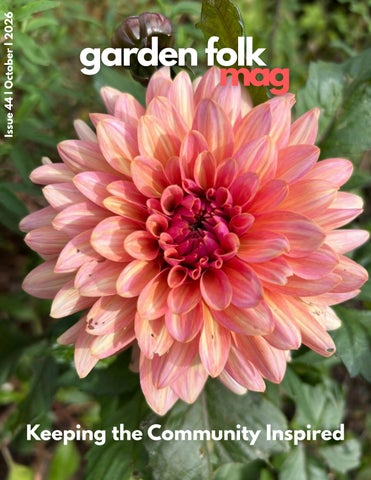
Issue 44 l October l 2026
garden folk mag
Keeping the Community Inspired
4
Contents 3 Editors Notes
Features 4 Time to slow down 14 Isafjordur Magic
Photo Credit: Sophie Mae
Garden Projects 7 Collie Flower Grow Along 17 Lessons from Goth Corner 26 Busy at the Hive
Photo Credit: Mel Heris
17
Photo Credit: Annette Hurt
10 Living Off the Land: Things to do in Autumn to protect your food supply
Photo Credit:Kerry Tomlinson
Garden Journeys
26
10
14
Photo Credit: Kim O’Brien
This Month 13
Write for Garden Folk
20 Become a Garden Folk Supporter 21 Creating a wildlife garden: October 25 Gardening in October
Managing Editor - Ally Phillimoore
Would you like to be part of a future issue? Just pop us an email info@gardenfolkmag.com
Senior Editor - Anjee Harrison
Visit our website @gardenfolkmag 2
A note from our editors
Witchy season is upon us and for those who love it, autumn has all the goodies to offer. I’ve spent the month of September taking part in the Wild Biome Project and have been eating solely wild and foraged food for the entire month. It has been quite the journey so if you missed it, do check back on my instagram posts @plot26a. Whether you’re filling your basket from the hedgerows and forest floor or from your allotment or local farmers market, there is so much natural goodness and beauty around right now. Pull on the jacket and find your hat and get out there. Anjee xx
Its time to enjoy the luxuries of this years season.
Photo Credit: Marc Ridpath
I wrote my last article in a bit of a funk after what has been a challenging year for many reasons not just the weather, family life, my garden and the garden at work. Hopefully this article will be more positive and give you a few bits of inspiration of how to feel positive and move forward in spite of the ever depressing news from around the world.
Photo Credits : Marc Ridpath
Apples are definitely a success for Marc. My first piece of advice is to slow down, it feels like we don’t have enough time any more but I think thats because we are filling every second of the day with distractions, you don’t need to keep scrolling, you will never complete the internet, the dopamine hits are great but I’ll tell By Marc Ridpath you an even better one. Go and watch a small @gardeneriddler corner of your garden and realise how much habitat you are providing, not just wildlife but moss, lichen and all number of living things. You just have to take the time to stare. Let me take you behind the curtain a little now, for the past 3 years I have been creating a podcast called ‘Through The Garden Gate’. Every week, my co-host Jamie and I talk to a guest from the world of horticulture. I am not naturally a chatty person and to be honest it’s completely out of my comfort zone; it gives me anxiety every week in the hours leading up to it. Here is the big but though, I absolutely love doing it and the connections and fantastic conversations we have with passionate people makes it all worth while. They do say getting out of your comfort zone gets you in to your growth zone after all.
An absolute abundance.
Adding details such as windchimes can make the space feel even more relaxing.
On our last episode we were talking to Izwe Nkosi and he really opened my eyes and reframed how I should look at success. Success isn’t how many flowers you have grown or how big or the quantity of your vegetables, it’s is your garden contributing towards providing a habitat for plants and creatures to thrive, which in turn will help to fight the challenges our planet is facing. That may sound a little woo woo but if everyone who had a garden or a few pots thought in that way, didn’t spray pesticides and herbicides everywhere, didn’t pave or fake grass their whole spaces. As one we are small but if we all come together as a community we can make a seismic change. There are 20.6 million domestic gardens in the UK which accounts for 502,757 hectares- a larger area than the UKs biggest national park the Cairngorms which is only 452,000 hectares. So just imagine if we could all create gardens that helped nature thrive, provided food for ourselves and also a place for us to reconnect with that nature we are all part of.
Features
5
Take a momen and slow down.
Photo Credits: Marc Ridpath
Enjoy the simple moments in nature.
Nature knows how to survive changes in climate, it’s been doing it for thousands of years. Something that really brought it home to me was seeing the apple trees in the native woodland at work producing huge amount of apples, that very much larger and juicier than the apple trees in the orchard in the ornamental garden, that are pruned regularly and have been watered during the drought. The reason the ones in the woodland have done so much better is because the temperatures have been lower and all of the trees have creates a community that looks after one another, not just above ground but also below through fungal networks that we barely understand. The evidence is plain to see; it’s been a joy watching all of the wildlife that is now calling the woodland their home, badgers, foxes, rabbits, hares, deer, bats, owls and all sorts of birds. So have I succeed this year? Absolutely! It might have taken 12 years, but I have created an incredible habit that’s going to continue to provide everything those creature need for years to come. It also provides me with material that I can turn in to mulch to continue to improve the ornamental garden and make it more sustainable, oh and also lots of yummy apples and sloes. Obviously not everyone has 5 acres to plant up as a native woodland but you can create a habitat in any sized space, even a pot will encourage and provide habitat for life. If you get some salad, a few strawberries or 20 courgettes out of it everyone is winning. 6
Features
Photo Credit: Nic Wright
Cast your mind back to March. The soil was cold, summer seemed impossibly far away, and these brassicas were little more than seeds and optimism. Seven months later, we've watched them weather spring winds, summer heat and hungry caterpillars. Some crops failed, some have already filled our plates, while others are preparing to see us through the colder months ahead. October is a month of reflection, harvest and anticipation all at once.
In collaboration with
By Nic Wright @collieflowers.co.uk
As the garden settles into autumn, some of our brassicas are quietly doing some of their most important growing. Cooler temperatures suit this family perfectly, helping plants put on steady growth while reducing some of the stress that comes with summer heat. This month is all about keeping plants healthy, feeding where needed, and staying one step ahead of pests.
Kale Kale is one of the easiest and most rewarding brassicas to grow through autumn and winter. Many varieties - including Nero di Toscana which we've grown together - actually taste sweeter after the first few frosts, making them a valuable crop as the weather turns colder.
Photo Credits: Nic Wright
Continue harvesting the lower leaves as required, always leaving the growing tip intact. Remove any yellowing or damaged foliage to improve airflow and reduce hiding places for pests. Keep plants watered during dry spells, particularly if you're still experiencing mild autumn weather. A mulch applied now will help retain moisture and suppress late weeds.
Brussels Sprouts Your sprouts should be standing tall now, with buttons beginning to develop up the stem. Strong plants will benefit from being firmed into the soil, or even supported with a cane, if autumn winds become a problem. Remove any yellowing leaves from the bottom of the plant and keep the area around stems weed free. If plants are producing lots of leafy growth but few sprouts, avoid feeding with nitrogen-rich fertilisers. Towards the end of the month, or early next I'll be doing one of the most important jobs – in my opinion – with my sprouts and that's decapitating them. In my experience, like when we harvest a brocolli but leave the stem and get side shoot growing from it, we can apply to same theory to sprouts, except in their case the side shoots are actually the sprouts themselves. By taking off their heads (you can cook that too like a cabbage), you'll focus the plant's growing energy into the sprouts and get decent sized ones to harvest by mid-December. That said, come the end of this month you might also find you've got some whoppers already growing up the stalks. If that's the case, don't hang around with harvesting, they'll blow and become unusable.
How are your brussel sprouts?
8
And finally, don't forget that like Kale above, and also Parsnips, your sprouts will taste better for being frosted, so if you can hang on for a chill to convert those starches into sugars before tucking in, then do.
Savoy Cabbage Savoy cabbages are steadily building their beautifully crinkled heads at this time of year. Keep plants growing without checks by maintaining consistent moisture levels. Watch for slug damage as cooler, wetter conditions arrive. Remove damaged outer leaves where necessary and ensure plants have enough space around them for good airflow. Also make sure you do an "extra protein" check once you've got them home and are about to cook them, noone wants to find slugs in the fridge, veg drawer or on their chopping board, and they do like to hide in savoys! Firm heads should be checked regularly and harvested once they reach a usable size. Leaving them too long can increase the chance of splitting during wet weather.
Photo Credits: Nic Wright
Cauliflower If you've harvested your cauliflower heads already, congratulations! Given we sowed seed for the Growalong in March it's likely those will have finished cropping by now. Clear away spent plants and add healthy foliage to the compost heap, disposing of any diseased material separately. But if you have any left, or did a touch of succession sowing and those are still producing, check heads regularly and harvest as soon as they reach a good size. Left too long, curds can begin to loosen and lose quality.
Kohl Rabi Most March-sown kohl rabi will have been harvested by now. If you've still got plants in the ground, pick any remaining swollen stems before they become woody and tough. Kohl Rabi were my big failure this year, but I'm blaming the heatwaves rather than myself. Take a moment to reflect on what worked well. Did you harvest at the right size? Were plants given enough space? Kohl rabi is one of those crops that teaches timing, and next year's harvest will be even better for the experience.
As temperatures fall, remember that brassicas are among the stars of the winter garden. While everything else seems to be slowing down, they're often just getting started.
Kohl Rabi.
Credit: Nic Wright
Over autumn, brassicas often face fewer pests than they do in summer, but don't become complacent. Regularly inspect leaves for caterpillars, slugs and signs of disease - plus for me keeping the nets up will deter Arthur's pigeons from popping in for a snack when they're retuning from a long flight. A few minutes spent checking plants each week can save a crop that has taken months to reach maturity.
Garden Projects
9
Photo Credit: Tori Thomas
Living Liv Liv ing Off ing Off the the Land: Land: Things to Things to Do Do in in Autumn to Autumn to Protect Protect Your Food Your Food Supply Supply Autumn can feel like the end of the growing year, but I have come to see it quite differently. For me, it is the point where the garden starts preparing for the next year’s food supply. There is still plenty to harvest, but there is also a lot to do now that will make a difference next spring and summer. After a difficult growing season, particularly one where water has been such a challenge, I am much more aware of how important that preparation is.
By Tori Thomas @torisallotment
The soil needs attention too. After a season of growing, harvesting and watering, I want to give it something back. Compost, well-rotted organic matter and a good layer of mulch help protect the soil through the colder months. Leaving the ground covered also means I am not starting from scratch when spring arrives. Then there are the crops that need a little protection. Tender plants can be moved into the greenhouse or somewhere sheltered, while cloches, fleece and simple covers can extend the growing season for vegetables that would otherwise struggle. I have become much more interested in protecting what I have rather than constantly trying to grow more.
Photo Credits: Tori Thomas
One of the first things I do is look at what is still growing and decide what deserves the space. It is tempting to clear everything as soon as summer finishes, but there is food to be grown through autumn and winter too. Kale, spinach, oriental greens, winter salads, spring onions, carrots and beetroot can all keep the garden producing when many summer crops have disappeared. I also make the most of every bit of space. As one crop finishes, I think about what can follow it rather than leaving the ground bare. Garlic and onions can go in for next year, while hardy crops can take over beds that have been filled with tomatoes, courgettes and beans. It means the garden is constantly moving towards the next harvest rather than simply shutting down for winter.
Seed saving is another part of becoming more self-sufficient. If I have grown something particularly well, I want to save the seed rather than buy it again. It is such a simple thing, but over time it starts to close the loop. The garden produces food, some of that food gives me seed, and that seed becomes next year’s crop. I also look at what I have stored. Potatoes, onions, apples, dried herbs, seeds, preserved vegetables and anything else that can be kept safely all become part of the food supply. The aim is not to have a perfect pantry or to grow absolutely everything. It is to gradually build the knowledge and resources to feed ourselves from what we have grown. This year has made that feel particularly important. Carrying bucket after bucket of water through a drought has made me think very differently about what I plant, how much water it needs and whether it is worth the space it takes. I want a garden that can cope with difficult seasons, not one that only works when everything goes according to plan.
Things are being saved and stored for the upcoming Winter. Garden Journeys
11
Photo Credits: Tori Thomas
Photo Credits: Tori Thomas
A basket of Autumn.
Autumn is also the time to notice what worked and what didn’t. Which crops handled the heat? Which ones needed constant watering? What produced well in a small space? What was hardly worth growing? I write these things down because next year I want to make better choices. Protecting our food supply is not about panic or trying to predict exactly what is coming. It is about preparation. It is knowing how to grow, save, store, preserve and start again. It is having seeds in a drawer, compost on the beds, food in the freezer and jars in the cupboard. It is learning which crops can cope when the weather doesn’t.
Photo Credits: Tori Thomas
What a selection of goodies!
And perhaps most importantly, it is using autumn to get ahead. Because while the garden might look as though it is slowing down, underneath the surface it is already preparing for another year of food. And so am I. The greenhouse is bursting!
12
Garden Projects
Would you like to write for Garden Folk mag? We are always looking for new writers to join the team, no experience needed and everyone is welcome. If you have a story you would like to share or just want to try your hand at writing, get in touch and pop us an email
Get in touch
Photo Credits: Kim O’Brien
Isafjordur Magic I almost missed it entirely! After a day of hiking through the dramatic northern mountain scape of the coastal Icelandic retreat that is Isafjordur, I stumbled by pure chance on one of the most incredible wild growing spaces I have ever encountered.
Absolutely stunning views!
Photo Credits: Kim O’Brien
That day I had followed a mountain trail overlooking spectacular views of the fjord which eventually left the rock face to weave through an ancient pine forest. Trees in Iceland are scarce. – an artefact of the Danish Vikings felling most of them for timber, and while the landscape is slowly repopulating with new vegetation, any existing trees are considered highly prized and sacred. Venturing through this revered and ancient Icelandic woodland was a beautiful immersion into nature I will forever treasure. As the day faded to mid-afternoon, I considered heading down the mountainside into the town, and it was on my descent that I spied a flash of red that stopped me in my tracks. Curious, I turned towards it, and as I drew nearer, I was met with a meadow of vibrant orange-red blooms growing in swathes among the grasses. Just look at the humidity.
By Kim O’Brien @garden.with.kim
Eye spy a watcher.
I was thrilled to discover this floral jewel was orange hawkweed (Pilosella aurantiaca) which grows abundantly in certain areas in the cool Icelandic climate. Despite its acclimatisation here, this was my first, and only sighting in the two weeks that I roamed the countryside of Iceland. Much of the area is volcanic and the hawkweed doesn't flourish amid the hot springs and lava beds, so I really struck lucky that day chancing upon it high up in the mountains. Of course I wanted to photograph this beautiful flower, and it was while doing this I spotted a sign which read ‘Groandi’. I pushed on, curious to find out what secrets Groandi would reveal. I walked through the gate and was absolutely amazed by what I discovered. As the Head Gardener of a Community Garden and a judge for Anglia in Bloom, I’m well acquainted with the many innovative set-ups which make a growing space well-balanced and productive, along with the challenges that various topographies of the land can face. But hand on heart, I can honestly say I have never seen a community garden clinging to a rock face, at high altitude, next to the sea, and yet so incredibly abundant with produce. It was thriving!! And it was awe inspiring! My heart was pounding because I saw immediately how this was somewhere extraordinary, a vibrant growing oasis of green, defiantly flourishing in a rugged landscape of harsh elements, scree, ice and snow.
Can we all get a bee sculpture this! Coleus. What alike stunning
Features
15
Creative engineering combined with development of a microclimate (once you walk through that gate, the difference in the environment is immediately evident) is at the heart of the growing space, and these include strategies such as the building of exceptionally deep beds which insulate root systems with generous layers of organic matter. In addition, beds are intentionally paired with architectural structures which create geodomes that function to protect and shelter plants from harsh mountain winds. The final principle is permaculture of cold-hardy varieties of herbs, berries and other crops including salad and root vegetables, and for a UK facing increasingly unpredictable extremes of weather, the garden Groandi is a masterclass in resilient growing. And of course, the garden is chemical and pesticide free. Everything here works with nature and when you see its place in the rugged wilderness you understand that working with nature is the key to its success.
The moss balls were so perfect
Luscious green goodies.
Photo Credits: Kim O’Brien
Photo Credits: Kim O’Brien
On the day of my visit, the site was abandoned, but I have since learned that Groandi is a collectively managed mountain space, an allotment which, rather than being subdivided into plots as in the UK, is managed in unison as an entire site by a cooperative of the public, local schools and international interns who plant, tend and harvest produce. The space is overseen by a visionary landscape architect named Hildur, who has spent more than 10 years pioneering the cultivation techniques which are specifically tailored to growing in these sub-arctic conditions. The permaculture here isn’t just botanical, it’s social too, and an inclusive environment fosters learning and sharing of knowledge between community groups and intergenerationally.
As far as inclusivity goes, all visitors are encouraged to harvest from the garden, even an alien passer by like me. I harvested a range of salad crops, and with a couple of leaves of each, made myself a tasty feast – but I earned it first! Not wanting to take without giving something back, I passed a very contented 15 minutes of weeding the salad beds by hand before eating. And I don’t know if this was my imagination, but sub-arctic, high-altitude, coastal grown lettuce is the best I have ever tasted. They definitely knowhow to cultivate flavour in the Icelandic mountains. Could there be a more perfect snack. 16
Features
Photo Credits: Sophie Mae
Photo Credits: Annette Hurt
Lessons from Lessons from the the Goth Corner Goth Corner
When I first started my garden, I wasn’t aware of the wealth of dark and moody plants that were readily available. Since discovering how easily I could get my hands on so many gothic plants, I’ve started a Goth Corner, which has now spread out into the rest of the garden!
Wakey Wakey bees!
Hellebore
Photo Credits: Sophie Mae
Another thing I’ve learned is that goth gardening doesn’t necessarily mean you need to limit your colour scheme to deep coloured plants. Some plants like Foxgloves can be considered gothic due to their toxicity or connotations in their folklore that make them suitably macabre or mysterious. There are gothic plants out there for every season, so you can intentionally curate your space and know that there will be interest throughout the year. Here are some things that have worked well throughout the year in my Goth Corner.
Hellebores are a wonderful winter plant. They’re gothic in their own right as a highly toxic plant, but there are some gorgeous dark varieties out there. One of my favourites is Hellebore ‘Harvington Black’, possibly the closest I’ve seen a Hellebore come to true black, with rich velvety petals. Not many people know that there are some truly dark Iris varieties too, Iris reticulata ‘Pauline’ is a favourite of mine. There’s also rich folklore surrounding classic winter plants like Snowdrops, so don’t overlook them!
Photo Credits: Annette Hurt
Winter
By Sophie Mae
Hyacinth
@sophs.mae.garden
Add a touch of gothic to your garden.
There are so many stunning dark spring bulbs these days. Tulip ‘Queen of Night’ is a dark purple tulip that is readily available in a lot of garden centres and shops across the UK. It’s elegant and unfussy. Or, you can lean into the drama of a double-flowered variety like Tulip ‘Black Hero’; there’s plenty of options to fit your vibe. I’d love to get my hands on Tulip ‘Paul Scherer’ - which in my experience seems to be the closest to true black. Hyacinth ‘Midnight Sky’ is another wonderful spring bulb for a gothic garden. This can be a more expensive variety and harder to get hold of than the tulips but if you want the scent of hyacinth and flowers to match your aesthetic, then it’s a winner.
18
Photo Credits: Annette Hurt
Spring
Photo Credits: Sophie Mae
Summer Petunias themselves may not scream goth, but ‘Black Mamba’ and ‘Black Velvet’ varieties have show-stopping true black flowers. I tend to plant up a couple of pots with these in the Goth Corner, but they can easily be added as bedding plants to any area. I personally do prefer these in pots or a planter so that the flowers really pop as I feel they can get a bit lost planted directly into beds. I’ve managed to find these at garden centres which is a win. They’re also a long flowering variety as long as you remember to deadhead them to encourage more flowers. Photo Credits: Annette Hurt
Hear me out, but goth peas. Pea ‘Blauwschokker’ have rich purple pods, and the wrapping tendrils add a touch of whimsy to the garden. They’re also great to eat as mangetout or straight from the pod, so they’re a great option if you’re a fan of growing your own produce.
Sedum.
Autumn There are several Sedum varieties that provide great autumnal interest as we get closer to Halloween ‘Black Knight’ and ‘Back in Black’ have been the easiest to get a hold of in my experience. Sambuca ‘Black Lace’ has dramatic dark foliage almost yearround, so it’s great for interest through the seasons, as long as you’re a fan of the delicate pink flowers in spring, but in autumn the glossy black elderberries really pop.
Photo Credits: Annette Hurt
Sunflower.
If you’d like a spin on a classic summer flower, Sunflower ‘Velvet Queen’ is a way to add some darkness to a late summer staple. I’ve personally found them easy to grow as well, so this could be a fun project for children too. Bear in mind that these often begin to have a pop of yellow as they develop so if you’re goth garden is a yellow free zone beware!
There are so many plants you could have in a gothic garden throughout the year, but hopefully this is a starting point for some of the easiest accessible plants. If you want to make your garden more gothic but it’s already quite established with plants, accessories like mirrors are gargoyles are perfect. The most important thing is that you create a garden you love!
Garden Projects
19
Become a Garden Folk Supporter ...and help us keep making the Garden Folk Mag We appreciate all the support given to the magazine by all the Garden Folkour readers, writers, industry supporters and anyone else who cheers us on. Running the magazine each month does incur financial costs though, so if you are able to contribute, either with a one off payment or by becoming a member, it would really help to keep the magazine going... and growing.
There are currently three membership tiers to choose from, all with great benefits. .
By Mel Heris @bluebellandbumblebee
Photo Credits: Mel Heris
Creating a Creating a wildlife wildlife garden: garden: A monthly A monthly step-by-step step-by-step guide guide
October: The turning of the season October marks the gentle shift from autumn toward winter. Leaves change colour and fall, light fades earlier in the day, and the garden takes on a quieter, more reflective mood. Wildlife is busy preparing for the colder months and for gardeners, October is a month of preparation and observation. It’s the perfect time to maintain habitats, provide food, shelter, and to take steps to support wildlife through the upcoming winter. Who is this hiding?
This month’s wildlife project: Creating a brush pile and/or dead hedge
Photo Credit: Mel Heris
Photo Credit: Mel Heris
As autumn deepens, the garden starts to slow down, and wildlife begins preparing for the colder months ahead. Many creatures, from insects and amphibians to small mammals and birds, rely on natural shelters to keep them safe, warm, and hidden during this time. To help them, you can create a brush pile and/or dead hedge in your garden.
Photo Credit: Stock Canva Image
I spy a Hedgehog enjoying Autumn.
The benefits of a brush pile/dead hedge for wildlife Offers a safe hiding place for hedgehogs, frogs, toads, and other small mammals. Provides shelter for insects, spiders, and beetles. Gives birds places to forage, nest, or take cover from predators. Adds natural structure and texture to your garden while using materials you already have.
Scoop up the leaves for all the critters.
Photo Credit: Mel Heris
Photo Credit: Stock Canva Image
Choose a quiet, sheltered spot in your garden, ideally near shrubs, hedges, or other wildlife areas. Gather fallen branches, twigs, prunings, and leaves. Arrange them in a loose pile with some height and gaps to allow small creatures to move in safely. Add layers of leaf litter or straw for insulation and extra hiding spaces. Make sure the pile is stable but not compacted so creatures have the space to crawl freely into it.
Photo Credit: Stock Canva Image
Creating a brush pile
Keep watch for seeds popping. 22
Photo Credit: Mel Heris
Creating a dead hedge Use (pruned) branches and hedge trimmings from your garden. Stack the material in a linear fashion, weaving the branches together if possible to form a continuous barrier. Leave some gaps for small animals to enter and exit safely. Position near existing hedges, fences, or trees to provide additional shelter and connectivity for wildlife moving through the garden.
Photo Credits: Mel Heris
Maintenance and observation Leave the pile or dead hedge undisturbed through autumn and winter. Avoid removing leaves, sticks, or branches that wildlife may be using for shelter. Observe from a distance: You may spot insects, frogs, hedgehogs, or birds making use of the new habitat.
A dead hedge pile.
By creating a brush pile or dead hedge, you provide vital shelter that helps wildlife survive the colder months while making use of natural materials from your garden. It’s a simple, low maintenance project that has a big impact for our wildlife friends. Tips for success Keep the area quiet and undisturbed, especially during the day when hedgehogs rest.
Photo Credit: Mel Heris
Check the food and water daily, especially in dry or hot weather, to ensure it remains fresh. You can add leaf litter or straw around the house for extra insulation and comfort. Leave the area undisturbed throughout autumn, winter, and early spring. Why not be creative and make it a feature. Up close and personal with your widlife friends. Garden Projects
23
Photo Credit: Mel Heris
Other monthly wildlife jobs: Leave seed heads: Seed heads from plants like grasses, annual flowers, and late perennials provide natural food for birds and shelter for insects.
Check hedgehog habitats: Ensure hedgehog houses and natural hibernation spots are dry, sheltered, and undisturbed as hibernation season approaches.
Photo Credit: Stock Canva Image
Create leaf piles in quiet corners: Fallen leaves offer insulation and hiding places for hedgehogs, amphibians, and overwintering insects.
Top up water sources: Keep ponds, bird baths, and shallow dishes clean and filled. Plant spring-flowering bulbs: Early blooms will provide vital nectar for pollinators emerging at the end of winter/early spring. Avoid heavy pruning: Dense shrubs and hedges offer valuable shelter and roosting spots as temperatures begin to drop.
Photo Credit: Mel Heris
Reduce garden disturbance: Be mindful when moving logs, clearing beds, or strimming because many creatures may already be settling in for winter. October carries a quiet sense of preparation as wildlife begins to prepare for the colder months ahead, and your thoughtful actions help ensure they can do so safely. With the habitats you have created, your garden is becoming a refuge to support life through the winter’s stillness.
24
Happy wildlife gardening, and see you all next month.
Gardening in October October is when we have to accept that autumn is definitely here and winter is just around the corner. As gardeners we are preparing our spaces for the colder month, frosts may already have arrived, and as ever, there is much to do and much to admire.
Things to sow
Jobs to do
Flowers Tulips Daffodils Crocuses Aliums Hyacynths Poppies Cornflowers Aquilegia
Embrace the start of autumn and calmer times in the garden. Enjoy all those harvests and the chance to create new things.
Edibles Broad Beans Winter Peas Winter Lettuce Spring Onions Rocket Mizuna Garlic Elephant Garlic Autumn onion sets
Come and join the @gardenfolkmag team for live garden updates throughout the month over on Instagram.
What to listen to while you sow:
Join Jamie & Marc as they have a rambling chat with people from the world of horticulture about their gardens and what gardening means to them.
Harvest as much autumn rain as possible to store for the year to come. Clean out waterbutts or install new ones.
Sow green manures to prevent your soil being naked over the winter.
Embrace the seed heads and autumn foliaage - the wildlife with thank you for it.
Provide frost protection to anything that may need it over the winter.
Lift and divide established perennials to create new, fee plants before the soil gets too cold.
Rake fallen leaves into piles for wildlife or compost separately from your usual compost in wire bins to make leaf mold.
lightly prune climbing and rambling roses.
Clean bird baths and top up bird feeders.
Make an autumn wreath with leaves, foliage and berries.
Rake away debris from lawns and aertate compacted soil.
Plant your spring bulbs. use pretty pots and containers to really make them pop.
Plant garlic and autumn onion sets for harvests next year.
If you’re in need of Garden related ‘stuff’ remember that Garden Folk Supporters get some amazing discounts with some great companies!
Garden Projects
25
Photo Credits: Annette Hurt
Busy at the Hive
Photo Credits: Laura Whiskens
With the shortening days of autumn, our honey bees are using the last of the warm days to build up stores for the winter ahead.
Bee on a Dahlia.
As the temperatures cool down, they are making shorter flights from their hives and using resources closer to home. My late flowering dahlias, Japanese anemone, ivy, and even some late windfalls of overripe pears seem to be the focus of their forage for nectar, fruit sugars, and pollen, ensuring these winter bees will have the fat stores to see them through the months ahead. In October, my beekeeping duties have lessened greatly, with the odd check to ensure food stores are building, and if needed, supplementing their forage with extra feed. The varroa treatments have been removed and my interaction with my girls is limited to a walk around the hives, coffee in hand, to update them of any news and gossip.
Varroa Destructor
Photo Credits: Annette Hurt
My focus turns to the National Honey Show, held at the end of October. Beekeepers from across the world assemble at Sandown Park Racecourse to celebrate the honey bee and everything associated with them. I like to enter my honey, and a few beeswax and craft products into the show so it’s time to sort and clean any beeswax which has been collected through the summer. Beeswax is an amazing product and it’s easy to underestimate the work the bees undertake to produce it. It’s vital for honey bees and without it they would not be able to raise and maintain their colonies. It acts as their nurseries for their eggs and larvae, the pantry for honey storage, and a communication platform for the waggle dance and spreading the Queens’ pheromones. The beeswax also acts to insulate and help the bees regulate the temperature in their hives.
By Annette Hurt @mypatchofnorfolk
Photo Credits: Annette Hurt
Beeswax is made by young honey bees, typically between 12 and 18 days old. They require a good nectar flow to be able to produce it, needing around 8 -10 pounds of honey to produce just 1 pound of wax! Taking around 12 hours to produce, the young bees secrete liquid wax from eight small wax glands underneath their abdomens. As the liquid wax hits the air it turns into tiny flakes of white wax which the bees chew with their mandibles, then give to their sisters who mould them into round cells all closely linked together to form the hexagon pattern we know.
Fresh wax from the adbomen of a young bee. Bee water feeder.
As a valued resource we only collect excess wax or use wax from old frames. The purest wax is from the honey cappings and that is cleaned separately before being used for any skincare products.
Fresh Wax. Garden Projects
27
Some of Annette’s products.
Photo Credits: Annette Hurt
Bees on wax.
Once cleaned, the round cheese like discs of wax are broken down and melted into more useable blocks before being used to make candles, polishes, balms and soaps. It’s worth burning beeswax candles rather than their soy or paraffin counterparts as they burn slower, brighter and cleaner. Its widely reported that they emit negative ions which neutralise, pollutants and allergens such as pollen and dust, while giving off a gentle honey scent. Beeswax has anti microbial, anti inflammatory, anti bacterial and antiseptic properties which make it ideal for skincare products. I use it to make my ‘magic cream’, which is a perfect for soothing cuts, grazing, and insect bites.
28
Garden Projects
Photo Credits: Annette Hurt
Once collected it needs to be cleaned and filtered. We render it using steam, then filter it through cotton sheets to remove any impurities. We filter our wax at least 3 times and often gets a fourth filter through very fine milk filters depending on it use. The beeswax can differ in colour and often depends on what the bees were foraging on when being produced and also how it’s been used in the hive.
Perfect for insect bites, cuts, grazes or just as a general skin cream.
Photo Credits: Annette Hurt
Annette’s Annette’s ‘Magic’ salve ‘Magic’ salve
This recipe is simple and uses hardly any ingredients. You can easily tailor it to your own preferences by changing the base oil or essential oils. When changing the essential oil check the dilution rate for skincare as some oils may cause a reaction if too much is used.
80 grams of almond oil or extra virgin olive oil 20 grams of beeswax 5 drops of lavender essential oil 5 drops of bergamot essential oil 1. Place the infused oil and wax into a bowl over a saucepan of barely simmering water. 2. Allow the wax to melt and remove from heat. 3. Stir and pour into jars. Drop the essential oils into the container at this stage. 4. Leave to cool and become firm before securing lid. 5. Label and store in a dark, cool place.
Issue 44 l October l 2026
Set the date for November 6th for the next issue
Keeping the Community Inspired