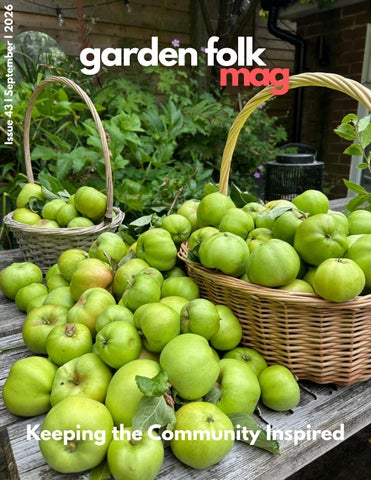
Issue 43 l September l 2026
garden folk mag
Keeping the Community Inspired
4
Contents 3 Editors Notes
Features 6 What a year 20 Magical September Sowing 22 Belfast Botanical Garden Photo Credit: Sophie Mae
Garden Projects 4 Make use of your recycling 14 Collie Flower Grow Along 18 Kerrys Kitchen Garden 25 Busy at the Hive
Photo Credit: Mel Heris
25
Photo Credit: Annette Hurt
10 Living Off the Land: Growing for an uncertain future
Photo Credit:Kerry Tomlinson
Garden Journeys
28
18
22
Photo Credit: Kim O’Brien
This Month 7
Write for Garden Folk
28 Become a Garden Folk Supporter 28 Creating a wildlife garden: September 32 Plot to Plate: Green Tomato Salsa 34 Plot to Plate: Peach Chutney 35 Gardening in September Managing Editor - Ally Phillimoore
Would you like to be part of a future issue? Just pop us an email info@gardenfolkmag.com
Senior Editor - Anjee Harrison
Visit our website @gardenfolkmag 2
A note from our editors
Well summer has definitely ended in Scotland, the chillier mornings are back days are slowly getting darker and oh my have we had some rain! I’m not going to moan though as the plants are very happy with all the wet stuff. It hasn’t been the most sucessful growing year for me here. I didn’t even get one ripe tomato! I will be making this month’s Plot to Plate of Green Tomato Salsa for sure. We have a jam packed issue with a real variety of articles. Not just one but two recipes and some recycling tips to get you thinking differently about your garden. Do we dare mention the dreaded Christmas yet? Well we are certainly starting to think about all the festive things we can bring you. But for now September is here and Autumn is appearing. Ally xx
Photo Credits: Sophie Mae
Photo Credits: Annette Hurt
Make use of your recycling in the garden
Some of my favourite gardening tools started life as rubbish. From yoghurt pots full of seedlings to milk bottles turned into watering cans, giving everyday items a second life is an easy, budgetfriendly way to reduce waste in the garden. Wakey Wakey bees!
Another simple use for milk bottles is making plant labels. I'll be the first to admit I need to be better at labelling my seedlings, but these have made it much easier when I don’t have any to hand. Simply cut a clean, dry milk bottle into strips and write on them with a permanent marker. I find that these eventually fade in the outdoor weather, but then I can use them again
Photo Credits: Annette Hurt
Milk bottles are one of the most versatile things to keep. One of my favourite projects is turning them into watering cans. I keep a few dotted around the garden so there's always one within easy reach, like in the greenhouse. I even have some filled with pre-mixed seaweed feed, which makes me much more likely to remember to feed my plants! It takes a little more effort than the seed trays, but it's well worth it. I heat a sewing needle and carefully make holes in the bottle top. You can also decorate them or use the bottles as mini greenhouses for autumn-sown sweet peas.
Photo Credits: Sophie Mae
The easiest projects depend on what you already use and have to hand. For me, clean fruit punnets and yoghurt pots make perfect seed trays with no more work than a quick rinse. Giving them a second life means there's no need to buy more plastic trays, and it's a simple way to make the most of what you already have.
Turn your milk bottles into a watering can.
By Sophie Mae @sophs.mae.garden
Why not see what you can create with an old sink in your garden.
Almost anything can be used as a planter. I was lucky enough to rescue a butler sink from a building site. My original plan was to turn it into a wildlife pond, but I couldn't stop it from leaking, so it became a planter instead. Sometimes the best garden projects are the ones that adapt along the way. Keep an eye on local reuse groups or online marketplaces for unwanted items, or think twice before throwing things away during a renovation. You might be surprised by what can become a beautiful planter.
Photo Credits: Annette Hurt
You can never go wrong with a glass jar, although if you're anything like me, you'll soon have a cupboard full of them! They're perfect for storing plant labels, collecting seeds from the garden or rooting cuttings. They also make lovely little vases for smaller blooms like sweet peas. There are so many ways to give everyday items a second life in the garden, and they don't need to take much time or effort. Before buying something new, have a look around your home first. That empty yoghurt pot, milk bottle or glass jar could be exactly what your garden needs. If you're gardening on a budget and want to reduce waste, recycling what you already have is a brilliant place to start.
Garden Projects
5
Photo Credit: Marc Ridpath
I think it’s safe to say it’s been a challenging year in gardening and it’s a year that I will admit I have fallen out of love with it a little bit, and not because of any failures although there have been many. It’s more for the fact that it’s hard to see a future in ornamental horticulture or growing food when the climate that has been pretty stable for thousands of years is shifting so dramatically and so quickly that both the plants and the people growing them have absolutely no chance to keep up and evolve.
Photo Credits : Marc Ridpath
Its been one hell of a hot summer. If things were happening slowly you could adapt every year slightly so your garden could become more resilient to change, but the changes needed to have a garden that can survive weeks of no rain and weeks of 30 plus degrees in temperature is monumental. I can just about By Marc Ridpath @gardeneriddler get my head around the lack of rain but we are going to have to start growing varieties of plants that still perform with regular temperatures above 30 degrees Celsius. Interestingly it’s not just the day time temperatures that have an effect, beans rely on cooler night time temperatures of around 18 degrees Celsius to produce seed which for much of this summer didn’t happen. Beans are the primary source of protein for 400 million people, so it’s going to become a big problem very quickly if we do not find a solution. A recent American study found after testing more than 1000 bean varieties, only 30 were identified to be able to produce seeds in increased night time temperatures. I don’t know about you, but I would rather try and stop the temperatures rising than try toadapt to life with the consequences. Obviously that’s easier said than done especially for a gardener in Lincolnshire that has little to no influence on changing the systems that need changing.
The leaves are already changing.
However, I can say my piece in these pages and hope to influence you to not believe the propaganda pushed by the system’s media. It’s so conflicting to both want to have an influence and at the same time just want to throw your phone in the bin, turn off the WiFi and go live in a forest somewhere. That’s the genuine struggle I live with on a daily basis. Adding details such as windchimes can make the space feel even more relaxing.
It’s the same in general life- sending my son to a mainstream school knowing he would be better out of that system, but then does that damage his chances of being able to eventually be an independent adult that can live a happy life able to make his own choices? Anyway, back to the plants. I’m sure you have all noticed the signs of stress in nature all around your local area: trees looking autumnal in July and the beginning of August, perennials shutting down before flowering to preserve life, streams drying up, ponds become puddles. In my eyes nature is crying out for help and if we don’t change our consuming habits dramatically as we have seen with wildfires and the devastation in Nepal, nature will make those changes for us. Sadly in Nepal they were doing everything right; they get This water provides from all the wildlife withsomething a viatl we in nearly all oftrough their electricity hydropowerwater source. Britain can only dream of.
Features
7
Time to start thinking about what to sow next year.
Photo Credits: Marc Ridpath
Beans are a great addition for a self sufficient garden
If I had unlimited resources, I would have solar panels on my house and a wind turbine in the garden even if only a small one, I would fit a grey water system to be more sensible with my use of water and collect more water in the garden for the plants as I discussed last month. How to I tie all these tangents up? We have to consume less, source things we do consume more ethically, shop locally and pay with cash if possible, I know tapping is so much easier but if we are to change the world we are going to have to make things less convenient. Because if the world makes the changes for us I am telling you now we have lived through the good times and what those good times have done to the planet is not sustainable. You know that feeling when you haven’t netted your brassicas successfully enough and the cabbage whites have got in and laid eggs on the underside of the leaf and all your brassicas disappear in front of your eyes? That’s what’s we are allowing to happen to the planet yet we are apparently a highly evolved dominant species that absolutely should know better. You don’t need to be self sufficient that’s such an unattainable goal, you can be self sufficient in some things but also support your local community of growers, buy less from supermarkets, if you have a farm shop that is actually selling local produce, support them. Another really important thing to make sure you do is save seeds from your crops. It is as important and the crop itself because you will have seed that is more adjusted to your microclimate. Just avoid anything in the squash family, as the seed won’t be true unless you have pollinated the flowers by hand from the male flowers to the female flowers on the same plant.
8
Features
Autumn looks like its already arrived. Squash is a varied and versatile vegetable
Would you like to write for Garden Folk mag? We are always looking for new writers to join the team, no experience needed and everyone is welcome. If you have a story you would like to share or just want to try your hand at writing, get in touch and pop us an email
Get in touch
Photo Credit: Tori Thomas
Living Liv Liv ing Off ing Off the the Land: Land: Growing for Growing for an an Uncertain Future Uncertain Future I look at the garden in a slightly different way now, perhaps it is because this year has already tested us. Perhaps it is because carrying bucket after bucket of water across the garden in the heat makes you realise very quickly just how dependent everything is on something as simple as rain and climate. Or perhaps it is because, for the first time in a long time, the things happening in the wider world feel much closer to home.
By Tori Thomas @torisallotment
Weather affects crops. Crops affect supply. Supply affects prices. We have already seen how quickly a difficult growing season can change things. This summer, the lack of rain has made growing incredibly challenging here. I have spent so much time carrying water that I have had to become very selective about where it goes. You cannot stand there with a bucket and water everything equally when the water itself is limited. You start looking at what is most important, what can survive another day, what is going to give you the most food and what needs protecting first. It has completely changed the way I think about water. It has also changed the way I think about what I grow.
Photo Credits: Tori Thomas
El Niño is back, and this is not simply another weather story to watch from a distance. El Niño is a natural climate pattern caused by unusually warm ocean temperatures in the tropical Pacific, but its effects can be felt around the world because it changes rainfall and temperature patterns. The current event is expected to strengthen through the rest of 2026, with forecasters warning that this could become a particularly strong event. What happens in the Pacific might seem a very long way from my vegetable beds, but this is exactly where food security becomes something worth thinking about.
Photo Credits: Tori Thomas
We have talked throughout this series about becoming selfsufficient, about growing our own food, looking after our soil, preserving what we grow and learning to use what we already have. These things can sometimes sound like lifestyle choices, and of course they are, but I increasingly think they are also practical forms of resilience. And right now, resilience feels important.
When you are growing simply for enjoyment, it is easy to fill a garden with things that look beautiful or that you fancy trying that year. When you are growing for food security, you start asking different questions. How much food will this produce? Will we actually eat it? Can I save the seed? Can I preserve it? Can it be stored? How long will it keep producing? Will it cope if the weather is difficult? Suddenly, every space matters. That does not mean I have stopped growing flowers or the things that make the garden beautiful. Quite the opposite. I think the garden should still be somewhere you want to spend time. I still want the lavender, calendula and flowers buzzing with bees. I still want somewhere beautiful to sit with a cup of tea at the end of the day. But I have become much more aware that beauty and productivity do not have to compete with one another. A flower can feed a pollinator, provide something to dry for winter, produce seed for next year and still make you smile every time you walk past it. That is the kind of abundance I want.
No matter where you are this year water has been the topic of gardening. Garden Journeys
11
The same goes for vegetables. I would rather grow a smaller number of crops really well and have enough to eat, preserve and save for later than grow a huge collection of things that look impressive but do not actually contribute much to feeding us. Potatoes, onions, garlic, beans, tomatoes, squash, kale, carrots and beetroot have become increasingly important to me because they give something back in different ways. Some can be eaten fresh, some can be stored, some can be preserved and some can keep producing over a long period. I want crops that give me options. That is what food security means to me. It is not about being frightened of what might happen. It is about being prepared enough that I do not have to be frightened by it. There is a huge difference.
Pumpkins galore!
Photo Credits: Tori Thomas
Photo Credits: Tori Thomas
Water saving is a focus this year for many gardeners.
Photo Credits: Tori Thomas
Photo Credits: Tori Thomas
The current El Niño is already being watched closely because of its potential to disrupt agriculture, water resources and global food supplies, particularly in regions that are already vulnerable. Recent analysis has warned that its effects could add further pressure to food production and prices around the world. And that matters even here. We live in a country where we can walk into a supermarket and expect almost everything to be available all year round. We have become accustomed to that level of convenience, but it relies on an incredibly complicated system of farmers, transport, energy, international trade and favourable weather in many different parts of the world. When one part of that system is disrupted, we feel it eventually. That is why I want to build something different at home. Not a perfect, completely self-contained life where I never need to buy anything again, because that is not realistic for me. I mean something much more practical. I want to know that if prices rise, weather becomes difficult or supply chains are disrupted, I have the skills to grow a meaningful amount of our food myself. I want to know how to preserve it, store it, save seed from it and grow it again the following year. I want the knowledge to stay with me. And perhaps that is the most important thing we can grow. Photo Credits: Tori Thomas
Knowledge does not take up much space. It does not go off. It does not become more expensive in the supermarket. Once you have learnt how to grow tomatoes from seed, save your own seeds, make compost, improve your soil, collect water, preserve a harvest and plan your crops around the seasons, those skills are yours forever. The garden becomes a form of insurance, but one that also gives you something beautiful in return. Of course, we also have to adapt the way we garden. This summer has shown me that I cannot simply assume the weather will behave as it always has. Healthy soil is more important than ever because soil rich in organic matter holds water far better than dry, depleted ground. Mulching becomes essential. The greenhouse is bursting!
12
Its been a sunny year!
The world is changing, and I think the way we grow our food has to change with it. We cannot predict every drought, every flood, every heatwave or every disruption to the food system, but we can make ourselves less vulnerable to them.
Providing food for a future you.
We can grow more. We can waste less. We can preserve what we grow. We can save seed. We can improve our soil. We can collect water. We can learn.
Photo Credits: Tori Thomas
Photo Credits: Tori Thomas
Photo Credits: Tori Thomas
But living off the land is not about controlling nature. It is about working with it. And perhaps that is where I am now with my garden. I am less interested in fighting the conditions and more interested in understanding them. If summers become hotter and drier, I need to build a garden that can cope with that. If winters become unpredictable, I need to think about what can still be grown through them. If food prices continue to rise, I need to make sure the space I have is producing something useful. It is not about panic. It is about paying attention.
Photo Credits: Tori Thomas
Choosing crops that cope better with heat and periods of drought becomes part of planning rather than an afterthought. Collecting rainwater becomes something you do whenever you possibly can. And perhaps we need to stop thinking of water as something we simply turn on. When you have to carry it in buckets, you suddenly understand its value very quickly. It has been exhausting at times, but it has also made me more resourceful. I have learnt to prioritise. I have learnt which plants are surprisingly resilient and which ones simply cannot cope without help. I have learnt that sometimes the best thing you can do is not try to save everything, but concentrate on the crops that matter most. That is a difficult lesson for a gardener. We want everything to survive.
And slowly, almost without noticing, we become more selfsufficient than we were before. That is the future I am trying to build here. Not a perfect garden, and certainly not an easy one, but one that can feed us, sustain us and continue to give something back even when the conditions are difficult. Because I think that is what living off the land really means. It is not escaping the uncertainty of the world. It is knowing that, whatever happens beyond the garden fence, you have begun to build something resilient on the other side of it.
The greenhouse is bursting!
Garden Projects
13
Photo Credit: Nic Wright
September is the month where brassicas stop pretending and start telling the truth. Whatever the summer has thrown at them - heatwaves, drought, wind-rock, pests, neglect - it all shows up now. Some plants surge, some stall, and some quietly admit defeat. In amongst the harvesting, now’s a good moment to take stock, tidy up, and make a plan for the rest of the season. And for me, it’s been a mixed bag.
In collaboration with
Watch out for caterpillars
By Nic Wright @collieflowers.co.uk
Kohl Rabi: the one that didn’t make it If you’ve been following along, you’ll know my Kohl Rabi bowed out early. The heatwaves finished them off completely. They germinated well, grew steadily, and then collapsed in the combination of heat stress and dry soil. Kohl Rabi is always the drama queen of the brassica world quick to bolt, quick to sulk, and very quick to give up when temperatures climb. If yours survived, you should already have harvested or be harvesting now and, unless you did some sucessional sowing, the ones we started off together in March will probably be nearing the end soon.
Photo Credits: Nic Wright
Cauliflower de Purple: curds forming September is prime time for curd formation in Spring sown caulis. Healthy plants will be showing tight, well-shaped heads now, with that beautiful purple blush. If your curds look small or loose, it’s likely the summer heat slowed development. But if heat got to them and they bolted last month before you got to them, you’re not on your own. For the plants that remain, keep them well watered, remove any yellowing leaves, and consider gently folding outer leaves over the curd if strong sun is forecast — it helps prevent “blowing” and keeps colour strong. But a note on the lovely vibrant colour of de Purple – it doesn’t last when the caulis are cooked! Unless you’re making Cauliflower Cheese – although I wouldn't recommend it! I once did and found pink Cauliflower Cheese challenging, I find it’s best roasted or lightly steamed.
Savoy Cabbage: hearting up Savoys begin to firm and shape their hearts this month. You should see the centre tightening and the outer leaves forming that classic crinkled globe. You might even be able to harvest some now, although they could be a little on the small side and another few cooler weeks will help them to grow. Heatwaves may have slowed heart formation, so don’t panic if yours look a little behind. Water deeply during dry spells, keep weeds down, and firm the soil around any plants that have rocked in the wind. They’ll catch up.
Garden Projects
15
My big summer discovery: clubroot
Brussel Sprouts: button time This is the moment sprouts begin to appear: tiny pea-sized buttons forming up the stem. If your plants stretched tall in August, that’s a good sign - they were building the framework they need. Consistent moisture is key now. Dry soil leads to loose, leafy sprouts later on. Keep an eye on netting too; cabbage whites are still active, and leaves touching the net can let them slip through. In October weve got a big job coming up with our Sprouts, so don’t worry about them being tiny now, I’m going to help you turbo charge them soon!
This year brought an unwelcome surprise at my allotment: clubroot. I found it while doing a midsummer tidy-up - a couple of plants looking stunted, leaves yellowing, and when I pulled them up, the roots were swollen and distorted. It’s one of those moments that knocks the wind out of you, especially because I’m hosting this Growalong. Clubroot is a soil-borne pathogen that distorts roots, restricts water uptake, and persists for years. It spreads through soil movement, boots, tools, and even water splash. And it can appear even when you’ve done everything “right”.
Kale (Nero di Toscana)
Remove yellowing or damaged leaves Keep soil moist during dry spells Firm soil around any wind-rocked plants Check netting for gaps or leaf contact Weed thoroughly — brassicas hate competition Clear debris to reduce disease pressure This year has been brutal for cool-weather crops. If your brassicas are smaller, slower, or more chaotic than you expected, that’s normal. Growing, and this Growalong isn’t about perfection - it’s about learning, adapting, and growing alongside whatever the season throws at us.
What’s next October brings more harvests, hearting, and the first signs of proper sprouts. It’s also when we’ll talk more about winter protection, and how to set your brassicas up for the colder months ahead. For now, keep harvesting, keep observing, keep adjusting, and remember: brassicas can be divas, but they’re worth it!
16
Garden Projects
Remove affected plants immediately. Don’t compost them - they need to go in general waste. Clean tools, boots, and gloves. Check neighbouring plants by sacrificing one or two to inspect the roots. If they’re clean, keep them growing but monitor closely.
The long game Clubroot means a long wait before I can grow brassicas in that bed. It’s not the end of the world, but it does mean rethinking my plot. You can still grow alliums, legumes, roots, salads, squash, and herbs in that space - just not brassicas. I’ve talked in more detail about Clubroot over on the Collie Flowers blog, so if you’d like to know more, you can go check that out here. But, I’m not going to end my clubroot update on a completely sad note, it was 1 bed out of 4 in the area where I’m growing then that was affected, last weekend I had another check on the nearest bed and happily can report that the Savoy I harvested had a healthy root system with no sign of clubroot. That said, I’ll still be keeping that entire area, almost a quarter of my growing space at the allotment free from brassicas for a long time to come.
Credit: Nic Wright
September jobs for all brassicas
What to do if you find it Photo Credits: Nic Wright
If everything else has been dramatic, kale is the steady friend in the corner. Nero di Toscana handles heat better than most brassicas, and although it’s probably been growing well so far, September is when it really gets going. Pick little-and-often from the bottom up, always leaving the growing tip intact. You should see strong, upright plants with deep green leaves and plenty of new growth.
Become a Garden Folk Supporter ...and help us keep making the Garden Folk Mag We appreciate all the support given to the magazine by all the Garden Folkour readers, writers, industry supporters and anyone else who cheers us on. Running the magazine each month does incur financial costs though, so if you are able to contribute, either with a one off payment or by becoming a member, it would really help to keep the magazine going... and growing.
There are currently three membership tiers to choose from, all with great benefits. .
Photo Credit: Kerry Tomlinson
Kerry’s kitchen garden
The pumpkin race is on.
Will there be a Christmas harvest? Just a puppy living his best life.
Photo Credits: Kerry Tomlinson
It seems I may have wished a little too hard for rain! After weeks of barely even a drop, the drought finally ended with an almighty downpour of monsoon proportions, with two thunderstorms colliding and my patio flooding.
In the aftermath, the garden bounced back pretty quickly but as fast as the rain came, it disappeared again. A week later and that precious supply has already been used up. The kitchen garden really greened up after the downpour, and the outdoor tomatoes all seemed to ripen at once, which I am not complaining about. I feel like I’ve been teased for weeks, with the garden only giving me a little picking here and there, so it felt really good to finally gather a proper harvest of one of my favourite crops. The runner beans are in full flower, the courgettes have finally joined the party, the dahlias are in bloom and we have just planted leeks.
Photo Credit: Kerry Tomlinson
The garden took an absolute battering, and I quickly discovered my dahlia supporting skills weren’t quite up to monsoon standards. Plants were brutally deadheaded by the sheer power of the rain, the chickens got a little soggy but, on the plus side, the water butts were finally full.
Helpers have become chefs this month.
No sooner had we emptied those tubs than they were then filled again with Christmas seed potatoes.
Photo Credit: Kerry Tomlinson
Our tub-grown potatoes were also ready to be harvested. This was actually a task I thought the kids would jump at, but somehow it ended up being me and Rob, which I actually loved. We both sat together on the lawn with a tub each and went treasure hunting. There’s always an anticipation when it comes to ground crops; you never really know how well they’ve performed until the very end. We managed to retrieve an entire washing-up bowl worth of spuds, which is just fab.
So, with an abundance of tomatoes and potatoes, we wasted no time getting those crops from plot to plate. Max took the lead on the outdoor grill, cooking burgers with a tea towel slung over his shoulder and tongs in hand, he looked quite the part. Our freshly picked tomatoes were sliced and piled onto the burgers, while some of our newly harvested potatoes made their way into a homemade potato salad with chives from the garden. My husband got in on the homegrown action, whipping up mayonnaise using eggs from our hens. I loved that somehow our garden had found its way onto almost every part of our plate.
By Kerry Tomlinson @lottie_thyme_
As for our family pumpkin competition, there have been some unexpected developments. James and George’s plants sadly didn’t survive the last heatwave taking them both firmly out of the running. After a flying start, Max’s pumpkin plant is now having a bit of chill time. My plant is producing lots of flowers, but there is a lack of pollination, and somehow my husband is firmly in the lead with his plant growing an actual pumpkin! He’s overly smug about this achievement. Join me next time as we prepare the kitchen garden for autumn and discover if anyone can knock my husband off his pumpkin-growing throne!
I think we can agree Max did a fantastic job.
Garden Projects
19
By Mel Lord
September is a sublime time to sow all kinds of seeds. To get a head start on companion plants for the vegetable patch or encourage early blooms.
@_thequietplace
Symbolising flights of fancy or levity and lightness it is easy to see why delphiniums, also known as larkspur, were given these connotations when they’re blossoming. With their proud, flamboyant steeple of a stem. The genus name comes from the word “delphin” or dolphin because of a resemblance between their buds and the marine mammal. Shakespeare referred to them as “lark’s heel” and the variety “consolida regalis” or “delphinium consolida” was called this as a nod to the plant's power to consolidate (or close up) wounds. Though technically the seeds are poisonous those were used to create an effective tincture for treating head lice!
Photo Credit: Mel Lord
According to Ovid, larkspur sprouted from the blood of the warrior Ajax. Who fell on his own sword in a fit of rage after the armour of Achilles was given to Odysseus instead of him, in the aftermath of the Trojan war. Perhaps that is why purple delphiniums are also associated with hautiness. Dried out and used as a protective charm against witches, they were allegedly capable of dispelling ghosts and keeping away scorpions too. It was also believed that using larkspur in solstice celebrations to gaze at a Midsummer bonfire would protect your eyes from any ailment during the coming year.
Magical September Sowing
Borage, like thyme, is a plant that supposedly gave courage and valour to Celtic warriors, when drunk in a tea, and to Roman soldiers, who would eat the leaves. Knights heading off to the Crusades would also be presented with scarves embroidered with this flower which was added to their final “stirrup cup” before they were sent off to war. A parting drink traditionally offered to guests after they’d mounted their horse. In fact it still appears in some form on drinks tables today, especially in summer cocktails.
Photo Credit:Stock Canva Image Photo Credit: Mel Lord
Photo Credit: Mel Lord
Rambling Rose. Borage.
Pliny the Elder claimed borage was actually the key ingredient of Homer’s mythical “nepenthe”. A mysterious medicine for curing sorrow by causing forgetfulness when mixed with wine. So all trouble and strife would vanish. These healing properties weren’t just recorded by Pliny. Galen, John Gerard and Culpepper praised it as well. Their furry leaves are rich in calcium, potassium and vitamin C. Meaning it was hailed as a remedy for a plethora of illnesses. Treating rheumatism, colic, cramps, diarrhoea, jaundice, ringworm, scabs, and colds. As well as soothing sore throats, asthma and bronchitis. Queen Catherine Parr, the last wife of Henry VIII who famously outlived him, even used the herb in her own potions to banish melancholy. Not just helpful for humans, borage supports almost any plant grown next to it by increasing resistance to pests and disease. It deters tomato hornworms and cabbage worms, as well as attracting pollinators. Borage may also enhance the flavor of strawberries while improving the yield.
Photo Credit:Stock Canva Image
Both of these plants were featured in the enchanting showcase garden “The Folklorian’s Garden”, at this summer's Gardener’s World Live. Due to their significance in folklore and how they encourage wildlife. Borage and delphiniums are a favourite of bees and butterflies, and fittingly this garden has now been reimagined and rebuilt at the headquarters of the Manchester Beekeeping Association. Embraced by a sweeping, circular willow henge this pair were perfect for the overall theme of the design, to share and pass on myths and old tales about plants to family, friends and future generations. As well as encouraging gardeners to plant native species that also have an interesting story to tell, and to chersih.
I think we can agree none of us want to climb this tree.
Photo Credits: Kim O’Brien
Belfast Botanical Garden
During my travels over the summer, I found myself in Northern Ireland. It was on a cloudy day broken by sunny spells, that I became locked in the heart of Belfast, a capital city steeped in a troubled history and still bearing the recent scars of conflict. Not wishing to get political (despite sneaking a fab tour of the magnificent city hall and only a short walk from the peace wall and the Falls road), I headed on foot to the green oasis that comprises the Belfast Botanical Gardens. What a magnificent building!
Photo Credits: Kim O’Brien
It was immediately apparent that the glasshouse, which boasts one of the most diverse curations of plants in Northern Ireland, was heavily influenced by London’s Kew Gardens, and the white metal frame which encapsulates the same Victorian greenhouse design, and has now become an iconic landmark of this era, stood like an impressive giant in the landscape.
Just look at the humidity.
By Kim O’Brien @garden.with.kim
Eye spy a watcher.
Can we all get a bee sculpture this! Coleus. What alike stunning
The climate inside the great glasshouse was subdivided into its temperate zones, from the comfortably warm, to the unbearably humid and heavily misted, with ferocious jets of spray intermittently hissing from valves like angry vipers. The collection of plants were tropical and subtropical, as you would expect, an eclectic mix of Musa’s (bananas), cacti, bromeliads, ferns and various carnivorous plants, to name a few, but it was the extensive range of coleus that really caught me off guard. The impact of so many varieties of this genus together in one place was striking, although frustratingly, some had grown so large that their labels were no longer visible (and despite trying my best to dig around surreptitiously in the base of the pots) I was unable to identify them. I have photographed both my named and nameless favourites from the collection to share here and for future identification when time allows. The interior scaping of the glasshouses were ordered, imaginative, quirky and peppered with statues that brought to mind a specific episode of Dr Who called ‘The Weeping Angels’. The faces of these stone creatures were angled to peek, watch, judge and outright frighten unsuspecting visitors as they ventured through the foliage. Many had stares that would put Medusa to shame, while others poked fun by sporting living floral hair adornments. I was equally amused to see a statue with a large insect on it, until I realised that the insect was in fact a live cockroach! It was time to bid a hasty retreat from that particular sculpture… Amid the bromeliads and other ‘houseplants’ in the glasshouse was one of the most fantastic specimens of Monstera deliciosa I’ve ever encountered. Not your typical Swiss cheese plant, this was a controversial piece of living (and dead) ‘art’! In a well-kept glasshouse, heavily populated with attentive professional gardeners, where this beast had at its centre a large brown leaf; irrefutably dead but with the appearance of wood and the illusion that it was carved from solid oak.
Garden Projects
23
Photo Credits: Kim O’Brien
This was a deliberate artistic statement that showcased the focal part of the plant at its best, looking more dramatic and beautiful than if this show-stopping leaf had been removed. It’s this calibre of creative gardening which pushes the artistic and horticultural boundaries and sets a Botanical garden apart as one which isn’t afraid to honour the beauty of the life (and death) cycle. The specimen was healthy, well looked after, pest and disease controlled to the most rigorous standard, and yet, it was as beautifully displayed in death as in life, and without question that dead leaf packed the thought-provoking punch it was meant to. Another gem in the glasshouse was a fantastically majestic specimen of Norfolk Island Pine (Araucaria heterophylla). A slow growing plant that sits in the same genus as the well-known Monkey Puzzle tree (Araucaria arucana) the similarity was striking although this tree has a softer, less spiney foliage than its American cousin.
The moss balls were so perfect
Outside the glasshouse, established clumps of agapanthus bloomed abundantly in shades of violet, sky blue and white, producing a stunning visual against the aged white metal of the glasshouse frame. Plant architecture crashed like a cymbal against Victorian buildings producing the most incredible spectacle. Garden design at its finest. Photo Credits: Kim O’Brien
In the wider grounds of the gardens, the herbaceous borders were bursting with a tapestry of echinops, day lilies, phlox and crocosmia, and the annual borders were a bodacious mix of lavatera, cornflowers, calendula and other flowers that positively hummed with bees and other pollinators. Amid this floral joy, it was the extensive rose garden which shone as the jewel of the crown, flushed with colour and as fragrant as any rose garden could possibly be. Its fragrance thick, heady and other-worldly divine. Frustratingly, none of the roses were labelled, which was unforgivable! I wanted to track down and buy them all, but perhaps this is the ruse of the century that ensures that every visitor has to go back and revisit for that spell-binding rose garden experience. I know I definitely will.
Norfolk Island Pine.
A truly stunning rose garden. 24
Garden Projects
Photo Credits: Annette Hurt
Busy at the Hive
Busy honey bees returning home
Photo Credits: Laura Whiskens
With the day length shortening and the temperatures starting to drop, it’s time to get our bees ready for winter.
Before I discuss this, I’ve been asked many times over this summer, ‘How are the bees been coping with the extreme drought?’ My response has been, ‘They are struggling’ and to some extent they have been. The nectar and honey stores found on inspecting have been low, with a couple of colonies needing an extra feed of sugar water. On occasions their normally placid natures have been a bit tetchy, but with temperatures regularly reaching between 25 and 35 degrees without any rain showers for relief, I think we can all identify with that.
Varroa Destructor
Photo Credits: Annette Hurt
However, when I step back, I feel my bees have adapted rather well. When forage was really low, the queens slowed down their egg laying, more pollen was brought into the hive and bees were seen constantly at water features in both my and many neighbours’ gardens as well as feasting on the hedgerow blackberries and plums which would make an interesting flavour to any honey, if extracted. Honey bees seem to be extremely adaptable, thank goodness. Between now and November the Queen bee is laying her winter bees. These bees have a slightly different make up to summer bees who work hard and quickly all summer, essentially wearing themselves out and dying at around 45 days old. The winter bees have larger fat storage glands, stay younger for longer and will live for up to six months. These keep the colony going through the winter when the queen slows and briefly pauses her egg laying. They are able to slow down their metabolisms, reduce feeding, clustering down and keeping the Queen and each other warm. The drones have all been kicked out of the hive too, as they aren’t needed to mate with virgin queens.
By Annette Hurt @mypatchofnorfolk
Photo Credits: Annette Hurt
As a beekeeper, my responsibility is to ensure our bees are in the best health entering the long winter season. Over summer the Varroa mite (Varroa Destructor) builds up in the colonies causing problems such as Deformed Wing Virus (DWV), weakening colonies, and if left untreated can cause colony collapse over the winter. The Varroa mite was discovered in the UK in 1992 so it’s a relatively new problem here, and one that beekeepers and bees have had to adapt to. I started my treatments for Varroa in August once the honey harvest had been removed. These continue over a 10 week period. As a chemical free gardener, I struggle using mitacides, albeit plant based ones, however I want my bees to have the best chance of survival. Without them a colony’s average lifespan is only around 3 years. Some of my bee colonies are showing signs of Varroa resistance and this is where I will spend time next season with detailed monitoring and possibly queen rearing from these bees.
Bee water feeder.
Wingless virgin queen, caused by Deformed wing virus 26
Photo Credits: Annette Hurt
Autumn pollen colours.
Hanging out with a worker bee.
Photo Credits: Annette Hurt
Another preparation is to combine any weaker colonies together, using something called the newspaper method. If a colony has become queenless we add those bees to another queen-right hive. To stop any fighting between the colonies a layer of paper is put between them. The bees gradually chew through the paper, allowing the queen’s pheromones to spread so that the bees combine harmoniously. This gives them a better chance of winter survival. Here by the Norfolk Broads we have Himalayan Balsam and the ivy is just starting to come into flower. These are the nectars the bees will use for their winter stores. I will monitor their food levels over the next month and if necessary, will give them extra food to make up any deficit. It seems strange to think of winter preparations in September when we still have warm days and are enjoying our garden harvests and flowers, but beekeeping here in the UK is a relatively short season and I am definitely looking forward to a slower time with my bees.
Garden Projects
27
By Mel Heris
Photo Credits: Mel Heris
@bluebellandbumblebee
Creating a Creating a wildlife wildlife garden: garden: A monthly A monthly step-by-step step-by-step guide guide
September: The gentle shift into autumn September brings a subtle change to the garden. The days are gradually shortening, the light softens, and the air carries the first hints of autumn. For gardeners, September is a time of observation and preparation. It’s the perfect month to support wildlife by maintaining food sources, shelter, and water, and by making small adjustments to help creatures thrive as summer gives way to autumn. Who is this hiding?
Photo Credit: Stock Canva Image
After the abundance of July and August, September invites us to notice the changes, enjoy the lingering warmth, and continue nurturing the habitats we’ve created for wildlife in our gardens.
Photo Credit: Mel Heris
September is a time when hedgehogs begin to prepare for hibernation. Providing a safe home and reliable food and water now can make a real difference to their survival through the colder months
This Month’s Wildlife Project: Installing a hedgehog house and feeding Spot Option 1: Installing a Hedgehog House Choosing the right house Look for a house made of solid, untreated wood rather than thin or flimsy materials where their spines could get caught. Ensure the house is the right size: large enough for a hedgehog to curl up comfortably, but small enough to retain warmth.
Find a quiet, sheltered spot in your garden, away from heavy foot traffic or bright lights. Hedgehogs like to hide under shrubs, hedges, or piles of leaves, so positioning the house near cover helps them feel safe.
Photo Credit: Stock Canva Image
Where to place it
Photo Credit: Mel Heris
Grab yourself a hedgehog home for your garden.
Ventilation and drainage are important: small holes near the top for airflow, and a slightly raised base or drainage holes to prevent dampness.
Photo Credit: Stock Canva Image
Photo Credit: Mel Heris
I spy a Hedgehog enjoying Autumn.
Provide easy access: leave an opening or gap for hedgehogs to enter and exit freely. Keep watch for seeds popping. Garden Projects
29
Photo Credit: Mel Heris
Option 2: Creating a natural hibernation spot using what you have Choosing the right location Pick a quiet, sheltered corner of your garden, ideally near shrubs, hedges, or a fence for cover. Avoid areas that are prone to flooding, heavy disturbance, or full sun.
Building the hibernation spot
Photo Credits: Mel Heris
Leaf and twig pile: Pile up fallen leaves, twigs, and small branches to create a mound. Hedgehogs can burrow into this for insulation and safety. Log pile or brushwood: A small stack of logs or a brushwood pile creates nooks and crannies where hedgehogs can hide.
Creating a feeding and drinking Spot Place a shallow dish of water near the house, ensuring it’s easy for hedgehogs to reach. Offer hedgehog-friendly food such as: Provide food in those harder months for Hedgehogs.
High-quality hedgehog food (available in garden or pet stores) Dog or cat biscuits where the main ingredient is meat Do not feed them milk, bread, or processed human food, as these can harm hedgehogs.
Tips for success Keep the area quiet and undisturbed, especially during the day when hedgehogs rest. Photo Credit: Mel Heris
Check the food and water daily, especially in dry or hot weather, to ensure it remains fresh. You can add leaf litter or straw around the house for extra insulation and comfort.
Up close and personal with your widlife friends. 30
Leave the area undisturbed throughout autumn, winter, and early spring.
Photo Credit: Mel Heris
Other monthly wildlife jobs: Top up water sources Check ponds, bird baths, puddling spots, and insect drinking areas regularly, especially if late-summer weather is dry. Check wildlife shelters
Leave leaves and other garden materials Piles of leaves, twigs, and dead plant material create natural habitats for hedgehogs, insects, and other small creatures.
Photo Credit: Stock Canva Image
Inspect hedgehog houses, birdhouses, log piles, and insect hotels to ensure they are still safe, dry, and secure.
Support pollinators Late-flowering plants, herbs, and shrubs provide nectar for bees, butterflies, and hoverflies before winter. Observe and record wildlife Note which species are visiting, how they use the garden, and any changes as the season shifts. This helps guide actions for autumn and winter.
Photo Credit: Mel Heris
Prepare for cooler months Consider small maintenance tasks, like topping up soil around plants, mulching, or leaving seed heads for birds to enjoy later.
September is a month of preparation and quiet activity.
September is a month of preparation and care. By providing food, shelter, and water, you help your garden’s wildlife stay healthy and safe as the seasons begin to change.
With your hedgehog shelters in place and food and water available, your garden has become a safe haven for creatures as they ready themselves for the colder months ahead.
Up close and personal with your widlife friends.
By observing, maintaining, and nurturing these habitats, you ensure that your garden continues to be a sanctuary for wildlife through autumn and beyond. Happy wildlife gardening, and see you all next month!
By Shona Price @starof_72
Green Tomato Green Tomato Salsa Salsa
Photo Credits: Shona Price
You would think with the influx of heatwaves this year that tomatoes would be growing in abundance. You'd be right, except that most of them have stayed green this year. In the past this would mean green tomato chutney, but i wanted to try something different. I've been experimenting and come up with this delicious spicy green tomato salsa. Feesh and zingy it is a great addition to any BBQ. As usual there's no measurements, cook from your heart.
You will need:
Green tomatoes Onion Garlic Chillies Brown sugar Olive oil Salt Corriander Chop up your onions and garlic and gently fry in a little olive oil until soft. Chop up your green tomatoes and add them to the soft onions & garlic. Cook until soft. Add the chillies to taste and some salt. Add some brown sugar to counteract the acidity. Finely chop up a good amount of corriander and add this to the pan. Once everything is soft, add to a blender and pulse to your desired consistency. I like mine chunky. There you have it, a very easy and delicious salsa. This got served at a BBQ we had and it went down really well. It will keep in an airtight container in the fridge for a week, or you can freeze it.
1 kg ripe peaches, stoned and diced 2 small onions, finely chopped 160 g soft brown sugar 160 ml apple cider vinegar 2 tsp salt 2 tsp freshly grated ginger 1 tsp mustard seeds 1 tsp ground cardamom ½–1 tsp chilli flakes, to taste ½ tsp ground cinnamon, optional 1. Put all the ingredients into a large, heavybased saucepan. 2. Bring slowly to the boil, stirring until the sugar has dissolved. 3. Reduce the heat and simmer uncovered for 40–50 minutes, stirring occasionally, until the chutney has thickened and the fruit is soft but still retains some texture. 4. Taste towards the end of cooking and adjust the balance of sweetness, acidity and heat if necessary. 5. Spoon the hot chutney into clean, sterilised jars and seal immediately. 6. Leave the chutney to cool before storing. Its flavour will develop beautifully over the following weeks, so if you can resist opening a jar straight away, it is well worth the wait.
Serving suggestion: Peach chutney is particularly good with mature Cheddar, blue cheese or grilled meat. It also makes a delicious addition to a summer picnic or a late-season garden supper.
Peach Chutney Peach Chutney
By Christoph Rhyner @christophsgaertli
Gardening in September September is a month of transtion in the garden as summer plants and crops complete their life cycle and make way for more cold tolerant plants. The watering is no longer the main event and we can start to think about what our gardens will look like over the winteer and into next year.
Things to sow
Jobs to do
Flowers Larkspur Cornflowers Poppies Sweet Peas Forget-me-nots Calendula Aquilegia Delphiniums Lupins
Embrace the start of autumn and calmer times in the garden. Enjoy all those harvests and the chance to create new things.
Edibles Rocket Corn Salad Autumn onion sets Garlic Turnips Winter lettuce Landcress Swiss chard Radish
Come and join the @gardenfolkmag team for live garden updates throughout the month over on Instagram.
What to listen to while you sow: This weekly podcast is a scientific look at trees and how they affect and are affected by everything. Hosted by master arborist and environmental educator Casey Clapp and his tree curious friend and musical artist Alex Crowson. Each episode features a tree from around the world and a discussion about its unique position in culture, ecology and history. 35
This Month
Wash pots and trays and make ready for hardy annual sowing.
Collect as mush seed from your own plants for sowing next year as you can.
Leave borders to die back naturally as this will create cover and habitat for wildlife..
Start to think about protecting any tender perennials.
Harvest all you can and preserve it to enjoy in the colder darker months to come.
Enjoy a cuppa in the early autumn sunshine Make an autumn wreath with leaves, foliage and berries.
Start thinking about plantning spring bulbs.
Rake fallen leaves into piles for wildlife or compost separately from your usual compost to make leaf mold.
Head to the garden centre and create some pretty pots for autumn.
Take cuttings from salvias and perlargoniums.
Sow hardy greens for winter picking.
If you’re in need of Garden related ‘stuff’ remember that Garden Folk Supporters get some amazing discounts with some great companies!
Issue 43 l Septemberl 2026
Set the date for October 2nd for the next issue
Keeping the Community Inspired