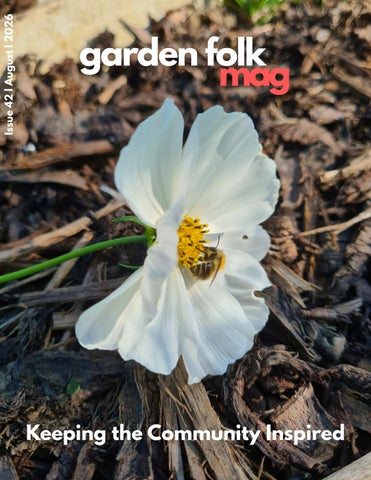
Issue 42 l August l 2026
garden folk mag
Keeping the Community Inspired
11
Contents 3 Editors Notes
Features 4 Time for change
Photo Credit: Kim O’Brien
Garden Projects 11 The Dumping Ground Garden 15 Collie Flower Grow Along 18 Kerrys Kitchen Garden
Photo Credit: Nic Wright
8 Living Off the Land: Keeping Summer Close
Photo Credit:Shone Price
Garden Journeys
Photo Credit: Annette Hurt
8
24
18
15
Photo Credit: Kerry Tomlinson
This Month 7
Write for Garden Folk
20 Creating a wildlife garden: August 24 Plot to Plate - Cool as a Cucumber 26 Become a Garden Folk Supporter 27 Gardening in August Managing Editor - Ally Phillimoore
Would you like to be part of a future issue? Just pop us an email info@gardenfolkmag.com
Senior Editor - Anjee Harrison
Visit our website @gardenfolkmag 2
A note from our editors
Well, we certainly can’t complain of a lack of sunshine and warm weather this year can we? The repeated heatwaves have brought joy to the sunworshippers and wrought havoc with the rest- be that human or plant! In this issue of Garden Folk Mag we have a range of responses and solutions to this change in the climate. There is also a real sense of celebration and satisfaction at the things have done well and the projects that have been achieved. I hope that your August allows you to take stock, breathe and enjoy the abundance on show. Anjee xx
Photo Credit: Marc Ridpath
It’s time for a change and I am afraid it’s not a small one. If the last few summers have taught me anything, it’s that extreme weather is the new normal. You either give up because nothing you used to be able to grow is reliable any more or you accept we are living in a new world order and start preparing for hot dry summers, and very wet and mild winters.
It’s not a complete catastrophe because other countries are able to grow crops in hot dry conditions, but it won’t be the same crops you are used to. For example, the lettuce has bolted so quickly this year even before the plants have matured, but if you sow a tray of mixed lettuce By Marc Ridpath @gardeneriddler and treat it as cut and come again you probably have more chance of having a steady supply of salad leaves. The other thing we all need to do is harvest more rain water. I already have two 1000 litre tanks, a 300 litre water butt and a 200 litre water butt down at the veg garden and three 150 litre water butts around my house. But even with all of them full it’s not enough to survive the six, nearly seven week of minimal rain fall and extreme heat. I probably need at least another four 1000 litre tanks and 4 more water butts as soon as possible so that next time it rains I can capture as much as possible. I am going replace a lot of my ornamental planting schemes to more drought tolerant ones, there’s a few plants that have survived this summer will stay. Plants like Roses are very tolerant especially the ones with less petals like my favourite Morning Mist, Inula grandiflora still looks lush and covered in flowers despite zero watering, Galega officinalis has pretty much taken over all my beds because everything else has died. Salvias are another one that seem to really tolerate the hot and dry especially the smaller leaved forms with the more woody stems. A simple way to save water in your garden.
Photo Credits : Marc Ridpath
Adding details such as windchimes can make the space feel even more relaxing.
Srip lines in Marc’s garden.
I will also include also more grasses in to my planting because even if they dry out, they look fantastic. Calamagrostis × acutiflora 'Karl Foerster' is one of my all time favourites as is Stipa gigentea both about 6-7ft tall one tall and straight the other a mound of leaves with arching flower spikes above. The other superstar right now is technically a Salvia now but I’ll always know it as Perovskia atriplicifolia 'Blue Spire’ or Russian sage for you common folk. It’s showing no sign whatsoever of drought stress. I will also be installing drip lines to as many areas of the garden as possible so that I can deliver to the water directly to the soil with little effort from myself, because I know I speak for half the population when I say I am sick to death of watering for hours on end. Drip lines are pvc pipes with valves every 15cm that deliver drops of water to the soil and if you leave them on for a few hours in the evening they use very little water but give the plants a really deep drink right to the roots. If you then add a layer of mulch over the top of the drip lines it will lock the moisture, helping all to reduce the amount of water you Thisinwater trough provides the wildlife with a viatl need to source. apply. water
Features
5
Photo Credits: Marc Ridpath
Surviving in the heat.
Using saucers is a great way to stop water wastage.
Another great way to help water wastage on your patio pot displays is to get saucers for all your pots. You can do this individually or group them and stand them in large trays so that when you do water, the run off is captured for the plants to drink from during the day. It all sound very expensive doesn’t it? Thankfully, it doesn’t have to be. IBC tanks can be found on Facebook marketplace for £40 or even free and if you have space, that’s a 1000 litres of water storage. When you consider a 200 litre water butt costs at least £40, that’s 5 times the storage for the same price. Drip lines are expensive to set up but once you have them you don’t have any further outlay, unless you stick a fork through it, which hands up I have done so many times- but it’s a quick fix. Trays and saucers are another one that doesn’t have to be costly because you could use chocolate tubs from Christmas as a saucer or maybe use a propagator lid. Get creative, as long as it holds water it will do the job. I hope I have given you some ideas and inspiration to make your gardens more resilient to our changing climate. See you all next month.
6
Features
A stunning rose. Squash is a varied and versatile vegetable
Would you like to write for Garden Folk mag? We are always looking for new writers to join the team, no experience needed and everyone is welcome. If you have a story you would like to share or just want to try your hand at writing, get in touch and pop us an email
Get in touch
Photo Credit: Tori Thomas
Living Liv Liv ing Off ing Off the the Land: Land: Keeping Keeping Summer Summer Close Close
By the time late summer arrives, the garden begins to feel different again. The excitement of the first harvests settles into something quieter, and without really noticing, your walks around the garden change too. Instead of wondering what might grow next, you find yourself asking, what’s ready today? Baskets of joy .
The harvests keep coming at Tori’s.
Some of my favourite jobs in the garden happen at this time of year. Standing over a pan of tomatoes as they slowly cook down into a rich homemade tomato sauce gives a sense of fulfilment. I love hanging bunches of herbs upside down to dry naturally, tying them with string before leaving them to fill the garden room with their scent. Filling jars, writing labels and lining them neatly on a shelf are all simple jobs, but they have become some of my favourites because they slow me down. It feels like a way of holding onto summer.
Photo Credits: Tori Thomas
When I first started growing my own food, harvesting felt like the finish line. I’d spent months sowing, planting, watering and waiting, so once everything was finally ready, it felt as though the job was done. Now I know that harvesting is simply another part of the journey. Summer is incredibly generous, often giving us more than we could possibly eat all at once, and learning how to make the most of that abundance has become just as important as growing it in the first place.
Photo Credits: Tori Thomas
I find satisfaction in stepping outside empty handed and returning a little while later with dinner filling the baskets. Sometimes it’s only a handful of tomatoes, a few beans and fresh herbs. Other days it’s overflowing bowls of produce covering every kitchen worktop. Whatever the harvest looks like, that feeling never gets old. But I’ve realised that living off the land isn’t really about the harvest itself. It’s about what comes afterwards.
By Tori Thomas @torisallotment
Every jar tells a story. It holds warm evenings spent picking tomatoes straight from the greenhouse, muddy boots left by the back door, hands stained from harvesting blackcurrants, and that quiet satisfaction that comes from growing something from a tiny seed. Months later, when winter has arrived and the garden has slowed, opening a jar of homemade tomato sauce brings a little piece of summer back into the kitchen. That, to me, is one of the greatest rewards of growing your own food. Preserving has never been about preparing for the worst. It is about respecting what the season has given you. If you have spent months nurturing a crop, why would you allow any of it to go to waste? Every tomato, every herb, every handful of berries has taken time, patience and care to produce, and making the most of them feels like the natural end to the season. This year, though, has reminded me just how much hard work can sit behind every harvest. The drought has made this one of the toughest growing seasons I can remember. There have been evenings spent carrying bucket after bucket across the garden because the water butts had long since emptied and every drop suddenly felt precious
Take a moment for yourself.
Garden Journeys
9
The garden never really stands still, either. Even while I’m harvesting tomatoes and beans, I’m already thinking about what comes next. Empty beds don’t stay empty for long. As soon as the potatoes and broad beans are lifted, I’ll re-prep the soil and sow more beetroot, spring onions, spinach and salad leaves. The kale and winter brassicas are ready to be planted, ready to carry us through the colder months ahead. It’s a continual reminder that growing your own food is never really about one season. You’re always growing for the next one too. I think that’s one of the biggest lessons the garden has taught me. To enjoy what is in front of you while quietly preparing for what comes next.
Water saving is a focus this year for many gardeners.
Photo Credits: Tori Thomas
Photo Credits: Tori Thomas
Photo Credits: Tori Thomas
I often talk about food security because I genuinely believe it matters, now more than ever. We are living in uncertain times. Food prices continue to rise, the weather is becoming increasingly unpredictable, and more people are beginning to question how secure our food systems really are. I don’t believe the answer is fear, and I don’t believe it is panic buying or filling cupboards with things we’ll never use. I believe the answer starts much closer to home. For me, living off the land has always been about working towards becoming as self-sufficient as possible. It isn’t something that happens overnight, and it probably isn’t something I’ll ever stop learning, but every season brings me one step closer. Every new skill, every successful crop, every shelf filled with food we’ve grown ourselves is another piece of that bigger picture. It isn’t about perfection. It is about building a life where my family relies more on what we can produce ourselves and less on systems that feel increasingly fragile.
Photo Credits: Tori Thomas
I found myself prioritising crops, making difficult decisions about what needed water most and what would simply have to cope for another day. It hasn’t been easy, and there were moments where it felt relentless. But somehow, those challenges make the harvest even sweeter. When you’ve carried every bucket by hand, every tomato feels earned. Every potato lifted from dry soil means a little more. You appreciate every bean, every courgette and every onion because you know exactly what it took to get them there. Growing your own food has never been about taking the easy route. It is about investing your time now for something far more valuable later.
Perhaps that’s what living off the land really means. It isn’t just about growing vegetables or filling a pantry. It is about learning skills that stay with you for life. It is about wasting less, appreciating more and finding confidence in knowing that, whatever the season brings, you have the knowledge to sow another seed, grow another meal and begin again. Because the greatest harvest isn’t always what fills your basket. Sometimes it’s the confidence that grows alongside it. The greenhouse is bursting!
10
Garden Journeys
Photo Credits: Kim O’Brien
The Dumping Ground Garden a journey of transformation
Fresh back from a whirlwind week of floristry, stage talks and assessing the cut flower, vegetable and mushroom exhibits at BBC Gardeners World Live, the garden renovation project of the grotty little corner called ‘The Terrace’ has resumed at full speed.
Just look at the transformation from last month.
Photo Credits: Kim O’Brien
It's not been easy working in the heat. Nationally, we are currently in the grip of what could turn out to be the hottest summer on record since 1976, but because I know what the vision for the end point of the transformation involves (spoiler - it’s a cold plunge pool), I am really eager to get everything in place so we can enjoy the bliss of the pool at the earliest possible moment. Impatience at its finest, but it’s a strong motivation to crack on with the work.
How it looked before.
By Kim O’Brien @garden.with.kim
As things stood at the end of my previous article in Garden Folk Magazine, the fence had been painted, the metal banana leaf screens installed, the trees had been repotted into larger pots (something I could see after a week away had invigorated them enormously) and top dressed with beautiful Welsh shell (kindly gifted @shellonearth). New metal raised beds had been built, positioned and an exuberant mix of dahlias and cottage garden flowers added for future colour. That’s when frustratingly, I needed to hit pause (albeit for the most exciting reason - see above) but since returning home from @bbcgwlive, the garden terrace has already transformed beyond all recognition. It began with the addition of a stunning hexagon and bee sculpture which was kindly gifted to me by @guesthomeandgarden. I knew immediately it would be best placed in the corner near one of the potted Silver Birch (Betula pendula). It was angled to soften the harsh line where two of the banana leaf panels met, and I decided to plant it with one of my all-time favourite fragranced plants, summer jasmine (Jasminum officinale), which I’m really chuffed to have propagated from the huge parent plant near my pond. I’ve entwined it through the hexagons and up into the banana leaf panels and I can already see that after a couple of seasons of growth it’s going to look fantastic. It’s great to have things to look forward to in the garden as they grow and establish. Speaking of growth, the dahlias more than doubled in size in the few days I was away, so I’ve added in the metal plant supports (previously gifted for show gardens @bbcgwlive @bbcgwfair by @plantsupportsuK) because I’m expecting these to get really lofty by the end of the flowering season.
Can we all get a bee sculpture like this!
12
Photo Credits: Kim O’Brien
The uplighting has truly trasformed the space.
The moss balls were so perfect
Now that the terrace (this has long been our affectionate name for this 4m x 5m raised and paved area of the garden) was finally looking great during the day, we knew that with all the summer entertaining that we do, we would need to make it look equally beautiful at night. Our plan was to install uplighting to illuminate the area. We knew this was going to look impactful, but we could not have anticipated how stunning and dramatic the finished result would be. It is truly breathtaking! The terrace at night takes on an ambience and aura that makes it impossible to stay away from in this nook of the garden, and it’s definitely been the talking point of our parties. This is what we love. We have a real garden, with the authentic mix of peas, cosmos, lettuce, courgettes, larkspur, radishes, and dahlias to name only a few of the plants. It’s a garden of produce, not a show garden, but it definitely hits with the power of a space that could hold its own out in the showcase arena, and having the balance of both is something we’re happy to have accomplished. I mean, my (150+) tomato plants wouldn’t look out of place in the new metal raised beds, and this will probably be the plan for next year, but here I go, jumping ahead… excited as ever for how things will evolve
Natural bird boxes.
The flowers have already started blooming Plantago major used as a feature plant.in the new space. Garden Projects
13
Photo Credits: Kim O’Brien
This space has been truly transformed from an unused area to a magical haven.
Back to the current season; we knew we needed to upgrade the existing paving because ‘hard-standing for a motorhome’ (which is what this area was originally used for) wasn’t the aesthetic we were going for. The herringbone brickwork is sound, so we decided to keep it rather than remove it, and simply covered it with a layer of the most beautiful cream Cotswold stone. We used fine chippings so that it would be easy to walk on (especially with a glass in hand if you follow my meaning) but I seriously under-estimated the amount of stone we would need - around 10 bags too few - so there was a small hiatus of a few days as I was too busy juggling work projects and clients to go and buy more. Finally purchased, the stone is now down and completed, and we could not be happier with the result. I wanted to add a walkway to the area to create somewhere to wander slowly and take in the details of the mixed permaculture beds, and even to put a bistro table and chairs for continental breakfasts in the mornings. The comical side of this is that I have succeeded not only in achieving all of the above, but my friends pointed out that I have also inadvertently created a ‘catwalk runway’ in the garden. You can imagine the hilarity which ensues around this when it’s party time, but isn’t that what a garden is for? It’s an absolute haven of fun and enjoyment as well as of beauty and productivity, and this transformation is definitely ticking all of the boxes. And finally, we have the ‘piece de resistance’ to add for the make-over to be complete. The cold-water plunge pool is poised to be put into place, and this will be added in the next couple of days. It’s going to be on the terrace overlooking the raised beds where the dahlias and other flowers are already beginning to bloom. This pool will be used daily - even in the winter, (I know this because we had one before) but for the Summer it’s going to be best enjoyed on a roasting hot day with a glass of something special in hand. I hope you’ve enjoyed watching the transformation and perhaps drawn some inspiration from it for your own outdoor space. Once tucked away and forgotten at the top end of our garden, out of sight and out of mind, we’ve proven that with a little bit of work, our messy terrace has become a beautiful space we can’t wait to relax in every evening after work and entertain in at weekends. Now the work is done there’s the whole summer ahead to enjoy it before the next project beckons in the dumping ground garden - although at this rate I might have to rename the garden altogether. Far from the mess it was, it's rapidly become THE meeting point and the place to be, and every day it just gets better. I shall think of ideas as I sip my strawberry daiquiri and take in the planting ...
A perfect place to escape.
14
Garden Projects
Have a happy and relaxing Summer and Happy Gardening. Kim x
Photo Credit: Nic Wright
August always looks quiet on the surface, but it’s one of those months where brassicas suddenly reveal what they’ve been plotting. Some crops are ready now, some continue building their foundations, and some are simply trying to survive the weather we’ve had. This month is all about noticing what’s happening, harvesting at the right moment, and giving your plants the conditions they need to keep going.
In collaboration with
Watch out for caterpillars
By Nic Wright @collieflowers.co.uk
Cauliflowers: Harvest Before They Blow I got my first purple cauliflower about ten days ago, and more look like they’re on the way. If you if took my advice and sowed sensibly back in spring and only did a few at a time, you’ll be grateful now. If you sowed seventeen… well, good luck explaining cauliflower week to your household. Cauliflowers don’t wait. Once the curd forms, you’re on a countdown. Warm spells can make them “blow” quickly, turning that tight, beautiful head into something loose and leafy. Still edible, but not what you were aiming for. So the rule for August is simple: Harvest as soon as they’re ready. Don’t wait for a free day. Don’t wait for the weekend. If it looks good, cut it. They keep well in the fridge for a few days, and you’ll be glad you didn’t leave them to unravel.
Photo Credits: Nic Wright
Kohl Rabi: Harvest Window + Two Easy Uses My own kohl rabi gave up during the May/June heatwave, but if yours survived, you might be harvesting now. They’re best when small and crisp. Two easy ways to use them: Raw, grated or sliced thin with lemon, olive oil and salt Roasted in wedges with garlic and herbs
Kale: The Reliable One Kale doesn’t care that it’s August. It doesn’t care that everything else is sulking. It just keeps producing. Pick the outer leaves and it will keep going right through autumn and winter.
Savoy + Sprouts: The Long Haul Crew Savoy cabbages and sprouts are in their slow, steady phase. They’re thickening stems, building structure and quietly preparing for autumn. It looks like nothing is happening, but this is the groundwork for everything that comes later.
16
Why Your Brassicas Might Not Be Thriving Right Now
But the brassica family is huge, and not all of them behave the same way. Kale, especially the Nero di Toscana we're growing, thrives perfectly well in Mediterranean climates. And many brassicas have origins in southern Europe, including Italy, where summers are hotter and drier than ours. They’re not strangers to heat. They’re just not built for the kind of extreme, prolonged spikes we’ve had this year. So if your cabbages, cauliflowers or sprouts look tired, they’re coping with conditions they didn’t evolve for. A few things help: consistent watering (I know it's a challenge), mulching to keep roots cool, a bit of shade in the worst heat, and patience.
Photo Credits: Nic Wright
Brassicas are often described as cool‑weather plants, and many of them really are. They like steady moisture, mild temperatures and predictable seasons. What they’ve had instead is heatwaves, drought, intense sun and wild swings between hot and cold (remember March when we started sowing - a distant memory, but it wasn’t a warm one). It’s no surprise some of them look stressed, small or slow. That isn’t failure. It’s physiology.
How are your brassicas fairing?
August isn’t a big “doing” month for brassicas, but it is a big noticing month. Cauliflowers need quick hands, kohl rabi has a short harvest window, kale keeps giving, and the long‑haul crops are quietly preparing for their moment. And if your brassicas look a bit tired, they’re not alone. So are most growers. Don't forget: Keep your brassica beds weed‑free. In dry spells, you don’t want anything competing for moisture or nutrients. Every drop counts. Also keep up with butterfly, caterpillar and egg checks. August is prime time for cabbage whites, and they can strip a plant faster than you’d think.
Credit: Nic Wright
Make to fit netting Don’tsure forget to the keep them securely. covered.
Garden Projects
17
Photo Credit: Kerry Tomlinson
Kerry’s kitchen garden
Such a dreamy space to relax.
Although the plants are under more stress than usual for this time of year, they’ve continued to reward us with wonderful harvests. We’ve enjoyed picking peas, broad beans, garlic, cucumbers, chilli’s, tomatoes, salads, herbs and one of my favourite seasonal treats, blueberries. The blueberry harvest has been exceptional this year, giving us the perfect way to spend warm evenings outside making pancakes on the outdoor Ninja. Freshly picked berries never seem last long in our house. They’re just so sweet and moreish that by the time the pancakes are ready, half the blueberries have mysteriously disappeared! James been insistent on doing his bit. One-handed podding of broad beans has become the new norm. And he’ll happily stir pancake batter using our freshly picked blueberries, determined not to miss out just because his arm is in a cast. I admire his resilience, but more than that, I love that the garden is still somewhere he chooses to be. Currently in the kitchen garden, the pumpkins are climbing across our new arches, the volunteer sunflowers are in full bloom as they tower over me, and the butterflies have ravaged my brassicas before I’d even got them in the ground. I can’t help but have a giggle about that though; those greedy caterpillars clearly have a better work ethic than I do because they beat me to them! The brassicas may look a little sorry for themselves, but after a little haircut (although there’s not really much left to trim!), I’m sure they’ll soon bounce back.
Photo Credits: Kerry Tomlinson
If keeping plants alive wasn’t enough of a challenge, my youngest son James managed to badly break his arm. Thankfully, he is on the mend, and it hasn’t stopped him wanting to be involved in every harvest the garden has to offer.
What a whopper of a harvest! Just a puppy living his best life.
The helpers are still here even with an injury.
Photo Credit: Kerry Tomlinson
Anyone else and their plants feeling a bit parched after the driest July on record here in England? We certainly are! We haven’t seen more than five minutes of rain all month here in Stevenage, and with it also being the sunniest July on record, keeping the garden alive has become a daily challenge.
By Kerry Tomlinson @lottie_thyme_
With no rain on the forecast, and unbelievably not even on my birthday, the dreaded hosepipe ban came into force overnight. Watering suddenly became much more labour intense. Every evening the five of us head into the garden armed with watering cans, each taking a different route around the garden before meeting back at the water tap for another refill. Somehow, it’s become less of a chore and more of a family rally race, complete with a healthy dose of competition over who can empty their watering can the quickest. This month has reminded me that gardens are remarkably resilient. Given a little care, they’ll keep growing through the toughest conditions. Watching James tackle his broken arm with the same determination has made me realise people aren’t so different. Join me next time as we keep our fingers crossed for rain and see what late summer has in store for our kitchen garden. We will take a plate of these!
Garden Projects
19
By Mel Heris
Photo Credits: Mel Heris
@bluebellandbumblebee
Creating a Creating a wildlife wildlife garden: garden: A monthly A monthly step-by-step step-by-step guide guide
August: The Heart of Summer In August, summer is at its peak, with flowers, fruit, and vegetables flourishing, and wildlife busy taking advantage of the long, sunny days. For them, August is a month of preparation and sustenance. Nectar, seeds, and water are all in high demand as creatures fuel themselves for the later months, while some begin quietly preparing for autumn. Nature's tiny pollinator
Photo Credit: Mel Heris
This Month’s Wildlife Project: Creating an Amphibian Spot What you’ll need Logs, branches, or small pieces of wood Rocks or flat stones Leaf litter, moss, or straw Dense planting or low shrubs for shade and cover
Optional:
A(cracked) terracotta pot
Choose the right location:
Photo Credit: Mel Heris
Creating the amphibian spot
Photo Credits: Stock Canva Images
A small pile of soil or sand for burrowing
Pick a quiet, shaded or partially shaded area, ideally near your pond or water source.
Build shelter structures:
Stack logs, branches, or rocks to create small piles or crevices where amphibians can hide.
Photo Credit: Mel Heris
Avoid high-traffic areas where amphibians could be disturbed.
Photo Credit: Stock Canva Image
Photo Credit: Mel Heris
Grab a dish and start making your own.
Amphibians like frogs, toads, and newts spend much of their time out of the water, seeking shelter, hunting for insects, and resting during the day. By creating a dedicated amphibian friendly area in your garden, you can give them safe spaces on land to hide, rest, and feed, complementing any pond or water feature you already have.
Make sure there are gaps for easy access and ventilation. Flat stones can provide warm surfaces for resting while still offering cover underneath. Keep watch for seeds popping. Garden Projects
21
Photo Credit: Mel Heris
Add natural cover: Scatter leaf litter, moss, or straw around the piles to create damp, cool microhabitats. Low-growing plants or dense shrubs provide shade and protection from predators. Optional - Create a burrowing area using sand/soil: A small pile of soil or sand allows amphibians to dig and hide during hot, dry periods. Keep the soil slightly moist but not waterlogged. Optional - Create shelter using a cracked terracotta pot: Turn a cracked terracotta pot upside down. Place it in a cool, shaded spot and cover it with leaf litter or moss to help keep it damp. This simple shelter provides a safe place for frogs, toads, and newts to hide
Maintenance and observation Leave the area largely undisturbed; amphibians prefer quiet, safe spaces. Check occasionally to ensure structures remain stable. Observe from a distance at dusk or night to see amphibians emerge for feeding.
Photo Credit: Mel Heris
By providing these land-based shelters, you complement your pond/water feature and give amphibians safe, shaded, and cool spaces to thrive.
.
Up close and personal with your widlife friends. 22
Photo Credit: Mel Heris
Other monthly wildlife jobs: Maintain water sources Keep ponds, bird baths, puddling spots, and insect drinking areas topped up with fresh water, especially during hot, dry spells.
Provide things such as log piles and lots of plants so your wildlife friends stay cool and have a safe spot to hide from the heat.
Photo Credit: Mel Heris
Provide shade and shelter
Support pollinators Continue providing nectar-rich flowers and herbs for bees, butterflies, and other pollinators. Deadhead regularly to encourage longer flowering periods.
Observe wildlife activity Note which species are visiting and which areas of the garden they prefer. This helps guide future projects and ensures all visitors are supported.
Leave some areas wild
Photo Credit: Mel Heris
Allow corners of the garden to remain undisturbed, with leaf litter, twigs, and dense vegetation for insects, amphibians, and small mammals to shelter in.
August is a month of energy, warmth, and activity and every step you’ve taken, no matter how big or small, helps wildlife thrive during the height of summer and the rest of the year.
Up close and personal with your widlife friends.
Happy wildlife gardening, and see you all next month! 12
By Shona Price @starof_72
Cool as a Cucumber
Photo Credits: Shona Price
One thing that is absolutely loving this heatwave we are having are my cucumber plants. I'm growing just 2 varieties this year, Wisconsin and Mini Munch. Both are smaller cucumbers and both are prolific croppers. I am picking 10-15 cucumbers each day. I've been enjoying this really simple cucumber and sesame salad for my lunches. Delicious on its own, or you can add other ingredients to mix it up. I've had it with tuna or ginger, chilli & spring onion. Whatever you decide to add, here's a quick, easy and delicious salad.
Cucumber and Cucumber and Sesame Sesame Salad Salad
You will need: Cucumber (about 400g) ½ tsp salt to draw out excess water 2 tbsp soy sauce 1 tbsp rice vinegar 1 tbsp toasted sesame oil 1 tsp honey Sesame seeds Slice of finely chop your cucumber, sprinkle with salt and leave for 20-30 mins to draw out the water. Add all the other ingredients, except the sesame seeds, into a jar, pop the lid on and give it a good shake. Drain off the excess water from the cucumber. Pour the dressing over the top then sprinkle with sesame seeds.
Become a Garden Folk Supporter ...and help us keep making the Garden Folk Mag We appreciate all the support given to the magazine by all the Garden Folkour readers, writers, industry supporters and anyone else who cheers us on. Running the magazine each month does incur financial costs though, so if you are able to contribute, either with a one off payment or by becoming a member, it would really help to keep the magazine going... and growing.
There are currently three membership tiers to choose from, all with great benefits. .
Gardening in August Summer this year has brough most of us lots and lots of sunshine and not a lot of rain. The temperatures have made gardening more challenging for many. The main job for most of us has been keeping up the watering! There are however, plenty of other tasks to keep us busy in August.
Things to sow
Jobs to do
Flowers Scabiosa Cornflowers California Poppies Pansies and Violets Forget-me-nots Calendula
Enjoy this final month of the summer.
Edibles Rocket Spinach Dwarf beans Turnips Overwintering Cabbage Winter lettuce Spring Greens Coriander Parsley
Come and join the @gardenfolkmag team for live garden updates throughout the month over on Instagram.
Continue to water regularly if rain is not apparent. Try using ‘grey’ water from your bath or shower.
Use something from your garden or allotment to make a meal or drink extra special. Then sit and enjoy it in the garden.
Mulch to conserve as much water as possible.
Deadhead to keep blooms coming for longer.
Harvest your produce and preserve or share anything you can’t eat now.
Sow autumn and winter salads.
Prune Rambling Roses and tie into supports.
What to listen to while you sow: Hosts Thordis and Alan Gray (of East Ruston Old Vicarage gardens) catch up with their horticultural (or should that be naughty-cultural!) friends to talk about their favourite plants of the moment. It's a bit like a stroll around a fantastic nursery or inspiring garden, but with someone telling you what all the plants are!
32
This Month
Take softwood cuttings from woody plantslavender, rosemary, hydrangea, currants etc
Water at dusk or dawn to avoid excessive evaporation.
Prune lavender once flowering is over to keep it from getting woody.
Invite a friend round to enjoy your garden- or visit theirs.
Plant potatoes in tubs for Christmas dinner!
If you’re in need of Garden related ‘stuff’ remember that Garden Folk Supporters get some amazing discounts with some great companies!
Issue 42 l Ausgust l 2026
Set the date for September 11th for the next issue
Keeping the Community Inspired