



consultanttoaccessthefullpolicy.
1. Our business
Originally founded in 1998, we are now one of the top five largest industrial providers in the UK, supplying temporary, contract and permanent workers to companies across industrial, commercial, technical, construction, fmcg and driving sectors. We offer nationwide coverage through high-street branches, specialist divisions and onsite managed solutions. With a turnover of almost £200 million in 2019, we currently payroll in excess of 12,000 temporary workers each week and cover more than 3 million shifts per year.
Through collaboration and innovation, we increase our Hirer’s productivity andexceed their efficiency targets, all while maintaining full compliance andcommitment to service excellence.
Thishandbook has beencreated with the intention of providing information toourapplicants and workers about:
• importantindustry legislation;
• key expectations we have ofyourconduct whilst representing the employment business;
• key policiesand proceduresyou need to be aware of;
• social and ethical compliance practices;
• basic health andsafety information
Thishandbook isto be usedin conjunction with ContractForServicesagreements. Alternative handbooksare providedwhere other Employment Status agreements are entered into. Sector specific factsheets are provided in addition to this agreement for gap Technical Limited and DrivingForce Recruitment.
This handbook is applicable toall businesses, offices and operations within the gap personnel group, including:
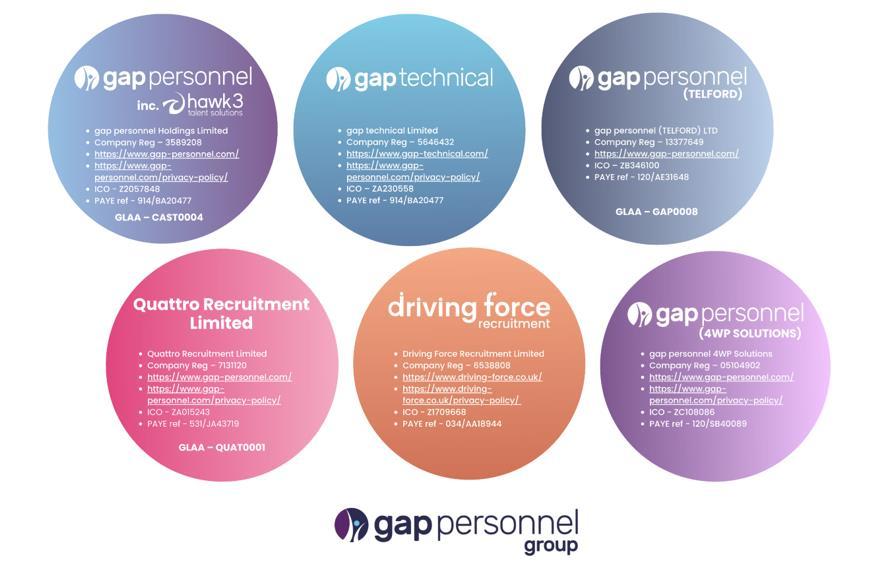
Please take the time toread this handbook. If anything is unclear or needfurther advice on please feel free to ask
2.Entitlement to work in the UK
You mustbelegallyentitledtoworkin the UK andwe arelegally requiredtocheck andvalidate your identification andRightto Work in the UK prior to placing you onto an assignment. Should your documentation and therefore Right to Work in the UK expire during your application process, or once engaged by us, you will be requested to provide new documentation. If you are aware of any pending changes to your visa or other permissions to work in the UK, you must inform the employment business immediately so a follow up right to work check can be conducted.
We reserve the right to conduct a follow up check on your right to work documents at any time during your assignmentwith us. We may ask you to visit your local branch with your documentation again and/or take an updated photograph of you to hold on your payroll record. If we discover you do not have permission to live and work in the UK, and/or your permission to do so is revoked or expired and you cannot provide new documentation, we are entitled to terminate your assignment and any associated contract immediately without giving you any notice orpaying you in lieu of notice andwill be obliged to inform UKVI.
If you are residingin the UKon documentation containing restrictionson the type ofwork orhours of work you are legally entitled to undertake,youmustensure your visarestrictionsarenotbreached. Ifitisdeterminedthatyouhave breachedyourvisarestrictions we are legally and morally obligated to terminate your assignment and any associated contract immediately and inform UKVI of the visa breach, which may ultimately resultinthe removal of your visa and permissions tolive and work in the UK
Any assignmentsprovidedtoyou by theemploymentbusiness are tobecompletedby you andyou arenotpermittedtosubstitute, subcontractorauthoriseanotherperson to attendonyourbehalf. Youshouldneveruse someoneelse’srighttowork documentsto attempt to obtain work, nor should you permit someone else to ‘borrow’ your right to work documents to gain employment, this would constitute fraud. If we discover you have, we will terminate your assignment and any associated contract immediately and inform UKVI.
3.Our professional reputation
Please conduct yourself professionally at all times. Be polite and aim never to cause offence or misunderstanding. Remember that when on assignment you are our ambassador and we request you do your best to promote the interests of us and uphold our policiesat all times.Below is anon-exhaustive list ofexpectationssurroundingconduct whilst onassignment with us:
a) Co-operate with the Hirer, its employees and other workers. Accept the supervision, direction and control, and instruction of any responsible person in the Hirer’s organisation.
b) Observe any rules and regulations of the Hirer’s workplace to which your attention has been drawn or to which you might reasonably be expected to anticipate or have been delivered.
c) Treat with courtesy and respect the Hirer, all fellow workers,our staff andany site visitors.
d) Conform to the standard operational working hours and rest breaks for the Hirer’s workplace (unless alternative arrangementshave been made in advance bythe employment business and the Hirer).
e) Take all reasonable steps while working for the Hirer to safeguard your own, and the safety of others who may be present or be affected by your actions during the assignment andcomply with the health and safety policy of the Hirer.
f) Do notengage in any conduct detrimental to the interests ofthe Hirer, the employment business,yourself and or others.
g) Do not use any motor vehicle or any mechanised equipment in connection with any assignment unless you hold the relevant certification, have undertaken the necessary training and have confirmed the proper insurance cover is in force for such use.
4.Conduct
Personalappearance
Our workers are renowned for maintaining a high level of personal appearance and dress at all times. Presenting a professional imageisveryimportant. You shouldfollow all instructions fromthe Hirerregardinguniforms,safetyequipmentandPPE,acceptable dress and conduct, specifically with reference to health, safety and hygiene. If dressed inappropriately you may be sent home and required to return suitably attired, no payment will be made for time spent away from work. Shouldyou consider that observing the dress code may contravene principles regardingdiscrimination,you shouldcontact the employment business to discuss
Workwear/Uniform/Equipment
Some Hirers may operate a work wear / uniform policy on their site. You will be advised in advance of an assignment the specific detail of a Hirer’s work wear / uniform policy. You may be issued with items such as locker keys, swipe cards or other equipment to undertake the assignment.
Personalprotectiveequipment(PPE)
The Personal Protective Equipment at Work Regulations 1992 (the PPE Regulations) state that workers must have suitable PPE whenever they may be exposed to a risk tohealth and safety whilst at work. PPE includes the following:
a) aprons, gloves and safety footwear
b) high visibility jackets
c) eye protectors, safety harnesses, respirators & life jackets.
TheprovisionofPPE/workwearprovidedbyyou
d) safety helmets
e) clothing designed to protect against adverse weather conditions
Should you wish to provide / purchase or source your own PPE or work wear, you are entitled to do so, providing the items meet regulatoryortheHirer’sstandards.Indoingsoyoupermittheemploymentbusinessand/orthehirertoinspectitemsthat youhave providedyourselftoensure theycomply.You may requesttheloanof PPEor workwear,subjectto theconditionsbelow,atany time.
ProvisionofPPE/workwear/equipmentprovidedbytheemploymentbusinessortheHirer
a) You will be advised for each assignment of any health and safety risks and the PPE required reducing risks associated. It is a condition ofyour contract and responsibilitiesunder the Healthand Safety at work act that, where itisrequirementof an assignment for PPE items to be worn, that you will do so at all times. By accepting an assignment, you agree to adhere to the work wear / uniform code and accept that failure to do so will result in the termination of your assignment and your removal from site.
b) Where required, PPE, work wear items and/or equipment will be provided free of charge, for use during an assignment. FormalwrittenagreementwillbeenteredintoasavariationtoTermsofEngagement,whichwillincludeascheduleofitems and the associatedliability issue of any PPE/work wearor equipment provided by the employment business.
c) By accepting PPE or work wear provided by the employment business or the Hirer you agree that such items remain the property of employment business or the Hirer until 60 shifts have been completed (average of 12 weeks work), save where the variation of Termsof Engagement specifiesan alternate timeframe.
d) By accepting equipment provided by the employment business or the Hirer, you agree that such items remain the permanent property of the employment business or the Hirer.
e) It is the employment business policy to reissue previously used and returned PPE or work wear, provided it is in a fit state and cleaned for use by another user.
f) If the employment business or the Hirer provides any PPE, work wear or equipment to you to be used in the course of an Assignment with the Hirer, you must take reasonable care of those items. Should items require re-issue due to loss or damage beyond fair wear and tear, the employment business reserves the right to deduct the cost of replacement from any sumsowed to you, as provided for in the variation to your Terms of Engagement.
g) Where required to, should your assignment end, or the employment business or the Hirer so request, you agree to return theitemsinareasonablecondition,subjecttofairwearandtearandcleaned,within48hoursoftheendofyourassignment or such request.In the event that you do notcomply with these obligations, the employment business reserves the right to deduct the costof replacement from any sums owed to you as provided for in the variation to your Terms of Engagement.
h) The question of the reasonable care of the equipment or clothing will be solely assessed by the employment business ’s reasonable judgement.
Security
Comply with Hirer security measures at all times, including any instructions relating to the wearing of security badges or ID cards. Keep confidential information, valuables, equipment and materials adequately secured at all times. You must never be in unauthorisedpossessionofanyproperty,includingcash,belongingtotheHirer,yourcolleaguesortheemploymentbusiness.Report suspiciousincidentsorloss ofitemsimmediately to the Hireror the employment business.
Stopandsearch
Both the employment business and the Hirer reserve the right to stop and search fully any workers (or their vehicles), prior to entry or before exit from the working location or during your shift, using whatever reasonable means are at their disposal. A search may be made ofyour office, desk, filing cabinet, car, bag orperson.
Smoking
It isillegal to smoke inall enclosed or substantially enclosedpublic places and workplaces. You must adhere tothe Hirer’s smoking policy onsite and only smoke in the permitted areasor off site if smoking areas are not provided.
Alcohol,drugs,substancesofabuseandlegalhighs
Drunkenness or disorderly conduct (including being in possession of or under the influence of alcohol, drugs, unauthorised substances , misusing substances or legal highs) whilst at work as a serious matter, such behaviour will not be tolerated and if identifiedwereservetherighttoinformthepolice.YoumaybeaskedbyusorourHirerstotakepartinarandomalcoholorsubstance test. You should inform us of any prescribed drug(s) you are taking or course of treatment you are following which may impact on the result of a random alcohol or substance test or which may have an impact upon your ability to properly perform your job (e.g. by makingyou drowsy, affect concentration or have limitations on operating machinery).
Publicityandcompetitorrelations
Please be mindful whenin contact with employeesofcompetitors orsuppliersofthe needto avoid(intentionally orunintentionally) revealing information which could be used by a competitor. Should you be contacted by any section of the media in relation to us or any assignment through us, you will inform the employment business immediately before making any response. In no circumstances should we or any Hirer’s name be identified in any statement, interview or other communication. If you have any doubts as to what is expected,please ask the employment business’ representative.
By accepting an assignment you agree that you will comply with requests outlined. Failure to comply will result in you being immediately sent home andyour assignment may be terminated.
5.Complaints
TheCompanyiscommittedtoprovidingahigh-levelof service toourcustomers.Ifyou arenotsatisfiedwith thelevel of serviceyou have received, we encourage you to inform us. This will help us to improve our standards. In the first instance, please contact your local branchandescalate your concernsto the branch manager by phone so that we can try to resolve yourcomplaintinformally.
Ifyoufeelthattheresponseisunsatisfactoryandrequiresfurtherinvestigation,pleasereferyourcomplainttoanOperationsDirector If at this stage you are still not satisfied with the response, you can then submit your complaint directly to the HR Department. In all instances, to obtain correct contact details, whether that be for post, email or telephone please refer to the contact details section of ourwebsite https://www.gap-personnel.com/job-seekers-get-in-touch/
FormalInvestigations
The HR department will investigate complaints in a timely and confidential manner. Individuals not involved in the complaint or the investigation should not be told about it. The investigation will be conducted by someone with appropriate experience and no prior involvement in the complaint. The investigation should be thorough, impartial, objective and carried out with sensitivity and due respect for the rights of all partiesconcerned.
The HR department will acknowledge receipt of your complaint and keep you informed of all updates and any delays throughout the process.Aninvestigationmeetingwillbeheldwith you usuallywithinone week ofreceivingyour complaint,so thatyou can give your accountof events. The investigator will arrange furthermeetingswith you as appropriate throughout the investigation.
Where yourcomplaintis about an employee orworker ofThe Company, the investigator will also meet with the alleged person who have the right to be told the details of the allegations against them, so they can respond. Where your complaint is about someone other than an employee or worker, such as customer, supplier or visitor we will consider what action may be appropriate to protect youandwewill attempttodiscussthematterwith thethirdparty. Itmaybenecessarytointerviewwitnessestoanyoftheincidents mentionedin your complaint.If so the importance ofconfidentiality will be emphasised tothem.
At the end of the investigation, the HR department will write a report of the findings of the investigation and the outcome to your complaint.
ActionfollowingInvestigation
Ifthe HR Departmentconsidersthatthe pointsraisedinyourcomplainthave been upheld,promptaction will be taken toaddress it. If, following the investigation, you are still not satisfied you can write to the REC, our trade association of which we are a member marked for the attention ofthe Compliance Team: REC, Dorset House, 1stFloor,27 – 45 Stamford Street, London, SE1 9NT).
NOTE:Inanyevent,wewillcomplywithanystatutoryproceduresthatmayrelatetoyourcomplaint.
6.Grievance procedure
This policy is specifically applicable to permanent and temporary employees of The Company. We define grievance as any complaint,problemorconcernyoumayhaveregardingyouremploymentwiththeCompany. Weencourageemployeestoresolve any workplace problems informally in the first instance. When this is not possible you have the right to submit your grievance following the Company procedure.
You should first raise the matter in writing with the HR Department. This should be done in confidence, giving full details, to allow them tofully consideryour grievance.
FormalInvestigations
We will investigate grievances in a timely and confidential manner. Individuals not involved in the grievance or the investigation should not be told about it. The investigation will be conducted by someone with appropriate experience and no prior involvement in the grievance. The investigation should be thorough, impartial and objective, and carried out with sensitivity and due respect for the rights ofall partiesconcerned.
Wewillarrangeameetingwithyou,usuallywithinoneweekofreceivingyourgrievance,sothatyoucangiveyouraccountofevents. You have the right to be accompanied by a colleague or a trade union representative of your choice, who must respect the confidentialityoftheinvestigation.Youwillbegivenaprovisionaltimetablefortheinvestigation.Theinvestigatorwillarrangefurther meetingswith you as appropriate throughout the investigation.
Where your grievance is about an employee,we mayconsider suspending them on full pay ormakingother temporary changesto working arrangements pending the outcome of the investigation, if circumstances require. The investigator will also meet with the allegedperson who may alsobe accompaniedby acolleague or trade union representativeof theirchoice to heartheiraccountof events. They have a right to be told the details of the allegations against them, so that they can respond.
Whereyourgrievanceisaboutsomeoneotherthananemployee,suchasacustomer,supplierorvisitor,wewillconsiderwhataction may be appropriate to protectyou and anyone involved pending the outcome of the investigation, bearing in mind the reasonable needs ofthe business andthe rights of that person. Where appropriate,we will attempt to discuss the matter with the third party.
We will also seriously consider any request that you make for changes to your own workingarrangements during the investigation. For example,you may ask for changes to your dutiesor working hours so as toavoid or minimise contactwith the alleged person Itmaybenecessarytointerviewwitnessestoanyoftheincidentsmentionedinyourgrievance.Ifso,theimportanceofconfidentiality will be emphasised to them.
At the end of the investigation, the investigator will submit a report to the HR Department to consider the complaint. The HR Departmentwill arrange ameetingwithyou,usuallywithin aweek ofreceivingthe report,in orderto discuss the outcome andwhat action, if any, should be taken. You have the right to bring acolleague or a trade union representative to the meeting. A copy of the report andthe HR Department’s findingswill be given to youand the alleged partiesinvolved
Actionfollowingtheinvestigation
If the HR Departmentconsiders that the pointsraisedin yourgrievance have been upheld,prompt action will be taken to address it. Where the person accusedisan employee the matter will be dealt with under ourDisciplinary Procedure.
If the person accused is a third party such as acustomer orother visitor, we will consider what action would be appropriate to deal with the problem. Whether or not your grievance is upheld, we will consider how best to manage any ongoing working relationship betweenyou and the person concerned.
Itmay be appropriate to arrange some formof mediation and/orcounselling,or to changethe duties,workinglocation orreporting linesofone or both parties.
Any staff member who deliberately provides false information or otherwise acts in bad faith as part of an investigation may be subject to action underourDisciplinary Procedure.
Appealprocedure
You have the right to appeal at any stage of the grievance procedure. If you are not satisfied with the outcome you may appeal in writing to a Director stating your full grounds of appeal, within one week of the date on which the decision was sent or given to you. The request must detail the ground(s) for appeal andindicate the outcome that you are seeking.
We will hold an appeal meeting, normally within one week of receiving your written appeal. This will be dealt with impartially by a moreseniormanagerwho hasnotpreviously beeninvolvedin thecase.Youmay bringacolleague ortradeunionrepresentative to the meeting.
Wewillconfirmourfinaldecisioninwriting,usuallywithinoneweekoftheappealhearing. TheoutcomeoftheAppealwill bebinding on all concerned and there isno further appeal.
Protectionandsupportforthoseinvolved
Employees who submit a grievance or who participate in good faith in any investigation must not suffer any form of retaliation or victimisation as a result. Anyone found to have retaliated against or victimised someone in this way will be subject to disciplinary action underour Disciplinary Procedure.
If you believe you have suffered any such treatment you should inform your line manageror the HR Department. If the matter is not remedied, you should raise it formally using this procedure ifappropriate.
Confidentialityandrecord-keeping
Confidentiality is an important part of the procedures provided under this policy. Details of the investigation and the names of the person making the grievance and the person accused must only be disclosed on a "need to know" basis. Breach of confidentiality may give rise to disciplinary action underour Disciplinary Procedure.
Information aboutagrievanceby oraboutanemployeemay beplacedon theemployee'spersonnelfile,alongwith arecordof the outcome and of any notes orother documents compiled during the process.
7. Disciplinary and Appeal Procedure
This policy is specifically applicable to permanent and temporary employees of The Company. The company aims to support employees in resolving disputes or conflicts at work. Resolution through informal channels seeks to identify positive solutions between the parties involved.
Mediation is a completely voluntary and confidential form of resolving workplace disputes between two or more people. The mediationprocesswillinvolveanindependent,impartialpersonhelpingtoreachasolutiontoaworkplacedisputethatisacceptable to all partiesinvolved.
Where the dispute cannot notbe resolvedinformally, thiswill then resultin the disciplinary procedure beingfollowed.
The Company expects reasonable standards of performance and conduct from its employees to safeguard the interests of the business,theemployees,theclientsandthegeneralpublic.Itisthe responsibilityof allemployeestofamiliarisethemselveswith the disciplinaryprocedureandthelikelydisciplinaryconsequencesofbreakingtherulesasoutlined.Itisnotpossibletoanticipateevery breach of performance or conduct,so the rulessetoutbelow are designedto provide apractical framework forunderstandingand complyingwith the required standards.
The disciplinary procedure complements the rules in its aim to ensure that all disciplinary matters are dealt with in a fair and consistent manner. The primary objective of the procedure is to discourage breaches of discipline through advice and correction Where corrective action fails to improve performance or conduct however, more serious disciplinary measures may have to be applied (and may ultimately result in dismissal).
Where warnings have to be given to an employee after disciplinary action, they will be applied cumulatively, irrespective of the nature of the “offence”. The disciplinary procedure incorporates the facility for appeal against disciplinary action taken and will be discussed further.
The Company will endeavour to follow this procedure but may depart from it when absolutely necessary. The Procedure has been designed to provide you with every opportunity to reply to any alleged offence or shortcoming and/or explain your actions or performance.
Offences under the Company’s disciplinary procedure fall into three broad categories, namely misconduct, incapability and gross misconduct.
Misconduct
Examples ofmisconductinclude (withoutlimitation):
a) Poor time keeping
b) Unreasonable or unexplainedabsences
Incapability
Examples ofincapability include (withoutlimitation):
a) Poor performance
b) Incompetence
c) Failure to observe the company’s rulesor procedures
d) Abusive ornegligent behaviour
c) Unsuitability
d) •Lack ofapplication
GrossMisconduct
The followingactsareexamplesof GrossMisconductoffencesandassuch may renderemployeesliable toSummaryDismissal (i.e. dismissal withoutnotice). Thislistisnotexhaustive:
• Fighting, bullying, physical assault or dangerous
• Threats of assault andintimidation
• Failuretocarryoutareasonableandlawfuldirectinstructiongivenbyasupervisor/manager/directorduringworkinghours
• Seriousinsubordinationor theuse of aggressive behaviourorexcessive badlanguage on the premisesofthe Company or theirclients
• Theft, deliberate falsification of records or any Company document, wilful damage or negligence that leads to damage to property belonging tothe Company,customers,suppliersor other employees
• Fraud, or any otheroffence committedagainst the Company that would be a breach ofthe law ofthe land
• Seriousincapability, or the potential for seriousincapability,whilst on duty broughton by alcohol orillegal drugs
• Seriousnegligence that causes, or mightcause, unacceptable loss, damage orinjury
• A serious breach,repeated breachesafterwarning oranymaterial persistent breach of the Company’s rules
• Loss of drivinglicence on conviction when drivingisall, or an essential part, of the job requirements
• Falsifying clock or electronic access systems, failure to report an unauthorised recording, or receiving money for hours not worked
• Breach of safety rules and/or action that seriously endangers the health or safety of yourself or another person whilst at work
• Unlawful breach of the Race RelationsAct, Sex Discrimination Act, Disability Discrimination Act or Age
• Discrimination Act, e.g. racial or sexual abuse, harassment orany act which fundamentally breaches the dignity of people at work
• Serious breach ofconfidence (subject to the Public Interest (Disclosure) Act 1998) orconflict of interest
• Bringing the Company into seriousdisrepute
• Thedistributionofanye-mailcontaininganysexuallyexplicitmaterialand/orwilfullyviewingordownloadingsuchmaterial onto the Company’scomputer systems
• Any otherserious abuse of the email,Internet orother electronic communication systems
DisciplinaryProcedure
Prior to any disciplinary action being considered, an investigation will be carried out. Where the case warrants disciplinary action being taken, it is the intention that such action be seen, where possible, as remedial rather than punitive the company’s general disciplinary procedure hasthree clearstages as follows:
Consideration by the company: During this time, your contract of employment will continue while the Company considers the complaint(s) / allegation(s). This may involve interviews with the employee against whom the allegation is made, as well as other individuals asnecessary.A neutral third party will be available to attend such interviews if requested tobe so.
• The company may consider it necessary to suspend you (with full pay) for a specified period, in which case your contract of employment will continue but you will not enter the Company’s premises, or contact fellow employees, candidates or clients without prior permission.
• Anyconcernsthatgetbroughttoourattentionwillbeinvestigatedinatimelyandconfidentialmannerfollowingourinternal investigation procedure whichcan be foundin our grievance policy.
Disciplinary Hearing: In some cases of very minor misconduct the Company might not hold a formal disciplinary hearing. In most cases of misconduct however, the Company will hold a disciplinary hearing at Head Office, chaired by a Manager, and you will be given detailsof the complaint(s) / allegation(s) made against you before the hearing.
• Atthehearingyoumaybeaccompanied,ifyouwish,byaworkcolleagueorTradeUnionrepresentative.Duringthehearing, youwillbegivenadequateopportunitytoreplytothecomplaint(s)/allegation(s)madeandtostateyourversionofevents.
• At the conclusion of the hearing, the Manager will decide what, if any, disciplinary action isappropriate. (They may wish to adjourn the meeting to give the matter further consideration). The decision will be confirmed to you in writing and a copy retainedon yourfile.
If the disciplinary action constitutes a warning, the written confirmation noted above will specify the following:
a) The nature of the misconductor shortcoming
b) The date(s)of any previous warnings,if relevant
c) The remedial action required and the timescale for improvement
d) The further disciplinary penalty for non-compliance with the warning
e) An explanation of the right ofappeal
If the disciplinary action constitutes dismissal, with or without notice, the writtenconfirmation noted above will specify the following:
a) The nature of the misconductor shortcoming
b) The date(s)of any previous warnings,if relevant
c) The effective date of termination ofyour employment
d) The amountof any monies due to you
e) An explanation of the right ofappeal
The disciplinary action taken, when the case warrants it, will be determined by the severity of the offence and/or length of service, exceptincasesofgrossmisconductwheresummarydismissalwillnormallyapply. Disciplinaryactionmaytakeoneofthefollowing forms:
1. A Verbal Warning recordedwithin your Personnel File.
2. A WrittenWarning where one copy will be given to you andone copy enclosedwithinyourPersonnel File.
3. Final Written Warning advising you that a further offence or continued shortcoming will render you liable to dismissal. One copy will be given to you andone copy enclosedwithinyourPersonnel File.
4. Dismissal, with or without notice. This will be confirmedin writing and recorded for future reference.
Youwillbegiventheopportunitytoreplytoallandanycomplaints/allegationsmadeagainstyoubeforeanydecisionordisciplinary action istaken. All warningslapse after 12 months.
Appealprocedure
Youhavetherighttoappealatanystageofthedisciplinaryprocedure(whetherornotaformaldisciplinaryhearinghasbeenheld). If you feel that you have been unfairly treatedin terms of the decision made at a disciplinary hearing and you are not satisfied with the outcome,you mustconfirmyour appealrequestin writingwithin oneweekof the dateinwhich the decisionwassentor givento you. Where the discipliningmanageris a Director,your appeal must be addressed to the HR Department.
The request must detail the ground(s) for appeal and indicate the outcome that you are seeking. We will hold an appeal meeting, normally within one week of receivingyour written appeal.This will be dealt with impartially by a more seniormanager who has not previously been involved in the case. You may bring a colleague or trade union representative to the meeting. We will confirm our final decision in writing, usually within one week of the appeal hearing. The outcome of the Appeal will be binding on all concerned and there is no furtherappeal.
Note: At all stages ofthe disciplinary procedure you will:
1. Be given the opportunity to reply to all and any complaints / allegations made against you before any decision or disciplinary action is taken.
2. Have the opportunity to be accompanied by awork colleague or a suitably qualified Trade Union representative.
3. Have the most appropriate level of Management hear any disciplinary matter or appeal and, where the Manager in question was directly involved in the issues in dispute or under review, an alternative person with appropriate seniority will deal withthe matter.
Confidentialityandrecord-keeping
Confidentiality is an important part of the procedures provided under this policy. Details of the investigation and disciplinary must only be disclosed on a "need to know" basis. You must not communicate with any employees regarding the disciplinary as it may jeopardise the process and give rise to further allegations of misconduct. If you wish to speak with any colleagues about the disciplinary procedure, please contact me to discuss and appropriate arrangement will be made. Information about a the disciplinary may be placed on the employee's personnel file, along with a record of the outcome and of any notes or other documentscompiled during the process.
8.Working time regulations
TheWorkingTimeRegulations1998areprimarilyhealthandsafetylegislationandareintendedtoprotectworkersfromtherisksthat arise outof workingexcessively long hoursor for long periods without breaks.
The Regulations provide that all workers should be entitled to:
a) a maximum average workingweek (inclusive of overtime) ofnot more than48 hours (the averaging period to be 17 weeks or longer in some cases),except where the individual hasinwriting agreed tothe 48 hour opt out;
b) a 20 minute rest break where the working day islonger than 6 hours;
c) a minimum daily rest periodof 11 consecutive hours in each 24 hour period;
d) a minimum of 24hours restevery 7 days (or 48hours every 14 days). This rest period doesnot have toinclude a Sunday;
e) a restriction of 8 hours night work in every 24 hour period, the restriction of 8 hours to be averaged except where the work involves special hazards or heavy physical ormental strainin which case it can neverexceed 8 hours; and
f) 5.6 weeks paid annual leave - apart from the excluded sectors no opting out of the annual leave provisions, no carrying over ofholiday from one annual leave year to the next andno paymentsin lieu except on termination of yourcontract;
g) protection through the Employment Tribunals from suffering detrimental treatment or dismissal by the employment businessfor taking entitlements under the Regulations.
There are alternative regulations in place for young workers,if you are a youngworkeryou must have:
a) a 30minute break if they work more than 4.5hours;
b) a minimum of 12 hours rest between shifts;
c) cannotwork more than8hoursperday / 40hoursperweek;
d) a minimum of 2 (consecutive)days rest in a7 day period.
If,while workingwith aHirer, you are notprovidedwith statutory restbreaks,you shouldraisethisimmediatelywith the employment business,either by contactingyourlocal office or raise aconcern centrally viaour website.
9.Flexible working request
The Company iscommittedtoconsidering any flexible working arrangements, provided that the needs and objectives ofboth the Company and the employee are met. Every employee has the statutory right to request flexible working and thisright applies from the first day of employment.
Submittingaflexibleworkingrequest
The request must be submitted in writing to your line manager andstate that itis astatutory request for flexible workingand must include:
• The date of the request
• The change you arerequestingto the termsandconditionsof your employmentin relationto hours,timesor place ofwork
• The date you wouldlike the change to come intoeffect
• If andwhen you have made aprevious request for flexible working to your line manager
If the request relates to a reasonable adjustment for a disability under the Equality Act 2010, the employee should make this clear in the request.
You are only entitled to make two statutory requests for flexible working within one calendaryear(April –March). You may only have one live request for flexible working at one time. Once arequest has been made,it remainslive until any ofthe followinghave occurred:
a) A decision about the request is made by the Company
b) The requestis withdrawn
c) An outcome has been mutually agreed
d) It has been two months since the date of the last request
A request will continue to be live during any appeal orextension to the statutory two-month decision period that has been agreed by all parties.
Respondingtoaflexibleworkingrequest
Your line manager will consider the proposed flexible workingarrangements. They will look at the potential benefits andadverse effects to both you andthe Company in implementingthe proposedchanges.
Each request will be considered on acase by case basis. Agreeing toone request will not set a precedent orcreate the right for anotheremployee to be granted a similarchange totheirworking pattern. Where a request needs further discussion, you will be invited to aconsultation meeting within10 daysof receiving the request. This time limit may be extendedwith the agreement ofall partiesinvolved. Where arequestcan be approvedinfull without a consultation meeting,the HR department will confirm thisin writing with a break down of the agreed termsand conditions.
The Company will make a decision on all requestswithina maximum of two months. Thistime limitmay be extended with the agreement of bothemployeeand the company.
Consultationmeeting
If you are invited to aconsultation meeting to discuss yourrequest in further detail this will be held with yourline manager. The followingwill be discussed:
• The requestitself
• How the proposedworking arrangementswill work in practice
• Any concerns relating tothe ability to fulfil the dutiesof yourrole following the proposed change to termsand conditions
• A trial period may be implemented to review how the proposed changes work in practice before a final decision is made on itsviability
Communicatingadecisionafterconsultation
After consultation the requestmay be grantedinfull,in partor refused. The Company may propose an alternative option,grant the request ona temporarybasis or implement a trial period to reviewthe working arrangementsin practice. All decisions will be confirmedin writing by the HR Department.
Righttoappealadecision
Employeeshave the right to appeal the decision ifyour request has been deniedorisonly agreedinpart. All appeals should be submitted within five workingdays of being notifiedof the decision. This should be submitted in writing clearly statingthe reasons for your appeal.
All appeals should be submitted to the HR department who will hearthe appeal and reacha final outcome.Confirmationof the decision will be submittedin writingto the employee.The HR department will aim to reach a decision as soon asreasonably practicable. The HR department will update the employee on any delaysinthe process.
10. Recording hours worked
For each assignment you will be advised of the process for recording hours worked at the given Hirer’s site. This information will be communicated by your consultant and is available on the Temporary Assignment Schedule which is emailed to you at the start of eachassignment. Differentmethodsmayapplyatdifferentsites. Itisyourresponsibilitytofollowthecorrectprocedures andfailure to do so may resultin delay orerrorin processing your pay. Generally, the processwill follow one ofthe following formats:
Individualtimesheets
You would be issued with an individual timesheet which will be renewed on a weekly basis. Each week, simply follow any clockingin and out procedures required by the Hirer, enter the hours you work on the timesheet, have this signed by an authorised representative of the Hirer and return it tothe employment business by no later than 6.00pm on the Friday ofthe assignmentweek.
Bulktimesheet/manualsigning
Attendance sheets will be present on site for you to log yourname, start time, end time and require a signature. Where this method is in place please ensure you print your full name including any middle names, clearly and in capitals to reduce any errors in processing. The Hirer will transfer hoursto a bulk timesheet and submit to us ona weekly basis.
Swipecards/fobaccess
Some sites may issue you with a swipe card to provide access into and around the building and also to log your hours of work. It is essential that if provided with a swipe card you have this with you each day or hours may not get recorded and there will not be a guarantee that you can evidence being on site. You are not to give your swipe card / fob to anyone else and this must be returned to us orthe Hirer shouldyourassignment cease.
Biometrichandscanners
At some sitesbiometric handscannershave been installed to recordhours worked.Ifworking at a site containing these you will get set up on the hand reader prior to your first shift, you will be issued a pin number that is personal to you and you will need to enter thepinnumberandplaceyourhandintothereaderforverificationatthestartandendofeachshift.Shouldyouhaveanydisabilities or conditions that you feel may hinder your usage of the biometric hand scanner, please speak to your consultant as we have alternative measuresto avoidany detrimenttoyourabilitiesto signin andout.In some casesyouwill also be askedto registeryour department and/ or category of work. Remember, it is your responsibility to follow the correct procedures and failure to do so may result in delay orerror in processingyour pay.
Hoursofworkandovertime
Thehoursofworkapplicabletoanyassignmentwillbenotifiedtoyouinadvanceoftheassignmentstartdate.Ifovertimeisavailable youwillnormally be toldin advance.You are free to acceptor rejectovertime offered.Ifyou are askedto work any hoursdifferentto those notified at the start of the assignment, please tell us so we can confirm the arrangement, adherence to working time regulations and the rate ofpay. Additional hours are not always paid at ahigherrate.
Excessiveworkinghours
The total hours workedin any7 day periodshall notexceed60hours,exceptin exceptional circumstanceswhere all of the following are met:
a) Thisis allowed by National Law,
b) This is allowed by a collective agreement freely negotiated with a workers’ organisation representing a significant portion of the workforce,
c) Appropriate safeguards are taken to protect the workers’ health and safety.
d) Theemployercandemonstrate thatexceptionalcircumstancesapplysuch asunexpectedproductionpeaks,accidentsor emergencies.
Ifyouarerequestedtocompletehoursinexcessof60hourspleasespeaktotheemploymentbusinessinadvancesowecanensure the request complies with the criteria detailed above. Excessive workinghours interviews may be undertaken to ensure your health and wellbeing are not at detriment and additional hours are being undertaken of your ownfree will.
Timekeeping
Punctuality isveryimportant Alwaysarrive promptly for yourscheduledassignments,ensuringyoucheck in atyourworkstation for the start ofyourshift. Ifyou anticipate being late at any time,contact the employment businessimmediately. On the first day of an assignment we recommend that you always allow for unexpected delays aimingto arrive in good time ready to commence work.
11.Absence from work
Assoonasyou(theagencyworker)areawarethatyouarenotgoingtobeabletoattendyourshiftyoumustnotifyusbytelephone. We offer a 24/7 service which is available to you, just call your usual branch contact number and if your call is made outside operating hours, you will be transferred to our out of hours team. Notifying us as early as possible will enable us to communicate to the Hirerand arrange necessary cover for your absence.
Whereverpossible,medicalordentalappointmentsshouldbemadeoutsideofyourshifthours.Holidays,juryservice,militaryservice or other reasons should be agreedin advance using the applicable procedure notedin your handbook.
Sicknessabsence
Where your absence is related to sickness you MUST:
1. Personally inform a representative of the company by telephone as soon as you are aware that you are not going to be able toattendyourshift but no later than 1hourbefore your shift starts
2. During thatcall, you must provide:
a. A general description of the reason for the sickness absence, illness or injury.
b. How longyou think you will be absent for.
c. How we can contactyou during your absence.
3. You must notify us each day of absence where the sicknessabsence under7 days, unlessotherwise agreed.
4. Pendingthetypeofsicknessandenvironmentyouareworkingin,youmaynotbe permitted toreturntoworkuntilyouhave been clear ofillness for 48 hours – e.gwhere you are workingin afoodenvironment and have been vomiting.
5. Pleasenotethatemailsortextmessagesareonlyacceptableifitisnotpossibletomakeaphonecall.Shouldyounotreport your absence and you fail to respond to phone calls, we may contact your designated next of kin to establish the reason for your absence.
SicknessCertification–Fitnotesandselfcertification
• Ifyoursicknessabsencemeansyouareawayfromworkforsevencalendardaysorless,youmustevidenceyourincapacity and provide a self-certification form which can be found at - https://www.gov.uk/guidance/ask-your-employer-forstatutory-sick-pay
• If your sickness absence takes you over seven calendar days in a row (including non-working days), you are required to provide evidence ofyourincapacity with a validFit Note (Statement of fitness to work certificate), usually can be obtained from a GP orhospital doctor.
• Evidenceofincapacity,eitherselfcertorfitnotesmustbesubmittedpromptly,within48hoursofyoureportingyoursickness absence. This is to ensure efficient processingof statutory sick pay shouldyou be eligible.
• If your absence continues and you submit multiple certificates to give continuous cover for the period of absence please ensure there are no gapsin dates.
• If the doctor's medical certificate doesnot specify the period of absence covered, it will be classed as covering a periodof sevencalendar daysonly.
StatutorySickPay
Statutory sick pay is paid in accordance with Statutory Sick Pay (SSP) regulations. SSP is paid for the first 28 weeks of sickness absence. From April 2026, SSP is payable from the first day of sickness absence, with no waiting period as long as the sickness absence reporting procedure is followed and statutory qualifying criteria is met. The statutory qualifying criteria and further information is held on the following website: www.gov.uk/statutory-sick-pay If you do not qualify for SSP you will be provided with an SSP1 form which you can use to facilitate a claim through the job centre.
Should the Agency Worker fail to follow the Employment Businesses reporting sickness absence procedure as detailed in the associatedhandbookandnotprovidetimelynoticeorevidenceofincapacity,SSPmaybewithheld.Theabsencemaybetreated as unauthorised andany assignment and associated engagement would be reviewed in line with clause 9 and the relevant policyandprocedure,asnecessary.
Returntowork
On returning to work, you will be required to attend a return to work interview with A representative of the company to discuss your absence. This is routine and provides an opportunity to review your fitness for work and consider any potential reasonable adjustments asnecessary. Arecord ofthe interview will be added to yourworker profile.
Medicaldeclarations
Medical declarations are completed should you disclose a medical condition. This may be during your registration or during the courseofyourengagementwiththecompanysuchasfollowingasicknessabsence.TheCompanyhasadutyofcaretoyourhealth, safety and wellbeingwhile meetingourlegal obligations under UKemployment law, including the Equality Act 2010. As such when a worker discloses a medical condition the company must understand more about the condition to identify if any reasonable adjustments are to be considered or to identify the provision of any other support necessary. In relevant cases, you may be asked to update yourmedical history and subsequently, be invitedto a medical declaration discussion.
MedicalAdvice
Where there is doubt regarding your ability to return to work, the company would with your permission, request a medical report from your GP. Alternatively, advice would be sought from a medical professional or an Occupational Health Service Provider. You must make yourselfavailableto attend medical referrals.
Redeployment
If medical opinion is that you are unfit to return to the former assignment, the possibility of alternative work will be considered. However, depending on the availability of alternative posts, thismay not be possible.
Maternity/paternity/adoption/bereavementleaveandpay
Ifyou become pregnant,you shouldinformtheemploymentbusinesssotheycan arrangefor arisk assessmentto becarriedout to ensure the health and safety of you and your baby whilst at work. To ensure accurate information is provided in relation to your eligibility to maternity / paternity / adoption / bereavement entitlements please contact the Payroll Department via our payroll helpline on 0808 1785534.
12. Pay, Holiday Pay and Pay Queries
We know how important it is to be paid promptly and it is always our intention to ensure your pay is accurate. Provided the appropriate timesheet procedures have been completed as instructed, payments will be made directly by credit transfer into your bank or building society account on the Friday following the week you worked. Payments will only be made to a bank account of which you are the registered account holderor joint accountholder. Full payment detailswill appearin yourpay adviceslip.
Payadviceslips
You will receive your pay advice slip by email on a Thursday prior to moniesclearing in your account on the Friday. Your pay advice slipwillbesenttoyouusingthee-mailaddressyouprovidedinyourregistrationdetailsorCV. Papercopiesmayberequestedfrom yourlocal branchinexceptional circumstances.Youmustinform theemploymentbusinessof anychangestoyourpostalore-mail address. Payslips will contain a reminder of:
a) yourholiday leave year start date;
b) the factyou have 12 months from that date in whichto take any accruedholiday leave.
TaxandNationalInsurance
We have a legal obligation to deduct PAYE and National Insurance Contributions from your pay. To avoid paying more tax than necessary or any delays in processing your pay, we must receive your P45, P46 or a P38s before you start your first assignment. If you do not pay PAYE and NIC in the usual way, special arrangements must be made through your branch.
Taxcodequeries
Once you have supplied us with your tax documents, and started working, any queries relating to your tax code should be directed to HMRC on 03002003300. Please quote the PAYE referenceno forthe correct company asdetailedinthe Our Businesssection pg3
You will also need to provide your Temporary Worker Reference number, which is on your pay advice slip. If you are being engaged via an intermediary please contact them directly to obtain their reference no, you would need to quote their reference no to HMRC not that of the employment business.
NationalInsuranceNumbers(NI)
YoumustprovideuswithproofofyourNInumber.IfyoudonothaveanNInumberyet,youcancommencework,butyoumustapply and provide us with proof of your application and in turn your NI umber as soon as you receive it You can apply by contacting the NI number application line - open Monday to Friday, 8am to 6pm Telephone: 0345 600 0643. Text phone: 03456000644
HolidayPay
We recognise the right to paid holiday by our temporary agency workers and employees and at all times seek to comply with legislation.
Leaveentitlement
a) UndertheWorkingTimeRegulations1998you qualifyforpaidholiday.Yourholidayentitlementis5.6normalworkingweeks (28 daysifyournormal working week is5 days) paid holiday in each holiday year. Thisincludes public holidays;
b) HolidaypaywillbecalculatedandpaidinaccordancewiththerelevantprovisionsoftheEmploymentRights(Amendment, Revocation and Transitional Provision) Regulations 2023 relating to Agency Workers defined under the regulations as IrregularHours orPart-Year workers atminimum of 12.07% ofhours worked;
c) At some clients, your holiday entitlement may increase following completion of the 12-week AWR period, your consultant will notify you at the point of placement and this will be detailed on your assignment schedule if this applies and to what value;
d) Leave entitlement accrues in proportion to the amount of time worked by you on Assignment during the Leave Year. You do not accrue annual leave when you are noton anassignment;
e) TheLeaveYearmeanstheperiodduringwhichyouaccrueandmaytakestatutoryleave,yourspecificleaveyearisdetailed within yourcontract;
f) As you are paid in arrears, a small % of holiday may accrue after the leave year has ended relating to work completed up to and including the final pay period of your leave year. This holiday accrual will be made available for you to take in a
reasonable timeframe of the new leave year. The timeframe will be agreed with the relevant Regional Director, taking into account your particularcontract arrangements, the date ofyour proposed holiday requestand client requirements;
g) Any otheroutstanding annualleave not taken during the leave year will be lost subject to:
o Otherstatutory entitlement preventing the leave from beingtakensuch as:
If a worker is unable to take some or all of their annual leave as a result of taking a period of maternity or other family leave. In these circumstances, annual leave that has been carried over must be used within 12 months starting from the end of the leave year in which it was accrued;
If a worker is unable to take some or all of their annual leave as a result of being off sick. In these circumstances, annual leave that has been carried over must be usedwithin18 months starting from the end of the leave year in which it wasaccrued.
o The Employment Businessnothaving complied with itslegal obligations to: Recognise the Agency Workers right toannual leave, or payment for thatleave; Give the Agency Worker areasonable opportunity to take the leave orhavingnotencouraged them to do so; Inform the Agency Worker thatany leave not taken by the end of the leave year, which cannot be carriedforward islost.
h) Holidaysmaynotbecarriedover,paidontopofafullweeklywageortocoversicknessorunauthorisedabsence;itwillonly be processed where the holiday is actually taken. This is clearly stated in the Terms of Engagement that are issued to ALL temporary workers
Exampleofstandardentitlementcalculationon40-hourwk
After 6 weeks continuous employment at the Basic of 40 hrs per week you will have accrued 28.97 hours which would be rounded up to 29 hours entitlement.
Exampleofstandardentitlementcalculationon16-hourwk
After 6 weeks continuous employment at the Basic of 16 hrs per week you will have accrued 11.59 hours which would be rounded up to 12 hours entitlement.
Exampleofstandardentitlementcalculationonvaryinghoursperwk
After 6 weeks continuous employment at the Basic of 40 hrs for 3 weeks and 16 hours for 3 weeks you will have accrued 20.28 hours which would be rounded down to 20 hours entitlement.
Paycalculation
a) Holiday pay will be calculated and paid in accordance with the relevant provisions of the Employment Rights (Amendment, Revocation and Transitional Provision) Regulations 2023 relating to Agency Workers defined under the regulations as Irregular Hours or Part-Year workers.
• at the average remuneration for all hour’s worked on which holiday has been accrued in the preceding 52 weeks worked on assignments;
• noaccountshallbetakenofaweekinwhichnoremunerationwaspayable,insteadearlierweekswillbeincludedtoachieve the average.
• Where Salary Exchange for Pension Contributions (SXP) applies, The Company preserves the pre-SXP level of holiday pay entitlement and therefore holiday pay calculations are based on ‘reference pay’, that is the rate before and SXP reduction is applied.
Exampleofstandardentitlementcalculationon40-hourwk@£12.71ph
After 6 weeks continuous assignments at 40 hrs @ £12.71 per week you will have worked a total of 240 hours and earned £3050.40 gross pay. Your normal hourly rate for holiday pay would be £12.71 (£3050.40 / 240).
Exampleofstandardentitlementcalculationon16-hourwk@£12.71ph
After 6weeks continuous assignmentsat16 hrs@ £12.71perweek you will have workedatotal of 96hours andearned£1220.16 gross pay. Your normal hourly rate for holiday pay would be £12.71 (£1220.16 / 96).
Exampleofstandardentitlementcalculationonvaryinghoursandpayperwk
After 6 weeks continuous assignments at 40 hrs @ £12.71 for 3 weeks and 16 hrs @ £13.40 for 3 weeks you will have worked a total of 168 hours and earned £2168.40 gross pay. Your normal hourly rate for holiday pay would be £12.91 (£2168.40 / 168).
Bookingprocess
a) Applications for holiday mustbe requested throughyour local branch andauthorised by the client;
b) You shouldnotify usof the datesofyourintendedabsence givingnotice ofatleasttwice the length ofthe periodof annual leave that you wish to take. We will advise where the holiday is authorised, at times it may be necessary for us to give counter-notice to you to postpone or reduce the amount of leave that you have requested to take. In such circumstances we will inform you in writing giving at least the same length of notice as the period of leave that it wishes to postpone or reduce it by;
c) In certain circumstances the Employment Business may require you to take paid annual leave at specific times or notify you of periods when paid annual leave cannot be taken;
d) Holiday destinationsmustberecordedonthe holidayrequesttoenable“Return toWork”procedurestobecarriedout(this is particularly applicable to our industrial food clients).
PayQueries
For any questions or queries regarding pay, please contact the local office immediately. We know how important it is to be paid promptly and it is always our intention to ensure your pay is accurate. As a business we get paid by Hirer’s based on what we have hadauthorisedandpaidto you soifyouhaven’treceivedaccurate pay,we couldalso bemissingout,resolvingqueriesquickly and effectively isapriority tous Inthe unlikelyeventthatyou needto raise aformal pay query,please do so assoon aspossible.Where it requiresinvestigation:
• We commit to providing a response within 24 hours of a pay query beinglogged duringoperational hours;
• Emergency advance paymentswill bepaidat70%of the total value,where thevalueisover£50,wewillaimto process the advanceinlinewiththeoriginalpaydate;theremainderwillbeprocessedinthefollowingweekspayrolltoaccountfortax, NI andother legal contributions which must be made;
• Amendments under£50value cannot be advanced and will be processedthe following scheduled pay date;
• Errors in payments due to inaccurate banking information being provided cannot be rectified until monies are returned from the bank.If moniesare not able to be returned by the bank paid to a repayment will not be made;
• Errors in payments due to inaccurate signing in / out by the worker cannot be processed until signed agreement received from our client that hours were completed.
SSP/SMP/SPP/SAP/bereavementquery
For queries relating to eligibility of, or payment of SSP (Statutory Sick Pay), SMP (Statutory Maternity Pay), SPP (Statutory Paternity Pay), SAP (Statutory AdoptionPay) orBereavementLeave, please contact the dedicated Payroll Helpline onTel: 0808 1785 534
P45s
Should you wish to cease working for the employment business, please request your P45 from your branch. Your P45 will be processed the week followingyourfinal wages being paid
13. Changing your details
Weappreciateitmaynotalwaysbepracticalforyoutoattendourofficesaroundyourworkandwherepossibleaimtoalleviatethis by allowingyou to change the followingdetails by email notification, attachingsuitable proof for the itemsindicated*:
a) Changingyourbank details*;
b) Changingyouremail address;
c) Changingyouraddress*;
d) Changingyourtelephone number;
e) Changingyournext ofkin.
Please note, notification of changes via email will only be accepted where it originates from the email address held on record and to whichyourpay advice slipisissued. Whereyoucannotaccess the originalemail address for any reasonyou mustcomeinto the office to complete the change of detailsform in person andprovide necessary evidenceswhere detailed.
Changingyourname
If you are changing your name, you must attend our offices, this cannot be completed via an email notification. Your change of name proof must be presented in person along with your Right to Work documentation e.g. if you get married and change your name,wewillberequiredtoobtainacopyofthemarriagecertificate.Theemploymentbusinesscanadviseonwhatdocumentation you need to present based on yourcircumstance.
ChangingyourBankDetailsVerification
We cannot change bank details without proof that the person is the account holdere.g. bank statement. Any changes toyour bank account must be requested by 9am on the Monday of the week you are due to be paid to guarantee monies clearing in your new account on the Friday
Whereverachange ofbank detailstakesplace,an SMSwillbe sentouttoyouaheadof the payroll run to advise achange of details hastakenplace,andforyoutocontactourcentralteamatheadofficeon01978890000ifyouhavenotactionedthisrequestyourself quoting reference number COD999. This message is legitimate communication from The Company, it does not contain the bank details just a prompt that changeshave been made.
14. Agency worker regulations - worker rights
TheAgencyWorkersRegulations(AWR)cameintoeffecton1stOctober2011,itaimstoensurethefairtreatmentoftemporaryworkers who are retained on long term assignments at the same hirer. In some cases this will mean that workers will eventually be entitled to receive the same pay, along with some benefits as if they had been engaged directly by the Hirer. There are also some changes to your rights that will apply from the first day of your assignmentwith any hirer thatwe place you with.
Day1rights
From your first day on site you will be entitled to access to ‘Collective facilities and amenities’. This is not intended to extend to all benefitswhichahirermightprovideto directlyrecruitedworkersoremployeessuch assubsidisedaccesstoanoff-site gymaspart of a benefit package to reward long term service or loyalty. Rather, it applies to collective facilities provided by the hirer either to workersoremployees asa whole or to particular groups ofworkersor employees. These may include:
a) a canteenorothersimilar facilities;
b) toilets/shower facilities;
c) staff common room;
d) mother and baby room;
e) prayerroom;
f) food and drinksmachines;
g) car parking;
h) information aboutjobvacancies direct with the hirer;
i) a workplace crèche
Ifthereisawaitinglistforthechildcareorotherfacilities,youwouldalsobeabletojointhelistandwouldnotbegivenan automatic right,youjustaddyournametothebottomofthelist.) Thisisanon-exhaustivelistandactsasanindicationofwhichkindoffacilities should be included. It applies to facilities by the hirer and therefore these facilities will usually be on-site.
Comparatorentitlements
After an agency worker completes a 12 week qualifying period with the same hirer, in the same role, they will be entitled to have the same basic terms andconditions ofemployment asif they had been employed directly by the hirer.They are;
a) key elementsof pay;
b) duration of working time
c) night work;
d) rest periods;
e) annual leave;
f) paid time off forantenatal appointments.
For any entitlement requiring a period of service – e.g. enhanced entitlement to annual leave after 12 months – the period starts at the time the qualifying periodcommenced (not 12 months and 12 weeks but 12 months).
Arethereanyoptoutsorexemptions?
a) If your assignment with the end Hirer does not exceed 12 weeks (counting from either the start date of the assignment or the 1st October2011 – whicheverislater) then you will not be entitled to post 12 week Qualifying Period rights.
b) If you work throughyourown limitedcompany then you are likely to fall outside of the scope of the legislation.
c) If you are a professional worker (e.g. Doctor, Nurse, Architect) then you are likely to fall outside the scope of the legislation.
Assignmentlengthorduration
All assignments will be for an initial maximum of 11 weeks. At 11 weeks we will review the requirements of the Hirer and contractual arrangements, this is called the review period. During the review period, we will consult with the Hirer, if you are still working in the same assignment at the endof the review periodwe may:
a) extendyour assignment withthe Hirer;
b) offeryou a different assignment with the Hirer;
WhathappensifweextendyourcontractwiththeHirer?
c) terminate your assignmentwith the Hirer;
d) offeryou an assignment with anotherHirer
Once you have completed your 12th continuous week, you will be entitled to receive equal pay and benefits to a comparable permanent employee of the Hirer. If you are offered an extended assignment, we will advise you of any changes that will be made to your pay and benefits at the end of the review period. However, you are entitled to request this information at any time during your assignment with the Hirer.
HowcanIcheckifIamreceivingmyfullentitlementunderAWR?
If you have any questions about your entitlements you should submit these to your account manager at the earliest opportunity The legislation specifies awritten requestfor information andtwenty-eight-day response period.Ifyou donot receive an adequate response after 30 days, you can escalate up the chain to the Hirer. However, we will normally respond to your request within 7 - 14 days.IftheinformationyoureceivesuggeststoyouthatyouhavenotreceivedyourfullAWRrights,thenyoushoulddiscussthiswith us totrytoclarify anyissues.Ifweidentifyanyerrorswewillrectifytheseissuesimmediately (includinganyhistorical back payetc.), or agree revised terms and compensation as appropriate. If you feel we have not resolved the issue adequately then you should escalate a complaint to the Managing Director. Once this process is exhausted, should you feel unsatisfied with the resolution you can refer yourcomplaint to ACAS.
IfIsubmitarequestforinformationaboutmyAWRentitlements,isthereariskthatmycontractmaybeterminated? Absolutely not! We respect the rights of our workers and whilst our principle concern is to maintain regular flexible assignments for our workers, we will always protect our workers rights whilst doing so. Your rights to request information and take action under this legislation are specifically protected by regulation 17 of the AWR and to take action against a worker for exercising rights under the regulations is anoffence.
www.legislation.gov.uk/uksi/2010/93/pdfs/uksi_20100093_en.pdf www.bis.gov.uk/assets/biscore/employment-matters/docs/a/11-949-agency-workers-regulationsguidance.pdf
15. Equal opportunities
Wearecommittedtotreatingeveryoneequallyandwillnotdiscriminateonthegroundsofanindividual’s“protectedcharacteristic” under the Equality Act 2010 (the Act). We will not discriminate on the groundsof an individual’s membership or non-membership of a Trade Union Whilst representing us on a temporary assignment, you must conduct yourself in an appropriate manner whilst you are in work and ensure that you do not discriminate against another person or engage in any conduct which may result in discrimination, harassment, bullying or the victimisation of another individual. For the avoidance of doubt, the following passages highlight areasof the Equality act 2010whichyou are expected to abide by.
ProtectedCharacteristic
The Equality Act 2010 makes it unlawful to discriminate against people with a ‘protected characteristic, those protected characteristics are listed anddefied below:
a) age;
b) being or becoming a transsexual person;
c) being marriedorin acivil partnership;
d) being pregnant oron maternity leave;
Age
e) disability;
f) race including colour, nationality orethnic origin;
g) religion, belief or lack of religion/beliefs;
h) sex or sexual orientation.
The Act protects people of all ages. Age is the only protected characteristic that allows employers to justify direct discrimination.
Disability
The Actincludes protection from discrimination arising from disability. Thisstates that it isdiscrimination to treat a disabled person unfavourably because of something connected with their disability.
Genderreassignment
The Act provides protection for transsexual people. A transsexual person is someone who proposes to, starts or has completed a process to change his or her gender. The Act no longer requires a person to be under medical supervision to be protected – so a womanwho decides tolive asa man but doesnot undergo any medical procedures wouldbe covered.
Marriageandcivilpartnership
The Act protects individuals who are married orin acivil partnership against discrimination. Single people are not protected.
Pregnancyandmaternity
A woman is protected against discrimination on the grounds of pregnancy and maternity during the period of her pregnancy and anystatutorymaternityleave to whichsheisentitled.Duringthisperiod,pregnancyandmaternitydiscriminationcannotbe treated as sex discrimination.
Race
For the purposes of the Act ‘race’ includescolour,nationality and ethnic ornational origins.
Religionandbelief
In the Equality Act, religion includes any religion. It also includes a lack of religion, in other words means individuals are protected if theydonotfollowacertain religionorhaveno religionatall. Discrimination because ofreligionor beliefcanoccurevenwhere both the discriminatorand recipient are of the same religion or belief.
Sex
Both men and women are protected under the Act.
Sexualorientation
The Act protects bisexual, gay, heterosexual and lesbian people. Discrimination can come in more than one form, when you are speaking to individuals you need to be aware of what topics you choose to share within your working environment in order not to offendothers andpose a risk of discrimination.
Directdiscrimination
Direct discrimination occurs when someone is treated less favourably than another person because of a protected characteristic they have or are thought to have or because they associate with someone who has a protected characteristic.
Example
Paul, asenior manager, turns down Angela’s application forpromotion toa supervisor position. Angela, who is alesbian,learns that Paul did this because he believes the team that she applied to manage are homophobic. Paul thought that Angela’s sexual orientation would prevent her from gaining the team’s respect and managing them effectively. This is direct sexual orientation discrimination against Angela.
Discriminationbyassociation
Thisisdirectdiscriminationagainstsomeonebecausetheyassociatewithanotherpersonwhopossessesaprotectedcharacteristic.
Example
June worksasaprojectmanagerandislookingforwardto apromisedpromotion.However,aftershe tellsherbossthathermother, wholivesathome,hashadastroke,thepromotioniswithdrawn.ThismaybediscriminationagainstJunebecauseofherassociation with a disabled person.
Perceptiondiscrimination
This is direct discrimination against an individual because others think they possess a particular protected characteristic. It applies even if the person doesnot actually possess that characteristic.
Example
Jim is 45 but looks much younger. Many people assume that he is in his mid 20s. he is not allowed to represent his company at an international meeting because the Managing Director thinks that he is too young. Jim has been discriminated against on the perception ofa protectedcharacteristic.
Indirectdiscrimination
Indirect discrimination can occur when a company has acondition, rule, policy oreven a practice in place that applies toeveryone but particularly disadvantages people who share a protected characteristic. Indirect discrimination can be justified if the company can show thatit acted reasonably in managing the situation, i.e. that itis ‘a proportionate meansof achieving alegitimate aim’.
Example
A small finance company needs its staff to work late on a Friday afternoon to analyse stock prices in the American finance market. The figures arrive late on Friday because of the global time differences. During the winter some staff would like to be released early on Friday afternoon in order to be home before sunset – a requirement of their religion. They propose to make the time up later during the remainder of the week. The company is not able to agree to this request because the American figures are necessary to the business, they need to be worked on immediately and the company is too small to have anyone else able to do the work. The requirementto workonFridayafternoonisnotunlawfulindirectdiscrimination asitmeetsalegitimate business aimandthere isno alternative means to available.
16. Dignity at work
Aspartof ouroverall commitmentto equal opportunities,we are fully committedto promotingaharmoniousworkingenvironment. Allworkershavetherighttobetreatedwithrespectanddignity,inanenvironmentfreefromharassment,victimisationand bullying. Harassment
Harassment is “unwanted conduct related to a relevant protected characteristic, which has the purpose or effect of violating an individual’s dignity or creating an intimidating, hostile, degrading, humiliating or offensive environment for that individual”. Harassment applies to all protected characteristics except for pregnancy and maternity and marriage and civil partnership. Individuals are also protectedfrom harassment because of perception and association.
Example
Steve is continually being called gay and other related names by a group of employees at his work, homophobic comments have been postedon thestaffnoticeboardabouthimby people from thisgroup.Stevewasrecently physically pushedto the floorbyone member of the group but is too scared to take action. Steve is not gay but heterosexual; furthermore the group know he isn’t gay. Thisisharassment because ofsexual orientation.
Bullying
Bullying means any unwanted behaviour that makes someone feel intimidated, degraded, humiliated or offended. It is not necessarilyalwaysobviousorapparenttoothers,andmayhappenintheworkplacewithoutanemployer’sawareness.Bullyingcan be between twoindividualsoritmayinvolvegroupsof people.Itmightbeobviousoritmightbeinsidious.Itmay be persistentoran isolatedincident.Itcanalsooccurinwrittencommunications,byphoneorthroughemail,notjustface-to-face.Examplesofbullying behaviour couldinclude:
a) spreading maliciousrumours,or insultingsomeone;
b) exclusion orvictimisation;
Victimisation
c) undermining an individual by constantcriticism; d) unfairtreatment.
Victimisation occurs when an individual is treated badly because they have made or supported a complaint or raised a grievance under the Equality Act; or because they are suspected of doing so. An individual is not protected from victimisation if they have maliciously made or supported an untrue complaint. A complainant will not need to compare their treatment with that of a person who has not made or supported a claim underthe Act.
Example
Anne makes a formal complaint against her manager because she feels that she has been discriminated against because of marriage. Although thecomplaintisresolvedthrough the organisation’sgrievance procedures,Anneissubsequently ostracisedby her colleagues, including her manager. She could claim victimisation. With this in mind, regardless of your individual beliefs or opinions whilst you are in work representing us, yourconductshould reflect this and you should treat all individuals how you expect to be treated.
17. Worker Protection Act – Prevention of Sexual Harassment
TheCompanyiscommittedtoprovidingaworkingenvironmentwhereallstaffaretreated,andtreatothers,withdignityandrespect. Sexual harassment or victimisation of any member of staff, or anyone they come into contact with (third-party) during the course of theirwork, is unlawful and will not be toleratedin any form.
Sexualharassment
Sexual harassment is any unwanted verbal, non-verbal, physical, visual/written conduct of a sexual nature that has the purpose or effect of violating a person's dignity, or creating an intimidating, hostile, degrading, humiliating or offensive environment for them. Sexual harassment mayinclude the following (this is not an exhaustive list):
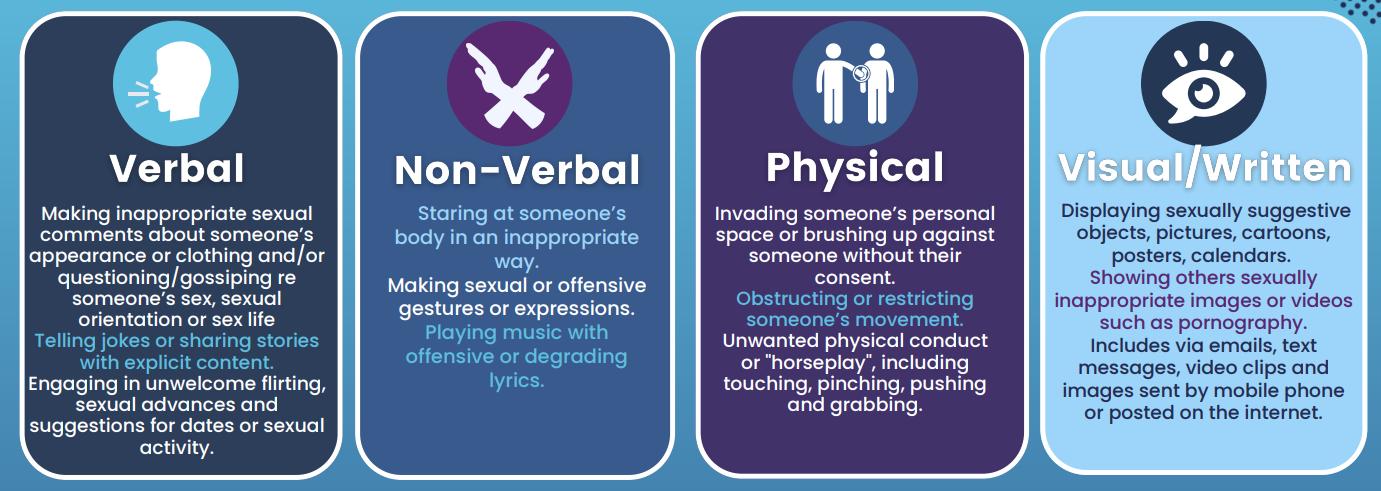
Asingleincidentcanamounttosexualharassment. Italsoincludestreatingsomeonelessfavourablybecausetheyhavesubmitted or refused to submit to unwanted conduct of a sexual nature, or that isrelated to genderreassignment or sex,in the past. A person maybesexuallyharassedeveniftheywerenottheintendedtargetandevenwheretheharasserperceivestheactivityasharmless. It isthe effecton the victim that establishes whethersexual harassmentis aconsiderationnot whether there wasintent.
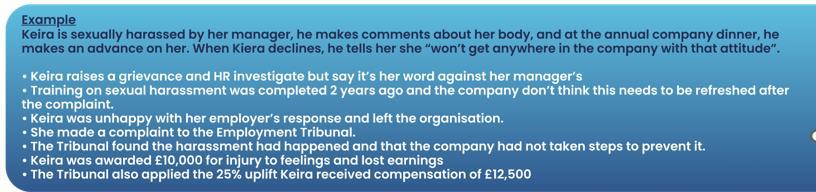
Thirdpartyharassment
Third-partyharassmentoccurswhere apersonisharassedor sexuallyharassedby someonewho doesnotwork for,andwhoisnot an agent of, the same employer, but with whom they have come into contact during the course of their employment whether that be in person or remotely. The Company will take active steps to try to prevent third-party sexual harassment of staff. All staff are encouraged to report any third-party harassment they are a victim of, or witness, in accordance with this policy.
If any third-party harassment of staff occurs, we will take steps to remedy any complaints and to prevent it happening again. Consideration will be givenineachinstance whether an outcome warrants in warning the harasser about their behaviour, banning them from our premises or even termination of supplier or client relationships. Any sexual harassment by our associated persons against a third party may lead to warning the harasser about their behaviour, termination of an assignment, disciplinary action up to and including dismissal In all instances, where necessary, any criminal acts will be reported to the police.
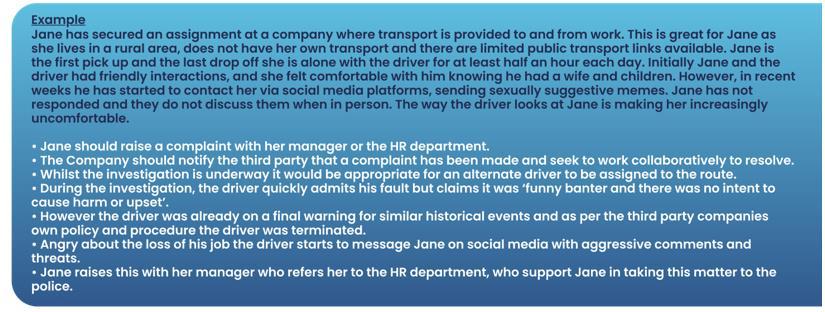
ShiftMethod
Anyone who witnessessexualharassment or victimisation isencouraged to take appropriate stepsto SHIFT the situation.
Dependingon the circumstances, thiscouldinclude:
▪ Speak up - Intervene where you feel safe and able to do so.
▪ Hold off- Ifyou do not feel safe orable to intervene, wait and check in with the victim as soon aspossible.
▪ Involve others – Considerwhoelse could supportin the situation eg a trustedcolleague, mental Health first aidersor HR.
▪ Fake it –Considerwhether you can discreetly cause a distraction to either stopor change the focus of the conversation.
▪ Take notes –log the date, time and asmany detailsas you can, these are extremely useful during an investigation.
In all instances it is key to support the victim to report it or reporting it on their behalf, especially where you feel there may be a continuing risk if you donot report it.
Reportingprocedures
The Company aims to take active and reasonable steps to help prevent the sexual harassment and victimisation of all staff. There isacalltoactionforanyonewhoisavictimof,orwitnessto,sexualharassmenttoreportitinaccordancewiththispolicyorfollowing April 2026 legislative enhancements to sexual harassment being afforded protections under whistleblowing, you can also report it via our whistleblowing policy and procedures. Either route will enable us to take appropriate investigation, action and provide support.
InformalSteps:
If you are being sexually harassed, consider whether you feel able to raise the problem informally with the person responsible, only if you are able and feel safe todo so:
• Explain clearly to them that theirbehaviourisnotwelcome or makesyou uncomfortable.
• Ifthisistoodifficult,youshouldspeaktoyourlinemanager,whocanprovideconfidentialadviceandassistanceinresolving the issue informally.
• Ifyou feel unable to speak to yourlinemanagerbecause thecomplaintconcernsthem,youshouldspeakinformally to the HR Department.If this doesnot resolve the issue,you shouldfollow the formal procedure below.
If you are not certain whetheran incident or series of incidents amounts to sexual harassment, you should initially contact your line manageror the HR Department informally for confidential advice.
FormalReporting:
Protectionandsupportforthoseinvolved

18. Preventing hidden labour exploitation and Stronger Together
Stronger Together is a multi-stakeholder initiative aiming to reduce human trafficking, forced labour and other hidden third-party exploitation of workers. The initiative was developed by the ALP, GLAA and migrant help and is being driven by the majority of the UK’s major supermarkets and retail chains.
AsaUKleadingindustrial recruiter,we realise we are in at the front line of the recruitment process andkeytotacklingtheproblemofhiddenlabour exploitation. We commit to developing and adopting a proactive approach to tackling hidden labourexploitation.
Hidden labour exploitation is exploitation of job applicantsorworkersbythirdpartyindividualsor gangs other than the employer or labour provider including rogue individuals working within these businesses but without the knowledge of management. It includes: * forced labour and human trafficking for labour exploitation;
• payment for work-finding services;
• work-related exploitation such as forced use of accommodation.
If you believe you may be a victim/concerned someone else may be a victim of human trafficking,forcedlabourandoranyotherhidden third-party exploitation of workers, please make your manager aware so we can report it to the appropriate authorities and work together to abolish these illegal activities.
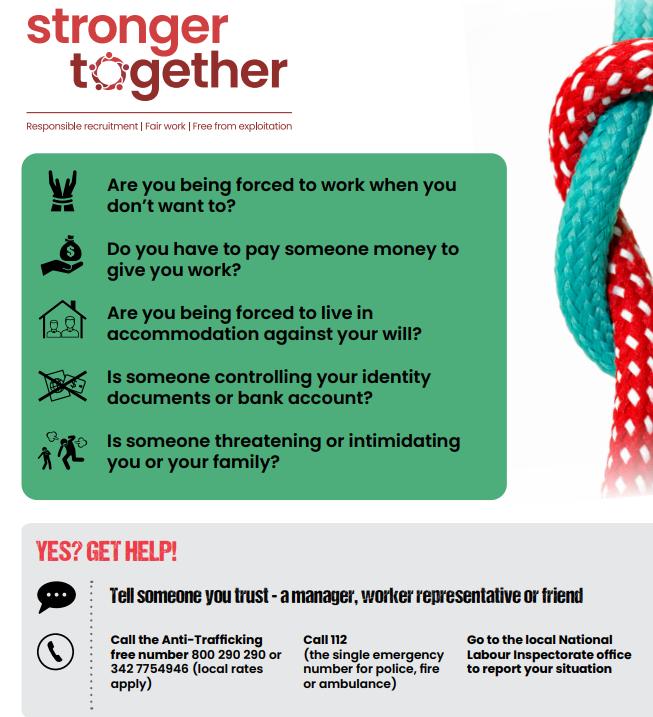
We are proudto be advancedbusinesspartners of Stronger2gether. For furtherinformation visit http:// stronger2gether.org/
19. Just Good Work App
JustGoodWorkisafreeinteractivemobileapp,givingjob-seekersandworkerscriticalinformationandadviceforeverythingneeded on the journey to work, from recruitment, to employment and life in a new destination, to moving on or returning home. Supports multiple languages, provides important checklists and facility for storing important documents, advice on good recruitment practices, immigration requirements, travel and practicalities and access to frequently asked questions. We encourage all job applicants to download the ‘Just goodwork app’
20. Ethical Trading
As a responsible corporate business,we aim toactina socially responsible manner at alltimes byrespecting the economic, social, cultural, political and civil rights of those engaged throughour employment business andcomplyingwithHumanRightslegislation. In accordance with our Ethical Trading policy and the ETI base code,we commit to ensure that:
a) employment isfreely chosen;
b) freedom of association and the right to collective bargaining are respected;
c) workingconditionsare safe and hygienic;
d) childlabourshall not be used;
21. WHISTLEBLOWING POLICY
e) living wages are paid;
f) workinghours are not excessive;
g) no discrimination is practised;
h) regularemployment is provided;
i) no harsh orinhumane treatmentis allowed
TheCompanyiscommittedtoconductingitsbusinesswithhonestyandintegrityandaimstoachievethehighestpossiblestandards ofserviceandethicalstandardsinallofitspractices. Weencourageallstafftoraiseanyconcernstheymayhaveaboutmalpractice or wrongdoing within the organisation freely and without fear of suffering a detriment or termination. We will treat any concerns raised seriously and will protect and support any individual who makes a disclosure in line with this policy.
To report concerns of malpractice or wrongdoing in relation to our organisation’s activities where you have information which you reasonably believe tendsto show one or more of the following:
• that a criminal offence has been committed,is beingcommitted orislikely to be committed; or
• that a person hasfailed,is failing or islikely to fail to comply with any legal obligation to which they are subject;
• that a miscarriage of justice has occurred,is occurring orislikely to occur; or
• that the healthorsafety of anindividual has been,or is beingor is likely to be endangered; or
• that the environment has been, is being orislikely tobe damaged; or
• that any of the above malpractices have been, are being or are likely to be deliberately concealed. This applies whether the malpractice hasalready occurred,iscurrently in progress, or is likely to happen in the future.
Youmustreasonablybelievethatthedisclosureisbeingmadeinthepublicinterest.Itdoesn’tmatterifyouaremistakenaboutyour concern but you must have information that tends to show some malpractice or wrongdoing rather than an opinion or a feeling. Any other concerns about our services generally which are not related to the types of wrongdoing or malpractice covered by this policy shouldbe raised usingourcomplaints policy instead.
Howtoraiseaconcern
If you have any concerns of the types of malpractice or wrongdoing covered by this policy, you should in the first instance make a disclosure to your immediatesuperior. Agencyworkersshoulddisclose concernsto theconsultantwhoisresponsibleformanaging theirassignment.
• If, for any reason, you feel that you cannot tell your immediate superior, or in the case of an agency worker the consultant responsible for managing your assignment, you should raise the issue withThe Company’sHR Department;
• If you have made a disclosure and are still concerned, or the matter is so serious that you feel you cannot discuss it with eitherof the two personsnamed above,you shouldraise the matter with Mark Roberts,Managing Director.
A disclosure of a concern can be made by telephone, in person or in writing (including by email). However, it is preferable for the disclosure to be made in writing so that we can keep an exact record of your concern. You are not expected to prove the truth of your concern beyond reasonable doubt or provide any evidence; however, you will generally need to provide the following information as aminimum:
a) the nature of the concern;
b) why you believe it to be true;
c) the background andhistory ofthe concern; and
d) relevant dateswhere possible.
You can raise any concerns anonymously; however, we encourage you to give your name when reporting your concern wherever possiblebecauseitmaybemoredifficultforustoprotectyourpositionorgiveyoufeedbackontheoutcomeofinvestigationsifyou choose to remain anonymous. You may wish to consider discussing your concern with a colleague before raising it formally under this policy. You can also choose to raise a concern under this policy alone or with a colleague; however, it is in the interests of all parties tomaintainconfidentiality once you have raised a formal concern.
Confidentiality
Allconcerns raisedwillbetreatedasconfidential andeveryeffortwill be madenottoreveal theidentityof anyindividualwhoraises a concern. Unless the law requires otherwise, we will only make disclosures to third partiesor other staffwith your consent.
Protectionandsupportforthoseraisingaconcern
TheCompanyiscommittedtogoodpracticeandhighstandardsandtobeingsupportiveofstaffwhoraisegenuineconcernsunder this policy, even if they turn out to be mistaken. We hope that all staff will feel able to voice their concerns freely under this policy. Anyindividual raisingagenuine concern underthispolicywillbe protectedfromany detriment,harassmentor retaliation.Misuse of thispolicy,suchasraisingmaliciousorfrivolousconcernsmayresultinformalaction.Ifyouareunhappywithhowyourconcernhas been handled you may escalate the matter throughthe Company’s Complaints policy.
22. GDPR - Privacy Notice Introduction
Collectionanduseofpersonaldata
The Company will collectyourpersonal dataandprocessyour personal data,which mayinclude sensitive data,for the purposesof providingyou with our services.
Purposeofprocessingandlegalbases
The legal baseswe rely uponwhen providing and/oroffering to provide these services toyou are:
a) Legal Obligation
b) Contractual Obligation
c) Legitimate Interest
OverseasTransfers
d) Consent
e) Public Interest
f) Vital interestof data subject
The Company may transfer the information you provide to us to countries outside the European Economic Area (‘EEA’).
AutomatedDecision-Making
To a limited extent, certain activities within the screening and suitability process will include automated decision-making. The primary function where automated decision-making processes are utilised is via technology platform implemented to validate an individual’s Right to work in line with government legislation. The outcomes of the technology implemented may produce legal effects on the individual or similarly significant affects fortheindividual.Where the automated decision-making process:
a) Validates anindividual’sright to work, the services maybe provided;
b) Is unable tobe validatedandan alertisissued by the technology platform, amanual checking processwill be engagedin ordertoidentifyiftherighttoworkoftheindividualcanbeestablishedandthereforwhetherornotservicescanbeprovided;
c) Determines the individual does not have the right to work, services will not be able to be provided;
d) Identifies the right to work documentation submitted for validation does not belong to the individual presenting it or it is stolen,fraudulentorcounterfeitthiswillbereportedtothenecessaryauthoritiesandserviceswillnotbeabletobeprovided.
Dataaccessrestrictionandretention
Where services have not been provided
If we have not provided you with our services, or had valuable contact with for two consecutive years, your personal data will be deleted from oursystemssave where we believe in good faith that the law or other regulation requiresus to preserve it.
Where services have been provided
Your personal details may be included in several documents created during the course of our contract with you. To comply with legal requirements e.g. HMRC, UK Visas and Immigration, The Conduct of Employment Agencies and Employment Businesses Regulations 2003, Agency Workers Regulation, HSE and tax legislation, your data will be kept by The Company for 7 tax years from the last date on which services were provided to you.
Securityprecautionsinplacetoprotecttheloss,misuseoralterationofdata
We are committed to taking all reasonable and appropriate steps to protect the personal information that we hold from misuse, loss,or unauthorised access.We do this by having in place a range of appropriate technical and organisational measures,e.g.:
a) Encryption:Implementingencryption methods for sensitive data both in transit and at rest.
b) Access Controls: Utilizing access controls such as strong passwords, multi-factor authentication, and role-based access control to limit who canaccess personal information within the company.
c) Regular Security Audits: Conducting regular security audits and assessments to identify vulnerabilities and address them promptly.This mightinclude penetration testing, vulnerability scanning, andcode reviews.
d) Employee Training: Providing comprehensive training to employees on data protection policies and procedures, including how to handle personal information securely and recognize potential security threats suchas phishing attacks.
e) DataMinimization:Adoptingadataminimizationapproachwhereonlythenecessarypersonalinformationiscollectedand retained, reducing the risk exposure in case of a security breach.
f) Secure Software Development: Integrating security into the software development lifecycle by following secure coding practices,conducting security reviewsduring development,and implementing secure coding standards.
g) RegularUpdates andPatchManagement: Ensuring thatsystemsandsoftware are kept up-to-date withthe latestsecurity patchesand updates to address known vulnerabilities andreduce the risk ofexploitation.
h) Data Encryption in Storage and Transmission: Encrypting personal data both during transmission over networks and while storedon servers orother storage devices to prevent unauthorizedaccess.
i) Data Backup and Disaster Recovery: Implementing robust data backup procedures and disaster recovery plans to ensure that personal information can be restored in case of data loss or corruption due to unforeseen events such as hardware failure,natural disasters, or cyber attacks.
Yourrights
Please be aware that you have the following data protection rights:
a) The right to be informed aboutthe personal data the Company processes on you;
b) The right ofaccess to the personal data the Company processeson you;
c) The right to rectification of your personal data;
d) The right to erasure ofyourpersonal data incertaincircumstances;
e) The right to restrict processingof your personal data;
f) The right to data portability in certain circumstances;
g) The right to object to the processing of your personal data that was based ona public orlegitimate interest;
h) The right not to be subjected to automated decision makingand profiling; and
i) The righttowithdrawconsentatany time.Where youhaveconsentedto theCompany processingyourpersonal dataand sensitive personal datayou have the rightto withdraw thatconsentatany time bycompletingon-line request(click here) or emailing Data Protection Officer asdetailed in your privacy notice.
Complaintsorqueries
If you wish to complain about this privacy notice or any of the procedures set out in it please contact: Data Protection Officer by emailing dpo@gap-personnel.com You also have the right to raise concerns with the Information Commissioner’s Office (ICO) on 0303 123 1113 or at https://ico.org.uk/concerns/ or any other relevant supervisory authority should your personal data be processed outside ofthe UK, ifyou believe that your data protection rights have not beenadhered to.
To view our up-to-date privacy notice, please visit the link detailed in the Our Business section for your legal entity pg3.
23. Benefits – Pensions FAQS
1. What is auto-enrolment?
We are obligated to automatically enrol every worker into a workplace pension scheme if they are aged between 22 and State Pension age, earn more than£10,000 a year and work in the UK. Furtherinformation is available on the govwebsite.
2. What happens ifI already pay into aprivatepension?
It is possible to have both a workplace pension and your own personal pension and continue paying into both. Unless you opt out you will also be required topay into the workplace pension.
3. IfI wereto leave, do I losethe money I paidin?
No, the money will remain in your pension fund and will be available to draw out once you reach pension age.
4. IfI join andthen return to my nativecountry, what willhappen to my contributions? Please speak tothe workplace pension provider for more information.
5. What happens ifI havemore than onejobwith theemployment business? The pension contribution will be calculated on the pensionable pay you receive each week.
6.What happens ifI don’t want to join theauto enrolment pension scheme?
If you are automatically enrolledinto the workplace pension,orelect to join, ThePeople’sPensionwill issue you a joinerinformation pack about the scheme and about managing your pension online. Thiswill explain the process to optout, handledby the provider.
7. What is Salary Exchangefor Pension Contributions (SXP)
SXP is our default method for making contributions to the company pension scheme. Where, and to the extent they are eligible, workersgive up anelement ofpay inexchange for contributions that are made byus.
24. Benefits – Optima Health
Through our partnership with Optima health, we are proud to offer a free worker support line to help you with all kinds of practical and emotional issues including:
• Work-life balance
• Childcare
• Debt
• Careers
• Stress
• Life events
• Anxiety & depression
• Bullying& harassment
• Education
• Workplace pressure
• Relationships
• Health & wellbeing
• Disability & illness
• Bereavement& loss
• Eldercare
• Immigration
• Family issues
• Sexual Harassment
• Consumer rights
• Translation services

The serviceisfree to all temporary workers.There isno registration process andallconversationsare strictly confidential.To use the worker support line simply call 0800 174 319 to speak with a professional counsellor or information specialist. For more information please visit: www.carefirst-lifestyle.co.uk.
25. Health and safety - the policy
It is our policy to ensure, as far as is reasonably practicable, that we protect and promote the health, safety and welfare of all employed workers through the provision of a safe working environment, safe equipment and safe systemsof work.
Additionally,itisourintentiontosafeguardallpeopleandassetsinsofarastheyareaffectedbyouroperations,includingtemporary workers,visitors, contractors and the general public.
Our Hirershavearesponsibility to:
a) comply with all requirementsof The Healthand Safety at Work etc Act 1974 (as amended)and otherlegislation and codes of practice;
b) review health andsafety arrangements on an ongoing basisto ensure theireffectivenessand continuous improvement;
c) provide and maintain locations, equipment and systemsof work that are safe and without risks to health;
d) establish emergency procedures asrequired;
e) promote safety and reduce hazards;
f) detail specialist skills or qualifications required by the temporary worker to carry out an assignment together with related health and safety information;
g) pass to the temporary workerall information on health and safety issuesconnected with the assignment;
h) unless otherwise agreed with us, our Hirers are to complete a health and safety induction for all new staff (including temporary staff), retain induction and training records on file and where requested make these available to us;
i) tell the workforce the name of the authorisedhealth andsafety representative;
j) record any accidents orinjuries intheiraccident record book and report tothe healthand safety executive,in accordance with current requirements.Pass on the information to the local branch of the employmentbusiness.
Theemployment business’responsibilities:
a) toconductinspectionsofHirers’premisestosatisfyourselvesthatthehealthandsafetypracticesofthesiteareacceptable prior tothe initial introduction of a worker;
b) to obtain information in relation to any risk assessments conducted by the Hirer, health and safety training that will be delivered to the workers and obtain evidence of the necessary liability insurances being in place by the Hirer, prior to the initial introduction of aworker;
c) to pass on to the worker all relevant information obtained from the Hirer in relation to known health and safety risks, measurestakenbythe Hirer topreventor control risks andany information regardingPPE,Uniform, orequipment required;
d) to ensure workers have received health and safety training from the Hirer and to act immediately should it become apparent that traininghas notbeen delivered;
e) to co-operate fully in the investigation of accidents.
Employed worker responsibilities
Every Employed Worker has a legal duty to take reasonable care of their own health and safety and that of other persons who may be affectedby their actionsand/or omissions. In particular,every Temporary Worker has aduty to:
a) Observe the Hirer’s Health andSafety Policy at all times andask for sight of the Policy before starting any assignment;
b) Take care to follow any safety regulations, including wearingthe correctPPE requiredfor the assignment;
c) Beresponsibleforyourownhealthandsafetyatworkbutalsotakereasonablecareforthehealthandsafetyofothers(e.g. other Temporary Workers,contractors, customers etc.), who may be affected by youractsor omissions at work;
d) Nevermisuse orinterfere with anything providedin the interest ofhealth, safety or welfare;
e) Neveroperate/handle equipment for which they have not been trained;
f) Immediately report any perceived hazard or risk, accident, injury, dangerous occurrence or damage to property to their Line Manager;
g) Co-operate fully in the investigation ofaccidents.
26. Health and safety - manual handling
Asthe majority of roleswillinclude some aspectof manualhandlingwehave detailedsome importantinformation foryou. Manual handling regulations cover the tasks involving supporting or transporting loads by physical human effort. You should familiarise yourself with good handling techniques as hazards are not only presented by heavy loads. The basic rule of manual handling on your assignmentis “think before you lift”. Please remember all of the following and, ifin doubt, then ask.
a) You must inform your Line Manager if you have had a previous history of back pain;
b) Stop and think before you lift. Ensure you have enough space, be aware ofany obstructions,don’tliftunless you have to!;
c) Get helpif the loadis beyondyourcapacity, don’t try to liftiton yourown;
d) Look out for sharp edges, nails,wires and splinters;
e) Stand close to the load, feet slightly apart, one infrontof the other tobalance the load;
f) Bendyour knees;
g) Keepthe back upright (thismaintains the spine’snatural curves) andlift with the legs;
h) Keepthe shoulderslevel andin the same direction as the hips;
i) Keepthe loadclose to the trunk for aslong aspossible and do not twist when turning toone side;
j) If you need to position the load, put it down first then slide it into the desired position



27. Health and safety - first aid and accidents
Reporting accidents is really important. All accidents, no matter how small, must be reported to us, the employment business, and the designated Hirer representative. All accidents must be recorded in the Hirer’s Accident Record Book, maintained by the Hirer’s designated First Aider. If you have an accident, get first aid treatment immediately. The smallest cut, if neglected, could result in infection.
28. Health and safety - fire
Learn the fire drill for every place you work - each one may be different.Make sure you know:
a) how to raise the fire alarm;
b) the fire evacuation procedure;
c) where the fire extinguishers are andhow to use them;
d) the whereabouts of all fire exits.
You must ensure that you are fully conversant with and comply with the fire and other emergency procedures and take part in all drills asorganised / notified by us and /or the Hirer.
You must ensure that you do not render any fire escape or fire escape routes at the site unavailable for emergency use, nor cause any obstruction at any time toany staircases, passages,walkways, entrances and exits orany other partof the site.
29. Health and safety - special notes for food production assignments
Temporary workers must inform us immediately if they are suffering from any of the following conditions and are due on an assignment within a food production environment: food poisoning; typhoid/ paratyphoid; dysentery; hepatitis; influenza; ear or throat infection; stomach upset; open sores; eczema. Please note that under no circumstances should you work in a food environment whilst suffering from any of these ailments. After an instance of sickness and diarrhoea you must stay off work for 48 hoursafter the last instance.
If you become ill whilst on shift, you must notify your supervisor of the circumstances immediately. In any event of sickness related absence, areturn to work interview will be completed prior toyou returning to site.
General procedures
a) Hands must be washed frequently, especially after using the toilet, after breaks, before starting work and between tasks. Cuts andsores must be covered. Nailsmust be short andunvarnished. Acrylic false nailsare not acceptable;
b) Hair must be clean and neat.Iflongit must always be tied back and secured under protective head wear when working in a food preparation or service area;
c) Jewellery: with the exception of plain wedding rings andplain studearrings, should not be worn while on duty;
d) Personal hygiene: please take care with personal freshness. Frequent washing and the use of deodorants are recommended. Ensure that your uniformisclean andfresh;
e) Sickness: Ensure you donotcough or sneeze near food.If you do handsmust thenbe washed immediately.
30. Statement of best practice
We continually review our Employed Worker Contracts, rules and policies to ensure that they remain, at least, comparable to best practice within similar organisations. Appropriate amendments will be made to reflect changes to best practice, for reference the most recentversion will always be available on our website.
