1202 BEF-NAJ
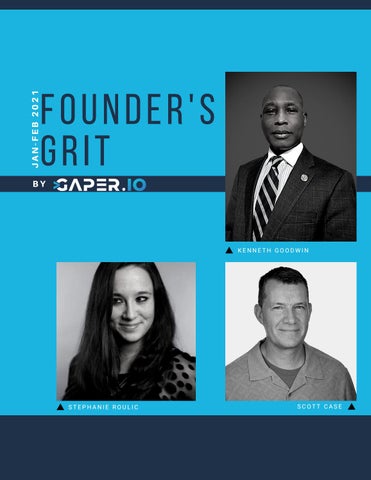
FOUNDER'S GRIT
BY
KENNETH GOODWIN
STEPHANIE ROULIC
SCOTT CASE
EDITOR'S NOTE We have entered this new year with a renewed hope of returning back to life as we knew it before the pandemic took over our lives. And though it is indeed a time of planning ahead and preparing to step back into the world of business, startups, entrepreneurship, innovation and progress, we must not forget what the past year taught us so soon.
lives and alter the future in unprecedented ways. We saw loss of lives and livelihood, businesses and balance; we saw people fight for their rights and struggle for justice. The year was overwhelming and tiring. We go forward with renewed hope - even if it is a hope to feel hopeful again.
We saw the prevailing conditions ruthlessly tears into
Founder's Grit | 3
aper.io
Founder's Grit | 4
aper.io
TABLE OF CONTENTS 07. KENNETH GOODWIN: INSIGHTS INTO FINTECH, PUBLIC SPEAKING AND THE FUTURE OF WORK 11. SCOTT CASE: GOING UP, UP AND UP WITH UPSIDE! 15. STEPHANIE ROULIC: BUILDING ECOSYSTEMS ONE STARTUP AT A TIME 19. LEADERSHIP IN UNCERTAIN TIMES – CREDIBILITY, FLEXIBILITY AND GOING REMOTE 22. ARE WE WORKING MORE IN WFH SETUPS?
Founder's Grit | 5
aper.io
Focus on Building Your Start-Up & Leave the Engineering to Us. Zero Risk You pay nothing, if you decide to stop within two weeks. Just get us a cup of coffee.
Inexpensive 1/2 the price of strong NYC/Bay Area software engineers. We give you affordable quality.
Tech Stack Front-End, Back-End, Mobile, DevOps, AI Engineers, Full Stack and more.
100% Flexible Work with engineers part-time, full-time or hourly. Pay only for hours worked.
(530) 324 2349
gaper.io
sales@gaper.io
512 W 112th St, New York NY 10025, USA Founder's Grit | 6
aper.io
KENNETH GOODWIN - INSIGHTS INTO FINTECH, PUBLIC SPEAKING AND THE FUTURE OF WORK Introduction: A Rich Professional Background Kenneth Goodwin is the managing partner and founder at Jeanensis LLC and Jeanensis Capital Markets. A commissioned central banker, he started off at the Federal Reserve Bank in New York where he spent ten years. During the decade, one of the major projects he worked on was the TALF (Term Asset-Backed Liquidity Facility) program. This was during the time when the US markets entered a downward spiral. Kenneth’s role was instrumental in ensuring that banks and financial institutions got enough capital to operate and be able to start lending to each other and their consumers. Kenneth has spent a lot of time in Japan as well as an exchange student but also as an executive level expat as part of the Mansfield Fellowship Programme. This gave him a chance to work at the Bank of Japan, Tokyo Stock Exchange, the Japanese FSA and Japan Diet. At the Tokyo Stock Exchange, he mainly covered government bonds, and helped new companies in listing on the exchange. Founder's Grit | 7
aper.io
After he left the Fed, Kenneth started working in the consulting industry at banks on the Wall Street on the trading floor at RBS and HSBC. Here, he focused on fixed income derivatives and equity. His last years in this industry at Grant Thorton where he worked as a national senior manager. His work included both advisory practice and audit practice. Kenneth followed this by founding and becoming a managing partner at Jeanensis.
Where Is Fintech Heading? Traditional Banking vs. Innovations Several years ago (around 2016), when Kenneth
These are small and new retail banks that are
encountered concepts like cryptocurrency and
part of the same competitive market as the
blockchain technology, they were very trendy,
older, traditional banks where oftentimes they
attractive ideas. A lot of companies were trying
specialize in areas not covered by the latter,
to be the next bitcoin. The overarching
bigger banks. These fintech banks are able to
sentiment among interested groups was that of
execute transactions a lot faster, in a relatively
dismissing the roles of banks and governments,
easier manner. Resultantly, they are more
and decentralizing everything! However,
attractive to a population that like to take care
Kenneth finds that the term “decentralized”
of such things digitally - no one likes going to
was misused at that time. He believes that the
branches anymore. They value quick access to
government and banking institutions cannot be
meaningful data and information. It is thus
separated from these new innovations in the
becoming imperative for banks to restructure
sector.
and digitize themselves if they are to remain at the top of the competition in their industry.
In some way or another, it was important to collaborate with them, train them, and develop
But also, as mentioned above, the blockchain
them to be a part of this system.
industry is going to have to accept banks and the government in their ecosystem. Kenneth
The idea remains the same for banks today.
reminds us that banks serve the very important
Banks are going to have to learn blockchain
purpose of being the custodian of assets.
technology. They need to digitize their
Similarly, the government sets policies and
operations. If they don’t, the future is set to be
procedures. They do however need to
very tough for them, not least with regard to
understand and appreciate the importance and
maintaining their client base. This can already
roles of fintech, blockchain and other
be seen by the rise of "challenger banks".
innovations that are now transforming the
Founder's Grit | 8
aper.io
financial sector so as to better serve their citizens.
On Public Speaking - Tips From a TEDxTALKS Speaker and Lecturer! In addition to an incredibly remarkable career in finance, Kenneth is also a TEDxTALKS speaker! (Readers are encouraged to check out his insightful talk titled “How Digital Transformation will create a Borderless Trade System”). Kenneth attributes his flair for public speaking to his time as a lecturer which is characterized by a decade long teaching experience at local community colleges in New York (Baruch College) and New Jersey. It is therefore the vast experience of standing and talking in front of a classroom that acclimatizes you to standing in front of people. It hones your confidence and communication skills. You learn to convey something complex in a simple, easy-tounderstand manner.
Founder's Grit | 9
Both sides need to work together, otherwise, we will see an inefficient government, inefficient banking systems, and an inefficient fintech sector.
aper.io
“You visualise”... ...says Kenneth when talking about his TEDx experience. To him, the best way to handle a huge audience is to be with yourself in a room with a mirror and visualise yourself being in front of a stadium full of people. A visualisation mindset helps bring things to reality. In addition to building your confidence and storytelling prowess, this teaches you not to rely on your memory. Rather than rely on scripts, Kenneth likes to improvise to build real, natural yet engaging conversations. (Author’s note: Kenneth was one of the most engaging, fun and insightful persons to interview even though he was given no questions to prepare beforehand!)
Founder's Grit | 10
aper.io
Scott Case
Going Up, Up and Up with Upside!
A vastly experienced entrepreneur, Scott is the founding CTO of Priceline. As part of his work, Scott has ran and scaled public health organizations like Malaria No More. He is also the chairman of Network for Good which is a Software as a Service platform for small and medium sized charities as well as a donation processing system for partners like Facebook, Google, Patagonia and others. The company helps around 250,000 non-profits raise $500 million a year. Scott is also the co-founder and CEO of Upside Business Travel. This five year old venture has been an interesting ride for Scott. Even though the pandemic meant that the number of people looking for travel fell dramatically, things are looking up at this point!
COPING DURING UNCERTAIN TIMES For his professional endeavors, Scott divides the
the future.
pandemic-ridden time into three phases. The first two months were entirely focused upon surviving
Once it became apparent what the next few
the sudden shocks in the economic and business
months would be like, the company expanded its
world. News stories were developing every few
planning horizon up till the end of the year. It
hours and every few days so any planning that the
looked into potential short-term investments that
company did was for a similar time period into
would aid growth out of the pandemic chaos.
Founder's Grit | 11
aper.io
In the final phase, towards the end of the year, it was more about recognizing and accepting that the business environment had changed and thus appropriate and adaptive planning needed to be done for the next two years.
Team resilience made it smoother to navigate through these times. Going remote, planning, adapting, and growing have been mainly dependent on how resilient and persevering organizations have been during 2020.
Founder's Grit | 12
aper.io
REMOTE WORK
Scott’s views about remote work are centered around company culture. The critical point here is
establishing and implementing core values as a company. These values do not really change whether teams are remote or not. These values are brought into play from the very beginning of employee onboarding process. A major challenge presents itself when it comes to interacting with each other and keeping the teams together. This is relatively easy to manage with small teams. Big teams are trickier to establish connections for. Additionally, Scott has also discovered that bringing strategies and ideas that worked well in office environments into the digital world does not quite work. It is smarter to reimagine the employee space and understand what problems were being addressed by those office based/physical space strategies. Once identified, those problems should then be solved for digital work setups. For example, when someone new joins your company, they are able to introduce themselves to existing employees and familiarize themselves with the company culture. The dynamics are vastly different when someone is brought onboard in a digital work environment. It is then a challenge for managers to figure out efficient and effective ways of online communication that at some level, try to translate an office’s social environment on a digital platform. Founder's Grit | 13
aper.io
ADVICE FOR NEW BUSINESSES AND ENTREPRENEURS Scott also shared a few pieces of valuable advice for individuals and teams just starting out in the business arena (though of course, anyone can apply them in their professional endeavors!): Depending on the nature of your business and the resources you have, you may have to pivot significantly to make it through uncertain and challenging times. This might mean some aspects of your business pick up pace, while others need to be slowed down. Do not be hesitant to make dramatic changes if the situation calls for it. Be careful about the kind of feedback you are getting from your prospects or customers during the uncertain times. Question whether such feedback will continue beyond those times (the pandemic for example). Behaviors and opinions and 2020 will very likely change significantly two years from now. For example, the simple fact that people are spending more time at home means that their views about your business will be influenced by that dynamic. Be mindful of these elements and maintain your customer base as much as possible. But keep evaluating how your business’ environment will change in the future. Remember, hard times will pass. There will be another side to these troubles. Don’t hesitate to think several months, several years down the line. Short-term decisions are important, but you are allowed to be ambitious about the future regardless of current times!
Founder's Grit | 14
aper.io
FEATURED ACCELERATOR
STEPHANIE ROULIC: BUILDING ECOSYSTEMS ONE STARTUP AT A TIME Stephanie “loves” startups and is an active member and contributor to Boston’s startup ecosystem! She co-founded a startup called nDash in 2016 as part of a marketing agency. nDash is a content marketplace startup platform. When the agency decided to start a software platform, Stephanie took over the customer success and community department. Because she was a new founder, she started an organization called Startup Boston to help her network with other professionals going through similar career experiences as her. Startup Boston plays the role of connecting Boston’s startup community which has now blossomed into a solid network.
Founder's Grit | 15
aper.io
Startup Boston Week is their flagship event which, in September 2020, brought together a diverse group of 3,500 professionals from the startup community. These individuals then get to be a part of 70 sessions featuring over 250 speakers. Because of the success of this event, Startup Boston has also started other events and initiatives to bring together and help the startup community.
REMOTE WORK: AHEAD OF THE TIMES nDash started off as an office based startup in 2016, but since 2018, they have transitioned to becoming a “remote first” company. The decision to become remote was therefore not a byproduct of the pandemic at all; it was the simple realization that this mode of working was not only feasible but also more efficient. It was a learning curve for both nDash, and its clients, but a very productive one! Startup Boston conferences were also conducted successfully on virtual platforms in 2020.
Founder's Grit | 16
aper.io
STARTUP BOSTON At Startup Boston, audiences are pulled in from all industries and all departments in startups. This means that startups at their events range
bootcamp that takes them through all the necessary steps in their departments.
from fields like fashion, food and beverage, or hardware. This way, individuals get the chance to expand their networking avenues beyond just their cities and industries. Also, the event and conferences are designed with very structured takeaways as well. Attendees essentially go through a five day
Founder's Grit | 17
aper.io
THE FUTURE OF REMOTE WORK Like all of us, Stephanie is also uncertain about the future of remote work. 2020 has convinced enough people of the merits and practicality of remote work, as well as its cost and time efficient nature. Therefore, while WFH setups have been normalized to a great extent, there is still a question mark over what route companies will choose to adopt once lockdowns are lifted. Interestingly, Stephanie also draws insights from historical patterns of major world events, and opines that office based setups will end up making a very strong comeback in the professional world in about a couple of years time. At the same time, the ease in access to talent provided by remote means of work will continue to be of value to many businesses. Not only that, Stephanie is aware of how fastpaced working at startups is. Founders and managers therefore need to recruit all the resources that they can without restricting themselves to local or office-based teams. This is critical in helping them rescale their businesses. Stephanie is without a doubt passionate about startups. Her endeavours speak volumes about her dedication to not only building ecosystems and meaningful networking platforms but also ensuring that they are provided with the necessary knowledge to make it in the highly competitive world of startups.
Founder's Grit | 18
aper.io
FEATURED FOUNDER
LEADERSHIP IN UNCERTAIN TIMES -
CREDIBILITY, FLEXIBILITY & GOING REMOTE As the leader of a company, or a part of a company, the onus of ensuring that things keep running smoothly even during difficult, unprecedented times falls on you. You have in your hands the livelihoods of the people who work under you as well as the future of the company. This makes it inevitable for you to face situations in your professional life where you will have to make very hard decisions. The question then is, how should one lead? What should a leader do? And what does remote leadership look like?
Founder's Grit | 19
aper.io
BUILDING CREDIBILITY One of the major challenges you can expect to face is that of developing and maintaining credibility of what you do as a leader. This is something that new leaders have to build from scratch when they take a new leadership role or join a new company. This does not preclude the experienced ones from being tested either. 2020 put all leaders, new and experienced ones alike, into a dilemma that none of them had faced before. Indeed it ended up cornering leaders into a rather vulnerable spot. Remote leadership becomes even trickier and brings with it a set of completely new dynamics. Overcoming this, or rather dealing with it, is a game of a few well thought out, judicious decision-making. Leaders should take on challenging times by thoroughly studying the companies they are responsible for and gain an idea of factors that lead to success and
BEING FLEXIBLE If there is one takeaway you should choose from this article, it is this one. 2020 taught us that no amount of certainty is ever guaranteed. Being rigid in your business leadership practices is a one-way ticket to stagnation. You do not progress or grow. Your decisions should incorporate the inputs of all those who work under you. You never know that the next best idea that propels the company into success can come from an intern. Gone are the days when the strict white collar, blue collar distinction concentrated decision-making power to the few people up at the top of the hierarchy.
those that don’t. Draw on these inferences and implement flexible decisions. You should be able to back your ideas up with valid
Your policies should be malleable enough to be changed according to the needs and demands of your company and the business community and environment it is a part of.
reasonings that everyone in your company can understand.
Perhaps this is where remote leadership
Founder's Grit | 20
aper.io
becomes a little easier. Exchanging ideas is quicker, changing work flow is relatively hassle-free. One has more immediate access to what is going on in the company and where changes are needed.
COMMUNICATION The aforementioned two points lead to this one. A leader cannot expect to concoct any sort of credibility or inject flexibility into their company culture if they do not engage in effective and meaningful communication with every stakeholder.
to be backed up by appropriate actionsthat reflect a good balance of company interests and employee interests.
Every leader will know their own company
However, this does not mean that you completely abandon your own personal leadership style and rules. Bring new and innovative practices with you. Be different
and thus be able to better decide how best to relay important information to their teams, senior management, investors and even customers. Because of growing understanding of company culture and critique of modern day work-life, it is no longer enough to just ‘listen’. Words need
from your predecessors. Openly express what your expectations are from everyone. Just make sure that they know. Don’t let everything be a surprise to your organization – you do not want unnecessary barriers between you and everyone else.
REMOTE LEADERSHIP = DIGITAL LEADERSHIP Don’t hesitate to go digital! Digital communication is perfectly normalized now. People will appreciate if you keep interactive sessions on Zoom (or your app of choice) to communicate with different teams in your organization. Create a healthy mix of scheduled and unplanned, informal meetings however you see fit.
Founder's Grit | 21
aper.io
ARE WE WORKING MORE IN WFH SETUPS? The world went remote almost overnight once the pandemic hit. While remote work was something a lot of Americans adopted, with Silicon Valley as usual taking the lead, there was still the reluctance to go remote fulltime in other parts of the world. The pandemic tousled everything around. There was nothing anybody could do about it. As the virus spread throughout the world, one country at a time, there was a lot of ambiguity on how to handle corporate interactions. With such a sudden disruption, it definitely had a whiplash effect. Almost overnight the world was forced to go remote, an occurrence no one had predicted or anticipated. This was beyond anyone’s comprehension and anything anyone could have ever imagined. So what happened after remote work became the mode of work? The struggles everyone faced in coming to terms with the new terms and conditions. Are we working more than before?
Founder's Grit | 22
aper.io
TIME MANAGEMENT WITH REMOTE WORK: Are we really working more than before? Or working more hours? Do we have, what several termed it as, survivors’ guilt? Trying to overcompensate by retaining our jobs where countless others lost theirs? If we get to the crux of it – most people who have felt burnt out due to “overworking” are more often than not simply unable to manage their times and tasks properly. This may be due to the fact that they are used to clocking in and clocking out at given time stamps. That being said, several companies have still noticed a notable spike in overall productivity. So what is the actual problem and how do HR personnel tackle such things when they face these problems. More now than before? One simple yet effective solution was to consciously take breaks. Be more deliberate about clocking in and out of work – no matter what time one starts and ends their tasks. CompanyCam included half days midweek to overcome Zoom fatigue and other such measures where brought in to mitigate the effects of overwork, burnouts and a new terminology “Zoom Fatigue”.
SOCIALIZING REMOTELY: Yes, it is like an oxymoron, however, a lot of companies have
platforms are used for activities other than work, so that
Collaboration is key in such situations, in fact, over
made concerted efforts to have virtual events to engage employees.
employees have the chance of having their “water cooler conversations" and interactive sessions to
communication is what has kept confusion out of the loop.
Zoom and other
keep isolation at bay.
Founder's Grit | 23
aper.io
GOING HOME WHILE WORKING FROM HOME: So how do you “Go Home” when you are working from home? Like already shared, be deliberate about your actions and timings. Till you do not switch off, you are literally always on work mode. Something that has proven to cause high rates of burnouts and lower productivity. So it is obviously a loss to everyone around.
LESS IS MORE WITH REMOTE WORK: At the end of the day, it is not the number of hours put into your work, but the quality of tasks done that matters. Employers are now realizing the folly of
pandemic would push remote life several years on? We are already living the “Future of Remote Work”. What goes on hence, is something everyone needs
the regimented 9 – 5 work life, which may have its own perks, but needs to be tweaked to suit today’s world better.
to figure out. We have done quite well the world over, alas, a lot more needs to be done. But then need is the mother of
Who had known, or predicted, that a
all inventions right?
Founder's Grit | 24
aper.io
Founder's Grit | 25
aper.io
What makes Gaper special? Hassle free hiring Top 1% of vetted engineers High-performing teams
Become a master software developer with Nerdii 12 weeks of intense training Interpersonal skills development Problem solving via practical projects