World Child & Adolescent
Psychiatry ISSUE 30, July 2026
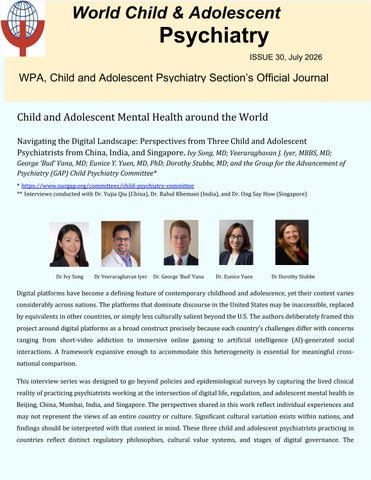
WPA, Child and Adolescent Psychiatry Section’s Official Journal Child and Adolescent Mental Health around the World Navigating the Digital Landscape: Perspectives from Three Child and Adolescent Psychiatrists from China, India, and Singapore. Ivy Song, MD; Veeraraghavan J. Iyer, MBBS, MD; George ‘Bud’ Vana, MD; Eunice Y. Yuen, MD, PhD; Dorothy Stubbe, MD; and the Group for the Advancement of Psychiatry (GAP) Child Psychiatry Committee* * https://www.ourgap.org/committees/child-psychiatry-committee ** Interviews conducted with Dr. Yujia Qiu (China), Dr. Rahul Khemani (India), and Dr. Ong Say How (Singapore)
Dr Ivy Song
Dr Veeraraghavan Iyer
Dr. George ‘Bud’ Vana
Dr. Eunice Yuen
Dr Dorothy Stubbe
Digital platforms have become a defining feature of contemporary childhood and adolescence, yet their context varies considerably across nations. The platforms that dominate discourse in the United States may be inaccessible, replaced by equivalents in other countries, or simply less culturally salient beyond the U.S. The authors deliberately framed this project around digital platforms as a broad construct precisely because each country’s challenges differ with concerns ranging from short-video addiction to immersive online gaming to artificial intelligence (AI)-generated social interactions. A framework expansive enough to accommodate this heterogeneity is essential for meaningful crossnational comparison. This interview series was designed to go beyond policies and epidemiological surveys by capturing the lived clinical reality of practicing psychiatrists working at the intersection of digital life, regulation, and adolescent mental health in Beijing, China, Mumbai, India, and Singapore. The perspectives shared in this work reflect individual experiences and may not represent the views of an entire country or culture. Significant cultural variation exists within nations, and findings should be interpreted with that context in mind. These three child and adolescent psychiatrists practicing in countries reflect distinct regulatory philosophies, cultural value systems, and stages of digital governance. The
World Child & Adolescent
Psychiatry ISSUE 30, July 2026
WPA, Child and Adolescent Psychiatry Section’s Official Journal responses offer something that policy reviews cannot: candid, practice-grounded accounts of what regulation looks like from the consulting room. Questions arise, such as what conflicts it resolves or generates, who benefits, and where the intention of policy diverges from clinical outcome. Our aim is to broaden the international conversation on this topic, draw lessons that transcend any single system, and prompt clinicians and policymakers alike to examine assumptions that may prove far more context-dependent than they appear. Three psychiatrists were interviewed in depth and their responses synthesized thematically to highlight cross-national trends and divergent practices. The Chinese psychiatrist was interviewed in Mandarin; the Indian and Singaporean psychiatrists were interviewed in English. These countries were selected because all three are major Asian economies undergoing rapid digital expansion, with children and adolescents showing high rates of smartphone and internet access — positioning youth digital use as a shared clinical concern across settings. They also share broadly similar patterns of socioeconomic stratification: each country contains both highly resourced urban populations and lower-income or rural populations with markedly different access to parental supervision, digital literacy, and mental health services. At the same time, the countries differ significantly in policy and scale: population size (Singapore's approximately 6 million versus India's and China's more than 1 billion each) and regulatory philosophy (from China's centralized, state-enforced platform mandates, to India's consent-based legal architecture, to Singapore's institutional guidance). This combination of shared exposure to rapid digital development alongside differing regulatory and socioeconomic landscapes allows for a comparison that is both balanced and informative. Clinical background and serving patient population How do the clinicians’ practice contexts differ, and what does this mean for interpreting their observations? China: The psychiatrist practices in addiction medicine in a tertiary urban hospital in Beijing, with 60% of patients being children and adolescents drawn from a national referral base. Most patients present with mood disorders in which digital screen use functions as a secondary coping mechanism. India: The consultant operates in private outpatient practice in Mumbai serving urban middle-class and working-class families. The caseload spans common psychiatric conditions alongside growing presentations of excessive social media use, gaming addiction, cyberbullying, and online social comparison affecting self-esteem and body image.
World Child & Adolescent
Psychiatry ISSUE 30, July 2026
WPA, Child and Adolescent Psychiatry Section’s Official Journal Singapore: The clinician is a senior consultant in developmental psychiatry at a national institute with over two decades of experience. The caseload includes a significant proportion of patients with attention-deficit/hyperactivity disorder (ADHD) and autism spectrum disorder (ASD), diagnoses whereby excessive gaming and frequent use of digital devices frequently co-occur.
Cross-national trend: All three psychiatrists view digital screen use as clinically relevant, but they rarely view it as pathology on its own — it is embedded within broader emotional, neurodevelopmental, or social difficulties. This convergence challenges simplistic addiction framing and supports a biopsychosocial conceptualization of problematic digital use in youth. Current digital regulations affecting youth and families How does the regulatory landscape differ across the three jurisdictions? China: China has the most codified digital framework. Since January 2024, all apps must operate in a ‘minor mode’ with time limits, spending caps, and content filters. Gaming was restricted to one hour on weekend evenings in 2021 and since March 2026 platforms have faced stricter obligations regarding harmful content. Mobile phones are prohibited in classrooms. India: India’s regulatory environment is layered and evolving. The Digital Personal Data Protection Act (DPDP) in 2023 mandates verifiable parental consent before processing children’s data and bans targeted advertising directed at minors. Proposed agestratified social media legislation would introduce graded restrictions for adolescents under 12 years, 12–16 years, and 16–18 years of age. AI governance guidelines are being updated to address synthetic content risks for children. Singapore: Singapore’s approach is the least prescriptive legislatively. The Ministry of Health published screen-time guidelines in 2023, and secondary schools implemented a mandatory locker policy for mobile phones during school hours in January 2025. No comprehensive national digital regulation for children currently exists. Adopting a more calibrated stance allows for learning from existing good practices in other countries and regions.
Cross-national trend: A clear regulatory gradient exists-from China’s mandatory, state-enforced platform controls to India’s consent-based legal architecture to Singapore’s institutional guidance. This gradient maps broadly onto differing political philosophies regarding state intervention versus family autonomy. Regulations most directly reflected in clinical practice Where does regulation visibly manifest in the clinical encounter? China: Content restrictions, parental monitoring tools, and gaming limits are most directly observable. Platform-level enforcement shifts the burden of rule implementation away from parents, reducing adversarial parent-child dynamics. Children initially protest limits but typically adapt when these are socially normalized.
World Child & Adolescent
Psychiatry ISSUE 30, July 2026
WPA, Child and Adolescent Psychiatry Section’s Official Journal India: The DPDP Act’s parental consent requirements have prompted families to engage with privacy settings, generating clinical conversations about data safety and digital footprints. Government recognition of ‘gaming disorder’ has shaped how parents frame their children’s gaming behavior, sometimes resulting in over-pathologizing normative use. Singapore: Early observations following the January 2025 school phone restriction suggest students appreciate increased in-person peer interaction during recess with benefits apparent such as social skill development and reduced social comparison anxiety, though longitudinal data remain pending.
Cross-national trend: Regulations are most clinically visible when they shift enforcement from individual parents to institutions or platforms. Cross-national trend: Regulations are most clinically visible when they shift enforcement from individual parents to institutions or platforms. Parent-reported conflict around device use diminishes when adolescents perceive limits as derived from policy regulations rather than arbitrary parental mandates — a consistent finding across all three settings. Unintended consequences of digital regulation Are there iatrogenic effects of digital regulation on youth mental health? China: No significant unintended consequences were observed. The comprehensiveness of the framework — including prohibition of account sales to minors — appears to minimize bypass attempts. India: Multiple unintended consequences were identified. Abrupt, fear-driven parental restrictions triggered by government advisories often increase adolescent secrecy, age-falsification, and migration to less regulated platforms. Overgeneralized messaging on gaming disorder risks pathologizing normative use, and heightened legal concern around explicit content has paradoxically made open discussions about online safety and sexuality more difficult. Singapore: No unintended consequences were observed at this early stage. The cautious, graduated approach appears to limit iatrogenic risk of mental health disorders.
Cross-national trend: Unintended consequences are most prevalent where implementation is rapid or relies heavily on parental enforcement without institutional support. Clinicians across settings agree that reductive public messaging amplifies parental anxiety and, counterproductively, it tends to increase adolescent concealment. Effective regulatory communication, much like clinical psychoeducation, must be nuanced, context-sensitive, and tailored to its audience. Cultural values and societal attitudes How does cultural context shape both regulation and its clinical effects? China: Confucian values (i.e., ethical living, social harmony, focusing on humanity, et al.) emphasize collective wellbeing, and parental authority underpins broad public acceptance of state-imposed digital controls. Parental anxiety regarding internet addiction is high and socially validated, and the framing of regulation as protecting the family unit facilitates compliance.
World Child & Adolescent
Psychiatry ISSUE 30, July 2026
WPA, Child and Adolescent Psychiatry Section’s Official Journal India: Intense value placed on academic achievement amplifies parental concern about anything perceived as distracting from examination performance. Simultaneously, aspirational attitudes toward digital and AI literacy create ambivalence: parents oscillate between restriction and ensuring their child remains ‘tech-savvy.’ Singapore: A balance between control and trust characterizes Singapore’s approach. The Ministry of Education acknowledged children’s legitimate needs for the use of a device before implementing restrictions. Parents broadly support school-level intervention because they find unilateral home enforcement difficult.
Cross-national trend: Parental anxiety is a significant mediating variable between policy and clinical outcome across all three settings. Cultural frameworks that institutionalize responsibility for digital limits — through state mandate, school policy, or community norms — appear to reduce the burden on individual parents and attenuate domestic conflict. Impact on vulnerable and marginalized youth Do regulations equitably serve all children, or do they risk widening existing disparities? China: Regulation is viewed as particularly protective for rural and low-income children who have fewer structured alternatives to screen use and whose parents may have limited supervisory capacity. Broad applicability helps equalize baseline protections. India: Significant equity concerns are identified. Compliance with complex consent frameworks presupposes digital literacy and resources that disadvantaged families frequently lack, creating a dual burden: over-exposure due to inadequate supervision, and under-access due to blanket institutional restrictions. The gap between legislative intent and ground-level reality remains substantial. Singapore: Marginalization is less applicable given Singapore’s social safety net though variability in parental digital literacy and restrictiveness exist and may disadvantage some children.
Cross-national trend: Frameworks that concentrate implementation on families at risk inadvertently widen inequities. The Indian experience offers the most instructive cautionary example, underscoring the need for policy designs that embed capacity-building and institutional support rather than assuming equivalent parental resources across socioeconomic strata. Clinical integration and family dynamics How do clinicians address digital use, and how have regulations reshaped parent-child relationships? China: Digital use is systematically assessed in terms of time, content, and emotional function. Platform-level enforcement is therapeutically leveraged: externally imposed limits allow clinicians to reframe the parent’s role from adversarial monitor to supportive ally. Family conflict around devices has measurably reduced in the regulatory era.
World Child & Adolescent
Psychiatry ISSUE 30, July 2026
WPA, Child and Adolescent Psychiatry Section’s Official Journal India: Digital habits are treated as core components of psychiatric assessment, analogous to sleep and diet. Interventions emphasize ‘digital hygiene’ — structured boundaries co-created with the adolescent — rather than categorical prohibition. Adolescents respond best when discussions center on their own goals rather than adult moral frameworks. Singapore: Particular vulnerability is identified in adolescents with ADHD and ASD. The persistence of problematic device beyond the COVID-19 pandemic remains a significant clinical challenge. Parental failure to model healthy digital behavior from early childhood is consistently identified as a missed preventive opportunity.
Cross-national trend: The most effective clinical stance across all three settings reframes digital limits within a relational and developmental context rather than a punitive one. Early parental modeling, collaborative goal-setting with adolescents, and leveraging institutional constraints to de-personalize enforcement emerge as consistent principles of good clinical practice. Proposed regulatory reforms What does each psychiatrist identify as the single most impactful regulatory change? China: Expanded biometric identification to prevent minors from accessing adult accounts in addition to a curated digital environment with educational and culturally enriching content as a complement to restrictive measures. India: A shift from a consent-and-restriction model to a wellbeing-by-design model, requiring platforms to implement mental-health safeguards — including default time-outs, night-time notification limits, algorithmic safeguards against harmful content, and in-app mental health signposting — as a condition of operating. Parallel investment in digital literacy education for parents and teachers in low-income communities is advocated. Singapore: Caution against high-handed approaches perceived as punitive. The priority is universal, early-onset digital literacy education. Parents are identified as the primary preventive agent with emphasis on early role-modeling and proactive family conversations rather than reactive restriction.
Cross-national trend: A convergent theme across all three proposals is that restriction alone is insufficient. Each clinician advocates for positive environmental shaping — enriching content, well-being-by-design, and early literacy — regardless of their country’s regulatory starting point. This clinical consensus across three distinct systems carries meaningful implications for international policy development. Conclusion The perspectives of three psychiatrists from China, India, and Singapore illuminate a shared clinical reality despite markedly different regulatory contexts. The authors surmise: problematic digital use in youth is predominantly a symptom of underlying psychosocial vulnerability rather than an autonomous disorder; regulations are most effective
World Child & Adolescent
Psychiatry ISSUE 30, July 2026
WPA, Child and Adolescent Psychiatry Section’s Official Journal when they institutionalize limits and reduce the domestic conflict that drives adolescent concealment; and the burden of implementation must not rest solely with families, particularly those least equipped to bear it. These findings carry particular relevance for low- and middle-income countries, which often have less formal regulation, school infrastructure, children’s mental health access, and parental digital literacy. As these interviews show, blanket mandates handed down without context can be counterproductive, relying on individual families to implement rules and safeguards around digital use is often not effective on its own. Therefore, an early-stage focus could be on education, growth, and goal-setting rather than punitive restriction. Given the shortage of specialists in most low- and middleincome countries, community-based approaches may be more feasible than clinic-based ones: parent digital literacy education delivered through primary care, community health workers, or culturally specific local organizations; schoolbased measures similar to Singapore's phone policy; and public messaging that avoids the fear-driven framing shown here to increase adolescent secrecy. The goal would be to teach parents and children how to healthily co-exist with technology, rather than treating it as a threat to be restricted. Such low-cost, institution-driven strategies may offer a practical starting point where formal regulation and specialist services remain limited. As Asian jurisdictions continue to refine their approaches, the international psychiatric community has a meaningful role to play in contributing evidence on how digital policies affect adolescent mental health outcomes, equity-sensitive critique, and clinical expertise to the design of digital environments that support rather than compromise the mental health of the next generation. Acknowledgement Use of Artificial Intelligence (AI). AI tools were used in the editing and preparation of this manuscript. All AI-assisted content was reviewed, verified, and approved by the authors, who take full responsibility for the accuracy and integrity of the published work. Representativeness of Views. The opinions expressed by each interviewed psychiatrist reflect their individual clinical experiences and perspectives and should not be construed as representative of the healthcare systems, governments, professional bodies, or populations of their respective countries. Readers are cautioned against overgeneralizing the findings of any single clinician’s account to the broader national context. The authors express special thanks for the Group for the Advancement of Psychiatry (GAP) Publication Board for critical review of the manuscript.