Oct 2026
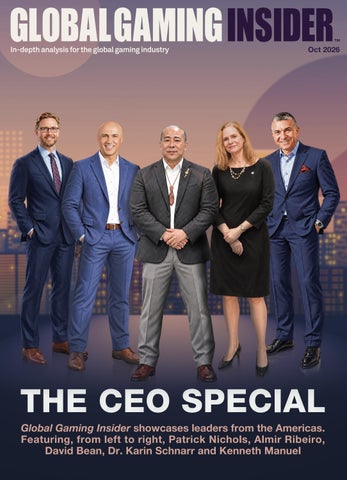
THE CEO SPECIAL Global Gaming Insider showcases leaders from the Americas. Featuring, from left to right, Patrick Nichols, Almir Ribeiro, David Bean, Dr. Karin Schnarr and Kenneth Manuel
COO, EDITOR IN CHIEF Julian Perry EDITOR Tim Poole Tim.Poole@globalgaminginsider.com STAFF WRITERS Will Underwood, Kirk Geller CONTENT WRITERS Marieta Ležaić, Jack Found LEAD DESIGNER Olesya Adamska DESIGNERS Medina Mammadkhanova, Gabriela Baleva JUNIOR DESIGNER Monika Petrova
Julian Perry, COO, Editor-in-Chief
Tim Poole, Editor
EDITOR’S LETTER W
elcome all readers to another CEO Special – the very first Americas edition of the Global Gaming Insider era! I have now been at this publication for over eight years – and a rough calculation extrapolates that to 16 CEO Specials. That means we could reasonably round that up to involvement in 100 different CEO Special interviews... Now, I'd be forgiven for having interview fatigue by this point, right? But believe me as wholeheartedly as you can when I say I love every last CEO Special just as much as the very first. In this issue, please enjoy five in-depth features about some of gaming's finest leaders across the Americas. One sails in their spare time, one used to play football for Corinthians and one had a grandmother who was good at poker! These are the kind of stories you rarely get to see, unveiling the full person behind the executive. Yes, we talk business – for example, I discuss the private-equity model and the cyclicality of Las Vegas in great depth with Patrick Nichols, President and CEO of The Venetian. But we equally get to know the real CEOs, Chairs and Presidents. (Nichols is the one who sails...) Our overarching theme is a representation of the major American markets, implicitly asking: which one is the hottest? We've got Nichols from Vegas and commercial US gaming, while BetMGM Brazil CEO Almir Ribeiro represents Latin America. Joining us from Canada is Dr. Karin Schnarr, CEO and Registrar of the Alcohol and Gaming Commission of Ontario. From Tribal gaming in the US, Indian Gaming Association Chairman David Z. Bean speaks to Kirk Geller, as does Kenneth Manuel, CEO of Gila River Hotels & Casinos. Together, our five interviewees provide a rich tapestry of insight into executive life – and where American gaming is headed across several crucial areas. As always, I would like to extend my gratitude to those who took part, as well as those who helped make these interviews happen! Elsewhere in our October issue, Oliver Lovat provides just short of 5,000 words of forensic analysis on the Golden Nugget's 80-year history. We have placed this special feature at the back of the magazine, so as not to cram it into any section in particular; in effect, it has its own – and I have no objection to it being the very last thing you read (making it the one you may remember most). As ever, we still bring you our regional sections. Americas forms our biggest, naturally given this magazine is being distributed at G2E, and includes a breakdown of the Global Gaming Awards Americas' Executive of the Year category, with the ceremony now very close indeed. In our APAC segment, we hear from lawyer Jamie Nettleton on Australia's major gambling reforms, while we also explore the current situation for operators in India. Over in Europe, we look ahead to the Global Gaming Awards EMEA, as well as an exclusive interview on the Italian market with ACADI President Geronimo Cardia. All this and more in a bumper 100-page magazine! Give yourselves a moment to consume all the content we have to offer. You never know, stopping to take stock may just be the inspiration you need behind your next big idea... TP, Editor
ASSISTANT DESIGNER Tanya Aleksova ILLUSTRATOR Christian Wüst MARKETING DIRECTOR Mariya Savova FINANCE AND ADMINISTRATION OFFICER Svetlana Kamulya HEAD OF DIGITAL Tom Powling VIDEO PRODUCER Callum Flett COMMERCIAL DIRECTOR Deepak Malkani Deepak.Malkani@globalgaminginsider.com Tel: +44 (0) 204 591 3117 ACCOUNT DIRECTOR Michael Juqula Michael.Juqula@globalgaminginsider.com Tel: +44 (0) 207 039 9186 SENIOR ACCOUNT MANAGER William Aderele William.Aderele@globalgaminginsider.com Tel: +44 (0) 203 884 9277 ACCOUNT MANAGERS Irina Litvinova Irina.Litvinova@globalgaminginsider.com Tel: +44 (0) 203 855 0662 Serena Kwong Serena.Kwong@globalgaminginsider.com Tel: +44 (0) 203 787 4615 ACCOUNT EXECUTIVE Joe Church Joe.Church@globalgaminginsider.com Tel: +44 (0) 203 882 9693 AWARDS SPONSORSHIP MANAGERS Michelle Pugh Michelle.Pugh@globalgamingawards.com Tel: +44 (0) 207 360 7590 Ben Bannister Ben.Bannister@globalgamingawards.com Tel: +44 (0) 208 078 2453 CREDIT MANAGER Rachel Voit WITH THANKS TO: David Z. Bean, Geronimo Cardia, Ryan Comstock, Vitor Francisco, Dr. Joerg Hofmann, Patryk Igras, Oliver Lovat, Kenneth Manuel, Jamie Nettleton, Patrick Nichols, Nadia Popova, Almir Ribeiro, Dr. Karin Schnarr, Thomas Schmalzer, Martin Stålros, Rickard Vikström, Dara Cohen, Interblock, IGT and Omniplay
Global Gaming Insider magazine ISSN 2978-5723 (Print) ISSN 2978-5731 (Online) Produced and published by Players Publishing Ltd
All material is strictly copyrighted and all rights reserved. Reproduction without permission is forbidden. Every care is taken in compiling the contents of Global Gaming Insider but we assume no responsibility for the effects arising therefrom. The views expressed are not necessarily those of the publisher.
Raptor. Now Larger Than Life. Putting proven content on a bigger stage. The Raptor A865 combines Ainsworth’s strongest-performing games with our largest and most immersive Raptor cabinet yet giving players more ways to experience the games they already know and love.
October 2026 Global Gaming Insider Ainsworth Ad.indd 1
8/20/26 3:33 PM
CONT 54
58
RYAN COMSTOCK
CEO SPECIAL
AMERICAS
10 Las Vegas
49 Taking Stock
Global Gaming Insider Editor Tim Poole speaks exclusively to Patrick Nichols, President and CEO of The Venetian
18 Tribal gaming
IGA Chairman David Z. Bean reflects on his early years, the legacy of Chairman Ernie Stevens and much more
26 Canada
AGCO CEO Dr. Karin Schnarr speaks to Kirk Geller about how family inspired her career journey
34 Tribal casinos
Gila Rivers Resorts & Casinos CEO Kenneth Manuel goes from the slot floor to the top floor
42 Brazil
BetMGM Brazil CEO Almir Ribeiro provides a deep dive into his career and the wider Brazilian market
50 Movers & Shakers 51 Facing Facts 52 Executive decision
Global Gaming Insider previews the prestigious Global Gaming Awards Americas and the Executive of the Year
54 Making a mark
Ainsworth CEO Ryan Comstock speaks on his ambitions following his permanent appointment
56 10 out of 10
The AGA returns for our October issue, continuing its ever-presence in Global Gaming Insider magazine
58 Tailorable growth
EGT CRO Nadia Popova discusses pressure points and growth opportunities across the Americas
NADIA POPOVA
60 Continental feedback
Novomatic VP Thomas Schmalzer explores the nuances between casino products across North America
62 Patchwork development
Greentube’s Patryk Igras discusses how US regulation has shaped North America
64 Stronger over time
Internet Vikings CEO Rickard Vikström explores key lessons on practical disaster recovery and resilience
66 Trend examination
FBM Director Vitor Francisco talks all things G2E, new market horizons and emerging trends across the Americas
68 Product reviews
ENTS 86
GERONIMO CARDIA
ASIA-PACIFIC 71 Taking Stock 72 Movers & Shakers
Oliver Lovat, longtime Global Gaming Insider contributor and Las Vegas expert, takes a deep dive into the history of the Golden Nugget on its 80th anniversary
79 Taking Stock
74 India: Risk & reward
80 Movers & Shakers
98 Event Calendar
81 Facing Facts
76 A new era Down Under?
82 Global Gaming Awards
77 Product reviews
84 Balanced growth
Australian gaming law expert Jamie Nettleton unpicks the nation’s proposed online gambling reforms
OLIVER LOVAT
EUROPE, BONUS BETS MIDDLE EAST 90 80 years and counting… & AFRICA
73 Facing Facts
Global Gaming Insider evaluates the risk-reward ratio in India and the waning potential for future regulation
90
Global Gaming Insider previews the Global Gaming Awards EMEA ahead of the 2026 ceremony in Barcelona
Global Gaming Insider speaks with Relax Gaming CEO Martin Stålros about the company's 15-year journey
86 Regulatory paralysis
Acadi President Geronimo Cardia explores the lay of the land in Italy’s pressurised market
88 Product reviews
Special Feature p.90
AMERICAS
CEO SPECIAL
THE CEO SPECIAL Featuring (from left to right): The Venetian President and CEO Patrick Nichols (p.10), IGA Chairman David Z. Bean (p.18), AGCO CEO Dr. Karin Schnarr (p. 26), Gila River Hotels & Casinos CEO Kenneth Manuel (p. 34) and BetMGM Brazil CEO Almir Ribeiro (p. 42) 8
GLOBALGAMINGINSIDER.COM
CEO SPECIAL
AMERICAS
GLOBALGAMINGINSIDER.COM
9
AMERICAS
10
CEO SPECIAL – PATRICK NICHOLS
GLOBALGAMINGINSIDER.COM
PATRICK NICHOLS – CEO SPECIAL
AMERICAS
LAS VEGAS: THE RISE OF PRIVATE EQUITY Patrick Nichols, President and CEO of The Venetian, joins Global Gaming Insider Editor Tim Poole to discuss Cornell, The Cosmopolitan, his perfect night out in Las Vegas and the “three-legged stool” that drives The Venetian forward This continued even upon graduating Wall Street.” Nichols, instead, came across the high school, when Nichols studied at Cornell aforementioned posting at The Venetian and was University. “You know, it’s funny. Cornell, for back in familiar territory. “I am very, very happy whatever reason, always gets portrayed as the I didn’t end up on Wall Street,” he breathes in a goofy Ivy League college,” he quips. “Andy sigh of relief. “In fact, I spend a lot of time back at Bernard from The Office, Sideshow Bob from Cornell speaking to students in different classes. The Simpsons both went to Cornell. We’re There’s this appeal that Wall Street has when always picked on.” Admittedly, Nichols attended you’re young and you see big numbers. But there the Nolan School of Hotel Administration is a quality of life and enjoyment that certainly but, again, with “no inkling” that he would comes with the hospitality business.” run a casino resort one day. His studies were less focused on operations and more on the TRIAL BY FIRE financial side. Like many of his peers, Nichols When the Financial Analyst role became harbored aspirations of Wall Street, at the time available, Nichols conducted his research on foreseeing potential pathways into private equity Las Vegas Sands, covering its ethos, property or investment banking. development in Macau and Singapore, and the As events transpired, though, Nichols ended impact of its Founder Sheldon Adelson. There up graduating in 2008 – the year of a global was only one conclusion: this was a “pretty financial crisis, triggered by Wall Street activity cool opportunity” in a “really fun industry.” THE FAMILY BUSINESS “I’ll take you back to the beginning,” Nichols that prompted a US housing market crash. “It “This wasn’t a limited-service hotel. This begins his discussion with Global Gaming Insider, wasn’t the best time to be looking for a job on was the big leagues,” Nichols reflects. “The speaking from his office at The Venetian. “I think I was in third grade and my parents bought this little piece of land on the Mississippi River Valley in Minnesota, where I grew up. They decided to build a very small hotel, call it 40 keys. One hotel turned into six, all small – nothing compared to Vegas – no restaurants, just hotels and pools. And so I really grew up working in these hotels. My mom was an elementary school teacher who retired from teaching to run them. My dad worked in the financial services industry. It was very much a family business. ” Among the list of duties a young Nichols and his sister grew up with were: working the front desk, housekeeping, maintenance, painting and putting in Wi-Fi networks. The now-CEO puts genuine meaning behind the phrase “you name it, I have done it.” Perhaps the most interesting fact about this upbringing, however, was that Nichols thought hotel operations were “not for him.” Partly due to family business dynamics and the cyclicality of hospitality, Nichols felt sufficiently put off from the industry. The Venetian stands tall on the Las Vegas Strip If you’re reading this at the Global Gaming Expo (G2E), consider this your official welcome from Patrick Nichols, President and CEO of The Venetian Resort Las Vegas. In charge of the property since August 2022, Nichols recently celebrated his four-year anniversary at the casino. But, having started as a Financial Analyst at The Venetian & The Palazzo in July 2008, Nichols’ association with the resort goes back much further. Add in time at Singapore with the Marina Bay Sands, alongside almost 12 years at The Cosmopolitan of Las Vegas, and you start to think Nichols was born for the role. And yet Nichols’ connection with hotels goes back even further. Indeed, when we ask if he ever saw himself running a resort – considering his family history – well, actually, yes...
GLOBALGAMINGINSIDER.COM
11
AMERICAS
CEO SPECIAL – PATRICK NICHOLS An example of “a lot of trial by fire” in Nichols’ career, he became Director of Strategic Planning at The Cosmopolitan in October 2010. The switch inspired a 12-year career at the property, which culminated in promotion to the role of General Manager & Chief Strategy Officer. It would be his last position before taking charge at The Venetian, although Nichols never held the explicit goal of becoming CEO of a casino. “I’ve always loved every single job I’ve had and would be perfectly comfortable doing it for the rest of my life,” he says. “I love building Excel models and really getting into the business. But as my career progressed, I realized leading a property is something I should think about.”
Popular (but fictional) Cornell alumni, Andy Bernard and Sideshow Bob diversity of the business – casinos, table games, slots, sportsbooks, poker, hotels, nightclubs, restaurants, bars – was really appealing to me. And in financial planning, you get to see everything. You can see all the numbers; you get to work with different stakeholders who run the business. I would say I learned very quickly.” Although Nichols prefaces that his understanding equated to an “inch of depth,” compared to someone running an individual department who would know it “a hundred feet deep.” Nevertheless, he developed a requisite understanding of how every area of the business works in tandem. This level of knowledge allowed him to “really enjoy” his early time in Las Vegas – and facilitated a move to the Marina Bay Sands in Singapore. Moving to Southeast Asia for a year to be part of the property’s pre-opening team, as Manager of Financial Planning & Analysis,
The Cosmopolitan of Las Vegas 12
GLOBALGAMINGINSIDER.COM
was “great when you’re young, single and can work nonstop seven days a week.” “Never afraid of hard work,” Nichols fell in love with the experience, receiving exposure to different problems and how they were solved by different executives. Nichols still visits Singapore every other year or so, with the Marina Bay Sands remaining a “benchmark” his team looks up to today. But, six months after the Marina Bay Sands opening, Nichols could not resist the chance to open another property closer to home: The Cosmopolitan of Las Vegas. For context, Nichols’ old Venetian team had moved to The Cosmopolitan, where the VP of Finance was now the CFO and Nichols’ direct boss, Walt Fales, was also a VP. Fales called to inform Nichols they were opening a new resort on the Las Vegas Strip, despite Vegas – in 2010 – facing some of its toughest times to date.
“WORK HARD, BE NICE” Nichols is grateful to have had “some fantastic mentors and bosses along the way.” He was placed in rooms he “should never have been in” and presented opportunities he “should never have had.” These mentors acted as backstops for Nichols whenever he was lost or needed help. Biggest of all – returning to the very beginning – was the inspiration of both his parents. “My mom, every day I left for school or work, always told me to be nice,” Nichols recalls. “My dad always told me to work hard. And so I have a poster in my office that says work hard and be nice. That’s my philosophy. Those two simple things go a very, very long way in making someone a successful executive.” Nichols also looks back on “a couple of wonderful bosses.” Fales taught him the discipline and importance of accurate information and presentation, and to always think about the next question someone’s going to ask. At The Cosmopolitan, there was further influence from both CEOs Nichols worked for: John Unwin first
The Marina Bay Sands in Singapore
AMERICAS
CEO SPECIAL – PATRICK NICHOLS
My mom, every day I left for school or work, always told me to be nice. My dad always told me to work hard. And so I have a poster in my office that says work hard and be nice. That’s my philosophy. Those two simple things go a very, very long way in making someone a successful executive taught him about branding, design and creating “something people want before they know they want it.” Later, Bill McBeath, brought in when Blackstone acquired The Cosmopolitan in 2014, taught Nichols about the design, development and culture of a gaming business. There was a bonus motivational factor early on in Nichols’ Cosmopolitan tenure too... “What was cool about The Cosmopolitan, despite financial troubles, was a lot of people said it would never work. That gave the team and me an incredible amount of motivation to prove everybody wrong – that this place will work. So we were very tight-knit; the culture was fantastic and we really believed in what we were building.” Nichols utilized all of these lessons as he rose through the ranks at The Cosmopolitan. Similarly to Bill Hornbuckle, the MGM Resorts International President & CEO who worked his way up through the business, step by step, Nichols ascended every rung of the executive ladder. His roles at The Cosmopolitan, between his first and last, included Director of Business Planning, Senior Director of Strategic Planning, VP of Financial Planning & Analysis, SVP of Strategy and Business Development and Chief Strategy Officer. Plus, Nichols had the front-desk and day-to-day hotel jobs he grew up from his childhood... This holistic combination, tied with his financial planning education, positioned him perfectly for property leadership – especially in Las Vegas. THE THREE-LEGGED STOOL “Coming up from the financial planning side of the business, you’re a partner to all of the operators,” Nichols continues. “Your job is to make them perform as best as they can. When you approach that with a partnership mindset, the operators really bring you into their operations. One person has a different skill set to me – and they’re incredibly financially literate. They think about the business differently than I do. And that balance is, I think, really important. Early in my career, I’d be heavily focused on financial performance. I worked
14
GLOBALGAMINGINSIDER.COM
with an operator who said ‘yeah, financials are one piece of the puzzle, but you also have to focus on the guest service side.’ I learned that lesson over many years, to balance my view of how these resorts should operate. There are trade-offs between prioritizing team member experience versus guest experience, versus the financial experience.” These trade-offs lead us to Nichols’ triedand-tested operating model. Indeed, he thinks about The Venetian’s business like a piece of furniture. Not a BarcaLounger to relax in, but a precise three-legged stool where each leg must be equidistant and, chiefly, equal in length. “The team member experience is on one leg, the guest experience on another and financial performance on that third leg,” the President & CEO explains. “The goal is to balance the stool. If you get that out of balance, the stool falls over. Every year, it should get taller and taller. All those metrics should improve, but it should be in balance and harmony.” Nichols admits: “I learned that through being too focused on the financial side of the business early in my career, partially because I started when the financial performance just wasn’t great. When you start in the recession, an all-time low performance, you’re going to be heavily focused on financials. Similarly, at The Cosmopolitan, when the business opened, it was the middle of the global financial crisis, and we needed to turn a $4bn investment into something profitable.” In terms of operating models, Nichols feels The Cosmopolitan and Venetian are “probably more similar than you’d think.” The scale is very different, with The Venetian holding almost 7,200 suites (compared to around 3,000 rooms at The Cosmopolitan). But the biggest driving factor behind that is The Venetian’s MICE (Meetings, Incentives, Conferences and Exhibitions) business. The perfect example is US gaming’s biggest annual convention, G2E, held at the Venetian Expo and at which this magazine is mass distributed. Nichols adds: “We have 2.2 million square feet. The Cosmopolitan was a couple of hundred thousand.
So our ability to accommodate the largest groups and conventions in the world sets us apart from, really, any resort in the country. That is probably the biggest fundamental difference, the scale and the focus on MICE.” “IT GETS A BAD RAP... BUT I LOVE PRIVATE EQUITY” Nichols feels his tenure at The Venetian so far is, again, “very similar” to that of The Cosmopolitan. For his last seven years at the latter, the property was operated by Blackstone, while The Venetian today is operated by Apollo Global Management. Both represent a privateequity model, which creates a “really fast-paced environment to work in.” The timing behind the ownership transitions of both properties played an important factor in Nichols’ career. Once Blackstone had sold the Cosmopolitan to MGM Resorts, after 12 years under two different owners, Nichols felt his work at the property was complete. At the same time, however, Apollo was buying The Venetian from Las Vegas Sands (Sands now only operates resorts in Asia). Four years on, Nichols’ decision to start afresh at The Venetian – but stay with private equity – is one he looks back on with pride. “I love the private-equity model,” he beams. “I think private equity historically has gotten a bad rap of buy it, gut it and sell it for a profit. My experience has been the exact opposite. It has been significant amounts of capital investment across two casino resorts, significant investment in the team, massive operational improvement and creating a much better business than when we found it. At The Venetian, the strategy has been pretty simple. It goes back to the threelegged stool I talked about. “First, we are highly focused on taking care of our teams. We have some unique things at The Venetian that, to my knowledge, no other casino offers. For example, every single one of our team members has an equity-like participation in the business. We call it The Venetian Red Coin Program. So, when there’s a change of control at some point and Apollo sells, our team members will receive a portion of the profits. And along the way every year, if we hit our budget and guest service targets, there’s a distribution on an annual basis. “I believe we have distributed about $4,300 per team member in the last four years. We now have 9,000 or so team members who are all advocates for The Venetian. They’re all owners. They’re all entrepreneurs. To me, that has been a game changer. Another way we take care of our team members is we pay all of our healthcare premiums. So there’s no deduction on a monthly basis for premiums on paychecks, which for a family of four is thousands of dollars a year. It’s a meaningful difference. And the entire model, the reason why we’re so focused on this, is if a team
PATRICK NICHOLS – CEO SPECIAL member is focused on how they’re going to put dinner on the table tomorrow night, they’re certainly not going to be focused on the guest experience at that moment.” On the financial side, Nichols emphasizes a lack of “corporate decision-making.” If he or his team want to make a decision, they make it. Things can move “incredibly quickly,” demonstrated in how much capital expenditure (CapEx) Apollo has thus far invested into The Venetian. A chief benefit is the ability to focus solely on one property, a “huge advantage in Las Vegas,” without having to prioritize across a portfolio of multiple casinos or development opportunities. As such, Apollo has deployed “north of $1bn of CapEx” into The Venetian over the last four years. The total CapEx plan will be more than $1.6-$1.7bn by the end of 2027 and start of 2028, according to Nichols. The 27-year-old resort, therefore, feels “new.” There are 4,000 renovated suites in The Venetian North and South Towers, while work is being carried out on a new highend product at the Palazzo. There are new restaurants, new bars, new entertainment and, of course, “new neighbors” in The Sphere. With “happy team members, happy guests and operational excellence,” Nichols feels there is no ceiling for how high the three-legged stool can become. LAS VEGAS: THE PERFECT NIGHT OUT As we approach the final topics of our CEO Special interview, we set a test for Nichols. It is equal part industry question, equal part a fun, lighter segment of our discussion. After all, everything Nichols does as President & CEO of the Venetian is designed to get guests through the resort’s doors. So what would his perfect night in Las Vegas involve – both with and without The Venetian? ... AT THE VENETIAN I think my favorite night out right now is a fantastic dinner at Cote, which is one of our new restaurants, a Korean steakhouse that’s phenomenal. They have additional locations in New York, Miami and Singapore. Then I would check out a show at the Sphere. Backstreet Boys is in the building right now – I saw them recently; they still are fantastic. I would wrap it up with some drinks at Electra Cocktail Club at The Palazzo, which is a great ultra lounge and probably the best place to be after any show at The Sphere. It has just incredible energy; a ton of fun. ... WITHOUT THE VENETIAN I would have brunch at a great place like Bardot at Aria. Then I’d walk to Allegiant Stadium, check out a 1pm Sunday Las Vegas Raiders game, and then to the T-Mobile Arena for an afternoon or evening Vegas Golden Knights game – hitting the hotspots along the way.
WHAT ELSE DOES A CEO DO OUTSIDE THE BOARDROOM? For all our strategic discussion on private equity, our CEO Specials also aim to discover the person behind the executive. For example, what does Nichols do outside of work – if there is such a thing for a CEO? To begin with, he and his wife have two children – a two-year-old and a four-year-old – who keep them very busy (and perhaps a little sleep-deprived). Nichols’ favorite thing to do, plainly, is spending time with his family – aiming to teach his children to “see the world the right way.” Nichols’ favorite hobby, though? Sailing! His big passion, racing sailboats is one of the few ways the executive has found to completely unplug. “The teamwork, complexity, hydrodynamics, navigation... There is generally no cell service, although Starlink has changed that recently for everyone who enjoys offshore racing! It’s a great way to disconnect and it’s challenging, when you’re focused on making the boat go as fast as possible and not really thinking about anything else.” Elsewhere, Nichols is very active within his community, focusing particularly on education and food insecurity in Las Vegas. Nevada ranks among the bottom few states nationally when it comes to high school graduation rates. Nichols does what he can in this regard, spending a “significant amount of time” with local organizations who help on the education front, as well as with schools addressing food insecurity. “We have put into place a number of great programs here at The Venetian, the first of their kind, really, to redeploy unconsumed food from large banquets and events, package them up into meals, flash freeze them and get them out to the community through our partner, The Just One Project. So we redistribute hundreds of thousands of meals a year. I think last year the Food Rescue Alliance distributed north of
AMERICAS
250,000 meals to the community. That is very important to me.” Lastly, Nichols is involved with the Board at the Campus for Hope Foundation, which represents a new facility being built in Las Vegas. The aim here is to tackle Vegas’ homelessness problem, without focusing only on housing, but getting people back to being productive, functioning members of society – via healthcare, childcare, education and job placement. The community element is” incredibly important” to Nichols and his wife: “We spend a lot of time on it personally and through The Venetian.” THE BIG QUESTION: WHERE NEXT FOR LAS VEGAS? Of course, there is one big topic we are yet to discuss with Nichols... Since 2025, Las Vegas has been the subject of endless headlines and column inches – many of them for the wrong reasons. Last year, Las Vegas visitation fell 7.5% yearover-year to 38.5 million, while gross gaming revenue for 2026 grew just 1.2% to $15.6bn – with cracks starting to show. December 2025 and January 2026, for example, both saw gross gaming revenue fall – the latter by as much as 6.5% to $1.34bn. There were external economic and policial pressures, naturally, but other factors – like excessive food & beverage pricing and hidden fees – have been endlessly emphasized by influencers declaring the end of Las Vegas as we know it. The truth, of course, is somewhat more measured – with numerous Nevada-based executives speaking to Global Gaming Insider about how Las Vegas has and always will bounce back. Leading a high-end property at the heart of the Las Vegas Strip, Nichols is well positioned to give his take. “Like most businesses, there is cyclicality to Las Vegas,” he explains. “That’s nothing mind-shattering: everybody knows that about Las Vegas. Following four years of pent-up demand coming out of the Covid-19 pandemic,
Sailing is Nichols’ favorite pastime GLOBALGAMINGINSIDER.COM
15
AMERICAS
CEO SPECIAL – PATRICK NICHOLS
I love the private-equity model. I think private equity historically has gotten a bad rap of buy it, gut it and sell it for a profit. My experience has been the exact opposite
Patrick Nichols 16
GLOBALGAMINGINSIDER.COM
when I go back and evaluate it, 2025 was really the return of seasonality to our market – coupled with a disconnection in the broader Las Vegas value proposition. I think there are plenty of resorts, including The Venetian, where the value proposition was intact. I’d say there were others where pricing and the experience – that formula was not synced up. “We saw demand soften, but the value segments of the hospitality industry domestically, across all major metropolitan statistical areas, also saw declines in average daily rates and occupancies. Then you combine that with this disconnected value proposition at the lower end of the market. I’m going to use a buzzword – but you think about the K-shaped economy. The high part of the K, the luxury segment, has performed incredibly well in Vegas and nationally, whereas the value side has struggled. So you get the seasonality, you get the disconnected value proposition. You have a couple of unique things to Vegas, with some of our discount suppliers cutting inbound flights. It made for a perfect storm in 2025.” Considering the source, it is Nichols’ job as a Las Vegas Strip CEO to offer hope. But, considering the logic involved, he is not exactly wrong in doing so. Seasonality has returned but Nevada has seen tougher times in the past, including when Nichols first entered the region post-financial crisis. The market has “not just sat, scratching its head” and several strategies have now been put in place. Nichols openly admits those strategies show Vegas “got it wrong as a destination” and that the “price value proposition was out of sync.” But operators took note, acted and Nichols expects stronger Q3 performance as a result – with Q2 results already showing relative growth, while visitation has grown in recent months. He concludes: “I think we found the bottom. We had a great couple of years of pent-up demand coming out of Covid. And now it’s back to the typical cyclical seasonality. To me, it’s a reversion back to the mean.” Nichols’ confidence is additionally underpinned by the “immense amount of young talent” in Las Vegas. Not only is Nichols a young leader himself, the team in place at the Venetian has youth on its side. Nichols is thus given “great confidence” by the pipeline of talent in Las Vegas who will be “running this town” in the future – and their “incredible passion” for the business. As for the here and now? Nichols has stated his case. MICE continues to drive The Venetian forward, while Las Vegas has taken stock of 2025’s “seasonality” issue. Private equity is unlocking for Nichols the quick decision-making so often celebrated by Tribal operators – and bemoaned for its absence within larger corporations. Utilizing those advantages, this Las Vegas Strip leader will stick to his personal operating model. If the team remains happy, the guests keep returning and financial performance continues to grow, that three-legged stool will only keep rising.
U AT
SEE YO
AS 2026 G E V S LA 1259 BOOTH #
NOVOMATIC AG · Global Sales +43 2252 606 220 · sales@novomatic.com · www.novomatic.com
09_2026_VisionLink_G2E__210_290mm_GamblingInsider.indd 1
07.08.26 10:19
AMERICAS
18
CEO SPECIAL – DAVID BEAN
GLOBALGAMINGINSIDER.COM
DAVID BEAN – CEO SPECIAL
AMERICAS
TRIBAL GAMING: SOVEREIGN SUCCESS Preparing to celebrate the one-year anniversary of becoming IGA Chairman, David Z. Bean joins Global Gaming Insider’s CEO Special to reflect on his early life in Washington, current threats to Tribal gaming and the legacy of former Chairman Ernie Stevens Jr. Sometimes, life can be like a box of chocolates. You never know what you’re gonna get... For Indian Gaming Association (IGA) Chairman David Bean, the phrase couldn’t ring more true. Growing up as a member of the Puyallup Tribe in Washington State, Chairman Bean learned early on the difficulties of attempting to generate economic self-sufficiency, as well as the mistreatment those living in the reservation faced from neighboring communities. Despite federal governments’ intentions to “kill the Indian and save the child,” Chairman Bean’s Puyallup Tribe managed to expand upon Native American culture and history by supporting the classes at the Tahoma Indian Center that led to the development of the Chief Leschi Elementary School. There, the future IGA Chairman learned of various Tribal songs, traditions and values from reservations across the US, but was also “aware” enough to question where much of the same lineage rested for his own homeland. The Puyallup Tribe was no stranger to the hostility many reservations faced when attempting to establish independence in the US, forcing an alternative type of “immersion process” for those of Chairman Bean’s generation. CLOCKING IN EARLY While the Washington native would eventually come to learn of Puyallup songs and dances in his later scholastic years, his childhood knowledge of Tribal values had been through a more hands-on approach. Before turning 10 years old, Chairman Bean sold his first carton of cigarettes (Camel
non-filters) while assisting at his mother’s smoke shop, even recalling having to count out the change for a $5 bill on the $3.75 charge. “I’ve been making sales ever since,” Chairman Bean tells Global Gaming Insider. “The rest is history. But being an entrepreneur family, selling cigarettes, selling fireworks, it was cyclical. There were challenges from the State Government (and) the Federal Government against our right to engage in commerce or regulate commerce. Me seeing our rights being trampled on, not respected or recognized, in the middle of it I didn’t understand the magnitude. But in reflection, I knew that we were exercising sovereignty. As a child, we’re trying to regain our songs, language, dances and way of life, so that was my lesson very early on. That was my exposure to Tribal sovereignty.” Along the way, Chairman Bean was rasied by the “badass” women of the Puyallup Tribe, who had no issues starting their own means of economic self-sufficiency – even during a period where female leadership was still quite rare. Through his time at the smoke shop, working firework stands and manning concession booths at powwows, Chairman Bean was slowly learning the ins and outs of running a business. I learned to communicate and to count. I became really good with numbers. I was phenomenal with numbers. While my friends were playing, and I was working, I learned how to manage an operation, inventory control, cash handling and keeping track of sales,” he recalls proudly.
ONE PUSH-UP AT A TIME During his teenage years, Chairman Bean would run into two crucial figures who also shaped his eventual path to Tribal leadership in Michael Pavel and Chuck Bingham. Both University of Puget Sound graduates, the duo helped direct Chairman Bean toward pursuing an accounting degree at the in-state institution, as well as offering a life lesson that still remains with the Chairman to this day. When Bingham – serving as Chairman Bean’s physical education teacher at the time – asked the Tribal executive to complete 10 pull-ups, Bean exclaimed he “can’t,” which wasn’t going to fly with the 6’3” 225-pound instructor. “Can’t?” Bingham questioned, “Give me 25 push-ups.” Whether it was because he “got really good at doing push-ups” while under Bingham’s tutelage or not, Chairman Bean quickly learned that “can’t” must be eliminated from his vocabulary. “I was capable of doing whatever I set my mind to. That was a powerful lesson. And respect, not just for others, but respect for myself too,” Chairman Bean said. After missing the application deadline to attend the University of Puget Sound, however, Chairman Bean had to put Bingham’s mantra to work right away and met with the program’s admissions team to secure a late entry. Having managed to put together an impressive list of references, Chairman Bean was admitted into Puget Sound by former Associate VP of University Relations Geroge Mills, and continued on his way to pursue a career in finance and accounting.
I don’t want to fill those shoes, I simply want to walk in his footsteps GLOBALGAMINGINSIDER.COM
19
AMERICAS
CEO SPECIAL – DAVID BEAN
In his junior year, though, Chairman Bean discovered a new flavor profile for his future career, adding political science classes and finding his interest in politics. While Chairman Bean’s excitement about potentially running for counsel on the Puyallup Tribal Government was quickly growing, others questioned whether he was “sure” such a choice was truly his best path forward. Professor Bill
Haltam, for example, had been familiar with the Tribe and was forced to chuckle at his pupil’s optimism; perhaps not quite understanding the depths of motivation Chairman Bean held as a Native member. Fast forward to 2006 – and past 10+ years of working for Puyallup’s economic development arm – Chairman Bean found himself elected to serve on the very same Tribal council he grew
Chairman Bean with the late Chairman Stevens
20
GLOBALGAMINGINSIDER.COM
up under. Coincidentally, Chairman Bean’s first appointment as a Council Member was a meeting with Baarsma, who had become Mayor of Washington just five years earlier. It appears a life in politics was set in stone for both parties – a rather ironic twist for the Puget Sound scholar. DINNER FOR TWO To begin his work in Tribal government, Chairman Bean first tasked himself with improving the relationship Puyallup had with neighboring western Washington communities, as the Fishing Wars of the 1960s and 1970s created noticeable “animosity” between the two sides. Understanding that fights on the federal level would require state support, Chairman Bean “broke bread” with fellow state and local government leaders, believing a simple meal is the beginning of building a strong working relationship. “You can sit down and have a formal meeting,” Chairman Bean explains, “but you’re not really going to get to know folks. When you share a meal, something happens. Folks start to get comfortable, they let their guard down, you learn about their values and their priorities and they learn about yours at the same time. “Those, for me, were some defining moments in terms of bridging relationships with people who historically did not get along with us because we were reclaiming our lands, which obviously decreased their tax base. I had to let them know we have far more in common than differences, and I believe we can get a lot further by working together – because neither of us are going anywhere until we collectively recognize that.” As Chairman Bean continued his career in Tribal government, the elder leaders who had served their Tribes for decades began passing the baton to Bean after noticing his drive to “jump in wherever I could.” Chairman Bean began representing the Puyallup Tribe at various conferences and meetings, and before fellow Tribal organizations, eventually catching the eye of those leading at a more national scale. In 2009, IGA – then known as the National Indian Gaming Association – asked Chairman Bean to serve as Northwest Region Representative, a transition that would allow him to remain close with former IGA Chairman Ernest “Ernie” Stevens Jr. Chairman Bean represented then-Chairman Stevens with high-energy during this period, ensuring he was always “in the front row asking questions.” Despite Chairman Bean standing at 5’6” and weighing “180 pounds soaking wet,” he was still able to make a name for himself in Tribal government by sticking with the 6’5” IGA leader at every opportunity. Chairman Bean adds: “I did the same
AMERICAS
CEO SPECIAL – DAVID BEAN
at the National Congress of American Indians. I positioned myself so wherever the congressional representatives that were speaking came off stage, I was there to shake their hand, take their card, introduce myself and try to develop a relationship. It’s the same thing I did with the cities locally and early on in DC. An observation I made was these are folks who we have a lot of commonalities with, and it’s very easy to go into a friend’s house and have a conversation about issues we have in common. I knew from listening to folks that we need both sides of the aisle to get legislation moving. The pendulum swings from left to right, so you have to make friends on both sides. Nobody stays in power forever. I told them, ‘Put me in the unfamiliar, the unfriendly and I’m going to come out with a familiar friend.’ And I’ve been doing that ever since.” MOTHER’S INTUITION By 2017, both Chairman Bean and Chairman Stevens were caught by surprise when elder members of the Board nominated the Northwest Region Representative to become IGA Vice Chairman. Picture the towering Chairman Stevens looking down at Chairman Bean asking if he knew about the nomination prior, only for his protégé to quickly explain the elders had come to the decision on their own. While the duo may not have been expecting such a nomination, the choice had long been coming after Chairman Bean
developed a reputation for “rolling up my sleeves and getting involved.” It was also one his mother had anticipated for most of his life, well before Chairman Bean was first elected to the Puyallup Tribe Council. Chairman Bean’s mother passed away in 2002 after a battle with cancer. Chairman Bean recalls a special moment his wife recounted from 2016, less than 12 months before his appointment as IGA Vice Chairman, when his mother told her that his place was always going to be in leadership and advised her of those expectations. “My mom didn’t like too many of my girlfriends, but she told my wife, ‘I’m going to share this with you, and if you’re around, and I hope you are, this is what you need to do. I raised him to be a leader. He’s going to lead the Tribe, and he’s going to work nationally.’ She also told my wife what to expect as a Council Member, including the attacks, the long hours, the travel, and the commitment to the community,” Chairman Bean said. “Then, she also told her, ‘this is what you need to do to put him back together and send him out there every day.’ Mind you, that was 2016-2017, and my mom passed in 2002. My wife held on to that for a long time. I don’t know why she chose that time to share it with me, but she did. And it was an incredible birthday gift. Shortly thereafter, I got selected to serve as Vice Chair; so maybe they’re all connected, maybe not. “But the foundation was rooted in all the
Speaking on behalf of Tribes is a passion and a privilege for Chairman Bean 22
GLOBALGAMINGINSIDER.COM
things my mom did in terms of exposing me to different Tribal regions, making sure I had our language, making sure I was present and available for all of our ceremonies and making sure I was always working. Again, while my friends were playing, I thought I was in trouble. All those things came into perspective. I did not like those lessons then, but I appreciate them now, because they all contributed to who I am today.” While being the son of such a remarkable figure in the Puyallup Tribe came with being deemed as “Gloria’s boy” for much of his life, Chairman Bean was eventually able to “earn (my) name” and “make my own way.” Chairman Bean stepping into the Vice Chairman role for IGA came at a crucial time for the Association, as the overturning of PASPA and new growth across online gambling brought forth heightened threats – and opportunities – to Tribal sovereignty. Reservations began fighting for the right to offer sports betting in their respective states, beginning with New Jersey and Chairman Bean’s own Washington State in 2020. MISSED BEYOND MEASURE… Still, the difficulties which stemmed from the Covid-19 pandemic affected Tribes in a similar fashion, or even moreso, to those who were forced to close the doors of gaming destinations worldwide. Alongside his work in Washington and on the national stage, Chairman Bean was in the midst of managing
DAVID BEAN – CEO SPECIAL his own smoke shop and fireworks business back home – one he originally acquired from an aging Tribal member in 2006 and still runs today. Coming from a life built around perseverance, Chairman Bean helped his reservation and fellow Indian communities across the US endure the downswing and come out stronger on the other side. From fiscal year 2021-2025, Tribal gaming has managed to set new records in gross gaming revenue for each period, showcasing the resolve that has sparked the industry for generations. In late 2025, IGA – and Tribal communities everywhere – would need to show such persistence once again, as the industry was hit with a devastating loss following Chairman Stevens’ sudden passing on September 26. Having constructed one of most renowned legacies in Tribal history, Chairman Stevens’ passing left behind massive shoes to fill, both “literally and figuratively,” although the man preparing to step into the role knew such a feat could never be achieved. “I don’t want to fill those shoes, I simply want to walk in his footsteps,” Chairman Bean explained to Global Gaming Insider. “We all lost a relative, a big brother, an uncle figure, a father figure and so we move forward with heavy hearts. We move forward respecting his legacy. So when I say we want to walk in his footsteps, we want to do so as he walked in the footsteps of his predecessors. That made it a little bit easier, and knowing the team that
supported him is the same team that supports me now.” There’s an awful lot you can tell about a person by their shoes, and Chairman Stevens’ exemplified his substantial impact on Tribal gaming and the industry as a whole throughout his life. Chairman Bean was no stranger to taking over leadership in the midst of a difficult period for Tribal gaming, thankfully, having been elected as Puyallup Tribe Chairman less than a year before Covid-19 hit the US. Utilizing his ability to “thrive in a chaotic environment,” Chairman Bean carried the leadership and legacy of Chairman Stevens into the Global Gaming Expo (G2E) in Las Vegas less than two weeks after his passing, as well as the IGA Tradeshow & Convention last March. Having triumphed (to a strong degree) in the battle against sweepstakes casinos and illegal online gambling, other prominent adversaries still await the Tribal executive as he approaches the one-year anniversary of becoming IGA Chairman. TRADING ONE THREAT FOR ANOTHER As IGA takes on new threats to Tribal gaming – none greater than the rise of prediction markets – Chairman Bean still remembers the lessons passed down by his predecessor, especially when fighting on the federal stage in Washington DC. Joining Global Gaming Insider for the CEO Special less than 24 hours before speaking in front of US lawmakers,
AMERICAS
Chairman Bean recalled having to balance the desire to challenge certain politicians with the need to gain support from “both sides of the aisle.” Having been taught that people own “two ears, one mouth” and he should “use them proportionally,” Chairman Bean understands the “polarization of politics” doesn’t allow for much pushback until a potential connection has already been lost. Addressing prediction markets’ growth since 2025, Chairman Bean shares: “It’s spread like wildfire and what we’re doing right now is pushing a snowball uphill. The slope’s getting steeper because of folks like Chairman [Michael] Selig [of the Commodity Futures Trading Commission], who interprets the Commodity Exchange Act to allow sports betting. We’re trying to get congressional represntativess to take action, but the moment they hear a member of the President’s family is involved, all of a sudden they don’t know what’s going on; or they need to learn more about it because the reality is they don’t want to upset the big boss. “The moment they take action, guess what? Their head gets chopped. We met with Chairman Bozeman of the Appropriations Committee and he opened up by saying ‘what we’re dealing with is a choice between friends.’ I respectfully pushed back and said ‘we’re not asking you to make a choice between friends. We’re asking you to follow the law.” Believing a Tribal victory against prediction markets would only require US
GLOBALGAMINGINSIDER.COM
23
AMERICAS
CEO SPECIAL – DAVID BEAN
politicians to “follow the law,” Chairman Bean remains confident Tribal gaming will find ways to thrive even in the face of swelling competition. IGA’s leader referenced the “hard work, sacrifice and unified efforts” Tribes have put in to generate economic self-sufficiency
throughout their history and his desire to expand the industry even further by 2027. While the Chairman admits such aspirations are quite “aggressive,” dreams of growing the IGA conference by “50%” are also on the cards for helping extend Tribal gaming’s presence across the US.
I was capable of doing whatever I set my mind to. That was a powerful lesson
Chairman Bean
24
GLOBALGAMINGINSIDER.COM
According to figures such as Chairman Bean, California Nations Indian Gaming Association Chairman James Siva and IGA Conference Chair Victor Rocha, iGaming is also a path soon to be explored by Tribal leaders. With the belief Tribes “have to embrace technology” to continue innovating, Chairman Bean compared Indian gaming’s relationship with online gambling to Blockbuster’s eventual demise due to streaming services, stating “if we are not careful, we will suffer the same fate.” Nonetheless, Tribal gaming’s success since Covid-19 helps showcase the industry’s ability to keep pace with corporate-led operators both in the US and across North America as a whole. Even with the iGaming growth witnessed in Canada and LatAm over the past 12 months, online gambling becoming more accessible to Tribes could hold more potential than gaming has seen since – ironically – the introduction of prediction markets. How Chairman Bean chooses to pursue such opportunities, and defend the industry from historic threats, may represent the most defining stage in Tribal gaming history. THE ROAD AHEAD Chairman Bean’s ability to thrive in the midst of chaos will be tested no greater than in the regulatory tug-of-war between prediction markets and regulators across the US. Protecting Tribal sovereignty from the dangers of event contract trading is not the Chairman’s only task, however, as carrying the legacy of those who came before him is as pivotal a duty as ever for industry leaders. While Chairman Bean’s conviction that no one can step into Chairman Stevens’ shoes is both realistically and figuratively correct, it doesn’t mean the responsibility that falls upon him is no lighter than that carried by IGA’s former leader for so many years. The battle with prediction-market operators will alter Tribal gaming for generations, either because figures such as Chairman Bean come out victorious or the ultimate need to adapt in a world where swaps and event contracts become the norm. As covered prior, it’s also the Chairman’s responsibility to guarantee Tribal operators continue to innovate in the years ahead, as the opportunities which lie with online gambling are quickly becoming too incentivized to ignore. Chairman Bean is up to the task, though, as the “Forrest Gump life” he’s enjoyed up to this point has featured the twist and turns typical of a leadership position in Tribal gaming. Nearly 12 months down as IGA Chairman, Chairman Bean’s focus is now to construct a legacy those who come next can carry on for generations. Run Chairman Bean, run.
AMERICAS
26
CEO SPECIAL – DR. KARIN SCHNARR
GLOBALGAMINGINSIDER.COM
DR. KARIN SCHNARR – CEO SPECIAL
AMERICAS
ONTARIO: BEST IN CLASS
Dr. Karin Schnarr, Alcohol & Gaming Commission of Ontario Registrar & CEO, tells Global Gaming Insider’s Kirk Geller how her mom – and gambling grandma – inspired her career journey, and how she sees unity, rather than competition, in Alberta’s iGaming launch
It can be difficult to spot the sharks sat ready and waiting at table games and slot machines on a casino floor. It becomes even more of a challenge when one of those sharks is a “cute little” grandmother who can appear harmless to the naked eye. That would’ve been the grandmother of Karin Schnarr, Registrar & CEO of the Alcohol and Gaming Commission of Ontario (AGCO), who first developed an interest in gambling by watching the leading women in her life build a reputation as forces to be reckoned with on the poker and blackjack tables. “I never remember a time when we didn’t play euchre, rummy or cribbage. You hear stories about grandparents where they let the kid win; my grandma was never like that – and we always played for money,” Dr. Schnarr reflects with Global Gaming Insider. “You learn to be good at cards very early on when there’s always money at stake. I’d go down to Las Vegas with my mom and grandma, who was this cute little lady and she’d go to the tables where people would look at her like ‘oh, how nice.’ And she’d clean their clocks.” Dr. Schnarr recalls a family trip to Las Vegas, when her brother mistakenly believed he was up to the challenge of playing at the same table as their grandmother, only to be “cleaned out as well” by the delightfully ruthless gambling alpha. “It didn’t matter that he was blood,” she says, “poker was poker, and she took that very seriously. We didn’t come from a family of means so we grew up playing cards. I think my love of gaming also came from my mom… she was an avid blackjack player; she loved the game.”
WANDERING EYE Despite the young interest in gambling, the future AGCO leader also developed a passion for optometry after babysitting for a family who ran one of the largest optical chains in Canada. Having grown up in Kitchener, Waterloo – known for hosting the second-largest Oktoberfest outside of Munich and as the birthplace of BlackBerry – Dr. Schnarr was able to stay local and attend the University of Waterloo with little worry of the financial handicap felt by present-day students. The University offered Canada’s only English-speaking optometry school, a “coincidental” positive as she continued her scholastic career. Unfortunately, Dr. Schnarr quickly discovered that “if you don’t like physics, optometry is a terrible career choice,” and chose to shift her academic focus to English while finishing the credits necessary to obtain an additional degree in biological sciences. After graduating from the University of Waterloo with dual bachelor’s degrees, Dr. Schnarr referred back to the “service-oriented” mindset instilled
by her parents and joined the Government of Ontario as a Legislative Assistant. Even while a career in politics may not have been the future Dr. Schnarr envisioned when she first got accepted to the University of Waterloo, history shows it might’ve been a career path destined for quite some time. Dr. Schnarr recalled how her father sat on a number of Boards for various community initiatives, while she would also go door-to-door with her mom handing out pamphlets for local political candidates. In yet another happy accident for Dr. Schnarr’s eventual journey to AGCO Registrar & CEO, a lack of funding to attend Purdue University led to her accepting the Government of Ontario appointment, a moment she sees as “being at the right place at the right time.” “My ultimate plan really was to do a PhD in English and finish my Master’s at Queen’s University. I got accepted at Purdue and my funding fell through at the exact time the party I supported won the provincial election in 1995. I’d never intended to have a career in politics; I always thought I was going to be an
To lead this organization… it’s challenging some days, but it’s hands down the most fun and interesting job I will ever have in my career. It’s an exciting place to come to work every day – and not everybody gets to say that GLOBALGAMINGINSIDER.COM
27
AMERICAS
CEO SPECIAL – DR. KARIN SCHNARR
academic. I loved the experience as a young person in politics. You’re not paid well and there’s no job security, but the opportunity to be at those tables, learn, listen and move up the chain quite quickly if you’re a hard worker. I never looked back.” ACADEMIC ACTIVITY Dr. Schnarr ultimately chose to depart the Government of Ontario to work in management consulting by 2003, a move which would jumpstart her return to academia just three years later. In an effort to secure her MBA, Dr. Schnarr moved from Canada to London to attend the Ivey Business School at University of Western Ontario, where she also worked to secure a PhD in Business – General Management from 2009 to 2015. While a return to student life offered challenges she had not faced in almost a decade, including the transition from a “really good salary” to living off $25,000 a year, it reminded the gaming executive of “just how much I loved academia.” Even with dreams of teaching in Nevada or Arizona given her love for warm weather, Dr. Schnarr instead chose to undergo “one of the world’s biggest ironies” and return to Waterloo as an Associate Professor at Wilfrid Laurier University in July 2014. Shifting to the Lazaridis School of Business & Economics from 2020-2023, Dr. Schnarr found herself with an opportunity to re-join gaming in 2022, right as Ontario was about to embark on Canada’s first regulatory foray into iGaming. Coming
Gaming is a sector where we have to make sure we have strong protections from a regulatory perspective while also not overburdening the industry. We want people to invest and create all of those great jobs because there’s absolutely an economic benefit out of the Covid-19 pandemic, Dr. Schnarr was tasked with a number of initiatives by the Ontario Government – one of which included overseeing a taskforce to help female entrepreneurs and university graduates. Once the taskforce concluded, Dr. Schnarr was asked to sit on the Board of iGaming Ontario as the provincial gaming manager was first being established, helping “reignite” her passion for the sector. DOORS OPEN IN ONTARIO Despite currently maintaining organizational independence, iGaming Ontario originally began as a subsidiary of the AGCO, providing Dr. Schnarr with a better understanding of how both entities helped regulate the province’s newest revenue generator. Before long, the young professor found herself swapping the responsibilities
of university life for those more directly tied to gambling, including sports betting, iGaming and the role her new organization would play in establishing Canada’s inaugural regulated market. While Dr. Schnarr and her colleagues attempted to remain modest with initial revenue projections, the CEO shares how such estimates paled in comparison to Ontario’s immediate success. She recalls: “I remember in one of my very first meetings, the financial projections we had going into the market were so spectacularly off in terms of the success we saw even very early on. It was always changing and very dynamic to see how that developed, especially while things like sports integrity were coming up for the first time. “We absolutely didn’t get it perfect the first time, so how can we learn and
I’m incredibly privileged to head an agency where I get to think about public good 28
GLOBALGAMINGINSIDER.COM
AMERICAS
CEO SPECIAL – DR. KARIN SCHNARR
continue to evolve and improve? It’s a balance. Gaming is a sector where we have to make sure we have strong protections from a regulatory perspective while also not overburdening the industry. We want people to invest and create all of those great jobs because there’s absolutely an economic benefit. You’re always trying to balance both sides of the coin.” From 2022-2023, active player accounts in Ontario rose 115.9% to just over eight million, while total handle generated by licensed operators reached $59bn and increased 173.4%. In 2025, there were nearly 13.5 million active player accounts reported across Ontario, with the province’s handle set to eclipse $100bn for the first time during full-year 2026. In the midst of such growth, former AGCO Registrar & CEO Tom Mungham had announced his intention to step down from the position by the fall of 2023, resulting in a “very wide open search” for the regulator’s next leader. Even with limited experience in gaming, a background in strategic planning and government operations gave Dr. Schnarr an advantage... NEXT IN LINE “I came from a very different background,” Dr. Schnarr explains, “I’m not someone that has a depth of experience in the gaming space. But what I did bring to the table was a depth of experience in strategic planning, change management and an understanding of how the government operates. I was fortunate to be there because I know there were a number of really amazing people that also tossed their hat in the ring; so I’m just grateful to the Board for giving me the opportunity.” But Dr. Schnarr still had to consider one crucial factor. The same factor that had driven
her original interest in gaming all those years ago: family. Knowing the Registrar & CEO title would include a full-time move to Toronto, Dr. Schnarr and her husband discussed the challenge of being separated from her youngest daughter, who was about to start university in 2024. “I said to my husband, ‘I’m really busy, our younger daughter’s starting university next year; I want to make sure she’s supported, we would have to be separate. I would not want to try and do this job part-time.’ And he replied, ‘Karin, this is an amazing opportunity. These don’t come up very often. But not only is it good for you, it’s an unbelievable opportunity for you to model leadership behaviour for our daughters,’ and I’ve never forgotten that.” Beginning her tenure as AGCO Registrar & CEO in September 2023, Dr. Schnarr’s original belief was that her focus would mainly centre around the “big r” rather than the CEO title. Instead, she soon discovered “exactly the opposite,” as becoming head of the AGCO came with responsibilities “no different to running a private sector company.” A noteworthy reminder is the AGCO Registrar & CEO title extends past gambling, with Dr. Schnarr additionally having to account for personnel monitoring liquor, cannabis and horseracing. Continuing the work of her predecessors, Dr. Schnarr has aimed to continue transitioning the AGCO from a “very structured regulatory system that heavily burdens ourselves” to an outcomes-based model. AT YOUR OWN RISK Within the past 12 months, the AGCO has enforced regulatory penalties on operators such as FanDuel, theScore, Great Canadian Entertainment and PointsBet, showcasing an ‘actions have consequences’ mentality. Speaking on gaming’s constant expansion,
I truly valued my experience participating in politics as a young person. The salary isn’t very high and job security is uncertain, but being part of those conversations, learning, observing carefully, and progressing rapidly if you work hard is a unique opportunity. I never had any regrets
30
GLOBALGAMINGINSIDER.COM
the newest threat to regulators such as the AGCO has come in the form of prediction markets, which have been dominating headlines since early 2025. Backed by multi-billion-dollar valuations, the likes of Kalshi, Polymarket and Crypto. com have generated inconceivable amounts of trading volume since the US’ interest in the sector first catapulted. While many US states are currently tied up in prediction market legal battles, Ontario and Canada’s financial regulators have thus far limited their spread. The AGCO Chief explains: In Ontario, we already have a very open, welcoming and successful iGaming market. In some of the US states, it was a bit of a workaround if they didn’t have legal sports betting markets in place. We have a very robust, legal sports betting market. We’ve certainly been having a lot of conversations with the Ontario Securities Commission because they regulate the financial side. Any product that falls into the category of sports betting and gaming needs to have those controls and governance to be regulated according to the laws of the land.” The AGCO is certainly not the only organization keeping on eye on prediction markets in Canada. Collaborating with government, iGaming Ontario, the Canadian Gaming Association and Ontario Lottery and Gaming Corporation remains a top priority for Dr. Schnarr on this and numerous other files. Looking to avoid duplicating efforts with her counterparts, she highlights how each is trying to work in a coordinated fashion during an extremely complex time for the industry. “We are all trying to make sure we have a fair, legal, responsible gaming system in Ontario that’s going to provide a lot of comfort for players, whether it’s through iGaming or visiting one of our casino properties,” Dr. Schnarr said. “When iGaming Ontario separated, it made it a lot easier and a lot cleaner, because there wasn’t the potential for conflict of interest that can come up at times. It’s worked incredibly well. I was literally on the phone with the CEOs of those organizations this morning as part of a group conversation. Members of our teams, whether it’s legal, operations or policy, are always communicating.” CANADA’S NEXT STEP FORWARD Recent gaming expansion in Canada brought forth Ontario’s first local competition since the sector’s inaugural launch in 2022. On July 13, Alberta officially debuted regulated iGaming with more than 50 operator registrations, featuring many of the same organizations that have already set up camp in Ontario.
DR. KARIN SCHNARR – CEO SPECIAL
AMERICAS
Dr. Schnarr and fellow Ontario regulators actually helped Alberta ensure a successful launch, with both provinces more inclined to work in harmony rather than against one another. We asked whether she views Alberta as possible competition to Ontario’s iGaming future, with Dr. Schnarr responding that she “100%” does not, and would even “encourage” other provinces to follow in the same footsteps. Describing the new launch as “absolutely fantastic,” Dr. Schnarr remembers seeing Alberta regulators in Florida “counting down” to July 13. She concludes: “We want to encourage investment in gaming communities as more provinces start to think about this. Where can we make sure the rules are as similar as they possibly can be so that, if you’re investing in Ontario, it’s easy to invest in Alberta and other markets? Alberta was a really great partner with us for that. It’s a very similar system. There are a couple of places where they’re a little bit different, where we’re actually looking to say, ‘is this something we should be adopting?’ So I’m really excited about the launch. While the AGCO Registrar & CEO remains “open to learning” from fellow regulators – especially in regards to market entry, consumer protection and payment providers – Ontario refuses to “get too distracted by what other jurisdictions are doing.” In cases where gaming collaboration takes precedent, however, Dr. Schnarr finds herself returning to her academic and political roots. RETURNING TO YOUR ROOTS As a consistent panelist at events such as G2E, the former professor notes her ability to “talk for three hours about absolutely nothing,” as well as her love for establishing a stronger connection with coworkers. Not needing people to “come and find me in my ivory tower,” Dr. Schnarr is “very comfortable going to find them.” “When I look back at my career, I would have never thought this is where I would end up, but I can see all of these amazing steps that have landed me where I am. To lead this organization… It’s challenging some days but, hands down, it’s the most fun and interesting job I will ever have in my career. It’s an exciting place to come to work every day – and not everybody gets to say that,” Dr. Schnarr remarked. “I’m incredibly privileged to head an agency where I get to think about public good. I am never going to be able to compete with the private sector in terms of what I can offer for compensation, so I’ve got people that are here because they love what they do. They love protecting
Dr. Karin Schnarr
GLOBALGAMINGINSIDER.COM
31
AMERICAS
CEO SPECIAL – DR. KARIN SCHNARR
people and they believe we’ve got the best possible system.” In familiar terminology for Global Gaming Insider, Dr. Schnarr spoke on “drinking from a fire hose at the very beginning” of her tenure with the AGCO, and still wishes she had “more hours in the day sometimes.” Despite not having
the “luxury” of focusing solely on gaming, Dr. Schnarr’s experience juggling multiple responsibilities dates back nearly 30 years ago to her studies... “I love my job. Every single one of my sectors is interesting. We as an organization are going through transformation in some of our strategic planning functions, to
ensure they’re up to date with the newest technologies and, quite frankly, create an offer with the best possible customer experience. Every day there’s a new technology tool that helps us with that.” The minnow, much like her late grandmother, has slowly become the shark in gaming regulation.
I’m incredibly privileged to head an agency where I get to think about public good. I am never going to be able to compete with the private sector in terms of what I can offer for compensation, so I’ve got people that are here because they love what they do - Dr. Karin Schnar
Dr. Schnarr in conversation with industry stakeholders 32
GLOBALGAMINGINSIDER.COM
A LEADER TRUSTED BY THE WORLD.
Contact us:
· 1xpartners.com · support@1xpartners.com
AMERICAS
34
CEO SPECIAL – KENNETH MANUEL
GLOBALGAMINGINSIDER.COM
KENNETH MANUEL – CEO SPECIAL
AMERICAS
TRIBAL CASINOS: A COMPETITIVE EDGE Gila River Resorts & Casinos CEO Kenneth Manuel tells Global Gaming Insider’s Kirk Geller his story, from working on the slot floor to eventually leading his reservation’s biggest economic engine The story of the Gila River Indian Community dates back as far as 6,000 years, featuring tales of how the reservation eventually established and maintained its economic independence in Arizona. Much of its history – similar to fellow Tribes across the US – was built upon overcoming obstacles, all while attempting to safeguard the values that had been passed down for generations. Such narratives helped inspire numerous Tribal members. One of them was Gila River Resorts & Casinos CEO Kenneth Manuel, a native of the reservation’s District Four community – Stotonic. Even as a lifelong member of the Tribe, though Manuel’s passion for gaming and hospitality was more of a “right place, right time” scenario, having begun his career on the slot floor of the original Lone Butte Casino property in 1994. And he’s far from the first executive to tell us similar. While the future CEO had “no aspirations for anything larger than what I was doing at the time,” his commitment to hard work and leadership agreed to disagree. CATCHING THE EYE At just 21 years of age, Manuel had already captured the attention of those leading the Gila River Indian Community and its gaming operations, beginning his journey. Bringing along the “ethics taught to me by my parents and family members,” Manuel rose to hold the Supervisor, Manager and Acting Director titles for Lone Butte Casino’s slot department, overseeing the same sector he had started in just a decade earlier. Working in slots came with overlaps across fellow Gila River departments, however, helping Manuel establish the relationships that came to support his transition to CEO, and which still last to this day. The Gila River Resorts & Casinos CEO tells Global Gaming Insider: “You interact
with so many different departments.You’re interacting with the security departments, with all of the operational departments that exist in our hospitality industries. Food and beverage, cage cashiers, surveillance, just to name a few. That enabled me to have direct contact and established relationships with those folks, and today many of those still exist at our properties. “That’s truly one of the unique things about my experience; I’ve grown up here. I know I may not fit the mold of traditional corporate CEOs, but I’m pretty happy about my path and where I’ve landed today. I still have those same relationships, and what’s really interesting is a lot of the folks I worked alongside throughout my early career, some of their children are now working for our properties; which is both exciting and tells the tale of how old I am.” Manuel’s rise to leadership did not come without studying, as he attended management programs at both the University of Nevada, Reno and Cornell University. Former Gila River Gaming Enterprises CEO John James had “built a path” for the young Manuel. On top of his lessons in Reno and at Cornell, Manuel is also a product of Gila River’s Pathways Mentorship Development Program, which has no issue highlighting the “taxing” effect gaming and hospitality can have on those aspiring for leadership positions.
Having “seen and experienced” the program’s success firsthand, Manuel cautions that much of leadership is being “open to constructive criticism.” He explains: “What I do share with all of these individuals who are members of the Gila River Indian Community is ‘don’t be afraid to work hard.’ You have to be able to show commitment… to show colleagues you’re not afraid to work hard. Also, be open to new ideas and to constructive criticism. That is important when you’re coming up through the ranks. One of the hardest things to do as an early leader is to take constructive criticism. “Folks will take it as something along the lines of being scolded. Historically, us as Tribal members and as Tribes, we tend to take things a little harshly when in fact this program, which is supported by other community members and leadership roles, places a strong emphasis on success. We want folks to succeed, but we can’t hide the fact that this industry can be pretty taxing. We’re open 24 hours a day, seven days a week. But I encourage all community members who are in this role to really look at this as an opportunity to grow as a leader.” CLIMBING THE LADDER Asked at the time if he wanted to “move up” by Gila River leadership, Manuel decided to “go ahead and run with it” by joining the Tribe’s Sheraton Grand at Wild Horse Pass property.
I think listening is a tactic that has maybe gone by the wayside in terms of leadership, and I never want to lose sight of how I came up and the things that helped me become a success GLOBALGAMINGINSIDER.COM
35
AMERICAS
CEO SPECIAL – KENNETH MANUEL
Here, he found himself knee-deep in the hospitality side. Coming off a role in which he interconnected with various departments, Manuel was able to easily transition during his latest career pit stop. Veering off the gaming highway could only last for so long, though, as Manuel quickly steered back by joining the Gila River Gaming Enterprises Corporate Board of Directors at the start of the 2010s. Serving on the Board for just over seven years, the future Chief Executive was only then starting to realize a future in Gila River leadership could be on the cards. Backed by loved ones and Tribal leaders “who propelled me, believed in me and prompted me to move into C-suite,” Manuel was eventually named Gila River Resorts & Casinos CEO in 2017 after a 23-year journey within the Tribe’s workforce. There is no doubt Manuel paid his dues on the way to becoming top of Gila River’s gaming food chain. The same man who was walking the slot floor at an age barely old enough to purchase alcohol was now overseeing a multi-property enterprise, surrounded by the same people who nurtured him since day one. At the time of Manuel’s hiring, Gila River Resorts & Casinos owned
and operated three casino properties – Lone Butte, Wild Horse Pass and Vee Quiva – but later debuted its Santan Mountain location in 2023 under his leadership. To begin his tenure, Manuel put forward the same ideology that had carried him for 20+ years and began integrating himself across each of the operator’s gaming destinations. “I’ve established an approach [based upon] the rule of treating people how you want to be treated. That resonated with me back in the day, and it still resonates with me today. It’s something I preach to my executive team,” Manuel tells Global Gaming Insider. “Any opportunity I get to visit the sites, I’m not just walking into an office… I’m engaging with the team. I want to know how they’re feeling and any of the challenges they’re facing because I was once in that role. I was on the gaming floor. And if there’s a way I can improve their wellbeing, if there’s something they’re dealing with on the floors or in the operational departments that I can improve, I want to find a way to do that. “It’s been one of my recipes for success, and I believe having that rapport with my team is extremely important. I think listening is a tactic that has maybe gone by the wayside in
Entertainment at Gila River’s Wild Horse Pass Resort
36
GLOBALGAMINGINSIDER.COM
terms of leadership, and I never want to lose sight of how I came up and the things that helped me become a success.” OFF THE BEATEN PATH Located in a market somewhat overshadowed by the bright lights of Southern California and Las Vegas, Manuel was determined to find a way to let Gila River shine while finding a balance. A balance between casino entertainment – and the family aspect that drives Tribal properties across the US. Noticing how organizations such as Gila River “focus merely on the casino floor,” Manuel pushed for his Tribe to “think outside the cookie-cutter box” and develop the same amenities that drive Arizona locals to its neighboring competition. “I didn’t want us to pigeonhole ourselves into something small; I wanted Gila River to be known for building fully integrated resorts with entertainment (and) additional amenities that guests typically travel to Las Vegas for,” Manuel says. “The Gila River brand in Arizona has truly evolved. I didn’t want to just be known as a casino property. I wanted us to be known for something more than that. We don’t do things the same way we used to, and I, for one, am very proud of that.”
FORTUNE SAILS SCATTER WILD WINS IN 3x3 REELS!
TRANSFORMING WILDS IN COLLAPSING REELS INCREASING MULTIPLIERS
Scan for more info GameplayInteractive.com
AMERICAS
CEO SPECIAL – KENNETH MANUEL
While such aspirations have come to light for Manuel, they were not achieved without some unforeseen obstacles along the way. Chiefly, the Covid-19 pandemic in 2020 brought forth difficulties Manuel was simply unaccustomed to, including having to shut the doors of each property for multiple weeks. Of course, the whole world was in the same position. Now as the leader of his Tribe’s biggest economic arm, Manuel looked around as many of the same faces he grew up with wondered when they’d be able to return to work, as well as how they would be protected from the outbreak. Leading amid the uncertainty, Manuel helped Gila River Resorts & Casinos re-open by July 2020, offering enhanced safety measures to ensure the health of its team members and clientele. POST-PANDEMIC POTENTIAL Looking back, although the pandemic shut normal life down for an extended period – and the difficulty of the period cannot be overstated – the aftermath produced an extended period of “pent-up demand.” Coming out of the pandemic, Manuel wasn’t just looking to stay complacent, as evidenced by the eventual launch of Gila River – Santan Mountain less than three years later. Prior to the Tribe’s fourth hotel-casino making its official debut, Gila River’s Wild Horse Pass property underwent an $180m expansion in 2022, exemplifying the type of postCovid attitude Manuel wanted to initiate for his organization. Not all of Gila River’s expansion efforts focused on new integrations, however, as the Tribe also called back to its gaming origins with
38
GLOBALGAMINGINSIDER.COM
the re-introduction of bingo post-pandemic. Spending the last 10 years “enhancing, revamping and elevating” the Gila River brand, Manuel says the operator is “always looking to expand.” Not looking to forego humility as CEO, though, Manuel notes how the operator’s 3,000+ team members serve as the “backbone and foundation of what we do.” The Gila River Indian Community features more than just a history of selfpreservation and economic independence, as the reservation has long welcomed to its neighboring territories and fellow Tribes. As far back as the mid-1800s, travelers seeking out fortune from the California Gold Rush suffered from dehydration, starvation and injuries from battle, but were saved by the Tribe’s ancestors who offered food such as wheat, corn, beans, pumpkins, watermelon, squash and peas. Much of the same practices are still used by Manuel and the Gila River Indian Community today, having generated over $2bn in economic impact for surrounding Arizona cities over the course of its 30+ year history. Through its State Shared Revenue Grants Program, Gila River distributes 12% of its annual gaming revenue share to cities, towns and counties for public services such as economic development, education, healthcare, public safety and transportation. As CEO, Manuel has also helped establish Gila River’s presence in the local community through partnerships with the Arizona Cardinals NFL franchise, Phoenix Suns NBA team and Arizona State University.
it all comes back to how his path first originated. Working on the same casino floors that have seen millions – potentially billions – of different feet walk across it, Manuel doesn’t let any of them pass without being impacted in one way or another. Even as he focuses on how the Gila River brand will grow in the future, challenges and competition remain firmly on Manuel’s mind. “One of the challenges we’ve had in the state of Arizona (is) population growth in terms of just keeping up with demand. Seeing the population growth and being able to keep up is something the team constantly struggles with,” Manuel reflects with Global Gaming Insider. “We’re also setting ourselves up for the future in terms of infrastructure. Our IT team is always trying to remain ahead of the curve. They’re always at the table looking at ways to set us up for success in the future. A message I share on a regular basis and have always relayed to my team is: how do we create a sustainable competitive advantage? A lot of folks get intimidated by that, but I challenge my team because I don’t want to hear about the old ways. I want to hear how we’re going to move forward in the future. It’s served me well – and it’s something I’ll continue to push with the team.” In a similar fashion to our CEO Special with Indian Gaming Association Chairman David Bean, the rise of Gila River Resorts & Casinos helps reflect the overall growth of Tribal gaming, as well as FINDING A COMPETITIVE EDGE its successful recovery For the Gila River Resorts & Casinos CEO, efforts out of the
KENNETH MANUEL – CEO SPECIAL
AMERICAS
Hospitality at Gila River’s Wild Horse Pass
Sportsbook and gaming at Gila River’s Lone Butte
A colorful environment at Gila River’s Vee Quiva
GLOBALGAMINGINSIDER.COM
39
AMERICAS
CEO SPECIAL – KENNETH MANUEL
Covid-19 pandemic. While Tribal gaming has long since reached the point of consistently churning out billions in gross gaming revenue each year, Gila River plays its part in keeping the industry as prosperous as it’s ever been. Amid growing competition even from
outside the US – including from Canada and Latin America – Tribal gaming entities have found ways to innovate while also maintaining their respective culture and sovereignty. In Arizona specifically, ongoing threats from prediction markets have also spelled trouble
I don’t want to hear about the old ways. I want to hear how we’re going to move forward in the future
Kenneth Manuel
40
GLOBALGAMINGINSIDER.COM
for the state’s gaming industry, including interference from the Commodity Futures Trading Commission (CFTC) in legal battles with operators such as Kalshi. Even with prediction markets having yet to take a major effect on commercial gaming in the US, the potential for event contracts to find its way toward casino-style gambling is not out of the realm of possibility by any means. Gila River Resorts & Casinos has previously had partners for retail sportsbook services, which could be impacted by the rise of sports-related event contract trading across the country. REFLECTING AND PROJECTING What such challenges result in, though, is added motivation for Manuel to leave behind a legacy his eventual successors can learn from, to help sustain Gila River’s economic independence. In true Tribal fashion, Manuel focuses more on what he’ll leave behind, rather than the quarter-byquarter mindset his corporate counterparts are typically boxed into. “I take my role very seriously, because as a member of the Gila River Indian community, there’s so much pride in the decisions I make on a daily basis, and the things we have built today and in the future. I want to leave a legacy for the community and for the folks who are coming up. I want Gila River Resorts & Casinos to be a place they’re proud of,” Manuel states. “I want the Governor, Lieutenant Governor and members of our Tribal Council to be proud of what we’re building and what we’re doing today, because I know how important the revenues we generate are. As a sovereign nation and community, I’m well aware of how important our revenues are to programs such as housing, healthcare, education, social service and all of the different departments that benefit.” For generations, the Gila River Indian Community has provided for its surrounding area and helped create leaders such as Manuel, who will be celebrating his 10th anniversary as CEO next year. When observing his Tribal gaming counterparts, there are very few that can highlight the multi-property-type of success Manuel and Gila River Resorts & Casinos have built over the past 30+ years. Yet Manuel hasn’t forgotten the early days of Gila River’s gaming enterprise, and those memories help drive the CEO to grow the organization even further. Also noting how the operator’s staff is as “diverse as it’s ever been,” Manuel understands that innovation, change and growth aren’t anything to be scared of. And, for Gila River, the value of having a leader such as Manuel has been proven time and time again.
AMERICAS
42
CEO SPECIAL – BETMGM BRAZIL
GLOBALGAMINGINSIDER.COM
BETMGM BRAZIL – CEO SPECIAL
AMERICAS
BRAZIL: A PASSION FOR GROWTH Global Gaming Insider sits down with BetMGM Brazil CEO Almir Ribeiro, who provides the LatAm view on gaming’s exponential growth over the past two decades. We explore his childhood, professional football career, passion for teamwork and much more Sometimes, it’s the simplest things that teach us the biggest lessons in life. A dog with a stick, a girl with a kite – or a boy with a ball. Core memories from childhood are, in essence, what shape us all. Habits, values and perceptions are set early in life only to solidify and become inescapable as time goes on. Sitting down with BetMGM Brazil CEO Almir Ribeiro, it is immediately evident that his passion for people and sheer fascination with the world around him was something instilled early in his life. Over the course of his career, Ribeiro has amassed more than 25 years of experience in business development within the digital industry. His career prior to BetMGM includes roles at streaming companies in Brazil, such as TV Max, and he was responsible for developing Brazil’s first online betting product and operation, Betboo, which is now owned and operated by Entain. However, as with any story, the perfect place to start is (naturally) at the beginning. Indeed, in the case of Ribeiro, the beginnings were humble. He tells Global Gaming Insider... “I was born into a very simple family. My father and mother came from the countryside in Brazil. I was the first person in my family to graduate from university. My father worked a long way from home. He worked on construction projects in another state, where he was a construction foreman, so I didn’t have my father physically close to me. “But my mother created this fantastic image of my father for me. He became my hero through the image she created. In reality, she was the great hero of my story because she was raising three children. I grew up in a house with three women, which I think was also very important in shaping me.”
A BOY WITH A BALL Ribeiro speaks of a close-knit family behind closed doors when discussing his childhood. But his formative years appear to have been equally inspired by time spent with a ball at his feet: “When I was a boy, I played a lot of football. I was very good at it. I was way ahead of everyone else my age in my neighbourhood – and everyone was convinced I would become a professional footballer. I played for Corinthians, even though I’m a Palmeiras supporter.” For anyone in need of context, Corinthians is arguably the second or third-largest football club in Brazil and one of the most recognized sporting franchises on the whole South American continent. Earning a place in its youth team demands an enormous amount of talent, dedication and competitive spirit – all of which are of course also essential in business. Nevertheless, the lessons Ribeiro took away from this time were slightly different: “Because I was so much better than the other children, I was always put on the weaker team. Otherwise, the games would be unfair. “That helped shape me enormously. I didn’t realize it at the time, but today I can see how important it was. It taught me to help people and to facilitate things for them. Of course I wanted to win, but I wasn’t going to win on my own. I needed the team and I needed to make the team better. That was something that really marked my life.” Ribeiro also recounts a story of helping his
neighbors remove dirt from their front lawn. After overhearing that they were planning to hire a tractor, he offered to work with a shovel in exchange for a football: “I’m very proud of that story from my childhood, because I feel as though it encapsulates how my youth influenced me.” From early on in the conversation, it is obvious Ribeiro values team effort over individual achievement, attributes not only inherited from his time on the football pitch, but also his military school education. He spent his teenage years in the Air Force preparatory school, the Escola Preparatória de Cadetes do Ar, before leaving home to eventually study law at university. “Initially, I actually studied engineering – but I hated the course. When I started working as a lawyer, I realized I was a mediocre lawyer – mediocre in the literal sense of being average. I was lucky to work with some very good people. But when the internet arrived, I fell in love with it. It may seem silly now but, at the time, even connecting to the internet seemed magical. I was desperate to be part of that environment. I knew I had to be involved with it somehow.” INTO THE WORKING WORLD The journey out of education and into the world of work is different for everyone. For some, it’s born out of necessity; for others, it’s a slower integration. For Ribeiro, working through university was a means of
My mother was the hero of my story. I grew up in a house with three women, which was important in shaping me GLOBALGAMINGINSIDER.COM
43
AMERICAS
CEO SPECIAL – BETMGM BRAZIL
ensuring financial independence, alongside professional and intellectual freedom. He may not have realized it at the time but, looking back, it’s clear he was always destined for entrepreneurship. “My first job came while I was at university. I worked with health insurance, handling medical accreditation in the countryside. I studied at night and worked during the day. I wanted that because I wanted my independence. I wanted my own money and didn’t want to depend on my parents, because things weren’t easy for them either. That was my first job and my first real work experience. But I just knew I needed to do something on the internet. I was completely obsessed with it.” Evidently not one to sit on an idea, Ribeiro pushed forwards with his first-ever formal business venture c TV Max – which he describes as “an absolutely crazy idea.” “TV Max was a venture that essentially looked to create YouTube in Brazil before YouTube existed. And doing it without money, so obviously it was going to fail – and it did.” It almost seems surprising to hear someone with a disposition as optimistic as Ribeiro’s describe this first foray into the world of entrepreneurship as a failure; not least because the way he frames the experience overall is one of an ultimately successful learning experience: “I learned a huge amount because we had to deal with new technology. Streaming was new at the time. Today it’s completely ordinary, but back then it wasn’t,” he reflects. “I had to adapt that technology and try to sell it to companies. There was a huge amount of commercial learning involved. But it’s through mistakes that you grow. TV Max didn’t succeed, but it taught me an enormous amount. I developed the ability to understand technology, build a product, try to sell it, work with limited resources and still persevere. In the end, TV Max was an opportunity.” BRAZIL: THE LAND OF GAMING OPPORTUNITY Prior to its formal regulation in 2025, Brazil was constantly referred to as the sleeping giant of gambling – and it’s easy to see why. A population of over 210 million, a fastdeveloping infrastructure and an unfettered cultural obsession with sport made it an eyewatering prospect for regulated operators across the globe.
For many years, however, this opportunity remained untapped. In 2018, during Michel Temer’s administration, Law No. 13,756 established fixed-odds betting as a lottery modality and set a two-year deadline, extendable for an equal period, for its regulation. As this process was not completed within the established timeframe, the regulatory framework only began to take shape at the end of 2023, with the enactment of Law No. 14,790. From then on, the industry entered a new stage. Throughout 2024, the supplementary regulations and procedures required to implement the regulated market were established, leading up to full operational rollout in 2025 – and that was when the real work began. While international operators had already been present in Brazil since the market’s initial legalization in 2018, the introduction of this fully regulated framework attracted even more global players. Operators with the scale, structure and compliance capacity prepared to secure official licenses, and strengthen their long-term presence in this new landscape. Rewind some years to 2002 and, during Ribeiro’s first entry into the gaming market, the LatAm landscape was still at an early stage of development, with business models, technologies and regulatory frameworks continuing to evolve. It was precisely the industry’s potential for transformation and growth that first attracted him to the sector. “What attracted me to gaming was that it was something completely new in South America at the time. I did some research into what the American market looked like then, and I had two insights,” Ribeiro explains. “First, it was possible to build something here. And second – and I don’t want this to sound pretentious, because it isn’t – when I looked at the market, I thought, ‘I can be the best.’ There was almost nothing here yet.” As such, Ribeiro led the creation of Betboo through 2002 and 2003, helping to develop the first structured gaming affiliate marketing network in Latin America – scaling the brand during a time when digital advertising for gambling was essentially non-existent. As Betboo CEO, Ribeiro steered the brand through a period of aggressive user acquisition, molding the company into a regional powerhouse that made it one of the standout homegrown organizations in Brazil’s early betting landscape.
Problems happen. That’s okay. How you deal with them says a lot about you 44
GLOBALGAMINGINSIDER.COM
It wasn’t long before people began paying attention and Betboo’s momentum caught the eye of European operators. In 2009, GVC Holdings (now Entain) acquired the business for a reported $4m. The acquisition gave GVC a foothold in Brazil that would eventually lead to Sportingbet becoming one of the group’s leading Latin American assets. Reflecting on the groundwork he helped lay in Latin American gambling in the modern era, Ribeiro returns to his mantra: “You don’t build anything alone. I may have been at the front of things, but the truth is the construction came from the team. It’s always about the team.” FROM THE GROUND UP Ribeiro’s groundwork at Betboo established the template that would define much of his later career; building localized betting brands from the ground up in markets where global operators had little on-the-ground expertise. That track record is one of the reasons MGM Resorts turned to him more than two decades later to spearhead BetMGM’s entry into the newly regulated Brazilian market. Stepping into the role of CEO of BetMGM Brazil in February 2024, Ribeiro’s appointment coincided with the operator’s launch in the nation by way of collaboration with Grupo Globo – one of Brazil’s largest media companies. Despite his experience in Brazil, Ribeiro’s journey in the nation’s regulated market began on 1 January 2025 alongside everyone else’s. Indeed, the CEO was bringing his expertise to a new landscape, which has continued to fizz and bubble with excitement and controversy in equal measure to this day – and the future remains uncertain: “Because this is a new regulation and a new environment, it’s completely fair that society is having a lot of discussions about it. I see that in a very positive way,” states Ribeiro. “A lot of things were done irresponsibly in the past, and the industry is paying a price for that. We now have regulation in place and it’s very good. It’s extremely modern. “At the same time, we’re still operating in a market where the illegal sector is very significant. It’s disproportionately large compared with other countries. The figures vary, but somewhere between 40% and 50% of the market is illegal. What I’d like to see is a more mature discussion in which we recognize the difference between regulated companies – which have clear responsible gaming policies, a genuine concern for customers, behavioral monitoring, limits and certified games – and a huge illegal market. “Our industry is the controlled alternative. It pays taxes, remains under government scrutiny and is constantly engaging with the Government about how it can improve. I believe that’s a much better path for Brazil. I think there are some good
BETMGM BRAZIL – CEO SPECIAL opportunities. There are sectors that haven’t yet been fully developed.” LEADING BY ENTHUSIASTIC EXAMPLE From the football pitch to the boardroom, everything Ribeiro has built throughout his career has placed an emphasis on teamwork. That said, he also sets high expectations for discipline from his staff, but primarily from himself: “I have a conviction that discipline eats, has breakfast and has lunch with talent every single day. Neither can truly exist without the other. But, in the end, nothing beats discipline. “I think that’s true for a company, for your personal life and for looking after your health. Discipline builds things. It really creates a better path. Without discipline, it’s impossible to prosper. Talent can carry you for a while, but if you don’t have a foundation of routine, consistency and doing the work every day, you won’t get there.” Ribeiro also underlines how his perception of being a good manager at the office has been influenced by significant developments in his home life over the years, including becoming a father. He highlights that, to lead, you eventually must become surplus to requirement at times – in order to allow
AMERICAS
I may have been at the front of things but the truth is the construction came from the team. It’s always about the team people the space and opportunities to grow: “I genuinely believe being a good leader means becoming unnecessary at some point. It means removing the barriers that prevent your team from growing. “My role is very much about removing obstacles and creating alignment around a vision. A leader needs to establish that alignment, but ultimately it’s about the team. I believe that’s true both of being a father and being a CEO. The best father and the best CEO is someone who eventually becomes unnecessary – when you see that your team or your children are capable of following their own path. “I will never understand people better than my Head of People. I won’t understand data better than my Head of Data. That’s not my role. My role is to align the vision and remove the obstacles. Ultimately, I
like taking people from point A to point B, as long as I truly believe point B will be a better place.” An additional trait held by every successful CEO, although not outlined by Ribeiro, is an endless inquisitiveness with the world around them. This is something Ribeiro possesses in abundance. Ribeiro explains: “This is how I like to think about being a CEO: you’re doing something bigger, for something bigger. Of course, with lots of enthusiasm!” Despite his seniority within the BetMGM Brazil operation, Ribeiro is still very willing to learn – as he acknowledges the importance avoiding complacency and an overly authoritative approach: “I think the worst mistake someone can make when they enter a leadership position is to start acting as though they’re the boss. You can’t think, ‘I’m in charge
GLOBALGAMINGINSIDER.COM
45
AMERICAS
CEO SPECIAL – BETMGM BRAZIL
now, so I’m going to do this or that.’ To lead an operation, whatever that operation may be, you can’t simply be comfortable. You have to try to be the best you can be.” A key facet of being willing to learn, he explains further, is being willing to get things wrong: “What brought you here won’t necessarily keep you here, so you have to be willing to take risks – and that means accepting the risk of making mistakes. You have to accept that risk because you will make mistakes. However, every interaction with the customer is an opportunity, even when they have a problem. Problems happen. That’s okay. How you deal with them says a lot about you.”
demand discipline, resilience and, perhaps most importantly, a willingness to keep moving when the path ahead becomes difficult. For Ribeiro, however, the connection between the two is far more than metaphorical. “I’m very focused on physical activity. I need to exercise, and I do it every day – seven days a week,” he explains. “And I love mountaineering. I love being in the mountains. I joke that I train so that I can climb mountains – so that I’m fit enough to do it.” That dedication to preparation mirrors the philosophy Ribeiro has already outlined when discussing his approach to leadership. For him, reaching the summit is never about a single moment of achievement, but the THE MOUNTAIN WON’T CLIMB ITSELF discipline required to get there. The parallels There is perhaps no better metaphor for become even clearer when he reflects on the leadership than climbing a mountain. Both emotional reward of completing a climb.
Ribeiro takes in the breathtaking view at Torres del Paine, Patagônia Chilena 46
GLOBALGAMINGINSIDER.COM
“I feel like a better human being when I’m at the top of a mountain,” he says. “That’s why I love it so much.” His adventures have taken him to some of the world’s most challenging and spectacular landscapes, including Everest Base Camp, which he climbed with his daughter over nine days before making the five-day journey back down. He describes the experience simply as “a life journey” and one that he would recommend to anyone. Yet perhaps the most telling aspect of Ribeiro’s relationship with mountaineering is the way he carries its lessons back into his professional life. “I end up relating a lot of what happens there to my personal life because it’s a difficult path and you always have to keep moving upwards,” he muses. “You have to reach the top.”
BETMGM BRAZIL – CEO SPECIAL
AMERICAS
On top of the world – Everest Base Camp on a family trek For a CEO, much like a mountaineer, reaching that summit is only possible through persistence, preparation and the people beside you. Ribeiro’s love of the mountains therefore feels less like a hobby and more like an extension of the philosophy that has guided his career: keep climbing, keep learning and never stop moving forward. For Ribeiro, however, the mountain is never truly conquered. Reaching one summit simply creates the opportunity to look towards the next, and as BetMGM Brazil continues to establish itself within Brazil’s maturing regulated market, his sights are already firmly fixed on what comes next. “Today, without a doubt, my driving force is taking BetMGM to the place it deserves to be. wake up, have breakfast, lunch and dinner and go to sleep with that as my focus.”
A true statement of intent, indeed, but perhaps one that makes sense given the scale of the challenge Ribeiro has already described. He further explains that BetMGM did not inherit an established Brazilian operation when it entered the regulated market. Instead, it had to construct one from the ground up – an experience Ribeiro sees as fundamental to understanding where the business can go next. “BetMGM is different from many others in Brazil because it only operates in regulated markets. It wasn’t here before,” he recalls. “That meant we literally started from zero.” Alas, starting from zero meant more than simply launching a betting brand. Ribeiro and his team had to “build an office, build a team from scratch, establish a culture from scratch and navigate a completely new regulatory environment”. Each element
Discipline builds things. It really creates a better path. Without discipline, it’s impossible to prosper
represented another part of the climb, requiring patience, preparation and a willingness to keep moving when the route ahead was unfamiliar. “All of that was a challenge,” Ribeiro reflects. Yet, as with his approach to mountaineering, it is the difficulty of the journey that appears to make the destination more meaningful. “I’m very proud of the path we’ve taken and of our responsible approach to the customer and their journey.” That concluding point perhaps offers the clearest indication of how Ribeiro sees the road ahead. The objective is not simply to reach the top as quickly as possible, but to build something capable of getting there the right way and, crucially, remain there for as long as possible. In a Brazilian market that is still finding its feet under regulation, the route upward will undoubtedly continue to throw out a landslide of new obstacles. For Ribeiro, though, that seems to be precisely the appeal. The summit may move further into the distance with every step, but his motivation remains unchanged: to keep climbing, keep learning and take BetMGM Brazil as high as he can.
GLOBALGAMINGINSIDER.COM
47
49
Taking Stock
50
Movers & Shakers
51
Facing Facts
52
Preview: Executive of the Year
54
Exclusive interview: Ainsworth CEO Ryan Comstock
56
The AGA on the industry’s responsible gaming efforts
58
Interview: EGT
60
Q&A: Novomatic
62
Q&A: Greentube
64
Internet Vikings CEO on data & crisis recovery
66
Interview: FBM
68
Product reviews
SHARE PRICES
AMERICAS
TAKING STOCK Global Gaming Insider examines operator share prices from the opening day of the past six months across the Americas, observing March – August 2026 PENN ENTERTAINMENT
CAESARS ENTERTAINMENT
22
32
21
31
20
30
19
28
18 26
17
24
16 15
22
14
20 0
0 Mar
Apr
May
Jun
Jul
Aug
Mar
Apr
May
Jun
Jul
Aug
• Six-month high: July (30.41 USD) • Six-month low: March (24.64 USD) • Market capitalization: US$6.13bn (as of 6 August 2026)
• Six-month high: July (21.49 USD) • Six-month low: March (14.85 USD) • Market capitalization: US$2.29bn (as of 6 August 2026)
DRAFTKINGS
RUSH STREET INTERACTIVE 33
28
31
27
29
26
27
25
25
24
23
23
21
22
19
21
17
20
0
0 Mar
Apr
May
Jun
Jul
Aug
• Six-month high: July (31.26 USD) • Six-month low: March (19.95 USD) • Market capitalization: US$6.28bn (as of 6 August 2026)
Mar
Apr
May
Jun
Jul
Aug
• Six-month high: June (26.33 USD) • Six-month low: April (22.16 USD) • Market capitalization: US$10.68bn (as of 6 August 2026)
GLOBALGAMINGINSIDER.COM
49
AMERICAS
PEOPLE & HR
MOVERS AND SHAKERS From inaugural Tribal appointments to new regulatory leadership in Michigan, there was no recent shortage of gaming personnel hires
Patricia Tate President & CEO, Salt River Community Gaming Enterprises
Jim Townsend Chairman, Michigan Gaming Control Board
Rodrigo Shimizu CMO Z.ro Global Payments
Not only did Tate become the first female to be named President & CEO of Salt River Community Gaming Enterprises – the operator of Casino Arizona and Talking Stick Resort – she also represents the first-ever enrolled Tribal member to hold such titles. Tate originally joined the organization in 2004 as Controller ,and served with the Tribal operator as EVP and CFO for the past 15 years. Tate will now take over control of the Salt River Pima-Maricopa Indian Community’s two casino properties, looking to help drive economic sovereignty within a highly competitive Arizona Tribal gaming market.
Townsend took over as Michigan Gaming Control Board (MGCB) Chairman from Jim Ananich, who officially resigned from the position on August 1. Following Governor Gretchen Whitmer’s appointment, Townsend will serve the MGCB alongside Executive Director Henry Williams and fellow Board members Joni Thrower Davis, Mark Evenson, Deidre LambertBounds and Andrew Palms. One of Townsend’s main objectives may be to help solve prediction markets’ legality, following the Commodity Futures Trading Commission’s choice to block Kalshi from cancelling trades in Michigan despite being ordered to cease such activity in June.
Shimizu brings more than 25 years of experience in strategic planning, B2B marketing, sales and revenue growth to Z.ro Global Payments while the organization accelerates its expansion across LatAm. As CMO, Shimizu will oversee Z.ro’s institutional marketing, market intelligence and business development functions, with a network that currently stretches to Brazil, Argentina, Chile, Peru and Mexico. The marketing executive believes Z.ro is “experiencing a very interesting period of growth and internalization,” and will look to adapt commercial strategies to the specific characteristics and maturity of each LatAm market.
Tate is currently on the Board of Governors for the Boys & Girls Clubs of Greater Scottsdale, Arizona
50
GLOBALGAMINGINSIDER.COM
Harnessing his journalistic skills, Townsend served as Assistant Editor for Wayne State University’s Wayne Law Review in 2016
Shimizu also serves as Chairman of Lurian Energia, an organization promoting the use of clean energy
DATA
AMERICAS
FACING FACTS Global Gaming Insider analyzes Tribal Gaming’s expansion through the years TOTAL TRIBAL GGR ($BN)
?
50 45
All data sourced from National Indian Gaming Commission • According to data from the National Indian Gaming Commission (NIGC), Tribal gaming’s fiscal year 2025 gross gaming revenue (GGR) reached a record-high $46.2bn, a 5.3% year-over-year rise. The Tribes’ fiscal year ends September 30
40 35
• This total GGR figure for FY2025 represents the industry’s fifth consecutive record year, a streak that was only broken by the Covid-19 pandemic in 2020
30 25 0
FY17
FY18
FY19
FY20
FY21
FY22
FY23
FY24
FY25
FY26
THE FIVE LEADING REGIONS: GGR SHARE
• With Tribal gaming leaders warning that prediction markets are diverting players, will Tribal gaming revenues decline in 2026? Or will the results call a bluff on the narrative?
LEADING REGIONS: HISTORICAL GGR TRENDS
9,1% 10,7%
27,4%
• All five major Tribal gaming regions show a consistent year-over-year increase in GGR • The DC region showed the steepest growth rate, and it is also a second largest contributor to total GGR
11,5%
13bn 17%
24,3%
11bn 9bn
Sacramento (California, Northern Nevada)
St. Paul (Minnesota, Wisconsin, Michigan, Indiana, Iowa, Nebraska)
D.C. (New York, North Carolina, Florida, Alabama)
Portland (Alaska, Washington, Oregon, Idaho)
Other Regions (Rapid City, Tulsa, Oklahoma City)
Phoenix (Arizona, Southern Nevada, New Mexico, Colorado)
• The NIGC’s data is split across eight operational regions, including Portland, Sacramento, Phoenix, St. Paul, Rapid City, Tulsa, Oklahoma City and Washington DC, corresponding to the areas served by each regional office. We have focused on the biggest regions, grouping the smallest
7bn 5bn 3bn
0 FY22
FY23
FY24
FY25
• Sacramento and DC are the top two contributors to total GGR, capturing 27.4% and 24.3% of market share • St. Paul (11.5%) and Portland (10.7%) represent the next tier of revenue generation
Sacramento
D.C.
Other Regions
St. Paul
Portland
Phoenix
GLOBALGAMINGINSIDER.COM
51
AMERICAS
GLOBAL GAMING AWARDS
EXECUTIVE DECISION Global Gaming Insider is delighted to unveil the Executive of the Year Shortlist for the Global Gaming Awards Americas 2026. Ahead of this year’s big ceremony, we preview the nominees – and why they were nominated – below Peter Arceo, Yuhaaviatam of San Manuel Nation: With 30 years in gaming, Peter Arceo provides strategic direction across Yaamava’ Resort & Casino and Palms Casino Resort as Chief Gaming Officer. He has achieved success in leadership across both properties while also contributing to the Tribe’s wider hospitality portfolio. Carsten Koerl, Sportradar: Founder and CEO Carsten Koerl drives Sportradar’s growth through expansion and innovation. He led the acquisition of IMG ARENA’s sports betting rights portfolio, adding 70+ rightsholders and access to Grand Slam tennis, MLS, PGA TOUR and UFC, while accelerating AI investment. Mandi Hart, Sightline Payments: As Head of Product at Sightline Payments, Mandi Hart has advanced payments across regulated gaming. She led the development and launch of Sightline Debit, designed to reduce costs and churn while maintaining security and auditability. Her leadership has helped Sightline maintain 99.9% uptime during launches. Ryan Comstock, Ainsworth: Ryan Comstock became CEO of Ainsworth in May 2026 after a 14-year career spanning finance leadership, COO and Interim CEO roles. He has supported organizational change and a focus on product performance and growth, with Dragon Legacy securing the #1 and #2 positions in EKG’s Top New Core Video Games rankings. Dawn Clayton, Thunder Valley Casino Resort: Dawn Clayton became the first CEO in Thunder Valley Casino Resort’s 23-year history in August 2026. Working alongside the United Auburn Indian Community Tribal Council, she leads operations and long-term strategy, drawing on four decades of gaming and
52
GLOBALGAMINGINSIDER.COM
hospitality experience, from starting her career Adam Greenblatt, BetMGM: As CEO as a craps dealer to leading a major Northern of BetMGM, Adam Greenblatt has led a California resort. transformation toward sustainable growth and profitability and strengthened its US online Andrew Burke, Bluberi: Since becoming gaming position. In 2025, BetMGM generated CEO in 2020, Andrew Burke has $2.8bn in net revenue, up 33%, and $220m transformed Bluberi from a company in adjusted EBITDA. Online sports betting emerging from bankruptcy into a profitable became profitable, while iGaming revenue North American supplier. He rebuilt the grew 24%. leadership team, attracted industry talent and established a culture centered on David Lopez, AGS: During more than a creativity. A milestone came in 2025 when decade as President and CEO, David Lopez Bluberi entered Nevada. helped transform AGS while building a distinctive culture. Following Brightstar’s Mackenzie Haugh, GLI: During more acquisition of AGS in 2025, he guided a than 25 years at GLI, Mackenzie Haugh has transition across slots, table games, shufflers, progressed from engineering roles to Chief HHR and online gaming. In 2026, AGS Delivery Officer. He oversees delivery was named among the Best and Brightest strategy, technical execution, security and Companies for a 10th consecutive year. quality, while modernizing operations. He has also strengthened GLI’s customer- Brooks Pierce, Inspired Entertainment: centric delivery model through clearer As President and CEO, Brooks Pierce has led ownership and client alignment. Inspired Entertainment’s transformation toward a more scalable, digitally focused Ivory Kelly, Tribal Council for Responsible business. It has prioritized digital growth, Gaming: With more than 25 years in optimized its portfolio and strengthened Tribal gaming regulation, Ivory Kelly is a its balance sheet. In Q1 2026, Inspired leading advocate for responsible gaming. generated $57.2m in revenue and $23.7m As Founder and CEO of the Tribal Council in EBITDA, achieving a 41% margin. for Responsible Gaming, she strengthens practices while respecting Tribal sovereignty. Dr. Alicia Lechtenberger, Passport Her initiatives include a Tribal-wide self- Technology: Since joining Passport exclusion programme, while the IGA named Technology as Vice President of Sales and her Regulator of the Year in 2025. Marketing in January 2026, Dr. Alicia Lechtenberger has reshaped its commercial Joe Billhimer, Cordish Gaming Group: strategy. She restructured sales territories, As Chief Operating & Development recruited talent, introduced coaching and Officer, Joe Billhimer has helped guide performance reviews, led a rebrand and Cordish Gaming through expansion. established Passport’s first structured RFP Under his leadership, the portfolio has management process. doubled, strengthening the Live! Casinos & Hotels brand across the Mid-Atlantic and Jordan Levin, OpenBet: Jordan Levin Southern US and advancing new projects has led OpenBet through transformation, in Virginia. navigating its management buyout while
GLOBAL GAMING AWARDS
AMERICAS
reinforcing its position as a sportsbook technology, content and services provider. OpenBet has expanded in regulated markets, including Brazil, and strengthened its North American presence. Levin has also advanced regulatory and responsible gaming capabilities, including Neccton and Protect. Mor Weizer, Playtech: Mor Weizer has led Playtech through transformation while focusing on the Americas. US revenue nearly doubled year-over-year, supported by expansion into West Virginia, Delaware and Connecticut and deeper relationships with FanDuel, Hard Rock Digital and Delaware North. In Brazil, Playtech has expanded through GaleraBet and a São Paulo Live Casino studio. Lana Rivera, Graton Resort & Casino: Lana Rivera has progressed from card dealer to President of Graton Resort & Casino, overseeing all business functions at one of California’s leading Tribal gaming properties. She brings decades of operational experience, including 15 years as General Manager of Hard Rock Hotel & Casino Tulsa, combining handson leadership with direction for Graton’s next phase. Elizabeth Maya Cano, Cornazar: As Executive President of Cornazar, Elizabeth Maya Cano represents Colombia’s licensed gaming industry. Leading the national trade association, she plays an important role in regulatory and industry discussions, advocating for operators facing regulatory change, taxation, banking access and wider economic pressures. Arthur Niggemann, Betano (Kaizen Gaming): Arthur Niggemann helped establish Betano as a leading gaming brand in Brazil and is now applying that experience across the Americas. In his expanded role, he supports growth through localized marketing reflecting each market’s cultural and sporting characteristics, combining regional strategy with a strong understanding of local audiences.
gaming business. Under her leadership, its North American premium installed base has grown for 23 consecutive quarters, increasing by 2,550 units year-over-year in Q1 2026. Gaming Operations revenue rose 38%, while Table Products revenue grew 24%.
coordination across government partners, operators and responsible gambling experts. Robin Villarreal, Gila River Resorts & Casinos: Robin Villarreal is the first Native American female Chief Information Officer of Gila River Resorts & Casinos. She has led technology advancements and supported development projects across the portfolio, helping the enterprise evolve while maintaining Tribal values. Her technical leadership and commitment to developing future talent make her a Tribal gaming role model.
Eric Hession, Caesars Digital: As President of Caesars Digital, Eric Hession has transformed Caesars’ online gaming business into a more profitable part of the organization. In 2025, Caesars Digital generated $1.41bn in net revenue, up 21%. Q1 2026 delivered record Richard Schwartz, Rush Street Interactive: revenue of $374m and adjusted EBITDA As CEO of Rush Street Interactive, Richard of $69m. Schwartz has built a successful online gaming business through a player-first Nadia Popova, EGT: During 15 years with approach. In 2025, RSI delivered record EGT, Nadia Popova has helped transform revenue of $1.13bn, up 23%, while adjusted the company into a global gaming supplier, EBITDA rose 66% to $153.7m and net particularly in Latin America. She has led income reached $74m. Investment in South American expansion through offices technology, customer experience and in Brazil and Argentina, market-entry efficiency has supported profitable growth. strategies and local leadership.
Erica Pinto, Jamul Indian Village: Erica Pinto has served the Jamul Indian Village of California for more than 27 years and became the Tribe’s first female Chairwoman in 2015. Under her leadership, the Tribe has strengthened its economic position while investing in healthcare, Joseph Hillier, iGaming Ontario: As community programmes and opportunities for President and CEO of iGaming Ontario, future generations. Joseph Hillier led player protection through BetGuard, the organization’s coordinated, Siobhan Lane, Light & Wonder: As CEO of market-wide self-exclusion system. As Gaming at Light & Wonder, Siobhan Lane North America’s first centralized system of oversees the company’s global land-based its kind, its implementation required close
The Global Gaming Awards are powered by Global Gaming Insider, with KPMG US serving as the official voting adjudicator. Interblock is the Lead Partner of the event, joined by Gold Sponsors Soft2Bet, Aristocrat Gaming, NOVOMATIC, Light & Wonder and Playtech, and Silver Sponsors SPRIBE, Greentube, MGR Casino Chairs, Betting Jobs, BETER, LT Game, Games Global, IGT, FIRST.bet and Sightline Payments.
GLOBALGAMINGINSIDER.COM
53
AMERICAS
CEO FOCUS
LEAVING A PERMANENT MARK Having been appointed CEO of Ainsworth on a permanent basis in May, Ryan Comstock once again joins Global Gaming Insider to discuss his ambitions for the supplier’s future After transitioning from Interim CEO in May, has there been any alteration to your day-to-day strategy with Ainsworth? With the permanent role, it’s easier to make long-term and short-term decisions. We’ve had a lot of disruption within our organization, so the last thing I wanted to do was implement my changes and then have someone else come along and change it again. It’s really helped stabilize the organization and give comfort to our customers in the market, that we have a stable plan and we’re moving forward.
business. I’ve served in a lot of different capacities and know how we operate within all of our unique regions. I’ve come to know all of our different product lines and our go-tomarket strategies. It brings all of those together to better support our customers.
What is your vision for Ainsworth’s future? Are you focusing on be sustainable profitability, market share gains or stakeholder value? Sustainable profitability is certainly key for us while leveraging our global reach What does the appointment say about and workforce. We’re not a large company your professional career in gaming, as well headcount-wise, compared to our bigger as the confidence Ainsworth is showing in competitors, so leveraging our different you to lead its next phase of growth? regions on a global basis is important. We had It displays my deep understanding of our become a bit too regionalized over the past few
54
GLOBALGAMINGINSIDER.COM
years, and you’ll see it in some of our product strategy going forward: we’re really looking to leverage each studio around the world and bring the best products to market. Given the disruption you mentioned, how does Ainsworth’s shareholder dynamic influence your leadership strategy? At the end of the day – I think I said it last time we met – all shareholders want the same thing. That’s dividends, value and return on their investment. The focus is really on how we can optimize the business to create the greatest profitability. And that’s what my day-to-day focus is – steering the business in the right direction and structuring it for long-term growth.
CEO FOCUS
AMERICAS
“The focus is really on how we can optimize the business to create the greatest profitability” helped lead to this point in your career? It’s been an interesting journey. I can’t say I started 14 years ago and said, ‘hey, I want to be CEO one day.’ It’s just been showing up every day and doing the best I can for the company and our customers. Some big milestones along the way that I think of are historical horseracing and how the development and launch of that product was an exciting multi-year project. Building our office in Las Vegas was a night job of mine, if you will. Overseeing the construction, the development and just reflecting back on how we came to purchase the land. Our CEO at the time and I were going to lunch and we saw this plot of land… he asked to see if I could make it happen so we bought the land and built the building. On one of our walls downstairs we have a picture of the groundbreaking, which has really become a who’s who-type photo. Mike Dreitzer was our President of North America and is now Gaming Nevada Control Board Chair, Governor Brian Sandoval was there In Ainsworth’s H1 2026 report, the at the time and then Steve Sisolak became organization reported softer results Governor afterwards. That was quite a across North America. What led to that special project, and then certainly seeing the performance and how can you ensure development of our products over the years. a successful turnaround for the future? The innovations and evolution of cabinets That’s a fair question. If you look back at last year that we’ve launched, the technologies we’ve for North America, the H1 results were stronger developed and acquisitions made. than H2 and the trajectory was not great. A lot of that’s driven by customer confidence. We didn’t What advice would you pass along do a great job releasing titles on time or on to fellow members of the gaming schedule last year. There were gaps. industry who may aspire to lead their We launched into the premium product own organization? category last year with Neon’s Bonus Blast Work hard, do your best and be a team player. in a four-release product, but I think that A lot of my leadership style is partnering with was premature for us. We’re walking that everybody in our organization and working back and focusing more on core titles for alongside them. Treat everybody with respect sale and consistency of releases, in both and they’ll give you that respect back. We’re all game performance and timely releases. in this together. Regardless of what part in the business you play, it’s an important one. Are there ways your position as AGEM Chairman influences the CEO role with How will Ainsworth look to close out 2026, Ainsworth? and what is the roadmap for the supplier It’s a close-knit industry, everybody knows broadening its presence across the US? everybody. Prior to being CEO, I had strong For closing out 2026, we’ll see. We haven’t relationships with many of our competitors provided any market guidance on that yet, and their executive teams. Being Chairman but certainly from a product perspective we’ve just further strengthens those relationships and made positive headway on the things that I identifies opportunities where we can work came into this role viewing as challenges. We together in a meaningful way. Whether that’s hadn’t been on Eilers in 15 months, and in May, industry advocacy, supporting customers or we were at the number 12 spot with Just Chillin’. going to market together. In June, we were on with Dragon Legacy at the number one and number two spots, Having joined Ainsworth in 2012, which so that’s a big part of rebuilding customer milestones do you reflect back on that confidence in our projections and showing
we’re getting games out as we say we will. We have the discipline in place and we’re getting performing titles out as well. To get both of those spots was a big moment that we celebrated, and it’s an indicator of the changes we’ve made and the discipline that’s in place to make sure we’re meeting our commitments. Internationally, how is Ainsworth looking to improve or maintain operations in Latin America, APAC and potential future expansion? Within the APAC region, we’re continuing to have strong momentum. We launched our 65inch portrait screen cabinet at the beginning of this year, which is doing very well. Last year was a bit of a turnaround for us in Australia, we had our best results in probably nine years across the region and we’re continuing that momentum. That’s largely driven by disciplined roadmap game releases within that region. The LatAm and Europe regions continue to be stable for us. Within LatAM, you never know politically what country’s going to have challenges from one year to the next, but expansion into Europe has been a big part of our strategy as well. We haven’t had a strong presence in Europe the last 5-10 years, so partnering with key distributors and making more headway within the European region is a goal for this year.
Ryan Comstock GLOBALGAMINGINSIDER.COM
55
AMERICAS
SAFER GAMING
EVERYDAY RESPONSIBILITY Dara Cohen, Senior Director of Strategic Communications and Media Relations at the American Gaming Association, writes for Global Gaming Insider This September marked the gaming industry’s of and research into responsible gambling. 28th Responsible Gaming Education Month For players, it’s a time to reflect on how (RGEM). Every year it serves as a moment to they engage with gaming, and ensure they’re review, refresh and continue the industry’s playing smart and for fun. shared commitment to responsible play. INVESTING IN RESPONSIBILITY IMPORTANCE OF RGEM Gaming continues to be welcomed into The month spotlights the foundation of communities because we operate responsibly responsibility on which the industry was and give back through investments and taxes built. The legal gaming industry has been that support local priorities. The industry setting high standards for more than 30 years, also continues to be the primary funder ensuring responsible gaming practices evolve of responsible gaming research, problem alongside industry growth. gambling support and awareness campaigns. For industry operators, suppliers and • Operators alone invest nearly $500m developers alike, RGEM is a moment to annually in responsible gaming programs continue the commitment to developing and initiatives new games, resources and programs that are • The gaming industry pays nearly $130m in responsible by design. It’s also a springboard for state taxes annually that go towards problem new campaigns that promote gaming literacy, gambling services elevate and renew employee training, deepen These investments demonstrate the industry’s partnerships, and advance our understanding shared commitment to preserving and protecting consumers, communities and the future of the industry.
Dara Cohen 56
GLOBALGAMINGINSIDER.COM
ACCOUNTABILITY WITHIN THE STATE AND TRIBAL MARKET Legal gaming operates within state and Tribal frameworks overseen by 8,400 regulators nationwide. Licensed operators must follow strict requirements ranging from age verification – which in most states is 21 – to geolocation, anti-money laundering and rigorous responsible gaming programs. These safeguards are fundamental to the trust with regulators, policymakers and communities for decades. By contrast, illegal offshore operators and so-called “prediction markets” are not held to the same safeguards and requirements, because they operate outside of the intended state and Tribal regulatory frameworks. By offering illegal casino games and sports betting to US consumers without regulatory oversight, these operators expose consumers to unnecessary financial and personal risk including fraud, underage gambling and unfair practices. As Congress intended, legal gaming operates safely and responsibly under state and Tribal
oversight. The American Gaming Association (AGA) and the gaming industry work diligently every day, to protect and preserve the state and tribal gaming system and its consumers. PLAY SMART FROM THE START Last year, the AGA released Play Smart from the Start, a research-backed responsible gaming platform designed to meet players where they are and provide positive messaging and tools that encourage responsible play. We continue to highlight this program throughout the year, especially during RGEM. This platform empowers players to make choices that keep gaming fun by: • Playing with the right state of mind: Start every game with the right mindset – stay present, know your limits, and play on your terms • Acting Intentionally: Take a pause to stay in control – set a budget, take breaks and stay aware • Know the Rules: Load up on knowledge to level up your play – know the rules, understand the odds and bet with intention, so that you have fun whether you win or lose This effort continues to be integrated across the industry alongside individualized responsible gaming programs like MGM’s GameSense, Aristocrat’s KnowYourMax and Playtech Protect. It’s critical that consumers see consistent messaging that encourages positive and smart play. RESPONSIBILITY YEAR ROUND Every September, we celebrate Responsible Gaming Education Month. The state and Tribal-regulated gaming industry operates, promotes and builds on our commitment to responsibility year-round. September provides a spotlight for our industry to showcase the evergreen programs that are woven into everything that we do. New programs, partnerships and promises made this month represent the shared commitment that the industry strengthens for the years to come. RGEM 2026 may be over, but responsibility is a part of gaming every day.
C
M
Y
M
MY
Y
MY
K
AMERICAS
LAND-BASED
TAILORABLE GROWTH Nadia Popova, CRO and VP Sales & Marketing at EGT, discusses pressure points and growth opportunities across the Americas – explaining why G2E show remains a key differentiator of success in the industry What makes events like G2E important for EGT and what can attendees hope to see from you this year... that they haven’t before? To become one of the leaders in the global gaming industry, in addition to offering innovative products, you need the right platform to present them directly to customers. Events like G2E Las Vegas give us the opportunity to meet in person with operators from all over the world, who are able to test our developments on site and assess their business potential. Exhibitions are also places where experts gather, discuss ideas and set industry trends. That is why they are a very important component of EGT’s sales and marketing strategy in all 100+ markets the company operates in. As always, we have prepared an impressive selection of novelties for this year’s G2E Las Vegas. Among them will be our latest jackpot solutions, as well as the recently debuted Clover Chance and Grand Link Gold. Our guests will also be able to see our Supreme cabinets,
Nadia Popova 58
GLOBALGAMINGINSIDER.COM
the Compact 8 Roulette, as well as numerous EGT returned to G2E Asia this year after solutions developed specifically for different some years away. How do you reflect on markets in the region. the show? We are pleased with our participation in G2E Observing the full Americas region, where Asia. The products we showed received positive would you point out geographically as the feedback and we laid the foundations of new most important markets for EGT right now? partnerships. The event once again confirmed The LatAm jurisdictions are among the most that tailored and reliable solutions are among important for EGT not only in the Americas, the key factors that attract operators’ interest and but also in general. Thanks to our local create long-term business potential. Last but not offices, we have built good groundwork in least, it helped us strengthen EGT’s visibility in Panama, Mexico, Peru, Colombia and several the region, where we plan to further enhance CentralAmerican markets. our presence. Argentina is also of great interest to us. After the opening of our new office there last year, With new expansions across LatAm and EGT has made installations in a number of Europe this year, how do you approach gaming halls in a short period of time. managing products effectively across a Of course, Brazil is also an important priority range of geographical locations? for us. After the legalization of iGaming in I would say one of the secrets behind EGT’s early 2025, we opened our office there and I am success is communication. We strive to stay proud to say that EGT already has successful close to our clients, no matter where they installations of its VLT solutions designed for are located and to listen carefully to their the domestic market, and we are currently needs. This helps us understand each market working on more projects in this direction. better and offer solutions that are relevant to operators and players. This has been a Speaking of Brazil, what are your fundamental principle of our company since predictions for the direction of the the beginning and remains essential to the market, both in the regulated online and way we work across different regions. still-unregulated land-based sectors? Brazil offers significant opportunities, especially What do you observe as the main as the regulated online market continues emerging gambling trends that could to develop. We see that local operators are define the next 12 months? increasingly looking not only for providers, One of the main trends will continue to be but for long-term partners who understand the development of player-centric gaming the market, the regulatory environment and experiences. Operators are looking for the expectations of local players. solutions that help them understand player For EGT, this is exactly where our experience preferences better, optimize performance can bring value. We have reliable products, and create more engaging environments. tailored solutions and a partnership approach In this context, data analytics will become focused on sustainable growth. increasingly important, while AI can support Regarding the land-based sector, we are closely the process by enabling more precise following the discussions and the potential future personalization and faster decision-making. development of the regulatory framework. If the I would also point out responsible gaming market evolves in this direction, the companies as an important area of development. As that are prepared, compliant and able to markets mature and regulatory frameworks adapt to local requirements will be in the evolve, initiatives that support safety and strongest position. sustainability will become even more relevant.
AMERICAS
LAND-BASED
TRANSLATING MARKET FEEDBACK Thomas Schmalzer, VP Global Sales & Product Management at Novomatic, discusses the strategic nuances between casino products in US, Canada and Latin America How does Novomatic differentiate its product strategy for markets in the US and Canada as compared to those in LatAm? Are there specific regional tendencies you have noticed over the years? Novomatic operates across highly diverse gaming markets and our product strategy reflects the specific requirements of each region. In the US and Canada, player preferences, regulatory frameworks and operator requirements can vary significantly between jurisdictions. The same applies to Latin America, where individual markets have their own dynamics and established player preferences. Successful game content needs to
match such player preferences in each market. Specific math models, game themes, features or game mechanics, graphic design, as well as the degree of player interaction are key for classical markets and specialized products such as skill gaming or historical horseracing products alike. Our approach is therefore not one-sizefits-all. We work closely with our local teams and customers to tailor our portfolio to each market. What we see across the Americas, however, is a common demand for compelling content, strong performance and reliable technology – combined with solutions that create long-term value for operators. Having led Novomatic’s global sales and product strategy since 2022, how has your role evolved to prioritize growth opportunities across the Americas? A key focus of my role has been to translate market and customer feedback into clear product priorities. For the Americas, this means identifying which products have the strongest potential in each market and prioritizing our development, certification and sales efforts accordingly. This allows us to focus our resources where we see the greatest opportunities and bring the right products to market more efficiently.
Thomas Schmalzer 60
GLOBALGAMINGINSIDER.COM
With G2E quickly approaching, can you provide a glimpse into which products Novomatic will be featuring? G2E is a key opportunity for us to engage directly with our customers across the Americas. The feedback we receive on the show floor gives us valuable insights into evolving market requirements and is an important input for our future product strategy. This year, we will present a strong lineup including our new multi-feature titles Vision Link™, Impera Prolink™ 2 and Rising Treasures™ II. Our international
bestseller Xtension Link™ will be presented with Volume 5, bringing a new selection of exciting titles to the gaming floor. We will also showcase our internationally highly successful Sign Packages, which will now be introduced to the US market, further expanding the reach of some of our most successful game concepts. On the cabinet side, one of the highlights will be the US premiere of the V.I.P. X Galaxy™ Lounge 2.65, alongside the Diamond X™ Quattro1.55J. Another key focus at this year’s show will be our ETG portfolio, where visitors can look forward to exciting innovations and major new developments. While we are not revealing all the details just yet, we are preparing a number of highlights that demonstrate our continued commitment to innovation, flexibility, and outstanding player experiences. Stay tuned for more information as we get closer to the show, when we will unveil the full scope of our latest ETG developments through our exhibition activities, publications, and press releases. How do regulatory standards differ in the Americas as compared to Novomatic’s footprint across Europe and Asia? Regulatory requirements differ significantly not only between regions, but also between individual countries and jurisdictions. In the Americas in particular, regulation can be highly fragmented, with different technical standards, certification processes and market requirements from one jurisdiction to another. Novomatic operates exclusively in regulated gaming markets worldwide, so adapting to different regulatory frameworks is an integral part of our business. Our global experience, combined with strong local expertise, enables us to efficiently address market-specific requirements and ensure that our products meet the respective regulatory standards.
+200
-105
+500
+150
-180
-1200
+650
+400
+800 +135
+100
-180
kambi.com
AMERICAS
REGULATION
PATCHWORK EVOLUTION Patryk Igras, Sales and Key Account Manager at Greentube, explores the evolving paths of sports betting and iGaming in North America How has your experience in North American online casino markets differed from elsewhere, when it comes to player habits and innovation? A patchwork regulatory structure has shaped the US in a way few other regions have. Operating across New Jersey, Michigan, Connecticut, Pennsylvania and Delaware has meant tailoring content and go-to-market approach state by state rather than treating North America as a single territory, which is a very different discipline to launching across an established regulatory bloc. Player habits reflect that too. US players have come to online casino partly through the same operators and apps that brought them into sports betting, and also by following the legacy land-based brands they already know. From an innovation standpoint, we’ve also seen operators place greater emphasis on differentiated content to help them stand out in an increasingly competitive market. That has encouraged suppliers like Greentube to invest even more in developing games
Patryk Igras 62
GLOBALGAMINGINSIDER.COM
specifically for North American audiences, that many consumers were already participating rather than simply adapting titles that have in, which helped accelerate adoption. been successful elsewhere. Online casinos have faced a different path because they require a greater level of Which unregulated states do you think education about the benefits of regulation, could benefit greatly from regulated including consumer protection, responsible online casino? gaming and economic opportunity for states. Rather than pointing to any one state, I think The opportunity is clear: regulation brings any that is currently facing budget shortfalls players into a protected environment, creates could benefit from considering a regulated meaningful tax revenue and allows states to online casino market. Such an environment oversee an activity that is already happening. has the potential to generate meaningful tax revenue that can be reinvested into public Do you think the proliferation of prediction priorities, while also creating a transparent markets could, in theory, influence which and accountable framework for the industry. states regulate online casino? Just as importantly, regulation helps protect The growth of prediction markets could players. Today, many consumers are already contribute to the broader conversation playing online through unregulated offshore around digital wagering and online gaming. sites that offer little oversight or consumer Still, regulation will ultimately come down to protection. By introducing a regulated market, each state’s priorities and the benefits it sees states can help those players migrate to from a regulated framework. licensed operators that offer certified games, What prediction markets do, however, is responsible gaming tools and regulatory highlight the continued consumer demand safeguards.From our perspective, the real for online gaming experiences. As states opportunity is capturing economic activity evaluate these opportunities, factors such as that’s already happening. consumer protection, responsible gaming and potential tax revenue will likely remain the Moving forward, do you see any states biggest drivers of future iGaming decisions. that are more likely to regulate than others? Maine is certainly the state to watch in the near Has the regulation of Alberta re-informed term. With iGaming moving forward there, it’s your North American strategy, and do you another positive step for the regulated market think it could act as a catalyst for more and one we’re excited to be part of. Beyond online casino legislation? Maine, states like Illinois, New York, Maryland If anything, Alberta has reinforced rather and Louisiana continue to be discussed as than reshaped our North American strategy. potential candidates; because they already have Entering the market from day one validated established gaming or sports betting markets. our approach of focusing on strong operator We’re optimistic that more states will recognize the partnerships and proven game families rather benefits of regulation, both in terms of generating than simply launching more content. tax revenue and providing players with a safe, It also highlights the opportunity that regulated alternative to the black market. exists when players move from unregulated platforms into a licensed, safe and regulated Why do you feel sports betting has been environment. Alberta demonstrates significant so broadly regulated across the US, but demand for online casino. And successful online casino has not? launches like this can provide valuable insights One of the biggest factors is that sports betting for other jurisdictions considering regulation. had a much broader public awareness and appeal Every well-run regulated market adds to when states began considering regulation. It was the growing evidence that such a landscape also viewed as a natural evolution of an activity benefits players, operators and states alike.
AMERICAS
RESILIENCE AND RECOVERY
STRONGER FOR THE NEXT MATCH Rickard Vikström, CEO and Founder of Internet Vikings, provides Global Gaming Insider with perspectives on practical disaster recovery and resilience For sports betting operators, major sporting events are more than commercial opportunities. They are real-world resilience tests. In my experience they reveal how systems perform under pressure, how teams respond when demand peaks, and how prepared an organisation is to recover if something unexpected happens.
“What did the event teach us about our ability to respond and recover?” During the tournament, a major European betting operator reportedly faced almost 19 million malicious requests over a three-week period. Ahead of the competition, the same operator experienced a short DDoS attack that generated more than 786,000 requests in just 87 seconds, peaking at nearly 18,000 THE BEST QUESTION IS NOT SIMPLY requests per second. Operators must often WHETHER YOU STAYED ONLINE manage multiple pressures at once: growing After a major event, it is natural to ask: “How customer demand, security threats and the did our platform perform?” need to maintain service availability under And that is a useful starting point. But challenging conditions. there is an even more valuable question: “A backup helps you recover your data.
Disaster recovery helps you recover your business” In my opinion, one of the most common misconceptions I still encounter is treating backups and disaster recovery as the same thing. They are not. A backup is essential, but it is only one part of the equation. A backup helps you recover your data. Disaster recovery helps you recover your business. The strongest recovery strategies are not built around assumptions. They are built around testing, and validation. QUESTIONS TO GUIDE THE NEXT STAGE With the FIFA World Cup complete, operators have an opportunity to review what they learned and build on their successes in preparing for the NFL. Leadership teams should be asking: • How quickly can we recover each critical service in practice? • Can our recovery environment support peak match-day demand? • How are production systems and replicated data protected? • Which customer services can remain available while recovery takes place? • When did we last test the complete recovery process under realistic conditions? • Which lessons from the tournament can help us improve further? THE NEXT OPPORTUNITY IS ALREADY ON THE CALENDAR For many operators, the 2026 FIFA World Cup was a commercial success. Alongside that success came something equally valuable: a clearer understanding of how their platforms behave under exceptional demand. Now is the time to act on those insights. The NFL season is approaching, making now the right time for operators to review what worked, address any gaps and test their recovery plans before the next peak in demand.
64
GLOBALGAMINGINSIDER.COM
AMERICAS
STRATEGY & GROWTH
DIVERSITY IN PRACTICE FBM Director Vitor Francisco speaks to Global Gaming Insider about building relationships, localizing effectively and maturing markets across the North American landscape Since you made your North American debut, how has the evolution of the region influenced your product innovation strategies? Our global experience has shown us that successful product development starts with understanding the realities of each market. As we expanded our presence in North America, we gained valuable insights into a highly competitive and diverse landscape, where operator expectations and player preferences continue to evolve. That experience has reinforced the importance of maintaining a flexible development approach. Rather than applying the same strategy across every region, we adapt our landbased offering based on market feedback, operational needs and player behavior. This allows us to develop products that are not only engaging from an entertainment perspective but
Vitor Francisco 66
GLOBALGAMINGINSIDER.COM
also aligned with the commercial objectives of competitive and capable of creating value our customers. for both operators and players. What makes Mexico an important market for FBM, especially in shaping your wider regional strategy in North America? Mexico plays a strategic role in FBM’s regional vision for the Americas. It is a dynamic, well-established gaming market that offers opportunities to strengthen operator relationships, understand evolving player expectations and refine our product development approach. As a manufacturer of gaming machines and land-based gaming solutions, our experience spans gaming machines, content, electronic bingo and lottery solutions across international markets. This global experience, combined with local insights from markets like Mexico, helps us adapt our solutions and strengthen our regional strategy. Rather than applying a single approach across every market, we believe long-term success comes from combining global expertise with local understanding. Mexico continues to play an important role in that process. What have you learnt about player preferences in the North American land-based sector that have influenced your localization approach? One of the most important lessons has been that localization goes far beyond adapting themes or game presentation. Every market has its own player preferences, operational realities and customer expectations, which means product development must always begin with a deep understanding of the environment where those products will operate. Throughout our global experience, we have learned that successful localization is achieved by balancing consistency with flexibility. While FBM maintains the same quality standards and development approach across all markets, we adapt our land-based offering to reflect regional preferences and support the specific needs of operators. By combining international experience with local market knowledge, we continue delivering solutions that are relevant,
Why does G2E represent a pivotal meeting point in FBM’s annual calendar? G2E continues to be the most important meeting point for the North American gaming industry, making it a key milestone in FBM’s annual calendar. It provides a unique opportunity to reconnect with longstanding partners, establish new relationships and engage directly with operators from across the region. The quality of those conversations makes the event an essential part of our commercial and strategic planning. For FBM, G2E is much more than an opportunity to present new products. It is where we exchange market insights, strengthen partnerships and gain valuable perspectives that continue shaping the evolution of our landbased offering and our regional strategy. As one of the industry’s most influential events, G2E also reinforces our long-term commitment to North America. It allows us to showcase our latest developments while continuing to build relationships that support sustainable growth across the region. Finally, what new developments are planned for Q4 2026? The final quarter will be an important period for FBM as we continue building on the momentum generated throughout the year. Alongside our participation at G2E, we have additional product launches planned, further strengthening our land-based offering and expanding the entertainment experiences available to customers. Our roadmap reflects our commitment to expanding and refining our land-based offering, with new game concepts, engaging mechanics and experiences designed to meet the expectations of different markets. Looking ahead, our priority remains clear: to continue investing in product development, strengthening relationships across the Americas and supporting our customers with solutions that contribute to sustainable long-term growth. We believe this balanced approach will continue creating value for operators.
AMERICAS
PRODUCT REVIEWS
WHAT’S NEW ON THE MARKET? Interblock is lighting up the stars in the sky with this one! INTERBLOCK IS LIGHTING UP THE STARS IN THE SKY WITH THIS ONE! Interblock – Cosmic Crash Cosmic Crash features three individual player stations, each with its own independent verticalroulette wheel that rotates around an illuminated mechanical ball-drop maze. As player expectations continue to evolve, casino operators are expanding their offerings with more interactive and engaging games.AMUSE by Interblock was developed to meet that demand, introducing a collection of entertainment-driven titles designed for both existing players and those looking for something different. Among them is Cosmic Crash, which builds on the familiarity of roulette with the excitement of crash-style gameplay. Players begin the game by placing standard roulette wagers before a rocket appears on screen and launches into space as a multiplier continuously increases in real time. Players choose when to lock in their multiplier before the rocket disappears, adding an interactive decision to every round. Once locked, the multiplier is randomly assigned to a straight-up roulette number. If that number wins, the straight-up payout is multiplied accordingly, while all other wagers are
68
GLOBALGAMINGINSIDER.COM
paid according to standard roulette rules. If the rocket disappears before the multiplier is locked in, the multiplier is lost and straight-up wagers are paid at 25 to 1. Instead of watching a traditional roulette ball launch, players trigger the action themselves by pressing a button that releases the ball into play before it enters the rotating vertical roulette wheel. The combination of hands-on interaction, anticipation as the ball makes its way toward the wheel and the opportunity for enhanced payouts adds a new dimension to the familiar appeal of roulette. Designed around a space theme, Cosmic Crash features three individual player stations, each with its own independent vertical roulette
wheel that rotates around an illuminated mechanical ball-drop maze. The stations are arranged around an animated LED helix, developed as part of AMUSE’s signature signage package. Giving each title its own distinct identity, the signage unifies the entire portfolio into a cohesive entertainment destination that elevates the casino environment and naturally invites players to explore the AMUSE collection. Custom Luv Seats, colorcoordinated to complement each AMUSE title, invite friends and couples to play side-byside, while the intuitive interface makes it easy for first-time players to understand the game and begin playing with confidence. Cosmic Crash is currently available at several Las Vegas properties, including The Venetian Las Vegas, The Cosmopolitan of Las Vegas, Planet Hollywood Las Vegas Resort & Casino and Circa Resort & Casino, with additional installations rolling out across North America, including the latest installation at Foxwoods Resort Casino. Interblock is also preparing to expand AMUSE throughout Europe, Asia and LatAm. Encouraging early performance data, positive player response and strong operator demand indicate that Cosmic Crash shows no signs of losing altitude.
PRODUCT REVIEWS
AMERICAS
LT Game presents a fresh roll of innovation: The evolution of craps into a more dynamic and engaging experience for modern casino floors LT GAME: SEESAW CRAPS As the casino industry continues to evolve, operators are exploring new ways to enhance player engagement and create more dynamic entertainment experiences. While traditional table games remain iconic, the next generation of players is looking for faster, more interactive and visually engaging ways to play. Seesaw Craps introduces a fresh approach to one of the casino’s most recognized dice games. Built around an innovative Seesaw™ mechanism, the game transforms the classic craps experience by adding a new layer of interaction and anticipation. The movement of the physical dice creates a visually engaging moment, allowing players to experience the excitement of every roll while maintaining the familiar spirit of traditional craps. Designed for modern casino environments, Seesaw Craps combines a sleek appearance
with an intuitive interface and flexible configuration options. Its contemporary design allows seamless integration across different gaming floors, while its simplified gameplay provides an accessible experience for both seasoned players and newcomers. Beyond player appeal, Seesaw Craps offers operational advantages for casino operators. The ETG format helps streamline game management while maintaining an engaging atmosphere on the casino floor. With efficient betting cycles, smooth gameplay flow, and
strong visual presence, the game provides a balance between entertainment value and operational flexibility. Innovation is not about replacing tradition – it is about elevating it. Seesaw Craps transforms one of the casino’s most iconic games into a modern entertainment experience that captures attention, builds anticipation and delivers lasting engagement. As casinos continue to seek differentiated attractions, Seesaw Craps is ready to bring fresh energy to gaming floors around the world – one roll at a time.
“Seesaw Craps transforms one of the casino’s most iconic games into a modern entertainment experience” GLOBALGAMINGINSIDER.COM
69
ASIA-PACIFIC 71
73
Taking Stock
Facing Facts
72
74
Movers & Shakers
Market focus: What now for operators in India?
76
Jamie Nettleton on Australia’s reforms
77 Product reviews
APAC
SHARE PRICES
TAKING STOCK Global Gaming Insider examines the monthly stock price from the opening day of the past six months across the APAC region, observing March – August 2026 MGM CHINA
SJM HOLDINGS
12.50
3
12
2.50
11.50 2
11 10.50
1.50
10
1
9.50 0.50 0
0 Mar
Apr
May
Jun
Jul
Mar
Aug
• Six-month high: March (11.98 HKD) • Six-month low: July (9.84 HKD) • Market capitalization: US$5.35bn (as of 6 August 2026)
Apr
May
Jun
Jul
Aug
• Six-month high: March (2.41 HKD) • Six-month low: July (1.46 HKD) • Market capitalization: US$1.33bn (as of 6 August 2026)
WYNN MACAU
GALAXY ENTERTAINMENT GROUP
5.7
41
5.6
39
5.5
37
5.4
35
5.3
33
5.2
31
5.1
29
5
27 0
0
Mar
Apr
May
Jun
Jul
Aug
• Six-month high: August (5.67 HKD) • Six-month low: July (5.01 HKD) • Market capitalization: US$3.88bn (as of 6 August 2026)
Mar
Apr
May
Jun
Jul
Aug
• Six-month high: March (39.13 HKD) • Six-month low: July (29.50 HKD) • Market capitalization: US$18.63bn (as of 6 August 2026)
GLOBALGAMINGINSIDER.COM
71
APAC
PEOPLE & HR
MOVERS AND SHAKERS A new executive hire at MGM China headlines the next class of appointments unveiled in the APAC region, which also features personnel advancements from Tabcorp and PhilWeb
Jeny Lau CFO, MGM China
Vivian Stewart Non-Executive Director, Tabcorp
Lance Y Gokongwei Board of Directors Member, PhilWeb Corporation
Jeny Lau, an Executive Director on the Board of MGM China Holdings Limited, has been appointed to take on the role of the CFO of the group. She will oversee the treasury, finance and financial planning, accounting and reporting. Lau arrives with over 30 years of experience in banking, corporate finance and treasury experience. Her functions will also cover the related areas of MGM Asia Pacific Limited, a hotel management group that was newly acquired by MGM China Holdings.
Tabcorp brought Vivian Stewart on board as a Non-Executive Director. Alongside the appointment, Stewart also becomes a member of Tabcorp’s Risk, Compliance and Sustainability Committee, as well as the operator’s Nomination Committee. Stewart most recently served as Bigtincan COO, where he led over 15 acquisitions across Australia, North America and Europe before the company was taken private in 2025. His background in risk oversight aims to support Tabcorp’s governance framework, as it navigates the Australian gaming market and all of its associated complexities.
PhilWeb made a recent addition to its Board of Directors with the appointment of Lance Y Gokongwei, following his $33.25m investment in the Philippine gaming technology supplier. Gokongwei will acquire 159.5 million common shares and 93.8 million redeemable preferred shares as part of the transaction, amounting to 10% of PhilWeb’s outstanding common stock. The supplier confirmed Gokongwei will contribute to its governance, capital allocation and long-term planning; as it continues to invest in platform infrastructure, compliance systems, analytics and automated operational tools.
Lau is a CPA and holds a Bachelor degree in Accountancy and a Master degree in Accounting & Systems from University of Illinois at Chicago
Stewart is a Co-Founder of the Sidecar Fund Investment Committee at Sydney Angels, whose members invest in innovative early-stage companies with high potential
In 2024, Gokongwei was given the EY-Bank of Singapore ASEAN Entrepreneurial Excellence Award, which celebrates significant contributions from entrepreneurs
72
GLOBALGAMINGINSIDER.COM
DATA
APAC
FACING FACTS Global Gaming Insider analyzes the data and trends behind Las Vegas Sands’ Q2 Marina Bay Sands
LAS VEGAS SANDS Q2 RESULTS (US$M)
Macau Operations
• Net revenue fell slightly year-over-year at both divisions, but adjusted property EBITDA declined by 10.3% at Marina Bay Sands and 24.4% in Macau
1,800 1,600 1,400
• Despite a double-digit decline in adjusted property EBITDA, Marina Bay Sands maintained a 49.9% EBITDA margin, which management said remains strong by industry standards
1,200 1,000 800 600
• However, as seen in the below infographic Macau net income declined substantially:
400 200 0
Net Revenue Q2 2025
Adjusted property EBITDA Q2 2025
Net Revenue Q2 2026
Adjusted property EBITDA Q2 2026
MACAU PREMIUM MASS TABLE WIN
• The quarterly premium mass table win at Sands’ Macau properties showed consistent growth from Q2 2025 ($673m) up to a peak in Q1 2026 ($822m), before declining in Q2 2026 ($732m)
1,000 800 600
• The quarterly decline in Q2 2026 can be attributed to low hold, the Word Cup effect and seasonality
400 200 0
• Nevertheless, Q2 2026 premium mass win was still up 8.8% on year-over-year basis Q2 2025
Q3 2025
Q4 2025
Q1 2026
Q2 2026
MACAU & MBS MASS GAMING REVENUE 1,800
Macau
1,600
• The quarter-on-quarter decline in Q2 2026 was likely driven by seasonal softness and reduced visitation during the FIFA World Cup; however, mass gaming revenue remained higher than the same period last year
1,400 1,200 1,000 900 800 0
Marina Bay Sands
Q1 25
Q2 25
Q3 25
Q4 25
Q1 26
Q2 26
• Las Vegas Sands noted that Marina Bay Sands continues to deliver growth in mass gaming revenue, emphasising that H1 2026 mass gaming revenue still increased compared to the same period last year
GLOBALGAMINGINSIDER.COM
73
APAC
INDIA FOCUS
HIGH RISK, SHRINKING REWARD India’s vast gambling audience once promised a jackpot. A national real-money ban has turned that opportunity into an enforcement test – and a warning for would-be entrants... India has always looked irresistible on a spreadsheet: 1.4 billion people, obsessive cricket fandom, cheap data and frictionless payments. For gambling executives, however, the spreadsheet needs a second tab labelled “things that can become illegal before lunch.” A MARKET BUILT ON EXCEPTIONS For more than a century, India’s gambling regime was less a market than a mosaic. The Public Gambling Act of 1867 supplied the colonial template, while the Constitution left “betting and gambling” to the states. Courts then carved out an economically important distinction between games of chance and games in which skill predominates. That opened room for rummy, poker and fantasy-sports businesses, even as most conventional betting remained prohibited. There are still legal islands. State-run lotteries operate under national legislation; horse racing has long enjoyed judicial recognition as a game of skill; and casinos are licensed in Goa and Sikkim. But these are narrow, locally governed channels, not a national gambling market. Operators thus have had to read India like a railway timetable printed by 28 different companies. Digital play briefly appeared to offer a faster route. According to the Indian Government, online gaming generated INR232bn ($2.4bn) in 2024, with transaction-based games producing 77% of revenue. Cricket, smartphones and UPI payments made customer acquisition alluring. The old skill-versus-chance distinction also gave well-funded domestic platforms – and international investors – a plausible legal thesis. Then the thesis was marked down, taxed and banned.
Regulation of Online Gaming Act 2025 attacked its legality. In force with its rules since 1 May 2026, the Act prohibits online money games irrespective of whether skill or chance determines the result. It also bans their advertising and payment facilitation. Social games and esports are permitted, but esports must be registered with the new Online Gaming Authority of India, which can also determine or register other products. The commercial shock was immediate. Dream11, MPL and others withdrew money games. Flutter shut Junglee’s real-money operation, which had been expected to contribute about $200m of 2025 revenue and $50m of adjusted EBITDA. Its later $556m impairment is a useful reminder that in India, “regulatory risk” is not decorative language buried on page 147 of an annual report. Nor has the courtroom offered operators an easy hedge. In May 2026, the Supreme Court upheld full-stake GST treatment and the ability of Tamil Nadu and Karnataka to prohibit online staking even on skill games. A separate constitutional challenge to the national Act is heading for a final hearing. The case could reopen part of the market, but assuming that outcome would make for a risky entry strategy; staking capital on a favourable judgment is a gamble few compliance committees would take.
PROHIBITION’S OFFSHORE PROBLEM Meanwhile, prohibition has not made demand disappear – it has just changed who serves it. Before the national ban, the Government said it had blocked 1,524 betting and gambling sites and apps between 2022 and June 2025. Tax investigators separately reported roughly 700 offshore operators under scrutiny, 357 URLs THE DOOR SLAMS ON REAL-MONEY blocked, nearly 2,400 bank accounts targeted GAMING and INR1.26bn frozen. In 2026, petitioners A 28% GST on the full amount deposited, told the Supreme Court that around 2,000 introduced in 2023, attacked the economics of apps were still facilitating betting under real-money gaming before the Promotion and gaming labels.
74
GLOBALGAMINGINSIDER.COM
This is the market’s central paradox. The compliant domestic sector is easier to switch off than offshore operators using mirror sites, mule accounts, cryptocurrency and surrogate marketing. Enforcement can raise friction, but digital whack-a-mole is still whack-a-mole. Consumers are left with fewer safeguards, while licensed businesses lose the very visibility regulators could supervise. The direction of travel is nevertheless tougher, not looser. Bihar’s 2026 law replaced the 1867 framework with a broad prohibition covering websites, apps and virtual currency, alongside warrantless enforcement powers and corporate liability. Other states may modernise their statutes too, while the centre is combining website blocking with payment disruption and money-laundering investigations. Taken together, this looks less like a grey market inching towards regulation than a perimeter being steadily fortified. BET OR FOLD: IS INDIA WORTH THE WAGER? So, is India a good market for gambling companies? For offshore betting brands courting Indian players, no: the audience may be enormous, but so are criminal, payment, tax and reputational risks. For casino groups, lotteries and racing interests, opportunity remains local and licence-specific. For suppliers able to serve esports, free-to-play social gaming, safety technology or compliant entertainment without stakes, India can still be compelling. The long-term prize is a regulated market that channels existing demand into taxed, monitored products. India’s own Law Commission argued in 2018 that prohibition was difficult to enforce and regulation was the pragmatic alternative. Yet policy has since travelled the other way. The reward remains alluringly visible; the legal road to it has, for now, been barricaded.
GLOBAL GAMING EXPO | BOOTH #1239
APAC
REGULATION
INSIDE AUSTRALIA’S REFORMS Jamie Nettleton, Gaming and Gambling Partner at law firm Addisons, examines Australia’s proposed online gambling reforms, from advertising restrictions to illegal offshore activity Australia’s proposed gambling reforms represent the most significant changes to the country’s online gambling framework in years. Global Gaming Insider caught up with Jamie Nettleton, Gaming and Gambling Partner at Australian law firm Addisons, for an in-depth overview of the proposed adaptations.
levels and promotional inducements. While the Government adopted several of the inquiry’s recommendations, it stopped short of introducing a complete ban on online gambling advertising. Although the reform is somewhat broader in scope, the below questions focus on why the Government took that approach, the practical challenges THE PATH TO AUSTRALIA’S operators face in complying with the new GAMBLING REFORMS restrictions and whether measures targeting In an earlier conversation published in our illegal offshore operators will be effective. weekly GGI Friday newsletter, Nettleton outlined the background to the reforms, noting Why do you think the Government that Australia has regulated online gambling stopped short of completely banning for 25 years and that the current changes online advertising, as advised in the mark only the second major overhaul of the Murphy report, and what legal policy framework. The reforms are the Australian considerations may have influenced Government’s response to the Murphy Report that decision? that followed a parliamentary inquiry, which Many stakeholders rely on having a viable found that online betting had become too regulated online betting industry. This includes widespread, with concerns over advertising sports organisations, which receive significant product fees and benefit from integrity information provided by licensed operators, as well as governments, which receive considerable tax revenue from the sector. There were a number of discussions taking place behind the scenes, but I think the main voices involved were the racing and sporting sectors, and licensed online gambling operators.
Jamie Nettleton 76
GLOBALGAMINGINSIDER.COM
How challenging will it be for operators to comply with the new advertising restrictions in practice? I think there will be a lot of uncertainty around what some of these restrictions actually mean. They are extremely complicated for onshore operators. They’ve clearly been given a great deal of thought, but we’re spending a lot of time, frankly, just trying to understand them. It is really challenging – even for us. We’re meant to be at the forefront of the legal understanding of this law – and it’s hard. What that really means is there will be uncertainty about how these measures operate in practice. There are going to be doubts about what some of the provisions actually mean.
I think the Government recognises this because there are numerous references to guidance being issued. The practical implementation of this law is extensive. It’s coming into force within a few months. Social media platforms will need to introduce functionality requiring anyone who accesses online gambling content to go through a triple-lock process. That is going to be very, very challenging to implement from a technical perspective. The bill strengthens regulator powers and enables banks and payment providers to block transactions to illegal offshore operators. How legally and practically effective do you expect these measures to be? I think the Government had to do something because it recognised there was a practical loophole that allowed Australians to fund offshore gambling transactions, with only limited action being taken against the financial institutions facilitating those payments. The Government has introduced restrictions and they are, again, quite extensive. However, financial institutions have a defence. If they put measures in place to prevent those transactions and get it wrong, they still leeway. That suggests to me that, given the practical difficulties they will face, financial institutions are only required to take steps that are reasonably practical. How do you think financial institutions will respond? I think they will introduce measures that go much further than many people anticipate. But I also don’t think they’re going to be fully effective. Even if you can identify a URL associated with an offshore gambling operator, there are plenty of other ways and channels through which funds can be transferred from someone in Australia to an offshore gambling operator. We won’t know how effective these measures are until the law comes into force and we see how they operate in practice.
PRODUCT REVIEWS
APAC
WHAT’S NEW ON THE MARKET? Super Gems 1000 brings proven success to Okada Online Casino Win Zone OMNIPLAY SUPER GEMS 1000 Omniplay’s Super Gems 1000, one of the company’s strongest-performing titles in the Philippines, is now available at the Okada Online Casino Win Zone, bringing its proven online gameplay experience to one of the country’s leading integrated resorts. Building on the success of the original Super Gems, the new release retains the signature respin Feature while introducing the boost Feature, a new mechanic that
upgrades multiplier symbols and increases the game’s maximum multiplier potential to 1,000x. By combining familiar gameplay with enhanced reward opportunities, Super Gems 1000 expands on a feature set that has already demonstrated strong player engagement across major online platforms in the Philippines. The launch of Super Gems 1000 reflects Omniplay’s commitment to extending the lifecycle of successful game concepts through continuous feature innovation. Building
on a proven foundation while introducing new mechanics allows the company to keep familiar gameplay fresh and relevant for both players and operators. Looking ahead, Omniplay will continue expanding the Super Gems series while exploring new themes, mechanics, and gameplay concepts across its portfolio. This approach reflects the company’s commitment to delivering diverse content that meets the evolving needs of different markets and player preferences.
GLOBALGAMINGINSIDER.COM
77
EUROPE, MIDDLE EAST & AFRICA 79
Taking Stock
80
Movers & Shakers
81
82
Global Gaming Awards EMEA: A look ahead
84
Q&A: Relax Gaming CEO Martin Stålros
Facing Facts
86 Italy focus: Exclusive interview with ACADI
88
Product reviews
SHARE PRICES
EMEA
TAKING STOCK Global Gaming Insider examines the monthly stock price from the opening day of the past six months across the EMEA region, observing March – August 2026 ENTAIN
FLUTTER ENTERTAINMENT 109
585
107
580
105
575
103
570
101
565
99
560
97
555
95
550
93
545
0
0 Mar
Apr
May
Jun
Jul
Aug
Mar
Apr
May
Jun
Jul
Aug
• Six-month high: May (106.31 USD) • Six-month low: Aug (93.01 USD) • Market capitalisation: US$16.12bn (as of 6 August 2026)
• Six-month high: April (579.2 GBp) • Six-month low: August (547.4 GBp) • Market capitalisation: US$4.59bn (as of 6 August 2026)
BETSSON AB
SUPER GROUP
105
14.50 14
100
13.50 13
95
12.50 90
12 11.50
85
11 80
10.50
0
0 Mar
Apr
May
Jun
Jul
Aug
• Six-month high: April (102.4 SEK) • Six-month low: July (85.05 SEK) • Market capitalisation: US$1.28bn (as of 6 August 2026)
Mar
Apr
May
Jun
Jul
Aug
• Six-month high: July (13.97 USD) • Six-month low: April (10.87 USD) • Market capitalisation: US$6.66bn (as of 6 August 2026)
GLOBALGAMINGINSIDER.COM
79
EMEA
PEOPLE & HR
MOVERS AND SHAKERS The most recent EMEA appointment cycle covered markets such as Romania, Greece and Hungary, with new hires taking over at Novibet, Games Valley and Szerencsejáték Zrt
Peter Jackson Outgoing CEO, Flutter Entertainment
Christos Lamprou Global Brand Activation Lead, Novibet
Dr. Marcell Olajos Chairman, Szerencsejáték Zrt
Following the departure of Amy Howe as FanDuel CEO in May, Flutter Entertainment will undergo yet another seismic leadership change when Peter Jackson steps down from the CEO position, to be succeeded by Dan Taylor, on 1 October. Jackson will remain at Flutter as an advisor through the transition, while Taylor is set to step up from his current role as CEO of the operator’s International division. Under Jackson’s leadership, Flutter leveraged its pricing engines and trading expertise to build FanDuel into a market-leading online sportsbook and iGaming platform in the US. Although it appears the rise of prediction markets may have played a huge part in his exit...
Coming off a significant milestone in its European growth strategy, Novibet appointed Lamprou as its new Global Brand Activation Lead in the hopes of boosting its international expansion. Lamprou brings more than 25 years of experience across digital marketing, brand strategy and commercial growth, having spoken of his excitement to join an operator “constantly pushing to achieve more.” Novibet recently became the first company to receive a licence from Ireland’s new Gambling Regulatory Authority, as well as continued investing in its product offering through new supplier partnerships. It is all systems “activate” for the operator, both in South America and Europe right now.
As Hungary seeks to increase transparency and strengthen oversight of Szerencsejáték Zrt, Finance Minister András Kármán appointed Dr. Olajos as Chairman to represent a shift toward greater efficiency. Prior to Dr. Olajos’ appointment, allegations had been made that Szerencsejáték Zrt’s Board included members brought in due to their political connections under the former Government, while Kármán accused the operator of directing revenues towards “propaganda purposes” instead of the state treasury. Dr. Olajos spent more than 10 years in the intellectual property, technology and corporate compliance teams of international law firms across Hungary.
Jackson spent the majority of his career in banking before his Flutter tenure, and was crucial in the company’s New York listing
80
GLOBALGAMINGINSIDER.COM
Lamprou Co-Founded ThinkBiz Academy in October 2016, a two-day multi-conference for young entrepreneurs
Dr. Olajos expanded his legal career by starting his own practice – PLM Legal – in 2024
DATA
EMEA
FACING FACTS Global Gaming Insider looks at World Cup betting statistics from the French market ANJ WORLD CUP DATA 2022 VS 2026 1,400
150
1,200
130
1,000
110
900
90
800
70
600
50
400
30
200
10
0
2022 2026 Stakes (€M)
• The FIFA World Cup set new records for online sports betting in France, generating more than €1.3bn ($1.5bn) in stakes and €157m in gross gaming revenue (GGR), more than double the figures recorded for the 2022 World Cup
0
2022 2026 GGR (€M)
2022 2026
2022 2026
Total Players (M)
Total Bets (M)
• During the tournament, 3.1 million players placed nearly 113 million bets
GROWTH PERCENTAGES
STAKES
• The ANJ said increases were driven by the expansion of the competition to 48 teams and 104 matches
GGR
PLAYERS
• There was also a more diverse set of betting options than during the rest of the season, with less bets on “match winner,” and more on goalscorers and combinations
BETS
TOP FIVE MOST-BET ON MATCHES (€M) • The France-Spain semi-final on 14 July became the most bet-on match since 2010, with €63m in bets recorded – surpassing the France-Argentina final (€51m) in 2022
France v Spain France v Morocco
• Each of the tournament’s five most bet-on matches generated over €30m in wagers
Spain v Argentina Paraguay v France France v Sweden 0
10
20
30
40
50
60
70
80
GLOBALGAMINGINSIDER.COM
81
EMEA
GLOBAL GAMING AWARDS
LOOKING AHEAD: GLOBAL GAMING AWARDS EMEA Global Gaming Insider previews the 10th EMEA edition of the industry’s most prestigious Awards, set to be held at the Fira Gran Via Barcelona in January
82
GLOBALGAMINGINSIDER.COM
2026
RIC
A
e,
mi
AF
op
HISTORY IN THE MAKING When the Global Gaming Awards first arrived in the EMEA region, the market was in a very different place. Online sports betting across the pond remained outlawed outside of Nevada, and the European landscape was scrambling to adjust to the explosion of the digital market. Over the past 10 years, the Awards and the industry they serve have been on quite the journey. Yet, through it all, one principle has remained unchanged: credibility. Powered by Global Gaming Insider, the Global Gaming Awards remain independently
adjudicated by KPMG, with the voting process meticulously designed to ensure full transparency. A wide panel of Judges is drawn from senior industry executives, with conflicts of interest excluded, while
Eur
It seems only yesterday that the industry was readying itself for another calendar year after a pivotal 2025 that changed the shape of the market... hopefully for better – definitely for always. Yet time continues to march on and we now find ourselves at the intersection of 2026’s final quarter... which can only mean one thing. Indeed, the conclusion of the third quarter places ICE Barcelona and the 10th edition of the Global Gaming Awards EMEA ceremony firmly on the horizon. After over half a decade of memories at the Hippodrome Casino, the Global Gaming Awards EMEA has found a solidified new home in the Catalan capital of Barcelona as it returns to the Fira Gran Via’s Market Restaurant for its third Spanish iteration. What makes the 2027 Awards special, however, is not just a milestone anniversary that has seen a decade of championing the industry’s best and brightest with full, transparent integrity – but also the addition of a brand new category.
ddle east
&
the reasons behind every nomination are made public. The 2026 ceremony was the ninth edition of the EMEA Awards, bringing together the region’s leading operators, suppliers and affiliates and more in Barcelona. The winners provided
a fitting snapshot of an industry operating across an increasingly broad spectrum. Indeed, bet365 and Sportradar claimed the Sports Betting Operator and Supplier awards respectively, while The Hippodrome Casino retained the spotlight in land-based gaming by taking Casino of the Year. Aristocrat Gaming added Casino Supplier of the Year to its growing repertoire of Global Gaming Awards. Online excellence was represented by BetMGM, alongside Pragmatic Play and its Gates of Hades slot, while bet365 Partners took home the Affiliate Program of the Year. Elsewhere, Soft2Bet, Fast Track and Spribe took home Platform Provider, Services Provider and Crash Game of the Year, respectively. Aristocrat also secured Product Launch of the Year for The Baron Upright – adding to its haul as the biggest winner of the night. Elsewhere, Betsson Group’s commitment to responsible gaming earned it Social Responsibility of the Year, while Betby took home its first-ever award for Breakthrough Company of the Year. Betsson CEO Jesper Svensson was also proudly crowned the EMEA Executive of the Year. Now, with a decade of history behind it, the 2027 Global Gaming Awards EMEA ceremony offers the opportunity to celebrate another year of transformation. IN WITH THE NEW Of course, that transformation is reflected by the exciting introduction of a new category for this year’s Awards – Casino Product of the Year. Designed to recognise the products,
GLOBAL GAMING AWARDS
EMEA
technologies and innovations helping physical casinos evolve alongside their digital counterparts, this new arrival marks a new era for the ceremony and signifies the shifting tide of an industry that refuses to sit still. Across Europe, regulation continues to develop market by market, while new forms of gaming and betting are testing existing frameworks. Gibraltar, for example, issued Europe’s first prediction-market licence in 2026, underlining the speed at which new verticals are emerging. Meanwhile, the UK market continues to field an increasing trend of M&A consolidation as neighbouring Ireland settles further into its own new regulatory framework with each passing month. Naturally, technology will remain another defining theme at this year’s Awards, with increasingly sophisticated AI and data capabilities reshaping the market, as mobile-first products and evolving player experiences redefine how operators and suppliers interact and compete. Beyond Europe, Africa is becoming an increasingly important growth engine. Regulated online gambling revenue across the continent rose from $4.4bn for 2024 to $5.2bn for 2025, while mobile remains overwhelmingly dominant among bettors. Elsewhere, a revelation of land-based and online opportunity has arrived in the Middle East with the opening of the UAE market – with 2027 still scheduled as the year the industry will finally welcome the arrival of Wynn Resorts’ Al Marjan Island casino resort. At a pivotal point in the industry’s evolution, the Global Gaming Awards EMEA 2027 ceremony promises to be a memorable celebration of the industry’s best and brightest.
GLOBALGAMINGINSIDER.COM
83
EMEA
15 YEARS
BALANCED GROWTH Global Gaming Insider speaks with Relax Gaming CEO Martin Stålros about the company’s 15-year journey, as well as his vision for Relax’s next phase You joined Relax Gaming over a decade ago, when the business had around 30 employees. How has Relax’s strategy evolved as the business has grown?
games, plus more than 7,000 titles through our aggregation platform, as well as our jackpot products and tools like Relax Vantage. Dream Drop was a defining moment for us because it changed the jackpot landscape, and we’re continuing to build on that success with a new jackpot product called Jackpot X, originally designed exclusively for our partners at FDJ. We’ve also seen great success with Relax Vantage, our all-in-one platform that streamlines the entire integration process for operators and suppliers. So, really, Relax is so much more than simply a games supplier.
When I joined Relax Gaming, the company’s core strength was our technical capability – and still is today. During our biggest growth phase, we intentionally became a little more silo-driven because it allowed us to scale quickly across different areas of the business. Now, as we look ahead to our next strategy cycle, our focus is to connect all of our verticals into one easy-to-work-with solution. It all comes back to those technical foundations we built early on. Today, through a single Beyond Money Train, how does Relax integration, operators can access our own identify the potential to become long-term franchises rather than one-off releases? For every title, we monitor the data very closely to understand what genuinely resonates with players and what doesn’t. When we find something we truly believe in, we look at how we can make that experience even better. It’s not simply a case of saying game one was successful, so let’s make game two. We want to understand what players enjoyed, where the potential for improvement is and how we can enhance the game while staying true to the original DNA. Money Train is probably the best example of that. The first game wasn’t a raving success, but the data showed us that the core mechanic had potential. That gave us the confidence to develop a sequel and from there it became one of the strongest franchises in the industry.
Martin Stålros 84
GLOBALGAMINGINSIDER.COM
How does Relax balance its own content development with third-party partnerships? Strategically, we look to find the right balance of new and exciting studios, but we also want proven studios that already have an established fan base. At the same time, we’re examining product verticals where partnerships can strengthen areas that we don’t already cover ourselves. The benefit for operators is that they can
access a broad offering through a single integration. This ties back to what I mentioned earlier. We’re increasingly positioning Relax as a multi-product supplier, so operators don’t just integrate with us for slot games, but gain access to a much wider ecosystem. How do you see player expectations changing over the next few years? One trend we’ve seen over the last few years is reworks and games that are very similar to what’s already available on the market. The problem here is that these games tend not to offer much depth to the player experience. Also, with AI and automation becoming more accessible, it’s naturally becoming easier for suppliers to create that kind of monotonous content that fails to stand out. That doesn’t mean AI isn’t important. In fact, it’s quite the opposite. AI has enormous potential to improve efficiency throughout the game development lifecycle. It can speed up certain parts of the process, giving our teams more time to focus on innovation. For me, AI should be helping us improve quality rather than simply increasing quantity. My belief is that the industry moves in cycles. Players will eventually become tired of seeing the same mechanics repeated over and over again, and throughout the next few years we’ll start to see a switch to more thoughtfully designed, handcrafted games. Looking ahead, what are the biggest lessons from Relax Gaming’s growth journey that will shape the company’s next phase? Looking ahead, we’ll keep doing what we’re doing, just better. We’ll continue expanding our product offering and will look to grow in markets where we see real long-term potential, particularly across North and Latin America. We’ve spent a lot of time getting ourselves ready technically for that next phase, so it’s exciting to see those plans starting to come together.
EMEA
ITALY FOCUS
REGULATORY PARALYSIS Italy’s land-based gambling sector remains under regulatory pressure as operators navigate ongoing uncertainty around reform, investment conditions and the future structure of the market. We spoke with Geronimo Cardia, President of Acadi, to find out more The legislative process to reorganise Italy’s land-based gambling sector has been ongoing for some time. For years, operators have had to navigate a patchwork of regional and municipal rules governing operating hours, distance requirements and the location of gambling venues, creating an inconsistent regulatory landscape across the country. The proposed reform aims to replace the fragmented framework with a more unified national system. Alongside harmonising local regulations, it would introduce a licensing framework for new verticals, including AWPs, VLTs, betting shops and bingo halls. The overhaul also includes a tender process for land-based gambling concessions, a national operator register, updated advertising rules, technical standards for next-generation gaming
86
GLOBALGAMINGINSIDER.COM
machines, measures to tackle the illegal market and stronger consumer protections. The concession tender process remains one of the sector’s biggest unresolved issues. Years of successive extensions have maintained business continuity but have done little to encourage long-term investment and innovation. A stable licensing framework would provide operators with greater certainty while reinforcing the regulated market across Italy. At the same time, the land-based gaming machine sector continues to contract. State revenue from gaming machines fell from €5.66bn ($6.52bn) in 2023 to €5.24bn in 2025, a decline of 7.4%, according to the 2025 Tax Revenue Bulletin published by Italy’s Department of Finance. To examine the challenges facing the sector, Global Gaming Insider spoke with
Geronimo Cardia, President of Acadi, the association representing Italy’s public gaming concessionaires, and a barrister with more than two decades’ experience in the country’s gaming industry. What is your assessment of the current state of progress of the reorganisation of the land-based gambling sector, and when do you expect significant developments in the reform process? There was the 2023 enabling law and the 2024 reform of online gaming. However, to date, the reform of land-based gaming and the rebalancing of the parameters of products and distribution channels – which were also originally envisaged – remain outstanding. Priority was given to the reform of online gaming, which has now overtaken the entire
ITALY FOCUS land-based network in terms of wagers collected, rather than proceeding with a comprehensive reform that would have provided a coherent overall framework. Moreover, even under the best-case scenario of the immediate enactment of an agreed reform and a balanced tender process, the concrete benefits for the public interests involved would not be seen before 2027-2028. If, by 29 August 2026 – the deadline for approving the territorial reorganisation of the land-based gambling sector – the reform has still not been completed, we will inevitably see another extension of the concessions, whether by decree or through the 2027 Budget Law. In that case, the extensions should not impose additional burdens on operators.
To what extent has regulatory standstill become an obstacle to investment and modernisation in the land-based gaming sector? The investments required from private operators can only follow a regulatory stabilisation which, to date, is still awaited. Moreover, this situation has persisted for years, especially in the landbased machines sector. Indeed, gaming reform has been discussed over several parliamentary terms. Most recently, we saw the failed attempt at the final stage in the Unified Conference, which in September 2017 resulted in a measure signed by the State and local authorities. Despite this, it appears never to have been ratified by the Ministry of Economy and Finance and, even more importantly, it has not been applied in practice by the courts. Can we say it? Regulatory paralysis is the real problem. It is well known that regulatory paralysis has limited investment in the sector. This lack of investment has affected product development and quality, reducing demand for land-based machine gaming. As a result, it has negatively impacted tax revenues, employment levels and the protection of consumer health. With player protection a priority, it is regrettable that the implementation of safer gaming products has been delayed. Today’s technology can make these products safer by identifying when a minor is attempting to access a machine (without identifying the individual) and by detecting potentially compulsive gambling signals before they develop into more serious problems. This would allow the operator to be alerted and act as a valuable ally in addressing gambling harm issues. What would the sector like to see included in the final regulatory framework? Much of the gaming supply chain – especially the land-based sector and, in particular,
the machines segment – has called for a comprehensive reform rather than separate online and later land-based reforms. Online and land-based gaming should be addressed through a unified approach to protect public health, the Treasury, legality and employment. Operators have called for the removal of ineffective measures – minimum-distance rules and operating-hour restrictions – which they argue do not protect players but instead shift demand to other channels, including illegal gambling. They believe technology can provide more effective safeguards against gambling harm, replacing measures that currently apply only to certain land-based products, such as gaming machines. Among the other measures the sector hopes to see in the reform are, as mentioned, a revision of taxation and operating parameters for new machines, moving from a turnover-based levy to one based on net margin, as already applies to other product types.
EMEA
What are the main risks for the market if the Government were to proceed with the reform without fully addressing the sector’s concerns? There were tensions among industry representatives because no formal prior consultation process took place. For this reason, many called for a prior impact assessment of the proposed measures. The risk is that the downward trend highlighted by the sector’s figures will continue. If the reform fails to materialise, the current trends will continue – probably at an accelerated pace – unless timely remedial action is taken through the bridge measures mentioned above. Note: This interview was conducted prior the 29 August 2026 deadline for approving the reorganisation of the land-based gambling sector reform. As a result, it considers two possible scenarios. A follow-up article may revisit the subject in light of subsequent developments
“Regulatory paralysis is the real problem. It has limited investment, slowed product development, reduced demand for land-based gaming and ultimately impacted tax revenues, employment and consumer protection”
Geronimo Cardia GLOBALGAMINGINSIDER.COM
87
EMEA
PRODUCT REVIEWS
WHAT’S NEW ON THE MARKET? Sleek, comfortable and driving IGT’s growth in the core video space – IGT’s RISE32 cabinet IGT’S RISE32 CABINET With three ultra-HD 32-inch displays, each intricately set at a precise angle to allow content to seamlessly flow between them, IGT’s RISE32 cabinet delivers peak banking flexibility and a remarkable player experience. Since its debut, IGT’s RISE32 cabinet has consistently achieved the #1 position in Eilers & Krejcik’s “Top-Indexing Multi Screen Slant” cabinets ranking and remains one of the industry’s highest-performing cabinets with
88
GLOBALGAMINGINSIDER.COM
games that consistently sustain more than 1.45 zone and house performance averages. In June 2026, IGT games captured 10 of the top 25 positions on Eilers & Krejcik’s ranking of New Games in Core Video – four of those 10 games are featured on the RISE32 cabinet. Across the globe a, RISE32 games King Khufu and King Khufu Dawn are penetrating casino floors and achieving player-favourite status. Rich in features and bonus content, the
Egyptian-themed King Khufu and King Khufu Dawn games are available as standalone or linked progressives. Other noteworthy IGT games on the RISE32 cabinet include Stink Link Hawaii and Stink Link Wild West, both extensions of the famous Stinkin’ Rich game family featuring Richard, the iconic and mischievous skunk character. In international markets, the RISE32’s success has been fueled by Mummy Link Dawn and Mummy Link Night.
LIGHTNING REIGNS
The most iconic and legendary slots franchise of all time returns for its biggest adventure yet, unleashing supercharged multipliers, four bonus game modes, and epic wins of up to 25,000x.
pragmaticplay.com
SPECIAL FEATURE
ESSAY
EVERYTHING IS GOLDEN: THE NUGGET AT 80 Oliver Lovat, Las Vegas expert, Denstone Group CEO and longtime Global Gaming Insider contributor, forensically examines the 80-year timeline of The Golden Nugget. Not just any old property, The Golden Nugget has shaped modern American gaming history – in more ways than one 2026 celebrates the 80th anniversary of the Golden Nugget Gambling Hall on Downtown’s Fremont Street. It is increasingly evident that this once inconsequential gambling saloon has had the most substantial impact of any casino in American gaming history. Events at The Nugget have formed the
90
GLOBALGAMINGINSIDER.COM
basis of modern strategic thinking in casino management, shaped the nature of modern hospitality operations and design, and is the acorn that has sprouted dozens of industry executives and several multi-billion-dollar gaming companies. GAMEKEEPER TURNED POACHER In the pantheon of controversial characters to operate casinos in Las Vegas, Guy McAfee remains among the most notorious. As the head of Los Angeles’ Police Vice Squad in the 1930s, McAfee had the responsibility to curtail the same brothels and gambling saloons he was illegally operating. After his criminality was exposed in 1938, McAfee was forced to depart LA along with several underworld colleagues and friends. Obviously, he arrived in Las Vegas. With no hotels on “The Strip” – a term he claimed first to coin for Highway 91 – McAfee initially acquired the Pair-O-Dice Club, then obtaining interests in other gaming and drinking operations across the city, notably The Pioneer Club on Fremont Street. By 1945, McAfee had developed sufficient relationships, capital and appetite to build his own casino club from the ground up. With backing from
a group of investors and friends, including former construction worker Gilbert “Buck” Blaine, McAfee built the Golden Nugget Casino at 129 East Fremont Street, themed in homage to the gambling halls frequented by Gold Rush speculators and frontiersmen of the mid-19th century.
***
The property opened on August 30th, 1946. Despite no guestrooms, it was immediately profitable and the casino expanded to neighboring real estate. In 1948 the famous “Golden Nugget Gambling Hall, 1905” sign was added, dominating the intersection of Fremont Street and what is now Casino Center Blvd. It was claimed that points in the property – and beneficiaries of the skim – ranged from known mobsters such as Moe Sedway, to influential lawyer, politician and Founder of The Bank of Las Vegas, Cliff Jones. The operational and ownership status of the casino at this time was opaque. However, we know that McAfee controlled the property as both General Manager and President. We also know that the company structure
SPECIAL FEATURE
ESSAY
was changed around 1950 to allow Golden Nugget’s shares to be publicly traded, a rarity in the industry, facilitating the exit of some of the investment group and enabling access to others, including fellow casino owners Jake Kozloff and Beldon Katleman. McAfee and his friend group further invested, acquired and traded several more casinos, notably The Last/New Frontier on the site of McAfee’s Pair-O-Dice in 1955. After McAfee’s death in 1960, Blaine assumed control of the company. He made further expansions to the footprint of the property over the following decade. The Golden Nugget remained profitable, despite the assumed skim. Still without a hotel, it remained a junior player in the market, existing in the shadows of The Mint and Binion’s Horseshoe, opposite, The Four Queens next door, and the new The Union Plaza, rising from the site of the train station, just one block away. By the end of the 1960s, several of the founders and owners of Las Vegas’ casinos were exiting their positions, many guided by hand of Cliff Jones’ Bank of Las Vegas’ successor, Valley Bank, then led by E. Parry Thomas and Jerome Mack. ENTER STEVE WYNN Steve Wynn moved to Las Vegas in 1967 to become slot manager in the newly reopened Frontier Hotel and Casino, where he had acquired 3% of the company – thanks to an introduction from Maurice Friedman, a family friend. Within months, Howard Hughes acquired The Frontier as part of his acquisition spree, with Valley Bank’s Thomas leading the deal on behalf of Hughes. Wynn’s part-ownership, and his job, were eliminated. Prepared to leave town after such a disappointing experience, Thomas persuaded Wynn to stay in Las Vegas after the Frontier sale and assisted him in finding an opportunity in the liquor business, by acquiring Best Brands (also trading as Wynn Distribution). Thomas engineered a deal with Riviera owner Meshulam Riklis for Wynn to receive the distribution rights for liquor company Shenley, which Riklis also owned. Again, with Thomas’ assistance, Wynn and partner Abe Rosenberg were able to trade a parcel of Howard Hughes’ personally owned land adjacent to Caesars Palace, flipping the site for over $1m in profit. In 1969, with the new Corporate Gaming Act in place, Continental Connector, a listed company, merged with The Dunes Hotel in Las Vegas, and E. Parry Thomas was made Chairman. Perhaps with the belief that Continental was to move for Golden Nugget, Wynn bought shares in the holding company of The Nugget, hoping for another quick turn. The Continental deal fell through, but Wynn continued to acquire stock for several years. 92
GLOBALGAMINGINSIDER.COM
Around 1971/1972 both Wynn and former Caesars Palace casino manager, Jerry Zarowitz, whom Elaine Wynn recalled knowing from Miami, had acquired sufficient positions to face off for control of the casino. Zarowitz had a long and contentious history with the Nevada Gaming Control Board, who had branded him a man of “notorious reputation.” Others that knew him were not so polite! With Zarowitz’s inability to achieve licensure, and Wynn’s suitability for such, Wynn was able to form a consortium (again thanks to both Thomas and Rosenberg) to acquire further stock of The Golden Nugget that by June 1973, Wynn was made a Director and an EVP. In 1972, the company reported annual revenue of $19m, with $4m of profit. With the induced retirement of The Nugget’s President, Buck Blaine, who had been on property since opening day, by August of that year, Wynn (and Thomas) had arranged for to a new board of directors and a shareholding group that included industry insiders such as Jackie Gaughan. Wynn became The Golden Nugget’s new CEO and President and was, now, in the casino business. BECOMING STEVE WYNN It immediately became clear to all present that The Golden Nugget had endemic corruption that needed addressing before any real work took place. It was reported that within the first year of Wynn’s ownership, over 160 employees were fired and, in some cases, entire departments reconstituted. Developing robust management systems and fostering employee trust became paramount to Wynn’s thinking, which was to evolve into a highculture management thesis. Knowing that the existing operations and strategy at the property needed an overhaul, Wynn planned his first redesign of the casino floor with architect Fred Doriot, (removing of
elements of the western theme). He proposed The Golden Nugget Rooming House, a 19-story, 576 guestroom addition, a new parking garage, and the introduction of restaurants Zachariah’s and Lillie Langtry’s. The Golden Nugget’s first hotel tower opened in 1977 and, in 1978, the Golden Nugget Inc reported $43m in revenue, $12.3m in profit. Wynn had also started building a team. Trusted colleague “Bob” Maxey, who Wynn employed at Best Brands, was onboard and, over the next several years, many friends arrived from outside the casino industry. Both
ESSAY Steve and Elaine’s brothers, Michael Pascal and Kenny Wynn joined the new family business. Peter Thomas, son of Parry, Doug Poole and Clyde Turner assumed key financing and administration roles before the end of the decade. The Nugget was doing well, but the opportunity for Wynn to go back east and bid for a license in Atlantic City was compelling. Although not the subject of this essay, the development of The Golden Nugget in Atlantic City was formative to the fortunes of the Las Vegas namesake. Opening the (relatively small) 506-room resort in late 1980, in short order it was the highest-grossing casino in the largest gaming market in the country (as, by 1981, Atlantic City was outperforming Las Vegas). TV commercials featuring Wynn and Frank Sinatra, who had signed a 40-date deal across both Golden Nuggets, made Wynn a very public face, perhaps the best-known casino owner in Atlantic City, until Donald Trump entered the market. Moreover, operating in two markets with an ambitious and demanding owner, The Golden Nugget needed to grow and professionalize internally. Without E. Parry Thomas, Wynn formed a financing partnership with (another Riklis associate) Michael Milken. He employed the talents of Joel Bergman, Brad Friedmutter, Peter Smith, DeRuyter Butler and Paul Steelman at the in-house Atlandia Design. Across operations, the company hired longtime family friend, Charlie Meyerson, and executives Bobby Baldwin, Arte Nathan, Marc Schorr and Barry Shier joined The Nugget throughout the early 1980s. The combined input of designers, executives, employees and capital, and the implementation of the culture and systems formulated in Las Vegas’ Golden Nugget, were to prove highly impactful for the company’s growth and the future of the gaming industry. In 1983, The Golden Nugget Inc reported $38.9m in annual profit, and the company planned expansion at both its Las Vegas and Atlantic City resorts. MIDAS YEARS Influenced by the design and operational principals of Wynn’s friend, Jay Sarno, and trusting his own good sense, the new Golden Nugget was ready to apply elements of fantasy, spectacle, theatre, fun and entertainment, in the context of modern luxury and hospitality delivery translated to design by Atlandia, aided by Henry Conversano. With the team in place, in 1983 The Golden Nugget acquired neighboring properties and commenced a full remodel and repositioning of the property. This was to be perhaps the most creative, daring, innovative and formative period in the history of the casino industry. Around the table was the finest team of casino architects ever assembled, alongside
executives from both the Vegas and Atlantic City properties, discussing – but not always agreeing – the ideas, principles and strategies that were to form the business model for decades to come. The results were changes throughout the operating verticals, with standards, practices and training levels implemented that were ahead of anything in the industry. Gone was the neon; Wynn hated it. Likewise, the historic 1948 sign went. In came the white exterior with a reported 50,000 lightbulbs. The 19-floor Spa Tower and showrooms were added in 1984. Notable for the penthouses (forerunners to the villas) and duplex suites, the room product was elevated significantly to become among the finest in the city, easily bettering anything in the Downtown market. The interior designer selected for the rooms was E. Perry Thomas’ son, Roger Thomas, who was to begin a relationship with Wynn that would run for nearly 40 years, elevating Thomas to one of the leading interior designers in the world. “The magical pool and cabaret that were created were among the greatest environments ever conceived for a Downtown hotel casino. When the entertainer opened the curtains to reveal the pool, the effect was magical,” recalled architect, Paul Steelman. The grand opening of the New Golden Nugget was in 1985. When recording of market data began in 1984, the entire Downtown Las Vegas (DTLV) market generated revenue of $565m, of which $411m was from gaming, $21m from hotel and $57m from food. In 1986, phase one of the south tower expansion opened, adding 816 rooms, with a further 500 rooms added to the inventory over the next two years. The following year, the company completed the sale of The Golden Nugget Atlantic City for $439m, with a renewed focus to develop in Las Vegas. By the end of 1988, The Golden Nugget Las Vegas had 1,930 rooms. Atlantic City offered glimpses of the potential revenue that could be achieved, plus the results of ideas in Las Vegas and the small Golden Nugget built in Laughlin, so the team started work on The Strip Golden Nugget – the property that would ultimately become The Mirage. The Nugget team had already been enhanced, with a roll-call of future industry leaders and Hall of Famers, notably Bill Hornbuckle, Bill McBeath, Chris Flatt, Troy Mitchum, Bob Sheldon, Scott Sibella, Andrew Pascal, Rob Oseland, Trevor Scherrer, Debra Nutton, Alan Feldman and Maurice Wooden (as well as too many others to individually mention) all joining the Nugget employee base around this period, in preparation for the company expansion. Golden Nugget Inc was renamed Mirage Resorts, with the Strip property opening
SPECIAL FEATURE
in November 1989. In 1990, the company reported revenue of $909m and EBITDA of $188m. The financial power of what was possible in the Las Vegas casino business was laid bare. However, there was a cost; with many of the Nugget’s staff and much of the highend custom moving over to Wynn’s newer property, it was reported that the Nugget’s revenue was down 21%. This was not just to affect the property, but the entire DTLV market, which The Nugget dominated. After a challenging period where veteran operator Dennis Gomes joined and left the property, Mirage EVP Barry Shier was parachuted back Downtown with dual responsibilities on The Strip and as The Nugget’s President and CEO, where he had to revive both the property and the Downtown market. Shier reflected, “The problem we had at The Nugget was that, by the late 1980s, we were constrained by the footprint. We had focused on operations and refined all aspects of the customer experience, delivering leading rooms, amenities, restaurants and environment, but there was a ceiling to what we could offer Downtown. At The Mirage, we could raise that ceiling significantly – and we did. Coming back to The Nugget in the 1990s, we observed that some customers preferred the more intimate experience found Downtown. And, once again, we returned to our fundamental principles of great service, leading product and a unique place for our guests to visit; and they continued to reward us with their loyalty.” Under Shier, The Nugget led the renewal of the area, playing a key role in the design and delivery of The Fremont Street Experience and the illuminated canopy, which opened in 1995, in time for the Nugget’s 50th anniversary the following year. The introduction of The Fremont Street Experience experiment worked, maintained market relevance and, despite several new resorts on The Strip with thousands of new rooms, in 1997 DTLV’s gross revenue crossed the $1bn threshold for the first time at $1.14bn. That year’s gaming revenue of $687m remained unsurpassed until 2021. NEW OWNERS On March 6, 2000, it was confirmed that MGM was to acquire Mirage Resorts for $4.4bn. At that time, it was the largest casino transaction in history and subsequently proved one of the greatest bargains. It was reported that Abe Rosenberg’s $300,000 in backing Steve Wynn in 1973 yielded him $75m. Wynn’s 12% of the company was valued at over $480m. Kerkorian’s MGM had never operated Downtown Las Vegas. Although many MGM-Mirage Executives (both new and old)
GLOBALGAMINGINSIDER.COM
93
SPECIAL FEATURE
ESSAY
had learned their craft at The Nugget, the ambitions and resources of the new company were to be focused on the larger Strip resorts and integrating thousands of new employees in a merged corporate entity. Steve Wynn and Frank Sinatra were very visible promoters of the Nugget in the 1970s and 1980s, redefining the brand as elegant, aspirational fun, away from the pioneer nostalgia envisioned by McAfee. Perhaps only Caesars Palace and The Sands held greater resonance in Americana. In hindsight, MGM missed a trick by not appreciating the value of the Golden Nugget brand, particularly in US regional markets. It could have been translated in way that the uniqueness of Bellagio, MGM Grand and Mirage as destinations could not outside of Las Vegas. At MGM, with multiple assets in the portfolio, the essential role that The Nugget had played in the Mirage development structure (both from a training and testing perspective) was deemed no longer necessary. MGM sold the property (and Golden Nugget Laughlin) to internet entrepreneurs, Tim Poster and Tom Breitling in 2003 for $215m. Considering that, a year later, Tamares was to acquire Jackie Gaughan’s portfolio, including The Plaza, Las Vegas Club, Gold Spike, Western and much of the retail on Fremont East, totaling around 40 acres, for $82m, this was no fire-sale acquisition. Breitling and Poster understood the internet and new media. The duo had previously sold Travelscape.com to Expedia, parlaying profits into The Nugget. Under the new owners, the property became visible again as part of the reality TV boom. Relying on the historic nature of the brand, they believed customers would have nostalgia for the grande dame of Downtown Las Vegas. As The Sands, Desert Inn and even The Mirage prove today, embracing nostalgia alone is a challenging strategy to adopt as a differentiator; operational delivery is key and the duo without casino experience discovered the challenges of managing a property on Fremont Street. Moreover, running a casino did not guarantee financial upside, but did guarantee scrutiny and stress! Breitling recalled, “Tim [Poster] and I really understood the travel business and the growth of Las Vegas. Having attended nearly every one of the new property openings in the 1990s and 2000s as part of the growth of our travel company, LVRS and Travelscape, we studied the market on a daily basis to understand room rates, industry trends, casino opportunities with limits and odds, and that the real ‘hook’ in the business were personalization and the personalities running the properties. It really helped that we saw the power of the internet early on, embraced the development of new technology, and were the first travel company to offer online room rates for Las Vegas. We
94
GLOBALGAMINGINSIDER.COM
were operators – not developers of technology. We knew what technology could do and we embraced it to the fullest, but we enjoyed operating and building businesses. “There was a lot of attention on us as new casino owners when we bought the Golden Nugget, but we realized the value of having a great team, and kept Maurice Wooden and his leadership team in place to help us run the operations of the property while we got up to speed on all of the details. We had to think differently with our marketing efforts and took the approach of bringing vintage Vegas back to the industry – and respecting the rich history of one of the most storied brands.” Tilman Fertitta was watching Las Vegas. Based in Houston, Landry’s had successfully operated restaurants across the country, investing in recognized brands, standardizing operating procedures and rapidly scaling operations. The company’s Las Vegas footprint was already proven, as part of their then 300 restaurant unit portfolio. In 2005, Fertitta made the move into gaming, with the brand equity found at The Golden Nugget making it highly desirable. Breitling reflected, “We had no intention of selling the properties, but Tilman Fertitta essentially paid us $340m for a company we paid $215m just 18 months prior. Our intention was to build a meaningful gaming company, like what Tilman eventually did with the Golden Nugget brand, and use the Las Vegas property as a launching pad. The deal from Tilman, though, was just too good to pass up. If he didn’t pay us what we wanted, we would’ve still owned the company. Tim and I made a profit of $113m, a 226% profit on the $50m we invested. That was more money than anyone in Downtown Las Vegas had ever made, faster than anyone had ever made it (up until 2005). On the flip side, it was the entryway for Tilman into the industry – and he would go on to create billions in value over the next two decades.” Everything looked golden in 2005, but The Great Recession’s cumulus was forming. Between 2005 and 2011, Downtown revenue would fall from $1.1bn ($658m in gaming) to $900m ($496m in gaming). Downtown Las Vegas was in trouble again, and The Nugget was particularly exposed. LANDRY’S AT THE NUGGET There is little doubt that Landry’s has its formula perfected. From steakhouses to aquariums, the company is a leader in hospitality operations. At The Golden Nugget, the footprint allowed for Fertitta to integrate his existing chain businesses within and, shortly after acquisition, the property adapted to test a new template. Already an important driver of differentiation, the Golden Nugget’s pool was enhanced with an aquarium, featuring sharks... Until Circa Swim
Tilman Fertitta was added, it was the dominant pool area in the market. Vic and Anthony’s became the anchor steakhouse, followed by Saltgrass as a second steakhouse. Grotto Italian, Claim Jumper and Chart House were added to the restaurant mix. However, the most notable addition to the footprint was the introduction of the Rush Tower, a 500-room upscale tower completed in 2009. With the Golden Nugget, Fertitta had a nationally recognized casino brand, his food & beverage brands operating successfully within and, perhaps most crucially, proof that his strategy could work. There was a clear market position, a proven design aesthetic, operations and more importantly, The Nugget could be imported to other markets with a cachet that few other casino brands could offer. In addition to Las Vegas and Laughlin, under Fertitta, the Golden Nugget brand can now be found in Lake Charles (former Ameristar), Danville, Lake Tahoe (original Sahara), Atlantic City (former Trump Marina), Biloxi (former Isle of Capri) and Cripple Creek (former Wildwood). The properties share common design features, standards and hospitality brands. With the strategy proven, this has allowed Landry’s to achieve efficiencies in acquisition, generate greater equity as part of a portfolio or the opportunity to repeat the strategy with another company – which may be the rationale for a potential Caesars acquisition. With an architectural practice on multiple continents, Steelman has worked with many leading global gaming visionaries, including
SPECIAL FEATURE
ESSAY
Fertitta. “Today, the Golden Nugget remains truly one of a kind in Downtown Las Vegas, with revenue and profit exceeding those of many Strip resorts. What Tilman has accomplished there, and the value he has created through seven Golden Nugget casinos, is absolutely incredible.” In what was initially considered an expensive transaction, Fertitta’s Golden Nugget acquisition has proved a shrewd piece of business. GOLDEN LESSONS As a development and strategy professional, I frequently reflect on the evolution of various aspects of this industry. And there is little doubt that, when we assess the industry today, the role of The Golden Nugget is pivotal. The origins of The Nugget were not uncommon for the time, although of McAfee’s various casino “investments,” only the Nugget has endured. McAfee’s contribution to this legacy is location, and location alone. Situated in an area that had strong customer footfall, thanks to the initial proximity to the train station and the cluster of properties around the saloon, this allowed it to be more accessible than the Strip. The angle of “theming” the property may have initially been an effective marketing tactic enticing customers in; it was not enough to be a sustainable driver of competitive advantage. However, under both McAfee and Blaine’s management, the property served its purpose; it provided a source of income to the ownership groups. There were other casinos in the area around the early 1970s of various sizes and with variance in longevity. Many are just memories. The Nugget could have gone the same way, if not for the arrival of Steve Wynn. Wynn’s ownership is of interest to strategic
thinkers, as the early changes grew profit from $4m to $39m in just over a decade. His second decade is about the effective delivery of that strategy, where the casino became the roots of a multi-billion-dollar corporation. In his 2014 address to G2E, Wynn isolated the strategic dilemma facing the property: “When I got to the Golden Nugget as a young guy, I thought to myself I’m just one of the gang here and therefore I really don’t have a way of exceeding the average revenue stream… that wasn’t satisfying to me, so we began a journey that has brought us to today, where we’ve developed some thoughts on the subject. The mentality of Fremont Street made us realize then that gaming revenue was an effect not a cause.” In determining that the effect, Wynn set about deconstructing the “cause:” “It’s about things that give people a chance to live big; that’s what they come here for (to Las Vegas) that’s what they want… If you give it to them, you’re going to be okay, and if you forget it you’re just a passenger on a bumpy road of economic cycles.. you’re just as good as until the next guy opens up down the street, and I don’t like that. I don’t like any business where all you’ve got to sell is price. It’s a fool’s game. You’ve got to give people something they’re willing to pay for, to give people something they’re willing to get on an airplane and submit to a body search for… and that ain’t a slot machine friends, and it sure as hell ain’t a baccarat table.” Done well, customers would feel validated about their decision to visit The Golden Nugget, would want to stay for longer at the property… and, most importantly, would want to come back. Positive experiences lead to positive memories. Positive memories lead to loyalty. Loyalty leads to business sustainability. For the first time, Wynn specifically identified and codified the psychological element in the casino environment; customers needed to feel valued on an individual level and, in a practical context, this was isolated to three verticals. • Employee cultural excellence • Investment in nongaming experiences • Unique placemaking
Golden Nugget Billboard, 1977 Credit: Las Vegas News Bureau Collection, LVCVA Archive
96
GLOBALGAMINGINSIDER.COM
With this thesis, Wynn set about developing (and hiring) the capabilities to deliver, both at Atlandia and within The Nugget’s executive team, many of whom were more proficient at delivering this vision than Wynn himself. The mission was inculcated throughout the property, from top to bottom. Starting with a summer job in
the mailroom in 1985, Troy Mitchum graduated to warehouse, then valet. The company paid his college tuition as he progressed through management positions. “The hospitality culture was embedded throughout the company, with both peers and guests all treated like family. Over time we developed one-on-one relationships, which guests appreciated, and they returned to repeat their positive experiences at the property. Lessons I learned from the Nugget are valued, and throughout my career I have relayed those to new employees joining the industry.” Today, Mitchum is an executive at Wynn Resorts. The Nugget’s 1983 development cycle saw this strategy effectively implemented in Las Vegas. Wynn explains, “At the Golden Nugget we spent $200m or more on a street where people spent $50-60m. We spent that money on rooms and restaurants, attractions and entertainment that had little to do directly with gaming but they brought people who are interested in experiential moments who also found time to gamble while they were doing it. This focus on non-gaming resulted in the Golden Nugget at one point making more money than all of the casinos on Fremont Street combined.” Whereas Wynn translated this strategy to different, bigger and more ambitious projects, Fertitta captured it and rolled it out, nationally. Every successful casino that has been built on the planet, in the past 30 years, from Mississippi to Macau, has taken architectural inspiration and design features that originate from the Golden Nugget. Every single training standard or best practice in the industry can be traced to the culture heavy approach that was codified at The Golden Nugget. Every one of the 40 million annual visitors that come to Las Vegas and is wowed by the spectacle and the range of experiences that is before their eyes, is enjoying the legacy of a strategy first deployed at The Golden Nugget. Every list of industry CEOs, casino presidents and gaming executives of the past 40 years, whether working in Las Vegas, regional, national, Tribal and global gaming companies, will feature those schooled at The Golden Nugget. And, even today, when there are corporate mergers, acquisitions and casino transactions, the aspiration for all is to have some of the success started at The Golden Nugget. For those that study the evolution of Las Vegas, the gaming and hospitality industry, strategy formulation, delivery and impact, there is no single casino has had such an impact. Happy 80th birthday – everything is Golden! Oliver Lovat is the CEO of the Denstone Group. He consults on development and the strategic positioning of casino resorts. He lectures and writes about the evolution of Las Vegas and Competitive Strategy.
Get closer to the action.
Elevate your game with The Premium Golf Service, only at sportradar.com
EVENTS CALENDAR
2026
UPCOMING EVENTS: OCT
14-16
SPORTS BETTING WEST AFRICA+ SUMMIT
OCT
15
Dakar, Senegal
GAMING IN SPAIN Madrid, Spain
SBWA+ Summit serves as a vital hub for African operators, regulators and stakeholders in the country’s gaming ecosystem. The conference provides a platform to celebrate new developments and partnerships that have emerged over the years.
The Gaming in Spain Conference is an annual event for those professionally involved in Spain’s regulated online gambling industry. This year’s show is set to cover the latest regulatory developments – the DGOJ’s new problem gambling detection algorithm and cross-operator deposit limits.
Networking: To kick off its festivities, the Sports Betting West Africa+ Summit will host a registration and networking event on the morning of 14 October. It offers an invite-only networking dinner the following night.
Networking: The Gaming in Spain Conference offers attendees the chance to connect with key stakeholders in Spain’s regulated sector. Expect similar networking as Gaming in Europe’s other shows in Germany, Holland & Finland.
sportsbettingevents.com/sbwa
gamingin.eu/spain/conference26
OCT
19-20
SOFTWARE PAYMENTS AFFILIATES REVENUE KICKOFF Sofia, Bulgaria
OCT
& NORDIC 22-23 SCANDINAVIAN GAMING SHOW Copenhagen, Denmark
SPARK 2026 offers a comprehensive two-day conference covering software, payments, affiliates, revenue growth, MarTech, FinTech and RegTech. The show’s exhibition will showcase the latest products, technologies and services shaping the future of gaming.
The Scandinavian & Nordic Gaming Show caters to the Swedish, Norwegian, Danish and wider Nordic gaming sector. The show encompasses a range of topics and invaluable insights into the legal, regulatory and consumer aspects of the industry.
Networking: SPARK 2026 will provide the chance to meet with industry leaders and unlock new business opportunities, through a number of networking promotions and workshops.
Networking: Gathering industry professionals, regulators, innovators and stakeholders, the summit aims to provide networking and collaboration opportunities to multiple parts of the sector.
eventus-international.com/spark
eventus-international.com/sngs
98
GLOBALGAMINGINSIDER.COM