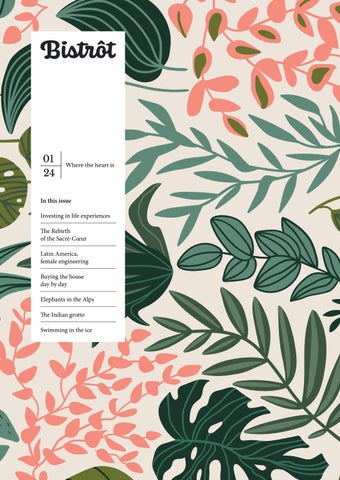
01 24
Where the heart is
In this issue Investing in life experiences The Rebirth of the Sacré-Cœur Latin America, female engineering Buying the house day by day Elephants in the Alps The Indian grotto Swimming in the ice
01 24
Start—
#living #qualityoflife #grono #lumino #geneva #brazil #engineering #architecture #india #curry #grotto #iceswimming #streetart #mesocco #nevercrew #panama #zoo #renttobuy #invest #create #live #latinamerica #swimming #museum #church #sacrecoeur
Index
4
22
Editorial
Buying the house day by day
6 Investing in life experiences
28 Elephants in the Alps
If you have the Spotify application on your smartphone go to “search’ camera icon in the top right and enter the code that is found next to each article. You can then listen to the playlist inspired by the article. All the playlists can be found at this address: https://spoti.fi/3ofTODK. Enjoy listening... and (enjoy) reading! Impressum Publisher Galli Group SA www.galligroup.ch Graphic concept, (page) layout and text editing visiva.ch
12 The Rebirth of the Sacré-Cœur
34 The Indian grotto
For the photos, we thank: pages2-11 Galli Group pages12-17 Atelier ribo+ pages18-21 Nilda Edith Pallares Quijano pages22-27 Sabrina Tilli e Fotostudio Hsaskia Cereghetti Landrini pages28-33 Mercedes Albertini pages34-37 Gagan Nirh pages38-43 Lea Kusano
18
Print Salvioni arti grafiche SA
Latin America, female engineering
Any use of the contents (total or partial) shall be prohibited, without express consent of the publisher. November 2024
38 Swimming in the ice
EY Entrepreneur ™ of the Year 2024 Andrea Galli (in the center during the awards ceremony held on October 4 at the Cultural and Congress Center in Lucerne) won in the category “Services & Commerce”
01 24
ey.com
To the readers
Editorial Where the heart is. This is how an ancient Latin defines home: ‘Home is where the heart is.” So, in this issue of Bistrôt, we let ourselves be led by what is home and what gives impulse to the heart. This is why we have chosen to show you the heart behind a project, a passion, a new initiative. Because there are many hearts.
Download your digital copy! You can download the free digital version (.pdf format) of Bistrôt at bistrot.digital
There is the ‘sacred heart’ of Geneva, which is reborn after a fire and becomes the ‘maison’ of the community. There is the heart of Gagan from India, which beats for Daniela and makes Ticino home. There is the heart of young couples, who with the ‘rent to buy’ can give a concrete answer to their dreams of living together. There is Nilda’s heart, which has given her the passion to emerge in the world of Latin American engineering. There is Lea’s heart, which continues to beat even when she plunges into icy waters surrounded by winter ice. There is the heart of Mercedes, who gives an artist’s ‘zoo’ to the walls of the houses in her Alpine village. There is the heart of Andrea, who believes in a construction world capable of building houses with a social soul. These are the stories we tell in the next few pages, as always accompanied by a playlist on Spotify, and with the desire to tell you about a world of people, professionals and brilliant minds, who, from the Swiss Alps to the Brazilian metropolis, are guided by passion, by the
heart, because without feelings and ideals, without this compass that guides us between emotions and disappointments, between desires and frustrations, every project of ours would just be a ‘task’ to be ticked off. Autumn is the time of harvest, when the vats are filled, when the wait for fermentation begins, and you can choose: toast with a new wine or go down to the cellar and go back in time, travelling through past vintages and memories? With Bistrôt, we want to spare you the choice and continue to give you the effervescence of a Beaujolais nouveau without sacrificing the meditative fullness of a Barolo. To offer food for thought but in an informative way, combining the tale of technique with that of emotions. As if we were at the table of our ‘Bistrôt’, the one in Grono! Enjoy the reading!
01 24
Andrea Galli Year of birth: 1978 Profession: Entrepreneur Andrea Galli, a civil engineer by training, was the manager of an important Swiss engineering company for 15 years, and then managed AF-Consult Switzerland in Baden in the Canton of Aargau, active in the energy field. In 2019, he founded the Galli Group in Grono (GR), which brings together companies active in the construction, engineering, real estate, planning, and food and wine sectors. Since 2021, he has been CEO of Pini Group, a Swiss company and global leader in infrastructure design.
INVESTING IN LIFE EXPERIENCES Why read this article? To have a vision of living and investing that focuses the quality of human experiences experiences.
#investinginthefuture #qualityoflife
Is it possible to do business while reconciling profitability and care for the local area? Is it possible to invest in areas considered peripheral while still offering a high quality of life and ensuring the maintenance of a vibrant social fabric? Andrea Galli was clear five years ago that it was possible to answer yes, but above all he wanted to show that it was possible, that it could be demonstrated concretely that these were not declarations from a dream book. Therefore, starting from the family’s real estate and consulting company, he wanted to invest by opening new companies capable of creating a group that could create new residential experiences, and that would allow people to live in them and experience them while also thinking about the services and the socio-environmental context in which they were located. So, 5 years later, here we are interviewing the editor of the magazine you have in your hands, ready to draw up a balance sheet, which resembles a renewed promise for the future.
01 24
Let’s talk about the Galli Group: how was born and what is the philosophy behind it? “The group was founded at the end of 2019 and we officially launched at the beginning of 2020, so we are almost five years into the business. In these years, we have grown considerably, reaching more than 70 employees. Our basic idea was to create a set of skills that could comprehensively address the issue of ‘living’ on the ground. We don’t just limit ourselves to construction or planning: we want to manage and improve people’s life experience, also offering services such as our Bistrôt, both in the sense of the bar and restaurant, which has become a reference point in Grono, and with the magazine, which aims to inform and create culture by telling about people and their activities.” How did you arrive at this current configuration? “We started with Galli Partners and Galli Immobiliare. They are two family-owned businesses, which are historical and did not have more than 20 employees. They are focused on consulting and the local real estate market. Then we added other key
pieces: the general construction company, the engineering firm, the planning firm and the food and wine part.” Regarding the initial vision, is the group achieving what it set out to do? “Yes. The vision was to create a group that could enhance not only the best known urban centres, but also the suburbs and less frequented areas, which are often snubbed by big investors. We chose to focus on an approach that balances economic sustainability with attention to the territory and people. We do not simply want to do business, but to pamper the needs of potential customers and protect the territory.” Have there been any slowdowns or difficulties in recent years? “We are interested in growing organically. Geographical expansion is something that takes time: we have also started to operate in Zurich, and in other cantons, trying to expand our range gradually, but without ever losing sight of our philosophy of paying attention to minor realities.”
We do not simply want to do business, but to pamper the needs of potential customers and protect the territory.
ey.com
Which projects or achievements are you most proud of? “One of our projects of which I am particularly proud was in Grono, where we developed the Quartiere Birreria: 52 flats in an area that many would have considered unprofitable. It was a challenging operation, but it proved to be a success, showing that it is possible to create value even in less central locations. In the Moesano, then, we are the periphery of the periphery. An Italian-speaking region that is in the minority in a canton that is in any case peripheral to the rest of the Confederation. We could say that this is our mission: to revalue and make people appreciate what we have, even in areas that might be considered ‘difficult’ or unattractive to large investors. I can tell you an anecdote....” Of course... “This summer a colleague came to visit me from Dubai. He saw the Mesolcina and Ticino and was enchanted by areas like Grono and other small towns. He told me that for many people it would be a dream to have a house in the middle of greenery and nature. Well, we often
01 24
take the beauty around us for granted and think that the value is in the name of the place, in the brand. But those who come here are interested in the human dimension and the contact with nature that one can have. Beauty is an experience that you perceive by living in it.” What is the message you would like to convey about the future of the Galli Group? “I firmly believe that by focusing on quality and good living, we will be able to maintain long-term, sustainable growth. We are not interested in rapid expansion or compromising on quality. We want to be a point of reference for people who are looking not just for an investment, but for a living experience. Ultimately, our goal is to maintain the social and economic fabric of the territories in which we operate, contributing to their development with projects that enhance local resources and are in tune with the needs of the community.”
Before saying goodbye, one last question about a great passion of yours: wine. What are you proposing lately at Bistrôt and with World Wide Wine? “We are trying to educate people about bubbles. We have created a menu with a selection of Champagne, Franciacorta, Trento, Cava and other classic method sparkling wines that offer the possibility of drinking while spending the right amount. The good and the beautiful can be within everyone’s reach, you just have to know how to choose and have the tools to do so.”
DOSAGE TABLE Sparkling wine, champagne, classic method, champenoise, traditional how to get around the world of ‘bubbles’? Andrea Galli is not only an entrepreneur but also a wine enthusiast and sommelier. Here is a short guide to help you find your way around the distinction of wines by type of sugar dosage. This is what classifies ‘bubbles’ into dry, brut, etc. Let’s do a little review. Type of Dosage
Grams of Sugar per Litre
Characteristics
Brut Nature / Pas Dosé
0 - 3 g/L
No sugar added; very dry and dry taste.
Extra Brut
0 - 6 g/L
Very dry, with barely perceptible residual sugar.
Brut 0 - 12 g/L
The most common dosage; balance between acidity and sweetness.
Extra Dry
Slightly sweeter than Brut; fresh, lively flavour.
12 - 17 g/L
Sec / Dry 17 - 32 g/L Sweetness more evident; pleasant but still balanced. Demi-Sec 32 - 50 g/L
Sweet, suitable for desserts; well-balanced acidity and sugar.
Doux Over 50 g/L Very sweet; perfect to accompany very sugary desserts. 01 24
THE REBIRTH OF THE SACRÉ-CŒUR
Why read this article? To discover how a fire can be an opportunity for rebirth and rethinking of sacred buildings.
#swissarchitecture #enhancementofheritage
Being reborn to new life. This is, after all, the meaning of the Christian message. And in Geneva, it was a church that was reborn. Destroyed by a fire, which completely gutted it in 2018, the Eglise du Sacré-Cœur was the landmark for the Catholic community in the city that was the cradle of Calvinism. After six years, in June 2024, it returned to house the faithful. Its new life is a new life, as architecture has rethought the spaces in which the community of believers can meet and evolve. We talk about this with architect Christian Rivola, director and founder of atelier ribo+ in Cadenazzo, the studio that conceived and developed the innovative project.
01 24
The new Sacré-Cœur is no longer just a place of worship: can the sacred and the profane coexist in architecture? “The fire of 2018 created extraordinary conditions to ask questions about how to reactivate a building and cultural heritage with in the perspective of tomorrow. The core of the reasoning was a reflection, stimulated by the words of Pope Francis, on how the Church can bring people closer to the sacred. The answer was to open the doors to activities complementary to liturgical ones. Catechism should be seen in its universal value, so we thought of teaching spaces not only for religious topics but for broader comparisons. The festival hall projects the moment of ceremonies, such as baptisms, weddings and funerals, to the
conviviality of the afterwards and can also accommodate corporate teams and other groups of people who want to spend time together. From here it came natural to think also of a place to drink and eat that would project outwards, and so the bar-restaurant area became a point of attraction towards the square. The fire became an opportunity to open up new possibilities, a burning to be reborn. In this way, the architecture becomes an ideal setting for complementary activities, and vice versa, becoming dynamic, also thanks to the fact that today, the structure is all active and alive. Whereas in the past, almost half the volume was off and passive.” Is it a replicable model? “The initial vision, which then became a concrete project, has aroused great
Le Sacré-Cœur wants to be a source of energy for changing the way we experience relationships in cities.
Christian Rivola Year of birth: 1973 Profession: Architect After graduating from Scuola universitaria professionale della Svizzera italiana di Lugano, he obtained a Master of Architecture at SCI-Arc in Los Angeles. In 1998, together with Omar Bontà he founded the studio “ribo architecture” in Monteceneri (TI). After Bontà’s departure, the studio evolved in 2016 into the atelier “ribo+” (www.ribo.swiss) in Cadenazzo, with branches in Frenchspeaking Switzerland and in Portugal, in the Douro region.
01 24
interest among the religious, and not only, which I find surprising. There was a great deal of media attention, ever since it became known that a project group had been set up, led by an atelier in Ticino. At Sacré-Cœur, there were special features. The structure built in 1859 was that of a temple, the fire modelled the interior volume, opening the door to a less constrained reconstruction. So the concepts are certainly replicable, but in each situation the pre-existing must be evaluated in order to be able to integrate the renovation in a harmonious way. There are however, similar cases of multifunctional churches: in Basel a literary café is housed, in Cambridge an exhibition hall. The topic is highly topical, as there is an ecclesiastical heritage to be protected but also to be revitalised. In the case of Sacré-Cœur, there was also the availability of an adequate budget: 25.5 million francs thanks to insurance funding and donations from foundations and many private individuals. However, we thought of a structure model that would also be economically sustainable over time, guaranteeing a property income from some of the functions present, so
as to eliminate dependence on the financial support of the religious.” From a design point of view, what were the elements you focused on? “The façade had remained almost intact. Therefore, on the outer perimeter we worked in a conservative and enhancing manner. On the inside, we worked on the relationship between heaven and earth, on the relationship between man and spirituality. We worked on natural light with glass windows set into the roof. It was a project that involved, in particular, in addition the architects of ribo+ Sara Anzi and Simone Izzo. In this way, the building is sculpted from above by light, which in its path of reflection animates the interior with new life. For the materials, we have chosen to use traditional materials, such as stone, wood, plaster, to give a sense of naturalness but also refinement. The marbles come from Carrara and are grey, white and yellow, inspired by the colours of St Peter’s Basilica in Rome.” Why were you chosen? Why did they turn to a Ticino firm from Geneva? “We were called in February 2020, at the time the famous Parisian
architect Jean Marie Duthilleul, called in as a consultant, had given some guidelines in favour of the organisation of the church space, thanks to the conception of a new liturgical axis where the interaction between religious was completely rethought. From that input we started working intensively. I think the choice fell on us for two main reasons. The first is that in Bulle, in the canton of Fribourg, we conceived the reconversion of the Halle Landi, a pavilion from the 1939 Universal Exhibition in Zurich, which was then moved to Bulle and used for many years by the army. Now it has become a landmark and meeting point for the new Jardins de la Pâla neighbourhood. The other reason I think is the fact that Ticino is a predominantly Catholic canton; therefore, it has a long tradition of building churches, a tradition revived by a master of contemporary architecture, even of the sacred, like Mario Botta.” What do you take home from this experience? “I remember with emotion the first visit to the building, we arrived on the roof. Sounds of the city in the
distance, birds flying and the absence of human life. I thought: this is a break in the building’s history. Then, at an advanced stage of the project, I remember the great enthusiasm I perceived in the Geneva community. Architecture cannot disregard aesthetics, but it makes sense if it can create the optimum conditions for society and the environment to develop in balance. Le Sacré-Cœur wants to be a source of energy for changing the way we experience relationships in cities. Because I believe that all architecture carries with it the idea of the sacred. Geneva’s Sacré-Cœur is beating to a new rhythm, following the time of the future, playing the harmony of hope, listening to the voices of the community.” Interview with Christian Rivola on Youtube: https://youtu.be/ gEBbYeDdRt4?si=v0v4fth8lXpuswIs
01 24
LATIN AMERICA, FEMALE ENGINEERING
The construction industry has historically been a male-dominated sector, especially in countries with a Latin culture. Yet preparation and passion lead a young engineering graduate from Panama to become a leader in major engineering companies in Brazil within a few years. This is the story that Nilda Edith Pallares Quijano tells us from São Paulo, taking us on a tour of the industry in Latin America (LATAM).
Why read this article? To travel from Central to South America, from the Republic of Panama to Brazil, to discover the world of engineering and infrastructure in LATAM.
#engineering #LATAM #Brazil
01 24
Nilda Edith Pallares Quijano Year of birth: 1985 Profession: Civil engineer Always passionate about the world of construction, after graduating from the Universidad Tecnológica de Panamá in 2008, she established herself in the world of engineering in LATAM including Brazil, working on infrastructure, building and renewable energy construction projects in multinational companies, up to positions as head of international units. She is a woman of Faith, she is the mother of twins (André and Thiago), and also she is the wife of a Mechanical Engineer (André Luis).
How did you approach the world of engineering? “I grew up in Colón City, Republic of Panama, where I was born. I am the youngest of several siblings, with a single mother, who is my biggest inspiration. Since the end of high school, I felt the desire to enter the construction world, initially with the intention of becoming an architect. However, I realized that my true passion lay in mathematics, and so I decided to pursue civil engineering. This led me to graduate from the Universidad Tecnológica de Panamá in 2008.” What was your initial experience in the industry like? “In 2007, I had the opportunity to
participate in a student program offered by a large Brazilian construction company. It was a very competitive selection process but I was chosen to be part of this program and have been working on significant projects ever since. This marked the beginning of my career path in a maledominated industry, especially in Latin America.” She currently lives and works in Brazil. What is your current role? “Yes, I currently live in São Paulo, Brazil, where I serve as international sales manager for a Brazilian engineering company. I oversee managing the commercial department of the international unit, from preparing technical and commercial proposals to defining operational strategies for the internationalization of the company. In addition, I am responsible for developing new activities and opening new markets, as well as researching and negotiating with both public and private partners and clients.” Can you share with us some of the most important projects you have worked on? “Certainly. I have had the privilege of working on major projects, such as the $569 million Colón Urban Renewal Project, the $2 billion Panama Metro Line 1, and the $380 million Dos Mares Hydroelectric Project. Each project has been a unique challenge but they have also allowed me to grow as a professional and as a leader in the field.” What are the main challenges facing the infrastructure industry in Latin America, particularly for a woman engineer? “The challenges are numerous. First, there is the business model in LATAM, which can vary greatly from country to country. Local culture plays a crucial role, as does the political and socioeconomic situation, which is often a significant obstacle. In addition, national legislation can further complicate project
implementation. Being a woman in this field adds an additional layer of complexity. However, these challenges have made me more determined and resilient.” How would you describe the current situation in Brazil in the context of engineering and infrastructure? “Brazil is an extremely complex and fascinating country. With a large economy and a very diverse market, it offers many opportunities in sectors such as oil & gas, transportation, sanitation and renewable energy. However, the unstable political situation poses a significant business risk. Despite this, I appreciate that Brazil manages to generate its own business, often developing new technologies and unique business models to tackle mega projects. It is a country that, while it has its challenges, also offers great opportunities to innovate and grow.” What do you like most about Brazil, both from a personal and professional point of view? “From a professional point of view, I admire Brazil for its ability to create its own business model in the construction and engineering sector. The diversification of the market and the scope of projects are impressive. On a personal level, I appreciate the Brazilian culture, its resilience and its ability to adapt and innovate - qualities that resonate deeply with my values and experience.”
Being a woman in this field adds an additional layer of complexity.
01 24
Why read this article? To learn how “rent to buy” can offer new opportunities to young couples or families.
#renttobuy #Lumino
Fotostudio Hsaskia Cereghetti Landrini
BUYING THE HOUSE DAY BY DAY
Deposit is one of the biggest obstacles for young couples or singles who want to buy a house of their own. Especially if you are looking to buy a property that reflects your expectations. However, there is a way to cover that down payment required by banks, which is often lacking. It is, in essence, to pay a slightly higher rent and thus start buying your own home, day after day. But to get a better explanation of how ‘rent to buy’ works, we interviewed Sabrina Tilli, director of Omnis Vision, a consulting firm based in Bellinzona.
01 24
Sabrina Tilli Year of birth: 1987 Profession: Director of consultancy firm After attending the Business School in Bellinzona, he worked as a private client advisor in the banking sector from 2008 to 2014. In that year she entered the world of architecture studies, becoming assistant director of ‘atelier ribo+ in Cadenazzo. In 2019 she started working on the consulting project of Omnis Gestioni, now evolved into Omnis Vision, Consultancy and project management companies of which she is the director.
What is ‘rent to buy’ and why can it
So how does this system facilitate
be a solution for becoming popular?
access to real estate?
“It is a formula that facilitates the
“The big advantage is that the buyer
purchase of a property, especially
does not immediately have to have
for those who have a good income
the 20-25% of the purchase price
but do not have enough deposit to
that banks usually require as equity
meet the banks’ demands. Basically,
capital. For example, if a couple
the buyer signs two contracts: a
only has 10-15% of the necessary
right to buy and a rental contract.
capital, with ‘rent to buy’ they can
The rent is paid for a defined period
still reserve the house, live in it, and
with the seller, normally between
in the meantime accumulate the
3-5 years, part of which goes to
remaining missing capital through
cover the missing equity. This allows
increased rent. This formula
you to reserve the flat, live in it and
prevents people from having to
gradually accumulate the necessary
drain their savings to reach the
equity for the final purchase.”
required threshold.” What happens if the buyer decides to stop the purchase process? “If the buyer decides not to proceed with the purchase at the end of the period established, the capital paid is not reimbursed and serves as a conventional penalty, as protection for the owner, who could still return to the house. It is a bilateral agreement that must be clear from the beginning, with all the case analyses to assess the solvency of the buyer and economic conditions.” Are there also advantages for the seller? “Yes, absolutely. The seller benefits from continuous profitability thanks to the rental fee and does not have to sell the property immediately, which results in a tax advantage, particularly on the reduction of the real estate gains tax rate. This formula is particularly interesting for owners who wish to sell their real estate but who do not have an immediate need for liquidity, as the collection is deferred.” Concrete examples that you have experienced? “Omnis Vision is a consulting and project management
company active in favour of the enhancement of natural and built heritage. In this specific case, our consultancy focuses on accompanying the property owner in evaluating this option in terms of feasibility and sustainability. We have had the opportunity to explore this method of disposal in Bulle, in the canton of Fribourg, with which dozens of flats have been successfully sold. In Ticino, we have recently partnered with Galli Immobiliare to apply this purchase method to their various projects, both existing and new constructions. With Galli Immobiliare we are developing a model that aims to make access to property easier, both bureaucratically and financially. Will the future see rent to buy
01 24
become established? “The Rent to Buy model has existed for some time and I believe it has enormous potential, especially in an increasingly difficult real estate market with stricter banking rules. It is a solution that offers flexibility to both buyers and sellers and, with the right support and information, can become an increasingly popular choice. It is a form that favours the new generations, so it also has a social and cultural value.”
Fotostudio Hsaskia Cereghetti Landrini
ELEPHANTS IN THE ALPS
Why read this article? To take a safari between ecology and fantasy in the Moesano, discovering how street art can be integrated into an Alpine village.
#streetart #Newvercrew #Mesocco
Can contemporary art become a vehicle for launching ecological messages and creating an economic spin-off in small towns in the Alpine valleys? To look for an answer, one has to go up to Mesocco. In the Moesano village and its hamlets, an unusual zoo was inaugurated on 24 August. There are no cages and marmots live with sperm whales, ibexes with elephants. What brought them to the Alps was not a revived Hannibal but a pair of street artists from Ticino. They are Christian Rebecchi and Pablo Togni, in art Nevercrew. In order to better understand the aims of the project, we interviewed Mercedes Albertini, Municipal Councillor of Mesocco, in charge of Tourism, Public Education, Culture, Sport and Leisure Time.
01 24
Mesocco Mesocco is the last northern municipality in the Mesolcina Valley, is one of the largest in Canton Graubünden and has a population of around 1,400. It consists of 11 hamlets, including the mountain hamlet of San Bernardino. An important necropolis from the early Iron Age (VI-V centuries BC) was found where the village stands today. The ruins of the castle, one of the largest in the canton, are still visible. It was once the seat of the de Sacco family, lords of the Mesolcina valley from the XII century to 1480, and then of the Trivulzio family until 1549.
What is the Mesocco Zoo?
Where did the idea for the Mesocco
“We could call it a diffuse exhibition
Zoo come from?
or a permanent outdoor exhibition.
“It was an evolution of the
It currently consists of 13 works that
mMoMAm (mini Museum of
are located on the walls of Mesocco
Modern Art Misox) project. With my
and its hamlets. They range from
nephew, Luca Cereghetti, president
schools to some private houses,
of the Moesano regional tourist
all the way to the power station in
board, we created an association
Leso. But the idea is that it can be
that converted the old bakery of
a work in progress with works that
Ulisse Albertini, a figure known
can be added every year. It is a zoo
by everyone in the village and
but also a kind of safari, in which
nicknamed ‘l’Ulissino’, into a cultural
one wanders through the streets of
space. In April, we presented the
Mesocco to spot the works on the
exhibition ‘Marilyn and friends’,
walls.”
an exhibition dedicated to the master of Pop Art Andy Warhol,
What do the works represent?
and we will continue with small
“The Nevercrew duo wanted to
temporary exhibitions in order to
create a colourful zoo, born of their
offer an opportunity to discover
imagination and realised through
contemporary art in Mesolcina as
their artistry. The murals depict
well.”
marmots, bears, birds, beavers, sheep, deer, badgers, ibexes as well
And one thing led to another...
as sperm whales, zebras, pandas and
“Yes, we imagined colouring our
elephants. Some murals are several
municipality and thought of a zoo
metres high and have a strong
of animals painted on the walls. We
impact, others reproduce animals
contacted the Nevercrew, who were
at life size. There are also elements
enthusiastic about the initiative.
that recall mirrors and photography,
Both because they can propose an
to create a game of cross-references
ecological message, reminding us
between art and reality.”
that we are not the only species on this planet and that we must seek a harmonious cohabitation between
01 24
NEVERCREW Christian Rebecchi (b. 1980) and Pablo Togni (b. 1979) started an artistic street art partnership in 1996 that took the name Nevercrew. After studying at the Liceo Artistico CSIA in Lugano at the Brera Academy in Milan, they created works in many cities around the world, including: Madrid, Berlin, Grenoble, New Delhi, Manchester, Turin, Lucerne, Vancouver, Cairo, Miami, Kiev, Los Angeles and Phoenix. They have received numerous awards and were
included among the 100 most influential urban artists of the year by Graffiti Art magazine in ‘The Urban Contemporary Art Guide 2015. The themes of their artworks focus mainly on environmental and social issues, seeking to provoke reflection on human attitudes and their influence on nature.
animals and humans, and because of
want to work so that the Mesocco
of the works, we think it is also a
the original context of a route within
Zoo is known nationally and
fascinating itinerary for families
an alpine environment that invites a
internationally. We want it to be an
or school classes, to bring children
sustainable approach to visiting and
opportunity for people heading to
closer to the language of art, but
discovering the area.”
or from San Bernardino to stop off
also to respect for the environment
in Mesocco. In this way they will be
and animals. It is an important
How did you finance the project?
able to walk around and discover
educational function that should not
“In addition to the support of some
the painted walls and at the same
be overlooked.”
local partners and institutions, there
time get to know our villages. For the
was self-funding from the residents.
mid-valley centres, it is important
The Mesocco Zoo is therefore
In December, we sent a letter to
to offer opportunities for ‘slow’ and
an example of how art can be
all the fires announcing the sale of
cultural tourism to intercept part
a driving force for sustainable
one hundred Nevercrew prints that
of the flows directed towards the
development in the Alpine region:
corresponded to one hundred zoo
destinations at higher altitudes,
low environmental impact, great
shares and we immediately sold
those chosen by skiing, hiking and
cultural message.
them out. People not only bought
mountaineering enthusiasts, but
the prints but started to offer us the
who also have artistic interests.
walls of their private homes.”
Trying to create an induced income from cultural activities was our goal
Is this project replicable in other
even before, after the effects of last
centres in the Alpine valleys?
June’s flooding it is even more so. In
“We hope so. But above all we
addition, given the subject matter
The works 1) Mesocco schools: the marmots 2) Private house village centre: the bears and the panda 3) Subway N13 Cremeo: the sperm whale 4) Postbus stop castello: the birds 5) Gesena Deira bridge: the beavers 6) Logiano private house: the sheep 7) Darba private house: the zebra 8) Andergi private house: the deer 9) Cebia private house: the badgers 10) Anzon road wall: the ibexes 11) Central Leso: the elephant 12) Postal station Pian San Giacomo: the monkeys 13) Bridge N13 San Bernardino: the foxes
Mercedes Albertini Year of birth: 1961 Profession: Municipal employee She is a lover of sport in general and with a predilection at a young age for Alpine skiing, which she practised with ease and talent, she spent most of his professional life in Italian-speaking Switzerland, working for the FIAT Group. Among others, she also worked with Sergio Marchionne during his time in Paradiso. Passionate about oriental culture and yoga, as well as the mountains of Graubünden, she decided a few months ago to serve her own municipality, Mesocco, in the Town Hall, trying to bring some new air into the shadow of the castle. As in the case of the Mesocco Zoo.
01 24
THE INDIAN GROTTO
Why read this article? To take a journey into the homely flavours of Indian cuisine by climbing the hill dear to Hermann Hesse.
#cucinaindiana #grotto
A place where you can find the frankness and genuineness of the Ticino grotto tradition, but where you can mainly savour flavours from the Orient. It all stems from a wager launched in the early 2000s, to introduce Indian home cooking to the people of Ticino. That bet turned into a restaurant that attracts customers from all over the Canton and international tourists to the slopes of Collina d’Oro. The Tabla restaurant is the brainchild of Gagan and Daniela. Indian he, Ticino she, they met in the USA, then started a family in Ticino. With them, we embark on a journey into the Indian flavours of their mother’s recipes and pairings with international wines.
01 24
of Ticino proved that they are curious at the table and appreciate good food, even if it is exotic.”
From India to Ticino, how did it happen? “I was born in a “village” of two million people in the centre of India: 40 minutes‘ flight from Mumbai, 10 hours’ drive. After my studies in a boarding school near Mumbai, I went to a hotel school in the US. I stayed in Connecticut, Chicago and then joined the Ritz-Carlton group. So, in 2000 I went to New York, first as room service manager and then as food and beverage director. And at the New York Palace I met Daniela, my wife, originally from Lugano, who was room manager. We lived in the US six years.” Then came Ticino? “Yes, I was not ready to go back to India. But we didn’t want to stay in America because Daniela had to wait for her visa to be renewed. So, we came to Ticino for a “pit-stop”, which has lasted 18 years.” Did you start from scratch? “Yes, in that year our son Marc was born. The following year we opened the Amici restaurant in Vezia. Then our daughter Sara arrived.” When did you start offering Indian cuisine? “At first, ours was a traditional Ticino cuisine, then I gradually started to introduce Indian dishes. Daniela was a bit sceptical, but instead the people
Then you didn’t stop, from Vezia to Montagnola... “Yes, there is a curious story about this place where we made Tabla. In 2003, when we lived in America, we came to Ticino for three days on holiday. I remember we went to eat at the nearby grotto. We parked, I got out of the car, saw this building and said to Daniela: one day it will be ours. Keep dreaming, she replied. We forgot about it, then in 2010-11 when we were looking for a place of our own for a restaurant, it was proposed to us and we managed to find a fair deal. The dream had come true. After a year, on 4 June 2012, we had completely renovated and opened Tabla.” What kind of Indian cuisine is yours? “We could call ourselves an Indian grotto. In India, there are restaurants and dhaba, a kind of grotto, where you can eat home cooking. This is what we offer, based on the recipes of my mother Gurmeen and my grandmother. Our chefs don’t have to elaborate them but only respect them. The result is that when some Indians come to us, they say: it is like eating at home.” Is the sense of hospitality part of Indian culture? “Certainly, for us the guest is sacred. That is why when I come down for service, I am always serene and smiling. For me it is an honour to be able to serve people and make them happy at the table.”
Which is your most popular dish? “Undoubtedly the Chicken tikka masala is the most popular. It originates from New Delhi, and is marinated chicken chunks, cooked in the tandoor oven and sautéed in a creamy spiced tomato sauce. Another popular dish is lamb shank, but more and more people are choosing vegetarian and vegan dishes lately, and our cuisine offers some delicious things in this area.” A recipe for a sauce? “You can make an excellent green sauce with mint, coriander, lime and
ginger and then add coconut flakes or coconut milk to make it creamier. It is an excellent and very fresh sauce.” But does Indian cuisine go well with wine? “Indian cuisine is vast so many pairings are possible, which is why we offer dinners with producers where we match their wines with our dishes.”
Our cuisine is based on the recipes of my mother Gurmeen and my grandmother.
01 24
Favourite pairings? “Usually at the end of the evening, Daniela and I maybe have our chicken bites marinated and cooked in the tandoor oven, to be paired with a Pinot Noir from Burgundy or a Nebbiolo or a soft Barbaresco. If, on the other hand, we go for the lamb shank, the Amarone area is better, but also a Cabernet from the Bolgheri area.” Do you bet a lot on the cellar? “We have a cellar of a thousand labels with wines from all over the world: France, Chile Argentina Australia South Africa, North America and also Italy and Ticino. They are all wines chosen knowing the producer, for me it is important to know who is behind it, its history.”
Is your clientele from Ticino? “We work a lot with locals, but Lugano is an international city, so we have several customers from Dubai or Kuwait and celebrities who come back and have become friends.” Nostalgia for India? “When I want to in seven and a half hours by plane I am there. If I miss it, I go there. But I love Lugano and Switzerland I embraced its culture, and it has given me so much. There is a very high quality of life, you have security, and you can go anywhere in the world. I have many friends here and I feel this is home.” Gagan and Daniela’s story is one of intertwining destinies and the desire to follow their own visions.
Over the years you have continued to offer traditional and Indian dishes, but you have also added Asian dishes, why? “I wanted to bring to the menu some heartfelt recipes that bind me to my father, I travelled to Asia with him and so some flavours have remained in my heart.” For example? “What we propose as Hong Kong Rolls: tempura-cooked sea bass fillet, rolled with rice leaf, salad, peanuts and a kind of wasabi mayonnaise and a secret soy sauce. It is a recipe prepared for us by a Vietnamese lady living in Hong Kong.”
Gagan Nirh Year of birth: 1977 Profession: Restaurateur Originally from India, he furthered his studies in the hotel industry in the USA, where he was food & beverage director for Ritz-Carlton. In 2007, he opened the Amici restaurant in Vezia with his wife Daniela. In 2012 he opened the Tabla Restaurant in Collina d’Oro, bringing the people of Ticino to discover Indian cuisine.
And perhaps it is by chance or another twist of fate that they chose Montagnola to realise their dream, the same place that the writer Hermann Hesse, who brought the charm of Indian culture to European literature, chose to live and compose, to feel at home.
TABLA
CURRY
The name of Gagan and Daniela Nirh’s restaurant is inspired by a characteristic Indian musical instrument. The tabla is a pair of small drums, one usually made of wood and the other of metal or clay, on which the leather membrane is stretched by means of leather ties. The tabla is used in Indian music, both classical and popular and religious, but also in world music for its typical sound that evokes an imagery linked to the world of Indian culture.
In India, ‘curry’ simply means sauce, which can be made with different ingredients. In the West, the retail sale of packets of ‘curry powder’, a mix of powdered spices, has led to that flavour being associated with curry. There is no specific curry flavour, but it depends on the mixture of spices used to make the ‘sauce.” Furthermore, the term ‘curry’ is also used to refer to various curry dishes.
01 24
Why read this article? To learn about a new way of discovering one’s body by swimming in borderline conditions.
#nuoto #ghiaccio #iceswimming
SWIMMING IN THE ICE In summer you dream of a refreshing dive, but there are those who look for it even in winter. Indeed more than refreshing... we should say “freezing.” Ice swimmers, which differs from the “simple” winter swimming by the water temperature in which it is practiced: it must not be higher than 5 degrees centigrade. Therefore, the races of this peculiar sport are held in ice-covered basins, with outside temperatures below zero. Lea Kusano, from Bern, who is part of the International Ice Swimming Association, tells us how this passion came about. And don’t think it’s just for special athletes; it can be commonly practiced and also bring benefits to your immune system.
01 24
Xxx
When did you discover ice swimming? “I started swimming in winter about nine years ago and intensified this hobby over the years. My swimming activities became more and more regular and the more I trained, the more I was able to swim in colder water and increase my stay, until I got into ice swimming.” Why did you choose to practice it? “At the time, I had read a report on silence that had been done with an ice freediver. I was fascinated by the idea of being in total control and total relaxation at the same time and the idea of silence surrounding this moment. I knew immediately that
I had to try it. This feeling remains even after all these years, and although I long for summer every year, I have moments when I wish I could enter into this moment of total clarity, concentration, silence and a kind of positive solitude. I have been practising apnea for a few months now and sooner or later I will intensify this activity. I think that with a little exercise I will have the same sensations.” Is it just a challenge to the cold or is it also a healthy sport? “Being in the cold has many positive effects on the body and mind, such as a better immune response. In addition, certain hormones are activated,
such as adrenaline, endorphins and corticoids, which are antiinflammatory. Personally, my body and mind are immediately calmed by the cold, so it is a great stress relief with an immediate impact.” Contraindications? “I believe that in principle everyone is able to swim in cold water, but one must be careful. Those with severe asthma, heart problems or cardiovascular risks should contact their doctor first. Also, never go alone and, very importantly, do not do it in open water the first few times, easily the cold shock will make you hyperventilate. As for the challenge, for me it is not about the challenge. It’s more about immersing yourself in the sensations I described above.” Does it require special clothing or equipment? “Yes and no. Swimming itself can be done in a normal swimming costume. I often use neoprene gloves and shoes to protect myself, you can order them in many online shops. But it is important to be well prepared for after swimming, to have a hat and gloves and very warm clothes. It is important to warm up quickly.”
When was your first competition and what did you experience? “It was in 2023, at the IISA World Championships in Samoëns and it was absolutely fantastic to meet all these people from all over the world. The swimming itself was very different from what I am used to experiencing. There is no time to adapt to the cold, you just have to get in and swim immediately.
01 24
Lea Kusano Year of birth: 1980 Profession: Chief Communications Officer Lea Kusano, after completing her Master of Art at the University of Bern, worked in the communications sector and is currently Chief Communications Officer of the law firm Kellerhals Carrard. She is one of the members of the Integrity Committee of IISA (International Ice Swimming Association).
Xxxxx
The most surprising experience was that I felt nothing as I entered the icy water. No sensational cold, no interruption of my breathing rhythm: the power of adrenaline!”
open people, so contact them when you see them live or on Instagram. And of course you can always get in touch with the International Ice Swimming Association Switzerland.”
Where is ice swimming practised in Switzerland? And specifically in Italian-speaking Switzerland? “Wherever there is water. I think it is very nice to swim in the valleys of Ticino when there are no tourists. Personally, I have swum several times in the lake around Lugano. There are several swimming groups in all the major resorts around Lake Zurich, Lake Zug, the Rhine and Aare rivers and Lake Geneva. Ice swimming and winter swimming swimmers are very
Will there be Swiss athletes at the upcoming World Championships in Molveno? Who in general are the best athletes in the sport? “Yes, and more than one. As far as the rankings are concerned, there are two types. The overall winners and the age-group winners. Age groups go up to over 100 years old. At the European Championships my age group was quite large, and for my abilities there was no chance of a medal, I just have to wait until I get a bit older.”
01 24
Some advice for those who want to approach this sport, how to start? What are the mistakes to avoid? “The first step is obviously to adapt to the cold water. My advice is not to stop swimming at the end of the summer. Continue and adapt slowly as the temperatures drop. And remember to have warm clothes after your swim. If you really enjoy swimming and not just taking a dip - which by the way is great and also cool - the biggest mistake is not exercising. Go swimming in the pool and do weight training.” Three reasons for ice swimming? “The reasons for practicing ice swimming lie only in yourself. If you find them, do it.”
RESIDENZE TENDRO
6apartments forsale withenchantinglakeview TENERO-CONTRA(TI) 3 separate blocks with 2 apartments per block
4.5 room apartments also with garden and large terraces
Info:+41918274036 immogal.ch
Secondary and primary residence
End— #Champagne #GrandCru #PremierCru #CôteDesBlancs #MontagneDeReims #ValléeDeLaMarne #CôteDeSézanne #CôteDeBar #PinotNoir #Chardonnay #Meunier #BlancDeBlancs #NonVintage #BlancDeNoirs #RoséChampagne #VintageChampagne #ExtraBrut #GrowerChampagne #BrutNature #SecChampagne #DemiSec #Millésime #PrestigeCuvée #MéthodeChampenoise #VinsDeChampagne #TerroirChampagne
Visit our online shop by scanning the QR code!t
worldwidewine.ch