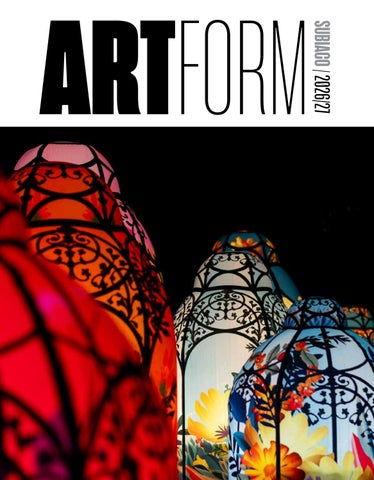
SUBIACO / 2026/27 ARTFORM 2026/27 | 1
Welcome to ARTFORM Subiaco, a showcase of arts, culture and design in Subiaco, Western Australia. Uncover the narratives behind recently commissioned
COVER IMAGE Matthew Aberline’s The Light Within display at Subi Blooms x Gather 2026. Image by Adam Kenna, SoCo Studios ABOVE IMAGE Little Figments by Graeme Miles Richards.
public artworks and delve into the lives of local creators, makers and producers. ‘ARTFORM’ surveys the people, places and stories redefining Subiaco’s cultural landscape.
ACKNOWLEDGEMENT of COUNTRY
Editor Gabi Mills
The City of Subiaco acknowledges the Whadjuk Noongar people
Design Cally Browning
as the traditional custodians of the area. We recognise their cultural connection to the land and waterways of Subiaco, and their continuing contribution to our City. Aboriginal and Torres Strait Island people should be aware that this publication contains names and images of deceased persons.
Advertising Shelley Tamsitt Photography Matt Jelonek, Soco Studios Contributors Stephen Bevis, Brooke Evans-Butler, Brooke Hunter, Ara Jansen, Mark Naglazas, Lisa O’Neill, Lizzy Pepper, Sarah Schmitt, Gail Williams
GALLEY PRESS Published by Galley Press on behalf of See Subiaco. See Subiaco is an intiative of City of Subiaco. Visit SeeSubiaco.com.au
2 | ARTFORM | 2026/27
CONTRIBUTORS Ara Jansen
From Snoop Dogg to Sting and prize scones to long distance swimmers, Ara has met, interviewed and written about the famous, the infamous and the interesting during an extensive career as a writer, rock music journalist and critic. She loves the colour blue, swimming pools, fountain pens, books and tomatoes.
Gail Williams
Gail has eaten pasta with Jamie Oliver, made Robert De Niro laugh, had a one-on-one with Bob Geldof, almost got caught in a lift with Heston Blumenthal and upset actress Patricia Routledge. And let’s not forget the Queen . . . All in four decades of covering government, police rounds and feature writing for newspapers and magazines including food editorship of STM. She has a penchant for singing sea shanties (but can’t actually sing). And loves, loves, loves Subiaco. And then there’s food of course . . .
Lizzy Pepper
She’s taken helicopter rides, distilled her own batch of gin and visited artist studios in her work as a tourism marketer, arts enthusiast and writer. Lizzy loves redtailed black cockatoos, grunge music, pesto, quick dips at Meelup and Here Together, the 1909 Subi East smokestack artwork by Abdul Abdullah and MOMO.
Mark Naglazas
Mark has interviewed so many writers, directors, actors and artists during his multi-decade career in journalism that his tales have enlivened more than a few dinner parties. Since leaving The West Australian, he has worked as a freelance arts writer, winning the WA Media Award for a series on Perth’s new movie studio. He writes about politics and culture for the Nine News website WAtoday and runs a lively Facebook page with a strong culture focus.
Stephen Bevis
Stephen is a writer, journalist and editor with a long background in telling stories about arts and culture in WA. He is a former Arts Editor at The West Australian and communications manager at Perth Festival and has been constantly inspired by the creativity and dedication of the artists he has met from the Kimberley to the Great Southern and from all over the world. He loves music but can’t play it, and he once earned a living by painting gaudy tropical scenes on coconuts for tourists in north Queensland.
Sarah Schmitt
Sarah writes about art, travel, food and the people who make places interesting. She collects books faster than she can read them, loves collecting notebooks, never says no to good coffee and a bakery treat, and is happiest in nature by the ocean or exploring a trail.
Brooke Hunter
Brooke is a mumma to four-year-old Amelie and two-year-old twins Eli and Tilly. Living locally, she has a love for exploring the streets (and playgrounds) of Subiaco. Writing for ARTForm is a passion of hers as she delves into the minds of creative artists and discovers new art hubs in the area.
Brooke Evans-Butler
Brooke is a journalist and communications expert from Perth. She has published features in many topics during more than 20 years in the industry, but the topics she loves most are being able to share the stories of local, hard-working people. Lisa O’Neill Meeting people pursuing their passions is a constant delight for Lisa, who has written about Olympians, tequila producers in Mexico, architects all over the globe and most recently The Rug Est who opened her eyes to the intricate art involved in every element of rug creation. 20 years of journalism has opened so many doors to exploring the vastness of humanity.
Gabi Mills
Gabi thinks it’s no coincidence that her name is something to do with communication; her lifelong gift -of-the-gab has allowed her to interview Princess Diana’s brother and most of the Monty Pythons. Author of several books about art in Perth and Margaret River, she’s a keen amateur painter and a pianist, currently without a piano. Having travelled high and low in search of the perfect room service menu, these days Gabi is happiest with a skinny cap and granddaughter Florry babbling on her lap in Subiaco. Cally Browning After an advertising career that was cut short by the recession-we-were-supposed-to-have, Cally found herself in Japan designing a magazine. A passion was born and, after creative stints in Hong Kong and Melbourne, returned to Perth and is delighted that print is apparently not yet dead. She’s grateful to be part of the talented ArtForm team, bringing to life stories from the vibrant creative hub that is Subiaco.
ARTFORM 2026/27 | 3
ARTFORM
22
SUBIACO / 2026/27
52 Still Together An underpass mural, a poet’s words and a student competition: the next chapter of public art at 1909 Subi East
07
Cityscape Shifters WA’s world-leading Percent for Art scheme reaps so many rewards - this time in Subiaco
13
Master of (Public) Arts What inspires Stuart Green , a very private public artist
20
Small Space, Big Meaning The new Rupert Street pocket park gives locals a new place to enjoy their surroundings
22
4 | ARTFORM | 2026/27
Concrete Canvases Muralists share their love of the challenge of transforming streets with art
26
Mad About Harry Meet actor Harry Gilchrist, forging a different path to famous sporting legend dad, Adam.
32
Teamwork Makes the Dream Work Two creative agencies have made their HQs in Subiaco - we find out their new beginnings
34
Young Guns Ready to Fire Rising Subiaco stars in the creative industries share what inspires and drives them
38
Creative Catalyst Perth Advertising and Design Club GM Laura Vulling has Subiaco running through her veins
42
13
26 44
Back to the Future A new ‘deep green’ apartment is rising in Price Street on the site of a historic fine china kiln
46
Night Visionary Artist Matthew Aberline creates work that sparks imagination and wonder
52
Fermenting ldeas FOUND.Subiaco is the spot to head to for more than just a cold brew and a good feed
56
Funny Business WA Comedy Week’s Ronan Freeburn shares his vision for the event and its affinity with Subiaco
58
The Art of the Atelier Subiaco has an embarassment of riches when it comes to jewellers
62
26
Lady of Ro Reno Hits the Sweet Spot An imaginative reno on Rokeby Road takes diners back to the Greek isles
66
Subi’s Creative Crucible The Lab was an artistic space casting a long shadow - read about its legacy
68
Wardrobe Wonders on Show Subiaco Museum’s Jessica Marantelli shares her passion for fashion
72
Subiaco was Built on a Sunday Discover the story behind a timber merchant and a suburb that assembled itself on a Sunday
76
A New Chapter on Rokeby A new base for three businesses will become part of the Rokeby Road community
82
Go West Interior design made easy with GlobeWest’s creative team
84
Space Makers SPACEMRKT continues to flip the narrative on reinvigorating vacant spaces in Subiaco
88
Floor Play A stunning mural on Hay Street showcases the skillset behind The Rug Establishment
90
Big, Creative Ideas on the Menu A long lunch at the Subiaco Hotel produced more than just food for thought
92
Last Word Subiaco local and soprano Leilah Fox sings the high notes with WA Opera
98
contents
Maintenance Man Paul Caporn ensures Subiaco’s urban art is kept in tip-top shape
ARTFORM 2026/27 | 5
6 | ARTFORM | 2026/27
Still TOGETHER
The next chapter of public art at 1909 Subi East is unfolding. Lizzy Pepper reports.
T
wo years ago, the 53-metre smokestack at the old Princess Margaret Hospital site lit up for the first time, its joyous neon faces beaming out over Subiaco. Here Together, by Abdul Abdullah and David ‘MOMO’ Momyer, was the first artwork at the reborn precinct now known as 1909 Subi East - named after the year the hospital first saw patients. Now, 1909 Subi East is open to the public, and, while the residential towers are still to rise, the bones of a new community space are in: native landscaping, a playground, restored heritage buildings and a growing collection of public art. The next wave of art is deliberately varied - an underpass transformed by local students, a poet’s words honouring the hospital’s history and a competition that put students’ art on show. Behind it is Artify Consulting, engaged by DevelopmentWA to shape the precinct’s art strategy. For Carolyn Karnovsky of Artify, its success lies in the range of voices and creative disciplines the precinct has drawn together - artists, poets and students alike each responding to a site steeped in history. “Its story spans both an ancient past and a more recent past as a hospital, all of which adds to the character of the vibrant, dynamic precinct it is becoming,” she says. “There are moments of quiet reflection, of local storytelling, and then big, bold, happy moments that just put a smile on your face.”
2023 cleared the way for essential repairs and construction, but while works were underway, Perth Modern School and Bob Hawke College students navigated a temporary detour. So when artists Chris Nixon and Kyle Hughes-Odgers were invited to reimagine the thoroughfare, it was an opportunity to work with and inspire the students. “When this opportunity came up, it felt like quite a natural fit,” says Chris. The two had also recently
Bob Hawke College and Perth Modern students worked with artists Chris Nixon and Kyle HughesOdgers to reimagine the Thomas Street underpass. OPPOSITE BOTTOM: New artworks populate the 1909 Subi East precinct.
Safe passage - the Thomas Street underpass For decades, the Thomas Street pedestrian underpass was a key connection point for patients, staff and visitors accessing PMH. Closing it in
ARTFORM 2026/27 | 7
formed Moving Colour Studio, a partnership for larger projects that lets them respond to a brief without the baggage of an individual signature. “There’s no preconceived expectation,” says Kyle. Nixon describes it as liberating. “When Kyle and I work together, there’s so much editing happening as you go. You’re bouncing off each other, the design develops quickly. It’s not an ego thing. We’re just looking for the creative solution.” Chris and Kyle built a series of workshops for Year 9 art students of Bob Hawke College, designed to pass on everything they’d learned about how public art actually works. “Sculptures, murals, architectural integrations, functional art and a whole host of things,” says Carolyn. “It was like a training program for that next generation of artists.” They started with the big picture - what is public art, what is possible - then took the students on a walking tour of Subiaco’s many murals, talking through what worked, what is unique, and the challenges of making art outdoors. Next came students’ site studies, sketching, and a collaborative concept development, with the artists acting as art directors and curators. “They surprised us how engaged they were,” says Chris. “They embraced the project and did a really good job.” The aim was to demystify a process and share both the business and creative aspects of their practice. “It’s a competitive process and you’re only as strong as your ideas,” says Kyle. Their advice to anyone starting out is refreshingly unromantic: stop waiting to be discovered. “We want to see exciting public artwork. There’s a lot of talented people out there that may be frozen because they don’t understand the process,” says Kyle. The finished artwork grew from students’ field notes – inspiration gathered from architecture, nature and even a birthday cake from a local café. “Those personal stories made it interesting and brought character into the artwork,” says Chris. With many narratives, the artwork could have felt busy. “By controlling the colour palette, it doesn’t feel visually intense,” says Kyle. “There’s not 3,000 colours going on.” It’s an artwork built for a moving audience, with a colour transition that draws you through the tunnel out into the open space where the hospital once stood. “You notice all the detail as you move through,” says Chris. “But it’s not a space you’re going to linger in.” And as you emerge, the gardens and the smokestack reveal themselves - the underpass palette echoing the vibrant tones of Here Together. Because of construction and insurance restrictions, the students couldn’t paint on site. Instead, each painted a canvas based on their design, and those works have been photographed and turned into hoardings around the precinct - a temporary gallery while the apartments go up. Chris found unexpected value in bringing the students to site midinstallation anyway.
8 | ARTFORM | 2026/27
The Year 9 students were keen to share their ideas and contribute to the future of the site.
“They noticed their work right away. They got excited by that.” Chris hopes they’ve given confidence to young artists. “If you have a persistence and a drive to make it work, and a curiosity to learn and keep expanding your practice, then there’s no reason why you can’t make it work as an artist.”
Here Together - the student competition Two years on from creating the Boiler House stack artwork, Abdul Abdullah found himself back in the orbit of the 1909 Subi East site, this time as a judge. Students from Perth Modern School and Bob Hawke College were invited to enter the Here Together competition, responding to the themes the smokestack had set in motion: community, togetherness, and what it means to share a place and a moment with others. The response was strong: around 70 works came in across the Years 7–12 categories, with the youngest age groups drawing the most entries. In the end, all of them went on display – a colourful outdoor exhibition inspired by and adjacent to the towering smokestack. Supported by a City of Subiaco representative, Abdul judged the way he approaches every prize, children’s or otherwise. “Judging children’s prizes is always really fun,” he
says. “Quite often you’ll find works that are as good or better than what you’d see in adult prizes.” He’s a veteran of the format - he judged the Young Archie twice and is currently judging the Hadley’s Art Prize – and says the process is the same. “It’s always subjective. You pick your favourites on the day. That’s why we’ve got a panel. We’re all entertained by slightly different things.” What fascinates him is how young children can make work that wows us, and he points to a particular threshold. “There’s that age where kids flick from being no holds barred to becoming perfectionists, comparing themselves to other people,” he says. “Before that comes in, these kids are amazing. So much character and humour in them.” Across the high school age brackets, though, he sees the opposite curve: a rapid growth in technical skill over five or six years. Abdul is quick to point out that many gifted young artists often don’t become artists at all. “The best artists amongst them will probably be doctors and lawyers and vets.” Abdul went through a specialist art program and is one of the few from his cohort still practicing. He talks about the “ABCs of self-determination” autonomy, belonging and competence - and how art can offer all three, particularly to young people whose lives feel out of their hands.
ARTFORM 2026/27 | 9
They commissioned Perth poet Mags Webster, a celebrated writer shortlisted for the Prime Minister’s Literary Awards. Mags spent the summer of 2025 immersed in the hospital’s history, working from first-hand accounts in books such as Safe in Our Hands and Princess Margaret Hospital Remembered - stories from the nurses, volunteers and families who had passed through PMH. Carolyn remembers sitting with her at home over a cup of tea, the books spread between them, before Mags took them away. “Once she’d absorbed it, it just flowed,” she says. Her words are now integrated into the ground plane as a kind of poetic timeline, tracing the hospital’s life from its beginning to its close. At the first water feature, on the theme of birth and beginnings, she wrote: we swim to our beginning hands reach out to catch us we are woken out of water cups full to the brim – Mags Webster He’s seen it in kids at risk, “when everything else is out of their hands, just making something on a page fulfils a few of these needs,” he says. “Art can be challenging and frustrating and upsetting, but it’s all contained, which is brilliant.” He could draw long before he had the words to express himself - and that, to him, is the whole case for putting art in front of young people. Abdul is busy preparing for a London show in April 2027, and about to film the final episode of Portrait Artist of the Year. “It’s the most fun thing I do,” he says. “It shows people’s working processes, their anxieties, how difficult it is. But also that people can do amazing things in a short amount of time.” A poet’s tribute Near the Old Outpatients Building - the weatherboard on the corner of Thomas and Hay streets - a series of three water features and a memorial garden form a place for reflection. It commemorates the patients and their families, and pays tribute to the nurses, physicians and carers who offered hope and healing. The water features draw on the “three pennies” story: the young girl who placed three pennies into a collection box and helped begin the fundraising for a children’s hospital. Each carries a theme: birth and beginnings; life, growth and care, and hope and healing. A fourth space, the memorial garden, is a place families can come and remember. Designed by wayfinding consultants Studio Fields, the spaces called for words as much as form. “The best creative pairing for a work like that was to work with a writer or a poet,” says Carolyn, “someone who could give words to those complex feelings and emotions.”
10 | ARTFORM | 2026/27
Carolyn first heard the poems read aloud at Mags’ home. “It brought me to tears, whole-body tingles,” she
says. “She had a beautiful delivery voice.” When Mags presented the work to DevelopmentWA and Studio Fields, it was well received and there was almost nothing to change. The piece carries an unforeseen significance. It was Webster’s first public art commission, and the only work of hers that will be physically etched into a place. She finished it - reviewing the typefaces and samples - in August 2025, and sadly passed away in early December, never having the opportunity to see her artwork installed. For Carolyn, a friend and colleague of 18 years, the work has become something more than a commission. “It’ll be a very special place for her friends and loved ones to come and remember Mags,” she says, “and hopefully give comfort to families who have lost children.” Open to all, with more to come The underpass artwork and Here Together competition weren’t just art lesson excursions – for some, they’ve opened a door. “This is the biggest thing I’ve ever done for art,” said one Bob Hawke College student. Another put it simply: “Getting this opportunity now has really helped me get a path forward.” They’ll walk through that underpass for years, point it out to friends and family, and know they helped make it.
Art can be challenging and frustrating and upsetting, but it’s all contained, which is brilliant.”
For Carolyn, that’s the whole point. “Public art is at its best when the community can see themselves reflected in it,” she says. “I hope it inspires those students to be brave, be bold and to continue their creative pursuits.” Fittingly, those teenagers might one day be living here. “They’ll probably be the ones buying those apartments, once they’re finally built.”
1909 Subi East is now open. You can walk or explore the grounds, follow the Bidi Trail markers that trace the Noongar pathways, use the Thomas Street underpass, let kids play on the playground and take in the artworks ~ the poetry by the Old Outpatients Building, the student gallery on the hoardings, and of course the Boiler House, beaming across Subiaco.
~ Abdul Abdullah
The students were proud to view their vision, brought to life in situ, under Thomas Street.
ARTFORM 2026/27 | 11
12 |
OPPPOSITE: Dellas Bennell, Yandi Wildflowers, celebrates Djilba, 2023. Subi East. DevelopmentWA, with Apparatus. Image by Frances Andrijich. BELOW: Left – Kookaburra by Susan Flavell. Right - Curl by Geoffrey Drake-Brockman.
CITYSCAPE F
or thousands of years before the foundations of Princess Margaret Hospital (PMH) were planted into the earth, women and children shared the healing bounty of Whadjuk Noongar country. Now the children’s hospital has gone – demolished after 110 years – and, while modern medicine goes from the strength to strength elsewhere, the ancient traditions of collecting medicinal and edible plants are being honoured once again. As the PMH site finds new life as an urban village in the 1909 Subi East redevelopment, public art is connecting the past to the present to help people better understand the cultural richness of their home. Memories of collecting flowers with her Noongar family matriarchs are imbued in Dellas Bennell’s Yandi Wildflowers, which sits at the north-west corner of the 1909 Subi East site. Her curved bronze sculpture represents the yandi, or coolamon, a
shifters WA’s world-leading Percent for Art public art scheme has transformed our cityscapes for the past 40 years. Stephen Bevis reports on the latest additions in Subiaco.
ARTFORM 2026/27 | 13
handheld vessel used to cradle babies and carry water, bush food and medicinal plants. For Dellas, Yandi Wildflowers is an opportunity to share her culture and add a new strand in public sculpture to the Whadjuk, Wardandi, Wilman and Baiyungu artist’s 30-year career as a painter. Commissioned by DevelopmentWA, her artwork celebrates Djilba (August to September) as one of six Noongar seasonal markers tracing a trail through Subi East from 1909 through to the historic western gate of Subiaco Oval. “It was such a meaningful project for me, and it launched my work in the public artwork sphere,” Dellas says. “It’s only fitting that this yandi, which is a tool that was used long time ago to carry our babies, sits there as a reminder of that place.”
Beyond Subi East, throughout Subiaco, Perth and across WA, developers are commissioning artists such as Dellas to weave history, community stories and magical thinking into the urban fabric of everyday life. Run your eyes or your hands over your favourite public artwork the next time you pass through the streets of your neighbourhood. It might be the Grow Your Own “green cactus” by James Angus in Forrest Place, Brian McKay and Ahmad Abas’ gigantic optical illusion Impossible Triangle in East Perth or Laurel Nannup’s shimmering bird-in-a-boat First Contact at Elizabeth Quay. In Subiaco, perhaps its Geoffrey DrakeBrockman’s imposing multi-faceted stainless-steel Curl or Susan Flavell’s squat bronze Kookaburra,
both in Subiaco Common, or the mural art of Jerome Davenport’s stained-glass inspired diptych in Olive Street or James Giddy’s Karrak black cockatoos roosting in Forrest Street Car Park. Oscar-winning artist, author and filmmaker Shaun Tan says in a video about his mural at the Subiaco City Library that he is a big fan of public art. “One reason is, that everybody gets to see it, including people who don’t want to,” Shaun says. “I think it is an important thing to have that exposure.” That exposure has grown year-on-year thanks to a world-leading scheme that has operated quietly here in Western Australia for the best part of 40 years. Low in profile but high in impact, Percent for Art has made creativity such a fundamental part of urban development that every street, public square,
I’ve heard it said you can always tell how interesting someone is by the art and books in their home, the same goes for cities. ~ Peter Ciemitis
ABOVE: Jerome Davenport, founder of the street art studio Blank Walls, with his work on Olive Street. RIGHT: Artist and urban planner Peter Ciemitis.
wall front, underpass or overhead canopy can hold artistic meaning. Percent for Art mandates that up to one percent of a large construction project’s budget be dedicated to public art to improve the quality, value and connection of public spaces and to create work for artists. Inspired by a handful of other schemes around the world, in 1989 WA became the first Australian jurisdiction to introduce Percent for Art, through which artists have installed thousands of artworks. The State initially applied the policy to schools, hospitals, highways and other public works. In 2007, WA visual arts body Artsource helped draft a version for adoption within local planning approvals. This supercharged its rollout as councils such as the City of Subiaco encouraged private developers to add to the public amenity as they rebuilt the face of the city. It supplanted the idea of public art in WA as ubiquitous statues of colonial figures and solemn civic monuments in stone and bronze. Art became more embedded in the fabric of daily life as people encountered creativity woven into the city itself. Thanks to Percent for Art’s cultural interventions, Perth is on its way to becoming a culture capital in Australia, says the acclaimed WA artist Peter Ciemitis, who has a foot in two camps as an awardwinning urban planner. “I’ve heard it said you can always tell how interesting someone is by the art and books in their home,” Peter says. “The same goes for cities. Visitors will seek out interesting and creative places and visit interesting and creative businesses. “Public art, delivered through Percent for Art, plays a large part in shaping the sense of a more sophisticated cultural ecosystem to attract visitors to places like Subiaco, to work, stay, relax and get inspired – all of which supports commerce and community.” Some are so bold as to liken developers funding the surge in public art as akin to modern-day Medicis, after the 15th-century dynasty who bankrolled grand architecture and masters such as Da Vinci, Donatello, Vasari and Michelangelo. “It’s a playful comparison, but there is some truth in it,” says Jerome Davenport, an internationally
ARTFORM 2026/27 | 15
LEFT: Human Urban director and co-founder Kyle Jeavons. OPPOSITE PAGE: right: Art Theory director Lisa Reeves. RIGHT ADC Executive Director Rod Hamersley.
recognised muralist and founder of the street art studio Blank Walls, which has run the No More Blank Walls street art festival in Subiaco. His multi-storey mural A Symmetry of Age, Beauty and Wisdom beautifies the walls of a new apartment block on the site of the former Corner Gallery in Olive Street, Subiaco. “Historically, great cities have often emerged when investment in development and investment in culture happened together,” Jerome says. “Developers today have a unique opportunity to contribute to a city’s cultural legacy through the projects they deliver. Of course, the context is different from Renaissance Florence. But when developers support artists and cultural outcomes, they’re helping shape the character of future communities in a way that extends well beyond the buildings themselves.” Peter, who co-wrote the 2007 Artsource framework, agrees with Davenport on the benefits of commerce and culture working together. “I applaud and celebrate those businesses and developers who form relationships with the arts,” he says. “Of course, I think the arts ought to acknowledge and promote them in return – in symbiosis.” Kyle Jeavons, a co-founder of Human Urban
16 | ARTFORM | 2026/27
with well-known arts philanthropist and developer Adrian Fini, says Percent for Art aligns with H-U’s commitment to design and build projects that strengthen the city’s existing character. “We have always had a pretty clear awareness that Percent for Art would help create better urban outcomes,” Kyle says. Lisa Reeves, director of consultancy Art Theory, says some developers are prepared to invest in public art even when not compelled to do so because they understand its contribution to quality-of-life and neighbourhood identity. “Zero – and we can see a direct influence on sales results,” she says. Lisa works with artists, designers, architects and developers across metropolitan Perth. She’s currently working with developers ADC on a $50 million apartment project in Price Street, on the former Australian Fine China site fronting Subiaco Common. Leading the Price Street development is ADC Executive Director Rod Hamersley, who is also redeveloping the heritage-listed former Perth Girls School in East Perth into a cultural, residential and hospitality hub. “Art can often drive a project’s identity, strengthen its connection to place and community, and help us create spaces that people genuinely want
to spend time in,” Rod says. “From a developer’s perspective, well-integrated public art can enhance amenity, support activation and contribute to the long-term success of a precinct.” Although the City of Subiaco and some other councils offer developers a 15 percent discount if they provide cash in lieu of an artwork, Rod and Kyle both say there is extra value instead for developers to work directly with artists. “Delivering the artwork as part of the development means that it becomes integrated place-making rather than a compliance exercise,” Hamersley says. “The public art commissioned for Price Street, in collaboration with Art Theory, is a strong example of this. It is site specific and meaningful to our project in a way that a cash contribution simply cannot replicate.” Kyle says most developers prefer to control their own destiny rather than having cash redirected elsewhere – and helping deliver an artistic outcome can be very rewarding. “We do projects to create better places,” he says, “so we want to be an integral part of that art component. We take a fair amount of satisfaction and enjoyment out of it. It is probably the fun part of the project.” Jerome stresses that public art creates long-term
value. Not just cultural value, but social, reputational and commercial value. “Great public art isn’t decoration,” he says. “It’s infrastructure for identity. It helps people understand where they are, connect with a place, and remember it.” Lisa says the best art happens when art is incorporated and planned from the outset, rather than an afterthought or garnish on top, and when consultants can translate between artists, architects, developers and construction teams. “It certainly has carved out a way for artists to make a living,” she says, but adds that she would like to see more support and training for WA artists to diversify the creative pool and the range of artwork it produced. Some 37 years after the launch of Percent for Art in WA, the local scene remains dominated by a pool of artists. “We at Art Theory go out of our way to find artists that perhaps haven’t worked in public art,” Lisa says. “We mentor and guide them and introduce them to what can be quite a daunting process if you haven’t done it before. We are looking to expand how those funds are reaching artists, and not just the same people all the time. “There are good reasons why some people should get ongoing work, but there is enough going on that we would like to see more opportunities available to artists who feel comfortable working in that space.” Another public art consultancy that does this is Apparatus, which worked with Dellas on the Six Seasons Bidi artwork sculptures at Subi East, along with other Noongar artists Leah Taylor, Kamsani Bin Salleh, David Jones, Jarni McGuire and Rubeun Yorkshire. When completed in 2023, it was the biggest WA State Government investment in Aboriginal public art. All six artists were already leading exponents in other fields – textiles, painting, illustration, performance and printmaking included – but it was their first venture into public art. Apparatus ran a comprehensive professional skills development program as a springboard for them to take on more major public art commissions. “Without that Percent for Art scheme, we wouldn’t have been able to do the Subi East project,” Dellas says. “It’s vital for us as Noongar artists to have that opportunity. It really gave us that platform then to be able to first present our work in the public art space. “That commitment to Percent for Art has helped shape a more vibrant, connected, culturally rich city,” she says. “It creates spaces to tell stories to celebrate and provide a sense of place when it is done in a meaningful way with artists, Noongar elders, cultural advisors and mentors. The outcome is then shared right across the community.” There is strong consensus that the more art people experience in everyday life, the stronger their appreciation of its community value. Art at its best should sometimes be contentious, and certainly debated and critiqued, even when people might simply say: “I don’t get it” or even - shock, horror “what a waste of money”.
Jerome says one of the most rewarding things about public art is how people form their own relationships with the work. “Sometimes it’s hearing a local resident tell you what a piece means to them,” he says. “Sometimes it’s seeing children interact with it in a completely unexpected way. Those moments remind us that public art isn’t just an object. It’s part of people’s daily lives and if I can bring a smile to someone’s face then my work is done.” Jerome would like to see Percent for Art help promote more engagement between artists and audiences to demystify art and deepen community understanding. “People are naturally curious about creative processes especially when it’s being painted live in front of them,” he says. “When artists are visible during fabrication or installation, it creates conversations and opportunities for engagement. People feel connected because they can see something being made rather than simply appearing overnight. For developers and project teams, it can also create positive visibility around a project.” Percent for Art is due for an update to better diversify the style of art, the number of artists making it, the amount of steel, aluminium and other sculptures made in WA and not lost to overseas or east coast fabricators, and its capacity to turbocharge cultural activity and community life. Peter Ciemitis echoes the views of the artist Jerome,
I think they are genuinely starting to see how art makes a difference in the living quality, the aesthetics and design of their development. ~ Lisa Reeves
ARTFORM 2026/27 | 17
the developer Kyle and the curator Lisa when he argues the case for what he terms “Percent for Art 2.0”. “I think we’re ready for Percent for Art 2.0 - a recalibration of Percent for Art policies to include the possible delivery of space for creatives as an alternative to providing public art,” Peter says. “However, other things need to be lined up to support this sort of approach. Developers aren’t in the business of running art spaces, so we need strong and well-funded intermediaries that could potentially take on the running of creative spaces. “Perhaps the use of Percent for Art 2.0 to deliver studio, workshop or gallery spaces should be acknowledged by the naming rights for the developers who provided them,” he says. “Most developers understand the process and the people involved in helping to deliver Percent for Art outcomes. We’ve also seen a number of artists evolve their practices to be able to produce work to a high standard. The next opportunity is the challenge to WA fabricators to use Percent for Art to extend their capabilities. “We’re seeing many works outsourced to the east coast because of the experience and skill sets of their fabricators, and I’d like to see WA industry rise to the challenge Percent for Art offers and keep the work local.”
18 | ARTFORM | 2026/27
Jerome says permanent artworks are important, but culture is also something that happens, not just something that sits in a space. “There’s a strong argument for supporting temporary works, performances, artist residencies and community-led programming,” he says. “These activities can activate places repeatedly, create reasons for people to return and allow local stories to keep evolving over time.” The State Government says the Department of Creative Industries, Tourism and Sport (CITS), responsible for the State’s arts policy, is available to provide technical assistance, advice, and promote best practices in public art. “There is still scope to strengthen collaboration between governments and developers to consistently deliver high-quality, meaningful public art outcomes,” a CITS statement said. “The broader definition of public art or arts in public places is reflective of a wider Percent for Art scope. Broader artistic activity, such as performances, residencies, temporary activations, and co-working studios, support a more inclusive approach to public art. This enables creative use of vacant or underutilised spaces, attracting people, enhancing vibrancy, and delivering community benefit.”
Artist Jon Denaro, of VoxLab, says a revamped Percent for Art could promote broader and ongoing cultural activity, including critical writing, public dialogue, mentoring, festivals, ephemeral artwork, and ongoing artistic engagement — not just the installation of permanent objects. Jon has an extensive career as a sculptor, fabricator and champion of cultural spaces such as the Pickle District in West Perth. A renowned exponent of making art from repurposed objects, Jon tapped into the history of the old Subiaco Markets Pavilion site to create artworks for the ONE Subiaco development. He advocates for a more adventurous, braver application of Percent for Art to foster “artistled activation” instead of activity controlled by municipalities, corporations, consultants, or placemaking teams. “It’s really hard to generate courage for this in our context here in Western Australia,” he says. Percent for Art is by a long way the biggest source of income for artists in an otherwise struggling sector, he says. “The only reason this spending on public art exists is because it’s mandated by policy. But it is positive juice. “It’s the only juice that exists right now.”
TOP: Geoffrey DrakeBrockman installing his stainless-steel sculpture Curl in Subiaco Common. ABOVE: Karrak by James Giddy. LEFT: Artist Jon Denaro, VoxLab.
ARTFORM 2026/27 | 19
Master of (public)
ARTS S
You may be more familiar with Stuart Green’s works than you think – from the colourful ‘bubbles’ outside the Children’s Hospital in Nedlands to the giant owl outside the train station in Perth. Sarah Schmitt finds out what inspires this very private public artist.
tuart Green runs his fingers over a charred tree trunk. We are standing in the yard of his workshop, and he’s talking me through the process of recreating the look of burnt timber in aluminium. “The burnt timber is about a kind of experience,” he tells me. “Experience being worn on your skin ... there’s a resilience there.” Stuart knows a thing or two about resilience for more than 30 years, he’s built one of Perth’s most distinctive bodies of public art, ranging from architectural façade treatments and civic and corporate commissions to standalone sculptures. His creative process is an interplay between the site, the materials and his artistic instinct. Then there’s a strong thread of storytelling that weaves it all together. For Stuart, the story needs to contribute to the space.
20 | ARTFORM | 2026/27
“It can be about the history of the place. But it can also make the history of the place,” he explains. It’s a distinction that seems to make the art more active and long-lasting, and for Stuart this is important. “Public art engages with people,” he says. He has little interest in work that delivers quick, uncomplicated messages. “I think an artwork should be intriguing. It should be enjoyable. It should have visual splendour, but it should reveal itself in different ways over the years,” he says. Stuart’s ideas are often shaped by the natural world, and he’s drawn to materials that carry both visual and emotional weight. “I create what I want to see and experience,” he explains as he shows me through his collection of work. At the sculptures along Price and Atkinson streets in Subiaco, circular motifs emerge,
I create what I want to see and experience. ~ Stuart Green
LEFT: Fragments, Atkinson Road, and Butterfly Ring, Price Street. THIS PAGE: Detail of Quadrant Scatter White, Atkinson Road, all by Stuart Green.
reminiscent of the former industrial site, like whispers retelling their stories over and again. The butterflies on his sculpture, Fragments, look as though they might flutter away at any moment. Their design is a reimagining of the decorative butterflies once made at the Australian Fine China site. The Children’s Hospital in Nedlands is another example of Stuart’s interchangeability, creating designs to meet the space and engage with the public as they pass it by. Its façade offers reassurance, and connects the building to Kings Park across the road. It acts as a wayfinder for those who need it, as much as it’s designed to delight and reduce fear. “It’s sort of joyous and bubbly, reminiscent of little lollies,” Stuart says of the colourful dots. Then there’s Boobook outside the city train station, the stunning giant owl that sits quietly in observation. Its burnt-timber appearance is a symbol of the aforementioned resilience as it moves through time, watching the world pass by, ever-changing. Each artwork is vastly different, each with its own language and function within the space it occupies. There’s a sustained presence in Stuart’s sculptures. It’s resonant and quietly complementary, not merely filling the space but working with the built environment. While offering visual pleasure, it allows room for thought and a continued invitation to return and look again. So, go on – take another look.
ARTFORM 2026/27 | 21
The new Rupert Street pocket park gives locals – humans and animals – a new place to pause and be reminded of the circular nature of both seasons and life.
SMALL SPACE,
BIG MEANING BY Ara Jansen. IMAGES BY Peter Zuvela
W
hen landscape architect Julian Croudace was looking for inspiration for the City of Subiaco’s newest park, he spent time walking around the area and talking to people. He would sometimes sit at the nearby bus stop and strike up a casual conversation to find out what locals wanted in a new park. One conversation stuck with him – which is why you’ll find a rosemary bush and several perennial herbs tucked into the greenery in the Rupert Street pocket park, not far from that bus stop. A woman he spoke to told him after she did her shopping, she always loved to grab a few sprigs of rosemary for her cooking before hopping on the bus. Following the demolition of the Subiaco Community Centre, where the park is now, she lamented there would be no more rosemary. The exchange reminded Julian that thoughtful park design means creating a place where people and nature thrive together, stimulating the senses and fostering connection. “There’s not a lot of green spaces right in the heart
22 | ARTFORM | 2026/27
Subiaco’s newest part on Rupert Street has burst into life from architect Julian Croudace’s drawing board.
of Rokeby Road, so this was a perfect opportunity to create a green space right in the heart of that community for people to have lunch in or walk through for a moment of quiet or a nature break,” says Julian, director and owner of Propagule Consulting. “The creation of a park and the artwork have given this space a new lease on life. We made it really easy to navigate using red asphalt, and included solar-powered night lighting. I also think it’s a nice place for kids to informally play without putting in a playground. There are rocks to sit or climb on, and a creek and logs which kids can explore up close.” Some of the gravel was crushed from bricks from the community centre, keeping in mind the City’s commitment to re-use and recycling. It is hoped a bird watering station not only attracts numerous species but helps conserve declining numbers of black cockatoos. Using researched history of the area, original vegetation information and old aerials, historic photos, articles and stories, Julian looked back to
see what kinds of local species might be able to be incorporated in the park and set the scene for how to approach the cultural aspects of the place. That led to using many local species as possible, such as a lemon-scented gum, quondong and bull banksia, and considering such aspects as which flowers might attract the right insects and birds. One of the main features of the park is a new public artwork commissioned by the City of Subiaco. In 1997, ceramic artist Jenny Dawson and Indigenous artist and Noongar elder Sandra Hill collaborated to create the Subiaco Centenary Tiles project on Postal Walk, with the help of more than 100 students from Subiaco Primary School. Refreshed a couple of years ago, it’s a nice link to nearby Rupert Street pocket park and a new public artwork. For this public art piece, Jenny and Sandra have teamed up again to create Nanninup, a place to stop and rest, located inside the park. Jenny alongside partner and fellow artist Peter Zuvela (who was also involved in the making of the
ARTFORM 2026/27 | 23
first artwork at Postal Walk), once again worked with students from Subiaco Primary, this time a Year Three class. In another very Subiaco link, one of the contributors to this new project is Subi Primary teacher Sandy Thornett. She was the original teacher from the Subiaco Centenary Tiles project. Almost coming full circle, several children working on this new project are the kids of the parents who made the centenary tiles. “With both Sandra and I working on it and the students and Sandy involved, I feel that makes it a bit of an intergenerational work,” says Jenny. Reflecting the nature of the seasons, the tiles are circular and 16 centimetres in diameter. 24 children each made a tile for the public artwork as well as decorating a square one as a memento of their involvement. The square tiles were presented to the children at a special ceremony organised by the school and the City of Subiaco. “The artwork represents the history of the area from a Noongar perspective,” says Jenny. “The children’s tile designs are all based around nature and
24 | ARTFORM | 2026/27
the park. During workshops the children did pressings into the tiles of things like leaves and bush litter taken from the park. When fired, the designs pressed into the wet clay capture the essence of nature.” Set into the park’s concrete kerbing, the tiles are stepping stones into the park, like scales on the back of a waugyl, which continues its meandering journey from Postal Walk. A series of tiles designed by Sandra to represent the six Noongar seasons and made into clay tiles by Jenny, creates a linear artwork leading to a bigger piece made of metal and located on top of the concrete seating near the bus stop. It is an etched design by Sandra celebrating the natural environment that existed around the area in earlier times. “We worked closely with the artists to come up with something which was beautiful, durable and integrated well, rather than having a sculpture stuck up in the middle of the park,” says Julian. “As the trees and the plants grow and more people enjoy the art, I think it will all get even better with time. It’s already nice to see people using the park and just relaxing. ”
Photographs by Peter Zuvela. ABOVE RIGHT: Artists Sandra Hill and Jenny Dawson pictured in Sandra’s studio at the J Shed in 1997. TOP LEFT: students whose work features in Subiaco Centenary Tiles by Jenny Dawson and Sandra Hill 1997 The new commission by the City will be launched later in 2026, with the children present to celebrate their involvement. ABOVE: The Waugyl - the Noongar manifestation of the Rainbow Serpent is a central part of the Postal Walk work.
TOP LEFT AND LEFT: Students at Subi Primary making their tiles. TOP RIGHT: Designs of the tiles representing the Noongar Six Seasons. ABOVE MIDDLE: Subi Primary teacher Sandy Thornett (left) with Jenny Dawson (right)
ARTFORM 2026/27 | 25
CONCRETE Nobody knows better than muralists the challenging fun of working with the street as your canvas. BY Mark Naglazas
ABOVE: Leanne Bray with her work, Canopy.
26 | ARTFORM | 2026/27
canvases
Who doesn’t love a great mural?
Mostly, these bright additions to the Subiaco cityscape are applauded, celebrated and welcomed as one of the most immediate forms of public art, but, as with all good things, there will always be naysayers - initially at least. Working on a piece on the wall behind Dallimore Homewares and Delisio Pizas in Xanthis Lane, a typically colour-drenched work inspired by her African heritage, Kalamunda muralist Leanne Bray was approached by a worried sceptic. “The woman was agitated by what I was doing,” Leanne recalls. “‘Who is going to pay for this?’
she demanded to know. ‘I don’t like what you are doing’. But by the time we finished talking she had completely changed her mind. She was totally on board with what I was doing.” Bringing art to public places, which Leanne has been doing for the best part of 40 years, means engaging with the public. “Even before I pick up a brush I will talk to the community who will be directly impacted by the work,” Leanne says. “The first thing I ever did was a bus stop and it was to commemorate a young guy who died who had had a passion for birds. The family put some money
Even before I pick up a brush I will talk to the community who will be directly impacted by the work ~ Leanne Bray
towards the project. I engaged with them directly and that bus stop is still there. It is about talking to people and making them a part of the process.” And the feedback is almost always positive. “Most people love a bit of colour and story and joy in their lives,” Leanne says. While artists in Subiaco are hired for their individual vision, a commission from the City of Subiaco means it will go through a rigorous process of assessment, as it would with most councils or public bodies. Workshops are held, opinions gathered, input drawn from nearby businesses and owners. “My role was to pull all these views together to create a coordinated work, which in the end will be 160 metres long and nine metres high. It is the very definition of community engagement,” says Leanne.
Community engagement
Another muralist with a strong link with his community is Jacob Butler - aka Shakey (pictured left)- who has built his entire practice around engagement with places in which he works. “I specialise in telling stories about the place and the people,” he says during a break from the large piece he has created in on the east-facing wall of the Salvation Army’s Third Place Centre on the corner of Barker Road and Xanthis Lane. “I don’t bring a concept to a place and try to make it work. I go in and do the research in order to find the story and draw out the human element. During that process I look for stories that define the place. I don’t want to do anything that’s just decorative. I want it to have a bit of depth to it. Otherwise I can’t put energy into it. It has to be something that excites me.” Shakey is one of Australia’s most distinctive mural artists. His enormous public artworks aren’t simply landmarks, they’re visual histories, celebrating the people, places and forgotten moments that have shaped communities. “I’m trying to teach people stuff,” he says. “I’m using the mural as a means to communicate a message.” When he received the commission from the City of
ARTFORM 2026/27 | 27
Subiaco, he threw himself into the history books and landed on the year 1952, when Subiaco became a City and there was a massive parade to celebrate the event. Amongst those featured in the parade that wound itself along Hay Street and down Rokeby Road were the Salvation Army Band, the Shenton Park Returned Servicemen League and, in the back of her own vehicle, Western Australia’s legendary Olympian Shirley Strickland. Among his research materials, Shakey had a collection of around 40 photographs that told the story of this monumental moment in Subiaco history. “I love working from old photographs because people seem way more present than they do in books. We see the way they move, the way they dress. It’s why I love doing historical pieces. It gives it an authenticity. How can you tell a story if you are making it up?” The research continues even when Shakey is
28 | ARTFORM | 2026/27
creating his murals. People wandering past provide memories of old shops and long-demolished buildings, with every conversation adding another detail. “The magic happens when you are doing the job,” he says. Shakey traces his love of visual storytelling to a childhood spent between the mining settlement of Lawlers in the Goldfields, where his father worked as a geologist, and the time he spent in Italy, where his father was transferred. “There wasn’t much to do in Lawlers, so we used our imaginations. Pen and paper was my thing. And when I was in Italy I didn’t speak the language so I would have to draw pictures to communicate,” he recalls. Despite a talent honed by years of drawing, Shakey was told by his teachers that a career in art was not possible because of a tremor that makes his hand shake. It also thwarted a possible career in architecture. “I couldn’t draw a straight line,” he remembers.
However, such was his love of art that the tremor did not deter Shakey, who discovered that painting and focusing on a piece of work steadied his hand. It also came to define his distinct artistic approach and style. “I’d paint really quickly because I wouldn’t worry about making it perfect,” laughs Shakey, who, in wonderfully self-deprecating Aussie style, so enthusiastically embraced his condition it became his nickname. Shakey’s devotion to story and to history has led to building a thriving public art practice in which he works with his photographer wife Anne on a project called Rolling Stills Art Trail, in which they travel the country documenting rural communities, photographing characters and creating murals inspired by local history. “I think history is dying,” Shakey says. “If we’re not going to capture stories, who will?”
LEFT and INSET BELOW: Muralist Jacob Butler - aka Shakey – next to his work Leading the Way, Subiaco, 1952 on the corner of Barker Road and Xanthis Lane. RIGHT: Jordan Paolillo at work on his mural for The Rug Est. on Hay Street.
If you love what you do . . .
The magic happens when you are doing the job. ~ Jacob Butler, aka Shakey
Jordan Paolillo knows how lucky he is that his passion is also his day job. “I actually get paid to paint. How incredible is that?” says the Balcatta-based muralist. And, like the other artists interviewed for this piece, Jordan believes in putting the public into public art, and leans into community engagement. “I have been doing a lot of work at schools, so it would be silly not to involve the students. So I will do a day of painting with the students or do some workshops with the teacher and the students. It’s very popular, and a bit of a no-brainer,” he says. While there is a set of expectations and requirements that goes with being a public artist, Jordan says that he does not let it be a burden. He trusts his own instincts, which he believes are aligned with those of the general public. “The most creative freedom I’ve enjoyed on a job is a bus shelter in Joondalup. I received no notes or
instructions. Yet it was the piece that people have responded most positively to. So it has given me a lot of confidence to follow my initial instinct. So now the basis or the start of every project I do is, ‘what do I want to see here?’” explains Jordan. However, when Paolillo starts to work on a piece he is constantly adjusting the idea as he becomes more familiar with the space and its place within an area as well as the people passing by. “It’s a dynamic process,” Jordan says. “I recently rethought and amended a work because I realised that a lot more people would be viewing it from a different direction to what I thought they would. So works in the public domain are in conversation with people even more than a piece created in private.” Jordan’s most recent piece is on the wall of The Rug Establishment in Hay Street - a pair of giant hands working on a traditional rug loom. “It was an exciting collaboration that bridges
ARTFORM 2026/27 | 29
Bhadohi in India, the heartland of handwoven rugs, with the streets of Subiaco. It’s a marriage of brush and weaving, celebrating the craftsmanship of handmade work in a world that too easily forgets the time it takes to make something real.” Jordan says he is most influenced by European muralists such as Pablo Astrain. “His work resonates with me. It is always behavioural, always has a narrative layer beneath the surface. A guy slouched on a chair, someone hunched over in a bathtub with his face hidden or a black-and-white photograph flipped vertically.” Cinema is the other big influence on Jordan, who spent his youth making short movies and dreamed of one day becoming a filmmaker. However, he realised that filmmaking is a tough gig and he needed a Plan B, which became murals because of his talent for painting. “Art is a pretty risky Plan B - but it’s working,” laughs Jordan. While he has put being filmmaker on the backburner – and that dream is still alive - Jordan is channelling his cinematic vision into his murals, which is why so much of his work is about people and their behaviour. “The work I’m drawn to creating is playful and narrative-driven, often immortalising the behaviour of characters and relationships through grounded palettes and loose brushwork,” he says. “In some projects, this comes through more strongly than others, depending on the client’s expectations. Recently, I worked on a mural for the Tighes Building. It is a playful nod to its history as a heritage-listed site and to Fry’s malted cocoa, which once occupied the space in the early 1900s. I drew inspiration from the hand-painted advertisements of the era to bring a bit of history into the present, creating an organic and visually engaging winterscape that also met the client’s request for something slightly Banksy-esque hanging playfully off their window.”
. . . celebrating that craftsmanship of handmade work in a world that too easily forgets the time it takes to make something real.” ~ Jordan Paolillo BOTTOM: Detail of Graeme Miles Richards’ work, Little Fragments.
Audiences are an ispiration
Veteran Bayswater muralist Graeme Miles Richards (pictured above) is a larger-than-life character, a warm, friendly knockabout bloke who is always laughing and telling jokes. Indeed, Graeme has such an outsized personality it must have been a struggle to squeeze it into the location of his latest work — an incredibly narrow laneway across the road from the Post Office in Rokeby Road. “It’s barely an armspan wide,” Graeme, who was part of the group of artists featured in last year’s No More Blank Walls Subi street art festival, tells me as he touches both sides of the laneway without straining. “It is so narrow that I initially thought
30 | ARTFORM | 2026/27
about blocking off both ends while I worked. But in the end the people walking through weren’t much of a bother. They sometimes stop for a chat and make suggestions, and even given me things, such as a coffee and something to eat.” The new work is a continuation of the Dada-style mural in Walmsley Lane, with his spaceman now a more earthbound traveller who visits Rome — a nod to the pizza shop Delisio behind one wall and Dimario Italian Shoes behind the other — and an array of smaller characters and items that can be taken in easily in this narrowest of walkthroughs. Graeme has such a big-hearted approach to mural-making that when a local stamp collector asked if he would include WA’s first stamp, the Black Swan one penny, the New Zealand-born artist obliged.
“He came back and gave me a bottle of wine,” laughs Graeme, who is in much demand for his vibrant, humorous large-scale works; his grand-scale imagery on the outside of East West Furniture in South Fremantle is among his best-known work. Graeme sometimes doesn’t look much beyond his own life for inspiration, with his reproduction of the cover of the classic Rolling Stones’ 1972 album memorialising a fight he had with his brother Warren. “We were driving around and he wouldn’t change the CD. He had about three Rolling Stones albums. He had Let It Bleed and Sticky Fingers. I said that Exile On Main St was much better. He said, ‘no, no, no, Let It Bleed is the best!’” So I put Exile On Main St on the wall so I could photograph it and send it to my brother.” Even in public art, things can be personal for Graeme.
Graeme Miles Richards sometimes doesn’t look much beyond his own life for inspiration . . .
ARTFORM 2026/27 | 31
MAD ABOUT
HARRY Being the son of a legendary sportsman is one thing; forging a path on a stage of a very different kind has allowed Harry Gilchrist to shine in his own unique way. BY Gail Williams
ABOVE: Harry Glichrist is forging his own starry path as an actor. OPPOSITE: Harry Gilchrist on stage with Black Swan in The Almighty Sometimes with co-stars ‘Ana Ika and Alison van Reeken. Images by Daniel J Grant.
32 | ARTFORM | 2026/27
W
hen Harry Gilchrist recently stepped on stage at the Subiaco Arts Centre in the powerful play, The Almighty Sometimes, it was an emotional moment. Not only was he making his debut with Black Swan Theatre Company in the critically-acclaimed role of Oliver, Gilchrist, 24, was slap bang in the middle of his old stomping ground – Theatre Gardens, where he spent his carefree childhood climbing trees, jumping over stones and celebrating birthdays. The former Subiaco Primary School student who was later school captain of Scotch College, went on to study acting at Western Australian Academy of Performing Arts before moving to Melbourne to further his career. He was already known for his roles in television miniseries Silent, Dustfall, and Delusion but the oldest of the four Gilchrist children was thrilled, this time, to have his proud Mum, Melinda, and Dad, Australian cricket legend Adam, beaming with pride in the audience. I caught up with him just after the successful season finished. How did it feel being on stage in The Almighty Sometimes with so many familiar faces in the audience? Being on stage with Black Swan in The Almighty Sometimes in my hometown, let alone home suburb, was a surreal experience. I’m not sure I’ve ever felt that much love and support with a performance and felt such a privilege to be able to share this story with such an amazing cast/crew and with all those who I have grown up with and looked up to. Very special.
Was it a disturbing role to play with so much emphasis on mental illness? I wouldn’t say that my role in the play and the play as a whole was disturbing, but more so insightful and illuminating on what mental illness is and how it manifests in so many different ways. Definitely a confronting experience to learn so many new things about the spectrum of such illness’s, especially its impact on relationships and autonomy. A very important role to apply all the techniques learnt throughout the years on how to let the show and character go and maintain a healthy perspective and approach to the work. Your younger brother, Archie, 19, is also pursuing an acting career at Sydney’s NIDA. Is acting something that seems to come naturally to all the Gilchrist family members? Correct! Young Archie has followed suit and is currently studying at NIDA in Sydney! A very exciting time for him. Wasn’t too long ago that I was studying in my final year – it’s a one of a kind and rewarding experience. As for the acting in the family coming naturally . . . honestly, I have no idea where it’s come from. Perhaps we were just good at playing dress ups and costumes as young kids! Funny how much that can shape your view on acting. When two of your mates at Scotch College signed you up to audition for the school play when you had a sports injury was that a lifechanging event? Absolutely. I will forever and always be grateful for two of my best mates pushing me down that well.
While I do believe I would have stumbled across that career path in one way or another, I’m not sure there could have been a better way to do it. I learnt so much from that experience, especially the passion for rehearsal, learning lines, playing a character and bring something to life! Didn’t take a step back after that point. Do you often think how different your life would be if you had followed your father’s footsteps into cricket? Well, I’d like to say yes, I had the choice between pursuing a career of acting and rejection and occasional yet rewarding work, and playing international cricket for my country as a wicketkeeper batsmen ... but unfortunately wasn’t dealt the cricketing gene in my hand. And believe me, it wasn’t through lack of trying. While I was an adequate/ mediocre cricketer, I certainly made up for it in love and passion for the game. Easily my favourite code of sport. You’ll catch me watching every hour, of every day, of every test match over the Australian summers. And yes, I am a red ball enthusiast. What was that first role you played at school? First role at Scotch College came in the form of Prince Edward in the Prince and the Pauper. Fair to say Mum had a fair giggle at that.
Do you have any aspirations to go to Hollywood? While it doesn’t seem as common to up and leave Australia to pursuit the lights of Hollywood, given everything has made its way to an online space, I’d be lying if I told you I wasn’t somewhat curious as to what that environment would be like. Not even for a work sense – more so for pure inspiration and motivation to do what I love. To surround yourself with the cogs and working engine of this industry, at its core, that would be an incredible opportunity. One day! Do you prefer theatre or film? I struggle to answer this question for two reasons. Firstly, I don’t believe I have enough experience
in film to fully answer that question. Most of my training took place in the form of the stage, so I feel as though I’d be lying if I had a confident answer. Secondly, from the limited experience I do have with screen work, I’d say they’re completely different styles of acting and demand a very different set of skills. That said, my lack of film craft, and the experiences I’ve had being so rewarding, has only made me hungry and curious to take on more of that beast. Who is your favourite actor? I don’t have one singular favourite actor but, I am always in awe and inspired by the work of Andrew Scott. Especially across both screen and stage. Always challenging the norms and full of life. And Emma Stone. She is just brilliant in everything, whether comedic, tragic, or even thriller. What is your favourite place in Subi to catch up with mates? Give me Juanita’s any time. Sometimes it’s a Wednesday for two beers and a bowl of salt and vinegar fries. Or other times it’s a Saturday disco vibe and you’re being roped into a shot of something, laughing the house down with friends and family celebrating whatever the occasion calls for. Truly one of the great watering holes. Is there a particular artwork or street art in Subiaco that inspires you? It would be rude of me not to say the Barking Geckos in Theatre Gardens be what inspires me the most. Through no hyperbolic use of the saying, I grew up with those lizards. Every day after school, and every weekend up until I was 12, I was playing on or around those mosaic marvels. And being in and around that ‘Theatre’ Gardens space ... who knows, maybe that’s what set me on this course. Do you sing and dance as well as act? Certainly not. Unless it’s a Paul Kelly song late in the piece at a function after a couple of nerve settlers, or a late night boogie at the disco, I don’t burden anyone with my song nor dance. I leave that to Archie, he lucked out in that department for sure. Any other creative pursuits? I’ve always had a strong love of photography and film but currently, I’m very intrigued about the world of directing too, so would love to fall down that rabbit hole a bit and see how I can wear that hat a bit more! Would you like to come back to Subi to live? I’ve always believed that Subi is one of the great places to raise a family. Obviously, this career path I’ve decided upon is tumultuous and fragile, but I wouldn’t be surprised if one day I found myself back in Perth, in Subi, continuing to be a part of the incredible community there. While that concept of raising a family and settling down is quite foreign to me and my goals right now, Subi holds a very fond place in my heart.
ARTFORM 2026/27 | 33
Creative agencies Media Stable and Known Associates Events have recently moved their HQs to Subiaco. ARTForm spoke to them about new beginnings and the magic that happens when great minds think alike.
makes the
dream work T
here’s a certain synergy that comes from two creative agencies sharing a space for 10-plus years. It’s about shared passion and creative alignment, with lots of laughter thrown in for good measure. So, when the time came for Media Stable and Known Associates Events to leave their former home at 295 Lord Street, it was a no-brainer that they would find a shared space together, and that space was a reimagining of 531 Hay Street in Subiaco. ARTForm sat down with Media Stable’s Managing Director Nic Hayes and Known Associates Events’ Director Tamara Cook to find out more. AF Tell us about the new office why Subiaco? TC We want to be where the action is, where our clients are, and we love a good coffee in the morning, a delicious cocktail in the evening and everything
34 | ARTFORM | 2026/27
have my back and I’ll always have his. There’s comfort in knowing that. NH I respect Tam’s business acumen, drive, professionalism, and at the same time, her appetite to have fun. Work doesn’t have to be hard work; it should be fun. We’re similar in that approach but on different levels as far as our characters go. I always say good people know good people. We’re two peas in a pod really.
Subiaco is an aspirational place to live and work. It has an energy and vibe that fits with our unique and creative approach to communications. ~ Nic Hayes, Media Stable
in-between. Subi has it all. The City of Subiaco is bringing the precinct back in a big way by listening to and supporting small business and creative industries. We wanted to be part of that! NH It was opportunistic; we were coming to an end of 10 years in Highgate. Subiaco is an aspirational place to live and work. It has an energy and vibe that fits with our unique and creative approach to communications. We must have looked at a dozen sites, but I always wanted the new phase of the business to set up stumps in Subi. AF What do you like and respect the most about each other? TC Nic calls a spade, a spade and reminds me not to sweat the small stuff. He’s grand, his voice booms with ideas and opinions and courage, and most importantly his heart is kind. He built a terrific business with great people at the core. He’ll always
AF First impressions when you met? TC We first met through the late Dr Ros Worthington OAM, my beloved mentor and friend. Known Associates was developing and managing Lifeline WA’s inaugural Black Diamond Ball and Nic was organising a media table. I thought, ‘who is this dude?’ Loud, fun, and passionate about being involved. Ros brought us together and she somehow knew we’d be a strong partnership and friendship. She was right. NH After that pro bono media work for Ros more than 16 years ago, I was impressed with Tam’s attention to detail. I think the thing that stood out was her devotion and loyalty to supporting Ros. The power of Ros Worthington and her ability to bring people together has a lasting effect. AF What’s your respective agencies’ point of difference? TC Creativity, excellence, and genuine connection. Our team leads everything we do with the goal of having fun, making genuine lasting friendships and delivering outstanding customer service through premium event experiences. It’s why people keep coming back to us. It may sound corny, but we love what we do and that can’t help but shine on through. NH Media Stable is all about relationships and earned media, which AI is fast making the most important marker of an expert or businesses’ reputation. Many agencies claim to specialise in earned media, but we
ARTFORM 2026/27 | 35
live and breathe it with our #MeetTheMedia events, and our people are all former journos, editors and producers. We also generate our own earned media. Oh, and we love what we do and we have fun doing it. AF You’ve both created loyal teams, what’s the secret sauce? TC Culture is and has always been at the heart of Known Associates. It’s always been about the people. We spend so much time collaboratively building premium experiences for our clients, so to design with incredible people I consider friends is an absolute treat. They must be passionate and a little bit wild. Once they join KA, it’s my job to ensure they’re challenged, happy, secure, and feel valued. And having shared an office with Media Stable for so long, we live for the laughter that comes out of their space, mirroring ours. You can tell they’re connected and enjoy each other’s company, and they’re always up for a lively debate about the state of the world. NH The secret sauce is in hiring people that are smarter than you, then provide them with everything they need to be good at their job and listen to them. I live by this rule as I said before - good people know good people. Words to live by. AF What do you enjoy the most about Subiaco? TC Cherubino’s, I love good chardy! But, beyond, that, it’s the buzz. The streets are alive with community. The shopping, the bakeries, the murals. NH Subiaco from the moment I landed in Western Australia 28 years ago was the place to be. It is an aspirational area that all ages, types and businesses can thrive in.
AF Your tried and tested business rule? TC Can I have three? Have fun, be fun, create fun. Quality over quantity. Community over competition. NH Pick up the phone! A little old-school, but relationships are locked in when we communicate at the very basic level. AF And finally, your mantra . . . TC May your dreams of today be your pride of tomorrow. You only die once, live each day with purpose and kindness. NH You can do anything! Oh and, don’t be the best story no-one ever heard of.
ABOVE: The team at Media Stable are market leaders in earned media for their clients. BELOW: Known Associates Events are ready to manage your next event.
Find Media Stable & Known Associates at 531 Hay Street in Subiaco Village.
For more on earned media specialists Media Stable: mediastable.com.au For more on premium event managers Known Associates Events: knownassociates.com.au
Have fun, be fun, create fun. Quality over quantity. Community over competition. ~ Tamara Cook, Known Associates Events
36 | ARTFORM | 2026/27
Now by appointment at our new premises at 4/131 Rokeby Road, Subiaco tel 9388 6288 | thomasmeihoferjewellery.com.au ARTFORM 2026/27 | 37
Young
guns READY to FIRE
BY Sarah Schmitt
Emerging creatives are shaping Subiaco in their own way across a variety of industries. A shared generosity of spirit and a people-focused energy helps make Subiaco feel connected, distinctive and alive. A new generation of creatives working in events, advertising design and digital marketing are making their mark in Subiaco. As old ways make way for novel approaches, this growing band of talented professionals see the place they work as integral to their career story as the industry they have chosen. Subiaco, it seems, is a vital part of their road to success. Meet the New Creatives.
KATE HEDGES
Chief Risk Taker at Future Proof Agency
I’ve always been a creative person. Always inspired by beautiful things, and I just knew I had to create something.” Kate Hedges established Future Proof Agency eight years ago, working across brand strategy, visual identity and digital marketing, “and we make it look really, really good,” she tells me with a laugh. Kate’s career began organically - creating invitations for family and friends, and has now become an award-winning business, recognised at the Transform Awards ANZ two years running. Inspired by her surroundings, whether a beautiful space, stoic literature or a conversation that sparks an idea, Kate responds to what moves her. “I’ve got to see it and feel it” she says of her creative process. Kate grew up in Subiaco, and now her business base is here; it’s something she describes as a full circle moment that feels special. Her role as a sessional academic tutor in graphic design at Curtin University is equally meaningful. Watching her students’ confidence grow as they learn new skills is satisfying. “That course pulls together what I do here,” she tells me, and being able to give something back is fulfilling. So what’s next for Kate? After years spent building the business, she feels it’s now time for more balance in her life and finding more joy for herself. You can connect with Kate through her website futureproofagency.com.au
38 | ARTFORM | 2026/27
You get into the business because you love the art, and you love the joy of creation”.
REBECCA CONST Fox and Rabbit
Rebecca Const has managed Subi Blooms x Gather for the past two years, alongside her friend Lara Rose. When not overseeing the festival, she runs her floral studio, Fox and Rabbit Premium Flowers, based in the city’s State Buildings. 16 years ago, Rebecca began her business in her parents’ laundry, creating flowers for her sister’s wedding. Inspired by a desire to do something different, word quickly spread, finding herself designing for friends, then friends of friends, before moving into a small studio. A turning point came when a front-page newspaper story caught the attention of Adrian Fini of the State Buildings, who offered her a shopfront and contract with COMO The Treasury Hotel. Self-taught, Rebecca developed her style through trial and error, free from traditional rules. She finds inspiration everywhere, especially in nature. “I love that I spend almost a full half-day every week just in nature, just looking at foliage and shapes and stuff, and not on my phone.” After curating a floristry exhibition with her friend Lara, Rebecca stepped into the role managing Subi Blooms x Gather. It’s a role she enjoys for its focus on flowers as an art form. “We believe in the power of creativity and certainly the power of flowers and their importance in the world.” You can connect with Rebecca through her website foxandrabbit.com.au
ARTFORM 2026/27 | 39
I wholeheartedly believe that architecture is for the people, by the people, with the people.”
SHARAAN MURUVAN
MJA Studio
Sharaan Muruvan is a design architect at MJA Studio, with a focus on multi-residential housing and on how architecture can connect people and help them feel safe, included and at ease. “I’ve always looked at everything from a human scale perspective,” he says. Rather than an afterthought, Sharaan sees inclusive design as fundamental to planning. “You can’t design for everybody, but you can definitely make sure there are tolerances and allowances for design to incorporate that.” He finds inspiration in observation, often peoplewatching to understand how individuals interact with their environment. He also values conversations with peers, believing that exchanging perspectives strengthens his approach to design. International architecture is another influence, and after recently being awarded the Dulux Study Tour, he will travel to Singapore, Paris and Vienna to visit studios, landmark buildings and connect with leading architects. Alongside practice, Sharaan leads networking events and teaches at university, helping students develop their own ideas. “I like to be able to empower young people to have their voice and feel confident in what they do.” You can connect with Sharaan through his firm mjastudio.net.
40 | ARTFORM | 2026/27
CHARMAINE KOH Likeable Creative
I think the wonderful thing about being creative - and that I’ve also found so far in my journey here - is that every creative has a different story.”
Charmaine Koh sees herself as a bit of a jack of all trades. “I like a bit of variety everywhere,” she says, and it’s something she finds at Likeable Creative, where her work spans logo design, web design, print and advertising. At the core of her approach is a love of process. Charmaine enjoys taking complex ideas and shaping them into something clear, structured and visually engaging. “I’m someone who likes process”, she says. This makes sense when you learn Charmaine started out in engineering. Growing up in Singapore it was the expected path. But designing marketing posters for a group she was involved with, and the encouragement from a mentor led her to question her career choice. “I’d rather do something that I enjoy and something that I can be good at,” she explains. Moving to Australia, she studied graphic design at Curtin University, where the passion of her lecturers gave her clarity about her future in the industry. Charmaine finds inspiration through research, but equally values stepping away. Time outdoors and variety in daily life create space for ideas to form. Five years into her career, success feels simple: “Am I happy doing what I do still? Do I feel fulfilled in what I do?” she offers thoughtfully. “and so far I’ve been pretty fortunate.” You can connect with Charmaine through her agency’s website likeablecreative.com.au.
ARTFORM 2026/27 | 41
Laura Vulling is as passionate about her industry – advertising and design – as she is about promoting Subiaco. BY Gail Williams
42 | ARTFORM | 2026/27
Creative Catalyst
LEFT: Laura Vulling, General Manager of the Perth Advertising and Design Club. THIS PAGE: Age Shall Not Weary Them, by Greg James.
T
hree creative directors walk into a bar. They spend four hours debating the font on the menu and then leave without ordering a drink. This cheesy dad joke actually did play out in a Perth pub around four decades ago, but with a much better outcome. Over a few bevvies and a spirited discussion about photography, fonts, advertising, copy writing and production, the creative directors had a lightbulb moment that has morphed into the Perth Advertising and Design Club (or PADC as it’s known) now boasting 300 members and more than 1,000 people attending events through the year. According to Laura Vulling, PADC’s General Manager - and a proud Subiaco resident who grew up in the suburb - the group began getting together on a casual basis in local pubs to share their creative expertise. In 1981, it grew into an official not-for-profit organisation which now has a hipster home in the CBD at the super cool, art deco building, Lawson Flats. That’s where local industry professionals and students have their own lightbulb moments. They come about during events with guest speakers, casual catch-ups, mentoring from other creatives and producing podcasts – all of which provide huge doses of inspiration for the club’s annual SKULLS awards, launched in 1989 to recognise our state’s outstanding contributors. Two years ago, Laura – after a lengthy career in advertising and design including a six-year stint with AFL Media – took on the GM role after returning to Perth from Melbourne. As Creative Services Manager at AFL Media, she
led Virgin Australia’s AFL campaign in 2015, and oversaw the launch of IPTV technology at Etihad (now Marvel) Stadium, one of the first grounds in Australia to have full LED digital signage. All of which sees her well qualified for her role at PADC, which is overseeing operations and strategic planning. “I returned to Perth during COVID when my dad was seriously ill,” she says. “I knew I always wanted to come home to Subi to raise my children. This is the special thing about Subi. I am now going to playgroups and meeting families of kids I went to Subi Primary School with, people I have known my whole life.” That life to date has been pretty eventful. Having grown up in Subiaco’s prominent arts-loving Benichou family, she took her Bachelor of Arts degree from the University of WA all over the world, using it to work in London, teach in Paris, create those huge campaigns for the AFL and work in women’s mental health with the Liptember Foundation. Her dad, the late Lucien Benichou, a history professor at UWA with a PhD in philosophy, was a gifted leather carver. Her brother, Joel, is a wellknown architect and director of SPACEMRKT, the property management social enterprise company revitalising empty Subiaco spaces. Sister Emma is an accomplished artist who recently painted floral artworks with Subiaco Primary School to wrap leftover blooms from the Subi Blooms X Gather festival for new mums and staff at King Edward Memorial Hospital and St John of God Subiaco. And let’s not leave out their talented mum, Jaye Hopewell, who was a Miss World finalist in 1977 and later became a sculptor working with Greg James, one
of Western Australia’s finest sculptors who created the Age Shall Not Weary Them statue at the Subiaco Fallen Soldiers War Memorial. With all that Subi-centred creativity in her genes, it’s not surprising that Laura wants to promote art and design throughout the suburb, already known to be home to around 15 digital marketing agencies focusing on SEO, web design, and AI solutions. The City of Subiaco shares Laura’s enthusiasm and supported the PADC to host a range of events, encouraging creatives to meet at bars like Lum’s and Juanita’s. “Last year the Subiaco Arts Centre was the venue for our Chair of Judges breakfast event, for our 25 judges who come from all over Australia and New Zealand, with over 80 people in attendance,” says Laura. “We held the event downstairs and there were lots of Subiaco creatives who were able to interact with top creative and marketing leaders, film makers and writers. “Dr Sinead Roarty, Global Executive creative director was the chair of judges and gave the keynote address with the theme Why I Hate Advertising. “It was a very bold and raw, a tongue-in-cheek exploration of why traditional advertising has lost its relevance and how the world’s best brands are creating culture, not just campaigns. She challenged the industry’s reliance on persuasion and disruption, urging creatives to embrace authenticity, agility, and deeper connection.” The SKULLS awards night was celebrated at Perth Mess Hall in November and Rare Advertising and Digital Agency was the big winner, taking home six gold Skulls out of 500 submissions. The gold-leaf gilded skull was designed by PADC resident sculptor, Eric Schneider, and North Metropolitan TAFE artist in residence, Ross Scotland. PADC chooses a new artist each year to design the Skull trophy and at the time of writing have yet to announce this year’s choice but in February, they kicked off the 2026 program in partnership with Southern Cross Austereo and the City of Subiaco, with a silent commune at the SCA rooftop. “The event, led by SCA Strategy Lead, Matt Dickson, explored the emotional power of audio in an immersive experience highlighting how sound and storytelling combine to create a uniquely powerful impact,” said Laura. The awards night this year will be held on November 14 at a venue yet to be announced. In the meantime, keep an eye out in Subi for a passionate young woman waxing lyrical about local sculptures, street art and galleries. It could well be Laura Vulling. “I am really so passionate about Subi. I feel like Subiaco is really special with its mix of hospo and art side by side. There is such a creative energy running through it. It’s a place that has continued to evolve and kept a strong sense of local identity.” And, as she adds her own chapter to Subiaco’s history, Laura’s father, Lucien, would be proud.
ARTFORM 2026/27 | 43
Maintenance Paul Caporn loves art, but like anyone with an opinion about it, doesn’t love all the public art he’s seen. Luckily there’s plenty to enjoy while he’s maintaining the dozens of pieces in Subiaco’s public art collection. BY Ara Jansen 44 | ARTFORM | 2026/27
OPPOSITE: The Watershed by Kevin Draper and Rodney Glick, and Paul Caporn at work in his studio.
I
f something comes loose on a piece of public art or an ANZAC sculptures need polishing, it’s time to call Paul Caporn. Paul and his company Art Services Perth look after the City of Subiaco public art collection and generally provides advice and services to local government, public art and collections, galleries and museums. A respected contemporary Australian artist, Paul’s commercial career has developed side-by-side with his own work. He has a Bachelor of Fine Art and a BA (Hons) Visual Art with first class honours from Curtin University. He had his first solo show in 1996 and since then, has had more than a dozen solo shows in Perth, with one in Taiwan. He’s also been part of more than 40 group shows locally, interstate and overseas, including Sculpture by the Sea in Cottesloe and Bondi. Paul’s work lives in collections such as the Art Gallery of Western Australia, Parliament House Canberra, WA Chamber of Commerce and Industry, Art Bank, Janet Holmes à Court Collection, the Stokes Collection, local and national councils, Curtin University, Central TAFE and private collections. As a young boy Paul liked to draw and says he was never going to do anything other than make art. “That’s what I would do despite everything,” he remembers. “I will keep making art despite them.
Even my brother said at the time that I couldn’t make a living from it.” His colourful career has included being part of Subiaco’s famed The Lab and the early days of City Farm in East Perth. He works primarily in sculpture, animation, video and installation. He says the latter remains his favourite style to work in. On the back of having worked in museums and galleries in production design, in the late 1990s a local council approached him to help look after their public art collection, make repairs and fix any issues which came up. “I do a lot of things because as an art practitioner, especially in WA, you have to do different things to make a living.” His work with the City of Subiaco is to maintain their public art collection and it includes everything from keeping bronzes looking great, to conservation and maintenance. That might seem simple, but if they’re not looked after regularly, you’ll know. The City is home to more than 75+ pieces of public art including major sculptures, heritageinspired mosaics and permanent installations. Subi is also home to more than a dozen large-scale murals and the Subi Art Discovery Trail which highlights sculptures, monuments and mural. One of Paul’s favourite pieces of public art in the city is The Watershed by Rodney Glick and Kevin
Draper, located on Subiaco Common. It symbolises the area’s industrial history and uses the natural beauty of water. Anchoring it in place is the use of recycled material from the former Hume site nearby. “It looks like a large shed standing by water. The chimney stacks are originally from large drying kilns on the site. Maybe it’s sentimental for me because of the history of it. I often like art in public spaces that you don’t necessarily know is public art; things more driven to be a bit utilitarian.” Paul’s other favourite is piece is sculptor Stuart Green’s Quadrant Scatter White along Atkinson Road. Sitting in a pond, it reflects the repeated forms found in ceramic manufacture, nodding to the nearby former Australian Fine China Factory, now the China Green site, where Stuart has several other pieces on the theme. “It’s like a series of broken plates, which is more a grand statement of public art. I like exploring that kind of work, and in this case it’s obvious, whereas you can look at The Watershed and wonder what it is. Stuart’s piece is a genuinely great reflection of the site. “I do have a love/hate relationship with public art. Of course, I have a general love for art, but I think public art can be quite complicated. It doesn’t often fit the community and sometimes it’s more like ornamentation but I think it has to add to general placemaking and either extend or create an identity for the space. “Public art responds to people in different ways – and they respond to it in different ways too. I do tend to like the piece that creates a bit more controversy – sometimes the ones people hate. Like The Kebab. People complained about it and then became attached to it because it has created that identity of place. We’re a young country so unlike in other places where some pieces of public art are true institutions, we’re still working towards that. “I’m also interested in the fact that public art reflects its time and ideology. A bit like a zoo where the animal’s living situations were very colonial and have now been updated. It does sometimes begs the question of what we do with such pieces. It’s probably good to keep them, but change the narrative, rather than making them disappear.” Like the public art which Paul looks after and regularly checks in on, if you’ve got sculptures at home, they are best gently cleaned with deionised water and mild detergent. This is best done regularly so there’s no build-up on the surfaces, especially if they are exposed to the elements. “Generally and overall, the better and more regularly you maintain any art collection, the better state you keep it in and the longer it lasts.”
ARTFORM 2026/27 | 45
46 | ARTFORM | 2026/27
BELOW: From left: ‘Bristile China’, Australian Fine China Factory, Sonya Sears, 1997; Interior of Australian Fine China, Sonya Sears, 1997, Courtesy Subiaco Museum. OPPOSITE: The new ADC development on Price Street.
BACK toTHE FUTURE
BY Mark Naglazas
A ‘deep green’ apartment on the Australian Fine China site on Price Street is an imaginative meld of the past and the present.
D
rop the name Subiaco into any conversation and it instantly evokes upscale urban — boutiques, homeware stores and bookshops along Rokeby Road, cafes and restaurants tucked into leafy laneways, art galleries and cool pop-ups along Hay Street, two busy theatres located at each end of the main drag and an overall European village vibe. However, those with a handle on history will know that the stylish Subiaco of today is a far cry from its blue-collar origins. For much of the last century Subiaco was the working-class cousin to much fancier addresses closer to the city and closer to the coast, with factories dotted along the railway line, modest rentals for workers and a pool of domestic staff to service the swanky homes in Dalkeith, Claremont, Cottesloe and Peppermint Grove.
“Subiaco was a long way from the elegant place it is today,” explains leading Perth heritage architect Phillip Griffiths. “It was a manufacturing centre and a workingclass suburb. There were many factories, especially in the area we know as Subi Centro, and workers — often migrants — lived nearby in small homes. Back then, Subiaco was more like Welshpool than the posh place we know today,” says Phillip. Among the biggest and most famous of the factories that gave Subiaco its working-class character and provided hundreds of jobs for the fledgling state was Calyx Porcelain and Paint Company, which was later renamed to Australian Fine China (AFC). Incredibly, Australian Fine China produced not only an array of commercial-grade porcelain and
ARTFORM 2026/27 | 47
BELOW: Leading heritage architect Phillip Griffiths, and design drawings for the new Price Street development. OPPOSITE: The new apartments being built on the site of the old Australian Fine China site will celebrate its industrial heritage.
48 | ARTFORM | 2026/27
dinnerware for the local hospitality industry but also exported its products around the world. If you were staying at any high-class hotel in Europe, the United States or Asia from the 1920s onwards there was a good chance you were eating off plates and drinking from cups made in Subiaco at Australian Fine China. “They would bring felspar in from places like Coolgardie and cattle bone from the regions that eventually found their way into their kilns. And the quality was so high AFC was able to send it across the globe to be showcased in the finest establishments,” explains Phillip, who in 2010 wrote a heritage assessment of the factory for the State Tovernment. The Australian Fine China factory was demolished as a part of development of Subi Centro. When leading developer ADC set out to build a set of apartments on the old AFC location at 64 Price Street, their aim was to celebrate its industrial heritage, to embrace and not bury the past. So when Perth architect Nic Brunsdon and
art consultant Lisa Reeves joined the design and construction team on the Price Street project the first thing they did was go back to Griffith’s report, which told the story of the Australian Fine China. What emerged from the pair’s encounter with the place and the report was the theme of “many hands”. “Australian Fine China was a major employer in the area, especially of migrants and women. The company needed the skills of women, their ability to use their hands. Their dexterity was sought after,” says Lisa. “It’s a part of Western Australian history we
tend to overlook,” she continues. “We celebrate our agricultural and mining industries, but we forget our manufacturing, which didn’t need brawn but brains and craft skills, which women — especially migrant women — possessed. It was how AFC could compete on the world stage. “And AFC was a big thing for Perth. When I was in primary school my best friend’s parents ran a café. I remember going to Australian Fine China factory to buy plates and saucers for the café. It’s where the entire hospitality industry got their supplies. Their famous Wembley Ware is still highly sought after.”
FAR LEFT: The former site of the Australian Fine China kiln has been retained near the Price Street development. INSET: Factory workers hand decorating china in the Calyx Building.
ARTFORM 2026/27 | 49
ABOVE: ADC architect Nic Brundson. Photographed by Aaron Webber. OPPOSITE: Australian Fine China. Photographed by Sonya Sears, 1997, courtesy of Subiaco Museum.
50 | ARTFORM | 2026/27
Nic, who partnered with innovative Melbourne architect Jeremy McLeod of Breathe for the Price Street project, took up the theme of many hands in his choice of building material. “When you approach any project you need to find the story — and the story of this site is its heritage in making, in particular, the use of hands in the making. So we chose to use brick over a more contemporary material, such as concrete,” explains Nic. “It is about the tactile. It is about the ground and the soil and the clay that was used in every aspect of the making of the pottery and China. This led us to the idea of using brick. It didn’t want to employ architectural tricks. It just need the sense of materiality.” Nic was so committed to authenticity that he traced the clay used in the factory to Coolgardie and Goomalling and matched the brick to the colour of those clays. The company, Brickworks, is now calling it the “Brunsdon Brick”, which also has a 10 to 15 percent component of recycled material. “It is a direct reference to the clay that was used on the site for 80 years,” explains Nick. “A solid building is much more sustainable and doesn’t need layers of
finishes on it. It has an honesty and a simplicity.” His desire to build innovatively and sustainably pre-dates his commission by the developer. He wanted to collaborate with Jeremy and Breathe, one of the most progressive design firms in Melbourne and famed for their Nightingale housing model, so he approached the developer with the idea of executing their ideas about sustainability on a major project. Fortunately, ADC had the Price Street project on their books — it was one of the last vacant lots in the Subiaco Redevelopment Area (now called Subi Centro) — and were impressed enough by Nic and Breathe’s track record and thinking to commission them to build a multistorey residence that honoured the history and embraced sustainable practices. “Not all developers are open to this kind of project in which sustainability is built into its DNA. But ADC were up for it and the result has been something truly special. When it is finished it will be the most sustainable multistorey residence in Western Australia,” says Nic. “We got our permits within three months in a highly congested, super-difficult site because we landed the
story — we responded to what had come before and what it could be in the future,” explains Nic. At the heart of the Australian Fine China factory was a 50-metre long tunnel kiln, which was sliced up into pieces and dumped across the road from the site. Two similar kilns will be craned back to the site and reactivated as public art works that honour the history of the factory and the thousands of workers whose labour was such a significant part of the building of Subiaco and Western Australia. “There are few better ways to celebrate a site than using the materials that are already there, so right from the start we were keen to get ceramicists involved,” says Lisa, who is director of art consultancy Art Theory. “We considered lots of ideas, but in the end we settled on the light touch that glass and etchings would bring. It seemed a nice way to bring life to the story of the kilns without overpowering their own story,” says Lisa. “One of the things we like to do at Art Theory is to find the right artist for the project. Too often we
commission artists who have already done a bunch of public art projects, not because they are right for the job,” she says. “We have a lot of experience in construction, so we are very comfortable in bringing in an artist who has never worked in that realm before. “And there is too much public art by the same people because they are great at writing expressions of interest. “From the get-go we were absolutely keen to get a ceramist involved. And we were keen to use the kilns because they are already such a rich historical piece. It was a way to bring life to them without sort of overpowering their own stories,” remembers Lisa. “AFC commissioned Western Australian artists such as Phillippa Nikulinsky to create designs for their Wembley Wares. “So the site’s connection between manufacturing and art is embedded in the site. It was an opportunity to connect with another contemporary artist as the factory did in its own time.” For Nic, the Price Street project was a wonderful opportunity to show what can be done if the both the right story is right — the “many hands” narrative — and it is realised with a consideration to both creativity and sustainability. “Projects like these can be beacons for Western Australia. It shows you can be deep green — that is, achieving a high level of sustainability — without costs blowing out or sacrificing creativity,” argues Nic. “And the success of this project has revealed the market is ready for it. At a certain stage in your life you don’t need a big back yard and a two-car garage “You simply need to be centrally located with all the amenities nearby and be able to walk to shops and cafes and restaurants and the train. “I know it sounds like a very un-Western Australian thing to not rely on motor vehicles, but a beautiful project like this in the heart of one of the loveliest precincts in the metropolitan area will be a showcase. “It is a shining example of what high-density can be.”
When you approach any project you need to find the story — and the story of this site is its heritage in making, in particular, the use of hands in the making.” ~ Nic Brundson, architect
ARTFORM 2026/27 | 51
NIGHT
visionary Unashamedly passionate about the idea of beauty, Australian artist Matthew Aberline creates work designed to spark imagination and wonder. BY Brooke Hunter IMAGES BY Adam Kenna, SoCo Studios
I
f you were lucky enough to see Matthew Aberline’s work during autumn in Subiaco, his vision will live long in memory. His immersive installation The Light Within electrified the urban landscape for Subi Blooms x Gather 2026 and set a new benchmark in imaginative floral interpretation for the award-winning annual event. From April to May, Subiaco came alive with creativity as visitors of all ages wandered through the annual floral festival, interacting with Aberline’s artwork, in awe of its scale, colour, beauty and light. Expansive, generous and available to anyone who wanders into its orbit, the headline artwork made beauty feel democratic. Matthew said his work was often the first doorway into contemporary art for children and
52 | ARTFORM | 2026/27
families, treating that responsibility with both joy and seriousness. “For many young visitors, The Light Within may be one of their first encounters with contemporary art - not as something behind a barrier, but as something they can enter, touch, photograph, share and remember,” he said. For Matthew, whose family has deep roots in floristry, The Light Within felt perfectly at home among the flowers. Growing up in Dampier Western Australia, his mum established the town’s first floristry business in the early 1970s. “I come from a family passionate about flowers. My grandmother, my mum and my sister were all involved in floristry, and my dad helped too,” he said.
“We used flowers as a language, to express feelings, mark events and celebrate moments. ‘Say it with flowers’ was very real for us. So, it is no surprise that my work is influenced by these floral landscapes. “Flowers are a key tool I use to create immersive worlds. These are environments people can step into, inhabit, and be surrounded by colour, texture and sensory experience.” Before pursuing art full time, Matthew spent decades working across design, entertainment and filmmaking. For a while, he questioned whether it was OK to be an artist focused on beauty rather than more challenging or confrontational ideas. “For the first couple of decades of my life, I thought, you know what? I want to take everything I’ve learned from this experience and start calling it
ARTFORM 2026/27 | 53
What’s been fascinating, is seeing how the work takes on a life of its own. People experience it, interpret it, photograph it, share it, and those responses ripple outward in ways I can’t control.” ~ Matthew Aberline, artist
“art”,” he said. “Everything I’d learned about storytelling, narrative, fabrication and design communication — I took a sideways step and reframed it as art. There’s far more autonomy, and the creative processes have been incredible. “Something I didn’t expect was the scale of the audience. A single artwork can reach millions of people over its lifetime. We showed a work in the US at the World Trade Centre Oculus, and in just two weeks, around two million people passed through. That scale is really exciting.” His practice sits at an intersection of craft, public art and social engagement, challenging the idea that accessible art must be simple. His works are joyful, beautiful and immediate, yet layered with narrative and storytelling. Originally commissioned for a festival in Singapore, The Light Within has since travelled to Sydney, Shenzhen and now Subiaco, evolving with every audience it encounters. “What’s been fascinating is seeing how the work takes on a life of its own. People experience it, interpret
54 | ARTFORM | 2026/27
it, photograph it, share it, and those responses ripple outward in ways I can’t control,” Matthew said. “Thousands of people engage with it in their own way, and that creates conversations and creativity beyond the original work. Being the starting point for that is incredibly rewarding. “And it happens everywhere — Sydney, Singapore, Shenzhen, Subiaco. Watching that unfold is amazing.” Matthew said he hoped to redefine public art, making it immersive, generous, family-friendly and culturally ambitious. The Light Within breaks open the conventions of the art world, offering contemporary art as a shared public experience rather than a private or elite one. The large inflatable installation was created to spark imagination and offer a space away from screens, where people could share a physical, emotional and imaginative experience with friends and family. Designed almost like a maze, the installation invited visitors to wander through a series of interconnected spaces, creating a journey unique to each person. “I want people to feel a sense of wonder – to be
moved by creativity and beauty, and to connect with each other through the experience.” By day, the work is highly decorative, filled with detailed prints and colour. By night, it transforms into a glowing beacon, creating a completely different but beautiful experience. “The work draws on the idea of trompe l’oeil, a French term meaning ‘trick of the eye.’ It features a series of gazebo-like structures - around 16 - that people can walk through and explore. Inspired by colonial ironwork aesthetics, each structure contains layered visual spaces and garden-like environments, with doorways that appear to lead into other imagined worlds,” he said. “The interactions are simple but powerful . . . giving people permission to play in public, but within a more sophisticated aesthetic.” During its month-long presentation at Subi Blooms, The Light Within became more than a visual centrepiece. Through walking tours and participatory lantern-making workshops, the work extended beyond spectacle into cultural programming, giving audiences new ways to engage with its themes of
imagination, creativity and community building. Sustainability is also central to Matthew’s practice, with a focus on recycled materials and solar power. “It’s important that, as artists, especially when our work celebrates the environment, we also take responsibility for protecting it,” Matthew said. “Our fabrics are made from recycled PET, so they were once plastic bottles. We also design the works to be reused repeatedly over time. “Our studio uses 100 per cent solar power, so we’re working within a largely renewable energy framework.” Despite travelling to all corners of the world for his work, Matthew said he was honoured to feature The Light Within for Subi Blooms, creating a cultural connection for Western Australians. He said he was excited to see public art and culture becoming a major focus for WA entities. “For me, public art is about creating moments people remember and carry with them long after they leave,” Matthew said. “And if a work can bring people together, spark imagination and make them see the world a little differently, then I feel like it’s done its job.”
ARTFORM 2026/27 | 55
A
Fermenting You’ll find more than a cold brew at FOUND.Subiaco – it’s a place where likeminded folk are welcomed to create and chew the fat in an eminently welcoming community space.
56 | ARTFORM | 2026/27
ideas
BY Brooke Hunter
t FOUND. Subiaco, beer is only part of the story. The team behind the popular brewery have created a space where creativity and craftsmanship are an important part of their identity. “FOUND started with a pretty simple idea. Brew great beer, build spaces people actually want to spend time in, and make it all feel considered without feeling overworked,” founder Steve Finney says. “It was never just about opening a brewery. It was about creating places where good beer, good hospitality and a sense of discovery could sit together naturally.” FOUND. Subiaco was established by four likeminded enthusiasts, including Steve and cofounder and head brewer Will Irving. The team were united by a shared vision to create venues that combined high-quality beer with thoughtful design and friendly hospitality. The concept began in 2023 with FOUND. LAB in Byford, envisioned as a community gathering place as much as a brewery. The following year, the idea evolved into FOUND. Subiaco which was an urban expression of the same philosophy, bringing the atmosphere and community feel of a regional WA brewpub into the heart of the city. “Subi has a strong sense of place. It’s evolving, but it’s still grounded and that suits us,” Steve says. “FOUND. Subiaco gave us the chance to bring that sense of soul ointo a more urban setting. It has city energy, but it still feels connected to the broader WA identity that informs everything we do.” The team behind FOUND comes from a mix of brewing, hospitality, sales, and operational backgrounds, but there is a shared artistic mindset running through the business. “The creative part happens early. Ideas, direction, flavour, intent,” Steve says. “Once we commit to something, it becomes about process and control. That’s where consistency lives. Water, yeast health, temperature, timing - all the less glamorous stuff. You give creativity room at the start, then you tighten everything up behind the scenes so the final beer lands where it should. “We’re not interested in being loud for the sake of it. We love beers with personality, but they still need to work in the glass.”
Rather than following trends, their creative process begins with an idea or feeling. “Sometimes it’s a flavour idea, sometimes it’s a hop or ingredient we want to work with, sometimes it’s the mood of a season. Often, though, it starts with a feeling. What do we want someone to experience when they take that first sip?” That intersection between art and science is central to the FOUND identity. “The art is in the instinct, the palate, and the intent. The science is everything that gets you there.” Behind the scenes, brewing is highly measured, but Steve believes scientific perfection means little without creative direction. “Without that initial vision, all the precision in the world doesn’t really mean much. The best beers usually sit right in the middle of both,” he says. FOUND’s signature hazy beer, SUPER, embodies this idea. Originally conceived as a beer with all the tropical lift and soft texture people love, but with enough balance to keep you coming back, it has become one of the brewery’s clearest expressions of its science and artistry. “What people drink now is the result of a lot of refinement, not one big dramatic idea,” Steve says. Experimentation plays a key role in that refinement at FOUND. “Every experiment should teach you something. You’re either confirming an idea, improving a process, or learning where the limit is. That’s how recipes evolve. Quietly, steadily, and usually through a lot of small decisions rather than one big leap.” The venue’s attention to detail extends far beyond the brewery tanks, building a sense of community within the Subiaco area and drawing inspiration from Western Australians. “The local community absolutely shapes the way we think. What people respond to, how they gather, what kind of experience they want around the beer, that all matters. Beer is social by nature, so it should reflect the people drinking it and the place they’re in,” Steve says. “Places like FOUND help lift the overall offering by showing what’s possible when you care about the details. Not in a chest-beating way, just by doing the work properly. Good beer, strong food, thoughtful
design, hospitality that feels real.” That connection to Western Australia is expressed through the large-scale mural inside the venue, created by artist Will Clarke in collaboration with Zendoke Design founder, Jarrod Fuller. “The mural came from a really personal starting point,” Steve says. “Early on, each team member sent through two photos of what Western Australia meant to them.” Steve went through and pulled hundreds of colour swatches from those images: Wheatbelt
yellows, Boranup forest greens, south coast blues, pindan reds from the north west, and pink tones inspired by Kalbarri salt lakes. Running through the mural is a vivid orange line symbolising the gravel roads connecting WA. “It’s not just a mural for the sake of having one,” he says. “It’s a visual map of the state that shaped the brand and a big part of how FOUND found its look.” That community philosophy defines FOUND as a whole. It is a brewery, but also a creative space that invites people not simply to drink, but to linger.
ARTFORM 2026/27 | 57
58 | ARTFORM | 2026/27
Funny BUSINESS The much-loved WA Comedy Week headed back to Subiaco in winter 2026. Ronan Freeburn, Founder and Festival Director of WA Comedy shares his vision for the event and its affinity with Subiaco. BY Brooke Evans-Butler
W
A Comedy Director Ronan Freeburn has a long history producing shows and festivals – it was as far back as 2017 that he played with the idea of a week-long comedy festival. Initially with the Scarborough foreshore in mind, Ronan foresaw an event that would encourage people into the area to help support local businesses during the beach front redevelopments. Fast forward to 2021, he returned to Perth after living in Melbourne and saw the opportunity to make the event a reality when WA was in lockdown from the rest of the country. “Our locals still wanted to be entertained and a lot of the venues around Perth were more willing than ever to provide opportunities for local talent to use those venues – and in many cases at discounted rates,” Ronan recalls. “I reworked my initial comedy week idea into an event purely celebrating WA comedy talent. There are other activities such as the Perth Comedy Festival and Fringe World
ARTFORM 2026/27 | 59
(who provide a platform for the local comedians), however, the talent usually plays second or third fiddle to international acts and east coast talent. I wanted WA Comedy Week to champion WA talent.” “The first WA Comedy Week was almost exclusively at the Rechabite and some satellite venues – and it went extremely well. We had support from high profile WA acts such as Rove McMannus and Peter Rowsthorn. The week went so well the shows were all full,” he recalls. With the success of the first year, organisers began exploring opportunities to expand the event. This led them to the City of Subiaco, whose vibrant arts scene, diverse venues and strong commitment to cultural programming made it a natural fit. WA Comedy Week has now been successfully staged in Subiaco for the past three years - coming on four in 2026. Last year saw WA Comedy Week in Subiaco utilising small Subiaco bars, Monday through to
60 | ARTFORM | 2026/27
Thursday and then anchoring larger events on Friday and Saturday at venues such as the Subiaco Arts Centre, allowing patrons to not only enjoy a show but make a night out at the restaurants and bars in Subiaco. “One of the venues said they did more sales in the bar across two days during WA Comedy Week than they did all month normally,” Ronan says. “It became a destination night out for people to enjoy what Subiaco has to offer.” For 2026, Ronan says WA Comedy Week has become more than stand-up. “We have a selection of the best talent across the subgenres of comedy,” Ronan says. “Of course, stand-up is a large component – but there could be theatre comedy, musical comedy, open mic nights for emerging talent and more.” The 2026 event, presented by See Subiaco and produced by WA Comedy, ran in early August, and featured 10 comedy shows presented across five
venues (including Bark Subiaco, Lums Wine Bar, McNally’s Irish Pub, Storehouse Subiaco (Vibe Hotel Rooftop), and Subiaco Bar & Bistro. Some of Western Australia’s best established and emerging comedians were showcased, including Sean Conway, Iain Pringle, a comedy showcase hosted by Luke Joseph Ryan, and much more. “We are super appreciative of the support of WA locals,” Ronan adds. “They’ve really gotten behind this idea of supporting our homegrown comedy talent in the same way we support WA music and other art forms. “WA consists of a lot of non-pretentious, saltof-the-earth, working class people and I think the art form of comedy appeals to a large portion of this population.”
Visit WA Comedy socials or their website wacomedyweek.com for details.
Your Saturday morning starts here... Join us every Saturday from 8am to 12pm for fresh local produce, artisan goodies, coffee, breakfast and live music.
Subi Primary School, 271 Bagot Road, Subiaco
A family and dog-friendly community market in the heart of Subi
All profits go back to supporting Subi Primary School
Proudly supported by City of Subiaco ARTFORM 2026/27 | 61
THE ART of the
Subiaco has an embarrassment of riches when it comes to jewellers – with each offering their own unique approach to this traditional craft.
ATELIER
62 | ARTFORM | 2026/27
BY Sarah Schmitt
OPPOSITE: Justin Linney is a hands-on Creative Director of Linneys.
R
okeby Road is more than a shopping strip; it’s the throughline of Subiaco’s social fabric. There’s an intimacy here, and its historic charm creates an oldworld aesthetic, with the Regal Theatre and the Subiaco Hotel at one end, and Rankin Gardens at the other. Within just a few kilometres, shopping is intertwined with community identity, all in one postcode. Maybe that charm is why Subiaco has become a destination for distinctive, owner-led businesses. Shops are built on taste, expertise, and personal relationships rather than scale, and it seems this leafy suburb has quietly become a hub for bespoke jewellers. There’s something deeply personal about choosing jewellery. Designers work directly with clients, creating one-of-a-kind pieces that hold the personal story of the wearer. The relationship formed between jeweller and customer is meaningful and built on trust. “Customers will remember the discussion you have had, 20 years later,” says Justin Linney, Creative Director of Linneys. “The process of buying is almost as important as the product, because of the value for milestones.” There’s a comfort in coming to Subiaco everything is close, familiar, and easy to navigate. The experience of discovery sits alongside the celebration of milestones, and the personal exchange between jeweller and client fits naturally within a precinct where people linger over conversation and feel a strong sense of belonging.
THIS PAGE: Allure South Sea Pearls is another family affair on Rokeby Road, run by Louis and Lindsay Youd.
That sense of closeness didn’t appear overnight. It’s built into the way Subiaco’s shopping precinct formed, and it helps explain how the area became the kind of place where bespoke jewellers thrive. By the early 1900s, Rokeby Road and Hay Street were firmly established as the commercial heart of Subiaco. The precinct was home to a diverse range of essential and convenience services, from grocers, bakers and tailors, to estate agents and merchants. Businesses catering to everyday household needs reflected suburban self-sufficiency, and taking a walk down Rokeby Road was part of the daily rhythm of
ARTFORM 2026/27 | 63
The area attracts people seeking engagement, connection and an appreciation of community.” - Thomas Meihofer, jeweller life. It was the heart of the community. That early retail culture was reinforced by the suburb’s layout. Late 19th century planning created smaller lots, with retail spaces divided into multiple tenancies. Multi-storey buildings were common, with living and office spaces upstairs and a retail shopfront at ground level. The result was a streetscape of smaller shopfronts that naturally encouraged variety among independent businesses. Over time, this design has helped Subiaco develop a unique boutique retail mix. It’s something rarely found in modern urban planning or large-format shopping centres. Subiaco was further shaped in the 1970s, as new commercial complexes were established alongside laws to conserve heritage buildings. During this period, laneways were restored and historical industrial areas redeveloped, creating the more upmarket aesthetic the city is known for today. By the mid-1980s, Subiaco was still a place of light industry and car yards, but Allen Linney recognised its potential as a shopping destination and moved out of his city location. While the move was largely practical, offering street parking the city lacked, he also recognised Subiaco was evolving
64 | ARTFORM | 2026/27
into a place where people would come to browse and purchase items defined by personal service and quality workmanship. That shift toward boutique, relationship-based shopping is a natural fit for bespoke jewellers. Subiaco’s central position next to the train line and main roads leading beyond the city, is also part of its appeal. “We’ve got clients from the hills, the northern coastal belt down to Mandurah,” says Lindsay Youd, managing director and co-founder of Allure Pearls. “There’s an ease to visiting Subiaco, with parking close to shops and that perfect combination of shopping and café culture.” For Thomas Meihofer, it was lived experience that made Subiaco the right fit. As a resident of over 30 years, his connection to the community helped him decide it was the perfect place to establish Thomas Meihofer Jewellery Design. “The area attracts people seeking engagement, connection and an appreciation of community,” he says. Thomas notes that in the early 2000s when he opened his store, retail was strong and vacancies were hard to come by. At the time, he recalls there were fewer independent jewellery businesses. Now,
with access to online retail, jewellers can reach a larger customer base, creating opportunities for smaller studios to open alongside more established businesses. Thomas believes that proximity makes it easy for people to explore, strengthening Subiaco as an attractive and convenient destination for the jewellery buyer. Online shopping has also changed how people navigate shopping precincts. Customers often research first, then want to see pieces in person and compare options. Subiaco works well for that with its easy parking, and shops are within walking distance, so people can move between jewellery stores, finding the designs that feel right. “The village atmosphere we’ve got works well for that,” says Lindsay. Perhaps that’s the simplest explanation for why bespoke jewellery belongs here is that. Rokeby Road invites time time to browse, time to talk, time to return. In a precinct shaped by small shopfronts, preserved character, and a culture of conversation, jewellery, a marker of life’s milestones, is another way Subiaco’s community tells its own unique story.
Create, rest & reconnect in Tuscany
OPPOSITE: Thomas Meihofer, Subiaco resident and longstanding master jeweller on Rokeby Road.
With artist Cher van Schouwen
L uxury Art Experiences 15-22 August 2027 Villa Fontallorso, Chianti, Italy AUD$6,900, all inclusive*
*Terms and conditions apply. Please refer to the website for more information.
C H E R VA N S C H O U W E N
B o u ti qu e Ar t C l a s s es | Wo r kshops | Commissions Annu a l Na ti o na l & Inter national Re t re ats
@cher_artist
0424 741 404
cher@cherartist.com
W I T H
www.cherartist.com
ARTFORM L O V E 2026/27 | 65
Lady of Ro reno hits the sweet spot
A Greek island idyll is on many people’s bucket list – but in the absence of a trip to the Corfu, head to Rokeby Road’s Lady of Ro for a taste of the Aegean. BY Gail Williams
P
arisians lusting after artistic vibes look to Montmartre, while Romans head to Via Marguto. But Subiaco creatives are flocking to the top end of Rokeby Road to the character-filled Lady of Ro eatery, for helpings of authentic Greek food, art and colourful stories. Named by former owner Despina Tanner, the inviting eatery pays tribute to the brave female patriot who raised the Greek flag every day for 40 years on the tiny island of Ro, off Kastellorizo, in the eastern Mediterranean. Kastellorizo. Now there is a familiar, well-loved name in Perth. The Kastellorizo island – smaller than Rottnest -is an international artists’ haven. It’s also the spiritual home for many families in Perth’s business and arts community, who migrated here in the 1920s and after World War II.
66 | ARTFORM | 2026/27
Our own Lady of Ro proudly flies the artistic flag for their descendants as local Kazzies bond over charred octopus and slow-cooked lamb in vine leaves while admiring the stunning family heirlooms around them. Regulars still love hearing the stories behind the precious artworks handed down through generations. The works are not just from Kastellorizo but also from Calabria. That’s thanks to the European connections of current owners, Paul and Jaycinta Zammit, who recently bought back the restaurant with their business partner Daniel Goodsell, a Perth hospitality icon. Pottery water urns here, an orange lamp hanging there, a genuine old fisherman’s cap, timber floorboards, Carrera marble on the benches. Each has a story to tell in the century-old building which the owners refreshed and refitted in just four weeks when they took over last March.
The backstories of their exquisitely-embroidered tablecloths go way beyond the cookie-cutter fit-out of many restaurants of today. “The fabric in the table cloths was actually made with ginestra (gorse) grown in San Nicola, Calabria by Jaycinta’s nonna, Teresa Sorgiovanni, who recently passed away,” says Goodsell, who is well known for his front-of-house expertise in stellar Perth stalwarts like Balthazar, Shadow Wine Bar, Bread in Common, Coogee Common and Ode to Sirens. He owned Billie H., and co-owned Il Lido Canteen, Duende and Gordon Street Garage. “Jaycinta was going through her things and found a lot of these beautiful handmade bath towels made by her Nonna, which I made into tablecloths. It’s great to have that history in the restaurant and to share it with customers.” Customers with surnames like Kailis, Kakulas,
OPPOSITE: New owner of Lady of Ro, Daniel Goodsell, has reinvigorated the popular eatery. BELOW: The island of Kastellorizo, painted by local artist Cher van Schouwen (pictured right).
Zempilas and Michael pop in and nostalgically point out where their family homes are on the wall mural of the Megisti port at the entrance to Kastellorizo. It’s a nod to former owner Despina, who opened the restaurant with her husband, Brian, in 2011 in the heritage building where her father, John Kannis, once ran a tailor shop. At the time, one of Subiaco’s beloved artists, the late Murray Gill, had transformed his art supply store next door into Juanita’s wine bar - a welcome addition to a precinct already home to Boucla, Despina’s popular cafe. Despina and Brian’s son, John, inherited the creative genes. The former Subiaco Primary school student studied architecture, and designed the original fit out of Lady of Ro with whitewashed walls and marble benchtops After selling the restaurant (for the first time) to Paul and Jaycinta in 2018, Despina now has a house
in Kastellorizo where she is part of the arts and hospitality community. She may be delighted to know that back in Subi, Lady of Ro customers, on paying their bills, receive a beautiful postcard of Kastellorizo’s Megisti, the horseshoe-shaped natural harbour. It’s the work of another Kazzie lover, local artist Cher van Schouwen, who hails from South Africa but has taken six groups of art students to the island for retreats during 2024 and 2025. After moving from Hermanus to Perth with her family 19 years ago, Cher has built a successful career with her bold, vibrant compositions, described as “a one-of-a-kind textural and colour-rich aesthetic.” Known for her portraits, still life, landscapes and flora and fauna she often uses sand, glitter and detailed brushwork in her art. As well as running art classes for adults and children from her West
Leederville studio, she is also currently working on a coffee table book following her highly successful solo exhibition at Gallery 360 last November, which featured a critically acclaimed collection of 25 artworks. Fellow Scotch mum, who is from Kazzie, suggested they take a group of students to the island for a collaborated art and food retreat in 2024, places sold out immediately. Cher has been in love with the island ever since. And so are her students. Says one: “I was fortunate to be part of one of the very first retreats in Greece, Cher organised in beautiful Kastellorizo - a true hidden paradise that took three flights to reach, but was absolutely worth every moment of travel. From the instant we arrived, we settled into the most magical oasis of relaxation, connection, and unforgettable experiences.” “Kastellorizo has a way of claiming your heart,” Cher says. “It isn’t simply a place you visit - it becomes a part of you. Every laneway, conversation and shared meal is woven into a rich tapestry of history, art, family and Greek heritage. The island is so much more than its extraordinary beauty; it is a living story of community, culture, food, art and tradition.” She describes her first retreat in Kazzie as a turning point and proudly shows an image of a painting called Salt & Solitude, a portrait that sold for $8,900, of a radiant Australian girl soaking in sunlight. It perfectly sums up the Kastellorizo vibe. Cher has another two at and wellness retreats taking place later in 2026, both of which are now sold out. Looking ahead her highly anticipated Tuscan art retreat in August 2027 will create an even richer shared experience of art, connection and creativity.“Art is my passion – I rejoice in being alive, and painting is my way of expressing my love of life.” Lady of Ro would agree.
ARTFORM 2026/27 | 67
68 | ARTFORM | 2026/27
SUBI’S CREATIVE CRUCIBLE The Lab might conjure up images of white coats and exploding beakers, but Subiaco’s artist space of the same name was a 90s crucible for chemistry of a different kind. BY Ara Jansen
W
hat would happen to an old television if you dropped it from a height? What would it sound like? That was the question Geoff GreenArmytage was keen to answer when he tried such an experiment in Subiaco’s The Lab. Hint: there’s a crunching noise and stuff goes everywhere. An artist-run space, The Lab was a large, abandoned building on the old Hume’s industrial site at 89 Salvado Road. Established in July 1992, it occupies a quietly legendary and sentimentally heartfelt space in Western Australia’s contemporary art history. Lasting almost five years, its physical footprint has long been erased – now bisected by the manicured landscaping of Subiaco Common – the cultural, creative and professional residue of The Lab echoes through the practices of artists who developed there and the institutions it engaged with during the mid-90s. Alongside those Lab alumni who have continued to make art, others have championed the arts in advocacy, working for local government, in galleries and art institutions or have arts adjacent careers, such as in architecture and advertising. There are dozens of tales about the fun, madness and creative work which went on at The Lab. Many of them lost to hazy memory and late nights, with many more held close as seminal parts of an early life and a bedrock of artistic practice.
ARTFORM 2026/27 | 69
Geoff – who now works for an events company – was studying fine arts at Curtin University and often squatted at The Lab, as did Brendan Worrel. The site didn’t have any power in its early days and Geoff would light a fire under a cast iron tub to bathe, as the building had no hot water. A large concrete water tank – dubbed the Void Tank – was periodically filled with water for summer swimming. “It was pretty feral and romantic – and I loved it,” remembers Geoff, who found the space with Ollie McPherson. “I was making art. It was totally bohemian. We had exhibitions and used to light bonfires and blow stuff up. We could get away with it, being in a light industrial area. “There was a sense of anarchy in that everyone was exploring and making art as they wanted to. A lot of the art and performances were pretty out there. During a performance there could be random poetry in the dark and someone took blood from their arm.” Once Geoff was cooking dinner – meat was grilling over an open fire while he chopped carrots with a large meat cleaver. He was wearing what looked like white scrubs and visitors thought it was part of the performance. A couple of giggling girls stopped in front of him. He asked if they were hungry, offered them some dinner and they freaked out. “Lots of random things like that happened,” says Geoff. The Lab was a name that sounded right and fitting at the time. It left whatever happened on the site open to plenty of interpretation. At its peak, The Lab was creative home to around 20 artists in varying disciplines, including fine art, performance, installation and festival productions. Being part of The Lab was an opportunity to move their practice out of home or other studio spaces as they continued their university studies. “It was a perfect place for the time,” says Corine van Hall, one of The Lab’s founding tenants and now an arts consultant. “It was a time when there was no money around and no jobs – in that context it was important. Space was expensive to rent and no one wanted artists making a mess.” Knowing the Hume site – then owned by Heytesbury Holdings – would eventually be redeveloped, the Lab tenants knew the space was temporary, but that also meant there was little worry about how much mess they made. “We managed everything ourselves by setting up a not-for-profit,” says Corine. “There were meetings and AGMs. Everyone had to pay their bit. It was quite organised. I looked after a lot of that – collected rent and answered the phone - we had a landline then. “It was a pretty grungy place and big. The building was set in an industrial site with the warehouses at the back. We had access to the whole site, so scale was important. It was a great stepping stone and incubator for so many people.” The Lab became a formative space for many of its artists, bridging the gap between institutional art education and the realities of creative survival. Living, working and exhibiting in the same space
70 | ARTFORM | 2026/27
There was a sense of anarchy in that everyone was exploring and making art as they wanted to. ~ Geoff Green-Armytage, The Lab Co-Founder
fostered a level of intensity and camaraderie that shaped not only artistic practices but also future networks and cultural infrastructure. “Things seemed to happen spontaneously all the time,” says Belinda Cobby, another longtime Lab artist. “It certainly had a big impact on my life. I made great connections and friendships that have lasted. It was an awesome thing to be part of.” Corine says they also engaged plenty with the City of Subiaco. The mayor and deputy mayor came to morning tea at The Lab and the council’s art officers kept in touch. “They were supportive, which felt pretty amazing at the time. We also ended up doing some art projects for the city, including some workshops over a couple of years, and a huge mural.” The artists either had their own studios or shared larger spaces, which were perfect for exhibitions, installations or artistic experiments like a promenade theatre, where the invited audience moved with the action. Nothing was ever advertised and invites were word of mouth. Sometimes up to 100 people would show up, never quite sure of what they would see.
The Lab was a platform for pretty raw art events, including collaborative works with Melbourne-based groups such as the Snuff Puppets, which brought together art, theatre and the audience in unruly, siteresponsive ways. Many of The Lab’s residents were instrumental in the creative progression of Artrage – which eventually evolved into today’s Fringe World Festival – and Taiwanese performance group Dribdas had a residency. The Lab’s punk DIY attitude embedded a creative freedom into the DNA of what turned into large scale public events. Dozens of artists came and went through The Lab including Paul Caporn, Briony Paul, Theaker von Ziarno, Indra Geidans, Jenny Rossen, Jahne Rees, Philip Ward-Dickson, Jason Payne, Adam Parsonage, Monique la Fontaine, Collin Langridge, Amber Davey, John Ardley, Kris Redd and Matt Hoar. “It was a seminal part of my 20s,” says Corine. “It was the first time we were empowered to run our own projects and everything was self-generating. It was also so much fun and so many hilarious things happened. A guy once buried himself in the ground – that memory still freaks me out.”
The various guises of Geoff Green-Armytage at The Lab and artist Amber Davey working on a piece.
ARTFORM 2026/27 | 71
WARDROBE
on show
72 | ARTFORM | 2026/27
Subiaco Museum’s Jessica Marantelli oversees a trove of fashion items dating back to the early 1900s. Gail Williams reports.
F
orget Miranda Priestly and the Devil Wears Prada. Subiaco Museum’s Jessica Marantelli could teach that formidable fashion icon a thing or two – and not just about empathy. Marantelli could identify a shot silk fabric from 20 paces, discern an embroidery from an applique and a brocade from a jacquard. And undoubtedly a TK Maxx from a Temu. On closer inspection, she could also tell whether the former wearer of a dress was left- or righthanded and whether the embroidered flowers on her garment were handmade or machine. But unlike the sharp- tongued, icy-cold fictional Priestly, Jessica is a delightful and bubbly real-life font of fashion knowledge which she gladly shares in her workplace at the Subiaco Museum where she curates a collection of well-loved pieces of Subiaco social history dating back to the 1820s. Every day she breathes life and stories into inanimate objects - washboards, chamber pots, a façade of a weatherboard house from Park Street, radios, Bakelite phones and the old box office at the Regal Theatre are among the 16,000 items in her loving care. But it is the How to Read a Dress lectures in her regular Museum Mornings talks that attract the most attention. Participants in that series unlock, from her, the hidden language of dress and style from past decades and learn how to read clothing as important historical documents. So popular is this free event that she has moved it to the Night Time at the Museum slot to accommodate the demand and interest in the 720 items in the museum’s textiles collection.
Jessica spends much of her week in the centuryold former substation in Rokeby Road, poring over intricate and delicate fabrics, wondering - like me - about the lives of the Subiaco residents who once wore or owned the precious items. There’s the black two-piece Edwardian silk damask dress with leg-of-mutton sleeves once owned by Abrilda McKennay, who was born in 1878, and lived in Onslow Road, Shenton Park. The dress was created between 1900 and 1910, so did she wear it to a funeral of a sibling or a child much earlier than for the passing of her husband, William in 1926? How did she cope with grief while she had 12 pieces of whalebone sticking into her bodice? And why was Janet Sibbald Moore – who lived in Thomas Street and died at the Subi Home of Peace in 1970 – described as “a quiet and sad lady” by her granddaughter, who donated the circa 1905 dress to the museum? Was Janet happy when she wore the beautiful plum-coloured silk taffeta dress that rustled when she walked? Did she dance with a handsome man at the Government House ballroom? She must have been a wealthy woman to wear such finery. But why was she sad? And can you imagine the excitement that went into the design and construction of an exquisite lime and gold brocade dress that was worn to the Coronation Ball during Queen Elizabeth II visit to Perth in 1954? Olga Abrahams - wife of then Subiaco Mayor. Joseph Abrahams - would have cut quite a figure on the dance floor in the gown that features 12 gored
ARTFORM 2026/27 | 73
All are assessed on criteria such as rarity, uniqueness, aesthetic value and historical connection to Subiaco. Jessica Marantelli, Subiaco Museum
panels flaring to a very full skirt and featuring a large bow on one side. Surely, it would have impressed the Queen when a slightly nervous Olga curtseyed? Other well-heeled members of Perth society would not have guessed that the gown’s edges are unfinished and cut with pinking shears. Marantelli says that gown, along with the mourning gown, is among her favourites. Sadly, she can only exhibit one garment at a time in a glass case because they need to be protected from light and insect damage. “A lot of our textiles are in storage to protect them because they are so fragile,” says Jessica. “Included in the wider collection are undergarments, furniture textiles, costumes, shoes, cushions, curtains, doyleys as well as football guernseys. “All are assessed on criteria such as rarity, uniqueness, aesthetic value and historical connection to Subiaco. If it was, say a mod dress, from the 1960s, we would assess the provenance, whose family it was from, who wore it and where they wore it. Also, we verify the current ownership of the garment.” Jessica is well qualified to discern the age of the garment, how it was made, why particular colours were chosen, whether it was designed locally or overseas and the occasion the garment was worn. She has a wealth of experience in fashion, history, conservation and fine arts under her, ahem, belt, so to speak. Having grown up in Boddington, Leinster and then Rossmoyne she briefly studied architecture at Curtin before travelling to Florence where she completed a double Bachelor of Art History and Fine Art Conservation, then went to London and did a Masters of Art – Museum and Gallery Studies. “My Italian family history goes back to the Valtellina, a beautiful Alpine valley that boasts a great variety of unexpected landscapes with perpetual
74 | ARTFORM | 2026/27
snow, mountain peaks and glaciers, nature parks and vineyards,” she says. “That’s where they held the Winter Olympics.” Overseas studies also included medieval and renaissance history and Italian literature, film history and architecture, but she is equally passionate about Western Australian history and, since returning to Perth ten years ago, has curated exhibitions at the heritage centres of Perth and Mercedes colleges. Subiaco Museum has been lucky to have her for the past five years, and she leads a team of three staff and a number of casuals, along with five volunteers. She draws on all their expertise to stage events such as last year’s 50 Objects, 50 Years exhibition for the museum’s 50th anniversary. A huge thrill for Jessica was showcasing 50 key objects from the museum’s collection, one of which is her favourite donation to the museum, the mourning dress, circa 1910, worn by Abrilda McKennay. “My grandmother was a wedding dressmaker, and I have an interest in textiles, so I knew this was unique and in incredible condition - no moth holes or tears, and it was clean with only a top layer of dirt. It was a pleasure to do a lot of research into the stunning bodice and skirt,” she says. “And to find out that it was likely a mourning dress from the Edwardian era that was very well conserved for being more than 110 years old was fascinating.” Jessica says the museum welcomes donations from Subiaco residents but kindly requests that people do not leave bags of clothes at the front door. Lastly, if anyone knows who wore the No 26 guernsey for Subiaco in the WAFL, Jessica would love to hear from you.
To find out more about the Subiaco Museum Museum Mornings and Nights at the Museum visit subiaco.wa.gov.au/events
ARTFORM 2026/27 | 75
76 | ARTFORM | 2026/27
SUBIACO
Read on to discover the story behind a timber merchant, a local saying that inspired an artist, and a suburb that assembled itself – one Sunday at a time. BY Lizzy Pepper
was built on a Sunday Subi’s early residents had a saying: “Subiaco was built on a Sunday.” In the late 1800s and early 1900s, men laboured six days a week. Sunday meant church, and if there was timber available, it meant building one’s home. Not by a contractor or crew, but the man of the house, on his own block, with a horse and cart delivery from the local timber yard and whatever skill he’d managed to pick up. A handful of these wooden cottages remain in Subiaco and Shenton Park. And at the centre of this story is the Whittaker Brothers on Hay Street, who made it all possible, and an artist who captured this slice of Subi history in a mural on Kannis Lane. The boom that built Subi Subiaco’s earliest European settlers were a handful of Benedictine monks who arrived in the 1850s, planting orchards and olive trees. The suburb had barely a smattering of residents by 1880, when two things happened in quick succession. Firstly, the Perth to Fremantle railway line was completed in 1881 and Subiaco’s station opened in 1883, making its quiet stretch of land accessible. Blocks were cheap, the commute was manageable and word spread. Then the Kalgoorlie gold rush of the late 1880s and 90s drew waves of migrants from the eastern colonies - young couples arriving with small children and not much else were looking for affordable land on which to put down roots.
OPPOSITE: A smattering of Whittaker’s kit homes remain. LEFT: Mel McVee’s artwork was picked for the Kannis Lane project.
ARTFORM 2026/27 | 77
78 | ARTFORM | 2026/27
Subiaco’s population surged to more than 10,000 residents by 1915, and a suburb that had barely existed now needed thousands of homes, fast. Many new arrivals started with a tent or a tin shack, building something more permanent as time and money allowed. The brothers on Broome Road Edwin and Arthur Whittaker ran a timber and hardware business on what was then Broome Road - now Hay Street – and pioneered prefabricated housing. Their kit homes became the product that defined them – pre-cut timber, plans and other materials. Key to success was the kit’s modular, extendable design - a single room for those starting out, larger cottages for those with growing families or deeper pockets. You’d place your order, the cart would arrive at your block, and then on Sunday you’d start building.
“They started out small, and when your family grew, you could buy more little extensions and add them on.” – artist Mel McVee, on the Whittaker kit homes. Subiaco’s streetscape still carries the evidence: Federation-era weatherboards with their verandas and asymmetric extensions, the homes that feel like they grew organically rather than arriving fully formed. Painting the town About a decade ago, artist Mel McVee came across the saying for the first time. She had applied for a tender to paint a mural in Kannis Laneway, just off Rokeby Road, and visited Subiaco Museum to research the area’s history. “The curator mentioned Subiaco had a saying Subiaco was built on a Sunday,” Mel recalls, “and that was based on the fact that a lot of the residents would build their own houses, usually only on a Sunday because they’d be working six days a week.” The mural that emerged is detailed, intricate and Mel says peppered with Easter eggs throughout. “You can stare at it for a very long time and still find new little details in it.” Both the Whittaker building and the Whittaker house plan can be seen in the painting, alongside ornate Rokeby Road shopfronts with stained glass windows, hand lettered signs and R. Durack Grocer’s iron lace balcony. D. Chaloner Guns and Cycle Works is represented by a bike parked on the street, Wembley Ware pottery (mid-century ceramics made in Subiaco, now prized by collectors) is displayed for sale in the shopfront, while a warbling magpie sings ‘Subiaco was built on a Sunday’. Asked about any Subiaco Museum gems that didn’t make the final edit, Mel recalls a cupboard made by a six-year-old child. “I remember it vividly, because children nowadays aren’t really allowed to use tools to build things as much.” It’s part of a kitchenette made by Subiaco Primary student Francis Mackenzie, on display at the museum. Mel’s background in cartography shines in the mural. “When you’re doing maps, you use line, colour
and shape to emphasise whatever you’re trying to show,” she says. “My artwork is quite similar. Colour and line are very important to me - I really love colour and how it makes things feel.” Refreshing a much-loved mural In 2025 the mural was refreshed by Mel’s artist sister Tash Alibegovic, as part of the Kannis Lane upgrade and Rowland Street Precinct improvements. Kannis Lane is a greener and more inviting place to linger, connecting Rokeby Road with leafy car parks and character-filled walkways. There’s new red brick paving and cobblestone banding, planting, festoon lighting and a seat for observing the artwork. Weathering and water damage to the mural was rectified, and the piece remains popular with locals. When Mel first being painted the mural, residents enthusiastically turned up to help colour the lower section - a fitting touch for a story that was always about ordinary people getting their hands dirty. Visit the tree-lined streets of Subi today and you’ll still find the evidence of those Sunday afternoons modest weatherboards with their add-on rooms and bull-nosed verandas. Built on Sundays, by people who worked all week, and then worked some more.
OPPOSITE: The Wihittaker Brothers pioneered prefabricated housing, courtesy of Subiaco Museum. ABOVE: Natasha Alibegovic repairing Mel McVee’s mural Subiaco Was Built on a Sunday, featuring Wembley Ware and ornate stained glass windows.
ARTFORM 2026/27 | 79
LEFT: Kenton Thor, Customer Service Manager BELOW: Natalie Hiddlestone and her handcrafted lampshades.
Light Fantastic The Hiddlestone Hub should be your first stop for decorative lightware, says Gail Williams – especially if you want something truly unique. BY Gail Williams
80 | ARTFORM | 2026/27
Y
ou don’t have to look far in Subiaco to find Aladdin’s Cave. It’s at the bottom end of Rokeby Road in a character-laden old shop where you may just discover a magic lamp. There is no vault, but step inside Hiddlestone Hub at 79 Rokeby to see a vast collection of one-off treasures, hidden vintage gems, and antiques – some of which have been lighting up Subiaco homes for three generations. Hiddlestone Hub – an offshoot of iconic Subi business, Hiddlestone Electrics -- is hard to miss, especially at night. That’s when the passion of owner, Natalie Hiddlestone, springs to life in a kaleidoscope of beautiful colours beckoning passersby to press their noses against the window of the store that, until two years ago, satisfied their urge for donuts. All are enchanted by jewel-like hanging pendants, table lamps, tiffany lampshades and brass wall sconces. But lately, it’s Natalie’s creative venture which is enticing them in to further explore a recentlydiscovered side that she never knew she had. That is, creating hand- crafted bespoke lampshades which she painstakingly produces outside her demanding 70-hour-a-week role of running the 106-year-old family business since her father, Vern, passed away in 2014. When her day’s work of managing electricians and organising repairs is over – or she needs a creative break, Natalie is tucked away in an upstairs
room in the Rokeby Road store, surrounded by fabrics, lampstands, chandeliers and braids. It’s then she becomes absorbed in a blissful meditative solitude as she mixes fabrics and presses glue to make the colourful bespoke shades as she gives new life to lamps that have brought light to generations of families. “It all started about a year ago,” says the selftaught artist. “Coming together when a customer, who used to make wheat packs, brought in a whole lot of fabric, then another customer who wanted a different shade to the lamp she had. I gave it a go. And now, here I am.” Her creations feature colourful native birdlife, grass trees, florals and Indigenous art. So popular are the pieces that customers often beg her to take up a regular teaching course in the craft. She’s happy to offer three tips for home decorators wanting to know the dos and don’ts of current light fitting trends. Here are her three key points: Mid-century pendant lighting is currently hot, as are brass conches, it’s always best to match the lighting with the period of the house, and don’t mix light bulb colours. “Say, yellow with clear. It drives me mad when I drive around the suburb and see that.” Any other tips? No, that would be letting the genie out of the bottle.
LIGHTING THE WAY SINCE 1920 At Hiddlestone Electrics, you will find an eclectic mix of modern and antique/retro lights, lamps and chandeliers, plus an amazing variety of individual one-off statement pieces. We specialize in rewiring and restoring lamps, lights, and chandeliers to meet Australian Standards. As a family-owned business established in Subiaco in 1920, we bring over a century of expertise and craftsmanship to every project. Explore the largest variety of cloth-covered cables for your lighting needs, and let us recover and refresh your lamp shades for a polished, timeless look. Trust Hiddlestone Electrics for all your lighting restoration needs — where tradition meets quality, and every detail shines.
79 Rokeby Road (cnr Rokeby Road & Hiddlestone Lane) Open: Mon - Fri 10.30am ~ 5pm • Sat 12pm ~ 5pm ✆ 9381 1918 • hiddlestonelectrics.com.au ARTFORM 2026/27 | 81
A new on
When three respected Perth businesses set out to create a new base on Rokeby Road, they saw an opportunity to do more than redevelop a building. They want to become part of the fabric of the community. BY Ara Jansen
82 | ARTFORM | 2026/27
T
here’s a chance that Jack Varney (above) may never leave his new office. Why would he have to, given there’s a nightclub bar installed in a kitchen, some disco-style lights in the foyer, a balcony to recover on and a laneway with trees and art when he wants some air. Nearby, his favourite coffee place will give him a lift and any number of stores in Subiaco will sell him a clean shirt. Rokeby Office – though everyone seems to already be calling it Rokeby’s – is a new adaptive re-use project sitting on three lots at 83 – 85 Rokeby Road. Property developers Human Urban (H-U) worked in partnership with architects and designers MJA Studio and builders Valtari Construction to acquire and renovate the space. All three will be the main tenants in the building, alongside some smaller like-minded businesses in the co-working and retail space on Rokeby Road. The building was formerly home to local institution Hiddlestone Electrics and the Red Sea nightclub, and runs right through to Rowland Street.
The building will be mixed use commercial, while retaining some of its heritage history, especially on the Rokeby Road frontage. Because of the three entry points on the two streets and the laneway, each of the main owners and tenants will have their own entrance. “This is a special and slightly unusual job in the that owners and builders are also the main tenants. The three groups are working together to create a contemporary office space,” says Jack, development manager for developers H-U. “There are three levels to the building and each group will have most of one floor and there will be a retail outlet facing the street. With access from Rowland Street, there will also be a co-working space and even a membership dedicated for those seeking just a dedicated desk. “The idea is to provide minimal impact to the building’s footprint but still create something contemporary and incredibly special inside. We’ve stripped everything back to the studs and started again.”
RIGHT: Detail from Moments that Make Us by Tessa Dorotich. ABOVE: New design work by Human Urban (H-U).
That’s where the architect has offered some nods to the past and had a little fun, such as one of the kitchens featuring the original bar rescued from the Red Sea, the popular nightclub which operated in the space for more than two decades. The bright and neon lighting in H-U’s entry foyer reminds staff of fun nights out dancing. The building’s history is further remembered through old brick which has been left exposed, celebrating the imperfection in the 100-year-old walls, and some timber has been re-purposed. Balconies have been added overlooking Hiddlestone Lane, ideal for lunch, meetings or just taking a pause. As part of this redevelopment, Hiddlestone Lane, which is a key link between Rokeby Road and Rowland Street, will be upgraded and landscaped to improve amenity and public access. Trees, shaded areas and seating have been added alongside ample lighting to ensure the lane is inviting and accessible both during the day and at night. The lane is home to the well-known mural, Moments That Make Us by Tessa Dorotich, which showcases the magic in the mundane and celebrates community legacy. The piece captures a child’s sense of awe and wonder and its floral lamps reference Subi’s art deco era. “All of this is about activating Hiddlestone Lane as well as creating a statement entry for the building on that side. But we also want the building to be integral to the streetscape and the community. Through this upgrade we want the space to feel safe and inviting. “This project represents an ongoing collaborative approach with the City of Subiaco who are an integral partner in our shared vision for this lane and building. Without their support this opportunity would not be possible. “We estimate about 300 people will work in the building and we’ll have around 1,000 daily visitors.” Jack believes this amount of busyness and buzz around the building and laneway will encourage greater social interaction and a sense of belonging. Consciously or not, employees and daily visitors will support the ongoing renewal of the town centre. “Personally, I love Subiaco because it has both a residential and an urban feel at the same time. I love easily being able to go to my favourite place for a coffee. Everything is walkable. As someone who is active, there’s gyms or pilates. We’ve even done a staff class together and lunches and evening drinks are often on the cards.” Jack doesn’t have far to go from his new office for any of these things. Because it’s located in Subiaco, the Rokeby project also has a tinge of sentimental significance for Jack. When Jack first moved to Perth from London, his family’s first rental was in Subiaco. Shopping for fruit and veg at the Station Street Markets looms large in is memories, so much so that you’ll often find him at the Subi Farmers Market on Saturday mornings. “What’s really important to all the project partners is creating a great space for people to work and be creative in. It’s important to contribute to improving the area we’re in and activate the spaces inside and out for everyone to enjoy.”
ARTFORM 2026/27 | 83
WEST
Go
84 | ARTFORM | 2026/27
GlobeWest State Manager Josie Barrett shares with Lisa O’Neill how interiors create divine, connected spaces you never want to leave.
lobeWest is an Australian-owned and run furniture and homewares company, with its Perth showroom housed in the design district of Subiaco’s Hay Street. Josie Barrett takes us through their designers’ inspiration, pieces they really love and how styles and textures are evolving to fit the home’s revolution as a place of sanctuary rather than show. LON What is your design philosophy at GlobeWest? JB At GlobeWest, we believe beautiful design can transform the everyday, bringing connection, comfort and joy to the spaces people live and work in. Designed with designers in mind, our collections focus on choice, diversity and considered pieces that help create homes and commercial spaces with comfort, ease and individuality. LON How have your design principles and operations evolved over the 20 years since you began? JB As the company and our teams have grown, so too has our collaborative approach to developing collections. There is a more considered process across the business, with different teams bringing their expertise to the range. What I’ve noticed is the gradual shift in how people use their homes. This has shaped the way the range has evolved over time, with a stronger focus on versatility, comfort and how pieces work within the home as a whole. LON Can you tell me more about the shift you’ve seen in home designs? How did we use them back in the day compared to now? JB I was chatting with one of our clients, Kellie Carlos of Perth Style Co, about this topic, and she agreed that where homes were once more about ‘show’, they’re now focused on functionality, liveability and creating spaces that feel welcoming and cosy. ‘Good rooms’ kept only for formal occasions have become increasingly rare, with the home now seen as a
whole a cosy sanctuary to retreat to, and a place to share with others. LON What are the tactile materials featuring most in your collections now? JB In our latest collection, tactile materials are really about warmth, texture and everyday comfort. Solid timber, timber veneer and marble are key across tables and storage, while upholstery focuses on generous, textured fabrics in earthy and tonal palettes. In homewares, ceramics, glass, stainless steel and hand-crafted finishes bring a more expressive, sculptural layer to the range. LON Where does GlobeWest find creative inspiration when designing new collections? Tell me about the process of creating. JB Our wonderful Design & Product team finds inspiration from a mix of things - travel, architecture, materials, and observing how people live and use their spaces. A lot of it is about noticing small details and how environments are evolving. The process usually starts with thinking about how a piece will actually be used in a space. From there, it’s about refining the shape, scale and materials so it feels balanced and considered. LON What designs are particularly popular in your Subiaco store and what do you attribute this to? JB In Subiaco, people are really drawn to pieces that feel relaxed and textural, with softer shapes and natural materials. There is a strong design community in Perth who like to include hero pieces that reflect global design influences, balanced with classic inspiration. LON What are some of the hero pieces they’re drawn to at the moment? JB Pieces that resonate with our Perth clients right now would have to be the Classique Oval Dining Table, Leon Dining Table, Kip Occasional Chair and Venus Revolve Marble Coffee Table.
ARTFORM 2026/27 | 85
Style Hub LON Are there any particular designs that have proven to be timeless and why do they remain this way? JB It’s usually less about one specific design and more about the qualities behind it. The pieces that tend to endure are those with a sense of simplicity and balance - often in neutral palettes and tactile materials, particularly in core pieces like sofas and dining tables. They may not dominate a space, but they anchor it. If we were to name a design, our Classique tables are an iconic style that the Perth market has resonated with over the years. LON In what ways can one new beautiful piece of furniture have an affect on a home and what steps should we take to add the right piece? JB One piece can really change the feel of a space. It might bring in warmth, add contrast, or help tie everything together. Sometimes it’s that one considered piece that makes a room feel more complete. When choosing something new, it’s worth thinking about how it will sit within the space - the scale, the materials, and how it works with what’s already there. LON What excites you most about your work and the industry right now? JB What’s exciting is how much more considered the conversation around interiors has become, with people looking beyond the overall look of a space to think more deeply about materials, texture, functionality and how each piece works together.
Visit GlobeWest’s showroom at 239 Hay Street, Subiaco.
Henri Living | 357 Rokeby Road Luxury furniture store Henri Living has left its former Claremont abode and moved straight into the heart of Subiaco’s designer hub. The Subi showroom is laden with curated collections of fine Italian furniture and home accessories, while behind the scenes, interior designers are available to provide consultations with dreamy mood boards to spark your imagination and reinvent your home. 4Rooms Design | 324 Churchill Avenue Interior designer Jane Fyfe’s studio 4Rooms is a tactile haven with all the elements of home design in situ to peruse. From benchtops to cabinetry, tiles to window treatments, Jane invites clients to drop in, explore the myriad samples and ideate. Creatives who work from home are also invited to book space at 4Rooms for a fresh work environment. Decor Design Centre | 85 Hay Street The history of Décor Design Centre is as rich and vast as its textile range; it has been a key feature of Perth’s interior design scene for over 60 years. Their Subiaco showroom is welcoming and constantly evolving, showcasing fine leather, curtains and drapery, wallpaper, endless textiles and more to support their clients’ design vision. District | 246 Hay Street A mix of Australian, New Zealand and European furniture brands span the floor of District’s flagship Subiaco showroom, catering to both residential settings and workplaces. Sculptural chairs mingle with playfullydesigned mirrors and plenty of luxurious home accessories that will transform interior spaces. Addicted to Audio | 139 Hay Street Immersive listening experiences are curated by Addicted to Audio, from dynamic headphones to speakers so chic they double as a piece of art. This showroom is another luxury design platform lining the streets of Subiaco, which will particularly appeal to sound connoisseurs. Surrounds | 308 Hay Street Another sound and tech specialist has arrive in the heart of Subiaco’s style centre. Surrounds creates integrated technology solutions for living spaces in residential contexts and a variety of applications for businesses.
86 | ARTFORM | 2026/27
Designed to perfection It’s the personal touch which elevates the client interior design experience at 4Rooms.
4Rooms is a Subiaco-based interior design studio specialising in premium residential new builds, renovations and complete interior transformations. Led by interior designers Jane Fyfe and Charlotte Parkes, the studio brings together more than 20 years of experience, a highly developed design eye and a meticulous approach to every stage of a project. “We work with clients making a significant investment in their homes and seeking the confidence that every detail will be considered from the outset,” says Jane. “From spatial planning, colour selections and custom detailing through to lighting, furniture, window treatments and final styling, 4Rooms delivers a complete design service that ensures each element feels cohesive, refined and purposeful.” Jane and Charlotte’s approach is personal and collaborative, yet clear, structured and decisive. “We guide clients through complex choices, coordinate with builders, architects, trades and
suppliers, and protect the design vision from concept through to completion,” says Jane. The result is a home that looks exceptional, functions beautifully and feels entirely individual. Meanwhile, Charlotte brings a fresh, detaildriven perspective to the studio, complementing Jane’s extensive experience and instinctive understanding of proportion, materiality and liveability. “My designs are greatly inspired by the local landscape, remaining textural, refined and unexpected, to create a space perfectly suited to its specific location,” says Charlotte. Each project is tailored to its architecture, setting and the people who call it home. Based at Design Home on Churchill Road, 4Rooms offers a calm, considered and highly professional design experience, supported by the creativity, expertise and attention to detail required to deliver a truly resolved home.
ARTFORM 2026/27 | 87
How do you create vibrancy in a city? It’s not an overnight solution but if SPACEMRKT enters the equation you’ll be rolling in the right direction. BY Lisa O’Neill
S
PACEMRKT describe themselves as a property management social enterprise that has been activating underutilised Fremantle spaces for 14 years, while more recently stretching to other suburbs could use their expertise. Directors Sarah Booth and Joel Benichou are two dynamic powerhouses currently spearheading the initiative, moving adeptly between lease management and emerging entrepreneurs, all while critiquing the system that has left so many high streets resembling postapocalyptic worlds. “SPACEMRKT isn’t a new concept, it’s had different people running it over its 14 years,” Sarah says. “We’ve been working in Freo for so long and it’s still in dire straits, so a lot of the work I’m doing now is more systemic. “I just completed a Churchill Fellowship which was published this year on commercial vacancy and how to solve it, specifically from a Perth context, because it’s got to a point where we need to see systemic changes if we’re going to see our cities get back on their feet.” According to Sarah, the property management industry across Australia is tipped towards inactivity with negatively-geared portfolios allowing owners to claim their losses while their property continues to
88 | ARTFORM | 2026/27
rise in value. Tenanting is thrown into the too-hardbasket while the surrounding community suffers the ghostly presence of empty shopfronts and a rise in antisocial behaviour. As Sarah works to change the system from the top down, there is plenty of grassroots work to be done – and Subiaco is the latest recipient of SPACEMRKTs reinvigoration program. Sarah and Joel’s passion for reinvigorating empty spaces has been enthusiastically received by the City of Subiaco, who has both supported multiple space activations. “The partnership with the City of Subiaco has been so positive has been such a big part of the economic development space,” Sarah says. “It’s been a rolling exploration of vacant space and how we can make meaningful use of these spaces; there’s been such a large amount of activity in Subi.” From Hay Street to Rokeby Road, the SPACEMRKT signage has been popping up between iconic Subiaco hotspots, but the most recent space in Shenton Park is surrounded by residential properties. The once derelict pink building has been transformed into a bold black and red façade concealing a creative wonderland.
SAVA Art Gallery co-owner and street artist Nelson Mondlane is the transformation specialist responsible for the building’s new look. SAVA Art Gallery uses pop-up-style galleries to introduce alternative artists to the general public, and finding spaces to do this is one of the big challenges. “SPACEMRKT specialises in activations and have the processes in place to manage it, so having them be the middle person with their knowledge has been so helpful,” Nelson says. “This is a beautiful building and it’s in a really prominent spot in the community, but it had been empty for a long time.” From broken windows and plumbing, Nelson and his team risked life and limb to transform the space into a gallery displaying art on every available canvas. “I’d never seen so many redback spiders in my life, it was dark and grungy, full of dust and mould,” Nelson describes. “We cleaned it all up, repainted the building inside and out, fixed the lighting and plumbing and now we’re hosting monthly exhibitions.” Rooms are filled with art ranging from work by henna distributor Sasha Britto to surreal artist Laura Provan, fashion pop-ups Cinn Vintage and Arc Mart, and up the back is a music room for musicians to rehearse. External walls play host to a vivid range
With so many artists jumping onboard, the intersection of art is diverse. ~ Nelson Mondlane, Sava Art Gallery OPPOSITE: SPACEMRKT director Joel Bemichou and SAVA Gallery co-owner Zak Cawdron.
of graffiti and street art from multiple artists, from small pieces to works of massive scale (there were many ladders involved, says Nelson). “It’s one of the few places in Perth that artists feel like is geared for them, where older and younger generations have a space together to meet and get to know each other, and be inspired by each other,” Nelson explains. “With so many artists jumping onboard, the intersection of art is diverse.” The surrounding community has been supportive too, applauding the revival of this once-vacant space into a thriving hub of up-and-coming artists. Seeing all the elements coming together is exactly what Sarah and Joel aspire to. “It’s such a good news story, Westbridge Funds Management traditionally leave their buildings vacant, but after the success of our Hay Street activation, they let us take on a second property,” Sarah says. “The property had experienced a huge amount of antisocial behaviour and it was attracting really bad energy into what is mostly a residential area in Shenton Park. Now, SAVA Art Gallery is filled with well-respected street artists and the antisocial behaviour has completely reduced in the area.” This kind of meaningful activation is at the core of SPACEMRKT’s purpose, providing space for local artists and businesses here so Perth doesn’t lose talent to eastern states or further abroad. “The thing that Perth lacks, which is integral to a healthy arts and creative fabric, is to be able to work as a collective and have critical discourse, and see each other’s work, develop work together, and exhibit work together,” Sarah says. “We are in the business of creating opportunities and that’s what gets Joel and I out of bed in the morning! “It’s hard work, but when we crack a space like SAVA Art Gallery, I think, oh my god, this is what we are doing it for!” SAVA Art Gallery is open at 377 Railway Road, Shenton Park on varying days and times depending on the exhibition. Find out more via their Instagram handle @sava_aus. SPACEMRKT is looking to collaborate on more activations in Subiaco with an abundance of local artists and businesses seeking space within their own community. For more information and contact details, visit www.spacemrkt.com.au.
THIS PAGE: SAVA Art Gallery co-owner and street artist, Nelson Mondlane. BELOW: New works on show at the Daglish art hub.
ARTFORM 2026/27 | 89
Floorplay
A stunning mural on a Hay Street wall announces to all and sundry the talent behind The Rug Est’s artisan weavers, as Lisa O’Neill discovers.
A
rriving in Subiaco has never been quite so evocative. Rolling down Hay Street, the latest mural in the increasingly colourful city portrays the experienced hands of The Rug Est’s weavers. The artist, Jordan Paolillo, was inspired to approach businesses in Subiaco following the recent uplift of public art in the City. “I’ve focused on outreaching to Subi since the 2024 No More Blank Walls Subi street art festival, when about a dozen new murals popped up within a month,’ Jordan says. ‘The response from Subi people gave me confidence they were going to be receptive to street art, but more importantly, that the council supported a festival aligned with my own artistic interests. That felt rare to me.’ He found the ideal partnership in The Rug Est, a business steeped in a rich history of craftmanship
90 | ARTFORM | 2026/27
itself, and owner of a largescale, bare wall. The Rug Est’s Showroom Director Arlene Parks immediately saw the gift in Jordan’s vision and the collaboration began. “Jordan spent months designing and painting the work to capture the craftsmanship behind each rug,” Arlene says. “It was a huge scale project, probably bigger than Jordan initially thought it would be to get the colours perfect, but just look at the detail of the fingers and the colours of our Claremont rug. “It’s wonderful, everybody talks about it. Those fingers represent entire villages in India and the many skills they have to produce the quality of rugs that last a lifetime.” Jordan’s vision merged The Rug Est’s main mill in Bhadohi, known as the heartland of handwoven rugs, with the streets of Subiaco.
‘It’s a marriage of brush and weaving, celebrating the craftmanship of handmade work in a world that too easily forgets the time it takes to make something real,” Jordan says. The Rug Est works with five mills in India, where Arlene says the quality of rug production is incredibly high. “Our main mill is in Bhadohi and the villagers have weaved there for hundreds of years. It’s all they do – the men weave and the women do the finishing,” says Arlene. “The skill level at the mills is incredible, they can shape the rugs to fit any space, from curved edges to all sorts of angles.” In 2012, The Rug Est opened their first Perth showroom in Claremont (known then as Hip Home), importing rugs mainly for trade clients whose architectural eye for quality was well honed. “Everything is handmade at the mills from the dyeing to the weaving, to stitching on the labels. Nothing is machine made,” Arlene explains. “The weavers use traditional looms and stones for weights as they create the exact tensioning.” It was at the first showroom that the company’s iconic Claremont Rug was designed, with the ocean hues inspired by late afternoon at Cottesloe Beach as the sun played upon surf and sand. Despite the proximity to the beach, Claremont wasn’t destined to be The Rug Est’s forever home, as Subiaco was most definitely calling. “Subiaco has become a design hub, with designers galore in renovated cottages up Churchill Avenue and two furniture showrooms within walking distance of our showroom,” Arlene says. “And while our core design philosophies haven’t changed since moving here, the clientele and design briefs are far more open and wild.” Where Claremont was a destination showroom, Subiaco invites plenty of walk-ins thanks to its accessibility and alternative furniture options nearby. Now, Arlene delights in the open briefs, with 2,000 colours across the silk and wool options available for her well-informed clientele. “The mills we work with are able to replicate these colours - in fact, the colour reference person is one of the most important people in the mill to make sure the colours are right because the subtlety in colours is incredible,” Arlene says. The evolving design briefs of the The Rug Est include broadening the sizes, shapes and the placements within a space. Designers now tend to place every piece of furniture on the rug, creating a sense of cohesion for the room. “Most of the rugs we sell now are huge, from a 2.4m by 3m up to a 7 by 7m rug and that’s to do with how people place their furniture,” Arlene says. “The rug is now the focus, it brings everything together, whereas it used to be the little bit in the middle – a floating rug.” This evolution has brought on a suite of fresh challenges for the industry, from transport to installation.
“Most of our rugs now need to come by sea, we can’t fly them – the bigger ones are well over 100 kilograms,” Arlene says. “Then for installation, we need to provide a full service with two or three people setting them up.” While statement rugs, particularly in the entry and hallway, remain vibrant with bold colour and design features, the rug industry palate now leans towards a simpler aesthetic. “Design has evolved, it used to be far more traditional and flowery but we see a lot more single colour rugs now with more texture than design aspects,” Arlene says. “Calm colours are more typical.” Despite moving with these changes, The Rug Est is no slave to trends, with sustainability at the forefront of their production and design ethos. “Our rugs take about six months to make. A Persian rug has every knot done individually, so it’s important for colour choice to be useful at any time and any way, which has led to a lot of single
colour and heavier patterns,” Arlene explains. “Our design philosophy is to meet the market, but not be drive by it and to craft each rug for life.” For The Rug Est, reinvesting into the villages is another nod to its sustainability protocols. They work with Care & Fair, supporting a Bhadohi school to ensure hundreds of children receive an education while their parents are weaving, simultaneously preventing illegal child labour. Visit Jordan’s mural and the woven pieces of art at The Rug Est’s Subiaco showroom, 307 Hay Street and be prepared for the passion and warmth Arlene embodies for every aspect of the craftsmanship involved in each rug – it’s infectious. More of Jordan’s artwork, also commissioned by local business owners, can be seen on the Tighes building at the corner of Rokeby and Barker Roads. The rear of the building features a playful nod to Fry’s Malted Cocoa, a feature on the front of the Tighe’s General Store in the early 1900s on this heritage-listed site.
OPPOSITE: Jordan Paolillo at work on the Hay Street mural for The Rug Est.
ARTFORM 2026/27 | 91
BIG, CREATIVE IDEAS
A unique opportunity to share ideas over a lunch at the Subiaco Hotel created more than just new friendships. It planted the seeds for a vision of how the creative industries could unlock Subiaco’s future as a cultural powerhouse. BY Mark Naglazas PORTRAITS BY SoCo Studios
92 | ARTFORM | 2026/27
id you hear the one about the gallery owner, the jazz pianist, the advertising agency boss and the theatre company director who walked into a bar? Probably not, because the event that happened at the Subiaco Hotel in May was a rarity - a unique coming together of creative industry professionals in a format that encouraged a frank and free-wheeling exchange of ideas about Subiaco as a creative hub. We all know that the beautiful village-like setting, exceptional infrastructure and its location on the train-line between Perth and Fremantle make Subiaco ideal for creatives to live in, to work in, to mix in and to imagine. But up until now, bringing together the diverse mix of professionals in the city’s creative industries to discuss big, important ideas for Subiaco’s new tomorrow had remained in the too-hard basket. Facilitated by the City of Subiaco and this
magazine, the ARTForm x Creative Connect Lunch’s aim was to get a clear picture of the creative industries in the city, what role they play in culture, in society and the economy and how they can be fostered. “We believe Subiaco has something to say in the creative space,” the City’s Manager Economic Development & Place, Adam Cousins told 30 or so creative industries movers and shakers - who all shared an vision to ensure Subiaco is place attractive to those who use their imagination and artistry to make something magical, and to those who want to experience it. “We have a cluster of agencies and broadcasters in Subiaco who are probably attracted by the prestige postcode and proximity to the city,” said Adam. “But we also have a number of commercial galleries, we have two theatres, we have a several practicing artists, we have designers, we have architects and we have
ARTFORM 2026/27 | 93
TOP: Emma Benichou ABOVE, Left to Right: Michelle Glaser, Sandy Anghie AB0VE RIGHT: Sarah Booth and Joel Benichou, SPACEMRKT BELOW: Lucy Treasure
94 | ARTFORM | 2026/27
investment. We would love to harness that energy and see where it can take us.” But is the presence of all of this creative energy enough to make a creative hub? What does the City of Subiaco and the private sector need do to harness this energy so it generates buzz, vibrance and synergies, so when Subi comes up in conversation we immediately think of smart people doing inventive things? Astutely, Adam kicked things off by throwing the metaphorical conch to the dynamic duo from the urban activation company SPACEMRKT, Joel Benichou and Sarah Booth, whose mission is to connect creatives and others doing vital work in empty and under-utilised spaces - that is, those who use their creative energy to keep our urban environment alive. “There’s no shortage of people who want to be in our centres such as Subiaco, but it is difficult for younger artists to be able to afford to be here and be supported and to see themselves having access to the high street,” said Sarah, who is also the Community Engagement Lead at Adrian Fini’s Subiaco-based Human Urban. “One thing we have really failed to do in Perth is nurture that next generation of retailers. We keep saying, ‘retail is dead!’ when it is not dead at all. Dead is the opportunity,” said Sarah, whose innovative company has activated a number of dormant spaces
in Subiaco and shown how important it is for high streets not to have dead spots. The work being done by the likes of SPACEMRKT is obviously paying off because one of the “outsiders” invited to the lunch, Perth Design Week director Sandy Anghie, said she was amazed by the newfound vitality of Subiaco, and was keen to bring her event to the City. “I couldn’t get a parking space!” declared Sandy, who also has an architectural practice. “When you add up all the sectors represented in the City of Subiaco — architecture, advertising, filmmaking, visual arts, theatre, retail — you get the kind of synergy we promote and celebrate in Perth Design Week. “Perth is known as a mining town, but the creative sector is making a huge contribution to both business and to cultural life. And Subiaco should be playing a major role in the new multi-dimensional WA economy.” While all of these sectors are contributing to Subiaco being an arts hub, what makes the biggest and most obvious contribution of all is Subiaco itself, argued visual artist Emma Benichou. Emma explained that her work is inspired by the sensorial experience of Subiaco, which has arguably the most beautiful streetscape of any comparable precinct in the metropolitan. “From the train station through to Kings Park we have an extraordinary range of experiences. And, of
course, Subiaco is a great walking city. I believe we can build a new brand for Subiaco around that,” said Emma. “What if we used all of the creativity in this room to enhance Subiaco as a space for the senses?” she challenged. “What if one month was about auditory experiences and we had performances in the street and poetry readings in laneways, one month it was all about the visual and all the galleries opened late and we turn Subi into the city of lights, or one month we celebrated the sense of taste by focusing on all the great bars and restaurants? “We have the expertise in this room to make it work.” Emma’s idea that Subiaco itself — its wide, beautifully maintained streets and laneways, its heritage architecture, its beautiful parks and gardens, its lush canopy, its wonderfully located railway station, its walkability, its array of eating and drinking experiences — is its finest piece of public art and the strongest argument for being a creative hub, was taken up by artist and consultant Peter Ciemitis. “Subiaco has a very distinct character. Apart from the historic buildings and the village-like setting, it has two very different worlds happily sitting side by side — the grunge and the elite. It gives it a very different feel to every other precinct in the metropolitan area,” said Peter. His persuasive two-worlds idea also chimed with my own contribution to the conversation — that Subiaco also sits right in the middle between two other distinct worlds, the Perth CBD and Fremantle, with the train linking all three. It is that space in between — the midpoint between business and the arts – that makes Subiaco so attractive to culture industries. It is why there are art galleries cheek by jowl with advertising agencies, a theatre that puts artistically ambitious plays up the road from one that stages commercial productions, top-drawer restaurants neighbours to nearby funky takeaway places. “Subiaco’s position geographically and the diversity of industries within walking distance of each other provides opportunities for really interesting synergies. Cross-pollination is becoming an increasingly important element of the culture industries and Subiaco is perfectly placed to take advantage of it,” agreed Peter. One of the sense organs that has been getting a workout in recent years is our ears, with the Perth International Jazz Festival (PIJF) returning to Subiaco and classical pianist, conductor and arts entrepreneur Mark Coughlan using his Onslow Street’s The Orangery gallery for concerts. PIJF’s artistic director Mace Francis said it was great to be back in Subiaco because what the city has to offer — the vibrant food and beverage culture, a variety of fabulous venues (from bars to The Regal), a surfeit of green spaces and the most walkable precinct in the metro area — means that jazz and the city go together as naturally as Louis Armstong and Ella Fitzgerald.
ARTFORM 2026/27 | 95
Conversation was free-flowing and inspiring at the inaugural Creative Connections lunch at the Subiaco Hotel. ABOVE, left to right: Sandy Anghie, Mark Naglazas, Nita Davey LEFT: Peter Ciemitis BELOW: Left to right, Nita Davey, Laura Vulling, Alex Kelly
There was even much enthusiasm for the space where the meeting was being held — the atmospheric top floor of the Subiaco Hotel. “It could be used for an Ellington’s-style jazz club,” noted one of the luncheon guests. “We are always looking for venues and places that support our vision of bringing the world’s best music to WA and for local artists to be given the opportunity to work with international artists,” said Mace, a firstrate jazz performer in his own right. “The City has been very supportive over the past few years. That is half the battle — finding people who share your vision and are easy to work with.” After lunch, Francis reminded me that jazz already has deep roots in Subiaco with the Llama Bar, which in the 1990s and noughties drew many of the City’s hottest performers. “The venue and bands that had residencies, such as Void and K, had real impact on the jazz scene. Even now, all these years later, jazz students at WAAPA still talk about those bands and are aware the history at
96 | ARTFORM | 2026/27
the Llama Bar. And local jazz legend Ali Bodycoat had residency at the Subiaco Hotel for 15 or 20 years. So Subiaco and jazz have a history we hope to add to,” says Francis. Mark expressed some envy for Mace because Subiaco offers so many commercially viable places for jazz performers and so few for classical musicians. “There is virtually nowhere in Subiaco that I can practice my art,” said Mark. “Whenever I put on a concert it sells out instantly, which shows there is demand. But there is only room for 50 people, so it is not really a viable space,” he said. Indeed, finding appropriate venues for classical concerts is a problem for the whole of Perth, he added, pointing out that WASO was struggling to find venues while the Perth Concert Hall was closed for a major renovation. Mark believes that an existing building in Subiaco could be repurposed for classical concerts. “The City has been focused on the visual arts, creating studio spaces and encouraging pop-ups, which is terrific. But I think is now time for the City to get behind music to really diversify the arts offering,” he said. Mark also believes one of those spaces that could be opened up to different art forms is the Subiaco Arts Centre, currently the home of Yirra Yaakin Theatre Company and Barking Gecko Arts, and managed by the Arts and Culture Trust. “I would like the City to carry out a utilisation review of the facility and to see if there could be strategies to encourage a more diverse use, especially by local musicians or community-based groups that
Natalie Jenkins and Luke Cowling
don’t have high funding levels and can’t pay the high fees needed to get into state-managed venues,” he said. Peter agreed with Mark that the lack of affordable spaces is a challenge facing Subiaco in its evolution into a flourishing creative hub. “At the moment, there is a missing middle,” Peter told me during a chat after the conclusion of the luncheon. “Subiaco is expensive, but Subiaco is not an orphan. It is the same problem faced by all the urban centres. “There are plenty of empty buildings in Subiaco. The problem is that many are left vacant because current regulations enable property owners to discount vacant space from their valuations. It is better for them to leave the property empty because it keeps the values higher. “The solution for us creatives is to build alliances and start lobbying to have those laws amended so those buildings can be unlocked, not just for Subiaco but for a whole range of places the metro area. We need to get rid of the red tape,” he said. “Subiaco already has an enviable collection of significant infrastructure. But there is a missing piece — the affordable studio spaces for visual artists, accessible rehearsal spaces for musicians, places in which photographers and filmmakers can operate. “Making spaces accessible to creatives at different stages of their careers is an essential part of the arts and culture ecosystem. If we can get more creatives practising their art within Subiaco it will be transformative. It will become a genuine creative hub.”
Zac Cawdron
Emma Benichou and Lucy Treasure
We are always looking for venues and places that support our vision of bringing the world’s best music to WA, and for local artists to be given the opportunity to work with international artists.” ~ Mace Francis, Artistic Director, Perth Jazz International Festival
Mace Francis and Mark Coughlan
Tamara Cooke
ARTFORM 2026/27 | 97
lastWORD
Many of Leilah Fox’s early and favourite memories are about Subiaco. The soprano and voice coach was born, grew up and spends much of her time in the City. BY Ara Jansen
98 | ARTFORM | 2026/27
T
he neighbours must have wondered what kind of endless musical party was happening at the Fox house. On any given day, you might hear someone singing or Ray Charles, Tom Waits and Wagner coming out of the speakers. There was always a wide variety of music echoing around the house – and not always played quietly. Leilah Fox’s dad was a Welsh geologist who loved music and her mum played piano and loved to sing, so perhaps it was predestined their daughter would fall in love with music. “Mum and dad decided to enrol me in music lessons when I was very young to see how I went,” remembers Leilah, a classical soprano and music teacher. “I was like a duck to water. From then on, I was never not doing music and wanted to do more. I picked up a trumpet and started to have lessons and play. I loved the violin and started to play the piano.” When Leilah’s music teacher introduced the young Subi student to singing and she sang a solo in a local choir, the future was clear.
Leilah, 40, is now a soprano, teaching classical, music theatre and contemporary voice. She’s proficient at piano and played multiple instruments to a high level. “No other instruments have made me as happy and fulfilled as singing. Now being able to sing with WA Opera is an ultimate dream. “I’m very passionate about teaching, singing and performance and I’ve been able to do it for a long time. I don’t take that for granted and I’m very aware of being in that position. When you’re busy and doing something you love, it gives you such energy. It’s the perfect balance – I get to teach singing all day and then perform by night.” Leilah performs regularly in the WA Opera chorus and has done so for many years. During the day she works with students, teaching all genres of vocal performance. She aims to give them comprehensive musical and technical training with a focus on making sure the vocal mechanism is strong enough to handle performing over a long career. Born at King Edward’s Memorial Hospital, Leilah went to Subiaco Primary and then Perth Modern, got her first job at KFC on Hay Street, another one at Farmer Jacks in Crossways and eventually graduated to her waitressing job while at WAAPA. Weekend shopping visits were to the Pavillion Markets, which she remembers feeling like a kid in a candy store. Many special family occasions were celebrated with meals at the Witches Cauldron and she bought music at a local store. Leilah’s mum still lives in that family home and her daughter visits regularly. She also housesits, shops and eats regularly in Subiaco and schedules appointments locally. “I still love Subi because it has its own feel which is just like a village,” says Leilah. “I’ll never stop being a Subiaco girl. There’s such a strong sense of community and family here. It has always been a place where there’s something going on. I’m always pulled back here.”
C H A R LOT T E PA R K E S
R E N OVAT I O N S PE C I A L I STS CO M PL E T E H O M E T R A N S FO R M AT I O N S ART AND FURNITURE PROCUREMENT COLOUR AND PRODUCT SELECTIONS
DESIGN HOME ON CHURCHILL
324 Churchill Avenue, Subiaco @4rooms
www.4roomsdesign.com.au ARTFORM 2026/27 | 99
The Orangery Gallery is a beautifully restored arts space showcasing West Australian artists and musicians.
100 | ARTFORM | 2026/27
320 Onslow Road, Shenton Park theorangerygallery