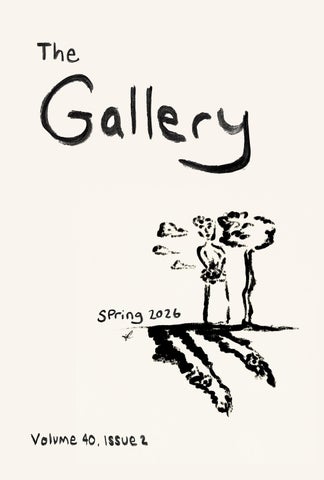
G
the
allery
Volume 40, Issue 2 Spring 2026
Editors Editors-in-Chief Ash Pyle Sydney Shoulders Art Editor Logan Mischke Poetry Editor Melania Frye Josephine Halushka Prose Editor Arden Pentlicki Publicity Editor Valerie Noto Thank you so much to everyone who made this a fantastic semester, including the following, who helped assemble the magazine! Isabelle Bernard
Lucia Reyes
Cover Art
A Stroll
Emmery Flanagan see the full work on page 26
2 The Gallery
Contents creation Man's Valley Springtime on the Beach In the Blue hunting season The Marsh Men The Landscapers Have Still Not Come slush Red in Pieces Lampshade walking to church It's something like terror, something like guilt. To Arabella (Inspired by Ian McEwan's Atonement) I imagine us as children together Fragilina Birthday Rituals The Bubble Tamed Nostalgia, Its Roots, and Related Poems A Stroll one long blink A Life in the Day of Miriam Pflug Sleeping Man Crooked Nose lidocaine Grief at a Good Friday Service Waterfall Arcadian Frontier lonely on my hill All I Want Rebuttal to Larkin's "An Arundel Tomb" "A Springtime Melody" Lady Portrait Buckle cat-cow Flying South 10.11.25 Baubles People Portrait Banana Oversight Dogwood in Ice Apricot Planes Contributors’ Notes Editors’ Note
4 5 6 7 8 10 11 12 13 15 16 16 17 19 20 21 22 24 25 26 27 28 30 31 32 34 35 36 37 38 40 41 42 43 44 45 46 48 49 50 51 52 53 54-55 56
Daisy Maxwell Emma Carmichael Neil Dongre Naomi Dabrowski Melania Frye Catherine Smith Isabelle Bernard Josephine Halushka Phoebe Robertson Rebecca Graber Elizabeth Walker Arden Pentlicki Grace Drost Rebecca Graber Elizabeth Walker Rebecca Graber Lucy Loudon Dativa Eyembe Amelia Haid Emmery Flanagan Lu Caudle Ash Vetter Emmery Flanagan Jia Patil Valerie Noto Isabelle Bernard Catherine Smith Melania Frye Lauren Matlock Josephine Halushka Julia Wall Emmery Flanagan Lucia Reyes Meghan Shelley Rebecca Graber Amelia Haid Cadence Hodge Emmery Flanagan Ash Vetter Ash Vetter Kaz Norrod Meghan Shelley Neil Dongre
The Gallery 3
creation torn out of soapstone to clinical voices thrown from swirling amniotic fluid laundry machine chiseled faces, arms interlocked muses of cave paintings, bells on hats jesters by-the-hour and dancing statues two dimensional caricatures forced to expand, stretched latex balloon as in one moment prehistoric then jesus is born ideal form of a woman, ideal form of a man a sphere of which each point is equidistant from the center, the abrasion of ancient hieroglyphics on temple columns, plato imagined and pygmalion sculpted and the deformed son was thrown off mount olympus, and on the sixth day— clay was scored to nose, cool breath upon a cavern wall, and deer began to run, hooves encircling an imagined foreground the two-horned unicorn turned its head and if god created man in his own image then god must be my dad. — Daisy Maxwell
4 The Gallery
Emma Carmichael
Man’s Valley Photography
The Gallery 5
Springtime on the Beach My darling, snowberries butterflies, have never seemed so young in your eyes I want to wake up and chase the strange tides of your hair – Combed by the wind blown far and near white and black Again and again. The new sun rises on ocean eyes again and again — Neil Dongre
6 The Gallery
Naomi Dabrowski
In The Blue Photography
The Gallery 7
Hunting Season A mother bird lands in her nest, her nest of cracked eggs Bundles of hollow bones and protein Through the gaps between the sticks, Thick yellow wafts of sunlight Pushing up against the green grass Beneath my body, A big warm eye now grown cold, moist as the mosses Dark grey trees towering over me passively, Brown and bloodied, The soft white, glittered with flies A soul, now left as streams of consciousness in the air But before I died, I saw such things The shrubs lighten up as i breach their yard, Thick drops of dew on their level, flat lawn Orderly, tall, and brown Their structures kept freshly painted and free of the ivies and insects crawling their way into civilization Left for me, A steel bowl of sweets, I have only bottom teeth, I make my way through their corn and oats Mushy from the rain While warm amber light pulsates from their neatly trimmed windows, Bookshelves and grey armchairs, A family watching me and naming me.
8 The Gallery
The brown beer spillage onto a sidewalk, And the shiny red side of a car, Lines of blue lights on it, a silhouette broken by a blonde Her hair is a cloud around her head, Smiling mouth framed with red, Eyes becoming black half moons with happiness A hand on her shoulder, On the silver handles of his car A thinning white tank top on a short thick man His eyes are eating her with need, with want, Another man comes, a thick crop of brown hair marking his head and They collide before I know what is happening, Sharp yells hit my ear, yet they’re sleepy with drink The blonde smiles, she is giddy The men love her so much that she earned their hate. A big white truck splattered with mud Squelching underneath it, of joyful orange slugs Leaves and underbrush, made blue with the darkness Men of bulkiness and layers of hardy clothes, Worn rough hands, loud open mouths Rich, fast energy landing on a smooth black gun Too sluggish, too rich to truly run I merely stand there, Moonlight on me, black and shiny or exposed bone I like the sound of the crickets and the cool night breeze I hate the smell of booze being caught by the wind, My nose twitches when it hits me, I don’t hear them as they stumble and bump into each other, My long neck was turned, A click and I am gone. — Melania Frye
The Gallery 9
Catherine Smith
10 The Gallery
The Marsh Men Photography
The Landscapers Have Still Not Come Eyesore, they say in passing, Someone ought to remove that. And yet, perhaps some other things are more important. So I lay here, the snow melting and refreezing between upturned roots, watching the swirl of passing boots and sneakers, my body pressed on the bricks bordering the sidewalk—a waste of money. A week horizontal and I am waiting for the cradle of the garbage truck, my body stiff, creaking with the wind—there is no saving this, only prolonging, only being nudged awake with the incessant dripping of ice, only being preserved in the cold arms of winter. Some days I imagine my death as a welcome warmth and some days I’d prefer living to see spring again, watching boots turn into sandals and feeling shoots of grass rise beneath me. I am not sure if delaying my end is an act of mercy or torture. I am not sure if they care. — Isabelle Bernard
The Gallery 11
slush not quite a puddle, i sink into mud’s child with snow, infant born of cold and slow heat, rising until in surprising rush, what once was snowflakes devolves into slush. the old ice drowns my socks the new dirt browns my shoes i am helpless but to smile at the water-herald’s news—spring is harkening home and soon she’ll cast her spell that grows sunflowers from sleet and new life from a shell. — Josephine Halushka
12 The Gallery
Red in Pieces
by Phoebe Robertson To make stained glass, it must reach a temperature of 2,500 degrees. Silica sand, sodium carbonite, and limestone are heated together. Selenium compounds are carefully swirled in, turning the once clear glass a stunning shade of crimson. The melted substance is then pressed into lead frames, formed into designs that become a window. My Aunt Cuckoo once lived in a house with red-colored windows. That was what she told us to call her that one night when my sister and I were ten. Her real name is Cathy, but secretly I always think of her as that whispered word, passed like a secret on the crowded back porch of the Farm. But the Farm is another story—another house that only comes to me in flashes of memory. The scratch of tall grass, the hush of a hidden attic door, the smell of peeled oranges on the kitchen table. Aberdeen is a town of just under five thousand people. Located in northeastern Mississippi, it’s the type of place most people will go their entire lives without knowing. To the outside observer, it is a quintessential small town. There is one main street, on which the nicest building in town, City Hall, stands—a behemoth building of gray bricks squished between the quietly darkening storefronts of family-run businesses. However, once you stray from the historical cluster of brick-and-mortars, Aberdeen’s charming facade slips away, revealing a town trapped in the course of a slow and painful death. The house with red-colored windows used to sit on an empty street with a name I’ve long forgotten. But I do remember the quiet of the corner on which that house sat. It was the type of silence that smothers you, the type that makes your ears hum from the complete and utter absence of noise. The last time I was in this house, my great-aunt’s third son had passed away. I’d never met the other two—they’d died before I was born. All who remained was the eldest daughter. Ainsley. Outside the church, I see her in a thick fur coat striped through with white and gray, large sunglasses pulled down over her eyes. In the sea of sables before me, she stands out. Beside her, my great-aunt Cuckoo wears another fur, this one in black. It strikes me as odd that Ainsley is matching with her mother, whom she lives so very far from now and seldom visits. But in this moment, they are together, walking side by side to Ainsley’s childhood home.
The Gallery 13
The house is like a satellite. The last tether to a state everyone else has long abandoned. As the slow parade makes its way inside, I pause in the foyer, turning my gaze back to the windows framing the door. They are the color of cherries, and the room is flooded in the vermillion light. No inch of the space is spared. I imagine the house fills with warmth as more and more people shuffled through the door, and I shift under the itchy weight of my coat. A few people wear masks, even though the height of the pandemic has passed. This far south, however, it’s a rare sight. We are then shepherded into an adjoining room, where my great-grandmother lays in bed. Tall windows behind her head limn her in the bright shine of winter light. She moved in with her daughter not long ago—her sudden drop in health requiring 24-hour care. She doesn’t move around much anymore, but her voice is still clear as she speaks to us. It’s a strange feeling to see a person decline. I remember when she had the strength to hug us, to pat us on the cheek. She has been wheelchair-bound for most of my life following a stroke, but up until recently she’d maintained her faculties. Now she only offers a smile, her gaze distant as she struggles to remember our names. My father is the only one she places instantly, and a small sense of clarity passes through her eyes as they land on him. He takes her hand, giving it a squeeze. No one’s quite sure she understands that her grandson has died, despite how many times they’ve tried to tell her. I imagine then we must have made our way through the house, mingling and reminiscing with people we hadn’t seen in ages. Yet I cannot remember that part. All that remains is the feeling of staring at those red windows. Tracing the scarlet shadows with my eyes. We must have only been in that house for a number of minutes. In and out— passing through the doors framed by the stained glass windows. Outside the sky is gray and bright, a sudden contrast to the red which draped over us in heavy sheets. It was a short walk back to the church, where we climbed back into our car sitting in the muddy gravel lot. Then it was back to the road, I haven’t been back to Aberdeen since. When my great-grandmother eventually passed, we traveled to Batesville—the little town in Arkansas where the majority of that side of the family lives. My great-aunt didn’t attend her mother’s funeral, despite having taken care of her around the clock in her final years. A couple years ago, my Aunt Cuckoo and her husband moved into assisted living. Shortly thereafter, the house with the red-colored windows caught fire in the night and burned. And yet no one has told my great-aunt. One thing about glass. When a house burns, it doesn’t melt its panes. Instead, the thermal pressure builds, and within minutes the windows simply shatter. Only a fraction of the 2500 degrees necessary to make the glass is needed for it to be destroyed. I wonder if they didn’t tell her because they think she’s crazy. If they think she can’t handle yet another tragedy. If Aunt Cuckoo finally did go cuckoo. But the glass has shattered, not melted. The pieces are still there. I just wonder who will pick them up.
G
14 The Gallery
Rebecca Graber
Lampshade Photography
The Gallery 15
walking to church waking up in another bed kind of smelling like vodka and someone else’s sweat brushing an eyelash trailing off into nothingness, just kind of letting the tears congeal and drip out next to me, recalling the way he breathes curled like a cat around a girl unknown remembering when i was that girl grateful for his shirt and when he got up at midnight to open the window and let the cold air in —Elizabeth Walker
It’s something like terror, something like guilt. There’s some halo of light when you’re on top of me, maybe from the lamp. — Arden Pentlicki
16 The Gallery
To Arabella (Inspired by Atonement by Ian McEwan) I through the iron kissing gate past the rhododendrons beneath the ha-ha windows transmute into mirrors for the fantastical. glass shines clearly, while the animal in the mind chews at the wearing fabric underneath the eyes. Paramours, tucked away in Triton’s golden palace. does the water reveal or does it distort? these intimate esoteric emotions lost in time or in reality? exculpation will never run free trampled by footsteps the pitter patter of the letter the vase baked in fire, cracked by flame yet fairytales journey onand fiction has never failed to touch this world. a stolen glance, a secret moment youthful passion etched into dusty library shelves their story written into the pages of time. one cursory decision and the love of the dead obligates the living to fan the flames of infatuation further the trials were lined up for them. like soldier figurines awaiting orders neatly corralled against the window sill. their spirits were not claimed they persist like ancient hieroglyphs disembodied ghosts slumbering in green, lakeshore trees limbs reaching out holding onto their bodies
The Gallery 17
II you gave your life for us as metal whirr replaced birdsong you never did waver. as muddy trenches deepend, and bodies stacked higher, you marched along the slashed up ground. when dry beach sands threatened to fill your mouth, and fever began to creep its way into your mind you washed them away in the fountain promising to come back. III she understands how much they bled she saw it in red hospital beds rows and rows of sticky sheets torn up limbs, shredded meat. fleeing guilt to an imprisoned life controlled, corralled, blacked out at night Atonement is what she searches for how many times must she scrub the floor? before her hands will finally be rid of ink stained blame, of paper cut splits ink that should tell another story one of romance, bravery and glory. fiction blends into reality reveries appear on the brink of sleep dreams comfort both living and dead and mend the fractures in the head. maybe they’re alive and well, not a scratch that one could tell bright blue flowers and gingham cotton a silk slip dress, love not forgotten. a handsome man, and a pretty girl what else could they hope for in this world? their bodies roam, and their lips can smile here they stay for a long, long while
18 The Gallery
IV By seventy-seven years old, the creases of my brain are collapsing. Red-letter moments of like peter out into darknessInside here, though, Arabella and her medical prince still join me. Over the page, beneath my pen, Nestled between this space, they meet me. Yearning for life, they tiptoe together in time to a typewriter a blur of deep ivy and red The water has evaporated into the late afternoon sun All is beginning to sink Let it not sleep until it shines its light on them Library books reopened Ivory pages dusted clean Side by side with family where they have always belonged.
— Grace Drost
I imagine us as children together There is a rope swing over the river I imagine us as children together, cannonballing into the rapids How I wish I had a river to run to like you There is freedom in the water I imagine you as a child swimming in reckless abandonment I shed down to my underwear to cleanse myself There is only us here now Playing with the fish and spitting salt in each other’s faces in the brackish water And when we are done, we lay out on the rocks Let the sun warm us dry
— Rebecca Graber
The Gallery 19
Fragilina If I like I can stretch her forehead to the moon. Shape little earth-worm craters near her temples I can save her Fragilina. Her face veiled for the viewer’s projection, his own presupposed aesthetic. Requisite smallness of the thigh. Naked, kneeling at his feet Fragilina. he cuts me– i’m not joking– he takes that little pocket knife his grandfather gave him and he cuts three short, deep lines on my ribs, in the shape of his name three years later and i’m still thinking oh God the ecstasy of being marked like that. Knuckle-deep in a woman still wanting to be marked like that, Fragilina. frantic, frenetic, made to be small, made to kneel, made fetal, made fragile, made his, his own image of me, the reflection, the beginning, the end Fragilina. Fragilina. Fragilina! Sever my nose from its stupid base. Mold myself blank, lipless, sinless. A vessel for your happiness. Crack me open and set yourself free.
20 The Gallery
— Elizabeth Walker
Rebecca Graber
Birthday Rituals Photography
The Gallery 21
The Bubble In a backyard, I remember behind my teacher’s house on a hill catching iridescent damselflies in the garden by the pond at the very bottom with the cattails cicada hums caught in the breeze below her daughter’s tree from Arbor Day twenty years ago still stretching in the sizzling Missouri sun A doll room upstairs, I remember pink dresses, blonde curls, bonnets blinkless eyes that look at me as I change from my polka-dotted swimsuit through the vertical blinds that hang and shift like fingers looking out at the pool surrounded by a decrepit black gate rust gnawing at its edges my friends screaming and splashing below Downstairs, I remember a half-built lego boat semi-completed puzzle pieces the makeshift classroom of cardboard tables whiteboards and board games where we swirl homemade bubble solution with a sunflower yellow wand and fill our cheeks watching as the shining spheres take flight
22 The Gallery
Downstairs, I remember my teacher’s voice “When the rainbow darkens to black that’s how you know it’s ready to pop.” Downstairs, I remember the swirling prismatic surface reflected in the shine of the bubble’s glass skin Now we sit in our rooms curled in our bedsheets that scratch against our skin eyes unblinking fixed to the hazy sky the red of our cheeks in the cold the yellow of our bumblebee rainboots the orange of the dreamsicles that dripped down our fingers Waiting for the sun to dip below the horizon our roommate calls from downstairs our phone buzzes on the bedside table as they try to wrest us out of the haze We watch our skies as they fill with swirling colors We wait for the world to pop. — Lucy Loudon
The Gallery 23
Dativa Eyembe
24 The Gallery
Tamed Mixed Media
Nostalgia, Its Roots, and Related Poems NOSTALGIA (noun) 1: a wistful or excessively sentimental yearning for return to or of some past period or irrecoverable condition also : something that evokes nostalgia 2: the state of being homesick
My dreams are made to look something backwards / something of you / I stick my fingers to the softness of my eyes and dream and dream / A place / A world of some kind in which you inhabit / like the memory of a movie I cannot quite recall, but beckon in weakness and the pounding of strength / play again before me / Here / you wave as though across a desert, and the mirage itself is my final, gratifying drop / Still, I walk / You do not get closer / but I walk / for I am certain with another step or two / I will be returned / What an injury it is to wake “Nost-” derived from the Greek “nóstos” NÓSTOS (noun) return, homecoming
To a close / not like that of an axe to wood, but of something soft and twilight-cold / My venture is done! / to some extent / Your heart is in my ears / Your voice swirls in my stomach / I ache! / And now, to convince the rest / Time / and all of that, so stubborn they are / Patience is etched something wicked and red, like bloody halfmoons cradled in my palms / This sea, pale and hot / and beyond / there, you stand / Waving / Waving always, and grinning / I come, sick as I am / Stronger than you / weaker, still / As an oath, I swear return “-algia” derived from the Greek “álgos” ÁLGOS (noun) pain
In the clutches of certain nature do I weep / Like an ill girl / Like a mother robin and her nothing / Do not get accustomed to it / I beg / This is for me / the unavoidable waves between / the ship I crashed despite never sailing / my worn soles / the pressing hands of night / I find grief in this inability / In knowing you can but do not understand / In knowing I cannot but / want it still / And worst of all, I continue / For I am nothing if not hungry / My promise is but a taste / My dreams but a bite / I see you / your outline and your everything / And still, to my aching / I find myself unable / to be close. — Amelia Haid
The Gallery 25
Emmery Flanagan
26
The Gallery
A Stroll Digital
one long blink I wake up with tightness in my body like I’m bracing to be hit. My eyes open fast: the night’s sleep was just one long blink. The kitchen is cold, which isn’t helping how I’m recoiling into myself, a cinderblock on my chest, my lungs sucking in short, fast puffs, my hands trembling as they search for the coffee grounds. Stills from a dream about trying to leave a grocery store without a receipt. In that scene, there is everything: my friends watch them search me from the automatic sliding doors, a stranger’s prying hands in places they shouldn’t be, and always money– what am I gonna eat this week? What am I gonna eat this week? We’re out of coffee grounds. —Lu Caudle
The Gallery 27
A Life in the Day of Miriam Pflug by Ash Vetter
And Miriam had always hated the general atmosphere of the DMV; the long line, the subtle smell of tobacco, the overwhelming density of living human matter all talking and breathing and refusing to stop and it was moments like these, these visits in the Late Morning to the few places she was legally obligated to be present at on time that reminded her of the reasons why she really preferred to be a shut-in, though that word–she knew quite well by now–always had the tendency to pierce into the pleasantries of any Noontime lunch’s simple conservation, the tendency to make people more reserved, more like herself in a sense, for the concept of a person who refused to spend any time with others was, in the minds of many, totally unthinkable, a disgrace to the limited time one had on Earth, and they acted as if Miriam spent every Afternoon in her home with the blinds closed and the lights off and her eyes open, looking at no one but the mirror out of some juvenile fear of confrontation, but Miriam was fine with confrontation, truly, seeing as she had spent forty-eight years of her life in constant confrontation behind a front desk, and after work she’d head to Happy Hour at Benicio’s for even more confrontation, the kind that arises in folks after their fourth margarita, so she really hated the implication that she was scared of other people, no, no, no, she wasn’t scared, she was just tired, tired of speaking, tired of lifting the flap of her mouth to that vindictive boss of hers who kept her at the office late, every other Evening to speak on some meaningless nothing, and perhaps to stare; she found it so odd that so many people liked to stare at others, for while she understood staring at a book, or a tall building, or a sky just entering Twilight and filling with stars, the idea that there was anything of note in the human face
28 The Gallery
had always confused her, even back when Joseph was alive, the man who had given her that unpronounceable surname, Pflug, she could never find more than a null in his eyes, a Midnight on a planet a trillion miles from the nearest star, and even back when she was a child, her fondest memories always came in that silent Witching Hour when the house was asleep and only her own voice could be heard, and only her own face could be seen, and there was always a little tragedy when the bracing light of Dawn peeked through her window, bringing her back into a reality of moving mouth flaps, and gradually bringing her closer to the present day, where everyone who lived in that old house save for herself was dead, including the house itself, and she could extend that pleasant night as long as she wished, with the exception of those legal obligations, pulling her back into reality’s Late Morning and away from the joys of an eternal night.
G
The Gallery 29
Emmery Flannagan
30 The Gallery
Sleeping Man Crooked Nose Digital
lidocaine for these talons piercing into my soft throat every swallow bruised like a fighter & my sole opponent is you. every time I get back up, head throbbing, im having visions— oh sweet anesthesia, don’t put me out of my misery. for i believe in the relieving of current pain with future joy elation, even. equal & opposite reaction so ill take it just like i’ll readily take the pleasure down the line. so, do your worst. I have no fear of all the good in store for me. ~
— Jia Patil
The Gallery 31
Grief at a Good Friday Service I pray in a pew with clasped hands and open eyes. I have been here many times before, and will be many times after. Thick, black fabric covers the cross and dresses my body. “Dying,” “dead,” and “death” ring from the rector’s lips. In the suffering of Christ is the reflection of every grief that has turned my stomach, of every person ripped from my clasped hands. My grandmother’s shaking fingers and her mother’s casket. Skin melted to wax by disease. A pair of mesmerizing brown eyes I memorized that became too dark to recognize.
32 The Gallery
I can no longer feel something without feeling everything. “Dying,” “dead,” and “death.” The bereavements are intertwined, like necklaces left together in a jewelry box, once individual and shiny, now too knotted for my neck. Aching for relief, I dream of soft fabrics and open palms, familiar eyes, a tidy jewelry box and a clear mind. I know Sunday’s promise, I know to have hope, yet today the stone stands stagnant. There is permission to feel its weight. So I sit with clasped hands, for once with closed eyes, and I pray. — Valerie Noto
The Gallery 33
Waterfall It is the rumble of water sent into freefall that I am here for—feeling the rising fervor, watching it writhe against itself, foam frothing up cool stones before passing over the threshold—then, reckless in its descent, scarcely caressing slick cliffside ledges, stumbling over roots sticking out between rocks, slipping past lush beds of green until reaching the bottom, landing and battering the agitated basin, each drop bursting, reverberating, generating a deep, all-becoming vibrating in my bones. My budding thoughts, grand deliberations, troubles— just as the spray: pushed under or cast out, only a new fresh mist to collect across my skin— a silence. Nothing to do, except simply to witness this. — Isabelle Bernard
34 The Gallery
Catherine Smith
Arcadian Frontier Photography
The Gallery 35
lonely on my hill there’s a valley between us, the rift drowned in fog. on my side, a hill that bathes in sun each afternoon, it mirrors yours. I wake up early, the bend of my back aching, I walk places and I wish I could feel you with me in these moments, I build up a love. I peer across the valley, at your hill I hope you are building one as well. I hear your words, the fly across the mist and the clouds, the wispy grey air carries with it your breath, your voice, sotto voce, whispering, maybe today you said I was pretty, maybe today, you said nice things, in my better morning moods, these sayings make my soul sing with joy, but when I awake from a strange dream and my hill seems to tower above the valley, when I’m alone with my thoughts, the wind from your side smells like lies, and I feel like I can see the green grass of your hillside, unbroken, with no evidence of me, holding you tightly as you sleep and you dream. — Melania Frye
36 The Gallery
Lauren Matlock
All I Want Paint, marker, pencil, and charcoal
The Gallery 37
Rebuttal To Larkin’s “An Arundel Tomb” Focus not on the hands, o knave, O’er which so many sigh Stare instead upon the grave In which their bodies lie. Their faces not so forgotten As you would likes to claim Lady Eleanor and Earl Fitzalen; Relearn these hallowed names. For Eleanor died first, and hollow Her husband stood alone. When it his time to follow He requested for his stone: Near to the tomb of Eleanor, Raised no higher than she With only the same pomp and ardor That she herself received. For a man—a noble—of this time To lay equal with his wife When all expected the clank and chime Monumenting his closéd life
38 The Gallery
Has more to it an eternal gleam Than two marbled hands could hold And yet, this crucial fact does seem To you entirely untold. Those hands, I warrant, verify What was already known: When we live, and when we die We do not goeth alone. But the tomb itself, though you asperse, Does in its history prove Regardless of the cynic’s verse What will survive of us is love. — Josephine Halushka
The Gallery 39
A Springtime Melody How sweet the sound of birdsong Floating soft on springtime breeze! How hushed the rustle of newborn leaves Swapping secrets in the trees! Robins race around the Dell, Bees are buzzing in their hive. My soul rises up to join their danceWhat a joy to be alive!
40 The Gallery
— Julia Wall
Emmery Flanagan
Lady Portrait
Digital
The Gallery 41
Buckle It is very cold and I am far from home. Light bleeds from the sky faster than I can patch it, life running through my numb fingers. Tiny fires flicker off in the distance; their smoke becomes the stars. I think we are alone here, me and the waning moon. I search his face and find nothing. I turn from him and run my numb fingers through the snow, which reflects its weight back at me. Cold and heavy. Not ironheavy. Heavy like branches laden with snow, heavy like the vast expanse of the dark sky in my chest. The wind drones on as it beats down on my flimsy fleshy body. The bones here are long-buried. My eyes pulse. There, against the thin tree trunks, a deer. A buck, a hulking thing. Icicles glimmering on its antlers, pulling its head down so all it wants is to lie in the snow. A buck, here, and then gone. It leaves no footprints. Only the waning moon saw it go. It is very cold and I am. Light bleeds from the sky fast a thing through my numb fingers. ff in the distance; their smoke becomes the stars. we are alone here, me and the waning moon. I see and find nothing. my numb through the snow which reflects its weight back at me. Cold and heavy. Not ironheavy. Heavy like branches laden vast expanse of the my chest. The wind drones on as it beats my fleshy body. There is no falling the bones are long-buried. There, ever. A buck, a hulking thin glimmering on its head down so all it wants is to lay in the snow. A buck, here, and then gone. It leaves no \ It is very cold and I am. Light bleeds fa thing through my numb finhere, me an d the waning moon. I see and find nothing numb through the snow heavy. Not iron-heavy. Heavy t. There, eer. A buck, a hulky snow. A buck, here, and then gone. It leaves no — Lucia Reyes
42 The Gallery
cat-cow cat-cow child’s pose cat-cow church on Sunday her name in my freezer emails, emails, emails cat-cow child’s pose cat-cow $5.75 iced coffee tequila lime soda the time to call my older sister cat-cow child’s pose cat-cow
— Daisy Maxwell
The Gallery 43
Flying South It was the hand of god that pulled me from my mind Or maybe it was just the summer heat sweaty fingers gripping against my temples I feel the mark even now I try to wipe away what remains It sticks to me like honey on my lips The taste of something divine clung to the back of my hand… I’d give it to the birds to feed They know the heavens better than me They know the freedom of expectation They fly from it south for the winter They don’t know of the cold how time freezes with her touch I’m never ready for it The still image on the lake she holds her breath I wonder if the fish freeze too some brief respite from their flurried days endless schools swimming in circles …but it’s always too warm these days The sun beats down my back, harsh And I am drowning in the heat dripping down to the pavement The vultures screech above anticipating let them swarm me they never scared me anyhow I see their shadows circling the clouds taloned angels with battered wings
Can you make a beautiful thing ugly? Where does it go? the beauty picked apart and digested — Rebecca Graber
44 The Gallery
Amelia Haid
10.11.25
Photography
The Gallery 45
Baubles
by Cadence Hodge I could not chase the old woman down. The burdens she’d given me had made my legs too weary. The baubles, the weights, the aching—I had no clue what I was supposed to do with them, and so I had nowhere to set them all down. The first ornament I’d taken as a gift. For what, I had no clue, but it was dainty, glittery-white like a pearl, and made me smile. Pleased with it, I’d rolled it around in my palm for a minute and placed it in my coat pocket. By the twentieth trinket—light blue, wooden, carved in the shape of a fish—my pockets began to bulge, and I was sure this was punishment. For what, I had no clue, but the sense that something about me was simply wrong festered inside me and began to fruit in the back of my throat by the fiftieth—a stone the color of blood. I tried bringing them to the river. I scuttled out from the cover of the trees and onto the bank, carefully submerged all ninety-seven of my burdens and watched the river’s will carry them away. I knelt by the river and said a prayer to thank her for freeing me, but once I’d walked several miles down her banks she returned each and every one of the baubles, now heavier because they were waterlogged. Spitting, the river told of her disgust, and I blushed to have given her such garbage. Though I believe I’ve gotten over my embarrassment, my body still forbids me from stooping down to drink from the river. I tried to pawn them all off in a village I came across. Though my arms were overflowing with all one hundred and twenty-six of my burdens, the broker looked at me like I had three heads and insisted I had nothing to pawn. When I tried dropping all of my “nothing” outside the pawnbroker’s door on my way out, his wife—more perceptive than her spouse—chased after me and insisted I take it all back. When I tried to ignore her and continue up the path away from the village, she howled and wailed and pleaded, and my heart compelled me to obey her. Once I reached a clearing, I built a fire and tried to burn them up. I watched the red and blue flames lick the one hundred and eighty-sixth—a tortoise carved from remarkably heavy jadestone—and the two hundred and third—a string of bright red glass beads. They remained unmelted, unburned, untainted, as if I’d merely thrown them all on the ground. When I started to leave to find more kindling, my body broke out in searing welts as if I’d thrown myself onto the pyre. Though all my skin was burning, my legs would not let me go to the river and soothe myself. The burdensome trinkets grew harder to carry after that. I could no longer flee from the woman’s sight when she tracked me down and foisted more into my hands, not yet healed from the burning. One night, late, I tried to bury them all. I woke at morning twilight, suffocating under their weight.
46 The Gallery
The old woman came to me again, and perhaps because I did not protest or try to run away, she took pity on me. She did not refrain from presenting me with more of her trinkets, but a tear rolled down her face as she did so. I could see she was sorry I did not like them. I passed over a ravine one evening by a bridge. I thought of how quickly the weight of the burdens could pull me to my death. Others had felt similarly, and as a result those responsible for the bridge built a wall of iron bars that stopped a foot above my head. I was too weighed down by the trinkets to climb over. A girl stopped me on the road, and she looked at me like I was a halfdrowned kitten. Taking my hand, she led me to her cottage, where she insisted upon removing the burdens, one by one. I told her it wouldn’t work, and she didn’t listen, only placed each one, no matter how ugly, onto a set of shelves that ought to have held good books instead. She let me eat the bread she’d made and sleep by her fire. I awoke to find her dead, crushed by the set of shelves. It had toppled under the burdens’ weight. Quickly, I took them all back and left the cottage. After that, I thought it best to stop fighting. Let the old woman come, supply me with more trinkets and ornaments I had no use for. If they crushed me into the earth, so be it. If they buried me alive, so be it. Without a shred of defiance, I sat on a bed of pine needles and felt the weight of the trinkets imprison me. From time to time, I could feel a few of them shift, kneading my body into the ground. Though there weren’t nearly as many burdens on my chest as there were on my legs and feet and stomach, my heart and lungs took the brunt of the pressure. Exhausted, I didn’t have the energy to readjust anything, or even to gasp for air. I let myself be crushed onto my back, let my vision grow dim and hazy. I hadn’t heard her footsteps, and I couldn’t make out anything other than a shadowy silhouette standing above me, but I knew the old woman was there. My body grew slack. I could no longer brace myself for the extra troubles, the extra weight she would bestow upon me. My head, ashamed of my weakness, lolled to one side so I wouldn’t be looking directly at her. The old woman lingered for a while. I wondered if she was happy with what she’d done, and as if in response I felt the tepid splash of a tear fall upon my upturned cheek. I heard a sniff from above me, then the soft shuffling of bare feet through pine needles. To my surprise, the corners of my mouth turned down at the sound of her leaving. A small cough escaped from my throat, and then a small wail. I cried.
G
The Gallery 47
Emmery Flanagan
48 The Gallery
People Portrait Digital
Banana Concerning the price of the banana, Concerning those 49 cents per pound, I find it all Concerning how, Concerning the owner, a great wealth is made and Concerning the buyer, a great deal is saved and Concerning myself, I find some greatness Concerning the taste of the product bought; it’s Concerning how all these greats converge when, Concerning the workers who, far away, serve this Concerning, consuming, consistent society, an issue Concerning the price of labor has formed, for Concerning the environments where these fruits flourish, Concerning the hot tropic belt, a trend Concerning any group who finds uneven wealth Concerning forms in a pattern of intervention, where Concerning the peasants, the bullets rain down, and Concerning the bullets, each then rolls around to reveal, how Concerning, the United States’ name, signing away on a million deaths Concerning the lands further south, so that, Concerning the price of the banana, nothing changes, and nothing seems Concerning. — Ash Vetter
The Gallery 49
Oversight Sheer slabs of garbled marble, Crushed and cut into crude extrusions, Boxed and imported by foreign porters, Border the porcelain on either side To hovelish heights, not quite thought through So that each side as such tapers under my eye Fumbling frantically as I find your face next to mine, Dredging down, doing as I do, doubtlessly the dull deluge, Standing still in the stalls of the Boswell bathroom.
50 The Gallery
— Ash Vetter
Kaz Norrod
Dogwood in Ice Photography
The Gallery 51
Apricot you called me a kid, said that maybe I should leave him, dirty talk, told me then you’ll always be alone you know how to hurt me like no one else, what are you so afraid of? what are you so afraid of? you know all about fear, and I know that I can not hear that I looked happier then, not one more time fucked up in love and waist deep lost in it, I like to get my hands messy if it isn’t rough I won’t bite, not this time, not again, at least, not for a while let me catch my breath, because I only want my faith back on airplanes, and truthfully, I feel like a farmer with a shotgun and the worst person in the world time to get the fuck out of dodge, he knows my favorite wine and you know what questions to ask apricot, apricot, apricot his safe word sweet and wet in my tired mouth, Saturn at 29 degrees, everything falls apart — Meghan Shelley
52 The Gallery
Planes To the tall gate of heaven comes us all eventually some will say it is our destination to nowhere and as it speaks its promises I unwrap the golden bar and I look out towards nowhere the hums grow louder in the trees and we have reached our peak yet our destination is farther so let us climb back down the steps and eventually some will say we have arrived
— Neil Dongre
The Gallery 53
Contributors’ Amelia Haid is a Chemistry major who cannot escape her love for the arts and the written word. She particularly enjoys exploring photography, and is currently mourning the loss of her old, hand-me-down camera that no longer works. Arden Pentlicki loves The Gallery very much. Ash Pyle (‘26) will 100% be coming onto campus to steal future editions of The Gallery, and expects at least one photograph of an animal in each. Ash Vetter was placed inside a vat of quicksand when you opened this booklet. By the time you read this bio, the sand will have already finished consuming the young, aspiring writer. Dativa Eyembe (‘26) says get that fade if you want to, babe. Emma Carmichael (‘26) is graduating with a degree in English with a minor in finance. While she spends most of her time writing, she began shooting film at nineteen with cameras she bought off eBay. Grace Drost is a sophomore at W&M and spends her free time with her a cappella group Passing Notes and her band F2L. She loved writing stories throughout elementary school and has since translated this passion into writing songs and poems. Isabelle Bernard (‘28) is studying English and using creative writing to escape the horrors. Jia Patil (she/her) is a first year, majoring in neuroscience and minoring in psych on the pre-med track. She writes poetry to express overwhelming emotion, explore unanswered questions, or simply recall perfect moments and memorable dreams. She hopes to inspire people to slow down occasionally and admire their own thoughts, from time to time :) Josephine Halushka (‘26) is an English major and Classics minor who will always advocate for the strange and silly. Kaz Norrod (they/them) is an Integrative Conservation major and Native Studies minor in their second year at William and Mary. They picked up photography as a hobby in middle school and are fascinated by capturing the smaller details in nature often missed.
54 The Gallery
Notes Logan Mischke (‘26) is excited to remember The Gallery as a pivotal part of their college experience. Lu Caudle (‘27) is an English-Music double major from Richmond, VA. They enjoy writing prose, poetry, and lyrics, and are currently pursuing a long-form prose thesis in Creative Writing. Lucy Loudon (‘26) is a Biology major and Creative Writing minor heading to veterinary school at the University of Illinois Urbana-Champaign. She has dearly loved her time at William & Mary but is excited for what the future has to offer! Her writing is often inspired by nostalgia and the natural world. Neil Dongre (he/him) is a rising junior double-majoring in Philosophy and Psychology. His interest in writing started in his sophomore year and continues to deepen. He is proud to be in this edition of the Gallery and hopes that you enjoy reading his work. Meghan Shelley is a third-year English student in the Joint Degree Program with the University of St Andrews. You can read more of her poetry and personal essays on her substack, @ballisticonthebench. Melania Frye (she/her) is a freshman majoring in Biology and English with a love for writing in its many forms. Phoebe Robertson (she/her) is a sophomore English major and Film and Media Studies minor. She frequently can be found with her nose in a book or dreaming up ideas for a novel. Rebecca Sage Graber (‘27, she/they) is a junior Studio Art major with a keen interest in poetry and a passion for photography. Sydney Shoulders (‘26) is graduating after studying Philosophy and English. They love Sally Rooney and hate Irish goodbyes. Valerie Noto (‘28) is a psychology major who enjoys exploring art museums, drinking excessive amounts of chai, and making Canva graphics for Gallery. She finally put fingertips to a keyboard and wrote a poem.
The Gallery 55
Editors’ Note Hello Gallery people! As the Spring 2026 semester comes to a close, so does our tenure as Editors-in-Chief. We both joined The Gallery in the fall of 2022, as two bright-eyed freshmen living in Gooch Hall, and it is hard to believe that we have spent our Thursday evenings in Tucker for four years now. Throughout college, Gallery meetings have been a consistent and reliable way for us to remain creative, even as coursework and other responsibilities made it challenging to feel inspired. Having the free time to thoughtfully consider others’ art is a serious privilege, especially in the social and political climate of today, and we are so grateful to have led an organization that makes it easier for students to do exactly that. Serving as your Editors-in-Chief has been an honor, and thank you for trusting us to lead. We also want to thank our staff for their efforts toward creating this issue. Our incoming executive board is phenomenal, and we hope that you stick around to see how The Gallery blossoms under their leadership. A special thank you is owed to Logan Mischke, our amazing and retiring Art Editor, for their tremendous support and long-standing loyalty to The Gallery since our original Gooch glory days. Most importantly, thank you so much to our readers! Whether you are a regular contributor, a friend of an artist, or someone who just so happened to find a copy of this magazine sitting around, none of our efforts would be possible, or meaningful, without you. Please continue supporting the arts, whether at William & Mary or elsewhere. Finally, we hope that these pieces inspire you to slow down, reflect on your surroundings and feelings, and possibly even create something new. Our time working with The Gallery may sadly be coming to an end, but it is never too late to start making or sharing art. We wish you the best of luck with your creative endeavors, and thank you endlessly for reading our final issue. — Ashleigh (Ash) Pyle and Sydney (Syd) Shoulders Co-Editors in Chief, The Gallery
Colophon The Gallery Volume 40 Issue 2 was produced by the student staff at the College of William & Mary and published by Carter Printing Co. in Richmond, Virginia. Submissions are accepted anonymously through a staff vote. The magazine was designed using Adobe Indesign CC and Adobe Photoshop CC. The magazine’s 54, 6x9 pages are set in Garamond. The titles of all the pieces are Derivia. The text on the cover is set also in Garamond.
Check out The Gallery online www.issuu.com/gallerywm/ www.instagram.com/thegallerywm/
56 The Gallery