
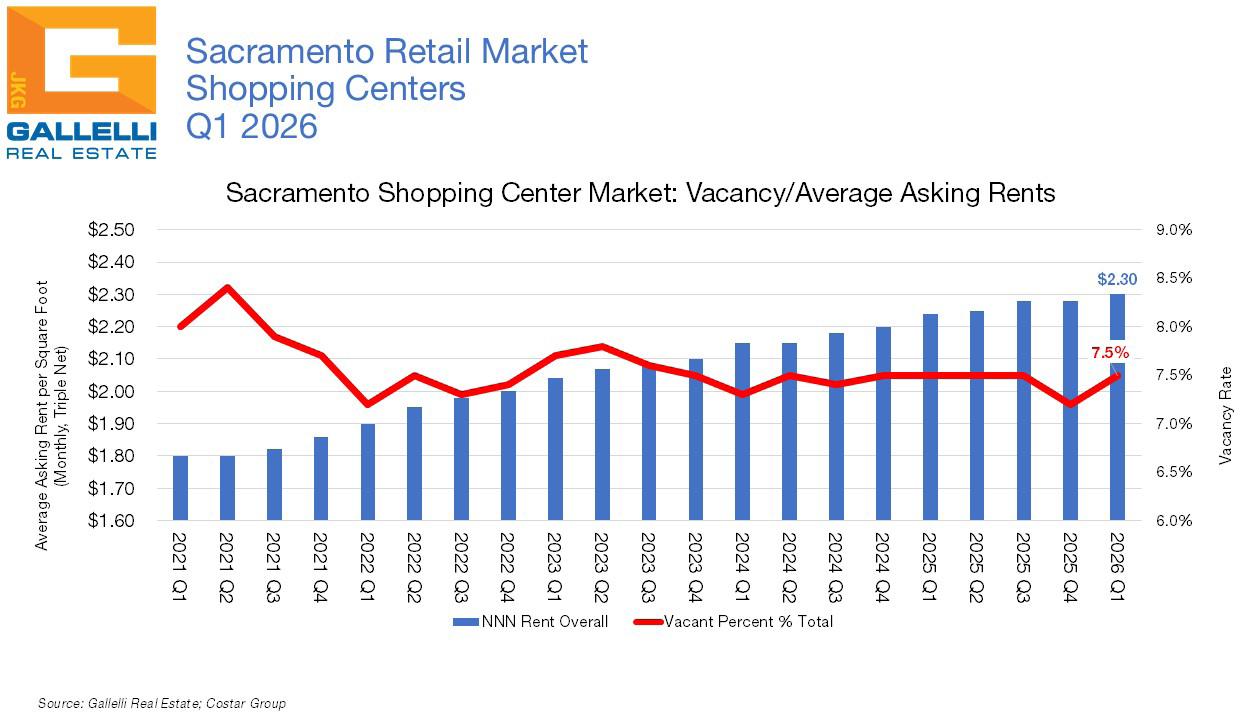
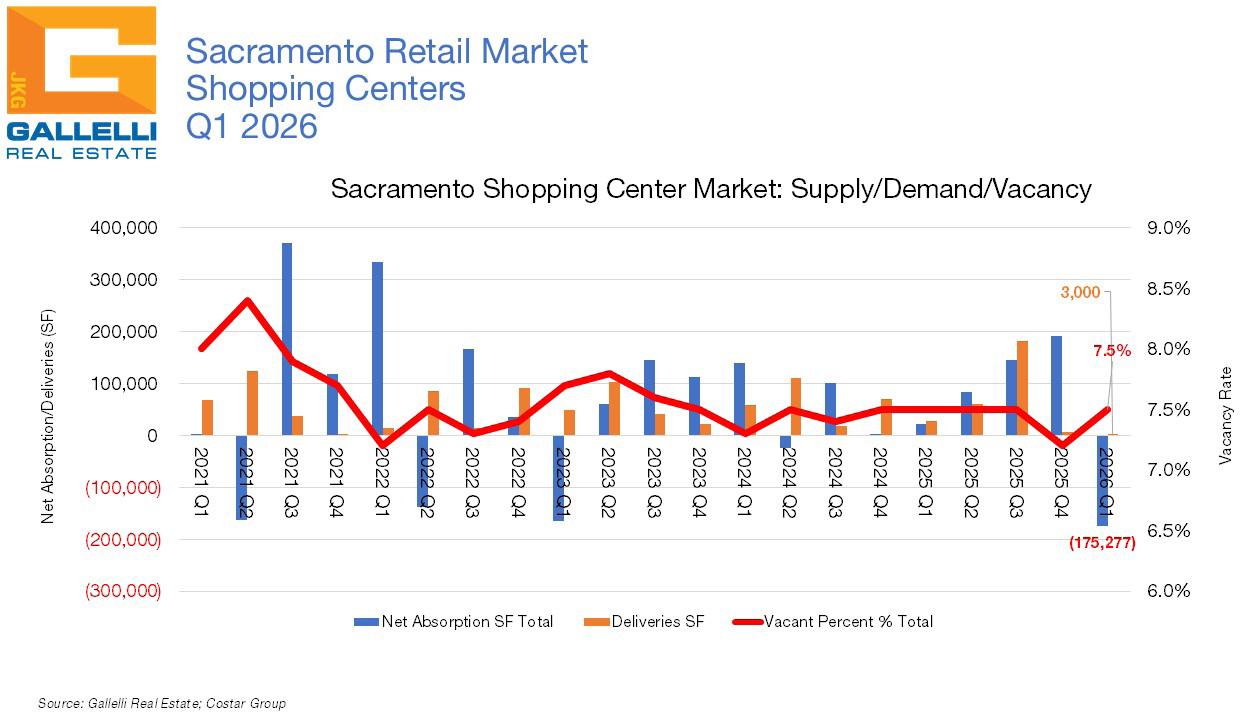
Vacancy for shopping center space in the Sacramento region stood at 7.5% as of the end of Q1 2026, reflecting a slight uptick from the 7.2% rate recorded at the close of 2025. Since Q4 2023, vacancy has consistently hovered at or near the current mark of 7.5%, never moving more than 20 basis points in either direction. This is particularly notable because both 2024 and 2025 were years in which national chain bankruptcies and store closures were elevated, with the liquidation of major chains like Rite Aid, Joann Fabrics, Party City, Francesca’s, Forever 21, and others resulting in thousands of store closures nationally and dozens across the Sacramento region. Despite this, the market has remained resilient with most of the properties impacted by these space givebacks, typically landing tenants within nine to 12 months of storefronts going dark.
While key retail categories like drug stores, craft and/or hobby, furniture, and mid-price apparel stores have been in contraction mode, discounters, grocery stores, beauty, and off-price apparel players have been expanding. For example, since 2023, the bankruptcy and liquidation of Rite Aid and the ongoing downsizing of both CVS and Walgreens has returned roughly 20 drug stores to market in the greater Sacramento region. Only a handful remain vacant, with most of those in process of leasing to new tenants ranging from fitness clubs to small format grocery or dollar stores. In one case, a former Rite Aid in the Midtown submarket, permits have been filed to redevelop the property as a mixed-use multifamily project with 33 apartments and ground floor retail. Grocery Outlet, Ross Dress for Less, Skechers, and Dollar Tree have been among the most active tenants taking this space locally.
Fitness concepts also continue to be active in the Sacramento region with 24 Hour Fitness, Crunch Fitness, Planet Fitness, Chuze Fitness, Club Studio among the larger format users, while we also continue to see movement from smaller users as well. But we also continue to see some of the most aggressive growth coming from concepts that weren’t even considered retail space using categories just a few years
ago. Aesthetics/MediSpa concepts, cannabis dispensaries, car washes, urgent care, or quasi-medical and veterinary hospitals all remain highly active.
Meanwhile, we continue to see aggressive expansion from newer QSR and fast casual concepts, particularly in the coffee, chicken, and Asian sub-categories though we are seeing more closures from some legacy chains like Jack in the Box, Wendy’s, KFC, Pizza Hut, and others. But Chick-fil-A, Raising Cane’s, Chipotle, Panda Express, Dutch Bros. have all been actively expanding and we continue to see new entrants to the marketplace as well (500-unit+ 7 Brew is about to make their California entry in the Sacramento region as is the nationally expanding Bay Area-based Slice House by Tony Gemigniani). Likewise, the casual dining category continues to churn with legacy bar and grill chains increasingly struggling to hold their own against new gastropub players as well as upand-coming concepts from a wide range of cuisines.
Over the course of 2025, these tenants kept the Sacramento shopping center market in the black, despite the continued uptick in bankruptcies and strategic closures. Net absorption remained in positive territory throughout last year with the market absorbing 443,000 square feet (SF) of retail space last year. About half of that was vacant secondgeneration space in existing shopping centers.

Developers added 278,000 SF of new shopping center inventory to the region last year. All these projects had commitments from anchor tenants in place (primarily from grocery concepts) prior to delivery and nearly all the inline small shop space and pad sites at these centers have either landed tenants or have letters of intent in place.
Since 2021, developers have added 300,000 SF or less of new space annually in the Sacramento market. This is roughly half the level averaged in any given year between 2010 and 2019, and approximately one third the level of new shopping center construction the previous decade (2000 through 2009). These constrained levels of new development have been a major factor in the market’s relative stability in the face of recent economic headwinds and elevated closure levels. We know of no new anchored shopping centers to have been built locally in the past decade on a 100% speculative basis, and most construction over the past five years has consisted of additional phases, pad buildings, or strips in already successful shopping centers.
Construction costs remain elevated. Concrete, steel, and lumber prices remain 30% to 40% above where it was just five years ago, before the Biden-era inflation spike. Those numbers are not going to get better in 2026, with the current energy price shock from the Iran war already negatively impacting inflation (more on that in a moment). The reality is that most new projects simply do not pencil because construction and financing costs remain high. The few new projects moving forward are those on premier corners, with the most desired anchor tenants in place, typically with inline rents above local averages.
This same trend is playing out nationally in most markets (save for a few experiencing outsized population growth from in-migration). Limited new development is giving the market time to absorb excess space and maintain relatively stable vacancy levels while supporting rental rate growth.
The current average asking rent for shopping center space in the region is $2.30 per square foot (PSF), on a monthly triple net basis. This metric has held its own despite the headwinds and has increased 2.7% over the past year, though at its peak during the 2022 post-pandemic rebound this metric reached 3.6%. According to the Costar Group, overall retail rents have increased 27.0% in the Sacramento region over the past decade. Not bad, considering that ten years ago the prevailing industry narrative was one of eCommerce driving a “retail
apocalypse” and since then, the market has experienced a global pandemic that resulted in record store closures and bankruptcies, followed by the biggest surge in inflation in forty years. Through it all, both the American consumer and shopping centers have proven to be remarkably resilient.
But will that resilience hold up in 2026?
As stated earlier, vacancy increased slightly in Q1 2026 from 7.2% to 7.5% across the Sacramento region. The market recorded -175,000 SF of negative net absorption over the first three months of 2026. Half of the region’s 14 distinct submarkets recorded occupancy growth this quarter, but ultimately space givebacks in a few key submarkets outpaced new tenants.
The Carmichael/Citrus Heights Orangevale submarket recorded -77,000 SF of negative net absorption in Q1, driving vacancy upward from 11.3% to 12.3% though we should note much of the current vacancy overhang in this market comes from one project, Sunrise Mall. Excepting that one mall property, this trade area currently has an overall vacancy rate of 8.5%. Plans to redevelop significant portions of the mall continue to work their way through the Citrus Heights City Council. Currently the nearly 100-acre property is split into five parcels with different ownership groups, complicating plans to reimagine the property.
The Roseville/Rocklin submarket was also in the red in Q1 to the tune of -58,000 SF of negative net absorption. Still regarded as one of the region’s premier suburban retail trade areas, this number was primarily driven by grocer Raley’s closing their store at the Roseville Center shopping center. The locally based chain also closed stores in the Bay Area; Mountain View and Antioch (the latter is going dark at the end of April). Vacancy in the Roseville/Rocklin submarket now stands at 5.3%, up from last quarter’s reading of 4.8%, but will likely dip again by Q2. Nugget Market is opening its 18th location in Rocklin in April, while we know of multiple other scheduled openings that will boost local occupancy heading toward the mid-year mark.
Vacancy also ticked up in the Highway 50 submarket as it posted -53,000 SF of occupancy declines from a mix of sources. Vacancy here edged upward in Q1
from 13.0% to 14.6%. The Arden/Howe/Watt trade area also posted negative net absorption this quarter across a handful of shopping centers with -35,000 SF of space returned to market. Vacancy here increased from 9.9% to 10.4%.
Despite the bad news, most markets held their own this quarter despite relatively tepid leasing activity. We tracked 453,000 SF of total deal activity (gross absorption) in Q1, down from 719,000 SF in Q4 2025 and from the quarterly average of 642,000 SF recorded last year. Most of this deal activity was concentrated in Sacramento’s newest or premier Class A properties. Not surprisingly, according to the Costar Group, only 5.0% of the total retail space available in the region is in Class A properties or those that have recently been built (less than ten years old). Which is even though retailers have had plenty of glum headlines over the last couple of years, the challenge we hear most from brokers focusing on tenant representation (whether locally or nationally) is that finding quality product remains a challenge. This is especially the case when it comes to Class A smaller shop space (5,000 SF or less) or junior box space (25,000 to 35,000 SF.
The Sacramento market is likely to record positive net absorption and declining vacancy in Q2 simply based on deals already signed where tenants are taking occupancy in the
next three months. Nugget’s opening at Whitney Ranch in Rocklin, Grocery Outlet in Citrus Heights (in a former Rite Aid space), Whole Foods’ new store in Elk Grove at The Village and H Mart at 6300 Mack Road in South Sacramento are all slated to open in the coming weeks and months. But grocery requirements appear to be slowing, and we may not be far from a competitive tipping point in the market.
Competition in the grocery space is starting to take its toll with more chains beginning to prune underperformers from their store fleets. In addition to Raley’s recently announced closures, Grocery Outlet (even while still opening new stores) is planning to close at least 35 units nationally in the next few months. This comes on the heels of Amazon Fresh shutting all its doors, including three local stores, and both Kroger and Albertson’s looking to close underperformers this year. Though both chains expect to close 50-70 units across their multiple banners, we are not aware of any local closures being planned.
But despite the intensifying battle for grocery market share and inevitable emergence of winners and losers, most industry forecasts for store closures are pointing downward. At least, for now.
Retail analytics firm Coresight Research tracked 50 retail bankruptcies in 2024, the highest they recorded since the 2020 pandemic. That number fell to 32 last year. They predict that retailers will close approximately 7,900 stores in 2026,
down by 4.5% from 2025 numbers. We should note that Coresight primarily tracks traditional merchants. It does not track some of the other major categories now active in shopping centers like restaurant chains, fitness clubs, or the wave of new user categories ranging from veterinary clinics to car washes.
Meanwhile, retail credit monitoring company Pulse Ratings has reported an increase in general risk across the industry over the past six months with consumers continuing to be frugal and highly price conscious. As a result, retailers remain focused on driving value at times to the detriment of their margins. But while their bankruptcy watch list has grown from where it was one year ago, most of the concepts that are at greatest risk are significantly smaller than the chains we saw fail in 2024 or 2025. Keep in mind that the collapse of just three chains (Rite Aid, JoAnn, and Party City) alone accounted for the closure of more than 2,600 stores over the past two years and the return of more than 40 million square feet (MSF) of space to the market. While currently elevated risk chains (credit ratings of D or below) include some major players (AMC, SaveA-Lot, Cato, DSW, Torrid, Regis, Dave & Buster’s, Sportsman’s Warehouse, etc.), none are of the size or scale that could match what the market experienced in 2024 or 2025.
But the news is not all rosy in terms of the macroeconomy.
There is good news for import-reliant retailers is that the Supreme Court ruling on tariffs means that they are largely off the table for now (though the administration certainly could pursue them again via Congressional channels). In April, the Trump administration launched a tariff refund portal for businesses to claim refunds on the estimated $166 billion it collected last year. It’s unclear as to how long the process may take, but this could mean some retailers could see some significant refunds in the months ahead that certainly could bolster bottom lines. But any good news on this front may be short-lived.
As this report went to press, the ongoing war in Iran and the blockade of the Strait of Hormuz has created a global oil shock that has sent energy prices skyward. The average national price of gasoline in the United States is now above the $4.00 mark while diesel fuel, the lifeblood of the nation’s supply chain, has climbed by more than 50% with the national price topping $5.50 per gallon. Ultimately, higher fuel prices function as a regressive tax with those higher costs not stopping at the pump. While consumers might be able to pull back on non-essential trips, carpool or work remotely in the face of high gas prices, higher diesel prices cascade into higher freight rates, food prices, manufacturing
outputs, and overall inflation (which climbed to 3.3% in March and will get worse before it gets better).
This will have a direct immediate term impact on retail spending as higher gas prices increasingly divert consumer spending from the mall to the gas pump. Meanwhile, the increased cost of getting goods to market will inevitably be passed on to consumers in the form of higher prices that could potentially set off another upward spiral. Should these conditions worsen or persist long enough, real challenges will emerge for retailers.
Against this backdrop, shoppers are likely to focus on essential goods, supporting categories such as grocery, pharmacy, and discount retail. Discretionary sectors (including travel, dining, entertainment) will become far more vulnerable as consumers focus on needs, rather than wants. Shoppers will be more likely in the near term to postpone big ticket purchases which may be challenging to furniture, appliance, and consumer electronics retailers.
The restaurant industry, which operates on thin margins, may also face challenges as costs rise but consumers are increasingly cash strapped. Valueoriented operators are generally better positioned than mid-tier concepts in this environment. Look for QSRs, especially those with budget menus, to outperform more expensive fast casual or casual dining concepts.
Ultimately, the depth of the economic impact will be determined by the length of the supply chain disruption but most economists are lowering near-term outlooks for growth, with groups ranging from Moody’s Analytics to Oxford Economics all significantly raising their odds for a potential global recession ahead—most with the caveat that an extended crisis of four or more months making a downturn more likely than not.
In the meantime, even assuming a best-case scenario of an immediate reopening of the Strait, most energy analysts say it would be at least four months before we could see a return to pre-war levels of oil production and a full recovery of the supply chain. Which means that even in the most optimistic outlook, significantly elevated gas prices through Summer 2026 are likely.
An expansion of the war, especially if large amounts of critical energy infrastructure across the Gulf were to be destroyed or damaged, or if the conflict were to drag on for months, would substantially increase the chances of global recession by the end of the year.
Criteria based on: Retail in a Shopping Center. Includes Existing, Under Construction, Proposed, Final Planning
Gallelli Real Estate is a private firm that specializes in commercial real estate services and property management. We believe that as a boutique firm whose understanding of the business runs as deep as our core values, our advantage is large. We take pride in our unique approach to offer more individual solutions that address the ever changing needs of our clients and the industry. After all, our success is measured by the success of our clients and the strength and longevity of our relationships.