© Robert Kipniss, Window w/ vase & forest (Detail), 2000, Mezzotint, 19.625” x 19.375”
THE NATURE OF ABSTRACTION RALPH WICKISER STANLEY BOXER ROBERT KIPNISS RICHARD ERDMAN
33 NEWBURY STREET, BOSTON, MA 02116 | 617.266.8001 | GALERIE-DORSAY.COM
ABOUT GALERIE d’ORSAY Since 2000, Galerie d’Orsay has served as Boston’s premier resource for the finest of masterworks. Located in the heart of Boston’s Back Bay, the gallery and its qualified staff provide acquisition and collection expertise to a wide-ranging global base of discerning art collectors. Galerie d’Orsay’s collection spans six centuries of art, featuring works by preeminent old masters, impressionists, and modern artists. The gallery represents an internationally renowned stable of living artists. CONTACT: INFO@GALERIE-DORSAY.COM 33 NEWBURY STREET, BOSTON, MA 02116 | 617.266.8001 | GALERIE-DORSAY.COM
Foreword 20th & 21st c. American Artists The story of American art in the twentieth and twenty-first centuries is one of continual reinvention—a dialogue between tradition and innovation, observation and abstraction, the tangible and the imagined. The artists presented in this collection each contribute a distinctive voice to that conversation while remaining deeply committed to the pursuit of a singular artistic vision. Whether through Ralph Wickiser’s analytical abstractions, Stanley Boxer’s bold and expressive compositions, Robert Kipniss’s quiet meditations on landscape and light, or Richard Erdman’s masterfully sculpted forms, each artist reveals a profound understanding of balance, emotion, and craftsmanship. Though their approaches differ, they share an unwavering dedication to exploring the human experience through enduring works of art. We have curated this collection for our Galerie d’Orsay community to celebrate these remarkable artists who represent the richness and impact of American artistic achievement, creating works that resonate across generations.
RALPH WICKISER 1910 - 1998
RALPH WICKISER Rising The Reflected Stream: The Early Years Oil on Linen ; 60” x 72” 1985 “As an abstract painter, the beauty of Reflections are the continuous theme in Nature became an irresistible lure when all these works and the study of reflections in the stream has led to a discovery of a I moved to Bearsville, NY. whole new class of art qualities in form After discovering Vredenburg Stream, and substance, which has allowed me to I was drawn in particular to a part of express more succinctly my appreciation the stream about a city block long. of the grandeur in nature.” Constantly changing shapes and colors found in the reflections of the stream Ralph L. Wickiser intrigued me and in attempts to capture Woodstock, New York, 1985 fleeting and momentary qualities, I focus on different depths in the stream and there I discovered a whole new world of shapes, forms, textures and colors.
RALPH WICKISER Hanging The Reflected Stream: The Abstract Years Oil on Canvas ; 40” x 60” 1987
“How many aging artists in their seventies have the chutzpah much less the energy to move on from a sumptuous and dazzling signature style—the Reflected Stream paintings of 1975 to 1985—and further extend that vision into the often treacherous arena of two-dimensional flat abstraction. One is reminded of the aging Monet and his obsession with capturing the essence of light and form in the floating world of his lily pad ponds. Wickiser, a nature poet at heart, with a visual acuity only surpassed by Thoreau in his
journals, managed in his last period to capture the scintillating evanescent light forms found on the surface of a tiny stream in Woodstock, and transform that experience into works at once symphonic and exquisitely intimate. These transfixing paintings depict a world both interior and exterior, a place of the spirit as much as the mind, where floating sumptuous fields of symbolic natural forms tantalize the beholder. Time is crystallized. Patterns of color beguile and challenge the viewer. Only a consummate craftsman
RALPH WICKISER Intersession The Reflected Stream: The Abstract Years Oil on Linen ; 40” x 50” 1987
in the handling and manipulation of paint could make such meticulous dissections of nature sing on the canvas… Ralph Wickiser’s Abstract Stream and Covered Apple Tree paintings sing of the final chapter of an artist’s life; they are the epiphany of a lifetime’s devotion to the splendors of the natural world. Although photography provided a tool for conceptualizing these works, the deft gestural skill of this master artist was the crucial ingredient to their
successful execution. In the acuity of observation and the deep subjectivity of translating lived experience to canvas and paint, Ralph Wickiser taps into and extends the transcendentalist tradition of Emerson and Thoreau in ways that very few artists of his generation, or any generation, even dreamed possible.” David Adams Cleveland Ralph Wickiser: The Abstract Stream, 2014
RALPH WICKISER 1910 – 1998
BIOGRAPHY “Ralph L. Wickiser gained renown for his ever-evolving style of symbolic art drawn from nature, at once expressive and intimate. Trained at the Art Institute of Chicago, Wickiser began as a representational artist in the 1930s and evolved into Abstract Expressionism in the 1950s and ‘60s. He would then segue into modes of representational abstraction in the 1970s, only to push new boundaries with his purified and flattened analytical abstractions of trees and reflections in the late ‘80s. Wickiser was included in the 1953 Annual at the Whitney Museum alongside colleagues Milton Avery, Adolph Gottlieb, and Willem de Kooning. As a Woodstock Artist Association insider and head of the Pratt Institute’s Master of Fine Arts program, Wickiser worked closely with friends Yasuo Kuniyoshi, Jacob Lawrence, Stephen Pace, Franz Kline, and Philip Pearlstein. Wickiser’s non-objective abstractions from the 1950s were created with lush Tonalist impasto of interlaced geometric shapes; inspired by Matthias Grunewald’s Isenheim Altarpiece, the artist sought to create a visual metaphor of uplift and resurrection. After forays into figurative painting, Wickiser won acclaim with his sumptuous “The Reflected Stream” (1975-85), which captured the prismatic flow of reflected light on a rocky, leaf-strewn stream in Woodstock. Ralph L. Wickiser further refined his abstracting impulse, culminating in his last series of works, The Covered Apple Tree (1987-1998) and The Shadows on the Grass (1996-1998).” David Adams Cleveland Ralph L. Wickiser: The Reflected Stream, The Early Years 1975 - 1985, 2009
STANLEY BOXER 1926 - 2000
STANLEY BOXER Poolsandbaredwander Oil & Mixed Media on Canvas ; 62” x 50” 1991
“Painter Stanley Boxer used the term ‘manufacture’ to describe his process. His abstractions integrate raw materials into a polished whole, all the while retaining evidence of painting as pure, manual labor. Boxer’s body of work gives renewed meaning to what used to be called ‘all-over painting.’
drips, dabs, washes, and three-dimensional objects, foregrounding both the serene and frictional properties of painting. Embedded materials such as sawdust, stones, glitter, twine, and netting produce mysterious depths within the thick, textured, melted and bleeding color.”
Employing multiple brushwork techniques within any single painting, Boxer crams his surfaces with impastos,
Tim Keane Fabricated Galaxies: On Stanley Boxer, 2016
STANLEY BOXER Untitled Figure Study (40D-60) Mixed Media on Paper ; 17.5” x 22.5” 1960
“A prolific and tireless worker, [Stanley Boxer] was in the studio seven days a week, [Boxer] preferred the term ‘practitioner’ to ‘artist’ and routinely rotated his attention among several media, including painting, drawing, sculpture and printmaking. Within painting, he explored a variety of styles. At one point he caught the eye of the critic Clement Greenberg, and he was sometimes lumped in with the ‘colorfield’ painters whom
Greenberg championed, notably Jules Olitski. But Mr. Boxer himself was adamant in rejecting this stylistic label. Over the years, he remained loyal to the materially dense abstract mode on which his reputation rested. Mr. Boxer had his first solo exhibition of paintings in New York in 1953...In 1992, the Rose Art Museum at Brandeis University in Waltham, Mass. organized a career
STANLEY BOXER Mitblauund Oil & Mixed Media on Canvas ; 41.125” x 36.375” 1997
retrospective of Mr. Boxer’s work in all media. Traveling retrospectives of his drawings, which are largely figurative, were organized in 1978, and 1991. A one-person show of his paintings appeared at the Butler Institute of Art in Youngstown, Ohio, last year. His work is in the permanent collections of many museums, including the Museum of Modern Art and the Whitney
Museum of American Art in New York, the Boston Museum of Fine Art and the Hirshhorn Museum in Washington.” Holland Cotter New York Times, 2000
STANLEY BOXER 1926 - 2000
BIOGRAPHY Endlessly innovative and with a profound sensitivity to texture, Stanley Boxer was born in 1926 in the Williamsburg neighborhood of Brooklyn, New York. Boxer was a prolific artist—more a “practitioner” of art by his own admission—across a number of different media, including painting, printmaking, drawing, and sculpture. Having returned to New York after his service in the United States Navy during World War II, Boxer enrolled at the Art Students League with funds he received from the G.I. Bill. He was uncompromising in his pursuit of painting, spending 7 days a week in his studio. Boxer’s work attracted the attention of art critic Clement Greenberg, who categorized Boxer as one of the ‘color-field’ painters. But Boxer, ever the independent, was adamant in rejecting this label, calling himself “visionless”—meaning he allowed his past art to shape his work but would by no means attempt to shift what that art should look like in the future. His art appears in the collections of many museums, including the Museum of Modern Art (NY) and the Whitney Museum of American Art, as well as the Museum of Fine Arts, Boston, the Solomon R. Guggenheim Museum, the Hirshhorn Museum, and the Metropolitan Museum of Art, amongst many others. In 1975, Boxer received a Guggenheim Fellowship. Stanley Boxer’s paintings are abstract compositions notable for their texture and color, in which small gestures are multiplied to form a single entity—almost as if observing cells under a microscope where individual units coalesce into a whole. His often perplexing titles (take for example, Boxer’s 1978 ‘Peckedperchingsilveredblanch’, a tongue-twister of a word, or the evocative “Cooingnoonflowerlets,” 1974) obscure any immediate understanding of the works; a deep love of language, particularly German, encouraged his playful use of words, combining suggestive nouns and adjectives in much the same way as his approach to painting merged color and form. If there is to be any single, identifiable subject to Boxer’s decidedly abstract works, it is this coming-together of disparate colors, textures, and moods.
© Robert Kipniss Studio
ROBERT KIPNISS B. 1931
© Robert Kipniss Studio
ROBERT KIPNISS Near trees & distant hills Oil on Canvas ; 30” x 38” 2012 “One thing I have most wonderfully learned is that the greatest reward for making art is making art. Instinctively I knew that painting and exhibiting were the only essentials I needed, and whatever difficulties I encountered along my path, there was always the reassurance of working and learning. I was working and showing right from the start, and it never occurred to me to wonder if I would be successful or not. In the beginning, it was very challenging, mostly because there was no sure way to do it, no rules, no guideposts. For about ten years my painting was lyrical, energetic, filled with bright color, and charged with exuberance. At the same time, the poetry I was writing was dark, angry, and often painful to create.
When I stopped writing in the early 1960s, my paintings took on the characteristics of my poetry and became infused with anger, a dark monochromatic palette, gravitas, and occasionally slightly surreal themes. It was only after a few years when my lyricism began to re-surface and meld with the darkness. This was the beginning of my mature style...my life as an artist continues to be a passionate adventure. Every day I learn more about the constellations of feelings and thoughts I derive from the simple act of seeing. The life of an artist is about the art. I have lived my life as I dreamed of doing when I was a young man.” Robert Kipniss
© Robert Kipniss Studio
ROBERT KIPNISS Black table Mezzotint on Somerset Paper ; 9.375” x 7” 1995
“Kipniss’s subject matter is landscapes, interiors, and still lifes, often described as conveying solitude and inward experience. The lighting is penumbral or shadow-like; twilight and dawn are favored time settings. In his paintings Kipniss employs exceptional subtlety in tones and restrained use of color to create an overall atmospheric effect. His prints are masterly meditations on mood and light using a restricted black-andwhite palette, though he has occasionally created color variants of selected prints, always employing a subtle color palette. His works in various media—paintings, drawings, and printmaking—are often interrelated, presenting variants on a theme.
The paintings date from the early 1950s; the prints from 1967. His favored techniques in printmaking have been lithography and mezzotint, the former dating from 1968 into 1994, the latter since 1990. In keeping with his subtle and understated style, he has a unique approach to titles: the first word is capitalized, and any subsequent words are lower case, unless a proper noun; ‘and’ is replaced by an ampersand, and ‘with’ is shortened to ‘w/’.” Sarah Kirk Hanley
© Robert Kipniss Studio
ROBERT KIPNISS Window w/ orange curtains Color Lithograph ; 24” x 15.25” 1989 “Robert Kipniss does not copy nature but elicits what it feels like to be in nature...Drowsy trees and hedges, barns and leaves casually converse in a breeze that seems to bend and shake bushes or explode leaves in sudden flurry into a pale sky. In these virtual realities Kipniss’s realism is of the subconscious, nonverbal perceptions achieved with painstaking skill so that we, too, may experience the memory of the inner eye. Robert Kipniss conflates the categories of representation-of things,
of relationships, and of moods. His inner truth is a language of basic forms that evoke feeling rather than literal meaning. What his work is about is what it shows, not what it describes.” Alison Armstrong A walk in the country with Robert Kipniss, 2009
© Robert Kipniss Studio
ROBERT KIPNISS B. 1931
BIOGRAPHY Robert Kipniss is a distinguished American painter and printmaker. His work has been shown in solo exhibitions at galleries and museums worldwide since 1951. He is a Royal Academician (retired), an elected member of the National Academy of Design, New York, and holds two honorary doctorates. His work is represented in the collections of numerous public institutions, including The Metropolitan Museum of Art, The Art Institute of Chicago, The Whitney Museum of American Art, the Smithsonian American Art Museum, the Victoria and Albert Museum, London, and many others. He has created over 750 editions and is perhaps best known as one of the leading living practitioners of mezzotint. After working in various locations in New York City for over three decades, in 1989 he moved his studio to Ardsley-on-Hudson, New York. He now lives and works in Sharon, Connecticut. “For over five decades, Robert Kipniss has prolifically produced paintings, prints, and drawings of remarkable beauty, eloquence, and refinement... he has gained international recognition for his distinctly American images of spacious landscapes and smalltown vistas, as well as quiet interiors and intimate still lifes. Following in the footsteps of such esteemed predecessors as Paul Cezanne and Giorgio Morandi, the artist has faithfully investigated and reexamined these familiar, humble subjects... He has never felt confined or restricted by their narrow range; rather, he is liberated within it... Kipniss’s art has always clearly bespoken his independent spirit and lifelong embrace of solitude.”
Daniel Piersol Seen In Solitude: Robert Kipniss Prints from the James F. White Collection New Orleans Museum of Art, 2006
RICHARD ERDMAN B. 1952
RICHARD ERDMAN Reclining Form Piccolo Series Carrara Marble ; 16.5” x 22” x 16” 2025
“Carved from pure white Carrara marble, the Piccolo Series demonstrates that wonder can be conjured at any scale. Each of these petite works is hewn from stone formed nearly 200 million years ago, part of Earth’s primordial past now bursting forth with motion into the future. Together, the piccolos – Italian for little, or young – bring geologic time into the present moment, harmonizing ancient history with the verve of new life.” Richard Erdman Studio
RICHARD ERDMAN Opus Bronze: Brown Patina ; 15” x 10” x 8.5” 2023
“Bronze sculpture honors a living material with reverence for its lasting changeability. Bronze emerges from a type of alchemy, copper and tin combine to create a material stronger than either, a partnership forged in fire, the molten merge creates a living material. While creating new forms, sculptor Richard Erdman imagines the work at each evolutionary stage. Creating a sculpture to be enjoyed throughout time, channeling the warm malleability of the material into the movement of the form. Erdman particularly enjoys the detail captured by bronze casting. Fine etchings and marks from the artist’s own hand recorded to the final form, an imprint of the creative process. It transports the viewer to that pregnant moment of creation.” Richard Erdman Studio
RICHARD ERDMAN Luna Carrara Marble ; 27” x 26” x 13” 2023
I am not content to look at marble from the outside only. Richard Erdman “Richard Erdman’s marble sculpture unites movement and stillness, weight, and buoyancy. His practice is defined by sustained engagement with material, where form emerges through the hand. Each work reflects an ongoing dialogue between balance and internal tension, exploring the sensual and architectural possibilities of marble, shaped by geological time and abstraction of form.” Richard Erdman Studio
RICHARD ERDMAN B. 1952
BIOGRAPHY “Richard Erdman (b. 1952, Princeton, New Jersey) is an American sculptor whose practice engages the enduring vitality of marble and bronze. His work is distinguished by a lyrical interplay of curves and contrasts, by a dialogue between geologic and human timescales, and by a gesture toward the transcendent power of natural phenomena. Educated at the University of Vermont—where he later received an Honorary Doctorate of Letters (2016)—Erdman has maintained studios in Williston, Vermont, and Carrara, Italy, for over four decades. Erdman’s breakthrough commission, Passage (1983), a monumental travertine sculpture carved from a single 350-ton block, was installed at the Donald M. Kendall Sculpture Gardens at PepsiCo, New York, where it holds company with works by Alexander Calder, Alberto Giacometti, Joan Miró, Henry Moore, and Louise Nevelson. His work is now represented in public and private collections worldwide—including the United Nations, the Museum of Fine Arts, Boston, Princeton University, the Rockefeller Collection, and the Tel Aviv Museum of Art—and has been featured in more than 160 exhibitions internationally. Recent large-scale commissions include Arete (2018) in Taipei and Seri Tai (2019) in Taichung, Taiwan, created in collaboration with Richard Meier & Partners and Citterio-Viel. In 2022, Belladonna, his most ambitious marble sculpture since Passage, was installed in Reno, Nevada.” Richard Erdman Studio
RALPH WICKISER
RALPH WICKISER
Last Snow
Rising
The Reflected Stream: The Early Years
The Reflected Stream: The Early Years
Oil on Linen
Oil on Linen
40” x 50”
60” x 72”
Framed: 40.5” x 50.5”
Framed: 60.75” x 72.25”
1975-1977
1985
SELECTED PUBLIC + PRIVATE COLLECTIONS: Bulbrite Inc., NJ Continental Trust Bank, Fort Worth, TX New Orleans Museum of Art, New Orleans, LA Eastern University, Charleston, IL High Museum, Atlanta, GA Mint Museum, Charlotte, NC Louisiana State University, Baton Rouge, LA Lehigh University, Bethlehem, PA Louisiana Art Commission, Baton Rouge, LA Pratt Institute, Brooklyn, NY Woodstock Historical Society, Woodstock, NY
RALPH WICKISER
RALPH WICKISER
Hanging
Intersession
The Reflected Stream: The Abstract Years
The Reflected Stream: The Abstract Years
Oil on Canvas
Oil on Linen
40” x 60”
40” x 50”
Framed: 41.5” x 61.5”
Framed: 40.5” x 50.75”
1987
1987
INQUIRE FOR PRICING + AVAILABILITY INFO@GALERIE-DORSAY.COM 617.266.8001
STANLEY BOXER
STANLEY BOXER
Untitled Figure Study (93D-59)
Poolsandbaredwander
Mixed Media on Paper
Oil & Mixed Media on Canvas
18” x 23”
62” x 50”
Framed: 25.25” x 30.75”
Framed: 63.25” x 51.25”
1959
1991
SELECTED PUBLIC + PRIVATE COLLECTIONS: San Francisco Museum of Art, California Museum of Fine Arts, Boston, Massachusetts Phillips Academy, Andover, Massachusetts Rose Art Museum, Brandeis University, Waltham, Massachusetts Prudential Life Insurance Company, Newark, New Jersey Chase Manhattan Bank, New York, New York Solomon R. Guggenheim Museum, New York, New York Metropolitan Museum of Art, New York, New York Museum of Modern Art, New York, New York Whitney Museum of American Art, New York, New York Columbia Museum, Columbia, South Carolina Hirshhorn Museum, Washington, D.C.
STANLEY BOXER
STANLEY BOXER
Untitled Figure Study (40D-60)
Mitblauund
Mixed Media on Paper
Oil & Mixed Media on Canvas
18” x 23”
41.125” x 36.375”
Framed: 25.25” x 30.75”
Framed: 42” x 37.5”
1960
1997
INQUIRE FOR PRICING + AVAILABILITY INFO@GALERIE-DORSAY.COM 617.266.8001
ROBERT KIPNISS
ROBERT KIPNISS
Near & far
Near trees & distant hills
Edition # 3/18
Oil on Canvas
Mezzotint
30” x 38”
Sheet: 9.5” x 12”
Framed: 32” x 40”
Framed: 18.625” x 23”
2012
2022
© Robert Kipniss Studio
Printed in North Salem, NY © Robert Kipniss Studio
SELECTED PUBLIC + PRIVATE COLLECTIONS: Whitney Museum of Art, New York City, New York Metropolitan Museum of Art, New York City, New York National Academy of Design, New York, New York Museum of Fine Arts, Boston, Massachusetts Art Institute of Chicago, Chicago, Illinois Detroit Institute of Arts, Detroit, Michigan British Museum, London, England Victoria and Albert Museum, London, England Bibliothèque Nationale de France, Paris, France
ROBERT KIPNISS
ROBERT KIPNISS
The black table
Window w/ orange curtains
AP, Restrike Print
Edition #115/120
Edition of 75
Color Lithograph
Mezzotint on Somerset paper
Sheet: 28” x 19.25”
Sheet: 12.25” x 10.625”
Framed: 33.75” x 25”
Framed: 20.75” x 18.5”
1989
1995
Printed in NYC
Printed in NYC
© Robert Kipniss Studio
© Robert Kipniss Studio
INQUIRE FOR PRICING + AVAILABILITY INFO@GALERIE-DORSAY.COM 617.266.8001
RICHARD ERDMAN
RICHARD ERDMAN
Momenta
Reclining Form
Piccolo Series
Piccolo Series
Carrara Marble
Carrara Marble
19” x 24” x 17”
16.5” x 22” x 16”
2025
2025
SELECTED PUBLIC + PRIVATE COLLECTIONS: Aldrich Museum of Contemporary Art, Ridgefield, CT Minneapolis Institute of Art, Minneapolis, MN Museum of Fine Arts, Boston, MA Princeton University Art Museum, Princeton, NJ Rockefeller Collection, New York, NY United Nations, New York, NY United States Olympic Foundation, Stowe, VT Four Seasons Hotel, St. Louis, MO & Singapore Goldman, Sachs & Company, New York, NY IBM Corporation, Essex Jct., VT Johnson & Johnson Corporation, New Brunswick, NJ JP Morgan Chase, New York, NY Shangri-La Hotel, Beijing, China Society Generale, Singapore
RICHARD ERDMAN
RICHARD ERDMAN
Opus
Luna
Bronze: Brown Patina
Carrara Marble
15” x 10” x 8.5”
27” x 26” x 13”
2023
2023
INQUIRE FOR PRICING + AVAILABILITY INFO@GALERIE-DORSAY.COM 617.266.8001
Front Cover:
Inside Front Cover:
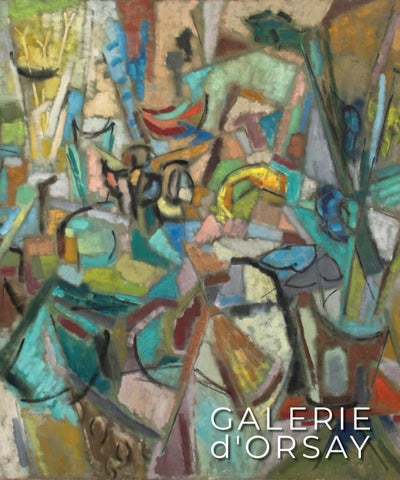
STANLEY BOXER
ROBERT KIPNISS
Untitled (3-46)
Window w/ vase & forest
Oil & Mixed Media on Canvas
Mezzotint
43” x 57”
Edition #23/60
Framed: 44.5” x 58”
19.625” x 19.375”
1946
Framed: 31” x 30.25” 2000 © Robert Kipniss Studio
INQUIRE FOR PRICING + AVAILABILITY INFO@GALERIE-DORSAY.COM 617.266.8001
Back Cover: STANLEY BOXER Untitled Figure Study (309D-61) Mixed Media on Paper 12” x 15.625” Framed: 19.5” x 26.25” 1961
Right: Ralph Wickiser, Yellow Reflections (Detail), 1994, Oil on Linen, 12” x 16”
33 NEWBURY STREET, BOSTON, MA 02116 | 617.266.8001 | GALERIE-DORSAY.COM