Everything You Need to Know About Online BLS Certification Currently, there are more than three million nurses practicing in the United States and about 30 million nurses practicing around the world. However, even with this already impressive workforce in place, the demand for nursing is expected to continue increasing into the foreseeable future.
By the end of the next decade, the demand for nurses in the United States will likely double. This is not only caused by widespread changes in the medical industry, but also demographic and economic changes as well. As time goes on, the portion of Americans requiring specialized nursing is expected to steadily increase. In order to become a nurse, you will likely need to obtain several important certifications, including basic life support (BLS) certification. This specific certification is
designed to help equip all nurses to act in the event of a cardiac emergency, which includes heart attacks, strokes, and other somewhat common situations. Ultimately, BLS training and certification may ultimately be what helps a nurse save someone’s life. However, even knowing the importance of this particular certification, you may not be sure where to begin the process. In this article, we will answer some of the most common questions people have about BLS certification and discuss how online BLS certification has helped improve the process.
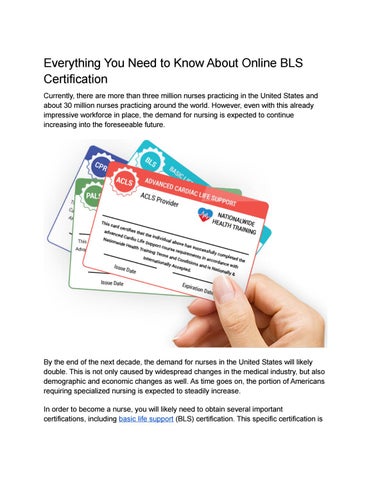
What is Basic Life Support (BLS)? Basic Life Support (BLS), as described by the American Red Cross, “generally refers to the type of care that first-responders, healthcare providers and public safety professionals provide to anyone who is experiencing cardiac arrest, respiratory distress or an obstructed airway.” A BLS certification course will cover many different topics and will specifically focus on how to administer CPR and how to use automated external defibrillators (AED). Unlike ACLS and PALS courses, which nurses may also be required to complete, BLS courses focus on administering care to patients of all possible ages, including infants, children, and adults. Beyond familiarizing yourself with these life-saving procedures and reviewing all essential BLS algorithms, you will also need to learn other skills, such as recognizing the onset of a cardiac emergency and effectively working as a team. When a cardiac emergency does emerge, nurses will need to act quickly—there will often not be time for looking things up or even getting additional help. Familiarizing yourself with these critical concepts can make the difference between life and death.
Who Needs to Obtain Basic Life Support (BLS) Certification? In 2020, there are many different professionals that might need to apply for BLS certification. The specific requirements for you will depend on your current field of work, relevant specializations, and the rules set forth by whatever entities (government, trade organizations, etc.) govern your position. Virtually all nurses will need to complete BLS certification prior to their first day of work. BLS certification will also be required for most doctors, along with most actively practicing medical assistants. Additionally, dentists, EMTs, and paramedics will usually
be required to obtain BLS certification as well; these professions have been identified as being especially likely to require life-saving interventions. Police officers and firefighters will also be required to be BLS certified, in most cases, along with some lifeguards, teachers, and coaches.
Does Basic Life Support Certification Include CPR? Both within and beyond the medical community, the terms BLS and CPR are occasionally used interchangeably. However, while CPR courses and BLS courses will both discuss how to administer CPR, these certifications should not be considered to be interchangeable. BLS courses are considerably more comprehensive. If you are currently CPR certified, you should not claim that you are also BLS certified—this can create legal issues in the future.
How Often Does My BLS Certification Need to be Renewed? While many certification programs still use the American Heart Association’s (AHA) BLS guidelines from 2015, BLS certification will still need to be renewed every two years. This remains true regardless of your profession or whatever supplementary courses you have taken. ACLS and PALS—to other major certifications—will also need to be renewed every two years.
Can I Obtain My BLS Certification Online? Over the past ten years, the marketplace for BLS certifications has dramatically shifted online. Currently, there are many different online BLS courses available to choose from. A typical course will usually include a guided review, followed by an opportunity to complete a BLS practice exam. Once the review components of the course, you will be able to take the actual exam as many times as needed until you receive a passing score. BLS recertification is usually a bit simpler than primary BLS certification. If you getting recertified, rather than getting certified for the first time, you can expect to spend about 50 percent less time on the exam and you can also expect to pay significantly less for the course.
Do Online BLS Courses Offer Continuing Education Credits? One of the nice things about online BLS certification is that these courses typically offer continuing medical education (CME) credits that many nurses are already required to be getting anyway. An online BLS certification course will offer 4 CME credits, while an online BLS recertification will offer 2 credits. When comparing different online providers, be sure to choose one that is able to offer these credits.
What are the Benefits of Obtaining BLS Certification Online? With more and more hospitals deciding to accept online BLS certification, there is no surprise that many medical professionals now prefer online courses to traditional courses. These courses are not only usually much more affordable, but they can also be completed at a time and in a place that is convenient for you. Additionally, online BLS courses allow you to use your time much more efficiently and focus on specific material as needed. In light of the unprecedented events of 2020, having access to reliable, fast, and credible certification courses is more important than ever.
Conclusion - Guide to Online BLS Certification Basic Life Support (BLS) certification is essential for all nurses and many other professionals, both medical and non-medical. This course covers many important topics including how to administer CPR and use an AED. If you are a current or aspiring nurse, be sure that your BLS certification and other certifications are entirely up to date.