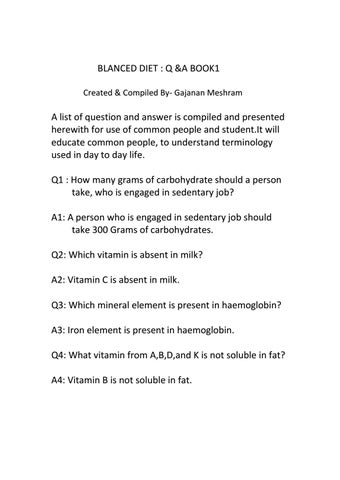
BLANCED DIET : Q &A BOOK1 Created & Compiled By- Gajanan Meshram
A list of question and answer is compiled and presented herewith for use of common people and student.It will educate common people, to understand terminology used in day to day life. Q1 : How many grams of carbohydrate should a person take, who is engaged in sedentary job? A1: A person who is engaged in sedentary job should take 300 Grams of carbohydrates. Q2: Which vitamin is absent in milk? A2: Vitamin C is absent in milk. Q3: Which mineral element is present in haemoglobin? A3: Iron element is present in haemoglobin. Q4: What vitamin from A,B,D,and K is not soluble in fat? A4: Vitamin B is not soluble in fat.
Q5: Which is the structural basic unit of proteins? A5: The structural basic unit of proteins is amino acids. Q6: What is the functional role of structural protein? A6: Structural proteins play an important role in the organization of cells and tissues. Q7: Which vitamin is obtained from the citrus fruits? A7: Vitamin C is obtained from the citrus fruits. Q8: What is the functional role of protein substance hormones? A8: The functional role of protein substance hormones is to regulate the physiological processes. Q9: Why do all living organisms need energy? A9: All living organisms need energy to carry out day to day physiological activities, to replace lost cells with new cells,to grow and reproduce. Q10: Define calorie? A10: The amount of heat energy, which can raise the the temperature of 1 gram of water by 1 degree centigrade is called a calorie.
Q11: What is used to measure the calorific value of food item? A11: Bomb calorimeter is used to measure the calorific value of food item. Q12: What is the unit of energy available from the food item? A12: The unit of energy available from food item is calorie or kilo calorie. Q13: In which form is excess of glucose in the body converted? A13: The excess of glucose in the body is converted into glycogen or lipid. Q14: What are the main sources of lipids? A14: Oils,Fats,Ghee,Butter,and Eggs etc are the main sources of lipids. Q15: What is Cholesterol? A15: Cholesterol is one of the lipid constituent, leads to heart trouble if its level is more the normal. Q16: Which mineral element is necessary for coagulation of blood? A16: Calcium is necessary for the coagulation of blood. Q17: Which mineral is necessary for acid- base balancing? A17: Sodium is necessary for acid- base balancing. Q18: Which vitamins are water soluble? A18: Vitamins like B- Complex and vitamin- C are water soluble. Q19: Name three plant product rich in protein? A19: Gram,Peas,and Beans etc are the plant product rich in protein.
Q20: Discuss calorific energy necessary for man according to age and occupation? A20: Energy demand of man according to age. Child 5 years age 1400 to 1500 kcal Child 15 years age 2100 to 2200 kcal Child 18 years age 2600 to 2650 kcal Energy demand of man according to occupation Adult,light work Adult, hard physical work Adult very hard physical work A person doing sedentary job need carbohydrate A person doing medium heavy job need carbohydrate A person doing heavy physical job need carbohydrate
2200 to 2300 kcal 2800 to 2900 kcal 3700 to 3800 kcal Upto 300 gms/day 400 to 500 gms/day Upto 800 gms/day
Presence of nutrients and minerals in some common food items given in table below Nutrients Food Item Carbohydrate Rice,Chapati,Potatoes,Jaggery,Sugar, Honey, Bread Protein Eggs,Fish, Milk, Panner, Pulse s Lipid Butter, Groundnut, Ghee, Vegetable oils Minerals Food Item Calcium Milk, Green vegetables ,Careals, Iron Meat,Dry fruits , leafy vegetables ,Jaggary Phosphorus Milk, leafy vegetables Sulfur Leafy vegetables Iodine Sea food ,Turmeric