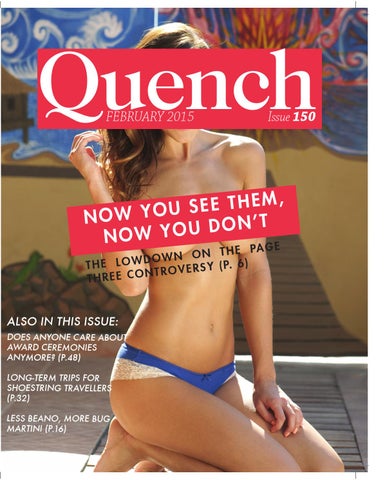
Quench February 2015
Issue 150
, m e h t e e s u o y Now t ’ n o d u o y w o n age e p h t n o wn o d w o l ) 6 . p The ( y s r ove r t n o c e thre
Also in this issue: Does anyone care about award ceremonies anymore? (p.48) Long-term trips for shoestring travellers (p.32) Less Beano, more Bug Martini (p.16)
February
Sleaford Mods
The Jesus And Mary Chain
Halestorm
10/03/15, £10 ADV
27/02/15, £25 ADV
13/03/15, £15 ADV
Four Year Strong
Treatment presents... Ten Walls Live
24/03/15, £14 ADV
March
Lower Than Atlantis
Stiff Little Fingers
Limehouse Lizzy vs Livewire AC/DC
27/02/15, £18.50 ADV
Hoobastank
15/05/15, £22 ADV
June Young Guns
04/06/15, £12.50 ADV
09/04/15, £12 ADV
08/03/15, £18.50 ADV
The Stranglers
April
May
17/04/15, £20 ADV
10/03/15, £23 ADV
@CARDIFFUNION
CARDIFFBOXOFFICE
CARDIFFBOXOFFICE.COM | All tickets subject to booking fee
CONTENTS FEATURES 6
Page 3
Boobs vs. News? Aimee-lee Abraham tackles The Sun’s most unique selling point
COLUMNIST The Sketch
Gareth Evans’ reflects on the minefield that is your teenage years
CULTURE 14
Interview: Josie Long
Aimee-lee Abraham interviews comedian Josie Long about her upcoming tour
16
The Future is Now: Webcomics
A beginners’ guide to the artists’ world of webcomics
18
In Review: WARP’s G39 Exhibition
A breathtaking exhibition showcasing an unprecidented range of upcoming talent
20
Ending the Winter of Discontent
Pitting history against contemporary gender politics in Richard III
21
Student Theatre: The Count of Monte Cristo
We take a front row seat at Act One’s production of the classic tale
22
Credit: The Beauty Experts
13
Spice Up Your Wardrobe for Spring
Everything you need to know to make that transition from winter to spring
21
Sexualisation of the Fashion Industry
Has fashion become too sexualised? Harriet Martin elucidates
22
For and Against: Makeup
This century’s beauty dilemma: does makeup enhance or conceal your natural beauty?
24
#HashtagOfTheDay: democracy for fashion, or industry destroyer?
Emily Lowery investigates whether fashion hashtags are taking over the job of leading fashion experts
TRAVEL 26
Long-term Travel
Is it affordable for the cash strapped student?
30
Travel Hacks
Tips and tricks on how to save money abroad
MUSIC 34
New/Newydd
New artists to look out for as per our editors’ recommendations
35
Microfest
Exclusive interview with Feels Like Summer headliners, Johnny Foreigner
36
Interview: Menace Beach
We chat supergroups and stage set ups with Leeds five-piece, Menace Beach
38
History In The Making
The LGBT+ musicians giving the community a face
40
Music Reviews
We review Kate Tempest, Get Inuit, Charli XCX and more...
48
54 31
Credit: The Boston Calendar
FASHION & BEAUTY 20
VIDEO GAMES The YouTuber Review
More of the contributors to the newest form of Video Game Media are reviewed
44
The Good Protagonist & Antagonist
Main characters in video games are incredibly important, but makes the best the best?
46
Digital Symphony
Music is prevalent in many areas and this is no different than in Video Games
47
Review: Dragon Age Inquisition
The deepest fantasy RPG returns with a bang. Video Games takes a look
FILM & TV 48
Best in Show: An Awards Show Critique
So you’ve won an Oscar, should people care?
50
Genre in Review: Sci-Fi
Out of this world as their narratives can be; we review the Sci-Fi genre
52
Fear vs Freedom: Do Cyber Threats Signal the End of Creative Expression?
Is it finally time for inner beauty to take centre stage?
54
Going Mainstream: Evolution of LGBT characters
From the outskirts to the forefront. we mark LGBT+ History Month with their screen evolution
47
FOOD & DRINK 56
Food Evening: La Shish
Get the round up from our latest Quench Food Evening
58
Food as Art
Is Instagram taking over our eating habits?
60
The Cake Makeover: Vegetable Cakes
We have a look at the rise of vegetable cakes and a delicious avocado brownie recipe
58
Credit: Sarah / Steaks and Chops
42
3
Quench EDITOR Sum Sze Tam
editor@quenchmag.co.uk @QuenchMag
DEPUTY EDITOR Chloe May FEATURES Aimee-lee Abraham Jason Roberts COLUMNIST Gareth Evans
features@quenchmag.co.uk @Quench_Features
@_GarethEvans
CULTURE Elouise Hobbs Jasmine Freeman
culture@quenchmag.co.uk
FASHION & BEAUTY Franciska Bodnar Nicole Petty
fashion@quenchmag.co.uk
TRAVEL Olivia Waltho
travel@quenchmag.co.uk
MUSIC Charlie Mock
music@quenchmag.co.uk
VIDEO GAMES Alex Glazer
videogames@quenchmag.co.uk
FILM & TV Aaron Roberts Emily Giblett
filmtv@quenchmag.co.uk
FOOD & DRINK Emma Giles Kathryn Lewis
food@quenchmag.co.uk
HEAD OF DESIGN Emilia Ignaciuk
design@quenchmag.co.uk
ART EDITORS Franciska Bodnar Naomi Brown Eleanor Duffy Lucy Okell Olivia Thomas Georgia Hamer Bryn Evans
@QuenchCulture
@Quench_Fashion
@Quench_Travel
@QuenchMusic
QuenchStreetStyle
Quench_Travel
QuenchMusic
@QuenchGames
@QuenchFilm
@Quench_Food
QuenchFoodCardiff
@frankiebods @honeyandbrown @eleanorduff y @lucyokell @oliviadthomas @georgialeehamer @MantaRayBryn
EDITOR’S N O T E Where mad punnage takes place, and a plea for appreciation is extended to you, the reader An ode to May The month of May this year looks set to be a busy one. For one, we’ll be having our Cardiff Student Media Awards (a guy from VICE is judging our Best Long Form Writer category - check out the other categories at http://tinyurl.com/CSMAQuench), which for many will no doubt end in heartbreak, or liverbreak. Keep an eye out if you’re interested in coming - we spend a proper amount of money on this ceremony, which means you get a *real* trophy if you win. There’s also the General Elections, which will be a mega exciting time and you should all vote if you care even a little bit about how the UK landscape will look in the next few years, especially for when you graduate! Whether you want to do a postgrad, get a job, travel, or even if you haven’t really started to think about it yet, the decisions made by party politicians are going to affect you greatly. Most of you reading this will actually have the ability to vote, whereas I won’t. But this note’s sole purpose isn’t just to push Union promo, I promise. There’s another May I’d like you to look forward to, and that’s the wholly independent editorial debut of Chloe May, the secret weapon to Quench’s success (and its deputy editor). She’s briefly taken over for the transformation of this issue from digital to print format. She’s also going to be in charge of Ty Celf, which will be an arts supplement in next month’s issue. Send us your creative writing, artwork and photography if you fancy being published! It’ll be a great party. A couch potato by any other name... How much free time do you give yourselves at uni? How often do you just sit around the sofa with your housemates with no coursework or academic work on your mind, and just chill? Every night on my way back from the Media Office I do this thing where I pretend to be just taking a slow, leisurely walk next to people’s living room windows. But really, I’m just trying to peek out of the corner of my eyes to see what people do with
their living room time. Why? Because I’m envious. Personally, there’s nothing I’d love to do more right now than spend my days 1) playing Super Smash Bros. with the housemates 2) playing XCOM 3) making soup or 4) making a pumpkin tart. The reason I’m so envious is mostly because I find myself so busy nowadays. I’m not exactly working multiple jobs to get by, as I’m sure many of my fellow university students are. But I treat Quench as a quasi-job, and I also work on production for the Gair Rhydd besides (which takes up the majority of my time, really). The sheer amount of time and effort some of the core people here in Cardiff Student Media put in is simply astonishing - more than the hours a person would work full-time, and they’d get paid otherwise. A large number of us might as well bloody live in this office. I’ve knocked around a few calculations over the past few days, and I’ve figured out that I spend just over 40 hours a week in this office, and on a Quench production week I spend about 8 hours more on top of that. That’s almost 50 hours a week! I’m not even the person who spends the most time in here, because off the top of my head I can think of at least five other people who at least spend as much time in here, if not more, as I do. The point of this isn’t to moan about my life (not really). I suppose it’s more to impress upon readers who may not realise just how much of our lives just doing student media has taken up. We’re all volunteers, but we endeavour to be professionals. We’re all students, but we’re working as though we’re adults. It is rare for many people to be the head of many sections for more than a year, because it literally burns you out. But ultimately, a large cohort of us continue to do what we do. And for good reason. It’s rewarding beyond belief, and the friends you meet become friends for life. In fact, over time most of us have gradually reversed our priorities so much that grades are no longer the main reason for us living in Cardiff, but student media is. So please appreciate us for the work we do. Pretty pretty please.
SPECIAL THANKS TO Michael O’Connell-Davidson, Aaron Roberts, Emily Giblett, Charlie Mock, Alex Glazer, Daisy Lane, Alice Byron, Kathryn Lewis,Olivier VDBK, Greg McChesney, Emma Giles, Bryn Evans, Olivia Thomas, Eleanor Duffy and Georgia Hamer for helping us out on deadline night, Elaine Morgan for having a birthday and not telling anyone about it, the new Ty Celf editorial team for being brave enough to step up to the role, Alex Miarli for agreeing to be our very own Page 3 model, Rupert Murdoch for making The Sun what it is today, and the actual sun for not leaving us in complete darkness every morning anymore.
5
Quench The
Now you see them, now you don’t 6
As the feature continues to disappear and reappear again, AIMEE-LEE ABRAHAM wrestles the ‘British institution’ that is (or was!?) The Sun’s Page Three in a tale of boobs and news “Mammary shaped missiles that have been flung back and forth in a relentless debate over the morality of The Sun’s most distinctive unique selling point”
On the day the magazine you are holding went to print, The Sun, the best selling newspaper in the UK, hasn’t run a pair of naked breasts on its third page for a record 26 days. This is a significant period of time if we are to consider the fact that it published a nude shot every single day before that since 1970. This is an significant period of time if we are to look back at the last time The Sun stopped printing Page Three as we know it (20th January 2015) and replaced it with clothed images for a grand total of two days before it reappeared again in what looked like one big PR stunt at the expense of ‘comfy shoe wearing’ fun-spoilers everywhere. No official statement has been released to confirm if it’s gone for good, and it’s unlikely that this will materialise any time soon (if at all). For now, we can only wait to hear of its fate. Unless you’ve been living under a rock for the past month, it’s unlikely that you would have found shelter from the mammary-shaped missiles that have been flung back and forth in relentless debate over the morality of The Sun’s most distinctive unique selling point. Almost a quarter of a million people have signed Lucy Holme’s petition, a plea for editor David Dinsmore to ‘stop conditioning readers to view women as sex objects’ and to reconsider the relevance of boobs as news in 2015, but many questions remain unanswered. Is page three really that bad? Is glamour modelling always inherently exploitative? And why do media commentators keep making bizarre comparisons between Charlie Hebdo’s right to satirise extremism and The Sun’s right to show off Nicole from Bournemouth’s youthful assets? Perhaps the most prominent argument in defence of Page Three has been ‘surely it’s not the worst example out there in terms of objectification?’ And yes, it’s incontestable that the daily Page Three feature in The Sun can be seen as
fe atures Like what you see? Meet our lush cover man, Alex Miarli. Find out more about him on the next page
the lesser of several evils in a highly sexualised digital age. If we are to remove ourselves from the connotations of its existence and look objectively at the content, then it’s pretty tame. Even Nicole from Bournemouth, the poster girl for the feature’s brief but triumphant return, looked a bit lukewarm in her beachside garb. If the tweets of Sun PR chief Dylan Sharpe are anything to go by, her wink was no doubt intended as a sexy, suggestive middle finger to all the haters. But it fell disappointingly flat. There was something almost slapstick about it, and in a stylistic sense, it was so distinctly Page Three - all wink-wink, nudge-nudge and cruise ship innuendo. There was not a hint of sexual deviancy in those glassy baby blues of Nicole’s, and the meadow in which she stood looking unconvincingly wistful was more ‘fancy a frolic through the hills?’ than it was ‘fuck me on the floor’. Perhaps it’s this vanilla girl-next-door aesthetic that fuels the notion that it’s just a bit of old-fashioned fun. Even Germaine Greer said so in a recent Newsnight interview, admitting that it had always struck her as ‘innocent’. In a rapid and rabid sexual landscape, Page Three has stood still, frozen in time for almost half a century. As a result, the predictable series of shots featuring interchangeable girls with identical head tilts and vacant expressions which were once considered stimulating are now about as arousing for most people as walking in on your mum in the bath. For many, Page Three appears to cater to two distinct stereotypes in its outdatedness: the nosy neighbour peeping over the fence as you sunbathe and the construction worker who assures you that it might never happen. For others, Page Three is something more malign, like the mole on the hypochondriac’s arm - a ticking time bomb, unchanging but unnerving. It occupies an unknown familiar space in British culture, simultaneously harmless and volatile. Defenders of free speech at all costs may note that it’s an innocuous British ‘institution’, just another of our eccentricities. Some have compared it to the cup of tea and the art of sarcasm, arguing that it’s embedded in our cultural fabric. However, those who call for it to be banned may note that colonialism was also once a British institution. I’d argue that both sides are being a little too binary in their comparisons. We cannot possibly compare the plight of Page Three to slavery without completely undermining the entire argument against printing it, and we cannot pretend that sexism in the UK is a degree of sexism comparable to that in certain other countries, where women dream of having even a fraction of our liberties. At the same time, until gender ceases to be grounds for institutionalised discrimination on a national scale (equal
pay, anyone?), we shouldn’t congratulate ourselves just yet. Nor should we make the mistake of thinking that sexism exists in a vacuum. Bare boobies printed in a newspaper are not the cause or catalyst of complex societal ills like sexual assault and rape, but they are contributing to a wider dialogue about what it means to be a woman today that is proven to influence sexual decision making processes. When we examine how democratic a society is, we are quick to turn to the media as an indicator of societal attitudes. We should interrogate the media we consume whenever we can, and demand debate when it fails. The reason Page Three feels familiar is because every day the content follows the same formula - a pair of (typically white, typically large) tits accompanied by a brief description of the woman they belong to. Sometimes there is the occasional ogling description of said ‘t*ts’, asterisk and all. The word itself is censored in print, and in an age where the C’s and the F’s are thrown about without caution in most forms of popular culture, this is somewhat mystifying; it seems that what is used in playground conversations without so much of a raised brow from observing adults is too risqué for the best selling newspaper in the UK. Perhaps it’s censored because it makes the editors come over all shy and flustered. Is ‘tit’ reserved for special occasions at News International? Maybe they have an office ‘t*t-tip’ jar (like a swear jar with nips) and collect change whenever someone in the newsroom suffers a slip of the tongue. Maybe they’ll notice the black lace beneath Jennifer from Marketing’s white shirt one day at the water cooler and bring ‘tit’ out from under linguistic lock and
There was not a hint of sexual deviancy in those glassy baby blues of Nicole’s, and the meadow in which she stood looking unconvincingly wistful was more ‘fancy a frolic through the hills?’ than it was ‘fuck me on the floor’.
7
Little Alex “Miarls” Miarli was a sweet little boy, who loved playing football on Sunday after church As a typical Italian mother’s boy, he was always very well behaved... but not anymore. Now he takes his life lessons from the likes of Don Corleone and Silvio Berlusconi Now he likes nothing more than to pop on his Speedos and head down to the beach with the lads to try and entice some young ladies with “the gunshow”
8
fe atures key then. It’s unlikely but not impossible that they’re wary of IPSO intervention if they use the word ‘tit’ in a ‘family newspaper’, despite the fact that they use boobs to sell news. Whatever the reason, treating the word ‘tit’ with the hushed caution of the word ‘Voldemort’ sends mixed messages. What we have here is perverted prudishness, an oxymoronic attitude that has little relevance in liberal twenty-first century Britain. The idea that nude breasts are worthy of column inches but unworthy of uncensored acknowledgement just serves to fuel the argument that the content is misplaced. If there’s nothing inherently wrong or odd about serving up half naked women with your current affairs, then why put an asterisk in the word ‘tits’? This is especially true in reference to tabloid publications regularly printing sex scandals as front page news, often at the expense of more pressing global issues which get left on the back bench as a result. The Sun was
‘This is troubling because it fuels the discourse that the opinions of attractive women are invalid. It says ‘women capable of exciting you downstairs have nothing going on upstairs’. a regular fixture at the dinner table when I was growing up. I can’t overstate how working class my South Walian upbringing was, and I feel this is relevant as a response to the cries of ‘Snobbery!’ that have come from Murdoch himself and many media commentators, who have taken to assuming that the Page Three battleground is some kind of class war in disguise. I remember that as a seven-yearold, I read a page that disclosed as series of salacious texts exchanged between David Beckham and Rebecca Loos. One sentence in particular – that described Beckham wishing Loos’ body was his bar of soap as he bathed alone in hotel rooms – tested my logic, even as a seven year-old. How could a soap lady be better than a real one? I also vividly remember waking up next to my partner and feeling sick
at the image of a bikini-clad Reeva Steenkamp, whose body was barely cold before the media started dissecting her; she had appeared on The Sun’s front cover after being murdered by her boyfriend Oscar Pistorius. Her gleaming body was juxtaposed with by-lines that were indistinguishable from Hollywood dialogue (‘3 shots. Screams. 3 more shots’), and for days the insensitivity behind this editorial decision tested my nineteen yearold logic. I am now 21, and I am sick of this bullshit. When I quizzed friends for their opinions on the sex appeal of the feature, most of them felt passive and indifferent. “What’s the point of it, really?”, they sang in unison. Regardless of your moral stance, Page Three was sexy once upon a time. Now, it merely blends into the background. It pales in comparison to lad mags and is practically translucent when contrasted with the oil-slicked, acrobatic underworld of porn. There, bodies as malleable as dough are frequently rolled into pretzels.There, every fetish and fantasy imaginable is catered to in HD and is available at the click of a button. This is something that Sun spokespersons are keen to remind the public of, reassuring concerned parents in particular that they are ‘on side’ in the fight against the sexualisation of Britain’s children, squeaky clean and saccharin in a cum-stained, gritty media landscape. Awkward PR scripting aside, they may have a valid argument. If Page Three were to vanish off the face of the earth for good, people would still exercise their right to get off. They’d just stop wiping up the mess with Mystic Meg’s crumpled face. Perhaps the world would be better for it. There are few things more tragic than an indifferent wank, but that’s probably beside the point. So, in light of all the jokes about how PG Page Three is, why is it that so many care so passionately about seeing the back of it? Well, context is everything, and this is precisely why the persistent presence of the feature warrants our attention. I spoke to Cynthia Carter, a senior lecturer at Cardiff University’s School of Journalism, Media and Cultural Studies and an expert in media representations of gender. When I asked her if the removal of Page Three would make little to no difference to women’s position in society, she bore light on the difference between seeing a half naked woman in a newspaper and seeing her in another media form: ‘The difference is that The Sun purports to be a newspaper. Other forms of media and culture do not; they are entertainment publications where one would expect different sorts of representations. Newspapers are supposed to represent the important issues and debates with which we engage in a democratic society. Therefore, a semi clad woman on Page Three sends the message that women are largely there to be looked at in a democratic society; their value judged on their appearance instead of what they have to say. As such, it supports the idea that men are the decision makers and citizens and that women are primarily included in the news for men’s pleasure.’ Dr. Carter’s point about the absence of voice in the feature grows pertinent if we look at its recent history. Up until 2013, Page Three shots were accompanied by ‘News In Briefs’ boxes. Consisting of short, (frequently politically charged) soundbites, these boxes featured commentary from the model on display. They were engineered, however, with past models admitting they had no input into the words the paper claimed came out of their mouth. This allowed News In Briefs to tackle the current editorial line, with past examples ranging from opinions on foreign policy to football, all delivered through an attractive mouthpiece. Some of these were subtle and had did not concern matters in the public interest, appearing almost like office banter that had spilt over onto the page. We can speculate that maybe Anna was expressing her love of Man United, for example, just because James from Showbiz was an avid fan and wanted to use the page as a platform to rub the victory in the faces of staff supporters of the team they
defeated. Others were glaringly obvious to anyone familiar with the political allegiance of The Sun and its then editor Rebekah Wade (now Brooks of Leveson notoriety). A prime example of this can be found in a series of News in Briefs pieces from 2004, where the feature was used to publicly defend then home secretary David Blunkett (a close friend of Brooks) in the midst of a media shit-storm following an extra-marital affair gone public. One example, dated 16 December 2004, saw Katie highlighting Blunkett’s achievements while expressing her ‘devastation’ at his alleged resignation, stating : ‘I think it’s terrible that a man who has done so much for the country has felt it necessary to leave public office… Blunkett was one of the few Home Secretaries prepared to get tough on issues that matter to ordinary people - asylum, terrorism and law and order’. All along it was heavily implied, though never directly addressed, that News in Briefs was meant to be satirical, with the assumption that most readers knew full well that the model had not said what they claimed. Those who didn’t get the gag were perhaps too simple to warrant worry. This is troubling because it not only mocks readers who don’t know better, but it also fuels the discourse that the opinions of attractive women are invalid. It says (albeit it in softer terms) ‘women capable of exciting you downstairs have nothing going on upstairs’. It’s a few centimeters wide, while the half naked image dominates a full page spread. We could say that this is representative of the value we place on beauty over intellect, seeing it as some sort of bonus add-on that does little to improve the bigger picture. After all, how could nineteen year old Beth from Swindon, fresh out of college with an NVQ in beauty therapy, possibly know about the economic cost of investing in more sustainable energy sources? And what about Katie, all doe-eyed and DD’s, fresh out of school? What makes her an authority on intervention in Syria? These women may not possess knowledge in these areas. They may not have opinions based on solidly grounded expertise. They may not have an opinion on the subject in question at all. Frankly, they might not give a fuck. All of these things are beside the point. It doesn’t matter if these women are nail technicians or barristers. All women deserve our respect, and putting words in their mouths in a way that is intended to belittle and tease does them a disservice. I’ll admit that watching footage of the debate unfold on live television a few weeks ago, I too was guilty of putting these women into boxes. I squirmed as Page Three regular Chloe Goodman tried to defend Page Three by comparing it to classical art, as if Michelangelo and Murdoch were brothers in arms somehow. ‘What did we think of women and men one thousand years years ago when you see statues written all over the walls in the nude?’ she asked, as Jon Snow tried to keep a straight face and Harriet Harman gave him a knowing side-eye. Statues written on the walls? What is this sorcery? But mocking these women on this basis is a cheap shot. It serves no purpose in tackling the root of the problem, just as telling models they were exploited in their jobs when they felt in control (as much of the left wing press has done throughout) fuels Murdoch’s claims that opponents are ‘elitist’ and patronising in their approach. Dr. Carter pointed out to me that we need to interrogate the notion of choice in a society where women continue to fight for equal pay and as a noticeable minority in positions of power, but we must also bear the individual in mind. All of the women featured during the reign of News in Briefs were undoubtedly the butt of an ugly joke, and although this particular element of the feature has been scrapped, it must not be forgotten. Just two years gone, it can teach us a lot about how the paper has chosen to portray women. Feminist studies of the media have extensively proved that women predominantly make the news in certain ways. They are the whores, the clothes horses, the victims and the girlfriends. Female politicians have a particularly hard time, as the Daily Mail’s ‘Downing Street Catwalk’
9
feature last year so grotesquely demonstrated. Of course, all politicians are frequently the subjects of ridicule. Many would argue that Ed Miliband’s perceived incompetence has more to do with his vacant expression and nasal tone than it does with his policies, for example. The fact that his brother is an irresistibly charming fucker with a perfect jaw doesn’t do anything to dispel claims he’d be a better candidate. What makes our treatment of female politicians particularly telling is the fact that women rarely make the headlines for their achievements. When they do, we often fixate on irrelevant details of their lives (i.e ‘I know you’re a world class athlete and warrior in your own right, but who are you sleeping with and which diet are you on and when are you having babies?!’). Women’s magazines are perhaps ironically the biggest perpetrators of this. For women, Page Three is arguably less damaging to their perceptions of themselves than the backstabbing best friend who materialises in the women’s glossy. If the average woman’s glossy were to take on human form, she would be a vicious handbag-fixated creature of the highest calibre. She would mutter that your ‘bum looks big in that’ while stroking your hair and denying all knowledge with a strawberry scented smile. You would never know where you stood with her. One minute she could raise you up, armed with advice and products to transform you into the best possible version of yourself. The next, you might catch her spiking your overpriced cosmopolitan with ipecac and doubt. Moreover, we have to ask what Page Three is communicating about men. There is something depressing about the assumption that men will part with their pennies in exchange for a little nip slip, as implied in the ‘sex sells’
10
argument tirelessly used by editorial staff at The Sun. It fuels the archaic and offensive notion that men are simple creatures driven by desire, and this has far-reaching negative effects. It’s both binary and heteronormative, failing to represent masculinity in all its complexity and breadth. Instead, it presents us with a caricature of a white van man who lives and breathes for upskirt shots and a cuppa with three sugars. Sure, these men exist. Sure, they are statistically likely to be found in The Sun’s key demographic, but they are in no way representative of an entire gender or class. The sooner we embrace fluidity and abandon black and white thinking when it comes to issues of gender and sexuality, the healthier and more tolerant we will be become. Tim Samuels, a radio 5 Men’s Hour presenter, summarised this perfectly in a think piece for The Guardian back in January, noting that: ‘The “exploitation” of daft male tendencies is hardly the greatest peril facing society – but it’s part of a wider trend, especially in advertising, to portray men as fools who are barely able to use oven cleaner or are liable to come back from shopping expeditions with a puppy instead of a pint of milk (happens all the time – it’s like 101 Dalmatians in my kitchen). Gracefully retiring Page 3 to its rightful bin of outdated 80s naffness would be a decent step towards giving men a bit more credit – recognising that we are emotionally nuanced characters who can’t (always) be bought off with a boob.’ Similarly, when I asked a friend to share his views on how his masculinity is perceived by others, he too felt that the laddish culture perpetuated by The Sun alienated him. He said: All-around, not uniformly but very prevalently, is the assumption that as a sexually active man I’m in a constant state of animal lust. On the one hand I’m some stuffy killjoy because I don’t share male friends’ and colleagues’ inability to be near attractive women without defaulting to ape-humour or resorting to a collective ‘I’d give her one’. On the other, and I think as a direct consequence of this idea of who men are and how we often present ourselves, I’m not able to approach women without either being perceived as a flirt, adulterer or one of those creepy little Michael Cera-types that collect female friends as insurance policies in case their current thing doesn’t work-out. And here I am with a great love of socialising and drinking and conversation and fucking, but painted as something other than this because I’m not at ease with a particular type of banter. And its the mainstreaming of this culture, whether or not its what most men actually think of the world as individuals, that I think causes this. What we are left with, then, is not an argument about boobs, but an argument about news values and responsible representation of the sexes. Of course, the editorial staff at The Sun are no strangers to sensationalism,
and this extends far beyond sex scandals and coverage of grisly murders. Tackling concepts of what is newsworthy and why is an incredibly complicated process. There are certain factors, such as timing, significance, proximity and prominence which can generally be applied to most of the news we consume, with human interest stories proving more complicated in their frequent deviation from these usual constraints. Page Three is hard to justify in terms of its raw news value. It’s certainly not new or unusual, and it’s difficult to argue that it carries any sort of human interest besides the appeal to basic inherent sexual impulses. But, on that note, we would be elitist puritans if we thought we could or should just rid our news of items we don’t deem newsworthy. For a start, the value of a piece of information is very much subjective. Our society is a melting pot of tastes and world views and we cannot dictate what the masses should or should not show an interest in without resorting to dictatorship. Secondly, if we were going to do this, we’d have hardly anything left. Newspapers are no longer mere information subsidies - they are platforms for informed debate; they are entertainment sources; they are vehicles for storytelling. If we were to ban boobs in news on this basis, we’d also need to ban stories about babies dressed up in cute costumes and that would be a terrible tragedy for all. Regardless of how this situation develops, one thing we can take away from the media hoo-ha surrounding the disappearance and reappearance of the increasingly elusive Page Three feature is a need for constant interrogation and inquisition over censorship. If we can start a dialogue about media discourse and the ways in which it impacts our citizens, the battle for equal and fair representations for all is half-won.
‘It fuels the archaic and offensive notion that men are simple creatures driven by desire, and this has far-reaching negative effects. It’s both binary and heteronormative’
News in briefs Alex has high hopes for the new Socialist government in Greece. He has enjoyed holidays in Greece since his childhood in Italy, but has something to say about the Eurozone. “As an Italian man, I like Europe as much as the next man. But the euro? I mean... come on! As the great Bobby Charlton once said: ‘Pull your socks up boys!’. I like football”
VOTE
eat vote study sleep
Use Your Vote! Voting is open 23rd-27th February
CARDIFFSTUDENTS.COM ELECTIONS
COLUMNIST
THE SKETCH with GARETH EVANS
How to handle a decade of absurdity? Here’s An Open Letter to 12 year olds. Dear Anonymous child, I recently turned 21 and in doing so left behind ‘youth’ in its most obvious sense. I am still young after all, I am still naïve, and I still like to go home and have food made for me and get my clothes washed. I also enjoyed having a birthday cake far too much, and the immeasurable joy I received from blowing out its candles was frankly embarrassing. I still feel young, but ‘officially’ I am a developed human being; I am a grown up. There is nothing that I cannot do – nothing – except drive because I never bothered to learn and I spent all my money on nonsense. These are my first two tips actually: if you can do, try and learn to drive. The bus isn’t cool unless it’s a tour bus and I don’t think the X14 from Chepstow at 3:25 really counts as that. Secondly, money is probably a demon you will battle with until your dying day. The transition I struggled with was that, as a child, the only time you have any money is at your birthday and that is solely disposable income designed to please you. I continued to consider all money ‘birthday money’ so to speak, even when I got a job, had rent to pay, and needed to survive. This doesn’t work so when you get older, only treat actual birthday money as birthday money otherwise you end up with a shelf of interminable joy but an empty fridge and an angry landlord. I digress, so let me take a step back quickly. When I said that there’s nothing I cannot do, I remember how the idea of being 21 used to look to me. Like a mirage
on the horizon, I was going to be a tall (true), handsome (refer to sketch), shining Zeus driving a car of the future (bus of the nineties) across the desert (Monmouthshire)
with an actress next to me (my dog). Reality has been cruel to my dreams. However, I’m going to make a profound point – the future always looks nicer than today. It’s easy to spend time thinking how great it will be to turn 18 because you can buy a WKD and sit in a Wetherspoons but it’s much better to just enjoy the present. Besides, the rose-tinted future glasses are swapped for rose-tinted nostalgia ones at about 19 and you start to realise how great being young really is. I know it’s a cliché, but you should try and appreciate it as much as possible. At 12 I’m almost certain you could go and roll down some hills without fear of social reprisal. You won’t be able to do that again until Glastonbury 2021; so do it. You get three meals a day prepared for you, that won’t happen again until your all-inclusive holiday to Turkey in 2019; so lap it up. Even school has no bearing on your future success and that is something that you really should make the most of. However, I appreciate that being told to relish your transient youth by a comparatively old man is probably a bit annoying, and instead you came to this
The first time is an awful, clumsy, awkward, festival of confusion and that’s alright. As I say, better at 16 than 31 and on your wedding night. unqualified and confused column seeking serious advice for the future. It is true that your teenage years are incredibly daunting. I understand that. At 12, you stand at the edge of the ravine, a ravine sodden with cheap alcohol, condoms, bad deodorant and even worse haircuts. But how do you approach crossing the bridge? I suppose I can give some advice from the perspective of someone who has just made it across. (Side note: I now face the second ravine that is my twenties and all I can see is infinite darkness.) Your teenage years begin with starting secondary school and this is generally a terrible time; you are small, weak, scared and lost. On reflection, what I will say is this – you know the really cool and popular people? They will be pregnant, incarcerated or both by eighteen. Don’t try and please these people, stay on the straight and narrow and get Facebook so you can lord over them in ten years. These are the people who were top of the pile in Year 8 but are now defined by the fact that they ‘Went to *insert small town* Comprehensive’ and ‘Live in *insert small town*.’ You don’t want that to be the peak of your existence, so avoid these detention
demigods, however tempting they may be. While remaining on the straight and narrow, there will still be new experiences to try and as much as being young is great it’s best to get your first times out of the way now. Getting drunk for the first time is okay at 14, everyone’s with you, it’s a collective
experience. It’s better than drinking vodka like it’s water at 31 and then doing terrible, terrible, things to your colleagues. The same goes for sex. The first time is an awful, clumsy, awkward, festival of confusion and that’s alright. As I say, better at 16 than 31 and on your wedding night. Do I say more about sex? Girls, don’t expect too much, and guys, try not to injure anyone. I suppose sex education was the least helpful thing possible. From what I remember we watched a tame video of two young people having sex, the girl got pregnant, and then the guy fled the country. I left thinking that sex was the most extreme version of tag possible. (Tag! You’re pregnant lol!) But
You know the really cool and popular people? They will be pregnant, incarcerated or both by eighteen seriously, just remember contraception. And what more can be said? Probably a lot, but oh well. I don’t imagine this was helpful in the slightest but just remember that it’s inevitable that you’ll look back at your teenage self and feel massively nauseous with both embarrassment and anger. That’s okay though, I once had a fringe made solely of hair gel and owned a white Sony Ericsson with nothing but Dizzee Rascal on it. We all make mistakes, just make sure they’re not too bad, and don’t take yourself too seriously. You look ridiculous after all.
Illustrations: Naomi Brown
13
JOSIE LONG Aimee-Lee Abraham talks to Josie Long about her upcoming tour, heartache and having the courage to pursue a career in the arts when the world is against you
Credit: Giles Smith
My first conversation with Josie Long is characteristically, charmingly dysfunctional. We’re at the mercy of technology, the whole thing a blur of distorted fuzz and ‘Oh Fuck’’s. The line cuts out and I text her with one hand as I dash through the house looking for a spot with better signal. She tells me she’s in in the middle of doing her tax returns and she’s forgotten what day of the week it is and the two of us become involved in a kind of selfdeprecating, sweary dance as we try to reschedule. We have been talking for less than ten seconds but her wit and warmth are seeping through my phone by some kind of comedic osmosis. She seems genuinely enthused about my trip the following week, a total pain in the arse as far as the whole rescheduling debacle is concerned; ‘Paris? Awww FAN-TA-S-T-I-C. You’ll have the best time m’love!’ she says in her signature Kentish twang. Very loudly. Very quickly. There’s something effervescent about her, every word delivered with urgency and sparkle. ‘She’s great. She’s the sort of person I’d want to go for a pint and bitch about boys with’ I think, frantically flipping through my diary. We finally settle on the following Wednesday.
14
Josie Long is a force to reckoned with. At just 32 years old, she has three Edinburgh comedy award nominations under her belt and has co-founded her own charity, Arts Emergency: a project that aims to empower ‘children who don’t come for privilege to pursue the education and the careers of their dreams… to keep an indignant flame burning in their heart that they deserve to make a living an artist
if they so wish’ even in an economy where art rarely pays. If you’re unfamiliar with her stand-up, Josie is best known for being a political tourde-force in the comedy arena. ‘I just fucking love a bit of social justice!’, she beams. Known for her goofy, unyielding optimism, she frequently rips politicians to shreds with a smile and a heel-click. Her latest work, however, sees a deviation from her signature rants and unmerciful impressions, turning inward. She assures me that she’s no less passionate about politics (and there is still a gag about imagining a picnic with Nigel Farage in there), but felt that it was time to change the record. Having used all three of her previous tours as platforms for expressing angst at dissapointment in a society she feels still frequently fails to care for its most vulnerable members, it was time to move on. The result is Cara Josephine: an ode to familial dysfunction and heartache and learning how to stand on your own two feet. Fittingly named after her newborn niece whom she has become wholeheartedly obsessed with, the tour reflects on a most turbulent year. It’s a medley of emotional experiences, tackling awkward memories of childhood and the breakdown of a long-term relationship with a merciless and brutal honesty that will no doubt resonate with readers who spent their valentine’s just past hunched over a dominoes having an existential meltdown. Though the subject matter is dark at times, it’s infused with Josie’s infectious silliness and is laced with messages of empowerment and acceptance. Throughout our conversation, I get
culture
a. I’m only 21 myself and therefore thoroughly lost, and b. She is a complete stranger But the feelings I experienced during our conversation are testament to Josie’s character. You can’t help but feel like you want to be her best friend, and it’s easy to see how Josie ended up in comedy. She’s been at it for a long time, perfecting her craft in professional surroundings since the age of 14, when her Mum decided to do something about her natural love of showing off and enrolled her on a comedy course at her local arts centre. She’s infectiously positive, and even manages to put a joyous spin on the depressingly bleak job market many readers will be entering when they graduate this summer. Struggle is a key part of any story, she reassures me, and ‘It’s good to be a part of what everyone else is going through.
It’s good to feel like you’re not trying to be some rich wanker in an ivory tower’. Are there any surprises we can look forward to in Cara Josephine? Josie is relatively tight-lipped and keen not to spoil any surprises, but she does reveal that another topic explored in Cara Josephine is ‘the joy of being outside’. She tells me she’s become as ‘outdoorsy as a bear’, which is pretty fucking outdoorsy. There are stories of adventure to be told here; tales of swimming through freezing cold rivers and camping under the stars. Josie started a ‘heartbreak climbing club’ with friends who had all found themselves simultaneously single, and it there that they enjoyed discovering in unison who they were and what they wanted in a way that felt just like coming up for air after being held underwater for far too long. ‘There’s a lot of chat about that stuff in this tour’, and Josie is well aware of how saccharine this may sound. She reassures me through giggles and mouthfuls of toast (she’s in the middle of lunch when I call) that there’s not even a hint of Eat, Pray, Love in there, though. Promise. Instead, what we can expect is an unapologetic insight into the real Josie Long, who seems thoroughly like the sweary, sarcastic agony aunt everyone deserves to have in their life. A nationwide tour of Cara Josephine runs from 19 January to 28 March.
Credit: Giles Smith
“ I JUST FUCKING LOVE A BIT OF SOCIAL JUSTICE! ”
a real sense that Josie Long has grown up, and she thinks so, too. There’s still something wonderfully childlike about her mannerisms, all foot stomps and fist pumps and eye rolls (she told The Guardian earlier this year that she’s ‘basically a twelve year old bully trapped in an adult’s body’) but there’s a strong woman inside, compelling you to listen attentively to her every word. I feel a real sense of misplaced pride as she tells me about her journey, which is kind of bizarre, given that:
15
W
hen you think of comics, you probably think of one of two things: either comic books, with their huge, testosterone packed action set pieces and big muscly superheroes, or newspaper comics, a once great source of comedy now turned into an unfunny dinosaur squeezed between the horoscopes and the crossword. Strips like Garfield are still bumbling along, but many of the greats such as Calvin and Hobbes and Peanuts have gracefully retired long ago. The spiritual successors of those genius comics are now to be found online, in the thriving webcomic genre. Just like with anything else online there are big comics, and then there are small, criminally underappreciated comics. From a personal experience, it quickly became evident that it requires not only artistic flair and humour, but technical expertise or at the very least expert knowledge on how to promote your comics in the cutthroat world of social media whilst still getting the advert money you need to keep your dream alive. Webcomics have the advantage of being unrestricted by boring old paper - sneak-
16
ing in a GIF comic isn’t unheard of, although sometimes this isn’t always a good thing as some people feel it necessary to go on and on just because space on a webpage is more or less unlimited. Needless to say, there is a huge variety of webcomics out there in the blogosphere, and I’ve attempted to showcase some of the better ones. So if you need a way to burn a few hundred hours, waste away your whole life bursting your sides, and you find that Facebook “relatable posts” just aren’t cutting it anymore, read on. Perhaps the best example of a webcomic which could almost have been a newspaper comic back in the day is the Perry Bible Fellowship (pbfcomics.com), or PBF to its fans. Featuring simple white blob people and unmatched wit, the author doesn’t post very often but when he does you can be sure its simple art will keep his incredible talent under wraps. The artist, Nicholas Gurewitch, did in fact originally publish the comics in newspapers, but in 2007 went online only to ensure the integrity of his comics remained intact. In similar styles to PBF are Channelate (channelate.com) and Extra Fabulous Com-
www.bouletcorp.com
recently, comic books have undergone a revolution; the rescued relics from teenage bedrooms now occupy times Square’s billboards and represent a multi-million dollar industry. However, they have also had less ostentatious overhaul where artist masterpieces dominate the designs. Tom Morris investigates the rise of the webcomics.
culture
‘It requires not only artistic flair and humour, but technical expertise or at the very least expert knowledge on how to promote your comics’
ics (extrafabulouscomics.com). Ryan Hudson’s Channelate is another great example of an artist who puts the digital format to good use, with a bonus panel to each comic. You might say it’s a scheme to generate more clicks, but they’re always very funny, so I wouldn’t complain. Meanwhile, Zach of Extra Fabulous Comics goes for a more “abrupt” style, with minimal dialogue. I could also mention Cyanide and Happiness here in the “simplistic but excellent” category, but most people who’ve used the internet a little bit will surely have heard of them. If you find yourself looking for a very old fashioned sort of strip that even looks like it should be printed alongside the crossword, then Bug Martini (bugmartini.com), the five-days-a-week comic by Adam Huber, should be right up your street, with simple black and white illustrations, weird ant-like people that still manage some degree of expression, and constant narration. If you ever feel like you’re just… not normal, then you might well enjoy the semiautobiographical adventures of Ronnie Filyaw, star and artist of Whomp (whompcomic.com) and a bona fide neckbeard, addicted to chicken nuggets and anime.
You might also have heard of Deathbulge (deathbulge.com), a comic written by a British artist who has really nailed the small kind of jokes that make comics as great as they are- not a single comic goes by without at least one absolutely insane hairstyle or throwaway pun, but still leaving room for a punchline to blow everything else out of the water. If it’s great art you’re after, the quite old fashioned style of Toonhole (toonhole. com) matches well with its surprisingly modern humour. But nothing can match the incredible skill of Frenchman Boulet, the genius behind Bouletcorp (english.bouletcorp. com)- I have a firm belief that no-one draws jaws quite like Boulet does. One trend you will see in webcomics is that they are very much affected by internet culture, and it’s no surprise that so many of them are themed around video games. Of course there are the juggernauts like Penny Arcade (penny-arcade.com) which are all well and good, but there are plenty of smaller game themed comics to enjoy like John Kleckner’s Hejibits (hejibits.com) and Katie Tiedrich’s Awkward Zombie (awkwardzombie.com). You might not have actually heard
of these comics, but you may well have seen them rehashed as “exploitables” all around the web. Both feature excellent cartoonists backed up by a decent variety of jokes that aren’t always just “look how unrealistic this game is!”. If you’re more a thinker than a gamer, you might already have heard of Zach Weiner’s Saturday Morning Breakfast Cereal (smbc-comics.com), a wildly successful comic that often touches on philosophical ideas whilst still being funny (but having an odd fondness for poses that involve looking over a character’s shoulder) and of course Randall Munroe’s capital-shredding xkcd (xkcd.com), a comic that often eschews humour entirely in favour of just being, well, interesting- and has the science of minimalist art absolutely nailed. Two underappreciated but understandably niche comics that might be best suited for those studying subjects such as sociology are the beautifully Photoshopped Dead Philosophers In Heaven (dead-philosophers.com) and the crude Microsoft Paint masterpiece that is Existential Comics (existentialcomics.com), both featuring famous thinkers such as Aristotle, Socrates, Marx and Freud in some bizarre situations. You
might even learn something. The great sadness is however, that Gibb and Russell’s Dead Philosophers, a strip originally circulated in student magazines not unlike the one you are reading and one of my all-time favourite comics, has now not updated for almost a year. But, such is the beauty of the web that you can instead go back and read your favourite comics from months long past. Luckily, the lower production values of Existential Comics mean it can fill the hole in your cold sociologist’s heart. That just about wraps up my rough guide to the world of webcomics. Check them out for yourself, and spend a couple of hundred hours sifting through their archives. It’s also a good idea to keep an eye on various social media sites for upcoming talent, such as the Comics subreddit (comics.reddit. com) and the Comics hashtag on Tumblr. Following the artists themselves on Twitter and Facebook is recommended as not only will you discover related comics to your interests through their shared posts but these funny types tend to think of so many jokes that they often just throw the weaker ones away in a tweet, which is always great. Happy reading!
17
IN REVIEW:
WARPS’s
When Cardiff ’s very own internationally renowned Artes Mundi main exhibition is situated on the opposite side of town, the Welsh contemporary art scene is viewed as very one-dimensional in a lot of respects, so with the arrival of g39’s UNIT(e) exhibition in mid-January, we now have something to level the playing field. With the Wales Artist Resource Programme (WARP) and their holding over g39 - a new artist exhibition recently moved over to an expansive warehouse on Oxford Street - comes an actively exhibiting rival even to the modernity of what Artes Mundi has to offer. But similar to what AM have done, g39 have taken on a group of 12 artists that are pushing themselves to the forefront of a scene that prides itself on, well, being at the forefront. Admirably so, if you put down this article, packed your lunch and headed over to the warehouse right now, you would stumble into a huge space divided into over a dozen rooms where you would be seeing an unfinished work-in-progress from every artist in the UNIT(e) exhibi-
18
39 g Exhibition
tion – such is the beauty of this exhibit being open to the public before completion. These developmental spaces are open to the public only on Saturdays, so you can see how these works are formed week-to-week (should you want to). In week 2 of UNIT(e) being open we stumbled upon John-Michael Parry, one of the younger artists at work within the group, whose ‘product’ design is functionally ambiguous and confusing in nature, but subverts the role of the designer, the consumer, and the product, all within the same bracket. Barry mentions to us: “I have an image in my head but it’s all impromptu at the same time - comic but powerful.” He shows us a plastic axe head that he aims to build up and function as a lamp, on the floor of a workshop that looks like an embodied Google search for the word ‘3D ambiguity’ – comic but powerful indeed, we can’t wait to see what he cooks up. From artists such as the Welsh natives ‘good cop bad cop’ – who work across various artistic platforms travelling through performance art, and continue an innate fascina-
tion into the work of Welsh poet RS Thomas (something physically tangible for the more artistically persuaded English degree students out there) in their g39 residence. To artists like Simon Holly whose digital media influence has been previously shown in utilising grid systems to underpin kaleidoscopic, psychedelic, and pixelated pieces, after which he de/reconstructs them by hand – likely the most complex exhibit from UNIT(e) that will be the most intricately changing over time. Gwenan Davies’s work specialises within interior spaces, occasionally rather comedic in appearance. Her exhibit is working via the ideas of conglomerate companies and with the juxtaposition between homes and workplaces, while Harry Morgan takes labour intensive works that create conversely tinier, more complex pieces, creating his own objects from home-made coal dust, and redefining the term ‘modesty’ into something more objective. If you’re looking for the rose among the contemporary thorns, then Morgan’s space is your port of call. Upon browsing the other in-production exhibits,
culture
we can see works of emotive graffiti caged in scaffolding, floors swimming in varying sizes of wooden blocks, and for now? The occasional empty room. But even so, there’s already an excitement within the very present starkness that comes with the inherent spontaneity of what’s going on here; the huge difference that two weeks will make between what I see and what you, the reader, will see upon visiting g39. For instance, the aforementioned and ‘impromptu’ Mr. Parry could possibly have created a piece overnight highlighting him as the next Damien Hirst, or you could very well be discovering the next Tracy Emin or Anish Kapoor in the room opposite him! (Which, let’s face it, is a pretty damn awesome possibility to behold.) No doubt that when the UNIT(e) exhibition is more well-rounded and complete there will be a far richer visual canvas on show than what any number of visits in the prior weeks could give you. If you’ve ever wanted to see what was underneath the layers of the Mona Lisa, how much intent and thought really went into that Banksy stencil, or if you wanted to see for yourself the marble from which Hepworth’s ‘Image II’ sculpture was carved from; the foundations of the most innate pieces of era-defining art? Then take a walk to the g39 warehouse once, twice… maybe three times over a few months, because if you want to witness an exhibition that embodies the ever-morphing spirit of contemporary art, one that mirrors it in all of it’s minimalist, extravagant, beautifully consistent and/or inconsistent glory, then g39’s UNIT(e) is taking it to new heights.
‘g39 have taken on a group of 12 artists that are pushing themselves to the forefront of a scene that prides itself on... well... being at the forefront...’
— Veryan Leaper WARP’s exhibition at g39 will be on display from January to March 2015.
19
ENDING THE WINTER OF DISCONTENT
Female actresses in classic dramas are often sidelined to the role of ’damsel in distress’ - something Omidaze Productions has challenged in their truly inspirational adaptation of Richard III which features an entirely female cast. When you think of William Shakespeare, you think of his great catalogue of plays and iconic characters. From “Honest Iago’s” creation of Othello into the “green-eyed monster” to Hamlet’s philosophical pondering of “to be or not to be’’, his characters have entered the public psyche and are thus visible in many texts today. However, many of the great women in Shakespeare’s plays are often forgotten: Portia’s outwitting of Shylock in Merchant of Venice is overshadowed by her marriage, Lady Macbeth is “unsexed” as her actions are not viewed as feminine and not one single Shakespeare play is named after a woman, despite 20 plays being named after men. So, where does this position of the female actress fit in a contemporary production of Shakespeare’s plays? The answer to this question is a difficult one which has been tackled in many different ways over the years. Some directors choose to highlight the subtler lines where the power of women is more prevalent, some decide to play with gender roles using staging but a new production at the Wales Millennium Centre this February will see the entire cast of Richard III replaced by women, both onstage and behind the scenes. Interestingly, in contemporary productions of Shakespearian plays, men often took female roles when real women were banned from the stage. This has led to a tradition of all male productions of Shakespeare’s plays becoming commonplace. For example, The Reduced Shakespeare Company have
20
OMIDAZE PRODUCTIONS CELEBRATES WOMEN IN THEATRE WITH THEIR ALL FEMALE CASTING OF RICHARD III
recreated all of Shakespeare’s plays without featuring a single woman. Consequently, all female productions of the bard’s plays are very rare and is precisely what makes this production so unique. This bold casting choice by director Yvonne Murphy is an attempt to normalise women playing male parts, with a view to ultimately achieve equality for women in the theatre industry. Despite women taking a 68% majority of theatre attendees in the UK, males amount to over 70% of the creative talent and production. Omidaze Productions is tenacious in
“ This bold casting choice by director Yvonne Murphy attempts to normalise women playing male parts “ its efforts to engage women in the craft of theatre, but also to captivate audiences who still view the art form as highbrow and disengaging. Through their open rehearsal strategy of taking their rehearsals on a road trip around deprived areas of Cardiff and the Vale, they give young people access to a professional production standard that would otherwise be impossible to relate to and engage with. All this is undertaken with the ultimate goal of allowing young people to feel that they have played a part in the production and will hopefully inspire
them to view performances of this type in a different light. This production is not only pushing the boundaries of character expectations within a Shakespearian play, it is also plays with the idea of staging. The performance will be in the roof void (or attic) of the Millennium Centre - a space that has never before been used for performance but will be transformed into a large and unique theatre space. This alternative performance space becomes inextricably linked with the performance itself as it provides a challenge to everything about the audience’s experience of theatre. The performance of Richard III is set to coincide with city-wide events combining to create WOW (Women of the World festival) Caerdydd. This festival is set to take place in March and will celebrate women; recognising both their struggles to achieve equality and their creative and academic achievements. This celebration of women in the theatre moves away from the traditional and safe to a new presentation of the past, but spills also into the way women are viewed in society. By pushing the creative boundaries of theatre it questions the perceived limitations of women and grants the public a new perspective on a male-dominated history. Drawing on the infamous words of Iago, this plays allows the actresses to show “I am not what I am”. Richard III played at the Wales Millenium Centre in February. Catch up with what else Omidaze are doing on http://www.omidaze.co.uk/ — Elouise Hobbs
culture
Student Theatre:
THE COUNT OF MONTE CRISTO Student theatre has moved from strength to strength in recent years with sellout performances, alternate pantomimes and Cardiff University’s very own drama group Act One performing 12 different shows this year. Quench Culture visits one of these performances, The Count of Monte Cristo, and reflects on the changes in student theatre
A
Ct One’s The Count of Monte Cristo was performed at the YMCA theatre in Roath, a community-run space alive with people from all over Cardiff, and home to a number of student productions. The front of the building is unassuming but once inside, the true beauty of the theatre is revealed. Up a few flights of stairs lies a vintage feeling theatre; the cosy space is filled with velvet covered chairs and a beautifully decorated ceiling which adds to the grandeur of the space. As the curtain rose to signal the beginning of the performance, a creatively dressed set was revealed, with a vast array of characters. The adaptation of the famous novel by Alexandre Dumas was written by Rhys Edwards. The play recreates the classic revenge thriller, set in the villainous world of investment bankers and follows an interview with a young journalist who is questioning the infamous serial killer, Edmond Dante. Throughout the preformance Dante narrates an unfolding tale of deception, dishonesty and greed. After the performance we caught up with some of the members of the cast. One member of Act One commented that performing in the show was challenging but rewarding: “the script was so dynamic, it was a real challenge to live up to Rhys’ vision, but I think we pulled it off, special mention must go to Rob England, who played Edmond Dantes. His energy and connection with the script gave us all a lift in our performance.” The most promising thing about student performances is that they often perform to sell out audiences. The Count of
Monte Cristo saw not one empty seat in the house and organisers were even turning people away at the door. This reality is only a dream for the bigger theatres who often find themselves unable to fill their theatres due to increasingly high ticket costs. This year will see many more student created shows with sell out performances. Thought provoking A Theory of Justice is set to be performed on the 4th - 7th March, directed by Cardiff student Sarah Robert. Following this, students will take to the stage on 25th March in a prefromance of Christopher Marlowe’s classic Dr Faustus, directed by Alex Diggins. The play, which is based on German folklore, tells the story of a man who sells his soul to the devil in exchange for limitless power, pleasure and ultimate knowledge. Student theatre is unique in its freedom, it is able to give writers the opportunity to see their plays performed in a professional setting. This is even more crucial in the current economical climate. Theatre funding has been cut in recent years and there is consequently less money to fund new productions. This year Act One is championing Battle Scars: An Original Musical which is written and directed by Alex Gatherer and is going to be shown on the 18th - 21st March. Ultimately, as theatre becomes more expensive to produce and harder to fund, eyes turn to the student community who have the means and enthusiasm to create stellar performances for enjoyment of all the community. — Elouise Hobbs.
21
Spice up your wa 1. Oversized Jumpers and Leather
Jump into spring with fashi and her top tips to wardrobe
Shorts If you’re anything like me, as soon as summer was ‘officially’ coming to a close, you sprinted to Topshop, River Island and co. to stock up on their finest, comfiest and cosiest jumpers. Safe to say, we all needed something to cheer us up with deadlines on the horizon... Well, you can put your layering days behind you (for now). Leather shorts and an oversized jumper; whether you’re sticking to neutral or opting for bold, work it – you won’t regret it.
2. New Arm Candy (just While JT is still taken) Sure, it may be a somewhat neglected letter, standing right at the end of our alphabet...but Z stands for ZARA, and you can’t beat Zara for handbags (unless you’re Mulberry, but that’s another story). Zara has seen me through many seasons, and I have fallen for - don’t tell my boyfriend - their Spring/Summer Collection, in particular the Navy Crocodile Bucket Bag. If that doesn’t suit your fancy, their new collection sees over 50 bags hit the shelves, so what are you waiting for? Get shopping!
5. Investment: 1 Mini, 1 Midi I’m sure you’ve all seen it, Miss Selfridge’s new take on the ‘denim skirt’ – skater style, with buttoning up the entire front. A skirt you can work every which way this spring! And to contrast, they were your statement party piece last season, but they’ve had a Springover. For the pleated midi skirt – no more black. This time, we’re going pastel – in pink pastel PU; so get yourself to Topshop ASAP. Quite the investment , you can team it with some fresh white
6. Leather Spring Clean There’s nothing like a good spring clean to refresh your wardrobe. Take everything out and be sure to only put back the items you will wear this spring. Some, like leather jackets, can be worn all year round, revamp your leather jacket collection by making it lighter and brighter and you can’t get brighter than white. My go-to-store Topshop is where you will find yours and at a STEAL price no doubt.
22
FASHION & BE AUTY
rdrobe for spring on writer, Sophie Blackwell, rejuvinate your 4. Sports Luxe
3. THE Statement Shirt
So you know those joggers that have seen you through all these dark, cold, stormy nights... Team them with a crop top, leather jacket and a pair of barely there heels (yes, the ones still in your wardrobe somewhere from last summer) and.... VOILA! No need to break the bank for an updated, new season look.
Oversized with trainers, or fitted with jeans and boots, acrisp, white shirt will be a statement piece next season. Steal from your Dad’s work wardrobe or head down to H&M for a bargain. Either way, you’ll need one - or two as it’s the essential piece that will take you from day to night with the right accessory
8. Wipe Away Those Panda Eyes...
7. Run, Sun, Shop: Trainers - You’re Gonna Need Them
Ditch the black eyeliner; kohl eyes are to be left with the miserable, drizzly days please. Dare to be different with Dior’s catwalk look, pastel eyes, instead of digging out your overused, much-loved Smokey-Eye palette. Think dewy foundation, bright eyes, and nude lipstick. Two make up bag essentials for spring are MAC Studio Sculpt foundation and Benefit They’re Real mascara for an au naturelle complexion and effortless, show stopping eyes.
Trainers are true friends; they promise to be there for us throughout all seasons, no matter what. Shop around this season and try something new by taking advantage of your student discount. With Schuh’s Free Standard Delivery, 10% student discount and 365 returns, you’d be silly not to. New to their shelves are the wonderful white and grey metallic-inspired Roshe runs – a clever investment, wouldn’t you agree?
23
#ootd
#beauty
#HashtagOfTheDay: democracy for fashion or industry destroyer?
Are the public becoming dictators of what’s fashionable? Are they taking over the job of fashion gurus and experts? Fashion writer Emily Lowery gives us her opinion on the evolution of fashion
#selfie 24
#wiwt
fashion & be auty
#fotd
In a world that is permeated with social media, it is no surprise that fashion has become entwined with the hashtag phenomenon. With popular hashtags, such as #selfie, being at the forefront of the media, it would seem logical that the fashion industry would benefit from coining hashtags where those who are interested in the latest trends can look to for inspiration. This beats being told directly what trends are “so last season” by those experts who may not be viewed as relatable. Fashion is about personal style, and hashtags such as #ootd (outfit of the day) and #wiwt (what I wore today), embrace this and encourage others to wear what they want and share it with the world. Rather than seeing the hashtag phenomenon as the public dictating what is fashionable and taking over the job of fashion gurus and experts, I view it as an accessible trend where users can find inspiration for their own individual styles. There are so many fashion bloggers who utilise these hashtags to show off their daily looks, and inspire others to share what their own personal style is to others. These bloggers tend to be far more relatable than some fashion gurus. Sometimes I look to the catwalk for the latest trends of the season, and cannot help but wonder how people would adapt these trends into an outfit to wear every day. Fashion
#blogger
#fashion
hashtags aid this. Fashion bloggers can use the hashtag, and show to other users how they have adapted the trends of the catwalk into their everyday style. It is almost as if, rather than dictating what is fashionable and taking over the job of fashion gurus, the hashtags are operating as the middle man. The fashion bloggers can watch the catwalk trends, and show other users how they can wear these (sometimes) over-thetop trends in everyday life. Given the decision taken by Company magazine in autumn last year to stop manufacturing a hard copy of their magazine, it could be said that hashtags are taking over the job of fashion gurus. As a magazine which claims to be aimed at ‘street-style-obsessed young British women,’ it begs the question of whether their young fashionable readers have turned to digital platforms such as Instagram. Anna Jones, chief executive officer of Hearst Magazines UK, explained that ‘Company already has a strong social presence across Twitter, Instagram, Facebook and YouTube,’ so it would seem that they are jumping on the hashtag bandwagon in order to let their professional fashion advice be heard. Considering this is a magazine which has run since 1978, it could certainly be seen that the rise in social media, and thus hashtags, has contributed to its decision to become a purely digital
magazine. Of course, there is the side of the general public. You do not have to be a fashion blogger, guru or expert to join in on the hashtag phenomenon. If you like what you were wearing that day, then you are free to snap a quick mirror photo, upload it to Instagram and tag it as #ootd, #wiwt #fashion ... there are so many hashtags out there! I feel that this public contribution to fashion does not dictate what to wear, but instead opens up the discussion of individual fashion. So what if this season’s trend is khaki? You do not have to wear khaki in order to be ‘fashionable.’ I absolutely adore pastel shades, and just because it’s the winter season, it does not mean I have to eliminate them from my wardrobe. Sure, I may seem oddly bright against the dull Cardiff backdrop, but that is my style. This is what I feel hashtags represent. Rather than dictating what you should wear, and what is on trend, it would seem that they instead show a variety of what people would consider as ‘fashionable.’ It is time to ditch the idea that fashion can be dictated, and embrace it as the sense of individuality that every person holds.
#notd 25
SEX
26
IN THE FASHION INDUSTRY
FASHION & BE AUTY
Harriet Martin reveals how sex has become so much a part of modern fashion in everything from the design of the clothes to the advertising. A few decades ago, overtly sexual images in advertisements were considered to be a taboo. However, in today’s media saturated environment sexuality is arguably omnipresent within all aspects of life. Through music, television and fashion, the presence of sex is inescapable; yet, the main concern is whether the selling of sex is prioritized in advertisements over the products themselves.
“Are fashion adverts now selling sex rather than clothes?” Are fashion adverts now selling sex rather than clothes? Caryn Franklin, a former host of the BBC’s Clothes Show, has raised this argument when she notably said, ‘from Chanel to Burberry, fashion is becoming a branch of the porn industry.’ Further still, it is not just women who are becoming sexualised in the fashion industry; men are just as likely to be. As a result of the designer brands portraying sexual imagery, it has also filtered down into high street fashion. This is deemed as worrying because it is unknown to what extent this sexualisation is having an effect on young people today. To counter this argument, the sexualisation of the fashion industry can to some extent be justified as being a form of empowerment, and due to the frequency that the viewer is subjected to it, the presence of sex is normalised. The idea that sex ‘sells,’ and the portrayal of sex in the fashion industry is essentially an allusion of glamour used to mask the softpornographic advertising techniques which are having an unknown effect on the consumer. Nevertheless, sex has undoubtedly become a significant part of modern fashion. For one, it’s inextricably linked to fashion advertising. Sex is evident throughout almost all modern fashion campaigns, and most notably the recent Burberry
adverts featuring Cara Delevingne and Kate Moss. In this campaign, both Moss and Delevingne are shown to be completely naked, with the exception of the famous Burberry trench coat. As well as the excessive amount of skin on show, both models are shown facing inwards hugging each other, in an overtly sexual way. Thus, whilst the models are depicted as being sexual objects, the product at the center of the campaign is lost. Is Burberry therefore advertising the sexual presence of the supermodels or the trench coat and new fragrance? What is more striking is that the figures in these campaigns are considered as fashion icons and role models. Sex is being exposed to a significantly younger target audience, who aspire to be like these women. This means that
“Fashion is becoming a branch of the porn industry” the younger generation may grow up to expect explicit nudity wherever they go, due to the sexualisation of the fashion industry. Therefore, these supermodels are merely alluding to the sophisticated ethos of the high-end brand and are encouraging the sexualisation of the female body. The images depicted in high-end fashion campaigns are regularly filtered down into high-street brands, and this also demonstrates that sex is a significant feature of modern fashion. For example, the same model from the Burberry campaign, Cara Delevingne is also the star model for Topshop’s 2014/15 seasons. Consequently, Topshop is integrating what is shown to be popular on the high-end catwalks into their own clothing ranges. The style of clothes, which has filtered down from the catwalk, is often deemed as sexual or revealing. As a result the revealing garments are widely available to
the Topshop customer. This is significant as Topshop clearly appeals to a much younger demographic than Burberry does. The affordability of the clothes in the high-street shop also means that they are much more accessible to a wider range of people. Therefore, sexual images and revealing styles of clothing are vividly exposed to a much younger consumer. Today, men are just as likely as women to be overtly sexualised within mainstream media, and fashion.This is undoubtedly as a consequence of the social acceptance of sexual imagery in advertisements. As technology has advanced over the years, so has the art of airbrushing and glamourising the male body. For example, in Calvin Klein’s most recent campaign the star Justin Bieber’s body has been noticeably enhanced. Moreover, male sexualisation is also depicted in the Marks and Spencer’s recent Autograph campaign. This is equally as significant as Cara Delevingne modeling for Topshop because, David Gandy, who is a renowned supermodel, is featured
“It is striking that the sexualised figures are considered role models” in the advertising for the high-street brand M&S. Gandy is shown to be posing sexually in almost all of the artwork used for the advertising. Similarly to Topshop, M&S reaches a much larger audience than the exclusive designer brands. Undoubtedly from the catwalk, to the high-street the presence of sex is everywhere. Yet the normalisation of it and the campaigns targeting younger audiences is an issue which still needs to be addressed. Crucially, we may never be able to fully escape the popular phrase, ‘sex sells,’ but we do have a
It appears that Cara’s clothes are missing and Kate’s coat is barely showing. What fashion item is being advertised here exactly? Burberry are basically trying to sell us the face and body of these models rather than their clothes. No, that is not an amateur mistake on our behalf putting two pictures of Bieber next to one another with one slightly stretched, that IS the amount of photoshopping the image went through in order to make the singer appear more masculine and ‘sexy’. Or how about this American Apparel advert where the model is positioned sexually and awkwardly with her crotch in main focus.
With Gandy really make
the amount of money Mr gets paid, they could have put more clothes on him to it more worth the campaign.
27
B E A U T Y
D E B A T E
The debate of the season around women’s use of makeup is one that we can’t seem to escape. Vicky Chandler argues that make-up is a creative expression whilst Ciara Rafter argues against believing that makeup masks and conceals our natural beauty.
FOR As a self-proclaimed beauty buff, I live and breathe makeup. I don’t wear it every day, but when I do, I relish in the opportunity to try new products, test out new looks, and experiment with different techniques. This isn’t everyone’s way of life, but whether you’re the biggest beauty product hoarder, or only have a tinted moisturiser and mascara to your name, there are so many reasons as to why makeup is SO fantastic. I don’t know about you, but I look back through my teen years and remember pivotal moments in my life based on what makeup I had; those awful glitter sprays you used to apply all over before the primary school disco, the huge winged eyeliner that went halfway across your face, the orange streaks you used to leave on your school shirts, foundation lips... These were never good looks for the best of people, but it was a chance for us to experiment with who we wanted to be and our way of expressing our personalities and chosen styles. The argument that makeup makes women feel like they ‘conform’ is a ridiculous accusation as I’m a huge believer that cosmetics are a creative tool that allows a woman to
28
explore and change herself when she feels like it without reaching for the surgical knife. Putting my makeup on in the morning or before a night out has always been a ritual for me, something that I like to do privately, in my own time and at my own leisure. Makeup is my time to look after myself. I know it may seem ridiculous to say that you can look after yourself with makeup, but it’s true. Makeup that contains SPF (you should always be using a foundation or moisturiser that has SPF in it anyway!) or antioxidants, protect and nourish your skin. Even if it’s purely for aesthetic purposes, who cares? Makeup allows people to make themselves feel good, whether it is to impress others or to be comfortable in themselves. It’s not up to us to decide what a person is like based upon whether they wear makeup or not, nor are we in a position to judge someone on the makeup choices they make, or lack thereof. Makeup is something that enhances beauty that people already possess, it gives you that opportunity to look after yourself, and experiment with a way you’ve always wanted to look.
AGAINST Don’t get me wrong, I wear makeup at times. I don’t always face the day as fresh faced as can be. I am not anti-makeup. I am not pro makeup. There is more to life than right or wrong, black or white. It almost feels weird to think about the possibility of not getting glammed up for a night out. You want to look good. You want to impress, or maybe you don’t, but I think the majority of women can admit that they want to look in the mirror before they leave the house and mentally say to themselves, ‘yeah, I look good.’ But needless to say is that the need for makeup is not an innate attribute that we acquire at birth. We were not born to look in the mirror and frown at our pale, blemished faces. Instead, we grow up in media dominated culture with beauty queens as role models and this is why we acquire the need for makeup. Our mothers do not raise us to cover our completely normal spots that cannot be avoided during puberty with concealer, and our eyelashes with mascara. But the rest of the world does. Maybe we should listen to our mothers. Maybe we should listen to them when they
say we do not need all these cosmetics to make us beautiful, to make us confident. It is okay to wear makeup, we are entitled to do as we please, but the reason should not be because we cannot leave the house without looking perfect, or leaving a bathroom without topping up our lipstick. We say that all we want is for someone to love us when we wake up in the morning with our face makeup-less and our flaws on show. So why is it that we wear makeup in the first place? Why not skip the fuss and put our flaws on the surface from the word go? I can only speak for myself, but taking my makeup off at the end of the day is the most refreshing part of my day. I don’t have to worry about my lipstick smudging or my eyes watering and ruining my mascara when it’s windy outside. I can appreciate the softness of my skin, my freckles are no longer non-existent, and even the parts that aren’t conventionally beauty queen-esque are perfect because they are authentic, they are unique, and they are me.
FASHION & BE AUTY
Over the previous decades, pointed flats have come and gone numerous times. Nicole Petty tells you the styles that are expected to come back this season and how to wear them so that you can be ahead of the trend. The most memorable appearance of the pointed flat was styled by the iconic Audrey Hepburn who bolstered the classic black shoe with a fresh identity in the 1950s-60s, not to mention their dominating presence in the 1980s fashion scene. Last year, we saw the return of the pointed flats. It wasn’t until the 2014 fashion catwalks that designers and fashionistas finally embraced their sharpness and marked their absolute comeback, and it seems we’re not getting rid of them just yet. Understandably, their stern elegance and statement style is not everybody’s cup of tea, but despite some initial hostility, the spring 2015 fashion shows
made a point in proving that these flats can look extremely refined and stylish when worn the right way. Pointed flats offer a polished alternative to the average round toed ballet flats. In both their simpler and gorgeously detailed trends, the pointy flats promise the same thing: to help you make a fashionable statement, while placing comfort above everything else. If you want to create a longer leg line when wearing your flats (which I’m sure you all do!), but you’re not mad about wearing heels, trust the pointy flats to help you achieve that same effect. If minimalism is your style, an all-white
outfit will certainly highlight the pointy flats’ signature sophistication, by keeping things incredibly light and natural. Understandably, the British weather is not always kind to us, but keep in mind that the pointed flats look incredible when paired with skinny ankle grazer jeans or trousers, short A-line skirts, and midi-dresses. So, if we do have an overcast day, think twice when you go to grab your winter ankle boots.
Go Bold Add a splash of colour to your outfit this spring; whether you dare to wear red, or decide to channel your inner childhood by opting for a flamboyant yellow shoe - a guaranteed eyecatcher. Both Next and Dorothy Perkins offer a wide range of brightly coloured pointed shoes for you to mix and match this season.
shoe lounge Embellished Madness This season, think pointed bling-ified courts in neutral tonal colours such as nude, gold and silver. If you’re looking for a premium shoe, make a smart investment with Phase Eight’s bejewelled pumps. These shoes will not only last you to next season, but you can instantly turn a boring outfit into something more spectacular. Also, if you have a wedding or a spring ball lined up this year, and are not a fan of wearing heels, Phase Eight’s luxurious pointed flats will not only put any set of heels to shame, but you’ll be the last belle on the dance floor! Think less pain, more dancing.
Our favourite D&G pair
The Court Shoe Looking for a barely-there-heel with minimal pain? Look no further than Marks & Spencer’s, where you’ll stumble across their outrageously comfy ‘insolia’ pointed court shoes. Play it safe with pastel shades and nude tones, a sure winner to compliment any outfit you choose to wear. Don’t be shy to shake things up a little with unique textures and eye-popping prints. Faux-snake printed shoes created in colourful shades such as pink, mint green and orange, are strong contenders this season. The bolder the shoes, the more confident you’ll feel.
29
CHEAPEST TIME OF THE YEAR TO TRAVEL This varies a lot depending on where you are heading, but in the second half of January plane ticket prices tend to drop drastically, together with hotel and activity prices. The most expensive time to travel is July and August because almost everyone seems to holiday in this time. Skyscanner is great for finding the best deals if you are flexible on the destination and time. You can see how plane ticket prices fluctuate across the whole month or a year, and you can choose not just an airport as your destination but the whole country, including all the airports. If you’re indecisive, you can choose the option ‘Everywhere’.
CHEAPEST TIME OF THE YEAR TO BUY TICKETS Some experts’ claim that the earlier you book, the cheaper tickets. Research through Skyscanner shows the average return flight price from the UK in the Summer, how many weeks in advance you should book it and how much you could save. At this point in the year, (20 weeks in advance) a return ticket from London to Milan in the peak month of July, the prices start at as low as £50. It is clear that if you know where and when exactly you want to go, book your tickets as far in advance as possible. Airline companies rarely have special offers later on for the destinations of your choice. However, if you are flexible on the destination, waiting for a special offer is a good decision. Price patterns and special offers vary by airline, so make sure to check all airlines’ deals.
HOW TO SAVE MONEY BEFORE THE TRIP Unfortunately, there’s no miracle to it, but one rule: don’t buy crap and work your fingers to the bone, especially if you have a minimum wage paying job like most students or graduates. Before buying anything, think how you would spend this money on travelling. And if you actually need to buy something, don’t buy on impulse but research online in advance to find the best price. Also, start writing your expenditure list to see where your money actually goes and plan how you could save more. Cook at home (it’s way cheaper, healthier and tastier), cancel memberships you don’t actually need (for example the gym), and start jogging and exercising in the park, maybe even sell some clothes and books which you don’t need.
30
TRAVEL
“One rule: don’t buy crap and work your fingers to the bone” HOW TO SAVE MONEY ON THE TRIP There are four main things you spend money on while travelling: Food, accommodation, transport and activities (such as shopping and visiting museums). In order to save, you need to plan how much money each matter deserves. Arguably, the least important of them is accommodation; as long as there’s a bed and hot water (preferably no cockroaches as well), you’ll be fine. Therefore, try to spend as little as possible on it or get it for free via Couchsurfing, Bewelcome, Hospitality club or any similar site. If you choose to stay at a locals place from any of these sites, you also have an advantage of being able to cook food yourself which is always cheaper, and also gain useful tips on things to do in the area. Sometimes your host may even drive you to/from the airport and while all these things are great, don’t exploit him/her; bring a souvenir, prepare a meal, share a skill or offer to pay for the gas – no one likes freeloaders.
HOW TO STRETCH YOUR MONEY AND DO IT LONG-TERM Consider volunteering. Organisations like EVS (European Voluntary Service) have programmes lasting from a few weeks to a year where you’re provided with accommodation, some pocket money and 90% of the travelling costs are compensated. Otherwise, find a job. There are plenty of sectors, from teaching English to picking fruit. If you’re planning to visit a destination where English isn’t the native language, learn the basics of the spoken language there as it will tremendously increase your prospects of landing a job and finding an opportunity to volunteer. — Ingrida Kurlinkute
Illustration by Naomi Brown
If you decide instead to stay at a hostel or a hotel and you can’t cook there, this still doesn’t mean you must eat every meal in a restaurant. Buy some bread and spread from a supermarket, drink tap water and whenever you feel like it, let yourself indulge in some local specialities. As for transport, hitchhiking is free but you must be extremely cautious, especially in a foreign country where there may be language barriers and you don’t know the local customs. If you have a planned schedule, try to book tickets in advance and ask locals on travel forums about the most reliable and cheap way to travel in their countries (many have megabus or another cheap alternative). Do your research on activities you would like to do, check if there’s any discount and get an international student card if this helps. Don’t forget that in every place there’s always something free to do or a way to visit something for free (i.e. the admission fee to St Paul’s Cathedral in London is around £16 but if you go to the evening Holy Mass, it’s free!). Also, most major cities have so-called ‘free’ walking tours where you can pay whatever you feel like.
31
Is long-term travel affordable for the cash strapped student? Taking that dream ‘gap yah’ at the end of an education that lasted nearly two decades is something that has crossed most students’ minds. Unfortunately, these thoughts are kept in close company with the reality of lack of money; primarily the ominous debt resulting from a few years of university. The sheer reality is there will never be another time when you can travel the world with such a complete freedom and complete lack of responsibility. If you have spent nine thousand pounds per year on tuition fees for a powerpoint assisted course, then you deserve to spend a little money on something a bit more exciting, something to give you a break. There is no denying that University has broken all of our banks; money is an issue. But, there are so many ways to minimise the damage. Scrimping on things doesn’t mean the experience is any less valuable, it’s often better. Travelling for a long period actually gives you more options because you are less time restricted, meaning you could get a job, you can live more like a local, and you can use little money saving hacks like cooking your own meals. One of the main factors is the destination you plan on visiting. If you’re travelling for an extended period of time, your pot of money will soon be depleted if you solely stick to more expensive places like Europe or Australia. Asia and South America are some of the cheapest places to go, and boast some amazing scenery and culture. Once the basics are settled, the real lifesaver comes in the form of a hostel. There is no other option when thinking about long-term travel. Depending on which parts of the world you are wanting to go to, the rates can dip as low as £3 per night. When prices like that are available, it makes you question why you would ever pay rent on a mouldy student house. Severely below average student housing, or a hostel
the other side of the world for less money? Hard choice. The room rates are not the only advantage you get with a hostel. They often have kitchens so you can cook your own food instead of eating out, some give free meals, and you can gain valuable advice from other travellers about where the best (and cheapest) places to go are. A useful download is the ‘hostelworld’ app. Like most product comparing websites, it’s a site that compiles the prices of a huge variety of hostels for your chosen dates and number of people It’s a must have. There is also ‘airbnb’ which allows people to rent out their homes over the Internet, and it is often cheaper than staying in a hotel. This is a gem for long-term travellers because the host may want their house occupied for a long period of time whilst they are away. The other handy website is ‘couchsurfing’, which is a database of hosts who let you stay at their house. This differs slightly from ‘airbnb’ in that it is free. You simply set up a profile, state your dates of travelling and find your ideal host. They will stay in the house with you, and depending on luck, they could prove to be your new tour guide. You may end up sleeping on a sofa, but lets just remember it’s for free, and lets be honest, you’ve probably woken up in a few worse places over your years at university. If the money has truly run out, and your couchsurfing host has had enough of you, there is always the option of working in return for accommodation. This is the advantage of long-term travel as hostels will look for a resident who intends to stay longer than a week. It lets you feel like you’re actually living there, and saves money for the more important things you set out to do. Most of the jobs don’t pay, however for as little as a few hours work per day, you can get free accommodation, sometimes free food, and its great way to
meet people if you’re travelling alone. The jobs can vary from being a receptionist, simple housekeeping tasks or, as many hostels have bars, there are various catering jobs available. Don’t think working for accommodation is simply restricted to hostels; there are also options such as au pairing. It’s all well and good planning how to save the dollar once you get to the country, but another financial hurdle is the travel itself. Consider using car sharing as a cheap way to get around. People making journeys who have a spare seat can advertise them on sites like ‘blablacar.com’, and you can simply click and join the ride for as little as a pound. For those looking to take their time and see a great deal of places, some motorhome rental companies such as ‘Apollo’ offer massively discounted prices for people to relocate the vehicles. You get discounted travel (dependent on how poor you are), free accommodation, and sometimes even get a petrol allowance for doing the exact same thing that the people paying in full are doing. The difference is, you are doing a ‘job’ by relocating it to where it’s meant to be. In vast places such as Australia, this is a frequent practice, and that way you can attempt to see at least more than Sydney harbour. Despite the stereotype of a ‘rich kid discovering themselves’ in Thailand, whilst spending thousands of pounds in the process, travelling doesn’t always have to be break-the-bank expensive. With an open mind and the potential from the many new websites tailored for young travellers, you will see it become more like a reality, and less like that dream you always had. - Sarah Barltrop
“Severely below average student housing, or a hostel the other side of the world for less money? Hard choice.” 32
Illustration by Naomi Brown
TRAVEL
33
New / new y dd Everett Orr If January is a time for reflecting upon 2014 whilst also risking the integrity of your nipples every time you step outdoors, then February is a time for excitement of the now not-so-distant summer. To ensure impatient souls are not left yearning, we welcome Everett Orr to the hypothetical cabana. Orr’s first offering, ‘Closer’, is a deliciously creamy number, brimming with tropical vibes and electronic allure; lie back, lounge in the soothing trumpets and pitched percussion and let Evvy O’s crisp production wash all over you. Peace out, man, peace out. For Fans Of: Jacques Greene & Lapalux Download: ‘Closer’ soundcloud.com/everettorr @Everettorr
Get Inuit ‘We make dirty, surf inspired pop music and we come from Kent’ is what this Sittingboune quartet tell us on the world wide web. And, if we’re completely honest, they’ve got themselves pretty well sussed. More sussed than we can get them in a measly 100 words, anyway. With debut EP 001 out now on UKIP’s favourite indie record label, Alcopop!, Get Inuit are the band that will come out of festival season on a high that never quite plateaus. Prepare to have your hearts filled with a fuzzy feeling of joy; Get Inuit are great. For Fans Of: Vampire Weekend circa 2008 Download: ‘Dress Of Bubblewrap’ soundcloud.com/get-inuit @GetInuit
WebsterX Just a hop, skip and a jump away in Milwaukee, WebsterX is doing something superbly interesting. Citing King Krule as a big inspiration, WebsterX dispenses aggression, tenacity and heartfelt emotion over instrumentation and production that is for the most part, subdued and a little sinister. Having collected 20K plays in a couple of days on his video for latest track ‘Doomsday (ft. Siren)’, WebsterX is grabbing the attention of omg so many ppl. We give it a couple of months before this profound beauty storms into the consciousness of the mainstream. For Fans Of: Open Mike Eagle, MF Doom Download: ‘Doomsday (ft. Siren)’ soundcloud.com/websterx @_websterX
biLLLy ‘Producer from London’ might be the most overused profile padding this side of ‘lifestyle and beauty blogger.’ But, in true Quench fashion, we still like to give them a chance. Lucky for us, this London-based producer is one of the more promising of his kind; making waves in the all the right places, biLLLy offers a stunning brand of electronic funk, peppered with all the trappings of a big time summer hit. Give him a listen, we dare ya. For Fans Of: Jai Paul, Jungle Download: ‘Bad Timing’ soundcloud.com/b-illly
34
MUSIC
Johnny Foreigner chat to Quench Music in an EXCLUSIVE interview about their headline spot at Feels Like Summer Festival
FEELS LIKE
‘Having nearby Greggs and real toilets goes a long way the older we get’
What about headlining Feels Like Summer are you most looking forward to? It’s a pretty mad ego trip to play a festival named after your own song, but all Jealous Lovers shows we’ve done have been hella fun. Mostly looking forward to, you know, being on stage and doing a rock show. How does Cardiff sit amongst the cities you’ve played in? It’s definitely one of the drunker cities. Cardiff has this mad sparky energy to it, even when we were playing to 10 people at the old barfly there was a buzz that you don’t really get in England. We’re happy to be coming back for sure. As both musicians and punters, what appeals to you about city festivals? It’s the convenience of a festival and the convenience of a high street. I do love the summer when we all get to hang out on farms but having nearby Greggs and real toilets goes a long way the older we get... Also, cities have personalities in a way that some tents in a field don’t; it’s a cool way to experience that.
SUMMER
Jealous Lovers Club and Juxtaposed kick off the festival season this May with a corker of a day at Cardiff ’s cosiest establishment, Gwdihw. Feels Like Summer will take over the venue with two stages and a line up filled to the brim with some of the best names in up and coming and underground alternative music, including freshly announced headliners, Johnny Foreigner, and folk quintet My Grey Horse. With over ten more acts yet to be announced and the promise of classic Cardiffian weather, it’s set to be a cracking start to the summer; cue the beers.
What can people who haven’t heard of Johnny Foreigner expect from your live show? Um, we’re a 4 piece, male and female singing, big guitars… We play like a 90s US indie-rock band and our lives depend on it. We’re not but they do. And for those who have heard of you, why should they head down to Feels Like Summer? Oh man I don’t know, we’ve been around forever so I’ve run out of ‘come see our band’ sentences. They should come see us because that’s what we do and who we are and it’d be hella embarrassing if no one shows up. Things might go wrong or fall apart but we’ll for sure be entertaining. Are you planning anything particularly special to bring the festival to a close? Oh wow are we closing it? Okay, I dunno, we don’t really have much of a pyro budget but I’m sure we can find some cool celebratory surprises. SEE YOU SOON!
35
‘It really bums me out when bands have artwork stuff that looks rushed and at odds with itself, yet they clearly spend hours picking out jazzy shirts.’
36
Music
MENACE BEACH Dillon Eastoe chats singer and guitarist Ryan Needham about their freshman release, reading the reviews and keeping it real Two years after playing their first show, Leeds five-piece Menace PA and Needham and Violet’s dreamy harmonies swimming above Beach released their debut album, Ratworld. a raucous half hour of the grungey rhythm section. From the frenetic blast of ‘Lowtalking’ pop-infused grunge. Ahead of the band’s show at Bristol’s Louisiana, to the woozy pop of ‘Tastes Like Medicine,’ the band own the stage singer and guitarist Ryan Needham is nonplussed at the time taken with an effortless cool. Punters range from pogoing devotees to to complete the release. ‘It’s been so great to let it out there, but adolescent indie kids to older bearded types, confirming the good it doesn’t feel like it’s been a wait at all really. We’ve released a press exposure Menace Beach have enjoyed recently. Needham couple of EPs and 7” singles in that time, and done a fair few shows admits that he’s been paying some attention to recent reviews. and festivals, so we’ve kind of just done stuff when we felt like it.” ‘When the first few were really positive it was like, ‘ok that’s fine, With fuzzy guitars and squalling feedback enveloping I don’t need to read any more.’ I’m super relaxed about everything sumptuously catchy choruses, this spontaneity certainly carries but yeah, there’s still an egotistic brat in there somewhere.’ over to the songs committed to record. ‘We don’t have band Needham’s ‘ego’ regarding the album is a result of the hard practices as such, so when we went in to do the album we just work put into every facet of the release. ‘It’s our first album and we listened through to all the demos me and Liza (Violet, co-vocalist put so much [of ourselves] into stuff like the artwork and videos, and keyboardist) had recorded, collectively chose the ones we and we were involved in every single part of this happening, so it thought worked and then just played through them a few times with was kind of hard not to read some.’ This has extended to Needham the others suggesting changes here and there and then recorded and Violet carefully putting together trippy and captivating visuals them straight down. That spontaneity and rawness is very real.” for last summer’s festival sets, including Derbyshire’s Y NOT This approach can have its drawbacks, says Needham, as weekender. ‘The screen at Y NOT was great. We put those visuals they’ve been finding out on tour. ‘It together with some animation that can be a little bit frustrating when ‘It helped swerve a lot of ‘how did me and Liza did, and then just cut in you start playing live shows and figure all the videos we’ve done so far. The out cool parts and wish you’d added is to just keep chucking each you meet?’ questions in interviews; idea them to the record.’ Despite this, the video into the projection loop and band are happy to commit hot-offadding bits over the top as we go along.’ the-press ideas to tape. ‘I think the bands have to try and make it sound The newcomers put some big payoff is worth it. It beats trying to name acts to shame that weekend with record songs that you’re already sick of.’ interesting when really, they just met their weird and engaging backdrop, and As you might expect, there are Needham can’t get his head round the some lyrical curveballs on the record; lack of attention bands pay to their art at a university in Shropshire’ named after a 90s Nintendo game compared to their wardrobe. ‘It really featuring a skateboarder that uses frogs and balloons to defeat bums me out when bands have artwork stuff that looks rushed and at ninjas and clowns, Menace Beach are no strangers to mixing things odds with itself, yet they clearly spend hours picking out jazzy shirts.’ up a bit. But Needham maintains that, despite their zany nature, his After a summer of playing to open fields on big stages, the lyrics do come from personal experience. ‘I can only speak for the band are now getting back into the groove of the club circuit to songs I wrote the words for but yeah, most of it is super personal, promote Ratworld. Unlike a lot of artists who get bogged down in then there’s a bit of patching up with phrases or words that I find technical issues and lack of set up time, Menace Beach have no real kind of visually interesting. A couple of the songs were written just preference for their own shows over festival slots. ‘They are totally before moving cities and loosely documented why and how I was different experiences, but I’m really into festivals right now. The feeling around that time, then there are some on there that were lead up to the show at a festival is significantly more slapdash and written really recently so it kind of spans that whole period of my life.’ fun. You just turn up, watch a couple of bands, chuck your gear The core duo of Needham and Violet are complemented by on stage and hope for the best, and I like that element of chaos.’ a revolving cast of backing musicians, notably MJ of Hookworms, For now, Menace Beach are back to the basement as it were, who doubles as the record’s producer, and Pulled Apart By Horses’ taking Ratworld to clubs and in-stores around the country. ‘Regular Robert Lee. Needham isn’t bothered by some of the ‘supergroup’ touring is a lot more systematic but you just can’t beat playing in comments tossed their way though, ‘Nah it’s not annoying. It’s not dark little sweaty rooms; it’s really exciting.’ Keen to keep moving true, but it’s not annoying. I guess it was a point of interest when we forward and build on the momentum generated by their debut put the first few things out and we do operate slightly differently to a release, Needham already has ideas for the year ahead. ‘I want to lot of bands in that we sometimes have different people playing live do some more recording with MJ, maybe put out a summer EP with us and stuff. If anything it helped swerve a lot of ‘how did you or something like that and then just festivals and touring lots meet?’ questions in interviews; bands have to try and make it sound hopefully.’ And, with a cracking freshman record under their belt and interesting when really they just met at a university in Shropshire.’ a live show that’s in fine nick, it’s likely that Menace Beach will be The current configuration showcases guitarist Nick on his continuing through 2015 doing exactly what they set their sights on. debut tour with the band. In the cramped confines of the busy –—Dillon Eastoe Louisiana, their tunes pack a punch, with distortion blasting from the
37
H IS T O R Y
IN THE
M A K IN G
In celebration of LGBT+ History Month, Quench Music take you through some of the community’s most influential musical figureheads
In the build-up to his eagerly anticipated 2012 debut Channel Orange, rumours surrounding Frank Ocean’s sexuality began to circulate. Critics, who were able to listen to the album prior to its release, noticed that gender pronouns implying a male love interest were used on the song ‘Forrest Gump’. While the technique of writing a love song from a different point of view had been used in the past, most prominently by fellow RnB star J. Cole in ‘Lost Ones’, the possibility was neglected amongst the speculations. As the release date for Channel Orange drew closer, rumours continued to surface across the Internet. In reaction to the gossip, Ocean released a statement on his Tumblr page that was supposed to be included in the linear notes of the album. In this statement Ocean wrote about what he called his first love, confirming that it was someone of the same gender that he had fallen in love with. Never giving his sexuality a label, Ocean garnered great amounts of praise for coming out publically. Coming from a genre of music that has been plagued with a history of dissension towards LGBT+ persons, it’s not surprising that the discussion of Frank’s sexuality was met with some opposition. As part of the hip-hop collective Odd Future, who have previously been criticised for using homophobic slurs in their musical projects, Ocean is no stranger to the prejudice that the LGBT+ community still face today. Despite this, Odd Future leader Tyler, The Creator voiced his support for Frank, claiming that he knew Ocean’s sexuality much before his announcement. Although the majority response towards Ocean’s announcement was positive, there were a few instances that tarnished the music industry’s attitude of LGBT+ artists. Prominent rappers The Game and Lil’ Wayne both released songs that included homophobic lyrics that clearly referenced Frank and his sexuality. While these instances are still worrying, the wide acceptance of Ocean’s sexuality is a definitive step forward for a community plagued with a reputation of underrepresenting artists who identify as LGBT+. —Jack Boyce
38
FRANK OCEAN
‘Prominent rappers released songs that included homophobic lyrics that clearly referenced Frank and his sexuality.’
MUSIC
LAURA JANE GRACE
There are approximately 700,000 people in the US who have been affected by gender dysphoria. Laura Jane Grace, frontwoman of Against Me!, counts for one of this statistic. Her earliest memories of her childhood are tainted by gender dysphoria, a condition that causes a person to experience a mismatch between their biological sex and gender identity. Grace has described it as a ‘misalignment in the body,’ a conflict between ‘the way you feel and the way people perceive you.’ As a teen, Grace, formerly known as Tommy Gabel, didn’t know how to cope with her dysphoria. She was repeatedly getting into fights, getting arrested and taking drugs to find a means of escape from the world and her feelings. During her turbulent youth, Grace fell in love with punk rock and became attracted to the idea of fighting the system and its gender roles. Grace met James Bowman, with whom she formed the band Against Me!, in high school. A bedroom project turned success story, the band took to the road. While on tour, Grace was confronted with a male dominated scene and was left to feel like she was ‘shoved into this role of the angry white man in a punk band.’ She was forced to confront her own masculinity but for the sake of the band, Grace decided to commit to a male image. While on tour with Alkaline Trio in 2006, Grace met Heather Hannoura, a punk-rocker from Detroit, and the couple were engaged in the same year. During their whirlwind romance, Grace was able to suppress her dysphoria. However, in 2009, when Heather became pregnant with their daughter Evelyn, the feelings she had tried to ignore began to resurface; performing lost its sense of fun because the screaming crowds didn’t know the truth. Grace tried to ignore her feelings for another year, but Against Me! were dropped by their label and her dysphoria became unavoidable. Checking into hotels dressed as a woman in the hope of finding solitude in songwriting, she realised that her feelings would never change.
It was in 2012 that Laura Jane Grace decided that she wanted to transition. She told her wife and the band about her transgender identity and Rolling Stone magazine released an article, detailing her battle with gender dysphoria and her decision to come out. Her family and friends reacted warmly to her announcement, with the exception of her father, who she hopes will reach out to her one day. Bandmate James Bowman confirmed that ‘nothing’s changed’ and her mother said that ‘not [once] did it change how I felt about her […] it made me prouder.’ Since revealing her struggle,
‘Checking into hotels dressed as a woman in the hope of finding solitude in songwriting, she realised that her feelings would never change’ Grace dropped her birth name and began undergoing the medical transition, involving hormone replacement therapy, electrolysis, breast surgery and facial plastic surgery. Last year, Grace released a ten-part AOL web-series called True Trans in celebration of National Coming Out Day. The documentary depicts Grace’s own experiences with gender dypshoria and her transitional process, as well as the experiences of other transgender people that she has met throughout her career. January Hunt, whom Grace met at one of Against Me!’s shows, says that ‘it’s iconic,
in a way, to have someone like Laura in the position that she’s in, putting herself out there in a really honest way, is what people really need.’ The Against Me! song ‘Searching for a Former Clarity’ saved January’s life because it directly related to what she was going through as a transgender teenager in New York. About a man suffering from AIDs, ‘Searching For A Former Clarity’ features slippages of Grace’s battle with dysphoria, illustrated by lyrics such as ‘confessing childhood secrets of dressing up in women’s clothes.’ During her transition, Grace has received a lot of support from her fans and the punk community, including musicians such as Brian Fallon, Brendan Kelly, Franz Nicolay and Mike Shinoda. Grace hopes that showcasing her experiences will help the public better understand the lives of transgender people, but is determined not to let her changed gender identity define her. ‘I don’t want it to be the only thing about me as an artist. I don’t want it to always be ‘transgender performer,’ ‘transgender singer,’ I just want to be a singer. I just want to be in a band.’ Grace is currently working on a new record with Against Me!, writing ‘things that are fun to dance to...songs about hanging out with your friends and travelling the world and playing music.’ Since transitioning, things are completely new for Grace: she is no longer with her partner, half of the members of Against Me! are new, she’s touring with new people and has moved into an apartment in Chicago and according to Grace, the world feels like it did when she was nineteen, ‘terrifying and thrilling.’ - Kate Barlow
CN LESTER
It’s difficult to find artists to compare to CN Lester. The London-based musician straddles the worlds of classical and alternative music, managing to build a reputation as an opera singer while making time to release several highly acclaimed albums of original songs. But that’s not the only shattered dichotomy that makes CN such a unique voice in the music industry; they are also openly non-binary, identifying as neither male nor female. When not making music, CN is a blogger and activist for transgender rights, even appearing on the 2013 Pink List of influential LGBT+ figures. They often write about the challenges of living in the space outside of gender, an experience which most of society refuses to even acknowledge. In particular, they have found one major similarity between the classical and popular music industries. Both are more conservative than they would like to appear, at least when it comes to transgender and non-binary identities; anything that subverts cultural norms too far in the wrong direction becomes inconvenient to package and sell to consumers, making it harder for artists like CN to get taken seriously, in spite of their talent. But like the gender binary, the old system is starting to unravel. As the Internet provides artists with more opportunities to communicate directly with audiences and manage their own careers, a new diversity of identities will hopefully be allowed to flourish. CN’s last two albums, Dark Angels and the hauntingly beautiful Aether, were both crowdfunded through Indiegogo. They could not have raised that money without a strong following in online LGBT+ communities, amassed through their blog and twitter presence. As increasing numbers of young people start to identify as non-binary, CN’s powerful mezzo-soprano voice is one of the first to sing directly to them, helping them feel less alone in a world too often divided into black and white. —Kevin Smyth
‘CN’s powerful mezzosoprano voice is one of the first to sing directly to them, helping them feel less alone in a world too often divided into black and white’
39
music review s
Kerrang! Tour
With Don Broco, We Are The In Crowd, Bury
Y Plas, February 13th
February 7th I recently suffered the indignity of going to the cinema completely alone on a Saturday night. Buying my tickets and popcorn, I could only grin sheepishly as I repeated ‘yes just the one adult ticket, thanks’. Not a half hour previously I was at Bristol’s Thekla enjoying a captivating, intimate performance by Laura Marling – who is currently touring her as-yet unreleased LP Short Movie (debuting March 23) – and yet, there I was, alone. The venue seemed the perfect match for Marling; Thekla’s history as a seafaring cargo ship echoes the incessant touring schedule that Marling has endured since she was 16 years old. Both take firm position as cultural powerhouses in their own right. In its relatively short history, Thekla has played host to seminal artists such as Massive Attack and Portishead, while Marling’s Short Movie will be her 5th album release in 7 years, with each album receiving greater critical acclaim than the last. One of the myriad reasons for Marling’s success both live and in studio is for the emotion with which she imbues every single track. From the first minute of the opening song it is apparent that Marling’s performance is not to be a clinical, note-for-note mimicry of her studio recordings; with Joni Mitchell-esque fluidity she moved on a whim from delicate, honeyed vocals to warm, familiar spoken word. Her engagement with the audience is comfortable and easy, shirking the pretence of Marling as a performer, and instead taking on the human, easy-going character of the Marling whose birthday was celebrated not 3 days previously. Then, all of a sudden, it’s her last song of the evening. A mere 75 minutes after first taking the stage, I am left standing on the street, my breath frosting before me wondering what to do for the next 4 hours before my bus ride home. —Greg McChesney
Credit: Veryan Leaper
Valentine’s Eve and a queue of cold, slightly soggy people line the road of CUSU, not super keen for the SU’s Speed Dating event the day after, but rather queuing to see their favourite bands on this year’s Kerrang! Tour. Opening, are Ohio metalcore titans Beartooth. Tonight, they come with as much energy and furore as if they were headliners themselves, and as a floor-wide mosh pit erupts, the lads from across the pond give one hell of an act to follow. This isn’t a problem however, as next up are self-confessed metal kings Bury Tomorrow. Lead vocalist Dani WinterBates preaches the ethos of metal through music and word and with arms wide open, an army of screaming girls at his feet, this man is a deity-esque image for all to feast upon. Mid-gig, special guests Young Guns hit the stage with a three song set. The crowd have enough time to lap up the up-tempo pop rock before the stage is prepped for tonight’s fourth band, We Are The In Crowd. Fronted by seemingly the only female on the tour, Tay Jardine, they pace through an array of bouncy pop tunes that close the pit and unite the crowd into one giant jump-fest. Finally, headliners Don Broco burst onto the stage and Y Plas transforms into a party. All those who stood by the bar flock forward to get in on the action. With energy and smiles abundant, they take us through classics, some old and some new. It is by far the most exciting set of the night, complete with pyro and semi-naked crowdsurfers. Don Broco were made for the stage and rounding off the most eclectic tour 2015 has seen thus far sees them right at home. —Alice Hoddinott
Laura Marling Thekla
40
Kate Tempest Motion Februrary 8th In a packed-out and jumper-worthy Motion, Kate Tempest holds court to the second date of her live tour, the largest venue she confesses to have played so far. Support act Loyle Carner rips out some mellow jams for the first half of his set, sticking blissfully to recorded material, making sure his presence is heard for the crowdparticipation of the final minutes. Carner is new blood and intricately talented, but when Tempest walks out to a heavy-dropping ‘Marshall Law’ to thunderous applause it’s clear he’s only here to warm us up. Tempest keeps awesomely to her namesake and spits out some stormy bars on the scarily realistic storyline of ‘Marshall.’ All I can do is stand and stare among the swelling crowd and take in everything that she has to throw at me; two drummers so frenetically in sync that you expect them to shed skin and uncover a robotic interior; a backing singer filling into Tempest’s dialogue and showing some serious vocal pipes in the process; the synth shaking deep with startling energy. Kate Tempest is more than your two-dimensional Mercury nominee. The eclectic material from her debut Everybody Down is filled with a bleak reality reflecting the fake romance of Jamie T and The Streets and the panache of Scroobius Pip. Tempest is as real is it gets, barely holding back the cheeky grin and swelling emotion when the responsive crowd becomes too much. Someone shouts “we love you Kate!” and, wiping the tears from her eyes, Kate replies “I fucking love you too, mate”. An immersive experience and Kate Tempest is, without doubt, one storm that I wouldn’t want to pass anytime soon. —Veryan Leaper
MUSIC
PEACE Happy People
IBEYI Ibeyi
Waifish indie boys Peace return with the follow up to their 2013 debut, In Love. Similarly optimistic in title, Happy People is what the media would call the ‘difficult second’ album, yet Peace have managed to create something that feels easy and natural. The album, which juxtaposes unhappy lyrics with happy melody, is full of buoyant beats and joyful vibes: the trademark sound of the indie rock ‘n’ roll they are so insistent on keeping alive. ‘I’m just trying to change the world you live in’ croons surprise heartthrob of the last year, Harry Koisser, on opening track ‘O You’; an optimistic statement and one which this album probably won’t fulfil. Songs like ‘Gen Strange’ take you back to an era past and have you dancing around in a daydream haze, and the gorgeous ‘Money’ has you singing along like you’re part of the Brummie quartet yourself. A lot of indie rock is all guitars and bravado, but Happy People is more than that. It’s clever, coy and incredibly catchy. The mix of past and present grooves removes you from your current concept of indie rock and has you re-evaluate it, helping you find something far more exciting. ‘I wish I had perfect skin, I wish I was tall and thin, I wish I wore gorgeous clothes’ pleads Koisser on the iridescent ‘Perfect Skin’, and then there’s ‘I’m A Girl’ which simply oozes coolness. It’s bigger and bolder songs like these that really bring this album to your attention. Yes, there’s songs like title track ‘Happy People’ and ‘Under the Moon’ which have you wishing the formula for this album was the same as it was for In Love but overall, Happy People feels like the album Peace should have been brave enough to make from the start. —Alice Hoddinott
Ibeyi, a French Cuban duo who’s music is eclectic as they’re cultural backgrounds, arrive with their self titled debut. Singing in English and Nigerian Yoruba languages, the album sees a fusion of modern music styles and cultural clashes; on paper, inconceivable to work coherently. On whole however, the album completely quells these fears. Each track flows into the next, creating a wholly fluid sound o the overall record. No one song is lost in this flowing trajectory of the debut. Each song brings with it its own unique contribution to the album, cumulatively building the distinctive sound that the pair produces. Highlights include the echoing tones of ‘Think Of You’ set over recognizable hip hop beats, creating a stark and altogether haunting track. ‘Weatherman’ also encapsulates this sound, channelling R&B melodies and rhythms with the two piercing voices. The prior released tracks such as ‘River’ and ‘Ghosts’ that initiated the hype around the girls can also not be ignored. Far from being overplayed, they still remain fresh amongst the new material, aiding the rejuvenation of the well-trodden tracks. The album certainly showcases the sisters’ talent, setting them firmly on the alternative stage. We are left, however, with a somewhat bitter taste, wondering where the distinctly different duo can take their music from here. Ibeyi push the boundaries with this debut; how much further they can go is a question begging to be answered. For now though, in their initiatory phases, you can only merit such a brave and altogether well composed piece of art. —Jade Attwood
GET INUIT 100 For those of you who aren’t aware, Get Inuit are a funky indie-pop quartet from Kent. They’re pretty fresh and are tipped to be one of the hottest newcomers of 2015. The ingeniously titled 001 is a four track package of fun hooks and catchy lines which are bound to get you bopping your head at the very least. EP opener, ‘Dress of Bubblewrap’ is an infectious slice of Get Inuit’s poppier side. It’s the sort of song that if you heard it coming from a festival tent, you’d head over and check out what the crowd were making such a fuss over; it’s definitely one for the summer playlists. ‘Coping With Death, In A Nutshell’ brings the EP down a notch, turning that bop you’ve got going on into a sway. It feels a bit drawn-out but that can be overlooked as by the time you get to track three, you’re back in the fun zone. ‘Cutie Pie, I’m Bloated’ is the band’s best track. ‘I wanna be your stick in the mud’ whines vocalist Jamie Glass over and over again in traditional indie style. The final track of the EP, ‘I Would’, is Get Inuit’s latest single and full of the echo and reverb that will make them contenders against the likes of Palma Violets and Drenge. 001, in a nutshell, is as cool as anything the indie heavyweights of the industry could record and best of all, it’s only a sneak-peak into what Get Inuit can do; certainly a glittering promise. —Alice Hoddinott
41
YouTuber
The
Review
AFTER THE SUCCESS OF THE FIRST YOUTUBER REVIEW FEATURE LAST MONTH, VIDEO GAMES HAS DECIDED TO DIVE ONCE AGAIN INTO THE WORLD OF THE NEWEST FORM OF VIDEO GAME MEDIA
That One Video Gamer 344K SUBSCRIBERS While most YouTubers comfort themselves with simply running through a game for the sake of an LP, it just isn't enough for That One Video Gamer. Jirard Khalil, known as The Completionist, aided by his partner in crime Greg, takes games suggested by the audience every week. He completes them before going on to discuss the gameplay, presentation, story and his personal experiences with the game. The Completionist has so far officially completed approximately 115 games which include Diablo II, Conker's Bad Fur Day, Five Nights At Freddy's and more, all while showering you with knee-slapping comedic gold. In addition to these weekly videos, The Completionist also forms half of The Beard Bros who
"IN MY YEARS OF WATCHING THE COMPUTER SCREEN LIKE A GOLDFISH, I CAN HONESTLY SAY I HAVE NEVER SEEN A YOUTUBER WITH MORE PASSION OR PRIDE IN THEIR WORK THAN THE COMPLETIONIST."
appear regularly in SuperScopeShow and collaborates with the likes of Jesse Cox and The Warp Zone in The Scary Game Squad where Khalil and three others drunkenly stumble their way through one horror game after another. If you have ever wanted a man to embark on a three year project to complete Skyrim or to complete A Link Between Worlds twice before release, then you have found your man. In my years of watching the computer screen like a goldfish, I can honestly say I have never seen a YouTuber with more passion or pride in their work than The Completionist. — Liam Padfield
OfficialNerdCubed 2M SUBSCRIBERS By being far and away the biggest channel on this list, it is obvious that I am not writing about Nerd3 to give him some extra publicity. His channel is special for me since it was the first channel that I subscribed to when I started to tune into video game YouTubers and there are reasons for why I have continued to watch his videos ever since. His primary focus is on entertainment. His longest running series Nerd3 Plays… is where you will now find his original comedy skits on a huge variety of games. It is credit to how popular that particular series is as his channel has undergone many reboots in regards to his content. Currently his series include Nerd3’s FW, Nerd3’s Hell
42
and a complete series which he records live on Twitch and uploads to YouTube in an episodic format. Aside from being entertainment, he also tries to stand up for the rights of the consumer against the big companies. It is often the case that you will come across a Nerd3 Extra video which are usually when something happens in the gaming industry, such as Dungeon Keeper Mobile which he feels deserves being pointed out and berated. These often evolve into interesting but very poignant rants. All I can say is this – Nerd3 has something for everyone. — Alex Glazer
ExInTheVatican – Vinesauce 121K SUBSCRIBERS “ExInTheVatican”, known by his followers as “Vinesauce Joel” is a charismatic Youtuber and frequent live-streamer. He has captivated his audience with surreal gaming streams, hilarious videos with exceptional comedic timing and a loyal following who send in their own drawings of the humorous events in a display of superb audience participation. Joel excels in creating a niche amongst YouTube “Let’s Players” by utilizing interesting and entertaining concepts that have yet to be featured by more pronounced members of the YouTube community. He plays retro video games, which are then hacked apart to change and glitch the game, usually with hysterical results. He frequently
VIDEO GAMES
3
plays a tremendous amount of lesser known and independent video games, and showcases a large number of games ranging from Skyrim to very obscure MSDOS games. Some notable works include The Sims 3 series, wherein he uses mods to hack the game to its breaking point and a Halloween special which involves a game where he controls a skeleton trying to eat cereal and gain calories. He is highly recommended for those of you with a twisted sense of humour and enjoy laughing at the uncanny and sometimes absurd results of broken games. — Matthew Scanlon
Yahtzee (from Zero Punctuation) 3K SUBSCRIBERS YouTube game reviewers have become as synonymous with gaming as the games themselves. In this saturated side of YouTube we find that most of these reviewers follow the JonTron standard of game reviewing: fawning, mindless slapstick comedy or the use of nostalgia as the justification for no original ideas. Cue Yahtzee, who in my opinion is one of the few YouTube game reviewers worth your time. He’s a quick-paced matter-offact reviewer, who peppers his short reviews (the longest I’ve clocked in being 5 minutes) with charming if not basic animations of the colourful
metaphors he uses to describe games. The games he reviews are a mixture of indie titles that often miss the spotlight, popular games (which he usually ridicules) and older games on occasion. Yahtzee is not one for pulling punches in interviews, so expect swearing, the treading on of the games and tropes you hold dear and plenty of profanity. For a mixture of comedy and genuine gaming insight, although controversial, I recommend Yahtzee’s Zero Punctuation series on the Escapist YouTube channel. — Ryan Barker
"THE TWO BOUNCE OFF EACH OTHER WITH OFTEN HILARIOUS AND ENGAGING RESULTS, THE KIND OF CHEMISTRY MOST BUDDY-COP MOVIES COULD ONLY DREAM OF. "
Happy Console Gamer 92K SUBSCRIBERS Those with a soft spot for gaming nostalgia will adore the output of Johnny Millenium, aka HappyConsoleGamer. A friendly chap with an enviable fanaticism for the hobby, it's hard not to be drawn to his unbridled enthusiasm... not to mention bitterly envious of his vast, generation spanning game collection. The channel's primary focus is to recount fondly remembered anecdotes on once new consoles and games. Subjects of interest vary from celebrated classics, such as Fantasy VII and Resident Evil 2, to lesser known fan favourites like Ys, Phantasy Star and Shenmue. Everything comes together to make for informative, well-spoken videos, which is further bolstered by impressively strong production
values. Also on hand is frequent cohost and lifelong friend Robman. The two bounce off each other with often hilarious and engaging results, the kind of chemistry most buddycop movies could only dream of. It might remind you of exchanges both witnessed and held down in a pub, though instead of discussing last night's ludicrous display or the delicate intricacies of lad culture, they're recounting friendshipdestroying Street Fighter matches and bizarre incidents involving cruelty and Super Mario 64. Very much as endearing and grin-inducing, just without the football chants. — James Reid
43
WHAT MAKES A GOOD PROTAGONIST? THE PAST FEW YEARS HAVE SEEN THE DEVELOPMENT OF VIDEO GAME CHARACTERS LIKE NEVER BEFORE. WE INVESTIGATE WHAT SETS THE TRULY MEMORABLE FIGURES APART As video games have over the past 25 years moved beyond simple eight-bit games, so have the heroes. From the first Zelda game on the Famicom Disk System, to Crash Bandicoot on the PlayStation, to the Master Chief from countless Halo games spanning multiple systems, all these games have had memorable, likable heroes that helped drive the story forward. The formula for a good protagonist has not changed since. There are two ways to make a good protagonist. The character needs to either be an avatar that allows you to explore the world in which they exist, allowing them to merely be an extension of player, or a larger than life character - the type of person that the player can connect with right at the start of the game. Protagonists can have amazing adventures that the player must see to the end, or they can have some sort of ultimate characteristic that makes them deeply interesting or very likeable. This is usually achieved through an over the top personality like the Duke Nukem of the 1990s or the hero merely being a badass like Solid Snake or Kratos. The protagonist needs to have one simple goal. Whether these are time-tested classics such as saving the princess like Mario and Link have done time and time again or saving the world, galaxy or even universe from some sort of intergalactic threat, whatever form that threat may take; aliens, interdimensional demons or creatures that have
always been on Earth and are trying to reclaim what they see as their planet. A simple and clear objective needs to be set from the beginning to let the player know what needs to be achieved. This will drive the player to complete the game while deepening their bond with the protagonist, and ultimately making his goal more interesting. Sometimes the protagonist should be silent throughout most of the game and exist merely as an avatar that allows me to explore the world through your own eyes every time you turn on the console. While the avatar should have an interesting backstory, sometimes the best protagonists are those that give us some level of customisation, allowing us to insert ourselves into the game more fully. Games such as the Fallout series and Mass Effect enable the player to choose the hero’s gender, hair-colour, eye-colour amongst a wider range of customisable settings. These types of blank heroes should either be silent with all their dialogue being read through text or if the hero has been given a voice like Commander Shepard in Mass Effect then we should at least be able to choose the hero’s dialogue. This affords players the agency to respond to NPCs as they deem fit, allowing them to get closer to supporting characters that they have common ground with and to make enemies of those that they disagree with from the get go. This can be seen in choosing to side with the rebellion in Skyrim
simply because as soon as the game starts game the empire is trying to lop off the avatar’s head for no apparent reason. If the hero is not an avatar then they need to be a character that the player can either connect with or root for regardless of backstory. The most successful of these heroes are ones that allow the hero to play as some over the top badass such as Kratos from the God of War franchise. Although he is a morally ambiguous demi-god from ancient Sparta, who doesn’t want to have the ability to kill violently gods such as Ares and Poseidon and take revenge against those who have wronged others? There is no single formula to making a good protagonist. There will always be universally-loved heroes and there will always be heroes that, while not as well received on the whole, will have a small following who will fiercely defend their position amongst the best in the business. As long as the protagonist is likeable, be this through the ability of the player to project themselves within the game or a well written back story, and hav a well thought out story to take the player along for, then that hero will be seen as a good protagonist. — Thomas Harrison
“THE HERO NEEDS TO HAVE ONE SIMPLE GOAL. WHETHER THESE ARE TIME-TESTED CLASSICS SUCH AS SAVING THE PRINCESS LIKE MARIO AND LINK HAVE DONE TIME AND TIME AGAIN OR SAVING THE WORLD, GALAXY OR EVEN UNIVERSE FROM SOME SORT OF INTERGALACTIC THREAT.“ 44
VIDEO GAMES
“A GOOD ANTAGONIST HAS TO REPRESENT SOMETHING WITHIN AN INDIVIDUAL. AN EFFECTIVE BAD GUY MAKES THINGS PERSONAL. THEY EVOKE AN EMOTIONAL RESPONSE FROM BOTH THE CHARACTER YOU PLAY, AND YOU PERSONALLY.”
What makes a good antagonist? Some games don’t even have a bad guy within their narrative and are still great games. Tetris and Gran Turismo are forever going to be remembered as great games. However, they were genre defining. Games such as Halo and Space Invaders also do not have a specific antagonist, pitting the player against a collective of foes. The great games, films and television series are remembered in my opinion for the bad guys. The protagonist of a game is not without complexity, but ultimately their narrative is parallel to that of their antagonist and the choices made by that person. As games have evolved, so have their audiences. Consequently, an immersive story is just as essential as graphics and gameplay, if not more so. Believability and realism are both contextual and largely subjective, but the humanity of a character is what makes them believable and real to an individual. Megatron and Optimus Prime are two autonomous robots locked in battles and can transform in to objects of secondary purpose. They are not so realistic or believable, but in the context of the Transformers franchise, that doesn’t matter. Add character and backstory to this, and you have a story arc that eliminates the need for realism, and provides entertainment. The Joker is arguably one of the best antagonists in gaming and entertainment lore. He has his own morality, as a man who has no concern for a person’s well-being; he is unhinged, psychopathic, and yet
highly intelligent and cunning. Who else would be a worthy opponent to Batman? One reason why the Arkham games worked was the character arcs built around that of all the antagonists you had to face, not just around the Joker, and the challenges that lay before you were different. A good antagonist has to represent something within an individual. An effective bad guy makes things personal. They evoke an emotional response from both the character you play, and from within you personally. I remember playing Final Fantasy VII and being in awe of the game and learning all about the characters, their backstories and abilities, and how they fit amongst the shenanigans with Chocobo breeding and gambling money away at the Gold Saucer. The Game’s single defining moment is when the antagonist Sephiroth impales the party’s cleric (and the protagonist’s love interest) through her chest; she fell, he pulled out the sword, smirked at me, and left. As a 12 year old I experienced an overwhelming hatred for an antagonist, the first time I’d felt that way. Not being able to beat Robotnik or Bowser only caused hissy fits of frustration in comparison. I was left with a desire for revenge that compelled me to continue with the story, and delve more into not only the game, but why this person did what they did. But This was a game, for goodness’ sake, not real life. Other antagonists have since come close, but probably not touched, that level of hatred. It is the complexity of the antagonist in
combination with their appearance that makes them who and not just what - they are. Albert Wesker annoyed me in Resident Evil, as he started out as someone on my side. The same can be said of General Sheppard in Modern Warfare 2. The way both characters berayed me left me furious. The Xenomorph in Alien Isolation and Silent Hill’s Pyramid Head embodied the emotion of fear. Lurking in the shadows, and it was the waiting for them to turn up, as they seemingly pleased, that made them such great antagonists. Antagonists in games, in my humble opinion, are those based upon human complexity, and are a worthy adversary that make us think. They are not just there to challenge our game playing ability, or obstacles to overcome. Today, heroes in games are measured by the foe they face, and not knowing how things might turn out with every challenge, but being engrossed in the narrative is what attracts most people nowadays. For every Marcus Fenix and Link, there is a Raam and Ganondorf; as such, they are seemingly linear narratives. Ultimately, the great antagonists that stay with you like the Alien and Sephiroth, are not just physically challenging, but cerebral, charismatic and captivating. — Ian Dunne
WHAT MAKES A GOOD ANTAGONIST? 45
IGITAL YMPHONY THE USE OF BOTH LICENSED AND ORIGINAL MUSIC IN VIDEO GAMES IS OFTEN UNDERSTATED BUT IN FACT IT IS AN IRREPLACEABLE PART OF THE WINNING FORMULA
Video games give developers one of the most flexible literal and metaphorical creative licenses in the entertainment industry. It is the power to create unique universes filled with fascinating characters experiencing wondrous stories. This licence extends to the field of music. So often critically acclaimed games are accompanied (and made better) by superb use of music both original (composed specifically for the game) and licensed (pre-existing classical or popular music that has been paid for), that its importance cannot be ignored. Perhaps it is best to start with an example. Bioware’s Mass Effect trilogy is often perceived as being the Space Odyssey of the gaming industry. Thus like films of the same genre, it is accompanied by a spectacular soundtrack. Mass Effect 2 is of particular note as its epic final mission is accompanied by an orchestral performance of epic proportions fittingly named “Suicide Mission”. This piece of music does a great job of setting the scene for the last push to defeat the collectors from bringing back the reapers. It achieves this by building up the music through crescendo and diminuendo which has the effect of letting the player know that something huge is about to go down. There is no doubt that without “Suicide Mission”, Mass Effect 2’s ending would be far less memorable than it is in reality. One other technique that is employed by developers when it comes to music is to have recognisable themes for certain levels. This is more common in games which are linear in their format and are broken up by individual levels, so we
46
are talking about older games here. The game to look at here is MediEvil from the PS1 era and its PSP retelling MediEvil: Resurrection. Here each level has its own distinct theme fitting the setting of the level. It is highly likely that you have heard the quirky, tuba-driven, “Wheat Demon” which has often been used on TV. This is not the only one with “Gallowmere Waltz”, “George the Pumpkin” and “Hilltop Mausoleum” being of particular significance. This game highlights the importance of music in earlier games when the technology restricted developers’ ability to create the diverse universes of the size that we see so often today. Games like this and Super Mario Bros. and the legendary Tetris, whose theme was inspired by an old, Russian folk-song, helped establish music’s importance in gaming. Music is also prevalent in games that are not necessarily action-packed shoot-'em-ups, but also in games instead focused on more patient and strategic gameplay. Games such as Civilization V and the Tropico series do a fantastic job of using classical and Latin-American music respectively but we shall come back to licensed usage later. The game that I want to talk about here is the phenomenal Europa Universalis: IV. The developers of this game, Paradox Interactive, have become renowned for making some of the deepest and most complex grand strategy games in existence. A large part of EUIV’s success is owed to it’s utterly phenomenal orchestral soundtrack which hits you from the very first menu. The music also changes depending on your country’s diplomatic
status – mainly whether you are at war or not – and is so good that you will often find yourself humming along to it as you play. The final usage of music in video games is licensed music. To clarify, this is music that was not written specifically for a video game but that has been licensed by the developer to be used in a game. As mentioned above, classical music is often used by games such as Civilization but this area is not necessarily restricted to music written before the 20th Century. The use of Alex Torres and his Orchestra in the Tropico series is fitting since you play as the dictator of an island in the Caribbean and the vibe required is that of a sunny disposition with a hint of despotism. Much like in EUIV you will often find yourself humming along. Perhaps the most inventive use of licensed music was in the recent Wolfenstein: The New Order which re-wrote classic Beatles songs into German in order to fit its alternate history setting. This was not only extremely clever but it really helps immerse the player in the universe that it has created. Throughout the history of the video game industry, from the early pioneers through to the global hegemons of today, music has played an integral role. It is impossible to imagine where video games’ status as cultural icons would be without this factor. One thing is for sure, the partnership between video games and music is very strong and does not look like changing anytime soon. — Alex Glazer
VIDEO GAMES
DRAGON AGE: INQUISITION Set shortly after the events of Dragon Age 2, Dragon Age: Inquisition is the latest game by Bioware. How does it rank? Dragon Age: Inquisition is the latest title from Bioware and is set shortly after the events in Dragon Age 2. A giant rift is tearing the sky apart and you are the lone survivor of the explosion that caused it. You’ve gained the power to close the fade rifts that are spewing demons into the real world. Your quest is to close the tear in the sky and save the world. Bioware offers four races to players, Humans, Dwarfs, Elves and for the first time in the series the Quinari. Each race offers minor boosts such as a 25% damage resistance for Dwarfs but nothing really gamechanging. Of course depending on what race you choose effects how you are treated and perceived in-game. I played around thirty hours as a male dwarf before deciding to make a male generic “hero” character. Being a human, my background was that I was from a noble house and so this opened up new choices for me in game as opposed to being a surface Dwarf who may or may not be part of the Dwarven equivalent of the Mafia. It was surprising that you could not change the backstory as it would truly allow you to make a unique character. The world design involves a kind of MMO-style level zones. Unlike games such as Skyrim that involved one huge map DA:I has around a dozen different and fairly unique areas that range from a windswept coast to vast deserts. These areas are huge though. The starting area “The Hinterlands” took me around twenty five hours to complete. The reason for this is the amount of dialogue and lore that you encounter, for a person new to the series I couldn’t get enough of it. By skipping everything on my second playthrough I cut the time down to nine hours, it really depends on how fast you want to complete the game. It may also be worth having a quick look at a
guide to see the recommended levels for these zones as the game doesn’t tell you what level the zones are. This level requirement does force players to stay in zones for longer than they may feel they want to and to some degree slows down the story progression, whilst you can travel to all the areas it’s best to stick to areas with enemies of a similar level to yourself as it’s near impossible to take higher level enemies on. The combat isn’t bad either, although it does get a bit repetitive. It’s akin to MMO gameplay with cool downs on abilities and a manna or energy bar that slowly recharges. Also the tactical camera doesn’t really function very well, it’s only purpose seems to be for higher game difficulties. However combat serves its purpose well enough. There’s also a multiplayer mode similar to that in Mass Effect 3; however it just isn’t as good. Mass Effect’s multiplayer wasn’t the best either at launch and only got better with time so hopefully DA:I will follow suit. The game runs well on console even when mages are firing lightning everywhere and very rarely were there any framerate drops. The game on PC is fairly demanding and requires a high end rig to max it out. What may come as a disappointment to the PC crowd is that cutscenes are reduced to 30 fps and the change is apparently very noticeable.
The story, characters and choices that you get to make is a trademark of Bioware games. The cast of companions for the most part is the best yet in any Bioware game, each one with a fleshed out personality and backstory that really brings them to life. Romance can still be achieved by choosing the “flirt” option whenever it appears, the only thing stopping you from romancing someone is that if you aren’t their sexual orientation or species preference. This is one area of the game that could use some massive improvements to. The main story is really good during the instances it takes place, and with a decent villain the world at stake you’ll want to find out what happens next. With a few shock moments and revelations I enjoyed it immensely at the time but looking back none of my choices made any difference to the ending of the game. Ultimately that’s what these games should be about; how your choices affect the world. It’s not as bad as Mass Effect 3’s ending but it just makes everything you do during the game seem somewhat irrelevant. Sure there’s a nice cut-scene with pictures and narration of what your choices did but during the game but other than that I felt the hours I had spent upgrading the Inquisition were pointless. Overall DA:I is a great RPG and you’ll spend hours playing it, but ultimately it’s the amazing characters that make the game worth playing. The story is good if predictable, the combat is fine but repetitive and there is an abundance of side-quests and lore to delve into. All of this combined with one of, if not the most realised and beautiful fantasy worlds created and you can see why this game had so many Game of the Year nominations and wins. Reviewed on PC — Ben Jamieson w
9/10 47
Best in Show :
An Awards Show Critique With this year’s Oscars a matter of days behind us, we take a look at what it means to conquer awards season, and if it even matters. It’s a mind-boggling affair really; the stars whose films and shows we’ve watched for the previous eligible year, all get dressed up and sit in a room where they pat each other on the back and give themselves some nice golden, metal, and marble statues. It would be remiss to say they don’t matter, of course they matter. Awards season itself is a multi-million pound business with corporate sponsors, fashion house loans and some seriously bad taste jokes (here’s looking at you Gervais). I love award shows (you could say I’m an Oscarologist – it’s a real profession, honest). Some people follow sports religiously and some follow the process of giving merit to the year’s past films and TV shows. Both are complex, both have the high-paid frequently used athletes (read here as actors) and both heavily split audiences. I’ve watched every awards season, for every discipline, that’s been televised for about 6 years religiously. The entire awards season revolves around the ‘Big Five’. If the performance is ‘good’ enough, it’ll sweep the entire board. If there’s stiff competition a whole other lot of factors come into play (age, nationality, longevity of career, debut performance etc.). The Golden Globes are first in the season, making it a family affair by having the film industry’s little brother, TV, a part of the night. The Screen Actors Guild (where the actors themselves choose the best performances) follows, with the Critics’ Choice, the BAFTAs and Academy Awards (colloquially known as the Oscars) pulling up the rear. It begs the question however, what does it mean to be the ‘Best’ of the year? In one sense, it’s the gratification that the performance(s) have been effective on the audience, especially those from a realistic narrative, and the other components (direction, editing, sound, visual effects etc.) have been executed seamlessly. However, it’s a pretty subjective description; you cannot account for taste and one person’s best may be another person’s worst. It can be said however, to be the ‘Best’ of the year pretty much solidifies your stance within the industry (if only till the following awards season). Performance wise, some are richly deserved and a long time coming (another factor which decides who gets the award); Robin Williams’s Oscar for Good Will Hunting was justified. It was a win however that endorsed the ‘comedians don’t win Oscars’ staple, to win an Oscar he had to take on a dramatic role. The Oscars (or any of the five) rarely reward comedy, and they most certainly don’t award horrors. There is a process for this, one I have called ‘The Guaranteed Nomination Formula’: find a dramatic role, cry a little, look ugly, and maybe shed the clothes too (bonus points if you do all this and ground your performance in some sort of health threatening disease – Like more than half of the overall nominees of the 2014/15 awards season did). It’s this formula that has won year on year performances that were so so but had all
48
By the time we get to the ‘most prestigious’ Mr Oscar at the end of the road, we’ve had to stop off at the Globes and the SAGs, entertained the critics, had the approval of of the Producer and Director Guilds and not to mention having the British blessing of the BAFTAs
film and t v the components that make a ‘winning performance’: Sandra Bullock in The Blind Side, Anne Hathaway in Les Misérables, Jeff Bridges in Crazy Heart, Alan Arkin in Little Miss Sunshine, and even Halle Berry in Monster’s Ball. Then there are those forever nominated but never win. The ultimate snub; Leonardo DiCaprio. You keep doing you, Leo and don’t listen to those Academy members who keep nominating but thinking you’re not worthy. (His performance in The Wolf of Wall Street was much more rich and complex than Matthew McConna-talk-too-much in Dallas Buyers Club). The old ‘he’s due an Oscar’ spiel is wonderful, until another 20 years have passed and he’s closer to death than getting his hands on the Gold. But hey, then they’ll give him the Lifetime Achievement Award. The Miss Congeniality of any and all awarding bodies.However winning the Five doesn’t necessarily mean career bolstering, just ask Gwyneth Paltrow that. After wining for Shakespeare in Love, Paltrow’s career nosedived into the deep end (resurfacing slightly a few years back for an Emmy winning turn on Glee). Winning the Oscar gold doesn’t always translate well into career gold. There is no downside really however; you’ll always be referred to as Oscar winner (insert name here) regardless if your career falls flat. It is pretty transparent who decides who is best. It isn’t the audience of the films, cause hey, they haven’t even hit cinemas yet (and probably won’t for a good two to three months). It’s the awarding bodies made up of producers, directors, and actors, the critics, and the money (think Harvey Weinstein and his brother) – that’s who decides who is best. It’s this sort of ‘keeping it in the family’ that caused the utter mayhem after this year’s nominees were announced. Not a single performance by a black actor in any of the acting categories (And we shouldn’t even get started on the fact the Academy is predominately white men over 70). Take this year for example: Julianne Moore has won the Golden Globe, Critics Choice, Screen Actors Guild and the BAFTA (and no doubt the Oscar but you’ll be reading
this the day after that ceremony so we can’t comment for sure) all for a performance – Still Alice – that won’t be shown in the UK until March, at the earliest. It is this sort of display that really begs the question; why the hell is awards season giving merit to films audiences haven’t even seen? The main negative that can be said about awards season is that there’s too many of them. By time we get to the ‘most prestigious’ Mr Oscar at the end of the road, we’ve had to stop off at the Globes and the SAGs, entertained the Critics, had the approval off of the Producer and Director Guilds and not to mention having the British blessing of the BAFTAs just before getting to the Oscars. By this point; who genuinely cares who’s won? We’ve already seen duplicated speeches and winners for months. And why are audience still hooked on the shows? Because awards are equated with relevance, and without the former you’re nothing but an actor who used to be on screen once. Should people care about awards shows? Yes. Honouring achievements is a business old as time, we do it through out school and in our professional lives – so of course the entertainment industries will award what it is deemed the best. ‘For Your Consideration’ are three words you’ll see most commonly throughout the year, especially the pre awards season slot of September to January. The conversation will always encompass “Is it Oscar worthy?” because that’s how they relate it to the masses; they need performances to be in debate and films to be in dispute with each other to create buzz about its components. Frivolity that encompasses the pre-show aside, award shows are brining attention to films and shows to the masses – and that can’t be a bad thing. (We’ll just ignore the corporate money exchanging hands, and the same people nominated every year. Cough - Meryl Streep - cough.)
The old ‘he’s due an Oscar’ spiel is wonderful, until another 20 years have passed and he’s closer to death than getting his hands on the Gold. But hey, then they’ll give him the Lifetime Achievement Award. The Miss Congeniality of any and all awarding bodies.
— Aaron Roberts
49
GENRE IN REVIEW :SCI-FI
Science fiction is the most imaginative genre; it evokes more fear and thought than any other genre. Watching a marathon of sci-fi films says a lot about how our thinking has progressed over the years; about how we imagine the future and ourselves, and our answers to the big questions. When dealing with the majority of sci-fi films about extraterrestrial life, there is a strong ‘us’ and ‘them’ feel, even in children’s films like E.T. (1982). Filmmakers have used the possibility of extraterrestrial life to explore an inherent xenophobia within us - we are scared of what we haven’t met but imagine them to be different to us. Extraterrestrial life may be as harmless or harmful as we are, or a weapon of extinction, it doesn’t matter. Sci-fi filmmakers have a general consensus: we will experiment on extraterrestrial life and assert our authority over our planet when facing
50
It’s essentially the genre that encompasses the big guns (literally), the next instalment in our review serial: Sci-Fi
anything foreign. All that differs is their approach. In classics like Alien (1979) and Independence Day (1996), aliens typically drain the life out of humans with their extra-terrestrial powers, weapons and size, whether it’s a seven-foot alien or droves of 15-mile wide alien ships. Also typical is the human desire to test the aliens and eventually, in true Hollywood fashion, these films’ often have decisive human victories. While it is natural to think extra-terrestrial life will be a threat, it doesn’t mean they will be. How would we react if aliens are malnourished and pose little threat? Cynically, District 9 (2009) decides that we will exploit the aliens’ weakness, assert our superiority and ruthlessly satisfy our scientific curiosity; we will vivisect them in labs and repress them in slums and concentration camps. This is a horrific reality far beyond Yoda’s principles in Star Wars: The Empire Strikes trilogy: “A Jedi
FILM AND T V uses the Force for knowledge and defence, never for attack”. Conversely, in the Star Wars franchise there are millions of sentient species, humans are merely one of them; they live mainly in harmony. Interestingly, though not the strongest nor cleverest species, humans tend to be the most dominant, and the central protagonist of the trilogy, Luke Skywalker is indeed human. It begs the question: can we live in harmony with extraterrestrial life only if humans remain dominant? It’s not just extra-terrestrial life that makes sci-fi writers’ brains whirr. Sci-fi addicts, computer scientists and philosophers have been driven mad for years by potential developments in artificial intelligence (A.I.), begging the question: what does it mean to be human? In S1M0NE (2002), Al Pacino’s character, Viktor, uses a computer programme to simulate an actress whose speech and actions he controls. The issue here is not about her consciousness but instead, keeping up the pretence to her fans. More interesting exploration of A.I.s in I, Robot (2004) sees subservient robots act in humans’ best interests. This film explores advancements in an A.I. with emotions and an urge to keep humans safe from each other above all else. Yet it all goes back to the ‘us’ and ‘them’ attitude typical to the genre: humans think advanced robots are problematic while robots see human interactions as threats. Filmmakers are getting increasingly philosophical in their depiction of A.I./human interactions, moving past the ‘us’ and ‘them’ attitude. A decade later, in Ex Machina (2014) the concept of A.I.s advancing past humans is not confronted but accepted; A.I. creator, Nathan speculates, “One day the A.I.s will look back on us the same way we look at fossil skeletons
When it comes to dystopian futures, filmmakers seem to reflect our own awareness of our exploitation of the Earth’s finite resources
in the planes of Africa; upright apes, all set for extinction”. Ex Machina examines the difference between an A.I. mimicking human behaviour and adopting a form of consciousness to rival and potentially surpass human consciousness. Her (2013) delves into what Ex Machina predicts. An A.I., Samantha, evolves to realise that the human body she craved would be nothing but a limitation; she gradually embraces her capability to expand beyond human capacities. Alongside A.I. advancement, filmmakers have been fascinated by the future of human life; they have conjured countless dystopias for humans to overcome. In Sunshine (2007) our sun reaches a natural death and in typical fashion an astronaut attempts to revive it. Silent Running (1972) shows us an earth devoid of plants and an astronaut’s mission to save the remaining plants in space. In Elysium (2013), the earth is too polluted, diseased and overcrowded to live in and those rich enough live in the aptly named Elysium, which our protagonist aims to make inclusive. Children of Men (2006) envisage an Earth under totalitarian control, where humans can no longer reproduce and face extinction. When it comes to dystopian futures, filmmakers seem to reflect our own awareness of our exploitation of the Earth’s finite resources. However, it remains unclear whether they want us to stop taking these resources for granted, or accept that their scarcity is an inevitability. Over the decades, we have created technologies we rely on, from aeroplanes and vacuum cleaners to fridges and the internet. We get excited at the idea of something new to combat our current woes, be it eradicating diseases or a form of ultra fast transport. It’s no wonder a large proportion of sci-fi tackles technological advancements and its various effects on human life. The ability to access our hidden mental abilities has occupied the plots of many films in the sci-fi genre. Limitless (2011) and Lucy (2014) wouldn’t be sci-fi thrillers without the race to overcome disastrous side effects. On another level of scientific advancement, in Never Let Me Go (2010) human disease is history but only because clones have been bred to donate organs and die young. Similarly dark, in Black Mirror: White Christmas (2014), Z-eye implants mean internet access and the ability to ‘block’ someone in real life using just your eyes, and with a simple surgery, your consciousness can be replicated and placed in a portable ‘cookie’. The potential of all this technology raises questions sci-fi has repeatedly confronted over the years. Is technology making our lives simpler or bringing unnecessary complications? Is it ever morally justifiable to make cloned A.I.s for the purpose of serving humans? Is it any less cruel to breed organ-donating clones in social communities (Never Let Me Go) than clones doomed to forever make toast in solitude (Black Mirror: White Christmas)? When an A.I. has consciousness, is it morally equivalent to a human? As well as providing entertainment, sci-fi allows us to speculate the pros and cons of non-existent technology to morally and legally prepare us for the future. —Asal Golshaie
51
“We are sending you our warning again. Do carry out our demand if you want to escape us. And, stop immediately showing the movie of terrorism which can break the regional peace and cause the War!” This is part of a statement released by Guardians of Peace - the group reportedly behind the Sony hacking scandal that crippled its computer systems worldwide and caused a huge amount of sensitive data, such as the salaries of major Hollywood stars such as Rebel Wilson and Sylvester Stallone to be released into the public domain. The motivation for this drastic cyber-attack? The release of The Interview, the comic conception of Seth Rogen and Evan Goldberg that sees an airhead infotainment show host and his longsuffering producer travel to North Korea in order to interview, and covertly assassinate, the republic’s supreme leader, Kim Jong Un. The producers of the film clearly intended to mock negative aspects of North Korean culture, such as the idolatry of their leader as a God despite his apparent disinterest in the wellbeing of his people. The Sony hackers were unable to acknowledge the obvious satire and instead identified The Interview as ‘a movie of terrorism’ an attack upon the peace between East and West. With their systems severely debilitated, Sony was reportedly reduced to using pens, paper and fax machines to communicate. American cinemas began to pull out of showing the film as hackers threatened to attack those venues who chose to do so, calling for cinema goers to ‘Remember the 11th of September 2001.’ On Wednesday 17th December 2014, in a move that caused outcry across America, Sony announced that they had cancelled the theatrical release and had ‘no further release plans’ for The Interview. Having watched the film several times, I can categorically state that this film is not worth the controversy that it stirred up. As Scott Foundas of Variety noted, the film ‘won’t bring global diplomacy to its knees, but should feel like a kind of terror attack to any audience with a limited tolerance for anal penetration jokes.’ A premise that had the
potential to provide a shrewd and witty satirical commentary on world issues is reduced to the level of generic vulgarity that quickly and inevitably becomes tiring to anyone who has a maturity level above that of a teenage boy. The cause of worldwide indignation at the cancellation of The Interview was not anything to do with the film itself, but rather the submissive message that it sent to potential terrorists across the world - that major global corporations will bow down to the requests of renegade individuals given enough pressure and the implications this would have for creative freedom. Celebrities such as Steve Carell, whose film Pyongyang, a thriller also set in North Korea, was pulled in the same week, tweeted that Sony’s decision marked ‘a sad day for creative expression’, whilst director Gore Verbinski wrote ‘I find it ironic that fear is eliminating the possibility to tell stories that depict our ability to overcome fear.’ In the wake of recent events such as the Charlie Hebdo shooting and the protests in support of free expression that followed, it has become clearer than ever that creative freedom is a notion that people across the world are fiercely keen to protect. The fact that Charlie Hebdo and The Interview came under attack calls into question where the boundary is between satire and blatant insult. Whilst The Interview mocked an albeit supremely powerful individual, Charlie Hebdo often published cartoons mocking the Prophet Mohammed alongside the figureheads of other world religions, making it the irresponsibility to call out the supposed hypocrisy of religion through the lens of secularist satire. It has recently been argued that the boundary between satire and racism is crossed when mockery comes to stigmatise and make unfair generalisations about a group of people. It is widely accepted however, that retaliation, whether physically violent or technologically damaging will only serve to further destroy the precarious civility between groups with such differing views on the freedom of expression.
In the wake of attacks on free expression that have shocked the West, Quench Film and TV investigate the implications of creative freedom on the film industry.
Fear vs Freedom 52
Do Cyber-Threats Signal the End of Creative Expression?
FILM AND T V
The Interview
‘I find it ironic that fear is eliminating the possibility to tell stories that depict our ability to overcome fear’
After President Obama announced in a press conference that he believed Sony had made a mistake by not releasing The Interview, the corporation swiftly performed a u-turn, declaring that cinema-goers would be able to watch the film in theatres that chose to show it. It was argued by many including the President himself that Sony’s actions that week constituted setting a dangerous precedent of how they and other multi-national corporations would react to the almost inevitable cyber-attacks of the future. Time will tell whether the events of this winter will lead to creative self-censoring, so as not to offend the sensibilities of those, in the words of Obama, ‘whose sensibilities probably need to be offended’. Perhaps the attack on Sony will spur directors on to push the limits of their creative freedom further than ever before, perhaps straying over the boundary of culturally acceptable limits in terms of international relations. One such fim that has recently stirred up controversy is awards season favourite, American Sniper, a biographical war drama that documents the personal and professional life of Chris Kyle, the deadliest marksman in U.S. military history. Though it has widely been received with critical acclaim and is director Clint Eastwood’s most successful film to date, the picture has been attacked by many academics for idolising a man reported to have killed over 200 people. A montage of hate-filled tweets towards the citizens of Iraq by users who had watched American Sniper later went viral, serving to illustrate the huge power that the
film industry and the media in general has in its ability to influence our perception of the people it features through the way they are portrayed. The invention of the Internet and the technological advances that have followed swiftly ever since allow us to connect with people on a global scale, allowing us to disregard the limits of distance and supposedly break down boundaries that existed previously to explore a new realm of creative freedom. This freedom is power, and to quote Voltaire (and Spiderman) ‘with great power comes great responsibility’. If there is anything that recent events can teach us, it is that freedom of expression is a concept that people across the world value extremely highly, the supposed misuse of which can be catastrophic. We can only hope for a positive outcome of the recent threats, a renaissance for creative expression, pushing the film industry to stretch the physical and narrative limits of film-making more than ever before. Used responsibly, creativity has the power to connect people regardless of race, gender and religion and the positive potential of this is something that should never be forgotten. —Emily Giblett
53
G O I N G MAINSTREAM
evolution of LGBT+ characters
With an abundance of critically acclaimed shows and films; we celebrate lGBt history month by marking the evolution of lGBt characters from the margins, into the heart of this industry’s output. 54
film and t v Flashback thirty years and the world of film and TV looked very different to how it does today. Heteronormativity was so ingrained into every narrative and every character on every show that even the suggestion of homosexuality was frowned upon. Looking at the state of film and TV today, however, I’m ecstatic to see that it clearly tells a different story. Mainstream triumphs such as Brokeback Mountain and Buffy the Vampire Slayer all contained nonhetero elements that have slowly but surely brought LGBT representation to the forefront of modern society, but the question is, just how has it evolved? It could be said that 1997 was a pivotal moment for the gay and lesbian community; when the first major moment of non-hetero representation occurred in mainstream television. Comedian Ellen DeGeneres, now known most famously in the UK for voicing Dory in Finding Nemo, not only came out to the public as a lesbian, but outed the main character of her self-titled sitcom as well. Seen at the time by critics and the LGBT community as revolutionary, Ellen also inspired many others to feel comfortable about whom they were no matter their sexuality. Unfortunately this lead to many advertisers pulling out of the show, citing the theme it was taking as ‘unnatural’, and the sitcom was cancelled one season later. Fast forward to today however, and Ellen not only has her own exceedingly popular chat show broadcasted every weekday which has also won over 30 Daytime Emmy Awards, but DeGeneres also presented the Oscars last year to critical acclaim (a repeat performance of her much acclaimed hosting of the 2004 Oscars). It’s clear that the decision to bring the sexuality of the character in DeGeneres’ 90’s sitcom was the trigger that started the ball rolling for LGBT representation. The Ellen DeGeneres Show is one of the most popular shows on daytime TV, showing that sexuality in general is not as much of a factor that it was in 1997. This year, Ellen is being succeeded at the Academy Awards by openly gay actor Neil Patrick Harris, another American national treasure valued for his entertainment and personality, rather than his sexuality, showing again that celebrities are now mostly valued on talent rather than sexual orientation. Both Harris and DeGeneres are now part of power couples that the American audience adore, showing a completely different approach
to homosexuality than there was a few years previous. TV shows such as the UK Bad Girls and Queer As Folk, and the ever-popular US sitcoms Will & Grace and Friends all displayed openly gay and lesbian couples before the millennium hit, but these representations were only portrayed as an underdeveloped plot or an aside to another narrative. Though it seemed that representations were getting better, stigma regarding anything other than the heterosexuality were ever present, and the notion of mixed gender pairings still reigned as the norm. The representation of homosexuality was present, but there were no indications of this as a norm or even a hint of bisexuality or transgender.
“Yes, some people are gay. Some people are bi. Some people are Latina, are black, are transgender, are white… Get over it and accept each other!” Enter in Orange is the New Black over a decade later. This ground breaking and incredibly popular (streamed) television show features homosexuality, bisexuality, transgender and racial diversity, which, rather than a plot point, just happens to be attributes of the characters, sending a message to the masses of “Yes, some people are gay. Some people are bi. Some people are Latina, are black, are transgender, are white…Get over it and accept each other!”. This refreshing portrayal has led many people to see and accept the diversity of people, regardless of our own personal beliefs or attributes. It is hard to say how much OITNB has done for LGBT evolution, but this one specific show has done more than any other before it. Transgender actress Laverne Cox who has gained fame through the show now campaigns for transgender
awareness, hoping to see many other actresses like her brought into the spotlight. 2013’s Oscar nominated film Dallas Buyers Club also featured a transwoman character, Rayon, which although very appreciated to see a transgender character in a motion picture, I personally believe that this role should have gone to a transgender actor such as Cox, not a cisgender man like Jared Leto. Homosexuality is now commonplace in mainstream television, with main characters in shows such as Modern Family, Pretty Little Liars, and Glee displaying both lesbian and gay sexualities. More and more shows are including LGBT themes aimed at younger teen audiences, such as The New Normal, and the brand new Channel 4 drama series’ Cucumber, Banana and Tofu; showing how even a small representation of sexuality can lead to better awareness amongst the mainstream. Though some of the characters are slightly stereotypical, they are also seen to be fighting inequality at the same time, highlighting underlying messages of acceptance throughout mainstream television. Motion pictures are slightly holding back with their representations, only using homosexual characters as plot points to further a narrative in films such as I Love You Philip Morris, The Imitation Game and A Single Man. Whereas mainstream indie successes The Kids are Alright and Blue is the Warmest Colour displayed an LGBT representation as something completely new: normal. It could be said that television shows are more situated and real life based, but a larger representation of LGBT community would be appreciated on the big screen as well as the small one, and the bisexual and transgender community should be just as recognised in the mainstream media in all platforms. It’s clear to see the representation of the LGBT community in the mainstream media has clearly evolved into a much more diverse spectacle than ever seen before, but it is also apparent that heterosexuality is still the dominant sexuality in all media narratives, meaning that there is still much work to do before equality is achieved in both film and television. — Em Gates
55
Quench Food Evening:
LA’SHISH
“New to Quench, I was the first to arrive to the food evening at La’Shish Grill House, fortunately giving me extra time to look through the huge menu on offer. Whilst waiting I enjoyed a fresh fruity cocktail; watermelon, mango and pineapple, a delicious and refreshing mix. After much uncertainty regarding my main course, I eventually decided to share a platter consisting of lamb and chicken shish, kufta and shawerma, served with rice, salad, naan bread and, surprisingly, chips. The portion size certainly didn’t disappoint and meant there was even enough to take home, however the food itself varied in quality. Whilst the strips of chicken and lamb appeared well cooked with a slight spice to the mouth, it remained considerably bland. Although the sour cream dip finely complemented the heat, it almost needed another ‘kick’ in order for it to be fully flavoursome. As for the rest, the naan bread was fresh from the oven and the creamy rice was delicate on the tongue, creating a well balanced platter. The salty olives in the mixed-leaf salad finished the dish off well, however, the portion of chips were left untouched and seemed to be a strange addition to the menu as a whole. Overall, La’Shish serves tasty food and creates a friendly atmosphere whilst remaining good value for money.” – Daisy Lane
56
Photo by Vicky Chandler
Continuing our journey of food discovery around Cardiff, we head to La’Shish for this month’s Quench Food Evening. Promising a taste of the Middle East right in the heart of City Road, La’Shish’s open-grill style restaurant boasted a large menu ranging from mezze-style dishes and grilled steak platters. The restaurant was bustling, busy with chattering friends and fragrant with enticing smells of the spicy feast we were about to experience. With lantern-clad walls and the open grill on display, we were intrigued to see whether the food would justifying the authentic atmosphere created here. Here’s what we thought of La’Shish:
FOOD AND DRINK
“A busy restaurant is normally a great indicator for the food coming your way, and entering La Shish on a blustery Monday evening the City Road eatery was bustling. With an array of vibrant, exciting sights and smells I thought this was going to be a winner. Admittedly catering for a large group of hungry students is a big ask, however the service at La Shish was a little more rushed and flustered than previous Quench Food Evenings with similar numbers. Once we’d all managed to find a seat (this did take a good while) and had a chance to consider how to satisfy our rumbling tums, the menu suddenly seemed extremely daunting. With a huge number of dishes to choose from, this is a great place for people who love variety and are familiar with Middle Eastern food. However, for those not as clued up, it is a little hard to distinguish one dish from another. Not one to let something as petty as language barriers stop me, I went for a selection of mezze dishes so I could get a real taste for the food. After
– Emma Giles
“La Shish looked promising with a glance at the menu, but unfortunately the food did not live up to my expectations. I ordered the Lamb Shawerma and the lamb was cold and a bit fatty. The rice on the other hand was quite flavoursome and maybe the meal would have been nicer if I had ordered the chicken.” – Emily Lowery
a short wait the food was on the table and with an assortment of different shaped and sized dishes, I couldn’t wait to get stuck in. First up was the spicy chicken cooked with peppers and beans. Bursting with flavour the rich sauce was delicious, the only shame was that the bread it was promised to arrive with never reached the table. The halloumi and olive salad I’d ordered with it couldn’t really live up to the bread’s carby soaking abilities, but served its purpose as a refreshing side salad with a salty punch. My final offering was deep-fried vegetable parcels served with a spicy sauce. Resembling a frozen spring roll, these were unfortunately disappointing, the lack of spicy sauce adding to the dissatisfaction. All in all the food served at La’Shish was good value for the hearty portions reaching the table. The dishes had real potential but a few minor mistakes, probably owing to our large party size, let down the whole experience.” – Kathryn Lewis
Photo’s by Vicky Chandler
“A busy restaurant is normally a great indicator for the food coming your way, and entering La’Shish on a blustery Monday evening the City Road eatery was bustling.”
The dish was also very meat heavy, lacking in onions and peppers, something I think the dish would have benefitted from in order to add a range of flavours and textures. Whilst the restaurant delivered in terms of atmosphere, the food left a fair bit to be desired. On reflection, choosing a range of mezze dishes may have been tastier, more authentic and an overall better choice.”
Photo’s by Emily Lowery
“I was excited to see what La Shish had to offer after looking at the extensive menu. From mezze-style dishes to grilled meat platters, it seemed La Shish had something for everyone. Opting for the hummus starter proved a good choice, served with warm naan style bread that had the perfect crisp to accompany the smooth houmous. I went for the chicken fajita main, expecting a wealth of spices with soft tender chicken. I was however left slightly disappointed as the meat failed to lack any sort of spice and wasalso cold in temperature.
57
Food as art
We wanted to jump on the food photography bandwagon and see how easy it is to take beautiful pictures of what we are eating. So with the help of Zenn Wong behind the camera, here’s the results of the first ever Quench Food photo shoot.
Zenn Wong
Food and drink
Kathryn Lewis takes a look at how our plates are becoming frames for our artistic foodie conquests. There was a time when food solely served a nutritional purpose; food equalled calories, calories equalled energy and that was it. Yet now, in our land of plenty, food can be indulgent, food can be fashionable and now it appears in many ways that food can be art. Just take a look at Instagram. The photo sharing platform is saturated with pictures of food. From images of restaurant dishes to our own kitchen conquests, we’re sharing what we eat with the social world and doing so in an ever more artistic manner. It’s not simply a question of selecting the correct filter, it’s the perfect angle, light and placement of the items; everything is considered in order to produce the most attractive framing of the meal. Cutlery, plates and table settings also come into the equation. With tableware styles coming in and out of fashion as quickly as clothes these days, what it’s being served on and around appears to be as important as the food itself. Our obsession with documenting our food indulgences on social media in ever more imaginative ways is no doubt inspired by the expanding food photography industry. Pick up any cookbook and the first thing you’ll be drawn to are the large, colourful pictures accompanying the recipes. The same holds true for food and drink magazines, consumed with more and more pictures and fewer words. Take something like Bon Appetite Magazine for instance; at first glance you could be flicking through a photography magazine, but, dotted between the pictures, are recipes and articles. However, with strikingly beautiful images, these pictures definitely have place, even if we just want to pick up the magazines to dribble over them. But. how is our new found perspective of food as an artistic form actually affecting our eating habits? Yes, we may all be eating our meals a little cooler due to the time taken to picture it in the perfect light, but that’s our own fault. What we should really be questioning is whether our dining-out experiences are changing. Omitting the days gone by when mum cut sandwiches into exciting shapes, the creative presentation of food really started in fine dining restaurants. With a pea foam here, a bed of rocket there and a de-constructed apple pie to follow; although these fancy terms may seem alluring, when presentation is key it can often mean style over substance. Do we really want or need all these extras on our plates? Garnishing our meat with micro herbs and decorating our cakes with flowers may look great, but sometimes these little additions can leave a sour taste, especially when selected purely for aesthetics. There are still a great deal of venues in Cardiff which excel in presentation and still come up trumps when the quality is considered. With The Potted Pig, The Clink and Bully’s Restaurant to name a few. Therefore, food as art shouldn’t be viewed as a negative concept. Okay, some may say it’s pretentious, a meal will taste the same in whatever form it reaches the table but why not make food beautiful if it’s not going to be at the taste’s expense? We really do eat with our eyes, and the more attractive a meal looks, the more appealing it will be to eat. Living in such an image obsessed world, it was only a matter of time before it caught up with the basic necessities. Unlike our bodies, however, food doesn’t have feelings, so why not give it a bit of a nip here and a tuck there to make it pretty?
59
vegetable cakes The cake makeover: vegetable cakes Cake; that one little word that instantly brings joy. After all, who doesn’t get excited at the prospect of cake? And when I say cake, I’m sure you’re all envisaging a chocolate coated, multi-layer, icing lathered cake. So what if I said vegetable cake? Yes, pretty daunting right? Why on earth would you mix vegetables with cake when cake is already perfect as is it is? The answer to that is that frankly, vegetable cakes and desserts can be surprisingly delicious. Just think of the carrot cake. When first created I’m sure it seemed ludicrous, yet we all know how great a chunky slice of carrot cake can be. With lots of different vegetable-based cake recipes circulating online and within cookery books, it’s hard not to be at least a little bit intrigued as to how they may taste. With popular recipes including courgette, beetroot and even avocado within our favourite sweet treats, people are getting more and more experimental with ingredients and flavours. Anyway, what better way to make yourself feel better about eating masses of cake than convincing yourself that a vegetable cake definitely counts as one of your 5-a-day? So if you’re a keen baker, or just like cake, these recipes can offer something a little different which may just surprise you. If you’re reading this thinking that it’s still completely ludicrous, I dare you to try these avocado brownies:
Avocado Brownies Recipe Makes 8-10 Ingredients: • 1 large ripe avocado • 425g light brown sugar • 50g cocoa powder • 100g unsalted butter • 2 eggs • 1 tsp of vanilla extract • 1 tsp salt • 70g plain flour • 100g plain chocolate chips Method: 1. First, preheat the oven to 170 degrees and line a large baking dish with butter. 2. Remove the skin and the stone from the avocado and put the flesh into a large bowl. Mash the flesh with the back of a fork until it forms a smooth paste. Once smooth add in the sugar and cocoa powder and stir until mixed, it should form quite a thick gloopy mixture. 3. Next, melt the butter in the microwave and allow to cool slightly for a minute or so. Then, add the butter to the cocoa mixture and mix thoroughly. 4. Crack the two eggs and add them to the bowl along with the vanilla extract and salt, once combined add the flour and the chocolate chips. 5. Transfer the mixture into the lined baking dish and cook for about 40 minutes. To check that the brownie has cooked through, place a knife through the centre. If it comes back clean it’s ready.
60
food and drink
The Cardiff Guide to
Burgers 1
Uni Burger Got Beef
Doubts were high when this quirky combination was first spotted on Got Beef’s menu: a 6oz. beef burger topped with crispy calamari, could seafood and beef actually work outside the much loved anomaly that is the surf and turf? Hell yeah it can. The thick patty made from 100% Welsh beef was suitably blushed in the centre and oozed with flavoursome juices. On top lay two crispy calamari rings, packing a perfect crunch to accompany the subtle flavours of Chinese five spice that manage to carry just the right amount of heat to make things interesting. Before the sweet hit of the brioche bun, the Asian slaw teeming with cooling edamame beans came next, adding a welcomed balance to the spiced meats and seafood but also an exciting contrast of textures. And of course, the burger was rounded off with a beautifully soft bun, encasing the intriguing array of ingredients. With a big old bowl of seasoned sweet potato fries on the side, this meal is more than worthy of the title of King of Burgers in the ‘diff. Move over surf and turf, there’s a new ruler in town.
2
Pulled Pork-Bun - cOSY cLUB
If you’re looking for the ultimate comfort food, the pulled pork burger at the Cosy Club is the burger for you. Sweet, melt in the mouth eight hour slow-cooked pork is piled generously into a brioche bun and lathered with cheddar cheese, sour cream and sweetcorn relish. The saltiness of the cheese blends perfectly with the hint of spice from the relish and the sour cream adds a creamy coolness to the fiery BBQ sauce that clings to the delicate pork. Situated on the Hayes in Cardiff City Centre, The Cosy Club is in easy reach for any over-worked student hungry for comfort and ultimate burger satisfaction. Accompanied by a house salad and skin-on fries, this pulled-pork burger is not for those with a small appetite. At £9.75 the portion is plenty big enough to get your money’s worth, and it is safe to say that you will probably leave with the top button of your jeans undone; feeling at least half a stone heavier than when you entered. For burger lovers, though, this food baby is definitely worth it.
3
THE GRAZING SHED FRISKING CHICKEN
This little gem hidden away on the corner of Barrack Lane will get your taste buds tingling; for there is nothing better than the chargrilled piece of chicken layered with thick bacon, spicy avocado mash and ‘The Grazing Shed’s’ trademark ‘boom boom’ mayo, on a bed of peppery rocket. Served in the classic American style basket in a sesame seeded bun, the portion is more than generous at £8.50. To make it a meal complete with fries and bottomless drinks is just £3 extra; a welcome surprise is their quirky drinks choices of root beer, cloudy lemonade, elderflower presse and ginger beer. This burger is a far cry from the sloppy McDonald’s chicken sandwich that many of us flock to at 3am on Queen Street; it’s bursting with flavour, with quality cuts of locally sourced Welsh meat that melts into the soft avocado and garlic mayonnaise. This is a proper burger, and one that you won’t forget in a hurry!
4
FACE 11 - CHEESE BURGER
Located in the centre of the student hub that is Cathays Terrace, there lies a hidden gem that is the Face 11 1/2lb Cheese Burger. Presented on a wooden cutting board, it is a burger which immediately ignites your inner need to Instagram. But, not only is it presented in a way that would make you salivate on the spot, it tastes amazing. The cheese is melted within the half-pound of beef mince so with every bite, you taste the gorgeous mixture of melted cheese and succulent beef. It is also available at a student friendly price of £8.50 (served with ‘farmhouse’ chips and garnish on the side) so you won’t be breaking the bank with your indulgence. It is definitely worth checking out this restaurant and treating yourself to this burger. — Emily Lowery
5
Gourmet burger kitchen - the taxi driver
With a vast array of burgers on the menu, Gourmet Burger Kitchen is one for the best burger experts out there. If you’re looking for a spicy twist on the classic beef burger, GBK’s Taxi Driver is definitely one to try. The jam-packed burger is not one that can be eaten graciously as it is piled high with an interesting combination of Cajun relish, smoked chilli mayo, dill pickle, American cheese, salad and a crispy onion ring. It may seem intimidating but the smokiness of the mayo partnered with the juicy beef patty is delicious. At £9.80, the burger is suitably priced considering the sheer amount of food you get. The crispy onion ring is a nice little addition, promising a bit of crunch alongside the range of sauces, relish and cheese. All nestled in one soft brioche bun, the Taxi Driver is burger mastery and definitely one to get your teeth into; that’s if you think you can handle it. — Emma Giles
— Emily Jones
— Emily Jones — Kathryn Lewis
61
“The fruit and vegetables on display at the greengrocers may look a little less buffed and perfected than the shiny sprayed apples from the Tesco, but the taste is certainly fresher and the price difference is a happy coincidence.�
Buy Local, Buy Better? Imogen Byers investigates how easy it really is to revolt against the supermarkets by eating local produce and supporting independent food retailers in Cardiff. 62
FOOD AND DRINK
So as far as fresh fruit and vegetables are concerned, there really isn’t much of an excuse once you know where to find them. Buying meat as a student, however, can be a bit of a risk. How much are we willing to trust the sources of the basic, cheap cuts of meat? Any animal produce that you can be sure will be safe even before the cooking process even begins is more expensive than organic produce so it is always a good idea to ensure you are able to get the freshest meat for the best price. As well as the stalls in the central market, there are also a few
“Look a little closer and you will find more indie cafes providing a different range of goodies, often with fresher ingredients and a more personal touch” independently run butchers dotted around Cardiff which sell meats reared in nearby farms with many of the butchers being able to tell you exactly which farm it was sourced from. A good idea for those students trying to save a few pennies is to make visits to these butchers just before closing time in order to get the meat which hasn’t sold that day for bargain prices. Another advantage of visiting these friendlier stores is the personal service and advice the butchers provide about cooking techniques, storage and timings which may be useful to the novice chefs or those simply wanting to try something different. For the many students under stricter time constraints or the just plain lazy, you will be pleased to hear that you can still support the Cardiff community by simply eating out at the independent cafes and restaurants. How often is it that we find ourselves nipping to Costa or Cafe Nero to grab that daily pick-me-up? Sure, popular chains such as Subway and Starbucks have cleverly located themselves within easy reach of Cardiff students
but look a little closer and you will find more cafes providing a different range of goodies, often with fresher ingredients and a more personal touch. City and Crwys Road for those who are situated in Cathays hold a great deal of these independent eateries, often at much cheaper prices than their big business competitors, giving you the opportunity to try something new every time! The tea-freaks among us will be happy to know that generally, in these indie cafes, the range of teas is far more exciting and varied than the average coffee shop. It is often in these types of places that you find a love for a new flavour of tea or cake (courgette and beetroot cake, anyone?) so venturing out is a great idea for anyone willing to broaden their culinary horizons.
Photography by Emma Pethybridge
When picturing student dinners, the idea of endless plates of beans on toast, frozen pizza and pre-made pasta sauces are often the first images to come to mind. The bulk of this food stash quite likely hoarded from the cheaper chain superstores such as ‘Iceland’ and ‘LIDL’, simply due to the lower prices and convenience. However, among the budding student cooks who care a little more about the origin and freshness of their food, are those who dare enter the seemingly hidden world of local produce. Throughout Cardiff there are independent retailers selling all types of food from the surrounding area, striving to provide organic flavours and a fresher taste. For those who have not yet ventured into the unknown, Cardiff has a wide range of places where you can buy locallysourced fruit, vegetables and meat as well as a great range of independent restaurants and cafes where you can support the local community without spending a fortune! The biggest honeypot of local produce in Cardiff, available within the student budget, is the Central Market located just off St. Mary’s Street. The market makes itself easily accessible with long opening hours (8:30am-5pm every day of the week except Sunday) so there really is no excuse not to give it a try however heavy your timetable may be. There’s a massive range of stalls to explore, with six separate butchers alone to choose from. With similar numbers of fruit and veg merchants, cheese delicatessens and sweeter goodies, there is no lack of variety or choice. Plus for the cheekier chappies among us there’s the chance to try out their best bargaining skills. For those without the time to regularly venture into town (no doubt, one of the downfalls of such fresh food is its limited shelf-life) there may be other options to support the local community closer to home. The ‘Market Garden’ is a small greengrocers located slap bang in the middle of Albany Road, interestingly positioned right next to our old friend Tesco Metro, a guilty dependence for many of us. The fruit and vegetables on display at the greengrocers may look a little less buffed and perfected than the shiny sprayed apples from the Tesco, but the taste is certainly fresher and the price difference is a happy coincidence. Another benefit of these open markets is the friendly customer service that the greengrocers always provide. The owners often strive to pick out the most attractive selection for the best price which is a nice comparison to token mouldy satsuma you’re destined to find at the bottom of a value pack of supermarket fruit.
It isn’t hard to see that with the appropriate planning and preparation, you can increase your community support by buying from local producers and dining out at local eateries. Who knows what you might discover deep within Cardiff ’s realms? After all, for those of us who are living away from home, you might as well make the most of what Cardiff has to offer while you can! —Imogen Byers
63