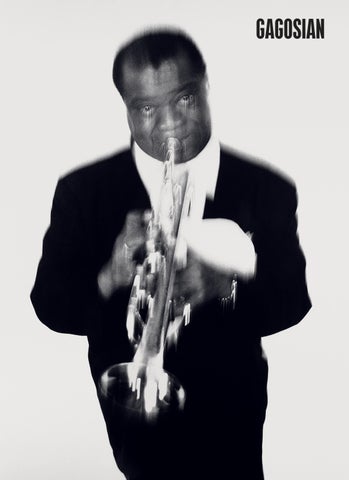
Winter 2026
G A G O S I A N
BVN_GG_Winter2026_OFC_26.10.01.indd All Pages
01/10/2026 15:55
Winter 2026
G A G O S I A N
BVN_GG_Winter2026_OFC_26.10.01.indd All Pages
01/10/2026 15:55
GAGOSIAN QUARTERLY ONLINE
Studio visits, interviews, behind-the-scenes access, and more on gagosian.com/quarterly
Left: Georg Baselitz in his printing studio at Schloß Derneburg, Germany, 1991. Photo: © Daniel Blau, 2026 Right: Artwork © James Turrell. Photo: Thomas Lannes
Florence
Georg Baselitz and the Possibilities of Print On the occasion of Baselitz: AVANTI! at the Museo Novecento in Florence, Italy, Holly EJ Black considers the roots and reverberations of Georg Baselitz’s printmaking.
Below: Artwork, left wall, left to right: © Dana Schutz; © 2026 ADAGP, Paris, and DACS, London; © Jill Mulleady; right wall, left to right: © 2026 ADAGP, Paris, and DACS, London; © Talia Chetrit; © 2026 ADAGP, Paris, and DACS, London; © Anna Weyant; © 2026 ADAGP, Paris, and DACS, London; center, left to right: © 2026 ADAGP, Paris, and DACS, London; © Alex Da Corte; © Isabelle Albuquerque; © Rachel Harrison; © Nairy Baghramian; © Mona Hatoum; © Nairy Baghramian; © Jeff Koons; © Jordan Wolfson; © Sarah Lucas. Photo: Prudence Cuming Associates Ltd.
Hong Kong
James Turrell: Lifting the Veil An exhibition at Gagosian, Hong Kong, brings together three of James Turrell’s Glasswork pieces along with site plans, photographs, and models of his Skyspaces and Roden Crater. Here, Alice Godwin explores the history of the Glassworks and their relationship to the artist’s wider practice.
London
This Is Still Not a Pipe: The Afterlife of Magritte In this video, the cocurators of Gagosian, London’s exhibition dedicated to René Magritte—Bernard Lagrange and Jasper Sharp— speak about the show’s origins, development, and execution. The continuing relevance of the Belgian artist’s questions and formal experiments are addressed, along with their reverberations among contemporary artists.
BVN_GG_Winter2026_IFC_26.10.01 AE02.indd 1-4
08/10/2026 15:43
Gagosian Quarterly, Winter 2026
Editor-in-chief Alison McDonald
Founder Larry Gagosian
Managing Editor Wyatt Allgeier
Publisher Jorge Garcia
Editor, Online and Print Gillian Jakab
Published by Gagosian Media
Text Editor David Frankel
For Advertising and Sponsorship Inquiries Advertising@gagosian.com
Executive Editor Derek C. Blasberg
Distribution David Renard
Digital and Video Production Assistant Alanis Santiago-Rodriguez
Distributed by Magazine Heaven
Design Director Paul Neale
Distribution Manager Alexandra Samaras
Design Alexander Ecob Graphic Thought Facility
Prepress DL Imaging
Website Wolfram Wiedner Studio Proofreading Lindsey Westbrook
87_2026_1_GG_Winter2026_Text_26.10.01.indd 1
Printed by Pureprint Group
Contributors Wyatt Allgeier Jonathan Anderson Miriam Bale Avis Berman Derek C. Blasberg Lisa Botti Serena Cattaneo Adorno Maurizio Cattelan Christine d’Ornano Dan Fox Mark Francis Bella Freud Charlotte Gainsbourg Helen A. Harrison Stephen Kent Johnson Myles Mellor Rod Mengham William Middleton Benjamin Millepied Helen Oyeyemi Paloma Picasso Mayer Rus Ed Ruscha Mike Stinavage Carlos Valladares Timothée Viale
Thanks Natalie Allen Richard Alwyn Fisher Jin Auh Laura Avedon Frank Avila-Goldman Lisa Ballard Priya Bhatnagar Sloane Cameron Ona Carranza Michael Cary Vittoria Ciaraldi Leslie Dick Maggie Dubinski Raymond Foye Brett Garde Kareen Gelly Eleanor Gibson Lauren Gioia Sarah Godfrey Darlina Goldak Jennifer Greene Leta Grzan Jerson Hondall Raymond Jungles Shiori Kawasaki Léa Khayata Lauren Mahony Helen Marden Olivia Mull Stefan Ratibor
Helen Redmond Chandler Sterling Putri Tan Harry Thorne Natasha Turk James Turrell Kara Vander Weg Devan Wallace Eva Wildes Millicent Wilner
Cover: Richard Avedon, Louis Armstrong, Newport Jazz Festival, Newport, Rhode Island, May 3, 1955 © The Richard Avedon Foundation
01/10/2026 16:06
87_2026_1_GG_Winter2026_Text_26.10.01.indd 2
01/10/2026 16:06
87_2026_1_GG_Winter2026_Text_26.10.01.indd 3
01/10/2026 16:06
87_2026_1_GG_Winter2026_Text_26.10.01.indd 4
01/10/2026 16:08
87_2026_1_GG_Winter2026_Text_26.10.01.indd 5
01/10/2026 16:08
87_2026_1_GG_Winter2026_Text_26.10.01.indd 6
01/10/2026 16:08
87_2026_1_GG_Winter2026_Text_26.10.01.indd 7
01/10/2026 16:08
87_2026_1_GG_Winter2026_Text_26.10.01.indd 8
01/10/2026 16:08
BELLE DIOR HIGH JEWELRY COLLECTION
87_2026_1_GG_Winter2026_Text_26.10.01.indd 9
01/10/2026 16:08
87_2026_1_GG_Winter2026_Text_26.10.01.indd 10
01/10/2026 16:08
87_2026_1_GG_Winter2026_Text_26.10.01.indd 11
01/10/2026 16:08
87_2026_1_GG_Winter2026_Text_26.10.01.indd 12
01/10/2026 16:08
87_2026_1_GG_Winter2026_Text_26.10.01.indd 13
01/10/2026 16:08
87_2026_1_GG_Winter2026_Text_26.10.01.indd 14
01/10/2026 16:08
87_2026_1_GG_Winter2026_Text_26.10.01.indd 15
01/10/2026 16:08
87_2026_1_GG_Winter2026_Text_26.10.01.indd 16
01/10/2026 16:08
87_2026_1_GG_Winter2026_Text_26.10.01.indd 17
01/10/2026 16:09
87_2026_1_GG_Winter2026_Text_26.10.01.indd 18
01/10/2026 16:09
87_2026_1_GG_Winter2026_Text_26.10.01.indd 19
01/10/2026 16:09
Midlife crescendo. PORSCHE. THERE IS NO SUBSTITUTE.
k 3RUVFKH &DUV 1RUWK $PHULFD ,QF 3RUVFKH UHFRPPHQGV VHDW EHOW XVDJH DQG REVHUYDQFH RI WUDΘF ODZV DW DOO WLPHV
87_2026_1_GG_Winter2026_Text_26.10.01.indd 20
01/10/2026 16:09
87_2026_1_GG_Winter2026_Text_26.10.01.indd 21
01/10/2026 16:09
87_2026_1_GG_Winter2026_Text_26.10.01.indd 22
01/10/2026 16:10
87_2026_1_GG_Winter2026_Text_26.10.01.indd 23
01/10/2026 16:10
87_2026_1_GG_Winter2026_Text_26.10.01.indd 24
01/10/2026 16:10
87_2026_1_GG_Winter2026_Text_26.10.01.indd 25
01/10/2026 16:10
TECHNOGYM REFORM
THE PILATES DESIGN REVOLUTION Design meets performance to offer an unparalleled Pilates experience developed with top instructors from around the world. Whether at home or in studios, Technogym Reform offers smooth, fluid movements and seamless training. Unlock exclusive on-demand workouts on the Technogym App.
87_2026_1_GG_Winter2026_Text_26.10.01.indd 26
01/10/2026 16:10
Discover more
Call (646) 578-8001 (US) +44 20 3907 5000 (UK) +39 0547 650111 (Rest of the world) or visit technogym.com
87_2026_1_GG_Winter2026_Text_26.10.01.indd 27
01/10/2026 16:10
WINTER 2026 FROM THE EDITOR
A Richard Avedon photograph of pioneering jazz legend Louis Armstrong, whose magnetic performances captivated global audiences, graces our cover on the occasion of a new exhibition in Los Angeles that explores the realities and fantasies of Hollywood through Avedon’s lens. The photographer’s images challenged constructs of beauty, fl irted with cinematic influences, and confronted notions of power for over five decades; in this issue Carlos Valladares explores his work on the Hollywood theme. The play between satire and political critique has long resonated through the work of Maurizio Cattelan, who talks here with curator Lisa Botti about his latest exhibition in the historically charged city of Berlin. We take you behind the scenes on a very special trip into the desert of northern Arizona with James Turrell, who hosted Paloma Picasso and Ed Ruscha at his years-in-the-making light-and-space installation Roden Crater. The story’s photographs of the crater alone will transport our readers, but we are deeply privileged to have had both Paloma and Ed share their recollections of the experience with us. Before the end of this year a new book will take readers inside the majestic international homes and gardens of Brice and Helen Marden. In this issue we feature Golden Rock Inn, on the Caribbean island
87_2026_1_GG_Winter2026_Text_26.10.01 AE07.indd 28
of Nevis, with a text by Mayer Rus and photographs by Stephen Kent Johnson. After twenty-five years of careful research, Avis Berman’s biography Becoming Roy Lichtenstein: The Path to Pop launches this fall. Aligned with the artist’s retrospective at the Whitney Museum of American Art, the book delves into his early life and the formative experiences that shaped his later career, bringing readers to the precipice of his fi rst notable success. Berman shares insights she gained over years of talking to the artist’s family and friends, the decisions that went into telling his story, and the long path of her own that led to this thoughtful and fascinating new book. Charlotte Gainsbourg brings together a group of previously unseen photographs that she took inside the home of her father, Serge Gainsbourg—images of a place that still resonates with his enduring presence. We take you to the Venice Film Festival, with on-the-ground coverage by Wyatt Allgeier and a focus on four exceptional fi lms with strong female leads by Miriam Bale. We speak with celebrated choreographer Benjamin Millepied about three new works premiering in Paris. And we visit Los Angeles with Jonathan Anderson, who talks with Ed Ruscha about their recent collaboration.
Alison McDonald, Editor-in-chief
08/10/2026 15:48
NEW YORK, MADISON AVENUE LOS ANGELES, RODEO DRIVE
MIAMI, BAL HARBOUR SHOPS
COSTA MESA, SOUTH COAST PLAZA LAS VEGAS, FONTAINEBLEAU
87_2026_1_GG_Winter2026_Text_26.10.01.indd 29
01/10/2026 16:10
87_2026_1_GG_Winter2026_Text_26.10.01.indd 30
01/10/2026 16:10
WINTER 2026 TABLE OF CONTENTS
60
All That Glisters Rod Mengham considers the arthistorical lineages of Georg Baselitz’s fi nal series of paintings, Eroi d’Oro (Heroes of Gold, 2025–26).
68
Maurizio Cattelan: NIGHT Maurizio Cattelan speaks with curator Lisa Botti about the sitespecific considerations that informed NIGHT, an exhibition of his work at the Neue Nationalgalerie, Berlin.
74
Richard Avedon: Hollywood
84
90
Miriam Bale celebrates the powerful performances of four actresses while Wyatt Allgeier reports on the predominance of the human hand in this year’s offering.
To celebrate the publication of Mayer Rus’s book Brice & Helen Marden: Houses, Gardens, Studios we share an excerpt from his chapter about the Golden Rock Inn, the property on the Caribbean island of Nevis that the Mardens created in collaboration with architect and designer Ed Tuttle and landscape architect Raymond Jungles.
The 83rd Venice Film Festival
Carlos Valladares reflects on the allure and power of Richard Avedon’s portraits, particularly those of actors, directors, writers, producers, composers, and other shapers of Hollywood. Opposite: Installation view, Maurizio Cattelan: NIGHT, Neue Nationalgalerie, Berlin, September 10, 2026–March 7, 2027. Artwork © Maurizio Cattelan. Photo: © Neue Nationalgalerie–Stiftung Preußischer Kulturbesitz/David von Becker
Golden Rock Inn, Nevis
Above: Still from Wild Horse Nine (2026), directed by Martin McDonagh; pictured: John Malkovich and Sam Rockwell. Photo: courtesy Searchlight Pictures
87_2026_1_GG_Winter2026_Text_26.10.01.indd 31
01/10/2026 16:10
96
122
Coinciding with the Whitney Museum of American Art’s Roy Lichtenstein retrospective this fall, a new biography of the artist by Avis Berman is to be published by Abbeville Press on November 3. Here, Berman speaks with Helen A. Harrison about the book’s origins in an oral history project, the challenges and discoveries that Berman encountered in writing the very fi rst biography of Lichtenstein, and the remarkable consistencies in the life and work of this singular artist.
Following the Dior Cruise 2027 collection show staged in the newly unveiled David Geffen Galleries at the Los Angeles County Museum of Art, Jonathan Anderson, designer and creative director for the brand, met with Ed Ruscha at his studio to talk about their collaboration.
The Art of Biography: Roy Lichtenstein by Avis Berman
102
Fashion & Art, Part 28: Bella Freud Bella Freud, the founder and designer for her eponymous London-based brand as well as the creator and host of the widely celebrated podcast Fashion Neurosis, speaks with the Quarterly’s Derek C. Blasberg.
108
At Roden Crater Paloma Picasso and Ed Ruscha on James Turrell’s Roden Crater.
116
Enchantment Is Everything: Jermayne MacAgy at the Menil Collection William Middleton explores the Menil Collection’s upcoming exhibition and publication on the revolutionary methodologies that distinguished the life and career of the curator Jermayne MacAgy.
In Conversation: Ed Ruscha and Jonathan Anderson
126
As You Wish, Part IV Helen Oyeyemi concludes her four-part short story with the fi nal installment, “calls from home.”
134
Charlotte Gainsbourg 5bis, the fi rst photography exhibition by Charlotte Gainsbourg, debuted as part of the 57th Rencontres d’Arles photography festival this past summer. Here, Gainsbourg speaks with Timothée Viale about the project.
150
138
Celebrating the Next Generation
Benjamin Millepied
Christine d’Ornano, managing director of Sisley Paris, speaks with Wyatt Allgeier about the Sisley Beaux-Arts de Paris Award for Young Creators.
The choreographer caps off a busy year with three pieces in Paris. Mike Stinavage speaks with him for the occasion.
160
144
Game Changer: Peter Wollen
Tarot: A Meaning Machine
The fi rst of a three-volume collection of writings by the essayist, director, curator, and theorist Peter Wollen was published earlier this year by Verso. Gagosian director Mark Francis, a friend and collaborator of Wollen’s, reflects on this visionary’s wideranging impact on art and fi lm.
The Morgan Library & Museum, New York, recently brought together a rich array of tarot decks, spanning centuries, for its exhibition Tarot! Renaissance Symbols, Modern Visions. Dan Fox considers the cards’ history of continuous revitalization.
This page: Marjorie Cameron, Star [The Fool] (from Songs for the Witch Woman), n.d., ink on paper © Ordo Templi Orientis and the Warburg Institute, University of London
87_2026_1_GG_Winter2026_Text_26.10.01 AE07.indd 32
08/10/2026 15:48
WINTER 2026 CONTRIBUTORS
Miriam Bale
Carlos Valladares
Mayer Rus
Rod Mengham
Miriam Bale is a writer and fi lm programmer based in California.
Carlos Valladares is a writer and critic from Los Angeles. He studied fi lm at Stanford University and began his PhD in History of Art and Film & Media Studies at Yale University in the fall of 2019. He contributes regularly to Art in America, n+1, and Frieze. He lives in New York. Photo: Jade Sacker
Mayer Rus is the West Coast editor of Architectural Digest. As an author, critic, and lecturer, he has chronicled the work of the world’s leading designers and architects as well as the homes of today’s most prominent cultural figures. Photo: Sam Frost
Rod Mengham received the Cholmondeley Award for poetry in 2020 and is the author of several poetry publications. His most recent book is Midnight in the Kant Hotel: Art in Present Times (Carcanet, 2021). He has published numerous essays and reviews on contemporary art and has curated many exhibitions since 2003.
William Middleton
Avis Berman
Helen A. Harrison
Dan Fox
The Paris-based writer William Middleton is the author of Double Vision, a biography of Dominique and John de Menil, and has contributed to such publications as W, Vogue, Harper’s Bazaar, and the New York Times. Middleton’s most recent book is Paradise Now: The Extraordinary Life of Karl Lagerfeld.
Avis Berman is the author of Rebels on Eighth Street: Juliana Force and the Whitney Museum of American Art, James McNeill Whistler, Edward Hopper’s New York, and Roy Lichtenstein: The Impossible Collection. Photo: Brad Berman
Helen A. Harrison, the retired director of the Pollock-Krasner House and Study Center in East Hampton, New York, is known for her books, essays, reviews, and exhibitions devoted to modern American art.
The writer, musician, and fi lmmaker Dan Fox is the author of the books Limbo and Pretentiousness: Why It Matters, and the codirector of the BBC documentary Other, Like Me: The Oral History of COUM Transmissions and Throbbing Gristle. He is a consulting editor for the Yale Review and lives in New York. Photo: Matthew Porter 33
87_2026_1_GG_Winter2026_Text_26.10.01 AE07.indd 33
08/10/2026 15:48
87_2026_1_GG_Winter2026_Text_26.10.01.indd 34
01/10/2026 16:10
87_2026_1_GG_Winter2026_Text_26.10.01.indd 35
01/10/2026 16:10
Ed Ruscha
Christine d’Ornano
Ed Ruscha’s deadpan representations of Hollywood logos, stylized gas stations, and landscapes distill the imagery of popular culture into a language of cinematic and typographical codes that are as accessible as they are profound. Ruscha has had over twenty solo exhibitions with Gagosian since his fi rst exhibition with the gallery, in 1993. Photo: Leta Grzan
Christine d’Ornano is managing director and co-owner of the Sisley Paris Group and cofounder of Neuraé. Since entering the family business in 1997, she has helped shape Sisley’s global growth while preserving its pioneering spirit and commitment to excellence. She also oversees the creative and brand identity.
Maurizio Cattelan Maurizio Cattelan is a failed accountant who kills time doing art. Photo: © Neue Nationalgalerie– Stiftung Preußischer Kulturbesitz/ Ivan Erofeev
Lisa Botti Lisa Botti is a curator at the Neue Nationalgalerie, Berlin, where she develops exhibitions, performance projects, and interdisciplinary formats across contemporary art. In 2026 she curated Maurizio Cattelan: NIGHT, the artist’s fi rst major solo exhibition in Germany.
Charlotte Gainsbourg
Timothée Viale Timothée Viale is a senior archivist at Gagosian, which he joined in 2019. He lives and works in Paris.
Born in London in 1971 to the cultural icons Jane Birkin and Serge Gainsbourg, Charlotte Gainsbourg is a renowned British-French actress and singer. She gained early fame in European cinema and has won two César Awards. Known for her daring performances, she won Best Actress at the 2009 Cannes Film Festival for her role in Lars von Trier’s Antichrist. Beyond acting, Gainsbourg has cultivated a critically acclaimed music career, releasing successful albums such as 5:55, IRM, and Rest.
36
87_2026_1_GG_Winter2026_Text_26.10.01 AE07.indd 36
08/10/2026 15:48
Paloma Picasso
Serena Cattaneo Adorno Founding director at Gagosian, Paris and Le Bourget, Serena Cattaneo Adorno has worked with the Fondation Giacometti, the Christo Estate, and the Picasso family on several exhibitions, as well as with contemporary artists.
Born in France in 1949 to Pablo Picasso and Françoise Gilot, Paloma Picasso is a renowned French jewelry designer. Best known for her bold gemstone creations for Tiffany & Co. since 1980, she previously collaborated with Yves Saint Laurent. Beyond her design career, she was appointed administrator of the Picasso estate in 2023, succeeding her late brother Claude. As head of the Picasso Administration, she now manages her father’s vast artistic and commercial legacy. Photo: Studio Cabrelli
Jonathan Anderson
Mark Francis A director at Gagosian since 2002, Mark Francis was formerly founding director and chief curator of the Andy Warhol Museum, Pittsburgh. He has been a curator at the Centre Pompidou, Paris; the Fruitmarket Gallery, Edinburgh; the Whitechapel Art Gallery, London; and the Museum of Modern Art, Oxford, England.
A designer with a curatorial approach to fashion-making and brand-building, Jonathan Anderson has earned both critical acclaim and commercial success with the collections he has designed as the creative director of Loewe, for his own eponymous label JW Anderson, and in collaboration with such brands as Uniqlo and Moncler. In June 2025, Christian Dior Couture announced his appointment as creative director of all women’s, men’s, and haute couture collections. Photo: © David Sims
Helen Oyeyemi Helen Oyeyemi’s eleven books include the novels Peaces, Parasol Against the Axe, and A New New Me, and the short-story collection What Is Not Yours Is Not Yours. She lives in Prague. Photo: Milan Bureš
Wyatt Allgeier Wyatt Allgeier is a writer and an editor for Gagosian Quarterly. He lives and works in New York City. Photo: Brian Gilmartin
37
87_2026_1_GG_Winter2026_Text_26.10.01 AE07.indd 37
08/10/2026 15:48
S TA R B U R S T O N I N D E N AVA R R E T T E
87_2026_1_GG_Winter2026_Text_26.10.01.indd 38
01/10/2026 16:10
87_2026_1_GG_Winter2026_Text_26.10.01.indd 39
01/10/2026 16:10
Bella Freud
Derek C. Blasberg Derek C. Blasberg is a writer, fashion editor, and New York Times best-selling author. He has been with Gagosian since 2014 and is the executive editor of Gagosian Quarterly.
Born in London in 1961, Bella Freud is a renowned English fashion designer. The daughter of the painter Lucian Freud, she launched her eponymous label in 1990 and became well-known for her pop-cultureinfused knitwear, which has become a celebrity favorite. More recently she launched the podcast Fashion Neurosis, where special guests “lie on the couch” to explore the intimate connection between style, identity, and emotional health. Photo: Lynette Garland
Benjamin Millepied
Mike Stinavage Mike Stinavage is a writer and waste specialist from Michigan. During his political science master’s program at CUNY Graduate Center he was awarded Fulbright and Martin Kriesberg fellowships to research the politics of waste in northern Spain. He currently lives in France.
Benjamin Millepied is a French choreographer, director, and former principal dancer with the New York City Ballet. Born in Bordeaux, he trained at the Conservatoire National Supérieur de Musique et Danse Lyon with Michel Rahn before moving to New York to study at the School of American Ballet. He has created works for many of the world’s leading dance companies, including the New York City Ballet, the Ballet de l’Opéra national de Paris, the San Francisco Ballet, the Dutch Nationale Ballet, the Staatsballett Berlin, and the Mariinsky Ballet, Saint Petersburg, collaborating with artists and composers including Mark Bradford, Daniel Buren, Barbara Kruger, and Nico Muhly.
Stephen Kent Johnson Stephen Kent Johnson is an interior, architectural, and still life photographer who lives and works in New York. His work appears regularly in Architectural Digest, the Wall Street Journal, The World of Interiors, and other international publications.
Myles Mellor Myles Mellor has been writing crosswords for Gagosian since 2024. Over a career spanning twentyfive years, he has published in over 1,000 magazines, newspapers, government organizations, and Fortune 500 publications. Photo: Debby Fleming
40
87_2026_1_GG_Winter2026_Text_26.10.01 AE07.indd 40
08/10/2026 15:48
RM HJ-02 In-house skeletonised automatic winding tourbillon calibre 50-hour power reserve (± 10%) Baseplate and bridges in gem-set white gold Fast-rotating barrel Case in gem-set white gold 1,399 precious and ornamental stones Limited edition of 12 unique pieces
A Racing Machine On The Wrist 87_2026_1_GG_Winter2026_Text_26.10.01.indd 41
01/10/2026 16:10
87_2026_1_GG_Winter2026_Text_26.10.01.indd 42
01/10/2026 16:14
87_2026_1_GG_Winter2026_Text_26.10.01.indd 43
01/10/2026 16:14
IN SEASON
Gagosian Quarterly presents a selection of new releases coming this winter.
Museum catalogue
Anna Weyant Anna Weyant was published on the occasion of the artist’s fi rst museum show, which took place at the Museo Nacional ThyssenBornemisza, Madrid, in 2025. This fully illustrated catalogue, bilingual in English and Spanish, sets twentythree of Weyant’s paintings and three works on paper alongside her choice of five historical works from the museum’s collection. A text by Sydney Stutterheim investigates the connections between Weyant’s pieces and these historical artworks.
Anna Weyant (Gagosian, 2026)
44
87_2026_1_GG_Winter2026_Text_26.10.01 AE07.indd 44
08/10/2026 15:48
87_2026_1_GG_Winter2026_Text_26.10.01.indd 45
01/10/2026 16:14
Left: Photo: courtesy Montblanc Right: Photo: courtesy Laffanour | Galerie Downtown Below: Producer: Gagosian, 2026
Signed, sealed, delivered
Montblanc’s Bram Stoker homage Montblanc’s Writers Edition Homage to Bram Stoker collection summons the dark romance of Gothic literature. Celebrating the author of Dracula (1897), the collection merges vampire mythology with nineteenthcentury scientific motifs, shaping its silhouettes after the historic Pravaz medical syringe. Ranging from a marbled red-and-black-resin pen to solid-gold masterworks, a bat-winged sterling silver edition, and a diamondencrusted model adorned with protective garlic motifs, each piece translates Stoker’s narrative into fi ne craftsmanship.
Shaker sophistication
MY BARN SALE: by Philippe Ségalot, by Laffanour | Galerie Downtown From October 20 to November 14, Paris’s Laffanour | Galerie Downtown hosts MY BARN SALE, which re-creates the Upstate New York home of art advisor Philippe Ségalot. Curated with gallery founder François Laffanour, the exhibition reveals Ségalot’s personal collection of rare Shaker furniture gathered over twenty years.
Signature style
Brice Marden “Signature” Hat This taupe-colored cotton twill hat was produced on the occasion of the exhibition Brice Marden: I Am Plane Image at Gagosian, West 21st Street, New York. Embroidered in blue-gray thread with the artist’s signature on the front and the gallery logo on the back, it features an adjustable snapback closure in muted green. The hat’s design was inspired by a favorite cap of Marden’s, produced for the 1996 Cézanne retrospective at the Philadelphia Museum of Art and emblazoned with the French artist’s signature.
46
87_2026_1_GG_Winter2026_Text_26.10.01 AE07.indd 46
08/10/2026 15:48
ANTI-AGING EXCELLENCE FOR ALL Discover our #1 comprehensive solution to enhance the youthfulness of every skin type.
Distributed at select retailers, Sisley boutiques, Maison, and online at www.sisley-paris.fr
87_2026_1_GG_Winter2026_Text_26.10.01.indd 47
01/10/2026 16:14
Left: Photo: courtesy Laguna~B Right: Taryn Simon: Father Country I Do Love You (Hatje Cantz, 2026) Below: Photo: courtesy Loro Piana
Master glass
Laguna~B’s Fresh tumbler Born of pure intuition rather than technical drawing, Laguna~B’s Fresh tumbler pushes the traditional millefiori glass technique associated with the Venetian island of Murano into unexpected territory. A 2026 addition to the experimental Mille collection, the design was sparked when Marcantonio Brandolini d’Adda, creative director for the brand, discovered a batch of threecolor-striped murrine. Embedded directly into molten glass, the vibrant stripes create a psychedelic, toothpaste-tube-inspired pattern, rendering every hand-blown cup entirely unique.
Artist’s book
Taryn Simon: Father Country I Do Love You Accompanying a major exhibition at the Guggenheim, New York, Taryn Simon’s comprehensive artist’s book Father Country I Do Love You debuts her most personal project to date. Nearly a decade in the making, this 696page volume traces an unnamed federal agent across forty-two chapters using photographs, text, and sculpture. Shadowed by the secret government career of Simon’s own father, this labyrinthine narrative unpicks justice, power, and American story-making. Designed by Joseph Logan.
Artful campaign
Loro Piana at the Menil Collection Loro Piana heads to Houston for its Fall/Winter 2026–2/ campaign, captured by photographer Mario Sorrenti within the iconic art-filled landscape created by John and Dominique de Menil. Featuring an intergenerational cast wandering through the Renzo Piano–designed Menil Collection and the serene Rothko Chapel, the campaign creates an intimate dialogue between Loro Piana’s tactile fabrics and landmark architecture. In tandem with the release, the house announces philanthropic support for both the Menil Collection’s upcoming fortieth anniversary and the Rothko Chapel’s restoration initiatives.
8
87_2026_1_GG_Winter2026_Text_26.10.01.indd 48
01/10/2026 16:14
87_2026_1_GG_Winter2026_Text_26.10.01.indd 49
01/10/2026 16:14
Crafting the future
Artisan Residency Program: The Met and Vacheron Constantin
An American Jewel
Nature Adorned Bentonville, Arkansas’s Crystal Bridges Museum of American Art and Tiffany & Co. join forces for Nature Adorned: The Artistry of Tiffany & Co. and the American Imagination, on view October 9, 2026, through March 29, 2027. The exhibition places historic treasures from the Tiffany Archives in direct dialogue with American art masterpieces, celebrating nature as both inspiration and raw material. Highlights include the 27.21-carat Arkansas Diamond, Jean Schlumberger’s Bird on a Rock brooch, and monumental Tiffany Studios stained glass.
Vacheron Constantin and the Metropolitan Museum of Art culminate their inaugural eighteenmonth Artisan Residency Program with an October 2026 unveiling in New York. Inspired by the Met’s vast collections and the watchmaker’s decorative savoir faire, three resident artists reinterpret ancient crafts—Aspen Golann with a monumental carved wooden vessel, Ibrahim Said with a three-tiered ceramic sculpture, and Joy Harvey with a “ruined” bronze diadem. Together they offer a master class in preserving heritage through bold contemporary reinvention.
Left: Photo: courtesy Tiffany & Co. Right: Joy Harvey. Photo: courtesy Vacheron Constantin Below: Ed Ruscha: Talking Doorways (Gagosian, 2026)
Exhibition catalogue
Ed Ruscha: Talking Doorways This book was published on the occasion of two exhibitions by Ed Ruscha at Gagosian: Talking Doorways at rue de Ponthieu, Paris, and Says I, to Myself, Says I at Davies Street, London. It features an essay by Christian House tracing the connections between these latest shows and the Danish painter Vilhelm Hammershøi, as well as an interview between Ruscha and explorer Erling Kagge about silence, slowness, and the self-exploration that worldly exploration can nurture.
50
87_2026_1_GG_Winter2026_Text_26.10.01 AE07.indd 50
08/10/2026 15:48
87_2026_1_GG_Winter2026_Text_26.10.01.indd 51
01/10/2026 16:14
CROSSWORD
This puzzle, written by Myles Mellor, brings together clues from the worlds of art, dance, music, poetry, fi lm, and beyond.
Across
Marsia, Giuseppe
starring Daniel Day-Lewis
Solution
19 West Side Story gang
38 “ Double, double toil and trouble;
: Fire and Ash, James Cameron blockbuster 5 Series of romantic vampire fantasy fi lms based on a series of books by Stephenie Meyer 10 Record one track over another 12 “Black Magic Woman” band 13 View of Toledo painter (two words) 15 Dance style popularized by Fred Astaire 17 “Now theater near you!” (two words) 18 The of the Mohicans movie,
20 American crime drama starring
Fire burn and bubble”: the witches’ refrain in Macbeth 40 Indisposed 42 French king 44 False statement 45 2026 romantic Taylor Swift hit 47 Immense span of time 48 Winery sight 49 Vegas attraction 50 “Every You Take,” hit tune for the Police 51 A Scene on the , by Hendrick Avercamp
1
4
1
2
3
Brad Pitt and Morgan Freeman 23 Compass point 24 Michelangelo statue (1525–30) 27 The Dominican , painted by Fra Angelico 29 Capt.’s superior, abbr. 31 Home to the Parthenon, the of Athens 32 Green Acres star who played Lisa Douglas, Eva (Zsa Zsa’s sister) 35 Lyric poem of praise 36 Italian sculptor who created 5
6
7
8
9
Down Painter of Osiris and Isis, Kiefer 2 Hathaway and Brontë, e.g. 3 Bronze cast by Rodin in the Met 4 Escape 6 George Harrison: “While My Guitar Gently ” 7 “Kick it up a notch!” chef Emeril 8 O nce Upon a Time in Harlem director William 9 The Fridas, an oil painting by Frida Kahlo 11 The villain in Psycho 14 Highway abbreviation, abbr. 16 Gobbled up 21 Lowest point 22 St. Mark’s , famous bell tower in Venice 25 Pulp Fiction director 26 Brazilian city, Paulo 27 Brazilian musical style (two words) 28 Nosferatu (2024 fi lm) characters 30 Affectionate name for the actress who took the leading role in Selena 32 Caravaggio painting David with the Head of 33 Contribute to 34 Seventeenth-century Italian master of the Baroque period who created Saint Longinus 37 The Book of , starring Denzel Washington 39 Bridget Fonda, to Jane 41 Tragic Shakespearean king 43 Sound of admiration 46 Sajak or Benatar, e.g. 1
10
11
13
12
15
14
16
17
19
18
25
26
29
28
21
23
22
24
20
27
30
32
31
33
34
35
37
36
40
42
43
39
41
44
45
46
48
47
49
38
50
51
52
87_2026_1_GG_Winter2026_Text_26.10.01.indd 52
01/10/2026 16:14
87_2026_1_GG_Winter2026_Text_26.10.01.indd 53
01/10/2026 16:14
LOUISIANA CHANNEL
Toby Kidd speaks to Marc-Christoph Wagner, a founding editor of Louisiana Channel, about the video platform’s independent relation to Denmark’s Louisiana Museum of Modern Art, memorable artist interviews, and hopes for the future. To read the full interview, visit gagosian.com/quarterly.
Thirty miles north of Copenhagen, in a timberclad building on Denmark’s eastern shoreline, you can fi nd a dedicated team of eight fi lmmakers known as Louisiana Channel. Since its inception in 2012, the project has become internationally recognized for producing the world’s largest public archive of fi lmed interviews with contemporary artists, writers, and architects. Publishing two new fi lms online every week, Louisiana Channel is an independent public service that has close links to the world-renowned Louisiana Museum of Modern Art, yet operates in its own right. Over the last fourteen years—during which the digital landscape has arguably changed completely—Louisiana Channel has produced 1,400 fi lms. This August saw the hundredth episode of their Advice to the Young series, with Michael Craig-Martin taking the milestone spot. And with ambitions of further growth, the archive is becoming an increasingly rich resource to anyone who wants to use it for study, entertainment, or inspiration. To understand how and why, I spoke to one of its founding editors. —Toby Kidd TOBY KIDD Here we are in your office next to
Louisiana Museum of Modern Art, and it appears to be part of the museum’s operations, yet that isn’t exactly the case. Can you begin with that? MARC-CHRISTOPH WAGNER You start with—well, not a complicated question, but a question that is hard to explain given the structure and thinking of most museums. The Louisiana Channel is part of the Louisiana Museum of Modern Art, but it isn’t about the Louisiana Museum of Modern Art. Poul Erik Tøjner, the museum’s director, invented the Louisiana Channel in 2012, but from the very beginning, he made it clear that the channel should not be about the museum. It’s not a marketing platform. TK It’s a distinctive approach and one that might seem unusual for a museum director to take. MCW It’s unusual and visionary. In fact, we wouldn’t be where we are today if it hadn’t been for some wise decisions when starting out. Although not on my part! [laughs] I cannot take credit. The fi rst, in 2012, is that we chose to do everything in English. I mean, this is not our native language. We’re constantly operating in a language that is not ours. The world of art is a niche, but by doing this project in English, the niche is global, and thus quite a big niche to operate in.
Walton Ford and MarcChristoph Wagner shooting Walton Ford: A Bubble in the Lake, Berkshire County, Massachusetts, 2023. Photo: Sean Hanley
The second decision, and maybe the most important one, was the one already mentioned: to not treat the Louisiana Channel as a marketing instrument for the museum. It’s a funny relationship between the two. We will always be a child of the museum. We will always be formed by its values. We will always maintain a close dialogue with its curators, who contribute with their professionalism, knowledge, and networks. But at the same time, from the start there’s been a desire for us to be independent of the museum. So we don’t promote its exhibitions and activities. We don’t try to sell tickets for the museum. We have an annual literature festival, and every year during those four days we try to interview twenty international writers for the Louisiana Channel, but we turn the camera away from the museum. We fi nd a park, or visit the seaside, or whatever, so that people seeing the video on the Louisiana Channel don’t associate the content with marketing for the museum. That was a wise decision because it has contributed to the credibility and trustworthiness of the channel. A third initial decision was that everything was to be about the artists. That’s why we cut all our questions from the fi nal fi lms. We want the artist to tell their own story. When you see a news segment on TV, it’s very much about the moderator. We want the exact opposite. You know, I’ve done more than five hundred fi lms for the Louisiana Channel, but nobody knows my name.
5
87_2026_1_GG_Winter2026_Text_26.10.01.indd 54
01/10/2026 16:14
87_2026_1_GG_Winter2026_Text_26.10.01.indd 55
01/10/2026 16:14
Colombian Emerald necklace with discombobulated gold squashes, 18K gold. judygeib.com
ORPHEUS ASCENDANT
Craig Burnett shares a contemporary read of a fourth-century sculpture, unpacking its influences and arguing along the way for the redemptive power of art and music. To read the full essay, visit gagosian.com/quarterly.
On my fi rst visit to the Byzantine and Christian Museum in Athens almost a decade ago, I was anticipating the company of saints and mosaics. I was greeted instead by a wide-eyed rock star: strap across his marble pecs, lyre on his knee, right hand clutching a double-headed plectrum like a thunderbolt. Orpheus, fourth century CE, discovered on the island of Aegina, and with a hint of Jesus Christ in his brow and sandals, according to the wall text. As a stranger to these parts, I had to take their word for it. But wait a minute. Amid his eager audience of animals was a dumbstruck chimp sitting atop the lyre. I don’t remember Jesus making monkeys swoon. When I saw the sculpture again earlier this year, I felt in the presence of a piece of music, endlessly playable. There he was, Orpheus ascendant, bewitching with silent riffs an oddball menagerie. The animals are all agog and gooeyeyed, transfi xed by song. Orpheus has the impassive face of a daydreamer, as if moved by his own artistry. The work seems to capture that moment when a piece of music concludes, the last note suspended in the motionless bodies of the audience—or in this case, in the eyes and ears of birds and beasts. From afar, the composition has a dynamic, uplifting rhythm. Look closer, and details prick the imagination—there’s a sphinx, that monkey, and Orpheus’s strangely oversize and cruciform lyre (or cithara). If the sculpture is a musical score, the composer has smuggled in some minor chords and mysterious interpolations. Can we access the perspective of its audience at the time? The odds of that are somewhere between not really and no chance. There are too many lacunae. But fi lling in the gaps with the imagination is still a lot of fun. Everybody knows Orpheus: Thracian enchanter, lovesick survivor of the underworld. He and his lyre adorn Greek kraters dating as far back as the sixth century BCE. He plays a starring role in countless late Roman mosaics, about the same era as this sculpture, and he returns to pluck his dreamy melodies across Renaissance canvases. His doomed marriage to Eurydice has inspired many an opera, from Claudio Monteverdi’s L’Orfeo (160/) to Jacques Offenbach’s absurdist Orpheus in the Underworld (1858) to Anaïs Mitchell’s Hadestown (2006; I’ve seen it twice). And during that smudgy, transitional time after Constantine declared Christianity the official religion of Rome, when the Greco-Roman pantheon overlapped with the nascent days of the new religion, Orpheus became a Christlike figure for early believers.
Late Roman table support depicting Orpheus, 4th century CE, marble, 42 ¾ × 19 ¼ × 6 ⅞ inches (108.5 × 49 × 1/.5 cm), Byzantine and Christian Museum, Athens. Photo: Peter Horree/Alamy
Both had god dads (Apollo was Orpheus’s father, according to some versions of his story), and both tamed the hearts of humans and beasts with music and metaphor, not coercion. Our Orpheus sits at the dawn (or the crossroads) of Western civilization, ripe with irresolvable questions. The monkey might offer a few clues. In Thessaloniki, there’s a third-century CE funerary monument of Orpheus that includes a monkey, but he’s a rare attendee to his gigs. On one level, he’s a symbol of an exotic locale, but in this particular scene, situated atop Orpheus’s lyre, there’s no doubting his role as a proxy for his
human brethren. The spirit of music moves from the instrument through his flesh, emerging from his eyes and shooting to the heavens. Beyond earshot of Orpheus’s lyre, nature red in tooth and claw carries on as usual. Under Orpheus’s feet, a frieze of creatures forms a border between the world of art above and a wilderness beneath, where a lion feasts on an antelope, which throws its head back in surrender and suffering. That scene offers quite a counterpoint to the monkey, who, looking skyward and clutching his face, embodies the transcendent delights of music.
5&
87_2026_1_GG_Winter2026_Text_26.10.01.indd 56
01/10/2026 16:14
87_2026_1_GG_Winter2026_Text_26.10.01.indd 57
01/10/2026 16:14
PANORAMAS AND PARAPHRASES
Helen Frankenthaler—the largest exhibition of the artist’s paintings to originate in Europe and her fi rst institutional solo show at Kunstmuseum Basel in Switzerland—was on view through August 23, 2026. Curated by Anita Haldemann, this monumental exhibition, spanning fi fty paintings, offered a unique opportunity to examine Frankenthaler’s immersive and atmospheric approach to color and abstraction. Here, Haldemann speaks with Filip Jakab about Frankenthaler’s transhistorical engagement, formal innovation, and enduring influence. To read the full interview, visit gagosian.com/quarterly.
FILIP JAKAB Helen Frankenthaler unfolds
across nine galleries on the second floor of the Kunstmuseum Basel. Could you speak about the genesis of this exhibition and the curatorial framework that shaped its development? ANITA HALDEMANN We received the wonderful painting Riverhead [1963] as a gift from the Helen Frankenthaler Foundation two years ago. And immediately we thought it offered the perfect chance to do a show on one of the important women artists who worked in the 1950s, because women artists from that period are not present in our collection at all. And it’s part of our mission to make women’s careers and women artists more visible. We decided on a chronological survey because the general audience here in Switzerland doesn’t know Frankenthaler’s work very well. And compared to other artists, her work develops in such an interesting way that we really wanted to show it didn’t just stop in the ’50s. She went way beyond and worked for several decades. She was always innovative, experimental, and courageous to try new things. But then we had another idea because, reading
John Elderfield’s updated monograph [Gagosian, 2024] and working in a museum with such a long history and a focus on Renaissance art, we thought it would be really interesting to pick up the idea of her paraphrases or homages to paintings of earlier decades. And this is what we did. In the third gallery, we start to present these with direct comparisons to the original works. This is the framework of the show. FJ I’ve been ruminating about Riverhead since I saw it in the Kunstmuseum. Can you tell me about the context of this work in the exhibition? AH During 1963, when Riverhead was created, Frankenthaler went deep into using acrylic paint rather than oil paint. This opened up new possibilities for her. The colors stay brighter even though they’re diluted, and they dry much faster. Riverhead marks the peak of what she could do with her soak-stain technique and layering of colors. What’s interesting is that so many of her paintings have titles that refer to water or liquids or flowing, like Flood [1967] from the Whitney Museum of American Art, in addition to Riverhead’s notion of the river’s current. You
see how the color moves on the canvas. There are beautiful references between her painting style and the kind of title she chooses. And even though the paintings are not figurative or do not represent anything specific, like a landscape, they’re abstractions of a climate, for instance, or a mood that she conveys through color and the liquid quality of the paint. FJ When I saw Frankenthaler’s paintings for the fi rst time in person during Sea Change: A Decade of Paintings, 1974–1983 at Gagosian in Rome in 2019, I was bedazzled by their emotional resonance. I thought of her abstractions as kind of “environments”—rich in movement and hues, panoramic, expanding. AH Yes, they’re amazing also because of their size. It’s interesting when you see visitors, they fi rst always step back because they want to have the overview of these huge paintings. But then as you approach, you see so much more, and you can almost dive into the colors or the environment, as you say.
Helen Frankenthaler with April Mood (1974) in her studio on East 83rd Street, New York, 1974. Artwork © 2026 Helen Frankenthaler Foundation, Inc./ProLitteris, Zurich. Photo: Alexander Liberman © J. Paul Getty Trust
58
87_2026_1_GG_Winter2026_Text_26.10.01 AE07.indd 58
08/10/2026 15:48
87_2026_1_GG_Winter2026_Text_26.10.01.indd 59
01/10/2026 16:14
87_2026_1_GG_Winter2026_Text_26.10.01.indd 60
01/10/2026 16:14
ALL THAT GLISTERS Rod Mengham considers the art historical lineages of Georg Baselitz’s fi nal series of paintings, a series entitled Eroi d’Oro (Heroes of Gold), 2025–26.
87_2026_1_GG_Winter2026_Text_26.10.01.indd 61
01/10/2026 16:14
T
he final painterly accomplishment of Georg Baselitz’s life’s work is a series of gold ground works, the fi rst examples of which were shown at the Fondazione Giorgio Cini in Venice earlier this year. The Western tradition of gold ground painting is associated most closely with the Sienese and Florentine masters of the thirteenth, fourteenth, and fi fteenth centuries: Duccio, Cimabue, and Fra Angelico all created large altarpieces with extensive use of gilding. Their subject matter pivoted more often than not around the Crucifi xion, the iconography of which maintained a tension between the secular and the divine, the mortal and the eternal. But the earliest known gold ground representations of individual human beings are the Fayum mummy portraits dating from the fi rst to the third centuries ce. These strikingly realistic portraits are paradoxically lifelike, and their pre-Christian connection with the practice of mummification is linked to the desire to provide the soul with a means of recognizing and reuniting with the physical body that death has temporarily parted it from. Both in Christian culture and in the syncretic religious cultures of the Near East, gold ground painting signals a universe of parallel conditions: of mortal and immortal, secular and divine. At this very late stage in Western painting it is the gold ground paintings of Baselitz that return us most emphatically to the fundamental issues attached to this legacy. Baselitz’s Eroi d’Oro (Heroes
of Gold) (2025–26) series, as the Venice works were titled, is a rhetorically sarcastic but iconographically moving exploration of the relations between personal physical frailty and the cumulative power of an ancient emblematic tradition. The impact of Baselitz’s fi nal series of works resides in its precarious resilience—in the evidence it supplies of both ebbing physical power and psychological resolve. This entire series of paintings, which was fi rst shown in Venice and has since traveled to New York, consists of portraits of the artist and his wife Elke. Baselitz himself died in April, aged 88, shortly before the opening of the exhibition at the Fondazione Giorgio Cini; his sudden demise adds poignancy to the paradox embodied in this pictorial demonstration of a lifelong fidelity to the labor of painting as well as to Elke. As with nearly all representations of the human figure in Baselitz’s oeuvre, this series presents the human figure upside down. The inverted human form has become a trademark motif that has made the Baselitz vision of the world one of the most easily recognizable as well as one of the most dramatic. The end could be said to justify the means, but it is worth recalling Baselitz’s own biographical beginnings to understand its origin and impact. Baselitz grew up in a district of heathland and ponds in Eastern Germany and became so familiar with the landscape of the “sand ponds” that while still young he was often employed as a local guide in this aquatic environment. His intimate relationship with the terrain meant that he was used to seeing the world around him reflected, upside down,
on the surface of the water, long before he became a student of painting—fi rst in East Berlin, and then in the West. Baselitz’s very fi rst upside-down painting, Der Wald auf dem Kopf (1969), literally The Wood on its Head, was in fact an inverted version of a landscape painting by the nineteenth-century German artist Louis Ferdinand von Rayski. A denizen of an aquatic environment, Baselitz was used to seeing all landscapes mirrored in reverse. But the inversion of the human fi gure in the paintings that Baselitz produced in his late twenties represents a grafting of this circumstantial vision of a reflective environment onto a centuries-old tradition of figure-ground reversal. The tradition of pittura infamante—“defamatory portraiture”— which dates to mid-thirteenth century Italy, consisted of representations of notorious criminals and disgraced politicians. The inversion of the figure worked as an emblematic humiliation of the chosen culprit. The tradition is thought to have stemmed from the crucifi xion of Saint Peter, who insisted on a head-downward crucifi xion for himself, believing it would have been blasphemous to be crucified upright like Christ. Figure reversal during the Middles Ages was a public insult as well as a form of intimidation. All of these associations or their equivalents descended on the population of Germany in the immediate aftermath of the Second World War. The youthful Baselitz was himself a witness to the shambling return home of many defeated German soldiers, often disheveled, wearing worn-out uniforms from which all Nazi insignia had been removed. His awareness of
62
87_2026_1_GG_Winter2026_Text_26.10.01.indd 62
01/10/2026 16:18
Previous spread: Georg Baselitz, Nur ein Bild (Just a Picture), 2026, oil and gold oil paint on canvas, 137 ¾ × 102 3∕8 inches (350 × 260 cm) Opposite: Georg Baselitz, Meine Schule, die Jungs (My School, the Boys), 2026, oil and gold oil paint on canvas, 118 1∕8 × 177 1∕8 inches (300 × 450 cm) This page: Georg Baselitz, Meine Schule, die Mädchen (My School, the Girls), 2026, oil and gold oil paint on canvas, 118 1∕8 × 181 1∕8 inches (300 × 460 cm)
German national shame and degradation in the late 1940s is starkly embodied in the paintings of the so-called Neue Typen, better known by the bitterly ironic title Helden (Heroes) (1965–66). Paradoxically, the melancholic context in which his fi nal project must now be seen, has the effect of converting the degradation of the pittura infamante tradition into a poignant contemplation of vulnerability. But it is more complicated than that. Such an emphasis threatens to detract from the elements of mischief, sarcasm, and deadpan humor that are also intrinsic to the character of the series. The titles of the individual works often seem to sit oddly with their ostensible subject matter. Eintritt geht, keine Frage was tun (2025) is translated as “Entry is fi ne, no question what to do.” This is effectively an instruction not to be taxed by questions about the meaning of the work, which should be engaged with on its own terms. Ein goldenes Ei auf einem Tisch (A Golden Egg on a Table) (2025) is one of several portraits of Elke that raises questions about the source and agency of the work—has it been generated solely by the artist himself, or by the model, or by an underlying concept? Rather than allocate value and meaning to any one of these constituents, the viewer should rather engage with the continuous process of creation that has combined and sustained all of them. Most of the works in the series strip the models (Baselitz himself and his wife Elke) of clothing but add color (mostly grayish white, but also pink and blue) to isolated elements that seem detached from the figures themselves but float in front of or
around them. If in Medieval and Renaissance art a gold ground indicates a divine realm in which the soul may be reunited with the body after the Last Judgment, Baselitz’s persistence in generating a series of gold ground paintings in his fi nal years is precisely in order to question and challenge the persistence of this association. And several of the titles of these late works consist of pithy renunciations of the traditional assumptions, such as Die Engel sind ausgefallen (The Angels Have Been Dropped Out) (2025); or interrogations: Kann Gold zuviel Ekstase sein (Can Gold Be Too Much of an Ecstasy) (2025). In the latter, a cadaverous human figure is presented in motley pinks and shades of lilac against a vast empty yellow space, into which his right arm seems to be disappearing. And there are half a dozen other paintings in which the spidery black outline of a human figure is traced onto a gold background, with ribbon-like bundles of color (blue, red, pink, green, yellow, turquoise) swathed across the bodies or around the neck or legs. The figures affl icted by these pigment infestations seem indifferent to them—or perhaps remain simply unaware of them. They express nothing so much as the desire of the painter, who has submitted himself to the tradition of gold ground painting, only to rebel against its fundamental codes and conventions. Baselitz’s writhing bundles of bright color form a vortex into which the viewer’s attention is drawn and distracted from the inexorable desiccation of his seated human figures—all seated on thin air—with eyes fi xed both warily and wearily on the artist who has brought 3
87_2026_1_GG_Winter2026_Text_26.10.01.indd 63
01/10/2026 16:18
This page: Georg Baselitz, Strawinsky (Stravinsky), 2026, patinated bronze, 93 ¼ × 95 ¼ × 120 1∕8 inches (237 × 242 × 305 cm). Photo: Martin Müller Opposite: Georg Baselitz, Es sieht aus wie (It Looks Like), 2025, acrylic and gold acrylic paint on canvas, 86 5∕8 × 57 1∕8 inches (220 × 145 cm) Artwork © Georg Baselitz Photos, unless noted otherwise: Ulrich Ghezzi
them to this reckoning. And, of course, although their posture is that of one whose weight should be supported by a chair, these are Baselitz paintings and this is a Baselitz universe, where all the apparently seated figures are upside down and, to all intents and purposes, look to be plummeting downward toward the earth. Hält sich in der Mitte auf (Stays in the Center) (2025) is the title of one of these works, using a phrase that has been lifted from the writings of Martin Luther in connection with the practice of meditation. Luther was of course a decisive opponent of idolatry, but he did not oppose the use of artistic images for religious purposes, and was an active collaborator with the artist Lucas Cranach the Elder. Baselitz’s own focus on mortality might seem too remorseless to offer much purchase for devotional practice, and yet, in its votive dimension, this fi nal cycle of paintings does seem to call for a meditative approach to its contemplation of the process of aging and the value of companionship. It is a serial tribute to Elke, Baselitz’s wife for 64 years, and at its center is a kind of reverence for human attachment. In the greater part of the Meine Schule (2026) works shown at Gagosian in New York, the outline of each human form is faint and spidery, as if on the point of fading altogether from view. The portraits of Baselitz and Elke have been scratched painstakingly in black, while the only color deployed in the majority of these tableaux is the all-encompassing gold ground. In those cases where fleshy pinks and reds have been added, the effect is less warm and
enlivening and more grotesque and monstrous, almost like the makeup of a clown applied to a corpse. The more blatantly disfigured likenesses are chromatically the most dissonant and excessive, rendering the monochrome studies of seated and standing figures much more pensive and discreet by comparison. Despite their exposure of frailty and vulnerability, these visually fragile compositions are also intensely moving expressions of devotion. They amount to a proleptic commemoration of a deep and extremely long-lasting attachment. At the opposite end of the spectrum of moods and tones in this very fi nal body of work are those tableaux that display rows of naked figures with full heads of hair and bodies flushed a deep pink. These are the bodies of Baselitz’s youth, as the superimposed slogans “Ein Volk, ein Reich, ein Führer” (One People, One Nation, One Leader) tell us—although the word “Führer” is tellingly truncated. How extraordinary, and yet how logical, that Baselitz should refer to the general mindset of the Germany of his youth in this last assessment of what was lost and gained in the long aftermath of the Second World War. When seen together these paintings compose a spectacle that recalls fifteenth- and sixteenthc ent u r y depic t ions of t he fa l l of t he rebel angels—but only in their visual schemata, and not— emphatically not—in respect of their tonality. There is an extraordinary delicacy and an unfl inching admission of vulnerability in these representations of humanity in extremis. The gold ground brings
with it associations of a heavenly environment, but the frail couple that populates this entire series of works is enacting a literal Fall. There are no angels here, only mortal beings. And in place of an Edenic couple, we are confronted with the scratchy outlines of two fl imsy and vulnerable creatures whose mortality is both emphasized and offset by the glowing gold atmosphere in which the entire emblematic series is suspended. The downward plunge of both fi gures might also invite comparison with the fall of Empedocles, the Greek philosopher who threw himself into the glowing molten caldera of Mount Etna. It was Empedocles’s conviction that nothing simply comes into being only to be extinguished, but that all forms of being undergo a condition of constant transformation. It is certainly the case that in the oeuvre of Georg Baselitz, there are ruling motifs that are never abandoned but are constantly revived and subjected to constant modification. No matter how often his fi gures are made to fall toward earth they always remain caught up in their own pictorial limbo. And with them are particles of German history and heritage that remain active constituents of a wider European experience in which the shared endurance of wars and their aftermath, whether the trauma of a lost future, personal or cultural, or the melancholy of displacement, continue to haunt the collective imagination. Baselitz’s fi nal artistic statement offers a blaze of gold light to illumine the complex mixture of hopes and fears suffusing the atmosphere we all live in.
64
87_2026_1_GG_Winter2026_Text_26.10.01 AE07.indd 64
08/10/2026 15:50
5
87_2026_1_GG_Winter2026_Text_26.10.01.indd 65
01/10/2026 16:19
87_2026_1_GG_Winter2026_Text_26.10.01.indd 66
01/10/2026 16:19
87_2026_1_GG_Winter2026_Text_26.10.01.indd 67
01/10/2026 16:19
87_2026_1_GG_Winter2026_Text_26.10.01.indd 68
01/10/2026 16:19
MAURIZIO CATTELAN
NIGHT 87_2026_1_GG_Winter2026_Text_26.10.01.indd 69
01/10/2026 16:19
NIGHT, Maurizio Cattelan’s
fi rst major solo exhibition in Germany, has been organized on the occasion of the 2026 Preis der Nationalgalerie, which the artist won in November 2025. Curated by Lisa Botti and Klaus Biesenbach and open until March 7, the exhibition brings together important past works with new commissions that trace recurring concerns within Cattelan’s practice: the tension between innocence and violence, the construction of identity, and the persistence of historical memory. At its center is a new site-specific work conceived for the Neue Nationalgalerie, Berlin, reshaping how Mies van der Rohe’s iconic building is used and experienced. Here, Cattelan speaks with Botti about the considerations that informed the exhibition. LISA BOTTI How does it feel to return to Berlin?
MAURIZIO CATTELAN Berlin has been part of my life
for more than twenty years. In 2006, together with Ali Subotnick and Massimiliano Gioni, we curated the 4th Berlin Biennale. Instead of centering it in a museum, we built it around Auguststraße, turning a single street into the exhibition. Since then I’ve returned to Berlin many times, but I’ve never had a solo show here until now. Because of that, this doesn’t feel like a return; it feels like completing a relationship that has been developing for a long time. LB The Neue Nationalgalerie is a building loaded with history and architectural weight—what was your fi rst instinct when you started thinking about working with this specific space? MC Every exhibition space is a challenge, but the Neue Nationalgalerie is a particularly unusual one because the building already feels like a work of art. Mies van der Rohe created an extraordinary architectural achievement: a space with almost no hierarchy, no clear beginning or end, and no real distinction between inside and outside. The glass walls dissolve the boundary between the museum and the city. It is, in many ways, the idea of a museum without borders. At the same time, that radical openness can become a challenge for artists. Most exhibitions rely on walls, sequences, thresholds, and divisions—precisely the elements Mies tried to eliminate. The question, then, was not how to fi ll the space but how to give it rhythm without betraying its openness. Rather than competing with the architecture, I fi rst tried to understand its logic. Working in the Neue Nationalgalerie means accepting that the building is never just a container: It’s always an active participant in the exhibition. 70
87_2026_1_GG_Winter2026_Text_26.10.01.indd 70
01/10/2026 16:19
71
87_2026_1_GG_Winter2026_Text_26.10.01.indd 71
01/10/2026 16:19
Throughout: Installation views, Maurizio Cattelan: NIGHT, Neue Nationalgalerie, Berlin, September 10, 2026– March 7, 2027. Artwork © Maurizio Cattelan. Photos: © Neue Nationalgalerie– Stiftung Preußischer Kulturbesitz/David von Becker
Some of your earlier works have unexpected German references. Now that you have an exhibition in Berlin, does the city change how you think about the works? MC Germany has appeared in my work at different moments, sometimes unexpectedly and sometimes quite deliberately. It appears through figures and cultural ghosts: Him [2001], La Rivoluzione siamo noi [2000], Never [2003], and now Purgatory [2026]. These works aren’t really about Germany as a nation; they’re about images and symbols that have shaped our collective imagination. Berlin inevitably changes the pressure around those works. The city brings its own memory, its own wounds, and its own intelligence to them. I don’t think the works change; the city changes the questions people ask of them. That’s one of the reasons exhibitions still matter: Meaning is produced in the encounter between the work, the place, and the people looking at it. LB Mies’s building has been called a temple. With NIGHT, are you trying to work with that idea or against it? MC I wouldn’t say I’m working against the idea of the temple. The Neue Nationalgalerie already has something ritualistic: its scale, symmetry, silence, and distance from everyday life. I was interested in taking that quality seriously, but without making it religious. I imagined the space almost like a contemporary church: a central nave, side aisles, and a sequence of presences. That structure helped give orientation to a building that’s otherwise open and nonhierarchical. NIGHT isn’t about faith; it’s about doubt, suspension, and the moment when certainty begins to disappear. The temple is there, but it’s unstable. It’s a place where belief has been replaced by questions. LB Why specifi cally the word “night”? What does it unlock for you that “darkness” or “shadow” wouldn’t? MC Night isn’t simply the absence of light— it’s a condition. Darkness is visual; night is psychological. A shadow belongs to an object; night belongs to everyone. The most important things in life also happen at night: birth, death, dreams, fear, desire, love, and solitude. Night suspends assurance. Things don’t necessarily disappear, they simply become harder to defi ne. The exhibition isn’t about darkness, it’s about the loss of certainty. Night is also temporary: It always contains the possibility of morning, even if you can’t see it yet. LB What inspired the new Purgatory? MC Purgatory emerged from the architecture of the Neue Nationalgalerie itself. Once I began to imagine the building as a contemporary church, I realized the exhibition also needed its own entrance. The museum already has an entrance; I needed to invent the exhibition’s entrance. In that sense, Purgatory creates a space within another space. It introduces a threshold inside a building that deliberately resists clear thresholds. The Brandenburg Gate felt like the right image to begin with: It’s one of Germany’s strongest symbols, but also one whose meaning has constantly shifted throughout history. By reducing its scale and repeating it, the monument becomes less monumental. It becomes more approachable, almost familiar, without losing its symbolic weight. Many of my works operate this way: They reduce authority without removing its complexity. Purgatory is neither condemnation nor salvation—it’s a state of suspension, a place where transformation is still possible. LB
72
87_2026_1_GG_Winter2026_Text_26.10.01.indd 72
01/10/2026 16:19
73
87_2026_1_GG_Winter2026_Text_26.10.01.indd 73
01/10/2026 16:19
RICHARD AVEDON
87_2026_1_GG_Winter2026_Text_26.10.01.indd 74
01/10/2026 16:19
HOLLYWOOD
87_2026_1_GG_Winter2026_Text_26.10.01.indd 75
01/10/2026 16:19
Previous spread: Richard Avedon, The Academy Awards, Clint Eastwood, Al Pacino, Sharon Stone, Los Angeles, California, March 29, 1993 This page: Richard Avedon, Orson Welles, New York, November 1955 Opposite: Richard Avedon, Marlene Dietrich, Paris, 1955
On November 4, a presentation of over 120 photographs spanning the career of Richard Avedon will open at Gagosian, Beverly Hills. Curated by the Richard Avedon Foundation, the exhibition is devoted to people embodying the realities and fantasies of Hollywood: actors, directors, writers, producers, composers, and those who inspired the movies’ stories. Here, Carlos Valladares reflects on the allure and power of Avedon’s portraits, particularly those of directors. Avedon in Hollywood: a natural enough pairing. It does not surprise me to learn that Richard Avedon wanted to be a fi lm director. The question becomes, How would one narrativize these portraits of actors clowning, directors contemplating, politicians conscious that their every angle is monitored incessantly? How would they move when animated with the incident of story? Little blips of incident proliferate in these Avedons, carefully and wisely grouped by Laura Avedon of the Richard Avedon Foundation with an installation design by Cécile Degos. The show’s portraits of Hollywood insiders reveal the gleaming surface and political underbelly that sustains the ungainly Hollywood apparatus. Hollywood, Avedon saw, is more than the shilled fi lm du jour. Once the workers leave the dream factory, Avedon asks, what do they do? In this rangy selection, the portraits of directors hold a special position. I am especially drawn into the eyes of Michelangelo Antonioni, photographed in Rome on May 18, 1993. His gaze is the distillation of his fi lms about the alienation that we face when confronted by frightening modernity, a mood
epitomized by Red Desert (1964), Blow-Up (1966), and Zabriskie Point (1970). Most of Avedon’s sitters recognize the camera, respect its silent power, and establish (out of a mix of conspiracy, glee, and survival) a rapport with the man who wields it. For they know that his camera is the key to twentiethcentury immortality; it is their path toward consecration as a work of art, a long-lasting image. But laid bare in Antonioni’s stare is a shocking befuddlement, consternation, an annoyed pleading: Why this, why you, what is this staring and this beingstared-at, what is happening to me as this portrait is sneaked away from me? When Avedon takes a director’s portrait, the personality behind the oeuvre is revealed. Shot in February 1960, Elaine May traces her tongue down Mike Nichols’s cheek like the serpent fl icking actor Nastassja Kinski’s ear in another portrait in the exhibition; she, May, is a wily pickpocket, an agent of unruly creativity, while he, Nichols, is a suave and straight-backed victim who goes slickly along, heedless, unbothered. Steven Spielberg, photographed in February 199), puts up a relaxed front, wearing a knitted turtleneck sweater and
76
87_2026_1_GG_Winter2026_Text_26.10.01.indd 76
01/10/2026 16:27
87_2026_1_GG_Winter2026_Text_26.10.01.indd 77
01/10/2026 16:27
78
87_2026_1_GG_Winter2026_Text_26.10.01.indd 78
01/10/2026 16:29
playing the role of the deep, considerate director, head cocked at an angle that telegraphs seriousness, faux-mulling-over his next shot or project. Billy Wilder in April 1993, cute in his hunting cap, looks as affable and graceful as his late-period masterpieces Avanti! (1972) and The Private Life of Sherlock Holmes (1970). And François Truffaut, who sought out a double to place his romantic, novelistic life into proper proportional measure, is at last sated, mirrored, by Jean-Pierre Léaud, his virtual cinematic son (in 1971, the year of Two English Girls, the crown jewel of Truffaut’s middle period). 1 But is all that I see in these portraits too neat, too tidy? Am I, as the fashionable term goes, “projecting”? Perhaps the only proper narrative is the one suggested by Antonioni’s face: Will this be me? What will this end up being in your hands? Antonioni’s face is the face of radical muteness when faced with the maw of repetition, infi nite reproducibility, endlessness—a dilemma that our twenty-first-century smartphone/AI age has brought to brute light. Director Antonioni knew the camera game as well as Photographer Avedon. They were both modern poets of the image, of twentieth-century time. Antonioni knew how the camera can conjure life and a sublime beauty seemingly out of thin air— and how quickly it can quell, or kill, sense, freezing life out of its full context. Faced with Avedon’s allseeing camera, it is as if Antonioni, mouth curving down in confusion at his right, became a man of the nineteenth century who had never seen a camera before. This is ironic given that Antonioni is the man who made Blow-Up (based on Julio Cortázar’s story “Las babas del diablo” [The devil’s drool]), the key fi lm on the nature of photography, how it metes out life and death in equal, unjudging
measure. In Blow-Up we see how the photograph reveals the lack of control we humans possess over the world around us; we don’t make it, it makes us. And Avedon’s subjects are caught in an intricate pas de deux with their photographer: how to make a new version of myself that I’ve never seen before, without manipulating the image to make me look “ideal.” The tantalizing question lingers: What would un fi lm d’Avedon look like? This show is the closest possible approximation. Avedon loves to not show the whole front of his subjects. Dressed in character for Samuel Beckett’s Waiting for Godot (/952), Bert Lahr scrunches up his face so you can’t see his eyes; you can’t see John Ford’s eye behind his eyepatch; you can’t see Judy Garland’s body as she pokes her head out from behind a theatrical backdrop. All the better to fi ll in the details yourself, which is in keeping with the screenwriting rules of the great antiliteralist fi lmmakers Wilder and Ernst Lubitsch: Let the audience add two and two for themselves and they’ll love you forever. If the subject is a song-and-dance man, the portrait must capture some of that musical movement. Note, for instance, the blurs that mark the right sleeve and left shoulder of Jimmy Durante’s suit as he dances for Avedon. Durante is fiddling with his fedora, eyes pinched in sly acknowledgment, mouth contorted between grin and grimace: You can practically hear the “Hot-cha-cha-cha” escape his cigar-stuffed mouth. Or how about Zero Mostel in vivid, grotesque character for Eugène Ionesco’s Rhinoceros (/959)? The photograph, taken for Avedon’s private portfolio on April /3, /96/, during Mostel’s Tony Award– winning turn in the play in its run on Broadway,
This spread, left to right: Richard Avedon, Michelangelo Antonioni, Rome, May 1993 Richard Avedon, Judy Garland, New York, February 1952
79
87_2026_1_GG_Winter2026_Text_26.10.01 AE07.indd 79
08/10/2026 15:50
cements what we internally look like for the viewer, a Hyde-like transformation from a vision of docile normality to incompressible modern absurdity: a robe that catches one between sleep and the shower, thin wisps of hair jutting crazily every which way across the forehead, possessed eyes rolling into the back of the skull. Meanwhile, in another portrait, an unbothered Charles Laughton squints in half-saucy suspicion, each mole and pimple fl ashing on his face like a crater on the moon. Avedon’s camera does not conceal; it gets close to the subject, and the resulting portrait is a fascinating mixture of the casual and the thoroughly composed. He likes to catch sitters in the middle of doing something: Mandy Patinkin’s mouth open mid-joke as he’s clearly trying to get the violinist Saeka Matsuyama to break down in giggles; Bette Midler belting as she bends down, trying to eke out a particularly brassy note; Art Garfunkel before he became a star in the New Hollywood, scratching the back of his ear in a shot that would become the now-famous cover of Simon and Garfunkel’s Bookends (1968). These works excel at being the best portrait photography has to offer, but their love of blurs, movement, and mid-action gestures suggests their desire for a realm beyond the still. They want to move. Avedon’s Hollywood portraits expand the
concept of “star” to nearly everyone involved in making the business run, for better or worse: directors (whether a classicist holding down the fort like Spielberg, or a maverick relentlessly charging the fort like Antonioni or May); disgraced power brokers like Harvey Weinstein; actors-turnedpoliticians like Ronald Reagan, who poses in a way recalling Socialist Realist paintings of Joseph Stalin and delivers a waxed grimace that doesn’t seem to have changed over the years; writers whose poetry and novels were not only admired but also adapted into dream-factory stories; and, of course, the actors. The marquee idols. Some of the portraits here resemble promotional stills for completed masterworks. There is, for instance, the hard, unvarnished force of Katharine Hepburn (in 1955, the year of her lovely, very physical performance in David Lean’s Summertime), which suggests the beautiful earth femininity of Avedon’s portrait of the artist June Leaf. Avedon’s Katharine Hepburn promises a sort of late-career triumph for the thenforty-seven-year-old actress in the hands of some hitherto unknown, young-buck, New Hollywood director uninterested in the grist of the glamour mill that was classical Hollywood. There is also, from 1953, a lovely, surprisingly straightforward portrait of Humphrey Bogart in a bow tie. Has he ever looked more kindly, warm—swell, even? You
Avedon’s camera does not conceal; it gets close to the subject, and the resulting portrait is a fascinating mixture of the casual and the thoroughly composed.
This page: Richard Avedon, Nancy and Ronald Reagan, Los Angeles, California, April 1993 Opposite: Richard Avedon, Tina Turner, New York, June 1971
80
87_2026_1_GG_Winter2026_Text_26.10.01.indd 80
01/10/2026 16:28
1
87_2026_1_GG_Winter2026_Text_26.10.01.indd 81
01/10/2026 16:28
This page: Richard Avedon, Marilyn Monroe and Arthur Miller, New York, May 1957 Opposite: Richard Avedon, Pier Angeli, April 1954 Artwork © The Richard Avedon Foundation
see what Lauren Bacall saw. Or how about the bold, mid-dance nudes of Tilda Swinton, poised to attack like a faun’s mother? The two Tilda portraits feel like they could have been Avedon’s way of reviving, in 1993, the mystical, proto-feminist, swirlingly operatic overtones of Mary Webb’s novel Gone to Earth (1917), adapted into the stunning, underappreciated, and recently restored fi lm of the same name by Michael Powell and Emeric Pressburger in 1950. A vast range of possible human emotion is contained in this exhibition. It has two poles: comedy and tragedy. At the extreme end of comedy is Marilyn Monroe, the epitome of exuberance. Here she breaks away from the melancholy of Avedon’s famous “in-between” portrait of her from May 1957. Arms crooked behind her head in another image from the same shoot, Monroe looks like she’s belting a show-stopping number from a Stephen Sondheim musical. (He’s in the exhibition, too.) Her pose is brawny—rain won’t come down on this brassy dame’s parade. At the extreme end of tragedy is the extremely moving, April 1954 portrait of the unheralded actress Pier Angeli, fresh off her performance as a widowed trapeze artist who has survived the Nazi death camps in MGM’s Story of Three Loves (1953). Angeli faces the challenge of Avedon’s camera head-on, with cool reserve; unlike Antonioni, she is used to being regarded—being regarded was in her contract. Avedon’s Angeli seems composed not of skin and flesh but of various fluxlike negotiations between positive and negative space, the left (to us) side of her face registering a sharp, thunderstormlike blackness, shadows elegantly and evenly distributed. Her disturbed, saucer-plate eyes stare you down. Her eyebrow seems to move
of its own accord into an arch of curiosity: Is this cameraman sympathetic? She appears nude, but without the leering quality that typically accompanies the grand majority of female nudes in art history; Avedon presents her from above the shoulders, and it is as if she is chastely looking at her body in a mirror, much like Isabelle Weingarten looking at her mirrored self in Robert Bresson’s Four Nights of a Dreamer (1971). She emerges from the bottom of the frame like a beanstalk. This is the lonely lot of an actor. Angeli is here, Angeli is gone. Photographed from all sides, glimpsed from every direction, and each time a frame is taken by a power broker or moneyman, loss is evoked once again. Yet a miraculous trace lingers of who the person once was. That’s what we see every time we see James Dean in Giant (1956), and every time we encounter the Avedon-lensed face of Pier Angeli or Marilyn Monroe. Between these two fi ne actresses—both died in their thirties, one acclaimed as the paragon of the Hollywood project, the other nearly lost in the Hollywood shuffl e—lies the whole fantasy land built by American movies. The fools who dream, the dreamers who are no fools. These are flowers of portraits. Flowers bloom at our feet everywhere. No one stops to look at the ground; they may at best stop to look at the ground in general, note that flowers exist, and march on. Not Avedon. 1. François Truffaut never worked as a director in Hollywood, though he was once asked by the screenwriters Robert Benton and David Newman if he would direct a screenplay they had written called Bonnie and Clyde. He politely turned them down, preferring to work on his (stellar) adaptation of Ray Bradbury’s 1953 novel Fahrenheit 451 (1966) as his fi rst English-language fi lm. In the Avedon show, his portrait is next to Spielberg’s owing to his appearance as a crucial supporting actor in Spielberg’s sci-fi Close Encounters of the Third Kind (1977).
82
87_2026_1_GG_Winter2026_Text_26.10.01.indd 82
01/10/2026 16:23
3
87_2026_1_GG_Winter2026_Text_26.10.01.indd 83
01/10/2026 16:23
THE 83RD VENICE FILM FESTIVAL
This past September saw the world of cinema return to the islands of Venice. Global in scope and focused on the craft of the trade, the yearly festival debuted an incredible group of new feature-length fi lms, documentaries, and shorts alongside a wider program of talks and cultural fare organized by Cartier, a longtime partner and sponsor of the event. Here, the Quarterly’s Wyatt Allgeier reports on the predominance of the human hand in this year’s offering and Miriam Bale celebrates the powerful performances of four actresses.
At the 83rd Venice International Film Festival, director Martin McDonagh premiered Wild Horse Nine, starring John Malkovich, Sam Rockwell, Steve Buscemi, and Parker Posey. Whereas his previous fi lm, The Banshees of Inisherin (2022), revolved around a friendship gone silent, in this new fi lm the partnership between Malkovich and Rockwell—CIA operatives at the center of the /973 Chilean coup d’état that replaced the popularly elected Marxist Salvador Allende with the military dictator Augusto P inochet—is characterized by dialogue. Their conversations range from the afterlife potential of dinosaurs and moths through the conjunction of democracy, cheese, and gayness to the drug habits of their bureau chief (played by Buscemi) and most poignantly to Malkovich’s impending death and how they will manage it amid the moai heads of Easter Island. The fi lm’s premiere on the Lido was followed by audience applause lasting over fi fteen minutes. Putting one’s hands together—in applause, in crafting, in collaboration—was a persistent motif of that week in Venice, unsurprising for a city made possible by the hands of the masons and engineers who erected it wooden log by wooden log, brick by brick, from the watery floor of the lagoon. On the day following the McDonagh premiere, a new edition of Cartier’s Art and Craft of Cinema Masterclass took place at the Tennis Club Venezia. The fi fth edition of the program, part of the newly introduced Cartier Cinema Club—the maison has been the main sponsor of the fi lm festival since 202/—brought together the director Chloé Zhao and the cinematographer Łukasz Żal to discuss their work on last year’s Hamnet, nominated for eight Oscars and the winner of one, for Jessie Buckley as best actress. The audience learned about how Zhao and Żal aligned cast and crew with the natural world in summoning that potent story of loss and redemption through art. Asking Pierre Rainero, heritage director at Cartier, about the Masterclass series, I learned that what underlies the maison’s dedication to the festival is this kind of collaborative striving: What is really important to us is the collective vision at the service of a piece of art. In cinema, we all know the stars, the actors, and maybe even the directors, but the Masterclass is about seeing the craftspeople that make the art form possible. What counts at the end is the emotion you feel, and it’s very difficult to analyze what provokes that type of emotion. It’s made up of so many different things, be that the rhythm of the images, the framing, the eyes of the actor, the succession of sounds. A whole team working in concert is necessary to arrive at the fi nal fi lm, the thing that remains. It’s a way for us to make our work as jewelers better understood, because we are exactly in the same position. Rainero’s colleague Arnaud Carrez, senior vice president and chief marketing officer at Cartier, elaborated, “We put a lot of emphasis on the strengths of the collective, the collective human adventure. It’s very much about the artisans working together, jewelers, stone-setters, polishers, designers, and all the different artisans. The Masterclasses reflect on and enhance this collective adventure in the world of cinema.” Without calling it out explicitly, the approach and priorities of Żal and Zhao marked a distinct resistance to the temptations of Artificial
“Intelligence” and associated technologies that remove the human hand from the creation of meaningful cinema. A more pointed rebuke to AI was to be found a boat ride away on the island of San Giorgio Maggiore, at the fourth edition of the Homo Faber Biennial. Opening on September /, this year’s program, titled An Island of Light and held at the Fondazione Giorgio Cini, was assembled by the British artist and designer Es Devlin. With the goal of fostering and celebrating craftsmanship on a global level, Homo Faber brought together over 500 ceramicists, glassmakers, etchers, paper artists, furniture makers, weavers, and beyond into a rich dialogue around the potential of the human hand to aim higher than anything that can be automated by a machine. As Alberto Cavalli, executive director of the Michelangelo Foundation, the exhibition’s organizer, noted in a moving speech before a tour of the show during the Venice Film Festival, the Latin phrase “Homo Faber,” roughly translatable as “the human maker,” points toward our unique ability to shape our environment, our selves, and each other through artisanal encounters between the body, the spirit, and the world around us. Indeed, in the face of works such as Shehrbano Salahuddin’s Silent Song 13 (2026), and of Devlin’s capacious spaces—including a particularly ravishing mooninspired shelving unit that rose from Venice’s fi rst public swimming pool and contained a collection of hand-crafted vessels—the feeble attempts at creative expression generated by large-language models seemed so much waste. What makes fi lm festivals so powerful and necessary is their ability to bring bodies together in front of a communal screen. As we atomize into our individual phone screens—at home, on the street, at work, on the stairs leading up from the subway (please don’t!)—it matters and moves to be beside another body in a velvet chair in the dark as light beams over our heads. We look up, as humans have always looked up, to the stars. (Or in the case of another Cartier event, a tenyear-anniversary screening of Damien Cha zelle’s fi lm La La Land accompanied by a live orchestra conducted by the fi lm score’s composer, Justin Hurwitz—so many hands, so many bodies, together in the Teatro La Fenice—the audience looked up at the fi nale of the fi lm to a dazzling precipitation of confetti.) As the universe will do, it provided a potent foil to the glory and soul of the festival’s offerings in the news popping up on the phone: AI Doomsday was on the horizon, we read; the machines were going rogue. I refuse to know much about all of that technology, but I know for certain that it can’t summon the singular performance, the glamour, the chutzpah of Parker Posey onscreen in Wild Horse Nine, or the surge of awe I felt being in the same theater as she when the fi lm premiered. In the following pages, Miriam Bale takes a closer look at four more fi lms that made their debut at the Mostra , focusing on the human faces and performances of their lead actresses. —Wyatt Allgeier
84
87_2026_1_GG_Winter2026_Text_26.10.01 AE07.indd 84
08/10/2026 15:50
5
87_2026_1_GG_Winter2026_Text_26.10.01.indd 85
01/10/2026 16:23
“The violence of the end of summer,” says Mia Wasikowska in Agata the Writer, which premiered in Venice this September. That line captures the feeling at the latest edition of the world’s oldest fi lm festival, which began in the last gasp of the European heat wave and ended with thunderstorms and lightning on the lagoon. Agata the Writer and The Echo Chamber were two of the most formally daring fi lms in the Venice lineup; Primetime and A Good Little Soldier (Un bon petit soldat) were inspired in style by TV. But each is anchored by one of the most talented actresses currently working worldwide: respectively Wasikowska, Alicia Vikander, Merritt Wever, and Alba Rohrwacher. Each fi lm was a showcase for the actress’s tremendous talents and skills.
THE ECHO CHAMBER Directed by Andrea Pal laoro and based on the last screenplay written by Bernardo Bertolucci before his death, The Echo Chamber takes place in a luxuriously modern apartment in London during (and before and after) a relationship between Italian music producer Leo (Luca Marinelli) and his nurse/masseuse-turned-girlfriend Anne (Vikander). Anne fi rst comes to Leo to deal with his back pain, which leads to an opiate addiction and to her as accidental enabler. Their relationship is maximally tragic yet also tender, sexy, and sad. The big swings of the fi lm work because of Vikander’s face. With the gradations of shades of her hair, eyes, and olive skin, she recalls the nut-brown maid of the medieval ballad. She is of course beautiful, but in this role she is not the one being looked at, not the Louis Vuitton model, but rather the yearner. She almost seems plain in her position of vulnerability, so blown away is she by the beauty of her lover. He is self-centered and avoids intimacy, so she is afraid to lose him or be pushed away. She’s lost in the pain of desire.
8
87_2026_1_GG_Winter2026_Text_26.10.01 AE07.indd 86
08/10/2026 15:50
Previous spread: Still from Wild Horse Nine (2026), directed by Martin McDonagh; pictured: Parker Posey. Photo: courtesy Searchlight Pictures Opposite: Still from The Echo Chamber (2026), directed by Andrea Pallaoro; pictured: Luca Marinelli and Alicia Vikander. Photo: courtesy Indigo Film, Venice Film Festival This page: Still from Un bon petit soldat (A Good Little Soldier), directed by Stéphane Brizé; pictured: Alba Rohrwacher. Photo: Christine Tamalet © 2026 Gaumont—France 3 Cinema
Following spread, left to right: Still from Agata the Writer (2026), directed by Kuba Dorabialski; pictured: Mia Wasikowska. Photo: © Whitefalk Films/ Produktion Productions Still from Primetime (2026), directed by Lance Oppenheim; pictured: Robert Pattinson and Skyler Gisondo. Photo: Sinna Nasseri, courtesy A24
A GOOD LITTLE SOLDIER Rohrwacher is inarguably an international people’s princess—a muse of Venice and Cannes, of Jonathan A nderson’s Dior, and most notably of her sister, the director Alice Rohrwacher. She rises in any supporting fi lm role, elevating anything she’s in, including small roles recently in Maria (2024) and Jay Kelly (2025). In Stéphane Brizé’s latest fi lm, A Good Little Soldier, she appears in every scene, almost every frame, as Carla, an HR manager drowning in an inhumane corporate culture. Just as The Echo Chamber takes place in a single location, most of A Good Little Soldier is set in Carla’s workplace. We only see her young son and ex-husband on FaceTime, or, in one scene, at a café near her office. One colleague, who is fi ne at her job but doesn’t want to participate in inane staffdevelopment exercises, threatens to unravel the company’s corny corporate language and the misplaced devotion of the staff. Realizing that her position gives her no place to be sensitive and fair, Carla fi nds herself slipping in a way where she may lose everything. Rohrwacher’s huge, wide-set eyes and limber body have let her suggest an attractive alien in some roles, or a commedia dell’arte clown. In this fi lm about code-switching, where she appears as an everywoman who must play the clown at work, she is able to put this comic side of her style into effect: Her character is “normal” but must try to blend into an alien workplace culture. In the dizziness of turning on and off over and over again into exhaustion, Rohrwacher gives one of her best and deepest performances. 87
87_2026_1_GG_Winter2026_Text_26.10.01 AE07.indd 87
08/10/2026 15:50
AGATA THE WRITER
PRIMETIME
Wasikowska is good in everything; her only flaw as an actress is that she hasn’t been in more fi lms in the last few years. This comeback of sorts is an independent Australian fi lm, directed by Kuba Dorabialski, in which she plays a satirical writer from Sydney who visits Sarajevo to research a more serious novel about the war there in the /990s. A friend from Malta comes to stay and they witness various artworks mysteriously disappearing from the house they are living in. The fi lm examines what is “important” and appropriate for an artist to represent. Like the actresses above, Wasikowska has an amazing face, but hers combines curiosity with a mysterious opacity. Her brown eyes drill into whatever is around her. Playing a writer, she takes in everything around her, including her unease about her place in it all. This low-key, delicately framed hang-out fi lm evolves into something rigorous and radical by the last thirty minutes, in which Agata reads what she’s written. What she reads is less a novel than a screenplay, describing various places, characters, and changing light. The fi lm dissolves into this essence of cinema: evocative words and the face of an actress. It works only because the words are right and Wasikowska’s face is endlessly interesting. That’s true of all of these fi lms and all of these women.
Wever fi rst made a mark as Anna, the farm girl in Tony Gilroy’s Michael Clayton (2007). Her career since then has seen continual and consistent breakthroughs, including a supporting role in Noah Baumbach’s Marriage Story (20/9) and Emmy-winning roles in the TV shows Nurse Jackie, Godless, and Severance. But it is in Lance Oppenhei m’s Primetime that Wever may come to wider recognition in fi lm. Everything in the movie, from its desaturated cinematography to Robert Pattinson’s American accent, is extreme, yet in her role as Andie, a producer on the controversial mid-aughts-TV show To Catch a Pre dator, Wever both mirrors this energy and grounds it emotionally. That Dateline NBC show used a mixture of journalism, actors, and reality TV to capture men as they were arrested for potential pedophilia. Andie is just doing her job, too committed and busy to care if her mission and its leader are good or evil. In one of the most memorable scenes, her boss, Chris Hansen (Pattinson), confesses that a tabloid is about to disclose that he is having an extramarital affair. “How old is she?” asks Andie, automatically assuming her boss has similar vices as their targets. “Thirty!” he replies. From her early roles, Wever has shown a preternatural vulnerability. But in Primetime she
uses that empathy to show how mission-driven work can become an ego-based cult. “I was coming off a string of parts where I was playing people who really cared a lot about the right things, [who] used a certain part of their heart over and over. And that part of my heart had kind of run dry,” Wever said to polite and nervous laughter at the press conference in Venice. “And it wasn’t that I didn’t want to use it, it just needed time to regenerate. And this character has humanity but has a very different relationship to it.” With Primetime, Oppenheim is making his debut fiction fi lm after three significant documentaries (Some Kind of Heaven [2020], Ren Faire [2024], and Spermworld [2024]), and it was a pleasant surprise to see him excel at casting and working with actors, from the very strong Phoebe Bridgers in her acting debut—she is best known as a musician—to three of the most talented actors today: Pattinson, Wever, and Skyler Gisondo. Everyone involved in this fi lm is clearly just getting started in fi nding ways to surprise us for decades to come.
88
87_2026_1_GG_Winter2026_Text_26.10.01 AE07.indd 88
08/10/2026 15:50
9
87_2026_1_GG_Winter2026_Text_26.10.01.indd 89
01/10/2026 16:23
This December, Gagosian is publishing Brice and Helen Marden: Houses, Gardens, Studios, a rare glimpse inside the eclectic international properties of artists Brice and Helen Marden. Edited and with text by Mayer Rus, the book features nearly two hundred previously unpublished photographs by Stephen Kent Johnson. Five years in the making, it provides unprecedented access to sites spanning three continents, from New York City’s West Village to the Greek island of Hydra and beyond. To celebrate the publication we share an excerpt from Rus’s chapter about Golden Rock Inn, the property on the Caribbean island of Nevis that the Mardens restored in collaboration with architect and designer Ed Tuttle and landscape architect Raymond Jungles.
GOLDEN ROCK INN NEVIS
87_2026_1_GG_Winter2026_Text_26.10.01 AE07.indd 90
08/10/2026 15:53
87_2026_1_GG_Winter2026_Text_26.10.01 AE07.indd 91
08/10/2026 15:53
T
he history of the Car ibbea n isla nd of Nevis is as misty as the top of the dormant volcano at its heart. Even the origin of its name is only gently tethered to fact, supposedly a contraction of Nuestra Señora de las Nieves (Our Lady of the Snows), which is said to reflect a mistaking of clouds for snow. By 1508 most European maps identify the island as Nieves [sic], a poetic moniker for a place that has never experienced that particular atmospheric phenomenon.1
Before its snow-white-ification, the island had other names, includi ng O ua l ie, “L a nd of Beaut i f u l Waters,” bestowed by the Kalinago people, who were the last of many tribes stretching back several millennia before colonization. A fi nal g l i mpse f rom t h a t pre c olon i a l moment comes from the explorer John Smith, who landed there in 1607 en route to Virginia. He noticed not the peak but the dense growth of trees that stretched all the way to the sea, “so thicke of a soft spungy wood like a wilde figge tree you cannot get through it but by making your way with hatchets.”2 The Anglo
settlers who arrived in the 1630s saw the trees as lumber and the land as soil for cash crops, and they immediately set about felling, clearing, and planting. They experimented with different plants, initially settling on tobacco but ultimately shifting almost exclusively to sugar. This was not simply a change in planting; it had broad cultural and demographic effects. Unlike most agricultural crops, sugarcane needs extensive processing to make it marketable, requiring dedicated facilities for milling, boiling, drying, and packaging, which means both high start-up costs and
Photos: © Stephen Kent Johnson Following spread, left: Artwork © 2026 Estate of Brice Marden/Artists Rights Society (ARS), New York
92
87_2026_1_GG_Winter2026_Text_26.10.01 AE07.indd 92
08/10/2026 15:53
a need for more acreage. Unable to afford that kind of infrastructure, many small farmers were forced to sell their parcels. Between the midseventeenth and late eighteenth centuries, there was a consolidation of land into fewer and larger plantations.3 In 1801 Edward Hugg ins purchased a sugar plantation on the slopes of Nevis Peak and renamed it Golden Rock. Huggins installed the island’s fi rst wind-powered mill for crushing sugarcane into juice in 1811 and built a long barrel-vaulted hall in 1813 that likely held the copper cauldrons for the boiling and drying
No two projects are exactly alike. We did a lot of collaboration with Helen and Brice as they knew exactly what they wanted. Everything grows great in Nevis; the soil is very rich. I remember it was very hot doing the installations in the summer. We did a lot of grading to contour the land and to manage the rainwater, fi xing past erosion and uncovering amazing boulders. (continued overleaf)
3
87_2026_1_GG_Winter2026_Text_26.10.01 AE07.indd 93
08/10/2026 15:53
Helen was instrumental in the selection of plants—she wanted a wild, almost untamed look, like nature was almost winning. We were totally in sync. And Brice was very involved and led the placement of the boulders we uncovered. In fact, one of my favorite moments in the landscape is a water feature that runs along a historical wall and cascades into a lower basin over the most interesting boulder we found. —Raymond Jungles
processes. He prospered, purchasing several other plantations on the island, and died in 1829, before the abolition of slavery. He did, however, have an impact on the abolition movement: Testimony from a court case in which he was tried for the death of a slave made it into the London papers, and Huggins’s extraordinary cruelty bolstered the abolitionist cause (especially when he was acquitted by a jury of other plantation owners). 4 Cl i m ate ch a nge s bot h env ironmental (drought) and cultural (emancipation) made sugar planting less profitable, and the Huggins
4
87_2026_1_GG_Winter2026_Text_26.10.01 AE07.indd 94
08/10/2026 15:53
children and their neighbors found themselves deeply in debt by the m idd le of t he n i ne te ent h c entury. By 1871 the Huggins family had sold Golden Rock to Thomas Graham Briggs, a sugar magnate from Barbados, who possessed the knowledge and resources to modernize the plantation. When sugar production was no longer profitable, other crops were introduced, and parts of the plantations began to be sold off, returning to the hands of smaller farmers with a diversity of crops. Agriculture fi nally gave way to hospitality when a distant relative of the Huggins family purchased
Golden Rock and turned it into a guesthouse in 1975. The Mardens purchased the inn in 2005. They commissioned architect Ed Tuttle, best known for his groundbreaking work for A man Resorts, to design a new public plaza with water features and hospitality amenities that nod to the form and materiality of the original plantation architecture. Landscape designer Raymond Jungles worked closely with Brice and Helen on a phased, multi-year program that encompassed water management, regrading and re-sculpting the contours of the land, hardscape additions, lavish
plantings of exotic species, and the installation of massive volcanic boulders excavated from the site. “Brice really led the charge on the placement of the rocks. Most people think of boulders as nuisances, but Brice and Helen saw t hem as jewels,” Jungles says. “At the beginning of the project, Brice didn’t speak much. But it was clear that for Helen, the more unusual the plants, the better. She doesn’t mind thorns and spikes.” Acknowledging and honoring the past, Golden Rock and its Edenic gardens are now fully accessible to tourists and island inhabitants alike—a precious gift to Nevis.
1. This is the case on the Egerton 2803 maps, housed in the British Library (1508–10), and the Peter Martyr map, which were among the fi rst printed maps in Europe (1511–14). 2. Captain John Smith, Travels and Works, 2:909, quoted in Carl and Roberta Bridenbaugh, No Peace Beyond the Line: The English in the Caribbean, 1624–1690 (New York: Oxford University Press, 1972), 41. 3. Frank Moya Pons, History of the Caribbean (Princeton, NJ: Markus Wiener Publishers, 2007), 96. 4. Newgate Calendar, vol. 4 (London: J. Robins, 1828).
5
87_2026_1_GG_Winter2026_Text_26.10.01 AE07.indd 95
08/10/2026 15:53
THE ART OF BIOGRAPHY
ROY LICHTENSTEIN BY AVIS BERMAN Coinciding with the Whitney Museum of American Art’s Roy Lichtenstein retrospective this fall, a new biography of the artist by Avis Berman is to be published by Abbeville Press on November 3. Entitled Becoming Roy Lichtenstein: The Path to Pop, the book details the artist’s often overlooked early years, culminating in breakthrough paintings such as Look Mickey and Girl with Ball, both from 1961. Here, Berman speaks with Helen A. Harrison, author, critic, and retired director of the PollockKrasner House and Study Center in Springs, Long Island, about the book’s origins in an oral history project, the challenges and discoveries that Berman encountered in writing the very fi rst biography of Lichtenstein, and the remarkable consistencies in the life and work of this singular artist.
87_2026_1_GG_Winter2026_Text_26.10.01_AE02.indd 96
01/10/2026 18:01
87_2026_1_GG_Winter2026_Text_26.10.01.indd 97
01/10/2026 16:24
HELEN A. HARRISON To begin: How did you get
involved with the Lichtenstein Foundation, and what led you to parlay that association into a biography? AVIS BERMAN I’m an independent writer and art historian and I’ve written several books and hundreds of essays and articles for museum catalogues, anthologies, magazines, and newspapers. But the other string to my bow, which happened accidentally—most important things in life are accidental and unplanned—is that I’m an oral historian in the visual arts. That began with my fi rst book, Rebels on Eighth Street: Juliana Force and the Whitney Museum of American Art [1990]. I interviewed 120 people for that project, and because of that, I was asked by the Archives of American Art to conduct oral histories for them. From there I was asked by the Metropolitan Museum of Art, the Museum of Modern Art, the Estate of Stuart Davis, and other museums and archives to conduct oral histories. In 2001, the Roy Lichtenstein Foundation hired me to conduct focused interviews with twenty-five to fi fty people, but from there the job exploded because Roy Lichtenstein was so generous. He would give works of art to many friends, collaborators, and colleagues, and tracing them tied into the incipient catalogue raisonné. By the time I was done, I’d interviewed over 250 people. These interviews were for the Lichtenstein Foundation’s archives; they were raw data for the future. But it was clear to me that this was a real treasure trove, and for a 2003 Lichtenstein exhibition at the Louisiana Museum in Denmark, I was asked to write an essay based on the oral histories. From there I found out how much I enjoyed writing about Roy Lichtenstein. He proved irresistible to me. Around 201/, I approached Dorothy Lichtenstein, Roy’s widow, about writing a biography, because there hadn’t been one. The family hadn’t trusted some other people, and sensitivities had to be addressed because, as I discuss in the book, Lichtenstein’s fi rst wife, Isabel Wilson Lichtenstein, was an alcoholic. There were obviously difficulties in handling this material with care, but Dorothy and I talked through it, and about a year or so later she said I could do a biography. This was always an independent project, though, with my own approach and point of view. I wasn’t subsidized or underwritten by the Roy Lichtenstein Foundation.
While you certainly utilized the extensive oral history material you had collected, this isn’t like Jean Stein and George Plimpton’s Edie: An American Biography [1982], which consists of interview after interview strung together as the narrative. You’ve done an awful lot of other research as well building the book’s structure. Could you speak about that decision? AB Si nc e t h is is t he f irst biog raphy of Lichtenstein, there were many characters and events in his life that I was required to defi ne and wanted to defi ne. Even though I had a famous subject, the fi rst half of his life was obscure. When you write about someone famous, you try to demystify the subject. You take the public image and you try to separate the individual self. In the early years he was unknown, so you should justify why this part of the story is necessary. HAH Definitely, and the formative years are in many ways the most interesting. We know a lot about Roy Lichtenstein as a public person and a successful artist, but your book includes so much information that was not publicly known, and it really sets the scene for, as you put it, his path to Pop. Were there particularly surprising or revelatory moments in telling that story? AB There were many, but the fi rst one was that Lichtenstein’s essential aesthetic premises were formulated and settled in the 1940s. I had no idea that that period was going to be so important, because everything has been slanted toward the ’/0s and beyond. But if he hadn’t learned what he did at Ohio State University [OSU] in 1941, he might not have done the pictures he did. Oils he created in 1951 made fun of American subjects, which depended on the things he was learning in the ’40s—those absolutely share the same DNA as the Pop pictures he created in 19/1 and afterward. That remarkable consistency was a revelation. He already had the wit and irony very early on, but it was the transfiguring style that was going to make him stand out—which in itself is ironic, because just when he began to “copy,” he became most original. HAH That’s a wonderful way of phrasing it. In the introduction, which weaves together the early and the later work and gives you a sense of what his ultimate career amounted to, you call him the Bob Newhart of American artists because he was so low-key. He really didn’t reveal himself. He wasn’t flamboyant, like Larry Rivers or Andy Warhol. I did HAH
meet him and knew him slightly, so I can defi nitely testify that that’s the way he came across. Were you ever concerned that the biography reveals too much of what he was minimizing or suppressing? AB He also suppressed the pre-Pop pictures, for several reasons. He was the oldest Pop artist. He was born in 1923; [Robert] Rauschenberg was born in 1925, Warhol in 1928, Marisol and [Jasper] Johns in 1930, and [Jim] Dine in 1935. The premium was on youth. Furthermore, Leo Castelli was not interested in selling those pictures. So it was a savvy career move to put away his yesterdays. HAH You mentioned that Lichtenstein presented as self-deprecating and modest, but another revelation of working on this project is how steely and tenacious his sense of ambition was. That, too, goes back to the 1940s and ’50s. AB He went to OSU from 1940 to ’43, and then his education was interrupted by his service in World War II. He came back to OSU and fi nished on the GI Bill and was an instructor until he was fi red from OSU for supposedly showing no potential as an artist [laughter]. After that he lived in Cleveland for a few years before ending up at SUNY [State University of New York] Oswego, where he stayed until 19/0, followed by a teaching job at Douglass College[, New Jersey], which was then the women’s branch of Rutgers. It was in close proximity to New York. Most artists intent on being in New York don’t wait until their late thirties, but his circumstances and his responsibilities to his wife and two children required stability: He needed to support them. He was really in the hinterlands in the 1950s, but that didn’t stop his ambition. He would pack up his paintings, strap them into a rack in his station wagon, and drive to New York—from Columbus or Cleveland or Oswego—and walk up and down 57th Street showing his paintings until he got a show or a gallery. That doggedness really struck me. During those trips to Manhattan he would go down to the Cedar Street Tavern, the home of the Abstract Expressionists. He would screw up his courage to approach one of those artists and say hello, hoping that [Willem] de Kooning or [Franz] Kline would say hi back and possibly he could engage them. He was trying to fi nd any wedge to get recognized in New York. He even went to see Leo Castelli well before the important meeting in 19/1, but Castelli didn’t remember that he did. He was always
9
87_2026_1_GG_Winter2026_Text_26.10.01.indd 98
01/10/2026 16:24
Previous spread: Roy Lichtenstein in his Columbus, Ohio, studio in 1949. Photo: Photographer unknown, courtesy the Roy Lichtenstein Foundation Archive. Artwork © 2026 Estate of Roy Lichtenstein/ DACS Opposite: Roy Lichtenstein, Washington Crossing the Delaware II, c. 1951, oil on canvas, 24 ¼ × 30 1∕8 inches (61.3 × 76.3 cm) © 2026 Estate of Roy Lichtenstein/ DACS This page: Roy Lichtenstein in his Army uniform, Paris, 1945. Photo: Photographer unknown, courtesy the Roy Lichtenstein Foundation Archive
pushing and pushing, until eventually, while he was at Douglass, he hit on the kind of work that would make him famous. His colleague and friend Allan Kaprow, who was an avant-garde artist himself—the father of Happenings—got him an appointment with Ivan Karp, the associate director of the Leo Castelli Gallery. And then it began. HAH And that’s where you end the book. So tell me, why stop at 19/1? You bring him right up to the edge of success and then all of a sudden, that’s it. I know the book is subtitled The Path to Pop, but where is that path going to lead? AB Yes, I left Lichtenstein teetering on the brink of art stardom because we all know what the future would bring for him. In contrast, several unforeseen factors affected me and contributed to the scope of the book. For one thing, global events overtook me. I was working on the book in 2018 and 2019. Then in March 2020 the pandemic struck, and everything went into lockdown. It was impossible to research very much in general, especially in New York City. The Roy Lichtenstein Foundation
closed for three years, from 2020 to 2023, meaning that my principal archive was inaccessible. So that was difficult, to say the least. The other consideration was timing, in that I wanted to publish this fall to coincide with the huge retrospective of Lichtenstein’s work at the Whitney. The book needed to be out in time for the show; the archive reopened in 2023 and I had to have a manuscript completed in 2025. It became clear that I could not do the whole cradle-to-grave life story up to my standards in that amount of time. It would be too big and too diffuse. I decided to write a standalone book that would end in December 19/1, a few weeks from Lichtenstein’s epochal fi rst show with Castelli. However, I do cover the nail-biting episode of his acceptance by the gallery. I have Pop pictures painted later than 19/1 throughout—even in the earliest chapters, certain later paintings are related to events and images from the ’40s and ’50s. There’s a trail beyond 19/1. And honestly, the manuscript was ballooning already. HAH It’s not like you skimped. I mean, it’s over 500
99
87_2026_1_GG_Winter2026_Text_26.10.01.indd 99
01/10/2026 16:24
This page: Roy Lichtenstein, Mickey Mouse I, c. 1958, pastel, charcoal, brush, and india ink on paper, 19 × 25 inches (48.4 × 63.5 cm) © 2026 Estate of Roy Lichtenstein/ DACS Opposite: Roy Lichtenstein and Leo Castelli at the Castelli Gallery, New York, 1961. Photo: Paul Berg/St. Louis Post-Dispatch/Polaris, courtesy the Library of Congress. Artwork © 2026 Estate of Roy Lichtenstein/ DACS
pages, and that’s not counting the endnotes. I found Lichtenstein’s war years particularly fascinating. You quote so many wonderful letters he wrote to his family back home that show how he was not only coping with the war but protecting his family from the truth of the situation. He was in combat. He was in danger. While he didn’t actually fi re a gun, he was on the battlefield and he makes light of it, as I think many soldiers did. They didn’t want their families to worry too much, although I’m sure everyone at home was on tenterhooks. But at the same time, his wit comes through very strongly. AB Yes. That was, again, a fi nd that came from the Lichtenstein Foundation later, via his sister, Renée Lichtenstein Tolcott. He wrote more than a hundred letters home during the World War II period, which is probably about ninety letters more than he wrote to his parents for the rest of his life. They are really unparalleled, and Renée saved them and donated them to the foundation. To track his movements, I matched them with military records of his unit, because he didn’t always date the letters, or they took a long time to get through. Milton Lichtenstein, Roy’s father, had served in World War I and had had terrible experiences. One of his duties was to pull corpses off the battlefield, so he was extremely traumatized. I think the imperative to keep the letters humorous and casual was to mitigate the worry that his father, and whole family, must have been experiencing. HAH Though the letters don’t betray it, I think for someone like him, his military experience must also have been really traumatic. AB In his Lichtensteinian way, what really used to irk him all the time were the inequities of military bureaucracy—the difference between how the brass lived and the suffering of the grunts, the GI Joes who were out there dying. He despised hopped-up militarism, which shows up in his work. In ’/2, when he begins copying World War II comics, he makes fun of bloated military authority. And he also did that in 1951, when he made a satirical painting of Washington Crossing the Delaware— exactly a hundred years after Emanuel Leutze did his famous painting, which was certainly no accident. As opposed to Leutze’s enormous picture, in which revivifying rays of light triumphantly shine
down on the men, Lichtenstein’s got this scruffy little crew on a raft about to capsize. HAH After the war, he comes back to the United States. Earlier, you mentioned his ambition and desire to return to New York, but could you say more about how he eventually made it back? AB Absolutely. It took him a long time to get back, but he was always fi xated on New York City as his goal, especially during those years in Ohio. At fi rst I thought his tenure in Oswego was the nadir of his career—by the time he was there, in the late 1950s, his work wasn’t going anywhere and his marriage was a mess. It was brutally cold up there. It was provincial. But he was optimistic and he kept going. And it was there, in 1958, that he made the original drawings of Mickey Mouse, Donald Duck, and Bugs Bunny. I don’t want to say he didn’t know what to do with them, but they were too threatening. The seed was planted but he had to step away. He made some paintings of cartoon characters embedded in Abstract Expressionist brushwork, but they were too painterly, and that’s what he had to excise. An equally important outcome of being in Oswego was that he met and befriended Bruce Breland, another instructor there. The Breland and Lichtenstein families were very friendly and shared a house for a while. Bruce Breland introduced Roy to a man named Reginald Neal, who became the chair of the art department at Douglass College in 1959. Neal was expanding his faculty and Breland suggested he hire Lichtenstein. And that was the best thing that could have happened to him. Lichtenstein later said, “If I’d stayed in Oswego, nothing would have happened to me.” HAH How do you reconcile the gestural paintings? It was a brief period, 1959 to spring 19/1, but was he perhaps rethinking his aesthetic in order to fit in better? AB I think there was a little of that, but during this time he worked consistently through approaches. He would pursue an idea until he couldn’t do it anymore; if he repeated himself, he’d stop. There are quite a number of medieval-themed paintings, and cowboy and Indian paintings, and when he fi rst came to Oswego he tried a different kind of history painting based on rococo images of
the French aristocracy. There were only six of those because he realized it just wasn’t panning out. He decided to rethink everything and try something else. He couldn’t paint the figure anymore, which led to the works you’re asking about. I’d argue that they aren’t Abstract Expressionist—the ones from 1958 were dryly brushed abstractions, very linear, very graphic. Eventually more and more paint began to be applied, very lush ribbons and stripes of pigment appeared, and they were more vibrant. But he was cycling through styles and painting techniques pretty quickly. It was an experimental time, when he was asking himself: Is this working for me? Am I realizing anything? Which leads to this moment when he abandons anything representational as the basis of his work. He showed a real hero worship of de Kooning, he loved those paintings, but it wasn’t his temperament. HAH Thinking about influences, you make a very good case in the book for the idea that Hoyt L. Sherman, one of his professors at OSU, taught him how to see—not just how to paint, or how to compose a painting, but how to really perceive subject matter and internalize it. AB As I said before, Lichtenstein’s aesthetic premises were formed and settled in the 1940s, when he was under Sherman’s tutelage, and there were two main ones. The fi rst was a focus on perception, meaning what you see versus what you think you see. The second was that art is not based on nature, it’s based on other art. There are two people you can’t talk about enough in this regard: Hoyt Sherman and Pablo Picasso. When [the critic] Clement Greenberg fi rst saw Lichtenstein’s Pop work, he called it “bad Cubism,” which is exactly true, but not in the way he meant. Most of the early works, not just the ones in which Lichtenstein clearly appropriated Picasso paintings, were cubistic in some way. HAH I really enjoyed reading the book—not just learning about Roy, his life, and what made him what he was, but the way you tell the story is very engaging. I think even people who don’t know that much about the art world will really relate to it because you make him so human. AB I hope so, because he really had relatable experiences. He lived in the suburbs, was in
100
87_2026_1_GG_Winter2026_Text_26.10.01.indd 100
01/10/2026 16:24
World War II, he was married, divorced, went to college. There were a lot of middle-class American aspects of his life that people can understand. Allan Kaprow told me that Lichtenstein became “a very historical, intellectual artist of great, conservative humor.” I didn’t understand Kaprow when he said that but eventually I did: It didn’t mean being politically conservative, it was that Lichtenstein was never a bohemian. He just wanted to have a setup in which he could work all the time. HAH I remember asking him why he’d moved to Southampton, because there really wasn’t a Pop art community there. Well, Larry Rivers was there, but none of the others had staked out that territory; at the time, East Hampton had a far more vibrant art scene. And he said, “Oh, it’s quiet and I can get to work and there’s no pressure.” It was a getaway. He just wanted to be in the studio doing his work without interruption. And he did get a lot of work done. From that base in Southampton he was able to adapt in ways that some of the other Pop artists really didn’t. He kept evolving within the parameters he had set for himself, evolving and developing his signature approach across various contexts.
Yes, he defi nitely developed a much more complex pictorial statement, as in his takes on Cubism, Impressionism, Surrealism, and Expressionism. HAH And the brushstroke paintings, of course, that wry commentary on Abstract Expressionism. It isn’t just about the subject matter, either; I think it’s also about the way it’s approached in painterly terms. He never painted thickly again, the way he did with the smeary paintings, but he did paint things that alluded to texture and were much more nuanced. As a fi nal question: Earlier you spoke about the difficulties of navigating the pandemic. Were there any other difficult hurdles in writing this book? AB Another hurdle, which is one you expect, is interpreting the confl icts between written and spoken evidence, between documents and interviews. If I only have oral histories as a source, I have to have at least three witnesses corroborating an incident before I can give it credence. Documents are great for dates, for chronological placement. But you need oral histories to evoke atmosphere and the sense of being in the room where it happened. AB
My biographer hero is Robert Caro, whose research mantra is famously “Turn every page.” So my method is omnium-gatherum. I want to look at the context and the times that leaven the artist’s milieu, and you’ve got to have the inner life, the outer life, the friends and relationships, and the work—I dig up so much stuff, and my fl aw is that I tend to fall in love with everything in my research. If it took me six months to discover something, damn it, it’s going to be used [laughter]. But I know that it has to be within reason. Ultimately I cut around 150 pages from the manuscript. That was the hardest thing I had to do. It was so joyless. It was like opening a vein. I felt miserable. The best piece of advice that carried me through was from Lichtenstein himself, when he was discussing the ruthlessness necessary for him to shake that previous painterly approach, his love of the New York School, and all of his training for twenty years to simulate the cold, industrial look of Pop. He said that he had to give up everything he knew about art to make a stronger statement in the end. And he was right.
101
87_2026_1_GG_Winter2026_Text_26.10.01.indd 101
01/10/2026 16:24
FASHION AND ART PART 28: Bella Freud, the founder and designer for her eponymous London-based brand as well as the creator and host of the widely celebrated podcast Fashion Neurosis, speaks with the Quarterly’s Derek C. Blasberg. The two discuss her early engagements with visual culture; her experiences modeling for her father, the painter Lucian Freud; the origins and methods of her psychoanalytically inspired interviews; and her evolving, personal approach to producing her fashion collections.
BELLA FREUD 87_2026_1_GG_Winter2026_Text_26.10.01 AE07.indd 102
08/10/2026 15:55
87_2026_1_GG_Winter2026_Text_26.10.01 AE07.indd 103
08/10/2026 15:55
DEREK C. BLASBERG: What’s your first memory of art? Were you an arty kid? Of course your father was Lucian Freud. BELLA FREUD: I didn’t grow up with my father, so I probably had a similarly uninformed approach to art as any other kid. It’s not exactly art, but the first real things that made an impression on me were record covers, album sleeves. I remember my mom had Marvin Gaye’s album What’s Going On [1971], and I used to gaze at it. I had so much feeling when I looked at it. Does that count as an art experience? DCB: That counts! What did you love about it? BF: I loved what he was wearing. I loved his hair. From there it moved to book covers. I’d learned to read quite young, when I was five or four, and I remember having a paperback of [Antoine de Saint-Exupéry’s] The Little Prince [1943] and it being very important to me. DCB: Album covers, kids’ books— these are very good examples of Previous spread: Bella Freud. Photo: Lynette Garland narrative art. Sometimes someone This spread, from left to right: Bella Freud, 1990. Photo: © Emily Andersen; will tell me, “My parents made me John Currin and Bella Freud during the filming of Fashion Neurosis with Bella Freud go to the Met, or a school trip to the Louvre.” Maybe Marvin Gaye and The Little Prince are cooler. BF: Well, that was what was in my life. It wasn’t till I was older, a certain age, most meaningful thing in life, really, aside from children. that I thought, “I must like art. How do I find out what I like?” It’s hard to know DCB: I’m in awe of her fearlessness to just pick up a paintbrush, pick up a so you have to keep looking and looking. At a certain point I found I wanted guitar, start another band— to connect with my father, and I wanted to find common ground through art. BF: Kim Gordon is like that too. She’s just exceptional. She just looks someI really liked Toulouse-Lautrec; I had this big Lautrec poster in my room. And where and there’s all this outcome, and I love it. I’m so admiring of that. I liked illustrations, I liked comic drawings. I think it’s why I love Andy Warhol DCB: On your last trip to New York, we went to FIT [the Fashion Institute of so much—it all stems from comic books. So much information is reduced Technology] to see an exhibition called Dress, Dreams, and Desire [2025– into tiny little frames of everything. Eventually I graduated to Manet, espe26], and one of your pieces was in that show. cially the kind of stylistic beauty in his paintings. BF: I know. It was so exciting! I could hardly believe it. It’s very hard not to DCB: Did you know you were getting closer to your father and his aesthetic? think, “Oh God, I wish I’d done that lapel slightly like this. There it is on show BF: I started to look at the things that he liked, like Francis Bacon and the with all these other amazing things.” But I felt very privileged to have been Impressionists, the latter of which were harder to get the hang of. But Franchosen and to be part of [FIT director and chief curator] Valerie Steele’s cis Bacon was immediate. I have one distinct memory of being eleven, and vision. I find her so unlike anybody else: her curatorial eye, the way she brings there was a man in my life, someone I didn’t like at all, and he took us to the her fetish into everything. After the show you took me to my new favorite Tate, and he covered my eyes. I remember us walking into the room, and place, Sant Ambroeus on the Upper East Side, and had some tiny, dainty litthere was the triptych Three Studies for Figures at the Base of a Crucifixtle sandwich. I love that place. It’s like something from a sort of tawdry miniion [1944]. And he put his hands over my eyes! I thought, “There’s got to be series set in the nineteenth century. It’s full of gossip. We sat at the bar and something here. This is surely great if he’s trying to hide it from me.” And overheard and eavesdropped. I’ve stayed loving Francis Bacon ever since. DCB: And then we went over to see Lauren Halsey’s exhibition. DCB: Isn’t that funny—when people try to prevent us from something, they BF: I really enjoyed that—a perfect day. Lauren Halsey has incredible style. actually just make it more enticing? The first time I became aware of Lauren was when she did an episode of BF: Yeah, especially when that person is a total wanker as well. Martine Syms’s NTS Radio show CCarTalkLA. They drove down the streets DCB: The first time I met you was through our mutual friend Alison Mossof LA and talked about car culture, music, whatever they’re into. Martine hart, a musician in bands like the Kills and the Dead Weather. And over the introduced her as “artist and basketball player Lauren Halsey.” years, I’ve met so many similarly creative and cool people in your life—artDCB: Martine Syms, another recent guest on Fashion Neurosis. ists, musicians, and writers. I love hearing you engage with them on your hit BF: Martine Syms—perhaps the best outfit that’s ever been on the couch. podcast Fashion Neurosis, which we’ll get to in a minute. But first I want to DCB: Really?! ask about how you’ve traveled the world with all these cool creative people. BF: Maybe between her and Peaches. She was so chic, so cool, original, and BF: I’m so dazzled by people who are makers, and what can I learn? What sexy. It was very impressive. can I find out from their company, and will they want to associate with me? DCB: Is it time to talk about Fashion Neurosis? I hope you’re not sick of talkDo I come up to scratch? I remember becoming friendly with Stefano Pilati, ing about it. who’s one of the most creative people in the world. He’s just such an extraorBF: Never! I love talking about Fashion Neurosis. dinary abundance of genius. And then his personality is so—well, it was just DCB: Great. Tell me everything. How long did you incubate the idea? How so exciting to be in his orbit and to be friends with him. It’s a bit like being long did it take you to get it off the ground? Rick Owens was your first guest, at school. As a child, I’d always have a longing to be with the clique of the right? prettiest girls in the class. I’d think, “Look what they’re doing. Can I be in the BF: The impetus was to tell stories in fashion—all about the idiosyncrasies, gang? What’s my currency?” Alison is such a supremely creative person the perversities, the amazing triumphs over adversity, the different codes, in her music, her art, the way she dresses, the way she looks, the way she’s the loyalties, the idea that not everyone is in competition or wants the death always looking at what’s happening, and how to have those ideas so that you of each other or is a bitch. Then I always had this idea that it would be a film; don’t ever get stale—so that things you’re experiencing you’re somehow then I thought it would be a chat show, a model that doesn’t really exist anyreverberating, and suddenly an idea will come out of that. I suppose it’s the more. So I worked on the idea for about five years, which included the COVID
104
87_2026_1_GG_Winter2026_Text_26.10.01.indd 104
01/10/2026 16:35
with that question on the fly? How scripted or organized is the show, and how much prep do you do? BF: I do a lot of prep. As much as I can, actually. And I had that opening question from the start because I’d been inspired by an old column I used to read in the Observer. It was very, very short—probably about 100 or 200 words—and it was called “My Life on a Plate.” It was about what a person had eaten that day, and I found it fascinating. I’d buy the whole Sunday newspaper and only read that tiny bit. For Fashion Neurosis I thought I needed a question that’s absorbing, self-absorbing, and revealing. I thought, “I’ll ask everyone that question.” And then I thought about another question I ask everyone: “If you fancy someone and don’t like something they’re wearing, do you still fancy them?” I liked the idea of repeat questions. I liked the idea that people would be interested in, OK, what are they going to say for that? DCB: Did you test out the show before it launched? BF: Yes, and it was illuminating. At first I figured I could wing it. Then I did a trial with someone who was quite nervous, and their answers were very brief, and I realized, “Oh my God, this is a nightmare.” I need to prepare a lot so I can handle that nervousness if it’s palpable. That’s what I do, so I’m not fazed by anything anymore, because I prepare enough and have a series of questions. I don’t always ask everything, and sometimes they get answered with another question, or they’ll say something and we have another conversation about something that I hadn’t planned, but it all feels good, and it’s still quite formal in a way. DCB: Has anyone ever shocked you? BF: I don’t think so. I suppose I’m so looking forward to being shocked that no one has completely thrown me off balance. I’m so interested, and I love hearing what people say, whether or not it’s a dramatic revelation. There’s something about agreeing that we’re going to be open with each other. Each time that happens, I find it very touching, very moving. I learn a lot. Every time I get nervous—and I’m always nervous before—I have to conjure the calmness to carry on. DCB: Who made you nervous recently? BF: I spoke to Nathaniel Mary Quinn the other day. [His childhood] is so wild, and what he’s made of [his life] is so wild. I could feel tears in my eyes, holding back. It was so moving. I mean, I’d read all of it. I knew his story
The impetus was to tell stories in fashion—all about the idiosyncrasies, the perversities, the amazing triumphs over adversity, the different codes, the loyalties, the idea that not everyone is in competition or wants the death of each other.
lockdown. Initially I thought the timing was a nightmare because I was ready to launch just before COVID happened, but in a way that made me rethink everything. It got me to come up with the podcast format, and then I didn’t have to rely on a streaming platform. Then a friend who’s a filmmaker said, “You need props.” So I said, “Okay, I’ll have the couch.” DCB: This very Sigmund Freudian setup, with that couch— BF: Exactly. I thought, “I’m going to do it. If someone else does it, I’m going to kick myself.” So I did it. I didn’t want to say one day, “What’s wrong with you for being so self-effacing?” It felt funny, appropriate, a good reference. DCB: And it works! BF: It was a slow burn. I’ve always thought there’s more to this [fashion industry], and it’s not about worthiness. The reality is so much more interesting than you would necessarily think. DCB: What do the subjects see when they’re being interviewed? BF: I wanted that overhead shot of a camera looking down at them. So they lie there, I look at them, and they look up. When we started it had this outcome I didn’t plan: a feeling like you’re floating around—and you could almost say anything when you’re lying down. I didn’t know that until I tried it out myself. We did a live event at the Tribeca Festival with Laurie Anderson, and she said, “Why don’t we swap places?” Then I realized I could have said anything lying there because I felt completely alone, as if I was floating. DCB: Turns out Sigmund Freud knew what he was doing. BF: Still works! DCB: You start every episode with the same question: “What are you wearing today, and why did you choose it?” It’s a perfect summary of the show and what you want to do with it: observation and sartorial declaration, with something much more sentimental and intellectual behind it. Did you come up
105
87_2026_1_GG_Winter2026_Text_26.10.01.indd 105
01/10/2026 16:35
My father did like traditional things, but it never looked that way on him. He always looked like he had a nervous tension, like he was going to pump someone and make a run for it. Like a bird of prey, he was just going to fly off.
because that’s how I discovered him. And yet he completely knocked me out. DCB: Was that the first time your response was so emotional? BF: I’m always very emotionally engaged. But I’m not waiting to be moved. I don’t particularly want that. I want to stay in control. That’s my job. But the things he said about his mother and the things he said about his wife, and they were just—his story is incredible. But it was him who was so incredible. He had this huge vision, and how destroyed he was by so much abandonment and his nature. It was really something. DCB: Do you have a dream guest? BF: Sure. I have a few. I’d love to have Celine Dion. Grace Jones has always been a dream. Whoopi Goldberg has always been on my list, I find her such an extraordinary person. Honestly, it can also be stimulating to have people who don’t respond, or say no, and aren’t gettable. John Galliano and Mrs. Prada and Phoebe Philo. DCB: Classic therapy: When they turn you down, it makes you want them more. BF: That still works, too.
DCB: I want to talk a bit about your fashion label. How has the program affected your brand? How are you doing it all? Does the show’s success— you got the New Yorker profile treatment this year—impact the business? BF: It definitely shines a light, makes the label more visible, and that’s nice. Part of why I’m doing Fashion Neurosis is because all my education is in fashion and design. I have a really great team, so we’re really tight here, and that means I’m able to do some other stuff as well. The more I find, the more I do, the more I can do, and I’ve got so many other ideas as well. DCB: Your formative days were training with Vivienne Westwood, who’s a good example of a designer who did all these other things outside the studio. My last memory This spread, from left to right: Kate Moss wearing Bella Freud “Ginsberg is God” sweater, London, 2003. Photo: Richard Young/ of Vivienne Westwood was of her dressed as a Shutterstock; Bella Freud, London, 2016. Photo: Kasia Bobula/Getty Images; Bruce Bernard, Lucian Freud and Bella Freud, 1983 © Estate of Bruce Bernard (courtesy Virginia Verran) canary and suspended in a giant birdcage to protest the potential extradition of WikiLeaks founder Julian Assange to the United States. BF: I remember that too. Wasn’t she fantastic? I can remember when she appeared on the cover of Tatler dressed up as Maggie Thatcher. Incredible. She was identical to Thatcher! It was a protest, and it was so good. When I was working with her, her thoughtful attention was to the Gay Men’s Health Crisis. She was brilliant, and I really miss her, actually. She was frightening but very lovable. I like people like that. DCB: The first time I became aware of your brand was when I saw a picture of Kate Moss wearing a jumper of yours that said “Ginsberg is God.” BF: That was about ten years after I’d launched my brand, but I’d met Kate before that. When I first started I didn’t do fashion shows, I made a few films. When I decided to do a show, I got a call from Storm Management saying, “Kate said she’ll walk in your show.” I mean, Fashion Week in London was so tiny and my shows were so intimate. It was the mid-’90s and I was so touched that she’d do that. My favorite show was in 1997; it was called “The Best Dressed Chicken in Town,” and she was in that one too. It was really good. At one point I had some Italian backers who went bust—this happens often in fashion, it seems—and I had to reorganize my entire business. I downsized. I was tiny. I started making about four sweaters—literally four—and I sold them to Dan Macmillan’s shop Zoltar the Magnificent. I thought, I want these tiny little sweaters because everything was oversized. I thought that would be sexy. Kate came into the shop on her own, bought one, and it got photographed, and it became a thing. It doesn’t really happen like that anymore, but it was so great. DCB: Sometimes smaller is better. BF: It was for me. I’d been doing something more traditional—making collections, wholesaling, doing all that stuff. When everything fell through the floor, I started again, and I just thought, “I’m going to do what I like.” I’ve always been interested in words. I’d made this film with John Malkovich, Hideous Man [2002], about these sort of beatniks and groupies of a poet, and Arielle Dombasle was wearing a shirt that said “Ginsberg is God.” I thought, “Oh, this is where I feel I like this.” Then I sold on Net-a-Porter, and Natalie Massenet was
106
87_2026_1_GG_Winter2026_Text_26.10.01.indd 106
01/10/2026 16:36
supportive. I felt like I sort of started again and found all these other sources of information, almost like going back to that early record cover where I saw something very distilled and decided to do that. DCB: I remember Jane Birkin wanted one that said “Gainsbourg is God.” BF: So that was the next one, [Serge] Gainsbourg. And then I thought, “Well, everyone can’t be God, so where do I go back to?” I went back to my school desk where I used to carve things in, like “Get up, stand up,” sort of Bob Marley stuff. And I thought, “What would I write in my desk? It would be ‘Je t’aime Jane.’” Then I put “Gainsbourg is God” on the back of that and I had “Serge” on the sleeve. Like, you wear your heart on your sleeve. Get it? Last year, Alexa [Chung] wore the “Ginsberg is God” jumper and it started the whole cycle over again. I had people ringing on my doorbell who’d come from Argentina and couldn’t speak English. DCB: Your father did your logo, didn’t he? BF: Yes. Growing up, he had this kind of unformed, almost childlike writing. He’d learned to write in Germany before he had to leave to escape the Nazis; he could write Gothic script, they all got taught that in school, but when he came to England he started again. I loved it. I said, “Could you write my name for my brand?” And he handed me this piece of paper that had a little drawing of Pluto, his dog, his whippet, and my name drawn around it in this sort of lopsided box, and it was just so perfect. I love that now he’s always part of my work because of that logo. DCB: You modeled for your father too, didn’t you? What was that experience like? BF: It was wonderful. I loved sitting for him, and it was how I got to know him. I left home at sixteen, I moved to London, and I started sitting for him soon after. I sat for about eight paintings. There are a few things he’d done of me when I was a baby— two paintings and lots of etchings and drawings—but the time I spent with him in his studio was absolutely wonderful. It’s how I got to know him. DCB: OK, great. I thought it’d be holding a pose for hours and hours. Grueling. BF: Not for me. I was good at finding a good position. I knew how I could be a good sitter. I didn’t propose anything that was excruciating, like leaning on an arm or standing up. Apparently that’s the worst thing. DCB: And would you chat? BF: Often I’d be lying down, and we’d chat a lot. He told me so many things.
He had a very good memory, especially for poetry. He’d recite whole poems. I’d ask him about people I was interested in, like Jean Cocteau and Pablo Picasso and that whole set. I remember he used to paint this couple who were opium addicts— there’s an amazing drawing that he did of him just in a toweling robe and you could see every strand of his beard. Maybe he’s having withdrawals because there were loads of opium addicts in those days. And he remembered all these stories with these people. DCB: Did he care about clothes? BF: Yes. He had great clothes and great style. He would wear these chef’s trousers to work, with a belt tied around the outside, and then he had nice shirts he had made; if one got paint on, he’d start using it as a work shirt. After we’d work together, when we’d go out, we’d work till about midnight, and then we’d go out to wherever was open late. Not many places in those days, but sometimes we’d go to Annabel’s or a club he liked on Queen Street. He would change into a gray flannel suit with black leather shoes and tie a scarf around his throat, and he just looked amazing. DCB: It sounds traditional. BF: He did like traditional things, but it never looked that way on him. He always looked like he had a nervous tension, like he was going to pump someone and make a run for it. Like a bird of prey, he was just going to fly off. DCB: Last question for you. Is fashion ever art? Is art ever fashion? BF: Honestly, I think it’s the least interesting question about either of those things. It’s like, Who cares? Why does that matter? Is fashion better because it’s art? No, not necessarily. But I suppose when something is amazing, it feels like art. It’s associated with respect, whereas fashion has been placed in this derogatory, fleeting place. Sometimes it is, but sometimes it’s just beyond, and it feels good. So ultimately I don’t think it matters. What matters is if it’s good. DCB: I think your father would be proud of your response: “I think that’s a stupid question.” BF: I remember him saying once, “Art is wrought.” And I thought, “Yeah, that’s pretty good.” Because in the end, it is made. I suppose fashion and art are connected because they’re both part of something that gets made. If it’s good, it’s great, isn’t it? DCB: Art is wrought. You should put that on a sweater. BF: Maybe I will.
107
87_2026_1_GG_Winter2026_Text_26.10.01_AE02.indd 107
01/10/2026 18:01
Paloma Picasso and Ed Ruscha on James Turrell’s “Roden Crater” In October 2025, artist Ed Ruscha, jewelry designer and head of the Picasso Administration Paloma Picasso, Larry Gagosian, and a few friends traveled together to James Turrell’s “Roden Crater” in the Painted Desert in northern Arizona. After acquiring the land containing a cinder cone volcano in 1977, Turrell began to convert the mountain into a large-scale artwork designed to function as a naked-eye observatory. “Roden Crater” reconceives the landscape as a multisensory experience and provides an environment for contemplation of the sky and of celestial bodies visible from Earth. The work comprises tunnels, portals, and apertures in the cinder cone that open onto the sky, facilitating an experience of isolated and intensified light. Here, Ruscha and Picasso reflect on their descent into Turrell’s masterpiece in interviews with Gagosian director Serena Cattaneo Adorno, who accompanied them on the trip and captured some of the photographs that follow.
87_2026_1_GG_Winter2026_Text_26.10.01.indd 108
01/10/2026 16:36
87_2026_1_GG_Winter2026_Text_26.10.01 AE07.indd 109
08/10/2026 15:56
Ed Ruscha Serena Cattaneo Adorno: Driving together across the Arizona desert toward “Roden Crater,” the horizon felt endless and stripped to essentials. Your work has long examined the American West as both place and myth. After entering Turrell’s transformed crater, did it change the way you see the American West? Ed Ruscha: The transition from Flagstaff to the crater was gradual and shocking, but the best kind of shock. I kept thinking, only in America! I came to the crater with the prejudice that only the Western half of the US can provide such a contrast between an artwork and its setting. It’s the combination of the two that makes it tick! Previous spread, left: James Turrell in Arizona, 2001. Photo: Florian Holzherr, courtesy James Turrell Studio. Previous spread, right: James Turrell, “Roden Crater, East Portal,” Arizona, 2024. Photo: James Turrell Studio
SCA: You’ve spent decades defining the idea of landscape in American art. After experiencing “Roden Crater” from the inside—where the sky becomes framed and almost constructed—is “landscape” something we look at, or is it something we occupy? ER: I race to define “landscape” but it escapes logic. I tend to picture it referring to the world of the horizontal rather than the vertical. SCA: At sunset during our visit, the light inside the crater appeared denser than the open desert light outside. Los Angeles light has always informed your visual language. How would you distinguish Turrell’s architectural light from the cinematic light of the West Coast? ER: The light in Los Angeles is incandescent, neon, and plastic—rather like a minestrone of light, which in itself can be inspiring. The light in the Roden desert is pure and untouched— a light that encourages solitude.
110
87_2026_1_GG_Winter2026_Text_26.10.01 AE07.indd 110
08/10/2026 15:56
SCA: As we stood together in one of the chambers, the sky appeared almost as a flat plane—an inversion of depth. Did that moment resonate with your own long-standing interest in surface, illusion, and the tension between image and reality? ER: On entering “Roden Crater” I felt like I was being spoken to and that the lights and darks of the chambers and passageways had some ancient story to tell. All this made me stop and go slow. It was easy to forget that moments earlier I was barreling down a dirt road in a vehicle driven by an internal combustion engine. SCA: Turrell seems to challenge traditional monumentality. Rather than asserting dominance over the landscape, he frames and aligns with celestial movement. After walking the perimeter and sensing the scale firsthand, how would you describe his redefinition of what a monument can be? ER: Inside the crater I kept thinking of it as a stairway to heaven where
SCA: You have known James for many
architecture and astronomy get
years. During this recent trip, did
together, rule the moment, and set the
the experience of the advanced crater
stage for total concentration. It was
bring back memories of conversations
serene without being demanding.
or ambitions he shared with you in the early days? ER: Jim and I have known each other since the 1960s, when he was tinkering with the effects of a camera obscura in Venice, California. He was eager and open to where art and science meet. No wonder he advanced to the Egyptian task of the “Roden Crater.” One question I dismissed is whether or not the crater is finished or simply in forward motion. It’s a wonder of the century at any stage.
111
87_2026_1_GG_Winter2026_Text_26.10.01 AE07.indd 111
08/10/2026 15:56
SCA: Which, in a way, is a kind of perspective, something artists are always engaged with. PP: He’s framing a moment, but there’s a longevity to it; this change is happening that’s almost invisible but constant. It forces us to slow down and get deeper into our inner feelings. SCA: And your feelings become the subject of the work. PP: Exactly. It’s his intention as well, it’s not just something that happens. SCA: How do you feel your perception changes by inhabiting the artwork, rather than standing before it? PP: It obliges us to be more reflective. Entering this silent place without light, you have to be closer to your emotions somehow—you start reflecting on where you are, who you are, what you’re doing on this earth. Inside the crater you’re in one way cut off from the world, but at the same time it enhances the fact that you’re on earth, and that there’s a relation between the earth, you, and the sky. SCA: Your father was the quintessential artist of modernism, and his oeuvre is the exemplar of modernism’s experimentation with time, space, and perspective. How do you think Turrell fits into modernism’s trajectory?
Paloma Picasso SCA: What is the strongest impression you came away with from your visit to Roden Crater? Paloma Picasso: The light. I suppose that’s obvious with Turrell, because it is very much his medium, but the whole point of this massive structure is the light coming through keyholes. It hits in certain places at certain hours of the day; it’s like a calendar tracing the path of the sun throughout a year. The light changes not only with the time of day but with events in the landscape—if there’s a wildfire that creates smoke, the light falls in a different way. The sky changes color— that’s something that’s happening around us all the time, but he puts us in a situation where we can really perceive and appreciate it. He slows down our perception and concentrates it. “Roden Crater” forces you to define your place on this earth and in the cosmos. The sky is going to change whether you’re looking at it or not, but you feel in the crater that you’re lucky to be there in order to see it.
112
87_2026_1_GG_Winter2026_Text_26.10.01 AE07.indd 112
08/10/2026 15:56
PP: I think he would have gotten along with James. I think he would have enjoyed the experience, enjoyed listening to James speak about the work, following his path; there’s a lot to try to understand. That would have fascinated him, but mostly he would have liked James. Françoise [Gilot] would have been interested in the spiritual side of it, as her work deals so much with myth and narrative; she would have been looking for the story. SCA: Do you have a favorite moment from the experience? PP: For me it’s the staircase. There’s this impossible staircase inside that seems to float, that has no weight to it, and it’s terrifying. It’s beautiful because it’s ethereal—it almost doesn’t PP: “Roden Crater” feels very much
exist. It’s magical and dreamy, like
a part of modernism’s concerns, but
something you read about in fairy tales.
at the same time it feels ancient,
There’s something very unreal about it
like the pyramids or Stonehenge. And
that I really like. The staircase to
that’s something Picasso was doing as
heaven . . . that you can’t walk up.
well—looking back not only to ancient civilizations but to other cultures. Picasso was always situating himself in the world and in a timeline of art: His looking at classical Greece or African sculpture was not in opposition to modernism but complementary, trying to sort out where he stood. “Roden Crater” feels like a tomb or temple: You enter this dark space through enormous bronze doors. It’s made from materials on site— ocher earth and stone, reddish-black lava—as ancient builders would do. There’s a time continuum—not just that it’s taken Turrell decades to realize this work, but geological time: The crater isn’t going anywhere. The tracing of the sun across the sky has always fascinated humans, we want to understand the world, and art is meant for that. Art doesn’t produce anything, it makes us reflect. While art today is going in so many directions, the crater seems to go back to the essential: one man, the sky, and the earth. SCA: What do you think Picasso would have felt about “Roden Crater”?
113
87_2026_1_GG_Winter2026_Text_26.10.01 AE07.indd 113
08/10/2026 15:56
To support the construction and operation of “Roden Crater,” consider joining Friends of Roden Crater, a partnership of the Turrell Art Foundation, a public charity, working in conjunction with the Skystone Foundation. Visit: www.rodencrater. com/support
Second spread, left to right: James Turrell and Ed Ruscha inside “Roden Crater,” Arizona, 2025. Photo: Serena Cattaneo Adorno James Turrell, “Roden Crater, East Portal,” Arizona, 2024. Photo: James Turrell Studio The “Crater Bowl” space of James Turrell’s “Roden Crater,” Arizona, 2025. Photo: Serena Cattaneo Adorno Larry Gagosian, Erica Pelosini, Maria Embiricos, Ed Ruscha, and James Turrell arriving at “Roden Crater,” Arizona, 2025. Photo: Serena Cattaneo Adorno James Turrell, “Roden Crater, Sun | Moon Chamber,” Arizona, 2024. Photo: James Turrell Studio Previous spread, left to right: James Turrell, “Roden Crater,” Arizona, 2015. Photo: Klaus Brasch, courtesy the artist Maria Embiricos, James Turrell, Paloma Picasso, and Elly Sistovaris at “Roden Crater,” Arizona, 2025. Photo: Serena Cattaneo Adorno Elly Sistovaris, Paloma Picasso, and Ed Ruscha at “Roden Crater,” Arizona, 2025. Photo: Serena Cattaneo Adorno Leta Grzan at “Roden Crater,” Arizona, 2025. Photo: Serena Cattaneo Adorno Paloma Picasso at “Roden Crater,” Arizona, 2025. Photo: Serena Cattaneo Adorno This spread: James Turrell, “Roden Crater Blue Sky,” 2009, carbon print, 34 ¼ × 39 ¾ inches (76.2 × 96.5 cm) Artwork © James Turrell
114
87_2026_1_GG_Winter2026_Text_26.10.01 AE07.indd 114
08/10/2026 15:56
115
87_2026_1_GG_Winter2026_Text_26.10.01 AE07.indd 115
08/10/2026 15:56
ENCHANTMENT IS EVERYTHING
JERMAYNE MACAGY AT THE MENIL COLLECTION
On December 11, the Menil Collection, Houston, opens How to Make an Exhibition: The Story of Jermayne MacAgy, an expansive display of the pivotal and singular work of the curator, art historian, and museum director Jermayne MacAgy. Here, William Middleton explores the contours of the exhibition and its corresponding publication, thinking through the revolutionary methodologies and personal relationships that distinguished MacAgy’s life and career. Dr. Jermayne MacAgy (1914–1964) was one of the great curatorial forces of the mid-twentieth-century American art world. Though little known today, she had a galvanizing impact on the institutions she led, on contemporary artists, on collectors, on her students, and on the art-going public. At the time known widely as “Jerry,” MacAgy is now the subject of a major exhibition at the Menil Collection, How to Make an Exhibition: The Story of Jermayne MacAgy (December 11, 2026–July 18, 2027). In 1964, Menil Foundation cofounder John de Menil, writing to the art dealer Daniel Wildenstein, described MacAgy’s approach to art history as “scholarly but seductive.”1 Indeed, everything MacAgy did was built on a solid foundation of research but was also designed to seduce and charm the viewer—an ethos that in turn inspired both John de Menil and his wife Dominique, foundation president, who would curate and install over two hundred exhibitions on her own. “Her exhibitions seemed to prove Marcel Duchamp right,” Dominique de Menil wrote of MacAgy in the catalogue for a biographical exhibition she curated in 1968, Jermayne MacAgy: A Life Illustrated by an Exhibition, the only other show on MacAgy before this one. “The spectator completes the creation. Without his cooperation, there is no work of art. Her
talent insured the cooperation. Each of her installations produced an atmospheric miracle which set the work of art in such a light that it would shine and talk to anyone who would care to look and listen.”2 The curator Donna De Salvo fi rst came across de Menil’s MacAgy catalogue in the early 1990s, less than a decade into her own impressive career. “In retrospect, I see her influence on my own exhibitions, though I may not have been entirely conscious of it at the time,” De Salvo writes in her essay for Jermayne MacAgy: Lessons from a Curator, the book that will accompany the upcoming exhibition. “MacAgy gave me both a kind of permission— affi rming my instinct to take my cues from artists, from the objects themselves, and the surrounding architecture—and the desire to seduce rather than instruct, to invite the viewer in on the exhibition. In her, I found a kindred spirit.”3 Walter Hopps, the founding director of the Menil Collection, had been familiar with MacAgy’s work since the late 1940s, when he was a teenager and she was the director of the California Palace of the Legion of Honor in San Francisco. “Her imaginative displays knocked my socks off,” Hopps recalled. “She had an innate sense of visual theater, and, with resourceful alchemy, mounted exhibitions of exceptional appeal and invention. She pioneered
116
87_2026_1_GG_Winter2026_Text_26.10.01.indd 116
01/10/2026 16:40
7
87_2026_1_GG_Winter2026_Text_26.10.01.indd 117
01/10/2026 16:40
thematic exhibitions, mingling periods, cultures and genres.”4 The new MacAgy exhibition is the initiative of Rebecca Rabinow, the director of the Menil Collection, and Michelle White, senior curator there. It is designed to coincide with the fortieth anniversary of the museum, which was inaugurated in June 1987. “We were thinking about how to look back but also look forward, to think through aspects of the Menil history and background that needed attention and scholarship,” White explains. “Rebecca and I both felt strongly that MacAgy was such an important part of our story and that the research simply hadn’t been done.” White also feels that the MacAgy initiative is an example of a fresh area of curatorial studies. “There has been new attention to the role of exhibition-making in the formation of art history,” she observes. “It is still relatively new and I was excited that we have an example of a lesser-known name who did an extraordinary amount of shows that helped shape art history in a way that hasn’t been brought to the fore. It is using curatorial practice as another source of knowledge about modern art history.” For the exhibition and for the companion book, White and her team have spent over two years conducting research on every aspect of MacAgy’s life and career. Instead of an exhibition catalogue, the book is meant to be its own entity, fi lled with archival images, biographical texts, and art-historical essays. “We wanted to pull the book apart from the show,” White continues. “You’ll notice that they have separate titles. It is not to say that they don’t overlap but we wanted it to be a book about her—we wanted it to be a lot more comprehensive.” Jermayne
MacAgy: Lessons from a Curator contains illustrated portfolios of twenty-eight of MacAgy’s exhibitions, from the 1940s through the 1960s. The exhibition will bring to life more than a dozen of these shows. Illusionism and Trompe l’Oeil: A History of Painting That Fools the Eye (California Palace of the Legion of Honor, 1949) was a poetic show of over a hundred objects, ranging from a fifteenth-century Italian triptych to a Joseph Cornell collage, Soap Bubble Set (1948). When MacAgy sent the Trompe l’Oeil catalogue to Alfred H. Barr Jr., founding director of New York’s Museum of Modern Art (MoMA), he responded, “It seems to me to be one of the most brilliant and well-studied exhibition catalogs that I have seen in years.”5 With over two dozen sculptures experimenting with motion, Mobiles and Articulated Sculpture (Palace of the Legion of Honor, 1948), White suggests, was probably the fi rst exhibition of kinetic art. Mark Rothko (Contemporary Arts Museum, Houston, 1957) was a groundbreaking show of seventeen paintings, twelve of which had never previously been exhibited, grouped according to palette, lit softly, and hung low in order to position the viewer, as the artist wished, “within the picture.”) Totems Not Taboo: An Exhibition of Primitive Art (Contemporary Arts Museum/Museum of Fine Arts, Houston, 19/9) was a spectacular show of 23( non-Western sculptures and objects, along with work by Constantin Brancusi, Amedeo Modigliani, and Pablo Picasso, installed in the soaring galleries of the Museum of Fine Arts’ new Mies van der Rohe–designed building. René d’Harnoncourt, then the director of MoMA, said that Totems Not Taboo was one of the three most exceptional exhibitions he had seen in his life.
One of MacAgy’s overarching goals with her exhibitions was to stimulate a response from the public, producing what White calls “engaged spectatorship.” “I wanted to put this in the perspective of history,” White continues. “She’s a curator being trained pre–World War II. After the war, especially in the United States, going to museums becomes more important—they are beacons of the defense of freedom. That means that curators begin to shift their practices; they’re not just academics in the back of a museum, researching objects. There is this profound shift to institutions and exhibitions that are designed for the public. And MacAgy was at the front of this sea change into what becomes the modern and contemporary art museum.” Delight, then, became a key curatorial objective for MacAgy. “She sincerely believed in providing the visitor with an experience that was memorable, often using the word ‘enchanting.’ She hoped that a viewer could have a transformative experience by walking through an exhibition and encountering art objects in interesting, provocative ways. She wanted her exhibitions to create atmosphere, so enchantment is everything!” MacAgy also had a playfully expansive approach to thematic exhibitions. “In some of her exhibitions she is using this transhistorical/transgeographical lens, taking you from preantiquity to the contemporary moment,” White points out. “And if you look at some of the titles, [such as] Persona Grata: An Exhibition of Masks from 1200 B.C. to the Present [University of St. Thomas, Houston, 19)(], they are these categories that cross time and space, and they are important because they represent how she thought about art history in such an expansive way. We’re going to quote another of her exhibitions, Art Has Many Facets: The Artistic Fascination with the Cube [University of St. Thomas, 19)3]. It’s a well-known show where it sweeps across time and looks at everything from faceted die from medieval Europe to a Cubist work of art by Picasso.” The Menil show will also explore Out of This World: An Exhibition of Fantastic Landscapes from the Renaissance to the Present (University of St. Thomas, 19)4). The exhibition included eighty-six works, from the fi fteenth century to the present, focusing on how artists used fantasy and nature. It was the exhibition that MacAgy was preparing when she died. Jermayne Virginia Noble Smart was born on February 14, 1914, in Cleveland, Ohio. Having majored in art history at Radcliffe College, graduating in 193/, she stayed on to pursue graduate studies in art history there, then took on museum studies at the Fogg Museum at Harvard University. Back in Cleveland, she continued her studies of art history at Case-Western University, obtaining her master’s in 1938 and her doctorate the following year, making her one of the fi rst female recipients of a PhD in art history in the United States. Work ing as an educator at t he Cleveland Museum of Art, Jermayne met fellow art historian Douglas MacAgy and married him in 1941. That spring they moved to San Francisco, where he was hired as a curator at the San Francisco Museum of Art. By 1943 she was named acting director of the California Palace of the Legion of Honor, making her, at twenty-eight years old, one of the youngest museum directors in the United States and one of the fi rst women to hold such a post. Over the next decade, MacAgy curated and installed over thirty major exhibitions at the Palace.
118
87_2026_1_GG_Winter2026_Text_26.10.01.indd 118
01/10/2026 16:41
Previous spread: Jermayne MacAgy in The Trojan Horse: The Art of the Machine at the Contemporary Arts Museum, Houston, 1958. Photo: Eve Arnold, courtesy of Menil Archives, The Menil Collection, Houston Opposite: Dominique de Menil and Jermayne MacAgy, c. 1957. Photo: Maurice Miller, courtesy of Menil Archives, The Menil Collection, Houston This page: Installation view, Totems Not Taboo: An Exhibition of Primitive Art, Museum of Fine Arts, Houston, 1959. Photo: Eve Arnold, courtesy of Menil Archives, The Menil Collection, Houston
“Having done this research, what I was most surprised about was how important artists were to the formation and understanding of MacAgy’s curatorial practice,” says White. “Very uniquely, always ahead of her time, she thought through the artistcurator relationship, showing living artists within a museum setting in San Francisco beginning in the 194(s. At that time, so few institutions were showing living artists. When she gave Richard Diebenkorn his fi rst exhibition, he was twenty-six years old, and the paint was still wet on the wall. So she wasn’t showing only more established living artists—she was really putting younger artists out within the museum. That was so extraordinary and unique, and it was an aspect of her story that I just had not been familiar with.” MacAgy developed close personal relationships with many artists, including Cornell, whose boxes she borrowed for many exhibitions, whose fi lms she acquired, and with whom she engaged in a charming, playful correspondence beginning in 1944. (Many Cornell boxes in the Menil’s outstanding collection of those works were fi rst owned by MacAgy.) Starting in 194), Mark Rothko and Clyfford Still spent two summers teaching at the California School of Fine Arts (later the San Francisco Art Institute). MacAgy, although she was already a museum director, enrolled in Rothko’s course and had perfect attendance. In July 1947, she curated a show of thirteen paintings by Still at the Palace, including eight of his most recent, fully abstract canvases. “Cliff’s show is on, including a number of new ones, and has taken the town by storm,” Rothko wrote to Annalee and Barnett Newman back in New York.7 MacAgy and her husband began buying Rothko and Still works in the mid-194(s, took holidays with Still down to Baja
California, and kept in close touch with the artists once they returned to the East Coast. In 19/2, MacAgy was summoned to Houston to propose plans for the Contemporar y Ar ts Association, an all-volunteer group that would soon turn professional and become the Contemporary Arts Museum. Her fi rst trip brought her into the orbit of the de Menils. White’s research uncovered the earliest-known communication between the Franco-American collectors and MacAgy. The de Menils, from that fi rst contact, were smitten. As Dominique de Menil wrote, “Jerry! It was so much fun to have you in Houston. We were spoilt. Now, it will be like tasting cafeteria food. No chef’s knowledge and genius to cook up wonderful dishes and insist on impeccable service. I just won’t eat.”8 Hired in 19// as director of the Contemporary Arts Museum, MacAgy had the full fi nancial backing and moral support of the de Menils. When they launched a new art-history department at the University of St. Thomas, in a campus designed by Philip Johnson that they had helped fund, they made sure that MacAgy became director. There she was beloved by students, from Helen Winkler Fosdick, who would go on to cofound the Dia Art Foundation, to Fred Hughes, best known as the business manager of Andy Warhol, an uninspired student who became fascinated by art history because of MacAgy. (It was Hughes who later suggested to Warhol that doing portraits of MacAgy would help establish his relationship with the de Menils—and Hughes was right!) Petite and pixie-haired, MacAgy had an oversize presence in Houston. She tooled around town in her convertible Ford Thunderbird, appeared for classes with her pair of black dachshunds, and taught students to play bridge so that she would always be 9
87_2026_1_GG_Winter2026_Text_26.10.01.indd 119
01/10/2026 16:41
2!
87_2026_1_GG_Winter2026_Text_26.10.01.indd 120
01/10/2026 16:31
Opposite: Mark Rothko, Astral Image, 1946, oil on canvas, 44 1∕8 × 33 7∕8 inches (112.1 × 86 cm) © 1998 Kate Rothko Prizel & Christopher Rothko/Artists Rights Society (ARS), New York Right: Clyfford Still, PH-237 (1947-H-No. 2), 1947, oil on canvas, 63 1∕8 × 40 ¾ inches (160.3 × 103.5 cm) © City & County of Denver, courtesy of the Clyfford Still Museum/ Artists Rights Society (ARS), New York: James Craven
Below: Installation view of Andy Warhol’s Jermayne MacAgy, 1968, The Menil Collection, Houston © Andy Warhol Foundation for the Visual Arts/Artists Rights Society (ARS), New York. Photo: Paul Hester, courtesy of Menil Archives, The Menil Collection, Houston
able to get a game going.9 “Come on in, this is what I call my curio cabin,” MacAgy told a local journalist in 1962, welcoming her into her two-story bungalow fi lled with contemporary art, antiquities, and unusual objects that she had gathered over the years. “It is absolutely the most originally decorated residence in the city,” proclaimed the Houston Press. “If her home could be lifted as it is and placed in the Museum of Fine Arts, we could have a show like none you’ve ever seen.”10 When Jerry MacAgy died, in February 1964— from diabetic shock, at only fi fty years old—the de Menils were distraught. They decided to make a memorial to their friend. “When the f loor collapses, it’s time to make an act of faith,” Dominique stated, and they approached MacAgy’s great friend Rothko, commissioning him to build what has become known as the Rothko Chapel. 11 “Another aspect of the story that we are really trying to pull out is the fact that the Rothko Chapel was built in memory of Jermayne MacAgy,” White explains. “Whenever I talk to people about that, so many are shocked. The de Menils had been talking to Rothko, they were thinking about what to do with a chapel at the University of St. Thomas, conversations had been bubbling up. But the idea that we’re not going to just take the murals from the Seagram Building and show them in Houston—we’re going to do something bigger and bolder—that decision came out of MacAgy’s death. The fact that Rothko is in Houston in such a substantial way—it all stems from her.” 1. John de Menil, letter to Daniel Wildenstein, January 18, 196(. Menil Archives, Houston. 2. Dominique de Menil, Jermayne MacAgy: A Life Illustrated by an Exhibition, exh. cat. (Houston: University of St. Thomas, 1968), 10. 3. Donna De Salvo, “Learning from MacAgy,” in Michelle White, Jermayne MacAgy: Lessons from a Curator (Houston: The Menil Collection, and New Haven: Yale University Press, 2026), 100. (. Walter Hopps, notes for the Menil Collection, quoted in William Middleton, Double Vision: The Unerring Eye of Art World Avatars Dominique and John de Menil (New York: Alfred A. Knopf, 2018), 387. ). Alfred H. Barr Jr., letter to Jermayne MacAgy, June 1, 19(9, quoted
in “Illusionism and Trompe l’Oeil: A History of Painting That Fools the Eye, California Palace of the Legion of Honor, May 4–June 26, 1949,” in “Portfolio of Exhibitions,” in White, Lessons from a Curator, 146. 6. Mark Rothko, letter to Katharine Kuh, September 25, 1954, in Mark Rothko: Writings on Art, ed. Miguel López-Remiro (New Haven: Yale University Press, 2006), 99. Quoted here from White, Lessons from a Curator, 182. 7. White, “Jermayne MacAgy and the Making of a TwentiethCentury Curator,” in White, Lessons from a Curator, 128. 8. Dominique de Menil, letter to MacAgy, May 2(, 19)2, quoted in ibid., 36. 9. See Middleton, Double Vision, (13. 10. Marge Crumbaker, “As Museum Director or College Prof, She’s Followed the Arts,” Houston Press, February 9, 1962. 11. Dominique de Menil, quoted in Susan J. Barnes, The Rothko Chapel: An Act of Faith (Houston: Rothko Chapel, 1989), (2.
121
87_2026_1_GG_Winter2026_Text_26.10.01.indd 121
01/10/2026 16:40
122
87_2026_1_GG_Winter2026_Text_26.10.01.indd 122
01/10/2026 16:41
JONATHAN ANDERSON It’s been a huge honor to work with
you, Ed. I’ve been a big fan of your work for way too many years. And it’s quite surreal, actually doing it. Let’s talk about the pieces we did together. How did you fi nd the process of working on shirts? ED RUSCHA [Our work together] kept taking me back to what my grandpa, Pat Driscoll, used to say: “It’s not the clothes that make the man.” He didn’t even know that decades earlier Mark Twain had said, “Clothes make the man. Naked people never had that much influence on society.” JA That’s good! I was inspired by the shirt I wore at the end, with the numbers on it. You changed how we positioned them. Originally we had them all on the front. What made you want to scatter them? I remember you mentioned something about poker. Or was it gambling? ER It did look like it could be a hit in Las Vegas, with the numbers maybe fl ipping around or something. When you brought these samples over here, it blew my hair back. The intricate detailing of the craftsmanship was so smart. You don’t see embroidery like that every day, do you? I was pleasantly surprised. JA When I fi rst started working at Dior I put works that you’d done in the ’70s with moiré and silk on my mood boards. The silks—especially the ones you used, the pale blue ones—kind of look like water. ER Oh, yeah. JA I always thought it was interesting how you’ve used contrasts of material, contrasts of pigmentation on things, as a kind of base level for a canvas. I always found those works really fascinating, the way light hits the material and then the word. ER I guess I got tired of painting in oil paint on canvas, and I thought some other materials have got to work. Also, with oil paint, maybe I’d use organic materials like grape juice or something on moiré. It was just a sidestep for me, but I got so into it. It’s like the joys of chemistry without the calculus. JA What’s a day in the studio like with Ed Ruscha? ER You know, I end up doing the same thing every day. To generalize it, I take whatever’s out in the world and I piddle with it. It’s like a gumbo of notions and ideas and things like that. I thought I wanted to come out to California and be a sign painter, so I ended up in art school. Eventually it went beyond painting signs, and then I got into printing and books. I worked for a printer and it grew from there. When I saw fine-art painting, it was the only way for me. There was no career promise in anything. You know there’s no guarantee that you’re going to be a success, so I had a lot of friends who were doing the same thing, and we just did it for sport. “Maybe we’ll sell some of these sometime. Who knows?” JA At what moment did you feel like it clicked in your head? ER I was making a living off painting signs, designing books, and things like that. So I was able to paint on the side and spend more and more time painting. That seemed to make perfect sense for me. JA I always think the minute you feel like you’re working, it’s not enjoyable. When I go to work in the morning, if it feels like work, it’s hard. ER Do you ever go to work and then at the end of the day say, “I didn’t do anything”? JA There are some days when yeah, you do feel like that. ER You’re there, you’re still with it, but you don’t get a fi nal product. So you’ve got to stop feeling serious about that. JA Or stop thinking you’ll find a solution. Maybe you feel like this when you’re working on a canvas. Ultimately, you’re trying to work out a solution or a composition, and sometimes when I’m doing a collection, I’m trying to take all these components and fi nd a solution—it takes a moment where you’re trying to balance
IN CONVERSATION
ED RUSCHA AND JONATHAN ANDERSON Following the unveiling of the Dior Cruise 2027 collection in the new David Geffen Galleries at the Los Angeles County Museum of Art, Dior creative director Jonathan Anderson met with Ed Ruscha at the artist’s studio to discuss their collaboration on select shirts and flannels for the collection, the necessity of practice, and the theatrical aspects of creative pursuits.
123
87_2026_1_GG_Winter2026_Text_26.10.01.indd 123
01/10/2026 16:42
!4
87_2026_1_GG_Winter2026_Text_26.10.01.indd 124
01/10/2026 16:42
something, where you’re making the viewer feel both uncomfortable and seduced at the same time. You’re trying to balance the two things. I always fi nd that on days I’m feeling that it’s flowing, there’s this good balance between those two parts, this area of push and pull. ER That’s a good feeling when you can feel like you do that. I don’t know how I’ve been able to keep it going this long, but I’ve never gotten fatigued or tired of it. I always feel like there’s something I haven’t covered, and I have these urges to keep going. JA What I admire is that when you keep going, your brain is active, and you start to learn more about yourself. The work or the job of the skill—the more you do it, the better it is. It’s like practicing an instrument. ER That’s true. Practice makes perfect. It’s an old concept but it seems to be true. Now, if you stop doing something for any length of time, man, you can get disconnected. And then it’s no fun jumping back on the train. So let’s be happy where we are. JA We’re in LA! What do you think, as an artist, LA gives you? ER I grew up in Oklahoma and felt like, I’ve got to leave here and go to art school somewhere. I could go to New York, I could go to Chicago, Kansas City, LA. I thought of palm trees and sunsets and that seemed to do it for me. New York seemed cold and tough. So I headed out here, and when I got close to LA, I could see this beautiful purple sunset. When I got in the city, I realized, God, they’ve even got a boulevard that’s named Sunset! Everything else just sort of fell into place. It was noisy, and I felt like I was leaving a black-and-white world and going into Technicolor. JA I always felt like everything is lit very well here. The horizon level is good. I’m originally from Northern Ireland, where the horizon level is very different. It’s more gray. Everything is in gray tones. So when you see color in Ireland, it pops. So that’s why green becomes— ER Like gorse. JA Yes! It’s a strong contrast because it’s all against gray. But when you come to LA and you see a palm tree, or you see nature, it becomes so graphic. Even in the evenings when it becomes silhouetted. ER You can settle into it, and you feel cozy. When did you decide that you wanted to go into fashion? JA At one point I wanted to be a stage actor. I left Northern Ireland to go to Washington, DC, to attend an acting school there. I enjoyed it but I probably wasn’t very good at it. From that I became fascinated by costume in theater, the making of costumes, the repetition. When you do an ensemble, you would have to make multiple people look the same. Then I worked in a department store doing windows. Then I decided to go to university to study fashion, but it didn’t really work out. Then I started my own brand. Then I built my own brand. Cut to more than twenty years later, I became the creative director of Christian Dior. I’m kind of glad that I did the acting part because it was a good way for me to understand how to build characters. I like this idea that you have to kind of live and breathe it or believe in what you’re doing, how you’re going to portray something. Sometimes I feel like when I’m doing clothing, I do that. It’s kind of like the fashion show at LACMA: How do you take LA and cinema and do your own personal creation of it? At the same time, when the model’s wearing it, you believe the character in the moment. ER You’ve got acting in there, don’t you? Maybe the acting part of your life set you up for the better part, what you’re into now. JA I was explaining to a friend recently that everyone
Previous spread, left to right: Dior Cruise 2027 collection. Photo: Colin Dodgson, courtesy Dior Ed Ruscha and Jonathan Anderson at the Los Angeles County Museum of Art, May 2026. Photo: Leta Grzan This spread, left to right: Dior Cruise 2027 collection. Photo: Justin Leveritt, courtesy Dior Ed Ruscha and Jonathan Anderson at Ruscha’s Los Angeles studio, May 2026. Photo: Leta Grzan
has about three versions of themselves in their creative lives. I fi nd myself: I have Jonathan the designer, and then there’s Jonathan me, myself, and I, and then there’s Jonathan in relationship to people. We’re all going through these three segments of our life. Being the designer is probably a bit like being the artist: People have a viewpoint on you as the creative director, or on Ed as the artist. It’s almost like it’s you, but it isn’t. They may know you for a painting and they may not know the face. Or they may know me for a bag but not my face. It’s a very strange thing. Well, it’s marketing. Marketing is a very strange thing. ER At the same time, you’re making a theatrical statement. Whether you design something or paint a picture or make a piece of music, it’s always a theatrical production, and you’ve got to stand by it. JA And live and breathe it. In my creative process it’s a process of rejection. I create, I make, I move on. I create, I make, I move on. What’s it like when you look at older work that you’ve done? What’s your relationship with the works—have they changed? ER They do. Sometimes, when I see something I did fi fty years ago, I say, Hmm, I wonder where I was back then. But there’s also a lot where I feel, Hey, I’m still doing the same thing that I felt like I was doing at age eighteen. It’s just an evolution of time and everything you make—and it’s right out there. JA Thank you for trusting me to put this out there! It’s been a very big honor. And if I come back to LA, I’ll pop by and see you. ER Sure enough, you’ve got to come around and see what’s happening. Maybe it will be all different; might be just the same. You might say, “Hey, this guy didn’t make any progress at all.”
!5
87_2026_1_GG_Winter2026_Text_26.10.01.indd 125
01/10/2026 16:42
87_2026_1_GG_Winter2026_Text_26.10.01.indd 126
01/10/2026 16:42
127
helen oyeyemi
part iv
part iv calls from home
“Advise us, Iago,” Mumtaz said to the nonbiodegradable ladybird. Tiffany coaxed him too: “Yes, I wish you would . . . ” Iago raised his thorax and placed one tarsal claw atop the other; this pose endowed him with the air of an artistic salon host—curious, convivial, yet discreet. “With pleasure,” he said, “though it’s hard to think with the air as swollen as it is. I had some unpleasant afternoons back when children used to involve me in their play—they used every little bit of power they had to put me in serious danger, or save me, or throw balls in my honor. They sent me to war, hospitalized me, made me tap-dance on the roofs of runaway trains they’d scheduled for collisions, forced me into a cage fight with a taffeta butterfly—I remember that we were both so sad that we could not refuse, and I’ll never understand how it got decided that that butterfly would have to be ripped apart the way it was, or why I had to be used to do that—the kids kept saying they’d finally given me something to do. Now this is action, they’d say. What they meant by that is anybody’s guess. And then there was the bowl of pudding. One afternoon I was very slowly drowned in tapioca. Yes, that’s what this weather reminds me of . . . ” Tiffany took her folding fan in hand, removed the lid of Iago’s terrarium, and rippled bamboo-inflected breeze over one side of it. Mumtaz waved her handheld electric fan over the other side of the terrarium. “That’s a bit better,” said Iago, seeming to take this as his due. Maybe this was what he had intended: an anecdotal
87_2026_1_GG_Winter2026_Text_26.10.01 AE08.indd 127
attack that would place both genies at his disposal. It’s also possible that he felt more grateful than he was letting on: The faces of ladybirds aren’t especially expressive, even when you look at them up close. “Now I’m ready to set you on the right path. And I don’t think I need to ask if you two capable and ambitious wish agents are ready. Based on what I’ve overheard these past few weeks, your next steps will raise the standard of geniehood no matter what you decide!” Tiffany’s frown resembled forehead origami. Her scam radar had been set off. Mumtaz beamed; she also sensed a scam but was fine with lapping up the sugar and leaving all the rest. “The real challenge,” said Mumtaz, “is task quality. How can genies improve when wishes are so shabby?” Iago replied that for a variety of reasons he didn’t recommend qualitative assessment of wishes. He had quite a different observation: “Though you both have your capabilities, only one of you is really cut out for this work.” “Oh. And what about Tiff—I mean, the one who isn’t cut out for this? What path is she on?” asked Mumtaz. “Fortunately, the sky’s the limit for a voluntarily retired genie. I’m living proof of that.” Mumtaz said “Huh,” and Tiffany asked, “What were your . . . ah, other options, if you don’t mind us asking?” Iago went quiet; for a moment it seemed he did mind them asking, but really he was trying to remember something: “How many dots do I have on my back? Could you check?”
08/10/2026 16:50
128
!l!n oy!y!mi
Mumtaz counted silently but wasn’t able to complete the sequence—each time she set her gaze upon the final dot, one more slid into view. Sometimes from the left, sometimes from the right. Tiffany got into even more of a muddle counting aloud. In short, it didn’t look as if there were very many dots on Iago’s back, but after looking for a while, all you could really say was, “There are a few. At least one: probably more.” The precise figure should have been summed in a glance and a half, but once you got in amongst those dots with a methodology at the ready you had to exert a lot of strength of mind to separate one dot from its neighbor. Counting them was like disturbing fog that parted and closed up again in the blink of an eye. According to Iago, each dot referred to the choices he still had left. He preferred to have those marked out, which made a ladybird the most suitable postretirement format for him. “Now—do you want my advice or not?” “Of course we do,” Tiffany said, modulating the motion of her fan so that crisp waves rolled over and around the pock marks in Iago’s casing; really it was as cooling as a lake swim. “All right. Start with the fundamentals. What is a wish?” “Oh, everybody knows that. Let’s move on to intermediate matters,” Mumtaz said. “Yes, let’s—just as soon as you’ve shown me that you understand what a wish is.” Tiffany made some comments on the nature of wish-making and so did Mumtaz. Considering that they’d had no formal education and were drawing extrapolations from scenes in I Dream of Jeannie and One Thousand and One Nights, they managed to sound as if the basics hadn’t entirely eluded them. But before very long they could hear that they were really just speaking in jargon and waiting to see if any of their phrases got a nod from Iago. None did; Iago simply closed his eyes until they were finished. Then
87_2026_1_GG_Winter2026_Text_26.10.01.indd 128
as you wis
he told them, “You don’t seem to realize that a wish does whatever it has to do to reset the balance of a situation.” The genies tried prompting him for examples, but he said there were no words for the losses that wish-granting brings about. I wonder if he was thinking about someone like Youping . . . Hou Youping. She had no need of genies. She granted her own wishes. At the age of fifty-four she lived in a city in eastern China that was crisscrossed with leafy canals, and she worked as a uniformed attendant on a bus that drove pupils to and from school. It was a job she liked and approached lightheartedly but with meticulousness. She noticed everything, and the bus driver and the passengers noticed her noticing everything and joked with her about it while also feeling tremendously reassured. One day somebody in her vicinity decided to take some lives: He started at a bus stop, stabbing a mother and child just as Youping’s bus pulled up. The man with the knife tried to board the bus. He tried with all his might, and with his weapon besides. To this day he can’t understand how he was prevented from reaching the passengers. The lady in the uniform wasn’t alone in daring to stop him; people weren’t just standing by—bags and umbrellas were thrown at the knife attacker. He dodged the missiles, but then there was Hou Youping. It was terrible how tightly she hugged that man. It was her wish that he wouldn’t get past her— not with that thing in his hand. She died despite very much wanting her life. No allowance was made for Youping’s knack for living, for perfecting recipes, for shimmying whenever she heard her song playing over the speakers at a café. I’ll never stop wondering why that morning’s ultimatum was so very strict: How could things turn out that way for someone who made each of her friends feel like they were her best friend? Some wishes are fact-checkers. Not satisfied with the hypothetical honor of being what someone wants at any cost, they seek confirmation. The seeking is innocent: The loss of Hou Youping can’t be blamed on what she wished. It’s a near certainty that someone like
01/10/2026 16:42
129
!l!n oy!y!mi
Hou Youping was on Iago’s mind when his words became brisk: “Start by granting your own wish. Then you’ll find out what wishes really are.” “Thanks, that’s really helpful,” Mumtaz said. “Could we trouble you for some follow-up hints? For instance, suppose you don’t have a wish of your own . . . is it all right to borrow one?” Iago thought about that for a second or two. “I don’t see any reason why not. If push comes to shove, you can ask your mother. I doubt anyone else would loan you their heart’s desire without charging interest.” “Yes, I’ve heard about this sel8essness of mothers,” said Mumtaz, not bothering to conceal her disappointment. “And for those without access to a mother . . . ” “You mean you? But you do have access.” “What? Elaborate, please?” Iago began to sweat a little bit despite the sweeping fan strokes the genies were administering. Wanting mother was something he’d been hoping not to have to bring up. The last time he’d mentioned it, the person he’d been advising had gotten into such a hoarse and purple-faced state of argumentation that they’d had to be carried away in an ambulance. Whisper it: Iago stands by what he said. We always want our mothers. It was irresponsible to say that in front of someone who was allergic to sentimentality, but . . . a person’s mother-seeking activities take place daily, if not hourly. Where do we run to preen and crow when something wonderful happens? Where do we seek belief when things take a turn for the bizarre? We go to our mothers for that stuff; there’s no better destination. Wounds heal faster when mother’s looked at them and sorrowed over them. After a certain age we no longer shout “I’m telling my mum!” when someone scares us into a sense of insignificance . . . we teach ourselves to make more sophisticated threats, but they’re just iterations of the original. Whatever it is, good or bad, we’re going to make sure mum knows about it, because she must know, she
87_2026_1_GG_Winter2026_Text_26.10.01.indd 129
pa,- i.
wants to know, all of your news is intensely interesting, somehow you’re her only child. When Mumtaz asked Iago to elaborate on this “mother” he was so sure she always wanted and always had, he told her he was talking about her greatest and most inexplicably tenacious supporter. Some people’s lovers are like that—for others it’s friends, siblings, a biological parent, an adopted parent, an anonymous follower who posts links to complementary music beneath the uploads of your 8ower petal collages that you share with nine people and nine bots in an online photo album. That one thoughtful follower is a place your mind goes to when you want mother: “Which is, as I’ve said, pretty much always.” After saying “There’s plenty we seek from our fathers as well,” Iago paused and stared at Mumtaz, but she didn’t waste any time contradicting him. She was well aware that we’d already seen her pursuing a tomcat across Bangkok because she saw him in a paternal light. “Father defends; mother supports. Father decrees, mother . . . wishes. Your being here, exactly as you are, seems to be something that was asked of you and continues to be asked of you. So from the very beginning it’s something of a quiz, this business of being yourself . . . ” Someone asked for a sign of something, something “more,” and how disconcerting it is to live as the answer to what that person asked. It was Iago’s guess that this is why people always want their mothers but are also sad and worried about always wanting their mothers. “Go on,” said Mumtaz. What else could Iago say? He admitted that he didn’t want to live his life as a sign. Oh well. At least he can tell mother, in detail. He can say how unfair it is. And mother feels every atom of it, she says, Oh, these bloody systems, and she berates the world for rewarding role play and punishing everything else. One dares not raise this topic with father, who rides systems as if they were wild horses that he’ll either break
01/10/2026 16:42
130
!l!n oy!y!mi
in or be pulverized by. From that perspective, systems are useful. You can’t fault the way they maintain momentum. Whatever is capable of moving forward moves forward, useless stuff is kept back, and anything else you want to say has absolutely no effect in terms of making the development of human civilization gentler, easier, or happier. It’s mother who doesn’t care how useful systems are: Damn and blast every single one of them. Seriously, I mean it! And she really does. But it isn’t system failure she hopes for— not exactly . . . She fixes her gaze on you and you’re like an IV drip for her morale. Such a beautiful child, an only child, a 8uttering ribbon that sets some sort of limit on hopelessness. “You know what,” said Mumtaz, “I’m just going to say it: I don’t think living as a sign sounds so bad. Especially if the direction you’re indicating points away from despair.” Tiffany wasn’t as keen. Iago hadn’t sold her on the concept of making do with whatever it is you might randomly end up symbolizing for the people around you. She didn’t feel like giving up on intrinsic dignity just yet. She pressed her lips together tightly, took out a lens cloth, and cleaned her glasses without taking them off. There were some other factors that made Iago’s advice less likely to sound good to Tiffany. She already had a wish of her own: It was the wish that Mumtaz had seen on the day that Tiffany had named her. There was no need for Tiffany Schnell to go to her mother for anything, or even to think about whether she wanted to. Yet Mumtaz was the one who sat there looking all serene and secure. Tiffany watched her friend, wondering precisely what it was that this Mumtaz Fadahunsi was so securely attached to. Gnats and 8ower petals? Iago asked Tiffany what she thought of his advice, and whether she was going to follow it. Looking directly at the ladybird, Tiffany found, to her unease, that he’d put on a pair of round sunglasses, tiny replicas of hers. She strongly doubted that he meant well. Mumtaz said: “Iago? What’s
87_2026_1_GG_Winter2026_Text_26.10.01.indd 130
as you wis
this . . . I mean, why? Stop acting creepy,” and he took offense, turning his back on them, muttering “It’s always the same, they ask you for advice and then they call you creepy,” until they left the room. The washing machine had been doing its work in the background while the genies consulted Iago. Its rumblings having drawn to an end, Tiffany and Mumtaz folded a batch of freshly dried laundry while they talked things over. Mumtaz : You’re not going to follow Iago’s advice, are you? Tiffany : Which bit? Mumtaz: Granting your own wish. Tiffany : Nope. Mumtaz: Good. That’s the only thing that scared me. Tiffany : You’re not going to ask to borrow my wish either. Are you? Mumtaz : Oh, no way. Don’t worry . . . I don’t think you’re my mother. Tiffany : So are you . . . you’re staying? Mumtaz: Yes! The late-morning light was speckled with fragments of the synthetic fabrics they’d just washed, and a lavish greenness wafted from each piece of clothing; it was the scent of cardamom and bergamot rinds. This laundry detergent was Mumtaz’s find, which made sense to the name-adjudicator regions of Tiffany’s brain—only somebody who danced the Mumtaz Fadahunsi dance would clothe themselves in the aroma of a celestial apothecary where all cure-alls combined to bring the most intense relief. And now—now it was as if saplings were shooting up all around them. Remember this, thought Tiffany. Remember this, remember. Mumtaz: I just want to check something first. It won’t take long. Tiffany : Where are you going? Mumtaz: To Pilates. Tiffany : Pilates? What studio? Where?
01/10/2026 16:42
131
!l!n oy!y!mi
Mumtaz: Stop looking so scared. Can’t you be happy that I’m going to strengthen my core? Tiffany : This is actually my excited face. I’m excited for you. Mumtaz: Liar. Right, I’m off. Tiffany : How long will—when will you be back? Mumtaz: In a couple of hours. Tiffany : Show me where you’re going? Send me the map coordinates, I mean? Mumtaz: Ugh, I’ll just share my location. Are you my mother after all? Calm yourself, calm yourself, and have a nice afternoon. Aren’t you seeing Lupe in a bit? Yes? Perfect . . . Tiffany : Wait. Mumtaz. Wait. But Mumtaz had already waited too long. In the rear courtyard of a downtown-Amherst Pilates studio known as the TTTT (more formally, the Ten Thousand Toe Taps Studio) a white phone booth stood beneath a canopy of LED fairy lights. Some of the lights swept across the booth door like a pale, steady curtain of apricot-colored sparks and made it hard to see whether the booth was occupied. Your re8ection in the glass grew and shrank as you tried to see if the lights were showing you anyone else. The phone booth was a photographic prop that had seen its greatest amount of footfall during the studio’s launch party over a decade ago. At the time, the studio owner had suggested customizing one of two captions: Calling everyone I know to tell ’em strong is the new _____, or Hey girl, can we talk about what happens to your posture after the ten thousandth toe tap? Hundreds of photogenic women took her up on it and for a few hours, these images of women feeling so wonderful that they just couldn’t keep it to themselves dominated the feeds of social media scrollers who didn’t dare post. The photos were a spur for the imagination: What must it be like to feel like you can afford to be perceived? Could Pilates really be the secret sauce that made such risk
87_2026_1_GG_Winter2026_Text_26.10.01.indd 131
pa,- i.
palatable? Most classes at the TTTT had been fully booked ever since the studio opened, but the locally viral phone booth stayed where it was, maybe as a kind of a talisman, maybe as a repeat prop for future announcements; after all, expansion to secondary and tertiary locations was on the cards. Mumtaz hadn’t been looking for a communication aid. She’d been looking for a pet frog that seemed to be on a tour of all the sinks, dishwashers, ponds, and puddles along the same street the TTTT was on. Wandering between buildings as a member of the search party for Fiona the Frog, she’d noted the phone booth and noted that there was some level on which this peach-sprayed apparition was for her. Aficionados of 8ea markets, thrift shops, and car-trunk sales are familiar with this kind of cognizance: There’s a clicking sensation at the point where every rib connects; maybe there’s a metaphysical magnet in there. There being no way to carry the phone booth home, she’d been visiting often. She took a broom and swept dust out of the interior. Easy-going dust; it dispersed without disputing her claim to this cubicle with a cushioned stool and a nonfunctional telephone receiver perched above a dial pad. When Iago spoke of being able to borrow something from one’s mother regardless of whether you knew her or not, an image swam into her mind’s eye, blurring and then sharpening like shadow peeling itself away from a photographic negative: The white phone booth illuminating the green courtyard. Mumtaz thought, I can call her from there. Mother. The source of wishing. She’ll answer ; she’ll definitely answer. So that’s where Mumtaz went. To the phone booth, with her mind full of semi-sentences. If she says— then I’ll say: Maybe she’ll tell me she’s been waiting Do I tell her about What if she
01/10/2026 16:42
132
!l!n oy!y!()
Following the dot on the GPS app, Tiffany watched Mumtaz’s mobile phone approach the TTTT studio: a fifteen-minute walk away from where she and Tiffany were housesitting. Then the dot came to a standstill. The owner of the Pilates studio would tell Tiffany she’d heard Mumtaz go in that afternoon, and then she’d heard voices. The studio owner went back and forth across the courtyard, wondering why she was getting goosebumps from the sound of the voice that wasn’t Mumtaz’s. She couldn’t quite catch what was being said: Only Mumtaz’s end of the conversation came through to her clearly. Mumtaz was speaking Thai, and the name of the person she was talking to was apparently Huana Maechi. Tiffany thinks Mumtaz may have been saying หัวหน า้ แม่ช ,ี which is Thai for “abbess.” When the studio owner locked up at 6 p.m., Mumtaz was still in the phone booth, chatting away. All right, and what about the next day? Did the conversation continue? Those were Tiffany’s questions. Maybe there was impatience in her voice; the Pilates-studio owner becomes cagey as the transcript continues. “I think so,” “I’m not sure.” She gets even cagier about the days and weeks that followed. That account of Mumtaz’s phone call is from the twenty-first century. Writing from the twenty-second century, I can only surmise that Mumtaz is . . . still chatting away. With my own eyes I’ve seen the blue dot hovering over the coordinates in the Amherst forest that correlate with that long-ago Pilates studio—I’ve seen this dot on the screen of Tiffany’s carefully preserved handset. We both think that for Mumtaz, from the moment her call was answered, only an hour has passed. Maybe less than an hour. She’s probably expecting to have dinner with Tiffany later on. And she probably will, though there’s no telling when that’ll be. Tiffany’s a renowned wish-granter these days: It’d be nice to see my favorite professor setting time aside for a meal instead of having a quick slurp and a chew while standing up. Every now and then she sees me hanging
87_2026_1_GG_Winter2026_Text_26.10.01.indd 132
as you D)s
around quietly concocting an excuse for being where I am, and she suddenly tells me things, or recommends some reading. Such moments serve as an incentive to further cultivate my look of gormlessness: It seems to make people want to put things into your head. Then you’ve got your pick of implanted thoughts. Just today Tiffany told me that the day she met Mumtaz, she’d been wishing to die a death so mysterious that it could never be solved. When I heard this, I was like, “What? I mean . . . what?” My mentor unpacked her past logic as best she could: The woman she loved was a crime novelist, and vanishing is the most potent act in any mystery. It was Tiffany’s best bet for 6nessing an upgrade from girlfriend status to bride of Lupe’s dreams and nightmares. As an inextricable link between two lives goes, becoming a story that’d be impossible for Lupe to tell would be top tier. But she couldn’t make herself say this aloud to a genie. Tiffany believes that this is the only reason her wish wasn’t granted. I don’t buy that. The Mumtaz I’ve been told about is . . . well, she’s all talk. Much more talk than she ever was genie. Those dreams you keep having about opening extraordinary doors in the order of things: What do they sound like when they’re spoken of? I think Mumtaz took form in order to be a judge of that. She wanted to be able to walk up to you and say, OK, what’s your wish? You speak, and as you speak, you become almost as judgmental as she is. While speaking, you’re thinking: Of all the things I could possibly want, must it be this? You stammer a lot, you may almost scuttle back toward silence, but Mumtaz points out that you’re getting something. Both the pleas and the verdicts dissolve on the tongue as you’re wishing. It’s almost as if wishing is a series of sweet and saline steps toward the sum total of what can be given (or received) unconditionally. Quite a lofty proposal, this. Especially coming from a student who’s currently bottom of their class.
01/10/2026 16:42
Typeface: PicNic by Mariel Nils (Velvetyne Type Foundry) 87_2026_1_GG_Winter2026_Text_26.10.01.indd 133
01/10/2026 16:42
CHARLOTTE GAINSBOURG 5bis, the first photography exhibition by Charlotte Gainsbourg, debuted as part of the 57th Rencontres d’Arles photography festival this past summer, with the support of Saint Laurent by Anthony Vaccarello and Maja Hoffmann. Curated by Matthieu Humery, the exhibition gathered a group of previously unseen photographs that Gainsbourg took in her father Serge Gainsbourg’s legendary home at 5bis rue de Verneuil, Paris, shortly before it became Maison Gainsbourg, a museum dedicated to his life and work. Here, Charlotte speaks with Gagosian’s Timothée Viale about the genesis of the project, her lifelong fascination with the magic of photographic film development, and her father’s enduring presence in the architecture and objects of his home.
87_2026_1_GG_Winter2026_Text_26.10.01.indd 134
01/10/2026 16:42
87_2026_1_GG_Winter2026_Text_26.10.01.indd 135
01/10/2026 16:42
I was more interested in the look of objects, the arrangement of objects that move me. While they are staying put in the museum, I felt that those objects and arrangements were going to slip away from me in a sense, so the photographs were a sort of last one-on-one between them and me.
TIMOTHÉE VIALE We are meeting on the occasion of
your exhibition 5bis, which is currently on view as part of Rencontres d’Arles. It will reappear this fall at Sa int Laurent Rive Droite Paris, which will publish a catalogue. CHARLOTTE GAINSBOURG Yes, we actually made several versions of the book. In addition to the standard edition, there are versions containing prints. TV Incredible. To begin, could you talk about your relationship with photography in a more general sense? Historically you’ve been in front of the camera, starting at a very young age. More recently you’ve gone behind the camera, taking pictures yourself. How would you describe the evolution of your relationship to the medium? CG I’ve always been quite familiar with it. My father was a fan of photography; we took a lot of Polaroids as a family, lots and lots of Polaroids. He gave me a Polaroid camera, as well as a spy camera, which was both a gadget and a very treasured object—in fact I still have it. It’s a very nice little camera. And it didn’t stop there: I had a Nikon when I was very young, and I started taking amateur photos. I set up a small developing room in the garden when I was fi fteen or sixteen. I was so attracted to the magic of fi lm, the development of fi lm. But you know, it was my sister, Kate Barry, who really did it professionally. TV Yes, of course. This is fascinating; I didn’t know you were engaged with photography from such a young age. CG It’s true. I always had a Leica with me, and Yvan [Attal, Gainsbourg’s partner] and I took a lot of photos, both of us, over the years, but there was never that professional aspect. Then when my sister died, photography became a way for me to get
closer to her, seeing things through the eye of a lens. There were a lot of subconscious things that made me pick up a camera again in a serious way: I was searching for something, and then a friend recommended cameras to me, including a Hasselblad. It was this that eventually led me to the exhibition, actually. TV Is it accurate to say that taking images at your father’s house on the rue de Verneuil acted as catalyst for sharing your photography in a professional sense? CG Well, I was taking photos there as practice, really. I made many mistakes, but I was able to experiment in that space in a unique way. I didn’t expect my photos to ever be developed, because I was doing it for myself. Maybe, secretly, there was the idea that one day I would be asked to do a documentary project there, but on a conscious level these images were taken as a personal endeavor. TV May I ask a technical question? Are all of these photographs captured on fi lm, or did you use any digital photography? CG For this exhibition, no digital. I’ve used a digital camera for a documentary on my mother, but I enjoy that process less, I don’t feel as comfortable with it as with fi lm, and for this exhibition I only used the Hasselblad and a small Leica fi lm camera with a flash. I like the fact that I don’t see the result right away, that I’m waiting, that I’m surprised— and sometimes disappointed—but also the accidental aspect, because I’m not really in control of much. There’s also a kind of concentration, a somewhat meditative aspect, being so focused on the light, the frame. So it isn’t necessarily about shooting on fi lm, but the fact that with a Hasselblad you only have twelve exposures makes it a more deliberate
process, really. That’s it. TV I also see that you alternate between blackand-white and color images. Could you speak about that choice, and would you say that you have a particular affi nity for one or the other? CG Well, in this exhibition there’s more blackand-white. It’s what I started with; for whatever reason, I found an ease with that format more immediately. Also, when I look at the work of photographers I admire, the majority are in black-andwhite. There are color photographs that completely fascinate me, and there are professional photographers with a mastery of color that I admire enormously, but I do gravitate toward black-and-white, yes. TV Were there specific photographers who influenced your approach to photographing the house on the rue de Verneuil, whether in point of view or emotional tenor? It’s clearly a very personal project, but I’m curious whether anyone served as a reference point? CG I admire a great many photographers and I’m sure that many of them influenced the types of images I made. It’s largely thanks to Yvan that I was exposed to many incredible fine-art photographers in the fi rst place. I should also mention that the rue de Verneuil house is full of photos; there’s a photo of Brigitte Bardot that’s sublime—I actually photographed that photo. So it must be said that as a child, the photos in the house left profound impressions on me. There was Sam Haskins’s Cowboy Kate [1964], for instance. Later on, as far as my personal taste is concerned, I started with Pierre Molinier, André Kertész, Hans Bellmer, Vivian Maier, Saul Leiter, William Eggleston, Irving Penn. TV I notice in your photographs of the house
36
87_2026_1_GG_Winter2026_Text_26.10.01.indd 136
01/10/2026 16:42
that there are a lot of close-ups, details, photos of photos. You’ve avoided more traditional, broader interior depictions; these aren’t like, say, Franç ois Halard’s famous photographs of houses and studios. CG Yes, I defi nitely didn’t want wide shots of the house because it’s well-known already. It’s now accessible as a museum. So that’s not what interested me. I didn’t want to do an inventory; I was more interested in the look of objects, the arrangement of objects that move me. While they are staying put in the museum, I felt that those objects and arrangements were going to slip away from me in a sense, so the photographs were a sort of last oneon-one between them and me. TV Yes, this is the feeling, I fi nd, that you get when you see these photos. The details are carefully chosen. But there’s an interesting tension between the intimacy of your depictions and the fact that your father is so well-known, so iconic: We can recognize the distinctive signs that orbit around him, like the Gauloises cigarettes, the Zippo lighter, the Repetto Zizi shoes. You don’t shy away from those, but you’ve managed to create a new atmosphere that’s distinctly your own. CG My father touched everything in that house. All of the objects are chosen and positioned in a very precise way. He was truly an aesthete to the tips of his fi ngers, so there wasn’t one object that felt preferred. I just had to trust my emotional directions. The couch where he sat, where you can see the mark of his buttocks. The fridge, because it was so special to have this transparent fridge with everything lined up nicely inside.
I’m not sure if this was intentional, but I noticed that many of the images are captured from quite a low point of view, as though things were being seen through a child’s eyes. CG I think it was a bit unconscious, but it makes a lot of sense, because I lived in the house until my parents separated, when I was nine. And after that, as usual with separated couples, I was a child who came on weekends. In every case, I was always in that position of sitting on the floor. That’s what I did at his home. Upstairs there was carpet, but even downstairs it never occurred to me to sit in an armchair. I don’t think I could ever have taken a photo perched on a ladder. TV In interviews I’ve read, you mentioned feeling like an intruder anytime you returned to the rue de Verneuil. That was quite surprising to me, since you spent so much of your childhood there. Could you elaborate on that a bit? CG Absolutely. That house was very much my father’s place. Sometimes even he felt stifled there, and on the weekends when I came we would go to a hotel, because he so desperately needed to escape his own world. It was and remains a very emotionally charged house. We all felt it. Two days before he died, he gave me the keys so that I could go live with him, because I wasn’t doing well, I was suffering. Sensing that, he suggested that I get closer to him and have this closeness at his home. So it was about to feel like my home, maybe, but then he died two days later. I wanted to buy the house and the objects in it, but with the aim of opening it to the public. I could never have imagined living there without him. He was much, much too present in every corner. TV
Am I correct in thinking that you started with a much larger collection of photographs of the house than the fi nal selection that made it into the exhibition? If so, could you say how you went about narrowing the works down? CG Yes, absolutely. I had a folder that was . . . I don’t know how many photos I had, but it was pretty awful. I was ashamed to send such a big fi le. It was Anthony [Vaccarello] who helped me make the selection. I don’t think I would have been able to by myself; I’m hesitant to make those kinds of decisions and it would have taken me a long time, while he was able to just do it. You need someone who has just the right perspective to say, “Well, this photo seems interesting to me and that one less so.” It was really within Saint Laurent that the fi rst selection was made, and then with Matthi eu Humery and Nathalie Canguilhem, they were great at finalizing everything with me. I was really supported by some ideal, professional people. And it was Maja [Hoffmann], above all, who justified the fact that I was exhibiting for the fi rst time. It fl attered me and made me think that it was valuable, really. When you take a lot of photographs away from the spotlight, just for yourself, it’s hard to tell yourself that it’s worthwhile. TV Now that you’ve had this exhibition, can the public expect to see more photos by Charlotte Gainsbourg the photographer? Or do you wish to keep this specific to this project? CG No, I’d love to. I keep taking pictures; it’s become a great pleasure. So I’ll continue anyway for myself if nothing else. TV
Photos throughout: © Charlotte Gainsbourg
37
87_2026_1_GG_Winter2026_Text_26.10.01.indd 137
01/10/2026 16:42
BENJAMIN 87_2026_1_GG_Winter2026_Text_26.10.01.indd 138
01/10/2026 16:42
MILLEPIED 87_2026_1_GG_Winter2026_Text_26.10.01.indd 139
01/10/2026 16:42
Previous spread: Barbara, Du bout des lèvres (2026), choreographed by Benjamin Millepied, Opéra Comédie, Montpellier, France, 2026. Photo: Maria-Helena Buckley This spread: Benjamin Millepied’s choreography for the French Open finals, Roland-Garros, Paris, 2026. Photo: Clément Mahoudeau
The choreographer caps off a busy year with three pieces in Paris. Mike Stinavage speaks with him for the occasion. It’s 9 am in LA and Benjamin Millepied ambles around a white kitchen in what appears to be a hockey jersey, a tiger in the center. The interview begins as an informal tour of not only Millepied’s kitchen but, to some extent, his morning routine. As we greet each other he pulls things from a cupboard, takes a vitamin, and some minutes later sits down at a table. His expression holds traces of a kind of casual American nonchalance far from the formality of both France and ballet. After decades in the United States, Millepied, a former principal dancer for the New York City Ballet and the current artistic director of both the LA and the Paris Dance Projects, returned to his native France in 2022. His stateside work nonetheless continues: In March he presented Romeo & Juliet Suite at Manhattan’s Park Avenue Armory, just one of the dance and fi lm pieces he’s shown this year. Soon he’ll show three new dance pieces at the historic Folies Bergère in Paris. MIKE STINAVAGE A few months ago I was reminded of
your work when I saw the prematch ceremonies for singles fi nal in the French Open. BENJAMIN MILLEPIED Oh yeah? MS Yeah, really fantastic. The performances for both the men’s and the women’s fi nals. BM Thank you. That means a lot. It’s funny because you do these things and, I don’t know, I was happy with it but I didn’t get to talk about it much afterward. So I’m glad that it was impactful. MS Especially the men’s fi nal, with the Zaho de Sagazan cover of David Bowie’s “Modern Love.” Very fun, the use of the vocabulary of American kitsch cheerleaders. BM I’m really glad that you got it—using that vocabulary, exactly. Roland-Garros wasn’t in favor of the pom-poms. I told them I was doing it and they were like, “What?” [laughs] They didn’t really get the angle and why I was doing it. In the end they basically gave in. But it was a very conscious decision to use that vocabulary. MS What about the pom-poms put people off? BM Tennis is such a specific culture. In that world, for events like Roland-Garros and Wimbledon,
people get dressed up and it’s a show. Then to put this sort of American kitsch in the midst of that . . . But the reality is that pom-poms are just a great accessory for choreography, period. It’s really what it is. And fun to watch, visually cool. MS Out of curiosity, did you have a chance to watch either the men’s or the women’s match? BM Yeah, I watched both. And it’s great. I love watching the games—the whole psychology of it is really fascinating, honestly. MS To watch players have a wonderful game, and then sometimes crumble before your eyes after a few bad shots. It can be heartbreaking. BM Yeah, totally. MS Thinking about the upcoming pieces at the Folies Bergère in November, is that the L.A. Dance Project or the Paris Dance Project? BM Some dancers are from LA, but I made these pieces in Paris—it’s Paris Dance. It didn’t make sense to have a group from LA be in Paris for months. The three works that I’m showing at the Folies Bergère are the result of over a year of work, a collaboration with [singer/songwriter] November Ultra, dances to songs by the very famous French singer Barbara, and then this brand-new musical, Move Me Once More (Le Dernier Cabaret), with a very talented writer, Léa Mysius. MS This year Mysius presented a fi lm that she’d written and directed, Histoires de la nuit [The Birthday Party], at the Cannes Film Festival. How did that collaboration come about? BM We met about three years ago and worked together on a script that I didn’t make because it wasn’t the right time. But she and I really get along and work well together. She’s a dream collaborator. Our collaboration is like the one I have with [the composer] Nico Muhly. MS And when you say “dream collaborator,” what does that entail for you? BM For me, there are people who enrich your life. There are people who enrich your ideas. There are people who have ideas you don’t have, people whose talent you love and respect. They’re different from you, yet you have very strong common ground. They’re the best people. You surround yourself with
40
87_2026_1_GG_Winter2026_Text_26.10.01.indd 140
01/10/2026 16:42
people who enrich your life, enrich your vision, enrich what you see and what you don’t see. MS Something that’s striking about your work is all of your collaborations. BM On the one hand I’m a classical choreographer who has made over seventy ballets, but on the other hand, like choreographers in the past— like [George] Balanchine, who worked with [Igor] Stravinsky and with the music of [John Philip] Sousa and made cabaret-style work and also a piece for elephants—I’m a choreographer who explores many ideas. MS I saw that Barbara in fact went to New York in /986 to work with [Mikhail] Baryshnikov at the Met Opera. BM They were very close friends. In fact Misha [Baryshnikov] was very much part of convincing me to make a piece of hers, but he didn’t have to convince me; he strongly believed that there was a dance piece to be made to her music. MS And how does Barbara inspire you? What’s your relationship with her music? BM It’s all these waltzes and really powerful,
beautiful, poetic lyrics. It’s extraordinary music. The songs are real jewels and there’s an incredible fluidity in the transitions. They just scream dance to me. It’s all these stories that she sang about her life. She’s someone who loved life deeply and also someone who sang tragedy beautifully, so it’s really interesting to be quite narrative, but without being literal, and to evoke with movement such beautiful poetry. MS Between the Romeo & Juliet Suite at Park Avenue Armory this year, the Romeo and Juliet– inspired short fi lm you made with [actors] Margaret Qualley and Shameik Moore, and these three performances, there seems to be a theme of love and loss and yearning. Why now? BM I think all relationships are about love. I think life is about relationships too, a lot, and how people interact in this world, how they express who they are. So in fact, yes, a lot of the work is about human interactions, and love can be just about a group of people joyfully dancing together. I’m mainly interested in depicting the human experience in my work at this point. Roland-Garros is different—it’s
a moment of celebration. But in the pieces I’m making, I’m interested in the human experience. When I say “human experience,” that means absolutely understanding who’s in front of you. It’s also giving the dancers room to express who they are. It creates a connection to each other, to sensibility, to poetry, to the beauty of living, the beauty of love, of being simply acknowledged by someone, just having someone actually look you in the eyes and listen to you and try to understand who you are. And that’s not a small thing today, honestly, to have someone take the time to understand who you are by actually being present with you. Dance for me is about bringing my dancers to that freedom of being completely who they are onstage and expressing that. MS The diffi culty there seems like it could be, number one, it takes a lot of time to get there, truly getting to know someone. And number two, when people are encouraged and capable of being vulnerable with each other, ugliness can come out. BM Yeah, you’re right. I do quite a bit of casting. I have to fi nd dancers who are already there to some
4
87_2026_1_GG_Winter2026_Text_26.10.01.indd 141
01/10/2026 16:42
That’s not a small thing today, honestly, to have someone take the time to understand who you are by actually being present with you. Dance for me is about bringing my dancers to that freedom of being completely who they are onstage. –Benjamin Millepied
142
87_2026_1_GG_Winter2026_Text_26.10.01.indd 142
01/10/2026 16:44
Below: Summerland (2026), choreographed by Benjamin Millepied, Théâtre de la Gare du Midi, Biarritz, France, 2026. Photo: Maria-Helena Buckley Right: Romeo & Juliet Suite (2022), choreographed by Benjamin Millepied, Park Avenue Armory, New York, 2026. Photo: Stephanie Berger
extent, who are at a level of confidence where they show who they are. In the past I’ve picked dancers who I thought were there and then, when I worked with them, they didn’t fully get there. A lot of it is careful casting. But when they’re there and they give you that, it’s incredible. It’s funny, this week I’m working on a piece for the opening of the Lucas Museum of Narrative Art in LA. I didn’t even do the casting, really; I gave instructions. I have eight dancers and a lot of them I’ve never worked with. They’re all completely different from one another. It’s inspiring when you actually connect who’s in front of you—I can’t wait to see what comes out of it because it’s a unique group of people. MS What were the parameters the museum gave you? BM It’s a really site-specific piece that’s going to take place there. Essentially there’s a round room that connects two parts of the museum with a glass center. In a way, it’s the most diffi cult room they could have given me, but it’s also going to be really interesting because of it—how people will actually view the dance. Since so much of the museum is about narrative, this piece is about stories, stories between people. MS What kind of stories? BM I’m making them up every day. I just started yesterday, so they’ll come to me. But they aren’t complex stories. They’re stories of emotional interactions. MS Going back to Move Me Once More, you said it was written with Mysius. It follows a cabaretmusical narrative about an individual struggling against the tensions within their society. BM What’s cool with Move Me Once More, and also the challenge, is that it’s a musical with an English title that we premiere in Paris. It’s not like a lot of French people are doing that. It’s a story about love and toxic love and self-destruction. And also, How do you live in this society that’s so judgmental of how you potentially lead your life and who you are? We’re still working on it—we’re talking about the script all morning—but those are all subjects that came very naturally to this project. And in fact, a lot of it started with a desire for a kind of dance that I haven’t done before. I wanted to go into the world of cabaret because I love watching someone express their sexuality on stage in a way that’s completely free and open, which is what dance is, but in cabaret you can take it to an extreme of sensuality.
Have you danced in cabarets yourself? No. In fact, I’m choreographing this show on pole. Essentially pole is just another accessory to play with. If you think about it, it’s no different from the lamppost in Singin’ in the Rain. MS Summerland is a collaboration with November Ultra. How did that come to be? BM I was introduced to her by a friend on TikTok. When I met her and started to listen to her music, it clearly was music for dance. It was very apparent very fast that I wanted to make a ballet with her music. I ended up bringing her into the piece, and she’s become an integral part of the work. She’s a superspecial person, incredible talent, who I think is at the beginning of a major career. Extraordinary voice, sensibility, sense of structure and sound and melody. MS For that piece, too, I saw that there’s some inspiration from the work of James Turrell. BM Yeah. That sound of music very much visually connects to the worlds in Turrell’s work, this harmony of nature and the American West. Summerland is a town by Santa Barbara, it’s where I used to live. And the piece is also about my memories of that place. MS W hat k ind of memories do you have of Summerland? BM It’s a place of true happiness in terms of my experience with nature and my experience with light and my experience with my kids. That sort of harmony is what you feel in Summerland—that you’re watching a community around November Ultra, her creating a sense of harmony and beauty within the relationships. MS November’s going to be a busy month, a full month. Three performances. I’m sure you’ll have your hands full. What’s on your calendar so far for 2027? BM In April I’m premiering a piece I’m choreographing to Brahms’s Liebeslieder Walzer, which are love songs. It’s an hour-long piece with eight singers and four pianos. And then in the summer I’m making Nico Muhly’s piano études into ballet études. Then I’m making a huge piece for horses. I’m making the opening of a major horse competition. MS Ah, for horses. Okay. BM Horses and dancers. MS Thanks for clarifying. BM A ten-minute piece that will be the opening of a major horse competition. MS And have you worked with horses before? BM Never. I’m very, very excited. MS
BM
43
87_2026_1_GG_Winter2026_Text_26.10.01.indd 143
01/10/2026 16:44
87_2026_1_GG_Winter2026_Text_26.10.01_AE02.indd 144
01/10/2026 18:01
New York’s Morgan Library & Museum recently brought together a rich array of tarot decks, spanning centuries, for Tarot! Renaissance Symbols, Modern Visions, a show that illuminated the evolving generative power of the cards and their images. Here, Dan Fox considers the tarot cards’ history, their transformation from an aristocratic game to a divination device, their occult refusal of the horrors of modern life, and their adoption by artists and everyday people in the contemporary world.
87_2026_1_GG_Winter2026_Text_26.10.01.indd 145
01/10/2026 16:44
Until the late eighteenth century, tarot was a card game. Sophisticated, morally instructive if played correctly, but a game. A recent exhibition at New York’s Morgan Library & Museum, Tarot! Renaissance Symbols, Modern Visions, traced the history of tarot to the aristocratic families of northern Italy during the mid-14&&s. There it was known as trionfi , “trumps” in English. Around the end of the fi fteenth century, trionfi mutated into tarocchi, or tarot. It spread through Europe as a trick-taking game, a distant cousin of bridge, the rules varying from region to region. Then, shortly before the 1789 revolution in France, something strange happened: Three men claimed that tarot was a lost book of ancient Egyptian magic.
The idea caught fi re. New myths eclipsed the old game. By the turn of the twentieth century, tarot was the Book of Thoth. Tarot was a key to hermetic wisdom. Tarot was Romani. Tarot was alchemic, divinatory, kabbalistic, magickal. Scholars Ronald Decker, Thierry Depaulis, and Michael Dummett call this occultation “the most successful propaganda campaign ever launched.” Innocent bridgeplayers had no idea of their implication in the sorcerous arts.
On show at the Morgan was the oldest surviving tarot deck, the Visconti di Modrone. It was commissioned by Duke Filippo Maria Visconti of Milan for the marriage of his daughter into the Sforza family. Between 1441 and 1458 the ViscontiSforza family ordered three decks from the Bembo family workshop in Cremona, Italy, with six replacement cards created by Franco dei Russi. These large cards were luxury items combining techniques adopted from manuscript illumination, fresco, and panel painting. They were made from pasteboard covered in exquisite layers of pigment, inks, glazes, and fi nely tooled metal leaf patterned with family emblems. With seventy-eight in a complete deck, occasionally more, their production was a feat of labor. The cards were divided into three categories: pips, courts, and trumps. Pips were the lowest category, groups of objects repeated across four suits: cups, swords, batons, and coins. Bespoke suits were available to reflect their owner’s interests; the 1475–8& Cloisters deck from the Netherlands, for instance, features hunting motifs instead of the standard icons. Above the pips were the courts, including kings, queens, knights, and knaves, in all four suits. At the top were the trumps, which got their name from six poems by Petrarch describing a succession of virtues “triumphing” one over the other. Visconti’s secretary, Marziano da Tortona, developed the category around 1415 at his employer’s request. His original version, now lost, used Greco-Roman gods, but the ranked symbols familiar from modern tarot decks soon began to appear. Representing earthly power were an Emperor, an Empress, a Pope, and, surprisingly, a Popess. There were three celestial signs: the Sun, the Moon, and the Stars. External forces— luck, for example, and change—were imagined as allegorical fi gures: the Fool, the Juggler, the Chariot, the Wheel of Fortune, the Hanged Man, the Devil, and the Tower. Then there were cards standing for mostly more abstract qualities: Love, Temperance, Justice, Strength, Time, Death, the World, and Judgment. No Devil cards survive from the Renaissance; its image was often defaced out of piety and fear.
The term “Renaissance” may be misleading: The illuminated Visconti cards resemble the older International Gothic style more than the Italian quattrocento. By virtue of the methods used to make them, they seem to me to echo Catholic religious icons. Queens, Empresses, and Popesses enthroned, dressed in richly colored robes, and surrounded by glowing fields of gold or silver; to modern eyes they could be taken for portable devotional images of the Virgin Mary or female saints. Under the sepulchral exhibition lights at the Morgan, it seemed conceivable that these religious connotations might have helped to amplify tarot’s otherworldly aura after its later occult turn, when the cards might have come across as relics channeling mysterious powers, as ghosts of church ritual. In the 15&&s, cheaper, printed decks spread across Europe. The iconography standardized and evolved: Time, for instance, became the Hermit. But there were outliers. One was the enigmatic 1491 Sola Busca, a set of copperplate engravings attributed to the Italian painter Nicola di Maestro Antonio d’Ancona. Its trumps include Roman deities, biblical characters, and heroes and villains
Artists charged artworks with meaning in excess of their physical materiality, like batteries charged with energy—or like saint relics or artifacts used in magic. of antiquity, all colored in a peculiar, narrow palette of sky blues, plums, and rusty reds. Among its innovations is a set of haunting figurative pips. The Three of Wands, for instance, shows an obese disembodied head piked by the suit’s staves. The Ten of Swords depicts a hunched figure lifting ten giant scabbarded blades from a sack.
The Sola Busca’s figures seem almost designed to goad players into drawing recondite meanings from their mysterious messages. Its dreamlike, protosurrealist compositional space—empty landscapes, the sense of a fragmented Arcadia—appealed to early and late moderns alike. In 19&9, the artist Pamela Colman Smith copied its Ten of Swords for the landmark Rider-Waite-Smith deck, likely after seeing it on display at the British Museum. Over the next couple of centuries, parlor games evolved using tarot: personality readings, memory tests, poetry improv. But the serious and big business of divination was done by astrology, palmistry, crystal gazing, casting lots, and analyzing animal guts. Then in 1781, a French pastor named Antoine Court de Gébelin published an entry on tarot in Le Monde primitif, a vast encyclopedia of anthropology that he had devoted himself to compiling. While watching a tarot game in Paris he had become convinced beyond doubt that the card imagery was Egyptian in origin. Writing in the Morgan exhibition catalogue, Joshua O’Driscoll describes
Court de Gébelin’s belief that “the Pope and Popess were originally the Egyptian Hierophant and High Priestess” and “the Chariot was actually a triumphal depiction of the god Osiris.” Not only was the tarot deck Egyptian, it was an ancient grimoire, a magician’s manual, mistaken for a game. To support his claim, Court de Gébelin included in his encyclopedia an essay by Louis-Raphaël-Lucrèce de Fayolle, Comte de Mellet, who argued that tarot was an encoded version of the Book of Thoth, Egyptian god of writing, wisdom, and the moon. Originating in China, playing cards had come to Europe through the Islamic world, that was true. The rest was orientalist fantasy. Today it would be called a conspiracy theory, at best seeing patterns in the clouds. But it caught the zeitgeist. A surge of esoteric beliefs was emerging in counterreaction to Enlightenment reason and through an anxious desire for guidance during a period of political turmoil. Napoleon’s 1798–18&1 campaign in Egypt and Syria sparked the European phenomenon of Egyptomania, a craze for fabrics decorated with sphinxes, buildings and furniture ornamented with obelisks and pyramids, and more. Tarot represented abstract concepts such as judgment, love, and time, as well as kings, queens, and knights, making the deck particularly adaptable to the new fad for cartomancy, fortune-telling with playing cards.
Jean-Baptiste Alliette, a merchant and autodidact who wrote under the pen name “Etteilla,” his name in reverse, jumped on Court de Gébelin’s idea in 1783. Etteilla held deep convictions about tarot’s Egyptian origins. It came from gold plates in a temple of fi re at Memphis, he said. (No such temples existed in ancient Egypt.) He published new methods for reading cards and spreads and for interpreting “reversals,” cards that land upsidedown. In 1789 he released the Grand Etteilla, his own “revised” deck designed specifically for divination, including new imagery such as a sequence of cards based on the Creation, and with symbols borrowed from the Tarot de Marseille of 17&9. (Deck genealogy can be mind-bendingly hard to follow.) Some have argued Etteilla was the fi rst modern professional tarot reader. He was certainly adept at self-promotion; he even advertised his services in the margins of his cards. In the nineteenth century, occultists such as Éliphas Lévi would belittle his work out of class snobbery and egotism, but Etteilla had given tarot a significant push into the arcane. The future of tarot remained pinned to cataclysm and revolution. As Victorian Britain industrialized, rural workers migrated to the towns, bringing with them their folk beliefs. Electricity was the new invisible power—in the popular imagination, part science, part force from beyond. The British occult revival, inspired by the spiritualist movement in the United States, with its séances and levitations, was partly a reaction to the machine and the factory. Esoteric groups devoted to ritual magic, hermetic knowledge, and divination emerged from the city smog: the Theosophical Society, the Societas Rosicruciana in Anglia, and the Hermetic Order of the Golden Dawn, which offered equal membership to women. These groups promised reenchantment and the feeling that it was still possible to exert agency over the world.
Arthur Edward Waite was a poet and an adept in the Hermetic Order of the Golden Dawn. In 1886 he translated Lévi’s Transcendental Magic: Its Doctrine
46
87_2026_1_GG_Winter2026_Text_26.10.01.indd 146
01/10/2026 16:44
Previous spread: Bea Nettles, “Temperance” photograph from The Mountain Dream Tarot, 1975 © Bea Nettles This page, from top to bottom: Unidentified artist, Rosenwald Tarot, Florence, Italy, c. 1500, The National Gallery of Art, Washington, DC, Rosenwald Collection; 1951.16.6 Bonifacio Bembo, “Death” from the Visconti-Sforza Tarot Cards, Milan or Cremona, Italy, c. 1456–58, The Morgan Library & Museum, New York, MS M.630.12 Pamela Colman Smith and Arthur Edward Waite, “The Fool” from the Rider-WaiteSmith Tarot (Deck “C”), London: William Rider & Son, c. 1921–31 (first published in 1909), chromolithograph, The Morgan Library & Museum, New York, PML 199373
47
87_2026_1_GG_Winter2026_Text_26.10.01.indd 147
01/10/2026 16:44
This page, clockwise from top left: Jess, The Chariot: Tarot VII, c. 1960, collage of cut paper (color lithographs) on paper, with window shade pull, private collection © The Jess Collins Trust, courtesy Tibor de Nagy Gallery, New York
Aleister Crowley and Lady Frieda Harris, Sketch for “The Magus,” n.d., graphite on paper © Ordo Templi Orientis and the Warburg Institute, University of London. Photo: courtesy of O.T.O. Betye Saar, A Secretary to the Spirits [for Ishmael Reed] series, 1975–78, mixed media collage © Betye Saar, courtesy the artist and Roberts Projects, Los Angeles Austin Osman Spare, “The Devil” from Tarot Deck, c. 1906, ink and watercolor on paper, The Magic Circle Collection, London Images: courtesy The Morgan Library & Museum
48
87_2026_1_GG_Winter2026_Text_26.10.01.indd 148
01/10/2026 16:44
and Ritual, which codified uses of tarot: Trumps were now the Major Arcana, the courts and pips the Minor Arcana; batons became wands while coins became pentacles and stood for the elements. Waite met Smith in 19&1, as the Golden Dawn splintered. Together with publisher William Rider & Sons in 19&9, they produced the Rider-Waite-Smith deck. Smith’s iconography looked both archaic and modern: She drew from specific sources—the Sola Busca, for example—yet her thick, bold lines, reminiscent of woodcuts, also exuded an Arts and Crafts romanticism. She dressed her figures in neomedieval robes and tunics; set them against flat skies and rustic landscapes, uncanny in their emptiness; and colored them in shades of gray, ocher, and chestnut, all played against buttercup yellows, pale blues, and bright crimsons redolent of stained glass. They looked like drawings from an Edwardian book of fairy tales. Smith illustrated every card in both the Major and the Minor Arcana, dramatizing the entire tarot, making it newly beguiling, while a user manual written by Waite opened it to a broader public.
Marseille deck with a group of Surrealists including Max Ernst, Wifredo Lam, Jacqueline Lamba, and André Masson. This was a tarot-inspired set of playing cards, featuring fi gures including Sigmund Freud, the Marquis de Sade, and the medium Hélène Smith. In 1944, Breton wrote the prose poem Arcane 17, named after the seventeenth Major Arcana, the Star, and to accompany it he commissioned four lithographs by Roberto Matta: spindly seminaked figures in a bright desert oasis representing the Lovers, the Star, the Chariot, and the Moon. Both Leonora Carrington and Remedios Varo, who moved to Mexico City as refugees from the European theater of war, produced tarot-inspired work. Varo’s haunting gouache The
Rider-Waite-Smith for the fi rst time in the United States, where it was an enormous commercial success, exploding its popularity. Modernism lent a degree of legitimacy to cartomancy, through stories of artists who embraced chance to liberate their thinking: John Cage’s use of the divinatory I Ching system, for instance, or Brian Eno and Peter Schmidt’s Oblique Strategies cards. But missing from the Morgan’s account of tarot was its dissemination through music and film, increasingly the way people learned of its existence. Think of Marlene Dietrich’s fortune teller in Orson Welles’s Touch of Evil (1958), or Corinne Marchand’s tarot reading at the start of Agnès Varda’s Cléo from 5 to 7 (1962); Vincent Price dealing cards in Roger Corman’s Masque of the Red Death (1964); and the plot of the James Bond fi lm Live and Let Die, a box-office hit in 1973. Magic symbolism runs through Kenneth Anger and Alejandro Jodorowsky’s fi lms. Led Zeppelin put the hunched, lantern-bearing Hermit on the cover of Led Zeppelin IV in 1971. David Bowie— cocaine paranoid, transfi xed by the occult—made a series of screen prints based on the Major Arcana in the mid-197&s, and tarot references ran through Bob Dylan’s 1978 album Street-Legal. In 1972, even Playboy did a feature on tarot. By the 2&&&s it was in Madonna’s stage shows and countless horror fl icks.
Artists in the postwar United States drew the tarot deeper inside themselves, They weren’t the fi rst. Around 19&6, the inimitable artist Austin Osman Spare had designed syncretizing personal a deck that fused occult cartomancy with standard playing-card fortune-telling, replacing tarot’s referents, elements cups, swords, wands, and pentacles with clubs, diamonds, hearts, and spades. His deck was believed of Eastern and pagan lost until 2&13, when curator Jonathan Allen rediscovered it in the archives of London’s Magic Circle, religion, counterculture a British society for magicians, established in 19&5, Tarot’s stor y has always been one of perwhich famously swears its members never to dis- aesthetics, domestic life, sonal meaning in tension with universal legibilclose the secrets of their trade. Allen observed that ity, going right back to the custom-ordered pips Spare had collapsed “a popular and mainly middle- sex, and the commercial of Renaissance decks. The anxiety about politics and technology that remade modern tarot over to working-class pastime” with “the preserve of a landscape. small educated elite with esoteric interests.” Spare and again still persists. Its standard symbolism is was a working-class Londoner; his hybrid design suggested that tarot could be made more accessible to ordinary people. Having briefly associated with the occultist Aleister Crowley, he increasingly wanted to develop his own philosophies of magic. (Crowley’s Thoth Tarot, painted in 1938–43 by Lady Frieda Harris, was included in the Morgan show: With their busy Vorticist lines, the cards look like designs for Art Deco theater sets.) Spare’s individualist impulse prefigured a different future for the tarot: personal, introspective, and hermetic as in private rather than occult.
The Morgan exhibition put modernist artists at the heart of the tarot story. Although that choice occludes tarot-ists working beyond the radar of art history, it is unsurprising: Religion and folklore remained in the brick and rebar of Western art, no matter that modern artists began to speak the languages of rationalism and secular critique. Art demanded the belief that pictures, objects, and words held the power to effect change in the real world, however “power” and “change” might be defi ned. Artists charged artworks with meaning in excess of their physical materiality, like batteries charged with energy—or like saint relics or artifacts used in magic. Traumatized by World War I, the Surrealists turned inward for their creative material. For them, divinatory tarot was another system for speaking to the unconscious, like automatism or collage. In the 194&s, Ithell Colquhoun began vivid experiments to make an entirely abstract deck. André Breton had a long-standing affi nity for tarot; in Marseille in 1941, while waiting to escape occupied France, he had collaborated on the design of the Jeu de
Other Clock, from 1957, drew inspiration from the Magician card: A delicate powder-blue figure, with a pentagram head and threaded infi nity signs in place of a body, balances on top of a small gray star. Part angel, part alien—a sign for the age of science fiction.
Artists in the postwar United States drew the tarot deeper inside themselves, syncretizing personal referents, elements of Eastern and pagan religion, counterculture aesthetics, domestic life, sex, and the commercial landscape. In a sense this was the American spiritual way: individualist, each person in search of their own gnostic truth about the universe. In the early 196&s, the San Francisco artist Jess collaged a riotous Major Arcana from books, magazines, and newspapers: “I don’t see that much difference between the spiritual and the material,” he remarked. Betye Saar’s House of Tarot, etched in 1966, put the Major Arcana of the Moon and the Star, along with a pip, the One of Wands, next to animal stamps and her own celestial iconography. In 1968–69, Dorothy Iannone made Ta(Rot) Pack, a sexually frank and funny pseudo-tarot depicting her life with the artist Dieter Roth. Occult tradition was not forgotten: In 197&, Bea Nettles made a photographic deck based on the Rider-Waite-Smith. David Palladini drew the elegant Aquarius Deck in 197&; like the Brown Company’s Linweave Deck of 1967, it was inspired by the Rider-Waite-Smith. Arts and Crafts romanticism became hippie idealism, with a sinuous pastoral imagery straight off posters for rock gigs at the Fillmore West or the Troubadour. The year after Palladini’s deck came out, a company called U.S. Games Systems published the
today overlaid in commercial decks themed around pulp novels, grunge music, Stranger Things, queer heroes, modern witches, whatever you wish. For artists, tarot is capacious and syncretic, owned by nobody and everybody. It is a mirror for personal reflection or a sword for the revision of tradition. Like art, it is an allegorical system that intimates the existence of something beyond the territory of ordinary perception. In the fi nal corner of the Morgan exhibition was a sumptuous collage series by Chris Ofi li that rethought the tarot through Trinidadian carnival. There were designs by Alison Saar (Betye Saar’s daughter) infusing the Rider-Waite-Smith with Yoruba and Black American iconography. Drawings by Ali Banisadr inspired by Etteilla. Yet next to them hung work by other artists that were so private as to be inaccessible without a key. These left me lost. Perhaps that’s how it should be. Tarot is a meaning machine. Its open-endedness appeals to artists because interpretation is one of art’s great pleasures and because artists are promiscuous thinkers, willing to connect disparate objects. Which is a polite way of saying that tarot suits the paranoid and conspiratorial reader too.
Or the tired w riter look ing for g uidance. Recently I watched a YouTube clip from writer Alan Moore’s storytelling class for the BBC Maestro platform: “I think that writing and magic are pretty much synonymous,” he says, and goes on to explain how the four suits of tarot can help writers improve their craft: pentacles (earth) for knowledge of the material world, swords (air) for the intellect, cups (water) for emotional insight, and wands (fi re) for the will, simply doing the work. It’s solid advice, magic or not. 49
87_2026_1_GG_Winter2026_Text_26.10.01.indd 149
01/10/2026 16:44
CELEBRATING THE NEXT GENERATION
SISLEY BEAUXARTS DE PARIS AWARD FOR YOUNG CREATORS
Since 2020, the Paris skincare company Sisley has been collaborating with the Beaux-Arts de Paris, a premier arts university based in the French capital, to celebrate recent graduates through the Award for Young Creators. Each year, a jury chaired by Christine d’Ornano, co-owner and managing director of Sisley, is assembled to select a winner. Here, d’Ornano speaks with the Quarterly’s Wyatt Allgeier about the details of the program, the symbiotic rewards of engaging with young artists, and how art has always been at the core of the family-owned and -run Sisley company.
Opposite: Christine d’Ornano. Photo: courtesy Sisley Paris
WYATT ALLGEIER You recently opened a new maison. CHRISTINE D’ORNANO Yes, in Los Angeles. While I was
there, I went to Gagosian in Beverly Hills and there was a Jonas Wood show with his tennis paintings. I love them. WA Are you a tennis player? CDO I like tennis, but I’m not a big player. But I love Jonas Wood as an artist and have some of his early works. WA We’re already talking about art, so let’s talk about Sisley’s Beaux-Arts de Paris Award for Young Creators. It started in 2020—what was the catalyst? CDO It’s a collaboration with the Beaux-Arts, one of the most prestigious art schools in France. To see the students’ new talent is very inspiring for us as a company. A few years ago my mother, Isabelle d’Ornano, went to the Beaux-Arts’s end-of-year show and there was one artist, Alexandre Lenoir, whom she particularly liked. We decided to host his fi rst solo show in our new headquarters in Paris, which has an exhibition space. And then we thought, Why don’t we formalize this venture and create a prize for young talent? We made the prize eligible to graduates who had completed the Beaux-Arts in the last three years, because we realized that those are the hardest years as a young artist. WA A difficult transition. CDO So many of them give up because they don’t fi nd a gallery— WA They can’t access a studio— CDO Exactly. So the prize supports them as they begin their careers. We give them fi nancial support and host their fi rst solo show, where we invite galleries to come. WA You’ve built incredible judging panels. They’re really the top tier. CDO Yes, we invite judges from all different walks of life; they act as godparents to these artists. We usually have one jury member from the art world, one from the press—an important magazine or newspaper—and one who is an entrepreneur or works in a company. It’s a varied panel and we change the participants every year. They’ve helped the winners of the prize, but they also get to know all the fi nalists. WA And how many fi nalists are there each year? CDO Three to fi ve, typically, but it depends. The fi nalists present their work and it’s a very enriching experience for the jury. Many have commented that it takes them out of their everyday life. Talking to these aspiring young artists, it’s interesting, almost every year we see themes emerge. You get a feeling of what that generation is thinking about or preoccupied about. WA That sounds incredibly rewarding and symbiotic. In evaluating the artists, there’s obviously technical skill, but is there something else you look for in the winner? What are the factors? CDO Sometimes we consider whether we can help them, whether we feel that this will be useful for them. Often the jury will be interested in an artist with a new concept, a new outlook. It’s hard to generalize, though, since having this varied jury gives you different points of view every time. Someone in business, someone in design, a gallery owner— they don’t look for the same qualities in the fi nalist. Some will be drawn to work that is more commercial, others to a more purist concept . . . the conversations that ensue are interesting and we try to fi nd the meeting point. We sometimes discuss whether there’s a link with Sisley, but it’s not necessary. WA It’s not an A-to-A translation. CDO No. But for example, Sisley is based on active ingredients from plants. So art practices that have to do with nature could relate broadly. Often our jury
150
87_2026_1_GG_Winter2026_Text_26.10.01 AE07.indd 150
08/10/2026 15:57
I think if the artists have gone on to have a career, that’s a success. It’s great to see them flourish. It’s a way of giving back, but it’s also so enriching for us to have these artists that are part of the Sisley community. We’ve also tried to not make the prize too rigid, to take advice from our juries, and see how the prize can be grown, how it can be made better.
members ask, “Do you want a link? Or is it something that we should not consider at all?” I tell them, “You have complete freedom.” Because if you get an interesting jury, you can’t try to influence them. WA Then once an artist wins the prize, they’re given a solo exhibition at your headquarters in Paris. I understand that there’s a lot of art already in the headquarters— CDO We do have an art collection. WA When did that collecting venture begin? CDO My parents have always collected, and in parallel they started buying art for the company. We have Maison Sisley locations in many cities; each has a living area and each is unique. We have art in all these maisons. We try to include local artists, as well as works from the Sisley collection, because we want the maisons to feel like a home of Sisley. So our collection is in our headquarters but also everywhere in the world. WA It must inspire the staff as well, working in a creative environment. I mean, that one would come to work and walk past paintings every day— CDO Yes, they love it. We’re a family-owned business and we wanted to share a passion for art. That passion translates into aspects of our creations for Sisley, but also into the environment we’re in. WA Yes. I mean, the name “Sisley” comes from the
painter Alfred Sisley, right? So art is baked in the very core. CDO Into the very core. Exactly. WA And growing up, you were surrounded by art, it sounds like. Do you have any formative art memories? Was there a museum or a particular work that etched itself into your mind? CDO I was always being taken to shows. I remember a large Monet retrospective at the Grand Palais when I was six or so; I remember going for the fi rst time to see the Dalí museum in Cadaqués. When I was younger my parents collected nineteenthand early twentieth-century work, but their taste evolved and they started buying more contemporary art. WA I understand you’ve continued relationships with some of the prize winners? You’ve done limited-edition projects? CDO We did one with Ymane Chabi-Gara. It just happened naturally. We loved her work—she creates big figurative paintings that take her a long time, but sometimes she extracts an abstract detail of a work and creates a small painting which she completes in a single day. From one of these paintings, we created a limited edition for our fragrance, Eau du Soir. WA I’ve seen it; it’s beautiful. CDO We did it once, and maybe we will do it again. It was super well-received. WA Am I correct that you’re working toward some projects here in New York, as well? CDO The Sisley–d’Ornano Foundation is sponsoring the commission of a fresco on the ceiling of the ballroom of the Villa Albertine [New York home of the French Institute for Culture and Education], yes. It’s a beautiful institution and it has that link between France and America that resonates with us as a French company. We participated in selecting the artist, Abdelkader Benchamma. He’s a fantastic artist and, interestingly, he was part of one of our juries at the Beaux-Arts. It keeps coming full circle. Raymond Pettibon is said to contribute some touches as part of their ongoing collaboration. WA Art doesn’t work on the normal commerce timeline; it’s beyond trends, it’s about a sort of timelessness. In that way, does art allow you to take your time in relation to the development of new products? CDO You’re totally right. This is what Sisley is all about. We don’t rush to follow trends. We take the necessary time to develop our products. Our scientists have complete freedom to develop the most complete formulas using the best active ingredients available. It takes time to develop good formulas. Whether it’s the scientists developing our products or the Beaux-Arts prize winners, we try to give whomever we engage with this long-term view of working toward creative quality, something that stays. WA So, looking forward, imagine we’re ten years in the future, what does success look like in terms of the art prize? CDO I think if the artists have gone on to have a career, that’s a success. And we can already see that most of the artists we’ve supported are now represented by a prestigious gallery and are shown around the world. We were thinking the other day that we should do a ten-year anniversary and bring them all together. It’s great to see them flourish. It’s a way of giving back, but it’s also so enriching for us to have these artists that are part of the Sisley community. We’ve also tried to not make the prize too rigid, to take advice from our juries, and see how the prize can be grown, how it can be made better.
5
87_2026_1_GG_Winter2026_Text_26.10.01 AE07.indd 151
08/10/2026 15:57
87_2026_1_GG_Winter2026_Text_26.10.01 AE07.indd 152
08/10/2026 15:57
Pablo Picasso, Baigneuses regardant un avion (Bathers Watching an Airplane), Juanles-Pins, 1920, oil on plywood, 29 × 36 3/8 inches (73.5 × 92.5 cm), MusÈe national Picasso, Paris. Inv. MP69 © 2026 Estate of Pablo Picasso/ Artists Rights Society (ARS), New York. Photo: © RMNGrand Palais/Art Resource, New York
41 Main Street, East Hampton, NY Open daily 10amñ5pm
87_2026_1_GG_Winter2026_Text_26.10.01 AE07.indd 153
08/10/2026 15:57
Sable Elyse Smith: Clockwork
87_2026_1_GG_Winter2026_Text_26.10.01.indd 154
01/10/2026 16:44
Image: © Sable Elyse Smith
87_2026_1_GG_Winter2026_Text_26.10.01.indd 155
01/10/2026 16:44
87_2026_1_GG_Winter2026_Text_26.10.01.indd 156
01/10/2026 16:44
87_2026_1_GG_Winter2026_Text_26.10.01.indd 157
01/10/2026 16:44
380 Columbus Avenue New York, NY 10024
Photography has a new home. 87_2026_1_GG_Winter2026_Text_26.10.01.indd 158
01/10/2026 16:44
87_2026_1_GG_Winter2026_Text_26.10.01.indd 159
01/10/2026 16:44
GAME CHANGER PETER WOLLEN, 1938–2019
The fi rst of three collections of writings by the essayist, director, curator, and theorist Peter Wollen was published earlier this year by Verso. Entitled Arrows of Desire: Selected Writings 1963–2002, the book charts the expansive scope of Wollen’s interests, from cinema to anti-imperialism, from curating to the politics of the avant-garde. Here, Gagosian director Mark Francis—a friend and collaborator of Wollen’s—reflects on this visionary’s wide-ranging impact on art and fi lm.
Peter Wollen was a towering and protean figure in intellectual, political, and cultural circles, spanning bohemia and academia in London, New York, and Los Angeles for half a century beginning in the 196&s. Initially a writer for New Left Review who covered revolutionary political developments in Iran, Indonesia, and Zanzibar, Peter then transformed fi lm studies with his fi rst book, Signs and Meaning in the Cinema (1969), which subjected the auteur theory to semiotic analysis and established connections and differences between two avantgardes, one associated with JeanLuc Godard and Yvonne Rainer, the other with structural fi lmmakers such as Hollis Frampton and Michael Snow. In collaboration with Laura Mulvey, Peter went on to become an avant-garde fi lmmaker
himself with Penthesilea: Queen of the Amazons (1974) and Riddles of the Sphinx (1977); he also cowrote the script for Michelangelo Antonioni’s The Passenger (1975), a mysterious but more mainstream European fi lm starring Jack Nicholson and Maria Schneider. And he directed his own story for Friendship’s Death (1987) which was Tilda Swinton’s debut as a starring actress. Peter’s interests expanded into the history of art, attending to overlooked aspects of modernism as he and Mulvey cocurated the exhibition Frida Kahlo and Tina Modotti (1982–83) for the Whitechapel Gallery in London. The show traveled to New York, where it is known that both JeanMichel Basquiat and Madonna saw it, and to Mexico City. His curatorial projects continued with Komar
& Melamid (1985) in Edinburgh, Oxford, and Paris, where his interest in the arcane but prescient concept of stromata, attributed to the early Christian theologian Clement of Alexandria—a sense of modern life as a colorful mosaic, patchwork, or bricolage—is perhaps symbolic of Peter’s own disparate concerns within modernism, rebelling against any purist orthodoxy. In 1989, he also initiated the provocative fi rst exhibition on the Situationists, bringing together the work of Constant, Guy Debord, Asger Jorn, Giuseppe Pinot-Gallizio, and others; the show necessarily met with different responses in Paris, London, and Boston. In 1988, Peter moved to Los Angeles with Leslie Dick and their daughter Audrey, where he taught fi lm theory at the University of California, Los Angeles, close to his beloved Hollywood, and compiled Raiding the Icebox (1993), his magnum opus of critical essays on the volatile culture of international modernism, before retiring in 2&&5. I met Peter in 1976, when I was in Edinburgh for the International Forum on Avant-Garde Film. I had gotten my copy of Signs and Meaning in the Cinema two years earlier. Soon afterward, at the Museum of Modern Art in Oxford, I showed the program Five Feminist Films, which included Riddles of the Sphinx. A year later, when I started working at the Whitechapel Gallery, Peter and Laura invited me over to Ladbroke Grove to talk about their idea for an exhibition about Kahlo and Modotti, then forgotten figures of Mexican politics and culture. The rest, as they say, is art history. It took a long time to realize the exhibition, as research was so difficult at the time, but it eventually traveled to Berlin, Stockholm, New York, and then triumphantly to Mexico City in 1983. The response was extraordinary, as we all know, to such an extent that Peter was later compelled to write the essay “Fridamania” about the history of taste, the reception of art, and the
(0
87_2026_1_GG_Winter2026_Text_26.10.01.indd 160
01/10/2026 16:44
This page, left to right: Still from The Passenger (1975), directed by Michelangelo Antonioni; written by Michelangelo Antonioni, Mark Peploe, and Peter Wollen; pictured: Jack Nicholson and Maria Schneider. Image: Entertainment Pictures/ Alamy Peter Wollen at home in London, 1997. Photo: Leslie Dick
Georg Baselitz with Modell für eine Skulptur (Model for a Sculpture,1979–80), Whitechapel Art Gallery, London, 1980. Photo: courtesy Archiv Georg Baselitz
(
87_2026_1_GG_Winter2026_Text_26.10.01.indd 161
01/10/2026 16:44
A year later, when I started working at the Whitechapel Gallery, Peter and Laura invited me over to Ladbroke Grove to talk about their idea for an exhibition about Kahlo and Modotti, then forgotten figures of Mexican politics and culture. The rest, as they say, is art history.
Peter Wollen’s diagram for an unrealized exhibition titled The Continent, from a 1993 fax to Elisabeth Sussman, then a curator at the Whitney Museum of American Art, New York. Photo: courtesy Verso
(2
87_2026_1_GG_Winter2026_Text_26.10.01.indd 162
01/10/2026 16:44
Still from Friendship’s Death (1987), directed by Peter Wollen; pictured: Bill Paterson and Tilda Swinton. Image: BFI/Film4 Productions/Modelmark/ Album/Alamy
construction of cultural icons. We were all rather peripatetic then, and the next time I worked with Peter was at the Fruitmarket, Edinburgh, when he proposed an exhibition of Komar and Melamid, the dissident Russian artists living in New York. It was perhaps an unpredictable proposal but it became the most popular show we put on during my stint at the Fruitmarket, and it traveled to Oxford and then Paris. It is also worth mentioning that it was Peter who suggested we bring Nan Goldin’s Ballad of Sexual Dependency to Edinburgh during the city’s annual festival, proposing it in 1986, making it the fi rst time the work was shown in Europe. I noticed the other day that the Tate acquired the Ballad thirty years later. The other big project we worked
on together was the exhibition about the Situationist International, On the Passage of a Few People Through a Rather Brief Moment in Time. By 1989 I had moved to Paris and we proposed it to the Centre Pompidou, then to the ICA in London and the ICA in Boston. It generated enormous interest, and one might say created a kind of intellectual and academic “Situmania” that still continues. It is worth remembering that Debord was still around and living in Paris at the time, and we had some indirect contact with him, as well as with many others, such as Michèle Bernstein and Jacqueline de Jong, who had been S.I. members, none of whom would collaborate with state or official institutions. So it was an extraordinary moment when J. V. Martin, the only group member never to be expelled by
Debord, arrived from Denmark at the Pompidou’s opening, somewhat destitute and in need of a few drinks. Showing the range of Peter’s interests in art, the last project we collaborated on, this time with Colin MacCabe, was the inaugural conference at the Andy Warhol Museum in Pittsburgh. Peter’s text there was called “Andy Warhol: Renaissance Man,” a title he could perhaps also claim for himself. I remember him telling me once that he had decided on a structural exercise—to take a photo at midday for a whole year, wherever he was— only to fi nd after some months that it was too predictable: He was generally sitting at his desk writing something. I want to close by quoting one of those lucid and brilliant texts; it is about The Passenger, the great fi lm whose
script he cowrote:
The penultimate shot of The Passenger, . . . the man on the bed, the dismal hotel room, the window grating, the dust, the arena, the child, the police car, Maria walking, waiting, an awkward encounter, the light, the wandering gaze, journey’s end, story’s end. . . . This . . . expresses more by its indirection, by the camera’s absence, than it could possibly have done by its presence. Like all of Antonioni’s work, it makes a demand on our patience. Patience, he once wrote, is “also a trait of love”: this loving patience, this waiting, observing, are the vital signs of Antonioni’s cinema. As they are of Peter’s life and works. (3
87_2026_1_GG_Winter2026_Text_26.10.01.indd 163
01/10/2026 16:44
87_2026_1_GG_Winter2026_Text_26.10.01.indd 164
01/10/2026 16:44
GAGOSIAN QUARTERLY ONLINE
Studio visits, interviews, behind-the-scenes access, and more on gagosian.com/quarterly
Left: Georg Baselitz in his printing studio at Schloß Derneburg, Germany, 1991. Photo: © Daniel Blau, 2026 Right: Artwork © James Turrell. Photo: Thomas Lannes
Florence
Georg Baselitz and the Possibilities of Print On the occasion of Baselitz: AVANTI! at the Museo Novecento in Florence, Italy, Holly EJ Black considers the roots and reverberations of Georg Baselitz’s printmaking.
Below: Artwork, left wall, left to right: © Dana Schutz; © 2026 ADAGP, Paris, and DACS, London; © Jill Mulleady; right wall, left to right: © 2026 ADAGP, Paris, and DACS, London; © Talia Chetrit; © 2026 ADAGP, Paris, and DACS, London; © Anna Weyant; © 2026 ADAGP, Paris, and DACS, London; center, left to right: © 2026 ADAGP, Paris, and DACS, London; © Alex Da Corte; © Isabelle Albuquerque; © Rachel Harrison; © Nairy Baghramian; © Mona Hatoum; © Nairy Baghramian; © Jeff Koons; © Jordan Wolfson; © Sarah Lucas. Photo: Prudence Cuming Associates Ltd.
Hong Kong
James Turrell: Lifting the Veil An exhibition at Gagosian, Hong Kong, brings together three of James Turrell’s Glasswork pieces along with site plans, photographs, and models of his Skyspaces and Roden Crater. Here, Alice Godwin explores the history of the Glassworks and their relationship to the artist’s wider practice.
London
This Is Still Not a Pipe: The Afterlife of Magritte In this video, the cocurators of Gagosian, London’s exhibition dedicated to René Magritte—Bernard Lagrange and Jasper Sharp— speak about the show’s origins, development, and execution. The continuing relevance of the Belgian artist’s questions and formal experiments are addressed, along with their reverberations among contemporary artists.
BVN_GG_Winter2026_IFC_26.10.01 AE02.indd 1-4
08/10/2026 15:43
Winter 2026
G A G O S I A N
BVN_GG_Winter2026_OFC_26.10.01.indd All Pages
01/10/2026 15:55