April 22, 2026
SOUTHERN FARMERS HIT HARD BY RISING FUEL & FERTILIZER COSTS
By Dr. Faith Parum, AFBF Economist GFB News Editor Jennifer
Whittaker contributed Georgia-specific information to this article.
Results of a nationwide survey American Farm Bureau Federation conducted April 3-11 show high fertilizer costs are hitting Southern farmers hard, with 78% of farmers in the organization’s Southern Region (Georgia, Virginia, North & South Carolina, Kentucky, Tennessee, Alabama, Florida, Mississippi, Louisiana, Arkansas, Texas & Oklahoma) saying they can’t afford all of the fertilizer they need to grow their crops this year. Of the 121 survey responses from Georgia, 88 farmers said they can't afford all the fertilizer they need to grow their crops this year.
According to the survey, 94% of the 5,700 respondents from all 50 states & Puerto Rico reported their overall financial situation has worsened or remained the same since 2025: only 6% reported improvement.
In Georgia, 95.5% of the responses reported their financial situation has worsened or remained the same. Only 5% of the Georgia responses reported improvement Of the 121 survey responses from Georgia, 88 farmers said they can't afford all the fertilizer they need to grow their crops this year.
Key Takeaways
• Fertilizer pre-booking rates varied significantly by region, with just 19% of Southern producers reporting fertilizer purchases secured ahead of the season, compared to 30% in the Northeast, 31% in the West and 67% in the Midwest, reflecting differences in planting decision timelines and exposure to recent price increases. Only 9.1% of Georgia responses reported prebooking fertilizer. Reasons Georgia farmers gave for not pre-booking were: uncertainty about 2026 crop acreage plans; prices too high/waiting for prices to decrease; farmers cannot prebook without accepting delivery, and farmers don't have infrastructure to store fertilizers; and not having the cash or operating loans to prebook.
• Fertilizer affordability challenges are most acute in the South and Northeast but remain a concern for farmers across all regions. Around 70% of respondents report being unable to afford all the fertilizer they need. In Georgia, 74.4% of respondents said they will not be able to afford all the fertilizer they need.
Field Notes page 2 of 23
• Farm diesel prices have increased 46% since the end of February, raising costs for fieldwork, fertilizer transport and irrigation during both planting and growing seasons. AFBF analysis shows that on average, prices for fertilizer components in the Midwest have increased as follows since the end of February: urea 47%, anhydrous ammonia 30%, liquid nitrogen 18%, potash 3% & DAP 3%.
• Nationwide, nearly six in 10 farmers report worsening finances, reflecting rising fertilizer and fuel costs during spring planting and underscoring the urgent need for immediate economic assistance to keep farms gates open. In Georgia, 92 of the farmers who took the survey reported their finances being worse than last year.
AFBF economists explain that when farmers can’t afford full fertilizer application rates, they may reduce nutrient use or shift acreage decisions, both of which increase the risk of lower yields and reduced production potential in the 2026 crop year.
“Before planting season started, my family’s intention was to increase our corn acreage because corn prices were better than peanuts but since the first week of March, fertilizer prices have gone up astronomically, so we’ve had to cut our corn acreage by about 40%,” said Screven County row crop farmer Ben Boyd in upper Southeast Georgia on the South Carolina line. “Our fertilizer prices rose from 55 cents a pound to 96 cents a pound in the middle of planting corn so we’re having to shift some of our intended corn acreage to other crops like soybeans, cotton and peanuts.”
In Southwest Georgia, the Hurst-Hardy Family is facing similar tough decisions on their Thomas County farm.
“We were planning to plant 575 acres of corn at the beginning of the season but after the war started and prices went through the roof, we only planted 320 acres,” said Julie Hurst Hardy, who farms with her dad and brother. “It’s a very scary time right now. Every day we’re banging our heads against the wall trying to figure out what we can do to make it to wheat harvest to get a little bit of money to make it to our corn harvest to get a little bit of money to make it to our peanut and cotton harvest. It’s a very, very vicious cycle right now.”
In addition to cutting their corn acreage, Hardy said her family is also reducing their cotton acreage by about 690 acres cotton this year and are instead planting more soybeans.
“We’ve moved our reduced corn and cotton acres to soybeans because it’s the only thing that looks like it might be making some money,” Hardy said. She said they are considering asking their crop consultant to advise them if there are fertilizer components they can leave off some of their crops and still break even.
Poor financial conditions going into this growing season were already affecting farmers’ planting and purchasing decisions, so, rapidly changing fertilizer and fuel prices tied to the conflict in the Middle East are adding strain to an already challenging farm economy. AFBF economists say farm diesel prices have risen 46% since the end of February, marking the largest month-to-month percentage increase in diesel prices from 2009 to 2026. Fuel is a major operating expense during spring planting as it affects what it costs farmers to run their planting equipment, irrigate in drought areas where water is needed to get the crop up, and to transport farm supplies.
“Diesel prices have increased a little more than two dollars a gallon for me since the first week of March. When we started planting our crops in early March, we were paying about $2.80 a gallon
GFB Field Notes page 3 of 23
for fuel and now it’s at least $5 a gallon. The higher cost of fuel touches everything we do on the farm,” Boyd said.
Fuel and fertilizer markets are the most volatile since Russia’s invasion of Ukraine, AFBF economists say and the duration of disruptions in the Middle East and closure of the Strait of Hormuz will ultimately determine farm production expenses in the months ahead – a variable that significantly impacts farm margins given historically low crop prices. While the U.S. is the world’s largest producer of oil and natural gas, fuel and fertilizer markets remain globally interconnected.
Fertilizer cost impact reflects regional crop mix, production practices & farm size
Rising fertilizer costs are affecting U.S. farmers differently depending on where they live due to regional differences in crops grown, production practices and farm size.
For example, only 19% of Southern farmers responding to the AFBF survey reported prebooking fertilizer for the 2026 crop year at lower prices than current market prices. That can be attributed to several factors according to Georgia farmers GFB media spoke with: Southern farms didn’t have the cash nor equity at the end of 2025 to pre-book fertilizer; Southern farms don’t have facilities to store pre-booked fertilizer supplies until needed; Southern farms grow a wider variety of crops than Midwestern farms, and many Southern farms have sandy soils, which tend to leach fertilizer when it rains, so farmers typically only buy and apply fertilizer for their crops as needed.
“Southern producers often grow crops such as cotton, rice, soybeans, corn and peanuts that rely heavily on applied nutrients and can be particularly sensitive to changes in fertilizer costs. Prebooking rates are similarly limited in other regions, with just 30% of farmers in the Northeast and 31% in the West securing fertilizer ahead of the season,” the AFBF Market Intel summarizing the survey reports.
Midwestern producers, who mostly grow corn and soybeans, reported higher pre-booking rates of fertilizer, with 67% securing fertilizer earlier in the season. Given these crop rotations, prebooking is more common in the Midwest, where fertilizer needs are typically larger and purchasing decisions are often made well ahead of planting. As a result, a larger share of Midwestern farmers reported being able to secure the inputs they need before recent price increases. Even with higher pre-booking rates, nearly one in three Midwestern farmers still report entering the season without securing all of their fertilizer needs.
The AFBF survey also found that smaller farms reported substantially lower fertilizer prebooking rates than larger operations across every region, suggesting greater exposure to recent price volatility during the spring purchasing window. In the South only 16% of farms with 1–499 acres pre-booked fertilizer, 20% of farms with 500 to 2,499 acres and 28% of farms with 2,500+ acres. In the Northeast, only 24% of the smallest farms pre-booked fertilizer, compared to 35% of mid-sized farms and 67% of the largest operations. Similar patterns appeared in the West (25% of smallest farms, 33% of midsize farms and 54% of larger farms. In the Midwest, 49% of small farms pre-booked fertilizer, compared to 77% of midsize farms and 76% of large farms.
AFBF economists say because smaller farms are less likely to secure fertilizer ahead of the season, they are more exposed to in-season price increases, which can make it harder to afford full application rates and increase the risk of reduced yields and tighter margins in 2026.
Field Notes page 4 of 23
Fertilizer Impact by Commodity
The AFBF survey also shows that pre-booking behavior of farmers varies significantly across commodities. Nearly half of soybean producers reported pre-booking fertilizer (49%), followed by barley (47%), corn (44%), and wheat (42%) growers. Lower pre-booking rates among cotton (13%) and peanuts (9%), both crops grown in the southern U.S., suggest greater farm exposure to in-season price volatility.
Affordability concerns are more pronounced when viewed by commodity. More than 80% of rice, cotton and peanut producers reported they cannot afford all required fertilizer, highlighting the vulnerability of these production systems to input cost shocks. Over half of all commodities report not being able to afford all fertilizer needs this year
Bottom Line
Fuel and fertilizer markets are the most volatile since Russia’s invasion of Ukraine in 2022, and the duration of disruptions in the Middle East and closure of the Strait of Hormuz will ultimately determine farm production expenses in the months ahead – a variable that significantly impacts farm margins given historically low crop prices, AFBF economists say. While the United States is the world’s largest producer of oil and natural gas, fuel and fertilizer markets remain globally interconnected.
Countries exposed to instability in and around the Persian Gulf account for roughly 49% of global urea exports and about 30% of global ammonia exports. Because these products are essential for crop production, disruptions in the region can influence fertilizer availability and prices well beyond the Middle East.
Survey results suggest many farmers are already adjusting fertilizer purchases and application decisions in response to rising costs. If disruptions persist, these adjustments could affect yields, acreage decisions and overall production potential in the 2026 crop year. The first opportunity to see how farmers reacted will come with USDA’s May World Agricultural Supply and Demand Estimates (WASDE) report, followed by the June 30 Acreage report.
Domestic Food Production Security is National Security
In March, American Farm Bureau Federation (AFBF) President Zippy Duvall sent a letter to President Donald J. Trump and testified before the Senate Agriculture Committee seeking help from the federal government to ease farmers’ financial challenges, particularly those related to fertilizer and fuel costs. AFBF recommended a number of actions the federal government could take to mitigate fertilizer supply and price challenges, including using the U.S. Navy to facilitate safe passage through Hormuz, leveraging federal tools to address insurance or financing barriers to maritime transport, taking steps to improved domestic transportation and suspending tariffs on imported fertilizer products.
While testifying before the Senate committee, Duvall suggested a variety of solutions for increasing demand for U.S.-grown agricultural, saying "We must reinforce our production capacity of critical ag supplies and restore domestic processing capacity."
Solutions Duvall offered include authorizing year-round E15, modernizing farm labor programs and establishing improved programs to enable schools and our military to purchase directly from local farms.
Field Notes page 5 of 23
The Trump administration has announced plans to help ensure the safe passage of fuel shipments through key global shipping lanes. Expanding these protections to include agricultural input supplies such as fertilizer should also be a priority given their importance to food production and national security.
Given the worsening financial conditions on the farm, support is building for additional economic aid for farmers in any upcoming legislation to help offset economic hardships made more challenging by recent increases in fertilizer and fuel prices.
On March 18, President Trump issued an executive order suspending the Jones Act for 60 days. The Jones Act, officially called the Merchant Marine Act of 1920, requires transport of goods between U.S. ports to be done on U.S.-built vessels sailing under the U.S. flag.
MAJOR FOREST FIRES PLAGUE BRANTLEY AND CLINCH COUNTIES
With exceedingly dry conditions across the state, the Georgia Forestry Commission (GFC) has been warning of high, very high or extreme fire risk for weeks. Across the state, that risk has turned into reality, as GFC has addressed dozens of fires statewide. On April 21, the GFC posted on Facebook it had responded to 46 wildfires burning about 1,100 acres statewide not including the fires in Southeast Georgia.
While the vast majority of those have been contained, two fires in Clinch and Brantley counties have developed into disasters, with thousands of acres burning, causing extensive property destruction and prompting evacuation orders.
Most of the state is under high, very high, or extreme fire risk, according to GFC data, with the lack of rain combined with low humidity.
The Pineland Road fire in Clinch County, near its western border with Echols County, had burned 16,516 acres by 1 a.m. on April 22, nearly doubling in size from the previous day. The GFC indicated that fire, which began April 18, was 10% contained. On social media on April 20, the GFC noted that firefighting crews are actively engaged in containing the fire and asked people to stay out of the area if they did not need to be there. The GFC noted that flying drones over or near wildfires is illegal and extremely dangerous.
In Brantley County, the U.S. Highway 82 fire had burned 3,800 acres and was 10% contained early Wednesday morning, April 22. The burned land associated with this fire more than doubled overnight. The fire had already destroyed dozens of homes, and portions of Brantley County were under mandatory evacuation orders.
In response to a social media request from the Brantley County Sheriff’s office, Georgia Farm Bureau has begun organizing efforts to support firefighters. GFB District 10 Federation Manager Kane Staines is working to set up drop-off points to accept donations of drinks, snacks and dry socks for the firefighters. If you wish to support this effort, contact Staines at kmstaines@gfb.org. At press time the Tift County Farm Bureau and Irwin County Farm Bureau offices were collecting donations.
GFB Field Notes page 6 of 23
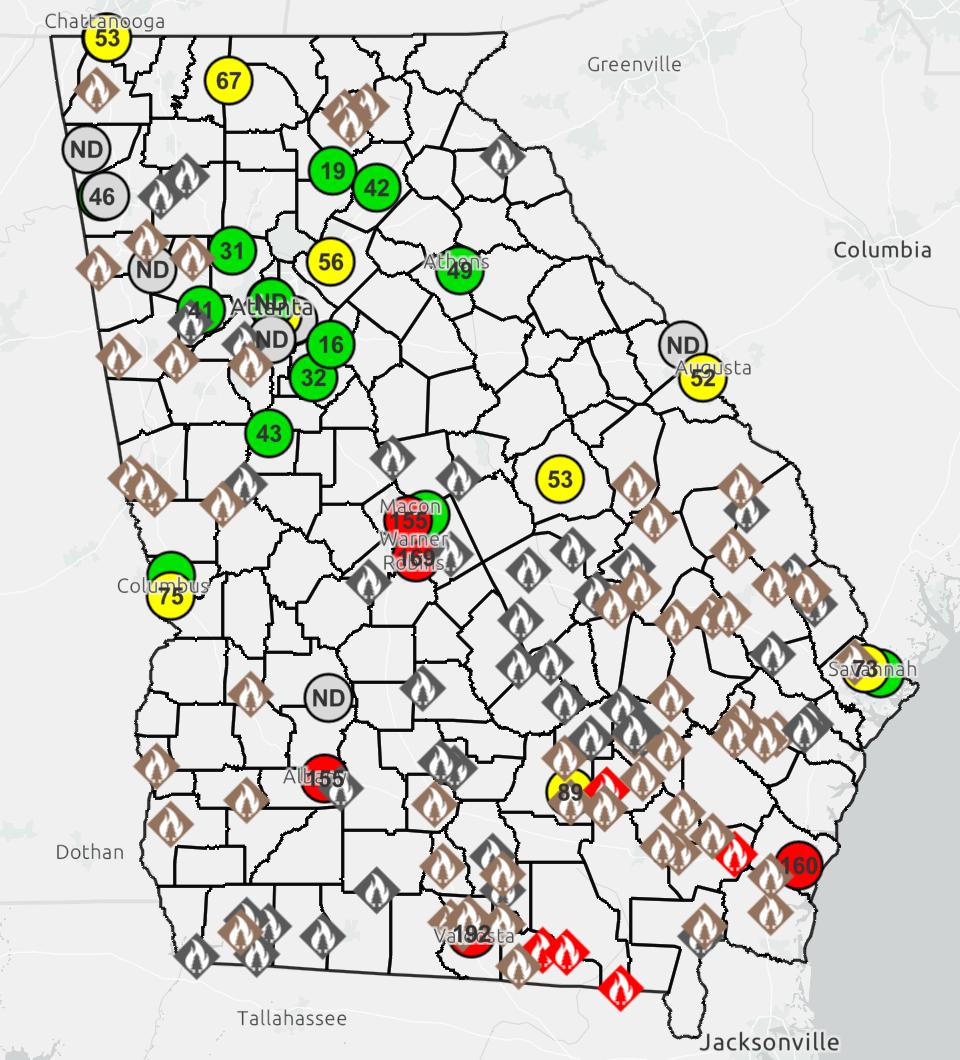
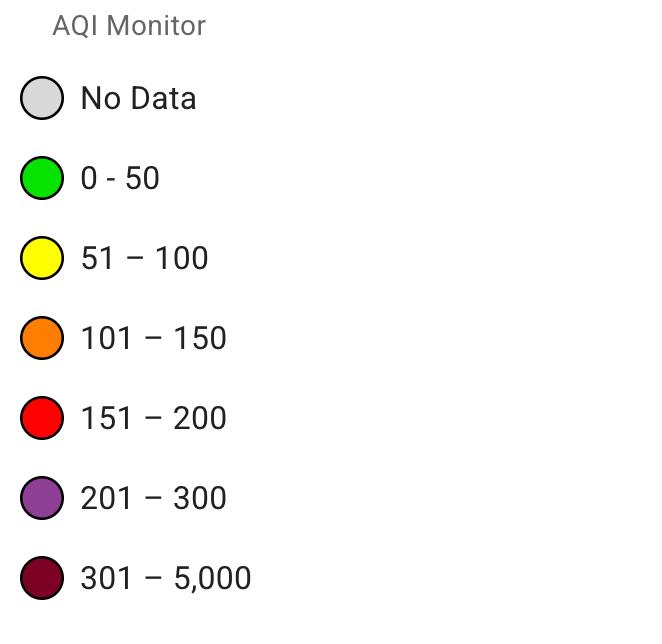
GFC map show locations of fires it has addressed around the state. The circled numbers indicate air quality index (AQI) data
GFB YF&R, LEADERSHIP GFB PROGRAMS VISIT WASHINGTON, D.C.
By Heather King and Jay Stone
Two key groups in Georgia Farm Bureau’s leadership development programs visited Washington, D.C., April 14-17 for training and advocacy activities.
A group of 25 GFB members from 20 different counties went as part of the GFB Young Farmers & Ranchers (YF&R) program, and the 12 members of the inaugural Leadership GFB class visited concurrently.
The YF&R group received briefings from American Farm Bureau Federation (AFBF) staff about the farm bill and international trade, as well as advocacy training. The advocacy training on April 14 walked the YF&Rs through a visit with a policy maker, exploring the importance of advocacy and a framework for delivering concise messaging both asking for and offering help.
“It’s a great time to be able to sit down in front of a congressperson or a staffer, to let them know that [agriculture] exists,” said GFB YF&R Committee Chairman Garrett Hurley. “Basically, [we] just took our seat at the table, because ultimately if we don't take that seat, someone that’s sitting
Field Notes page 7 of 23
in front of us will tell a story that is possibly not true. And we want to be sure that we've got the true Georgia agriculture story in front of these legislators.”
On April 15, the YF&R group visited 10 members of Georgia’s congressional delegation, with whom they shared the dire situation Georgia farmers find themselves in. Key messaging centered on getting a new farm bill passed. The YF&Rs told elected officials and their staff about the overwhelming challenges presented by spiking fertilizer and fuel costs.
“I don't think there's ever been a time that it's been more important to come up here to D.C., to talk to these legislators and let them know how bad it really is back home and hopefully get some support from them, to help the Georgia farmer, also the American farmer, be sustainable.” Hurley said.
The YF&R group had opportunities to explore D.C., and their trip included visits to the French Embassy and the Pentagon on April 16. At the French Embassy, Counselor for Agriculture Christian Ligeard presented information about farming and ranching in France, which farms a total of 66 million acres and accounts for 18% of agricultural production in the European Union.
The French are tops among EU nations in wine production in terms of value and second in volume. In 2024, France exported $6.8 billion worth of agricultural goods to the United States:70% of that was wine. France is the EU’s fourth-largest producer of fruits and vegetables.
Like their counterparts in the U.S., French farmers are being squeezed with respect to input costs and product prices, Ligeard said. He referenced policy “mirroring,” referring to the concept of having producers of goods that are imported to France subject to the same production standards and regulations as French farmers. And like U.S. farmers, French producers would like fewer regulations.
Netherlands Embassy, EPA, Farm Tours highlight Leadership GFB trip
Leadership GFB members visited the Kingdom of the Netherlands Embassy on April 14 and were given an overview of Netherlands agriculture and how it compares to U.S. agriculture. Netherlands Agriculture Counselor Ton van Arnhem, Agricultural Attaché Mark Zonnenberg, and Agricultural Advisor Caroline Feitel shared information about the Netherlands’ use of controlled environment agriculture, greenhouse exports, and trade between the U.S. and The Netherlands. Notably, cost of land, input costs, and barriers to entry for young farmers are problems that both U.S. and Dutch farms are facing.
“Agriculture for them looks very different than it does for us,” said Leadership GFB participant Toni Gaines “They're able to do a lot with a little bit of space. For me, it was a little bit eyeopening. If they can grow tomatoes there year-round, why can’t we do that in America and supply enough tomatoes and from greenhouses in this country where you don’t have to go to the grocery store and see Mexico tomatoes in December?”
On April 15, AFBF Senior Director for Advocacy & Media Training Johnna Miller guided the Leadership GFB group through the process of interacting with media outlets.
Miller encouraged Leadership GFB to focus on shared values, steer clear of agriculture industry jargon and acronyms, and to use positive wording when speaking with the media. She trained members to think about sound bites that can be used from interviews, don't wait for the question, and to not be afraid to ask questions to reporters to prevent being caught off guard.
GFB Field Notes page 8 of 23
“My big takeaway from media training is be careful with your words and also not use terms that are so familiar to us in the industry,” Gaines said. “If you go out there and you say, ‘Oh, I’m a cattle producer,’ they don't know. Just say you're a farmer and keep it simple.”
Leadership GFB visited the Environmental Protection Agency (EPA) and heard from EPA Senior Advisor for Agricultural and Rural Affairs Turner Bridgforth, who discussed ways that the EPA is working with farmers to expand tools to help fight disease and pests
Bridgforth said he is using his agriculture background to help lawmakers, staffers, and EPA officials understand farmers and how decisions affect them. He said it is important to get people from the Make America Healthy Again (MAHA) movement onto local farms to bridge the disconnect between MAHA and much of conventional agriculture.
On April 16, the Leadership GFB group visited four farm operations in Northern Virginia, through coordination with Virginia Farm Bureau. The tours included stops at Great Country Farms near Bluemont, Virginia, Gathering Springs Farm in Middleburg, Mom’s Apple Pie bakery in Loudon County and Potomac Vegetable Farm in Vienna/Purcellville.
At Great Country Farms, the group met with farm operator Kate Zurschmeide at the 400-acre farm near the base of the Blue Ridge Mountains. Great Country Farms offers produce and the farm experience to its customers.
The group met Pamela Jones and Sarah Obuchowicz at Gathering Springs Farm, a small farm that grows more than 60 varieties of fruits and vegetables and cut flowers. The farm has 200 pasture-raised laying hens on two acres of land. The farm operates primarily through communitysupported agriculture (CSA), selling at farmers markets and a direct-to-consumer stand on the farm.
Loudoun County Farm Bureau president Avis Renshaw hosted Leadership GFB at her bakery, Mom’s Apple Pie. She discussed issues that Loudoun County, which she called the richest county in the nation, is facing: Data centers, developers, land prices, water usage many of the same issues Georgia farmers face. She and her husband grow all the fruits used in her pies at the bakery.
On the final tour stop, Leadership GFB met with Hana Newcomb at Potomac Vegetable Farm, which has been in operation for over 50 years in the middle of the Washington, D.C., suburbs. They sell all of their produce through CSA boxes, roadside stands and farmers markets.
HPAI CONFIRMED IN PIERCE COUNTY BACKYARD FLOCK
On April 17, the Georgia Department of Agriculture and the USDA’s Animal and Plant Health Inspection Service (APHIS) confirmed a positive case of Highly Pathogenic Avian Influenza (HPAI) in a non-commercial backyard flock in Pierce County. The affected flock – which includes of approximately 60 chickens, ducks, geese, and turkeys – has been depopulated as part of standard response protocols to prevent further spread of the disease.
“We are working around the clock to protect our state’s poultry industry. Our team acted swiftly to respond to the detection of HPAI, implement containment protocols, and limit the potential spread of the disease,” said Georgia Agriculture Commissioner Tyler Harper. “In Georgia, we have maintained strong biosecurity measures since the nationwide HPAI outbreak began in 2022. To date, the outbreak has impacted more than 206 million birds nationwide, with less than 0.25
GFB Field Notes page 9 of 23
percent of those cases occurring in Georgia – the nation’s top poultry producer. This underscores the effectiveness of strong biosecurity practices and the dedication of our animal health professionals and poultry producers.”
On April 10, the flock owner observed increased mortality and contacted the Georgia Poultry Laboratory Network (GPLN) on April 14. On April 15, staff from the GDA and GPLN were dispatched to the premises to collect samples, which were submitted to the UGA Tifton Veterinary Diagnostic & Investigational Laboratory (TVDIL) for initial testing. Samples were identified as non-negative for HPAI on the same day. The results were subsequently confirmed as positive by the U.S. Department of Agriculture’s National Veterinary Services Laboratories (NVSL) on Friday, April 17.
Depopulation, disposal, cleaning & disinfection operations were completed on April 16 to mitigate further spread of the disease. It is most likely that transmission occurred through contact with wild birds or viral material shed by wild birds into the environment. There are no commercial poultry or dairy cattle operations located within a 10-kilometer (6.2-mile) radius around the affected premises.
Owners of poultry flocks are strongly encouraged to closely observe their birds and report a sudden increase in the number of sick birds or bird deaths to the Avian Influenza Hotline at 770766-6850.
For more information regarding biosecurity visit:
Protect Your Flock (Georgia Dept. of Ag)
Defend the Flock - Resource Center (USDA APHIS)
AI Information for Hunters (USDA)
Avian Influenza FAQ
DROUGHT INTENSIFIES ACROSS GEORGIA
USDA issues disaster designations for 126 Georgia counties
Drought conditions have worsened for most of the state in the past two weeks, but much-needed rain could be on the way. In the April 18 installment of the Climate and Agriculture in the Southeast blog, UGA Climatologist Pam Knox wrote that a rain system will move into Alabama and Georgia this weekend, though she predicted the hardest-hit drought areas in South Georgia would be largely bypassed.
“The prospects for week 2 look good, with all of the region likely to get more rain than normal,” Knox wrote. “After that, chances return to normal for most of the region for the next two weeks.”
According to the Georgia Forestry Commission, Jan. – March was the 8th driest first quarter on record dating back to 1895.
The April 14 U.S. Drought Monitor report, released April 16, showed every county in Georgia with at least some portion under severe drought, the third-worst rating according to the National Drought Mitigation Center. Of Georgia’s 159 counties, 125 are in the two driest categories –extreme drought and exceptional drought. The most significant drought conditions – exceptional drought – were present in 42 counties in the Coastal Plain of South and Southeast Georgia.
Field Notes page 10 of 23
On April 21, the USDA issued a natural disaster designation for 126 Georgia counties due to drought conditions, making producers in those counties, as well as producers in 23 contiguous counties, eligible for emergency loans, which can be used to meet various recovery needs including the replacement of essential items such as equipment or livestock, reorganization of a farming operation, or to refinance certain debts. FSA will review the loans based on the extent of losses, security available, and repayment ability. The application deadline to apply for aid under this designation is Dec. 10.
According to the U.S. Drought Monitor, these counties suffered from a drought intensity value during the growing season of 1) D2 Drought-Severe for 8 or more consecutive weeks or 2) D3 Drought-Extreme or D4 Drought-Exceptional.
Primary Counties Eligible: Appling, Atkinson, Bacon, Baker, Banks, Barrow, Ben Hill, Berrien, Bibb, Bleckley, Brantley, Brooks, Bryan, Bulloch, Burke, Calhoun, Camden, Candler, Catoosa, Charlton, Chatham, Chattahoochee, Clarke, Clay, Clinch, Coffee, Colquitt, Columbia, Cook, Crawford, Crisp, Decatur, Dodge, Dooly, Dougherty, Early, Echols, Effingham, Elbert, Emanuel, Evans, Fannin, Forsyth, Franklin, Gilmer, Glascock, Glynn, Grady, Greene, Gwinnett, Hall, Hancock, Harris, Hart, Houston, Irwin, Jackson, Jeff Davis, Jefferson, Jenkins, Johnson, Lamar, Lanier, Laurens, Lee, Liberty, Lincoln, Long, Lowndes, Lumpkin, McDuffie, McIntosh, Macon, Madison, Marion, Meriwether, Miller, Mitchell, Monroe, Montgomery, Morgan, Murray, Muscogee, Oconee, Oglethorpe, Peach, Pierce, Pulaski, Quitman, Randolph, Schley, Screven, Seminole, Stephens, Stewart, Sumter, Talbot, Taliaferro, Tattnall, Taylor, Telfair, Terrell, Thomas, Tift, Toombs, Towns, Treutlen, Troup, Turner, Twiggs, Union, Upson, Walker, Walton, Ware, Warren, Washington, Wayne, Webster, Wheeler, White, Whitfield, Wilcox, Wilkes, Wilkinson, and Worth
Contiguous Counties Also Eligible: Baldwin, Butts, Chattooga, Cherokee, Coweta, Dade, Dawson, DeKalb, Floyd, Fulton, Gordon, Habersham, Heard, Jasper, Jones, Newton, Pickens, Pike, Putnam, Rabun, Richmond, Rockdale, and Spalding.
On farmers.gov, the Disaster Assistance Discovery Tool, Disaster Assistance-at-a-Glance fact sheet, and Loan Assistance Tool can help you determine program or loan options. To file a Notice of Loss or to ask questions about available programs, contact your local USDA Service Center
SPECIALTY CROP GROWERS MUST REPORT 2025 ACREAGE TO FSA BY APRIL 24
Specialty crop producers who want to apply for payments under the Assistance for Specialty Crop Farmers (ASCF) program must report their 2025 specialty crop acreage to the USDA Farm Service Agency (FSA) by April 24. This is an extended deadline from the original March 13 deadline USDA set when the agency announced program details on Feb. 13.
The ASCF program is designed to help address market disruptions, elevated input costs, persistent inflation, and market losses from foreign competitors engaging in unfair trade practices that impede exports. ASCF payments will be based on reported 2025 planted acres.
After reporting their 2025 specialty crop acreage to FSA, producers are encouraged to prepare for the eventual announcement of the ASCF program application period by creating a Login.gov account. Doing so ensures that once FSA starts taking ASCF program applications, those
GFB Field Notes page 11 of 23
producers who wish to apply online will experience an expedited application and payment process. Assistance will also be available through local FSA county offices.
The USDA first announced that specialty crop producers would be allocated $1 billion in early December 2025 when it announced that it was allocating $11 billion to row crop producers under the Farmer Bridge Assistance (FBA) program. The ASCF program is authorized under the Commodity Credit Corporation Charter Act and FSA will administer it.
Eligible Specialty Crops
ASCF-eligible specialty crops include: (A) Almond, Apple, Apricot, Aronia berry, Artichoke, Asparagus, Avocado (B) Banana, Bean (Snap or green; Lima; Dry edible), Beet (Table), Blackberry, Blueberry, Breadfruit, Broccoli (including Broccoli Raab), Brussels Sprouts (C) Cabbage (including Chinese), Cacao, Carrot, Cashew, Cauliflower, Celeriac, Celery, Cherimoya, Cherry, Chestnut (for Nuts), Chive, Citrus, Coconut, Coffee, Collards (including Kale), Cranberry, Cucumber, Currant (D) Date, (E) Eggplant, Endive (F) Feijou, Fig, Filbert (Hazelnut) (G) Garlic, Gooseberry, Grape (including Raisin), Guava (H) Horseradish (K) Kiwi, Kohlrabi (L) Leek, Lettuce, Litchi (M) Macadamia, Mango, Melon (All Types), Mushroom (Cultivated), Mustard and Other Greens (N) Nectarine (O) Okra, Olive, Onion, (P) Papaya, Parsley, Parsnip, Passion Fruit, Pea (Garden; English or Edible Pod; Dry edible), Peach, Pear, Pecan, Pepper, Persimmon, Pineapple, Pistachio, Plum (including Prune), Pomegranate, Potato, Pumpkin (Q) Quince (R) Radish (All Types), Raspberry, Rhubarb, Rutabaga (S) Salsify, Spinach, Squash (Summer and Winter), Strawberry, Suriname Cherry, Sweet Corn, Sweet Potato, Swiss Chard (T) Taro, Tomato (including Tomatillo), Turnip (W) Walnut, Watermelon *Dry edible beans and peas covered by the Farmer Bridge Assistance (FBA) program will not be eligible for ASCF. Commodities covered by FBA will not be eligible for ASCF.
Program Participation
ASCF payments will be based on reported 2025 planted acres. USDA will release commodityspecific payment rates soon after the acreage reporting deadline.
Following completion of acreage reporting, producers are encouraged to prepare for the eventual announcement of the ASCF program application period by creating a Login.gov account. Doing so ensures that once FSA starts taking ASCF program applications, those producers who wish to apply online will experience an expedited application and payment process. Assistance will also be available through local FSA county offices.
Login.gov is the public’s one account for government engagement. Producers can use one account and password for secure, private access to participating government agencies, including FSA. Begin the Login.gov process by visiting fsa.usda.gov/fba to create a Login.gov account. Producers who have an existing Login.gov account can work with FSA using their existing account. For assistance creating a login.gov account, visit https://login.gov/help/.
Crop insurance linkage will not be required for the ASCF program. However, USDA strongly urges producers to take advantage of the new crop insurance provisions in the One Big Beautiful Bill Act (OBBBA) to best protect against price risk and volatility in the future.
More information on ASCF is available online at www.fsa.usda.gov/fba. Producers can contact their local FSA county office to make an appointment to complete their 2025 crop acreage report.
USDA NAMES APPOINTEES TO GEORGIA FSA STATE COMMITTEE
On April 16 the USDA Farm Service Agency (FSA) announced the appointment of five agriculture leaders to serve on the Georgia USDA Farm Service Agency (FSA) state committee.
Members of the FSA state committee are appointed by Secretary of Agriculture Brooke Rollins and are responsible for the oversight of farm programs and county committee operations, resolving program delivery appeals from Georgia producers, maintaining cooperative relations with industry stakeholders and keeping producers informed about current FSA programs.
Each FSA state committee is comprised of three to five members including a designated chairperson. Georgians appointed to serve on the state FSA committee are:
William Brim, Chair (Tifton) - Brim is a vegetable and transplant producer who manages thousands of acres of diversified crop production and one of the state’s largest greenhouse operations. He has decades of experience in large‑scale vegetable farming, seedling production, labor management, and food‑safety innovation. He has held extensive leadership roles on state and national agricultural boards.
Stacey Britt, Member (Hartwell) – Britt is an experienced agricultural producer, bank director, and public servant with nearly three decades of leadership across farming, local government, financial governance, and agricultural organizations. He manages a large Angus cattle operation and has held multiple appointed and elected roles including serving on industrial development, planning and zoning, and county commission boards. His background also includes founding directorship of a regional bank and long‑standing involvement in Georgia’s cattle and Angus associations.
Joel Keith, Member (Hogansville) – Keith is a longtime dairy producer with decades of leadership across Farm Bureau, commodity boards and conservation districts. He has served on the Troup County FSA Committee and brings extensive experience in dairy policy, cooperative representation, and county‑level agricultural governance through the Georgia Beef Board, the Roosevelt Soil & Water Conservation District, and Farm Bureau committees.
J. Chad Nimmer, Member (Blackshear) – Nimmer is a fourth‑generation producer with nearly three decades of experience in forestry, timber harvesting and land management. His background combines hands‑on production work with long‑term resource stewardship, supported by years of legislative service focused on agriculture, natural resources and rural communities.
Lee Nunn, Member (Madison) – Nunn is a row‑crop producer who grows wheat, corn, cotton, soybeans, sunflowers, sorghum and other rotational crops, while also providing custom services to neighboring operations. He brings extensive experience in crop production, equipment management and agricultural construction, along with leadership on county‑level agricultural boards, including previously serving as chairman of the Morgan County FSA Committee.
FSA implements agricultural policy, administers credit and loan programs, and manages conservation, commodity, disaster recovery and marketing programs through a national network of state and county offices and locally elected county committees. For more information, visit fsa.usda.gov.
GDA LAUNCHES ALBANY GEORGIA GROWN RESOURCE CENTER
On April 14, Georgia Agriculture Commissioner Tyler Harper announced the launch of the Georgia Grown Resource Center in Albany, a new partnership between the Georgia Department of Agriculture (GDA) and the Albany-Dougherty Economic Development Commission. The center represents a significant investment in Southwest Georgia and will serve as a hub for agricultural producers and related businesses across the region, offering tools, resources, and connections to help them grow and succeed.
“The new Georgia Grown Resource Center in Albany reflects our commitment to investing in and strengthening Georgia’s #1 industry and supporting the farm families who fuel its success,” Harper said. “By bringing resources directly to Southwest Georgia, we’re giving agricultural businesses the tools they need to grow, compete, and succeed. We’re glad to be opening new doors of opportunity for Georgia’s ag community as we continue to expand these centers across the state.”
To mark the opening, the GDA, in partnership with state and local organizations, hosted a celebration on April 9. Community members, agricultural professionals, and business leaders attended the event, which featured remarks from Harper and Albany Mayor Bo Dorough, as well as live music and networking opportunities. The event highlighted the center’s role in supporting and strengthening the agricultural community in the Albany area.
“This is an exciting moment for not only Albany, but also for Southwest Georgia as a whole,” said Albany-Dougherty Economic Development Commission President & CEO Jana Dyke. “The Georgia Grown Resource Center represents an investment in an industry that means so much to our region. We’re proud to be part of a partnership that supports the agriculture community, and we appreciate Commissioner Harper and his team for the opportunity to work together.”
The Albany Georgia Grown Resource Center is the second of nine planned regional Georgia Grown Resource Centers. Each location is designed to connect producers, processors, food manufacturers, agritourism operators, and other agriculture-related businesses with services that increase visibility, expand market reach, and drive sales of Georgia-based products. The centers will also provide collaborative space for marketing support, industry insights, and expert guidance.
USDA, CORPS OF ENGINEERS BREAK GROUND ON STERILE FLY FACILITY
On April 17, U.S. Secretary of Agriculture Brooke Rollins and Lt. Gen. William “Butch” Graham, U.S. Army Corps of Engineers (USACE) commanding general, led the groundbreaking for the new sterile fly production facility at Moore Air Base in Edinburg, Texas. USDA is partnering with USACE to construct this facility, which is a cornerstone of the USDA’s strategy to combat New World Screwworm (NWS), expanding the nation’s domestic capacity to protect livestock, wildlife, and public health from this serious pest.
“Breaking ground on this facility marks a major investment in safeguarding America’s livestock and the producers who feed this nation. This puts NWS sterile fly production in American hands, so we do not have to rely on other countries for the best offensive measure to push screwworm away from our borders,” said Secretary Rollins. “The New World Screwworm threatens the health of our herds, the stability of rural economies, and the resilience of our supply chain.”
Field Notes page 14 of 23
The Edinburg facility is near the U.S. border with Mexico. As of April 20, Mexico had 1,395 active cases nationwide, with the greatest concentration in the southern half of the country, according to USDA data. The two Mexican states with active NWS cases closest to the U.S. border – within 90 miles – are Nuevo Leon (five active cases) and Tamaulipas (102 active cases). Overall, there have been 21,058 cases – combined total of active and inactive cases - reported in Mexico.
USACE is providing engineering, design, construction management, and contract oversight for the project, ensuring the facility meets the highest standards for biosecurity, reliability, and long‑term operational readiness.
“Our mission at USACE is to deliver engineering solutions, with our partners, to secure our nation, strengthen our economy, and reduce disaster risk,” said Gen. Graham. “That’s why we’re proud to deliver an engineering solution to the New World Screwworm, which represents a direct threat to our nation’s livestock, our food security, and our economy. This new, modern facility is the critical infrastructure we need to secure a defensive line against the New World Screwworm for generations to come.”
The new facility is being built with an aggressive timeline designed to quickly expand the nation’s sterile fly production capacity:
Initial operational capability is targeted for November 2027, reaching production of 100 million sterile flies per week.
Construction continues immediately beyond initial operations to scale full production capacity to 300 million sterile flies per week.
A sterile fly production facility plays a crucial role in NWS prevention and response. In a biosecure environment, NWS flies are raised and sterilized using irradiation before being released in targeted areas. Because female screwworm flies mate only once, mating with sterile males results in eggs that do not hatch. Sterile insect technique, paired with surveillance, animal movement restrictions, and education and outreach, has been the foundation of successful screwworm eradication efforts for decades.
This new state-of-the-art facility will complement USDA’s ongoing production of 100 million sterile flies per week at the Panama-based COPEG facility. USDA has also invested $21 million to support modernization of Mexico’s Metapa, MX, facility, expected to be operational in summer 2026.
Once fully operational, this expanded production network will provide the speed, scale, and domestic capability needed to rapidly counter any NWS threat reducing risks to producers, protecting animal health, and strengthening the resilience of America’s livestock industry.
For more information about New World Screwworm and USDA’s prevention efforts, visit Screwworm.gov.
GFB Field Notes page 15 of 23
64TH ANNUAL GEORGIA CATTLEMEN’S CONVENTION
April 23-25 Georgia National Fairgrounds & Agricenter Perry “King of the Swamp” Troy Landry from the tv show Swamp People will be the keynote speaker for the Georgia Cattlemen’s Association Annual Convention. Previously announced speaker Temple Grandin will be unable to attend the event as planned. The event features a 35,000-squarefoot trade show, Cattlemen’s College sessions on current industry topics, youth speaking contests, junior cattlemen’s stockman’s quiz, photography contest and Cattlemen’s Ball. To register, visit https://gfb.ag/26GCAConvregistration
2026 GFB SPRING SHOOTOUT
April 29 deadline to buy tickets
May 15 Cherokee Rose Sporting Clays 9 a.m. – 2 p.m. Griffin The 4th Annual GFB Spring Shootout brings together friendly competition, supporting a good cause and enjoying the outdoors for an event you won’t want to miss! It’s perfect for colleagues looking to get out of the office, families making memories, friends catching up, and youth teams gaining real-world tournament experience. VIP team tickets are available for $750, which include a larger tax-deductible amount, regular ticket perks PLUS t-shirts, preferred parking, priority access to the course, and complimentary post-event beverages. General admission team tickets for four are available for $575, which includes the 100-disc event, golf cart rental, eye and ear protection for each shooter, light breakfast, and lunch. Individual entry tickets are $155. Individual entrant will be grouped with other individual participants to form a team for the tournament. Includes the 100-disc event, golf cart rental, eye and ear protection for each shooter, light breakfast, and lunch. This is a great option for those who don’t have a full team but still want to join the fun! All proceeds support the Georgia Foundation for Agriculture. To register, visit https://gfb.ag/26SpringShootout. The deadline to register is April 29. There are also opportunities for businesses interested in sponsoring the event to gain valuable brand exposure through the shootout. Sponsorships ranging from $250 to $5,000 include benefits such as team entries, branding on event materials, social media promotion, acknowledgement in post-event publicity and more. April 18 is the deadline to become an event sponsor.
GEORGIA PEACH & PECAN COMMISSION REFERENDUMS
Through April 30
Both the Georgia Peach Commission and the Georgia Pecan Commission are holding simultaneous mail referendums April 1-30 for producers to determine if they will continue their current assessment to fund programs of research, promotion, and education for each commodity. All ballots must be postmarked prior to midnight April 30 to be eligible to be counted. The 10 cent ($0.10) per bushel and 5 cent ($0.05) per half bushel assessment funds programs of research, promotion, and education on behalf of Georgia peaches. The one ($0.01) cent per pound assessment of pecans funds programs of research, promotion, and education on behalf of Georgia Pecans.
Field Notes page 16 of 23
GFB YF&R SUMMER LEADERSHIP CONFERENCE
July 15-18
April 30
June 1
Jekyll Island Convention Center Jekyll Island
Early registration deadline
Final registration deadline
Registration is open for the GFB Young Farmers & Ranchers (YF&R) Summer Leadership Conference and competitive events. Please share the following information with anyone who may be interested in attending or competing. This conference is open to any GFB member involved with Young Farmers & Ranchers, ages 18-35. A children’s program will be provided for kids 4th grade and younger as a convenience for attendees competing or participating in sessions. Visit https://gfb.ag/yfrslc for complete conference details, including tentative agenda, information about the children’s program and lodging information, or to register by one of these deadlines: Early Registration - April 30 – Registration Fee: $100 per attendee; Regular Registration –Deadline: June 1 Registration Fee: $150 per attendee Attendees are responsible for their own hotel reservations. Room blocks have been secured at the Courtyard/Residence Inn (912635-2416, reservation deadline is June 150; Hampton Inn and Suites (912-635-3733, reservation deadline is June 15), Holiday Inn Resort (912-319-0037, reservation deadline is June 15), Villas by the Sea (912-635-2521, reservation deadline is June 15) and the Westin (912-635-4545, reservation deadline is June 15) on Jekyll Island. Note: These room blocks tend to fill up quickly. For more information about the conference, contact Levi Davis at ledavis@gfb.org or 478-230-6767.
GFB EXCELLENCE IN AGRICULTURE AWARD
April 30 deadline to apply
The Georgia Farm Bureau Excellence in Agriculture Award honors Young Farmers & Ranchers members who earn most of their income off the farm but are active in Farm Bureau and are ag advocates in their community. Contact your GFB district federation manager or your county Farm Bureau office manager for information to apply for this award. GFB district winners and three state finalists will be selected from the written applications. The three state finalists will be contacted by June 5 so they may prepare a presentation to be given the afternoon of July 15 at the GFB YF&R Summer Leadership Conference to be held July 15-18. The state winner will be announced at the summer conference. The state winner will receive an expense-paid trip to the 2027 American Farm Bureau Convention next January in Charlotte, N.C., to represent Georgia. Applicants must be between the ages of 18 and 35 and should not turn 36 before Jan. 12, 2027. Visit www.gfb.org/connect/excellence-in-ag for more information.
Field Notes page 17 of 23
SDRP SECOND STAGE, MILK AND ON-FARM STORAGE PAYMENTS
April 30 deadline to apply for SDRP Stage One and Stage Two assistance Stage Two of SDRP covers eligible crop, tree, bush and vine losses that were not covered under Stage One program provisions, including non-indemnified (shallow loss), uncovered and quality losses. For Stage Two program details, including fact sheets, please visit https://fsa.usda.gov/sdrp. The first stage, announced in July, remains available to producers who received an indemnity under crop insurance or the Noninsured Crop Disaster Assistance Program (NAP) for eligible crop losses due to qualifying 2023 and 2024 natural disaster events. FSA county offices will begin accepting SDRP Stage Two applications on Nov. 24. Producers have until April 30 to apply for both Stage One and Stage Two assistance. Information and a fact sheet are available online at https://fsa.usda.gov/ofsclp.
2026 GEORGIA FARM DOG OF THE YEAR
May 1 entry deadline
Do you have a special farm dog that herds or guards your livestock? Maybe it keeps you company as you do your daily chores and provides stress relief. Maybe it has done something heroic. Georgia Farm Bureau is accepting entries for its 2026 Georgia Farm Dog Contest until 10:59 p.m. on May 1 or until 200 entries are accepted. Contest is open to GFB members ages 18 and over. The grand prize winner will receive a $500 gift card and be recognized at the 2025 Sunbelt Ag Expo. For contest rules and the criteria dogs will be judged by, visit www.gfb.ag/26farmdogcontest
NURSERY VALUE SELECT INSURANCE
May 1 deadline t o enroll/renew
The USDA’s Risk Management Agency (RMA) reminds Georgia nursery producers that the final date to apply for or renew crop insurance coverage for the 2027 crop year is May 1 Federal crop insurance is critical to the farm safety net. It helps producers and owners manage revenue risks and strengthens the rural economy. Coverage is available in all Georgia counties for nursery operators who receive at least 40% of their gross income from wholesale marketing of nursery plants. Growers are encouraged to visit their crop insurance agent soon to learn specific details for the 2026 crop year. Crop insurance is sold and delivered solely through private crop insurance agents. A list of crop insurance agents is available online using the RMA Agent Locator. Learn more about crop insurance and the modern farm safety net at https://rma.usda.gov The Georgia Farm Bureau Insurance Company contracts with four companies – American Farm Bureau Insurance Services Inc., Rain & Hail, Sompo, and Great American Insurance to offer crop insurance. GFB has more than 70 experienced crop insurance agents (and growing) across the state to help their members protect their investment. Find your local agent and learn more at www.GFBInsurance.com or email crops@gfbinsurance.com for more details. USDA is an equal opportunity provider, employer and lender.
GFB Field Notes page 18 of 23
GEORGIA CENTENNIAL FARM APPLICATIONS
May 1 deadline to apply
Centennial Farm applications are open to all qualifying candidates. Farms play a pivotal role in shaping the legacy of our state, serving as the bedrock for economic, cultural, and family traditions for generations of Georgians. Georgia recognizes farms with a legacy spanning more than a century for their historical significance through the Georgia Centennial Farm program. Nominees must be a working farm with a minimum of 10 acres of the original purchase, actively involved in agricultural production, and must generate at least $1,000 in annual farm-generated income. In addition, farms must have been continuously farmed by members of the same family for at least 100 years or be listed on the National Register of Historic Places. Qualifying Georgia Centennial Farms are honored each October at an awards ceremony at the Georgia National Fairgrounds and Agricenter in Perry. The Georgia Centennial Farm program is administered by the Historic Preservation Division of the Georgia Department of Community Affairs; Georgia Farm Bureau Federation; Georgia Department of Agriculture; Georgia EMC; Georgia National Fair and Agricenter; and University of Georgia Cooperative Extension. For more information, please contact Rose Mayo, Historic Preservation Division Outreach Coordinator, at 770-855-2586 or rose.mayo@dca.ga.gov The postmark deadline for applications is May 1, 2026. Applications are available online at https://gfb.ag/centuryfarmsapply (https://www.dca.ga.gov/georgia-historic-preservation-division/historicresources/centennialfarms)
GFB DAY AT THE BRAVES 2026
Deadline to purchase tickets is May 1 June 7 Truist Park 1:35 p.m. Atlanta
GFB is bringing the heart of Georgia agriculture to Truist Park for an afternoon of baseball, fellowship, and a celebration of the farmers who make it all possible. From the fields to the stands, this afternoon is all about showing support for the people and industry that keep our state growing strong. Join us for a special pre-game parade around the field, giving attendees the chance to step onto the field and be part of the experience before the game begins. Tickets are $42 for Home Run Porch seating in Sections 147–151. GFB recommends arriving early to secure seats together. Comfort Colors GFB Braves t-shirts ($30) and Ag is #1 foam fingers ($6) are available for purchase to enhance the gameday experience. A portion of t-shirt sales, foam finger sales, and $8–$10 from each ticket sold will support the Georgia Foundation for Agriculture. Have fun while raising funds for a great cause. We are all Farm Bureau. For more information or to purchase tickets and merchandise, click HERE. (https://www.gafoundationag.org/braves)
GFB Field Notes page 19 of 23
NATURAL RESOURCES CONSERVATION WORKSHOP
June 7-12
May 1
Abraham Baldwin Agricultural College Tifton
registration deadline
The Natural Resources Conservation Workshop (NRCW) is available to Georgia’s Rising 10th, 11th, and 12th graders. This workshop focuses on the value, protection, and conservation of Georgia’s wildlife, forestry, soil, and water resources, including conservation in Georgia’s mining industry. The workshop gives students a taste of college life while delivering valuable insight into careers through their counselors and instructors. The workshop features field trips, classroom instruction, and recreational activities. Students scoring well on the workshop exam may be awarded a college scholarship. A limited number of scholarships are awarded based on exam scores and specific scholarship guidelines and criteria. Sponsorships are available through local Soil and Water Conservation Districts for students to attend at no cost. Transportation options are also available. Registration is available through May 1 at https://gfb.ag/26NRCWapp
GA DEVELOPMENT AUTHORITY DAVID SKINNER SCHOLARSHIP
May 4
Application deadline
High school seniors or college freshmen who are Georgia residents, live in a rural county and are pursuing a degree directly related to agriculture are encouraged to apply. Six scholarships in the amount of $2,400 will be awarded. Visit https://www.gdaonline.com/scholarships/ to apply.
SOUTHEASTERN SPECIALTY CROP TECHNOLOGY CONFERENCE
May 5 & 6
UGA Tifton Campus Conference Center Tifton
This conference and show aims to serve as a platform to accelerate knowledge and adoption of emerging technologies in specialty crop production in the Southeast U.S. Researchers and company representatives will discuss and demonstrate robotics, artificial intelligence and digital agriculture. Open to fruit, vegetable and nut growers, industry professionals, students and Extension professionals. Event runs from 8 a.m. to 5p.m. both days. For more information and to register, visit https://specialtycroptech.uga.edu/.
GFB Field Notes page 20 of 23
INTERNATIONAL YEAR OF THE WOMAN FARMER ACE SUMMIT
June 1-3
Washington, D.C.
May 6 registration deadline
In celebration of the International Year of the Woman Farmer, the American Farm Bureau Federation’s Women’s Leadership program, together with a strong coalition of U.S. agrifood system stakeholders, is proud to host a landmark national gathering honoring the vital role women play in agriculture and the supply chain. The International Year of the Woman Farmer ACE (Advocate, Cultivate, Empower) Summit will take place in Washington, D.C., June 1–3, 2026. This signature event held in recognition of IYWF will empower, equip, and connect women farmers, ranchers and agribusiness professionals. Through skill-building sessions, high-impact networking and advocacy-focused programming, attendees will strengthen their voices and leadership within the agricultural community. Visit https://gfb.ag/IYWFACEreg to learn more or to register.
KEL-MAC SADDLE CLUB HORSE SHOWS
May 9, Sept. 19 & Oct. 24 Morgan Co. Ag Center Madison
These shows are open to equestrians of all ages and experience levels. Classes include hunter/jumper, western, gaited, trail obstacles, ranch riding, ranch reining, dressage on the rail, halter/showmanship, “small fry” and more. All shows begin at 9 a.m. - rain or shine. Trail classes are from 10 a.m. -3 p.m. Western Classes not to start before lunch. Riders must be members of Kel-Mac to accrue points towards year-end awards. Age divisions for competition are as follows: Small Fry: 10 and under; Junior: under 14 years of age; Senior: 14 years and over. Novice: Rider is in 1st or 2nd year of showing. Green Horse: Horse is in 1st or 2nd year of showing. Entry fee per class is $10. Stall fees are $15 for club members & $20 nonmembers. All overnight stalls are $25. Each horse show is an “an all-breed show” which means there are a wide variety of disciplines offered in the more than 50 classes. The focus of the Kel-Mac shows is to include everyone and help participants become more comfortable with showing.
For more information about the shows, visit the KelMac Saddle Club Facebook or Instagram pages or www.kel-mac.com or call Arlene Williams at 706-431-8600. Signup for shows on the website. General admission is free and concession food and drinks will be available. The Morgan County Ag Center is located at 2380 Athens Hwy. (441), north of Madison.
These volunteer-run shows generate funds to benefit Kel-Mac’s equestrian related charities. The Kel-Mac Saddle Club has donated more than $170,250 back to Georgia’s Piedmont region during its 50 years including: the Georgia Equine Rescue League, ReDux Equine Rescue, Sweet Olive Rescue, and the Morgan County Sheriff’s Empty Stocking Fund, and the equestrian facilities of state & county parks such as A. H. Stephens, Hard Labor Creek, and Heritage Park.
GFB Field Notes page 21 of 23
GFB COUNTY VOICES. CAPITOL CHOICES MEETINGS
May 11 Steed Dairy 10 a.m. - noon Grovetown Event location is 4634 Wrightsboro Rd Grovetown 30813
May 12 LCCL Strawberry Farm 10 a.m. - noon Rome Event location is 3743 Old Dalton Rd NE Rome 30165
Georgia Farm Bureau is holding a series of meetings statewide to give farmers a chance to hear from their state legislators regarding legislation passed during the 2026 Georgia Legislative Session. Farmers and members of Georgia’s ag community can share their legislative concerns. Both meetings start at 10 a.m. and are expected to end by noon.
GEORGIA CORN COMMISSION REFERENDUM
Through May 15
The 1 cent ($0.01) per bushel assessment funds programs of research, promotion, and education on behalf of Georgia corn. The balloting period for the continuation of the Georgia Marketing Order for Corn for an additional three-year period has been set from April 15 - May 15. All ballots must be postmarked prior to midnight May 15, to be eligible to be counted. For more information, or to receive a ballot, contact Fred Rayfield at 404-586-1405 or fred.rayfield@agr.georgia.gov.
GFB YF&R DISCUSSION MEET
June 1 deadline for entries
Registration is open for the YF&R Discussion Meet. The entry form should be completed and submitted online at https://gfb.ag/yfrcompete by June 1. Please share this information with anyone who may be interested in competing. Also attached to this email are the questions that will be used in the 2026 Discussion Meet and a scoring rubric that can be used in preparation for the competition. Any Georgia Farm Bureau Young Farmers & Ranchers member is eligible to compete. Discussion Meet Orientation (for all competitors) will be on Wednesday afternoon, July 16 and the competition will be in person at the conference. The Discussion Meet consists of two (2) preliminary rounds, a Sweet Sixteen round, and a Final Four round, which will determine the state winner. A collegiate winner will also be recognized. Competitors can visit https://www.gfb.org/education-and-outreach/discussion-meet.cms for additional resources that may be helpful when preparing for the Discussion Meet. For questions regarding the Summer Leadership Conference or the competitive events, contact your district federation manager.
GFB Field Notes page 22 of 23
AFBF AG INNOVATION CHALLENGE
June 5 application deadline
The American Farm Bureau Federation, in partnership with Farm Credit, is accepting online applications from entrepreneurs for the 2027 Farm Bureau Ag Innovation Challenge through June 5. Now in its 13th year, this national business competition showcases U.S. startup companies developing innovative solutions to challenges faced by America’s farmers, ranchers and rural communities. The overall winner of the competition will receive $100,000 in startup funds, the runner-up will be awarded $25,000 and two additional business owners who advance to the final four round will receive $10,000. Farm Bureau is offering a total of $145,000 in startup funds throughout the course of the competition. After the application period closes on June 5, 10 semifinalist teams will be selected and announced on Sept. 2. Next, the 10 semi-finalist teams will pitch virtually to compete for a spot in the final four round of the contest. Examples of successful Ag Innovation Challenge participants, as well as detailed eligibility guidelines and the competition timeline, can be found at fb.org/challenge. Entrepreneurs must be members of a county or parish Farm Bureau within their state of residence to qualify as top 10 semi-finalists. Applicants who are not Farm Bureau members can visit www.fb.org/about/get-involved to learn about becoming a member. Applications must be received by 11:59 p.m. Eastern Daylight Time on June 5.
AFBF WHITE-REINHARDT FUND FOR EDUCATION GRANTS
June 12 application deadline
The White-Reinhardt Fund for Education is a special funding opportunity from the American Farm Bureau Foundation for Agriculture (AFBFA) in cooperation with the American Farm Bureau Women’s Leadership Committee. It was established to honor two former chairs of that committee (Berta White and Linda Reinhardt, leaders in the national effort to improve agricultural literacy) by enlarging agricultural literacy efforts across the United States. The project grant is one of two components of the fund. Visit https://www.agfoundation.org/grants-awards/white-reinhardtgrants to apply.
Field Notes page 23 of 23
SOUTHEAST CATTLE CONFERENCE
Aug. 1 Georgia FFA Camp Old Dining Hall Covington July 18 RSVP deadline
The Southeast Cattle Conference, sponsored by the Georgia Hereford Association & formerly called Herefords in the Cove, will be held Saturday, Aug. 1, in Covington, Ga. at the FFA Camp in the old dining hall. Cost to attend is $25 for adults and $10 for kids under 10. Registration starts at 1:30 p.m. ET. Program starts at 2 p.m. ET. For more info call Wes Smith at 706-601-9527. Please RSVP to the Georgia Hereford Association Facebook page or call Smith by July 18 Program topics will include: Managing income tax in good & bad years presented by Kevin Burkett, Clemson University; Using Hereford genetics to increase profitability presented by Peyton Pruett of the American Hereford Assc. There will also be a panel discussion between the following cattle producers regarding how they decide to cull cows & the factors they use to choose a cow for their donor herd: Tommy Maples, Maples Stock Farm, Elkmont, Al; Steve Morgan, Oakhurst Farm, West Point, Ga.; & Breck Debnam, Innisfail Farm, Madison, Ga. Jenna Paulette of Texas will provide entertainment. There will also be a benefit auction and a dinner. Hotels to choose from in the Covington/Conyers area:
Hampton Inn
678-212-2500
Courtyard by Marriott 470-444-1470
Holiday Inn Express 866-245-4286
FFA Camp 770-786-6926
GFB HAY DIRECTORY
GFB is accepting listings for its online hay directory. Farm Bureau members with hay for sale or who offer custom harvesting or custom sprigging services are invited to list their hay and/or services in the GFB Quality Hay Directory published on the GFB website. Hay for sale or services can be listed or removed from the directory throughout the year. To be included in GFB’s online hay directory, complete a submission form by visiting your county Farm Bureau office or online at www.gfb.ag/hay. Please include a $10 check made payable to Georgia Farm Bureau for each listing of hay, custom harvesting or custom sprigging. Multiple listings are allowed. Listings can be updated in the directory throughout the year as hay inventories change. Hay producers who entered the 2024 GFB Quality Hay Contest receive a free listing in the online GFB Hay Directory.
CONSERVATION DISTRICTS OFFER FERAL HOG CONTROL SERVICES
For a list of feral hog control services available in each GACD Conservation District, visit https://gfb.ag/feralhoggacdresources.
988 SUICIDE & CRISIS LIFELINE OFFERS SUPPORT
The 988 Suicide & Crisis Lifeline can be reached by calling or texting 988 or chatting on 988lifeline.org. 988 is a universal entry point so that no matter where you live in the U.S., you can easily access 24/7 emotional support. You don’t have to be suicidal to reach out. 988 trained crisis counselors can help you through whatever mental health challenges you are experiencing