1 Available on the purchase or lease of an eligible new 2025/2026/2027MY Ford Maverick®, Ranger®, F-150, Super Duty® or F-150 Lightning®. Not available on any other Ford or Lincoln vehicles, or F-150 Raptor®, F-150 Raptor R™, Ranger Raptor or F-650® and F-750® Super Duty. Vehicle eligibility may change at any time. Available to U.S. residents only. Place a new retail order or take new retail delivery from an authorized Ford Dealer’s stock by 1/04/27. Limit of five purchases/ leases per household during the program offer (PGM# 32900). Offer subject to dealer participation. May not be used/combined with most other Ford private offers. See an authorized Ford Dealer or go to https://www.fordrecognizesu.com, for complete details and eligibility (PGM# 32900).
2 Available on the purchase of an eligible certified used 2021-2027MY Ford Blue Advantage Gold, EV (F-150 Lightning only), or Blue Certified, Ford Maverick, Ranger, F-150, Super Duty or F-150 Lightning with under 80,000 miles. Not available on any other Ford or Lincoln vehicles, or F-150 Raptor, F-150 Raptor R, Ranger Raptor or F-650 and F-750 Super Duty. Vehicle eligibility may change at any time. Available to U.S. residents only. This offer is not eligible for customers purchasing a vehicle in the state of Arkansas, Hawaii, Idaho, Louisiana, Maryland, Mississippi, Oklahoma, and Texas. Take delivery from an authorized Ford Dealer’s stock by 1/4/2027. Limit of five purchases per household during the program offer (PGM# 32902). Offer subject to dealer participation. May not be used/ combined with most other Ford private offers. See an authorized Ford Dealer or go to https://www.fordrecognizesu.com, for complete details and eligibility (PGM# 32902).
Contents
page 5
Forest fires scorch Georgia
As of late May, drought conditions had already led to an above average number of wildfires statewide.
The economic conditions in which Georgia farmers find themselves are making it hard for many to see the way through this crop and on to the next.
pages 8 & 9
Southern farmers hit hard by rising fuel & fertilizer costs
page 10
Federal Reserve VP hears from farmers
Departments
page 4
View from the Field
pages 12 & 13
Public Policy
page 25
Women's Leadership
pages 26 & 27
Young Farmers & Ranchers
page 28
Ag in the Classroom
pages 30 & 31
Ga Foundation for Agriculture
Want to subscribe? Join Georgia Farm Bureau to receive GFB News four times a year. Your membership supports farmers & agriculture while giving you access to more than 300,000 discounts. Visit gfb.ag/join.
pages 14 & 15
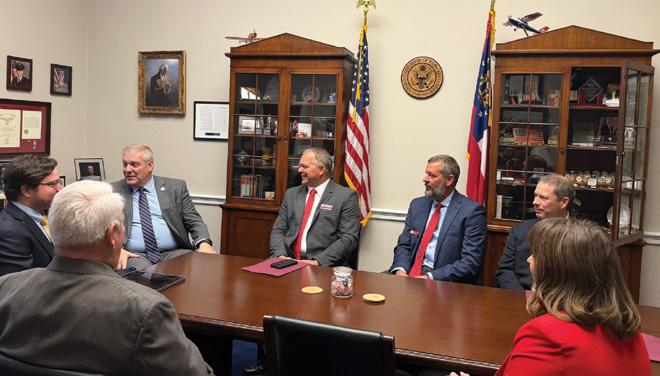
GFB leaders tell lawmakers about farmers’ struggles County leaders met with members of Congress to discuss what’s happening on their farms.
pages 16 & 17
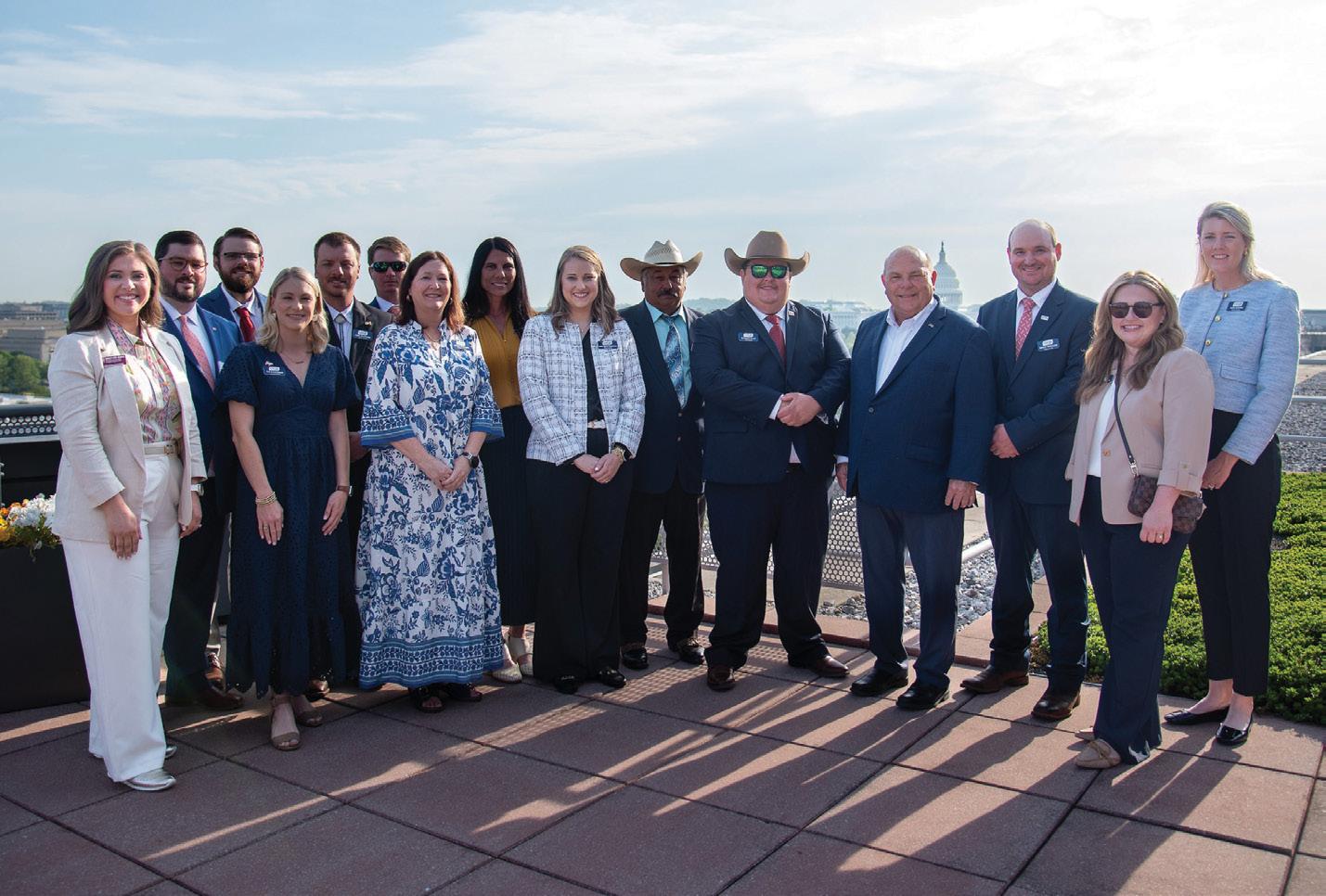
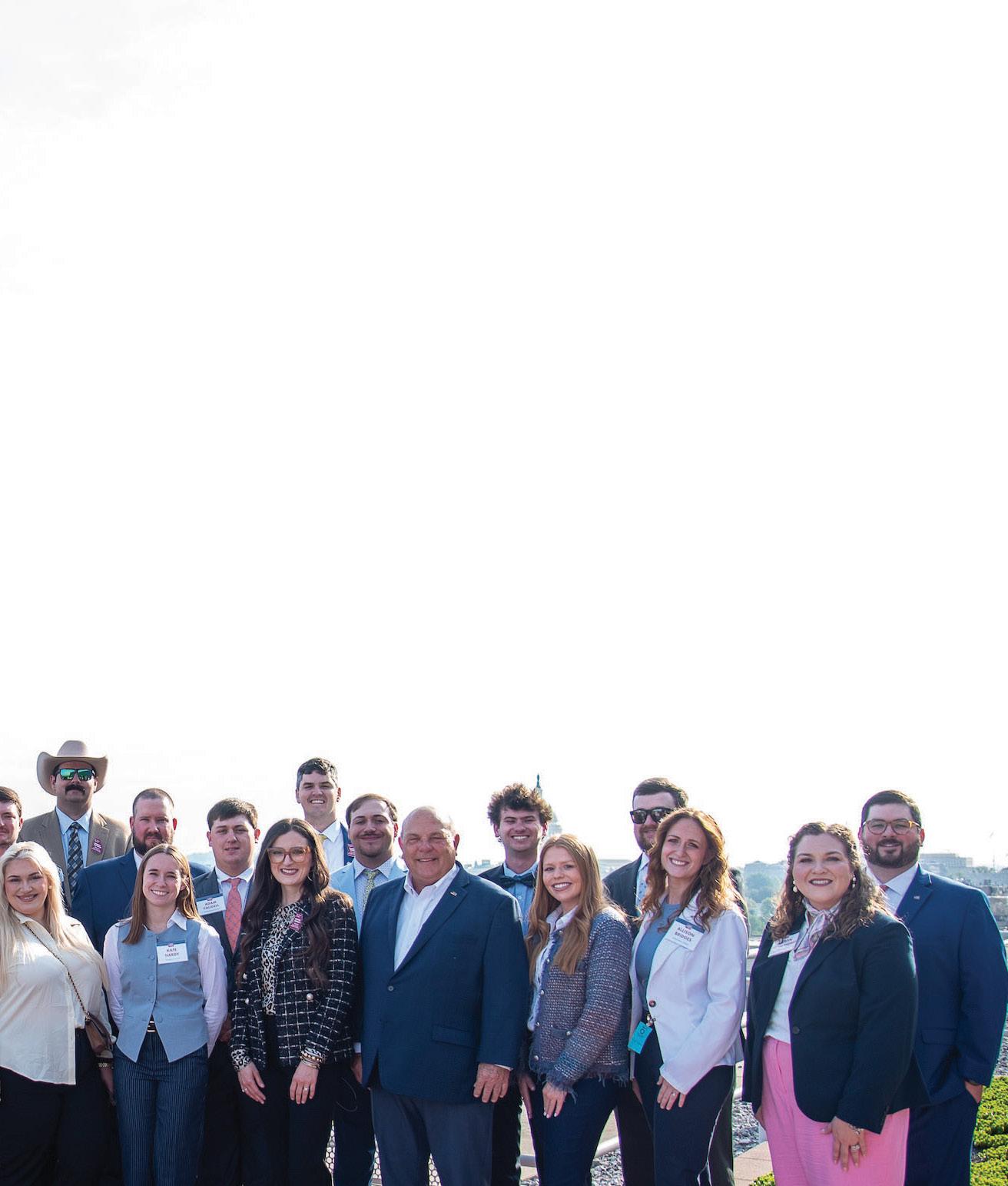
GFB Leadership programs visit Washington, D.C.
GFB Young Farmers & Ranchers and the 2026 Leadership GFB class learned the ins & outs of policy making on Capitol Hill in April.
pages 18 & 19
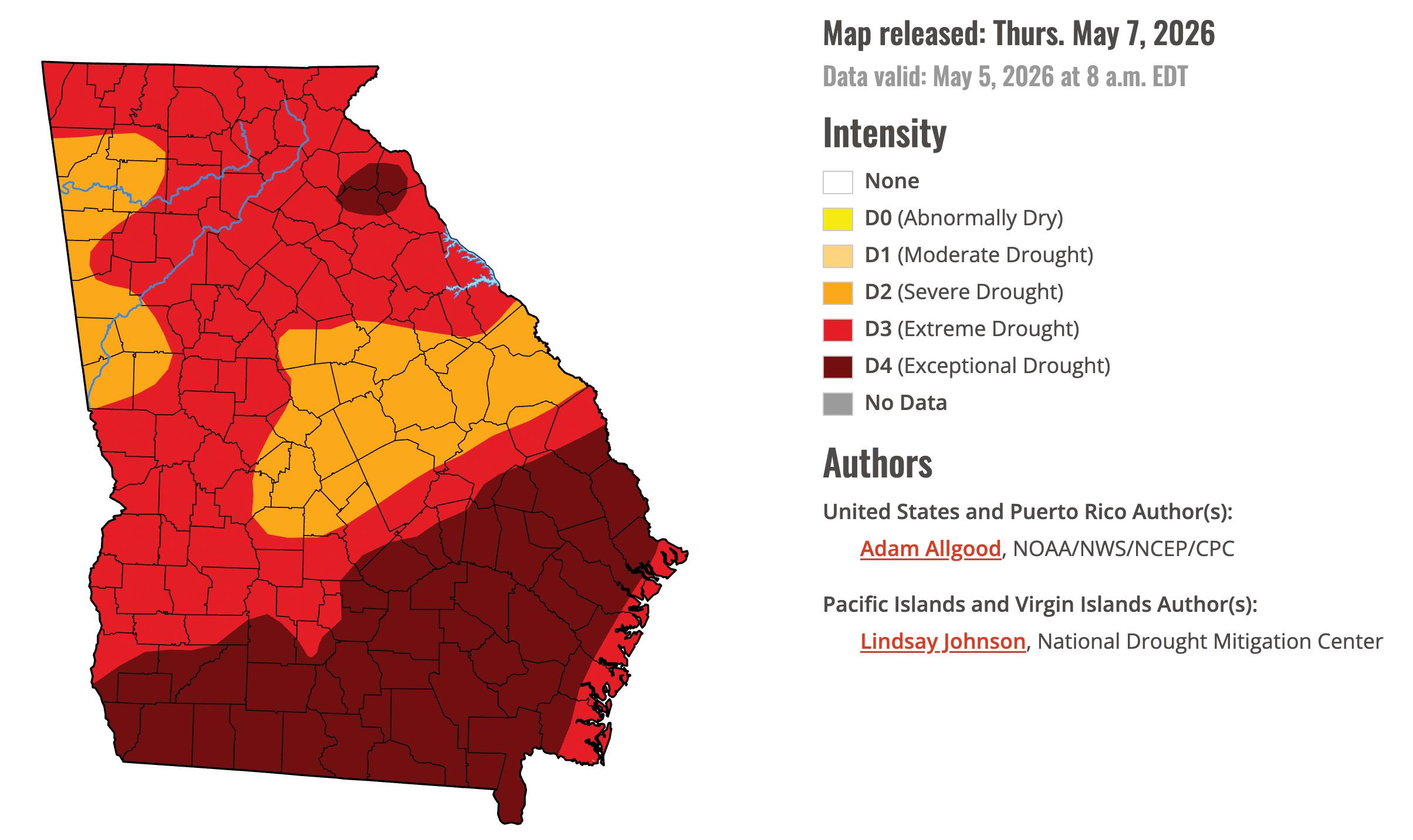
Drought intensifies across Georgia; USDA issues disaster designation for 146 counties
GFB News Staff
Kenny Burgamy Director
Jennifer Whittaker Editor
Jay Stone News Reporter
Jared McGukin Graphic Designer
Logan Thomas Photographer
pages 20 & 21
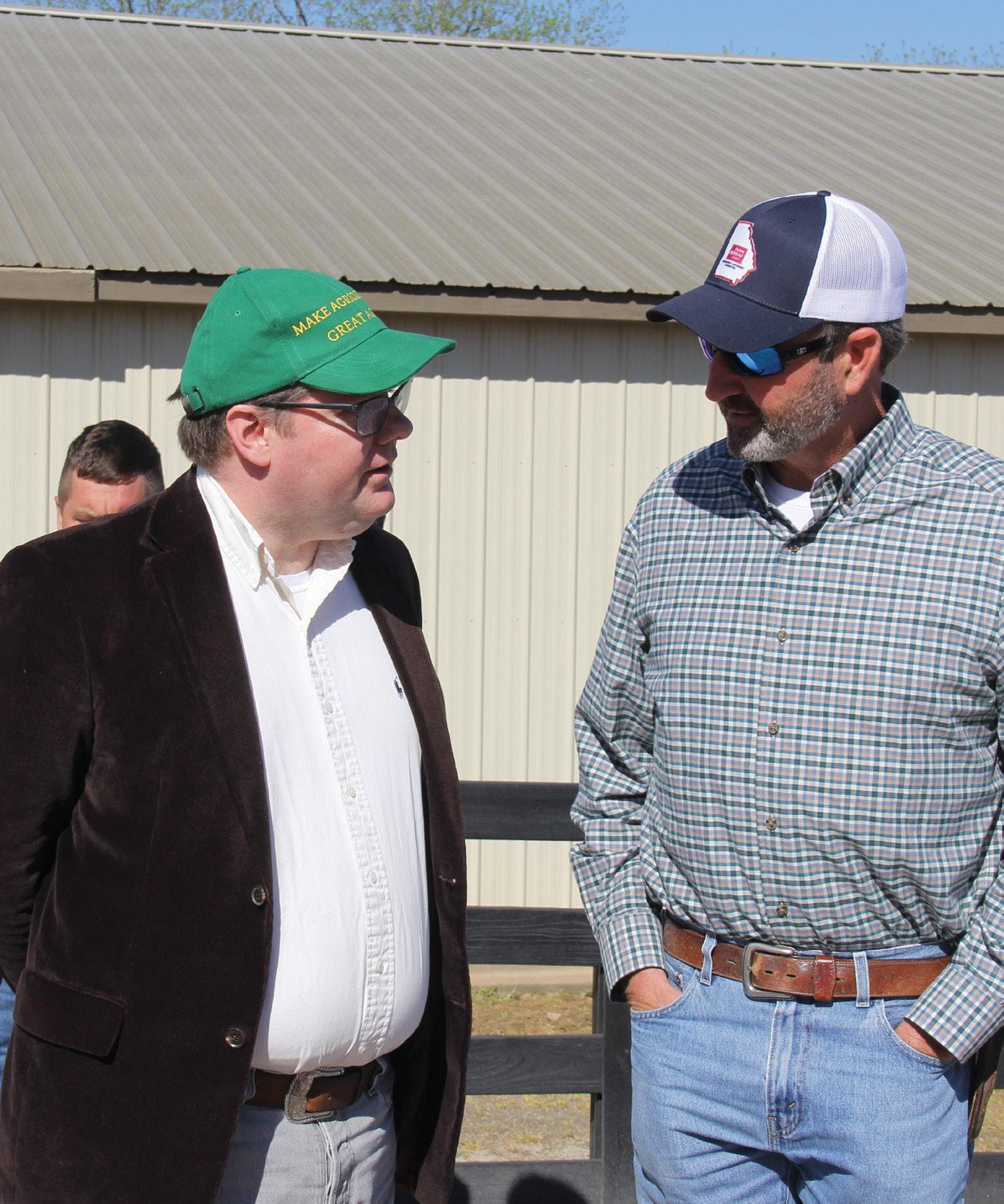
USDA Deputy Secretary Vaden visits Georgia
page 22
Georgia FSA Committee named
page 23
Farmer mental health: Resiliency ≠ invincibility
page 24
GFB Summit prepares women to Rise & Thrive
FOLLOW US ON THESE PLATFORMS @GAFARMBUREAU
On The Cover:
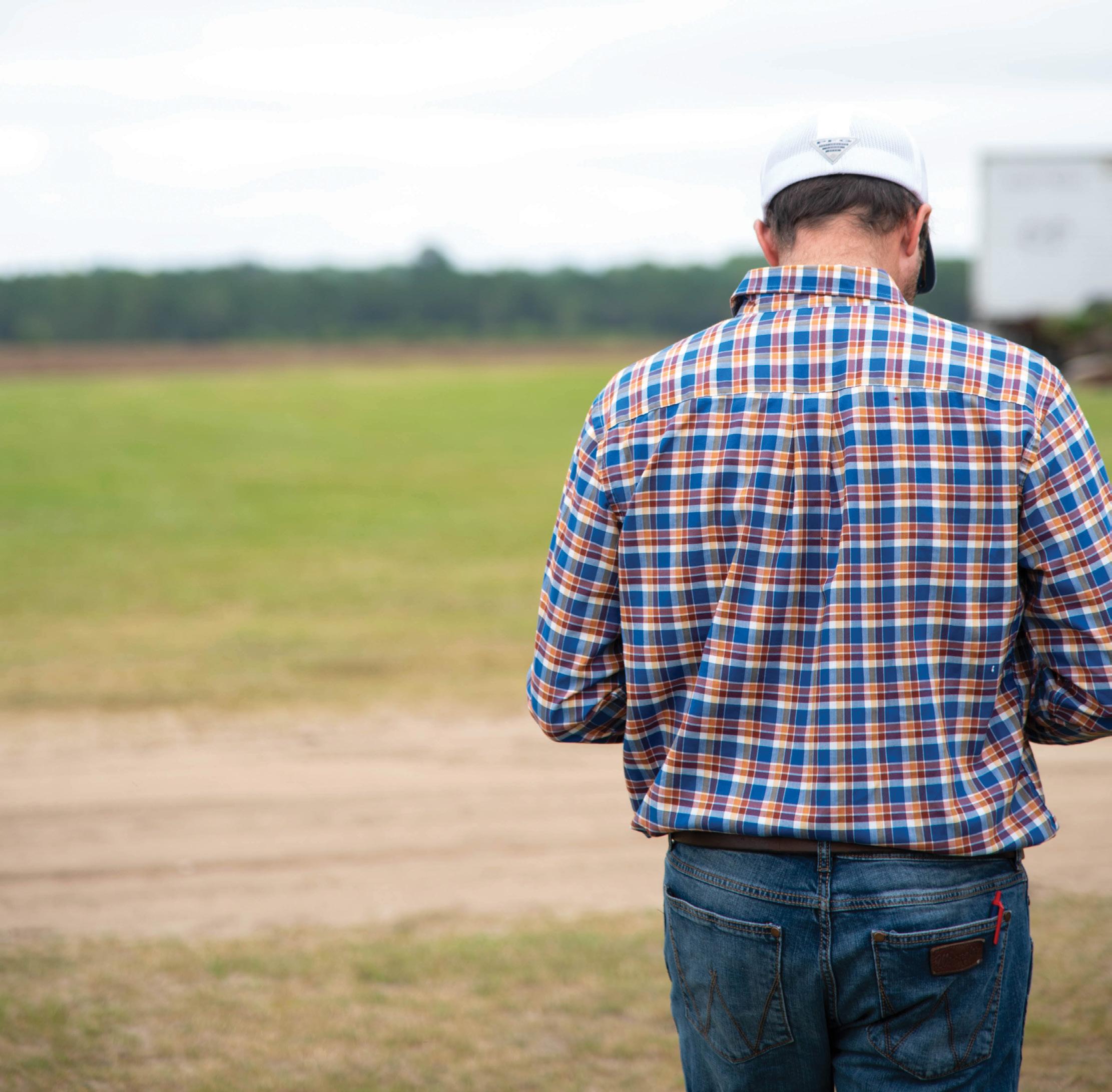
With input costs higher than predicted commodity prices, Georgia farmers have had to make tough decisions this year regarding what crops and how many acres to plant or, in some cases, whether to leave land fallow.
Photo by Logan Thomas
For information concerning advertising, contact Wendy McFarland at 334-6529080 or mcfarlandadvantage@gmail.com. For questions about your membership or member benefits, call 1-800-633-5432. For questions regarding editorial content call 478-474-0679, ext. 5334 or e-mail jawhittaker@gfb.org.
View from the Field
Tom McCall, GFB President
Y’all need to know Georgia Farm Bureau is doing everything we can when it comes to fighting the skyrocketing input costs we’re all facing. Our message to Washington is that farmers are in the middle of a growing financial storm and we need help from the stress.
With that being said, one of the most meaningful surveys I’ve seen recently is part of the greater efforts to get the Trump administration’s attention as well as members of the U.S. Congress.
In early April more than 5,700 farmers, both Farm Bureau members and nonmembers, from every state and Puerto Rico participated in a survey conducted by the American Farm Bureau Federation (AFBF). Just over 120 of the responses came from Georgia.
This survey clearly indicates farmers cannot afford to purchase enough fertilizer to get them through the growing season. 70% of the producers say fertilizer is so expensive they will not be able to buy all the fertilizer they desperately need.
Almost 8 in 10 farmers in the South say they can’t afford all the needed supplies this year, followed by our friends in the Northeast and West at 69% and 66% respectively, compared to 48% of the farmers in the Midwest.
Only 19% of producers here in the South prebooked fertilizer purchases in advance of planting season. That applies to so
many of you that I’ve spoken to in the first four months of this year.
The conflict in the Middle East that started in March sent fertilizer and fuel prices soaring. The closure of the Strait of Hormuz has had far-reaching impacts on critical fertilizer supplies and crude oil from reaching global markets, which puts a squeeze on supplies around the world.
As reported in the AFBF survey, only 6% of farmers indicate their financial situation has improved over last year. I’m concerned that the worsened crisis won’t bode well for many of our friends in Georgia.
Let me urge you to do a couple of things as we search for solutions so farmers can continue to feed families across America. First, become engaged with our Strong Farms. Strong Georgia. (SFSG) campaign so that we speak with one voice to the leaders in Washington.
You can find more details about SFSG at this website www.gfb.ag/strongfarms
And if you’re a person of faith, be intentional to pray for the situation we find ourselves in right now. Your Georgia Farm Bureau Board of Directors and some GFB employees began our April board meeting asking God to send rain across Georgia to end the drought and to extinguish the wildfires in South Georgia. After all, prayer changes everything!
We’re in this together.
Tom
McCall, GFB President
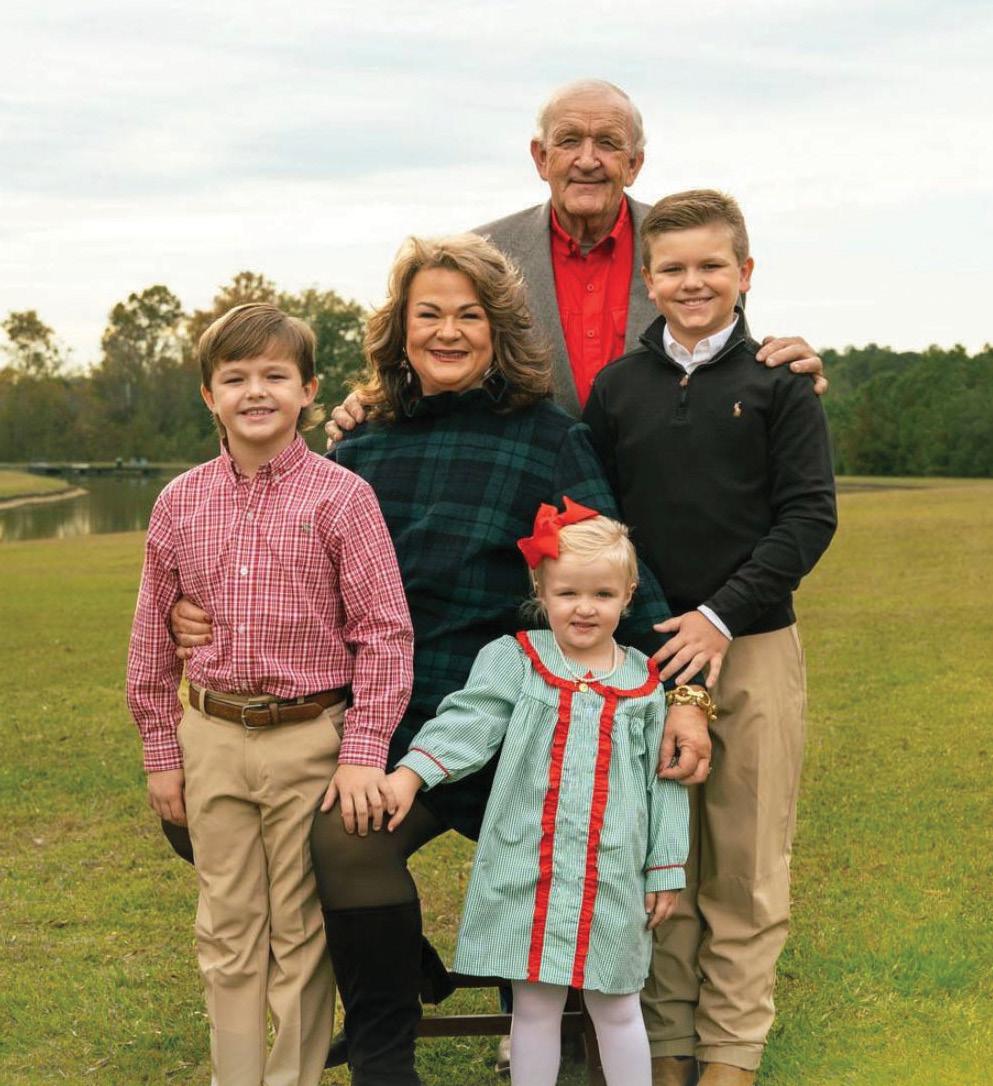
GFB President Tom McCall with his wife, Jane, and grandchildren, Wilkes, Winn and McCall.
Photo by Camdyn Moon
Photography
OFFICERS
President
TOM McCALL, Elbert Co.
1st Vice President &
South Georgia Vice President
DANIEL JOHNSON, Pierce Co.
North Georgia Vice President
BERNARD SIMS, Catoosa Co.
Middle Georgia Vice President
RALPH CALDWELL, Heard County
General Counsel
DUKE GROOVER
Chief Financial Officer, Corp. Treasurer
RACHEL MOSELY
Chief Administrative Officer
JEFFREY HARVEY
Corporate Secretary & Senior Counsel
JEANNA FENNELL
DIRECTORS
FIRST DISTRICT: Bill Bryan, Chattooga Co.; Wesley Hall, Forsyth Co. SECOND DISTRICT: Gilbert Barrett, Habersham Co.; Russ Moon, Madison Co. THIRD DISTRICT: Chad Carlton, Polk Co.; Brad Marks, Newton Co. FOURTH DISTRICT: Skeetter McCorkle, McDuffie Co.; Russ Wilburn, Barrow Co. FIFTH DISTRICT: Matt Bottoms, Pike Co.; Leighton Cooley, Crawford Co. SIXTH DISTRICT: James Malone, Laurens Co.; James Emory Tate, Jeff Davis Co. SEVENTH DISTRICT: Gary Bell, Evans Co.; Ben Boyd, Screven Co. EIGHTH DISTRICT: Scotty Raines, Turner Co.; Don Wood, Wilcox Co. NINTH DISTRICT: Lucius Adkins, Baker Co.; Paul Shirah, Mitchell Co. TENTH DISTRICT: David Lee, Bacon Co.; Lamar Vickers, Berrien Co.
All advertising accepted subject to publisher’s approval. Advertisers must assume liability for content of their advertising. Publisher maintains right to cancel advertising for non-payment or reader complaint about advertiser service or products. Publisher does not accept per-order, political or alcoholic beverage ads, nor does publisher prescreen or guarantee advertiser service or products. Publisher assumes no liability for products or services advertised in the Georgia Farm Bureau News. For advertising rates and information, contact Wendy McFarland at 334-652-9080 or mcfarlandadvantage@gmail.com. Georgia Farm Bureau News was established in 1937. Copyright 2026 by the Georgia Farm Bureau Federation. Printed by Panaprint, Macon, Georgia.
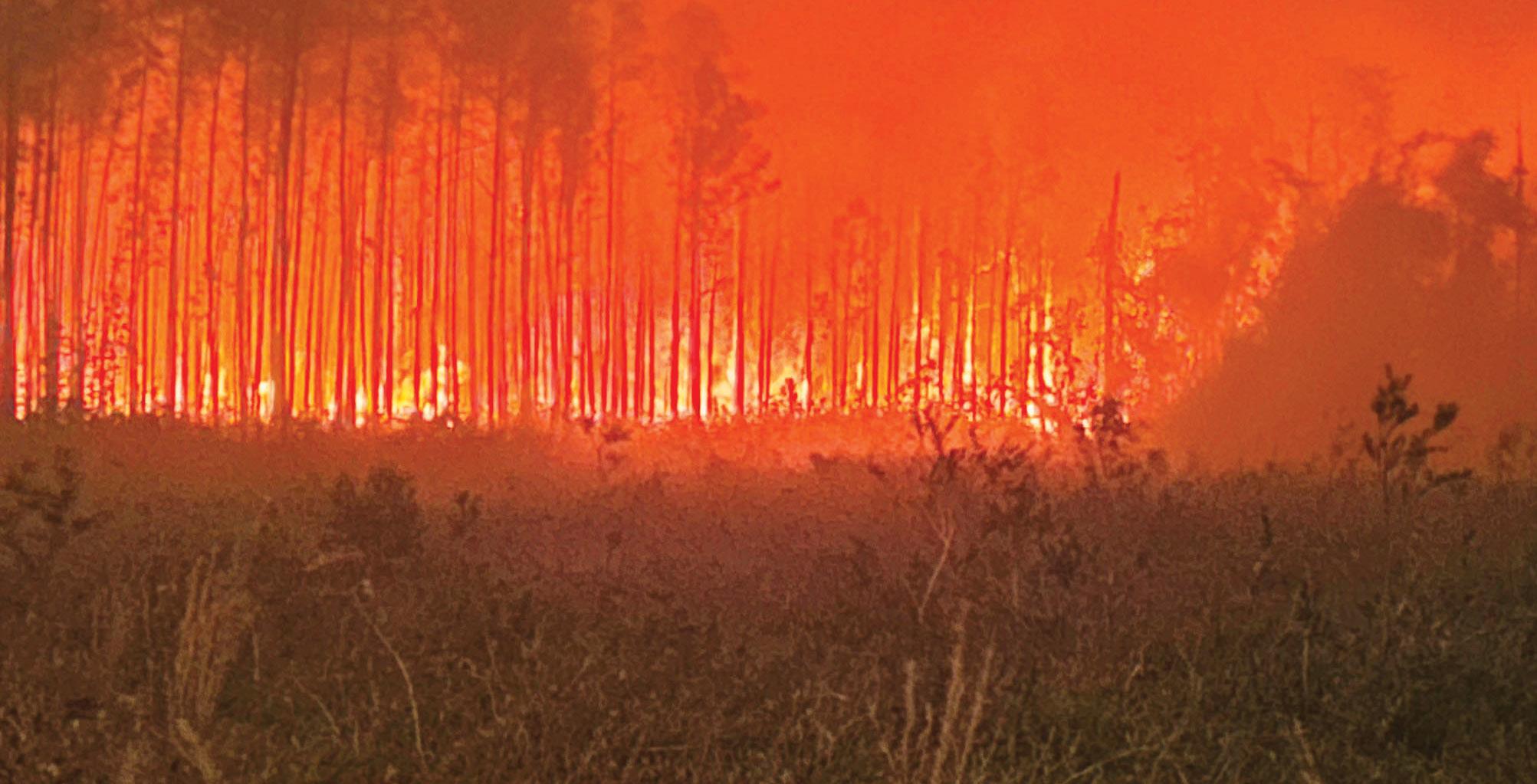
Drought conditions have resulted in Georgia having an above average number of wildfires so far this year.
FOREST FIRES SCORCH GEORGIA
By Jennifer Whittaker
As of May 27, Georgia has had 2,882 forest fires statewide in 2026 that have burned 27,408 acres, the Georgia Forestry Commission (GFC) reports. That’s 73.34% above the five-year average of 1,663 fires and 155.45% above the five-year average of 10,729 acres. These statistics do not include the two major fires in Southeast Georgia media have covered extensively.
The Pineland Road fire in Clinch and Echols counties, which began April 18 on private timberland in Clinch County when a spark from welding equipment fell to the forest floor igniting surrounding vegetation. The fire spread into western Echols County on April 22. As of May 19, this fire had burned 32,031 acres and was 95% contained by May 27 per the GFC.
At its peak on April 29, the Pineland Road fire response included 272 personnel - 212 from Georgia and other states’ agencies, 30 federal and 30 personnel employed by landowners, the GFC reported.
A GFC investigation shows the Highway 82 fire started April 20, when a Mylar balloon landed on a power line in Brantley County creating an electrical arc that ignited surrounding vegetation. According to the GFC, the fire never left Brantley County but spread close enough to Glynn and Wayne counties to warrant evacuations. As of May 19, this fire had burned 22,419 acres and was expected to be 95% contained by May 28 per the GFC.
At its peak on April 30, the HWY 82 fire response included 632 personnel - 188 from Georgia and other states’ agencies, 305 federal and 139 private personnel of landowners, the GFC reported. This fire affected 4,000 people through evacuations and property damage, including 110 destroyed homes, according to the GFC.
Fire fighters from 37 states helped fight the Pineland Road and Hwy. 82 fires with Alaska being the farthest state that sent
fire fighters per the GFC. Ten large airtankers, eight Type 1 helicopters, 1 Type 3 helicopter and 2 air attack platforms were used to fight both fires.
On April 22, Gov. Brian Kemp declared a state of emergency (SOE) in 91 Georgia counties in response to wildfires from central to south Georgia. Kemp directed the GFC and other relevant state agencies to mobilize all necessary resources to assist with active response efforts in the southern region of the state.
The GFC issued a burn ban for these same 91 Georgia counties April 22, that was reduced to 17 Southeast Georgia counties near the Pineland Road and HWY 82 fires on May 5. The revised ban was lifted May 12.
Rain throughout May helped contain both major Southeast Georgia fires.
All Georgians should be aware of local burn ban ordinances for their county. Questions about local conditions and burn permits should be directed to the county’s GFC office or fire marshal. Visit https://gatrees.org for more information about safe burning and GFC services.
On May 1 the Georgia Environmental Division implemented its annual burn restrictions in 54 North Georgia counties. These restrictions, in effect until Oct. 1, protect air quality in the summer when ozone levels may create health concerns.
Agricultural burns, classified as Burn Types 2 & 3, are allowed in the 54 counties with EPD restrictions and the rest of Georgia, but burners must notify the GFC. Prescribed burns are not permitted in the 19 metro Atlanta counties, but Burn Types 2,3,5,6,10 and 12 are allowed. For more information about the burn types the EPD & GFC recognizes, visit www.gfb.ag/GAburnbanrules .
Photo courtesy of Georgia Forestry Commission
Georgia Farmers Facing Tough Times & Tough Decisions
STRONG FARMS. STRONG GEORGIA.
By Jay Stone
It is often said that farmers are the ultimate optimists. They plant seeds and do what they can to facilitate their growth, believing their crop will yield a bountiful harvest.
Lately, that belief is being subjected to rigorous testing. The economic conditions in which Georgia farmers find themselves are making it hard for many of them to see the way through this crop and on to the next one, even with their deep faith.
“It’s one of those things where you can’t be a farmer and not be a Christian because if you don’t have faith, you’ll never make it,” said Thomas County farmer Julie Hardy. “At the same time, I’m still human, so while I like to say, ‘Let go and let God,’ it’s hard. My anxiety has definitely been higher than normal.”
DECISIONS, DECISIONS
Across the U.S., farmers are choosing to downsize where possible, see if they can get by using less or different fertilizer, or rework their acreage choices between crops. In some cases, they’re getting out altogether.
“We may trim some seed per acre,” Ware County farmer David Morgan said. “There’s really nothing we can do other than potentially let it lay out (not plant).”
Morgan, who farms in partnership with his wife, Lindsey, said because of costs, he didn’t plant land this year that has produced lower yields in the past.
“There’s a lot of people around us who scaled back and there are some people who decided not to farm any more at all,” Morgan said. “It could easily happen if [the federal government] doesn’t keep supporting us. Everything’s out of our control. Our pricing … I mean, we can’t just go to the gin or the peanut mill and tell them what we want for a price. They’d laugh us out of there.”
Cotton, corn and peanut producers aren’t the only ones being pushed into difficult decisions. In Toombs County, Vidalia onion producer Aries Haygood said the margins are thin for one of the state’s most famous commodities. He estimated costs for seed, fertilizer, fuel, crop protection, seasonal labor, irrigation, insurance and permanent staff runs to about $15,400 per acre. If he can get $24 per box of onions – he said an average acre produces about 650 boxes – he can generate $15,600 from that acre.
“That’s if everything goes perfect,” Haygood said. 2026 has not been perfect, with ongoing drought meaning more irrigation and more expense.
He’s trimmed his onion acreage to use some of the acres for cabbage, watermelons and peas, and relies on a farm store to create non-onion production streams of revenue.
And the possibility of getting out?
“That crosses my mind about every day now, but I’ve made a commitment to my family, my father-in-law, the banks, everyone else,” Haygood said. “So, I’m going to go down fighting. I have to try to bring in different cash flows.”
COUNTING THE LOSSES
In Georgia, the average farm size is approximately 253 acres according to the 2022 USDA Census of Agriculture, and on that farm the producer would plant 71 acres in cotton, 38 acres in peanuts, 22 acres in corn and 7½ acres in soybeans. (See Methodology at end of article.)
Using UGA Extension’s 2026 Crop Budget Tool and entering current numbers for diesel fuel and commodity prices offers projections of profits or losses for each commodity. If the farmer irrigates all of that acreage, his or her projected losses are $28,178. With no irrigation, the projected losses would total $32,268.
The budget tool, compiled by UGA Extension Agricultural economists, shows projected expenses for seed, fertilizer, crop protection, irrigation, labor, and equipment maintenance outpacing expected revenues for most of Georgia’s major crops.
In January, UGA used an average diesel fuel price of $3 per gallon. Fast-forward through April, and diesel prices spiked to $5 or more per gallon. On May 4, according to the American Automobile Association (AAA), Georgia’s average price for diesel fuel was $5.64.
Fuel price increases make anything that has to be transported more expensive. Most notably for farmers has been fertilizer.
Fertilizer price increases came at the time when most Georgia farmers were gearing up for planting and ordering fertilizer. See information on AFBF’s fertilizer survey on pages 8 and 9. In 2025, Georgia farmers lost almost $800 million, according to Farm Bureau analysis of USDA data. In seven of the last 11 years, overall farm production expenses have exceeded revenue. This presents a different perspective on sustainability than the prevailing themes in public discourse, which mainly centers on ecological sustainability and conservation.
HEAVY HEARTS
In a vocation that is often generational, the mental and emotional toll of these struggles can be overwhelming.
“I feel like I have a concrete block sitting on my chest. There’s nights I don’t sleep,” Hardy said.
During the GFB Presidents’ Trip to D.C., in March, Sumter County Farm Bureau President Matt Berry made the point in multiple meetings with lawmakers that he could be the generation that loses his family’s farm.
Berry has been steadfast in advocating for farmers’ mental health. Normally an outgoing, cheerful person, he’s still prone to wonder, in light of all the economic challenges, what he’ll be able to pass on to his sons if they choose to pursue agriculture.
“I have days that I think, ‘This life’s got to be better than this,’” Berry said. “Why, Lord? Why? I mean we all have those days right now.”
TO FARM OR NOT TO FARM
The numbers of farm bankruptcies show the economic challenges are becoming more existential for some farms. In Georgia, there were 27 Chapter 12 (farm) bankruptcies in 2025, up from 11 in 2024. This may not sound like many, with nearly 40,000 farms in the state, but a 145% increase is eye-opening, and every one of them carries negative ripple effects.
“When farms shut down, communities also lose access to fresh, local food,” said GFB President Tom McCall. “We need thriving rural communities, and farmers are essential to continuing sustainability of rural life.”
2026 PROJECTED PROFIT/LOSS FOR AVERAGE GEORGIA ROW CROP FARM
Compiled by Jay Stone using UGA Extension Row Crop Comparison Tool
2026 Projected Profit/Loss Non-Irrigated Land
METHODOLOGY: The 253-acre farm is the average farm size according to the 2022 USDA Census of Agriculture. Acreage for each crop was calculated based on National Agricultural Statistics Service (NASS) overall cropland estimate for Georgia and prorated portions of that acreage for each commodity. We used the UGA Extension Budgets April 2026 Estimated Crop Costs and Net Returns spreadsheets using current commodity prices from Business Insider on May 4 for cotton, soybeans and corn and from NASS on May 1 for peanuts. Fuel cost used for all crops irrigated & non-irrigated was $5.64/gal - the May 4 state average for diesel fuel per the American Automobile Association. Farmers can create an estimate for their own farm using the Extension budget spreadsheets at https://agecon.uga.edu/extension/budgets.html
Southern Farmers Hit Hard by Rising Fuel & Fertilizer Costs
By Dr. Faith Parum, AFBF Economist
Results of a nationwide survey American Farm Bureau Federation conducted April 3-11 show high fertilizer costs are hitting Southern farmers hard, with 78% of farmers in the organization’s Southern Region, which includes Georgia saying they can’t afford all of the fertilizer they need to grow their crops this year. Georgia had 121 responses to the survey; 88 Georgians said they can't afford all of the fertilizer they need to grow their crops this year.
According to the survey, 94% of the 5,700 respondents from all 50 states & Puerto Rico reported their overall financial situation has worsened or remained the same since 2025. In Georgia, 95.5% of the respondents reported their financial situation has worsened or remained the same.
• Fertilizer pre-booking rates vary by region. Just 19% of Southern producers reported securing fertilizer purchases ahead of the season, compared to 30% in the Northeast, 31% in the West and 67% in the Midwest. This reflects regional differences in planting decision timelines and exposure to recent price increases. Only 9.1% of Georgia responses reported prebooking fertilizer.
Reasons Georgia farmers gave for not pre-booking were: uncertainty about 2026 crop acreage plans; prices too high/ waiting for prices to decrease; farmers cannot prebook without accepting delivery, not having infrastructure to store fertilizers; and not having the cash or operating loans to prebook.
• Fertilizer affordability challenges are most acute in the South and Northeast but remain a concern for all farmers.
Around 70% of respondents report being unable to afford all the fertilizer they need. In Georgia, 74.4% of respondents said they will not be able to afford all the fertilizer they need.
• Farm diesel prices have increased 46% since the end of February, raising costs for fieldwork, fertilizer transport and irrigation during planting and growing seasons. AFBF analysis shows average prices for fertilizer components in the Midwest increased as follows from the end of February to early April: urea 47%, anhydrous ammonia 30%, liquid nitrogen 18%, potash 3% &
Diammonium Phosphate (DAP) 3%.
• Nationwide, nearly six in 10 farmers report worsening finances, reflecting rising fertilizer and fuel costs during spring planting and underscoring the urgent need for immediate economic assistance to keep farms operating. In Georgia, 92 farmers who took the survey said their finances are worse than last year.
AFBF economists say if farmers can’t afford full fertilizer application rates, they may reduce nutrient use or shift acreage decisions, which increases the risk of lower yields and reduced production potential this year.
“Before planting season started, my family’s intention was to increase our corn acreage because corn prices were better than peanuts, but since the first week of March, fertilizer prices have gone up astronomically, so we’ve had to cut our corn acreage by about 40%,” said Screven County farmer Ben Boyd. “Our fertilizer prices rose from 55 cents a pound to 96 cents a pound in the middle of planting corn so we’re having to shift some of our intended corn acreage to other crops like soybeans, cotton and peanuts.”
In Thomas County, the Hurst-Hardy Family is facing similar tough decisions on their farm. They cut their corn acreage from 575 acres to 320 after the price of fertilizer went up.
“It’s a very scary time right now,” said Julie Hurst Hardy, who farms with her dad and brother. "Every day we’re banging our heads against the wall trying to figure out what we can do to make it to wheat harvest to get a little bit of money to make it to our corn harvest, to get a little bit of money to make it to our peanut and cotton harvest. It’s a very, very vicious cycle right now.”
Hardy said her family is reducing their cotton acreage by about 690 acres this year and are instead planting more soybeans.
“Soybeans is the only thing that looks like it might be making some money,” Hurst Hardy said. Her family is considering if there are fertilizer components they can leave off some of their crops and still break even.
Going into this crop season, the challenging financial situation farmers were in was already affecting farmers’ planting and purchasing decisions. Rapidly changing fertilizer and fuel prices tied to the Middle East conflict added additional strain.
AFBF economists say farm diesel prices rose 46% since the end of February, marking the largest month-to-month percentage increase in diesel prices from 2009 to 2026. Fuel is a major operating expense during spring planting affecting the cost to run planting equipment, irrigate where water is needed to get the crop up, and to transport farm supplies.
“Diesel prices have increased a little more than two dollars a gallon for me since the first week of March. When we started planting our crops in early March, we were paying about $2.80 a gallon for fuel and now it’s at least $5 a gallon. The higher cost of fuel touches everything we do on the farm,” Boyd said.
Bottom Line
The duration of the Strait of Hormuz closure will ultimately determine farm production expenses in coming months – a variable that greatly impacts farm margins given historically low crop prices, AFBF economists say. While the U.S. is the world’s largest producer of oil and natural gas, fuel and fertilizer markets remain globally interconnected.
Countries exposed to instability in and around the Persian Gulf account for about 49% of global urea exports and about 30% of global ammonia exports. These products are essential for crop production, so, disruptions in the region can influence fertilizer availability and prices.
Survey results suggest many farmers are adjusting fertilizer purchases and application decisions due to rising costs. If disruptions persist, these adjustments could affect yields, acreage decisions and overall production potential in the 2026 crop year.
Domestic food production is national security
In March, American Farm Bureau Federation (AFBF) President Zippy Duvall sent a letter to President Donald J. Trump and testified before the Senate Agriculture Committee asking the federal government to ease farmers’ financial challenges, particularly those related to fertilizer and fuel costs.
AFBF recommended a number of actions to mitigate fertilizer supply and price challenges, including using the U.S. Navy to facilitate safe passage through Hormuz, leveraging federal tools to address insurance & financing barriers to shipping, improving domestic transportation, and suspending tariffs on imported fertilizer products.
The Trump administration has announced plans to help ensure the safe passage of fuel shipments through key global shipping lanes. AFBF maintains this protection should include ag input supplies such as fertilizer. On March 18, President Trump issued an executive order suspending the Jones Act for 60 days. The Jones Act requires goods transported between U.S. ports to be done on U.S.-built vessels sailing under the U.S. flag.
Given the worsening financial conditions on the farm, support is building for additional economic aid for farmers to help offset economic hardships made more challenging by recent increases in fertilizer and fuel prices.
Jennifer Whittaker contributed Georgia-specific information to this article.
Percentage of Farmers Unable to Afford All Needed Fertilizer
Share of Respondents by Region Unable to Afford All Needed Fertilizer for 2026
Source:
FEDERAL RESERVE VP HEARS FROM FARMERS
By Jennifer Whittaker
Members of Georgia Farm Bureau’s Commodity Committees met Kevin Dancy, Federal Reserve Bank of Atlanta vice president & regional executive, at the March 16 GFB Commodity Meeting. Dancy asked the farmers to share their thoughts on how rising input costs and other factors are causing them economic problems.
“I spend my time traveling and talking to farmers, CEOs, industries, nonprofits and government, to get a real-time picture of what the economy is doing and where things are,” Dancy said.
Below are questions Dancy asked and answers farmers gave.
If you saw interest rates cut, would you still borrow money?
GFB President Tom McCall said, “Ninety-nine percent of farmers don't have a choice. You have to borrow money to put in a crop and buy a piece of machinery or sometimes fix what you have. What the Fed needs to understand is the money they {farmers} save on cheaper interest rates will go back into the economy. It’s not going into a savings account somewhere that’s not benefiting the general public.”
Decatur County pecan grower Rob Cohen pointed out farmers and agriculture are vital to the stability of rural economies.
“The farming dollar turns over seven times in the local community,” Cohen said. “It’s not only impacting us on the farm, but also the lady that’s got the dress shop downtown and the guy who has a restaurant. Farmers being profitable is a big deal.”
Would having lower interest rates help farmers tackle higher input costs?
Jeff Davis row crop farmer Jerry Wooten replied, “In 1972, interest was about 8%. I could borrow $8,000 and farm around 350 acres. I borrowed that $8,000 at 8% interest for $640. That same 350 acres today costs at least $150,000 to farm. Our inputs are so high today that we have to borrow more money to farm than I did when I first started. You won’t borrow money today for less than 7%, and if you don’t have good credit you’re probably going to pay 8% or more.”
How do higher input costs keep American farmers from competing globally?
“You’ve got a couple of companies that have the monopoly on the [cotton, corn and soybean] seed we plant. Brazil, one of our main competitors, doesn’t pay the same technology fees we do,” Jeff Davis farmer Jamie Tate said.
Macon County peanut and poultry farmer Donald Chase said equipment costs are requiring farmers to borrow more money.
“You need to make investments in equipment to stay efficient, but those things have risen inordinately in the last five years,” Chase said.
Are lenders tightening credit? Is this causing financial stress?
Longtime farmers discussed how hard it is for young farmers to get loans to start farming because banks need collateral.
“I’ve got two boys trying to get established. It’s a struggle for them to get the credit necessary to pay just cash flow,” said Troup County dairy farmer Joel Keith. “When I go to get a loan, the banks are now looking for my wife’s W-2. My sons and their wives don’t have advanced sweat equity or salary.
Chase mentioned land ownership is unaffordable for young farmers.
“I think everybody in this room is concerned land ownership is almost out of reach for young farmers,” Chase said. “If we’re going to be sharecroppers again, I don’t know I could recommend that to my children.”
What are farmers experiencing when asking for operating loans?
“There’s no profitability because all the input costs are so high. You come to the point where the banker says, ‘This won't pencil out. You can't make a profit,’” Bacon County row-crop farmer Cory Tyre said. “How are you going to borrow money to grow a product that you can't make a profit on? One crop is profitable this year. That’s great, but you have to be able to grow multiple crops because sustainability is key to farming. You’ve got to rotate your land.”
The Fed is looking at resources, tools to help farmers.
“Agricultural loans, particularly small farm loans, are a part of the Community Reinvestment Act. This is a tool we have at our disposal that we can better educate financial institutions on,” Dancy said. “The challenge comes in high concentration. When you get a rural bank that's in South Georgia that has a huge concentration of community development agriculture loans facing this profit loss, it can look like a risk on that institution. That’s where we educate our examiners that this is part of the industry and how the industry ebbs and flows.”
Federal Reserve Bank of Atlanta VP Kevin Dancy /Photo by J. Whittaker
2026 Georgia Legislative Session Good for Agriculture
By Adam Belflower
With the end of the governor’s bill review in May, another successful session concludes for Georgia agriculture. Georgia Farm Bureau applauds the Georgia General Assembly’s support of the state’s number one industry. As this is Gov. Brian Kemp’s last legislative session, we want to say a special thank you for the way he has steered the state the last eight years and championed rural Georgia.
Agricultural producers are facing extremely challenging times amid a struggling farm economy and recent natural disasters, but elected leaders have helped ensure that farmers can remain resilient. Below are key pieces of legislation related to agriculture enacted following the 2026 legislative session.
Forestry initiatives
Due to lingering effects from Hurricane Helene and the closure of multiple timber mills, Georgia’s timber markets are strained, leaving landowners with greatly diminished timber investments. By expanding existing incentives to attract new forestry manufacturers to Georgia, HB 134, by Rep. Beth Camp (R-Concord), incentivizes the creation of new markets and bolsters existing markets for our state’s timber, keeping Georgia the premier state for forestry. GFB also acknowledges Rep. Jesse Petrea (R-Savannah) for his work on HB 1085. The language in HB 134 was originally in HB 1085.
Water plan
During the fall of 2025, in cooperation with the State Water Council, Georgia Farm Bureau and other stakeholders provided feedback to make meaningful changes to the statewide water plan. HR 1008, by Rep. Lynn Smith (R-Newnan), ratifies the amendments, which aim to alleviate situations in which councils have struggled to function due to low participation. These changes will help streamline policymaking, provide a designated seat at the table for agriculture, and strengthen local communities’ ability to provide input into resource management decisions.
Taxes
Tax policy was heavily debated this year. State income tax legislation HB 463, by Rep. Shaw Blackmon (R-Bonaire), and homestead property tax legislation SB 33, by Sen. Kay Kirkpatrick (R-Marietta), were in the spotlight. The underlying objective of both bills is to keep more dollars in Georgians’ pockets.
HB 463 will lower the state income tax rate to 4.99% for 2026, establish triggers to incrementally lower the tax to 3.99%, decouple the corporate and personal income tax rate, increase the standard deduction, retirement income exclusion and dependent deduction, and repeal certain tax credits to replace lost revenue.
SB 33 caps the increase on valuation assessments for homestead properties at the rate of inflation and gives local governments the option, if agreed upon by a referendum, to utilize a floating local option sales tax (FLOST) to offset all types of property tax or a homestead option sales tax (HOST) to offset only homestead property tax.
In December 2025, the USDA first announced the Farmer Bridge Assistance program, a $12 billion lifeline for our nation’s farmers. HB 1159, by Rep. Matthew Gambill (R-Cartersville), makes payments received exempt from state income tax, further extending this lifeline by keeping more of those dollars in the pockets of the farmers who need it most.
CUVA
The Conservation Use Value Assessment (CUVA) program has been crucial in preserving Georgia’s farmland for decades. Georgia Farm Bureau leads the fight to protect CUVA and ensure producers are covered by this program. SB 306 by Sen. Randy Robertson (R-Catuala) included a few small changes to the program that do not represent any significant policy shifts. These changes clarify that a landowner can trade carbon credits
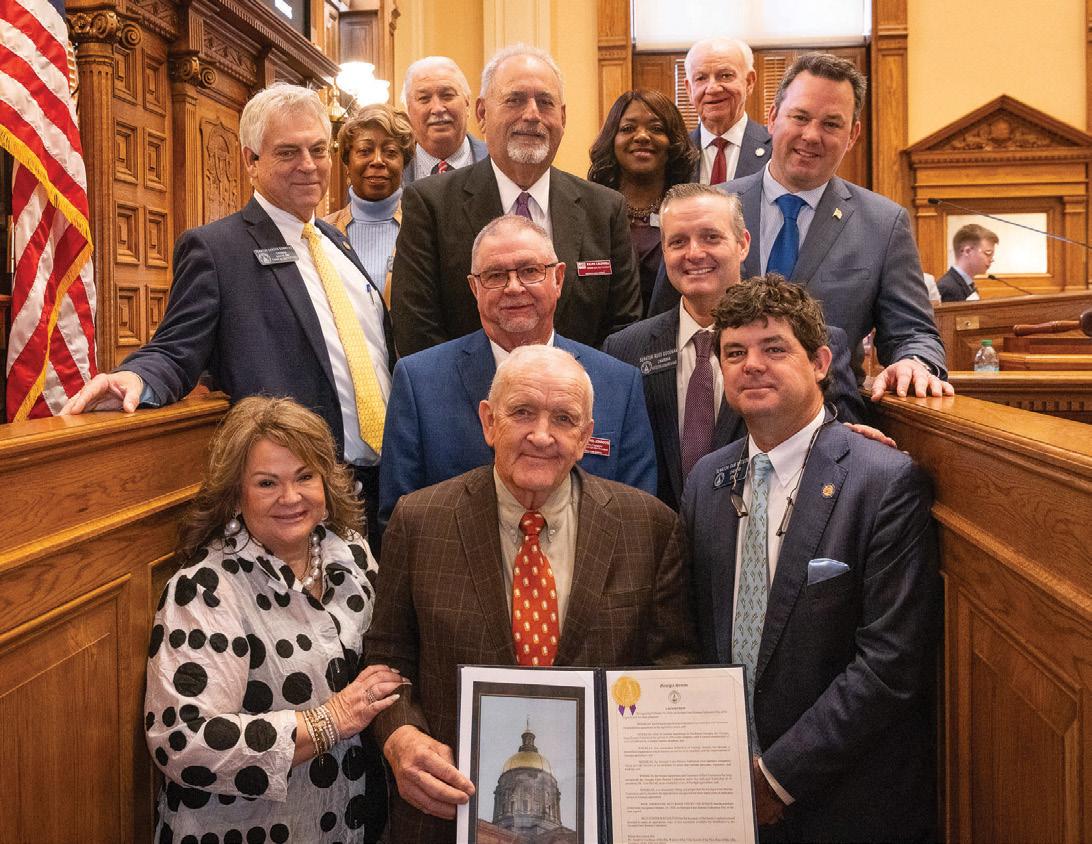
Georgia Senate leaders presented Georgia Farm Bureau leaders with a resolution recognizing Georgia Farm Bureau on GFB Day at the Capitol, Feb. 10. /Photo courtesy of Ga. Senate Press Office
while enrolled in a covenant, allow notification by email and certified mail of an expiring covenant, provide an option to merge covenants on a singular timeline, and create a 180-day grace period for the conversion of CUVA to the Forest Land Protection Act (FLPA) at the time of acquisition.
Cotton & eggs
Cotton has long been a staple crop in Georgia. This year the General Assembly passed HB 1310, by Rep. Jaclyn Ford (R-Tifton), designating cotton as the official state fabric. This bill highlights the importance of cotton production to Georgia and the need to support cotton farmers by choosing cotton fabrics. SB 551, by Sen. Sam Watson (R-Moultrie), repeals the Georgia Department of Agriculture's egg candling program. The existing program is outdated and creates barriers to non-commercial egg producers from participating in local markets; this bill changes that by repealing the program entirely.
State budget
Both the amended 2026 fiscal year budget and the 2027 budget were full of investments in agriculture. Due to major tax cuts the General Assembly implemented, Gov. Kemp had to line-item veto multiple items to account for the decreased revenue. Even after the cuts, many investments are still in place that will benefit farmers. These investments support the Georgia Department of Agriculture, University of Georgia, and promote innovation in agriculture. For a comprehensive review of the budget, visit www.gfb.org/advocate/ session-reports .
Heading into the interim, Georgia Farm Bureau is eager to work with Rep. Robert Dickey (R-Musella) and Sen. Russ Goodman (R-Cogdell) as they chair the Joint Study
Committee on the Generational Sustainability of Family Farms, created by HR 1416. The Ag Committee chairmen have heard the struggles of Georgia farmers and experienced them on their own farms.
This committee will look into the inflationary pressures impacting the cost of inputs, suppressed market conditions, and the systems that support farmers. Most importantly, the chairmen want to hear input from farmers across the state. To stay current with Georgia and federal legislative activities, sign up for the Georgia Farm Bureau Action Center at www.gfb.org/ advocate/public-policy
Adam Belflower is Georgia Farm Bureau’s State Affairs Manager. He may be reached at acbelflower@gfb.org or 478-474-0679, ext. 5259.
2026 FARM PASSPORT
1 2
FARM PASSPORT
•Farm Passports are free
•Support our state’s farmers
•Earn prizes for your travels
INTERACTIVE SCAVENGER HUNT!
•Live leader board
•Fun missions
•Explore and discover farms in a way you never have before!
Download the Goosechase App on your smartphone. Once in the app, choose to play as a guest or create an account.
Next, search for the name of the Experience (GFB Farm Passport) or enter our unique join code: 49PF1P. And use the password: Georgia
To earn points, complete missions from the list. Mission types include photo submissions, text replies and checking in at specific locations.
Have fun completing missions that will enhance your Farm Passport travels. The app has a live leaderboard so you can see where you rank and enjoy seeing each other’s progress. Special prizes will be given out at the end of each season’s round.
Optional: You can compete as a solo traveler or as a team (max 4 people.) If team, one person will create a team name and be assigned a team password that they can then share with their teammates to join on their phones.
GFB President Tom McCall welcomes Georgia Commissioner of Agriculture
Tyler Harper to the GFB Day at the Capitol lunch. /Photo by Logan Thomas
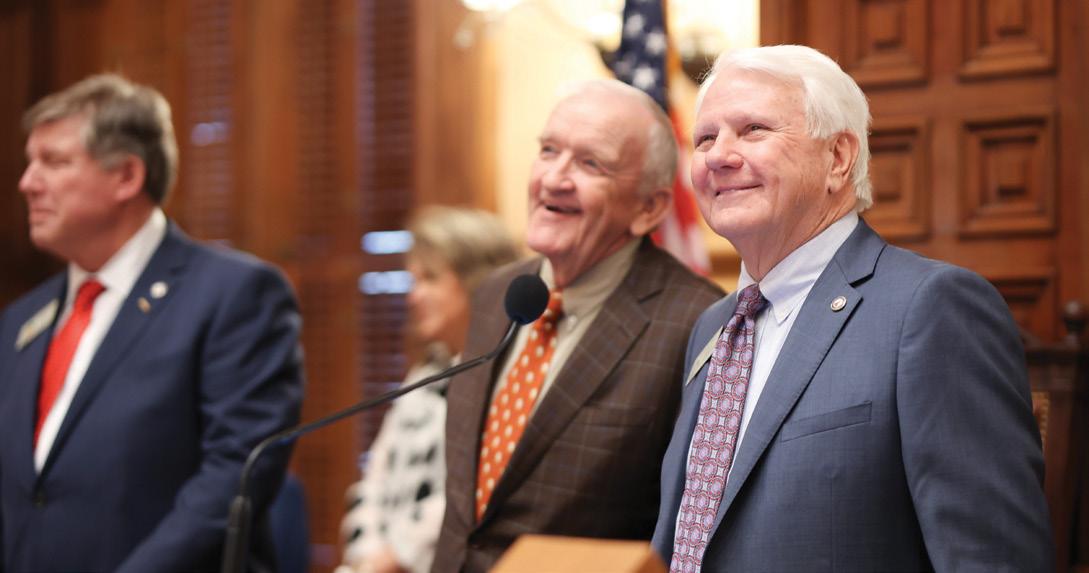
House Speaker Jon Burns welcomes GFB President Tom McCall to the House during GFB Day at the Capitol. /Photo courtesy of Ga. House Media Services
GFB LEADERS TELL LAWMAKERS ABOUT FARMERS’ STRUGGLES
By Jay Stone
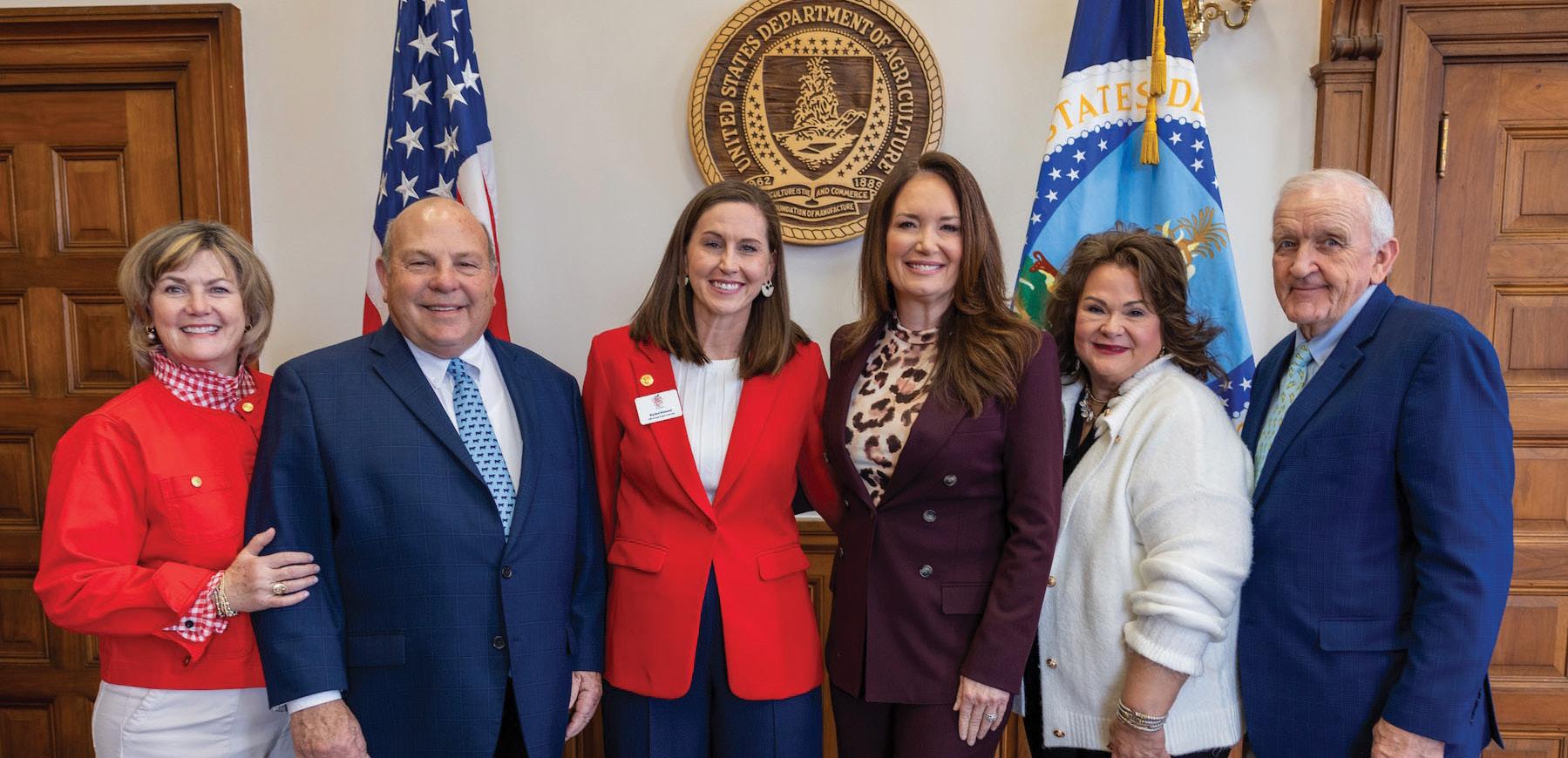
Morgan County Farm Bureau Director Rachel Kinsaul, center, was in D.C. at the same time GFB visited. Kinsaul, the 2026 Georgia Teacher of the Year, was interviewing as a finalist for the National Teacher of the Year. While there, she visited with Agriculture Secretary Brooke Rollins. GFB President Tom McCall & his wife, Jane, on right, and AFBF President Zippy Duvall & his wife, Jennifer, on left, joined Kinsaul in meeting with Rollins. Although Kinsaul did not receive the national award, GFB is proud of her for being a national finalist and the attention she has brought to ag education this past year. /Photo courtesy of AFBF
The annual Georgia Farm Bureau Presidents’ trip to Washington, D.C., gave GFB members an important opportunity to interact directly with members of Georgia’s congressional delegation. This year, they carried a particularly weighty burden.
A group of 28 GFB leaders from county chapters and the GFB board visited Washington March 3-5, carrying stories of the many ways they’re running into barriers to success, from rising input costs to international trade challenges. The elevator speech was this: Farming that is not profitable is not sustainable, and farmers and ranchers need help.
On March 3, the GFB group heard presentations from American Farm Bureau staff during an after-lunch briefing covering trade, labor costs, the farm bill, water and more.
On March 4, the GFB group took to Capitol Hill where they met with Reps. Barry Loudermilk, Austin Scott, Buddy Carter, Rick Allen, Brian Jack and Mike Collins, Sen. Jon Ossoff and staff for Rep. Andrew Clyde and Sen. Raphael Warnock, as well as staff for the Senate Agriculture Committee.
The GFB group shared messages about the farm bill, disaster assistance, farm labor and trade, with the overriding mission of focusing attention on farmers’ need for profitability. Discussions
included developments related to U.S. military operations in the Middle East. GFB members pointed out that diesel prices jumped by 85 cents per gallon virtually overnight, compounding already dire financial conditions for farmers.
AFBF BRIEFINGS
FARM BILL
AFBF Government Affairs Director Brian Glenn gave the farm bill briefing. Coincidentally, on March 3, the House Agriculture Committee began markup on the Farm, Food, and National Security Act of 2026. The House passed its farm bill April 30.
The bill addresses farm bill titles not addressed in the One Big Beautiful Bill Act passed July 2025. Glenn said AFBF has several priorities for a modernized five-year farm bill, including federal loan programs, rural development, research and Extension, forestry and energy.
“China outspends us on ag research two to one,” Glenn said. “We need smart policy that moves us forward, gets us that technology, that innovation that moves us forward. So, this bill really focuses a lot on that.”
TRADE
AFBF Senior Director of Government Affairs Dave Salmonsen discussed trade issues. While the United States has reached trade agreements with numerous nations in the past year, Salmonsen emphasized that China’s influence over agricultural trade cannot be overstated.
In October 2025, the U.S. and China agreed to delay additional tariffs for one year. The U.S. tariffs on imported goods from China were reduced from 59% to 49%, while China’s tariffs on imports from the U.S. were reduced to 21.9% and port fees were delayed. China committed to buying 12 million metric tons of soybeans in 2025 and 25 million metric tons annually moving forward.
Salmonsen said tariffs are the Trump administration’s tool of choice to generate revenue, create leverage to achieve economic and non-economic objectives and reindustrialize the U.S. economy. The administration has faced legal challenges on some of its trade policy and has been rebuffed by U.S. courts on multiple points.
The U.S. last had an ag trade surplus in 2021, though Salmonsen said the deficits since then are based more on value than volume.
LABOR
AFBF Director of Government of Affairs John Walt Boatright discussed ag labor and farmers' costs associated with it. Congress has been slow to take action on migrant labor, with some legislators saying they will not address it until the border is secure.
Boatright reviewed the status of numerous federal rules related to immigration and labor:
• The methodology the U.S. Department of Labor (DOL) used to determine the Adverse Effect Wage Rate is under a nationwide injunction.
• The Department of Homeland Security’s U.S. Citizenship & Immigration Service fee schedule and changes to certain other immigration benefit request requirements is still in effect.
• The DOL Overtime Pay Rule is on hold.
• The OSHA Worker Walkaround Representative Designation Process is still in place.
• The DOL Independent Contractor Rule is no longer being enforced.
• Improving Protections for Workers in Temporary Agricultural Employment in the United States that took effect June 28, 2024, may be rescinded following court decisions.
• The rule that took effect Jan. 17, 2025, modernizing H-2A program requirements, oversight, and worker protections is still in place.
• The OSHA proposed heat standard is still pending.
WATERS OF THE UNITED STATES
AFBF Senior Director of Government Affairs Courtney Briggs reviewed the latest developments on the Waters of the United States (WOTUS) rule. Notably, the definition of WOTUS is significantly narrowed under an EPA Interim Final Rule currently undergoing the regulatory review process. The new definition takes into consideration the seasonal moisture variations by geographic area.
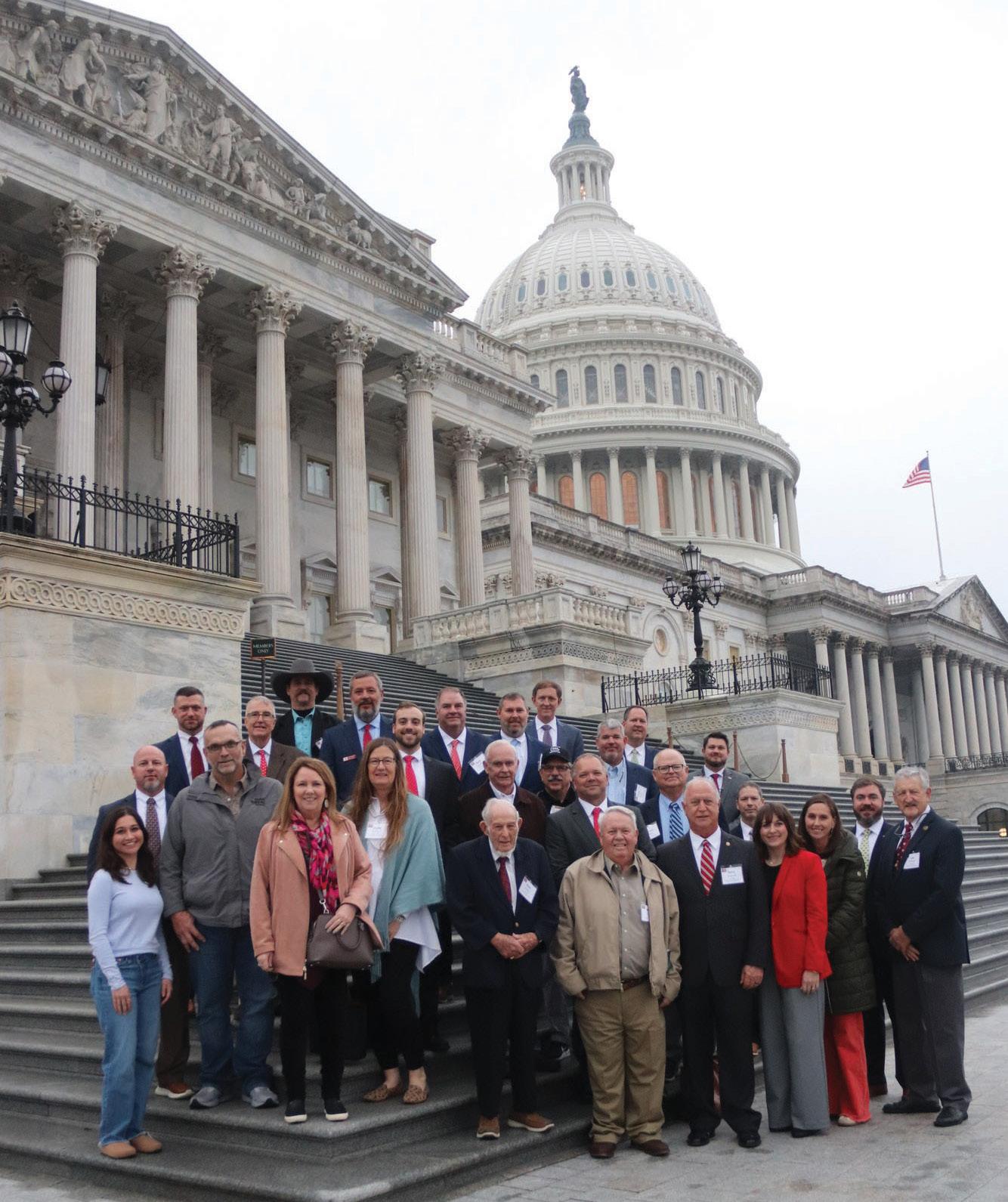
GFB members toured the U.S. Capitol during a March trip to D.C. /Photo by Jay Stone
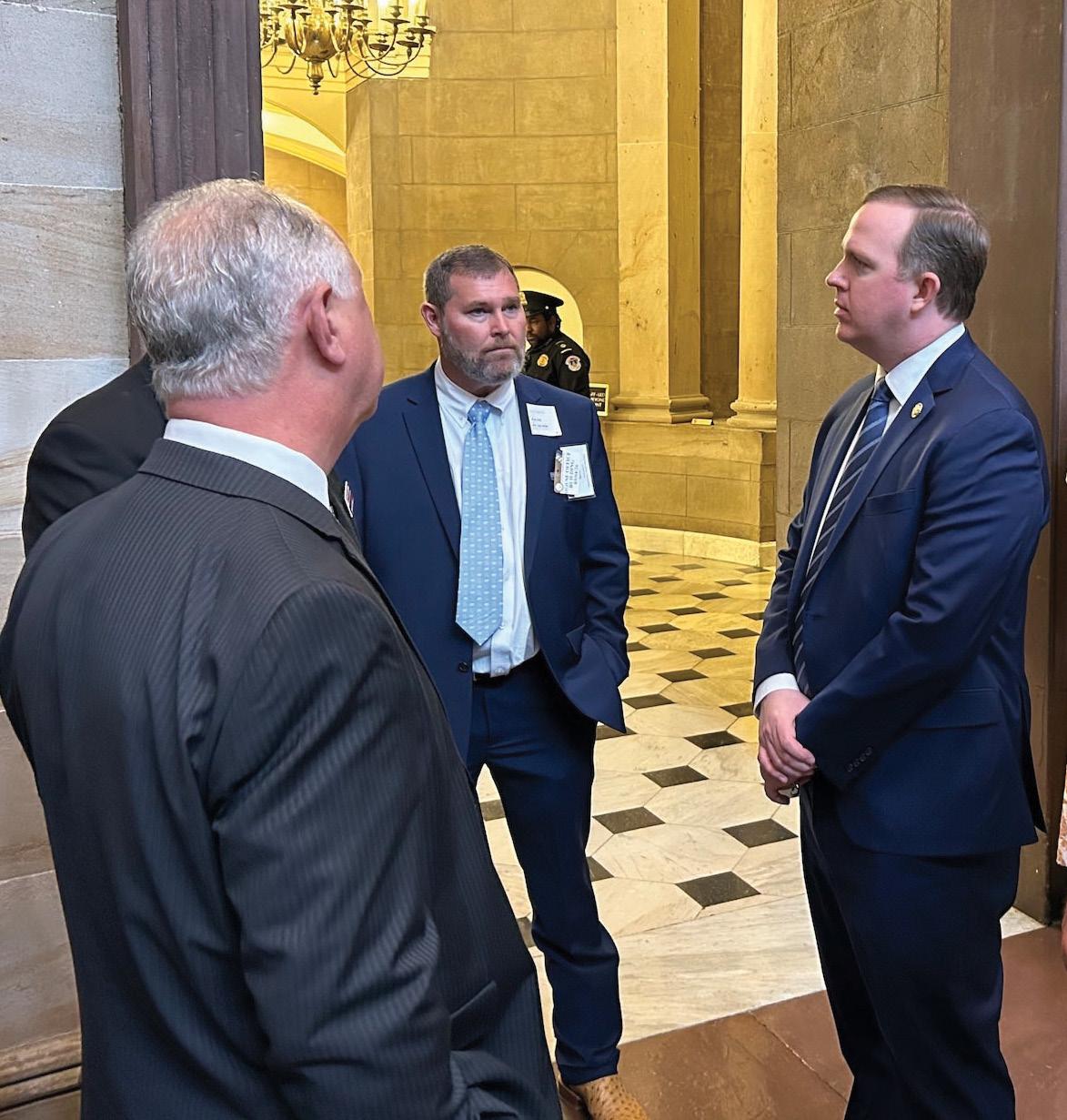
Rep. Brian Jack, far right, visits with GFB members outside the U.S. House chamber on March 4. /Photo by Ken Murphree
GFB Leadership Programs Visit D.C.
By Heather King & Jay Stone
Two key groups in Georgia Farm Bureau’s leadership development programs visited Washington, D.C., April 14-17 for training and advocacy activities.
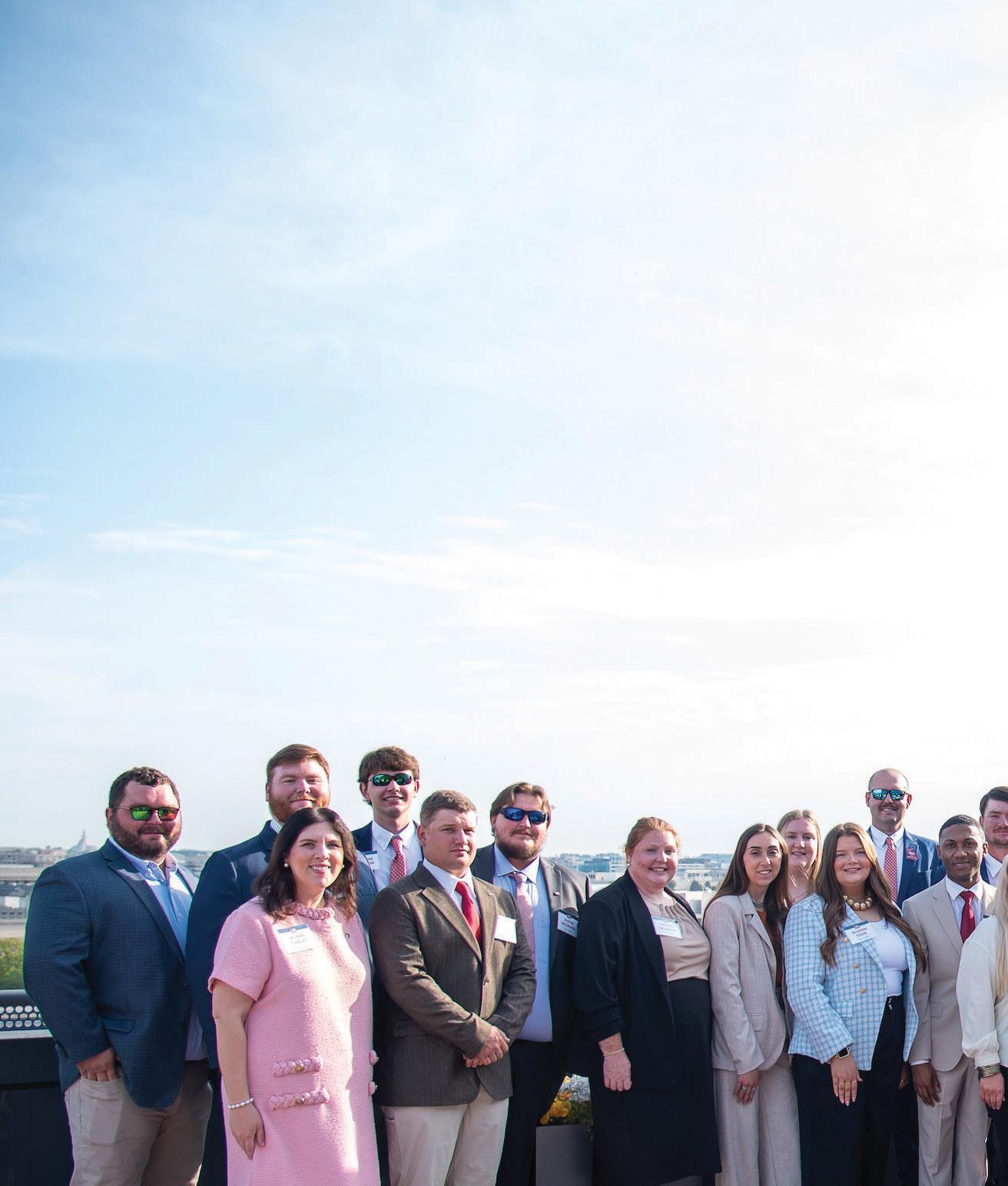
A group of 25 GFB members from 20 different counties went as part of the GFB Young Farmers & Ranchers (YF&R) program, and the 12 members of the inaugural Leadership GFB class visited concurrently.
The YF&R group received briefings from American Farm Bureau Federation (AFBF) staff about the farm bill and international trade, as well as advocacy training.
“It’s a great time to be able to sit down in front of a congressperson or a staffer, to let them know that [agriculture] exists,” said GFB YF&R Committee Chairman Garrett Hurley. “Basically, [we] just took our seat at the table, because ultimately if we don't take that seat, someone that’s sitting in front of us will tell a story that is possibly not true. And we want to be sure that we've got the true Georgia agriculture story in front of these legislators.”
On April 15, the YF&R group visited 10 members of Georgia’s congressional delegation, with whom they shared the dire situation Georgia farmers find themselves in. Key messaging centered on getting a new farm bill passed. The YF&R members told elected officials and their staff about the overwhelming challenges presented by spiking fertilizer and fuel costs.
“I don't think there's ever been a time that it's been more important to come up here to D.C., to talk to these legislators and let them know how bad it really is back home and hopefully get some support from them, to help the Georgia farmer, also the American farmer, be sustainable,” Hurley said.
The YF&R group also visited the French Embassy and the Pentagon. At the French Embassy, Counselor for Agriculture Christian Ligeard presented information about farming and ranching in France, which farms a total of 66 million acres and accounts for 18% of agricultural production in the European Union.
The French are tops among EU nations in wine production in value and second in volume. In 2024, France exported $6.8 billion worth of agricultural goods to the United States, of which 70% was wine. France is the EU’s fourth-largest producer of fruits and vegetables.
Like their counterparts in the U.S., French farmers are being squeezed with respect to input costs and product prices, Ligeard said. He referenced policy “mirroring,” referring to the concept of having producers of goods that are imported to France subject to the same production standards and regulations as French farmers. Like U.S. farmers, French producers would like fewer regulations.
Leadership GFB
members visited the Netherlands Embassy April 14. Agriculture Counselor Ton van Arnhem, Agricultural Attaché Mark Zonnenberg and Agricultural Advisor Caroline Feitel discussed the Netherlands’ use of controlled-environment agriculture, greenhouse exports, and trade between the U.S. and the Netherlands. Cost of land, high input costs and barriers for young people entering farming are problems Dutch agriculture is facing.
“They're able to do a lot with a little bit of space. For me, it was a little bit eye-opening,” said Leadership GFB participant Toni Gaines. “If they can grow tomatoes there year-round, why
For the 42nd year, GFB Young Farmers & Ranchers traveled to Washington, D.C.
Photo by Logan Thomas
During a visit to the Environmental Protection Agency (EPA), Senior Advisor for Agricultural & Rural Affairs Turner Bridgforth discussed ways the agency is working with farmers to expand tools to fight crop disease and pests.
can’t we do that in America and supply enough tomatoes from greenhouses in this country where you don’t have to go to the grocery store and see Mexico tomatoes in December?”
AFBF Senior Director for Advocacy & Media Training Johnna Miller taught the Leadership GFB group how to interact with media outlets. Miller encouraged them to focus on shared values, steer clear of agriculture jargon and acronyms, and use positive words when speaking with the media. She trained members to: think about sound bites that can be used from interviews, don't wait for the question, and to prevent being caught off guard, ask reporters what they plan to ask you.
“My big takeaway from media training is to be careful with your words and not use terms that are so familiar to us in the industry,” Gaines said. “If you say, ‘Oh, I’m a cattle producer,’ they don't know. Just say you're a farmer and keep it simple.”
Bridgforth said he is using his ag background to help lawmakers, staffers and EPA officials understand how decisions affect farmers. He said it is important to get people from the Make America Healthy Again (MAHA) movement onto local farms to bridge the disconnect between MAHA and conventional agriculture.
On April 16, Leadership GFB visited four farms in Northern Virginia.
At Great Country Farms near Bluemont, Virginia, the group met with farm operator Kate Zurschmeide. The 400-acre farm offers produce and the farm experience.
The group met Pamela Jones and Sarah Obuchowicz at Gathering Springs Farm in Middleburg, a small farm that grows more than 60 varieties of fruits and vegetables and cut flowers.
The farm also pastures 200 laying hens on two acres and operates primarily through community-supported agriculture (CSA), farmers markets and a direct-to-consumer stand on the farm.
Loudoun County Farm Bureau President Avis Renshaw hosted Leadership GFB at her bakery, Mom’s Apple Pie. She discussed issues Loudoun County, which she called the richest county in the nation, is facing: data centers, developers, land prices and water usage - the same issues Georgia farmers face. She and her husband grow all the fruit used in her pies at the bakery.
Leadership GFB met with Hana Newcomb at Potomac Vegetable Farm, which has been in operation for over 50 years in Washington, D.C., suburbs in Vienna/Purcellville. They sell all of their produce through CSA boxes, roadside stands and farmers markets.
The inaugural Leadership GFB class received advocacy training, visited the Netherlands Embassy and toured Virginia farms during an April trip to D.C.
Photo by Logan Thomas
DROUGHT INTENSIFIES ACROSS GEORGIA
Compiled by GFB Staff
The month of May brought much-needed rain to most of Georgia, easing – temporarily, at least – the lack of water many Georgia farmers struggled with in the first quarter of the year
According to the Georgia Forestry Commission, Jan. – March was the 8th driest first quarter on record dating back to 1895.
Drought conditions have persisted for most of the state dating back to early fall 2025. Some farmers reported their last meaningful rain being in August, compounding extreme economic conditions (see pages 6-8) and affecting planting decisions and practices. Some chose to irrigate.
The National Drought Mitigation Center categorizes drought intensity in five levels: D0 – abnormally dry; D1 – moderate drought; D2 – severe drought; D3 – extreme drought; and D4 –exceptional drought.
The May 5 U.S. Drought Monitor report, released May 7, showed every county in Georgia with at least some portion under severe drought. Of Georgia’s 159 counties, 149 were in extreme drought and/or exceptional drought. The most intense drought conditions – exceptional drought – were present in 51 counties in the Coastal Plain of South and Southeast Georgia and an additional six counties in Northeast Georgia.
As of May 7, the USDA had issued eight natural disaster declarations for drought, covering virtually every county in the state. According to the U.S. Drought Monitor, these counties suffered from a drought intensity value during the growing season of 1) D2 for 8 or more consecutive weeks or 2) D3 or D4.
GA. COUNTIES RECEIVE DROUGHT DISASTER DESIGNATION
Compiled by GFB Staff
On April 21, the USDA issued a natural disaster designation for 126 Georgia counties due to drought conditions. USDA announced April 29 that another 20 counties received primary drought disaster designation. Producers in the primary counties, as well as producers in contiguous counties, are eligible for emergency loans, which can be used to meet various recovery needs including the replacement of essential items such as equipment or livestock, reorganization of a farming operation, or to refinance certain debts. The Farm Service Agency will review the loans based on the extent of losses, security available and repayment ability.
According to the U.S. Drought Monitor, these counties suffered from a drought intensity value during the growing season of 1) D2 Drought-Severe for 8 or more consecutive weeks or 2) D3 Drought-Extreme or D4 Drought-Exceptional.
These counties received the primary drought designation April 21 and have a Dec. 10 application deadline: Appling, Atkinson, Bacon, Baker, Banks, Barrow, Ben Hill, Berrien, Bibb, Bleckley, Brantley, Brooks, Bryan, Bulloch, Burke, Calhoun, Camden, Candler, Catoosa, Charlton, Chatham, Chattahoochee, Clarke, Clay, Clinch, Coffee, Colquitt, Columbia, Cook, Crawford, Crisp, Decatur, Dodge, Dooly, Dougherty, Early, Echols, Effingham, Elbert, Emanuel, Evans, Fannin, Forsyth, Franklin, Gilmer, Glascock, Glynn, Grady, Greene, Gwinnett, Hall, Hancock, Harris, Hart, Houston, Irwin, Jackson,
These counties received a primary disaster declaration on April 27 and have a Dec. 23 application deadline: Butts, Chattooga, Clayton, Coweta, Dade, Dawson, DeKalb, Fayette, Fulton, Gordon, Habersham, Henry, Jasper, Newton, Pickens, Pike, Putnam, Rabun, Rockdale and Spalding. Contiguous counties also eligible are Banks, Bartow, Carroll,Cobb, Douglas and Fannin.
Polk Co. is eligible to apply as a contiguous county to Cherokee Co., AL; Dec. 21 is application deadline.
Visit farmers.gov, the Disaster Assistance Discovery Tool, Disaster Assistance-at-a-Glance fact sheet, and Loan Assistance Tool for more information. Contact your local USDA Service Center to file a Notice of Loss or ask questions about programs
USDA Deputy Secretary Vaden visits Georgia
By Jennifer Whittaker
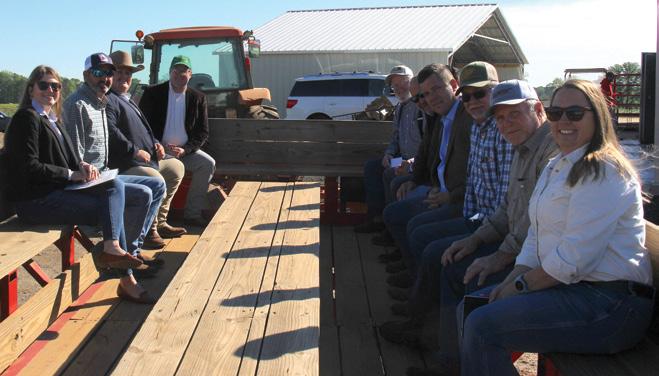
Georgia Farm Bureau hosted a roundtable April 7 for USDA Deputy Secretary Stephen Vaden and farmers to discuss the economic pressures they are facing. The group, which met at Southern Belle Farm in Henry County, also discussed crop insurance and poultry issues.
“The biggest thing we as producers and Farm Bureau worry about is the profitability of our farms. If farms aren’t profitable, they aren’t sustainable,” GFB President Tom McCall said. “America being able to feed itself is a national security issue. You only need five things to survive - food, clothing, shelter, air and water - and three come from agriculture. When farms in our rural communities start fading away, so do the hamburger joints, the grocery stores, the gas stations and the tire dealers.”
Between the farmers attending, most of the state’s major crops were represented.
“We’re in trouble. This will be my 43rd crop and this is the first time in my life that I’m thinking going into the crop year that I probably won’t break even,” said Pierce County row crop farmer Daniel Johnson. “It’s not just fertilizer and fuel, it’s [equipment] parts and all of the inputs. I keep hearing about tax breaks that will help save the farm, but if something doesn’t turn around pretty fast there isn’t going to be a farm to save.”
One reason for high costs: consolidated ag companies
Vaden, the second-highest ranking USDA official, helps oversee implementation of federal ag policy nationwide. He served as USDA general counsel during President Trump’s first term, leading the department’s legal strategy on regulatory and policy issues. As a former judge on the U.S. Court of International Trade, Vaden handled cases involving trade law, tariffs and global commerce.
Vaden said he spends a lot of his time focused on input costs and looking at the broader market dynamics. He said USDA
data shows that from the early 1970s to about 2010, commodity prices and input costs were correlated.
“They [input costs] no longer follow the commodity prices like they did before. If you look back at what was going on in that time period, it happens to correlate with the number of large mergers that took place, particularly in the agricultural sector,” Vaden said. “You’ve still got all the brands you bought for decades. They just are now owned by about three companies in each sector. We think fewer people competing for your business and the growing prices are related.”
Vaden said the U.S. Department of Justice (DOJ) and the Federal Trade Commission (FTC) are asking if some companies are following antitrust laws. He said the three big fertilizer companies are being investigated. The FTC is suing farm equipment companies over farmers’ right to repair their own equipment.
USDA Deputy Secretary Stephen Vaden, left, visits with GFB 7th District Director Ben Boyd during a meeting GFB held in April.
Photo by Jennifer Whittaker
Screven County row crop farmer Ben Boyd said he received a text after leaving home informing him that his fertilizer prices were going up another 10%. Boyd said his fertilizer costs have increased from 55 cents/pound to 96 cents/pound since early March.
Both Boyd and Julie Hardy, a Thomas County row crop farmer and cattle producer, expressed concern that ag companies are charging farmers maximum amounts.
“Every time I fill out the credit applications for the companies we buy our inputs from, every company wants to know, not only our financial information, they want to know how many acres of what crop we’re planting and what our expected yield is,” Hardy said. “Even when we got the USDA Bridge payments that were to help farmers, because a farm bill hadn’t been passed since 2018 to update reference prices to account for higher production prices, they raised their prices. Don’t get me wrong, we needed the bridge payments, and we’re thankful for them, but they know what they can charge us because they finance everything.”
Farmers say another USDA Bridge payment is needed
Grady County peanut and cotton grower John Harrell warned another round of payments may be necessary. Harrell said multiple bankers told him that without the bridge payment and without provisions in the One Big Beautiful Bill set to increase crop reference prices in October, they could not have financed a lot of farmers this year.
“The price of everything has jumped up, so our bridge payment is basically gone now. I know [U.S. House Agriculture Committee] Chairman [Glenn] Thompson is wanting to do another bridge payment through the House and the Senate,” Harrell said. “I hope that can be put on something [the pending farm bill or an appropriations bill] because I know what y’all are doing is going to help us in the future, but it’s like others have said, no business can operate losing money. The only thing keeping most of us afloat [with the banks] is the value of our land.”
Crop insurance & chances of farm bill being passed
Lowndes County tobacco grower Fred Wetherington expressed gratitude to Congress and the Trump administration for including provisions in the One Big Beautiful Bill that lowered the cost of crop insurance. He asked if it’s possible the pending farm bill could increase the maximum amount a farmer can insure a crop from 75% to 90%.
“My crop insurance that I had last year is costing about 20%, maybe 21 or 22% less this year than it did last year, so I want to thank you for that,” Wetherington said. “Trying to be a solutionsoriented person, I am just wondering could we maybe buy crop insurance to cover up to 90% of our crops? Buying crop insurance lets farmers stand up more on our own.”
Vaden said he thinks there’s a 40-60% chance Congress will pass a new farm bill this year and encouraged Farm Bureau members to keep pressure on their U.S. legislators to pass it.
Georgia Farm Service Agency Committee Members Named
In April, the USDA Farm Service Agency (FSA) announced the appointment of five Georgia ag leaders to serve on the state USDA FSA committee. Secretary of Agriculture Brooke Rollins appointed members of the Georgia FSA committee, which is responsible for the oversight of FSA farm programs and county committee operations, resolving program delivery appeals from Georgia producers, maintaining cooperative relations with industry stakeholders and keeping producers informed about FSA programs. Each FSA state committee has three to five members including a designated chairperson. Georgians appointed to serve on the state FSA committee are:
Chairman Bill Brim, Tifton: Brim is a vegetable producer who manages thousands of acres of diversified crop production and one of the state’s largest greenhouse operations. He has decades of experience in large-scale vegetable farming, seedling production, labor management, and food-safety innovation. He has held extensive leadership roles on state and national agricultural boards. Stacey Britt, Hartwell: Britt manages a large Angus cattle operation and has held multiple appointed and elected roles including
Members of Georgia’s agricultural community and mental health advocates gathered March 12 for the fifth Georgia Farm Stress Summit to discuss how they can help farmers navigate the stress of their livelihood.
UGA College of Agricultural & Environmental Sciences Associate Dean for Extension Michael Toews noted that last year Georgia ranked No. 2 in the country for bankruptcy proceedings.
“Georgia farmers are facing a severe mental health crisis. Firstgeneration farmers have higher stats for stress,” Toews said. “Resilience doesn’t mean invincibility. We need to offer listening without judging and remind farmers they’re not alone.”
Keynote speaker Tara Haskins, who holds a doctor of nursing practice degree and is the health director of the nonprofit AgriSafe, outlined ways the agriculture community nationwide can continue to reduce the stigma of talking about mental stress and improve farmers’, loggers’, and commercial fishers’ mental well-being.
“Sometimes the resilience we celebrate can mask exhaustion,” Haskins said. “It’s easy to understand why. Farmers are responsible for their employees. They’re dealing with concerns about the weather, supply chain, labor shortages, public scrutiny and policy uncertainty.”
Haskins advocates mental health training be normalized and included with farm safety training. “Ag leaders need to have the courage to say mental health sustains workers in agriculture. We need permanent funding, research and policy advocacy on the state and federal level. We can either treat mental health as a crisis response or embed it and improve on how we help people. History will judge us by whether we were able to reduce the suicide rate and the stigma of mental issues in agriculture.”
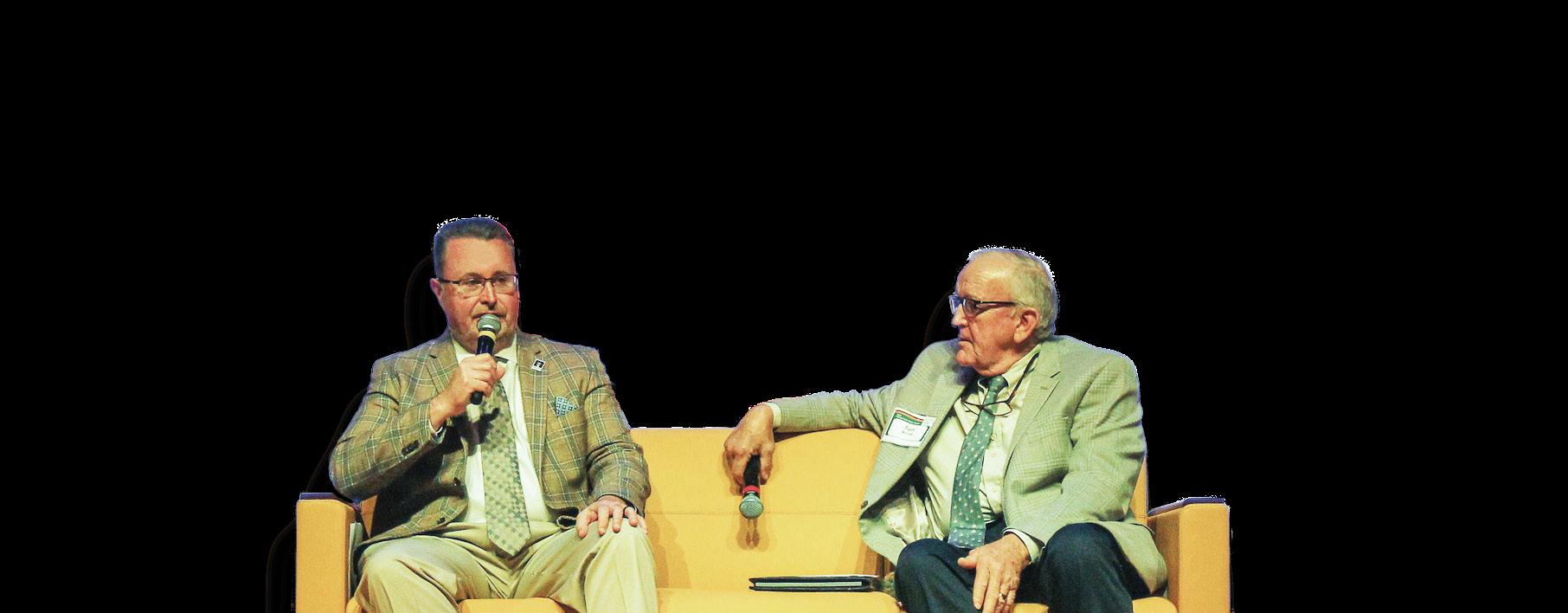
Georgia Department of Behavioral Health & Developmental Disabilities Commissioner Kevin Tanner and Georgia Farm Bureau President Tom McCall discussed what their organizations are doing to help.
Tanner urged anyone having a mental health crisis in their family to call the DBHDD hotline at 988. Trained clinicians are available to talk 24 hours, seven days a week.
“The Georgia Crisis Access Line gets about 1,000 calls or texts a day,” Tanner said. “The top 20 counties that have used 988 in Georgia are rural.”
McCall urged members of the ag community to reach out to friends they see struggling.
“Don’t wait for them to come and talk to you,” McCall said. “If you have friends going through issues, ask them if they are okay and if they want to talk.”
Tanner said a good way to get people to share their struggles is to share your own.
“Give that person the opportunity to open up by saying, ‘Let me tell you what I’m dealing with or let me tell you about my struggles,’” Tanner said. “When we allow people to see our vulnerability, it allows others to open up.”
McCall said addressing farmer mental health is a priority of the Georgia Foundation for Agriculture, which was instrumental in creating the Georgia Agricultural Wellness Alliance in collaboration with Mercer University.
Visit www.gfb.ag/mentalhealth for more coverage of this conference.
FARM & RURAL MENTAL HEALTH RESOURCES
If you or someone you know is in crisis, call or text 988 or visit:
Georgia Department of Behavioral Health & Developmental Disabilities Commissioner Kevin Tanner, left, & GFB President Tom McCall discussed farmer mental health issues at the Georgia Farm Stress Summit. /Photo by Jennifer Whittaker
GFB SUMMIT PREPARES WOMEN TO RISE & THRIVE
By Jennifer Whittaker
Women representing numerous commodities and jobs in Georgia agriculture had a blast at the Georgia Farm Bureau Women in Agriculture Summit held March 19 & 20 in Savannah. Among the fun, they networked, cultivated leadership skills, learned ag advocacy tips for social media, and how to rebut fear-based food marketing campaigns.
“It’s pretty special that we gathered for this summit during Ag Week, National Women’s History Month and the International Year of the Woman Farmer,” said GFB Women’s Leadership Committee Chairman Romy Strickland. “I hope the attendees leave this conference with renewed energy and new ideas for the ag promotion work they do in their communities. We hope you have found Farm Bureau to be a place you can plug into.”
CELEBRATING THE INTERNATIONAL YEAR OF THE WOMAN FARMER
In the opening session of the summit, speakers praised the attendees for the contributions they make to agriculture and recognized the United Nations has designated 2026 as the International Year of the Woman Farmer. Learn more at www. gfb.ag/iywf.
GFB President Tom McCall thanked the ladies attending the summit for what they do to feed, clothe and house the world.
“Behind every successful harvest, there’s a lady whose name you may not ever hear, but she is a main component of feeding the world. Y’all care about the land. Y’all care about the livestock. Y’all care about your families and the legacies your families leave,” McCall said. “Don’t ever let anyone downplay what you bring to agriculture. The work you do as ladies for Georgia Farm Bureau and American Farm Bureau matters. We appreciate you and want your input.”
Abraham Baldwin Agricultural College President Dr. Tracy Brundage delivered the opening session keynote speech. She said 53% of the students enrolled in ABAC’s School of Agriculture & Natural Resources are women.
“When I look around this room, I see the leaders those students will look up to. This is why our work and our courage matter so much,” Brundage said. “Dr. Brene Brown teaches that courage starts with showing up and letting ourselves be seen. It means stepping into rooms where your authority may be questioned. It means making decisions not everyone will like. It may be invisible in ways that are uncomfortable, especially when you are the first or the only one charting new territory.”
LIVING EXTRAORDINARY LIVES
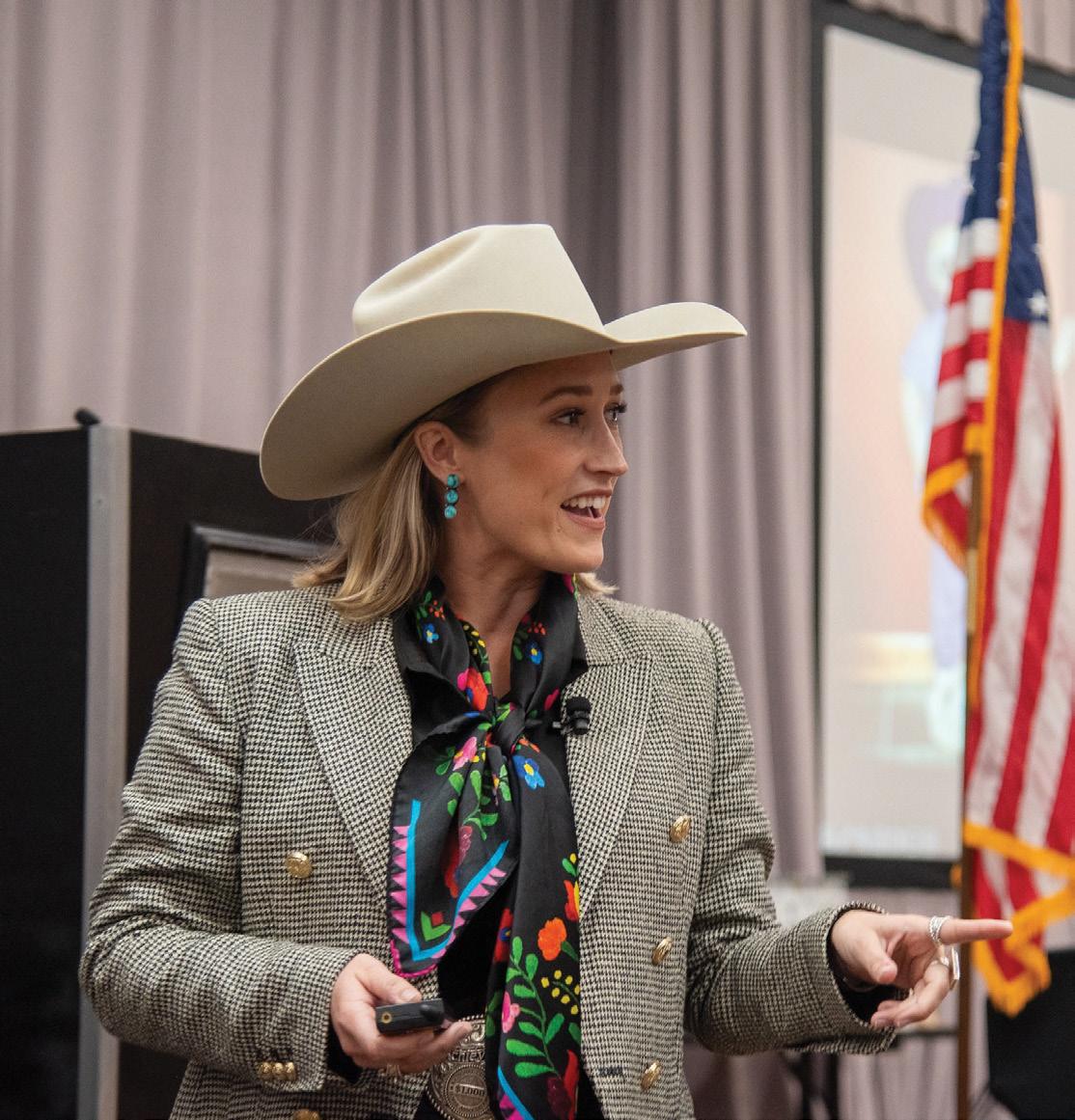
Motivational speaker Courtenay DeHoff shared her cowgirl code for living a legendary, extraordinary life. DeHoff grew up the fifth generation on her family’s Kansas ranch where she rode horses,
tied goats in rodeos and showed cattle. She attended Oklahoma State University, earning a degree in ag communications. After completing an internship at a TV station in Stillwater, Oklahoma, she continued working there for three years.
To pursue a TV career in larger markets, DeHoff traded her cowboy hat and boots for heels and fake eyelashes.
“I got to interview big-name stars like Michael B. Jordan, Garth Brooks and Trisha Yearwood, but I burst into tears every day on the way home from work because I wasn’t being my authentic self,” DeHoff shared. “It took me 10 years to figure out I was hiding the best part of me – the ag kid – to fit into an industry I thought I wanted to be part of. My legendary life didn’t begin until I decided to quit TV and show up as the person I was meant to be. We need all kinds of people in agriculture.”
DeHoff said a Forbes survey shows 900 million people worldwide feel unfulfilled.
“This tells me these people are living their life through a filter of fear, not faith. I want to inspire you not to be one of these people,” DeHoff said.
Being a cowgirl is a mindset, not an occupation, DeHoff says. Her principles for living a legendary life are:
Courage: Have the courage to show up the way you truly are.
Originality: Be who you were created to be.
Worthiness: Believe you are worthy of doing extraordinary things.
Grit: Develop it/use it when challenges arise.
Integrity: Exercise it. In ag, integrity sets us apart.
Resiliency: When you’re told “no,” keep going. Find another way to contribute.
Legendary: What you’ll be by being your authentic self.
“Imagine if you don’t have the courage to show up what you might miss out on,” DeHoff said. “Have the courage to not listen when people criticize you and your dreams.”
Courtenay DeHoff /Photo by Logan Thomas
Women's Leadership Update GFB Women In Action
By Heather King
Georgia Farm Bureau (GFB) Women’s Leadership Committee (WLC) members have been busy learning and leading in 2026. Committee members have been planning district meetings that started in April and will continue into the fall.
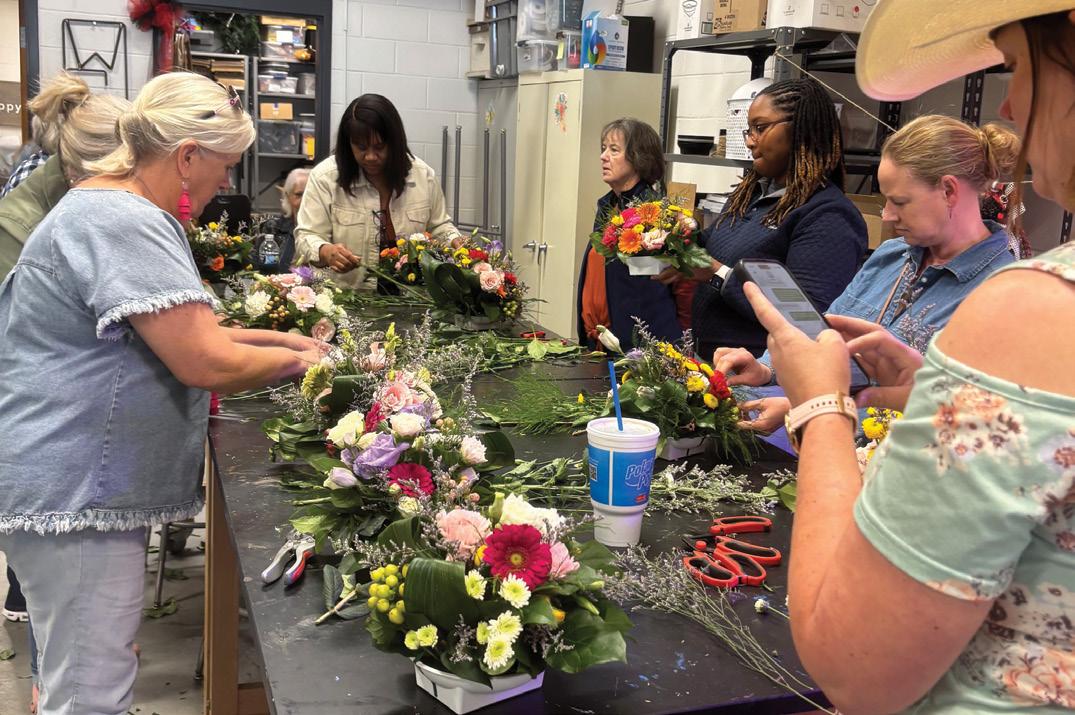
GFB WLC District 4 Chair Della Fowler, of Greene County, hosted her district’s meeting April 8 in Madison, above. Attendees participated in a floral arrangement workshop at Morgan County High School led by ag teachers Rachel Kinsaul and Erin Pringle. They also visited Rock House Creamery where they learned about dairy farming. Kinsaul, the 2026 Georgia Teacher of the Year (TOY), shared her TOY journey during lunch at Farmview Market. She is the first ag educator to be awarded the Georgia title.
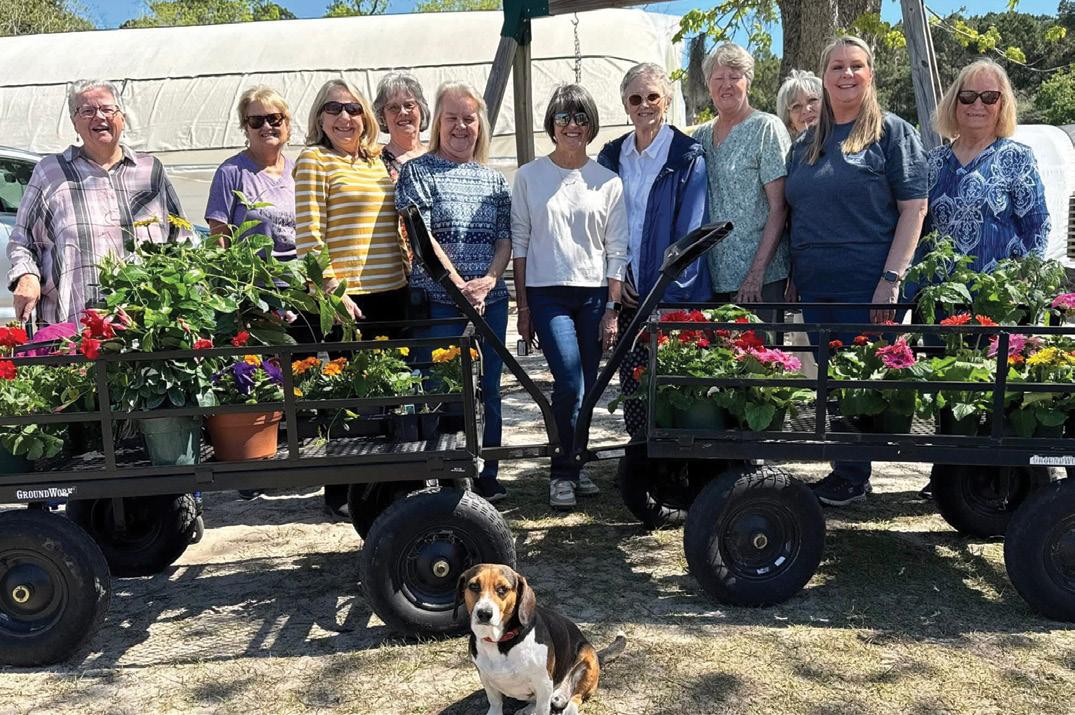
GFB WLC District 7 Chair Whitney Sheppard, of Screven County, hosted her meeting at Rahn’s Greenhouses & Nursery in Springfield on April 10, above. Attendees toured the greenhouses, heard from the women who own and operate the
greenhouse, and finished up with an advocacy lunch and learn at District Square Food Hall.
Carol McQueen, GFB WLC District 3 chair of Henry County, held her meeting in Mansfield at Love is Love Farm, May 28.
Anna Strickland, GFB WLC District 2 chair of Madison County, held her meeting at the Stephens County Ag Center in Eastanollee, June 10. GFB WLC State Chair Romy Strickland, of Spalding County, held the District 5 meeting in Griffin at the UGA Griffin Campus & Gardens on June 11.
Each Women’s Leadership district meeting will feature an advocacy focus, as well as fellowship and networking. If your GFB district meeting isn’t listed above and you’re interested in attending it, reach out to your county Farm Bureau office manager to let them know and look for announcements on the Friends of Georgia Farm Bureau Facebook group page.
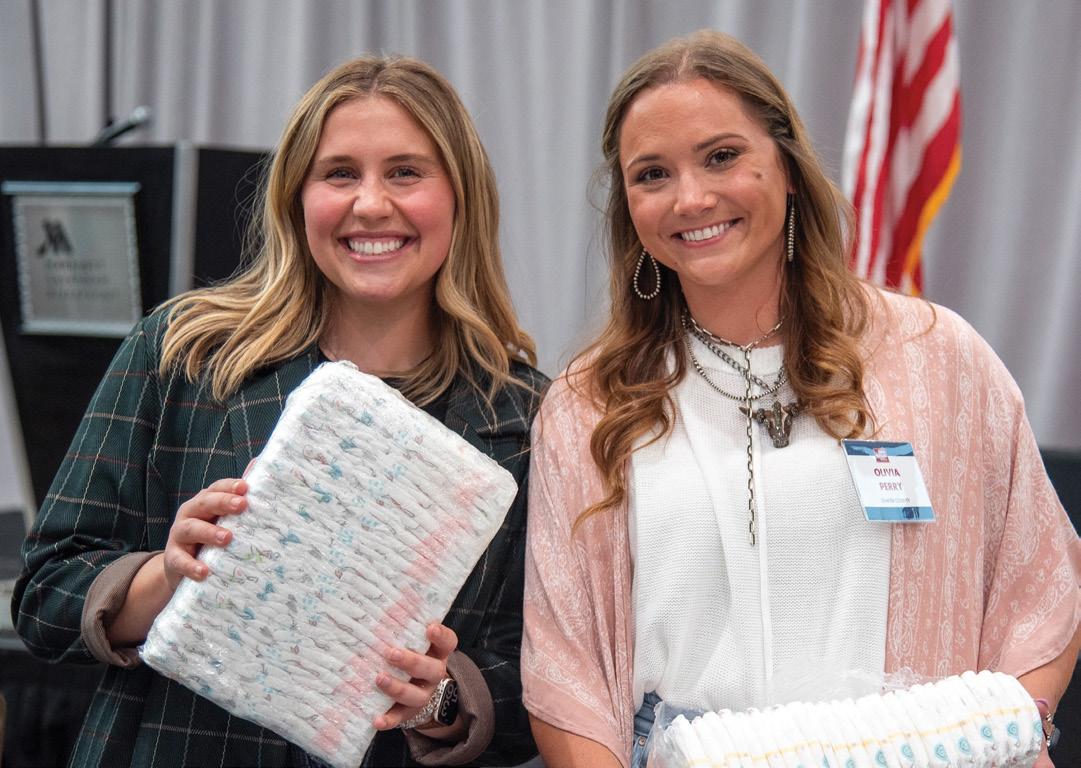
GFB women are always looking for ways to give back to their local communities. County Farm Bureaus and volunteers donated snacks and funds toward pallets of diapers for two service projects during the opening session of the GFB Women in Ag Summit. Attendees spent the afternoon of March 19 assembling 850 snack bags for families who will stay at the Savannah Ronald McDonald House. They also sorted and wrapped 16,750 diapers, above, that will be distributed to 670 families through the Over the Moon Diaper Bank that serves 24 Georgia counties located in GFB’s 6th, 7th and 10th Districts.
Georgia Farm Bureau Women’s Leadership Programs Coordinator Heather King may be reached at hcking@gfb.org or 478-474-0679, ext. 5232. Contact your county Farm Bureau if you’d like to volunteer with your local Women’s Leadership Committee.
Photo by Heather King
Photo by Christie Montford
Photo by
Logan Thomas
Young Farmers & Ranchers Update Young Farmers & Ranchers Visit Portland
By Levi Davis
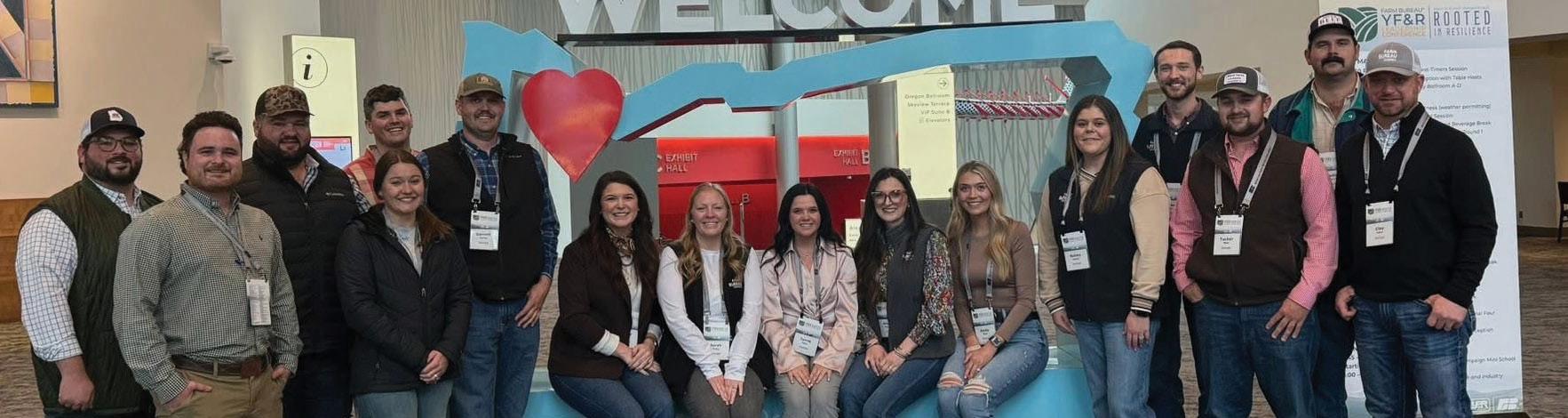
Representing Georgia at the AFBF YF&R Leadership Conference were from left: GFB YF&R Program Coordinator Levi Davis; GFB YF&R Committee Members Joe Twiner, Gwinnett Co.; Chris & Paige Little, White Co.; Stuart Gregg, Pike Co.; Committee Chair Garrett Hurley, Chattooga Co.; GFB District 1 Federation Manager Lacy Powell, GFB YF&R Committee Chair Sarah Hurley, Chattooga Co.; Collegiate Discussion Meet Competitor Torrie Reed, Gilmer Co.; GFB YF&R Committee Members Bristol Peterson, Wilcox Co.; Committee Vice Chair Emily West, Taliaferro Co.; Committee Members Bailey & Blake Segars, Cook Co.; Committee Vice Chair Tucker West, Taliaferro Co.; Committee Member Bradley Peterson, Wilcox Co.; & GFB Field Services Director Clay Talton.
Photo courtesy of Levi Davis
Georgia Farm Bureau Young Farmer & Ranchers (YF&R) traveled to Portland, Oregon, March 13-17 to attend the American Farm Bureau Federation (AFBF) YF&R Leadership Conference. The conference theme was “Rooted in Resilience.”
The conference included sessions designed to sharpen the leadership and advocacy skills of the YF&R members attending from across the country. Tours of farms and ag businesses were also offered. In addition to breakout sessions, attendees got to hear from keynote speakers such as renowned motivational speaker and former United States Army Ranger Keni Thomas.
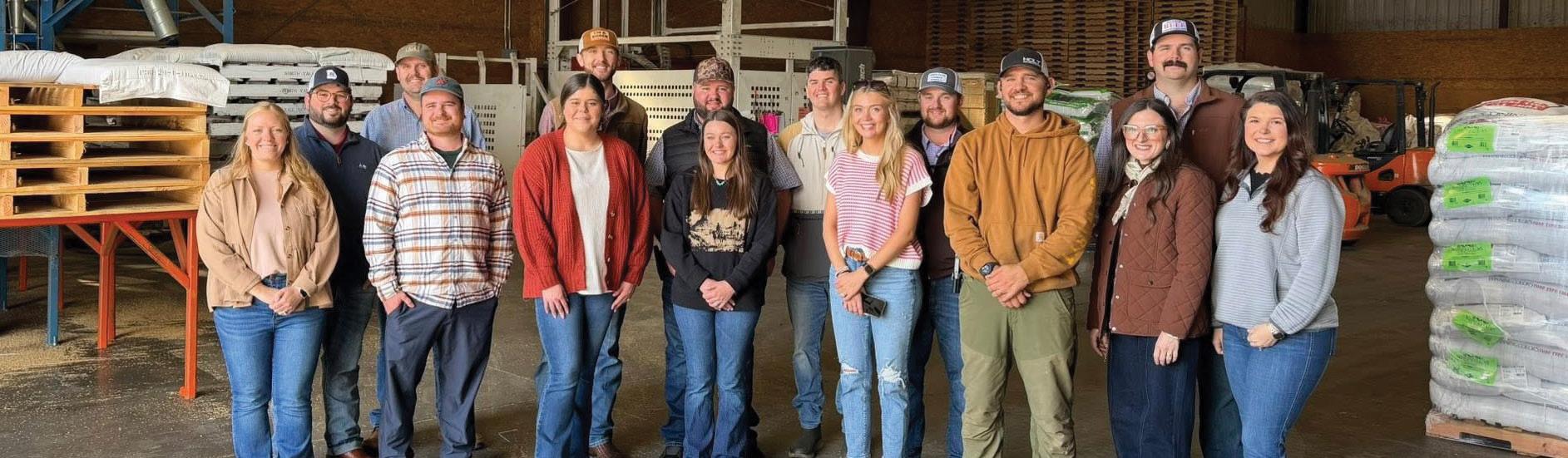
GS3 Quality Seed Inc. and Mckee River Farms hosted the Georgia delegation on farm tours of their operations around Monmouth, Oregon, where they demonstrated agricultural practices in Oregon and the importance of advocacy.
During the conference, Gilmer County Farm Bureau member Torrie Reed competed in the AFBF Collegiate Discussion Meet. Torrie represented Georgia well in the contest, making it through the preliminary and Sweet 16 rounds to compete on stage for the final four.
In addition to experiencing leadership development for themselves, the GFB YF&R attendees gained ideas to implement at GFB’s YF&R Conference set for July 15-18 on Jekyll Island.
GFB Young Farmers and Ranchers Coordinator Levi Davis may be contacted at ledavis@gfb.org or 478-474-0679, ext. 5233. Contact your county Farm Bureau if you’d like to join your local YF&R Committee.
The GFB YF&R delegation enjoyed a tour of GS3 Quality Seed Inc., while attending the AFBF YF&R Conference in Oregon. Photo courtesy of Levi Davis.
Reed Makes AFBF Collegiate Discussion Meet Finals
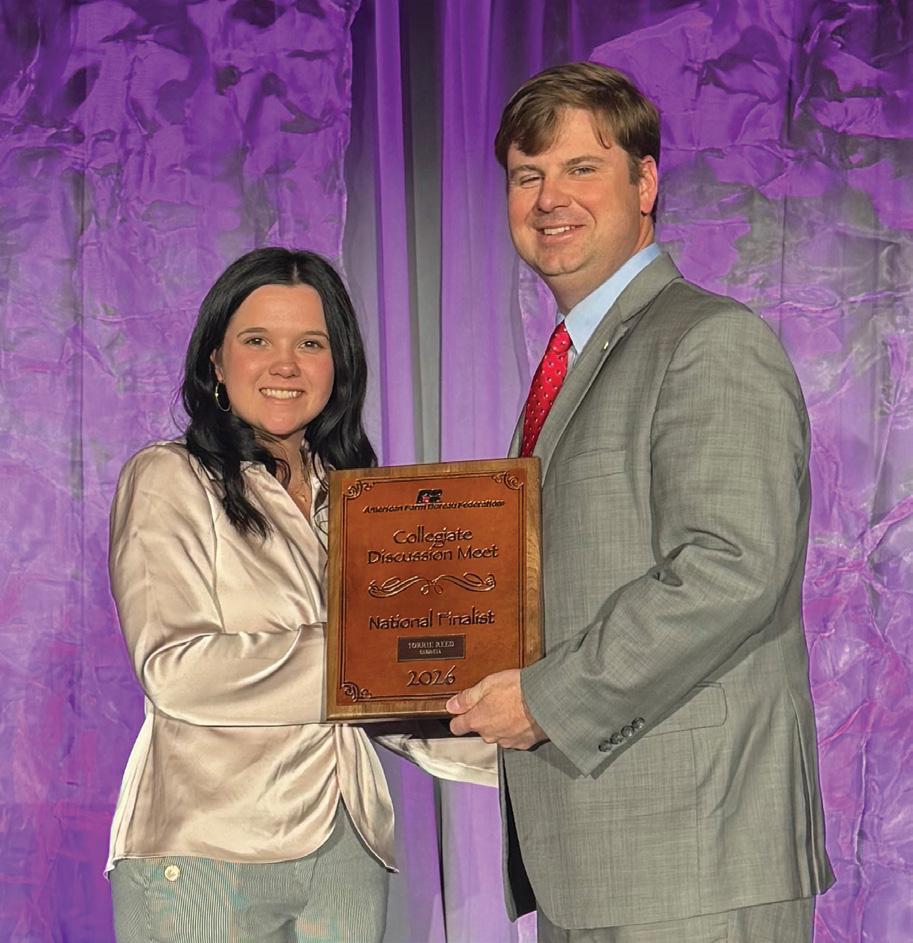
Torrie Reed, a Gilmer County Farm Bureau member, finished in the top four at the American Farm Bureau Young Farmers & Ranchers (YF&R) Collegiate Discussion Meet, held during the AFBF Young Farmers & Ranchers Leadership Conference in Portland, Oregon, March 13-16.
Reed, a University of North Georgia student, advanced through the first three rounds of the event to face off against Sara Bair of Utah, Courtney Taibi of New York and Brooke Beamesderfer of Pennsylvania in the last round.
An education major, Reed was the top collegiate finisher in the 2025 Georgia Farm Bureau YF&R Discussion Meet, earning state honors for the second consecutive year.
Bair earned the national title following a dynamic discussion on how communities can grow responsibly while protecting farms, ranches and the agricultural way of life.
The collegiate discussion meet is designed to replicate a committee meeting where active discussion is expected from each competitor. Participants are judged on their ability to exchange ideas and information on an ag topic and work toward practical answers or solutions. The event helps young Farm Bureau members develop leadership skills and prepare for future roles in agriculture and their communities.
AFBF Young Farmers & Ranchers Committee Vice Chairman Cleve Jackson presents Torrie Reed, of Gilmer County, with a plaque for being a finalist in the 2026 AFBF Collegiate Discussion Meet. Jackson is a Floyd County Farm Bureau member. Photo courtesy of AFBF
Thirty-six competitors from across the country participated in the event. The CHS Foundation provided $18,000 in scholarships for the competition. National winner Bair received $3,100. Reed and the two other finalists each received $2,100. All competitors received scholarships recognizing their achievement in reaching the national level, with additional funding for those advancing to the Sweet 16 round.
Farm Bureau’s YF&R program offers agriculturalists, ages 18 to 35, a variety of programs to develop as effective leaders.
Ray wins GA FFA Discussion Meet
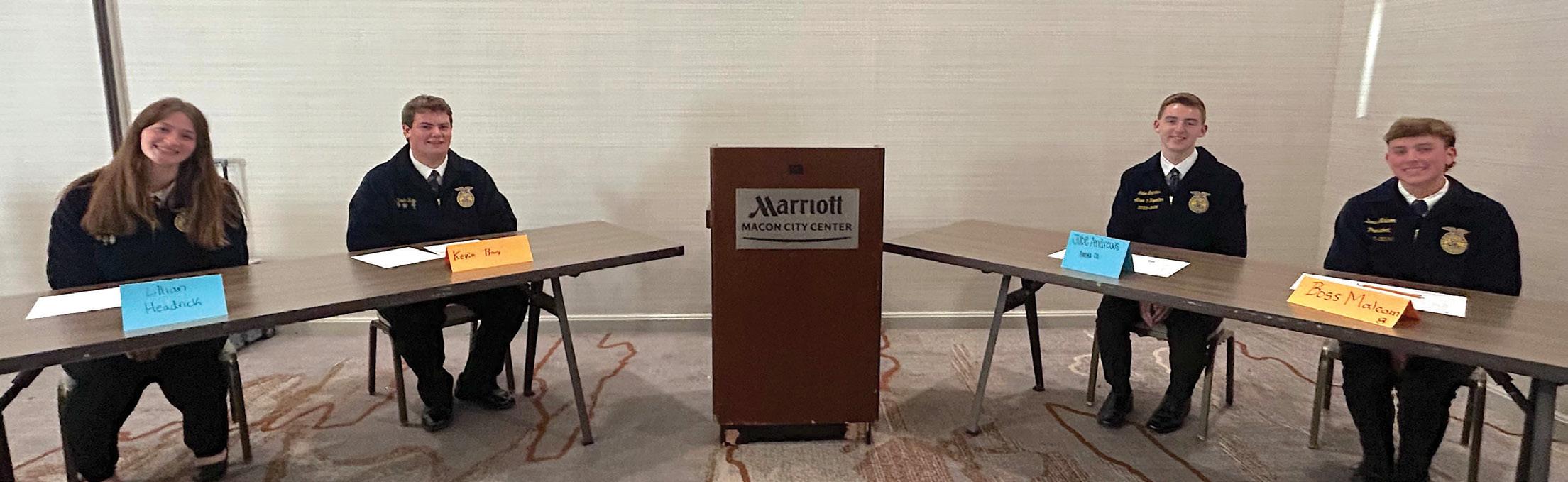
Georgia Farm Bureau was proud to again sponsor the FFA Discussion Meet held April 22 at the 98th Annual Georgia FFA Convention. We congratulate the final four competitors, from left: Lily Headrick, Rome High School; FFA Discussion Meet state winner Kevin Ray, Bainbridge High School; Jabe Andrews, Banks County High School; and Boss Malcom, Mary Persons High School. As the state winner, Ray received a $250 savings bond. Each finalist received a $100 savings bond. During the conference, Georgia FFA members packed more than 100,000 meals for Meals of Hope, which GFB sponsored.
Photo by Levi Davis
Ag in the Classroom Update Farm Bureau Celebrates Georgia Ag Week
By Caroline Waldrep Leonhard
During Georgia Ag Week, Paulding County Farm Bureau volunteer Patricia Moore read a book and completed a blueberry life cycle activity with a 3rd grade class at Abney Elementary in Paulding County. Photo courtesy of PCFB
Georgia farmers work hard every day to keep our state fed and thriving. Georgia Ag Week, March 23-29, was all about celebrating their contributions. Each day featured a special theme created by the Georgia Department of Agriculture that gave students, teachers and communities exciting ways to explore agriculture. This year marked the 53rd anniversary of National Ag Day, which was celebrated on March 24.
County Farm Bureaus and agricultural organizations got creative, hosting events throughout March to highlight the importance of agriculture in their communities.
To help teachers bring Ag Week to life, Georgia Farm Bureau (GFB) created a free, online toolkit featuring videos and resources about blueberries to match the American Farm Bureau Foundation Book of the Year, I Love Blueberries! Teachers, Farm Bureau staff and volunteers used these materials to spark learning in classrooms across Georgia.
For Hands-On Garden Day, March 23, participants were encouraged to plant blueberry plants or seeds. Videos and other resources were provided in the toolkit to teach participants how to do so.
For Lead the Way Tuesday, March 24, participants were encouraged to celebrate by inviting a local farmer or ag professional to speak to their classes.
For Ag Hero Day, March 25, GFB included Thank a Farmer cards in the online toolkit for classes to utilize and distribute to local farmers.
For Ag Literacy Day, March 26, participants were encouraged to read I Love Blueberries! to their classes and complete any of the blueberry-themed activities provided in the toolkit.
To finish the week on Farm to Table Friday, March 27, participants were encouraged to utilize any of the blueberry recipes provided in the toolkit.
Volunteers, educators and GFB office managers who participated and shared their Ag Week celebrations on the Friends of Georgia Farm Bureau Facebook group had the chance to win an Ag in the Classroom prize pack from GFB.
Want to keep the Ag Week fun going? GFB’s Ag in the Classroom program will keep all the resources from the week available at www.gfb.ag/aitc until it is updated with the 2027 material. You can find more great ag book recommendations, each with its own activity page, at www.gfb.ag/books.
From left, Laurens County Farm Bureau Office Manager Mary Morris & Women’s Committee member Kathy Sanders donated garden supplies to Southwest Laurens Elementary Ag Teacher Tara Mullis for her class during Georgia Ag Week. /Photo courtesy of LCFB
Georgia Farm Bureau Educational Programs Manager Caroline Leonhard may be reached at cwleonhard@gfb.org. Visit www.gfb.ag/ AITC for the latest AITC news & for resources to teach children about agriculture.
Ag Students Selected For GFA Scholarships
By Whitney Sangster
The Georgia Foundation for Agriculture (GFA) is excited to announce the 27 students selected to receive a total of $70,000 in scholarships for the 2026-2027 academic year. These awards support Georgia students pursuing degrees in agriculture, forestry, or family & consumer sciences at a University System of Georgia institution, Berry College, Emmanuel College, any accredited Georgia college or university with an ag program, or a Georgia accredited technical college.
“The Georgia Foundation for Agriculture is proud to support these future leaders of agriculture,” said GFA Board Chairman and Georgia Farm Bureau President Tom McCall. “Each student has a unique ag experience they are bringing to their studies that span across a variety of vital sectors.”
The scholarships are awarded to graduating high school seniors, rising college juniors and seniors, students attending technical colleges, and UGA College of Veterinary Medicine students.
Recipients are listed below.
•College Freshman Scholarship for Agriculture
Ten students entering college this fall at the University of Georgia (UGA), Abraham Baldwin Agricultural College (ABAC), or Berry College were chosen to receive scholarships of $3,000 each: Adalynn Puckett, Crawford Co.; Aly Corzine, Houston Co.; Bailey Barnes, Houston Co.; Evan Hardeman, Montgomery Co.; James Wise, Tift Co.; Kory West, Bibb Co.; Alexis Williams, Barrow Co.; Peyton Hicks, Rabun Co.; Ryan Kelly, Wilcox Co.; and Sadie Beth Sell, Richmond Co. The top two candidates –Corzine and Hardeman – each received an additional $1,500.
These students plan to pursue degrees in ag education, ag mechanics & technology, avian biology, agribusiness, animal science, ag communications or ag engineering.
•Technical College Scholarship for Ag
Aiden Cameron, Walton Co.; Ashlynn Dixon, Rabun Co.; Catherine Wells, Gordon Co.; Jackson Thrift, Ware Co.; Kaytlyn Crapps, Appling Co.; and Layla Jackson, Dawson Co. were each selected to receive a $1,500 scholarship to attend Athens Technical College, North Georgia Technical College, Georgia Northwestern Technical College, Coastal Pines Technical College or Gwinnett Technical College. These students plan to pursue degrees in ag communications, agribusiness, welding & metal fabrication or veterinary technology.
•Rising College JR/SR Scholarships for Ag
The foundation awarded eight $2,000 scholarships to these rising college juniors and seniors: Amelia Housley, Franklin Co.; Ashlyn Thompson, Seminole Co.; Breanna Harris, Effingham Co.; Katie Moncrief, Crawford Co.; Payne Murphree, Early Co.; Kyla Rhodes, Henry Co.; Mariann Dayment, Camden Co.; and Megan Jacobs, Jackson Co.
These students attend UGA or ABAC and are studying ag education, ag communications, agribusiness, avian biology, animal science or livestock production.
GFA scholarships help students like Ryan Kelly of Crisp County pursue careers in agriculture. /Photo courtesy of GFA
•Back to Farm Scholarship
Thanks to the generous support of Mac Peden, GFA awarded two $1,000 Back to Farm Scholarships to Amelia Housley, Franklin Co., and Riley Mitchell, Houston Co. This scholarship recognizes students who demonstrate a strong commitment to returning to and serving rural communities.
•UGA College of Veterinary Medicine Scholarship
Katlyn Davis, of Effingham Co., and Olivia Spooner, of Early Co., each received a $5,000 scholarship to support their pursuit of careers in large animal veterinary medicine at the UGA College of Veterinary Medicine.
Whitney Sangster is the Georgia Foundation for Agriculture development coordinator. Visit www.gafoundationag.org to learn more about GFA or to make a tax-deductible donation. Instructions for applying for the 2027 scholarships will be posted on the GFA website this fall.
Ag Literacy Sprouts From Book Donations
For the ninth year, the Georgia Foundation for Agriculture (GFA) and Georgia EMC partnered to donate a children’s book that accurately portrays agriculture to the main 395 libraries in the Georgia Public Library Service.
Each county Farm Bureau received enough copies of “I Love Blueberries,” by Shannon Anderson and illustrated by Jaclyn Sinquett, to deliver one to each public library in its county on behalf of GFA and Georgia EMC. County Farm Bureau and regional Georgia EMC representatives delivered the books to their local libraries throughout March.
This year’s book teaches young readers to create a plan and work together to grow blueberries and develop new friendships. The American Farm Bureau Foundation for Agriculture selected the book as its 2026 Book of the Year for its accurate and positive portrayal of agriculture.
Other ag-themed books available at your local library, courtesy of GFA and Georgia EMC, include: “The Soil in Jackie’s Garden”; “I Love Strawberries”; “How to Grow a Monster,” about growing zucchini; “John Deere, That’s Who!”; “Right This Very Minute,” which explores how food gets from farm to table; “Full of Beans: Henry Ford Grows a Car,” about soybean-based inventions; “Tales of the Dairy Godmother: Chuck’s Ice Cream Wish,” and “My Grandpa, My Tree & Me,” which explores growing a pecan tree. “Sleep Tight Farm” and “Hi, I’m Billy Blueberry: This Is My Story” are available thanks to GFA. You can find activity pages for these books and other ag books at gfb.ag/books.
&
presented a copy of “I Love Blueberries” to Ashley Chambers of the Statham Library on behalf of the Georgia Foundation for Agriculture and Georgia EMC. BCFB won the GFA contest for having the best library event held in conjunction with the book donation. / Photo courtesy of BCFB
From right, Barrow County Farm Bureau (BCFB) Women’s Committee Chairman Linda Crumley & Cheyanne Smith, with Jackson EMC,