Spring 2026
News
2026 International Year of Woman Farmer
GEORGIA FARM BUREAU
Hurricane Helene Block Grants: April 27 deadline to apply
GA WORKING TO KEEP ANIMAL DISEASES OUT
Vol. 88 No.1
Cotton jassid causes big problems
Farm Bureau Members Receive a
$500
Exclusive Cash Reward
1,2
on an Eligible New1 Ford Truck or Ford Blue Advantage™ Certified Used2 Vehicle.
Ford Super Duty®
The Farm Bureau Exclusive Cash Reward1 is now compatible with AXZD-Plans.
Visit FordRecognizesU.com/FarmBureau today for complete offer details! 1 Available on the purchase or lease of an eligible new 2025/2026/2027MY Ford Maverick®, Ranger®, F-150®, Super Duty or F-150 Lightning®. Not available on any other Ford or Lincoln vehicles, or F-150 Raptor®, F-150 Raptor R™, Ranger Raptor or F-650® and F-750® Super Duty. Vehicle eligibility may change at any time. Available to U.S. residents only. Place a new retail order or take new retail delivery from an authorized Ford Dealer’s stock by 1/04/27. Limit of five purchases/ leases per household during the program offer (PGM# 32900). Offer subject to dealer participation. May not be used/combined with most other Ford private offers. See an authorized Ford Dealer or go to https://www.fordrecognizesu.com, for complete details and eligibility (PGM# 32900). Due to high demand and global supply chain constraints, some models, trims, and features may not be available or may be subject to change. Check with your local dealer for current information. Offer subject to confirmation of eligibility. 2 Available on the purchase of an eligible certified used 2021-2027MY Ford Blue Advantage Gold, EV (F-150 Lightning only), or Blue Certified, Ford Maverick, Ranger, F-150, Super Duty or F-150 Lightning with under 80,000 miles. Not available on any other Ford or Lincoln vehicles, or F-150 Raptor, F-150 Raptor R, Ranger Raptor or F-650 and F-750 Super Duty. Vehicle eligibility may change at any time. Available to U.S. residents only. This offer is not eligible for customers purchasing a vehicle in the state of Texas. Take delivery from an authorized Ford Dealer’s stock by 1/4/2027. Limit of five purchases per household during the program offer (PGM# 32902). Offer subject to dealer participation. May not be used/combined with most other Ford private offers. See an authorized Ford Dealer or go to https://www.fordrecognizesu.com, for complete details and eligibility (PGM# 32902). Due to high demand and global supply chain constraints, some models, trims, and features may not be available or may be subject to change. Check with your local Ford Dealer for current information. Offer subject to confirmation of eligibility.
2 Spring 2026
Georgia Farm Bureau News
Contents
Want to subscribe? Join Georgia Farm Bureau to receive GFB News four times a year. Your membership supports farmers & agriculture while giving you access to more than 300,000 discounts. Visit gfb.ag/join.
pages 6 & 7
page 11
page 20
Georgia working to keep animal diseases out
Willis new GFB Insurance Co. general manager
Ag Forecast: 2026 to be challenging
pages 8 & 9
page 12
page 21
Georgia Farm Bureau launches Leadership GFB
Gelber is Georgia Farmer of the Year
page 14
page 27
Female farmers being celebrated worldwide in 2026
GFB YF&R delegation attends AFBF
Hurricane Helene Block Grants: April 27 deadline to apply Georgia farmers, ranchers and foresters in eligible counties with losses not covered under existing USDA programs have until midnight April 27 to apply for recovery funds. USDA allocated $531.246 million to Georgia.
page 10
Hotel opens at Georgia National Fairgrounds & Agricenter
Departments page 4
View from the Field
Learn the story behind the International Year of the Woman Farmer.
pages 16 & 17
Peanut awards, D.C. updates & new leaders
GFB News Staff Kenny Burgamy Director
Public Policy
Jay Stone News Reporter
pages 22 &23
Jared McGukin Graphic Designer
Ag in the Classroom
Hardy elected to AFBF WLC
Cotton jassid: little bugs, BIG problem
Jennifer Whittaker Editor
page 25
page 29
pages 18 & 19
page 5
Ga. Foundation for Agriculture
Jackson is the 2026 vice chair of AFBF YF&R Committee.
Logan Thomas Photographer
FOLLOW US ON THESE PLATFORMS @GAFARMBUREAU
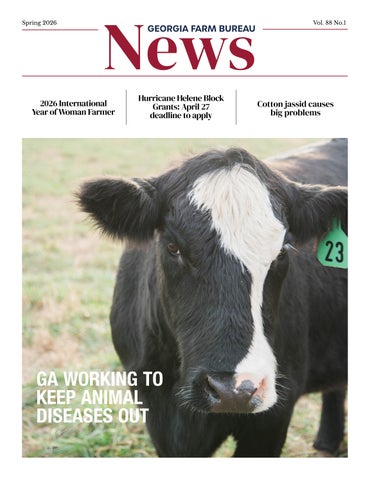
On The Cover: As New World Screwworm threatens to reestablish itself in the U.S. mainland for the first time since 1966, Georgia cattle producers are having to relearn the signs of infected cattle. The pest was eradicated from Georgia in 1959. Photo by GFB Staff
page 26
Young Farmers & Ranchers page 28
Women’s Leadership
Georgia Farm Bureau News
For information concerning advertising, contact Wendy McFarland at 334-6529080 or mcfarlandadvantage@gmail.com. For questions about your membership or member benefits, call 1-800-633-5432. For questions regarding editorial content call 478-474-0679, ext. 5334 or e-mail jawhittaker@gfb.org.
Spring 2026 3
View from the Field Tom McCall, GFB President By nature, I consider myself an optimist. I trust in God and always subscribe to what the Apostle Paul wrote in Acts 17. “The God who made the world and everything in it…gives to all mankind life and breath and everything.” I firmly believe that the good Lord didn’t leave anything out, and we have got to continually be searching for what is available for us. I realize starting a new year with positive thoughts and optimism is the right thing to do. But if I’m honest with you, sometimes it’s easier than others to stay positive. We don’t have to look too far to see others in agriculture struggling. All Georgia farmers are facing their own unique challenges. Most of us are shaking our heads at trade and tariff concerns, uncertainties in finding dependable help and labor, turmoil with the timber markets that remain slow-moving and riding the highs and lows of the cattle and livestock markets. Plus, there are severe challenges that row crop farmers currently face because of input costs, difficulties in the overseas markets and a fair farm bill that seems to elude lawmakers in Washington, D.C. When I’m driving down the road, thinking about all these trials, I always
come back to the question, how long can my friends and neighbors hold on in the face of this dire situation? My friend Dan Wright, president of Arkansas Farm Bureau, recently wrote in a column that hardship builds resilience. Dan said, “It [hardship] pushed us to innovate, to work smarter and to appreciate the blessings that come when the rain finally falls after a long dry spell.” I share Dan’s thoughts about hard times and think most farmers can attest that difficult times can and will make us stronger. You’re not alone in your battles. Georgia Farm Bureau is here with you. We’re fighting for you on Capitol Hill in D.C., and in Atlanta at the Georgia Capitol. It’s what we do. It’s who we are. Please remember that no matter what hardships come our way, Farm Bureau is unified in standing for you and standing with you. This spring we’re launching a campaign called Strong Farms. Strong Georgia. If you would like to help spread the message that having strong farms is a national security issue and that agriculture contributes greatly to our economy, visit www.gfb.ag/strongfarms. We appreciate you!
Tom McCall, GFB President
GFB President Tom McCall, center, GFB 10th Dist. Director Lamar Vickers, left, and GFB 1st Vice President Daniel Johnson review policy that AFBF voting delegates considered at the 107th AFBF Convention in January. Photo by Logan Thomas
4 Spring 2026
News GEORGIA FARM BUREAU
OFFICERS President TOM McCALL, Elbert Co. 1st Vice President & South Georgia Vice President DANIEL JOHNSON, Pierce Co. North Georgia Vice President BERNARD SIMS, Catoosa Co. Middle Georgia Vice President RALPH CALDWELL, Heard County General Counsel DUKE GROOVER Chief Financial Officer, Corp. Treasurer RACHEL MOSELY Chief Administrative Officer JEFFREY HARVEY Corporate Secretary & Senior Counsel JEANNA FENNELL DIRECTORS FIRST DISTRICT: Bill Bryan, Chattooga Co.; Wesley Hall, Forsyth Co. SECOND DISTRICT: Gilbert Barrett, Habersham Co.; Russ Moon, Madison Co. THIRD DISTRICT: Chad Carlton, Polk Co.; Brad Marks, Newton Co. FOURTH DISTRICT: Skeetter McCorkle, McDuffie Co.; Russ Wilburn, Barrow Co. FIFTH DISTRICT: Matt Bottoms, Pike Co.; Leighton Cooley, Crawford Co. SIXTH DISTRICT: James Malone, Laurens Co.; James Emory Tate, Jeff Davis Co. SEVENTH DISTRICT: Gary Bell, Evans Co.; Ben Boyd, Screven Co. EIGHTH DISTRICT: Scotty Raines, Turner Co.; Don Wood, Wilcox Co. NINTH DISTRICT: Lucius Adkins, Baker Co.; Paul Shirah, Mitchell Co. TENTH DISTRICT: David Lee, Bacon Co.; Lamar Vickers, Berrien Co. YOUNG FARMERS & RANCHERS CHAIR: Garrett Hurley, Chattooga Co. WOMEN’S LEADERSHIP CHAIR: Romy Strickland, Spalding Co. ADVERTISING POLICY All advertising accepted subject to publisher’s approval. Advertisers must assume liability for content of their advertising. Publisher maintains right to cancel advertising for non-payment or reader complaint about advertiser service or products. Publisher does not accept per-order, political or alcoholic beverage ads, nor does publisher prescreen or guarantee advertiser service or products. Publisher assumes no liability for products or services advertised in the Georgia Farm Bureau News. For advertising rates and information, contact Wendy McFarland at 334-652-9080 or mcfarlandadvantage@gmail.com. Georgia Farm Bureau News was established in 1937. Copyright 2026 by the Georgia Farm Bureau Federation. Printed by Panaprint, Macon, Georgia.
Georgia Farm Bureau News
Public Policy Update
Georgia Farmland Conservation Program accepting applications By Adam Belflower From the mountains to the coast, Georgia's landscapes boast some of the greatest views in the country making it attractive to tourists, newcomers and Georgians whose families have been here for generations. Our scenic state has nearly 10 million acres of farmland, so it is hard to find a sliver of the horizon that does not touch a family farm. Along with its natural beauty, Georgia continues to boast a strong economy, healthy business climate, and robust workforce. These factors combine to foster economic development and job growth putting our state ahead of many regions in the U.S. Vibrant cities, new businesses, and large subdivisions need space to grow and resources to draw on to provide for the people that come along with them. Often, open farmland can be the first victim of new development. Recognizing the need for a tool to balance the growth of our state with the preservation of our most fertile soils, in 2023, the Georgia General Assembly passed SB 220 to establish the Georgia Farmland Conservation Program. This program allows landowners who place their land into an agricultural conservation easement to receive payment from the Georgia Farmland Conservation Fund to help offset the cost of forgoing their development rights. Essentially, this tool pays landowners to protect their land from development if they will commit that land to production agriculture forever. The Georgia Farmland Advisory Council, chaired by Georgia Commissioner of Agriculture Tyler Harper, oversees the program. “Georgia farmland is under constant threat,” Harper said. “The Georgia Farmland Conservation Fund will help us fight back by protecting and preserving our state’s farmland into perpetuity. We are looking forward to taking the first round of applications in 2026 and helping Georgia farm families protect their most valuable asset - their land.” Georgia Farm Bureau is excited to support the work of the program and fortunate to have President Tom McCall serving as vice chairman of the council. “This program will go a long way in preserving family farms for future generations” McCall said. “As farmers, the land we farm is not ours, we are just borrowing it from our children and our grandchildren until they get to farm it one day. That is what this program is about. Ensuring that family farms are still around for our grandchildren.” The program is accepting applications for its first cycle until May 20. For more information about the program or to apply,
Georgia Farm Bureau News
visit https://gfb.ag/gafarmlandconservationprog. The Georgia Department of Agriculture administers the program, and the number of projects awarded will be based on availability of council funds. The Georgia Farmland Conservation Fund can receive funding from federal, state and local governments as well as private donations. Adam Belflower is Georgia Farm Bureau’s State Affairs Manager. He may be reached at acbelflower@gfb.org or 478-474-0679, ext. 5259.
The Georgia Farmland Conservation Program will help preserve farms for future farmers. Photo by Logan Thomas Spring 2026 5
Unwelcome Guests Georgia working to keep animal diseases out By Jay Stone A variety of animal diseases have been in the news in recent years. Georgia’s obvious goal is to keep them out. State Veterinarian Janemarie Hennebelle outlined what’s here and what could be on the way when she spoke to livestock producers at the Georgia Farm Bureau Convention in December. Hennebelle primarily focused on three diseases: Equine herpesvirus (EHV), New World Screwworm (NWS) and Highly Pathogenic Avian Influenza (HPAI). “These are all things on our radar that you’re having to track as producers,” Hennebelle said. As of late February, six Georgia commercial poultry flocks have been depopulated following positive tests for HPAI, since January 2025. The state has gone to great lengths to prevent outbreaks when possible and contain the ones that occur. Since the beginning of the current HPAI outbreak in 2022, approximately 184 million birds have been affected nationwide. “We’re not seeing a wave of cases move across the country,” Hennebelle said. “It is everywhere all at once.”
Biosecurity and proper disposal of dead birds and waste are key steps in controlling HPAI, Hennebelle said. While HPAI is an ongoing concern for Georgia’s highest earning commodity sector - broilers and eggs generated more than $7 billion in farm gate value in 2024 - the state’s dairy producers are also having to watch their herds after more than 1,088 cases at dairies in 19 states, mostly in Texas, the Midwest and western U.S., have had herds infected with HPAI since 2024. At press time in March, HPAI had not been detected in any Georgia dairy herds.
Sources for HPAI Information Georgia Poultry Lab HPAI reporting line https://www.gapoultrylab.org/avian-influenza-hotline/
DNR dead wild birds reporting line
Call 1-800-366-2661 or report at https://georgiawildlife.com/reportdead-birds
Protect Your Flock flyer https://gfb.ag/protectyourflock
Georgia Department of Ag FAQ https://gfb.ag/avianflufaq
USDA Defend Your Flock Resource Center https://gfb.ag/hpaiusdainfo
AI information for hunters https://gfb.ag/USDAAIinfohunters
New World Screwworm
Screwworm flies are about the size of a common housefly (or slightly larger). They have orange eyes, a metallic blue or green body, and three dark stripes along their backs. / USDA photo
6 Spring 2026
A threat that hasn’t been present in Georgia since 1959 is looming: New World Screwworm (NWS). Cattle, which are produced in every Georgia county, are the primary ag concern relating to NWS. “We haven’t seen it [since 1959]. We haven’t dealt with it,” Hennebelle said. “I would like to not see it in my career, but we’re going to be ready.” NWS has progressed through Central America, from Panama northward into Mexico, and has been found within 200 miles of the Mexico/U.S. border.
Georgia Farm Bureau News
Hennebelle emphasized in December that no cases had been identified in the United States, and she reiterated that message to Georgia Farm Bureau media in February. Still, as in dealing with any animal disease, vigilance is necessary. The NWS seeks and feeds on open animal flesh, including wounds and navels on newborn animals. It is a major threat to cattle herds, though dogs and swine are also highly susceptible. The fly has also been known to infest horses, sheep, goats and birds. “We can’t just assume it’s not going to show up,” Hennebelle said.
Key points about NWS: • The NWS fly must be present for the worms to exist. • NWS larvae, or maggots, feed on living tissue. • The fly mates once in its lifespan, which is 21-30 days. • One female fly can lay up to 2,800 eggs and may lay them in portions on multiple animals. • The eggs are laid on wound edges. After the maggots hatch, they crawl into the wound & burrow until they reach bone.
NWS infestation is a reportable condition. Producers should notify Georgia animal health officials and APHIS if they see signs their cattle are infested, which include cattle exhibiting irritated behavior or head shaking, smelling of decay and having maggots in wounds. Georgia Department of Agriculture scientists have assembled traps to catch the NWS fly for surveillance. The department has also conducted response exercises as part of its preparation, Hennebelle said. For more information about NWS, visit www.screwworm.gov.
Equine herpesvirus
Concerns about equine herpesvirus in the U.S. emerged after horses at a Women’s Professional Rodeo Association event in Waco, Texas, tested positive in November. Georgia horse owners at the event isolated their horses. There have been no known detections of EHV in Georgia animals related to the Waco rodeo. The closest related detection of EHV as of March 2 was in Louisiana. Hennebelle noted that EHV is found regularly in the U.S. “Horses have it, and they shed it all the time with no clinical signs,” she said. For information about reportable animal diseases visit https://agr.georgia.gov/reportable-animal-diseases.
• Once the maggots eat their way through tissue and mature, they fall off the animal. “There are certain points where we can intervene, and we can stop production of the fly,” Hennebelle said. The USDA has established a sterile fly dispersal facility in Edinburg, Texas, and is also building a sterile fly production facility in Edinburg. Part of the current challenge is that animal husbandry practices have changed over time. “What we hear from folks who do remember that time [before NWS was eradicated on the U.S. mainland] is they had a lot more workers. They spent a lot more time putting eyes on animals to try to find that straggler who might be infested, and they could treat it and control it at that time,” Hennebelle said. According to the USDA’s Animal and Plant Health Inspection Service (APHIS), adult screwworm flies are about the size of a common housefly or slightly larger. They have orange eyes, a metallic blue or green body, and three dark stripes along their backs.
Georgia Farm Bureau News
Georgia horse owners are on the lookout for equine herpesvirus after horses tested positive at a small rodeo event in Texas last fall./Photo by Jennifer Whittaker
Spring 2026 7
HURRICANE HELENE BLOCK GRANTS A P RI L 27 D E AD L IN E TO APPL Y From Georgia Department of Agriculture Georgia farmers, ranchers and foresters in eligible counties, who suffered losses of timber, infrastructure, poultry, beef or dairy cattle, milk loss, dairy feed loss, pecans, blueberries, citrus, nursery, plasticulture or bare ground practices due to Hurricane Helene may apply for assistance until midnight April 27. Visit www.farmrecovery.com for the application, eligibility requirements and more information. The USDA has allocated Georgia $531,236,000 million to provide relief for commodities and losses not covered under pre-existing USDA programs. According to the Georgia Department of Agriculture (GDA), which is administering the program, Georgia is covering more commodities and loss types than any other state. “While this relief will not make impacted producers 100% whole, it will go a long way to help farm families get back on their feet after the devastation of Hurricane Helene,” Georgia Agriculture Commissioner Tyler Harper said. According to GDA, timber payments will be based on prehurricane values of damaged timber stands; infrastructure losses will cover on-farm physical structures needed for ag production; poultry losses will be based on lost production cycles; beef and dairy cattle losses cover drops in conception rates; milk losses are for lower milk production; pecan, blueberry and citrus losses are for future production losses due to destroyed bushes and trees; nursery losses cover future production losses due to destruction of nursery crops. Compensation will be provided to reestablish plasticulture and bare-ground practices damaged by Helene. Minimum loss requirements for all above categories will apply.
Hurricane Helene block grants will cover vegetable crop loss on bareground or plasticulture./Photo by Jay Stone
8 Spring 2026
GDA SAYS THE BLOCK GRANT APPLICATION WILL ASK
1. Are you applying as an: Individual, General Partnership, Joint
Venture, Sole Proprietorship, Corporation, Limited Partnership, Limited Liability Company, Revocable/Living Trust, Irrevocable Trust, Estate, Charitable/Tax Exempt Organization? Entities must list member names and shares. 2. What is your name or name of your operation? 3. What is your Tax Identification Number? 4. What is your GATE Card Number? 5. What is the physical location of the farm(s)? 6. What is your USDA Farm Number? 7. Are you an owner or do you lease the property? 8. How can you prove your interest in the farm?
RECORDS THAT MAY SUPPORT A PRODUCER’S LOSS CLAIMS
Deeds; 2024 tax assessments; lease contracts; documentation verifying timber losses; acreage reports; crop insurance records; veterinarian records; poultry lost production cycles; tree, bush and/or nursery damage; damage to buildings; receipts for animal medications, records of milk production; animal numbers pre&post-Hurricane Helene; expense invoices; sales receipts; trucking receipts; repair bills; demolition bills; reconstruction invoices; photographs, aerial photos; replacement invoices; other documentation that helps substantiate losses. Approved applicants will receive payments after the block grant signup period ends.
Hurricane Helene block grants will cover timber damage. Photo by Jennifer Whittaker
Georgia Farm Bureau News
PRODUCERS IN THE FOLLOWING COUNTIES MAY APPLY FOR BLOCK GRANTS
Appling, Atkinson, Bacon, Baker, Baldwin, Ben Hill, Berrien, Bibb, Bleckley, Brantley, Brooks, Bryan, Bulloch, Burke, Camden, Candler, Charlton, Chatham, Chattahoochee, Clinch, Coffee, Colquitt, Columbia, Cook, Crisp, Decatur, Dodge, Dooly, Dougherty, Echols, Effingham, Elbert, Emanuel, Evans, Glascock, Glynn, Grady, Hancock, Houston, Irwin, Jeff Davis, Jefferson, Jenkins, Johnson, Jones, Lanier, Laurens, Lee, Liberty, Lincoln, Long, Lowndes, Marion, McDuffie, McIntosh, Miller, Mitchell, Montgomery, Oglethorpe, Pierce, Pulaski, Quitman, Rabun, Randolph, Richmond, Screven, Seminole, Stewart, Sumter, Taliaferro, Tattnall, Telfair, Terrell, Thomas, Tift, Toombs, Treutlen, Turner, Twiggs, Ware, Warren, Washington, Wayne, Webster, Wheeler, Wilcox, Wilkes, Wilkinson, and Worth.
Questions may be asked via phone at 404-6563630 or by email at hbg@agr.georgia.gov.
-Paid Advertisement
Hurricane Helene block grants will cover blueberry bush damage. Photo by Jennifer Whittaker
Georgia Farm Bureau News
Spring 2026 9
Hotel opens at Georgia National Fairgrounds & Agricenter
Those attending events at the Georgia National Fairgrounds now have the option of staying onsite at the new hotel. / Photo by Jennifer Whittaker
10 Spring 2026
Retreat Hotels & Resorts, a dual-branded Fairfield by Marriott and TownePlace Suites by Marriott, located on the Georgia National Fairgrounds & Agricenter (GNFA) in Perry, is now open. “This has been a long time coming,” said GNFA Executive Director Stephen Shimp. “We now have a world-class hotel that enhances our operations. The Retreat team has been on site, attentive to every detail. We thank them and the entire fairgrounds team for helping us reach this milestone.” The 129-room property brings two Marriott brands under one roof, offering 66 TownePlace Suites rooms and 63 Fairfield rooms. Designed with inspiration from the region’s agrarian heritage and equine culture, the hotel features a custom aesthetic inside and out, crafted to complement the fairgrounds and create a welcoming oasis for travelers. Hotel amenities include the 1824 Kitchen & Bar, complimentary breakfast, a pool and spa, a fitness center, guest laundry facilities, and electric vehicle charging stations. Visible from I-75, the hotel is connected to the Miller-Murphy-Howard Conference Center via an air-conditioned corridor. This is the first Marriott property in Perry and the only Marriott hotel within a 15-mile radius. The GNFA welcomes more than one million visitors annually, positioning the hotel to serve Georgians and international guests. Visit www.gfb.ag/gnfafairfieldinn or www.gfb.ag/gnfatowneplacesuites to make reservations at either hotel.
Georgia Farm Bureau News
Willis New GFB Insurance Co. General Manager Gary Willis began serving as the new general manager of the Georgia Farm Bureau Mutual Insurance Company (GFBMIC) on Jan. 3. Prior to his promotion he served as GFBMIC executive director of insurance operations. Willis assumed his new role after his predecessor, George Monk, retired Jan. 2. Willis has been with the GFBMIC for 26 years. “Gary brings a wealth of experience at Georgia Farm Bureau to this new appointment. In addition to his operations role, he’s served as former senior director of our claims department, as well as managing various other responsibilities in the claims department. Gary takes this important position at a critical juncture as we pursue our long-term strategic goals,” said Georgia Farm Bureau President Tom McCall. “Gary’s vast knowledge of the insurance industry and our products will continue to serve our members, volunteers, and staff well.” A native of Lowndes County, Willis graduated from Valdosta State University with a degree in business. He serves on the boards of the Georgia Underwriting Association, Georgia Insurers Insolvency Pool and the Georgia Association of Property and Casualty Insurance Companies. Willis lives in Warner Robins where he is a member of Southside Pleasant Hill Church. He is the proud father of sons Coleman and Brooks.
Gary Willis Photo by Logan Thomas
Print your certif icate today! www.gfb.org/join/case-ih
Georgia Farm Bureau News
Spring 2026 11
Georgia Farm Bureau Launches Leadership GFB
Congratulations to the inaugural Leadership GFB class! Front row, from left are: Liz Danforth, Lowndes County; Mattie Boyles, Thomas County; Sara Beth Studstill, Wilcox County; Angie Roberts, McDuffie County; and Garrett Hart, Hart County. Back row, from left are: Colt Calhoun, Miller County; Gregg Hendrix, Evans County; Luke Andrews, Lamar County; David Morgan, Pierce County; Toni Gaines, Bartow County; & Owen Paulk, Irwin County. Not pictured is Stephanie Branch, Rabun County./Photo by Heather King By Jennifer Whittaker Twelve Georgia Farm Bureau members from across the state are participating in the inaugural class of Leadership GFB. Leadership GFB kicked off its year of programs, designed to develop stronger advocates for agriculture, with a retreat Feb. 8-9 at the Georgia FFA/FCCLA Center near Covington. On Feb. 10, Leadership GFB members attended Georgia Farm Bureau Day at the Capitol. Anna Strickland, owner of Harper & Mary Strategies, facilitated the first retreat during which class members took personality assessments to learn their strengths and weaknesses and how they can use their strengths to be better leaders. “Our members asked for a program like this, especially those who have aged out of the Young Farmers & Ranchers Program, but Leadership GFB is open to all Farm Bureau members who are over 21 years old,” said GFB President Tom McCall. “This program is about ensuring that when ag policy debates heat up, Farm Bureau has leaders ready to speak up for Georgia farmers. We’ve got participants representing a variety of commodities and agribusinesses. We’re excited to watch the class members sharpen their speaking and leadership skills to be prepared to represent us.” GFB announced the program last October and took applications until Nov. 10. Applicants were interviewed in December and the class announced Feb. 5.
12 Spring 2026
Leadership GFB will equip rising and current GFB leaders with the tools needed to successfully advocate for agriculture, develop their leadership skills and embody the organization’s grassroots mission. Participants will attend sessions focused on leadership development, understanding the county, state and national structure of Farm Bureau and how the organization represents farmers on the state and federal level, and the importance of educating students and consumers about agriculture. The program will offer class members professional networking opportunities and expand their agricultural knowledge to develop a team of trained advocates. In April, Leadership GFB participants will travel to Washington, D.C., to visit the American Farm Bureau headquarters and receive advocacy training, visit members of Georgia’s U.S. Congressional delegation, federal agencies and a foreign embassy. In June, the class will take a deep dive into Georgia Farm Bureau programs and receive communications training. In August, the class will tour farms and agribusinesses in North Georgia. Class participants will tour farms and agribusinesses in South Georgia in October and visit Sunbelt Ag Expo. This year’s session of Leadership GFB will conclude at the GFB Convention in December. GFB Women’s Leadership Coordinator Heather King and GFB Young Farmers & Ranchers Coordinator Levi Davis are overseeing Leadership GFB.
Georgia Farm Bureau News
GFB Recognizes Volunteers
Georgia Farm Bureau (GFB) depends on its volunteer members and the activities they do in their communities to promote agriculture. Since 2022, GFB has recognized a volunteer of the year from each of its 10 districts at its annual convention. These volunteers go the extra mile to promote agriculture in their local communities.
Congratulations and thank you to the 2025 GFB District Volunteers of the Year! From left are: Andrea Sims, Catoosa Co., 1st Dist.; Della Fowler, Greene Co., 4th Dist.; Terry Cooley, Crawford Co., 5th Dist.; Alan Thiese, Bibb Co., 6th Dist.; Melanie Hendrix, Evans Co., 7th Dist.; Bristol Peterson, Wilcox Co., 8th Dist.; Sandra McDonald, Brooks Co., 9th Dist.; and Mary Folsom, Lanier Co.,10th Dist. Recipients not pictured are: Terry Chandler, Madison Co., 2nd Dist.; and Dr. Deetra Poindexter, Clayton Co., 3rd Dist. / Photo by Jennifer Whittaker
Introducing
The Next Evolution in Irrigation Management from Valley.
We’ve consolidated our best-in-class remote management applications into one powerful platform, providing you with seamless, intuitive irrigation management that’s more robust than ever.
Medders Irrigation 229-776-8595 | 1006 E Franklin St. | Sylvester, GA | meddersirrigation.com
TECHNOLOGY DA1741
Learn more at valleyirrigation.com/AgSense365
Georgia Farm Bureau News
Spring 2026 13
Female Farmers Being Celebrated Worldwide in 2026
U.N. stats show women produce about 50% of the world's food, but 60% of women worldwide can't own land. Photo by Logan Thomas By Jennifer Whittaker The International Year of the Woman Farmer (IYWF) 2026 didn’t happen overnight. Krysta Harden, Karla Theiman and Alexis Taylor, who worked together at the USDA over a decade ago, shared a stage at the American Farm Bureau Convention to discuss how, in 2024, the United Nations General Assembly came to designate the IYWF. “How powerful is it that because of impassioned people [worldwide] we have a global initiative to raise women up, to elevate their voices, their contributions and surface solutions to some of the challenges that still exist around the world for them in agriculture?” Taylor said. Having been mentored by Harden, Theiman and Taylor first discussed the possibility of the IYWF in 2016 as their time together at the USDA ended.
14 Spring 2026
All three ladies grew up on farms. “There have been women farmers, probably since we’ve been eating as people. They were called wives, sisters and daughters,” Harden said. “Now we’re starting to realize they deserve to be recognized for their contributions.” As USDA deputy secretary of agriculture from 2013-2016, Harden used her influence to advocate for the women she knew contributed to family farms, but in most cases, weren’t considered farmers. Under her guidance, the 2017 U.S. Agriculture Census language was changed so that up to four people on a farm could be listed as principal producers and principal operators. This allowed women, who had always been working on the farm, to be counted along with their husbands/dads, who had been listed because the men were deemed to have more primary roles. As Harden, Theiman and Taylor traveled overseas with the USDA, they met women who had to walk a mile to get water for their crops, who could not inherit land or get loans to improve their farms. Harden began talking about these issues in speeches around the world. Theiman said the response of female audiences was amazing, especially in Cote d’Ivoire, where it’s women who primarily pick cocoa in hard conditions but can’t own the land. As her last act of USDA chief of staff in December 2016, Theiman gave a speech to the UN Food & Agriculture Organization suggesting it designate an IYWF. When Taylor returned to the USDA in 2023 in a more senior position, she picked up the cause again. Taylor’s staff started by getting the White House, State Department and National Security Council to support the campaign. U.S. embassy representatives worldwide talked to their respective host governments. At the USDA, then Sec. Tom Vilsack down to career employees asked their counterparts in other countries to encourage their leaders to support the resolution. They asked Mongolia to cosponsor the IYWF resolution because it had succeeded in getting the U.N. to declare 2026 as the International Year of Rangeland and Pastoralists. Of the 193 U.N. countries, 123 cosponsored the resolution. The U.N. IYWF resolution focuses on four priorities: female access to land, access to capital, access to technology, education & training, and access to markets. All three ladies credit men they’ve worked with for supporting their careers and the IYWF. They praised AFBF’s longstanding women’s leadership program and use it as a model for similar programs in ag organizations they now lead. More of the story & photos are available at www.gfb.ag.iywf.
Georgia Farm Bureau News
Who's a good dog? Do you have a special farm dog that herds or guards your livestock? Maybe it keeps you company as you do your daily chores and provides stress relief. Maybe it has done something heroic. Georgia Farm Bureau is accepting entries for its 2026 Georgia Farm Dog Contest until 10:59 p.m. on May 1 or until 200 entries are accepted. Contest is open to GFB members ages 18 and over. The grand prize winner will receive a $500 gift card and be recognized at the Sunbelt Ag Expo. For contest rules and the criteria dogs will be judged by, visit https://gfb.ag/26farmdogcontest
Georgia Farm Bureau News
Spring 2026 15
By Jennifer Whittaker Peanuts took center stage Jan. 15 at the Annual Georgia Peanut Farm Show & Conference on the UGA Tifton Campus hosted by the Georgia Peanut Commission (GPC). About 100 exhibitors displayed products and services pertaining to growing or harvesting peanuts.
GPC District 1 - Willard Mims of Seminole Co.; District 2 – Jones Brothers Farms of Tift Co.; GPC District 3 – Carl Hood of Burke Co.; GPC District 4 – Keith Moore of Crisp Co. and GPC District 5 – Rodney Locke of Terrell Co.. The award recognizes farmers who exhibit a passion for peanuts, industry leadership and grow high quality peanuts.
ARNOLD NEW GPC EXECUTIVE DIRECTOR
The GPC presented awards to individuals and businesses for their service to the peanut industry in various categories. From left, GPC Chairman Donald Chase congratulates award recipients: front row, from left, Research & Education Award-Dr. Steve Brown, The Peanut Research Foundation; Media Award-Tommy Rountree, The Dawson News; Innovator Award-Frank Nolin, Nolin Steel; Hall of Fame-Don Koehler, GPC sr. executive director; back row, from left Distinguished Service Award-Dr. Scott Monfort, UGA Extension; Media AwardAmanda Huber, The Peanut Grower; Special Award-Andy Bell, 2021 National Peanut Board chairman; & Outstanding Ga. Young Peanut Farmer-Will Anderson of Bulloch County. / Photo by Jennifer Whittaker
Georgia Peanut Commission Executive Director Taylor Arnold, below, who hit the ground running with the GPC Jan. 1, introduced himself at the Georgia Peanut Show Lunch. “I’m very excited about joining the staff of the Georgia Peanut Commission. It’s very humbling to work for all of you and this industry,” Arnold said. “I’m joining an incredible staff that has been doing incredible things. I look forward to working for you, and I guarantee I will work hard for the industry.” Arnold, a native of Calhoun County, is replacing Don Koehler, who announced last year he would retire on July 31 of this year
Taylor Arnold
The UGA Peanut Team presented a peanut production seminar covering the 2025 peanut crop’s yield and quality and what to expect in 2026. Special emphasis was placed on how peanut growers can remain profitable this year while also controlling diseases, pests and weeds in their crops. A seed seminar was held, which highlighted peanut varieties available for 2026. The GPC and AgriSupply presented the Outstanding Georgia Peanut Farmers of the Year Awards to individuals representing each of the commission’s five districts. The 2026 recipients are:
16 Spring 2026
Georgia Farm Bureau News
after 40 years with the GPC. Koehler will serve as senior executive director until his retirement. Arnold has a background in ag leadership, farm program administration, and on-the-ground experience in production agriculture. From 2017 until December 2025, he was the USDA Farm Service Agency (FSA) Worth County executive director where he oversaw the implementation of key federal programs supporting farmers. Arnold holds a bachelor’s degree in accounting from Mercer University, where he served as president and vice president of his fraternity, director of judicial affairs for the Interfraternity Council and volunteered with IRS VITA and Relay for Life. In other GPC news, Macon County peanut grower Donald Chase, who represents the GPC Dist. 5, was elected by his fellow GPC directors at their January board meeting to chair the commission for 2026. GPC District 3 Director Joe Boddiford, of Screven County, is vice chairman. GPC 4th Dist. Director Rodney Dawson, of Pulaski Co., is GPC treasurer. Other directors are: GPC Dist. 1 Director Tim Burch, Baker Co. and GPC Dist. 2 Director Ross Kendrick, Turner Co. Georgia’s peanut production area is divided into five districts based on acreage distribution and geography with one board member representing each of the GPC’s districts.
Georgia Farm Bureau News
WASHINGTON, D.C. UPDATE Bob Redding, who represents the U.S. Peanut Federation in Washington, D.C., reminded growers of the peanut program provisions in the One Big Beautiful Bill Act effective for the 2026 crop. It increases the peanut reference price from $535 a ton to $635 a ton, increases the loan rate for peanuts from $355 per ton to $390 per ton, allows farmers to add new base acres of peanuts and other row crops, and allows a separate peanut payment limit bumped from $125,000 to $155,000 per entity and indexed to inflation in future years, Redding said. “In the long run we have the absolute best peanut program and safety net that we’ve had in 20 years or more,” Redding said. “I know the farm economy has been strained for several years now. We've been working on ways to try and make it better.” Redding said the bridge payments the USDA announced in early December will send $11 billion to row crop growers by the end of February. “The U.S. Peanut Federation signed a letter Jan. 14, along with other southern commodity ag groups and the American Farm Bureau Federation, asking Congress to take a look and see what they could do before we get into this problem again. We're hopeful we will see another economic assistance package roll out sometime between now and the planting of peanuts,” Redding said.
Spring 2026 17
Cotton Jassid • LITTLE B UGS, BI G P ROBLEM• By Jay Stone producing counties. By Sept. 23, they were present in 82 counties, including nearly all of the coastal plain and as far north as Gordon County.
E FFE C T ON Y I E LD
The cotton jassid, or two-spot leaf hopper. Photo by Justin Odom, UGA A new insect invaded Georgia cotton fields last year. The adult cotton jassid is about three millimeters long, approximately the size of the word “WE” on the heads side of a penny. As with most insects, its strength is in numbers. A female jassid lays between 14 and 60 eggs over her lifetime. A laid egg reaches adulthood in about two weeks. Once fully grown, an adult may live for 2-6 weeks. Jassid populations expand rapidly, and South Georgia cotton farmers can attest to the damage the insects can do. Cotton jassids have also been found in ornamental nurseries in South Georgia. “There’s still a lot of things that we need to better understand,” said UGA Extension Entomologist Dr. Phillip Roberts, who presented the latest available information on jassids at the 2026 Georgia Cotton Commission Annual Meeting, Jan. 29. “When you have something that turns a generation that quickly, you can see how populations can really go up. We all saw that across the state of Georgia [last year].”
The jassid, sometimes referred to as the two-spot cotton leafhopper, reproduces on at least 25 plant species including cotton, okra, sunflowers, eggplants and hibiscus. Okra appears to be their preferred host for reproduction. Roberts said the insects insert their eggs into plant tissue, making them difficult to see. In the course of feeding off the leaf, jassids introduce a toxin that researchers are still trying to identify. This toxin causes “hopperburn,” which is characterized by puckering of the leaf tissue and the leaves turning yellow, red and brown. The damaged leaves become less efficient at photosynthesis, resulting in reduced yield. On average, Georgia cotton producers who had jassids in 2025 saw crop yield losses of 2%, Roberts said. Early detection and pesticide application largely kept the insects under control. Left untreated, the potential damage and resulting yield loss is more extensive. Research trials where jassids were untreated showed a mean yield loss of 13% with a range of 1 to 46%.
SP REA D OF T HE P E S T The tiny insects are native to the Indian subcontinent. In 2023, they first appeared in the Western Hemisphere in Puerto Rico. They were detected in Florida in 2024. Jassids were first detected in Georgia on July 9, 2025, in Seminole County. By Aug. 19, they had been found in 48 counties across Georgia’s Coastal Plain, as far north as Burke County, including most of the state’s cotton-
18 Spring 2026
Cotton jassids on the underside of a cotton leaf. Photo courtesy of UGA
Georgia Farm Bureau News
SCO U T I NG JA SSID S
UGA’s pesticide trials showed the following products provided good control of jassids: Argyle, Bidrin, Carbine, Courier, Vertento, Sefina, Sivanto and Venom. Products that provided moderate control were Admire Pro, Assail, bifen+imid, Centric, Orthene and Transform. Roberts said it will likely take 10 years or more before jassidresistant cotton varieties are available in the U.S. In the interim, it’s important farmers vary the pesticides they use to prevent jassids developing immunity to products.
Once jassids are detected, if farmers delay spraying 5-7 days it will be too late to prevent the insects from damaging cotton plants. Maintaining potash levels appears to be important to minimize plant injury symptoms, though research has yet to show why, Roberts said. UGA research also showed the bugs’ affinity for field edges. Plants on the sides of fields, which Roberts calls “indicator plants,” tend to show jassid damage first. It’s important for growers to keep an eye on those plants. Last year, UGA researchers noticed jassids showing up W HAT’ S N E XT? on yellow sticky cards placed in fields to assess white Roberts said the UGA Cotton Team is researching a number of fly populations so they began using the cards to gauge questions including: the jassid populations, as well. The highest concentration • Where are the jassids now? of jassids appeared on the fourth leaf stem below the top • How do cold temperatures affect winter survival? terminal bud, Roberts said, giving an indication of where to look. • When will they infest the ’26 cotton crop? If earlier than in ’25, “Going into 2026, our threshold is going to be an average of one will the population thresholds for applying pesticides change? jassid per leaf when sampling at least 25 leaves per field,” Roberts • How long to protect cotton? • What is the toxin the jassids introduce during feeding? said. If more than that are found, it’s time to make the first pesticide • Are any cotton varieties jassid-resistant? application.
V A R Y PES T I C ID E S T O P R E VE N T IMM U NI T Y What makes jassids particularly troublesome is they quickly build pesticide immunity, a trait often present in rapidly reproducing insect species. Roberts said they are already immune to every pesticide available in their native India, where cotton varieties have been bred to resist jassids.
C OT T ON JASSI D'S 20 25 I N VASI ON T I M E LI N E July
Aug.
July 9, 2025 Detected in Seminole County, Ga.
August 7, 2025 Detected in 34 Georgia counties.
Sept.
August 19, 2025 Detected in 48 Georgia counties.
Oct.
September 23, 2025 Detected in 82 Georgia counties.
Source: UGA CAES
Cotton jassids on the heads side of a penny. Photo courtesy of UGA
Georgia Farm Bureau News
Spring 2026 19
AG FORECAST 2026 TO BE CHALLENGING By Jennifer Whittaker
From left, UGA CAES Dean & Director Dr. Nick Place moderated a panel discussion made up of Colquitt County vegetable producer Kent Hamilton, Ga. Sen. Russ Goodman, and Georgia FSA Director Duncan Johnson. The panelists discussed ag topics such as labor issues, crop production costs & USDA farm programs. Hamilton was the 2025 Sunbelt Ag Expo Southeastern Farmer of the Year. Goodman chairs the Georgia Senate Agriculture & Consumer Affairs Committee and grows blueberries and timber. / Photo by Jennifer Whittaker The UGA College of Agricultural & Environmental Sciences (CAES) held its 2026 Ag Forecast in Tifton Jan. 23. The annual event included economic analysis and projections from UGA CAES economists.
ECONOMIC OUTLOOK FOR GA CROPS
Amanda Smith, a senior public service associate with the UGA CAES, shared insights about the coming year. The 2026 outlook for cotton remains challenging, Smith said, due to Brazil’s rising production, China buying less U.S. cotton, and global stocks exceeding demand. Growers will need to carefully manage expenses with cotton futures in the high 50-cents to low-60 cents/pound. U.S. and Georgia peanut growers are expected to plant high acreage this year as they did in 2025. Georgia forward contracts are expected to range from $400-$425/ton at most, Smith said. Georgia farmers are expected to plant more acres of corn in 2026, while soybean and wheat acres are expected to be similar to 2025. Projected prices for corn, soybeans and wheat are near or below the break-even cost of production, so tight margins are expected to continue this year for these crops. Blueberries are expected to again lead the Georgia fruit and tree nut sector in 2026. Overall, consumer and grower price indexes should remain strong this year.
20 Spring 2026
Total acres of harvested vegetables are expected to decrease in 2026, but the value of production will continue to grow because of yield increases due to good production practices. The consumer price index for vegetables is expected to remain strong this year. Consumers are expected to eat more fresh vegetables this year, up from last year.
OVERALL ECONOMIC OUTLOOK
Dr. Ford Ramsey, UGA CAES associate professor, said the overall 2026 U.S. economic forecast calls for the second consecutive year of slow economic growth due to trade wars and restrictive immigration policies. The U.S. economy is expected to grow by about 2% this year. Inflation rates will likely fall toward the Federal Reserve’s target inflation rate of 2%. Changes to farm bill programs in the 2025 One Big Beautiful Bill Act, disaster assistance and economic assistance payments will be important to keeping farmers afloat, Ramsey said, as many commodities will continue to experience cost-price squeeze. Livestock prices will also help. Interest and H-2A labor rates, fuel and electricity farm expenses are expected to decrease as fertilizer costs increase in 2026. Visit https://gfb.ag/25caesagimpactreport to read the latest Georgia Ag Impact Report published by UGA CAES.
Georgia Farm Bureau News
GELBER, GEORGIA FARMER OF THE YEAR As the 2026 Georgia Farmer of the Year, Macon County dairy producer Pete Gelber will vie to be named the Sunbelt Ag Expo Southeastern Farmer of the Year. Gelber, his wife, Dr. Elisabeth Reid, his son, Richard, and business partner, Andre Coen, co-own and operate Barrington dairy, home to more than 15,000 cows. The dairy's Holsteins are milked three times a day in its milking parlors: a 120-stall rotary, a double-42 parallel and a double-35 parallel. Gelber and his partners employ about 200 people. Gelber was selected for the dairy’s sustainability practices, his high standard for herd health and the emphasis he places on taking care of his employees, Stewart said. UGA Extension coordinates the selection of the annual award. County Extension agents nominate outstanding farmers. Macon County Extension Coordinator and Agriculture & Natural Resource Agent Madison Warbington Luke nominated Gelber. “Mr. Pete is a pioneer in his field. He's built a state-of-the-art facility where he focuses on sustainability while maximizing yields and reducing inputs,” Luke said. “Mr. Pete takes care of the people that work for him and his community. He's a leader in the dairy industry and his community.” Gelber, a native of the Bronx, New York City, became interested in dairy farming as a kid when his parents took their family each summer to their cabin in upstate New York near a dairy. Gelber worked at the farm and later earned a degree in animal science and agribusiness. After college, Gelber worked for Ron St. John at his western New York dairy. When St. John relocated his dairy to Florida, Gelber worked as herdsman at that farm. “Ron St. John turned into my mentor, my best friend, my partner, then my banker. He gave me a lot of opportunities, and I took it with both hands,” Gelber said. “We bought these bankrupt dairies called Masstock Dairy in Macon County back around 2000. For a number of years, we tried to run it from Florida and failed miserably. In 2007 I moved up here to run it and bought my partners out in 2013. Besides being proud of having happy cows with super milk production and super milk quality, I’m happy to have happy employees. We have them participate in our profitability. We’re still a family farm. We just have 200 families.”
Georgia Farm Bureau News
According to UGA CAES, Georgia is the only Southeastern state increasing its milk production. In the last 15 years, Georgia has increased its milk production 20%.
UGA Assistant Dean for Extension Lawton Stewart, left, presented Pete Gelber the award Jan. 23 at the UGA Ag Forecast. Photo by Jennifer Whittaker
Spring 2026 21
22 Spring 2026
Georgia Farm Bureau News
Georgia Farm Bureau News
Spring 2026 23
LEONHARD JOINS GFB AS EDUCATIONAL PROGRAMS MANAGER Georgia Farm Bureau (GFB) is pleased to announce Caroline Waldrep Leonhard is its new educational programs manager. Leonhard has been on the job since Dec. 1. Leonhard worked as the events and outreach coordinator with the Georgia Cattlemen’s Association for the last several years. She previously worked as office manager with Bryan County Farm Bureau and as an agriculture teacher at Portal High School in Bulloch County. She graduated from the University of Georgia with a bachelor’s degree in agricultural education and earned her master’s degree in education from Auburn University. “We are looking forward to all Caroline will bring to our educational programs,” GFB President Tom McCall said. “Her work experience is excellent but her ‘growing up’ surrounded by Farm Bureau people is an even better plus.” Leonhard has been active with GFB as a member of Monroe County Farm Bureau and has been involved in the Young Farmers and Ranchers Program. She grew up on a cow/calf and hay farm in Monroe County, of which she is the fifth generation to farm. She was an active FFA member. Leonhard's father, Bill Waldrep, is an active GFB member and current MCFB president. Her late grandfather, Billy Waldrep, was an active MCFB and GFB member. As educational programs manager, Leonhard will oversee GFB’s Ag in the Classroom program, through which GFB works to increase agricultural literacy among children and consumers. It provides tools to teachers for more effective teaching about agriculture and to assist Georgia educators in implementing the instruction of agriculture-related concepts in the classroom. She is also managing the Georgia Ag Experience Mobile Classroom. Caroline Leonhard Caroline lives in Macon with her husband, Timmy Leonhard.
24 Spring 2026
Georgia Farm Bureau News
Ag in the Classroom Update
GFB accepting nominations for AITC Teacher Award By Caroline Waldrep Leonhard Visit www.gfb.ag/westhafer25aitcteacher to learn more about Westhafer’s innovative approach to agricultural education. “In my classroom, agriculture isn’t a subject we occasionally visit – it’s the heartbeat of our learning community. At our STEAMcertified school, students engage in project-based learning with a year-long focus in the learning garden,” Westhafer said. “Our essential question is ‘How can we maintain a seasonal garden to provide food for our school and community?’ That question drives inquiry, builds responsibility and creates meaningful connections to science, literacy, math and social studies. The larger goal is to help my students understand how agriculture sustains us and how the choices we make about food impact our health and community. My students no longer see agriculture as something that happens ‘out there,’ but as a vital part of their lives and community.” Westhafer teaches science, English/language arts, math and social studies to her first graders. She received the GFB AITC Teacher of the Year award for incorporating agriculture topics into her class curriculum. She invites Jackson County Farm Bureau volunteers From right, Georgia Farm Bureau President Tom McCall presents the to read accurate ag books and do other activities with her classes 2025 Georgia Farm Bureau Agriculture in the Classroom Teacher of the Year Award to Dr. Stephanie Westhafer as representatives of the throughout the year. award sponsors, Georgia EMC Public Relations Representative Andy Paul and Georgia Foundation for Agriculture Executive Director Lily May 15 is deadline to submit applications. Baucom offer congratulations. Westhafer accepted the award at the • The winner receives $500 & an expense-paid trip to the 2027 National Ag in the Classroom Conference. 88th Annual GFB Convention in December. Photo by Jennifer Whittaker • High school/middle school/elementary school ag teachers are not eligible for this award. The Georgia Farm Bureau (GFB) Teacher of the Year Award • Teacher should have a close partnership with their recognizes educators who excel at incorporating agriculture local Farm Bureau. into their lessons while meeting Georgia curriculum standards. Agricultural concepts provide valuable connections to science, • If interested in applying, contact your local Farm Bureau office. Visit www.gfb.ag/contact to find your county technology, engineering, math (STEM); science, technology, Farm Bureau’s contact information. engineering, art, math (STEAM); and science, technology, • Applications must be submitted online. emotional learning, art, and math (STREAM). Visit www.gfb.ag/teacheraward for more information & This award highlights the importance of teaching students how to apply. agriculture impacts their daily lives. County Farm Bureaus are invited to nominate teachers who do an exceptional job in bringing 2026 National AITC Conference agriculture to life. GFB will recognize one of these teachers as the • June 22-25/ Providence, Rhode Island 2026 Georgia Ag in the Classroom Teacher of the Year. • Visit www.agclassroom.org/conference for more Stephanie Westhafer, the 2025 award winner, received $500 information & to register. sponsored by Georgia EMC and $2,000 to attend the 2026 National Ag in the Classroom Conference, courtesy of the Georgia Farm Bureau Educational Programs Manager Caroline Georgia Foundation for Agriculture and Georgia Farm Bureau. Waldrep Leonhard may be reached at cwleonhard@gfb.org. Visit www. She is a first-grade teacher at West Jackson Elementary School in gfb.ag/AITC for the latest AITC news & for resources to teach children Braselton, where she has taught since 2021. She previously taught how their food is grown. Pre-K for 10 years.
Georgia Farm Bureau News
Spring 2026 25
Young Farmer & Ranchers Update
Apply for a YF&R Award; Enter photo contest By Levi Davis
Members of the 2026 YF&R Committee are from left: Stuart Gregg, Pike Co., GFB Dist. 5; Joe Twiner, Gwinnett Co., GFB Dist. 3; Taylor & Gabe Outlaw, Wilkinson Co., GFB Dist. 6; Paige & Chris Little, White Co., GFB Dist. 2; Vice Chairs Emily & Tucker West, Taliaferro Co., GFB Dist. 4; Committee Chairs Sarah & Garrett Hurley, Chattooga Co., GFB Dist. 1; Caitlyn & Christian Crispell, Tattnall Co., GFB Dist. 7; Bristol & Bradley Peterson, Wilcox Co., GFB Dist. 8; Bailey & Blake Segars, Cook Co., GFB Dist. 10; Chelsea & JT Sumner, Thomas Co., GFB Dist. 9. / Photo by Jay Stone This will be an exciting year for participants in Georgia Farm Bureau’s Young Farmers and Ranchers (YF&R) Program! YF&R activities are open to all Farm Bureau members ages 18-35. The YF&R program is designed for those who work in any part of agriculture – farming, ranching, banking, ag education, ag sales, marketing, etc. College students pursuing careers in agriculture are also welcome. GFB will hold its 2026 YF&R Summer Leadership Conference July 15-18 on Jekyll Island. This event is a great way for young agriculturalists to network, sharpen their leadership skills, hear updates on current ag issues and learn about Farm Bureau. The conference is kid friendly. A cornerstone of GFB’s YF&R program is its awards - the GFB Achievement Award in Agriculture; GFB Excellence in Agriculture Award and GFB Discussion Meet. GFB encourages existing and potential YF&R members to apply for the awards. The Achievement Award recognizes YF&R members for their farming operations and leadership activities. Feb. 28 was the deadline to apply for the achievement award. The Excellence in Agriculture Award honors YF&R members for their ag advocacy and ag leadership activities. Applicants for this award earn most of their income off the farm. The Discussion Meet simulates a meeting where participants talk about current ag issues and explore possible solutions in groups of four to six contestants.
26 Spring 2026
The Achievement & Excellence in Ag Award winners will be announced at the summer conference. The Discussion Meet will be held at the July conference and a winner named. All state winners will receive prizes and will represent GFB at the American Farm Bureau Convention January 2027 in Charlotte, North Carolina. Registration information for the conference, Excellence in Ag Award and YF&R Photo Contest will be released in the spring. Visit www.gfb.ag/yfr or ask your county Farm Bureau office for more information about the awards, photo contest and registering for the conference.
YF&R Deadlines April 30
Excellence in Ag Award entry due
June 1
YF&R Discussion Meet entry due
YF&R Leadership Conference registration due June 12
YF&R Photo Contest entries due
Georgia Farm Bureau Young Farmers and Ranchers Coordinator Levi Davis may be reached at ledavis@gfb.org or 478-474-0679, ext. 5233 for more information. Contact your county Farm Bureau if you’d like to get involved with your local YF&R program.
Georgia Farm Bureau News
GFB YF&R Delegation attends American Farm Bureau Federation Convention By Jay Stone
Georgia Farm Bureau’s Walt Pridgen, Haley Scruggs and Kylie Sizemore represented GFB in YF&R contests at the 107th American Farm Bureau Federation (AFBF) Convention in January in Anaheim, California. Sizemore of Franklin County competed in the first two rounds of the AFBF Discussion Meet on Jan. 10, advancing to the Sweet 16 round of the event held Jan. 11. Contestants in this event participate in group discussions that simulate committee meetings. Participants are evaluated on their ability to exchange ideas and information on predetermined ag topics. During her three rounds of competition, Sizemore discussed how Farm Bureau can make farm families aware of resources they can use to smoothly pass their operations to the next generation; how farmers care for the natural resources on their farms; and how Farm Bureau can use digital engagement to connect its members with elected officials. Sizemore works for Cobb-Vantress as a hatchery operations associate. She has bachelor’s and master’s degrees in poultry science from UGA and is pursuing a PhD from Auburn University in poultry science. She won the 2019 AFBF Collegiate YF&R Discussion Meet. Scruggs, from Bibb County, gave her presentation in the Excellence in Agriculture competition on Jan. 10. This award honors active Farm Bureau members, who promote agriculture in their community but earn most of their income off the farm.
Representing GFB’s YF&R program at the AFBF Convention were, front row, from left, GFB YF&R Coordinator Levi Davis, Seth Scruggs, Willie Sizemore, GFB YF&R Chairman Garrett Hurley; standing from left, Bristol & Bradley Peterson, Haley Scruggs, Sarah Hurley, Walt Pridgen, Kylie Sizemore and Cleve Jackson, who is serving as vice chair of the 2026 AFBF YF&R Committee. Photo by AFBF
Georgia Farm Bureau News
In addition to being a nurse practitioner, Scruggs helps run her family’s farm, which produces pecans, hay and Christmas trees. She regularly welcomes the public to the farm to educate consumers about agriculture. Scruggs, president of Bibb County Farm Bureau, has served on the BCFB Board of Directors since 2018 and served as vice president for three years. She and her husband, Seth, served on the GFB YF&R Committee in 2024-2025. Pridgen, of Coffee County, raises broilers and cattle, and grows hay and corn for livestock. He competed for the Achievement Award, which recognizes farmers and ranchers who earn most of their income by farming. Pridgen has a bachelor’s degree in diversified agriculture from Abraham Baldwin Agricultural College. A fifthgeneration farmer, Pridgen chaired the 2022 GFB YF&R Committee. During the AFBF convention, Cleve Jackson of Floyd County was elected vice chairman of the AFBF YF&R Committee by his fellow committee members. He will serve as vice chair until March 2027 when his second year on the committee ends. Jackson and his wife, Emilia, raise cattle and hay with his family, and grow fresh-cut flowers sold directly to customers. Cleve also works for Elanco Animal Health as a senior account executive in the poultry business unit.
Women's Leadership Update
Celebrating Year of the Woman Farmer By Heather King
Members of the 2026 Georgia Farm Bureau Women’s Leadership Committee are from left: Chairwoman Romy Strickland, Spalding Co., GFB Dist. 5; Vice Chairwoman Anna Strickland, Madison Co., GFB Dist. 2; Emilia Jackson, Floyd Co., GFB Dist.1; Carol McQueen, Henry Co., GFB Dist. 3; Della Fowler, Greene Co., GFB Dist. 4; Jane Wooten, Jeff Davis Co., GFB Dist. 6; Whitney Sheppard, Screven Co., GFB Dist. 7; Alicia Berry, Sumter Co., GFB Dist. 8; Michaela White, Thomas Co., GFB Dist. 9; & Melissa Williams, Berrien Co., GFB Dist. 10. /Photo by Jennifer Whittaker The United Nations has declared 2026 the International Year of the Woman Farmer. Learn how a coalition of U.S. female ag leaders asked for the designation on page 14. The year will spotlight the essential roles women play across agrifood systems, which often go unrecognized, from production to trade. Women farmers are central to food security, nutrition and economic resilience. The GFB Women’s Leadership Committee (WLC) will celebrate the year at its Women in Ag Summit in March, at its district meetings and while advocating for agriculture through the year. The GFB WLC will host its 4th Annual Women in Ag Summit in Savannah on March 19-20. The summit will provide personal and professional development to women in Georgia agriculture. Attendees will participate in a service project and hear from keynote speaker Courtenay DeHoff. GFB’s WLC consists of a great group of enthusiastic district chairwomen who are looking forward to promoting agriculture and helping ladies in their districts do the same. Planning is
underway for this year’s district Women’s Leadership meetings that will begin this spring and run throughout the year. These events usually include a farm tour, an educational lesson or informative speaker, a hands-on activity, and the chance to meet other female Farm Bureau members. Watch for announcements about the 2026 meetings from your county offices and on the Friends of Georgia Farm Bureau Facebook group. Women’s Leadership activities can range from teaching an Ag in the Classroom lesson at your local school or library, hosting a legislative event, or manning an exhibit at a local festival to promote agriculture to consumers. Please reach out to your county Farm Bureau if you’re interested in getting involved. Georgia Farm Bureau Women’s Leadership Program Coordinator Heather King may be reached at hcking@gfb.org or 478-474-0679, ext. 5232. Contact your county Farm Bureau if you’d like to volunteer with your local Women’s Leadership Committee.
Female farmers: share your thoughts! The American Farm Bureau WLC is conducting a National Women in Agriculture Study to capture women’s voices across the U.S. involved with agriculture and forestry. The study aims to gain a better understanding of the experiences and future needs of women who farm, ranch, or work in ag education, advocacy, agribusiness and related ag/ forestry fields. Please take the survey by March 31 at www.gfb.ag/women-in-ag-study.
28 Spring 2026
Georgia Farm Bureau News
HARDY ELECTED TO AFBF WLC COMMITTEE By Jennifer Whittaker
Photo by Logan Thomas
JULIE HARDY Julie Hardy of Thomas County is serving a two-year term on the American Farm Bureau Federation (AFBF) Women’s Leadership Committee (WLC). She was elected Jan. 10 during the 107th AFBF Convention. The AFBF WLC provides women with opportunities for growth and development to sharpen their advocacy skills to inspire change. “As a farmer, I’m so excited to get to represent the Southeast on this national committee. I’m grateful to be a part of this organization that is so much like a family and works so hard to represent farmers,” Hardy said. “When I was giving my campaign speech, and I looked out in the audience and saw so many Georgia faces there to support me, it meant so much to me.” Hardy ran against two candidates from North Carolina and Virginia to be elected as the AFBF WLC Southern Region representative. The AFBF Southern Region includes Alabama, Arkansas, Florida, Georgia, Kentucky, Louisiana, Mississippi, North Carolina, Oklahoma, South Carolina, Tennessee and Virginia. While asking AFBF members from the organization's Southern Region to elect her to represent them on the AFBF WLC, Hardy shared her story as a female farmer and why she's passionate about encouraging other women to advocate for their family farms. GFB WLC 8th District Chairwoman Alicia Berry nominated Hardy for the position.
Georgia Farm Bureau News
“I know Julie’s history and I know her passion for agriculture,” Berry said. “I know she’s going to give 100% to represent Georgia and the other Southeastern states on the AFBF committee.” Hardy served on the GFB WLC Committee from December 2022 to December 2025 representing GFB’s 9th District. She chaired the GFB WLC Committee in 2025 and is now an ex officio member of the GFB committee. The GFB WLC committee works to teach children and consumers how farmers grow their food and increase their understanding of the importance of agriculture. The committee also equips women across the state to engage with their local, state and national elected officials to discuss how legislation affects farms and to take on leadership roles in their communities. Hardy farms in partnership with her father, Bobby Hurst, and her brother, Bert Hurst. The family grows cotton, peanuts, soybeans and wheat and runs a small herd of beef cattle. She and her husband, Robby Hardy, have one daughter, Kate. Hardy is an active member of the Thomas County Farm Bureau and is the TCFB vice president. She is a 2023 graduate of the AFBF Communications Boot Camp. She is a member of the 2025-2026 UGA Advancing Georgia Leaders in Agriculture & Forestry program. Hardy is the first Georgian on the AFBF WLC since 2001, when Peggy Smith of Turner County served a one-year term on the AFBF committee that year representing the AFBF Southern Region. In 1984, Bertie Mae McDonald, of Washington County, became the first GFB member to serve on the AFBF committee. She served on the committee for six years.
GFB's delegation to the AFBF Women’s Annual Meeting, from left: Henrietta Duvall, Doris Malone, Kathy Sanders, Alicia Berry, Carol McQueen, Della Fowler, Julie Hardy, Jane Wooten, Romy Strickland, Michaela White, Laney Kirk, Katie Malone, Betty Sue Tate & GFB Women's Leadership Coordinator Heather King./Photo by Jennifer Whittaker
Spring 2026 29
30 Spring 2026
2026 FARM PASSPORT
TWO WAYS TO START YOUR FARM ADVENTURE!
FARM PASSPORT 1 •Farm Passports are free •Support our state’s farmers •Earn prizes for your travels
SCAN HERE FOR INFO
2 INTERACTIVE
SCAVENGER HUNT!
•Live leader board •Fun missions •Explore and discover farms in a way you never have before!
SCAN HERE TO START!
Download the Goosechase App on your smartphone. Once in the app, choose to play as a guest or create an account. Next, search for the name of the Experience (GFB Farm Passport) or enter our unique join code: 49PF1P. And use the password: Georgia To earn points, complete missions from the list. Mission types include photo submissions, text replies and checking in at specific locations. Have fun completing missions that will enhance your Farm Passport travels. The app has a live leaderboard so you can see where you rank and enjoy seeing each other’s progress. Special prizes will be given out at the end of each season’s round. Optional: You can compete as a solo traveler or as a team (max 4 people.) If team, one person will create a team name and be assigned a team password that they can then share with their teammates to join on their phones.
*You must be present at the farm to get your Farm Passport stamped.
Georgia Farm Bureau News
Spring 2026 31
Reliable Protection. Real Impact.
Insurance you can feel good about You need insurance. Why not choose a company that supports your family’s future through Georgia agriculture for a safe and abundant food supply?
gfbinsurance.com
AUTO•HOME•LIFE•BANK