Contents
Volume 27 • Number 2
Cover Story
08
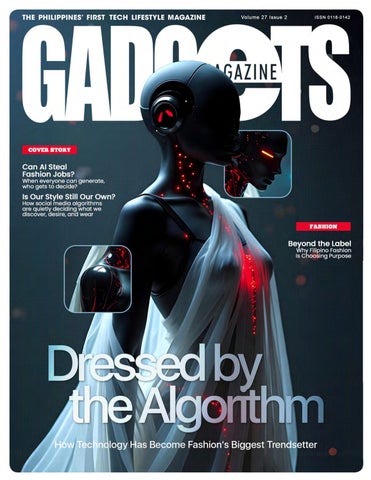
Dressed by the Algorithm Can AI Steal Fashion Jobs? Is Our Style Still Our Own?
8 10 16
Fashion Beyond the Label: Why Filipino Fashion is Choosing Purpose
20
Parade
32
28
44 Mobility
Mitsubishi Outlander PHEV Plugged In
48
The BYD Seal 5 DM-i Goes Further
54
Meet the BYD Atto 2
58
Hilux, Recharged
62
A New Sportage Era
66
Is the MPV The New Family Car?
70
Suzuki Carry Expands Its Utility
74
Yamaha Keeps Winning
76
48 4
Epson SureColor V4000
24
Hamilton Beach Air Grill
26
HONOR Robot Phone
28
Huawei Pura 90s Series
30
Logitech G3 Series
32
nubia LiveBuds 3 Pro
34
nubia LiveFlip
35
nubia 90W Three-Port GaN Quick Charger
36
Puma Suede
37
ROG Gjallat
38
Samsung Galaxy A27 5G
40
soundcore Rave 3S
42
TCL Nxtpaper 60 Ultra
44
TCL Nxtpaper 70 Pro
46
TCL K80 Power 4G
47
Contents
Volume 27 • Number 2
Gaming Beasts of Reincarnation
78
Entertainment SB19’s Rise from RADAR to Lollapalooza
80
FinTech Make Big Payments Mini with Maya Mini Payments at 0% Interest
82
When Your iPhone Becomes Your Wallet
84
78
Employment Filipino Workers Lead in AI Reinvention
88
The Tech Skills Employers Still Want
90
Enterprise Turning Logistics Into Business Intelligence
92
Grab, ITC Push MSME Digitalization
94
88
Education Teaching Beyond the Textbook
96
From Content Creation to Digital Livelihoods
98
Cybersecurity United Against Digital Scams
100
96
Government Pag-IBIG Housing Assets Top PHP1-Trillion
102
Active Lifestyle Growing Philippine Junior Golf Together
104
More Coaches, Stronger Pickleball
106
Relic The Pocket Watch
108
100 6
Cover Story
Volume 27 No. 2
8
DRESSED BY THE ALGORITHM HOW TECHNOLOGY HAS BECOME FASHION’S BIGGEST TRENDSETTER Words by Maribelle Alba
T
echnology hasn’t just changed how we shop for clothes. It is changing how fashion is created, discovered, shared, and ultimately worn.
Type a prompt and AI hands you a design concept. Scroll your feed and an algorithm has already decided which looks you’ll see today. A creator posts one outfit, and a few taps later, that outfit is a brand with its own storefront and a following ready to buy in. Fashion has always reflected the culture and technology of its time, but today, the connection between the two has become almost impossible to separate. Let’s take a look beyond the clothes to the digital systems increasingly shaping them. What does AI mean for the people who make fashion, not just wearing it? How much of what feels like “personal style” is really just an algorithm’s output? And who gets to create trends, build brands, and reach an audience? Because the next big fashion moment may not begin on a runway at all. It could begin with a prompt, a post, or a reel that the algorithm decided you needed to see.
9
Volume 27 No. 2
Cover Story
Words by Aljhelyn Piador
CAN AI STEAL FASHION JOBS? When everyone can generate, who gets to decide?
F
ashion has always been about taste. Not simply knowing what looks good, but knowing why it works. Knowing when a color combination feels elegant and when it feels forced and just plain loud. Knowing when to follow a trend, and when to ignore it entirely. AI can generate a thousand cerulean sweater designs. It still doesn’t know why Miranda Priestly would hate 999 of them. Artificial intelligence can produce an astonishing number of possibilities. Give it a prompt, Volume 27 No. 2
and it can generate a collection. Give it an image, and it can restyle it. Feed it enough consumer data, and it can identify patterns, forecast demand, and suggest what people might want to wear next. Generative tools can visualize ideas in seconds that might once have taken hours to sketch, photograph, retouch, or prototype. But fashion has never simply been about producing more of what people already like. Some of its most memorable moments came from people willing to reject the obvious, making something strange, uncomfortable, excessive, minimal,
10
rebellious, or simply different enough to change what everyone else considered beautiful. Across the industry, AI is moving from the sidelines into the workflow. It is helping designers develop concepts, brands create campaign imagery, retailers anticipate demand, and shoppers discover what to wear. Yet AI is not necessarily walking into a fashion house and taking someone’s job whole. More often, it is taking pieces of it, and when enough pieces disappear, the job itself begins to look different.
The Designer For generations, fashion design has been associated with the physical act of creation. Designers sketch silhouettes, select fabrics, develop patterns, experiment with proportions, and eventually turn an idea into something wearable. Artificial intelligence changes what happens before any of that reaches the cutting table. Generative platforms such as Midjourney and OpenAI’s image-generation tools can visualize concepts almost instantly, while fashion-specific technology platforms can help teams move from ideation toward product development. Instead of spending hours translating an idea into its first visual form, a designer can explore dozens or even hundreds of directions before committing to one.
The designer’s role therefore begins to move upstream. The valuable skill is no longer only the ability to produce a beautiful sketch, but recognizing which idea has potential, which feels derivative, which belongs to the brand, and which should never leave the screen. AI expands the possibility space, but the designer still decides what deserves to exist within it. The role becomes part creator, part editor, and part curator of machine-assisted ideas. The machine can make the options abundant; it is still the human who has to make one of them matter.
That sounds like creative freedom, but it can also become creative overload. If a designer can generate 500 possible silhouettes in the time it once took to develop five, producing ideas is no longer necessarily the bottleneck. Choosing among them is.
11
Volume 27 No. 2
Cover Story
The Image Makers The disruption looks different once an idea becomes an image. Fashion photography has traditionally required an ecosystem of people: models, photographers, stylists, makeup artists, assistants, retouchers, and producers. Many of those roles depend on something technology has historically struggled to reproduce convincingly, namely a physical body wearing a physical garment in a physical space. A sleeve wrinkles, fabric catches the light, and a dress moves differently depending on how the person wearing it turns. Around that interaction, a creative team makes countless small decisions that shape the final image. Yet not every fashion photograph needs that level of physical reality. For e-commerce, catalog imagery, concept testing, and some forms of advertising, synthetic people and AI-generated environments are becoming commercially useful.
Volume 27 No. 2
Digital-model platforms can create different body types and poses. At the same time, virtual try-on and image-generation systems can show garments in multiple settings without staging a new shoot for every variation. The consequence for human models, photographers, retouchers, and production crews is more complicated than outright replacement. Fashion houses will still want human personalities for major campaigns, runway presentations, editorial shoots, and moments where physical presence is part of the product. But if routine imagery can increasingly be created without a conventional shoot, brands have less reason to assemble a full production team every time they need another image. AI will not eliminate fashion photography or modeling as professions. But it will make some of the work around those professions unnecessary.
12
The Creative Director If AI changes how designers generate ideas and brands produce images, it creates an even bigger shift at the top of the creative hierarchy. The creative director’s job has never been simply to make things. It is to decide what a brand should stand for. Which image feels unmistakably like the house? Which trend is worth pursuing? When does something feel fresh, and when does it look like a polished copy of an idea that was already popular six months ago? Generative AI can produce hundreds of campaign concepts, styling directions, visual identities, and product narratives in remarkably little time. The challenge is identifying the idea that resonates because it is meaningful, not just polished. When software can generate almost anything on command, the ability to say no becomes a creative skill in itself. The creative director’s value increasingly lies in setting standards, identifying what belongs, and rejecting what does not. But what happens if an AI system learns from years of a brand’s campaigns, previous collections, customer response, and established visual codes? Could it eventually approximate some of the decisions a creative director makes? Perhaps. Which means human judgment cannot simply rely on repeating what a brand has already been. The advantage shifts toward recognizing cultural change before it becomes obvious, breaking with a successful formula, or deciding that what worked yesterday is precisely what should not be done tomorrow. Taste is not only knowing what fits the pattern. Sometimes it is knowing when to break it.
13
Volume 27 No. 2
Cover Story
The real threat isn't replacement. It's the missing first step. This is where the conversation around AI and fashion becomes more complicated.
to employ as many people to perform it. The problem is not simply fewer tasks, but fewer opportunities to develop judgment through repetition, failure, correction, and observation.
The biggest threat may not be that AI replaces an entire profession. It may be that it removes the small jobs people once used to do to become good at that profession. A junior designer learns by sketching and watching senior designers reject ideas. A young photographer learns by assisting on shoots. A copywriter learns by producing product descriptions. An assistant buyer studies line sheets and watches inventory move.
People entering fashion may increasingly be expected to arrive with the judgment previous generations developed through years of execution. But where does that judgment come from if the industry removes the work through which people were supposed to develop it? The result would not necessarily be a world without fashion professionals. It could be a world with fewer ways to become one, with fewer highly skilled people using increasingly powerful tools and fewer newcomers getting the chance to learn underneath them.
Individually, those tasks can look insignificant. Collectively, they form the apprenticeship. When software begins handling more of that baseline work, companies have less reason
Volume 27 No. 2
14
The New Fashion Worker Knowing how to use AI will matter, but simply knowing how to prompt a machine will not be enough. If everyone has access to similar tools, technical fluency quickly becomes the baseline rather than the advantage.
fashion professional may need an unusual combination of creative judgment, visual literacy, cultural awareness, data fluency, technology skills, and enough understanding of the craft to recognize when a machine-generated idea cannot survive contact with real fabric, real bodies, or real consumers.
The real advantage comes from knowing what to ask for, recognizing when the answer is wrong, understanding the brand and the culture around it, and knowing when the algorithm’s recommendation should be ignored. Tomorrow’s
AI becomes another instrument in the studio. The valuable person is the one who knows when to use it and when to put it down.
So, Can AI Steal Fashion Jobs? AI is unlikely to walk into a fashion studio and replace every designer, photographer, model, writer, buyer, or creative director overnight. The disruption is quieter than that. One person with the right tools can increasingly accomplish work that once required several. At the same time, the disappearance of routine and entry-level tasks can weaken the traditional apprenticeship through which creative professionals develop their instincts. Together, those forces can change the fashion labor market without completely replacing any single profession. And this brings the conversation back to where fashion has always begun: taste. Fashion is not only about understanding what people want. Sometimes, it is about deciding what they will want next. That requires more than pattern recognition. It requires cultural awareness, context, restraint, curiosity, and the confidence to reject the obvious. In a fashion industry where everyone can generate, making something becomes easier while knowing what is worth keeping becomes harder. And when almost everything can be made, taste may ultimately mean knowing what should exist.
15
Volume 27 No. 2
Cover Story
IS OUR STYLE STILL OUR OWN? HOW SOCIAL MEDIA ALGORITHMS ARE QUIETLY DECIDING WHAT WE DISCOVER, DESIRE, AND WEAR Words by Phia Manuell Layoso
Volume 27 No. 2
16
G
etting dressed used to begin with a closet. Now, it can begin with a scroll.
You open TikTok for entertainment, and suddenly your feed is filled with ballet flats. Instagram starts showing you oversized jerseys. A creator you follow wears a certain bag, another recommends a particular skirt, and before long the same pieces seem to appear everywhere. Then one day, you realize you want them too. That does not necessarily mean an algorithm told you what to wear. But it may have helped decide which clothes, aesthetics, brands, and people you encountered often enough to start wanting them in the first place. Fashion trends have always been influenced by other people. Designers sent ideas down runways, celebrities brought them into popular culture, magazines interpreted them, and shoppers adapted them to their own lives. What has changed is the speed, scale, and precision with which those influences now reach us. Today, platforms such as TikTok and Instagram do not simply show us what is popular. Their recommendation systems learn what holds our attention, then give us more of it. The result is a fashion world in which trends no longer move only from designers to consumers. They move through feeds.
Recommendation systems identify patterns in what users watch, like, save, share, search for, and sometimes buy. The more signals they receive, the better they become at predicting what might keep someone engaged. One person’s feed might become filled with vintage denim, silver jewelry, and thrifted jackets. Someone else’s might revolve around neutral tailoring and structured bags, while a third sees sporty streetwear and colorful sneakers. Each feed feels customized, but personalization creates an interesting paradox. The more accurately an algorithm identifies what you already like, the more likely it is to keep showing you variations of the same thing. Your personal style becomes easier to refine, but it may also become harder to escape. From Trend to Microtrend The internet did not invent fashion cycles, but it has dramatically accelerated them. Aesthetic labels can move from niche communities into mainstream feeds almost overnight. One week, everyone appears to be talking about quiet luxury. Then comes coquette, blokecore, office siren, mob wife, balletcore, tenniscore, or whatever “-core” happens to capture attention next.
These labels can be playful. They make fashion easier to search, remix, and participate in. Anyone can type the name of an aesthetic into a search bar and immediately find outfit ideas, shopping suggestions, tutorials, and creators who already embody it. But that accessibility also changes the lifespan of trends. When millions of people are exposed to the same aesthetic at roughly the same time, the cycle from discovery to saturation becomes dramatically shorter. A look can feel new, become unavoidable, and start feeling outdated within months. Fashion once moved through seasons. Online, it can move through weeks. Creators search for the next aesthetic, brands respond to what is gaining attention, and consumers learn that there is always another version of themselves waiting one scroll away. When “For You” Becomes “For Everyone” The feed feels personal, but the trends can become remarkably uniform. Someone in Manila, Seoul, Los Angeles, London, or Sydney can discover the same shoes, bags, silhouettes, and styling tricks within days of one another. Geography matters less when viral content moves across borders almost instantly.
Your Feed Knows Your Aesthetic Spend enough time on social media and the algorithm begins building a version of you. You linger on a video about minimalist outfits, so it shows you another. You save a creator wearing wide-leg trousers, then watch three clips about styling them. You search for a pair of sneakers, and soon your feed seems filled with people wearing similar shoes. None of those actions individually says, “This is my personal style,” but together they become signals.
17
Volume 27 No. 2
Cover Story
That can be liberating. Fashion inspiration is no longer limited to what happens to be available in your local mall or what traditional media chooses to publish. Someone interested in Japanese streetwear, modest fashion, archival designer pieces, Filipino independent labels, or vintage subcultures can find communities that might once have been difficult to access. Algorithms can make niche fashion visible. The irony is that once a niche becomes visible enough, it can stop being niche. A look created by a small online community can suddenly appear on thousands of mood boards, become a hashtag, enter mainstream collections, and eventually arrive in everyone’s recommendations. The internet can democratize fashion and homogenize it at the same time. The Creator Is the New Storefront Fashion discovery is also increasingly turning directly into fashion commerce. Creators no longer simply show people what they are wearing. They can link directly to products, earn commissions through affiliate programs, host livestream selling sessions, build storefronts, launch their own labels, or turn their personal aesthetic into an entire business. That shortens the traditional journey from inspiration to purchase. You see an outfit, like it, tap the product, and buy it. The distance between discovery and transaction can now be measured in seconds. For younger consumers especially, the person introducing a product can matter almost as much as the brand itself. A creator who has built a recognizable style and an audience that trusts their recommendations can make an unfamiliar label feel more relevant than a conventional advertisement from a major fashion house.
Volume 27 No. 2
The algorithm decides who gets seen, the creator translates visibility into desire, and the shopping platform removes as much friction as possible between desire and purchase. Fashion is no longer simply sold through stores. It is sold through attention. Did I Want This, or Did I See It Too Many Times? That is where personal style becomes harder to separate from platform influence. Wanting something after seeing it online does not make that desire fake. Fashion has always been social. People borrow
18
ideas from friends, musicians, films, celebrities, subcultures, and strangers on the street. The difference is that social media can repeat the influence hundreds of times. A particular shoe might appear in a styling video, an unboxing, a “get ready with me,” a shopping haul, an advertisement, and a creator recommendation all within the same week. After enough appearances, familiarity starts doing its own work. The object feels relevant because it is everywhere. When something feels culturally inevitable, buying it can feel less like
The difference may depend partly on how actively we use it. If we repeatedly engage with the same aesthetic, the platform learns that preference. If we deliberately explore unfamiliar designers, communities, cultures, and styles, what appears in the feed can become more varied too. We may not control the algorithm, but we are not entirely passive inside it either. Personal Style in the Age of Recommendation Maybe the real question is not whether our style is still our own. Personal style has never developed in isolation; every generation has dressed in conversation with the culture around it. The more useful question is whether we still recognize the forces influencing us. There is a difference between discovering an idea and being trapped inside a loop of similar recommendations, between borrowing inspiration and feeling pressured to reinvent your wardrobe every time a new aesthetic starts trending. Algorithms are very good at predicting what we might click next. They are less qualified to decide who we want to become. following a trend and more like simply keeping up. This is also where microtrends can encourage overconsumption. If each aesthetic comes with its own unofficial uniform, participating often means buying something new, while another aesthetic is already waiting before the previous purchase has begun to feel old.
same. The same systems that amplify mass trends can introduce people to ideas they might never have encountered otherwise.
But Algorithms Can Also Expand Style
A teenager can discover independent Filipino designers through a creator’s video. Someone bored with mainstream fashion can find vintage communities, upcycling tutorials, sewing accounts, sneaker collectors, sustainable brands, or people styling clothes for body types rarely represented in traditional fashion media.
It would be too simple to blame social media for making everyone dress the
For many users, the algorithm does not narrow style. It opens a door.
Personal style can start to feel like a series of temporary subscriptions.
19
Perhaps personal style in the algorithmic age isn’t about rejecting trends, deleting TikTok, or pretending our feeds don’t influence us. It is about making the final choice consciously: scrolling past what does not feel like you, wearing something after the internet has declared it outdated, repeating an outfit even when another aesthetic is trending, or following creators who expand your taste instead of simply confirming it. The algorithm can suggest the clothes, show us the trend, and even predict what we might buy. But getting dressed is still the moment when recommendation becomes decision, and that may be where personal style survives.
Volume 27 No. 2
Fashion
BEYOND THE LABEL: WHY FILIPINO FASHION IS CHOOSING PURPOSE F
ashion has long been driven by the question of what comes next. New collections arrive at an increasingly rapid pace, trends can change overnight, and consumers are continually encouraged to refresh their wardrobes.
it will last, and whether it deserves a place in their wardrobe beyond a single season.
But another conversation is gaining ground. Consumers are becoming more deliberate about what they buy, asking not only how a garment looks, but how it was made, who made it, how long
For Jaycee Amazona-Dioneza, creative director of premium Filipino fashion label orangedot, the changing mindset presents an opportunity for Filipino designers to reconsider what local fashion can represent.
Volume 27 No. 2
That shift is bringing renewed attention to craftsmanship, timeless design, and independent labels that prioritize quality over quantity. It represents a move toward buying fewer pieces and choosing them more thoughtfully.
20
Instead of competing through increasingly rapid trend cycles or mass production, Dioneza believes the future lies in garments created with intention, authenticity, and lasting value. “People are becoming more thoughtful about what they wear,” he says. “They’re beginning to appreciate the story behind a garment, the craftsmanship that went into making it, and the intention behind every design decision.”
LEARNING TO SEE VALUE DIFFERENTLY Long before orangedot became a fashion label, Dioneza’s understanding of design was shaped by necessity. Growing up in Baler, Aurora, he spent much of his childhood watching his mother, Cheryl Amazona-Dioneza, a seamstress, carefully cut patterns, stitch garments, and transform simple fabric into something people could wear with pride. Those moments became some of his earliest lessons in craftsmanship. He learned that good design demanded more than creativity. It required patience, discipline, technical skill, and respect for the process. Years later, while studying Operations Management, Dioneza found another kind of fashion education.
Jaycee Amazona-Dioneza with his mother Cheryl Amazona-Dioneza
To help support his studies, he began buying ukay-ukay pieces, repairing and redesigning them, then selling them to classmates and customers looking for something different. What started as a practical side hustle became an education in garment construction.
RETHINKING LUXURY
Working with secondhand clothing forced him to understand how pieces were built before thinking about how they could look. Each alteration demanded problem-solving and the ability to maximize the materials that were already available.
For decades, luxury has often been associated with heritage houses, exclusivity, and recognizable logos. But its meaning is changing. For a new generation of designers and consumers, luxury can increasingly be found in craftsmanship: the precision of a pattern, the quality of a seam, the durability of a garment, and the confidence that comes from wearing something thoughtfully made rather than quickly produced.
More importantly, the experience challenged the assumption that value depends on something being new. “I realized creativity isn’t about having unlimited resources,” Dioneza says. “It’s about seeing potential where other people don’t.”
For Dioneza, this changing definition also gives Filipino fashion an opportunity to develop its own identity instead of imitating established fashion capitals.
That idea still influences the way he approaches design. Before considering silhouettes or fabrics, he starts with a more fundamental question: What purpose will this garment serve, and why should someone choose to keep it?
“We don’t need to compete by trying to be someone else,” he says. “Our strength lies in our craftsmanship, our creativity, and the stories only Filipino designers can tell.”
21
Volume 27 No. 2
Fashion
DESIGNING WITH INTENTION That philosophy became one of the foundations of orangedot. Rather than responding primarily to fastmoving trends, the label focuses on pieces intended to remain relevant after those trends have passed. Its debut HIDA Pleated Series reflects that thinking. Inspired by Japanese craftsmanship, the collection explores precision, structure, and deliberate construction. The objective, according to Dioneza, is not to reproduce another culture’s aesthetic, but to show how international influences can be interpreted through a Filipino creative perspective. “For me, being proudly Filipino isn’t about limiting where we find inspiration,” Dioneza says. “It’s about learning from different cultures while creating work that reflects our own identity and our own standards of craftsmanship.” As Filipino designers continue to gain international attention, he believes confidence, not imitation, will be central to the industry’s evolution. “We shouldn’t be afraid to learn from the world,” he says. “What’s important is creating something that’s authentically ours.”
THE DISCIPLINE OF MAKING LESS Fashion tends to celebrate inspiration and creation. It speaks less often about editing and restraint. For Dioneza, however, knowing what not to make is an important part of designing. His Operations Management background reinforced his awareness that creative choices also have practical consequences, including production efficiency, material waste, and long-term brand identity.
Volume 27 No. 2
YOROI - “armor” Hida Pleated Series
Some designs he personally liked never reached production because they no longer fit a collection’s direction or would have created unnecessary material waste. “I’ve learned that saying no is just as important as saying yes,” he says. “Every piece should contribute to something bigger than itself.” It is a philosophy that runs against an industry frequently built around constant output. Sometimes, restraint may be the more meaningful design decision.
22
FASHION AS A CREATIVE ECOSYSTEM Although clothing remains at the heart of orangedot, Dioneza sees fashion as part of something larger. His long-term vision extends beyond collections and retail. He hopes eventually to establish a space where fashion, design, art, music, and community can intersect, allowing emerging creatives to collaborate and exchange ideas. Even the label’s name reflects that approach. For orangedot, orange represents creative energy, while the dot stands for precision, clarity, and purpose. Together, they represent the idea that creativity becomes more meaningful when paired with intention.
YOROI - “armor” Hida Pleated Series
“I want people to understand that fashion isn’t just about what we wear,” Dioneza says. “It’s about the values we express through what we create. Every garment is an opportunity to tell a story, preserve craftsmanship, and contribute something meaningful.”
A MORE CONFIDENT FILIPINO FASHION IDENTITY Filipino fashion is finding more ways to define itself beyond imitation or participation in global trends. For designers such as Dioneza, the opportunity is to build identities around craftsmanship, authenticity, and a confidence in what Filipino creatives can contribute. There is something fitting about the fact that his own journey into fashion did not begin in a design studio or on a runway. It began with clothing other people had already discarded. That experience taught him to look for lasting value in something others considered temporary. Years later, the same idea continues to shape his approach to fashion. The brands that endure may not necessarily be the ones that release the most collections or respond fastest to every new trend. They may instead be those that give consumers a reason to keep what they buy. Because trends inevitably move on. Craftsmanship does not have to.
TANTŌ - “short blade” Hida Pleated Series
23
Volume 27 No. 2
PARADE gadgetsmagazine.com.ph
Epson SureColor V4000 UV Flatbed Printer
THE EPSON SureColor V4000 is a compact A1+ UV flatbed printer designed for businesses producing customized merchandise, signage, display graphics, and other short-run commercial print applications. Supporting media up to 20cm thick, the SureColor V4000 can print directly on a range of rigid substrates, including phone cases and notebooks. Its A1+ flatbed provides a larger print area than typical A1 machines while maintaining a relatively compact footprint, making it suitable for businesses working with limited production space. The printer uses a 10-color UltraChrome UV ink set that includes grey, red, white, and varnish inks. This configuration is designed to produce a wider color gamut, smoother gradations, and reduced graininess. White and varnish inks also allow users to create layered
Volume 27 No. 2
prints, gloss highlights, textured effects, and other specialty finishes. For detailed work, the SureColor V4000 supports fine-line reproduction and text as small as 2 points. Print speeds reach up to 4.6 square meters per hour, while the larger flatbed area allows multiple smaller items or boards to be handled within a single production run. An automatic media height adjustment system positions the print head based on material thickness, reducing manual setup between jobs. The printer also uses a frontaccess design intended to simplify routine maintenance and consumable replacement. With its combination of A1+ capacity, UV printing versatility, and compact design, the SureColor V4000 gives growing print businesses another option for bringing customized production in-house.
24
gadgetsmagazine.com.ph
PARADE
Volume 27 No. 2
25
PARADE
Hamilton Beach Air Grill AF06201 gadgetsmagazine.com.ph
Kitchen Appliance
THE HAMILTON Beach Air Grill AF06201 combines grilling and air frying in a single countertop appliance, giving home cooks another way to prepare grilled, roasted, and crispy dishes without relying on a conventional grill or large amounts of cooking oil. At the core of the Air Grill is Air Turbo 360° Technology, which circulates hot air around food for more even cooking and a crisp exterior. Its temperature control reaches up to 230°C, allowing the appliance to sear food at high heat while helping retain moisture inside.
For everyday convenience, the Air Grill comes with 15 preset cooking programs covering French fries, pizza, sweet potato, cheese toast, egg tart, steak, drumsticks, chicken wings, duck, eggplant, fish, shrimp, sausage, kebab, and dried fruit. With its combination of hightemperature grilling, circulating hot air, and preset cooking modes, the Hamilton Beach Air Grill AF06201 offers a versatile option for households that want to prepare everything from grilled meats and vegetables to snacks and fried favorites in one appliance.
For grilling, the AF06201 uses an extra-thick, extra-wide non-stick ceramic grill plate designed for heat retention. Its cooking area accommodates up to six steaks at a time, and the basket holds up to 900g of French fries. The appliance also incorporates a reduced oil smoke system intended to minimize smoke while cooking, making it more practical for indoor kitchens. A wear-resistant ceramic coating and removable oil-resistant plate help simplify cleanup after meals. Volume 27 No. 2
26
gadgetsmagazine.com.ph
PARADE
Volume 27 No. 2
27
Volume 27 No. 2
28
gadgetsmagazine.com.ph
PARADE
HONOR Robot Phone Smartphone
gadgetsmagazine.com.ph
THE HONOR ROBOT PHONE pushes smartphone imaging beyond software stabilization by integrating a motorized mechanical gimbal directly into the device. Its ultra-compact 4DoF system uses the HONOR Titanium Agile Gimbal, built from more than 100 precision components and supported by more than 100 patents. A 2.6g Titanium Gimbal Motor enables movement at up to 360 degrees per second, while a separate flip motor helps position the camera arm quickly and precisely.
The Robot Phone is also the first product developed under HONOR’s Cinematic Imaging Partnership with ARRI. Its main camera supports 10-bit ARRI LogC3 recording in ARRI CINEMA mode, alongside ARRI Wide Gamut 3 and ARRI Looks. Working with the HONOR H1 Image Chip, its imaging pipeline supports AI noise reduction and up to 14 stops of dynamic range, with footage designed to integrate into professional post-production workflows such as DaVinci Resolve. MagicOS adds AI-powered motion and hands-free shooting capabilities. YOYO Robot Mode combines contextual awareness, gesture recognition, voice source localization and AI Live-Tracking,
29
allowing the camera to pan and tilt automatically to keep subjects in frame. Shooting modes include Tilt Lock, FPV, FPV Vertical and AI SpinShot. The device is powered by the Snapdragon 8 Elite Gen 5 Mobile Platform, paired with a 7,060mAh silicon-carbon battery, 120W wired charging, and 50W wireless charging. It also features a 6.31-inch LTPO OLED display with a 1–120Hz adaptive refresh rate, up to 6,800 nits peak brightness, 4320Hz PWM dimming and HONOR NanoCrystal Shield protection. HONOR recently began the global commercial rollout of the Robot Phone, following earlier appearances at Mobile World Congress 2026, Cannes Film Festival’s China Night, and the 28th Shanghai International Film Festival.
Volume 27 No. 2
PARADE
Imaging is built around two 200MP cameras. The 200MP Agile Gimbal Main Camera uses a 1/1.28-inch sensor with an f/1.6 aperture, while the 200MP Periscope Telephoto Camera has a 1/1.4-inch sensor and 2.7x optical zoom. A 50MP ultra-wide camera with
a 122-degree field of view completes the rear camera system.
PARADE
HUAWEI Pura 90s Series Smartphone
THE HUAWEI PURA 90S SERIES builds on the brand’s long-running focus on mobile photography, combining upgraded imaging hardware, AI-assisted shooting tools, 5G connectivity, and a refreshed design across its latest flagship lineup.
gadgetsmagazine.com.ph
At the top of the range is the HUAWEI Pura 90s Pro Max, which features a quad-camera system led by a 200MP Ultra Large Sensor Telephoto
Volume 27 No. 2
30
Camera. Built around a 1/1.28-inch RYYB sensor, the telephoto system is designed to capture more detail at extended focal lengths and supports 20x telephoto zoom. CIPA 7.0 image stabilization helps keep long-range photos and zoomed video steadier, particularly when shooting handheld. The Pura 90s Pro Max also uses a 50MP Ultra Lighting HDR Camera intended to preserve more detail in
both bright and dark areas of a scene. This is complemented by HUAWEI’s second-generation True-to-Colour Camera, which works with the other cameras to improve color accuracy across portraits, landscapes, and challenging lighting conditions. The HUAWEI Pura 90s Pro takes a slightly different approach with a 50MP Ultra Lighting Macro Telephoto Camera. Its minimum focusing distance of 5cm gives users more flexibility for close-up photography, including detailed shots of textures, small objects, food, and other subjects that benefit from tighter framing.
Beyond photography, the Pura 90s Series introduces stronger 5G connectivity designed to improve signal recovery and maintain better performance in areas with weaker reception. HUAWEI’s Celia AI assistant also supports everyday tasks such as answering questions, organizing activities, placing calls, and accessing selected travel and ride-related services through voice commands. Durability and charging are also key elements of the Pura 90s Pro Max. The device uses Anti-Reflective, Scratch-
Resistant Kunlun Glass and carries a 6000mAh battery. Charging support includes 100W HUAWEI SuperCharge and 60W Wireless HUAWEI SuperCharge. The series also introduces HUAWEI’s Rhythm of Color design direction. The Pura 90s Pro Max features a Dual-Tone Gradient Mid-Frame and comes in Orange Ocean, Blush Gold, and Graphite Black. The Pura 90s Pro is offered in Guava Soda, Orange Soda, Coconut White, and Mulberry Black. With its emphasis on telephoto performance, color accuracy, AIassisted photography, and flagshiplevel durability, the HUAWEI Pura 90s Series continues the evolution of the former P Series as HUAWEI’s photography-focused smartphone line.
gadgetsmagazine.com.ph
AI also plays a larger role in the imaging experience. AI Composition analyzes a scene and offers framing guidance based on photographic
composition principles. AI De-Glare reduces distracting reflections when shooting through glass or other reflective surfaces, while AI Move lets users reposition or resize subjects within a photo during editing.
PARADE
31
Volume 27 No. 2
Volume 27 No. 2
32
gadgetsmagazine.com.ph
PARADE
Logitech G3 Series Gaming Peripherals
G304 X SUPERLIGHT – PHP4,995 G316 X 98 – PHP5,695
G325 – PHP5,999
LOGITECH G expands its G3 Series with a lineup of gaming peripherals designed to bring high-performance features and customization to more accessible price points.
Battery life is rated at more than 130 hours, while USB-C fast charging can provide up to 3.5 hours of playtime from a twominute charge. The mouse is also made with at least 51 percent recycled plastic and uses exposed screws to make repairs easier.
gadgetsmagazine.com.ph
The G304 X SUPERLIGHT wireless gaming mouse updates the familiar G304 shape with Logitech G’s HERO sensor, supporting sensitivity of up to 44,000DPI. Weighing approximately 59g, it can be upgraded with the PRO LIGHTSPEED Receiver for report rates of up to 8kHz. Connectivity options include LIGHTSPEED wireless, Bluetooth, and wired modes.
For keyboard users, the G316 X 98 wired mechanical gaming keyboard combines an 8kHz report rate and 0.125ms response time with features usually associated with enthusiast custom keyboards. Its multi-layer snap-fit gasket construction is designed to produce a deeper “thocky” typing sound, while hot-swappable switches and compatible cross-hatch stem keycaps provide additional customization. An onboard dot-matrix LED display and control dial handle settings such as report rate, brightness, music, and volume. The keyboard also features 30 customizable light-bar zones and perkey LIGHTSYNC RGB lighting.
All three peripherals work with Logitech G HUB for performance, lighting, macro, and profile customization.
33
Volume 27 No. 2
PARADE
Completing the setup is the G325 LIGHTSPEED wireless gaming headset, which offers 24-bit audio, a boomless microphone with AI-powered noise reduction, and a lightweight, comfort-focused design.
PARADE
nubia LiveBuds 3 Pro Wireless earbuds
THE NUBIA LiveBuds 3 Pro are true wireless earbuds designed for users who want stronger noise control for music, calls, commuting, and everyday listening.
PHP1,999
single charge, making the earbuds suitable for longer listening sessions throughout the day. The LiveBuds 3 Pro also support an AI Voice Assistant and work with the nubia Life+ app for additional personalization. An IPX4 splash-resistance rating provides protection against light moisture and sweat during regular use.
A 10mm composite dynamic driver handles audio playback, while Bluetooth 5.4 provides the wireless connection. Battery life is rated at up to 10 hours on a
Available in White, the nubia LiveBuds 3 Pro combine active noise cancellation, long battery life, and app-based customization at a relatively accessible price point.
gadgetsmagazine.com.ph
They feature up to 50dB Active Noise Cancellation to reduce surrounding sound, along with dual-mic Environmental Noise Cancellation and Wind Noise Reduction for clearer voice calls in busier environments.
Volume 27 No. 2
34
gadgetsmagazine.com.ph
nubia LiveFlip Wireless earbuds
PHP1,999
THE NUBIA LIVEFLIP offers an open-ear alternative for users who want to listen to music or take calls while remaining aware of their surroundings.
Bluetooth 5.4 provides wireless connectivity, while gesture controls allow users to manage playback and other functions directly from the earbuds.
Its ergonomic open-ear design avoids sealing the ear canal, making it suited to activities such as commuting, exercising, working, or walking outdoors where environmental awareness can be useful.
Battery life reaches up to 40 hours in total, giving the LiveFlip enough endurance for extended daily use without frequent charging. Available in White and Dark Blue, the nubia LiveFlip is positioned as a lightweight audio option for users who prefer comfort and situational awareness over the isolation of conventional in-ear earbuds.
35
Volume 27 No. 2
PARADE
A 15mm driver delivers the audio, while an intelligent AI chip supports AI-powered functions intended to make everyday interactions more convenient. The earbuds also feature Environmental Noise Cancellation for clearer voice calls.
PARADE
nubia 80W Three-Port GaN Quick Charger GaN charger
PHP1,199
gadgetsmagazine.com.ph
THE NUBIA 80W Three-Port GaN Quick Charger is designed for users who regularly carry several devices but want to reduce the number of individual chargers in their bag. Built using gallium nitride technology, the compact charger delivers up to 80W of charging power while maintaining a smaller footprint than many conventional high-output adapters. It includes two USB-C ports and one USB-A port, allowing up to three compatible devices to be connected at the same time. nubia’s NeoCharger 3.0 manages power distribution between connected devices according to their charging requirements. Support for mainstream fastcharging protocols broadens compatibility across smartphones, tablets, laptops, gaming devices, and other USB-powered electronics. The charger also incorporates protection against overcurrent, overheating, overvoltage, short circuits, and other electrical conditions. A transparent, cyberpunk-inspired housing gives the charger a more distinctive visual identity than a typical wall adapter.
Volume 27 No. 2
36
gadgetsmagazine.com.ph
PUMA Suede Footwear
PHP5,500
THE PUMA SUEDE returns in two variants that build on one of the brand’s most enduring sneaker silhouettes: the Suede Classic and Suede Bloom. First introduced in the late 1960s, the PUMA Suede has moved through athletics, basketball, hip-hop, B-boy culture, and streetwear while retaining the simple low-profile shape that helped make it recognizable across generations.
The Suede Classic is available in Haute Coffee-PUMA White, PUMA BlackPUMA White, and Cayenne PepperPUMA White. For a more expressive interpretation, the PUMA Suede Bloom adds faux pearl-inspired detailing, bead-accented laces, and feminine design touches to the classic silhouette. These details add texture and personality without
37
straying too far from the original’s understated proportions. Like the Suede Classic, the Bloom uses a lowprofile rubber outsole designed to provide reliable traction, stable footing, and lasting comfort for daily commutes and casual outings. The Suede Bloom comes in PUMA Black-Slate Sky, Misty Pink-Powder Pink, and Frosted Ivory-Silver Fog. Whether worn in its more traditional form or with the Bloom’s decorative accents, the PUMA Suede remains a versatile streetwear staple built around a design that has stayed relevant for decades. Volume 27 No. 2
PARADE
The PUMA Suede Classic stays closest to the original formula. It features a premium full-suede upper, PUMA’s signature leather Formstrip, and a matching suede heel overlay. The durable suede is designed to develop
character over time while maintaining the shoe’s familiar look and comfortable fit. A low-profile rubber outsole provides reliable traction, stable footing, and good ground feel for everyday wear.
PARADE
ROG Gjallar gadgetsmagazine.com.ph
Gaming Soundbar
PHP33,490
THE ROG GJALLAR is a premium gaming soundbar designed to deliver immersive audio, clearer voice communication, and flexible connectivity across PCs, consoles, TVs, and mobile devices.
Acoustic Echo Cancellation designed to reduce audio coming from the speakers during voice chat. An AI beamforming algorithm further helps suppress ambient noise from sources such as PC fans and system hum.
Its 2.1.2-channel audio system supports Dolby Atmos and combines four 50mm full-range drivers, two 27mm tweeters, upward-firing channels, and a wireless subwoofer. The 6.5-inch, 65W subwoofer connects over 5GHz wireless to provide low-latency bass while allowing more flexible placement around a gaming setup.
Connectivity options include USB-C, HDMI 2.1 with eARC, optical, AUX, and Bluetooth 5.3. The Gjallar also supports up to 4K at 120Hz passthrough via HDMI 2.1, making it suitable for high-refresh-rate console and PC gaming setups. Two USB Type-A ports on the soundbar can accommodate peripherals such as wireless dongles or external storage.
The soundbar itself has a frequency response of 50Hz to 20kHz and is designed to create a more dimensional soundstage for games, movies, and music. Dolby Atmos support adds height information to compatible content, helping sound effects feel more spatial and directional. A separate multifunction control hub gives users access to EQ settings, playback controls, input selection, and RGB lighting. Its LCD display can also switch between EQ profiles optimized for gaming, music, or movies. The control hub incorporates beamforming microphones with
Volume 27 No. 2
Supported platforms include Windows PCs, Mac, PlayStation 5, PlayStation 4, Xbox Series X|S, Nintendo Switch, TVs, and mobile devices. ASUS Aura RGB lighting offers up to 16.8 million colors and four preset effects, while the web-based and mobile Gear Link software allows users to adjust EQ, microphone settings, lighting, and other audio parameters. The soundbar measures 607 x 92 x 82mm and weighs 2.4kg, while the wireless subwoofer measures 125 x 315 x 356mm and weighs 5.7kg.
38
gadgetsmagazine.com.ph
PARADE
Volume 27 No. 2
39
Volume 27 No. 2
40
gadgetsmagazine.com.ph
PARADE
Samsung Galaxy A27 5G Smartphone
PHP18,990 (6GB+128GB)
PHP21,990 (8GB+256GB)
THE SAMSUNG Galaxy A27 5G combines a high-refresh-rate display, upgraded processing power, and AI-assisted features in a smartphone aimed at gaming, entertainment, and everyday productivity.
Samsung also equips the phone with its Awesome Intelligence features. Circle to Search with Google allows users to search for something shown on-screen without leaving the current app, while Voice Transcription can convert recorded meetings and conversations into text. For photos, Object Eraser lets you remove unwanted people or distractions from an image.
gadgetsmagazine.com.ph
Powered by the Qualcomm Snapdragon 6 Gen 3 processor, the Galaxy A27 5G is designed to deliver responsive performance for mobile gaming and multitasking. An Infinity-O display with slimmer bezels creates a more expansive viewing area, while the 120Hz refresh rate keeps scrolling, animations, and fast-moving gameplay looking smooth.
Security comes through Samsung Knox Vault, which provides hardware-backed protection for sensitive information such as passwords and personal data. Samsung is also supporting the Galaxy A27 5G with six generations of Android OS upgrades and six years of security updates, extending the device’s usable lifespan.
41
Volume 27 No. 2
PARADE
Available in Light Pink, Blue, and Black, the Galaxy A27 5G offers a mix of gamingfocused performance, AI tools, and longterm software support for users looking for a capable midrange smartphone.
PARADE
soundcore Rave 3S gadgetsmagazine.com.ph
Portable Karaoke Speaker
PHP19,995
THE SOUNDCORE RAVE 3S is a portable party speaker built around one of its most distinctive features: AI-powered vocal removal that can turn regular songs into karaoke backing tracks. Instead of searching for dedicated instrumental versions, users can stream music from their preferred apps and use the speaker’s AI Vocal Removal feature to reduce the original vocals. This lets you sing along to a wider selection of tracks, from current hits to older favorites, using the included pair of wireless microphones. For sound output, the Rave 3S delivers up to 200W through three full-range drivers and a dedicated 6.5-inch woofer. The setup provides enough volume and bass for living rooms, outdoor gatherings, function spaces, and other social settings. Users can adjust the sound through customizable EQ settings, including controls for vocal enhancement and reverb. Dynamic beat-synced LED
Volume 27 No. 2
lighting adds a visual element that follows the music during parties and karaoke sessions. The speaker is also designed to handle more than karaoke. Dedicated microphone and guitar inputs support live performances, while AUX-IN connectivity allows it to serve as a conventional speaker for music, movies, and other entertainment. For portability, the Rave 3S has an IPX4 water-resistance rating to help protect it against splashes. Battery life is rated at up to 12 hours on a single charge, giving it enough endurance for extended gatherings without requiring constant access to a power outlet. With its combination of AI Vocal Removal, bundled wireless microphones, 200W output, lighting effects, and live-performance inputs, the soundcore Rave 3S offers an allin-one entertainment setup for users who want karaoke capability without a separate karaoke machine.
42
gadgetsmagazine.com.ph
PARADE
Volume 27 No. 2
43
PARADE gadgetsmagazine.com.ph
TCL NXTPAPER 60 Ultra Smartphone
PHP35,995
DESIGNED for professionals who spend much of the day working from their phones, the TCL NXTPAPER 60 Ultra brings the brand’s display technology into a productivity-focused mobile device. Its defining feature is TCL’s NXTPAPER display, which combines hardware and software technologies to create a more paper-like viewing experience. The technology is designed to make extended screen use more comfortable while maintaining the color and image clarity expected from a smartphone display. This makes it particularly suited for activities such as reading documents, reviewing presentations, answering email, and joining virtual meetings.
The combination of a more comfortable viewing experience and productivityoriented tools gives the NXTPAPER 60 Ultra a clear role within TCL’s smartphone range: a device built for people who spend significant amounts of time reading, working, and creating on a mobile screen. The Nebula Black variant comes with 12GB RAM and 512GB storage.
TCL also equips the NXTPAPER 60 Ultra with AI-powered productivity features designed to help users handle everyday work and communication tasks on the go. Camera capabilities and performance features add versatility for users who also rely on their smartphone for content creation and entertainment.
Volume 27 No. 2
44
gadgetsmagazine.com.ph
PARADE
Volume 27 No. 2
45
PARADE gadgetsmagazine.com.ph
TCL NXTPAPER 70 Pro Smartphone
PHP22,995
BALANCING productivity and entertainment, the TCL NXTPAPER 70 Pro combines a large paper-like display, AI tools, expandable storage, and a versatile camera system. Up front is a 6.9-inch FHD+ NXTPAPER 4.0 display with a 120Hz refresh rate. TCL’s NXTPAPER technology is designed to provide a more comfortable viewing experience during extended sessions while preserving color and image clarity, Volume 27 No. 2
making the screen suitable for reading, document work, streaming, and everyday scrolling. The phone runs Android 16 and is powered by a D7300 chipset, paired with 8GB RAM and up to 16GB of memory expansion. Its 256GB internal storage can be expanded with a microSD card up to 2TB. For imaging, the NXTPAPER 70 Pro features a 50MP main camera with OIS, an 8MP autofocus ultrawide
46
camera, a flicker sensor, and a 32MP front camera. TCL also includes its MuseFilm capabilities alongside AI productivity features. A 5,200mAh battery supports 33W charging, while connectivity options include either two physical SIMs or a physical SIM and eSIM combination. Finished in Nebula Gold, the NXTPAPER 70 Pro weighs 208g and measures 169.4 x 80.05 x 7.98mm.
TCL K70 Power 4G Smartphone
PHP9,495
BUILT FOR USERS who prioritize endurance, the TCL K70 Power 4G puts battery life at the center of its everyday smartphone experience. TCL claims the device can deliver up to three days of use on a single charge, reducing the need to reach for a charger throughout the day. That makes the K70 Power 4G particularly suited for users who depend on their phones for communication, browsing, entertainment, and other everyday tasks while spending long periods away from a power outlet. When recharging is needed, the phone supports 33W fast charging, helping shorten the time required
to get the battery ready for another extended stretch of use. TCL also highlights TÜV certification for the device, supporting its focus on reliability and longterm durability. Rather than emphasizing premium specifications or an extensive feature set, the K70 Power 4G takes a straightforward approach centered on practical battery performance and accessible everyday use. The Nebula Blue variant comes with 4GB RAM and 128GB storage, positioning the K70 Power 4G as the entry-level option in TCL’s Philippine smartphone range for users looking for a device built around staying power. gadgetsmagazine.com.ph
PARADE
47
Volume 27 No. 2
MOBILITY
MITSUBISHI OUTLANDER PHEV PLUGGED IN
The all-new flagship SUV combines almost 1,000 km of PHEV driving, twin-motor all-wheel control, and a tech-rich cabin for everyday mobility and longer trips. Volume 27 No. 2
48
Premium Light Gray Leather Finish
The Mitsubishi Outlander returns to the Philippines with a very different proposition. The all-new Outlander PHEV is not only Mitsubishi Motors Philippines Corporation’s new flagship SUV, but also the brand’s first plug-in hybrid electric vehicle for the local market. More importantly, it arrives at a time when many drivers are looking for a practical way to experience electric mobility without giving up the flexibility of a gasoline-powered vehicle. That balance is central to the Outlander PHEV. It can handle shorter trips on electric power, switch to hybrid operation when needed, and still offer the all-wheel-drive capability associated with Mitsubishi SUVs. For drivers interested in electrification but unwilling to plan every journey around a charging stop, that makes the transition feel far less restrictive. Floating Center Console
49
Electric when it makes sense The Outlander PHEV combines a 2.4-liter MIVEC gasoline engine with separate electric motors at the front and rear. Together, the system produces a combined 306PS and 450Nm of torque, delivering the immediate response of electric propulsion with the added flexibility of a gasoline engine for longer drives. Mitsubishi claims almost 1,000km of combined driving range, including up to 100km of pure electric range. For many users, that gives the Outlander PHEV enough EV capability to cover a significant portion of daily commuting and routine urban trips before the gasoline engine needs to take over. Drivers can also manage how the electrified system operates through four EV drive modes: Normal, Save, Charge, and EV Priority. EV Priority favors 7 Selectable Drive Modes
Volume 27 No. 2
MOBILITY
2.4L 16-valve DOHC MIVEC Engine
electric driving, while the other settings allow battery energy to be conserved or replenished depending on the journey. Charging is handled through an AC Type 2 connection, making the vehicle compatible with charging infrastructure using that standard in the Philippines. When external charging is not available, the Outlander PHEV can continue operating as a hybrid. That flexibility is one of its strongest practical advantages, allowing drivers to make use of electric driving without becoming completely dependent on charging infrastructure.
Motor 4WD, Active Yaw Control, Antilock Braking System, Active Stability Control, and Traction Control System to manage traction, stability, and handling across changing road conditions. Seven selectable drive modes give the driver further control over how the vehicle responds. Normal, Eco, and Power adjust performance around everyday driving preferences, while Tarmac, Gravel, Snow, and Mud tailor power delivery and traction management for different surfaces.
Mitsubishi has paired the plug-in hybrid system with one of its signature vehicle technologies: Super All-Wheel Control, or S-AWC. The system integrates Twin-
This is where the Outlander PHEV separates itself from a typical electrified commuter SUV. Its electric motors and chassis-control systems work together to preserve the four-wheel-drive capability that has long been part of Mitsubishi’s SUV identity.
Outlander PHEV System
Super All-Wheel Control (S-AWC)
Electrification meets S-AWC
Volume 27 No. 2
50
51
Volume 27 No. 2
MOBILITY
A digital-first cockpit Inside, the Outlander PHEV leans heavily into the technology expected of a flagship SUV. A 12.3-inch Smartphone-Link Display Audio system supports wireless Apple CarPlay and Android Auto, allowing drivers to bring familiar apps and services into the vehicle without plugging in a cable. Audio comes through an eight-speaker Dynamic Sound Yamaha Premium system, while a Smart Rear View Mirror provides an unobstructed rearward view. A head-up display projects relevant driving information directly into the driver’s field of vision, reducing the need to shift attention away from the road. The technology feels most useful when it works quietly in the background. Rather than simply adding more screens, the Outlander PHEV uses connectivity and display systems to make information easier to access while keeping the cabin intuitive. Comfort for the daily grind The flagship positioning is also reflected in the cabin materials and convenience features. Light gray leather-trimmed seats and soft-touch surfaces create
a more premium interior, while a panoramic sunroof opens up the cabin and brings in more natural light.
PHEV’s appeal lies in how its technology supports everyday comfort rather than simply adding headline features.
Both the driver and front passenger get eight-way power-adjustable seats with lumbar support, memory functions, heating, and ventilation. Triple-zone automatic climate control allows separate temperature settings for different areas of the cabin, helping make longer drives more comfortable for everyone on board.
Safety that watches the road
These features matter just as much in stop-and-go city traffic as they do on an out-of-town trip. Much of the Outlander
Panoramic Sunroof
The Outlander PHEV is equipped with Mitsubishi Motors Safety Sensing, a suite of driver-assistance technologies that adds another layer of awareness around the SUV. It includes Forward Collision Mitigation, Blind Spot Warning, Lane Change Assist, Rear Cross Traffic Alert, Lane Departure Warning, Automatic High Beam, and Driver Attention Alert. Combined with S-AWC and the vehicle’s traction and stability systems, these features create a broad safety net for both urban driving and longer highway journeys. The result is a vehicle designed to reduce some of the workload on the driver while maintaining a strong emphasis on control. Flagship presence The technology may be new, but the exterior remains recognizably Mitsubishi. The Outlander PHEV uses the brand’s Dynamic Shield front design, framed by wide proportions, sculpted surfaces, full-LED lighting, and 20-inch machine-finished and black two-tone alloy wheels.
Volume 27 No. 2
52
Mitsubishi has also paid attention to refinement beyond styling. The use of steel on prominent body components is intended to improve noise and vibration characteristics, helping reduce unwanted road and wind noise inside the cabin.
V2L Feature
Visually, the result is a more polished take on the traditional Mitsubishi SUV formula. It remains substantial and muscular, but with a greater emphasis on quietness, comfort, and premium road presence.
technologies work together: useful electric-only range for daily driving, gasoline backup for longer journeys, twin-motor four-wheel drive, S-AWC, and a cabin built around connectivity and comfort.
Plug-in flexibility at flagship price
For drivers who want to move toward electric mobility without giving up long-range flexibility or all-wheel-drive capability, the Outlander PHEV offers a compelling middle ground. It brings the advantages of electrification into a package that still feels familiar enough for everyday use.
The all-new Mitsubishi Outlander PHEV carries a suggested retail price of PHP2,848,000 and is available in White Diamond, Black Diamond, and Red Diamond. At that price, its appeal comes from how well its different
53
Volume 27 No. 2
MOBILITY
THE BYD SEAL 5 DM-I GOES FURTHER The updated plug-in hybrid sedan combines long-range capability, useful electric driving, and everyday practicality for personal and fleet use.
Volume 27 No. 2
54
The BYD Seal 5 DM-i returns in updated form with a clearer focus on range, efficiency, and day-to-day usability. Available in Essential and Dynamic variants, the sedan uses BYD’s fifth-generation Super DM-i technology to give drivers electric-only capability for shorter trips while retaining the flexibility of a plug-in hybrid system for longer journeys. That combination makes the Seal 5 DM-i relevant to a broad range of users, from first-time buyers and professionals to families and fleet operators. Its appeal lies less in novelty and more in how easily electrified driving can fit into everyday routines. Built to go farther During an efficiency run conducted by BYD Cars Philippines in partnership with the Automobile Association Philippines, the Seal 5 DM-i achieved a combined driving range of up to 2,181km. That figure is not guaranteed in everyday use and can vary depending on driving habits, traffic, road and weather conditions, vehicle load, battery condition, and other factors. Even so, it illustrates the long-distance potential of the Super DM-i system and the flexibility it offers beyond pure batteryelectric driving. Electric for the daily drive The two variants differ mainly in battery size and electric-only range. The Essential uses a 7.42kWh Blade Battery and offers up to 55km of electric range, while the Dynamic gets a larger 18.3kWh Blade Battery and extends that figure to 115km. For drivers whose usual trips fall within those distances, the Seal 5 DM-i can potentially cover much of the daily commute on electric power before the hybrid system takes over. This gives the sedan a practical middle ground between conventional fuel use and fully electric driving.
55
Volume 27 No. 2
MOBILITY
Volume 27 No. 2
56
Room for real-world use The cabin is designed around everyday convenience. An 8.8-inch digital instrument cluster sits ahead of the driver, while a 10.1-inch touchscreen infotainment system supports Apple CarPlay and Android Auto.
That mix of range, cargo space, and relatively straightforward equipment makes the model relevant beyond private ownership. BYD also positions it for businesses and fleet operators looking to add electrified vehicles while retaining the convenience of extended driving range.
Automatic climate control with rear air vents and multiple USB charging ports add to passenger comfort. The sedan also offers a 522-liter trunk, expanding to a maximum of 1,295 liters with the rear seats folded, giving it enough flexibility for family luggage, larger loads, or business cargo.
Both variants are built around BYD’s Blade Battery technology and come with an eight-year drive unit warranty, a sixyear or 160,000km bumper-to-bumper warranty, and an eight-year or 160,000km warranty for the Blade Battery.
Made for personal and fleet duty
The BYD Seal 5 DM-i Essential carries an official suggested retail price of PHP948,000, while the BYD Seal 5 DM-i Dynamic is priced at PHP1,048,000.
The Seal 5 DM-i also comes with a range of safety and convenience features, including cruise control, a Tire Pressure Monitoring System, rear parking sensors, Vehicle Dynamic Control, Hill Hold Control, Automatic Vehicle Hold, and multiple airbags.
Essential or Dynamic
The Seal 5 DM-i is available in Deep Sea Blue, Cosmos Black, Atlantis Grey, and Harbour Grey.
(Left to right): Alden Richards, BYD Ambassador; Sharyn Jacobsen, Chief Financial Officer, ACMobility; Bob Palanca, Managing Director, BYD Cars Philippines; Jaime Alfonso Zobel de Ayala, CEO, ACMobility; Adam Hu, Country Head, BYD and Denza Philippines; Javy Wang, Senior Manager of BYD Product Strategy Department, BYD Asia Pacific Auto Sales Division; and Dino Obias, Chief Marketing Officer, ACMobility
57
Volume 27 No. 2
MOBILITY
MEET THE BYD ATTO 2
The compact SUV gives Filipino drivers a choice between fullelectric and plug-in hybrid power, with three variants designed for different mobility needs. Volume 27 No. 2
58
The BYD Atto 2 arrives in the Philippines with a simple proposition: make electrified driving easier to adopt. Rather than offering just one route into electric mobility, the compact SUV comes in both battery-electric and plug-in hybrid forms, giving buyers more flexibility depending on how and where they drive. The lineup consists of one full-electric variant and two Super DM-i plugin hybrid variants, with each model built around BYD’s Blade Battery technology. Together, they expand BYD Cars Philippines’ New Energy Vehicle portfolio while targeting drivers who want the benefits of electrification without being limited to a single powertrain format.
59
Volume 27 No. 2
MOBILITY
Two paths to electrification The Atto 2 EV offers up to 380km of pure electric range, giving drivers a fully electric option for daily use and longer trips within its battery capacity. The Super DM-i versions take a different approach. Both the Dynamic and Premium variants offer up to 45km of electric-only driving, while their combined driving range reaches 1,340km based on an efficiency run conducted by BYD Cars Philippines in partnership with the Automobile Association of the Philippines. Actual range can vary depending on driving conditions, traffic, weather, load, battery condition, and driving habits.
while the DM-i versions combine electric driving with the extended range of a plug-in hybrid system. Blade Battery across the range All three Atto 2 variants use BYD’s Blade Battery, bringing the same core battery technology across both the EV and DM-i models. BYD highlights the battery for its durability, thermal stability, and long-term reliability.
This gives buyers a clear distinction within the range. The EV is designed for those ready to go fully electric,
Volume 27 No. 2
60
The common battery platform also gives the lineup a more consistent electrified foundation despite the differences in powertrain. Whether buyers choose full-electric or plug-in hybrid propulsion, the battery remains central to the Atto 2’s engineering. Smart tech, different priorities Technology varies by variant, reflecting the different positioning of each model.
The Atto 2 EV features a 12.8-inch touchscreen, while the DM-i variants use a 10.1-inch display. Both systems support smartphone connectivity.
also power appliances and electronics during road trips, outdoor activities, or emergencies, effectively turning the Atto 2 EV into a mobile power source.
The DM-i Premium sits at the top of the plug-in hybrid range and is the only variant equipped with DiPilot ADAS, BYD’s suite of advanced driver-assistance technologies. This gives buyers seeking more safety and convenience features a clear step up within the lineup.
BYD also highlights a once-a-year maintenance schedule across the Atto 2 range, aimed at keeping ownership more predictable and reducing the frequency of scheduled servicing.
Power beyond the drive The Atto 2 EV also adds Vehicle-toLoad capability, allowing the vehicle to supply electricity to compatible external devices and equipment.
The BYD Atto 2 EV carries an official suggested retail price of PHP1,338,000. The Atto 2 DM-i Premium is priced at PHP1,258,000, while the Atto 2 DM-i Dynamic starts at PHP1,048,000.
That means the battery can do more than power the vehicle itself. It can
Each unit comes with an eightyear drive unit warranty, a six-year
Three variants, three price points
61
or 160,000km bumper-to-bumper warranty, and an eight-year or 160,000km warranty for the BYD Blade Battery. Color choices include Breeze Green, Harbour Grey, Midnight Blue, Ski White, and Cosmos Black. Breeze Green is exclusive to the EV, while Cosmos Black is exclusive to the DM-i variants.
Volume 27 No. 2
MOBILITY
Volume 27 No. 2
62
HILUX, RECHARGED The ninth-generation Toyota Hilux broadens its formula with updated diesel variants, more technology, and the nameplate’s first 4x4 battery-electric model. The Toyota Hilux has built its reputation on toughness, utility, and the ability to handle demanding conditions. Now in its ninth generation, the pickup is evolving for a market where capability is no longer defined by a single type of powertrain.
The move reflects Toyota’s broader multi-pathway strategy. Rather than committing customers to one route toward electrification, the company is offering different technologies for different driving requirements.
The all-new Toyota Hilux arrives in the Philippines with a redesigned exterior and cabin, upgraded technology, and an expanded diesel lineup. More significantly, it introduces the nameplate’s first-ever 4x4 battery-electric vehicle, giving buyers a choice between conventional diesel power and fully electric mobility.
Tougher, sharper design
63
Toyota describes the new Hilux design as “Cyber Sumo,” combining the pickup’s established rugged character with sharper and more contemporary styling. C-shaped LED headlamps frame a wider honeycomb-pattern grille, while the rear
Volume 27 No. 2
MOBILITY
receives updated lighting and a cleaner appearance. An integrated deck-side step also makes it easier to reach into the cargo bed.
The BEV sits slightly lower at 287mm but retains the high-riding proportions and utility-focused stance expected of the nameplate.
Each version gets distinctive styling details. The Conquest carries a more aggressive front bumper suited to its adventure-oriented character, while the Hilux BEV replaces the conventional grille with a solid, enclosed design that helps improve aerodynamic efficiency and immediately distinguishes it from its diesel siblings.
A more modern cabin
The internal-combustion Hilux models ride on a 3,085mm wheelbase, with ground clearance reaching 312mm.
Volume 27 No. 2
Inside, the redesigned cabin adopts a more modern, driver-focused layout with improved ergonomics and utility. The Conquest and V variants feature a 12.3inch infotainment display with wireless Apple CarPlay and Android Auto, while the G and E use an 8-inch system with wired Apple CarPlay and Android Auto. The Conquest further elevates the cabin with synthetic leather upholstery,
64
upgraded materials, and an eight-way power-adjustable driver’s seat. The Hilux BEV receives similarly premium equipment, including a 12.3-inch display, wireless Apple CarPlay and Android Auto, wireless charging, a Panoramic View Monitor, synthetic leather upholstery, and eight-way power-adjustable seats. Diesel power stays For customers who prefer the familiar diesel formula, all internalcombustion variants continue to use Toyota’s 2.8-liter 1GD-FTV fourcylinder Variable Nozzle Turbo diesel engine. It produces 204PS between
3,000 and 3,400rpm, with manualtransmission versions delivering 420Nm of torque and automatic variants generating up to 500Nm. The suspension retains the proven combination of independent double wishbones at the front and a rigid rear axle with leaf springs, maintaining the load-carrying ability expected of a pickup while targeting better ride comfort. Higher-grade variants receive ventilated disc brakes on all four wheels. Toyota has also introduced Electric Power Steering on the V and Conquest, reducing steering effort
during low-speed maneuvers while improving precision on the road. The G and E variants continue to use hydraulic power steering. The Conquest adds more capability through Multi-Terrain Select, which allows drivers to optimize vehicle performance for Dirt, Rock, Sand, Mogul, and Mud conditions. It also comes with an Electronic Parking Brake with Auto Hold, Panoramic View Monitor, seven airbags, and Toyota Safety Sense 3.0. Hilux goes electric The biggest change in the ninthgeneration lineup is the Hilux 4x4 BEV. Rather than simply replacing the diesel engine with electric motors, Toyota developed the electric Hilux around a ladder-frame chassis engineered specifically for electric propulsion. Reinforced protection for the highvoltage battery and electric axle is designed to preserve the structural durability, ground clearance, and offroad capability expected of the Hilux. The BEV also comes with shift-by-wire and Electric Power Steering. Its dual-motor drivetrain produces a combined 196PS, with 200Nm of torque from the front motor and 269Nm from the rear. Permanent electric all-wheel drive provides immediate torque distribution to help maintain traction across different surfaces.
65
Power comes from a 59.2kWh lithiumion battery, with Toyota claiming up to 315km of driving range under the NEDC testing cycle. The Hilux BEV supports AC Type 2 charging and DC CCS2 fast charging, while Toyota Motor Philippines includes a wall charger and home installation with the vehicle. Different paths forward The introduction of the electric variant does not mean Toyota is moving away from diesel. Instead, the new Hilux reflects the company’s multi-pathway approach, with different powertrains intended to serve a wider range of driving needs and applications. Toyota calls this philosophy Toyota Choice, allowing customers to select the Hilux that best aligns with their needs, whether they prioritize longdistance capability, payload and towing performance, off-road recreation, fleet operations, or electrified mobility. The all-new Hilux diesel lineup starts at PHP1,772,000, while the Hilux 4x4 BEV is priced at PHP2,990,000. For a vehicle that has spent generations building its reputation for reliability and ruggedness, the latest Hilux is more than a redesign. It keeps the traditional diesel formula intact while adding technology, comfort, improved driving systems, and, for the first time, an electric path forward. Volume 27 No. 2
MOBILITY
A NEW SPORTAGE ERA The fifth-generation Kia Sportage returns to the Philippines with turbo-hybrid power, upgraded technology, and a more refined take on the compact SUV. The Kia Sportage is back in the Philippines, but the formula has changed considerably from what first made the name familiar to local motorists. Now in its fifth generation, the Sportage returns as a turbo hybrid, pairing its established compact SUV practicality with a more sophisticated design, connected cabin, and advanced driver-assistance technology.
Volume 27 No. 2
That makes its comeback more than a simple return of an old nameplate. The latest Sportage reflects how the segment itself has evolved, with electrification, connectivity, and everyday comfort now playing a much larger role in what buyers expect from a modern SUV. A familiar name returns The Sportage was one of the early players in the Philippine compact SUV segment, and Kia is using that heritage as a foundation rather than a template. The new model follows the brand’s “Opposites United” design philosophy, giving it a sharper and more contemporary identity.
66
Up front, the familiar Tiger Nose Grille is framed by Star-Map Signature LED headlights and projector foglights. The cleaner profile is complemented by 18inch alloy wheels, which are standard across the range, while a Smart Power tailgate adds a practical touch at the rear.
The Sportage is available in Heritage Blue, Wolf Grey, Snow White Pearl, and Gravity Grey. Heritage Blue is exclusive to the higher-spec SX, while the EX is offered in the remaining three colors. Designed for a new generation The changes continue inside, where the Sportage adopts a cabin that places greater emphasis on comfort, connectivity, and ease of use. A 12.3-inch LCD infotainment system comes with wireless Apple CarPlay and Android Auto, while wireless charging supports compatible devices. Premium leather seats are fitted across the range, while the audio setup varies by variant. Buyers get either a six-speaker system or an eight-speaker Harman Kardon sound system. The result is a cabin that feels more aligned with today’s compact SUV buyer, balancing everyday practicality with the technology and convenience features that have become increasingly important in the segment. Hybrid at the heart The clearest sign of how much the Sportage has changed is its powertrain. The fifth-generation model uses a 1.6-liter turbocharged hybrid system paired with a 1.49kWh lithium-ion battery. Together, the system produces a combined 235PS and 367Nm of torque, blending turbocharged performance with the added efficiency of electrification. Kia positions the setup for both daily city use and longer weekend drives, giving the Sportage a broader range of use without abandoning the responsive character expected from a compact SUV. Unlike earlier generations defined more by conventional SUV capability, the new Sportage puts hybrid performance at the center of its identity. That shift reflects the broader direction of the market, where electrification is becoming less of a niche feature and more of a mainstream consideration.
67
Volume 27 No. 2
MOBILITY
Volume 27 No. 2
68
Comfort meets connectivity Technology is also a more visible part of the Sportage experience. The large infotainment display, wireless smartphone integration, and wireless charging all contribute to a more connected cabin environment. The higher-spec SX builds on that with the eight-speaker Harman Kardon system, while both variants retain the same emphasis on premium seating and everyday usability. Rather than overwhelming the cabin with novelty, the Sportage focuses on features that support routine driving, whether that means navigating traffic, staying connected on the road, or making longer trips more comfortable. More confidence behind the wheel
Collision Avoidance Assist. These systems give the top variant broader assistance in urban traffic, on highways, and during longer drives.
Kia DriveWise provides the foundation for the Sportage’s driver-assistance technologies. Across the range, standard safety equipment includes cruise control, six airbags, and a tire pressure monitoring system.
The Sportage is offered in two variants, EX and SX. The EX carries a regular price of PHP1,978,000, while the SX is priced at PHP2,098,000. An SX version with an optional two-tone interior is priced at PHP2,128,000.
The SX adds Forward Collision Avoidance Assist, Advanced Smart Cruise Control, Autonomous Emergency Braking, Lane Keep Assist, and Blind Spot
Both variants come with Kia’s five-year or 160,000km vehicle warranty, along with an eight-year or 160,000km warranty for the hybrid battery.
69
Volume 27 No. 2
MOBILITY
IS THE MPV THE NEW FAMILY CAR?
GAC makes the case with three people movers that span gasoline, hybrid, and plug-in hybrid power. Volume 27 No. 2
70
For years, the midsize SUV has been a default choice for Filipino families looking for space, versatility, and sevenseat practicality. Higher ground clearance and rugged styling made it an easy recommendation for everything from school runs to weekend trips, but family priorities are changing. Passenger comfort, cabin flexibility, everyday convenience, and efficiency now matter just as much as outright utility. Electrification is also becoming part of the equation as buyers consider ways to reduce fuel consumption without giving up the practicality expected from a family vehicle. That shift is putting the modern multipurpose vehicle, or MPV, back in the spotlight. GAC International Philippines is approaching the category with three distinct models: the gasoline-powered GN6, hybrid E8 HEV, and flagship GN8 PHEV Executive. Together, they cover a broad spectrum of family mobility needs.
GAC GN6: Practicality first The all-new GAC GN6 represents the most accessible entry into the lineup. Powered by a 1.5-liter turbocharged gasoline engine, it retains the familiarity and convenience of a conventional internal-combustion powertrain while focusing heavily on flexible interior space. Its third-row seats fold completely flat into the floor, expanding cargo capacity to as much as 1,100 liters. That gives the GN6 the versatility to shift from carrying passengers during the week to handling groceries, luggage, sports equipment, or larger family loads when needed. Technology also helps make the GN6 easier to manage in everyday driving. A 360-degree HD camera system works alongside a suite of Advanced Driver Assistance Systems to give drivers greater awareness around the vehicle, particularly in tight streets, parking structures, and busy drop-off areas. The GN6 GX is priced at PHP1,298,000 and is available in Pearl White and Classic Black.
71
Volume 27 No. 2
MOBILITY
GAC E8 HEV: Flexible family mobility The GAC E8 HEV takes the family-focused formula further by combining a more passengeroriented cabin with hybrid efficiency. A low step-in height makes entry and exit easier, while the GX variant adds powersliding doors. Inside, three-row seating and generous legroom give passengers more space for daily commutes and longer journeys. The E8 HEV also introduces GAC’s Magic Storage seating system, which offers 18 different configurations. One is Tea Break Mode, which transforms the rear area into an outdoor lounge-style setup, showing how the cabin can adapt beyond conventional passenger and cargo arrangements.
Volume 27 No. 2
Comfort is another major part of the E8 HEV’s appeal. The GX variant comes with One-Touch Zero Gravity captain’s seats in the second row, complete with power leg rests, ventilation, and massage functions. Under the hood, the E8 HEV uses a 2.0-liter hybrid system and offers a driving range of more than 1,000km on a full tank, giving families an electrified option without requiring plug-in charging. The E8 HEV GL is priced at PHP1,858,000, while the E8 HEV GX costs PHP1,998,000. Both are offered in Crystal White and Elegant Black.
72
GAC GN8 PHEV Executive: Premium people moving At the top of the lineup, the GAC GN8 PHEV Executive brings plug-in hybrid technology into a more premium MPV package. Its second-row One-Touch Zero Gravity captain’s seats feature power leg rests, ventilation, and massage functions, placing greater emphasis on passenger comfort during longer journeys. The cabin also features Zero Breeze Air Conditioning, which uses more than 1,600 micro-vents to distribute air more gently throughout the interior. The GN8 PHEV Executive also connects with the GAC app, extending some of the vehicle experience beyond the cabin. Power comes from a 2.0-liter turbocharged plug-in hybrid system, with a total combined driving range of up to 1,032km. This gives buyers access to electrified driving while retaining the long-distance flexibility expected from a large family or executive vehicle.
The GN8 PHEV Executive is priced at PHP3,488,000 and is available in Blade Shadow White and Elegant Black. Three different takes on the family MPV GAC has been active in China’s premium MPV segment since the 2010s and says it has delivered more than 880,000 MPVs globally. That experience is reflected in a Philippine lineup that does not treat the MPV as a single formula. The GN6 focuses on accessible practicality, the E8 HEV adds hybrid efficiency and greater cabin flexibility, while the GN8 PHEV Executive
73
moves into premium plug-in hybrid territory. Together, they give buyers three distinct ways to approach family mobility depending on budget, comfort requirements, and readiness for electrification. GAC supports the lineup through a nationwide network of 30 dealerships, a dedicated parts warehouse, and two years of free roadside assistance. The GN6 carries a five-year or 150,000km warranty, while the E8 HEV and GN8 PHEV Executive come with a five-year or 150,000km basic warranty plus an eight-year or 150,000km warranty covering the power battery, driving motor, and motor control unit.
Volume 27 No. 2
MOBILITY
SUZUKI CARRY EXPANDS ITS UTILITY New PUV Class 1 and Patrol Van variants give the Suzuki Carry more specialized configurations for passenger transport, patrol operations, and institutional mobility. The Suzuki Carry has long been built around utility, and its latest variants take that practicality into more specialized public-service roles. Suzuki Philippines has expanded the Carry lineup with the new Carry PUV Class 1 and Carry Patrol Van, two purpose-built configurations aimed at organizations, local government units, transport groups, and other institutional users with specific mobility requirements. Both variants Volume 27 No. 2
retain the Carry platform while adapting it for passenger transport and public-service operations. Carry PUV Class 1 Priced at PHP849,000, the Carry PUV Class 1 is configured as a practical, purpose-built passenger vehicle. It features side entry with removable doors and a canvas cover, wide windows with roll-up canvas, side-facing seats, and high headroom.
74
The setup also includes a fire extinguisher. More importantly for organizations looking at regulated passenger transport, the variant is DOTr Certified under COC No. 20250900C1GE and complies with PNS 2131:2018, Public Utility Vehicles Class 1: Dimensional Standard. Its configuration makes it suitable for transport cooperatives, resorts, local government units, and other
organizations that require this type of passenger vehicle. The purpose-built body emphasizes function, with a tall rear passenger compartment, large side openings, side entry, and canvas-covered windows providing the configuration required for its intended transport role. Carry Patrol Van The second addition is the Suzuki Carry Patrol Van, with an SRP of PHP822,000. It is designed specifically for LGUs, barangays, and other organizations that need a dedicated patrol or public-service vehicle. Its purpose-built equipment includes a reversible seat, checkered plate flooring, roll-up canvas covers with locks, an embedded side step, and a siren with PA system and blinker. The Patrol Van seats 10 occupants, including the driver, giving it the
capacity for patrol operations, community assistance, and other public-service activities. Its rear compartment is similarly designed around its intended function, with roll-up canvas covers, seating, and emergency equipment distinguishing it from the passenger-oriented PUV Class 1. Rather than attempting to make one configuration serve every purpose, Suzuki is using the Carry platform as a base for more specialized applications. The PUV Class 1 focuses on passenger transport, while the Patrol Van is
75
oriented toward patrol duties and community-service work. That distinction gives institutional customers more choices within the Carry lineup, particularly for organizations that need purposebuilt mobility for specific operational requirements. Both variants will be available through Suzuki Philippines’ authorized automobile dealer network. With these additions, the Carry lineup extends beyond basic commercial utility into more clearly defined passenger transport and public-service roles.
Volume 27 No. 2
MOBILITY
YAMAHA KEEPS WINNING The Yamaha Philippines Racing Team delivers victories, podium sweeps, and breakthrough performances at MOTOIR Round 4. The Yamaha Philippines Racing Team maintained its strong 2026 campaign at MOTOIR Round 4, collecting wins and podium finishes across several categories while giving both established racers and developing riders opportunities to shine. The weekend produced a Yamaha sweep in the Underbone Open GP Expert class, a first win of the season for Timothy Rojas, another victory for April
Volume 27 No. 2
King Mascardo, and a breakthrough Supersport 200 GP triumph for BLU CRU rider Zain Doblada. Justinne Bethany Tolentino also added another podium in the Supersport Bike Women’s Championship. Paz leads an Open GP sweep McKinley Kyle Paz delivered one of Yamaha’s strongest results of the weekend in the Underbone Open GP
76
Expert category. After taking pole position, Paz converted his qualifying advantage into victory and led a Yamaha 1-2-3 finish. April King Mascardo crossed the line in second, while Timothy Rojas completed the podium in third. The result followed an equally dominant Superpole session, where Paz, Rojas, and Mascardo had already locked out the front row of the grid.
Paz also finished third in the Underbone LTD GP Expert race, although he recorded a DNF in the Motul Underbone GP Sprint.
Tolentino finished second to add another podium to her 2026 campaign. Her result extended Yamaha’s presence across the different MOTOIR categories and added to a weekend that combined success from experienced national competitors with strong performances from developing riders.
Rojas finds winning form For Timothy Rojas, Round 4 marked an important turnaround. He claimed victory in the Motul Underbone GP Sprint Expert race, securing his first win of the season after a difficult start to the campaign that included injuries and a missed Round 2. His weekend was strengthened further by the third-place finish in the Underbone Open GP Expert race. Together, the results made Round 4 his strongest outing of the season so far and signaled a return to competitive form. Rojas also finished eighth in the Underbone LTD GP Expert category.
Mascardo stays consistent April King Mascardo continued to deliver across multiple classes, taking victory in the Underbone LTD GP Expert category while also finishing second in both the Motul Underbone GP Sprint and Underbone Open GP Expert races. That consistency gave Yamaha a strong presence near the front throughout the weekend. While individual victories were spread among different riders, Mascardo’s results showed the value of repeatedly collecting podiums across several categories. Doblada breaks through for BLU CRU Yamaha’s BLU CRU rider development program also reached another milestone as Zain Doblada won the Supersport 200 GP, earning his first victory in the championship. The result gives Yamaha another example of its development program translating into race success. BLU CRU is designed to identify and prepare emerging riders for higher levels of competition, and Doblada’s win marked an important step in that progression.
JM Malonzo, meanwhile, finished fourth in the Intermediate class of the Underbone Open GP and recorded a DNF in the Underbone LTD GP Intermediate race. MOTOIR Round 4 results In the Motul Underbone GP Sprint Expert, Timothy Rojas finished first, April King Mascardo second, while McKinley Kyle Paz recorded a DNF. For the Underbone LTD GP Expert, Mascardo took first, Paz finished third, and Rojas placed eighth. In the Intermediate class, Zain Doblada finished fourth while JM Malonzo recorded a DNF. Justinne Bethany Tolentino finished second in the Supersport Bike Women’s Championship, while Doblada claimed first place in the Supersport 200 GP. The Underbone Open GP Expert produced Yamaha’s clean sweep, with Paz first, Mascardo second, and Rojas third. Malonzo finished fourth in the Intermediate division.
Doblada also finished fourth in the Intermediate division of the Underbone LTD GP. Tolentino adds another podium In the Supersport Bike Women’s Championship, Justinne Bethany
77
Volume 27 No. 2
Gaming
DEVELOPER
PUBLISHER
Game Freak
PLATFORM
PC, PlayStation 5, Xbox Series X/S
Words by Jose Alvarez
T
he fact that Game Freak developed this game turned my head and made me want to review it. Game Freak is more known for Pokemon, one of the most successful (albeit sometimes controversial) franchises of all time. That raises the question: what happens when you stray from your bread and butter? Many developers have done this with varying levels of success. Will Beast of Reincarnation prove that game developers can be versatile, or should it just stick to what it does best (in this case, Pokemon)?
Volume 27 No. 2
Fictions
78
Beast of Reincarnation takes place in the year 4026, in a post-apocalyptic Japan that was taken over by a parasitic plant called the Blight. While post-apocalyptic is always popular, there are levels to popularity, and this one shows a bit of promise. You play as Emma, a Sealer, a rare person who can absorb the Blight and use it as a weapon. Emma is tasked with taking out elite Malefacts, the Nushi, absorbing their power, and then killing the Beast of Reincarnation. Emma befriends a Malefact, a wolf named Koo, and develops a deep bond as the game progresses. The story clearly draws inspiration from other JRPGs and various anime such as Princess Mononoke, showing a lot of variety. You do this while sifting through ruined buildings, fighting enemies, and finding out more about the nature of the Blight. The game looks great, but that only covers up a rather average combat experience. You’ll be fighting the same enemies for quite a bit of the game, which will make the game a lot easier than expected. While this isn’t always a bad thing, hardcore fans of action RPGs may find it boring. For instance, you fight the same boss multiple times in the first chapter. While fighting the same boss is a staple of RPGs of all flavors, this seems to be more of an annoyance than anything else. Players can customize Koo to their liking, and thankfully, you can also control him directly to get through some of the harder parts of the game. You can have him kill enemies on your behalf, which makes the slog of slaying random goons easier. Koo also makes bosses easier; with the right build, you can thrash bosses as well. However, the depth of options makes this game feel easier (once again, not a bad thing, but a disappointment to hardcore fans of soulslike games). The story isn’t necessarily too deep either, and I say this as someone who has played hundreds of RPGs. The attempt at depth stops at some point, and some story events can be predicted hours in advance if you know your typical RPG tropes. Some games, like the Trails series, have insane depth beyond the main characters. Even what players may consider insignificant NPCs also appear in multiple games with their own story arcs. Beast of Reincarnation does the opposite, with shallow NPCs and weak worldbuilding. The execution of a rather promising setting was rather poor, and this is why Game Freak shouldn’t really stray from its bread and butter. There are some strong points in the game, namely Koo, who puts the game (35 hours, by the way) on his back from the beginning. While I expected to be slaying enemies and being challenged, that just wasn’t the case here. Hopefully Game Freak can use Beast of Reincarnation as a lesson to create a better game in the future, but this one is just a weekend play at best.
79
Volume 27 No. 2
Entertainment
SB19's Rise f to Lollap Spotify’s The Come Up traces how sustained releases, playlist discovery, collaborations, and fan support helped SB19 grow from 141,489 monthly listeners in 2020 to more than 1.4 million today
S
B19’s rise has never been defined by a single breakout moment. Instead, the P-pop group’s journey has unfolded across years of releases, collaborations, fan-driven momentum, and growing visibility on streaming platforms. Following SB19’s debut at Lollapalooza as the first P-pop group to perform at the festival, Spotify is putting that journey in focus through The Come Up, its global series highlighting the milestones behind an artist’s rise. The numbers show how far the group has come. SB19 joined RADAR Philippines in March 2020 as one of the Filipino artists featured in the program’s global launch, when the group had 141,489 monthly listeners on Spotify. Six years later, they reached Lollapalooza with more than 1.4 million monthly listeners. Since the release of “GENTO,” SB19 has maintained a global monthly listener base above 1.4 million, sustained across multiple releases, cross-market collaborations, and continued discovery through Spotify playlists. Building an audience one release at a time
Volume 27 No. 2
80
from RADAR palooza Building an audience one release at a time
Going beyond the music
Different songs marked different stages of SB19’s growth. “MAPA” earned placement on Tatak Pinoy, while “GENTO” broke through Viral Hits Philippines, helping the group’s monthly listeners nearly quadruple within three months. When Spotify introduced P-Pop On The Rise as a dedicated home for the genre, SB19 became the first act featured on its cover. Their reach also expanded internationally through collaborations, including a track with JVKE that brought a Tagalog verse into a global release and “Toyfriend” with Japan’s BE:FIRST, which landed on the cover of Hot Hits Japan. “The more places SB19 showed up on Spotify, the more their audience grew and stuck around,” said Chesca Tan, lead editor for Spotify Philippines. “And what stands out with SB19 is that every era gave us a reason to champion them again. Each time, the audience got bigger and stayed longer.” That growth reflects how streaming discovery can happen over time rather than through one viral hit. Playlist placements gave existing releases new entry points, while new songs and collaborations brought the group in front of audiences who may not have encountered them before.
From local momentum to global stage
SB19’s Lollapalooza appearance represents a major milestone in that progression, but the group’s streaming history shows that the path toward it was built incrementally.
For A’TIN, SB19’s fan community, the relationship with the group extended beyond simply streaming songs. Fans listened to the group’s exclusive podcast Atin Atin Lang, took part in the Pagsibol-era A’TIN ’To! jeepney art activation, and joined an SB19 Listening Party that drew around 20,000 participants, the first of its kind for a Filipino artist on Spotify. Spotify’s recommendation tools also helped introduce the group to listeners who were not actively searching for them. Features such as Discover Weekly, Release Radar, and DJ continued surfacing SB19 tracks to new audiences. The combination of playlists, recommendations, podcasts, activations, and fan participation helped create multiple ways for listeners to encounter the group and stay connected between releases.
81
“When we debuted eight years ago, we never imagined performing at international festivals or hearing fans around the world sing our songs back to us,” SB19 said. “A’TIN has been with us through every chapter, and Spotify has helped more listeners discover our music.” For the group, each milestone has become another reason to keep creating music that represents the Philippines on a wider stage. For Spotify, SB19’s journey is an example of how sustained discovery, fan engagement, and cross-market exposure can help an artist’s audience grow across successive eras. Six years after joining RADAR Philippines, SB19’s story has moved from an emerging act with just over 140,000 monthly listeners to a P-pop group reaching global audiences and international festival stages. Rather than arriving through a single defining hit, their rise has been built chapter by chapter, with every release opening another door. Volume 27 No. 2
FinTech
MAKE BIG PURCHASES MINI WITH MAYA MINI PAYMENTS AT 0% INTEREST
B
uying big-ticket items such as a new laptop for work or school, the latest smartphone, or even a high resolution TV can be quite expensive. We often put off these necessary upgrades for months, waiting for the right time or enough savings. But imagine being able to acquire such an important upgrade immediately, spreading out the cost, and actually getting something back for your purchase? It might sound too good to be true, but it’s exactly the kind of flexibility modern
digital services are bringing to the table. With the right financial tools, upgrading your life doesn’t just mean spending money; it can also mean earning rewards. Here’s the deal: with Maya Mini Payments, a single purchase of at least PHP10,000 on your Maya Black Credit Card or Landers Cashback Everywhere Credit Card can be converted into a three-month installment plan at effective 0% interest, while the Maya Miles or Landers Cashback Points you earned on the purchase stay right where they are, safely in your account. The promo runs until October 31, 2026, but set up your plan by September 30, 2026, and Maya waives your processing fees too.
Why Rewards Matter When You Spend While many view rewards programs as a background bonus, their value skyrockets during significant purchases where points and miles accumulate rapidly. For Maya users, these miles function like cash across the merchant network which you can redeem for flights, shopping, dining or other rewards. And if you’re a Landers Cashback Everywhere cardholder, using this same Mini Payments feature comes with an added advantage: your entire large purchase amount counts immediately toward your cumulative monthly spend. This clever feature helps you climb into higher cashback brackets (up to 5%) much faster, effectively supercharging the rewards you earn on every other purchase you make for the rest of the month.
Volume 27 No. 2
82
The Power of “Effective 0% Interest” Let’s break down how this actually works. Many installment plans seem great but come with hidden interest charges that eat into your savings. This is why the “Mini Payment plan with an effective 0% interest” model is so valuable. When you convert your purchase to Mini Payments, interest will initially show up on your statement, same as it would with any installment plan. The difference is what happens next: Maya automatically credits that interest back to you in the first week of the following month, once your plan has been posted. By the end of the three-month term, you haven’t paid a centavo of interest; you’ve simply had it refunded along the way rather than never charged at all. Please take note that these are only eligible for electronics and home appliance purchases. Mini Payment plans that included retail or dining purchases will still be charged interest. Only the electronics and home appliance purchases will have their interest credited back.
How to enjoy 0% interest with Mini Payments Ready to start upgrading? Here’s a simple way to earn those points while staying within your budget: 1. Identify the items you really need. The promotion requires a single straight purchase of at least PHP 10,000 for any electronics or home appliance using your Maya Black Credit Card or Landers Cashback Everywhere Credit Card. 2. Use your Maya Credit Card for the full amount at checkout. Don’t worry about the total just yet. The goal is to get the transaction posted to your account so you can manage it later.
Beyond the interest savings, there’s a strategic benefit to this approach that goes far beyond just saving money. When you hold onto your cash instead of dropping a large, heavy lump sum all at once, you maintain much better control over your monthly budget. By utilizing this 3-month split, you are essentially keeping a significant portion of your income free to use elsewhere, money that would have otherwise been locked into a single, expensive transaction. You are also keeping your financial options open, all while still enjoying the full benefits of your new upgrade immediately. Mini Payments offers flexibility and control for your immediate purchases, and as a bonus, don’t miss out on this limited-time offer of 0% interest. Check out what your Mini Payment plan would look like with your planned purchases by using the Mini Payment Calculator at https://maya.ph/minipayments.
3. Once the transaction appears in your Maya app, look for Convert to Mini Payments and select the three-month plan. 4. Because the purchase is treated as a qualifying transaction, your rewards (Miles or Points) stay securely in your account. You get to pay in small, easy-to-manage bites over the next 90 days, all while keeping the rewards you earned on day one. 5. Your interest will still be seen in your Mini Payment plans. Maya will automatically credit that interest back to you within the first week of the following month, once your plan has been posted.
Don’t Miss the Window One of the most important things to remember about smart shopping is timing. This promotion for Mini Payments runs until October 31, 2026, but there’s an extra incentive to act sooner. If you set up your Mini Payments by September 30, 2026, you also get those processing fees waived.
It’s a simple strategy: buy what you need, split the cost into three months, pay zero interest, and keep your rewards points. It’s about upgrading your lifestyle without stressing your bank account. The tools are already there; all you have to do is use them. Learn more about the 0% promo at maya.ph/minipaymentpromo.
83
Volume 27 No. 2
FinTech
When Your iPhone Becomes Your Wallet Apple Pay’s arrival in the Philippines adds another layer to the country’s rapidly evolving digital payments ecosystem.
F
or years, the smartphone has been steadily absorbing things we once carried separately. Cameras, boarding passes, tickets, loyalty cards, keys, and even identification documents have moved onto our screens. Now, for more Filipino consumers, the physical wallet is becoming part of that transition. Apple Pay has arrived in the Philippines, giving eligible cardholders a way to make payments using an iPhone, Apple Watch, iPad, or Mac. Visa and Mastercard have announced support for the service, while Union Bank of the Philippines is among the local financial institutions enabling Apple Pay for its customers. On the surface, the experience is deliberately simple. Instead of reaching for a physical credit or debit card, a user can double-click the side button on an iPhone or Apple Watch, authenticate the transaction, and hold the device near a contactless payment terminal. Behind that familiar tap-to-pay gesture, however, is a larger shift in how payment credentials are stored, protected, and used.
Volume 27 No. 2
84
numbers, contact information, and billing or shipping details.
The wallet moves onto the device Apple Pay turns compatible Apple devices into extensions of a user’s existing payment cards rather than creating an entirely separate payment account. Once an eligible card is added to the Wallet app, users can make contactless transactions at establishments that accept compatible payments, including grocery stores, pharmacies, restaurants, coffee shops, and retail outlets. The service also extends beyond the checkout counter. Apple Pay can be used for purchases in supported apps and on supported websites on the iPhone, iPad, and Mac, reducing the need to repeatedly enter card
For consumers already embedded in Apple’s ecosystem, that integration is arguably one of Apple Pay’s biggest attractions. The phone or watch they already use throughout the day also becomes a payment device, fitting naturally into a Philippine payments landscape where cash now coexists with credit and debit cards, QR payments, bank apps, e-wallets, and other digital services. Apple Pay does not necessarily replace any of those options. Instead, it adds another layer to an increasingly diverse payments ecosystem.
What happens to your card number? One of the more important aspects of Apple Pay happens almost entirely out of sight. When you add a credit or debit card to the service, the actual card number is not stored on the device or on Apple’s servers. Instead, Apple assigns a unique Device Account Number to the card, encrypts it, and stores it in the device’s Secure Element, a certified chip designed to protect payment information.
85
Volume 27 No. 2
FinTech
Transactions must also be authenticated through Face ID, Touch ID, or the device passcode, while each purchase uses a one-time unique dynamic security code. The result is an important distinction in how payment information is handled: Apple Pay relies on a device-specific account number rather than storing the user’s actual card number on the device or Apple servers. For consumers increasingly aware of digital fraud and stolen payment credentials, that security architecture
can be as important as the convenience of leaving the physical wallet in a pocket or bag. “The launch of Apple Pay enables secure, seamless, and convenient payment experiences for consumers in the Philippines,” said Jason Crasto, country manager of Mastercard in the Philippines. “As digital adoption continues to accelerate in this region, we’re excited to continue connecting people to the payment choices they want and the peace of mind they need every time they pay.”
A new layer in digital banking For banks, Apple Pay represents more than another mobile feature. It extends the relationship between a customer’s bank account or card and the devices people use throughout the day, effectively making the smartphone another interface for everyday financial transactions. UnionBank, which has built much of its positioning around digital banking, sees the service as another step toward simpler, more intuitive payments. “As we continue building a next-generation bank, we’re focused on making everyday banking and payments simpler, safer, and more intuitive,” said UnionBank president and CEO Ana Aboitiz Delgado. “Bringing Apple Pay to UnionBank cardholders enhances the payment experience by allowing customers to pay quickly and securely with the devices they use every day.” The important distinction is that Apple Pay does not require customers to abandon their existing cards. Eligible cards are instead brought into Apple’s Wallet environment, while applicable rewards and benefits continue to come from the issuing bank or payment network.
Volume 27 No. 2
86
Payments without borders situation. A person might use a QR code at one merchant, a physical card at another, an e-wallet for bills, online banking for transfers, and Apple Pay at a contactless terminal.
The service also has implications beyond everyday local purchases. Visa views Apple Pay as part of the broader digitalization of payments for both Filipinos traveling overseas and visitors coming into the Philippines.
That fragmentation can sometimes appear messy, but it also reflects an increasingly competitive payments landscape. Apple Pay is therefore less about replacing cash, cards, or local digital wallets and more about expanding the range of payment choices available to consumers.
According to regional data cited by Visa, 97 percent of Asia-Pacific travelers say they expect to bring credit, debit, or prepaid cards during their trips, while only 17 percent intend to bring foreign currency. Among travelers who prefer cards, 38 percent cite security and fraud protection, while 20 percent point to widespread acceptance. Digital wallets add another dimension to that behavior. Instead of relying solely on a physical card, travelers can use the same payment credentials through a compatible device wherever Apple Pay and contactless transactions are supported.
Your iPhone is becoming your wallet Getting started is relatively straightforward. On an iPhone, users open the Wallet app, tap the “+” symbol, and follow the instructions to add an eligible card. Supported cards can then be used through compatible Apple devices, including the Apple Watch, iPad, and Mac.
“Apple Pay represents the next evolution of payments in the Philippines, combining ease of use, simplicity, and security in every transaction,” said Jeffrey Navarro, country manager for Visa Philippines. He added that the service gives Filipinos and tourists another secure way to pay across shops, restaurants, travel destinations, and public transport, supporting the country’s broader move toward a cash-lite economy.
The bigger change, however, is behavioral. For decades, the physical wallet was where money, identity, and access converged. Smartphones are gradually taking over each of those roles, and Apple Pay brings that transition another step forward in the Philippines. The most visible part may simply be tapping an iPhone or Apple Watch at the checkout counter. What makes the service more interesting from a fintech perspective is everything happening underneath: device-specific payment credentials, biometric authentication, secure hardware, issuing banks, payment networks, and merchant infrastructure working together in the few seconds it takes to pay.
Not quite a cashless future Apple Pay’s arrival does not mean the Philippines is suddenly heading toward a completely cashless economy. Cash remains deeply embedded in everyday transactions, and digital payment habits still vary widely depending on location, merchant infrastructure, banking access, and consumer preference.
The wallet is not disappearing just yet. Increasingly, however, it may no longer need to be something we carry separately.
Even among digitally active consumers, no single payment method is likely to dominate every
87
Volume 27 No. 2
Employment
Filipino Workers Lead in AI Reinvention Microsoft’s 2026 Work Trend Index finds Filipino professionals ahead of global peers in advanced AI use, while emphasizing critical thinking, judgment, and accountability.
A
rtificial intelligence is rapidly changing what people can do at work, but Filipino professionals appear to be adapting faster than many of their global counterparts. According to Microsoft’s 2026 Work Trend Index Annual Report, 25% of Filipino workers now qualify as “Frontier Professionals,” the company’s term for advanced AI users who routinely use AI agents for multi-step workflows, rethink business processes, and help establish new standards for AI-assisted work. That compares with a global average of 16%, placing the Philippines among the leading markets covered by the research. The findings suggest that AI adoption in the Philippine workplace is moving beyond simple productivity gains. Among Filipino AI users, 77% say they are producing Volume 27 No. 2
work they could not have produced a year ago, compared with 58% globally. Among Filipino Frontier Professionals, the figure rises to 86%. The 2026 Microsoft Work Trend Index is based on a survey of 20,000 workers using AI across 10 markets, with the research later extended to 11 additional markets including the Philippines. It also draws on trillions of anonymized Microsoft 365 productivity signals and interviews with experts in AI, work, and organizational psychology.
Sixty-five percent of Filipino AI users identify critical thinking as the most important human skill as AI takes on more work, the highest figure among the markets surveyed and well above the 46% global average. Another 59% identify quality control of AI output as a top priority, compared with 50% globally.
Human judgment becomes more important
More significantly, 93% of Filipino AI users say they treat AI-generated output as a starting point rather than a final answer, compared with 86% globally. The finding points to a workplace in which AI increasingly assists with execution while people remain responsible for judgment, verification, and the quality of the final result.
Greater use of AI does not necessarily mean Filipino workers are handing more of their thinking over to machines. In fact, the research indicates the opposite.
Filipino Frontier Professionals are particularly deliberate about maintaining that balance. More than half, or 53%, intentionally perform some work without AI to keep their skills
88
sharp, compared with 42% of non-Frontier professionals. Meanwhile, 61% pause before beginning a task to determine what should be handled by AI and what should remain human-led, versus 47% among their nonFrontier counterparts. “The Philippines is showing what the next chapter of AI adoption can look like when people combine ambition with judgment, accountability, and practical execution,” said Mayank Wadhwa, president of Microsoft ASEAN. “Filipino professionals are not only using AI to work faster; they are using it to expand what they can deliver, while staying clear that human judgment, critical thinking, and quality control remain essential.” When workers move faster than organizations The challenge now is whether employers can keep pace with their increasingly AI-capable workforce. Microsoft describes this gap as the “Transformation Paradox,” where employees adopt AI faster than the organizations around them. In the Philippines, 35% of AI users say their leadership is clearly and consistently aligned on AI, higher than the 26% global average but still representing only around one in three workers. At the same time, 66% worry they will fall behind if they do not adapt quickly to AI, while 53% say it feels safer to concentrate on current priorities rather than redesign their work around the technology. A quarter of Filipino AI users say they are rewarded for reinventing how they work, nearly double the 13% global average. However, the findings indicate that organizational incentives have yet to fully keep pace with changing ways of working.
They are also more likely to have managers who create room for experimentation and encourage more ambitious approaches to redesigning work. The difference extends to collaboration within teams. Nearly three-quarters, or 74%, of Frontier Professionals say their teams regularly brainstorm and refine business processes together to identify opportunities for AI, compared with 55% of non-Frontier teams. Sixty-one percent actively share AI tips, new agents, and lessons learned, while 56% discuss quality standards for AI-assisted work. Microsoft’s analysis suggests these workplace conditions can have a greater effect on successful AI adoption than individual enthusiasm alone. Organizational factors including culture, manager support, and talent practices account for 67% of the impact identified by the research, compared with 32% attributed to individual mindset and behavior. From individual skills to organizational capability
Transformation Office at PLDT and Smart. Gaw said moving AI from pilots into everyday workflows requires training, governance, and employee adoption. Those elements reflect the wider challenge identified in the Work Trend Index: companies need to transform the enthusiasm and capabilities of individual employees into repeatable ways of working across the organization. Building the AI-ready workplace Microsoft describes the next stage as turning organizations into “Learning Systems,” where lessons from employees working with AI can be captured, shared, and scaled across teams. That task is becoming more urgent as AI agents take on a larger role in work. According to the report, the use of AI agents across the Microsoft 365 ecosystem has grown 15 times year over year and 18 times within large enterprises.
Some Philippine companies are already attempting to turn individual AI adoption into broader organizational capability. PLDT and Smart recently deployed 1,000 Microsoft 365 Copilot seats as part of an effort to integrate AI into everyday workflows across their businesses.
For Filipino workers, the findings present both an advantage and a challenge. Their relatively advanced adoption of AI suggests they are increasingly prepared for a workplace where people collaborate with intelligent tools and agents. Maintaining that advantage, however, will depend on continuing to strengthen the human capabilities highlighted in the report, including critical thinking, judgment, accountability, and quality control.
“At PLDT and Smart, AI is not just a technology rollout. The real opportunity is to rethink how work gets done, so our teams can simplify processes, respond faster, and create more meaningful value for customers,” said Gilbert Gaw, first vice president and head of Information Technology and the
For Philippine employers, the message is equally significant. Filipino workers appear ready to reinvent how they work. The next question is whether their organizations can build the leadership, culture, governance, and systems needed to turn that momentum into consistent and scalable ways of working.
Managers can make the difference For employees trying to make AI part of their everyday work, management support and team culture appear to matter significantly. Among Filipino Frontier Professionals, 86% say their managers openly use AI, compared with 78% of other workers. The same percentage say their managers establish quality standards for AI-assisted work, versus 75% among non-Frontier professionals.
89
Volume 27 No. 2
Employment
The Tech Skills Employers Still Want
An analysis of roughly 850,000 U.S. tech job postings finds cloud platforms and infrastructure skills dominating employer demand, offering a clearer picture of where tech professionals may want to focus their skills development.
T
he technology job market may be turbulent, but the skills employers are looking for appear relatively consistent. Behind much of the attention surrounding artificial intelligence and emerging technologies, companies continue to seek workers with cloud, infrastructure, development, and analytics skills. An analysis by web intelligence company Oxylabs examined roughly 850,000 U.S. tech job postings published between January 2025 and March 2026. The results point strongly toward cloud platforms and foundational infrastructure tools rather than necessarily the technologies receiving the most attention online. Amazon Web Services (AWS) was the most frequently requested tool, appearing in Volume 27 No. 2
30% of the job postings analyzed. Microsoft Azure followed at 24%, Git at 21%, Excel at 15%, Google Cloud Platform (GCP) and Kubernetes at 14% each, Docker at 13%, Power BI at 9%, Terraform at 8%, and Tableau at 7%. Nearly 42% of all analyzed job postings required knowledge of at least one major cloud platform. AWS and Azure were also the most frequently co-mentioned pair, appearing together in 15% of job descriptions. Cloud skills form the foundation The numbers reveal how heavily the technology employment market continues to depend on infrastructure. Data Storage and Infrastructure tools, primarily cloud platforms such as AWS, Azure, and GCP, accounted
90
for 47% of all tool mentions across the job postings analyzed. DevOps and Developer Experience tools represented another 30%, led by Git and including Docker, Kubernetes, and Terraform. Business Intelligence and Analytics tools such as Power BI, Tableau, and Looker accounted for 18%. More specialized categories appeared much less frequently. Data Ingestion and Transformation tools including dbt, Fivetran, Kafka, and Airbyte represented 4% of mentions, while Orchestration and Observability tools such as Airflow accounted for just 1%. “The picture we saw after analyzing close to a million job postings largely confirms what
experienced developers would guess — cloud, infrastructure, and data skills are in high demand,” said Andrius Kūkšta, tech lead at Oxylabs. Kūkšta added that cloud platforms and DevOps tools appear in job advertisements even more heavily than survey-based rankings might suggest, while some highly visible technologies receive comparatively fewer mentions. Hiring demand extends beyond AI Artificial intelligence may dominate much of the current technology conversation, but the employment data shows substantial demand across several other technology roles. Software engineering represented the largest share of job postings at 38%. Data Science and AI/ML accounted for 14%, equal to Tech and Engineering Management at 14%, while DevOps and Cloud roles represented 12%. The dataset also showed a sharp increase in hiring activity earlier this year. The first quarter of 2026 accounted for 39% of all listings analyzed, representing 3.7 times the activity recorded during the same period a year earlier.
concentration of data centers serving major cloud providers. AWS was the most requested cloud platform across most states. Azure, however, led in a cluster of Upper Midwest and Southern states, including Minnesota, Indiana, and Tennessee, which the analysis links to regional enterprise ties in manufacturing and healthcare. Technology companies themselves generated 45% of all listings, but demand for tech talent extended well beyond the sector. Professional services accounted for 17% of hiring demand, while finance and manufacturing each represented 8%. Media and entertainment also emerged as an active recruiter for cloud-native talent, relying heavily on AWS and Git for digital production pipelines. Building skills around the work For technology professionals, the research offers a practical reminder that employer
demand remains concentrated around core tools used in cloud computing, software development, deployment, data infrastructure, and analytics. That does not diminish the importance of AI and machine learning. Rather, the findings show that AI/ML roles represent one part of a broader technology employment market in which cloud and infrastructure skills continue to appear frequently across job postings. For workers planning their next career move, Oxylabs’ recommendation is straightforward: first identify the role category they want to pursue, then build proficiency in the tools most commonly associated with that path. In a technology job market shaped by shifting trends and changing demand, the research suggests that cloud fundamentals and core infrastructure skills remain among the most consistently requested capabilities.
The distribution of postings reinforces the prominence of infrastructure, software development, cloud, management, and datarelated skills in employer demand. For professionals deciding what to learn next, the research points toward developing the fundamentals required for a particular career path rather than simply pursuing whichever technology is generating the most attention. “Chasing the most ‘advanced’ or talked-about tools without building cloud fundamentals first is a risky strategy,” Kūkšta said. “The data suggests professionals should first identify their target role category, then master the toolset specific to that path.” Location and industry shape demand Demand also varies according to geography. California accounted for 13% of total posting volume, followed by Texas at 8% and New York at 5%. Virginia stood out on a per-capita basis, however, posting nearly three times as many technology jobs as the national average, which the research attributes to the state’s
91
Volume 27 No. 2
Enterprise
TURNING LOGISTICS INTO BUSINESS INTELLIGENCE Ninja Van Philippines is extending its logistics infrastructure with AIpowered retail intelligence, giving businesses greater visibility into inventory, retail execution, and market activity.
L
ogistics has traditionally focused on getting goods from warehouses to customers as efficiently as possible. But as businesses operate across physical stores and online channels, the ability to understand what is happening across those operations and respond quickly is becoming increasingly important.
From visibility to operational intelligence
For Ninja Van Philippines, this changing environment is expanding the role of logistics beyond parcel delivery and toward providing businesses with the information needed to make better operational decisions.
Across Asia-Pacific, that challenge is growing. Research cited by the Supply Chain Management Association of the Philippines (SCMAP) found that delivery costs increased 18.9% year-onyear. In comparison, 44% of operators continue to struggle with real-time shipment visibility. Despite investments in digital tools, only a small percentage of organizations have reached the point where intelligence actively drives operational decisions.
“Operational excellence starts with visibility,” said Vin Perez, country head of Ninja Van Philippines. “Businesses need confidence that inventory is available, products are on shelves, promotions are executed correctly, and issues can be identified before they affect customers. That’s where operational intelligence creates value.” Ninja Van is building on its nationwide logistics network through Ninja FieldSight, an AI-powered retail intelligence platform designed to transform existing delivery infrastructure into a real-time source of market information.
“The next competitive advantage isn’t simply having more data,” said Pierre Curay, president of SCMAP. “It’s shortening the time between seeing what’s happening and acting on it.”
The idea emerged partly from the challenges businesses encounter in monitoring products across a wide retail network. Before joining the logistics industry, Danielle Hung, head of Business Development at Ninja Van Philippines, worked with FMCG brands and experienced firsthand how difficult it is to keep products visible and available across stores.
According to Curay, fragmented information continues to make it difficult for companies to identify inventory issues and fulfillment bottlenecks before they worsen. For Philippine businesses, where logistics represents a significant business cost, faster access to operational information can make those decisions more timely.
Volume 27 No. 2
92
“One thing has always remained true, whether I was working in sales or supply chain—we were obsessed with making sure our products were accessible to consumers every day,” Hung said. Traditional retail audits provided that information, she explained, but the data could arrive months later, limiting businesses’ ability to act on what they found.
and more than 50 retail locations, has experienced how increasing scale adds complexity to inventory management and customer expectations.
Ninja FieldSight applies Ninja Van’s existing nationwide delivery infrastructure to that process. Rather than requiring brands to establish a separate
According to the company, its shift toward technologyenabled operations has helped synchronize inventory across channels and streamline fulfillment. It has also allowed teams to spend more time on product development and market expansion rather than manual tasks.
“Inventory accuracy and operational visibility are as important as product innovation,” said Morize Arenal, chief inventory officer of GRWM Cosmetics.
The example illustrates the broader operational challenge facing growing businesses. Adding products, stores, and sales channels also increases the amount of information that needs to be coordinated. Greater visibility across these activities can help companies identify issues sooner and respond more quickly.
Turning delivery routes into market intelligence
Through a network of thousands of daily riders, Ninja FieldSight lets businesses verify product availability, monitor shelf execution, capture geotagged photo validation, and track competitor activity along existing delivery routes. AI helps validate rider submissions and turns field observations into information presented through a unified dashboard. This reduces much of the manual processing traditionally associated with retail audits while giving brands access to information sooner.
Logistics beyond parcel movement
As consumer behavior and expectations continue to change, Ninja Van sees operational intelligence extending beyond logistics itself. Bringing together inventory visibility, retail execution, and customer experience can give businesses a clearer picture of their operations and help them make faster decisions.
“Ninja FieldSight gives brands detailed on-ground visibility in real time,” Hung said. “It helps identify availability gaps immediately and turns that information into actionable insights that improve operations, make businesses more efficient, and ultimately help brands build to last.”
Ninja Van aims to support that shift by combining its logistics infrastructure with AI-powered solutions such as Ninja FieldSight. The platform is designed to give businesses real-time visibility while using an existing delivery network to collect and organize field information.
The approach connects logistics infrastructure with retail intelligence. A delivery network that already reaches stores and communities can also become a source of information about whether products are available, correctly displayed, and reaching the market as intended.
“As commerce becomes more complex, logistics must evolve beyond parcel movement,” Perez said. “We strive to be a long-term partner, helping businesses operate intelligently. With clearer insights, companies can respond quickly, improve customer service, and build resilient operations for the future.”
Visibility becomes more important at scale
For businesses, the emerging value of logistics may therefore extend beyond how quickly a parcel reaches its destination. Increasingly, it is also about how quickly companies can see what is happening across their operations, turn that information into useful insight, and act on it.
The need for that information becomes more pronounced as businesses expand. GRWM Cosmetics, which grew from an online startup into an omnichannel business with hundreds of SKUs
93
Volume 27 No. 2
Enterprise
GRAB, ITC PUSH MSME DIGITALIZATION A new partnership combines hands-on digital training, AI tools, and business monitoring to help Filipino MSMEs strengthen their competitiveness and translate technology adoption into measurable growth.
D
igitalization is becoming increasingly important to how small businesses expand market access, strengthen operations, and build resilience.
Grab Philippines and the International Trade Centre (ITC), the joint agency of the United Nations and the World Trade Organization, are working together through a new partnership focused on strengthening the technology and artificial intelligence capabilities of Filipino micro, small, and medium enterprises. The initiative will also track how digital adoption translates into measurable business results. The collaboration brings together Grab Asenso: Digital Diskarte, Grab’s public-private partnership program, and the Inclusive, Competitive and Responsible Digital Philippines program, or Digital PINAS. Its pilot phase
Volume 27 No. 2
ITC-Digital PINAS Digitalization Business Advisor Kim Sinchioco leads a session at the Grab Asenso Learning Caravan in Davao City, guiding women farmer-entrepreneurs from the Rural Improvement Club (RIC) Davao City Federation Inc. on branding, content strategy, and digital content planning.
will integrate ITC’s micro-business development expertise into Grab Asenso Learning Caravans in regional cities through the end of 2026, including Davao City, Cebu City, the City of San Fernando, and Puerto Princesa.
94
From digital access to business capability
Putting AI and digital tools to work
small businesses expand into new markets, create livelihoods, and build resilience against shocks.
The partnership is structured around two main areas: expertled masterclasses for participating MSMEs and a monitoring framework designed to measure how the training affects business practices and performance.
The initiative also brings Grab’s own merchant tools into the training. Grab trainers are conducting refresher courses on the Merchant AI Assistant, described as a 24/7 digital copilot designed to help merchants navigate day-to-day business tasks.
“Our vision is to build an even more expansive digital road network that reaches more MSMEs across cities and communities nationwide,” said Sherielysse Bonifacio, chief corporate officer of Grab Philippines. “That means going beyond market access and equipping entrepreneurs with the foundational skills, tools, and capabilities they need to participate confidently in the digital economy, expand their opportunities, and pursue sustainable growth.”
Participating entrepreneurs are also being introduced to Tap and Scan to Pay, which allows merchants to accept cashless payments through QR codes and cards.
“Digital PINAS was built on the commitment to reduce digital barriers and equip MSMEs, particularly those in underserved and underconnected communities, with the skills and support they need to become more competitive and sustainable,” Roy said. She added that partnering with Grab allows the program to reach entrepreneurs where they already do business, combining Grab’s platform and tools with hands-on, community-based digital training.
The sessions will follow Digital PINAS’ hands-on, practice-driven approach, guiding entrepreneurs through the fundamentals of bringing their businesses online and strengthening their digital presence. Women farmer-entrepreneurs from the Rural Improvement Club Davao City Federation Inc., for example, participated in learning modules covering AI 101 for small businesses, branding strategy, product photography, and digital business profile optimization. Core modules under the program will include setting up and improving Digital Business Profiles, building an online presence, developing brand and marketing content using creative platforms, and applying artificial intelligence tools to optimize business operations.
Together with the training modules, these tools are intended to help MSMEs apply digital technology and AI to everyday business activities, from operations and marketing to payments and customer engagement.
Measuring real business impact One of the more significant elements of the Grab-ITC partnership is its focus on measurement. Rather than stopping at training participation, both organizations intend to track changes in merchants’ business practices, technology use, and performance. Assessments, check-ins, surveys, and adoption data will be used to determine how entrepreneurs are applying the tools, technologies, and AI skills introduced through the Grab Asenso Learning Sessions. The findings will guide future program improvements and support wider learning around MSME digitalization in the Philippines. Camille Roy, country program manager at the International Trade Centre, said digital transformation is increasingly important to how
95
Building more digitally capable MSMEs Digital PINAS is a joint program funded by the United Nations Sustainable Development Goals Fund, with contributions from the European Union. It is implemented by ITC, the International Labour Organization, and the United Nations Development Programme, alongside government agencies led by the Department of Information and Communications Technology. For Filipino MSMEs, the GrabITC partnership brings together digital skills training, AI tools, payment capabilities, and business monitoring in a single program designed to strengthen competitiveness and support sustainable growth. By tracking how entrepreneurs apply what they learn and how those changes affect business performance, the initiative also emphasizes whether digital adoption produces measurable results for participating MSMEs.
Volume 27 No. 2
Education
TEACHING BEYOND THE TEXTBOOK Filipino educators are using tools like Canva Code to simplify lesson planning, create interactive learning experiences, and give themselves more time to focus on their students.
T
eaching today involves much more than delivering lessons. Filipino educators must adapt to changing curricula, prepare materials, manage administrative responsibilities, and find new ways to keep students engaged, all while preparing learners for an increasingly digital world. For educators Daniel Timbal, Richard Empimo, Reyna Orlanes, and Vanda Rema, technology is helping them respond to some of those demands. They have been using Canva Code, which brings “vibe coding,” or turning plain-language prompts into working apps and interactive experiences, into a platform that does not require teachers to have technical expertise.
Daniel Timbal
Their experiences show how digital tools can support different parts of teaching, from lesson planning and classroom preparation to creating activities designed to encourage greater student participation.
Adapting to a changing curriculum
After nearly 15 years as an educator, Daniel Timbal has experienced how curriculum changes can add to teachers’ workloads. New requirements mean revising lesson plans, redesigning materials, and developing new skills alongside their everyday teaching responsibilities. “I’ve been a teacher for almost 15 years. So I experienced firsthand how much time Filipino educators spend on paperwork, making lesson plans, and in several years, since 2015, our curriculum is constantly changing. So every year we have to learn, we have to acquire skills,” Timbal said.
Volume 27 No. 2
Rather than addressing the challenge only for his own classroom, Timbal used Canva Code to build GuroHub, a free AI-powered lesson-planning platform designed around the Philippine curriculum. The platform is intended to help teachers create lesson plans aligned with current curriculum requirements more efficiently. Within its first month, GuroHub attracted more than 2,000 users, showing educators’ interest in tools that reduce administrative work while keeping pace with curriculum changes.
96
Giving teachers more time to teach
Richard Empimo
For Richard Empimo, a teacher at Cristina Calnantoc Rosario National High School in Davao Occidental, lesson preparation can consume hours that could otherwise be spent refining instruction. “We know that making lesson plans is very time-consuming. There are times when I’d spend hours just to complete a lesson plan,” Empimo said. Using tools such as Canva Code to turn ideas into interactive learning materials more efficiently allows him to spend more time refining lessons and concentrating on teaching. Empimo also created the DepEd ILAW Lesson Planner, a website designed to streamline the lesson-planning process. English and Media Arts teacher Reyna Orlanes has experienced a similar benefit. Where she previously relied on several applications to create presentations, visuals, and activities, she can now access these capabilities in one place. “This really makes the work of teachers very easy in the sense that we don’t need any additional subscriptions if we want to work on our lesson plans or if we want to prepare presentations,” Orlanes said. She has also used the technology to develop Diction, Context & Connotation, an interactive classroom activity where students can work through a lesson, complete an activity, and take a quiz. The example demonstrates how the same tools being used to streamline teacher preparation can also be applied directly to classroom learning.
Making lessons more interactive
For science teacher Vanda Rema, who has been teaching for nearly eight years, technology offers possibilities beyond efficiency. She uses digital tools to make lessons more interactive, encourage participation, and simplify complex concepts. “I incorporate technology into my lessons to enhance learning and encourage student participation,” Rema said. “AI has helped a lot because we treat it as a tool to improve teaching. It’s not there to replace teachers because human interaction is still needed.” Using Canva Code, Rema creates gamified reviews and interactive learning activities. One example is her Collision Theory Group Activity, a website designed to give
Vanda Rema
students a more engaging way to complete a group assignment on the topic. Rema said she has observed stronger student participation and improved academic performance after incorporating these approaches, reinforcing her view that active involvement can help students understand, retain, and apply what they learn.
Technology that supports the teacher
Across the four educators’ experiences, technology plays different roles. For Timbal and Empimo, it can streamline timeconsuming lesson planning. For Orlanes, it brings different preparation and classroom tools together. For Rema, it provides another way to create interactive experiences that encourage student participation. What connects their experiences is using technology as a support for teaching rather than a substitute for the educator. AI and digital tools can help with preparation, organization, and creating learning resources, but teachers remain responsible for shaping how those tools are applied in the classroom.
97
Reyna Orlanes
As education continues to evolve, giving educators tools that help simplify their workloads can create more time for teaching and more flexibility to experiment with new learning experiences. For these Filipino teachers, technology is becoming one way to adapt to change while keeping the focus where it belongs: on helping students learn.
Volume 27 No. 2
Education
FROM CONTENT CREATION TO DIGITAL LIVELIHOODS TikTok and TESDA-NCR are bringing practical training in content creation, livestreaming, and social commerce to Filipinos exploring new opportunities to learn, work, and earn online.
During the event, participants immersed themselves in interactive learning sessions, building practical skills and knowledge in content creation, livestreaming, and digital entrepreneurship.
A
s digital platforms reshape how people communicate, do business, and earn a living, the skills needed to participate in that economy are changing as well. For aspiring entrepreneurs, job seekers, and other learners, knowing how to create content, build an online presence, and engage audiences can now form part of a broader set of livelihood skills. TikTok has partnered with the Technical Education and Skills Development Authority-National Capital Region (TESDA-NCR) for a special edition of TikTok Content Camp, its flagship learning initiative. The collaboration is designed to equip participants with practical digital
Volume 27 No. 2
skills and help them explore alternative income opportunities through the platform. The initiative also supports efforts to expand access to future-ready skills as digital platforms increasingly influence how Filipinos learn, work, and earn. “The digital economy is creating new opportunities for Filipinos to build businesses, develop new skills, and earn a livelihood,” said Yves Gonzalez, head of Public Policy for the Philippines at TikTok. He added that the collaboration with TESDA is intended to bring practical, industry-relevant training to more learners and help them participate in the digital economy.
98
Adding digital skills to technical training
For TESDA, the collaboration expands skills development into areas that have become increasingly relevant across industries. “Digital skills are becoming increasingly essential across industries and TESDA’s role is to make sure every Filipino is equipped to succeed in this rapidly changing environment,” said Eugene P. Agcaoili, center administrator of TESDA RTC-NCR. Agcaoili said TikTok Content Camp complements technical training with knowledge in content creation, livestreaming, and social commerce, creating additional opportunities for entrepreneurship and sustainable growth. The partnership also aims to make skills development more accessible and responsive to changes in the Philippine economy.
Jerry Taroy, TESD specialist, TESDA; Yves Gonzalez, head of Public Policy for the Philippines at TikTok
Skills for digital livelihoods
The Content Camp reflects a broader view of skills development in which digital competencies can complement traditional technical and vocational training. Content creation, livestreaming, and social commerce are increasingly part of the environment in which entrepreneurs and independent creators promote products, reach audiences, and explore new income sources.
Rather than approaching digital learning purely as a classroom exercise, the program uses hands-on sessions focused on tools and practices participants can apply directly.
From video editing to livestreaming
For learners, the program provides hands-on exposure to actual tools and platform features. Participants are introduced to the processes involved in creating and packaging content, engaging audiences, and participating in social commerce, aligning the training with practical opportunities in today’s digital economy.
The program opened with an introduction to CapCut, where participants learned the fundamentals of video editing, content packaging, and techniques for producing engaging short-form videos.
TikTok said it intends to continue working with government agencies, educational institutions, and industry stakeholders on digital upskilling initiatives that give more Filipinos the tools, knowledge, and confidence to participate in an increasingly digital world while supporting inclusive economic growth.
The sessions then moved into TikTok LIVE, covering the Philippine livestreaming landscape, emerging content niches, audience engagement, and monetization opportunities. Participants also received an overview of how TikTok LIVE agencies can support creators and businesses.
For TESDA, the collaboration demonstrates how digital skills can complement technical training as the needs of the Philippine economy change. By adding content creation, livestreaming, and social commerce to the skills conversation, TikTok Content Camp opens another avenue for Filipinos to explore entrepreneurship and sustainable digital livelihoods.
The program concluded with content best practices for TikTok Shop Creator Affiliates, introducing participants to strategies used in social commerce. Together, the sessions provided exposure to several parts of the digital content ecosystem, from producing a video to building an audience and exploring possible income opportunities.
99
Volume 27 No. 2
Cyber Security
UNITED AGAINST DIGITAL SCAMS Whoscall, Globe Telecom, ScamWatch Pilipinas, CICC, and Meta are bringing government, industry, and communities together to strengthen scam prevention, reporting, and digital trust in the Philippines.
BUILDING THE ALLIANCE AGAINST SCAMS. Whoscall convenes its first Anti-Scam Community Meet-Up in partnership with key stakeholders Globe Telecom and ScamWatch Pilipinas, with the support of the Cybercrime Investigation and Coordinating Center (CICC) and Meta, bringing together public and private sector leaders to strengthen the country’s fight against digital scams. [From L-R] Gio Tingson, head of Public Policy, Meta; Paulo C. Ullado, director III, Office of the Deputy Executive Director (ODED), CICC; Mel Migriño, country head and general manager, Gogolook Philippines; Yoly Crisanto, chief Sustainability and Corporate Communications officer, Globe Telecom Inc.; and Jocel De Guzman, founder, president and CEO, ScamWatch Pilipinas.
D
igital scams have become difficult to fight through awareness campaigns or technology alone. As fraud tactics evolve across calls, messages, websites, social platforms, and financial channels, the response increasingly requires cooperation among government agencies, technology companies, telecommunications providers, financial institutions, and the public. Whoscall, the caller-ID and anti-scam mobile app developed by Gogolook Philippines, brought those groups together during its first Anti-Scam Community Meet-Up at The Globe Tower in Bonifacio Global
Volume 27 No. 2
City. Organized in collaboration with Globe Telecom and ScamWatch Pilipinas, with participation from the Cybercrime Investigation and Coordinating Center (CICC) and Meta, the event focused on strengthening partnerships and sharing strategies for scam prevention and response. The initiative forms part of Whoscall’s broader “Know the Unknown” movement, which encourages Filipinos to verify suspicious URLs and report fraudulent activity. According to the source material, the Philippines’ suspected scam rate stands at 4.1%, remaining above international averages for the sixth consecutive year.
100
Technology, governance, and coordinated response
Building digital trust through collaboration
The meet-up was designed to strengthen cooperation among stakeholders, increase knowledge-sharing on scam trends and prevention, generate insights that can improve anti-scam tools, and expand the community working toward a safer digital environment.
The gathering also brought together perspectives from telecommunications, social media, and government. Derick Adil, head of AI and Privacy Governance at Globe, presented GoSafe’s advanced security features, while Gio Tingson, head of Public Policy at Meta, discussed the platform’s detection technologies and user education initiatives.
“This first Anti-Scam Community Meet-Up is a landmark moment. For the first time, we are enjoining government, private sector, and communities in one ecosystem to fight scams,” said Mel Migriño, country head and general manager of Gogolook Philippines.
CICC Director Paulo Ullado, meanwhile, provided updates on the country’s scam landscape and the upcoming National Anti-Scam Hub (NASH). The hub is envisioned as a centralized initiative for improving inter-agency coordination, scam reporting, and response capabilities nationwide.
Migriño said Whoscall aims to expand the anti-scam community, strengthen enterprise protection through technology, and support government efforts against digital fraud. “Collaboration is the most powerful weapon against digital threats,” she added.
Bringing these perspectives together reflects the increasingly interconnected nature of digital fraud. Scams can cross different digital services and channels, making information sharing and coordination among organizations an important part of prevention and response.
Globe Telecom also highlighted the role of coordinated customer protection. Yoly Crisanto, chief sustainability and corporate communications officer of Globe Telecom Inc., pointed to the company’s GoSafe program, which combines awareness campaigns, security features, and customer protection measures.
Building a nationwide anti-scam ecosystem
“The First Anti-Scam Community Meet-Up demonstrates how partnerships can empower communities and stakeholders to take control of their digital safety,” Crisanto said. She added that working with Whoscall and ScamWatch Pilipinas extends Globe’s efforts to help Filipinos navigate digital services more safely and confidently.
The event concluded with networking and community engagement sessions involving representatives from government, banking and financial services, telecommunications, technology and social media, fintech and digital payments, academe, professional associations, and nonprofit and community organizations. For Whoscall, the objective is to continue expanding that network while combining technology with community intelligence. Its platform provides caller identification, scam detection, URL scanning, and other digital safety features intended to help users recognize and respond to suspicious activity.
Moving beyond scam awareness
One recurring theme of the initiative is that simply recognizing scams is no longer enough. Users also need practical ways to identify suspicious activity, prevent fraud, report potential threats, and help protect others.
“We are protecting individuals, enterprises, and industries,” Migriño said. “Every partnership forged is a step toward a safer tomorrow, where trust in digital experiences fuels growth and innovation.”
Jocel De Guzman, co-founder of ScamWatch Pilipinas, emphasized that approach through the organization’s AntiScam Quad Model, which brings together government, the private sector, communities, and individuals.
As scams become more distributed across digital platforms and services, cybersecurity increasingly depends on more than individual vigilance. The initiative points toward a shared approach in which government, industry, technology providers, and communities work together to strengthen scam prevention, reporting, and response.
“Scam awareness is not enough. Communities must not only understand how scams work but also be equipped with practical tools that allow them to fight back,” De Guzman said. He cited Whoscall as one of the tools supporting that model by helping users identify suspicious calls and messages, prevent possible scams, report threats, and share information that can benefit the wider community.
For Filipino internet users, building that broader antiscam ecosystem offers another layer of protection as more everyday activities move online.
101
Volume 27 No. 2
Government
Pag-IBIG Housing Assets Top PHP1-Trillion Growing housing portfolio reflects expanded financing for Filipino homebuyers and continued government support for affordable homeownership
F
or millions of Filipino workers, Pag-IBIG Fund is more than a savings program. Their pooled contributions also help finance homes for fellow members, turning individual savings into a broader mechanism for homeownership and housing development. That role has reached a significant milestone. Pag-IBIG Fund’s gross housing-related assets stood at PHP1.01 trillion as of July 31, 2026, as the agency continued to extend financing to members buying, building, or improving their homes, as well as to qualified institutions supporting housing development. Of the PHP1.01 trillion total, PHP971.39 billion, or about 96%, consists of housing-related loans, while
Volume 27 No. 2
another PHP38.47 billion represents other housing-related assets. The scale of the portfolio reflects Pag-IBIG Fund’s mandate to invest at least 70% of its investible funds in housing, allowing members’ pooled savings to support both home financing and housing development while generating earnings for the fund. Department of Human Settlements and Urban Development Secretary Jose Ramon P. Aliling, who chairs the Pag-IBIG Fund Board of Trustees, said the milestone reflects the agency’s continuing role in expanding homeownership while supporting activity across the housing sector and the broader economy. “Pag-IBIG Fund’s performance continues to reflect its commitment
102
to achieving the directive of President Ferdinand R. Marcos Jr. under the Expanded Pambansang Pabahay para sa Pilipino Program to make affordable homeownership accessible to more Filipinos,” Aliling said. He noted that reaching more than PHP1 trillion in housing-related assets means more financing is reaching Filipino homebuyers, while qualified developers and institutions gain greater support to provide housing. Increased housing investment, he added, can also stimulate construction and related industries, create jobs, and contribute to broader economic growth. Turning savings into homes Pag-IBIG Fund Chief Executive Officer Marilene C. Acosta described
the trillion-peso portfolio as an expression of the cooperative principle behind Pag-IBIG, or Pagtutulungan sa Kinabukasan: Ikaw, Bangko, Industriya at Gobyerno. Savings from millions of Filipino workers are pooled and put to productive use, with much of the money helping other members secure homes of their own. “This is Pag-IBIG at work. The savings of millions of Filipino workers are pooled together and put to productive use, much of it to help fellow members have homes of their own,” Acosta said. “As we continue supporting President Marcos’ housing agenda, what matters most is that more members are able to turn their hardearned income into homes and assets that can provide greater security for their families.” For borrowers, Acosta said homeownership also represents a way of building long-term family assets. Each housing loan amortization moves a member closer to full ownership of a property that can eventually be improved, preserved, and passed on to the next generation.
Expanding access to housing finance Pag-IBIG Fund has also continued to increase financing across both the enduser and institutional housing markets. From January to July 2026, housing and wholesale loan releases reached PHP88.84 billion, up 12% from PHP72.61 billion during the same period in 2025. The increase reflects continued demand for home financing as well as funding support for housing development. Under the Expanded Pambansang Pabahay para sa Pilipino Program or Expanded 4PH, Pag-IBIG Fund has raised its maximum housing loan to PHP10 million per borrower, with repayment terms of up to 30 years. Qualified low-income borrowers
continue to have access to a subsidized housing loan rate of 3%. The agency is also offering promotional rates of 4.5% for loans above the socialized housing price ceiling up to PHP4.9 million, and 5.75% for loans above PHP4.9 million up to PHP10 million, until December 31, 2026. Crossing the PHP1-trillion mark gives Pag-IBIG Fund’s housing portfolio a new scale, but its significance ultimately rests on what those assets represent. Behind the numbers are homes being financed, housing developments receiving support, and members using their savings system to build assets that can provide greater security for their families over the long term.
“This is Pag-IBIG at work. The savings of millions of Filipino workers are pooled together and put to productive use, much of it to help fellow members have homes of their own,”
103
Volume 27 No. 2
Active Lifestyle
GROWING PHILIPPINE JUNIOR GOLF TOGETHER The JGFP Community brings families, coaches, alumni, partners, and supporters together to help create more opportunities for the next generation of Filipino golfers.
T
he future of Philippine junior golf is built by more than athletes alone. Behind every young golfer is a wider community of families, coaches, alumni, volunteers, partners, and supporters who help create opportunities for young players to develop and stay connected to the sport. The Junior Golf Foundation of the Philippines (JGFP) is bringing that community together
Volume 27 No. 2
through the JGFP Community, a national movement centered on one shared mission: creating more opportunities for the next generation of Filipino golfers. More than a membership program, it gives parents, alumni, coaches, volunteers, sponsors, golf enthusiasts, and advocates a way to join a community committed to supporting young athletes and giving back to the sport.
104
Building a stronger support For JGFP, developing young golfers goes beyond competition. The foundation also recognizes the role that families, coaches, alumni, and partners play in helping young athletes grow and in creating the environment that allows junior golf to flourish. “Every young golfer’s journey begins with someone who chooses to believe in them,” said Oliver Gan, president of the Junior Golf Foundation of the Philippines. “Our responsibility at JGFP is not only to develop great athletes, but to build a community that stands beside them every step of the way.” Gan added that the JGFP Community gives every family, alumnus, partner, and supporter an opportunity to play a meaningful role in shaping the future of Philippine golf. Members will have access to partner privileges, member experiences, community events, volunteer opportunities, Foundation updates, and other ways to contribute to JGFP’s mission. Together, these activities are designed to strengthen the relationships that have long supported junior golf in the country. Giving the junior golf community a permanent home Philippine junior golf has grown through the efforts of families who made sacrifices, coaches who inspired young players, alumni who returned to give back, and partners who supported athletes early in their development. The JGFP Community gives that existing network a more permanent home, bringing individual acts of support together under one shared effort. By connecting the people who have helped sustain the sport, the initiative aims to continue creating opportunities for future generations of Filipino golfers. That community-based approach also reflects JGFP’s broader mission of supporting young athletes through athlete development, competitive opportunities, education, and meaningful partnerships. Instead of treating those efforts as separate, The JGFP Community brings them closer together through a common platform for participation and support.
Partnerships that supports the next generation The launch of The JGFP Community is supported by SIGMA Ventures, whose involvement reflects a shared belief in investing in people and strengthening communities. “Communities create the greatest and most lasting impact when they rally around a shared purpose,” said Ronald Robins, managing partner of SIGMA Ventures. “At SIGMA Ventures, we believe investing in people creates the greatest long-term return.” Robins added that the company is supporting JGFP as it builds a community where generosity, opportunity, and collaboration can help empower the next generation of Filipino golfers. The initiative was also developed in partnership with Minotaur, JGFP’s strategic marketing and communitybuilding partner, which works with organizations to encourage participation, belonging, and lasting engagement.
Growing the game through community For JGFP, the next step is to keep that network growing, bringing together the people and organizations that have long helped sustain junior golf in the Philippines. The goal is not only to develop young athletes, but also to create an environment where they have access to support, opportunities, and a community that can stand behind them throughout their journey. By connecting families, alumni, coaches, volunteers, corporate partners, and supporters, JGFP is strengthening the network around junior golf and creating more ways for people to contribute to its future. In a sport where individual performance often takes center stage, the JGFP Community reinforces a simple idea: young golfers may compete on their own scorecards, but a whole community can help build the future of Philippine junior golf.
105
Volume 27 No. 2
Active Lifestyle
MORE COACHES, STRONGER PICKLEBALL
Racket Professional Organization has certified more than 110 Filipino coaches across Manila, Cebu, and Davao as it builds a longer-term development pathway for the country’s growing pickleball community.
P
ickleball’s momentum in the Philippines is creating demand not only for more places to play, but also for more qualified people who can teach the game well. The Racket Professional Organization (RPO) recently completed the Philippine leg of its APAC Level 1 Coach Training Tour, certifying more than 110 Filipino coaches across Manila, Cebu, and Davao as part of a broader effort to strengthen coaching standards and professional development pathways across the Asia-Pacific region. For Philippine pickleball, the program adds another layer to the sport’s growth. As more players, clubs, academies, schools, and communities take up the game, structured coach education can help ensure that player development keeps pace with participation and that the sport continues to build a stronger foundation.
Volume 27 No. 2
RPO’s Level 1 Workshop in Cebu, where coaches develop skills ranging from technical fundamentals and player development to coaching methodology and club operations.
Building better coaches
The Philippine tour brought together aspiring coaches, current instructors, and experienced players from different parts of the country to complete RPO’s Level 1 Coach Certification Program. The course
106
covers coaching methodologies, player assessment techniques, lesson planning, communication skills, and practical on-court instruction, with participants coming from clubs, academies, schools, and growing pickleball communities around the Philippines.
invited to enter the coach selection process of Helios, one of the country’s leading pickleball venue operators. Further training and evaluation will determine possible future coaching placements, creating a pathway from certification to real-world professional opportunities.
Certification combines 10 hours of virtual learning, a two-hour online assessment, and a six-hour practical workshop. This blended format brings together theory and hands-on coaching application, giving participants an opportunity to strengthen both their technical understanding and practical teaching skills. The Manila workshop was led by Collin Johns, RPO’s global technical director and a world-class pickleball professional.
RPO also points to the progression of Filipino coach Carlo as an example of how this development pathway can work. After completing the Level 1 Certification Program and advancing to the intensive COEBRA leadership program, he returned to the Manila workshop as an assistant clinician, demonstrating how coach education can extend beyond a single course and create opportunities for participants to contribute to the development of others.
For RPO, however, completing the course is only the beginning. “Certification should never be the finish line,” said Connor Nguyen, managing director of RPO APAC. “Our vision is to build a community where coaches continue learning, connect with one another, and gain meaningful coaching opportunities long after the workshop ends. That’s how we create lasting impact for coaches and for the future of pickleball in the Philippines.”
Certified coaches will also be invited to regional RPO Coach Gatherings, where they can reconnect with fellow coaches, exchange experiences, learn from industry leaders, and stay updated on coaching methodologies and player development practices. These continuing touchpoints are intended to keep coaches connected to a wider professional community even after the formal workshop has ended.
Beyond the certificate
RPO APAC is developing its regional education ecosystem around the idea that coaches should continue building their skills after earning certification. Through continued learning, professional networking, and practical coaching opportunities, certified coaches can remain engaged with the sport and develop further as instructors rather than treating certification as a one-time milestone. Selected standout coaches from the Manila Level 1 Workshop will be
Learning on the court
Practical experience is another part of RPO’s approach. As the strategic partner of PPA Tour Asia, RPO APAC provides opportunities for coaches to assist at RPO Clinics during PPA Tour Asia events, giving them a chance to apply their knowledge in live coaching environments while working alongside experienced clinicians. RPO’s partnership with JOOLA also helps connect coach education with the wider professional pickleball ecosystem across Asia-Pacific.
107
Together, these partnerships are designed to extend coach development beyond the classroom and provide greater exposure to international events, industry leaders, and the broader pickleball community. The goal is to create an education pathway where coaches can continue learning, gain practical experience, and remain actively connected to the sport after completing their initial certification. By combining formal instruction with on-court exposure and ongoing professional engagement, RPO is positioning coaching development as a continuing process rather than a single event.
Developing the people behind the game
As pickleball continues to grow in the Philippines, the quality of coaching could become increasingly important to the sport’s development. RPO believes its future will be shaped not only by how many people start playing, but also by the coaches who introduce them to the game, help develop their skills, and guide their progress. Through structured education, industry partnerships, and continuing coaching opportunities, the organization is building a community of professionals equipped to support the sport over the long term. For players, that means access to a growing pool of trained coaches, while for coaches, it creates a pathway that can extend well beyond the first workshop. For Philippine pickleball, developing the people who teach the game may prove just as important as growing the number of people picking up a paddle. More coaches, in that sense, can help build a stronger game.
Volume 27 No. 2
Relic
THE POCKET WATCH Words by Jose Alvarez
T
oday, clocks around the world can keep time accurate to fractions of a second, showing how timekeeping has changed over the years. Just slightly before that, everyone had their own concepts of time. I specifically remember some clocks being a few minutes faster than others (cue the school alarm being two minutes faster than my own watch). Timekeeping also blended with fashion, especially the pocket watch. In fact, some of these pocket watches are so rare or valuable they could easily fetch hundreds of thousands of dollars. But how did it come about, and why is it considered a fashion statement then (and now)?
dates back to around 1500 BC in Egypt. However, a wearable timekeeping device didn’t come around until around the 1500s (AD). This meant that almost 3,000 years passed between the actual act of timekeeping and a wearable timekeeping device. German clockmaker Peter Henlein is considered the inventor of the portable spring-driven watch. These early watches were heavy and worn around the neck. They were also part of more ornate jewelry, shaped differently than the watches we know today, and (like most tech) initially for the wealthy. On top of that, they were also wildly inaccurate, as watches could lose or gain minutes per day.
Timekeeping is (pun intended) a tale as old as time itself. The sundial, considered one of the oldest ways of keeping time,
By the late 17th century, the invention of the balance spring had made pocket watches far more accurate. Craftspeople
Volume 27 No. 2
108
honed their trade to make more complex and ornate devices, making it a fashion statement for wealthy men in particular. These were carried in waistcoat pockets. However, a nagging issue that came with the pocket watch was dust accumulation. In damp climates, pocket watches were also subject to moisture damage, and let’s not forget physical shock. Dropping your pocket watch was far more damaging at the time than dropping your iPhone or Android phone today, as many were still handcrafted. This is also when the term “pocket watch” began to gain popularity. In the 18th century, the pocket watch gained huge popularity in London, Geneva, Paris, and other cities. They were usually made out of gold, silver, enamel, other precious stones, and engraved
metals. Some even included calendars, repeating mechanisms, moon phases, alarms, and even the time in multiple time zones. By this time period, Abraham-Louis Breguet was revolutionizing mechanical watchmaking through inventions such as the tourbillon in 1801, intended to reduce the effects of gravity on these ornate timepieces. By the dawn of the Industrial Revolution in the 19th century, pocket watches shifted from individual craftsmanship to mass production. This meant that anyone (not just high society) could own a pocket watch. It was commonplace by the end of the century, and mainly for one reason: railroads. Before 1883, railroad stops in the United States set their own times, and railroads ran on them. For example, two cities in the same time zone (Seattle and San Francisco) today may have had times varying by a few minutes. Pocket watches were upgraded to account for railroads, and they became not only a fashion statement but also part of safety infrastructure and, by extension, economic lifelines. By World War I, pocket watches began to fall out of favor as advances in technology led to the wristwatch. While wristwatches were initially intended for women, men also started wearing wristwatches in the 20th century. Between World War I and World War II, the pocket watch became more of a niche item, usually used by railroad workers, tradesmen, collectors, and older generations. By the 1960s, quartz technology shot the wristwatch to new heights, effectively relegating the pocket watch to a collector’s item. Some pocket watches, especially Breguet-made ones, have reportedly sold for USD100,000.
A rail conductor inspects his pocket watch, an essential company tool for keeping trains moving on schedule.
The pocket watch has often been called the world’s first wearable technology. While it served as a status symbol and later on as part of a railroad worker’s tools, it is important to remember that pocket watches made the man (or woman). If you have one, consider yourself an owner of an important piece of technology history.
109
Volume 27 No. 2
Volume 27 Number 02
MEET THE TEAM EDITORIAL Chief Content Officer MARIBELLE ALBA
You want more? We recommend you check out our other issues
Content Developers PRESY ALBA REN ALCANTARA Mobility Specialist ARNEL DORIA GIAN DEREK BAMBICO Content Creators JOSE ALVAREZ CHRIS NOEL HIDALGO ALJHELYN PIADOR PHIA MANUELL LAYOSO Creative Strategist RAYMUND RAVANERA Digital Media Designer CHINI YU SORIANO ADMINISTRATION President & CEO MARIBELLE ALBA Senior Managers MARITESS MAULION AMY CHRISTINE GIRAY Coordinators CAROL AGABIN LORIE BERNARDO Operations Support RAMIL ALMOJANO Legal Counsel ALBA LAW OFFICE
gadgetsmagazine.com.ph Follow us on Social Media
GADGETS Magazine is published monthly by
Available on the following digital newsstands
Proud member of
E-mail: info@gadgetsmagazine.com.ph All rights reserved. Reproduction in whole or in part without written permission from the publisher is prohibited. GADGETS Magazine is a registered trademark of Great Minds Media Inc.
FEATURE
Lenovo Legion Go S Handheld gaming PCs have gone from niche to borderline mainstream in a few short years. With more gamers craving portability that even the lightest gaming laptops can’t match, it’s no surprise that companies are scrambling ...more
CO
Fiesta Futures: Tech is Reinven Filipino Celebra