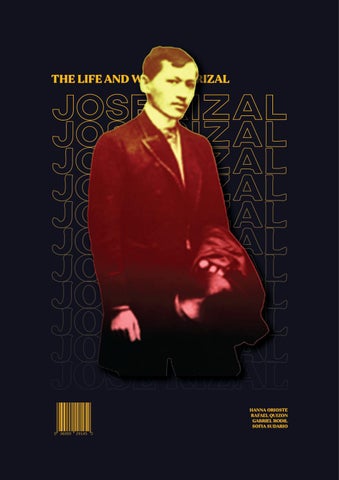
ARTICLE ONE
Dr. Jose Rizal’s Contributions to the Philippines Before His Execution Dr. Jose Rizal, the national hero of the Philippines, is not only venerated for his intellectual brilliance but for taking a stand against the Spanish colonial government. Whilst his death sparked a revolution to overthrow tyranny, Rizal was always remembered for his compassion towards the Filipino people and towards the creation of the country. As a brief background regarding Rizal, his full name is Jose Protasio Rizal Mercado Y Alonso Realonda and was born on June 19, 1861, to Francisco Mercado and Teodora Alonzo in Calamba, Laguna. He had nine sisters and one brother. At the age of three, he had already learned of the English alphabet and by five, he could already read and write. He completed his schooling at the Ateneo Municipal de Manila (referred to now as Ateneo De Manila University), wherein he excelled in performance. Winning various poetry contests, impressing his professors with his familiarity of Castilian and other foreign languages. It was also during his education that he started writing literary essays that were critical of the Spanish historical accounts of pre-colonial Philippine societies. Rizal had been very vocal against the Spanish government, but in a peaceful and progressive manner. For him, “the pen was mightier than the sword.” And through his writings, he exposed the corruption and wrongdoings of government officials as well as the Spanish friars. While in Barcelona, Rizal contributed essays, poems, allegories, and editorials to the Spanish newspaper, La Solidaridad. Most of his writings, both in his essays and editorials, centered on individual rights and freedom, specifically for the Filipino people. As part of his reforms, he even called for the inclusion of the Philippines to become a province of Spain.
But, among his best works, two novels stood out from the rest. These are Noli Me Tángere and El Filibusterismo. In both novels, Rizal harshly criticized the Spanish colonial rule in the country and exposed the ills of Philippine society at the time. And because he wrote about the injustices and brutalities of the Spaniards in the country, the authorities banned Filipinos from reading the controversial books. Yet they were not able to ban it completely. As more Filipinos read the books, their eyes opened to the truth that they were suffering unspeakable abuses at the hands of the friars. These two novels by Rizal, now considered his literary masterpieces, are said to have indirectly sparked the Philippine Revolution. Upon his return to the Philippines, Rizal formed a progressive organization called the La Liga Filipina. This civic movement advocated social reforms through legal means. Now Rizal was considered even more of a threat by the Spanish authorities (alongside his novels and essays), which ultimately led to his exile in Dapitan in northern Mindanao. This however did not stop him from continuing his plans for reform. While in Dapitan, Rizal built a school, hospital, and water system. He also taught farming and worked on agricultural projects such as using abaca to make ropes. In 1896, Rizal was granted leave by then Governor-General Blanco, after volunteering to travel to Cuba to serve as doctor to yellow fever victims. But at that time, the Katipunan had a full-blown revolution and Rizal was accused of being associated with the secret militant society. On his way to Cuba, he was arrested in Barcelona and sent back to Manila to stand for trial before the court martial. Rizal was
Page Two - Dr. Jose Rizal’s Contributions to the Philippines Before His Execution
charged with sedition, conspiracy, and rebellion – and therefore, sentenced to death by firing squad. Days before his execution, Rizal bid farewell to his motherland and countrymen through one of his final letters, entitled Mi último adiós or My Last Farewell. Dr. José Rizal was executed on the morning of December 30, 1896, in what was then called Bagumbayan (now referred to as Luneta). Upon hearing the command to shoot him, he faced the squad and uttered in his final breath: “Consummatum est” (which means “It is finished”). According to historical accounts, only one bullet ended the life of the Filipino martyr and hero.
ARTICLE TWO
Impact of Rizal to the Philippines After His Execution Dr. José Rizal brought a new era for the Filipino people. His ability to inspire others and his compassion for his people made him a national hero. In joining this movement, he inspired his fellow Filipinos to take nonviolent action against the Spanish. His words awakened new ideas throughout the Philippines. After his death by firing squad at Bagumbayan (now called Luneta) in Manila on December 30, 1896, the Philippine Revolution continued until 1898. And with the assistance of the United States, the Philippines declared its independence from Spain on June 12, 1898. This was the time that the Philippine flag was waved at General Emilio Aguinaldo’s residence in Kawit, Cavite. Today, Dr. Rizal’s brilliance, compassion, courage, and patriotism are greatly remembered and recognized by the Filipino people. His two novels are continuously being analyzed by students and professionals. Colleges and universities in the Philippines even require their students to take a subject which centers around the life and works of Rizal. Especially so given Rizal always highlighting the youth as the future of the country. Which could be seen on his works such as on chapter 39 of the novel El Filibusterismo. In that chapter, the monologue of Padre Florentino depicts the role of the youth in nation-building. As described in the excerpt, this chapter sends a message that the youth is the hope of the future. The much-awaited actions of the youth will change the course of tomorrow. It is the role of the youth to aspire for change and to work together in addressing the real problems of our nation.
Every year, the Filipinos celebrate Rizal Day – December 30 each year – to commemorate his life and works. Filipinos look back at how his founding of La Liga Filipina and his two novels influenced the early beginnings of the Philippine Revolution. The people also recognize his advocacy to achieve liberty through peaceful means rather than violent revolution. In honor of Rizal, memorials and statues of the national hero can be found not only within the Philippines, but in selected cities around the world. A road in the Chanakyapuri area of New Delhi (India) and in Medan, Indonesia is named after him. The José Rizal Bridge and Rizal Park in the city of Seattle are also dedicated to the late hero. Within the Philippines, there are streets, towns/cities, a university (Rizal University), and a province named after him. Three species have also been named after Rizal – the Draco rizali (a small lizard, known as a flying dragon), Apogania rizali (a very rare kind of beetle with five horns) and the Rhacophorus rizali (a peculiar frog species). To commemorate what he did for the country, the Philippines built a memorial park for him – now referred to as Rizal Park, found in Manila. There lies a monument which contains a standing bronze sculpture of Rizal, an obelisk, and a stone base said to contain his remains. The monument stands near the place where he fell during his execution in Luneta.
Page Three - Impact of Rizal to the Philippines After His Execution
ARTICLE THREE
The Life and Legacy of Jose Rizal: National Hero of the Philippines Dr. José Rizal, the national hero of the Philippines, is not only admired for possessing intellectual brilliance but also for taking a stand and resisting the Spanish colonial government. While his death sparked a revolution to overthrow the tyranny, Rizal will always be remembered for his compassion towards the Filipino people and the country. Rizal had been very vocal against the Spanish government, but in a peaceful and progressive manner. For him, “the pen was mightier than the sword.” And through his writings, he exposed the corruption and wrongdoings of government officials as well as the Spanish friars. While in Barcelona, Rizal contributed essays, poems, allegories, and editorials to the Spanish newspaper, La Solidaridad. Most of his writings, both in his essays and editorials, centered on individual rights and freedom, specifically for the Filipino people. As part of his reforms, he even called for the inclusion of the Philippines to become a province of Spain. But, among his best works, two novels stood out from the rest – Noli Me Tángere (Touch Me Not) and El Filibusterismo (The Reign of the Greed). In both novels, Rizal harshly criticized the Spanish colonial rule in the country and exposed the ills of Philippine society at the time. And because he wrote about the injustices and brutalities of the Spaniards in the country, the authorities banned Filipinos from reading the controversial books. Yet they were not able to ban it completely. As more Filipinos read the books, their eyes opened to the truth that they were suffering unspeakable abuses at the hands of the friars. These two novels by Rizal, now considered his literary masterpieces, are said to have indirectly sparked the Philippine Revolution.
Page Four - The Life and Legacy of Jose Rizal: National Hero of the Philippines
Upon his return to the Philippines, Rizal formed a progressive organization called the La Liga Filipina. This civic movement advocated social reforms through legal means. Now Rizal was considered even more of a threat by the Spanish authorities (alongside his novels and essays), which ultimately led to his exile in Dapitan in northern Mindanao. This however did not stop him from continuing his plans for reform. While in Dapitan, Rizal built a school, hospital, and water system. He also taught farming and worked on agricultural projects such as using abaca to make ropes. In 1896, Rizal was granted leave by then GovernorGeneral Blanco, after volunteering to travel to Cuba to serve as doctor to yellow fever victims. But at that time, the Katipunan had a full-blown revolution and Rizal was accused of being associated with the secret militant society. On his way to Cuba, he was arrested in Barcelona and sent back to Manila to stand for trial before the court martial. Rizal was charged with sedition, conspiracy, and rebellion – and therefore, sentenced to death by firing squad. Days before his execution, Rizal bid farewell to his motherland and countrymen through one of his final letters, entitled Mi último adiós or My Last Farewell. Dr. José Rizal was executed on the morning of December 30, 1896, in what was then called Bagumbayan (now referred to as Luneta). Upon hearing the command to shoot him, he faced the squad and uttered in his final breath: “Consummatum est” (It is finished). According to historical accounts, only one bullet ended the life of the Filipino martyr and hero. After his death, the Philippine Revolution continued until 1898. And with the assistance of the United States, the Philippines declared its independence from Spain on June 12, 1898. This was the time that the Philippine flag was waved at General Emilio Aguinaldo’s residence in Kawit, Cavite.
ARTICLE FOUR
Jose Rizal and the Revolution When we open the pages of history books in the Philippines, it is not surprising to see texts about the martyrdom of our most celebrated hero– Dr. Jose Rizal. In fact, it seems that his name already occupied a permanent and prominent place in every publication that has something to say about the Philippines. Truthfully, there is nothing wrong about immortalizing Rizal and his heroism in books and literatures read by several generations of Filipinos and non-Filipinos. Probably, most writers deemed that doing such is a fitting way of paying respect and gratitude to his contributions and sacrifices for the benefit of the Filipino people and of our nation. It’s just unfortunate that in trying to present him as an icon of heroism, he was placed in a pedestal that became too tough for Juan dela Cruz to reach. The national revolution that we had in our country from 1896 to 1901 is one period when the Filipino people were most united, most involved and most spirited to fight for a common cause—freedom. While all aspects of Jose Rizal’s short but meaningful life were already explored and exhausted by history writers and biographers, his direct involvement in the Philippine Revolution that broke out in 1896 remains to be a sensitive and unfamiliar topic. Historians cannot deny that Rizal played a major part in the country’s struggle for reforms and independence. His writings, particularly the Noli me Tangere and El Filibusterismo were viewed as the guiding force for other patriots to rally for the country’s cause. While most of us believed that Rizal dedicated his life and labor for the cause of the revolution and venerated him to a certain extent, a brave historian rose up and went against the tide by making known to the public his stand that Rizal was NOT an actual leader of the Philippine Revolution. While most of his biographers avoided this topic, it is important to note that this
greatest contradiction in Rizal made him more significant than ever. In his Rizal Day lecture in 1969 entitled “Veneration without Understanding,” Prof. Renato Constantino tried to disclose the real Rizal and the truth of his heroism stripping off the superficial knick-knacks adorned on him by hagiographers and heroworshippers. The very striking fact that Constantino forwarded was the notion that Rizal was not a leader of the Philippine Revolution, but a leading opponent of it. Accordingly, in the manifesto of 15 December 1896 written by Rizal himself which he addressed to the Filipino people, he declared that when the plan of revolution came into his knowledge, he opposed its absolute impossibility and state his utmost willingness to offer anything he could to stifle the rebellion. Rizal thought of it as absurd and abhorred its alleged criminal methods. Rizal in his manifesto put into premise the necessity of education in the achievement of liberties. Most importantly he believed that reforms to be fruitful must come from above and that those that come from below are shaky, irregular, and uncertain. Rizal’s weakness for this matter was his failure to fully understand his people. He was unsuccessful in empathizing with the true sentiments of the people from below in launching the armed rebellion. He repudiated the revolution because he thought that reforms to be successful should come from above. It could be understandable that the hero thought of such because it was the belief of the prevailing class to which Rizal belonged. It is also possible that Rizal disproved the revolution due to his belief that violence should not prevail. In this case, Rizal unintentionally underestimated the capacity of those from below to compel changes and reforms. This hesitation of Rizal against the revolution was supported by
Dr. Pio Valenzuela’s 1896 account of the revolution after he was sent by Andres Bonifacio to Dapitan to seek Rizal’s opinion and approval in launching an armed rebellion against the Spanish administration. In September 1896, Valenzuela before a military court testified that Rizal was resolutely opposed to the idea of a premature armed rebellion and used bad language in reference to it, the same statement was extracted from him in October 1896, only that he overturned that it was Bonifacio, not Rizal, who made use of foul words. However, Valenzuela after two decades reversed his story by saying that Rizal was not actually against the revolution but advised the Katipuneros to wait for the right timing, secure the needed weapons and get the support of the rich and scholarly class. Valenzuela recounted that his 1896 statements were embellished due to duress and torture, and it was made to appear that in his desire “not to implicate” or “save” Rizal, testified that the latter was opposed to the rebellion. This turn of events put historians into a great confusion, making Rizal’s stand over the Philippine Revolution, controversial and debatable, making him both hero and anti-hero. Constantino, did not disrobe Rizal the merit he deserves, what he did was a critical evaluation of Rizal as a product of his time. He pointed out that even without Rizal, the nationalistic movement would still advance with another figure to take his place because it was not Rizal who shaped the turn of events but otherwise. Historical forces untied by social developments impelled and motivated Rizal to rose up and articulate the people’s sentiments through his writings. In fact, the revolution ensued even Rizal disagreed with it. Finally, Constantino argued that to better understand the hero, we should also take note of his weaknesses and learn from them.
Page Five - Jose Rizal and the Revolution
ARTICLE FIVE
The Greatest Contributions of Rizal Dr. Jose P. Rizal is the Philippines’ national hero. He was the one who inspired the Filipinos to revolt against the Spanish colonial government in order to gain independence and control of the country. He is well-known as a propagandist who uses his writings to expose the Spanish government’s inhumane manipulation of the Philippines. He chose a silent battle over a violent one because he believes it is the only way to achieve freedom. Other Filipinos were inspired to gain their independence as a result of this. They instigated a number of uprisings against the Spanish government. Most of the people really admire Dr. Jose P. Rizal since he paved the way for the country’s independence and are grateful for what he accomplished because they are glad to call themselves an independent Filipino. The Philippines were permanently changed when Dr. Jose P. Rizal died on December 31, 1896. His death had such great impact on the Filipinos that they were encouraged to initiate a revolution against the Spanish government in order to reclaim sovereignty of the Philippines. Rizal Day, a yearly
memorial of his death, is celebrated every year. Filipinos commemorate his death and sacrifice for the country. He had a huge influence on the Filipino people because of everything he did for the country. The majority of Filipinos began to work really hard for their education in order to live a successful life. The value of education is vividly demonstrated in Dr. Jose P. Rizal’s work Instruction, wherein he seeks to improve schools and teaching methods. He understands that his country’s primitiveness during the Spanish period was caused by the Spanish government’ disregard of the islands, not by the Filipinos’ indifference, apathy, or indolence, as the rulers claimed. The aim of education, according to Rizal, is to raise the country to the peak of grandeur and to educate the mind of the people. Education is the foundation of civilization and a requirement for social advancement.
Page Six - The Greatest Contributions of Rizal
Rizal stated that only through learning could the country be spared from dominance, as education is the foundation of society and a prerequisite for progressive change. Rizal’s educational theory is thus centered on providing appropriate incentive in order to reinforce the immense social forces that make education a success, to instill in the youth an intrinsic desire to develop his intelligence and offer him eternal life.
ARTICLE SIX
Rizal’s Works Sparked a Resurgence of Philippine Nationalism Dr. José Rizal, the Philippines’ national hero, is recognized not only for his intellectual ability, but also for standing up to the Spanish government and defying it. Rizal will be honored for his compassion towards the Filipino country and its people, even though his death prompted a movement to topple the government. Rizal was outspoken in his criticism of the Spanish government, yet he did so in a peaceful and progressive manner. “The pen was mightier than the sword” for him, and he revealed the dishonesty and wrongdoings of public officials as well as Spanish friars through his works.
Rizal published essays, poems, allegories, and editorials to the Spanish newspaper, La Solidaridad while in Barcelona. The majority of his publications, including essays and editorials, focused on the individual rights and independence, particularly for Filipinos. He also advocated for the Philippines to become a province of Spain as part of his reforms.
However, they were unable to entirely prohibit it. As more Filipinos read the books, they realized that they had been subjected to horrible abuses at the hands of the friars. The Philippine Revolution is supposed to have been triggered inadvertently by these two novels of Rizal, which are now considered his literary masterpieces.
Noli Me Tángere (Touch Me Not) and El Filibusterismo stood out as his greatest works (The Reign of the Greed). Rizal severely denounced Spanish colonial power in the Philippines in both works, exposing the faults of Philippine society at the time. The government also prohibited Filipinos from reading the contentious novels since he spoke about the country’s injustices and atrocities perpetrated by Spaniards.
Page Seven - Rizal’s Works Sparked a Resurgence of Philippine Nationalism