EKUZ
ERSTES EUROPÄISCHES KLIMA- UND UMWELTBILDUNGSZENTRUM
online lecture series
|
Ringvorlesung
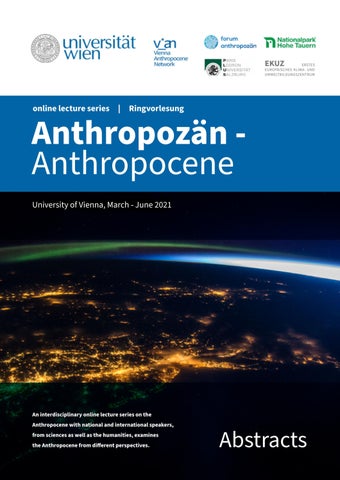
Anthropozän Anthropocene University of Vienna, March - June 2021
An interdisciplinary online lecture series on the Anthropocene with national and international speakers, from sciences as well as the humanities, examines the Anthropocene from different perspectives.
Abstracts PAGE 1
Special thanks for supporting this lecture series go to
EKUZ
ERSTES EUROPÄISCHES KLIMA- UND UMWELTBILDUNGSZENTRUM
PAGE 2
Impressum
Herausgeber: Universität Wien / VAN Vienna Anthropocene Network https://anthropocene.univie.ac.at
Kontakt: Univ.-Prof.Dr. Michael Wagreich Email: michael.wagreich@univie.ac.at
Universität Wien / Institut für Geologie https://geologie.univie.ac.at
Kontakt: Dr.in Veronika Koukal Email: veronika.koukal@univie.ac.at
Forum Anthropozän/Verein ProMÖLLTAL https://www.forum-anthropozaen.com
Kontakt: Mag.a Dr.in Sabine Seidler Email: s.seidler@forum-anthropozaen.com
Grafische Gestaltung:
Gabriele Pichler, Email: gp@gabrielepichler.com
Photo credits: Cover: Page 5: Page 6: Page 7: Page 8: Page 9: Page 10: Page 11: Page 12: Page 13: Page 14: Page 15: Page 16: Page 17: Page 18: Page 19: Page 20: Page 21: Page 22:
Wiseman/Nasa Peter Maier Malachi Brooks on Unsplash Christian Senger Portrait photo of Sabine Seidler by Sabine Seidler, Michael Wagreich by Michael Wagreich and Eva Horn by Eva Horn, picture at the bottom by Stefan Leitner/Nationalpark Hohe Tauen Kaernten Portrait photo Peter Rupitsch/Nationalpark Hohe Tauern Kaernten, bottom M. Knollseisen/Nationalpark Hohe Tauen Kaernten Ruth Brozek Portrait photo Kurt Stüwe, bottom Veronika Koukal Portrait photo Eva Horn, bottom Veronika Koukal Portrait photo Jan Zalasiewicz/University of Leicester, bottom J. Claborn (Public Domain) Neli Mihaylova (MPIC) Portrait photo and screenshot Michael Wagreich, bottom left Veronika Koukal Portrait photo Andreas Lang, bottom right Michael Wagreich Portrait photo Will Steffen, bottom Veronika Koukal all by Veronika Koukal Portrait photo Carmen Sippl, bottom left Pädagogische Hochschule Niederösterreich, bottom right Michael Wagreich Portrait photo Sabine Seidler, center left Michael Wagreich, bottom left and right Christian Senger all by Christian Senger top left Veronika Koukal, top right Michael Wagreich, bottom by GlacierNPS (Public Domain)
PAGE 3
Contents Introduction Program 1st Lecture – 09 March 2021 Opening Session by Sabine Seidler, Michael Wagreich and Eva Horn Peter RUPITSCH (Hohe Tauern National Park) Hohe Tauern National Park – Natural Resource Management in the Anthropocene 2nd Lecture – 23 March 2021 Kurt STÜWE (University of Graz) The start of the Anthropocene: How far back? (How climate and humans have influenced the Alps since millions of years) 3rd Lecture – 30 March 2021 Eva HORN (VAN, University of Vienna) The Anthropocene: Challenging the Disciplines 4th Lecture - 13 April 2021 Jan ZALASIEWICZ (University of Leicester) The Anthropocene Working Group and the stratigraphic definition of the Anthropocene
5-6 7
8 9 - 10
11
12
13 - 14
5th Lecture – 27 April 2021 Michael WAGREICH (VAN, University of Vienna) Anthropogenic geologic-stratigraphic signals and the Urban Anthropocene 15 6th Lecture – 11 May 2021 Andreas LANG The early Anthropocene of European river systems
16
7th Lecture – 25 May 2021 Will STEFFEN (Australian National University) The Anthropocene, Great Acceleration and Planetary Boundaries: 17 - 18 Where on Earth are we going? 8th Lecture – 08 June 2021 Carmen SIPPL (Pädagogische Hochschule Niederösterreich) Learning and Teaching the Anthropocene Sabine Seidler (KLAR! & KEM Manager National Park Communities Upper Mölltal) Forum Anthropozän at Heiligenblut
19 20 - 21
9th Lecture – 29 June 2021 Michael WAGREICH (VAN, University of Vienna) The Impact of the Anthropocene
22
Selected Q&A of the discussions in the lecture series
23 PAGE 4
Introduction
The lecture series "Anthropozän-Anthropocene" took place in the summer semester 2021 at the University of Vienna as a cooperation event of the Vienna Anthropocene Network (VAN) and the Department of Geology of the University of Vienna, Faculty of Earth Sciences, Geography and Astronomy, together with the Forum Anthropozän, the Hohe Tauern National Park (Carinthia) and with the participation of the universities of Salzburg and Graz, funded by EKUZ, the 1st European Climate and Environmental Education Center. This event was designed as an interdisciplinary open online lecture series on the Anthropocene with national and international speakers from the natural sciences and the humanities who examined the topic of the Anthropocene from different perspectives. Prominent external lecturers were Jan Zalasiewicz (geologist and long-time head of the AWG, the Anthropocene Working Group, the scientific commission that decides on the geological definition of the Anthropocene), Will Steffen (Earth System scientist working on Planetary Boundaries and the Great Acceleration, also a member of the AWG), Carmen Sippl (cultural scientist at the PH NÖ Baden and lecturer on the Anthropocene), and Peter Rupitsch (director of the Hohe Tauern National Park).
The Anthropocene presents challenges to all academic fields. As a new geochronological epoch it redefines the human relationship to the planet in ecological terms with consequences that are also historical, social, and ethical. Bringing together the humanities and the sciences, our network comprises scholars from geology, geography, the life sciences, history, philosophy, political science, literary and cultural studies, STS, anthropology and a range of area studies. Drawing on this broad interdisciplinary base, we will explore the new perspectives on nature, culture, society, and technology that the Anthropocene urgently solicits. We furthermore aim to convey an understanding of the significance of the Anthropocene to a wider audience of policy makers, teachers, journalists and the public at large.
PAGE 5
Einleitung
Die Ringvorlesung "Anthropozän-Anthropocene" fand im Sommersemester 2021 an der Universität Wien statt als eine Kooperationsveranstaltung des Vienna Anthropocene Network (VAN) und des Instituts für Geologie der Universität Wien der Fakultät für Erdwissenschaften, Geographie und Astronomie, gemeinsam mit dem Forum Anthropozän, dem Nationalpark Hohe Tauern (Kärnten) und unter Beteiligung der Universitäten Salzburg und Graz, gefördert durch EKUZ, das 1. Europäische Klima und Umweltbildungszentrum. Konzipiert war diese Veranstaltung als eine interdisziplinäre offene Online-Ringvorlesung zum Thema Anthropozän mit nationalen und internationalen Vortragenden aus den Naturwissenschaften und den Geisteswissenschaften, die das Thema "Anthropozän" aus unterschiedlichen Gesichtspunkten beleuchteten.
Das Anthropozän stellt eine Herausforderung für viele akademische Fachdisziplinen dar. Als ein neues geologisches Zeitalter definiert es die Beziehung des Menschen zum Planeten in ökologischer Hinsicht neu, mit Konsequenzen in historischer, sozialer und ethischer Sicht. Das Vienna Anthropocene Network der Universität Wien bringt somit Geistes- und Naturwissenschaften zusammen und umfasst Wissenschaftler aus den Bereichen Geologie, Geographie, Biowissenschaften, Geschichte, Philosophie, Politikwissenschaft, Literatur- und Kulturwissenschaften, STS, Anthropologie und einer Reihe von regionalen Studienrichtungen. Auf der Grundlage dieser breiten interdisziplinären Basis versucht das Netzwerk neue Perspektiven auf Natur, Kultur, Gesellschaft und Technologie zu erforschen, die das Anthropozän fordert. Darüber hinaus wollen wir einem breiteren Publikum von politischen Entscheidungsträgern, Lehrern, Journalisten und der breiten Öffentlichkeit ein Verständnis für die Bedeutung des Anthropozäns vermitteln.
Prominente auswärtige Vortragende waren Jan Zalasiewicz (Geologe und langjähriger Leiter der AWG, der "Anthropocene Working Group", jener Wissenschaftlerkommission, die über die geologische Definition des Anthropozäns befindet), Will Steffen (Erdsystemforscher über Planetare Grenzen und der "Great Acceleration", ebenfalls Mitglied der AWG), Carmen Sippl (Kulturwissenschaftlerin an der PH NÖ Baden und Lehrende des Anthropozäns) und Peter Rupitsch (Direktor des Nationalparks Hohe Tauern).
PAGE 6
Program
Opening Session
9. March 2021
Introduction
Michael WAGREICH, Eva HORN (VAN, University of Vienna) and Sabine SEIDLER (Forum Anthropozän)
followed by
Hohe Tauern National Park – Natural Resource Management in the Anthropocene
Peter RUPITSCH (Nationalpark Hohe Tauern)
2 Lecture nd
23. March 2021
The start of the Anthropocene: How far back? (How climate and humans have influenced the Alps since millions of years)
Kurt STÜWE (University of Graz)
3rd Lecture
30. March 2021
5th Lecture
27. April 2021
Anthropogenic geologic-stratigraphic signals and the Urban Anthropocene
Michael WAGREICH (University of Vienna)
6th Lecture
11. May 2021
The early Anthropocene of European river systems
Andreas LANG (University of Salzburg)
7th Lecture
25. May 2021 Start at 7:30 p.m.
The Anthropocene, Great Acceleration and Planetary Boundaries: Where on Earth are we going?
Will STEFFEN (Australian National University)
8th Lecture
8. June 2021
The Anthropocene: Challenging the Disciplines
Learning and Teaching the Anthropocene
4th Lecture
9th Lecture
Eva HORN (VAN, University of Vienna)
13. April 2021
The Anthropocene Working Group and the stratigraphic definition of the Anthropocene
Jan ZALASIEWICZ (University of Leicester)
Carmen SIPPL (Pädagogische Hochschule Niederösterreich)
29. June 2021
The Impact of the Anthropocene
Michael WAGREICH (University of Vienna)
PAGE 7
1st Lecture Opening Session
09. March 2021
A recording of this talk is available at the Forum Anthropozän webpage https://vimeo.com/524220679
Introduction by Sabine SEIDLER, Michael WAGREICH and Eva HORN
Sabine Seidler (Forum Anthropozän), Eva Horn and Michael Wagreich (both VAN, University of Vienna) gave an overview of the contents and objectives of the lecture, including a short introduction of what the term Anthropocene stands for. Further the scope the Forum Anthropozän and the Vienna Anthropocene Network (VAN) were illustrated.
PAGE 8
1st Lecture Opening Session
09. March 2021
A recording of this talk is available at the Forum Anthropozän webpage https://vimeo.com/524220679
Hohe Tauern National Park – Natural Resource Management in the Anthropocene by Peter RUPITSCH (Hohe Tauern National Park) Peter Rupitsch, Geographer, is managing director of Hohe Tauern Nationalpark – Carinthia an President of “Verein Nationalpark Austria”. He started his career in 1984, shortly after the Nationalpark has been established and now is the longest serving Nationalpark-manager in Austria. Peter is member of various national and international conservation boards, such as Alparc (Alpine Network of Protected Areas) or Nationalparks Austria. He also is engaged as a lecturer at the Alpen-Adria-University Klagenfurt, Department of Geography and Regional Sciences. Peter Rupitsch, Geograph, ist Direktor des Nationalparks Hohe Tauern - Kärnten und Obmann des Vereins “Nationalparks Austria”. 1984 wurde er von der Kärntner Landesregierung mit dem Auf- und Ausbau des für den ersten und größten Nationalpark Österreichs beauftragt. Er ist in zahlreichen internationalen Organisationen (INCN, Europarc, Alparc,…) verteten. Zudem ist er immer wieder als Lektor an der Alpe Adria Universität Klagenfurt engagiert.
PAGE 9
1st Lecture
09. March 2021
Hohe Tauern National Park – Natural Resource Management in the Anthropocene by Peter RUPITSCH (Hohe Tauern National Park)
National Parks represent the preservation of national natural heritage. National parks and wilderness areas play a crucial role in this as representative, large-scale and largely non-intervention protected areas and part of a country-wide ecological network. All types of natural ecosystem are protected by Austrian national parks. The national parks help to increase the long-term survival chances of species and ecological communities; they also help in achieving national biodiversity targets under the Austrian Biodiversity Strategy 2020+. National parks are innovative places to enable natural processes, preserve evolutionary potential, and maintain intact natural ecosystems and their services. The central task of each national park is the protection of the original wildlife and nature by allowing natural processes. In accordance with international guidelines (IUCN protected area category II), at least 75% of the area is to be transferred to a zone which is no longer commercially used by humans.
A recording of this talk is available at the Forum Anthropozän webpage https://vimeo.com/524220679
Efforts to achieve this objective have been made steadily, and significant improvements to the status quo should be made over the next few years. National parks have a special responsibility for species and habitats of national and international importance. An analysis of the sources of these disturbances is necessary in order to develop solutions and prevention strategies, as far as possible, and to take appropriate measures. Hohe Tauern National Park, Austria oldest and largest protected area is well known for it's biodiversity. In the Hohe Tauern area represents one third of species is to be found. According to the Management Goals for the core-zone and the buffer-zone various measures in the field of wildlife management, forest management and alpine farming are taking place. Based on studies and monitoring programms, there is a concept for the reintroduction of selected species like Ibex (Capra ibex) and the „autochthonous“ trout - „Urforelle“ (Salmo trutta fario).
PAGE 10
2nd Lecture
23. March 2021
A recording of this talk is available at the Forum Anthropozän webpage https://vimeo.com/529965453
The start of the Anthropocene: How far back?
(How climate and humans have influenced the Alps since millions of years) by Kurt STÜWE (University of Graz) Kurt Stüwe is professor of geology at the University of Graz and works in a series of different interdisciplinary fields of the Earth Sciences. He has 15 years of international experience from working in Australia and the USA. He has published about 150 research papers and several textbooks. Kurt Stüwe ist Professor für Geologie an der Universität Graz und arbeitet in einer Reihe interdisziplinärer Bereiche der Erdwissenschaften. Er hat 15 Jahre Auslandserfahrung in Australien und den USA und hat neben etwa 150 wissenschaftlichen Publikationen auch mehrere Lehrbücher verfasst.
The geological period of the Anthropocene is the time period that started when mankind started shaping Earth and various arguments have been made since when this is the case. Generally, dates within the last few centuries have been brought forward as a starting date. However, hominids, have populated Earth since about 7 million years and have always influenced our planet in one way or other. Moreover, the global warming of the 20st century often used as the most iconic of all man-made influences on Earth - fades into insignificance in comparison to the climate changes that our planet had experienced in the last few million years, a time during which hominids already populated Europe.
In this contribution we illustrate the important changes that our planet has made during the time of hominid evolution, with particular focus on the European Alps as an example. We illustrate some of the important geological event that influenced our climate and vice versa and show how they may have interacted with hominid evolution. In particular, we discuss the Messinian salinity crisis and the glaciation periods as two examples that show how dramatically our mountain range has changed during the time of humankind.
PAGE 11
3rd Lecture
30. March 2021
A recording of this talk is available at the Forum Anthropozän webpage https://vimeo.com/532689656
The Anthropocene: Challenging the Disciplines by Eva HORN (VAN, University of Vienna) Eva Horn is Professor of German Studies and, together with Michael Wagreich, founder and director of the Vienna Anthropocene Network. Her research focuses on the implications of the Anthropocene for the human sciences and multi-disciplinary research, the poetics of the Anthropocene, the cultural history of climate, and catastrophe fictions. Eva Horn ist Professorin für Germanistik und, zusammen mit Michael Wagreich, Gründerin und Leiterin des Vienna Anthropocene Network. Ihre Forschungsschwerpunkte sind die Implikationen des Anthropozäns für die Humanwissenschaften und die multi-disziplinäre Forschung, die Poetik des Anthropozäns, die Kulturgeschichte des Klimas und Katastrophen-Fiktionen.
Originally coined by the natural sciences, the concept of the Anthropocene has rapidly gained traction in the humanities and social sciences. It has unleashed an array of debates as well as critical disciplinary self-reflection in many academic fields. The Anthropocene not only calls for new perspectives within the fields but also for a dialogue across disciplinary and epistemological boundaries. Exposing the ina-
dequacy of certain traditional disciplinary distinctions, the concept has forged unprecedented forms of cooperation and alliances between the disciplines. My talk will outline some of the challenges the Anthropocene poses for the humanities and social sciences, and sketch out research perspectives in these fields. It will also present a few recent, multidisciplinary approaches to the Anthropocene.
PAGE 12
4th Lecture
13. April 2021
A recording of this talk is available at the Forum Anthropozän webpage https://vimeo.com/538779793
The Anthropocene Working Group and the stratigraphic definition of the Anthropocene by Jan ZALASIEWICZ (University of Leicester) Jan Zalasiewicz is Emeritus Professor of Paleobiology at the University of Leicester, with interests across field geology, palaeontology and stratigraphy, including study of mud and mudrock, fossil graptolites and the geology of global change. He has written books such as The Earth After Us, The Planet in a Pebble, Geology: A Very Short Introduction and (with Mark Williams) Ocean Worlds and Skeletons, and (with Julia Adeney Thomas and Mark Williams) The Anthropocene: A Multidisciplinary Approach. As a member of the Anthropocene Working Group of the International Commission on Stratigraphy, he is a co-editor of its recent summary The Anthropocene as a geological time unit: a guide to the scientific evidence and current debate.
Jan Zalasiewicz ist emeritierter Professor für Paläobiologie an der Universität von Leicester. Sein Forschungsschwerpunkt liegt im Bereich Feldgeologie, Paläontologie und Stratigraphie, insbesondere der Erforschung von Peliten, fossilen Graptolithen und der Geologie des globalen Wandels. Er ist Autor folgender Bücher: The Earth After Us, The Planet in a Pebble, Geology: A Very Short Introduction, Ocean Worlds and Skeletons (mit Mark Williams) und The Anthropocene: A Multidisciplinary Approach (mit Julia Adeney Thomas und Mark Williams). Als Mitglied der Arbeitsgruppe zum Anthropozän der International Commission on Stratigraphy ist er Mitherausgeber der Publikation “The Anthropocene as a geological time unit: a guide to the scientific evidence and current debate”.
PAGE 13
4th Lecture
13. April 2021
The Anthropocene Working Group and the stratigraphic definition of the Anthropocene by Jan ZALASIEWICZ (University of Leicester)
We still live, formally, within the Holocene Epoch, that represents the latest of the many glacial-to-interglacial transitions of the Quaternary Period, the beginning of which has been placed 11.7 thousand years ago. In 2000, Paul Crutzen suggested that the global environmental changes associated with industrialization had been large enough to end the relatively stable conditions of the Holocene, and suggested that we now live in the Anthropocene Epoch, marked by overwhelming human impact. As use of the term grew, the Anthropocene Working Group (AWG) of the Subcommission on Quaternary Stratigraphy (of the International Commission on Stratigraphy (ICS)) has, since 2009, been gathering evidence on whether the Anthropocene should or should not be formalized on the Geological Time Scale. The AWG, the first truly multidisciplinary working group of the ICS, has in the subsequent decade collated a wide range of evidence to establish that a sufficiently wide and distinctive array of lithostratigraphic, chemostratigraphic and
A recording of this talk is available at the Forum Anthropozän webpage https://vimeo.com/538779793
biostratigraphic signals is present in recent strata, and that these signals will be sufficiently long-lasting, to propose the Anthropocene as a formal chronostratigraphic unit. Anthropocene strata may be characterized by such physical signals as widespread to near-ubiquitous concrete and plastics, chemostratigraphic signals such as sharp changes to carbon and nitrogen isotope ratios, and biological signals such as a rise in fossilizeable invasive species. The most pronounced change (and hence optimal position for the beginning of the Anthropocene) came with the ‘Great Acceleration’ of population, industrialization and globalization in the mid-20th century. The sharpest signal here, a potential primary marker, is the ‘bomb spike’ of artificial radionuclides in the early 1950s. The AWG is currently examining a range of potential stratotype locations, with the aim to submit a proposal to formalize the Anthropocene within the next couple of years, to be voted upon by the relevant stratigraphic bodies.
Attendees at the Anthropocene Working Group meeting held in Mainz, 5-8 September 2018, hosted by the Max-Planck Institute for Chemistry. Photo taken by Neli Mihaylova (MPIC).
PAGE 14
5th Lecture
27. April 2021
A recording of this talk is available at the Forum Anthropozän webpage https://vimeo.com/544075637
Anthropogenic geologic-stratigraphic signals and the Urban Anthropocene by Michael WAGREICH (VAN, University of Vienna) Michael Wagreich, Univ. Prof. Dr. is Professor of Geology at the Department of Geology, University of Vienna, with interests and publications in sedimentology and stratigraphy. Current research topics are environmental change and paleoclimate. Since 2012, he is a member of the Anthropocene Working Group, the international group of experts investigating the significance of the term "Anthropocene" as a new geological era strongly influenced by humans. Michael Wagreich, Univ. Prof. Dr., ist Professor für Geologie am Institut für Geologie der Universität Wien, mit Forschungsschwerpunkten und Publikationen in Sedimentologie und
Geological signals for the Anthropocene are ubiquitous, formative, and show the profound change of the Earth System by humans. Human influence is not only evident on surface geologic and geomorphological processes, but is also manifested in induced earthquakes. Earthquakes triggered by human activities are on the rise, with most of these induced earthquakes resulting from mining activities (37%), water reservoir recharge (23%), and oil and gas exploitation including fracking (19%). But also deep geothermal wells can trigger earthquakes as in Basel in year 2006. The best globally distributed and geologically archived signal for a beginning of the stratigraphic Anthropocene in the middle of the twentieth century provides radiogenic fallout from nuclear bomb tests of the 1950s and 1960s, besides new man-made materials like plastics.
Stratigraphie. Aktuelle Forschungsthemen sind Umweltänderungen und Paläoklima. Seit 2012 ist er Mitglied der „Anthropocene Working Group“, jener internationalen Expertengruppe, die die Signifikanz des Begriffes "Anthropozän" als neues, vom Menschen geprägtes, geologisches Zeitalter untersucht.
Most recently, typical artificial radionuclides (e.g. Pu239) for this bomb-test spike could also be found in the very recent anthropogenic deposits of the city of Vienna (Urban Archaeology Vienna excavation at Wien Museum, Karlsplatz), thus impressively demonstrating its suitability as a stratigraphic marker. The anthropogenic subsurface of Vienna thus becomes a case study that also quantifies the material flows of anthropogenic fill, from the inner city based on Roman settlements to the outskirts with its recent landfills. Paradigm shifts in earth sciences brought about by the Anthropocene are highlighted.
PAGE 15
6th Lecture
11. May 2021
A recording of this talk is available at the Forum Anthropozän webpage https://vimeo.com/548783741
The early Anthropocene of European river systems by Andreas LANG Andreas Lang holds the Chair for Physical Geography at the University of Salzburg. He studied in Heidelberg and after stations in Germany and Belgium spent many years in the UK before starting his current position in 2015. His research focusses on Geomorphology and Geochronolgy, especially the quantification of human impact on Erath surface systems. He has published widely in the field’s leading journals. Recently published work on the Mississippi river shows that river engineering has transformed the carbon flux to the ocean and is of global climatic significance. Andreas is also engaged with learned societies, co-founded two scientific journals (Earth Surface Dynamics and Geochronology) and has been party to discussions about the Anthropocene from early on.
In Europe, remodelling of river channels for navigation, flood protection or hydropower purposes is commonplace. Engineering measures dominate the flux of water and sediment from the uplands to the oceans since more than a century. The functioning of river systems however, has shifted from natural to human dominated already much earlier: land use has release large amounts of sediment, much more than the river systems can carry. This surplus has transformed the functioning of rivers, initiating for example the meandering patterns of many river channels. Today, where meandering patterns have survived the engineering measures, such meanders are often considered ‘natural’ and used as management targets for river restoration. Using examples, the talk will highlight such caveats and use the discussions around the term Anthropocene to rethink the man-environment relationship. In large parts of Europe humans have been the dominant force since centuries and the natural, unaltered state of the Earth’ surface has long been lost - beyond retrieval.
Andreas Lang ist Professor für Physische Geographie an der Universität von Salzburg. Er hat in Heidelberg studiert und ist nach weiteren Stationen in Deutschland, Belgien und vielen Jahren in Großbritannien seit 2015 in Österreich tätig. Seine Forschungsschwerpunkte liegen in der Geomorphologie und Geochronologie, insbesondere der Quantifizierung des menschlichen Einflusses auf Prozesse der Erdoberfläche. Über diese Themen hat er vielfach in international führenden Fachzeitschriften publiziert. Gerade ist eine Arbeit zur anthropogenen Veränderung des Kohlenstofftransports am Mississippi River erschienen die zeigt, dass moderne Flussverbauung auch globale klimatische Auswirkungen hat. Daneben engagiert sich Andreas Lang in wissenschaftlichen Gesellschaften, hat zwei internationale Zeitschriften mitgegründet (Earth Surface Dynamics und Geochronology) und war in die Diskussion zum Anthropozän von Beginn an eingebunden.
PAGE 16
7th Lecture
25. May 2021
A recording of this talk is available at the Forum Anthropozän webpage https://vimeo.com/560398095
The Anthropocene, Great Acceleration and Planetary Boundaries: Where on Earth are we going? by Will STEFFEN (Australian National University) Will Steffen is an Earth System scientist. He is a Councilor on the publicly-funded Climate Council of Australia that delivers independent expert information about climate change. He is also an Emeritus Professor at the Australian National University (ANU); Canberra, a Senior Fellow at the Stockholm Resilience Centre, Sweden; and a member of the Anthropocene Working Group. From 1998 to mid-2004, Steffen was Executive Director of the International Geosphere-Biosphere Programme, based in Stockholm. His research interests span a broad range within Earth System science, with an emphasis on sustainability and climate change. Will Steffen ist ein Erd- und Klimawissenschaftler. Er ist Ratsmitglied im öffentlich finanzierten Climate Council of Australia, der unabhängige Experteninformationen zum Klimawandel liefert. Außerdem ist er emeritierter Professor an der Australian National University (ANU); Canberra, Senior Fellow am Stockholm Resilience Centre, Schweden, und Mitglied der Anthropocene Working Group. Von 1998 bis 2004 war Steffen Leiter des International Geosphere-Biosphere Programmes mit Sitz in Stockholm. Seine Forschungsinteressen umfassen ein breites Spektrum, mit einem Schwerpunkt auf Nachhaltigkeit und Klimawandel.
PAGE 17
7th Lecture
25. May 2021
The Anthropocene, Great Acceleration and Planetary Boundaries: Where on Earth are we going? by Will STEFFEN (Australian National University)
Human pressures on the planet as a whole - the ‘Earth System’ - have now become so great that scientists have proposed that we have left the Holocene, the 11,700-year geologic epoch that has been humanity’s accommodating home and have entered a new geologic epoch, the Anthropocene. Originally proposed by atmospheric chemist Paul Crutzen, the Anthropocene is characterised by extremely rapid changes to the climate system driven primarily by human emissions of greenhouse gases and growing degradation of the planet’s biosphere, driven by a range of direct and indirect human pressures. The Anthropocene Working Group, created by the geological community to examine formalisation of the Anthropocene on the Geologic Time Scale, has recently recommended that the Anthropocene should indeed be formalised, with a start date in the mid-20th century Where is the Anthropocene headed in the future? The current trajectory of the Earth System is a rapid exit from the Holocene, accelerating towards a much hotter climate system and a degraded and ill-functioning biosphere. Perhaps most concerning is a possible ‘fork in the road’ beyond which lies ‘Hothouse Earth’. The key element of this trajectory is a ‘tipping cascade’, in which a series of interlinked tipping points - melting of polar ice, conversion of forest biomes to grasslands or savannas, change in ocean and atmospheric circulation - take control of the trajectory of the Earth System and move it to a much hotter, biodiversity impoverished but stable state. One approach to quantifying the measures that humanity must take to stabilise the Earth System is the ‘planetary boundaries framework’. This science-based approach is built on an assessment of various features of the Earth System, such as climate change, biosphere integrity, biogeochemical flows and so on, that define the state of the system. Maintaining these planetary boundaries within science-based limits - or, more appropriately, returning many of the bounda-
A recording of this talk is available at the Forum Anthropozän webpage https://vimeo.com/560398095
ries to within these limits - would ensure a stable and well-functioning Earth System in Holocene-like conditions.
Meeting the challenge of living within the planetary boundaries requires fundamental changes to human societies. These changes include not only advances in technologies but also more fundamental changes in societal structures and core values. In essence, we must become stewards of the Earth System, based on transformed societies that focus on systems approaches to economies, a greater level of equity within societies, and a focus on restoration of a well-functioning biosphere. All of these changes are possible, but they will only occur if we develop a life-centric approach to our existence rather than a human-centric approach. Indigenous Australians can show us the way forward to a much more life-centric society. PAGE 18
8th Lecture
08. June 2021
A recording of this talk is available at the Forum Anthropozän webpage https://vimeo.com/562914760
Learning and Teaching the Anthropocene by Carmen SIPPL (Pädagogische Hochschule Niederösterreich) HS-Prof. Mag. Dr. Carmen Sippl is philologist, professor for cultural semiotics and multilingualism at the University College of Teacher Education Lower Austria and lecturer at the University of Vienna. Main research interests: Project “Learning and Teaching the Anthropocene”, didactics of literature, visual literacy, inter/transculturality. HS-Prof. Mag. Dr. Carmen Sippl ist Philologin, Professorin für Kultursemiotik und Mehrsprachigkeit an der Pädagogischen Hochschule Niederösterreich und Lehrbeauftragte an der Universität Wien. Forschungsschwerpunkte: Projekt "Lernen und Lehren im Anthropozän", Literaturdidaktik, Visual Literacy, Inter- und Transkulturalität.
With its quest to reassess the interrelation between humankind and nature, the Anthropocene is both a geological and a cultural concept. This dual function demands a transdisciplinary approach to link sciences and humanities, and it can provide a fruitful framework for education, to learn about and reflect upon the culture-nature interdependencies. Education for and in the Anthropocene needs an integrated education across subjects and across the curriculum. How does learning and teaching need to be designed to meet young people’s interest in shaping a sustainable future? How can the Anthropocene serve as a framework to initiate transformative learning? What forms of innovative knowledge communication serve best to enable future literacy?
This lecture does not focus on the subject-related contents of an Anthropocene curriculum. It provides a survey of educational models which have the potential to meet the key demands of knowledge transmission in this new epoch, like interdisciplinarity, participation, place-based first-hand experience, reflection of social, cultural and ethical values, understanding complexities, designing solutions, glocal thinking, collaboration. We reflect upon the issues learning environments and teaching materials should consider when designed within the framework of the Anthropocene concept. Best practice examples serve to exemplify how to integrate the Anthropocene in tertiary education as well as in learning and teaching on secondary and primary levels.
PAGE 19
Forum Anthropozän at Heiligenblut Sabine SEIDLER (KLAR! & KEM Manager National Park Communities Upper Mölltal) Sabine Seidler studied economics and communication sciences. Doctoral studies in philosophy/group dynamics. Several years of teaching experience in project management. Quality Auditor Diversity Management. Focus on diversity - resilience - innovation. Since 2016 Chairwoman of the association ProMÖLLTAL Initiative for Education, Culture, Economy and Tourism. Founder of the international Forum Anthropozän with the Hohe Tauern National Park. Lead in development of KLAR! and KEM. Studium der Wirtschafts-, Kommunikationswissenschaften. Doktorratsstudium Philosophie/Gruppendynamik.
The fourth Forum Anthropozän, organized by Sabine Seidler and Team, from 17 to 19 June 2021 was not part of the lecture series. But two students had the opportunity to join this event, all costs were covered by EKUZ.
Mehrjährige Lehrtätgikeit im Projektmanagement. Qualitätsauditorin Diversity Management. Schwerpunkt Diversität – Resilienz – Innovation. Seit 2016 Obfrau des Vereins ProMÖLLTAL – Initiative für Bildung, Kultur, Wirtschaft und Tourismus. Gründerin des internationalen Forum Anthropozän mit dem Nationalpark Hohe Tauern. Lead in Entwicklung von KLAR! und KEM.
Contact: s.seidler@forum-anthropozaen.com +43 (0)664 450 9513
PAGE 20
Forum Anthropozän at Heiligenblut 17-19 June 2021
PAGE 21
9th Lecture
29. June 2021
A recording of this talk is available at the Forum Anthropozän webpage https://vimeo.com/569826651
The Impact of the Anthropocene by Michael WAGREICH (VAN, University of Vienna)
Geological signals of the Anthropocene and the influence of humans on landscape and geological surface processes are ubiquitous and extraordinary.
Michael Wagreich will give a brief review of past lectures and present an outlook into future developments regarding the Anthropocene, with plenty of time for discussion.
PAGE 22
Selected Q&A of the discussions in the lecture series
[Q] [A]
Are there also signals related to the sixth mass extinction that is happening during the Anthropocene? Yes, there are significant signals, like the disappearance of taxa due to direct and indirect human activity, the severe changes in biomass due to industrial stock farming and plantation, and also the raise of invasive taxa. Estimates are given, that a real sixth mass extinction will at least start in about 300 years.
[Q] [A]
What do you think, when will the Anthropocene end? From a geologist viewpoint, the Anthropocene will have a duration of at least a few ten thousands of years, given that the climate change due to anthropogenic rise in greenhouse gases will go on as long as the lifetime of these gases in the atmosphere will be, and the geological archives like lake sediments will show those marker materials, like plastic and concrete, for a long time even when nothing will be produced anymore. There are climate models that predict that there is already enough CO2 in the atmosphere to postpone the next (future) ice age, which otherwise, based on sun insolation cycles, would have been in approximately 60.000 years.
[Q]
This sounded a bit like a doomsday scenario, where there is not much soil left in the future and agriculture on artificial substrates create even more additional problems, is it possible to reduce the soil erosion below the levels of soil creation with sustainable agriculture? Examples shown in the talk illustrate how doomsday had arrived in some landscapes already 2000 years ago - and still today (after 2000 years of soil formation) we cannot utilize such landscapes for more than grazing or forestry. Such issues have long been known (check out Plato's comment on the deforestation of Attica ~400 BC), scientifically investigated and made their way into legislation (soil protection laws). Still, in many sustainability frameworks soils are taken as givens and soil loss is not factored in. Besides the on-site loss it is especially also the off-site damage that comes with a big remediation price tag attached. Arable land does induce soil erosion - there is currently no way around even so a whole range of techniques has been developed to minimize losses. We need to be aware that even if we want to act responsible we will not be able to achieve full sustainability, and will still leave some footprint.
[A]
[Q] [A]
Were the disagreements within the Anthropocene Working Group based on the start date, or rather about formalizing the Anthropocene? Those members of the AWG saw a more transitional rise in the human influence and argued for an asynchronous beginning (which is not covered by our stratigraphy rules) or a longer (1000s of years) transitional interval (which also is against stratigraphic rules).
PAGE 23