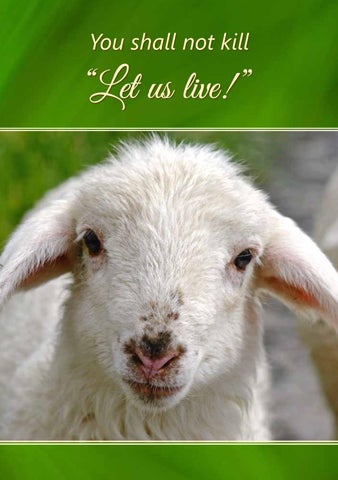
You shall not kill
“Let us live!”
Jesus of Nazareth said: Verily, I say to you: I am come
into the world in order to put to an end all blood offerings and the eating of the flesh of animals and birds that are slain by men.
I, Christ, explain, correct and deepen the word:
The one who loves the life in God loves God
and is one with the life from God. I came into this world to teach the gospel of love, the law of the heavens, and to live it as an example. The one who actualizes the law of love of the heavens will find his way to a fulfilled life.
a
A small excerpt from the great work of revelation “This is My Word. A and Ω” given by the prophetess and emissary of God, Gabriele Sophia Order No. G370en
1
The animals lament: “We chickens would normally live to be 20 years old. You, however, only let us live as broiler chickens for 5 to 6 weeks. And when you exploit us as laying or soup chickens, we only get to be 1,5 years old. We chickens are intelligent and social creatures, yet to you we are only ‘broiler chickens’. Most of us live by the thousands in large closed halls which are mostly artificially lit and air-conditioned. Twenty-four chickens share one square meter of space. We can hardly move or rest undisturbed; this is a great stress for us and therefore we often injure each other. It’s a prison where we have to live in our own filth. The sense of satiety has been bred out of us, so that we eat more. Within just 32 days we reach a weight of 1.8 kg. This massive and rapid growth is fatal for our bodies; our bones and organs are overwhelmed by this, which is why we experience great pains. In factory farming, we suffer unspeakably, both mentally and physically. Most of us don’t even reach adolescence. After only four or six weeks we are slaughtered.”
a
2
“We cattle could live to be about 25 years old if you humans wouldn’t slaughter us as calves after 3 to 5 months. You grant a dairy cow just 5 years of life. And you only let steers live for 18 to 20 months. Why do you do that?” “We calves are separated from our mothers immediately after birth. Although we would like to run and play, for the first eight weeks we are forced to live — mostly alone — in cramped boxes or wooden pens, which are often so small that we can’t even lie down properly.” In Germany, the butcher only has 45 seconds to kill a cow. “When you slit us open, cut our throats and saw off our legs, 9 percent of us are still conscious. Hanging on a hook, we scream and we thrash about in mortal fear and excruciating pain. And our friends who are next in line have to witness our agony, knowing that they are about to suffer the same fate. But you show no mercy. You call this reasonable...”
3
“We pigs can live for about 20 years. If, however, we must serve you human beings as suppliers of meat, you bring our lives to an abrupt end after just 5 months. In large groups of 80 to 200 animals, we pigs are kept on grates in almost constant darkness. We stand on fully slatted floors without bedding, which often leads to joint damage. We are produced like in a factory: the mother pigs are artificially inseminated in individual pens. During the 15 weeks of pregnancy, they must vegetate in a confined space in the twilight. To give birth, they are girdled in special ‘farrowing boxes’. They can hardly move, only get up and lie down again. So it is impossible for them to care for their children. When the day of slaughter comes, you try to stun us with electric pliers. You only give the butcher five seconds to do this. The pain shoots through our head, our whole body like lightning. You think we no longer feel anything when you throw us into boiling water after the electric shock to remove the hair off our skin. But one in eight of us pigs is not properly stunned. Every year, 6.9 million of us experience alive how our lungs fill with boiling hot water ... a terrible death!”
a 4
“We sheep could live on this earth for about 20 years if humans wouldn’t take our lives prematurely. You rejoice when you see little lambs frolicking in the pasture, but their happiness usually does not last long, because at about 6 months old — which, if you would convert it into human years, would not even amount to 2 years — most of them are slaughtered. A special ‘delicacy’ for you is the ‘milk-lamb‘– baby sheep that has not yet eaten any solid food.“ “We, the fish, are also sentient beings. Scientists have meanwhile proven that we fish, much like you humans, feel pain and stress and possess enormous social skill. Despite this, you humans see us fish only as a source of protein and consider only our weight as important. In 2020, the weight of farmed fish was 122.6 million tons and the weight of fish from wild catches was 91 million tons. In aquaculture you not only feed us fortifiers and medications, you also force us to cannibalism by feeding us fish meal from our formerly wild counterparts. Whether in factory farming or free-roaming, death is cruel for each of us! The fish farmers of the aquacultures call it ‘harvest’ when they pull us out of the net cages with the help of special hoses ... At sea, you pull us out of the water in large nets. Then you let us suffocate in agony on land or you cut open our gill arches so that we slowly bleed to death. Since we can’t scream, we are not even anesthetized.”
a 5
”Organic meat” — is not an alternative:
“We ‘organic meat suppliers’ usually live under conditions that are not quite as terrible as our counterparts in factory farming — but there can be no mention of speciesappropriate living conditions! A pig from conventional farming, for example, has an area of 0.75 square meters. A pig from organic farming has at least 1.3 square meters of space and one square meter of outdoor access — for us freedom-loving animals, this is hardly a difference. The only species-appropriate way to keep animals is freedom — but there is no talk of this in organic farming either. If you really want to do justice to our kind, then you must not lock us up and take our lives after a short time, just to devour us! Even if our lives are not quite as cruel as those of our friends in factory farming, the end is the same for all of us. And slaughter is never ‘species-appropriate’, because only a natural death at the end of our lives — and that can be for many, many years — is speciesappropriate. Our fear of being killed is just as great as that of our friends in factory farming. But you humans want to eat our meat, and that’s why we suffer the same cruel fate of slaughter — whether ‘organic’ or ‘conventional’.”
6
Hunting — War in Forest and Field:
“Have you humans ever thought about why we animals living in the wild flee from you? It is the fear for our lives that drives us to flee! The peace of nature is disturbed by a loud bang — it is our death shot. With the last of our strength and badly wounded, we try to flee. When we deer are hit by your expansion bullets, 60% of us are not immediately dead. We drag ourselves through the forest for hours and days, badly injured, with our intestines hanging out. Helplessly fawns watch their mothers bleed to death or they die of starvation because their mother does not return.” “What the hunters do to us animals is war! Particularly popular are hunting drives on us hares. But even though we can run so fast, we don’t have a chance. We hares are completely encircled and boxed in by the drivers. When the shotgun charge hits us, penetrating not only our skin, but also the underlying nervous system, we writhe in pain and cry out in agony like little human children. When hit, some of us hares somersault several times, screaming, until we lie dead.” “Hunting is always a form of war.” J. W. von Goethe, German poet (1749 - 1832)
7
The suffering of animals ... 742.5 million animals were slaughtered in 2024 in Germany — that’s over 2 million every single day! On average, up to 1,094 animals must lose their lives to satisfy the palate of a meat eater:
4 cows, 4 sheep, 12 geese, 37 ducks, 46 turkeys, 46 pigs and 945 chickens. In addition, there are countless fish and sea creatures! (Source: “Meat Atlas 2013” of the Heinrich Böll Foundation)
A third of all food ends up in the garbage in private German households. The proportion of vegetables, fruit and bread is particularly high, but meat is also disposed of in the garbage. According to the Heinrich Böll Foundation, more than four kilograms of meat and sausage are thrown away per capita in Germany every year. This means that every year 50,000 cattle, 360,000 ducks, 450,000 turkeys, 640,000 pigs and 8,900,000 chickens were fattened and slaughtered, only to end up thoughtlessly in the garbage. (Source: “Meat Atlas 2021” of the Heinrich Böll Foundation)
8
Numbers that speak volumes... Approximately 83.5 million people live in Germany and more than 200 million ‘farm animals’!
According to the Federal Statistical Office, in November 2024 there were 10.5 million cattle, 21.3 million pigs and 1.5 million sheep living in Germany. The poultry population was 167 million animals in 2023. (Source: Federal Ministry of Agriculture, Food and Homeland)
Worldwide, the number of animals slaughtered for their meat in 2020 was about 78.8 billion land animals. In Germany alone, around 761 million butcherings were carried out. That is an average of about 14.6 million animals killed commercially per week, just under 2 million per day, about 1,338 animals per minute and about 22 animals per second. Slaughtered in Germany in 2020:
• 623 million broiler chickens • 53.2 million pigs
• 34.9 million turkeys
• 33 million laying hens
• 12.7 million ducks, geese and guinea fowl • 3.2 million cattle
• 1.8 million sheep and goats • Rabbits and fish are not even included here.
9
Everything that lives bears eternal life.
Everything is souled with Spirit, because God, the Eternal, is the Life.
Peace to the animals, to nature, to the Mother Earth.
Peace to all people.
Eating meat causes global suffering l 673 million people world wide were considered malnourished in 2024. This corresponded to around 8% of the world’s population. Basically, enough food is produced worldwide to feed all people. However, it is distributed unevenly — and fed to animals. Only about 40 percent of the harvest of the most important crops are left for people to eat. Almost the same amount ends up in the feeding trough of the so-called farm animals.
12
l Livestock farming takes up 77% of the world’s agricultural land (including pasture and arable land to produce animal feed), but out of 100 calories fed to animals as crops, only 17-30 calories enter the human food chain as meat. l To produce 1 kg of meat, you need 7 to 16 kg of grain or soybeans. When grain is “converted” into meat, this artificial extension of the food chain results in the loss of 90% protein, 99% carbohydrates and 100% fibers, amongst other things. Meat consumption is therefore the most effective form of food destruction.
l In order to prevent a catastrophic food shortage, human beings would have to become almost completely vegetarian in the next 40 years. This was already calculated in 2012 by scientists from the Stockholm International Water Institute. With a vegetarian diet, the amount of water available could be significantly increased. Meat production requires five to ten times more water than the production of basic foods such as corn or wheat.
13
Eating meat harms the environment l Manure & slurry: In intensive livestock farming, large quantities of liquid manure accumulate on relatively small areas. Every year, farmers spread more than 200 million cubic meters of liquid farm fertilizer on German fields and meadows, around half of which is cattle manure and a third of which is biogas fermentation residues. If more fertilizer is used than plants and soils can absorb, excess nitrate seeps into the groundwater. The consequences are serious: Eutrophication of water ecosystems, decline of biodiversity due to the displacement of many plant and animal species, and the pollution of drinking water.The high nitrate levels in groundwater are not the only negative consequence of overfertilization. The use of drugs such as antibiotics play an important role in intensive livestock farming. As a result, not only the meat of the animals is contaminated, but also its excretions. When these end up in the fields, drug residues and germs are released into the environment. The uncontrolled intake of antibiotics is so dangerous for consumers because many germs develop resistance, rendering antibiotics ineffective. Infections with such resistant germs can then become life-threatening.
14
l Life Cycle Assessment: For 300 kg of meat (fattening cattle with an average age of two years), the following are used: • 14,600 liters of water and 3.5 tons of soy and grain and this results in • 3 million liters of carbon dioxide from the combustion of the 2,500 liters of fuel for feed cultivation, 200,000 liters of methane from the digestive tract and 4.6 tons of manure. l Rainforest: The expansion of livestock farming is a key factor in the deforestation of the rainforests; 70 percent of the deforested areas in the Amazon basin are used for grazing; the cultivation of animal feed takes up a large part of the rest. A total of 90% of the destruction of the tropical rainforest is caused by intensive livestock farming. l The world’s five largest meat and dairy companies are jointly responsible for more greenhouse gas emissions than the three largest oil companies, ExxonMobil, Shell and BP. This is according to Shefali Sharma, head of the Institute for Agriculture and Trade Policy (IATP), which compiled the study in collaboration with the environmental organization Grain in 2018. If the industry continues to grow at this rate, the entire livestock population will consume about 80 percent of the earth’s greenhouse gas budget by 2050. In order to contain the global temperature rise to at least two degrees Celsius, everybody could eat no more than 22 kilos of meat annually by 2030. And by 2050, meat consumption would have to fall even further to 16 kilos per person.
15
This is what great minds say ... Albert Einstein, physicist: “Nothing will increase the chance of survival on Earth as much as the step to a vegetarian diet.” Leonardo da Vinci, Universal Genie: “Truly, man is the king of all animals, for his cruelty surpasses theirs. We live from the death of others. We are wandering graves!” Leo Tolstoy, writer: “Eating meat is a remnant of the greatest brutality; the transition to vegetarianism is the first and most natural consequence of the Enlightenment.” Sven Hedin, Swedish Asia researcher: “I could never bring myself to extinguish a life’s flame, for I lack the power to rekindle it.” Christian Morgenstern, writer: “If modern man himself had to kill the animals he uses as food, the number of plant eaters would increase immeasurably.” Pythagoras, philosopher and mathematician: “Everything that man does to the animals comes back to man.”
16
Eugen Roth, writer: “Man thinks, contentedly glad: ‘I am not a butcher, bloody raw.’ But since man is not a sausage despiser, he shares the butcher’s guilt.” Mahatma Gandhi, Nobel Prize winner: “I believe that spiritual progress at some point requires us to stop killing our fellow beings to satisfy our physical desires.” Albert Schweitzer, physician, Nobel Peace Prize winner: “My view is that we, who stand up for the protection of animals, completely renounce the consumption of meat and also speak against it. That’s how I do it myself. And so this way, many people become aware of the problem that was raised so late.” Wilhelm Busch, poet: “True human culture only exists when not only human flesh-eating, but every kind of meat consumption is considered cannibalism.” Bertha von Suttner, Nobel Peace Prize laureate: “I am convinced that the time will come when no one will want to feed on corpses, when no one will be willing to do the butcher’s trade. How many of us are there already, who would never eat meat if they themselves had to plunge the knife into the throat of the animals in question!”
17
Animals are creatures of God Although much is concealed in the official church Bibles, there is still a grain of truth to be found there. In the story of creation, it says: “Then God said: I hereby hand over to you all the plants on all the earth that bear seed, and all trees with seed-bearing fruits. They shall serve as food for you.
To all the beasts of the field, to all the birds of the air, and to all that moves on the earth, which has the breath of life in it, I give all the green plants for food. And so it happened. God saw everything he had done: it was very good.” (Genesis 1:29-31)
a
Through the great prophets of the Old Covenant, God spoke against animal sacrifice and meat consumption, for example: • “He who slaughters a bull is like him who kills a man.” (Isaiah, 66:3) • “Your burnt offerings are not pleasing to me, and your sacrifices are not to my delight.” (Jeremiah, 6:20) • “For I desire steadfast love and not sacrifice, the knowledge of God rather than burnt offerings.” (Hosea 6:6)
18
Jesus of Nazareth taught us to love all creatures. What can hardly be found in the Bible can be read in extra-biblical gospels, for example in “The Gospel of Jesus”. You can learn more about Jesus’ love for animals in the free brochures “Jesus and the Animals” and “Jesus of Nazareth Came for the Animals, too”. Available at: Gabriele Publishing House The Word www.gabriele-publishing-house.com An excerpt from: “Jesus and the Animals” “And it happened one day, after Jesus had finished His speaking, that, in a place near Tiberias, where there are seven wells, a young man brought him live rabbits and doves, to consume them with His disciples. And Jesus looked at the young man lovingly and said to him, ‘You have a good heart, and God will enlighten you; but do you not know that in the beginning God gave man the fruits of the earth for food, and thereby made him no less than the ape, or the ox, or the horse, or the sheep, that he may kill his fellow creatures and consume their flesh and blood? Therefore, let the creatures free to rejoice in God and not bring people into guilt.’ … And the young man set them free, and Jesus tore their cages and their fetters. But, behold, they feared to be caught again, and would not depart from Him. But He spoke to them and bade them go, and they obeyed His words and departed with joy.”
19
The International Gabriele-Sophia-Foundation The International Gabriele-Sophia-Foundation was founded by Gabriele, the prophetess and emissary of God. Out of love and deep compassion for all life, she laid the foundation for the Christ-Isaiah-Land and taught and prepared those willing for the great unity of man, nature and animals. As amends for the destruction and exploitation of nature and animals by humans, the International Gabriele-SophiaFoundation began to build the largest contiguous biotope network in Germany on a once cleared, barren land. Today, in kilometer-long hedges, many tree islands, in wooded areas and stone and wetland biotopes, plants and animals of all kinds once again find habitats, poison-free food and a safe home.
20
Even 1 euro
The Land of Peace is already a place full of life, a green jewel where peace is visible and tangible. And it is only the beginning, the beginning of a New Era, in which people live in unity and peace with nature and animals. People who have a heart for nature and animals, who strive to think and live peacefully, continue to build this land of peace.
n 1 eur ve
Many, many thanks for every donation!
o
E
Help to preserve and further build and expand the land of animals, the Land of Peace with all its plants and animals.
h elps
Donation account: International-Gabriele-Sophia-Stiftung Volksbank Main-Tauber BIC: GENODE61WTH IBAN: DE37 6739 0000 0000 2062 88
Responsible according to German press law
International Gabriele-Sophia-Foundation Max-Braun-Straße 2, 97828 Marktheidenfeld www.gabriele-stiftung.de Order No. G370en
Then the wolf dwells with the lamb, the panther lies with the kid. Calf and lion graze together a little boy can lead them.
C ow and bear become friends, their young are
lying together. The lion eats straw like the ox. The infant plays in front of the adder’s hole, the child puts his hand into the den of the snake.
Man does no more evil and commits no
further crimes on all My holy mountain; for the land is filled with the knowledge of the lord as the sea is filled with water. Isaiah 11, 6-9