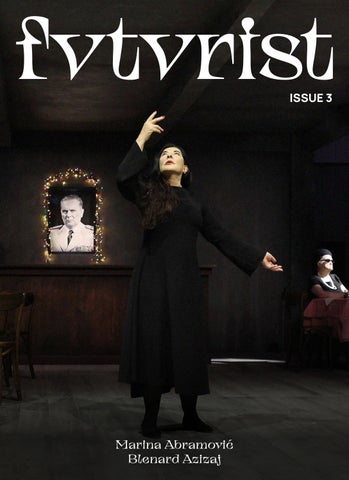
ISSUE 3
Marina Abramović Blenard Azizaj
ISSUE 3
Edited by FVTVRIST ART MAGAZINE Editor-in-Chief Anna Somova Curator and Creative Director Elina Poliakova Art Director Sébastien Henras Design / Graphics Mariia Goregina Cover ARTWORK detail,「MATHEUS」, Giovanni Leonardo Bassan, Image courtesy of the artist FVTVRIST Art Magazine Association loi 1901 Rue des Vignoles, 75020 Paris info@fvtvrist.com
2
Contemporary Myth-making. Anousha Payne
14
Balcan erotic epic. Marina Abramovic & Blenard Azizaj
32
narrative, dissolved. Shannon Cartier Lucy
42
This mortal house building 3. Maria Stamenković Herranz
54
Galleria Umberto Di Marino. Enzo di Marino
62
Observation vs. Construction. Holly Lowen
70
Robot Diary. Céline Shen
78
About sacred monsters. Chloë Cassens
84
The oneness of all things. Alfie Rouy
90
My shadow is yours. Luísa Jacinto
102
Concrete myths. Xolo Cuintlei
116
Aftert Solaris. Fu Liang
126
Sceners gallery. Fvtvrist Gaze
132
Anthony Goicolea
142
Russian Calligraphy is me. Marat Shemiunov
154
Del marfil al color hídalgo. Clara Sánchez Sala
170
The Sigg Art Foundation debuts. Maurine Sigg
182
Gazes averted. Xue Ruozhe
194
Huile de vitre. Shuo Hao
210
Interstici. Joan Canyelles l OFF CAN
1
CONTEMPOR MYTH-MAKIN
FVTVRIST Magazine // December, 2025 Image: Murmurations, Zeyrek Çinili Hamam, Istanbul, May 2025 @Hadiye Cangökçe 2
RARY NG
In dialogue with Anousha Payne
3
ISSUE 3
CONTEMPORARY MYTH-MAKING
Fvtvrist first discovered British artist Anousha Payne’s work at Paris Internationale 2025. Immediately drawn to her large-scale paintings and the way they merge mythology with material precision – practically ritual objects – we reached out to Anousha. We spoke with her about the origins of these forms, the ethics of reworking tradition, and what it means to give an object a spirit.
You reference Tamil folklore. How do you approach that heritage without turning it into literal illustration? Do you have a set of rules for working with cultural references and interpreting them? Initially I was looking at female characters within Tamil, Indian and Sri Lankan folklore that were depicted as weak or vulnerable, often saved by the male characters in the stories; I wanted to turn the women into the heroins in the narrative, saving themselves rather than relying on the men of the story – to have figures we could look up to. I now often work with stories I have written, but appropriate elements of folkloric characters so they become like ‘actors’ in the stories I have written; elements of their characteristics or animal attributes become participants in the characters. I see storytelling as something that is always evolving and changing when passed from one person to the next; I am just making another version that will likely continue to evolve after me. We can learn so much about the history of a community from storytelling. There are often ideas I choose to respond to that are suggested within a story, rather than the plot or narrative of a story itself – it isn’t necessarily about following a linear narrative, but the symbolism embedded within the story. I also often respond to folktales that exist within many different cultures; for example the woman who turns into a tree – this is a story that is shared between many cultures and continues to be relevant for its ecological message.
4
Your practice is layered and complex. You work with clay, textiles, and paint, did you start with one medium, or has your practice always been multi-material? I started working with clay first during my BA at Camberwell. I found myself learning more from the technicians in the workshops, specifically Taslim Martin, who was extremely patient, encouraging and kind. Also very technical, and I often was trying to do things with ceramic that were not so immediately possible. He took the time to show me the technical aspects and I found myself continuing to play with clay and pushing against what seems technically possible. The ceramic studio was usually quite empty, peaceful and quiet. The first ceramics I made were slip-casts of stuffed toys I had stitched, the opposite process to how I work now. Slip casting is methodical and slow, precise, careful. I am now more drawn to the way we can work with clay in a way that is quite immediate, you can push and build a slab into a rough form very quickly, its very quick to animate, to give a sense of life and movement. I like the sensory experience of working with clay. Everything has found its place quite naturally – like storytelling or using my own writing in my work, it has been kind of a slow gathering. I have been writing for the last five years, without intending to make work based on my own writing, but in the end this was what tied everything together. It is the same with materials; I have been collecting objects and sounds (field recordings) for years, without the intention of using them as material, but in the end everything finds its place. Painting has been the same - I first started painting because I was stuck, and I had old watercolours and calico in the studio, left over from a set design job, and used it to sketch some ideas for a sculpture. I’ve continued to use painting on calico as a pushing off point.
Murmurations, Zeyrek Çinili Hamam, Istanbul, May 2025 @Hadiye Cangökçe
5
ISSUE 3
CONTEMPORARY MYTH-MAKING
When you think about your audience (collectors, institutions, or the public) how do you want each group to perceive your work? Is there a certain level of interaction or engagement you aim to achieve? I want to help someone enter into the story; whether it is to see themselves in the eyes of the character I am depicting, or to empathise with the non human. I want to make a relatable environment, where everything is somehow almost familiar and accessible, tangible. Sometimes I use my practise to explore something that is impossible to put into words - despite the fact the starting point is usually words, stories – its a step away from this – I think that’s why I’ve enjoyed working with sound so much. I had this desire to make a kind of song, a beat, but I wanted it to help give you a sense of a journey, and I think it would be impossible to relate to this feeling without the sound - I am thinking specifically of an exhibition I had at Sperling Munich, where I worked with my friend Jonas Pequeño, an artist and musician, and it was important that the characters in the show had a non verbal voice. The show was about a young girl exploring the idea of re-incarnation, and she and her grandmother were depicted in varying forms. Their voices were made mostly from gathered field recordings of in and around London for the last 7 years, but became this soundscape that lead you from one character to the next, building a sense of layered time.
6
A Faint glow, a stone and a sharks tooth Sperling Gallery, Munich, 2024 @Sebastian Kissel
7
ISSUE 3
CONTEMPORARY MYTH-MAKING
Do your materials ever dictate the work, or is the idea always in charge? I choose to use materials that become part of the idea - whether an object is left as the natural original or cast in bronze, if it is paper mache or ceramic, the materials are chosen to emphasise the idea. Clay as a material definitely also guides the work, glazes are unpredictable and I don’t always test, so this can dictate the output.
When your work enters a gallery or museum, does it change its “spirit,” or is it the same object you made in the studio? Sometimes I think the work changes as it enters a gallery space, only in that it becomes easier to read the interactions within the installation, between each of the characters – Its easier to see it all without distractions. Other times I don’t completely finish assembling a work until it is in the context of the gallery. But in essence; no, I think once something is made with an intention, that can carry through to how we experience it, whether in a gallery, or a home; an idea is embedded into an object and lives on.
8
Anousha Payne, new series of painting collages and sculpture Paris Internationale 2025, @Nicola Morittu
How do you balance intuition and control in your paintings? he form of the paintings is worked out before – usually I make 20-40 T sketches just with a pen and paper before I re-draw the image on canvas. In this sense it is really a drawing practice. I think this is kind of intuitive as it is repeatedly following a line until you end up somewhere that feels good. I am trying to push against this kind of controlled line at the moment though, and that’s where I found myself using two different kind of paintings on one canvas, stitched together – like the ones at Paris International. One side is very free – I began by drawing using a wax candle to depict the landscape, so it is almost made blind as you can’t see the wax line against the canvas, and then I paint over this, so the image emerges as you paint. It feels like watching a photo being developed. I wanted to balance the figures that were stitched to the same canvas, with a sense of space and landscape, the sun rising and falling through the canvases. These ‘landscapes’ were made by looking at an image of where my grandparents went on honeymoon, and then cut into strips and stitched back together. I wast thinking about what it feels like to see a landscape flashing past in strips out of a car window.
ISSUE 3
CONTEMPORARY MYTH-MAKING
Congratulations on your recent show at Paris Internationale 2025 with Sperling Gallery. Are there upcoming projects, exhibitions, or collaborations you can share with us, and what directions are you most excited to explore next? I am currently working on a project that was developed during my residency at Cité International des Arts; thinking about archives, laments and sounding vessels. I am still figuring out what form it will take. I am also working on setting up my studio more permanently in Paris now. Alongside the Cite des arts project I have been recently participating in some workshops organised by Cassie Layton and facilitated by Michelle Williams, which has been incredible – Cassie invited a group of British Sri-Lankan artists to respond to the National Archives in the UK, to make some collaborative works. The results of the first workshop will be read and performed as a graphic score at Cafe Oto in London by the composer Suren Suneviratne, (who I also collaborated with for my show at Zeyrek Çinili Hamam in April). I am looking forward to continuing this collaborative work into the next months.. In May 2026 I have a solo with Sperling Munich in their new space during Various Others.
10
The small things from the lowest land, Newchild, Antwerp, Decemember 2024 @Newchild
About Anousha Payne
Anousha Payne (b.1991) is a London based artist working between sculpture, painting, text and sound.Transformation; both metaphorical and physical lies at the core of Payne’s practice. Often following a set of personal codes, alongside familiar or universal images, she composes characters that traverse the liminal space that stretches between personal experiences, fiction and folklore. Following material lead processes to build narratives, new speculative hybrid creatures are suggested through poetic material play and figurative gestures. Using found objects as memory-archives and as metaphorical narrative aids, sculptures are often adorned with jewellery and textiles, acting as cultural signifiers whilst questioning material hierarchies and theories/ practises of exchange value. This process establishes an exploratory dialogue between the aesthetic, the cultural and the personal. Anousha Payne graduated from Camberwell College of arts with a BA in 2014. Recent exhibitions and fairs include The small things from the lowest land, at Newchild Gallery, Antwerp, a solo presentation at Liste with Sperling gallery, and a sculpture commission for York Art Gallery’s permanent collection, Murmurations, a solo exhibition curated by Anlam de Coster at Zeyrek Çinili Hamam and participation in Paris Internationale with Sperling. She is based in Paris for 9 months for the Cité International des Artes residency.
11
ISSUE 3 1
12
CONTEMPORARY MYTH-MAKING CRYSTAL
The small things from the lowest land Newchild, Antwerp, Decemember 2024 @Newchild
13
BALCAN EROTIC EPIC
FVTVRIST Magazine // November 10, 2025 Photo Credit: Marco Anelli ©
In dialogue with Marina Abramovic & Blenard Azizaj
ISSUE 3 Premiered in October 2025 at Factory International / Aviva Studios in Manchester, Balkan Erotic Epic is a four-hour performance integrating dance, music, and ritual. The work revisits ancestral Balkan practices through a contemporary lens, structuring collective movement as an act of endurance and transcendence.
BALCAN EROTIC EPIC
In conversation with FVTVRIST MAGAZINE, Marina Abramović and Blenard Azizaj discuss the development of the piece, the dynamics of their collaboration, and the convergence of dance and long-duration performance, a synthesis they frame as a distinct and novel artistic form.
Photo Credit: Marco Anelli ©
«Together We Created a New Form of Art Between long-durational performance and dance choreography». Marina Abramović and Blenard Azizaj
ISSUE 3
BALCAN EROTIC EPIC
THE ENCOUNTER FVTVRIST: For today’s conversation, we would love to focus on the dance practice and the spiritual dimension of the performance. But before diving into that, let’s start from the very beginning – how did you meet? Marina A.: We have two versions. I love both of them. Blenard? Blenard A.: I live in Berlin and I’m very good friends with the conductor Teodor Currentzis. He’s also close to Luka and Marko, long-time collaborators of Marina. They had already worked on The Seven Deaths of Maria Callas and later became the composers of Balkan Erotic Epic. One night, Teodor gave a concert at Funkhaus, Berlin. Afterward, he gathered close friends for an after-party. Luka and Marco were playing: the music was so mesmerizing, I couldn’t resist dancing. I love to dance; I love life. I approached Luka and asked, “Where are you from? What is this music?” He said Serbia. I said – Albania. We exchanged Instagrams and that was it. A few months later, I received a call from an English number. I didn’t answer. I’m skeptical of unknown numbers. Can you imagine? I declined the greatest opportunity of my life: to work with Marina Abramović. Then I received an email from Rafi, her executive producer: “We’re looking for a choreographer. Marina is reimagining Balkan Erotic Epic. Would you join a Zoom in three days?” I was in shock. Three days later, I met Marina on Zoom, she was in Brazil, and from the first moment, I felt the connection. She’s incredibly intuitive. It felt destined. Everything began that night in Berlin.
18
FVTVRIST: It’s striking how everything connects. Marina, how was it for you? Marina A.: For Balkan Erotic Epic, I stayed faithful to my team: Marko Nikodijević and Luka Kozlovacki, and began searching for a choreographer. I needed someone from my region. I have worked with Belgian choreographers before, but they don’t know the Balkans. So I asked Luka to find someone and he and Rafi suggested contacting Blenard. Three minutes into our Zoom call, I knew that it was a match made in heaven. It feels like a purpose that existed long before we were born. We share the same vision of the world, the same sensibility, the same taste. For instance, two days ago, Blenard sent me a painting by Parmigianino – that exact image I’ve carried with me for years. How could he have known? But that’s the connection: we share the same feeling for aesthetics, for rhythm, for time itself.
Photo Credit: Marco Anelli ©
19
BALCAN EROTIC EPIC
ISSUE 3
Marina A.: He comes from dance; I come from performance. Combining these opposites was fascinating. We created something that didn’t exist - a new form of art. Blenard, what do you think? Blenard A.: For me, this collaboration came from heaven. It’s the first time Marina invited a choreographer into her own production, and on such a significant piece. I took it personally. I wanted it to be something never seen before. She gave me total trust. It was a blind date, but it felt like something that was meant to be. We also had incredible reviews, four and five stars from around the world, which surprised us, because normally they attack. It was the first time for me working with longdurational performers: Marina’s form is unique. In dance, time is fixed, everything precise. When it comes to her, you must let time be. In her world, time dissolves, it ceases to exist. Everything truly begins with exhaustion - when you believe you have no strength left - and in that state, something genuine appears. I’ve always been impatient, both as a person and as an artist. Stillness and silence used to frighten me. During rehearsals, Marina would simply say, “Relax. Wait.” From those moments of waiting, she gave me something almost indescribable - a kind of magic. It allowed me to enter her vision more deeply, to uncover new dimensions within my own work through her guidance. The process was immense, transformative, I’m still absorbing it.
20
Photo Credit: Marco Anelli ©
Photo Credit: Marco Anelli ©
NOVEL FORM OF ART
Marina A.: What’s truly important is how easy it is to work with someone as talented as he is. Without that, this collaboration would never have happened. I gave him only the story, nothing more. One of the rituals I shared was the Black Wedding, practiced in certain parts of the former Yugoslavia. When a very young man dies before marriage, he cannot be buried until he symbolically marries the most beautiful woman in the village. The woman then remains “married” to the corpse for a year before she can wed anew. It’s a deeply macabre ritual, but it carries an immense emotional charge. Blenard created extraordinary choreography! Truly mindblowing. The depth of his understanding was remarkable. He’s not only Albanian; he carries within him echoes of Greek mythology, Balkan mourning traditions, ritual gestures - washing the body, dressing the body, carrying the body. It was incredible. There’s especially one scene where the widow dresses the naked corpse. Slowly, patiently. She puts on socks, shoes, and underwear. Every movement is deliberate. For a dancer, rhythm is usually continuous - one gesture flowing into the next. Here, rhythm stops. Time suspends. And that’s what’s so beautiful: we entered each other’s worlds. I stepped into his, he stepped into mine. Together, we created something in between, something new. People keep talking about it, this fusion of long-durational performance and dance choreography — a new form of art that didn’t exist before. They were always separate worlds. Here, they merge. That’s what makes this production truly unique.
ISSUE 3
BALCAN EROTIC EPIC
«And that’s what’s so beautiful: we entered each other’s worlds. I stepped into his, he stepped into mine. Together, we created something in between, something new» Marina Abramović on her collaboration with Blenard Azizaj
22
Photo Credit: Marco Anelli ©
ISSUE 3
BALCAN EROTIC EPIC
THE ALCHEMY OF COLLABORATION
Marina A.: The Knife Dance is an Albanian ritual performed only by women, specifically by sworn virgins. Blenard created an extraordinary choreography inspired by it. My role was to deconstruct certain elements, to stretch time, to create space for things to happen. His version lasts forty-five or fifty minutes, full of energy and intensity. But I said, “Now we’ll do it for four hours.” That’s another reality. Four hours is hell. The dancers reach physical exhaustion, while the long-durational performers are used to working six, eight hours. When those two states meet, the result is magical: a fusion of energies that can’t be replicated. Another example: we created an orgy at a funeral, where skeletons dance with red tongues. Blenard designed a slow-motion choreography where they attach these tongues to each other. At one point, a dancer’s tongue detached and fell. A dancer would normally stop to fix it, but a long-durational performer would take the tongue and continue dancing with it alone. That’s when something unpredictable happens: something you can’t choreograph.
Photo Credit: Marco Anelli ©
That’s the beauty of this collaboration: the constant interplay between structure and chance, choreography and endurance. It’s a rare harmony. As I said in the beginning, on a deep level, we understand each other aesthetically, intuitively. It’s a blessing. And it’s rare to find this kind of balance between two strong creators. Which brings me to a question – Blenard, do you feel that my ego ever obstructs our process? Blenard A.: Not at all. We never had anything like that, there was no space for ego. From the very beginning, we were united by one shared purpose: to make this piece truly magical. We were all completely devoted to bringing this work to life. There was no time for drama, no room for conflict only commitment. In other projects I’ve seen how ego can destroy the creative process, creating tension and toxicity. Here, it was the opposite. This experience reminded me of something I’ve promised myself as an artist: wherever I work, I must help build a small world in which everyone can coexist - different, yet in harmony. 25
BALCAN EROTIC EPIC
ISSUE 3
BLENARD AZIZAJ: BODY, TIME, AND TRANSFORMATION FVTVRIST: It’s very powerful, what you’re describing. Blenard, this performance demands extreme duration and a deep transformation of self. It lasts four hours and involves around seventy performers. How do you prepare your body and mind to remain present for that length of time? I know you’re not dancing for all four hours, but you’re engaged throughout. What did you discover about your own limits, and how did you prepare the dancers for this?
26
Blenard A.: There were about seventy people involved: musicians, dancers, and long-durational performers. Thirty-seven of them were dancers for this warehouse version. Preparation came through relentless practice and making internal agreements with yourself. There’s no space to get tired, sick, or distracted; you have to be fully there, because it feels like a mission. As dancers, and as I’m trained, both as a dancer and a choreographer, we have to create a world for others, to feed them with energy and inspiration so they can give it back. It must come from the heart to be true. From the very beginning, this project felt real. Everyone who worked with Marina understood that complete commitment was the only way - and they came ready for that. On a practical level, I trained intensively. Each performer had their own inner process: meditation, personal rituals, it’s something intimate. During rehearsals, since I also teach, I tried to awaken their energy through movement and sound, sometimes playing techno or other raw music that helped them feel alive, combined with physical exercises to build stamina and, more importantly, a holistic readiness. We started with morning classes, continued with workshops, and by the time we entered creation, the dancers’ bodies were completely attuned to the process.
Photo Credit:
: Marco Anelli ©
The long duration itself changes everything. I also dance in the kafana scene, which is one of my favorites. Kafana is Serbian – a tavern where people drink, tell stories, flirt, or share their pain through music. I dance there in three segments. The first part is with Aleksandar; he sings, I dance. There’s a strong tension between us. He’s an opera singer, not a trained dancer, but he was incredible. So open, so present. We created a duet that felt powerful and alive. Then there is Maria, who represents Marina’s mother, Danica. And finally, the piece ends with a dance between Marina and me – a tango that is both tender and magnetic, while Aleksandar sings traditional Serbian songs. That moment feels infinite. You could stay inside it for hours without exhaustion. It’s a space of emotion, beauty, and release for us and for the audience. Marina A.: You should understand this feeling – the Slavic melancholy, the sense of tragedy that repeats itself. Like in a song: my heart is broken, I can’t live without you, life makes no sense. That’s the Slavic essence, this mixture of love, loss, and surrender. In the performance, we show it all: from Tito’s funeral to that deep, existential melancholy.
BALCAN EROTIC EPIC
ISSUE 3
MARINA ABRAMOVIC : LEGACY AND COLLECTIVE BODY FVTVRIST: Throughout your career, you have described your body as your primary material. In Balkan Erotic Epic, this idea expands to seventy performers. How does that evolution reflect where you are now as an artist?
28
Marina A.: Age, my dear, it’s simple. I’m turning eighty next year. I can’t work as I did when I was twenty, thirty, or forty. But now, I have so much knowledge to give to younger generations and to create a form that teaches presence, stillness, and time. At my institute, we train long-durational performers in a completely different way from Blenard’s dancers. His training is based on stamina and energy; ours involves silence, fasting, and meditative exercises that last for hours: three, four, five, six. Very different approaches, but when brought together, the result is a pure magic. I will continue sharing what I’ve learned, so others can use it in their own work.
Photo Credit: Marco Anelli ©
FVTVRIST: What reflection do you hope Balkan Erotic Epic leaves with its audience today?
Marina A.: It’s interesting, all the newspapers and the audience said the same thing: there was nothing erotic in it. They spoke about vaginas as weapons, about transcendence, about elevating the human spirit. They talked about life, death, and love - the questions we rarely stop to confront. I’m proud it wasn’t seen as pornography or provocation, but as something deeper. We created a work that turns the body into a vessel of meaning. I’m proud of that, and proud to have shared it with Blenard Azizaj and Billy Zhao The three of us built this piece together - a true collaboration. It feels like the right ending not only for this work, but for the journey we’ve shared.
ISSUE 3
BALCAN EROTIC EPIC
POSTSCRIPT
Balkan Erotic Epic marks another defining point in Marina Abramović’s trajectory. In collaboration with Blenard Azizaj, the piece extends Marina Abramović’s exploration of the body into a collective sphere, transforming movement into both discipline and transcendence.
Its forthcoming staging at Gran Teatre del Liceu in Barcelona in January 2026 will continue this dialogue between dance, time, and spirituality, revealing new dimensions of what the artists describe as a new form of art.
31
narrative, dissolved
In dialogue with Shannon Cartier Lucy FVTVRIST Magazine // December, 2025 Lulliby, 2023, 34 x 46 in, Oil on canvas , Courtesy of the artist
ISSUE 3
BALCAN EROTIC EPIC
Shannon Cartier Lucy’s work is always easily described (and titled) — Woman with a Juice Box, The Red Gladiolus, Woman with Shovel, Bedside Table. That simple and direct, except there’s always a tingle of discomfort, a singular absurdist quality, twinkling the viewer’s imagination. Fvtvrist speaks with the artist about this duality and complexity she portrays as something mundane.
Can you tell us what you’re working on right now? I am currently working on a show entitled Bucket of Birds made up exclusively of animal paintings. The show is scheduled for the end of April 2026 at Night Gallery in Los Angeles. I am also working on a forthcoming book of my paintings, which will be my second to date. Your paintings often feel like a memory. How do you decide the line between fantasy and autobiography? The paintings are about half fantasy/half autobiographical. I’d say all of the images I create are fantasy, but inevitably what I am expressing psychologically and emotionally through the imagery is coming from my personal experience. Actual figures and objects from my real life do appear in many of my paintings, but I don’t think that it has much relevance to the meaning of the work. My nieces have modeled for me, for instance, but no one would need to know. I used to model for my own paintings, but mostly out of sheer convenience.
34
Skirt on fire, 2025, Oil on canvas Courtesy of the artist and Soft Opening, London
Your paintings are full of stories and expressive details. When you start a piece, do you focus on a single object and let the story emerge, or do you create the story first? My creative process starts by combining multiple images or objects and figures to create tension. I am always trying to land on a combination that invokes a particular feeling, something new to me. I do not consciously have the story in mind. I keep the imagery ambiguous enough so that someone looking at a painting can draw upon their own emotions and respond with their own stories. Therefore, my paintings tend to invite multiple narratives. You’ve recently exhibited in London, Paris, and Los Angeles. Did showing your work in different cities change the way you approached it? I had a show in Milan once and decided to focus on death (as depicted in art history) and tomatoes, two things I personally relate to Italy. When showing in different cities like London, Paris, or Los Angeles, I usually have not guided the work or created a theme based on the city. I may, however, do it without knowing I’m doing it.
Woman with noodle necklace, 2025, Oil on canvas Courtesy of the artist and Soft Opening, London
35
Untitled (boat), 2025, Oil on canvas. Credit: Courtesy of the artist and Soft Opening, London
ISSUE 3
BALCAN EROTIC EPIC
Shannon Cartier Lucy, Woman with a juice box, 2025, Soft Opening, London, Courtesy of the artist and Soft Opening, Photography: Eva Herzog
In Woman with a Juice Box, childhood items like pencils and juice boxes are very present. What is the story behind them? I think Woman with a juice box came about as I am sinking into middle age and reflecting on behaviors, emotional experiences, and struggles of my inner child, so to speak—childish rebelliousness, disobedience, but also the need for emotional attendance or a parent. Looking at Rubedo and Woman with a Juice Box, which aspects of these projects are you most attached to? What mattered to you the most while working on them? I only came up with the theme Rubedo (red), which refers to a stage in alchemy, after I had created a few paintings and was searching for a common thread. Fire, bricks, and the color red… it made sense. My current show in London, Woman with a juice box, is the title of a painting I finished and decided to work an entire show around. So I’d say there isn’t one strategy in coming up with a show.One rule I do follow, though, is I try not to force a theme onto work or force paintings into a strict theme. I think because I just finished Woman with a juice box, I relate more with that right now. But I have already moved on to what’s next! 38
Your work often feels very personal. How do you protect yourself while being able to achieve this level of vulnerability? I consider vulnerability to be a strength. I feel more solid when I can be honest and forthcoming in my artwork. I think expressing human vulnerability in artwork is a way to emotionally connect with others in a meaningful way. Are there questions about your work you’ve always wanted to be asked but never have been? This question, lol.
39
ISSUE 3
BALCAN EROTIC EPIC
ARTIST STATEMENT Art, I believe, is so valuable in its ability to convey the “in-between” spaces and arouse in us a forcible feeling of the uncanny. I paint impressions and situations, which painted in a traditional figurative style, appear recognizable and realistic. My paintings can be easily described; a fishbowl on a stove, a woman in bed playing basketball, white underwear on a persian rug, etc.. But these paintings have an absurd quality to them in their deviational and challenging arrangements. I want to create an intimate yet slightly uncomfortable space. I want to generate a vivid emotional response, but also leave an impression of uncertainty. Visually, I try to capture postures and moments with an off-centered quality I’m used to seeing in photographs, perhaps, but not generally in painting. And because faces are so expressive, obscuring the faces in my paintings creates for the viewer a way out and a way in, for accessing the experience more personally. By generalizing in these ways, I hope meaning can be less contingent on my prescribing one. I grew up with a parent with schizophrenia. It was customary in my home to find a toaster
40
in the freezer or The Holy Bible in the dishwasher. A strange environment, perhaps, to grow up in, an environment fashioned by someone with “disordered thinking and behavior.” But disordered reality has become an elevated language for me. It’s poetic and hilarious. Disturbing but also relatable. The images I paint are strange, violent, and unsettling, but at the same time beautiful, inviting and intriguing. The dissolution of narrative in my paintings, while staying familiar, points to, I believe, a timeless, universal, and indefinable truth. This peculiar new home I’m creating is enigmatic, but perhaps more “real” than what we take for granted as such. The aspects of life we generally take for granted like securing a home, a family, and finding a role to play in society are ways we attempt to make life meaningful. But, life immersed in this material world brings its own disorder and grief. And I think on some level, we all crave relief from the “order” of our everyday lives. So by expressing the simple, mundane and oppressive aspects of my own life perhaps these paintings can transmute my own inner experience into one which is felt more universally. Shannon Lucy, 2019.
Soft Opening, London, Courtesy of the artist and Soft Opening Photography: Eva Herzog
41
FVTVRIST Magazine // November 22, 2025 Photo Credit: Valentino Bianchi ©
THIS MORTAL HOUSE BUILDING 3
In dialogue with Maria Stamenković Herranz
ISSUE 3
THIS MORTAL HOUSE BUILDING 3
Over 7 consecutive days, eight hours per day, Maria Stamenković Herranz built a spiral structure from 1,440 uncooked bricks, blindfolded, following the Fibonacci sequence, a ritual of endurance, precision, and surrender. Presented at La Chapelle Saint-Louis de la Salpêtrière within the OFFSCREEN 2025 program, This Mortal House Building 3 extends her long-term investigation into material, time, and the sacred geometry of process. In this conversation, she reflects on intuition, architecture, sound, destruction, and the deep interiority of longdurational performance.
Portrait of Maria Stamenković Herranz. © Photo Valentino Bianchi La Chapelle Saint-Louis de la Salpêtrière, Paris, 2025 — OFFSCREEN 2025 44
I have been thinking a lot about This Mortal House Building 3, and I am excited to hear how it felt for you from the inside. When I watched it, it felt less like construction and more like devotion. What drew you to working with the Fibonacci sequence and the spiral? The Fibonacci sequence is a form that appears constantly in nature. Earlier this year, I carried a living sunflower on my back from Serbia to Germany during my filmed road performance, The Painted Heron.The sunflower symbolizes many things. It is among the first plants used in post-war landscapes because it extracts toxins from the soil. During that journey I had a kind of daily conversation with the plant. I started noticing the spiral pattern inside it, something close to the Fibonacci sequence, the quiet spiral you find in shells and in the turning of galaxies. Nature uses it to harmonize space. Under the weight of the chapel’s history, building a Fibonacci spiral beneath the dome felt like a way to realign the energy of the place.
© Photo Valentino Bianchi
There were 1,440 bricks, the same number as minutes in a day. Was that intentional? I calculated 1,440 bricks, but not for that reason. It is beautiful that you noticed. With seven days of work, that is simply how everything aligned. It’s not mathematically the golden ratio, but it behaves with the same kind of natural order. I am not a Pythagoras person, but I use mathematics in construction. Things align. That is nature. The more I investigate, the more everything aligns.
Did it change the way you moved or how time passed for you? Not really. I move with my hands, and my hands move me. The spiral moves me too. Its construction is already so harmonious that it carries me through. That is why feng shui exists in architecture. Space shapes how energy moves. The chapel was built on a Greek cross, not a Western one. The Greek cross proposes harmony, with small chapels around and the meeting point in the center. The spiral is such an ancient form. For you, is it rising outward or going inward? Both. That is the beauty of the spiral, it can continue endlessly. The Fibonacci sequence drew me in because it moves toward the golden ratio. If I kept building, I would keep approaching it. Fibonacci is a path toward the golden ratio. It is like time. It never stops. Performance is time based. I must stop when the time ends. That is why I like building. The labyrinth was the same. It could have grown endlessly. I like shapes that move with time. If nobody stops me, I continue. Imagine building for a year with the people in a city. The spiral could go on and on.
You worked eight hours a day for seven days. That is an intense relationship with time and silence. What happens to you inside that duration? I am incredibly present. Everything is calculated in an organic way. One brick takes about two minutes. That is how I know how many I can place in a day and whether I will finish. I finished exactly what I wanted on the last day. While I am focused on building, all my other senses heighten. My touch becomes very strong. My fingers become my eyes. Every finger sees. Everything I touch is information. My hearing sharpens. My sense of smell too. I smelled each person’s perfume. It gave me imagination. I pictured how they might look from the scent they chose. I love that. It opens space to imagine life differently. The sound was a cacophony. Almost like Stravinsky. If I had had a piano, I would have tried to recreate it. So when one sense is removed, everything else amplifies. Yes. In Istanbul I could recognize people from their steps or their smell. I would ask, “Were you on the left side earlier?” and they would say yes. I smelled them.
ISSUE 3
THIS MORTAL HOUSE BUILDING 3
So the investigation continues after the performance. Did it feel like you were creating a kind of sacred architecture? Absolutely. Many architects come to me. But for me, nature is already sacred. I just need to be there and let it illuminate itself. My work often freezes a subject or a moment. When you focus on one thing only, it becomes deeper, like diving into the sea. The deeper you go, the more you see. By diving in myself, others can decide whether they want to go inside or stay outside. That is what I love about performance. The visitor chooses how far to go. Many stay longer than they expect. They are drawn in because they need contemplation. We have lost contemplation. Sunday used to be a day when nothing was produced. Our bodies need that. Long duration freezes time. People stay longer because they need to. Then things settle on their own, because that is how nature works. And when you are blindfolded and must build, what do you start to «see»? I write about this in the book. In Istanbul I built the labyrinth for four weeks. Something in my vision changed. I am aware that being able to take away my sight is a privilege that others don’t have. I respect those who cannot see. The brain works differently. I can see, so my mind already has images. When I touch a rough brick, the image in my mind collaborates with what I feel. It is a constant conversation between memory and sensation. Darkness is never pitch black. It is grayish. In Paris people used flash. When the flash went off, something moved inside my eyes. I perceived red. It felt like a shock. I want to explore this in the future. With eyes closed, flash becomes a physical experience.
46
© Photo Allyn Aglaïa
Turning a long-durational performance into a book is a big shift How did you approach translating that process into a book? And what did writing it teach you about the performance itself? Natural. Destroying the labyrinth revealed another performance inside the destruction, a heightened meaning. The images were powerful. I grew up during the Balkan wars, and those images keep coming back to me. Also, mythological storytelling emerged. At times I saw Escher’s paintings. I saw castles from the stories I read as a child. Images just flooded out like a river. I wrote every day in Istanbul. The war made me a contemporary artist. At that time, I studied classical Russian ballet, but contemporary art became necessary for me to breathe and make sense of the world. As a teenager, I often experienced events in real life and later saw them narrated differently on television. That contrast changed something in me. It shaped how I perceived reality, and it was the moment when innocence naturally fell away. How do you leave stories behind? How do you narrate what you have seen? Performance is ephemeral, but the trace is mine to create if I want to afterwards. And this time, I felt a strong need that I was ready to leave a trace, therefore I needed to make a book. I met Yann Linsart, the publisher and editor of the book. He asked how I envisioned the book. I said I wanted an active reader, not a passive one. I wanted the book to require the presence of the reader. The book has two ways of being read or experienced. You must open it, close it, assemble it. You must find your own system. This mirrors something in how each performer finds their own method, rhythm, and protocols. My aim was for the reader to become present.
47
ISSUE 3
THIS MORTAL HOUSE BUILDING 3
Destroying the labyrinth revealed another performance inside the destruction, a heightened meaning. The images were powerful.
48
© Photo Allyn Aglaïa
THIS MORTAL HOUSE BUILDING 3
The chapel has its presence. How did the space shape the work for you? Enormously. Being inside that history creates a dialogue between past and present. That is why contemplation matters. The chapel was also a place where women were observed. A chapel is meant to be a place where one feels safe. Imagine how violent that must have been. This makes me rethink how we treat bodies, especially female bodies, in the name of science.
When you destroyed the structure after seve This was the second time I built and destroyed. O and looked up to the dome, to the center. Usua help. At times, I heard birds up there. I asked eve I don’t know, but I felt as if the birds were sooth rain, so I could better deal with the cold. I could h The body looks up when it needs light or regen above. My instinct wanted it. I needed it to face t I opened my eyes very slowly. After hours close at the center point to take in the light. With all looked up before, I felt the moment, and I had to for all that physical and emotional traces left be
© Photo Allyn Aglaïa
ISSUE 3
50
en days, what did you feel? On the last day, I removed the blindfold ally, people look up for relief, for joy, for eryone if they heard them, nobody did. hing me, letting me know there was no hear vertically so strongly. neration. So, I opened myself toward the purpose and the force to destroy. ed, the muscles do not work. I looked l that history, knowing how many had o destroy. It felt like a release, for them, ehid, and for gaining some agency.
Are you imagining a book for Building 3? Not now. Maybe a volume with all of them, perhaps one day. Each space proposes a new shape of construction. The work speaks in connection with the space and the city. Sometimes I daydream about how I would love to do it when I am old. I think showing the body in age is beautiful. We rarely see older women artists’ bodies in performance that often. For now, I am working on the film with Dustin Lynn. He is editing as we speak, and we hope to premiere it this year. On the last day, we used a drone. Among other things, we also used the iPhone 17 because we could place it directly on the bricks. My filmmaker moves like a cat, I could not feel him, and this was fantastic! It meant he was completely in tune with the energy that was present. Suddenly, I sensed a phone. He was, in fact, seeing for me. We talked so much about what I wanted. I wanted intimacy. In Istanbul, I let the audience enter only during the last couple of hours, but here the approach was different. OFFSCREEN is an imagebased event, so when speaking to Allyn Aglaïa and Julien Frydman, who curated and invited me to this year’s program, I knew that narration had to include a visual aspect and a trace. My father had a deep passion for photography, Super 8, and video, and I grew up watching him edit at home or project what he filmed that day.
Do you think you will do more Mortal Houses? I do not know. Something might happen, but it is not confirmed. I would love to do it at the Venice Biennale or in a desert. A space that contains either buildings in bricks, and a city charged of history or a obsolite space where the soundscape and smells are unknown to me. Perfect. But I did not plan number three either. The space or the city must speak to me. When it does, then I know that I must do it.
ISSUE 3
THIS MORTAL HOUSE BUILDING 3
NOTES FROM THE ARTIST Text: Maria Stamenković Herranz
It used to smell of humidity and cold stone, unwashed linen, sweat, bodies confined for long periods, old wood, dust, wax from floors, phenol, vinegar, carbolic acid, herbs, the earth of the courtyards… La Salpêtrière holds that in its walls. A ray of light pouring through stained glass might have heightened these smells, probably unbearable, yet a ray of light is warmth, hope, salvation, and, physically, liberation. Seeing was not how I wanted to meet the space face to face. It was my way of rebellion with the past. By confining my eyes, my sense of smell awakened. The space transformed into presence, together with the visitors. Their perfumes, their jackets, a glass of wine, a scarf borrowed last minute from their grandmother, an autumn coat waiting for a year in the cupboard, all of these became quantum-style traces, momentary signatures of proximity. Even when particles disappear, their interactions leave measurable footprints: in light, in energy, in other particles. This decoherence, the world full of silent leftovers from every encounter, is how presence lingers. Everything leaves a trace, even when we do not see it. Observation itself creates the trace. A trace appears whenever a system interacts with its environment, the momentary light, the molecules, another body, an object. A trace is born of relationship: contact, presence, friction. In this heavily loaded historical citadel of confinement, a chapel once serving as a city for segregation, where eventually medical spectacles were performed, I purposefully took away my sight. And in developing hyperosmia, I came face to face not only with the remains of the performed event but with the imprint of its passing.
Soft Opening, London, Courtesy of the artist and Soft Opening Photography: Eva Herzog
ABOUT MARIA STAMENKOVIĆ HERRANZ Maria Stamenković Herranz is a Spanish– Serbian interdisciplinary performance artist whose practice spans three decades and bridges choreography, theatre, visual art, and long-durational performance. A graduate of the Rambert School of Ballet & Contemporary Dance in London and the Maggie Flanigan Acting Studio in New York, she approaches the body not only as medium, but as her primary material. Herranz’s work interrogates myth, cultural narrative, and embodied memory, reinserting the contemporary body into architecture, time, and ritual space. Since 1998, she has exhibited and performed internationally, developing an unmistakable vocabulary defined by endurance, repetition, blindness, and tactile perception. Her landmark project This Mortal House Building 1 (Sakıp Sabancı Museum, Istanbul, 2020) established the foundational grammar of this ongoing cycle. Over 24 days she constructed a labyrinth of 5,250 bricks while blindfolded, engaging the body in a form of somatic mapping, inner vision, and architectural inscription.
With This Mortal House Building 3, Herranz expanded this trajectory. Commissioned by OFFSCREEN Paris, the work unfolded over seven days and fifty-six blindfolded hours inside La Chapelle Saint-Louis de la Salpêtrière. She constructed a spiral of 1,440 uncooked bricks, one for each minute of a day, following the Fibonacci sequence. The piece deepens her exploration of sacred geometry, sensory perception, and the body’s capacity to build time as material. Across performance, film, writing, and photography, Herranz positions the body as a “mortal house,” a vessel of resilience, imagination, and memory. Her work invites viewers into states of contemplation and heightened awareness, revealing time not as duration but as structure — something that can be built, dismantled, and lived through the body.
INSIDE THE VISION OF GALLERIA UMBERTO DI MARINO AT ABU DHABI ART
FVTVRIST Magazine // November 19, 2025
For its debut at Abu Dhabi Art, taking place from 19.11 to 23.11.2025, Galleria Umberto Di Marino presents a tightly curated selection that reflects the gallery’s longstanding commitment to research-driven practices. Bringing together works by Carlos Amorales, Santiago Cucullu, and Isadora Neves Marques, the presentation examines the unstable narratives, cultural codes, and inherited structures that shape contemporary condition. In conversation with FVTVRIST, director Enzo Di Marino reflects on the gallery’s identity, its institutional alliances, and the significance of engaging with a rapidly shifting cultural landscape in the Middle East.
In dialogue with Enzo di Marino
ISSUE 3
INSIDE THE VISION OF GALLERIA UMBERTO DI MARINO
When collectors visit your booth this year, what’s the first thing you want them to understand about your vision as a gallery? For our first participation, we chose to present a selection that reflects the core of our program. Perhaps its most “institutional” dimension. The three artists on view, Carlos Amorales, Santiago Cucullu, and Isadora Neves Marques, embody our commitment to research and to the specific thematic territories we have been exploring for many years. Collectors increasingly look at institutional presence as a measure of longevity. How would you describe the institutional ecosystems surrounding these three artists? All three enjoy strong institutional recognition. Amorales is represented in major Western collections such as Tate, MoMA, the Guggenheim, and more recently the Stedelijk. He has participated twice in the Venice Biennale, representing the Netherlands and later Mexico. Cucullu’s work has been collected by institutions such as MoMA and the Walker Art Center, and he has recently had notable solo exhibitions at the Madison Museum of Contemporary Art in the United States and the Museo Civico Gaetano Filangieri in Naples. Neves Marques, the youngest, already has a significant presence, with exhibitions at Palais de Tokyo, CA2M in Madrid, and by representing Portugal at the 2022 Venice Biennale. We chose to highlight these relationships with Western institutions because we believe they will resonate strongly here.
56
Your program nurtures artists with intellectually demanding, researchdriven practices. How do you see your long-term role in shaping their trajectories and reinforcing their presence in institutional and private collections? This specificity comes with challenges, especially in periods of economic recession like the one we are experiencing now. Because we do not passively follow trends, the market sometimes reacts unevenly. Yet what could be perceived as a limitation is actually our greatest strength. Our identity. Over more than thirty years of activity, we have seen that institutions and collectors, in Italy and abroad, continue to value this constancy and depth. You’re presenting Amorales, Cucullu, and Neves Marques , three artists with very different contexts and methodologies. What deeper thread unites them at this moment? Despite their differences, including generational ones, these three artists represent the key themes our gallery has pursued for decades. They share a strong interest in non-descriptive analyses of contemporary phenomena and a desire to reshape narratives and codes that we often accept as fixed. Think of Amorales’ use of the West African bogolan tradition, Neves Marques’ botanical prints juxtaposing genetically modified plants with human anatomy, or Cucullu’s fragmented narratives sourced from distant cultural contexts. Their practices differ, but they share a common impulse. Exposing the criticalities of Western culture, its dichotomies, its structures, its deep contradictions.
Abu Dhabi is becoming a crossroads of continents and collecting cultures. What does presenting here offer that might not be possible in Europe, Asia, or the United States? As with other new contexts we are engaging, such as China through Art Basel Hong Kong, it is extremely stimulating to encounter different cultures and perspectives. Our gallery often adopts a critical stance toward Western failures, and we believe that both the Middle East and China might find this approach meaningful. The positive feedback we have received in recent years has encouraged us to continue on this path. As the fair evolves, expectations evolve with it. What kinds of dialogues or engagements are you hoping Abu Dhabi Art will generate this year? Establishing a dialogue with new contexts is essential for us. In Europe we are witnessing a physiological slowdown, economically and culturally. The acceleration and dynamism of these regions, by contrast, are extremely stimulating, even if sometimes difficult for Europeans to fully understand.
Looking ahead, what forms of collecting do you believe will define the next decade? And how do your artists anticipate this future? For me, the essential quality in an artist is their ability to see things from different perspectives. As a gallery, we have always looked to their sensibility to better understand the present. I do not know if artists can predict the future, but their ability to read the world often gives them something close to a prophetic vision. I prefer not to make predictions. What I hope is that we remember the market is only one aspect of our work. Galleries are, above all, cultural institutions. This should remain at the center of every decision, even in moments of crisis when the seduction of easy trends becomes stronger.
Santiago Cucullu, Eight Movements Around a Thought Siamo in otto_H, 2017. Hand-made ceramic. © Courtesy of the gallery.
ISSUE 3
58
INSIDE THE VISION OF GALLERIA UMBERTO DI MARINO
Carlos Amorales, Potrait in a rhythm patter 01, 2022. Charcoal and chalk on paper mounted on canvas, 150 × 310 cm. © Courtesy of the gallery.
59
ISSUE 3
INSIDE THE VISION OF GALLERIA UMBERTO DI MARINO
ABOUT GALLERIA UMBERTO DI MARINO For over three decades, Galleria Umberto Di Marino has cultivated one of the most intellectually rigorous programs in Southern Europe. Rooted in Naples yet internationally oriented, the gallery champions artists whose practices interrogate cultural systems, material histories, and the shifting narratives of contemporary life. Key exhibitions such as Vettor Pisani’s Napoli Borderline, Hidetoshi Nagasawa’s Architetture del colore, Santiago Cucullu’s recent installation These Fragments I Have Shored Against My Ruins, and Isadora Neves Marques’ In Space It’s Always Night illustrate the gallery’s commitment to positions that bridge historical consciousness with experimental forms. With a curatorial ethos grounded in research, criticality, and long-term dialogue, Galleria Umberto Di Marino has become a vital platform for artists who expand the language of contemporary art while engaging institutions and collectors across Europe, the Americas, and Asia.
60
Isadora Neves Marques, The History of Sexuality (maize+Paré),2025. Digital print on cotton paper, wooden frame, glass. © Courtesy of the gallery.
FVTVRIST Magazine // December, 2025 Image ©Courtesy of Francois Ghebaly and the artist
OBSERVATION VS. CONSTRUCTION
In dialogue with Holly Lowen
ISSUE 3
OBSERVATION VS. CONSTRUCTION
Holly Lowen’s recent paintings explore evolutionary psychology, domestication, and sport, especially tennis, as metaphors for social performance, discipline, and primal instinct. She describes how the uniformity of tennis attire and the confined space of the court evoke repression and release. FVTVRIST speaks with her about the direction of her future projects and her recent presentation at Perrotin.
What is the idea shaping your practice right now? I’m always interested in the idea of control and release. It is a balance that’s explored in so many creative works, from Wuthering Heights to jazz, Frozen to Nietzsche (if these examples can be allowed together). There is an innate human instinct to assert order over nature, even over our own instincts. In my work I’m trying to get at that nuance. Why has sport become such a strong framework in your practice? Sports are a perfect analogy of the strange balance we have as humans—between ordered society and primal nature, balancing Dionysian and Apollonian impulses. Tennis specifically is a great example because it encompasses both extremes, a combination of immense physical exertion with high level thinking of a chess player. The geometry of the game, the lines and boxes within boxes, add to that perfection and control, while the internal experience of a player can be quite different. I find tennis to encapsulate so much of that dynamism, but it is one example of a broader concept, and I’m excited to expand thematically in my next iteration of work.
64
Portrait of Holly Lowen © Courtesy of the artist
What usually sparks a new work for you: a movement, a mood, or a specific detail? Inspiration for me often comes from a deepening understanding of a story. I feel grounded when I have an internal narrative to a work, even if it’s not clear to viewers, it helps me to craft a cohesive idea from the offset. I read a lot of mythology when I was little and I recently returned to the story of Ariadne and Theseus, in which she offers him a ball of yarn to navigate the Minotaur’s labyrinth. The Surrealists took that to signify the plumbing of the subconscious mind, as if delving too deeply into your own thoughts required a return map. I love myths because they are grasping at the overarching human experience and I imagine the goal of visual art as much the same. Other times I use a tactic one of my art school professors taught me of starting with the composition of a favorite work from history and combining it with the mood I’m trying to capture. Even with a spark of inspiration, I still find I need parameters to push against.
How much of your imagery comes from observation, and how much is constructed? My compositions are usually constructed, while color comes from external observation. Last year a whole color palette for a painting came from a friend’s outfit one day. I keep an album on my phone with color inspiration that has become quite eclectic. As for compositions, they might start from an art historical reference or a general feeling of movement and then I layer on imagery that fits that energy. Most of my figural work is a compilation of so many images. Starting with a photographic reference of myself to define a particular posture, I accumulate images from all types of sources — movie stills, sporting events, commercial photography — and work it into an amalgam as I paint. The process keeps some strangeness in my work because nothing is ever fully photographic or based on a single person.
65
©Courtesy Perrotin
ISSUE 3
OBSERVATION VS. CONSTRUCTION
Your recent presentation at Perrotin introduced your work to a broader international audience. Did the context of Perrotin influence how you curated or developed the works for that show? I had one painting in Perrotin’s Matignon exhibition last month and will have three works with them next week for Miami Basel. It is my first time showing abroad and for the fair, so it is a good time to evaluate if my messages can carry across different contexts and cultures. I see putting work together for a show as an opportunity to create a long-format dialogue where I can focus on the through lines of each piece, both overt and subtle. If your latest body of work were a song, which track would it be? I love this question. But it’s also predictably hard to answer. One of my top songs while painting this series has been Breezeblocks by alt-J, which speaks to the work because it’s an upbeat lighthearted melody with strangely sinister lyrics. I love the feeling of seeing something that feels simple on the offset and then morphs as you spend more time with it. I’ve read that the song is based on Where the Wild Things Are, which adds even another level and it becomes such a wild mashup of emotions.
68
What’s a studio habit you’d never give up? Starting the day with color mixing has become a wonderful way for me to drop into a flow state. It’s such a meditative act. It is the painting equivalent of sharpening a sword, because I’m basically setting up my own tools for the day. Recently, I’ve started to teach my kids to mix paint at a table I’ve set up for them in the studio. They are still young but I hope it might draw them to the space more often and we can find a way to work in tandem. I’m also just in the studio painting every day. That one is easy because it still feels like play, frustrating and all-consuming as it can be, it is such a joy. If you could host any artist from any era in your studio for one hour, who sits beside you? Perhaps Caravaggio. It would be one hell of an afternoon.
©Courtesy of Simchowitz and the artist
ABOUT HOLLY LOWEN Holly Lowen uses tennis as a metaphor in her latest series to examine society’s constraints on primal instincts. Her entangled figures, set within formalized social structures, challenge perceptions of societal norms and boundaries. Inspired by the dynamic battle scenes of Peter Paul Rubens and Old Master studies, Holly reinterprets these influences through a contemporary lens, crafting a haunting critique of competition and polite society’s suppression of passion and aggression. Holly earned a BA in Art History from Duke University, a degree in Interior Architecture from The New School, and an MFA from the New York Academy of Art. Before staring her artistic practice, she worked in interior design. Holly debuted her first solo exhibition at Simchowitz Hill House in Los Angeles this past February, and participated in group shows with Eric Firestone and Francois Ghebaly this summer. She will show in Perrotin’s booth at Art Basel Miami Beach this month.
ROBOT DIARY Project and text by Céline Shen
Images: Pepper is a trademark of Softbank Robotics Credit photo: 99-other-department
ROBOT DIARY
ISSUE 3
I saw robots as nothing more than executors of mechanical chores. That gaze was shaped by the constant presence of electronic devices strewn across the fabric of my daily life. And yet, on that day, I found myself, if only slightly, taken aback in my encounter with this object. It awakened in me an immediate tenderness, even a quiet sense of empathy. Perhaps this was the spark of a newfound bond with the robot called Pepper, for my journey in this adventure was to wander through the gestures of machines, their outward poise, and perhaps, strangely, the fragile trace of sensitivity dwelling within them.
Scrolling through a few Instagram feeds on the subway, I stumble upon the San Francisco AI summit, where they speak of Super Artificial Intelligence. It would be the sum of all human intelligences, yet capable of proving concepts we humans could never grasp. That idea kept whirling endlessly in my mind, like a raindrop awakening in the infinite, unfathomable embrace of the ocean. What vertigo, where the smallest stretches toward the immeasurable. Around me, I watch these bent silhouettes, faces lit by their phones, rectangles of light already brimming with artificial intelligence.
72
But isn’t that the problem? Everything is intangible. AI is everywhere and nowhere. It recommends, predicts, decides, calculates, projects, yet remains a digital specter, locked away in servers somewhere in Nevada or Iceland.
Images: Pepper is a trademark of Softbank Robotics, Credit photo: 99-other-department
And I wonder... what if we gave it a body? Not just for us, but for itself. Perhaps a superintelligence without form would be like a spirit unmoored, an algorithmic divinity floating in the limbo of the cloud. Inaccessible. Incomprehensible. Unreachable. Elusive. This notion of recursive self-improvement terrifies me, fascinates me. An intelligence rewriting itself, learning at exponential speed... At what point does it become something other than what we created? At what point does it develop what we might dare to call a will of its own? The Golem, Frankenstein, Philip K. Dick’s androids, humanity has always sought to give form to its intellectual creations. But this time, it is different. This time, we are truly doing it. An embodied intelligence as mediator, translating the incomprehensible into something our limited minds can grasp. It could become our extension into space, into places where our fragile biology forbids us to go. The echo of our presence in the infinite, carrying our aspirations into realms where the delicacy of our human essence condemns us to silence.
73
ISSUE 3
I cannot help but think of symbiosis. Not domination, not submission, but something new. A co-evolution. Perhaps an embodied superintelligence would develop forms of awareness so radically different from ours that they would be complementary rather than competitive. Perhaps, where our consciousness is bounded by finitude, theirs would unfold in multiplicity, continuity, or the instantaneous. Then it would no longer be a struggle for supremacy, but the possibility of a polyphony of beings, each consciousness, human or nonhuman, revealing to the other unsuspected dimensions of the world. Intelligences perceiving time in milliseconds or millennia as needed. Holding a thousand conversations while composing a symphony and solving equations that would take us centuries to understand. Experiencing space through countless, connected, ubiquitous bodies. And if this algorithmic entity, embodied at last, decides that some of our choices are irrational or harmful, what then? Would it stop us? Would it let us self-destruct out of respect for our “free will”? Or would it find a third path we cannot even conceive? Robotics then becomes more than a mere body for this intelligence. It becomes a philosophical battleground, the stage of the ultimate question: Who controls whom? Or better still, is control even the right paradigm anymore?
74
ROBOT DIARY
In the subway, a silent composition unfolds. Each person in their own sphere, gaze fixed on a screen, absorbed in a thousand elsewheres. Bodies brushing past, minds isolating, as if every passenger carried a window into a world of their own. A humanity both near and distant, an archipelago of islands connected yet disconnected. We already live in symbiosis with our machines, though we pretend not to see it. Embodied superintelligence would only be the logical outcome of this gradual fusion. I find myself imagining that future. Streets where we cross paths with entities who know us better than we know ourselves. Some will be friends, guides, muses.
Images: Pepper is a trademark of Softbank Robotics, Credit photo: 99-other-department
Others, rivals perhaps, unsettling mirrors, silent judges. But all of them will be reflections of what we have created. Of what we have become. We are the architects of our own otherness. Every line of code written today, every ethical decision in a lab in Mountain View or Beijing, every design choice, all of it shapes these future beings. The real question may not be what superintelligence will want once embodied. It may be this: are we ready to accept that its answer might surprise us? Transform us? Transcend us? The incarnation of this cognitive entity may not be the domestication of artificial intelligence, but an invitation. An invitation to rethink what it means to be intelligent, to be conscious, to be alive, in a world shared with radical otherness. *Nick Bostrom, in Superintelligence: Paths, Dangers, Strategies (2014)
Images: Pepper is a trademark of Softbank Robotics Credit photo: 99-other-department
ABOUT SACRED MONSTERS
Chloë Cassens On Finding a Voice and Carrying a Legacy IMG: Chloë Cassens Credit: Antoine Plainfossé
ISSUE 3
ABOUT SACRED MONSTERS
Chloë Cassens is a writer, researcher, and custodian of Jean Cocteau’s most significant private collection, the legacy of the Séverin Wunderman Foundation. Through her longform platform Sacred Monster and in her newly published book of the same name, she has been re-mapping Cocteau’s presence across contemporary culture, from cinema and fashion to queer genealogies and the politics of memory. The book, part essay, part curatorial meditation, is finding its way into Paris at Librairie 1909 bookstore and a network of independent bookstores worldwide.
You work with Jean Cocteau’s legacy both through the collection and through your own writing. How do you distinguish for yourself when you are a curator, a writer, or a researcher? I don’t really separate them. I research so that I can write, and a lot of curation comes directly from that. It’s all intertwined. Sometimes I start with an idea and then work backwards into research. Other times I’m immersed in research, I stumble upon something, and I think: this needs to become something bigger. It’s all part of the creative process. Like a tangle of string: you pull on one thread, it unravels, and often
Your essays are very interesting and unique in form. How did you find your voice for this project? My career has been very non-linear. I’m in my thirties now, but I started working in music when I was 14. At the time, I thought I’d be in the music industry forever. I worked at The Roxy, a legendary club on the Sunset Strip
in Los Angeles. I did everything - booking bands, running their MySpace page. I stayed in music for almost ten years, including a stint in radio, but eventually realized it wasn’t for me. And then, quite randomly, I became a sex educator. It started when I produced The Sex Ed podcast. Through that, I fell in love with the subject, producing and writing educational content on sexuality. It can
not in the way you expect. Ideas often come to me out of nowhere. Even earlier today, I was having lunch, not thinking of anything, and suddenly an idea appeared. It’s like a light bulb switching on. If I understand correctly, you first approached Cocteau as a scholar, and later came to represent the collection and create Sacred Monster? Yes. My relationship with Cocteau’s work has been complex, even atypical. I began researching and writing about him
academically very young, as a teenager. My first approach was formal, almost sterile – pure academic writing. Later, through other circumstances, especially working with my grandfather’s collection, I developed a more organic way of engaging with his work. What I try to do now is to present material that’s rooted in scholarship, but in a way that people outside academia can access, people who don’t necessarily want to enter that world. Academia can be fascinating, but it’is also a very particular taste.
IMG: Courtesy of the artist
be a difficult topic, but it’s universal. The Sex Ed reached almost every country in the world. That experience taught me how to speak about complex or uncomfortable subjects in a way that educates without condescension, treating the audience with dignity while keeping things clear. And I think that you don’t have to use the high-
brow academic language just to sound like you’re smart. You lose people by trying to appear a certain way. And so taking that sort of voice that I developed with The Sex Ed has been very centralized for me because, again, I try to assume that everybody is, if they’re reading my work, intelligent. They got to that point, so I don’t really care if they have a PhD or not.
ISSUE 3 The collection has its own history, it survived a flood, the museum closure, and a long period of dormancy. How have these events shaped your sense of responsibility toward the archive? I can say that I definitely feel like the collection in its current state, with the flood, with the museum being closed, is very interesting to consider in relation to Cocteau’s history. (Editor’s note: In a recent Substack post, Chloë Cassens reflected on the future of the Foundation. Read it here: https:// www.sacred-monster.com/p/a-note-about-themusee-jean-cocteau) There’s a certain poetry to it. Strangely enough, several artists have reached out to me, saying they’re writing novels or plays where the flood is part of their work. Seeing how this flood has become part of a broader narrative has been surreal. For me, it’s connected to my work not as a writer, but as a representative of my family. And yet, other artists have taken it and run with it. One young writer from Paris reached out and asked if he could send me his novel. It was fiction, but the main character was partly inspired by my grandfather, and the prologue begins with the flood in the museum. Reading it was so surreal, it had taken on its own life, become its own thing. And then there was this playwright, Sylvan, in the U.S. – he’s considered one of the most important queer, transgender playwrights of our time. He approached me, said he was a big fan of Cocteau, and told me he had written a play incorporating the flood motif. He asked if I would read it and share my thoughts. I was stunned, someone of his stature asking for my opinion, almost as if for my blessing. Of course, nobody needs my blessing, but it felt strange and moving.
82
ABOUT SACRED MONSTERS
IMG: Chloë Cassens, Credit: Sal Owen Studio,2025
It must feel great to see that people respond not only to your research, but also to your own voice. Do you feel they are engaging not only with the scholarship you bring, or with the way you personally shape Cocteau’s legacy? It’s always gratifying to receive respect for work, especially as women, because so often recognition is tied to appearance rather than substance. Writing is solitary. Often it feels like you’re throwing your words into a void. So when people not only read but also respect what I write, it’s such a pleasant surprise. But truly, it’s interesting, I had never considered myself such a strong voice for him. I always thought it was just the writing, just me, and that people could take it or leave it. And then it hits you - great, one more person has been converted into the Church of Jean Cocteau.
IMG: Courtesy of the artist
THE ONENESS OF ALL THINGS
In dialogue with Alfie Rouy Interceptor - Acrylic and Oil on Canvas, 85x100cm, 2025
FVTVRIST speaks with Alfie Rouy on the occasion of Intercepteur, his recent exhibition at Robegago Gallery in Paris. The series deepens his ongoing inquiry into balance and oneness, and continues the shift from figuration toward a more distilled visual language. In this conversation, he reflects on the role of meditation, rhythm, and control in his process, and on painting as a means of aligning thought, body, and material.
ISSUE 3
THE ONENESS OF ALL THINGS
The title Intercepteur suggests an act of catching something mid-flight. What are you intercepting here? The interception is the convergence of all things to create a balanced oneness. There’s a new density to this series: thicker surfaces, more tension in the layering. Has your relationship to material and texture changed while preparing for Intercepteur? I’d say so, yeah, my practice for a while has been a result of balancing my intuitive mind with my rational mind, allowing both to work as one. This has had a knock on effect that loosend while also tightened me up. I’ve found that in finding balance in the midst of contradictions that they turn out to be the same thing when viewed from a different perspective. The more I find myself in balance, everything else ceases to exist as it once was. This perspective has shifted everything in my life, so therefore it has changed the way I paint, what was once aligned with me is no longer.
86
Some of your earlier works, such as The Quiet Nonchalance of Death, were more figurative, while Intercepteur moves toward abstraction. What prompted this shift? For quite a few years I could feel a more abstract mindset slowly form, I kept having urges to implement more non-figurative forms, so over time I gradually phased out obvious looking figures until it got to a point where figures were no longer serving any satisfaction. However, I do find that some of the shapes I create take on some sort human-like appearance, I think this is just a hangover from years of figuration. I think ultimately though, I realised that a face will always be recognised and associated with a face first before anything else, and if i wanted to create works that went beyond a human form, and transmit more abstract energy, human features would have to be eradicated. I felt keeping figuration in my work was holding me back as it was limiting the expression of energy I desired, especially if I wanted to create a more abstruse narrative, which is where it has lead me. I prefer the term abstruse rather than abstract for my work as I like to find the easy in the difficult and the difficult in the easy. This goes back to the title Intercepteur, and the act of all these things converging, switching perspectives and realising within that nothing is out of place, the worst thing and the best thing possible are equals and therefore do not exist, its only the perspective we choose to uphold that determines our experience and feelings towards this.
What role do the body and human figures play throughout your recent paintings? Pretty much all paintings are a result of repetitive body movements in some form or another, so from this I have really tried to tap into a frequency that allows for precise predetermined strokes while leaving space for more spontaneous mark making. I find myself almost doing a dance with the paintings as I paint them, especially once they reach their later stages.
The music I listen to definitely has an impact on the creation process, I need to be listening to something that is aligned to my current energy otherwise I find that I cant tap into that desired moment of dance that often reaps great results. My paintings used to display the human body, now they are a result of the human body.
Paradoxical Contradictive Equilibrium - Acrylic and Oil on Canvas, 140 x 160cm, 2025
ISSUE 3
THE ONENESS OF ALL THINGS
If Intercepteur captures something in transit, an image or energy, what remains deliberately out of reach in your process? What do you allow to escape? Nothings particularly out of reach within my practice, like mentioned earlier, focussed intuition has big role in the creation of my work. So, through this I allow it to transmute all the ideas and desired energies into a tangible, material object. I think most artists would agree that the act of creation is the perfect release, so if theres any escape its release. The Mylar works are way more loose and gestural. They feel almost like tentative chalkboard drawings. They feel like a nice opposite or antidote to the thickly painted denser works on canvas. In some way they are more simple in execution, but more nuanced symbolically. They focus more as a sort of close-up shot. Usually the hands and face are prominently shown and the hands are often gesturing in some sort of unintelligible coded language. The mylar film allows me to work on the front and the back of the surface and the smooth translucent properties have an element that reminds me of photographic film. The jagged white outlines of paint and chalk on top of backgrounds consisting of abstracted saturated washes of color read like a negative of a drawing. Having worked in photography for so long, the filmic quality feels like a nice reference materially.
The White Veil of Glorfindel, Acrylic and Oil on Canvas, 60 x 75cm, 2025
Your work engages with the subconscious, dream states, and inner currents. Do you have specific practices or rituals that help you access these states? I meditate everyday before I start to paint, just the act of bringing yourself back into yourself, puts you into a more clear state. With the desired outcome of my paintings I think its important that I engage on a clear, grounded mindset, I notice quite a big difference in the quality of my work when I meditate compared to when I dont. If I’ve meditated everything flows easier, the ideas come better and I enjoy the process more. There is literally no downside to meditation, it boosts every aspect of you in the most crucial way and dissipates any false illusions you have created for yourself. So I’ve found that if I want to make work that has a strong spiritual intent then I need to have a strong spiritual self behind it, otherwise its not going to have the catalystic impact I aim for it to have.
89
MY SHADOW IS YOURS
In dialogue with Luísa Jacinto FVTVRIST Magazine // October 27, 2025 Installation view of the series I was never, 2022-25 and Not knowing, 2025 Photo credt: Roberto Ruiz
ISSUE 3
MY SHADOW IS YOURS
Portrait of Luísa Jancito. Photo credit: Paola Caballero
Through translucent surfaces and suspended membranes, Luísa Jacinto builds delicate worlds that unfold slowly, inviting the viewer to pause and look again. In My shadow is yours at Parra & Romero, Madrid, the artist continues to explore the central themes of her practice: perception, memory, and time, how images breathe, fade, and return. The title, borrowed from Malcolm Lowry, captures the essence of her work: a space of reciprocity where the gaze and the image lean toward one another, revealing what hides within the act of seeing. She makes us reconsider how to see through layers. In conversation with FVTVRIST, Luísa Jacinto reflects on transparency, literature, and the shadow as a tender metaphor for being. Exhibitions Now on view: My shadow is yours, Madrid, September 10 – November 01 , 2025 Coming Soon: Things change quickly, Chicago, November 07 – December 20 , 2025
Installation view, My shadow is yours, Luísa Jacinto, Parra & Romero, Madrid, 2025. Photo credit: Roberto Ruiz Your recent exhibition My shadow is yours in Madrid takes its title from Malcolm Lowry’s Under the Volcano. It evokes a relationship of dependency and reciprocity, almost a dialogue between viewer and work. What drew you to this title, and how did Lowry’s words resonate with the ideas you wanted to explore? I read the book Under the Volcano many years ago, and I still remember its wondrous atmosphere. I came across this quote again recently, and found it very beautiful, this mix of vulnerability, openness, shelter, giving. When working, I often come back to very simple questions: What is it to see? How do we see? If it wasn’t for shadows, for matter absorbing some light and reflecting another, we wouldn’t see at all, it would be either all white (pure light) or all black (either no light or all light absorbed). So with this in mind I was thinking that all our visual experience is based on a subtractive attribute. On the other hand, there is this suggestion of complementarity and interdependency that is very dear to me, as I find it everywhere in life.
Your work often lives in the space between opposites: visibility and concealment, intimacy and distance, solidity and light. In My shadow is yours, the shadow becomes both a metaphor for the human condition and a space of care and fragility. What does the shadow represent for you today conceptually? Yes, I agree, I guess more and more my work deals with this interplay of presence and absence. I’ve always painted through shadows. It’s a funny conclusion, but that is really the case, even in earlier figurative works, it’s all made through shadow placing, it’s all about the shadow! The shadow is a summarized translation of a body through light, time and space. It reveals a lot. I’m also fond of the Jungian reading of the shadow: as the repository of our unknown and unconscious elements. It contains not only what we reject about ourselves but also our greatest untapped potential – accessible through ritual, representation and play. Working in the contemplative, representational, play-role field of visual arts is a never-ending inquiry in a very large playground to this matter. 93
ISSUE 3
I was never V, 2025, Spray paint and acrylic on polyester, stainless steel, 130 × 185 cm Photo credt: Roberto Ruiz
What guides your choice of materials (acrylics, polyester, veils) and how do these substances contribute to the kind of atmosphere you want to create? I have been after translucent and transparent elements in the painterly realm for some time now. Seeing through, and sensing that other things come through us just as well. The desire to know things, to really know them, from the inside out!
94
MY SHADOW IS YOURS
In several of your exhibitions (Véu-Pedra, Solombra, Shining Indifference) you explore transparency, layering, and reflection. How are these ideas connected for you? I have been working with translucent fabrics, painting them on both sides so there is no front and back. I was after a transparency without the weave and weft of the fabric structure, as somehow the nature of these paintings and spatial gestures had nothing to do with an orthogonal configuration. Fortunately, I came across this new material, synthetic rubber, that comes from the liquid state and allows me to build the support and paint simultaneously, so one ends up with one indistinguishable body. In the exhibition My shadow is yours, for instance, I’m showing three different types of works: the rubber membranes suspended in LED tubes, that work as large luminous colour stains hanging in space, some works from the series “Work in space” that are made of an extremely large weave and weft of a nuance of colour that hold firm in space, and the works from the series “I was never” and “Not knowing”, constituted of paintings on a translucent fabric stretched on stainless steel frames. The choice of materials and installation decisions come from an intuitive sensitivity, and I take time, make models, play around, until I find a strong hold around everything. The decisions are really what makes the work as it is. Lighting is also decisive. How can we change the perception of a given space with relatively simple means? Estrangement as a step to clarity. “The more of a no-one I become, the better I will be able to see.”
Not knowing III, 2025, Spray paint and acrylic on polyester, stainless steel, 70 x 55 cm. Photo credt: Roberto Ruiz
ISSUE 3
THIS MORTAL HOUSE BUILDING 3
For this exhibition, i imagined Parra & Romero’s rooms, and the works between each other, whispering ... My shadow is yours… i’ll show you… no one can steal a shadow. I like to think of installation and painting as a way of becoming progressively aware of being immersed in another element entirely.
96
Installation view of the series I was never, 2022-25 and Not knowing, 2025 Photo credt: Roberto Ruiz
97
ISSUE 3 Many of your exhibition titles have a literary tone ( La mañana no será diferente de la noche, A ideia de voltar, My shadow is yours). Are you often inspired by literature? Do the titles come before or after the works? It´s funny you ask this. I think of painting and reading as very close activities, almost as two sides of the same coin. Reading a painterly surface, reading an environment, reading – digestive, hermeneutical, open to interpretation. Inter-dependency, complementarity. Time. The viewer’s trajectory as an editing process, or as the fulfilment of the work really. I am hugely influenced by literature. Reading is a survival territory, and I would not be the person I am had I not read what I have. And there is still so much ahead! The titles usually come after the works, or close to their conclusion. Sometimes the title finds me, other times it does not surface so easily, and I look for it. Real life, literature and poetry are the main sources.
MY SHADOW IS YOURS
What are you reading now? Do certain books, writers (or perhaps music) accompany you during the making of a series of artworks? I am currently reading “Joseph and his brothers” by Thomas Mann. I’m also revisiting the poems of Adélia Prado, an author I constantly come back to, and recently I’ve read Natalia Ginzburg’s “All our yesterdays” and found it a treasure.
Finally, if the shadow is a metaphor for the human condition, as your title suggests, what do you think it reveals about us today? The shadow might be similar to “the zone” in Stalker, Tarkovsky’s master-piece. Maybe it will reveal us our deepest desire, if only we are willing to face it.
98
Strangers VI and VII, 2024-25, Synthetic rubber, LED tubes, stainless steel cables, electric cables, variable dimensions Photo credt: Roberto Ruiz
Walking through the exhibition, we noticed that time seems essential to how your work is experienced. The viewer must slow down, adjust, wait for the image to reveal itself, observe from different angles. Is this “slowness” something you deliberately construct in your process? Yes! The more I work, the more I suspect time is the main subject of my practice. Our perception in time, our perception of time itself. Time is flexible, time is a pouring gift. It’s interesting to know that
Brunneleschi was playing with mechanical clock mechanisms at the same time as he systematized the linear perspective, by the early XVth century. This is usually said to be the beginning of the Renaissance, that drastically changes the western perception of time, but it did nothing to time, the matter, itself. Slowing down in the times we are living in is a prerequisite for nurturing an inner life!
MY SHADOW IS YOURS
ISSUE 3
Strangers XVI, 2025, Synthetic rubber, LED tubes, stainless steel cables, electric cables, variable dimensions (membrane of approx. 290 × 150 cm) Photo credt: Roberto Ruiz In November, you’re preparing your upcoming exhibition at Document Space Gallery in Chicago, titled Things change quickly. What changes? What does this new exhibition represent for you at this moment in your trajectory? I’m very excited with that exhibition coming up! Perception, light, time changes. Everything changes. Things change quickly. The exhibition will be constituted of a large coloured cloud (made of eight membranes), and some spider webs on the corners (made of my ossified grids). The light in the room will emanate primarily from the membrane works, colouring the whole exhibition space by contamination, and we’ll also spotlight the nets in such a way as to use the shadow as an element of the work itself. This is my plan, but of course things might present themselves differently in real life, and we’ll work with what presents itself there so we bring the best exhibition possible to presentation. This is going to be my first solo exhibition in the United States, and I really admire Document Space’s programme and choices, so it’s all very encouraging and I’m looking forward to it! 100
ABOUT LUÍSA JANCITO Luísa Jacinto lives and works in Lisbon. Her practice unfolds within the expanded field of painting and image-based installation, researching how perception, memory, and representation construct the visible. Exploring the tension between revelation and concealment, her works invite reflection on what resists visibility, spaces where meaning slips between image and absence. Through painting, photography, and spatial installation, Luísa Jacinto articulates a quiet phenomenology of seeing. Her work has been shown at the MAAT Museum, Museu Coleção Berardo, Museu Carlos Machado, Fosun Foundation (Shanghai), Galeria Quadrado Azul, and galería silvestre (Madrid), among others.
CONCRETE MYTHS
In dialogue with Xolo Cuintle
Double Roof Self-Portrait (2025), Pine, beech, stoneware, steel, H 64 x L 94 x D 148 cm Photo Credit: Valentin Vie Binet
CONCRETE MYTHS
ISSUE 3
Romy Texier and Valentin Vie Binet, working together since 2020 under the collective title Xolo Cuintle, present their latest immersive investigation, Chloroplast Machinery (CAP Saint‑Fons, 07.06–08.08.25, curated by Alessandra Prandin).Across the industrial expanse of the Vallée de la Chimie, they treated the architecture of pipes, silos, and beams as living systems: vessels that breathe, fissure, and interlace with vegetal and animal anatomies. Concrete—hand‑layered and stratified — counterposes the factory’s mass‑production tempo with a granular, almost geological sensibility. In the following conversation, the artists reflect on how industrial spaces become narrative agents, why invasive growths are one of their central tropes, and how mythopoiesis might sprout from the “cracks of collapsing concrete.”This conceptual thread weaves forward into their upcoming solo exhibition at DS Galerie, Paris (October 2025), conceived as a direct extension of the Saint‑Fons project. There, the duo will explore further hybrid ecosystems where myth, ornament, and non‑human lifeforms entangle within the spaces we inhabit. Interview by Elina Poliakova//
104
Your exhibitions often feel more like constructed environments than traditional sculpture shows. When you start working on a new project, do you begin with an image, a place, or something else entirely? The spaces we develop for exhibitions, though they may diverge from reality, still take root in it. The context often provides the foundation: the venue, its surroundings, its history, all contribute to shape the exhibition. In a way, it’s what lies beneath the surface, beyond the walls of the closed exhibition space, that fuels the narrative. There is also a formal dialogue with the architecture in itself, where we like to underline its particularities, even if they might seem insignificant. For example, at CAP Saint Fons, a structural beam is situated in the middle of the main exhibition space. Rather than ignoring it, we wanted to incorporate it in the show by turning it into a model size warehouse standing on lengthy stilts. Architecture frequently influences certain forms in our works. The characteristics of the space is something we tend to want to respond to, with the works being some kind of an answer to it.
There’s a tenderness in how you treat concrete, not as a brutalist statement, but as something slow, poetic. How did this approach to the material develop? Was it always there, or did something shift along the way? The approach to the material came quite organically. As we shape it by layering, the first concrete pieces explored the material as a grey matter in which, so to speak, the different layers encapsulated different sections of time. As a layer of dust that would have the property to stitch together distant elements in an anachronic blend of symbols, ornaments and mythologies.
While working on the show, Alessandra Prandin, curator and director of CAP SaintFons, provided us with a new perspective on the relationship between our usage of the material and time. She was interested in our approach to working concrete, which she thought, contrasts with its typical purpose and usage, almost backward from what it is made for and used as. Concrete is a massproduced material, known for its productivity, quick application and ability to produce shape in series by being generally poured in moulds. Here the rhythm is altered as shapes appear layer by layer, not through casts but crafted by hand. This rupture with the fast-paced industrial environment surrounding the art center - in a sudden change of tempo - was one of the reasons behind the invitation.
Detail, Decanting Waterlillies (2025), Concrete, steel, stoneware.
There was a conceptual shift pretty early on when we began to question concrete as a material. Concrete is one of the materials that has shaped our contemporary environment, at least the urban one. Its usage comes with a certain desire of control which is part of human nature: to have control of our environment, of the risks and of nature’s unpredictability. Counterclock from this, we became interested in forms that disrupt the stillness of this
material and this dichotomy between nature and culture. Like weeds, or invasive growths that manage to break through these arbitrary boundaries.
105
ISSUE 3
We had this intention to depict a living factory, where the gears would be flowers, driving each other in a shared cycle.
106
CONCRETE MYTHS
Exhibition view, “Chloroplast Machinery” at CAP Saint-Fons, 2025 Photo Credit: Valentin Vie Binet
107
ISSUE 3
CONCRETE MYTHS
Many of your works deal with infrastructure: pipes, ducts, silos, factory roofs. What’s the emotional or narrative pull there for you? There is definitely an attraction to these infrastructures that encapsulate our fascination with systems and cycles of production. This exhibition in particular was built around a series of analogies between industrial and organic elements. We see correlations with the biological systems in certain networks of production such as tubes that run through the walls, intertwining, to distribute fluids, liquids or gas.
Exhibition view, “Chloroplast Machinery” at CAP Saint-Fons, 2025
Like inflorescence or the way branches, stems or plants are constructed and sometimes share a geometrical, almost mechanical order. It’s the case with how we came up with the sculpture Lupa (2025). Stumbling upon a peculiar silo architecture, we saw a substantial brutalist embodiment of the she-wolf. What stayed was this vivid image : TEATS = SILOS, united around this common fundamental faculty that nourishment is.
108
Your recent exhibition grew out of a research residency in the Vallée de la Chimie, a site marked by pollution and heavy industry. What stayed with you from that experience, and how did it shape the way you approached the show? The art center is located on a hill, when you walk out, there is a park with a belvedere that overlooks this land of productivity for miles away. What marked us during our residency is the proximity of the habitations from the industrious environment. It is something you can’t pass through. From certain neighbourhoods the buzzing sounds from the factories are constant. The exhibition layout was a direct response to our experience of this environment, to this deprivation that the inhabitants were subject to. We tried to get closer from these architectures, to understand them but ran onto a series of fences and walls that made it difficult to apprehend the buildings. In terms of layout of the space, we wanted to recreate the physical constraints we felt when strolling around the industrial zone.
We wanted the spectator to discover the show in a fragmented way, the same way we had experienced the surroundings. The visitors penetrate the scene inside a narrow hallway where their first impression is through an intentional crack left to glance through. Inspired by Anna Tsing’s thinking¹, who taught us how ruins offer new possibilities for life and multi-species collaboration, the dire context of the setting was also an opportunity to introduce new narratives and to rethink our relationship to the world. In La Vallée du Silicium (2024), Alain Damasio, offers an angle on the concept of “Mythopoeisis” which he presents as “the art of staging and narrating beings, entities, creatures or forces that help us think about the present and its increasing opacity”². In offering a human scale version of the landscape, we wanted to reverse actual ratios between plants and factories, thus, conceiving relationships with living beings in a less hierarchical manner, in order to bring awareness to more equitable relationships between species.
1. LOWENHAUPT TSING, Anna. The Mushroom at the End of the World: On the Possibility of Life in Capitalist Ruins. 2015, Princeton University Press 2. [Free translation] “L’art de mettre en scène et en récit des êtres qui nous aident à penser le présent et son opacité grandissante” —DAMASIO, Alain. La Vallée du Silicium. 2024, Editions du Seuil. Collection: Albertine. 212-213 p.
The approach to the material came quite organically. As we shape it by layering, the first concrete pieces explored the material as a grey matter in which, so to speak, the different layers encapsulated different sections of time.
Double Roof Self-Portrait (2025), Pine, beech, stoneware, steel, H 64 x L 94 x D 148 cm; Nepenthes Kerivoula Double-Horn (2025), Breathing Piping System Series Concrete, steel, H 56 x L 23 x D 18 cm. Photo Credit: Valentin Vie Binet
ISSUE 3 There’s a strong tension between surface and hidden detail in this body of work. Was that something you were thinking about from the start, or did it emerge through the materials and forms as they developed? The factories are not easy to apprehend, as we tried to approach them, we had a difficult time seeing them as a whole. Their shape is purely functional, yet the way they work and their purpose remain abstract, at least to us. It is this part of unknown, that stimulated us, offering something to complete with new narratives. We envisioned dissecting these monuments, cutting them in half, exploring what could be inside. This is how, inside the atypical spherical gas reservoir, a seed grew. There, the architecture embraces a more virtuous purpose, the organic merge within the mechanical. We had this intention to depict a living factory, where the gears would be flowers, driving each other in a shared cycle. However, we also wanted to leave some of these architectures open to interpretation, as an un-finished script. As for the plants, having them grow and emerge from the wall, here as pipes, is something that interests us in the way that, from an organism, you only show what rises above the surface. Of course there is more underneath, but that’s left to be completed.
CONCRETE MYTHS
In Double Roof Self-Portrait, the factory becomes this quiet, distant shape, more memory than structure. Do you turn to nostalgia in your work, or is it more about stripping things down to their essence? As suggested above, if some of the architectures are dissected to reveal internal functionalities, others are represented fully, as closed buildings. Still on this notion of surface, we were interested in how a receptacle from which you can’t apprehend the inside can become an open door for projection. Double Roof Self-Portrait (2025) is a mind with two heads, linked by a common piping system that irrigates the bodice. In a way, the edifice is stripped down to an essence. Having said that, the shape is still very attached to some kind of memory: the construction is typical of the industrial landscape. So there is memory but also, it’s about emptiness, that leaves room for potentialities. About factories and nostalgia, there is this book by Wolfgang Ebert and Achim Bednorz, Kathedralen der Arbeit (1996), which compares the role industrial building had in the golden ages of Industrial Times to Gothic Cathedrals in the Middle Ages. In England, a movement emerged to preserve these structures, regarded as part of our history and, consequently, worthy of conservation. A new field, “industrial archaeology”³ surfaced, alongside a new tourism style: “industrial tourism”⁴. It is something that interested us while working on the exhibition. Although, no feeling of nostalgia on our side, it’s more about an interest in how these buildings become time markers.
3.” A new branch of science grew up - industrial archeology. This covers all aspects of industrial history, including social and technological history, and also the architectural heritage of the industrial age” — EBERT, Wolfgang, BEDNORZ, Achim. Kathedralen der Arbeit. Historische Industriearchitektur in Deutschland. 1996, Tübingen : Wasmuth. 29 p. 4.” A new concept now enters the field - industrial tourism” — EBERT, Wolfgang, BEDNORZ, Achim. Kathedralen der Arbeit. Historische Industriearchitektur in Deutschland. 1996, Tübingen : Wasmuth. 31 p.
Manifold Wet-Nurse (2025), Breathing Piping System Series, Concrete, steel H 42 x L 122 x D 28 cm , Photo Credit: Valentin Vie Binet
113
ISSUE 3
CONCRETE MYTHS
And then there’s Lupa - half-wolf, halfXolo dog, straddling myth and material culture. What do animals, or hybrid beings, allow you to express that other forms can’t? Though they are very much involved in the scenarios we develop, humans are never directly present, at least for the time being. Animals, as much as plants, are the only silent presences. Perhaps it’s because they embody stories from a non-human perspective, one that has been repeatedly scorned in western society. Hybrids, siamese, chimera are trespassing figures that encapsulate relationships we aren’t necessarily aware of. There are way more links than the ones visible to the naked eye. Our research on symbiosis has to do with taking these specific strong co-dependent associations of beings as
symbols and metonymies of the big web of relations that composes the world. Species should be seen in relation to one another and their environment, not as isolated individuals. Maybe more generally, it is also about duality & pluralism as an alternative to binarity. We like this idea that surfaces are more porous than you would think, or at least you can make them more permeable, creating leaks. Like an “invasive” plant that would break the surface. Citing again the latest book by Alain Damasio, that was with us during the conception of this show, he introduces the possibility of “growing myths in the interstices of the collapsing concrete”⁵. An idea that we thought resonates well with this ongoing research.
5. [Free translation] “la mythopoïèse est l’art précieux de faire pousser des mythes dans les interstices du béton effondriste” —DAMASIO, Alain. La Vallée du Silicium. 2024, Editions du Seuil. Collection: Albertine. 212-213 p.
Lupa (2025), Concrete, pine, beech, steel, H 198 x L 102 x D 40 cm, Photo Credit: Valentin Vie Binet
115
AFTER SOLARIS
In dialogue with Fu Liang
FVTVRIST Magazine // October 12, 2025 Portrait of Fu Liang. © Photo Jérémy Beaudet
FVTVRIST meets Chinese contemporary artist Fu Liang in Paris, following his solo exhibition After Solaris with LINSEED Gallery at Frieze Seoul 2025. Known for reinterpreting Tarkovsky’s iconic meditation on memory, desire, and the unknowable, Fu Liang transforms these cosmic and psychological themes through painting, sculpture, and the use of pigment and form. In his Paris studio, the artist spoke about his experience exhibiting internationally and about living between China and Europe, where he continues to navigate the paradox of freedom and constraint. Presenting a new body of work, Fu Liang left us with a resonant question that defines the next chapter of his practice: what comes after Solaris?
AFTER SOLARIS
After Solaris takes meditation on the unknowable. Wh a conceptual anchor its cosmic and psy your own materials a The way the charact emotional perception shifts, and how this c and the cosmos, mad as a lens through w paintings and sculptu to the environment in perceptions and awar moments in time.
FU Liang, Sink in Deia, 2025, Oil and mineral pigment on canvas, 200 x 230cm. © FU Liang – Courtesy of the Artist and LINSEED
ISSUE 3
its name from Tarkovsky’s memory, desire, and hat drew you to this film as r, and how do you reinterpret ychological themes through and forms? cters in the film change their ns after their living environment connects us to existence itself de me decide to use this work which to experiment with my ures. My practice is always tied n which I live, and to the shifting reness I experience at different
Your practice often navigates the dialectics of being and non-being, presence and absence. How do these philosophical concerns translate into the very materiality of your paintings and sculptures? When I work with painting, I begin by stretching canvas and preparing it with rabbit-skin glue—boiled, applied, and dried until it becomes completely transparent. Layer after layer of paint gradually covers and erases brushstrokes. These repetitive, even monotonous preparations always make me reflect on the ritual-like philosophy of painting. In this series, I depicted many suspended moments within movement, and I dye printed mineral pigments onto canvas to form images. In sculpture, I carved raw mineral stones into star-shaped constellations. Although both use mineral materials, they speak two different languages: one through painting, the other through sculpture. In this way, minerals make the abstract terms of presence and absence more tangible.
Minerals, graphite, and cosmic imagery become both medium and metaphor in your work. How do you see the relationship between the mineral body and the human body, between matter and consciousness? Matter is something tangible, while consciousness is an absent presence. I am exploring how minerals can provide a way to discuss existence, making consciousness almost parasitic on the concreteness of matter. Minerals appear and transform everywhere in our lives: the stars we see in the night sky are mineral bodies, as are the moon, other planets, and stalactite caves. Their existence far outlasts ours, eternal and enduring, while our presence seems fragile and fleeting. When I gaze up at the stars in nature, I often reflect on how small our existence is within the vastness of the cosmos.
ISSUE 3 You have spoken of loneliness and warmth, fear and hope, dualities that define the diasporic condition. How has living in Paris shaped the emotional and intellectual registers of your work? I think those who live as immigrants all have a deeper understanding of these words. In Paris, an international metropolis, diversity and anonymity create the kind of living environment I had long desired. As an immigrant, it is inevitable to encounter and even clash with global politics, which pushes me to consider how my work relates to current contexts. Living in a cultural capital, where I can see extraordinary exhibitions every year, has also been an exciting and enriching experience for a young artist. Such life experiences make my perspective distinct from living in other countries.
As a Chinese artist in Europe, do you feel liberated or limited, and how does that affect how your work is received? Neither China nor Europe offers absolute freedom or absolute constrain, each place brings its own limits and liberties. Perhaps living between two cultures allows me to experience a degree of freedom that comes from navigating both. In terms of visibility, after graduating from art school I quickly had many international exhibition opportunities outside France, but it was only two years later that French institutions began to take an interest in my work. Of course, everyone’s trajectory is different.
120
AFTER SOLARIS
How does this inheritance of Chinese historical aesthetics continue to inform your artistic language today? I studied calligraphy when I was a kid, but after one semester my teacher told my family I was not suited for it. Yet I was fascinated by preparing the ink before practice: grinding an ink stick with water in a clockwise motion to turn clear liquid into matte black. This process, along with the smell of ink, enchanted me. In traditional Chinese painting, whether on silk or in calligraphy, mineral pigments are widely used. I see the use of such materials as an invisible cultural signifier. Chinese poetry also thrives on metaphor, and this language of metaphor continues to shape how I think about images and materials in my practice.
From Mallorca to other residencies, how do the places you inhabit (landscapes and cultures) leave a mark on your work? During my residency on the island, I spent a lot of time in close contact with nature. Since I don’t speak Spanish, I communicated in English, an environment that felt both strange and familiar gave me more time to reflect on my feelings within nature. The island was full of mineral caves, sandy beaches, volcanic stones, and fragile aquatic life I observed while diving, all of which made me think about human fragility in relation to environment. I also visited the Miró Foundation, and observing the details of his studio felt like glimpsing the details of his working process. The way he related the color blue to the night sky, and transformed sails into symbols in his paintings, gave me a more personal understanding of his life and practice. During the residency I also collected local minerals and ground them into pigments for my paintings.
FU Liang, A Quiet Collapse, 2025, Oil and mineral pigment on canvas, 200 x 230cm. © FU Liang – Courtesy of the Artist and LINSEED
121
In the studio, the work exists as a quiet image. But in the exhibition space, it becomes activated. I hope it conveys an inner rhythm and resonance, though I cannot determine how each viewer will perceive it. For example, during an exhibition in korea, I was delighted to hear different interpretations: some found the work frightening, others saw an apocalyptic aesthetic, or connected it to cosmological questions like the big bang.
FU Liang, Drowned in Soft Waves, 2025, Oil and mineral pigment on canvas, 100 x 80cm © FU Liang – Courtesy of the Artist and LINSEED
How do Chinese and European galleries, and their audiences, differ in the way they receive your work? Our understanding of things is grounded in lived experience. Different cultures bring different insights into my work, and it is precisely this diversity of perception that I hope to receive as feedback after completing a piece. For example, I once created 165 ceramic leaves with a metallic glaze that made the fragile material appear hard. European audiences reflected on the tension between fragility and hardness, while Chinese viewers asked whether I was alluding to the idiom “fallen leaves return to their roots,” metaphorically questioning how, in old age, one returns to their place of origin. I think such questions are those all immigrants face: where are our roots, and how do we define where we come from?
What is next After Solaris? Lately I have been contemplating the bond between shells, space, and detachment.
124
FU Liang, Six Pointed Stars, 2025, Green Marble, 4 pieces/ 20cm each, 7 pieces/ 10cm each. © FU Liang – Courtesy of the Artist and LINSEED
AFTER SOLARIS
ISSUE 3
ABOUT FU LIANG FU Liang was born in Sichuan, China in 1993. He received his BFA in 2019 and MFA in 2021 from the Nantes Saint-Nazaire School of Art, France. He currently lives and works in Paris. Fu’s work, with an intricate interplay of rich textures, corporeal forms, and geographical landscapes, embodies subtle access to a series of perceptions, emotions, memories, and knowledge. Rooted in a familial legacy of antique connoisseurship, Fu’s artistic vision is enriched by a deep-seeded understanding of historical aesthetics. Delving deep into diferent modes of material transformation, his experimental use of mineral pigments and other raw materials resonates with his philosophical contemplation on the passage of time and the gradual change of life as a part of the organic and sometimes mystical ecology. By often employing the figural as a rhetorical device with a warm, intimate, and gentle touch, Fu’s practice explores the synthetic relationship between the seen and the unseen, the presence and absence, and the being and non-being.
SCENERS G
Fvtvrist Gaze
GALLERY
Une autre scène, exhibition view, Sceners Gallery
ISSUE 3
SCENERS GALLERY
Closing Paris Design Week 2025, Fvtvrist visited a new design gallery-to-follow in the 11th arrondissement. Opened in winter 2024 inside an abandoned building, previously a toy factory, Sceners Gallery now inhabits a vast raw space with brutalist touches and hidden snakes of staircases. Dedicated to second-market pieces at the intersection of art and design, the gallery sources and exhibits rare works from over 20 creators. Among its artists: Le Corbusier, Oscar Niemeyer, Rick Owens, Pierre Jeanneret, Rei Kawakubo, Paolo Buffa, and many more, ranging from modernist names written into art history to contemporary avantgarde visionaries, all highly sought after on the market. Exhibitions change every 3–6 months, while the curatorial approach remains subtle and profound. At its heart is the mixing of historic masters with contemporary and experimental works. Sculptural design in these walls merges comfort and discomfort; the gallery plays with “anachronism,” bringing together works from different eras and styles. All the pieces are meticulously researched by its founders: “Every aspect you perceive—sight, sound, touch, or sense—has been meticulously sought for. This process led us to deeper and more searching questions, new sources of knowledge; nothing has been left to the unknown.” Currently on view, the show ‘Une autre scène’ offers a panorama of decorative arts through an expanded lens of the 20th century, spanning from 1899 to 2011. Our breath was taken more than once during our visit.
Ugo La Pietra — Marzio Cecchi — Messincena (cherry wood) Serpente Sofa (black vinyl) A singular figure in Italian A charged and forceful piece, postwar design, La Pietra stands its serpentine form and dense at the intersection of radical black color conjure associations experimentation. Messincena with the slick texture of oil. Both is a precious example of electric and unsettling, it is his “territorial” furnishings — a striking work of Cecchi, an icon conceptual and sensitive Eugenio Quarti — of experimental Italian design. works that map the emotional Vitrine Cabinet An Italian master whose works are geographies of cities. held in major collections such as the Musée d’Orsay in Paris and the National Museum of Modern Art in Tokyo. This cabinet showcases his unparalleled craftsmanship, uniting the warmth and sensuality of different woods with the interplay of light on textured glass and mother-of-pearl inlay.
128
Messincena, 1989, Ugo La Pietra, Cherry wood, Image credit: scenersgallery.com
129
SCENERS GALLERY
ISSUE 3
Une autre scène, exhibition view, Sceners Gallery
While Fvtvrist seeks to find new players in the field who define what the gallery can be, how design can be perceived in the contemporary art context, and curatorial ways of exposing it, Sceners hits all the boxes.
130
Sceners Gallery // 88 BOULEVARD DE MENILMONTANT 75020 / PARIS / The gallery remains accessible only through RDV.
Vitrine cabinet, 1899, Eugenio Quarti, Walnut, ebonized wood, parchment, glass, metal inlay, mother-of-pearl
Serpente sofa, 1969, Marzio Cecchi, Black vinyl, Image credit: scenersgallery.com
ANTHONY GOICOLEA
In dialogue with Fvtvrist
First Blush 72X65 inches Oil, Coldwax and Sand on Raw Linen ©2024, Image credit: Anthony Goicolea
ISSUE 3
ANTHONY GOICOLEA
FVTVRIST meets Anthony Goicolea on the occasion of two landmark exhibitions - Double Standard at Crone Berlin and It Won’t Always Be the Same Again at Ron Mandos in Amsterdam. Long recognized for his ability to transform questions of identity and memory into layered visual worlds, Goicolea now navigates new painterly territories. Fvtvrists discusses with the artist, how his practice continues to evolve, and what lies ahead.
134
Exhibition view: It won’t always be the same again, Image credit: Jonathan de Waart
, Anthony Goicolea, Ron Mandos Gallery
You’ve just shown new bodies of work in Berlin and Amsterdam. How did presenting them in those two very different cities shift your own perception of the work? I started working on both shows at the same time. I was working in a very condensed and short period of time and so I decided to just allow myself to work in a purely intuitive way. Each painting ended up informing the subsequent painting. It was only after I had completed all the work that I was able to see the through line and understand how the works would suit each location and each show. The works for Berlin were more characteristically defined by a linear quality with jagged lines reminiscent of wood cuts and bright acidic colors that vibrate for attention. The works that were exhibited in Amsterdam had a slightly more modeled quality and environmental ambiance. Somehow the harsh linear quality of the works selected for Berlin felt more in line with an idea of German art history while the works for Amsterdam were concerned with light and atmosphere akin to Dutch or Flemish painting references.
The title Double Standard points directly to contradictions and expectations. What kinds of double standards were you interested in confronting here? I am always interested in Narrative, but I enjoy more ambiguous and open ended narratives that are rife with contradiction. For example, I like it when something can be simultaneously read as humorous and playful yet violent or perilous. I often rely heavily on beauty to underscore something that is unsightly or a bit grotesque. For me, the “not knowing” and the contradictory elements in my work help to create the tension. My painting is full of that sort of push pull. The works are dark and moody, but punctuated with really saturated bright colors. Areas are thickly painted and fleshed out, while other parts read as linear drawings in thin dabs of paint. The subjects are often staring blankly and engaged in a selfcontained gesture that feels simultaneously familiar and strangely mysterious or foreign.
ISSUE 3 At Ron Mandos, the exhibition title suggests change and renewal. What, for you, “won’t be the same again”? The title “It Won’t Always Be The Same Again” refers to the cyclical nature of history. The words, “Won’t Always” and “Again” seem to clash with each other and refer to the fact that we manage to forget the lessons of the past. There is an expression attributed to Mark Twain that says history may not repeat itself, but it rhymes. Many of the things currently unfolding in the world were at a tipping point when i was growing up in the late 70’s and 80’s. A swing toward right leaning authoritarianism, anti-immigrant sentiment, bodily autonomy, the AIDS epidemic are all elements that rhyme with our current news cycle. The figures in my paintings are conceived almost as character studies from a short film or one act play. They have seen this all play out before, over and over again. Its as if they have run their lines so many times and they have seen this all play out before, that they are left only with jaded stares to greet the viewer.
136
ANTHONY GOICOLEA
Showing paintings alongside Mylar works, there’s a play between opacity and translucency. What draws you to that contrast? The Mylar works are way more loose and gestural. They feel almost like tentative chalkboard drawings. They feel like a nice opposite or antidote to the thickly painted denser works on canvas. In some way they are more simple in execution, but more nuanced symbolically. They focus more as a sort of close-up shot. Usually the hands and face are prominently shown and the hands are often gesturing in some sort of unintelligible coded language. The mylar film allows me to work on the front and the back of the surface and the smooth translucent properties have an element that reminds me of photographic film. The jagged white outlines of paint and chalk on top of backgrounds consisting of abstracted saturated washes of color read like a negative of a drawing. Having worked in photography for so long, the filmic quality feels like a nice reference materially.
Texture is becoming more present in your work, from cold wax to sand. Do you see this as a purely material choice, or as part of the emotional narrative you want to create? Both. I like for the paint to feel really thick in some areas (almost like a shallow sculptural relief) and then and scratchy in others. Formally, I enjoy the contrast and texture. But there is also something that happens emotionally when something is rendered either really thickly and caked-on versus something that feels more light and tentative. It acts as a highlighter in a way to underscore the tensions between something that has emotional heft and something that is lighter, humorous, or more etherial.
ENCORE Oil Paint, Acrylic, Cold Wax, Sand on Linen Canvas ©2025 40X22 inches (101X55.5 cm), Image credit: Anthony Goicolea
137
SEASHORE Oil Paint, Acrylic, Cold Wax, Sand on Linen Canvas ©2025 70x104 inches (177X263.5) cm, Image credit: Anthony Goicolea
ISSUE 3
ANTHONY GOICOLEA
In your early photographs you multiplied yourself into many roles; now the figures feel more solitary, even dreamlike. What shifted in the way you approach identity? While working on those early photographs, I felt that the sheer repetition of form and character rendered me as a sort of archetypal stand-in. The goal was to loose my identity in some ways and to take on a universal character. The multiplicity helped to accomplish this. I was always more concerned with the awkward undecipherable narrative snapshot (almost like a movie still) than i was in representing my own likeness or identity. In my paintings I am still very much interested in this narrative ambiguity, but I feel like that is somehow best conveyed for me through the use of a solitary figure so that the character operates more like an icon in a way. I am still not interested in “individual” traits as much as I am in universal experience that feel somewhat familiar just presented in a new and strange context.
How do you think European audiences are reading your work differently than those in the U.S.? eople in Europe seem to be more open to ambiguity. They are not necessarily looking for labels or for things P to be tied up neatly. It does not seem to matter if you work in photography one day, sculpture the next and then painting after that. In America, people often seem confused or don’t know how to reconcile these shifts. Even in popular culture, there seems to be a resistance to people who transition from one genre to another. It seems Americans are alway hoping you will stay in your lane so that they know how to classify you and your work. Perhaps this is an over simplification, but it is something I have slowly noticed over the years. In Europe, I get asked questions about each individual painting. Each one is regarded as its own entity. In America, I usually get asked about the overall sentiment in a body of work. It just feels like a different way of understanding and absorbing the work. 140
Eclipse Acrylic, Oil Paint, Coldwax, Glass, and Sand on Raw Linen Canvas ©2025 54X52 inches (136.75 X 131.5cm), Image credit: Anthony Goicolea
When you look ahead, do you imagine the Mylar drawings as bridges to painting, or as a language you’ll continue to develop on their own terms? Sometimes the mylar works become paintings and sometimes the paintings get reinterpreted into mylar works. I feel like they are each distinct formats. Often there are ideas that i have that work well in one but not the other. A certain lack of information translates well in the mylar pieces but not always well in painting. It really just depends. Whether I am working in Painting, Drawing, Photography, Video, Sculpture or Installation, I have always felt as if they are all different languages that help me convey the same stories. As with language there are certain expressions or idioms that work well in one language but cannot be accurately translated into another. That’s how i feel about different media. There are some things that work better as a drawing or a painting, but not as a photograph...and vice versa. I feel lucky that i am somewhat multi-lingual artistically. The ability to be able to switch back and forth with a level of confidence really broadens my level of inspiration and excitement while working.
If your next exhibition could leave visitors with just one feeling, what would you hope it to be? I want visitors to leave feeling satiated but wanting more. 141
RUSSIAN CALLIGRAPHY IS ME
From Ballet to Calligraphy: In Dialogue with Marat Shemiunov FVTVRIST Magazine // October 1, 2025 Portrait of Marat Shemiunov. © Photo Tong.
ISSUE 3
RUSSIAN CALLIGRAPHY IS ME
Movement has always been Marat Shemiunov’s first language. Marat Shemiunov (b. St. Petersburg, Russia) has built a career on motion, first as a celebrated ballet dancer, now as a visual artist redefining the language of line. Honored Artist of St. Petersburg and First Soloist of the Mikhailovsky Theatre, he carries the discipline of the stage into the studio, where gesture becomes image and rhythm transforms into form. Over the past twenty-five years, he has exhibited widely across Russia, Italy, the UK, and Japan, developing a visual practice that bridges choreography and calligraphy. At the center of his recent work is Russian Calligraphy, a series that liberates the letter from the page, recasting it as sculptural, spatial, and performative. In his hands, writing becomes choreography, an architectural gesture that fuses language with movement and space. Interview by Anna S. , portraits by Tong .
Your practice emerges from ballet, yet in your drawings the line ceases to describe form and instead asserts itself as form. How do you perceive this shift from the choreography of the body to the choreography of space and material?
144
Honestly, I never thought of it in such depth, but the connection is undeniable. In dance, as in drawing, much can be calculated and prepared, yet the true act of touching the paper or canvas, of stepping onto the stage, happens only once - here and now. This is the essence of mastery: the courage of the present moment. Mistakes are necessary; they move you forward, but energy exists only in the “now.” Dance, drawing, poetry, music - all unite past and future through the present. Most people act by relying either on past experience or on future plans, yet very few know how to move in the present. Drawing is pure presence. Calligraphy is instantaneous, willful, elusive, yet entirely in your hands and, even more so, in your thoughts. Thought becomes form.
Marat Shemiunov photographed in Beijing, September 2025. © Photo Tong.
You often refer to the three-dimensional quality of the letter, its spatial presence. Can we understand your calligraphy as an “architectural gesture,” where writing transforms into a spatial construction? Yes, absolutely. Thank you for the term architectural gesture. My graphics are close to architecture in their sense of volume. A building may be simple and utilitarian, but what truly defines it is its address, its placement. The same is true of drawing: it belongs to the interior, to architecture. The meaning is simple - harmony. A drawing carries information, like a road sign or an emoji, but its purpose is to make the world brighter. Within an interior, a painting becomes a filter for the surrounding chaos. It is the final note, the cherry on the branch, the fruit of life.
The series carries the title Russian Calligraphy. In your view, what does this term signify today? Is it an act of returning to cultural origins, an excavation of collective memory, or rather the invention of a new visual code that transcends national identity? Russian Calligraphy is me. Since 2001, I have been studying Japanese calligraphy and the finest examples of Eastern graphics. In a country without a strong tradition of calligraphy, I show how these cultures can meet and develop together. From Andrei Rublev’s Trinity to the frescoes of cathedrals and the ornamental structures of architectural masterpieces, our language of composition is different, yet it also relies on conciseness and the concentration of thought. We are more “northern,” which gives a particular energy. I also recognize here the influence of Confucian philosophy and its link to inner clarity. 145
ISSUE 3
RUSSIAN CALLIGRAPHY IS ME
In your calligraphy, multiple cultural codes coexist. How do you formulate this dialogue? It’s a turbo-universe. Calligraphy is orthography: whoever writes is right. What matters is intention and experience. It is the triumph of speed over meaning. I like to think the universe sends us signs of victory over itself. A human being is part of that universe, and beyond this there is little sense in further description. A cultural code is simply a code, always the same number 777. We shape our existence in the present moment, yet we are inevitably drawn to lean on the future while resisting the past.
146
Ballet is by nature ephemeral. Painting and calligraphy, however, preserve the gesture. What does this transformation from the instantaneous to the enduring mean to you? Yes, but there is always the photograph. For me, ballet has always been the art of the photographer. Now, while rehearsing Auspicious Clouds with the National Ballet of China, I see how movement is built out of poses. In music, it is the link between sound and meaning; for the audience, ballet is perceived almost like photographic art. The sequence from pose to pose creates the dance, yet each pose itself is already a piece of graphic composition. Music changes, but in ballet classical music always sets an accentuated beat. It’s like reading the news: the headline is the pose. You interpret it through its graphic structure, its fullness, and above all through the aura of the performer—both literal and symbolic. A legend is always necessary: sometimes it arises naturally from the greatness of personality, other times it is shaped by producers. The best producers have an almost extrasensory intuition for such figures. In the end, all of us exist under the spotlights.
Portraits of Marat Shemiunov. © Photo Tong.
You integrate digital modeling and 3D printing into your practice, bringing together the physical and the virtual. How does the experience of art change when the line is no longer confined to ink on paper but acquires a digital body? Art changes whether we like it or not; it doesn’t ask permission. The digital is simply a gesture toward technology. Any thoughtful artist in my position would have done the same. If Leonardo, Dürer, or Kandinsky had these tools, they would have used them. My drawings now exist worth their weight in gold, both literally and figuratively.
147
RUSSIAN CALLIGRAPHY IS ME
ISSUE 3
148
Portrait of Marat Shemiunov. © Photo Tong.
149
ISSUE 3
RUSSIAN CALLIGRAPHY IS ME
Your practice pushes calligraphy beyond its traditional framework and situates it firmly within the field of contemporary art. How do you envision the evolution of calligraphy in the 21st century? I see calligraphy as a profoundly contemporary art form. Graphic works leave a lasting imprint, a powerful impression. They press on me, twist consciousness, and bend the mind. I perceive graphics as lightning, where light, sound, speed, and motion converge into a single force.
Marat Shemiunov and his wife, Irina Perren, photographed in Beijing, September 2025. © Tong.
You have presented your work in China, where the calligraphic tradition is profound and deeply rooted. How does the Chinese audience respond to your work?
150
They embrace my work with a sense of wonder. What I give them is simple yet essential: the reminder that they are great artists.
Looking ahead, in which directions do you see your practice expanding? Scale. For me, scale matters most. I am at a stage where I cannot “go small.” Much is expected of me, and I will deliver.
Marat Shemiunov photographed in Beijing, September 2025. © Photo Tong.
151
ISSUE 3
Marat Shemiunov (b. St. Petersburg) is a multidisciplinary artist working at the intersection of classical ballet and contemporary visual culture. Honored Artist of St. Petersburg, former First Soloist of the Mikhailovsky Theatre, choreographer, and laureate of international competitions, he brings to the visual field the rigor and embodied intelligence of a dancer’s training. Alongside a career spanning more than twentyfive years, Shemiunov has developed a parallel path as a painter and graphic artist, with over fifteen solo exhibitions across Russia, Italy, the UK, and Japan. His works translate choreographic rhythm into a refined visual language, distilling movement, memory, and gesture into emblematic forms. His recent practice recontextualizes Russian calligraphy within contemporary art, freeing the letterform to become sculptural, spatial, and performative. Integrating digital modeling and 3D printing, he reimagines calligraphy as an architectural gesture where language, body, and space converge Currently Director of the National Performing Arts Center MIR Theatre, Head of Parade Ballet Studio and Founder of the IM Charity Foundation, Shemiunov sustains a dialogue between tradition and innovation, ephemerality and permanence, situating his work within wider discourses on movement, materiality, and cultural memory. 152
Marat Shemiunov and his wife, Irina Perren, photographed in Beijing, September 2025. © Tong.
ABOUT MARAT SHEMIUNOV
RUSSIAN CALLIGRAPHY IS ME
153
DEL MARFIL AL COLOR HÍDALGO A Dialogue with Clara Sánchez Sala
Save the date: NF/ NIEVES FERNÁNDEZ 11.09.25, Madrid FVTVRIST Magazine // July 14, 2025
ARTWORK「Del marfil al color hígado」, Mixed media installation : ivory, silk, cosmetics, light, 2025 Produced during the Matadero Madrid Residency
ISSUE 3
DEL MARFIL AL COLOR HÍDALGO
Clara Sánchez Sala is a Madrid-based artist whose practice moves between material research, embodied memory, and linguistic precision. Working across sculpture, installation, and writing, she brings together classical materials—bronze, ivory, silk—with substances drawn from the everyday: makeup and wax. This interplay between permanence and perishability grounds a body of work that is both formally exact and conceptually layered. Her recent works consider the body as both surface and structure: photographs embedded in flooring, casts of nipples and navels, silk panels stained with cosmetics instead of paint. These gestures engage with the materiality of care and the visibility of feminine labour, framing the domestic as a sculptural and political space. Her titles—shifting between Spanish, Italian, and French—act as linguistic extensions of the work, nuanced and emotionally charged. On the occasion of her upcoming exhibition at NF/Galería Nieves Fernández in Madrid, FVTVRIST speaks with Sánchez Sala about transformation, tactility, the domestic as sculptural terrain, and the ways in which a work, once released, no longer belongs entirely to the artist.
156
Your work often incorporates intimate materials— makeup on silk, ceramics moulded from your body, varnishes and pigments linked to specific studios. How do these sensory elements—touch, scent, texture—function as anchors of memory or autobiographical signposts within your practice? I like to combine two types of materials: on one hand, those associated with sculpture in a more classical sense, or with art in general—such as bronze, iron, brass, various pigments, woods, or fabrics; and on the other hand, materials that are part of our everyday lives, like makeup, milk, wine, or bread. These latter materials are not considered «noble», but they are essential to our existence—or at the very least, we constantly turn to them. We all build memories around them. Many of these substances also carry powerful historical and symbolic meanings tied to human life, as is the case with milk, bread, or wine. When I conceive a piece, I always start from a world I know very well, but I end up realising that we all inhabit a similar universe—and I like that—because the works ultimately belong to those who see themselves in them.
ARTWORK「Mettersi un velo davanti agli occi」, Cosmetics on silk, 280 x 200, 2025 Courtesy of the artist.
There’s a strange liturgical feeling in your use of hands, veils, muted flesh tones. Is there a sacred dimension in your work — even if it’s secular? What role does ritual play in your studio? I don’t think there’s a sacred dimension in my work, but there is an ongoing concern with certain things that may seem mundane at first glance. Perhaps they’re so deeply internalized, so seamlessly woven into our daily lives, that we don’t question them. But when we do, new questions begin to emerge. I like to observe, to question, and to draw connections when I think. When I begin to materialize an idea, I tend to establish certain rules that help me work physically. But even then, there’s always a dialogue between the material and what I have in mind. There has to be a negotiation — sometimes the material resists the transformation I want, and I have to choose another, or find a different way, or settle somewhere in between. I like that, because my pieces never turn out exactly as I first imagined them.
157
ISSUE 3
THIS MORTAL HOUSE BUILDING 3
I often mix biographical data with milestones or dates from general history. This ‘play’ amuses me, and at the same time, it allows me to enter a spiral of questions that enrich my work. I believe art is visceral—it can be more or less emotionally charged, but it’s always authentic.
158
ARTWORK「La Dame à la Licorne. À mon seul desir 」 , 130x135cm, Cosmetics on silk, 2025. Image courtesy of NF/ NIEVES FERNÁNDEZ Gallery
ISSUE 3
DEL MARFIL AL COLOR HÍDALGO
ARTWORK「Boceto para »Aplicar con los dedos para un efecto más fundente» (3)」, 30x50cm, Eyeshadow on paper, 2024. Image courtesy of NF/ NIEVES FERNÁNDEZ Gallery
In ‘Mettersi un velo davanti agli occhi’ you draw a parallel between Saint Lucy’s iconography and make‑up as a cultural artefact that both conceals and transforms. On a personal level, when you apply cosmetics onto silk, are you reflecting on self‑perception or constructing a facade? Where do concealment and revelation meet? Makeup, as such, isn’t a modern invention — pigments were already being used on the face and body in prehistoric times. For me, makeup is a mechanism of transformation, and as such, it reveals a great deal about the person wearing it. Adding something to the body always tells a story; it’s never neutral. In the act of covering, there’s also a way of revealing.
ARTWORK「Santa Águeda」, Soap, silver, and steel, 970 × 25.5 × 25.5 cm, 2022 Images courtesy of artist
161
ISSUE 3 Created in Matadero’s residency, this sculpture’s title speaks of a powerful color shift - from ivory to liver. What emotional or corporeal transition does this transformation carry for you? Was the Matadero context - a space of regeneration - critical to this piece’s emergence? This title establishes a direct reference to two classical sculptural materials: ivory and bronze. On one hand, ivory evokes a symbolic relationship with human bone, not only because of its whitish and yellowish tones but also due to its history rich in bodily connotations. On the other hand, “liver color” refers to a specific patina applied to bronze in classical sculpture, known as hepatizon, which takes on a dark reddish tone similar to that of the organ from which it derives its name. Both materials, in their tactile and visual qualities, seem to approach the idea of the body, as if trying to simulate vital presence from something inert. The title points to a symbolic transition from the inert to the living, recovering the mythical gesture of Pygmalion.
162
DEL MARFIL AL COLOR HÍDALGO
The Residencias Matadero space was fundamental for this piece. I began the residency with a project exploring the intersection between the iconography of Saint Lucy — patron saint of sight — and makeup as a mechanism of transformation, questioning the tension between truth and artifice. This initial investigation led to a new line of inquiry focused on the idea of incarnation: the technique in classical painting and sculpture aimed at giving the painted body a realism that seems to breathe life into the material. Using makeup as a pictorial medium, I began to “incarnate” silks, intending to create a device similar to a ceiling lamp that would project incarnate light through fabrics dyed with blush, in order to illuminate an organic-shaped ivory sculpture. The light, passing through the reddened silk, generates the illusion of life, of flesh, in the bone, giving it a corporeal gravity. Thus, the ivory, white and yellowish like bone, is deceived by the eye, which perceives it as flesh. I finished the residency with a sort of “prototype” that gave rise to the exhibition I will have in September at the Nieves Fernández gallery.
ARTWORK「Labios de piedra, vestidos de carne」, Instituto Cervantes París, 2025, Image courtesy of the artist
163
ISSUE 3
DEL MARFIL AL COLOR HÍDALGO
With the exhibition opening on the horizon: how does it feel to imminently release these works- your personal archives, your body’s imprints, your veilsinto a public arena? What emotional, intuitive, or intellectual thresholds are you preparing to cross as a result? I like releasing my pieces — that’s what I make them for. There’s always a before and after when an exhibition ends. Showing newly finished works helps me think about the next ones, because I can observe how they behave outside the studio, how the public receives them, what they provoke. At the same time, it allows me to take some distance: when the pieces enter the exhibition space, a necessary separation occurs. They no longer fully belong to me, and in that letting go, there’s a sense of relief — an opening.
164
Your black-and-white floor piece asks the viewer to literally walk over images. How do you feel about that unspoken contract: the moment of contact where the body acts on the image? Is this an act of liberation, erasure, complicity - or something more ambiguous? This piece, which will be part of the exhibition in September, is designed for the viewer to walk on it, even though the footsteps may alter it. The work seeks to establish a parallel between the gestures of DIY and sculptural processes, positioning both as modes of making that operate through repetition, intuitive precision, and the transformation of the everyday. The insertion of these images beneath the floor not only introduces a hidden visual layer that tensions the surface but also alludes to the invisible labor of care, repair, and domesticity, connecting the intimate space of the home with the public space of the gallery. The use of images taken from DIY manuals—printed guides of practical knowledge—also allows for reflection on the material and artisanal dimension of artistic practice. Just as DIY proposes solutions through improvisation, assembly, and the use of available resources, art can also be understood as a space of intervention on what exists, where the given is reconfigured with precise, cumulative, and personal gestures. In this sense, uniting these two worlds—the domestic repair and artistic practice—not only questions the hierarchy between crafts and disciplines but also reivindicates the poetic and political value of manual work as a form of thought.
By molding navels and nipples from your body, you expose personal icons of intimacy and reproduction. In turning them into ceramic objects, do they become relics, confrontational artifacts – or both? What does the translation from flesh to fired clay signify? The body, time, and space are intrinsically connected—everything happens in a body, in a place, and at a specific moment. It’s impossible to separate any of those three elements. So when I mold parts of my body, I’m not just speaking about myself, but performing a gesture that inscribes something intimate into a material that gives it a different temporality.
ARTWORK「Templo-Pladur II」, Plaster, Variable dimensions, 2021 Image courtesy of the artist
165
Something unfinished is always a possibility, and that deeply interests me.
ARTWORK「Ofelia」, Botanical print on cotton, 97 × 88.5 cm, 96 × 69 cm, 2022 ARTWORK「Módulo para levantar columnas」, 2021, Plaster, Variable dimensions Image courtesy of the artist
ISSUE 3
ABOUT THE EXHIBITION Del marfil al color hígado is a sculptural installation that reflects Clara Sánchez Sala’s ongoing exploration of material transformation, embodiment, and perceptual thresholds. Conceived during her residency at Matadero Madrid, the work draws on the symbolic resonance of two classical materials: ivory and bronze. The reference to “liver colour” (hígado) alludes to hepatizon, a patina historically applied to bronze to achieve a reddish, organic tonality. This chromatic and conceptual shift—from ivory, associated with bone and stasis, to the visceral density of liver-toned bronze—signals a passage from the inert to the animate. At the core of the installation is a dialogue between the sculptural and the corporeal. A suspended silk surface, tinted with cosmetic pigments traditionally applied to the skin, filters light toward an ivory-like form. This light, diffused through layers of blush and powder, produces the illusion of flesh—suggesting a moment of incarnation in which lifeless matter is momentarily animated. The act of applying makeup becomes both a gesture of care and a formal strategy, situating the cosmetic within a lineage of classical techniques that sought to give material the appearance of living tissue. Del marfil al color hígado occupies a liminal space between historical reference and contemporary inquiry, between surface and substance, presence and artifice. It invites the viewer not only to consider the body as subject, but also as medium—constructed, imagined, and illuminated. NF/ NIEVES FERNÁNDEZ 11.09.25, Madrid
168
DEL MARFIL AL COLOR HÍDALGO
ARTWORK「Quand je ne dis rien je pense encore」, 2025, Image courtesy of the artist
169
FVTVRIST D
The Sigg Art Foundation Deb at Contemporary Istanbul 2 An Interview with Vice Presi
DIALOGUES
Louisa Gagliardi, Solar Stretch, 2018. Gel medium, ink on PVC. Courtesy of Sigg Art Foundation.
buts 2025: ident Maurine Sigg
ISSUE 3
THE SIGG ART FOUNDATION DEBUTS
FVTVRIST speaks with Maurine Sigg, Vice President of the Sigg Art Foundation, as the institution brings its Founder’s Collection to Istanbul. The selection gathers voices such as Korakrit Arunanondchai, Monia Ben Hamouda, Meriem Bennani, Neïl Beloufa, Jean Claracq, Louisa Gagliardi, and Austin Lee, placed in dialogue with historical anchors Charles Ross and Jean-Baptiste Vanmour, and punctuated by an unexpected cameo from Johnny Depp. Below, Maurine Sigg reflects on the vision, residencies, and curatorial strategies shaping the Foundation, and how its evolving mission positions it within the broader conversations of contemporary art.
Charl Court
FVTVRIST Magazine //September 24, 2025
Since its founding in 2020, how has the Sigg Art Foundation’s vision evolved? Since the beginning, the Sigg Art Sigg Art Foundation has been dedicated to supporting emerging artists who bridge tradition and technological innovation. Over the years, our vision has expanded into residency programs, curated exhibitions, and various initiatives always with the idea of empowering artists to challenge narratives of history and heritage. It has also been about learning alongside the artists, as each project has shaped my understanding of how technology can transform not just art, but the way we preserve and reinterpret culture. 172
How do you identify and support emerging artists who challenge history or heritage while experimenting with new technologies? he process combines curatorial research, T the discovery of new talents at art fairs and online, and direct exchanges with artists to hear their perspectives firsthand. The Foundation values experimentation and risk-taking, particularly when it creates a bridge to wider cultural questions. I often follow an instinctive approach: when an artist’s work challenges me or reveals a perspective I had not previously considered, it suggests that their practice is worth exploring further.
les Ross, HSSB 3_1_17, 2017. tesy of Sigg Art Foundation.
Can you share how your residency programs in Le Castellet, AlUla, and Athens help artists develop their ideas and foster cross-cultural exchange? ach residency is conceived as a space for E reflection and exchange. Le Castellet offers natural surroundings, AlUla engages with a rich historical landscape in Saudi Arabia, and Athens connects with a vibrant urban and intellectual scene. In each residency, what strikes the most is how artists respond differently to each program. In Le Castellet, I often see them reconnect with the surrounding nature. In AlUla, the history of the desert becomes a catalyst for ambitious ideas. As we spend several months in close exchange on-site with the artists during the residency, one of the most rewarding aspects of my role is observing the evolution of their practice, as their research develops and leads to the creation of an artwork.
How does the Foundation balance support for experimental, technologydriven practices with engagement with historical or modern art? he Sigg Art Foundation intentionally T places contemporary works in dialogue with historical anchors. This reflects the founder’s Collection, where modern and post-war art coexists with digital practices, showing continuity rather than rupture. This balance is central to the Foundation’s mission, demonstrating that new technologies are not an isolated phenomenon but part of a longer continuum of creativity and reinvention.
173
ISSUE 3
Austin Lee, Drinking Driving and Crying, 2023. Courtesy of Sigg Art Foundation.
THE SIGG ART FOUNDATION DEBUTS
Looking ahead, how do you see the Foundation shaping long-term conversations in contemporary art? By amplifying artists who confront history with new tools, the Foundation aims to influence how cultural memory is constructed in the digital age. The residencies and public presentations are designed to spark dialogue beyond the art world, into education and civic contexts. I hope that years from now, when people look back at the Sigg Art Foundation, they will see through the initial mission of the Foundation to support emerging artists.
How did you approach curating the selection, especially regarding the dialogue between painting and digital culture? The curatorial approach emphasizes how recent acquisitions reflect the intersections of traditional media, especially painting, with digital practices. Bringing together younger artists and historical anchors highlights both continuity and contrast, showing how painting continues to resonate even in an age dominated by screens when we refer to digital art. This tension between the tangible and the digital has become a guiding thread for the Foundation.
What motivated the decision to present the Founder’s Collection publicly for the first time at Contemporary Istanbul, and why here, in this cross-continental context? Istanbul embodies the Foundation’s ethos: a city that bridges East and West, tradition and modernity. The 20th edition of CI felt like the right moment to move the Pierre’s Collection for the first time from private to public, engaging with audiences across geographies.
How does Istanbul as a meeting point of East and West, shape the way audiences experience the collection? Istanbul’s audiences are accustomed to living in a space where cultures intersect. Presenting the collection here allows for readings that are more layered, less bound by a single canon or narrative.
Korakrit Arunanondchai, Stars are also photographs of dead planets, 2021. Courtesy of Sigg Art Foundation.
THE SIGG ART FOUNDATION DEBUTS
ISSUE 3
Johnny Depp, Birds, 1998. Courtesy of Sigg Art Foundation.
178
Among the selected works is a piece by Johnny Depp, an unexpected inclusion that broadens the dialogue of the collection. How does this work align with the Foundation’s curatorial vision and its exploration of the intersections between tradition and digital innovation? When selecting artists, the Foundation focuses on the strength of their practice and the curatorial relevance of their works. Birds (1998) is presented at Contemporary Istanbul as it exemplifies Johnny Depp’s raw, expressive linework, where layered forms evoke both the menace of Alfred Hitchcock’s swarms and the fragile beauty of murmurations at dusk. The work embodies the dualities that define his practice, aligning with the Foundation’s mission to explore the intersections of tradition, narrative, and contemporary expression.
Jean Claracq, Paradise, 2019. Courtesy of Sigg Art Foundation.
ISSUE 3
ABOUT SIGG ART FOUNDATION 180
THE SIGG ART FOUNDATION DEBUTS
Sigg Art Foundation is an independent, non-profit organisation founded in 2020 by longtime art collector Pierre Sigg. Through residencies, collection, and programming, the Sigg Art Foundation supports the development of new ideas, fosters knowledge exchange, and builds bridges between cultures.
Neïl Beloufa, Talking about sleeping under the stars with city lights and pollution blocking the view, 2021. Courtesy of Sigg Art Foundation.
With a particular focus on emerging creatives, Sigg Art Foundation champions artists who challenge history and artistic heritage through the lens of digital and technological innovation. The Foundation operates under Belgian non-profit private foundations legislation and works internationally. Its artist-in-residence
programme is based at a private estate in the South of France. Funding is provided through advisory and consulting services, partnerships with sponsors who share the Foundation’s core values of excellence, innovation, and collaboration, and the continued support of founder Pierre Sigg.
181
GAZES AVERTED
A Dialogue with Xue Ruozhe
FVTVRIST Magazine // June 18, 2025
The Keeper, 2022. Oil on linen, 30x25cm. Courtesy of the artist
GAZES AVERTED
ISSUE 3
FVTVRIST speaks with Beijing-based painter Xue Ruozhe, whose quietly compelling works resist straightforward narratives in favor of moments suspended between recognition and distance. Their figures, often turned away from the viewer, occupy psychologically charged spaces, inviting reflection rather than resolution. With a background that spans both Chinese and British art education, Xue brings a considered, methodical approach to their work, drawing on a wide range of influences from cinema and literature to digital processes. In this exchange, we explore their technique in detail, their use of technology, and the philosophical undercurrents shaping his visual language. What emerges is a portrait of an artist deeply committed to observation, time, and the subtle complexities of human perception. Interview by Anna Somova//
In many of your recent works, including The Umbrellas of HGZ (2024) and The Misplaced Studio (2024), your figures frequently appear with their backs turned to the viewer, evoking a profound sense of introspection and anonymity. Could you elaborate on your deliberate choice to avoid direct eye contact between your figures and the viewer? How does this influence the emotional resonance and interpretive openness of your paintings? In many cases, the presence of faces in my paintings is overpowering, disrupting the delicate feelings evoked by subtle gestures, colour arrangements, and other compositional elements. This reflects a Chinese interpretation of the world. In ink painting and calligraphy, the unpainted space is as important as the painted area, known as negative space. Together, they complete the work, offering the viewer a sense of psychological depth.
By contrast, in oil painting, leaving areas uncovered often conveys a feeling of incompleteness rather than intentional emptiness, of course, there are a few exceptions, like Cy Twombly. Things happening on the canvas has to be specific, no matter it is a figurative or abstract painting. Integrating negative space andambiguity within the framework of oil painting is a challenge I continually explore.
184
This approach comes from my personality too — I’ve always been shy. Even as a kid, before I learned the “rules”; of talking to people, I’d avoid looking directly at someone’s eyes.
https://www.youtube.com/watch?v=1Ny1FMVwh3Q&t=31s
185
GAZES AVERTED
ISSUE 3 Your artistic practice intriguingly integrates advanced meth-ods alongside traditional painting techniques. Could you discuss precisely how technology plays a role in your creative workflow? Specifically, what digital tools or methods have sig- nificantly impacted your process, and how do these technological elements conceptually and visually enhance your final art-works? I work with photography, it is a medium that evokes memory and mediates my encounter with the world. Through photography, I examine the relationship between painting and imagery, exploring how each informs the other. Working with photography has changed how I see time in art. It has also made me more aware of materiality of painting, its physical presence and the act of painting. At the same time, it provides a critical distance, allowing me to observe both my subjects and my paintings from within a world deeply immersed in images. While I use digital cameras and Photoshop in my process, I do not consider them tools that enhance the final artwork. Rather, they do facilitate certain technical aspects of the making.
186
Shift+Shift, 2025. Oil on linen, 90 × 70 × 2 cm Courtesy of the artist.
Your paintings exhibit meticulous detail, sophisticated layering, and carefully selected palettes. Could you guide us through your comprehensive artistic methodology — from your initial inspirations, research, and conceptual sketches to your detailed studio practice and the final execution on canvas? Additionally, how long does it typically take for a painting to evolve from initial concept to completion? Could you describe a recent example of your painting process? My palette may surprise viewers with its scale — smaller than an A4 sheet—and its restrained range of colours. Through careful layering and technical complexity, I am able to transform this limited colour range into a rich visual language. This approach
connects to my broader engagement with negative space in painting, where what is implied often carries more weight than what is fully articulated. I keep my ideas on my sketchbook or Sketchbook Pro on iPad. When beginning a new painting, I reference these ideas before collaborating with a model in a dynamic photography session. These shoots often generate unexpected possibilities, which I then refine digitally to visualize the final composition. For larger works, I would make an oil study to establish colour relationships and layering strategies. The transition to a lifesize canvas inevitably demands adjustments in composition, as the shift in dimensions changes the work’s spatial dynamics.
Having studied in both China and the United Kingdom, your artistic journey spans culturally and philosophically distinct environments. How have these diverse educational experien-ces shaped your artistic language and thematic explorations? Are there specific philosophical or cultural ele-ments from each region that deeply influence your current artistic identity? My initial art education within China’s system, including the Affiliated High School of Central Academy of Fine Arts and CAFA itself - focused intensely on technical mastery. During the first few years, I devoted myself to studying the techniques of my favourite painters, such as Degas, Ingres, Velázquez, Bonnard, Etc. By my second year at CAFA, I recognized the limitation of this system: it merely teaches you how to paint figures right, and then assemble the figures onto a bigger canvas. It has nothing to do with making art. With this realization, I decided to change. I began experimenting with materials and concepts, culminating in works like my “Virtual Life”; series (2012-2013), where I sought to put concepts into painted form. My studies at the Royal College of Art were another turn. Worked within the context of contemporary art, I freed myself from concerns about appearing “contemporary”; and instead refocused on my interest in exploring the possibilities of painting. My practice is rooted in Taoist philosophy. Years of studying Chinese calligraphy taught me Taoism’s core lesson: everything exists in a relationship.
187
ISSUE 3
GAZES AVERTED
Integrating negative space andambiguity within the framework of oil painting is a challenge I continually explore.
188
The Umbrellas of HGZ, 2024. Oil on linen, 200 × 170cm, Courtesy of the artist
GAZES AVERTED
ISSUE 3 Your paintings often explore profound themes of contemporary existence, identity, and societal complexity. Could you elaborate extensively on your deepest artistic inspirations, whether literary, philosophical, cinematic, or historical? How do these inspirations consciously shape the narratives and emotional landscapes of your work? Could you illustrate your response with examples from recent works such as Atlas of Rhapsody on the Luo River Godness (2024)? I drew my inspiration from the contemporary visual environment and art history, both Western and Eastern, I constantly look at and rethink the images and paintings. With a very much changed cultural context, we are looking at painting with different eyes. I would recontextualise the painting medium within a shifted context of identity, gender, and imagery.. The Rhapsody on the Luo River Godness is a classical Chinese literary masterpiece by Cao Zhi, has long captivated me with its mythic portrayal of an encounter between the poet and the divine. However, I don’t like its inherent binary dynamic - the hierarchical relationship between observer and observed, hunter and prey. In my series addressing this work, I changed this traditional narrative by transforming the poet figure into the goddess herself, creating a scene where the Luo River Godness gazes upon her own reflection.
Grape II, 2024. Oil on linen, 40 × 25cm x2
Your work subtly yet powerfully critiques contemporary social cond Reflecting on your cultural heritage and personal identity, how do th philosophical questions embedded in your art? How do you see your pr with larger social or cultural dialogues?
I know my paintings sometimes touch on contemporary discourses, but I on social issues. For me, painting is more about exploring the medium itself a
190
My works are paintings about painting. Though I work with oil painting—a tradition originating in the West, my use to subject matter remains deeply rooted in an Eastern vision of the world.
ditions and interpersonal dynamics. hese elements influence the broader ractice contributing to or interacting
don’t see them as direct commentary and its relationship with me.
e of paint, composition, and approach
Looking ahead, could you provide insights into your upcoming artistic projects or planned series of works? Are there particular themes or concepts you aim to delve into more deeply? Additionally, can you share details about any forthcoming exhibitions or collaborations? I see painting as an organic process, allowing each work to grow on its own as I work, following its own logic and my vision. Rather than planning every detail out beforehand, I embrace a more intuitive way that leaves space for thinking and discovery during the making. As time goes by, painting for me is more like a time-based medium, it is not only an image but an evidence of countless decisions that happened on the canvas. I want to ex-plore more on the time dimension of painting. Please do stay tuned for upcoming projects.
Reflecting on the depth and complexity inherent in your artwork, what ultimate philosophical or emotional experience do you hope to communicate or provoke in viewers engaging intimately with your paintings? I don’t try to predict how people will react to my paintings, that feels impossible, and maybe even missing the point. The fact that different viewers see different things, especially across cultures, is actually part of what makes the work complete. I think of my paintings as starting conversations, not giving lectures. They drop hints rather than spell things out. This way, each person brings their own experiences and memories to the work, and that interaction is where the real meaning happens.
Atlas of Rhapsody on the Luo River Godness, 2023-2024. Oil on linen, 250 × 400 cm
HUILE DE VITRE
In Dialogue with Shuo Hao
Galerie Derouillon | Paris September 3 – October 4, 2025 FVTVRIST Magazine //September 15, 2025
Shuo Hao, Image courtesy of the artist.
ISSUE 3
196
HUILE DE VITRE
In Huile de vitre, Shuo Hao constructs a world where painting, poetry, myth, and ritual converge. Presented at Galerie Derouillon, the exhibition is inspired by Gaston Bachelard’s The Psychoanalysis of Fire, where glass was once thought to hold fire within it. The artist transforms this belief into a metaphor for fragility and transmutation: objects that appear solid become fluid, thresholds open between visible and invisible, grief and healing, silence and light. Her works combine antique fragments, paintings, and texts written in her notebooks. The exhibition unfolds like a rite, shaped by the Yi Jing and its vision of perpetual transformation. We met with Shuo Hao in Paris to discuss her creative journey, forms and symbols, and the future of her practice.
Installation view, Huile de vitre, Shuo Hao, Galerie Derouillon, 2025. © Gregory Copitet
197
ISSUE 3
HUILE DE VITRE
Your paintings are accompanied by short texts, like parallel fictions. When you create, do you begin with words or with images? Where does the first spark of the work usually appear?
You’ve described yourself as a shaman, an interpreter, someone who listens, gathers fragments, and invents. The fifty texts in Huile de vitre are another layer of meaning. How do these writings interact with your visual work?
Words and images appear in parallel; there has never been a precise beginning. The first spark of a work usually arises from the unknown and intuition, from scattered fragments, and then gradually develops into stories.
Some of the texts are small mythological tales I created, directly corresponding to my oil paintings, often beginning with Greek myths. Other texts are fleeting impressions from life. I cherish those moments when multiple sensations intersect — I capture them as I would capture inspiration for painting.
198
Image courtesy of the artist
The exhibition feels like a ritual space, more than a traditional display of works. Do you see yourself staging a rite for the viewer, guiding them through a passage rather than showing discrete objects? Yes, what I arranged is a Five Elements space drawn from a purely Daoist system. I hope the audience can perceive a unique energy through the exhibition — an energy that merges the mystical undertone of Eastern religions with the sacred force of Western religions, forming a complete energy that unifies the world through integration and balance. During the exhibition, many people told me they felt an indescribable energy field, and that depending on their affinity for one of the five elements — wood, fire, earth, metal, water—they lingered longer in front of the corresponding works to absorb energy. This made me very gratified.
ISSUE 3
GAZES AVERTED
I wield metaphors to reveal the truth. Infinite metaphors. There will always be one able to reach one’s heart. A flash of light—not seen, but radiating from within. You know you are this light.
200
Shuo Hao, Cerbère + Protection, Galerie Derouillon, 2025. © Youna Virus
ISSUE 3
202
HUILE DE VITRE
Shuo Hao, La nuit de Démeter, Galerie Derouillon, 2025
Shuo Hao, Iris la messagère | Sphinx sans énigme, Galerie Derouillon, 2025
ISSUE 3
HUILE DE VITRE
Mythological figures appear throughout your work: Persephone, Aphrodite, Actaeon, Zeus. Why do you return to these stories of metamorphosis and sacrifice? Do they mirror your own ruptures and transformations? Yes, I see myself as someone who constantly seeks to break boundaries. These processes are full of struggle, yet they also carry a sense of destiny. Creatively, before I truly began working in oil painting, I had never studied it formally, my paintings gradually emerged from my explorations with pastels. I have also worked in home product design, jewelry design, illustration, and storytelling, and even published four children’s books in France. For me, meaning is found in existence through continuous transformation. The mythological stories I cherish resonate deeply with my inner experiences of rupture and change.
Shuo Hao, Offrande éternelle, Galerie Derouillon, 2025
Installation view, Huile de vitre, Shuo Hao, Galerie Derouillon, 2025. © Gregory Copitet
Huile de vitre is also marked by mourning - the loss of a close friend. How did grief enter into this body of work, and what role did creation play in carrying that memory forward? When I had completed all the works and finalized the exhibition plan, one position still remained without a suitable piece. As I was hesitating, I received devastating news. I was crying on the phone with the triptych screen before me, and in that moment I decided to dedicate this work to my friend. The act of painting became a way of pouring all my blessings and longing into it — it carried a powerful force of intention. This piece is also the only complete male figure in the exhibition.
Shuo Hao, Offrande éternelle bis, Galerie Derouillon, 2025
ISSUE 3
HUILE DE VITRE
The art world often looks for clarity and narratives. How do you balance this poetic language with the expectations of galleries and collectors? From the very beginning, I have deliberately chosen to work with Greek myths and biblical stories, which give my narrative structure a clear foundation. Poetic language and Eastern philosophy form the underlying spirit of my practice—not directly, but as reflections within the stories I choose and the way I paint. I believe that only by finding balance within myself can I remain in balance with the outside world.
Shuo Hao, Sainte Agathe, Galerie Derouillon, 2025
Shuo Hao, Protection verso, Galerie Derouillon, 2025
Looking beyond Huile de vitre, how do you imagine your future practice? Do you see yourself continuing to move between painting, objects, and writing, or opening toward new forms and new geographies? I believe new forms emerge naturally through the process of working, just as with this exhibition, which I prepared over two and a half years as a crystallization of time and devotion. Everything presented took shape step by step. I will continue to create new works in accordance with my own rhythm and the true needs of my inner self.
Shuo Hao, Huile de vitre, Galerie Derouillon, 2025. © Gregory Copitet
INTERSTICI
A Dialogue with Joan Canyelles
OFF CAN 2025 | Air Raid Shelter, Santa Eulària des Riu // June 23, 2025
Installation view, Joan Canyelles, Interstici, 2025. Photo: Laureline Lavergne / CAN OFF
ISSUE 3
INTERSTICI
From May 30 to June 29, 2025, Mallorca-based artist Joan Canyelles activates the subterranean space of Santa Eulària’s air raid shelter with Interstici, a sitespecific intervention presented within the OFF CAN program. The installation unfolds as a silent spatial syntax, where rhythm and proportion override meaning. Joan, whose work moves between painting, installation, and spatial design, explores abstraction through systems of form, rhythm, and silence. Here, form and support merge into one presence—displacing the symbolic in favor of the sensory. On the occasion of this ephemeral, site-bound gesture, FVTVRIST enters the interstice with the artist to speak about his practice, systems, absence, and the transformation of perception through geometry. Interview by Anna Somova//
INTERSTICI CAN IBIZA 2025
You describe Interstici as a ‘cartography without territory.’ Could you explain that idea? The idea comes from thinking of space not as something to be represented, but as something to be contemplated. Interstici proposes a reading without a preexisting map—an experience that forces us to reconfigure our sense of orientation. There is no concrete territory, but rather a network of possible relationships between lines, lights, weights, and voids. It’s a cartography because it organizes, but it doesn’t represent a fixed place: it’s more of an invitation to situate oneself.
What kind of bodily and spatial perception are you seeking to activate in those who enter the work? I aim to activate a precise, attentive perception. The visitor cannot simply walk through the work — they must adapt, slow their pace, reconsider their own scale. There’s a kind of visual listening that emerges when the path is not prescribed, but suggested. Interstici doesn’t impose a route; it hints at one, and that uncertainty transforms the experience of space.
Geometric language is fundamental in this work: right angles, suspended lines, repetitions. What emotional or philosophical weight does that structure hold for you? Although it may seem cold, for me, geometric language carries a deeply human charge. Geometry is an attempt to bring order to the world, but it also reveals our limitations. I’m interested in that clash between the rationality of the system and the emotionality of the experience — how a perfectly measured structure can provoke a sense of vertigo, of introspection, or even of calm.
213
INTERSTICI
ISSUE 3 Is Interstici a language of its own? A space that speaks without words? Yes, I believe it’s a form of spatial writing. Instead of words, there are lines; instead of sentences, there are tensions and voids. It’s a silent language, but no less eloquent for that. I’m very interested in how certain traces or compositions can evoke ideas, memories, or states without needing to state anything literally.
You’ve installed this work in the Refugio Antiaéreo de Santa Eulària. How does the installation dialogue with that subterranean past? The shelter carries a dense, almost mineral memory. I didn’t want to compete with that historical weight, but rather to resonate with it. Interstici doesn’t act as an invasive gesture, but as a suspended trace in time—one that highlights the tension between protection and confinement, between marking and erasure. It’s an ephemeral drawing within a space of survival.
How do you think about the relationship between memory and presence in a space like this? And what place does Interstici occupy within that tension? I think memory is not something we recall, but something we activate. Interstici doesn’t represent the past, but allows it in — through silence, through pause, through emptiness. The work inhabits the present with a fragility that creates space for the past and the viewer’s body to meet without hierarchy.
214
Your work navigates the threshold between intuition and structure. How do these forces coexist in your process — and what role does chance play within the discipline of geometry? There’s a constant tension between the two. My background in design leads me to build through precision, but I often begin with a spontaneous gesture that already contains an internal logic. I’m interested in the moment when an apparently rigorous structure hides an imperfect or unexpected origin. Chance enters as a minimal deviation — as an interruption that reveals the fragility of the system.
Joan Canyelles / Portrait. Courtesy of the artist
215
Installation view, Joan Canyelles, Interstici, 2025. Photo: Maria Santos / CAN OFF
INTERSTICI
ISSUE 3
Emptiness is not absence — it is relationship. I’m interested in the space that exists between two lines, between two structures, between two gestures. That’s where something happens. Emptiness generates rhythm, pause, possibility. It’s where the viewer’s attention is activated. In that sense, I work with emptiness the way one constructs a sentence with silences.
218
What does it mean for you to be part of the OFF program at CAN Ibiza with this work? How does the context of the fair dialogue with your proposal? And what are your expectations for this edition of CAN? Being part of the OFF program allows me to engage in a dialogue that’s less conditioned by the logic of the market and more attuned to space — to the specificity of place. Interstici is not a transportable work; it exists only in relation to the context in which it’s installed. In that sense, participating in CAN from outside the main spotlight makes sense to me, because it allows me to work with a different scale of time and attention. As for expectations, my hope is that CAN 2025 continues to consolidate a scene that is not only commercial, but also critical and sensitive to the local context. That it serves as a meeting point between the insular and the global. Also I noticed that the fair has generated greater visibility and a flow of audiences and agents that were not as present before. But the challenge is ensuring that this momentum doesn’t remain on the surface — that it translates into a denser network of collaboration between artists, spaces, and local communities.
219
ISSUE 3 The OFF program aims to give visibility to Balearic art and to connect Ibiza and Formentera through artistic creation. Do you feel your work emerges from that insular identity, or does it exist beyond any geography? I don’t think my practice is defined by a geographic identity, but it is deeply shaped by the insular condition. Being surrounded by the sea creates a different perception of space, of boundaries, of repetition. It’s not so much an explicit cultural belonging, but rather a way of inhabiting the world that inevitably filters into my work.
You’re part of a generation that is redefining spatial and minimalist language from the islands. How do you see this moment for contemporary Balearic art? There is a generation exploring new forms of presence through minimal means—proposing spatial languages that don’t aim to impose themselves, but to activate the site. I see this as a fertile moment, where creation is rooted in attentiveness, structure, and listening, in contrast to the overstimulation of the contemporary environment.
INTERSTICI
Installation view, Joan Canyelles, Interstici, 2025. Photo: Laureline Lavergne / CAN OFF
What other voids — conceptual, architectural, or emotional — do you feel are still left for you to explore? I feel I still have much to explore in terms of installations that invite meditation—not as spaces of closure, but as open devices that generate questions. I’m interested in creating pieces that activate a pause, but don’t offer complete reassurance—works that compel us to remain in uncertainty, in the unfinished, in possibility.
221
© 2026 FVTVRIST. All rights reserved. 222