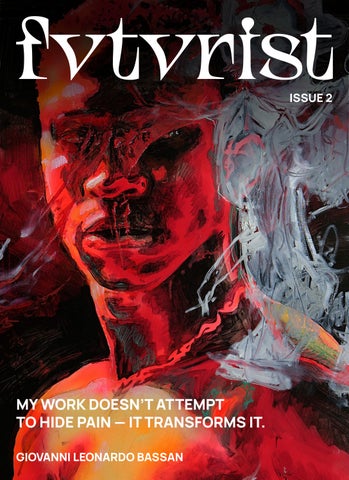
ISSUE 2
MY WORK DOESN’T ATTEMPT TO HIDE PAIN — IT TRANSFORMS IT. GIOVANNI LEONARDO BASSAN
ISSUE 2
Edited by FVTVRIST ART MAGAZINE Editor-in-Chief Anna Somova Curator and Creative Director Elina Poliakova Art Director Sébastien Henras Design / Graphics Mariia Goregina Cover ARTWORK detail,「MATHEUS」, Giovanni Leonardo Bassan, Image courtesy of the artist FVTVRIST Art Magazine Association loi 1901 Rue des Vignoles, 75020 Paris info@fvtvrist.com
Material as Metaphor, Form as Philosophy. Crystal
16
Between Velvet Flesh & Painted Shadow. Giovanni Leonardo Bassan
30
Into the V.O.I.D. Alexandre Bavard
46
Sweet Verses, Dying Like Roses. ShuShu
58
One thread all the way. Alfred Cheng
74
Beauty That Bleeds. Slava Vorontsov
88
The Architecture of Echoes. Von Wolfe. Chapter I
106
Shadows of the Image. Von Wolfe. Chapter II
118
From runway to store. Anastasia Shevchenko
130
Captured before it wilts. Tara and Emil
140
Memory Builds the Future. Rocco Plessi
156
Molding presence in stone and metal. Elina Lans-Timofeev
174
Nostalgie du présent. Exhibition Visit
186
Beyond the (movies) stream. Théodore Nave
196
Les contes de l’entre-soin. Clément Justin-Hannin
212
Being an occasional muse. Clémence Bruno
2
1
CRYSTAL
Text by Anna Somova // FVTVRIST All images: Courtesy of the artist 2
Material as Metaphor, Form as Philosophy: The Sculptural Language of Crystal
3
ISSUE 2
CRYSTAL
From Amoy to Milan, Crystal is emerging as one of the most compelling sculptural voices of her generation—a practitioner whose work fuses material sensitivity with philosophical depth. Currently studying at the Accademia di Belle Arti di Brera, her practice unfolds at the intersection of Eastern metaphysics and Western sculptural discourse, articulating a language both meditative and precise.
Crystal engages with a wide range of materials—marble, wood, metal, and clay—each chosen not for effect, but for the resonance it holds within the conceptual frame of the work. Her metallic pieces often begin as digital visualizations, where she choreographs form in the virtual space before rendering it into physical presence. This integration of ancient technique and contemporary technology defines her distinctive approach.
At the core of Crystal’s artistic inquiry is the concept of the “not-Self”—a dissolution of ego that recalls both Buddhist philosophy and posthuman thought. Her works are bold manifestations of states: fragile, transitory, suspended between form and formlessness. There is a subtle rigor in her spatial thinking. Crystal’s sculptures operate through quiet poetics, resisting spectacle in favor of presence.
4
Crystal already appeared on the cover of FVTVRIST ISSUE 01 MARCH with one the most evocative works 「十」, a digital piece in which human elements are abstracted into symbolic forms, constructing the illusion of a ritual. It is an artwork about futility—a poetic meditation on the dissolution of life through meaningless actions.
Today, we follow that thread further—into the conceptual terrain of her studio, the materials that shape her language, and the emergence of a new Chinese voice with the clarity and vision to engage the global art landscape.
We have prepared a special article dedicated to her, not only to explore what she has already revealed— but because Crystal has much more to unveil.
CRYSTAL
ISSUE 2
Trauma as origin.
ARTWORK「Super Survivor」, Crystal. Metal sculpture. 2025
Rebirth through pain.
6
l though there are significant differences between Chinese and Western cultures, I prefer to explore the shared origins of their consciousness. Differences are a manifestation of miracles.
7
ISSUE 2 How has your move from China to Milan influenced your creative vision and your understanding of artistic freedom? I’mlessinterestedinthedifferencesbetweenEastern and Western cultures, and more drawn to their shared roots — the deeper layers of consciousness that connect us. Milan has brought me closer to life itself. It taught me to trust my intuition. My thinking still flows through Chinese philosophy — it’s where I’m grounded. And true freedom? It’s not about inventing concepts. It’s about no longer needing them.
What has your experience studying sculpture at the Pinacoteca di Brera been like — creatively, intellectually, and day to day? Studying at Brera is less about following rules and more about expanding how I think. I’m constantly inspired by the open exchange of ideas — with professors, classmates, and the environment itself. The classes are flexible, giving me space to focus on my own work while pushing me to refine my creativity and expand my perspective. It’s about the infinite possibilities of thought and form. Structure, here, becomes a tool to better realize intuition.
Can you walk us through the creation of one of your recent sculptures — from initial impulse to materials, process, and inner reflections? The sculpture I’m working on began with a question I kept hearing: “Do you like Milan?” At first, I answered easily — yes, it’s beautiful. But that surface soon wore thin. Beneath it, I felt chaos, a quiet cruelty, a kind of existential friction. This shift — from beauty to discomfort — became the core of the work. I chose materials that embody contradiction: metal colliding with organic textures, aggressive yet soft, ancient yet futuristic. I’ve been exploring lost-wax casting, marble, metal inlays — anything that carries both tension and memory. The process is never static. I reflect constantly, often overturning my own ideas. There’s a quiet rebellion at the heart of everything I make. 8
CRYSTAL
Your sculptures often evoke the metaphysical and the spiritual. How do philosophy, the “not Self,” and ideas of transformation or healing shape your artistic vision? Philosophy helps me face the unsolvable — not to solve, but to see. I think of existence like H₂O: sometimes ocean, sometimes cloud, always shifting. The soul is both independent and inseparable. Death isn’t an end, it’s a change of form. For me, sculpture isn’t about resonance — it’s about disruption, about provoking thought and giving the soul a brief moment of freedom. Maybe art can’t preserve time, but it leaves traces — fragments that settle deep inside someone, quietly alive.
Crystal, Working at the Studio, 2025
Your work draws from deep philosophical roots while embracing raw, physical creation. How do Chinese philosophy, ritual, materials, and inner states shape your sculptural process today? I return again and again to the question of life — something Chinese philosophy and mythology have taught me to contemplate through ritual, silence, and symbolic form. For me, sculpture is both sacred and destructive: in stillness, I carve with force. Ritual isn’t just tradition — it’s a necessity born from the spirit. My process begins with the intangible: a smell, a dream, a metaphysical coincidence. I work with whatever tools match my energy — sometimes even my own body becomes a tool. Everything shifts, including my bond with materials like metal, stone, or wood. They evolve as I do. I don’t feel torn between East and West — their foundations harmonize in my hands. Sculpture, for me, is guided by invisible energies, wrapped in solitude, and confirmed by the unseen.
ISSUE 1
10
CRYSTAL
“Rite” is the embodiment of ritual in my mind. Across cultures, the human spirit needs something to hold onto. Rituals might not mean much — but they prove the soul exists.
ARTWORK「RITE」, Crystal. Metal sculpture, Oil on canvas. 2025
11
ISSUE 2
CRYSTAL
13
ISSUE 2
CRYSTAL
The clash between metal and flesh fascinates me. It’s raw. Violent. Beautiful. Metal shifts with temperature — rigid, fluid, fractured — echoing the cycles of life. This tension drives my work: Soft vs. sharp. Past vs. future.
14
15
GIOVANNI LEONARDO BASSAN
Interview by Elina Poliakova ARTWORK detail,「MATHEUS」, Giovanni Leonardo Bassan, 90x130cm, oil and acrylics and pastel on linen canvas, 2025, Image courtesy of the artist
Between Velvet Flesh & Painted Shado
ISSUE 2
GIOVANNI LEONARDO BASSAN
Giovanni Leonardo Bassan’s practice explores how figuration can hold both presence and withdrawal. With a background that bridges classical training and the nocturnal pulse of Paris and Milan, Bassan has steadily crafted a body of work where softness is never weakness, and where figuration becomes a slow seduction. His latest exhibition, Non c’è Rosa Senza Spine, marks a turning point: a distilled, pared-back, yet emotionally precise moment in a practice that has long flirted with the sacred and the broken, the sensual and the wounded. For FVTVRIST, we aim to open a deeper dialogue — one that touches on his evolving relationship with painting, the iconography of touch and shadow, and the philosophical undercurrents that run beneath the surface. Giovanni Leonardo Bassan, IMG credit: Antoine Bedos
Your exhibition Non c’è Rosa Senza Spine explores themes of duality and perception, bridging classical European painting with contemporary figurative art. How do you navigate the interplay between beauty and pain, visibility and obscurity in your work? This has been a central conversation with the curator (Lexing Zhang) in the lead-up to the show. The title was actually her idea — she recognized this tension in my life and in my way of seeing the world. I’ve always been drawn to darkness and obscurity, whether in people or situations, yet I carry and transmit a very bright energy. That same duality is present in my paintings: my subjects might emerge from darker narratives, but they’re rendered in vibrant colors, gentle light, and layered transparencies. Carl Jung’s notion that awareness comes from integrating both light and shadow resonates deeply with me. My work doesn’t attempt to hide pain — it transforms it. There’s always this dance between concealment and revelation, where beauty is not separate from fragility but intimately tied to it.
Your works often feature fragmented images, veiled figures, and expressive hands. What significance do these motifs hold for you, and how do they contribute to the overarching themes in your art? Veiled figures and blurred gestures are part of my personal search for abstraction. Coming from a figurative background, reaching abstraction is quite complex for me — I naturally return to faces, body parts, fragments of identity. By layering scenes and applying paint in translucent washes, I allow distortion to enter the work. The final image is not a statement, but a residue. As for hands, they’ve become an essential part of my visual language. Being Italian, communication through gesture is second nature. I observe hands constantly — how people move and speak with them. There’s an unspoken intimacy in that language. In almost every piece, a hand appears not just as a symbol, but as a silent communicator, a carrier of memory and emotion.
In pieces like TOMAS and GIADA, you utilize bold brushstrokes and layered colors that evoke a sense of transition and fragility of perception. Can you discuss your material choices and how they serve to underscore the themes of your work? I’m very drawn to working with unusual materials. In this exhibition, for example, I painted on vintage French military blankets made of thick wool, which are incredibly textured and tactile — raw. It forced me to adapt my technique and relate to the surface in a more sculptural way. With TOMAS, I began on traditional linen canvas, but ended up cutting out the painting and hand-stitching it onto the blanket. GIADA was painted entirely on wool. The way oil paint moves on that texture allowed me to apply it more heavily, to let the brushstrokes carry weight — almost like carving. These choices help reinforce the physicality and vulnerability of the figures. They’re not floating in sterile space, but anchored in rough, lived materials.
ISSUE 2
GIOVANNI LEONARDO BASSAN
My work doesn’t attempt to hide pain — it transforms it.
20
ARTWORK「GIADA」, Giovanni Leonardo Bassan. 100x145cm, oil and acrylics on army blanket (french vintage army blanket 100% wool), 2025, Image courtesy of the artist
ARTWORK「THOMAS」, Giovanni Leonardo Bassan. 90x130cm, oil and acrylics and pastel on army blanket (french vintage army blanket 100% wool) and linen canvas, 2025, Image courtesy of the artist
21
GIOVANNI LEONARDO BASSAN
ISSUE 2 Presenting your first solo exhibition in Singapore, a city known for its blend of tradition and modernity, how does the cultural context influence the reception of your work, and does it affect your creative process? For me, exhibiting is the final chapter of creation. The dialogue with the public, the energy of the space, the way people interact with the work — that completes the circle that starts alone in my studio. I often avoid commissions or projects destined for private spaces or archives because I need that moment of exposure and confrontation with the audience. Singapore’s cultural context — and the broader Southeast Asian community — is both close and distant from my typically Parisian subjects. I was genuinely curious to see what kind of conversations would emerge. And I was pleasantly surprised. The work was well received and thoughtfully interpreted, which reminded me that emotional language can cross cultural boundaries.
Reflecting on your recent exhibitions, how has your artistic practice evolved over the past two years, and what new directions are you exploring in your current work? Over the past two years, I’ve become more confident in my research and direction. I don’t think I’ve reached the place I want to be, but I’m getting closer. I’m pushing toward a more layered, abstract vision — one that still holds figuration, but lets it dissolve at the edges. Looking back at my earlier work, I’m full of critique, but also full of excitement for what’s to come. The path feels more defined, more personal, and yet I’m still open to surprise and risk.
22
ARTWORK「MATHEUS」, Giovanni Leonardo Bassan. 90x130cm, oil and acrylics and pastel on linen canvas, 2025, Image courtesy of the artist
Photo Credit: STEFFFF Having collaborated with figures like Michele Lamy and Rick Owens, how have these interdisciplinary experiences influenced your painting practice and conceptual frameworks? On a material level, absolutely! Some of the textiles I use are directly inspired by the Owens Furniture world. The military blankets, for instance, are often used in his furniture for flooring or upholstery. I repurpose them in a fine art context, which brings a new layer of meaning. Conceptually, though, I try to protect my research from too much external influence. Being exposed to international art fairs and constantly surrounded by visual input can feel overwhelming — like an “art overdose.” But I’ve learned how to navigate this saturation: observe everything, absorb very little, and only let in what truly resonates. I admire many things, but I try to keep my inner compass intact.
GIOVANNI LEONARDO BASSAN
ISSUE 2 Your paintings invite viewers into intimate and sometimes vulnerable spaces. How do you approach viewer engagement, and what emotional responses do you aim to evoke through your art? My hope is that viewers will slow down. In a world moving so fast, with attention spans shrinking, I want to offer a pause — a space where people might linger, wonder, and connect with their own feelings. The layered nature of my paintings means some subjects become unclear or abstracted. I love that moment when the viewer fills in the blanks, sees things their own mind projects. It becomes a dialogue between my gesture and their imagination. Vulnerability invites vulnerability.
Looking ahead, are there specific themes or mediums you are eager to explore, and how do you envision your practice evolving in response to the changing landscapes of art and society? I don’t think my work changes in reaction to external trends. Rather, I try to mirror the deeper shifts I sense within people and within myself. As for new mediums, I’m really excited to begin working with bronze. I’ve started developing a hand sculpture for an upcoming show in Paris this July. It’s a new challenge and a natural extension of the themes I’ve always explored — touch, gesture, memory — previously with ceramics, but now in a material that carries permanence and weight. I’m curious to see where it leads.
24
ARTWORKS「LIMB I」, ceramic and metal structure, 20x20x102cm, 2024 「LIMB III」 15x15x84cm, ceramic and metal structure, 2024 Image courtesy of the artist
ISSUE 2
26
GIOVANNI LEONARDO BASSAN
Exhibition View,「Non c’è Rosa Senza Spine」, Loy Gallery, SIngapore, 2025, Image courtesy of the artist
27
GIOVANNI LEONARDO BASSAN
ISSUE 2
ARTWORKS「SELF PORTRAIT」, oil and spray paint on hand embroidered army blanket, foam, 150x120x45cm, 2024 Image courtesy of the artist
28
ARTWORKS「LIMB I」, ceramic and metal structu 「LIMB III」 15x15x84cm, ceramic and Image courtesy of the artis
ure, 20x20x102cm, 2024
metal structure, 2024 st
ARTWORKS「SELF PORTRAIT」, 73x90cm, oil and acrylics and pastel on canvas, 2024 「STUDY OF A SELF PORTRAIT」 52x62cm, oil and acrylics on transparent gel, 2023 Image courtesy of the artist
29
INTO THE V.O.I.D. After the closing of V.O.I.D. exhibition at Galerie Au Roi in Paris, we caught up with Alexandre Bavard to reflect on the ideas and energies that lingered long after the lights went out. Created in collaboration with Arthur Hoffmann and curated by a-topos, the exhibition was a full-bodied environment. In this conversation, we delve into the symbolic spine of V.O.I.D.—exploring how Alexandre builds meaning through absence, material, and myth. What emerges is a portrait of an artist navigating the fractures of the present with precision, urgency, and a language entirely his own.
FVTVRIST Magazine // Photo Credit: Manuel Obadia Wills 30
A Studio Dialogue with Alexandre Bavard
31
After the closing of V.O.I.D. exhibition at Galerie Au Roi in Paris, we caught up with Alexandre Bavard to reflect on the ideas and energies that lingered long after the lights went out. Created in collaboration with Arthur Hoffmann and curated by a-topos, the exhibition was a full-bodied environment. In this conversation, we delve into the symbolic spine of V.O.I.D. — exploring how Alexandre builds meaning through absence, material, and myth. What emerges is a portrait of an artist navigating the fractures of the present with precision, urgency, and a language entirely his own.
Photo Credit: Manuel Obadia Wills
32
33
I’m drawn to unstable zones — vacant lots, industrial wastelands, abandoned buildings. These are places where time feels suspended, where the past is still visible and the future not yet arrived. They evoke a kind of present-day archaeology.
Exhibition view, V.O.I.D. by Alexandre Bavard and Arthur Hoffmann. Galerie Au Roi in Paris, 2025 Courtesy of the artist.
35
ISSUE 2
INTO THE V.O.I.D.
Your recent exhibition V.O.I.D. with Arthur Hoffmann feels more like a spatial proposition than a conventional exhibition. What interests you about co-authorship, and how does it reshape the architecture of a work? V.O.I.D., curated by Atopos, was conceived as an immersive space—an ecosystem rather than a mere sequence of artworks. The installation of scaffolding in the venue became a kind of spine, a structure that was both architectural and symbolic. It drew from urban aesthetic codes deeply rooted in my gaze, especially those specific to the city of Paris. Scaffolding, in its essence, embodies transition — a threshold, a temporary architecture that materialises the idea of connection. Working with Arthur Hoffmann allowed us to weave formal and conceptual dialogues between our practices without trying to merge them. Being a co-author means giving up total authority over the work in favour of a fertile space of friction, where ideas confront and transform one another. It’s not about placing two works side by side, but about creating a third language. This experience confirmed for me that art can be generous — a space for building connections.
Non-places are at the heart of V.O.I.D. and of your broader practice. Do you see these transitional spaces as sites of erasure or of potential? I’m drawn to unstable zones—vacant lots, industrial wastelands, abandoned buildings. These are places where time feels suspended, where the past is still visible and the future not yet arrived. They evoke a kind of present-day archaeology. My graffiti practice taught me how to read these landscapes, to inscribe signs within them, to capture their invisible ruins. Such places remind me that everything is destined to disappear: neighbourhoods, architecture, entire civilizations. But within every collapse, there’s a promise. In Beirut, I saw a wounded, fractured city—yet it was still alive. I realised that where there is destruction, there is also the possibility of renewal. These spaces are both sites of erasure and of potential—thresholds. A topology of passage, of cycles, of unstable memory. In Syria, a month after I visited, I witnessed the regime of Bashar al-Assad begin to collapse, triggering a civil war that would last over a decade. That moment left a deep impression on me. It reminded me of the fragility of systems, the impermanence of the world, and it shaped both my mindset and my visual imagination. I’m drawn to such experiences, often violent ones , where collapse coexists with life and rebirth.
Arthur Hoffman. print on alluminium, 2025 Image courtesy of the artist
The void is not only spatial. It’s also psychological, social, and political. What kind of void are you trying to inhabit or confront right now? I feel a generational void—an anxiety about the future. Many of my works resonate with this sense of an ending, a melancholy for a world fading away. Eco-anxiety, the rise of extremism, artificial intelligence, pandemics, war—all of it creates a suffocating atmosphere. I grew up watching science fiction films from the 1990s, and now I have the eerie feeling that those fictions have become reality. Faced with this void, my work becomes a symbolic rampart. Art doesn’t need to be reassuring. It can be disturbing, confrontational, even aggressive; it can raise questions that politics or institutions shy away from. Art is a space of sensitive resistance. I’m not trying to fill the void—but to inhabit it, to shape it, to create rituals and anticipations within it. The void then becomes an echo chamber for our collective anxieties—but also a catalyst for imagination.
Your work often returns to medieval and mythological codes— knights, relics, rituals—filtered through a distinctly urban and post-industrial lens. What draws you to these temporal collapses? I don’t see time as a straight line, but as a loop. Temporal collapses interest me because they allow for the layering of epochs: a tag on an ancient column, a knight in armor dueling a riot cop. There’s a tension there that becomes fertile. Mythologies, rituals, figures of bravery or rebellion—these obsess me. Even if they’re out of fashion in contemporary art, these codes still course through our bodies and imaginations. The 2023 BRAV exhibition at Tick Tack gallery in Antwerp played precisely with those analogies: the hero versus the system, the armor versus the uniform, myth versus control. I think our era needs strong narratives—not necessarily to believe in, but to feel. I work like a time traveler, gathering fragments from the past to compose new realities. It’s an act of imagination, but also of memory.
ISSUE 2
CRYSTAL
I feel a generational void—an anxiety about the future. Many of my works resonate with this sense of an ending, a melancholy for a world fading away. Eco-anxiety, the rise of extremism, artificial intelligence, pandemics, war—all of it creates a suffocating atmosphere.
38
Kunstverein Wagenhalle Stuttgart, 2024
ISSUE 2
40
INTO THE V.O.I.D.
Kunstverein Wagenhalle Stuttgart, 2024
ISSUE 2 What’s next? What kinds of ruins, myths, or margins are calling to you now? Right now, I’m very drawn to preColumbian civilizations—Mexico, the Andes. There’s a powerful iconographic force in those cultures, a deep connection between ritual, body, and cosmos that speaks to me. I’d love to go there—to feel the energy of the sites, to move in the rhythm of another continent. Every journey is foundational for me. I never work only in the studio. I need to immerse myself first — to move, to feel, to capture invisible forces. It’s in those margins — geographical, temporal, mental — that my most vital projects take shape.
INTO THE V.O.I.D.
Agora, Théâtre de Liège Belgium, 2025
ISSUE 2
Finally, what is the question about your work that you wish people would ask, but never do?
44
Photo Credit: Manuel Obadia Wills
Why?
45
SWEET VERSES, DYING LIKE ROSES
FVTVRIST Magazine // Image: Courtesy of the artist 48
A soundscape and conversation with Shanghai-based music producer ShuShu
49
SWEET VERSES, DYING LIKE ROSES
ISSUE 2 ShuShu, the Shanghai-born producer and vocalist operates on an emotional, dreamlike frequency. Across collaborations with Vebe Suprada and Organ Tapes, she crafts a sound that is airy yet anchored, ghostly yet defiant. Her lyrics slip between languages; her melodies resemble traces of emotions you once felt but never named. There’s a sensibility in her work that suggests an intimacy with both underground nightlife and solitary rituals, a duality shaped by the electric haze of her home Shanghai and the sultry pulse of Paris, where she has lived for several years. For Fvtvrist, we reached out to explore her sonic cosmology, and what lives just beyond it.
Listen to the sonic selection by ShuShu for fvtvrist on spotify
50
shu² Shanghai shushu-sm.vercel.app _shushu_chiu_
51
ISSUE 2 Your sound floats between ambient, emo club, teenage pop, and lullaby. Do you see this fluidity as instinctive, or are you sculpting an entirely your own sonic language? I was just thinking about it a couple days ago — Sweet Verses Dying Like Roses literally came out of nowhere, and it’s so hard to categorize. That was the time I was really into club music, the first hyperpop boom, and other cloud rap/hip-hop shit. But eventually, that EP doesn’t sound anything like any of that — not a single clue. I just realized how original it is. Pure creative energy. No reference to anything. I didn’t like it at first, honestly, it took me years. It was actually just last night that I had this epiphany moment: it’s not crap. I just couldn’t get it before. And yeah, I think you’re right — it’s completely driven by intuition.
52
SWEET VERSES, DYING LIKE ROSES
Who are the artists, musical, visual, literary, who helped shape your inner terrain? Jay Chou, Khalil Fong, PC music, M.I.A. David Lynch, CHARLIXCX ofc, Arca, Rosalia, Pharrell and many more, im inspired by many movies recently like X trilogy. Jean-Christophe by Romain Rolland, I’ve been reading this book for several years, and I don’t know which part I’m on now. It’s the story of a musician from cradle to grave, and I can relate to it very much.
I have some friends who make music, and they’ll ask me, “Don’t you look for references when you create?” I always say, “Not really.” Of course there are songs I really appreciate and think, wow, I want to sound like that too — but when I actually sit down to make music, I totally forget about them and just do my thing. Right now though, yes, I am starting to look more for inspiration and references. So to answer your question: I didn’t intend to sculpt my music like that. It is what it is. It just comes out like that. Maybe the universe made me do it, lol. An artist will spend their whole life searching for a unique sound, vision, or style — but maybe what I’ve been chasing, I already had in the very beginning. I just didn’t realize it. Life is a full circle.
Image: Courtesy of the artist
53
ISSUE 2
SWEET VERSES, DYING LIKE ROSES
An artist will spend their whole life searching for a unique sound, vision, or style — but maybe what I’ve been chasing, I already had in the very beginning. I just didn’t realize it. Life is a full circle.
54
You’ve lived in Shanghai and Paris, two cities with vastly different rhythms and emotional architectures. How has this dual geography shaped the way you write, listen, or even feel sound? Is there one city, or perhaps an entirely different place, that lingers more deeply in your music? It’s a bit of a difficult question to answer. Living in different cities definitely changes things, but I spend most of my time in my room making music. I collaborate online, even now, my main producer and I live in different cities. I think the influence is more on my personal life, and that then spills over into the music. In Paris, I was a carefree student, living under my parents’ shelter. In Shanghai, I became more down to earth and striving a real adult life.
Image: Courtesy of the artist
What emotional spaces or textures are you drawn to exploring next? Are there themes or sonics you’re beginning to trace but haven’t fully unraveled yet? I’m working on next release right now, and it sounds way more exciting and sleek. Titled S&M. It’s shows a different side of me, a crazier part. A new era with bigger ambition. Just think about if Elon mask can make it to Mars, girl can do anything I want right? 55
ISSUE 2
SWEET VERSES, DYING LIKE ROSES
nothing like uuuu (shu2 remix) 57
ONE THREAD ALL THE WAY
FVTVRIST Magazine //
ARTWORK「Choir No.1」, Alfred Cheng Courtesy of the artist
Alfred Cheng and the Metaphysics of Thread
ISSUE 2
https://www.alfredcheng.art/
60
ONE THREAD ALL THE WAY
Alfred Cheng in his Hong Kong studio, 2025. Courtesy of the artist n a cultural landscape defined by visual excess and algorithmic immediacy, Alfred Cheng’s practice emerges as a slow, methodical resistance — not against image, but against disconnection. Working from his Hong Kong studio, Cheng reconfigures the act of mark-making by eliminating the mark altogether. In place of graphite, pigment, or gesture, he offers a single unbroken thread — looped around hundreds of nails — to form portraits and symbolic structures that operate at the intersection of drawing, textile, architecture, and meditation. Cheng’s work proposes a radical material minimalism: line as form, thread as philosophy. Each piece functions as a spatial score composed through tension, restraint, and control, inviting viewers not only to look, but to inhabit distance — the space between thread and image, form and meaning. In this rare interview with FVTVRIST, Alfred Cheng reflects on his obsessions, the metaphysics of thread, and how loneliness shapes reliance. He shares his reluctance to chase markets and butterflies, and his quiet rebellion against complexity in pursuit of silence — the kind only art can conjure.
ONE THREAD ALL THE WAY
ISSUE 2
One Thread All the Way’ — what does that phrase mean to you? For me, a thread is not just a tool — it represents boundaries, connections, and separations. It reflects the complex network of relationships in society and invites reflection on identity and power. The phrase ‘One Thread All the Way’ expresses my desire for uninterrupted thought during creation, allowing the audience to feel a sense of harmony within the final piece. I want the thread to weave continuously, without interruption, until it’s complete. Even if it moves in the wrong direction, I won’t undo it — I continue from that point. That feels like life. Every choice we make shapes who we are. There is no need for regret; each thread belongs to the path we are building.
How did your practice begin — and how did thread become your chosen medium? It’s been a gradual accumulation since childhood. I was always fascinated by black-and-white sketches and the beauty of line. Around 2016, I reignited that curiosity, left my job, and dedicated myself fully to art. I began with pencil drawings, drawn to the purity of line. But I soon realized that if I wanted to grow, I had to find a language uniquely mine. While traveling in Europe, I stumbled into an old textile shop. Seeing spools of black thread lined up on the shelves, I suddenly saw one as a drawn line — and a new idea took hold. In 2021, after years of experimentation, I finally created a piece I was truly satisfied with.
62
ARTWORK「Happy Birthday」, Alfred Cheng Courtesy of the artist
Has living in Hong Kong shaped your artistic vision? Growing up in Hong Kong has influenced how I understand social structures and human relationships — these themes often appear in my work.Emotion is central to what I create. Whether I’m depicting a person or a single flower, I try to perceive the subtle emotional forces they carry. I believe the world is already rich with complexity and purity — my job is not to impose meaning but to reveal what’s already there. I aim to capture beauty and emotional truth as they exist, unfiltered.
Your recent exhibitions Silent Love and Silent Night seem emotionally charged yet quiet. Why silence? ‘The world is already complex enough. I hope to find some silence’. In this absurd world, purity and silence is a luxury that prompts us to rethink our identity and existence. ‘This is a journey of reflection and reformation’. Silent Night explores how solitude creates space for emotional reliance between people. The question behind the show was: in the quiet of the night, am I thinking of you, or are you thinking of me? That ambiguity — that invisible connection — fascinates me. When we feel loneliness, the need for others intensifies. I often wonder: do I rely on others more, or do others rely on me? That question sits at the center of the work. Mutual dependence is undoubtedly rooted in solitude. When humans feel loneliness, the need for relationships and the sense of reliance become even stronger. This emotional depth can foster more genuine connections in the future.I chose this theme because I often question whether my dependence on others is greater or if others rely on me more. I hope to explore how the priority of reliance between people is defined and arranged. 63
ISSUE 2
ONE THREAD ALL THE WAY
Emotion is central to what I create. Whether I’m depicting a person or a single flower, I try to perceive the subtle emotional forces they carry.
64
ARTWORK「Onlookers」, Alfred Cheng Courtesy of the artist
14
ISSUE 2
ONE THREAD ALL THE WAY
How do you see your process of working with thread in relation to life itself? I began exploring the potential of thread in 2016. Thread can break and reconnect, and when a method fails, I seek new paths. I experimented with different types of threads, and no matter how difficult they were to tame, I never considered giving up. As I spent each day with the thread, I realized it’s like searching for the meaning behind every choice in life. I feel that the person I am today is shaped by every choice I’ve made in the past. Should I choose option A or B? Gradually, I found this process resembles winding a thread. You can imagine a nail as a choice from my past, and then how I weave and connect it with the thread. Should the thread wrap around the nail from the left or the right? Ultimately, I pulled my work into a path, leading to the birth of each piece, which, in turn, shaped the person I am today. Each strike of the nail and every tug of the thread injects emotion into the work, materializing it into a tangible form. This interactive process continuously reshapes the value of each other’s existence. It is fair and essential. With my past experiments and research, I became increasingly attracted to the purity, simplicity, and infinite possibilities of thread. The most subtle aspect is that they allow me to enter a unique rhythm and meditative state during the creative process. Unlike other media, thread art removes color and focuses only on line, shape, and structure. It forces the viewer to pay attention to form and flow — and to the stories embedded within.
66
Many viewers are surprised to learn your works aren’t pencil or digital drawings, but thread. How do you see this moment of realization? Indeed, my method of creation requires viewing the physical work to fully experience it. The thoughts and tension formed by the thread cannot be felt through a screen. When observing the artwork up close, one cannot see the clear patterns; only by stepping back can the meaning within the work gradually become apparent. This is also what makes my approach appealing, as it embodies a philosophical idea: ‘when we are too close to something, we often fail to see the truth. Only by stepping back and looking from a distance can we gain insight into the truth.’ It is indeed interesting that many people initially perceive my works as having been created with a pencil. Whenever I see their expressions change as they move from their own inherent perceptions to suddenly embracing a new perspective, those moments are what attract me sometimes.
Do you believe an artist must suffer or search to create something truly moving? I believe this is a process that most creators experience. I am convinced that only by forcing oneself to engage with various experiences can one clearly understand what moves them most. Only then can truly great and touching works be created. However, one thing I can be certain of is that I believe simple and direct artistic expression can serve as a powerful weapon against complexity, allowing the human soul to return to a pure state.
ARTWORK「The Weight of Cigarette No.2」, Alfred Cheng Courtesy of the artist
Your piece The Weight of Cigarette No.2 is particularly striking. Can you speak about its meaning? The work ‘The Weight of Cigarette No.2’ depicts a child taking a box of cigarettes from their pocket. After a moment of hesitation, they put one in their mouth and inhale, only to then look around anxiously and extinguish the cigarette. I feel the brief emotional shift as they choose to be true to themselves but ultimately succumb to the gaze of the public. This symbolizes two processes: self-struggle and conformity. Struggle represents the choice of solitude to satisfy oneself, highlighting the importance of desire. Conformity reflects societal expectations, leading to compromise and dependence, further revealing the submissive relationship between the individual and society. This makes me reflect—what determines our status as a so-called ‘normal person’?
ARTWORK「 Choir No.3」, Alfred Cheng Courtesy of the artist
ISSUE 2
68
ONE THREAD ALL THE WAY
ARTWORK「Choir No.2」, Alfred Cheng Courtesy of the artist
69
ISSUE 2
ONE THREAD ALL THE WAY
You’ve collaborated across disciplines — fashion, luxury, dining. Do you see art and other industries as compatible? I believe that there has never been an opposition between art and other industries. Art should absolutely—and even must—engage in cross-disciplinary collaboration to bridge the gap with the public, expanding market opportunities and increasing interaction across different fields. Of course, this requires absolute respect and trust from both sides. These collaborations not only significantly enhance the exposure of artists but also allow artists to create artworks that best align with a brand’s philosophy, style, and themes. Through art, they can communicate and collaborate, thereby elevating their brand image. Therefore, I believe that both can complement each other and have a positive influence on one another.
70
What’s next for your practice? Do you see yourself expanding beyond two-dimensional threadwork? Currently, most of my works are primarily two-dimensional, but my goals extend beyond this. I am working on larger experiments, hoping to create more three-dimensional pieces or installation art soon, allowing more people to experience my world in a larger space. I hope that one day I can find the end side of the thread, but I believe life is too short for that to be realized. But It is already enough to have the fortune of intertwining with people I met in my life.
As your presence grows in Asia and Europe, how do you think about international recognition? Actually, I don’t actively seek out specific places to hold exhibitions. I only consider them when opportunities arise or when I receive invitations. If it feels suitable, I will think about the theme for my work, but I don’t change my style just to cater to certain places or audiences. If you create with the intention of pleasing the majority of the market, you may end up attracting no one at all. ‘Don’t try to chase butterflies, instead, cultivate your own unique garden, and the butterflies will come naturally.’
Collaboration:Vogue Art and Alfred Cheng during Hong Kong Art Week 2025
71
ISSUE 1
3
INTO THE V.O.I.D.
3
SLAVA VORONTSOV
Beauty That Bleeds
Text by Elina Poliakova // FVTVRIST All images: Courtesy of the artist
ISSUE 2
BEAUTY THAT BLEEDS
Someone likes to watch / someone likes to show. There’s a pretty French word with a sultry meaning for this — voyeurism. Black as mazut (Russian for a heavy, tar-like fuel oil — the word for industrial sludge), sweet as a melted candy sensation. The feeling of witnessing something that wasn’t meant for our eyes. And still, we can’t take our eyes off of it. Slava’s work traps you in that exact manner. The moment your gaze slips across his large-scale paintings — dense, almost viscous. They carry a sense of physicality, of resistance. Of layered meanings thick with emotional sediment. He confronts both shared and intimate questions through a choreographed entropy of brushstrokes, gestures unfiltered — painted with a primal, almost animal force. His canvases flicker between figuration and collapse. Sacred one moment, grotesque the next. What emerges are not answers, but atmospheres — rituals of undoing, confrontations with flesh and memory.
Take la mort de vénus: a raw, visceral undoing of Cabanel’s Birth. Where the classic Venus floated in purity, Slava’s is breaking down. Fragmented, decaying, devoured by color and force. No longer a goddess of desire — but of rot, of entropy. Painted with violent strokes and heavy textures, it’s a body pulled back down to matter. A critique of idealism, yes, but also a ritual: this is what happens when we stop pretending beauty doesn’t bleed.
76
ARTWORK「la mort de vénus 」, Slava Vorontsov 2025. canvas, acrylic, spray paint, oil pastel, oil stick, 199,5 x 172,5. Courtesy of the artist
ARTWORK「pizda (origine de l’origine du monde)」, Slava Vorontsov diptych, 2024, canvas, acrylic, oil pastel, 280 x 200 Exhibition view, École Nationale Supérieure des Beaux-Arts Courtesy of the artist
In another work pizda (origine de l’origine du monde), he references Courbet’s infamous Origin of the World, but instead of a singular erotic gaze, Slava brings in Mitochondrial Eve. Ancestral Blackness. Genetics, anthropology, archaeology — everything pointing to the same truth: the origin was never white. This painting becomes an undoing and a reclaiming all at once.
77
ISSUE 2
ARTWORK「petite révolution (josephine)」, Slava Vorontsov 2025. canvas, acrylic, oil pastel, 134 x 194 Courtesy of the artist
78
BEAUTY THAT BLEEDS
petite révolution (josephine), is dedicated to Josephine Loiselle, a 19th-century Parisian dancer of short stature. Here, her body becomes monumental. The black background frames her defiant pose as a rejection of aesthetic normativity. She is all confidence, all force, breaking through the shadow.
cyclisme plays with loops — of nature, migration, decay, and rebirth. It’s about movement across space and identity. Uprooting, adapting, reforming. Becoming something new before even understanding what was lost.
And then voyeurisme. A painting as mirror, but cracked. Watching oneself as if through another’s eyes. Moving to a new place, facing unknown conditions — and seeing unfamiliar parts of your own essence reflected back. In this work, voyeurism becomes a metaphor for intimacy with oneself. A transformation watched in real time.
ARTWORK「voyeurisme」, Slava Vorontsov 2024. canvas, acrylic, charcoal, airbrush, oil pastel, 80 x 80 Courtesy of the artist
ISSUE 2
BEAUTY THAT BLEEDS
I am particularly fascinated by contrasts—both in subject matter and technique. My paintings often delve into visceral themes such as scatological imagery and sexuality, incorporating elements from rock culture, tattoo motifs, and mythological figures.
80
ARTWORK「autoportrait d’une autre personne」, Slava Vorontsov 2024. canvas, acrylic, airbrush, spray paint, charcoal, oil pastel, 150 x 190 Courtesy of the artist
14
ISSUE 2
BEAUTY THAT BLEEDS
One of his paintings is called a self-portrait of another person. That’s what I felt flipping through his workbooks, playing with the paper corners, while the murmuring of the Parisian street outside mixed with explanations dressed in Slava’s calm voice. A rare sensation of being an object, a subject, and a witness — all at once.
82
Made between 2023 and 2025, drawings in his albums stand apart — not as studies or leftovers, but as a parallel space. A3-sized pages filled with airbrush, charcoal, oil pastels, pencil. The technique is layered, the tone more internal. Characters appear and dissolve. Mythological figures, fragments of bodies, forms in motion. They feel less like scenes, more like states. Each one its own exploration — some tender, some more violent. The drawings carry a different intimacy, like looking through a keyhole at something unfolding just for itself.
83
ISSUE 2
No staging. No narrative. Just the quiet violence of looking. A child’s curiosity with an adult’s precision. The world, undone — and stitched back with different threads.
BEAUTY THAT BLEEDS
VON WOLFE
Chapter I The Architecture of Echoes
Interview by Anna Somova // FVTVRIST 88
Photography by Nick Knight
89
ISSUE 2
VON WOLFE. CHAPTER I
Interview about authorship reconstruction of image-ma
p, AI, and the philosophical aking.
There is a particular gravity to Von Wolfe’s work — an orchestration of image, symbol, and material that resists immediacy. With a philosophical lens and an instinct for structural recomposition, he treats visual culture not as reference but as raw architecture. In this interview, he unfolds the deeper logic of his practice — authorship, distortion, machinegenerated memory — and the construction of a post-canonical image.
Photography by Nick Knight
91
ISSUE 2 Your art has been described as a “post-historic” practice that creates dialogues between eras. When you stand before a blank canvas, about to engage with a masterwork of the past, how do you choose which voices from art history to ‘invite’ into the conversation? When I first began the “School of Night” series seven years ago, my approach was rooted in what I would now describe as a more direct engagement with art historical imagery. Back then, I found it compelling to draw upon the visual language of artists like Rembrandt — not to replicate, but to enter into a kind of imaginative dialogue. The inclusion of deep-sea creatures and alchemical symbols in that series was less a deliberate narrative and more a kind of intuitive collision, a fusion born out of what I now understand as an early iteration of Cultural Quantumism. These juxtapositions weren’t meant to decode the past but to create a space where time folded into itself, inviting the viewer into a speculative mythology of human consciousness and the unknown. Today, my process has transformed. I no longer reference masterworks directly, and I haven’t for several years. Instead, I work from original compositions generated through a rigorous interplay between AI and traditional painting methods. The decision to move away from direct quotation was philosophical - an embrace of originality that nonetheless acknowledges its heritage through subtle stylistic resonance. While “School of Night” remains an important chapter in my development, my current work seeks to construct entirely new mythologies that reflect the complexity of our digital and human entanglements. The narrative, if there is one, arises not from an intent to “fuse” symbols but from allowing multiple eras, styles, and psychic registers to coexist within a single pictorial space. In this way, the canon becomes less of a reference point and more of an echo chamber — one that informs, but no longer dictates, the aesthetic decisions I make.
92
VON WOLFE. CHAPTER I In your 2011 exhibition “I Have an Excellent Idea…Let’s Change the Subject,” you evoked Derrida’s notion that “death of the author does not mean death of responsibility.” What is your sense of ownership and responsibility over the narratives that emerge from your recombined imagery? When I created “I Have an Excellent Idea… Let’s Change the Subject,” my interest lay in interrogating the authority of the image, and by extension, the author. At that time, I was engaged with Derrida’s notion that the “death of the author does not mean death of responsibility” — a premise that allowed me to explore the ethical ambiguity and liberating potential of recombination. My role then could be likened to that of a storyteller — a kind of bricoleur weaving a tapestry from salvaged icons, reshaping them into a new narrative that questioned its own origins. But over time, my position has shifted. Today, I feel less like a storyteller and more like an architect — not merely reassembling fragments of the past, but constructing entirely new visual worlds. While the specters of historical styles still linger in my art, I now work predominantly with original content generated through a synthesis of AI and traditional technique. This evolution in process brings with it a deeper sense of authorship, not in the possessive sense, but in the philosophical one: authorship as accountability, as the ethical stewardship of meaning. My responsibility lies not in preserving the narratives of the past, but in acknowledging how those narratives have shaped the visual language I now speak fluently, even as I strive to transcend it. I aim to build structures that are both haunted and newly inhabited—spaces where viewers can encounter echoes of history refracted through contemporary concerns. Authorship, in this context, becomes an act of critical architecture: designing visual environments that invite, unsettle, and ask more questions than they answer.
You have seamlessly brought figures like Snow White, Alice in Wonderland, and even Pokémon into fine art contexts. What is the fascination for you with these mythic and pop-culture characters? In the earlier phases of my practice, incorporating figures like Snow White, Alice, or even Pokémon was not merely an exercise in pop-cultural collage — it was a deliberate strategy. These characters functioned as instantly recognizable archetypes, modern-day hieroglyphs embedded with collective meaning. By placing them in incongruous or uncanny scenarios, I was probing the elasticity of symbolism—how the same icon can mutate across contexts, from innocence to seduction, from fantasy to critique. Snow White, for instance, was never just a princess; she became a cipher
for innocence under siege, a stand-in for the commodification of purity, or even a reflection of the audience’s own cultural nostalgia. These characters allowed me to engage with a visual language that viewers already carried inside them. They became vessels through which I could question authorship, identity, and the porous boundaries between high culture and mass entertainment. So whether playful, autobiographical, or subversive, these figures were never mere decoration. They were — and remain — gateways into deeper conversations about perception, projection, and the mythologies we collectively build.
ARTWORK「Steel Saint」, Von Wolfe Digital diffusion model with crafted iterations in post-production. Courtesy of the artist
93
ISSUE 2
ARTWORK「Pearls of the Desert」, Von Wolfe Oil on Canvas. Courtesy of the artist
94
VON WOLFE. CHAPTER I
95
ISSUE 2 Your “Processions of Orpheus” show in Moscow was striking for how it married Picasso’s forms with Russian avant-garde aesthetics, creating what was called a “harmonious marriage between East and West”. What inspired you to explore that particular cultural fusion? Was it influenced by the Moscow setting, or perhaps by current dialogues about globalization in art? Processions of Orpheus emerged at a moment when I was deeply interested in the tensions — and possibilities — of cultural fusion. The decision to blend the sculptural fragmentation of Picasso with the ideological force of the Russian avantgarde was not merely aesthetic; it was dialogic. I saw it as an opportunity to stage a kind of visual diplomacy, a synthesis that reflected on both historical rupture and the potential for harmony. The Moscow setting certainly played a role. There’s an unmistakable gravitas to exhibiting in a place so central to the story of modernism and revolution. The work became a kind of homage, but also an interrogation of what “East” and “West” really mean in the context of contemporary globalized art. In my broader practice, I’ve long been drawn to the interplay of visual systems across time and geography. Whether juxtaposing a Renaissance composition with an Asian iconographic gesture or embedding Byzantine symmetry within a digital construct, I’m less interested in exoticism than in resonance. The aim isn’t to flatten distinctions, nor to romanticize cultural boundaries, but to find points of entanglement — moments where seemingly disparate traditions echo one another in unexpected ways.
96
VON WOLFE. CHAPTER I
Early on, many noted the humour and whimsy in your works – the visual puns and playful transplantations. In recent years, some works feel more somber or uncanny. Do you feel your artistic tone has shifted as your personal outlook or philosophical focus has changed? There’s truth in the observation. In my earlier work, humour functioned as a kind of rupture — visual puns, misalignments, and anachronisms that unsettled the canon with a wink. It was never slapstick, but there was an unmistakable mischief in recontextualizing Snow White or Alice into existential or surreal tableaux. That playfulness was a form of critique, a way to expose the absurdity embedded within cultural hierarchies and iconographies. But over the last few years — particularly since my integration of AI into the creative process in 2021 — the tone has indeed deepened. Works like Always Screaming When Her Voice Is Cracked don’t seek to provoke laughter; they lean instead toward the uncanny, the liminal, even the spiritual. Part of this shift reflects a broader philosophical reorientation. This tonal shift isn’t necessarily darker, but it is more contemplative. Perhaps more sacred. There’s a new humility in the face of the machine and the mirror it holds up to us — one that invites less laughter and more stillness.
ARTWORK「THE STILL POINT」, Von Wolfe Oil on Canvas
97
VON WOLFE. CHAPTER I
ISSUE 2 Alchemy seems to be a recurring metaphor in your art – you’ve referenced it in titles and your 2018 Saatchi show explicitly linked to an alchemists’ society. How do alchemical ideas play into your process? Alchemy has always fascinated me — not as pseudoscience or esoteric nostalgia, but as metaphor. It’s a way of thinking about transformation: how base material, whether visual or philosophical, can be metabolized into something elevated or strange. At the time of painting The School of Night, I was reading the scholar Frances Yates and many books on notable figures in Elizabethan England, such as Sir Walter Raleigh and the School of Night. I was also looking at the works of Dr. John Dee and Cornelius Agrippa. In referencing Rembrandt’s The Night Watch, I was enacting a kind of painterly transmutation. The figures of The School of Night are suffused with a transformation into gold, as if the alchemical process had manifested literally within the image. In my earlier practice, this metaphor was more literal — referencing specific societies, medieval texts, or iconographies. But today, particularly with the integration of AI into my work, alchemy feels more alive than ever. The process of imagegeneration — of combining latent data, gestures, and histories into something uncanny and entirely new — feels akin to transmutation. It’s not just remixing; it’s a search for the philosopher’s stone hidden in the dataset. In that sense, yes, I do see myself as an alchemist of sorts. My ingredients aren’t sulphur and mercury, but fragments of memory, art history, and algorithmic code.
98
With a formal background in philosophy, do you consciously engage with philosophical texts or concepts while creating art? For example, your piece Werewolf (2011) famously references Derrida’s The Beast and the Sovereign. Are there current philosophical questions that preoccupy you – perhaps about reality simulation, given your AI work, or about the authenticity of the image in the digital age – that you find filtering into your paintings? Philosophy has always been embedded in my work, not just as a reference point but as a mode of inquiry. In the early years — particularly with works like Werewolf — there was a kind of scholastic rigor, a deliberate dialogue with thinkers like Derrida, Foucault, and Bataille. That
ARTWORK「SHADOW-BAN」, Von Wolfe
period was still fresh from academia, and my engagement was more textual, almost architectural in its fidelity to source ideas. I was building visual arguments — sometimes dense, sometimes playful, but always tethered to a critical lineage. Since then, the relationship has become less literal and more ontological. With the integration of AI, new philosophical questions have emerged — questions not just about the image, but about the very nature of perception, authorship, and agency. Wittgenstein’s language games, Baudrillard’s simulacra, or even Paul Feyerabend’s scepticism about epistemological hierarchy—these ideas
now underpin my process more intuitively. They filter into the way I think about iteration, about machine-generated possibility, about the fluid authorship between human and algorithm. One central concern today is the question of reality. Not in the naïve, material sense, but in terms of simulation and phenomenology. When an image is generated by AI and then handpainted in oil, where does its authenticity reside? Is it in the brushstroke? The prompt, the training? The viewer’s recognition of something “real”? I find myself increasingly preoccupied with this liminality — this digital hauntology, if you will — where images feel both ancient and synthetic, familiar and unplaceable.
ISSUE 2
VON WOLFE. CHAPTER I
Works like Always Screaming When Her Voice Is Cracked don’t seek to provoke laughter; they lean instead toward the uncanny, the liminal, even the spiritual. Part of this shift reflects a broader philosophical reorientation.
100
ARTWORK「Always Screaming When Her voice is Cracked」, Von Wolfe Digital diffusion model with crafted iterations in post-production. Courtesy of the artist
ISSUE 2 You’ve said that “no image is sacred” in your art– that you feel free to use any imagery, whether a religious icon or a modern meme. Have you ever hesitated or felt conflicted about a particular appropriation? How do you navigate the use of charged or sacred imagery? The phrase “no image is sacred” wasn’t a dismissal of meaning — it was a provocation. A reminder that all images, whether sacred or secular, are part of a shared cultural language. My interest has always been in testing the boundaries of that language: how far it can be stretched, repurposed, even subverted, without collapsing into either cliché or offense. That said, I’ve never approached appropriation flippantly. When using an image like the Falling Man or a religious figure, the decision is weighed carefully — not to sensationalize, but to interrogate. What does it mean, for instance, to repurpose an icon that has already been consumed, politicized, or aestheticized in other media? Can the image be returned to a state of critical reflection, rather than passive recognition? I’m less interested in shock for its own sake than I am in rupturing the complacency with which certain images are received. Art should disturb when necessary, but it should also illuminate the structures of that disturbance. If a viewer feels discomfort, I want that discomfort to be directed inward, toward their own assumptions about history, trauma, or sanctity — not simply outward, toward the image itself. The artist’s responsibility lies in that nuance. It’s not about avoiding offense — it’s about ensuring that any offence is meaningful, not gratuitous.
102
VON WOLFE. CHAPTER I
When someone encounters one of your large-scale works for the first time, they often experience a double-take – first the shock of recognition, then the surprise of the unexpected element. What do you hope the viewer takes away after that surprise settles? That moment of double recognition—the shock of the familiar turned uncanny — is absolutely intentional. I’ve always been interested in the slippage between what we think we know and what lies just beneath. When a viewer recognises, say, a familiar cartoon figure inside a reimagined Garden of Earthly Delights, I want that recognition to be destabilising. It’s a trapdoor. First they smile, then they wonder why they’re smiling. The absurdity is a hook, but the dissonance lingers. That second moment—the unease, the sense that something isn’t quite right—is where the real work begins. The image opens into a space of ambiguity, not to confuse, but to invite interpretation. I rarely prescribe a single narrative. Instead, I construct a kind of visual theatre where multiple readings can coexist: humour and horror, nostalgia and critique, spectacle and introspection. In a sense, I’m creating mirrors—images that reflect back the viewer’s own cultural assumptions, desires, and blind spots. Is there critique? Absolutely. But it’s embedded, not shouted. The remixing of sacred and profane, historical and pop, is less about parody and more about exposing the continuum of visual culture — how the iconographies of sin, spectacle, or salvation persist, only in different guises. Today’s meme is tomorrow’s myth. As for how much I orchestrate—there’s always structure beneath the chaos. The compositions are meticulous, the choices deliberate. But I never want to close the image off with too much explanation. The viewer must be allowed to “fill in the blanks,” to inhabit the work as a kind of co-author. That’s where meaning gains traction — not from the artist dictating intent, but from the friction between what’s shown and what’s seen.
There’s a beautiful irony in a painter of your classical skill embracing AI – it’s like the ultimate fusion of past and future. Some would say AI threatens the uniqueness of human creativity, especially in appropriation art; what’s your take on that debate? Working with AI has been nothing short of revelatory. When I first began to explore diffusion models and algorithmic generation, I wasn’t seeking efficiency — I was chasing surprise. The algorithm, when trained with care and guided by intuition, doesn’t just produce variations — it reveals logics I wouldn’t have imagined. In that sense, AI has become less a tool and more a coconspirator. It’s like collaborating with a ghost that speaks in the dialect of every image ever seen. There is, as you say, a beautiful irony in it. I trained in classical oil painting, steeped in the traditions of sight-size technique, atelier discipline, and historical composition. To pair that with machine learning feels like bringing the Renaissance into conversation with the digital unconscious. It’s not a betrayal of tradition — it’s a transformation of it. AI allows me to ask older questions in new ways: about originality, authorship, and what an image actually is. The debate around AI “threatening” creativity is understandable, but I think it’s misplaced. Every technological shift has prompted existential anxiety in the art world. But art doesn’t dissolve under new tools; it adapts, reflects, and reinvents itself. What we’re witnessing isn’t the death of human creativity, but its expansion. AI forces us to reconsider what creativity means when the boundary between artist and machine becomes porous. Who authors an image when both intuition and computation are at play? So yes, AI has transformed how I paint — but more importantly, it’s transformed how I think about painting. It’s not a replacement for the human — it’s a prism that refracts what it means to be one.
Over the years, you’ve built a kind of personal mythology in your body of work – recurring motifs (the Alice in Wonderland motif, for instance, or the use of mirrors and playing cards that I’ve noticed in some works), and of course the motif of the wolf in your name. Do you see your entire oeuvre as interconnected? Yes, I do see my body of work as a kind of evolving mythology — a constellation of symbols, references, and recurrences that have grown with me over time. The Alice figures, the playing cards, the mirrors, the wolf — all of them are more than visual tropes. They’re markers in an ongoing narrative, glyphs in a personal lexicon. Some began as deliberate metaphors, others emerged unconsciously, only revealing their coherence in retrospect. I think of them as waypoints — traces of where the psyche has been, and where it’s circling back to. My recent projects, especially those involving AI and digital methodologies, have undeniably expanded that terrain. Where earlier works might have drawn primarily on art history and classical form, the newer pieces feel more global, more networked. They’re informed by a broader visual consciousness — one shaped by algorithms, machine logic, and the distributed aesthetics of the internet. That doesn’t negate the mythology I’ve built; it extends it.
103
ISSUE 1
CRYSTAL
One central concern today is the question of reality. Not in the naïve, material sense, but in terms of simulation and phenomenology. When an image is generated by AI and then hand-painted in oil, where does its authenticity reside? Is it in the brushstroke? The prompt, the training? The viewer’s recognition of something “real”?
ARTWORK「Ebon」, Von Wolfe. Digital diffusion model with crafted iterations in post-production. Courtesy of the artist.
105
VON WOLFE
Chapter II Shadows of the Image
Interview by Anna Somova // FVTVRIST
Photography by Nick Knight
ISSUE 2
VON WOLFE. CHAPTER II
This second chapter enters the deeper strata of Von Wolfe’s praxis — a terrain where image production becomes a site of ontological inquiry and the painterly surface is conceived as a palimpsest of algorithmic memory, symbolic compression, and gestural control. What unfolds is not a linear continuation, but a critical descent into the artist’s epistemology: his strategic integration of AI-generated form, his dismantling of canonical hierarchies, and his articulation of a visual language that merges the mechanics of digital repetition with the irreducibility of manual labor. Von Wolfe navigates this interstice between the post-historic and the post-human with conceptual precision — composing images that are neither appropriated nor invented, but cultivated through systems of self-referencing recursion.
Your paintings reference so many artworks and historical images, but I’m curious about influences outside the visual arts. Are there writers, filmmakers, or musicians who have shaped your imagination? For example, has literature (perhaps Borges, who loved labyrinths of meaning, or scifi authors who explore alternate histories) played a role in how you conceive your “alternate art histories”? Or has living through the turbulent events of the 2020s (pandemic, social movements, etc.) left a mark on the kind of stories you want to tell through your images? Absolutely—my influences have always extended far beyond the visual arts. Literature, philosophy, cinema and music—all of these filter into my practice, often as conceptual scaffolding or tonal guides. Borges is a constant reference. His labyrinths, his mirror metaphors, his recursive narratives—these have deeply informed how I think about image-making as a kind of epistemological puzzle. I often imagine my work less as a statement and more as a riddle—something that unfolds, contradicts itself, and resists final meaning. Science fiction too, especially the speculative and philosophical strain— writers like Philip K. Dick, Stanisław Lem, or J.G. Ballard—have had a profound impact. Their willingness to fracture time, to question the stability of reality, and
to explore alternate histories resonates strongly with what I try to do visually. In a sense, my AI-based practice is its own form of sci-fi: an encounter with nonhuman cognition, an exploration of potential worlds conjured through machine dreaming. Music also plays a role—often ambient or minimalist compositions that mirror the meditative rhythm of my studio process. There’s something about music’s non-verbal logic, its temporal layering, that aligns with how I build images—slowly, iteratively, across different sensory and conceptual frequencies. In that way, the stories I’m telling have also changed. They’re less about rewriting history in bold strokes and more about feeling through its echoes—tracing the residuals of culture, identity, and time through a lens that’s both deeply human and increasingly posthuman.
Can you describe your studio process when developing a new piece? Do you start with research – paging through art history books or scrolling through digital archives for visual “ingredients”? Or do you start with sketches of an idea (say, “Mona Lisa meets Godzilla” – I’m being facetious) and then hunt for reference images to fit? I’m trying to picture the playfulness versus the planning. My process starts with open-source AI software installed on an RTX 4090. I train image-generation models on a dataset composed entirely of my own past work. This gives the system a specific visual vocabulary—one that’s deeply personal, yet capable of producing unexpected permutations. Once trained, the model generates hundreds of images. I comb through these outputs systematically,
looking for what I call an “outlier”—an image that doesn’t just reflect my past language, but expands it. It’s not about finding the most refined result, but the one that reveals a new direction. Something that feels unfamiliar, but still resonates at a deeper level. When an outlier stands out, that’s the point where the digital phase ends and the physical begins. I translate the selected image into a traditional oil painting using classical techniques—gridding, layered underpainting, glazing. This part of the process is precise and rooted in centuries-old craftsmanship. The work always exists between two poles: computation and intuition, speed and slowness, the virtual and the material. Each painting is the result of both high-frequency image testing and a focused, hands-on execution. The aim is not to collapse these two worlds, but to hold them in tension—to let each stage inform the other without compromise.
ARTWORK「Triton’s Tirade」, Von Wolfe Digital diffusion model with crafted iterations in post-production. Courtesy of the artist.
109
ISSUE 2
VON WOLFE. CHAPTER I
As for legacy, I’d like the wo between eras, between med mach If there’s a contribution, p authorship and image-makin transforming v
110
ork to be seen as a bridge— diums, between human and hine. perhaps it’s in rethinking ng in the context of a rapidly visual culture.
111
ISSUE 2 In a recent interview, you spoke about your fascination with the German Romantic era and how its philosophy of the sublime and introspection resonates today. I’d love to hear more about this. Do you consider yourself a Romantic at heart, despite the postmodern strategy of your work? I often feel aligned with the ethos of Romanticism. German Romantic thinkers and painters, particularly Friedrich, Runge, and the writings of Goethe, approached art as a means of accessing something beyond language. Their work was about more than visual beauty; it was about a metaphysical orientation, a striving toward the sublime, even in the face of ruin or fragmentation. That sense of searching — of wrestling with the ineffable — is very present in my practice. Beneath the systems and software, there’s an emotional undercurrent that runs through everything I do. Works like Christ on the Cross or Azazel are not ironic. They are acts of engagement with enduring themes: suffering, transcendence, exile, faith. The fact that they’re constructed through postmodern tools — digital layering, symbolic overload — doesn’t diminish their sincerity. If anything, it heightens the tension. The viewer is pulled between emotional depth and aesthetic detachment, and that dissonance becomes the experience. I’m not interested in nostalgia, but I am interested in what Romanticism still offers — particularly its emphasis on introspection, the individual encounter with the infinite, and the fragility of human reason. Those ideas feel more relevant than ever in an age of digital saturation and algorithmic mediation. So while my work often wears the language of postmodernism, the impulse behind it is older, more earnest. I’m not trying to dismantle meaning for its own sake. I’m trying to reach for it, knowing that it may always remain just out of view.
VON WOLFE. CHAPTER II
ARTWORK「Sea Horse」, Von Wolfe Oil on Canvas. Courtesy of the artist.
Your oeuvre often feels like a mirror maze reflecting our contemporary culture as much as our past. When you incorporate something explicitly modern – say, Damien Hirst’s spot paintings or a scene of environmental catastrophe – are you aiming to critique the present? For example, placing 9/11 imagery in a surreal contextor using Air-Ink made from pollution in a drawing are potent gestures. Do you see your art as a commentary on today’s society and its relationship to images (perhaps our saturation with images, or our tendency to idolize certain pictures)? I don’t see myself as a commentator in the traditional sense, but it’s impossible to make images today without being in dialogue with the culture that surrounds us. When I use contemporary materials or references — whether it’s Hirst’s spot paintings, 9/11 imagery, or something like Air-Ink derived from pollution — it’s not to make a singular point. It’s to create a pressure within the image. A kind of atmospheric tension between recognition and discomfort. Contemporary material is part of the visual world we all inhabit, so of course it enters the work. But I’m not aiming to deliver a moral verdict. My interest lies more in examining how images function — how they accumulate meaning, how they decay, how they can be both sacred and disposable. We live in a culture saturated with images, many of them stripped of context but loaded with emotional residue. I’m trying to hold that contradiction in place, not resolve it. So while there’s a critical dimension to the work, it’s never straightforward. The ambiguity is deliberate. If there’s a message, it’s not delivered like a slogan — it emerges in the viewer’s negotiation with the image. The work doesn’t tell you what to think. It reflects back the structures — emotional, cultural, visual — that shape how we see in the first place. 113
ISSUE 2 I imagine viewers must often share interpretations with you that you never intended – given the open-ended nature of your work. Could you share an instance when a viewer, critic, or even a collector pointed out a meaning or reference in one of your works that truly surprised you? How do you feel about the audience “completing” the work by bringing their own knowledge and imagination to it? Interpretation has always been a part of the process. Once a work leaves the studio, it enters a space of shared authorship. I don’t try to control that — on the contrary, I welcome it. There have been moments when a viewer or collector has identified something I hadn’t consciously placed, and those moments are often the most rewarding. One person once described a painting of mine, Always Screaming When Her Voice Is Cracked—originally conceived as a reinterpretation of Mary Magdalene — as an image of resistance, reading it through the lens of Iranian women’s protests. That reading had nothing to do with the original concept, but it was deeply moving. It told me something about the elasticity of the image, and about how resonance is shaped by the viewer’s context, not just the artist’s.
114
VON WOLFE. CHAPTER II
How do you see your work evolving in the next decade? Are there uncharted territories you’re excited to explore – perhaps new technologies (VR? AR?), or entirely new subject matter that you’ve held off on so far? After integrating AI into my process in 2021, the work is no longer rooted in appropriation in the same way it once was. I’ve already begun moving toward entirely original compositions — works that don’t directly quote historical sources, even if they carry echoes of them. In terms of what’s next, I’m interested in immersive technologies — VR, AR, and spatial computing—but only if they can be approached with the same painterly integrity that underpins my work on canvas. These tools offer new dimensions, but they have to serve the same depth of inquiry. I’m not looking for novelty; I’m looking for ways to deepen the questions. I’ve also started to think more about abstraction — not as a departure from figuration, but as a stripping back of language. What happens when the residue of history is still there, but the reference points dissolve? That’s something I’d like to explore: how to create images that feel like memory, myth, or dream, but are no longer tethered to any specific source.
ARTWORK「Ladybird」, Von Wolfe Digital diffusion model with crafted iterations in post-production. Courtesy of the artist.
When future art historians look back at “the world of Von Wolfe,” what do you hope will be the philosophical or artistic contribution that your art has made to the story of art? As for legacy, I’d like the work to be seen as a bridge—between eras, between mediums, between human and machine. If there’s a contribution, perhaps it’s in rethinking authorship and image-making in the context of a rapidly transforming visual culture. I’m less interested in offering a fixed “style” than in proposing a method—one that’s rooted in deep craft, critical inquiry, and a willingness to let the image evolve beyond intention. Some works invite this more than others. Pieces like Always Screaming When Her Voice Is Cracked have generated wildly divergent interpretations—some see it as a feminist scream, others as a portrait of existential despair, others still as an AI hallucination. I don’t try to resolve those differences. If anything, they confirm that the work is alive. It’s doing what I hope it will do: refusing to settle into a single narrative, offering multiple entry points depending on who is looking, and when. I’ve come to see this kind of reception as not only inevitable, but essential. The audience completes the work, not by solving it, but by inhabiting it. The painting becomes a mirror of their knowledge, their projections, their emotional temperature at the time. That kind of multiplicity expands the intent behind the piec
VON WOLFE. CHAPTER I
ISSUE 2 Lastly, I’d love to end with a story. Could you choose one recent artwork of yours that is particularly meaningful to you and share its backstory? It could be the wild journey of how you made it, a personal challenge you overcame during its creation, or perhaps an unexpected influence that guided it. When I painted The Journey’s End, after Géricault and Caspar David Friedrich, I worked in a Roman studio, high atop a tall scaffold. Outside, a summer storm swept through the city — rain lashed the windows and flooded the streets, the drama of it all echoing the tempest I was trying to summon on canvas. I had wandered Rome in search of the very studio where Géricault once painted his Barberi horses, though it has long since vanished. I descended into the crypt of a deconsecrated church I believed he may have used, hoping to find some trace of that great, lost, rolled-up canvas — there was none. At that time, Rome felt like a palimpsest of reenactments. I was reading Tom McCarthy’s Remainder, reflecting on the possibilities of resurrecting not just the atmosphere of Géricault but also the spectral presence of the Nazarenes — those 19th-century idealists who sought a return to purity through art. It was a period of obsessive reconstruction, both physical and emotional, as I tried to inhabit their vanished world through my own.
116
ARTWORK「Cathedral」, Von Wolfe Oil on Canvas. Courtesy of the artist
SIX MONTHS FORWARD: FROM RUNWAY TO STORE FVTVRIST Magazine //
Photography by Nick Knight
project by Anastasia Shevchenko
FROM RUNWAY TO STORE
ISSUE 2
(
fashion buyer (noun) - a person employed to select and purchase clothes and accessories for a large retail store to stock. (Oxford Languages)
)
ANASTASIA SHEVCHENKO Fashion Buyer for VERY Concept Store
Saint Petersburg, Russia https://veryboutique.ru/ veryconceptstore
Fashion may not be the first thing that comes to mind when thinking about art – but it’s definitely the closest (physically too) to every human: every day each of us chooses what to wear, and although we may think it’s our free will, there’s a whole chain of events that influences these decisions behind the scenes. Let’s reveal some parts of the (truly) artistic process of buying.
Part 1. Fashion show Flashing lights, just-as-flashy guests, conceptual venues, anticipation, sweet excitement – we’re lucky to be among the first to see new collections during Milan Fashion Week. Over the past decade, fashion shows have come to resemble carefully curated (though very brief) performances, where clothes, music, and lighting work together to express the designer’s vision. This season, for example, part of the show of Giuseppe di Morabito was Ameca – the most advanced humanoid robot in the world, who interacted with models and posed the existential question ‘Who am I?’ A successful fashion show may touch the hearts (and budgets) of the buyers – I was so moved by Blumarine SS23 that I walked home in heels for almost an hour without any fatigue, and the music from this runway is still a treasure in my playlist.
ISSUE 2
FROM RUNWAY TO STORE
Over the past decade, fashion shows have come to resemble carefully curated (though very brief) performances, where clothes, music, and lighting work together to express the designer’s vision.
122
10
ISSUE 2
FROM RUNWAY TO STORE
Part 2. Showroom The next day, we move to the showroom – the collection is carefully presented on the racks and it’s time to work: touching, exploring piece by piece, seeing them on a model, and making our own selection. Usually, the clothes we see on the rails are different from the ones we just saw during the show: pieces are altered to fit the needs of a “normal” human being, but they still represent the key concept. The selected items will be produced for us and presented in our concept store in 6 months, along with other brands – buyers may place their orders only during fashion weeks, which, to me, resembles the schedule of art fairs.
But showrooms themselves also deserve special attention – that’s how the new space of the Italian brand MSGM was described by ML Architettura: ‘The only intentional pop of color comes from a permanent installation by designers Eva and Franco Mattes, adding a playful yet subtle contrast. A fluorescent yellow electrical cable tray runs through all the rooms, snaking across the showroom and injecting a vivid, unexpected touch of energy into the otherwise pristine space. This bold accent complements the neutral backdrop, reinforcing the idea that even in a minimalistic setting, color remains an essential part of MSGM’s identity.’ 124
Well, I couldn’t agree more.
Just like retail stores, showrooms can also represent different brands – take Massimo Bonini, for example, a well-known platform for wholesaling fashion footwear, handbags, and accessories. For many years, they have been located in a historic venue in the heart of Milano, and almost every season they invite different artists to display their works – take a look at the pictures throughout the years. Breathtaking.
ISSUE 2
126
FROM RUNWAY TO STORE
127
ISSUE 2
Part 3. Concept store Half a year later, just in time for the beginning of the season, the selection reaches its final destination. The real work begins here – one of the most exciting things to me is to merchandise and curate dresses, t-shirts, pants, jewelry and finally make them part of our own concept space: represent them while keeping the idea of the collection, but also fit into the interior and atmosphere of the boutique.
FROM RUNWAY TO STORE
Part 4. These items truly come to life when someone buys them – and that’s the most exciting part. But by then, my work is done.
129
CAPTURED BEFORE IT WILTS
FVTVRIST Magazine //
A Dialogue Between Tara and Emil
ISSUE 2
CAPTURED BEFORE IT WILTS
The conversation was recorded on the sixth floor of an Haussmannian building, in Emile’s studio. The 10th arrondissement of Paris hums in the background in its own messy glory - even on the Tuesday morning. A fitting backdrop for the work of two artists who navigate the fine line between control and chaos, order and surrender.
Tara Msellati Tara’s relationship with nature is one of curation and precision. Trained as a florist, she moved beyond traditional arrangements into floral styling for fashion, art, and editorial projects. Her collaborations with institutions like Fondation Louis Vuitton and Musée de l’Orangerie reveal an approach where florals become more than decoration—they transform into structured, almost architectural elements. She builds compositions with an awareness of texture and space, painting with petals and stems, layering organic forms into something that feels both deliberate and unforced.
There is a tension in her work: flowers, by nature, are ephemeral. They wither, they decay, they return to the earth. Yet in her hands, they momentarily defy this fate. Through her arrangements, she grants them a temporary permanence—an illusion of stillness, of control over time. Her practice is about honoring that tension, embracing both the delicacy and resilience of natural forms.
Paris, France tara_msellati_flowers 132
ISSUE 2
CAPTURED BEFORE IT WILTS
What connects them is not just their shared use of nature, but their relationship with time—Tara curates and composes fleeting arrangements, while Emile allows nature to reclaim and reshape his spaces. Both embrace impermanence, finding ways to capture what is destined to disappear.
134
ISSUE 2
CAPTURED BEFORE IT WILTS
Emil Zenko
Emile works with nature differently. His practice, spanning visual arts, music, and fashion, is rooted in storytelling—his own, and those of the spaces he inhabits. One of his ongoing projects, The Greenhouse, began in 2020 in an abandoned structure. It was never intended as a fixed installation but rather a living, evolving environment where stories unfold. The plants inside are not arranged, they are not framed—they grow wild, uncontained, creeping into the cracks, overtaking the walls, reclaiming what was once theirs.
If Tara composes, Emile observes. He does not interfere with the process of nature but rather lets it dictate the narrative. The greenhouse, left to its own devices, becomes an ecosystem of layered references—fragments of pop culture, personal mythology, and imagined histories. The decay of leaves, the shifting light, the textures of the overgrowth—everything is in flux, and that transience becomes part of the work.
Paris, France emilzenko www.emilzenko.com 136
CAPTURED BEFORE IT WILTS
ISSUE 2 What connects them is not just their shared use of nature, but their relationship with time. Tara’s floral compositions are brief interventions— carefully composed yet destined to fade. Emile’s greenhouse, though seemingly permanent, is in a constant state of transformation, never the same twice. Yet both artists find a way to preserve these fleeting worlds. The lens of a camera becomes a tool of resistance against impermanence, capturing a moment before it dissolves, holding onto something that can no longer be touched.
Beyond materials and process, both artists engage deeply with collaboration. Tara’s work is shaped by the teams she works with, the hands that assemble and arrange alongside her. The act of creating becomes a dialogue—between florist and model, stylist and photographer, between the organic materials and the vision that guides them.
For Emile, collaboration is woven into his narratives. His greenhouse is a stage, and the figures that inhabit it—whether models, friends, or passersby—become actors in an ever-evolving scene. There is a performative quality to his work, a blurring of the boundary between real and imagined. His characters, like his plants, exist in a liminal space—growing, changing, never quite fixed.
138
In their work, nothing is static, yet nothing is entirely lost. A floral composition before it wilts, a greenhouse before it is overtaken — each moment suspended in a fragile balance between what is created, what disappears, and what remains.
3
MEMORY BUILDS THE FUTURE
FVTVRIST Magazine //
Interview by Anna Somova
In Dialogue with Rocco Plessi
ISSUE 2
MEMORY BUILDS THE FUTURE
Venetian architect and digital innovator Rocco Plessi, founder of Plessi Digital, approaches architecture as a profound exercise in memory, emotion, and invisible forces. The space becomes a medium for perception as much as construction.
In dialogue, what emerges is a practice grounded in intuition rather than spectacle; one that resists the flattening effects of digital standardization in favour of nuance, atmosphere, and affect. There is a clear belief that technology, when consciously engaged, does not replace human imagination — it sharpens it. It becomes an instrument not of efficiency, but of empathy.
142
Each project emerges as a spatial hypothesis — not merely a design, but a pre-material narrative shaped by memory, intuition, and the anticipation of presence. It is in this liminal state, before matter and function take hold, that architecture reveals its most vulnerable and poetic dimension: the possibility of being felt before being built.
Architecture begins with memory. Not with blueprints, nor with technical drawings, but with the emotional architectures that shape how spaces are perceived, inhabited, and remembered. Before code, before render — there is the way one sees. As the Venice Architecture Biennale 2025 turns its attention to Intelligens: Natural. Artificial. Collective., FVTVRIST enters into a conversation with a voice reminding us that even in an age of synthetic minds, architecture must begin — and end — with the intelligence of feeling.
ISSUE 2
MEMORY BUILDS THE FUTURE
Every visualization we create is a memory of a place that doesn’t exist yet.
145
ISSUE 2
MEMORY BUILDS THE FUTURE
Part 1. Personal Experience & Philosophical Roots// Venice Architecture Biennale 2025
The Biennale’s theme, Intelligens: Natural. Artificial. Collective., seems tailor-made for the kind of questions your work raises. How do you personally interpret this idea of ‘collective intelligence’ in the context of architecture? I see collective intelligence as a natural extension of architecture’s original mission: to create shared environments that nurture life. Today, technology allows us to design with millions of invisible collaborators, data, AI, ecological systems, without losing the human hand. True collective intelligence respects both intuition and information.
Do you feel the role of the architect is shifting - from individual visionary to something more networked, collaborative, even porous? What excites or unsettles you about that shift? Absolutely. The “solo genius” myth is dissolving. Architects today are more like conductors of complex symphonies. This is exciting, it forces us to be more humble, more open, more attuned to the rhythms of a world that demands collaboration rather than control.
Every creator’s vision is shaped by their earliest interactions with the world. Could you share a defining moment or experience in your life that profoundly influenced your approach to architecture and your relationship with technology? From an early age, I understood that architecture wasn’t just about structures; it was about emotional landscapes. Growing up surrounded by art and creative experimentation taught me that intuition could coexist with innovation. Technology was never a replacement for imagination; it was a tool to deepen it.
You come from an environment deeply embedded in art and innovation. How does this background shape your thoughts about the intersection between art, existential philosophy, and your architectural/AI practice today? I don’t see architecture, art, or technology as separate. They are all extensions of the same existential search: to make meaning visible. My work today is less about replicating forms and more about revealing invisible forces, memory, desire, fragility, through digital and spatial mediums. AI is part of this evolution, but it’s the human instinct behind the machine that matters.
ISSUE 2
MEMORY BUILDS THE FUTURE
With Plessi Digital, you’re deeply involved in visualizing abstract concepts and helping architects and designers manifest their visions. Can you explain, what deeper purpose or mission drives your work beyond providing technical solutions? Plessi Digital was born to challenge the idea that digitalization means standardization. We create not to serve technology but to humanize it. The deeper mission is to craft digital architectures that feel alive, experiences that provoke memory, emotion, and a renewed connection to space.
3
How do work with architects and designers differ, and what creative tensions or, unexpected harmonies, do you encounter between the two worlds? Architects think in systems; designers think in sensations. Both are vital. The tension often lies between structure and freedom, but that’s where the magic happens. Our role is to translate abstract visions into tangible experiences without suffocating their poetry.
ISSUE 2
CAPTURED BEFORE IT WILTS
Architecture isn’t just about structures — it’s about emotional landscapes.
150
ISSUE 2
MEMORY BUILDS THE FUTURE
PART II. AI & The Metaverse //
Do you agree that AI isn’t a replacement for creativity, but a powerful collaborator? How do you see AI reshaping (not just how we design) but how we think as architects, artists, and humans? AI is neither savior nor threat. It’s a mirror. It reflects our own ambitions, fears, and dreams back at us. Used consciously, it can accelerate intuition, liberate creativity, and allow us to think spatially in ways never before possible. But it must always remain a collaborator, not a substitute for human vision.
With this shift, do new ethical questions emerge? What responsibilities do architects carry when they design not only for people, but increasingly with systems of intelligence that may one day shape human behavior? Of course. When we design with AI, we are shaping the frameworks through which future lives will unfold. Responsibility becomes even greater. Architects can no longer think only in terms of functionality or aesthetics; we must also consider the behavioral, psychological, and social impact of the spaces and systems we create.
Do you see digital architectures as a new kind of phenomenology? What role do you think the architect plays when the built world becomes entirely conceptual? In the metaverse, space is freed from physics, but not from emotion. Digital architectures become pure states of experience, less about material, more about memory, identity, and perception. It’s a new kind of phenomenology, one that challenges what ‘real’ even means.
ISSUE 2
MEMORY BUILDS THE FUTURE
Do these metaverse spaces change the way we experience time, emotion, or even identity? They already have. In digital spaces, time collapses, emotions are intensified, and identities become fluid. As architects, we have the opportunity, and the responsibility, to design for these new dimensions of human experience, with sensitivity and imagination.
154
As we approach an era shaped by synthetic minds and shared perception, do you believe architecture can still hold space for the deeply personal, the poetic, the human? It must. The deeper our technologies become, the more crucial it is to defend spaces for wonder, contemplation, and tenderness. Architecture will not lose its humanity unless we abandon it ourselves. At Plessi Digital, we believe the future belongs to those who can merge innovation with vulnerability, who can remember that the ultimate client is still the human soul.
MOLDING PRESENCE IN STONE AND METAL
FVTVRIST Magazine //
IMG credit: Bart Lans
project by Elina Lans-Timofeev
ISSUE 2
MOLDING PRESENCE IN STONE AND METAL
ELÍNA LANS-TIMOFEEV
Amsterdam, Holland @studioelinalans https://elinalans.com/
3
I think, through my practice, I am exploring the concept of overcoming fear, selfhood, humility, vulnerability, resilience, the art of being present, and the power of rituals. You know how I came to work with precious materials—through inheriting my greatgrandmother’s jewelry tools and battling breast cancer. Alongside my jewelry education, I am largely self-taught. I am finding myself and my roots in jewelry making. Working with metal and gemstones, I often try to see what the material wants to become, without making prior sketches or having concepts about what the piece should be. It’s quite a Buddhist approach—having no expectations about what the final object will become. It is very meditative, actually.
ISSUE 2
MOLDING PRESENCE IN STONE AND METAL
When I sketch, I find myself influenced by artists, contemporary dance, architecture, and literature. I see natural forms, minimalism, aesthetic purity, and basic geometric shapes.
I see jewelry as meaningful and intimate — a love language of gifting, or a ritual: something that reminds you to be present — to stop for a moment, touch the piece of metal or gemstone, and reflect on it.
When I am commissioned by someone, I am engaged in a beautiful and intimate ritual of recording a moment of people’s lives — documenting their emotions in precious metals and gems.
And, of course, I want to bring awareness to the importance of humility through craftsmanship. I also aim to bring awareness and visibility to the communities engaged in every stage of jewelry making: miners, lapidaries, and jewelers—and their quality of life.
160
161
ISSUE 2
MOLDING PRESENCE IN STONE AND METAL
There are several c been working with lat refere
162
core subjects i have tely, along with visual ences
163
ISSUE 2
Sphere serving as a mirror, reflecting and transforming the world around you.
3
MOLDING PRESENCE IN STONE AND METAL
ISSUE 2
A tulip doesn’t have deep roots, but it still blooms beautifully—just like those of us who have moved, willingly or by force, and started over, or built new lives and chosen families along the way. Even when we don’t have deep roots, I dedicate this flower to those who will always find their way to flourish.
MOLDING PRESENCE IN STONE AND METAL
We have woven the tulips into this precious diadem: the tulip reemerging after a cold winter is a symbol of rebirth, youth, and hope. In pagan tradition, a flower wreath is a protective charm. It was believed that flowers, herbs, and leaves woven into a headpiece possessed magical properties.
ISSUE 2
3
MOLDING PRESENCE IN STONE AND METAL
Color black: graceful and sculptural, promoting balance, purity, and inner peace.
ISSUE 2 Shells – our talisman of interconnectedness and creativity. I had this intention to create a gift that you carry with you – like a token – as a reminder to be more aware, a simple object to serve as a reminder every time you see it you’ll remember that it’s time to be still for a short while, slow down the pace and be present
MOLDING PRESENCE IN STONE AND METAL
Moons. Of all the planets, it is the moon that is the most powerful and magical. It rules our lives with the tides and times, defining the seasons and the calendar. Also, a nod to Brâncuși’s birds.
171
ISSUE 2
MOLDING PRESENCE IN STONE AND METAL
PART II. Every bend, every cut, every whisper Text by Elina Poliakova. Fvtvrist
As a kid, I was scared of everything green. Grass, trees — I didn’t care much for either. Instead, I was obsessed with rocks, stones, minerals — anything I could find in my childhood’s big-ish city surroundings or hidden in my mother’s jewelry box. Summers were marked by riverbank explorations and “gem” hunts at my grandparents’ home. The game was simple: who could find the smoothest, the roundest, the warmest river rock? That was the winner.
172
Something about the soft resistance of its porous surface, the monolithic presence in my palm, the faint scent of river silt, and — above all — the shape. Those shapes made them absolutely and undeniably precious. The sculptural nature of the world — of cities, of bodies — forms fluid yet flawless in their living, infallible improvisation.
Wassily Kandinsky saw form not just as an outward expression but as a vessel of inner meaning. In his Concerning the Spiritual in Art (1910), he argued that each form carries an intrinsic essence, affecting the viewer beyond mere representation. To him, Forma was an extension, the voice of inner necessity — spirituality given pulpability, given weight. Simpler meant purer. Purer meant closer to perfection. Encountering Elina’s work for the first time, this is what strikes us—simplicity, its quiet force, its loud potential. A simplicity born from the search for perfection, from long explorations, from a longing for something we cannot quite grasp but can sense, can smell in the presence of her objects. Wearable, tiny sculptures with ethically sourced gemstones — shapes that embrace the human body. The hunt for perfection, the love for timeless, meaningful materials, and the essence of each stone are woven into the very fabric of each creation nestling into hollows, wrapping around knuckles, curling into the snail-shell curves of our ears.
Elina Lans’ journey has been anything but conventional. From studying Japanese in Osaka to practicing law in Amsterdam, she navigated different worlds before finding her true calling. A breast cancer diagnosis at 26 became a turning point, pushing her to explore jewelry-making — a craft deeply rooted in her family history. While working at a law firm, she took courses at Central Saint Martins and trained in jewelry techniques, eventually launching her own mindful and sustainable brand, ELÍNALANS. Each piece she creates reflects her passion for craftsmanship, storytelling, and intentional living. The need and configuration of Elina’s artistic soul — her relentless, impassioned life — are imprinted in each piece. She celebrates it — its physicality, its meanings, its fullness, and manifestations — etched into every crack, every bend, every way light meets the edges of her work. And we become part of that celebration, sometimes as viewers, sometimes as participants — slipping into her world, slipping on one of those tiny, sculptural pieces.
NOSTALGIE DU PRÉSENT
FVTVRIST Magazine // 174
Othman Elkheloufi IMG credit: Ayoub Alahyane
Exhibition Visit. Marrakech, February 2025
ISSUE 2
NOSTALGIE DU PRÉSENT
An exhibition within the frame of 1-54, the international contemporary art fair dedicated to African art and its diaspora. Curated by Farah Maakel Powered by El Mehdi Largo Artists: Ines Abergel, Mehdi Ait El Mallali, Ismail Alaoui Fdili, Maissane Alibrahimi, Mariam Benbakkar, Elisa Budin & Nassim Boudraa, El Mehdi Largo, Melanie Ebtissem Defoin, Akim El Ouardi, Jessica El Mal, Zineb Linda Kaine, Amelia Malfait Lakhtara, Sara Noun, Yannis Ratbi, Aliocha Tazi, Shama Visini Performances by Othman Elkheloufi and FatimZahra Alami Scenography by Ismail Alaoui Fdili, Sara Ayoub, Othman EL Kheloufi, Hiba Hillali et El Mehdi Largo, assistés d’Abderrahman Taha Visual identity by Andyman Studio - Imane Abbadi et Andrea Sallé
NOSTALGIE DU PRÉSENT
Rèsidence El Hamra, Marrakech, Marroco 176
@nostalgie_du_present
Time, when confronted with memory, learns of its own powerlessness. Joseph Brodsky A riddle: What feeling has the taste of bittersweet oranges and the scent of a grandmother’s hand lotion? What feeling is light yet pulls our shoulders down like an (overly) weighty blanket? Nostalgia. How do we preserve what we call tradition without turning it into a dusty museum artifact? How do we move forward without erasing the past—without romanticizing it, either? Is it true that to build something new, we must abandon the old? Can past and present coexist in true symbiosis, not just tolerating but feeding into one another, alive and evolving?
177
ISSUE 2
NOSTALGIE DU PRÉSENT
Nostalgie du présent is an «Archive of gazes»
178
Cerf-volant, Aliocha Tazi, IMG credit: Ayoub Alahyane
179
NOSTALGIE DU PRÉSENT
ISSUE 2
Nostalgie du Présent is an “archive of gazes” and a narrative in motion, curated by Farah Maakel. She orchestrates a poetry of Nostalgia, seamlesiily integrating symbols into the scenography, and intervening with the space in the most natural manner.
Drawing from cultural heritage symbols and objects, sixteen artists of the Moroccan diaspora evoke and document the feelings of nostalgia and belonging. They play, they analyze, they pay tribute. They write new chapters of the present—unapologetic, raw. Sixteen voices, each telling their story fully, in its own, unique honesty.
180
Othman Elkheloufi, IMG credit: Ayoub Alahyane
The exhibition unfolds across two floors of the first apartment hotel in Marrakech, opened in 1968. In its rooms, behind doors that have witnessed countless stories, in the maze of corridors, we follow the rhythm of the exhibition as if tracing the threads of a narrative—dense, layered with secrets, memories, questions. The building’s eyes, windows, are wide open to the inner courtyard, where an empty swimming pool has become part of the narrative, filling with the transcendental music of Othman Elkheloufi and people following its sounds in an ocean-wave-like dance.
ISSUE 2
A little turn, left from the staircase, the breath of the clear blue — The Water We Seek, an installation by Jessica El Mal. Mesmerizing and rhythmic, a dance of transparent curtains, recalling the joy and relief of heavy rains on the parched arteries of a city.
182
NOSTALGIE DU PRÉSENT
The Water We Seek, Jessica El Mal, IMG credit: Ayoub Alahyane
In the Realm of Sense, Mehdi Ait El Mallali’s, IMG credit: Ayoub Alahyane
With a similar poetic approach, Mehdi Ait El Mallali’s In the Realm of Sense fractures the line between what the eye perceives and what we simply know without seeing. The materiality of memory, the way it flickers between presence and disappearance hides in the shadows of his work.
183
ISSUE 2
Un-happy Ending, Sara Noun, IMG credit: Ayoub Alahyane
3
NOSTALGIE DU PRÉSENT
A layered cake of senses and meanings, a little game with serious stakes. The tension between new and old unravels in Sara Noun’s Un-happy Ending. With quiet irony, she questions the very idea of an ending. Where does a story end? Where does it begin? Must it always be that linear?
Yanis Ratbi’s Reliques des Lamentations is a map of personal heritage, complete and hybrid: “It all stems from two expressions my maternal grandmother used: “3iniya” (apple of my eye) and “hadi darkoum” (this is your home), embodying a connection both physiological and material to her and her land. I translate this bond through the layering and collage of photographs, taking the form of altarpieces. On wooden tablets, I inscribe the archaeology of my future, like Rosetta Stones to be deciphered in the light of my ancestors’ memory.”
Reliques des Lamentations, Yanis Ratbi, IMG credit: Yanis Ratbi
The space fills with viewers. The hotel carries on. The maître d’hôtel seems to be unfazed by cats playing around his desk with a heavy hotel phone, some of the hotel guests are following the football game while poring hot tea into glasses. This night is another moment—sparkling, beautiful, and undoubtedly precious—in its long, unbroken history, which will continue long after the exhibition closes its doors.
BEYOND THE (MOVIES) STREAM
FVTVRIST Magazine //
IMG credit: Agent Dale Cooper (Kyle MacLachlan) in the Black Lodge. ©Suzanne Tenner/Showtime
Project by Théodore Nave, Timepilot and CineFund co-founder
ISSUE 2
I’m Théodore, and together with my co-founder Solal, we’ve been working on Timepilot, an app designed to make discovering movie screenings in France effortless—essentially, to re-popularize the cinema-going experience. The goal wasn’t just to create a tool, but to reshape people’s relationship with cinema, rethinking how films are experienced and consumed. Growing up in Paris, I had the privilege of easy access to a vast array of films, especially in the Quartier Latin. But over time, I watched as many cinemas closed, and streaming platforms became the dominant mode of consumption. The ritual of going to the movies, of discovering a film on the big screen, is something irreplaceable. I feel a need to promote and preserve this experience. It’s this drive that fuels my passion for cinema and motivates my work—through Timepilot and beyond—especially in an era where technology continuously reshapes how we engage with film.
IMG credit:Twin Peaks Intro. ©TMDB
188
BEYOND THE (MOVIES) STREAM
THÉODORE NAVE
Paris, France timepilot.co, cinefund.fr
My love for cinema started early. As I grew, I became fascinated by 80s and 90s American alt-cinema— David Lynch’s Twin Peaks and Blue Velvet, alongside cult body-horror and kitsch classics like Evil Dead, The Thing, and They Live. But my cinematic appetite expanded far beyond that. Long chats with friends from film school opened my eyes to British, South Korean, Danish, and Icelandic cinema. I find immense joy in the dark humor of Danish films like Adam’s Apples and am captivated by the unsettling brilliance of the new Korean wave (Hallyu). British cinema, too, has left an imprint—particularly the raw performances of its actors.
ISSUE 2
BEYOND THE (MOVIES) STREAM
I feel a need to promote and preserve this experience. It’s this drive that fuels my passion for cinema and motivates my work through timepilot and beyond, Especially in an era where technology continuously reshapes how We engage with film.
190
191
ISSUE 2
Despite never formally studying cinema, I’ve immersed myself in its universe through my own means, absorbing every genre, every style, every auteur I could find. One of my favorite feelings remains seeing a film for the first time in a theater. I even waited until 2022 to watch Citizen Kane at the Max Linder, ensuring I could experience it in the best possible conditions. Cinema has evolved—sometimes for the better, sometimes for the worse. But what remains unchanged is France’s deep love for film. Last year,
192
BEYOND THE (MOVIES) STREAM
UGC Châtelet-Les Halles was once again the most visited movie theater in the world, a testament to this enduring passion. And yet, while we can order a meal in two clicks, cinephiles still struggle with a frustratingly complicated process to find screenings of the films they truly care about. With Timepilot’s algorithm, we aim to change that—to simplify and enrich the experience of going to the movies.
IMGs credit: ©TMDB
In today’s digital landscape, streaming has encouraged a more compulsive consumption of films—what I call the Netflixization of content. It works for some genres, but I believe true cinema exists in the theater. It’s about immersion—being enveloped by sound, feeling the energy of an audience, and carrying that experience beyond the screening, into post-film discussions at a bar with friends.
At the same time, film production is evolving in exciting ways. Studios are embracing alternative content, and independent filmmakers are being granted more creative freedom. There’s a resurgence of interest in neo-horror—elevated and arthouse horror—and a growing exploration of genre hybrids, pushing the boundaries of cinematic storytelling. While the industry remains somewhat of a closed circle, more filmmakers are taking risks and creating films that defy expectations.
193
ISSUE 2
BEYOND THE (MOVIES) STREAM
I believe true cinema exists in the theater.
194
That’s why, beyond distribution, we found the heart of the issue lies in production. Two months ago, we launched CineFund, a platform designed to modernize
and streamline financing for production companies. Our goal is simple: to help bring more stories to the big screen and support French filmmakers in realizing
their visions. CineFund is at the core of this mission, and we’re excited to continue empowering creators with the tools they need to turn their ideas into reality.
195
LES CONTES DE L’ENTRESOIN
FVTVRIST Magazine //
Othman Elkheloufi IMG credit: Ayoub Alahyane
Project in 3 chapters by Clément Justin-Hannin
LES CONTES DE L’ENTRE-SOIN
ISSUE 2
Reflecting my fascination with art as the synthesis of our considerations on the world, my cultural interests know no bounds and my productions are transdisciplinary. In my practice, scientific research intersects with artistic creation, beginning with a sensitive, gestural rallying point that I owe to the codified learning of dance, but which I read in all of life’s extraordinary gestures; in other words, a very broad understanding of what Western linguistic classification calls dance, and which could be considered as gestures of creation.
CLÉMENT JUSTIN-HANNIN Paris, France @holy.brius
3
INTRO Quand j’aime, je fuis, J’ai souvent peur que l’enfermement ne m’attrape Peur que le temps ne se perde le cours de la vie Alors je danse, pour le retenir, je danse pour l’arrêter, Je danse pour le suspendre, je danse pour l’oublier. Mon corps frémit sous mes pulsions vibrantes Le tien, parfois, de me voir gesticuler, Ce dialogue sucré de nos nuits de bacchantes N’a d’égal le jour qu’en travaillant la chorée Cette folie pulsionnelle, cette âme partagée C’est la compréhension brute d’un secret distribué, C’est la perception fine de nos corps reliés, Qui se répondent, se ressentent, se comprennent sans parler. Cette forme gestuelle, cette arche salvatrice, Le rempart implacable à quoi nous ferait ployer C’est le bruit de la nuit qui remonte, faisant de nos corps le bateau de Thésée C’est semondre des transes qui refusent de passer. Point de croyances aveugles dans ces perceptions attestées, Juste des constats de sensations traversées. Quand bien même ces possessions seraient divines, je refuse d’y songer. Je sais qu’elles se trouvent en nous même, Elles sont nos épopées. Pas besoin de doctrines ni de religiosité. Elles voyagent par et pour nous, pour nous accompagner, Elles sont notre terrain à explorer, nos découvertes, notre Odyssée. Le savoir se loge aussi dans ces expériences sensibles Il se crée sur ces sables mouvants. Il ne peut se tenir dans des formes immobiles, Car il nous faut reconnaître que nous sommes vivant·e·s !
(
When I love, I run away, Fear of being caught up by enclosure Afraid that time will lose itself in the course of life So I dance, to withhold it, I dance to stop it, I dance to suspend time, I dance to forget it. My body quivers from my vibrant urges Yours, sometimes, from watching me shudder, Those sweet dialogues from our bacchant nights Only find an equal in the days, working on chorea This insane pulse, this shared soul Is the rough comprehension of a widely distributed secret, It is the fine perception of our connected bodies They answer each other, feel each other, understand each other without having to speak. This gestural form, this saving arc, The implacable rampart would make us sway and fold Is the noise of the night creeping in, turning our bodies in Theseus’s boat. Invoking trances that refuses to pass. No blind beliefs in these certified perceptions. Only statements of crossed sensations. Even if these possessions were divine, I refuse to think about I know they can be found within us, They are our sights. No need of doctrines or religions. They travel by and for us, to accompany us, They are our lands to explore, our discoveries, our Odyssey. Knowledge also dwells in these sensitive experiences. It is forged on their shifting sands. It cannot be held in immobile forms, Cause we must recognize that we are alive!
) 199
ISSUE 2
LES CONTES DE L’ENTRE-SOIN
Improvising by recycling old gestures Is telling the story of a language passed down, which, contrary to popular belief, is not an ephemeral art.
200
CHAPTER 1 Hints of contact
201
ISSUE 2
LES CONTES DE L’ENTRE-SOIN
The past in the present, Bodies clashing in the dark. My only God is Dance, no need to believe, In a transcendent, illusory form. My only God is the Dance, its ways are penetrable. My only God is Dance, and its ways are penetrating. What depth in the richness, in ourselves, its language is no secret; What wisdom and what science shared, its word is transmitted. Continuities, from one body to others in the fine perception of movement, Sonship of a continuous dream that we catch from time to time, Lineage of a collective flow that we suspend, A flight, an impulse, an abduction, Just the time for a scene, just the time for the present, Just for the show, stealing glances, contradicting torments, For an art that can only be seen alive. Agnation of a sensitive system, relentless learning, Dance and life have this permanence in common, Timely reproduction, apotropaic survival, its heart is immune, Its continuous march carries us on Its graceful voice, in the end, is immortality.
202
Heterodoxy, short cut, 2022, Music Clément Justin-Hannin
ISSUE 2
LES CONTES DE L’ENTRE-SOIN
Time for disassembly, th No fugue possible here Of genies prepares the w From hypnosis, redemp and its pro Life drowns in b A night like sweet wat
204
CHAPTER II Dancing is Caring
hen to reunite the pieces. e, for the enchantment way for saving adoration. ptive effects, to trance ophylactics, blue immensity. ters. It’s healing time!
205
LES CONTES DE L’ENTRE-SOIN
ISSUE 2
Je voudrais une vie 2021, Variations on Boris Vian’s poetry, mixed media on paper, 24 x 32 cm
Extract from «The great book of vanished dances», 2020, mixed media on paper, book 34 x 47 cm
Les riches heures de la dissociation 2021, mixed media on paper, 24 x 32 cm 206
Extract from «The great boo vanished dances», 2020, mix on paper, book 34 x 47 cm
Pauline 2020, mixed media on brown paper, 48 x 38cm
ok of xed media
Raising arms, being possessed 2022, mixed media on paper, 32x24cm 207
ISSUE 2
LES CONTES DE L’ENTRE-SOIN
CHAPTER III On collective practices The collective in creation and its reception is an analogy of scattering as I see it. This is the dialectical methodology I seek to apply to all my works (even solitary ones), which are deliberately fragmentary but always “connected”. This is why, despite the accepted risk of a fragmented, and a priori off-center, artistic practice, I have no choice but to propose forms that are themselves scattered, whose internal coherence I hope will emerge in the light of the entirety of my creations and practices, for your greater pleasure. For, as I believe and reiterate for the sake of future coherence: “Everything is connected in life. The point is to know it and to understand it.”
208
During the pre-improvisation body warmups, participants are invited to go through various exercises designed to connect them to the other members of the group, while at the same time making them more porous to their own sensorium,thus creating a wider sensory awareness for each participant and between participants, as well as an attentive awareness of the global environment. Changing their bodily frame of reference to re-inscribe movement in the body through sensation, rather than in relation to external referents (rendered image, attempt to reproduce a technicality, etc.), participants are then launched into guided improvisations in which, like cells, each dancer is autonomous yet sensitive and reactive to the other dancers: the result is a sensitive ecosystem through gesture. Here, then, is my/our attempt to approach a somaesthetic as much as a soma-ethic in the dancing forms.
Workshop at Vincennes, Clément et Léonore analog photography, 2024
Workshop at Césure, Sofia et Appoline, analog photography, 2024
Workshops at Césure, Sofia & Sarah, analog photography, 2024
ISSUE 2
210
LES CONTES DE L’ENTRE-SOIN
Pour qui sont tous nos poèmes ? 2023, embroidery on handkerchiefs made from recycled fabrics, embroidery-performances
Writing ourselves in vertigo, For to obey is to betray, For right straight is death, For we must still defy gravity. A slightly baroque vesanie: of imbalance and its instabilities... Let it go! Let it mutate to live better. Write ourselves in vertigo to continue to dream obliquely, To think askew, To spill a little, To fall a lot, To dream passionately.
211
BEING AN OCCASIONAL MUSE
FVTVRIST Magazine //
project by Clémence Bruno
213
ISSUE 2
BEING AN OCCASIONAL MUSE
CLÉMENCE BRUNO Marseille, France @clemence_bruno Solo exhibition Amitiés Galerie Ars Longa, Aix-en-Provence, September 2024
IMG credit: Marthe Robin
3
How do you decide which moments from your life to paint? Are there any moments you would never paint? The moments I decide to paint are either ones that really happened, but felt too short, moments I loved and wanted to relive by recreating them in a painting. Or, it can also be moments I fantasize about, things I wish had happened but never did. So there’s this duality between fantasy and reality, fiction and real life, intertwining in my work. The staging of these moments always happens, that’s a constant.
here’s nothing I refuse to paint, but since T I paint my friends, I feel a responsibility to represent them in a way they’re comfortable with. For example, I painted Gabrielle as a Madonna, but she doesn’t believe in God, and she wasn’t happy with it. So I never showed the painting, even though it was requested for exhibitions.
ISSUE 2
Does your work evolve with you, or do you paint specific phases of your life? My work is constantly evolving. For instance, last year, I started painting Madonnas, which reflects the questions we’re asking ourselves now, at 25, around topics like motherhood. At 20, I wasn’t thinking about that at all, but these things come up as you grow, and the questions you ask yourself shift.
BEING AN OCCASIONAL MUSE
How do you experience vulnerability when creating such personal work? Are you ever afraid of revealing too much? Yes, I often worry about what my friends think of how I represent them. If they don’t like a painting, I don’t show it. It’s difficult because I’m very emotionally attached to my work. For example, selling pieces that convey some of my very personal stories was incredibly hard for me. It made me question if I could continue doing this as a profession because it was too painful. But at the same time, I realized I can’t keep everything to myself; it would be selfish. If I only painted things that didn’t matter to me, the paintings would feel empty. I’d be painting colorful tiger portraits or something, you know?
Gabi comment ça va, 2024 Clémence Bruno
How do people usually react to your paintings, especially ones that are emotionally charged or personal? Most people just say, “Oh, that’s beautiful,” and leave it at that. But my paintings are full of little anecdotes that only my close friends or family know. The painting heals wounds, but I can choose what to share or keep to myself. So in a way, I protect myself.
217
ISSUE 2
Annonciation, 2023 Clémence Bruno
218
BEING AN OCCASIONAL MUSE
So there’s this duality between fantasy and reality, fiction and real life, intertwining in my work. The staging of these moments always happens, that’s a constant.
219
BEING AN OCCASIONAL MUSE
ISSUE 2
What is there a recurring emotion in your paintings? Yes, inevitably it’s love. My work is about relationships and the bonds we create with the people around us. It’s about rethinking how we live together and appreciating friendships, which I place even higher than romantic relationships. Love and connection are at the center of everything I paint.
Le film de Gabi, version 2, 2023 Clémence Bruno
220
What’s a dream project you haven’t done yet? There are two major paintings I want to create. One is a massive portrait of all the people I love, like those old family photographs where everyone stood straight and posed. The other is a painting I’ve had in mind for a while. It’s called “What the Contemporary Art World Expects of Us” and would feature my friends, all looking sweet, well-behaved, and hyper-sexy at the same time, representing the pressure of the art world.
Après la boite de nuit, 2024 Clémence Bruno
221
BEING AN OCCASIONAL MUSE
ISSUE 2
Happy birthday to us, 2024 Mise en scène, Happy Birthday to us. Juillet 2024. Among three or four patterned t-shirts—for Clémence to have her pick—I slip my green knockoff Givenchy boots into my bag, the heeled ones I never wear. This’ll be the perfect chance to party without wrecking my feet, without a hint of shame. I can already predict what’s coming: we’ll probably devour a giant cake with frosting, demolish all the tongue-tingling candies, blow out candles, and listen to Gwen Stefani. Word is, she even dropped by Polichinelle to grab us cat ears, polka dot cups, and glittery straws. I hurry to get ready, too excited at the thought of going to this birthday party. Funny thing is, none of the five of us were born on July 23. I think that’s what I love most about it: playing a game. Really getting into it. And in this kind of pretend reality, strangely, I feel better. It’s almost better than a real birthday. Gabrielle Alexandre
La fête n’est pas finie The sparkling silence that bubbles endlessly when a scene comes together in a living room, a bathroom, or a new bed. Clem rings at the apartment this morning, straight out of bed, to snap a photo at the end of my breakfast, which I hum along with her before she leaves. You should never really look at the camera, but I always relish secretly watching Clem’s eyes brimming with joy, in that rush of friends thrilled to be in sync. I love being an occasional muse, always forgetting the paint, still amazed by everything. Marie Perraud
Sortir avec des garcons??? I’m thinking about the coming winter and the times we spent in the studio last year. With our hot water bottles and the skin glue that would gel in no time. In spring, we were so happy about the new warmth that we painted our “self-portraits.” Clémence painted me with my brushes, and I painted her in the fresh green just outside the studio. Whenever anyone asked, she’d always say she was painting her “self-portrait” with, at the tip of her brush, a portrait of me. Severina Ianakieva
© 2026 FVTVRIST. All rights reserved. 224