1
2
3
4
5
Dados Internacionais de Catalogação na Publicação (CIP) C368a Claudio Goulart: quando o horizonte é tão vasto = Claudio Goulart: when the horizon is so vast / Fernanda Soares da Rosa ; organização e produção Thaís Franco ; tradução Carolina Paz Garcia ; revisão Laís Webber. – Viamão: Fundação Vera Chaves Barcellos, 2019. – 100 p. : il. : 21 x 16 cm. ISBN: 978-85-64269-20-0 1. Claudio Goulart 2. ? 3. Fundação Vera Chaves Barcellos 4. Arte contemporânea 5. Artes Visuais I. Rosa, Fernanda Soares da II. Franco, Thaís, org. III. Garcia, Carolina Paz IV. Webber, Laís VI. Título. CDU 7.038
Bibliotecário responsável: Rafael Antunes dos Santos – CRB10 / 1898
6
SUMÁRIO
08 QUANDO O HORIZONTE É TÃO VASTO 13 CRONOLOGIA 15 ENGLISH VERSION
7
Make war love not, 2000 Impressão colorida 9,2 x 14,3 cm
8
9
FERNANDA SOARES DA ROSA Mestra em História, Teoria e Crítica de Arte (PPGAV/UFRGS) Historiadora no Acervo Artístico da Fundação Vera Chaves Barcellos
Claudio Goulart | Quando o horizonte é tão vasto pretende resgatar a significativa produção de Claudio Goulart (1954-2005), artista brasileiro, natural de Porto Alegre, que desenvolveu sua carreira em Amsterdã, na Holanda, onde viveu desde meados da década de 1970. A mostra surge como um dos desdobramentos de uma investigação que vem sendo desenvolvida desde a doação de quase a totalidade da obra do artista, feita ao acervo da Fundação Vera Chaves, em 2015, pela Fundação Art Zone – instituição holandesa criada por Goulart ainda em vida e, até então, legatária de sua obra –, e parte de meu interesse e de minhas inquietações a partir do contato com os trabalhos do artista, dentro do acervo da FVCB, onde atuo como historiadora1. Através do recebimento, da organização e da ca1 A investigação desdobrou-se ainda em minha dissertação de mestrado intitulada Claudio Goulart: o arquivo como memória, que aborda questões referentes a arquivos e à memória na arte contemporânea, através da produção do artista, apresentada em outubro de 2018, no Instituto de Artes da UFRGS. 10
talogação do acervo artístico e documental de Goulart, percebi um artista com uma importante e interessante produção que, apesar de sua projeção internacional, tendo feito parte de inúmeros projetos e exposições em diversos países, ainda é pouco conhecido no cenário artístico brasileiro. No limiar dos horizontes possíveis de serem acessados através da obra de Goulart, entre caminhos, paisagens e diálogos, há interlocuções não apenas com o outro, mas também consigo mesmo. Os trabalhos realizados nas mais diferentes linguagens e suportes são trazidos como um convite a adentrarmos a vastidão de sua poética. Através de sua produção, tendo como temas a história brasileira, mundial e da arte, o artista investiga contextos e cenários diversos. Por vezes, abordando assuntos como relações de poder, manipulações midiáticas, colonialismo ocidental, conflitos armados, situação social dos povos oprimidos, censura, identidade, memória, entre tantos outros, reflete sobre questões relevantes e urgentes ainda hoje, tendo em vista o atual cenário político nacional e mundial. Contando com mais de 60 trabalhos do artista brasileiro, em fotografia, colagem, desenho, videoarte, instalação, livro de artista e arte postal, além de registros de intervenção urbana, de exposições, de performances e de projetos em vídeo, Claudio Goulart | Quando o horizonte é tão vasto caracteriza-se por uma seleção dos trabalhos do artista, reunindo, em um conjunto diverso, a riqueza conceitual e visual de Goulart. Propondo-nos, ainda, a reflexão a partir de suas experiências artísticas e de sua trajetória, sobre as constâncias da efemeridade e da arte conceitual na arte contemporânea, sobre suas perspicazes provocações e suas possíveis relações com nossas próprias experiências espaço-temporais e interpessoais.
11
Da série Scenography , 1977
Colagem e desenho sobre papel (12 lâminas) 31,5 x 45 cm cada
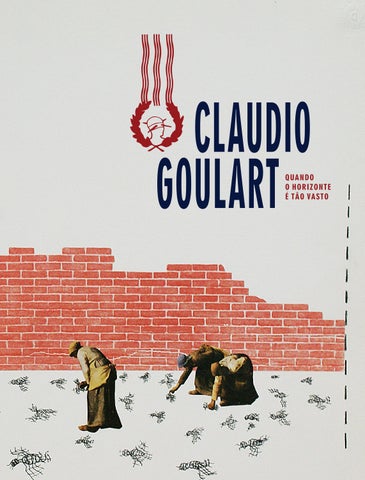
Tendo em vista a quantidade e a complexidade das obras da mostra, pretende-se aqui traçar um breve percurso, por algumas das obras escolhidas para a exposição. Logo na entrada da Sala dos Pomares, uma série de colagens e desenhos feitos pelo artista no primeiro ano em que chega à Europa e se fixa em Amsterdã, em 1977, é uma seleção do trabalho intitulado Scenography. Nele, Goulart apropria-se de imagens de jornais, revistas e de reproduções, como da pintura Les Glaneuses (1857), de Jean-François Millet (1814-1875). Na tela do artista francês, expoente do realismo pictórico e que integrou a chamada Escola de Barbizon, três camponesas recolhem as sobras das espigas de trigo esquecidas após a colheita. A cena caracteriza uma reflexão sobre o contexto social europeu do século XIX e as classes pobres reduzidas a trabalhar no campo para, literalmente, ganharem o resto deixado pelos donos das terras. Na cenografia proposta por Goulart, as três camponesas são retiradas do quadro, 12
esvaziando a imagem, e são colocadas em frente a um muro de tijolos vermelhos. Uma constante na série, o muro irá interligar e dividir cenas diversas. Ao referirem-se, direta ou indiretamente, ao mundo do trabalho, impõem-se como uma reflexão crítica às precárias e dúbias relações trabalhistas na contemporaneidade.
Da série Monuments, 1980 Colagem e desenho sobre papel Schillerhammer 51 x 36,3 cm cada
Em outra série com colagens do mesmo período, Monuments (1978), Goulart também apropria-se de uma imagem canônica da História da Arte. Em uma das três obras da série, escolhidas para a exposição, destaca-se a colagem de uma reprodução do afresco de Rafael Sanzio (1483-1520), Escola de Atenas (1510-1511), pintado no
13
Vaticano, na Stanza della Segnatura – uma ampla sala que o papa Julio II utilizava como biblioteca e lugar de assinatura de documentos eclesiásticos –, na qual o pintor representa grandes nomes ligados à filosofia grega, tendo ao centro Platão e Aristóteles. Nas outras duas lâminas, um grupo de paraquedistas faz um voo rasante em direção ao Coliseu enquanto a imagem de uma explosão em larga escala está presente na cena; na lâmina ao lado, no lugar de um foguete em posição de lançamento, é colocado um obelisco, que, ironicamente, prepara-se para atravessar a atmosfera terrestre e chegar ao espaço. Transportando-nos à Antiguidade Clássica, Goulart baliza os grandes monumentos arquitetônicos históricos e modernos como espaços não só de memória, mas também evocando, sobretudo, esses lugares como signos sociais, levando em conta suas bagagens culturais e históricas. Tendo em vista a brutalidade dos conflitos e das guerras ao longo da história da humanidade, a ideia de civilização é posta em xeque pelo artista através desses monumentos. Fazendo-nos refletir: a que ponto e a que preço as sociedades desenvolvidas a partir do conhecimento ameaçam a própria vida humana? Dos projetos fotográficos realizados por Goulart, destaco Excerpts from / Fragments of a Landescape (1986), realizado nos caminhos que Goulart traçou entre Amsterdã e Almelo, cidade localizada a cerca de 150 km de distância da capital holandesa. O trabalho inicia-se com registros feitos em fotografias P&B de estradas, de casas abandonadas, de clareiras, de lagos e de ferrovias. As fotos foram feitas em ocasião da seleção em um edital público, como um estudo a ser disposto nas paredes de um hospital regional em Almelo. A partir dessas imagens, Goulart elege fragmentos das fotografias, que passaram por um processo de fotocópia e de ampliação; dessas ampliações, as imagens são fragmentadas e unidas novamente por 14
Excerpts from / Fragments of a Landscape, 1986 Instalação - Projeto Almelo Fotocópia 205cm x 252cm
uma fita branca colada no verso delicadamente. Como uma dobradura japonesa, a imagem pode ser novamente montada quando as partes são completamente abertas, formando novas paisagens com os fragmentos das fotografias iniciais, em larga escala. Sobre o projeto, segundo o artista: “o lugar onde este trabalho é investido – um corredor muito longo - sugere um caminho, onde o visitante pode 15
passar pela paisagem [...]. Minha intenção é que o espectador, após sua visita àquela “estrada”, olhe a paisagem natural e suas muitas estradas com olhos diferentes”.2
Da série FOTO GRAFIA, 1983 Fotografias P&B (12 lâminas) 18 x 24 cm
O desejo por colecionar paisagens insiste, igualmente, na série que reúne os caminhos percorridos durante uma viagem ao Japão, FOTO GRAFIA (1983). Foi realizada no período em que Goulart esteve em Tóquio para a realização de dois projetos: a videoperformance Compass, na Galeria Spoon, e a performance The Image Maker, no 2 16
Trecho de texto escrito pelo artista que compõe a documentação sobre a obra.
espaço de arte Plan B. Sem sequência exata, as imagens, ao serem acessadas uma após a outra, desvelam-se em uma espécie de álbum e, como fragmentos de tempo, acabam por formar espécies de relatos dos locais percorridos. Cenários como: uma reunião de gravetos e de folhas secas de árvores, que já encontravam-se daquela forma no chão, ganharam a atenção do artista, que, possivelmente, apenas apontou sua lente para o local escolhido e registrou o momento; aves nadam sobre as águas, dividem espaço com juncos que, amontoados, compõem um desenho sobre um lago; uma montanha ao fundo da imagem com uma luz quase prateada inunda a cena; as folhas secas de uma árvore são vistas pelos vidros de uma janela; o telhado e uma parede de um prédio quase parecem desenhar o papel fotográfico; a bela grafia japonesa, enigmática aos olhos ocidentais, inscrita junto a um par de óculos antigo, formam registros de um monumento em homenagem a um importante líder japonês. Nessas fotografias, estão gravados lugares em seus detalhes, uma documentação não só de passagens percorridas, mas também de momentos. Ao interrogar esses documentos visuais, em FOTO GRAFIA e Excerpts from / Fragments of a Landscape, podemos ver, nos registros-fotografias-escritas de Goulart, para além de apenas memórias de viagem, suas visões cotidianas fragmentárias daqueles espaços vivenciados; seu olhar estrangeiro e passageiro. Fica evidente o desejo do artista por armazenar memórias e também por arquivá-las, como recordações em seu sensível e preciso olhar. Uma constante no trabalho do artista, a fita, aparece como um signo visual na produção de Goulart. Ora vendando os olhos, ora amordaçando os lábios, por vezes entrelaçando ou imobilizando corpos, ou ainda, propondo distâncias e aproximações, irá, de diferentes formas surgir como uma recorrência, até mesmo sendo colocada em imagens apropriadas. 17
Em uma pequena caixa de acrílico, com um formato arredondado, sobre um tecido almofadado branco, 17 fotografias em P&B, medindo 3 x 2 cm cada, são cuidadosamente guardadas. As imagens são uma versão da obra Lovers, coladas em um papel cartolina preto com dobraduras em formato de fole. As fotos trazem os artistas Claudio Goulart e Flavio Pons com seus corpos cobertos apenas por uma fita. Em cada fotografia seus movimentos se alternam em círculos, transpassando de um para o outro o cordão que enlaça seus corpos. O delicado receptáculo que conserva os registros nos dá indícios do cuidado e do apreço pela memória que carrega, entrelaçados ainda, por uma fita vermelha, embalando-as como um relicário.
Lovers, década de 1980
Fotografias P&B, caixa de acrílico, fita vermelha 3x2cm cada foto
18
Lovers, década de 1980 Vídeo a cores, sem som 8 minutos
Lovers foi uma performance apresentada por Goulart juntamente com o artista Flavio Pons na galeria Bedaux, em Amsterdã, em 1978. Com uma poética particular, os dois artistas, vestidos com camisas brancas, coletes e calças pretas, mantendo certa distância, dividem uma longa fita vermelha. Na performance, Pons, com o corpo totalmente amarrado por essa fita, mantém a ponta solta, que passa a encobrir o corpo de Goulart, enquanto eles giram em torno de si mesmos, até que o primeiro se liberte da amarra, atando completamente o outro. Registros fotográficos em fotocópias desta apresentação compõem o arquivo documental sobre a performance. Em 1980, a interlocução que se deu por meio de uma fita vermelha, é gravada no formato de vídeo. Essa versão de Lovers traz os corpos dos artistas nus, frente a um fundo escuro, onde se movimentam em torno de si, e entre um e outro, suavemente. O sutil 19
deslocamento dos artistas fixa o olhar do observador, que, inevitavelmente, passa a acompanhar cada um de seus movimentos. Dialogs, também apresentado primeiro como performance, em 1978, é gravado em vídeo dois anos depois, em parceria com Pons. Nessa obra, o objeto emerge como fio condutor mais uma vez, se, em Lovers, entrelaça uma ligação e uma troca simbólica entre corpos, em Dialogs, a fita emerge como um fio condutor de uma conversa muda. Mesmo sem dizerem uma só palavra, os artistas expressam, no vídeo, através de seus olhares e seus lentos e precisos movimentos, as mais diversas trocas e potências comunicacionais possíveis entre duas pessoas. Ensaiam as interferências, os ruídos, os desacordos, as incertezas e as escutas, ou a falta delas, presentes ou ausentes nos diálogos humanos.
Dialogs, 1980
Vídeo P&B, sem som 14 minutos
20
Em destaque no espaço expositivo, a instalação Los Juguetes (1997) ocupa a parede principal da Sala dos Pomares. No trabalho, um jogo lúdico apresenta desenhos de figuras masculinas sobre um fundo preto; neles, apenas o contorno do rosto e dos ombros são retratados. As figuras trazem a recorrência dos olhos vendados por fitas coloridas, pintadas sob os olhos das figuras que, ao aparecerem como um sintoma que ressurge e que se multiplica, fazem alusão à relação das sociedades contemporâneas com a memória. A proposta, apresentada na VI Bienal de Havana, dialogou com o tema da edição, “O indivíduo e sua memória”, ocupando espaços históricos de Cuba, como o Centro Cultural Wifredo Lam, as ruas de Havana Vieja e outros.
Los juguetes, 1997
Instalação | Impressão colorida, 45 lâminas 42,2 X 29,8cm cada
21
Na região central de cada uma dessas figuras, na altura do peito, há o formato de um retângulo e, dentro desses, o artista insere colagens de reproduções e desenhos de símbolos. Nelas, variam imagens de objetos, de lugares, de cenas, de fotografias, etc., como: um relógio sem ponteiros; uma estrela de Davi; uma fotografia feita do Muro de Berlim; uma escultura, provavelmente, de origem pré-colombiana; uma fechadura; rosas vermelhas; um fragmento da tela A primeira missa no Brasil (1860), de Victor Meirelles (1832-1903), com enfoque na cruz presente na cena; botas de um soldado; armas de brinquedo; parte do rosto de uma mulher com foco em seus ombros nus e em seus lábios; tanques de guerra; a figura anatômica de um coração humano; entre outras. A produção, em seu aglomerado de imagens apropriadas, discute os desejos, as emoções, as ambições, as lembranças, os medos, etc.; ou seja, as mais complexas relações do homem com o meio político, econômico, religioso e cultural, através de símbolos e de imagens que remetem a eles. Junto à instalação, é mostrado um livro de artista que compõe o trabalho. Um álbum de figurinhas que traz as mesmas imagens em formato menor, a serem recortadas e coladas nos lugares indicados no livro; nelas, a recorrência das figuras com os olhos vendados. O artista expõe seu tom crítico em denúncia às sociedades que insistem em manter os olhos fechados e em omitir-se diante de dificuldades sociais que se tornaram problemas históricos. Discute temas como a exploração de trabalho e a desigualdade social nas sociedades capitalistas, principalmente nos países de Terceiro Mundo, carregados de suas heranças vindas de seus passados colonialistas. A partir de uma compreensão política matizada no presente e no passado, Goulart levanta apagamentos e esquecimentos históricos. A própria memória que o artista trata, denuncia uma sociedade que 22
esquece sua história e as gêneses de seus maiores problemas, que se repetem em círculos, como sintomas de violência e de ódio em guerras e em conflitos armados.
THE PRINTOUT, 2000
Impressão colorida, 42 lâminas 31,7 x 22,3 cm cada
Em THE PRINTOUT (2000), Goulart utiliza a internet para disponibilizar um projeto inteiramente de domínio público. Em 36 números, o trabalho apresenta diversas imagens apropriadas e produzidas com colagens digitais. Em algumas, o artista cria uma espécie de pequenas narrativas, algumas bem-humoradas e até mesmo irônicas, que tocam temas como identidade, geopolítica, conflitos 23
políticos, relações amorosas e os mais variados dilemas sociais contemporâneos. Nas palavras do artista, “THE PRINTOUT vislumbra os arquivos do vasto labirinto de nossa memória coletiva”.3 Produzindo uma série pensada para um espaço que não os convencionais do sistema de artes, como galerias e museus, o artista dessacraliza a imagem artística, tornando-a totalmente acessível, gratuita e, de certa forma, atemporal. Ainda percorrendo o primeiro andar da Sala dos Pomares, uma maleta, caixa de arquivo em forma de leque, ganha destaque no espaço expositivo; em seu interior, cada um de seus compartimentos de arquivamento estão repletos por fotocópias de reproduções de gravuras e de ilustrações. Nessa composição, a obra Birds of Paradise with strange fruit (1997) traz duas gravuras de William Blake (1957-1827) que ilustram um relato de viagem que narra as vivências do soldado britânico holandês John Gabriel Stedman (1744-1797) no Suriname entre os anos 1772 e 1777.4 Na narrativa de Stedman, são inúmeros os relatos sobre a escravidão e as lutas de resistência da população negra escravizada no período, bem como outros aspectos do colonialismo holandês e inglês no extremo norte da América do Sul. Através desses escritos, assim como da obra de Goulart, é possível refletir sobre a pluralidade e a complexidade da história colonial latino-americana.
3
Trecho de texto escrito pelo artista que compõe a documentação sobre a obra.
4 Narrativa de uma expedição de cinco anos contra os negros revoltados do Suriname, do ano de 1772 ao ano de 1777, elucidando a história daquele país e descrevendo suas produções, escrito por Stedman, com ilustrações de Blake, foi publicado em Londres, em 1796, em dois volumes. Há disponível uma edição da publicação para acesso online no site da biblioteca da Northeastern University. 24
Birds of Paradise with strange fruit, 1997 Mala/arquivo, fotocópias
25
Nas ilustrações de Blake, escolhidas por Goulart para seu arquivo-memorial sobre nosso passado colonialista, a brutal imagem de um negro pendurado vivo pelas costelas em uma forca e de uma escrava negra sendo flagelada retratam, pelo olhar de Blake, a partir da narrativa de Stedman, apenas algumas das terríveis atrocidades e das formas de tortura contra os escravos no período colonial latino-americano. A terceira imagem escolhida para compor a obra Birds of Paradise é um detalhado estudo e uma descrição visual do artista botânico austríaco Franz Bauer (1758-1840) da Strelitzia reginae, ou estrelícia, feito em 1818. A popular planta, originária da África do Sul, conhecida também como Ave do Paraíso, espalhou-se pelo mundo após ser introduzida no continente europeu durante o colonialismo. Reunidas por Goulart e distribuídas entre as separações da maleta-arquivo, ganham um caráter quase escultórico, em um formato que lembra também um cocar indígena. A obra nos convida a revisitarmos nossa história trazendo conhecimento, questionamentos e possibilitando discussões, principalmente sobre esse passado escravista que ainda ecoa nas sociedades contemporâneas.
Pieces of myself , 1979
Projeto de arte postal Carimbo, colagem e desenho sobre papel
26
As convocatórias Pieces of myself (1979), Poste Restante (1979) e L’air d’ (1980), organizadas pelo artista, e presentes na exposição, refletem a inserção de Goulart na importante e diversa rede de arte postal do período que reuniu e interligou artistas de distintas nacionalidades em projetos que transgrediam os limites geográficos e comunicacionais dos anos 1970 e 1980, tendo em vista, principalmente, os contextos de censura vivenciados durante os governos ditatoriais latino-americanos. Em Pieces of myself, uma caixa de carimbos com peças que desmembram uma figura baseada nos estudos antropométricos de Albert Dürer (1471-1525) e no Homem Vitruviano (1490), de Leonardo Da Vinci (1452-1519), viajou por vários países sendo suporte para a produção de diferentes mailartistas. Em Poste Restante, convocatória mais ampla, criada para um projeto do britânico Michael Scott (1934-1988), a pergunta Why are you doing mail art? é respondida com reflexões sobre a rede postal, repletas de humor, de ironia e de referências à História da Arte. Já em L’air d’, Goulart, inspirado pela produção duchampiana, convida diversos artistas para enviarem o ar de suas cidades em um envelope, capturando assim, a “atmosfera coletada” de diversas partes do mundo. De 1979 a 1981, Goulart produziu uma série de obras com carimbos de borracha coloridos sobre papel, certamente influenciado pelo convívio com o poeta e artista mexicano, Ulises Carrión (19411989) – com quem realizou e colaborou em diversos projetos –, inclusive na editora-livraria-galeria-espaço de arte Other Books and So. Uma seleção desses trabalhos compõe uma parede do mezanino da Sala dos Pomares, onde estão obras como History (1979), A stamp is a stamp (1981), Between you and me (1979), Visual (1981) e Verbal or the painter discourse (1981), que exploram, de diferentes formas, o campo da linguagem e da visualidade das palavras. Universo esse 27
History, 1979
Carimbo de borracha colorida sobre papel 37 x 51 cm
que Goulart irá explorar igualmente em alguns de seus trabalhos em livros de artista, como Between you and me (1981), mas também combinados a símbolos, signos e marcas de suas impressões digitais, como em Portraits (1979), Stamps (1980) e Badge (1981). Pensar o espaço de atuação e os trânsitos do artista, ao longo de sua trajetória, leva à busca da compreensão das lógicas e das ca28
racterísticas de sua produção e, consequentemente, de seu acervo. A complexidade dos materiais presentes no arquivo documental de Goulart evidencia a natureza híbrida das relações que seus trabalhos permitem expor. Dessa forma, uma parte mais documental de sua produção ganha destaque na mostra, ao serem expostos registros de projetos como: os cartazes de divulgação da LIVE VIDEO (1983 e 1986); fotocópias de fotografias feitas das performances como Lovers (1978), Dialogs (1978) e Concert (1981); fotografias e textos sobre as instalações das videoinstalações A arte como adorno do poder (1979), Night and Day (I think of you) (1983), Brazilian Watercolor (1986) e Om de tuin Leiden / Voyage pittoresque au pays inconnu / A Ilha dos inocentes (1992). Essas produções e montagens efêmeras, por sua característica “temporária” foram, de certa forma, projetadas para serem documentadas e, em alguns casos, como na intervenção urbana O.A.N.I. / Objeto Anônimo Não Identificado (1979), possuem registro completo e presença nos arquivos. Em O.A.N.I. / Objeto Anônimo Não Identificado, Goulart ocupa a cidade de Porto Alegre, marcando as paredes públicas, os terrenos abandonados e as ruas com uma imagem criada por ele. As chamadas “setas corações” são espalhadas pela paisagem urbana, desenvolvendo uma espécie de projeto de comunicação visual onde o artista grafita os espaços públicos com esse símbolo – muito utilizado posteriormente em livros de artista e arte postal. Os locais escolhidos para a intervenção variavam de tapumes a paredes de prédios ou de passagens urbanas, em sua maioria já grafitados com alguma frase política ou com lambes de propagandas. Em algumas imagens, os locais escolhidos são terrenos vazios ou em demolição, com presença de arquiteturas inacabadas ou colocadas abaixo, no centro da cidade ou em bairros relativamente próximos à zona central. Ainda 29
há a versão carimbada desse símbolo em cartões postais de Porto Alegre. Nos espaços públicos, um intervir – através de seu símbolo, o artista invade o cotidiano dos passantes; no gesto simbólico, um ato que transpassou a normalidade exigida pelo governo ditatorial do período.
O.A.N.I. / Objeto Anônimo Não Identificado, 1979 Fotocópia de cartões postais (seleção de 10 lâminas) 10 x 15 cm cada
30
Da intervenção, permanecem os registros. No trabalho, constata-se uma das primeiras experimentações de Goulart com a fotografia. A artista Vera Chaves Barcellos, amiga e parceira de Goulart em alguns projetos, relata que o conheceu em Amsterdã, em 1977, por intermédio de Flavio Pons e, da amizade e parceria firmada, Vera conta que o iniciou nas técnicas de fotografia em aulas informais em seu ateliê. Uma seleção desses registros fotográficos foi mostrada no Espaço N.O., em 1979. Goulart desenvolve e explora a linguagem do vídeo em seus trabalhos em Amsterdã, a partir da década de 1980, incorporando-os às performances e às instalações, e realizando até mesmo vídeos de longa duração. Idealiza e organiza um festival de videoperformance na galeria Time Based Arts, em Amsterdã, em duas edições, em 1983 e 1986. Nos anos 1990, juntamente com os artistas David Garcia e Raul Marroquin, realizou o projeto Kanaal Zero, que exibiu vídeos de artistas em um canal de televisão a cabo de Amsterdã, entre os anos 1991 e 1994. Transgredindo temas e modelos habituais de produção e de apresentação, o Kanaal Zero apoiou e apresentou trabalhos de artista não só da Holanda, mas de vários outros países. Para a exposição, foram selecionados seis vídeos do artista: Portraits (1985), Videorama (1985), Om de tuin leiden / Voyage pittoresque au pays inconnu / A Ilha dos inocentes (1992) e News-reel (1993), além dos citados anteriormente Lovers (1980) e Dialogs (1980). O vídeo The Image Maker registra a performance que o artista realizou em Tóquio, em 1983. Desses, destaco Videorama (1985), produzido em parceria com a Televisão Difusora, de Porto Alegre. Nele, Goulart constrói uma espécie de alfabeto, onde cada uma das letras é representada por uma palavra que é associada a um objeto ou a um símbolo visual que é transformado por ações feitas pelo 31
próprio artista. Como, por exemplo, ao apresentar a letra “E”, o artista encena uma entrevista cedida a ele mesmo, na qual, com humor, relembra seu projeto O.A.N.I. e fala sobre sua produção em vídeo relacionada à presença de televisões nos lares brasileiros, como uma convenção social. Claudio Goulart | Quando o horizonte é tão vasto configura-se assim como um dos frutos de uma pesquisa que se desdobra aqui em um projeto curatorial. Realiza-se como uma exposição, em que a curadoria é pensada como um processo, tendo em vista desde o percurso de recebimento, de organização e de catalogação das obras do artista, em um primeiro momento com a vinda desses trabalhos para integrar a Coleção Artistas Contemporâneos da FVCB, mas que se destaca, também, como um dispositivo de difusão de conhecimento, tendo como uma constante o olhar de questionamento e de investigação sobre a obra e sobre o arquivo documental de Goulart. A produção de Goulart segue então disponível para conhecimento e livre acesso à pesquisa no acervo da FCVB.
O.A.N.I. / Objeto Anônimo Não Identificado, 1979 Intervenção urbana (registro fotográfico) 18 x 24 cm
32
33
34
35
36
37
38
39
40
41
42
43
44
45
46
47
48
49
50
51
Badge, 1981
Livro de artista 20 x 15,5 cm
52
53
56
CRONOLOGIA
Claudio Cezar Camargo Goulart nasceu em 30 de maio de 1954, em Porto Alegre, capital do Rio Grande do Sul, Brasil. Em seus primeiros contatos com a prática artística, Goulart desenhava. Detalhes de paisagens arquitetônicas antigas, de ruínas, cenas com pássaros e caminhos eram predominantes nos desenhos feitos ainda enquanto estudante de Arquitetura, na Universidade do Vale dos Sinos (UNISINOS, ingresso em 1975), que cursou paralelamente com Artes Visuais, no Instituto de Artes da Universidade Federal do Rio Grande do Sul.
57
DÉCADA DE 1970 1976 Goulart viaja para a Europa, buscando aperfeiçoar seus estudos em Artes, com destino a Barcelona e, durante uma passagem por Amsterdã, encontra e torna-se amigo do artista Flavio Pons, o qual conhecera no Brasil. Fixa residência na Holanda, pelas possibilidades de atuação e de formação na área visual que o sistema de arte holandês proporcionava. O efervescente cenário europeu no período permitia experimentações e dava espaço em diversos centros alternativos de arte e em galerias, que promoviam rede de contatos entre artistas e possibilitavam parcerias.
Olhe e passe adiante, s/d Claudio Goulart e Flavio Pons.
1977 Goulart participa do Espaço B, no Museu de Arte Contemporânea da Universidade de São Paulo (MAC USP), e expõe no local, em parceria com Flavio Pons, durante a mostra As ilusões. Produz a série de colagens Scenography. 58
1977-1978 Produz a série Flags, com desenhos e colagens de diferentes interpretações a partir de bandeiras de países e de estados brasileiros. Realiza performances em parceria com Flavio Pons. Os artistas apresentam as performances Lovers e Dialogs na Galeria Bedaux, em Amsterdã. Uma visita de Vera Chaves Barcellos aos artistas, no inverno desse ano, resultou no trabalho On Ice, série fotográfica em que a artista registra uma ação performática de Pons e Goulart sob um lago gelado em Amsterdã. Uma seleção dessas imagens ilustrou a capa do cartazete Nervo Óptico nº 11. Logo, Goulart começa a fazer parte do grupo de artistas em torno de Ulises Carrión, poeta e artista mexicano estabelecido em Amsterdã, e passa frequentar sua livraria, a pioneira a dedicar-se a livros de artista, a Other Books and So.
Claudio Goulart e Vera Chaves Barcellos Porto Alegre, 1979
59
1979 Em uma temporada em Porto Alegre, desenvolve um projeto de intervenção urbana pelas ruas da cidade, O.A.N.I./Objeto Anônimo Não Identificado, que resultou ainda em uma exposição individual dos registros fotográficos do projeto no Espaço N.O., em Porto Alegre. A apresentação da performance A arte como adorno do poder acontece no mesmo ano, no Museu de Arte do Rio Grande do Sul Ado Malagoli (MARGS), em parceria com Flavio Pons. Desenvolve, nesse período, dois significativos projetos de arte postal com a participação de vários artistas de diferentes países: Pieces of mylself e Post Restante.
Pelas ruas de Porto Alegre durante a intervenção O.A.N.I./Objeto Anônino Não Identificado, 1979
L’Air d’, 1980 Convocatória de arte postal
60
DÉCADA DE 1980
A década de 1980 é marcada por experimentações com vídeos, como Lovers e Dialogs desenvolvidos com Pons. De 1979 a 1981, Goulart produz uma série de obras com carimbos de borracha coloridos sobre papel. The Opening é exibida na galeria Bedaux. A convocatória de arte postal L’air d’ é enviada, reunindo o ar de várias cidades do mundo.
Ulises Carrión e Claudio Goulart, 1982
61
1983 Goulart vai para o Japão, onde apresenta a videoperformance Compass, na galeria Spoon, e a performance The Image Maker, no espaço de arte Plan B, em Tóquio. Também desse período, a série FOTO GRAFIA traz, em registros P&B, os olhares do artista por entre as paisagens japonesas. A videoinstalação Night and Day é exibida na galeria Time Based Arts, em Amsterdã. O projeto de vidoperformance LIVE VIDEO é organizado por Claudio Goulart.
Material de divulgação da performance The Image Maker, na galeria Plan B em Tóquio
62
1985 Videorama é transmitido na Televisão Difusora, em Porto Alegre. Participação do artista na exposição coletiva Tendências do Livro de Artista no Brasil, realizada no Centro Cultural São Paulo, com curadoria de Annateresa Fabris e de Cacilda Teixeira.
1985 - 1986 Organiza a segunda edição da LIVE VIDEO, com sede na Time Based Arts novamente. Na ocasião, apresenta a videoperformance Brazilian Watercolor. Realiza um projeto por meio de um edital público que resulta na obra Excerpts from / Fragments of a landscape, que foi exposto nos corredores de um hospital regional em Almelo, na Holanda.
Excerpts from / Fragments of a Landscape, 1986
63
DÉCADA DE 1990
Inicia o projeto televisivo Kanaal Zero, em parceria com David Garcia e Raul Marroquin. Apresenta uma leitura/conferência/performance intitulada Postcards on the road, na Jan Van Eyck Academie, de Maastricht, nos Países Baixos, que teve como tema a identidade cultural brasileira.
1992 Produz o catálogo raisonné, da galeria Time Based Arts. Na publicação, estão trabalhos de artistas que atuaram na galeria, como Marina Abramovich, Idea General, Marcel Odenbach, Ulricke Rosenbach, Antoni Muntadas e Peter Baren, entre outros. Goulart produz o vídeo Tanzan of Tarzans, onde constrói uma nova narrativa sobre o personagem a partir de recortes e de edições de várias versões de filmes de Tarzan. A videoinstalação Om de tuin Leiden é exibida na Oude Kerk, em Amsterdã. Página do catálogo da galeria Time Based Arts
64
1994 Participa da V Bienal de Havana, em Cuba, com a instalação A man can hide another. A instalação Vale quanto pesa é exibida na Gate Foundation, em Amsterdã.
Vale quanto pesa, 1994 Instalação
1995 Expõe a instalação Portrait Intérieur na mostra O país que mora em mim: literatura e arte visual sobre migração, no Museum voor Volkenkunde, em Leiden, com itinerância em outros museus holandeses.
65
1997 – 1998 Participa da VI Bienal de Havana, Cuba, com a instalação Los Juguetes. Portrait Intérieur e Wishful Thinking são apresentadas na exposição Les mondes du Sida: entre resignation et espoir (1998), em Genebra, na Suíça.
A man can hide another, 1997
1999 A instalação The Gallery of Battles é exibida na Gate Foundation. Expõe na coletiva El arte de los libros de artista, na Biblioteca da Cidade do México.
The Gallery of Battles, 1999
66
ANOS 2000
2000 – 2002 Em 2000, desenvolve THE PRINTOUT, uma série que reúne imagens apropriadas e colagens digitais, totalmente disponível através do site da Fundação Art Zone. A instalação Wishful Thinking é exposta no Centro Cultural de Cascais, em Portugal, durante a mostra Arte Holandesa Contemporânea. Expõe uma seleção de THE PRINTOUT na Prince Claus Foun, em Haia, nos Países Baixos, em 2002.
Da série PRINTOUT, 2000
67
2003 Participa de exposições coletivas sobre videoarte na Holanda: A Short History of Video é exibido na Gate Foundation; Una breve historia del videoarte en Holanda, no Centro de Arte Reina Sofia, em Madrid. Expõe na coletiva 30 Years Duth Videoart, no Netherlands Media Arts Institute, em Amsterdã. Colabora com a publicação Ulises Carrión: ¿Mundos personales o estrategias culturales?, sob coordenação editorial de Martha Hellion, com o texto Ulises Carrión: esquema de obra em vídeo, sobre a produção de vídeo do artista mexicano.
Frame do vídeo Portrait (1985), exposto em 30 Years Duth Videoart
2005 O artista faleceu em Amsterdã, em decorrência da aids.
68
Autorretrato feito em ocasião da documentação fotográfica de Goulart durante a performance El robo del año de autoria de Ulises Carrión em 1982.
2006 – 2018 Na Fundação Vera Chaves Barcellos, as exposições coletivas que contaram com obras do artista foram: Imagem Lúcida – fotografia contemporânea no acervo FVCB (2006), na qual foram expostas fotografias da série Wishful Thinking; Um Porto de Ironia (2011), com a obra de arte postal Artista/papel; Um Salto no Espaço (2014), com três impressões Home sweet home, da série PRINTOUT; Humanas Interlocuções (2016), que apresentou uma seleção com cinco impressões também da série PRINTOUT; A condição básica (2018), na qual foram mostrados os vídeos Nine out of tem movie stars make me cry e Tarzan of Tarzans; e Apropriações, Variações e Neopalimpsestos (2018), na qual foram expostas uma seleção da série Flags e a obra George’s Dream. A publicação Stempelplaats (1981) foi exposta na mostra Um firme e vibrante NÃO, em 2016, na Galeria Ecarta, em Porto Alegre, com curadoria de Leo Felipe e de Jorge Bucksdricker. Recentemente, registros de projetos de Goulart ainda foram mostrados em Querido lector. No lea., exposição sobre o artista Ulises Carrión que aconteceu no Centro de Arte Reina Sofia, em Madrid, em 2016, e na Fundación Jumex de Arte Contemporáneo, na Cidade do México, em 2017. 69
Verbal, 1981
Carimbo de borracha colorida sobre papel 29,5 x 40 cm
70
71
ENGLISH VERSION
Da série Scenography , 1977
72
WHEN THE HORIZON IS SO VAST 1 FERNANDA SOARES DA ROSA
Master in History, Theory and Art Criticism (PPGAV/UFRGS) Historian at the Art Collection of Vera Chaves Barcellos Foundation Claudio Goulart | Quando o horizonte é tão vasto [When the horizon is so vast] aims at recovering the significant production of Claudio Goulart (19542005), a Brazilian artist, born in Porto Alegre, who developed his career in Amsterdam, Netherlands, where he lived since the mid-1970s. The show arises as one of the outcomes from the research that has been carried out since the donation of almost the entirety of the artist’s work, given to the art collection of Vera Chaves Foundation, in 2015, by Art Zone 1 The phrase that gives name to the exhibition is part of a text written by the artist regarding one of his works, chosen as an invitation to discover the vastness of his poetics and the possible paths it can lead us.
Foundation – a Dutch institution created by Goulart while he was still alive and which, until then, was the legatee of his work –, as well as part of my own interest and uneasiness from the contact with the artist’s works, within FVCB’s collection, where I act as a historian.2 Through receiving, organizing, and cataloging Goulart’s artistic and documental collection, I could not help but notice an artist with such a relevant and interesting production, who, despite his international projection, having taken part of numerous projects and exhibitions in several countries, is still little known in the Brazilian artistic scene. On the threshold of possible horizons to be accessed through Goulart’s work, among paths, landscapes, and dialogs,
2 The research also unfolded in my master’s thesis, which is entitled Claudio Goulart: o arquivo como memória [Claudio Goulart: the archive as memory], addressing issues related to archives and memory in contemporary art, through the artist’s production, featured in October 2018, at the Institute of Arts of the Federal University of Rio Grande do Sul (UFRGS).
73
not only are there interlocutions with the other, but also with oneself. The artworks carried out in the most different languages and medium are brought as an invitation to embark on the vastness of his poetics. Throughout his production, having Brazilian, world, and art history as its theme, the artist investigates various contexts and scenarios. At times, by addressing matters such as power relations, media manipulation, western colonialism, armed conflicts, the social situation of oppressed nations, censorship, identity, memory, among many others, he reflects on issues that are relevant and urgent until today, taking into account the current national and global political scenario. Featuring over 60 works by the Brazilian artist, comprising photographs, collages, drawings, video art, installations, artist’s books, and postal art, besides records of urban interventions, exhibitions, performances, and projects in video, Claudio Goulart | Quando o horizonte é tão vasto [When the horizon is so vast] is characterized by a selection of the artist’s works, bringing together, in a diverse set, Goulart’s conceptual and visual richness. Furthermore, we propose a reflection based on his artistic experiences and trajectory, on the constancy of ephemeral nature and of conceptual art in contemporary art, on his insightful provocations, 74
and possible relations with our own space-temporal and interpersonal experiences. Considering the amount and complexity of the exhibition pieces, we intend to draw a short route through some of the works chosen for the show. Right at the entrance to Sala dos Pomares, a series of collages and drawings made by the artist during the first year he had arrived in Europe and settled in Amsterdam, in 1977, composes a selection from the work entitled Scenography. In it, Goulart appropriates images of newspapers, magazines, and reproductions such as Les Glaneuses (1857), by Jean-François Millet (1814-1875). On the canvas of the French artist, who was an exponent of pictorial realism and who integrated the so-called Barbizon School, three peasant women are gleaning the remaining stalks of wheat forgotten after the harvest. The scene features a reflection on the European social context of the nineteenth century and the lower-classes reduced to working in the fields to literally earn the landowners’ leftovers. In the scenography proposed by Goulart, the three peasants are removed from the painting, leaving the image empty, and are placed in front of a red brick wall. Being something constant in the series, the wall will interconnect and split several scenes. When referring direct or indirectly to the world of
work, they impose themselves as a critical reflection on the precarious and dubious labor relations in contemporary times. In another series of collages from the same period, Monuments (1978), Goulart also appropriates a canonical image of the History of Art into his work. In one of the three works of the series chosen to take part in the exhibition, it is worth mentioning the collage of a fresco reproduction of Raphael Sanzio (1483-1520), The School of Athens (1510-1511), painted in the Vatican Stanza della Segnatura – a large room used by Pope Julius II as a library and a place to sign ecclesiastical documents –, in which the painter represents great names connected to the Greek philosophy, having Plato and Aristotle at the center. In the other two plates, a group of skydivers makes a free-fall towards the Colosseum while the image of a large-scale explosion is present in the scene; on the next plate, in place of a rocket in launching position, there is an obelisk instead, which, ironically, is prepared to cross the Earth’s atmosphere and reach into space. Carrying us to the Classical Antiquity, Goulart marks the great historical and architectural monuments not only as memory spaces but also evoking these venues as, above all, social signs, taking into account their cultural and historical baggage. Given the brutality of conflicts and wars
throughout the history of humankind, the artist casts doubt on the idea of civilization through these monuments, making us ponder: to what extent and at what cost do societies developed from knowledge threaten human life itself? From the photographic projects carried out by Goulart, I point out Excerpts from / Fragments of a Landscape (1986), produced on the way Goulart traced between Amsterdam and Almelo, a city located about 150 km away from the Dutch capital. The work begins with records made in B&W photographs of roads, abandoned houses, clearings, lakes, and railroads. The photos were taken on the occasion of a public bid opening selection, as a study to be displayed on the walls of a local hospital in Almelo. From those images, Goulart chose fragments of photographs, which went through a process of photocopying and enlargement; then, the enlarged images were fragmented and joined again by a white tape gently stuck in the back. Like a Japanese origami, the image can be reassembled when its parts are completely open, forming new landscapes with the fragments of the original photos on a large scale. Regarding the project, according to the artist: “the place where this work is invested – a very long aisle – suggests a path, where the visitor can walk through the landscape [...]. My 75
intention is that the spectators, after visiting that “road”, look at the natural landscape and its many roads with different eyes”.3 His wish to collect landscapes carries on, similarly, in the series that comprises the paths taken during a trip to Japan, FOTO GRAFIA (1983). It was held while Goulart was in Tokyo for the accomplishment of two projects: the video performance entitled Compass, at Spoon Gallery, and the performance The Image Maker, at Plan B Art Space. Without an exact sequence, the images, when accessed one after another, are unveiled in a kind of album and, like fragments of time, end up forming kinds of reports of the traveled places. Scenarios such as: a gathering of sticks and dried leaves of trees, which were already in that way on the ground, gained the artist’s attention, who possibly only pointed his lens at the chosen place and recorded that moment; birds swim on the water, sharing the space with reeds that, heaped up, make up a drawing on a lake; a mountain in the background with an almost silver light inundates the scene; the dried leaves of a tree are seen through the glasses of a window; the roof and the wall of a building almost seem to draw the photographic
3 Excerpt from a text written by the artist, that composes the documentation about the work.
76
paper; the beautiful Japanese script, enigmatic to western eyes, inscribed next to a pair of old glasses, form records of a monument in honor of an important Japanese leader. In these photographs, places are engraved in their details, being documentation not only of traveled paths but also of moments. When examining these visual documents, in FOTO GRAFIA and Excerpts from / Fragments of a Landscape, we can see, in Goulart’s records-photographswritings, something that goes beyond mere travel memories, but his daily, fragmentary visions of those experienced spaces; his foreign and passing gaze. The artist’s desire to file and storage memories is quite evident, like memorabilia in his sensitive and precise eye. Being a constant in the artist’s work, the ribbon appears as a visual sign in Goulart’s production. Either blindfolding the eyes or gagging the lips, at times intertwining or immobilizing bodies, or even proposing distances and approximations, this will arise as a recurrence in different ways, even being placed in appropriate images. Seventeen B&W photographs, measuring 3x2 cm each, are carefully kept in a small acrylic box, with a rounded shape, over a white cushioned
fabric. The images are a version of Lovers, glued on black fan-folded cardboard. The photos show artists Claudio Goulart and Flavio Pons with their bodies covered only by a ribbon. In each photograph, their movements alternate in circles, passing from one to the other the string that ties their bodies. The delicate receptacle that keeps the records gives us evidence of the care and appreciation for the memory it carries, still entwined, by a red ribbon, cradling it like a reliquary. Lovers was performed by Goulart together with artist Flavio Pons at Bedaux Gallery, in Amsterdam, in 1978. With a peculiar poetics, both artists, wearing white shirts, vests, and black pants, keeping a certain distance, share a long red ribbon. During the performance, Pons, with his body entirely tied by this ribbon, keeps the loose end, which starts covering Goulart’s body, while they spin around themselves until the first is released from the tie, completely tying the other. Photographic photocopies of this presentation compose the documentary archive about the performance. In 1980, the interlocution that took place by means of a red ribbon was recorded in video format. This version of Lovers features the artists’ bodies naked, against a dark background, where they softly move around
themselves, and around each other. The subtle shifting of the artists fixes the eye of the observer, who inevitably accompanies each of their movements. Dialogs, which was also presented as a performance at first, in 1978, was recorded in video two years later, in partnership with Pons. In this work, the object emerges as the guiding thread again. If in Lovers, it interweaves a connection and a symbolic exchange between bodies, in Dialogs, the ribbon emerges as the thread of a mute conversation. Even without saying a word, the artists express, in the video, through their glances and their slow and precise movements, the most diverse communicational exchanges and forces that are possible between two people. They rehearse interferences, noises, disagreements, uncertainties, and hearing, or the lack of it, present or absent in human dialogues. Standing out in the exhibition space, Los Juguetes (1997) occupies the main wall of Sala dos Pomares. In this installation, a playful game features drawings of male figures over a black background; in them, only the outline of the face and shoulders are portrayed. The figures bring the recurrence of the eyes blindfolded by colorful ribbons, which had been painted over the figures’ eyes. By appearing as a resurgent symptom that 77
multiplies, they allude to the relation of contemporary societies to memory. The proposal, presented at the 6th
Next to the installation, an artist’s book that composes the work is shown. A sticker album that brings the same
Havana Biennial, interacted with the edition’s theme, “The individual and their memory”, occupying historical landmarks of Cuba, such as Wifredo Lam Cultural Center, the streets of Old Havana, among others.
images in smaller shape, to be cut and pasted in the spots indicated in the book; in them, the recurrence of the blindfolded figures. The artist exposes his critical tone denouncing societies that insist on keeping their eyes shut and omitting themselves in the face of social difficulties that have become historical problems. He tackles issues such as labor exploitation and social inequality in capitalist societies, especially in Third World countries, loaded with their legacies from their colonial past. From a political understanding with nuances in the present and past, Goulart raises historical erasures and oblivions. The very memory the artist addresses denounces a society that forgets its history and the genesis of its biggest problems, which are repeated in circles, as symptoms of violence and hatred in wars and armed conflicts.
In the central region of each of these figures, there are rectangles at the chest height, inside of which the artist inserts reproduction collages and drawings of symbols. There is a range of images of objects, places, scenes, photographs, etc., such as a clock without its hands; a star of David; a photo of the Berlin Wall; a sculpture, probably of pre-Columbian origin; a lock; red roses; a fragment from The first mass in Brazil (1860), by Victor Meirelles (1832-1903), focusing on the cross featured on the scene; soldier boots; toy guns; part of a woman’s face focusing on her bare shoulders and lips; war tanks; the anatomical figure of a human heart; among others. The production, in its cluster of appropriated images, discusses wishes, feelings, ambitions, memories, fears, among others; that is, the most complex relations between the man and the political, economic, religious, and cultural milieu, through symbols and images that refer to them.
78
In THE PRINTOUT (2000), Goulart makes use of the internet to create an entirely public domain project. In 36 numbers, the work presents several appropriated images produced with digital collage. In some of them, the artist creates some kind of small narratives, some of which humorous and even ironic, dealing with themes such as identity, geopolitics, political conflicts, love relationships, and the
most varied contemporary social dilemmas. In the artist’s words, “THE PRINTOUT is a glimpse into the archives of the vast labyrinth of our collective memory”.4 Producing a series designed for a space other than the conventional art system, such as galleries and museums, the artist desacralizes the artistic image, making it totally accessible, free, and, somehow, timeless.
enslaved during that period, as well as other aspects of Dutch and English colonialism in the extreme north of South America. Through these writings, just as Goulart’s work, it is possible to reflect upon the plurality and complexity of Latin-America colonial history.
4 Excerpt from a text written by the artist, which composes the documentation about the work.
In Blake’s illustrations, chosen by Goulart for his memorial-archive of our colonial past, the brutal image of an African slave hung alive by the ribs in a gallows and of an African woman being lashed depict, through Blake’s eyes from Stedman’s narrative, only some of the terrible atrocities and forms of torture against the slaves in the Latin American colonial period. The third image chosen to compose Birds of Paradise is a detailed study and a visual description by Austrian botanical artist Franz Bauer (1758-1840) of Strelitzia reginae, or crane flower, made in 1818. This popular plant, indigenous to South Africa, also known as Bird of Paradise, has spread around the world after being widely introduced in the European continent during colonialism. Compiled by Goulart and dispersed among the briefcase-file slots, they gain an almost sculptural character, in a format that also resembles an indigenous war bonnet. The work
5 The Narrative of a Five Years’ Expedition against the Revolted Negroes of Surinam, from 1772 to 1777, covering the history of that country and describing its productions, written by Stedman, with illustrations by
Blake, was published in London, in 1796, in two volumes. An edition of the publication is available for online access on the website of the Northeastern University library.
Still on the first floor of Sala dos Pomares, a briefcase, a fan-shaped archive box, gains prominence in the exhibition space; inside of it, each of its filling compartments is filled by photocopies of reproductions of engravings and illustrations. In this composition, the work entitled Birds of Paradise with strange fruit (1997) features two engravings by William Blake (1957-1827) that illustrate a travel diary on the experiences of British Dutch soldier John Gabriel Stedman (1744-1797) in Surinam between the years of 1772 and 1777.5 In Stedman’s narrative, there are numerous accounts on slavery and the struggle of resistance of the black population
79
invites us to revisit our history by bringing knowledge, questions, and enabling discussions, especially in this past of slavery that still echoes in contemporary societies. The mail art calls Pieces of myself (1979), Poste Restante (1979), and L’air d’ (1980), organized by the artist, and present in the exhibition, reflect on Goulart’s insertion in the important and diverse postal art network of that time which gathered and interlinked artists from different nationalities in projects that transgressed geographic and communicational boundaries in the 1970s and 1980s, especially in view of the censorship contexts experienced during Latin American dictatorial governments. In Pieces of myself, a box of rubber stamps with pieces that dismember a figure based on the anthropometric studies of Albert Dürer (1471-1525) and on the Vitruvian Man (1490), of Leonardo Da Vinci (1452-1519), traveled through several countries, being support for the production of various mail artists. In Poste Restante, which is a broader call created for a project by British Michael Scott (1934-1988), the question Why are you doing mail art? is answered through reflections on the postal network, full of humor, irony, and references to the History of Art. In turn, in L’air d’, Goulart, inspired by Duchampian production, invited several artists to send the air from their 80
cites in an envelope, capturing thus the “collected atmosphere” from different parts of the world. From 1979 to 1981, Goulart produced a series of artworks with colored rubber stamps on paper, undoubtedly influenced by the contact with Mexican poet and artist Ulises Carrión (19411989) – with whom he collaborated and worked in several projects –, including at the publishing housebookstore-gallery-art space called Other Books and So. A selection of those works make up a wall from the mezzanine of Sala dos Pomares, where there are works such as History (1979), A stamp is a stamp (1981), Between you and me (1979), Visual (1981), and Verbal or the painter discourse (1981), which explore, in different ways, the field of language and visuality of words. Such universe will be equally explored by Goulart in some of his works in artist’s books, like Between you and me (1981), but also combined with symbols, signs, and fingerprints, like in Portraits (1979), Stamps (1980), and Badge (1981). Thinking of the performance field and the artist’s influence throughout his trajectory leads us to seek understanding the logic and characteristics of his production and, consequently, of his archive. The complexity of materials present in Goulart’s documental archive shows the hybrid nature of the relations his
works allow to expose. Thus, a more documental part of his production gains prominence in the show, by exhibiting project records such as the advertising posters of LIVE VIDEO (1983 and 1986); photocopies of the photographs made of performances like Lovers (1978), Dialogs (1978), and Concert (1981); photographs and texts about the installations of the video installations A arte como adorno do poder [Art as an adornment of power] (1979), Night and Day (I think of you) (1983), Brazilian Watercolor (1986), and Om de tuin Leiden/ Voyage pittoresque au pays inconnu/ A Ilha dos inocentes (1992). Due to their “temporary” characteristics, these ephemeral productions and setups were, somehow, designed to be documented, and, in some cases, as in the urban intervention entitled O.A.N.I./ Objeto Anônimo Não Identificado [U.A.O./ Unidentified Anonymous Object] (1979), they have complete record and presence in the archives. In O.A.N.I./ Objeto Anônimo Não Identificado [U.A.O./ Unidentified Anonymous Object], Goulart takes the Brazilian city of Porto Alegre, marking public walls, abandoned grounds, and streets with an image created by him. The so-called “heart arrows” are spread throughout the urban landscape, developing a sort of visual communication project, where the artist covers public spaces with graffiti
of this symbol – much used later in artist’s books and postal art. The places chosen for this intervention ranged from hoarding for construction sites to building walls and urban passages, most of which already graffitied with some political phrase or with an advertisement. In some images, the chosen sites were empty lots or places under demolition, with unfinished architecture or ramshackle buildings, located downtown or in neighborhoods relatively close to the central zone. In addition to that, there is still the stamped version of this symbol on postcards of Porto Alegre. In public spaces, an intervention – through his symbol, the artist invades the daily lives of passers-by; in the symbolic gesture, an action that transgressed the normality required by the dictatorial government of the time. From the intervention, the records remain. In this artwork, we can see one of Goulart’s first experiments with photography. Artist Vera Chaves Barcellos, Goulart’s friend and partner in some projects, states that she had met him in Amsterdam, in 1977, through Flavio Pons and, from the established friendship and partnership, Vera tells she had introduced him to the techniques of photography in informal classes in her atelier. A selection of those photographic records was shown at Espaço N.O., in 1979.
81
Goulart develops and explores the audiovisual language in his works in Amsterdam from the 1980s onwards, incorporating it in performances and installations, even making full-length videos. He devises and organizes a video performance festival at Time Based Arts Gallery, in Amsterdam, in two editions, 1983 and 1986. In the 1990s, along with artists David Garcia and Raul Marroquin, he carried out the project called Kanaal Zero, which featured videos by artists on a cable television channel in Amsterdam, between 1991 and 1994. Transgressing the usual themes and models of production and presentation, Kanaal Zero supported and presented works of artists not only from the Netherlands but also from several other countries. For the exhibition, six artist’s videos were selected: Portraits (1985), Videorama (1985), Om de tuin leiden / Voyage pittoresque au pays inconnu / A Ilha dos inocentes (1992), and News-reel (1993), besides the aforementioned Lovers (1980) and Dialogs (1980). The video entitled The Image Maker records the artist’s performance carried out in Tokyo in 1983. Among them, I would highlight Videorama (1985), produced in partnership with Televisão Difusora, a local television broadcaster from Porto Alegre. Goulart builds a sort of alphabet, in which each letter is represented by a word that is associated with an object or a visual 82
symbol that is transformed by the action made by the artist himself. For instance, when representing the letter “E”, the artist stages an interview given to himself, in which, he humorously recalls his project O.A.N.I. and talks about his video production related to the presence of televisions in Brazilian households, as a social convention. Claudio Goulart | Quando o horizonte é tão vasto [When the horizon is so vast] is, thus, one of the research outcomes that unfolds here in a curatorial project. It is held as an exhibition, in which the curatorship is thought of as a process, bearing in mind since the course of receiving, organizing and cataloging the artist’s works in a first moment, with the arrival of these pieces to integrate FVCB’s Collection of Contemporary Artists, but that also stands out as a device for dissemination of knowledge, keeping as a constant the questioning and investigation look upon Goulart’s work and documental archive. Goulart’s production remains available for knowledge and free access to research at FCVB’s collection.
CHRONOLOGY
galleries, which promoted networking among artists and made partnerships possible.
Claudio Cezar Camargo Goulart was born on May 30, 1954, in Porto Alegre, capital of Rio Grande do Sul, Brazil. During the early days of his artistic practice, Goulart used to draw. Details of ancient architectural landscapes, ruins, and scenes with birds and paths were predominant in his drawings which had been made still while he was an architecture student, at the University of the Sinos Valley (UNISINOS, admission in 1975), where he attended alongside the Visual Arts Program, at the Institute of Arts of the Federal University of Rio Grande do Sul.
1977 Goulart takes part in Espaço B, at
THE 1970’S 1976 Goulart travels to Europe seeking to improve his studies in Arts, and having Barcelona as his destination. During a visit to Amsterdam, he comes across and becomes friends with artist Flavio Pons, whom he had met in Brazil. He sets up residence in the Netherlands because of the possibilities of acting and training in the visual area that the Dutch art system provided. The bustling European art scene at that time allowed for experimentation and gave space to several alternative art centers and
the Museum of Contemporary Art of the University of São Paulo (MAC USP), exhibiting on site, in partnership with Flavio Pons, during art show As ilusões. He produces the series of collages entitled Scenography.
1978 He produces the Flags series, with drawings and collages of different interpretations of flags from countries and Brazilian states. Also, he carries out performances alongside Flavio Pons. The artists perform Lovers and Dialogs at Bedaux Gallery, in Amsterdam. A visit by Vera Chaves Barcellos to both artists in the winter of that year resulted in On Ice, a photographic series in which she records a performance by Pons and Goulart on an icy lake in Amsterdam. A selection of those images illustrated the cover of Nervo Óptico’s poster No. 11. Soon after, Goulart begins to be part of the group of artists around Ulises Carrión, a Mexican poet and artist settled in Amsterdam, and he then starts attending his pioneering bookstore, dedicated to artist’s books, called Other Books and So.
1979 While spending a season in Porto Alegre, he develops an urban intervention project on the streets of the city, O.A.N.I./Objeto Anônimo 83
Não Identificado [U.A.O./Unidentified Anonymous Object], which also resulted in an individual exhibition of the project’s photographic records at Espaço N.O., in Porto Alegre. The presentation of the performance A arte como adorno do poder [Art as an adornment of power] is held in the same year, at Rio Grande do Sul Museum of Art (MARGS), in partnership with Flavio Pons. During this period, he develops two significant postal art projects with the participation of several artists from different countries: Pieces of myself and Post Restante.
carried out Artista/Papel, alongside Paulo Bruscky and Pons.
1983 Goulart goes to Japan, where he exhibits videoperformance Compass, at Spoon Gallery, and the performance The Image Maker, at Plan B art space, in Tokyo. Also from this period, the series FOTO GRAFIA brings, in black and white records, the artist’s gazes through Japanese landscapes. The video installation Night and Day is exhibited at Time Based Arts gallery, in Amsterdam. Claudio Goulart organizes the videoperformance project called LIVE VIDEO.
1985 Videorama is broadcasted by THE 1980’S This decade is marked by experimentations with videos such as Lovers and Dialogs, developed with Pons. From 1979 to 1981, Goulart produces a series of works with colored rubber stamps on paper. The Opening is exhibited at Bedaux gallery. The call of L’air d’ postal art is sent, gathering the air from different cities worldwide.
1982 The performance and exhibition called Casino Royale is featured at Other Books and So, in Amsterdam. In partnership with Ulises Carrión, Goulart recorded the installation El robo del año, by the Mexican artist. He also
84
Televisão Difusora, in Porto Alegre. The artist participates in the collective exhibition Tendências do Livro de Artista no Brasil [Artist’s Book Trends in Brazil], held at São Paulo Cultural Center, curated by Annateresa Fabris and Cacilda Teixeira.
1986 He organizes the second edition of LIVE VIDEO, based at Time Based Arts once again. On that occasion, he presents the videoperformance entitled Brazilian Watercolor. He carries out a project through public bidding that resulted in the artwork Excerpts from / Fragments of a landscape, which was displayed in the aisles of a regional hospital in Almelo, Netherlands.
THE 1990’S He begins the television project Kanaal Zero, in partnership with David Garcia and Raul Marroquin. Moreover, he presents a reading/conference/ performance entitled Postcards on the road, at Jan Van Eyck Academie, in Maastricht, Netherlands, which had as its theme the Brazilian cultural identity.
1992 He produces the catalog raisonné, at Time Based Arts Gallery. The publication comprises artworks by artists who had worked at the gallery, such as Marina Abramovich, Idea General, Marcel Odenbach, Ulricke Rosenbach, Antoni Muntadas, and Peter Baren, among others. Goulart produces the video Tarzan of Tarzans, where he builds a new narrative about the character from clippings and editions of several versions of Tarzan’s movies. Video installation Om de tuin Leiden is exhibited at Oude Kerk, in Amsterdam.
lives in me: literature and visual art on migration], at Museum voor Volkenkunde, in Leiden, being itinerant in other Dutch museums.
1997 - 1998 He takes part in the 6th Havana Biennial, in Cuba, with the installation Los Juguetes. Portrait Intérieur and Wishful Thinking are shown at the exhibition Les mondes du Sida: entre resignation et espoir (1998), in Geneva, Switzerland.
1999 The Gallery of Battles is exhibited at Gate Foundation. He takes part in the collective show El arte de los libros de artista, at the Mexico City Library.
THE 2000’S 2000 - 2002 In 2000, he develops
Biennial, in Cuba, with the installation A man can hide another. Another installation, Vale quanto pesa [It is worth how much it weighs] is exhibited at Gate Foundation, in Amsterdam.
THE PRINTOUT, a series that brings together appropriate images and digital collages, fully available through the Art Zone Foundation website. Wishful Thinking is exhibited at Cascais Cultural Center, in Portugal, during the Contemporary Dutch Art show. He exhibits a selection of THE PRINTOUT at Prince Claus Foun, in The Hague, Netherlands, in 2002.
1995 His installation called Portrait
2003 He participates in collective
1994 He takes part in the 5th Havana
Intérieur is exhibited at the art show O país que mora em mim: literatura e arte visual sobre migração [The country that
exhibitions about videoart in the Netherlands: A Short History of Video is exhibited at Gate Foundation; Una 85
breve historia del videoarte en Holanda, at Reina Sofia Art Center, in Madrid. He exhibits at the collective show 30 Years Dutch Videoart, at Netherlands Media Arts Institute, in Amsterdam. He collaborates with the publication Ulises Carrión: ¿Mundos personales o estrategias culturales?, under editorial coordination of Martha Hellion, with the text Ulises Carrión: esquema de obra em vídeo, about the video production of the Mexican artist.
2005 The artist died in Amsterdam as a result of AIDS.
2006 – 2018 At Vera Chaves Barcellos Foundation, the collective exhibitions that included works by the artist are listed as follows: Imagem Lúcida – fotografia contemporânea no acervo FVCB (2006), in which photographs from the series Wishful Thinking; Um Porto de Ironia (2011) were exhibited, with the postal artwork Artista/papel; Um Salto no Espaço (2014), with three printouts of Home sweet home, from the PRINTOUT series; Humanas Interlocuções (2016), presenting a selection of five printouts also form the PRINTOUT series; A condição básica [The Basic Condition] (2018), where the videos Nine out of ten movie stars make me cry and Tarzan of Tarzans were broadcasted; and Apropriações, Variações e Neopalimpsestos [Appropriations, Variations and Neopalimpsests] (2018), displaying 86
a selection from the Flags series, and George’s Dream. Stempelplaats (1981) was shown at the art show Um firme e vibrante NÃO, in 2016, at Ecarta Gallery, in Porto Alegre, with the curatorship of Leo Felipe and Jorge Bucksdricker. Recently, Goulart’s project records were shown at Querido lector. No lea., an exhibition about artist Ulises Carrión that happened at Reina Sofia Art Center, in Madrid, in 2016, and at Fundación Jumex de Arte Contemporáneo, in Mexico City, in 2017.
Brazilian Watercolor, 1986
Registro fotográfico de videoperformance
87
EXPOSIÇÃO
CLAUDIO GOULART QUANDO O HORIZONTE É TÃO VASTO
Fundação Vera Chaves Barcellos Sala dos Pomares, Viamão - RS De 06 de abril a 20 de julho de 2019
Curadoria Fernanda Soares da Rosa Organização Fundação Vera Chaves Barcellos Produção e Comunicação Thaís Franco Montagem Altemir Sanhudo Patricio Farías
CATÁLOGO Organização e Produção Thaís Franco Texto Fernanda Soares da Rosa Revisão Laís Weber
Diretora Presidente Vera Chaves Barcellos Presidente Conselho Deliberativo Patricio Farías Diretora Cultural Neiva Bohns Diretor Administrativo Carlos Renato Hees Coordenação de Projetos e Produção Thaís Franco Assistente de Comunicação Kevin Nicolai
Tradução Carolina Paz
Coordenação Educativa Margarita Kremer Yuri Flores Machado
Imagens Biel Gomes, Leopoldo Plentz, Pietro F. (Equipe Art in Poa)
Reserva Técnica – Acervo Fernanda Porto Campos Fernanda Soares da Rosa
Design Lu Rabello - Vinco Estúdio
Centro de Documentação e Pesquisa Yuri Flores Machado
Impressão Gráfica Ideograf
88
FUNDAÇÃO VERA CHAVES BARCELLOS
89
90
91
92