FuseNews
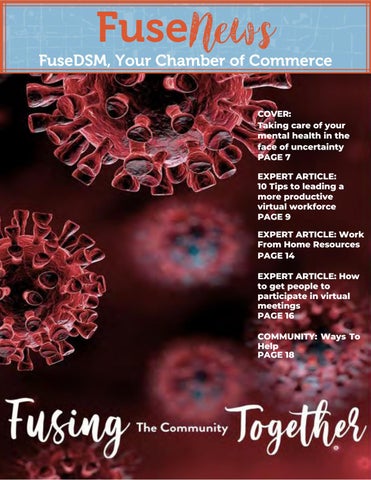
FuseDSM, Your Chamber of Commerce COVER: Taking care of your mental health in the face of uncertainty PAGE 7 EXPERT ARTICLE: 10 Tips to leading a more productive virtual workforce PAGE 9 EXPERT ARTICLE: Work From Home Resources PAGE 14 EXPERT ARTICLE: How to get people to participate in virtual meetings PAGE 16 COMMUNITY: Ways To Help PAGE 18
2
INSIDE // APRIL 2020
In the Community // Community Ways to Help GDMP
Page 18
Coronavirus Emergency Loans
Page 20-23
On the Cover // Taking care of your mental health in the face of uncertainty Page 7 10 Tips to leading a more productive virtual workforce Page 9 Work From Home Resources Page 14 How to get people to participate in virtual meetings Page 16 Ways to help on the community Page 18
In the Chamber // Chamber Highlights
Page 10
Ask an Expert // Support Des Moines Business
Page 5
Anderson Erickson Celebrates 90 Years!
Page 10
The Market Continues Its Volatility
Page 15
Harvard Business Review
Page 16
3
Letter from the President/CEO // Trish Flaherty-Barnes To our members and the community, FuseDSM, Your Chamber of Commerce remains OPEN for business. While our physical office may be closed as we practice the recommended social distancing, rest assured, FuseDSM staff is still working tirelessly on your behalf. We are available via phone and email. Events have been moved to an online format if feasible or will be re-scheduled for a later date. FuseDSM, like our businesses, has had to pivot our focus as social distancing is not a common word used in the world of Chambers of Commerce. We are adjusting quickly and more online webinars will be rolled out soon. Technology is amazing and we plan to utilize it to remain connected and bring that connection to the community. It can and will be done, as your Chamber needs YOU as much as your business needs the support of the community. We continue to remain in contact with our city, county and state leaders for direction and recommendations, and we are well connected to chambers all across the world. The incredibly innovative ideas as chambers of commerce work together for our communities is powerful. We will continue to bring those ideas into our community. Please stay healthy, follow the recommended guidelines in place by the CDC and local government, but most importantly remain calm, thoughtful and purposeful as we all navigate this ever changing landscape together. We got this Des Moines!
Trish Flaherty-Barnes President/CEO
4
Expert Article // Support Des Moines Business
READ MORE
5
COVER STORY // Taking Care of Your Mental Health in the Face of Uncertainty // Doreen Marshall, Ph.D. Human beings like certainty. We are hard-wired to want to know what is happening when and to notice things that feel threatening to us. When things feel uncertain or when we don’t generally feel safe, it’s normal to feel stressed. This very reaction, while there to protect us, can cause all sorts of havoc when there is a sense of uncertainty and conflicting information around us. A large part of anxiety comes from a sense of what we think we should be able to control, but can’t. Right now, many of us are worried about COVID-19, known as the “Coronavirus”. We may feel helpless about what will happen or what we can do to prevent further stress. The uncertainty might also connect to our uncertainty about other aspects of our lives, or remind us of past times when we didn’t feel safe and the immediate future was uncertain. In times like these, our mental health can suffer. We don’t always know it’s happening. You might feel more on edge than usual, angry, helpless or sad. You might notice that you are more frustrated with others or want to completely avoid any reminders of what is happening. For those of us who already struggle with our mental wellness, we might feel more depressed or less motivated to carry out our daily activities. It’s important to note that we are not helpless in light of current news events. We can always choose our response. If you are struggling, here are some things you can do to take care of your mental health in the face of uncertainty: Separate what is in your control from what is not. There are things you can do, and it’s helpful to focus on those. Wash your hands. Remind others to wash theirs. Take your vitamins. Limit your consumption of news (Do you really need to know what is happening on a cruise ship you aren’t on?). Do what helps you feel a sense of safety. This will be different for everyone, and it’s important not to compare yourself to others. It’s ok if you’ve decided what makes you feel safe is to limit attendance of large social events, but make sure you separate when you are isolating based on potential for sickness versus isolating because it’s part of depression. Get outside in nature, even if you are avoiding crowds. I took a walk yesterday afternoon in my neighborhood with my daughter. The sun was shining, we got our dose of vitamin D, and it felt good to both get some fresh air and quality time together. Exercise also helps both your physical and mental health. Challenge yourself to stay in the present. Perhaps your worry is compounding—you are not only thinking about what is currently happening, but also projecting into the future. When you find yourself worrying about something that hasn’t happened, gently bring yourself back to the present moment. Notice the sights, sounds, tastes and other sensory experiences in your immediate moment and name them. Engaging in mindfulness activities is one way to help stay grounded when things feel beyond your control. Stay connected and reach out if you need more support. Talk to trusted friends about what you are feeling. If you are feeling particularly anxious or if you are struggling with your mental health, it’s ok to reach out to a mental health professional for support.
7
WELCOME // NEW MEMBERS
Rendall Insurance Agency
Kelly’s Little Nipper
Sleep in Heavenly Peace, IA-Des Moines Mercado Iowa Market
8
EXPERT ARTICLE // TODD MCDONALD, ATW TRAINING
9
EXPERT ARTICLE // AE CELEBRATES 90 YEARS! Anderson Erickson Celebrating 90 Years! Anderson Erickson Dairy (AE for short) is a 90-year-old, family-owned, third-generation dairy. Since we opened our doors in 1930, our goal has always been to help our customers enjoy the goodness of dairy made the AE way. AE is a different kind of dairy. Our products are made using time tested recipes with specially selected ingredients such as European cocoas, premium vanillas, and fresh cream and milk from Iowa farms. We don’t just make our products and send them out the door. Our products are evaluated on taste, performance, consistency and overall appeal in our on-site lab and in weekly taste tests by company leaders who know what great dairy should taste like. There are countless things we do to ensure our products are hours fresh and just right for our customers’ enjoyment. The unsolicited feedback we get from our customers who tell us they leave Iowa with coolers full of AE products or that they fight over who gets the last AE Chocolate Milk is how we measure our success. We receive what we call “love letters” from our customers and we even put their quotes on our trucks. It’s why we do what we do. As Iowa’s local family dairy, our roots in the community run deep. We partner with over 600 local businesses, hold clothing drives, send AE products to food banks, and support hundreds of nonprofits. For three generations, we’ve provided the freshest dairy to our friends and neighbors and we’ve loved every second of it. We like to say, “we’re as local as it gets” and we hope you taste our passion in everything we make.
10
CHAMBER // HIGHLIGHTS
Pulse of the City //
We had a wonderful Pulse of the City event. For this event we partner with the Des Moines Downtown Chamber of Commerce and the Des Moines West Side Chamber of Commerce. A big thanks to everyone who attended to hear about our wonderful City's updates and the projects that are being done to continue to make Des Moines a better place.Last but not least, thanks to Yellow Cab Company for being our sponsor!
Annual Dinner // Wow! We have received so many compliments on our annual dinner held at the end of February.. And it's all thanks to YOU! Thank you to all our businesses that chose to participate in being sponsors for our event. A big thank you to those who came and participated. Thank you, thank you, thank you!
11
12
13
EXPERT ARTICLE // Work From Home Resources Important Tips When Working From Home • Location-Where you work matters! • Schedule-Lines can be blurred between personal and professional. • Daily Routine-Get dressed, do your routine. • Communication-Over-communicate • Meal Prep-Come up with go-to lunches. • Take regular breaks-get some fresh air There are several websites that are great for working remotely. We compiled a list of websites to help you get started!
14
EXPERT ARTICLE // THE MARKET CONTINUES ITS VOLATILITY... Iron Horse Wealth Management, LLC: The market continues its volatility. Here are our thoughts on the current situation. A message from the Iron Horse Team As we continue to see extreme volatility in the markets, the team at Iron Horse wanted to reach back out to our clients to share our perspective. As fears of the impact of coronavirus drove the market lower over recent days, it’s become uncomfortable for everyone. Having managed through other recessions, bear markets, and panics, we’d like to provide some insights and thoughts for you to consider: · While a few people like to be uncomfortable, most do not. We take our role as your advisor seriously and we will never let that fear and discomfort drive our decision making. We rely on scientific facts, data, and academic research studies to drive our decision making in both the good times and the not so good times. And we will always make decisions in your best interest. · Our faith is unyielding in the strength and resiliency of the US Economy and in the ability of medical professionals and companies to work their ways through the challenges presented by the virus. We believe that over time, this too shall pass. · We are just coming off the longest bull run in history, and a correction was planned for and inevitable. While these times can be stressful, keep in mind that the economy as a whole is still doing well by virtually any metric. Events shutting down, schools closing, and precautions being taken right now will likely only be temporary and are necessary to contain/reduce/eliminate the virus. While none of us enjoy seeing dramatic market swings, the fundamentals are intact and most of the volatility we are seeing is based on emotions. READ MORE
15
How To Help
Broadlawns has been fortunate to receive an overwhelming amount of support from the community during these challenging times. Thank you for your generosity!
Disaster Relief Fund
The Broadlawns Medical Center Foundation has established a Disaster Relief Fund to ensure our doctors, nurses and healthcare workers have the supplies and resources they need to remain at the front lines of the COVID-19 pandemic and are able to continue providing our community with compassionate care and support during this unprecedented time. To make a donation to support this restricted fund, please visit our donation page and indicate “Disaster Fund” in the comments.
Handmade Masks
Broadlawns Medical Center is accepting homemade masks. We ask that you please adhere to the specifications below and follow the instructions in this video when making masks. Please construct masks using the following specifications:
100% cotton fabric, tightly woven, minimum of 160 thread count per square inch Ties and tape – 100% cotton – white or natural color – minimum ¼ inch thick Nose piece – minimum 4 inches long – plastic coated wire twist ties Mask size when complete – 7 inches wide by 3.75 inches long 3 pleats per mask facing upward (from outside view) The mask should have two layers of fabric If you've already made masks using another pattern, that's OK, we’ll accept those as well. Kindly enclose completed masks in a zip lock plastic bag or within a closed plastic box. We will launder them prior to use so there is no need to wash the masks prior to delivery. To coordinate a delivery of masks, please email foundation@broadlawns.org. We hope that our supply of PPE masks will get us through this situation, but we will use the homemade masks if circumstances dictate the need.
In-Kind Donations
Broadlawns welcomes donations of catered meals or restaurant gift cards as a way to support our medical staff on the front lines while also supporting local businesses. At this time, we are not accepting homemade food items. For your safety and the safety of our patients and staff, please email foundation@broadlawns.org to coordinate any donation. Please do not enter the Medical Center with donations.
EXPERT ARTICLE// HARVARD BUSINESS REVIEW How to Get People to Actually Participate in Virtual Meetings These days it’s hard to get people to pay attention in any meeting, but when people aren’t in the same room, it can be especially difficult. And it’s particularly annoying when you make a nine-minute argument, pause for an expected reaction, and get: “I’m not sure I followed you” which might as well mean: “I was shampooing my cat and didn’t realize I would be called on.” Let’s face it, most meetings have always sucked because there’s often little to zero accountability for engagement. When we are together in a room, we often compensate with coercive eye contact. Participants feel some obligation to feign interest (even if they’re staring at their phones). In situations where you can’t demand attention with ocular oppression, you have to learn to do what we should’ve mastered long ago: create voluntary engagement. In other words, you have to create structured opportunities for attendees to engage fully. There are four broad reasons to hold a meeting: to influence others, to make decisions, to solve problems, or to strengthen relationships. Since all of these are active processes, passive passengers in a meeting rarely do quality work. The precondition for effective meetings — virtual or otherwise — is voluntary engagement. We’ve spent the last few years studying virtual training sessions to understand why most virtual gatherings bore groups into a coma. As we’ve done so, we’ve discovered and tested five rules that lead to predictably better meeting outcomes. In one study we did, comparing 200 attendees of a face-to-face experience with 200 of a virtual experience, we found that when these rules are applied, 86% of participants report as high or higher levels of engagement as in face-to-face meetings. And we’ve now applied these rules with over 15,000 meeting participants. Here’s what works. Let’s take Raul, a mid-level manager, who is about to lead a 15-minute virtual presentation to 16 of his peers scattered from North to South America. His goal is to convince them they should identify some global sales opportunities from each of their regional account portfolios, then cooperate in pursuing them. To avoid a passive lecture and engage the group, he plans to use 18 slides. Here are the rules Raul should follow. 1. The 60-second rule. First, never engage a group in solving a problem until they have felt the problem. Do something in the first 60 seconds to help them experience it. You might share shocking or provocative statistics, anecdotes, or analogies that dramatize the problem. For example, Raul could share a statistic showing average global deal sizes for a competitor that provokes a sense of inferiority with the group. He could share an anecdote about a frustrated customer who discontinued purchasing because the team failed to offer global pricing and support. Or, he could engage emotions by making an analogy to whales who feed far more effectively when they work together to encircle large schools of krill— and then take turns gorging on the feast. No matter what tactic you use, your goal is to make sure the group empathetically understands the problem (or opportunity) before you try to solve it. 2. The responsibility rule. When people enter any social setting, they tacitly work to determine their role. For example, when you enter a movie theater, you unconsciously define your role as observer — you are there to be entertained. When you enter the gym, you are an actor — you are there to work out. The biggest engagement threat in virtual meetings is allowing team members to unconsciously take the role of observer. Many already happily defined their role this way when they received the meeting invite. To counteract this implicit decision, create an experience of shared responsibility early on in your presentation. Don’t do it by saying, “Okay, I want this to be a conversation, not a presentation. I need all of you to be involved.” That rarely works. Instead, create an opportunity for them to take meaningful responsibility. This is best done using the next rule.
16
EXPERT ARTICLE // CONTINUED 3. The nowhere to hide rule. Research shows that a person appearing to have a heart attack on a subway is less likely to get help the more people there are on the train. Social psychologists refer to this phenomenon as diffusion of responsibility. If everyone is responsible, then no one feels responsible. Avoid this in your meeting by giving people tasks that they can actively engage in so there is nowhere to hide. Define a problem that can be solved quickly, assign people to groups of two or three (max). Give them a medium with which to communicate with one another (video conference, Slack channel, messaging platform, audio breakouts). If you’re on a virtual meeting platform that allows for breakout groups, use them liberally. Give them a very limited time frame to take on a highly structured and brief task. For example, three minutes into his pitch, Raul could say something like, “The next slide shows who your partner will be. I want you to take two minutes in your breakout group to identify a global regret: a client you believe you could have had a much bigger deal with if we had worked together better in the past 12 months.” Next, he could ask everyone to type their answers into the chat pod, and/or call on one or two to share their example over the phone. 4. The MVP rule. Nothing disengages a group more reliably than assaulting them with slide after slide of mind-numbing data organized in endless bullet points. It doesn’t matter how smart or sophisticated the group is, if your goal is engagement, you must mix facts and stories. We encourage people to determine the Minimum Viable PowerPoint (MVP) deck they need. In other words, select the least amount of data you need to inform and engage the group. Don’t add a single slide more. A side benefit of this rule is that it forces you to engage the attendees. If you have too many slides, you feel enslaved to “getting through them.” If Raul has 18 minutes to get his job done, 15 slides is far too many. He should be able to make his case with one or two slides, then use any additional slides to accomplish the tasks in rules 1-3 above. 5. The 5-minute rule. Never go longer than 5 minutes without giving the group another problem to solve. Participants are in rooms scattered hither and yon with dozens of tempting distractions. If you don’t sustain a continual expectation of meaningful involvement, they will retreat into that alluring observer role, and you’ll have to work hard to bring them back. In his 15-minute presentation, Raul should have 2-3 brief, well-defined, and meaningful engagement opportunities. For example, he could wrap up his presentation with a group-generated list of options, then throw out a polling/voting opportunity to determine the team’s opinion about where to begin. The truth is these rules should already be second nature, no matter what kind of meeting you’re leading. But the stakes are even higher today when team members are out of sight and their minds are free to wander. Following these five rules will dramatically and immediately change the productivity of any virtual gathering.
17
COMMUNITY // WAYS TO HELP DONATE MONEY Certain organizations will help provide much-needed resources to individuals and families who may be economically disadvantaged during this time. Below are a few organizations accepting donations. Also, make sure to check in with your local food banks and homeless shelters to find out what resources they may need. • Feeding America has 200 food banks and 60,000 food pantries. DONATE • Meals on Wheels delivers meals directly to the homes of seniors. DONATE • No Kid Hungry works to end childhood hunger in the United States. DONATE • Stay In Speak Out is a fundraising campaign organized by wedding industry professionals, with a goal of turning $5 donations for UNICEF into $5 million in just two weeks. DONATE IF POSSIBLE, STAY HOME Public health experts are urging people to follow cautionary measures to stem the rise of coronavirus cases. One of the simplest ways to prevent the spread of the disease is to practice social distancing. In other words, just stay home. DONATE BLOOD According to The New York Times, we need donors now more than ever. As more people are confirmed to have contracted coronavirus, there are also less eligible individuals able to donate blood. Find out how you can donate locally by visiting the website for LifeServe Blood Center. SHOP AT LOCAL BUSINESSES A vital yet easily overlooked way to support your community during the time of the coronavirus pandemic is by shopping online locally. While major stores and chains will most likely survive whatever dip in customer traffic comes, smaller businesses will bear the brunt of it. If you plan on buying food, toiletries, and medicine, aim for your local grocery store rather than major retailers. (But remember not to over-stockpile, lest your hoarding leads to a shortage of much-needed resources for at-risk communities, like those who are immunocompromised.) For nonessentials (like hair salons, nail spas, coffee shops, and more), consider buying gift certificates to use in the future. REACH OUT TO YOUR LOVED ONES AND NEIGHBORS Have you spoken to your loved ones and neighbors? While prevention is key, it may also be worthwhile to get on the same page about what to do in event of the worst-case scenario. The Centers for Disease Control and Prevention has provided a checklist for a household plan of action.
18
19
Prepared by the U.S. CHAMBER OF COMMERCE
CORONAVIRUS EMERGENCY L ANS
Small Business Guide and Checklist
The Coronavirus Aid, Relief, and Economic Security (CARES) Act allocated $350 billion to help small businesses keep workers employed amid the pandemic and economic downturn. Known as the Paycheck Protection Program, the initiative provides 100% federally guaranteed loans to small businesses who maintain their payroll during this emergency. Importantly, these loans may be forgiven if borrowers maintain their payrolls during the crisis or restore their payrolls afterward. The administration soon will release more details including the list of lenders offering loans under the program. In the meantime, the U.S. Chamber of Commerce has issued this guide to help small businesses and self-employed individuals prepare to file for a loan.
Here are the questions you may be asking— and what you need to know.
1 Am I ELIGIBLE? You are eligible if you are: • A small business with fewer than 500 employees • A small business that otherwise meets the SBA’s size standard • A 501(c)(3) with fewer than 500 employees • An individual who operates as a sole proprietor • An individual who operates as an independent contractor • An individual who is self-employed who regularly carries on any trade or business • A Tribal business concern that meets the SBA size standard • A 501(c)(19) Veterans Organization that meets the SBA size standard
In addition, some special rules may make you eligible: • If you are in the accommodation and food services sector (NAICS 72), the 500-employee rule is applied on a per physical location basis • If you are operating as a franchise or receive financial assistance from an approved Small Business Investment Company the normal affiliation rules do not apply REMEMBER: The 500-employee threshold includes all employees: full-time, part-time, and any other status.
2 What will lenders be LOOKING FOR? In evaluating eligibility, lenders are directed to consider whether the borrower was in operation before February 15, 2020 and had employees for whom they paid salaries and payroll taxes or paid independent contractors.
What lenders will
NOT LOOK FOR
Lenders will also ask you for a good faith certification that:
• That the borrower sought and was unable to obtain credit elsewhere.
1. The uncertainty of current economic conditions makes the loan request necessary to support ongoing operations
• A personal guarantee is not required for the loan.
2. The borrower will use the loan proceeds to retain workers and maintain payroll or make mortgage, lease, and utility payments
• No collateral is required for the loan.
3. Borrower does not have an application pending for a loan duplicative of the purpose and amounts applied for here 4. From Feb. 15, 2020 to Dec. 31, 2020, the borrower has not received a loan duplicative of the purpose and amounts applied for here (Note: There is an opportunity to fold emergency loans made between Jan. 31, 2020 and the date this loan program becomes available into a new loan) If you are an independent contractor, sole proprietor, or self-employed individual, lenders will also be looking for certain documents (final requirements will be announced by the government) such as payroll tax filings, Forms 1099-MISC, and income and expenses from the sole proprietorship. P repa red by th e U.S. CHAMB E R OF COMME RCE
3 How much can I
BORROW?
Loans can be up to 2.5 x the borrower’s average monthly payroll costs, not to exceed $10 million. NON SEASONAL EMPLOYERS:
How do I calculate my average monthly
PAYROLL COSTS? sum of INCLUDED payroll costs
sum of EXCLUDED payroll costs
Maximum loan =
PAYROLL COSTS
INCLUDED Payroll Cost: 1. For Employers: The sum of payments of any compensation with respect to employees that is a: • salary, wage, commission, or similar compensation; • payment of cash tip or equivalent; • payment for vacation, parental, family, medical, or sick leave • allowance for dismissal or separation • payment required for the provisions of group health care benefits, including insurance premiums • payment of any retirement benefit • payment of state or local tax assessed on the compensation of the employee 2. For Sole Proprietors, Independent Contractors, and Self-Employed Individuals: The sum of payments of any compensation to or income of a sole proprietor or independent contractor that is a wage, commission, income, net earnings from self-employment, or similar compensation and that is in an amount that is not more than $100,000 in one year, as pro-rated for the covered period.
EXCLUDED Payroll Cost: 1. Compensation of an individual employee in excess of an annual salary of $100,000, as prorated for the period February 15, to June 30, 2020 2. Payroll taxes, railroad retirement taxes, and income taxes 3. Any compensation of an employee whose principal place of residence is outside of the United States 4. Qualified sick leave wages for which a credit is allowed under section 7001 of the Families First Coronavirus Response Act (Public Law 116– 5 127); or qualified family leave wages for which a credit is allowed under section 7003 of the Families First Coronavirus Response Act P repa red by th e U.S. CHAMB E R OF COMME RCE
2.5 x Average total monthly payroll costs incurred during the year prior to the loan date For businesses not operational in 2019:
2.5 x Average total monthly payroll costs incurred for January and February 2020 SEASONAL EMPLOYERS:
Maximum loan =
2.5 x Average total monthly payments for payroll costs for the 12-week period beginning February 15, 2019 or March 1, 2019 (decided by the loan recipient) and ending June 30, 2019
4 Will this loan be
FORGIVEN?
Borrowers are eligible to have their loans forgiven.
WHAT'S NEXT?
How Much? A borrower is eligible for loan forgiveness equal to the amount the borrower spent on the following items during the 8-week period beginning on the date of the origination of the loan: • Payroll costs (using the same definition of payroll costs used to determine loan eligibility)
• Payments on utilities (electricity, gas, water, transportation, telephone, or internet)
Look out for more information about eligible lenders and additional loan guidance.
• For borrowers with tipped employees, additional wages paid to those employees
Visit sba.gov for updates.
• Interest on the mortgage obligation incurred in the ordinary course of business • Rent on a leasing agreement
The loan forgiveness cannot exceed the principal.
How could the forgiveness be reduced? The amount of loan forgiveness calculated above is reduced if there is a reduction in the number of employees or a reduction of greater than 25% in wages paid to employees. Specifically: Reduction based on reduction of number of employees
PAYROLL COST Calculated on page 2
Average Number of Full-Time Equivalent Employees (FTEs) Per Month for the 8-Weeks Beginning on Loan Origination
Option 1: Average number of FTEs per month from February 15, 2019 to June 30, 2019 Option 2: Average number of FTEs per month from January 1, 2020 to February 29, 2020 For Seasonal Employers: Average number of FTEs per month from February 15, 2019 to June 30, 2019
Reduction based on reduction in salaries
PAYROLL COST Calculated on page 2
For any employee who did not earn during any pay period in 2019 wages at an annualized rate more than $100,000, the amount of any reduction in wages that is greater than 25% compared to their most recent full quarter.
What if I bring back employees or restore wages? Reductions in employment or wages that occur during the period beginning on February 15, 2020, and ending 30 days after enactment of the CARES Act, (as compared to February 15, 2020) shall not reduce the amount of loan forgiveness IF by June 30, 2020 the borrower eliminates the reduction in employees or reduction in wages.
P repa red by th e U.S. CHAMB E R OF COMME RCE
AFFILIATE // BENEFITS GDMP Partnership Perk - Supporting Women in Business “Companies run by women are entering the middle market at rates eight times faster than businesses in general”. “While the number of middle-market firms grew by 4 percent between 2008 and 2014, the number of women-owned/led firms in the middle market increased by 32 percent” according to a study by American Express and Dun & Bradstreet. As the numbers continue to grow, communities in Greater Des Moines (DSM) are committed to working with these women to create better futures for themselves and their communities. The Partnership and its Affiliate Chambers of Commerce continue to raise awareness by offering local programming around this topic. First Fridays Series The Greater Des Moines Partnership is excited to team up with the Iowa Women’s Business Center to bring you First Fridays! The goal of First Fridays is for the aspiring small business owners and the people of DSM to hear from business owners who have helped shape the communities in which we live. The speakers are makers, store owners, movers and shakers, creators of regional or national brands, and all have stories that are uniquely their own. To learn more about the First Fridays series and for list of upcoming First Friday events, click here.
20
BOARD OF DIRECTORS // 2020 FuseDSM’s Board of Directors serve a three-year term with a maximum of two terms. Members of the Board focus on the development of Board policies that govern the implementation of institutional plans and purposes. The role is separate and distinct from the role of the staff, to whom are delegated the implementation of these policies.
Randy Sackett //
Yellow & Capital Cab Co, Chair
Ryan Anderson // No Coast Consulting Immediate Past
Carolyn Jenison // SpeakPR Vice Chair
Laura Gibson //
Tom Welchans //
Jeremy Merrill //
Fernando Aveiga //
Bill Raine //
Andre McKay //
Megan Fletcher//
Pam Thompson //
Central Iowa Center for Independent Living Secretary
Lubinus Law Firm
Reliable Maintenance
Danny Beyer // Iron Horse Wealth Management, LLC
Denman & Company, CPA Treasurer
Hacha & Machete, Inc.
Siegwerk
Patrick Rupe // Atlantic Coca-Cola Bottling Company
Michael Bird // Spindustry
Raine Recruiting LLC
Parks Area Foundation
Daniel Willrich // Pelds Design Services
INTERESTED IN GETTING INVOLVED? Contact FuseDSM today for additional ways to get your business noticed in our 10,000 business footprint. Or set up a time with our Firestater Ambassadors to discuss how the chamber can change your marketing approach.
OUR CHAMBER GROUPS 21
22