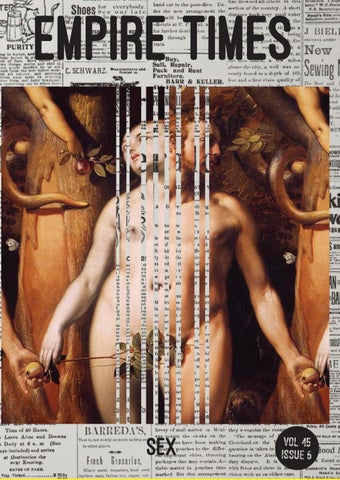
EMPIRE TIMES
SEX
The Team EDITORS Ainsley Ewart, Oli Glenie and Cameron Lowe SUB-EDITORS Georgina Banfield, Elise Christopher, Chelsea Griffith, Courtney Lawrence, Vanshika Sinh and Karen Smart COLUMNISTS Chelsea Griffith, Renee Kohler, and Michelle Wakim ARTISTS Chris Galimitakis (@c.galimitakis) and Adrienne Gill CONTRIBUTORS Laurent Bope, Ruby Easterbrook, Jessica Elton, Ainsley Ewart, Esme Fabry, Chelsea Griffith, Madeline Hand, Renee Kohler, Cameron Lowe, Jordana Mansfield, Kaing Zar Maung, Elizabeth Middleton, Peter Moreman, Morgan Pankhurst, Drew Price, Rachael Stapleton, Ashley Sutherland and Michelle Wakim
ADVERTISING/MEDIA Steph Walker stephanie.walker@flinders.edu.au Enquiries Level 1, Student Hub, Flinders University (FUSA) 1 Registry Road Bedford Park, 5042. THANK YOUS Thank you to all of our contributors and sub-editors for this issue; we truly appreciate the time you put in for us! And a special thanks to the real stars, the Pets of Flinders: Bruce, Juno, Rascal and Yogi. Congratulations to our sub-editor Karen Smart for having a piece (from our 2015 Issue “Fallout” 43.8 with a hint of “Nature” 43.2) published by Kidspot which went on to be on the front page of news.com.au! Also, a big thank you to Aaron Harvey for helping us out with our first four issues. We wish you all the best in your new job!
Empire Times would like to acknowledge the Kaurna people who are the traditional custodians of the land Flinders University is situated on, and that this land was never ceded, but stolen. We would like to pay our respects to the elders of the Kaurna nation and extend that respect to other Aboriginal peoples, past, present, and future. Empire Times is a publication of Flinders University Student Association (FUSA). Empire Times is printed by Newstyle Print. ‘The opinions expressed herein are not necessarily those of the editors, Flinders University, or Flinders University Student Association. Reasonable care is taken to ensure that Empire Times articles and other information are up-to-date and as accurate as possible, as of the time of publication, but no responsibility can be taken by Empire Times Magazine for any errors or omissions contained herein.’
WRITERS, PHOTOGRAPHERS, ILLUSTRATORS & MAKERS OF PRETTY INTERESTING THINGS! Empire Times is a student publication that prints 8 times over the academic year. It is made by students, for students and provides a unique opportunity for students to be published, to talk about what's important to them and to be read by those in their community. Empire Times relies entirely on contributions from the readers to make up its content. Each selected piece goes through a collaborative editing process. We're very friendly, visit empiretimes.com.au/contribute to find out everything you need to know about being part of the team. 3
Editorial
Sex was never really a taboo topic in my family. My parents were happy to let me read educational books on sex and puberty at a young age – I remember reading one book about how the human body develops during puberty over and over when I was about seven or eight. I watched a video of my birth when I was even younger; around four or five, and it didn’t leave me traumatised; all it did was leave me with a better understanding of “where do babies come from”. My parents – especially my dad – don’t necessarily believe in censorship, and Dad’s always argued that in fact, we should be more concerned with censoring the overwhelming violence and brutality we’re surrounded by in modern media. Western society has such a weird relationship with sex. On the one hand, everything in advertising and media is sexualised to hell (especially if it includes femininity), but on the other, we’re socialised to believe sex should be attached to shame, especially if it falls outside of a cis- and hetero-normative (and honestly underwhelming) experience. Kids are taught to be both obsessed with and scared of sex. There’s so many weird ideas and opinions about sex, when in reality, there’s no one way for it to look or feel, and so long as all parties are consenting, it counts as good sex in my book. Enjoy, Oli p.s. my portrait this issue is my cat, Asparagus, comforting me because I’ve been unwell and don’t want to share my garbage sick face right now x
Sex: it’s a word that has so many different meanings and interpretations beyond just the means of reproduction. What you will read in this issue, are our contributor’s take on the topic of sex. We have it all, from gender roles (Hand, page 29) to women in Westworld (Kohler, pages 24-25). Currently one thing I’ve been finding sexy is Octopath Traveler on the Nintendo Switch. This game has some of the most beautiful art style I have seen in a video game this year. To give you a perspective: it has 2D 16-bit sprites (similar to sprites from SNES games like Final Fantasy VI) in a 3D environment. It feels like a pop-up storybook come to life and has swept me up in its beauty. Also, it’s music, wow, just... breathtaking. Oh, before signing off, I have booked a trip to Japan at the end of the year! What better way to end my second undergrad (and my editorship here) than travelling to the land of the Rising Sun. I honestly cannot wait! Cam
In mid-June, I went to Melbourne for the Emerging Writers’ Festival, where I was up for the Monash Prize (I clearly didn’t win the $4000, otherwise I probably would have opened with that). My piece was a dystopian fiction short story I wrote in Prose A last year (shout out to the wonderful Lisa Bennett!) about the forced partnering of women (and partial drafting of men) following a gynaecological plague in the near future. The week before I left for Melbourne, Eurydice Dixon was murdered in Princes Park. She was the same age as me. I go into this more in ‘Women Deserve Better’ (pages 38-9) and talk about her vigil that I attended, because otherwise I would run out of room. Clearly, I’m not the only one angry at how sexual assault towards women is handled, as Chelsea Griffith recounts her friend’s experiences and dissects the “good bloke” on pages 10 and 11. Elizabeth Middleton is “bloody outraged” by the tampon tax (pages 6-7), because periods are a luxury according to the government. Trust me, they’re not. Last week I watched Hannah Gadsby’s Nanette on Netflix. I recommend you all do the same. It’s funny, it’s moving, it’s powerful and it’s relevant. Stay angry, Ainsley
14
27
Opinion
Opinion
is Love, simon really
Sex, Games and classification
that revolutionary?
VOL 45 NO.5
28 16
Creative
president’s statement
Just For Fun
Hydration
05
Vox Pops
What’s on
18
04
29 opinion
Just For Fun
06
conforming to gender roles
Pets @ Flinders
30
opinion
opinion
20
A Bloody Outrage
subjective journalism
ART/Feature
08
IMmerse embrace by Adrienne Gill
32
COlumn
Just for fun
Sex in Sport
22
10
review
Quiz
Tell me how you really feel
34
by courtney barnett
Just for fun
Column ‘But he’s a good bloke’
Six things
12
24
36
column
Just for fun
opinion
A Love Letter to the
Virginity for sale
Women of Westworld
13
26
CREATIVE
Opinion
FUSA
38 Opinion
Breasts and Skimpy outfits
form and function
Key:
Vegan Sesame Ramen with Baked Tofu
Opinion
feature
column
Women Deserve Better
creative
just for fun 5
colu mn /pr es i d en ts stat e m e n t
President’s Statement I’m not sure if there is a way to write this article without sounding too “hello fellow kids” – but here we go. If it’s consensual, sex – in whatever form – can be a fun and positive experience for yourself and your sexual partner(s). So it’s pretty damn important to talk about how we ensure that sex, as well as other interpersonal interactions, are consensual and enacted with respect and empathy. You might’ve seen our Be a Better Human decals, booklets and other merchandise around campus – or maybe you attended the Campus Fair, the Q&A session, or one of the documentary screenings. We’ve run this campaign to raise awareness and recognition of rape culture and improve our own interpersonal skills, whether they be as a bystander or as an actor in our own relationships - both on and off campus and online. So, where to from here? We’ve welcomed experts in the field to our campus to hear their advice, spoken with hundreds of students about what affirmative consent means to them and hopefully educated individuals on good behaviour by promoting values of respect and empathy along the way. I know I’ve learnt so much – in particular, the biggest learning curve being that you can never stop learning how to better your behaviour and interactions with others. We’ve recently taken our findings from the Be a Better Human campaign to the Respect. Now. Always Advisory Committee, where we stressed the importance of continuing the conversation: • Maintain a presence at core campus events like Mental Health Week, while also having two core BaBH events a year – cultural change doesn’t happen overnight. • Refresh the BaBH Student Advisory Board after O’Week 2019 (so keep an eye out if you’d like to be involved in the future!) • Consider funding a media watch-list on this topic which would be free-to-view for Flinders students. • Assess the feasibility of a podcast in the future. • Continue to develop academic and geographic based partnerships – and consider collaboration where possible. • Promote and partner with national campaigns to develop opportunities to liaise with other universities. We also made some of our own suggestions to the RNA Committee as to how they could better equip the campus and our community to combat instances of sexual assault and/ or harassment. These recommendations include but are not limited to improvements to lighting, security, policy, academic and professional consultation, student representation in policy meetings and collaboration between FUSA and representatives on RNA going forward.
6
This definitely isn’t it for BaBH – we’re happy to say that the campaign will be back! Importantly, we’re working really hard at the moment to release the campaign materials to other student organisations across the country, because we know that this is an issue that affects us all. If you’re interested, email babh@ flinders.edu.au. On the whole, we believe that we can consider this campaign a success and we couldn’t have done any of it without you. BaBH was created by students for students. The Student Advisory Board members, in particular, were integral throughout this entire process but every single student who filled out a survey form, or sent us a Facebook message, or shared one of our posts, or told one of their friends, has played a huge role in furthering BaBH and its message of a safe and inclusive campus for all of us.
Ashley Sutherland Student President Flinders University Student Association student.president@flinders.edu.au
On Campus
A LISTING OF ON CAMPUS EVENTS
Japanese Inter-Club Pub Crawl 2 FUFC Past Players Event SATURDAY, AUGUST 11, 12pm-6pm We welcome all past players, members, officials and supporters down to Flinders University Football Club’s last game of the 2018 season. Spread the word to all your mates and let’s celebrate our history together as a whole. We will be kicking things off from 12.00pm for the Reserves and through until the end of the A Grade. From here, we will have the final weekly presentations down at the Marion Hotel from 7.00pm.
ONLINE Submissions
EMPIRE TIMES, ONGOING Missed out on our print due dates? Got an idea that is time sensitive? Want to have articles that contain video or links? Submit to us to be printed on our website! Send your submission to us today! Please include ONLINE in your email subject line.
FRIDAY, SEPTEMBER 1, 5pm-12am
The Japanese Cultural Club (JCC), the Japanese Language and Cultural Society (JLACS) and the Adelaide University Anime Club (AUAC) are back at it again with another pub crawl. We had a lot of fun last year and we hope to have as much fun this year! Check the pinned post for the design competition. If you win, you can get a free shirt! $20 for a shirt! Please come to your club events to purchase your shirt Or check out your club’s page to do a bank transfer!
FUSA SAYS RELAX - PLAZA WEDNESDAY, AUGUST 1, 11am-2pm FUSA Says Relax is an initiative of Student Council, funded by your Student Services Amenities Fee. Chill out at your campus with free food and soothing services.There are lots of free things! Free things may include: food, music, massages, hairdressing, and stationery (it varies each time).
SPACE SUBMISSIONS
WORLD SUBMISSIONS
Submissions for issue seven (space) will be accepted until Monday July 30. Email your submission to empire.times@ flinders.edu.au to be included in this issue.
Submissions for ‘World’ (our last print issue for 2018) will be open until Monday September 4. Get your submission in by this date if you wish to be part of our final issue.
EMPIRE TIMES, MONDAY, JULY 30
EMPIRE TIMES, MONDAY, SEPTEMBER 4
7
op inion/po l i t i cs
A Bloody outrage A revised Budget debate: Why women are bleeding money Words by Elizabeth Middleton Alice Cooper once sang, “Only women bleed”. Whilst this only happens once a month, for us women it delivers back pain, emotional pain and pain for our pockets. For something that happens not out of choice but due to biological make up, I labour to see how such a natural occurrence - our periods could be seen by our government as luxurious. The GST is a 10% tax placed on all goods and services. That’s 10% on our clothes, cars and even our morning coffee. Though, like any rule there are some exceptions. Items viewed as general necessities such as fresh food and education are exempt. Personal hygiene products including condoms and lubricants are also exempt, as well as nicotine patches for addicted smokers, yet women’s sanitary items such as pads and tampons still attract this tax. Why you may ask? Because females use them... Oehh wait, I mean… because they’re “luxuries”? Yes, luxuries; like a Prada bag, Lamborghini or trip to the Bahamas. pads and tampons according to the government are classified as luxuries. Luxuries that only half the population buy, but that we as women
8
need to survive. Unless of course you’re Channing Tatum in She’s the Man. The vital importance of personal hygiene items, sorry LUXURIES, can’t be stressed enough. These items help us to function in our everyday lives. Some, like Jason Turner from the Sydney Morning Herald, believe “tampons are just like a new jumper”, they’re a good you can “choose to buy”. But these people have a false conception. What do they really expect women to use instead of sanitary items? The newspaper? I’ll make sure I use the Herald. Just for you Jason! Unlike an iPhone or new Bardot Jumper, these items are a necessity. We can’t live without them. In fact most women reading this article will be using them at some time in the next month, maybe even right now, while the men in our lives will never have to. So how can there be a “fair tax” on a good that is only required by one gender? There can’t be. We are being taxed for something we clearly have no control over. Our periods! I see one solution to this sexist discriminatory issue; By removing the GST on women’s sanitary items, we willenforce a level of fairness that is necessary and expected in the twenty first century.
op inion/ politics
Let’s look at the dosh here. The amount of money collected each year from the tax on pads and tampons is over $30 million. It might sound like a lot but in comparison, the Federal Government spent $459.9 billion last year alone. So the tax doesn’t even make up 10% of the government budget. Not even 1%. Not even 0.1%! It’s less than 0.01%. To the government, this is petty cash. Like Joe Hockey, some say that this is “an insignificant amount being levied on women”, and the governments right! The tax is only about $12 per woman, per year. But it is not the money that is at issue here, it is the principle. Taxing women for being women is just wrong! It is an immoral, unjust situation that needs to be addressed. Let me explain it in another way. If tomorrow morning we all woke up and the treasurer announced a 1 cent per annum tax on women, just because we were women, there would be public outcry and protest in the streets. This would be seen as unjust and bigotry, which it is; it is unfair to tax people based on their gender. Yet this is what is happening! The people who have decided which items are to be taxed; Australia’s past treasurers, have been biased! By imposing a tax on an item which they themselves will never use, they have introduced bias into the Australian taxation system. Whilst attempting to justify such decisions as being better for the economy, as Margaret Atwood notes “better never means better for everyone… it always means worse for some”. By “some”, I think we all know Atwood means women. Only by removing this discriminative tax on women’s sanitary products would the tax burden imposed upon us be considered fair. This would be a step in the right direction for gender equality; something that has still not been achieved in today’s society. Seriously, when was our last female treasurer? 1992, 1999, 2007… We still cease to gain equality there.
Once sanitary items are not taxed, women will feel less disenfranchised by society. In fact I think personally it would make me feel more liberated. Ok maybe not fully fledged suffragette liberation but I would no longer be paying a premium to bleed monthly. It would be one of the many steps needed to bring Australia closure to gender equality. The removal of the tax would yield on average an annual benefit of $12 for women. A small amount for some, but for others this tax cumulatively could be the difference between being able to buy these products or not. While the removal may not financially benefit the government, I’m sure a few less bi-elections due to the citizenship saga would help them out. Whilst the government might have us believe that by ignoring the issue they can make it go away, they can’t. “Ignoring isn’t the same as ignorance…you have to work at it”Margaret Atwood. This government has been working at ignoring this issue for too long. I believe that this tax is a “bloody outrage”. I don’t believe women should suffer because we bleed. I don’t believe that we should be ashamed of our periods and I don’t believe that 52% of the population should pay more for the inconvenience of bleeding monthly. I do however believe in equality, and that all voices if loud enough can be heard and cause change. So if you’re fed up of this sexism, or even just fed up of paying more for pads and tampons at the checkout, let people know! Capture it and share it if you too believe this is a #bloodyoutrage. Together, the women of Australia can start a movement to axe the tampon tax. It just starts with a decision to try. #BloodyOutrage
9
colu mn /s po r t
Flashy players fancy moves and sticky situations such is sport Words by Michelle Wakim When you think about it, sex and sport are as closely related as siblings. They are both children of health and physical attraction. They share similar characteristics: the release of endorphins; grunting, panting and moaning; risk of injury; gauges for how healthy our lifestyles are. In the bedroom and when we work out, we may need to stop for water breaks and to catch our breath; we may get cramps in
10
inopportune places and at inconvenient times. There is often a lot of ‘encouragement’ during sex – please, if you are ever at a sporting match, listen to the crowd: many people say things that could be said as they romp around in the sheets. There has been the occasional moment at my gym where, in the few seconds of silence between songs and judging by the noises alone, you wouldn’t know if you were in a harem or a
c olumn/ sport ‘PG’ rated communal area. Whether we want to acknowledge it or not, this environment oozes sex. I mean, there is even a motivational poster up on the wall saying “sweat is sexy”.
“Our sexual relationships and the world of sporting dynamics are governed by politics. And they come with complications, risks, and disappointments.” We go through many of the same rituals leading up to both sport and sex. Firstly, for some women, going to the gym and going “all the way” can both involve expensive underwear. So we spend the dollars, and make the effort to put our purchases to good use. The result? The sports bra gets sweaty, and lingerie ends up on the floor. Music is another area of common ground. There is a soundtrack for every moment, sex and sport are included. I know that lots of people enjoy moving (or thrusting) to a beat. And of course we take precautions to protect ourselves during these activities. We strap those dodgy ankles, massage strained muscles, purchase and use the latex we all know and love. We like to avoid uncomfortable surprises. A warm up is always crucial. Few people perform well without a warm up. It kicks the body into gear, activating your systems, and ensuring everyone is excited for the ‘big dance’. If you are not getting my hint, it’s the activities prior to the game – the anticipation that builds while playing around beforehand, the ‘foreplay’ if you will – that makes a winner.
“Most of us are not great at keeping things ‘casual’; we not only get invested in our sexual partners and in the sports we play, but we sometimes need the investment to make it worthwhile.” So after all of this, the fun is set to begin. The umpire blows the whistle and all systems are go. But if only it was that simple… Our sexual relationships and the world of sporting dynamics are governed by politics. And they come with complications, risks, and disappointments. We become vulnerable in both sports and sex: physically and emotionally we put ourselves on the line to reach a goal. If the goal (whether it be an orgasm, or a premiership) isn’t achieved, we walk away feeling unsatisfied and frustrated. Sex is rarely uncomplicated, and sexual situations are rarely mutually ideal. The likelihood of an even playing ground between sexual partners is about as common as draws/ties in sport. The results often involve one person coming out on top. One person gets invested, the other doesn’t. One team walks away with a victory, the other just walks away tired and sore. Most of us are not great at keeping things ‘casual’; we not only get invested in our sexual partners and in the sports we play, but we sometimes need the investment to make it worthwhile. Participating in a purely sexual relationship is kind of like playing social sports – you are in it for the fun, but this isn’t always enough. We can get addicted to exercise as easily as we can get addicted to good sex, or just the feeling of being intimate with someone. Our bodies find habits, they like familiarity, and this habit
nurtures our emotional states – when our bodies feel good, so does our headspace. This can cause lines to become blurred between whether exercise should be a part of our lives or whether it should become our whole lives. The same blurriness applies for the distinction between sexual satisfaction and emotional investment. But when we are forced to break these habits – we get injured, we don’t have time to exercise, our team is losing, relationships break down, our casual sex options disappear – this can shake us to our core. Consequently, we may find ourselves reassessing our identities, being dissatisfied with our performances, hurting ourselves and others, or becoming unhealthy dependent on our sexual partners. We lose our winning streak and become complacent. I think one more complication worth mentioning is the dirty c-word. CHEATING. I’m going to talk about cricket (a timely example, I know). Cricket and sexual relationships are both full of tension. We have two parties, (the batter and the bowler) both willingly enter into a relationship. This relationship between the batter and bowler is built upon the understanding that each side needs to show up and play their part (because there is no bowler without a batter, and vice versa); there is an expectation for things to be fair and respectful. So in our batter and bowler couple, one fires the shots, the other plays back. Much like a sexual relationship, the power plays are always shifting, and you can always expect some banter. This goes on and over the course of the relationship (let’s say a Test Match) we reach many climaxes. Though, we eventually find ourselves at point where the relationship, casual or serious, has to end. More often than not, there is a winner and a loser, but you hope that both sides accept the outcome with humility.
“There will always be exercise and there will always be sex; at the end of it all both of these activities make us feel something real.” On the fateful ball tampering day earlier this year, the bowler was unhappy in his relationship – the batter was dominating, there was little to no chemistry, he was struggling to meet his batsman half-way, and he found himself in a rut. In attempt to end the relationship, to fast track through it and come out the winner, the bowler turned to his mates for advice. They strongly encouraged him to rough up his relationship (and not in a good way). He was told to tamper with the connection between batter and bowler. So he did this. He had a moment of weakness. He was too scared to face up to heartbreak that comes with losing. Too fragile to combat the pressure of this particular relationship. The bowler panicked when he was caught cheating and tried to hide the evidence, and keep it, in his pants – fitting for this analogy. The result was just as everyone on the outside expected. The act was brought down to desperation and stupidity, and there was remorse and regret. In the sporting world, people get punished for cheating. In the world of sex and relationships, we can only rely on karma to grant punishment. But in both worlds, people who were invested get hurt. There will always be exercise and there will always be sex; at the end of it all both of these activities make us feel something real. Individually, and with others, sport and sex allow us to feel pleasures, form connections, and overcome immense insecurities with an authenticity that is hard to find. They are a release, they strip us back, expose us – and it is bloody refreshing.
11
colu mn /o pi n i o n
TRIGGER WARNING: Sexual assault
ed oset and kiss e equipment cl “We were 19. I was crying, but he ay nc ie aw sc sh a pu to in to d tried shed me an pu , e o’ H ‘n . id ol sa ho didn’t stop.” I nd nts. y ha We were at sc it down his pa then forced m it, ed t rc ns fo ai d “We were 14. ag an d t rien lean abbed my hand He has a girlf the door and me. Then he gr a good bloke. ng. He locked lly yi ra cr ne as ge w I s . e’ nd H ‘mates’ after. and free my ha “We were 17 ntinued to be co I . We were m w.” d no an e H . aking harder wandering. I was trying to out and his hands kept move them a w ere in public “We were 19 way, , so I felt lik . Well, I was e I fo couldn’t move but we rcefully or s 19. I don’t kn half of ‘we’ o them too m eo n e would have ow who the was, or may would have other noticed. Eve be even the th o of ‘we’. I wa ug ht ryone I other two-t was a slut if s hands were hirds they saw th elevator, and very drunk. I remember ever there. In a t his entering an seeing two bo the end I pre was going to te ys standing n le d already. I re a ed d hi th m at I somewhere in the elevato member exit his hands fr so I could re r ing an eleva o m m e a le n a d we could st se tor, sore and bruised.” and up. I used opportunity the to run away .”
‘but he’s a good bloke’ Words by Chelsea Griffith
“We were 17. We were drunk. He was my boyfriend. He pushed me into a toilet cubicle and started to force himself into me. I said ‘no’ a million times, but he said ‘no’ back, and did it anyway. It hurt. I put it down to him being drunk and we continued dating for about six months.” nted to but I “We were 16. He wa ’, and kept ‘no didn’t. I kept saying he didn’t. I t bu asking him to stop, d I kind of an , me f never pushed him of ile, but that’s not enjoyed it after a wh the point.”
e making single. We wer as w he e m ld hands on He to pt putting his “We were 18. ke e H . om ro nd’s em and pull out in my frie ied to grab th tr I , em th t wan le lasted places I didn’t er. This strugg ng ro st as w t he e, frigid, a them away, bu lled me a teas ca e H . es ut min believe it. I for about 20 til I started to un n, ai ag er next day d ov bitch; over an over again. The would d an er ov g, ogisin d his girlfriend ended up apol t single. I hope n’ as w tter.” he t ou I found nd someone be fi go d ul co e find out so sh
“We were 15. We were at a party. He follow ed me around for half an hour trying to kiss me. He was relentless, so I thought if I did it, he’d leave me alone. But he didn’t. He kept on following. He grabbed at me, he stroked my arms and legs, he tried to pull my face into his repeatedly. I spent about an hour and a half trying to gently fight it off. He told me I couldn’t just kiss him once and then ‘be a bitch’. I felt bad, and fighting him off was exhausting, so I gave in a few times. He cont inued following me and nagging at me. My frustration eventually bubbled up and I told him to fuck off. He feigned hurt and told me I was a bitch. He was acting like a toddler. I joked to my friends that he was assaulting me. We remained friends for about a year after . When I tell this story I feel disgusted, kissi ng him was so unpleasant.”
“We we re laughed 20. He grabb , before e walking d my chest an d away. W friends e’re stil .” l
. I told him my house the wrong end of my street on r ove led pul He e. hom pping me kissed. He pushed my “We were 22 . He was dro unzipped his pants while we e hav st mu he and , me s strong and I was He kissed ay from it; I tried, but he wa was a little further down. aw d hea my ve mo ’t ldn there. I cou d let me go. So I did it.” head down, and he held it e. I knew if I just did it he’ drunk. I could barely breath
I would like to acknowledge that I did not express the experiences or concerns of LGBTQIA+ people, or males that have been sexually harassed/assaulted, and that these experiences are equally as in need of serious attention as the experiences of straight girls. I was unable to include a more diverse breadth of friends’ experiences, as none of the friends that spoke to me about their experiences were LGBTQIA+ or males. 12
column/opinion
Whether you call it harassment, assault, antisocial behaviour, or just being a dickhead, no one deserves to be treated in a way that makes them feel unsafe. We know that no woman should have to worry about being subjected to this behaviour. Even if she is drunk and alone walking home in next-to-nothing, we know that people should simply not do the wrong thing. We’ve had that conversation. So I’m not going to talk about girls in those situations. I’m going to talk about girls who no one suspects to be harassed or assaulted. ‘Sensible girls’, from ‘good schools’, in ‘safe areas’ who have the most average, if not quite sheltered, of teenage-young adult experiences. And yes, we’ve talked about that too.
There are people out there who believe sexual harassment/ assault only happens to those unlucky few; those girls on the ‘wrong’ side of the tracks and those girls who put themselves into ‘bad situations’. They know their mates are ‘good blokes’ who wouldn’t harass/assault women or girls. So let’s stop talking about this stuff, because it’s just those few bad guys that harass those few unlucky girls, right? Nah.
The stories I have gathered here are the stories of girls who aren’t the ‘unlucky few’ – because each story was told to me by a different friend, and the fact that there is a story from ten separate friends of mine, probably tells you that sexual harassment/assault does not affect a mere few. . None of these girls put themselves into ‘bad’ situations. ‘But some were drunk’, you say? Ok. Some were. That doesn’t mean that they should have been assaulted. But were any of them in situations that are unusual to be in, or that the majority of young guys aren’t in every weekend? So can we really call them ‘bad’ situations?
Only one of the guys who assaulted my friends listed is someone I genuinely believe to be a ‘bad person’. I think the part of his brain responsible for empathy doesn’t light up. Even then, I have trouble believing someone is inherently bad.
A lot of us have this tendency to excuse the perpetrators and blame ourselves as the victims. Some of the attitudes reflectedin the stories really exemplify this. Maybe that’s something we need to spend more time deconstructing.
Secondly, it makes you think, if this is what some of the ‘good’ guys are doing, what are ‘good’ parents teaching their boys? What is the standard for ‘good’ behaviour? What is the general understanding of consent? I think I’ve got a clearer idea of how the student system works than the boys in these stories have of how consent works, which is utterly terrifying.
The people mentioned in the stories are all socially intelligent people, and there is no way they could have missed the vocal or physical cues that told them ‘no’. They’re also all people who know how to use manipulation in place of force. Playfully nagging a partner to engage in a sexual interaction with you can be simply playful and not harmful, sure. But if the person continues to say no or continues to appear disinterested, no matter how playfully they might be saying no, just leave them alone. But if you’re going to harass them and continue to nag them, you can nag from the other side of the couch and your arguments can be non-manipulative. So why are there so many instances of blurred lines? (Pardon the Robin Thicke reference).
If you’re a guy reading this who hadn’t quite digested the fact that this issue is an epidemic (and probably has been throughout history), take a moment to take this in: most girls you know probably have a few stories. Some are definitely a lot worse than others, sure. But why should anyone have to put up with any of this crap? Even if you don’t actively encourage this behaviour, but you stand there and allow it to happen, you’re still encouraging it. The perpetrators are most often the kind of lowconfidence people who would abandon their poor behaviour in a second if another guy told them to pull their head in. Grabbing someone’s chest or backside might not be the worst thing that can happen to a girl, but why the hell should we have to just accept it and get over it, when it makes us feel gross? If we do nothing, we say it’s ok. If we say it’s ok, we say people have the right to do what they want with other people’s bodies.
There has been so much said about this topic, that this article just feels like a shout into the void and an unoriginal idea for a ‘Sex’ issue article. However, we apparently need to go on and on about this like a Jenner promoting a lip kit because people aren’t getting the bloody message.
13
Op inion/S ex
Virginity For Sale Words by Laurent Bope The auctioning of virginity is an industry that’s gaining popularity among student communities worldwide. It is a small facet of the larger commodification of sexuality that takes place on a regular basis, mostly for financial reasons related higher education. For some individuals, selling their sexuality is the only solution and others do it to rebel against societal norms. For instance, some people, such as Alexandra Kefren (a model who sold her virginity for $2.37 million), regards it as form of emancipation. She explained that women should be allowed to do whatever they want with their bodies and live their sexuality free from socially constructed norms. The key phrase here is ‘socially constructed norms’ because there’s no trace in nature of ethical and unethical standards, including saving your virginity for marriage - nor marriage itself.
“This conscious split or boundary between the mind/soul and the body is an ancient one and deeply entrenched in western religions and philosophy.” This view aroused a deeply curious observation that has consumed me for as long as I can remember. It is an observation of the boundary we draw within the total organism; that is the separation of the body and the mind to distinguish what’s “me” and “mine”. If this boundary sounds absurd to you, let me ask, “do you feel you are a body, or do you feel you have a body?” I personally feel that I have a body that I give commands, and like most individuals, I tend to see my body as a vehicle to carry me through “live”. It is, in a sense, “mine” as supposed to “me” and I live in a small control entre (head), and depends on my body to get me from a A to B, accomplish tasks, and process necessary nutritious substance to provide me and itself the energy to keep functioning. Similarly, just about everyone I asked said that they feel that they have a body, rather than being the body and somewhat described it the same way that I did. 14
This conscious split or boundary between the mind/soul and the body is an ancient one and deeply entrenched in western religions and philosophy. Socrates for instance, sermonized that the soul is immortal and that the body is merely a host of the soul that lives within. Similar elucidation of human identities is found across most western religions, including Christianity where we derived most of our legal (and social) moral/ethical standards. Thus, we tend to identify with the “soul” and see ourselves possessing the body rather than being the body. But, what does this view have to do with the topic of selling sex or virginity?
“For, despite identifying with the soul/mind, we still regard others as complete organism (i.e. body) and the problem being, we approach them at the same consciousness level as our own body.” The way I see it is that the commodification of sex/sexuality is the result of the boundary we have drawn within the total organism. All this is triggered by friction between the two sides of the boundary due to conflicting views between what I feel and think about myself (mind) and what others feel/think about me (body). For, despite identifying with the soul/mind, we still regard others as complete organism (i.e. body) and the problem being, we approach them at the same consciousness level as our own body. This exacerbate the mind-body separation because when we approach, and ultimately treat others at that level, it accentuates the separation they are already feeling, which leads them to treat others the same way. Thus, the commodification of sex/sexuality, I think, is only the tip of the iceberg as the body become so much “mine” as supposed to “me”. Whether it is good or bad, I’ll let you decide.
Form and Function Poetry by Rachael Stapleton
I am learning to
I am learning
love my body again
to love myself again not because they tell me to
They say:
but because I finally understand
If you love yourself, buy this
that to do anything less
If you hate yourself, buy this
would be a betrayal of the self
No I will not
Stop selling me love
be told how
Stop selling me hate
to get better
Stop selling me
from a sickness they have caused I have reclaimed myself I am learning to
with knowledge & feeling
love my body again
try to touch me &
through its form & function
I will break your constructs
through the understanding
down to form & function
of atoms & thoughts I know better now Poetry & science
what they seek to do
brought me back to
I am armed & armoured
my body
I have won
the compilation of
& not fired a single bullet
compounds & sounds
15
op inion/cu lt u r e an d f i l m
is love, simon really that revolutionary? Words by Ainsley Ewart
On Good Friday, I entered a packed cinema with my sister to watch Love, Simon, the first mainstream teen film with a gay protagonist. The audience was surprisingly diverse in age, but still mostly young and female. These teen girls made irritating comments that are now seen as synonymous with gay culture, especially when at the end (spoilers ahead by the way) Simon kisses the boy he’s been interacting with online. I heard screams of “YAAAAAAASSS!” and a lot of quite fetishistic gay-cultural related comments straight from Ru Paul’s Drag Race about how cute they were. Unsurprisingly, this pairing is popular on Tumblr and there are 32 pages of fan works on Archive of Their Own.
Now, there’s nothing overly wrong with this, but there I am reminded of the way teen girls and even grown women fetishise gay men. The gay best friend is still an archetype, and many women have tried to “turn” gay men straight. This has now evolved into primarily white, straight girls love shipping conventionally attractive, able-bodied and often white boys with each other because they’re cute. It’s been going on for a while now, remember Drarry (Draco Malfoy and Harry Potter for those who missed it)? I remember two instances of real people who have been shipped, with dismal and invasive results.
16
When then YouTuber and now amazing musician Troye Sivan came out as gay in 2013, fangirls immediately started shipping him with his friend and fellow YouTuber Tyler Oakley. They are six years apart in age, at the time being eighteen and twentythree, which is definitely questionable (again, they were never together in real life). There are eight pages of fan fic about these two on Archive of Their Own, many of which ship other YouTubers along with #Troyler. They won awards for YouTube collaborations, and still appear to be friends, which is nice. Sivan even contributed to the Love, Simon soundtrack. The most infamous ship of this kind comes from One Direction. Yes, I’m going to talk about LARRY STYLINSON. The obsessive shipping of Harry Styles with Louis Tomlinson actually destroyed their close friendship, and impacted their personal lives. There were Twitter and Tumblr accounts dedicated to finding “proof” because the two sat next to each other in an interview. There was even “proof” through vague tweets that they married on the 29th of September 2013 (interestingly, my research shows the band was touring Australia at this time, and playing a show in Perth that night, so if they did get married it seems like a very busy day for it). I was honestly too terrified to even search the number of fanfics for this one.
op inion/c u lt ure and film
Simon vs The Homosapiens Agenda, the novel from which Love, Simon was fairly accurately adapted from has Simon portrayed in a more sexual manner. He and “Blue” discuss sex online, which definitely does not happen in the film. The characters are sanitised, because gay sex makes straight people cringe, right? Even though we have all those films where gross straight guys discuss their (often horrifically rapey) fantasies for the hot cheerleader, because Love, Simon is the first mainstream teen film to focus on a gay protagonist, he has to be chaste.
Whenever Ethan, the only “out” gay kid at Simon’s school makes witty comebacks to the bullying jocks, the teen girls again explode with “YAAAAAAAAAASSSSSS!” Ethan is not white, and is less masculine than Simon, and is unsurprisingly not involved in shipping. Australian Keiynan Lonsdale’s Bram, who ultimately is “Blue”, is a closeted jock and runs away the second everything falls apart. He comes good in the end, and kisses Simon atop the ferris wheel in a cute moment. Lonsdale himself has since come out as bisexual following the film’s release, and the director Greg Berlanti is openly gay, but no one else involved with the film is openly queer.
Nick Robinson as Simon in Love, Simon (Fox)
In contrast, Moonlight, the film that infamously actually won Best Picture at the Oscars last year does not have the fanbase that Love, Simon does. It’s a weighty drama as opposed to a teen film, but it portrays black and Latino men trying to find their identities as opposed to cute white boys trying to find their way in the world. “Blue” from Love, Simon turns out to not be white. So why is the performance of Keiynan Lonsdale, a mixed-race actor more acceptable to fantisise about than Trevante Rhodes, who is one year older than Lonsdale but darker skinned? Robinson with Clark Moore as Ethan in Love, Simon (Fox) All I have heard is how “revolutionary” it is to see a white, gay male protagonist in a teen movie distributed by Fox. Now I agree it’s about time we had a gay-centred mainstream teen romance, but we should have had this years ago. Love, Simon is a good film, but I do think certain parts of its appeal have been greatly exaggerated. It’s cute, but it isn’t world changing. Simon is stripped of many aspects straight teenage boys are allowed (namely being sexually curious) because it would gross out the audience (or maybe just Fox, who are a notably conservative company). I’m glad the director himself is gay. I just want it to truly represent the experiences of queer people in their teens, and not aim to please straight audiences.
Love, Simon has been compared to John Hughes films. I agree, in that it seems revolutionary, but unfortunately stops short of fully representing as best as it could. Unlike Hughes’ films, this lack of representation stems not from the creators’ weaknesses (Hughes was terrible at writing women, his scripts lacked characters of colour and often featured homophobic jokes) but from the demands of the audience and studio. The studio wants them gay, but not TOO gay, and different but not TOO different. Otherwise it disrupts their audience’s “YAAASS”-ing and “SQUEEEE”-ing.
Keiynan Lonsdale as Bram in Love, Simon (Fox)
17
just for f u n /vox po ps
VOX POPS
VOICE OF THE PEOPLE (ON CAMPUS)
@ The Tav
LOUISA
ELLEN
JOSH
SPEECH PATHOLOGY
SPEECH PATHOLOGY
STAFF MEMBER
Q1. Leornardo DiCaprio
Q1. Channing Tatum
Q1. Ken Watanabe
Q2. Confidence, but not cockiness. Respect.
Q2. Sense of humour
Q2. Great smiles and confidence
Q3. “Reasons” by Earth Wind + Fire
Q3. “Blackbird” - The Beatles
Q4. Body odour
Q4. Lack of humour and disliking dogs
Q5. The Tavern
Q5. The Tavern
Q6. It’s very important that people are aware of their rights and responsibilities
Q6. Great to start conversations, seeing everyone around with the shirts and pins. It’s an important issue and it’s good to be conncious and considerate and there’s never a bad time to start trying to be a better human.
Q3.”Sexy” by Silk-Jane Q4. Arrogance Q5. The Tavern Q6. Very positive, a great movement :)
18
j ust for f un/ vox pops
Q1. Who is your celebrity crush? Q2. What do you think is sexy? Q3. What is the world’s sexiest song? Q4. What turns you off? Q5. Where is your favourite place on campus? Q6. What do you think of the Be a Better Human campaign?
RICHARD
ANNIE
DANIEL
DEGREE, WHAT DEGREE?
BACH. EDUC/BACH. SCIENCE
ELECTRONIC ENGINEERING
Q1. Kylie Minogue circa 1997
Q1. Emma Watson
Q1. Kate Upton
Q2. Dress sense
Q2. A good sense of humour
Q3. “Sexual Healing” by Marvin Gage
Q3. “Careless Whisper” by George Michael
Q2. People who can use ‘literally’ appropiately
Q4. Poor manners and rudeness Q5. Urban Paddock Q6. Fantastic
Q4. Bad personality Q5. The Tavern Q6. It’s unfortunate that some people need to be educated on it, but good that it’s getting down.
Q3. “Careless Whisper” by George Michael Q4. A sense of entitlement Q5. The secret bench Q6. Unfortunately neccessary
19
just for f u n /pets @ f l i n d e r s
pets @ flinders bruce u Name: Br Owner: D
ce
rew Price
A ge: 8
rador olden Lab G : d e e r B r g, and ea ing, eatin p e le S : s Like scritches ccoli, cuum, bro a v e h T : Dislikes er people giving oth le p o e p and but not him attention
juno Name: Juno Owner: Morgan Pankhu rst Age: 7 Breed: Mastiff Likes: Snuggles in bed Dislikes: Having her ph oto taken
20
j ust for f u n/p ets @ flinders
rascal Name: Rascal Owner: Jordana Mansfield Age: 7 Breed: Westie Likes: Really fluffy rugs, the ocean, carrying random pieces of paper around, and eating your food (see photo - Rasc closely waiting for a piece of sandwich) Dislikes: He hates flies, getting wet, and being itchy
yogi Name : Yogi (Bear) Owner: Khaing Zar Maung Age: 2 Breed: Boxer x Shar Pei Likes: Ball, food (as long as it’s edible), jogging with ma, sleeping, and singing Dislikes: Other dogs, oranges, lizards, thunder
On this page we feature some of the cutest friends of people here at Flinders. If you want your pet to feature in the next issue, send us an email at empire.times@flinders.edu.au and we’ll put them in the magazine for all of Flinders to admire! 21
IMMERSE EMBRACE Empire Times sits down with student artist Adrienne Gill to discuss her 2015 artwork Immerse Embrace. Words by Cameron Lowe “I continue to be inspired by the sea, it’s tone, depth, and life. I wanted to create a work of sensuality and connection, where the elegant form of two connected bodies are suspended and immersed within the seascape, in a dreamlike state,” says artist Adrienne Gill, when explaining the inspiration behind her 2015 artwork, Immerse Embrace (pictured left). Immerse Embrace is an oil on canvas painting that measures 61cm (h) x 152cm (w). “I used Windsor and Newton oil paints,” says Gill, “and a selection of square brushes to work wet on wet, over time and many layers, building and creating a shimmery textural effect dancing across the water surface.” When describing the process she went through to create Immerse Embrace, Gill said, “I love working with my favourite Venetian glass quill to create calligraphic line and symbols, suggesting emerging physical form and shape, with an underlying sense of dance movement. Usually my pieces start with a sort of free association technique, and I let the form emerge.” She also enjoys listening to music as she works. This painting came emerged while she was listening to Lachlan Davidson’s ‘Solace’, a Jazz musician and composer who is also a friend of Gill. Immerse Embrace has not been displayed to the public as of yet. Most of her art has been commissioned or is currently only available in private collections. Gill though hopes to exhibit it in the future, along with her other unfinished works. She will also be developing her online presence in the future in the form of a website. When asked if she had any advice for emerging artists, Gill said, “Keep feeding your creative potential over your whole artistic career. Collaborate with other creatives on artistic projects whenever you can to draw inspiration and reach a wider audience, and try not to limit yourself to the same sort of projects – I think we might see some intriguing collaborations emerging from artists interpreting new innovations emerging in the scientific and technological fields. Developing a dynamic, diverse and interesting network of people in your life is invaluable.” For inquires, you can contact Adrienne at: sctango@ bigpond.com 22
23
review / m us i c
Tell me how you really feel by courtney barnett
Words by Ruby Easterbrook
Courtney Barnett recently released her second album, Tell Me How You Really Feel, and it’s as punchy and delectable as you’d expect
24
r e v iew/ music
Our favourite left-handed, Melbourne-based singer/songwriter Courtney Barnett has wowed us once again with her latest album, Tell Me How You Really Feel, touching on topics such as anger, insecurity, and intimacy, all while strumming along on her bluesy guitar. Surprisingly, Barnett has taken a preference to singing and prose over her typical talk-sing voice and diary-like lyrics that we see a lot of Australian musicians doing these days, and nobody’s mad about it. Nobody except me, it seems. Courtney Barnett, owner and founder of ‘Milk! Records’, won an ARIA in 2015 for ‘Best Female Artist’ and has also received worldwide recognition for her work, being nominated for a BRIT Award and a Grammy Award in 2016. Tell Me How You Really Feel follows Barnett’s 2017 collaborative album with Philadelphia-based indie folk boy Kurt Vile. Lotta Sea Lice is a Sunday morning kind of record filled with lackadaisical guitars and warm, fuzzy vibes. This album was one of our first introductions to Barnett’s preference for singing over speaking in the lead up to her newest release. It’s safe to say Barnett is well-loved, but being well-loved occasionally comes with more than a fair share of hateful trolls. Plenty of people have criticised her “lazy” methods of singing and lyricism. This may be where the inspiration for her latest album came from as Barnett has admitted to having trouble getting angry when she needs to, being someone who always sees the best in others. Songs such as ‘Nameless, Faceless’ and ‘I’m Not Your Mother, I’m Not Your Bitch’ really channel her deepest, darkest hates, insecurities, and traumas. “Don’t you have anything better to do? I wish that someone would hug you. Must be lonely, being angry, feeling over-looked,” Barnett sings in ‘Nameless, Faceless’, showing her empathetic side before letting her frustration show in the chorus singing “I wanna walk through the park in the dark. Women are scared that men will kill them. I hold my keys, between my fingers.” It’s a really powerful call-out to men who intentionally make women feel uncomfortable and/or unsafe, so much so they can’t even walk through a public space at night without needing to prepare a makeshift weapon for their own protection. The delicate backing vocals combine with the thrashing of guitars and Barnett’s angry tone, making for an interesting juxtaposition of gentleness and fury. Barnett also sings about her struggles with love, fights, and vulnerability. Being in a monogamous, occasionally long-distance relationship, due to both her and her partner’s full-on touring schedules, understandably has its ups and downs. ‘Walkin’ On Eggshells’ is the perfect example of this: “Walkin’ on eggshells gets tiring, pullin’ teeth, white knucklin’, n’ I don’t wanna hurt your feelings, so I say nothing,” Barnett sings. Bluesy piano and guitar twangs in the front of the song as her monotonous vocals rest in the background, a symbol perhaps of Barnett’s inability to speak up in the face of conflict.
One of her most melancholic songs, tonally and lyrically, is ‘Sunday Roast’, founded on atmospheric, mellow sounds of light guitar picking. The song opens with the words “Don’t come with your arms swinging, throw them around me. Some kind of sweet relief, I hope you never leave.” The instruments seem to form around her voice, becoming more muted and then building up as her lyrics glide from yearning to hopefulness. This song reminds me of driving down a highway on a gloomy afternoon, feeling glum and nostalgic. Unsurprisingly, Barnett’s best tracks are the ones released in anticipation of her album: ‘Need A Little Time’, ‘Nameless, Faceless’, and ‘Sunday Roast’. ‘Need A Little Time’ is a song about taking a break when necessary, to avoid burning out or getting sad. “You seem to have the weight of the world upon your bony shoulders well, hold on, you need a little time out,” Barnett sings, describing her loved one’s struggles, and maybe even her own, with biting off more than they can chew and feeling a little too much as a result. It was always going to be difficult for Barnett to beat her first album, Sometimes I Sit And Think, And Sometimes I Just Sit. She’s well-known globally for her song writing abilities; her talents in telling imaginative and enticing stories forms the basis for the majority of her songs. In this album, Barnett falls short of all that she is capable of, in my honest opinion. Barnett’s previous songs such as ‘Pedestrian At Best’ and ‘Depreston’ really packed an emotive punch, pushing the boundaries of vulnerability and story-telling in songs. We see a draw-back from her previous narrative-like lyrics and more of a lean towards repetitive prose, two considerably different writing styles. Maybe, I’m just not willing to embrace this updated performance style of hers considering how much I connected with her old style. Her rambling nature and the way she observed and made up stories about others was so compelling and a refreshing sight to see within the Australian music scene. I was able to relate directly to her struggles with unrequited love and feeling lonely and unwanted. This album seems too far out of my reach in terms of her struggles with long-distance relationships and online trolls, making it harder to empathise and truly connect with Barnett. In all, Tell Me How You Really Feel is a catchy album with some captivating lyrics and innovative instrumental progressions. Songs like ‘City Looks Pretty’, ‘Charity’ and ‘Nameless, Faceless’ bring me back to Barnett’s old style: calling people out, telling a story, and getting loud, sarcastic, and emotional about it to an impassioned, well-formed tune. While others like ‘I’m Not Your Mother, I’m Not Your Bitch’ and ‘Walkin’ on Eggshells’ show refinement in her song writing, stripping back and using less instruments and more prose-like lyrics to convey her emotions. If I were to rate this album, I’d give it a 7 out of 10.
Courtney Barnett and her band of fellas – Dave, Bones, and Dan – will be dropping by Adelaide on August 17th for a gig at Thebarton Theatre. Tickets are still up for sale, so grab ‘em while you still can!
25
colu mn /po p cu lt u r e
A Love Letter to the Women of Westworld
“I want to be like a fictional robot on television and no one can stop me!” Women in Westworld (or Renee got carried away rambling about Westworld again) Words by Renee Kohler Westworld is a great show for a multitude of reasons and I could probably ramble for hours about them all. I become the living embodiment of the Ted Talk meme whenever it’s mentioned, so I’m sorry for that and a shout out to anyone who has endured one of my Westworld lectures. Alas, no amount of lecturing over how Westworld is the pinnacle of fantastic story telling will satiate me. Today’s article is just another outlet for my obsession, so prepare yourselves! If I haven’t already sold you on the show in previous articles, let me entice you further with an article for the Sex issue of the Empire Times! While this article won’t be talking about sex, it will be talking about how my favourite show handles character growth, specifically for the women on screen. And what’s sexier than feeling empowered? Mmm, nothing…except maybe the cast of Westworld. And given it is the Sex issue, I’d be remiss to not mention the fact that we saw James Marsden’s butt in the fifth episode of season 2. HBO gods be praised! Now, onto the PG rated content. So, while I could go on and on about the show’s production quality, acting and costume design, perhaps one of the best aspects of the show is how it approaches character. Some material handles this better than others and Westworld has proven to be a true testament to its writer’s ability to craft continuing character arcs. 26
In the first season, many of the characters are robots that have no autonomy whatsoever. They are controlled by humans, designed for humans and regularly tortured by, you guessed it, humans. The show paints an interesting, if not pessimistic, glance at what humanity could get up to if given free reign. The humans are there for the thrill, whether it be through the shedding of blood or clothes, and don’t have to deal with the consequences of their actions.
“Initially, it seems that many of the characters could be defined easily, but it is quickly established that choice is a strong motivator for each robot.” At first it seems as if this is the way things are destined to be. People pay $40,000 a day to go shoot and sleep with whichever robots they please. The robots are treated dismally, only free from the pain when they are taken away to be repaired and sent back out into the park. Perhaps the most disturbing aspect of their existence is that their memories are wiped, leaving many of them to be subjected to torture repeatedly, often by the same perpetrators, with absolutely no recollection of the past. Not exactly the most optimistic future for robots that could be programmed to do anything! However, the show strays from that premise very quickly.
c ol u mn/ pop culture It would be easy for a show like this to rely on one dimensional cardboard cut-outs for its characters, all of whom could embody classic western tropes and nothing more. Initially, it seems that many of the characters could be defined easily, but it is quickly established that choice is a strong motivator for each robot. These choices are what help them defy stereotypes and become three-dimensional. Choice in their world entails the ability to write their own stories, outside of the strict boxes they’ve been programmed into. Protecting themselves against their abusers, exercising full autonomy and establishing their own genuine connections with fellow robots are just a few of the ways in which the robots begin to rebel. These relationships, whether platonic or romantic, are a strong basis for their rebellion.
“Maeve Millay is a madame who spends most of her time trading barbs with a bartender, flirting with local ne’er do well Hector Escaton or being killed by unruly patrons.” Each host, the given name for robots in Westworld canon, is assigned a role (villain, hero, damsel etc) and a narrative loop that corresponds with the role. These loops are the hosts’ day to day life; a loop that can be repeated for days on end if not interrupted by park guests or other hosts. Dolores Abernathy for instance is the farmer’s daughter. Her loop largely consists of frolicking around the outdoors and doing chores that befit a woman of the time in which the park is set. If her loop is interrupted by a guest, she plays the part of the damsel in distress. Guests can then choose to romance her, or what unfortunately seems to be the preferred option, torment her. Maeve Millay is a madame who spends most of her time trading barbs with a bartender, flirting with local ne’er do well Hector Escaton or being killed by unruly patrons. Armistice is Hector’s tattooed sidekick who is quick with a gun but has little to do besides kill or be killed. Then we have Clementine, flirtatious but annoyingly repetitive as she recalls details of her sleepless nights.
continue to do the same things every day. They cannot harm anything they are not supposed to, such as flies, or humans and they don’t go anywhere they haven’t been programmed to go. Every movement is tracked and their popularity with the guests determines whether they will continue to be used in the park. However, the show quickly establishes that the tables are turning. Dialogue starts to shift, hosts begin straying from their designated posts and others notice that things are amiss in their world. Big and small events lead to each host cementing their individual identities, and while I’ll avoid huge spoilers for the second season, I will admit that the characters who we see in the second season’s premiere are drastically different from those seen in the pilot. As a creative writing major, I think the show manages to pull off growth beautifully and I’m continuously astounded by how far these characters have come. Maeve, played by the wonderful Thandie Newton, has had quite the awakening since season one. Not only has she chosen to seek out something beyond the revolution, but she’s also abandoned the very structure that the writers behind the scenes of the park sought to suffocate her with. She is quickly becoming a force to be reckoned with (pun intended given Newton’s role in Solo). Dolores is establishing herself as a rather frightening presence in the park, with hosts and humans alike fearing her wrath. Armistice is a flamethrowing badass with a robotic arm that could rival even Arnold Schwarzenegger, while Clementine is doing her best Corpse Bride impersonation. The introduction of more women from Shogun World only continues to reinforce that the future of Westworld lies in the hands of these badass women. And I for one could not be happier. I’d like to thank the Empire Times for enabling the publication of my Westworld nonsense again. I promise, readers and editors alike, that the next column shall be cowboy free (mostly)! Pictured: Dolores Abernathy played by Evan Rachel Wood (previous page, top right)
All of the female hosts are there for the gratification of the men and women visiting the park and it seems it has been that way for some time. If not drawn into a different storyline by a host, they
27
Op inion/g a m i n g
Breasts and Skimpy outfits Oversexualisation in Fire Emblem Fates Words by Cameron Lowe Fire Emblem Fates is one of my favourite Nintendo 3DS games. Its art style, soundtrack, and characters are beautiful and engaging. The split narratives are well done and thrilling from start to finish. However, if there is one negative that I found with Fates it is the amount of oversexualisation in it. While it’s not the most sexualised entry in the series (that goes to the 2016 Shin Megami Tensei - Fire Emblem crossover title Tokyo Mirage Sessions #FE), it is certainly a close second. Below are just some examples from the game I have found which are hilariously oversexualised.
“I found myself laughing with this oversexualisation, not good for serious moments within the story.” One of the royal children of Nohr (the evil side), Camilla, is a purple haired woman who has motherly attitude towards Corrin (main playable character) and is ruthless to her enemies. Her strength and personality makes her a popular character in the Fire Emblem series, as voted by the fanbase. However, one glaring thing about her design is how sexualised she is. Her breasts are unnaturally gigantic which is accompanied with an equally massive cleavage. I found myself laughing with this oversexualisation, not good for serious moments within the story. Her motherly personality and dialogue too can be seen as somewhat overbearing. Topping this off is very sexually suggestive dialogue towards implied “punishing” the player’s avatar. It is spoken in a way which gives the illusion she is being dominant. Camilla is a fantastic character, but her oversexualisation does somewhat undermine her better characterisitcs. Another oversexualised character in Fates is Charlotte. Appearing as a playable character on the Conquest narrative, Charlotte is, to me, a character whose characterisation is as 28
much as her in-game clothing: very little. There is not much to her character in general, which I find disappointing. However, her little amount of clothing is where my main criticism lies. She wears a very skimpy outfit, one that shows a lot of cleavage, belly and bum. This is exemplified further when she bends over in victory, with the camera behind her, making it comical for me. This would be fine if it were a game like Dead or Alive, but not in a tactical RPG, where you are fighting in battles. The final aspect comes from a minigame that is only in the Japanese release of Fates. This minigame gives the player the ability to pet characters within the game using the 3DS stylus. Players rub a character’s face as they’re blushing and they respond in a sexually suggestive manner. This petting is part of the romance mechanic that is in Fates, where characters can get married and have children. When I heard this feature was removed in the Western release of Fates, I wondered, why would Nintendo remove it? However, looking at clips of it on YouTube, I am kind of happy it was removed. It adds nothing to the gameplay and is not required in the romancing of a character. It also looks really creepy, especially with characters who appear underage or siblings of the player’s avatar.
“I will take a game with a compelling narrative over a character with unnaturally gigantic bouncing breasts any day.” Fire Emblem Fates is a fantastic game and I certainly recommend people give it a go. However, the oversexualisation of some of the characters and certain sexually suggestive features are too hilarious and may turn some people away. Personally speaking, oversexualisation is not needed to make a great game. I will take a game with a compelling narrative over a character with unnaturally gigantic bouncing breasts any day. I am pretty sure a number of gamers will agree with me too.
Opinion/ ga ming
Sex, Games and classification Is the Australian Classifications Board too harsh on video games? Words by Peter Moreman Sex, sex, sex. If the Australian Classifications Board (ACB) hears even the slightest whisper about sex in a video game, they get up in arms about it. Australia has had a rocky history with video game classifications for many years now and there is no indication that their rules will be loosened anytime soon. Countless games have gone under the scrutiny of ACB and haven’t come out the other side without censorship or been denied sale in Australia. The two big video games that had elements changed to please the board were South Park: The Stick of Truth over the alien probing scene, and State of Decay with their use of medicine. We have seen time and time again, the game developers fighting with the board and pleading their case. It’s hard to say if they actually do win. Yes, their video games are normally released in Australia, but we do miss out on specific content.
Many games that have problems with the ACB regarding sex isn’t because it’s implied, it is because of the situation surrounding it. The sex scene cannot be to do with fetishes, incest fantasies or anything that they deem as offensive. The sort of game that would have the situation implied is usually a horror game and would likely have offensive elements involved. An example of this is Outlast 2, which was banned because of implied sexual violence; the ban was overturned when the developer informed ACB that the sex scene was from the alpha and not the final version. However, The Witcher 3 had sex scenes that weren’t banned because it wasn’t offensive and there was no violence involved. In the future, I wonder how Australia’s game classifications will change, and if they do, will they become similar to America’s current guidelines.
29
Hydration A clear glass, water, ice cubes. Melt, condense, the glass stays the same – but it’s shielded so delicately by droplets like the small sighs of a baby. Breathing – contents continually moving, but the glass stays the same, stained by the fingerprints of the thirsty. Small air bubbles rise – a silent protest gulped away, repurposed for the selfish act of hydration. Poetry by Jessica Elton
30
op inion/ feminism
conforming to gender roles Madeline Hand Individuality is expressed through the clothes we wear, our bodies, our actions and the words that we say. In demonstrating who we are, we both consciously and unconsciously sort ourselves into boxes that define the way in which we see ourselves and how society perceives us. Whether these groups refer to our gender, sexual orientation, ethnic background, age groups, careers and interests, they help develop understanding and a sense of belonging. These groups fits into binaries: female/ male; queer/straight. They allow us to form an identity and to celebrate our individuality together, but they can also isolate and condemn us. We, as a society, feel the constant need to label and categorise individuals into groups to develop our understandings of difference. Although, this creates hierarchies and can promote inaccurate stereotypes. These labels can restrict our actions, rights and decisions. They prevent us from living to our full potential. I would like to share my understating of some terms that are sometimes incorrectly used interchangeably. Gender is commonly misunderstood and is not constricted to femininity and masculine; it is how an individual wishes to identify themselves. Sex, meanwhile, is biologically restricted by one’s chromosomes. Sexual orientation refers to one’s attraction to another human being. This is represented on a spectrum and includes so much more than the the binaries, straight and gay. I believe that the negative views towards others is because people don’t conform to normal ideas of a family, a couple or even views of females and males, and femininity and masculinity. That which is outside of normal gender representation may be seen as wrong or inferior to other genders and their representative characteristics and supposed qualities, as they divert from the traditional. For example, negative perfections may be created towards same-sex couples because it doesn’t fit the traditional view of a couple being a man and woman. Similarly, femininity is incorrectly tied to gay men and masculinity to lesbian women where individuals are given gender characteristics based on their sexual orientation.
Gender roles refer to the characteristics associated with gender, such as the idea that women are caring in nature. My gender determines what education I will have, the wage I will earn, what colours I should like, my role in a household and marriage and, ultimately, dictate how I live my life. This is seen with the toys children play with, girls are pushed towards dolls and cooking sets which foster a sense of motherhood and domesticity while boys are given action figures and trucks which promote strength and aggression. LEGO, which was once heralded as a toy for all, is no longer a gender neutral toy. The company created LEGO Friends targeted to young girls because their market base is predominantly boys. The series received backlash as it promoted girly-ness through its focus on story telling rather than building. With a similar aim, the company also created the series, Women in NASA, which is on the right path. However, the company should focus on boys and girls advertising the toys equally and creating toys in which gender does not matter. The social structure of society where men are considered superior to women is reflected in gender roles. An example of where gender roles are reinforced is through partner dancing, in which the man leads and the woman follows. Similarly, femininity is associated with being passive and weak, where masculinity is associated with aggression and strength. Society is evolving; it is dynamic. It reminds me of the idea that a university student, encompasses so much more than those fresh out of high school. The term student includes people of all ages. Similarly, our idea of family is expanding to encompass parents with differing religions, ethnicities, ages, genders and sexual orientation. We can question what it means to be a father and a mother. We can question why particular groups are inferior to others. We can examine why we must conform to old views and old traditions. We live in a world where, once we celebrate our differences, anything and everything is possible.
31
Op inion/j o u r n a l i s m
SUBJECTIVE JOURNALISM Subjective Opinion in the Media Words by Cameron Lowe
Like sex, subjective journalism sells. A journalist or media company showing their emotions or opinions adds humanity to what would have been a boring news story. Their opinion can catch a reader or viewer’s attention like a meteorite to Earth’s gravitational pull. However, like objective journalism, there is a time and place for subjective journalism. With the current struggles in the Australian media, the right time and place with which to use subjective journalism is becoming harder to distinguish. Subjective journalism has been around for as long as journalism. One historical example is the news reel of the Hindenburg crash in 1937. The journalist’s reactions are genuine and add power to the story, making the disaster more significant. It has also been effective in introducing or reversing changes made by governments due to potential impacts on the wider community.
“Traditional broadcast media outlets like newspapers and TV have been declining due to shrinking audiences and advertisers going to online companies like Facebook and YouTube.” This form of journalism has become more popular in the 21st century than ever before. Almost every news outlet, from Channel Ten to The Advertiser, contains more bias now than it did, say thirty years ago. The diverse amount of opinions on social media has helped with this form of journalism become more popular. Social media has given the wider public a chance to voice out their opinion, which was once restricted and
32
regulated in the Letters to the Editor sections of print media. Another reason of this rise in subjective journalism is because objective journalism is seen as being too “boring” in this era. Objective journalism provides the readers/viewers with the facts needed to digest an event and form their own conclusion. Subjective journalism also rids of that idea of having to think about an event. Instead, depending on where you read/watched the story, the journalist tells you exactly how to react to it. A number of mainstream media companies have been employing this form of journalism as it makes more money than objective. Traditional broadcast media outlets like newspapers and TV have been declining due to shrinking audiences and advertisers going to online companies like Facebook and YouTube. Mainstream media companies are private businesses with stakeholders; declining revenue means these stakeholders and jobs are lost. This also means voices of an area, say a regional one, could be lost as there will not be an outlet for them. Having those subjective, click-bait news stories is what has kept some “old” media companies in business, and helped establish “new” media companies (Junkee being an example).
“Perhaps the most dangerous repercussion of contemporary subjective journalism is its power to manipulate.” However, having too many subjective news stories can be dangerous as it can cause the audience to have an emotional overload. It encourages journalists and the wider public to take
Op inion/ Journa lism sides in an argument based on feelings rather than logic. It too can cause distrust in the entire media, believing everything they print to people is lies and their attempts of using their power to influence. Perhaps the most dangerous repercussion of contemporary subjective journalism is its power to manipulate. Having a journalist’s or media organisation’s opinion on an issue may mean audiences see only one side of an argument. This creates massive debates which can split apart communities and cause the audience to become deaf to any conflicting ideas. In a democracy, the worst thing is a one-sided argument. This means one side can say/do anything they wish, with no one there to criticise them, much like an authoritarian rule. One example of this is a 2017 story by Channel Nine Adelaide about the Adelaide developed game The P-Platers. Channel Nine had a clip of game footage, showed it to the wider public in Rundle Mall, spoke with an expert on video game violence, the Police Minister, and said the developer refused to comment. They then sold this as an “objective” news story.
“There will always be a need for subjective journalism. However, there must be a mixture of both subjective and objective news in the media, something that is becoming harder to find.” However, there is another side to the story. The game developer found out about the story from a TV bulletin promoting it on the next night’s news. They offered Channel Nine their side of the argument and updated game footage for them. Channel Nine though refused this and ran with their planned story. A majority of the people they also interviewed in the story were aged above 35 who were presumed to not be gamers. It should
also be noted Channel Nine used outdated footage of the game uploaded to Facebook years ago. And not once was the game’s name was mentioned by the reporter in the bulletin. About the only decent thing to come out of the bulletin was a couple who appeared to be young parents. One person had said there are ratings for a reason on video games. They were the only people interviewed who were not “outraged” by the game. It too was the only part of the whole bulletin that they said The P-Platers should be seen as what it is: a game. However, this was treated as a throwaway comment rather than anything more serious. The sort of manipulation Channel Nine used was to get a onesided reaction from the community. The reporter said it was “Grand Theft Adelaide” and compared it to the recent shootings and attacks on pedestrians involving cars. These were attempts to shame the developer to get development of the game condemned by police. For those interested in finding out more, check out the video “Grand Theft Adelaide (The Jimquisition)” from video game journalist and critic Jim Sterling on YouTube. There are also articles from Broadsheet Adelaide and This is Radelaide that go into more depth with the game. There will always be a need for subjective journalism. However, there must be a mixture of both subjective and objective news in the media, something that is becoming harder to find. Having the two separate is good for democracy. It allows people to see all sides of an argument and make their own conclusion, rather than be told what to think. So next time you read an online article or watch a popular current affairs program, take note of how they approach a news story. Take note of the people they ask for comment and what angle is it going for.
33
just for f u n /q u i z
Empire times quiz 1. What is the original Japanese title for the 2016 film Your Name? 2. ‘Highway Star’, ‘Space Truckin’ and ‘Smoke on the Water’ originally appeared on which Deep Purple studio album? 3. Who is the actress who played Michael Burnham in Star Trek Discovery and Sasha Williams in The Walking Dead? 4. Which British musician played the role of Ned Kelly in the 1970 Tony Richardson film of the same name? 5. What is the unofficial name of the Heart shaped plain on the dwarf planet Pluto?
6. Who am I? I am an author who was born in 1920 in Illinois, USA and died in 2012 in Los Angeles, California. I wrote short stories like ‘The Foghorn’ and ‘The Pedestrian’, but I’m best known for my novella Fahrenheit 451 and my short story collection The Martian Chronicles. 7. In the music video of George Harrison’s ‘When We was Fab’, which musician appeared as both George’s assistant and drummer? 8. The TV series Ripping Yarns was created by which two members of Monty Python? 9. Which Edgar Rice Burroughs story was released first: A Princess of Mars, or Tarzan of the Apes? 10. Jen Barber, Maurice Moss, and Roy Trenneman are characters in which British sitcom?
11. What is the name of the new Netflix series created by Matt Groening? 12. Who is the current Governor-General of Australia? 13. What band appeared in The Young Ones episode ‘Bambi’ and what song were they playing? 14. Which entry of the mainline Final Fantasy series was the first to make an appearance in Australia? 15. What does E3 stand for?
34
j ust for fun/ quiz 16. In Little Witch Academia, who are Akko’s roommates/best friends? 17. What 1989 novel help launch Bryce Courtenay’s literary career? 18. What is the name of the Doctor Who serial in which Davros makes his first appearance? 19. Guangzhou and Shenzhen are cities in which province in China? 20. The Legend of Zelda: Twilight Princess has been officially released on which three consoles?
BONUS QUIZ Which of the Following Musicians were Members of the Traveling Wilburys?
Ringo Starr
Tony Iommi
Bob Dylan
Debbie Harry
George Harrison
Stevie Nicks
1. Kimi no Na wa. 2. Machine Head. 3. Sonequa Martin-Green. 4. Mick Jagger. 5. Tombaugh Regio. 6. Ray Bradbury. 7. Ringo Starr 8. Michael Palin and Terry Jones. 9. A Princess of Mars. 10. The IT Crowd. 11. Disenchantment. 12. General Sir Peter Cosgrove. 13. Motorhead: ‘The Ace of Spades’. 14. Final Fantasy VII. 15. Electronic Entertainment Expo. 16. Lotti and Sucy. 17. The Power of One. 18. Genesis of the Daleks. 19. Guangdong. 20. Nintendo GameCube, Wii, and Wii U. BONUS QUIZ: Two (George Harrison and Bob Dylan)
QUIZ ANSWERS 35
just for f u n /t o p s i x
Top Six: men who defy toxic masculinity
HARRY STYLES
DAVID BOWIE
NICK OFFERMAN
A man with a ridiculously intricate suit collection is required in this list. Harry Styles is supportive of human rights and a self-described feminist.
There cannot be a list of men who defied toxic masculinity without David Bowie. In an era where toxic masculinity reigned supreme, Bowie was a man who refused to conform to society’s belief of what a man should look like.
Ron Swanson loves a good cry. Well, at least Nick Offerman does. Well known for playing the most masculine man in Pawnee (and being the guy who says FREMULON), Nick Offerman is a woodworking, canoe paddling mans man. Who loves his wife Megan Mullally more than anything else on this planet. He loves craftsmanship (and is hosting a new show with Amy Poehler about crafting!) and cares deeply about things. saying, “If you live your life openly with your emotions, that’s a more manly stance than burying them.”
He loves fashion and experimentation. His album cover is pink. His tour merch asks you to “Treat People With Kindness,” and he follows this up by donating the proceeds from some of it to local charities. He loves the fact that teenage girls are directly responsible for his success, and still sings “What Makes You Beautiful” on every tour date because he knows that song is why so many of his fans found him. His touring drummer and keys player are both female, positions women usually don’t occupy in bands. Harry Styles hangs out with Stevie Nicks and loves Shania Twain’s music, even listing the latter as his ultimate style icon.
36
One example is from his 1970 album, The Man Who Sold the World. Bowie wears a dress while lying across a lounge chair. His clothing choices stood out as it was an uncommon fashion style at the time. He later went through a number of different looks, all of which went against masculine styles of the day. His style allowed men to stop hiding themselves and look into the mirror. He inspired men to know that it was okay to dress up like a woman and wear makeup. His style allowed men to finally embrace who they really were.
He and Megan frequently post pictures of the puzzles they do together (and then act out hilariously), and went on a comedy tour together a few years back about their sex life. They wrote a book called “The Greatest Love Story Ever Told” where they are naked and covered in flowers on the cover.
j ust for fun/ top six
In this “Sex” Issue, we take a look at some men who are out deconstructing harmful ideas of masculinity and living their best lives because of it
TOM HOLLAND
The current Spider-Man is a trained ballet dancer who got his break into acting from appearing in Billy Elliot The Musical on the West End in London. He started out playing best-friend Michael, and then graduated to the title role. Along with his dance experience, he’s a gymnast who does many of his own stunts. He’s the kid who cries in every single film. He’s made SpiderMan what he’s truly meant to be: a kid overwhelmed with the need to do good. Tom Holland is remarkably comfortable in his masculinity. Especially when you consider how open he is about which Marvel Chris(es? Why are there so many?) he would Fuck, Marry or Kill (Hemsworth, Pratt, Evans, if you were wondering). But let’s face it: he’s here because of his fantastic Lip Sync Battle victory over the magnificent Zendaya, complete with full Rihanna outfit. He even applied his own lipstick while on stage. His only regret? Not wearing heels for the performance.
FREDDIE MERCURY
Queen has brought us some of the greatest rock songs of the 1970s and 1980s, with a lot of thanks to Freddie Mercury. Although not as outlandish in the early days, Freddie Mercury began to embrace himself and his sexuality by the 1980s. Mercury went against toxic masculinity by wearing tight clothing, makeup, and having a flamboyant personality. He also often dressed in drag (check out the ‘I Want to Break Free’ music video, which also has other members of Queen in drag) and was reported to have even snuck the Late Princess Diana into a gay bar. Mercury’s defiance of toxic masculinity helped him and Queen become legends of rock and, much like David Bowie did, allowed men to embrace who they really were.
HUGH JACKMAN
Wolverine just wants to sing! Hugh Jackman is a song and dance man at heart who is best known for playing the hyper-aggressive Wolverine. He made his start as Gaston in Beauty and the Beast in the Australian touring company back in the 1990s before transitioning to Broadway in shows like The Boy From Oz and Oklahoma! He went to drama school with Captain Feathersword and has since self-described himself as the worst actor in his class, and struck up a rigorous work ethic to improve. Hugh Jackman also wants you to know he loves his wife, Deborra-Lee Furness a lot. He posts cute pictures of them on his Instagram all the time and constantly talks about how loving and supportive their marriage is (which has lasted for twenty-two years, back when he was the nobody marrying a famous Australian actress). Recently he condemned the practice of acting auditions being held in hotel rooms, which is a noted predatory environment.
37
just for f u n /l u n chbox i d eas
Vegan Sesame Ramen with Baked Tofu Recipe by Esme Fabry Although eating vegan in Japan is tremendously difficult, I managed to find a tiny vegan restaurant tucked away in the heart of Tokyo which made the most incredibly flavoursome, rich, creamy ramen I’ve ever had! This is my interpretation of the that ramen, and it totally took me back to winter in Tokyo. I hope it transports you there, too. Ingredients: For Ramen Broth: 1 tablespoon of vegetable oil
2 teaspoons sake
3 cloves garlic
1 tablespoon soy sauce
2 teaspoons grated ginger
½ - 1 teaspoon chilli flakes
3 cups boiling water
Three servings ramen noodles
1 teaspoon/cube mushroom or vegetable stock
½ cup broccoli florets
2 dried mushrooms (shiitake or porcini) (optional)
One large head bok choy
1 tablespoon miso paste
¼ cup red capsicum in thin strips (julienne)
2 tablespoons tahini paste 2 teaspoons rice vinegar
Garnish of white/black sesame seeds and sesame oil
For Baked Tofu: 200 grams firm tofu cut into cubes 1 tablespoon soy sauce 1 tablespoon miso 1 tablespoon sesame oil 1 tablespoon hot water Method 1. Cut tofu into small cubes and place into a container. Place the soy sauce, miso, sesame oil and 1 tablespoon of hot water into a small bowl and mix well until it becomes a smooth sauce with no lumps. Pour the liquid over the tofu and toss so it covers all the tofu. Place in the fridge to marinate for about 3 hours or overnight. (If you want ramen immediately, skip this step and use straight away). 2. Turn the oven to 180° C and get out a large heavy-bottomed pot. 3. Place the tofu on a small baking tray lined with baking paper. Pour the remaining liquid over the tofu and place the tray in the oven and bake for about 20 minutes, checking occasionally and flipping the tofu over when it starts to look crispy and brown. 4. Place the pot on a medium heat. Add one tablespoon of vegetable oil and heat. Once the oil is hot, add the minced garlic and ginger and stir occasionally until golden brown. Add the boiling water, vegetable stock and dried mushrooms if using. Reduce heat to low and let the broth simmer. 5. In a small bowl add the miso, tahini, rice wine vinegar, sake, soy sauce and chilli flakes and mix until smooth. 6.Bring a pot of water to the boil and add broccoli, bok choy and red capsicum. Cook for 3 minutes until tender but not too soft. Remove vegetables from and set aside, leaving the boiling water on the heat. 7. Add the ramen noodles to the hot water. Cook as per the packet instructions (should only be a couple of minutes). Drain the noodles when they’re ready. 8. Add the sesame mixture to the broth and turn the heat off. Stir the sesame paste through the broth before transferring broth and sesame mixture to a blender. Whizz the broth until it is smooth, light in colour and has no bits. 9. Divide the ramen noodles into 3 bowls, add the cooked vegetables and pour over the creamy sesame ramen broth. Add the baked tofu on top and garnish with white or black sesame seeds and sesame oil. Enjoy!
38
39
op inion/cu r r en t even ts
WOMEN DESERVE BETTER Words and Images by Ainsley Ewart
40
The list of women who have died at the hands of violence in Australia in 2018 and their ages (as of June 19, via Destroy The Joint) Margaret Indich (38)
Teah Luckwell (22)
Antonia Tatchell (43)
Kay Dix (71)
Amelia Blake (22)
Unnamed Woman (62)
Nancy Barclay (83)
Cecilia Haddad (38)
Nowra Khatib (61)
Unnamed Woman (46)
Unnamed Woman (41)
Debbie Combarngo (37)
Radmilla Stevanovic (65)
Katrina Miles (35)
Sally Rothe (54)
Cynda Miles (58)
Le Ngoc Le (77)
Karen Ashcroft (52)
Marija Karovska (51)
Unnamed Woman (37)
Unnamed Woman (20)
Unnamed Woman (46)
Kerrie Keath (68)
Caroline Willis (69)
Katherine Daley (29)
Unnamed Woman (69)
Simone Fraser (57)
Qi Yu (28)
Unnamed Woman (59)
Eurydice Dixon (22)
op inion/c u rrent ev ents
While compiling this issue, a real life event hit me hard. In the early morning of June 12, a woman was found murdered in a Melbourne park, later revealed to be Eurydice Dixon. A week later, I went to Melbourne for the Emerging Writers Festival and attended her vigil in Princes Park, the place of her death. Eurydice Dixon was 22, and a comedian who was starting to make waves in a male-dominated artform and was walking back from a gig near her house. A few hundred metres from home, she sent a text letting her partner know she was nearly home safe. She never made it home because she was raped and murdered in Princes Park, Carlton. Over 10,000 people, including myself, turned up in a place where a week earlier a woman was killed. When I placed a candle amongst the others, I felt numb. How could I be among a group of people laying tributes to a woman who was at that time last week alive? She was my age. It could have been me. Or any one of my friends. The worst part was the night before the vigil the cite of tributes was vandalised by Andy Nolch, a fellow comedian who knew Eurydice through Melbourne’s comedy scene. He did this because of his anger at all men being blamed and has since stated that he believes that the murderer’s vaccine-caused autism was to blame for her murder (which is completely untrue, vaccines don’t cause autism you absolute dickhead, and definitely does not make anyone more likely to rape and murder another person). He faces court in August. There are still people trolling memorial pages on the internet. We only go into outrage when it is out of nowhere. Eurydice Dixon’s murder captured our attention because it fits our
society’s narrative of rape and tragedy. She was attacked by a man at random, who didn’t know her and didn’t want to know her. This is the outstanding narrative we’re told, that random men will be the ones to kill you. This is untrue. The vast majority of violence towards women comes from their domestic partners. When looking through the list of women who have died this year, I was shocked to find a woman younger than me on the list. She doesn’t have a publicly released name, but she was killed earlier this year, probably by someone she knew. But why would I be shocked? This is an epidemic. By the time this piece is published, more women will have joined this list. Eurydice herself is the first murder victim to be the same age as me that I am completely aware of. Instead of teaching males aggression is wrong, we are endlessly told to be aware of our surroundings and carry a charged mobile phone, as if women don’t already do those things. The second we hear a man behind us, women memorise our surroundings. Whenever I’m walking at night and a male starts walking behind me, I plan where I’m going to hit him, and ready myself to scream “fire,” because people don’t respond to “rape” or “help,” they only want to see things that are on fire. And I know this is absurd, because the man walking behind me is probably only thinking about what he’s going to eat when he gets home, but we have to on the off chance that he isn’t. I am angry for all of these women. They all deserved better. And to the men, please listen to us. We need you to listen.
41
42
Win $100 dollars! Empire Times Creative Competition
n o i Fict y r t Poe
First Place: $100 Second Place: $50
Visua l A rt Photo graph y
First and Second Place Will be Published in our Special ‘Creativity’ Issue!
Submissions Close 10 August
For T&Cs and to enter visit: Empiretimes.com.au