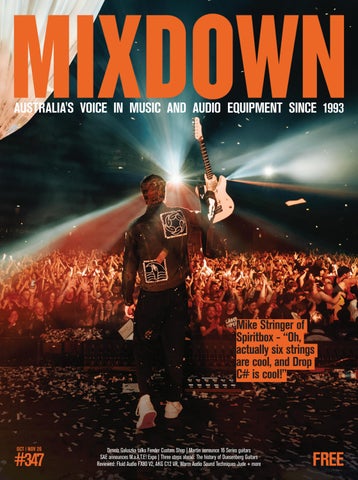
Mike Stringer of Spiritbox - “Oh, actually six strings are cool, and Drop C# is cool!”
OCT / NOV 26
#347
Dennis Galuszka talks Fender Custom Shop | Martin announce 16 Series guitars SAE announces M.a.A.T.E! Expo | Three steps ahead: The history of Duesenberg Guitars Reviewed: Fluid Audio FX80 V2, AKG C12 VR, Warm Audio Sound Techniques Jude + more
FREE
THE NEW
AMERICAN PROFESSIONAL HOTSHOT™ TELECASTER® IN THREE-TONE SUNBURST WITH TONE MASTER® DELUXE REVERB®
The One. For All. ©2026 Fender Musical Instruments Corporation. All Rights Reserved.
THE NEW
AMERICAN PROFESSIONAL STRATOCASTER® IN OXBLOOD WITH ‘62 DELUXE AMP
The One. For All. ©2026 Fender Musical Instruments Corporation. All Rights Reserved.
THE SOUND OF YOUR VISION AT V-
AT V-
LE
On-Camera Shotgun Mics Built for professional videographers and content creators, the ATV-SG1 and ATV-SG1LE on-camera shotgun microphones deliver natural, high-resolution audio from a feature-rich, easy-to-use device.
Safety Track
Rechargable Battery
Internal Shock Mount
Compact Design
Shoe Mount
External Jack Input
Low Cut Filter
Highly Directional Pickup
RFI Immunity
High-Fidelity Audio
SG1 Exclusive Features
CONTENTS
#347 OCT/NOV 2026
Win a Strum Buddy Pro
8
Product News
10
Tour News
14
Mike Stringer of Spiritbox
16
Inside Fender Custom Shop with Dennis Galuszka
18
Ableton x Emeree
20
SAE's new expo: M.a.A.T.E!
22
The history of Duesenberg Guitars
24
The Wolfe Brothers
28
Ernie Ball Clip-On tuners
30
Martin 16 Series
36
Fender Studio Audio Interfaces
38
Product Reviews
41
My Rig: C.O.F.F.I.N.
50
PHOTO BY ANA MASSARD
6
EDITOR'S NOTE
EDITORS Chris Hockey Lewis Noke Edwards PUBLISHING DIRECTOR Patrick Carr DESIGN Kelly Lim CONTRIBUTORS Jamie Colic, Rob Gee, Alasdair Belling Paul Blomfield, Anita Agathangelou Alexander Sims
A
career in the creative industry can be tough, long-winded, and the culmination of hundreds or thousands of tiny meetings. It might begin with a gig with someone who, ten years later has a new band they’d like you to record. A spare guitar handed to a fellow band on stage might be the reason you eventually have a foot in the door with a band looking for a new bass player. An awkward introduction one day might turn into the only familiar face at a networking event the next, and because of all this, it’s important not to shut down opportunities.
You’ll meet many people along the way and as long as you’re courteous, polite and open to work, they’ll all add up. Reputation is everything in this world, and even 1% effort with every person you meet will add up to 100% eventually. So don’t burn bridges, and if you keep enough doors open they’ll lead somewhere in the end. Lewis Editor
FOR ADVERTISING OR CONTENT PARTNERSHIPS advertise@mixdownmag.com.au DISTRIBUTION distribution@furstmedia.com.au ACCOUNTS accounts@furstmedia.com.au PUBLISHER Furst Media Pty Ltd FOUNDER Rob Furst
MIXDOWNMAG.COM.AU
MIXDOWNMAGAZINE
MIXDOWNMAGAZINE
COVER PHOTO: BETHAN MILLER-CAREY
8
GIVEAWAY
Want to win a Strum Buddy Pro? Built for practice, writing and lessons, the palm-sized Strum Buddy Pro runs six watts, with cabinet-modelled EQ and up to 3.5 hours of battery. Whether you’ve only got five minutes to play, don’t own an amp or just want to get something down before the moment passes, the Strum Buddy Pro makes it easy. For something so small it packs plenty in, with a 45mm speaker and onboard effects for clean, chorus, distortion and reverb. Headphones plug in for silent practice, and the USB-C battery runs up to 3.5 hours. “The idea is to remove the little obstacles that stop people from picking up the guitar,” said Kenneth Rustad, Partner and Sales & Marketing Director at Fluid Audio. “Strum Buddy Pro is ready in seconds, works quietly with headphones and is small enough to stay with the instrument. It gives players one less reason to put off practising.” The Strum Buddy Pro is a practice amp that clips straight to your guitar – and thanks to Fluid Audio, we've got three to give away. Nothing to set up, no cables across the room, ready to play in an instant – if that sounds good to you, the Strum Buddy Pro is your new best friend.
Thanks to Fluid Audio, we’ve got THREE to give away. Head to mixdownmag.com.au/giveaways/ for more info.
mixdownmag.com.au
10
PRODUCT NEWS
PRODUCT NEWS Spotlight on Guild Starfire Deluxe
Code Drum Heads: premium performance without the premium price
Celestion announce new G12-100 RAVEN 8 & 16ohm speakers
DYNAMICMUSIC.COM.AU
ELFA.COM.AU
AU.YAMAHA.COM
The new lineup honours the Starfire’s 1960sera legacy of quality and vibe, while adding contemporary touches aimed at working players. Numerous Starfire models were introduced throughout the 1960s, spanning single- and double-cutaway guitars in various pickup configurations and finishes, alongside two basses. The instruments have a storied history among rock royalty, with past players including John Lennon, Dave Davies, Buddy Guy, Jerry Garcia, Bob Weir, and Tom Fogerty on guitar, and Phil Lesh and Jack Casady on bass. Starfire Deluxe semi-hollow body doublecutaway guitars are reimagined versions of some of our most iconic instruments. Part of the Newark St. Collection of vintage-inspired guitars and basses, they honor their ’60s-era legacy of exceptional quality and vibe while also adding contemporary touches. Starfire Deluxe guitars include single-cutaway and double-cutaway models and feature HB-2+ humbucking pickups with Alnico V magnets. The Deluxe trim package features rosewood fingerboards with pearloid block inlays; ivory body, F-hole, and fingerboard binding; pearloid Guild Peak logo and Chesterfield headstock inlays; 3-ply black and ivory top and back body purfling; a black pickguard; and a rosewood bridge base. Have a look!
mixdownmag.com.au
The Raven is a 12-inch lightweight ceramic magnet guitar speaker. Boasting a formidable 100W power rating, and a new-design, low-weight ceramic magnet structure, the Celestion Raven is engineered to handle crushing lead lines and seismic low-end riff-work. Beyond the raw power lies a truly premium tone, delivering a detailed mid-range punch, brooding highs, and a firm, authoritative low end. The Raven is defined by its ability to deliver tons of tone, while remaining light as a feather. At the heart of this capability is a reimagined ceramic magnet assembly; a unique new motor structure that massively lowers the speaker’s overall weight to just 2.5 kg, without compromising the huge magnetic forces required to power such a gargantuan tone machine.
The UK brand is delivering back pocket relief to drummers nationwide, as the new alternative storms into a long-held duopoly. Code Drum Heads are new to Australia and purpose-built; designed by drummers for drummers. All their heads use the highest quality PET polyester film, unique to Code’s design, and are kept securely in place by Code’s revolutionary Grip-Tight™ rim technology. This means the heads tune up quicker and hold in place for longer, without the need for breaking glue or stretching and seating in heads. With the same level of quality, professional tone and professional feel as major brands, without the professional price tag, Code is a serious, quality option in the drumhead market. Every Code head is built around a rim design the company calls Grip-Tight. A deep, doubleknurled steel core is crimped into an aluminium or steel outer rim, depending on the range, so the head stays put in the hoop. With this design, heads tune quicker, hold their tuning longer and resonate freely. The heads use a unique PET polyester film that results in stunning tonal qualities. Code Drumheads are designed and manufactured to deliver the level of performance drummers expect – from single-ply and double-ply options through to coated, clear and specialist heads. Code’s range covers everything from rehearsal rooms and recording studios to touring stages. Reskinning your kit doesn’t have to be a major investment. Whether you’re trying out a different snare head, replacing all your tom heads or keeping a spare drum head handy, Code will give you quality without breaking the bank.
11
NOW SHIPPING: The Jason Richardson Cutlass in Kokiri Forest, in 6 and 7 strings
Behringer announce DICE USB Interfaces
Explore the Palmer Orbit 11 Active 1000W Co-Ax 3-Way Studio Monitor
AUSTRALISMUSIC.COM.AU
CMCMUSIC.COM.AU
Deep green. Serious burl. Built for the fastest hands in modern metal. Jason Richardson is widely regarded as one of the most innovative and impressive shred players in the industry today, and these guitars are built around his technique. The Kokiri Forest finish shows off a Poplar Burl veneer top over a lightweight Alder body, and players have praised that beautiful wood grain. The sculpted lower horn gives you easy access to all 24 frets. The roasted maple neck and rosewood fingerboard keep everything fast and smooth. Engineered to meet the demands of Jason Richardson’s virtuosic technique, both 6 and 7-string Artist Series Cutlass’ feature a customcontoured lower horn for superior access to all 24 frets, along with a roasted maple neck and rosewood fingerboard. The design delivers articulate, dynamic performance with custom high-output artist humbuckers, a push-push volume boost, a push-push coil-split, and a modern tremolo. Crafted from an Alder body with a striking Poplar Burl veneer top. The sound is just as heavy as the look. Custom high-output artist humbuckers give you crushing tone. A push-push volume boost adds extra gain for solos, and a push-push coil-split gives you cleaner tones. The modern tremolo and locking tuners keep up with the dive bombs. Choose the 6-string for tight, articulate control. Choose the 7-string for extended low-end range. Both are available now at your authorised Sterling by Music Man dealer.
Both of the new interfaces boast low-latency, 24-bit/192kHz operation. Anyone searching for a centrepiece for their computer-based recording setup will appreciate the streamlined simplicity of the Behringer DICE 1U2 and the Behringer DICE 2U2. The Dice 1u2 is a 2-in, 2-out USB audio interface features a Midas-designed microphone preamp. Selectable line-level/instrument inputs handle a wide variety of input sources. Additionally, the Dice 1U2 features 48-volt phantom power for your condenser mics. Direct monitoring is available for zero-latency performance while recording, and you get rock-solid Headphones and Main outputs with an independent Monitor control. The Dice 2u2 is a this 2-in, 2-out USB audio interface features two Midas-designed microphone preamps. Selectable line-level/instrument inputs handle a wide variety of input sources.
Warm Audio introduce MOD Series
STUDIOCONNECTIONS.COM.AU
One new pedal and revised, pedalboard friendly revisions of some of their most popular and trusted pedals.
The Black Keys Peach Fuzz A collaboration between The Black Keys and Warm Audio, delivering a pedalboard-friendly reimagination of Warm Audio’s vintage-inspired ’70s Foxy-style fuzz and octave pedal known for searing saturation and octave-up solo magic. Centavo Mod Whether you’re after the fabled clean boost tones, transparent overdrive, or you want to push your dirty channels to true grit, the Centavo has all of the adored tones of the vintage box.
LINKAUDIO.COM.AU
The Palmer ORBIT 11 is an active coaxial 3-way studio monitor designed for mixing, mastering, post-production, sound design, broadcasting, and content creation. Its coaxial True Point Source design combines a 6.5″ midrange driver and a 1″ tweeter on a single acoustic axis and provides consistent 120° × 120° dispersion for stable imaging and reliable balance across the listening area. The controlled, consistent dispersion pattern helps to maintain reliable balance and translation, while the cardioid front baffle reduces rearward energy to limit room interaction. Low frequencies are handled by two impulsecompensated 8″ woofers mounted in a sealed, die-cast aluminium enclosure with 5 to 16 mm wall thickness, which is designed to counteract mechanical forces and minimise cabinet vibration, delivering an impressively deep bass response down to 28 Hz. Engineered in Germany with musical sensitivity, the ORBIT 11 is built for reliable monitoring with time-coherent reproduction and extended low-frequency response, made for those who listen.
WA-C1 Chorus/Vibrato Mod The WA-C1 Chorus/Vibrato Mod is a pedalboard-friendly recreation of the most celebrated all-analog chorus in guitar pedal history with additional no-compromise features for exploring legendary modulated tones.
mixdownmag.com.au
12
PRODUCT NEWS
PRODUCT NEWS NOW SHIPPING: Markbass Little Mark Ninja 58R
Revisiting the Suzuki Omnichord with the OM-108
TASCAM and Amber Technology team up for exclusive Australian partnership
CMCMUSIC.COM.AU
Tone first, always. The Little Mark Ninja 58R carries the sound that made the Richard Bona signature head a worldwide best-seller, now updated with the 58R series' new features. It's warm and natural, and it respects your instrument without compromise.
What's new: ໞ Front-panel everything. All connections and controls sit up front, leaving only the speaker outs and AC socket on the back. Setup is faster and more practical. ໞ Updated 4-band EQ. Boost or cut up to 16 dB per band to find the sound you want in any genre. ໞ Old School filter. Rolls off the highs for a round, smooth tone. ໞ 3-way rotary switch. Choose Flat, a Scooped preset (mids down, lows and highs up, ideal for slap), or FSW to control mute and Scooped EQ on demand with an optional dual footswitch. ໞ New bi-band limiter. It reacts faster and more dynamically than traditional limiters and lets your high end breathe, so you keep a punchy attack at high volumes. ໞ 1000W MPT power amp. Serious headroom and clear, dynamic sound at any volume. ໞ Ultralight ABS chassis. Solid build quality at just 5.66 lbs / 2.57 kg, and eco-friendly too.
mixdownmag.com.au
AMBERTECH.COM.AU
The legendary pro audio brand and leading distributor are joining forces to expand access to world-class recording and broadcast solutions. When it comes to reliable audio gear, few names resonate like TASCAM. From its groundbreaking multitrack recorders to modern interfaces and broadcast systems, the brand has been powering studios, theatres, and live production rigs for decades. Now, thanks to a new deal with Amber Technology, TASCAM is set to strengthen its Australian presence from October 1, 2025. TASCAM is the professional audio division of TEAC Corporation and has built its reputation on delivering recording solutions that balance innovation with reliability. Its gear has long been a staple in both professional studios and home setups, making it a household name for sound engineers, musicians, and broadcast specialists. Partnering with Amber Technology—already a heavy hitter in the local pro AV scene—means TASCAM products will soon be even easier to access nationwide. For Aussie musicians, producers, and AV professionals, this collaboration means greater access, more choice, and streamlined support. Whether you’re decking out a recording studio, speccing a new performance venue, or just chasing high-quality playback at home, TASCAM’s gear will now be backed by Amber’s expertise and distribution muscle.
VIBEMUSIC.COM.AU
Released in 1981, the Omnichord is an electronic musical instrument with an automatic accompaniment function (auto bass/chord) and a harp sensor. Even after the last model was discontinued in 1996, its popularity remained undiminished and in response to consumer demand, Suzuki developed and released the Omnichord OM-108. By pressing a chord button and sliding your finger on the harp sensor (strumplate), an arpeggio corresponding to the chord is heard, allowing anyone to easily accompany a song. The Omnichord does not require any previous musical experience with an instrument or knowledge of staff notation. All that is needed are the chord names required to play a song which is a method commonly known as ‘tab’. Combined with its portability, the Omnichord became extremely popular as a musical instrument that anyone could enjoy anywhere. It is unique in its ability to generate the electronic sounds reminiscent of the 80’s and due to the tactile way musical expressions are achieved, it developed a cult status around the world. It not only appeared in recorded music but also in publicity photos and has featured in the titles of songs and albums.
13
Universal Audio announces New Volt and Volt Max audio interfaces
Audio-Technica’s first wireless openback headphones just dropped
Fender announce interactive connected commerce ecosystem with Fender.com
CMI.COM.AU
Universal Audio Inc. (UA), a worldwide leader in audio production tools, is proud to introduce Volt Gen 2 and Volt Max, a new generation of USB audio interfaces built for musicians, producers and podcasters. The six new models combine 32-bit audio conversion with Tone Shaping Preamps, Max dynamics processing, smart recording features, and integration with LUNA and today’s leading DAWs. “Every artist has a sound they’re chasing,” says Bill Putnam Jr., CEO of Universal Audio. “We want Volt Gen 2 to give people the confidence to explore that sound, experiment, and keep creating — whether they’re recording their first song or working on their tenth album.” Built by the team behind industry-standard Apollo interfaces, Volt Gen 2 brings UA analog sound and workflows to an easy-to-use format. The new lineup features Tone Shaping Preamps with three switchable character modes — Warmth (Tube), Focus (Solid State), and Shine (British Class-A) — putting record-ready tones at the input stage with the push of a button. These models also add Auto-Gain with Clip Protection, automatically setting the optimal input level, and can automatically detect mic, line and instrument sources, making setup faster and easier for creators of all stripes. All models except the Volt 1 feature a full-colour Smart Display for at-a-glance monitoring of inputs, gain, tone shaping, and more.
AU.FENDER.COM
AUDIO-TECHNICA.COM/EN-AU
The ATH-AL5NC completes Audio-Technica's open-back range, adding Bluetooth, a noisereduction mode and up to 75 hours of battery to the brand's signature open sound. Audio-Technica has made its first wireless open-back headphones, the ATH-AL5NC, bringing the spacious, natural sound of an open-back design to a wire-free pair. It rounds out the brand’s open-back range, alongside the R-Series for music production and the ADX Series for audiophile listening. Open-back headphones are prized for a wide, natural soundstage – the sense that the music surrounds you rather than being clamped to your head. The ATH-AL5NC uses 53mm drivers to get there. The open housings also let air move, so your ears stay cooler over a long session, and at 240g there isn’t much weight to the headphones. In plain wireless mode, the headphones run up to 75 hours on a charge, with a 15-minute top-up returning around eight hours. With noise reduction on, that drops to a still-generous 50 hours, or five from a quick charge. The noise reduction, worked by a button on the right earcup, takes the edge off background hum, such as air conditioning, traffic or the room next door, rather than sealing you in completely.
Fender was built on original ideas – instruments designed from scratch that changed what music could sound like. Fender Musical Instruments Corporation (FMIC) has announced the launch of an all-new Fender.com, evolving from a commerce destination into a connected global digital ecosystem designed to deepen their relationship with players and fans at every stage of their musical journey. For 80 years, Fender’s commitment to original design, innovation, and craftsmanship has defined how Fender builds. Now it defines how Fender connects. The new Fender.com extends that philosophy into the digital world, giving musicians the tools, inspiration, and community to discover who they are asa player – and take their music somewhere entirely their own. “This is about more than a new website. We’ve reimagined Fender.com, empowering players to shape their own journey. Moving beyond a traditional ecommerce platform, it’s a place where people can discover new gear, find what’s right for them and connect with the brand,” said Kelly Magrath, Interim Chief Marketing Officer. “Fender.com is also a destination for fans and music lovers, with original stories and content that celebrates the artists, players and culture that make music so meaningful. Our new digital experience is designed to create a deeper connection with players and fans everywhere.”
mixdownmag.com.au
14
TOUR NEWS
TOUR NEWS › Experience the cinematic dreamscape sounds of The Delines in April!
› Good Things lineup 2026: Limp Bizkit, Simple Plan and Spiritbox lead the bill
by special guest Ella Hooper. Sixpence’s major hit "Kiss Me" spent 3 weeks at #1 in Australia in June 1999, reached No. 2 on the Billboard Hot 100, and became a top-10 hit in sixteen countries.
TOUR DATES ໞ Mar 2: Canberra Theatre, Canberra ໞ Mar 3: Anita’s Theatre, Thirroul ໞ Mar 4: King Street, Newcastle ໞ Mar 5: Enmore Theatre, Sydney ໞ Mar 7-8: Port Fairy ໞ Mar 11: Twin Towns, Tweed Heads ໞ Mar 12: The Tivoli, Brisbane
LOVEPOLICE.COM.AU
Following two hugely successful Australian tours, Love Police again presents the Portland, Oregon band who will play music from their acclaimed new album The Set Up as well as favourites from the past. Returning to Australia in April smuggling their country-soul noir into bars, ballrooms and theatres across the east coast.
ໞ Mar 13: Palais Theatre, Melbourne ໞ Mar 16: The Gov, Adelaide ໞ Mar 18: Astor Theatre, Perth
› C.O.F.F.I.N announce Australian tour for Feb-March 2027
TOUR DATES
DESTROYALLLINES.COM
The Good Things lineup for 2026 has landed, with Limp Bizkit set to headline the festival's return to Melbourne, Sydney and Brisbane in December. This year’s Good Things lineup once again stretches from culture-shaping legends through to current scene-definers and emerging talent, with all three East Coast dates locked in as 16+ events. Australia’s largest travelling heavy and alternative music festival is back for another run across the summer.
TOUR DATES ໞ 4 Dec: Flemington Racecourse, Melbourne ໞ 5 Dec: Sydney Showground, Sydney
ໞ 15 April: Northcote Social Club, Melbourne
ໞ 6 Dec: Brisbane Showgrounds, Brisbane
ໞ 16 April: Brunswick Ballroom, Melbourne ໞ 17 April: Meeniyan Town Hall, Meeniyan ໞ 18 April: Odessa at Leaver’s Hotel, Creswick
› Big Red Bash Final Hurrah set to rock The Simpson Desert in 2027
ໞ 21 April: Oxford Art Factory, Sydney ໞ 22 April: Stag & Hunter, Newcastle ໞ 23 April: The Loyal Bellingen Golf Club, Bellingen ໞ 24 April: Eltham Hotel, Eltham ໞ 25 April: Junk Bar, Brisbane
› Kiss me in Australia: Sixpence None The Richer announce firstever Australian tour
COFFINBAND.COM/SHOWS
C.O.F.F.I.N (Children Of Finland Fighting In Norway) return to stages across Australia in February and March 2027 for their biggest Australian headline shows to date, following the release of their sixth studio album, Out In Oslo, which is set to be released on Friday 18 September via p(doom) records.
TOUR DATES ໞ 26 Feb: Max Watts, Melbourne ໞ 5 March: Factory Theatre, Sydney ໞ 6 March: Crowbar, Brisbane ໞ 12 March: The Rosemount, Perth ໞ 13 March: Lion Arts Factory, Adelaide DAVIDROYWILLIAMS.COM
David Roy Williams is proud to announce the first Australian tour by acclaimed American alternative rock band Sixpence None the Richer, joined
mixdownmag.com.au
ໞ 20 March: Altar Bar, Hobart
BIGREDBASH.COM.AU
After 13 extraordinary years of red dirt, big skies and even bigger music line-ups, the Birdsville Big Red Bash will return to the edge of the Simpson Desert from 6-8 July 2027 for an emotional final celebration, with organisers today announcing that next year will be the final Birdsville Big Red Bash.
TOUR DATES ໞ 6-8 July: Big Red sand dune, 35km west of Birdsville
16
COVER FEATURE
F Mike Stringer on Spiritbox's tranisiton from bedroom moshers to arena headliners WORDS BY ALASDAIR BELLING
A lot of people used the pandemic lockdowns to reset their lives; whether it was a career change, focusing on fitness, or expanding a skill set, the forced lockdowns at the start of the decade acted for some people as a circuit breaker of sorts.
mixdownmag.com.au
or the genre of metalcore, that circuit breaker was a crop of new and established artists taking things stadium-sized. By the 2010s, the style was bogged down in a tried, tested, and tired formula of versebreakdown-chorus-breakdown; the 20s saw the emergence of a wave of new metalcore that was leaner, chorus-driven, and more willing to lean on poppier sensibilities. Canadian-based quartet Spiritbox were at the forefront of this exciting new wave; emerging from the ashes of mathcore weirdos iwrestledabearonce, husband and wife duo Mike Stringer (guitar) and Courtney LaPlante (vocals) founded the project in 2017. For its first couple of years, the band existed as a mostly online entity; however, as momentum was building, lockdowns struck. It was from the depths of isolation in June 2020 that the band released the chart-topping single “Holy Roller”, and the subsequent downtime allowed it to assemble the final pieces for debut LP Eternal Blue, released in 2021 and hailed as a modern classic. In less than half a decade, Spiritbox had gone from semi-viral bedroom moshers to arena-fillers - changing the lives of its four members beyond recognition. “We’re in a place of reflection now,” says Stringer, speaking to us from a hotel room in Frankfurt in the middle of the band's arena tour across Europe. “I had a lot of material for (first album) Eternal Blue - I had years to bank a lot of stuff - but because of that, my relationship with that album was almost too intense because it was just our lives for years.” “When it came out, not only was there this online machine hyping the record so much when
THIS PAGE: PHOTO BY ANA MASSARD, OPPOSITE PAGE: PHOTO BY BETHAN MILLER-CAREY
17
we didn't even have the proper capacity to go and fruits of a new body of work. in December as part of the stacked Good Things do it live, which then led to all this expectation and “That’s a brand new one - it was just a song we Festival. stress and pressure… I was obviously very fulfilled felt really compelled to do,” Stringer said, adding When they first toured here with Knotfest in and relieved that the record went the way that it that the song reminded him of the reliability of a 2023, they were a buzz band in the scene; now, did, but I decided I wanted to then do the polar good old six-string guitar. they’ll return as leaders of the new(est) wave of opposite.” “ I've been playing within the same sort of like metal taking the world by storm. That ‘opposite’ was follow-up album Tsunami range and using the same seven-string instru‘“To come back on this scale and to be playing Sea (2025), an uglier and heavier endeavour which mentation, and it just dawned on me after I was these slots, it's really surreal,” Stringer said. still somehow managed to sound tailor-made for messing around that ‘Oh, actually six strings are “We've just always, always wanted to come stadiums, in keeping with Limp Bizkit, Linkin Park cool, and Drop C# is cool!’” back, but it's unfortunately not made sense in the and Bring Me The Horizon. “There's a reason why when I was a kid I used last little while until this came about.” “Doing that album really scared me 'cause to love all this stuff; it was really born “We're absolutely over the moon like… every band's second album, espeabout it, 'cause like, what a way to come ING FOR cially if you do have a big debut, is so back!” “THAT'S THE BEAUTY OF THE BAND EXIST important,” Stringer said. “The only hard thing is freight costs; I WE'RE THAT STUFF OUT PUT ONLY SO LONG… WE “Ultimately it came down to trusting would normally be showing up with a full ING ANYTH NOT IT'S OUT. PUT TO LLED COMPE our gut and deciding ‘we need to put out set up of four guitar amp rigs and cabs STRATEGY.” THAT'S A MASTER PLAN. THERE'S NO something cathartic and something for and pedals… but I think we're gonna do ourselves’, and if people identify with it something a little more conservative, and and they can hear where we're coming from with from wanting to move everything in a new direcI'm gonna tone-match everything that I have.” it, and especially if they can see a part of themtion, but not really knowing where that's gonna go.” “I’ll have all the tones digitally dialled within selves in it, then mission accomplished.” “That's the beauty of the band existing for so my Fractal, and I'm still gonna have a smaller In keeping with the modern trend of constant long… we only put out stuff that we're compelled board, because I need it to play a couple of our content, since first emerging with Holy Roller, to put out. It's not anything that's a master plan. songs like “Soft Spine” - if I don't have the [Earththere’s never been a defined period of silence for There's no strategy. For me, it was always stuck quaker Devices] Rainbow Machine pedal I physiSpiritbox. in my head, and Courtney really wanted to move cally can’t play that song.” After Eternal Blue came the Rotoscope EP forward with it because she wanted to write some“It's gonna be a little more conservative, but it (2022), followed by The Fear of Fear EP (2023). thing about it.” will sound like our usual selves thankfully.” With the addition of a scattering of feature “I hate to overuse this, but because Tsunami appearances on singles - including a ‘rock remix’ Sea was so just angry and pissed off on many, of Megan Thee Stallion’s “Cobra” - the Spiritbox many levels, I feel like “Mourning” is kind of the Spiritbox play Good Things Festival in machine appears to constantly be churning out answer to that… it’s extremely heavy, but in an Melbourne on Thursday, 4 December, Sydney on Friday, 5 December and material. accepting kind of way.” Brisbane on Saturday, 6 December. The latest offering was the September “It's kind of where we're at with our mindsets standalone single “Mourning”, a radio-ready rock right now.” anthem showcasing their melodic side. However, Australian fans will get their first chance to see there’s no indication (yet) that the song is the first Spiritbox since 2023 when they arrive down under
mixdownmag.com.au
18
FEATURE
AU.FENDER.COM
Inside Fender Custom Shop with Dennis Galuszka
WORDS BY ANITA AGATHANGELOU
Two drummers sit on a couch to talk about guitars, except one of us has Paul McCartney, Andy Summers, Sting, Johnny Marr and Mike Dirnt mentioned in his bio. Despite us talking big names, there's no ‘too-cool’ air around Dennis Galuszka. The Fender Custom Shop 2026 Showcase doesn't open for another couple of hours, but there are already more than 50 guitars on display at Canvas House in South Melbourne, and most of them will be spoken for by the end of the night. A Southern California native, Dennis has come a long way to be here. Only a handful of people hold the title of Fender Master Builder and he knows guitars from the inside out, quite literally. With such a successful career in building esteemed guitars, Dennis insists he hasn't transitioned from drummer to guitarist. "Not at all. I'm a drummer through and through. I couldn't play a solo if you had a gun to my head. I play enough to know a good one." Dennis spent 13 years as a furniture craftsman, and it was at the cabinet shop that he first started building instruments. His boss was a guitar player who'd begun making acoustics on site, and the two of them worked it out together – but it was drumming, not woodwork, that got him through Fender's door.
mixdownmag.com.au
"I was playing some shitty coffee house or something, and Fred Stewart, who was one of the Custom Shop founders, was there and saw me play, and asked me if I wanted to do some gigs with him," he says. "They found out my background, and they needed someone with a lot of woodworking experience to come in right away and do the archtop models." After 25 years in the biz, Dennis knows his way around a guitar. For him, the connection starts at the neck. "That's where you're grabbing it. It's like holding your bestie's hand." No matter the aesthetic, feel and tone are what turn a good guitar into a great one. When I ask what makes a guitar unmistakably his, he doesn't miss a beat. "My fingerboard edge roll and the fret ends. That together is going to make a very soft feel." When it comes to wood types, he'll work with whatever he's handed. There's no real hierarchy, but he knows exactly what a piece will do before he cuts it.
"When you have a very heavy piece of wood, it tends to make the guitar very bright. If it's too light, it kind of farts out before it gets to the end of the stage. There's a balance, and I think Leo just got it right the first time, and he was just using domestic woods." Eye for detail is his bread and butter. Dennis is one of Fender's most sought-after relic builders, and his Masterbuilt Strats, Teles and Jazzmasters – journeyman relic and heavy relic finishes, hand-wound pickups – move fast on the collector’s market. For someone who has built guitars for some of the biggest and most beloved artists around – namely, Paul McCartney – the excitement and novelty of it all hasn't worn off. "That was a big deal. Like, that's Paul McCartney. Mike Dirnt from Green Day actually had the idea. He wanted to gift it to Paul, so he had me build it." The gift was a bass built off Dirnt's tobacco-burst Fender signature, dressed up with an f-hole and classic binding and a pickup switch that flips between a Höfner voice and Dirnt's own – one made left-handed for Paul, one right-handed for Mike. Dirnt sent it with a note thanking Paul, on behalf of Green Day and every band he'd influenced. It doesn't end with Paul. Dennis has had plenty of bizarre, full circle moments in his career, including an interaction with Johnny Marr. "I mentioned to him that one of the first songs I learned on guitar was “Cemetery Gates”. And he says, 'oh, I did that in an alternate tuning' , but I always did it in standard." "So, he goes, 'oh, show me', so I played it for him. And then he said, 'here's how I do it. ' And I was like – I'm having a guitar lesson from Johnny Marr. I don't remember a damn thing he showed me. It was out of body." Like many drummers, Dennis was "totally obsessed" with Stewart Copeland when he was younger, so building for The Police reunion tour was full circle twice over. The job was a note-perfect replica of Andy Summers' battered 1961 Telecaster, which was behind “Roxanne” and “Every Breath You Take”. Dennis recreated down to its eccentric mods and every last ding, scratch and
hairline crack in the lacquer. Dennis spent the better part of a year on the prototype, and visited Summers' house to spec it out. "I walked in the door to spec out the guitar, and the first thing I saw was Stewart's drums sitting there. It was, like, oh shit, that's Stewart's drums!" None of us are safe from being star-struck, including Dennis – but ultimately, he says, “they’re just guys that want a guitar.” "You realise they're people like us. When you're a kid, they're like unicorns." A lot of work goes into making that happen, before he picks up a tool, from prototypes to planning. For an artist, he'll do his homework and track down some videos to understand what kind of player they are. Once he's got that in the bag, he'll know how to set up the guitar and how big the frets need to be. But it's not uncommon for someone to ask for a spec that isn't quite right, and in Dennis' case, honesty is the best policy. "I'm like, 'You don't want that.' Then they get it, and they don't want that. I'm like, listen to your builder." For all the big names, stories and incredible guitars, what he's after from the 2026 Fender Custom Shop Showcase is pretty simple." The goal tonight is mainly to just let people know we're human. We're not some computer that's gonna mess things up. We're not bots, you know? We want to make them feel more at home with the process." The process is personal, and one that starts and ends with the Master Builder. While the world continues to tilt further toward mass production and automation, the Custom Shop stands its ground and trades on the opposite. "If you came to me with something just totally out there, there's nowhere for me to go. It stops with me. I have to figure it out." "I want to know if there's any artist he dreams of building for. My daughter's 21 years old, so now it's to build for someone that'll impress her." Right now, that's Bruno Mars, who Dennis rates. He's a Strat guy, and although Fender has built for him before, Dennis hasn't been the one to do the job. "She would think Dad was pretty cool if I did.”
Mix to the Max
INT RODU CI NG
The Next Generation of Analog Professional Mixing Consoles Built for the realities of live sound, Signature Plus channels your creative audio character plus proven professional workflows, into a scalable family of portable, intuitive, analog mixers for small- to mid-size venues. Available in 12, 16, 22, and 32-channel models, it provides the control, reliability, and scalability needed to support today’s performances and tomorrow’s bigger productions. Learn more at soundcraft.com.
Soundcraft Ghost Mic Preamps
Lexicon Effects
Distributed in Australia by MadisonAV | madisonav.com.au © HARMAN 2026. All rights reserved.
dbx Compression
Soundcraft Sapphyre EQ
Professional Grade Workflow tools
Learn More about Signature Plus
20
INTERVIEW
Emeree talks laughing, travelling, dancing to fuel her creative process
WORDS BY MIXDOWN
PHOTO BY BRITNEY REID
Emeree is a powerhouse vocalist, a label that is only rivalled by her growing list of productions for both herself and other artists. Focused on the song and capturing ideas rather than being bogged down in the equipment used to make it, she’s a collaborator and songwriter, playing enough of a handful of instruments to get the ideas down, using Ableton as her pen and paper.
mixdownmag.com.au
21
ABLETON.COM/EN
Emeree’s work takes her all over the world, as she introduces herself to us from London. Can you introduce yourself a bit and explain what it is you do? My name is EMEREE, and I am a producer/artist and engineer. My primary job is producing and mixing for other artists, but I also produce and mix a lot of my own work. I sing, play flute, guitar, keys and anything else needed for the track (but not that well).
Can you explain a bit about your musicmaking process? I don’t have ‘one way’ that I make music. Sometimes it comes so organically, sometimes I am in writing sessions with other writers/ producers, and sometimes I start with a beat and write to that. I love to be really flexible with the way I make music. It’s really nice to be able to write with pen and paper (that’s how I wrote when I was a kid), but also to be able to transform that into something unique as a producer.
Tell us about what equipment you use to make music! I travel a lot for my music, so I’ve made myself as portable and flexible as possible. Learning Ableton is what helped me be able to create on the go. I love being able to create anywhere, but I also love to record real sounds and run them through cheap cassette/tape machines. I love using nice microphones, but honestly a lot of my favourite sounds have been created with my iPhone mic and a bunch of cheap cassette machines.
How does all this transition to performing live? I love to think about my live show, especially since I do a lot of my music direction myself using Ableton. I love to re-work songs and create interludes, and make my live show dramatic, exciting and fun. I don’t always think about it during the writing process, because sometimes the intentions for live can be a bit much to fit into a recording. When I’m adding a song into my live show, I love to sit and be really intentional with making interesting choices for the live version.
Who inspires you? Why? As much as I hate to admit it - time off to just exist and spend time laughing, travelling, dancing and feeling fulfilled in other ways. I am so bad at not overworking, but I really notice how much more fuel I have when I am rested and fulfilled in other aspects of my life. I’m working on it!
Have you got a desert island piece of equipment? Very specific answer coming for you here - Battery Operated UK ‘Mini Mello V2’. I freaking love this thing and it’s always sold out. The way you can manipulate loops and sounds would keep me entertained forever!
"LEARNING ABLETON IS WHAT HELPED ME BE ABLE TO CREATE ON THE GO." mixdownmag.com.au
22
INTERVIEW
SAE bring us all together for one huge day of listening in their new expo: M.a.A.T.E!
WORDS BY MIXDOWN
Audio and music production can be a very isolated process. You might spend a week with a band, but the following days, weeks and months are often spent quietly editing, mixing and adjusting on your own. There’s a big beautiful online audio community, albeit filled with various opinions, and SAE in Melbourne are looking to bring us all together in a huge new Australian event, aptly called M.a.A.T.E!
mixdownmag.com.au
The Music and Audio Technology Expo (M.a.A.T.E!) brings together professionals, students, distributors and more into a day at SAE’s Melbourne Campus. Along with unveiling SAE’s own new 9.1.4 Dolby Atmos system, mastering engineers Joe Carra and Nick Di Larenzo are presenting, along with keynote speaker Larry Crane, editor of Tape Op and owner/engineer at Jackpot! Recording Studio in Oregon. We spoke to Gareth Parton, Senior Lecturer at SAE and a music producer & audio engineer, about the upcoming event.
▷ M.a.A.T.E! builds on the Melbourne Audio Trade Show (MATS), which ran from 2016–2018 under SAE. What makes now the right time to bring it back, and what do you hope this event achieves? M.a.A.T.E! has its roots in the MATS which ran successfully at SAE Melbourne from 2016 to 2018. Those events brought together manufacturers, distributors, engineers, producers, educators and students, creating a rare opportunity for the Australian audio community to connect face-to-face. Also, I thought the re-launch should have a new name… and this is the most Aussie acronym I could come up with! We felt the timing was right to bring the event back because there's a real appetite for a space where the industry can come together. Our goal is to connect manufacturers, professionals, educators, students and emerging creators, and provide opportunities to learn, network and share ideas.
Ultimately, we want M.a.A.T.E! to strengthen the audio community and help inspire the next generation of audio professionals. SAE is celebrating its 50th year… the Melbourne campus has some impressive renovations and upgrades (the new Dolby ATMOS theatre, an SSL Duality (to add to their already impressive console offering API, Audient, AVID S6) and a campus make-over.
▷ What do you remember most about how those earlier MATS events landed with the audio community, and how has that shaped this new approach? What stood out most was the sense of community. People weren't just coming to see new equipment; they were coming to talk shop, learn from each other and connect with others who shared the same passion for audio. That experience has shaped this year's event significantly. We've focused on opportunities for meaningful engagement rather than simply showcasing products. We've built a program that combines technology, education, discussion and hands-on experiences, giving attendees plenty of opportunities to connect with both industry leaders and each other. ▷ Who are the exhibitors and manufacturers joining this year, and what can attendees expect from the workshops and masterclasses on the day? We're excited to have a diverse group of exhibitors representing many of the biggest names
23
SAE.EDU.AU
in professional audio, music production, live sound and music technology. CMI Music & Audio represents an extensive portfolio of leading brands including Korg, Arturia, Native Instruments, Universal Audio, Moog, Ableton and Sonarworks, covering everything from music production and synthesis to recording, mixing and performance technology. They will be demonstrating products throughout the day. AVID will showcase the latest Pro Tools updates and SAE’s brand new 9.1.4 Dolby ATMOS system in the theatrette. Ableton will demonstrate the new features in Ableton Live. Amber Technology is one of Australia's largest audio and AV distributors, representing globally recognised brands including Avid, Solid State Logic (SSL), JBL, DPA Microphones, TASCAM, Harrison Audio, Rycote and Genelec-adjacent professional solutions, among many others. They span professional recording, broadcast, post-production, live sound and installation markets. Link Audio brands include PreSonus, Audix, SPL, and Apogee, all widely used in studios, education and live production environments. Group Technologies represents L-Acoustics, DiGiCo, Sound Devices, RCF, Elektron, Erica Synths, PSI Audio and RME. Their portfolio spans touring systems, live production, broadcast and music technology. Roland remains one of the world's most influential manufacturers of electronic musical instruments, production tools and performance
technology, with products spanning keyboards, synthesisers, drum technology and music creation platforms. Factory Sound is one of Australia's most established professional audio suppliers, serving the live sound, broadcast, production and installation sectors and showcasing a range of leading professional audio solutions. Sky Music retails a large catalogue of musical instruments and equipment Studio Connections represents premium recording and monitoring brands including Genelec, Audient, Schoeps, Drawmer, and Warm Audio, MPEG - The Music Producers and Engineers Guild will present on the guild. Pacific Ears specialises in hearing protection and in-ear monitoring, including solutions from Westone Audio, Etymotic and 3DME, helping musicians and audio professionals protect and monitor their hearing in demanding environments. They will also host a presentation about safe listening and hearing protection. We'll also have Panorama Audio Labs promoting their new plugin, and founder Nick Di Lorenzo will be sharing the stage with mastering engineer Joe Carra for an in-depth mastering discussion. Attendees can expect product demonstrations, hands-on technology showcases, expert presentations and practical discussions covering recording, music production, live sound, monitoring, acoustics, software, hardware and emerging technologies. Whether you're interested in studio recording, electronic music production or live event technology, there will be something relevant to explore.
▷ Larry Crane is headlining as keynote. How did that come about, and what does his perspective as a producer, engineer and founder of Tape Op bring to the day? Larry has been one of the most respected voices in recording for decades. Through his work as a producer and engineer (Elliott Smith, SleaterKinney, The Go-Betweens, Stephen Malkmus), at his Portland studio Jackpot! and through Tape Op magazine, he's had conversations with some of the most influential people in audio while remaining deeply connected to the realities of making records. Larry's perspective is unique because he's not only worked at a high level, but he's also spent years helping others learn, develop and think critically about the creative process. Larry will be joining us via Zoom. ▷ Beyond the keynote, are there particular sessions, panels or demonstrations you'd point attendees toward? The Mastering Engineers Panel is something I'm particularly excited about. Mastering is often one of the least understood stages of the production process, and we're bringing together experienced mastering engineers (Nick Di Lorenzo and Joe Carra) to discuss critical listening, workflow, emerging technologies and the future of mastering. The Live Synth Jam should also be a highlight.
It's a chance to see synthesis and electronic music creation in a more creative and collaborative environment, showcasing both instruments and performance techniques. Beyond those sessions, I'd encourage attendees to spend time speaking directly with exhibitors. Some of the best insights often come from informal conversations and hands-on demonstrations with the people who design, distribute and support these technologies.
▷ Who is M.a.A.T.E! designed for? Is it aimed more at students and hobbyists, working professionals, or all of the above? It's genuinely for all of the above. One of the things that makes audio such a vibrant industry is that professionals, students, enthusiasts and educators often share the same interests and tools. Someone attending their first audio event can learn from an experienced engineer, while established professionals can discover new technologies or reconnect with colleagues. We want M.a.A.T.E! to be accessible to anyone with an interest in music and audio technology, regardless of where they are in their journey. ▷ Registration is free. Is there anything attendees should know before the day, or ways they can get the most out of it? The biggest recommendation is to come for the full day! Take a look at the program beforehand, identify the sessions you don't want to miss, and allow time to visit exhibitors and speak with manufacturers. Bring questions, introduce yourself to people and take advantage of the networking opportunities. The event is free because we want it to be as accessible as possible. Whether you're considering a career in audio, thinking about study, looking to expand your professional network or simply curious about new technologies, there will be opportunities to learn something new. There will also be some exclusive deals and door prizes on the day… so stick around ‘til the end! ▷ What's your hope for how this year's event builds on the ones before it? My hope is that M.a.A.T.E! becomes a regular meeting point for Australia's music and audio community. The earlier events demonstrated that there was a strong appetite for bringing people together around audio technology and creative practice. This year gives us the opportunity to re-establish that tradition while expanding the scope to reflect the modern industry. If attendees leave feeling inspired, having learned something new, discovered a new technology, made a valuable connection or simply felt more connected to the wider audio community, then we'll consider the event a success. Ultimately, we want M.a.A.T.E! to help strengthen and grow the industry for years to come.
mixdownmag.com.au
24
FEATURE
AMBERTECH.COM.AU
Three steps ahead: The history of Duesenberg Guitars WORDS BY MIXDOWN
From heavy metal beginnings to a design philosophy built on Bauhaus and Art Deco, the duo behind Duesenberg open up on hardware, heritage, and the artists who've shaped the brand. Duesenberg’s story starts not with a guitar at all, but with parts. In 1978, Dieter Gölsdorf opened a small business producing and selling guitar parts and kits, an operation he’d later run under the name Rockinger. It was here that Gölsdorf built the foundation for everything that followed. “My company at the time, Rockinger, produced guitar parts and kits for guitars and basses,” he explains. “Over time, I felt the desire to create my own line of guitars and design them according to my own ideas and approach to design. It was especially important to me to use only the highest-quality components, preferably ones I had designed myself. By that point, I already had plenty of expertise.” Interestingly, the brand that would go on to become synonymous with sophisticated, semi-hollow instruments actually began life orientated toward heavy metal, before shifting direction around 1989 as Gölsdorf’s own design sensibilities took over. “I’ve always had a fundamental interest in design and the way lines and shapes work together,” Gölsdorf
mixdownmag.com.au
says. “Automotive design, the Art Deco era, as well as Bauhaus and Memphis, were all major influences for a long time. There are very few brands that, in particular, make their hardware design part of an overarching design philosophy. That has always been a very appealing approach to me.” Then, in 1995, the guitar that would define Duesenberg’s identity arrived. The Starplayer TV was designed to have a voice of its own, look stunning, and be a reliable companion on stage. It quietly found its way into the world without any great fanfare, before going on to become the first of more than ten distinct guitar lines built in the decades since. Central to that identity is Gölsdorf’s insistence on designing every piece of hardware in-house, right down to details like hidden string ends inside the tuner shaft. “Using third-party components, especially parts that are freely available to everyone, doesn’t really get you anywhere if you want your instruments to have an identity of their own,” he says. “And I’ve always looked
for the best possible solutions. To this day, we are constantly improving whatever can still be improved.” It’s a philosophy that extends to how he sees himself within the process entirely. “I don’t really see myself as a ‘builder,’ but rather as a ‘producer.’ To me, an instrument has always been a complete work of art, not just a body shape.” That philosophy extends to construction methods, too. Where solid-body guitars have become the industry default, Duesenberg has built its reputation largely on semi-hollow construction instead. “Building a solid body is extremely easy. Everyone can do that. It’s not a challenge these days,” Gölsdorf says. Ingo Renner, who has since taken over daily business operations and become Gölsdorf’s design partner, explains the appeal in more detail. “For a long time, the Starplayer TV was the model Duesenberg was best known for. Quite simply, that was because we ourselves had always loved the tone of this type of construction. The way the instrument develops its tone and responds to the player is very special, and many artists feel the same way. Today, however, we build a number of solidbody and chambered models, which also have their own very distinctive character. Renner’s involvement in the company traces back to 2000, when Gölsdorf approached him directly. At the time, Renner was working in the guitar department of a music store, and the pair already knew each other a little. “After he explained everything to me over currywurst, oysters and beer, a rather unusual combination but very typical of Dieter at the time, I was quickly on fire,” Renner remembers. “Back then, the company was still very small. But I immediately saw so much potential that I decided to join him. Even though we are two very different personalities, we quickly realised that we shared the same values and passions. Above all, that included a drive for perfection and a love of good food.” Production itself is split between two locations, a setup that came about somewhat by circumstance. “At the time, one of our main guitar builders in Hannover had to move back to his hometown of Varaždin for family reasons,” Renner explains. “Since we were already working on optimising our production processes, it made perfect sense to continue
working together. We started with just three people in a small facility, initially focusing only on improving the construction of the Starplayer TV bodies. Over the years, we gradually moved more and more processes to our production facility in Varaždin, particularly CNC-controlled operations. Today, in addition to the woodworking itself, we also have two finishing lines there, which means we can send fully finished ‘blanks’ to Hannover, where we carry out all the remaining stages of production with a dedicated team of fully trained luthiers.” Duesenberg’s reputation has, over the years, spread well beyond insider circles into the hands of some of the most recognisable guitarists in music. Ronnie Wood, Mike Campbell, Bob Dylan, Joe Walsh, John Mayer, Robbie McIntosh, and Johnny Depp have all played the brand’s instruments, alongside the late Chris Cornell, who once said of the brand: “When you play a Duesenberg, you quickly find out why so many artists play it.” Renner takes the responsibility of designing for players like these seriously. “Every guitarist has different requirements when it comes to tone, appearance and handling. But one thing applies to all of them: the instrument has to feel perfect, and the technology has to be absolutely reliable,” he says. “Beyond that, I always know who I’m creating something for. That means I need to know the artist so that I can understand the way they think and feel. Only then can I create something that is truly right for them.” The focus on solving real problems for real players runs through much of Duesenberg’s engineering philosophy, too. Among the achievements Renner is proudest of is a piece of hardware that finally solved a problem plaguing guitarists for decades. “There are many, but creating a classic Top-Mount Tremolo that actually stays in tune has done a lot of good to the world, I think.” These days, “Three Steps Ahead” has become central to how Duesenberg presents itself, and Renner is refreshingly candid about what that actually looks like day to day. Looking back at everything from those early parts-shop days to where Duesenberg sits now, Gölsdorf offers a piece of advice he’d give his younger self without hesitation: “Keep an eye on the money, spend even more time and patience on developing new things.”
Key Features • Professional 32-bit / 192kHz audio conversion across the entire range • Tone Shaping Preamps featuring Warmth, Focus, and Shine modes • Volt Max models feature onboard Max Compression inspired by classic UA processors • Smart Display with real-time visual feedback on supported models • Auto-Gain and Clip Protection simplify recording setup and improve results • Built-in loopback functionality for podcasting, streaming, and content creation • MIDI I/O and ADAT expansion available on larger models • Talkback microphone and monitor switching available on Volt Max flagship models • Class-compliant operation with Mac, Windows, iPad, and iPhone • Includes the UAD Volt Studio Bundle, LUNA DAW, premium plug-ins, instruments, and creative software
SHOP NOW
26
FEATURE
ELFA.COM.AU
LEWITT Mic of the Month: Pure Tube
WORDS BY MIXDOWN
Old valve microphones have a trade-off built into their charm. Producers who love the sound often have to work around a noise floor that gets ugly fast once heavy compression or several vocal layers come into play. LEWITT built Pure Tube to remove that compromise, wrapping a hand-selected 12AU7/ECC82 tube around a signal path with no semiconductors or capacitors in it at all, chasing the warmth without carrying over the hiss.
At a glance ໞ 1" true condenser capsule, gold-sputtered 3-micron Mylar diaphragm ໞ Cardioid polar pattern ໞ Hand-selected 12AU7/ECC82 tube, semiconductor and capacitor-free signal path ໞ Self-noise of 7 dB (A), dynamic range of 125 dB (A), max SPL of 132 dB ໞ Magnetic pop filter integrated with the shock mount ໞ Compact external PSU, works on 230 V/50 Hz or 110 V/60 Hz ໞ Available in Essential and Studio sets ໞ 10-year LEWITT warranty
mixdownmag.com.au
At the front end sits a 1-inch true condenser capsule with a gold-sputtered, 3-micron Mylar diaphragm in a cardioid pattern, feeding into that valve circuit. The payoff is a self-noise rating of just 7 dB (A), a figure that's closer to a clean modern condenser than a classic tube mic, with a dynamic range of 125 dB (A) and a maximum SPL of 132 dB. Vocals are where Pure Tube truly excels, and the low noise floor is what makes that focus useful in practice rather than just a spec sheet number. A singer tracking take after take, a producer stacking harmonies eight deep, or an engineer running a vocal chain through heavy compression and saturation all tend to expose a noisy valve mic fairly quickly, and Pure Tube is built to stay quiet through all of it. The 20 Hz to 20,000 Hz frequency range and the sensitivity of 28.2 mV/Pa give it enough headroom for close-mic'd pop and R&B vocals as well as quieter, more intimate acoustic work, without the capsule running out of puff or the valve circuit adding unwanted colouration. The industrial design carries some thought too. A magnetic pop filter clips straight onto the shock mount, giving the reach and coverage of a studio gooseneck filter without the usual fiddling, while the external power supply is compact and runs happily on either 230 V, 50 Hz or 110 V, 60 Hz mains. LEWITT developed Pure Tube through its in-house LEWITT lab research program, and the mic went on to take out the Best Microphone category at the 2024 Sound on Sound awards. Pure Tube ships in two configurations: an Essential set with a microphone mount, 7-pin XLR cable and transport bag, and a Studio set that steps up to a shock mount, pop filter XL and a transport case. Both come backed by LEWITT's 10-year warranty.
28
INTERVIEW
TAG.COM.AU
The Wolfe Brothers discuss crystal clear signal from the
Audio-Technica 3000 Series Wireless
PHOTO BY BLACKLIST PRODUCTIONS
WORDS BY MIXDOWN
The 3000 series Wireless Systems from Audio-Technica offer unparalleled flexibility and power. For some, the flexibility and power helps them focus on the music, rather than bogged down in wireless settings— some of those people being the Wolfe Brothers, Tom and Nick. We spoke to Technical Audio Group salesperson Hugh about setting up a system for the brothers to headline Gympie Country Festival, as well as Tom and Nick themselves.
▷ When you set out to build this setup for the Wolfe Brothers, what was the brief? The Wolfe Brothers are renowned for their high-energy and audience interaction during their sets, so the main requirement was to provide a great sounding, reliable, light weight system that is easy to set and pack up. I wanted to offer them a flyable rig that could service the band in any venue or festival regardless of the size. To assist them with their Australian made tour, the IEM rig is neatly accompanied with an Allen and Heath SQ5+ (loaded with the SQ+ pack and UFX) and a GX48, to offer the band a consistency in their sound regardless of the venue. ▷ Why is the 3000 Series the right choice for a headline set this size? The AT 3000 series punch well above their weight and are packed with features, delivering rock solid reliability and premium quality features that are expected by the industry at a very budget friendly price. The system can be configured to suit individual requirements and have an abundance of great features, eg. Cue mode; which offers the user to monitor up to 10 different mixes on a single pack. This feature gives the engineer or stage technician the capability to cycle through multiple mixes at the push of a button. ▷ The Muster runs multiple wireless across the stages. How did you approach frequency mixdownmag.com.au
coordination on the day? The festival was well underway at that stage and understanding the importance of this show for the Wolfe Brothers I wanted to investigate the wireless environment. The 3000 series is documented to the EG2 band 580-714 (which has been modified in Australia to fit between 580-695 MHZ). This band covers a wider frequency spectrum than many other IEM systems, which allows users access to a much wider range when it comes to finding some clean air. On arrival I used the ATW-R3250 belt pack receiver to run a scan on the main stage. The belt packs have a single antenna and have a cool feature that uses the ear buds’ cable to act as a secondary backup antenna for improved RF stability. ▷ Audio-Technica talks about bringing professional monitoring to more players and stages. How does that show up in a system like this? The 3000 series is a high-quality IEM system, capable of covering any event, regardless of the size. They are impressive with their reliability and have a stack of features, at a fraction of the price of many other brands. As proven by the Wolfe Brothers case, the 3000 series have the capability to flawlessly stand up to the task in any venue, from a small club to a large festival environment. I am confident in saying these IEMs would be an excellent fit for any musician, venue or production company.
THE WOLFE BROTHERS ▷ Headlining the main stage at the Muster is a big moment. What does the Muster mean to you, and how were you feeling heading into Friday night? Tom Wolfe [TW]: Honestly, felt really cool, calm and collected, And that’s not normal for us Haha! We got the ‘A team’ crew, Thanks to AT & TAG we got the gear, and we are really gig fit at the moment so I just went in with the head space of “Let’s enjoy this!” Nick Wolfe [NW]: The Muster is one of the top tier festivals in our genre and with a headline slot there's an expectation to deliver a high calibre show. There's thousands of hours of experience between the band and crew at the moment and were very gig fit from being on the road and encountering various levels of shows and the challenges they present. Knowing your bandmates and crew have well and truly got your back is a great place to be as it means you can just enjoy yourself onstage and immerse yourself in the music, which is what we did! ▷ What do you most want from your in-ears when you're up there? [TW]: For me it’s reliability. I don’t want to have to think about it, I just want to be able to focus on the crowd, music, band etc. and find the groove and the moment. [NW]: Ideally I'd like to forget I'm even wearing in-ears, meaning I can hear everything I need to, in a pleasant and comfortable way. I don't want drop-outs or interference to take me
out of the moment, or be fatigued by harsh frequencies. The best experiences to me on ears are when I get off stage and remember "Oh yeah I've got these in my ears.”
▷ How did the new rig feel on stage? Could you hear yourselves and each other clearly? [TW]: Honestly, feels FANTASTIC. They sound super clear and crisp. [NW]: The new rig feels great, the packs seem to have plenty of headroom, and the overall tone is really good and non fatiguing. You can just get on with the job and enjoy it, and not be nagged by harshness or worried about the pack dropping out. Battery life seems really solid also which is great ▷ You're a high energy act that covers a lot of ground on stage. How much does it help to know the wireless will stay with you? [TW]: It’s so good. Like we have even been able to add extra movement in shows where our guitarist can enter the crowd, have a spot-light follow him, and he knows he is going to be super comfortable. [NW]: With our set at The Muster we had multiple vocal mic positions with L/R sensors, some close to the band and others out on a ramp into the crowd. It was flawless, and I felt totally comfortable no matter where I was on stage.
ELECTRO-HARMONIX ADRIAN BELEW ECHOFLANGER LIMITED, SIGNATURE EDITION | RRP $599
“Absolutely go and get one, see what you make of it. You’re gonna love it because you can do a lot of things with it.” -Adrian Belew
Distributed by Vibe Music Distribution PTY LTD I vibemusic.com.au I info@vibemusic.com.au
30
IN FOCUS
Ernie Ball Clip-On tuners WORDS BY MIXDOWN
Tuning is something we take for granted. Things will hold tune until they don’t, and having an accurate tuner on hand isn’t always as simple as it sounds. Modern clip-on tuners are a lifesaver in this sense, being easily available, left clipped to your guitar, ukulele, bass, or other stringed instrument. Clip-on tuners work by measuring the frequency of vibrations rather than measuring sound, so they can more easily be used in loud environments, especially when tuning acoustic instruments. Placed on your headstock, they’ll respond quickly and accurately, allowing you to monitor mid-song without muting like many tuners force you to. What’s more, the adjustable heads allow you to hide the main backlit screen from the crowd so they’ll be none the wiser. Ernie Ball’s strings are designed to maintain consistent tuning and great tone, so it makes sense that their range of clip-on tuners do a stellar job of just that: keeping tune. The Fast Clip and ProTune make up two tuners in the range, offering different levels of tuning options available, as well as power and charging features. Both are subtle, robust and very well lit, allowing you to tune equally accurately on a dark stage or in the bright sun, an area that a lot of screens struggle with!
mixdownmag.com.au
CMCMUSIC.COM.AU
Ernie Ball Fast Pitch The Fast Pitch is a simple design, powered by an included battery, focused on chromatic tuning. Offering precise tuning and a rotatable clip, the Fast Pitch can easily be stowed away when not in use, but is also unassuming enough to remain on your instrument’s headstock to be referred to between songs. A brightly LCD screen makes it ideal for all stringed instruments, the Fast Pitch being designed to put as little as possible between you and tuning as possible. It’s simply chromatic so it’s suitable for different tunings and instruments without any adjustment or need to switch modes, handling notes and tones in different tunings.
Ernie Ball ProTune USB-C Clip-On Tuner The ProTune is a little more of a robust design, doing away with a replaceable battery and being powered by USB-C. The ProTune adds a few more features to the streamlined Fast Clip, including five modes (C, G, B, V and U) for tuning Chromatically, Guitar, Bass, Violin or Ukulele, as well single or double flat tuning options (i.e. one or two semitones flat). You can also tune outside of A440 if you wish, the ProTune being adjustable between 430-450 Hz and anything in between. Turning the unit on and off reverts to A440, but you can easily cycle through and back to 440 while keeping the unit on. Clip-on tuners have come a long way, and brands like Ernie Ball are leading the charge with the likes of the feature-packed ProTune or the streamlined Fast Pitch, depending on your needs. Accessible enough to have one on each of your instruments, and mobile enough to stay out of the way, Ernie Ball’s clip-on tuning range will have you ready, tuned and performing confidently. Whether you’re gigging and tuning constantly, stowing away a guitar to be played occasionally, or maniacally tuning and re-tuning while recording, either of Ernie Ball’s options described here will have you tuned accurately.
32
IN FOCUS
VIBEMUSIC.COM.AU
Electro-Harmonix Adrian Belew signature Echoflanger
WORDS BY LEWIS NOKE EDWARDS
There’s nary an effect more suited to the descriptor ‘eccentric’ than flange, its modulating, evolving and developing tone being perfect for adding feel, movement and wobble to anything and everything it touches. The same goes for art-rock pioneers King Crimson, most easily described as eccentric, so who better to have a signature echoflanger pedal than guitarist Adrian Belew! The Electro-Harmonix Adrian Belew signature Echoflanger is just that: wild, crazy and eccentric, building on the original Echo Flanger that was produced only from 1977 to 1979. The pedal became somewhat of a ‘secret weapon’ of Belew, this new reissue featuring hidden settings to achieve his secrets! Belew’s own Echoflanger from the late 70s featured on and inspired tracks for the likes of Talking Heads, King Crimson of course and his own solo material, the warbly, sometimes brittle tone of the modulation paired with his (often single coil) guitars adding a layer of movement to his playing. The Electro-Harmonix Adrian Belew signature Echoflanger is mono in and stereo out pedal, for use with stereo amps if you wish. Mono use is available via simply using the input and Left output jack. It’s powered by a 9V adapter, and the top of the pedal also features an on/off switch for blending the Dry signal in, as on the original. As expected, the Blend off yields more intense flange and vibrato-esque effect, while turning it on clears things up nicely and brings the Dry signal back into the mix. There’s six switchable modes, with standard Volume, Feedback and Rate controls for flange, but these knobs’ jobs will differ depending on your mode choice! Filter Matrix is the first mode, which offers classic a EHX bell-like fixed comb filter for otherworldly modulation. Flange mode, as expected, is a more traditional, albeit extreme, flange effect, and Chorus + Flange mode harnesses Belew’s famous in-between setting that brings together the warmth of a chorus and movement of flange. The original switch could be toggled between Chorus and Flange mode, sticking between the two for a unique, now signature, tone. Chorus mode does away with the Flange, while Slap Back adds a roomy reflection, an effect that EHX describe as a “stage effect”. Finally, Slap Back + Filter Matrix add a short slap echo to the basic
mixdownmag.com.au
Filter Matrix sound, ready to be pushed, pulled and wrangled as you see fit. The Width knob helps to differentiate the Left and Right output, while there’s a Tune control to adjust the centre point of the modulation in Flange and Chorus mode, though this adjusts fixed filter frequencies in Filter Matrix mode, also elongating delay time in Slap Back mode. The new, limited edition pedal also includes an overall Master Volume to control signal hitting the next pedal in the chain. The toggle switch to turn the pedal on and off is soft touch, a nice addition, but also serves as a latching switch to momentarily engage wilder effects before switching back when you let go. In this mode (when holding down the button for more than 0.5 seconds) allows you to turn effects on, before releasing your foot and turning them off. All in all, the Adrian Belew Echoflanger is a revelation. The originals were built for a short time in limited numbers, players like Belew making them even more scarce and valuable. The tone is clear and surely less noisy than an original, allowing you to push volume and effects harder than ever. It’s easy to get warm and traditional modulation sounds, but equally simple to get outof-this-world and overt tuning and pitch effects, blended as much or as little as you like. Beginning with a little chorus, I found myself inspired to move beyond the guitar as my instrument, the strings serving only as a vessel to encourage the unit to feedback when I pushed the Rate and Feedback to their limits. The nature of the Filter Matrix itself is these otherworldly sounds, pushing the limits of simple flange and modulation to a sound that feels it’s about to take flight rather than modulate simply to and fro. The box itself is sturdy, and while it’s not a compact pedal, it’s still built to fit comfortably on a modern pedal board, simple additions like the top mounted input and output jacks allowing both space-saving and tidy cabling when mounted to a board. All in all, the reissue of this famous pedal is exactly as you’d hope. Everything about the original, now a classic, is augmented with a few useful additions as well as modern tech to raise the quality, usability and ruggedness for modern players. The soft touch switch is a welcome addition on any pedal, and not before it also serves as a momentary latch. The original was a simpler affair, though no less astounding when you look back at how much was packed into the box. The Electro-Harmonix Adrian Belew signature Echoflanger holds its own, adding modes discovered by Belew, as well as adding an overall master Volume knob. Well-built, ready to take flight and packed to the brim with decades of innovation from the man himself, the Electro-Harmonix Adrian Belew signature Echoflanger is your new favourite pedal.
THIS IS THAT PREAMP
Available now from your nearest Warm Dealer
34
IN FOCUS
AU.FENDER.COM
Fender California Deluxe Series
WORDS BY JAMIE COLIC
Recently, Fender's California line has garnered much attention amongst acoustic guitar aficionados. The combination of 1970s aesthetic and modern appointments owes more to Fender's electric heritage than it does to any traditional Dreadnought acoustic. 10 years in the making, these guitars really stand out from the pack! In particular, Fender opting to spec a comfy, electric-inspired C-shape neck carve has plucked the heartstrings of players worldwide. This makes the California Series especially comfortable to play for extended periods of time, all the while evoking those classic sunset vibes. If that wasn't enough, Fender has all players covered, with the California Standard/Debut line being catered towards the entry-level demographic and the California Vintage lineup providing premium options for seasoned professionals. Regardless of where you are at in your playing career there is a California Series acoustic for you, though in this article, we will be putting the mid-level California Deluxe series under the microscope.
California Deluxe Redondo A full-sized Dreadnought, the Redondo delivers in spades when it comes to providing strong full-bodied projection and warm authentic tones. Finished in a stunning Sienna Sunburst, this guitar would be just as at home on stage with Joni Mitchell in 1976, as it is with country legend Jesse Daniel in 2026. A solid Sitka Top with Mahogany Laminate back and sides contribute directly to the Redondo’s fantastic tones. Meanwhile, its scalloped “X” bracing provides adequate reinforcement, making for a high quality build that is sure to last decades. A comfortable C-Shaped neck is paired with a very sleek 12” fretboard radius makes for an effortless playing experience. Clearly influenced by Fender mainstays like the Stratocaster and Telecaster, this comfortable concept is further backed
mixdownmag.com.au
up by the California series donning Fender’s classic 6-in-line electric headstock.
California Deluxe Newporter CE The Newporter boasts a specially designed refined cutaway, providing unparalleled access to the upper registers. This makes for easier soloing and higher pitched chord voicings that may be hindered by a traditional Dreadnought body. Its slope shouldered design will be instantly familiar to many, harkening back to classic designs whilst imparting an identity of its own, only bolstered by the White Blonde top that provides elegance. Onboard electronics are provided courtesy of Fishman, this time around utilising their low profile CD-1 system to provide a means of clean, noise free, amplification. If that wasn't enough, features like an intuitive onboard EQ and tuner are there to keep you gig ready at the drop of a hat. Topped off with that aforementioned “C” neck profile and 12” radius fingerboard, the California Deluxe Newporter is ready to take you from the bedroom to the stage without missing a beat. California Deluxe Villager E The California Deluxe Villager E brings all of the features that we love about the California Series to an affordable and reliable 12-string format, without skimping on any of the important details Providing a three dimensional, luscious tone, the Villager E features the same high quality construction as its 6 string brothers. Quality 12 strings are tough to come by in this price range, but the Villager E goes above and beyond when
it comes to delivering authentic 12 string sounds. Fender have again included the low profile Fishman CD-1 System to ensure that you have everything you need to go right out of the box. From its handy two-band EQ with straightforward volume control, as always, when Fishman are involved you know you are getting quality. A Micarta nut and saddle materials maximise string vibration while the die cast split shaft tuners ensure that tuning stability is rock solid. All these elements come together to make for an extremely versatile instrument with tone for days.
California Deluxe Kingman Bass CE Mahogany Boasting a beautiful Dark Mahogany finish, the Kingman Bass CE Mahogany oozes vintage appeal, while its specially designed body pushes resonant, deep low end without compromising on any high frequencies. Open gear tuning machines keep things under control on the headstock side of things, utilising a modern ratio that makes for effortless and stable tuning regardless of what style of music you are playing on your Kingman. Once again, the Fishman CD-1 system holds down the fort in the electronics department and a modern 9.5” fretboard radius ties everything together for an unparalleled playing experience, only enforced by the Deluxe Kingmans wonderful P and Jazz inspired C-shaped neck. California Deluxe Redondo Jr E Sporting the same high quality build and components of its larger brothers, the Redondo Jr E scales things down into a bite-sized body. This makes it a perfect choice for smaller players or even adults who are in the market for a capable travel guitar. Tied together with the Fishman CD-1 system and the same neck profile that has made the California series such a hit. The California Deluxe Redondo Jr E is definitely one you need to put on your shopping list if you are in the market for a small bodied acoustic.
36
IN FOCUS
ELFA.COM.AU
Martin 16 Series WORDS BY MIXDOWN
GRAND J-16E 12-STRING
Martin Guitar and their 16-series are back with a slew of options for every sonic preference, available in multiple colours and style to suit every player. Beginning with the 00-sized 00L-16E and running through to the Grand and J models, there's something for everyone in the new range. With expressive gloss-top finishes, fresh body shapes, premium electronics, and distinctive voices across the range, these acoustic-electric guitars are made for players who want classic Martin craftsmanship with a look and sound that help them stand out and command the room.
00L-16E 1935 BURST, BLACK SMOKE & BLUE DENIM The 00L-16E 1935 Burst introduces a warm, intimate voice to the refreshed 16 Series, pairing standout style with a focused, vintage- inspired tone. Its gloss spruce top in a striking 1935 Burst finish is matched with satin solid mahogany back and sides for punchy midrange, strong treble response, and a controlled low end that sits comfortably in any mix. The sloped-shoulder 00L body size delivers a woody, responsive voice ideal for fingerstyle, songwriting, or expressive rhythm work while offering surprising projection from a compact frame. Scalloped X-bracing enhances sustain and resonance for a full, dynamic sound, and L.R. Baggs® ElementTM electronics make it ready for live performance or recording.
DSS-16E 1935 BURST, BLACK SMOKE, CHERRY COLA The DSS-16E 1935 Burst introduces a bold
mixdownmag.com.au
new voice to the refreshed 16 Series, pairing standout style with warm, vintage-inspired tone. Its gloss spruce top in a striking 1935 Burst finish is matched with satin solid mahogany back and sides for punchy midrange, strong treble response, and a focused low end that sits well in any mix. The slope-shoulder Dreadnought body shape delivers a woody, intimate tone and now paired for the first time with a short 24.9" scale length for a relaxed feel that complements its natural warmth. Forward-shifted scalloped X-bracing enhances resonance and bass response, while L.R. Baggs® ElementTM electronics make it ready for the stage.
GPC-16E The refreshed GPC-16E builds on its balanced Grand Performance platform, pairing powerful tone with exceptional comfort. Its gloss spruce top with vintage tint is matched with satin solid East Indian rosewood back and sides for deep bass, rich overtones, and articulate highs that project clearly in any setting. The Grand Performance body with 000 depth offers a balanced feel that’s comfortable without sacrificing power, while the cutaway provides easy access to higher frets for expressive lead playing. A long 25.4" scale length adds clarity and punch for dynamic response across styles. Scalloped X-bracing enhances sustain and resonance, while L.R. Baggs® ElementTM electronics make it ready for the stage.
The Grand J-16E 12-String expands the refreshed 16 Series with a bold, sonically driven voice, built to command the room through depth, shimmer, and projection. Its gloss spruce top with vintage tint is paired with satin solid East Indian rosewood back and sides for deep, rumbling bass and rich overtones that support the signature chime and jangle of a 12-string. The Grand Jumbo body size delivers powerful volume, while its 000 depth enhances comfort without sacrificing projection, making it equally suited for strumming, layered accompaniment, or expressive live performance. Non-scalloped X- bracing provides clarity and balance across all twelve strings, while L.R. Baggs® ElementTM electronics make it ready for the stage or studio.
J-16E 1935 BURST, BLACK SMOKE, CREAM The J-16E 1935 Burst introduces a bold new voice to the refreshed 16 Series, pairing standout style with powerful projection. Its gloss spruce top in a striking 1935 Burst finish is matched with satin solid East Indian rosewood back and sides for deep bass, rich overtones, and articulate highs that cut through the mix with clarity. The Jumbo body size delivers thunderous volume with sparkling top-end response ideal for strummers, rhythm players, and anyone who wants a commanding stage presence. Scalloped X-bracing enhances sustain and resonance for a full, dynamic voice, while L.R. Baggs® ElementTM electronics make it ready for live performance or recording.
KC12
Active 3-Way Column Loudspeaker System Building on the legacy of the World of K® portfolio, the KC12 is a 3-way, 3000-watt loudspeaker system encompassing the visual aesthetic of a column loudspeaker, while surpassing the acoustic performance of conventional designs. Simple and rapid to deploy, the elegant KC12 is ideal for solo entertainers, musicians and bands, mobile entertainers and DJs, AV productions and static installations. Key Features • 3-way loudspeaker system featuring a 12-inch subwoofer, two high-excursion 4-inch midrange drivers and a 1-inch HF compression driver combined with the proprietary QSC LEAF™ waveguide. • Very high, undistorted 132 dB maximum peak SPL. • Innovative QSC LEAF™ (Length-Equalized Acoustic Flare) waveguide provides defined, uniform coverage (145° H x 35° V) and excellent throw. • Energy-efficient Class D amplification featuring 3000 W of total peak power with Power Factor Correction and extremely low AC consumption.
QSC LEAF ™ WAVEGUIDE
The innovative QSC LEAF™ (Length-Equalized Acoustic Flare) waveguide provides defined, uniform coverage and exceptional throw allowing for consistent high-frequency reproduction, even in large venues and for distant audience, resulting in natural-sounding high frequency reproduction and impressive vocal clarity.
6
YEAR WARRANTY
with Product Registration
For more info on the KC12 scan the QR Code
38
IN FOCUS
Fender Studio Audio Interfaces WORDS BY JAMIE COLIC
If you took the time to ask a stranger to draw the silhouette of an electric guitar, they would likely present you with something that looks at least a little bit like a classic Fender Stratocaster. Fender is a name so synonymous with electric guitars and basses that iconic designs like the Stratocaster, Telecaster, Jazz Bass, Precision Bass, Jaguar and Jazzmaster have remained relatively unchanged for over 50 years.
The brand has never been one to shy away from innovation either – bringing modern designs like the beloved Meteora into the lineup and taking the amp modelling market by storm with the Mustang Micro and Tone Master Pro. More recently, Fender expanded its ecosystem in a significant direction with the acquisition of PreSonus in late 2021. As of January this year, that acquisition has fully taken shape: Studio One Pro 8 is now Fender Studio Pro 8, complete with native Fender amp and effects plugins, while PreSonus' Quantum and AudioBox interface ranges are transitioning to the Fender brand as the Fender Quantum Series and Fender AudioBox, respectively. PreSonus continues to operate as a subsidiary of Fender Musical Instruments Corporation. With more musicians exploring home recording than ever before, the timing makes sense. Fender's Studio interface lineup now spans the full spectrum of the market – from a simple portable interface for home demos to a professional-grade hub capable of anchoring a working studio.
Fender AudioBox GO The entry point in the Fender Studio range, the AudioBox GO is a compact 2-in/2-out USB-C audio interface designed to prioritise portability without sacrificing sound quality. It provides a combo XLR input with switchable 48V phantom power and a dedicated ¼" instrument input for plug-and-play guitar and bass recording. It also ships with six months of free access to Fender Studio Pro 8, giving you everything you need to start tracking, mixing and mastering from day one.
mixdownmag.com.au
LINKAUDIO.COM.AU
Fender Quantum LT4 FX2 The Quantum LT4 FX2 is a 4-in/2-out audio interface designed with duos and content creators in mind. Two low-noise MAX-HD microphone preamps deliver up to +75dB of gain, making it a comfortable match for anything from dynamic to condenser microphones. Low-latency drivers and professionalquality converters keep things running smoothly, while integration with Fender Studio Pro and Universal Control allows remote management from any compatible phone, computer or tablet. A standalone mode also lets the LT4 FX2 function as a straightforward analogue mixer when needed. Fender Quantum LT2 Creator Bundle A well-considered starter pack for aspiring producers and content creators, the Quantum LT2 Creator Bundle pairs the LT2 2-in/2-out USB-C audio interface with a PreSonus M7 condenser microphone and PreSonus HD7 monitoring headphones. Straight out of the box, it's set up to capture high-quality, low-noise voice recordings – a solid foundation for anyone getting started without wanting to compromise on the important details. Fender Quantum LT16 16x8 USB-C The Quantum LT16 steps things up considerably with eight MAX-HD preamps and plenty of flexibility for larger ensembles and multi-microphone setups. Eight combo XLR inputs sit on the front panel, with an additional eight TRS inputs on the rear. Custom low-latency drivers and quality converters keep the signal chain clean, and the unit ships with a perpetual licence for Fender Studio Pro – which makes the overall package strong value for the spec on offer. Fender Quantum HD2 20x24 USB-C Aimed at the discerning professional, the HD2 20x24 offers 32-bit/192kHz converters for high-quality capture of ensemble, band and vocal recordings in a studio environment. Auto-gain speeds up setup, while reamp outputs allow experimentation with different amplifier and pedal configurations without the need for external impedance-matching equipment. Its compact footprint makes it a practical choice for project studios and mobile recording rigs alike. Fender Quantum HD8 26x30 USB-C The flagship of the range, the Quantum HD8 26x30 expands I/O via 16 ADAT channels, additional TRS outputs and S/PDIF connectivity – more than enough to anchor any working studio. Flexible DSP monitoring and loopback routing support streaming, podcasting and multi-application recording, while the ability to output to multiple monitoring sources makes it well-suited to studios running a large microphone array. It's a setup that scales as your needs grow.
S L E E P
TOKEN
SIGNATURE IV MONARKH™ SC & III PRO-MOD SAN DIMAS® BASS V SHOP NOW: JACKSONGUITARS.COM/COLLECTIONS/SLEEP-TOKEN ©2026 Jackson/Charvel Manufacturing, Inc. All rights reserved.
40
IN FOCUS
JANDS.COM.AU
Shure MV88 USB-C Stereo Microphone
WORDS BY ROB GEE
The world of the digital creator is as fast-paced as the technology that drives it. Even faster, at times. We are seeing hardware and software companies striving to keep up with the needs of the modern compact filmmaker, to get the most out of their potential and creativity. Let's face it—the innovations with builtin cameras in smartphones these days really make them more like compact video cameras, with a phone option included free of charge. As video quality improves, the devices' audio limitations become more evident. Shure has stepped it up a notch and removed those woes with one simple microphone that only requires two actions. Plug in and record. This is the MV88 USB-C Stereo Microphone, and it is an absolute game-changer in the world of mobile video recording. If you're sick of lifeless, tinny audio in your videos that captures more ambient noise and reverb than it does your subject, you are going to love the MV88 USB-C from Shure. Best of all, you don't need a bag of cables or to be an audio engineer to get good results. This has to be the simplest external microphone setup for a smartphone that I've come across, that still offers the functional features you need to achieve great audio in a range of settings. Let's start with the installation process. First, you need to insert the MV88 USB-C into the USB-C port at the base of your phone. That's it. You're ready to go. It will snugly fit into position with the base sitting just out from the phone's chassis. This allows for phone cases or protective sleeves to be left on up to a certain thickness. If you have a bulkier case, you'll need to use a USB-C extender or take it out of the case. Either way, you're all set and you’ll have improved audio with your video right away. It gets even better. You now have an adjustable stereo microphone attached to your phone, and as we know, stereo recording requires directionality with two microphones. With a capsule facing out of each side of the microphone casing, you can set up the direction with the casing, and rotate it 90 degrees both horizontally and vertically. That means, by inserting the device one way or the other into your phone's USB-C port, you have the option to record in any direction in a 360-degree field. This allows you to record a subject in front of the camera, or yourself from behind the camera and still get incredible audio quality from either position. Yet, the MV88 USB-C goes even further, because it isn't a single directional capsule; it's a stereo pair, so both front and rear can be captured on separate audio tracks, making the interview process even easier than ever before. So far, everything we have mentioned is all just on the surface. It's what
mixdownmag.com.au
can be achieved just by connecting and adjusting the angle of the microphone. However, Shure has gone well beyond this in what the MV88 USB-C can offer with the implementation of digital controls for your microphone, allowing you to adjust polarity options to suit the scene. The obvious use is for stereo field recording, be it out in the natural environment or for live music recording. Here, you're able to adjust the depth of the stereo field to suit your recording position. This has a huge range of benefits for musicians wanting to record live video with incredible sound. Especially for ensembles or drum kits, where some spacing between the left and right field really brings a recording to life. There's also a mono cardioid option, where the microphone is used as an end-fire recorder, picking up directly in front of the end grill, allowing for more directional audio capture. This is ideal for recording speeches, one-sided interviews, or video presentations. Just about every YouTube creator will make use of this function as it allows them to angle the camera where they want, then point the microphone directly at their position for the best vocal recording. When two people are speaking, the MV88 USB-C allows for a mono bi-directional capture, with both sides of the capsule recording separate audio tracks. This is the perfect setup for an interview process when one person is behind the camera, yet still requires quality audio capture. Adjusting the left and right balance afterwards allows for the levels on either side to be evened out, as one source is likely to be closer to the capsule than the other. A final option of raw mid-side recording is one that will appeal to advanced users. This uses the side capsule to combine left and right into one audio channel, then it uses the end capsule to record the front signal into the other audio channel, resulting in an immersive sound that excels in live music recording. These capabilities are enhanced by a range of additional features that help shape and clean up your audio recordings. A multi-stage high-pass filter is included, along with several compression presets for easily squeezing your audio. Probably the best feature for those recording YouTube videos is the real-time 'de-noiser' that takes out unwanted background noise at the press of a button. Even more features—including simplified presets for various instruments and vocal recordings—can be accessed in Shure's MOTIV Audio and MOTIV Video apps. The MV88 USB-C can be as simple or as complex as you like with your mobile audio recordings. Either way, the results are amazing. Incredible audio quality, with a big bottom end, intricate high frequencies and a midrange that sounds like it's been recorded with a much larger microphone and a preamp. All of this comes from one compact device, which slides onto the end of your smartphone.
PRODUCT REVIEWS
On the Mt.Rushmore of studio microphone brands there are a few familiar faces, most of them German (or Austrian) being Neumann, Telefunken, Microtech Geffell and of course, AKG. For close to 100 years, these four companies have represented the lion’s share of premium microphone design as it pertains to the professional (and I stress the word professional) studio market, encompassing the very top tier of the economies of scale commonly associated with the modern recording industry. Yes the price tags are eye-watering, but the intended applications are lucrative and the audiences global. These are tools not toys, allowing engineers to achieve premium and highly musical results with minimal revisions or processing required. Time is money, after all. AKG’s C12VR reference multi-pattern tube microphone very much comes from this tradition, providing premium quality capture in the open air and boasting the kind of immediate musicality that most microphones dream of, even today. Building on the iconic C12, AKG ‘s modern, updated C12VR is a more robust and reliable workhorse than its predecessors, yielding the same crystal clear sound of the original, while harnessing the best in modern technology and combining it the the classic edge-terminated CK-12 capsule and sparkling ‘Goldklang’ voicing that AKG is known for. A supremely low-noise result brings together modern recording expectations and vintage colour, the sound of the mic bolstered by a single vacuum tube, coupled with a switchable and sweepable polar pattern. The AKG C12VR is your go-to for those special sources like lead vocals, brass, guitars and roominess on any source. The tube itself is a 6072A, a dual triode preamp tube known for great sound and low noise. This aids the mic’s 72 dB-A signal to noise ratio, the tube bolstering the source in a way that only tubes can, without adding excessive noise or muck to your recording. The C12VR responds from 30Hz all the way to 20kHz, so can be used for great results on just about any source. It includes a low-cut/high-pass filter of either 100Hz or 130Hz, or no low-cut at all of course. Sonically, the AKG C12VR is everything you’ve imagined and more. On a male voice, the sound is rich, complex and detailed, putting the recorded source right in front of you. Moving to and from the mic and capsule gives the low end presence and proximity effect that condensers are known for, large diaphragm tube condensers especially. The beauty of the C12VR is the way it captures the space around the source as well, pushing the ambient noise backwards and crystallising the source in front of you. A supremely difficult thing to do in a mix is to add depth to a stereo or immersive mix, but the AKG does the heavy lifting for you at the source. Toggling the sweepable polar pattern can blend in more or less of the ambience, the full-tilt figure of eight pattern settling the source back into the room, while the opposite end of the spectrum offers an omni setting that captures plenty of ambience with detail and clarity. For a vocal a few inches from the mic, I found pushing the dial a little beyond the cardioid towards figure of 8 captured a sound that was natural above all. There was enough ambience, plenty of the source, and the vocal settled into an already dense mix with ease. The warmth and heft of the
BRAND:
AKG
PRODUCT:
C12VR
DISTRIBUTOR:
Madison AV
RRP:
Price on request
REVIEW BY:
Lewis Noke Edwards
41
6072A seemed to attenuate harsh high end a little while bolstering the lows, the signal needing very little work to sound finished and mixed. An acoustic guitar, however, was a whole different story. A lead vocal is usually the star of a mix, so it was no surprise that the mic helped push it to the forefront. An acoustic guitar, more often than not, serves a supporting role. Nestled beneath a lead vocal, or used as an added texture beneath electric guitar, acoustics sometimes even play a percussive role. The AKG C12VR truly brings an acoustic guitar to life, and I can only surmise it would serve a similar purpose for any acoustic stringed instrument. While still able to be nestled into a mix if needed, the C12VR did a great job of capturing the character of an acoustic guitar. While yes, the low end is rich, balanced and consistent, the top end being sparkling and detailed, there was another feeling that was augmented and captured, the acoustic guitar really felt like it was singing. No harshness, no overblown mud, just rich guitar, poking through the mix in a great way. The C12VR achieved something I’ve struggled to do in a mix, because no amount of EQ or saturation can subtly augment a source like a tube condenser can, the AKG C12VR doing its job to capture magic and helping the result to ebb and flow more naturally. A holy grail mic for your locker, the C12VR ties together the timeless capture of the classic C12 heard across countless records, trusted by producers and artists alike. The C12VR brings modern design philosophy to a classic sound, offering a more reliable and clearer sound with a lower noise floor, more refined polar pattern and the same, classic robust sound of a tube condenser. A stellar option for sources like tenor or femme vocals, acoustic guitars, strings or anything requiring that expensive sheen, this mic is equally magical on lower stakes sources like rooms, and offers a special magical quality on acoustic and peripheral instrumentation. Their character is captured, augmented and amplified with the C12VR, perfect for nestling into a mix as an interesting earworm, or instead transforming the source into a star. Harmonic richness without mud, this tube condenser does exactly what every recording, mixing and mastering tutorial implores you to do: get it right at the source.
mixdownmag.com.au
42
PRODUCT REVIEWS
BRAND:
Warm Audio
PRODUCT:
Sound Techniques Jude-MP
DISTRIBUTOR:
Studio Connections
RRP:
$1280
REVIEW BY:
Jamie Colic
At this stage of the game, many of you will be familiar with Warm Audio Products. The Texan-bred upstart has developed a glowing reputation for producing high-quality gear at a price that isn't unobtanium for most hobbyist and pro audio enthusiasts. Late last year, we were fortunate enough to review their budget take on the classic Neumann U87, the WA-87jr. A mic that our staff found to be an excellent option for anyone in the market for a workhorse large diaphragm condenser in the sub-$500 range. Fast forward into the latter half of 2026, and we have had yet another Warm Audio product bestowed upon us. The Warm Audio Sound Techniques Jude-MP is a single-channel microphone preamplifier that is the embodiment of everything that we have come to love about Warm Audio Products, albeit with an interesting twist. The Jude is the direct result of a collaborative effort between Warm Audio and long-standing industry behemoth Sound Technologies. The goal was to develop an affordable mic pre that authentically recreates the sound of the classic Sound Technologies A-Range console preamps from the 1970s. We here are reviewing the desktop single channel version, with a rackable, stereo version also available. The sonic impact of the original A-Range console preamps cannot be understated, as their residency within a number of prolific studios like Trident, Sunset Sound and De Lane Lea, during the 70s led to them being featured on a number of records that would go on to be revered as genre-defining classics. The White Album, Abbey Road, Led Zeppelin IV, Are You Experienced?, Let It Bleed, Ziggy Stardust and The Spiders from Mars, and Black Sabbath's self-titled album are just a mere morsel of the productions graced by the original A-Range Console preamps. A dizzying list that brushes shoulders with a plethora of prolific engineers, producers and musicians across decades of popular music history. In typical Warm Audio fashion, no corners have been cut when it comes to what went into developing the Jude, which all started with a close analysis of the original schematics supplied by Sound Technologies mastermind, Geoff Frost. The Jude utilises a bounty of design decisions that will appeal to even the most stringent of purists, including the incorporation of 3035 Class-A amplification with no integrated circuits layered into the unit's direct path. Additionally, custom-specified Cinemag USA Transformers grace every Jude unit. This all combines to offer a pristine 65- 76 dB of gain with a frequency response of 10Hz to 25kHz. In particular, an interesting feature is the incorporation of Geoff Frost's own proprietary Z-Match impedance circuit. This 9-position control works to
mixdownmag.com.au
directly influence tonal characteristics, including gain, transient response, harmonic character and frequency balance. Useful with virtually any microphone, the Jude promises to impart the right amount of character to whichever source material your heart desires. From vocals to electric guitars, the Jude has you covered. The unit itself boasts a very sturdy build quality; immediately, I can tell that nothing has been spared when it comes to selecting the best components for the job. The Jude feels expensive; as a matter of fact, it gestures towards a price tag far higher than what it actually goes for at retail. Reassuring, given that this is the type of preamp that any owner would want in their arsenal for decades to come. In practice, the Jude-MP is very intuitive to use. With controls for 48V Phantom Power, line level selection and polarity switching, all located on the front panel of the unit, I never found myself scattering to find what I needed when I needed it. The same can be said for the Preamps Z-Match and gain controls, both of which feel great to use across the range of their respective sweeps. It goes without saying that the rear panel is also laid out in a decidedly simple manner. In terms of connectivity, Warm provides a pair of XLR and ¼” TRS inputs and outputs, as well as a handy ground lift switch. An instrument input is located on the front panel, a nice design choice that prevents users from having to blindly fumble about the back of the unit to plug in a guitar or bass. This all equates to a quality preamp that is a joy to use both at home and in the studio. In particular, I spent most of my time with the Jude testing it on guitars. It didn't take long for me to find that classic British bite from Beck-Ola when using the Jude to record electric guitars with a standard dynamic mic. Subsequently, when using the Jude to track acoustic, I was pleased to see how the details of the transients remained intact. Without sacrificing any of that 70s mojo that most of you will be interested in this unit for in the first place. The Jude-MP also excels as a standalone high-quality DI box. Whether I used it for guitar or bass, it did a great job of providing a pristine DI sound, letting me dial in the amount of character I desired without detriment to the source material's natural tonality. Vocals are another strong point when it comes to the Jude; I found that using the unit to track vocals with an LDC in a standard untreated room resulted in tracks that far exceeded my expectations. Rich, full and free of upper-frequency harshness, I can only imagine the full potential of this pre in a permanent studio environment. I concluded my test period by running some mono tracks through the Jude; the proprietary Z-Match switch makes it easy to select an impedance that is better matched to the output of modern audio interfaces, so using the Jude as a “colour box” on pre-recorded audio is an absolute breeze. If you are an intermediate-level music maker who has grown tired of your interface's built-in preamps or a seasoned pro looking to add something else to the array, it's hard to go past the Warm Audio Sound Techniques Jude-MP for the price.
PRODUCT REVIEWS
BRAND:
Fender
PRODUCT:
Lee Sklar Precision Bass
DISTRIBUTOR:
Fender Music Australia
RRP:
$5599
REVIEW BY:
Alexander Sims
The name Lee Sklar may not have the same recognisability as the people he has worked with, unless you’re someone who’s an avid reader of the musician credits on the back of albums. If you have listened to any of music’s greatest songwriters from the past five decades, chances are you’ve heard him and his bass. Having worked and played bass for artists like Linda Ronstadt, Carol King, Dolly Parton, Hall & Oats, Phil Collins and most notably, James Taylor. Sklar has amassed 4000 plus of recording credits over his nearly sixty-year career. He has stated that his ‘Frankenstein’ Precision Bass has been on roughly 85% of those recordings. If you have an eye for detail, you might think the bass has a closer resemblance to a Jazz Bass rather than a stock Precision Bass. This is intentional, as Sklar started on a Jazz bass and didn’t like aspects of the Precision. Sklar had acquired a neck from a 1962 Precision and happened to show it to luthier John Carruthers, who suggested they put a bass together. Sklar bought an unfinished blank Precision body from Charvel. While they were putting it together, Sklar wanted to take the pickup placement and neck profile that Jazz Bass has and apply them to this bass. The reason why the bass has split P-style pickups is because EMG were a new company and hadn’t started producing J-style pickups. This is the first known bass to have the split order reversed with the first pickup coil being positioned under the D and G strings and the second coil positioned under E and A strings giving more clarity to the note. When Carruthers was reshaping the neck, Sklar asked if he could put mandolin gauge fret wire instead of jumbos, as he liked glissando but didn’t like the clack sound that jumbo frets made when sliding over them. Carruthers initially thought that mandolin frets wouldn’t work on a bass The body is made from Alder and has a satin heirloom nitrocellulose lacquer finish. Fender has spent a lot of time detailing the years of wear on Sklar’s original. The only difference to Fender’s model is that there are no signatures. The Maple neck is modelled after a 1962 Jazz Bass "C" profile with a 7.25" radius laminated rosewood fingerboard. Hardware wise, this has to be one of the most kitted-out Precisions that Fender has ever offered, featuring a Badass II Bridge and Gotoh ReversedOpen Gear Tuners with a Hipshot BT3 Bass Xtender on the E string, allowing players to easily tune to drop D tuning. Pickups and controls are heavily inspired by the classic Jazz Bass layout of volume for each pickup and master tone. Instead of one centred split coil pickup, the bass has two EMG active Lee Sklar P Pickups, which are individually powered by two 9V batteries. While these are active pickups, the bass does not have any built-in pre-amp or EQ. It was quite an exciting opportunity to be able to play this bass. As someone who is familiar with it, one of the most curious aspects is the mandolin gauge fret wire, as this is not common on any style bass. Picking up this bass for the first time felt like reuniting with an old friend. Everything from the positioning of the controls to its cut aways has a familiarity. Playing this bass is simply joyous and takes minimal effort. This has to be one of the easiest
43
basses to fret a note and slide up and down the neck on. The neck is the only element of the bass that feels and looks new. However, despite appearances, this neck falls into the Goldilocks zone as it has the right amount of chunkiness of a Precision neck and narrow roundness of a Jazz neck. The 34” scale and light weight is incredibly comfortable to hold and play. The combination of the Badass bridge, brass nut and active pickups gives an excellent sustain, evenness and clarity to each note, no matter where you’re playing on the fretboard. Tonally, this bass leans towards a P-bass rather than a J-bass, despite the pickup positions. While the neck pickup is slightly above the traditional centre position, there is not a great amount of tone shift, it still has plenty of midrange growl and sub-low depth that Precisions are known for. The bridge pickup adds a pleasant hi-fi quality when the two pickups are blended. On its own though, the bridge pickup still has the midrange-focused Precision sound, while it does have slightly more treble, it does not have the classic honk of a J bass bridge pickup. Overall, this bass is its own thing. While the P and J sounds, there are countless tonal possibilities that lie in between both. This is one for the serious bass player and fan of Lee Sklar. Fender have done a spectacular job at recreating one of the instruments that has shaped the sound of pop music for over five decades and been lusted over by many a bassist. Everything about this bass is the culmination of years of experiments, adding new technologies (for the time) and playing experience. This bass is one of those rare instruments that you’ll never sell if you buy one.
mixdownmag.com.au
44
PRODUCT REVIEWS
BRAND:
KRK
PRODUCT:
V-Series Five Monitors
DISTRIBUTOR:
Jands
RRP:
Enquire for pricing
REVIEW BY:
Alexander Sims
Crystal-clear highs, a hefty low-end punch, and a surprising amount of tweakability, the Series Five earns its place on any desk. If you have been in or around studios for the past forty-plus years or so, chances are you’re familiar with the studio monitor brand KRK Systems. Known for having a full-frequency response, KRK has become an industry standard for both professionals and beginners alike. Recently, KRK released the latest version of the V-Series. Designed for clear, accurate monitoring, the latest edition of the V-Series features custom-designed transducers housed in cast aluminium frames, optimised for low distortion and linear low-frequency performance. These monitors are packed with features for the modern creator. Whether you want to create, mix, or listen to music in stereo or surround sound, the KRK Series Five Powered studio monitors are worthy candidates. They come in four, six, or eight-inch low-frequency drivers made from woven Kevlar aramid fibre cone, shorting ring, ferrite main and bucking magnets, along with a one-inch high-frequency driver with a silk dome, copper cap, and ferrite main magnet with a large rear damping chamber. The cabinet is constructed from PVC vinyl-wrapped MDF with a die-cast aluminium baffle, and includes an optional metal grille to protect the speakers. On the back panel, things have been overhauled for modern usage, featuring a balanced XLR / 1/4″ TRS/TS combo jack, along with a switchable option to use AES-3, which has replaced S/PDIF. It’s also worth noting that home theatre enthusiasts may find these hard to integrate into their systems, as there’s no HDMI port output — you’ll need a DAW interface or mix console to play audio through them. There’s a USB-C service port for firmware upgrades, plus a screen with a rotary encoder that lets users control various parameters outside the KRK Control App. Connecting to power in different countries is made easy, with the IEC accepting anything between 100 and 240 volts AC, and all models carrying a maximum power rating of 455 watts. KRK has designed these monitors to be multipurpose, whether for studio, theatre, art installations, or setting up a surround sound mixing and listening
mixdownmag.com.au
environment. The brand has integrated its “Mesh Technology,” allowing users to wirelessly control multiple monitors across multiple studios via the KRK Control App. The Series Five gives users more control over how the monitors sound in their space, with twenty-five fixed boundary and tuning EQs, as well as seven pro parametric EQs, custom EQ curves, and delay compensation for more immersive installations. One of the most intriguing aspects of these monitors is the adjustable EQ. They offer both low and high shelves, along with five bands of parametric EQ at ±6dB with adjustable Q curves — though there were only subtle differences when active in my listening environment, even at extreme settings. While there’s a good amount of tweaking ability here, the tuning EQ is designed to enhance audio in spaces that suffer from bad reflective surfaces or frequency null and boost spots, rather than to solve a lack of acoustic treatment in recording or mixing environments. The menu screen offers various helpful set-up configurations. The input screen allows users to adjust the input type from analog to digital, depending on the connection, as well as the analog sensitivity between +4dBu and -10dBV. Each monitor can have its sound precisely delayed between 0.0 and 200.0ms, useful when running multiple monitors over a large distance. However, if you’re using a pair in a studio, or multiple monitors in a small environment, make sure all settings match — mismatched settings will cause phase cancellation and an unbalanced sound. Downloading the KRK Control App makes setting up and optimising rooms with multiple monitors easy. Syncing monitors to the app is straightforward and painless, with the app scanning a fifty-metre radius to pick up any KRK monitors running Mesh Technology. Users can create custom monitor mapping from stereo through to 9.1.6 surround sound, all with individual monitor control. While the app allows wireless control over everything, there’s no option to send audio directly over Bluetooth — a handy feature KRK could consider for a future firmware update. These are exceptional monitors for the feature set and price point. Despite having just a four-inch woofer, they pack a hefty low-end punch, with hardly any noticeable loss in sub-low-end information, and mids and highs that offer crystal-like clarity within an acoustically treated room. They’re worthy of producing music, track referencing, or simply chilling out and listening to audio through, with plenty of volume for most applications. The Series Five has some genuinely exciting and surprising features to help with a plethora of circumstances. The past few days have been a joy spent listening to various types of audio through them, and the quality, clarity, and detail of the sound is remarkable. For anyone beginning their studio journey, or wanting to experiment with surround sound configurations, the fifth-generation V-Series should be highly considered.
PRODUCT REVIEWS
The world of live sound is ever evolving, digital consoles adding more and more options in the pursuit of ingenuity and versatility in a user-friendly and foolproof design. Multiple layers of faders offer users seemingly countless options in a small-form package, allowing just about every fader, potentiometer, button and switch to be adjusted or assigned to any function, truly offering a customisable experience. But you know what’s foolproof by design? Analogue consoles. While yes, the pots, buttons and faders on Channel 1 of an analogue console only work for Channel 1, it also means you can quickly adjust problem areas, the console itself offering an overview of your entire mix, or more to the point: mixes. The Soundcraft Signature Plus 16, part of a larger range of new analogue consoles from Soundcraft, follows this design philosophy and offers every tool that engineers and artists alike could need. As its name suggests, the Signature Plus 16 has 16 channels of audio to be routed to auxiliaries, alt mixes, your own ‘Listen’ mix, as well as Main Mix/front of house (FOH), of course. The Signature Plus 16 features 16 mono channels, three stereo channels and two RCA inputs. Each channel has four auxiliaries accompanying a fifth, dedicated FX send, routing signal to a legendary Lexicon-powered FX unit with 32 effects. Helpfully, the unit itself has a QR code that links to a user manual for the effects and parameters, as well as storing, recalling and clearing saved memory spaces. Effects can easily be routed to auxiliaries for artists, the main mix bus or a slew of other places if you need! Each channel has a three-band parametric EQ, as well as a 100
Hz high-pass filter for quickly and easily cutting out the rumble of a stage, or the hum of a studio. Quick and easy is the name of the game with the Soundcraft Signature Plus 16, its entire framework being easily visible all at once, handy LED lights communicating potential problem areas as they shift from green to indicate signal, yellow to indicate optimal signal, and warm orange and red as they clip. In seconds, I was able to identify and fix problem areas, the LEDs quickly letting me know the exact point in the signal flow where the clipping was occurring, or alternatively where signal was lacking – or not flowing at all! This immediately helped me manage the multiple mixes available on the console, whether sending signal directly to FOH, FX, auxiliary mixes for artist monitoring, or my own ‘Listen’ mix. The Listen mix is available via a bright yellow button with an ear icon – intended as the engineer’s own mix, sent to a small monitor, which works in addition to a headphones mix. Use this to easily and quickly double-check what an artist is hearing, or as a way to hone in on sounds without affecting the overall FOH or auxiliary mixes. The Main/FOH Mix has additional LED lights that respond to input, easily visible from metres away, and bright enough, of course, to be seen in a dark venue. Each channel features a highquality preamp taken directly from Soundcraft’s iconic ‘Ghost’ range of recording consoles, which were something of a cult favourite amongst the early DIY recording community of the ’90s and 2000s (Aphex Twin anyone??) and are fondly remembered for punching well above their weight. This is followed by a DBX 165x compressor circuit with its own
BRAND:
Soundcraft
PRODUCT:
Signature Plus 16
DISTRIBUTOR:
Madison AV
RRP:
$1799
REVIEW BY:
Lewis Noke Edwards
LED that, again, shifts from green to yellow and red depending on how much the sound is being wrangled into place. The compressor circuit is very utilitarian, imparting little sonic character to the sound, and doesn’t do too much to bring up noise in the signal. Instead, it acts and sounds more like a limiter, preventing peaks and pokey transients, while still doing the job of a compressor and bringing up quieter parts of the signal without lifting the noise floor. I found myself able to push the compressor pretty hard without overtly squashing or ruining the signal. The same goes for the EQ. Being analogue, it does that thing where you can push it harder than in the digital realm. With the high end dimmed, my voice through one of the mono channels only became brighter and more present, and the low end added proximity and closeness, all the while without introducing mud to the signal. Routing to any or all of the auxiliaries is available right on the channel strip – another potential hurdle in the digital world. While digital consoles offer more routing capabilities, often all that’s needed is a handful of auxiliaries to get signal to foldbacks and effects, as well as a main mix bus. The advantage of the Signature
45
Plus 16’s analogue design is that the auxiliary levels for each channel are, first and foremost, available on the channel you want to send to, and secondly you have a quick overview of what is being sent where, thanks to the level indicators on each auxiliary pot. On a digital console, sends and returns can be lost and hidden beneath multiple layers of faders. The Soundcraft Signature Plus 16 had me up and running and making sound in moments. All in all, the Soundcraft Signature Plus 16 is a home run. Simple, intuitive, but great sounding above all; truly the point of all this. An overview of your whole mix is available by design; the whole console and everything you need in a tidy package. Functional and practical EQ, with plenty of range at either end of the frequency spectrum, and a per-channel compressor in addition to an insert point for more effects. Lexicon-powered effects contribute to the polish and power of the mixer, all the while, the Signature Plus 16 takes it in its stride. The Signature Plus 16 is built for quick and powerful work, allowing you to focus on an artist’s needs, an audience’s enjoyment and your own polished FOH mix!
mixdownmag.com.au
46
PRODUCT REVIEWS
BRAND:
QSC
PRODUCT:
KC12 Powered 3-Way Column Loudspeaker
DISTRIBUTOR:
Technical Audio Group
RRP:
$4499 – $4699
REVIEW BY:
Rob Gee
It's been more than twenty years since I was first afforded the opportunity to test drive a column-style portable PA system. We were all extremely impressed with the ability of these units at the time, especially given the size of the system and the spread it offered. Whilst they delivered more than anyone expected, this style of portable PA just didn't quite have the fullness of sound that bigger cabinets offered. They all started to sound a little bit 'hi-fi' in the sound reproduction and left you wanting a little more. Of course, one couldn't complain, with the ease of transport and small footprint on offer, but as time progresses, I think every musician looks for more in the gear they use. Step forward two decades, through countless reinventions of early designs, and the team at QSC have delivered the 'more' we all look for. Let me introduce you to the KC12, QSC's powered 3-way column speaker system. So, before we talk about the unit, the build, the features, I want to get right to the heart of the KC12, and that is the sound quality. After all, anyone can reel off feature lists all day long, but what any musician will agree matters the most is what the audience hears, and in the case of the KC12, it's good. This system offers a real full-range sound reproduction, just like what you'd expect from a line array system, only on a smaller scale. It's not just a sub and a bunch of tweeters trying to fill in the space in between. The mid-range in the KC12 is what really makes this system stand out. This is created with the 3-way speaker design to deliver a full sound experience. The base of the unit houses a 12-inch subwoofer, along with a 3000-watt Class-D power amplifier to drive everything. That's right, 3000 watts! QSC are not mucking about here – they have ensured the unit has the gas to really drive high SPLs without running out of headroom. They state a maximum SPL peak of 132 dB without distortion. I can't confirm that precisely, as I wasn't able to drive the system to full volume in the space I was working with. And isn't it nice to have a little extra even when you've hit 'loud enough'? Of course, this was just with a single unit – you can chain up to four KC12 systems together for some serious movement of air. Up top, the column offers an angled housing for the high and mid-range speakers. Here we find two 4-inch mid-range drivers that really fill the sound out. Above these, there's a 1-inch tweeter housed in the proprietary QSC LEAF waveguide, which will be easily recognisable by anyone who has worked with their bigger line array systems. In an overly simplified explanation of this clever design, the LEAF waveguide essentially fans out the sound from the tweeter mixdownmag.com.au
so the audience in the very front row and those all the way up the back all fall into its throw. This delivers a crystal-clear high-frequency response to each and every spot down the room. Overall, the combination of 1, 4 and 12-inch drivers, backed with plenty of power from that 3000-watt amplifier, does just what you want from a full-range column speaker. They deliver, and they deliver well, too. This makes them ideal as a presentation system that is easy to operate. It's perfect for an acoustic solo or duo act that needs a compact and easily transportable rig. It moves enough air for a DJ that wants a bigger sound in a smaller system. With Bluetooth streaming, it's also going to be an unbelievable party speaker, with true stereo when two or four units are linked. After all, if you don't have a gig on, that doesn't mean the KC12 has to stay packed away! The column design is very clever, too. The speaker array is mounted into an ABS plastic housing on the top section of the aluminium column. The central section of the column can be removed to lower the array by about two and a half feet. All the wiring is within the column, with recessed connections in the joints, so it just pulls apart and slides back together, without the need to worry about cables. You can drop it down for a more intimate, seated acoustic performance, or when it's used up front on a higher stage. Or, add the column extension to have the array up around head height to get the sound across the room when set up at floor level. With an included tote for the array and column, it all sets up, and packs up, in about two minutes! On the input side of things, there are two channels with XLR/TRS combination connectors. One will accept a Hi-Z signal, while the other supplies phantom power. So, you can run a microphone and guitar straight in, all with DSP effects like reverb and delay, as well as the Digital Display allowing you to access Global Parametric EQ, Subwoofer level, Presets & Scenes and Bluetooth. A third stereo input is available with either a mini jack connector or wirelessly via Bluetooth. The most obvious setup would involve running a mixer to the two main channels to expand the capabilities of the column system. There are also a pair of assignable XLR outputs which can be used for linking column systems, as a recording output or even for an additional subwoofer if you want to incorporate a big 15-inch sub into the mix. In all, the QSC KC12 is a mobile column PA system, being compact and transportable, but harnessing the power of a professional level of sound. It's incredibly quick to set up and take down, easy to move around, and it delivers more volume and a fullness of sound that goes beyond expectations. It's available in a black or white housing to suit your style and reminds us all that you don't need to go big to sound amazing. If you're in the market for a PA system and have had concerns about the sound you can get from a column system, you can set them aside now that the KC12 is here. I think it goes without saying: you need to get into your local QSC dealer and have a listen for yourself, and regardless of what the sales staff say… turn it up!
PRODUCT REVIEWS
BRAND:
Sterling by Music Man
PRODUCT:
Stingray Short Scale Bass
DISTRIBUTOR:
CMC Music
RRP:
$2295
REVIEW BY:
Paul Blomfield
The new Sterling by Music Man short-scale Stingray bass is an ergonomic, lightweight instrument with impressive passive electronics, infinitely stylish roasted maple neck, and a fast, condensed feel that almost edges into baritone guitar territory. It’s the optimal bass guitar for players seeking all the beef, thump and reputation of the Stingray in a petite, passive, pocketrocket package. One of the best parts about learning to re-string a guitar by yourself is buying a fresh pack of Ernie Ball Slinky strings, flipping it over and reading the list of almost 80 artists on the back (78 to be exact). Such is the breadth and reach of this behemoth of guitar innovation. Ernie’s son, Sterling Ball, was kicking around in his dad’s shop’s factories while he was still young enough to count his age on his fingers. At 9 years old he spent his weekends and school-holidays packing strings in the factory and running the tills, embedding himself in the family business before he’d even started high-school. In 1975, Sterling helped beta-test a revolutionary bass guitar co-designed by Leo Fender - the Music Man Stingray. The following year, the Music Man brand delivered the world’s first mass-produced electric bass with onboard active electronics. Ernie Ball ended up buying the Music Man business in 1984, eventually handing the reins to Sterling, who still serves as President to this day. Sterling served on the NAMM (National Association of Music Merchants) board for several years in the early 2000s and has helped revolutionise the world of bass and guitar instruments for over 50 years. There are several distinguishing characteristics which give the Stingray its iconic silhouette: 3+1 tuning peg configuration, egg-shaped pick-guard and a big ole’ chonky bridge humbucker. Where might you hear the influence of the Stingray? Think Louis Johnson (session bassist for Michael Jackson on the Thriller album), “Le Freak” by Chic, and—arguably one of the most recognisable bass lines of all time—“Another One Bites The Dust” by Queen. Good luck getting that ear-worm out of your head. In 2008, Ernie Ball extended its family of brands to include Sterling by Music Man, shifting production to trusted partners in Asia in order to offer a more affordable range of options to fans of the Stingray and other iconic Music Man instruments. Today, Sterling by Music Man products are manufactured in Indonesia and run through rigorous quality control and final inspections by the elite team in Southern California before being shipped off to musicians of all backgrounds the world over. I was lucky enough to run a short-scale Stingray specimen through a nice, old vintage amp with four speakers— giving me some real grunt. I really enjoyed the commanding low-mids and had a blast fiddling around with the many tone configurations offered by the very impressive passive electronic setup. The pick-up is neodymium—a first for Sterling by Music Man—provid-
47
ing plenty of output and a wide dynamic range to accentuate your playing skills. The volume knob contains a push-pull function that acts as a volume boost. The default setting—with the knob pushed in—runs the signal through a volume cut, while the second position—with the knob popped out—engages the full capacity of the humbucker pickup. It’s a genius on-board method for cranking the signal when you need to really drive the output and beef up your mix. The middle knob is a rotary dial that changes the signal path through the pickup. Position one is parallel, position two is true single-coil, and position three is series. The single-coil option was my favourite: it dials back the lowend drive in favour of a crisp, sparkling clarity in the upper-mid frequencies, enhancing attack and brightening up the dynamics of your playing. The series option was the hottest, offering a ballsy bottom-end that rivals the best active bass guitars out there thanks to that hot, hot neodymium humbucker. Hitting the volume boost has the most noticeable impact in the parallel and singlecoil configurations, while the series position is already so hot there isn’t much headroom left for the boost. The third dial is a simple tone control that allows you to roll off some of the higher frequencies to your taste, putting fine-tuning tone-sculpting at your fingertips. All three dials are of supreme build quality; I particularly like how snappy the rotary dial is, giving you the confidence you’re really locked into your pick-up configuration of choice. While the industry standard scale for 90% of bass guitars is 34”, the 30” scale of the Sterling by Music Man Stingray doesn’t take away any of the girth or beef you’re looking for in a bass instrument. The string-spacing is identical to that of the classic Stingray (19mm at the bridge); the humbucker pickup is full-sized, the nut is 38mm ( just like on the RAY4 S.U.B and SLO Special models); and the fretboard has a radius of 9 ½”. Combining standard stringspacing with the shorter scale makes playing this instrument feel superbly ergonomic and friendly on your hands—ideal for players with limited reach, young players learning bass for the first time, guitarists transitioning into bass, and even players who struggle with conditions like arthritis and RSI. But this isn’t just an instrument for players with limited reach; even the freakishly longfingered of you will enjoy how comfy it feels to play the short-scale Stingray. The new roasted maple neck with satin finish gives a stylish, smooth, speedy feel with minimal friction to slow down your left thumb (or right thumb for left-handed players). The body is made of Nyatoh, a reliable and stable hardwood that allows room for the electronics to shape the tone. The bass I test-drove was finished in purple sparkle, which when combined with the roasted maple neck, felt insanely flashy and funky. The standard string-through bridge, 6-screw neck plate and 3x1 open-gear tuner configuration complete the classic look, giving you the confidence that while you may be holding in your hot little hands a slightly more compact and affordable instrument, it’s still the genuine Stingray article, known the world over.
mixdownmag.com.au
48
PRODUCT REVIEWS
BRAND:
Fluid Audio
PRODUCT:
FX80 V2 Studio Monitors
DISTRIBUTOR:
Technical Audio Group
RRP:
$499
REVIEW BY:
Jamie Colic
Fluid Audio is a stronghold within the modern pro audio landscape, spearheaded by Kevin Zuccaro, who combined knowledge from his time working as a product designer for industry giants such as JBL, M-Audio and Cerwin-Vega with what he learned from years as a working audio engineer to bring the brand to where it is today. Fluid is anchored in the philosophy that powerful audio tools should be intuitive and accessible to professionals at all stages of their career. Regardless of whether you are working from an established pro studio or cutting your teeth in the bedroom, Fluid doesn't just want to force-feed the consumer with a banquet of specs on paper. The priority is to provide tools that help people create, mix and monitor their productions with the utmost confidence. The FX80 V2 8” Coaxial Studio Monitors serve as an embodiment of this mission. Upon first unboxing and setting up the monitors, the amount of care implemented in their design by Fluid
mixdownmag.com.au
is immediately noticeable. The FX80 V2 sport an aesthetic that looks both modern and professional. Each speaker weighs in at a healthy 7.9kg, immediately quelling any doubts regarding their build quality. An 8” Bi-Amped Coaxial Studio Monitor boasts a frequency response range of 32hz - 22khz with a 2.4khz crossover, the FX80v2’s target demographic is musicians, producers and content creators who are working out of home studios and project rooms. The goal here is to provide precise imaging, a constant listening position, and strong low-frequency extension without the need for an external subwoofer. One of the many things that makes the FX80 V2 stand out from its competitors is its woofer/tweeter layout. Fluid has gone to great lengths to design a cabinet that mounts both drivers on the exact same acoustic axis. This imparts a bounty of benefits to how the monitors perform, especially in relation to their phase coherence, off-axis consistency and stereo imaging.
The 8” woofer encompasses a cutting-edge composite paper cone with a high-temp voice coil and dampened rubber surround. This handles the low-frequency foundation for medium to large home studios, with the FX80 V2’s woofer extending far down to an impressive 35hz, making the prospect of incorporating a sub into your monitor array a mere afterthought. The upper frequencies are handled by a specially designed 1.2” silk dome tweeter with 110W of Class D amplification powering both drivers: 50 watts dedicated to the high-frequency driver and the remaining 60 watts implemented by the low-frequency driver. The FX80 V2’s Coaxial architecture enables it to operate more like a single point source throughout its crossover religion. Fluid has achieved this by placing the tweeter in front of the Woofer, whereas other monitors traditionally mount both drivers in line within the cabinet's body. Additionally, Fluid has incorporated DSP-controlled rear panel switches to aid in fine-tuning the monitors for your workspace. The handy alignment LED made for a very quick and easy setup, while the frontported design meant that I could place the speakers closer to the wall than I could with others. A feature that will be no doubt advantageous for anyone working in the confines of a tighter workspace. Lastly, those looking to incorporate the FX80 V2 into an immersive
monitoring system will be pleased to hear that Fluid have incorporated integrated M6 mounting points, allowing for easy ceiling or wall installation. This makes the FX80 V2 an immediate contender for any consumer looking for a modestly priced speaker cable for rear, side, and overhead channels in Dolby Atmos and other immersive systems. In practice, the FX80 V2 provide an excellent experience when it comes to critical listening. I found stereo imaging to be accurate even in an untreated room, while the incorporated DSP frequency controls made it easy for me to tailor the monitor’s frequency response to the space I was testing them in. Fluid's coaxial design did provide a noticeable difference when it came to phase coherency among a variety of other details. Not only did this all boil down to me making informed decisions during the tracking and mixing process, but I also found that my finished mixes were translating better than those that I had done in the same room on other monitors. Whilst I would always get the end result I was after, the FX80 V2 resulted in fewer tweaks after the first bounce. All in all, Fluid Audio has knocked it out of the park when it comes to their new 8” Coaxial Reference Monitors. I could recommend a pair without hesitation to anyone in the market for a pair of studio monitors catered to the intermediate-to-prolevel home studio demographic.
PRODUCT REVIEWS
I have seen my fair share of volume pedals over the past three decades, and I have seen more repair jobs on volume pedals in that time than I care to mention. It’s one of those pieces in the audio signal puzzle that often gets thrown in as an afterthought. Often, a cheap stopgap is employed because it’s ‘not that important’, and that rhetoric usually comes back to bite you. It’s funny how such a critical link in your audio signal chain is just brushed off, the results being signal degradation, future repairs and the guitarist’s greatest fear, tone loss. So, why cut your tone apart along the way, when you can ensure clarity, volume and ongoing reliability? That’s certainly what Lehle have gone for in their range of volume pedals that absolutely have the guitarist in mind for build and tone quality. We all know that moment – when your cheap volume pedal starts to give up the ghost. The potentiometer gets stiff, the movement becomes restricted, and that audible crackling in your signal path all become the early warning signs of a repair job. It’s only a matter of time until the signal gets cut off altogether and you’re up for a replacement pot, or worse, an entire pedal. We all want to avoid that inevitable process – and nobody more so than Burkhard Lehle, who set about designing a volume pedal that wouldn’t need a pot replacement, ever. The Lehle Mono Volume pedal features magnetic sensor technology, using a German-made Hall sensor that accurately adjusts the VCA
based on the measured strength of a calibrated magnet over the distance of the pedal’s movement. It’s so simple, yet so perfectly constructed, it could only be described as German engineering at its finest. The pedal face houses the magnet, the casing houses the sensor, so as the pedal is moved up and down, the Hall sensor registers the distance and controls the Voltage Controlled Amplifier. For those who care about the little things – and the little things do matter – it’s an American-made Blackmer VCA. This delivers a more accurate adjustment of volume levels with less operating noise than a traditional mechanical potentiometer. As no mechanical potentiometer is employed, the input and output impedance stays consistent across the entire control range, so what’s transferred through is a clean signal with a total dynamic range of 110dB. When you drop your heel, it pulls the signal back to -92dB, which in essence creates an audible muting of any signal. Pushing your toe all the way forward brings you back to 0dB, so your full volume is passed through. There is an optional +10dB boost that can be added via a separate potentiometer, found on the housing between the input and output connections. On the front of the housing, the power connection, Input Jack, Output Jack and a separate Direct Out Jack can be found. The buffered Direct Out – intended for a tuner, recording, effects or an additional amplifier –
BRAND:
Lehle
PRODUCT:
Mono Volume Pedal
DISTRIBUTOR:
EGM Distribution
RRP:
$569
REVIEW BY:
Rob Gee
bypasses the internal signal chain without affecting your sound. The Boost pot sits there too, keeping all connections and controls out of the way of your foot and nicely recessed within the outer frame to reduce any unwanted bumps. As for the foot plate, it’s a good size, especially for someone with a big foot like me. With two rubber pads across the surface, your foot grips nicely with no chance of sliding around or missing the mark. It’s a generous throw across the full motion of the pedal, so you can neatly dial in to the level you’d like without worrying about shooting past too easily. In practice, that sweep feels confidence-inspiring – whether you’re rolling back for a slow swell or making quick, precise cuts midperformance, the action holds exactly where you put it without any of the stickiness or dead spots you’d notice on a worn pot-based pedal. The best way to describe the Lehle Mono Volume pedal is solid. It comes in at a little under 1.5kg, as one would expect with the decent footprint and robust metal casing. And that’s exactly how you’d want it to be. There are some serious components housed under the hood, so you want them built into a solid casing, especially given the workout it’s going to get underfoot. The weight doesn’t affect the movement in any adverse way either. It has a nice, smooth action that allows you to easily hold at any position and get moving again
49
without any noticeable sticking at the startup of the sweep. Perfect for the fast-moving, dynamic user or the more subtle, delicate perfectionist. Other models in the Lehle volume pedal range also implement the magnetic sensor technology for the same wear-free, smooth transition. Each has its own unique focus, taking care of a wide range of needs for all musicians. The Lehle Stereo Volume pedal offers signal passage from a virtually muted signal of -92dB up to 0dB with the added backing of their VCA for perfect transparency. This is ideal for keyboards, synthesizers, mixer outputs and a range of other uses. The Lehle Mono Volume S pedal offers another unique take on a simple design with a discreet Class-A input stage and digital control, with MIDI implementation via USB-C connection. All that, and a boost of up to +12dB more gain, in a seemingly innocent little footrest. So, if you’re looking to improve your signal path, achieve greater control over your dynamic range and not have to worry about pots wearing out underfoot anymore, get into your local Lehle dealer and check out these pedals. Your tone will thank you.
mixdownmag.com.au
50
MY RIG
C.O.F.F.I.N "I RUN A PRETTY STANDARD MEAT AND POTATOES ROCK SET UP: ONE RACK TOM, A FLOOR, 2 CRASHES, HATS, AND A RIDE."
PHOTO BY DOUGAL GORMAN
but sometimes you never know what you’re gonna be hit with and can kinda get away with anything really. That’s where the ol’ distortion and boost pedals earn their keep. Aaron: Usually I try to run a JCM whenever I can but have definitely played through absolute dog shit plenty of times! Just like Abijah said, always have a lil overdrive pedal ready in case it’s one of those occasions. Kosty: Where I can, I’ll run the Ampeg SVT Classic head into an 810 cab which is very lightweight and not heavy at all to lug around. I’ll run a little bit of overdrive from my pedal into the rig and it gives it hella crunch. That paired with a 70’s lawsuit-era Greco ‘Rick’, it’s VERY loud. For smaller venues, I’ll still run the same set up-will just have to turn it down a tiny bit.
WORDS BY MIXDOWN
▷ Thanks for taking the time! With Out In Oslo out and the band about to head out on your biggest headline run yet, can you speak a bit to your sonic influences for this record? I think like most it’s the culmination of all the things you pick up on and get excited by from that first time you experience some emotional reaction to music. And this record probably shows we’ve had a few more runs around the sun and broadened our intake of music. All the classics like AC/ DC, [Black] Sabbath, Mötorhead, Stones, Stooges etc. but also a bit more traditional folk and blues as well as country influences getting through. ▷ Can you give us a rundown of your current rig, and has anything changed heading into this touring cycle compared to previous C.O.F.F.I.N runs? For the record I borrowed Bryce’s kit from Amyl And The Sniffers. A Ludwig Classic similar to what I’ve been hiring when touring internationally. I run a pretty standard meat and potatoes rock set up: one rack tom, a floor, 2 crashes, hats, and a ride. Probably the most distinct feature of my set up is having a hi-hat mounted tambourine. Touring Aus I’ve usually just used whatever the house kit is or call on the generosity of a support to sort me. ▷ What does your setup look like these days? Has the more expansive, dynamic sound of Out In Oslo pushed you toward anything new, or are you sticking with what's worked for you in the past? It’s kinda funny because of the nature of touring I never really use my own kit which is a maple DW Collector’s Series I got for cheap in LA after it was used for demos in a store on Sunset Strip.
mixdownmag.com.au
I definitely need to get new cymbals, I’m currently borrowing our manager Jake’s, all mine are pretty smashed up.
▷ With the documentary 10,000 Miles From Oslo charting more than two decades of the band, has looking back at your gear history over the years changed how you think about your current setup at all? I mean it’s really nice to have decent gear with the band playing bigger shows now, you feel way better while playing, but I’m glad I had such a random mix of stuff I had to play on over the years. [It] makes you very versatile. I also used to like heaps more stuff on the kit when I was younger. More toms, more cymbals etc. Classic kid attitude that ‘more was better’. ▷ Between headline shows, festival slots, and now international touring, does your rig change much depending on the size or type of show, or do you try to keep things consistent wherever you're playing? Pretty much keep it the same for everything now. We got our first custom logo bass drum head the other day which is pretty cool, haha. ▷ Lastly, and arguably most importantly: amps. What are you running live, and does that change at all for a headline show versus something like the King Gizzard-curated block party? Abijah: For the most part I’ll run a Mesa Boogie Dual Rectifier into a Marshall cab loaded with [Celestion] greenbacks. That’s the standard setup for touring and headline shows but for something like party or festival shows where the backline is provided, it’s usually a [Marshall] JCM 800 or 900
▷ Do you find yourself reaching for the same gear for both live and recording, or does the studio bring out a different side of your tone? We were lucky this time around to be doing most of the instruments at Sundowner Studios in Melbourne which has a bunch of cool gear in it. So we’d often switch stuff up and play around for different tracks. “Try this guitar on this one, get that amp out for this, switch this rack tom out with a bigger one for this tune…” ▷ In your own words — what makes the ultimate C.O.F.F.I.N sound? Has that definition shifted at all across six albums? Heavy gear played very loud. Finally got to play as loud as we wanted on this last record. ▷ Can you tell us a bit about your first instrument, and what led you to the gear you're currently playing? My first kit was a chunky 80s yellowing Pearl Export that my mum got me second hand from the iconic but now gone Billy Hyde’s in Sydney. I suppose I slowly started to copy the drum set up from most of my favourite rock bands like The Stooges, The Band, [The Rolling] Stones, AC/DC etc. ▷ What's the one piece of gear you/the band can't live without on this upcoming tour? My hi-hat mounted tambourine!
HERCULES - Australia’s leading stage gear & instrument stands. Available from all good music stores & online.
Guitar Hangers
Guitar Stands
Mic Stands: Boom | Straight | Short
Fold-Up
Racks
Stage Device Holders Stand Item Holders
Music Stands
Keyboard Stands | Benches
Lighting | Speaker Stands
Wind | Orchestral Stands
Hercules Stands - Proudly distributed in Australia by: Electric Factory Pty Ltd 51 Northgate Drive VIC 3074 sales@elfa.com.au