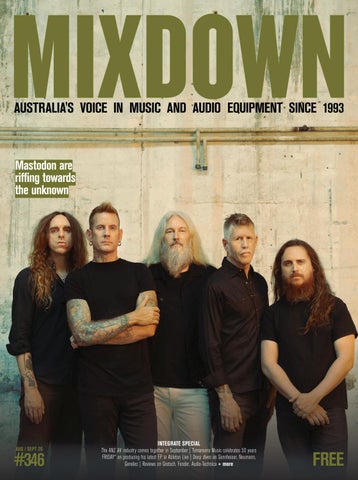
Mastodon are riffing towards the unknown
AUG / SEPT 26
#346
INTEGRATE SPECIAL The ANZ AV industry comes together in September | Turramurra Music celebrates 50 years FRIDAY* on producing his latest EP in Ableton Live | Deep dives on Sennheiser, Neumann, Genelec | Reviews on Gretsch, Fender, Audio-Technica + more
FREE
DEFY
The Electromatic® Premier Jet™ ®
gretschguitars.com ©2026 Fender Musical Instruments Corporation. All Rights Reserved
tm™
TICKETS AND INFO: THEPHOENIX.AU
CONTENTS
#346 AUG/SEPT 2026
Product News
8
Tour News
12
Mastodon
14
Paleface Swiss
16
Plini
18
Ableton x FRIDAY*
20
Turramurra Music
22
Integrate 2026 Special
24
Fender V2 Effects Pedals
36
Markbass MB5
38
Fluid Audio
40
Product Reviews
41
Leah Senior
50
PHOTO BY ERRICK EASTERDAY
6
`
EDITOR'S NOTE
EDITOR Anita Agathangelou PUBLISHING DIRECTOR Patrick Carr DESIGN Kelly Lim CONTRIBUTORS Sam McNiece, Hugh Wilson, Jamie Colic, Rob Gee, Sean Conran, Peter Hodgson, Jacob McCormack, Christopher Hockey, Alexander Sims, Samuel Stinson, Daniel Wright, Geoff King
W
j
hen you're creating something, there's usually a moment where you have to stop second-guessing and just commit. That instinct runs through this issue, with Atlanta prog-metal heavyweights Mastodon gracing the cover. Guitarist Bill Kelliher takes us through their new record Marrow Deep, and why it all comes down to trusting the riff and letting it take you where it wants. On the same note, we chat with Sydney's FRIDAY* about his new EP rituals and his process using Ableton Live. It's also our Integrate special, the annual meeting point for Australia and New Zealand's AV industry, where the
whole sector comes together to see what's possible and where AV is heading. There's a lot of innovative tech in these pages, and only a glimmer of what you'll find on the ground floor this September. Riff-pigs, beatmakers, tech-heads, six-string slingers – whatever you answer to, there's a lot to dig into here. Take a seat, pour your drink of choice and enjoy. Anita Editor
FOR ADVERTISING OR CONTENT PARTNERSHIPS advertise@mixdownmag.com.au DISTRIBUTION distribution@furstmedia.com.au ACCOUNTS accounts@furstmedia.com.au PUBLISHER Furst Media Pty Ltd FOUNDER Rob Furst MIXDOWNMAG.COM.AU
MIXDOWNMAGAZINE
MIXDOWNMAGAZINE
COVER PHOTO: WILLIAM LACALMONTIE
v
`j
jv
`v
`jv
h
THE SOUND OF YOUR VISION AT V-
AT V-
LE
On-Camera Shotgun Mics Built for professional videographers and content creators, the ATV-SG1 and ATV-SG1LE on-camera shotgun microphones deliver natural, high-resolution audio from a feature-rich, easy-to-use device.
Safety Track
Rechargable Battery
Internal Shock Mount
Compact Design
Shoe Mount
External Jack Input
Low Cut Filter
Highly Directional Pickup
RFI Immunity
High-Fidelity Audio
SG1 Exclusive Features
8
PRODUCT NEWS
PRODUCT
NEWS LEWITT's LCT 440 PURE now comes as a factorymatched stereo pair
ELFA.COM.AU
LEWITT has released a factory-matched stereo pair of its LCT 440 PURE condenser, with a full set of accessories so you can set up a stereo rig straight away. Both mics use the same 1-inch true condenser capsule and cardioid pattern, matched at the factory so the two sides sit evenly. Low self-noise and high SPL handling mean they cope with quiet and loud sources, which suits drum overheads, piano, acoustic guitar, strings and choirs. Each comes with a shock mount, pop filter and windscreen, and the pair adds a stereo bar and a rugged mil-spec case.
Gibson marks 100 years of flat-tops with five limited-edition acoustics
Jumbo, all handcrafted in Bozeman, Montana and topped with bearclaw Sitka spruce. All five have a vintage-style Cremona Burst finish, with abalone rosettes and binding. The tonewoods vary by model, across mahogany, figured maple and rosewood, and each has L.R. Baggs VTC electronics with soundholemounted controls. They ship now in a hardshell case with a Certificate of Authenticity.
signature amp in 14 years. Built on the handwired 1959HW platform, it carries a custom "Dookie Mod" developed with Armstrong to recreate the gain, tighter lows and saturated crunch of his sound since Dookie. The design nods to his first guitar, Blue, with baby-blue tolex, brass and silver panel details and his signature front and back. It's a head-only unit, handwired in the UK at 100W, with three ECC83 preamp valves and four EL34s.
Gretsch expands the Streamliner range with its first solidbody
Sennheiser adds pushto-talk to its Spectera wireless system
AU.FENDER.COM
The double-cut CVT swaps the range's hollow bodies for mahogany, aimed at players after volume and grit. It has a fast "C" neck, a 12-inch bound Indian Laurel fingerboard and 22 medium jumbo frets, with a Pitch-Perfect head angle and GraphTech NuBone nut to help it hold tune. HotWire ceramic humbuckers handle clean and dirty tones, and the controls are kept simple: a master volume, master tone and three-way toggle. It comes in four finishes – Jet Black, Sea Foam Green, Aged White and Olive Drab.
Billie Joe Armstrong's Super Bowl amp is now official
AUSTRALISMUSIC.COM.AU
Gibson Custom has marked a century of its flat-top acoustics with a five-model Anniversary Limited Edition Collection, each capped at 100. It gathers together five classics, the J-45, Hummingbird, SJ-200, Dove and Advanced
mixdownmag.com.au
ELFA.COM.AU
The baby-blue Marshall head behind Billie Joe Armstrong at the Super Bowl is now official as the 1959BJA Artist Signature, Marshall's first artist
SENNHEISER.COM/EN-AU
Sennheiser has rolled out an update to its Spectera wideband wireless system, adding firmware 1.4 and a new COM button that hands performers control over their own audio. Fitted between the SEK bodypack and the microphone, it lets a performer mute their own signal or open a private talkback channel to the crew. Firmware 1.4 also brings detailed monitoring through the Spectera WebUI and works with the SoundBase management app.
9
Electro-Harmonix launches the Deluxe Big Muff Pi 2 – a maxed-out take on a lost circuit
Parallel or Split and panned independently. The looper's 1 Button Mode lets you build layers midperformance without switching to a dedicated looper mode. For original TimeLine owners, the dual-engine routing and 1 Button Looper are the biggest changes.
AlphaTheta unveils the XDJ-AN all-inone DJ system
3000X's core features into a smaller, 3.6 kg body aimed at bars, small clubs and mobile setups. The same 10.1-inch touchscreen carries over, showing up to 15 tracks, and playlists can be rearranged on the unit without a laptop. Built-in Wi-Fi adds rekordbox CloudDirectPlay and streaming from Apple Music, Beatport and Tidal, while NFC login pulls up your library from a tapped phone. It's also the first AlphaTheta player to support CoBeat, a new crowd-interaction service where the audience votes on and requests tracks.
Shawn Mendes gets two new Martin 000 signatures
VIBEMUSIC.COM.AU
Electro-Harmonix has revived a cult fuzz with the Deluxe Big Muff Pi 2, a loaded version of the dual op-amp Big Muff Pi 2, built from a lost schematic found in designer Bob Myer's archives. Its mids-forward snarl is the heart of it, unusual for a Big Muff, which usually scoops the mids out. It now comes with EHX's Deluxe controls: a Blend knob mixes clean and fuzz, while a parametric mids section with its own footswitch and EXP input sweeps the frequency underfoot for wahlike sounds. It's an all-analogue, mono design.
Strymon reimagines the TimeLine with dual engines, a reverb and a five-minute looper
JANDS.COM.AU
AlphaTheta has launched the XDJ-AN, a 2-channel all-in-one with a layout based on the CDJ-3000X and DJM series, aimed at DJs moving from controllers to clubs. It plays from USB, PC/ Mac and mobile DJ apps, and streams directly from Apple Music, Beatport, Tidal and Spotify (Spotify to follow). Playlists and cue points sync via rekordbox Cloud Library Sync, and you can build and edit playlists on the touchscreen with no laptop. Mobile app support (rekordbox and djay for iOS) is a first for the category, and a built-in SonicLink transmitter handles wireless monitoring as low as 9ms. XLR and RCA outputs plus Bluetooth round it out.
AlphaTheta shrinks the CDJ-3000X into a smaller, cloudconnected package
ELFA.COM.AU
Martin has launched two Shawn Mendes signature models, both tracing back to a 1920s Martin 0-42 he found in a Brooklyn guitar shop. The limited 000-28, capped at 88 worldwide, pairs solid East Indian rosewood with a spruce top, Golden Era scalloped bracing and vintage appointments – a pyramid ebony bridge, slotted headstock and gold Waverly tuners – plus a custom mother-of-pearl eagle inlay. The more accessible Road Series 000-10E uses FSC-certified tonewoods, adds Martin E1 electronics with a tuner and is the first Road Series model with a straightline pyramid bridge. A portion of proceeds goes to the Shawn Mendes Foundation.
AMBERTECH.COM.AU
Strymon has launched the TimeLine MX, the follow-up to its flagship delay, with 12 engines and a five-minute stereo looper. Eleven are delay machines, among them new Oil Can, Spectral, Drum and MultiTap algorithms, while the twelfth is a reverb, putting delay and reverb on one board. Both engines run at once, routable in Series,
JANDS.COM.AU
AlphaTheta has announced the CDJ-1500X, a compact player that packs the flagship CDJ-
mixdownmag.com.au
10
PRODUCT NEWS
PRODUCT
NEWS Orange introduces the Baby Terror, a 20-watt micro head
more than 30 chord progressions, expressive touch strips and a colour display. The 16 carries 16 pads and nine knobs, while the 32 doubles the pad count and runs eight. Timeline navigation, session controls and hookup for synths and drum machines round them out. The RRP is $479 for the 16 and $549 for the 32, with stock due early September.
Ernie Ball adds three gauges to its Classic Rock N' Roll pure nickel range
in Splash Blue with gold accents. The model makes Malina Moye the first woman of colour to become a Kramer signature artist. Known for playing left-handed and upside down, she fuses rock, blues, soul and funk. The guitar pairs a maple neck with a DiMarzio set chosen for range: a Virtual Vintage Blues, an Area 67 and a Super Distortion. A five-way switch, master volume and two tone controls sit in a tortoiseshell pickguard, with Kramer vibrato, gold knobs and locking tuners. A left-handed version is also available, and both come with a gig bag.
Meet the MB5 Yellow JB: Markbass's first Yellow Series five-string
AUSTRALISMUSIC.COM.AU
Orange has added the Baby Terror to its Baby series, a 20-watt micro head small enough to live in a gig bag. It's an all-solid-state, valve-free design with JFET circuitry, keeping the size and weight down without losing the front-panel control. Gain, Volume, a three-band EQ and Presence make up the front, plus a Tubby switch for extra low end at cleaner settings and a footswitchable second volume for lead boosts. Around the back are an effects loop, a balanced line out with ground lift and an 8/16-ohm speaker output, so it records straight to an interface. A padded gig bag is included.
Fender launches the Motion 16 and 32 pad controllers for Studio Pro
CMCMUSIC.COM.AU
Ernie Ball has expanded its Classic Rock N' Roll Pure Nickel range with three new gauges, filling out a line that's been a player favourite since its 1990s reintroduction. The strings chase the warm vintage tone of the '60s and '70s, with a pure nickel wrap over a modern tin-plated hex steel core. The additions are Turbo Slinky (9.5–46), Ultra Slinky (10–48) and Skinny Top Heavy Bottom Slinky (10–52), joining the existing Extra, Super, Hybrid, Regular and Power Slinky gauges. Together they bring the full spread of Slinky tensions to the Classic Rock N' Roll formulation. The three new gauges have an RRP of $27.95.
Kramer marks 50 years with the Malina Moye Pacer Deluxe
LINKAUDIO.COM.AU
Fender has launched the Motion 16 and Motion 32, a pair of pad controllers built around its Fender Studio Pro software though happy to run with any DAW. Both use RGB polyphonic FATAR pads and illuminated encoders, with contextaware pads that switch between drums, melodies and chords, Smart Scale and Smart Chords,
mixdownmag.com.au
AUSTRALISMUSIC.COM.AU
Kramer is celebrating five decades with a signature Pacer Deluxe for Malina Moye, finished
CMCMUSIC.COM.AU
Markbass has taken its Yellow Series to five strings with the MB5 Yellow JB, built after repeated requests for a five-string version of the popular four-string model. It keeps the comfortable neck and low action of its sibling, with a poplar JB-style body, a maple "C"-profile neck and a laurel fingerboard. Two J-style single coils run through a simple passive circuit, with a volume for each pickup and a master tone, blending for fingerstyle or slap. The Markbass Yellow finish sits against a black pickguard, and every unit is individually inspected in Italy. With an RRP of $1150, the MB5 comes with a gig bag and strap.
11
beyerdynamic launches the DT 275 PRO for set, FOH and DJ use
Fender adds Rallye Orange and Cactus Gray to the Player II Series
style inductor and a custom taper sweep. The halo, or "holy grail", inductor does much of the work behind that vintage tone, while the custom taper pot smooths the movement from heel to toe for vocal-style phrasing. It sits in a full metal casing with a compact footprint that saves board space. True bypass keeps it out of the signal when off, and it runs on a 9-volt battery or Behringer's PSU-SB supply (sold separately).
Gibson brings back the numbered 1971 Flying V Medallion BEYERDYNAMIC.COM.AU
beyerdynamic has added the DT 275 PRO to its PRO headphone line, a compact closed-back on-ear built for loud, hectic spaces. Passive isolation cuts around 22 dBA of ambient noise, so a signal check on a busy set or at front-of-house still reads clearly. It weighs under 200 grams, the cups swivel to fold flat, and the cable locks to either ear cup. The faux leather pads and headband cushions are replaceable. Inside is a dynamic driver with a 5 Hz to 24 kHz response and 45-ohm impedance, easy to drive from a desk or camera.
Warm Audio shrinks the Dirty Boy Preamp into a pedalboard overdrive
AU.FENDER.COM
Fender has pulled two finishes from its archives for the Player II Series, the bright Rallye Orange and a muted green-grey called Cactus Gray, spread across nearly every electric and bass in the range. The line runs a Modern "C" neck with satin urethane back, rolled fingerboard edges and 22 medium jumbo frets over a 9.5-inch radius. Rallye Orange turns up on the Stratocaster, Telecaster, Jazzmaster, Jaguar and all three basses, while Cactus Gray covers much of the same ground. The Jaguar goes its own way with an exclusive Birch Green. Pickups, hardware and construction stay as they were.
Behringer announces the WahWah, an all-analogue take on the '60s wah
AUSTRALISMUSIC.COM.AU
Gibson Custom has recreated the 1971 Flying V Medallion, the numbered, gold-coin-toting V that Michael Schenker made a hard rock signature. Gibson built only around 350 in 1971, each with an individually numbered gold coin, and the model has gone largely un-reissued since. Built in Nashville, it has a two-piece mahogany body around 1.375 inches thick, a three-piece mahogany neck in the thin 1971 profile and a rosewood fretboard with 22 medium jumbo frets. Hardware includes genuine T-Top humbuckers hand-wired to individual volumes and a master tone. It comes in Medallion Cherry VOS with a hardshell case. Local enquiries through Australis.
STUDIOCONNECTIONS.COM.AU
Warm Audio has worked with boutique builder Dirty Boy to shrink its unusual preamp to pedalboard size. The Dirty Boy Jr. Overdrive recreates the Dirty Boy Preamp, a touch-sensitive drive that doubles as an amp and speaker sim, and arrives alongside a Booster and a Fuzz in a new Jr. series. It runs on Dirty Boy's all-analogue Tube Amp Emulation circuit for a tube-like response. Gain, Tone and Volume shape the drive, while a Variac control adds sag and a spongier, fuzzier feel. A speaker-emulated output voiced after a 4×12 lets it run straight to an interface or desk. True bypass, 9V (not included).
AUSTRALISMUSIC.COM.AU
Behringer has added a vintage-style wah to its pedal line with the WahWah, an all-analogue take on the classic '60s sound built around a halo-
mixdownmag.com.au
12
TOUR NEWS
TOUR
NEWS Kevin Morby tours Little Wide Open across Australia this November
metalcore crew have lined up an Australia tour in January 2027, taking Canadian mainstays Counterparts and Denver's Fox Lake along for the ride. Their 2025 run sold out every show bar one, and this time they're promising a bigger production.
TOUR DATES ໞ 27 Jan: The Astor, Perth ໞ 30 Jan: Froth & Fury Festival, Adelaide ໞ 31 Jan: The Forum, Melbourne ໞ 2 Feb: UC Hub, Canberra ໞ 5 Feb: Roundhouse, Sydney ໞ 6 Feb: The Tivoli, Brisbane ໞ 7 Feb: The Warehouse, Townsville
The Cribs line up four Australian dates
HANDSOMETOURS.COM
ໞ 13 Nov: Bellingen Golf Club, NSW (solo) ໞ 14 Nov: Old Museum, Brisbane, QLD (solo) ໞ 15 Nov: Elm House, Mt Glorious, QLD (solo) ໞ 18 Nov: Metro Theatre, Sydney, NSW ໞ 20 Nov: Hotel Brunswick, NSW ໞ 21 Nov: Town Folk Festival, Castlemaine, VIC ໞ 22 Nov: Forum, Melbourne, VIC
Paleface Swiss bring Counterparts and Fox Lake down under in 2027
DESTROYALLLINES.COM
Cake, the lunchbox-loving oddballs of American alt-rock, haven't played Australia in 15 years, but that’ll change next March. Billed as An Evening With Cake, the five shows will feature two full sets drawn from the band's back catalogue, with staples like 'The Distance' and 'Short Skirt/ Long Jacket'. Formed more than three decades ago, Cake have built a career on independence and a genre-blurring sound spanning rock, funk, country, folk and pop.
TOUR DATES
Kansas City-via-LA songwriter Kevin Morby is touring his acclaimed eighth album Little Wide Open, out now via Dead Oceans. Produced by Aaron Dessner of The National, it features guests including Justin Vernon, Lucinda Williams and Amelia Meath, and completes an unintentional trilogy rooted in American landscapes and restless motion.
TOUR DATES
Cake serve up two full sets on their An Evening With Cake tour
ໞ 14 March: Ice Cream Factory, Perth ໞ 16 March: Hindley Street Music Hall, Adelaide ໞ 18 March: Festival Hall, Melbourne ໞ 20 March: Enmore Theatre, Sydney ໞ 24 March: Fortitude Music Hall, Brisbane DESTROYALLLINES.COM
The Cribs are selling a vibe, and that vibe is coming to Australia. The UK indie trio are taking their ninth album Selling A Vibe to Melbourne, Sydney, Brisbane and Perth this October, for the first time since 2018. The Jarman brothers spent the pandemic scattered across New York, Portland and Wakefield, so their 2020 album Night Network went untoured. Selling A Vibe is their first record since the three were back in the same room, with the band leaning into modern pop production without losing their classic raw, hook-driven sound.
James lock in four Australian shows this October
TOUR DATES ໞ 4 Oct: 170 Russell, Melbourne ໞ 5 Oct: Factory Theatre, Sydney ໞ 6 Oct: The Triffid, Brisbane ໞ 8 Oct: Rosemount, Perth
DESTROYALLLINES.COM
Manchester’s James are heading to Australia this October, and promise a set featuring their greatest hits and deep cuts. Razorlight join as special guests, in Australia for the first time in over 15 years and marking the 20th anniversary of their self-titled album.
TOUR DATES THEPHOENIX.AU
Paleface Swiss don't do subtle, and their live shows have the reputation to prove it. The Zürich
mixdownmag.com.au
ໞ 8 Oct: Red Hill Auditorium, Perth ໞ 10 Oct: Margaret Court Arena, Melbourne ໞ 11 Oct: Hordern Pavilion, Sydney ໞ 13 Oct: Fortitude Music Hall, Brisbane
14
COVER FEATURE
Mastodon are riffing towards the unknown WORDS BY PETER HODGSON
There's something reassuringly old-school about the way Bill Kelliher describes writing a Mastodon record. In an age where songwriting can involve laptops, production teams and endless digital possibilities, Kelliher's process still begins with the simplest possible building block: a riff.
mixdownmag.com.au
“It
just all starts out with riffs,” he tells me. "It's just riff after riff after riff after riff, and then it's sort of throwing them at the guys." His phone is packed with them. So are his Pro Tools sessions and hard drives. Some start as halfremembered ideas hummed into his phone before bed, only to be rediscovered the next morning with the inevitable reaction: what the fuck was that? Others grow into something substantial through the back-and-forth of rehearsals and recording. The important thing is that Kelliher doesn't seem particularly interested in deciding whether an idea is good or bad too early. "I never judge anything until we've got all the lyrics and vocals on stuff," he says. "So I'm always very optimistic about every song and every riff." That optimism seems particularly appropriate for Mastodon's forthcoming album, Marrow Deep, which Kelliher describes as a major undertaking after the longest gap the band has had between album cycles, and the first since the death of founding member Brent Hinds. There was a lot of material to sift through, but that abundance is part of what makes the process work. Kelliher compares it to the Earth cooling, or the ancient supercontinent Pangaea before everything began separating into individual continents. He'll bring in an enormous mass of riffs, and then
15
PHOTOS BY ERRICK EASTERDAY
I.MASTODONROCKS.COM/MARROWDEEP
he and drummer Brann Dailor begin figuring out which pieces belong together. "By the time that Brann gets in with me and we start parsing off, like, okay, this goes with that, this goes with that, all of a sudden it's like, hey, we've got fucking songs." That process is beginning to evolve, though, particularly with the arrival of guitarist Nick Johnston. I've known Nick for years, going back to my time working with Seymour Duncan when Nick was part of our video demo team, so I was particularly interested in hearing how his distinctive voice had found its way into the Mastodon machine. Kelliher admits that, on this album, much of the writing was already well underway when Johnston joined. But there are already glimpses of what the future might hold. Nick and keyboardist João Nogueira have increasingly become part of the creative conversation, rather than simply adding colour to songs that have already been written. Kelliher describes Johnston as someone with a huge reserve of ideas who nevertheless approaches them with characteristic humility. "He's such a unique player," Kelliher says. "And he has such a unique sound." That difference is valuable in a band where Kelliher has traditionally been one of the principal riff generators. He describes himself as an entirely unschooled musician, and there are moments on the new record where Johnston and João have been able to take a relatively straightforward idea and look at it from a more theoretical or compositional perspective. Kelliher jokingly refers to himself and the other riff-driven members of the band as "cavemen" who are essentially feeding on riffs, before passing an
idea over to the more musically inclined members of the group. You can hear that approach in tracks such as ‘They're Coming for You’, while ‘He Goes to Ghost Again’ and ‘Poisonous Weapons’ also feature sections where Johnston and João helped reshape or expand Kelliher's original ideas. On ‘Three Fates’, meanwhile, the trio's extended trading of parts at the end of the album became something Kelliher simply couldn't bring himself to cut.
several Les Paul Customs and an ESP Ron Wood. The ESP is one of his secret studio weapons, often doubled with a humbucker rhythm part to add extra midrange and twang. Amplification came from his Friedman amps, an old JMP used on Leviathan, a Silvertone and a Fender Vibro-King. He also discovered the joy of a Hiwatt for the first time on record, using it for the clean parts of ‘Ruins’.
“I'M ALWAYS VERY OPTIMISTIC ABOUT "At first we were thinking, wow, that's fucking badass, but it's too long," he says. "But the more I listened to it, I was like, nah, fuck that. Every single note is amazing." Another highlight is ‘Moth and Bone’, a haunting, textural piece that began with Kelliher writing on acoustic guitar in an unusual tuning following the death of Dailor's mother. Producer Patrik Berger helped expand the song into something considerably more adventurous, with delayed guitar and keyboard passages weaving around Kelliher's original acoustic foundation. It was also the first time Kelliher experienced such immediate songwriting chemistry with another guitarist. "I've never really had this with another guitarist," he says. And then, inevitably, the interview gets to the part where two guitar nerds stop pretending we're talking about anything else and start talking about gear. Kelliher used his familiar collection of Gibson and ESP guitars, including his ESP Viper baritone,
EVERY SONG AND EVERY RIFF”
But perhaps the most revealing part of Kelliher's approach is how brutally simple he likes to keep his signal path. He wants the guitar to sound like the guitar, rather than some heavily processed approximation of it. "If I'm in control, I do," he says. "I want it to sound more raw, like the way it sounds when I put my ear to my own speaker cabinet." That pursuit of rawness seems to sum up the whole Mastodon process. Start with riffs. Throw them at each other. Follow the interesting paths. Keep the weird parts. And when something sounds alive, don't overthink it. Sometimes the best way forward is simply to trust the riff. Marrow Deep is out 28 August via Loma Vista Recordings.
mixdownmag.com.au
16
INTERVIEW
THEPHOENIX.AU
“Australia is one of the best places for heavy music”: Paleface Swiss are ready for their return WORDS BY JACOB MCCORMACK
Fresh off their album Cursed, the band are bringing a sharpened live show to seven cities.
mixdownmag.com.au
In 2025, Zürich’s Paleface Swiss awed Australian crowds with their high-octane live performance on the back of their album Cursed. Since then, they’ve only been refining the bone-rattling spectacle they are renowned for, adding another EP to their discography. Released this year, The Wilted features an intro that breaks into four smashing tracks, built to take audiences somewhere beyond the everyday. It comes at a time when Paleface Swiss are one of the fastest-rising bands in heavy music – something Australian crowds can attest to. The band are set to return to Australia in early 2027 for a national run, including The Forum in Melbourne – a venue they’ve played before, and one that frontman Marc ‘Zelli’ Zellweger loved. “I remember we played the Forum in Melbourne once on the first tour that we did,” states Zellweger. “We supported In Hearts Wake when we played there and honestly, that was one of the best shows we’ve done in Australia. I’m really excited to play there, as well as some of the other venues we have shows at.” With both Counterparts and Fox Lake joining the tour, the upcoming shows offer a bigger proposition than Paleface Swiss’s earlier Australian visits. “The last headline tour we did in Australia was only us and Nasty, our best friends, and they had never been there before,” Zellweger reflects. “We literally came to Australia not really knowing what to expect so we just played. There wasn’t really any production, we just played songs and the people seemed to love it.
“This time everything is so much bigger, and we’re bringing bands that have been there before. It feels like it’s getting more serious because we’re trying to bring something way bigger, way more crazy. I love Counterparts so much and I like Fox Lake a lot too, it’s a dream tour. I’m going to watch those bands every night and have the best time ever. So, I’m really excited about everything on this tour.” There is a sense of pride too, and a desire to honour Australian crowds by expanding the live show, driven by how much energy Paleface Swiss have taken from their shows in the country. “We are blown away by the audience in Australia too. Australia is one of the best places for heavy music and really that’s the truth. It’s so sick. It’s been two tours that we’ve done down there and both of them have been amazing, the response from the crowds has been amazing. I think it’s the sing-alongs and how rowdy you guys get, it’s perfect for a band like us. I love being there and I’m really, really, really glad that the people like us so much as well, it feels really good.” That exchange feeds the band’s energy in turn, making Australian shows a two-way street between crowd and stage. “I need the people to be active; I need that so much,” Zellweger says. “We perform so much better when we see how the people go crazy. Like you said, if everybody gets crazy, we can go crazy and it’s just a whole thing of energy and that’s exactly what I need.” It’s shaping up to be a huge tour for a band that has used recent shows to sharpen their live set into something more complete. “We’re at the point where everything is dialled in,” notes Zellweger. “The songs that we play all have lights and all that. But I’m honestly thinking about preparing some songs just for the sake of if we want to play them or like if the people demand that we play another.” All things considered, it remains a risk for a band like Paleface Swiss to tour in Australia – a 22 to 30 hour flight, give or take, and an expensive trip at that – so for Zellweger and the band, it’s a relief to know that fans are coming to the shows. “It always is a big risk that you have to take and it gives you so much peace and also energy to know that people want to come see you. It makes you more like, fuck yeah, let’s go, let’s give them everything we’ve got.” Everything they’ve got is exactly what to expect from Paleface Swiss on their 2027 Australian headline tour.
TOUR DATES ໞ 27th January: Perth, The Astor ໞ 30th January: Adelaide, Froth & Fury Festival ໞ 31st January: Melbourne, The Forum ໞ 2nd February: Canberra, UC Hub ໞ 5th February: Sydney, Roundhouse ໞ 6th February: Brisbane, The Tivoli ໞ 7th February: Townsville, The Warehouse
18
INTERVIEW
PHOTO BY DECLAN BLACKALL
Plini digs deeper and heavier on An Unnameable Desire
WORDS BY PETER HODGSON
There's something particularly satisfying about watching an artist's trajectory when you've been there near the beginning.
I first interviewed Plini back when he was still in the early stages of building the thing that would eventually become his career: intricate instrumental guitar music that could be virtuosic without becoming a wank-fest and progressive and melodic enough to stick in your head long after the shred had stopped. Now, years later, he’s back with a new album, An Unnameable Desire. If there’s one thing that becomes obvious talking to Plini, it’s that none of this happened by accident. “I bought a lot of live DVDs before I’d ever played a show,” he tells me. “I’d see all my favourite bands, like Dream Theater and shit, playing the biggest stages imaginable with videos and lights and all this stuff.” Those DVDs helped shape not just the music Plini wanted to make, but the kind of live experience he wanted to create. It was never going to
mixdownmag.com.au
be a case of dragging a couple of amps into a sweaty little room and hoping for the best. Although, as he admits, he wouldn’t necessarily hate that either. “I guess the music that I wanted to make comes from that, but also this kind of show that I want to put on. It was never a small punk club, stage-diving sort of thing. Although I wish it were.” Some of us caught Plini’s first Melbourne show at The Workers Club and each tour since has meant a slightly bigger venue, a few more lights, more sophisticated programming and, ultimately, a larger attempt to translate the scale of his recorded music into a live setting. An Unnameable Desire also sees Plini leaning further into something that has always been lurking around the edges of his music: heaviness. Like many guitarists of his generation, his musical education involved discovering virtuoso guitar heroes – Steve Vai and Joe Satriani sat alongside Lamb of God, Gojira and Meshuggah in his listening habits. “I’ve always loved and listened to that stuff a lot, but it didn’t necessarily come out in the writing,” he says. “But I guess it’s just crept in over time.” That evolution has now reached the point where Plini is happily venturing into tunings lower than an eight-string guitar would traditionally take him. There’s a similar sense of rediscovery in the way Plini describes being back onstage. After spending the previous year focused almost entirely on making the album, returning to live performance has reminded him just how much he enjoys it. “I guess I’d forgotten how sick it is to play in front of people and they’re smiling and having a good time,” he says. “As soon as the show started, I was just like, ‘Oh my God, this is so cool.'” Plini has a new Strandberg model on the horizon, developed around the company’s latest innovations in guitar design. The story of how he first encountered the prototype is suitably surreal: at Guitar Summit in Germany, Strandberg founder Ola Strandberg offered to drop by Plini’s hotel room at 8am with a prototype. “I was like, ‘8am? That sounds awful, but okay.'” The result was a guitar built around a new tremolo system that Plini describes as feeling more balanced across the strings, with a more even response and improved behaviour when performing techniques like fluttering the tremolo. It also handles things like dropping the tuning to D with-
out throwing the whole instrument out of whack. “I was sleepy, but I was like, ‘This is the best Strandberg I’ve ever played.'” For Plini, the appeal of Strandberg guitars extends well beyond their futuristic looks. Their light and ergonomic design has practical benefits for musicians who might struggle with the physical demands of conventional instruments. With international touring involving increasingly complicated baggage logistics, being able to carry two guitars in a single case is a serious advantage. Sonically, Plini has also embraced the advantages of modern digital gear. His touring rig is based around Neural DSP Quad Cortex units, with the newer Quad Cortex mini now offering essentially the same functionality in a smaller package. Plini, guitarist Jake Howsam Lowe and bassist Simon Grove each have their own board, allowing the whole rig to travel efficiently while keeping things simple and reliable. Despite having his name attached to one of the most widely used Neural DSP plugins, he doesn’t consider himself a traditional gear obsessive. “I just try to make something that’s simple and sounds good for a bunch of different things without being overly cumbersome or technical.” Away from the road, Plini’s current inspiration comes from somewhere rather less predictable: blink-182. He describes himself as being on something of a ‘mental holiday,’ taking a break from the constant pressure to learn, create and optimise. There’s something therapeutic about returning to music you already know inside out. “You don’t have to curate your own frigging thoughts all the time,” he says. That same spirit has led him to rediscover artists he might once have dismissed for being insufficiently ‘serious.’ He’s also been listening to Madison Cunningham, whose guitar playing and recording techniques have sparked ideas for future projects. In particular, he’s fascinated by the way her guitars can sound like complete performances rather than the surgically assembled parts that have become so common in modern recording. “I’m just used to recording chord by chord,” he says. “So that’s kind of inspiring next time I write music or record, to see if I can get some of that vibe happening.” It’s a fitting place to leave Plini: still curious, still experimenting, but increasingly comfortable with the idea that inspiration doesn’t always have to come from the obvious places. Sometimes it’s a new tremolo system. Sometimes it’s a brutally heavy riff. Sometimes it’s blink-182. And sometimes, after years of chasing bigger stages and more elaborate productions, it’s simply remembering how fucking cool it is to plug in, hit a note and hear a room full of people lose their minds.
Capture with Clarity Capture sound with precision and artistry. The AKG C-Series condenser microphones deliver studio-grade clarity for speech, music, and ambient environments—engineered from decades of acoustic expertise to elevate every recording. Discover the difference at akg.com.
INTRODUCING
MODERN ACOUSTICS
LOW NOISE FLOOR
WIDE DYNAMIC RANGE
ECO-FRIENDLY DESIGN
C-Series C104 | C114 | C151
Find your AKG Dealer:
Distributed by MadisonAV | madisonav.com.au
© HARMAN 2026. All rights reserved.
20
INTERVIEW
FRIDAY* on rituals, Ableton and trusting the first take WORDS BY ANITA AGATHANGELOU
Sydney producer FRIDAY* has released his latest EP rituals, made entirely in the box on Ableton Live. We chat with him about how the EP came together, why he no longer believes in demos and recording voice memos when he’s overstimulated.
Hey FRIDAY*! Congratulations on rituals – it's a very intricate and euphoric EP. How does it feel to have it out? Feels great. I’ve sat with those songs for quite a while, so it feels good to clear the cache and move on to the next. It’s been very fun seeing people’s reactions to the music! How long have you been in the world of production, and an Ableton Live user? I’ve been messing around with production for over a decade at this point. Initially I didn’t really know I was “producing” – I was just messing around on GarageBand for a bit. I’ve been using Ableton for maybe seven or eight years? The Ableton era is definitely where I started claiming the producer title, haha. Where does a track usually begin for you? A melody, a beat or a sample for instance? How much of the songwriting process is made in the box? I think every song I’ve made has started in a dif-
mixdownmag.com.au
21
ABLETON.COM/EN
ferent way. From voice memo ideas to samples to melodies to drum beats. I can say everything on the rituals EP was started and finished in the box.
The beginning of 'just you' has two people speaking. Is this something you recorded randomly, with the possibility of it fitting on a track one day, or do you record intentionally while working on the song? Randomly. I hit record on my iPhone like a creep whenever I hear something funny or compelling. Or when I’m overstimulated. When there’s too much noise around you, it’s always good to hit record because you’re bound to get some good texture or foley.
Do you create demos in Ableton, and then build on that same demo, or start from scratch? It’s evolved over time, but essentially I don’t believe in demos anymore. When I started out making songs, I would record my vocals over and over again – for no reason other than thinking that was the way things work when you make pop music. I don’t track live drums or anything, I don’t SE really replay any stems – I just make the instru"WHEN THERE’S TOO MUCH NOI TO D mental and then sing or rap over it. GOO AROUND YOU, IT’S ALWAYS TO With this project, PJ, who did the mixing ND BOU ’RE YOU HIT RECORD BECAUSE and mastering, encouraged me to keep a lot " EY. FOL OR E TUR TEX D GET SOME GOO of the first vocal takes because they sounded good already. The vocals in the title track are all recorded on my iPhone. A lot of my production Do you integrate hardware into the process? ethos came from 2010s – 2020s hip hop, because For rituals, no – unless you count the little red those are all pop songs constructed on a laptop. Focusrite interface or electric guitar. I made most These days I try to get as many things right of the project on my laptop, sometimes with headin the first session. For the songs on my next phones, and then my bro had an extra pair of stuproject, I didn’t bounce anything until it was a dio monitors that he wasn’t using, so that’s when I ‘finished’ track. started making some songs with harder bass – like Do you write in Session View, jamming and launching clips, or go straight into Arrangement? Straight into Arrangement, always. I have a friend that writes in Session View and I think it’s sort of psychotic. It freaks me out not being able to see what’s going on, but I guess it would make you lean on your ears a lot more. Maybe I should give it a shot. Any custom racks or chains you go for every time? God, I wish I had more racks and chains, you feel me? Hahaha sorry. I’m bad at remembering to make custom racks but I have a vocal one that I always use. I need to redo it though, it’s not hitting anymore. How much of the record is Ableton's stock effects vs. third-party plugins? I genuinely have no clue. There’s probably a healthy amount of both, but I’m confident the whole thing would feel exactly the same if it was all stock. How do you program your drums? Do you find the process tedious? On this EP, it’s a mixture of separate audio tracks and MIDI triggering. I’m using the Drum Rack a lot more these days on the new stuff though – it’s way easier and once you get the workflow down it makes the mixing process way simpler too. Programming drums could never be tedious. I love the drums, it makes me dance. If drum programming gets tedious for anyone it’s because their drums don’t smack. On ‘just you’ I wrote the swing pattern for the drum groove manually because I am stubborn and refuse to look things up. I probably wouldn’t do it that way again. We got there in the end, anyway.
‘pretty round face’. I went in and tweaked a lot of the songs after those monitors came into the picture. Saved my life. I have my own monitors now. I don’t see myself getting any of those hardware compressors or EQs or anything unless I get dumb rich. The plugins sound the same.
PJ mixed and mastered rituals – how much do you mix yourself while working? Do you find it helps you to really visualise the final track? I’ve learnt to mix better over the course of my musical journey. For rituals I would naturally mix as I produced the songs and then PJ would take the sessions and tweak things so that they were way more pop-ready and less muddy. With the next batch of music, I’ve mixed it all myself, and then gone to him for an extra ear. He’s kind of like Yoda in the sense that he’s encouraged me to lean on my own instincts and trust my ear more. Mixing as I go definitely helps me visualise the final track. In my head, I see producing and mixing as the same thing the more I sharpen my skills. The world you want to create is all in the sound selection and the treatment of those sounds, as much as it is in the writing.
It reminded me of D’Angelo naming his sophomore album Voodoo – it added a smoky layer of spirituality to the music. I feel like it definitely opened the channel for me to explore what “rituals” meant, subject matter wise, in regards to family, faith and friendships. The word also evoked the idea of drum circles and African rhythms in my mind – so that’s what led to a lot of the overlayering of the drums.
Do you get in a hyperfocused, flow state when producing? It’s pretty easy to lose yourself in it for hours. Yeah for sure. That is what led to all of this. Is there a track on rituals you're proudest of? ‘braid’. Every song on rituals was me finding the production language as I made them, but since it was written and produced last, ‘braid’ is the one song on the project that was made using the language I had created. Anything you learnt through the process of making rituals, whether from the production or creative process? Less is more, but more can be really fun sometimes. Always trust your instincts. In art, rules are supposed to be broken. Also, the song is done when you decide it’s done. How do the tracks on rituals translate to a live set? We did the rituals live experience with a seven-piece band last month – drums, electric bass and guitar, synthesisers, samples, saxophone with effects, keys, congas and miscellaneous percussion – the whole shebang. My vision for the EP was to contrast the grid and electronic aspects of the production with a more feel based, groovy, live instrumentation palette for the concert. That meant no click and a lot of jamming. I wanted there to be a clear difference between the computer and real life, whilst retaining the euphoric essence of the songs. The goal is to run that show a couple more times.
I always love a nod to the word "rituals", as I feel it’s such a big part of being a creative person. Where did this title come from, and how does it fit into the sound? Do you have any rituals when it comes to creating? I feel like the word rituals has a bit of a weight to it – there’s of course cultural and religious connotations attached to it. My goal sonically for the second EP was to make more afro-pop music influenced by dance genres, which to my ears is a lighthearted world. Pasting the word “rituals” against those sounds felt very fun and compelling, especially thinking about how electronic the EP is.
mixdownmag.com.au
22
FEATURE
TURRAMUSIC.COM.AU
Fifty years on, Turramurra Music is still all about their community
INTERVIEW BY HUGH WILSON WORDS BY ANITA AGATHANGELOU
Turramurra Music opened its doors on the North Shore of Sydney back in 1976, first as a record store that sold a small, select range of instruments. Since then, the family-owned shop has grown to become one of the most reputable musical instrument and gear stockists in Australia, and a leading supplier of Sennheiser, Roland, Yamaha, Fender and more. Its impact on the local music scene, though, extends well beyond the sales floor.
E
very true Sydney-sider knows Turramurra Music, and now celebrating their 50th anniversary, the store has stuck to what they do best: serving the musicians around them. Through all of it, Turramurra Music has stayed family-owned and operated, even as retail has gone digital and the chains have spread across the country. Founder Rob Stevens still manages the shop and works the floor on busy Saturdays, his wife Anne runs the education sales team as she has for several decades, and their two sons, Mat and Dave, now handle much of the day-to-day. It's Dave who talks us through fifty years of the family business. In the '70s, bands heading north out of Sydney had a little ritual. Before the long haul up the freeway, the likes of INXS, The Radiators and The Angels would pull in at the shop for a set of strings and a cup of tea. "Community has always been there from the start, with Rob having had close ties with up and coming musicians in the '70s and wanting to support them," says Dave Stevens. "The store used to be the last stop out of town for bands making the
mixdownmag.com.au
drive up north, and the likes of INXS, The Radiators and The Angels would sometimes stop off for some strings and a cup of tea before getting on the freeway." The shop that locals know today, packed with everything from beginner ukuleles to boutique synthesizers, looked a little different in the beginning. Rob built the business, and in those early years it was records and music tuition that paid the bills, rather than instruments. "Lessons ceased in the '90s but were a crucial part of our revenue base when we first opened," Dave recalls. "There are plenty of ongoing relationships with both early teachers and students." Some of those early teachers went on to play on the big stage. Midnight Oil's Jim Moginie once taught at Turramurra Music, as did his bandmate Martin Rotsey. "We recently found a ledger from the '70s and their names are on the first page under 'outgoings' for their teaching bills," Dave says. It's a small piece of Australian rock history filed away in the accounts. Mat and Dave grew up in and around the store, so much so that Mat's first outing as a
newborn wasn't his home. "When Mat was born, he and Anne were discharged from hospital on pay day – so Mat went to the shop before he made it home, as Anne had to do the pays." If that tells you anything about Turramurra Music, it's their deep commitment to the family business. Customers can feel that, and that's why they keep coming back. "Customer loyalty is huge for us. We are extremely privileged to have very loyal customers," Dave says. "We've attended weddings of customers, seen families grow." Turramurra does things differently, and their dedication to the community is part of why this independent store has outlasted so many of its peers. It's not only their loyalty to their customers, but to their staff, too. "Aside from Anne and Rob, there are two staff who are in their fifth decade at the shop, having started in the '80s, and another who started in the early '90s," Dave says. "We currently have 55 staff on payroll, many of them part time or casual, but it is a far harder roster to organise these days than it once was." As Turramurra's reputation and stock grew, the space needed to as well. What began as a small store eventually became the shopfront next door and then the one in between – until three buildings became one. "The current shop space is a point of pride for us as a family as well as our employees," Dave says. "With us being at least 40 minutes away from the city centre, we feel the space we can offer customers is worth the trip. The period during which renovations happened was a fairly intense and dif-
23
ficult one, but as soon as we saw the end product we knew it had been worthwhile." What began as records, guitars and accessories now fills that space as a full music centre, carrying one of the widest ranges of instruments, live sound and recording gear in the country, backed by in-house repairs, instrument and PA hire, installation and servicing. Turramurra have run close to 70 in-store and community events in the last five years, including product launches, demo nights, training seminars and workshops, topped off by a masterclass with jazz-fusion heavyweights Snarky Puppy, held at the Sydney Conservatorium of Music. "That is a big number, isn't it. They take a lot of work but we have a great team that comes together to put them on, especially the bigger ones like Snarky Puppy. I would definitely class them as more a labour of love than something we do to make money. But it allows us to give something really unique and cool to our loyal customers and the wider music community, so it's worth every bit of effort." Every bit of effort is indeed worth it, as Turramurra was recognised on the biggest stage of all when they won Best Community Retailer at NAMM 2026, and made the top three for Best Retailer overall – something of a rarity for an independent Australian retail store. "The community has grown and changed a lot over the years, so to be recognised with the award at NAMM was just amazing," Dave says. That effort reaches well beyond their immediate vicinity. Turramurra delivered instruments, set up a studio and ran workshops at Nyangatjatjara College in Yulara in the Northern Territory, alongside Graham "Buzz" Bidstrup, a founding member
of GANGgajang. Closer to home, they practice what they preach, putting their weight behind local music events. Practical support for an often under-funded industry is a big part of what Turramurra do, and education is central to that – key to making music more accessible. "Education sales are a huge part of our business," Dave says. "Anne is part of a dedicated team who deal with the huge volume of daily enquiries from not only the many schools in our area, but nation-wide. Alongside providing the best possible pricing to help music budgets go as far as they can, we have helped run primary school band nights, sponsored musicals and battle of the bands events, and helped set up gear in classrooms." All of these achievements are not to say that running a brick-and-mortar business comes with no challenges. Fifty years in music retail means weathering enormous change – from the first rise of online shopping and global marketplaces, and big chains swallowing up independent stores, to the arrival of CDs and pubs swapping live stages for dining rooms. To last, Turramurra Music has had to adapt, and as expected, it hasn't all been smooth sailing. "We had a second store in the '80s which almost sent us bankrupt. Getting out of that was difficult but a necessary decision. We feel we positioned ourselves well with the growth of online commerce early on and it continues to be a significant part of our business." Then came COVID, which Dave describes as a period they feared might close their doors. "There was the initial rush of everybody wanting audio interfaces and other equipment to set themselves up for home recording, but stock dried up very quickly. It then moved on to how do we entertain our children who are suddenly stuck home with us, and we saw a run on more student-priced keyboards, guitars and drum kits. Then eventually the grown-ups got bored and we started selling out of higher-end electric guitars." Stock shortages and shifting rules aside, Dave
says the period "ultimately built camaraderie", and they count themselves lucky the industry wasn't hit the way so many others were. After 50 years, you can count on the family to spot where the industry needs work, and funding is one of them. "The music industry and the arts sector more broadly have long suffered from relatively pitiful levels of government funding compared to other OECD nations. Getting governments to recognise its importance and back it with meaningful funding would do wonders." Five decades in the business is a huge milestone that calls for an even bigger celebration – and rest assured, Turramurra's half-century isn't going unmarked. There's an anniversary logo, a growing 50th merch collection, a birthday sale and a run of celebrations that a few of the team have been pulling together on the side of their day jobs. "Our trivia night was awesome – selling out a local restaurant with around 70 customers and friends joining us for an evening of music and food. And to celebrate our actual birthday in September, we've booked out a venue for a private event with staff past and present, as well as some suppliers and special friends." The celebrations have reached far and wide, too. All year the team have been running an interview series with a string of high-profile artists – and just how far that reaches showed over the weekend, when Thirsty Merc frontman Rai Thistlethwayte, who now plays keys for Toto, wore a Turramurra Music t-shirt on stage during a show in Tampa, Florida. For all the milestones, Turramurra Music's story is one of a family who don't just serve the musicians around them, but are part of the picture themselves. Their staying power is no coincidence – it comes down to real relationships, expert advice and a shared love of music. Fifty years on, that's something worth celebrating, and there's plenty more to come.
mixdownmag.com.au
24
INTEGRATE SPECIAL
Integrate 2026 returns to ICC Sydney with its most expansive program yet WORDS BY ANITA AGATHANGELOU
From AI and broadcast to smart home and education technology, the full AV industry lands at ICC Sydney from 2 to 4 September.
mixdownmag.com.au
I
ntegrate is back, and the 2026 edition is shaping up to be the most comprehensive to date. Now in its 17th year, Australia’s premier AV and integrated technology trade event returns to ICC Sydney from 2 to 4 September – and if last year’s numbers are anything to go by, it’s going to be a big one. The 2025 event drew 12,800-plus combined attendees and 250-plus combined exhibitors, and this year’s program has only grown from there, with new conferences, a dedicated AI stream and a broader spread of education sessions than the event has previously run. For anyone working across AV, integration, broadcast, live production or IT, this is the one event in the ANZ calendar where the full industry gathers in one place. Integrate brings together every corner of the AV industry under one roof – manufacturers, distributors, integrators, consultants, IT leaders and end users all in the same building. For educators, enterprises, retailers and a number of other verticals that have embraced AV technology, the floor covers all of it across three days at ICC Sydney’s Darling Harbour.
INTEGRATE-EXPO.COM
25
ON THE SHOW FLOOR The exhibition floor spans ten technology zones, covering audio systems and equipment, AV integration and services, capture and production, control systems, digital signage, entertainment technology, IT networking, projection and displays, streaming and broadcast AV, and UCC (unified communications and collaboration) and conferencing. With 120-plus exhibitors across the floor, it’s a broad slice of the industry. No matter your corner of AV, you’ll find it all. Entry to the expo is free for trade professionals. Integrate is also colocated with the Security Exhibition & Conference, Australia’s largest security industry event, and, for the first time in 2026, the Fire Security Expo, with a single registration covering all three.
"INTEGRATE BRINGS TOGETHER EVERY CORNER OF THE AV INDUSTRY UNDER ONE ROOF – MANUFACTURERS, DISTRIBUTORS, INTEGRATORS, CONSULTANTS, IT LEADERS AND END USERS ALL IN THE SAME BUILDING."
THE EDUCATION PROGRAM Running alongside the show floor across all three days, the Integrate & AVIXA Tech Talks is the largest AV education program in Australia. Developed in partnership with AVIXA, nine panel sessions cover AI and networked AV, broadcast operations, live production, collaboration space design, LED and digital signage, and the business of AV. “Tech Talks 2026 covers an extraordinary range of ground – from the business of AV and AV as a Service through to LED experience design, live production, and intelligent audio systems,” says Soren Norgaard, Event Director of Integrate. “What ties it all together is a focus on practical, forward-looking content that helps attendees navigate real decisions.” Tech Talks opens on Wednesday with the Intelligence Economy panel, examining how AI and data-driven decision-making are reshaping how organisations think about AV investment. Thursday’s focus is on business models, with a session on AV as a Service, looking at the shift from paying upfront for hardware to ongoing service contracts, alongside a session on networked AV systems as AV and IT increasingly merge together. Friday closes with broadcast and production in focus, covering the move from fixed hardware control rooms to software-based production running over standard IP networks. Audio also gets its own session, examining its growing role in the design of buildings. Tickets are available across several tiers: an All Access Pass for $295 + GST covers every session across all three days and a Single Session Pass is available for $95 + GST. AI IN AV MINI CONFERENCE New to the 2026 program is a standalone AI in AV Mini Conference, running on Wednesday afternoon. A keynote separates AI hype from practical application, two talks cover system efficiency and content creation, and a closing panel tackles trust, data security and skills. Available as a standalone ticket for $200 + GST or bundled into a full Tech Talks Pass, with a group rate of $150 + GST per ticket for bookings of ten or more. A GROWING CONFERENCE PROGRAM 2026 is bringing the strongest supporting conference lineup that Integrate has run. The AETM K–12 Conference returns on Wednesday, designed for IT and AV professionals working in education, covering the latest tools and realworld applications for classroom learning. Both the CEDIA Industry Leaders Forum and the SMPTE Oceania Industry Forum make their Integrate debut on Thursday. The CEDIA forum gathers integrators, manufacturers, distributors and allied trades for a half-day focused on the smart home sector, covering workforce development, education pathways and emerging market opportunities. The SMPTE forum unites broadcast, IP and motion imaging professionals for an afternoon of discussion and networking. The AVIXA Women’s Council Forum also returns on Thursday, connecting women working across the Pro AV industry to share ideas and support professional growth. This year’s panel explores how inclusive leadership can drive growth, innovation and resilience, and is free to attend. Day 1 closes with the AVIA Awards networking event from 5:30pm, recognising outstanding AV projects from across the region. For anyone working across AV, Integrate 2026 is shaping up to be one not to be missed.
mixdownmag.com.au
26
INTEGRATE SPECIAL
SENNHEISER.COM/EN-AU
Sennheiser EW-DX EM 2 Dante
WORDS BY SEAN CONRAN
There's always been something a little supernatural about wireless audio. Unseen signals drifting through the air, voices disembodied from their source, frequencies colliding and slipping past each other like ghosts in shared space. For years, engineers have been trying to tame that chaos, conjuring order from interference and clarity from the unseen. With the EW-DX series, Sennheiser edges further into that realm – not just refining wireless, but attempting to master three things we’ve been chasing for decades: control over the spectrum, transparency of sound, and freedom of movement. On paper, it’s a compelling ritual. Built around the Sennheiser EW-DX EM 2 Dante Receiver, the EW-DX SKM-S Handheld Transmitter, and voiced through the Sennheiser MMD 835 Capsule, the system promises to make the invisible not just audible, but dependable.
FIRST IMPRESSIONS What I expected to be a lengthy, tutorial-laden unpack and calibration process was a seamless plug-and-play. The familiar, robust feel of the SKM-S transmitter quells novelty. Twist-locked with the MMD 835 dynamic microphone module and powered on, it instantly paired with the devilishly understated, dual-channel EM 2 Dante unit. I went blind menu-diving with its intuitive panel controls and quickly discovered intelligent sound, connection, and test settings that humbled my network engineering vocabulary. “Fire,” I murmured into the capsule, over invisible airwaves, back to myself through my headphones with imperceptible latency. The initial clarity invited a vocal plosive and sibilant barrage, but for all my efforts, it never shattered. SOUND & PERFORMANCE The EW-DX SKM-S with an MMD835 capsule carries a focused cardioid character with a presence lift – reliable in the best sense of the word. Switchable low-cut options run between 30–120Hz, and a digital audio trim of -12dB to
mixdownmag.com.au
+6dB in 1dB steps helps battle ambient reflections and a wide variety of vocal applications. Want a different character? Swap capsules. It’s one of the system’s quieter strengths. There are 14 different capsule variants from evolution all the way up to the professional range, including compatibility with Neumann. Latency is handled very well here. With 88MHz of bandwidth at around 1.9 milliseconds, it’s effectively transparent up to 100 metres, unlikely to be perceived even when integrating into larger, typically headache-inducing signal chains. Combine the wide dynamic range of 134dB with Sennheiser’s proprietary Performance Audio Codec (SePAC) and the system minimises the need for constant gain adjustments. Performers or speakers with wildly fluctuating dynamics won’t easily clip, and quieter moments translate without a creeping noise floor. It’s practically set-andforget. I tried to break it at maximum +42 gain, but it just wouldn’t budge.
SMART FEATURES This is clearly a workhorse tuned for consistency across a wide range of voices and venues. I booted up the companion EW-D app, synced with the unit, and within five minutes, it had automatically scanned for the most interference-free RF channels available. It’s a significant time-saver for multi-channel deployments, removing the traditional trial-and-error of wireless setups. EW-DX wireless systems are available in three frequency variants in Australia: R1-9 (520 – 608MHz), S1-10 (606 – 694MHz) and the handy Y1-3 (1785 – 1800MHz) range, helpful in applications where you need a system completely away from the 520-694MHz region. These frequency ranges cover the entire Australian Free-to-Air spectrum and comply with ACMA regulations. For most users, the R1-9 band sits comfortably within a widely usable spectrum, making it a practical default.
THE DANTE DIFFERENCE Here’s what truly makes this model a professional upgrade over similar standalone systems, including its more analogue-aimed sibling, the EW-DX EM 2. It’s in the name ‘Dante’ (Digital Audio Network Through Ethernet), a protocol developed by Audinate enabling digital audio transmission and reception across a shared network. The potential is significant: you can daisy-chain wireless units, manipulate signal chains, and monitor link quality, battery status, and signal health remotely via networked devices. For theatre productions, corporate AV, and broadcast environments, this level of oversight and expansion isn’t just convenient – it’s essential. And with AES-256 encryption on board, signal security is robust enough for government or corporate environments that can’t afford interference. The EW-DX system is an investment. What separates the EW-DX EM 2 Dante from entry-level and mid-tier systems isn’t just build quality, but the depth of what you can actually do with it. Features like Dante, PoE via the control port and remote management are powerful, and they do assume a certain level of technical literacy. For engineers already fluent in networked audio, that’s no obstacle – and for those still building that knowledge, the depth here gives you plenty to grow into. The EW-DX carries an undeniable allure; Sennheiser’s ergonomic workflow design. With just enough twinkle in your eye, the EW-DX portfolio stops looking like just another wireless mic system and starts looking like a sandbox; something you can build around, expand, and bend to your will. For creatively inclined engineers, that’s the real draw – a system capable enough to reward wherever your imagination takes it.
28
INTEGRATE SPECIAL
SENNHEISER.COM/EN-AU
Sennheiser Spectera
WORDS BY ANITA AGATHANGELOU
Anyone who has coordinated a big wireless show knows the drill – hours of frequency calculation, racks of RF cabling, guard bands between every channel, and boosters and splitters everywhere.
Sennheiser's Spectera is built to simplify the whole process without losing an ounce of quality. Billed as the world's first wideband, bidirectional wireless ecosystem, Spectera runs an entire production through a single wideband RF channel and uses a bidirectional bodypack, all managed from one 1U rack unit. Spectera is aimed at the pointy end of live production – the RF coordinators, monitor engineers and system techs on touring concerts, broadcast, musical theatres and big houses of worship, who are often juggling dozens of wireless channels at once. If that's you, Spectera is designed to take a huge chunk of hassle out of your day. Underpinning Spectera is Sennheiser's WMAS (Wireless Multichannel Audio System), designed for reliable, low-latency two-way communication across many channels. Where a traditional wireless rig carves the radio spectrum into dozens of narrow slices, one for each mic or in-ear pack, WMAS uses one wide slice and fits everything inside it. That single 6 or 8 MHz carrier does the job of a whole rack of narrowband channels. A single 19-inch, 1U Base Station delivers up to 64 channels – 32 in and 32 out – across two independent wideband carriers, replacing a rack of separate mic receivers and IEM transmitters. A rig might run 32 mic or line channels alongside 16 stereo in-ear mixes, or 32 channels of interruptible foldback – the talkback feeds crew and presenters rely on. Redundant power supply, primary and secondary Dante and optional MADI give it full backup for live work. Each SEK bodypack talks in both directions at once, handling a mic or line input and an in-ear feed over the same RF channel, so a performer isn't wearing a separate transmitter and receiver. A 3-pin input takes a lavalier or headset mic, instrument cables plug in for guitar or bass, and there's a 3.5mm headphone output with an impedance matching headphone amp on board. The DAD transceiving antennas pull the same trick, carrying mic, IEM and control data together. Each one runs back to the Base Station over a single length of standard network cable (Cat5e or above) carrying power and data on the one line. Because the RF components live in the antennas rather than the Base Station, there's no need for the boosters, splitters, combiners or coaxial cable a narrowband rig would demand, and up to four antennas can mixdownmag.com.au
be connected for redundancy, wider coverage or range extension and spectrum scanning. The link runs both ways, so every device reports back, letting engineers set IEM and mic levels, watch RF health and battery status and check the spectrum for interference, all from the console. That spectrum sensing runs continuously, even on the channel Spectera is using itself, and AES-256 encryption keeps both audio and control data locked down over the air. The 11 Audio Link Modes let the operator trade off latency, audio quality, channel count and range for each link, with in-ear latency as low as 0.7 milliseconds on stereo. For an RF team, the frequency calculations, RF cabling and power-level maths that eat into a narrowband setup largely disappear. Its light footprint on the spectrum also makes it easier to reuse the same frequency block, between neighbouring theatres, say, or across a broadcast complex. More mics or IEMs can be used on the fly, and adjusted without tearing anything down. Sennheiser's brand-neutral tool SoundBase takes care of production setup, operation and control with the added bonus of coordinating RF across both wideband and narrowband wireless in one place – so your Spectera rig and traditional Sennheiser gear can be run side by side. For a single unit or a quick turnaround, the browser-based Spectera WebUI does much of the same from a phone, tablet or computer. Sennheiser has made it clear Spectera is a moving target. Since it began shipping in April last year, it’s been shaped by customer feedback and expanded steadily. A module for Bitfocus Companion and Buttons has arrived, bringing stream-deck-style tactile control and cross-industry integration. A new Spectera API also opens the system to multi-vendor control, alongside partners like SoundBase and Sonoros. An SKM handheld transmitter ships in September, with a lightweight anodised aluminium body, OLED display and the standard Sennheiser capsule interface that takes both Sennheiser and Neumann heads. A Command adapter is an additional option to buy, adding a programmable talkback channel so a reporter or performer can speak to the crew, and the same talkback function is coming to the SEK bodypack through a newly announced COM button, sold as a separate accessory. Broadcast integration arrives before the end of the year, through a Merging ZMAN module that brings the Base Station in line with the SMPTE ST 211030 standard, and an Engineer Mode due later in the year will let an engineer cue up to 16 IEM mixes at once. Spectera proved itself as the future of wireless earlier in the year. At Eurovision 2026 in Vienna, Sennheiser mounted its largest Spectera deployment yet – the first time the system has run at the world's biggest live music broadcast as an official audio supplier. With fifteen countries, up to six performers on stage at once and 45-second resets between acts, the arena is about as RF-hostile as live production gets. The team ran four base stations across four TV channels, backed by round-the-clock RF scanning and spare units behind every failure point. Most acts worked through a rotation of handhelds and separate in-ear packs, but for the handful of performers who did use the twoway bodypacks, a single unit handled both mic and monitor. Spectera is more a platform than a single product, and one Sennheiser is still building out. Its promise is simple: one rack unit, one RF channel and less setup.
STUDIOCONNECTIONS.COM.AU
29
Genelec Smart IP Installed Range
WORDS BY SAM MCNIECE
If there's a name that's synonymous with audio installations and gallery sound systems, it's got to be Genelec. Their iconic design language can be seen (and heard) in countless museums, hospitality venues and education spaces all over the globe. Their Smart IP range, which we're focusing on here, is a series of easy-to-install loudspeakers that provide studio-quality audio as well as receiving audio, power and management with a single CAT cable. Within the AV and audio installation environment, end-user businesses and installation companies need speakers that can be discreet and straightforward to operate and troubleshoot while also delivering premium-quality sound, something this range of speakers delivers in droves. The most alluring part about the Smart IP range, apart from the top-notch sound, is the single RJ45 CAT cable that delivers power and uncompressed audio, and sends configuration and control messages to the speakers. For both end users and installers, this reduces installation costs and simplifies troubleshooting thanks to fewer failure points in the system architecture.
SMART IP SOFTWARE & INTEGRATION Genelec has its own Smart IP software for both installers and end users, aptly named Manager and Controller. Smart IP Manager is configuration software for the installer, which handles automatic device discovery, speaker equalisation, system organisation and status monitoring, whereas Controller is an iOS and Android app for the daily user to cycle through previously made equalisation presets and change volume and power for the installed system. From a technical standpoint, this range of speakers is impressive. Utilising Power-overEthernet+ (PoE+), which can only supply a fixed maximum power due to the limitations of the standard, the Smart IP range features an onboard power supply inside each speaker to allow higher peak SPL than would usually be possible, creating more headroom and a cleaner sound for the end user.
The Smart IP range is also compatible with Dante and AES67, with a fully featured API and integrations currently available within 10 existing frameworks including Q-SYS, Crestron and Waved. Also a plus for this system is that the loudspeakers store their setups within internal memory, so within deployments alongside existing architectures, a PoE network switch and the Smart IP Manager software are all you need to get rolling – no proprietary networking or control box needed here.
SMART IP INSTALLATION SPEAKERS Within the range of speakers, there are three 2-way loudspeakers in a classic Genelec design (even utilising the same acoustic design as the 8000 series), in 76mm, 105mm and 130mm woofer sizes (3", 4 1/8" and 5 1/8" respectively). All three offer SPL levels more than suitable for installation purposes and a relatively flat frequency response, with the larger model capable of reaching down to 45 Hz. In addition to these, there's an in-ceiling model for highly discreet installations and a hanging pendant model designed for environments with high ceilings, delivering more direct sound to the audience. There is also a subwoofer, which is surprisingly also powered by the same Powerover-Ethernet technology and is only 22cm deep, allowing for flexibility within the deployment. Speaking of installation, the range comes with a series of flexible mounting options, including tilting mounts for walls and ceilings, and can be mounted on stands if the space requires it. The three on-wall Smart IP loudspeakers can be ordered in 120 custom RAL colours, ranging from very subtle, muted greys and gallery whites to vibrant, showy oranges, greens or purples based on the needs of the client. Who said installations had to be subtle? If that's not the vibe of the client, they're also available in RAW, an unpainted aluminium finish that highlights the recycled alu-
minium construction. The manufacturing process meets very high standards, with the whole thing taking place in Iisalmi, Finland, following strict quality controls and a commitment to sustainable practices. You also get great technical support and product warranties from Genelec, with a history of keeping spare parts available, a must for the conscious consumer. Back home in Australia, a new deployment of this speaker system has recently landed at Melbourne Museum, as part of the largest gallery redevelopment the museum has ever undertaken. On the Smart IP range, Mike Miller, Technical Project Manager and System Designer, said: "You get the really nice, beautiful sound, combined with the really convenient feature set," and went on to add that they're "very quick to install, very easy to manage and they also just sound so good." The deployment featured 69 Smart IP Genelec loudspeakers, with the smaller models used to highlight specific elements across the exhibit. "We wanted the audio to sound like it was coming from specific interactive elements or animals in the exhibit, so the 4410s are discreetly positioned to isolate sound to these areas. Two loudspeakers are even placed inside an octopus." The single RJ45 design proved its worth here too. The space already had plenty of network patch points, letting the installers use the existing infrastructure to save time and money in the process. There's a great deal of care that has gone into crafting these loudspeakers to fit neatly within use cases from a restaurant fit-out to a large museum deployment like the one above, and the simplicity of using one cable for every application makes them a great choice wherever they're going to be heard.
mixdownmag.com.au
30
INTEGRATE SPECIAL
Neumann MT 48 and KH 80 DSP
NEUMANN.COM/EN-AU
like a home, makeshift or temporary studio, an editing or broadcast suite, an outside-broadcast van or a shared space. That's how a lot of us work, and it's the monitor for the producer or engineer who wants reference accuracy without a purpose-built control room.
WORDS BY ANITA AGATHANGELOU
Neumann has spent almost a century building a reputation on microphones like the U 47 and U 87, but over the past decade the Berlin company has assembled a monitoring range to match. Two products – the KH 80 DSP nearfield monitor and the MT 48 interface – cover most desk-based work, with the interface also serving as the setup's monitor controller.
KH 80 DSP A two-way, bi-amplified nearfield with a four-inch woofer and a one-inch tweeter, the KH 80 DSP is compact enough to fit either side of a laptop, but still built to reference standards. Much of that accuracy comes from the Mathematically Modelled Dispersion (MMD) waveguide (if maths isn't your thing, stick with me), developed from Neumann's own computer simulations, controlling how sound spreads across the room to give a wide horizontal dispersion. That means you can move across the desk without the stereo image collapsing, while a narrower vertical dispersion cuts down reflections off the console in front of you. The "DSP" in the name is mostly about room correction. Every room colours what you hear, and the KH 80 DSP deals with that two ways. A fourposition Acoustical Control switch on the back offers quick low-mid compensation for free-standing use or small, medium and large desks, which is handy for mobile setups. For something more precise, Neumann's MA 1 system pairs a measurement mic with Mac or PC software to profile the room and align the monitors automatically, linearising the frequency and phase response, with a multichannel option for surround and immersive rigs. Housing curves reduce edge diffraction, the front-firing bass reflex ports keep the low end fast and free of pipe resonance, and separate thermal and excursion limiters protect the drivers when the level is pushed. Every KH 80 DSP is pair-matched to any other in final testing, so building a stereo pair or a larger array is straightforward. You could also add a sub for more low-end weight – the KH 750 DSP, for instance, slots in underneath. It comes in black or white and, at 3.5 kg, is light enough to mount almost anywhere – a desktop, stand, wall or ceiling, or as a front or rear speaker in a multichannel system. On paper, the KH 80 DSP reaches from 57 Hz to 21 kHz (±3 dB) with a maximum SPL of around 108 dB, a linear-phase crossover at 1.8 kHz and bi-amplification putting roughly 120 watts into the woofer and 70 into the tweeter. That mix of compact size, controlled dispersion and built-in room correction makes it a natural fit for anyone working in a room they can't treat,
mixdownmag.com.au
MT 48 The MT 48 is Neumann's first audio interface, and the hub that drives the monitors. Built on the Merging Anubis after Sennheiser brought Merging Technologies into the fold in 2022, it's a four-in, eight-out unit run almost entirely from a capacitive touchscreen and a single rotary control, with 24-bit conversion and two headphone outputs. With up to 78 dB of gain on tap, very low self-noise and 136 dB dynamic range, the converters and mic preamps are the main draw. The onboard DSP does more than just conversion, with EQ, dynamics and reverb that can be monitored through or printed to the recording. You can also capture the dry and processed signals at once. The MT 48 splits routing across four independent mixers, each with talkback, and connects over USB, ADAT and AES67. All up, it mixes as many as 48 channels – four physical, eight over ADAT and 36 over AES67. That last figure is what makes networked multichannel setups possible. For monitoring specifically, the Monitor Mission update turns it into a freely configurable monitor controller. It handles up to 256 AoIP I/O via RAVENNA and everything from mono and stereo through surround to immersive formats like Dolby Atmos 7.1.4, with bass management, speaker alignment and downmixing built in. Its portability and touchscreen control suit engineers who travel a lot, or work across more than one room, and the AES67 connectivity and Monitor Mission make it a strong pick for broadcast and for immersive mixing or mastering. The onboard DSP offers near zero latency for direct monitoring, and works well for anyone who would rather process and monitor at the interface than rely on a computer for everything. Firmware 2.0 arrived in June, bringing two plugins across from the Anubis platform – Eventide's Blackhole reverb and the Merging+Deesser. Both run in the interface's own DSP rather than the DAW. The same update scaled Dante networking from 8×8 up to 64×64, added support for the AMBEO 2 Channels Live Broadcast Encoder for immersive broadcast, and folded in a set of monitoring tweaks, among them speaker and source grouping, an L/R flip for checking stereo imaging, and Talkback Dim to pull monitoring down automatically when the talkback mic opens. Taken on their own, the KH 80 DSP is a precise monitor and the MT 48 is a capable interface. Put them together, aligned with MA 1, and they make a monitoring chain that starts on a desktop and scales all the way to an immersive room, with the MT 48 handling conversion and monitor control while the KH 80 DSPs do the listening. This pairing suits a project or home studio that wants a coherent, single-brand path rather than a patchwork of gear, especially anyone planning to grow from stereo into surround or Atmos without replacing everything to get there. For a room short on space or treatment, or a setup that needs to scale later, both keep the whole signal path under the Neumann roof.
32
INTEGRATE SPECIAL
Audio-Technica ATV-SG1 & ATV-SG1LE Shotgun Microphones WORDS BY ROB GEE
Nothing brings down your enjoyment of a video on YouTube like poor audio quality. All the fancy digital effects, transitions, camera angles and quality talent amount to very little when they're let down by tinny, off-axis audio that sounds like it was never even a consideration for the creator.
The same goes for just about any streaming platform, social media included, when viewed on mobile devices. More often than you'd expect, your audience is listening on earbuds or headphones that deliver excellent detail, and that's exactly when a long-format video, reel, story or post gets found out in the audio department. If you've gone to the effort of shooting on a good quality DSLR, back it up with a great microphone and start with great audio before you begin editing. With that in mind, I spent some time with two new compact shotgun microphones from Audio-Technica that are built to bring your content to life. The idea is to keep everything together, so you don't need a boom operator standing by your side – these camera-mounted microphones make it easy to capture good-sounding audio from the source you're filming, with low handling noise and strong side rejection to isolate your target. Two models – one leaning towards affordability, the other towards features – mean anyone using a DSLR or similar handheld video camera can improve what the audience hears right at the source. It's all well and good to process your audio in the editing suite, but you need a good base to start with, and you get that with the ATV-SG1 and ATV-SG1LE on-camera shotgun microphones.
ATV-SG1 The ATV-SG1 is the more feature-packed model, and it comes priced accordingly. It uses a 12-sided shoe-mounted design, so you can rotate the fixed mount in 30-degree increments to capture audio directly in front of the lens or off to the side if needed. It can be set further back to keep it out of shot, or to make room for other peripherals on the camera – and there's an added shoe on top of the unit for mounting a wireless receiver or similar device. Once locked into place, the microphone housing is supported by a shock mount system that keeps handling noise in check, which I appreciated whenever the camera got bumped mid-take. Even shooting handheld and moving around, the knocks and footsteps that usually creep into a recording stayed out of it. The microphone itself pairs a 14mm capsule with a 100mm acoustic tube,
mixdownmag.com.au
AUDIO-TECHNICA.COM/EN-AU
designed for accurate focus in audio capture with strong side and rear rejection. In use, that meant a lot of the unwanted background noise was dealt with right at the source, leaving less to clean up in post-production. Pointed at my subject, the SG1 pulled their voice forward and let the room fall away behind it, so I wasn't fighting the background to be heard. It's a high-sensitivity capsule with very low self-noise, and a low-cut filter helps take care of unwanted low-frequency sounds. The included wind muff handles wind noise when recording outdoors, and built-in RF noise immunity takes care of interference from smartphones and other electronic devices. The built-in USB rechargeable battery delivers up to 24 hours of operation, so it kept up with everything I put the camera through without missing a beat. The ATV-SG1 records two-channel audio in a number of options. You can set the second track as a -6dB safety track to avoid digital clipping, or bring in a lavalier microphone for one channel with the other coming from the SG1's capsule. That safety track earned its place the moment someone shouted across the room mid-take – where a single channel would have clipped into a mess, I still had a clean, usable version sitting underneath. All of this is backed up with headphone monitoring and an easily accessible gain knob on the rear of the unit to set your levels quickly. The audio recorded was clear and volume control was spot on, no matter how far the camera was, and a bit of wind was no problem.
ATV-SG1LE If you're not after all the extras, the ATV-SG1LE might well be the better option for you, especially as it comes in at a sharper price point. While physically smaller than the flagship ATV-SG1, the ATV-SG1LE still offers the same 14mm large-diameter diaphragm, housed in that 100mm directional acoustic tube. It takes the guesswork out of your audio setup with a more plug-andplay approach – lock it into place, connect it via the coiled TRS-to-TRS cable and you're ready to go. I mounted it, plugged in and had clean audio coming through within seconds, no menus to work through and no battery to keep an eye on. Its integrated plug-in power draws enough from the camera to operate the capsule without an inbuilt battery, keeping the housing smaller and lighter than its bigger brother. In my time with it, being ready to record within seconds of mounting was the main appeal. While the ATV-SG1LE doesn't have as many options, it still delivers beautifully clear audio with a maximum SPL of 114dB at 1kHz, so you're not likely to push it beyond its distortion range, and it captures a frequency response from 20Hz to 20kHz. Plug-in mics often feel like a trade-off, convenience for quality, but this one didn't – the frequency range stayed full and it took louder sources in its stride without folding into distortion. For what is essentially the more affordable option, the ATV-SG1LE is still made in Japan and performs above what the price point suggests. For content creators who don't want to worry about their audio but know they need to lift their game, this microphone brings a real improvement to your production, without needing an audio engineering degree in your back pocket. Factoring in the value it adds to every video you create, it essentially pays for itself right out of the box. Either way – a more complex setup that calls for a lavalier and advanced settings, or a simple plug-and-play approach – the ATV-SG1 and ATV-SG1LE lift your audio instantly. The only question left is why you'd settle for less when you can achieve so much more with so little effort. Go and check one out at your local Audio-Technica dealer today and hear the difference yourself.
34
INTEGRATE SPECIAL
LINKAUDIO.COM.AU
PreSonus AIR XD Series
WORDS BY ANITA AGATHANGELOU
A good PA gets out of the way of the gig. It needs to be loud enough to fill the room, light enough to carry and simple enough that you're not still trying to figure it out when doors open.
That's what PreSonus is going for with the AIR XD Series – an update to its original AIR range that keeps the same five shapes but adds Bluetooth, more power and reworked drivers. It's compact, quick to set up and user-friendly – handy for a solo muso running weekend gigs, a mobile DJ or a hire company loading in and out several times a week. The range splits into three full-range loudspeakers – the 10, 12 and 15, the "tops" that carry the whole mix on their own – plus two subwoofers, the Sub 15 and Sub 18, that add the deep bottom end underneath. Every model is active and Class D powered, with the tops running 1,500W. The woofer's been revamped with a bigger voice coil to shift heat and handle more power, so the low end stays tight and controlled through a long, loud night. Up top, the tweeter's PEEK diaphragm shrugs off heat, rated to 250°C, and keeps the highs clear without turning harsh when you push the levels, with a standard 90° by 60° spread of coverage. Every speaker has Bluetooth built in, so you can play music straight from your phone, or pair any two for wireless stereo with no cable in between. A small colour screen and a set of presets take care of the tuning, with modes for speech, music or foldback, plus ±10 dB of treble and bass to even out a boomy or a dead room. The presets get you up and running fast, and the deeper EQ and sub tuning are there when you want to dig in a little more. The tops also have a three-channel mixer built in, with two XLR/TRS combo inputs
mixdownmag.com.au
for mics or instruments and a stereo aux for a music player, so for a lot of gigs you won't need a separate desk. The tops are shaped to stand upright or lie on their side as a foldback wedge, and they'll go on a speaker pole, either level or tilted 7.5° down to aim at a crowd. They'll also hang from fly points for a permanent install or stack on the floor. Plus, every model is tuned to sound the same, so you can mix and match tops and subs and it all still sounds like one cohesive system.
AIR XD 10 The smallest and lightest top at 13.8 kg, the XD 10 pairs a 10-inch woofer with a 1-inch tweeter for up to 130 dB, with bass reaching down to 55 Hz. It's the one that'll fit in the backseat, and suits a solo set or a speech. It can also double as a foldback wedge on stage. AIR XD 12 A step up in size and volume, the 12-inch XD 12 hits 132 dB and reaches a little deeper to 48 Hz, on the same 1,500W and the same tweeter as the 15. At 19.5 kg it's the all-rounder of the range, a good fit for a small band, a mobile DJ or a busier corporate room. AIR XD 15 The biggest top, the XD 15 gets to 134 dB and digs all the way down to 40 Hz, so it can carry a full band on its own before you've even added a sub. It weighs 23.1 kg and shares the tweeter with the
12. If you're playing a bigger room, this is the one to go for.
AIR XD SUB 15 For low end, the Sub 15 brings a 15-inch driver on 2,000W, good for up to 128 dB and down to 32 Hz. It tunes itself to whatever top you're running so the handover between them stays smooth. If you're using more than one sub, there are settings to point the bass out at the crowd and keep it off the stage. There's also a "Mo' Bass" mode for when you simply want more. Casters are included, though at 32 kg it's still a two-hands job. AIR XD SUB 18 The big one. The Sub 18's 18-inch driver, also on 2,000W, pushes to 130 dB and reaches down to 33 Hz for serious sub-bass. It has the same tuning tricks as the Sub 15, in a tough wood cabinet with proper handles and caster mounts. At 39.8 kg, it's a bit of a hefty lift, so you may need an extra hand. The AIR XD Series is a jack-of-all-trades. With the amp, mixer, Bluetooth and tuning all built in, it's compact, fast to set up and user-friendly. It's the kind of PA you can point at almost any job and trust it to deliver – a party, a small stage, a corporate event, a wedding or a permanent installation. Aimed at everyone from mobile performers and DJs to hire companies, venues and installers, and backed by a six-year warranty, the AIR XD Series is built for the long haul.
36
IN FOCUS
AU.FENDER.COM
Fender V2 Effects Pedals
WORDS BY JAMIE COLIC
Back in 2018, Fender garnered much attention at that year's Winter NAMM by showcasing a then-new line of effects pedals. By no means Fender's first foray into the stompbox market, what captured the attention of the convention was the introduction of six core pedals that paired original circuit designs with a robust build quality. Within no time, Fender's V1 pedals were being seen on the boards of pros worldwide, from veterans like Johnny Marr and Adrian Belew all the way through to My Chemical Romance's Gerard Way. Not only have a number of these circuits become modern classics, but Fender was also able to effectively price them so that you didn't need a rockstar's budget in order to obtain them. This year, Fender has introduced the V2 line of pedals, effectively redesigning The Bends, Pugilist, Santa Ana Overdrive and The Pelt Fuzz for improved performance, functionality and tone. With the original line being so successful, Fender strived to maintain the core tones that made the now-discontinued V1 line such a hit; however, improved component layouts for better noise control, top-mounted jacks to save pedalboard real estate, multi-function footswitches and redesigned aesthetics all coalesce to refresh the line for 2026.
THE BENDS V2 COMPRESSOR The Bends V2 Compressor excels in providing an intuitive and versatile Compression/Boost combo that is suitable for both guitar and bass. Fender has taken the guesswork out of compression, providing a three-speed attack switch, enhanced release control and an input control for setting the compressor's threshold. A Blend control gives the player an easy means to dial in parallel compression, with switchable bypass modes for both buffered and true bypass.
mixdownmag.com.au
Additionally, the handy Comp Pre/Post switch lets you change the pedal's internal circuit to switch the order of compression and boost functions. What really makes The Bends V2 stand out amongst the competition is its rear-mounted Vintage switch, which works to alter the circuit from surgical precision into a smooth classic-style compression with hints of sweet saturation.
PUGILIST V2 DISTORTION A favourite within the original line, the Pugilist V2 Distortion makes its triumphant return. Retaining its classic dual independent distortion engines, each distortion provides a distinct voicing that can be further dialled in via its own gain, tone and level controls. Dual footswitches give the player immediate control of both voicings as well as the option to select momentary or latching functionality. However, what makes the Pugilist different to any other distortion on the market is its well-thought-out Path switch, providing not only a means of selecting which order the circuits run in, but also the added option to run them in parallel. From cascading stacked gain sounds, through to individually nuanced saturation settings, the Pugilist has you covered when it comes to dialling in fantastic-sounding and versatile distortion tones. THE PELT V2 FUZZ Built around silicon transistors and an input stage that is buffer-friendly, The Pelt has you covered when it comes to providing a plethora of
high-quality fuzz tones in a pro-level package, built to stand the rigours of both the road and the studio. Sag and Bloom controls work in unison with the gain and EQ section to provide even more ways to custom-tailor the characteristics of your fuzz. Additional bass and mid switches let the player further contour the shape, leaving no shortage of ways to appease even the most diligent of fuzz worshippers. What makes The Pelt stand out from the pack is the addition of its own Octave (Chaos) footswitch, which can serve up a buffet of traditional octave-up-based goodness or steamroll you with a monsoon of underlying glitchy maelstrom, as implied by the name of the switch itself. Equally at home with bass as with guitar, in its latest iteration, The Pelt is guaranteed to continue its legacy as a modern classic.
SANTA ANA V2 OVERDRIVE The Santa Ana V2 Overdrive is a JFET-based Class-A overdrive that operates on 18 volts internally as opposed to the 9 volts associated with many of its competitors. This added headroom works to give the Santa Ana Overdrive touchsensitive dynamics that many players would more likely associate with coveted tube amps than a standalone stompbox. This time around, Fender has also opted to provide a footswitchable 3-Band EQ control, giving players a smorgasbord of options when it comes to the frequencies affected by the overdrive, from preventing unwanted loss of low frequencies through to subtle (or less subtle) mid humps to help solos poke through the mix. The EQ Placement switch enables the user to decide where the EQ section is placed in the circuit, meaning that for a lot of players the Santa Ana V2 Overdrive has the potential to knock a pedal or two off their current board, offering more functionality than the competition. Whether you want to shape the tone of your drive pre or post, Fender has all options covered.
38
IN FOCUS
CMCMUSIC.COM.AU
WORDS BY ANITA AGATHANGELOU
When you think of an iconic yellow bass, chances are you'll think of Markbass.
Markbass MB5 Yellow JB Five-String Bass
mixdownmag.com.au
The brand have doubled down on their iconic yellow finish, a colour said to bring confidence and creativity. Markbass' Yellow Series basses launched in 2024, and their success had players asking for a five-string – and boy, did they deliver. Earlier this year in February, the Italian manufacturer of bass amps, heads, cabs, combos and, of course, bass guitars, announced the MB5 Yellow JB – an affordable bass, featuring a comfortable neck and the same easy playability and low action as its four-string brother. The MB5 Yellow JB is aimed at everyone from beginners dipping their fingers into a five-string to the pros after something bold and reliable. A key win of the MB5 is its versatility – with two five-string single-coil pickups, you can explore heaps of tones. Fingerstyle or slap, this yellow number has the yams for both. At its core, the MB5 is a classic JB through and through. The body is poplar, cut to the familiar offset double-cutaway shape and it's light enough to see out a long set without putting too much weight on your shoulders. Markbass have gone with a bolt-on maple neck and a smooth 'C' profile that fills the hand without ever feeling like too much, topped with a laurel fingerboard, a 34" scale and 20 medium-small frets with plain dot inlays to keep you oriented across the extra string. When you pair that with the low action it comes set up with, you've got a five-string that wants you to dig in. The neck pickup serves up warmth and the kind of hefty low-end you’d want from a five, while the bridge pickup adds the bite and definition that slap lines and melodic parts need to cut through. And with a passive circuit, you won't be dealing with batteries that die halfway through a set. Control-wise, the MB5 is pretty no-nonsense. A volume for each pickup and a master tone are laid out on a chrome control plate. You can blend the two pickups to your taste, back the tone off a little to soften the highs, and you're good to go. Rounding things out is a chrome vintage-style bridge and a set of F-style machine heads keeping everything anchored and in tune, the classic black pickguard and a Markbass gig bag and strap tucked in the box, so you're ready for the gig the moment you open it up. The MB5 Yellow JB has an RRP of $1150 – an accessible price for a gigready five-string. It's worth a look if you've been curious about making the jump from four to five. With its bold colour, honest specs and a price that keeps quality within reach, the MB5 Yellow JB looks every bit the reliable workhorse Markbass reckon it is.
`
j
v
`j
jv
`v
`jv
h
40
FEATURE
FLUIDAUDIO.COM
Fluid Audio makes accessible, accurate and honest tools for musicians
WORDS BY ANITA AGATHANGELOU
We speak with Fluid Audio cofounder Kenneth Rustad about building honest and accurate studio tools that work for the musicians working in imperfect rooms. Figuring out what you need when you're starting out as a producer, musician or audio engineer can be a challenge, and the sheer volume of gear on offer doesn't always make that easier – not to mention the overwhelming amount of information available. Enter Fluid Audio – a company built specifically with that problem in mind. Co-founders Kevin Zuccaro and Kenneth Rustad launched Fluid Audio with the goal of creating studio tools that are accurate, reliable and accessible. Most importantly, tools designed around how people actually make music. The range spans studio monitors, subwoofers, audio interfaces, headphones and microphones, covering producers doing their very first mix through to those working in professional rooms. Kevin had spent years in loudspeaker design and product development at companies including JBL, Cerwin-Vega and M-Audio, building a deep understanding of speaker engineering, voicing and manufacturing. Kenneth came from the commercial side – sales, distribution, dealers and customers. Their combined backgrounds gave them a sharp insight into the world of audio gear, including how great products are made and, just as usefully, where they consistently miss the mark. mixdownmag.com.au
"Fluid Audio really started from a mix of experience, frustration, friendship, and a love for music," says Kenneth. "It came from wanting to remove some of the nonsense around audio products and focus on what matters: useful design, honest sound, real-world value, and helping people create better music." "It is easy for companies to get caught up in feature lists, internal processes, margins, or what competitors are doing," Kenneth says. "But the real question should always be: what problem are we solving, and does this product make the creative process better?" After leaving the company where they met, the two began work on early prototypes. Kenneth sent Kevin's mockups to his Nordic distributor, and the response confirmed there was something worth pursuing. "The idea was not to start another speaker company just for the sake of it. It was to build useful, honest studio tools without the unnecessary bloat. Products that sounded right, worked well, and gave people a lot of performance for the money." For students, musicians juggling casual shifts and as many gigs as they can get, and anyone navigating the rising cost of living, getting the right gear can be a huge financial obstacle. "The idea came from seeing how many people were priced out of good monitoring, or forced to choose between cheap gear that was not honest enough and expensive gear that was not realistic for where they were on their journey. We wanted to give younger musicians, entry-level producers, and home recording people a better starting point. Good gear should not be reserved only for people who already have a commercial studio. If someone
is serious about making music, they deserve tools that help them grow from the beginning." Accessibility, for Kenneth, extends well beyond the price tag. "A lot of our users are not working in perfect control rooms. They are in home studios, writing rooms, project studios, apartments, and small creative spaces. They still need tools they can trust. "We are not trying to add complexity just to make something look more advanced. We care about voicing, translation, long-term listening comfort, useful features, and overall value. The product has to make sense in the real world." A monitor that flatters a mix isn't doing the engineer any favours. "People rely on studio monitors to make decisions. If the speaker flatters everything too much, the user pays for that later when the mix does not translate. So our background has pushed us toward a more honest design philosophy: build tools that help people hear what is actually happening." That sort of thinking extends to how they define 'accurate' in the first place. "A flat frequency response matters, but it is only part of the story. Phase coherence, stereo imaging, low-frequency control, transient detail, and long-term listening comfort all affect how well a mix translates outside the studio. So when we talk about accurate tools, we mean products that help users make better decisions in the real world, not just products that look good on a spec sheet." Home recording was already growing before the pandemic hit, but what followed accelerated the shift permanently. "When studios closed, touring stopped, and people had to work from home, a lot of musicians, producers, engineers, and content creators were forced to build more serious setups in their own spaces. What started as a temporary solution for many people became a permanent way of working." Untreated rooms, close listening distances, low volumes and reflective surfaces – these are just some of the challenges of home recording. "A home studio monitor has to be honest, but it also has to work well in less-than-perfect environments. Controlled low end, clear midrange, stable imaging, and good detail become extremely important. The speaker needs to help the user hear vocal balance, guitar tone, kick and bass relationship, reverb levels, and stereo placement without making the room problems worse." Fluid Audio is grounded in reality, and that hasn't changed as the brand has grown. Fluid Audio built Fluid Professional, an extended range for those early customers who've since stepped up into more demanding production environments and needed gear to match. For Kevin and Kenneth, the through-line across both ranges hasn't changed. "It is easy to make a product look impressive on paper. It is also easy to add features that sound good in a brochure. The harder part is making sure those choices actually help the person using the speaker make better decisions."
PRODUCT REVIEWS
After debuting the Image 2s a few years ago, Fluid Professional, the profocused wing of Fluid Audio – a brand that built its name on more affordable studio gear – has launched the Image 1, a smaller take on its successful bigger brother. Straight out of the box, this monitor is sleek, and in checking it out further, the Image 1 is definitely feature-packed. It's a 3-way design with dual (yes, dual!) 6.5-inch side-mounted low-frequency drivers, a 4-inch aluminium mid-frequency driver and a waveguided AMT tweeter, along with both digital and analogue inputs, rear-panel EQ tuning switches and onboard DSP capable of storing SoundID Reference calibration profiles. There's 475 watts of amplification per monitor behind all that, split across the three drivers, so headroom is never in short supply. On the technical side, the Image 1 reaches down to 42 Hz, and courtesy of its Vi-bracer design the woofers are force-cancelling, reducing cabinet vibration for a tighter, more controlled low end. It also runs a sealed cabinet rather than a ported one, something that’s unique at this price point, and part of why the low end stays so composed. This is especially apparent in smaller rooms, where the Image 1 reaches that low with serious power without the unwanted room reflections a port can throw up. Sitting the dual woofers opposite each other cancels out much of the cabinet reaction force I'd otherwise feel, and I could hear the benefit as a low end that stayed put rather than smearing. The waveguided AMT tweeter is very directional by design, which focuses the sound on the listening position and again reduces room reflections in the process. Mounting the tweeter a little inside the cabinet aligns it with the mid-frequency driver, and the pairing is tight. The tweeter is also extremely fast, handling very short transients with ease. The crossover between the two (set at 3 kHz, with a lower crossover at 190 Hz handing off to the woofers) never draws attention to itself. As a folded Air Motion Transformer design, it moves air quickly, and it shows in the way it renders detail, ambience and movement up top without ever getting harsh. Straight out of the box, before touching SoundID for any tuning, the nearflat frequency response was pleasing and smooth. The low end was present but focused, and felt consistent across the room. The midrange sat forward enough to read clearly without being over-emphasised, and the high end was detailed and crisp. Overall they displayed a fantastic sound. A lot of that even balance comes down to the dedicated midrange driver. Rather than asking a woofer to cover vocals and the bulk of the instrument range the way a two-way would, the Image 1 hands that job to the 4-inch
BRAND:
Fluid Professional
PRODUCT:
Image 1
DISTRIBUTOR:
Technical Audio Group
RRP:
$2349 each
REVIEW BY:
Samuel Stinson
41
aluminium cone, which has a low-distortion motor with a shorting ring to keep things clean. In practice, that meant the vocals sat exactly where I placed them, instruments stayed separated in a busy mix, and long sessions were noticeably less tiring on the ears. One very interesting feature of these monitors is the ability to turn off the bass woofers and emphasise the mid frequencies by putting them in the aptly named CubeMix monitoring mode. Using the Image 1 in this mode made my mix decisions in the midrange simpler, and really made me focus on the nitty-gritty of the sensitive region of hearing, a great feature to have when you're chasing translation to other systems. The onboard DSP stores up to four SoundID Reference profiles, which meant I didn't need to keep the software running on my computer once the measurements were done. Running SoundID and loading a profile straight into the monitors was straightforward, and having it live in the speaker itself makes them properly standalone. I could hook them up to an analogue mixer, with no computer in the signal path at all, and still get the benefit of a flattened room. The rear-panel EQ switches are handy here too, letting me compensate for boundaries and room interaction before I even reach for software correction. Connection-wise the Image 1 covers both worlds, with a balanced analogue XLR input and AES/EBU digital in and thru, so the Image 1 slots into a professional digital setup as easily as a traditional analogue one. The digital thru in particular keeps daisy-chaining and larger monitoring setups tidy. The Image 1 is the compact option in the Image Series, weighing just under 10 kg, with the larger Image 2 on hand for bigger rooms and higher SPLs. There's the 212S subwoofer if you want to extend the low end further for immersive or Dolby Atmos work, something the Image 1 is clearly built with in mind. After a good stretch of mixing on them, the near-flat response, awesome sound and sheer power of the Image 1 felt perfect for making critical mix decisions, and combined with the ability to tune them with SoundID to flatten out room responses, you have a set of real honest studio monitors you can rely on. mixdownmag.com.au
42
PRODUCT REVIEWS
BRAND:
Gretsch
PRODUCT:
Streamliner CVT
DISTRIBUTOR:
Fender Music Australia
RRP:
$399
REVIEW BY:
Alexander Sims
The Gretsch Corvette was originally released in 1961 to compete with other brands' student model guitars. Like many of those student models, the Corvette came in numerous pickup configurations and tailpiece options, with some configurations developing cult followings. In 2026, Gretsch reinvigorated the Corvette body shape for the next generation of rockers with the introduction of the Streamliner CVT. This guitar drips vintage chic and harks back to a time when the guitar was seen as a dangerous weapon of rhythm. If you want a no-frills, stripped-back, shortscale rock 'n' roll machine, then the Streamliner CVT is the guitar for you, featuring all-mahogany construction, two humbuckers and a compensated wraparound tailpiece. The Streamliner CVT comes in four colours: Jet Black, Aged White, Sea Foam Green and Olive Drab. The headstock features the classic Gretsch Split-V, three-a-side tuning peg design instead of the asymmetrical four-and-two that the late-'60s Corvettes were known for. Gretsch has improved the headstock break angle to help with tuning stability. The CVT has a bolt-on mahogany neck with a 22-fret Indian Laurel fingerboard, medium jumbo frets, a GraphTech NuBone nut and pearloid Neo-Classic Thumbnail fret markers, along with aged white binding. The neck has a fast C-shaped profile, yet when combined with its 12" radius, it is surprisingly chunky. The back of the neck is finished with the same gloss paint as the body and doesn't feel sticky when playing.
mixdownmag.com.au
The mahogany body has been updated for the modern player, with more pronounced bevelled contours and a rounded heel joint for comfortable upper-fret access. It is surprisingly lightweight for a mahogany body. The 24.88"/632mm scale of the Gretsch CVT is the perfect length for young children wanting their first electric guitar or seasoned players wanting something with a slinkier feel. As someone who tends to play larger-scaled guitars, the CVT might feel a bit cramped when you first pick it up, but after a few minutes you won't notice a difference. Electronically, the guitar keeps things simple, with two HotWire high-output ceramic humbuckers, master volume and tone, and a threeway pickup selector switch. This is where the Streamliner CVT really shines. These coverless humbuckers sound monstrous. Both pickups have been vacuum wax-potted to reject background noise and measure around 12–14k ohms. They will have no problem kicking an amp into overdrive, and they will also clean up when the volume is backed off. The neck pickup has a lot of bass on tap, especially when the tone is rolled off, which adds a nice heft for fuzzed-out doom sounds. When both pickups are active, there is a balance and clarity that is perfect for rock rhythm playing. The bridge pickup has the right amount of treble for leads. These pickups were built for hard and heavy rock. However, don't let that last sentence fool you, as manipulating the volume and tone
controls will offer a nice array of tones across both pickups, everything from a dark and mellow jazz sound on the neck pickup to a snarling rock sound on the bridge pickup. Both volume and tone potentiometers have been fitted with speed knobs and have seriously slick action. There's a lot to like about the CVT. The pickups sound great, the neck feels good, and for an entry-level guitar from a well-known company the $400 AUD price point is hard to beat, especially for a guitar with two amazing humbuckers. The few things holding it back come down to hardware and setup, and some of these may be down to our particular review unit rather than the model as a whole. The Gretsch Corvette is an extremely underappreciated and largely unknown guitar with very few notable players, one of whom is Rory Gallagher – so if you want to stand out from the crowd or play some old-fashioned dirty rock 'n' roll, the Streamliner CVT is well worth checking out.
PRODUCT REVIEWS
BRAND:
Gretsch
PRODUCT:
Electromatic Jet Baritone
DISTRIBUTOR:
Fender Music Australia
RRP:
$1199
REVIEW BY:
Christopher Hockey
It's fair to say that baritone guitars are having a moment. From slide virtuoso Joey Landreth to Countrygaze songstress Karly Hartzman, everyone seems to be reaching for a baritone these days. Luckily for those who want in on the fun, the good folks at Gretsch have provided the beautiful Electromatic Jet Baritone to fulfil all your low-down needs at a very reasonable price. Before we get into the Jet though, what is a baritone guitar exactly? A baritone is a long scale six string guitar designed to occupy the space between a traditional bass guitar and a normal six string. Typically tuned to B Standard (B-E-A-D-F♯-B), a perfect fourth below standard tuning, a traditionally set up baritone plays just the same as your average six string, only a fourth lower. This is different to a six string bass like the Fender VI, which has a longer scale length and is generally tuned E to E, a full octave below a standard guitar. Those low-down solos you hear on old surf and country songs that seem to be in a bass register but with a guitar’s tonality may have been your first exposure to a baritone, but these days there’s plenty of downtuned heavy metal that features them as well. The Electromatic Jet Baritone captures essential Gretsch power and fidelity at bone rattling frequencies. A thing of beauty, with a lovely mahogany body and maple top stained to be the same deep brown hue, the Jet Baritone has a scale length of 29.75”, which as we’ve discussed sits between a traditional guitar’s scale length and that of a bass. The mahogany body and bolt on maple neck combine for excellent resonance and punch and this thing is set up for immaculately smooth playability even if you’re used to a smaller instrument. The Jet’s mahogany body is chambered for a nice bit of weight relief and the stunning maple top is bound and carved beautifully. Featuring sculpted forearm and body contours and a rounded neck heel, it's a super comfortable guitar. The neck heel provides excellent fret access, the contours prevent any ribcage poking and it's a surprisingly light guitar for its size. Designed for exceptional acoustic balance, the combination of tonewoods is tailored for a strong attack, rich midrange, thunderous lows and shimmering musical highs. The rounded C shaped neck is also very comfortable, crafted with tapered shoulders and with just enough mass to ensure precise playability in all positions. Maple construction also ensures the stability to withstand the extra string tension of the baritone's heavy gauge strings. The Jet’s lovely rosewood fingerboard is silky smooth and has a classy aged white binding that ties it all together nicely. The fretboard has a 12” radius which is optimal for easier string bending and also allows for a super low set up if that's your thing. Completing the look are Gretsch's iconic pearloid Neo Classic Thumbnail Inlays and a GraphTech NuBone Nut for superior tuning stability. The GraphTech nut delivers enhanced resonance and sustain and superior playability whilst a carefully calibrated break angle prevents strings sticking or slipping.
43
These features result in rock-solid tuning stability that won't let you down on stage. Now let's talk about the sound. The Jet is loaded up with two PureVolt Twin Six humbuckers that deliver serious power whilst maintaining Gretsch's famous articulation. These pups are very dynamic, allowing you to go from clean and fragile to hard hitting and dirty using picking dynamics alone. Each pickup features twelve adjustable pole pieces for precisely tuned attack and flexible setups. The neck pickup features Alnico IV magnets and has a smooth, warm tone that allows the baritone’s lowest frequencies to shine. With plenty of bottom end punch and a woody midrange, the neck pickup is a good choice for beefing up or doubling a bassline in the studio. The bridge pickup on the other hand is Alnico V and has a noticeably brighter sound with less low end, a better choice for getting your Wichita Lineman on and ripping a classic country solo. Specially calibrated coil winds create incredible balance and raw power in both pickups with amazing clarity while vacuum wax-potting keeps noise and interference to a minimum. As usual, Gretsch's circuitry layout really comes in handy with this guitar. A master volume with a treble bleed circuit provides precise adjustment while maintaining treble as you roll off the volume and individual pickup tone controls provide a linear EQ adjustment calibrated for stellar tone at every setting. Push/Pull tone controls unlock snappy and glassy true single-coil tones for each pickup, and better yet, in the middle position each single coil combines for a hum-cancelling pair. How’s that for versatile! Overall this Jet is a fantastic introduction to the world of baritones. Its modest price point, manageable weight, smooth playability and versatile sound make it a great choice for anyone looking to get in the game. Rock solid tuning and a reliable Adjust-O-Matic bridge ensure it’s definitely gig-ready so it's a great pick for working musos too. Whether you’re looking to throw back to '60s Bakersfield, create some heavy downtuned mayhem or you just want a new tool to experiment with in the studio, Gretsch has got your back with this one. From its lovely dark woody stain to its shimmering nickel hardware and classy cream binding, this is a beautiful guitar that anyone would be proud to wield on stage. The Electromatic series has always delivered absolute stunners at a very accessible price and this model is no exception. The baritone’s return to the spotlight is an excellent opportunity to experiment and find new uses for this very cool and at times undervalued instrument. Who knows what new creative roads it might take you down? So as always, don't just listen to me, get out there and try one yourself and I’m sure if nothing else you’ll have a tonne of fun especially if you haven't played a baritone before. Now, excuse me while I go learn some Glen Campbell songs.
mixdownmag.com.au
44
PRODUCT REVIEWS
BRAND:
Fender
PRODUCT:
75th Anniversary American Vintage II 1951 Nocaster
DISTRIBUTOR:
Fender Music Australia
RRP:
$4999
REVIEW BY:
Geoff King
Fender has been so busy lately with guitar reissues, re-creations, reinventions and anniversaries that it would not surprise me to see a Fender-branded lyre in the next sword-and-sandal movie epic. Fresh in the catalogue is another in the Fender Telecaster 75th Anniversary series of excellent guitars catering for diverse musical needs and at differing price points. The American Vintage II is said to be an absolutely faithful-to-the-original 1951 blonde Nocaster, and I would have to say straight up that I could not put this guitar down once I started playing it at a session. Whatever its claims to authenticity it just played great. First came the Esquire around June 1950 followed by the Broadcaster later that year. February 1951 saw the Broadcaster name withdrawn from the peghead due to legal threats from Gretsch over their similarly named drum kit. A month or two later – no-one seems sure of the date – it was rebranded the Telecaster, a name influenced by the popularity of TV. That batch with no name, collectors later called the Nocaster, which Fender subsequently trademarked. A down-to-the-original-screws reincarnation is a bit tricky, though. Who, for example, would want the earliest truss-rod-less Esquires that kept being returned to the factory? The earliest two-pickup Fenders also had a tone knob that served as a blend function between the two pickups with a bass filter. This became redundant when the Precision solid body bass was introduced later in '51. A friend and I both had '52 vintage reissue Telecasters at one time and he kept that original circuit on his as a historical quirk. My own was modded to the standard we all salute: three distinct pickup selection positions, as does this Nocaster. Much more useful, despite not being quite as 'authentic'. Cosmetically, it looks fantastic, the maple neck complementing the blonde ash body, the grain of which is revealed through the 'Heirloom' nitrocellulose lacquer finish that looks naturally aged, without the synthetic 'roadworn' pretensions so common these days. It has many small authentic details such as the round string tree, the Fender Deluxe tuners, a flat pole pickup at the bridge, the one-ply black phenolic pickguard with five slot-head screws, knurled dome knobs, barrel-style switch tip, vintage strap buttons and even the attention given to the fret dots. It has the ashtray pickup cover and a good Fender tweed case. We're used to necks with a layered fretboard these days but this has a one-piece hard rock maple neck and it feels terrific. It has a 7.25" radius fingerboard and vintage-tall frets that play easily and allow secure bends. It's a 'U'-shaped neck that feels momentarily strange if you've come off a modern 'C' shape, but it sits comfortably in the hand and has been so well smoothed
mixdownmag.com.au
as to be almost frictionless right up to the top notes. It's a hefty neck and a somewhat weighty body at almost 7 lbs (around 3 kg) but, combined with the triple brass saddle bridge and a bone nut, it produced very musical acoustic sounds which always give me a small thrill of expectation before plugging in. No disappointment: there are classic Tele tones to be had. The pickups are 75th Anniversary Blackguard single-coils and said to be period-specific, but whatever that means, these are truly glorious. The neck pickup is rich, deep and chiming; the bridge has spank and twang, but no icepick-y or thin tones up high. The combination sounds like a genuine amalgam, with noticeable evenness of volume when switching between them, an irritation on guitars with pickups that jump around in volume when switched. I found rhythm strumming sweet and solid and the excellent note definition worked a treat for hybrid/fingerpicking. Digging in harder, there was grit and gristle for lead lines. All this before any pedals except for a little reverb. Add some dirt, push the amp and it roars. There are good reasons the Telecaster is found across most music genres and you won't find too many limitations here. It was only a few years ago that we had a period-correct '51 Telecaster reissue, and there have been Custom Shop and Masterbuilt versions of the Nocaster, but this must be the first, albeit limited, production-line run under the (no)name. It's interesting to compare some of the more innovative recent additions in the 75th Anniversary range to the very template for those decades of Telecaster production, a guitar that remains a fundamental electric instrument. Switching options, pickup variations and innovations, neck shapes, woods, colours, you name it. All good. Then have a play of the Nocaster, back to the basics of a no-frills guitar with three switching positions, a tone and volume control that just insists you make music and enjoy every moment of it. You feel the history in this Nocaster and you can sense what the earliest players must have felt as they adopted it so readily under the re-badged Tele moniker. It's expensive, of course; the detail and being a limited edition inevitably make it so, but it really is a superb instrument, looks great and plays great. A keeper. Go to your favourite shop and play one just for fun. But be warned. Like me, you'll have trouble putting it down.
PRODUCT REVIEWS
BRAND:
Audio-Technica
PRODUCT:
AT-ERP3 and AT-ERP5 Earplugs
DISTRIBUTOR:
Technical Audio Group
RRP:
AT-ERP3: $34.95 | AT-ERP5: $44.95
REVIEW BY:
Daniel Wright
Audio-Technica, one of the most trusted names in music hi-fi for more than 60 years, has just launched its latest generation of earplugs shaped by the idea of "Always Safe Listening." When it comes to experiencing high quality sound our ears are obviously our greatest assets, which is why protecting them in loud and overwhelming environments is all the more important, especially to Audio-Technica. The AT-ERP3 and AT-ERP5 earplugs were made by Audio-Technica to treat your ears with the same care that the brand gives to sound. Made for anyone that is overwhelmed by general day-to-day noise, the AT-ERP3 earplugs have specifically built eartips to reduce environmental sounds in places like busy streets, cafes, offices and during commutes. The discreet shape which hugs your ear allows the user to reclaim a sense of calm while looking natural with a comfortable fit that lends itself to long hours of wear. As someone that has experienced their fair share of earplugs, I can definitely say that these are as comfortable as any pair I’ve used. I found the level of noise reduction really impressive. I still felt as though I could hear quite clearly, but the more harsh sounds of everyday life, such as ambient construction noise and the scraping of cutlery on plates, were much less distracting. Weighing in at 1.2 grams per earplug, the light and flexible silicone build makes for a very comfortable experience, so much so I forgot I was wearing them. The AT-ERP3 earplugs have been made to meet EN (European Norm) and ANSI (American National Standards Institute) safety standards, with an SNR (Single Number Rating) of 26dB and an NRR (Noise Reduction Rating) of 19dB. Available in black, grey and coral, the earplugs come with a colourmatched carry case and replacement eartips in four sizes. Specifically made for filtering live sound, the AT-ERP5’s shape draws on Audio-Technica’s acoustic expertise to create earplugs for use at concerts, festivals and any loud environment. Sharing the same sleek, ear-hugging shape as the AT-ERP3, the soft, flexible silicone build makes wearing the earplugs for hours on end at a music
45
festival much easier than trying to convince your entire friend group to come along and see an obscure indie band that only you like. Containing dual-layer filtering dampers and fitted music-focused ear tips, the AT-ERP5 earplugs help protect your ears by keeping sound at a safe level while preserving sound quality. Sometimes it can feel like you’re not getting the full experience when wearing earplugs at a live show, but that wasn’t the case here. I wore these to a local rock show and was amazed at how clearly I could hear the band. It didn’t feel like I was missing out on any of the energy of the performance; the vocals and guitars still had so much clarity. The same as the AT-ERP3, these are also built to meet EN and ANSI safety standards, with respective ratings of SNR 21dB and NRR 14dB. Made to give off the vibe of an accessory, the metallic accented earplugs come in two colours, black and gold, with a colour-matched carry case and four sizes of replacement eartips. Unlike the ERP-3, which feature closed eartips to focus in mid to high frequency damping, the ERP-5s are kept open for an even damping across the frequency range. Hearing health is something that we often take for granted, but a little bit of effort now can go a long way towards enjoying your favourite music and live events for a long time to come. The simple change of wearing hearing protection to live music or having it on hand in case you’re in a loud environment is a game changer that future you will thank you for. This highly affordable range of earplugs from Audio-Technica allows you to experience your favourite live events at a safe volume without feeling like you’re missing out on the full experience, or simply to bring down the volume of day-to-day life.
mixdownmag.com.au
46
PRODUCT REVIEWS
BRAND:
Sterling by Music Man
PRODUCT:
Bongo 4
DISTRIBUTOR:
CMC Music
RRP:
$2295
REVIEW BY:
Anita Agathangelou
In the words of David Bowie, "whatever I'm doing won't be boring." The Bongo has been described as unconventional, and that’s not wrong by any stretch. Upon first look, this bass certainly isn’t boring – and that’s a compliment. Having first landed at NAMM back in 2003, the Bongo was dreamed up by Ernie Ball's Sterling Ball alongside Music Man's R&D team and BMW's Designworks studio. The brief was to ignore all the rules for what a bass should look and feel like, and some of the early concepts did just that. One wrapped around the player's body to do away with the strap entirely, and the team even tested a "wood" made of compressed wheat that, by their own admission, sounded terrible. What ended up making the cut was a lightweight, ergonomic and unmistakably modern instrument, and the first Music Man bass to carry 24 frets. It's since earned its place as a favourite of players like Dream Theater's John Myung. Until now, though, owning one meant paying premium American prices. Sterling by Music Man is Ernie Ball's more affordable line, so this new version is a big deal. The release brings the Bongo to a far more accessible price point for the first time without losing what makes it special. The four-string in Firemist Purple Satin is the model I had the chance to play. The finish is pretty eye-catching – a deep, matte purple that feels lovely in the hand and contrasts beautifully with the roasted
mixdownmag.com.au
maple neck. A black headstock and pickguard give it an unmistakable Music Man look. If purple's not your thing, the Bongo also comes in a Stealth Black. There's a bit of weight to it, in a solid, reassuring way – the mahogany body feels like a real, sturdy instrument, not a toy. Contoured and deeply cut away, it's comfortable to play seated or standing, with great access all the way up the 24-fret neck. It's clearly been designed with ergonomics front of mind, which makes sense given who was in the room when it was thought up. The roasted maple neck is smooth and fast, with a slim 41mm nut that makes it easy to move around, even at the top end. Straight out of the box, the Bongo comes strung with Ernie Ball Super Slinkys, which had a light tension and felt really smooth and lovely to play on. Under the hood are two ceramic humbuckers, a pickup blend control and a two-band active preamp. The American original made its name on neodymium pickups and an 18V preamp, and while this Sterling take keeps things simpler, there’s still plenty of grunt. The low end is gorgeous – deep, warm, punchy and full – and the controls are laid out intuitively, so your fingers find their way. The blend knob moves you between the two pickups, and the twoband EQ shapes things from there, so it's quick to land on a sound that works. Each pickup has its own character. The neck humbucker is warm
and round but still articulate, filling out the bottom of a mix, while soloing the bridge tightens and brightens things, with more punch and definition for cutting through. Somewhere in the middle is a full, even tone. There's plenty to work with – fat and warm or clear and defined. For its weight, the Bongo balances nicely on a strap, with no neck dive to speak of. Little touches like the six-bolt neck joint keep everything feeling solid. If you've always wanted a Bongo, this is your moment. It's comfortable, it sounds great, it's well built and its aesthetic will earn you some street-cred points, for sure. Bold, ergonomic and silky smooth, the Sterling Bongo is one of the more distinctive basses out there, and for anyone after something with real character, it's well worth a look.
PRODUCT REVIEWS
The humble CDJ has certainly come a very long way in the past 30 years, with new iterations delivering more features, greater storage and audio quality that continues to surpass what we all once took for granted. Now, AlphaTheta have launched their latest, the CDJ-1500X, and for this review they sent us two of the players alongside a DJM-V5 mixer to run as a full setup. This sleek looking unit delivers the sound quality of the CDJ-3000X, but packaged into a simpler layout with a larger screen. It's the perfect match-up for the DJM-V5 mixer when you want a more compact system that doesn't lose anything in audio or build quality. Like any great mix, there are times for simplicity, broken down into a sparse delivery, whilst ready to show off what the operator is capable of. That is, in essence, what the CDJ1500X is, in hardware form. You couldn't ask for a cleaner, simpler top deck design, yet still have access to a huge array of features. Like the breakdown just before the drop, when we hear what a track has going for it, the first laying of hand on this unit is full of trepidation and expectation, and once you start digging, you soon discover that you're not to be disappointed. A large jog wheel, with LED position markers running around the central section obviously takes a central role, with a tempo adjustment fader to the right, where you'd expect to find it. A couple of rotary encoders, Cue, Shift and Play buttons, along with a few function buttons and
eight Hot Cue buttons are all you get. Beautifully clean, slick and finished in matt black, the rest of the top panel is a full colour touchscreen where just about anything can be achieved. But don't be fooled by the simple design, this thing is built like a tank. The touchscreen section is angled up slightly from the jog wheel section for better visibility, and it all neatly sits alongside a compact mixer, like the DJM-V5. If you want to dress up your CDJ-1500X, you can choose from 12 colours of recessed LED light on the front panel. Plus, there is an option to add wooden side panels. Which I have to say, that in itself just about sold me on these, right there. The side panels transform the overall aesthetic, leaving it akin to some of my favourite mixing consoles and analogue synthesisers. It's good enough just to dress up your studio. But of course, it's performance that is the key, so let's dig a little deeper. Getting to know your touchscreen is what will allow you to make the most of your mixes with these units. There's a lot in there, it's almost like learning a whole new DAW, though anyone who has had experience with similar CDJ models will find the navigation fairly intuitive. It won't take long until you're deep diving into the huge host of features. A row of tabs across the top allows you to quickly and easily access key screens to pull up your library, effects and a range of playlists. It's not just your playlists that can appear here, you can also allow requests to
BRAND:
AlphaTheta
PRODUCT:
CDJ-1500X DJ Multi Player
DISTRIBUTOR:
Jands
RRP:
$3499
REVIEW BY:
Rob Gee
be fed into a list, as well as messages from the crowd, via the CoBeat app. Yes, that's right, the audience can send you requests which appear in a list alongside your library, as well as messages like a running commentary similar to a live feed on YouTube or another streaming platform. This really brings the room together and creates a greater sense of community through the music, whilst allowing you to gauge your audience in more ways than just their energy on the dancefloor. That's wild! Coming from a world where we started with just two turntables and a mixer that was battered to within an inch of its life, this sort of built-in feedback on the player's screen is truly amazing. Of course, the Waveform screen is the one you'll be most at home with, because no one wants to spend all their time scrolling through menus, when you have tracks to mix. And there's a heap going on here, with a full waveform of the entire track along the bottom, showing the breakdown of each section, running or remaining time, BPM counter, tempo adjustments, beat loops and more. The centre section has the larger format waveform running in real-time and a smaller loop waveform above that. It's a very familiar workspace, and allows for a bunch of features
47
to be accessed when you jump into the Shortcut Screen, at the press of a button. The audio quality is right up there with the CDJ-3000X, with the ability to connect to a laptop, USB drive or wireless LAN. The AD converters deliver a seamless, latency-free transfer of audio with up to four units able to be connected with a switching hub. At 3.6kg against the CDJ-3000X's 6.0kg, and around three-quarters of the size, this DJ multi player really does deliver on features and audio quality. If you're looking for an installation system with space limitations, or a setup that is easier to travel from one gig to the next with, you'd be hard pressed to find a better rig than a pair of the CDJ-1500Xs and a DJM-V5. There's nothing in that size and weight that comes close to the professional array of features offered by AlphaTheta. And it not only saves space and weight, but it's also more friendly on the hip pocket. If you're in the market for a DJ console upgrade, I'd really recommend getting into your local AlphaTheta dealer and checking these units out. It's safe to say we'll be seeing a lot more of these setups being used in the not-too-distant future. You'll probably want to have one yourself!
mixdownmag.com.au
48
PRODUCT REVIEWS
BRAND:
NORD
PRODUCT:
Electro 7 73
DISTRIBUTOR:
Electric Factory
RRP:
61 $4799 | 73 $5099 | HP $5599
REVIEW BY:
Anita Agathangelou
My first keyboard was a tried-andtrue beginner instrument. As a kid, it felt like I'd entered an endlessly expansive world where I could play piano, drums and become a flautist in my bedroom. It served me well, but I eventually had to move on. My next foray into keys was a decidedly complicated synth that left me feeling that within it, there was a code I couldn't crack, and a language I didn't speak. Jumping from 0 to 100 wasn't a smart move for me. What I really needed was a versatile, intuitive keyboard with depth – and, most importantly, one that sounds great. Swedish company Clavia has been building instruments since 1983, when founder Hans Nordelius invented the first drum pad that allowed dynamic playing using sampled sounds. The Nord Lead followed in 1995 – a synthesizer that combined a distinctive sound with an intuitive interface and became an instant classic. By 2001, the same philosophy of great sound and approachable design found its way into the first Nord Electro, introducing stunning emulations of classic vintage electromechanical instruments in a package far more portable than the originals. The Electro 7 is the latest chapter in the story. Now with a brand new Synth Section, it’s by far the most capable version yet, and the biggest step the series has taken in years. The Electro 7 is a synth, organ and piano in one. It's a general rule
mixdownmag.com.au
of thumb that something that tries to do too much often ends up doing nothing at all – but let me assure you, that's not the case with the Electro 7. Bold in its iconic red finish, the Nord Electro is as eye-catching as ever, but my immediate impression was how familiar and easy the interface was to understand. With physical drawbars, clearly labelled sections and a large colour display, everything is right in front of you, so you can just sit down and start playing, exactly as I did. In my books, that's the sign of a great instrument, and for one this capable, it's no small feat. Sifting through the presets, I found plenty to work with. 500 program locations across 20 banks is a huge amount to explore. With the layout being as intuitive as it is, you'll land on something you love pretty quickly. The organ section is a standout, with built-in rotary speaker emulation and a dedicated tube drive control on top. Players used to spend big money on external rotary pedals to get that swirling, spinning cabinet sound. The rotary on the Electro 7 covers B3, B3 Bass, Vox, Farfisa, Soft B3 and Pipe organs, all powered by the same engine as the Nord Organ 3. Three mic positions let you shape how present or distant the rotary effect sits, from punchy and upfront to smooth and open. Playing around with it, it’s easy to understand why it's such a headline feature of the series.
On the 73 model I played on, the wooden pitch stick was a nice tactile detail, a lot more natural and controlled to use than a plastic stick. In response to feedback, Nord added this and the mod wheel to the 73 after launch, a smart move that was very welcomed by Nord-enthusiasts. It's worth noting, though, that the 61 model doesn't include either, so if real-time pitch and modulation control are important to your playing, that's something to consider before you take your pick. The piano section covers grands, uprights and electric pianos from the Nord Piano Library, with 120-voice polyphony and controls for dynamic compression and timbre to shape each sound. Through monitors, the electric pianos had an ambient, expansive quality that you don't often get from a standard keyboard. Where the Electro 6 had a sample player, the Electro 7 goes all out with the new Synth Section. Analog waveforms and FM synthesis sit alongside samples from the Nord Sample Library, with a low-pass filter, resonance, dual envelopes, unison, vibrato and mono, legato and glide modes. The FM presets are classic in character and playable straight out of the box, but customisable enough to experiment with and make your own. Each section also has its own dedicated effects section, all working independently, so there’s no need to compromise on one sound to make another work.
The Electro 7 comes in three models: the 61, 73 and HP. The 61 and 73 both feature a semi-weighted waterfall keybed, which I found to be light, responsive and natural to play. For players who prefer a true piano feel, the HP model features a Kawai hammer action, which noticeably steps up the weight and response of the keys. Nord markets the series as being stage-ready, and it truly is. Here you've got an organ, synth and piano in one instrument, five dedicated live mode programs for quick access while playing, and light enough that you won’t break your back every time you lug it into a gig. Whichever side of the experience spectrum you fall on, the Electro 7 will work for you. Beginners will find it approachable right away – there's plenty to explore, but without a steep learning curve or mysterious controls you’ll need to trawl through Reddit threads to find the answers to. Experienced players appreciate its depth, and that the Electro 7 doesn’t overcomplicate things for the sake of it. Versatile, intuitive and endlessly explorable, Nord's latest is a big step up, and definitely worth checking out.
PRODUCT REVIEWS
BRAND:
QSC
PRODUCT:
KC12 Powered 3-Way Column Loudspeaker
DISTRIBUTOR:
Technical Audio Group
RRP:
$4499
REVIEW BY:
Rob Gee
It's been more than twenty years since I was first afforded the opportunity to test drive a column-style portable PA system. We were all extremely impressed with the ability of these units at the time, especially given the size of the system and the spread it offered. Whilst they delivered more than anyone expected, this style of portable PA just didn't quite have the fullness of sound that bigger cabinets offered. They all started to sound a little bit 'hi-fi' in the sound reproduction and left you wanting a little more. Of course, one couldn't complain, with the ease of transport and small footprint on offer, but as time progresses, I think every musician looks for more in the gear they use. Step forward two decades, through countless reinventions of early designs, and the team at QSC have delivered the 'more' we all look for. Let me introduce you to the KC12, QSC's powered 3-way column speaker system. So, before we talk about the unit, the build, the features, I want to get right to the heart of the KC12, and that is the sound quality. After all, anyone can reel off feature lists all day long, but what any musician will agree matters the most is what the audience hears, and in the case of the KC12, it's good. This system offers a real full-range sound reproduction, just like what you'd expect from a line array system, only on a smaller scale. It's not just a sub and a bunch of tweeters trying to fill in the space in between. The mid-range in the KC12 is what really makes this system stand out. This is created with the 3-way speaker design to deliver a full sound experience. The base of the unit houses a 12-inch subwoofer, along with a 3000-watt Class-D power amplifier to drive everything. That's right, 3000 watts! QSC are not mucking about here – they have ensured the unit has the gas to really drive high SPLs without running out of headroom. They state a maximum SPL peak of 132 dB without distortion. I can't confirm that precisely, as I wasn't able to drive the system to full volume in the space I was working with. And isn't it nice to have a little extra even when you've hit 'loud enough'? Of course, this was just with a single unit – you can chain up to four KC12 systems together for some serious movement of air. Up top, the column offers an angled housing for the high and mid-range speakers. Here we find two 4-inch mid-range drivers that really fill the sound out. Above these, there's a 1-inch tweeter housed in the proprietary QSC LEAF waveguide, which will be easily recognisable by anyone who has worked with their bigger line array systems. In an overly simplified explanation of this clever design, the LEAF waveguide essentially fans out the sound from the tweeter so the audience in the very front row and those all the way up the back all fall into its throw. This delivers a crystal-clear high-frequency response to each and every spot down the room. Overall, the combination of 1, 4 and 12-inch drivers, backed with plenty of power from that 3000-watt amplifier, does just what you want from a fullrange column speaker. They deliver, and they deliver well, too. This makes them ideal as a presentation system that is easy to operate. It's perfect for an acoustic solo or duo act that needs a compact and easily transportable rig. It moves enough air for a DJ that wants a bigger sound in a smaller system. With
49
Bluetooth streaming, it's also going to be an unbelievable party speaker, with true stereo when two or four units are linked. After all, if you don't have a gig on, that doesn't mean the KC12 has to stay packed away! The column design is very clever, too. The speaker array is mounted into an ABS plastic housing on the top section of the aluminium column. The central section of the column can be removed to lower the array by about two and a half feet. All the wiring is within the column, with recessed connections in the joints, so it just pulls apart and slides back together, without the need to worry about cables. You can drop it down for a more intimate, seated acoustic performance, or when it's used up front on a higher stage. Or, add the column extension to have the array up around head height to get the sound across the room when set up at floor level. With an included tote for the array and column, it all sets up, and packs up, in about two minutes! On the input side of things, there are two channels with XLR/TRS combination connectors. One will accept a Hi-Z signal, while the other supplies phantom power. So, you can run a microphone and guitar straight in, all with DSP effects like reverb and delay, as well as the Digital Display allowing you to access Global Parametric EQ, Subwoofer level, Presets & Scenes and Bluetooth. A third stereo input is available with either a mini jack connector or wirelessly via Bluetooth. The most obvious setup would involve running a mixer to the two main channels to expand the capabilities of the column system. There are also a pair of assignable XLR outputs which can be used for linking column systems, as a recording output or even for an additional subwoofer if you want to incorporate a big 15-inch sub into the mix. In all, the QSC KC12 is a mobile column PA system, being compact and transportable, but harnessing the power of a professional level of sound. It's incredibly quick to set up and take down, easy to move around, and it delivers more volume and a fullness of sound that goes beyond expectations. It's available in a black or white housing to suit your style and reminds us all that you don't need to go big to sound amazing. If you're in the market for a PA system and have had concerns about the sound you can get from a column system, you can set them aside now that the KC12 is here. I think it goes without saying: you need to get into your local QSC dealer and have a listen for yourself, and regardless of what the sales staff say… turn it up! mixdownmag.com.au
MY RIG
Leah Senior
WORDS BY ANITA AGATHANGELOU
Leah Senior’s connection to nature runs deep through Pt. Roadknight, her fifth studio album. Written in a sandstone beach shack in Anglesea and recorded by a protea farm in Torquay, Pt. Roadknight wrestles with concerns of gentrification and isolation, while finding solace in a quiet, seaside town. Leah and long-time collaborator Jesse Williams tell us how the record came together.
Hi, Leah and Jesse! Congratulations on the release of Pt. Roadknight – it’s a beautiful record. As a listener, I can really feel the pull of its namesake, especially in ‘Talk To Me’, where you write of returning to the ocean. How does this connection to the water inform your songwriting and production choices? Leah [LS]: It’s an interesting question isn’t it, how landscape translates sonically. For me, the place is spilled across the lyrics and storytelling but it’s harder to say how it influenced the sound. Perhaps ‘Talk To Me’ feels like the sea because the opening tuning feels more expansive, yet pensive and there’s a kind of repetition and circular motion. I feel that being in a quiet, introspective place makes the music more delicate. Can you tell us what the recording process was like? Was the album recorded in one location, or across a few different spaces? Jesse [JW]: We recorded the album in a studio space I was renting out the back of Torquay. It was mixed there for the most part until I moved out to build our new studio space, during which I had a makeshift mixing setup in our living room where we finished the record. [LS] I loved recording this album. The studio
mixdownmag.com.au
had windows facing out to our landlord’s protea farm and was very peaceful. There was a skylight and I would lie like a cat on the warm couch and listen back to the recordings. Jesse and I had a real flow going, exchanging ideas and passing the instruments back and forth to each other.
Did you track live as a full band for any songs, or was it mostly built up layer by layer? [JW] Generally for the ‘full band’ songs (with rhythm section) we would record drums, bass, an electric guitar or Rhodes, a scratch acoustic and scratch vocal live to tape. Sometimes we would redo the electric or add another one. We would replace the scratch acoustic and vocal with a take of Leah singing and playing her acoustic part together as it often would lose something if we split those up. The exceptions are ‘Blossoms Of Spring’ and ‘Talk To Me’, where we did the opposite, starting those with acoustic/vocals and layering the other instruments before adding the drums/bass. Anything additional was overdubbed after the fact. [LS] I am always in favour of playing live as a band and with my solo songs as I think you end up with a performance that is more dynamic and musical.
PHOTOS BY JAMIE WDZIEKONSKI
50
Jesse, you recorded and mixed most of the album, with ‘Two Weeks’ recorded separately by Glenn Van Dyke. What led to that one track being recorded differently? [JW] We were on tour with Glenn’s band ‘Kairos Creature Club’ in America and Glenn offered to record a song in her studio when we finished the run in her hometown Jacksonville, FL. She loved the ‘Two Weeks’ song which Leah had been performing at the shows. It was really fun to see someone else’s home studio and get insights into different recording approaches. We liked how the U87 mic Glenn used on Leah’s voice sounded and it sorta set a tone for the rest of the album and as such I used my OPR U87 for a number of the songs on the rest of the record. How much of the arranging happened before you got into the studio versus being worked out in the room? [LS] A bit of both! I arranged the orchestration for ‘Part Of The Crowd’, ‘Mothersong’, ‘Zoe’ and ‘Softly, Once Again’ before we got into the studio. The other parts were mostly improvised or worked out together with Jesse in the studio. I will often get melodic ideas while I write and then transfer them to instruments. Was there a particular piece of gear that ended up shaping the character of the record? [JW] We used a lot of DI’d acoustic on this record strangely enough, it’s quite unnatural sounding in some ways but gives the guitar a clarity when blended with a mic. We also ran a DI acoustic (sans mic) through an echo for a sort of a John Martyn-inspired lead sound on ‘Winter’ and ‘Talk To Me’. We used the Lillis Instruments resonator on ‘People Pleaser’. Mike had contacted me about
51
trying the instrument and it was the perfect sound for the song. I think it was the first song recorded/ released to feature the new instrument.
What guitars were favoured across the album? [JW] Leah played our favourite S.Yairi dreadnought for all of her acoustic parts. I used that guitar for my acoustic parts & played a Telecaster or a 12-string Danelectro (‘Part Of The Crowd’) for the electric parts. I think there is also some doubling of acoustic parts with a Nashville-strung guitar when we needed extra shimmer. The vocals throughout are so gentle and articulate. What mics did you use to capture the vocal takes? [JW] For Leah’s lead vocals we used an OPR U87 clone for at least half of it, a beyerdynamic M88 on a few songs & also our favourite Soyuz 017fet on a song or two (definitely ‘Winter’ from memory). I think backing vocals were done with either the M88, Soyuz or SM7B. There’s a real baroque folk quality throughout the record, with flute, flugelhorn and violin. How were those parts recorded, and was there a challenge in capturing orchestral elements? [JW] Those listed instruments were recorded with beyerdynamic mics, either the M88 for flute or M160/M130s for the others. We recorded them with varying degrees of distance from the mic and
used some reverb to get them in the zone. The strings were the hardest to get sitting right and sounding full. We blended some MIDI instruments and Mellotron to thicken the orchestration.
"I TEND TO WRITE SONGS THAT ARE FULLY FORMED AND SO ANY PART ADDED REALLY NEEDS TO BE DOING SOMETHING IMPORTANT TO WARRANT IT BEING THERE." Pt. Roadknight feels wonderfully minimal, yet it’s so rich and warm. Do you take on a deliberate less-is-more philosophy, and how did you know when a song was finished rather than adding more? [JW] I think we both have a bit of an automatic ‘less is more’ philosophy which we find hard to get away from! Though I think we would say that this album is one of our fuller and more arranged efforts, haha. [LS] I tend to write songs that are fully formed and so any part added really needs to be doing something important to warrant it being there. ‘Mothersong’ has that Pentangle-esque guitar and flute quality, while ‘Softly, Once Again’ leans into more Beatles-inspired pop. Are there specific artists or producers from that era who
directly shaped your approach, or is it more a case of absorbing the sounds and letting them come out naturally? [JW] I think for the most part we have absorbed lots of things and we let them happen naturally. I probably have lots of unconscious biases towards how I like things to sound based on what I’ve listened to. [LS] I had been singing the Shirley Collins’ version of ‘Murder of Maria Marten’ before I wrote ‘Mothersong’ and felt like this inspired me to try something rockin’. Otherwise a lot of the songs just came out of little guitar instrumental ideas in lots of different tunings. With so many friends and collaborators across the record, how do you approach capturing “the moment” in a session with that many players, as opposed to recording alone? [JW] When we bring extra players into the studio I guess we just try and keep it fun and get them to bring their special quality which they can contribute! All the additional layers/orchestration were done on separate days with separate players. When it came to the mix we just sorta favoured whatever was feeling strongest for the particular song.
mixdownmag.com.au
More Power. More Flexibility. More Performance.
W E I G H T E D
W A T E R F A L L
A C T I O N
6 1
W E I G H T E D
W A T E R F A L L
A C T I O N
7 3
P O R T A B L E
7 3
H A M M E R
A C T I O N
The Nord Electro 7 takes the acclaimed Electro series to the next level with a powerful new Synth Section, dedicated effects for every sound engine, & an intuitive colour display. Combining Nord’s latest piano technology with the Organ & Rotary Speaker from the Nord Organ 3, it delivers exceptional versatility in a lightweight, stage-ready instrument. Nord Keyboards - Proudly distributed in Australia by: Electric Factory Pty Ltd 51 Northgate Drive VIC 3074 nord@elfa.com.au