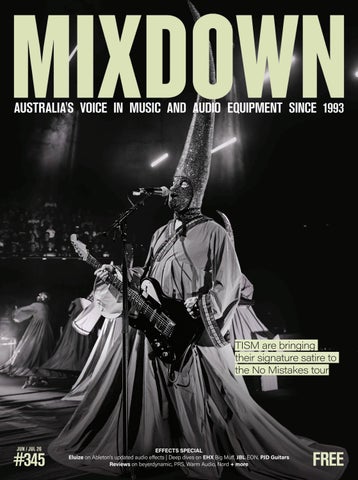
TISM are bringing their signature satire to the No Mistakes tour
JUN / JUL 26
#345
EFFECTS SPECIAL Eluize on Ableton's updated audio effects | Deep dives on EHX Big Muff, JBL EON, PJD Guitars Reviews on beyerdynamic, PRS, Warm Audio, Nord + more
FREE
AMERICAN
NEO-CLASSIC SAN DIMAS® SD1
Learn more about the Charvel American Neo-Classic San Dimas® SD1 collection at charvel.com ©2026 Jackson/Charvel Manufacturing, Inc. All rights reserved.
BARITONE CVT + JET™ L E A R N MORE A T G RETSC HG UITA RS. C O M ©20 2 5 F ender Mu si c a l Ins trum ent s C orp ora t i on. A ll R i gh t s R e ser ve d.
THE FIRST CONTROLLER MADE FOR SERATO STUDIO
DISCOVER
MORE
distributed by
DT 30 IE SOUNDS CLEARER. SO YOU PLAY BETTER.
NEW
CLASS LEADING PERFORMANCE Designed to meet the demands of modern live performances. Powerful 11-mm dynamic drivers deliver a balanced & detailed sound signature, allowing you to perform with clarity and control. A compact ergonomic earpiece weighing just 2.7 grams sits snugly in the ear delivering a secure fit & also a passive noise isolation of up to 39dB. In addition, the Kevlar®-reinforced, detachable cable with a Gold-plated MMCX connector system is built to last. Supplied with a protective case, three pairs of silicone & foam ear tips in sizes (S, M, L), you’re ready for the rehearsal room, club gig, or next big stage show! New DT 30 IE - $199rrp
beyerdynamic.com.au
CONTENTS
#345 JUNE / JULY 2026
Product News
8
Tour News
10
TISM
12
The Damned
14
Bush
16
Ableton x Eluize
18
TASCAM DR-40XP
20
Deluxe Bass Big Muff Pi 2
22
Musicorp
24
Palmer ORBIT 11
26
PJD Guitars
28
Big Muff Pi 2
30
JBL’s EON700 Series
32
Product Reviews
34
The Lemon Twigs
50
Photo by: Blowfly Photography | Cover credit: High Voltage Photography
6
EDITOR'S NOTE
EDITOR Anita Agathangelou PUBLISHING DIRECTOR Patrick Carr DESIGNER Kelly Lim CONTRIBUTORS Darcy Smart, Lewis-Noke Edwards, Sean Conran, Jamie Colic, Rob Gee, Alexander Sims, Tamara Issa, Peter Hodgson, Geoff King, Amelia Szabo, David James Young
W
hen it comes to effects, you can go down the route of using a chorus, reverb or drive that serves the song perfectly. Everything in its right place. Then there's the world of experimentation, where you build an effects chain so incompatible on paper that it somehow creates something unique, weird and wonderful. It's our Effects Special, with deep dives on Electro-Harmonix Big Muff, Nord Electro 7 and Tone City’s Golden Plexi and Double Durple. We chat with Ableton Certified Trainer, musician and DJ, Eluize, on getting the most out of Live’s recently updated built-in effects. Whether you're rearranging your pedalboard, dialling in plugins or
exploring a synth for the first time, the through line is the same – the best sounds usually come from just trying things out. See what happens. Speaking of the weird and wonderful – in this issue, TISM (currently operating under TSIM) mistake us for Mixmaster Magazine, and to their great disappointment, we are unable to help them achieve a perfectly crispy meringue. They also have a lot to say about the font Wingdings, to which I say: "it rules” I hope you all find the perfect meringue recipe and discover effects that make you giddy. Anita Editor
FOR ADVERTISING OR CONTENT PARTNERSHIPS advertise@mixdownmag.com.au DISTRIBUTION distribution@furstmedia.com.au ACCOUNTS accounts@furstmedia.com.au PUBLISHER Furst Media Pty Ltd FOUNDER Rob Furst
MIXDOWNMAG.COM.AU
MIXDOWNMAGAZINE
MIXDOWNMAGAZINE
A New Generation of Dual Op-Amp Muff pedals from the Masters of Fuzz.
Distributed by Vibe Music Distribution PTY LTD I vibemusic.com.au I info@vibemusic.com.au
8
PRODUCT NEWS
PRODUCT
NEWS
fretting hand clear, and it fits six and seven-string electric and acoustic guitars. Available in black or bronze.
Ableton Extensions SDK turns Live Suite into an open playground for custom tools
The Luke LK100 HSS brings five-way versatility to a classic Music Man design
ABLETON.COM/EN
CMCMUSIC.COM.AU
Sterling by Music Man has shipped the Luke LK100 HSS, a new take on the Steve Lukather signature that trades the standard humbucker layout for an HSS configuration with five-way switching. The iconic body shape and V-neck profile carry over from previous iterations, joined here by a roasted maple neck, locking tuners and a vintage tremolo. A 12dB push-pull volume boost on the volume knob adds an extra layer of flexibility for players who want a quick output jump without a separate pedal. Two flamed maple veneer finishes are available: Yucatan Blue and Heritage Cherry Burst.
Ernie Ball's Precision Capo lands in Australia
Ableton has launched a public beta of its Extensions SDK, a free JavaScript toolkit letting developers and producers build custom tools that read and edit Live Suite Sets. Extensions sit outside the main application, accessible via right-click, and can interact with tracks, clips, parameters and automation. Use cases range from automating repetitive tasks to connecting Live to external services. No deep programming knowledge is required. Tools can be freely built and shared under the SDK licence – Ableton's only instruction is to "hack responsibly". Community sharing is via Ableton's Discord. Available now for Live 12 Suite users via Live 12.4.5.
Strymon has launched Series A, a new line of pure analog pedals, with two simultaneous releases: the Fairfax drive and the Canoga fuzz.
CMCMUSIC.COM.AU
Ernie Ball's Precision Capo is now shipping in Australia, bringing thumbscrew tension control to players tired of buzz or tuning drift from standard spring-loaded capos. Rather than snapping on with fixed pressure, the thumbscrew lets you dial in the right tension for your guitar, fret position and string gauge. Soft contoured pads protect the neck and finish, the low-profile body keeps your
mixdownmag.com.au
AMBERTECH.COM.AU
Strymon has launched Series A, a new line of pure analog pedals, with two simultaneous releases: the Fairfax drive and the Canoga fuzz. The Fairfax is the more ambitious of the two. Inspired by the Garnet Herzog tube drive unit built for Randy Bachman in 1965, it recreates a com-
plete tube amp circuit in analog – a miniaturised preamp, Class A power amp and a custom output transformer emulation circuit included. An internal transformer boosts the 9V input to 40V for realamplifier headroom. Drive, Level and a variable Sag circuit cover the controls, with Sag ranging from mild compression to fuzz-style gating and sputtering. A Bright switch handles high-frequency response. The Canoga is built around one of designer Greg Dregni's original custom fuzz circuits from a decade ago, a tweaked silicon FuzzFace-style pedal with Drive and Level controls. Much of its character is tied to your guitar's volume knob. Rolled back, it clears up into blues, rock and Americana territory. When pushed all the way, it's full fuzz.
TASCAM DR-40XP: a 32-bit float recording to a four-channel portable
AMBERTECH.COM.AU
TASCAM has shipped the DR-40XP, a fourchannel portable field recorder that adds 32-bit float recording to the DR-40X formula alongside TASCAM's HDDA mic preamps and a USB-C interface. The 32-bit float format – recording at up to 96kHz – removes the need to set input levels before a take, keeping audio clean and recoverable regardless of what happens during a performance or session. Built-in RF-resistant stereo condenser mics handle up to 125dB SPL and switch between X-Y and A-B configurations, while dual XLR/ TRS combo inputs with +48V phantom power add four-channel flexibility for more complex setups. Battery life is quoted at approximately 18 hours from three AA cells. The DR-40XP also functions as a 2-in/2-out USB-C audio interface, connecting directly to laptops and iPhones.
9
PRS marks 25 years of SE with two new hollowbodies and some very limited amp colourways
Natural, Ebony and Heritage Cherry Sunburst – the latter also in left-handed configuration.
Sabian's Stratus Dry series offers drummers controlled, low-wash cymbals
Akai's most popular compact MIDI controller now comes in a bold red
ELFA.COM.AU
PRS has announced two new SE hollowbodies as part of the SE Series' 25th anniversary year, alongside limited-edition amp colourways for the Sonzera 20 and HDRX range. The SE Ed Sheeran Hollowbody I Piezo Baritone runs on a 27.7" scale with a maple top, mahogany back and PRS 85/15 "S" pickups paired with a PRS/LR Baggs piezo system. The SE Hollowbody I Piezo shares the same pickup and piezo setup on a standard 25" scale, with a flatback construction that keeps the profile slim while retaining the open tone of a hollow body. On the amp side, limited runs of the Sonzera 20 combo, HDRX 20 and HDRX 1×12 cabinet are available in Indigo with Wheat grill cloth and Black Paisley, with worldwide quantities ranging from 75–200 pieces.
Epiphone's Hummingbird introduces its iconic look and sound to a new generation of players
an SSL-designed preamp featuring Legacy 4K analogue enhancement. Channel 1 handles XLR with phantom power; Channel 2 takes instrument or line-level signals. A Mix button blends low-latency monitoring with computer playback, DC-coupled outputs add CV compatibility for modular setups, and three stereo loopback channels cover live streaming. It runs on USB bus power or an external 5V source, and works with Mac, Windows and USB Audio Class 2.0 devices. The SSL Production Pack software bundle is included.
AUSTRALISMUSIC.COM.AU
Sabian's Stratus Dry series is heading to Australia in late August, expanding the Stratus line with hats, crashes and rides built around reduced wash, short sustain and crisp articulation. Sizes run from 14″ to 16″ for hi-hats, 18″ to 20″ for crashes, and 22″ and 24″ for rides. Crashes deliver a fast attack with textured decay rather than extended wash, while rides offer refined stick articulation with hammered bells and enough crash-ability to stay expressive. Hi-hats range from tight and precise at 14″ to a fuller, trash-inflected character at 16″. For players after a cohesive package, the Performance Set combines the 15″ hats, 19″ crash and 22″ ride in one purchase. The Sabian Stratus Dry series is available in Australia from late August.
SSL launches the SSL 1, a compact two-channel USB audio interface
ELFA.COM.AU
Akai Professional has announced a red colourway for the MPK Mini IV, its compact MIDI controller packed with MPC pads, Scale and Chord modes, an enhanced arpeggiator and a bundled software instrument collection. The new colourway changes nothing under the hood – 25 velocity-sensitive keys, eight RGB MPC pads, real pitch and mod wheels, eight assignable knobs and a full-colour screen are all present. Scale and Chord modes, plus an arpeggiator with Pattern, Freeze and Mutate functions, handle performance. Connectivity covers USB-C, 5-pin MIDI output and sustain pedal input, with pre-programmed scripts for most major DAWs. The Studio Instrument Collection, Komplete 15 Select, Ableton Live Lite 12 and Splice and Melodics trials are all included.
AUSTRALISMUSIC.COM.AU
The Epiphone Hummingbird Tribute brings the square-shoulder dreadnought silhouette of the Gibson original to an accessible price point, available in Australia now. The body pairs a select layered spruce top with layered mahogany back and sides, with a glued-in mahogany Rounded C neck, laurel fingerboard and vintage-inspired binding. A tortoiseshell-style pickguard and Kalamazoo-shaped headstock stay true to the original design. Available in Antique
AMBERTECH.COM.AU
The SSL 1 is Solid State Logic's most accessible interface yet – a compact two-channel USB-C unit built for musicians, producers and content creators who want SSL quality on the move. The SSL 1 pairs a 32-bit/192kHz converter with
mixdownmag.com.au
10
TOUR NEWS
TOUR
NEWS
at the Sydney Opera House and Melbourne's PICA, the balaclava-clad, genre-blurring legends have announced nine dates across Adelaide, Darwin, Melbourne, Brisbane, Canberra, Perth and Sydney. The No Mistakes Tour promises a "RADICALLY DIFFERENT" set of fan favourites each night, plus their usual chaos and tomfoolery. If their recent shows are anything to go by, it's not one to sleep on.
Karnivool announce biggest headline tour yet behind their ARIA #1 album In Verses
TOUR DATES ໞ 10 July: Adelaide Beer & BBQ Festival
John Lydon is bringing Public Image Ltd back to Australia after 14 years away
ໞ 22 August: Darwin Festival ໞ 7 October: The Forum, Melbourne ໞ 8 October: The Forum, Melbourne ໞ 17 October: Fortitude Music Hall, Brisbane ໞ 21 October: Canberra Theatre, Canberra ໞ 24 October: Metro City, Perth ໞ 30 October: Enmore Theatre, Sydney ໞ 31 October: Enmore Theatre, Sydney
Death Cab for Cutie is coming back to Australia for the first time in seven years
DESTROYALLLINES.COM
Karnivool are hitting the road this month behind In Verses – their ARIA #1 album that ended a 13-year album drought – for the biggest headline shows of their career. TesseracT make the trip from the UK as special guests, while New York's Car Bomb make their long-overdue Australian debut on the same bill.
TOUR DATES ໞ 18 July: Ice Cream Factory, Perth
THEPHOENIX.AU
ໞ 21 July: AEC Theatre, Adelaide
Public Image Ltd are heading back to Australia and New Zealand in January 2027 as part of their global This Is Not… The Final PiL Tour. The run marks the band's first Australian shows since 2013, and their first New Zealand dates since 1989. The current four-piece lineup – John Lydon, Bruce Smith, Lu Edmonds and Scott Firth – will draw from PiL's four-decade catalogue, with early releases Public Image and Metal Box expected to feature.
ໞ 23 July: Hordern Pavilion, Sydney ໞ 24 July: Margaret Court Arena, Melbourne ໞ 25 July: Riverstage, Brisbane
The Damned's 50th anniversary tour is headed to Australia
TOUR DATES ໞ 22 Jan: The Tivoli, Brisbane ໞ 23 Jan: The Enmore, Sydney ໞ 24 Jan: The Forum, Melbourne ໞ 26 Jan: The Gov, Adelaide ໞ 28 Jan: The Astor, Perth SECRETSOUNDS.COM
TSIM announce first national headline tour in over 30 years – and no, it’s not a spelling mistake
Death Cab for Cutie are returning to Australia this November, their first visit in over seven years. The shows arrive off the back of new album I Built You A Tower, out now, with the setlist expected to pair fresh material with three decades of catalogue. The tour follows the band's move to independent label ANTI- Records at the start of 2026 after two decades on a major.
TOUR DATES ໞ 12 Nov: Hordern Pavilion, Sydney ໞ 13 Nov: Margaret Court Arena, Melbourne ໞ 15 Nov: Fortitude Music Hall, Brisbane
THEPHOENIX.AU
Fifty years in, The Damned are making their Final Damnation farewell tour and bringing it to Australia and New Zealand in September 2026. The band, who released the UK's first punk single and first punk album, are fresh off a sold-out Wembley Arena show, with a 25-song set drawing from across their catalogue, including New Rose, Neat Neat Neat and Eloise. Dave Vanian, Captain Sensible and Rat Scabies all return for the run.
TOUR DATES ໞ 10 Sep: Sydney Opera House, Sydney DAVIDROYWILLIAMS.COM
TSIM (yes, TSIM) are doing their first national headline tour in 30 years. Following acclaimed shows
mixdownmag.com.au
ໞ 11 Sep: The Tivoli, Brisbane ໞ 13 Sep: The Forum, Melbourne
12
COVER FEATURE
“Thank you for the Wingdings”: TISM talk baking, Opera House fallout and the No Mistakes Tour (sort of ) WORDS BY DARCY SMART
“Darcy, in continuing this interview, are you beginning to sense, deep in your bones, that you're going to get nothing out of it?”
A
nyone with even a passing understanding of TISM (now operating under the slightly modified moniker TSIM) knows that attempting to wrangle a solitary straight answer out of traditional band spokesmen, Humphrey B. Flaubert and Ron, is simply a fool’s errand. And for this green journalist, today’s interview was no exception. TISM joins the call, under the impression they’re speaking with someone from Mixmaster Magazine. Humphrey laments, “We had a whole load of information we wanted to discuss about how to get the peaks of your meringue mix just right.” Ron attempts to confer with me regarding the best setting for a Mixmaster to get your meringue to have a crusty outer and a fluffy interior. As much as I want to join in on all this cookery chat, I have to show my hand – I know nothing about baking. TISM threatens to end the interview, but instead immediately turns to discussing the sensuality of the phrase “firm meringue”. I posit that the phrase does possess a “certain implication”. The call drops out. I’m left wondering if this was a deliberate move. By what I suspect was an act of divine intervention, I manage to re-establish contact with Humphrey and Ron. Humphrey asks if this publication is more comparable to Kerrang! Magazine. We’re certainly closer than where we were with Mixmaster, but he still seems a little perturbed when I inform him our magazine focuses on music gear, instruments and production. “We certainly don't produce music. I don't know who steered you in that direction. But good luck. I think that your career is on an upward trajectory.” We again travel through an extremely lengthy bypass, this time regarding the virtues of my name. Humphrey says it's a “beautiful stage name” and
mixdownmag.com.au
suggests that with such a strong and implicative surname, I would be a suitable candidate for the Liberal Party (no thanks). We’re nearly halfway through the time allotted for the interview when TISM finally throws me a bone and allows me a privilege rarely afforded to those who are granted an interview with them – to actually ask a question. It’s been nearly four years since TISM rereunited (they first split after a single show in 1983, before disappearing again in 2004), once again coiling their dastardly talons around the ass-end of the Australian music industry. I’m wondering what their motivation is to continue past their Good Things Festival re-reunion dates in 2022, through to announcing the No Mistakes tour. Ron is curt in his reply: “Private school fees. See, our youngest is still in year 10. So, three more years and it's over.” I note that on the No Mistakes tour, TISM plans to play “radically different” sets each show. I want to know what fans might expect and whether it’s going to be difficult learning and performing a lot of long-dormant material from their back catalogue. Ron is completely unfazed by this notion. “We’ve got it. One set is in Times New Roman, set two is in Curvature, and the third is in Arial. Set four is in Wingdings. So we'll have radically different sets. Some sets will be bold, some sets will be italicised. Some set lists will be laminated. So our set lists are going to be completely different for every show.” Picking up on Ron’s savant-level knowledge of font sets, I ask which version of Wingdings he’ll want to use for set four. This pleases the masked frontman. “This is why you're called Darcy Smart! That is just a marvellous question. I mean, over all the years, that's nearly the best. You've caught us on the hop. I know that we've ripped an Australian icon apart, damaged the chairs unapologetically, our new Right-Wing, Pro Pauline Hanson, Totally Support Immigration Mitigation name – all those things are shameful, but not thinking about which exact font set of Wingdings we're going to use for a setlist. Darcy, you should join The Age and the investigative journalist unit. This is Four Corners stuff.” I’m flattered, but internally, I’m desperate to try and get more legitimate questions answered.
Instead, we go down another, mostly Wingdingsrelated interlude that carries on for several minutes. Humphrey expresses his desire for the Liberal Party to focus on key issues like “How many versions of Wingdings are there?”. Ron wants to see the Wingdings question added to the Australian Values Test. They then propound that I could, in fact, be the leader of a new Centrist political party, using the font as part of our marketing strategy. “Darcy Smart: Leader of the Wingdings”, Humphrey suggests. I think it has a nice ring to it. TISM’s performances exist in the exact centre of the universe between chaos and creation. Recently, in May, the group presented ‘Wankers of the World Unite! at PICA in Melbourne. The show culminated
13
Photos by High Voltage Photography
in three separate TISMs playing three different songs across three different stages, a panic-attackinducing experience that can only be described as an elaborate form of auditory terrorism. With this in mind, I finally get another chance to ask a question that’s even remotely relevant to what the band is here to promote. In response to my query about whether the shows on the No Mistakes tour will attempt to rival the high calibre of production we’ve seen them mount in Sydney and Melbourne already this year, Humphrey declares that the next stage show will involve copious amounts of curaçao (a liqueur derived from a Caribbean variety of orange). Providing an extraneous level of detail, Hum-
phrey says, “We're going to fill the stage with curaçao. Cascading floods of curaçao will come from the stage into the audience, much like a floating cloud of dry ice that sort of floats across the stage at about shin height. The audience will have had so much curaçao that their skin will turn a strange colour of grey, much like the characters in Bizarro World.” We continue down the booze chat path for a short while longer. For some reason, Ron seems to think I have a vested knowledge of Brandivino from my teenage years (which he says was “yesterday”). I get a rise out of the guys when I say the only thing I know about Brandivino is that Jimmy Barnes mentions it in Cold Chisel’s classic, ‘Breakfast at Sweethearts’. Humphrey talks about what a great word that is to use in a pop song, emphatically singing “Brandi-vinooo” a few times before they decide that Jimmy et al should have gone with curaçao instead. Ron talks about the image the song paints of Sydney, exclaiming that it was calling out for a curaçao reference. For the first and only time during the entire interview, it looks like I have TISM exactly where I want them. This was my in to asking about the state of ruin the iconic Sydney Opera House was subject to in the wake of TISM’s two-night stand there in April, performing ‘Machiavelli and The Four Seasons’ in full. The band received a damage claim from SOH to the tune of $18,488.88. I scurrilously suggest that this may be the reason why the band are suddenly going under their new moniker, TSIM, in a convoluted attempt to avoid seedy debt collectors. Humphrey takes this line of enquiry very seriously and states matter-of-factly, “There are obviously a lot of shady connections with that band that you refer to, which isn't TSIM – their connection with the Rocksman Promotions Company, which was purportedly bringing Candace Owens out here for a tour. Also, the links between that aforementioned group and the recent bombings of a nightclub connected to an escaped underworld figure. But I think REDACTED, the CEO of the REDACTED, knows the real answer to who's been doing those bombings. But I can't say anymore because our owner, Abdul Hamad, has requested that we keep this matter with the lawyers.” Ron supplements, “We can't be clearer than that. TSIM – Totally Support Immigration Mitigation – has nothing at all to do with the disgraceful actions of… I don't even know the name of that other band. Nothing to do with them. We deny any liability; we deny any connection. And we would
also like to say that Donald Runnicles (who conducted Mahler’s Sixth Symphony at SOH between the two TISM shows) is well known for REDACTED in REDACTED.” At this stage, I risk letting my figurative balaclava slip. The reality is I’m slightly more than a casual fan of the group and ask a question that could be a giveaway: “Have there been any recent additions to The List of People Who TISM Think Are F****d in the Head?”, referencing the infamous diatribe found in their song, ‘The Mystery of the Artist Explained’. Ron pauses for thought. “Well, not you, Darcy – you’re marvellous. Thank you for the Wingdings. We'll research that. Thank you for the curaçao and meringue recipe. That's a marvellous effort. Best of luck in your new career in the Liberal Party. You and Alex Antic will be marvellous leaders for our country. And just remember that we Totally Support Immigration Mitigation on our new pro-Pauline Hanson, proBarnarby Joyce tour that is kicking off in Orange. All other shows have been cancelled. We're playing eight nights in Orange.” After being decimated for 20 minutes with non-sequiturs and obscure references, my now weathered soul could not take any more. I went for a simple out, asking if they had any parting words for the readers of Mixdown. Ron wishes us luck with a hitherto unmentioned soufflé, but it's Humphrey who gets the final word. “Wingdings!” Despite Ron’s claim that all shows have been cancelled in place of an eight-night stand in Orange, you’ll actually find them playing here:
TOUR DATES ໞ 10 July: Adelaide Beer & BBQ Festival ໞ 22 August: Darwin Festival ໞ 7 October: The Forum, Melbourne ໞ 8 October: The Forum, Melbourne ໞ 17 October: Fortitude Music Hall, Brisbane ໞ 21 October: Canberra Theatre, Canberra ໞ 24 October: Metro City, Perth ໞ 30 October: Enmore Theatre, Sydney ໞ 31 October: Enmore Theatre, Sydney
mixdownmag.com.au
14
INTERVIEW
THEPHOENIX.AU
“Punk is beyond definition”: The Damned bring 50 years of conviction to Australia
WORDS BY JACOB MCCORMACK
The Damned are the type of band that doesn't need a formal introduction. Their discography, influence and longevity speak for themselves. And now, 50 years on from the release of their first track, they still carry the passion for music that had them pioneering punk in the UK in 1976. It was that very emergence into the sweltering punk scene of the 1970s in Britain that brought forth the sound that has effortlessly cemented its relevance and impact in the history of music. But much like all genres and many bands, there is nuance and evolution that occur over the tenure of any given career. The Damned are no exception as they prepare to make their way to Australia as part of a broader world tour. With shows at Sydney Opera House on September 10, Tivoli in Brisbane on the 11th, and The Forum in Melbourne on September 13, the band will have the opportunity to play the best of all their hits, namely in venues such as the Opera House that wouldn’t otherwise showcase the sounds of punk. And yet that’s perhaps the most punk thing a band can do. For Rat Scabies, founding drummer of the band who rejoined in 2023 after nearly three decades away, the expression of punk came about through conviction over authenticity, and a means to push for individual and public freedoms. “There was a lot wrong with the world in the
mixdownmag.com.au
1970s,” explains Rat. “I’m not comparing it to now, but we had a lot of strikes, a lot of power cuts, a lot of poverty, and life wasn’t that great in England at the time. “So, punk really was a backlash to that. It was the next generation looking at the previous one and saying, ‘You know what, that doesn’t work’. That’s not what I want to be a part of. I don’t want to be in some shit job in a factory for 30 years. “There was a definite freedom that came from punk, freedom of the way you thought about things, politically and in every other respect.” And it was the empowerment that came through the experience of speaking out, specifically through the means of art, and maybe more importantly, music, that spoke to Scabies. “I think there’s one thing that punk taught everyone, and that is in times of crisis you should stick together,” he says. “You’re much stronger as a group than you are individually. And I think that applies quite a lot today. “I think that when you’re in times of crisis, war, strife, the best key for survival is that everybody gets on the same page and makes sure they’re protected by the others. It’s about promoting strengths and covering weaknesses, and that’s what you do as a group.” That conviction – one that has seen the band’s sound ebb and flow while holding together their core approach – is one of the reasons The Damned are still playing live music today. “Punk isn’t something you can turn on and off,” Rat says. “You need to hold firm in your attitude. If
people like that, then they come and see you play. But I’ve never really been one for trying to uphold some objective idea of what punk is. I think it’s beyond definition.” And so, The Damned are excited to be once again coming out to Australia, a destination that has provided them with a sense of achieving their wildest dreams and engaging with a unique culture. “We were once little urban punks, and Australia was always so far away,” he states. “The thought of ever even being able to go there once was beyond our wildest dreams. To actually be able to come over and be well received, in a way that’s meant we can come back, is just great. “Australia is always a laugh. There’s something about it that’s always fun. It’s lively, and people are running around, noisy and brash, and people aren’t afraid to have a good time. They’re also not afraid to tell you what they think, because of that, we’re going to have to be playing our best game, but that’s a fun task to have at hand.” Expect a high-octane performance from the punk rockers – fifty years in, The Damned are coming to Australia to put on a show.
TOUR DATES ໞ 10 September: Sydney Opera House, Sydney ໞ 11 September: The Tivoli, Brisbane ໞ 13 September: The Forum, Melbourne
16
INTERVIEW
DESTROYALLLINES.COM
A band well-lived: Gavin Rossdale on Bush, legacy and coming back to Australia
WORDS BY DAVID JAMES YOUNG
“My choice to go with Bush was wildly uncommercial." Gavin Rossdale – the lead vocalist, rhythm guitarist and founding member of the aforementioned band – is speaking candidly with Mixdown about their formation and origins. Such a turn of phrase might raise an eyebrow, considering the multiple platinum records on Rossdale's wall. To him, however, the band's alt-rock leanings completely went against the wave of Cool Britannia that was developing as the band came to prominence in the early-to-mid ‘90s. "If you really wanted to be successful at that time, you had to make Britpop," he reasons. "Suede, Blur, Oasis, even Primal Scream. The whole nation was in love with it. I loved bands like Fugazi, the Smashing Pumpkins, Soundgarden, Alice in Chains... and England didn't even have those kinds of bands." Despite not keeping with the trends, Bush almost instantly found global success, established with 1994's Sixteen Stone and continued on 1996's follow-up Razorblade Suitcase. With the latter’s 30th anniversary on the horizon, Rossdale takes a moment to reflect on what the album meant to him – particularly its creation with beloved American engineer and musician Steve Albini. "Having lost Steve a couple of years ago, that record is always going to remind me incredibly of him," he says. "He remained a really good friend right up until his passing, and I'm still deeply friendly with his wife, Heather. There are other things, of
mixdownmag.com.au
course; recording at Abbey Road was extraordinary, as well as in Hook End, where Trevor Horn's studio was. I remember the sounds of birdsong getting me up in the morning, taking my dog for a walk, getting a fry-up for breakfast and then going to work with Steve in the studio. It was just an idyllic time." Fast forward three decades, and Bush are still very much holding their own. Having released their 10th album, I Beat Loneliness, last July, their shows have evolved into intergenerational affairs – and it's not just the kids of teenagers who grew up on them, either. The advent of the streaming age has allowed the band a chance to connect with an audience that was not even born when Sixteen Stone or Razorblade Suitcase came out – and Rossdale is all for the co-mingling. "There are young people really connecting with the new material, discovering there's a bit of a catalogue, alongside the OG Bush fans who know the first four records and don't know the new material as well," he says with a grin. "I write the setlists in a way that, even if you don't know one song, there'll be one next that you definitely do. I hedge my bets a little bit and have these very wide, expansive setlists across the years, and it's been fantastic. I
love the mixture – to me, that is the sign of a band well-lived." Given there's a wall dedicated to them behind Rossdale, I can't help but inquire about Rossdale's penchant for guitars. He's closely associated with Fender Stratocasters, having played the Eric Clapton signature and the HSS Deluxe, as well as a Custom Shop that he co-designed. There's more to his collection, of course: "I'm happy with a Strat, but I do use a lot of PRS guitars and have a couple of [Gibson] SGs that I've tuned down," he says. "I have a Jim Root signature Jazzmaster, too. My old Diesel amp that I toured the whole ‘90s with is set up at my house downstairs, along with a [Roland] JC-120 and a Fender [68] Princeton [Reverb]. I have three kids, and they all live with me, and they'll all go and play guitar while I'm cooking." For all of the extensive touring and live shows Bush have played since the release of I Beat Loneliness, one immediately comes to mind as the most high-profile. In April, the band appeared on NPR's Tiny Desk Concert for the first time, which, over two months later, Rossdale can't stop thinking about. "For me, it's the most interesting thing musicians can do," he says. "It's the coolest show. It's evolved as this kind of litmus test for quality, and just being able to hack it. I was a bit upset going in, because we did a couple of shows leading up to it, and by the time I got to sing that morning, my throat wasn't feeling good. I started a bit scared, but then I think it warmed into it, and my voice got better. In 'Glycerine', I achieved silence; just a pure a cappella. I was thinking my voice had warmed up, but there's always the little devil voice saying you're going to fuck up. It was really nice to have that on record." In September, Rossdale and co. will return to Australia for a tour with American rockers Shinedown. Rossdale is excited for the band to return – not least of all because their previous visit was as essentially guinea pigs, being one of the first international bands to tour post-lockdown on the troubled Under the Southern Stars mini-festival with Cheap Trick, Stone Temple Pilots and Black Rebel Motorcycle Club. "You can't see any documentaries where people are wearing masks now," says Rossdale. "It was just so horrific at the time. You don't even want to remember all that shit. It's not easy to get to Australia at the best of times. We're thrilled to be coming back, though; you have to jump through a lot of hoops, but apparently we've cleared them, and we're on our way."
BUSH X SHINEDOWN CO-HEADLINE TOUR DATES ໞ 17 September: Spark Arena, Auckland ໞ 20 September: Riverstage, Brisbane ໞ 23 September: Hordern Pavilion, Sydney ໞ 25 September: John Cain Arena, Melbourne ໞ 27 September: Entertainment Centre Theatre, Adelaide ໞ 29 September: Perth HPC, Perth
This just in.
Origin Series
pjdguitars.com.au
18
INTERVIEW
Ableton's audio effects keep getting better: Eluize breaks it down WORDS BY ANITA AGATHANGELOU
Kevin Parker ran the bassline from The Less I Know the Better through stock Ableton Overdrive, serving as a great reminder that what's already sitting in your DAW can go a long way. With a slew of Ableton's built-in effects recently updated (Auto Filter, Chorus-Ensemble, Erosion, Phaser-Flanger and Saturator among them), we asked DJ, producer, musician and Ableton Certified Trainer Eluize what's changed, what's underrated, and what she reaches for.
mixdownmag.com.au
The newly revamped Auto Filter brings in some unusual filter types, including Vowel, DJ and Comb. When would you suggest choosing more unusual, colourful filter types over a standard filter cut? Vowel brings vocal formant style tones to sounds. Some places to start experimenting could be using it to add vocoder energy to an instrument, for manipulating sounds to layer with recorded voices, or even reshaping the formants in a vocal take. Check out the envelope control while you're tweaking your settings. This applies envelope modulation to the filter, so the filter frequency moves with the amplitude of the incoming signal. With DJ, I instantly think of live performance or live recorded jam opportunities for drops or breaks, across groups or the main output channel, because of the intuitive way it works as both a high or low pass filter as you twist it. If you've got a history with DJ mixers, this one will make sense to you right away. My muscle memory wants to immediately put it with a delay or other timed effect for disco DJ style delay fades between tracks.
19
ABLETON.COM/EN
“Utility is a real treasure, a problem solver and a workhorse.” Comb has qualities akin to a phaser; if the frequency is modulated with the built-in LFO, you get instant movement in your sound. You can take this even further with Auto Filter's option to offset the phase of two LFOs in the left and right channels, combining this with an automating frequency creates lovely stereo width and an ever changing sound.
It's easy to overdo Phaser/ Flanger. How do you use it, and what's changed in the updated version? I'd suggest considering the amount and feedback — maybe a light touch is all you need to add that movement and sparkle. Take care selecting a centre frequency that feels right with the music, deciding how many notches and what rate of movement works. You might choose to make the LFO control the Phaser/Flanger's pace lock in time with the track's bpm, or use the built-in envelope follower to get the movement to follow the amplitude of the audio it's affecting. This can be great to enhance the groove or shape the sound without adding complication or mud. The envelope follower can be found with other new, finer control options when you unfold the device. These include 10 different wave shapes and a phase adjuster for the main LFO, as well as a second LFO and a Safe Bass high-pass filter. Always take care with high feedback settings. Depending on your other parameters, these devices can get loud quickly!
What does the added delay time control change for Chorus-Ensemble, especially for bass and guitar? The new delay time control parameters are Time and Taps. You can use the Time chooser to select a fixed delay time for the delay lines in the chorus. This can be useful for bass and guitar sounds, if you'd like to set longer delay times. I also appreciate the extended control for sound design and experimentation. The Auto setting preserves the original behaviour, where the delay time is scaled dynamically per tap and with the modulation amount. If you're looking for a familiar, classic hardware pedal effect, the single tap delay results in these simpler, thicker chorus textures.
smoothly, modulate or switch between, opens up so many wild opportunities for both live and studio settings, for sound design, and for honing your own artistic voice when it comes to effects. Very cool.
Do you think there's a bit of stigma around using stock plugins? Erosion is one of Live's more niche effects. What does the new sine/noise blend unlock that wasn't possible before? The new blend feature allows you to continuously mix between pure sine modulation and pure noise modulation rather than having to select one or the other. This opens up deeper control options for sound design. One of the highlight perks of this new blendability is that you can map the control to a modulator like LFO or Envelope Follower, to easily add dynamic movement, interest and shape to the effect across the track or amplitude of the incoming sound. It can be a tasteful way to add a touch of noise, fuzz or texture to simple basses or sub-bass without making them overly harsh.
Saturator got a Bass Shaper curve in 12.1. How much does that change the way you'd use it on low-end material like 808s and sub basses compared to before? The new Bass Shaper curve gives a smoother harmonic spectrum when driving the low signals in at high input gain. This curve, along with the threshold control that allows you to sweep through different forms of clipping and saturation smoothly, means you can tune in precisely the right kind of colour to help bass sounds like 808s cut through, without them getting too mucky or messy in the low end. For even more tweakability, you can expand the view on the Saturator and adjust the colour controls. The filter shape here adjusts what frequencies of the original signal are sent through the effect, so you can cut or boost areas you'd like more effected.
What's a stock Ableton effect you think is underrated? I think this is so dependent on the genre! Utility is a real treasure, a problem solver and a workhorse. The ability to do checks of your mix in mono, mono the bass frequencies, phase flip sides, and adjust and automate gain without interfering with the track's set level are all super useful adjustments, right at your fingertips, that you don't know you need til you need them. I'm recently obsessed with creative applications for the gate, another classic effect, with "practical" applications. By adding it to a track with non-beatsynced textures or an ambient recording, and using the built-in sidechain to trigger the gate to open with a percussive or instrumental sound, you can add ever-changing character to individual hits across a track. So fun. Auto Shift is a game-changer, too! As it's quite new, I think many producers might not have gone too deeply into the control and power of this thing, but it's incredible. Finally, utilising effect racks, putting together chains of stock effects that you can then blend
I'm not sure there's stigma, but I guess it depends on your circles, your experience and the people and places you've learned from. There'll always be debates around one thing or another. Vinyl/digital DJing, for example, is another one of these ongoing conversations. I think the most important thing is that you're comfortable with the tool, that it does what you're hoping to do, and that it helps you move into flow state with your production rather than feeling hard or clunky. I find it helpful to try to get as close as I can with stock effects, their settings and combinations, before getting lost looking for the "perfect" tool. This often leads to happy accidents, outcomes I could never have imagined, or discoveries of different ways to create effects — all things I'm very enthusiastic about.
Are there any stock Ableton effects you'd combine in a chain that people might not think to pair together? I'm always experimenting and a little bit chaotic with my chains. Regular combos are classic ones for treating vocals or safety and analysis chains on my main output. Lately, something I've enjoyed exploring is having multiple chains of effects to run a vocal through in an effects rack, then using a macro knob to either switch between effect chains (great for live sets) or blend a mix of multiple effects chains at different ratios. The blend option is particularly useful for creating lush, wide, evolving pads from single vocal notes. On the chains I intend to blend between, I might have an instance of Auto Shift on each, manipulating the formant, adding various harmonies, or following melodies or harmonies from the track via the inbuilt midi in. This gives me a wide range of experimentation opportunities with just one vocal take or input.
Has anything about the 12 update cycle changed how you teach effects to students? It's certainly given me lots of new tools to show them! The two big ones for me have been the realtime spectrum visualisation in Auto Filter, which makes it more beginner-friendly to understand, because we can use the visual cues to hear what it's doing, and Auto Shift is a game-changer for producers working with vocals. Prior to this, I used Max for Live effects or third-party for autotune, so having something this intuitive and deeply tweakable built into Live is huge!
mixdownmag.com.au
20
IN FOCUS
AMBERTECH.COM.AU
T A S C A M D R - 4 0 X P
WORDS BY SEAN CONRAN
There is a singular, universal kind of frustration that haunts every musician, field recordist, or producer: the moment you play back what you were certain was a career-defining take, only to find it clipped, distorted, or buried in noise. You set the gain, you thought you nailed it, but the performance is punished for straying beyond your predefined Goldilocks zone of expression. Lucky for us, TASCAM's DR-40XP is engineered to forgive where permission is often denied. The DR-40XP is the successor to the wellregarded DR-40X, loaded with the antidote for gain staging headaches: 32-bit float recording. It's not a buzzword, but maybe it should be. It's such a fundamental solution to many of the issues shared by musicians, videographers and field recordists.
32-bit float and why it matters To understand what a 32-bit float actually delivers, you need to understand what it eliminates. In traditional recording, if your input level is set too low, you get noise; too high, and you get clipping. While some can tolerate, or even celebrate the presence of either, clipped audio is unsalvageable in most professional cases. Thus, every recording session involves a careful negotiation between headroom and noise floor. 32-bit float removes that negotiation altogether. Just as an HDR camera captures the full
mixdownmag.com.au
dynamic range of a bright sky and deep shadow simultaneously without committing to an exposure, 32-bit float encodes audio so far above and below what any microphone or speaker can physically reproduce that clipping and noise floor cease to be practical concerns. Just hit record. The DR-40XP's builtin condenser capsules handle up to 125 dB SPL, meaning everything from the quietest pin drop to a jet engine passes through without distortion. The 32-bit float data holds enough information for post-production recovery, making it worry-free recording in the truest sense. There are a few portable competitors featuring this high-resolution capture, but TASCAM has thought considerably about what to build around it.
Format, features, microphones The heart of the device is TASCAM's proprietary HDDA (High Definition Discrete Architecture) microphone preamplifier, delivering an equivalent input noise (EIN) of –126 dBu. A preamp this clean and sensitive settles the difference between capturing sound and capturing nuance. Think overtones in an acoustic guitar's body, the breath before a vocal phrase, or the subtle character of a rehearsal space. The format flexibility is equally broad. At 96kHz, every second of recorded audio contains a world of detail to embrace or remove, letting you identify, isolate and manipulate even the most short-lived sounds – essentially non-negotiable for foley and sound design work. Beyond 32-bit float, the DR-40XP records 24-bit and 16-bit WAV at up to 96kHz, as well as MP3 for extended sessions where storage matters. Media support extends to 512GB via microSDXC, and with battery life quoted at approximately 18 hours from three AA alkaline cells in two-channel mode, the DR-40XP is a capable workhorse for all-day documentary shoots, field research or festivals. The built-in stereo condenser microphones are adjustable between X-Y and A-B configurations, letting you tighten or widen the stereo image depending on the application. Need a coherent pic-
ture of a single source like dialogue or an interview? Covered. Planning to record a live gig with binaural ambient crowd immersion? Also covered. The capsules are RF-resistant, a genuinely helpful upgrade from the DR-40X at a time when smartphones are present at virtually every recording session. MS microphone recording is also supported, giving field recordists additional flexibility in how they capture and manipulate the stereo image in post. If you need more than a stereo image, the DR-40XP provides a pair of XLR/TRS combo inputs with +48V phantom power, supporting external condenser microphones up to a line-level input of +24 dBu. This gives the unit true four-channel recording capability, with the built-in pair and two external inputs running simultaneously, opening up possibilities for more complex documentary, broadcast or live music scenarios. Recording a band rehearsal with room mics and a direct feed from the desk, or tracking an interview with a dedicated shotgun mic alongside ambient room capture, becomes straightforward.
Handy functions The DR-40XP functions as a 2-in/2-out USB-C audio interface, connecting directly to laptops and iPhones for composing directly into a DAW or importing audio live alongside video playback. The move from Micro-B to USB-C brings it in line with current connectivity standards. Additional features round out a thoughtfully considered package: an auto tone for DSLR audiovideo sync, four-stage low-cut filtering (40, 80, 120 and 220 Hz), a pre-record buffer, auto-record triggering, overdub functionality, a built-in reverb for tracking with feel, and a chromatic tuner. A built-in limiter and peak reduction give an additional layer of protection for unpredictable recording environments, while an input delay function of up to 150ms is useful for broadcast and video workflows requiring precise audio-video alignment. Variable speed playback, adjustable from 0.5x to 2.0x without pitch shift, also makes it a solid transcription tool. Overall, the TASCAM DR-40XP is built to cover everything a working musician or creator needs in a portable recorder, organised around the single most compelling advance in portable audio technology of the past decade. You get 32-bit float recording, TASCAM's exceptionally clean HDDA preamps, four-channel capability and generous battery life, all packed beneath a familiar interface and a proven, rugged design. If you've ever lost a take to a clipping transient or a poorly judged gain setting, the DR-40XP is a reliable recorder built to make sure it doesn't happen again.
22
IN FOCUS
VIBEMUSIC.COM.AU
Deluxe Big Muff
Bass Pi 2
WORDS BY PETER HODGSON
It seems like one of the hardest things to get right is a really solid, musical, useful distorted bass tone that maintains clarity and punch while also giving you all that gloriously gritty, girthy grind.
Bass players discovered pretty early on that the Electro-Harmonix Big Muff fuzz sounded great with basses but as musical styles evolved it wasn't quite hitting it. Mixes became tighter, playing techniques became more refined and detail-oriented and players just needed more. More control, more nuance, more interactivity, just more. Thankfully EHX has never rested on its laurels. This is a company who makes complex loopers, sample-andhold pedals, intelligent harmonizers and all sorts of other weird and wild digital creations while still making great use of the glories of analog. The Deluxe Bass Big Muff Pi 2 is a whole toolbox stuffed to overflow with features designed to give you the ultimate control over your dirty bass sound. The Deluxe Bass Big Muff Pi 2 kicks off with the once lost dual op-amp Big Muff 2 design that was recently unearthed and unleashed on the market. The basic version of this
mixdownmag.com.au
pedal features Volume, Tone, Sustain and Blend controls along with a bass boost switch, and it's easy to dial in a great tone. It's fantastic if you need something basic with a fair amount of tone-sculpting. But the Deluxe version goes all-out. The first thing you'll want to do is set the Input switch to the appropriate setting (0dB is best for passive basses, -10dB for active or hotter pickups). On the output end you have the option of a regular 1/4" output, a low impedance XLR DI output of the effected signal and an additional buffered 1/4" output just for the direct, uneffected signal. This is great if you're working with multiple signal chains because you can send a clean sound to one amp and a filthy one to another. Like the regular Bass Big Muff Pi 2, the Deluxe has those Sustain, Tone, Blend (which controls the ratio of the wet/dry mix) and Volume knobs, but we also get a few other very useful additions. The first is the Gate knob which gives you the ability to tame the hazy fuzzy growly artefacts that you'll find creeping into your signal at higher Sustain levels. It can be used as a simple noise-scrubbing tool or cranked up high to give you more of a choppy staccato effect. The most exciting addition to the Deluxe, however, is the Crossover section. This gives you dedicated High Pass Filter and Low Pass Filter controls to really focus your bass sound. The HPF applies to the wet signal feeding the fuzz circuit, while
the LPF acts on the dry signal only – together you can use these to strategically carve out a place for your bass in a crowded mix. For instance, if the lowest low-end frequencies are clashing with the kick drum, you can effectively lift up your fuzz sound so that part of the band mix is no longer crowded. If your high end is getting smeared by cymbals or a particularly fizzy guitar tone you can drop its highest levels down while still maintaining the overall character you dialled in with the Tone knob. The Deluxe has two footswitches: Effect and Crossover. This really opens up the potential of the pedal for using the Crossover as an effect in its own right. You can even use it as a very dramatic 'telephone' effect by zapping out all of the low end and keeping just the highs for a feature moment in a song and then returning to your full 'set for kill' sound. And it's here in the footswitch section that the Deluxe really distinguishes itself as not just a 'tone generator' pedal but as a performance one. The two footswitches are actually soft-touch units that operate as latching 'on/ off' switches at a tap, or become automatically momentary if you step on them for a little longer. This means you can dip into or out of effect mode in the heat of the moment, and it feels much more intuitive and connected than the regular 'step to turn on, step to turn off' option. It turns this from a pedal that you play through to a pedal that you play with.
German manufacturing and engineering at its finest! Serving musicians all around the globe! lehle.com Specialising in the supply of some of the world’s finest instruments and equipment to the Australian market
EGM.NET.AU | PH (03) 9817 7222 | INFO@EGM.NET.AU | 294 Darebin Road, Fairfield VIC 3078
-
24
IN FOCUS
MUSICORP.COM.AU
Musicorp lets you
rent the gear you've been eyeing – and buy it if you love it
WORDS BY MIXDOWN
For students, hobbyists, aspiring producers and working musicians alike, the gear list never really ends. There's always a new synth worth trying, a mic that'll change everything, or a guitar that's been sitting in your head rent-free for months. But quality gear costs serious money, and committing to a purchase before you really know if something fits is a gamble most people can't afford to take. Musicorp Australia has been helping Australians access quality musical instruments and equipment for over 30 years. Co-founded by a professional musician, it was built around transparency of pricing, flexibility of plans, and the understanding that a musician's needs tend to evolve and change. Whether you're a producer, a gigging musician, a student just starting out or a school looking to equip a classroom, Musicorp offers access to quality equipment without the upfront hit.
Try before you buy You've read the spec sheets, watched the videos and read the reviews, but even still, it can be hard to make the jump on a piece of gear. What better way to really know what you need than to try it out in your usual setup? Musicorp keeps things straightforward with low monthly payments, a one-off administration fee on approval and zero ongoing account keeping fees. Want to road-test a Roland synth for a few months before deciding if it earns a permanent spot in your rack? You’re sorted. Need a specific piece
mixdownmag.com.au
of kit for a short-term project without blowing your budget on an outright purchase? Musicorp has you covered. The range spans everything from instruments and DJ systems to amps and audio gear, with brands including Roland, Yamaha, Fender, Gibson, Ibanez, Pioneer and more.
Brand new or preloved – your call One of the smarter aspects of Musicorp is the choice between new and professionally maintained preloved gear. For players looking to stretch their budget further, a preloved rental is a cost-effective way to access quality equipment at a lower monthly rate. It's also a practical way to upgrade your existing setup or get your hands on gear you might not otherwise justify buying outright.
Protect your gear, protect your session For musicians and producers, lost or damaged gear mid-project means lost time and lost work. Musicorp offers an optional protection plan on most rentals, covering fire, theft and accidental damage for a little extra on top of your monthly payment. At home, in a rehearsal space, at school or out on the road, it keeps things covered.
If it's for you, make it yours If a rental piece earns its place in your setup, applying to purchase it is straightforward, with no penalties for buying early. Priorities and needs change. If that's the case, you can return the gear after the minimum rental
period, swap it out for something else or just keep renting. Musicorp is designed to flex around how you actually work, not the other way around.
Access to 170+ music retailers through Studio 19 Through its partner brand Studio 19, Musicorp connects customers to brand new gear from over 170 music retailers across Australia – available both in-store and online through participating retailer websites. Schools and institutions looking to equip students with quality instruments will find this particularly useful, with flexible rental options covering the latest instruments, pro audio and music technology. You can use the Studio 19 Store Finder to find your nearest participating retailer.
26
IN FOCUS
P a l m e r ORBIT 11 WORDS BY MIXDOWN
Mixing with speakers you don't fully trust is a risky game. You'll bounce a track that sounds perfectly balanced, but find when you play it back elsewhere, the bass is too muddy and the vocals are too quiet.
mixdownmag.com.au
LINKAUDIO.COM.AU
Good studio monitors don't make everything sound great, but honest. When you're mixing, mastering or producing, a great pair of studio monitors will inform every decision you make and give you the confidence to trust what you're hearing. Palmer has been making gear for working musicians and studio professionals for decades, and the ORBIT 11 is the company's most considered monitor yet. A three-way active design built in Germany, it's made for engineers, producers and musicians who need their speakers to cut through the flattery and show them the truth of the mix. Palmer sits under the Adam Hall Group – the German company behind LD Systems, Gravity Stands and Cameo Lighting – so the pedigree is solid. Most studio monitors have the tweeter sitting above or beside the mid driver, which means sound from two sources arrives at your ears at two slightly different times. Stereo imaging shifts depending on where you're sitting, and what you hear starts to drift from what's actually in the mix. The ORBIT 11 solves this by mounting the 6.5" mid driver and 1" tweeter on the same central point, so everything leaves from the same place at the same time. With 120 degrees of dispersion in every direction, the stereo field holds whether you're at the desk, on the couch or across the room. 8" woofers mounted facing opposite directions handle the low end, so their movements cancel each other out. Since the drivers do all the work, the cabinet stays almost completely inert. What you hear instead is powerful, articulate bass without the resonance and distortion that muddies the mix. Instead of firing sound in every direction (including the wall), with rear reflections that add colour, blur the image and make the mix harder to read, the ORBIT 11 is a cardioid acoustic design. Most of its energy fires forward, and above 250 Hz, what bounces off the wall behind drops off significantly. Whether you're working in a treated room or not, what reaches your ears is more direct and less tainted by the space around you. The ORBIT 11 runs 1,000W peak and 400W continuous – in a normal studio environment, you won’t come close to pushing them. Internal processing runs at 96 kHz/24-bit with filtering that keeps all three drivers locked in time with each other, so the tweeter, mid and woofer all arrive together. When that synchronisation breaks down, even slightly, the mix gets harder to read. You start looking for a problem in your mix when it's actually in your speakers. When it comes to the details of these monitors, Palmer hasn’t skimped. With passive cooling, there's no fan running in the background, and the diecast aluminiumcabinet won't vibrate the way wood or plastic can, so all you're hearing is your mix. Blindly reaching around to adjust settings or even power off a monitor can be a bit of a pain – albeit not a huge one, but a pain nonetheless. Another thing the ORBIT 11 has done exceptionally well is place the control panel on top, so it's completely accessible without getting out of your chair. It includes input selection, a three-band EQ, pad control, a high-pass filter for managing low end in smaller rooms, and desk and rear-wall compensation presets for rooms that aren't treated perfectly. A front LED shows you what's happening at a glance, displaying orange for power and red for limiting. Both analogue and digital inputs are covered, with a digital Thru output for connecting a second speaker cleanly without splitting the signal. It works on a desk, on stands or when wall-mounted, with removable feet and multiple mounting points to suit whatever the room requires. For producers and engineers who've been making do with monitors they don't have a trusting relationship with, the ORBIT 11 is your honest friend – one that’s not here for pure flattery, and won’t lie to keep you happy.
28
IN FOCUS
PJDGUITARS.COM.AU
PJD Guitars WORDS BY JAMIE COLIC
Built from humble backyard roots, PJD guitars have rapidly grown to become one of the largest guitar manufacturers in Britain. PJD's founder Leigh Dovey began the operation from his small home workshop, naming the company after his late father, who was a prop maker at London's Royal Opera House. PJD's custom shop instruments have gained particular acclaim, finding their way into a number of heavy-hitting artists from an array of genres. Bring Me the Horizon, Blur, Katie Melua and McFly are just some of the names that have brandished PJD Guitars in recent years. 2026 marks yet another milestone in PJD's growing list of accolades, with the brand introducing its new Origin Series to the Australian market via distribution through the prestigious F. Payton & Son. This signals the first time that PJD guitars have been available on our shores, with the new line already garnering much attention after winning Best In Show at the Sydney Guitar Show back in March. The Origin Series strives to bring PJD's acclaimed designs to a broader market, offering an import line that will run at a significantly lower price than what it would cost to commission a build from PJD's Custom shop. This gets PJD guitars into the hands of even more working musicians who would otherwise not be able to buy into this blossoming brand. The Origin Series is essentially split into 3 distinct tiers: Apprentice, Standard, and Pro. These lines work to offer the perfect instrument to any player and any budget, with a variety of body styles available within each tier.
mixdownmag.com.au
Regardless of what you require from your instrument, the new PJD Guitars Origin Series will have something that is right up your alley.
Apprentice The Apprentice serves as the entry point in the Origin Series, offering a stripped-down feature set without compromising on quality, playability or sound. Most notably, the Apprentice boasts an open-grain satin polyurethane finish that will provide a different feel to a more traditional gloss poly finish. The Apprentice also utilises a single Alnico V humbucker pickup, making it the ideal choice for players who prefer a simpler electronics setup. If you just want to get straight to rocking with no fuss, the Apprentice is your one-way ticket to riff heaven. Mahogany bodies paired with Maple necks and Rosewood fretboards mean that the Apprentice series is packed with familiar tonewoods that will provide warmth and punch for days. A 10" fretboard radius makes for a comfortable playing experience, with 22 medium frets providing the perfect balance between classic and contemporary feel. The Apprentice line comes in two distinct body shapes, the St John, which will be familiar to fans of traditional Offset shapes. Alternatively, the Carey offers up something for fans of Single-Cut Designs.
Standard The Standard serves as the middle ground of the Origin Series, and the Carey and St John body styles both make a strong appearance here. The St John carries its offset-influenced silhouette into the Standard tier, where it gains the same pickup upgrade as the Carey. Both models feature P-90 pickups in the neck position paired with PJD's own Alnico V humbucker in the bridge – a combination that broadens the tonal range considerably compared to the Apprentice tier and opens the door to
a wider variety of playing styles and genres. The Standard line also introduces two additional body styles for players with more specific needs. The Woodford adds a 6-point vibrato system and an HSS pickup configuration for those who need a tremolo unit and maximum versatility, while the York covers classic hard-tailed single coil territory with an emphasis on that quintessential Texas twang. All Standard models feature mahogany bodies, maple necks and Indian rosewood fingerboards, finished in a gloss polyester that's built to handle years of stage use.
Pro The Pro line represents the top of the Origin Series, with PJD packing in a range of prestigelevel features looking to appeal to the working professional. Roasted maple necks are a boutique touch, giving the Pro line an immediately noticeable difference in feel. These guitars feel much more expensive than they actually are, and the flame maple veneers that adorn both models back up this highend feel with an aesthetic that oozes sophisticated class, without going overboard. The Pro line is rounded out with both the St. John and Carey body styles, offering enough variety for even the most discerning player. The open-pore satin finishes that adorn both models do much in promoting resonance and sustain, whilst providing a comfortable playing surface that will age naturally over time. The electronics package on both Pro Series guitars features two signature PJD Alnico V humbuckers with master volume and tone controls. For players who want the PJD experience at its most complete, the Pro line is the place to start.
YOUR STAGE. YOUR SOUND. P O R TA B L E P A S O L U T I O N S From the ultra-portable EON ONE Compact to the powerhouse PRX900 Series, JBL delivers pro-sound for Musicians and DJ’s on the move. Designed to last, built for fast setup and easy transport, our portable PA solutions make it effortless to own YOUR STAGE and command YOUR SOUND.
Find your JBL Dealer:
Control up to 10 JBL Portable PA speakers with the JBL ProConnect app – free for download on your mobile device or tablet. Distributed by MadisonAV | madisonav.com.au
© H A R M A N 2 0 2 5 . A L L R I G H T S R E S E R V E D.
30
IN FOCUS
VIBEMUSIC.COM.AU
Big with
WORDS BY PETER HODGSON
Pedal geeks Josh Scott and Daniel Danger were researching information for what became their book Made On Earth For Rising Stars: The Electro-Harmonix Story in 2021 when they stumbled upon an interesting discovery.
There in the workshop of Bob Myer was a loose sheet of paper with a hand-drawn schematic for an alternate take on that classic pedal's circuit, reimagined with two OpAmps, newer technology than the transistors used at the time. Scott brought the design to EHX and the two collaborated on bringing it to life. The pedal was never actually built until Scott got to tinkering and immediately found that the design was unique compared to the later OpAmp Big Muff released in the late 70s and designed by Michael Abrams. It had a different clipping arrangement, an extra gain stage and a few other elements that made it unique. The original Big Muff is known for its violin-like sustain but the Myers Op-Amp circuit made for a more aggressive, biting, edgy tone, still recognisably 'Big Muff' but with sharper teeth and noticeably more
mixdownmag.com.au
lower midrange. EHX and Scott released their version of the Big Muff Pi 2 to much fanfare but EHX is never a company to sit back and say 'Well, we did that now' and move on, and that brings us to this, the Big Muff Pi 2 with Tone Wicker, which takes the newlycelebrated fuzz design and turns it into something even more unique. Let's start with the familiar. This pedal has the Volume, Tone and Sustain knobs you would expect to find on a Big Muff pedal, and which were present and accounted for on the initial Big Muff Pi 2 release. The tones, finally freed after 50 years trapped in a notebook, are aggressive and angry and biting, and can be used for everything from a mean edge on a slightly dirty tone to an absolutely monstrous Doom Metal roar. But this version wants to give you more. The first interesting little circuit hack found in the Tone Wicker pedal
Muff Tone
is the use of a Tone bypass switch. It removes the tone knob from the circuit completely to give you nothing but unfiltered, uncensored, fullpowered FUZZ. This is akin to guitars with 'blower' switches that send the pickups directly to the output jack, giving you a more immediate, fullrange, unrefined option for when you need it. It's also handy for calibrating your ears when dialling in a tone, letting you toggle between EQ'd and non-EQ'd voicings much like turning a filter off when editing a photo. But this is not the Big Muff Pi 2 With Tone Bypass, it's the Big Muff Pi 2 With Tone Wicker. What's a Tone Wicker, you ask? It's a selection of high-frequency filters acting upon the circuit to give you two additional levels of high end. I guess when Scott, Danger and EHX started exploring the increased brightness and clarity of the Op-Amp design they got inspired and wanted to see what else could be teased out of the circuit. The Tone Wicker is especially noticeable at lower Tone settings where it lets you bring in other flavours of treble instead of cranking that Tone knob all the way up. It helps you bring more detail out of darker-sounding pickups or give more cut to a clean-ish tone
Pi 2 Wicker
that might otherwise get lost in a mix. The results can give you a dry, desertrock kind of fuzz. If it was a flavour it'd be salted caramel. This pedal uses a soft-touch footswitch which can operate in both latching and momentary modes: simply click it like you normally would for latching (one tap on, one tap off) mode, or press and hold the switch to engage the effect only when you're pressing down. This is great for emphasising particular phrases, licks or riffs with an additional burst of fuzz, or for 'previewing' your big fuzzed-out guitar solo moment with a few wellplaced phrases between lines during a verse. Of course one of the most fun things about using a fuzz design that hasn't already been hammered into the ground with six decades of music history is that there's no subconscious bias or expectation here. It's a fresh flavour that doesn't carry the weight of all the iconic recordings it's been used on. You're not going to have David Gilmour or Billy Corgan or Robert Fripp or J. Mascis in your head when you step on this one. You're going to have you.
WARM AUDIO
REAMPER
Re-amp dry tracks through real tube amps. Add pedals to studio chains. Record silently with the built-in 50W/8 ohm power soak. Visit your nearest Warm Audio Dealer
OUT NOW
32
IN FOCUS
MADISONAV.COM.AU
No crew, no problem: JBL’s EON700 Series is the backbone of the DIY gig
WORDS BY ANITA AGATHANGELOU
If you dread the bump-in, bump-out grind, you're not alone – even if you're doing it alone. We don't all have a crew, and many of us work on a pretty DIY basis. You need gear that works for you, not against you, especially when you're short on hands and time. For independent musicians, DJs and small events organisers, a portable PA is one of the most important investments you could make. Not just for the sound it produces, but for everything around it – how it moves, how it sets up, how it fits in the back of a small sedan and how quickly you can get it out of a venue at the end of the night. The logistics of a gig are as important as the performance itself, and the right rig makes both easier. JBL's EON range is built around that reality – portable, powered speakers with onboard DSP and a surrounding ecosystem of accessories, designed to make every part of the bump-in and bump-out as painless as possible. Not all shows are the same, and JBL knows that. The EON range covers four models to scale with the room. From small, cosy shows at a bar through to outdoor events, you’re covered. The EON710 is the nimble workhorse of the range. At 10" and 11.9kg with a single ergonomic handle, it's quick to position and fairly easy to move around solo. It’s the right call for a solo acoustic set, a small rehearsal, a stage monitor situation or a small function. It puts out 125dB peak SPL with a wide 110° horizontal dispersion, covering a room
mixdownmag.com.au
evenly without needing careful placement. For slightly larger spaces, you’ll want to go with the EON712. At 14.5kg with two handles, it's still generally comfortable to carry. This PA is a good fit for a wine bar, a DJ set in a tight room or a small event where the 710 isn’t suitable. The 12" driver extends low-end response and pushes maximum SPL to 127dB, with dispersion tightening to 100° for more focused coverage. The EON715 is where the range moves into mid-sized and open-air gigs, like pop-up band performances and even the odd ad hoc beach party or bush doof. The 15" driver and 128dB peak SPL can fill a space properly without pulling a full production rig into the picture. Dispersion narrows further to 90°, sending sound toward the audience rather than the walls. It’s a little heavier than the 710 and 712, as expected – but at 16.9kg with two handles, it’s still a portable, compact PA. When it comes to bigger shows, the EON718S subwoofer has your back (or ears). If you pair this with any of the EON700 tops, the system will add a low-end weight and presence that tops alone won't give you. The sub runs 1,500W peak and reaches down to 31Hz, with a birch plywood cabinet that's
built heavier than the polypropylene tops – at 37kg, a second set of hands is worth having around. Each model integrates with the others, so you can add to your setup as gigs get bigger, rather than replacing what you’ve got. All three tops share 1,300W peak amplification, and each model in the range carries a seven-year warranty. Every EON speaker ships with onboard DSP, removing the need for a separate amp rack and cutting the signal chain down so it’s manageable for just one person. JBL Pro Connect extends that control to your phone, with EQ adjustment, presets, speaker linking and level monitoring, all from across the room. There's a bunch of handy features on the app that serve the same overall purpose as the speakers themselves – ease of setup. On JBL Pro Connect, you can set a preset for your regular venue and easily pull it back up next time you're in, saving time and brain space. If you need to check the levels, you can easily walk to the back of the room and adjust midsoundcheck without leaving the mix position. For a solo operator, that removes a significant chunk of setup time and adds a whole lot of confidence. For those who don’t have a dedicated engineer on call, it’s a game-changer. A speaker is only as portable as what surrounds it. The EON700 bags are purpose-built around each model, with tough, water-resistant polyester exteriors and foam-padded interiors, designed to handle the back of a hatchback, a wet outdoor load-in or a quick changeover between venues. The EON710BAG, EON712-BAG and EON715-BAG each fit their respective speaker. For the heaviest model in the range, the EON715-BAG-W also adds a telescoping handle and inline skate wheels, so you’re not hobbling it around. Slip-on covers are available for all three tops and the EON718S subwoofer. Convertible covers for the EON710, EON712 and EON715 offer a live-in design – meaning the speaker stays fully accessible and operational while it's inside the cover, with a side panel for controls and cutouts for fly-mounting. Proof that a little extra thought at the design end can go a long way when it comes to gig logistics. Good live sound has historically favoured those with the most hands-on-deck, the biggest vans and the deepest pockets. The EON range works against that, with truly portable boxes that scale with the room, powerful native DSP, an app that runs the system from your phone and specialised bags built with mobility in mind. It’s this deep understanding of how gigs and events work that permeates through the entire series, whether it’s at a DIY venue, an outdoor show, a front bar – the list goes on. Next show, give your arms a break and leave the heavy, cumbersome gear at home.
Grow your music journey Flexible instrument rentals →
Access quality instruments without the large upfront expense
→
Choose from both new and preloved music gear
→
Flexible options that adapt as your needs change
→
Trusted by Australian musicians, students and schools for over 30 years
→ → → → → → → → → → → → →
Drums; acoustic and electronic Percussion Pro audio Pianos and keyboards Band and orchestral DJ gear Amplifiers Effects processors and pedals Guitars and basses Mixing and recording gear Lighting PA systems and more...
Rent music gear today
musicorp.com.au Musicorp Australia is a trading name of The Polygon Group Pty Ltd Australian Credit License No. 412456
34
PRODUCT REVIEWS
BRAND:
Paul Reed Smith
PRODUCT:
SE Ed Sheeran Hollowbody I Piezo Baritone
DISTRIBUTOR:
Electric Factory
RRP:
$2899
REVIEW BY:
Rob Gee
It must be said, just “Thinking Out Loud”, that this guitar is close to “Perfect”. Fans of Ed Sheeran are certainly going to agree with that sentiment, which is a given. So, what about the rest of the guitar-playing community across the world? Are they to be forgotten simply because of their musical tastes? Well, I think it’s safe to say that all will welcome this little beauty, and you will too once you lay eyes on it. A photograph simply doesn’t do it justice. Once you’ve had one in your hands, it’s going to be a hard decision to put this guitar down. So, let’s see what Ed brings to the table and why this collaboration with PRS is an instrument for so many musicians of every ilk. So, this is a little different. With its 27.7″ extended scale, the Ed Sheeran Baritone guitar is one that might put a few people off when they first take it in their hands, until you start to get a feel for it. Improved string tension without the need for heavier gauge strings means you have to move a little extra up and down the fretboard, but it’s a delight to play. Those of us with large hands and long fingers will appreciate the added reach we have, and will be thankful for the light touch required. In essence, this is the dream 6-string for down-tuning and alternate scales where much heavier strings are required on 24 ¾” or 25 ½” scale lengths. But it’s not like some baritone guitars, where up to 30″ almost makes you feel like you’re playing a bass. With the body joining the neck at the 21st fret, it feels like a guitar, just with a little more room to move. Whether you’re looking for a deeper sound to layer onto your existing instruments, or you’re going through an Arabic scale existential crisis, or just want to detune considerably for metal, this guitar will cater to your every whim. A Wide Fat neck profile and a bevelled cutaway on the body make this an easy fretboard to get around, with PRS’s signature Bird inlays marking the way up the rosewood board. However, it’s not just the feel – it’s the sound that will have you hooked. On the electronics side of things, you have a pair of PRS 85/15 “S” humbuckers, with a standard 3-way switching system. These are helped along by the hollow body to give a full, rich tone that really lends itself to the lower notes. Down-tune a step or three, and you still retain clarity and warmth in every note, even the heavier strings. On top of this, you have a piezo pickup with its own dedicated volume control – separate from the magnetic volume and tone controls – letting you blend between the two as you please, and find a wide range of tones for just about any style of music. It goes without saying that a review of any Paul Reed Smith has to discuss the finish. Yes, the Ed Sheeran Baritone does play beautifully, and it sounds fantastic. But the aesthetic is what attracts many to these instruments first. PRS guitars, and no less PRS SE models, are some of the best presented you’ll find in production, and the Ed Sheeran Baritone is no exception. Available in three finishes – Kaleidoscope, Orange Tiger Smokeburst and Pink Ombre –
mixdownmag.com.au
the flame maple laminate top comes to life across all of them, with each as stunning as the next. Ed fans will probably favour the Kaleidoscope, which fades from green to blue, into red and then amber, and it’s the finish this review model arrives in. In the flesh, it’s striking. Orange Tiger Smokeburst will probably appeal to the traditionalists – it’s my favourite. Then there’s Pink Ombre, which is just spectacular and has that modern metal feel, with a bit of a sensitive side. Whatever takes your fancy, they all look incredible, balanced out with a mahogany back on the hollow body, a rosewood fretboard and ivory binding from the top of the headstock to the strap pin at the base. It’s a luxuriouslooking instrument that backs up its image with the tone. Factory fitted with 14-68 gauge strings and tuned straight out of the box to standard B-standard, baritone tuning (B E A D F# B), it doesn’t feel like you’re fighting a heavy gauge. It’s immediately warm and resonant, which makes sense given the hollow body and scale length working together. That’s the scale length easing the tension, so you get to understand why the bass player always seems so laidback. So, for those of you wanting an easy-playing guitar that is more like a 7-string with only six actual strings, this is an ideal choice. Perfect for heavier drop-tunings, or just experimenting with the sounds in between. Of course, the elephant in the room is that not everyone is an Ed Sheeran fan. Well, so what!? The fact remains that whether you love his stuff or not, you’ll love this instrument. If you really have a problem with it, the only thing identifying this as an “Ed Sheeran” model is the small name printed on the truss rod cover. That could be swapped out for a plain one if it gives you social anxiety; however, this is hardly likely to affect the instrument’s performance or sound. That aside, it is easy to see that Ed Sheeran and PRS have come up with a great instrument that you will want to play, especially once you’ve had it in your hands for a few minutes. With that in mind, you probably should get down to your local PRS dealer and try one out. I think you’ll agree that this is a real winner in both feel, looks and tone!
Chordcat
8-TRACK GROOVEBOX
Chord Cruiser mode Chordcat suggests multiple musically compatible chords for easy music making Sound presets and tone-shaping tools Spark fresh ideas with 145 sound presets and 16 drum kits designed for different genres
SCAN FOR MORE
3 built-in effects
Running Direction feature
Add unique touches to your music with 3 powerful effects – Arpeggiator, Delay, and Ducker – all of which you can manipulate intuitively using the XY pad
Press a single button to change the playback direction of 4x4 stepsequenced patterns between right, down, clockwise, and counterclockwise to explore new phrases and rhythms
Key and scale settings
Extensive workspace
Play with creative freedom – only compatible notes are mapped to the keyboard
Add layers to your music using up to 8 tracks, 16 patterns, and 128 steps (8 bars)
A L P H AT H E TA . C O M
distributed by
36
PRODUCT REVIEWS
BRAND:
Paul Reed Smith
PRODUCT:
SE Hollowbody I Piezo
DISTRIBUTOR:
Electric Factory
RRP:
$2750
REVIEW BY:
Tamara Issa
Some guitars are a transaction. You play them, they do their job, you move on. And then there are the ones that ruin you for everything else, like a Paul Reed Smith. PRS guitars are a rabbit hole you won’t want to climb out of, and the new SE Hollowbody I Piezo is no exception. I had it for just over a week, and honestly, giving it back was not something I did willingly. Let’s start with the obvious: this instrument is gorgeous. The Orange Tiger Smokeburst finish catches the light and almost glows. Warm amber and deep brown pour through the flame maple veneer, with a smoky burst around the edges that gives it a proper vintage vibe. It looks expensive. It looks like it belongs on a main stage. And then there are the bird inlays. PRS’s signature fretboard detail, and honestly, gaudy in the best possible way. Little abalone birds are taking flight up the rosewood fretboard, and I am completely here for it. Coming to PRS for the first time, it’s easy to understand why players become so devoted to the brand. The consensus among serious players is that PRS SE guitars are simply the best production guitars on the market, full stop. The attention to detail, the fit and finish, the features packed in at the price point, and by all accounts, a company that genuinely gives a damn about the people buying their instruments. It shows in every inch of this guitar. And if you want to understand why, go watch an interview with
mixdownmag.com.au
Paul Reed Smith. Seriously, just do it. The man talks about guitar building the way some people talk about raising children. You can see it in the process; in the way he obsesses over the details that most manufacturers wouldn’t think twice about. When someone at the top cares that deeply, it filters all the way down to the finished product sitting in your hands. I already play a Bolero hollowbody bass, a Hofner-style Beatles era replica from the ’60s, and one of my favourite things about it is how light it is and that I can just pick it up and play it anywhere without plugging in. So, when the PRS landed in my hands, I was excited, and it did not disappoint. It’s comfortable thanks to the flatback design, it’s light, it sits naturally whether you’re seated or standing, and the Wide Fat maple neck doesn’t feel like a handful. Like my Bolero, the hollow body construction means you can play it unplugged and still get a warm, resonant tone. The cream binding is a lovely touch, too. The 85/15 “S” pickups are clear and extended across the highs and lows, and through a hollow body, they just breathe differently than what you’d get from a solid body guitar. Notes bloom and there’s a resonance and warmth that’s genuinely lovely to play and hear. The fully hollow construction includes a centre block design, which keeps feedback under control at stage volume without sacrificing any of that open, airy tone – a practical
detail that matters when you’re actually playing live. But the real trick up this guitar’s sleeve is the LR Baggs/PRS piezo system. Six individual piezo-equipped saddles give you a convincing acoustic voice, and the dual-output, dualvolume setup means you can blend the two worlds however you like. Or split them entirely, sending the electric signal to your amp and the piezo to an acoustic amp or the PA. For gigging musicians who’ve been dragging two instruments to every show, that’s a genuinely lifechanging feature. It’s worth noting, too, that the piezo volume only kicks in when you’re plugged into the mix/piezo output jack, so there’s no accidental bleed between your two signals. Opeth’s Mikael Åkerfeldt and Fredrik Åkesson have been playing PRS guitars for over two decades, and Fredrik has gone on record saying the piezo system was “a revolution for our sound.” If it’s good enough to handle Opeth’s tonal range, from death metal to delicate acoustic passages, it’s good enough for the rest of us. Fredrik even has his own PRS SE signature model, which tells you everything you need to know about how deeply this band and this brand are intertwined. And that versatility is really the point. Folk players, fingerpickers, country musicians – this guitar was basically made for you. The natural resonance rewards a light touch, the piezo does the acoustic heavy lift-
ing when you need it, and the tonal palette is warm and nuanced. But the magnetic pickups have genuine grunt when you push them too. At the end of the day, a guitar is only as genrespecific as the person playing it. The PRS SE Hollowbody I Piezo is a seriously versatile, seriously beautiful guitar. It’s the kind of instrument that suits a huge range of players, and the kind you fall a little bit in love with when you’re supposed to be reviewing it objectively. There’s a reason PRS has the reputation it does. You can feel it the moment you pick one up. I fell for this guitar over the course of a week, and I don’t think that’s a coincidence when the person who built the brand cares as much as Paul Reed Smith clearly does.
38
PRODUCT REVIEWS
BRAND:
Lehle
PRODUCT:
Mono Volume Pedal
DISTRIBUTOR:
EGM Distribution
RRP:
$569
REVIEW BY:
Rob Gee
I have seen my fair share of volume pedals over the past three decades, and I have seen more repair jobs on volume pedals in that time than I care to mention. It's one of those pieces in the audio signal puzzle that often gets thrown in as an afterthought. Often a cheap stopgap is employed because it's 'not that important', and that rhetoric usually comes back to bite you. It's funny how such a critical link in your audio signal chain is just brushed off, the results being signal degradation, future repairs and the guitarist's greatest fear, tone loss. So, why cut your tone apart along the way, when you can ensure clarity, volume and ongoing reliability. That's certainly what Lehle have gone for in their range of volume pedals that absolutely have the guitarist in mind for build and tone quality. We all know that moment, when your cheap volume pedal starts to give up the ghost. The potentiometer gets stiff, the movement becomes restricted, and that audible crackling in your signal path all become the early warning signs of a repair job. It's only a matter of time until the signal gets cut off altogether and you're up for a replacement pot, or worse, an entire pedal. We all want to avoid that inevitable process – and nobody more so than Burkhard Lehle, who set about designing a volume pedal that wouldn't need a pot replacement, ever. The Lehle Mono Volume pedal features magnetic sensor technology, using a German-made Hall sensor that accurately adjusts the VCA based on the measured strength of a calibrated magnet over the distance of the pedal's movement. It's so simple, yet so perfectly constructed, it could only be described as German engineering at its finest. The pedal face houses the magnet, the casing houses the sensor, so as the pedal is moved up and down, the Hall sensor registers the distance and controls the Voltage Controlled Amplifier. For those who care about the little things – and the little things do matter – it's an American-made Blackmer VCA. This delivers a more accurate adjustment of volume levels with less operating noise than a traditional mechanical potentiometer. As no mechanical potentiometer is employed, the input and output impedance stays consistent across the entire control range, so what's transferred through is a clean signal with a total dynamic range of 110dB. When you drop your heel, it pulls the signal back to -92dB, which in essence creates an audible muting of any signal. Pushing your toe all the way forward brings you back to 0dB, so your full volume is passed through. There is an optional +10dB boost that can be added via a separate potentiometer, found on the housing between
mixdownmag.com.au
the input and output connections. On the front of the housing, the power connection, Input Jack, Output Jack and a separate Direct Out Jack can be found. The buffered Direct Out – intended for a tuner, recording, effects or an additional amplifier – bypasses the internal signal chain without affecting your sound. The Boost pot sits there too, keeping all connections and controls out of the way of your foot and nicely recessed within the outer frame to reduce any unwanted bumps. As for the foot plate, it's a good size, especially for someone with a big foot like me. With two rubber pads across the surface, your foot grips nicely with no chance of sliding around or missing the mark. It's a generous throw across the full motion of the pedal, so you can neatly dial in to the level you'd like without worrying about shooting past too easily. In practice, that sweep feels confidence-inspiring – whether you're rolling back for a slow swell or making quick, precise cuts mid-performance, the action holds exactly where you put it without any of the stickiness or dead spots you'd notice on a worn pot-based pedal. The best way to describe the Lehle Mono Volume pedal is solid. It comes in at a little under 1.5kg, as one would expect with the decent footprint and robust metal casing. And that's exactly how you'd want it to be. There are some serious components housed under the hood, so you want them built into a solid casing, especially given the workout it's going to get underfoot. The weight doesn't affect the movement in any adverse way either. It has a nice, smooth action which allows you to easily hold at any position and get moving again without any noticeable sticking at the startup of the sweep. Perfect for the fast moving, dynamic user or the more subtle, delicate perfectionist. Other models in the Lehle volume pedal range also implement the magnetic sensor technology for the same wear-free, smooth transition. Each has its own unique focus, taking care of a wide range of needs for all musicians. The Lehle Stereo Volume pedal offers signal passage from a virtually muted signal of -92dB up to 0dB with the added backing of their VCA for perfect transparency. This is ideal for keyboards, synthesizers, mixer outputs and a range of other uses. The Lehle Mono Volume S pedal offers another unique take on a simple design with a discreet Class-A input stage and digital control, with MIDI implementation via USB-C connection. All that, and a boost of up to +12dB more gain, in a seemingly innocent little footrest. So, if you're looking to improve your signal path, achieve greater control over your dynamic range and not have to worry about pots wearing out underfoot anymore, get into your local Lehle dealer and check out these pedals. Your tone will thank you.
CA HBACK SPEND $999+
$150
BUY. PLAY. CLAIM.
SPEND $1999+
CASHBACK
$500 CASHBACK
CASHBACK
$300
SPEND $4999+
SPEND $9999+
Promotion valid for a limited time only. Terms and Conditions apply. Visit our website for more: https://soundgroup.com.au/gibson-cashback/
$1000 CASHBACK
40
PRODUCT REVIEWS
BRAND:
Fender
PRODUCT:
Vintera® III Early '60s Bass VI
DISTRIBUTOR:
Fender Music Australia
RRP:
$2599
REVIEW BY:
Sean Conran
From the moment I lifted it, I knew I was handling a prestigious instrument in a league of its own. So different yet so familiar, the Fender Vintera III Early '60s Bass VI looks like what you'd get if an alien civilisation tried to reverse-engineer a guitar from a blurry broadcast signal, then built it to survive the journey home. Alas, the original Bass VI was an earthly invention – but in 1961, when Fender first introduced it to a world hungry for deeper tones, it must have felt just as alien. This particular Vintera III Early '60s Bass VI comes in a slick Candy Apple Red, the offset body a clear nod to its Jaguar and Jazzmaster roots. It caught the afternoon sunrays with its warm, aged-white plate detail that reads as unmistakably faithful. One, of course, doesn't need eyes to tell this is a Fender; their philosophy has always been that form follows function, and that's tangible in every way. The hardware sits flush, the controls are solid underhand, and they reserve any roughness for the incorporeal character. At a balanced mid-range weight of 4.4kg, it's substantial enough to feel serious without fatigue creeping in over long sessions. The alder body pairs with a maple neck and a 7.25″ radius round-laminated rosewood fingerboard, all of it replicating the look and feel of an early-'60s Fender with conviction. The 30" scale sits at the heart of what makes the Bass VI its own thing – short enough to be approachable for guitarists, long enough
mixdownmag.com.au
to give the low end real authority. The early '60s "C"-shaped neck is smooth and immediately familiar to anyone who has spent time with vintage Fender instruments – one of the most ergonomic profiles out there. The addition of vintage tall frets adds a slight lift that improves precision and gives bends a more responsive feel. Throw in a vintagestyle floating tremolo and a sizable whammy bar, and you've got the entire spectrum of frequencies to sweep through with both hands. Locking in the foundations are the vintage-style tuning machines, offering a finer gear ratio and enhanced tuning stability. So it's a bass with some extra strings, right? Not quite. I wouldn't call it a baritone guitar either. Tuned just one octave below a standard guitar across six strings, it turns that identity ambiguity into its greatest strength. Strummed or plucked, the pitch range normally divided between bassist and guitarist suddenly becomes accessible to a single player. The tone is simultaneously dark and jangly, precise and punchy, with satisfying resonance. It'll accommodate whatever approach you take at first, but forces an evolution as your fine motor skills adapt. You'll find yourself drawing on techniques from both guitar and bass, emerging approaches in service of something that neither player could pull off alone. Three toggleable Jaguar-style single-coil pickups deliver a broad array of caramel-ish responses, ca-
pable of staying clean and articulate at lower volumes or sizzling with a beautifully stressed character when pushed. 'Djentle' is the most appropriate term I can think of that frames the chug potential. Lava-like low-end attack would satisfy players coming from a modern metal context, while the twang sits high enough in the mix to cut through dense, progressive arrangements. The Bass VI Mute bridge is no mere ornament. It's the tool responsible for those classic tic-tac tones – that percussive, damped pluck heard across countless surf, spy and country recordings. Applying just the right pressure mid-performance is a technique that rewards time with the instrument. The sweet spot emerges the more you wear it in – and once it does, it's deeply satisfying. Want sub-redux? There's the strangle switch. A high-pass filter built into the instrument's original design, throwing a blanket over the low frequencies to let the top-end bite through with a distinct Bass VI sharpness. Try it out on a clean amp, and the instrument takes on an almost sitar-like character; add some grit to the signal chain, and you'll understand immediately why this thing ended up in so many iconic recordings. It's the sound you've heard without knowing what made it. The Bass VI has always attracted the best of us. The Beatles used it extensively during the White Album sessions, and it can be spotted in the Hey Jude promotional film. Me-
lissa Auf der Maur of Hole and The Smashing Pumpkins made it sing as a lead instrument, blurring the role of bass entirely. John Barry's Bond soundtracks, the Cocteau Twins, Stefan Olsdal of Placebo – they each found in the Bass VI a tonal identity and expressive range that a standard bass or guitar couldn't emulate. For me personally, it's Robert Smith's use of the Bass VI across The Cure's Disintegration that sits as the most resonant example of what it's capable of: that low-register rattle underpinning some of the most emotionally devastating guitar phrases ever recorded. The Bass VI was hiding in plain sight – responsible for defining an atmosphere that shaped me long before I knew what was making it. The Vintera III Early '60s Bass VI is a loyal remake of a groundbreaking design, and I'd argue it is for everyone. For harmony-seeking bassists or guitarists looking to expand their role in a mix, it's an invaluable tool. For producers, it's a primary weapon equally capable of matching percussive blows or carrying complex melodic expressions in an unoccupied register. Fender assures that every cent is justified by longevity, playability, spec accuracy and a proven personality. Some instruments make me change the way I play. This one made me rethink how I write.
PRODUCT REVIEWS
BRAND:
Epiphone
PRODUCT:
Futura RD Custom
DISTRIBUTOR:
Australis Music
RRP:
$1899
REVIEW BY:
Alexander Sims
What happens when you mash the single cutaway of a Les Paul, the bass side horn of an Explorer, with a slightly enlarged and warped body of a Firebird? The Epiphone Futura RD Custom. Originally introduced by Gibson in 1977, the RD – short for Research & Development – was designed for guitar players with an interest in synthesisers. Select models featured Moog-designed circuit boards offering switchable bright mode, treble and bass boost, compression and expansion. Players found those circuits harsh-sounding, and the line was discontinued by 1982. Despite its short run, the RD has built a steady cult following over the years, with Dave Grohl, Nameless Ghoul, Lee Malia and Daniela Villarreal among its advocates. As the body shape has grown in popularity, Epiphone – Gibson’s sister company – has brought it back through its Futura line, giving the RD a modern makeover. At almost half a metre long, this is the longest-bodied guitar I’ve played – though once it’s in your hands, that length becomes a non-issue. The scale length is also slightly longer than most Epiphones, measuring 647.7mm/25.5in compared to the standard 628.65mm/24.75in. Two finishes are on offer: Twilight Shift and Midnight Ember Shift. The Midnight Ember Shift is, in my opinion, the most eloquent of the entire Futura range. This finish gives an air of sophistication, with colour shifts from deep burgundy through caramel to grape purple. The neck is made from mahogany and features a modern C shape. Upper fret access gets a little tighter from the seventeenth fret up. With a mahogany body, the RD Custom has 7-ply white and black binding around the top. The back features a tummy contour carve for comfort, though the contour carve may not make a huge difference depending on where the guitar sits on your body. This could be down to where Epiphone’s Posi-Lok strap buttons are located. In this example, the button is on the bass horn, whereas the RD displayed on Epiphone’s website is on the neck heel. The ebony fretboard has a compound radius of 10 in. to 14 in./254 mm to 355.6 mm with 22 stainless steel medium jumbo frets. Out of Epiphone’s premium gig bag, all frets feel incredibly smooth; there appear to be no gritty frets or sharp fret ends. It’s worth noting that the intonation on this example needed adjustment out of the box – most of the strings were sharp when fretted at the twelfth fret, though it’s an easy fix with a quick search. Hardware is nickel-plated, though it reads more chrome than the warm yellow-brown typically associated with nickel. The pickup covers, tailpiece and control knobs share that same shiny finish, making for a clean contrast against the Midnight Ember Shift. Rounding out the hardware spec is a LockTone Tune-O-Matic bridge, LockTone Stop Bar tailpiece and Grover Rotomatic locking tuners. Electronically, the RD has the same functionality as the rest of the Futura
41
series, with Epiphone’s ProBucker Ignite humbuckers that can be coil split as well as phase reversed on the neck pickup, offering 21 different tonal combinations. That said, the RD still has a sound that feels distinctly its own. One thing the RD doesn’t suffer from is a dark and woolly neck pickup. Even with the volume and tone rolled back, it remains a usable sound, and there’s a rather pleasant jangle to it when the split coil is engaged. The pots have a non-linear response – both volume and tone shift dramatically in the upper range – but once you’re across it, it becomes a handy way to quickly move between sounds. When both pickups are engaged, the RD offers a lot of tonal range; small adjustments can take you from a fairly conventional middle-position sound to something much more textured and filtered. The bridge pickup has a mid-range, cocked-wah quality with a pronounced, edgy character that blends surprisingly well with the neck. I should mention that most of this testing was done through a clean amp – and in doing so, it became pretty clear that the RD wants to be played with gain. It loves it. That edge in the bridge pickup smooths out completely, and the guitar feels far more in its element. The coil splits and phase effects are less dramatic at full volume with gain in the mix, but the core sound at that point is compelling enough that you won’t miss them. While Epiphone has marketed the Futura RD Custom towards players who downtune their guitars because of its longer scale length, I don’t believe this should be the only case for purchasing one. Epiphone has managed to shake off the vibes of the late 70s and early 80s RDs and has turned it into a modern instrument. Whether you’re the high-gain, downtuning type, someone who loves to experiment with sounds, or just wants a great-looking and feeling guitar with electronics that are rarely found in a guitar at this price point, the Futura RD Custom might be the guitar you’re looking for. If you get the chance to play one, do not pass it up, as I do believe this will be a rather popular Futura model.
mixdownmag.com.au
42
PRODUCT REVIEWS
BRAND:
Tone City
PRODUCT:
Golden Plexi V3 Mini Distortion Pedal
DISTRIBUTOR:
EGM Distribution
RRP:
$129
REVIEW BY:
Alexander Sims
If you follow the world of boutique and budget pedals, you may have come across Tone City. Founded in 2014 by chief designer J. Wong and known for budget-friendly analog drive pedals, the brand has steadily built a loyal following. In 2025, Tone City released version three of their Golden Plexi pedal. What is the Plexi sound? It depends on which era you have in mind. Originally, the Plexi was designed to be loud, dynamic and touchsensitive – defining an era of British blues rock and early heavy metal. The amps had two independent channels that players would link together in pursuit of tone and more overdrive. A couple of years later, in America, the Plexi was being discovered by a new generation of guitarists hungry for more gain than the original circuit could offer. Amp techs began modifying Plexis with extra gain stages and permanently jumped channels, and in one famous case, Eddie Van Halen plugged his into a variac to starve the amp of voltage, creating his signature brown sound.
mixdownmag.com.au
Tone City describes the Golden Plexi as "a classic rock amp sound turned up to eleven." At its core, it feels based on a high-gain modded Plexi – the kind most associated with late '70s – '80s American rock and hair metal. It can get close to those '60s and early '70s British blues rock tones with some finesse, but with the amount of gain on offer, it leans towards more modern high-gain sounds. Spending time with the Golden Plexi, it became clear that while it's technically considered an amp-ina-box style pedal, this is more of a snapshot of one specific Plexi voice than a full-spectrum recreation – and what a snapshot it is. Rather than trying to cover every Plexi tone ever recorded, it commits to a lane and does it extremely well. Controls are straightforward: gain, tone, volume and a two-way toggle switch that selects between Golden Plexi 1 and Golden Plexi 2. Golden Plexi 1 (toggle left) delivers more bass and gain, while Golden Plexi 2 (toggle right) offers a tighter sound with slightly less gain – useful for cutting through a dense mix without muddying the low end. The volume control plays a significant role in shaping the gain character. Running the pedal through a 12-watt 2x10 combo, keeping the volume below halfway, yielded the best range of overdrive and the clearest distinction between the two toggle positions. The pedal has serious output on offer, so players with lower-wattage amps
have plenty of headroom to work with. The tone control runs from dark to bright and, given its sensitivity, allows precise dialling – keeping it lower produces a smooth lead tone, while pushing it higher gives a more cutting sound that sits well in a busy mix. The build quality is impressive for a pedal at this price. The metal enclosure is solid and feels well-suited to heavy gig use, and the footswitch has a satisfying click. The indicator light sits beneath the gain knob, designed to illuminate it – an effect that works best with the knob centred. The pedal is a true bypass and draws 15mA from a standard 9V DC centre-negative power supply (not included). Battery operation is not supported, so a dedicated power supply is required. The DC jack sits on the input side above the input jack – worth keeping in mind when planning your board layout if you use right-angled jack plugs. The Tone City Golden Plexi V3 is a genuinely impressive distortion pedal that captures a specific, highgain voice with real conviction and delivers it in a compact, road-ready enclosure. With enough gain and volume to handle most rock and metal genres, and a tone control sensitive enough to work across a wide range of pickups and amplifiers, it represents outstanding value for money. For players chasing a high-gain rock tone on a budget, it's hard to look past.
PRODUCT REVIEWS
In-ear monitors are an increasingly accessible and affordable option for musicians, sound engineers, producers and concert tech staff, thanks to companies like beyerdynamic. In years gone by, the systems that facilitated an in-ear mix were expensive and cumbersome, relegating the benefits to mostly top-tier artists who could afford it. Following the release of the DT IE series – the DT 70, 71, 72 and 73 in-ears, tuned specifically for engineers, drum and bass players, guitarists and singers, and orchestral players respectively – the DT 30 IE is here, with specs and quality trickling down to an even more affordable price point. With a 1.4m detachable cable, the DT 30 IE is a stereo pair of in-ear monitors designed for general use to suit every user. Dynamic transducers provide nuance, detail and volume where needed, all the while delivering a very flat response and accurate sound. The DT 30 IE is an in-ear monitor and, of course, is a closed-back design, weighing just 2.7g per earbud. The comfortable shape, design and weight serve to help them integrate into your setup with a secure fit, providing up to 39dB of isolation for use on loud stages, concerts and soundchecks. The DT 30 IE comes with six sets of eartips, including three sets of ComplyTM Tx-500 foam eartips for the best fit and isolation for you. The over-ear design also prevents the in-ear monitors from coming loose during a performance or movement, potentially rendering both your earplugs and monitors useless. Better isolation prevents the need for high volume, though the DT 30 IE has a maximum sound pressure level of 137dB. An IP54 outdoor weather rating means the in-ear monitors are both dust and water resistant, and can handle just about anything a gigging musician might throw at them, including hair, sweat, pub grime and more. Though durable, DT 30 IE are also assembled from easily replaceable parts for years of continued trust and use. Sonically, the dynamic element transducers offer superb sound reproduction for the best possible results in an in-ear monitor mix. The DT 30 IE will obviously serve as your monitoring solution, so pristine sound across the entire frequency spectrum is essential so you can hear whatever you desire in your mix. The DT 30 IE reproduces everything from 5Hz to 20kHz with ease, reporting only 0.08% at 500 Hz and 0.09% at 1 kHz total harmonic distortion (T.H.D.). In use, the DT 30 IE are very comfortable, once you've selected either the foam or rubber eartips in your size. The main assembly itself nestles right into the ear, its lightweight and small form factor keeping the monitor out of the way while preventing it from shifting too much during movement. The ergonomic fit of the driver itself was developed with hundreds of ear impressions in mind, so it's built to fit everyone. The detachable cables exit the main bulk of the monitor and are designed to follow the top of the ear, the first few inches of cable being housed in
BRAND:
beyerdynamic
PRODUCT:
DT 30 IE
DISTRIBUTOR:
Syntec
RRP:
$199
REVIEW BY:
Lewis-Noke Edwards
43
memory wire to help shape and customise the curve to your ear. The cable follows around the neck to your back, to keep it entirely out of your way. The cable is reinforced with Kevlar for strength, ensuring they'll continue to perform at their best, gig after gig. Sonically, the tiny monitors produce an impressive amount of low end, all the while retaining headroom and detail in the mids and highs. The low end isn't bombastic, boomy or overblown; it's accurate and punchy, perfect for focusing in on a kick drum or bass on a stage filled with noise, rumble and the sound of screaming fans. The high end is articulate, and the mids are present, ensuring you don't need to crank the DT 30 IE to hear things clearly. The accurate sound is a staple of beyerdynamic's legacy. This accurate sound also makes them a great solution for live sound engineers who need a controlled listening environment for mixing a live act. Venues, PA systems and bands can vary sound wildly, but the beyerdynamic DT 30 IE can serve as a constant in that changing environment, all the while protecting your hearing with a great fit and the aforementioned 39dB of isolation. Sound checking in a new room can leave you mixing blind, learning what is and isn't a resonance of a room, and the DT 30 IE can easily act as a way to check mixes on an isolated, balanced source before returning to main monitors for the mix. As we've discussed, the superb isolation of the monitors makes them a great solution even as earplugs without sound, but you'd be doing yourself a disservice by using them only for that. The DT 30 IE is one of the latest in a long line of monitoring solutions from beyerdynamic. Be it the open and closed back design of their studio headphones from the DT 770 and 990, through to the flagship DT 1770 and DT 1990 PRO. The range extends past the growing DT IE series and now into some of the more accessible in the DT 30 IE – beyerdynamic are dedicated to accurate playback, supreme comfort and forward-thinking design. The new DT 30 IE ties all of this together in a focused design, bringing a small, lightweight form factor together with hugely impressive sound at an attractive price point. Priced at $199 AUD including GST, the DT 30 IE joins the beyerdynamic family as a solution for everyone making music.
mixdownmag.com.au
44
PRODUCT REVIEWS
BRAND:
Warm Audio
PRODUCT:
Reamper
DISTRIBUTOR:
Studio Connections
RRP:
$799
REVIEW BY:
Rob Gee
We've certainly seen a big growth in the reamping market in the past ten or so years. From what was once deemed a dark art known only by studio engineers with magical, and often misunderstood, boxes, to a common practice in many a home recording setup. And it makes complete sense. Why worry about having the amplifier dialled in perfectly when you're focused on achieving the perfect take? Getting your track to tape the way you want it is the most important task for the guitarist. Then, finding the tone that sits in the mix can come after, with the magic of reamping. With that, you don't want to leave an essential process to any old device. We're looking for overall improvement, not a total destruction of your tone. That's where the Warm Audio Reamper comes into play. Warm Audio is all about tone, and a faithful reproduction of vintage audio signal paths with modern day noise levels. In essence, their goal in all the products they offer is to deliver warmth without noise. And that is exactly what they have done with the Reamper. They give you the ability to capture the warmth and tonal character of any amplifier you can get your hands on, after you have recorded your guitar tracks. All the while, being conscious of not adding unwanted noise to the signal path. What this means is that in the professional studio, right through to a home recording setup, you can make the most of your guitar tracks by feeding a dry recording back out of your DAW, through the Reamper, and into your choice of effects or amplifiers to then re-record on a separate track back into the DAW. To the uninitiated, it may sound complicated, but it's really quite a simple process, given you have the right equipment. That being the Warm Audio Reamper. There's a fair bit going on in this little box, which looks like it's somewhere between a vintage preamp power supply and a direct box, which isn't too far from the truth on both accounts. It's a purely analog, classic design built for working with digital recording systems to add flavour, tone and character. Two fully independent signal paths – one for preamp, one for reamp – run through custom CineMag USA transformers on each input and output, keeping the integrity of your instrument signal intact whether you're coming from a digital source, running through an amplifier, or redirecting back into your DAW. It can also be used as a preamp on the way in from the instrument directly, capturing the tone of the internal components straight from the source on the initial recording. A built-in power soak is a handy inclusion. Capable of taking a 50-watt signal at 8 ohms, it lets you run valve amps hard and record silently – no speaker cabinet required, no noise restrictions to worry about. Having used this in practice, it's a genuinely freeing experience: you can push an amp into the kind of breakup it was designed for and capture it cleanly, with the result going
mixdownmag.com.au
straight back into your DAW at line level. The speaker output of the amplifier is sent into the Amp In on the rear of the Reamper, with the input selection switch on the front set to Amp. It takes the powered load from the amplifier so it doesn't suffer damage and converts the signal to a recordable line level. In practical terms, this means you can feed your guitar signal from your DAW into a range of different valve amps and capture a recording from each one, without ever connecting a speaker cabinet or creating any noise outside of what's heard through your monitors or headphones. Got a mate who owns a Matchless? Get him to drop around on the weekend and grab a recording of that same guitar track through his amp, without having to have it there when you first record. Bring as many amps as you like to your recording after the fact, then decide which you want to use when you get into the mix and edit stage. The most important part of this whole process is that you're not adding unwanted noise to the signal. A range of features in the Reamper address this directly. The instrument input impedance is variable from 120kΩ to 1MΩ, so no matter what input level you're dealing with, you can match it up easily. A stepless reamp output level control handles attenuation or gain depending on what your signal needs, while a separate preamp output level gives you control on the other side of the chain. The switchable JFET Discrete or JFET Op-Amp input stage lets you choose between a warmer vintage character and a cleaner, more modern tone. Per-channel phase invert and ground/lift controls are also on hand – useful for dealing with phase issues or hum when integrating with different amps and signal chains. Balanced line-level I/O on both XLR and 1/4" connections rounds things out, with no phantom power required. All in all, this is an extremely well built, very well thought out unit with the improvement of your tone as its main objective. The ability to interconnect with any amplifier or effects unit after you've recorded your guitar tracks takes the nerves out of getting the perfect take time and time again, letting you focus on building and layering tone instead. Just bring any classic amp or effect you can get your hands on into the equation and the Reamper captures all its goodness without adding unwanted noise. For the discerning guitarist who wants to take their recordings further, the Warm Audio Reamper is an essential stage between DAW and valve amp. Having put it through its paces, it delivers exactly what it promises – and then some. You can hear a range of audio samples on Warm Audio’s website, but the real proof is in your own signal chain. It's well worth the time to try it for yourself.
PRODUCT REVIEWS
The Double Durple is a collaborative effort between Tone City and Pete Honoré – a session guitarist who has played with the likes of Lionel Richie and Tom Jones, and for the past decade has worked for English music shop Andertons as their YouTube Manager alongside running his own YouTube channel. Building upon their original collaboration, the Durple Overdrive, Pete was using Tone City's Blues Man as a low gain boost into the Durple and cited it as one of the best tones he had ever gotten. The Double Durple was born from that discovery, combining the original Durple Overdrive circuit with a modded version of the Blues Man that adds a bright/smooth EQ control. I'm going to address this straight away: what are these overdrive circuits based on? The Durple side is inspired by Tone City's Mandragora, which is based off Lovepedal's Kalamazoo. The Double side is a modded version of Tone City's Blues Man overdrive, with added improvements to volume and tonal options. The Durple side is a low to mid-gain overdrive that feels like a non-master volume amp with how the gain and volume controls interact with each other. Starting with all controls at twelve o'clock, there is a slight volume boost with a little grit to it. The gain control has quite the range of overdrive to it when the volume is low – though for best results, keep the volume up past a quarter where the Durple really opens up. The relationship between the gain and volume cannot be overstated on the Durple, as each adjustment affects the other in what could be considered more akin to a boost with an addable drive than an overdrive. So much so that the amount of volume on offer can start to feel considerable past twelve o'clock. The tone control sounds like a low pass filter, though its effect is subtle across its range. Mid-control allows the user to dial in either a low mid-rumble or a high mid-snarl – though don't expect cocked wah style sounds as the shape of the Q is broad. The Durple side works beautifully as an always-on pedal, especially for adding low-mid snarl or high-mid bite to your sound. The Double side is a very low gain yet muscly overdrive thanks to the sheer amount of volume it has to offer. The first three quarters of the gain control delivers a restrained, touch-sensitive response, with the gain ramping up more noticeably in the last quarter. Even so, the Double stays in clean-to-edge-ofbreakup territory, which is precisely where it thrives. Like the Durple side, the volume control is where the Double shines – it will seriously kick your amp hard, and anything above a quarter will boost your amp considerably. Set the gain anywhere in the last quarter and adjust volume to taste. The smooth/ bright toggle switch adds a subtle top end brilliance when set to bright. The tone control is more of a standard dark to bright EQ control similar to what can
BRAND:
Tone City
PRODUCT:
Double Durple
DISTRIBUTOR:
EGM Distribution
RRP:
$229
REVIEW BY:
Alexander Sims
45
be found on most electric guitars. How do both sides sound together? This feels like walking a tightrope when both sides are engaged, and the pedal rewards a measured approach. Gain and tonal-wise they pair beautifully, but the Double Durple is at its best when settings are kept modest – both gains all the way up becomes too mushy, and players with lower wattage amps will want to be mindful of how hard they're pushing the volume on each side simultaneously. The pedal enclosure feels sturdy and measures 12cm long, 10cm wide and 5.2cm tall. It has top mounted jacks and 9-volt centre negative power with a combined current draw of 25mA with both sides active. The foot switches have a nice click to them and have a fair amount of space between them for individual engagement but not so much that they cannot be engaged simultaneously. The mid-control uses a mini potentiometer – a practical necessity given the symmetrical layout opposite the smooth/bright toggle switch – feel is less substantial than the full-sized pots. The normal-sized potentiometers are smooth in action and feature silver witch hat knobs with black plastic grip around the centre. This is an exceptional low-to-mid gain overdrive for the price point, especially when you're getting two flavours of overdrive that have managed to address the common lack of volume boost problem that many classic overdrives suffer from. I encourage anyone just beginning to enter the world of overdrive pedals to try one, as well as overdrive pedal aficionados, as the Double Durple has plenty of edge of breakup and boosted tones to offer.
mixdownmag.com.au
46
PRODUCT REVIEWS
BRAND:
NORD
PRODUCT:
Electro 7
DISTRIBUTOR:
Electric Factory
RRP:
61 $4799 | 73 $5099 | HP $5599
REVIEW BY:
Anita Agathangelou
My first keyboard was a tried-andtrue beginner instrument. As a kid, it felt like I'd entered an endlessly expansive world where I could play piano, drums and become a flautist in my bedroom. It served me well, but I eventually had to move on. My next foray into keys was a decidedly complicated synth that left me feeling that within it, there was a code I couldn't crack, and a language I didn't speak. Jumping from 0 to 100 wasn't a smart move for me. What I really needed was a versatile, intuitive keyboard with depth – and, most importantly, one that sounds great. Swedish company Clavia has been building instruments since 1983, when founder Hans Nordelius invented the first drum pad that allowed dynamic playing using sampled sounds. The Nord Lead followed in 1995 – a synthesizer that combined a distinctive sound with an intuitive interface and became an instant classic. By 2001, the same philosophy of great sound and approachable design found its way into the first Nord Electro, introducing stunning emulations of classic vintage electromechanical instruments in a package far more portable than the originals. The Electro 7 is the latest chapter in the story. Now with a brand new Synth Section, it’s by far the most capable version yet, and the biggest step the series has taken in years. The Electro 7 is a synth, organ and piano in one. It's a general rule
mixdownmag.com.au
of thumb that something that tries to do too much often ends up doing nothing at all – but let me assure you, that's not the case with the Electro 7. Bold in its iconic red finish, the Nord Electro is as eye-catching as ever, but my immediate impression was how familiar and easy the interface was to understand. With physical drawbars, clearly labelled sections and a large colour display, everything is right in front of you, so you can just sit down and start playing, exactly as I did. In my books, that's the sign of a great instrument, and for one this capable, it's no small feat. Sifting through the presets, I found plenty to work with. 500 program locations across 20 banks is a huge amount to explore. With the layout being as intuitive as it is, you'll land on something you love pretty quickly. The organ section is a standout, with built-in rotary speaker emulation and a dedicated tube drive control on top. Players used to spend big money on external rotary pedals to get that swirling, spinning cabinet sound. IThe rotary on the Electro 7 covers B3, B3 Bass, Vox, Farfisa, Soft B3 and Pipe organs, all powered by the same engine as the Nord Organ 3. Three mic positions let you shape how present or distant the rotary effect sits, from punchy and upfront to smooth and open. Playing around with it, it’s easy to understand why it's such a headline feature of the series.
On the 73 model I played on, the wooden pitch stick was a nice tactile detail, a lot more natural and controlled to use than a plastic stick. In response to feedback, Nord added this and the mod wheel to the 73 after launch, a smart move that was very welcomed by Nord-enthusiasts. It's worth noting, though, that the 61 model doesn't include either, so if real-time pitch and modulation control are important to your playing, that's something to consider before you take your pick. The piano section covers grands, uprights and electric pianos from the Nord Piano Library, with 120-voice polyphony and controls for dynamic compression and timbre to shape each sound. Through monitors, the electric pianos had an ambient, expansive quality that you don't often get from a standard keyboard. Where the Electro 6 had a sample player, the Electro 7 goes all out with the new Synth Section. Analog waveforms and FM synthesis sit alongside samples from the Nord Sample Library, with a low-pass filter, resonance, dual envelopes, unison, vibrato and mono, legato and glide modes. The FM presets are classic in character and playable straight out of the box, but customisable enough to experiment with and make your own. Each section also has its own dedicated effects section, all working independently, so there’s no need to compromise on one sound to make
another work. The Electro 7 comes in three models: the 61, 73 and HP. The 61 and 73 both feature a semi-weighted waterfall keybed, which I found to be light, responsive and natural to play. For players who prefer a true piano feel, the HP model features a Kawai hammer action, which noticeably steps up the weight and response of the keys. Nord markets the series as being stage-ready, and it truly is. Here you've got an organ, synth and piano in one instrument, five dedicated live mode programs for quick access while playing, and light enough that you won’t break your back every time you lug it into a gig. Whichever side of the experience spectrum you fall on, the Electro 7 will work for you. Beginners will find it approachable right away – there's plenty to explore, but without a steep learning curve or mysterious controls you’ll need to trawl through Reddit threads to find the answers to. Experienced players appreciate its depth, and that the Electro 7 doesn’t overcomplicate things for the sake of it. Versatile, intuitive and endlessly explorable, the Nord latest is a big step up, and definitely worth checking out.
PRODUCT REVIEWS
Thumbing through some old guitar pornography recently, I was struck by the fact that there were no baritone guitars pictured. Or even mentioned. Ditto my vintage copy of Gruhn's Guide to Vintage Guitars. This certainly showed me that the baritone guitar is in a niche of its own – but it's certainly been making a comeback. These days, most guitar manufacturers, including acoustic builders, have at least one baritone in their catalogue, and some have several at different price points. In the last year or so, at least half a dozen new models have emerged. The Sterling by Music Man StingRay Baritone is one of the more recent additions to that growing field, and a first for the brand – though it has antecedents at the limited edition higher end of the Music Man range. I've often admired the Music Man aesthetic: they all look attractively rounded and, well, desirably playable. The baritone history is quite interesting, but not well historically delineated. Glen Campbell's famous solo on Wichita Lineman was often thought of as a baritone, but it was in fact a six-string Danelectro Bass, borrowed from fellow session player Carol Kaye. A contemporaneous TV appearance shows Campbell playing a Fender VI. Ditto Duane Eddy, who is considered to have played a baritone on some of his early twangy albums, but not too many years ago, Gretsch presented him with a signa-
BRAND:
Sterling by Music Man
PRODUCT:
StingRay Baritone
DISTRIBUTOR:
CMC Music
RRP:
$2150
REVIEW BY:
Geoff King
ture six-string bass built on a 6120 frame, which obviously suggested a bass was his instrument alongside his standard guitars. The Fender VI was introduced in 1961, following the concept of the Danelectro six-string bass released in 1956 and a baritone around the same time. Despite this obscured history, the six-string bass and baritone differ. A bass guitar, even one with six strings, is basically a standard guitar tuned down an octave, with thicker strings and a longer neck around the 34-inch mark. On the other hand, a baritone is somewhere between a standard guitar and a bass, both in terms of string gauges and neck length, typically 27.5 to 30 inches (although a shortscale bass can fall into that size). The StingRay sits in the sweet spot at 27.5 inches. It’s long enough for low-end but still familiar enough to pick up and play like a standard guitar. A big difference is that a baritone is tuned a fourth or fifth below standard tuning – B–B (BEADF#B), A–A or a major third lower C–C. Out of the box, the StingRay baritone is tuned to B, with – surprise, surprise – Ernie Ball 6-String Baritone Slinkys, 3-72 gauge, the top two strings unwound. A baritone's playability is not far from a standard guitar, and its depth of sound makes it a colourful choice across most genres. Baritones are considered to be tauter and more muscular than a standard-tuned guitar but more
articulate than a bass. Besides providing more string tension and better intonation, a baritone's longer scale yields a quicker onset and a longer decay, almost piano-like, than a detuned standard. The StingRay's 27.5-inch scale and dual-action truss rod are well-suited to exactly that. This guitar has a contoured poplar body, a roasted maple neck and a rosewood fingerboard with white pearloid block inlays. Its scale length is 27.5 inches (69.85cm), neck radius 12 inches (30.5cm) with 24 medium frets. Locking tuners in a four-two head array give tuning stability alongside a vintage tremolo. The electrics are two ceramic humbuckers in an HH configuration with a three-way toggle pickup selector. Single knurled volume and tone knobs are mounted on a chrome plate and turn smoothly. The neck attachment is a solid fivebolt pattern with a dual-action truss rod. At this pre-release stage, there is a body colour choice of Toluca Lake Blue with a black pickguard and black headstock. Many guitar companies have looked to Asia to construct their less expensive lines, and this guitar is Indonesian-built. In fact, Sterling by Music Man began as an import budget brand in 2009. Let me follow that by stating I would never have picked this as a budget guitar because I have absolutely no quibble with the build: it's all class. Frets and fret edges are
47
smooth. Pick this up, and you feel a comfortable weight with the neck solid in the hand. Its acoustic sound is round and full, which I love in a solid body, and this is reflected by the humbuckers when plugged in. The sound is rich and deep, and the playing is easy all the way up the neck. The three pickup settings are all very musical. The whammy bar fits neatly into the bridge and is highly effective. While a baritone by nature isn't made for twang or jazz tones, it handles heavy, low-register playing beautifully. Hit those power chords, crank the pedals, and book your passage to Mordor, Metalheads! Where does the 'Sterling' in the name come from? Well, Ernie Ball's son was a bass player who had helped develop and test the Music Man basses and ultimately owns Ernie Ball Music Man to this day: that's Sterling Ball. His son Brian is currently CEO. Luckily, they decided on 'Sterling by Music Man' – 'Brian by Music Man' doesn't quite have the same ring to it. A good name for a good guitar, as it turns out. Baritones have been hiding in plain sight for decades, and the StingRay makes a great case for why that's changing.
mixdownmag.com.au
48
PRODUCT REVIEWS
BRAND:
Fender
PRODUCT:
Vintera® III Early ’70s Jazz Bass
DISTRIBUTOR:
Fender Music Australia
RRP:
$2599
REVIEW BY:
Tamara Issa
The Vintera III Early ’70s Jazz Bass is the latest addition to Fender’s vintage revival series. If you’re a bass player who’s ever wanted to hold a piece of actual history, this thing was built with you in mind. It carries the same ingenuity, attitude, and infinite creative possibility that made the J Bass iconic in the first place. Sitting in that sweet spot in the Fender lineup, above Squier if you’re ready to level up, but below the American Vintage and Custom Shop stuff if you’re not quite ready to remortgage your house. Basically, it’s the move when you want real character without the eye-watering price tag. And the character is very much there. The J Bass carries the DNA of some absolute legends. Think John Paul Jones thundering through Led Zeppelin, Bootsy Collins making funk feel like a religious experience, Suzi Quatro with all that raw attitude, Paul McCartney proving melody and groove are basically the same thing. You can’t bottle that kind of history, but this gets you pretty damn close. Right, the bass itself. I got to test out the classic black colourway, and honestly, it’s just dead sexy. White pickguard, chrome hardware, and that sleek Fender silhouette. Hard to argue with. Modelled after Jazz Basses from roughly 1970 to 1974, the early ’70s “C” shape maple neck with binding and block inlays feels proper old school. The 7.25″ radius gives it that slightly rounder feel under the fingers. Comfortable, familiar, and the kind of neck
mixdownmag.com.au
that just makes you want to play. The bass has a solid, substantial feel in the hands – the kind of weight that reminds you there’s real wood and hardware here with no corners cut. The alder body and maple neck combo is proven for a reason. The alder keeps the low-end vibration punchy and tight, and the maple adds a bright snap on top. Fender offers the choice of a round-laminated rosewood or one-piece maple fingerboard with vintage tall frets, along with period-correct hardware to round it all out. The control setup is simple but makes a real impact on the sound you can create. Three knobs on the chrome plate: neck pickup volume, bridge pickup volume, and a master tone. That’s it. But the magic is in how you blend the two volumes together. Full neck pickup gives you a warm, round thump. The full bridge gets you that aggressive twang. Both wide open together, and you’ve got that iconic scooped J Bass tone that basically defined the ’70s sound. The tone knob then lets you roll off the highs as much or as little as you want, taking it from bright and snappy all the way to dark and woolly. The thumb rest sits above the lower strings, a period-correct detail that nods to how jazz cats approached the instrument in the early ’70s. Even though I play with a pick almost exclusively, I can appreciate it’s a small touch that adds to the overall authenticity of the design. I got to sit down and lose myself in this bass at a recording session at
Bakehouse Studios, tracking bass for nu metal band Gwot Lik. A Jazz Bass for nu metal – not the most obvious combo, but it absolutely held its own. Cranking the bridge pickup got some real bite and grind happening, a bit of distortion added the grit needed to sit in a heavy mix, and some EQ work on the lows and highs pushed it into proper metal territory. With a bit of tweaking, I was able to find a metal growl, and the sound stayed expressive even when things got dense and loud. It never sounded muddy or harsh. Once you dial it in, it gives you exactly what you’re asking for. And the sustain? Notes that just hang in the air for a good 15 seconds – very impressive. Look: the Vintera III Early ’70s Jazz Bass knows exactly what it is and owns it completely. It’s built for a specific sound and a specific era, and it nails both. But as the nu metal session proved, it’s got more range than you’d expect. If you want a bass with real personality and history baked in without spending that vintage money, this could easily become the bass you reach for night after night.
PRODUCT REVIEWS
Bonnie Raitt once said, “I’m no Ry Cooder, but I don’t buy ‘em for the colours either.” One look at this stunner of a guitar might change that habit. The 75th Anniversary American Ultra II Tele looks like the traditional Telecaster body shape has been dipped in liquid gold, which is how Fender describes the finish. I suspect they were inspired by looking through a glass of good whiskey! Then there’s a hint of green shining through, just like the worn edges of an old Gold Top. I don’t know why the matching headstock is not a more common feature on Fender guitars, especially those with dark wood fingerboards, and it looks great here. All of this golden bliss is set off by a matte-black scratch plate, black chrome hardware and some gold appointments. It plays and sounds as good as it looks. The 75th anniversary of the Telecaster is being celebrated with a five-guitar series, all presenting distinct playing experiences, features and looks at various price points. The production run will be limited to this anniversary year only. The Ultra II is the top of the Fender production line, and this limited edition shares features with other Ultra II models but has, just like the finish, unique qualities. They all have a comfortable, contoured alder body with a sculpted neck heel that gives unrestricted access to the top notes. The quarter-
BRAND:
Fender
PRODUCT:
75th Anniversary American Ultra II Telecaster
DISTRIBUTOR:
Fender Music Australia
RRP:
$5099
REVIEW BY:
Geoff King
sawn maple neck has a modern narrow ‘D’ profile that sits really comfortably in the hand (quarter-sawn wood has finer grain and more strength). A 25.4-35.56cm (10-14 inches in the old money) compound radius ebony fingerboard -so smooth, like the satin finish on the neck- has rolled edges and medium jumbo frets. Then there’s the short post locking tuners, which, Fender claims, give a more consistent break angle over the nut for more sustain, better tuning stability and allow faster string changes. I’d like to know how they strung this guitar with not a hint of string end from the tuners! Greater sustain is more obviously likely from the 6-saddle through-body hardtail bridge with the raw brass block saddles. Again, there’s the detailed attention given to the nut (Graph Tech Tusq), the slightly luminous side dots and the lap steel-style inlays. The volume and tone knobs turn firmly as you’d expect. Even the case has an ergonomically placed handle and is almost flight case standard, with strap locks included. The guitar has a 75th anniversarystamped neck plate. The pickup selector on a traditional Telecaster has always been a bit of a bugbear for me. I’ve never found fitting a finger between the volume knob and the top hat selector easy at speed. The Ultra II addresses this nicely with a Strat-like angled selector – a smart and welcome upgrade. Personally, I’d still lean towards an up-and-down switch like on
the excellent Cabronita model in this anniversary range, but the Strat-style solution is an improvement and one most players will appreciate. So, all class so far. Let’s move on to how it sounds and why it sounds like it does. The bridge pickup is a 75th Anniversary Ultra Noiseless Tele pickup, probably similar to that designed for the other Ultra guitars, though this has had its output jotted to match the bridge pickup. It’s a really beautiful-sounding pickup and the most interesting innovation. It is Fender’s first-ever single-spaced, dual-coil humbucker, monikered the ‘Fastlane.’ Both these pickups have incredible clarity and musicality, and one suspects Fender will be looking to further develop and promote the Fastlane humbucker well past this anniversary model Then there’s the switching system that takes them to another level. You are most likely familiar with the S-1 switching systems on modern Fender guitars that activate a series or parallel function. There are two S-1 switches on the volume and tone knobs on this Telecaster. These are activated by pressing into the centre of the knob, rather than by the usual push-pull action, which can be accidentally activated whilst playing. Much more sensible. The S-1 switch on the volume knob activates series mode, engaging both pickups wired in series, that give a noticeably fatter and grittier sound with increased volume. The
49
S-1 on the tone knob changes the humbucker from series to parallel, with a slight drop in volume, but brings a sharper, Telecaster single coil bridge sound. I’d have to say this guitar twangs, but not to the extent a country picker would desire (there are other Teles in the range that provide that), but it can give a throaty roar, especially when adding a little dirt. The centre position of the selector brings a lovely Tele chime, but my favourite is at the neck selection, especially in parallel mode. It has just gorgeous rounded tones. I think this will be a fabulous studio guitar as well as for the stage. It takes to pedals like ducks to water, and its noiseless pickups are just that. The combination of the pickups and wiring gives it enormous versatility. In fact, all the above description clearly indicates that this is not a traditional Telecaster by any measure, rather ironically, as the top of the line tribute on the 75th anniversary of the greatest workhorse guitar ever designed. But let’s get real here. No guitar ever designed fits every player’s needs, which is why, in the case of the Telecaster, there have been countless variations in those 75 years, and Fender is still innovating. This 75th Anniversary American Telecaster Ultra II is just one hell of a guitar.
mixdownmag.com.au
50
INTERVIEW
The Lemon Twigs on their
Photo by Eva Chambers
latest record, writing for vinyl and letting their dad derail the closing track
WORDS BY AMELIA SZABO
The Lemon Twigs know exactly what they’re doing. The sibling rock duo from Long Island, New York, released their debut album Do Hollywood a decade ago, and from the beginning, Michael and Brian D’Addario have had a hand in every element of the sonic machine that is The Lemon Twigs. They are songwriters, vocalists, producers and multiinstrumentalists. They are also the first to proudly name The Beatles and The Beach Boys as their influences, before critics could call out a copycat sound. Refreshing and rare in an industry that thrives on comparison. In their latest album, Look for Your Mind!, the D’Addario brothers navigate nostalgia, surrealism, and the all-too-real socio-political climate of today in a way that feels familiar, yet elevated. The signature ’60s and ’70s sound is right there, but there is also so much more to sink your teeth into. Catching them on the road as they tour through the United States, Michael and Brian broke down the album for us. Winding it back, the D’Addario brothers mixed things up a little when approaching this album, bringing Eva Chambers of Tchotchke, along with Danny Ayala and Reza Matin, into the studio with them. While these are not new collaborations – The Lemon Twigs and Tchotchke have collaborated previously, and Ayala and Matin are their current touring bandmates – Michael can’t deny the impact it had on the creative process. He reveals that, “You’re hearing everything in real time. Instead of being conservative…sometimes you can go either way. Sometimes you’ll lay
mixdownmag.com.au
down a drum track that’s too busy, because you have no idea really what’s going to go on it. And then sometimes you can do a drum track that’s not lively enough, because you’re being too conservative about it. So it allows you to arrange in a more accurate, informed way.” From our conversation, it’s clear The Lemon Twigs are not afraid to expand their palette, but they do so thoughtfully, avoiding getting stuck in a sunk cost mindset. Their home studio allows them the freedom to go down creative rabbit holes, and there is a constant process of trial and error, picking and choosing what works, neither rejecting tradition nor being constrained by it. In a natural alignment with their ’60s and ’70s influences, The Lemon Twigs prioritise how their music lives and breathes on vinyl. This is evident on Look for Your Mind! as sweeping ballad ‘Mean To Me’ transitions to ‘Bring You Down’, a sun-soaked and dynamic track. Explaining the duo’s approach, Michael candidly expresses how modern technology allows them to play within the parameters of old-school vinyl conventions. “We think of it in a technical way…there’s more distortion towards the middle of the record. But the thing about that, which is convenient, there are these technical considerations that are in place that you can ignore now, but you also don’t have to, you know, if you want to acknowledge them,” he says.
And then there’s the closing track on the record, ‘Your True Enemy’. A maximalist, theatrical and slightly unhinged 3 minutes and 49 seconds that leaves you unsure which way is up – and it’s all by design. It’s a track that both Michael and Brian are particularly proud of, and unsurprisingly, the controlled chaos came from an uninhibited moment in the studio. Michael recalls his father, Ronnie D’Addario, walking in during a session: “He started saying this poem that he had heard 40 years ago when he was touring with Tommy Makem. And it’s just spontaneous. I love that, though.” Michael and Brian then reworked the recorded spoken word, played around with backward sound and remodulated it, resulting in a gradual, but deeply intense sonic unravelling. What ties Look for Your Mind! together is that constant push and pull. The Lemon Twigs seem to thrive in between control and spontaneity, nostalgia and distortion, tradition and invention. It’s a record that feels carefully constructed, but never overworked, always leaving space for something a little unhinged to slip through.
Specialising in the supply of some of the world’s finest instruments and equipment to the Australian market
EGM.NET.AU | PH (03) 9817 7222 | INFO@EGM.NET.AU | 294 Darebin Road, Fairfield VIC 3078
More Power. More Flexibility. More Performance.
AVAIL ABL SOON E
W E I G H T E D
W A T E R F A L L
A C T I O N
6 1
W E I G H T E D
W A T E R F A L L
A C T I O N
7 3
P O R T A B L E
7 3
H A M M E R
A C T I O N
The Nord Electro 7 takes the acclaimed Electro series to the next level with a powerful new Synth Section, dedicated effects for every sound engine, & an intuitive colour display. Combining Nord’s latest piano technology with the Organ & Rotary Speaker from the Nord Organ 3, it delivers exceptional versatility in a lightweight, stage-ready instrument. Nord Keyboards - Proudly distributed in Australia by: Electric Factory Pty Ltd 51 Northgate Drive VIC 3074 nord@elfa.com.au