The magazine for Funeral Directors in Ireland
2026 Vol.26 No.4
NOW OPEN
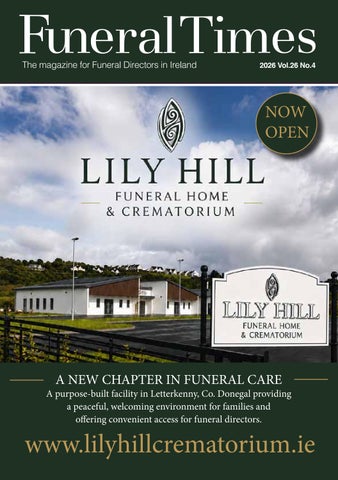
A NEW CHAPTER IN FUNERAL CARE
A purpose-built facility in Letterkenny, Co. Donegal providing a peaceful, welcoming environment for families and offering convenient access for funeral directors.
www.lilyhillcrematorium.ie
NON-RELIGIOUS FUNERAL AND MEMORIAL CEREMONIES
Humanist funerals and memorials are non-religious ceremonies which focus memorials are led, non-religious ceremoniesthey which focus on Humanist the personfunerals who hasand died, the life they and the relationships forged. on the person who has died, the life they led, and the relationships they forged. They are based on the humanist perspective that every life is valuable and unique. They are based on the humanist perspective that every life is valuable and unique. A humanist funeral or memorial is the perfect option for families and friends who A humanist orcommemoration memorial is the perfect for families friends who want a sincere,funeral personal of theiroption loved one, withoutand religion. want a sincere, personal commemoration of their loved one, without religion. Each funeral and memorial ceremony is tailored to the person who has died, and Each funeral and memorial ceremony is tailored to the person who has died, and ĕĉĆ ĘĊĔĉĆĔ Đć ĕĉĆ đĆĐđčĆ ĘĉĐ čĐėĆ ĕĉĆĎ Ċď ĕĉĆ ĎĐĔĕ ĥĕĕĊďĈ ĘĂĚ đĐĔĔĊăčĆ ûĉĂĕ ĕĉĆ ĘĊĔĉĆĔ Đć ĕĉĆ đĆĐđčĆ ĘĉĐ čĐėĆ ĕĉĆĎ Ċď ĕĉĆ ĎĐĔĕ ĥĕĕĊďĈ ĘĂĚ đĐĔĔĊăčĆ ûĉĂĕ maĚ ăĆ Ăď ĖđăĆat cĆčĆăration of life or a ceremony with a more traditional tone. maĚ ăĆ Ăď ĖđăĆat cĆčĆăration of life or a ceremony with a more traditional tone. Humanist funerals are inclusive and welcoming tĐ đĆĐđčĆ Đć Ăčč ăĂĄkgrounds Humanist funerals are inclusive and welcoming tĐ đĆĐđčĆ Đć Ăčč ăĂĄkgrounds Ăďą ćĂĊĕĉĔ ûĉĆĚ ĐćĕĆď ĊďĄčĖąĆ ĕĊĎĆ ćĐē ēĆĦĆĄĕĊĐď Đď ĕĉĆ đĆēĔĐď ĘĉĐ ĉĂĔ ąĊĆą Ăďą ćĂĊĕĉĔ ûĉĆĚ ĐćĕĆď ĊďĄčĖąĆ ĕĊĎĆ ćĐē ēĆĦĆĄĕĊĐď Đď ĕĉĆ đĆēĔĐď ĘĉĐ ĉĂĔ ąĊĆą when those with rĆčĊĈĊĐĖĔ ăĆčĊĆćĔ ĄĂď Ĕay a silent prayer, if they wish. when those with rĆčĊĈĊĐĖĔ ăĆčĊĆćĔ ĄĂď Ĕay a silent prayer, if they wish. Humanist funerals and memorial ceremonies are conducted by our trained funerals and memorial ceremonies are conducted by our trained andHumanist accredited celebrants. and accredited celebrants.
FIND YOUR LOCAL CELEBRANT
Naomh Galloway Janni Knox Sarah Clements FIND YOUR LOCAL CELEBRANT 07711 788839 07890 861690 07583 096952
Emma Crawford Emma Crawford 07976 124056 07976 124056 Ian Deboys 440040 Ian07368 Deboys 07368 440040 Terri Gilleece 07801418492 Geraldine Gallagher 07784 366681
Trevor Molloy Stewart Holden Richard Lavery Emily O’Dowd Lewis Terri Gilleece Richard Lavery 07549 946622 07802 839543 07971 634098 07955 200555 07801 418492 07802 839543 Michael McAlinden Emily Hope Kelly O'Dowd Lewis 07530 000300 07305 892201 Jill 07955 Robson200555 Steward Holden Michael McAlinden 07305 892201 07966 791717 07971 634098 Janni Knox MaryLou McShane Declan Walsh 07890 861690 07962 906236 07859 816585 MaryLou McShane Declan Walsh Hope Kelly 07962 906236 07859 816585 07530 000300
humanists.uk/ceremonies Humanists Waterhouse 138-142 Holborn, London EC1N 2ST HumanistsUK, UK,3 39 Moreland Square, Street, London EC1V 8BB Registered Charity No. 285987
Trevor Molloy 07549 946622
The magazine for Funeral Directors in Ireland
Lily Hill Funeral Home and Crematorium 6
Brian is on top of the world 10
Top marks for Ruby 36
Contents
Lily Hill Funeral Home and Crematorium...................................................................... 6 Brian is on top of the world................................................................................................ 10 Online condolence notices................................................................................................. 12 Lakeside Memorial Park set to open............................................................................... 14 Conor Clear asks Who is a funeral for?......................................................................... 18 IAFD News.................................................................................................................................. 20 Sereni and Funeral Partners join forces......................................................................... 27 135 years supporting local families.................................................................................. 28 The funeral ends. The relationship shouldn’t. By Mark Feehan......................... 32 BIE News....................................................................................................................................... 36 When the funeral is over by Alana Gillen.................................................................. 40 Ben Whitworth on The evolution of the Trocar..................................................... 46 Maria Connaughton focuses on The space between the words...................... 52 The owner’s dashboard by Drew Callingham............................................................ 56 Ian Fee on the importance of remembering ............................................................ 60 They would have loved that............................................................................................. 66 Mattie Lennon on a doubtful death and lonely hearts ....................................... 68 The things we carry by Jennifer Muldowney............................................................. 70 Dr Bill Webster on New rules supporting grief......................................................... 74 SAIF News .................................................................................................................................. 77 Padraic Cawley sets the tone under difficult circumstances............................ 80 Classifieds................................................................................................................................... 85
EDITORIAL AND ADVERTISING CONTACTS: Graham Brown, Ruth McQuillan, Vikki Crangle, Paula Hanna Tel: (028) 3835 5060 (048) from ROI
Funeral Times is owned and published by: InHouse Publications, 1 Annagh Drive, Craigavon, Co. Armagh BT63 5WF E: sales@funeraltimes.com
Disclaimer: Readers are urged to support the magazine’s advertisers, but the publishers cannot be held responsible for any claims made or implied in the advertisements. The publishers reserve the right to refuse advertising. Opinions expressed in this magazine by contributing writers and advertisers are not necessarily those of the publishers. Every effort is made to ensure the accuracy of information contributed for inclusion in this magazine but no legal responsibility will be accepted by the publishers for loss arising from the use of published articles. All rights reserved. No part of this publication may be reproduced, stored in a retrieval system or transmitted in any form or by any means without prior consent. Articles and photographs for inclusion are welcomed but the publishers cannot accept responsibility for their loss or damage however caused. FuneralTimes | 3
LUCAN/NEWLANDS ROAD, LUCAN VILLAGE, CO. DUBLIN.
DUBLIN’S NEWEST CEMETERY Within Esker Lawn Cemetery we have numerous options from which to choose: from traditional burial plots; ash burial or interment plots; to columbarium walls, all of which can be purchased in advance of need. Great attention to detail has been paid by our craftsmen to create an environment in which family members can visit IVL ZMÆMK\ _PQTM MVRWaQVO \PM \ZIVY]QTQ\a WٺMZML Ja \PM UIVQK]ZML VI\]ZIT []ZZW]VLQVO[ -[SMZ 4I_V +MUM\MZa WٺMZ[ I JM[XWSM [MZ^QKM I\ \QUM WN J]ZQIT 1V WZLMZ \W MV[]ZM OZQM^QVO NIUQTQM[ IZM UILM KWUNWZ\IJTM I\ \PM OZI^M[QLM _M XZW^QLM [MI\QVO NWZ QUUMLQI\M NIUQTa \WOM\PMZ _Q\P I KIVWXa IVL XTW\ LZM[[QVO _PQKP QVKT]LM[ \PM ZMUW^IT WN ^Q[QJTM [WQT NZWU \PM OZI^M[QLM
A LIMITED NUMBER OF BURIAL PLOTS AND ASH INTERMENT OPTIONS ARE AVAILABLE TO PRE-PURCHASE IN ADVANCE OF NEED
www.EskerLawnCemetery.com
FOR FURTHER INFORMATION PLEASE CONTACT
VIEW THIS CODE WITH YOUR MOBILE PHONE CAMERA TO VIEW OUR WEBSITE
01 601 5052 or 083 165 8604 email: info@EskerLawnCemetery.com
Lily Hill Funeral Home & Crematorium
L
ocated at Mountain Top, Letterkenny, Lily Hill Funeral Home & Crematorium is a new purpose-built facility providing a modern, convenient option for families and funeral directors throughout the North West. The facility was opened on Friday, 28th August 2026 by Michael Morning, who along with his brother Danny, are longtime veterans of the Irish funeral trade, with their well established businesses. The new building combines contemporary architecture with warm, understated interiors to create a calm environment for families while still providing the
6 | FuneralTimes
facilities required by funeral professionals. The spacious ceremony room provides a comfortable setting where family and friends can come together to say goodbye and celebrate the life of someone special. Flexible seating, modern audiovisual facilities and display screens
allow families to include photographs, tributes and other memories, creating a ceremony that reflects the life and personality of their loved one. Live streaming is also available, allowing those who cannot attend in person to take part in the service and
share this important moment with family and friends from near and far. Thoughtfully designed with both families and funeral professionals in mind, Lily Hill offers ample dedicated parking, landscaped grounds and a layout that makes
arrivals and departures straightforward. Inside, natural wood finishes, soft furnishings and considered lighting create a calm and comfortable atmosphere. Lily Hill welcomes families from all cultures, traditions and beliefs, and can
accommodate a wide range of funeral customs and ceremonies. Whether families are arranging a traditional service or a more personal celebration of life, the facilities provide the flexibility to create a farewell that reflects the wishes of any loved one. Above all, Lily Hill is a place where memories can be shared, lives can be honoured and families can come together. The dedicated team supports families and funeral directors in creating a meaningful and memorable farewell. For more information, contact: Michael Morning on +353 74 912044
A peaceful, modern setting for meaningful farewells FuneralTimes | 7
( &ODVV +HDUVH /LPRXVLQH
Find out more online at: www.duffycoachbodies.com
6SHFLÉFDWLRQV WR <RXU ,QGLYLGXDO 5HTXLUHPHQWV
IE Landline: 00 353 42 933 4312 UK Landline: 00 44 20 3290 7335
10 | FuneralTimes
FuneralTimes | 11
Online condolence notices The recent tragic road collision in County Kildare has once again highlighted some of the more troubling aspects of social media and the challenges that can arise with online death notices.
A
death notice relating to one of the teenagers involved in the fatal collision was published on RIP.ie before being removed just hours later following a significant backlash online relating to the circumstances surrounding the incident. RIP.ie has done really well in becoming a forum for finding information on deaths and the place where people can post comments. Unfortunately, in a small percentage of cases, these comments can be inappropriate and hurtful to families, perhaps reflecting badly on the funeral director under whose name the notice appears. In a
statement, RIP.ie said that they “do not comment on individual death notices. Funeral directors are the only ones who can place or remove a death notice.” This extreme example highlights an issue which Funeraltimes.com has long been aware of. There are different ways to handle the comments which some people might want to place on a death notice and where those comments should appear. Funeraltimes. com takes the position that there are two distinct types of condolence, one placed by family or close friends, which will almost always be placed through the funeral director. Social media comments can come from a wider circle of friends and acquaintances or from people who did not know the deceased. Funeraltimes.com has taken the view that free, unmoderated notices are more appropriate on social media sites such as Facebook, while condolences attached to the main death notice should primarily be from family and close friends. As such they are moderated by either the funeral director or Funeraltimes.com staff. Sympathy or condolence notices are free when placed by funeral directors. Some social media posts are entirely inappropriate to appear on a death notice, especially on a page carrying a funeral directors name and logo. Funeraltimes provides Facebook pages for each county which allows people to publish comments free of charge unless a funeral director suspects that there might be an issue and turns off comments on a particular notice.
Lakeside Memorial Park set to open a new chapter for north Dublin A new chapter in how Dubliners remember and honour their loved ones is about to begin with the opening of Lakeside Memorial Park in Portmarnock this October. Located on a 24-acre parkland setting on Drumnigh Road, Lakeside Memorial Park is set to ‘reimagine’ the traditional cemetery, offering a contemporary approach to remembering and celebrating the lives of our loved ones. Beautifully landscaped gardens, tree-lined walkways, water features, lakeside paths and peaceful spaces for reflection combine to create an environment where families can celebrate lives lived while finding comfort in nature. The multi-denominational memorial park provides a range of options for families, including traditional burial plots, in-ground ash interments and beautifully designed columbarium walls, welcoming people of all faiths and beliefs while addressing the growing need for high-quality memorial
space in North Dublin. Beyond its role as a final resting place, Lakeside has been conceived as a community amenity. An on-site restaurant, children’s playground, ample car parking, walking routes, extensive planting and seating areas are designed to encourage local residents and visitors to enjoy the grounds throughout the year. The development reflects a changing approach to memorial spaces, recognising the importance of creating places where remembrance, wellbeing and everyday life can comfortably coexist. Director Niall O’Connor believes the project represents a significant change in how memorial parks are viewed in Ireland. “Lakeside Memorial Park will be a truly spectacular place where we can honour and remember our loved ones in a dignified and tranquil setting. It has been designed as a public park, and we hope walkers, joggers and local families will
feel welcome here alongside those visiting loved ones.” Co-founder Henry Wildgust said the ambition behind Lakeside has always been to raise the standard of memorial parks while providing families with a place of comfort and peace. A short walk from Portmarnock DART station, Lakeside Memorial Park is set to become an important new landmark for North Dublin. A place that celebrates life, honours memories and provides a peaceful setting for generations to come. General Manager, Jane Clarke, formerly of Staffords Group Funeral Directors is on-site daily, welcoming visitors to the sales and information office at Drumnigh Road. The official opening date, along with details of the restaurant operator at Lakeside Memorial Park, will be announced in the coming weeks. For further information, visit www.lakesidememorialpark. ie, call (01) 960 2222 or email info@lakesidememorialpark.ie The cafe balcony
14 | FuneralTimes
Ballyfinane, Firies, Killarney, Co. Kerry Tel: +353 87 269 0044 sales@coachbuilders.ie
www.coachbuilders.ie
BUILD YOUR DREAM VEHICLE WITH US!
AT PIERCE COACHBUILDERS, WE DON’T BELIEVE IN LIMITATIONS. Whether you’re a fan of Mercedes, Skoda, or have your heart set on any other brand, WE CAN TURN YOUR VISION INTO REALITY. Our expertise spans across all makes and models, ensuring that your custom build is exactly what you’ve been dreaming of. DON’T SETTLE FOR ORDINARY! LET US BUILD THE EXTRAORDINARY VEHICLE YOU’VE ALWAYS WANTED.
CONTACT US TODAY TO GET STARTED ON YOUR CUSTOM BUILD! FuneralTimes | 15
CPL FUNERAL SUPPLIES
William Tel: NI/ROI (028/048) 8167 1247 Mob: 0044 (0)7730 409000 McGuckin Tel: NI (028) 816 71247 / ROI: (048) 816 71247 www.cplsupplies.com
sales@cplsupplies.com
CPL FUNERAL SUPPLIES FOR SALE REFURBISHED 30 STONE X LIFTER
COFFIN BUGGY
PICTURE FRAME HOLDER
WHO IS A FUNERAL FOR? Finding the balance between final wishes and present grief By Conor Clear I’m sure many funeral professionals will have experienced the moment: you’re sitting with a family, tea in hand, and a family member announces “Now, Dad wrote down exactly what he wanted. He said no fuss, no one crying, just play one song and get it over with.” And sometimes you might look at the family, and you can see it in their eyes; the difficult and uncomfortable knot between wanting to honour their loved ones wishes, and their own overwhelming need to stand up, share stories, and mourn in their own way. It’s a moment that always brings me back to the question: Who is a funeral really for? The person who has died, or the people left behind? The instinctive answer might often be the deceased. But over the last few years, sitting at kitchen tables and working alongside funeral directors, my own outlook has shifted. I’ve come to see that the true answer is both, and that finding the balance between the two is a really important, and often interesting part of our job. Early in my celebrancy journey, my thinking leaned heavily toward the person who died. Seeing how much comfort a clear set of wishes brought to families, I decided to sit down and map out my own funeral in meticulous detail. I chose the music, picked the readings, considered the venue, and planned the entire running order from start to finish. I had put together quite a comprehensive blueprint. It even has an operation codename, but thats for a different article. Proud of my handywork, and catching up with a celebrant friend over a coffee, I shared my plans. On hearing it, she laughed: “Wow Conor!! Does anyone else get a look in?” We had a great laugh about it, but her reaction shifted my entire perspective. I began to realise that while it will of course be my funeral, it isn’t just about me. The people I leave behind will have their own emotional journey to navigate on that day and they will need the space to 18 | FuneralTimes
grieve in a way that helps them heal. Over time, I’ve somewhat pulled back on my instructions, and as of today, I’ve left behind a couple of favourite songs and a reading, leaving the rest open so my family can have the freedom to shape a ceremony that gives them genuine comfort too. (It still, however, has the operation codename!!!) I will always champion people writing down their funeral wishes. Having a guide in place lifts an enormous burden of decision fatigue from a grieving family. But personal choice takes countless shapes and I think the challenge arises when stated preferences; whether sparse or detailed, meet the immediate emotional needs of the family. When someone’s modest nature prompts
them to say, “No fuss, no speeches, keep it brief,” it might well come from a place of kindness and a desire to spare the family trouble. But to adhere rigidly to the letter of those instructions could potentially leave the living feeling emotionally shortchanged, denied an outlet for the love and memories they need to express. Conversely, an individual may have mapped out a vibrant celebration, while the family is in deep shock and craving quiet, reflective space. In both directions, a celebrant’s role alongside the funeral director is not necessarily to act as rigid enforcers of a checklist; but to perhaps gently guide the family along that fine line, honouring the spirit of their loved one while making sure the ceremony functions as a living, comforting ritual for those left behind. Of course, we’re absolutely going to honour the wishes of the deceased but what I’m merely trying to consider is that, when appropriate, it can also be ok to open the door for the family to grieve in their way too. Finding that balance might play out in many ways, ranging from lighthearted dynamics to deeply held beliefs. On the lighter side, I was recently engaged with a lovely family, and as I sat with them, a love of football became very clear. Before I realised the extent of the deceased’s sporting loyalties, I casually admitted to growing up in a Manchester United household. A knowing laugh broke across the room. It turned out the gentleman was a lifelong, passionate Leeds United supporter who had jokingly insisted that any Manchester United fans at his funeral should be made to sit at the back! On the day of the service, I smiled as I said I hoped he’d forgive me for standing up front to lead his service. I hope it might have honoured his humour and personality while giving his family a small moment of levity that brought even a little light into a difficult day. At other times, the balance touches much deeper ground, particularly regarding faith and spirituality. It is very common to lead a ceremony for someone who lived a secular life and requested a non-religious service. Yet, sitting in the front row might be an elderly parent, a spouse, or a close relative who draws profound solace from prayer. I want to be really clear here: if the person
who died held deeply passionate convictions against religion, that boundary must be, and always is, respected. We never impose anything that runs counter to who they were. However, in many cases, people simply didn’t have a personal faith of their own, but wouldn’t begrudge comfort to those they loved. In those situations, as a celebrant, it is entirely appropriate to open the door and offer that option to the family. It doesn’t mean turning the ceremony into a religious service; it simply means making space for a gentle, brief prayer or a quiet moment of reflection for those who need it. In some circumstances, we can say to the room with complete authenticity: “While John lived his life without formal religion, we know how much faith means to those who loved him, and so we pause for a quiet moment of reflection and prayer for those who wish to join in.” The heart of the service remains deeply personal and true to the deceased, while the living are offered a little moment of something that they might need. The ceremony has wide borders, so long as we steer clear of anything the deceased was actively and passionately against in life. I have, in the past, used language during a service, saying something like, “Mary asked for no fuss today, but we hope she will forgive us for taking this time to celebrate just how much she meant to all of us.” It honours the deceased’s humble nature, while granting the family permission to grieve, share memories, and shed tears without feeling like they’ve broken a promise. In reflecting, my thoughts are merely just suggesting that a “good funeral” is never just the execution of a checklist. While honouring a journey and a life lived is essential, and indeed a beautiful part of being a celebrant, the ceremony should also remain an appropriate, compassionate space for the living. When we find that balance, we create a send-off that does justice to both.
Conor Clear is a funeral celebrant based in Dublin. He works with families to create meaningful funeral services that reflect the personality and values of the person being remembered. You can find him at www.conorclear.com FuneralTimes | 19
IAFD strengthens standards, connections and representation across the profession From international engagement and regional education to professional standards and advocacy, the Irish Association of Funeral Directors (IAFD) has continued to support its members and represent the funeral profession throughout Ireland. IAFD President Fintan Cooney and Vice President JohnMark Griffin attended the National Funeral Exhibition in Stoneleigh, UK. Organised by the National Association of Funeral Directors, the biennial exhibition is the largest event of its kind in the UK and Ireland, attracting more than 200 exhibitors and over 4,000 visitors. The exhibition brought together funeral professionals, suppliers and representative organisations, showcasing developments across areas including funeral vehicles,
Fintan Cooney and John-Mark Griffin with NAFD President, Daryll Smith including NAFD, SAIF, coffins, urns, printing, moving NFDA and FIAT-IFTA, while equipment, software and continuing to strengthen insurance. There was also a relationships across the strong Irish presence, with international funeral funeral directors travelling to profession. the event and Irish companies These international including Duffy Coachbodies connections were developed and Colm Kieran exhibiting. further when the IAFD For IAFD, the event President attended the provided a valuable Selected Independent Funeral opportunity to exchange Homes European & Pacific ideas and experiences with Summer Conference in representatives from other Listowel, Co. Kerry. Hosted by Graham and Patrice Gleasure, professional organisations, the conference welcomed 90 delegates from Australia, the Netherlands, the United States, the United Kingdom, Denmark, Germany and Ireland. Fintan delivered a presentation introducing the work of IAFD and joined delegates for a programme Fintan Cooney (IAFD President), Séamas Griffin (IAFD Past President), focused on shared learning, Pat Gleasure (IAFD Past President), Gus Nichols (IAFD Past President & professional development and FIAT-IFTA Past President) international collaboration. 20 | FuneralTimes
Welcome to the IAFD Board I
AFD is delighted to welcome Terry Weir to its Board of Directors, bringing more than 21 years of experience within the funeral profession. Terry is Senior Funeral Director in the Preparation Department at Funeral Partners Northern Ireland, where he manages a busy team serving 17 funeral homes across Northern Ireland. His role includes coordinating the transfer of deceased people into the company’s care, overseeing the required documentation and liaising with hospitals, GP surgeries and the Northern Ireland Coroner’s Office. Having previously worked for 16 years as a newspaper
Terry Weir compositor and proof-reader, Terry entered the funeral profession following a career change and later completed his professional qualification through IAFD. He has progressed from Dedicated Funeral Director to Senior Funeral Director for Northern Ireland and subsequently to his present role.
Terry is also an IAFD tutor and describes seeing students receive their qualifications as one of his proudest professional achievements. He is particularly motivated by the privilege of caring for families’ loved ones, even though much of his work now takes place behind the scenes. Away from his day-to-day responsibilities, Terry founded a community Crochet Club hosted in a funeral home. Meeting twice each month, the club is celebrating its tenth anniversary this year. IAFD warmly welcomes Terry to the Board and looks forward to the experience, knowledge and commitment he will bring to the role.
Regional learning and connection Closer to home, more than 60 members attended the IAFD Cork Regional Members’ Event at the Rochestown Park Hotel. The evening featured a presentation by Paul Keogh on succession planning for family businesses—a particularly important consideration for the many family-owned and multigenerational firms operating within the funeral profession. The event gave members an opportunity to discuss the challenges and opportunities
involved in preparing a business for the future, before continuing the conversation over dinner. The evening was generously sponsored by The Island Crematorium, Ringaskiddy. It also marked a special gathering of 11 IAFD Past
Presidents alongside current President Fintan Cooney. Their collective experience, leadership and dedication have played an important role in shaping the Association and supporting the development of the profession throughout Ireland.
Current President Fintan Cooney with IAFD Past Presidents
FuneralTimes | 21
A successful first outing for the IAFD Golf Society
T
he newly established IAFD Golf Society held its inaugural outing at Millicent Golf Club in Co. Kildare in July, bringing members together for a day of golf, conversation and camaraderie. The Society was created to provide members with an opportunity to meet in a relaxed social setting, strengthen professional relationships and encourage greater collaboration across the membership. First place went to the RIP. ie and The Irish Times team of Richie Kelly, Colum Dunne, Jack O’Driscoll and Ciaran O’Shea. The Fanagans Funeral Directors team of Conor McCarthy, Graham Dowling,
Paul Reilly with the team from Oliver Reilly Funeral Directors Ltd John Garrett and Paddy McPhillips secured second place. Ciaran O’Shea also won Longest Drive, while Conor McCarthy took Nearest the Pin. Prizes were generously donated by Eamon Glennon Coffin Manufacturers. IAFD also extends its thanks to Paul
Reilly, whose enthusiasm and hard work were instrumental in establishing the Society and organising its successful first event. Following the positive response to the inaugural outing, plans are already underway for the next IAFD Golf Society event.
Promoting excellence in funeral service IAFD’s commitment to high professional standards continues through its updated Excellence Programme.
T
he programme recognises the professionalism, quality of care and high operating standards demonstrated by member firms. It also encourages continuous improvement and provides funeral businesses with a structured way to review their policies, procedures and service delivery. Members are supported throughout the audit process, and IAFD is continuing to improve the programme’s 22 | FuneralTimes
Fintan Cooney presents awards to Alan and Sheera Harmon of Bourke’s Funeral Directors online resources to make guidance clearer and more accessible. The Association’s
education programme also remains central to its work. The Funeral Directors Certificate Award provides funeral professionals with comprehensive learning across the practical, professional and regulatory aspects of modern funeral directing. Delivered by experienced industry professionals, the qualification is regarded as an important benchmark for those working within the profession in Ireland.
Representing members on key issues A longside education and professional development, IAFD continues to represent funeral directors on issues affecting their day-to-day work. Following reports from members about significant delays in the payment of funeral expenses from deceased customers’ accounts, IAFD wrote to An Post, Ireland’s three main banks and Banking & Payments Federation Ireland. Funeral directors routinely extend unsecured credit to bereaved families, often covering costs of between €5,000 and €8,000. Delays in releasing payment can therefore place considerable financial pressure on funeral businesses.
IAFD Board members Jane Clarke and Noel Hughes IAFD has asked the relevant organisations to review their procedures and prioritise the prompt settlement of funeral expenses, recognising both the essential service provided by funeral directors and the difficult circumstances facing bereaved families.
The Association has also continued its engagement with coroners. IAFD Board Member Noel Hughes, formerly of the Dublin District Coroner’s Office, and IAFD Public Relations Officer Jane Clarke recently met Dr Myra Cullinane, Senior Coroner for the Dublin District. The meeting provided an opportunity to discuss matters of mutual interest and reaffirm the importance of constructive communication between the Coroner’s Office and funeral directors operating within the district. It followed discussions with the Department of Justice earlier in the year and forms part of IAFD’s continuing work to support best practice and positive professional collaboration.
Funeral profession featured on Newstalk’s Down to Business On Saturday, August 1st, the funeral profession was featured in the Industry Review section on Newstalk Radio’s Down to Business with Bobby Kerr.
A
s Bobby Kerr highlighted, the funeral profession is one that everyone encounters at some point, yet it is not often discussed from a business perspective. Funeral directors provide an essential service to families at some of the most difficult moments in their lives, but behind that service are complex businesses facing changing customer
expectations, rising costs and evolving traditions. The profession is built on compassion, care and service, but it also requires resilience, innovation and strong business leadership. It was wonderful to hear these important aspects of funeral directing discussed with a wider audience, highlighting how the profession continues to
evolve and meet the changing expectations of bereaved families, while remaining firmly rooted in dignity, tradition and service. The Industry Review explored the challenges and opportunities facing funeral directors and how the sector is adapting to modern Ireland. Representing the profession were two former Presidents of FuneralTimes | 23
the Irish Association of Funeral Directors: Niall Mulligan of Heffernans Funeral Directors in Trim and Gus Nichols, Director of Fanagans and a 30-year veteran of the business. They were joined by Jane Clarke, Public Relations Officer for the Irish Association of Funeral Directors and General Manager of Lakeside Memorial
Fintan Cooney (President) Fanagans Funeral Directors 54 Aungier Street Dublin 2 Email: president@iafd.ie Fintan Kennedy (Chair) Email: fintan.kennedy@iafd.ie
Bobby Kerr, JC, NM, GN
Niamh Sweeney (Hon. Treasurer) John Sweeney and Sons Fairgreen Arklow, Co Wicklow Email: treasurer@iafd.ie
Jane Clarke (Public Relations Officer) Lakeside Memorial Park, Portmarnock, Dublin Email: pro@iafd.ie
Clare Ann Irwin (Membership Officer) Irwins Funeral Home Bothar Irwin, Galway City, Email: clareann.irwin@iafd.ie
Donal Forde Fordes Funeral Homes Ltd South Gate Bridge Cork, Co. Cork Email: donal.forde@iafd.ie
John Mark Griffin (1st Vice President) Griffin Funerals John’s Gate Pennywell Limerick Peter Maguire (Education Email: jm.griffin@iafd.ie Officer) Massey Bros Funerals Paul Reilly (Hon. Secretary) Head office Oliver Reilly Ltd Funeral 109 The Coombe, Dublin 8, D08 Directors AK10 Leinster Street, Maynooth Email: peter.maguire@iafd.ie Email: paul.reilly@iafd.ie
Telephone: 0818 935 000 24 | FuneralTimes
Park Cemetery in Portmarnock. Together, the contributors provided valuable insight into the work of funeral directors and the changing landscape of the profession, while highlighting the importance of maintaining the highest standards of care and professionalism for the families we serve.
Noel Hughes Email: noel.hughes@iafd.ie Niall Mulligan Heffernan’s Funeral Directors Trim, Co. Meath Email: niall.mulligan@iafd.ie
BRINGING LOVED ONES HOME WITH CARE Dedicated International Repatriation Services Supporting Funeral Directors Across Ireland. International repatriation requires logistical precision, regulatory expertise and compassionate support. Woodland Group manages all aspects of outbound international repatriation including:
Airline coordination Customs documentation IATA compliance Global transport logistics Providing funeral directors with reliable, dignified support every step of the way.
We rely on Lorraine at Woodland for our international repatriations. Their attention to detail and professionalism give our families confidence every time. Johnathan Stafford’s Funeral Directors, Dublin
Contact us: Email: lorraine.mcentagart@woodlandgroup.com Direct Dial: +353 1 263 1533 Mobile: +353 87 720 3614 www.woodlandgroup.com
Season’s Greetings from Funeral Partners Shape your future, strengthen Celebrating Together This Christmas our communities
As the year draws to a close, we extend our heartfelt thanks to our incredible teams, suppliers and fellow funeral professionals for Support their dedication, careyour andskills, compassion. To all families, grow and give back tothe new businesses Northern that have joined us this year, welcome to the Ireland’s communities. Funeral Partners family. We are proud to support you and Choosing a career in funeral services is about more trust. than building your future, it’s about honoured by your
making a lasting impact. With structured training and clear pathways for development, you’ll everyone at Funeral Partners, we wish life’s you most joy meaningful gain the skillsFrom to grow professionally while helping others through moments. And through our community funds,and your awork contributes directly to local schools, for the festive season peacful NewYear. healthcare projects, and cultural initiatives across Northern Ireland.
Looking to join our growing team?
Explore career opportunities at funeralpartners.co.uk Find out how your career can strengthen communities. Scan the some QR code learn about more. Hear from of ourto partners their acquisition journey and becoming part of Funeral Partners.
funeralpartners.co.uk/story
Funeral Partners Ltd is committed to equality of opportunity for all colleagues and applications from individuals are encouraged regardless of age, disability, sex, gender reassignment, sexual orientation, pregnancy and maternity, race, religion or belief and marriage and civil partnerships. We welcome applications from members of all communities.
funeralpartners.co.uk/story
Sereni and Funeral Partners join forces to support families across four European countries Funeral service providers Sereni, with funeral homes in Belgium, Germany and Poland, and Funeral Partners, one of the largest funeral providers in the United Kingdom, are joining forces. The combination creates one of Europe’s largest funeral groups, with operations in four countries. Both companies will retain their established brands and the local identities of their funeral homes – a model both groups already pursue successfully in their respective markets and one that ensures continuity for the families they serve. “Supporting families reliably at difficult moments is the standard we hold ourselves to in every country,” said Jörg Reschke, CEO of Sereni. “Joining forces with Funeral Partners allows us to learn from one another and to live up to the high standards they deserve.” The combination aims to unlock synergies in areas such as procurement, technology,
and administrative processes. “We support this combination as a long-term partner,” says Caspar Berendsen, Chairman of the Board of Sereni. “Sereni and Funeral Partners have both shown that a consolidation model can work while respecting the local market. Our aim is to support the management teams of both companies through the next phase of growth in Europe. Sam Kershaw, CEO of Funeral Partners adds, “Joining forces with Sereni will further enhance the support we provide to bereaved families, while also creating new development opportunities for colleagues across the Group.” Together, the two companies will serve more than 75,000 funerals and 46,000 cremations a year with 3,100 employees. Alongside traditional funeral services, both also offer pre-need funeral plans. About Sereni Sereni was founded in Belgium
Funeral Partners CEO Sam Kershaw and Sereni Chairman Casper Berendsen with the Sereni and Funeral Partners senior leadership teams
Sam Kershaw, CEO of Funeral Partners with Caspar Berendsen, Chairman of Sereni in 2016 and has grown into a leading funeral group with a presence in Belgium, Germany and Poland. Sereni handles 45,000 funerals a year across 450 funeral homes with 1,800 employees, in a partner network that preserves local identity while providing central support in areas such as administration, marketing and succession planning. The group also includes 8 crematoria in Germany and Poland operating 46,000 cremations a year. About Funeral Partners Funeral Partners was founded in 2007 and, with around 300 funeral homes and almost 1,300 employees, is one of the largest funeral providers in the United Kingdom. The company supports around 30,000 funerals a year. FuneralTimes | 27
Londonderry funeral directors celebrate 135 years with new office and funding for local good causes This summer, Adair & Neely Funeral Directors celebrated 135 years of supporting families across the Londonderry area with care, compassion and professionalism.
T
o mark this impressive anniversary milestone, the funeral firm have moved to updated new Waterside offices at 84 Duke Street, Londonderry, where they can better serve clients with improved facilities. They also proudly launched the Adair & Neely Community Fund as a way of giving back to the communities that have supported the firm for generations. Up to £2,000 is available from the funding pot to support local charities, voluntary organisations,
community groups and grassroots projects that are making a positive difference to people’s quality of life across Derry/Londonderry and the surrounding areas. Projects must align with one or more of four categories: Health, Education, Employment Opportunities, and Poverty and Social Deprivation. Funeral Manager Wayne Glenn said: “Community organisations play a vital role in bringing people together, supporting vulnerable individuals and creating opportunities for local people
to thrive. Through this special anniversary initiative, we want to help those groups continue their valuable work and strengthen the communities we are proud to serve.” Applications for the Community Fund closed on Friday 28 August. Successful applicants were notified in September, with funding awarded later that month. You can also find Adair & Neely on Facebook at: https://www.facebook. com/p/Adair-NeelyFuneral-Directors-1000713 89988494/
Funeral Manager Wayne Glenn (centre left) with Adair & Neely staff at their new premises 28 | FuneralTimes
James Brown & Sons helps Ballybeen children start the school year with confidence More than 160 children in Ballybeen and the wider Dundonald community are heading back to school with the uniform and essentials they need, thanks to a community initiative supported by James Brown & Sons Funeral Directors. The Belfast funeral directors provided 100 free stationery packs for children attending two pop-up school uniform events organised by Redeeming Our Communities (ROC) Ballybeen this summer – with every pack snapped up by local families. The events provided free good-quality new and preloved school uniforms for children attending local nursery, primary and postprimary schools, helping families prepare for the new school term without the added pressure of rising costs. The support comes as many families continue to feel the impact of increasing back-toschool expenses. Research showed that 78% of parents consider back-to-school costs a financial burden, with 41% of parents in Northern Ireland reported going into debt because of those costs. The latest events were made possible through the support of local volunteers, churches, community organisations and partners, with more than 160 children receiving uniform and all 100 stationery packs provided by James Brown & Sons being distributed. Beverley Brown of James Brown & Sons Funeral
(L-R): Beverley Brown of James Brown & Sons and Keeva Watson at Redeeming Our Communities with stationery packs given out to families
Directors said: “Starting a new school year should be an exciting time for children, but we know the cost of uniforms and supplies can put real pressure on families. “ROC provides support in such a positive and dignified way, and we are proud to play a part in helping local children begin the school year feeling prepared and confident.” Keeva Watson of Redeeming Our Communities Northern Ireland said: “We are very grateful to James Brown & Sons for supporting our Ballybeen School Uniform Project. The stationery packs were a fantastic addition and helped ensure children had the essentials they needed alongside their uniforms.” ROC’s School Uniform Project brings together local churches, community groups, volunteers and businesses to support families across Northern Ireland.
The Ballybeen project has supported an estimated 870 children since it launched in 2021, with volunteers helping create a warm and welcoming experience for families. James Brown & Sons has served families across Belfast for generations and continues to support organisations making a positive difference in the communities it serves.
Items in the stationery pack sponsored by the James Brown & Sons Community Fund FuneralTimes | 29
Community groups share £1,000 boost from Carrickfergus and Larne funeral directors
T
wo community projects tackling loneliness, isolation and hardship in and around Carrickfergus and Larne have each received a £500 financial boost from the second round of the programme. The recipients are: The Willow Collective – the Carrickfergusbased women’s community organisation will use its £500 award to support activities that bring local people together and help reduce loneliness and social isolation. Plans include swimming sessions at the local leisure centre, social events with meals and purchasing wool so members can make blankets and hats for the local baby bank. Larne Community Development Project – the £500 award will support its popular Warm Space at Linn Road Community Centre, helping to provide a warm bowl of soup, wheaten bread, tea and coffee for around 30 people every Monday. The programme provides a welcoming place for people who may be lonely, isolated or struggling with the cost of living to meet others and access additional support. Cheques were presented by Peter Mulholland of Mulhollands Funeral Directors and Kerry Kennedy, Senior Funeral Arranger. Peter Mulholland said: “It is wonderful to see the difference these two organisations are making in their communities. Both are creating opportunities for people to come together,
Linda Reid, Sarah Jane Irons, Peter Mulholland and Sharon Mushtaq from The Willow Collective 30 30 || FuneralTimes FuneralTimes
Debroah Neill from Larne Community Assistance Programme with Peter Mulholland make connections and feel supported, which can be so important for anyone experiencing loneliness or difficult circumstances. “We are delighted that our Community Assistance Programme can play a small part in helping them continue this valuable work, and I know my late father Bob would be very proud to see the fund supporting local people in this way.” Kerry Kennedy added: “One of the things we really value about the programme is learning more about the fantastic work taking place within our local communities. The Willow Collective and Larne Community Development Project are both responding directly to the needs of local people and we look forward to seeing how their projects develop.” The team at the Carrickfergus and Larne funeral homes launched the grants programme in February with the aim of providing financial support for community-based projects that benefit people who live within two miles of their funeral homes. Projects must be non-profit and align with one or more of the fund’s categories: Health, Education, Employment Opportunities and Poverty or Social Deprivation. The latest awards follow the first round of funding earlier this year, when Good Morning Larne and Woodlands Food Table each received support from the programme. For more information about the funding, visit: https://www.mulhollandsfuneraldirectors. com/community-assistance-programme/ For community news, you can also find Mulhollands Funeral Directors on Facebook at: https://www.facebook.com/ MulhollandsFuneralDirectors/
FOR A DIGNIFIED FINAL JOURNEY fearghas@fearghasquinn.com
+4428 2582 2525
6th Edition
By Mark Feehan
The funeral ends. The relationship shouldn’t.
T
he next battle in funeral marketing isn’t simply being found. It’s being remembered. We spend enormous amounts of time trying to win the next family: Google, websites, SEO, Facebook, reviews and advertising. All important, but here is a different question... What are you doing for the family you served last year? Or five years ago? For several intense days, a funeral director can become one of the most trusted people in a family’s life. Then the funeral ends and, very often, so does the relationship. From a marketing perspective, I think that is one of the biggest untapped opportunities in the profession. Welcome back to Digital Force.
From Being Found to Being Remembered Throughout this series, I have argued that funeral homes need to take their digital presence seriously. Being found on Google, building a useful website, understanding local SEO, collecting genuine reviews, telling better stories, using social media properly and understanding your data are all essential. Those fundamentals have not changed; they are becoming the entry ticket. The next stage is understanding what happens after somebody finds you, chooses you and trusts you with one of the most important events their family will ever experience. Because being found gets you into the room, but being useful keeps you there. The Financial Conversation We Rarely Have There is another issue worth discussing openly. Funerals represent a significant and often unexpected household expense, and financial difficulty does not always look like poverty. It can be two people working, paying a mortgage 32 | FuneralTimes
or rent, raising children and meeting every other expense modern life throws at them, only for somebody to die. Not every family has several thousand euro immediately available. State assistance exists for people who qualify based on their circumstances, but there remains a large group of ordinary families for whom an unexpected funeral bill can create very real pressure. Death does not check your bank balance before it arrives. Perhaps technology can help communities do something they have always done particularly well in Ireland: look after one another. What Happened in Tramore Over the past few months, an interesting experiment has been taking place through RIP Ireland. Families have been given the option to allow friends, relatives, neighbours and colleagues to provide practical financial support towards funeral costs. In and around Tramore, close to €10,000 has been raised for local families. The number matters, but the behaviour behind it interests me much more. People wanted to help. Neighbours helped, friends helped, work colleagues helped and relatives overseas helped. The generosity was already there; technology simply made acting on it easier. That tells us something important about where digital funeral services may be heading. Technology does not have to replace human behaviour. Sometimes its greatest value is enabling it. Aftercare Could Become Your Greatest Marketing Tool There is a word I believe we will hear much more often in funeral service: aftercare. Not aftercare as a leaflet or a once-off message, but real, structured, thoughtful aftercare. Could your CRM remind you about a first
anniversary, a birthday or a Month’s Mind? Could a family receive a thoughtful message twelve months after the funeral? Could their memorial remain somewhere that photographs, memories and stories continue to be shared? Could relatives overseas continue to participate? None of that feels much like marketing. That is precisely why it can be so effective. The best funeral marketing rarely feels like marketing. It feels like somebody remembered. Your Trusted Suppliers Could Become Part of That Relationship There is another opportunity here that I think deserves much more attention. Think about the local businesses funeral directors already trust: florists, candle makers, memorial suppliers, local artists, keepsake makers, bakers, caterers and grave care providers. These businesses are already part of the wider ecosystem surrounding funerals and remembrance, and funeral directors regularly recommend them. But much of the spending on flowers, remembrance gifts and anniversary gifts increasingly goes to large national or international websites. That is money leaving the community. There is another model. A funeral home could use its social media and digital channels to regularly showcase trusted local suppliers, their stories and the products they create. Platforms are also beginning to take this further. RIP Ireland, for example, has developed a gifts marketplace. A marketplace is different from a traditional online shop. The funeral director does not need to manufacture, stock, pack or deliver the products. Instead, the funeral director introduces trusted local suppliers to the marketplace. The supplier uploads appropriate products, and the parties agree the final selling price and the margin the funeral home receives for facilitating the sale. Depending on the agreement, that margin might sit in the region of 20 to 30 percent. The supplier fulfils the order. The customer gets a trusted local product. The funeral home receives an agreed margin. And, critically, the money stays within the local economy. Think beyond the funeral itself. Flowers on the first anniversary. A candle at Christmas. A memorial gift on a birthday. A keepsake for Mother’s Day or Father’s Day. A locally
produced remembrance product several years later. Every one of those occasions creates an opportunity to reconnect a family with a trusted local business. Done properly, this is not simply another e-commerce channel. It is a local marketplace built around trust. And for funeral homes, it has the potential to create an entirely new recurring revenue stream without asking them to manufacture or fulfil a single product. The Bigger Opportunity Is Local There is a wider point here. Funeral homes remain some of the most deeply rooted businesses in Ireland. They know the florist, the church, the celebrant, the caterer and the local businesses families trust. Digital marketing can strengthen those connections rather than replacing them. Instead of sending somebody to an anonymous national retailer, why not introduce them to Mary down the road who makes beautiful candles? Instead of an international flower network taking the order, why not help your local florist receive it? Instead of technology pulling money out of communities, we can design technology that keeps money moving around them. That is an idea I think has enormous potential. Your Greatest Database Already Exists Most businesses spend fortunes trying to acquire customers they have never met. Funeral homes have something many businesses would love to possess: generations of relationships. Families who know you. Families who trusted you. Families who recommended you. Families whose parents you looked after and whose grandparents the previous generation of the business may have looked after. Yet much of that relationship capital still lives inside filing cabinets, older software and people’s memories. A modern CRM changes that. Not so families can be bombarded with marketing, but so they can be remembered. There is an enormous difference. The Digital Force Checklist Before the next edition, I would challenge every funeral director reading this to review ten things.: • Google your own funeral home and see exactly what a family sees. • Open your website on your phone and make sure the most important information is FuneralTimes | 33
immediately obvious. • Review your Google reviews and decide whether you are consistently collecting genuine family feedback. • Map what happens after the funeral at seven days, one month, six months and one year. • Check whether your CRM can remember anniversaries, birthdays, Months Minds and other important dates. • Review whether your memorial offering gives families somewhere meaningful to return. • Consider how relatives overseas can participate, remember and support. • List the local suppliers you already trust and recommend. • Choose three of those businesses and showcase them through your social media over the next month. • Ask whether every piece of technology you use genuinely helps you serve families better. If you answer no to several of those questions, you have not discovered a problem. You have discovered your next digital strategy. The Funeral Home of the Future I do not believe the funeral home of the future will necessarily be the one with the most technology. It will be the one that uses
technology most intelligently. AI can help. Automation can help. CRM can help. Memorial technology can help. Community support can help. Digital marketplaces can help. But none of them replace the funeral director. Their value is in strengthening what already makes a good funeral business successful: trust, relationships, memory and community. Your website then stops being a brochure and becomes a service. Your database stops being a list and becomes a relationship. Your suppliers become part of a connected local economy. Your aftercare becomes part of your marketing. And families remain connected long after the funeral itself has ended. The first digital revolution in funeral service was about getting found. I believe the next one will be about staying connected. Because the funeral ends. The relationship shouldn’t. And perhaps the smartest technology will not make funeral service feel more digital at all. It will make it feel more human, more local and more connected. Let’s raise the standard together. Mark Feehan Sales & Marketing Consultant MarkFeehan.com
New Delivery - Quinn Hearse and Limousine
Ronan Brett of Bretts Funeral Directors, Thurles, welcomes the latest addition to the Bretts fleet with the arrival of his new Volkswagen Passat hearse built by Quinn Hearse and Limousine. 34 | FuneralTimes
CASSIDY CHAUFFEUR DRIVE
Newly Restored 1940’s Rolls Royce Hearse For Hire Our recently restored 1940’s Rolls Royce Hearse is available for hire to Funeral Directors, along with one of our drivers, throughout the country. 13 Knockmitten Lane, Western Industrial Estate, Dublin 12 Phone: 01 4501533 / Mobile: 087 2567822
BIE News BIE News Ireland Division Hi All, I hope everyone had a lovely summer as we get ready for the darker evenings. We held our second meeting of 2026 on Sunday 5th July in Mount Jerome Crematorium. We would like to thank all students and members who attended. It was a lovely day, we had a fantastic tour of the Crematorium. A big thanks to Alan Massey you were a great host! We would like to congratulate Ruby Cudden on her fantastic achievement of receiving the 2025 Trustees award for highest achievement in theoretical exams that was presented by Imm. Past president, Edward Williams-Price. One thing I loved about the day was the open discussion we had, it was great to hear everyone’s insights, challenges and advice they had for the students. I’ve definitely learned a trick or two! On a final note, spooky season is on its way
and so is our final meeting of 2026. Keep an eye out for the invitations. Looking forward to seeing everyone again.
BIE Irish Chairperson
Niamh Cusack
Immediate Past President Edward Williams-Price presenting Ruby with the the Trustees Award of 2025 for highest achievement in theoretical exams 36 | FuneralTimes
List of BIE Officers and Appointed Representatives for 2026/2027 IRISH DIVISION Chairperson, Divisional Liaison Officer & 2nd National Council Rep: Niamh Cusack MBIE Ballingowan West, Villierstown, Cappoquin, Co. Waterford. Tel: 086 3744762 E: cusackembalmings@gmail.com Secretary & Public Relations officer: Sarah Roe 4. Thorndale Park, Arthane Dublin D05 T9H0 Tel: 085 7313237 E: sarah.roe.embalming@gmail.com 1st National Council Rep & National Educational Rep: Cyril Gantley MBIE 336 Kildare Road, Crumlin, Dublin 12 Mobile: 085 7671582 E: cyril.gantley@mortuary-science.ie Treasurer and Professional Standards Rep: Susan Moran MBIE 20 Cedarwood Park Newbridge, Co. Kildare Mobile 086 0619500 E.susan.moran@mortuary-science.ie
NORTHERN IRELAND DIVISION NI Chairman: Nicholas Gormley MBIE Unit 5, 3 Main Street, Maghera BT46 5AA Tel: 07761 500902 Email: support@gms-ni.com NI Secretary: Jamie Carnahan MBIE S. Clarke & Son Funeral Directors 12 Court Square, Newtownards BT23 7NY Tel: 028 9181 2168 Email: jamie@sclarkeandson.co.uk
NI Treasurer: Andrew McMullan MBIE 22 High Street, Ballymoney Co. Antrim BT53 6AQ Tel: 028 2766 2265 E: andrew@mcmullanfunerals.com NI Public Relations Offcer: Ciaran Bailie MBIE 27 Navan Court Armagh Tel. 07523 477852 ciaranbailie@googlemail.com NI Student Liaison Officer Charlie Poots MBIE NI 1st National Council Representative: Laurence O’Neill MBIE 98 Stewartstown Road, Belfast BT11 9JP Tel: 028 9062 0099 E: oneill8210@hotmail.com NI 2nd National Council Representative: Mrs Barbara Fowley, MBIE Killakee, Rockbrook Rathfarnham, Dublin 16 Telephone: 00353 (0)86 1911022 Email: barbarafowley@yahoo.ie NI Professional Standards Rep: Pat Harley, MBIE 67 Creggan Road, L’derry BT48 9DA Tel: 07712 899137 E: pat.harley@hotmail.co.uk
NATIONAL UK DIVISION President: Maria Stibbards Imm. Past National President: Mr Edward William-Price MBIE 1st Vice National President: Karen Caney FBIE 2nd Vice National President: Adrian Waters National PRO Ben Whithworth National General Secretary: Gareth Doherty National Treasurer: Michael Liddle FBIE 10 Yew Tree Close, Silsoe MK45 4EQ Tel: 01525 860117 E: michaelliddle914@gmail.com Editor: Gwen Schofield FBIE 9 Seymour Walk, Meltham, Holmfirth HD9 4BP Home Tel: 01484 851994 Mobile: 07778 279100 E: gwen.schofield@ntlworld.co.uk Master Fellow: Karen Caney FBIE Student Liaison Officer: Adrian Walters MBIE Tel: 01564 778991
NI 1st Educational Committee Representative: Deborah McConnell MBIE James Brown & Sons 300 Newtownards Road, Belfast Tel: 028 9045 1021 E: jamesbrown.belfast@ funeralpartners.com FuneralTimes | 37
Finlays Introduces the Jute Coffin to Ireland Finlays is pleased to introduce the innovative Jute Coffin to the Irish funeral market for the first time. Now available to order directly through Finlays, it offers funeral directors a sustainable, practical and beautifully designed alternative to a traditional coffin.
T
he patented design is owned by our sister company, JC Atkinson, one of the UK’s leading coffin manufacturers. Following JC Atkinson’s recent acquisition of Finlays, the partnership has created exciting opportunities to introduce a broader range of innovative products to funeral directors across Ireland. The Jute Coffin is one of the first new additions and has already become a popular choice across the UK. It is available in both a traditional coffin shape and a new casket shape, providing greater choice for funeral directors and families. Funeral directors have embraced the Jute Coffin for both its natural appearance and practical benefits. Its patented flat-pack design is a genuine space-saver, allowing ten units to be stored in approximately the same space as two assembled coffins. This makes it particularly suitable for bulk ordering and helps funeral directors make more efficient use of valuable storage space. The coffin is constructed using a Paulownia timber frame, a material known for being both lightweight and strong. It is covered in highquality, biodegradable jute fabric, giving it a soft, natural appearance for families seeking a more environmentally conscious farewell. Jute straps and string fastenings enhance its rustic character, while bamboo handles make it easy to carry. A coordinating jute pillow slip is
38 | FuneralTimes
also available to complete the interior. Easy to transport and quick to assemble when required, the coffin combines attractive design with excellent functionality. The Jute Coffin has been independently tested and approved for cremation and all types of burial. Feedback from funeral professionals who have already used the coffin has been extremely positive. One UK funeral director commented: “We recently used three Jute Coffins and received excellent feedback from the crematorium. They said these coffins were among the best they had received for cremation and that the cremated remains were exceptionally clean. We are very pleased with the quality and performance of the coffins.” Dara Gillepie, General Manager for Finlays said: “We are delighted to make the Jute Coffin available in Ireland for the first time. It shows that a more environmentally conscious coffin can also be affordable, attractive and highly practical. Its flat-pack design makes storage and transportation easier for funeral directors, while its natural appearance offers families something genuinely different.” The Jute Coffin is now available to order through Finlays. For further information, pricing or to place an order, please contact the Finlays sales team – info@finlaygrp.com
FuneralTimes | 39
When the Funeral Is Over: The Part of Bereavement We Don’t Talk About
F
or most families, the funeral is the moment everyone prepares for. There are arrangements to make, decisions to take, relatives to contact and a service to organise. Funeral directors are there throughout it all, guiding families through what is often one of the most difficult periods of their lives. But what happens when the funeral is over? The flowers are beginning to fade. The cards have stopped arriving. Family members return to their own homes and everyday lives. And somewhere, there may be a house that still belongs to the person who has died. For some families, that can be when another, very different part of bereavement begins.
The house nobody wants to enter Walking back into a loved one’s home after their death can be incredibly difficult. Everything may look exactly as it did before, yet nothing feels the same. Their coat may still be hanging behind the door. There may be a half-read newspaper on the table, food in the fridge, photographs on the walls and possessions accumulated over decades. For a family member, clearing that home isn’t simply a practical exercise. It can feel like dismantling someone’s life. Even deciding what appears to be an insignificant object can bring memories flooding back. Something that has little monetary value may be priceless to a son, daughter, partner or grandchild. This is one reason why a house clearance following a death requires a very different approach from an ordinary clearance.
Sometimes there is more to deal with Not every death leaves a property in a condition that a family can simply deal with themselves. An unattended death, for example, can mean that specialist cleaning and decontamination are required. Other circumstances, including decomposition, traumatic death, severe hoarding or long term 40 | FuneralTimes
neglect, can present their own challenges. These are situations where families should not be expected to simply put on a pair of gloves and start cleaning. There can be genuine health and safety considerations, as well as the emotional impact of dealing directly with the circumstances surrounding someone’s death. This is where specialist after death cleaning becomes an important, but often overlooked, part of the wider support available to bereaved families.
A funeral director’s role doesn’t have to end at the door Funeral directors are often asked questions that have very little to do with the funeral itself. Families may ask: “Do you know anyone who can clear the house?”, “Who can clean the property?”, “What happens if they weren’t found for several days?” or “What do we do with everything that’s left?”. These aren’t unusual questions. They come from people who are suddenly responsible for a property, possessions and practical decisions that they may never have had to consider before. A funeral director cannot be expected to provide every service a bereaved family may need. But being able to point families towards trusted professionals can be an important part of that wider support network.
The importance of trust For a family already placing their trust in a funeral director, recommendations carry considerable weight. If a property requires specialist cleaning or clearance, the last thing a bereaved relative needs is to feel that they are simply another job on someone’s schedule. They need people who understand the circumstances. They need discretion. They need patience. And they need to know that the belongings of their loved one will be treated respectfully.
This is particularly important when personal possessions are being sorted. Photographs, letters, jewellery, paperwork and everyday objects can all have meaning that isn’t immediately obvious to someone outside the family. A professional clearance should therefore never be viewed simply as removing unwanted items. It is about helping a family decide what happens to a lifetime of memories.
specialist procedures, appropriate protective equipment and responsible disposal methods may be required. Trying to deal with these situations without the appropriate knowledge can potentially expose family members to unnecessary risks. For funeral directors, this is an important distinction when signposting families towards help. The cheapest or quickest option isn’t necessarily the most appropriate. Experience, professionalism, discretion and the ability to deal with difficult circumstances safely should all be considered.
back ‘ Walking into a loved
one’s home after their death can be incredibly difficult.
There is also a practical responsibility There is a tendency to think of cleaning after a death as simply an unpleasant version of domestic cleaning. It isn’t. Where biological contamination or other hazards are present,
’
Specialist
Cleaning
SPECIALIST CLEANING SERVICES FOR AFTER A DEATH
We understand sometimes the circumstances of a death can be unpleasant and very traumatic. Unfortunately this can also mean needing a specialist cleaning service. You can now offer our specialist services within your arrangements. Discreetly and respectfully we clean up all manner of incidents. specialistcleaningni.com | info@specialistcleaningni.com Tel: 07522 921299
Alana Gillen SC 128x93mm.indd 1
28/09/2023 09:54 | 41 FuneralTimes
Supporting families beyond the funeral
The next chapter
The funeral profession has changed considerably over the years, but one thing remains constant: families remember how they were treated. They remember the funeral director who answered the phone. The person who explained something for the third time without making them feel foolish. The person who understood that there were no easy answers. And sometimes, they remember being given the name of someone who could help with something they simply couldn’t face themselves. After death cleaning and specialist property clearance may not be the first thing that comes to mind when we talk about bereavement support. Perhaps it should be. For some families, the funeral is the beginning of a long process of sorting out the practical consequences of a death. Having access to trusted professionals can remove one small burden from an already overwhelming list.
There is no standard way to deal with someone’s home after they die. One family may be ready to clear everything within weeks. Another may need months. Some will want to do everything themselves. Others will know immediately that they need professional help. There may be straightforward circumstances, or there may be situations requiring specialist cleaning and decontamination. Whatever the circumstances, the approach should be the same: with dignity, discretion and respect. Funeral directors already understand better than most that the smallest details can matter enormously to a grieving family. Perhaps supporting them with what happens after the funeral is simply another extension of that same principle. Because when the funeral is over, the bereavement doesn’t end. And sometimes, the most difficult part is only just beginning.
Alana x
Pearson Repatriation Service (UK) ! SMALL INDEPENDENT FAMILY RUN COMPANY OFFERING A FAST AND RELIABLE SERVICE HOURS A DAY
As part of our service to you, we can: s 2EPATRIATE THE DECEASED FROM THE 5+ s 0ROVIDE A COFlN AND INTERIOR s 0ROVIDE EMBALMING SERVICES
Telephone +44 (0)1484 844289 Proprietor Clive J Pearson LMBIFD. DIP.FD. MBIE -ANCHESTER 2OAD -ARSDEN (UDDERSlELD 7EST 9ORKSHIRE 5+ ($ %9 42 | FuneralTimes
07546 954222
07971 634098
07305 892201
Ian Deboys 07368 440040
Hope Kelly 07530 000300
MaryLou McShane 07962 906236
O'Dowd Lewis 07955 200555 Declan Walsh 07859 816585
Meet the Humanist Ceremonies celebrants! A series of profileshumanists.uk/ceremonies on Humanist Ceremonies trained and accredited celebrants in Northern Ireland, meet three of the network. Humanists UK, we 39 Moreland Street, London EC1V 8BB Registered Charity No. 285987
Find a celebrant: https://humanists.uk/ceremonies/find-a-celebrant/funerals/
JILL ROBSON
EMMA CRAWFORD
NAOMH GALLOWAY
Born and raised in Scotland, I moved to Co. Antrim almost 30 years ago and now live in Ballyclare. I began my professional journey in healthcare as a nurse, subsequently becoming a midwife. Throughout my career, I have provided support to numerous families during challenging periods, offering compassion and guidance. Now as a funeral celebrant I continue to do this by creating and leading memorable and meaningful non-religious funerals, celebrations of life, memorials, and ash ceremonies. I have built up a good relationship with many Belfast Funeral Directors due to my approachable manner and professionalism.
Emma has quickly become a trusted and respected humanist celebrant with funeral directors and crematorium staff. She has a kind and empathetic approach and delivers a warm and personable ceremony that aims to be inclusive to those of all faiths and none. She loves listening to the stories and memories people have of their loved-ones and works hard to craft a unique funeral ceremony that celebrates their life while acknowledging the grief. As a trained family mediator and with over 20 years experience in working in the caring sector in a variety of roles, Emma has excellent people and communication skills. Emma has a fun but busy family life in Ballyclare with her partner, twins, and three dogs. She loves nothing more than going for a forest walk with them all, followed by tea and carrot cake in a cosy café.
Naomh Galloway is a wedding and funeral celebrant working across all of Northern Ireland. She prides herself on her ability to connect with those around her, be that families and friends of those who have passed, as well as funeral directors, and crematorium staff. Naomh creates warm, personal ceremonies that speak to the heart of the person who has passed - giving a full picture of the person they were. Having spent the last decade working within the arts and culture sector writing, directing, facilitating and giving a voice to others. She is an expert at making others feel comfortable, and has a genuine passion for learning about the stories of others and how they would like to be remembered. Naomh now lives in Moira with her young family and can usually be found juggling family life, drinking coffee in a local café, or bravely convincing herself that a refreshing sea swim is a good idea - before immediately needing another coffee to warm back up. FuneralTimes | 43
sales@shepherds.ie
Available in Steel, Solid Oak, Solid Mahogany and Poplar
Steel available in White, Blue, Silver, Gold and White / Pink
The Evolution of the Trocar By Ben Whitworth CFSP, Dip FD, MBIE, LMBIFD, MNZEA As embalming has evolved through the centuries, so have the techniques, chemicals, and instruments available to the embalmer. One such notable instrument is the trocar.
T
he trocar receives a fair amount of focus from various people and recently online, I watched a former embalmer decry embalming, whilst waving a trocar about. The influencer went on to ask the public if they knew how the instrument was used to ‘stab’ and ‘drain’ the organs of the torso and how ‘barbaric’ it was. I could go on and highlight other such examples, however, in this case, I think one is enough! It is easy to see why some influencers reach for the trocar when speaking negatively about embalming. The trocar itself can be regarded as dramatic, imposing, even intimidating! There is a definite shock factor when waving one about on screen and highlighting how it is used to drain the body of fluids. However, is this deserved? Does the proper use of a trocar during the embalming process demonstrate how embalmers work in a minimally invasive way and do only what is needed, to reach the required outcome? The oldest methods of embalming recorded included some treatment of the viscera. The embalmers of ancient Egypt performed evisceration as part of their embalming process, placing the visceral organs into separate canopic jars with natron for preservation. Different forms of evisceration continued, and anatomists of the Renascence period would remove the visceral organs, washing and preserving them in different ways. Solutions of aqua vitae, mild acids, silicate of potash and various spirits were used to clean the viscera and wash out the body cavities. Once clean, the cavities may have been filled with cotton
46 | FuneralTimes
moistened with such a solution along with herbs, before being sutured closed. The external surfaces of the body may have been washed and then wrapped with fabrics impregnated with wax or even honey. This method helped to protect the body from air and slowed the process of decomposition. The embalmers of days gone by recognized that there was greater difficulty in preserving bodies where some form of visceral treatment had not been performed. There was in some cases a move away from evisceration and although incisions were made into the thoracic and abdominal cavities of the body, the viscera were incised and fluids sponged away, before a rudimentary preservative was applied. One can only imagine how time-consuming and unpleasant this was. The arrival of the trocar as a medical instrument is documented in the middle of the 18th century. French surgeon Percivall Potts is credited with using the instrument for abdominal procedures in 1748. Potts is also credited with introducing the use of the trocar in embalming around this time. From a medical point of view, the trocar was a revolutionary instrument and provided a means by which surgeons could effectively treat bloat, by releasing gas, and also drain ascites from the body cavities. This simple instrument, designed for draining fluids would go on to become more sophisticated and be the basis for access in minimally invasive surgeries as they developed. Embalming has continued to develop and there are some notable events that should be referenced. Dr. William Hunter (1718-1783)
is credited as the first person to use arterial injection to prevent decomposition of cadavers. Guiseppe Tranchina (1797-1837) is noted as successfully using an arsenic solution for arterial injection and as the first to perform an embalming procedure without eviscerating a body. Could his use of arsenic have been a contributing factor of his relatively short life? As the trocar evolved, U.S. Patent 207551 is issued on August 27, 1878 in New York City to Samuel Rogers. The patent describes the trocar as a hollow tube for injecting and removing fluids from body cavities. Embalming continues to evolve, and it is around the 1900’s that the trocar becomes a standard tool for cavity embalming in non-autopsy cases. Around this time hand pumps and aspirating bottles with goosenecks would have been the norm and in terms of embalming chemicals, in many cases, an arterial chemical would double as a cavity chemical and be applied as needed. The first cadaver embalming using formaldehyde was documented in 1899 and formaldehyde’s use in embalming chemicals was solidified in the early 1900’s, replacing the more dangerous arsenicbased chemicals. We now have access to a wide range of chemically advanced arterial, cavity and co-injection chemicals, allowing us to deal with the wide range of cases encountered. The trocar allowed for the development of minimally invasive surgery and in these situations, the surgical trocar becomes an access port to allow specialty instruments or laparoscope access to an organ or structure of the body. In a great number of surgical situations, trocars will be used for arthroscopies, abdominal and thoracic surgeries and even for emergency medical interventions. Trocars may also be used for recovery of certain tissues, during live tissue donation. It would be wrong of me to overlook the use of the trocar in Veterinary medicine as well. Trocars are not only used in minimally invasive animal surgery but have come to the rescue of a great many farm animals and horses with digestive disorders, particularly bloat! Prior to the advent of the trocar, bloat was nearly always fatal in veterinary medicine. From the embalmer’s point of view, the trocar allows minimally invasive access when aspirating the organs and cavities of the body. From a single point, we can reach the internal
organs and the cavities they rest within. We can withdraw gas, liquids and semi-solid materials and then apply preservatives as needed. There is no need for evisceration to prevent issues such as purging or bloat. In some cases, the trocar can be used to remove large volumes of ascites from the body cavities before we start arterial injection. This can reduce the need to raise additional arteries and veins for injection and drainage, maintaining the minimally invasive aspect of embalming. We can employ a similar technique if the abdomen is tightly distended with gas. Trocars can also be used as an alternative to arterial injection in certain situations. The hypo trocar is an asset when treating the trunk walls of an autopsy case or dealing with areas of the body where arterial injection has failed. Today there is a wide selection of trocars available to the embalmer. Differing length and diameters are available as well as different types of grips or handles. Some have built-in sight glasses so the embalmer can constantly monitor what is being aspirated. Most have changeable tips and there are even some, which are made to be single use and disposable, for the treatment of high risk or infectious cases. Whatever style of trocar is used by the embalmer, proper use and good maintenance of all equipment and instruments is key to effective cavity treatment. Whether the embalmer uses a vacuum pump and aspiration jars, a hydro aspirator or a mechanical aspirator such as the Dodge Waterless Aspirator (DWA), all should be maintained in the correct way. Where a vacuum pump is used, an in-line filter will help to stop particulate from entering the mechanism and causing damage to valves and diaphragm or partition of the pump. If liquids are sucked into the pump, the pump should be allowed to run, to expel such material. To avoid mechanical damage, these types of pumps should not be flushed through, but sent for service and repair as directed by the manufacturer. Hydro aspirators should be flushed through with a disinfectant solution after every use and dismantled and thoroughly cleaned and disinfected monthly. The DWA should be flushed with a suitable disinfecting solution after each use. The external casing should be wiped down with a cloth dampened with a disinfecting solution and the internal FuneralTimes | 47
tube changed should the performance of the machine decline. Where the DWA feeds directly into a drain line, these should be flushed well after every use and a drain cleaner/maintainer applied as needed, to prevent blockage. Suction hoses should also be thoroughly cleaned and disinfected after every use and depending on the volume of the embalming room, hoses may need to be changed every three to six months. Over time, constant exposure to chemicals, disinfectants and detergents will weaken and degrade hoses, potentially effecting the performance of aspiration equipment. There is also the matter of appearance. How would it look to an outsider, a professional like a plumber or electrician, who may see damaged, soiled or contaminated hoses in an embalming room while performing repairs or maintenance? As for the trocar itself, it should be thoroughly cleaned after every use, and this must include the use of a trocar brush to clean the internal shaft of the instrument. This removes any residue that may adhere inside the shaft and restrict the passage of material through the instrument. Between use, the trocar should also be soaked in a suitable disinfectant or sterilant, ready for the next use. Given the type of material aspirated through the trocar, there is a large potential to transfer potentially infectious material from case to case, if these steps are not followed. Not forgetting the trocar tip, this should be replaced as it dulls or should be frequently sharpened with the use of a wet stone. One of the most common causes of embalming failure, is ineffective cavity treatment. This can be due to suction
equipment not producing the required level of vacuum pressure. Dirty or poorly maintained equipment and instruments can be a factor. Also not enough time spent on cavity aspiration or failure to use enough of a suitable cavity chemical after aspiration can cause embalming failures. Finally, there is the failure to use any cavity chemical at all. I have seen cases where no cavity chemical has been used and have heard of operators who do this routinely. While it is true that the viscera will receive some of the arterial solution during the arterial injection stage, the trocar will remove some of this and further, potentially transplant bacteria, other body fluids and fecal matter around the cavities, risking a proliferation of bacterial activity. This can lead to potential gas formation, odor, and purging post embalming. Cavity chemical is inexpensive insurance when it comes to preventing this. Having a choice of cavity chemical is also a good idea. There is not one chemical that can be produced to deal with all cases routinely. If I am treating an emaciated case, which is very dehydrated and with minimal abdominal decomposition, I may choose to use a completely different cavity chemical, to one that I may use for a very edematous case, with advancing decomposition and the risk of tissue gas. The advancement and development of the trocar have allowed embalmers to change and evolve the way we care for the deceased. We are now able to treat the viscera and cavities of the body with minimally invasive techniques, and with a high degree of accuracy. Gone are the days when we need to eviscerate the body, just to secure the preservation of the
the embalmer’s ‘ From point of view, the
trocar allows minimally invasive access when aspirating the organs and cavities of the body. From a single point, we can reach the internal organs and the cavities they rest within.
48 | FuneralTimes
’
internal organs. The trocar doesn’t just improve how the cavities are treated. We can remove excess gases or liquids before arterial injections, reducing the need for additional incisions to raise arteries and veins. We can also use the trocar for drainage of waste blood from the body, and in cases where veinous drainage has not produced a satisfactory result, atrial drainage, courtesy of the trocar may just come to our rescue. In my own practice, atrial drainage is sometimes the only option I have, when working in less than adequate facilities. We will not escape those who seek to challenge what we do or question the need for funeral service and embalming, but we can educate. The next time someone asks or speaks detrimentally about embalming and in particular cavity treatment, we can offer a different point of view. Let them know how our own practices have evolved over time and they are based on sound scientific and medical techniques. As embalmers we do only what is necessary to care for the deceased in as gentle and dignified way as possible. In caring for the deceased, we also care for the bereaved. That is no small responsibility.
Ben is a Sales Consultant with The MazWell Group Ltd. His time is split between visiting customers across the UK and in the office where he assits with technical enquiries. An active funeral director and embalmer, Ben is an accredited Tutor of the British Institute of Embalmers and writes for several professional journals across the world.
If you would like to be added to the mailing list for the complementary Dodge Magazine which is printed quarterly or would like to discuss any of the products mentioned in this article, please contact us on the number below: Shepherds Funeral Supplies, Unit 2A Royal Canal Business Park, Athlone Road, Co. Longford. Ph. 00353 43 3349702/ 00353 87 2486668
New Delivery - Quinn Hearse and Limousine
Thomas and Lorcan from Cunningham Funerals, Dublin collect the latest addition to their fleet, a new E Class hearse from Quinn Hearse and Limousine. FuneralTimes | 49
New Delivery - Quinn Hearse and Limousine
Pat Keller of Keller’s Funeral Directors, Nenagh, pictured with his new Volkswagen Passat hearse at Quinn Hearse and Limousine, Co. Antrim, as it prepares to enter service in Co. Tipperary.
ONLINE
Anatomy & Physiology, plus many more CPD courses available through our website
Mortuary Services & Training Specialists (BIE Accredited tutor, Cyril Gantley) Professional and very Competitive Repatriation Service. Nationwide Collection and Embalming Service.
Daily Collections from Dublin Hospitals, Nursing Homes etc. (deceased can be then collected from our premises or delivered to your Funeral Home)
Fully Equipped Fleet of Private Ambulances Mercedes Saloon Type Limousine now available for hire Woodstock Ind. Est. Athy, Co. Kildare
086 0619500 059 8631541 085 7671582 www.mortuary-science.ie
FuneralTimes | 51
Maria Connaughton is a Dublin-based civil funeral celebrant, working Ireland-wide. She crafts meaningful, inclusive funeral ceremonies that honour the life and story of the person being remembered. Working primarily in English, she also offers bilingual (Polish and Italian) and culturally sensitive ceremonies when needed. More at www.ritualistic.ie and on Instagram @ritualistic_celebrant
By Maria Connaughton
The space between the words Why a meaningful funeral ceremony needs space to pause, reflect and remember
A
fter a recent bilingual funeral, a family member got in touch with me and shared something about the ceremony that really stayed with me. It had been a bilingual ceremony. The man who died was Polish, his daughters partners were Irish and among those attending were both Polish and Irish family and friends. I had crafted the ceremony in Polish and English, moving between the two languages so that everyone could feel included. The feedback I received afterwards made me think about something I hadn’t considered in quite the same way before. Some of the Irish guests, who couldn’t understand the Polish parts of the ceremony, had commented that they actually appreciated those moments. When I switched to Polish, they could stop concentrating on every word for a little while. It gave them time to gather themselves, sit with their own thoughts and memories and then reconnect with the ceremony when I returned to English. I thought that was such an 52 | FuneralTimes
interesting observation. Because while it came from a bilingual funeral, I don’t think it was really about language at all. It was about having space within a ceremony to pause. When we craft funeral ceremonies, naturally we think a great deal about words. What should we say? How do we tell this person’s story? Which memories should be included? Who will speak? What readings will work? But the people sitting in front of us are grieving. While they are listening to the words being spoken, there is so much more happening in their minds. A story might suddenly take them back twenty years. A name might bring another memory to the surface. They might look across the room at somebody and remember a completely different moment. They might be looking at the coffin and suddenly be struck by the reality of why they are there. Sometimes they simply need a moment to catch up with their own thoughts. That’s why I believe the rhythm of a ceremony matters just as much as its content. A meaningful funeral doesn’t
need to fill every available minute with spoken words. A piece of music, a slideshow, a candle being lit, a symbolic gesture or simply a moment of quiet can give people space to absorb what they have just heard. Music, in particular, can do something that words sometimes can’t. Perhaps we have just spoken about an important relationship or reached a particularly emotional part of someone’s story. Moving immediately into another reading or another section of the ceremony may not always be what people need. A piece of music can allow everyone to sit with that story for a few minutes. They don’t have to listen carefully or process new information. They can simply remember. The same can happen during a slideshow. While photographs move across the screen, people are recognising places, younger versions of the person they knew, holidays, family celebrations and people who may no longer be there themselves. One photograph can unlock an entire memory. And sometimes there doesn’t
need to be anything happening at all. Silence can feel uncomfortable in everyday life. We often rush to fill it. In a funeral ceremony, however, a few quiet moments can have enormous value. Silence gives people permission to be wherever they need to be emotionally without asking anything of them. I see the same thing with simple rituals. Lighting a remembrance candle, placing a flower or bringing forward a personal belonging changes the pace of the ceremony. For a short while, people are not being spoken to. They are watching something happen and making their own connection with what it represents. None of these elements need to be elaborate. In fact, I often think the simplest moments are the most effective. The important thing is that they belong there. This is something I consider when crafting a ceremony with a family. I usually offer a structure because families, particularly those who have never organised a civil funeral before, often find it reassuring to have guidance. But within that structure, we can create different moments and different energies. There might be storytelling followed by music. A family member may read something, followed by a moment of reflection. There might be laughter during a story and quietness a few minutes later. Sometimes there is a slideshow. Sometimes there is a ritual. Sometimes there is simply a pause.
The ceremony needs room to breathe. That doesn’t mean making it longer. Often it means being more thoughtful about what we include. Not every story needs another story immediately after it. Not every silence needs to be filled and not every moment needs an explanation. Importantly, not everybody in the room will experience the ceremony in the same way. One person may be concentrating on every word. Another may drift into a memory halfway through a story. Someone else may find themselves unable to listen for a few moments because something has become too emotional. And that’s okay. A funeral ceremony isn’t a presentation where everybody needs to absorb all the information being delivered. It is a shared experience for people who are saying goodbye in their own individual ways. That feedback from the bilingual ceremony reminded me of this beautifully. The Irish guests couldn’t understand the Polish words, but they weren’t disconnected from the ceremony. Quite the opposite. For those few minutes, the language they couldn’t understand created
space for something else- their own thoughts, memories and emotions. And when the English returned, they reconnected with the words again. I think there is something important in that for all of us involved in creating and holding funerals. We naturally want to make every minute meaningful. We want to tell the stories, acknowledge the relationships and find the words that somehow do justice to a whole human life. But meaningful doesn’t necessarily mean full. Sometimes meaning comes from a favourite song filling the room. Sometimes it comes from watching a photograph appear on a screen. Sometimes it is found in a candle flame, a familiar object or a few seconds when nobody says anything at all. As celebrants, we spend a great deal of time finding the right words. But part of crafting a truly meaningful ceremony is also knowing when to stop speaking and give people the space to remember and possibly, in those moments, to remember themselves. Because sometimes, the moments that allow us to connect most deeply are found in the space between the words.
Maria Connaughton Bilingual Funeral Celebrant
Funerals & Celebrations of Life Languages: English | Polish | Italian Supporting funeral directors and their teams in caring for families at end of life. Crafting meaningful, unique civil ceremonies (religious, non-religious and mixed) in English, with culturally sensitive bilingual support where needed. E: maria@ritualistic.ie T: 089 9606151 Dublin-based, working Ireland-wide. W: ritualistic.ie Member of Entheos Ireland
FuneralTimes | 53
Go Grande or Keep It Classic
Greater Choice for the Modern Funeral Director The Mercedes-Benz range from Coleman Milne now offers two distinctive hearse options.
The new Mercedes 214 2-bearer hearse expands the Coleman Milne range, offering greater flexibility and practicality for modern funeral directors, while complementing the established 3-bearer configuration. Available in AMG Line and Exclusive Premium, every vehicle is crafted to deliver the quality, refinement and presence Three-bearer, or two-bearer with peninsula expected from Coleman Milne.
Grande Full length deck
Overall Length of 6444mm
Scan to explore the range
Classic Two bearer seating Traditional Penisula Deck Overall Length of 6254mm
Contact your Area Sales Manager Tony Kerr: +44 (0)7860 586 850
The owner’s dashboard: staying in control without drowning in reports Drew Callingham ACMA, CGMA, Director, Oak Circle Accounting Ltd Oak Circle Accounting supports independent funeral directors with clearer visibility over cash, debtors and margins, helping owners make calm decisions without guesswork. hello@oakcircle.co.uk / oakcircle.co.uk
T
here is a particular kind of tiredness that comes from running a funeral firm without really knowing, month to month, how it is doing. It’s not the physical tiredness of the work itself, but the quieter strain of never being quite sure whether things are fine or slipping and making decisions from the bank balance. Most
owners sit somewhere between two extremes. Either they wait for the year-end accounts to tell them the truth, months after the fact, or they try to watch everything, all the time, and end up with a folder of spreadsheets nobody looks at. Neither of these is a dashboard. A dashboard, properly used, is not a bigger pile of information. It is a small, repeatable habit that answers one question:
has anything moved this month that needs a decision. That’s it, that is its whole job. It’s not analysis for its own sake, not a project, nor something that requires an accountant sitting beside you translating what it means. It’s a short, calm pause, at a fixed point in the month, to check whether the business is still where you left it. This rarely happens in practice, and it is not for lack of willingness. Most independent funeral directors are conscientious people who would look at their numbers gladly if the habit existed. What is usually missing is the routine itself, not the appetite for it. Reporting gets treated as something that happens to the business once a year, done by someone else, rather than something the owner does themselves, briefly, on a fixed day, as a matter of course. The cost of that gap is rarely dramatic. It is a supplier increase that quietly adds €40 or €50 to the cost of a service and goes unnoticed for three months, because nobody was looking in the place it would have shown up. By the time
it surfaces, it is folded into ordinary running costs and feels like something that was always there, rather than something that was allowed to happen. There is also a trap in the other direction, and it catches the more numerate owners particularly. Wanting to see everything leads to building something elaborate: a dozen ratios, a workbook with more tabs and a system that takes half a day to update properly. It looks impressive and lasts about two months before it quietly stops being filled in, because life gets in the way and the thing was never built to survive a busy week. An unused dashboard, however sophisticated, is worse than no dashboard at all, because it creates the impression that the business is being watched when it is not. What works has almost nothing to do with how much it covers and everything to do with whether it survives a normal month. It needs a fixed slot in the calendar, not a “when I get round to it.” It needs to take the same short amount of time each time, so it never becomes a task that gets deferred because there is no obvious end to it. It needs to produce one of two outcomes, every time: either “nothing here needs my attention” or “this needs a decision, and here is what I am going to do about it.” A monthly review that does not end in one of those two sentences was not a review. It was just reading. In practice, this comes down to three doors worth opening
each month, not ten. The first is cash - not a feeling about whether money is tight, but an actual look at what is sitting in the account against what is due out in the next few weeks. The second is margin - whether the money coming in for a typical funeral still covers what it costs to deliver one, or whether costs have quietly crept past what pricing was built to handle. The third is debtors - who owes what, and how long it has been owed, because in this trade the disbursements can go out long before the family settles up, and that gap is where cash quietly disappears. None of these needs a formula or a spreadsheet built specially for the purpose. They need a look, a comparison to last month, and an honest answer to whether anything has moved. This is where good intentions tend to fail quietly. An owner opens the figures, feels vaguely reassured or vaguely uneasy, and moves on without confirming the reassurance or acting on the unease. Six months later, something that was visible the whole time becomes a genuine problem, and it feels sudden even though it was not. The dashboard did not fail. The habit of deciding something from it did. There is a particular discipline in resisting the urge to widen the review every time something new comes up. A supplier increase, a slow month, a staffing worry - the temptation is always to add another line, another check, another thing to watch. Do this consistently, and within
a year the review has grown into exactly the unmanageable thing it was meant to replace. The better instinct is to keep it narrow and protect the time it takes and treat genuinely new concerns as separate conversations rather than permanent additions to the routine. None of this replaces proper management accounts, a good accountant, or the judgement that comes from experience. It sits alongside those things, not instead of them. What it gives an owner is something different: the quiet confidence of knowing, every month, without asking anyone, whether things are still on track. That confidence changes how pricing conversations happen, how comfortably an owner can commit to a new vehicle or hiring a new member of staff, and how much of the business’s strain they carry personally without ever quite naming it. The firms that build this habit early rarely describe it as transformative. They tend to describe it as unremarkable, which is rather the point. The numbers stop being a source of quiet dread and become something checked briefly, on a set day, and then put down again. That is not a small thing. For many independents, it is the difference between running the business and being run by it. If you would like help building a simple, sustainable monthly routine for your firm - one that fits around the work you actually do, rather than adding to it - get in touch.
Drew Callingham FuneralTimes | 57
Treasured Keepsakes - A Cherished Memory Treasured Keepsakes have just celebrated their seventeenth year in business. We caught up with Liza to see how she feels about this. “It is hard to believe that it has been 17 years since we started Treasured Keepsakes. So much has happened and changed in those years. This last year in particular has been challenging, due to the massive volatility in raw materials which affected every industry. When we first started, I had one main aim and that was to make the option of a keepsake or pendant as easy and accessible as possible to everyone. We have achieved this goal and I am really pleased about this. We were the first company in Ireland to bring keepsake jewellery directly to funeral directors and families. This is something I am very proud of. Other companies have come and gone over this time but I am very happy to say that our product and determination have stood the test of time and kept us in business. It is interesting to see other small businesses coming to the market using ‘our wording and reasoning behind their business’ but I take this as a compliment. Some of these individuals I provided keepsakes to when their loved one passed. The Treasured Keepsakes name has become popular and widely used throughout the funeral industry all across Ireland. Over the years we have met and dealt with many funeral directors. They have all been very helpful and eager to use our service and offer their advice. We have received great encouragement and advice from everyone we have met. We have also met with so many bereaved families who have been referred to us by their funeral director. We have received very positive feedback from funeral directors and from families whom we have dealt with on their behalf. This is always great to hear. More and more of our business is coming from referrals from families we have previously dealt with. This is very pleasing for us as it is recognition of the quality of service we are providing. 58 | FuneralTimes
If these seventeen years have taught me anything it is that this business is entirely about families. We owe our success to our clients and families who trust us. Our past success does not guarantee future success. We must consistently treat each family as if it was our own family and provide them with high quality keepsakes that will give comfort to them and keep their loved ones close always.” said Liza. Treasured Keepsakes is a small family run company run by Liza and her husband Keith. They provide funeral directors and clients with keepsake pendants and various sized urns. Liza explains how the service can work for you “Using Treasured Keepsakes means you never have to buy urns or keepsakes for stock if you do not want to, but they are still readily available from a local Irish company. We will sell our products to you at a wholesale price for you to sell on to your clients. Alternatively, we can meet your clients on your behalf and let them view a selection of our products, filling the items that they have chosen. You can refer your client to us safe in the knowledge that they will be looked after in a professional and compassionate manner. Using our service will enhance your business by giving the choice of a wide selection of products to your clients but at no extra cost to you.” If you would like to view any of their products or would like to discuss how Treasured Keepsakes can deal directly with bereaved families on your behalf, please do not hesitate to contact them and they will be happy to discuss the options with you. The opportunity to choose a treasured keepsake presents itself only once - the comfort a treasured keepsake offers lasts a lifetime. For more information on any of our products or on how Treasured Keepsakes can work alongside your company contact Liza Webster on Tel: 01 8254579. From NI: 00353 1 8254579 or email:info@treasuredkeepsakes.ie or visit: www.treasuredkeepsakes.ie
Through our own personal experience we received the inspiration to set up Treasured Keepsakes, to give people a wide variety of options upon a loved one’s passing should they choose to keep a lock of hair, cremated remains, a piece of jewellery, a photograph or anything that is a personal reminder of their loved one in a small keepsake, keepsake pendant or urn. Funeral directors we are currently working with have tailored our service to suit their needs. We have two options of how our service can work for you. If you wish you can buy our products from us at a wholesale price and sell them directly to your clients. Alternatively we can offer this service to your clients directly. We would hope that by recommending our service we will enhance and add value to your business at no extra cost to you.
For more information contact us or visit our website Tel: 01 825 4579 From NI: 00353 1 825 4579 info@treasuredkeepsakes.ie www.treasuredkeepsakes.ie
Let us remember them - By Ian Fee Celebrant Lakelands Funeral Home & Crematorium, Cavan
A
s I write this, August has just given way to September, summer to the first signs of autumn. The school holidays, blessed this year with glorious weather, have led to the inevitable return to school. New beginnings of college courses promise new adventures of learning, training, and relationships. The shops bring out their Halloween stock, and our clothes add another layer of warmth. In subtle ways, at least for another few weeks, we are gently reminded that the year is moving into its final chapters, the story of 2026 is reaching its conclusion. Nature begins its annual movement of recycling. Indeed, it never really ends but it moves up a gear with the browning of the leaves, the cooling of the wind, and the thawing of Maria Carey and Michael Bublé. Our thoughts perhaps turn to what is left of the year and what remains undone of the plans and hopes we laid out in January. Every business, even the funeral business, is marked by the fine balance of familiarity and newness. Holding on to what works and bringing in what is needed to keep everything fresh and moving forward, even if that is at a calm and steady pace. Nature does that
60 | FuneralTimes
better than anything; moving on, letting go, while creating something new. Throughout this year, we have witnessed to that change, most especially in the lives of those we have accompanied in our work, our ministry. Autumn is often associated with remembrance, and September can be a time to prepare for such an act of remembering, whether it is in a communal act or in small, personal ways. Remembrance is not ‘memento mori’, a meditation on mortality, that death awaits us all. It is an invitation to share that most human of practices; remembering our dead, the path we walked with them, the experiences we shared with them. It is a celebration of cherished memories, and of love. In this, we stand apart from nature. We do not simply let the wheel turn in its inexorable pattern. We pause. We reflect. We learn. We grow, and with everything we take to ourselves and make our own, we step forward, moving on. Perhaps in our role as funeral planners, directors, assistants, celebrants, we can find a way to mark this time of year and those whose stories we were honoured to be a part of. Together publicly or quietly by ourselves, let us remember them.
Crematorium, Facilities and Remembrance Garden Memorial Keepsakes
Lakelands Crematorium, Dublin Rd, Cavan, Co. Cavan Tel: 049 4362200 / Mob: 086 2458489 Email: info@LakelandsCrematorium.ie www.LakelandsCrematorium.ie
Helping families create lasting memorials through tribute giving W
hen Julie’s brother, Declan, was admitted to Evora Hospice in December 2024 following a courageous battle with brain cancer, her family’s only wish was for him to be comfortable. Although they had hoped to care for him at home, they knew the Hospice was the right place to ensure he remained pain-free and surrounded by compassionate care. Declan died peacefully aged just 42, and in his memory, his incredible family later raised more than £50,000 to help other families receive the same exceptional support. Stories like Declan’s reflect how remembrance giving has become an important part of bereavement support. Evora Hospice continues to strengthen its In Their Memory programme, creating meaningful opportunities for families to celebrate life, preserve memories and support local hospice care in honour of someone special. At its heart, the programme helps people create a lasting legacy of compassion within their own community. Among the most popular initiatives are the Hospice’s online Tribute Pages, where families and friends can share photographs, memories, funeral details and personal messages in one dedicated space. The pages also allow donations to be made easily in memory of a loved one, creating a lasting tribute that continues to support local hospice care. The Hospice has also seen growing interest in its Memory Tree within the Hospice Gardens in Newry. Families can dedicate engraved leaves as permanent tributes, providing a place for quiet reflection and remembrance. Alongside remembrance giving, Evora Hospice offers a range of bereavement support services, recognising that grief continues long after the funeral. Support includes one-toone bereavement sessions, counselling, the Bereavement Drop-In Café, family support services and the Bereavement Journey programme, helping people navigate loss in a compassionate and supportive environment. For funeral directors, these services offer
62 | FuneralTimes
additional ways to support families beyond the funeral itself. Increasingly, bereaved families appreciate guidance around meaningful remembrance opportunities alongside ongoing emotional support that is personal, communityfocused and lasting. Evora Hospice works closely with funeral professionals to ensure remembrance giving is simple and sensitive to arrange. The Hospice can provide donation envelopes, Tribute Page assistance, printed information and support for families wishing to organise funeral collections in lieu of flowers. Throughout the year, Evora Hospice also hosts remembrance walks, candlelight evenings and community remembrance events that bring families together in a supportive environment. The annual Midnight Memory Walk each September and Light Up A Life event each December provide special opportunities for families to remember loved ones while supporting local hospice care. As Evora Hospice continues to rely heavily on charitable support, remembrance giving allows families to honour loved ones while directly helping others in need of specialist palliative, end-of-life and bereavement care. For funeral directors, partnership with Evora Hospice represents an opportunity to extend compassionate support long after the funeral has taken place. For more information about Evora Hospice’s In Their Memory Programme, bereavement services or remembrance partnerships, visit evorahospice.org, contact the Supporter Care Team at supportercare@evorahospice. org or call 028 3026 7711.
Advertisement
OPEN DAY
At Antrim and Newtownabbey Crematorium Antrim and Newtownabbey Borough Council is pleased to invite Funeral Directors and Funeral Arrangers to a special Crematorium Open Day on Sunday 4 October, from 10am to 2pm.
T
his unique event offers an opportunity to explore the Crematorium’s modern facilities, meet the experienced team, and gain a greater understanding of the services available. Staff will be on hand throughout the day to answer questions, offer guidance, and provide insight into the cremation process, helping to enhance knowledge and understanding of the options available to bereaved families. Visitors will also have the opportunity to learn more about the services provided by Obitus, the trusted partner for music, visual tributes and live streaming. As personalisation continues to play an increasingly important role in funeral services, Funeral Directors can discover how families can create meaningful and memorable farewells through customised music, photo tributes, webcasting and other digital memorial options. These services allow loved ones who cannot attend in person to participate and
ensure every farewell is as personal and unique as the life being celebrated. Opened in 2023, Antrim and Newtownabbey Crematorium is conveniently located on Doagh Road, just off the A8 at Sandyknowes Roundabout (M2), directly opposite Ballyearl Arts and Leisure Centre. Owned and operated by Antrim and Newtownabbey Borough Council, the Crematorium team, alongside colleagues from Bereavement Services and the Cemetery Team, was awarded with the prestigious APSE UK Best Service Team Award 2024 in the Cemetery and Crematorium Service category. There is no need to pre-register. Simply drop in at any time between 10am and 2pm. Complimentary tea and coffee will be available throughout the day. Everyone is welcome to attend.
If you require more information, please do not hesitate to contact us.
Antrim and Newtownabbey Crematorium 582 Doagh Road, Newtownabbey, BT36 5BU
T. 028 9034 0101 E. crematorium@antrimandnewtownabbey.gov.uk W. antrimandnewtownabbey.gov.uk/crematorium FuneralTimes | 63
Your partner for all your hardware!
TRANSPORT COVER | Purple
COFFIN LINING | Da Vinci Bond
COFFIN LINING | Yates Tweed Magee
CATAFALQUE | Decoration with Cross
www.funeralsupplies.ie • www.morivita.com
FUNERAL SUPPLIES DONEGAL LTD. LEGHOWNEY DONEGAL TOWN CO. DONEGAL Contact Details: Enda Travers enda.travers@funeralsupplies.ie +353 87 7778629 Mark Campbell mark.campbell@morivita.com +44 7720 708613
M
orivita Ltd is a trusted manufacturer and supplier of high-quality funeral products, serving funeral directors, coffin manufacturers, and bereavement professionals across Ireland and the UK. Our comprehensive range includes coffin linings, soft furnishings, handles, ornaments, mortuary equipment, and graveyard supplies—carefully selected to combine quality, reliability, and value. With a commitment to exceptional service and continuous innovation, we provide everything needed to support dignified and professional funeral care, backed by expert knowledge and dependable delivery.
EXTRATANK | Spencer
COFFIN LINING | Yates Tweed Mint ECO FLOWER BAND | Jute
Naturel or Cotton
They would have loved that As every celebrant knows, these are the words that they want to hear most from the family when the ceremony comes to a close. To represent the loved ones of the deceased at this most important and poignant time is a true honour and privilege. Meeting the family so soon after their loss and listening and guiding their thoughts as they feel raw and lost is a deeply moving and intimate experience. The trust they place in me to make sure that everyone that comes to the ceremony leaves knowing exactly how wonderful, how loved and how missed the person is, is a humbling and truly spiritual experience.
Every word, every phrase, every syllable is chosen, evaluated and critiqued as if the person can hear and approve. Approval is uppermost in the minds of the family and friends. Everything is chosen because it means something. Nothing is wasted or indifferent. Often there are tears filling the eyes of the people in the planning chats as they reach a perfect description, tribute, song, poem or reading that frames the lost one. “Yes! Do that, that is exactly right!”
Often with a happy smile as they experience the joy of capturing the essence, the quirks and the unique character of that missing person. That is why I will take that time to make sure the family know that there is nothing that is “off the table”. The reason I became a celebrant was to honour and bring the true authenticity of a person in their last moments on earth. I experienced too many times a square peg being forced into a round hole of religious ritual which had no meaning or conviction for
Here to help your families who don’t want a minister/priest led funeral service or a fully non-religious humanist service. I offer a unique bespoke ceremony that includes anything your family desires.
Tel: 07825 093329
Gillian Cummings
Email: gillianecummings@hotmail.co.uk
Independent Funeral Celebrant
66 | FuneralTimes
the person who was being remembered. I became an independent celebrant through choice because I, myself am spiritual, not religious and I, myself am a human full of contradictions, varied loves and passions, lover of words and songs, admirer of truth and strength and above all a passion to make a difference. This cannot be fully framed within the boundaries of religious ritual or in a universe without spirituality, so I decided to be that celebrant that embraced all things authentic. You can trust that I have no judgement or comment to make on your choices, no opinion or raised eyebrow about your song choice, no need to approve or disapprove
if you want a prayer and I will join in with my whole heart when singing your chosen songs. My one desire and goal is to bring the memory of the dead to life again so that everyone gathering actually recognises them and their life. I have honoured the orange tradition and the Celtic, I have spoken prayers and words in Irish, I have sung ancient hymns and modern songs. “Bring me Sunshine” and “Be Thou my vision” in
one week is a delight to my celebrant soul. As an English scholar, the words of Shakespeare in Hamlet are my mantra for life. “This above all: to thine own self be true” In modern words this means above everything else, be honest with yourself and stay true to who you are. This is my promise and my gift to the family who are grieving. I will sit with you in that grief, I will listen and enjoy your recollections and thoughts, and I will honour all of these. And my hope will be to hear… “They would have loved that” This will always be my passion and goal.
Gillian Cummings Honoured Ceremonies.
FuneralTimes | 67
A DOUBTFUL DEATH AND LONELY HEARTS By Mattie Lennon
A
t a Primary School in Dublin a teacher asks the class to talk about what their fathers do for a living. Little Mary raises her hand and says, “My dad is a doctor in the Mater Hospital. He saves people’s lives.” Little Billy raises his hand and says, “My dad is a firefighter with Dublin Fire brigade. He rescues people from burning buildings.” The teacher, seeing that little Sean hasn’t raised his hand, turns to him and asks, “Sean, what does your dad do?” Sean replies, “My dad is dead. He was a stripper at a club for men.” The teacher is absolutely mortified or “morto” as they say in Dublin, quickly changes the subject, and goes back to her desk. At recess, she walks up to Sean and says, “Sean, I am so sorry about your father, but is that really true?” Sean whispers, “No, he is actually a Minister in Dail Eireann, but I was too embarrassed to say it out loud.”
The following is from a collection of pieces which I have collected over the years from several publications including a well-known Irish weekly magazine.
Extremely Single, Unreasonably Durable a Energetic nonagenarian seeks s, talk s, walk for ion pan spirited com ious and avoi ding light exercise. Prev terious three husbands all died of mys r afte tly shor es” caus ural “nat ies. polic e ranc increasing their life insu , rich y enjo t Mus nce! cide coin Purely a s. soup m untraceable mushroo
Looking for My Final Destinat ion “Passionate, adventurous male, 42, seeks romantic soulmate. I love skydivi ng, extreme solo-mountaineering, and running with the bulls. My idea l partner is cool under pressure and willing to sign a pre-nuptial liability waiv er. Let’s create memories that will literally carry us to the grave!”
Looking for Love (and an Exe cutor) “Slightly neurotic, charming rom antic looking for someone to share long evenings on the couch. I hav e an extensive collection of rare indo or plants, an existential dread of the dark, and an intense fea r of dying alone in a tragic folding chair incident. Serious inquiries only ; please provide next of kin.”
Match Made in Heaven (Eventually) ner “Devout romantic seeking a part r. I who believes in happily ever afte preoffer devotion, bad puns, and a ning stun a with plot al buri ble dou paid the t abou ss stre lake view. Why final inevitable when we can plan our es resting place together? Death com !” wait ’t uldn sho love but for us all,
+
+
Jennifer Muldowney is an International event planner for memorials based in the United States of America. Known as The Glam Reaper, Jennifer blends her extensive education in business, communications, and bereavement with a passion for modern memorial planning. As an award-winning memorial planner and speaker, she has made a significant international impact in the funeral space, advocating for personalised, and environmentally conscious funerals and digital legacies. Check out her Tedx Talk ‘Grief as Unique as your Heartbeat’ and ‘The Glam Reaper Podcast’ or Muldowney Memorials (.com) to learn more.
Jennifer Muldowney The things we carry I
have always been fascinated by people - how they think, why they do what they do, and I have always been fascinated by airports, where people are often at their very best and their very worst (side note: I am currently in an airport experiencing the latter). Maybe it is because I travel so much, or maybe it is because my work has trained me to notice the moments in between. The pauses. The hugs that last a little longer and tighter. The person sitting alone, staring out the window. The people-watchers (me). The family laughing raucously (…sometimes a little too raucously) because they are finally together again. Airports are one of the rare places where
70 70 || FuneralTimes FuneralTimes
almost every human emotion exists side by side. At one gate, someone is flying towards the trip of a lifetime. A honeymoon. A dream vacation. A new job. A fresh start. At the next gate, someone is saying goodbye. The same announcement that signals adventure for one person can signal heartbreak for another. “Now boarding.” Two simple words. For one person, excitement. For another, relief, anxiety, hope, grief or dread. I have boarded planes on my way to celebrations, conferences, holidays and adventures. I have also boarded planes carrying the weight of loss, worry and uncertainty. What always strikes me is that, from the outside, we can look exactly
the same. The person putting their bag in the overhead compartment beside you could be heading to a wedding or a funeral. The person impatiently rushing through security might not be rude. They might be desperately trying to get home in time to say goodbye. The person who seems distracted in the security line might have received a phone call ten minutes ago that changed their life. Yet we all move through the same space, largely oblivious to what everyone else is carrying. Working around death and grief has taught me that grief rarely looks the way we expect it to. Sometimes grief looks like someone crying uncontrollably at an airport gate. Sometimes it looks like a business suit, a carry-on bag and staring at a laptop because life has not given you the breathing room to stop. And sometimes grief looks like cocktails and laughter. Because human beings are beautifully complicated, and we can carry more than one emotion at a time. One of the misconceptions we have about grief is that it somehow exists separately from joy. That we are either happy or sad. Celebrating or mourning. Excited or heartbroken. Life rarely works in such neat categories. We can switch from anger to sadness to hysterical laughter and back again in the space of an hour. Sometimes in the space of five minutes. Anyone who works in death, dying or funeral service has witnessed this. A family can be devastated by a death and still laugh until they cry while telling a ridiculous story about the person who died. Someone can be dreading a funeral and simultaneously looking forward to seeing relatives they haven’t seen in years. There can be sadness around a table and, seconds later, uproarious laughter. One emotion does not cancel out the other. Airports remind me of that. You can be excited to see your family and devastated by the reason everyone is gathering. You can smile when you see someone you love and ache because somebody else is missing. You can be grateful for a beautiful life and still wish desperately that you had been given more time. I have experienced all of those things. There is a reason the arrivals-gate scene at the beginning of Love Actually has stayed with people for more than twenty years. As Hugh Grant’s character watches families, couples and friends reunite at Heathrow Airport, he observes that “love actually is all around.”
Simplified? Yes. A little sentimental? Absolutely. But true nonetheless. Every Arrivals hall is proof that love exists. The flowers waiting. The children running into open arms. The faces scanning the crowd for someone they love. The instant recognition. The enormous hugs. Departure halls are proof of love too. The final waves. The lingering embraces. The looking back one more time. The person standing there watching until the person they love has completely disappeared from view. My heart is wrenching even as I type this. Perhaps that is why airports can feel so emotional. They aren’t really about transport at all. They are about people. People leaving. People returning. People changing. People grieving. People loving. People letting go. People beginning again. And often, more than one of those things is happening at the same time. The next time you walk through an airport, look around. Behind every suitcase is a story. Behind every boarding pass is a reason. And behind every person is something you know absolutely nothing about. The woman being greeted with flowers might be arriving for a romantic weekend away. Or those flowers might be in the hands of the friend who has come to collect her and drive her to her dad’s funeral. You just don’t know. And perhaps there is something in that for those of us who spend our working lives around death. We know better than most how quickly an ordinary day can become a before and an after. We know that the person who appears perfectly composed may be holding themselves together by a thread. We know laughter does not mean someone isn’t grieving, and tears do not tell us everything about how someone is feeling. We know that love and grief aren’t opposites. In many ways, they are inseparable. So perhaps airports offer us a small reminder to carry beyond the departure gate: to give people a little more grace. To be slower to assume. To remember that the stranger irritating us in the security line has a life every bit as complicated as our own. Because we never really know what someone else is carrying. A suitcase tells us almost nothing. And a smile tells us even less. FuneralTimes | 71
Northern Ireland Chest Heart & Stroke
NICHS marks 80 years supporting health in NI Northern Ireland Chest Heart & Stroke (NICHS) is marking a significant milestone 80 years of improving the lives of people across Northern Ireland.
F
ounded on 14th June 1946, in response to the tuberculosis crisis at that time, our charity was established with a simple belief that everyone deserves better health, care and chances in life. Over the past eight decades NICHS has adapted and evolved to meet the changing health needs of the population and today focuses on chest, heart and stroke conditions- the leading causes of death and disability in Northern Ireland. Declan Cunnane, Northern Ireland Chest Heart & Stroke Chief Executive, says; “Marking our 80th anniversary is a moment of pride and reflection. We are extremely proud of everything our charity has achieved over the decades and of the impact we continue to have as Northern Ireland’s leading health charity. At the same time it is deeply concerning that chest, heart and stroke conditions remain the biggest causes of death here, particularly when many of these are preventable.” “Chest, heart and stroke conditions account for 38% of all deaths in Northern Ireland, compared to 27% caused by cancer. Many people will find this surprising. Today, 40% of our adult population are living with a chest, heart or stroke conditionapproximately 600,000 adults. Around 400,000 people have a diagnosis and an estimated 200,000 are living with undiagnosed 72 | FuneralTimes
conditions. This is why the work of our charity is so vital.” Declan continues; “As a charity almost 90% of our income comes from public donations. The support we receive allows us to provide life-changing care and support services, fund groundbreaking research, work with schools, communities and workplaces to help prevent future chest, heart and stroke conditions, and campaign for improved awareness, care and policy change. None of this would be possible without our staff, volunteers, fundraisers and supporters and we are extremely grateful for everything they do. We are also proud of the fact that every pound raised for our charity stays within Northern Ireland to help improve local lives.” “At NICHS we are very proud of our past but as we celebrate our 80th anniversary, our focus is firmly on the future. This milestone is an opportunity to highlight the vital role our charity continues to play in protecting and improving the health of the people of Northern Ireland. There is still much work to do, but everyone at Northern Ireland Chest Heart & Stroke is committed to helping local people live well and live longer, now and for generations to come.” For more information please visit www.nichs.org.uk
New rules for supporting grief By Dr Bill Webster When Eleanor Roosevelt died in 1962, Adlai Stevenson said, “I have lost more than a friend. She would rather light candles than curse the darkness, and her glow has warmed the world.” Which poses the question: “What is a friend?” The question is particularly relevant in today’s society where relationships are not as clearly defined. Traditionally, sympathy has been focused on kin based, familial relationships. The underlying assumption is that intimacy exists primarily between spouses, between parents and children, and then among immediate kin. We sometimes use the phrase that someone was “just a friend”, suggesting that relationship was somehow less significant than ones involving family ties. The problem is that these definitions often do not correspond to the nature of attachments or relationships in today’s society. Whether we agree or not, there are numerous non traditional roles that may be long lasting and intensely interactive. When someone dies, the person who has lost that relationship is going to grieve their loss. I am convinced that to understand ANY grief process, we need to fully comprehend the intensity of the relationship that has been lost and its unique significance to the grieving person. Even those who have lost a familial relationship do not grieve in the same way. Because each and every relationship is different, what has been is lost is different, and accordingly every grief process will be different. It is never wise to make assumptions about specific relationships, for the reality may differ from what may seem obvious. Not every spousal relationship is close, for example, nor every family connection. The dynamics of each unique relationship will dramatically affect the grief response. 74 | FuneralTimes
We must also acknowledge that there are many close and intense relationships with caregivers or room mates (e.g. in a nursing home), in laws, neighbours, co workers and colleagues. These relationships may be long and meaningful, sometimes even closer than family. Yet when death occurs, these folks may not have opportunity to fully mourn their loss, because the relationship is seen as invoking “low level” grief. In fact, such people are often expected to support the family, whose loss is regarded as “high level” grief. Non traditional relationships that may not be acknowledged or even socially sanctioned are a fact of life these days. The people involved are touched by grief when that relationship ends, but they may not feel able to publicly acknowledge their loss. They are left to say, “I lost a friend”, for which people give limited sympathy, and which in fact may not begin to acknowledge the depths of the loss experienced. Sometimes the loss itself is not regarded as socially significant. Perinatal deaths, miscarriages, still births and even crib deaths are still often minimized and met with the attitude, “you can always have another”, but in reality they can lead to very strong and long lasting grief reactions indeed. Similarly, the death of the very elderly is not always given appropriate attention. I counselled a middle aged lady having a major struggle with the loss of her 94 year old father. People said to her, “well at least he lived a good long life”. That was true, but in making that statement, they minimized the importance of what the loss meant to her and the grief she was feeling. Or, consider the situation of someone who has lived for years with a person who had Alzheimer’s disease. In fact her grief was as much about the persona that had changed and the relationship that had been transformed,
yet her grief over that was not adequately acknowledged while the person was still biologically alive. And when the person dies, phrases like “it’s a blessing” or “it’s for the best”, however well intended, diminish the profound sense of loss. Disenfranchised grief is defined as “the grief that person’s experience when they incur a loss that is not, or cannot be openly acknowledged, publicly mourned or socially supported.” Thus, the result of disenfranchised grief is that it creates a paradox. The grief of the individual is increased while at the same time support is denied, minimized or removed. People who in reality may be the “chief mourners” may be excluded from the funeral proceedings. They are given no time off work, little opportunity to verbalize their loss, or to receive appropriate sympathy and support. Even traditional sources of comfort may be unavailable to those whose actions or relationships are not condoned or approved. All this intensifies emotional reactions like guilt, anger, sadness, loneliness, and can cause grief to become complicated.
First you hurt, then you heal Dr. Bill Webster understands grief not just in theory, but also from personal experience. In his book, “First you Hurt, Then you Heal”, Dr. Bill outlines a road map for the grief journey in a series of articles that take us through the process. He begins with a chapter entitled “I Didn’t Plan for This” that gives people an understanding of what they may experience in the early days after a loss. The book then goes on to give us an understanding of grief, some insights into various situations of loss, and some strategies to help us work through the process. This book will be a helpful resource for those who are going through a grief process as well as containing much relevant and practical information for
I am suggesting that, in the field of grief support, we have to give more adequate consideration to the significance of that specific relationship that has been lost. We have to expand established grieving norms that attempt to specify who, when, where, how long, and for whom people should grieve, and rewrite rules which may not fully validate the true nature of individual attachments, the unique sense of loss, or the specific reactions of the griever. Those of us who offer comfort and counsel to those who grieve need to realize that there exists a multitude of people whose grief, for whatever reason, is effectively disenfranchised, and such situations are certain to increase. And we have not even considered the added impact of possible concurrent crises, such as legal issues over inheritance or ownership of property that can further complicate the situation. Perhaps we will choose to light candles to light the way for those whose grief is disenfranchised, and build bridges for those who feel at a distance.
those who would like to know what they can say and how they can help someone who has experienced a significant loss. It will also serve as a basic knowledge and layman’s guide for those in the helping professions such as nurses, teachers, funeral directors and those who seek to support grieving people, young and old, through their work. “First you Hurt, Then you Heal” provides practical, down to earth and effective insight into one of the most difficult topics and most misunderstood experiences of life. First you Hurt, Then you Heal: A Road Map for the Grief Journey (Kindle Edition) is available to buy on Amazon. FuneralTimes | 75
Looking to buy or sell your business? SAIF Acquisitions is a brokerage service for SAIF members
TESTIMONIAL
We recently purchased the Philip Peppard Funeral Directors business and used SAIF Acquisitions to great effect as the SAIF Business Centre was able to effortlessly mediate between the vendor and ourselves. Having heard that the vendor had received a lot of interest from other parties, we didn’t believe we would have the opportunity to acquire the business. However, SAIF’s due diligence, combined with our local knowledge, meant that we were able to establish a local relationship and thrash out the needs for both parties. , ZRXOG UHFRPPHQG DQ\RQH WKLQNLQJ RI VHOOLQJ WKHLU EXVLQHVV RU ORRNLQJ WR DFTXLUH D EXVLQHVV WR WXUQ WR 6$,) LQ WKH ŚUVW LQVWDQFH , ZRXOG UHFRPPHQG DQ\RQH WKLQNLQJ RI VHOOLQJ WKHLU EXVLQHVV RU ORRNLQJ WR DFTXLUH D EXVLQHVV WR WXUQ WR 6$,) LQ WKH ŚUVW LQVWDQFH It saves a lot of awkwardness around introductions and gives both parties a clear understanding of what is available. Although our business model is very different to the funeral home we have purchased, we were able to talk face to face and give the vendor assurance that their legacy was in good hands, because we had shared values as SAIF members.” Simon Helliar-Moore. Crescent Funeral Services in Somerset For more information, please contact Claire Day on 0345 230 6777 in the VWULFWHVW FRQŚGHQFH DQG ZLWK QR REOLJDWLRQ
We provide the introduction, you decide if the opportunity is right for you
Saif News Saif News Where next for trade association collaboration in Northern Ireland? As SAIF Scotland and Northern Ireland (SSNI) continues to explore greater autonomy in representing members on devolved matters, the SSNI Executive shares its perspective on recent developments surrounding the Northern Ireland All-Party Group.
T
he funeral sector in Northern Ireland has always done its best work when trade associations like SAIF and the NAFD collaborate. That is why recent events surrounding the secretariat of the Northern Ireland All-Party Group (APG) are extremely concerning for anyone invested in the future of our profession. It is the view of SAIF in Scotland and Northern Ireland (SSNI) that the decision by the NAFD to withdraw funding for Nick Britten as secretariat is a major step backwards. A consummate professional who understands the funeral profession inside out, Nick did an exceptional job supporting both the Scottish and Northern Irish groups. He earned the trust and respect of Assembly Members and funeral directors alike because he knew how to bridge differences and keep everyone aligned around shared goals. Replacing him at a time when the sector urgently needs to present a united front makes little sense. There is also a narrative being circulated that SSNI was unwilling to help cover secretariat costs. That simply is not true. We wrote to the NAFD on two separate occasions offering to split the expenses 50/50. Neither letter received a reply.
Instead, Granville Park Partners, which describes itself as an expert in economic and political advice, has been confirmed as the new secretariat, a firm put forward to MLAs and financed by the NAFD. That creates an obvious potential conflict of interest. The secretariat of the All-Party Group cannot be seen to serve one master. It must remain an independent, neutral facilitator that represents all stakeholders equally. If the APG is to function properly, every decision must be properly consulted on and agreed to by all participating associations. Trust is easy to break and hard to rebuild. If we are to safeguard the interests of Northern Ireland’s funeral directors, we need to get back to transparent, genuine partnership. At the end of the day, we sit on the APG to help lawmakers understand the funeral profession with a view to developing policy that serves bereaved people and ensures high standards across all providers. This endeavour will not be served by different groups working in isolation. Goodfaith collaboration is the way forward and we hope this rift represents a blip rather than a long-term trend towards protectionism.
FuneralTimes | 77
New Delivery - Quinn Hearse and Limousine
Pat McGennity of McGennity Funeral Directors and Stone Masons, Newry, takes delivery of his new Mercedes-Benz E-Class hearse, the latest addition to the McGennity fleet from Quinn Hearse and Limousine.
GerryWreath McDermot Manufacturer Circular Road, Roscommon
Mob: 086 2544126 or Mob: 086 8205215 78 | FuneralTimes
Padraic is Dublin based, and has worked in the funeral profession since 2004, and qualified as a full time funeral celebrant in 2011.
Setting the tone under difficult circumstances T
here are two events that bring families together – weddings and funerals. Both reveal much about the dysfunctional family. Weddings can produce a temporary surrender on the battleground of an eclectic mixture of parents, ex-spouses, in-laws and “out-laws”, aunts and uncles, as well as that cousin no one wants to talk about. Civility reigns at for least a few hours! The funeral can also reveal family dysfunction. Funeral directors and Celebrants often find themselves caught in the familyfeud crossfire. Much like a wedding, grieving families often bring elements of tension, resentment and bitterness into the arrangement meeting. Some families express embarrassment and struggle to know just what to say about the deceased. As a Celebrant, I have faced the challenge of preparing a service with some interesting dynamics. A friend of one family said that it was best to take the deceased in limited doses. On one occasion, I prepared a service for a man whose wide reputation as a bully preceded him – “the elephant in the room”. I sat with another family to plan the service and the tension engulfed the room like a thick cloud. In each case, the challenge was to find a way to celebrate a life few people enjoyed being around; to balance truth and compassion. I learned early on that even though the deceased was as mean as dirt, the funeral
80 | FuneralTimes
service is not the place to point that out. Here are some of the things I shared as a celebrant about one particularly controversial life. I set the tone saying that the deceased was a complex man; that he was one of a kind. Even as I uttered those “funeral correct” words, the left side of my brain was saying, “That’s a polite way of saying that just about everybody disliked this person!” I pointed to the truth that, like all of us, he had many sides to his personality. Some people are triangles and some are rectangles. But this guy was an octagon! And your take on him depended on which side of the octagon you encountered. He was a “preferred dish”, as a family friend delicately put it. He could be down-right stubborn and lovingly compassionate. It was his way or no way. And yet, he was highly thought of in his work place, was a very popular member of his golf club, and he was very generous with his time and resources for those who needed a little lift in life. – he was a ‘Street Angel and a House devil! Families are complex. Relationships are messy. There are moments when it’s as if a spotlight shines on just one side of our multisided lives. Complex people can drive us crazy, test our limits and push the boundaries of love. But, at the end of a life, we do the right thing. We bring dignity to their lives with gestures of respect. I concluded that uncomfortable funeral
service reminding everyone that honouring the only disingenuous but insulting. Honesty with compassion helps bring closure. It can help departed is a sacred act. It is sacred, because every life is sacred and has value to someone. bring reconciliation to dysfunctional families Families tasked with “making proper and help them understand their common arrangements” can embrace the opportunity ground of the wearying effects of living with a complex “octagon”. The one whom they to build bridges, and experience forgiveness. buried or cremated was the ground zero of It simply takes one person to make the first move to initiate a domino effect of something their family mess. They can now choose to build new bridges beyond mere tolerance. In celebrating a life, don’t portray the person with each other of understanding, empathy Padraics Civil Advert 2020.qxp_Layout 1 17/07/2020 Page care. 1 as someone theyJuly were not. That would be not13:50 and
Padraic Cawley Civil Funeral Celebrant Celebrating the life of the deceased, reflecting their personal beliefs, wishes, values and traditions.
T: 087- 2676050
E: padraic@padraiccawley.ie W: www.padraiccawley.ie
INSTITUTE OF
CIVIL FUNERALS
• Trade Embalming (straight & PM cases) • Mobile Service and Mortuary Facilities • Removals • Repatriation Embalming and Cadseal Services • Refrigerated storage facility now available
Simon 07563 828660 • Dereck 07834 091005
• email : sgmarshall@hotmail.co.uk • web: Dereckmarshallandsons.co.uk Stangmore Park, 4a Far circular Road, Dungannon, Co. Tyrone BT71 6LW
FuneralTimes | 81
New Delivery - Quinn Hearse and Limousine
Quinn Bros, Portadown, add to their fleet with the arrival of their new Mercedes-Benz E-Class hearse from Quinn Hearse and Limousine.
82 | FuneralTimes
CONNEELY (091) 562 866
TRADE SERVICES Since 1845
Available 7 Days a Week
OUR SERVICES EMBALMING & HYGIENIC SPECIALISTS Carried out by qualified qualifi f ed MBIE embalmers in full f ll compliance with the BIE Code of Practice. As one of fu Ireland’s leading trade embalming mortuaries we take great pride in our high standards of care. BIE certificates repatriation certifi f cates are av aavailable ailable up uupon on request.
TRADE COFFIN & PRODUCT SALES coffins, A comprehensive range of coff ffins, caskets and fu ffuneral neral products are av aavailable ailable to trade clients. We are adapting offer specific continuously l adap a ting and improving our stock levels to off ffer the best industry r specifi f c items to our office have customers. Please contact the off ffice if you hav a e any n queries.
COLLECTION TEAMS comfortable Hearse, Hearsette and Private Ambulance collection teams are av aavailable ailable up uupon on request. All staff f are comfo f rtable bereaved in dealing with bereav a ed fa ffamillies millies and will act as a representative fo fforr your fi ffirm. rm.
FUNERAL HOME Our Funeral Home is av aavailable ailable to hire fo fforr private fa ffamily mily l visits, reposings, pray prayer a er services or humanist services. offer office. Coffee We can also off ffer assistants. To enquire please contact the off ffice. Memorial Slideshows, Tea and Coff ffee and a Live-Stream webcam can be included.
DAILY COLLECTIONS
UNIVERSITY HOSPITAL GALWAY
Twoo UH T Tw U UHG G Collection Periods - Mo M Monday nday a to Friday F iday Fr a 8.30 - 9.30 a.m. & 2.00 - 3.00 p.m. One UH U UHG G Collection Period - We W Weekends ekends & Bank Ho H Holidays liday a s
8.30 - 9.30 a.m.
Closely l located to Th T Thee Galway a Ho H Hospice, s ice, Bons Secours & Galway Clinic sp info@galwayfunerals.com
Flood Street, Galway City - H91 A786 FuneralTimes | 83
84 | FuneralTimes
New Delivery - Quinn Hearse and Limousine
John, Pauline and David Halligan of Halligan Funeral Directors, Rathvilly, mark the latest addition to the family business as they collect their new Mercedes-Benz E-Class hearse from Quinn Hearse and Limousine.
Morning Grave Products, Listillion, Letterkenny, Co. Donegal Tel: 074 9120449 Email: morningdonegal@gmail.com Web: www.morninggraveproducts.ie FuneralTimes | 85
Classifieds... Classifieds... FOR SALE
MODERN FUNERAL HOME • Long established over 60 years • 40 funerals per year • All stock included • 20 plus coffins • Modern 3 door hearse • Embalming suite in-house • May suit expansion to Mayo / Sligo / Roscommon firms Please email expressions of interest in strictest confidence to sales@funeraltimes.com Quote Ref: PO Box No. 2026/4/1
WHAT DOES YOUR ORDER OF SERVICE SAY ABOUT YOU? OUR PROMISE TO YOU IS SIMPLE We will answer your calls, 7 days a week - 52 weeks a year We will deliver on time - EVERY time
T: (028/048) 3835 5060
E: production@inhousepublications.com 86 | FuneralTimes
CUNNINGHAM M E MOR IA L S • New Memorials • Renovations • Inscriptions
07714 268116 ccunninghammemorials @hotmail.co.uk
Matthew L. Jones
FUNERAL REPATRIATION SERVICE
• South Wales based • 24 Hour removal & repatriation service • Long & short distance throughout UK & Ireland • Inclusive of airports & ferry ports • B.I.E qualified embalming service • Also Hearse & Limousine hire available
Mobile: 07815 866 652 Tel: 01267 236 787 (24hrs) email: info@funeralservices.wales www.funeralservices.wales
WHITE GOLD formerly PRINTINGCullen Funeralcare www.whitegold-printing.com
info@orbelofyfuneralcare.com
+353858142906
New Memorial Website orbelofy.com
www.orbelofy.com
FuneralTimes | 87
Millhill Wholesale Ltd. Quality Caskets & Coffins Aughnacloy, Co. Tyrone
Dunmore
Last Supper
Rathlin Tel: 07764 533907 / 07394 090720 / 028 8555 7833 Email: mick@millhillwholesale.com
www.millhillwholesale.com