FORDHAM UNDERGRADUA
LAW REVIEW

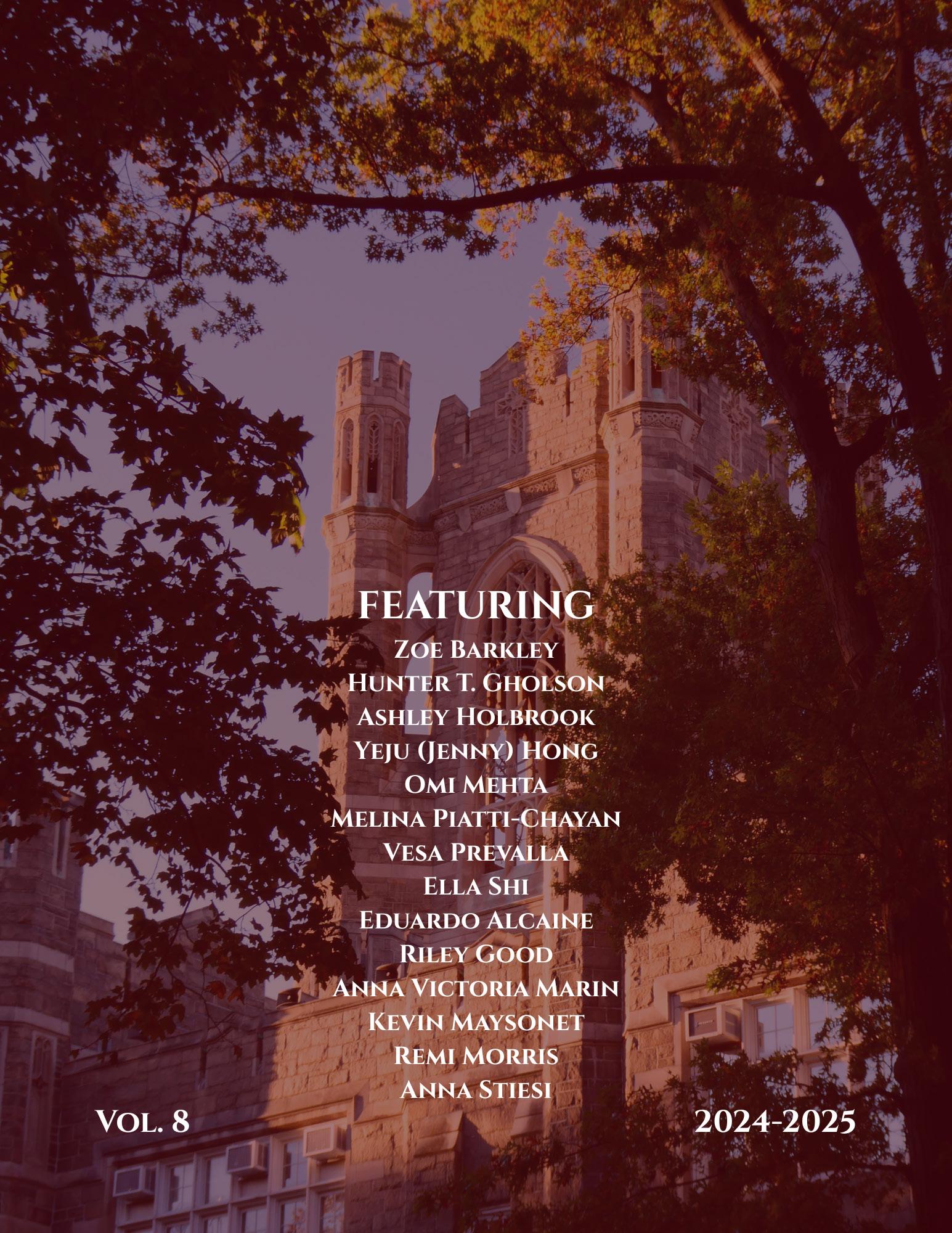
Cover Photography by Dalia Fouquart
FORDHAM UNDERGRADUATE

undergradlawreview.blog.fordham.edu
TABLE OF CONTENTS
Letter From The Editors-in-Chief, Vol. 8
February 17, 2026
Dear Reader:
It is our privilege to present to you Volume VIII of the Fordham Undergraduate Law Review (FULR). As Editors, we are always inspired by the fresh perspectives that our undergraduate contributors bring, drawing from diverse backgrounds to challenge conventional legal thinking in ways that resonate with Fordham’s rigorous academic environment. In a year marked by rapid advancements in technology and shifting geopolitical dynamics, these Notes offer timely insights that extend beyond the classroom, encouraging dialogue on how law can adapt to tomorrow’s uncertainties. We envision these works sparking not just academic discourse but also initiatives from students and practitioners to address these challenges head -on.
FULR provides Fordham students with the opportunity to try their hand at a range of technical skills, such as legal writing, research, and editing, that will serve them in law school and their future legal careers. Beyond this, FULR aims to provide a sense of community and a place for ambitious young scholars to connect. Volume VIII is the collective product of months of hard work, dedication, and rigorous research, with Notes ranging in subject matter from the need for antitrust reform in luxury markets to the expedited removal process for asylum seekers to bans on masked protests. It is evident that Volume VIII’s featured writers have sought to address systemic inequalities and a range of topical legal issues through their writing and research, and have skillfully argued for viable legal solutions they hope to see implemented in the future.
Volume VIII would not have been possible without the support, guidance, and expertise of those who have worked tirelessly behind the scenes. We would like to thank our team of Senior Editors for their work editing drafts and assisting writers with their research. We also owe a debt of gratitude to our fellow Editorial Board members, Ashley Holbrook, Eli Salomón, Ella Shi, Kathryn MacMillan, Megan Ruzicka, Mehak Imran, and John Schneider, for their contributions, enthusiasm, and commitment to FULR. We would also like to extend a special thanks to our faculty advisor, Dr. Robert Hume, and our Advisory Board, Dr. Anne Fernald, Dr. Catherine Chaput, Professor James Stillwagon, Dr. John Davenport, Professor Mark Conrad, Dr. Melissa Labonte, Dr. Michael Baur, and Dr. Orit Avishai, for their feedback on Volume VIII’s Notes. We would also like to thank the Fordham University faculty, administration, and student organizations for their continued support of our publication, and for inspiring writers to engage in legal research.
Please do not hesitate to contact the Editorial Board at fulr@fordham.edu to share any questions or comments you may have about Volume VIII.
Sincerely,
Danielle Barber, Co-Editor-in-Chief, 2024-2025
Ridhi Hora, Co-Editor-in-Chief, Fall 2024
Nadia Blouin, Co-Editor-in-Chief, Spring 2025
TABLE OF CONTENTS
GAPS IN THE BARS: A REEVALUATION OF THE PRISON RAPE ELIMINATION ACT
Zoe Barkley…………………………………………………………………1
UNRAVELING POST-CHEVRON ADMINISTRATIVE JURISPRUDENCE
Hunter T. Gholson 13
META AND THE FIRST AMENDMENT: A GOVERNMENT LIMITATION TO
PROTECT EDUCATIONAL PROCESSES AND STUDENTS’ MENTAL HEALTH
Ashley Holbrook 27
SELECTIVE SELLING AND MARKET POWER: ANTITRUST CHALLENGES IN THE LUXURY GOODS MARKET AND CASE OF HERMÉS
Yeju (Jenny) Hong………………………………………………………… 41
REFORMING EXPEDITED REMOVAL: PROTECTING ASYLUM SEEKERS’ RIGHTS
Omi Mehta…………………………………………………………………57
THE AMERICANS WITH DISABILITIES ACT: AN AVENUE FOR LEGAL PROTECTION AGAINST SOLITARY CONFINEMENT FOR MENTALLY ILL INCARCERATED PERSONS
Melina Piatti-Chayan 73
THE CHEMICALS ARE FOREVER 21, TOO: HOW TSCA CAN CLEAN UP OUR CLOTHING AND THE EVNRIONMENT
Vesa Prevalla 94
PARENTAL LIABILITY IN SCHOOL SHOOTINGS: ITS APPLICATION TO OTHER HIGH-RISK JUVENILE BEHAVIORS Ella Shi
TABLE OF CONTENTS
VOL. 8 2024-25 NOS. 1—2
GUILTY UNTIL PROVEN COMPLIANT: WHY THE CORPORATE TRANSPARENCY ACT MUST BE STRUCK DOWN
Eduardo Alcaine………………………………………………………….121
PUT DOWN THE POLISH AND PICK UP THE PEN: A CALL TO IMPPROVE SAFETY CONDITIONS IN NAIL SALONS
Riley Good……………………………………………………………… . 136
THE NECESSARY ROLE OF COUNTRY CONDITIONS FOR ARMED CONFLICT ASYLUM SEEKERS IN U.S. ASYLUM LAW
Anna Victoria Marin 151
“UNMASKING DISSENT”: NASSAU COUNTY’S BAN ON MASKED PROTEST
Kevin Maysonet………………………………………………………… . .166
THE RIGHT TO BODILY AUTONOMY IS CONSTITUTIONAL
Remi Morris………………………………………………………………181
DIGITAL ASSETS IN THE AFTERLIFE: REGULATING CRYPTOCURRENCY IN ESTATE PLANNING AND THE LEGAL FRAMEWORK
Anna Stiesi…………………………………………………………..……193
MASTHEAD
FALL
2024 EDITORIAL BOARD
DANIELLE BARBER
Co-Editor-in-Chief
KATHRYN MACMILLIAN
Co-Managing Editor
JOHN SCHNEIDER
Executive Notes Editor
ELLA SHI
Executive Layout Editor
RIDHI HORA
Co-Editor-in-Chief
ELI SALOMÓN
Co-Managing Editor
MEHAK IMRAN
Executive Online Editor
NADIA BLOUIN
Business Administrator
MEGAN RUZICKA
Events Coordinator
SPRING 2025 EDITORIAL BOARD
DANIELLE BARBER
Co-Editor-in-Chief
KATHRYN MACMILLIAN
Co-Managing Editor
JOHN SCHNEIDER
Executive Notes Editor
ELLA SHI
Executive Layout Editor
NADIA BLOUIN
Co-Editor-in-Chief
ELI SALOMÓN
Co-Managing Editor
MEHAK IMRAN
Executive Online Editor
ASHLEY HOLBROOK
Business Administrator
MEGAN RUZICKA
Events Coordinator
MASTHEAD
VOL. 8 2024-25
BUSINESS ADMINISTRATOR ASSISTANTS
ASHLEY HOLBROOK
MAYA SILBERMAN
ABIGAIL D’ANGELO
CAMILA MIRANDA
FATIMAH WAQAS
HUNTER GHOLSON
KATHRYN
ALEXANDRA-ROSSI
SARAH LARREA
SOPHIA STANIUNAS
NOS. 1 2
FRANCESCA ROSARIO BOLASTIG
NYLA PATEL
SENIOR EDITORS
AMY HERD
DANIELLA DRESPEL
GRAHAM THORESEN
ISABELLA RAGGETTE
LOLA CRAVATH
SARAH NUGIEL
VICTORIA ZHANG
ZUHOOR AL-FARDAN
BIANCA THAKUR
DYLAN AYER
HENRY CHANG
JULIA LAGRANGE
MADELINE GREEN
SEJAL GETCHELL
ZOE BARKLEY
MASTHEAD
VOL. 8 2024-25
STAFF WRITERS
ALEXA REID
EDUARDO ALCAINE
ERIN SANFORD
JADE GONZALEZ
KEVIN MAYSONET
NICOLE SIGISMONDI
SAM DANIELS
ANNA MARIN
EMMA CARRENO
HARRISON CARR
JAMES DOUGHERTY
MADDIE ANDO
RAEANN GOPAUL
SAM DOYLE
ROBERT J. HUME, PH.D. Faculty Advisor
NOS. 1 2
DEBORAH ADEBANJO
EMMA OWEN
JACK GONZALEZ
KATE STOVER
MATTHEW GRUYS
RUBEN ORTIZ FUENTES
MISSION
The Fordham Undergraduate Law Review (FULR) is a studentrun, scholarly journal at the undergraduate level for Fordham University and the legal community. Our publication includes a wide array of topical and historical legal issues covering both domestic and international affairs in its scope. FULR is a coveted opportunity for high-achieving, exceptional writers examining a range of disciplinary lenses as they relate to the nuances of law. In this pursuit, we have forged a driven, competitive community of students that engage in fruitful discussions on various legal issues. These exceptional attorneys of tomorrow are given opportunities for publication and offered admission to pre-law networking events with distinguished Fordham alumni. Learn more about opportunities to join our team by emailing fulr@fordham.edu.
INSTITUTIONAL PARTNERS
ROSE HILL DEAN’S OFFICE, Fordham College at Rose Hill
PRE-LAW ADVISING OFFICE, Fordham College at Rose Hill & Lincoln Center
OFFICE OF STRATEGIC INITIATIVES, Fordham College at Rose Hill
OFFICE OF STUDENT INVOLVEMENT, Fordham College at Rose Hill
PRE-LAW SOCIETY OF ROSE HILL & LINCOLN CENTER, Fordham College at Rose Hill & Lincoln Center
Thank you to our institutional partners for their supportive mentorship and financial assistance. Without their help, this Volume would not have been possible.
MISSION
The Editorial Board would like to express special gratitude for the careful efforts of the Advisory Board in providing feedback on Notes. Our writers have benefited immensely from the guidance of these accomplished scholars, whose time we know is dearly spent. We appreciate the support they have shown for student-driven legal inquiry outside of the classroom.
ANNE FERNALD, PH.D.
JOHN DAVENPORT, PH.D.
MICHAEL BAUR, PH.D., J.D.
CATHERINE CHAPUT, PH.D.
MARK CONRAD, J.D.
JAMES STILLWAGON, J.D.
MELISSA LABONTE, PH.D.
ORIT AVISHAI, PH.D., L.L.M
The views expressed by the authors are not necessarily those of the Editorial Board, the Faculty Advisory Board, or the institutional partners of the Fordham Undergraduate Law Review. While every effort has been made to ensure the accuracy and completeness of information contained in this journal, these parties cannot accept responsibility for any errors, inaccuracies, omissions, or inconsistencies contained herein.
No part of this journal may be reproduced or transmitted in any form or by any means, including by photocopying, recording, or use of an information storage and retrieval system, without prior written permission from FULR. Authors retain all rights to their work.
Volume VIII, Issues I & II, 2024-25 undergradlawreview.blog.fordham.edu.
Fordham Undergraduate Law Review
VOLUME VIII, ISSUE I (Fall 2024)
GAPS IN THE BARS: A REEVALUATION OF THE PRISON RAPE ELIMINATION ACT
Zoe Barkley*
The Prison Rape Elimination Act of 2003 (PREA) strives to eradicate prison rape in all correctional facilities throughout the United States. Through national standards set forth by the federal government, PREA is a foundational guideline for prisons to implement and reference in their fight against prison sexual assault. Despite these merits, the PREA has proven to be a failure in regard to the protection of inmates from sexual assault. This Note will lay out its premise by way of a brief introduction and a summary of the Prison Rape Elimination Act. The Note will examine the PREA and its implementation throughout correctional facilities. The Note will continue by emphasizing the continual presence of prison rape through examples where prison official-on-inmate rape occurred. A discussion on legislation passed after the PREA will also work to highlight the Act’s insufficiencies. Next, the Note will examine why the PREA is not working through the lens of an abuse of authority in L.C. v. United States and steps toward accountability. Ultimately, this Note will call out prison officials’ failure to protect inmates from sexual assault due to the ambiguous and vague language of the Prison Rape Elimination Act.
* B.A. Candidate for Political Science and French, Fordham College at Rose Hill, Class of 2026. I’d like to thank the FULR E-board and my senior editor for their amazing help throughout the writing process.
I. INTRODUCTION
In 2003, both chambers of Congress unanimously passed the Prison Rape Elimination Act (PREA).1 The PREA strives to “establish a zero-tolerance standard for the incidence of prison rape in prisons in the United States” while instating national standards for the prevention and punishment of prison rape.2 Further, under the PREA came the conception of the National Prison Rape Elimination Commission (NPREC). 3 Created in June of 2009, this commission drafted standards for eliminating prison rape and studying the cause and effect of sexual abuse in correctional facilities.4 Despite its efforts, its overarching goal of eradicating prison rape perpetrated by both inmates and prison officials has failed.
This Note will detail the premise of the Prison Rape Elimination Act of 2003 and the effectiveness of its implementation in the prison system. The Note will highlight the ongoing issue of prison rape, looking at specific cases and new legislation after the enactment of the PREA, such as the Prison Camera Reform Act. This Note will reason that the PREA and all subsequent legislation are not efficient in preventing prison rape and will present amendments for ensuring the effective application of the PREA. Ultimately, this Note argues that the Prison Rape Elimination Act inadequately protects inmates from sexual abuse as its language is too vague, leaving prison
1 National PREA Resource Center, Prison Rape Elimination Act, NATIONAL PREA
RESOURCE CENTER, https://www.prearesourcecenter.org/about/prison-rape-elimination-act.
2 Prison Rape Elimination Act of 2003, 34 U.S.C § 30305(a).
3 NATIONAL PRISON RAPE ELIMINATION COMMISSION, National Prison Rape Elimination Commission Report, 26 (June 2009).
4 Id
officials to disregard legal standards and constitutional guidelines guaranteed to protect inmate safety.
II. THE PRISON RAPE ELIMINATION ACT
The Prison Rape Elimination Act strives to promote national standards for the prevention of prison rape across all confinement facilities, prisons, jails, juvenile centers, and police lockups throughout the USA. 5 PREA standards are implemented through training sessions, increased accountability of prison officials, grant programs, and heightened data collection on the incidence of prison rape.6 For example, the PREA requires the Bureau of Justice Statistics (BJS) to carry out yearly statistical reviews and analyses on the incidence and effects of prison rape. 7 Under the jurisdiction of the PREA, the BJS provides surveys such as the Survey of Sexual Victimization (SSV) an administrative data collection of sexual assault allegations and substantiated incidents. 8 The SSV utilizes uniform definitions to classify each instance of sexual victimization by the type of act and whether the perpetrator was a fellow prisoner or a facility member. 9 Further, the BJS also oversees the National Inmate Survey (NIS), which gathers data on sexual victimization reports.10 This work generates statistics on prison rape, identifies correctional facilities with high and low incidence rates, and pinpoints common characteristics of victims, perpetrators, and facilities.11
To further combat sexual assault in confinement facilities, the Justice Department in accordance with the Prison Rape Elimination Act releases national standards in the prevention, detection, and response to prison sexual
5 Bureau of Justice Assistance, Annual Governors’ Prison Rape Elimination Act Certification and Assurance Submission, U.S. DEPARTMENT OF JUSTICE (Nov. 2022), https://bja.ojp.gov/doc/annual-governors-prea-certification-assurance-submission.pdf.
6 Prison Rape Elimination Act of 2003, 34 U.S.C § 30302.
7 Bureau of Justice Statistics, PREA Data Collection Activities, 2023, (June 2024), https://bjs.ojp.gov/document/pdca23.pdf.
8 Id
9 Id
10 Id 11 Id
abuse.12 More specifically, the standards detail various guidelines such as the screening of inmates for risk of being sexually abused, procedures for reporting sexual abuse, and the establishment of evidence protocol.13 Further, the standards presented in this ruling are binding on the Federal Bureau of Prisons, and no organization responsible for the accreditation of prisons may receive federal grants unless it adopts standards aligned with those outlined in the Justice Department’s ruling.14
Another key aspect of implementing PREA is federal grants. The Bureau of Justice Assistance (BJA) awards PREA grants to state, local, and tribal agencies to implement plans for the expansion of “zero-tolerance” cultures for prison sexual assault as well as comprehensive approaches to such incidents. 15 Each correctional facility uses the funds at its discretion, identifying where funding is most needed. For example, in 2020, the Colorado Department of Corrections planned to use its PREA funds to purchase cameras to deter and pinpoint sexual abuse within its facilities.16 On the other hand, the Georgia Department of Corrections has detailed goals of using its funds to conduct thorough examinations of current investigation processes and training.17 Overall, the standards and measures examined aim to direct prisons towards a reality where detection and prevention of prison rape is achievable nationwide.18
III. THE PRESENCE OF PRISON RAPE
In an environment commonly described as where “mercy is on extended vacation,” it is not surprising that American prisons are rampant with sexual harassment, abuse, and violence.19 Based on a culture of asserting physical dominance, the hierarchy in men’s prisons deems those unable to fight back
12 Office of the Attorney General, Justice Department Releases Final Rule to Prevent, Detect and Respond to Prison Rape, U.S. DEPARTMENT OF JUSTICE (2012), https://www.justice.gov/archives/opa/pr/justice-department-releases-final-rule-preventdetect-and-respond-prison-rape.
13 Id
14 Id.
15 National PREA Resource Center, Grant awards, NATIONAL PREA RESOURCE CENTER, https://www.prearesourcecenter.org/implementation/prea-in-action/grant-awards
16 Id.
17 Id
18 Prison Rape Elimination Act of 2003, 34 U.S.C § 30301.
19 Ian O’Donnell, The Struggle for Dominance: Prisons, Power and Sexual Violence, CRIMINAL LAW FORUM 277, 280 (2001).
as weak targets, susceptible to sexual violence.20 Despite the introduction of the Prison Rape Elimination Act, prisoners still live in fear of forced sexual encounters. 21 When evaluating the success of the PREA, it is vital to determine whether or not its goal of eradicating inmate rape has been met. To do so, one must examine the current state of the problem, specifically looking at recent rape cases and legislation.
A. Persistence of Prison Rape after the PREA
Despite the safeguards of the Prison Rape Elimination Act, prison rape continues to pervade correctional facilities nationwide.22 What remains even more concerning, however, are the recently recorded instances of officers perpetrating this sexual abuse the very individuals meant to protect prisoners under their charge.23 In March of 2023, California warden of the Federal Correctional Institution-Dublin and Prison Rape Elimination coordinator, Ray J. Garcia, was found guilty of sexually abusing three female inmates.24 Victims of Garcia recounted how they were treated like a “sexual play toy” and described him as “a predator and a pervert.”25 Garcia abused his place within the prison hierarchy to intimidate his victims, lie to government agents, and otherwise attempt to cover up his crimes. 26 According to Deputy Attorney General Lisa O. Monaco, Garcia “violated his oath to protect those in the custody of the Bureau of Prisons.”27 The women of the Dublin, CA prison aren’t the only victims of such sex crimes from 2016-2018, adult correctional authorities reported 2,229 incidents of staff
20 Id. at 279.
21 Id.
22 Id
23 Office of Public Affairs, Former Federal Prison Warden Sentenced for Sexual Abuse Of Three Female Inmates, OFFICE OF PUBLIC AFFAIRS (Mar. 22, 2023), https://www.justice.gov/opa/pr/former-federal-prison-warden-sentenced-sexual-abusethree-female-inmates.
24 Id
25 Richard Winton, Former warden at women’s prison known as ‘rape club’ gets 70 months for sexual abuse, LOS ANGELES TIMES (Mar. 22, 2023), https://www.latimes.com/california/story/2023-03-22/former-warden-sentenced-for-sexualabuse-at-female-prison.
26 Id
27 Id
engaging in sexual misconduct towards inmates.28 This staggering evidence of officer-on-inmate crime doesn’t reflect the full extent of this issue, as it doesn’t account for unreported incidents. 29 The report also detailed a shocking 2,666 cases of inmate-on-inmate sexual victimization. 30 This ultimately suggests inadequate implementation of the PREA, even twenty years after its introduction. It is becoming increasingly clear that it is a matter of when inmates will be raped, not if.
B. Legislation after the PREA
The continued passage of legislation after 2003 reveals additional flaws in the PREA. In 2021, former-President Joe Biden signed the Prison Camera Reform Act into law.31 This act requires the Federal Bureau of Prisons to fix any broken surveillance cameras to protect inmates from “rampant staff sexual abuse.”32 The Act’s detailed purposes are to ensure inmate safety by documenting any “misconduct by staff or inmates, negligent or abusive treatment of inmates, or criminal activity with correctional facilities.”33 This act implies that inmate safety is still drastically unrecognized. A large portion of the PREA is reserved for the use of federal grants to ensure “that budgetary circumstances… do not compromise efforts to protect inmates.” 34 These grants provide funds for data collection, training, and equipment.35 Strictly speaking, the Prison Camera Reform Act implies the need for further funds
28 Bureau of Justice Statistics, Substantiated Incidents of Sexual Victimization Reported by Adult Correctional Authorities, 2016-2018, BUREAU OF JUSTICE STATISTICS (Jan. 31, 2023), https://bjs.ojp.gov/press-release/substantiated-incidents-sexual-victimizationreported-adult-correctional-authorities.
29 Tami Abdollah, Prison, jail staff rarely face legal consequences after sex abuse of inmates, report finds, USA TODAY NEWS (Jan. 31, 2023), https://eu.usatoday.com/story/news/2023/01/31/sex-abuse-inmates-prison-jailunderreported-and-ongoing/11155572002/.
30 Bureau of Justice Statistics, Substantiated Incidents of Sexual Victimization Reported by Adult Correctional Authorities, 2016-2018, BUREAU OF JUSTICE STATISTICS (Jan. 31, 2023), https://bjs.ojp.gov/press-release/substantiated-incidents-sexual-victimizationreported-adult-correctional-authorities.
31 Prison Camera Reform Act of 2021, Pub. L. No. 117-321 (2022).
32 Michael R. Sisak, Bill Forcing Feds to Fix Prison Cameras is Signed into Law, AP NEWS (Dec. 27, 2022), https://apnews.com/article/biden-politics-prisons-district-ofcolumbia-united-states-government-1f9d6b4fea033a385fba620142251318.
33 Prison Camera Reform Act of 2021, Pub. L. No. 117-321, 136 Stat. 4430.
34 Prison Rape Elimination Act of 2003, 34 U.S.C § 30305(a).
35 Id
to protect inmates. As mentioned earlier, with the usage of PREA funds at the Colorado Department of Corrections (CDOC), it is evident that prisons have the funds to create change. In fact, the CDOC implemented inmate education on sexual safety as well as prevention and privacy measures such as shower curtains and private screens.36 Despite these efforts, the number of sexual abuse allegations only increased.37 In 2020, the facility reported 107 allegations including both inmate-inmate and staff-inmate sexual abuse. While in 2023, the prison documented 122 allegations. 38 Though these numbers may be close in quantity, this evidence suggests apparent failures to lessen instances of sexual abuse. The lack of sufficient funds and specific guidance on their use creates inconsistencies across prisons. To ensure that prisons like the CDOC use the PREA to its full potential, the Act must establish firmer regulations and additional PREA funds to ensure consistency throughout correctional facilities and proper usage of said funds.
The Adult Survivors Act (ASA) was passed one year later in New York, amending the statute of limitations for sexual assault survivors 18 years or older so that survivors could still file lawsuits past the previous three-year limit.
39 The Act provided a one-year window for survivors to file suits regardless of when the assault occurred.40 After the closure of the “lookback window,” over 3,000 suits had been filed under the ASA. 41 As the Act enables individuals to sue institutions, inmates who suffered sexual abuse while in the prison system could sue the state for abuse that occurred while incarcerated. Although the ASA does not pertain specifically to prisoners, the Act has frequently aided women affected by sexual abuse at the hands of prison officers.42 In fact, of the thousands of suits filed, 694 suits were filed
36 National PREA Resource Center, Grant awards, NATIONAL PREA RESOURCE CENTER, https://www.prearesourcecenter.org/implementation/prea-in-action/grant-awards
37 PRISON RAPE ELIMINATION ACT (PREA) Annual Report, COLORADO Department of Corrections, 4 (May 15, 2025).
38 Id
39 Senate Bill S66A, THE NEW YORK STATE SENATE (2022), https://www.nysenate.gov/legislation/bills/2021/S66.
40 Id
41 Safehorizon, Adult Survivors Act - Know Your Rights, SAFEHORIZON, https://www.safehorizon.org/adult-survivors-act.
42 Char Adams, Hundreds of lawsuits allege decades of sexual abuse at Rikers Island, NBC NEWS (Dec. 5, 2023), https://www.nbcnews.com/news/nbcblk/sexual-abuse-lawsuitsrikers-island-new-york-adult-survivors-act-rcna126898.
against NYC due to alleged staff-on-inmate sexual abuse at Rikers Island.43 The Adult Survivors Act helped maintain security by giving prisoners newly extended time to file suits after release. For example, the ASA gave 40-yearold Shanaye the ability to seek legal justice after her sexual assault at the hands of a Rikers correctional officer 21 years prior.44 The necessity of the ASA is no surprise, as the PREA contains no sections discussing the exact details of how survivors can come forward after sexual assault.45 There exists only a vague acknowledgment of change rather than substantial instructions.46
To tackle this, the PREA must add a section on post-assault procedure. An amendment applying the standards set in the ASA would reap substantial benefits for rape survivors. The Act must focus its efforts not only on the prevention of prison rape but also on helping survivors seek justice when such abuse occurs. Overall, new legislation doesn’t explicitly acknowledge the PREA’s failures; however, it does identify areas for reevaluation to further solidify the Act's strength and success.
IV. ACCOUNTABILITY UNDER THE PRISON RAPE ELIMINATION ACT
The Prison Rape Elimination Act of 2003 serves as a step in the right direction toward raising awareness and prevention. Despite this, the PREA has failed in its promise to dramatically reduce the rape epidemic plaguing thousands of correctional facilities nationwide.47 In just 2020, 36,264 sexual assault allegations were made from inside such facilities. 48 Of these harrowing numbers, only 2,351 allegations were substantiated the lowest number since 2014.49 American prisons compel vulnerable inmates to live in
43 Id 44 Id
45 Prison Rape Elimination Act of 2003, 34 U.S.C.
46 Id. § 30304.
47 Emily D. Buehler, Sexual Victimization Reported by Adult Correctional Authorities 2016-2018, BUREAU OF JUSTICE STATISTICS (June 2021), https://bjs.ojp.gov/library/publications/sexual-victimization-reported-adult-correctionalauthorities-2016-2018.
48 Emily D. Beuhler & Shelby Kottke-Weaver, Sexual Victimization Reported by Adult Correctional Authorities, 2019-2020 - Statistical Tables, BUREAU OF JUSTICE STATISTICS (July 2024), https://bjs.ojp.gov/document/svraca1920st.pdf.
49 Id
constant fear of sexual assault at the hands of fellow prisoners or, in some cases, their prison guards. The reinforcement of underreporting for fear of retaliation or distrust in the legal system leaves room for sexual violence to continue.
A. Corruption in the Prison System
The responsibility to protect prisoners’ bodily integrity becomes an increasingly complex matter when those meant to protect them are also participating in this systemic violence. An example of this striking power imbalance can be observed in L.C. v. United States (2022). While incarcerated, plaintiff L.C. alleged that a Bureau of Prisons officer, Hosea Lee, sexually assaulted her under his charge.50 L.C. claimed that the Bureau of Prisons was aware of Lee’s actions but “failed to enforce its zero-tolerance policy for sexual assault” as they failed to report his abuse in a timely manner.51 In search of legal justice, L.C. filed a negligence claim against the U.S. under the Federal Tort Claims Act. 52 The court denied relief on the grounds that L.C.’s allegations failed to state a plausible claim despite evidence that all of Lee’s victims contracted herpes after his assault.53 Failure to provide relief despite evidence of Lee’s assault highlights the inherent protections granted to prison officials, thus leaving their victims without the justice they seek. This is not an isolated event. In a report by the Bureau of Justice Statistics for 2016-2018, legal action against staff perpetrators resulted in only 38% of sexual misconduct cases.54 Of the 38%, only 44% resulted in reprimands such as discharge or termination for the accused.55 Evidence suggests that staff offenders face little accountability, fostering an environment that silences victims and facilitates abuse.
50 L.C. v. United States, 83 F.4th 534, 2023 (6th Cir.)
51 Id.
52 Id
53 Id
54 Bureau of Justice Statistics, Substantiated Incidents of Sexual Victimization Reported by Adult Correctional Authorities, 2016-2018, BUREAU OF JUSTICE STATISTICS (Jan. 31, 2023), https://bjs.ojp.gov/press-release/substantiated-incidents-sexual-victimizationreported-adult-correctional-authorities.
55 Id
B. Room for Growth
To address cases like L.C. v. United States, the PREA must revise its vague language to provide more concrete officer training guidelines. The current language found in the “Prison rape prevention and prosecution” section states, “The National Institute of Corrections shall conduct periodic training and education programs for Federal, State, and local authorities…”56 More specifically, PREA standard requires agencies to train all employees and volunteers who maintain regular contact with inmates on sexual abuse topics, policies, and procedures.57 Refreshers on such subjects are mandated every two years. 58 Despite these measures, the frequency of training and content learned is dependent on one’s role within PREA implementation.59 For instance, the PREA Academy teaches PREA 101 an online class designed to strengthen 8PREA implementation strategies through increased understanding of PREA standards and individualized coaching sessions. 60 Despite the informative nature of this course, limited seats leave many applicants without access to its resources and tools.61 The obscurity of the “Prison rape prevention and prosecution” section’s language leaves little instruction on the basis of this training.62 As a result, the National Institute of Corrections is given total discretion in establishing the curriculum taught during such training sessions. Solidifying concrete PREA guidelines would improve the consistency of PREA training content and ensure equal learning opportunities for prison officials, thus providing all inmates equal treatment and resources. This consistency is essential for fostering equity and growth within correctional institutions, as disparities may lead to disproportionate harm and continual abuse. By drafting uniform standards, institutions will bridge the gap in protection and education, ensuring that all inmates receive the same resources and protections against sexual abuse promised to them by the PREA.
56 Prison Rape Elimination Act of 2003, 34 U.S.C § 30304(a).
57 https://www.prearesourcecenter.org/node/1689.
58 Id
59 National PREA Resource Center, PREA Academy, NATIONAL PREA RESOURCE CENTER, https://www.prearesourcecenter.org/implementation/training/prea-academy.
60 Id 61 Id
62 Prison Rape Elimination Act of 2003, 34 U.S.C § 30304.
Amendments to the implementation of PREA training are not the only areas for potential improvements. The PREA must also be amended to reinforce preventative measures to reduce and ultimately eradicate inmateon-inmate rape and officer-on-inmate rape. To start, legislators must revise and elaborate upon the language within the Act. For reference, subsection six under the “Purposes” section states the need to “increase the accountability of prison officials who fail to detect, prevent, reduce, and punish prison rape.” 63 This highlights a focus on rape between inmates rather than the possibility of abuse at the hands of corrupt prison officials. Further, the current language suggests that officers must adequately enforce a no-rape policy rather than be held accountable and prosecuted for personal rape allegations. To combat this, the Act must emphasize stricter regulations for prison officers alongside additional PREA training to highlight the severity of the present prison rape epidemic. The current language emphasizes the need for “the training of correctional staff sufficient to ensure that they understand and appreciate the significance of prison rape and the necessity of its eradication.”64 Without specific language to define “sufficient,” prisons are left to navigate this language independently. As a result, universal training is impossible, as prisons have no distinct instructions or curricula to follow. Overall, the Prison Rape Elimination Act employs language that is too ambiguous, allowing for discrepancies in its implementation as well as the ability of prison officials to disregard its significance.8
V. CONCLUSION
For stronger implementation of the Prison Rate Elimination Act, Congress must structure the Act to present its overarching solution with subsequent subsections that develop and explain the language used. A possible amended statement may detail monthly training sessions for prison officers, discussing both inmate-on-inmate rape and officer-on-inmate rape. A focus will be placed on addressing the persistence of prison rape and the consequences of participating in or acting in negligence of one’s responsibility to prevent such crimes. These training sessions would create consistency while briefing officers on the standard procedure for preventing
63 Id. § 30306(e).
64 Id. § 30306(e).
rape and bringing forth legal action and aid if rape does occur. The following subsections must then delve into further explanation. For example, a subsection on “reporting” would detail the standard procedure for reporting and how inmates can be briefed on making PREA violation claims. This structure would ensure that prison officials meet national standards, as institutions would have direct instructions with little room for shortcuts. Overall, until we reevaluate the implementation and language of the Prison Rape Elimination Act, the safety and bodily autonomy of vulnerable inmates will continue to be violated.
UNRAVELING POST-CHEVRON ADMINISTRATIVE JURISPRUDENCE
Hunter T. Gholson*
This Note examines the Supreme Court’s decision to overturn the Chevron doctrine in Loper Bright Enterprises et al. v. Raimondo, Secretary of Commerce, et al. (2024). It will begin by providing background on the Chevron doctrine’s formation, outlining the two-step test established in Chevron U.S.A. Inc. v. Natural Resources Defense Council, Inc. (1984). This Note will then examine the issues arising after Chevron’s creation, including debates surrounding congressional intent, concerns about regulatory capture, and criticism of Chevron’s workability. It will then outline the Supreme Court’s reasoning in Loper Bright, specifically the Court’s arguments that Chevron: (1) conflicts with the Administrative Procedure Act, (2)lacks a firm legal basis, and (3) has proven unworkable in practice. Finally, this Note will explore the potential impacts of the Loper Bright decision, focusing on the shift towards judicial supremacy in statutory interpretation. This shift may lead to increased reliance on traditional tools of statutory construction and potential challenges to existing case law, creating uncertainty for agencies and regulated entities. This Note concludes by arguing that the end of Chevron deference strengthens judicial supremacy in statutory interpretation, fosters greater consistency and predictability in regulatory policy, and restores the constitutional balance of powers.
* B.S. Candidate for Business Administration (major) and Philosophy (minor) at Fordham University Gabelli School of Business, Class of 2026. I am grateful for my family, friends, the FULR Executive Board, and Sarah Nugiel, my Senior Editor, for their encouragement and resources throughout the writing process. I could not have written this Note without the support of those around me. Finally, words cannot fully express my appreciation for Professor Elizabeth Cosenza, who not only served as an exceptional academic mentor but also inspired my journey into law through her challenging coursework and invaluable guidance.
A.
I. INTRODUCTION
In a decisive move, the Supreme Court overturned Chevron deference, arguing that it conflicted with the Administrative Procedure Act, lacked a firm legal basis, and proved unworkable in practice.1 As a result, interpretive authority of statutes shifts away from agencies and returns to the courts. This ushers in a new era of judicial primacy in administrative statutory interpretation, particularly in matters traditionally subject to agency deference.
This Note will describe the Supreme Court’s decision to overturn the Chevron doctrine. It will argue that the Court’s decision will foster long-term stability in the regulatory landscape by anchoring statutory interpretations in judicial reasoning rather than agency positions. This Note will argue that the shift towards more consistent judicial interpretations will likely: (a) result in increased predictability in regulatory policy for regulated entities, and (b) restore the constitutional balance of powers. This Note aims to shine light on the potential impacts of the Court’s decision and the positive shift back to judicial interpretation away from fluctuating agency positions.
II. CHEVRON’S RISE AND FALL
In the landmark case, Chevron U.S.A. Inc. v. Natural Resources Defense Council, Inc. (1984), the Supreme Court examined the Environmental Protection Agency’s (EPA) interpretation of the term “statutory source”
1 Loper Bright Enterprises v. Raimondo, 603 U. S. 369 (June 28, 2024) at 413.
within the Clean Air Amendments Act of 1977 (Clean Air Act).2 The EPA’s interpretation was widely known as the “bubble concept,” which allowed states to treat all pollution-emitting devices within an industrial plant as a single source for regulation purposes as long as the total emissions level from the plant remained unchanged. 3 The Natural Resources Defense Council (NRDC) argued that the EPA’s interpretation contradicted the Clean Air Act’s goal of improving overall air quality.4 The NRDC succeeded in the D.C. Court of Appeals, which found the “bubble concept” to be inadequate for facilities promoting better air quality.5 Chevron later petitioned via writ for appellate review by the Supreme Court, where the Supreme Court reversed the decision of the D.C. Appellate Court.6
This reversal became widely known for its establishment of “Chevron deference,” a two-step test to determine if an agency’s interpretation of a statute is appropriate. First, (i) a court determines whether Congress has directly addressed the interpretation of the statute through a process where the court exhausts all “traditional tools of statutory construction” to determine Congress’s intent. The Court describes “traditional tools of statutory construction” as “us[ing] every tool at [its] disposal to determine the best reading of the statute and resolve the ambiguity.”7 If the intent is clear, then the intent governs.8 If the intent is ambiguous, the court then moves to the second step, which is (ii) deferring to the agency’s interpretation of the statute if it falls within the realm of reasonable interpretations. 9 The Chevron framework was founded on justifications that over time garnered criticism, eventually leading to the ruling in Loper Bright Enterprises v. Raimondo, Secretary of Commerce, et al. (2024). This section aims to unravel the foundational thoughts behind the doctrine through an analysis of the motives behind the Court’s decision.
2 Chevron U. S. A. Inc. v. Natural Res. Def. Council, Inc., 467 U. S. 837 (1984) at 840.
3 Id.
4 Id.
5 Id.
6 Id. at 841, 866.
7 Id. at 842-843.
8 Id. at 842.
9 Id. at 853.
A. Chevron’s Foundation
The Court’s justifications for Chevron deference are grounded in three key principles: congressional intent, agency expertise, and political accountability. First, congressional intent is what Congress intended to communicate through the chosen language used in a statute when drafting.10 The Court reasoned in Smiley v. Citibank (1996) that when Congress drafts a statute that is ambiguous or leaves gaps, it is left to the agency to fill the gaps and clarify the ambiguities in the statute. 11 This rationale suggests that Congress anticipates agencies, with their specialized subject-matter knowledge, will play a primary role in interpreting and implementing the law.12 For example, in Gray, Director of the Bituminous Coal Division of the Department of the Interior, et al. v. Powell et al, (1941), the Supreme Court deferred to an agency’s interpretation of the term “producer” in a statute related to exemption from price controls.13 The Court’s process in this case highlighted the role of congressional intent in determining when to defer to an agency, particularly when Congress has delegated the authority of interpretation to an agency due to its specialized knowledge. The Court reasoned that Congress intended to grant the agency discretion in determining the scope of the exemption because of the agency’s “experience in the field.” 14 By entrusting the agency with the decision, the Court stated that Congress aimed for a “better informed, more equitable adjustment of the conflicting interests” involved in the regulation of coal production. 15 The Court’s acknowledgment of congressional intent in Powell was crucial to the creation of Chevron deference, particularly noted by Justice Kagan in her
10 Id. at 842.
11 See Johnathan R. Siegel, The Constitutional Case for “Chevron” Deference, 71 VAND. L. REV 937 (2018) at 941.
12 Smiley v. Citibank (South Dakota), N. A., 517 U. S. 735 (1996) at 741 (Justice Scalia, writing for a unanimous Court, held that the Comptroller of the Currency’s interpretation of the term “interest” in the National Bank Act was entitled to deference. The Court emphasized that agencies possess the expertise and subject-matter knowledge to resolve statutory ambiguities, noting that “we have long recognized that considerable weight should be accorded to an executive department’s construction of a statutory scheme it is entrusted to administer”).
13 Gray, Director of the Bituminous Coal Division of the Department of the Interior, et al. v.Powell et al., 314 U.S. 402 at 411 (1941)
14 Id. at 412.
15 Id. at 411-412; See also Raimondo, 144 S. Ct. 2244 at 426 (Kagan, J., dissenting).
later Loper Bright dissent, stating that Gray v. Powell was a “leading case on review of agency interpretation.”16
The second core justification for the creation of Chevron deference was agency expertise.17 The Court recognized agencies are far better equipped than courts to grapple with niche statutory interpretation, particularly in fields like financial regulation or environmental protection.18 Prior to the inception of the doctrine, courts have viewed agency expertise as a source of “informed judgment.” 19 As seen in Skidmore v. Swift & Co. (1944), the Court determined that even when Congress has not explicitly granted an agency the authority to interpret a statute, the agency’s expert analysis of a particular issue can hold persuasive weight in a court’s decision-making process.20 In Skidmore, which involved a dispute over whether time spent by firefighters on call constituted “working time,” the Court recognized the value of agency expertise in guiding courts through complex statutory language. 21 The recognition of expertise stemmed from the idea that agencies develop a deep familiarity with the subject matter, making them well-equipped to understand the practical implications of different interpretations.22
The final of three key justifications outlined in the Chevron decision was the idea of political accountability. 23 In the Chevron decision, the Court acknowledged that agencies are not directly accountable to the people and argued that the President could and would ensure that agency actions are consistent with the will of the people. 24 This reasoning rests on the assumption that an agency’s interpretation, filtered through presidential oversight, is more likely to reflect the will of the people than a judge’s
16 Id. at 427 (Kagan, J., dissenting).
17 Frederick Liu, Chevron as a Doctrine of Hard Cases, 66 ADMIN. L. REV. 285 (2014) at 318.
18 Id. at 318
19 Skidmore v. Swift & Co., 323 U.S. 134 (1944) at 140.
20 Id. at 140 (“The Court has long given considerable and in some cases decisive weight to Treasury Decision and to interpretative regulations for the Treasury and of other bodies that were not of adversary origin. We consider that the rulings, interpretations, and opinions of the Administrator under that Act, while not controlling upon the courts by reason of their authority, do constitute a body of experience and informed judgment to which courts and litigants may properly resort for guidance”); see United States v. Mead Corp., 533 U.S. 218 (2001)
21 Id. at 138.
22 Id
23 Chevron, 467 U.S. at 865.
24 Id
interpretation, which lacks a democratic link.25 Since agencies are a part of the Executive Branch, ultimately accountable to the public through the elected President, it was deemed more logical for interpretations to be made by agencies rather than unelected judges.26 This rationale sought to ensure that administrative interpretations reflect the will of the people, as initially intended.27
The triad of congressional intent, agency expertise, and political accountability were critical to Chevron’s run over the last 40 years. However, these justifications have been subject to persistent criticism, raising questions about Chevron’s coherence and practicality.
B. Chevron Cracking
While the Court was clear and provided strong reasoning behind the Chevron decision, issues still arose. Congressional intent had many loopholes in its application. Primarily, judges with various understandings of “ambiguity” could reach different conclusions about the applicability of Chevron deference. 28 For example, in Exxon Mobil Corp. v. Allapattah Services, Inc. (2005), Justice Stevens expands on this idea in his dissent by sharing, “[a]mbiguity is a term that may have different meanings for different judges.” 29 Additionally, the Court in Loper Bright found there to be no boundary for “ambiguity,” in drawing a “reasonable” agency interpretation.30 Inconsistency and the nature of the word “ambiguity” completely undermined the predictability and stability that Chevron aimed to achieve. Secondly, the experienced guidance of specialized agencies like the EPA and SEC in their interpretations was short-lived as fears of regulatory capture began to leak. Regulatory capture is the idea that the agencies can be
25 Id.
26 Liu, supra note 17
27 Jeremy D. Rozansky, Waiving Chevron, 85 U. CHI. L. REV. 8 (2018) at 169-170.
28 See Thomas W. Merrill and Kristin E. Hickman, Chevron’s Domain, 89 GEO. L.J. 833 (2001) at 847; see also Jack M. Beermann, End the Failed Chevron Experiment Now: How Chevron Has Failed and Why It Can and Should Be Overruled, 42 CONN. L. REV. 779 (2010) at 784-785, 820.
29 Exxon Mobil Corp. v. Allapattah Services, Inc., 545 U.S. 546, 572 (2005) (Stevens, J., dissenting)
30 Raimondo, 144 S. Ct. 2244 at 7.
influenced through special interests to alter the interpretation of the statutes.31
Jeremy D. Rozansky, writing for the University of Chicago Law Review, explained that Chevron increased agency power by granting significant authority to interpret statutory ambiguities, potentially creating opportunities for special interests to exert unmerited influence. 32 Additionally, Justice Kennedy’s warning in Pereira v. Sessions (2018) about the risk of agency overreach is well-illustrated by the case itself.33 The issue involved the Board of Immigration Appeals (BIA) applying its own interpretation of the stoptime rule under the Immigration and Nationality Act, which determines when the accrual of continuous presence or residence ends for certain immigrants.34 The BIA's interpretation effectively expanded its authority by creating criteria not explicitly authorized by Congress. 35 This demonstrates how agencies can use Chevron deference to define the scope of their authority beyond what Congress intended.
While Justice Kennedy concurred with the majority opinion in Pereira, his separate note regarding “reflexive deference” served as a warning about the potential overreach of Chevron deference and the need for courts to exercise independent judgment when evaluating statutes that define their authority.36 United States Circuit Judge of the U.S. Court of Appeals for the Second Circuit, Robert A. Katzmann, further emphasized this concern, stating that Chevron incentivizes administrations to aggressively expand their political goals, even if it requires stretching the boundaries of their statutory authority.37 He writes, “[f]rom my more than five years of experience at the White House, I can confidently say that Chevron encourages the Executive Branch (whichever party controls it) to be extremely aggressive in seeking to squeeze its policy goals into ill-fitting statutory authorizations and
31 Scott Hempling, “Regulatory Capture”: Sources and Solutions, 1 EMORY CORP GOVERNANCE & ACCOUNTABILITY REV. 23 (2014) at 24-25.
32 Jeremy D. Rozansky, Waiving Chevron, 85 U. CHI L. REV. 1927 (2018) at 1992-1963.
33 Pereira v. Sessions, 585 U.S. 198, 219 (2018) at 221 (Justice Kennedy wrote a concurring opinion expressing concern about lower courts’ “reflexive deference” to agency interpretations. He specifically cautioned that when agencies interpret the scope of their own authority, there is an increased risk of agencies expanding their power beyond what Congress intended, stating that “reflexive deference” to agency interpretations has led to an “abdication of the Judiciary’s proper role in interpreting federal statutes”).
34 Id. at 205.
35 Id. at 216.
36 Id. at 221.
37 Robert A. Katzmann, Fixing Statutory Interpretations, 129 HARV L. REV 2118, 2150. (2016)
restraints.” 38 The uncertainty surrounding congressional intent exacerbates this fear. Lack of clarity, shifting political landscapes, and the changing of interpretations from administration to administration raised alarms around whether the public good was being prioritized.
Even though Chevron was initially designed to provide clarity, it garnered criticism through the subjective interpretation of the word “ambiguity” and fears of regulatory capture. These flaws undermined the very stability and predictability that Chevron sought to establish, further questioning whether grounding interpretations in judicial reasoning rather than agency interpretations would lead to long-term predictability.
C. Chevron Down
The knockout blow to Chevron deference came in 2024 when the Supreme Court heard Loper Bright v. Raimondo. 39 The case involved a dispute over whether the National Marine Fisheries Services (NMFS), under the Magnuson-Stevens Act (MSA), could require Atlantic-based fishing companies to pay for federal monitors on their vessels.40 The statute lacked clear language on this point, raising issues about agency authority.
The Supreme Court granted certiorari to address whether Chevron deference should be overruled or clarified when Congress’s statutory silence does not equate to ambiguity. Ultimately, the Court overturned Chevron U.S.A. v. Natural Resources Defense Council (1984), rejecting the longstanding doctrine of Chevron deference and emphasizing the importance of judicial interpretation over agency interpretations when statutory clarity is lacking.
41
D. Loper Bright’s Reasoning
Building on these issues in Chevron’s application, the Loper Bright decision provided a forceful critique of the doctrine.42 The Court’s reasoning centered on Chevron’s incompatibility with the Administrative Procedure
38 Id. at 2150.
39 Loper Bright, 603 U. S. 369
40 Id.
41 Id
42 Loper Bright, 603 U. S. 369 at 413 (Thomas, J., concurring).
Act of 1946 (APA), its historically weak foundation, and its shortcomings in practical application.43
The Supreme Court concluded that Chevron deference is fundamentally incompatible with the Administrative Procedure Act. 44 The Court emphasized that APA section 706 establishes a framework for judicial review of agency actions where courts independently interpret statutes and ensure agencies exercise “reasoned decision-making” within their boundaries. 45 Section 706 states that “the reviewing court shall decide all relevant questions of law” and “interpret…statutory provisions.”46 The APA is inconsistent with Chevron’s requirement of agency deference even when a court has a different interpretation of the statute. 47 The Court argued this inconsistency undermines the judiciary’s traditional role as the interpreter of the law. 48 Justice Thomas, concurring in the Loper Bright judgment, echoed this point, stating Chevron “contravene[s] the law Congress prescribed in the Administrative Procedure Act.” 49 Similarly, Justice Gorsuch, in his concurring opinion, asserted that abiding by Chevron would force the Court to disregard Congress’s instructions in the APA.50
The Court also found that Chevron deference opposed independent judicial decision-making.51 Prior to Chevron, while the Court acknowledged that agencies deserved “respect” in their interpretations, judicial judgment was never superseded.52 Justice Gorsuch painted a more detailed analysis of the Court’s pre-Chevron jurisprudence, arguing that it consistently upheld the
43 Id.
44 Id. at 18.
45 5 U.S.C. § 706; Loper Bright, 603 U. S. 369, 413 at 427 (Thomas, J., concurring).
46 Id. § 706.
47 Id
48 Loper Bright, 603 U. S. 369, 413 (Thomas, J., concurring).
49 Id. at 427 (Thomas, J., concurring).
50 Id. at 417-419 (Gorsuch, J., concurring).
51 Id
52 Id.; see Swift, 323 U.S. at 140 (Swift acts as evidence of the “normal and usual method of construing a statute” that involved courts independently determining the meaning of statutes, giving weight to agency interpretations only as a source of guidance, not as binding precedent); see Burnet v. Chicago Portrait Co., 285 U.S. 1 (1932) (The Court stated that it was “not bound” by an agency’s reasonable interpretation of a statute, even though the agency had expertise in the matter); see Davies Warehouse Co. v. Bowles, 321 U.S. 144 (1944) (This case involved the rejection of deference to an agency’s determination, further solidifying the historical pattern of judicial supremacy in statutory interpretation).
principle of independent judicial interpretation of statutes.53 He cited cases Burnet v. Chicago Portrait Co. (1932), which stated that courts were “not bound” by reasonable administrative interpretations, and Davies Warehouse Co. v. Bowles (1944), which rejected deference to an agency’s determination. These cases show a consistent historical thread of independent judicial interpretation of statutes that Chevron disrupted.54 This historical analysis, combined with the perceived incompatibility with the APA, led the Court to conclude that Chevron lacked a firm legal basis.
Finally, the Court criticized Chevron’s two-step framework for being unworkable and inconsistent in its application. 55 The opinion highlighted how the Court has been “forced to clarify the doctrine again and again,” which “only added to Chevron’s unworkability.” 56 Justice Gorsuch elaborated on this critique, arguing that the supposed simplicity of Chevron’s two-step approach proved illusory in practice.57 As further evidence of the doctrine’s unworkability, Justice Gorsuch also noted the emergence of “Chevron Step Zero,” an extra-statutory creation that requires examining whether Congress intended to delegate interpretive authority to the agency.58 This lack of clarity and consistency, combined with the emergence of additional steps and tests, reinforced the view that Chevron created more problems than it solved.
In conclusion, the Supreme Court in Loper Bright overturned Chevron deference, arguing that it conflicted with the APA’s framework for judicial review, lacked a strong historical foundation, and proved unworkable in practice.
III. NAVIGATION
The overturning of Chevron in Loper Bright signifies a major shift in interpretive authority, signaling a return to greater judicial control over
53 Id. at 431 (Gorsuch, J., concurring).
54 Id. at 432.
55 Id. at 389; see Exxon Mobil Corp. v. Allapattah Services, Inc., 545 U. S. 546 (2005) (Stevens, J., dissenting) (“[A]mbiguity’ is a term that may have different meanings for different judges”).
56 Loper Bright, 603 U. S. 369 at 390, 397.
57 Id. at 383-385 (Gorsuch, J., concurring).
58 Id. at 387-388 (“Step Zero,” an extra-statutory creation, is used by courts to determine if Chevron applies in a particular case. This step requires examining whether Congress intended to delegate interpretive authority to the agency, a question that often leads to further complexity and subjectivity).
statutory interpretation. This shift has many implications for courts’ methods of analysis, standards of review, and shifts in the authority to interpret statutes.
A. Return of Interpretative Power
Moving forward, courts are expected to take a more complete and influential role in resolving statutory ambiguities.59 Before Chevron, judicial deference to agency interpretations was on a case-by-case basis.60 Deference to agencies was present in cases where interpretation of statutes was directly delegated to agencies to define terms within those statutes.61 For example, in United States v. Vogel Fertilizer Co. (1982), the Supreme Court explained that when Congress has already specifically defined an ambiguous term, the term is “owed less deference than a regulation issued under a specific grant of authority to define a statutory term.”
62
By contrast, in cases where direct delegation to agencies was absent, courts relied on multiple factors on a case-by-case basis.63 During its run, Chevron deference relocated interpretive power from courts towards agencies due largely to step (ii) of the framework. For example, in National Cable & Telecommunications Association et al. v. Brand X Internet Services et al., (2005) the Supreme Court applied Chevron step (ii) and found that the FCC’s interpretation that a cable modem was not a “telecommunications service” was permissible.64 The Court’s decision in Brand X effectively overruled the Ninth Circuit’s prior decision in AT&T Corp. v. Portland (2000), which had held that the cable modem service was a “telecommunications service.” 65 Notably, this decision highlighted that an agency’s interpretation could override pre-existing judicial precedents unless the prior court explicitly
59 Loper Bright, 603 U. S. 369 at 381, 383.
60 Liu, at 328.
61 Id.
62 United States v. Vogel Fertilizer Co., 455 U.S. 16 (1982) at 16.
63 Merrill & Hickman, Chevron’s Domain, at 833; see also Colin S. Diver, Statutory Interpretation in the Administrative State, 133 U. PA. L. REV 562-67 (1985) (Here Diver expands on the factors the court relied on in that era. Not every factor was used in every case. Factors include: the thoroughness evident in the agency’s consideration of the issue, the validity of the agency’s reasoning, the consistency of the interpretation with earlier and later pronouncements, and the agency’s expertise).
64 National Cable & Telecommunications Association v. Brand X Internet Services., 545 U.S. 967 (2005).
65 AT&T Corp. v. City of Portland, 216 F.3d 871 (9th Cir. 2000).
deemed the statute unambiguous, showcasing the sweeping power of deference under the Chevron framework.66
Furthermore, a study conducted by Barnett and Walker in Chevron and Stare Decisis provided empirical evidence of Chevron’s application. The study found that agency interpretations prevailed in 77.4% of cases where Chevron was applied.67 Since the Loper Bright decision, courts have regained some of the interpretive weight that was lost under the Chevron standard and can now interpret statutes without deference. The end of Chevron now anchors the interpretations in judicial reasoning rather than potentially overridden precedents to support agency motives.
B. Independent Judicial Analysis
In a post-Chevron world, courts will assume a more central role in interpreting statutes, even when those statutes are ambiguous. The Loper Bright decision emphasizes that the judiciary is responsible for “say[ing] what the law is” and interpreting statutory provisions.68 Justice Gorsuch, in his concurring opinion, argues that Chevron “prevent[ed] judges from judging,” which is inconsistent with their constitutional role.69 The emphasis on independent judicial analysis means that courts will now return to applying traditional tools of statutory construction to determine the meaning of statutes, rather than deferring to agency interpretations. 70 Note that the same traditional tools of statutory construction previously used to determine congressional intent in step (i) are now likely to be used to determine the meaning of statutes in courts. 71 Consequently, higher levels of judicial efficiency permeate a post-Chevron landscape as courts will now be exhausting the same resources to reach an interpretation rather than an elongated two-step process where a court looks for Congress’ intention in step (i) or waits for the agency’s interpretation in step (ii).
66 Loper Bright, 603 U. S. 369 at 399 (Gorsuch, J., concurring)
67 Kent Barnett & Christopher J. Walker, Chevron and Stare Decisis, 31 GEO. MASON L. REV 475 (2024).
68 Loper Bright, 603 U. S. 369 at 364.
69 Id. at 63.
70 Liu, at 310 (“traditional tools of statutory construction” as referred to in (i) of Chevron are the same the courts would typically use; in the case of Chevron they were using it to determine congressional intent not standard judicial procedure).
71 Id
C. Potential Standards of Review
The overturning of Chevron raises questions about what alternative standards of review might emerge outside the usage of traditional tools of statutory construction. One possibility is a return to Skidmore deference, which gives weight to agency interpretations based on factors like agency expertise, thoroughness, and consistency.72 Under Skidmore, courts are not required to defer to agencies but instead consider their interpretations as persuasive authority. 73 Another option the Court could return to is preChevron decision-making based on a “reasonable manner with attention to the meaning of the statute, its purpose and history, and the wisdom of its policy choices under the arbitrary, capricious standard.” 74 Either way, the loss of Chevron seems to have no significant impact on the Court’s delineation of issues, proof being that alternative methods existed prior to Chevron’s inception. In Loper Bright, the Supreme Court concluded that traditional tools of statutory interpretation, as outlined in the APA, should guide the analysis of agency actions, thereby rejecting the agency deference approach that defined the Chevron era. Justice Thomas, concurring in the judgment, further emphasizes this point, stating that Chevron is at odds with the APA’s mandate that courts independently decide all relevant questions of law, solidifying the Court’s intention to prioritize its role in statutory interpretation.75
IV. CONCLUSION
The Supreme Court’s decision in Loper Bright marks more than just the end of Chevron's deference, but it represents a shift of power. The return to judicial supremacy in statutory interpretation will foster a more stable regulatory landscape in two key ways.
First, the post-Chevron framework will provide greater consistency and predictability for regulated entities by anchoring statutory interpretations in judicial reasoning rather than fluctuating agency positions. Courts will now uniformly apply time-tested tools of statutory construction across cases,
72 Swift, 323 U.S. at 140 (holding that the weight of agency interpretation depends on “thoroughness evident in its consideration, the validity of its reasoning, consistency with earlier and later pronouncements, and all those factors which give it power to persuade”).
73 Id.
74 Beermann, 42 CONN L. REV at 786.
75 Raimondo, 144 S. Ct. 2244 at (Thomas, J., concurring).
replacing the often inconsistent application of Chevron’s two-step framework, as outlined in Brand X.
Second, the elimination of Chevron deference will help restore the constitutional balance of powers that the Founders envisioned. 76 The judiciary will resume its proper role as the primary interpreter of statutory meaning, while agencies will focus on applying their technical expertise within clearly defined statutory boundaries. The rebalancing promises to create a more stable regulatory environment where changes in policy require legislative action rather than merely new agency interpretation.
Looking forward, the post-Chevron landscape will likely see the emergence of a more nuanced approach to agency expertise. While courts will no longer automatically defer to agency interpretations, they will still consider agencies’ technical knowledge and experience as part of their overall analysis. This approach strikes a better balance between respecting agency expertise and maintaining judicial oversight of statutory interpretation. The end of Chevron deference does not signal a wholesale rejection of administrative expertise but rather a recalibration of how that expertise fits within our constitutional framework. While this transition may create some short-term uncertainty, the long-term benefits of enhanced predictability and clearer statutory interpretation will ultimately serve both regulated entities and the public interest.
76 The Federalist No. 51 (James Madison).
META AND THE FIRST AMENDMENT: A GOVERNMENT LIMITATION TO PROTECT EDUCATIONAL PROCESSES AND STUDENTS’ MENTAL HEALTH
Ashley Holbrook*
The legal framework balancing freedom of speech with government regulation has become increasingly ambiguous as technology advances rapidly, especially in the context of social media. This Note will explore the historical development of the First Amendment, along with the circumstances under which the U.S. government may lawfully intervene in the regulation of speech. The Note will focus on Meta Platforms, Inc., and its impact on the American education system. The Note will examine past instances where the government-imposed regulations on education systems, notably Hazelwood School District v. Kuhlmeier and Augustus v. School Board. The Note will then analyze recent legal developments related to social media and Meta with State v. Meta Platforms, the Facebook Whistleblower Case, and Lemmon v. Snap. Inc.
To conclude, the Note will discuss current regulations, such as the Children’s Online Privacy Protection Act (COPPA), and suggest further implementations to protect students in schools. Ultimately, it will argue that the U.S. government has a legal basis to intervene in instances where social media platforms such as Meta disrupt or initiate violence in an educational setting. One key instance is the failure to protect the privacy and safety of students, thereby increasing the risk of addiction and other forms of distraction and harm. The government’s involvement would not constitute an infringement on the First Amendment because the objective would be to protect students against social media's harmful effects rather than restrict freedom of speech.
* B.A. Candidate for International Studies, with a French Minor and American Catholic Studies Honors Concentration, Fordham College at Rose Hill, Class of 2027. I am incredibly grateful for the opportunity to write for the FULR and explore my passion for law. I want to thank my friends and family, who have inspired me in all aspects of my life. Thank you also to the Senior Editors and FULR Editorial Board, specifically Sarah Nugiel and Ridhi Hora, who helped me edit, revise, and create something I am extremely proud of.
A. History of the First Amendment………………………………… . . .29
B. Hazelwood Sch. Dist. v. Kuhlmeier: A Violation of the First Amendment ……………………………………………………… . 30
C. Augustus v. School Board: Violence and Disruption in Educational Processes………………………………………………………….31
III. MENTAL HEALTH EFFECTS OF META PLATFORMS ON CHILDREN AND EDUCATION………………………………………………………………33
A. State v. Meta Platforms ……………………………………………
B. Intentional Addiction: Facebook Whistleblower Case …………… 35
C. Violence, Disruption, and Meta ………………………………… . .
IV. CONCLUSION: TO RESTRUCTURE, NOT ELIMINATE FREE SPEECH ………
A. Lemmon v. Snap. Inc
B. Children’s Online Privacy Protection Act (COPPA)
C. Limitation & Protection .39
I. INTRODUCTION
Meta Platforms Inc., formerly Facebook Inc., is a technology conglomerate that operates Facebook, Instagram, WhatsApp, Threads, Oculus, and other products and services. 1 Chairman and CEO Mark Zuckerberg founded TheFacebook Inc. in 2004.2 Today, as one of America’s top information technology companies, Meta dramatically influences the social media landscape. Its applications create and distribute massive amounts of information worldwide. In recent years, Meta has faced multiple lawsuits regarding privacy, trade, content moderation, working conditions, and more.3 As the platform evolves, so do legal questions. This Note will explore the limitations and protections of free speech and the First Amendment as they apply to social media platforms such as Meta.
1 Meta Platforms, Inc., Company Info, Meta (last visited Dec. 2, 2024), https://about.meta.com/company-info/.
2 Mark Zuckerberg Media Gallery, Meta (last visited Dec. 2, 2024), https://about.meta.com/media-gallery/executives/mark-zuckerberg/.
3 Matthew F. Carlin, Real Harm to Real People: A Restorative Justice Theory for Social Media Accountability, 51 N. KY L. REV 145, 170 (2024).
In the present-day classroom, Meta’s threat to students’ mental health is a growing issue. 4 The social media products developed by Meta are associated with mental health issues and an increased risk of suicide among young American students. 5 The addictive algorithms, unrealistic beauty standards, anorexia-promoting content, social comparison, and cyberbullying are just pieces of what make social media harmful.6 Students cannot possess the full ability to focus on their learning if influenced by dangerous, addictive, and distracting thoughts that social media can create.7 Consequently, the U.S. government has legal grounds to intervene without violating the First Amendment, as Meta’s platforms contribute to “violence and disruption in the educational process” through privacy violations, addiction, and selfharm.
8
This Note will document a brief history of the First Amendment, including its definition, its legal violations, and the situations in which the United States government can lawfully intervene. This Note will then highlight the effects of Meta’s applications on students’ mental health and the ensuing violence and disruption in educational processes. It will include relevant case law to explain how the effects of these social media platforms allow for government intervention. Ultimately, it will propose restructuring Meta’s platforms by removing addictive algorithms to safeguard students’ mental health better and mitigate the future risks of social media disrupting educational processes.
II. FIRST AMENDMENT
A. History of The First Amendment
The United States ratified the First Amendment on December 15th, 1791, 213 years before Facebook was created. It holds that “Congress shall make no law respecting an establishment of religion, or prohibiting the free exercise
4 Carlin, supra note 3, at 153-59.
5 Id.
6 A.M. Memon, et al., The role of online social networking on deliberate self-harm and suicidality in adolescents: A systematized review of literature, Indian Journal of Psychiatry (2018), https://pmc.ncbi.nlm.nih.gov/articles/PMC6278213/.
7 Carlin, supra note 3, at 153-159.
8 Augustus v. School Board, 507 F.2d 152 at 155-157 (5th Cir. 1975) (“violence and disruption in the educational process”).
thereof, or abridging the freedom of speech, or the press, or the right of the people peaceably to assemble, and to petition the Government for a redress of grievances.” 9 In response to prior religious oppression in Europe, the Founding Fathers drafted the Bill of Rights to combat long-standing limitations on their expression.10 Established in 1791, the First Amendment protects Americans’ ability to express their opinions, agreements, and disagreements, even if that is towards a higher power.11
Since then, First Amendment cases have defined and redefined the relationship between the United States government and freedom of speech.12 In today’s rapidly evolving social media and digital spaces, the balance between free expression and public safety remains a key issue. However, this tension has been relevant long before its appearance. The influential case Hazelwood School District v. Kuhlmeier (1984) clearly illustrates the First Amendment’s legal questions, especially regarding its limitations.
B. Hazelwood Sch. Dist. v. Kuhlmeier: A Violation of The First Amendment
Although the First Amendment protects freedom of speech and religion, its capacity has some limitations.13 The government can regulate obscenity, child pornography, defamatory speech, false advertising, actual threats, and fighting words. 14 All of these restrictions fall under the umbrella of unprotected speech.15 Courts decide what is and is not considered protected speech with the assistance of existing precedents and case-by-case reviews. In specific cases, the United States government can step in and regulate, displaying a right that is not absolute.16
Hazelwood serves to explain the limitations of the First Amendment, where an educational institution can step in to protect the privacy of
9 U.S. Const. Amend. I.
10 Paige L. Marshall, Defamation Dilemma: Is the First Amendment Protecting Unprotected Speech?, 53 SUFFOLK U. L. REV 41, 44-46 (2020).
11 Kurt T. Lash, Becoming the “Bill of Rights”: The First Ten Amendments from Founding to Reconstruction, 110 VA L. REV 413, 435 (2024).
12 Benjamin P. Pomerance, What Are We Saying? Violence, Vulgarity, Lies…and the Importance of 21st Century Free Speech, 76 ALB. L. REV. at 753-754 (2012).
13 Marshall, supra note 10 at 46.
14 Id.
15 Id.
16 Marshall, supra note 10 at 46.
individuals.17 In this case, a principal at Hazelwood East High School in St. Louis, Missouri, decided not to print two pages of the student newspaper.18 The articles were about student pregnancy and divorce, which raised concerns for the principal about the privacy of students and unsuitable school behavior.19 After the United States Court of Appeals for the Eighth Circuit ruled that the principal had violated the students' First Amendment rights, the Supreme Court granted certiorari and reversed the decision.20 The Supreme Court decided that the principal’s deletion of the articles was a reasonable response.21 The deletion did not violate First Amendment rights because the newspaper articles were disruptive and inappropriate to the educational institution, especially in terms of student privacy.22
In Hazelwood, the principal’s decision aligns with the Buckley Amendment, officially known as the Family Educational Rights and Privacy Act (FERPA) of 1974. 23 This federal law protects the privacy of student records by prohibiting the release of personally identifiable information without consent.24 The topics, such as student pregnancy, were identifiable, private, and not consented to by the article’s subjects.25 While the principal’s decision to withhold part of the newspaper did not explicitly reference FERPA, the case set a precedent for the government’s ability to protect students’ privacy within educational institutions, supported by legal standards.26
C. Augustus v. School Board: Violence and Disruption in Educational Processes
Furthermore, the defining legal precedent established by Augustus v. School Board (1975) is essential to highlight the U.S. government’s lawful
17 Hazelwood Sch. Dist. v. Kuhlmeier, 484 U.S. 260, 274 (1988).
18 Id. at 263.
19 Id. at 264.
20 Id. at 265.
21 Id.
22 Id. at 265-267.
23 Family Educational Rights and Privacy Act (FERPA), 20 U.S.C. § 1232g (1974).
24 Id.
25 Hazelwood, 484 U.S. at 265-266.
26 Martha McCarthy, Cyberbullying Laws and First Amendment Rulings: Can They Be Reconciled?, 83 MISS L.J. 805, 814 (2015); Susan G. Archambault, Student Privacy in the Digitial Age, BYU EDUC & L.J. 1, 13 (2021).
intervention involving the freedom of speech. The case involved the defendant school board at Escambia High School in Florida and the intervenor students who challenged the use of Confederate symbols at the school. A federal district court issued a permanent ban on using the name “Rebels” and the display of the Confederate flag at school events to reduce tension. 27 The school board and some white students disagreed and appealed.28 In this case, the primary legal question was whether the school could lawfully prohibit the display of these symbols due to their disruptive impact.29
Importantly, Augustus established that the “...exception to First Amendment rights of students occurs where the exercise of that right causes violence and disruption in the educational process.”30 The trial court found that student usage of the Confederate flag and other forms of discrimination intentionally distracted and threatened students while learning. 31 The symbols displayed on flags, clothing, and athletic attire posed a safety risk to students of color, as they were racially motivated and could be both distracting and violent.32
The federal court changed the permanent ban to a temporary one and sent the case back to the lower court to reconsider, which issued a permanent injunction.33 Therefore, the court found that limiting these expressions was constitutionally permissible.34 Although the court recognized the importance of student free speech, it ultimately held that the school board could implement policies to prevent violence and disruption in an educational institution. 35 The court’s decision in Augustus referred to Blackwell v. Issaquena County Board of Education (1966), which clarified the previously established exception that school officials may restrict a student’s First
27 Augustus v. School Board, 507 F.2d 152, 156 (5th Cir. 1975).
28 Id.
29 Id.
30 Id.
31 Id. at 156-157.
32 Id.
33 Augustus v. School Board, 361 F. SUPP. at 384 (N.D. Fla. 1973).
34 Id. at 388.
35 Id.
Amendment rights in school when it interferes with the educational process or student safety.36
III. MENTAL HEALTH EFFECTS OF META PLATFORMS ON CHILDREN AND EDUCATION
Thus, considering the current American school system, regulation with the First Amendment is permitted when the “exercise of that right causes violence and disruption in the educational process.”37 External disturbances, such as social media, can hinder learning and children’s focus in the classroom. With the presence of addictive algorithms installed in Meta’s applications, the effects of mental health issues carry into the classroom when students use these products, even if they do so outside of school.38 Meta’s algorithms are intentionally addictive, driving thoughts away from learning and towards an urge to log back on.39
Regarding safety protection, Meta Platforms Inc. poses a disruption attributable to “violence and disruption in the educational process.” 40 Although the government does not possess the power to entirely regulate the First Amendment outside of educational institutions, complete protection is necessary within them, as demonstrated in Augustus. 41 When threats of violence or disruption are present, the government’s legal boundaries are not only allowed but required to secure students’ privacy, ability, and safety in schools.
Meta Inc. platforms intentionally employ addictive algorithms designed to keep users engaged for as long as possible, limiting them from activities
36 Blackwell v. Issaquena County Board of Education, 363 F.2d 749, 751 (1966); Augustus, 507 U.S. 152 at 156-157; see also Tinker v. Des Moines Independent Community School District, 393 U.S. 503, 513 (1969) (“But conduct by the student, in class or out of it, which for any reason whether it stems from time, place, or type of behavior materially disrupts classwork or involves substantial disorder or invasion of the rights of others, is, of course, not immunized by the constitutional guarantee of freedom of speech.”).
37 Augustus, 507 F.2d 152 at 156.
38 Carlin, supra note 3, at 154-159; Vishranti Raut & Prafulla Patil, Use of Social Media in Education: Positive and Negative Impact on the Students, 4:1 INT’L J. RECENT & INNOVATION TRENDS COMPUT & COMMC’N at 281-283 (2016).
39 Id.
40 Augustus, 507 F.2d 152 at 156.
41 Id.
such as schoolwork or time spent with friends and family. 42 Meta is a business looking to keep its customers by generating revenue based on the time spent by users. 43 However, these applications have created a mental disruption in the classroom, which grants the government the ability to step in without violating the First Amendment.44
A. State v. Meta Platforms
In October 2023, Vermont Attorney General Charity Clark sued Meta (Facebook’s parent company). The case State v. Meta Platforms (2024) alleged “that Meta intentionally seeks to addict Instagram users under 18 (“Young Users”) in a way that Meta knows is harmful to the users’ physical and mental health, and misrepresents both its intentions and the harm it is knowingly causing.” 45 Here, the plaintiff argued that Meta’s applications increase time spent on the app and, in turn, revenue. 46 Furthermore, the plaintiff claimed that Meta Inc. has “misled the public about the addictiveness of the app and the mental health impacts of such addiction.”47 The compulsive and excessive use of this addictive platform causes harm to young users, who then cannot put forth full attention to their educational processes.48
In response, Meta argued that the case “must be dismissed because (1) the State lacks personal jurisdiction over the company, (2) the claims are barred by the federal Communications Decency Act, (3) the claims are barred by the First Amendment, and (4) the allegations fail to state a valid claim under the Vermont Consumer Protection Act.”49 However, in July 2024, the motion to dismiss was denied on all counts by the Vermont Superior Court Judge Helen M. Toor, allowing the case to proceed to the next phase.50 As of
42 Roman McGee, Mental Health and Social Media: Analyzing the Shift in Future Liability for Social Media Platforms, 24 N.C. J.L. & TECH., 101, 103 (2022).
43 Carlin supra note 3, at 156-158.
44 Augustus, 507 F.2d 152 at 156-157.
45 State v. Meta Platforms, Inc., Vt. Super. LEXIS 146 at *1 (Superior Court of Vermont, Chittenden Unit, Civil Division) (2024).
46 Id. at *2-3.
47 Id. at *2.
48 Raut & Patil supra note 39, at 281-283.
49 Meta Platforms, Inc., Vt. Super. LEXIS 146. at *1.
50 Id. at *24.
July 1st, 2025, the Vermont Attorney General’s lawsuit against Meta, alleging that Instagram's design harms young users, is ongoing.51
B. Intentional Addiction: Facebook Whistleblower Case
In September 2021, a former Facebook employee, Frances Haugen, released internal reports of an amplification algorithm within Facebook’s programming. 52 This algorithm negatively affects teenagers’ well-being through “engagement-based ranking,” which “enables Instagram to present specific content to the viewer based on personal user data collected by the platform….” 53 With internal evidence, it became clear that Facebook’s design intentionally rendered adolescents addicted to its software. 54 Furthermore, Haugen’s testimony displayed “that the algorithm is harmful; for example, it leads children from innocuous topics, like healthy recipes, to anorexia-promoting content.”55
As Facebook Inc. is a business, its interests lie foremost with revenue and competition, not the well-being of students.56 With an addictive algorithm, adolescents spend more time on social media, which in turn is linked to a deterioration of mental health.57 For example, a 2021 study states that “[t]he harm that people experience from social media use can rise to clinical-level depression that requires treatment and can even extend to self-harm.”58 The confirmed mental health effect of Meta’s platforms that Haugen exposed directly affects educational institutions. Addictive applications disrupt students from learning if they have violent, harmful thoughts that inhibit their abilities in school.59
51 Ruling on Motion to Dismiss at 18, State of Vermont v. Meta Platforms, Inc. and Instagram, LLC, No. 23-CV-4453 (Vt. Super. Ct. July 24, 2024).
52 Kaidyn McClure, A Case for Protecting Youth from the Harmful Mental Effects of Social Media, 26 CHAP. L. REV. 325, at 327-329 (2022).
53 Id.
54 Id at 328.
55 Id.
56 Id. at 331.
57 Id. at 332.
58 Id. at 333.
59 Augustus, 507 F.2d at 156.
C. Violence, Disruption, and Meta
As presented in State v. Meta Platforms Inc., the Facebook Whistleblower Case, and recent research, the relationships between addictive algorithms and students’ mental health are concerning.60 With the intentional structuring of the system to keep users engaged, Meta’s applications cause violence and disruption in the educational process through the linked mental health decline in students.61 Social media addiction can lead to depression, eating disorders, and suicide. 62 Additionally, addiction and other mental health limitations inhibit students’ ability in education systems and distract them from focusing in the classroom. 63 Meta Platforms Inc. knows these effects on children, especially those with eating disorders, as illustrated by Frances Haugen.64 The algorithms intentionally promote unrealistic beauty standards and use the viewer-based “Explore Page” to keep impressionable audiences engaged.65 As educational institutions are limited when it comes to the First Amendment, these platforms are also restricted if they obstruct students' ability to focus in the classroom or create disruptions that could lead to thoughts of self-harm.66 Here, the U.S. government has the legal power to intervene and establish a structure that ensures safety while respecting First Amendment rights.
IV. CONCLUSION: TO RESTRUCTURE, NOT ELIMINATE FREE SPEECH
A. Lemmon v. Snap, Inc.
Today, implementations have already begun to address the limitations of social media. Lemmon v. Snap, Inc. (2021) develops the argument for children’s safety and illustrates the implications when there is no protection or regulation.67 Here, the parents of three teenagers who died in a car accident brought suit against the social media company Snap, Inc., which owns
60 McClure, supra note 52, at 327.
61 Id. at 333; Augustus, 507 U.S. 152 at 156.
62 Memon, supra note 7.
63 Id.
64 McClure, supra note 52, at 327-329.
65 Id. at 331-333.
66 Id.; Augustus, 507 F.2d 152 at 156.
67 Lemmon v. Snap, Inc., 995 F.3d 1085, 1090 (9th Cir. 2021).
Snapchat.68 They argued that a Snapchat app filter, which encouraged highspeed driving, led to the teenagers’ deaths.69 Furthermore, the parents stated that “...the warnings were largely ignored, and Snap failed by not implementing further restrictions or removing the filter altogether to prevent dangerous situations.” 70 This case sets the standard for “claims related to negligent designs” and the future of social media regulation.71 In this lawsuit, violence was involved, as the application played a role in the children’s deaths. Additionally, addictive algorithms altered the teenagers’ mental capacity because they prompted them to drive unsafely.72
As a result, the Ninth Circuit Court of Appeals focused on the design of the Speed Filter on Snapchat and ruled that Snap, Inc. could be held liable for creating an app feature that encouraged unsafe behavior.73 This decision is significant because it sets a precedent for holding tech companies accountable for the design of their platforms, especially with algorithms that affect mental capacity.74
In essence, the court said that Snap’s design of the Speed Filter and its reward system could be seen as negligent because they encouraged risky driving. 75 This ruling could pave the way for future lawsuits against tech companies regarding the harmful effects of their product designs, such as cases related to social media addiction or other dangerous behaviors. Therefore, social media reform is possible under the First Amendment and legally applies to Meta Platforms Inc. and its applications.
B. Children’s Online Privacy Protection Act (COPPA)
Changing Meta’s applications is a critical step to protecting students and educational institutions. However, a complex issue arises when determining how to adequately protect both First Amendment rights and freedom of speech in the social media realm.
68 Id. at 1088.
69 McGee, supra note 42, at 114-117.
70 Id. at 114-115.
71 Id. at 116.
72 Id. at 116-117.; McClure, supra note 52, at 333-334.
73 McGee, supra note 42 at 118.
74 Id.
75 Id. at 115.
As technology evolves, regulations and implementation change constantly as well. For example, Congress passed the Children’s Online Privacy Protection Act (COPPA) in 1998 to safeguard children’s personal information, aiming to create a safer online experience. 76 COPPA, which went into effect in 2000, protects children’s privacy online by requiring companies to obtain verifiable parental consent before collecting data from children, providing clear notice about data practices, allowing parents to review and delete their children’s data, and implementing reasonable data security measures. 77 If a business or online service targets children under thirteen or collects data from them, they must follow COPPA’s rules to ensure the protection of children’s privacy and to avoid fines for noncompliance and geolocation data.78
However, the regulation of social media is blurry and requires firm legal standards.79 COPPA does not regulate all areas of children’s privacy on social media.80 Federal legislation like COPPA and FERPA provides parents with more power to control the information about their children online, but it does not define what privacy rights a child has.81 Furthermore, there is no clear standard that says what social media platforms should or should not censor.82 Therefore, effective regulation and defined standards of students’ social media use are needed to recognize “the necessary role that censures play in condemning unacceptable behavior and speech.”83 It is not a limit to freedom of speech but a protection of American students and the nation as a whole. To do this means restructuring the addictive algorithms that have detrimental mental health effects.84 The government already intervenes in a
76 Children’s Online Privacy Protection Act, 15 U.S.C 8, 15 U.S.C § 6501-6505 (1998); Suzanne Kaufman, The Invisible, Yet Omnipresent Ear: The Insufficiencies of the Children’s Online Privacy Protection Act, 78 N.Y.U. ANN SURV AM L. 101, at 106-107 (2022); see also 16 C.F.R § 312.2.
77 Id.
78 Id.
79 Elizabeth McIntire, Welcome to the World: Rethinking Children’s Privacy Rights in the Age of Sharenting, 38 WIS J.L. GENDER & SOC'Y 268, 291 (2023).
80 Id. at 272.
81 Id.
82 Id. at 291.
83 Austin Powell, A Censure is Free Speech and Not a First Amendment Violation, 2022 HARV C.R.-C.L. L. REV Amicus 1, 3 (2022).
84 McClure supra note 52 at 332.
similar way with indecency, pornography, and the protection of children.85 This regulation seeks to “(1) protect children from reading, viewing, or listening to pornography, and (2) ensure that children are not the subject of pornography.” 86 Physical and mental health must be equally guarded to protect children, ensuring no disruption or violence in the classroom results. If algorithm regulation succeeds, it must be imposed on social media companies like Meta to provide adequate protection for students in educational institutions.87
C. Limitation & Protection
Although the issue is complex, its resolution is significant for protecting future generations. Between 1999 and 2014, the age-adjusted suicide rate in the United States increased 24% from 10.5 suicides to 13 suicides per 100,000, according to the Centers for Disease Control and Prevention (CDC).88 At the same time, social media usage has increased, as well as the positive association between social media use and depression in adolescents. 89 In a 2015 study, the Centers for Disease Control and Prevention stated:
29.9% of United States high school students reported feeling sad or hopeless on most days within at least a consecutive 2-week period, 17.7% seriously considered attempting suicide, 14.6% formulated a plan to commit suicide, 8.6% attempted suicide, and 2.8% attempted suicide resulting in an injury that required medical attention in the 12 months before the survey in 2015.90
The relationship between growing social media addiction and suicide is concerning. However, a protective step is possible: the government can legally alter addictive algorithms on platforms like Meta.91 In terms of the First Amendment, “as experts learned more about the internet's capabilities,
85 Haven G. Ward, Indecency, Pornography, and the Protection of Children, 6 GEO J. GENDER & L. 315, at 328-329 (2005).
86 Id.
87 McClure, supra note 53, at 342-345
88 Sally Curtin, Margaret Warner, and Holly Hedegaard, Increase in Suicide in the United States, 1999–2014, Centers for Disease Control and Prevention, (Apr. 2016), https://www.cdc.gov/nchs/products/databriefs/db241.htm.
89 Memon, supra note 7.
90 Id
91 McGee, supra note 43, at 125.
they also realized protections were necessary to ensure the internet would advance without hindrance.”92
Freedom of speech is a protected constitutional right. Yet, when it involves violence and disruption in schools, students do not have an appropriate environment to learn.93 In the changing world of social media, schools and institutions must protect students to the same legal standard that safeguards the First Amendment. This protection does not require the elimination of free speech. Instead, the U.S. government possesses the legal capability to restructure Meta’s restrictive algorithms, protecting students’ education, safety, and lives.94
92 Id. at 104-105.
93 Id. at 103.
94 Augustus, 507 F.2d 152 at 156.
SELECTIVE SELLING AND MARKET POWER: ANTITRUST CHALLENGES IN THE LUXURY GOODS MARKET AND THE CASE OF HERMÈS
Jenny
(Yeju) Hong*
This Note examines market power and antitrust law in luxury markets, with a particular focus on Hermès’ strategies of selective selling and artificial scarcity as exemplified by the Birkin bag. Traditional definitions of market power, which primarily emphasize price manipulation, inadequately capture the mechanisms through which luxury brands like Hermès exert control over their markets through exclusivity. In luxury markets, antitrust challenges arise not from price increases but from consumer harm stemming from coercive choices. This Note argues for a re-evaluating and updating of antitrust frameworks to address non-price harms. The analysis is applied to the Cavalleri et al. v. Hermès International case, highlighting the implications for antitrust enforcement in the luxury sector.
* B.S. Candidate for Psychology, Fordham College at Rose Hill, Class of 2027. It has been an honor to be a part of the Fordham Undergraduate Law Review. Thank you to the FULR Editorial Board and to my friends and family, who have provided me with endless support.
V.
A. How Market Power Manifests in Luxury Markets
B.
B. Selective
C. The Need for a New Antitrust Injury Framework in Luxury Markets
I. INTRODUCTION
On March 19, 2024, Tina Cavalleri and Mark Glinoga filed a class action suit in the Northern District of California against Hermès, alleging that the company’s sales practice of tying ancillary products to the iconic Birkin handbag violated federal and state antitrust laws.1 The Birkin is frequently upheld as a symbol of both wealth and status. Consumers can attain this “worthiness” of the Birkin by gaining A-list celebrity status or establishing a sufficient sales profile at Hermès through the purchase of shoes, scarves, belts, jewelry, and home goods. 2 Securing an opportunity to purchase a Birkin involves not only a minimum payment of $10,000 but also being “deemed
1 Second Amended Class-Action Complaint, Cavalleri et al. v. Hermès International, 2024 (N.D. Cal. 2024).
2 Emma Bowman, Hermès Accused of Antitrust Violations by Customers Who Tried To Buy a Birkin Bag, NPR (March 21, 2024), https://www.npr.org/2024/03/21/1239940898/hermes-birkin-bag-antitrust-lawsuit.
worthy to buy.”3 The scarcity and desirability of the handbag have given the fashion house tremendous leverage.4
The luxury goods market is driven by consumer behavior based on exclusivity, brand perception, and scarcity. This presents a unique challenge to the application of these legal frameworks to luxury goods markets. Antitrust law, also known as competition law in the U.S., is designed to curb monopolistic practices, protect consumers from anti-competitive behavior, and ensure fair market competition.5 It prevents companies from dominating the market with undue market power that could stifle competition, inflate prices, or limit consumer choice. 6 Traditionally, antitrust law has been applied to industries where companies dominate through price-fixing, monopolization, or restrictive agreements. 7 A tying arrangement is an agreement where the seller conditions the sale of one product (the “tying” product) on the buyer’s agreement to purchase a separate product (the “tied” product) from the seller.8 It is a common form of anti-competitive practice, and it has been scrutinized under antitrust law for decades because it can reduce consumer choice and inhibit competition. 9 The luxury market, particularly high-end brands such as Hermès, operates on principles distinct from those seen in conventional markets.10 Hermès employs selective selling and artificial scarcity as a core business practice, reinforcing the brand’s
3 Nathaniel Meyersohn, Birkin Bags Are Too Hard To Buy, Shoppers Allege in Antitrust Lawsuit, CNN (March 21, 2024), https://www.cnn.com/2024/03/21/business/hermesbirkin-bags-antitrust/index.html.
4 Alexis Takashima, Hermès Hit with an Antitrust Lawsuit Over Birkin Bag Sales Practices, SYRACUSE L. REV (April 25, 2024), https://lawreview.syr.edu/hermes-hit-withan-antitrust-lawsuit-over-birkin-bag-sales-practices/.
5 15 U.S.C. § 2
6 FTC, Price Fixing, FEDERAL TRADE COMMISSION (2013), https://www.ftc.gov/adviceguidance/competition-guidance/guide-antitrust-laws/dealings-competitors/price-fixing
7 Barak Orbach, Foreword: Antitrust’s Pursuit of Purpose, 81 FORDHAM L. REV 2151 (2013), https://ir.lawnet.fordham.edu/flr/vol81/iss5/1.
8 Antitrust Division, Competition And Monopoly: Single-Firm Conduct Under Section 2 Of The Sherman Act : Chapter 5, U.S. DEP’T OF JUSTICE (2015), https://www.justice.gov/archives/atr/competition-and-monopoly-single-firm-conductunder-section-2-sherman-act-chapter-5
9 FTC, Price Fixing, FEDERAL TRADE COMMISSION (2013), https://www.ftc.gov/adviceguidance/competition-guidance/guide-antitrust-laws/dealings-competitors/price-fixing
10 Herb Scribner & Rachel Tashjian, ‘Hermès Has It in the Bag’: Legal Experts Weigh Birkin Lawsuit, THE WASHINGTON POST (March 21, 2024), https://www.washingtonpost.com/style/fashion/2024/03/21/hermes-birkin-bag-lawsuit/
exclusivity. 11 While currently legal under prevailing interpretations, these practices raise questions about their legitimacy and fairness.
The ongoing case of Cavalleri et al. v. Hermès International et al. (2024) challenges the selective selling practices of Hermès, with plaintiffs alleging that the company unlawfully ties the sale of its Birkin bags to other products in its collection.12 This case compels courts to address whether traditional antitrust standards designed for markets driven by price competition can be applied to luxury markets where scarcity and selective access dominate. Judge Donato’s skepticism regarding the applicability of these standards to the Hermès case signals the potential for the case to be dismissed, yet it also opens the door to a critical re-evaluation of antitrust frameworks in luxury markets. 13 This Note will first examine the legal and economic principles underlying antitrust law and tying arrangements, arguing that these principles currently fall short in addressing the dynamics of luxury markets. It will then explore the Cavalleri case and Hermès’ selective selling practices, ultimately arguing that antitrust frameworks require reassessment to account for the unique characteristics of luxury brands.
II. MARKET POWER IN LUXURY MARKETS
A. How Market Power Manifests in Luxury Markets
Traditionally, monopoly power in antitrust law refers to a company’s ability to raise prices or exclude competitors without losing a significant number of customers.14 In competitive markets, firms with substantial market power have more dominance and thus have more influence over prices or
11 Class-Action Complaint, Cavalleri et al. v. Hermès International, 2024 (N.D. Cal. 2024),
https://storage.courtlistener.com/recap/gov.uscourts.cand.426721/gov.uscourts.cand.42 6721.1.0.pdf
12 Emma Bowman, Hermès Accused of Antitrust Violations by Customers Who Tried To Buy a Birkin Bag, NPR (Mar. 21, 2024), https://www.npr.org/2024/03/21/1239940898/hermes-birkin-bag-antitrust-lawsuit.
13 Class-Action Complaint, Cavalleri et al. v. Hermès International, 2024 (N.D. Cal. 2024), https://storage.courtlistener.com/recap/gov.uscourts.cand.426721/gov.uscourts.cand.42 6721.1.0.pdf
14 Antitrust Division, Monopoly Power and Market Power in Antitrust Law, U.S. DEPARTMENT OF JUSTICE (2015), https://www.justice.gov/archives/atr/monopoly-powerand-market-power-antitrust-law
product availability, which is central to evaluating antitrust violations as it gauges potential harm to competition or consumer welfare.15 Courts typically assess market power by examining a firm’s market share, barriers to entry, and its ability to control prices or output.16
However, in luxury markets like that of Hermès, exclusivity and scarcity are central to driving consumer demand. 17 Hermès deliberately limits the production of Birkin handbags, and the resulting high demand enables the company to maintain exceptionally high prices. This scarcity elevates the perceived value of the product, allowing Hermès to exert significant market control without engaging in typical price-based competition.18 This strategy creates a demand structure where consumers are willing to pay premium prices for the chance to purchase a product, even when comparable alternatives may exist in the market.19 Further, this form of market power, based on non-price competition, presents significant challenges for antitrust law.20 Traditional frameworks emphasize price manipulation or competitor exclusion through pricing strategies;21 however, Hermès controls its market through non-price mechanisms such as a scarcity model that allows it to control consumer behavior by making products like the Birkin, Kelly, and Constance branded handbags highly desirable yet difficult to obtain. Customers often have to make multiple purchases from the brand, and such selective selling practices not only reinforce Hermès’ market power but also create barriers to entry for competitors who cannot replicate this level of
15 Id.
16 Id.
17 Antitrust Division, Competition And Monopoly: Single-Firm Conduct Under Section 2 Of The Sherman Act : Chapter 2, U.S. DEP’T OF JUSTICE (2015), https://www.justice.gov/archives/atr/competition-and-monopoly-single-firm-conductunder-section-2-sherman-act-chapter-2.
18 Class-Action Complaint, Cavalleri et al. v. Hermès International, 2024 (N.D. Cal. 2024), https://storage.courtlistener.com/recap/gov.uscourts.cand.426721/gov.uscourts.cand.42 6721.1.0.pdf
19 Takashima, supra note 4.
20 Darrell Prescott, Antitrust Issues in the Luxury and Fashion Industry, DARRELL PRESCOTT (2020), https://www.darrellprescott.com/antitrust-in-the-luxury-and-fashionindustry.
21 Antitrust Division, Competition And Monopoly: Single-Firm Conduct Under Section 2 Of The Sherman Act : Chapter 4, U.S. DEPARTMENT OF JUSTICE (2015), https://www.justice.gov/archives/atr/competition-and-monopoly-single-firm-conductunder-section-2-sherman-act-chapter-4
exclusivity. 22 This combination of unique desirability, demand, and low supply of Birkin handbags gives defendants incredible market power. Hermès creates a controlled environment where consumers feel compelled to purchase additional products in order to qualify for a highly coveted item like the Birkin bag. This form of coercion, while subtle, represents a potential harm to consumer choice and competition, as it distorts the natural dynamics of the market. 23 Plaintiffs accuse defendants of using this scheme to effectively increase the price of Birkin handbags.24
B. Applying Traditional Antitrust Frameworks to Luxury Markets
Applying traditional antitrust principles to luxury markets like Hermès presents several challenges. First, high-end luxury goods are highly differentiated and desirable, and they do not conform to the standard price elasticity assumptions that underpin traditional market analysis.25 Unlike a typical market where price increases typically lower the demand, luxury goods become more in demand when their prices rise–the opposite of ordinary goods a phenomenon sometimes called the Veblen effect plaintiffs asserted that Hermès is using “ancillary products” to monopolize the market by requiring consumers to purchase scarves, ties, belts, shoes, jewelry, and their other products before being offered an opportunity to buy a Birkin bag.26 This effectively conditions access to the coveted handbag on prior purchases, potentially coercing consumers into spending more across multiple product categories. However, this practice of requiring consumers to buy ancillary products before being offered a Birkin bag is hard to fit into the established antitrust framework, given the plethora of luxury brands currently also offering scarves, ties, belts, shoes, and jewelry, according to
22 Id
23 Prescott, supra note 20.
24 Class-Action Complaint, Cavalleri et al. v. Hermès International, 2024 (N.D. Cal. 2024), https://storage.courtlistener.com/recap/gov.uscourts.cand.426721/gov.uscourts.cand.42 6721.1.0.pdf.
25 John M. Yun, The Silly Season in Antitrust: The Hermès Case, TRUTH ON THE MARKET (2024), https://truthonthemarket.com/2024/04/29/the-silly-season-in-antitrust-the-hermescase/
26 Class-Action Complaint, Cavalleri et al. v. Hermès International, 2024 (N.D. Cal. 2024), https://storage.courtlistener.com/recap/gov.uscourts.cand.426721/gov.uscourts.cand.42672 1.1.0.pdf
the market practice principles, as there should be no significant barriers to consumer choice or competition in these markets. 27 This dynamic complicates the traditional antitrust analysis, which relies heavily on pricebased competition as a measure of market power.28
This difficulty may be because traditional antitrust frameworks focus more on preventing practices that harm consumer welfare by reducing choices or inflating prices. In luxury markets, consumer behavior is driven not by price but by the perceived value of exclusivity.29 Luxury goods are not readily acquirable, making them all the more desirable. Hermès’ selective selling and scarcity tactics shape consumer choices in ways that cannot be addressed using the current antitrust injury frameworks, resulting in difficulties when courts try to apply these frameworks to cases involving luxury brands.
It is hard to prove how Hermès’ market dominance over its own handbag design qualifies as a monopoly. Whether a shopper is offered a Birkin depends on many factors, and Hermès does not specify how much one needs to spend to get or to be “deemed worthy” of the handbag. The inconsistent application of the tie-in arrangement makes it difficult to distinguish the alleged market harm.30
III. CURRENT LEGAL FRAMEWORK AND EXISTING LAWS
Congress passed the first antitrust law, the Sherman Act, in 1890 as a “comprehensive charter of economic liberty aimed at preserving free and unfettered competition as the rule of trade.”31 In 1914, Congress enacted two
27 Mike Scarcella, Hermes Sued in Antitrust Class Action over Birkin Bag Sales, REUTERS, Mar. 20, 2024, https://www.reuters.com/business/retail-consumer/hermes-sued-antitrustclass-action-over-birkin-bag-sales-2024-03-20/
28 Second Amended Class-Action Complaint, Cavalleri et al. v. Hermès International, 2024 (N.D. Cal. 2024), https://fingfx.thomsonreuters.com/gfx/legaldocs/znvnlealxvl/Second%20amended%20laws uit%20Hermes%20Birken%20bag%202024.pdf.
29 Id. at 35.
30 Izellah Wang, Buying a Birkin is So Hard: Rich People Problems or a Violation of Antitrust Law?, THE COLUMBIA JOURNAL OF LAW & THE ARTS, https://journals.library.columbia.edu/index.php/lawandarts/announcement/view/703#_ftnre f1
31 Northern Pacific R. Co. v. United States, 356 U.S. 1 (1958), JUSTIA LAW (1958), https://supreme.justia.com/cases/federal/us/356/1/.
additional antitrust laws: the Federal Trade Commission Act,32 establishing the FTC, and the Clayton Act.33 With additional amendments, these three statutes remain the core federal antitrust laws that are still in effect today.
In 1979, the Supreme Court described the Sherman Act as a “consumer welfare prescription,” reflecting an interpretation that antitrust law is primarily concerned with protecting consumers from economic harms like higher prices and diminished competition.34 A traditional central concept of “consumer welfare” is interpreted as the economic well-being of consumers, and under this framework, antitrust focuses on harms to competition rather than individual consumer desires: a person being unable to purchase a luxury item, even if they can afford it, does not in itself constitute an antitrust injury.35 Some state courts, including in California, have suggested a more expansive view that incorporates market access and transparency.
A. State-Level Antitrust Laws
The Cartwright Act is California’s primary antitrust statute, enacted in 1907, which combats restrictive trade practices and promotes free competition in the marketplace.
36 The Act prohibits combinations of capital, skill, or actions by two or more parties that restrict trade or commerce, including price-fixing, market allocation, and tying arrangements.
37 Although similar to federal antitrust laws, the Cartwright Act provides broader protections against certain unfair business practices because it has been interpreted to reach certain unilateral and coercive conduct by dominant firms, applies more plaintiff-friendly standards, and provides enhanced protections for consumers and competition under California law.38
In the case of Hermès, the plaintiffs argue that the Birkin handbag purchase process, especially concerning how sales associates get
32 15 U.S.C. §§ 41-58.
33 15 U.S.C. §§ 12-27.
34 Barak Orbach, Foreword: Antitrust’s Pursuit of Purpose, 81 FORDHAM L. REV. 2151 (2013), https://ir.lawnet.fordham.edu/flr/vol81/iss5/1.
35 Murat C. Mungan & John M. Yun, A Reputational View of Antitrust’s Consumer Welfare Standard, 61 HOU L. REV (2024).
36 CA Bus & Prof Code § 16720 (2024), JUSTIA LAW (2024), https://law.justia.com/codes/california/code-bpc/division-7/part-2/chapter-2/article2/section-16720/.
37 Id.
38 Id.
commissions only for ancillary products and not the Birkin, is a practice of a prohibited tie-in arrangement under antitrust law.39 A key provision of the Act defines a “combination” as the anti-competitive conduct by a single firm that coerces other market participants to adhere to its scheme involuntarily.40 By leveraging its dominant position in the luxury market, Hermès’ tying practices linking the purchase of its coveted Birkin bag to the sale of other products could be interpreted as an illegal restraint of trade under California law.41 The Cartwright Act specifically makes it “unlawful for any person to lease or make a sale or contract for the sale of goods, merchandise, machinery, supplies, or commodities for use within the state, or to fix a price charged therefor, on the condition, agreement, or understanding that the lessee or purchaser shall not use or deal in the goods or services of a competitor.”
42
The Unfair Competition Law (UCL) in California further broadens the scope of consumer protection by prohibiting “unlawful, unfair, or fraudulent business practices.”
43 Even if Hermès’ actions do not technically breach antitrust statutes, plaintiffs could still claim that these practices are unfair under the UCL. Hermès’ selective selling practices could be deemed fraudulent as they distort consumer choice and artificially create a purchasing hierarchy where only certain customers who spend significantly on ancillary products are deemed worthy of a Birkin bag. This results in potential financial harm for consumers by coercing them into making additional purchases they might not otherwise make. This selective selling strategy fails to disclose the full extent of the purchasing requirements, which might lead consumers to believe that their ability to purchase a Birkin is based on merit or relationship with the brand rather than an undisclosed purchasing threshold. Based on this, they could argue that Hermès engaged in deceptive business practices. The UCL’s broad application offers an additional legal avenue for consumers to
39 Second Amended Class-Action Complaint, Cavalleri et al. v. Hermès International, 2024 (N.D. Cal. 2024), https://fingfx.thomsonreuters.com/gfx/legaldocs/znvnlealxvl/Second%20amended%20laws uit%20Hermes%20Birken%20bag%202024.pdf.
40 Id. at 89.
41 Id. at 110.
42 CA Bus & Prof Code § 16720 (2024), JUSTIA LAW (2024), https://law.justia.com/codes/california/code-bpc/division-7/part-2/chapter-2/article2/section-16720/.
43 CA Bus & Prof Code § 17200 (2024), JUSTIA LAW (2024), https://law.justia.com/codes/california/code-bpc/division-7/part-2/chapter-5/section17200/.
challenge harmful business tactics that manipulate market behavior, such as Hermès’ use of artificial scarcity and selective selling.44
Selective selling restricting who can purchase a product challenges traditional antitrust analysis because it does not fit neatly within categories like price-fixing or monopolization. Hermès’ strategy of conditioning the sale of Birkin bags on the purchase of other expensive products could be challenged as a tying arrangement, which has been historically prohibited under both state and federal antitrust laws.45
B. Federal-Level Antitrust Laws
At the federal level, antitrust enforcement primarily hinges on two statutes: the Sherman Act and the Clayton Act. Section 1 of the Sherman Act prohibits contracts, combinations, and conspiracies that restrain trade, 46 while Section 2 targets monopolization or attempts to monopolize. 47 The Clayton Act supplements the Sherman Act by addressing specific monopolistic practices such as price discrimination, exclusive dealings, and mergers that substantially lessen competition.48
C.
Impact of Legal Framework on Cavalleri et al. v. Hermès International
In the case of Hermès, plaintiffs may argue that the selective selling and tying practices violate Sections 1 and 2 of the Sherman Act by restraining trade and effectively creating a monopoly in the luxury handbag market. Hermès’ artificial scarcity tactics could be viewed as creating barriers to competition, making it difficult for other firms to enter or compete in the luxury space. 49 Section 3 of the Clayton Act prohibits tying arrangements where a seller conditions the sale of one product on the buyer’s agreement
44 Id.
45 Takashima, supra note 4.
46 15 U.S.C. § 1 (1890).
47 15 U.S.C. § 2 (1890).
48 15 U.S.C. §§ 12-27.
49 Second Amended Class-Action Complaint, Cavalleri et al. v. Hermès International, 2024 (N.D. Cal. 2024), https://fingfx.thomsonreuters.com/gfx/legaldocs/znvnlealxvl/Second%20amended%20laws uit%20Hermes%20Birken%20bag%202024.pdf.
not to purchase from a competitor.50 Hermès does not explicitly impose such a restriction, as consumers who purchase Birkins are still free to buy handbags from Chanel, Louis Vuitton, or other luxury brands.51 However, Hermès’ practice of conditioning the sale of its Birkin bag on the purchase of other products could act as a de facto tying arrangement by making the purchase of a Birkin bag contingent on other ancillary products, effectively forcing consumers to purchase multiple items to gain access to the desired good and leveraging market power in one category to drive sales in another.52
Given the complexities of selective selling and luxury market strategies, state and consumer protection laws provide additional avenues for challenging Hermès’ practices beyond federal statutes. Plaintiffs may argue that Hermès’ actions violate the Cartwright Act, UCL, and federal antitrust statutes by distorting competition and manipulating consumer behavior through artificial scarcity and tying practices. 53 This multifaceted legal approach strengthens the case against Hermès by demonstrating how these strategies harm both consumers and competitors.
In addition to these legal claims, the Federal Trade Commission (FTC), under the authority granted by the FTC Act, could investigate whether Hermès’ business practices constitute unfair methods of competition. 54 Although the FTC has traditionally focused on broader market dynamics, recent shifts in enforcement priorities may lead to greater scrutiny of niche markets like luxury goods, especially where anti-competitive practices are alleged.55
IV. ANTITRUST INJURY IN LUXURY MARKETS
A. Traditional Concept of Antitrust Injury
Antitrust injury refers to harm to competition or consumers, usually demonstrated through higher prices or limited choices caused by
50 15 U.S.C. §§ 12-27.
51 15 U.S.C. § 14 (1914).
52 Prescott, supra note 20.
53 CA Bus & Prof Code §§ 16720, 17200; see also 15 U.S.C. §§ 1-2, 14.
54 The Federal Trade Commission Act, 15 U.S.C. § 45 (1914).
55 Darrell Prescott, Antitrust Issues in the Luxury and Fashion Industry, DARRELL PRESCOTT (2020), https://www.darrellprescott.com/antitrust-in-the-luxury-and-fashionindustry.
SELECTIVE SELLING AND MARKET POWER [VOL. 8
anticompetitive practices. 56 In conventional markets, tying arrangements, monopolization, or price-fixing often lead to such injury by distorting markets and limiting consumer options. 57 Courts assess antitrust injury by examining how a company’s actions have affected competition, consumer prices, or product availability. 58 To establish a claim of antitrust injury, plaintiffs must show that the defendant’s conduct harmed both competition and consumers by reducing market efficiency or restricting access to products or services. 59 One of the plaintiffs claimed that she felt “coerced into purchasing [a]ncillary [p]roducts in order to obtain access,” and the resale market reflects shoppers “who were offered a colorway or style of the handbag that they didn’t prefer but felt that decorum dictated they couldn’t turn the offer down.”60
B. Selective Selling and Its Implications for Consumers
Selective selling, where access to certain items depends on a consumer’s purchasing history or relationship with the brand, is the central business model for luxury brands, including Hermès. For Hermès, the Birkin bag is often only available to customers who have already spent significant amounts of money on other Hermès products. Hermès limits the practice of consumers' free choice by forcing customers to buy other products to qualify for exclusive items like a Birkin bag. This selective selling tactic reinforces the brand’s market power while also distorting consumer choice by tying the purchase of one product to another.
The implications of selective selling for consumers are significant. These companies, as a result, leverage consumer behavior, compelling consumers to engage in purchasing that they would not otherwise consider, solely so that they can gain access to a desirable product. This coercive manipulation of consumer free choice raises crucial questions about whether the traditional
56 Antitrust Division, Competition And Monopoly: Single-Firm Conduct Under Section 2 Of The Sherman Act : Chapter 1, U.S. DEP’T OF JUSTICE (2015), https://www.justice.gov/archives/atr/competition-and-monopoly-single-firm-conductunder-section-2-sherman-act-chapter-1
57 Id.
58 Antitrust Division, Monopoly Power and Market Power in Antitrust Law, U.S. DEPARTMENT OF JUSTICE (2015), https://www.justice.gov/archives/atr/monopoly-powerand-market-power-antitrust-law
59 Id.
60 Wang, supra note 31.
antitrust legal framework can adequately address the unique dynamics presented in luxury markets. The specific injury that this practice results in the coercion of consumer choices may not be fully addressed in the current antitrust frameworks.
C. The Need for a New Antitrust Injury Framework in Luxury Markets
Given the unique dynamics of luxury markets, there is a need to rethink how antitrust injury is defined and assessed in these contexts. Traditional frameworks focus on price-based and economic competition and harm to consumers through higher prices or reduced choices. However, in luxury markets, the harm may be more psychological or social, driven by the manipulation of consumer behavior through practices like scarcity and selective selling. Manipulative marketing and selling strategies practiced by luxury markets create this false sense of desirability and urgency.61 Scarcity, for instance, generates a fear of missing out among consumers, compelling them to act against their best interests, driven rather by the pressure of conformity and the allure of owning something others cannot easily have.
62
A new antitrust injury framework for luxury markets would need to account for these non-price-based harms. This could include recognizing the coercive effects of selective selling on consumer choice, where consumers are pushed to buy additional products in order to qualify for exclusive items.63 It could also involve addressing the broader market implications of artificial scarcity, where a company like Hermès creates demand not through product availability but through deliberate limitations on access.64 Such a framework would allow courts to better address the unique consumer harms in luxury markets, ensuring antitrust law remains relevant.
61 Takashima, supra note 4.
62 Id.
63 Second Amended Class-Action Complaint, Cavalleri et al. v. Hermès International, 2024 (N.D. Cal. 2024), https://fingfx.thomsonreuters.com/gfx/legaldocs/znvnlealxvl/Second%20amended%20laws uit%20Hermes%20Birken%20bag%202024.pdf.
64 Id. at 30
V. RETHINKING ANTITRUST LEGAL FRAMEWORKS IN THE LUXURY SECTOR
Antitrust frameworks in luxury should be revised to implement broader definitions of market power and regulate non-price-based consumer harms and transparency requirements for selective selling to address the inadequacies of current antitrust frameworks in luxury markets. Courts can adopt broader and more inclusive concepts of market power by expanding the definition to include the addressing of the non-price mechanisms, like artificial scarcity and selective selling. This revised definition would ensure that market power is measured by its capacity to control access to goods and shape consumer demand through exclusivity strategies, rather than solely by a firm’s ability to raise prices.65 Doing so would allow regulators to better assess the true market power of companies like Hermès, which dominate their niche markets through exclusivity rather than price manipulation. 66 By considering factors such as waitlist requirements, purchase history prerequisites, and brand loyalty conditions, regulators could more accurately assess how selective selling distorts competition and coerces consumer behavior.67
Second, antitrust injury frameworks should be expanded to recognize non-price-based harms, such as the coercion of consumer behavior through selective selling. This would provide a more accurate picture of the consumer harm present in luxury markets, where exclusivity and scarcity drive demand. Selective selling manipulates consumer psychology by creating artificial scarcity.68 Consumers often place a higher value on products perceived as scarce or exclusive, even when the price remains the same. 69 This psychological manipulation drives consumers into making purchases driven by the fear of losing out on an opportunity when presented with the chance to be shown a Birkin, for instance, rather than driven by genuine need or
65 Id. at 28.
66 Id. at 30.
67 Id. at 33.
68 Scarcella, supra note 28.
69 Second Amended Class-Action Complaint, Cavalleri et al. v. Hermès International, 2024 (N.D. Cal. 2024), https://fingfx.thomsonreuters.com/gfx/legaldocs/znvnlealxvl/Second%20amended%20 lawsuit%20Hermes%20Birken%20bag%202024.pdf.
preference.
70 For instance, the luxury markets’ strategies of creating waitlists for luxury goods result in consumers’ “strong desire for access to exclusive products and the social signaling value associated with them, rather than purely economic or price-driven considerations.” 71 Hermès purposefully creates an environment where consumers act on emotional and social pressures to belong to a select group rather than on product quality or price. In addition to this psychological pressure, selective selling also drives herd behavior, which is when consumers follow the actions of others in their social circle or broader societal trends. This herd mentality is what drives the inflated demand for products, resulting in an artificial suspension of the perceived value without any underlying price changes. Such behaviors contribute to non-price-based consumer harm by eroding market transparency and the ability of consumers to make informed decisions based on their true preferences rather than social influence.
72
Finally, imposing transparency requirements that would mandate luxury brands to provide explicit criteria for acquiring certain products to ensure that selective selling processes are communicated and transparent for customers. For instance, the European Union has set regulations regarding selective distribution and transparency in its EU Vertical Agreements Regulation (Regulation 330/2010). This regulation provides a framework concerning selective distribution. While it allows some level of control over where and how goods are sold, the EU demands transparency in distribution agreements to avoid market abuse or anti-competitive practices.73 For companies under the EU, like Apple, if they engage in selective distribution, they must ensure that the criteria are clearly communicated. Companies like Apple have to provide transparent, non-discriminatory criteria that ensure that consumers
70 Id. at 35.
71 Scarcella, supra note 28.
72 Sarah O’Laughlin Kulik, Gregory S. Bombard, and Jennifer McDonald, Preparing for a New Era of Consumer Privacy in Antitrust Enforcement, DUANE MORRIS LLP https://www.duanemorris.com/articles/preparing_new_era_consumer_privacy_antitrust_en forcement_1221.html
73 This atypical price–demand relationship complicates traditional market analysis and does not easily map onto standard assumptions about price elasticity and substitution.# Within antitrust law, courts are skeptical of attempts to define markets around a single product. Defining markets so narrowly is appealing for plaintiffs but rarely applicable to the economic reality of the true options available to consumers in Cavalleri et al. v. Hermès International; see Prescott, supra note 20.
have access to their products across different markets, and failure to comply with these regulations could lead to investigations and penalties.74
VI. CONCLUSION
Traditional antitrust principles, while effective in price-driven markets, do not fully capture the dynamics of luxury markets like Hermès. Luxury brands wield market power not through price competition but through selective selling and scarcity, which often distorts consumer behavior and limits market access.75 As the Cavalleri et al. v. Hermès International et al. case demonstrates, current legal frameworks like the Sherman Act, the Federal Trade Commission Act, and the Clayton Act face challenges in addressing non-price-based sales tactics, such as the coercion of consumer behavior and restricted market access.
76 While these laws provide avenues for legal action, their application to selective selling strategies remains uncertain. This shows the need for clearer guidance to regulate fair competition in luxury markets. With consumer harm arising from exclusionary or coercive practices rather than traditional price manipulation, as Cavalleri et al. v. Hermès International et al. reveals, there is a strong need to ensure antitrust law remains relevant and effective in the luxury sector. Therefore, courts and regulators must adopt a broader definition of market power, account for non-price-based consumer harms, and implement transparency requirements for selective selling practices. By doing so, the legal framework can better address the dynamics and challenges of luxury markets, foster fair competition, and protect consumers.
74 Apple Antitrust and Competition Law Policy Statement, APPLE https://www.apple.com/compliance/pdfs/Antitrust-Competition-Law-Policy-Statement.pdf.
75 Second Amended Class-Action Complaint at page12, Cavalleri et al. v. Hermès International, 2024 (N.D. Cal. 2024), https://fingfx.thomsonreuters.com/gfx/legaldocs/znvnlealxvl/Second%20amended%20laws uit%20Hermes%20Birken%20bag%202024.pdf.
76 Id. at 36.
REFORMING EXPEDITED REMOVAL: PROTECTING ASYLUM SEEKERS' RIGHTS
Omi Mehta*
The expedited removal process involves the rapid deportation of asylum seekers who do not meet the credible fear criteria under the Illegal Immigration Reform and Immigrant Responsibility Act of 1996. Through this system, migrants face heightened legal precarity, exclusion, and restricted access to legal aid and due process protections available in formal removal proceedings under Section 240 of the INA. This note examines the numerous challenges that asylum seekers have endured throughout the years, most notably through the internal mechanics that place individuals at the discretion of immigration officers. This Note finds that the current removal process fails to uphold a comprehensive framework for protecting asylum seekers’ rights, leveraging a system that disproportionately targets vulnerable populations and perpetuates a power imbalance. Ultimately, this Note urges Congress and the Supreme Court to enhance judicial oversight and expand access to legal representation, thereby improving the modernday landscape for asylum seekers.
* B.S. candidate for Global Business at Fordham University Gabelli School of Business, Class of 2025. I would like to give particular thanks to my professors and mentors for inspiring me to follow my passion for law. Thank you to Co-Editor-in-Chief Ridhi Hora for her unwavering support, the Editorial Board for their guidance, and my friends and family for always encouraging me.
REFORMING EXPEDITED REMOVAL [VOL. 8
I. INTRODUCTION .………………………………………………………… . 58
II. THE EVOLUTION OF EXPEDITED REMOVAL ………………………………59
A. The IIRIRA and Initial Regulations.……………………………… .59
B. Expedited Removal in the Trump Era ……………………………. . 61
III. THE CURRENT MECHANICS OF EXPEDITED REMOVAL.………………… . . 62
A. The Initial Phases of Expedited Removal ………………………….62
B. Detention and its Impact on Asylum Seekers………………………63
C. Family Separation and FERM.…………………………………….64
D. Issuance of Expedited Removal Order…………………………… .65
IV. DUE PROCESS FAILURES IN EXPEDITED REMOVAL……………………….67
A. Homeland Security v. Thuraissigiam………………………………67
V. PATHWAYS TO REFORM ………………………………………………… . 69
A. Enhancing the U.S. Expedited Removal Process………………… . 69
VI. CONCLUSION 71
I. INTRODUCTION
The expedited removal process, which allows an immigration officer to order the removal of specific individuals from the United States without a hearing or review, applies to those deemed inadmissible under sections 212(a)(6)(C) or 212(a)(7) of the Immigration and Nationality Act.1 Unless a well-founded fear of persecution or an intent to apply for asylum is indicated, individuals are quickly removed on the following grounds: noncitizens who arrived at a port of entry without entry documents, noncitizens who entered through fraud or misrepresentation (with certain exceptions), noncitizens who entered by sea without inspection and who have been in the U.S. for less than two years, and noncitizens who have crossed a land border without inspection and are arrested within two weeks of their arrival and 100 miles of the border.2 When the expedited removal process was created in 1996 under the Illegal Immigration Reform and Immigrant Responsibility Act (IIRIRA), its primary goals were to improve border security, streamline the removal process, and enhance the asylum system by eliminating erroneous claims and
1 H.R. REP NO 104-828, at 208-210 (1996) (Conf. Rep.) (Illegal Immigration Reform and Immigrant Responsibility Act of 1996); see also Id. at 213-215 (discussing the expedited removal process and its purpose).
2 Id
reducing backlogs. 3 However, instead of achieving these objectives, expedited removal significantly restricted legal remedies - notably through jurisdiction-stripping provisions, limited credible fear procedures, and diminished legal resources.
This Note will provide a historical overview of the expedited removal process, focusing on the Illegal Immigration Reform and Immigrant Responsibility Act of 1996, followed by the modern-day approaches taken by President Donald Trump from 2017 to 2021. This Note will then examine the criteria and process for expedited removal, in addition to the role of the Customs and Border Protection in executing and overseeing the removal orders. Furthermore, this Note will analyze landmark court cases such as Department of Homeland Sec v. Thuraissigiam to highlight the key due process challenges facing asylum seekers subjected to expedited removal, whether through inadequate judicial oversight or a lack of legal representation. Ultimately, this Note will argue for reforms that can enhance legal representation and expand judicial oversight, thereby improving the current expedited removal process for asylum seekers.
II. THE EVOLUTION OF EXPEDITED REMOVAL
A. Early Foundations: The IIRIRA and Initial Regulations
In 1996, Congress passed the Illegal Immigration Reform and Immigrant Responsibility Act (IIRIRA), which mandated credible fear interviews for all asylum seekers.4 Individuals who demonstrated a credible fear of persecution were detained for further consideration, while those who did not were removed from the United States without an additional hearing.5 Due to the decisive emphasis that the IIRIRA places on rapid processing, migrants, specifically those fleeing trauma, are often unable to prepare evidence. Such evidence includes documents, affidavits, and medical reports supporting their
3 Yael Schacher, Addressing the Legacy of Expedited Removal: Border Procedures and Alternatives for Reform, REFUGEES INTERNATIONAL (Dec. 14, 2020), https://www.refugeesinternational.org/reports-briefs/addressing-the-legacy-of-expeditedremoval-border-procedures-and-alternatives-for-reform.
4 H.R. REP NO 104-828, § 1 (1996)
5 Id.
claims.6 This accelerated timeline obstructs the core evidentiary requirements of credible fear interviews, most notably the essential task of articulating specific fears of persecution.7 Because individuals are subjected to a highly compressed timeframe at a critical stage of the process, this system poses significant barriers to entry for migrants.
Building on these stringent requirements, a 1997 Immigration and Naturalization Service (INS) regulation, implemented as part of the IIRIRA, compounded the aforementioned challenges by mandating that “any individual who arrives at a port of entry or is apprehended within 100 miles of the border and within 14 days of arrival, without valid documentation, is subject to expedited removal.”8 However, individuals in this category who express a fear of persecution or an intent to seek asylum undergo the same credible fear screening process previously outlined, without additional procedural safeguards.
This regulation created an environment where the burden of proof was unduly high, yet the limited access to legal resources remained severely restricted.9 For instance, many fled their home country without the ability to gather necessary documents such as police reports and medical reports because of immediate threats to their safety. 10 Without such specific documentation, seekers were held in detention facilities where they faced further obstacles in gathering evidence or accessing legal representation.11 On a broader scope, it also increased discretion for immigration officers. The regulation stipulated that if an immigration officer determines an alien to be inadmissible, the officer “shall order the alien removed from the U.S. without further hearing or review” unless the individual expresses an intention to
6 Kristin Macleod-Ball et al., Practice Advisory: Expedited Removal, AMERICAN
IMMIGRATION COUNCIL (Feb. 21, 2017), https://www.americanimmigrationcouncil.org/sites/default/files/practice_advisory/final_ex pedited_removal_advisory-_updated_2-21-17.pdf
7 Id.
8 INS Final Rule, 62 FED REG 10,312, 10,314 (Mar. 6, 1997).
9 Id.
10American Immigration Council, An Overview of U.S. Refugee Law and Policy, FACT
SHEET (Apr. 24, 2025), available at American Immigration Council (originally dated Jan. 13, 2021) https://www.americanimmigrationcouncil.org/research/overview-us-refugee-lawand-policy
11 FEDERAL REGISTER, Vol. 62, No. 44, March 6, 1997, which outlines the interim rule regarding the inspection and expedited removal of aliens, as well as the conduct of removal proceedings and asylum procedures by the Immigration and Naturalization Service and the Executive Office for Immigration Review (INS No. 1788-96; AG Order No. 2071-97).
apply for asylum or a fear of persecution.”12 This increased power granted to immigration officers greatly reflects how shielded this process is from judicial review stranding asylum seekers without any further means to challenge the determined outcome.13
B. Expedited Removal in the Trump Era
Roughly two decades following the 1997 regulation, President Donald Trump’s first administration significantly impacted asylum standards, building upon the groundwork laid by IIRIRA. Trump’s appointment of Jeff Sessions as Attorney General influenced the immigration landscape, as evidenced by his decisions in Matter of A-C-A-A- and Matter of A-B-, which played increasingly prominent roles in shaping modern asylum policies. 14 Issued in June of 2018, Matter of A-C-A-A declared that domestic violence victims do not meet the level of persecution required to gain asylumimplying that they could no longer seek protection solely based on such circumstances. 15 Matter of A-B-, issued in 2018, further exacerbated the challenges faced by this group of asylum seekers by declaring that victims who faced domestic violence or gang violence would not qualify as a particular social group of people under asylum law.16
The outlined policies also established a stricter legal standard for what constitutes a “particular social group,” consequently hindering women fleeing gender-based violence and others facing persecution based on their social identity from obtaining asylum. 17 While these measures did not directly modify expedited removal protocols, they significantly impacted the process of credible fear assessments - resulting in a heightened rate of denial for asylum seekers. However, these policies were not the only efforts put towards expedited removal. Throughout Trump’s first administration, it was
12 FEDERAL REGISTER, Vol. 62, No. 44, March 6, 1997, pp. 10312-10314, “Inspection and Expedited Removal of Aliens; Detention and Removal of Aliens; Conduct of Removal Proceedings; Asylum Procedures” (RIN 1115-AE47).
13 Id.
14 Matter of A-B-, 27 I&N Dec. 316 (A.G. 2018), https://www.justice.gov/eoir/page/file/1070866/download.
15 EXECUTIVE OFFICE FOR IMMIGRATION REVIEW, Appendix E – Cover Pages, EOIR Policy Manual (updated May 9, 2025), available at JUSTICE GOV at https://www.justice.gov/eoir/eoir-policy-manual/appendices‑e .
16 Id.
17 Id.
found that CBP officers frequently “increased pressure on Central Americans to abandon their claims through the documented use of lies, threats, intimidation, and coercion, as well as verbal and physical abuse.”18 Moreover, the 2019 Prompt Asylum Claim Review (PACR) initiative moved critical procedures like the credible fear interviews to a telephonic format, requiring officers to conduct rushed assessments that often led to unfair outcomes.19
III. THE CURRENT MECHANICS OF EXPEDITED REMOVAL
A. The Initial Phases of Expedited Removal
The law governing the expedited removal process articulates that unless an individual demonstrates fear of return or the intention of asylum, the removal process is usually carried out without access to an immigration judge or any protections that may be available during court proceedings.20 However, even after expressing a fear of persecution, individuals must meet a significant evidentiary threshold during the credible interview process, which, therefore, allows them to proceed to a full asylum hearing.21 The first step in the expedition process occurs when an asylum seeker arrives at a port of entry and is suspected of being inadmissible. At this point, no independent judicial review is offered, and the subsequent step is carried out, which involves screening asylum claims in cases where credible fear of persecution is demonstrated.22 However, while a positive credible fear determination allows
18 See also “Trump Administration Testing New Program to Prompt Asylum Claim Review,” which discusses the Prompt Asylum Case Review (PACR) program initiated on October 7, 2019, aimed at expediting the removal of non-Mexican asylum seekers while limiting their access to legal representation during the process.
19 Id
20See also Immigration and Nationality Act § 235(b)(1), which states that “Any alien who is inadmissible under section 1182 of this title at the time of application for admission… shall be subject to removal from the United States without further hearing or review unless the alien indicates an intention to apply for asylum… or a fear of persecution.”
21 Catholic Legal Immigration Network, The New Asylum Rule on Credible Fear Screenings and Consideration of Asylum Claims by USCIS Officers FAQs for Immigration Practitioners, Catholic Legal Immigration Network, https://www.cliniclegal.org/sites/default/files/202206/the_new_asylum_rule_on_credible_fear_screenings_and_consideration_of_asylum_clai ms_by_uscis_officers_faqs_for_immigration_practitioners.pdf
22 Id.
the individual to proceed to a full asylum hearing, it does not guarantee that asylum will be granted.23
The responsibility for conducting the initial credible fear interview falls to immigration officials or CBP officers, who play a decisive role in determining the trajectory of the asylum process. As established in 8 C.F.R. § 235.3(b), “an alien subject to expedited removal shall be detained pending a determination of credible fear or removal unless paroled. Such determinations shall be made as expeditiously as possible.”24 Although this step is critical, the expedited nature of the process imposes substantial obstacles on asylum seekers, frequently depriving them of adequate preparation time and necessary access to legal counsel.
B. Detention and its Impact on Asylum Seekers
The next step involves detaining asylum seekers who are found to have a credible fear of persecution. The Immigration and Nationality Act (INA) § 236(a) outlines a general framework for detention, highlighting that “the alien shall be detained pending such a decision and shall be released only if the alien meets certain conditions for release on bond or parole.” 25 These conditions include posting a bond, establishing a credible risk of flight or threat to public safety, and potential eligibility for parole if the individual does not present a danger or risk of flight.26
However, these criteria often lead to prolonged detention without a hearing to assess whether the detention remains necessary. In some cases, asylum seekers may be held with limited or no opportunity for release on bail - underscoring the ramifications they face while their cases remain pending. In Jennings v. Rodriguez (2018), the Supreme Court addressed the prolonged detention that immigrants, including asylum seekers, experienced. It ruled that aliens “shall be detained until certain proceedings have concluded.”27 It also referred to INA § 236(a) and INA § 241(a), which mandate detention
23 U.S. Citizenship and Immigration Services, Questions and Answers: Credible Fear Screening, https://www.uscis.gov/humanitarian/refugees-and-asylum/asylum/questionsand-answers-credible-fear-screening
24 8 C.F.R. § 235.3(b)
25 Key Text from INA § 236(a): (Jennings, 138 S. Ct. at 844)
26 Id.
27 Id.
during removal proceedings but do not include bond-hearing provisions.28 For asylum seekers, this implied their situation's indefinite or ambiguous nature following their initial detention, compounding the burden of the process. This uncertainty substantially impacted their physical and mental well-being, adding to the stress of navigating an already complex system.29
C. Family Separation and FERM
Such conditions become exacerbated when families are separated at the border, a practice that has persisted under various enforcement policies, including the controversial “zero tolerance” policy implemented in 2018.30 Current policies often result in family members, including women and children, being separated before being transferred to detention centers, such as those detention centers located in Texas.31 The resulting impact on family members can heavily influence their testimonies and their time in detention, revealing a crucial structural flaw in the system.32 Individuals are compelled to remain in custody to secure their future. However, the surrounding circumstances often push them to a point where they are either unable to demonstrate fear or are dissuaded from seeking asylum.33 As stated by the American Immigration Council:
Some of the medical conditions experienced by the women and children detained in Dilley include seizure disorders, pregnancy, cancer, flu, and very frequently the physical manifestations of psychological trauma. These health conditions regularly inhibit detained mothers and children from fully describing in their credible fear interviews their past experiences and fears of future persecution. Mothers frequently state that their anxiety due to sick children or their own illnesses detrimentally affects their ability to focus and articulate critical aspects of their claims during their interviews. This, in turn, can lead to negative decisions in their
28 Id.
29 American Immigration Council, A Primer on Expedited Removal (2023), https://www.americanimmigrationcouncil.org/sites/default/files/research/primer_on_expedi ted_removal_factsheet_2023.pdf.
30 Id.
31 Id.
32 Id.
33 National Immigrant Justice Center, Policy Brief: ICE’s Family Expedited Removal Management (FERM) Program Puts Families at Risk, IMMIGRANT JUSTICE (July 27, 2023), https://immigrantjustice.org/research-items/policy-brief-ices-family-expedited-removalmanagement-ferm-program-puts-families.
cases from asylum officers or an immigration judge, and ultimately to deportation.34
This statement reflects the conditions that asylum seekers often find themselves in, severely hindering their performance in the credible fear interview. In May 2023, the Biden administration unrolled the Family Expedited Removal Management (FERM), which further accelerated the expedited removal process.35 This removal policy intended to place “parents and children apprehended at the U.S. border into a rapid screening process that purports to identify asylum claims while keeping families under heavy surveillance.” 36 Although it aimed to represent families seeking asylum comprehensively, it instead short-circuited access to legal counsel and expanded deterrence - therefore increasing the difficulty of navigating the asylum process.37 Upon arrival, families have as little as a day to go through the credible fear interview. 38 If their interview result is negative, they are offered an additional week to seek review by an immigration judge. However, if they fail, they must report to Immigration and Customs Enforcement (ICE) for deportation.
39
By nature, this system remains punitive towards asylum-seeking families. The hostile environment they are put in often complicates the pre-existing challenges families encounter while navigating an unfamiliar legal system.40 For example, although presented as a civil asylum process, the system imposes restrictive measures, such as requiring parents to wear an ankle monitor and remain confined to their home during the night.41 Additionally, intractable circumstances, such as language barriers and the placement of facilities in remote areas with limited legal resources, often prevent many from consulting an attorney or retaining counsel before their interview. For those with access to legal aid, inappropriate standards inherently bar them from complete help; families and lawyers are asked to “prepare a full asylum
34 AMERICAN IMMIGRATION COUNCIL, The Perils of Expedited Removal: How Fast-Track Deportations Jeopardize Asylum Seekers 21 (May 9, 2017), https://www.americanimmigrationcouncil.org/research/expedited-removal-asylum-seekers.
35 Id.
36 Id
37 Id.
38 Id.
39 Id.
40 Id.
41 Id.
claim in minutes or hours,” although the average time needed is approximately 100 hours - entailing legal research, fact-gathering, and interview preparation. 42 Enforced by U.S. Immigration and Customs Enforcement (ICE) under the Department of Homeland Security (DHS) in over thirty cities, this policy reinforces, rather than reforms, restrictive conditions, and a rushed timeline- fast-tracking the expedited removal process and leading to family removals within thirty days of arrival.43
D. Issuance of Expedited Removal Order
Although families are disproportionately affected by the limited chance to demonstrate credible fear, this issue extends beyond FERM's accelerated timeline - impacting individual asylum seekers as well.44 After the credible fear interview, an asylum officer’s singular decision ultimately determines whether an asylum seeker can continue their case or if they are issued for removal. If credible fear is demonstrated, the individual moves on to the next stage of the process, where they are placed into defensive asylum proceedings before an immigration judge. 45 However, when credible fear is not demonstrated, the individual is automatically subjected to removal. Implicitly, the system fosters a consequential power imbalance, leaving little room for judicial review.46 The law enables officers to serve as both the “prosecutor (charged with enforcing the law) and judge (rendering a final decision of the case).”47 Furthermore, once a decision is made, individuals typically have no right to challenge the outcome in federal court. 48 This refusal of appeal highlights a great systematic imbalance within the framework: if an officer abuses their authority in making a removal decision, the individual has virtually no recourse to challenge it. The lack of accountability and the deprivation of fairness reinforces the dangerous hierarchy present in immigration law enforcement - undermining both an individual’s fundamental human rights and the ability to seek refuge comprehensively.
42 Id.
43 Id.
44 Id.
45 INA § 235(b)(1)(B)(ii) and 8 C.F.R. § 235.3(b)(5).
46 Id
47 Id.
48 NATIONAL IMMIGRATION JUSTICE COUNCIL, supra note 34
IV. DUE PROCESS FAILURES IN EXPEDITED REMOVAL
A. Homeland Sec v. Thuraissigiam
According to the Fifth Amendment of the U.S. Constitution, “No person shall be…deprived of life, liberty, or property, without due process of law.”49 Due process is a core legal principle enshrined by the Constitution's Fifth Amendment, under which procedural due process guarantees impartiality and the opportunity to be heard. Nevertheless, despite the constitutional protections promised to all individuals, the expedited removal process has often bypassed such safeguards for asylum applicants. In 2020, the U.S. Supreme Court addressed the lack of due process for asylum seekers in the case of Department of Homeland Sec v. Thuraissigiam.50 This case revolved around Vijayakumar Thuraissigiam, a Sri Lankan national who was stopped twenty-five yards north of the Mexican border, lacking the necessary inspection or documentation required for entry.51 Thuraissigiam expressed that he fled Sri Lanka due to a fear of persecution based on his political beliefs and prior instances of abduction and assault - although he failed to verbally connect those attacks to any “protected characteristics” that make an individual eligible for asylum.52
After he was detained, Thuraissigiam underwent a credible fear interview, where officials determined that he did not establish credible fear. Thuraissigiam then filed a habeas petition, stating that he escaped from Sri Lanka after years of persecution, which included torture and beatings because of his Tamil ethnicity and his work for Tamil politicians. He requested a “meaningful opportunity” to adequately present his case, expressing that the process violated his rights under the Suspension Clause and Due Process Clause. 53 However, the U.S. District Court for the Southern District of California dismissed his assertions on the basis that his petition lacked subject matter jurisdiction.54 The district court expressed the “narrow, limited, and explicit terms” allowed under § 1252(e), emphasizing that it prohibited
49 U.S. CONST AMEND V, § 1.
50 Department of Homeland Security v. Thuraissigiam, 140 S. Ct. 1959 (2020).
51 Id.
52 Id.
53 Thuraissigiam v. U.S. Dep’t of Homeland Sec., 917 F.3d 1102, 1105 (9th Cir. 2019)
54 Thuraissigiam, 287 F. Supp. 3d at 1080; The court also denied Thuraissigiam’s motion for a stay of removal. Id. at 1083–84.
review of credible fear determinations. 55 Furthermore, the Supreme Court upheld that suspending habeas corpus relief for noncitizens subjected to expedited removal did not violate the U.S. Constitution.56 Through citing the “century-old rule,” which determined that due process for non-citizens was at the discretion of legislative and executive branches, the majority found that § 1225(b) gave Thuraissigiam all the procedures that he was entitled to.57 Justice Thomas offered the history of the writ of habeas corpus to support the decision further, stating that § 1252(e) “bears little resemblance to a suspension as that term was understood at the Founding.”58 He argued that Thuraissigiam’s case wasn’t a suspension of rights because the legal process did not completely block him from seeking habeas relief. Instead, the case was dismissed because of the limited scope of judicial review applicable to the plaintiff’s case.
Considering the Court’s judgment hinders a crucial function that habeas petitions serve. At its core, habeas petitions function as a strong legal mechanism by legally checking executive overreach and potential erroneous decisions. Whether through the ability to contest the legality of a decision or the right to challenge detention conditions, it exists as an instrumental tool by ensuring meaningful opportunity. However, the Supreme Court’s ruling in Thuraissigiam restricts this vital safeguard. It establishes that limited judicial review in expedited removal cases does not violate the due process clause, setting a precedent that allows significant discretionary power to immigration officials. This decision effectively limits asylum seekers' ability to challenge expedited removal orders, raising concerns about unchecked executive authority and the potential for errors or abuse in the process. It also curtails the ability of individuals like Thuraissigiam to contest expedited removal decisions via habeas corpus petitions, thereby leaving them exposed to unchecked executive authority and inadequate judicial protection.59
In her dissent, Justice Sonia Sotomayor posits that Thuraissigiam’s petition was mischaracterized: while Thuraissigiam challenged his detention, he also questioned the legality of the executive power exercised against him, specifically through the actions of asylum officers and immigration
55 Id.
56 Department of Homeland Security v. Thuraissigiam, 140 S.Ct. 1959, 15 (2020)
57 Id.
58 Id.
59 Id.
officials.60 She holds that concerns like the one Thuraissigiam put forward have long been permissible under habeas corpus and expresses that the majority’s decision to limit due process for non-citizens goes against a practice that the court has “long affirmed.” 61 While Justice Sotomayor acknowledged the policy concerns that the majority upheld, she concluded that the decision overshadowed the “minimal, yet crucial” role of upholding the Constitution, leaving “significant exercises of executive discretion unchecked.”62
In the current immigration landscape, the Department of Homeland Sec. v. Thuraissigiam case is a stark reminder of the flawed structure underlying the expedited removal process. The ruling not only heightened the risk of unlawful decisions, but it also fostered a discriminatory environment for vulnerable populations seeking refuge. 63 While the system was inherently designed to deter immigration, the ruling bolstered circumstances that resulted in fast removals with little oversight.64
V. PATHWAYS TO REFORM
A. Enhancing the U.S. Expedited Removal Process
Each month, 20,000 migrants are placed in the expedited removal process, with minimal oversight on the authority that determines the final decision.65 The IIRIRA undermines asylum seekers by denying them comprehensive due process, legal representation, or avenues for appeal.66 Recent policy shifts have only highlighted these systemic deficiencies, notably as successive
60 Id.
61 Id.
62 Id
63 See also AMERICAN IMMIGRATION LAWYERS ASSOCIATION (AILA), What Would Be the Impact of Expanding Expedited Removal Nationwide? (Dec. 12, 2023), which discusses concerns regarding the expansion of expedited removal authority and its implications for undocumented individuals and local communities.
64 See also THE AMERICAN IMMIGRATION COUNCIL's report, “Starting Anew: The Economic Impact of Refugees in America,” reveals that refugees contribute significantly to the U.S. economy, generating $93.6 billion in household income and $25 billion in taxes, while demonstrating high rates of entrepreneurship and homeownership among long-term residents.
65 Id.
66 Illegal Immigration Reform and Immigrant Responsibility Act of 1996, PUB L. NO. 104208, § 302, 110 Stat. 3009 (1996) (establishing expedited removal procedures for certain aliens).
presidential administrations have failed to implement meaningful reforms. Acknowledging and rectifying the existing power imbalance is crucial to strengthen the current process because it would help mitigate the domino effect that follows it. The power that asylum officers have in making the decision is overbearing, specifically when there are minimal ways for individuals to appeal a decision that could drastically impact their lives. Therefore, establishing an independent review board, separate from the DHS and USCIS, would provide the necessary unbiased assessment of credible fear determinations. 67 In Canada, for example, decisions are made by the Refugee Protection Division and the Immigration and Refugee Board, both of which are independent tribunals.68 If an asylum seeker’s claim is denied, the individual is given the right to appeal, with the decision reviewed by a separate body.69 This ensures impartiality since there is no direct involvement with the parties responsible for the original decision.70 While implementation of this policy in the United States would need to consider the higher number of asylum seekers compared to Canada, any immigration system must still prioritize fairness and impartiality, regardless of case volume. Furthermore, the system can be improved by providing asylum seekers an extended timeframe for credible fear interviews. Since the interview is one of the most prominent factors throughout the entire process, individuals must be given added time to gather necessary documentation or evidence to support their alleged claims. This ensures that their claims are not dismissed prematurely and are comprehensively reviewed without any necessary points
67 AMERICAN BAR ASSOCIATION, ABA Again Calls for an Independent Immigration Court, Washington Letter (July 2019), at 2, https://www.americanbar.org/advocacy/governmental_legislative_work/publications/washi ngtonletter/july_2019_washington_letter/immigration_article_0719/
68 Illegal Immigration Reform and Immigrant Responsibility Act of 1996, PUB L. NO. 104208, § 302, 110 Stat. 3009 (1996) (establishing expedited removal procedures for certain non-citizens).
69 See also Immigration and Refugee Protection Act, RSC 2001, c 27, s 110(4), which states that on appeal, a person may present only evidence that arose after the rejection of their claim or that was not reasonably available at the time of rejection
70 See also IMMIGRATION AND REFUGEE BOARD OF CANADA, Refugee Appeal Division, which provides an independent review process for individuals whose refugee claims have been denied, ensuring that genuine refugees are not returned to situations of persecution or danger.
missing. 71 Additionally, guaranteeing legal representation during critical stages of the process can help individuals and families adequately present their case, precisely at a time when they may not be mentally or physically equipped to handle the process themselves.72 While the requirement under FERM compels families and lawyers to prepare asylum claims within minutes or hours, it is crucial to allow individuals additional time to secure the quality legal aid they need.
VI. CONCLUSION
The U.S. expedited removal process has long exacerbated discriminatory practices toward asylum seekers. From its early foundation to the modernday landscape, it has created an environment that fosters hostility towards those who seek refuge. The mechanics of the process leave individuals and families vulnerable to the hands of officers who hold dominating power over their future - with little to no ability to reverse the decisions made on their behalf. Moreover, the power imbalance asylum seekers encounter becomes significantly amplified when the judicial review they need is either unavailable or severely limited, leaving little opportunity to improve their case and, therefore, their chance of rightfully and lawfully gaining asylum. At its core, the removal system perpetuates a cycle of injustice - primarily targeting a population escaping from pre-existing vulnerabilities. Whether it be individuals or families, the restricted guidance, in addition to the natural language barriers, creates a sense of unfamiliarity that soon unfolds into serious obstacles that increasingly deter eligibility.73 Due to the injustice that this system has internalized, it is time for Congress and the Supreme Court to address the deep-rooted flaws in the expedited removal process and enhance
71 See also U.S. CITIZENSHIP AND IMMIGRATION SERVICES (USCIS) testimony regarding the credible fear process, highlighting the significant rise in credible fear claims and the agency's efforts to enhance processing capabilities, including expanding staffing and digitizing processes to ensure fair and efficient handling of asylum claims amidst increasing caseloads.
72 See also AMERICAN BAR ASSOCIATION, “Importance of Counsel for Asylum Seekers and Immigrants in Detention Stressed by Faith, Civil Rights, Legal, and Other Leaders,” highlighting the critical need for legal representation in U.S. immigration proceedings and the significant gap in legal representation facing detained and other immigrants, as documented in a 2010 ABA report that emphasizes the “tremendous need for representation in order to achieve just outcomes” in immigration cases.
73 Id.
the current policies ensuring that asylum seekers are afforded the rights that are promised by the rule of law.
THE
AMERICANS WITH DISABILITIES ACT:
AN
AVENUE FOR LEGAL PROTECTION AGAINST SOLITARY CONFINEMENT FOR MENTALLY ILL INCARCERATED PERSONS
Melina Piatti-Chayan* 384
In a world where mentally ill persons are more likely to be incarcerated than placed in rehabilitative mental health programs, U.S. prisons and jails serve as de facto mental health institutions. Due to a lack of priority and resources, mentally ill inmates do not receive adequate mental healthcare while incarcerated. Instead, they are punished for their disability by routinely being housed in solitary confinement. The conditions of solitary are troubling for anyone: small, barren cells illuminated with fluorescent lights that prohibit social interaction and healthy mental stimulation. This isolation and sensory deprivation characteristic of solitary confinement is especially troublesome for the mentally ill. This cycle of institutionalization traps them in a system that exacerbates their illnesses, offers minimal chances of recovery, and often creates new illnesses.
Title II of the Americans with Disabilities Act is a powerful piece of legislation that can be used to challenge this pervasive use of solitary against the mentally ill. The ADA mandates equal access to services and accommodations routinely denied to those in solitary. Additionally, the ADA ensures modifications to programs and services so long as they do not affect the nature of the program or service. Title II of the ADA is a remedy that narrows the route into solitary, eases the harsh living conditions of solitary, and expands opportunities to get out of solitary confinement. Under the ADA, those with mental health struggles can receive adequate mental healthcare and benefit from alternative programs that prioritize rehabilitation over punishment.
* B.A. Candidate for Political Science and Sociology at Fordham College of Rose Hill, Class of 2025. I thank my Editor and friend, Nadia Blouin, for her ongoing support throughout this writing and editing process. I’d also like to thank the Fordham Undergraduate Law Review Editorial Board for making this Note possible and my friends and family for their encouragement
I. INTRODUCTION .………………………………………………………… . 74
II. SOLITARY CONFINEMENT THROUGHOUT U.S. PRISONS AND JAILS . ……. . 75
A. Mental Illness in Prisons and Jails .……………………………… . 76
B. Prevalence, Demographics, and Uses of Solitary Confinement.…. .77
C. The Effects of Solitary on the Mentally Ill…………………………79
D. The Harms of Solitary……………………………………………. . 80
E. Lack of Mental Healthcare for Inmates in Solitary………………. .83
III. A PATH FOR LEGAL PROTECTION……………………………………… . .84
A. Americans with Disabilities Act, Title II …………………………. . 85
B. Challenges to Solitary under the ADA …………………………… . 87
C. Successful Litigation Using the ADA Against Solitary …………… 89
D. The Fiscal Motivation for Ending Solitary………………………. . 90
IV. ALTERNATIVES TO SOLITARY……………………………………………91
V. CONCLUSION 92
I. INTRODUCTION
Since the deinstitutionalization of public psychiatric hospitals in the 1950s and the simultaneous shift of public policy to mass incarceration, a new institution to relocate the mentally ill emerged: U.S. prisons, jails, and detention centers.1 Prisons and jails have replaced public psychiatric facilities, serving as de facto mental healthcare providers.2 Approximately two million arrests annually are composed of people with mental illness.3 Furthermore, tthose with mental illnesses are 10 times more likely to be incarcerated than hospitalized.4 Despite the prevalence of mental illness in U.S. prisons and jails, less than one-in-three incarcerated persons who experience serious psychological distress report receiving professional help.5
1 Leah Wang, Chronic Punishment: The Unmet Health Needs of People in State Prisons, PRISON POLICY INITIATIVE (June 2022), https://www.prisonpolicy.org/reports/chronicpunishment.html#mentalhealth.
2 Id.
3 National Judicial Task Force, State Courts Leading Change: Report and Recommendations, NATIONAL CENTER FOR STATE COURTS (Oct. 2022) https://www.ncsc.org/__data/assets/pdf_file/0031/84469/MHTF_State_Courts_Leading_C hange.pdf
4 Id.
5 Wang, supra note 1.
Solitary confinement has remained a staple in U.S. prisons since the 19th century, housing a wide array of inmates. 6 Though believed to house the “worst of the worst,” solitary confinement is often imposed for nonviolent, low-level infractions, such as possession of contraband or swearing.7 This somewhat lenient use of solitary is particularly troublesome for two reasons: solitary confinement has been proven to result in various emotional, cognitive, social, and physical pathologies, and has been found to house mentally ill inmates.# disproportionately Despite the vulnerability of mentally ill prisoners and the importance of their rehabilitation, the mentally ill are overrepresented in solitary confinement,8 often because of the effects of their mental illness.9
This Note will document a brief history of the practice of solitary confinement concerning mentally ill prisoners, exploring the prevalence of mental illness in U.S. prisons, the widespread use of solitary confinement in such prisons on mentally ill incarcerated persons, the damaging effects this practice has on such persons, and the lack of access to mental and rehabilitative care. This Note will then explain the Americans with Disabilities Act and reference relevant legislation and litigation, alongside alternatives to solitary confinement. This Note will ultimately argue that the widespread use by prisons of housing mentally ill incarcerated persons in solitary confinement is a violation of Title II of the Americans with Disabilities Act and constitutes discrimination under this legislation.
II.
SOLITARY CONFINEMENT ACROSS U.S. PRISONS
The prevalent use of solitary confinement sentencing causes mentally ill inmates to be disproportionately housed in solitary. The lack of rehabilitative
6 David H Cloud et al., Public Health and Solitary Confinement in the United States, AM J. PUBLIC HEALTH (Jan. 2015), https://pmc.ncbi.nlm.nih.gov/articles/PMC4265928/#:~:text=Living%20conditions%20in% 20solitary%20confinement,desk%20bolted%20to%20the%20wall.
7 Why Are People Sent to Solitary Confinement? The Reasons Might Surprise You, VERA
INSTITUTE OF JUSTICE, 3 (2021), https://verainstitute.files.svdcdn.com/production/downloads/publications/why-are-people-sent-tosolitary-confinement.pdf
8 Gujtej Gill et al., Solitary Confinement in Prison Systems and Future Psychopathological, PSYCHIATRIST (Nov. 2023), https://www.psychiatrist.com/pcc/solitary-confinement-prisonsystems-future-psychopathological-effects/
9 Wang, supra note 1.
mental healthcare for inmates generally, but particularly for those with mental illness, perpetuates their mental illnesses further. The following sections will establish the framework this Note seeks to alleviate, discussing the prevalence of mental illness and solitary confinement throughout U.S. prisons and jails.
A. Mental Illness in Prisons
The mental health epidemic across U.S. prisons is not new: 2006 statistics reveal that about two in five incarcerated people have a history of mental illness. 10 These rates are twice the prevalence in the overall adult population.11 The diagnosis of mental illnesses varies, ranging from mania, major depression, and psychotic disorders, each with a substantial prevalence across state and federal jails. 12 More recent statistics do not reflect any improvement: more than half of the people currently in state prisons display indications of mental health struggles.13
The breakdown of mental illness statistics is critical, revealing that specific sexes and races are disproportionately affected. 14 Every mental health condition reported is statistically higher in women than in men. 15 Specifically, manic depression, bipolar disorder, mania, and depressive disorders are double the rate in women than in men.16 Multiracial people are more likely to receive a mental health diagnosis in state prisons: compare 56% of multi-racial inmates to 36% of Hispanic, 33% Black, and 32% Asian inmates.17 Those with substance use disorder are also more likely to receive a mental illness diagnosis in incarceration: compare the rate in prisons, 50%, to the national average, 38%.18
Instead of being directed to community or rehabilitative-based programs or institutions, those who have mental illness are often incarcerated due to
10 Doris J. James and Lauren E. Glaze, Bureau of Justice Statistics Special Report: Mental Health Problems of Prison and Jail Inmates, U.S. DEP’T OF JUSTICE, 2 (2006), https://bjs.ojp.gov/content/pub/pdf/mhppji.pdf.
11 Id.
12 Id.
13 Wang, supra note 1.
14 Id.
15 Id
16 Id
17 Id 18 Id
the effects of their mental illness. The mentally ill are left untreated, so much so that their deterioration is treated by arresting and prosecuting crimes they may have never committed had they had access to therapy, medication, and assisted living facilities.19 Such a pattern is reflective of the United States’ shift towards law and order programs over public welfare programs.20 As the following sections will demonstrate, the disproportionate incarceration of the mentally ill creates a cycle of perpetual mental illness.
B. The Demographics, Prevalence, and Uses of Solitary Confinement
Solitary confinement is a longstanding practice in U.S. prison and jail systems, dating back to the 19th-century use of “silent prisons.” 21 Today, solitary confinement refers to several isolative living conditions. 22 These names include disciplinary segregation, administrative segregation, protective segregation, secure housing unit, special housing unit, restrictive housing, and more. 23 Such a variation in concept and applicability makes obtaining precise measurements and data of individuals in restrictive housing difficult. Nevertheless, the Department of Justice defines “restrictive housing” as any type of detention with the following criteria: removal from the general inmate population, involuntarily or voluntarily; placement in a locked room or cell, either alone or with another inmate, with the inability to leave said cell for the majority of the day, typically 22 hours a day.24
The precise number of inmates in solitary varies. According to a comprehensive report accounting for the total use of solitary confinement in prisons and jails across the United States, there are an estimated 122,000
19 Sasha Abramsky & Jamie Fellner, Ill-Equipped: U.S. Prisons and Offenders with Mental Illness, HUMAN RIGHTS WATCH, 24 (2003), https://perma.cc/JQB3-WB99.
20 Christopher Ingraham, U.S. Spends Twice as Much on Law and Order as it Does on Cash Welfare, Data Show, WASHINGTON POST (June 4, 2020), https://www.washingtonpost.com/business/2020/06/04/us-spends-twice-much-law-order-itdoes-social-welfare-data-show/.
21 Cloud, supra note 6.
22 Laura M. Maruschak and Jennifer Bronson, Surveys of Prison Inmates, 2016: Indicators of Mental Health Problems Reported by Prisoners, U.S. DEPARTMENT OF JUSTICE, 1 (2021), https://bjs.ojp.gov/sites/g/files/xyckuh236/files/media/document/imhprpspi16st.pdf.
23 Id.
24 Report and Recommendations Concerning the Use of Restrictive Housing, U.S. DEP’T OF JUSTICE (2017), https://www.justice.gov/archives/dag/report-and-recommendationsconcerning-use-restrictive-housing#definitions.
inmates in solitary confinement for more than 22 hours a day.25 However, according to reports from 2019, 31,542 prisoners were in some form of restrictive housing across 39 jurisdictions in the United States. 26 Other reports, such as the Liman Center’s, using data from the Bureau of Justice Statistics and the Vera Institute, estimated that during the summer of 2019, somewhere between 55,000 and 62,500 prisoners were in restrictive housing.27 Though precise numbers vary, findings across the board suggest that Black, Latino, and Native American populations are particularly overrepresented in restrictive housing.28
The punitive actions warranting solitary confinement also vary dramatically across jurisdictions. Despite popular belief, only a small proportion of inmates placed in solitary require consistent separation from the general prison population. 29 In many jurisdictions across the United States, the majority of inmates in solitary do not pose an imminent threat to the staff or other prisoners.30 Instead, low-level disciplinary infractions, such as swearing, smoking, disrespecting authority, or possessing contraband, account for a significant majority of infractions justifying solitary.31 In North Carolina, for example, 40% of solitary confinement sentencing was due to disobedience of an order, use of profane language, and tobacco use. 32 In Nevada, the top 10 infractions that led to solitary confinement sentencing involved possession or sale of intoxicants, use of intoxicants, and failure to submit to a drug or alcohol test.33
25 Jean Casella et al., Calculating Torture, SOLITARY WATCH (2023), https://solitarywatch.org/wp-content/uploads/2023/05/Calculating-Torture-Report-May2023-R2.pdf.
26 Time-In-Cell 2019: A Snapshot of Restrictive Housing based on a Nationwide Survey of U.S. Prison Systems, THE CORRECTIONAL LEADERS ASSOCIATION & THE ARTHUR LIMAN CENTER FOR PUBLIC INTEREST LAW AT YALE LAW SCHOOL, 6 (2020), https://law.yale.edu/sites/default/files/area/center/liman/document/time-in-cell_2019.pdf.
27 Id. at 7.
28 Casella, supra note 25.
29 Cloud, supra note 6.
30 Why Are People Sent to Solitary Confinement? The Reasons Might Surprise You, VERA INSTITUTE OF JUSTICE, 2 (2021), https://verainstitute.files.svdcdn.com/production/downloads/publications/why-are-people-sent-tosolitary-confinement.pdf
31 Id. at 3.
32 Id.
33 Id.
Aside from being used as a punitive measure, solitary confinement is also used as protective custody.34 Inmates convicted of stigmatized crimes, such as sex offenses, former members of law enforcement, transgender or nonbinary individuals, and gang-affiliated or gang-connected members represent a significant majority in solitary confinement. 35 Other uses of solitary include risk or custody assessments.36 Regardless of their use, it has become evident that the uses of solitary confinement are not as conventional as widely believed. While most expect solitary to be composed of dangerous and violent criminals, reports indicate the contrary: low-level infractions and the protection of vulnerable populations account for widespread solitary sentencing. As the following section will discuss, one especially vulnerable group is overrepresented in solitary: the mentally ill.
C. Solitary Confinement and the Mentally Ill
Mentally ill inmates make up the majority of solitary confinement sentences. Because of their mental health, mentally ill incarcerated persons struggle to comply with the strict rules of incarceration.37 Consequently, they are written up for disciplinary infractions related to their symptoms, leading to high rates of punitive placement in solitary.38 Finding precise measurements on the number of mentally ill individuals in solitary confinement is troublesome, as correctional agencies often define mental illness and severe mental illness differently. 39 For example, Mississippi defines serious mental illness broadly as a “diagnosable disorder of thought, mood, perception, orientation, or memory that significantly impairs a person’s judgment, behavior, capacity to recognize reality, and/or ability to meet the ordinary demands of life currently or at any time during the past year.” 40 Vermont narrows the scope substantially, including
34 Cloud, supra note 6.
35 VERA INSTITUTE OF JUSTICE, supra note 7, at 2.
36 Id. at 5.
37 Id. at 2.
38 Id
39 Aiming to Reduce Time-In-Cell: Reports from Correctional Systems on the Numbers of Prisoners in Restricted Housing and on the Potential of Policy Changes to Bring About Reforms, ASSOCIATION OF STATE CORRECTIONAL ADMINISTRATORS & THE ARTHUR LIMAN PUBLIC INTEREST PROGRAM & YALE LAW SCHOOL, at 48 (2016), (https://law.yale.edu/sites/default/files/area/center/liman/document/aimingtoreducetic.pdf.
40 Id.
specifications of being formally diagnosed by a “qualified mental health professional,” the impairment of the ability to function in a correctional setting, forms of dementia and more.41
As a result of these inconsistencies, the numerical compositions of solitary confinement vary. In Louisiana, 38.7% of the male custodial population with mental illness are in restrictive housing. 42 In Utah, this percentage is 18.4%.43 The percentages for mentally ill women in solitary confinement are comparatively lower across states: 3.2% in Nebraska and 13.9% in Utah. 44 In Pennsylvania alone, the United States Department of Justice found that over 1,000 prisoners who were in solitary confinement were mentally ill.45 Other data suggests that overwhelmingly, more than half of prisoners across the country in solitary confinement have mental illness, in comparison to just 5% of those in the general prison population.46
Despite the difficulty in obtaining precise statistics and data, it is clear that incarcerated persons with mental illnesses are housed in solitary confinement, often for actions that are the result of their untreated mental illness. The abundance of strict rules but a subsequent shortage of quality mental health treatment ensures an inescapable cycle of solitude. 47 The following sections will demonstrate the harms of solitary confinement broadly, with a special focus on the effects on the mentally ill.
D. The Harms of Solitary Confinement
The harms of solitary confinement are directly linked to its conditions, both physical and psychological. A typical solitary cell is 60 to 80 square feet, containing nothing more than a cot, toilet, sink, a narrow slit of a window, and in some cells, a desk bolted to the wall.48 Sunlight is replaced with bright fluorescent lighting, shining throughout the night and disrupting sleep cycles
41 Id.
42 Id at 50.
43 Id
44 Id.
45 Letter from Jocelyn Samuels, Acting Assistant Attorney General, U.S. DEPARTMENT OF JUSTICE, to the Honorable Tom Corbett, Governor, Pennsylvania, (Feb. 24, 2014), https://www.justice.gov/sites/default/files/crt/legacy/2014/02/25/pdoc_finding_2-2414.pdf
46 Gill, supra note 8.
47 Cloud, supra note 6.
48 Id.
and circadian rhythms.49 Inmates are not allowed to leave their cells, with one-hour exceptions for recreation or a shower.50 Meals are provided by a correctional officer through a narrow window in the cell door, precluding human interaction.51 Alarmingly, correctional facilities are minimizing the need for human interaction as technology advances. Modern solitary units are now highly mechanized, replacing any human interaction with automation, intercoms, and electronic doors.52
The lack of human interaction, sunlight, and bodily movement is harmful to anyone for extended periods of time. In an evaluation of over 200 patients, Dr. Grassian, a certified psychiatrist who studies the effects of solitary confinement, observed recurring symptoms in inmates exposed to solitary confinement: hyperactivity to external stimuli, perceptual distortions, such as hallucinations and panic attacks, difficulties with cognition and memory, intrusive paranoid thoughts, and lack of impulse control. 53 Solitary confinement has also been recognized as inducing psychosis, post-traumatic stress disorder, and many other kinds of psychological damage. 54 These symptoms, known as “isolated sickness” or “security housing unit syndrome,” are present even after inmates leave solitary.55
The association between solitary confinement, self-harm, and suicide is alarming. Although inmates housed in solitary confinement typically account for 6-8% of the prison population, they account for approximately 50% of suicide deaths in prisons. 56 In New York, the suicide rate was five times higher for inmates in solitary confinement than for those in the general prison population between 2015 and 2019.57 In a study of 200,000 released inmates, those who spent time in solitary confinement were 78% more likely to commit suicide within one year of re-entering the community than those who
49 Id.
50 Id
51 Id
52 Id
53 Id
54 Id.
55 Id
56 Tiana Herring, The Research is Clear: Solitary Confinement Causes Long Term Harm, THE PRISON POLICY INSTITUTE (Dec. 8, 2020), https://www.prisonpolicy.org/blog/2020/12/08/solitary_symposium/
57 The Impacts of Solitary Confinement, VERA INSTITUTE OF JUSTICE, 2 (2021), (https://vera-institute.files.svdcdn.com/production/downloads/publications/the-impacts-ofsolitary-confinement.pdf.
spent no time in solitary. 58 In addition to causing disproportionately high rates of suicide, solitary confinement has also been proven to cause neurological deficiencies. 59 Solitary sentencing as brief as one week can cause significant changes in the electrical activity of the brain, leading to poor performance on intellectual and perceptual-motor tests. 60 The part of the brain that affects memory has even been shown to shrink after long periods without proper physical human interaction, a defining characteristic of solitary.61
Those with mental illness are especially susceptible to the psychological harm caused by solitary confinement.62 The prolonged absence of reasonable mental stimuli, everyday social interaction, and exposure to the natural world exacerbates preexisting mental illness and can trigger a recurrence of symptoms. 63 By virtue of their mental health conditions, mentally ill incarcerated persons are particularly unsuited to tolerate an especially restrictive environment.64 Serving as an expert witness for the plaintiff in a lawsuit challenging the legality of housing mentally ill prisoners in solitary, Dr. Terry Kupers, a psychiatric expert on the effects of solitary on mental health, provided testimony supporting the exacerbated effects of solitary confinement on the mentally ill. 65 He testified that prisoners prone to depression will suffer from worsened depression in solitary; those prone to suicidal ideation and attempts will become more suicidal; those who are psychotic will lose touch with reality due to the lack of social feedback and interaction, and are even at risk of succumbing to full psychosis.66 Mentally ill prisoners who suffer from delusions separate reality and fantasies from social interaction: social interaction they are now deprived of in solitary confinement.67
Dr. Kupers’ testimony has been replicated across various studies. The longer a mentally ill person remains in solitary confinement, the worse their
58 Id.
59 Wang, supra note 1.
60 Id.
61 Id
62 Cloud, supra note 6.
63 Abramsky, supra note 20, at 149.
64 Id
65 Id at 152.
66 Id
67 Id
long-term prognosis gets. 68 Many prisoners spend decades in solitary confinement, often being released only at the end of their sentence. 69 Mentally ill prisoners not only make up an alarming number of solitary confinement housing but they are also placed in an environment where their condition will be exacerbated. As the following section will discuss, mental health rehabilitation is already inaccessible for inmates in the general population: placing mentally ill prisoners in particularly restrictive environments only perpetuates the problem further.70
E. Lost in Solitary: Lack of Mental Health Care for Inmates in Solitary Confinement
Consistent and intensive treatment for mental illness and psychiatric disorders is the best chance at a rapid recovery that will maximize long-term prognosis.71 Despite their need for such treatment, these inmates are rarely treated for their mental health conditions.72 Correctional systems deprioritize mental health care for inmates in restrictive housing: not enough staff to treat the high volume, their symptoms are dismissed as an attempt to manipulate staff to get themselves out of restrictive housing, and the physical design of solitary quarters themselves is all justification for the preclusion of treatment measures.73
The problem in accessing this sort of healthcare is not only because of a staff shortage or physical barrier, but is rooted in the extent of the care needed. Medication is not the only treatment for mental illness: group therapy, private individual therapy or counseling, meetings in the social environment, daily living skill training, psychoeducation directed at educating patients about their illness and the importance of sticking to their pharmaceutical regimens, broad educational programs and vocational training, other forms of psychiatric rehabilitation, supervised recreation and more are all part of mental healthcare.74 These forms of rehabilitation are equally important and
68 Gill, supra note 8, at 153.
69 Abramsky, supra note 20, at 153.
70 Id. at 154.
71 Id.
72 Gill, supra note 8.
73 Abramsky, supra note 20, at 150.
74 Id.
play a crucial part in improving mental health, yet are absent in prisons.75 Extensive rehabilitation requires steep funds, which are resources that prisons and jails often don’t have or do not care to dedicate. Even in states where reforms have been implemented to provide care for segregated inmates, rehabilitation usually doesn’t extend past psychopharmacology.76
In the few cases where therapy for segregated individuals is provided, the physical limitations make it incredibly difficult to provide adequate treatment. When speaking to inmates, mental health staff must be standing in front of the cell in full earshot of other prisoners and non-mental health staff. 77 Inmates are often uncomfortable with this, opting out of cell-front therapy.78 Mental health workers are also generally unlikely to spend time in these units due to their unpleasantness and lack of conduciveness, often described as “noisy, dirty, too hot or cold, and crammed full of intimidating prisoners.”79 When they do spend time, they’re often “drive-by visits,” described as quick “how are you doing” front cell check-ins.80 Rules for segregated inmates do not permit them to be around other inmates, eliminating group therapy, supervised recreational activities, and other group interactions vital to rehabilitation.81
The absence of healthcare, matched with the restrictive conditions of solitary, exacerbates pre-existing mental illness. Without proper rehabilitative care, inmates are unlikely to improve their prognosis and, instead, increase their probability of recidivism. Inmates are not only unfairly placed in this housing because of outbursts and rule-breaking as a result of their mental illness, but their punishment worsens their illness, ensuring that they’re stuck in a cycle of institutionalization instead of rehabilitation.
III. LEGAL FRAMEWORK
Though Eighth Amendment “cruel and unusual” claims are the typical route through which protection and relief are sought, Title II of the Americans with Disabilities Act is an equally viable path that can protect mentally ill
75 Id 76 Id
77 Id.
78 Id
79 Id 80 Id 81 Abramsky, supra note 20, at 155.
inmates from solitary confinement. Title II classifies mentally ill persons as disabled and similarly prohibits discrimination against these persons by virtue of their mental illness. Title II also ensures that modifications are issued when existing practices are unusable by disabled persons, binding governmental institutions to the aforementioned. This section will outline the relevant statutes of the Americans with Disabilities Act and explain how solitary confinement constitutes a violation of the ADA and, similarly, as discrimination. This section will also display relevant litigation using these statutes and offer an additional incentive for prisons and jails to replace solitary confinement.
A. The Americans with Disabilities Act
The Americans with Disabilities Act (ADA) is a civil rights law prohibiting discrimination against persons with disabilities. 82 The ADA ensures that people with disabilities receive equal access to opportunities concerning employment, the purchase of goods and services, participation in State and local governmental programs, and more.
83
The ADA defines a person with a disability as someone “with a physical or mental impairment that substantially limits one or more major life activities, has a history or record of such an impairment and is perceived by others as having such an impairment.” 84 This definition is meant to be interpreted “in favor of broad coverage of individuals,” erring on the side of including more individuals within the term “disability” rather than excluding them.
85
Title II of the ADA relates to nondiscrimination on the basis of disability in State and local government services, specifying the protections found in Title 42. 86 This title binds explicitly public entities to provide and ensure equal access to their programs, services, and activities for persons with disabilities.87 Qualified individuals under this title include a person with a disability “who, with or without reasonable modifications to rules, policies,
82 Introduction to the Americans with Disabilities Act, U.S. DEP’T OF JUSTICE CIVIL RIGHTS
DIVISION. https://www.ada.gov/topics/intro-to-ada.
83 Id.
84 42 U.S.C. § 12102(1)
85 42 U.S.C. § 12102(4)(a).
86 28 C.F.R. § 35.149.
87 Id,
or practices, the removal of architectural, communication, or transportation barriers, or the provision of auxiliary aids and services, meets the essential eligibility requirements for the receipt of services or the participation in programs or activities provided by a public entity.”88 Additionally, Title II specifies that any mental or psychological disorder is included within the scope of “disability,” including emotional or mental illnesses.89
A public entity under Title II refers to any State or local government, and any department, agency, or instrumentality of a given State or local government.90 Section 35.152 extends explicitly aforementioned protections to “the operation or management of adult and juvenile justice jails, detention and correctional facilities, and community correctional facilities, either directly or through contractual, licensing, or other arrangements with public or private entities, in whole or in part, including private correctional facilities.” 91 In other words, to correctional facilities. Such public entities must ensure that qualified inmates and detainees have access to and participate in services, programs, and activities administered by the entity.92 Furthermore, qualified inmates or detainees cannot be denied access to or the benefits of such facilities and services because they are inaccessible or unusable by them: they must make them accessible without fundamentally altering the “nature of a service, program, or activity.”93 Additionally, this section ensures that inmates are housed in the most appropriate, integrated setting as dictated by their individual needs. 94 This includes protections against placing qualified inmates in facilities that do not offer the same programs as other facilities, amongst other protections.95
The ADA ensures that persons with disabilities are treated equally and equitably to those without disabilities. The aforementioned statutes are imperatively applicable to inmates who are housed by public entities and who suffer from mental illnesses. These statutes ensure various legal protections for inmates housed in solitary confinement: one of the general prohibitions against discrimination of disparate treatment and impact access to necessary
88 28 C.F.R. § 35.104.
89 28 C.F.R. § 35.108(b)(1)(ii).
90 28 C.F.R. § 35.104.
91 28 C.F.R. § 35.152(a).
92 28 C.F.R. § 35.152(b)(1).
93 28 C.F.R. § 35.150(a)(3).
94 28 C.F.R § 35.152(b)(2).
95 28 C.F.R § 35.152(b)(2)(iii).
programming (unless it alters the program fundamentally or there is an undue financial/administrative burden), and a mandate of integration.96
B. The ADA Challenges to Solitary Confinement
Under Title II of the ADA, the use of solitary confinement against mentally ill detainees constitutes several discriminatory violations. The first is rooted in one of the denial of services.97 As mentioned previously, due to the isolating purpose and nature of solitary confinement, inmates housed in them are routinely denied services provided by the correctional facility. For example, they cannot receive the same quality of therapy as inmates housed in the general population; they are often denied visitation or telephone calls to loved ones; they are denied the ability to work or participate in prison programming.98 All of these instances, when coupled with the reason why inmates are housed in solitary confinement, display blatant violations of the denial of services.
Title II protects inmates from being housed in solitary confinement simply because of their mental illness. ADA regulations stipulate that correctional facilities must afford services to disabled people as they do nondisabled people. Placing an inmate in solitary confinement because of their mental illness, which then deprives them of services that inmates in the general population have access to, constitutes a disparate treatment violation.99 Protections against disparate treatment extend to disparate impact – just as an inmate cannot be segregated because of their mental illness, they cannot be housed in solitary confinement because of conduct from their disability (i.e., violent outburst or disruptive behavior).100 Though case law for the latter has primarily played out in employment cases, exploring the
96 Margo Schlanger, Memorandum (Dec. 9, 2015), https://www.law.umich.edu/facultyhome/margoschlanger/Documents/Schlanger_ADAseg_memo_FINAL_12-09-2015.pdf.
97 Margo Schlanger, How the ADA Regulates and Restricts Solitary Confinement for People with Mental Disabilities, 10 (2016), https://repository.law.umich.edu/cgi/viewcontent.cgi?article=1123&context=other.
98 Solitary Confinement in the United States: The Facts, SOLITARY WATCH https://solitarywatch.org/facts/faq/.
99 Schlanger, supra note 97, at 5.
100 Id, at 6
disparate impact legal theory remains relevant for cases in correctional facilities.101
Another viable ADA challenge is through its “reasonable modifications” requirement. 102 In order to avoid discriminatory behavior, when a disabled person cannot access the benefits or services of a public entity, such an entity must make “reasonable modifications in policies, practices, or procedures.” 103 All public entities are excluded from this requirement if they can demonstrate that “making the modifications would fundamentally alter the nature of the service, program, or activity.”104 Under these protections, the ADA offers protections in three areas: the route into solitary, conditions of solitary itself, and the route out of solitary.105
Firstly, the ADA supports reasonable modifications to the route into solitary confinement. Reasonable modifications can include: considering mental illness or intellectual disability in housing decisions, not treating behavior that arises from severe mental illness or intellectual disability as one warranting disciplinary action, providing adequate mental health care in solitary confinement units, and more.106
Secondly, the ADA supports reasonable modifications to the conditions of solitary confinement itself. Although a correctional facility or prison may have a legitimate interest in isolating a mentally ill inmate, prisons still have a duty to ensure access to their services and programs to such inmates. 107 Failure to do so is a violation of ADA protections. Modifications can include offering controlled programming, increasing recreation hours, considering that inmates with mental illness are especially vulnerable to the isolative conditions of solitary, expanding access to educational materials, and more.108 This also includes modifying eligibility criteria for such services.109
Lastly, the ADA supports modifications to the route out of solitary. This includes eligibility and “step-down” requirements for inmates in solitary
101 Id, at 7.
102 Id, at 8.
103 28 C.F.R. § 35.130(b)(7)(i).
104 Id.
105 Schlanger, supra note 97, at 8.
106 Id.
107 Id, at 9.
108 Id, at 9, 10.
109 Id.
confinement that are not well-suited for inmates in solitary.110 Oftentimes, inmates cannot satisfy the conditions to be removed from solitary, either because prisons do not extend relevant programming to inmates in solitary, or the conditions themselves cannot be satisfied because of the inmate’s mental illness. Failure to reasonably modify such criteria can constitute a violation of ADA protections.
The ADA is an essential anti-discrimination law that can narrow the route into solitary, ease the harsh living conditions of solitary itself, and expand opportunities to assist inmates in exiting solitary confinement.
C. Successful Litigation: The ADA And Solitary
Few cases have been brought to courts of law to address the aforementioned challenges. In Disability Advocates v. New York State Office of Mental Health (2007), mentally ill inmates challenged the conditions of solitary confinement across New York state prisons, alleging that the New York State Office of Mental Health (OMH) and the New York State Department of Correctional Services (DOCS) were deliberately indifferent to the mental health needs of mentally ill prisoners, resulting in high numbers of mentally ill inmates in solitary confinement.111 The lack of alternatives and reasonable accommodations to solitary confinement was another point of contention in this lawsuit.112 After settling, reasonable accommodations for mentally ill inmates were provided across New York state prisons, including but not limited to increased hours per day for out-of-cell treatment, reviews of disciplinary sentences for prisoners with mental illness to be removed from isolated confinement, and residential programs for the same prisoners.113 Armstrong v. Brown (2012) is a well-known challenge to prison conditions through the ADA. 114 Due to the ruling in Armstrong, the California Department of Corrections established a grievance procedure by
110 Id, at 10.
111 Disability Advocates Inc., v. New York State Office of Mental Health, 473 F.3d 263, (2d Cir 2007).
112 Id.
113 Civil Rights Litigation Clearinghouse, MICHIGAN LAW, Case: Disability Advocates Inc. [DAI] v. New York State Office of Mental Health, https://clearinghouse.net/case/5560/#:~:text=with%20mental%20illness.-,The%20complai nt%20alleged%20that%20the%20New%20York%20State%20Office%20of,the%20Americ ans%20with%20Disabilities%20Act.
114 Armstrong v. Brown, 857 F. SUPP 2d 919 (N.D. Cal. 2012).
which mentally ill prisoners can request reasonable accommodations in restrictive housing.115 The court acknowledged the lack of alternatives and disparate access to accommodations, physical and psychological, for inmates in solitary confinement and the general population in their ruling.116
Rasho v. Baldwin (2013) is another successful class action lawsuit regarding mentally ill prisoners and the Illinois Department of Corrections (IDOC). Like Armstrong, Rasho not only contested the lack of mental health programming and the lack of alternative care for mentally ill inmates in solitary, but also challenged the inappropriate use of restrictive housing on mentally ill inmates.117 The lawsuit not only ended in a settlement, but it also resulted in the development of four residential treatment units designed to offer individualized healthcare for inmates with serious mental illness by the IDOC. 118 Additionally, the IDOC was required to increase staffing, implement policies and procedures that give clear indications for the housing and treatment of mentally ill inmates, and improve their training program for officers to allow them to interact better and engage with such offenders.119 The IDOC’s implementation and restructuring of its internal operations are exemplary.
The aforementioned cases are not only concrete ways in which the ADA has been used to challenge the illegality of solitary confinement but also demonstrate viable alternatives to the practice that can be implemented in its place.
D. The Fiscal Motivation for Ending Solitary
A commonly anticipated response to the abolishment of solitary confinement generally, but particularly for mental health modifications and alternatives, is the cost. However, the cost of solitary confinement presently is grossly expensive. According to the California Department of Corrections and Rehabilitation (CDCR), the total cost of holding each inmate in a Security Housing Unit (SHU) is $480,358, compared to only $83,733 to
115 Id.
116 Id.
117 Rasho v. Baldwin, No. 1:07-CV-1298-MMM-JAG (C.D. Ill. 2013).
118 Id.
119 Id.
house each in the general population.120 One study estimated that the average per-cell cost of housing an inmate in a supermax prison, where the housing is strictly solitary, was $75,000, compared to only $25,000 for an inmate in a general population.121 The removal of solitary confinement could save states millions of dollars. For example, the CDCR could save an average of $62.6 million annually.122 Rather than continuing to construct solitary confinement units or to continue housing them, correctional facilities could divert this money into rehabilitative treatment and programs for mentally ill incarcerated persons. Moreover, by partnering with local mental hospitals, institutions could split the cost while also providing adequate mental healthcare.123
IV. ALTERNATIVES TO SOLITARY
States across the country are implementing strong alternatives to solitary confinement. In New York State, the Humane Alternatives to Long-Term Solitary Confinement Act, better known as the “HALT” Act, was passed in June of 2021.124 HALT not only limits long-term solitary confinement to 15 consecutive days or 20 days total in a 60-day period but outright bans vulnerable populations from being subjected to solitary, including anyone with a mental disability. 125 Additionally, it creates alternatives to isolated confinement referred to as Residential Rehabilitation Units (RRUs). 126 RRUs are rehabilitative units that offer behavioral services and support programs with additional out-of-cell recreation and 60-day reviews to
120 Sal Rodriguez, Fact Sheet: The High Cost of Solitary Confinement, SOLITARY WATCH (2011), https://solitarywatch.org/wp-content/uploads/2011/06/fact-sheet-the-high-cost-ofsolitary-confinement.pdf
121 Id.
122 Tonya D. Lindsey, Solitary Confinement: Safety and Fiscal Costs/Savings, CALIFORNIA
STATE LIBRARY (2023), https://www.library.ca.gov/wp-content/uploads/crbreports/FINALPolicy_Brief_Solitary_Confinement_TDLindsey_TDL_20230222.pdf.
123 Ashley Halvorsen, Solitary Confinement of Mentally Ill Prisoners, 27 S. CAL. REV. L. & SOC JUST 227 (2018).
124 The Humane Alternatives to Long-Term (“HALT”) Solitary Confinement Act, N.Y. Civil Liberties Union, (May 29, 2019), https://www.nyclu.org/resources/policy/legislations/humane-alternatives-long-term-haltsolitary-confinement-act#_ftn23
125 Id.
126 Id.
determine release. 127 RRUs are exemplary examples of adhering to the ADA’s reasonable modification requirement, serving as an alternative program that isolates individuals but provides adequate mental health care.
The best alternative to placing mentally ill inmates in solitary confinement would be to put them in proper rehabilitative care. While the need to separate dangerous and violent individuals is recognized, it must be done in a case-by-case manner. This can be achieved through short-term separation coupled with strict time limits for time-in-cell. Additionally, individualized care plans with timelines for removal from solitary confinement and the creation and administration of investigative bodies with the authority to remove individuals from solitary confinement and into careoriented facilities are also alternative options.128
What must be prioritized in cases where separation is needed or where an offender is acting out as a result of their illness is to address the root issue: their mental health. Placing offenders in solitary confinement not only exacerbates their symptoms but also ensures a cycle of putting them in a restrictive and inhumane environment where their improvement is permanently at a stalemate.
V. CONCLUSION
The use of solitary confinement in prisons and jails across the country presents serious legal, ethical, and practical concerns, particularly for inmates with mental illness. Various studies and findings concretely prove that solitary confinement exacerbates existing mental illness, aids in the development of newly existing psychological and physiological harm, and denies adequate rehabilitation. Although awareness regarding the effects of solitary is widespread, its use against vulnerable populations remains unchanged.
The Americans with Disabilities Act is a critical piece of legislation that can help decrease the use of solitary confinement against mentally ill prisoners. Under Title II of the ADA, solitary confinement is a discriminatory
127 Id.
128 Keramet A. Reiter et al., Overview of the International Guiding Statement on Alternatives to Solitary Confinement, AMERICAN BAR ASSOCIATION (Jan. 22, 2024), https://www.americanbar.org/groups/criminal_justice/publications/criminal-justicemagazine/2024/winter/overview-international-guiding-statement-alternatives-solitaryconfinement/.
practice, denying mentally ill prisoners essential services and programming. The failure of many prisons and jails to provide adequate and reasonable accommodations and modifications to existing facilities and programs constitutes a similarly disproportionate impact and treatment on inmates. The ADA can help narrow the route into solitary and expand the route out of solitary confinement. Prisons and jails have a legal obligation to care for prisoners and consider their backgrounds when making housing and reprimand decisions. Coupled with the fact that solitary confinement is an expensive and inefficient program, the ADA must be used as a safeguard to protect marginalized populations and offset a cycle of poor quality of life. Prisons and jails must meet their legal obligations to provide accommodations, rather than using isolation as a default response to mental illness. Upholding these protections is not merely a legal requirement, but rather a necessary step toward a more just and rehabilitative correctional system
THE CHEMICALS ARE FOREVER 21, TOO: HOW TSCA CAN CLEAN UP OUR CLOTHING AND THE ENVIRONMENT
Vesa Prevalla*
In September 2023, the U.S. Environmental Protection Agency made a series of strides under the Toxic Substances Control Act (TSCA) to regulate Per- and Polyfluoroalkyl Substances (PFAS). TSCA Section 8(a)(7) requires that starting in July 2025, companies that manufacture or import PFAS or PFAS-containing materials must report all data since 2011 regarding the presence of the chemicals in their products. The EPA hopes to better understand the extent to which PFAS are present in U.S. manufacturing so that TSCA can be used to further regulate the substances, which have been proven to wreak devastating impacts on the environment and the human body. This Note argues that present EPA regulations for PFAS chemicals are antiquated and fail to adequately address the weight of the issue, including how this issue has evolved with the fast fashion industry’s unprecedented amount of textile waste and the disproportionate environmental injustice to limited-income communities of color. This Note proposes that, according to TSCA’s guidelines for collaboration between federal agencies, the EPA can invoke the Consumer Product Safety Act to require manufacturers to tag PFAS-containing articles; the EPA can also draw from California’s Proposition 65 to note in these tags that PFAS are linked to human disease, including cancer. This Note ultimately argues that, through taking these measures, the EPA can better work to mitigate the dangers of the fashion industry to environmental and human welfare
* B.A. Candidate for Sociology and Spanish Language and Literature minoring in Peace and Justice Studies, Fordham College at Rose Hill, Class of 2025. I would like to thank the FULR Editorial Board very much for their patience and assistance with the development of my Note, Dr. Peter Corfield for his valuable feedback, and my family and friends for supporting me every step of the way.
I. INTRODUCTION………………………………………………………… . . 95
II. OVERVIEW: PER- AND POLYFLUOROALKYL SUBSTANCES (PFAS). ………96
A. Water Contamination and National Response…………………… . 97
B. PFAS and Fast Fashion……………………………………………99
C. Impact on Marginalized Communities. ………………………… . .100
III. TOXIC SUBSTANCES CONTROL ACT …………………………………… . 101
IV. THE CONSUMER PRODUCT SAFETY COMMISSION AND PFAS RISK OF INJURY………………………………………………………………… . 103
V. CONCLUSION……………………………………………………………104
I. INTRODUCTION
In 1976, President Ford signed the Toxic Substances Control Act (TSCA) into law to regulate the use and presence of harmful chemicals in United States commerce. 1 Over 40 years, the legislation evolved to specifically address substances such as asbestos, radon, lead, formaldehyde, and mercury–ones that we tend to discuss antecedent to the word “poisoning,” known for their potential to cause human and environmental harm.2 TSCA grants the Environmental Protection Agency (EPA) the authority to demand testing for, to limit, and to ban new and existing chemicals in the United States.3 Under the National Defense Authorization Act for Fiscal Year 2020, the EPA’s updates to TSCA in June of 2021 added Per- and Polyfluoroalkyl Substances (PFAS) to its repertoire.4 PFAS, colloquially known as “forever chemicals,” are present in water, food, soil, air, humans, and animals.5 PFAS are bioaccumulative, which means they build up over time in humans, animals, and the environment and resist breakdown while quickly contaminating.6
1 Linda-Jo Schiewrow, The Toxic Substances Control Act (TSCA): A Summary of the Act and its Major Requirements, CONGRESSIONAL RESEARCH SERVICE (2013), https://sgp.fas.org/crs/misc/RL31905.pdf.
2 Id.
3 Toxic Substances Control Act 15 U.S.C. §§ 2601.
4 EPA Continues to Take Action on PFAS to Protect the Public, U.S. EPA (June 10, 2021), https://www.epa.gov/chemicals-under-tsca/epa-continues-take-action-pfas-protect-public.
5 Our Current Understanding of the Human Health and Environmental Risks of PFAS, U.S. EPA (May 16, 2024), https://www.epa.gov/pfas/our-current-understanding-human-healthand-environmental-risks-pfas.
6 Id.
This Note will examine the current legal conversation about PFAS as the EPA expands regulatory procedures for reporting these chemicals in circulation through U.S. manufacturing, including imports. This Note will then highlight where such regulations are antiquated in their failure to address the danger that PFAS pose to human and environmental health. This Note will underscore how the issue particularly affects marginalized communities while rapidly evolving with the fast fashion industry. Finally, this Note will argue that the Consumer Product Safety Commission should amend its regulations to include rules for tagging PFAS-contaminated clothing to warn consumers of the potential for human injury these chemicals cause.
II. OVERVIEW: PER- AND POLYFLUOROALKYL SUBSTANCES (PFAS)
Since the 1940s, human-made PFAS chemicals have circulated in international commerce within both industrial and consumer products, utilized for their ability to make daily tools more efficient.7 The Agency for Toxic Substances and Disease Registry (ATSDR) recognizes these chemicals as the foundation of common items present in our homes: “nonstick cookware, water-repellent clothing, stain-resistant fabrics and carpets, some cosmetics, some firefighting foams, and products that resist grease, water, and oil.” 8 Many recognize PFAS in Teflon the chemical substance polytetrafluoroethylene (PTFE), which DuPont introduced in 1946, has its own brand name and product lines.9 PTFE is remarkably chemically inert, or unreactive, and therefore is incredibly slick. 10 These chemicals, though helpful in the home, firefighting, and manufacturing, are uniquely dangerous due to their extremely strong carbon-fluorine bond and thus pose expansive,
7 What are PFAS?, AGENCY FOR TOXIC SUBSTANCES AND DISEASE REGISTRY (Jan. 18, 2024), https://www.atsdr.cdc.gov/pfas/health-effects/overview.html.
8 Id.
9 The History of Teflon™ Fluoropolymers, TEFLON™, https://www.teflon.com/en/newsevents/history
10 Id.
long-term effects. 11 Over 14,000 types of PFAS exist in our environment today, each resisting chemical breakdown through this powerful bond.12
A. Water Contamination and National Response
Though PFAS have been in use for almost a century, the acknowledgment of their threat to humans and the environment has notably increased in recent years. In 1998, several hundred cows belonging to farmer Wilbur Earl Tennant of West Virginia suddenly began to die.13 The Tennants’ property bordered DuPont’s Dry Run Landfill, and they sued the company with the belief that it had released pollutants and chemicals resulting in injury to both the herd of cows and themselves.14 The U.S. District Court for the Southern District of West Virginia established in Tennant v. E.I. du Pont de Nemours & Co., Inc. (2001) that DuPont, a chemical manufacturer, “dumped more than 7,100 tons of PFOA-[perfluorooctanoic acid, a type of PFAS]-laced sludge onto Tennant’s property and into the Ohio River, from which the chemical seeped into the ground and entered the local water table.”15 Leach v. E.I. du Pont de Nemours & Co., Inc., a class action representing 80,000 individuals in West Virginia and Ohio, became one of over 3,500 cases related to Tennant. 16 The Wood County Circuit Court settled Leach for $335 million and obligated DuPont to fund a multimillion-dollar C8 (another name for PFOA) Health Project investigating potential links between PFOA and any diseases, for which DuPont would further have to cover the costs of medical care.17
11 Annie Sneed, Forever Chemicals Are Widespread in U.S. Drinking Water, SCIENTIFIC AMERICAN (Jan. 22, 2021), https://www.scientificamerican.com/article/forever-chemicalsare-widespread-in-u-s-drinking-water/.
12 PFAS | EPA: PFAS structures in DSSTox (update August 2022). U.S. EPA, https://comptox.epa.gov/dashboard/chemical-lists/PFASSTRUCTV5.
13 Jeffrey Kluger, ‘Forever Chemical’ Lawsuits Could Ultimately Eclipse the Big Tobacco Settlement, TIME (Jul. 12, 2023), https://time.com/6292482/legal-liability-pfas-chemicalslawsuit/.
14 Robert Bilott, Request for Immediate Governmental Action/Regulation Relating to DuPont’s C-8 Releases in Wood County, West Virginia (Mar. 6, 2001), HILL, PETERSON, CARPER, BEE & DEITZLER, PLLC, https://www.hpcbd.com/wpcontent/uploads/migrations/2061991/dupont/Dupont-C8-Violations-Reported-to-EPA.pdf.
15 Tennant v. E.I. du Pont de Nemours & Co , CIVIL ACTION NO. 6:99-0488 (S.D. W. Va. Jul. 11, 1999).
16 Id.
17 Tony Fletcher, David Savitz & Kyle Steenland, The Science Panel, C8 SCIENCE PANEL, http://www.c8sciencepanel.org/panel.html.
The consequences of DuPont’s negligence do not stand alone. Combined with the actions of the innumerable other corporations exposing individuals to PFAS, the effect of this exposure leaves as many as 97% of Americans with PFAS in their blood; all the while, manufacturers are not required to make this known to the public. 18 Following widespread concerns about public health after DuPont and other cases, upon PFAS exposure, ATSDR lists such risks of exposure as high cholesterol, changes in liver enzymes, pregnancy-induced hypertension and preeclampsia, and kidney and testicular cancer.19
Exposure to PFAS can occur through multiple avenues as a result of environmental contamination. ATSDR lists possibilities, which include living near areas with air, soil, or drinking water contamination; eating food grown or caught near sites that used or made PFAS; inhaling PFAS in manufacturing chemicals or fire-fighting foam; using products that are stainresistant or water-repellant; eating food packaged in PFAS-made material; and even the accidental swallowing of contaminated soil or dust. 20 Even infants, with fewer opportunities for exposure through these categories, may be exposed to PFAS as well through breastfeeding, drinking formula with contaminated water, and even in the womb.21
In March 2023, the Biden-Harris administration published a PFAS Report under the National Science and Technology Council and the new Per- and Polyfluoroalkyl Substances Strategy Team.22 As part of the National Defense Authorization Act for fiscal year 2021, the one-hundred-page report aimed to identify “(1) alternatives to PFAS that are designed to be safer and more environmentally friendly, (2) methods for removal of PFAS from the environment, and (3) methods to safely destroy or degrade PFAS; and to establish goals and priorities for Federally-funded PFAS research and
18 Perfluroalkyl and Polyfluoroalkyl Substances (PFAS), NATIONAL INSTITUTE OF ENVIRONMENTAL HEALTH SCIENCES (Nov. 2024), https://www.niehs.nih.gov/health/topics/agents/pfc.
19 How PFAS Impacts Your Health, AGENCY FOR TOXIC SUBSTANCES AND DISEASE REGISTRY (Nov. 12, 2024), https://www.atsdr.cdc.gov/pfas/about/health-effects.html.
20 PFAS and Your Health, AGENCY FOR TOXIC SUBSTANCES AND DISEASE REGISTRY (Nov. 12, 2024), https://www.atsdr.cdc.gov/pfas/about/index.html.
21 Id.
22 NATIONAL SCIENCE AND TECHNOLOGY COUNCIL, Per- and Polyfluoroalkyl Substances (PFAS) Report, OFFICE OF THE PRESIDENT (Mar. 2023), https://www.whitehouse.gov/wpcontent/uploads/2023/03/OSTP-March-2023-PFAS-Report.pdf.
development.” 23 This report comprehensively reviewed what the nation’s leading scientists know about PFAS and their consequences on the environment, humans, and animals. It provides potential guidelines for technologies that will remove PFAS from water, solids (meaning wastes and soil), and air, while listing safer alternatives to several products that employ PFAS in their composition.24 Yet, the PFAS Report was unable to offer relief for the textile industry and emphasizes that further research must be conducted into how PFAS affect our clothing use.25
B. PFAS and Fast Fashion
While researchers and consumers alike are addressing the presence of PFAS chemicals in our food, water, and air, there is a significant lack of discussion and awareness about a field in which everyone participates: clothing. Articles of clothing specifically labeled “waterproof,” “stainrepellant,” or “dirt-repellant,” for example, are likely to have achieved such feats through PFAS treatment.26 PFAS-ridden clothing exposes consumers to the chemical by direct contact with the skin and creates environmental danger when the chemicals leak through laundry machines and into landfills.27 As research expands, we must draw increasing scrutiny toward the role that fast fashion retailers play in chemical contamination and the spread of these “forever chemicals.” Currently, fast fashion dominates the clothing industry, with “the number of new garments made per year nearly doubling over the past 20 years and global consumption of fashion increasing by 400%.”
28 Miriam Diamond, a leading researcher at the University of Wisconsin and the Vice-Chair of the International Panel on Chemical Pollution, found that out of thirty-eight samples of child and adult clothing, one in five samples had
23 Id.
24 Id.
25 Id
26 “Forever Chemicals” Called PFAS Show Up in Your Food, Clothes, and Home, NAT’L RESOURCES DEFENSE COUNCIL (Apr. 10, 2024), https://www.nrdc.org/stories/foreverchemicals-called-pfas-show-your-food-clothes-and-home.
27 Id.
28 At What Cost? Unravelling the Harms of the Fast Fashion Industry, CENTER FOR BIOLOGICAL DIVERSITY, https://www.biologicaldiversity.org/programs/population_and_sustainability/sustainability/ fast_fashion#:~:text=Fast%20fashion%20is%20an%20enormous,of%20fashion%20increas ing%20by%20400%25.
THE CHEMICALS ARE FOREVER 21, TOO [VOL. 8
100 concerning levels of chemicals, including lead and phthalates, and, importantly, PFAS. 29 The online retail giant Shein was one of the worst offenders, with its articles hosting as many as twenty times the amount of chemicals deemed safe for children.30
C. Unique Impact on Marginalized Communities
Like many environmental crises, the rapid rise of PFAS chemicals disproportionately affects communities of color. A 2023 study monitoring 7,873 U.S. community water systems found that “PFAS detection is positively associated with the number of PFAS sources and proportions of people of color who are served by these water systems.”31 Specifically, the study found that “watersheds with PFAS sources served higher proportions of Hispanic/Latino and non-Hispanic Black residents compared to [the watersheds] without PFAS sources. [Community water systems] serving higher proportions of Hispanic/Latino and non-Hispanic Black residents had significantly increased odds of detecting several PFAS.” 32 Evidently, the PFAS water issue has the widest effect on residents of color: not only are they more likely to live in neighborhoods with higher detection of PFAS water contamination, but this water is also more likely to be contaminated with varying kinds of PFAS.33
29 Dr. Miriam Diamond, DIAMOND ENVIRONMENTAL RESEARCH GROUP, http://www.miriamldiamond.com/bio.html; Jenny Cowley, Stephanie Matteis & Charlsie Agro, Experts warn of high levels of chemicals in clothes by some fast-fashion retailers, CBC (Oct. 1, 2021), https://www.cbc.ca/news/business/marketplace-fast-fashionchemicals-1.6193385.
30 Id.
31 Jahred Liddie et al., Sociodemographic Factors Are Associated with the Abundance of PFAS Sources and Detection in U.S. Community Water Systems, 57 ENVIRONMENTAL SCIENCE & TECHNOLOGY JOURNAL 7902, 7902 (2023); see also Liddie et al., PFAS Statewide Sampling Interactive Map, SUNDERLAND LAB. (Jan. 3, 2024), https://sunderlandlab.github.io/pfas_interactive_maps/PFAS_EJ_interactive_map.html. This interactive map provides additional supporting results to those published in Liddie et al., 2023.
32 Id.
33 Id., Liddie and his co-authors additionally emphasize that “[p]reliminary work on environmental disparities and PFAS exposures suggests that PFAS point sources may be disproportionately sited next to low-income communities and communities of color.” They draw from a 2019 report by the Center for Science and Democracy that explains how neighborhoods bordering toxic waste sites, landfills, and congested highways are home to
With regard to PFAS and fast fashion, the issue is further compounded by the statistic that landfills where 66% of American textiles are discarded and able to leak PFAS directly to soil and water are nearly three times more likely to be situated near regions with a high percentage of BIPOC residents than regions with high percentages of white residents.34 The chemical effects of U.S. textile waste also have international impacts. Up to 50% of our used textiles that are ‘recycled’ or ‘donated’ end up in financially vulnerable communities in the Global South finding majorly pollutive resting places in landfills, open-air dumps, gutters that block the flow of water and cause flooding, and burning.35 The disproportionate impact of PFAS contamination on historically marginalized communities is thus compounded by the waste of fast fashion.
III. THE TOXIC SUBSTANCES CONTROL ACT
TSCA was notably amended in 2016 after President Obama signed the Frank R. Lautenberg Chemical Safety for the 21st Century Act. Before this major reform, the government needed evidence that a chemical posed a risk before the EPA could mandate testing for it. This allowed tens of thousands of chemicals to be put and remain on the market without any tests proving their safety for humans or the environment.36 This bipartisan law requires the EPA to evaluate chemicals currently within manufacturing and the environment with enforceable deadlines while also demanding that the agency conduct regular risk-based chemical assessments and make chemical information widely transparent to the public.37 In response to the growing
more communities of color, Indigenous communities, and low-income communities than white and affluent communities; see also Anita Desikan, et al., Abandoned Science, Broken Promises, THE CENTER FOR SCIENCE AND DEMOCRACY (Oct. 2019), https://www.ucsusa.org/sites/default/files/2019-10/abandoned-science-broken-promisesweb-final.pdf.
34 Dielle Lundberg & Julia Devoy, The Aftermath of Fast Fashion, BOSTON UNIVERSITY SCHOOL OF PUBLIC HEALTH (Sep. 22, 2022), https://www.bu.edu/sph/news/articles/2022/the-aftermath-of-fast-fashion-how-discardedclothes-impact-public-health-and-the-environment/.
35 Id.
36 Fred Watkins, Our updated chemical safety law: The Lautenberg Act, ENVIRONMENTAL DEFENSE FUND, https://www.edf.org/impact/our-updated-chemical-safety-law-lautenbergact.
37 Frank R. Lautenberg Chemical Safety for the 21st Century Act, PUB L. NO 114-182, 130 Stat. 448, 461-463.
outrage over inescapable PFAS exposure, the EPA has updated its standards for PFAS recordkeeping and reporting requirements under TSCA Section 8 (a)(7). 38 Beginning in July 2025 (pushed back from the original date of November 12, 2024), the EPA is mandating a reporting period that requires “any person that manufactures (including import) or has manufactured (including imported) PFAS or PFAS-containing articles in any year since January 1, 2011, to electronically report information regarding PFAS uses, production volumes, disposal, exposures, and hazards.” 39 Companies will have six months to submit this expansive data, in order for the EPA to “better characterize the sources and quantities of manufactured PFAS in the United States.”40
This mandate is significant in addressing the harm that PFAS have been wreaking and will continue to wreak upon human and environmental health if left unchecked; however, it does nothing yet to stop their circulation. With the unique situation that online retail presents for purchasing at extremely high rates, these chemicals are entering the United States at an alarming rate. TSCA holds that the EPA must collaborate with other federal agencies in treating toxic issues that become apparent through its research. 41 While manufacturers are not yet required to submit their products’ PFAS results, a collaboration with the Consumer Product Safety Commission (CPSC) has the potential to provide a unique opportunity to handle PFAS before, during, and after this mandated reporting period.
38 See EPA Finalizes Rule to Require Reporting of PFAS Data to Better Protect Communities from Forever Chemicals, U.S. EPA (Sep. 28, 2023), https://www.epa.gov/newsreleases/epa-finalizes-rule-require-reporting-pfas-data-betterprotect-communities-forever.
39 Perfluoroalkyl and Polyfluoroalkyl Substances (PFAS) Data Reporting and Recordkeeping Under the Toxic Substances Control Act (TSCA); Change to Submission Period and Technical Correction, U.S. FEDERAL REGISTER (Sep. 5, 2024), https://www.federalregister.gov/documents/2024/09/05/2024-19931/perfluoroalkyl-andpolyfluoroalkyl-substances-pfas-data-reporting-and-recordkeeping-under-the-toxic.
40 TSCA Section 8(a)(7) Reporting and Recordkeeping Requirements for Perfluoroalkyl and Polyfluoroalkyl Substances, U.S. EPA (Nov. 14, 2024), https://www.epa.gov/assessing-and-managing-chemicals-under-tsca/tsca-section-8a7reporting-and-recordkeeping.
41 Toxic Substances Control Act 15 U.S.C. §§ 2601.
IV.
THE CONSUMER PRODUCT SAFETY COMMISSION AND PFAS RISK OF INJURY
The CPSC regulates consumer products by researching hazards, enforcing standards, and banning or recalling products that endanger the public it could be the answer to PFAS contamination in our clothes.42 The Consumer Product Safety Act, which authorizes the CPSC, regulates products that “present unreasonable risks of injury.”43 The widespread and long-term health risks associated with PFAS are certainly injurious to human health.44 Clothing articles manufactured with PFAS chemicals, therefore, can fall under CPSC jurisdiction and be subject to regulation under the Consumer Product Safety Act.45 Thus, the EPA must properly engage with the TSCA guidelines for agency collaboration and protect consumers who are at risk of bringing PFAS contamination into their homes and bodies. CPSC regulations currently require various labels for consumer products that may risk harm to users, such as age gradings for children’s toys or warnings on hazardous household substances.46 Clothing with PFAS contamination could similarly be tagged in order to provide sufficient warning of their dangers to human health for consumers considering purchase.
Following an EPA collaboration with the CPSC, California’s Proposition 65 presents a great example of how to provide sufficient PFAS warnings. This mandate requires that businesses “notify Californians about significant amounts of chemicals in the products they purchase, in their homes or
42 About CPSC, U.S. CPSC, https://www.cpsc.gov/About-CPSC; See Rajiv Shah & Kelly E. Taylor, Note, Concealing Danger: How the Regulation of Cosmetics in the United States Puts Consumers at Risk, 23 FORDHAM ENVTL. L. REV. 203 (2011) (using TSCA collaboration mandate to better regulate cosmetics with the FDA).
43 Consumer Product Safety Act 15 U.S.C. §2501.
44 See also Suzanne Fenton et al., Per- and Polyfluoroalkyl Substance Toxicity and Human Health Review: Current State of Knowledge and Strategies for Informing Future Research, 40 ENVTL TOXICOLOGY AND CHEMISTRY 606, 608 (2020). Figure 1 is a diagram emphasizing the high certainty of thyroid disease, increase cholesterol levels, reduced response to vaccines, cancer, and other risks caused by PFAS exposure.
45 See also Per- and Polyfluoroalkyl Substances (PFAS) in Consumer Products, 88 FED REG 64890 (Sept. 20, 2023); In 2023, the CPSC requested information on PFAS used in commerce or consumer products, as well as potential human health effects associated with PFAS exposure.
46 CPSC Labeling Requirements Overview, U.S. CPSC, https://www.cpsc.gov/Business Manufacturing/Business-Education/Business-Guidance/CPSC-Labeling-RequirementsOverview.
workplaces, or that are released into the environment.”
47 This notification is physically labeled on items, noting their association with cancer and reproductive harm and informing consumers about the risks posed by certain chemical exposure. 48 By requiring explicit statements that a product can cause bodily harm, this proposition, if applied to PFAS chemicals used in clothing, has the potential to largely decrease the PFAS in circulation through the economy, through our bodies, and through the environment, provided that such warnings lead consumers to determine that the risks of chemical exposure outweigh the worth of the item. This type of warning for PFAS should extend past California to become a national standard; with transparent labeling, retailers that sell to American consumers both online and in-person will properly adhere to Consumer Product Safety Act guidelines and allow consumers to make informed purchasing decisions that safeguard their health.
V. CONCLUSION
PFAS pose unique risks to American consumers, as well as to the environment, due to their bio accumulative nature and links to sickness and disease. While PFAS legislation currently focuses on water contamination, the lack of regulations for all other products manufactured with PFAS places the global public at great risk. TSCA and the EPA are surely, but slowly, requiring manufacturers and distributors to provide transparency with regard to their product development. Even so, transparency only describes the issue; TSCA Section 8(a)(7) does not prescribe limitations or solutions. Because TSCA enables the EPA to coordinate with other federal agencies, the CPSC can provide critical information regarding consumer health. People have the right to know that the items they are purchasing and wearing can cause serious health defects. Since there is no ban on PFAS inclusion in any products across the United States, consumers may still make the choice for the convenience these chemicals provide over the potential health risks, even if products are labeled with their chemical risk. Further research may reveal more information about either the safety or increasing dangers of PFAS. Nevertheless, the United States has a duty to protect civilians from unwilling
47 About Proposition 65, CAL OFFICE OF ENVTL HEALTH HAZARD ASSESSMENT, https://oehha.ca.gov/proposition-65/about-proposition-65. 48 Id.
FORDHAM UNDERGRADUATE LAW REVIEW
and unwitting chemical exposure, especially through participation in or subjection to the unavoidable fast fashion industry.
PARENTAL LIABILITY IN SCHOOL SHOOTINGS: ITS APPLICATION TO OTHER HIGH-RISK JUVENILE BEHAVIORS
Ella Shi*
This Note will examine the emerging legal frameworks governing parental liability for high-risk juvenile behavior following the landmark case People v. Crumbley (2022). In this case, the parents of the perpetrator of a school shooting were charged with involuntary manslaughter based on their gross negligence and failure to secure a firearm. This decision applies the concepts of proximate causation and foreseeability to establish parental culpability, setting a potential precedent for addressing juvenile actions that pose similarly severe risks to public safety. The analysis begins with a discussion of Crumbley and its implications for parental responsibility, followed by a review of federal and state laws, including the Youth Handgun Safety Act and Child Access Prevention (CAP) laws. Through the lenses of factual and proximate causation, this Note will explore how courts might expand the Crumbley framework of parental liability beyond firearm-related incidents, extending it to other dangerous behaviors committed by minors. Specifically, through the case of Kiernan Tague, this Note will illustrate how the same proximate cause standards can apply beyond firearm-related crimes. By advocating for the expansion of the principles Crumbley set forth, this Note will argue that using these concepts broadly could reinforce parental accountability, incentivize preventive measures, and ultimately mitigate juvenile delinquency and violence.
* B.A. Candidate for Economics with a minor in Philosophy, Fordham College at Rose Hill, Class of 2027. I would like to thank my parents, who have always supported me in following my passions in law. Thank you to the FULR Editorial Board, my friends, and professors who have inspired me to be driven and dedicated to my education.
I. INTRODUCTION………………………………………………………….107
II. PEOPLE V. CRUMBLEY. ………………………………………………… . .108
III. CAUSATION……………………………………………………………. .112
Proximate Causation…………………………………………….
IV. FEDERAL AND STATE PARENTAL LIABILITY LAWS . ……………………
V. APPLICATION TO OTHER HIGH-RISK JUVENILE BEHAVIORS.……………116
VI. CONCLUSION ……………………………………………………………117
I. INTRODUCTION
School shootings have remained a tragic and persistent phenomenon within American society, compelling communities to reel in the wake of such immediate devastation.1 It also raises the broader questions of prevention and legal responsibility.2 As incidences of school shootings continue to rise, so too has the demand for greater accountability in the pursuit of justice in the wake of these tragedies.3 The landmark case of People v. Crumbley (2022), wherein the parents of a school shooter were charged with identical involuntary manslaughter charges in two separate trials, represents a significant evolution in the legal discourse surrounding parental culpability.4 Despite a general decline in juvenile delinquency over recent years, specific categories of offenses have seen alarming increases most notably homicides and those involving firearms.5 Between 2016 and 2022, homicides involving juveniles rose by 65%, while firearm-related offenses increased by 21% in the same period.6 As juvenile violence escalates, courts are compelled
1 NAT’L CTR FOR EDUC STATISTICS, Violent Deaths at School and Away From School, and Active Shooter Incidents, U.S. DEP’T OF EDUCATION, INSTITUTE OF EDUCATION SCIENCES (2024), https://nces.ed.gov/programs/coe/indicator/a01.
2 Id.
3 John Woodrow Cox et al., School Shooting Database, WASHINGTON POST (Sept. 6, 2024), https://www.washingtonpost.com/education/interactive/school-shootings-database/.
4 Crumbley, Mich. Cir. LEXIS 505, 1
5 Brendan Lantz, Ph.D. & Kyle G. Knapp, M.S., Trends in Juvenile Offending: What You Need to Know, COUNCIL ON CRIMINAL JUSTICE (2024), https://counciloncj.org/trends-injuvenile-offending-what-you-need-to-know/.
6 Id
to explore the extent to which parents can and should be held liable for their children's actions beyond the context of school shootings.7
Through an examination of the Youth Handgun Safety Act, alongside state-level Child Access Prevention (CAP) laws and statutes governing parental liability for the actions of minors, this Note will propose that courts should expand the application of Crumbley beyond the narrow scope of firearm-related incidents, as such an expansion would reinforce parental accountability and incentivize more proactive efforts to mitigate the risks associated with violent or reckless juvenile misconduct.8 In proposing this expansion, this Note will examine the existing state and federal legal frameworks that set standards for parental responsibility. This Note will examine Crumbley, specifically the legal reasoning behind the imposition of liability on parents for their children’s actions. 9 This Note will further analyze the proximate cause tests employed by courts in assessing parental liability.10 Finally, this Note will argue that the legal framework established by Crumbley, particularly the use of foreseeability and proximate cause to establish parental liability, could be applied to other high-risk juvenile behaviors, such as underage drinking, reckless driving, and drug-related offenses.11
II. PEOPLE V. CRUMBLEY
The case of People v. Crumbley was brought against the parents of Ethan Crumbley, the perpetrator of the Oxford High School shooting that resulted in the death of four students and the injury of six other students and one
7 Melissa Willets, Should a Parent Be Held Liable for a Teen Driver Who Causes a Fatal Crash? PARENTS (Sept. 10, 2024), https://www.parents.com/can-parents-be-held-liable-forteen-drivers-8708899.
8 The Youth Handgun Safety Act Notice of 1993, U.S.C. § 922 (s)(1); see also Which states have child-access and/or secure storage laws? EVERYTOWN RESEARCH & POLICY (2024), https://everytownresearch.org/rankings/law/secure-storage-or-child-accessprevention-required/.
9 Crumbley, Mich. Cir. LEXIS 505, 1
10 Wex Definitions Team, proximate cause, CORNELL LAW SCHOOL LEGAL INFORMATION INSTITUTE (2024).
11 People v. Crumbley, Mich. Cir. LEXIS 505 1 (2022); see also Willets, supra note 7
teacher.12 Following the shooting on November 30, 2021, Ethan’s parents, Jennifer and James Crumbley, were tried in separate trials at the Sixth Circuit Court in Oakland County, Michigan, and were sentenced to prison for involuntary manslaughter for their role in the shooting. 13 Ethan Crumbley was fifteen years of age when he brought a handgun to Oxford High School and opened fire.14 Ethan had shown warning signs, including a fascination with firearms, misbehavior at school, and concerning social media posts and journal entries. 15 Despite these signs, the Crumbley parents failed to take precautions such as securing the firearm or seeking professional help for their son’s escalating mental health issues.16 On the day of the shooting, school officials met with the Crumbleys regarding Ethan’s behavior; however, the parents refused to take their son home for the day.17
In the first trial, the prosecution claimed that the Crumbleys’ gross negligence the improper storage of their firearms and their “failure to exercise reasonable care to control his or her minor child to prevent him from intentionally harming others”—provided the standard in causation leading to Ethan’s actions, allowing for the parents to be charged with four counts of involuntary manslaughter. 18 The defense argued that there was a lack of criminal liability, stating that Ethan’s actions were independent of his parents; there is insufficient proof of causation as a reasonable person could not predict Ethan’s actions as a likely result of the parents’ behavior; and the charge of “involuntary manslaughter” lacks specificity in direct liability.19 The legal implications of the case establish a precedent for parental responsibility and the potential for legal consequences in cases where parents fail to mitigate a child’s criminal behavior.20 The Crumbley parents were both
12 Ray Sanchez et al., Ethan Crumbley sentenced to life in prison without parole for killing 4 students in Michigan school shooting, CNN (Dec. 8, 2023), https://www.cnn.com/2023/12/08/us/oxford-shooting-ethan-crumbleysentencing/index.html.
13 Crumbley, Mich. Cir. LEXIS 505, 1
14 Crumbley, Mich. App. 11 N.W.3d 576 at 580.
15 Id.
16 Id. at 586.
17 Id. at 592.
18 Id at 588.
19 Crumbley, Mich. Cir. LEXIS 505 1 at 2
20 Anna Marchiony, A Parent’s Legal Duty: The Crumbley’s Culpability for Failing to Stop a School Shooting, 92 UNIV OF CINCINNATI L. REV (2023) https://uclawreview.org/2023/12/13/a-parents-legal-duty-the-crumbleys-culpability-forfailing-to-stop-a-school-shooting/.
found guilty on all four charges of involuntary manslaughter on June 22, 2022; however, the case was brought to the Court of Appeals of Michigan in 2023, which affirmed the original verdict.21
In the original trial of the Crumbley parents, the prosecution argued that the parents’ failure to prevent access to the firearm and address their son’s behavioral and mental health issues directly contributed to the tragedy that occurred at Oxford High School. 22 The Crumbley parents were aware of Ethan’s unstable mental health, as evidenced by text messages. 23 Nine months before the shooting, a text exchange between Ethan and a friend describes the Crumbley parents’ response to Ethan asking for medical help for his hallucinations. 24 Although there is no evidence of a verbal conversation between Ethan and his parents, the texts to his friend indicate that James, Ethan’s father, refused the request and told him to “suck it up.”25 Ethan’s mental health seemingly deteriorated without receiving medical attention; he kept a journal describing deep frustration with his parents for not listening to his pleas for help.26 In the same journal, he wrote detailed threats and plans for a school shooting, such as “I will cause the biggest school shooting ever in the state.” 27 However, there is no proof that the parents were aware of the contents of the journal.28
Furthermore, in a text correspondence in March 2021 between Ethan and Jennifer Crumbley, Ethan’s mother, on a night that neither parent was home, Ethan texted, “[T]here’s someone in the house, I think,” “someone walked into the bathroom and flushed the toilet and left the light on,” “[a]nd I thought it was you, but when I came out there was no one home,” “[t]here is no one in the house, though,” and “[d]ude, my door just slammed.” 29 Around 10 minutes later, Jennifer had not responded. Ethan continued by stating, “maybe it’s just my paranoia,” and asking, “but when are you going to be home[?]”30 Text records show Jennifer did not respond until the next morning.
21 Crumbley, Mich. Cir. LEXIS 505, 1; see also Crumbley, Mich. App. 11 N.W.3d 576 at 589.
22 Id. at 591.
23 Id. at 580.
24 Id. at 581.
25 Id.
26 Id. at 582.
27 Id. at 581.
28 Id. at 582.
29 Id
30 Id
31
Call records show that neither parent had attempted further contact with Ethan that night despite his apparent mental distress.
On November 26, James Crumbley purchased a nine-millimeter SIG Sauer handgun that he gifted to Ethan. Later that day, he posted pictures of the gun on social media following the purchase.32 Jennifer and Ethan went to a shooting range the next day, where Jennifer shared their experience on Instagram.33 Evidence suggests that the Crumbleys followed Ethan’s social media but failed to express concern about his posts involving the weapon.34 In the days leading up to the school shooting, Ethan was caught looking up ammunition on his phone and later watching a shooting video in class.
35 When contacted by the school about these incidents, Jennifer brushed off the concerns, joking with Ethan via text to “learn not to get caught.”
36 Despite the clear indicators of Ethan’s deteriorating mental health and violent tendencies, the Crumbleys did not take steps to intervene or remove access to the weapon, ultimately leading to the tragic events that followed.37
On the morning of November 30, 2021, Ethan was caught watching a shooting video on his cell phone in English class.38 In the following period, Ethan left scribbles resembling a gun on his math worksheet.39 His math and English teachers reported the incident to the dean of students, Nicholas Ejack, who forwarded the messages to school counselor Shawn Hopkins and another school official.40 Hopkins then conducted a risk assessment and contacted his parents, arranging a meeting at the school that same morning. 41 Hopkins discussed his concern for Ethan’s mental health and his references to violence and suicidal ideation. 42 Hopkins recommended that the parents seek immediate help for Ethan; however, since the school had insufficient evidence to prove that Ethan was presenting a danger to himself or others, he
31 Id
32 Id
33 Id
34 Id
35 Id. at 583.
36 Id.
37 Id. at 593.
38 Id. at 583
39 Id. at 584.
40 Id.
41 Id. at 585.
42 Id
was not required to leave the school building.43 Despite the recommendation, the Crumbleys objected to removing him from the school that day.44 Later that day, Ethan entered a bathroom and came out with the SIG Sauer handgun, committing the four murders and injuring other students and a teacher.45 Through both factual causation and proximate causation, the appellate court found sufficient evidence to uphold the decision made in the Crumbleys’ 2022 trial.46 It was determined that the Crumbley parents’ lack of intervention regarding Ethan Crumbley’s poor mental health and access to firearms was a substantial enough factor to charge the defendants with gross negligence.47 Furthermore, to a reasonable juror someone who can impartially evaluate evidence Ethan’s actions were reasonably foreseeable. 48 The legal implications of the case establish a precedent for parental responsibility and the potential for legal consequences in cases where parents fail to mitigate a child’s criminal behavior.49
III. CAUSATION
A. Factual Causation
Factual causation links a defendant’s actions to the harm caused to the victim.50 To prove factual causation, the “but-for” test is commonly used to determine if “but for the existence of X, would Y have occurred?”51 This test is often used to prove negligence, as in the case of Crumbley. 52 However, it is not solely sufficient in proving guilt in criminal cases; proximate cause must also be demonstrated.53
43 Id. at 586.
44 Id.
45 Id. at 587.
46 Id. at 597.
47 Id
48 Id. at 6.
49 Marchiony, supra note 20
50 Wex Definitions Team, cause-in-fact, CORNELL LAW SCHOOL LEGAL INFORMATION INSTITUTE (2022), https://www.law.cornell.edu/wex/cause-in-fact.
51 Wex Definitions Team, but–for test, CORNELL LAW SCHOOL LEGAL INFORMATION INSTITUTE (2022), https://www.law.cornell.edu/wex/but-for_test.
52 Crumbley, Mich. Cir. LEXIS 505, 1 at 5.
53 proximate cause, supra note 10.
B. Proximate Causation
Once factual causation is established, proximate causation determines criminal liability by establishing that a defendant’s conduct was a direct cause of the criminal actions. 54 Courts primarily use one of two tests to assess proximate causation: the Reasonable Foreseeability Test or the Substantial Factor Test. 55 In the case of Crumbley, proximate cause was central to determining whether the parents’ conduct or lack thereof played a sufficient role in bringing about the harmful consequences of their child’s actions specifically, the failure to take preventative measures.56
The Reasonable Foreseeability Test is a common legal standard applied when assessing proximate causation.57 Through this test, a defendant can be held liable if it is ‘reasonably foreseeable’ or predictable that their actions or inactions would lead to a specific harmful outcome. 58 In parental liability cases, this test asks whether a reasonable person in the same position as the parent would have anticipated the consequences of harm resulting from the parent’s negligence or failure to intervene.
Unlike the Reasonable Foreseeability Test, which focuses on the predictability of harm, the Substantial Factor Test assesses whether the parent’s conduct was a ‘substantial factor’ in the criminal misconduct that occurred. 59 This test is helpful in cases where multiple factors may have contributed to the harm caused.60 Thus, in parental liability cases, a parent can be held liable for their actions or inactions if they were a significant contributing factor resulting in the particular harm, even if other influences were involved such as personal motives, peer influences, and mental health.61
54 Id
55 Id
56 Crumbley, Mich. Cir. LEXIS 505, 1 at 5.
57 Hart, H. L. A., ‘Foreseeability and Risk,’ Causation in the Law, 2nd edn, OXFORD ACADEMIC, 254 (1985).
58 Id.
59 Wex Definitions Team, substantial factor test, CORNELL LAW SCHOOL LEGAL INFORMATION INSTITUTE (2024), https://www.law.cornell.edu/wex/substantial_factor_test.
60 Id.
61 Crumbley, Mich. App. 11 N.W.3d 576 at 590.
IV. FEDERAL AND STATE PARENTAL LIABILITY LAWS
Parental liability laws regarding firearm ownership at the federal and state levels serve as a legal basis for ensuring parental responsibility regarding their child’s actions.62 The Youth Handgun Safety Act Notice of 1993 was passed to amend U.S. Code Title 18.63 The Act limits juveniles' possession of firearms. The statute makes it unlawful “for a person to sell, deliver, or otherwise transfer to a juvenile, or to a person who the transferer knows or has reasonable cause to believe is a juvenile (A) a handgun; or (B) ammunition that is suitable for use only in a handgun,” therefore, penalizing parents when their children obtain firearms through negligence or failure to secure them properly. 64 While the Youth Handgun Safety Act provides a baseline of parental responsibility in cases of youth violent and reckless crimes, its scope is limited in specificity. 65 Thus, much of the burden of addressing parental liability has fallen on state legislators.66
Many states have enacted Secure Storage and Child Access Prevention laws to mitigate the risk of minors gaining unauthorized access to firearms.67 These laws vary by state in terms of scope, means of enforcement, and the severity of penalties outlined for individuals found acting in violation of these standards. 68 Still, they share the common goal of promoting responsible firearm storage by parents, particularly when children are present in the household.69
Currently, twenty-six states and the District of Columbia have implemented some form of Secure Storage or CAP laws, which impose a legal obligation on firearm owners to store their firearms in a manner that renders them inaccessible to minors.70 These laws aim to reduce accidental and intentional shootings and suicides by minors by ensuring firearms are securely stored.71
62 Which states have child-access and/or secure storage laws?, supra note 8
63 U.S.C. § 922 (s)(1).
64 Id.
65 Id.
66 Which states have child-access and/or secure storage laws?, supra note 8
67 Id.
68 Id.
69 Id.
70 Id.
71 Id.
Some jurisdictions impose strict liabilities on firearm owners if a minor even gains access to a weapon, while other jurisdictions impose more lenient repercussions only holding parents liable if their child uses a parent’s firearm to commit a crime or cause harm.72 The most stringent states require firearms to be securely stored at all times, even if no minor is present in the home.73 States differ in their definitions of a “child” ranging from minors under fourteen years of age to those under eighteen years of age.74 While only some states focus on the preventative aspect of Secure Storage and CAP laws, and others only impose liability after harm has occurred, the creation of these laws nevertheless reflects a growing recognition of parental responsibility in preventing youth firearm access and, ultimately, violent or reckless crime.75
Under California Penal Code § 25100, it is illegal for a parent or guardian to store a firearm in a place where a child or other prohibited person, such as a convicted felon, can access it without permission or supervision. 76 The statute establishes liability for the firearm owner if the child uses the gun to injure themselves or others.77 If a child gains access to a firearm due to a parent’s failure to store it securely, the parent may be charged with a misdemeanor or felony, depending on whether injury or death occurs, as well as the parent’s criminal history 78 This law emphasizes proactive, secure storage practices, requiring gun owners to take preventive measures to avoid harm from occurring.
Under Florida Statute § 790.174, firearm owners are required to store loaded firearms in a locked container or secure them with a trigger lock if a minor can access them to their knowledge 79 Unlike California’s law, Florida imposes criminal liability if a minor gains access to a firearm and discharges it, resulting in injury or death. 80 Acting in violation of this statute is considered a second-degree misdemeanor, and the firearm owner may also
72 Id.
73 Id.
74 Id.
75 Id.
76 Criminal Storage of Firearms, CALIFORNIA PENAL CODE, PEN § 29800 (a); see also Criminal Storage of Firearms, CALIFORNIA PENAL CODE, PEN § 25100.
77 CAL PENAL CODE, PEN § 25100
78 Id.
79 Safe Storage of Firearms Law, F.S.A. § 790,174.
80 Id.
face civil liability.81 Florida’s law highlights the importance of preventing access to firearms when they are not in immediate use.
V. APPLICATION TO OTHER HIGH-RISK JUVENILE BEHAVIORS
The court’s interpretation of the legal principles in People v. Crumbley opens up the possibility for parental liability to extend beyond the context of school shootings to other high-risk juvenile behaviors in the future.82 One such high-risk behavior is reckless driving, as observed in the case of Kiernan Tague, a 17-year-old from Michigan.83
On November 17, 2023, Michigan teenager Flynn MacKrell was killed in a high-speed car accident.84 The driver was sixteen-year-old Kiernan Tague, and after driving over 100 mph in a twenty-five miles-per-hour zone, the car hit a pole and a tree, killing MacKrell in the passenger seat.85 Tague was charged with second-degree murder but has yet to face trial.86 In light of the recent movement towards increased parental responsibility, many hold the belief that Tague’s mother, Elizabeth Puleo-Tague, should be held liable for the accident.87 Puleo-Tague was aware of his speeding habit due to the app “Life 360,” which allows parents to monitor a child’s location, driving speed, phone battery, etc.88 Text records show that she was concerned with Tague’s repeated speeding in the family Audi, stating, “I have screenshots of you [from Life360]….doing 123 mph…It scares me to my bone.”89 Despite her concerns, Puleo-Tague purchased a BMW X3 M series a faster car than the Audi for her son. 90 On the night of the accident, Puleo-Tague was in Canada but had left the car keys at home.91
81 Id.
82 Crumbley, Mich. Cir. LEXIS 505, 1 at 5.
83 Lilia Luciano, Family of 18-year-old killed in high-speed Michigan crash wants teen driver's mother charged, CBS NEWS (Aug. 31, 2024), https://www.cbsnews.com/news/flynn-mackrell-high-speed-michigan-crash-victim-familywants-teen-driver-mother-charged/.
84 Id.
85 Id.
86 Id.
87 Jenna Sundel, Mom of Flynn MacKrell, Teen Killed in High-Speed Crash, Sues Driver’s Mom, NEWSWEEK (Aug. 28, 2024), https://www.newsweek.com/grosse-pointe-teenkiernan-tague-mother-sued-1945546.
88 Id.
89 Id.
90 Id.
91 Id.
In consideration of the circumstances surrounding the incident, the mother of Flynn MacKrell is seeking charges against Tague’s mother, Elizabeth Puleo Tague, stating that granting him access to the car was “like she handed him an AR-15.” 92 In a letter written to the Wayne County Prosecutor Kym Worthy, MacKrell’s family expressed intent to file charges against Puleo-Tague.93 The letter states that Puleo Tague failed to “take the actions of a ‘reasonable’ person” to prevent the accident from occurring.94
This reasoning mirrors the prosecution’s argument in Crumbley, as Tague’s case “is similar to these shooting cases and differs only in relative severity and publicity. [...] But it is a similar legal theory.”95 In Tague’s case, the weapon is a car rather than a firearm, and as in Crumbley, the focus is on the parents’ knowledge of their children’s dangerous behavior and failure to mitigate the risk, which can be perceived as negligence.96 Ultimately, Crumbley and the case of the Tague family underscore the potential for expanding parental liability when their children engage in criminal behavior. 97 Whether it involves access to firearms or reckless driving, courts may hold parents accountable for failing to act when they are aware that their child poses a danger to others. The outcome of Kiernan Tague’s case, especially the specific legal charges that are pressed on his mother, will shape the future of parental liability in similar high-risk cases.98 This may extend the principles of Crumbley beyond the context of school shootings and firearm use.99
VI. CONCLUSION
By examining emerging laws and judicial precedents regarding parental liability in cases of high-risk juvenile behavior, it is clear that a growing willingness to hold parents accountable for the actions of their children has emerged. 100 Federal and state firearm laws show the increased legal responsibility of parents to ensure their children do not have access to
92 Id.
93 Willets, supra note 8.
94 Id.
95 Id.
96 Id.
97 Crumbley, Mich. Cir. LEXIS 505, 1 at 5; see also Willets, supra note 8
98 Id.
99 Crumbley, Mich. Cir. LEXIS 505, 1 at 5.
100 Id.
weapons.101 Furthermore, through proximate causation, parents can be held criminally liable for their failure to intervene and their passive roles in their children’s criminal actions that occur under their watch. 102 The decision established in Crumbley determines that parents have the duty to supervise and intervene to prevent harm caused by their children.103 When parents are aware of their child’s suspicious inclinations or expressed interest in violence such as fascination with firearms, violence, or mental health decline they have the legal obligation to attempt to mitigate harm.
In the case of Kiernan Tague, the possible charges against his mother would expand the legal standards outlined in Crumbley to contexts beyond school shootings. 104 The comparison between access to a firearm versus access to a high-speed car shows a similar failure to take appropriate action when parents are aware of their children’s dangerous tendencies.105 If PuleoTague is charged and convicted of involuntary manslaughter as the Crumbley parents were it would reinforce the emerging culture of heightened parental responsibility for the actions of their children.106 Thus, in cases of parental liability, courts must evaluate the parents' criminal fault on a case-by-case basis making sure that the standards of proximate causation are met.107 However, the growing trend towards holding parents liable for their children’s crimes shows how the legal system can deter future tragedies and encourage proactive parenting.
101 U.S.C. § 922 (s)(1); see also Which states have child-access and/or secure storage laws?, supra note 8
102 proximate cause, supra note 10.
103 Crumbley, Mich. Cir. LEXIS 505, 1 at 5.
104 Id. at 5; see also Willets, supra note 8.
105 Id.
106 Crumbley, Mich. Cir. LEXIS 505, 5; see also Willets, supra note 8.
107 proximate cause, supra note 10.
VOLUME VIII, ISSUE II (Spring 2025)
GUILTY UNTIL PROVEN COMPLIANT: WHY THE CORPORATE TRANSPARENCY ACT MUST BE STRUCK DOWN
Eduardo Alcaine*
Corporate transparency introduces an innovative paradigm for combating illicit financial activity and has displayed many successes in that regard in other countries. Despite these successes, beneficial ownership information requirements cannot be brought to the U.S. due to the numerous constitutional violations that the Corporate Transparency Act (CTA) engenders. Despite challenges in the judicial system, most notably in National Small Business United v. Janet Yellen (2024), courts have not invalidated the Act nationwide. As a result, members of Congress have introduced the Repealing Big Brother Overreach Act, which would repeal the CTA. This Note will analyze beneficial ownership information reporting requirements in other countries, noting the benefits of their implementation. It will then identify the relevant constitutional violations that prevent its implementation and review its complex judicial history. Finally, this note will provide a solution, the Repealing Big Brother Overreach Act, highlighting the sections within the act that repeal the Beneficial Ownership Information requirements. Ultimately, this Note will argue that the Repealing Big Brother Overreach Act is the solution to the violations of the Corporate Transparency Act.
* B.A. Candidate for Economics and Digital Technology & Emerging Media, Fordham University at Rose Hill, Class of 2027. I want to thank the 2024-2025 Executive Board for their support and commitment throughout the writing process.
I. INTRODUCTION………………………………………………………….121
II. BENEFICIAL OWNERSHIP REPORTING REQUIREMENTS………………….122
A. Benefits of Reporting Requirements…………………………… . . .123
III. UNCONSTITUTIONALITY OF THE CORPORATE TRANSPARENCY ACT…….125
A. Constitutional Violations in Lawsuits Against the CTA ………….126
B. Constitutional Violations Not Yet Addressed by Lawsuits……… .129
C. Injunction History……………………………………………… . .132
IV. SOLUTION: REPEALING THE BIG BROTHER OVERSIGHT ACT …………. . .133
V. CONCLUSION: IMPLICATIONS OF REPEALING CTA ……………………. . 134
I. INTRODUCTION
After its veto by President Trump on December 23, 2020, Congress voted to override the passing of the Anti-Money Laundering Act of 2020, spurring the beginning of the Corporate Transparency Act (CTA) and its Beneficial Ownership Reporting Requirement.1 This act was passed to crack down on money laundering, illegal shell company use, and funding of foreign terrorism. 2 The requirement to file this information was implemented on January 1, 2024, setting a deadline for all eligible businesses on January 1, 2025. 3 The beneficial ownership requirement forces business owners to declare their ownership of a business if they have more than a 25% stake in the firm and the firm makes less than $5 million a year and has less than 20 full-time employees.4 From the CTA’s inception, the government has been sued numerous times by multiple small business organizations and owners of companies who assert that it violates various sections of the Constitution, namely the First, Fourth, Fifth, Eighth, and Ninth Amendments.5 It has been established in the Northern District of Alabama, through National Small Business United v. Janet Yellen (2024), that the CTA violates Congress’s
1 Randall Mikkelson, US tightens anti-money laundering measures in legislation approved over Trump’s veto, THOMSON REUTERS REGULATORY INTELLIGENCE (2021).
2 Miranda Fraraccio, What Every Small Business Needs to Know About the Corporate Transparency Act, U.S. CHAMBER OF COMMERCE (2025).
3 Carlton Greene, et al., Federal District Court Issues Nationwide Preliminary Injunction Enjoining Enforcement of the Corporate Transparency Act, CROWELL & MORING LLP (2024).
4 Beneficial Ownership Information: Frequently Asked Questions, FINANCIAL CRIMES ENFORCEMENT NETWORK (2022).
5 Alan Granwell, et al., Corporate Transparency Act: Nationwide Injunction in Place Again; All Filing Deadlines Suspended, HOLLAND & KNIGHT ALERT (2024).
enumerated powers.6 There is also strong evidence that the CTA violates the Fourth, Fifth, and Eighth Amendments. 7 Despite these violations, the Corporate Transparency Act’s reporting requirements remain effective, collecting the beneficial ownership information of millions of lawful American businesses.8 It also imposes substantial penalties for failing to file this information, which has the potential to harm small businesses significantly.9
This Note will first discuss the reasoning behind Congress’s passing of the Corporate Transparency Act, using examples from the United Kingdom and Slovakia, countries with beneficial ownership reporting requirements, that have shown results from implementing BOI requirements. This Note will then identify the various ways the CTA violates the enumerated powers of Congress and the Fourth, Fifth, and Eighth Amendments. Finally, it will display the difficulty encountered so far in striking down the act in the United States Judicial System and propose a solution using the legislature instead. Ultimately, this Note will argue that the Repealing Big Brother Overreach Act, which calls for striking down the Corporate Transparency Act, is the solution to stopping violations under the Corporate Transparency Act.
II. BENEFICIAL OWNERSHIP REPORTING REQUIREMENTS
On May 20, 2015, member countries of the European Union created a registry of all beneficial owners for private companies as part of the 4th AntiMoney Laundering Directive.10 This registry collected applicants’ names and connected them to the business that they owned. 11 Some member nations decided to keep the registry private within their government, while others decided to open it to the public. Some examples of public beneficial ownership databases are found in Denmark, Luxembourg, Slovenia, Slovakia, and the United Kingdom.12 The central purpose of creating the registry was to prevent money laundering, tax evasion, and terrorism financing. The
6 National Small Business United v. Yellen, 721 F. Supp. 3d 1260, 1289 (2024).
7 Id.
8 Beneficial Ownership Information, FINANCIAL CRIMES ENFORCEMENT NETWORK (2025), fincen.gov/boi
9 Id.
10 Carol Seregni, Who are you Doing Business with? Beneficial Ownership Disclosure and Public Procurement, 2 THE WHARTON SCHOOL RESEARCH PAPER (2024).
11 Id. at 13.
12 Id. at 26.
following research shows that these registries accomplish these goals while also benefiting other critical areas.13 Creating a beneficial ownership registry has yielded three main results for these countries: ending illegal use of corporate vehicles, enabling greater competition for government contracts, and eliminating tax havens.
A. Benefits of Reporting Requirements
Ending illegal uses of corporate vehicles has been the first place where beneficial ownership requirements have proven successful. A report visits 10 anecdotal case studies where money was funneled through shell companies and other corporate vehicles to avoid prosecution by law enforcement. 14 Each case includes high-level politicians and corporation owners who would be held accountable by BOI reporting requirements.15
The Puppet Masters then analyzes how BOI reporting requirements solve the issue of illegal corporate vehicle use. 16 The first place that BOI requirements will eliminate large-scale corruption is by exposing the owners of a company that is potentially engaging in criminal activity.17 The second place would be uncovering fake employees, phony transactions, and fake company histories.18 The third place would be by expediting the retrieval of information from a company that is potentially participating in criminal activity to put together a case against potential criminals.19
Greater competition in markets for government contracts is the second benefit that Beneficial Ownership registries bring about. A study by the University of Pennsylvania reviewed the successes of Beneficial Ownership requirements in other countries, specifically European countries. Researchers found that public beneficial ownership databases in the United Kingdom, Denmark, and Slovakia have caused owners of multiple corporations to receive 9.4% less government contracts than owners who did not own
13 Id. at 2.
14 Emile van der Does de Willebois, et al., The Puppet Masters: How the Corrupt Use Legal Structures to Hide Stolen Assets and What to Do About It, 171-212 STOLEN ASSET
RECOVERY INITIATIVE
15 Id.
16 Id. at 65.
17 Id. at 65.
18 Id. at 66.
19 Id. at 66.
multiple corporations.20 Specifically in Slovakia, the introduction of public BOI registries resulted in a 13.4% drop in the number of contracts given to politically exposed persons in Slovakia.21 Public BOI registries have created public scrutiny through the media, along with administrative monitoring on the part of the government.22 This public scrutiny has resulted in a 13.4% drop in the number of contracts given to politically exposed persons in Slovakia.23 It is important to note that the BOI registry the US is looking to implement is not open to the public; it is for FinCEN, the Financial Crimes Enforcement Network. This does not eliminate the administrative monitoring aspects, as law enforcement agencies can request such information from FinCEN when needed.24
This study also measured the rate at which government contracts were executed correctly before and after the introduction of Beneficial Ownership Reporting Requirements. Researchers found that contracts issued to companies that were listed in a BOI registry were modified 5% less than contracts given to companies that were not listed on a registry.25 Researchers then related this decrease in contract modifications to contract execution, meaning that modifying a contract less indicates that it was executed properly.26
Preventing the U.S.’s status as a Tax Haven is the third place where BO requirements bring benefits. In testimony before the House Ways and Means Subcommittee, Daniel Hemel from the University of Chicago established that the US is a tax haven.27 His argument to this point is the fact that four states allow anonymous incorporation: Delaware, Nevada, New Mexico, and Wyoming.28 The issue with anonymous incorporation lies in foreign relations and national security risks.29 These policies allow foreigners to subvert the
20 Seregni, supra note 10, at 26.
21 Id. at 25.
22 Id. at 3.
23 Id. at 25.
24 Fact Sheet: Beneficial Ownership Information Access and Safeguards Notice of Proposed Rulemaking, FINANCIAL CRIMES ENFORCEMENT NETWORK (2022).
25 Seregni, supra note 10, at 31.
26 Id. at 31.
27 Daniel Hemel, The United States as the Ultimate Tax Haven, 1 PUBLIC LAW AND LEGAL THEORY WORKING PAPERS (2022).
28 Id.
29 Id. at 2.
laws of their country, investing their money in the US with lowered taxes, essentially greenlighting tax evasion.30
A Beneficial Ownership registry, as included in the CTA, would fight this by exposing the identities of the owners of companies. 31 In cases where someone is subverting the tax laws of their country, foreign law enforcement agencies would subpoena a Foreign Intelligence Surveillance Court in the US for the BO information of a suspect.32 This would also eliminate national security risks relating to the funding of foreign terrorism, as the owners of shell companies that are sending money to terrorist organizations would be exposed and prosecuted.33 It would also prevent the laundering of money into the US for storage in financial institutions.
Though there are policy justifications for bringing BO reporting requirements to the US, the Corporate Transparency Act violates Congress's enumerated powers and the Fourth, Fifth, and Eighth Amendments. These violations have led to a slew of lawsuits, the chief of which is National Small Business Association v. Janet Yellen, in which it was established that the Corporate Transparency Act violated the foreign affairs power, the commerce clause, and the necessary and proper clause of Congress’s enumerated powers. The next section of this note will be characterized by displaying the sections of the Constitution that can be interpreted to overturn the CTA.
III. UNCONSTITUTIONALITY OF THE CORPORATE TRANSPARENCY ACT
The US Constitution includes many provisions that protect against the collection of this beneficial ownership information. Specifically, the Corporate Transparency Act and its Reporting Requirement violate Congress’s enumerated powers and the Fourth, Fifth, and Eighth Amendments. 34 This section will first display the constitutional violations proven in lawsuits. Second, this section will present the unaddressed constitutional violations of the CTA. Third, this section will discuss the repetitive history of injunctions placed against the CTA’s enforcement.
30 Id.
31 Van der Does de Willebois, et al., supra note 14, at 3.
32 Fact Sheet: Beneficial Ownership Information Access and Safeguards Notice of Proposed Rulemaking, FINANCIAL CRIMES ENFORCEMENT NETWORK (2022).
33 Hemel, supra note 27, at 2.
34 National Small Business United v. Yellen, 721 F SUPP. 3d 1260, 1289 (2024).
A. Constitutional Violations in Lawsuits Against the CTA
Of the lawsuits filed against the CTA, the two most significant are National Small Business United v. Janet Yellen and Texas Top Cop Shop, Incorporated v. Garland (2024) NSBU addresses the three enumerated powers the CTA violates, while Texas Top Cop Shop displays the first use of injunctions against the CTA.
Congress’s Foreign Affairs Power is the first provision violated by the Corporate Transparency Act. The government believed it could pass the CTA to protect US national security interests, specifically preventing money laundering, financing of terrorism, and other illicit activity.35 This Note does not dispute Congress’s ability to pass a law to advance national interests; however, Congress cannot use its power to ensure national security for enacting a law that applies to citizens and must be enforced by the states. An example of this is found in the precedent of Bond v. United States (2011); in this case, a woman inflicted chemical burns on her husband’s mistress. She was charged with violating the Chemical Weapons Convention Implementation Act of 1998.36 This act made it illegal for a person to use chemical weapons violently. After appeal, the Supreme Court overturned the Bond conviction because the act did not have jurisdiction over “purely local crimes.”37 The central principle linking Bond to the Corporate Transparency Act is that the federal government cannot create laws to regulate crimes that are normally enforced by the states.38 As the right to incorporation is a state right, the federal government may not impose a reporting requirement on corporations. The CTA undermines a basic concept of state sovereignty and federalism, which is the authority states have over certain crimes. 39 This quote from the Bond case displays how the court interpreted federalism in this case: “By denying any one government complete jurisdiction over all the concerns of public life, federalism protects the liberty of the individual from arbitrary power. When the government acts in excess of its lawful powers, that liberty is at stake.” 40 By removing the states' power to collect
35 Id. at 1273.
36 Bond v. United States, 131 S.Ct. 2355, 2357 (2011).
37 Id. at 2363.
38 NSBU, 721 F. SUPP 3d 1260, 1275.
39 Bond, 131 S.Ct. 2355, 2359.
40 Id. at 2364.
incorporation information, the CTA disrupts the Federalism described in the Bond case.
Congress’s Commerce Clause Authority is the second provision the federal government uses to defend the passing of the CTA. Congress argues that the Constitution gives it the power to regulate commerce within the states and foreign countries, and CTA reporting companies frequently utilize channels of interstate commerce.41 It is confirmed that Congress can regulate channels and instrumentalities of interstate commerce to stop them from being used for criminal activity. 42 The issue, however, is that Congress cannot regulate an entire class of commerce because some of the actors in that class use the channels and instrumentalities over which Congress has power.43 The government’s argument is invalid because the law applies to all businesses and business owners regardless of whether they conduct business across state or national borders.
44
Under the commerce clause, Congress offers a second argument that uses the Substantial Effects Doctrine, which gives Congress the power to regulate non-economic intrastate commerce that will have substantial effects on interstate commerce. 45 To use this concept, the government draws a connection between the act of incorporation and national security. 46 The government alleges that incorporation exposes a national security risk, therefore allowing the CTA to regulate intra-state commerce along with interstate commerce, removing the idea that the CTA unfairly regulates businesses that solely conduct intra-state commerce.
47
The government’s argument fails because of the precedent set by United States v. Morrison, where it was argued that gender-motivated violence affected interstate commerce by deterring people from traveling between states, therefore allowing Congress to regulate intrastate affairs to allow for interstate commerce to continue.48 The court rejected this because enabling it would give Congress the power to regulate any crime so long as it can be
41 NSBU, 721 F. SUPP. 3d 1260, 1277.
42 Id
43 Id.
44 Id.
45 Id
46 Id. at 1282.
47 Id
48 Id
loosely tied to commerce or economics. 49 Further, the Morrison decision established that the commerce clause could not be applied to the regulation of interstate commerce for non-economic reasons. 50 This is similar to the precedent of the United States v. Lopez (1995) decision, where it was decided that the possession of a gun in a school zone would not affect interstate commerce because it is not an economic activity.51 In the case of the CTA, incorporation of a business is not an economic activity by itself; it is merely the registration of a business to conduct economic activity. 52 Therefore, Congress should make no law forcing a company that incorporates in a state to report information for a non-economic or non-tax-related purpose.53
Congress’s Taxing authority is the third enumerated power that is violated by the CTA. 54 The government asserts that it can enforce the CTA as an extension of its tax information collection power. 55 However, the government’s argument fails in two places.56 First, the information that the CTA acquires is reported directly to the Financial Crimes Enforcement Network (FinCEN). FinCEN is a bureau of the Department of the Treasury responsible for national security and law enforcement of financial crimes.57 It is not a tax collection agency nor is it directly connected to the IRS, a separate bureau under the Treasury. This means that the IRS, should its auditors suspect someone has committed a crime, must follow the application process to request information for FinCEN. 58 Second, allowing the government to collect helpful information for tax purposes would be a significant expansion of Congress’s ability to collect information. 59 If the Necessary and Proper clause is read in this manner, it would allow Congress to collect any information it wanted with the loose justification of tax purposes.60 It further violates the Necessary and Proper Clause because it is
49 Id.
50 Id
51 United States v. Lopez, 514 U.S. 549, 567 (1995).
52 NSBU, 721 F. SUPP 3d 1260, 1283.
53 Id. at 1283.
54 Id. at 1288.
55 Id
56 Id
57 Financial Crimes Enforcement Network: About, Financial Crimes Enforcement Network.
58 Fact Sheet: Beneficial Ownership Information Access and Safeguards Notice of Proposed Rulemaking, FINANCIAL CRIMES ENFORCEMENT NETWORK (2022).
59 NSBU, 721 F. SUPP. 3d 1260, 1289.
60 Id.
not narrow in scope, allowing Congress to collect virtually any type of information from any taxpayer.61
In National Small Business United v. Yellen, the District Court of the Northeastern Division of Alabama approved the plaintiff’s motion for summary judgment, injuncting the CTA reporting requirement for the plaintiffs. 62 From that point forward, several injunctions were placed by courts and removed by Judges at various levels of the Judicial System.63 A preliminary injunction was placed by a District Court in the Eastern District of Texas before a decision was reached in the Texas Top Cop Shop v. Garland case. 64 Using much of the same principles established by NSBU, the CTA was enjoined because the court established that it met particular requirements.65 These requirements are: a likelihood of success on the merits, a likelihood that the plaintiffs will suffer irreparable harm without an injunction, possible harm to the plaintiff outweighs damage caused to the defendant in the injunction, and that an injunction serves the public interest.66
B. Constitutional Violations Not Yet Addressed by Lawsuits
The previously mentioned cases stop short of proving that the CTA violates other constitutional amendments and acts.67 It is essential to consider these violations when understanding why this act should be struck down. The Corporate Transparency Act violates the Fourth, Fifth, and Eighth Amendments.
The Corporate Transparency Act violates the Fourth Amendment. Going back to the beginning of this note, the CTA is primarily intended to prevent money laundering, foreign terrorist funding, and other criminal activities. FinCEN will be responsible for collecting and maintaining BO information. The CTA intrudes on a person’s right to privacy by initiating a search of their Beneficial Ownership Information.68
61 Id.
62 Id.
63 Granwell, et al., supra note 5.
64 Texas Top Cop Shop v. Garland, No. 4:24-CV-478, (E.D.T.X. December 5, 2024).
65 Id.
66 Texas Top Cop Shop, No. 4:24-CV-478.
67 NSBU, 721 F. SUPP. 3d 1260, 1289.
68 United States v. Jones, 132 S. Ct. 945, 954-955 (2012).
A court case supporting this position is US v. Jones (2012), where the Supreme Court established that intrusion into someone’s property does not have to be physical.69 In her concurring opinion, Justice Sotomayor affirmed that the Fourth Amendment is violated when a search violates a subjective expectation of privacy that society recognizes as reasonable. 70 She writes, “Rather, even in the absence of a trespass, a Fourth Amendment search occurs when the government violates a subjective expectation of privacy that society recognizes as reasonable.”71 Under the Corporate Transparency Act, business owners can reasonably expect privacy from the federal government, as incorporation is a state matter, not a Federal one. This is further reinforced through the varying incorporation laws that exist in different states, specifically anonymity laws in Delaware, Nevada, New Mexico, and Wyoming. 72 A business owner in these states has a significant reason to believe that their business information is private from the federal government. This reasonable right to privacy extends beyond the government’s interest in protecting national security.
The Corporate Transparency Act also violates the Fifth Amendment through its compelled disclosure requirements.73 The Fifth Amendment says explicitly that no one “shall be compelled in any criminal case to be a witness against himself.”74 The CTA forces business owners to disclose that they own a company that is committing a crime, forcing them to “be a witness against himself.”75
A case that supports this point is Marchetti v. United States (1968) 76 In Connecticut, owners of casinos were supposed to report when they were engaged in any business that involved wagering.77 These requirements were to be filed with Internal Revenue Service Form 11-C, in which they fill out personal information and indicate that they are in the business of wagering.78
69 Id. at 955.
70 Jones, 132 S. Ct. 945, 954-955 (2012).
71 Id
72 Hemel, supra note 27, at 1.
73 Corporate Transparency Act, PUB L. NO 116-283, §§ 6401–6403, 134 Stat. 3388, 4604–4643 (2021).
74 U.S. CONST. AMEND. 5.
75 Id
76 Marchetti v. United States, 390 U.S. 39, 60-61 (1968).
77 Marchetti, 390 U.S. 39, 42-43.
78 Id
The court ruled that when a gambling business owner submits their information, they open themselves up to self-incrimination, which is not an issue if they are conducting legal business, but can be inadmissible in court if they are conducting illegal business, causing them to avoid criminal penalties.79 This applies back to the Corporate Transparency Act because it requires potentially incriminating information to be disclosed to the government for law enforcement.80 If someone is caught engaging in money laundering or financing foreign terrorism, the BO information submitted as required by the CTA could trigger Fifth Amendment protection and lead to a dismissal. As a side note, Marchetti did not strike down this reporting law; law-abiding citizens must still report this information.81 However, criminals who are forced to report this information will expose themselves to selfincrimination.82
The Eighth Amendment’s protection against cruel and unusual punishment is also violated by the Corporate Transparency Act’s penalties for submitting false or fraudulent information. As of November 2023, over 90% of businesses that are required to report their Beneficial Ownership Information were unaware of the new requirement.83 Yet, the punishments associated with not reporting beneficial ownership information would still apply to these people.84 FinCEN’s BOI website indicates that only people who have willfully violated the CTA’s reporting requirement would be punished. However, it is essential to read the verbiage of the CTA, which says: “for providing false or fraudulent beneficial ownership information or for willfully failing to provide complete or updated beneficial ownership information.”85 It is important to note that the word “willfully” comes after the “or” in this sentence, making it so that a willful violation is equal to a non-willful violation, thus being open to the same penalties. These penalties can be argued to be excessive: $591 per day that BO information goes unreported and up to three years of jail time.86 These penalties also extend
79 Id. at 60-61.
80 Corporate Transparency Act, 134 STAT. at 4604.
81 Marchetti, 390 U.S. 39, 60-61.
82 Id. at 60-61.
83 Lurah Lowery, 90% of businesses surveyed unaware of strict corporate reporting requirements beginning Jan. 1, LEGAL PRACTICES (2023).
84 Corporate Transparency Act, 134 STAT. at 4604.
85 Corporate Transparency Act, 134 STAT. at 4604.
86 Beneficial Ownership Information: Frequently Asked Questions, supra note 4.
further than just a fine or jail time because BOI requirements target businesses with less than 20 employees or $5 million in profits; they target small businesses. 87 These businesses could be bankrupted over a menial reporting requirement, making this a clear violation of the Eighth Amendment.
This is backed up by United States v. Bajakajian (1998), where Hosep Bajakajian, while traveling to Cyprus, failed to report to the government that he was traveling with more than $10,000 in cash.88 Customs officials, using trained currency detection dogs, confiscated $357,000 in money.89 18 U.S.C. § 982(a)(1) allows for the forfeiture of the full amount of money, which was appealed by Bajakajian.90 Though he was found guilty of not reporting this cash to customs officials, the Supreme Court ruled that this fine was grossly disproportionate to the simple customs reporting requirement.91 Additionally, it was confirmed that this money was being used to pay a lawful debt in another country, 92 and Bajakajian did not want to report this money to customs because of “distrust for the Government.” 93 This applies to the Corporate Transparency Act because it shows a time when a reporting requirement is violated, and the punishment associated with this violation is grossly disproportionate to the committed crime. The CTA can potentially bankrupt a small business owner who improperly reports their ownership information. Additionally, as in US v. Bajakajian, Hosep Bajakajian had not violated any other laws, as do most small businesses that are required to register their beneficial ownership information.94 Considering that violating a reporting requirement is not a serious crime, it should not carry these jail times and fines.
C. Injunction History
Injunctions against the CTA have been imposed and struck down by multiple judges in different states. The first injunction was placed after the
87 Lowery, supra note 83.
88 United States v. Bajakajian, 524 U.S. 321, 324 (1998)
89 Id. at 325.
90 18 U. S. C. § 982.
91 Bajakajian, 524 U.S. 321, 324.
92 Id. at 338.
93 Id. at 326.
94 Lowery, supra note 85.
FORDHAM UNDERGRADUATE LAW REVIEW
National Small Business United decision on March 1, 2024. 95 The second was a preliminary injunction placed on December 3, 2024, before the Texas Top Cop Shop decision.96 A third was placed after Smith et al. v. Department of the Treasury (2024) on January 7, 2025. 97 After this, injunctions were lifted by the Supreme Court on both Texas Top Cop Shop and Smith et al. on January 23, 2025, and February 19, 2025, respectively. 98 After lifting the Smith et al. injunction, a final date to register BO information was set for March 21, 2025.99 On February 27, 2025, FinCEN announced that it would not penalize any company that does not file BO information.100 FinCEN is currently analyzing the BOI process to find where it can make it less burdensome for business owners to register this information.101 On March 2, 2025, a policy decision was made by FinCEN to suspend the reporting requirement for domestic corporations.102 As it is a policy decision and does not strike down the CTA, this decision could be reversed at any point, in which case, these constitutional provisions would be violated again. The history of injunctions against the Corporate Transparency Act has yielded no change to the Corporate Transparency Act. Additionally, it remains in violation of the aforementioned constitutional provisions. The solution to constitutional violations by the CTA is not through the judicial system but through the legislative system
IV. SOLUTION: REPEALING THE BIG BROTHER OVERREACH ACT
Striking down the Corporate Transparency Act will require a Legislative solution, as seen through the reintroduced Repealing Big Brother Overreach Act.103 This act calls for the repeal of the Corporate Transparency Act, as well as the statutes and amendments created by it. It first strikes Title 31 USC
95 NSBU, 721 F. SUPP 3d 1260, 1289.
96 Alan Granwell, et al., supra note 5.
97 Smith, No. 6:24-cv-336-JDK.
98 Beneficial Ownership Information Newsroom, FINANCIAL CRIMES ENFORCEMENT NETWORK (2025).
99 Id.
100 Id.
101 Id.
102 Treasury Department Announces Suspension of Enforcement of Corporate Transparency Act Against U.S. Citizens and Domestic Reporting Companies, DEPARTMENT OF THE TREASURY (2025).
103 Repealing Big Brother Overreach Act, H.R. 8147, 118TH CONGRESS, (2024).
Sec. 5314, 5315, 5336, the statutes that allow reports on foreign financial transactions and the collection of BO information.104 It also strikes Section 6502 of the Thornberry National Defense Authorization Act of 2021. This section mandates that the Comptroller General of the United States study the effectiveness of BOI collection in the US two years after its implementation. It then strikes Sec 6509 of the Thornberry Act, which appropriates money to FinCEN to carry out BOI collection in the amount of $136,000,000 for 2021.105
This act has had a problematic history. It was first introduced to the House of Representatives on April 29, 2024, by Representative Warren Davidson (R-OH).106 The bill was taken to the House Committee on Financial Services, where it quickly died, with the support of 100 Republicans. 107 Simultaneously, on May 9, 2024, Senator Tommy Tuberville (R-AL) introduced a companion bill in the Senate, which was then referred to the Committee on Banking, Housing, and Urban Affairs.108 It died in Committee with 18 co-sponsors.
On January 15, 2025, Representative Warren Davidson reintroduced this bill to the House.109 Given the new administration’s outlook on regulatory reform, it is likely this bill would pass in Congress. However, Congress must act quickly while there is momentum for these outlooks.
V. CONCLUSION
Beneficial Ownership Information Reporting requirements have been successful in other countries; however, they violate the US’s numerous privacy protections, the self-incrimination clause, cruel punishment, and restrictions on the power of Congress. Therefore, the Corporate Transparency Act cannot be implemented in the US. Allowing the CTA to exist will continue to allow these protections to be violated. The solution is for Congress to pass the Repealing Big Brother Overreach Act, which would
104 Id.
105 Id.
106 Id.
107 Id
108 Repealing Big Brother Overreach Act, S. 4297, 118TH CONGRESS, (2024).
109 OFFICE OF REPRESENTATIVE WARREN DAVIDSON, Rep. Warren Davidson Re-Introduces the Repealing Big Brother Overreach Act, (2025).
fully repeal the Corporate Transparency Act. The U.S. must navigate these constitutional challenges without infringing on its citizens’ rights.
PUT
DOWN THE POLISH AND PICK UP THE PEN:
A
CALL TO IMPROVE SAFETY CONDITIONS IN NAIL SALONS
Riley Good*
The nail salon industry, dominated by immigrant women, exposes workers to toxic chemicals found in beauty products, yet federal oversight remains fragmented and insufficient. Harmful substances such as toluene, formaldehyde, and phthalates are commonly used in salons. Yet many workers, due to language barriers and a lack of accessible safety information, remain unaware of their dangers. Although regulatory responsibility is divided among federal agencies such as the Food and Drug Administration (FDA) and the Occupational Safety and Health Administration (OSHA), enforcement is weak, and protections are inconsistently applied. Additionally, wage violations and exploitative labor conditions persist under the Fair Labor Standards Act (FLSA) with little accountability. The Food, Drug, and Cosmetics Act (FD&C Act) grants the FDA authority over cosmetic ingredients. Still, it does not require pre-market approval or comprehensive safety testing, allowing harmful chemicals that should be labeled as adulterated to be widely used in salons. Meanwhile, the Occupational Safety and Health (OSH) Act of 1970 empowers OSHA to regulate workplace conditions, but federal exposure limits for toxic chemicals are outdated and rarely enforced. This note explores the failures of current federal regulations to protect nail salon workers and the violations under the FD&C Act and the OSH Act of 1970, arguing that improvements of the FDA and OSHA are necessary to close regulatory loopholes and enhance worker protections. Without stronger federal oversight and stricter enforcement of health and labor standards, vulnerable workers will continue to suffer occupational health risks and gender discrimination. Addressing these regulatory deficiencies is essential for ensuring fair labor practices and safe working environments in the nail salon industry.
* Pre-law undergraduate student at Fordham University Rose Hill, Class of 2027. I would like to thank the FULR Editorial Board for helping me along this process and their valuable feedback, and my friends for providing support throughout the writing process.
I. INTRODUCTION ………………………………………………………… 137
II. EXISTING FEDERAL REGULATIONS FOR NAIL SALONS ………………… .138
A. The FDA ………………………………………………………… . 139
B. OSHA……………………………………………………………. .142
C. The Fair Labor Standards Act ………………………………… . . 143
III. IMPLICATIONS OF POOR REGULATIONS ON WORKER SAFETY AND GENDER RIGHTS. …………………………………………………………………144
A. Disproportionate Impact on Reproductive Health……………… . 146
IV. ATTEMPTS AT REFORM AND RECOMMENDATIONS FOR IMPROVEMENT …147
V. CONCLUSION……………………………………………………………149
I. INTRODUCTION
Nail technicians, many of whom are women and immigrants, dominate the nail salon industry since it does not require English proficiency. 1 Consequently, these technicians have long endured exposure to toxic chemicals that are contained in the beauty products they use daily.2 Volatile organic compounds (VOCs) such as toluene and formaldehyde, and phthalates chemicals that disrupt the endocrine system such as dibutyl phthalate and diethyl phthalate, are highly toxic chemicals that these workers are surrounded by every day. 3 Due to their lack of English fluency, these workers have limited access to information about the dangers of the products they use.4 There are weak federal regulations for nail salons, distributed over several federal agencies, including but not limited to the Food and Drug Administration (FDA) and the Occupational Safety and Health Administration (OSHA).5 Having regulations dispersed throughout different
1 Kyung Jin Lee, City Steps in Where State Fails to Regulate Toxic Manis and Pedis, S.F. PUBLIC PRESS (May 23, 2011), http://sfpublicpress.org/news/2011-05/city-steps-in-wherestate-fails-to-regulate-toxic-manis-and-pedis.
2 Id.
3 Inkyua Han et al. Evaluating Indoor Air Phthalates and Volatile Organic Compounds in Nail Salons in the Greater New York City Area: A Pilot Study, 19 INTERNATIONAL JOURNAL OF ENVIRONMENTAL RESEARCH AND PUBLIC HEALTH 1, 2 (2022).
4 See Sarah A. Walsh, Beyond the Polish: An Examination of Hazardous Conditions in Nail Salons and Potential Solutions for the Industry in New York City, 21 J.L. & POL’Y 243, 256 (2012).
5 Karen Hu, Removing the Topcoat: Understanding Federal Oversights of Nail Salons, NAPAWF 1, 2 https://www.napawf.org/wp-content/uploads/2023/08/removing-thetopcoat.pdf.
agencies can lead to confusion and miscommunication. 6 Additionally, the regulations outlined in these agencies, along with wage protections under the Fair Labor Standards Act (FLSA), are frequently violated and not enforced.7 Most enforcement of federal regulations is left to state and local governments, leading to disproportionate protections as regulations vary among states.8 In general, state and local regulations only handle license eligibility and oversee the day-to-day business of nail salons.9 It is on the federal level that product ingredients and workplace regulations are monitored, which state and local governments must follow and can enact rules that add to the existing federal laws. 10 Accordingly, an effective examination of federal regulations is needed to address loopholes and inadequate measures.
This Note provides an overview of how current federal regulations under the FDA and OSHA are insufficient and improperly enforced in nail salons, violating workers’ rights and health standards under section 361 of the Food, Drug, and Cosmetic Act (FD&C Act) and the OSH Act of 1970. This Note will argue that these insufficient regulations and the exposure of technicians to hazardous chemicals in nail salons, which is a women and immigrantdominated industry, not only violate their rights to a safe workplace but also perpetuate systemic gender and racial inequalities. These violations necessitate urgent federal reforms of the FDA and OSHA, along with expanded authority to ensure fair treatment.
II. EXISTING FEDERAL REGULATIONS FOR NAIL SALONS
The current oversight of nail salon regulations is dispersed across multiple federal agencies, including the FDA and OSHA, as well as federal code like the FLSA. While each agency is responsible for setting safety standards, various loopholes in manufacturing and poor enforcement by these agencies lead to labor violations. For example, OSHA is tasked with setting Permissible Exposure Limits (PELs) that regulate the flow of chemicals in an environment.11 However, these PELs are outdated as they fail to take into
6 Id.
7 Id.
8 Walsh, supra note 4, at 245.
9 Id. at 261.
10 Id. at 246.
11 Id. at 259.
account the varying exposure limits for different ages and genders. 12 Similarly, Congress authorizes the FDA to regulate cosmetic products. 13 However, the measure for approving cosmetic products is much less strict than that of drugs and biologics, as it does not require testing.14 This means that current regulations cannot satisfactorily prevent the circulation of harmful chemicals and protect workers, as cosmetic products are not strictly monitored.15
In order to address the violations under the FD&C Act and the OSH Act of 1970, the FDA and OSHA need to have expanded authority to combat these hazards, and reforms are necessary to ensure that exposure to these harmful chemicals is decreased. This section will cover the oversight and regulations under the FDA and OSHA, and then briefly discuss wage theft violations under the FLSA, which are also common in nail salons.
A. The Federal Drug Administration (FDA)
Several statutes and regulations affect the health and safety of nail salon workers. FDA regulations over nail salons primarily focus on labeling and branding rather than establishing whether the cosmetics used are safe.16 The FDA does not require the cosmetic industry to test its products for safety, and “of the several thousand chemicals and substances used in personal care products, about 90% have not been formally tested in the amounts and combinations used in the nail salon workplace.” 17 The agency regulates cosmetics under the Fair Packaging and Labeling Act (FPLA) and the Federal Food, Drug, and Cosmetic Act (FD&C Act).18 The FPLA ensures that the package and labels provide accurate information about the contents, and the FD&C Act prohibits any “misbranded” cosmetics from hitting the market.19 Under the FD&C Act, a product is considered misbranded if it does not have
12 Id.
13 Id. at 263.
14 Id.
15 Id.
16 Id
17 Thuc-Nhi Nguyen et al., Cognitive Functioning and Nail Salon Occupational Exposure among Vietnamese Immigrant Women in Northern California, INTERNATIONAL JOURNAL OF ENVIRONMENTAL RESEARCH AND PUBLIC HEALTH 1, 2 (2022).
18 Walsh, supra note 4, at 264.
19 Id.
an adequate warning about its use and contents. 20 Therefore, it is up to cosmetic manufacturers to enforce the safety of their products before they go to market.21 The requirements for a “safe” product are broad, as a product can be marketed as safe “if used correctly.” 22 In general, except for some ingredients that are prohibited from use, such as color additives, manufacturers can put any ingredients they want into their cosmetic products provided that the finished product is correctly labeled and meets the FDA’s requirements.23
Chemicals like toluene, which is regulated by the FDA under the aforementioned acts, are frequently used in nail salons, mainly as a solvent, helping to suspend the pigment in nail polishes throughout the liquid. 24 Toluene, among other similar chemicals, is known to affect the central nervous system and is toxic to the kidneys and liver, along with disrupting reproductive health.25 Similarly, formaldehyde is an irritant that is used in nail salons as a nail hardener to create a smooth finish, and its use can lead to mild respiratory issues. 26 Most concerningly, formaldehyde is a known human carcinogen and is absorbed through inhalation and skin absorption.27 Chemicals like these and other phthalates, such as dibutyl phthalate, that are closely associated with the nail salon industry, are not heavily reviewed or regulated by the responsible agencies. 28 A study conducted in Northern California revealed that Vietnamese nail technicians who are constantly exposed to toxic chemicals in nail salons have attention and cognitive processing impairments.29 They tested the association of neurotoxin exposure with depressive symptoms using a group of Vietnamese nail technicians against a control group of a similar demographic. 30 This study found that “continuous and long-term occupational exposure to neurotoxins can put nail
20 Id.
21 Alexandra Gorman and Philip O’Connor, Glossed Over: Health Hazards Associated with Toxic Exposure in Nail Salons, Women’s Voices for the Earth 1, 9 (2007).
22 Id.
23 Id.
24 Gorman and O’Connor, supra note 21, at 4.
25 Id
26 Id.
27 Id
28 Id
29 Nguyen, supra note 17, at 1.
30 Id
salon workers at risk for physiological, neurological, and cognitive symptoms.”31
With these regulations, it is easy for the cosmetics industry to allow their toxic products, which are proven to be dangerous with prolonged exposure, to be approved and used, as the requirements for a ‘safe’ product are ambiguous. 32 Labeling a product as ‘safe’ does not mean it is truly safe because it still contains toxic chemicals that are allowed to be included under the FDA. Overall, the FDA has little authority to prevent dangerous products as they do not perform pre-market testing and they do not have regulatory control over cosmetic ingredients, making it easy for nail salon products to be overlooked and thus pose a danger to nail technicians. 33 This is problematic because the inclusion of toxic products violates workers' rights under section 361 of the FD&C Act.
Under section 361 of the FD&C Act of the FDA, a cosmetic is considered adulterated if it contains any poisonous or harmful substance that may injure users under “normal conditions of use,”34 meaning the typical everyday use of cosmetics. Chemicals like the ones listed above have been linked to respiratory issues, skin irritation, cognitive impairments, and reproductive harm, rendering them unsafe. 35 Because of the variety of issues linked to these chemicals, even if they are used according to the manufacturer’s instructions, they pose serious health issues that fall under the adulterated category of section 361. If a product is deemed adulterated, the FDA has limited authority to recall it.36 Only manufacturers or distributors can decide to recall and/or seize the product voluntarily. 37 However, there has been recent reform to give the FDA mandatory recall, as this Note will discuss in Section IV. Current nail salon products violate Section 361 of the FD&C Act, as they are proven harmful, even under normal use; therefore, they can and should be labeled as adulterated. The FDA’s authority should be expanded to
31 Id. at 2.
32 Walsh, supra note 4, at 266.
33 Id. at 270.
34 Federal Food, Drug, and Cosmetic Act §361.
35 See Han, supra note 3.
36 FOOD AND DRUG ADMINISTRATION, FDA Recall Policy for Cosmetics, https://www.fda.gov/cosmetics/cosmetics-compliance-enforcement/fda-recall-policycosmetics.
37 Id.
have regulatory control and ensure that manufacturers are not using harmful ingredients in their products.
B. Occupational Safety and Health Administration (OSHA)
OSHA’s PELs restrict air contaminants from entering the workplace. According to OSHA’s reports, “chemical levels can exceed 826 parts per million during the application of acrylics in nail salons, but proper ventilation can drop that to 12.4 parts per million.”38 Ensuring proper ventilation in all nail salons is a significant combatant to hazardous chemicals. However, these exposure standards were created in the 1960s for industrial settings and do not consider the effects of the combination of multiple hazardous chemicals. 39 Therefore, most modern nail salons do not have the proper ventilation required to combat the harmful chemicals in circulation. 40 Additionally, they do not account for absorption into the skin, which is often how chemicals are infiltrated in nail salons. 41 These outdated violations violate the OSH Act of 1970, which requires employers to provide a hazardfree workplace. The lack of proper ventilation is hazardous because it causes physiological, neurological, and cognitive harm to a person. Thus, with these additional factors, the PELs need to be updated to ensure that the health and safety of nail technicians are adequately protected.
Under the OSH Act of 1970, OSHA’s General Duty Clause states that “[e]ach employer shall furnish to each of his employees employment and a place of employment which are free from recognized hazards that are causing or are likely to cause death or serious physical harm to his employees.”42 Nevertheless, OSHA typically only investigates workplace violations if an employee alerts them. 43 This leads to many PELs not being enforced and improper ventilation in many nail salons.44 By the Hazard Communication Standard, manufacturers are required to inform customers of safety
38 Lindsey Wahowiak, Health Advocates Helping US Salons Nail Occupational Safety: More than 100,000 Workers by 2022, 45 THE NATION’S HEALTH (April 2015), www.thenationshealth.org/content/45/3/1.3.
39 Gorman and O’Connor, supra note 21, at 6.
40 Id.
41 Id.
42 OSH Act of 1970, § 5(a)(1).
43 Hu, supra note 5.
44 Id.
information and hazardous chemicals in their products.45 However, there is little to no enforcement of this law prior to customer use, but rather, enforcement is done after the chemicals are already in use by inspectors through OSHA.46 Due to the large number of workers who are immigrants with little English fluency, many nail technicians are unaware of their rights or unable to report unsafe working conditions. Furthermore, some are afraid to report them for fear of losing their jobs and detection by immigration authorities. 47 While federal law has anti-retaliation protections, they are relatively weak as there are loopholes.48 Federal law does not protect against retaliation done by a friend of an employer, and it does not protect against anticipatory retaliation, meaning that workers who retaliate can still face negative consequences.49 To address the health and safety issues for these low-wage immigrant workers and uphold their General Duty Clause, OSHA should increase the number of bilingual inspectors and inspectors altogether, provide them with more resources to address their safety concerns, and create stricter regulations of PELs for chemicals used in nail salons.50
C. Fair Labor Standards Act (FLSA)
The FLSA protects workers against unfair labor practices, mainly concerning wage violations and child labor laws.51 While the FLSA does not specifically address workplace safety or health conditions, wage theft is also a large issue in nail salons and is something that should be addressed.52 Wage theft can include acts such as being paid below the minimum wage, not receiving tips, or not being paid for all the hours worked.53 Nail salon workers are considered vulnerable workers by the U.S. Department of Labor (DOL) often being unaware of their rights, having language barriers, or being
45 Gorman and O’Connor, supra note 21, at 9.
46 Id.
47 Id
48 Nicole Taykhman, Defying Silence: Immigrant Women Workers, Wage Theft, and AntiRetaliation Policy in the States, 32 COLUM J. GENDER & L. 96, 123 (2016).
49 Id.
50 Letter from Nat’l Healthy Nail Salon Alliance to OSHA Docket Office, U.S. DEP’T OF LABOR (Mar. 31, 2010).
51 Fair Labor Standards Act, 29 U.S.C. § 201 to 219.
52 See 29 U.S. CODE § 215 - Prohibited Acts; Prima Facie Evidence, LII / LEGAL INFORMATION INSTITUTE, www.law.cornell.edu/uscode/text/29/215.
53 What is Wage Theft?, NEW YORK STATE DEP’T OF LABOR, https://dol.ny.gov/what-wagetheft.
reluctant to submit complaints.54 They are frequently underpaid the federal wage amount and work amid hazardous conditions as employers take advantage of the reasons mentioned above.55 Among foreign-born workers, undocumented women are the group most likely to experience wage theft.56 As nail salons are an industry that relies on low wages, undocumented immigrant workers are especially vulnerable to exploitation.57 Workers can file claims under the FLSA to the DOL, to which the DOL may investigate the claim. 58 However, agencies are very unlikely to fully respond to the problem simply because they lack the resources to do so. 59 Due to underfunding, opposition from business owners, the status of the employee’s immigration, and ungranted powers, agencies find it extremely difficult to exude their authority.60 This weakens the FLSA in protecting wage violations in nail salons, and nail technicians’ rights to fair labor practices are continuously violated. Additionally, with weak anti-retaliation policies, undocumented women are particularly subject to wage theft and health hazards, perpetuating large inequality in the nail salon industry.61
III. IMPLICATIONS OF POOR REGULATIONS ON WORKER SAFETY AND GENDER RIGHTS
Improper regulations in nail salons have disproportionately affected women and migrants for many years. According to a 2018 UCLA labor report, about 80% of nail salon workers are female, and 76% are of Asian ethnicity, with 74% being Vietnamese.62 Additionally, 40% do not speak English well, creating a large communication barrier.63 Health studies of nail salon workers have proven that chemical exposure in nail salons are indeed hazardous to cognitive abilities and reproductive harm, and can potentially lead to diseases
54 Workers in New York City Nail Salons Face Wage, Other Labor Violations, U.S. DEP’T OF LABOR, (2021), www.dol.gov/newsroom/releases/whd/whd20160407-0.
55 Id.
56 Taykhman, supra note 46, at 97.
57 Id.
58 Id.
59 Id.
60 Id.
61 See Taykhman, supra note 46.
62 A Study of Nail Salon Workers and Industry in the United States, UCLA LABOR CENTER 4, 23 (2018).
63 Id. at 25.
such as asthma and cancer.64 While OSHA covers all the potential dangers of a chemical, the agency does not take into account gender differences and pregnant workers. 65 Women have more fat tissue where some chemicals accumulate, generally lower body weight, and different hormone structures than men, which can affect the amount of chemical exposure that is safe.66 While initiatives have been taken to try and update OSHA’s and other agency regulations, there is still a significant protection gap. 67 OSHA is more focused on ensuring that workers are informed of the chemicals they are exposed to rather than changing and regulating workplaces. 68 The lack of updated and enforced regulations continues to pose health hazards and workers’ rights violations under the OSH Act of 1970 on immigrant women in nail salons, and they are at disproportionate risk due to the types of jobs they perform.69 Additionally, the inability of the FDA to perform pre-market approval and its reluctance to define the toxic chemicals described in this Note as adulterated under the FD&C Act allows these toxins to circulate in the market and be added to products. Improved regulations and policies would protect this vulnerable group and allow them to pursue their profession safely.
Some states, such as New York, have seen limited improvement in the number of nail salon inspectors in recent years. According to the Office of the New York City Public Advocate's official report on the nail salon industry in September 2014, the state only had 27 inspectors who were responsible for ensuring the health and safety of nearly 5,000 salons statewide, a number which has barely increased in recent years.70 Most state boards are highly understaffed and have fields other than the salon industry to regulate, making the situation even more difficult.71 They typically only conduct one annual inspection a year, and many others only go when a complaint is filed, making
64 Gorman, supra note 21, at 6.
65 Amy Westervelt, Research Lags on the Health Risks of Women’s Exposure to Chemicals, THE GUARDIAN (Sept. 20 2017), www.theguardian.com/lifeandstyle/2015/may/05/osha-health-women-breast-cancerchemicals-work-safety.
66 Id.
67 Id.
68 Id.
69 Id.
70 Id.
71 Patricia Oropeza, Salon Inspectors: Making the Grade? NAILS MAGAZINE (Sept. 2002), www.nailsmag.com/390962/salon-inspectors-making-the-grade.
the chances of catching poor regulations very minimal.72 Compared to the large number of nail salons, the small number of inspectors leads routine checks to be rushed, causing many violations including wage theft, improper ventilation, and physical abuse to go unnoticed.
A. Disproportionate Impact on Reproductive Health
Additionally, exposure to unsafe chemicals can also affect women’s reproductive health. Certain VOCs found in nail salons increase the risk for congenital disabilities, neurocognitive impairment, asthma, and cancer.73 A report by the New York Committee for Occupational Safety and Health (NYCOSH) found that 20 percent of nail salon workers reported having had issues with their reproductive health, compared to 11 percent of the general population of women who have reproductive issues. 74 As stated by Amir Khafagy, a journalist, “Ventilation regulations are essential to reducing this exposure and helping to create healthier nail salons for workers, customers, and owners alike. This is not just a workers’ rights issue, it’s a reproductive justice issue.”75 Nearly 46% of immigrant women in the United States are of reproductive age.76 Immigrant women working in nail salons are at a higher risk of having pregnancy complications due to the hazardous chemicals they are surrounded by, therefore necessitating improved regulations to prevent this risk. Many are in fear of having their immigration status exposed, so they might not access the health resources available to them, and many others simply don’t have health insurance.77 According to the Institute for Women’s Policy Research, 66.3 percent of immigrant women aged 18-64 do not have
72 Id.
73 Elizabeth Barksdale Doyle et al., Assessment of Exposure to VOCs among Pregnant Women in the National Children’s Study, 13 INTERNATIONAL JOURNAL OF ENVIRONMENTAL RESEARCH AND PUBLIC HEALTH 2, 2 (2016). https://pmc.ncbi.nlm.nih.gov/articles/PMC4847038/.
74 Amir Khafagy, Nail Salon Workers Say Proper Ventilation Can Protect Their Reproductive Health, NEXT CITY (Oct. 14, 2022), nextcity.org/urbanist-news/nail-salonworkers-proper-ventilation-protect-their-reproductive-health-nyc.
75 Id.
76 Emma Ceremak et al., Health Care for Immigrants, AMERICAN COLLEGE OF OBSTETRICIANS AND GYNECOLOGISTS (Feb. 2023), www.acog.org/clinical/clinicalguidance/committee-statement/articles/2023/01/health-care-for-immigrants.
77 Jacqueline Howard, Giving Birth in America: California, CNN (Oct. 24 2018), www.cnn.com/2018/10/23/health/pregnant-immigrant-women-every-mothercounts/index.html.
health insurance compared to 84.6 percent of U.S.-born women of the same age range. 78 According to the National Asian Pacific American Women’s Forum, “researchers have found that pregnant nail salon workers are at increased risk of various reproductive harms such as spontaneous abortions and congenital disabilities or poorer infant health outcomes due to the transfer of phthalates across the placental barrier to the developing fetus.”79 Since reproductive rights are no longer federally protected due to the overturn of Roe v. Wade (1973), it is even more imperative that these issues are addressed to protect these women through federal agencies.80 Currently, there are no specific federal labor laws that are designed to protect women’s reproductive rights in the workplace. While there are broader regulations under federal agencies, they are not enforced and vary from state to state. The absence of sufficient federal regulations through the FDA and OSHA allows this vulnerable group to be exploited, as many lack resources for education and training on the hazards they work with, in turn violating their rights to a safe and hazard-free workplace.81
IV. ATTEMPTS AT REFORM AND RECOMMENDATIONS FOR IMPROVEMENT
Several advocates propose reforms like stronger ventilation requirements, mandatory use of personal protection equipment (PPE), and regular health screenings for workers. 82 However, congressional budget cuts, regulatory hurdles, and weak enforcement make it difficult for agencies like the FDA and OSHA to help nail salons.83 Federal laws like the FLSA are frequently violated because employers know many of the immigrant women who work in this industry lack job security, discouraging retaliation.84 Many state, local,
78 Spotlight on Immigrant Women, INSTITUTE FOR WOMEN’S POLICY RESEARCH https://statusofwomendata.org/immigrant-women/.
79 The Nail Salon Industry and the Impact of Cosmetic Toxins on API Women’s Reproductive Health, NAPAWF 1, 4 https://perma.cc/R85P-T2Y4.
80 Id.
81 See Walsh, supra note 4.
82 Katie Tracy, Federal Agency Inaction amid Growing Concerns about Health and Safety of Nail Salon Workers, THE CENTER FOR PROGRESSIVE REFORM (2015), cpr-new2020.herokuapp.com/cpr-blog/federal-agency-inaction-amid-growing-concerns-abouthealth-and-safety-of-nail-salon-workers/.
83 Id.
84 See Oropeza, supra note 69.
and regional efforts are being made to address the link between cosmetic toxins and the health of the worker.85 New York has pushed for reform and formed coalitions to transform the nail salon industry into healthy and just workplaces.86 The New York Health Nail Salons Coalition was founded in 2014 and worked to establish a new training and licensing program and a wage bond requirement to protect workers from wage theft.87 In 2016, New York established the most stringent ventilation requirements in the country to protect against dangerous exposure.88 Nevertheless, the lack of consistent national guidelines leads to gaps in protection for many workers across the country.
Reform should focus on closing regulatory gaps, particularly by addressing the gender and racial disparities that disproportionately affect female and immigrant workers.89 The federal government has the power to improve the safety of cosmetic products and working conditions within the nail salon industry. In 2022, Congress enacted the first major statutory change since the implementation of the FD&C Act in 1938, known as the Modernization of Cosmetics Regulation Act (MoCRA). 90 It expanded the FDA’s authority over cosmetics, which includes nail salon products. 91 It requires that manufacturers register their facilities and list their products with the FDA, imposing greater recordkeeping and reporting of adverse health effects.92 Additionally, the FDA can now perform a mandatory recall if it deems a product to be unsafe or adulterated. 93 However, MoCRA is still limited in regulating nail salons.94 The FDA still does not require pre-market
85 The Nail Salon Industry and the Impact of Cosmetic Toxins on API Women’s Reproductive Health, NAPAWF 1, 5 https://perma.cc/R85P-T2Y4.
86 NY Healthy Nails, NY Healthy Nails (April 5, 2024), nyhealthynails.org.
87 “Healthy Nail Salons – NYCOSH.” Nycosh.org (2018), nycosh.org/initiatives/healthynail-salons/.
88 Id.
89 Tracy, supra note 80.
90 FOOD AND DRUG ADMINISTRATION, Modernization of Cosmetics Regulation Act of 2022 (MoCRA), https://www.fda.gov/cosmetics/cosmetics-laws-regulations/modernizationcosmetics-regulation-act-2022-mocra.
91 Id.
92 Id.
93 Id.
94 Ball et al., MoCRA Is Here Now What? Unpacking Litigation and Regulatory Risk for Cosmetics Brands Following MoCRA’s Enactment, FOOD & DRUG LAW INSTITUTE, https://www.fdli.org/2023/02/mocra-is-here-now-what-unpacking-litigation-andregulatory-risk-for-cosmetics-brands-following-mocras-enactment/.
testing and approval for cosmetics, which means that harmful products are still allowed to be sold if no adverse health effects are reported. 95 Additionally, MoCRA does not authorize the FDA to restrict or prohibit certain harmful substances, such as formaldehyde, toluene, and dibutyl phthalate, all common in nail salons.96 For the most part, MoCRA seems only to protect short-term exposure to these chemicals and fails to consider nail salon workers who are experiencing daily exposure to high concentrations of toxins, as these chemicals listed above are still being considered to have an inadequate substantiation of safety. The FDA could be given greater oversight of the products used in nail salons, specifically requiring premarket testing and annual investigations into the safety of a product.97 Given the ambiguity surrounding the term “safe” in cosmetics, certain nail salon products need to be studied for prolonged exposure and redefined as adulterated, as they contain harmful substances that can injure users under normal conditions of use. In addition to FDA improvements, OSHA’s PEL requirements need to be updated to account for gender differences, pregnant workers, and the combination of different chemicals in action. Granting more funding to OSHA for inspections and asking agencies to enforce and implement existing regulatory authority would help to monitor the safety of the workplace and products, as well.98 Laws and coalitions like that in New York should be adopted on a federal level to ensure that nail salon workers across the country are being properly protected.
V. CONCLUSION
This Note examined the adverse health effects of prolonged exposure to harmful VOCs and phthalates on nail technicians. It has considered violations under the FD&C Act, arguing that chemicals like formaldehyde, toluene, and dibutyl phthalate, as well as others, can and should be considered adulterated, as they are harmful and have proven to contribute to health issues, even when used correctly. Additionally, OSHA’s general duty to promote safe and healthy workplaces under the OSH Act of 1970 is being violated by nail salons, as PELs are outdated and not enforced, leading to improper
95 Id.
96 Id.
97 Oropeza, supra note 69.
98 Hu, supra note 5.
ventilation in many nail salons. The FLSA was briefly discussed, as there are weak enforcement and anti-retaliation policies, leading to nail salon workers being subject to wage theft. All of these violations disproportionately affect women and immigrants, as they make up a majority of those who work in nail salons. Since many nail technicians have little English proficiency, they are unaware of their rights to report these unsafe and violated working conditions. Furthermore, reform on the federal level was explored and discussed, focusing on closing regulatory loopholes and expanding FDA and OSHA authority. The FDA should be reformed to require pre-market testing and research on the effects of prolonged exposure to harmful chemicals. Additionally, giving the FDA the authority to regulate the ingredients in cosmetics and immediately ban them if necessary would ensure that the products are safe from harm. OSHA’s PEL requirements must be updated to account for the combination of chemicals and gender differences, as well as increased funding for inspections. With these reforms, nail salon workers will be one step closer to having health and safety justice, and the gender and racial inequalities placed upon female immigrants in this industry will be dismantled.
THE NECESSARY ROLE OF COUNTRY CONDITIONS FOR ARMED CONFLICT ASYLUM SEEKERS IN U.S. ASYLUM LAW
Anna Victoria Marin*
This Note explores the overlooked role that country conditions play in U.S. asylum law, with a particular focus on individuals fleeing armed conflict. Despite their critical importance, country conditions analyses remain largely discretionary and are not currently uniformly mandated by the Immigration and Nationality Act (INA). This has resulted in significant variability in how asylum officers and immigration judges interpret and apply this evidence, which in turn has led to inconsistent credibility determinations and outcomes. This Note argues that Section 208 of the INA in its current form lacks a consistent, legally mandated standard for evaluating country conditions in the context of armed conflict, and should be amended to include explicit instructions mandating adjudicators to utilize these country conditions when determining how the violence constitutes persecution for the purposes of asylum eligibility. By leaving the consultation of country condition reports largely to the discretion of asylum officers and judges, the law fosters uneven citation practices, credibility determinations, and outcomes. To bridge these gaps, this Note will argue that amending Section 208 of the INA to require mandatory country condition analysis in every decision for a refugee seeking asylum from a country of armed conflict is necessary to ensure that these decisions are grounded in relevant, regularly updated information. This would reduce the risk of returning vulnerable applicants to life-threatening situations. As a result, such a reform would protect legitimate asylum seekers while preserving the integrity of the U.S. asylum system by offering a transparent standard that can be reviewed and upheld consistently on appeal.
* B.A. Candidate for Political Science with a minor in Latin American and Latino Studies, Fordham College at Rose Hill, Class of 2027. I would like to give thanks to God for His endless guidance, to my family and friends for their constant support, and to my supervisor Linda Chan at the Office of the Principal Legal Advisor, Department of Homeland Security, for fueling my interest and knowledge in immigration law.
THE NECESSARY ROLE OF COUNTRY CONDITIONS [VOL. 8 152
I. INTRODUCTION ………………………………………………………… 152
II. HISTORY ……………………………………………………………… . .154
A. The INA ………………………………………………………… . .154
B. U.S. Asylum Legal Frameworks and Guidelines…………………156
III. CREDIBILITY ASSESSMENTS IN ASYLUM PROCEDURES: CURRENT FAILINGS OF SECTION 208……………………………………………………… . . .157
A. Discretion and Variability in Asylum Officers’ Approaches … .…158
B. Lack of Uniform Citation……………… ………………… …… . . 160
IV. PROPOSED AMENDMENT TO LAW.……………………………………… 161
A. Amending Section 208: Making Country Condition Analysis Mandatory.………………………………………………………162
B. Regulatory Changes (8 C.F.R. § 208.13 & §208.14)…………….162
C. Limitations.……………………………………………………….163
V. CONCLUSION 164
I. INTRODUCTION
The concept of asylum is an internationally-followed protection for those who flee their home country in fear of being prosecuted. Those fleeing must document their “well-founded fear” of “probability of persecution.”1 Country conditions analysis, where adjudicators consider reliable data on conflict, governance, and human rights in an asylum seeker’s home country, currently forms an important foundation of U.S. asylum law when utilized.2 Currently under the Department of Homeland Security Code of Regulations Title 8 Section 208.13, adjudicators must include country conditions in their evaluation of the asylum seeker’s request to relocate within their home country.3 Section 208 of the U.S. code specifies country conditions as, “the totality of the relevant circumstances regarding an applicant’s prospects for relocation, including the size of the country of nationality or last habitual residence, the geographic locus of the alleged persecution, … in order to apply for asylum.” 4 This explains the external factors examined when determining if asylum seekers may be allowed to continue to reside in the
1 United Nations High Commission for Refugees (UNHCR), 1951 REFUGEE CONVENTION, Art. 33
2 See Exec. Off. for Immigration Review, U.S. DEP’T OF JUSTICE, Country Conditions Research, https://www.justice.gov/eoir/country-conditions-research
3 8 CFR § 208.13 (3).
4 Id.
country they fled to. In fact, the premise that external evidence can bolster or diminish an applicant’s claim has been included in the Immigration and Nationality Act (INA) since Congress passed the Refugee Act of 1980 to align domestic practices with international obligations.5 Nearly a decade later in INS v. Cardoza-Fonseca (1987), the Supreme Court determined that an asylum seeker’s “well-founded fear” requirement should be weighed with more importance than a mere “clear probability” of persecution. The ruling on this case set a precedent for acknowledging the necessity of contextualizing an applicant’s fear within the broader context of their home country. 6 Despite this emphasis, Congress never codified a uniform obligation to consult contemporaneous reports or investigations, leaving U.S. Department of State findings and other NGOs’ data to the discretion of asylum officers and judges.7
The ambiguity arbitrators face when determining asylum status has become especially consequential for those fleeing armed conflicts, where constantly shifting violence makes accurate, current information indispensable for fair adjudication. 8 The Real ID Act of 2005 further heightened the stakes by imposing stricter credibility assessments, yet stopped short by not requiring mandatory documentation reference to any particular country condition evidence.9 With this gap of unclearly mandating adjudicators to utilize country conditions in the law, the unwritten role of country conditions remains both critical and inconsistent. This Note will trace the historical development of U.S. asylum law, examine the discretionary use of country reports, and argue for a mandatory framework that ensures consistent and universal assessment of country-specific conflict information in order to accurately reflect its central role in determining credibility and the ultimate grant or denial of asylum for those fleeing war-torn regions.
5 Refugee Act of 1980, PUB L. NO 96-212, 94 Stat. 102.
6 INS v. Cardoza-Fonseca, 480 U.S. 421, 431 (1987).
7 See 8 U.S.C. § 1158 (b) (1) (B) (iii) (“a trier of fact may base a credibility determination on … the consistency of such statements with other evidence of record (including the reports of the Department of State on country conditions”).
8 William Thomas Worster, A Book Dedicated to International Refugee Law: Essay: Customary International Law and the Shifting Patterns of Refugee Migration, 45 FORDHAM INT’L L.J. 853, 853
9 Real ID Act of 2005, PUB L. NO. 109-13, 119 Stat. 231, 302.
II. HISTORY
The United States has a complex and often contradictory history of refugee protection. During World War II, while a select few high-profile individuals were granted safety, the vast majority of refugees fleeing persecution, particularly Jewish refugees, were met with indifference from the U.S. State Department.10 This failure to provide humanitarian care had a lasting impact on post-war global refugee policy, as states realized there was a demanding need to implement stronger international protection mechanisms.11 The overall experiences of World War II led to the creation of the 1951 United Nations Refugee Convention, with a main goal of preventing such inaction in the future.12
Beyond humanitarian concerns, Cold War politics also significantly influenced U.S. asylum policy. Throughout the latter half of the 20th century, the United States prioritized granting asylum to those fleeing Communist regimes.13 This created an established history of systemic biases in asylum decisions; adjudicators often favored those who fled from adversarial governments, yet denied similar claims from those fleeing politically inconvenient countries.14 An analysis of these historical trends helps explain the uneven commitment to refugee rights in the United States, as well as the historical inconsistencies in how exactly asylum status has been decided.15
A. The INA
The initial mandate of the Immigration and Nationality Act (INA) of 1952 did not include specific asylum protections; instead, it focused on
10 Peter Margulies, Difference and Distrust in Asylum Law: Haitian and Holocaust Refugee Naratives, 6 St. THOMAS L. REV 135, 135 (1993), https://advance.lexis.com/api/document?collection=analyticalmaterials&id=urn%3acontentItem%3a3S41-1DG0-00CV-30MJ-0000000&context=1519360&identityprofileid=W29F2251538.
11 189 United Nations Treaty Series (U.N.T.S.) 150.
12 Id.
13 Peter Margulies, Review: Asylum in a New Era, 14 GEO IMMIGR L.J. 843, 849 (Spring, 2000), https://advance.lexis.com/api/document?collection=analyticalmaterials&id=urn%3acontentItem%3a4153-4BC0-00CV-80XP-0000000&context=1519360&identityprofileid=W29F2251538.
14 Id
15 Margulies, supra note 13, at 843.
standardizing the categories of immigration and nationality. 16 Over the course of the 20th century, humanitarian crises abroad and shifting geopolitical landscapes prompted the United States to strengthen its approach to refugee protection, which resulted in the creation of The Refugee Act of 1980. 17 This Act was originally introduced “to provide a permanent and systematic procedure for the admission of refugees of special humanitarian concern to the United States and to provide comprehensive and uniform provisions for the effective resettlement and absorption of those refugees who are admitted.” 18 As a result of this implementation, there was now a permanent admissions framework for adjudicators to follow when making application decisions. The modern asylum system was developed through further amendments to the INA, with Section 208 serving as the principal statutory provision governing asylum claims. 19 Section 208 specifies who qualifies for asylum, how applications are processed, and the rights and benefits given to granted applicants.20
Under 8 U.S.C. § 1158, eligible asylum seekers may file affirmatively or defensively with U.S. Citizenship and Immigration Services (USCIS) in removal proceedings before an immigration judge. 21 Although credibility assessments are crucial components of the asylum application, they are still subject to variation, given that officers have wide discretion in deciding whether to consult external data. 22 The Real ID Act of 2005 further heightened credibility standards and made it more difficult to receive asylum by allowing judges to base credibility decisions on any “perceived implausibility,” including minor details not central to the claim.23 However, the Act failed to mandate a systematic incorporation of detailed country evidence, leaving adjudicators to rely primarily on applicant testimony, applicant-supplied documentation, and optional reference to background materials.24
16 Immigration and Nationality (McCarran-Walter) Act, PUB L. NO 82-414, 66 Stat. 163 (1952).
17 Refugee Act of 1980, PUB. L. NO. 96-212, 94 Stat. 102.
18 S.643 96th Congress.
19 Immigration and Nationality Act § 208, 8 U.S.C. § 1158th.
20 Id.
21 Id
22 Id
23 Real ID Act of 2005, PUB L. NO. 109-13, 119 Stat. 231, 302.
24 Id
B. U.S. Asylum Legal Frameworks and Guidelines
Under Section 208 of the Immigration and Nationality Act (INA), codified at 8 U.S.C. § 1158, the United States may grant asylum to individuals who qualify as “refugees” under Section 101(a)(42)(A) of the INA. 25 Under this section, refugee status or asylum may be granted to someone outside their country of nationality (or, if stateless, their last habitual residence) who is unable or unwilling to return or seek protection due to past persecution or a well-founded fear of persecution based on race, religion, nationality, political opinion, or membership in a particular social group.26 This law is a universal, legally recognized definition that emphasizes the unique vulnerability of displaced populations. 27 However, these rights are most effectively exercised when applicants and adjudicators have access to accurate information on conditions in the home country, especially in scenarios involving ongoing armed conflict, where the conditions can vary daily.
Interpretations of this framework have evolved through case law and agency guidance. When considering the elements of country condition analysis, the courts have clarified that a “well-founded fear” of persecution requires both a subjective fear and an objectively reasonable possibility of persecution. 28 Although the INA allows for discretionary relief even if eligibility is met, asylum officers and immigration judges are legally required to consider all evidence presented, including corroborating documentation.29 Therefore, country conditions reports serve as crucial sources of evidence yet they are inconsistently applied. To this date, there is still no mandated framework or method for incorporating these reports into decisions, which has led to inconsistencies in decisions involving armed conflict.30
Although the U.S. Department of State does publish annual Country Reports on Human Rights Practices, and other government agencies release similarly authoritative research, there is no statutory requirement enforcing
25 Immigration and Nationality (McCarran-Walter) Act, § 108 (a)(42); see also https://www.uscis.gov/humanitarian/refugees-asylum.
26 Id
27 Id.
28 INS, 480 U.S. at 427.
29 8 C.F.R. § 208.13(a); see also Deborah Anker, Law of Asylum in the United States 179–80 (2023 ed.).
30 Id
officers to cite these materials explicitly in asylum decisions.31 Additionally, while the Executive Office for Immigration Review (EOIR) also compiles country conditions resources, reliance on them varies widely among adjudicators and changes from each decision.32 When properly utilized, these country condition analysis reports have the potential to help explain whether widespread violence or persecution actively exists, as well as whether an applicant’s fear is objectively reasonable in the context of their situation.33 As a result of inconsistent reliance on country conditions evidence for asylum seekers fleeing armed conflicts, decisions undeniably result in variability, thereby depriving applicants of the protections promised under U.S. law.34
III. CREDIBILITY ASSESSMENTS IN ASYLUM PROCEDURES: CURRENT FAILINGS OF SECTION 208
All asylum seekers must be honest and credible for judges and officers to determine whether they meet the “well-founded fear” standard required for a grant of asylum. 35 The element of credibility is central to an asylum adjudication when analyzing submitted documentation and testimony. Credibility findings may be based on the totality of the circumstances, including demeanor, consistency, and plausibility of the applicant’s statements.36 While the Real ID Act of 2005 heightened documentary and testimonial scrutiny, it did not mandate that external, up-to-date evidence, such as the U.S. Department of State Country Report, be regularly consulted or cited. As a result, many asylum denials hinge almost exclusively on perceived inconsistencies even minor ones unrelated to the central claim
31 See Exec. Off. for Immigration Review, U.S. DEP’T OF JUSTICE, Country Conditions Research, https://www.justice.gov/eoir/country-conditions-research
32 Susan K. Kerns, Country Conditions Documentation in U.S. Asylum Cases: Leveling the Evidentiary Playing Field, 8 INDIANA JOURNAL OF GLOBAL LEGAL STUDIES 197, 207 (2000).
33 Id.
34 Elizabeth Adjin-Tettey, Reconsidering the Criteria for Assessing Well-Founded Fear in Refugee Law, 25 MAN L.J. 127, 129 (1997), https://advance.lexis.com/api/document?collection=analyticalmaterials&id=urn%3acontentItem%3a3T9H-GV70-00C3-W2S6-0000000&context=1519360&identityprofileid=W29F2251538.
35 INS, 480 U.S. at 427.
36 Kerns, supra note 32, at 203.
in an applicant’s testimony, rather than on a contextual evaluation of the armed conflict or widespread violence in the applicant’s home country.37 This current framework is especially problematic in cases involving rapidly changing conflict dynamics. In regions experiencing acute armed conflict, data on political control, civilian targeting, or shifts in territorial governance can change within weeks. 38 Relying only on an applicant’s memory and narration puts undue pressure on the asylum seeker, particularly when gathering corroborating documents from a conflict zone may be impractical or dangerous. 39 Without a statutory requirement compelling adjudicators to consult the most recent country condition information, asylum applicants face a credibility determination process that often proceeds in a vacuum: one that overlooks the essential backdrop of political instability, threats from militias, and near-constant humanitarian crises.40
A. Discretion and Variability in Asylum Officers’ Approaches
Because Section 208 does not explicitly prescribe how and when country condition evidence must be used, asylum officers enjoy considerable discretion in deciding the extent to which such information factors into their adjudications.41 Training materials from USCIS encourage the inclusion of background research, yet the depth and consistency of this practice varies widely across regional asylum offices. 42 In a study conducted by the Georgetown University Law Center in 2007, researchers analyzed extensive asylum adjudication data. This data included 133,000 decisions by 884 asylum officers over seven years, 140,000 decisions by 225 immigration
37 Id.
38 ARMED CONFLICT LOCATION & EVENT DATA (ACLED), Conflict Index: December 2024, ACLED (2024), https://acleddata.com/conflict-index/. (“In the past five years, conflict levels have almost doubled. For 2020, we recorded 104,371 conflict events; this year, for the same period, nearly 200,000.”).
39 Kerns, supra note 32, at 203
40 Id.
41 Immigration and Nationality Act § 208, 8 U.S.C. § 1158
42 See UNHCR, Affirmative Asylum Packet Cover Sheet, 43, 2025 https://www.unhcr.org/us/sites/en-us/files/legacy-pdf/5cfa99a04.pdf (“Background information about the human rights situation in your country as well as information about events in your case is extremely important to assist the Asylum Officer or Immigration Judge in deciding your case. You may send in articles from magazines, newspapers, books, human rights reports, or any other documents which help explain the situation in your country and why a person in your situation would fear returning.”)
judges over four-and-a-half years, 126,000 Board of Immigration Appeals decisions over six years, and 4,215 U.S. Court of Appeals decisions during 2004-2005.43 The study revealed significant disparities in grant rates, even among adjudicators in the same office evaluating applications from nationals of the same country. In the findings report, researchers state, “officers who adjudicate asylum applications… appear to have grant rates that reflect personal outlooks rather than an office consensus.”44 This aligns with the idea that there is heavy personal bias rather than objectivity in the current asylum decision process, and the inconsistent use of country conditions evidence in armed conflict situations plays a role. Some officers and judges diligently consult government and nongovernmental organization reports on armed conflicts to corroborate or challenge an applicant’s testimony; others prioritize applicant demeanor or minor testimonial discrepancies. 45 The researchers further note, “In many cases, the most important moment in an asylum case is the instant in which a clerk randomly assigns an application to a particular asylum officer or immigration judge.”46 This decision variability raises serious concerns about the asylum decision making process. If applicants cannot predict which standards will be applied, how can they know whether relevant country data will be consulted at all in their decision? This issue is further exacerbated for those fleeing ongoing conflicts where conditions on the ground often shift more quickly than the publication cycle of official reports. An asylum officer in one jurisdiction might cite regularly updated reports from the Department of State or reputable international organizations, while an officer elsewhere may rely on out-of-date materials or perhaps even none at all leading to inconsistent outcomes for similarly situated applicants. 47 A study report conducted annually by the Transactional Records Access Clearinghouse (TRAC) Immigration updates each judge’s asylum decisions over the past six years through September 2024, including 823 individual judge reports
43 Jaya Ramji-Nogales et al., Refugee Roulette: Disparities in Asylum Adjudication, 60 STAN L. REV 295, 296 (2007).
44 Id. at 372.
45 Id.
46 Id. at 295.
47 Transactional Records Access Clearinghouse (TRAC) Immigration, Asylum Success Still Varies Widely Among Immigration Judges, (November 25, 2024), https://tracreports.org/reports/752/.
covering each of the 66 current Immigration Courts.48 Annually, the report finds drastic disparities in grant rates among judges reviewing similar claims from different regions, nationalities, and genders, “with asylum decisions often impacted by the conditions in the country the immigrant is fleeing.”49 Asylum outcomes tend to reflect chance rather than merit, and the accepted system of inconsistently applying different evidence plays a large role in this issue.
B. Lack of Uniform Citation
Another recurring issue tied to this discretionary approach is the absence of standardized citation practices. Since no current regulation effectively compels officers to consistently reference or cite specific country condition documents, applicants and subsequent reviewers often lack a clear record of whether and how such materials were considered. 50 From a procedural standpoint, this lack of uniform citation undermines transparency and hinders effective judicial review. 51 Appellate bodies such as the Board of Immigration Appeals (BIA) and federal courts depend on a comprehensive record to assess whether the officer’s decision was arbitrary or capricious.52 Without documented use of country condition data, it becomes challenging to determine whether a negative credibility assessment was based on the totality of the circumstances or merely on superficial discrepancies.
The case of Gomez-Beleno v. Holder from the Second Circuit in 2011 exemplifies this procedural flaw. In Gomez-Beleno, the applicant’s asylum claim based on threats from Colombia’s Revolutionary Armed Forces (FARC) faced extensive appellate court scrutiny because the BIA misinterpreted critical evidence, a mistranslation of the threatening note that significantly impacted their decision.53 The Second Circuit determined this as a “process error,” emphasizing the Board’s failure to accurately evaluate key evidence from the record where “the fault in the Board’s decision was based on its
48 Id.
49 Id.
50 Kerns, supra note 32, at 207
51 Id.
52 Executive Office for Immigration Review, Board of Immigration Appeals, U.S. DEPARTMENT OF JUSTICE (2025), https://www.justice.gov/eoir/board-of-immigrationappeals.
53 Gomez-Beleno v. Holder, 644 F.3d 139, 2011 (2d Cir. 2011).
failure to consider the significance of the actual record evidence.” 54 The ruling in this decision was imperative, as it reflects how important standardized documentation and transparent citations are to the fairness and accuracy of asylum decisions. This further highlights the failings of Section 208 by not providing a mandated, standardized framework for external evidence and the implications of its shortcomings. By requiring the Board to engage correctly with the documentation, the court underscores the principle that asylum decisions must rest on a faithful and fair evaluation of facts.
IV. PROPOSED AMENDMENTS TO LAW
In the current structure of Section 208, asylum denials are allowed to be based solely on credibility determinations, and does not require adjudicators to utilize country condition reports to contextualize applicants’ claims.55 This enables ambiguous and inconsistent applications of country-specific data, which can lead to credibility findings that fail to account for the full context of the current state of persecution in an applicant’s home country.56 By not mandating the use of country conditions in asylum decisions, the law permits a system where applicants may be denied protection even when independent evidence strongly corroborates their fear of persecution. 57 To ensure procedural fairness in every decision, this amendment proposes that asylum adjudications incorporate at least one credible, up-to-date country condition source in both approvals and denials for asylum seekers fleeing from countries under armed conflicts, as country conditions are always relevant in these cases. 58 Failure to do so should be grounds for appeal or remand, allowing the BIA or a federal court to require reconsideration based on the omitted evidence.
54 Scott Rempell, Judging the Judges: Appellate Review of Immigration Decisions, 53 S. TEX L. REV 477, 496 (2012)
55 Immigration and Nationality Act § 208, 8 U.S.C. § 1158.
56 Id.
57 Kerns, supra note 32, at 207
58 See 8 U.S.C. § 1158 (b) (1) (B) (iii) (“a trier of fact may base a credibility determination on … the consistency of such statements with other evidence of record (including the reports of the Department of State on country conditions”).
A. Amending Section 208: Making Country Condition Analysis Mandatory
The proposed revision would apply to all asylum applications, including affirmative asylum applications adjudicated by USCIS and defensive asylum claims raised in removal proceedings before the EOIR. In all scenarios of asylum seekers seeking refuge from a state of armed conflict, asylum officers should be required to consult at least one government or internationally recognized NGO report within the last 12 months. Additionally, regionspecific data should be encouraged, particularly in cases involving internal relocation considerations for applicants fleeing armed conflicts. This ensures that adjudicators do not dismiss claims based on general safety conditions within a country while overlooking localized persecution and conflict zones.
B. Regulatory Changes (8 C.F.R. § 208.13 & §208.14)
To strengthen asylum determinations, 8 C.F.R. § 208.13, which governs eligibility requirements, should be updated to explicitly require citation of at least one current country condition report when available.59 The proposed revision would define “current” reports as those published within the last 12 months. Additionally, 8 C.F.R. § 208.14, which governs the decision-making process for asylum claims, should be amended to require written justifications that reference country conditions in both approvals and denials.60
While official country reports already exist through agencies such as the Department of State, Department of Justice, and Department of Defense, their use is inconsistent, fragmented, and often lacks transparency. 61 No single repository currently offers adjudicators uniformly vetted, regularly updated, and easily searchable reports tailored to the evidentiary needs of asylum adjudication.62 Therefore, it is necessary that all federal agencies involved in asylum review establish a standardized mechanism requiring uniform
59 8 C.F.R. § 208.13(a); see also Deborah Anker, Law of Asylum in the United States 17980 (2023 ed.).
60 8 C.F.R. § 208.14
61 Rempell, supra note 54, at 496.
62 Philip G. Schrag et. al, The New Border Asylum Adjudication System: Speed, Fairness, and the Representation Problem and the Representation Problem, 66 HOWARD LAW JOURNAL, 571, 638 (2023)
mandation of country condition evidence when determining asylum for those fleeing from countries of armed conflict.
Given its role as the primary appellate body for asylum cases, the Board of Immigration Appeals (BIA) should be empowered to remand cases when asylum decisions fail to appropriately reference or misrepresent available country condition data. Moreover, the BIA should maintain a centralized database of governmental, up-to-date country condition sources, which should be presented in a format that ensures consistency, accessibility, and procedural fairness across all levels of asylum adjudication. Additionally, a standardized “Country Condition Checklist” should also be included in these asylum decisions for those fleeing from armed conflict. This would not only provide higher ease to officers, but it would also ensure that adjudicators are consulting the same recognized and approved sources for applicants.
C. Limitations
A possible limitation of mandating analysis of country condition evidence in asylum decisions is the concern over an increase in administrative costs for creating and updating these country condition reports. Opponents may argue that requiring explicit citation of country reports in every decision could slow down an already backlogged asylum system and place additional demands on adjudicators. However, country condition research is already a standard part of asylum officer training, and agencies including the Department of State and the EOIR maintain accessible databases of relevant reports. Implementing a structured framework for citing these sources would not introduce new research burdens but rather standardize an inconsistent practice.
Critics of this amendment may also argue that mandating country condition analysis would hinder adjudicator discretion, and therefore make asylum decisions extremely fixed and immutable. However, this solution would not demand a specific outcome in any asylum case; it would merely ensure that all decisions are equally grounded in uniform and citable evidence. Adjudicators would still retain their current authority to assess overall credibility and weigh all included evidence. With the implementation of this mandate, it would simply ensure that asylum officers and judges make these decisions with a consistent framework that considers the realities of conflict and persecution in their home countries. The current system allows for wide
discretion without accountability, leading to inconsistent and sometimes arbitrary decisions, and this amendment would ensure that asylum seekers fleeing armed conflict are evaluated in accordance with the humanitarian principles that asylum law was designed to uphold.
V. CONCLUSION
The inconsistent utilization of country condition evidence in asylum decisions has contributed to inconsistent adjudications, with stronger and more fatal consequences for asylum seekers fleeing armed conflicts. Although the INA does provide a broad framework for asylum eligibility, its failure to uniformly mandate the consideration of country condition reports has led to discretionary and often arbitrary decision-making. This Note has traced the historical evolution of U.S. asylum law, examined the current gaps in Section 208’s credibility assessment process, and proposed reforms to standardize the use of country condition evidence. By amending Section 208 to require adjudicators to cite specifically relevant and recent reports in all asylum decisions, this solution would uphold procedural integrity and eventually demand that all grants and denials reflect the full contextual realities of an applicant’s home country. These amendments are a necessary step toward ensuring that the U.S. asylum system upholds its humanitarian commitments and functions with greater consistency, accuracy, and integrity.
“UNMASKING
DISSENT”: NASSAU COUNTY’S BAN ON MASKED PROTEST
Kevin Maysonet*
The right to protest has long been revered as among the most fundamental rights Americans retain under the First Amendment. The right to protest anonymously through mask-wearing is far less established. Mask bans, or prohibitions on mask-wearing in public, have existed throughout American history. These laws implicate broader constitutional protections of anonymous demonstration and safe access to the right to protest. In the climate of the ongoing Palestine solidarity protest movement, mask bans have resurfaced under the guise of crime prevention and have the potential to chill protestors’ ability to safely access the right to demonstration. One such mask ban is currently in effect in Nassau County, NY.
This Note analyzes the caselaw surrounding the right to privacy and established precedent on the extent to which mask-wearing is a right under the First Amendment. By analyzing precedents such as NAACP v. Alabama and State v. Miller, this Note will argue that the Nassau County mask ban is unconstitutional and violates the First Amendment. This Note discusses the standards determining the constitutionality of a mask ban and concludes by arguing that the Nassau County mask ban does not hold up to established precedent. It contends that the mask ban should be ruled unconstitutional and unenforceable and suggests more narrow legislative measures to tackle masked crime.
* B.A. Candidate for Political Science and Spanish Language and Literature, Fordham College at Rose Hill, Class of 2027. I am incredibly grateful for the opportunity to write for the Fordham Undergraduate Law Review. I owe a great debt of gratitude to Nadia Blouin and John Schneider, for this Note could not have been possible without their editorial guidance. This Note is dedicated to my family and friends, to my grandparents for their support, and particularly to my beloved mom and dad for their unceasing love and encouragement, to whom I am infinitely grateful.
“UNMASKING DISSENT” [VOL. 8 166
I. INTRODUCTION………………………………………………………….166
II. A HISTORY OF FREEDOM OF PROTEST AND ANONYMITY……………… . 168
A. State v. Miller (1990) and the Substantial Interest Standard.…. . 169
B. Church of the American Knights of the KKK v. Kerik (2002) and the Pure Speech Standard……………………………………….170
C. NAACP v. Alabama ex rel. Patterson (1958) and Free, Private Speech and Association………………………………………….171
D. Ghafari v. Municipal Court for San Francisco Judicial District (1978) and Requirements for a Substantial Interest ……………. 173
III. NASSAU COUNTY’S ‘MASK TRANSPARENCY ACT’ …………………… . . 174
IV. IMPLICATIONS OF THE MASK TRANSPARENCY ACT.…………………….177
V. CONCLUSION……………………………………………………………180
I. INTRODUCTION
Mask bans have been challenged for nearly two centuries as unconstitutional under the First Amendment’s Free Speech and Free Assembly Clauses.1 The Supreme Court understands free speech to include relatively broad actions related to speech, such as symbolic speech and political expression, and other actions that are not strictly speech but count as symbolic speech, such as flag burning.2 The Free Assembly Clause has also been expanded similarly, with the Court recognizing a right to privacy in one’s associations, such as the privacy of group membership lists.3 Whether or not mask-wearing is also protected under the First Amendment has been a matter of deep legal focus in courts throughout the twentieth century. 4
1 (The first mask ban was signed into law in New York in 1848 during a period of civil unrest caused by anti-rent demonstrators, who wore leather masks and disguised as ‘Indians’ to conceal themselves, forcibly thwarting attempted evictions); see Claire Fahy, Why Is New York Considering Banning Masks on the Subway?, THE NEW YORK TIMES (June 16, 2024), https://advance-lexiscom.avoserv2.library.fordham.edu/api/document?collection=news&id=urn%3acontentItem %3a6C8F-MT11-DXY4-X30R-0000000&context=1519360&identityprofileid=W29F2251538.; see also U.S. CONST. AMEND. I.
2 See Texas v. Johnson, 491 U.S. 397 (1989); see also Tinker v. Des Moines Independent Community School District, 393 U.S. 503 (1969).
3 NAACP v. Alabama ex rel. Patterson, 357 U.S. 449, 462 (1958).
4 Rob Kahn, The Long Road Back to Skokie: Returning the First Amendment to Mask Wearers, JOURNAL OF LAW AND POLICY (2019). https://advance-lexiscom.avoserv2.library.fordham.edu/api/permalink/de53d4fa-28d2-4a0e-821a02e983a711d5/?context=1519360&identityprofileid=W29F2251538.
Typically, in response to rising threats of public disturbance and riots, legislatures have used mask bans under the purported need to prevent individuals from utilizing concealment to commit acts of criminal violence. The New York legislature repealed its mask ban law over a century later when the 2020 COVID-19 pandemic necessitated mask-wearing in public. 5 The rise of Palestine solidarity protests, four years after that repeal, prompted Nassau County, NY, to be the first jurisdiction in the nation to pass a local mask ban law after the pandemic. 6 This mask ban came in the wake of a supposed trend of concealed crime by demonstrators in New York City and a purported event where masked protestors intimidated subway riders with anti-Semitic chants.7
Mask bans generally targeted the white supremacist group, the Ku Klux Klan (KKK), particularly during its prevalence in the twentieth century.8 In contrast, today’s mask bans, such as the one implemented in Nassau County, are primarily considered a response to the rise of Palestine solidarity demonstrations, particularly those of student protestors.9 Legal challenges to the constitutionality of the Nassau County mask ban have been initiated. Various protesting groups have argued that the Nassau County mask ban endangers their security and chills their ability to freely protest in the modern era of doxxing, surveillance, internet media, and the ease of disseminating
5 See What was the New York mask law?, NEW YORK STATE UNIFIED COURT SYSTEM (updated 2024), https://askalawlibrarian.nycourts.gov/legalresearch/faq/410210.
6 Clerk Item #142-24.
7 See Chantelle Lee, Federal Lawsuit Challenges U.S.’s First Face Mask Ban Since the Pandemic, TIME (Aug. 23, 2024), https://time.com/7014499/face-mask-ban-federallawsuit-pandemic/.
8 Kahn, supra note 4.
9 See Testimony of the New York Civil Liberties Union Before the Nassau County Legislature Regarding The Mask Transparency Act , NEW YORK CIVIL LIBERTIES UNION (Aug. 5 2024), https://www.nyclu.org/uploads/2024/08/240805-TestimonyNassauMaskBanOppo.pdf. (While Palestine solidarity protests have been documented within many demographics, student-led protests consist of approximately 40% of all solidarity protests since October 7, 2023. Many cases of repression based on mask regulations have targeted student demonstrators. See Bianca Ho, et al. US Student ProPalestine Demonstrations Remain Overwhelmingly Peaceful, ACLED INSIGHT (May 10, 2024), https://acleddata.com/2024/05/10/us-student-pro-palestine-demonstrations-remainoverwhelmingly-peaceful-acled-brief/.)
death threats. 10 Thus, they claim that the mask ban violates the First Amendment.11
This Note will examine the history of mask bans in the United States, mainly stemming from the mask bans targeting the KKK, and present a brief summary of caselaw related to anonymous demonstrations. This Note will then explain the basis and language of Nassau County’s Mask Transparency Act. This Note will analyze the importance of upholding the constitutional right to free speech and free association and how the Nassau County mask ban aims to fit within the bounds of constitutionality. The Note will ultimately argue that the provisions of the Nassau County mask ban are unconstitutional under the Free Speech and the right to free association in the First Amendment.
II. A HISTORY OF FREEDOM OF PROTEST AND ANONYMITY
Historically, mask bans were primarily used to regulate the concealment of the KKK.12 The KKK in the twentieth century, while terrorizing minority communities, utilized the masks of the Klan’s traditional regalia to obscure one’s identity. 13 Many states with early prohibitions on masks explicitly stated such mask bans were intended to unmask the Klan.14 In Georgia’s 1951 Anti-Mask Act, 15 sponsor Senator Osgood Williams referenced the Klan, saying, “Subversive groups night march into Georgia and put their faces under masks and don their sheets and pillow cases. This bill will stop that.”16 Similar prohibitions on concealment were enacted in states like New York17 and South Carolina,18 and courts have historically permitted their application.
10 See Beatrice Adler-Bolton & Artie Vierkant, Masks Are a Symbol of Solidarity. Don’t Let Democrats Take Them Away, THE NATION (June 28, 2024), https://www.thenation.com/article/politics/masks-are-a-symbol-of-solidarity-dont-letdemocrats-take-them-away/.
11 Id.
12 Khan, supra note 4.
13 Id.
14 Id.
15 OFFIC. CODE OF GEORGIA § 16-11-38 (1951).
16 Special to the New York Times, Legislature Bans Masks in Georgia, N.Y. TIMES, Jan. 20, 1951, at 15. (The 1951 amendment to the state code prohibited the wearing of “a mask, hood, or device by which any portion of his or her face is so hidden, concealed, or covered as to conceal his or her identity” on public property with exceptions solely for holidays and other extraordinary circumstances.)
17 N.Y. PENAL LAW § 240.35(4).
18 S.C. CODE OF LAWS § 16-7-110.
In 1990, the Supreme Court of Georgia developed a detailed standard for the constitutionality of mask prohibitions.
A. State v. Miller (1990) and the Substantial Interest Standard
In 1990, KKK member Shade Miller appeared in public wearing the traditional regalia of the KKK, including a white face mask, leading to his arrest under Georgia’s 1951 Anti-Mask Act. 19 The Act was intended to prevent Klansmen like Miller from concealing their faces from law enforcement. Miller challenged the constitutionality of the mask ban in the courts. He claimed that wearing his mask was a form of symbolic speech protected by the Free Speech Clause of the First Amendment20 and that the mask ban was generally overbroad.21 Miller further argued that his ability to remain anonymous was a matter of personal safety and claimed the AntiMask Act chilled his ability to exercise his right to free association under the First Amendment. 22 The Gwinnett State Court ruled in favor of Miller, finding the mask ban unconstitutional.23 Upon appeal, the Supreme Court of Georgia overturned the lower court’s ruling, finding the Anti-Mask Act constitutional and instituting a standard for mask bans.24 The court concluded that Miller’s three points of objection were flawed.25 Concerning Miller’s claim that his mask qualified as symbolic speech, the court did not outright determine masks to have no expressive or symbolic purpose.26 However, the Court ruled that the mask itself did not have enough expressive purpose to overshadow what the Court determined to be “not only a compelling interest … [but an] affirmative constitutional duty” of the state to regulate concealment through mask-wearing.27 “The statute was passed in response to a demonstrated need to safeguard the people of Georgia from terrorization by masked vigilantes,” stated the court, and thus, even if Miller’s mask had some expressive value, it would not be so substantially crucial as to outweigh the government’s substantial interest in maintaining public safety
19 State v. Miller, 260 Ga. 669, 669 (Sup. Ct. of Ga, 1990).
20 See generally Tinker v. Des Moines Indep. Comm. School District, 393 U.S. 503 (1969).
21 Miller, 260 Ga. at 669-670.
22 Id. at 674.
23 Id. at 676.
24 Miller, 260 Ga. at 669, 676.
25 Id.
26 Id. at 673.
27 Id. at 672.
and combating the campaign of terrorization and intimidation of the KKK.28 Regarding Miller’s claim of overbreadth, the Court determined that the statute could be reasonably construed to apply solely to the use of masks for the purpose of intimidation or violence.29
The court concluded by addressing Miller’s argument that the anonymity of a mask ensured his security from retaliation and was required for his right to free association with the Klan. The court again pointed to the substantial government interest in preventing the genuine threat of racial violence posed by the Klan. It formulated a standard that mask-wearers’ interests in anonymity must outweigh the state interest. 30 In this case, Justice Clarke noted, “... the record in this case is devoid of any proof of any injury to or loss of a job by members of the Klan.”31 Thus, the court established a critical standard for mask bans that the Anti-Mask Act met. If the government could show a substantial interest in limiting the anonymity of mask-wearing, and plaintiffs could not prove an outweighing interest of their own, such a mask ban would be constitutional.
B. Church of the American Knights of the KKK v. Kerik (2002) and the Pure Speech Standard
This high standard for asserting one’s constitutional right to wear a mask was upheld under similar circumstances in the state of New York. In 2002, the Church of the American Knights of the KKK (a splinter group from the Klan) applied for a parade permit for a rally in New York but was denied the permit as the group’s practice of mask-wearing violated the state’s mask ban. 32 The American Knights challenged the constitutionality of the mask ban with arguments similar to those of the plaintiff in Miller. The Court of Appeals for the Second Circuit ruled against the American Knights, going beyond the Miller standard in its decision.33 Firstly, the Second Circuit ruled
28 Id. at 673.
29 Id. at 674 (“We construe the statute in conjunction with its policy statement to apply only to mask-wearing conduct when the mask-wearer knows or reasonably should know that the conduct provokes a reasonable apprehension of intimidation, threats or violence. So narrowed, the statute does not reach a substantial amount of constitutionally protected conduct,” wrote Justice Clarke.)
30 Id. at 675.
31 Id. at 676.
32 N.Y PENAL LAW § 240.35(4).
33 Khan, supra note 4.
that for a mask-wearer to be protected under the right to symbolic speech, not only must mask-wearers demonstrate some symbolic meaning in their maskwearing, but as Judge Cabranes wrote, “that party must advance more than a mere ‘plausible contention’ that its conduct is expressive.” 34 The Second Circuit thus dismissed the American Knights’ argument that the masks were expressive speech to the group, as the rest of the group’s regalia served as enough expressive speech, and the masks offered nothing further than redundancy.35 The Second Circuit also ruled that the First Amendment does protect free speech itself, but it does not necessarily guarantee the ‘ideal conditions’ for such free speech.36 The Second Circuit thus denied “that the concealment of one’s face while demonstrating is constitutionally protected.”37 The Second Circuit returned to the concept of a substantial state interest outweighing any interest in privacy, granting the state justification to “regulate conduct that it legitimately considers potentially dangerous.”38 In sum, the Second Circuit determined a standard that if the state has any legitimate consideration that mask-wearing is potentially dangerous, the state may restrict masks even if it incidentally depresses the ability to exercise free speech and free association.
39
C. NAACP v. Alabama ex rel. Patterson (1958) and Free, Private Speech and Association
While the rulings in Miller and especially Kerik impose a significant burden on arguments for mask-wearing as a constitutional right, they do not entirely deny its possibility altogether. In the above cases, the KKK’s history of racial terror and violence indisputably played a role in the rulings and the determination of a substantive or legitimate state interest.40 Courts have also, however, ruled that states do not simply have a ‘free pass’ to interfere with the right to anonymous speech and association.41
34 Church of the Am. Knights of the KKK v. Kerik, 356 F.3d 197, 205 (2d Cir. 2004).
35 Id. at 206.
36 Id. at 209.
37 Id.
38 Id.
39 Id.
40 Wayne R. Allen, Klan, Cloth and Constitution: Anti-Mask Laws and the First Amendment, G.A. L. REV 819, 839 (1991).
41 Id. at 820.
In the 1950s, the state of Alabama initiated a lawsuit against the National Association for the Advancement of Colored People (NAACP). The state demanded the civil rights group disclose its membership lists in discovery proceedings.42 The NAACP argued against this forced disclosure to the State Circuit Court and the Alabama Supreme Court, which both ruled in favor of Alabama.43 The NAACP appealed to the U.S. Supreme Court in 1958.44 The NAACP argued to the Supreme Court that the forced disclosure of its membership lists would endanger its members and preclude their capacity to exercise their right to freely associate. 45 The NAACP contended that disclosing its membership records would create a “chilling effect,” opening up members to significant private reprisal in the relatively hostile state of Alabama, and thus would induce members into withdrawing from the organization. The Court was therefore tasked with two questions: Was the chilling effect caused by Alabama’s indirect actions, which would likely open up members of the NAACP to reprisal by private parties, a state infringement on the freedom of association? And if so, had the state demonstrated enough of an interest to justify such an infringement? The Court ruled in favor of the NAACP, stating that the NAACP did not have to disclose its membership lists.46 The Court reasoned that the NAACP had demonstrated a significant interest in maintaining its privacy. Because the members of the group had demonstrated that when the identities of its members were revealed, economic, employment, and physical retaliation followed, the Court determined that forced disclosure would adversely abridge the NAACP’s pursuit of its expressive goals and chill the ability to associate with the group out of fear of private reprisal.47
The Court further determined that although private action was the only factor directly threatening the members’ ability to safely associate with the NAACP, “the crucial factor is the interplay of governmental and private action, for it is only after the initial exertion of state power represented by the production order that private action takes hold.” 48 The Court stated that although the state was not directly threatening the NAACP, it was purely
42 NAACP v. Ala. ex rel. Patterson, 357 U.S. 449, 449 (1958).
43 Ex parte NAACP, 265 Ala. 349 (1956).
44 NAACP, 357 U.S. at 449.
45 Id. at 460.
46 Id. at 467.
47 Id. at 462-463.
48 Id. at 463.
because of state actions that such threats could come about from private action.49 Thus, Justice Harlan stated the state was indeed implicated in the matter.50 The Court then ruled that the state had not shown any compelling interest that would justify such an infringement of free association.51 This ruling demonstrated that unless a state can verify some compelling interest that requires it, any state effort to restrict general anonymity in a way that will likely directly lead to private reprisals against members of an association inherently violates the right to free association established in the First Amendment.52
D. Ghafari v. Municipal Court for San Francisco Judicial District (1978) and Requirements for a Substantial Interest
Since the ruling in NAACP, courts have recognized at least some right to privacy in association and expression. A case determining how such a right applies to mask-wearers, relevant to the Nassau County mask ban, would occur in California in 1978.53 Members of the Iranian Students’ Association (ISA) protesting outside the Iranian consulate, picketing in disguise with leaflets as improvised face masks, were arrested under California’s mask ban.54 The students argued to the Superior Court, and later to the California Court of Appeals, that their arrests were unconstitutional. 55 The ISA primarily claimed that the mask ban’s restriction was not supported by a substantial state interest and that the mask ban violated the group’s rights to free speech and association as it chilled its ability to protest.56 The court ruled in favor of the students, determining that the California mask ban was unconstitutional.57
The ruling applied a standard similar to the one established by NAACP, beginning by recognizing the significant interest of the students in remaining anonymous. “They are fearful that if their identity became known as ISA
49 Id.
50 Id.
51 Id. at 466.
52 Id.
53 Ghafari v. Mun. Court for San Francisco Judicial Dist., 87 Cal. App. 3d 255 (Cal. Court of Appeals 1978).
54 CAL. PENAL CODE § 650.
55 Ghafari, 87 Cal. App. 3d at 258-259.
56 Id. at 259.
57 Id. at 266.
members and demonstrators, retaliatory measures of an unpleasant nature may be taken against them here and against their relatives in Iran by agents of the Iranian government,” noted Justice Feinberg, determining that the protestors had a compelling interest in remaining anonymous and that restricting their anonymity would effectively prevent them from being able to protest at all.58 In Ghafari, the court ruled that the state had not provided a substantive interest in restricting that anonymity. Although the state had claimed that a general interest in preventing crime justified the mask ban, the court ruled that such an interest was already met by narrower laws preventing riotous and disruptive crimes, and therefore, the mask ban was overbroad.59 The court elaborated further by discrediting the state’s claims that the protestors were about to storm the consulate and ruled that even if such an attack were imminent, other laws would have been applicable that would render the mask ban unnecessary.60
The court thus ruled that any claim of a substantive interest based on preemption of crime must be substantiated with concrete evidence. Through these determinations, the court established the doctrine that a state relying on a legitimate interest cannot implement a blanket mask ban; instead, it can only fall back on other laws that are narrowly tailored to address masked crime. The court also found that for a total mask ban to be constitutional, it must rise to the substantive interest test, and given that the ISA was never implicated in past criminal activity, it found no such interest.61
III. NASSAU COUNTY’S ‘MASK TRANSPARENCY ACT’
More recently, mask bans in many US states have been used to arrest demonstrators profoundly distinct from the KKK. New York police arrested Occupy Wall Street protestors in 2011,62 and the state of Virginia arrested
58 Id. at 259.
59 Id. at 261-262.
60 Id. at 262.
61 Id.
62 Adam Clark Estes, The NYPD Is Arresting Wall Street Protesters for Wearing Masks, Time (Sept. 20, 2011), https://www.theatlantic.com/national/archive/2011/09/nypdarresting-wall-street-protesters-wearing-masks/337706/.
anti-Confederate counter-protestors in 2017 63 under their respective mask bans. 64 Mask bans, such as New York’s, were generally repealed or significantly amended at the beginning of the COVID pandemic, as masks were heavily encouraged or mandated to mitigate the pandemic. 65 The decline of the pandemic overlapped with the initiation of the 2023 IsraelHamas War and a wave of protests against the U.S. involvement in the war. Following a student protest at Columbia University in 2023, demonstrators were identified by the conservative group Accuracy in Media and were subjected to a doxxing campaign. 66 Protestors’ identities were leaked and displayed to the public via a truck screen, and they were labeled ‘anti-Semites’ on many websites, leading to death threats.67 This threat posed by doxxing led to a trend of mask-wearing at future protests68 to avoid both this doxxing and alleged surveillance by Israeli agents.69 In 2024, accusations of a spread of masked crime at these protests increased, and an allegedly racially-charged intimidating incident occurred where protestors in a New York City subway
63 Ali Rockett, Masked Protesters' Charges from Monument Avenue Rally Downgraded to Misdemeanors, Richmond Times-Dispatch (Oct. 31, 2017), https://richmond.com/news/local/crime/masked-protesters-charges-from-monumentavenue-rally-downgraded-to-misdemeanors/article_5590d8a3-0b9a-5f7f-bfd7b52cb7e666c0.html.
64 N.Y. PENAL LAW § 240.35(4) and CODE OF VA. § 18.2-422.
65 Nick Robinson, U.S. Current Trend: Anti-Mask Laws, COVID-19, and the First Amendment, International Center for Non-Profit Law (Apr. 2020), https://www.icnl.org/post/analysis/anti-mask-laws-covid-19-and-the-first-amendment.
66 (‘Doxxing’ is defined as a malicious effort to uncover private, often identifying information about an individual on the internet and publicize that information on the internet. See more in https://www.thefire.org/research-learn/doxxing-free-speech-and-firstamendment.); Esha Karam, ‘Doxxing Truck’ Displaying Names and Faces of Affiliates it Calls ‘Antisemites’ Comes to Columbia’, COLUMBIA SPECTATOR (Oct. 25, 2023), https://www.columbiaspectator.com/news/2023/10/25/doxxing-truck-displaying-namesand-faces-ofaffiliates-it-calls-antisemites-comes-to-columbia/.
67 Id.
68 Nick Robins-Early, Why are Pro-Palestinian US Student Protesters Wearing Masks on Campus?, The Guardian (Apr. 30, 2024), https://www.theguardian.com/usnews/2024/apr/30/why-are-pro-palestinian-students-wearing-masks-campus.
69 Id. (note that the truck was also expected to travel to the protestors’ homes); Kali Robinson, How Israel’s Pegasus Spyware Stoked the Surveillance Debate, Council on Foreign Relations (Mar. 8, 2022), https://www.cfr.org/in-brief/how-israels-pegasusspyware-stoked-surveillance-debate.
car seemingly threatened ‘Zionists’ in the car, in an act that sparked widespread condemnation.70
In response, the Nassau County legislature passed the Mask Transparency Act on August 14, 2024. 71 Of particular concern, Section 3 of the Act prohibits mask-wearing in public if the wearer congregates with other masked individuals or “is engaged in conduct that could reasonably lead to the institution of a civil or criminal proceeding against her or him, with the intent of avoiding identification in such a proceeding.”72 This effectively prohibits mask-wearing during demonstrations and criminalizes mask-wearing with the intent to remain anonymous.
The Mask Transparency Act includes various clauses which aim to shield the act from potential constitutional challenges. Section 3 clarifies that “this law shall not apply to facial coverings worn to protect the health or safety of the wearer, for religious or cultural purposes, or for the peaceful celebration of a holiday or similar religious or cultural event for which the wearing of masks or facial coverings are customarily worn.” 73 The New York Civil Liberties Union (NYCLU) has criticized these exceptions, arguing that “the exceptions are insufficient and there is no way to ensure that these exceptions can be faithfully applied.”
74 Critics like the NYCLU have argued that the intersection between face coverings worn as symbols of Islamic tradition and those worn with the intent of protesting is addressed in an overly vague and insufficient manner.75 In addition, these detractors state that this law leaves the discretion to police officers, with little regard for due process rights.76
70 Edward Helmore et al. New York Governor Considers Face-Mask Ban on Subway to Deter Crime, The Guardian (June 15, 2024), https://www.theguardian.com/usnews/article/2024/jun/15/new-york-face-masks-ban-subway-crime. (note none of the threatening protestors were actually masked).
71 Nassau Cnty. Admin. Code tit. 90, §90-1 (2024).
72 Id. at § 90-3. (note the law includes basic exceptions for religious, cultural, or holiday mask-wearing).
73 Id.
74 NYCLU Testimony Before Nassau County Legislature, at 5-6, https://www.nyclu.org/uploads/2024/08/240805-Testimony-NassauMaskBanOppo.pdf.
75 Id.
76 Id. at 6.
IV. IMPLICATIONS OF THE MASK TRANSPARENCY ACT
The first arrest of a protestor under the Mask Transparency Act occurred in September 2024, when Nassau police arrested a protestor after detaining him. The protestor admitted he was wearing the mask not for religious or cultural purposes but as a mode of symbolic speech in solidarity with Palestine.77 The protestor’s attorney has argued that he “was exercising his constitutionally protected right to free speech.”78 This would mark the first case since 2020 in which a mask ban would be questioned on the grounds of the First Amendment.
The courts have not yet considered the Mask Transparency Act for its implications for the First Amendment.79 However, its constitutionality hinges on various conditions established by the aforementioned cases regarding the First Amendment. Although these cases have not been heard by the Supreme Court, they are widely regarded as precedents that establish a standard for the constitutionality of mask bans.
First, State v Miller 80 and Church v. Kerik 81 established that if a government can show a substantial or legitimate interest in limiting the anonymity of mask-wearing, it can generally prohibit mask-wearing. As the legitimate interest test is the level of least scrutiny, this is of particular concern.82 Courts usually have understood that any law based on legitimate interest must be narrowly tailored.83 As the Ghafari v. Municipal Court ruling demonstrated, a blanket mask ban does not necessarily fall under the scope
77 Philip Marcelo, Pro-Palestinian Protester Wearing Keffiyeh Charged with Violating New York County’s Face Mask Ban, Associated Press (Sept. 20, 2024), https://apnews.com/article/mask-ban-new-york-arrest-keffiyeh-protest8016ab90631d2871e5098c965b1a84fe.
78 Robert Brodsky, Pro-Palestinian Protester Who Wore Keffiyeh Arraigned Under Nassau Face Mask Ban, Newsday (Oct. 2, 2024), https://www.newsday.com/longisland/nassau/mask-ban-new-york-arrest-keffiyeh-protest-n39754.
79 See also Federal Lawsuit Challenging Mask Ban in Suburban New York County Dismissed, Associated Press (Sept. 26, 2024), https://nydailyrecord.com/2024/09/26/federal-lawsuit-challenging-mask-ban-in-suburbannew-york-county-dismissed/. (regarding a dismissed challenge regarding disability rights).
80 State, 260 Ga. at 669.
81 Church of the Am. Knights, 356 F.3d at 197.
82 Let the End Be Legitimate: Questioning the Value of Heightened Scrutiny’s Compellingand Important-Interest Inquiries, 129 HARVARD LAW REVIEW (2016). https://harvardlawreview.org/print/vol-129/let-the-end-be-legitimate-questioning-thevalue-of-heightened-scrutinys-compelling-and-important-interest-inquiries/.
83 Id. § Ic.
of legitimate interest. 84 For a total mask ban to fall under this legitimate interest, it must demonstrate two conditions: firstly, it must demonstrate that the mask ban is justified by more than a broad, unsubstantiated claim to be legitimate. Secondly, the state must ensure the total mask ban does not cause excessive danger to the parties involved. These two conditions seem to implicate the Mask Transparency Act, which relies on records of violence that never occurred within Nassau County, and the Act is argued to threaten the safety of protestors.85 Considering that there were no noted occurrences of masked crime in Nassau County preceding the passage of the mask ban, despite the broad claim in the Mask Transparency Act that masks are ‘often’ used as a predicate for crime, the intent of the law does not seem to outweigh the individual rights of protestors, particularly given threats to job security, privacy, and safety that protestors may face.86
Second, as established by NAACP v. Alabama, that interest must also outweigh a group’s interest in safety through privacy.87 Palestine solidarity protestors have experienced safety concerns due to doxxing campaigns,88 and many doxxed protestors have been precluded from working at certain businesses due to their demonstration. 89 While rulings such as Miller and Kerik seem to offer a great deal of deference to mask ban laws, these rulings involved the KKK, which never proved a threat to its members that could arise as a result of a mask ban.90 In contrast, NAACP shows that a reasonable expectation of threat to employment is a substantial fear, and as Ghafari furthers, a fear for personal safety from international retaliation (in this case, the Israeli state) is also a significant fear.
91
84 Ghafari, 87 Cal. App. 3d at 262.
85 Ghafari, 87 Cal. App. 3d at 262; see also Debra C. Weiss, How Sullivan & Cromwell is Scrutinizing Potential New Hires After Campus Protests ABA JOURNAL (May 9, 2024). https://www.abajournal.com/news/article/sullivan-cromwell-steps-up-scrutiny-of-potentialnew-hires-after-campus-protests.
86 Nassau Cnty. Admin. Code tit. 90, §90-2 (2024).
87 NAACP, 357 U.S. at 449.
88 Nick Robins-Early, Why are Pro-Palestinian US Student Protesters Wearing Masks on Campus?, The Guardian (Apr. 30, 2024).
89 Weiss, supra note 87.
90 Wayne R. Allen, Klan, Cloth and Constitution: Anti-Mask Laws and the First Amendment G.A. L. REV. 839 (1991).
91 Ghafari, 87 Cal. App. 3d at 259. (note the Israeli government is alleged to use ‘Pegasus’ spyware in the United States, and Israeli law bars entry to foreigners who protest against
Third, as Ghafari demonstrates, the level of legitimate interest in a mask ban requires some concrete fear based on some trend or pattern of violence that could reasonably be addressed by a mask ban.92 A study has found that of all youth-led Palestine solidarity protests, the vast majority of demonstrations in the US, 97% have been peaceful.93 Of the remainder, none are known to have occurred in Nassau County, despite Ghafari determining that the trend should be relevant to the locality itself.94 Sponsor of the Mask Transparency Act, Howard Kopel, stated that the law was passed in response to “antisemitic incidents, often perpetrated by those in masks.”95 However, the legislature has not cited any antisemitic incident committed by maskwearers in Nassau County. 96 As Ghafari demonstrates, such a broad, unsubstantiated claim does not provide enough backing for a legitimate interest to justify a blanket mask ban that goes beyond a prohibition of masked crime.97 Thus, these cases seem to show that the Mask Transparency Act is not backed by a legitimate state interest.
Fourth, these cases demonstrate that the Mask Transparency Act precludes access to the exercise of the Free Speech and Free Association Clauses of the First Amendment. As NAACP states, a law that indirectly makes the exercise of free speech and free association dangerous or impossible due to the threat of private reprisal inherently implicates the First Amendment.98 Given that the mask ban does not seem to fall under legitimate interest, and its prohibition on anonymity makes protest inherently more dangerous, NAACP conclusively demonstrates that such a mask ban is inherently unconstitutional. These cases, combined, demonstrate that the
the anti-Israel boycott movement; see more in https://www.cfr.org/in-brief/how-israelspegasus-spyware-stoked-surveillance-debate; https://www.theguardian.com/world/2017/mar/06/israel-law-barring-entry-supportersjewish-state-boycott)
92 Id.
93 Bianca Ho, et al. US Student Pro-Palestine Demonstrations Remain Overwhelmingly Peaceful, ACLED INSIGHT (May 10, 2024), https://acleddata.com/2024/05/10/us-studentpro-palestine-demonstrations-remain-overwhelmingly-peaceful-acled-brief/.
94 Ghafari, 87 Cal. App. 3d at 262.
95 Marlene Lethang, Nassau County, New York, Signs First Face Covering Ban into Law, NBC News (Aug. 14, 2024), https://www.nbcnews.com/news/us-news/nassau-county-newyork-signs-first-face-covering-ban-law-rcna166560.
96 Id.
97 Ghafari, 87 Cal. App. 3d at 262.
98 NAACP, 357 U.S. at 449.
Mask Transparency Act unconstitutionally exceeds legitimate interests and violates the First Amendment’s protections for anonymity and protest.
V. CONCLUSION
The question posed in this Note is whether the Mask Transparency Act of Nassau County unconstitutionally violates the First Amendment’s protections of free speech and free association. This Note also seeks to establish the importance of this question, recognizing that the undue burdens posed by an unconstitutional blanket mask ban can chill the public’s capacity to protest.
With an understanding of the implications of the above-mentioned caselaw, it thus seems clear that the Mask Transparency Act fails to comply with the First Amendment. By interfering with symbolic speech and the ability to safely access the right to free association, and without any justification that clearly outweighs the protestors’ interest in privacy, the ongoing enforcement of the mask ban in Nassau County is unconstitutional.
While it is indisputably essential to take legislative action to minimize masked crime as well as racially charged threats during a very unsettling time, it is equally crucial that governments do not infringe upon constitutional rights under the guise of such action. In the modern day of social media and doxxing, the ability to speak freely and form a peaceful movement without fear of death threats is paramount. Legislatures should instead consider means of tackling crimes committed while masked without unnecessarily depriving peaceful protestors of their privacy and security.
THE RIGHT TO BODILY AUTONOMY IS CONSTITUTIONAL
Remi Morris*
This Note begins by providing an overview of current interpretations of the Constitution, and the precedents those interpretations set, regarding bodily autonomy. It argues that autonomy over one’s own body should be a fundamental right that should be protected by the federal government, and that decisions regarding bodily autonomy should not be made at the state level. It proceeds to illuminate specifically how the Constitution protects bodily autonomy and accordingly argues that prostitution and surrogacy should both be federally protected, as both acts center around an individual commodifying their body. This Note then addresses the necessity for abortion to receive similar federal protections to organ donation, as both acts involve the need to give deference to the person making decisions over their body prior to considering the needs of others. This Note will ultimately argue that bodily autonomy should be seen as a federally recognized right in light of the Thirteenth and Fourteenth Amendments, which in turn, should shape the legality of acts that are codependent with the right to bodily autonomy.
* Remi Morris is currently a B.A. Candidate for Philosophy and Classical Civilizations, with a minor in Public and Professional Writing, on the pre-law track at Fordham College at Lincoln Center, in the Class of 2027. She has previously written about the ethics of bodily autonomy namely surrogacy, prostitution, and abortion and wishes to further examine this research through a legal lens. A huge thank you to all of the editors and organizers who make this wonderful Undergraduate Law Review possible. I want to especially thank Amy Herd and Eli Salomón for greatly assisting me. Also, I could not be more appreciative of the support of the entire editorial board throughout this process.
I. INTRODUCTION………………………………………………………….182
II. CONSTITUTIONAL JUSTIFICATIONS FOR BODILY AUTONOMY.…………. .184
III. APPLICATIONS OF THE CONSTITUTIONAL PROTECTION OF BODILY AUTONOMY……………………………………………………………. .186
A. Prostitution and Surrogacy.………………………………………187
B. Abortion and Organ Donation……………………………………189
IV. CONCLUSION …………………………………………………………… 191
I. INTRODUCTION
It has been almost three years since the U.S. Supreme Court ruled in Dobbs v. Jackson Women’s Health Organization (2022) that the Constitution does not specifically mention the “right to abortion,” and therefore abortion could no longer be protected as a federal right, overruling Roe v. Wade (1973). 1 Justice Samuel Alito claimed in the opinion that the attempt to ground the legality of abortion in the right to autonomy was “too much” or too lofty of an argument, because the right to autonomy could sanction criminalized acts, such as “prostitution, and the like.”2 In Dobbs, the Court provided lengthy arguments as to why there is insufficient evidence for the federal protection of the right to abortion itself, but there is a noticeable lack of commentary in the decision addressing the main concern involved in protecting the right to abortion the right to bodily autonomy.3 According to the Oxford Dictionary, “autonomy” is defined as “the right or condition of self-government,” 4 so bodily autonomy must subsequently be the right or condition of self-government over one’s body.
The inability of the Court to address why the right to bodily autonomy is not constitutionally protected is a claim highlighted in Justice Elena Kagan’s dissenting opinion. 5 She stated, “The Court’s precedents about bodily autonomy, sexual and familial relations, and procreation are all interwoven
1 Dobbs v. Jackson Women’s Health Org., 597 U.S. 215, 231 (2022); Roe v. Wade, 410 U.S. 113, 154 (1973) (“We note that those federal and state courts that have recently considered abortion law challenges have reached the same conclusion. A majority, in addition to the District Court in the present case, have held state laws unconstitutional, at least in part, because of vagueness or because of overbreadth and abridgment of rights).
2 Dobbs, 597 U. S. at 4, 32.
3 Michele Goodwin, No, Justice Alito, Reproductive Justice Is in the Constitution, 2 (2022).
4 Autonomy, OXFORD ENGLISH DICTIONARY (Online ed. 2025).
5 Dobbs, 597 U. S. at 20 (Breyer, Sotomayor, and Kagan, JJ., dissenting).
all part of the fabric of our constitutional law, and because that is so, of our lives. Especially women’s lives, where they safeguard a right to selfdetermination.”6 Kagan makes an important connection in her commentary, stating that the Court has created many precedents grounding the right to bodily autonomy in constitutional law because each individual’s life is so heavily dependent on this right. There is already prolific legal scholarship in grounding the legality of individual rights in the right to privacy, stemming from the precedent set by Roe v. Wade. 7 There is additionally a variety of legal scholarship asserting individual rights through the due process clause of the Fourteenth Amendment. 8 Although, one significant individual right has yet to be established under this amendment. There is little scholarship in supporting the right to bodily autonomy within the Thirteenth and Fourteenth Amendments yet, these amendments provide the most supportive evidence for the right to bodily autonomy.
Alito, as mentioned above, correctly predicted that attempting to ground the right to abortion in the right to autonomy would lead to ensuing policy readdressing circumstances involving bodily autonomy like prostitution. 9 Many situations involving bodily autonomy are socially contentious topics. Yet, simply because the public does not agree as to what one should do with one’s body does not negate the constitutional right to bodily autonomy. This Note argues that there are legal grounds for the federal protection of the right of bodily autonomy, found in the Thirteenth and Fourteenth Amendments in the Constitution. This Note also argues that the recognition of the right of bodily autonomy sets the precedent for courts to readdress the legality of bodily autonomy in complicated circumstances, which involves readdressing a person’s right to govern their body in medical, sexual, and reproductive contexts.
6 Id.
7 Miri Trauner, My Body, Whose Choice? A Case for a Fundamental Right to Bodily Autonomy, 89 BROOK L. REV 643, 644 (2024).
8 Id
9 Dobbs, 597 U. S. at 4, 32.
II. CONSTITUTIONAL JUSTIFICATIONS FOR BODILY AUTONOMY
The Thirteenth and Fourteenth Amendments were ratified with the goal of abolishing slavery a practice that was built on the confiscation of a person’s rights to freedom, humanity, and complete control over their body.10 It is from these Amendments that scholars have reasonably extracted the arguments in favor of the right to bodily autonomy.11
The Thirteenth Amendment to the United States Constitution prohibits slavery or involuntary servitude, except as a form of punishment for those who have committed a crime.12 Written into the Thirteenth Amendment are two important arguments that can be concluded about a person’s righ8t to govern their body. The first argument is that removing the liberty of control over one’s body without due process of law is considered slavery.13 The term ‘liberty’ does not only apply to physical restraint, but it also applies to any unreasonable restraint on what a person can choose to do with themselves, within the constraints of the law.14 In this context, an unreasonable restraint would involve a person or entity utilizing its power to censure a person’s authority over the medical, sexual, and reproductive decisions involving their body. Additionally, any forced labor causes a person to conduct their body in a manner that is not in accordance with their choice. This definition of liberty against physical restraint and any restraint of a person' s own will is validated by the rulings in a plethora of Supreme Court cases, such as Meyer v. Nebraska (1923), Bolling v. Sharpe (1954), and Ingraham v. Wright (1977).15
10 U.S. CONST. amend. XIII and XIV.
11 CENTER FOR REPRODUCTIVE RIGHTS, The Constitutional Right to Reproductive Autonomy: Realizing the Promise of the 14th Amendment (Jul. 21, 2022), https://reproductiverights.org/wp-content/uploads/2022/07/Final-14th-Amendment-Report7.26.22.pdf.
12 U.S. CONST. amend. XIII.
13 Rebecca E. Zietlow, Reproductive Justice and the Thirteenth Amendment, 104 BOSTON UNIVERSITY LAW REVIEW ONLINE, 146 (2024).
14 Id.
15 Meyer v. Nebraska, 262 U.S. 390, 399 (1923) (“[liberty] denotes not merely freedom from bodily restraint but also the right of the individual to contract, to engage in any of the common occupations of life, to acquire useful knowledge, to marry, establish a home and bring up children, to worship God according to the dictates of his own conscience, and generally to enjoy those privileges long recognized at common law as essential to the orderly pursuit of happiness by free men”); Bolling v. Sharpe, 347 U.S. 497, 499 (1954) (“[liberty] is not confined to mere freedom from bodily restraint. Liberty under law extends
A second argument in favor of bodily autonomy, supported by the Thirteenth Amendment, is that restricting one’s bodily autonomy is a form of involuntary servitude, particularly in light of the definition of involuntary servitude as outlined in the U.S. penal code: involuntary servitude is defined as “a condition of servitude induced by means of any scheme, plan, or pattern intended to cause a person to believe that, if the person did not enter into or continue in such a condition, that person or another person would suffer serious harm or physical restraint.”16 This definition sanctions any kind of coercion as a method of enforcing a form of enslavement, as opposed to exerting direct control over another person’s body. According to the Slaughterhouse Cases in 1873, involuntary servitude was interpreted as the “absence of a legal right to the disposal of his own person, property, and services.”17 It can be concluded from the precedent set in these cases that a person should be able to engage in the actions they choose to conduct with their body, which aligns with the right to bodily liberty, bodily integrity, and bodily autonomy. This indicates that a person’s liberty that is unreasonably restrained through indirect coercive tactics, in addition to 8a direct restraint, is nevertheless unconstitutional. Therefore, if a person’s right to bodily autonomy can be regarded as a form of liberty, then direct and indirect methods to restrain this liberty can be equated with slavery or involuntary servitude.
While the Thirteenth Amendment prohibits forms of enslavement by putting forth the rights and protections afforded to citizens, the Fourteenth Amendment provides protections against those who attempt to deprive a person of their liberties. 18 The Due Process clause of the Fourteenth Amendment is the source of protection for fundamental rights. 19 The Supreme Court is required to make evaluative assessments as to what is considered a fundamental right based on what the Court believes to be essential to this nation’s history, tradition, and liberty. 20 The assertion of
to the full range of conduct which the individual is free to pursue, and it cannot be restricted except for a proper governmental objective”); Ingraham v. Wright, 430 U.S. 651, 652 (1977) (“freedom from bodily restraint and punishment,” “a right to be free from and to obtain judicial relief, for unjustified intrusions on personal security”).
16 Zietlow, supra note 13, at 155; 22 USC § 7102(8).
17 See Zeitlow, supra note 13, at 156.
18 U.S. CONST. amend. XIV.
19 Id
20 Trauner, supra note 7, at 650 (citing Dobbs v. Jackson).
these fundamental rights within the judicial system, and outside of the legislative process, is fundamental to maintaining the integrity of individual rights so that they are sheltered from the political sphere.21 The Thirteenth Amendment underscores the importance of bodily autonomy, while the Fourteenth Amendment proves to be further protection of this fundamental right.22
III. APPLICATIONS OF THE CONSTITUTIONAL PROTECTION OF BODILY AUTONOMY
The idea of a person governing their own body might seem completely straightforward. Some might argue that a person’s right to bodily autonomy would simply mean that a person chooses what they do with their faculties on a daily basis where to walk, what to say, what actions to take, and what actions not to take. Yet, the right to autonomy over one’s body can be extremely complicated when conflicting laws and precedents regarding actions of bodily autonomy are considered. The interpretation of the law must recognize what limitations are appropriate to such a fundamental right relating to a person’s liberty, if there can be any limitations. The Thirteenth Amendment directly asserts a limitation: if a person is held liable for a crime in a court of law, their right to bodily autonomy may be taken away.23.The rule of law must be able to settle the differences between limitations. In this note, two important limitations to bodily autonomy should be considered, as they heavily affect existing legislation and socially contentious topics. One limitation to be considered: can a person commodify their body, essentially yielding the right to their bodily autonomy, for a given period of time? Another limitation to be considered: is a person’s right to govern their body more important than the potential life of another person? Within these two considerations, there are opposing contexts in legislation. Currently, citizens can commodify their bodies in one context, in surrogacy, but not in another, in prostitution. Citizens’ right to autonomy over their bodies is also protected in one instance, in organ donation, but is becoming increasingly unprotected in another instance, in the right to an abortion. In supporting the right to bodily autonomy as a federal protection, the disparities between the two
21 Id. at 651.
22 Id. at 653.
23 U.S. CONST amend. XIII.
groups must be reconciled so as to allow for both to reach the same goal: to protect a person’s right to govern themselves.
If the constitutional right to bodily autonomy can be asserted as a reasonable liberty, it then follows that alterations would need to be arranged for existing legislation regarding these limitations. Codifying the legality of certain actions will necessitate prioritizing the right to bodily autonomy as paramount over other concerns, namely social mores and customs. Some of the most impactful of these circumstances will likely involve the medical, sexual, and reproductive contexts at the core of the act.
A. Surrogacy and Prostitution
It might seem that there is no relation between gestational surrogacy, in which a surrogate (who shares no genetic material with the fetus) carries a fetus to term for another party, and prostitution (otherwise known as a commercial sex act), in which a person offers to, agrees to, or physically engages in paid sexual conduct with another person.24 Currently, prostitution is illegal in most U.S. states, and legal prostitution can only be practiced within brothels in Nevada’s rural counties, the terms of which are stipulated in the Nevada Revised Statutes.25 Conversely, surrogacy is legal in most U.S. states, with the exception of Louisiana. 26 However, both circumstances require a person to utilize their bodily autonomy in order to commodify their body. This circumstance creates a dilemma in light of protecting bodily autonomy as a fundamental right. It must be determined if a person can commodify their body as an aspect of their right to bodily autonomy. Commodifying the body would mean that a person is making their body a commodity, an object to be bought by another person, yielding the body to be governed in some capacity by another person. Yet, this creates a problem in light of the Thirteenth Amendment barring others from being able to govern another person’s body.
When discussing the debate around prostitution, there are arguments made both for and against prostitution as promoting or constraining a
24 18 USC § 1591(e)(3).
25 NV REV Stat § 201.353 (2024).
26 While surrogacy is not illegal in other U.S. states, there may be heavy regulation regarding the process. Surrogacy contracts in Arizona, Indiana, and Nebraska are void and unenforceable by statute, as stated in CREATIVE FAMILY CONNECTIONS LLC, The US Surrogacy Law Map™, https://creativefamilyconnections.com/us-surrogacy-law-map/.
person’s sexual and bodily autonomy.
27 Similarly, some view surrogacy as an aspect of a person’s reproductive autonomy or claim that the act constrains a person’s autonomy, as the surrogate is interposed into an economically and physically exploitative position because they are selling the rights to their body for the duration of the pregnancy.28 In both positions, a surrogate and a prostitute are both selling parts of their bodies for certain durations of time. In these positions, there is another party that can purchase the right to these parts of another person’s body. There lies a difficulty in discerning how a person may be able to exercise their right to bodily autonomy, even in such extreme circumstances, but also upholding the Amendments that bar against the purchase or forceful removal of another person’s right to govern their body.
The strategy for considering this conflict to bodily autonomy and bodily commodification can be found in re-analyzing the language of the Thirteenth and Fourteenth Amendments. In the conclusions made in previously examining the Thirteenth and Fourteenth Amendments, they imply that a person has control over the right to govern themselves and their body as that person deems fit, and no other person or entity can be granted this control (not without due process).
29 The Thirteenth and Fourteenth Amendments provide the basis for legalizing prostitution and surrogacy, while simultaneously supporting the argument in favor of criminalizing the act of commodifying another person’s body.
30 The difference in the circumstance lies in allowing a person full control and government over their body, but not allowing another person to have the same control or government over another person’s body. A prostitute or surrogate cannot be criminalized for promoting their services or for exercising this extreme form of government over their body, but the person who purchases these services or contributes to the
27 Scott A. Anderson, Prostitution and Sexual Autonomy: Making Sense of the Prohibition of Prostitution, 112 ETHICS (July 2002).
28 See generally Courtney G. Joslin, (Not) Just Surrogacy, 109 CALIFORNIA LAW REVIEW (April 2021).
29 U.S. CONST. amend. XIII and XIV.
30 Carley Cooke, Decriminalizing Prostitution: Embracing the Swedish Model by Removing the Mistake-Of-Age Defense from New York’s Stop Violence in the Sex Trade Act, 29 JOURNAL OF LAW AND POLICY, 274 (Dec. 01, 2020) (“However, unlike decriminalization, where statutory repeal is often the extent of state involvement in the sex trade, a legal sex trade inherently requires government involvement by way of regulation. This regulation can take the form of a system of state-regulated brothels, as seen in Nevada.”)
restriction of the other person’s bodily autonomy are penalized. 31 This interpretation of the Thirteenth and Fourteenth Amendments would support the legislative process in punishing those who create an incident of slavery or involuntary servitude for another person. 32 It follows from this interpretation that only those purchasing an act from a surrogate or prostitute are punished.
B. Abortion and Organ Donation
There is lively debate as to the viability of life involved in a procedural abortion, making the procedure a morally and ethically contentious issue.33 In contrast, it seems that organ donation is not as polarized, with 90% of American adults supporting the procedure. 34 Interestingly, both circumstances, while received by the public differently, deal with very similar considerations of supporting the viability of life dependent on the body of another person. In both an abortion and in organ donation from a living donor, a person is making a decision over what can be done with their own body in a situation that impacts the viability of another person’s life. For procedural abortions, a person must decide to terminate a pregnancy within their body for a variety of personal reasons including complications with their personal health which would curtail the growth of the fetus, impacting the viability of potential life. For organ transplantation, a person must decide to remove a healthy organ or tissue within their body to donate for the purposes of extending and supporting the viability of another person’s life.
Just as with the previous circumstances stated above with regard to surrogacy and prostitution, it may seem that the procedure for an abortion and for organ donation do not share any relevant legal considerations; however,
31 SWEDISH GENDER EQUALITY CENTER, Prostitution policy in Sweden (2022), https://swedishgenderequalityagency.se/media/tzsdwtn5/broschyr-sexko-pslagen_-a5_jamy_ny.pdf (Sweden was the first to encode this stance into law through their Sex Purchase Act, and other countries have followed in pursuit.)
32 See generally Mackenzie Darling, My Body, My Choice: Why the Decriminalization of Sex Work Is Essential for Reproductive Justice, O’NEILL INSTITUTE GEORGETOWN LAW (Dec. 15, 2022). https://oneill.law.georgetown.edu/my-body-my-choice-why-thedecriminalization-of-sex-work-is-essential-for-reproductive-justice/
33 Dobbs, 597 U.S. at 4, 32 (citing Roe).
34 HEALTH RESOURCES & SERVICES ADMINISTRATION, Organ Donation Statistics (citing the 2019 National Survey of Organ Donation Attitudes and Practices). https://www.organdonor.gov/learn/organ-donation-statistics
the right to bodily autonomy is common between these two procedures. In analyzing the similar way the right to bodily autonomy functions in both instances, it proves a need for bodily autonomy to be readdressed as a constitutional right. Bodily autonomy has been a central idea involved in analyzing the right to abortion because the act of abortion involves a person deciding to govern their own body over other considerations. Abortion is most commonly known as a person terminating a pregnancy. Yale Medicine defines an abortion as “...the termination of a pregnancy before the fetus can survive outside the uterus,”35 occurring through miscarriage or a procedure.36 Organ donation or organ transplantation can only occur through a procedure and involves taking a healthy organ or tissue from one person, deceased or alive, and transplanting it into the body of another.
37
Just as in the previous case regarding surrogacy and prostitution, the Thirteenth and Fourteenth Amendments are paramount in determining a solution that is consistent in both circumstances. As the Thirteenth Amendment asserts, a person cannot be forced into an instance of slavery or coerced into any form of involuntary servitude, which is an “absence of a legal right to the disposal of his own person, property and services.”38 The Fourteenth Amendment then protects a person from the revocation of their right to liberty, which is argued in this note to entail a right to bodily autonomy. The Amendments uphold the right for a person to govern their body, which and for these rights not to be taken away by another person or party. In this way, the viability of potential life should not take precedence over one’s right to govern one’s body one should not be coerced by another person or party to make a decision on how to govern one’s body. The viability of potential life may be considered in a person’s decision-making process over their body, but it should not be a legally enforceable standard that takes precedence over the right to bodily autonomy.
In upholding the right to bodily autonomy as a fundamental constitutional right, there lies the need to give the legal right to a person to make decisions over their own body before considering others. This application seems to apply to, and already is in effect for, the procedure of organ transplantation,
35 Yale Medicine, Abortion. https://www.yalemedicine.org/clinical-keywords/abortion
36 This Note will be referring to the procedure.
37 This Note will be referring to organ donation from a living donor. (e.g NATIONAL
LIBRARY OF MEDICINE, Organ Donation. https://medlineplus.gov/organdonation.html)
38 See Zeitlow, supra note 13, at 156 (citing the Slaughterhouse Cases).
as expressed in federal legislation regarding the procedure.839 Consequently, in upholding that the procedure for an abortion and an organ transplant involve similar moral and ethical considerations involved in the formation of legal standards, the deference given to a person’s bodily autonomy over the potential life of another person in organ donation should also be the deference given in a procedural abortion.40
IV. CONCLUSION
In Dobbs v. Jackson, there was a clear disparity between the commentaries of the Supreme Court justices in the Opinion of the Court41 and the dissenting opinion42 on whether or not the Constitution affirms the right to bodily autonomy. In examining the Thirteenth and Fourteenth Amendments of the Constitution, it is clear that the law entitles a citizen to the right to bodily autonomy. Considering that these amendments were instituted to prohibit slavery or indentured servitude and protect citizens’ right to liberty, it can be concluded that these amendments protect the right to bodily autonomy and prohibit others from revoking this right. Since bodily autonomy can now be considered a constitutional right, interpretations of this right must be made in light of other conflicting factors. One instance that presents a conflict is deciding if the right to bodily autonomy has enough supremacy that it legalizes the right to commodify one’s own body, which is currently allowed in surrogacy and not in prostitution. Another instance that presents a conflict is deciding whether the right to bodily autonomy has enough supremacy that it precedes the consideration of a life dependent on another person’s body, which is allowed in organ donation but is increasingly becoming banned in instances of abortion. The right to bodily autonomy is a fundamental right and liberty, and while it may introduce complex and unsavory uses of bodily autonomy, as commented on by Justice Alito, that
39 Health Resources & Services Administration, Organ Donation and Transplantation Legislation History (April 2021).
40 Devora Shapiro & Jeffrey Pannekoek, Another Defense of Abortion: What Transplant Ethics Tells Us about the Ethics of Abortion after Dobbs, 54 THE HASTINGS CENTER REPORT (May 2024).
41 Dobbs, 597 U. S. at 4, 32.
42 Id. at 20 (Breyer, Sotomayor, and Kagan, JJ., dissenting).
does not alter the validity of the right as it is protected and enshrined for the people.
43 Dobbs, 597 U. S. at 4, 32.
DIGITAL ASSETS IN THE AFTERLIFE: REGULATING CRYPTOCURRENCY IN ESTATE PLANNING AND THE LEGAL FRAMEWORK
Anna Stiesi*
The exponential rise in popularity of cryptocurrency since Bitcoin’s introduction in 2009 has brought about new challenges within estate planning and the probate process. This Note will discuss the complexities introduced by digital assets like cryptocurrencies, focusing on the technical, legal, and fiscal challenges they pose in the context of estate planning. Then, it will analyze the inadequacy of current legal frameworks, specifically the Uniform Probate Code (UPC) and the Revised Uniform Fiduciary Access to Digital Assets Act (RUFADAA), in addressing the unique nature of digital assets. Through analysis of high-profile cases, such as Quadriga and Matthew Mellon, and the discussion of digital asset volatility, privacy laws, and the IRS’s treatment of cryptocurrencies as property, this Note demonstrates the need for legal reforms. Finally, this Note advocates for amendments to existing laws to be more inclusive of digital assets and the standardization of estate planning tools specialized for the digital age.
* B.A. Candidate for Business Administration with a dual concentration in Consulting and Business Law and a minor in History, Fordham Gabelli School of Business at Rose Hill, Class of 2027. I would like to express my gratitude to the FULR Editorial Board for all their help and guidance throughout this process. I also want to thank my family and friends, who have given me tons of encouragement and support.
I. INTRODUCTION………………………………………………………….194
II. CRYPTOCURRENCY AND ESTATE PLANNING CHALLENGES……………. . 195
A. Understanding Cryptocurrency and Digital Assets. …………… . . 195
B. Accessibility and Control of Digital Wallets…………………… . .196
C. Valuation and Volatility of Digital Assets………………………. .198
D. Tax Implications.………………………………………………… 200
III. CURRENT LEGAL FRAMEWORKS AND THEIR LIMITATIONS…………… . . 201
A. Analysis of Uniform Probate Code ……………………………… 201
B. Analysis of Revised Uniform Fiduciary Access to Digital Assets Act……… . . …………………………………………………… . . 203
IV. PROPOSED LEGAL REFORMS……………………………………………206
A. Amendments to Existing Laws for Better Inclusion of Digital Assets.……………………………………………………………206
B. Standardization of Digital Asset-Specific Estate Planning Tools 207
V. CONCLUSION……………………………………………………………209
I. INTRODUCTION
With the introduction of Bitcoin in 2009, cryptocurrency’s use and popularity have steadily increased, with the existence of thousands of different digital currencies today. 1 As a new form of currency, cryptocurrency presents a lot of uncharted territory, notably legal and financial areas that lack appropriate guidance, and new technology that renders conventional banking practices and policies obsolete. These challenges arise from the specific benefits and risks associated with digital assets. Blockchain offers higher returns and diversification benefits and is not confined by inflation or currency depreciation. 2 However, cryptocurrency can be disadvantageous as a long-term asset because of its volatile nature and security risks, making it imperative to incorporate digital assets into estate planning. The Uniform Probate Code (UPC), a set of laws first created in 1969 and last amended in April 2023 to standardize and simplify the probate
1 Paul Vigna, For Bitcoin, A Year Like No Other, WALL STREET JOURNAL (December 31, 2017), https://www.wsj.com/articles/for-bitcoin-a-year-like-no-other-1514721601.
2 Digital Assets, How Does Crypto Help Hedge Against Inflation?, FORBES (Feb. 13, 2025), https://www.forbes.com/sites/digital-assets/article/how-does-crypto-help-hedgeagainst-inflation/.
UNDERGRADUATE LAW REVIEW 195
process, is used for traditional estate law but lacks sufficient inclusion of cryptocurrencies.3 While the UPC has only been adopted by 18 states, it is one of two major legal frameworks that govern the probate process. 4 Universal adoption of the UPC will be more difficult if these matters are not addressed. After an analysis of the UPC and Revised Uniform Fiduciary Access to Digital Assets Act (RUFADAA), along with real-world examples, it becomes evident that there is a need for more adequate definitions and legal frameworks in order to address the many complexities that are involved with transferring digital assets posthumously. These ambiguities leave estates and individuals extremely vulnerable to loss, mismanagement, and dispute, providing them no safeguard for their digital assets. This note will analyze the current challenges and legal frameworks that exist for digital assets in estate planning, and propose several legal reforms and tools.
II. CRYPTOCURRENCY AND ESTATE CHALLENGES
This section will present the major challenges, both technical and legal, that come with incorporating cryptocurrency into estate planning. Technical challenges include decentralization and viable security practices. Legal challenges include privacy laws and jurisdictional issues. A close examination of In re Quadriga Fintech Solutions Corp. reveals the complications that these challenges can cause throughout the process of accessing, distributing, and managing a digital estate. Other challenges, such as valuation and volatility in estate valuation and tax calculations, are also discussed. Lastly, this section will expose the harmful inadequacies and ambiguities of current legal frameworks when recognizing digital assets.
A. Understanding Cryptocurrency and Digital Assets
Cryptocurrency is a type of digital or virtual currency that applies cryptographic techniques in order to secure transactions and regulate the creation of additional coins or tokens.5 Unlike typical fiat currencies issued by governments, cryptocurrencies operate on decentralized systems based on
3 Uniform Probate Code (UNIF LAW COMM’N 2023).
4 Id
5 Sneha Solanki, Cryptocurrency Laws Legal Glossary, THOMSON REUTERS LEGAL
BLOG (Mar. 21, 2025), https://legal.thomsonreuters.com/blog/cryptocurrency-laws/.
blockchain technology. 6 Blockchain technology is a distributed ledger enforced by a network of computers.7 The decentralization allows for one-toone transactions without the need for intermediaries like banks.8 Similar to stock exchanges, individuals can acquire cryptocurrencies through cryptocurrency exchanges, such as Coinbase or Binance, where digital assets are bought and sold for fiat money or other cryptocurrencies.9 Once acquired, cryptocurrency can be stored in digital wallets. These wallets are a type of software application that securely holds the cryptographic keys necessary to gain access and manage one’s digital assets. 10 Understanding what a cryptocurrency is, the process of purchase, and security is essential to understanding the reasons why current legal frameworks are inadequate to handle them.
B. Accessibility and Control of Digital Wallets
As mentioned, blockchain technology decentralizes cryptocurrency, so cryptocurrencies are less susceptible to censorship or centralized control. It also protects assets behind keys and codes that are only known to the owners.11 These protections may seem extremely beneficial at first glance; however, they can cause some difficulties as well. With this complex encryption technology, assets are so strongly protected that they can become impossible to access posthumously.12 Additionally, because cryptocurrency is decentralized, there is no central authority that can override these difficulties, like a bank typically could. The Quadriga case exemplifies these technical issues.13
6 Rashi Maheshwari, What Are Crypto Exchanges And How Do They Work, FORBES (November 5, 2024), https://www.forbes.com/advisor/in/investing/cryptocurrency/what-isa-crypto-exchange/.
7 Id.
8 Id.
9 Dipen Pradhan, Spot Trading In Crypto: What Are They, And How Do They Work?, FORBES (November 5, 2024), https://www.forbes.com/advisor/in/investing/cryptocurrency/what-is-spot-trading-incrypto/.
10 Id.
11 Vigna, supra note 1.
12 Id
13 In the Matter of Quadriga, Factum of Ernst & Young Inc. in its Capacity as the Trustee in Bankruptcy, para. 1 (Ont. Super. Ct. J. [Commercial List] 2021).
The collapse of QuadrigaCX, Canada’s largest cryptocurrency exchange, resulted in a loss of $250 million in digital assets.14 Quadriga CEO Gerald Cotten was the sole controller of several digital wallets that held massively large funds belonging to around 115,000 Quadriga users, all secured by passwords and access keys.15 Since these passwords and keys were unknown to anyone else, the millions in digital assets protected by them were lost after his death in 2018.16 Thousands of these users lost life savings and later sought creditor protection. Despite these efforts, the money was simply impossible to retrieve.17 Bankruptcy trustee Ernst & Young Inc. settled on only repaying users 13% of their funds four years later in 2023.18 This instance highlights the dangers of improper key management and contingency planning, which are only exacerbated by the lack of a central authority to facilitate asset recovery.
In addition to these aforementioned technical difficulties, legal difficulties are likely to arise as well. It is not uncommon for these difficulties to stem from privacy laws or jurisdictional issues. Privacy laws are meant to protect an individual’s account information, but can sometimes prohibit a service provider from informing an estate executor, the specific type of fiduciary with the purpose of handling a deceased person’s estate, or even next of kin. 19 Jurisdictional issues could arise if digital assets transcend national borders, making multiple possibly conflicting jurisdictions applicable. The administration of the Matthew Mellon case exemplifies some of these legal issues.20
The estate of Matthew Mellon faced many legal challenges in estate planning, resulting in the loss of approximately $100 million in digital assets.21 Before his death, Mellon had holdings of around $100 million in XRP, a cryptocurrency developed by Ripple Labs, Inc.. Mellon’s will was outdated and did not account for his digital assets at the time of his death.22 Mellon also stored the private keys under various names, making it difficult
14 Id
15 Id. at para. 2-4.
16 Id. at para. 5.
17 Id. at para. 15-16.
18 Id. at para. 21-22.
19 Daniel J. Solove, A Taxonomy of Privacy, 154 U. Pa. L. Rev. 477 (2006).
20 Max Angel, Decoding Cryptocurrency Taxes: The Challenges for Estate Planners, 23 DUKE L. & TECH REV 1, 138 (2023).
21 Id. at 151.
22 Id. at 151-152.
for fiduciaries to access his assets. 23 The estate could not smoothly settle Mellon’s outstanding debts or tax obligations because they were unable to access and liquidate his XRP holdings, a bulk of his assets.24 Matters were further complicated when it was discovered that Mellon had an agreement with Ripple, the creator of XRP, that put a quota on the amount of XRP he could sell at any given time. 25 This limitation prolonged the liquidation process, during which the value of XRP experienced considerable volatility, resulting in a substantial decrease in the estate's value. 26 His inability to appropriately include his digital assets in his will caused his estate’s value to decline to less than half of its original value, as XRP’s price dropped to its lowest point since Mellon’s passing by the end of 2019. It wasn’t until almost three years after Mellon’s death that the estate fully settled all its obligations. Liabilities and creditor claims were resolved through a slow and partial liquidation of Mellon’s XRP holdings, most at depressed market prices. Beneficiaries did not receive the full value of their bequests because market volatility, restricted access, and contractual limitations reduced shares. 27 Overall, Mellon’s case highlights how critical it is to explicitly incorporate one’s digital assets into one's estate planning.
C. Valuation and Volatility of Digital Assets
As shown by Mellon’s case, the volatile nature of cryptocurrencies causes subsequent complexities in estate valuation and tax calculations. Unlike typical assets, the value of cryptocurrencies can change significantly over very short periods of time. This makes predicting the value of cryptocurrencies incredibly challenging.28 The value of one’s digital assets may significantly rise or fall when one does estate planning and when assets are actually distributed. 29 The Internal Revenue Service (IRS) categorizes cryptocurrencies as property, meaning they are liable to capital gains taxes.30 The actual calculation of capital gains or losses can be hard to determine, as
23 Id. at 151.
24 Id. at 151-152.
25 Id. at 152
26 Id
27 Id.
28 Nicholas Weaver, The Death of Cryptocurrency: The Case for Regulation, YALE L. SCH INFO SOC’Y PROJECT, Digital Future Whitepaper Series 1 (2022).
29 Id. at 7-9.
30 IRS Notice 2014-21, 2014-16 I.R.B. 938.
cryptocurrency is so volatile. This problem intensifies if one has engaged in multiple transactions over time. Each transaction is a separate taxable event that requires a fair market valuation at the time of transfer. 31 Since cryptocurrency is highly volatile, accurately calculating gains and losses for every transaction can become increasingly burdensome. In addition to this, the decentralization of cryptocurrencies makes the process of determining value or liquidation much more complicated. 32 It is clear that legal frameworks currently in place may not be fully equipped to handle the unique challenges posed by digital assets. Due to the unique volatility of digital assets, special methods of valuation and taxation are required.33 In addition to new methods, estate executors must have a great understanding of cryptocurrency to be able to properly handle the assets’ volatile nature.34
The volatile risks that accompany owning cryptocurrency are exemplified by the collapse of Three Arrows Capital (3AC).35 In February 2022, 3AC, a Singapore-based cryptocurrency hedge fund, invested $200 million in LUNA tokens, a type of cryptocurrency.36 Just three months later, LUNA’s value had plummeted to almost zero. 37 When it comes to the market, the performance of one company in an industry or sector tends to result in similar performance for all firms across that industry or sector. Along with LUNA, several types of cryptocurrency dropped in value at this time.38 As a result of this huge loss, 3AC was unable to meet its financial obligations and ultimately had to liquidate its assets, losing over $3 billion. 39 This case showcases the dangers of holding large cryptocurrency assets, as they are volatile.
31 Weaver, supra note 28, at 23.
32 Id. at 12-13.
33 Id. at 26-27.
34 Id. at 30.
35 S-RM, Crypto Crash: Three Arrows Capital, S-RM INFORM (July 19, 2022), https://www.s-rminform.com/latest-thinking/crypto-crash-three-arrowscapital#:~:text=The%20leaked%20Singapore%20court%20filing,liquidators%20had%20al ready%20begun%20investigating.
36 Id.
37 Jonathan Randles, Three Arrows Liquidators Seek $1.3 Billion Over 2022 Luna Crash, BLOOMBERG (Aug. 12, 2024), https://www.bloomberg.com/news/articles/2024-0812/three-arrows-liquidators-seek-1-3-billion-over-2022-luna-crash.
38 Id.
39 Hamza Shaban, Three Arrows Capital falls into liquidation after crypto crash, WASH POST (June 29, 2022), https://www.washingtonpost.com/business/2022/06/29/three-arrowsliquidation-crypto/
D. Tax Implications
The IRS currently treats cryptocurrencies as property, rather than a traditional fiat currency, for taxation purposes. 40 The IRS announced this decision in IRS Notice 2014-21, “For federal tax purposes, virtual currency is treated as property. General tax principles applicable to property transactions apply to transactions using virtual currency.”41 Since they are subject to property tax regulations, this includes the capital gains tax.42 This means that holders are required to report gains or losses from cryptocurrency transactions on their tax returns.43 This layer of complexity regarding recordkeeping and tax calculation for cryptocurrency holders does not exist for typical fiat currencies. 44 Calculating gains or losses is difficult since cryptocurrencies are volatile.
Complications with treating cryptocurrencies as property apply to estate taxes as well. As mentioned before, cryptocurrencies are volatile, so their value can differ drastically from the time of the owner’s death to the actual transfer of assets. Changes in value will affect the estate tax due. Similar to how other forms of property are treated, digital assets are included in an individual’s gross estate for estate tax purposes. The valuation is determined by the fair market value of the asset at the time of the individual’s death.45 The estate is responsible for any estate taxes due, which can affect the distribution of assets to heirs and beneficiaries. 46 Unlike traditional fiat currencies, which have standard valuation and tax processes, cryptocurrencies require detailed and continuous bookkeeping in terms of estate planning and taxation.
40 IRS Notice, supra note 30, at Q-1, A-1.
41 Id. Q-1, A-1.
42 Id. Q-6, A-6.
43 Id.
44 Id. Q-2, A-2; Q-5, A-5.
45 26 U.S.C. § 2031 (2023).
46 IRS, Responsibilities of an Estate Administrator, https://www.irs.gov/individuals/responsibilities-of-an-estate-administrator.
III. CURRENT LEGAL FRAMEWORKS AND THEIR LIMITATIONS
This section will cover and analyze the Uniform Probate Code (UPC) and the Revised Uniform Fiduciary Access to Digital Assets Act (RUFADAA) to understand where these laws need improvement to handle cryptocurrencies in estate planning. The UPC is intended to mandate estate planning in the U.S., including provisions for digital assets like cryptocurrencies and social media, all of which are considered personal property.47 It suggests that digital assets should follow traditional estate laws and give undefined power to digital estate executors. 48 These flaws found in the UPC highlight the importance of new, clear estate planning moving forward. This section will argue that the RUFADAA must design a uniform process of giving consent for fiduciary access to digital assets. The shortcomings of both pieces of legislation emphasize the critical role estate planners play in incorporating digital assets into estate plans and ensuring their careful management and distribution.
A. Analysis of Uniform Probate Code
The Uniform Probate Code (UPC) is a comprehensive statute designed to standardize and simplify estate planning and the probate process across the United States. While the code was last amended in 2019, it was created in 1969, so it has a primary focus on traditional forms of property and estate matters. However, some of its principles and provisions can be applied to digital assets to some extent. Given the unique nature of digital assets, applying the UPC to these digital forms of property requires careful interpretation and adaptation. The UPC does not explicitly define digital assets, which can include anything from cryptocurrencies to social media accounts and digital files. The broad definition of property under the UPC could encompass digital assets, as it defines “property” as including both real and personal property without limiting the scope to tangible assets.49 This definition suggests that digital assets could be considered personal property and thus subject to the same general rules of succession and distribution as traditional assets.
47 Uniform Probate Code Prefatory Note (amended 2019).
48 Id.
49 Id
Under the UPC, assets of a decedent who dies intestate or without a will are distributed to heirs based on a predetermined hierarchy. Applying this to digital assets implies that digital property, like cryptocurrencies or online accounts, would pass to the decedent’s heirs as well. However, without explicit guidelines on digital assets, heirs may face challenges in accessing or transferring these assets due to previously mentioned issues of encryption, passwords, or terms of service agreements with digital platform providers.
The UPC grants executors the ability to manage and dispose of the estate’s assets. This generally defines power groups as digital and traditional assets, implying that executors are to manage them in the same way. In practice, they can not be handled in the same way as digital assets, which can be easily hindered by unknown keys or without explicit authorization. This emphasizes the need for estate planners to include digital asset instructions and access information in wills or estate planning documents.
The UPC acknowledges and provides for non-probate transfers of assets, such as payable-on-death accounts or joint tenancies.50 Although designed for traditional financial assets, these processes can be adapted to digital assets. Specialized transfers would allow for the direct transfer of digital property outside of the probate process. This adaptation would require digital asset custodians (e.g., cryptocurrency exchanges) to facilitate such transfers based on the account holder’s designated beneficiary instructions.
Currently, the UPC is only enacted in 18 states, further prohibiting a smooth and universal treatment of digital assets.51 For example, New York has never adopted the code and instead governs estates through its Estates, Powers, and Trusts Law (EPTL). 52 Similar to the UPC, EPTL does not include provisions specifically addressing digital assets or cryptocurrency. As a result, fiduciaries must utilize general property principals and accompanying statutes, like the Revised Uniform Fiduciary Access to Digital Assets Act (RUFADAA) when distributing digital assets. 53 Executors in states like New York face the same barriers as those in UPC-complying states, such as encryption, private keys, and restrictive contracts, with the exception of a unified probate framework. This example illustrates how states who do
50 Id. § 6-101.
51 LEGAL INFORMATION INSTITUTE, Uniform Probate Code, Cornell Law School (2024), https://www.law.cornell.edu/uniform/probate
52 N.Y. Estates, Powers and Trusts Law (McKinney 2025).
53 Id. at §§ 13-A-1.1 to 13-A-6.1.
not adopt the UPC face similar, if not more stringent, challenges when it comes to digital assets in estate planning.54 Given the challenges states who have enacted the UPC and states that have not face with digital asset estate planning, it is more imperative that a new uniform probate framework is crafted that is both adequate and adopted across the country.
The main failure of the UPC is its inability to address the unique characteristics of digital assets: encryption, digital custody, and terms of service agreements. Furthermore, the rapid evolution of technology and the digital asset landscape can outpace legislative updates to the UPC, creating gaps in the legal framework. Estate planning professionals and lawmakers may need to consider amendments to the UPC or the adoption of supplementary laws to provide clear guidelines for the management, succession, and transfer of digital assets.
B. Analysis of Revised Uniform Fiduciary Access to Digital Assets Act
Similar to how cryptocurrencies are considered property to the IRS, digital assets lack a uniform, consistent legal definition across other jurisdictions.55
Traditional estate laws, like the Uniform Probate Code (UPC), do not specifically mention digital wallets. The Revised Uniform Fiduciary Access to Digital Assets Act (RUFADAA), adopted by many 47 U.S. states and the District of Columbia, is one of the few examples of the legal framework for managing digital assets. 56 While this is commendable, there are still a considerable number of ambiguities. The RUFADAA does not provide strong criteria for what exactly constitutes being labeled a “digital asset,” and this lack of clarity can lead to inconsistency and complications. 57 RUFADAA describes a digital asset as “an electronic record in which an individual has a right or interest.58 The term does not include an underlying asset or liability unless the asset or liability is itself an electronic record.”59 Another ambiguity lies in how the document defines consent. According to the RUFADAA,
54 Naomi Cahn, Postmortem Life Online, 25 PROB & PROP 36, 37–38 (2011).
55 IRS Notice 2014-21, 2014-16 I.R.B. 938
56 Revised Unif. Fiduciary Access to Dig. Assets Act § 1 (Unif. L. Comm’n 2015).
57 Id. § 2(10).
58 UNIFORM LAW COMMISSION, Revised Uniform Fiduciary Access to Digital Assets Act § 2(10) (2015).
59 Id
executors of digital assets control access based on the deceased’s or incapacitated person’s consent. 60 An executor must provide “a record evidencing the user’s consent to disclosure” in order to be granted access to a deceased user’s digital assets.61 This definition of consent is unclear. The RUFADAA should explicitly and clearly define how consent must be communicated and how it interacts with terms-of-service agreements. The Act should possibly require a specific type of consent form to be filled out for circumstances such as these. A uniform system will be effective in keeping the overall process clear and precise, adhering to legal standards.
While the RUFADAA makes a distinction between the content of electronic communications and other types of digital assets to offer different standards for access, this differentiation can be ambiguous, especially in cases where digital assets serve multiple purposes.62 The Act aims to respect the privacy of the digital asset owner while providing fiduciaries the ability to manage, distribute, or delete digital assets.63 The Act defines its purpose in two parts:
First, it gives fiduciaries the legal authority to manage digital assets and electronic communications in the same way they manage tangible assets and financial accounts, to the extent possible. Second, it gives custodians of digital assets and electronic communications legal authority to deal with the fiduciaries of their users, while respecting the user’s reasonable expectation of privacy for personal communications.64
However, it can be ambiguous how to balance these interests, especially in the absence of clear user instructions. Since RUFADAA is a uniform act proposed for adoption by individual states, variations in state-level implementation can create more ambiguity. Since each state can modify the Act to fit within its own particular legislative framework, this makes the process of handling digital assets across jurisdictions vulnerable to inconsistency and error.
Ambiguity exists not only in the RUFADAA but in some estate laws as well, which, when combined with other legal processes, add significant
60 Id. § 4(d)
61 Id. § 7.
62 Id. § 3.
63 Id
64 Id. prefatory note.
barriers to access for executors.65 The Electronic Communications Privacy Act (ECPA) is a federal statute that requires executors to obtain consent from the deceased in order to access digital communications, like emails. 66 As discussed, the RUFADAA does not outline a clear means of consent; therefore, without clear legal authority or consent, estate administrators will find it very challenging to bypass legal barriers, like the ECPA, that come with each service provider’s terms-of-service agreements when trying to retrieve critical information. Alternatively, without a clear definition of consent, wrongful claims could be made to an estate, risking unauthorized access. These ambiguities put the confidentiality and security of a deceased’s digital assets at great risk.
The RUFADAA allows users to grant consent using online tools; however, without proper adoption, this presents challenges as well. These online tools, if offered by a service provider, will override any conflicting message in a will, according to the RUFADAA. 67 While this could be a solution to providing clear consent, some service providers do not offer this, and many users do not even utilize it.68 The lack of universal adoption of these online tools makes this option nearly futile and further hinders uniform estate planning.69 While these online tools have great potential in easily and safely granting consent to executors, they will not work unless this becomes a uniform method of estate planning.
To combat these limitations, estate planners must clearly inform clients on how to provide consent to their digital assets. If possible, planners should utilize online tools, compose explicit instructions in estate plans with their clients, and be very familiar with the RUFADAA. All these precautions are essential to ensure a smooth distribution of any digital estate.
65 Id
66 Electronic Communications Privacy Act, 18 U.S.C. §§ 2510–2523, 2701–2713 (2023).
67 Revised Unif. Fiduciary Access to Dig. Assets Act § 4.
68 Gerry W. Beyer, Estate Planning for Digital Assets, 10 EST PLAN & CMTY PROP L.J. 1, 12–13 (2017).
69 Naomi Cahn, Postmortem Life Online, 25 PROB & PROP 36, 38 (2011).
IV. PROPOSED LEGAL REFORMS
This section will cover the ways in which current laws and tools can be amended to better equip executors to handle cryptocurrencies in estate planning. The UPC should be altered to include digital assets in estate planning and clarify definitions of cryptocurrencies and other online content. The RUFADAA should be amended to improve how digital asset custodians interact with estate fiduciaries, referring to fiduciary access and powers. Additionally, the creation of a digital executor role, an expert in digital assets, would be beneficial. Lastly, liability protections for custodians and a periodic review process of the RUFADAA and UPC would ensure they are updated as technology continues to advance.
A. Amendments to Existing Laws for Better Inclusion of Digital Assets
In order to adapt to the growing popularity of digital assets, the UPC should make several amendments to properly govern how to categorize, manage, and transfer digital assets. This includes providing clear distinctions and definitions for a variety of digital assets, such as cryptocurrencies, digital tokens, online accounts, and social media content. Moreover, the UPC can introduce the concept of a digital executor. This role is distinct from that of a traditional estate executor, with a specialization in the management and distribution of digital assets according to the decedent’s wishes.
The RUFADAA can be amended in several ways to serve as a better legal framework. Due to the several aforementioned flaws of the RUFADAA, estate executors face many barriers in gaining fiduciary access and carrying out their respective duties. The RUFADAA should be amended with the goal of ensuring smoother interactions between digital asset custodians, such as cryptocurrency platforms and social media platforms, and fiduciaries of estates. Custodians should be obligated to establish clearer and more userfriendly methods of granting or denying consent regarding digital assets and electronic communications. New methods could involve implementing standardized forms or universally mandated digital options. The RUFADAA should strive to better define the exact powers of digital estate executors. Fiduciaries should also be given the responsibility of ensuring the privacy of the decedent and any other party potentially impacted.
Furthermore, the RUFADAA should outline a set list of requirements for custodians to ensure that fiduciaries are able to fulfill their duties. Under the RUFADAA, “custodians” refer to entities that store, manage, or control digital assets, such as cryptocurrency exchanges, wallet providers, and online platforms. Custodians should be required to provide fiduciaries with any necessary information involving a decedent’s digital assets. In cases where access is denied, custodians should establish an appeal process. In addition to these requirements, RUFADAA should include liability protections for custodians who act in compliance with fiduciary requests to protect them legally. As technology continues to advance, these legal frameworks will require ongoing revisions; therefore, amendments should include a periodic review process for the RUFADAA. Periodic assessments will ensure legal frameworks are efficient and adequate to handle the current digital landscape.
B. Standardization of Digital Asset-Specific Estate Planning Tools
The rapid expansion of digital assets has led to the emergence of tools designed to facilitate their management in estate planning. In order for the benefits of these tools to be fully realized, legal reforms are necessary to ensure widespread legal recognition and standardization.70
The first of these tools is the specialized digital asset trust, which allows a user to securely store their digital assets and any accompanying management instructions. 71 This option would help executors better distribute their client’s assets and prevent ambiguity. If incorporated into current legal frameworks, these trusts will become more widely accepted and utilized.
Another underutilized tool is smart contracts, or self-executing blockchain agreements. 72 Smart contracts allow users to transfer digital assets based on their desired conditions and without an intermediary, ensuring a smooth transfer of ownership. 73 While these contracts offer an asynchronous means of transferring assets, they are not recognized under any
70 Id. at 12.
71 Id. at 7.
72 Wesley Crook, Why Digital Assets Need Smart Contract Security and Governance, FORBES (Sept. 3, 2024), https://www.forbes.com/councils/forbestechcouncil/2024/09/03/why-digital-assets-needsmart-contract-security-and-governance/.
73 Id
probate laws.74 If current legislation is amended to enforce the utilization of these tools, individuals will be able to proactively ensure their estate is in order.
A similar tool is Decentralized Autonomous Organizations (DAOs). While DAOs are still largely theoretical in their application to estate planning, they are another potential solution. 75 DOAs are organizations that use blockchain technology and previously mentioned smart contracts to make decisions. This model offers beneficiaries a chance to participate in a decentralized decision-making process according to the programmed instructions of the deceased. 76 While DAOs align with the principles of decentralized finance, they currently lack legal recognition for estate planning purposes, highlighting the need for regulatory clarity.
Lastly, secure storage and transfer platforms for digital assets are becoming more common, but have not been adopted into our legal statutes. These platforms use multi-signature wallets and encrypted vaults to house sensitive information like private keys and account credentials. 77 For example, Fidelity offers clients a digital asset service that can assist with transferring ownership, lending, securing storage, and trading.78 Services like Fidelity’s are convenient ways for users to manage their digital assets, but they have not been legally standardized for estate planning. If properly regulated, these services could be another viable option for digital estate planning.
Digital asset estate planning can evolve immensely if legal frameworks begin to recognize these tools.79 Legal recognition will result in widespread education for users, providing them with several ways to efficiently manage their digital assets.
74 Smart Contracts in Estate Planning: Automating Inheritance Through Blockchain Technology, DIGITAL AGE LAWYERS (Nov. 29, 2024), https://digitalagelawyers.com/smartcontracts-in-estate-planning-automating-inheritance-through-blockchain-technology/.
75 Cathy Hackl, What Are DAOs and Why You Should Pay Attention, FORBES (June 1, 2021), https://www.forbes.com/sites/cathyhackl/2021/06/01/what-are-daos-and-why-youshould-pay-attention/.
76 Id.
77 Beyer, supra note 68, at 12.
78 Fidelity Digital Assets, Trading & Custody, FIDELITY DIGITAL ASSETS, https://www.fidelitydigitalassets.com/trading-custody.
79 Beyer, supra note 68, at 15.
V. CONCLUSION
The rapid growth and popularization of digital assets in estate planning raise many concerns about the current legal procedures and the probate process. Real-world cases, such as Quadriga, Matthew Mellon, and Three Arrows Capital, showcase the many risks that come with owning digital assets. A close study of the nature of these assets reveals several technical and legal difficulties that current legal frameworks, namely the Uniform Probate Code and the Revised Uniform Fiduciary Access to Digital Assets Act, fail to address. This Note identifies both the flaws of these statutes and the suggested amendments to be made to them, such as stricter definitions of consent and the creation of a specialized digital executor role. Additionally, alternative digital asset estate planning tools, such as smart contracts and digital asset trusts, are discussed. Given the proper legal standardization and recognition, these tools will help shape the future of digital estate planning. The current legal frameworks put the belongings and privacy of decedents at incredible risk. Through the adoption of the aforementioned amendments and estate planning tools, our legal system will be better equipped to ensure a safe, fair, and efficient transfer of digital assets.