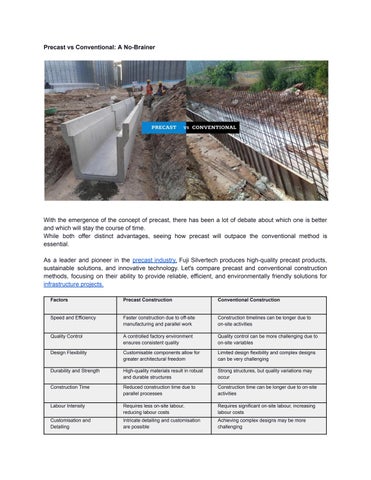
Precast vs Conventional: A No-Brainer
With the emergence of the concept of precast, there has been a lot of debate about which one is better and which will stay the course of time. While both offer distinct advantages, seeing how precast will outpace the conventional method is essential. As a leader and pioneer in the precast industry, Fuji Silvertech produces high-quality precast products, sustainable solutions, and innovative technology. Let's compare precast and conventional construction methods, focusing on their ability to provide reliable, efficient, and environmentally friendly solutions for infrastructure projects. Factors
Precast Construction
Conventional Construction
Speed and Efficiency
Faster construction due to off-site manufacturing and parallel work
Construction timelines can be longer due to on-site activities
Quality Control
A controlled factory environment ensures consistent quality
Quality control can be more challenging due to on-site variables
Design Flexibility
Customisable components allow for greater architectural freedom
Limited design flexibility and complex designs can be very challenging
Durability and Strength
High-quality materials result in robust and durable structures
Strong structures, but quality variations may occur
Construction Time
Reduced construction time due to parallel processes
Construction time can be longer due to on-site activities
Labour Intensity
Requires less on-site labour, reducing labour costs
Requires significant on-site labour, increasing labour costs
Customisation and Detailing
Intricate detailing and customisation are possible
Achieving complex designs may be more challenging
Suitability for Large-scale Projects
Well-suited for large-scale projects and infrastructure
Not really suitable for large-scale projects
Project Deadlines
Can help meet tight project deadlines
Construction timelines may require more flexibility
Site Limitations
Suitable for projects with limited on-site space
Cannot adapt to various site conditions and constraints
Choosing the correct method for your projects; proper research should be done before making a final choice. Fuji Silvertech has established itself as a leader by offering precast infrastructure solutions, including precast road and railway solutions. With industrial precast solutions and precast bridge components, the industry demonstrates its capability to deliver high-quality and durable products. Moreover, precast manufacturing in India incorporates innovative technology, allowing for design flexibility and customisation while ensuring reliable project management. The decision between India's precast and conventional construction methods depends on various factors, including project requirements and environmental considerations. The precast industry's focus on quality manufacturing, innovative technology, and project management makes it a reliable choice for infrastructure projects. The versatility and sustainability of precast solutions, such as precast concrete components, precast cable solutions, and precast water treatment solutions, position the industry as a leader in providing reliable, efficient, and environmentally friendly construction solutions. With the capability for large-scale production, the precast industry in India is well-equipped to meet the demands of the ever-growing construction sector.