THE VOICE AND RESOURCE FOR IOWA’S FUEL INDUSTRY
Incentives Grew Biofuels in Iowa pg. 4 2021 Recap and Where FUELIowa is Going pg. 8 SUMMERFEST Success pg. 10 Transportation Workforce Struggles pg. 12 VOLUME 75, NO.4 2021 JUL / AUG
F U E L I O WA // w w w. F U E L I o w a . c o m
1
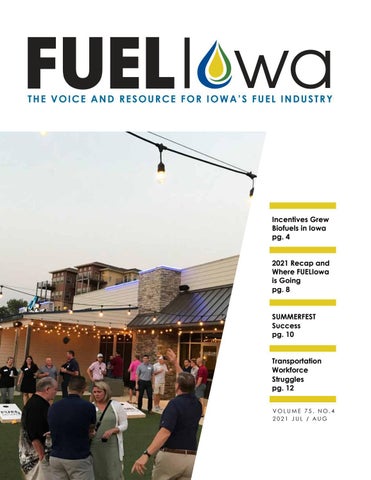
ON THE COVER 2021 SUMMERFEST held on July 26-27th in Okoboji, Iowa included a lake-side dinner, silent auction, and bags tournament and was attended by many fuel industry leaders.
FE A TUR E S 3
PRESIDENT’S PERSPECTIVE
4
BIOFUEL GROWTH
8
2021 RECAP
IN TH IS IS S UE
10430 New York Ave Suite F Urbandale, IA 50322 p (515) 224-7545 f (515) 224-0502 info@FUELIowa.com 2
www.FUELIowa.com
10
SUMMERFEST SUCCESS
12
DRIVER SHORTAGES
14
UST REGULATIONS
18
CALENDAR OF EVENTS
20
INDUSTRY INSIGHT S
24
PAC CONTRIBUTIONS
26
MEMBER HAPPENINGS
28
RISK MANAGEMENT
PR E S ID ENT ’S PER S P E C TI V E GROWTH: WHY IT MATTERS?
FUELIowa is actively engaged in the survival and viability of Iowa’s retail fuel industry. The recent collaboration between FUELIowa and the Fuel Choice Coalition to defeat the biofuel mandate during the last session of the Iowa General Assembly significantly accelerated FUELIowa’s core strategic goals: advocacy, communication, and growth. Why does growth matter? It matters because it is a prime indicator of a healthy organization. FUELIowa's strategic growth must have its core a strategy to identify prospective members and a nucleus of present and emerging leadership to sustain its strategic direction. Looking across Iowa’s retail fuel industry, many of our members are small, rural independent owners and operators. We also have robust urban and suburban member representation, all of whom have faithfully provided essential and critical services during disasters and the recent COVID-19 pandemic. We have the competitive advantage of serving Iowa’s 99 counties with a presence in each state legislative district. The challenges facing Iowa’s retail fuel industry include the threat of an onerous fuel mandate, the costly nature of infrastructure maintenance and upgrades, the emerging long-term competitive impact of electric vehicles, and maintaining a viable skilled labor force. We must be resilient, nimble as we adapt to the challenges of change regionally, nationally, and globally. The one consistent response to these challenges is growth. If we are to sustain the rich history of FUELIowa and serve as the foundational organization representing Iowa’s retail fuel industry, we must execute a purposeful strategy of strategic growth. As President and CEO, I am committed with the guiding leadership of the Board of Director's to ensuring we execute a viable, sustainable growth strategy.
R NL
Ronald N. Langston President & CEO FUELIowa 515-224-1599
EXECUTI VE COM M I TTEE Doug Coziahr Chair Nebraska-Iowa Supply Company Omaha 402-393-8350 Bev Jessen Vice Chair Treasurer Johnson Oil/ Cylinder Express Battle Creek 712-365-4740 Joseph Zietlow Treasurer Kwik Trip, Inc La Crosse, WI 608-793-6484
Jason McDermott Immediate Past Chair McDermott Oil Company Cascade 563-852-3510
Ronald N. Langston, President & CEO
BO A RD O F D I RECT OR S Chris Biellier Associate Director Seneca Companies Davenport | 563-332-8000
Don Burd Director Otter Creek Country Store Cedar Rapids | 319-533-1825
Nicole Johnson Director Molo Companies Dubuque | 563-557-5714
Chad Besch Associate Director MaxYield Cooperative Algona | 563-200-5115
Tia Eischeid Director Al’s Corner Oil Co Carroll | 712-673-2723
Steve Kimmes Director Kimmes Enterprises LLC Carroll | 515-681-7890
Jim Bocken Associate Director Core-Mark Midcontinent, Inc. DBA Farner-Bocken Company Carroll | 712-792-7412
Tessa Fahey Director Rainbo Oil Dubuque | 563- 526-1179
Jim Pauk Director W&H Coop Oil Co Humboldt | 515-332-2782
F U E L I O WA // w w w. F U E L I o w a . c o m
Matt Scheetz Director The Depot Express Tiffin | 319-545-9514
3
HOW INCENTIVES GREW BIOFUELS IN IOWA
By Strategic Elements
Iowa is inherently an agricultural state, and that means our state leads in the production of intersecting products – chiefly, biofuels. While many industries stagnated during the pandemic, new numbers reveal that biofuels are growing in Iowa. What increased biofuel consumption? Incentives.
2020 DATA
The Iowa Department of Revenue’s 2020 Retailers Fuel Gallons Annual Report (released in April of 2021) contained some interesting data regarding the growth of biofuels across our state. To compile their report, the department contacted qualifying fuel retailers statewide and requested gallon-by-gallon sale summaries. The department received responses from more than 77 percent of these fuel retailers, totaling 1,989 locations with a reported 2.15 billion gallons in retail fuel sales. Here is where it gets interesting. The report states: “Of the reporting 1,989 Iowa retail locations, 1,820 (91.5%) reported selling at least one type of ethanol blend, and 803 (40.4%) reported selling one or more blend of clear or dyed biodiesel. Of the locations selling ethanol, 1,812 (91.1%) reported selling E10 fuel, 335 (16.8%) reported selling Registered E15,
4 4
Flex Fuel E15 and/or E20 and 348 (17.5%) reported selling E85.” The report continued by highlighting the year-over-year growth in the sale of biofuels. In 2020, the statewide distribution of biofuels averaged out to be 14.5 percent.
While some may brush off this number, that is a 0.6 percent increase from 2019, even as Iowans stayed home throughout 2020 in response to the pandemic. That is a 23.1 percent relative increase year-over-year.
ethanol. Iowans filled their tanks with E15 and E20 in higher numbers. In 2020 alone, 12.2 million gallons of E15 were sold, 25.9 percent higher than the number of gallons sold in 2019. The sale of E20 also increased by 5.9 percent from 2019. This is clear evidence that the incentive programs in Iowa are working. Even with a lower response rate from fuel retailers for the 2020 annual report data collection, the number of retailers that distribute Registered E15, Flex Fuel E15, and/ or E20 slightly grew from the 2019 report. If we extrapolated those results for a hypothetical higher response rate, the state would have likely seen an even higher increase in retailers selling these higher blends. These numbers demonstrate the successful utilization of the Iowa Renewable Fuels Infrastructure Program. This program “helps retail operators of motor fuel dispensing sites or fueling stations to convert their equipment to allow the expanded use of renewable fuels in Iowa. The program utilizes grant incentives to encourage these upgrades.”
HOW DID INCENTIVES HELP IOWA ACHIEVE THESE NUMBERS? The sale of biofuels was not evenly distributed among blends. The sale of E10, which is one of the more common blends you will find sold by Iowa’s fuel retailers, decreased by 219.8 million gallons. So, how did the sale of biofuels still increase by 0.6 percent statewide? Simple – Iowans chose higher blends of F U E L I O WA // w w w. F U E L I o w a . c o m
To date, the program has funded over 70 E15 upgrade projects alone, alongside hundreds of other upgrades to infrastructure that allowed for increased sales of biofuels. With more retailers incentivized to spend the money on upgrading
their infrastructure, a higher level of biofuel distribution will be enabled. And, as this occurs, we will continue to see what we saw demonstrated in 2020 – higher levels of biofuels sold to consumers across Iowa.
HOW CAN INCENTIVES CONTINUE TO GROW BIOFUELS IN IOWA? Unlike our neighboring state of Minnesota, biofuel consumption in Iowa grew during the pandemic. While Minnesota, which has a mandated biofuel standard, recorded a 5 percent decrease in the gallons of biofuels sold, Iowans fueled up with record numbers of biofuels. That is thanks, in large part, to the increasing number of fuel retailers that have made the investment to upgrade their infrastructure to accommodate higher blends of biofuels. FUELIowa is supportive of the growth of biofuels across Iowa. The growth witnessed by within the 2020 data was fueled by incentives that allowed fuel retailers to upgrade their infrastructure and increased distribution. Incentives work. Rather than placing restrictive standards on what retailers can and cannot sell, Iowa should continue to incentivize upgrades that lead to growth in biofuel sales. Biofuels are an essential part of Iowa’s economy and fuel distribution network – we should work together to encourage their growth.
5
2021:
WHERE FUELIOWA HAS BEEN, AND WHERE WE ARE GOING
By Ronald N. Langston, President & CEO, FUELIowa
The remainder of 2021 is quickly slipping away, and that prompts taking a moment to pause and reflect. FUELIowa has undoubtedly been on the move – even with a global pandemic – and we still have a way to go before the year is over. Here is the progress we have made so far in 2021 and what’s next for FUELIowa: 2021 LEGISLATIVE SESSION The 2021 Legislative Session was a busy one for our association. We relentlessly advocated on behalf of our members at the Iowa State Capitol, specifically on such issues as the proposed biofuel mandate and the bottle bill. While bottle bill reform did not pass, we were pleased with the vigorous debate on the issue we were able to help instigate. We fought hard to defeat the proposed biofuel mandate and were successful in stopping it this year, but much work remains to ensure it does not become law next session. Our members’ continued mobilization in these policy matters is fundamental to our success and we urge you to remain engaged. CAMP COURAGEOUS FUNDRAISER After a year off from the golf course due to COVID-19, our mem-
6
bers made the annual fundraiser for Camp Courageous bigger than ever! We had 120 golfers in attendance at our 2021 Annual Golf Benefit, setting a new record. Together, we raised $30,000 to support a wonderful organization. We also had Iowa Hawkeyes’ Head Football Coach Kirk Ferentz and several of his players join us on the golf course and for dinner afterward. We are all very grateful for their continued partnership with Camp Courageous and their support of this cause.
LEGISLATOR OF THE YEAR AWARDS FUELIowa recognized Senator Adrian Dickey (R – Packwood), Senator Pam Jochum (D – Dubuque), and Representative Ross Paustian (R – Walcott) as champions of Iowa’s fuel industry at our 2021 Annual Meeting. This year was the first time our association has distributed such awards, and they highlight the relationships we built in the State Capitol throughout the 2021 Legislative Session. We are pleased to recognize these legislators and look forward to working with them in the future.
F U E L I O WA // w w w. F U E L I o w a . c o m
SUMMERFEST After COVID-19 caused us to cancel last summer’s event, our first Summerfest back was one for the books. We had more than 100 attendees join us in Okoboji! Congratulations to The Regulators from Solar Transport, winners of the 2nd Annual FUELIowa Summerfest Bags Tournament, for finishing undefeated in the tournament with a record of 5-0. We would also like to congratulate the Team from Mast ATM, winners of the 3rd Annual FUELIowa Summerfest Golf Tournament with a score of 53. They have retained the bragging rights as well as the Summerfest Traveling Trophy for another year. IOWA REPUBLICAN PARTY REGIONAL MEETINGS FUELIowa had numerous opportunities to attend meetings and events for the Iowa Republican Party across the state. We value these events and the time they allow us to spend with our elected officials, building relationships and highlighting the issues that matter to our industry. Representatives from FUELIowa’s staff and board of directors spoke with numerous state legislators and Iowa federal delegation members during these attended events. FUELIOWA PAC As FUELIowa continues to advocate for our members in the Iowa State Capitol and across the state, developing good relationships with legislators is critical to the process. One valuable tool in developing these relationships is the FUELIowa Political Action Committee (PAC). Together, we have raised $75,000 for the FUELIowa PAC in 2021 - a
huge increase and a record. We appreciate everyone who has donated! FUELIowa Insider and Magazine has brought industry news and updates to our members all year long and will continue to do so throughout 2021 and beyond. We are happy to report that the readership of both our newsletter and magazine has increased. FUELIowa will continue informing our members about everything happening across the state in our industry through our digital and print publications.
WHERE WE ARE GOING While significant events like the Camp Courageous fundraiser or Summerfest may not be on the calendar for the rest of the year, that does not mean FUELIowa is slowing down. We will continue to keep our members informed about the state of the industry. We will continue advocating on behalf of our industry, highlighting our legislative priorities from the State Capitol to the farthest corners of the state. We will, as always, work every day to support the many businesses across the state that comprise our industry because it is together that we fuel Iowa. FUELIowa has had a busy 2021 so far, and there is more to come! 7
S U MMERF ES T S U CCE S S EVENT FEAT UR E
B y G a r y K o e r n e r, Executive Vice President, FUELIowa
FUELIowa's Summerfest Event a Huge Success! Thank you to everyone who came out to Okoboji and joined us for Summerfest! We had more than 100 attendees and raised yet another $15,000 for the FUELIowa PAC while also having an incredible time. Congratulations to The Regulators from Solar Transport, winners of the 2nd Annual FUELIowa Summerfest Bags Tournament, who finished undefeated with a record of 5-0. Also, congratulations to the Team from Mast ATM, winners of the 3rd Annual FUELIowa Summerfest Golf Tournament with a score of 53. They have retained the bragging rights as well as the Summerfest Traveling Trophy for another year. Thank you to all of our sponsors and our attendees – we can’t wait to see everyone in Okoboji again next year!
8
F U E L I O WA // w w w. F U E L I o w a . c o m
9
The preferred payment processor for FUELIowa. Heartland has been processing credit and fleet cards for over 30 years in the Petro/C-Store marketplace. We are known for transparent pricing, outstanding customer support, and an ethical and customer-focused approach to business. Our innovative and leading-edge technology: • Seeks out the lowest possible Interchange categories for each transaction • Assures you low PIN debit rates available through our least-cost debit routing • Provides EMV chip card acceptance through most popular POS systems • Supported by world class customer service based in Indiana – fast call-to-answer times •
Integrates reporting capabilities, including DTN reporting, into your existing accounting systems
To Learn more, contact: Steve Heuton: 913-481-9461 . Steven.Heuton@heartland.us Alan Levine: 727-543-5503 . Alan.Levine@heartland.us
10
S2.8117_FUELIowa and Heartland Partner_7.75x5.indd 1
1/14/19 2:49 PM
It’s not just business.
It’s personal.
Cylinder Express makes it easy. Just unlock, exchange, collect! Call 888.365.1241
• Family Owned & Operated • Battle Creek • Iowa • At Cylinder Express, we take your business personally. A call to us means
always being greeted by a person, not an automated message. It means never running out of cylinders so you can advertise a special on propane with complete confidence that your customers will always find a propane tank at your store. It means value, quality and service. It means we treat you like family.
Value — Offering your customers grill cylinder cages provides your business with an excellent additional source of income and increased traffic flow. Quality — Each cylinder tank that arrives at our state-of-the-art facilities is carefully inspected, scraped, cleaned and painted to ensure it’s like new for your customer. Service — A friendly team member will assist you right away, not an automated system. Run ads with confidence. We deliver weekly or bi-weekly, based on your need for product.
Call 888.365.1241 or visit www.propanehank.com F U E L I O WA // w w w. F U E L I o w a . c o m
11
T H E ST R UGGLE T O GROW T H E F U EL TRAN S PORT A T ION W O RKFORCE S ERVICE F EAT UR E
By Strategic Elements
Keeping Iowa moving requires a fuel industry with a lot of different parts. While the average Iowan may be most familiar with the fuel retailers where they fill their cars, a considerable portion of the industry takes place behind the scenes. A key example being fuel transportation – how the fuel gets to the pump that fills your vehicle.
state’s entire trucking workforce is aging - 57 percent of all truckers today are over 45, and 23 percent are over 55. Experience and additional certifications are needed to transport fuel specifically, so it is harder to replace retiring qualified drivers.
Unfortunately, like much of the economy, the fuel transportation industry is struggling to grow due to a shortage of available workers. The fuel transportation driver shortage has been well documented in Iowa and across the nation. What’s causing this? Jim Ewing, FUELIowa membership marketing manager, thinks that the problem is not an isolated one: “It’s an issue that is so much more than transport drivers – it’s an issue across America in any of the skilled trades.” One key element fueling this driver shortage is that younger generations are joining the industry in smaller numbers. According to the Iowa Motor Truck Association, the 12
57%
OF ALL TRUCKERS ARE OVER AGE 45 Cindy Rippentrap, the owner of CH Wilson Transport (established in 1960 in Charles City, IA), noted that while driver shortages are one of the biggest challenges in growing her business, it comes on top of challenges already associated with running a business. These additional challenges include
insurance costs, balancing compensation and freight rates, and most recently, getting parts in for breakdowns. Rippentrap added, “we now have a truck that will be down for weeks because we can’t get a sensor in, and the backorder is due to COVID.” A struggle over work-life balance has also helped contribute to a dwindling fuel transportation workforce. The fuel transportation workforce has historically attracted truck drivers because they could spend more time at home than over-the-road drivers. But as the rest of the transportation industry reduces the time drivers spend on the road and the fuel industry adds hours to schedules due to fewer drivers, that work-life balance is not a competitive advantage in recruiting and retaining drivers. Brent Vander Leest of Sully Transport, a family business located in Sully, IA, is the third generation to manage the company since it opened in 1959. He agrees that there has been a shift in work-life balance within the industry. Com-
panies such as his require skills beyond driving that can complicate finding drivers: “To be a successful owner-operator with Sully Transport, a driver has to be a good business person.”
What can fuel industry transportation companies do to recruit new drivers? Ewing believes that although insurance companies require hazardous materials drivers to be a minimum of 24 years of age, beginning the recruiting process with high school students can pay off down the road. He argues that highlighting the benefits of skilled trades is essential and could certainly make a difference to younger people considering their options after graduation. The driver shortage is not just an issue here in Iowa – it is happening nationwide. While this will continue to be an ongoing problem, transportation companies statewide are hopeful that the workforce can be rebuilt and provide stable fuel industry jobs for generations to come through creative solutions and initiatives. F U E L I O WA // w w w. F U E L I o w a . c o m
13
U N DE RGR OUN D ST ORA GE T A N K SYSTEM T E S T IN G A N D T E ST WATER D I S POSA L S ERVICE F EAT UR E
By John Maynes, R e g u l a t o r y A f f a i r s M a n a g e r, FUELIowa
On June 23, Iowa adopted EPA’s 2015 revisions to the federal regulations governing underground storage systems (UST) contained in 40 CFR Part 280. EPA’s 2015 revisions implement significant changes in how owners and operators oversee their UST systems. Most notably, owners and operators will be tasked with testing spill buckets, containment sumps used for interstitial monitoring, and overfill prevention devices every three years. Additionally, there must be annual testing of mechanical and electrical release detection components. Owner-operators will be required to perform and document both 30-day walkthroughs and an annual walkthrough at their facility.
Deadline For First Round of Testing and Facility Walkthroughs In response to the phrasing in the federal regulation, the Iowa DNR requires owners and operators to complete their first round of UST system tests and first 30-day walkthrough by October 13, 2021.
14
Responsible parties must complete annual facility walkthroughs by October 13, 2022. Several factors are working against owners and operators meeting this deadline and for most of the regulated community, securing contractors to complete this work by October 13, 2021, is not feasible. Fortunately, the Iowa Department of Natural Resources UST Section recognizes many of the challenges facing the industry, be it timing, contractor availability, or supply chain disruption due to COVID related factors. Owners and operators unable to meet the deadline should work with their UST system contractors to develop a compliance plan defining a pathway with which the UST system testing requirements of the rule will be met.
UST System Testing Categories There are four areas of the UST system where testing will be required under the new rule:
Release Detection System Testing – Annual Test Overfill Prevention Inspection – 3-Year Inspection/Test Spill Bucket Testing – 3-Year Test Containment Sump Testing (only required where a sump is used for interstitial monitoring of piping) – 3-Year Test Release detection system testing is the only test required to be completed annually. Additionally, it is the only test for which an Iowa licensed professional or individual with a manufacturer’s certification must oversee the test. Release detection system testing must be performed according to the system manufacturer’s instructions, a code of practice developed by a nationally recognized association or independent testing laboratory, or requirements determined by the implementing agency to be no less protective of human health and the environment than the other options listed
above. The only code of practice available to satisfy release detection system testing is Recommended Practice 1200 published by the Petroleum Equipment Institute. Test requirements for release detection systems include testing electronic and mechanical components for proper operation.
be no less protective of human health and the environment. The only code of practice currently available to owners and operators to meet the test requirements in these areas is PEI’s RP-1200.
Annual areas of testing include:
Spill Bucket and Containment Sump Testing – Managing Hydrostatic Test Water
• ATG: Test alarm; verify system configuration; test battery backup. • Probes and Sensors: inspect for residual buildup; ensure floats move freely; ensure the shaft is not damaged; ensure cables are free of kinks and breaks; test alarm operability and communication with the controller. • Automatic Line Leak Detectors: Test by simulating a leak. • Vacuum pumps and pressure gauges: ensure proper communication with sensors and controllers. • Hand-held electronic sampling equipment associated with groundwater and vapor monitoring: ensure proper operation. In contrast to the annual testing requirements for release detection testing, overfill prevention equipment, spill buckets, and containment sumps used for interstitial monitoring of piping must be tested once every three years. All three categories of the test must be completed according to one of the following: manufacturer’s requirements; a code of practice developed by a nationally recognized association or independent testing laboratory, or requirements determined by the Iowa DNR to
F U E L I O WA // w w w. F U E L I o w a . c o m
the inspection requirements may install an audible alarm at a tank depth below the ball float valve. In this scenario, the audible alarm becomes the primary method of overfill prevention, and the ball float no longer requires removal.
The three-year overfill prevention inspection requires an owner/ operator to confirm the functionality of the primary overfill device while ensuring the device is set to activate at the appropriate level. Owners and operators can perform overfill device inspections so long as the inspection is completed using one of the criteria listed above. Owners and operators are strongly encouraged to consider replacing existing overfill devices with newer testable-in-place devices to avoid future removal during the inspection. Additionally, maintaining documentation of proper installation after replacement will also eliminate the need to remove the device to confirm proper installation depth. Owners and operators should note that only the primary overfill prevention device is required to be inspected. For example, an owner and operator encountering difficulty removing or accessing a ball float valve to meet
Owners and Operators may test spill buckets, containment sumps, and under-dispenser containments using a liquid (hydrostatic), vacuum, or pressure test method. Hydrostatic testing is the most likely option for owners and operators, and once again, PEI’s RP-1200 is the only nationally recognized industry standard available as a guide. It’s worth noting, double-wall spill buckets and containment sumps do not need to be tested. They only need to be monitored visually during the 30-day walkthrough. PEI’s RP-1200 involves the introduction of test water into the spill bucket or containment sump. The liquid levels are measured and monitored for at least one hour. After the test period, another measurement is taken. If the test water has receded less than 1/8 inch, the spill bucket or containment sump passes the test. If the water level decreases 1/8 of an inch or more, the spill bucket or containment fails the test and must be repaired or replaced. Upon completion of the test, the question becomes what must be done with the test water? Unequivocally, test water MUST be disposed of properly. Spill buckets
15
coverage and are strongly advised against disposing of test water at a location where pollution liability coverage is required.
and containments must be thoroughly cleaned before introducing test water to eliminate the presence of petroleum in the test water. Thoroughly cleaning your spill buckets and containments before hydrostatic testing affords an owner and operator the best chance of being able to dispose of the test water under the parameters of Iowa General Permit 8 (GP 8). GP 8 allows for the surface discharge of test water after a visual examination for contaminants.
GP 8 is free and can be downloaded from the Iowa DNR website. GP 8 should be kept on-site, but no registration requirement is associated with the state permit. Page 26 of GP 8 includes a template to document the disposal of hydrostatic test water used to test spill buckets and containment sumps.
Owners and operators identifying any type of sheen on test water should contact a hazardous waste disposal company to dispose of test water. Before disposal, owners and operators should consider the terms of their pollution liability
Documentation requirements include a description of the activity for which the water was used (hydrostatic testing), dates, the total volume of test water, a description of the visual characteristics of the test water, any results from
analytical tests conducted on the water, and an address or coordinates for the location or locations where the water was disposed of. Once again, documentation is not required to be submitted to a state agency and should be kept on-site and made available upon demand by a regulatory agency. As we navigate the implementation of EPA’s new regulations as a state, FUELIowa remains committed to helping members incorporate these practices into their business. Members are encouraged to contact us directly with any questions about the rule. John Maynes, 515-421-4043; john@fueliowa.com
Committed to Quality.
CONSTRUCTION + INSTALLATION
PETROLEUM SERVICES
TESTING + COMPLIANCE
mwpetroleum.com LINCOLN
16
NORTH PLATTE
OMAHA
402.476.6681 info@mwpetroleum.com /midwestpetroleumequipment
POWERFUL BRAND. HOMETOWN FEEL. RUNNING YOUR BUSINESS YOUR WAY. POWERED LOCALLY.
We know that the true power behind the Cenex® brand comes from our locally-owned retailers – valued partners who are invested in their customers and community. That’s why we’re committed to your success and helping you build your business from the moment you become a Cenex® retailer. From flexible brand conversion and marketing, to convenient payment processing and training programs, we can provide your business with the support it needs to help you grow.
A name your customers trust, a brand you can count on – visit cenex.com/businessopportunities to learn more. F U E L I O WA // w w w. F U E L I o w a . c o m
© 2021 CHS Inc. Cenex® is a registered trademark of CHS Inc.
17
C AL END AR O F EV EN T S
NOV E M B E R 2 4 , 2 0 2 1
JA N UARY 1 1 , 2 0 2 2
APRI L 1 8 -2 0, 2022
C E N T- A - GA L L O N
ANNUAL MEETING &
UPPER MIDWEST
Your Local Retailer
LEGISL ATIVE RECEPTION
CONVENIENCE STORE &
Des Moines, IA
ENER GY CONVENTION
FUELIowa hosts their annual Cent-AGallon Day for Camp Courageous on the day before Thanksgiving each year. One cent of each gallon of fuel sold on this day by participating marketers and convenience stores will benefit Camp Courageous. Posters will be displayed in the windows of those participating.
FUELIowa's Annual Meeting is our signature kick-off event focused on priority issues, advocacy, policy trends, and association initiatives. It is followed by FUELIowa's Legislative Reception, which is a great way to touch base with legislators from across the state in a fun and relaxed setting. Be sure to join us to show our united voice. "Together, we Fuel Iowa!"
St. Paul, MN UMCS is simply the best trade show, networking and educational event for the Fuel and C-store industry in the Upper Midwest. With the combined power of the state associations of both Minnesota and Iowa, UMCS is the largest show in the Upper Midwest, bringing more than 2,000 professionals together in a fun and relaxing atmosphere.
Visit www.fueliowa.com and select “Training and Events” to register. To sponsor an event, call FUELIowa at 515-224-7545 or email jim@fueliowa.com
800-362-2910
www.senecatank.com 18
Systems for Tank Truck Unloading & Mobile Fluid Power
PROVIDING
THE COMPLETE SOLUTION”
FOR IOWA PETROLEUM MARKETERS SINCE 1972
20
% for first time online store customers! Visit store.senecaco.com, register as a new customer and OFF enter code IOWA20 during checkout.
**Limit one use per login through 12/31/2020. Valid for online purchases only. Excludes sale items and items within the POS category.**
• FUEL SYSTEMS CONSTRUCTION, SERVICE, UPGRADES, INSPECTION AND EQUIPMENT
• UST/AST REMOVAL
• EMV COMPLIANCE
• OPERATOR TRAINING PROGRAMS
• POINT OF SALE SYSTEMS
• GENERAL CONTRACTING
• FUEL RESTORATION & TANK CLEANING
• ENVIRONMENTAL CONSULTING
800-369-5500
F U E L I O WA // w w w. F U E L I o w a . c o m
• COMPLIANCE MANAGEMENT
store.senecaco.com
senecaco.com
19
I N DU S T R Y INSI GHT for E10 blends between June 1 and September 15th of each year.
BIO F UEL P RO D U C E R S CH A LLEN G E FED ERA L A P PE A L S CO U R T D ECI SI O N BL O CKIN G SUMM ER T I ME E15 S A LES The Renewable Fuels Association, Growth Energy and the National Corn Growers Association filed a legal petition in the D.C. Court of Appeals requesting a full nine judge panel review of the Court’s recent decision that blocks the sale of gasoline with 15% ethanol during summer months. That decision was handed down by a panel of three of the nine judges who make up the D.C. Court of Appeals. Acting on a suit filed by oil producers, the three-judge panel invalidated a 2019 EPA rule that allowed the year-round sale of E15. The rule made it easier to sell E15 during the summer driving season in conventional fuel markets which make up roughly two thirds of all gasoline sold nationwide. The decision was based on interpretation of the statutory language in the Clean Air Act that provides a one-pound Reid Vapor Pressure (RVP) waiver 20
The Court ruled that the EPA lacked the authority to expand the RVP waiver to E15 because the plain language of the Clean Air Act limits the one -pound allowance solely to blends between E-9 and E10. Associations representing biofuel producers and corn growers said they were filing the petition for a full rehearing because the threejudge panel made legal errors in reaching its decision. A rehearing before all nine judges of the D.C. Court of Appeals may be ordered by a majority of the judges when consideration by the full court is necessary to maintain uniformity of its decisions, or when the case involves a question of exceptional importance, neither of which the petitioners’ case is likely to show.
S U PPLY CHAI N PA N E L APPR OV ES R E C OM M ENDATI ON F O R M ULTI AGENCY E F F OR T TO ADDR ES S D R I VER S HOR TAGE Last week, the International Trade Administration’s Advisory Committee on Supply Chain Competitiveness (ACSCC), voted to recommend the Department of Commerce lead a multiagency effort to immediately address the truck driver shortage. ACSCC Workforce Develop-
ment Subcommittee Chair Anne Strauss-Wieder told the panel that “our recommendation focuses on the driver shortage. We had a shortage prior to the pandemic and that situation has accelerated during the global health emergency. What we have recommended for committee consideration is that the Department of Commerce lead a multi federal agency effort to proactively address the shortage. Various departments are doing this already. And indeed, the Infrastructure Bill passed by the Senate also addresses part of this as well, including new funds for an apprenticeship program for the Under 21 Driver Initiative as well as establishing a board to increase the number of women entering and being retained in the trucking industry.” The ACSCC recommends that Commerce facilitate the pathways to becoming an interstate truck driver by expanding the demographic pools attracted to the profession and increasing driver training and apprenticeship programs, and to improve the driver experience through addressing truck-parking shortages and safety concerns. EMA continues to work with multiple departments alerting them to the dire problems the petroleum marketing industry is facing and to potential solutions regarding the driver shortage. In particular, EMA has been working with DOE on a 100-page report and recommendations on the shortage.
•Adverse Driving Conditions CDL drivers are allowed to extend the 11-hour maximum driving limit and 14-hour on-duty limit by up to two hours each when adverse driving conditions are encountered.
R EG U LAT O RY R EM IN D ER O N D R I V E R HO UR S O F S E RV I C E R EQU IREM EN T S EMA has been asked to provide a review of the FMCSA’s CDL Drivers Hours of Service (HOS), including record of duty logs and the short haul exception to the HOS requirements. EMA recently was able to expand hour and distance limitations of short haul exception from 100 air-mile radius and 12 hours maximum on duty time to a 150 airmile and 14 on-duty hours. •11 Hour Driving Limit CDL drivers may drive a maximum of 11 hours per shift after 10 consecutive hours off-duty. •14 Hour On-Duty Limit CDL drivers may not drive beyond the 14th consecutive hour after coming on duty, following 10 consecutive hours off duty. Off-duty time does not extend the 14-hour period. •60/70 Hour Weekly Limit CDL drivers may not drive after 60 hours on duty in 7 consecutive days or after 70 hours over 8 consecutive days. A driver may restart the 7/8 consecutive day week period after taking 34 or more consecutive hours off duty. F U E L I O WA // w w w. F U E L I o w a . c o m
Adverse driving conditions are caused by severe weather-related events. The FMCSA defines adverse driving conditions as: “snow, sleet, fog, other adverse weather conditions, a highway covered with snow or ice, or unusual road and traffic conditions, none of which were apparent on the basis of information known to the person dispatching the run at the time it was begun.” If any of the conditions described above exist, drivers may continue driving until the intended destination is reached or until they are able to safely reach a secure location, but for no more than two extra hours. •Short Haul Driver Exception A CDL driver is exempt from recording hours of service if - the driver operates within a 150-air mile radius of the normal work reporting location, and the driver does not exceed the 14-hour maximum on-duty period. Drivers using the short haul exception must report and return to the normal work reporting location within 14 consecutive hours and stay within a 150 air-mile radius of that location.
NE W DR UG AND AL C OHOL TES TI NG C U STODY AND C O NTR OL FOR M MU ST BE US ED B E G I NNI NG 8/ 3 0/ 2 1 Last year, the Office of Management and Budget (OMB) approved
a new Department of Health and Human Services (HHS) Federal Drug Testing Custody and Control Form (CCF). The form must be used by employers performing drug and alcohol testing for CDL drivers. In order to allow for an orderly transition to the new form, the OMB authorized the use of the old CCF form through August 29, 2021. However, beginning August 30, 2021, DOT-regulated employers and/ or their service agents (specimen collectors, laboratories, Medical Review Officers) must use the new form. Some laboratories may have already contacted employers and collectors with information about the delivery of the revised CCF form. Employers or collectors should monitor your existing supply of old CCF forms and coordinate the delivery of the new revised CCF form with an HHS-certified laboratory. Any employer or agent using the old CCF form after August 29, 2021, must provide a signed statement (i.e., a memorandum for the record) to accompany the CCF form to the testing laboratory. The memorandum must state that the incorrect form contains all the information needed for a valid DOT drug test, and that the incorrect form was used inadvertently or as the only means of conducting a test, in circumstances beyond the employer’s or agent’s control. The statement must also list the steps taken to prevent future use of expired Federal forms for DOT tests. The employer or agent must supply the memorandum on the same business day on which use of the expired form was discovered by fax or courier. Use of the expired form will only be deemed “corrected” if test of the accompanying specimen occurs at an HHS-certified laboratory. 21
G UID A N CE I SS U E D O N T H IRD - PA R T Y AL CO H O L D E L I V E RY With the passage of HF766, licensees and permittees authorized to sell alcoholic liquor, wine, beer,
or mixed drinks or cocktails for off-premises consumption may contract with a third party to deliver the alcoholic beverages provided that the licensee or permittee has entered into a written agreement with the third party that authorizes the third party to act as an agent of the licensee or permittee for the purpose of delivering the alcoholic beverages. Each licensee or permittee shall submit to ABD a list of names and addresses of all third parties it has authorized to act as its agent for the purpose of delivering alcoholic beverages. The licensee or permittee shall provide ABD with amendments to the list as necessary to ensure ABD possesses an accurate, current list.
WE GO ABOVE, BEYOND, AND BELOW. Over 30 Years Providing Professional AST/UST Services
22
UPGRADES, NEW INSTALLATIONS, LICENSED ELECTRICAL CONTRACTORS, CATHODIC PROTECTION SERVICES, VACUUM TRUCK SERVICES, EQUIPMENT SALES, DISPENSER SERVICES, ENVIRONMENTAL & COMPLIANCE.
888-788-8860 or 515-266-5700
RENEWABLE ENERGY GROUP
DON’T GET LEFT BEHIND. Through a generation of relentless improvement, Renewable Energy Group has pushed fuel forward in Iowa. Join the evolution and learn how using our cleaner fuels can benefit the environment and your bottom line.
Call REG to learn how you can drive fuel forward. (844) 405-0160 | regi.com
F U E L I O WA // w w w. F U E L I o w a . c o m
23
2 0 2 1 PA C C O N TR IBUT O RS CONTRIBUTIONS RECEIVED AS OF AUGUST 11, 2021
VISIONARY ($5,000+)
$12,160 Bev & Henry Jessen, Cylinder Express * $10,170 Don Burd, Otter Creek Country Stores *
LEADER ($2,500-$4,999)
$2,800 Jason McDermott, McDermott Oil * $2,600 Ronald N Langston, FUELIowa ^ * $2,600 Tessa Fahey, Rainbo Oil * $2,600 Todd Kanne, Community Oil * $2,500 Paul Fahey, Rainbo Oil * $2,500 Dave & Clifford Reif, Reif Oil *
PARTNER ($1,000-$2,449)
$2,000 Larry Bentler, Jet Gas $2,000 Mike & Dean Cox, Kardes C-Stores $1,500 John Gilroy, Grysson Oil $1,500 Steve Kimmes, Kimmes Enterprises $1,350 Doug Coziahr, Nebraska Iowa Supply $1,300 Joe Zietlow, Kwik Star ^ * $1,001 Keith Crandall, KC Mart $1,000 Frank Bradley, ET Products $1,000 Mark Cobb, Cobb Oil $1,000 Tom Flogel, Mulgrew Oil $1,000 Jennifer Likes, Harms Oil ^ $1,000 Aaron McDermott, McDermott Oil $1,000 Dan Moellers, CSOI Corporation $1,000 Mark Molo, Molo Petroleum $1,000 Matt Scheetz, The Depot Express $1,000 Don Zietlow, Kwik Star $1,000 Marc Beltrame, Beltrame Law Firm $1,000 Terry Hovden, Hovden Oil
FRIEND ($500-$999) $800 Seth Rotermund $700 Gordon Hagen $550 Thomas Burd $550 Jim Pauk $500 Steve Demmer $500 Tia Eischeid $500 Glenn Hasken $500 Nicole Johnson
Donate at: www.fueliowa.com/donate-to-pac.cfm ^ Sustaining Member * Fuel Marketer Program 24
$500 Richard Weiner $500 Delone Wilson $500 Andrew Woodard $500 Randal Woodard $500 Travis Buhman $500 Dick Metzger $500 Mark Lincoln $500 Brad/Laura Taylor
CONTRIBUTOR ($0-$499) $400 Lisa Abens $310 John Maynes $300 Steve Loehr $300 Gerald Stewart $300 Joseph Miller $275 Brian Beers $250 Russ/Barb Danielson $250 Rod Gittins $250 Michael Stanton $200 Sam Annis $200 Rick Gappa $200 Chad Besch $150 Eric Ziph $150 Gerald Bogler $100 Jim Bocken $100 Ace Ettleman $100 Jim Ewing $100 Gerry Greve $100 Charlie Good $100 Craig Kiracofe $100 Gary Koerner $100 Reo Menning $100 Thomas Pearson $100 David Scheetz $100 Dean Onken $100 John Meehan $100 Teresa Hunt $100 Tom/Linda Fuller $100 Trent Hepler $100 Aaron Ezzio $100 Chris Irlbeck $100 Colin Tiefenthaler $100 Dan Toale $100 Randy Morriss $100 Scott Struck
FUELIOWA PAC CONTRIBUTION CARD
CONTRIBUTOR INFORMATION Name____________________________________________ Address___________________________________________ City_______________________________________________ State ____________________
Zip_________________
E-mail____________________________________________
CONTRIBUTION AMOUNT
Bill Me*
$_________________
*Contributions not drawn on personal funds will automatically be contributed to the FUELIowa Political Education Fund (PEF).
BILLING ADDRESS
Billing Address_____________________________________ ( I f d i f f e r e n t f ro m a b o v e a d d r e s s)
__________________________________________________ Signature_________________________________________ Date______________________________________________ F U E L I O WA // w w w. F U E L I o w a . c o m
25
M EMBER HAPPEN IN GS WELCOME NE W FU ELIOWA M E M B E R S
Casey’s General Stores Casey’s is a crucial partner in our Fuel Choice Coalition, organized to represent fuel retailers and like-minded organizations as discussion continues with the biofuels mandate. We are delighted to be working with Casey’s on the key issues impacting the industry today. Pilot Flying J Pilot Flying J joins us after working side by side with our coalition and legislators regarding the biofuels mandate. We are pleased to partner with them. Pilot’s mission is to make the experience on the road the best it can be. They’ve done it for 60 years and will continue to do it every day in the future. Solar Transport We are also pleased to have Solar Transport back as a member. Solar Transport is a family-focused company. With more than 40 locations, their drivers make it home every night. The company notes that they genuinely value their team and go above and beyond to reward hard work. Great Plains Industries Great Plains Industries, Inc. manufactures genuine, American-made fuel transfer pump and meter systems that are
26
easier to install, operate and maintain than any other brand. They have been building superior products since 1972 in the heart of the Midwest – Wichita, Kansas, USA. Osage Co-Op Elevator Located in Osage, Iowa, Osage Co-Op Elevator has served farmers and consumers in the area for over 75 years with a wide range of products and services. Midwest Meter Midwest Meter, Inc. started in 1969 as a fuel meter calibrating service, covering most of the Upper Midwest, including Iowa and surrounding states. JP Byson Oil Company We’re pleased to have JP Byson out of Fort Dodge back as a member, initially joining the association in 1979. Oakland Corporation Oakland is software designed to enable your energy division to streamline its scheduling, delivery, billing, work order, and insurance-reporting duties. Chambers & Owen Chambers & Owen is based out of Janesville, Wisconsin. The company has been a wholesale distributor since 1891.
MAXYIELD COOPERATIVE APPROVES AUG. 1 MERGER WITH NEW COOPERATIVE (COURTESY GLOBE GAZETTE) Members of MaxYield Cooperative, which serves as well as provides ongoing financial contributions and awards to Hancock County organizations and individuals, have approved a merger proposal with Fort Dodge-based NEW Cooperative, Inc. The merger will become effective August 1. MaxYield’s membership vote met Iowa’s state voting requirement for a successful cooperative merger. “It’s exciting for me to see the members of MaxYield approve this merger in an effort to continue evolving, positioning for and maintaining a strong cooperative presence across the current MaxYield trade area,” MaxYield CEO Keith Heim said. NEW’s board of directors will expand to a total of 15, with the addition of three directors to be appointed by the MaxYield board of directors. The merger will become effective August 1. MaxYield’s membership vote met Iowa’s state voting requirement for a successful cooperative merger. SAPP BROS. CASHIER RECEIVES 2021 HARRIET TUBMAN AWARD (COURTESY 13WBIW) A truck stop cashier from Junction City has been recognized for her actions - saving a woman from a harmful situation. Jessica Chap-
man is a cashier at Sapp Brothers Truck Center in Junction City. In April, a woman came into the store - and Jessica knew something was wrong. “She was just really nervous, and she was trying to ask…I think she was trying to ask for cigarettes …but she couldn’t make a sentence.” Sapp Bros. Truck Center cashier Jessica Chapman says. Chapman used training she received on how to identify possible victims of trafficking. “I asked her if she was ok, and she told me that somebody had taken advantage of her and so I asked if she was going to be safe, she was just all over the place.” Chapman says. Chapman noticed a man watching the woman - so she pretended to have the woman fill out a rewards program application to get more information. As the pair left, Chapman also got their license plate number. “Just gotta be aware of your surroundings and pay attention to people because, you know, anybody could need help.” Chapman says. Chapman contacted local police. With her quick thinking, they quickly located the man and woman. “They said that she got away, which that’s all that I wanted.” Chapman says. But Chapman also received something else — the 2021 Harriet Tubman Award presented by Protective Insurance from Truckers Against Trafficking. It’s the organization’s highest award. Chapman says the recognition still seems surreal, as she feels like she was just doing her job that night.
DAVE'S AUTO IN LAKE MILLS WINS PAPPAJOHN AWARD (COURTESY GLOBE GAZETTE) The NIACC John Pappajohn Entrepreneurial Center and North Iowa Area SBDC honored Joe Jamtgaard and Jackie Villela of Dave’s Auto in Lake Mills as the July 2021 Entrepreneurs of the Month. Joe Jamtgaard purchased Dave’s Auto Service in November 2020 from Dave Anderson after working for him for 15 years. Dave’s Auto is a full-service gas station, a place where a customer can buy tires, get the windows cleaned and oil checked while getting a few gallons of gas. “It’s one of the unique value propositions of the business,” says Brook Boehmler, regional director of the North Iowa Area SBDC. When a local teenager gets their first car, their local gas station isn’t just a place to fill up, it’s a place to learn car maintenance and care. Joe and Jackie participated in the Fall 2020 University of Iowa Venture School program at the NIACC Pappajohn Center before officially opening the business. “We didn’t think we had time for it, but we’re so glad we did before we finalized the purchase – the business takes up a lot of time and concentration, but we were ready with the prep work. It was worth our time,” Jackie says. “We learned so much about people’s buying habits and why they do what they do,” Joe says. “We did more customer discovery than we needed to, in a wider market area, because just about anyone is a potential customer at a service station.” Joe and Jackie have some advice
F U E L I O WA // w w w. F U E L I o w a . c o m
for their fellow entrepreneurs just starting out. “Use the Small Business Development Center and other professionals as a resource,” Joe says. “They have contacts who can help you find what you need.” Jackie adds, “Don’t be afraid to ask for advice if you don’t know how the processes work, even if you feel dumb for not knowing. There are so many things we learned that we never would have known if we hadn’t asked.” REFINER PHILLIPS 66 WEIGHS BROADER MOVE INTO ELECTRIC VEHICLE BATTERIES (COURTESY OF REUTERS) Phillips 66, the fourth largest U.S. oil refiner, is weighing a broader move into developing battery components for electric vehicles and storage systems, according to top executives, leveraging its own and others’ research as it accelerates a shift from fossil fuels. Phillips 66, which gets the bulk of its profits from processing oil into gasoline, diesel and petrochemicals, has become one of the largest supplies of a graphite used to make a key component in electric vehicles. It recently formed an “emerging energy” unit to explore new markets for hydrogen and low-carbon fuels. “The U.S. refining business in the future is going to be smaller, not bigger,” Chief Executive Greg Garland told reporters at its headquarters on Monday.“There is going to be a battery supply chain in North America, a battery supply chain in Europe,” said Garland. “That’s an opportunity for us: To take a raw material competitive advantage and lever that further down the value chain in batteries.”
27
RI SK M A NAGE M E NT By Risk Improvement Department, EMC Insurance Companies, Des Moines, Iowa
P REV EN T F UE L D EL I V ERY ER R O R S W ITH T H ES E B E ST P RA CT ICES Fuel delivery may seem like a simple task, but small mistakes, such as dispensing the wrong fuel into a gas station tank or delivering fuel to the wrong address, can cause extensive damage with price tags totaling thousands of dollars.
take these steps: • Check the delivery history chart and make sure your delivery is in line with the size of previous deliveries • Determine the available tank capacity before delivery • Visually inspect indoor tanks for general condition, connection and venting on an annual basis and document the results
• Check that all fill pipes and caps are labeled or color coded to industry standards • Make sure the delivery rate is limited to tank vent capacity to reduce the chance of a large spill or tank rupture While filling the tank, drivers should always start pumping slowly and keep the vent line in view while pumping. If a steady vent whistle isn’t established after 5 to 10 gallons, they should stop pumping.
• Double-check the delivery ticket to verify details, including confirming that the fill pipe location is as indicated on the ticket • Verify that buried or basement tanks, filling lines and vents are piped outdoors
BEST PRACTICES FOR RESIDENTIAL FUEL DELIVERIES Storage tanks are usually in the basement or buried underground, making it difficult to inspect the tank before filling. Multiple fuel types in different compartments on the delivery truck increase the likelihood of delivering the wrong fuel. Before filling the tank, drivers should 28
• Conduct a visual inspection of the site for changes or problems; this may include ignition sources near the vent pipe, plugged vent pipes, excessive vegetation, unsecured fill caps or rust and corrosion on the piping • Ensure vent whistlers or other positive fill-notification alarms are in place before filling home basement tanks
BEST PRACTICES FOR GAS STATION DELIVERY AND OTHER COMMERCIAL FUEL DELIVERIES Drivers usually rely on color coding or tagging of fill spouts to identify the correct underground tank, but drivers who repeatedly deliver to the same locations may assume
they know the correct spout without checking each time. It’s also common for color coding or labels to wear off or be removed, so it’s crucial that drivers take the following steps before filling a commercial fuel tank. • Gauge the tank to determine available capacity
• Make sure the delivery rate is limited to tank vent capacity to reduce the chance of a large spill or tank rupture • Conduct a visual inspection of the site for changes or problems; this may include ignition sources near the vent pipe, plugged vent pipes, excessive vegetation, unsecured fill caps or rust or corrosion on the piping
• Verify that fill pipes and/or caps are labeled or color coded to indus• Ensure that leak monitoring well try standards caps are locked • Set the brake on the tank truck and turn off lights before starting fuel transfer
F U E L I O WA // w w w. F U E L I o w a . c o m
29
30
T HAN K YO U SP O NSO R S
F U E L I O WA // w w w. F U E L I o w a . c o m
31
PRESORTED STANDARD U.S. POSTAGE
PAID
1 0 4 3 0 N e w Yo r k Av e S t e F
DES MOINES, IA PERMIT NO. 1988
Urbandale IA 50322
Blending renewable fuels? Interested in RINs? RINAlliance helps blenders stay compliant with U.S. EPA’s Renewable Fuel Standard (RFS) while maximizing profits. Call us today to learn how you can benefit!
1-866-433-RINS (7467) info@rinalliance.com www.rinalliance.com 32