The Magazine of Florida State University Panama City
2026
A YEAR OF
MILESTONES ECAP 25 TH ANNIVERSARY • 30 YEARS OF NOTABLE NOLES • FSU CELEBRATES 175 YEARS
FIRST LOOK: The May 2026 Commencement Ceremony held at the Atlantis Center in Lynn Haven was standing room only. [Photo by Grad Images]
2
TORCH
PC.FSU.EDU
3
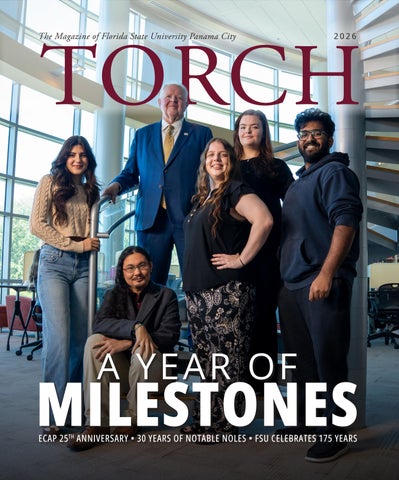
TORCH The Magazine of Florida State University Panama City 2026 DEAN OF FSU PANAMA CITY AND THE COLLEGE OF APPLIED STUDIES Randy Hanna, J.D., Ed.D., ‘83 OFFICE OF ADVANCEMENT STAFF Becky Kelly, Director of Advancement Erin Chaffin, Strategic Marketing Manager ‘12 Dana Erskine, Procurement and Operations ON THE COVER: Students gathered with Dean Randy Hanna in
Dorothy Forba, Engagement and Events Manager ‘27
the Dr. and Mrs. James T. Cook Library and Learning Center.
Kyle Middlemass, Marketing and Publications ‘19
[Photo and Cover Design by Kyle Middlemass]
Tony Simmons, Writing Program Manager ‘25 Katie Sowell, Sr. Director of Development ‘16, ‘17 EDITOR Becky Kelly DESIGNERS Erin Chaffin ‘12, Kyle Middlemass ‘19 CONTRIBUTING WRITERS Tristan Costales ‘25, Amy Farnum-Patronis, Tony Simmons ‘25 CONTRIBUTING PHOTOGRAPHERS Kyle Middlemass ‘19 Tony Simmons ‘25, Andrew Wardlow
THE TORCH MAGAZINE is published by the Office of Advancement at Florida State University Panama City. To be included in the mailing list or to submit a change of address, email us at torch@pc.fsu.edu. Please send alumni updates to outreach@pc.fsu.edu.
4
TORCH
CONTENTS 6
Dean’s Message
8
MILESTONE: FSU Celebrates 175 Years
10
2026 Events (Photo Timeline)
12
Graduate Profile: No Limits
14
Donor Profile: Gift of a Lifetime
16
Student Profile: Waddling Wellness
18
MILESTONE: 30 Years of Notable Noles
24
Scholarship Profile: Alyssa Howell
25
Roboboat Team Competes Internationally
26
Real CSI: Forensics Beyond the Classroom
30
Detectives of the Deep
32
New Program: The Gift of Health
34
Local Support: Donation Funds Nursing Scholarships
36
MILESTONE: 25 Years of Impact ECAP program evolves
40
An ECAP Photo Timeline
42
On the ASCENT
46
MILESTONE: Senior Class Collegiate School Adds Grade 12
49
TCS Student Profile: Harper Sikkema
50
Full Circuit Dr. Geoffrey Brooks Retires
52
MILESTONE: 40 Years of Garnet Key
54
Faculty Spotlights
55
In Memoriam: Dr. Jerome Barnes
56
Faculty and Staff Recognitions
58
Student Activities: Photo Timeline
59
SGC President’s Message
60
Seminole Sightings
64
Student Postscript: Tristan Costales
WADING IN: Students Rachel Browning, left, and Kaylee Dupuis sift for marine organisms in the seagrass of North Bay in July as part of Dr. Sara Wofford-Mares’ class, Biology for Non-Majors.
PC.FSU.EDU
5
THE DEAN’S MESSAGE As Florida State University marks the 175th year since it was first established as the West Florida Seminary, this academic year also represents a series of milestones for FSU Panama City. We will celebrate our 45th anniversary in 2027, but before we get to that, let’s see what makes 2026 so special. This fall, we recognized the 30th annual class of Notable Noles. Established in 1996, Notable Noles became an FSU PC tradition honoring alumni who have made outstanding contributions to the university, the community and within their careers. We recognized 100 distinguished alumni. This edition looks back at previous winners and showcases this year’s honorees. This year also marks 25 years since the creation of our Early Childhood Autism Program in 2001. ECAP has flourished, educating and training therapists and assisting families and their children. This year, ECAP will expand its practice to include adult clients through a partnership with the Arc of the Bay. Our inaugural class of ninth graders who launched The Collegiate School in 2023 began their senior year this fall. This means our A-rated charter laboratory school now includes all high-school grade levels. TCS will graduate its first senior class in 2027, setting a new milestone as part of the growing FSU Panama City legacy. On a personal note, fall of 2026 also marks my tenth year as dean of FSU PC and the College of Applied Studies. It has been a rewarding decade, watching the campus grow and evolve. Together, we have faced hardships including a natural disaster and a global pandemic, and we have proven that we are stronger together. While we celebrate these accomplishments, we are consistently keeping an eye on the horizon — looking forward to meeting the needs of the Panhandle and the challenges of tomorrow’s world. That’s our mission. Let’s continue to work together to advance that mission for the people of Northwest Florida and future Seminoles. Go Noles!
Randy Hanna, Dean, FSU Panama City The College of Applied Studies
6
TORCH
PC.FSU.EDU
7
MIL ES TO N E
YEAR OF FESTIVITIES HONOR REMARKABLE HISTORY, BRIGHT FUTURE Throughout the year 2026, Florida State University is commemorating a rare and historic achievement, marking 175 years since its founding. This milestone celebrates the university’s longstanding tradition of excellence and highlights its continued growth and significance as a leader in higher education. “As we mark Florida State University’s 175th anniversary, we honor a legacy of groundbreaking research, innovative teaching, and an outstanding track record of student success that built FSU into one of the Top 25 public universities in the nation,” said FSU President Richard McCullough. “While we celebrate our past, we are also experiencing unprecedented momentum. From posting record graduation rates and research expenditures to launching FSU Health and receiving transformative philanthropic gifts, every day we are building upon our great traditions and past achievements to propel Florida State University to even greater heights.” Founded in 1851 as the Seminary West of the Suwannee River, just 75 years after the United States gained independence and six years after Florida became a state, FSU began with a clear mission: to educate the young people who would help shape and civilize the Florida frontier. The original site, where the iconic Westcott fountain now stands, lays claim as the oldest continuous location of higher learning in Florida. Over the past 175 years, the institution has evolved through different names and purposes, growing from a modest few acres to a sprawling campus with 390 buildings on 1,810 acres across the state, including 216 buildings on 487.1 acres on the original main campus in Tallahassee. Today, FSU encompasses 17 colleges, the National High Magnetic Field Laboratory, The Ringling Museum in Sarasota, a branch campus in Panama City, Panama, international study centers in London, Florence and Valencia—and FSU Panama City. 8
TORCH
FSU PANAMA CITY In the early 1970s, Naval Coastal Systems Center, Gulf Coast Community College, Bay County School Board and Tyndall Air Force Base lobbied for an institution of higher learning to be located in Bay County. In 1972, the Florida Board of Regents directed the University of West Florida to establish a center in Panama City. Classes began that summer with an enrollment of 65 elementary education students and a staff of two. Facilities were in the Bay County School Board Office Building and GCCC. In 1976, the Bay County Commission purchased 17.5 acres between GCCC and the waters of North Bay for use by the center. In 1981, the commission donated an additional 2.54 acres and three quadriplex buildings. State Sen. Dempsey Barron (D-Panama City) pushed for FSU to take over responsibility for the campus, which it did in the fall of 1982. The existing five resident faculty could not provide all the instructional support necessary to meet the increased demand, so two vans were placed on daily round trips to transport faculty from Tallahassee to Panama City. On June 23, 1983, groundbreaking occurred for the $9.1 million Phase I development of FSU Panama City. The new facilities were dedicated on March 22, 1986, with the administrative building named in honor of Barron, who sponsored the bill that secured funds for the permanent FSU facility in Panama City. The new campus facilities opened for students in January 1987. In March 1987, an additional 5.62 acres along the bay were deeded to the state for use by the campus, which brought FSU PC to its current size of 25.66 acres. Since 2000, FSU Panama City has grown to offer more than 30 degree programs with more than 60 resident faculty members. In 2012, the FSU Board of Trustees approved a four-year academic
plan that allowed FSU PC to offer a limited range of generaleducation and lower-level courses focused on the upper-level majors offered at FSU Panama City. This historic decision allowed for the admission of the first freshman class in fall 2013. The Early Childhood Autism Program opened in 2001, serving children with autism and other developmental disorders while providing clinical experience to FSU PC students in Applied Behavior Analysis. The Doctor of Nurse Anesthesia Practice program, initially established and accredited at the master’s level in 2015, transitioned to the doctoral degree approved by the State University System of Florida Board of Governors in July 2020. Final approval was granted by the accrediting body in January 2021. Seminole Landing opened in 2021, providing on-campus student housing for the first time. The Collegiate School at FSU PC, a charter laboratory high school, opened to freshmen in fall 2023 and now serves students in grades 9-12.
HISTORIC CELEBRATION FSU’s 175th anniversary committee, chaired by FSU First Lady Jai Vartikar, planned a yearlong commemoration of the university’s history and achievements. “This year is more than a commemoration — it is a heartfelt invitation for every member of the FSU family to come together, celebrate our outstanding achievements, honor our vibrant traditions, and dream boldly about the next chapter,” Vartikar said. “FSU has always been defined by our spirit of connection and support — so let’s join hands, share our stories, and build an even brighter future together. I can’t wait to celebrate with you and make memories that will inspire generations to come!” The celebration began with students, faculty, staff, alumni and friends joining a spirited cupcake kickoff on Jan. 21, hosted by New Student and Family Programs at the Student Union in celebration of the university’s birthday, which is officially Jan. 24, 1851— the date when the Florida Legislature signed into law the establishment of the Seminary of Learning West of the Suwannee. The West Florida Seminary in Tallahassee began operating in 1857, only 12 years after Florida achieved statehood. Throughout its evolution, FSU has played a pioneering role in education, adapting to the needs of its students and society. Its legacy of embracing change and fostering innovation has positioned the university as a vibrant hub for research, learning, and global engagement. For more information on FSU’s 175th anniversary, visit 175.fsu.edu.
TOP: Students gather on the future Florida State College for Women campus in 1905. MIDDLE: State Sen. Dempsey Barron, who helped bring the Panama City campus under FSU, breaks ground for the Barron Building in 1983. BOTTOM: The inaugural Torch Run in 1989 marked the start of an FSU Panama City tradition.
LEARN MORE ABOUT FSU’S 175TH ANNIVERSARY 175.fsu.edu
PC.FSU.EDU
9
APRIL 17: Student Noah Owen demonstrates his project to judges at the annual Student Research Symposium, a showcase for students to present work to the university community.
JANUARY 24: Two runners reach the finish line during the annual Torch Run 5K, an FSU PC tradition since 1989.
EVENTS 2026
FEBRUARY 25: Violinist Samantha Crawford, ‘05, performs at the Black History Month celebration. More than 380 Bay County students attended. Other speakers included Al McCambry, Darrick McGhee and student Caleb Honore.
10
TORCH
MARCH 3: FOX News host Shannon Bream was keynote speaker for an event promoting the Osher Lifelong Learning Institute at FSU PC/30A held at WaterColor Lakehouse.
MAY 15: The second annual Northwest Florida Disability Conference, a free event, brought together dozens of local agencies and resources for an informative and inspiring day.
JUNE 6: The future of football was on full display at the 2026 FSU PC Youth Football Camp, led by coaches Boris Jackson and Javien Elliot.
PC.FSU.EDU
11
NO LIMITS MASTER’S GRADUATE HOPES TO INSPIRE OTHERS TO REACH HIGHER BY TONY SIMMONS Hillary Gaultney graduated in May with her master’s in Professional Communication, completing the Corporate & Public Communications online program under the guidance of Professor Brian Parker. It was an achievement she never expected, and one that she credits to the way FSU Panama City relates to its students. “FSU Panama City didn’t just help me earn a degree — it helped me believe that I belonged in places I once thought were out of reach,” she said. Gaultney’s father was a small business owner and her mother a stay-at-home mom who managed both the household and her children’s education through homeschooling. However, raising six children, they often struggled to make ends meet. Education and learning held value, but the family’s financial circumstances limited educational opportunity. Higher education was never discouraged but felt like a distant, unrealistic path. “I was never told I couldn’t go to college, but I was also never told I should,” she said. “Being educated was encouraged, but there wasn’t a priority placed on it.” Because she was not in a traditional classroom setting, early signs of Gaultney’s vision loss were not immediately recognized. She was about 10 when her mother noticed Hillary held books unusually close to her face while reading. A visit with an eye doctor for glasses led to nearly a year of appointments with specialists, as her symptoms did not present as typical near- or farsightedness. Eventually, Hillary received a diagnosis of a rare condition, Stargardt’s Macular Dystrophy, a juvenile form of macular degeneration that affects only 1 in 8,000 to 10,000 people.
12
TORCH
GLAD GRAD: Hillary Gaultney
“I remember asking the doctor what this meant for my future. He responded with what I’m sure he intended as doctor humor: ‘Well, you won’t be able to fly a plane,’” she said. “It was still the first time someone really told me directly that I couldn’t do something because of my circumstances. So much in my life at this point already felt out of reach, but in that moment it felt like another door was quietly closing on the future.”
FSU Panama City didn’t just help me earn a degree — it helped me believe that I belonged in places I once thought were out of reach. HILLARY GAULTNEY, ’26
A PATH TO THE FUTURE Hillary’s maternal grandfather, a first-generation college graduate, earned a master’s degree while in the workforce, going to night classes after a full day of work and taking care of a wife and five children. He also served in the U.S. Air Force and Florida National Guard, and he retired from the Florida Department of Children and Family Services. Having overcome significant hardships in his own early life, he demonstrated by his example that education and perseverance could change the trajectory of one’s future. Hillary’s grandfather treated her diagnosis not as a barrier, but as a challenge. “He pushed me in ways I often felt were unfair and beyond my comfort zone, though I know now that it was all from a place of love and wanting more for my future,” she said. “He is my greatest inspiration.”
scholarship program. She spent months researching different options, but none felt like the right fit until she discovered the CPC program offered at FSU Panama City. “After reviewing the coursework, I knew this program aligned with both my professional goals and my personal interests,” she said. At that time, the program was not fully online. Hillary still lived in Tallahassee, which seemed like yet another barrier. However, Parker encouraged her to take available online courses until the program fully transitioned online. Over the next three and a half years, Hillary took classes one or two per semester while balancing a full-time job and life’s demands. Most of her courses were with professors Parker and Laurie Lawrence.
When Hillary entered the public school system for her final two years of high school, she quickly realized how unfamiliar she was with the college preparation process. Many of her classmates were already dual-enrolled, taking SAT prep courses or applying to universities — experiences most firstgeneration students lack exposure to.
“I cannot say enough about the impact they have had on my journey,” she said. “Their curriculum shaped my understanding of communication in ways I never expected, and their assignments were grounded in real-world application. The guidance and support I received through this program have been unlike anything else.”
“I had no roadmap and no clear starting point,” she said. Late to the game, she applied to Valdosta State University with encouragement from teachers and mentors, and was accepted. She also received a full scholarship from the Georgia Vocational Rehabilitation Agency. “I still remember opening that letter, shocked that I actually got accepted into college,” she said.
All of her accommodation requests were met with the utmost professionalism. “I never felt like my disability would get in the way of completing this program,” she said.
At VSU, Hillary began as a Journalism/English major before discovering a passion for marketing and communications through an internship. She changed her major to Business Administration-Marketing and, for the first time, felt confident she had found the right path. “After graduation, I worked a series of jobs before landing my first marketing role with a nonprofit and later a position at a technical college, where I developed a deep appreciation for higher education,” she said. “A few years — and a pandemic — later, I found myself accepting a marketing role with University Housing at Florida State University.”
SMALL BUT MIGHTY Now the communications manager for the FSU College of Nursing, Hillary was able to take classes via the employee
“The FSU Panama City campus may be small, but it is mighty,” she added. “Having the same instructors walk alongside you and witness your growth creates a personal connection that means more than I can fully express.” Though she could have participated in Commencement in Tallahassee, where she lives and works, Hillary chose to walk in the FSU Panama City spring ceremony at the Atlantis Center in Lynn Haven. She brought her entire family including her mother, five siblings, and her biggest cheerleader of all, her 92-year-old grandfather. Two of her siblings also have the same eye condition, despite its rarity. “I want them to see that limitations do not define who we are or what is possible,” she said. “I want to show them, and others like my younger self, that someone can come from very little, face significant obstacles, and still build a meaningful future.”
PC.FSU.EDU
13
GIFT OF A LIFETIME GALLS DONATE $75,000 TO FSU PANAMA CITY BY TONY SIMMONS Dan and Stefanie Gall, both of whom are Florida State University alumni, made a $75,000 donation to FSU Panama City to support programs and services throughout the campus. The endowed fund is set to be used at the discretion of the dean. “We were going to leave money after we died, and we said, ‘That’s not going to be any fun, is it?’ Because we can’t watch anything happen,” said Stefanie (’70, ’73). “It would be more precious to us to watch programs and departments grow and get better … We decided to give it to the dean because we have faith in FSU Panama City.” The Galls both served a decade as members of the Dean’s Circle at the FSU Anne Spencer Davies College of Education, Health, and Human Sciences. After a lifetime in education, Dan (’73) retired from McGraw-Hill, where he worked as a national consultant for adult assessments. He also was the first teacher of learning-disabled students in Bay County. Stefanie, a graduate of Anne’s College, is a former school principal and superintendent of Bay District Schools. She was recognized with the Educator of a Lifetime Award, the highest honor bestowed by the district. And she also received the Anne’s College 2021 Distinguished Alumni Award.
GIVE TO FSU PANAMA CITY pc.fsu.edu/give-fsu-pc
14
TORCH
Originally from Bonifay, she earned a master’s in counseling psychology (1970) and doctorate in elementary education (1973) from FSU. An active volunteer, she has served as president of the Panama City Music Association and president of the Panama City Kiwanis Club.
Education brought us together. We would never have met each other if it had not been for that. STEFANIE GALL, ’70, ‘73
A LIFE IN EDUCATION The couple met in 1971, in their 20s, when Stefanie was working with the state’s educational assessment division and Dan was teaching at the Okeechobee School for Boys. He was working on his master’s degree, and she was a Ph.D. candidate. They were married less than a year later and have been together for more than 50 years. They now have three children and nine grandchildren, most of whom are also FSU PC alumni, including Lauren Gall Posey, Ryan Posey, Crayton Posey, Chase Posey (who will graduate in Spring 2027), Chad Gall, Dawson Gall (graduated 2025 from FSU PC and now working on his master’s degree at FSU Tallahassee). Lifeelong learners, they enjoy world travel, having recently made journeys to France, Zimbabwe, Italy, and more. Before coming to Bay County, the couple lived in Tallahassee — “jobless and poor,” as Dan said, living off of grants and temporary positions. Dan landed a job with Bay District Schools, and Stefanie later was hired to teach at Lynn Haven Elementary. Certified in psychology, she was then contracted to review all school psychology reports in the district. “All of this was in its infancy,” Dan said of the county’s learning disabled and emotionally handicapped programs. “It went from a couple hundred to almost a thousand school psychologists across the state. … Now, school systems can’t really function without school psychologists.”
Time passed, and as the principal at Millville Elementary, Stefanie instituted a program that turned classrooms into communities. Students learned important life skills and etiquette, operated a post office and learned to keep “bank accounts.” She also turned the discipline policy away from corporal punishment in an effort to create positive behavioral modification plans. “I told them they could go anywhere they want and eat with kings and queens,” she said. “Nothing is ‘too good’ for you. … We became a showcase school for the state.” Stefanie’s rise to school superintendent broke the traditional model, an unwritten rule that included first serving as principal of a high school and having been an athletics coach—not to mention being male. They similarly broke with the tradition of posthumous giving. “My 80th birthday came along last year, and we were already going to leave money to FSU, but we said, ‘Wouldn’t it be fun? Let’s do it now,’” she said. Rather than leave an endowment with specific stipulations about how it could be spent, they thought it would be better to place those decisions in the hands of the people on the front lines. “Education brought us together. We would never have met each other if it had not been for that,” Stefanie said. “But education is more than just teaching. Sometimes it can be stuff. If ECAP needs something, there you go. If another program requires some equipment, it can be purchased. “… We realized there might be something that needed to be bought for a program. You don’t have to do a scholarship, but everybody is getting an education.” GENERATIONS: Stefanie and Dan Gall pose with their family in 1972 during grad school at FSU. [Courtesy Photo]
PC.FSU.EDU
15
WADDLING WELLNESS STUDENT RESEARCH PRESCRIBES FOWL PLAY QUACK SCIENCE: Marty the duck and Courtney Holt the human.
16
TORCH
The power of a quack should never be underestimated. COURTNEY HOLT, Student Veteran
BY TONY SIMMONS One student veteran’s research offers an unexpected avenue of relief for those suffering from anxiety, depression and traumatic brain injury. First, get your ducks in a row. “There is a direct correlation between duck interactions and lowered anxiety scores,” said Courtney Holt, a U.S. Air Force veteran and Public Health major at FSU PC, who presented her findings as part of the sixth annual Student Research Symposium in April. “Perspectives from the intervention show life-changing effects, such as significant reduction in the frequency of nightmares,” she added. “This, in combination with gathered experiences of duck owners, provides a clear idea that ducks would be beneficial aids in therapeutic environments.” Milinda Stephenson, Ph.D., was Holt’s research advisor. She described Holt as a kind person, diligent student and class leader. “Courtney found something that helped her get through her PTSD, allowing her to calm herself and focus,” Stephenson said. “She wanted to use what she found worked for her to help other combat veterans.” Holt experienced a traumatic brain injury during her military service. As a result, she has had to deal with physical and mental health issues, including post-traumatic stress disorder. Once back at home, however, she began to find her way. “I found myself in the comfort of raising chickens and ducks,” she said. “I noticed that I would find relief from anxiety or migraines when I would spend time outdoors tending to them.”
ROAD TO RESEARCH Her firsthand experiences led Holt to wonder if any research had been completed that suggested a correlation between decreased symptoms in TBI patients and exposure to raising domestic ducks. In fact, she found “exactly one study regarding the subject.” Drawing on narrative review data, a clinical duck-based intervention, qualitative interviews and her own lived experience, Holt finished a research review that argues structured interaction with domesticated ducks can reduce anxiety, support emotional regulation and foster self-
efficacy in ways that complement conventional care. These findings are further supported by case narratives of community duck owners and Holt’s own longitudinal experience. She reported symptom relief from migraines, anxiety and obsessive-compulsive disorder through daily husbandry, outdoor engagement and humanduck bonding. According to Holt, existing farm animal-assisted therapy studies have demonstrated improvements in personal initiative, attentiveness and self-efficacy, alongside reductions in anxiety and depression. In her eyes, this seemed to indicate that ducks could be a suitable candidate species for use in therapy. A 12-week duck-centered intervention with TBI survivors showed meaningful reductions in anxiety scores during active participation. Follow-up work revealed participants’ descriptions of duck contact as grounding, life-changing and protective against intrusive symptoms such as nightmares. Holt’s findings propose that ducks uniquely integrate tactile comfort, routine caregiving and nature immersion, embedding therapy into everyday environments and extending benefits beyond time-limited clinical sessions. She said a longer-term study would be needed to clarify how the interaction leads to a reduction in symptoms, as well as evaluating the feasibility of duck-centered therapy in both institutional and home-based settings. Meanwhile, Holt is now raising 18 ducks. “They bring so much joy to my family — my husband and two children,” she said. “I’ve become very passionate with my hobby in duck husbandry, as they have given me so much joy and peace. The power of a quack should never be underestimated.”
LEARN ABOUT FSU PANAMA CITY’S VETERAN SERVICES fla.st/XKPYJ41A
PC.FSU.EDU
17
MIL ES TO N E
NOTABLE
NOLES HONORING OUR OUTSTANDING ALUMNI BY TONY SIMMONS In 1996, in conjunction with Homecoming, a tradition was established to honor Florida State University Panama City alumni who made outstanding contributions to the university, to the community and within their careers. Each year, distinguished alumni are honored as FSU Panama City Notable Noles and recognized at the annual Alumni Luncheon. While each honoree has distinct accomplishments, these outstanding alumni have one thing in common: They demonstrated excellence and dedication as students and have continued to exhibit these qualities in every aspect of their lives. Notable Noles are selected by a panel composed of FSU Panama City alumni, staff and supporters. Criteria used to select the Notable Noles may include, but is not limited to: Demonstration of excellence and dedication. Contributions and involvement in their community. Professional and career accomplishments. To nominate an FSU Panama City graduate as a Notable Nole, fill out the form at the website, pc.fsu.edu/notable-nole. Note that the previous year’s nominations also will be considered in subsequent years. However, additional information may be added using this form. Past Notable Noles established an endowed scholarship to support the next generation of alumni. For giving information on this scholarship, visit FSU.academicworks.com.
NOMINATE A NOTABLE NOLE pc.fsu.edu/notable-nole
18
TORCH
30 YEARS OF TRADITION 1996:
Kelly Chisholm, Ken Chisholm, Melinda Crawford, Randy Segler
1997:
Emily Balazs, Phyllis Deese, Jennifer Fenwick, John Holdnak
1998:
Lynn Centrone, Kim Dodd, Anita Dillard, Dinh Nguyen
1999:
Beth Durbin, Michael Grady, Tracy Johnstone
2000:
Kay Brewton, Suzanne Cox, Glen McDonald, Alan Robertson
2001:
Brian Barnes, Jack Kerigan, Tina Menna
2002:
Steve Rainelli, Judy Hughes, Richard Morrison
2003:
Cathy Felty, David Lovett, Colby Peel
2004:
Claire Calohan, Bill Husfelt, Alisa Kinsaul
2005:
John Cannon, Frank Hall, Cameron Skinner
2006:
Vickie Gainer, John Haley, Anita Mayer
2007:
Nicole Barefield, David Downing, Amy Sewell
2008:
Susan Fuder, David Southall, Jim Thomsen
2009:
Susan Butler, Michelle Lacewell, Janice Strickland-Salares
2010:
Steve Bornhoft, Gena Burgans, Philip Griffitts, Jr.
2011:
Patrick Green, Jennifer Mayne, Katie Patronis
2012:
Julia Walker Haley, Charla Skinner Perdue, Shannon Sheibe
2013:
Scott Ervin, Kathleen Jones, Glenda Walters
2014:
Aaron Rich, Angela Sexton, Kristina Williams
2015:
Ginger Littleton, Amy Polick, Cliff Wilson
2016:
Sarah Giles, Tanya Deal, Tiffani Hinds
2017:
Kenneth Ayers Jr., Jim Dever, Chuck Perdue, Jody Waller
2018:
Kenneth Ayers III, Brittany Cole, Karen Hurst
2019:
Karen Barss, Dan Sowell, Dustin Stokesbary
2020:
Albert Jesse “A.J.” Bacon, Kevin Elliott, Janice Lucas
2021:
Nancy Luther, Heather Kretzer, Brooke Powell
2022:
Melanie Boyd, Maria Goodwin, Sharon Michalik, Zacarias Sanchez, Judge Elijah Smiley
2023:
Carrie Baker, Wayne Porter, Adrianna Swearingen
2024:
Ted Czupryk, Jonathan Hayes, Karen Smith
2025:
Alex Burgans, Catie Feeney, Cheryl Flax-Hyman, Lesley Miller
And our 2026 Notable Noles are …
HISTORY UNFOLDS: Top: 2022 Notable Nole Sharon Michalik photographed in 1987. Middle: Claire Calohan was part of the first FSU PC graduating class. Bottom: Future Judge Elijah Smiley speaks with then-FSU President Bernard Sliger.
PC.FSU.EDU
19
JASON CROWE, ‘00, ‘04 Jason Crowe is the president of the Florida Division of Community Bank, where he has worked for nearly 21 years. An established bank executive with experience growing and managing a $500 million bank, Crowe has a proven business development background. He has an extensive background in management, market strategy and lending, and he successfully opened and operated six banking locations across the Florida Panhandle. “I’ve been really fortunate to be in some good positions at an early age,” he said. “In 2006, I started a bank from scratch in Destin, and we grew it over to Bay County in 2013.” That gave him the chance to return to Panama City, where his extended family lives. He first came to the Panama City area as a teenager; his father retired from the Navy in 1992 and took a job at Tyndall Air Force Base. Taking night courses while working as a teller in a local bank, Crowe earned his bachelor's degree in Business Management from the Herbert Wertheim College of Business at FSU Panama City in 2000. His MBA in Finance followed in 2004. “One of the benefits of FSU Panama City is the smaller size of the campus, the opportunity for more personalized attention and having a closer relationship with the faculty,” he said. "I had a great relationship with instructors and administration, and I had an opportunity to serve on the Student Government Council when I was here. … And there are so many more things to do here now than when I was in school.” Crowe is the husband of Elizabeth Crowe, the assistant dean of Academic Affairs at FSU Panama City. Married for more than 25 years, they have two children, Elias and Katie. “There are a lot of family ties here,” he said. “Both my sister and father are graduates of FSU PC, so it sort of runs in the family. My sister did some teaching here as well.” Crowe was nominated by Gail Robbins, who described him as an outstanding example of the heart and character of Seminole spirit. “Having known Jason Crowe for many years, I am excited that he is being recognized as a 2026 Notable Nole," Robbins said. “As a respected business and dedicated community leader, Jason has made a real difference in the life of our community. He exhibits integrity and empathy in all he does, which I greatly respect.”
20
TORCH
BROOKE LOYED, ‘99 In April 2026, Patronis Elementary School Principal Brooke Loyed was named Florida’s Principal of the Year for 2025-2026. A former Bay High School teacher and Mosley High School assistant principal, she received her Education Specialist degree from FSU Panama City in 1999, taking night classes led by professors bused from Tallahassee. “My last class of my Ed Specialist degree was on my wedding day,” she said. “I went straight from that to get married. I was dedicated. I wanted to graduate.” A native of Early County in Georgia, Brooke Loyed is married to Jim Loyed, and they are the parents of Tarver and Tracey. A Bay County educator for 29 years, Loyed received the state honor for demonstrating commitment to student success, academic excellence, and a positive school culture. Under her leadership, Patronis Elementary has maintained an “A” school grade for the past four years and in 2025 achieved a high proficiency rating in Language Arts and math. “Our students read 174 million words last year,” she said in a discussion of the Patronis reading program. “That’s the way to move the needle. If we can get that knocked out, it’ll set the tone for science, social studies, even math. We push reading for homework. If nothing else, let’s read every night.” A Bay District Schools statement said Patronis Elementary is an example “of what’s possible when high expectations are paired with genuine care for students, staff, and families.” Loyed’s focus on building strong relationships, supporting teachers, and creating an engaging learning environment has made a lasting impact on the entire school community. She leads with purpose and heart, always keeping students at the center of every decision. “My leadership style is: I hire the best, and then I get out of their way,” she said. “I’m in the classrooms, I have my finger on the pulse, but I’m not a micro-manager. There’s a million things we do—there’s not one silver bullet. There’s a lot that goes into a successful school.” She advises her students, who she described as resilient and flexible, to always strive to be their best. “You do the things when no one’s looking. You do the things because you want to do them. You’re not doing it to get the award … you’re doing it because it’s what’s right, it’s what is in your heart,” Loyed told reporters when her state award was announced. “Brooke leads with heart, integrity, and joy, putting her students, teachers, and staff at the center of everything she does every single day,” said Kelly Hodges, who nominated Loyed. “Her unconditional love for the people around her builds trust and allows for excellence to grow and thrive.” Loyed said education was in her blood and she would probably still be involved with schools after she retires. “I think that’s where our hope lies,” she said. “That’s where the possibilities are.”
PC.FSU.EDU
21
MARK SMITH, ‘86, ‘22 Mark Smith, chief of the Panama City Police Department, first moved to Panama City in 1963 with his family. He grew up here, went to school here, and eventually began his law enforcement career in 1981 with the Panama City Beach Police Department. When FSU came to Panama City in 1982, he saw a path to pursue a bachelor’s degree in Criminology (1986). “Living here and having access to the school provided easy access to continue my education while advancing my career goals,” he said. “Through the encouragement of family and employer, I decided to obtain my master’s degree. I chose Law Enforcement Intelligence as a natural addition to my bachelor’s degree and law enforcement career.” Smith credited his professors — specifically calling out Banyon Pelham and Scott Ervin — for providing valid and up-to-date information that matches actual workplace practices. “Each course seamlessly ties from one to another, threading the information and knowledge provided,” he said. Law enforcement is in Smith’s blood: His great-grandfather was a U.S. Marshal in Arizona, his grandfather served 37 years with Long Beach police, his father worked for Bay County Sheriff Doc Daffin, and his two older brothers were also police officers. Smith rose to the rank of lieutenant before retiring from the PCBPD in 1997. He joined the PCPD in 2004, working through the ranks of the agency and serving in all aspects of supervisory capacity. He was sworn in as the Chief of Police in 2021 and received his LEI master's degree in 2022. “It’s what I knew I wanted to do when I was in junior high and high school,” Smith said. He is also a graduate of the FBI Law Enforcement Executive Development Seminar, the Florida Department of Law Enforcement Senior Leadership Academy, and the Florida Police Chiefs Association Future Chiefs Seminar. He has served as an adjunct instructor with Gulf Coast State College for 43 years and with FSU PC for 12 years. Smith offered this advice to FSU Panama City students: “Continue through the struggles, keep moving forward through the classes. The future is brighter with the knowledge and experience obtained through the educational experience." Pelham, the assistant dean of Applied Studies, said Smith has made profound impacts on the PCPD since becoming its chief. “From Hurricane Michael he learned many lessons and found that they were not as prepared as they believed." Pelham also ranked Smith as one of the most accomplished investigators to have worked in Bay County: “He is a dedicated leader, who is most proud of his ability to assist his community as a law enforcement officer for over 45 years.”
22
TORCH
STEPHANIE WOOD, ‘07 As program coordinator for the Gulf Coast Children’s Advocacy Center, Stephanie Wood leads the development, expansion and operational oversight of multiple home-visiting programs serving expectant and new parents across the region. Since May 2017, she has grown the agency’s service capacity, secured and managed diverse funding streams, and built staffing and infrastructure to meet increasing community demand. Wood came to Panama City as a high school student when her father retired from the U.S. Air Force. She had long held a dream of attending FSU, and discovering FSU PC close to home provided a unique opportunity. “We were already Seminole fans through and through,” she said. “I was very young when I started, but no one treated me that way. Everyone was welcoming.” She wanted to become a criminal investigator but found a job in social work along the way that influenced her direction in life. Beyond that, a psychology class shifted her perspective on the reasons humans behave the way they do. Wood received her bachelor’s degree in Criminal Justice with a minor in Psychology in 2007, the same year she wed Jeremy Wood (FSU ’05). Married 19 years, Stephanie and Jeremy Wood are the parents of a teenage daughter who also has her sights set on attending FSU. She worked for the Children’s Home Society of Florida, Children’s Medical Services and Healthy Start before beginning her work with GCCAC. Nominator Frank Hall said her “career reflects the values long associated with FSU Panama City: service, leadership, community engagement, and a commitment to improving the lives of others. … Throughout her professional career, she has consistently applied that education in ways that have directly benefited vulnerable children, parents, and families across Northwest Florida.” In July 2025, Wood began coordinating Healthy Families Florida-Bay, establishing program operations, staffing and systems for a prevention-focused model aimed at reducing child abuse and neglect. Wood dedicated her career to serving children and families across Northwest Florida. Her professional accomplishments, involvement in the community, and commitment to improving the lives of others reflect positively on both FSU Panama City and the community. “My plan for the future is to continue to try to prevent child abuse, keep bringing programs to the area that we don’t have, and hope to save some children before it’s too late,” Wood said.
PC.FSU.EDU
23
BREAKING BARRIERS FIRST-GENERATION SCHOLAR LEADS BY EXAMPLE BY TONY SIMMONS When she received the Notable Nole Scholarship in September, Alyssa Howell stood on the Holley Center stage and told a bit of her story — emphasizing how FSU Panama City made a difference in her life’s trajectory when she found her place here. “I’m from a military family so I’ve lived all over the place,” she said. “I was born in Charleston, South Carolina, then did eight years in Portsmouth, Virginia, and eventually settled in a tiny town called Rock Run near my parents’ hometown in Piedmont, Alabama.” No one in her family had a college education, and Alyssa had lots of obstacles to overcome. At a very early age, she was diagnosed with AuDHD — a co-occurrence of Autism Spectrum Disorder (ASD) and Attention-Deficit/Hyperactivity Disorder (ADHD). “It steered my education in a specific route,” she said. “I was in separate classes and had restrictions on learning tools like books and computers up until high school.” She was funneled into a Cherokee County trade school, “with the idea that I would never go to college.” During the COVID-19 pandemic, Alyssa moved schools and found better support, so she was able to graduate with honors from high school. She moved to Panama City alone at 18 and enrolled at Gulf Coast State College, which she discovered from a Google search for “the cheapest college in Florida.” Seeking part-time employment, she was hired for a social media position in the Office of Advancement at FSU Panama City. “She did a great job creating engagement and reach with our social media,” said Isaiah Long, the SG&A Coordinator, who was at that time a student working on his master’s degree in Corporate and Public Communication. “This is also when I became friends with her, and I had no idea she wasn’t a student. She was always walking around campus, interacting with students and staff, creating the environment we want on campus.” Alyssa later transferred to Admissions, where she now gives tours and is often the first face prospective students see. She’s also now
24
TORCH
NOTABLE: Associate Dean Amy Polick presents the Notable Noles scholarship to student Alyssa Howell.
a Professional Communication major on the BS/MS track. She expects to finish her bachelor’s degree in May 2027. “I know what it is like to be uncertain and confused about college and going to school in general, so finding a field that helps support those students and people in the community is my goal,” she said. Alyssa is also the Student Government Council’s president pro tempore, working with SGC President Brent Cerney and others to create a more inclusive and focused student government culture. She also created the LEAD club to grow the leadership skills of students. Coffee lovers can thank her for scheduling Techspresso coffee truck’s visits. “Those are changes that will come to benefit our campus culture, graduates looking for careers, and our community,” Isaiah said. “Anyone who meets Alyssa leaves feeling better. That’s a quality I admire.”
I know what it is like to be uncertain and confused about college and going to school in general. ALYSSA HOWELL, Communications major
RO, RO, ROBO BOAT
ROBOTICS TEAM COMPETES INTERNATIONALLY
BY TONY SIMMONS One of the best things about working on a RoboBoat at FSU PC is the testing space.
However, to compete in the RoboBoat challenge, they needed to make significant changes to the design.
“It’s definitely larger than a typical testing pool, but also has a few more waves,” said Cesar Narvaez-Suarez, a senior in Mechanical Engineering, referring to the waters of North Bay, where the team tests its Autonomous Surface Vehicle prototypes and competition ASVs.
“We designed and implemented an emergency stop system and radio frequency backup controls to ensure safe operation at all times,” Cesar said. “From there, we expanded the boat’s autonomy by integrating additional, more powerful onboard computing for computer vision and object detection.”
Cesar was the co-founder and co-leader of the Nole Navigators robotics team alongside Computer Engineering major Katrina Le (pictured above with the roboboat).
For the year preceding the competition, the team tested and refined the operating system out on the bay, as well as using digital simulations — “especially on days when the sunshine state isn’t so sunny,” Cesar said.
“We started off really small with only two people and some inspiration from our mentor (Dr. Twan Capehart), but from there we’ve been able to grow to include people from all across the community,” Cesar said. “I think it’s been great to see the impact it’s had.” The Nole Navigators competed in the six-day RoboBoat Challenge at Nathan Benderson Park in Sarasota in the spring of 2026. Its first time joining the competition, the team faced 36 other teams representing 10 countries, including Bangladesh, Canada, Egypt, Indonesia, Japan, Mexico, Norway, Poland, Turkey and the United States and Puerto Rico. According to the official website, RoboBoat.org, the competition is a student program established to cultivate a community of innovators capable of making substantive contributions to the ASV domain. The vision is achieved by providing a venue and mechanism so practitioners of robotics and maritime autonomy come together to share knowledge, innovate and collaboratively advance the technology. The team’s boat, nicknamed “Bluey,” started as a kit from Blue Robotics, which gave them a solid and reliable foundation.
Katrina noted that the team was established in early 2025: “We are a relatively new team, but we were excited and ready to jump in head-first and go to Sarasota this year. Our team was inspired by past experiences with other Robo Nation programs and a desire to create more hands-on STEM opportunities at our campus, which did not previously have a robotics team.” Since restarting the RoboBoat team, Cesar and Katrina have added members from multiple disciplines at FSU PC as well as local high schools. Together, they engaged with STEM concepts they had learned in their classes. “Getting to this competition (was) a long road filled with trials,” Katrina said. “But every challenge and learning experience along the way has helped shaped us as a team.” VIEW VIDEO OF THE NOLE NAVIGATORS bit.ly/4hGVWl6
PC.FSU.EDU
25
THE REAL CSI
SAFETY FIRST: CSI students don protective gear during blood splatter simulations.
STUDENTS TAKE FORENSICS BEYOND THE CLASSROOM
BY TONY SIMMONS Entering college, Brianna Bogacz thought she had a grasp on what she wanted from a career. She discovered, however, that there were so many more possibilities than she’d ever considered. “As a child, you only know your main jobs — doctor, vet, astronaut — things like that,” she said. “As you get to college, you broaden your horizons. There are a lot of different jobs within every career field. You don’t have to be a doctor, you can be something else within the healthcare system. Just keep an open mind.” Achieving her bachelor’s degree happened faster than Bogacz expected. She transferred to FSU PC after receiving her A.A. from the University of North Florida, finding that FSU was able to offer many new opportunities she hadn’t considered — such as scuba diving to perform underwater forensic science. “I’m in the last semester of the Underwater Crime Scene
26
TORCH
Investigation program, so I’m about to be certified to do underwater CSI, which is very exciting,” Bogacz said. Originally from Pittsburgh, Pennsylvania, Bogacz never expected to go to college in Florida, and she hadn’t thought of Panama City as a destination to pursue her education. All of that changed, however, when she investigated criminal justice programs across the nation. “I found a program specifically for crime scene investigation. I didn’t know they existed,” Bogacz said. The small student/ professor ratio was another factor. “At FSU Panama City, you do get the small campus feel, but you get big campus opportunities. The professors actually get to know you.” Bogacz wants to manage her own forensics lab one day. “I know that through the skills and certifications I’ve gotten through this campus, I will be able to fulfill this dream,” she said.
“I know that through the skills and certifications I’ve gotten through this campus, I will be able to fulfill this dream.” BRIANNA BOGACZ, ’26
graduation, she plans to become a fingerprint analyst. “The most interesting and favorite thing I have done so far in crime scene has been dusting and collecting fingerprints — finding different methods to collect fingerprints and analyzing them,” Mongaras said. “This program has been incredible with the most supportive professors and advisors, and I have learned an abundance that I will never take for granted.” The CSI major is designed to bridge the gap between theoretical principles and field application, according to Charla Perdue, DFS, the undergraduate program coordinator for Public Safety & Security at FSU PC. “This program integrates rigorous academic study with practical exercises, teaching students to collect, identify, classify and analyze physical evidence to solve and prosecute criminal activity.” Students gain a professional edge through intensive, 40-hour lab courses offered during the summer semester. These accelerated sessions allow students to work on real cold cases and complete mock crime scene scenarios, mastering technical skills such as blood spatter analysis, fingerprint processing, bullet trajectory reconstruction and the recovery of skeletal remains. Hailing from Destin, Filion echoed Mongaras in that she has “always been interested in some form of law enforcement without becoming a police officer. Once I learned of this degree, especially so close to where I lived, it was an easy decision.”
SMOOTH CRIMINAL INVESTIGATOR: Brianna Bogacz, CSI graduate, in her commencement regalia.
DIGGING DEEP In May, CSI students began a week of hands-on labs. They learned to analyze blood spatter, pull fingerprints, recover soil samples and map them, determine bullet trajectories and more. One morning found Emily Mongaras and Sam Filion digging in the dirt at the campus pier on the shore of North Bay. Mongaras said she had a passion for criminal justice since her childhood in the Dallas, Texas area. “Freshman year of high school is when I got introduced to forensics and I was hooked,” she added. She transferred to FSU PC from Stephen F. Austin State University in Texas specifically for the CSI program. After
Filion said Lab Week was exciting — with viewing an autopsy, digging up simulated human remains, working with entomology — though “regular classes” in which she practiced basics like blood spatter analysis and fingerprint examination were also interesting. “This program is a great experience for anyone who may have an interest in law enforcement or the behind-the-scenes of a crime scene,” Filion said. “You are given so much hands-on experience and learn things from the best professors, who are always there to give extra information or real past experiences.” Filion will complete her bachelor’s degree in 2027, and she plans to pursue a master’s in Forensic Psychology so she can become a behavior analyst.
INTERNSHIP OPPORTUNITIES Carmen Thomaston graduated from the CSI track in Criminal Justice in 2021. During her last semester, she interned at the Bay County Sheriff’s Office in the Crime
PC.FSU.EDU
27
Scene Unit, learning to process evidence and participating in ride-alongs and on-site investigations. She credited the hands-on experience and technological familiarity that modern employers value for preparing FSU PC’s CSI graduates for diverse roles in law enforcement, intelligence services and private investigative agencies. All CSI-specific labs are approved by the International Association for Identification, which means students can apply their coursework directly toward professional training certification or continuing education hours. Internships further enhance their experience and learning opportunities, allowing them to network with professionals while learning about the variety of career paths in local, state and federal agencies. “This (internship) allowed me to truly understand that I was going into the right career, and to build relationships with fellow investigators and employees” at the BCSO, Thomaston said.
DIGGING FOR CLUES: Sam Filion and Emily Mongaras collect soil samples by the bay during Lab Week.
LEARN MORE ABOUT CRIME SCENE INVESTIGATION pc.fsu.edu/csi
28
TORCH
You are given so much hands-on experience and learn things from the best professors. SAM FILION, CSI student
After graduating, Thomaston took a job as a BCSO evidence custodian — getting her foot in the door. She started in January 2022 and worked there until February 2023, when she moved into a Crime Scene Investigator opening. “Since being in this position, I have worked an array of cases,” she said, including burglaries, murders, suicides, drug cases, assaults and many others. “I hope everyone will take my story and see that an internship can truly become what you want it to be.”
WE MAKE NORTHWEST FLORIDA A WONDERFUL PLACE TO LIVE, WORK AND PLAY ARTS
EDUCATION
ENVIRONMENT
HEALTH CARE
The St. Joe Community Foundation, Inc. was created with the express purpose of making Northwest Florida a wonderful place to live, work and play. Since 1999, the Foundation has contributed over $57 million grants in Northwest Florida to enhance cultural arts, strengthen education, improve healthcare, and protect the environment. How can the Foundation help you?
FOR MORE INFORMATION, VISIT JOEFOUNDATION.COM ©The St. Joe Community Foundation, Inc. 2026. All Rights Reserved. “JOESM”, “St. JoeSM”, “St. Joe with Taking Flight Bird designSM”, and the “Taking Flight Bird designSM,” are service marks of The St. Joe Company, and are used under license.
CENTENNIAL BANK SUPPORTS FLORIDA STATE UNIVERSITY! MY100BANK.COM
A Home BancShares Company | Member FDIC
DETECTIVES OF THE DEEP DIVE INTO UNDERWATER CRIME SCENE INVESTIGATION BY TONY SIMMONS Students in the Underwater Crime Scene Investigation program gathered on a floating dock at the Panama City Marina on a sunny spring morning with a serious mission. A scuba diver whose job involved cleaning boat hulls had failed to make it home the previous night, according to the report they were given by instructors. Students were divided into assignments, such as team operations leader, radio supervisor, dive master and so forth. They chose which gear to bring to the site, how to approach a search for the missing diver, and more. “We planned out the equipment we would be bringing today and how we’d be going about the investigation,” said Kate Fraser, 21, an environmental science major from Tallahassee. “In a body recovery, we process all the (diver’s) equipment just to see what might have gone wrong on the diver’s side. Also, we photograph
VIEW VIDEO OF THE SIMULATED CRIME SCENE INVESTIGATION bit.ly/4rWoPP1
30
TORCH
and collect all the evidence to give a report back to the police department.” Fraser came to the FSU PC dive locker just wanting to earn her open water diving certification, but she “fell in love” with the UCSI program, adding, “This has been my best experience in my three years so far at FSU.” Now a certified dive master, Fraser plans to continue her education by pursuing a law degree. The morning’s exercise was a culmination of four semesters of training and preparation, said Mike Davis, director of dive operations at FSU Panama City. “The students set up a command post and put divers in the water to start an investigation process,” Davis said. “They’ll go down,
SPLASHDOWN: UCSI student Elizabeth Moon leaps into the marina water during the recovery exercise.
do an initial analysis of the entire scene, mark the diver, take evidence, and then start to do recovery.” The UCSI certificate provides a program of applied study that focuses on forensic research and investigations. UCSI courses involve critical thinking to reach mission objectives. Students are challenged through sequenced courses and laboratories, which provide the theory and practical experience needed for the field of underwater research. The UCSI certificate may be earned independently as a nondegree seeking student or as part of a minor in a bachelor’s or master’s degree. The program is relevant to many careers in law enforcement and public safety, equipping students to be underwater forensic scientists and become highly qualified law enforcement and forensic professionals.
PROFESSIONAL EXPERIENCE One of the divers during the morning’s exercise was Elizabeth Moon, 23, originally from Houston, Texas. Her mother, a Bay County resident, told her in 2023 about the FSU PC forensic science program focusing on crime scene investigation. She transferred that year. However, she was hesitant to try the underwater track when her advisor suggested it would be an effective way to fulfill some
additional credits she needed. “I did not grow up on the beach. I have no experience in the water or diving in general,” Moon said. “I thought, maybe it would be something fun to do. I’ve been doing this for two years, and I would recommend it to anybody.” Moon graduated in May 2026 with a bachelor’s degree in Public Safety and Security and a career goal of a CSI job with city police or a county sheriff’s office. Before completing her degree, she interned at the Walton County Sheriff’s Office Evidence/Crime Scene Unit, where she was responsible for checking in evidence, ensuring chain of custody was maintained, and logging items into the Laboratory Information Management System. “I assisted in the preliminary processing of evidence-related vehicles in the impound garage, including swabbing for latent prints and packaging presumptive trace evidence before it went to the full lab for analysis,” Moon explained. She also performed many other duties, including supply management, organizing records, and more. “I learned that patience and rigorous adherence to protocol are the true measures of a professional CSI,” Moon said. “The meticulousness you demonstrate in your university lab reports, such as proper labeling, clear photography and logical procedure, is exactly what agencies look for.”
PC.FSU.EDU
31
THE GIFT OF HEALTH $10 MILLION GIFT FOR NEW NURSING PROGRAM INCREASES TECHNOLOGY ACCESS ACROSS NORTHWEST FLORIDA
LEARN MORE ABOUT OUR SCHOLARSHIPS pc.fsu.edu/finances
32
TORCH
BY AMY FARNUM-PATRONIS Florida State University is set to advance nursing education and health care innovation in Northwest Florida with the support of a $10 million gift from The Fairholme Foundation. This landmark philanthropic gift — the largest-ever to the College of Nursing — will help FSU expand nursing innovation and its undergraduate nursing program to FSU Panama City with the goal of elevating the quality of health care in Northwest Florida, while addressing a critical nursing shortage in the region. “We are so grateful for this gift from Bruce and Tracey Berkowitz and the Fairholme Foundation,” said FSU President Richard McCullough. “By supporting the education and innovation of the next generation of nurses, this investment will strengthen our local communities, improve access to care, and ensure that residents receive the highest quality of health services for years to come.” The gift will directly address health care workforce challenges in the Panama City area by creating undergraduate scholarship opportunities for nursing students from Bay, Walton and Gulf counties who are interested in working in these counties upon graduation. Additionally, this level of philanthropic investment will fund cutting-edge technologies and faculty research that looks to advance health care for aging populations in Northwest Florida.
PROTECTING THE FUTURE With Florida expected to face a shortage of 60,000 nurses by 2035, expanding FSU’s nursing program to Panama City aims to reduce the shortage. Nearly 53% of new registered nurses work within 40 miles of their high school, while 76.8% of bachelor’sprepared nurses practice in the same state as their high school, according to a recent study by the RN Work Project. “At the FSU College of Nursing, we are boldly rising to lead the future of health care — from pioneering digital health and smart home innovations to expanding access to high-quality nursing education across Florida,” said Jing Wang, dean of the FSU College of Nursing. “This historic gift empowers us to bring that vision to Northwest Florida, preparing exceptional nurses while advancing innovative care models that will shape the health of our communities for generations to come.” In addition to the Berkowitz gift, FSU plans to invest its own resources to renovate space, secure equipment, and hire faculty and staff for the nursing program to establish a presence in Panama City. The program will be operated in cooperation with FSU PC, which makes pursuing a degree from a preeminent institution more accessible to students in Northwest Florida. “This extraordinary gift is a true investment in the future of Panama City,” said Randy Hanna, dean of FSU Panama City.
NOLE NURSES: FSU will invest its own resources to renovate space, secure equipment, and hire faculty and staff to establish a presence in Bay County.
“It opens doors for our students, empowering them to pursue nursing careers right here at home and equipping them with the skills and support to serve and strengthen health care in our community.”
SERVING THE REGION Northwest Florida is experiencing incredible momentum in health care from the creation of the FSU Health medical campus in Panama City Beach to this transformative investment in nursing education, said Jorge Gonzalez, president and CEO of The St. Joe Company and member of the FSU Board of Trustees. “This gift builds on that progress by ensuring that talented students from our region can train, stay and serve right here at home, expanding access to care and strengthening the health of our communities for generations to come,” he said. The college recently announced a pioneering Smart Health Home Initiative, headquartered at the Latitude Margaritaville Watersound development near Panama City Beach, which focuses on researching innovative technologies to establish a home-based ecosystem designed to enhance the well-being and independence of active adults. Earlier in 2025, FSU also announced plans to build an acute care hospital in Panama City Beach under the FSU Health name. The project is the next phase in FSU’s longstanding commitment to improving health care in North Florida.
PC.FSU.EDU
33
INVESTING IN CARE HICKEY TRUST DONATES $100K FOR NURSING SCHOLARSHIPS The Edward F. Hickey Jr. Memorial Trust presented a $100,000 donation in January to establish a scholarship for the new College of Nursing BSN at FSU Panama City. Dean Randy Hanna said the program will partner with local healthcare providers and will fill a critical need for nurses in the community. The Hickey Memorial Trust was established as a legacy of the late Panama City Beach businessman whose name it bears. The Trust has supported many programs in the Bay County area, including several at FSU Panama City. (For details on how the Hickey Trust has supported the ECAP program, see the article beginning on page 36 of this edition.) “We all get impacted by the healthcare industry, and to know that we can help or change one individual’s life with this
To know that we can help or change one individual’s life with this scholarship is just important to me. JEFF DIBENEDICTIS, ’89, Executor, Edward F. Hickey Jr. Memorial Trust
scholarship is just important to me,” said Jeff DiBenedictis, executor of the Trust, a 1989 graduate of FSU. “I hope I never need the long-term care services of a nurse, but if I do, I know if they’re a graduate of FSU, I’ll be in good hands.” The Edward F. Hickey Jr. Memorial Nursing Scholarship will provide much-needed support to students attending Florida State University Panama City who are interested in pursuing a degree in nursing.
TRUST: The Edward F. Hickey Jr. Memorial Trust presents a $100,000 donation to establish a scholarship for the new College of Nursing BSN program at FSU Panama City.
34
TORCH
Welcome to Huntington We’re new in town, but we’ve been helping the communities we call home thrive and grow since 1866. And in that time, we’ve learned that the most important rule in banking is to really get to know your neighbors. We look forward to meeting you, working with you, and helping our community grow and prosper.
Member FDIC. Huntington, Huntington Bank, and the Huntington Brandmark are service marks of Huntington Bancshares Incorporated. © 2026 Huntington Bancshares Incorporated.
MIL ES TO N E
25 YEARS OF IMPACT ECAP EXPANDS SERVICES TO MEET COMMUNITY NEEDS
BY TONY SIMMONS Since its inception in 2001, the Early Childhood Autism Program at FSU Panama City has been at the forefront of efforts to grow and improve autism services in the Bay County area. Hundreds of children have benefited from its services. “We serve kids using Applied Behavior Analysis therapy,” said Amy Polick, Ph.D., the ECAP development director and associate dean of Academic Affairs for FSU Panama City. “We provide one-on-one teaching to provide kids with skills that they need to learn to be happy and successful in the environments they’re in, whether that’s home, school or the community.” Now in its 25th year, ECAP is the only nonprofit program
36
TORCH
of its kind in the Panhandle to provide in-home and in-clinic services for children diagnosed with (or presenting symptoms of) developmental delays or disabilities including Autism Spectrum Disorder, Down Syndrome, Cerebral Palsy and other intellectual disabilities. The program also has an approved practicum placement for graduate students enrolled in the FSU master’s degree in Psychology-ABA. Recently, ECAP has added a new resource for its students and expanded its client base through a partnership with Arc of the Bay. Since 1957, the nonprofit Arc of the Bay in Lynn Haven (originally the St. Andrew Bay Center) has provided support and opportunities for adults with disabilities. Designed around
Learning happens through joy, not just structure. Therapy should be fun. OLIVIA BANKS, ’16
individual needs, the Arc’s services assist individuals to become as self-sufficient and independent as possible.
Foundation. “It’s incredible to be able to support those who need that assistance.”
“When you look at the various programs, all of our growth and success really derived from our strategic planning, identifying the needs in the community and staying focused on meeting those needs,” said Ron Sharpe, president and CEO at the Arc. “We’ve been working on this collaboration for some time.”
A longtime supporter of ECAP, the St. Joe Community Foundation also awarded $75,000 to provide scholarships for clients and to purchase updated lobby furnishings in June 2026. The grant was one in a series of donations the Foundation has provided over the years to ensure local children continue to receive care.
Kolton Sellers, the ECAP assistant director, said the partnership with Arc of the Bay was a natural part of the program’s growth: “This will give graduate students experience working in populations outside the autism diagnosis and with adults who have special needs. It will make a bigger impact … not just training the individual but training the folks who provide support to those clients.” The collaboration, Cultivating Abilities with Resources Education and Support, was made possible through a $25,000 grant from the St. Joe Community Foundation. Through CARES, ECAP will expand its ABA therapy services and expertise to support the Arc of the Bay’s Adult Day Training Program. “Education is by far our biggest pillar that we do the most with,” said April Wilkes, executive director of the St. Joe Community
MISSION FIRST In the beginning, ECAP offered only in-home services for its clients, adding on-campus services in 2012 when the Camille Butchikas ECAP Clinic opened with the support of the George A. Butchikas Foundation for Autism. Over the years, new approaches and services developed, based on the latest research and tailored to the client’s needs. According to ECAP Director Nikki Dickens, Ed.D., BCBA, the program currently serves about 40 children and young adults aged 2-20, helping them to develop countless language, cognitive, self-help, academic, social and communication skills. Because each client’s plan is specific to his or her diagnosis and progress, therapists can adjust as skills and behaviors evolve. ECAP is where master’s program students studying ABA get
FILLS A NEED: Below: ECAP staff, volunteers, and family members representing the Edward F. Hickey Jr. Memorial Trust pose in the kitchenette of the FILLS Room. Opposite Page: ECAP’s leadership team includes, from left, Kolton Sellers, Amy Polick, Dakota Januchowski, Amanda Pavlus and Nikki Dickens.
PC.FSU.EDU
37
the experience required to become Board Certified Behavior Analysts.
moment reshaped my understanding of therapy: learning happens through joy, not just structure. Therapy should be fun.”
In the clinic, “they test what they learn in the classroom” about ABA therapy, Dickens said, noting that they work closely with Leah Koehler, Ph.D., BCBA-D, coordinator of the Psychology program at FSU Panama City.
FUN ZONE, FILLS ROOM
“I wasn’t just looking to build clinical skills, I wanted to become the best version of myself, and ECAP felt like the right place to do that,” said Olivia Banks, who received her ABA master’s degree in 2016. She is now the director of clinical operations for The Place for Children with Autism in Chicago, Illinois. “One of my earliest lessons came during one of my first supervised sessions with Dr. Dickens,” Banks said. “I was running back-to-back lessons with a young client, hoping to impress my new supervisor. Nikki gently asked, ‘Y’all ever going to take a break to play?’ That
The sounds of happy children erupt from the ECAP Fun Zone, which opened an enclosed indoor playground area in 2025 through a generous donation of $38,000 from the Edward F. Hickey Jr. Memorial Trust. Hickey, a pioneer in the Panama City Beach business community beginning in the mid-20th century, died at age 94 in 2021. He owned and operated several businesses in Panama City Beach throughout the years, including Ed’s Sheds and Ed’s Beach Services, providing jobs and opportunities to generations of Bay County residents. “Ed was a giving person who wanted no recognition, but his life and accomplishments demand that his legacy lives on,” said Jeff Dibenedictis, executor of the trust. “Being able to have a playroom where they can regulate themselves, have some downtime … it’s just beneficial all around to his day-to-day performance,” said Jessica Kelley, whose teenage son Miles is an ECAP client. “Miles likes to be active. He loves HAND IN HAND: ECAP’s clinical workers establish personal bonds with their clients and design therapies based on individual needs.
38
TORCH
to jump, he loves to swing. For him, it’s super-important to have that option.” That impact was not lost on Jana Spooner, whose son Hayden was age 5 at the time of the Fun Zone’s opening. Prior to coming to ECAP, Hayden cried every day at his preschool—but he loves to go to school now, she said. “He has Level 1 autism, so he really suffers more with social skills and anxiety,” Spooner said. “This has been wonderful for him to interact with other kids who are also on the spectrum. … It’s really amazing what ECAP has done for him. He can be super bashful, but it’s really cool how he’s come out of his shell since he started here.” The Hickey Trust also donated $100,000 to renovate a former classroom space into a simulated apartment where older ECAP clients could learn life skills. The Jackson Brush “FILLS” Room (for Functional Independent Living and Learning Skills) includes a functioning kitchenette and laundry, as well as sleeping, dining and living room areas. Clients learn to cook meals, use a dishwasher, washing machine and dryer, fold clothes, make a bed and other essential skills for independent living.
It’s really amazing what ECAP has done for him. He can be super bashful, but it’s really cool how he’s come out of his shell since he started here. JANA SPOONER, ECAP parent
“The FILLS room allows us to empower those we serve, offer innovative learning opportunities and individualized skill acquisition programs that will foster growth, stability and selfsufficiency,” Dickens said. The FILLS room was named for DiBenedictis’ nephew, who has autism. Classroom and playroom upgrades are just part of the Hickey Trust impact, however, which includes “second chance” scholarships for FSU PC students from Panama City Beach, in addition to supporting other local nonprofits, including Backpack Blessings and the Bay County Public Library.
HOUSEKEEPING: The FILLS Room (below left) includes a kitchenette, laundry space, dining area, Murphy bed and living room where ECAP clients can practice daily living skills. FUN ZONE: Flanked by ECAP students and clinical workers, children enjoy the Fun Room (below right), which also serves to expand social skills and regulate their emotions.
PC.FSU.EDU
39
4: The George A. Butchikas Foundation for Autism gave a $40,000 donation in June 2018 for the Butchikas Scholarship, which provides free ABA therapy for children in Bay County who do not have insurance coverage. Since 2012, ECAP has partnered with the Butchikas Foundation to provide early intervention ABA therapy to those in need.
1
4
2
ECAP EVOLVES Established in 2001, the Early Childhood Autism Program is an integral part of the campus and community. In its early years, ECAP offered only inhome services for its clients. On-campus services began in 2012 when the Camille Butchikas ECAP Clinic opened. This timeline of recent years at ECAP is taken from the program’s social media. See more at Facebook.com/FSUECAP.
40
TORCH
1: First-year students pose at the Florida Association for Behavior Analysis conference in 2014. 2: Amy Polick, Ph.D., is named the FABA president in 2014.
3 3: The ribbon cutting and Grand Opening celebration for the ECAP Parent Resource Center was in January 2016. It was supported by the Bay Health Foundation.
6 9
7 6: Students and staff enjoyed a wet Water Day in the summer of 2023. 7: In November 2022, ECAP braved bears, snakes and fire ants to hike a portion of the Florida Trail. 8: Jade Astin and his family pose by his student research poster in April 2022. 9: The fitness fundraiser was in October 2024.
8
11
5: Amanda Cockrell and Corrie Wilkins, 2020 FSU PC ABA graduates, show off their passing certification scores.
5
10 10: FSU police often work with ECAP therapists to teach children about public safety and familiarize them with police officers. 11: The ECAP staff and students gather for a photo by the bay in March 2024
PC.FSU.EDU
41
ON THE ASCENT
RISING TO MEET TOMORROW’S TECHNOLOGY NEEDS
42
TORCH
BY TONY SIMMONS While teachers from Bay District Schools filled a classroom in the Barron Building one June morning to learn about artificial intelligence resources, students from middle and high schools prepared submersible ROVs (remotely operated vehicles) for an obstacle course test in the swimming pool at Seminole Landing.
Triumph supplies matching funds for dollars raised by or donated to ASCENT, but it also has a say in what programs or initiatives ASCENT can pursue. “We listen to the needs of the community and figure out a way to address them and make it happen,” Remedies said. “We are successful because of the relationships that we’ve built and the connections we’ve made in the community. They trust us.”
The former were on campus for T3 Training (Teaching Technology Together), and the latter were there for iCamp, an immersive technology and engineering experience. Both activities The program has four core initiatives: were provided by ASCENT, the FSU Panama City initiative to design and deliver STEM education, 1. Expand technology-related after-school training and industry-recognized programs and summer camps leading to certifications that prepare students We listen to the needs of the industry certifications for middle and high and professionals for career entry and school students. community, and figure out advancement in high-demand fields. 2. Establish opportunities for teachers a way to address them and to earn industry certifications, enhance “The beginning of our efforts were curriculum, and implement best practices focused on K-12,” said ASCENT make it happen in the classroom. Director Suzanne Remedies, a U.S. Air Force veteran. “We are working really SUZANNE REMEDIES, ASCENT Director 3. Provide direct assistance through hard not only to support K-12, the tutoring programs, classroom workforce and industry, but university resources, and teacher recruitment to strengthen the regional students as well. We’re connecting our certification bootcamps STEM ecosystem. with academics to further the skills and employability of our students.” 4. Collaborate with district leaders to develop standards-aligned Career and Technical Education programs. ASCENT (Advancing Science and Career Education in New Technologies) is a 10-year, $23 million catalyst for Northwest “It’s amazing to think about the number of lives that ASCENT Florida’s tech economy supported in part through the Triumph has impacted in the 5.5 years that we’ve been operational,” Remedies said. “I can’t imagine how many more we’ll impact Gulf Coast fund, a recovery initiative created to offset economic being able to pivot, doing the things we do. Our partnership damages caused by the 2010 Deepwater Horizon oil spill.
.
A UNIVERSE OF KNOWLEDGE: Tech Expo volunteers demonstrate astronomy concepts.
PC.FSU.EDU
43
with Triumph is where the magic happens. They’ve been supportive of every idea.”
EDUCATIONAL CONDUIT Building future talent begins with innovative K-12 STEM outreach and T3 Training and continues through the addition of university-level degree programs. “T3 Training has been really successful. Last year, we moved into Gulf County. This year, we expanded it to Franklin and Walton,” Remedies said. “We’re flexing in so many different areas.” The T3 program concentrates on educator excellence, providing teachers with the tools to lead 21st-century classrooms by earning the same industry certifications they teach. ASCENT’s Office of Professional Engagement and Learning is designed to do the same for people already in the field by providing advanced certifications and specialized training required to meet regional cybersecurity and technology demands — with no degree required to enroll. In June, OPEL hosted an intensive bootcamp to prepare participants for the SOLIDWORKS Certification exam while building practical, job-ready skills in 3D modeling and
mechanical design. Throughout the course, participants learned to create precise 2D sketches, develop fully defined 3D parts, and build complex assemblies using industry-standard techniques. Remedies imagines future college students from distant states who are looking for a summer destination will come to Panama City Beach and take the opportunity while they’re here to earn certifications: “We’re the best vacation spot, you know? Come on over to OPEL and let us get you a certification. Because it’s lifechanging for these kids.” In addition to technical skills, the bootcamp focused on exam preparation strategies, ensuring participants were confident and ready to earn their certification. Remedies credited Professor Mauricio Chagas for incorporating ASCENT’s SOLIDWORKS bootcamp into his mechanical engineering classroom to determine how prepared students would be for certification exams. “We had some traction going with Tyndall and the Navy base with our Security Plus and Project Management Professional certifications,” Remedies said. “We pivoted to working on AI certification, and we’re going to collaborate with the Florida Chamber of Commerce because this is a statewide initiative. We
BUILDING REMOTE VEHICLES: Students from several Bay County middle schools learned about remotely operated vehicles during an ASCENT summer Technology Camp at FSU Panama City.
LEARN MORE ABOUT ASCENT pc.fsu.edu/ascent
44
TORCH
want to teach small business owners how to develop their own AI agent that can help them streamline what they’re doing within their businesses.”
CLUBS AND TESTING
the community. “Since we started, we’ve had 350 students take the teacher certification exam alone,” Remedies said. “We have Florida Fish and Wildlife and police examinations coming through here.”
ASCENT has already experienced remarkable success establishing Integrated Technology Clubs at area K-12 schools to interest students in STEM fields. During the summer of 2026, ASCENT developed technology summer camps and teacher training in Panama City, Gulf County and South Walton. ASCENT also leads collaborative workshops focused on integrating AI, block coding and computational thinking into the standard K-12 curriculum.
Future plans include expanding partnerships with the Florida Department of Corrections and county sheriff’s offices to provide entrepreneurship and small business training and certifications for inmates who ultimately want to become business owners.
In 2024, the FSU Panama City testing center was upgraded to a Pearson VUE Authorized Test Center, providing a secure and professional environment for high-stakes certification exams. Under the ASCENT umbrella, the testing services for various industry-recognized credentials include CompTIA, Cisco and Microsoft, supporting the academic and professional growth of
And in September, The St. Joe Community Foundation, Inc. presented a grant of $126,012 to support funding for 21 Integrated Technology Clubs (ITCs); equipment for four additional ITCs; equipment for five outreach clubs; 25 ITC mentorships; 11 community camps and summer iCamp; two Technology Expos and one esports competition.
In July, ASCENT secured a $10,000 Community Partner grant from Duke Energy that will expand Integrated Technology Clubs to Franklin County and entrepreneurship courses to inmates in the Franklin County Jail.
MIL ES TO N E
SENIOR CLASS FROM FIRST STUDENTS TO FIRST GRADUATES
DISCOVER THE COLLEGIATE SCHOOL tcs.fsu.edu
46
TORCH
BY TONY SIMMONS The Collegiate School at FSU Panama City began its fourth year of operation this fall — and its first graduating class is ready to make history.
got the first two years out of the way in high school,” Chin said. “When I graduate, I’ll be able to apply to any college or course of study I want.”
TCS opened in 2023 with 100 ninth-grade students; this fall, those students entered 12th grade. The student population topped out at 400 spread across the ninth-grade campus on St. Andrews Boulevard, the tenth-grade wing, and junior and senior students mixed into regular college classes on the FSU PC campus.
Tyler Zheng, 17, will also graduate from TCS in May 2027. Like Chin, he was one of the original cohort. He said friends joked at the beginning that TCS students “were going to be guinea pigs, being experimented on,” as the laboratory charter school innovated and developed results-driven curricula along the way.
It’s a story of growth as well as growing pains — opportunities for learning that were presented to students, faculty and staff alike.
“Over the years, I’ve seen tremendous growth in how they teach students and the opportunities presented to students,” Zheng said. “Talking to faculty members, they really respond to how we’re dealing with different situations, and they help us one-on-one.”
Director Debbi Whitaker, whose prior experience was in elementary and middle schools, expected that she would have to adjust to working with high schoolers. “I quickly learned that high schoolers need the same supports, encouragement, culture and learning environment” as their younger counterparts, she said. “We create a safe space for them, and they will flourish. It’s not a matter of how old they are, it’s what you can create for them that makes the difference.” That was the experience of Tai Chin, 17, who has been enrolled at TCS from the beginning. She was part of the original ninth grade cohort that launched the school. “It opened a lot of options for what I can do in college because I
INSPIRATIONAL AND ASPIRATIONAL TCS started by offering a single dual-enrolled class in each semester of that first year. But the graduating seniors have the potential of finishing their high school careers with more than 60 hours of college credit. “That’s never been done to that extent before,” Whitaker said. TCS also grew from offering only two Career and Technical Education classes that first year, with students accruing 75 certifications. About 650 CTE certifications are projected by the end of the new school year.
ALL TOGETHER: Collegiate School students return to the Holley Center after taking a group photo by the bay.
PC.FSU.EDU
47
In addition, TCS has been recognized by the College Board for its National Merit scholars; Cognia accredited on its first review; maintains an “A” in the Florida state ranking system; is a Purple Star school for its responsiveness to the families of active military and veterans; and has participated in pilot studies for the state of Florida. All of that has been free to the students and their families. There’s no cost for dual-enrollment classes, books or labs. There’s no fee to attend TCS. “We are a free public school,” Whitaker stressed. “We accept new students throughout the year.” One area the school has not expanded significantly is in faculty and staff, because 11th-graders are in FSU classrooms with adult students. TCS shifted to a block schedule in its second year to be more reflective of a college schedule and to allow students to build more college credits. The block schedule was an adjustment, said student Layla Mills, but she appreciated how it allows students more time to sit with the material and accrue credit-hours. She also enjoyed being able to participate in the TCS theatre program, portraying “Shaggy” in the school play, “Too Many Detectives at the Murder Mansion.” Mills, 16, is the new TCS Student Government president. A junior, she has attended TCS for only a year, but she believes it has made a significant impact on her life. “Definitely more rigorous courses. It challenges me a lot, which I enjoy,” Mills said. “And my teachers actually like teaching. That was a big thing.” In fact, Mills credited Professor Robert Cvornyek with inspiring her to become a history teacher someday.
48
TORCH
“I want to eventually get my Ph.D. in American History,” Mills said. “I looked up to him. So that’s the path I want to go down. He’s amazing. He touched my heart.”
READY FOR THE FUTURE After high school, Chin wants to pursue a degree in Computer Engineering or Computer Science. Zheng, who was one of the speakers at the spring 2026 First Amendment Debate, wants to pursue a law degree, but he’s also hoping to score a scholarship to do so. Both seniors say TCS prepared them for college and beyond. “Each year, I’ve taken a step toward growth, and junior year was an especially big step for me,” Zheng said. “I got more outside my comfort zone to do things I always wanted to do,” such as developing his public speaking skills or finding a love for chemistry. He credited Professor Ana West for instilling a passion for the sciences. “It gave me perspective. At one point in my life, college seemed out of the question,” Chin said. “TCS prepared me to be accustomed to a college campus and schedules. We have a lot of freedom. When we go into college for real, we’ll have to balance responsibilities like a job. There’s a lot of different things to manage.” During her senior year, Chin plans to present research at the spring symposium and hopes to work with Trio, ASCENT or another office at FSU Panama City. “I’ve built some good connections, because I’ve been around them so much,” Chin said. “They all know my name. I think being on the campus full time, meeting people and networking outside of classes has really opened up new opportunities that I wouldn’t have at other high schools.”
FIRST RESPONDER TCS FRESHMAN’S CPR TRAINING COMES TO THE RESCUE BY TONY SIMMONS It was just a normal Tuesday. School over, 14-year-old Harper Sikkema rode with her mom to buy some groceries at Walmart. By Wednesday, Harper wasn’t sure what had happened. She recalls all of it — little details stand out, like a woman holding two children’s raincoats on her arm. But it seems distant sometimes, because normal life just continued around her like nothing significant had happened. But it did happen… Walking into the Callaway Walmart, Harper and her mother, Mia, saw a small crowd gathered around an older man lying prone on the floor. His skin was blue, and the woman performing CPR on him was already growing tired. “I could see her compressions (were becoming less effective) and she was visibly struggling to breathe,” Harper recalled later. “I said, ‘Mom, I’m gonna go help.’” Harper is a ninth-grade student at The Collegiate School at FSU Panama City. Her father is in the U.S. Air Force, and her mom is retired from the USAF. She has three siblings, and she said she learned CPR to bolster her babysitting skills. Harper told the woman she was certified and asked if she needed someone to relieve her. The woman replied, “Yes.” When Harper took over compressions and rescue breathing, the man was cold. He had no pulse. More people gathered around. Someone was on the phone with 911. Someone else was telling people to back off, give them room, stop gawking. “He slowly starts to regain a pulse and he’s gasping for air,” Harper said. Deputies arrived, and EMTs soon after. They got a heart monitor and IV going, then got the man onto a stretcher. On the way out the door, they confirmed that he was breathing and his heart was beating. He was alive.
COURAGE: Collegiate School ninth-grader Harper Sikkema put her CPR training into action when she stepped in to help a man experiencing a medical emergency at a local store.
“She was heroic,” said Major Jason Daffin of the Bay County Sheriff’s Office. “I have had to do CPR one time in my entire career, and I have to give credit to this young girl who stepped up when she was needed.” Unfortunately, Daffin said the gentleman passed away later at the hospital, but Harper had bought him precious time. Harper called her boyfriend. “I started crying because I was like, I don’t know what just happened.” And while the world went back to normal — buying the groceries, taking her siblings to soccer, stopping for ice cream after, doing homework, going to bed — Harper was shaken by what had occurred. “It was such a hard scene to walk into,” Mia Sikkema said in a Facebook post. “She is so brave, selfless, and has amazing courage at 14. I have cried so many tears. Grown adults stood and watched. She ran in to help save. She would do anything for anyone. She’s beyond incredible.” Debbi Whitaker, TCS director, said that — even before her heroic actions at the Walmart — one of Harper’s dual-enrollment instructors shared a portion of one of her college assignments that outlined her goals for her freshman year: “The goal was to ‘make a lasting and good impression in someone’s life.’ I’m pretty sure Harper has not only accomplished that goal but surpassed it in an extraordinary way. “This one event is not a singular act on Harper’s part, it’s who she is as a person. We are proud of her and look forward to all that she will accomplish in life.”
PC.FSU.EDU
49
MIL ES TO N E
FULL CIRCUIT
FIRST PH.D. GRADUATE HELPED BUILD FSU PC PROGRAMS BY TONY SIMMONS Geoffrey Brooks was three weeks into his time as a professor at FSU Panama City when the 9/11 attacks occurred in 2001. “We had four students then and were challenged to grow an engineering program,” he said. After the attacks, “a student expressed her anger, wanting to graduate to work for the Navy to become part of the solution. I quickly realized the significance of training our future engineers, many of whom would serve the Department of Defense as I had.”
FIRST GRADUATE: Ph.D. graduate Geoffrey Brooks poses with his mentors, Dr. Fred Simons and Dean Ching Jen Chen.
County High School in 1977. He received his bachelor’s and master’s degrees from the University of Florida. He joined the ECE faculty in August 2001, teaching, recruiting and advising at FSU Panama City. He successfully directed several master’s theses and developed a unique course in biomimetics, which explores the development of sensory systems.
Brooks, Ph.D., a professor of Electrical and Computer Engineering, retired in May after 25 years at FSU Panama City. Dean Randy Hanna noted Brooks took a remarkable trajectory from his own studies to finishing his career at the forefront of building a strong engineering program in Panama City. I quickly realized the “Geoffrey was the first Ph.D. graduate in Electrical Engineering from the FAMU-FSU College of Engineering,” Hanna said. “He later joined FSU PC to start the EE program here. Electrical Engineering was the first engineering program we had at FSU PC, followed shortly by Civil Engineering.” Brooks received his doctorate from FSU in 1996.
significance of training our future engineers, many of whom would serve the Department of Defense as I had.
Brooks said his career has been rewarding. Former EE graduates he taught are now hiring his current EE graduates, and two of his former students later earned doctorates and were hired by FSU Panama City as his colleagues.
LIFE BY THE NUMBERS Born in Pensacola in 1959, Brooks graduated from Holmes
TORCH
From 1989 to 1999, Brooks served the U.S. Air Force Research Laboratory Munitions Directorate at Eglin Air Force Base. He managed advanced signal processing research and development programs. He was awarded a surf-zone image analysis research grant from the Navy that focused on investigating natural sensory object classification algorithms.
GEOFFREY BROOKS, PH.D., ‘96
“It was natural for me to work with the same department while building the Panama City program,” he said. “The success of the EE program helped to bring civil engineering and later mechanical and systems engineering to FSU PC.”
50
His class projects led to an undergraduate research contract with the Naval Experimental Dive Unit (NEDU), as well as senior design projects sponsored by local engineering firms. From 1999 to 2001, he served as lead engineer for the world’s first mobile infrared scene projector system while employed with the Modeling and Simulation Division of the U.S. Army Aviation Technical Test Center at Fort Rucker, Ala.
From 1981 to 1989, he was a co-op engineer for DuPont, offshore oil exploration engineer, and signal processing engineer for submarine sonar systems at the Naval Underwater Systems Center. He also worked for NWSC in Panama City as a ship-board integration engineer for a combat simulation test system. While at Eglin, he was a missile software engineer and F-15 test engineer.
Brooks is a member of several professional societies, including the Association for Unmanned Vehicle Systems International and the Optical Society of America. Long active in community service, he was a choir director and Sunday school teacher at Westwood Presbyterian Church in Dothan, Ala.; a hospice volunteer; puppy raiser for Southeastern Guide Dog Association; a host parent for international exchange students; musician with the Eglin Sax Quartet and the White Sands Dance Band; and sergeant-at-arms and vice president of the local chapter of Toastmasters International.
for the Third Millennium. While he has no interest in pursuing the ministry as a profession, Brooks said the object of his personal faith has become clearer to him. “My career interests have grown strangely dim as the answers to the big questions in life have come into clearer focus,” he said.
THE FUTURE LOOKS BRIGHT “I was fortunate to have been able to purchase our family farm in Bonifay in 1986,” Brooks said, adding that he has commuted for work ever since. He has no plans of slowing down in retirement, he said: “I am looking forward to spending more time with my wife pursuing our interests together and being available for our son, who is now in the U.S. Marines.” He also plans to continue taking graduate courses at the Seminary
STUDENT MENTOR: Professor Geoffrey Brooks speaks with students at the spring Student Research Symposium.
We Value Members
Tyndall is a member-owned notfor-profit credit union. Join a community where personalized service is at the heart of everything we do. Lower loan rates Higher deposit rates Little to no fees Tyndall.org | (850) 769-9999
Federally insured by NCUA
MIL ES TO N E
THE KEY TO SUCCESS
HONOR SOCIETY CELEBRATES 40 YEARS AT FSU PANAMA CITY
BY TONY SIMMONS Sarah Schreck (’12, ’19, ’24) was moved by the sight of tears overflowing the eyes of a young man as he stood on the stage in the Holley Center to accept his induction to the Garnet Key Honor Society in April. “He was among the most enthusiastic inductees and was visibly emotional about being welcomed into Garnet Key,” said Schreck, library specialist and advisor for the honor society. “Witnessing his excitement and pride was a powerful reminder of what this recognition means to students.” Established at FSU Panama City in 1986, Garnet Key was originally a branch of FSU Tallahassee’s Garnet and Gold Key Honor Society. The oldest and most prestigious leadership honorary at FSU, Garnet and Gold Key dates to the Florida State College for Women, before the current university was formed.
52
TORCH
The existing Garnet Key Honor Society formed forty years ago— on Sept. 26, 1986 — to recognize FSU Panama City students for outstanding leadership, service and scholarship, while promoting activities that foster the progress and spirit of the university. The first induction ceremony was on Dec. 15, 1986, and welcomed 50 inaugural members. In April 2026, Garnet Key inducted 49 students. “From first-year undergraduates beginning their college careers on a high note to returning students fulfilling long-held dreams of earning a degree, each story is inspiring in its own way,” Schreck said. “Celebrating their achievements, recognizing their hard work, and sharing in their joy is one of the most rewarding parts of being involved with the organization.” Garnet Key inducts students who have completed at least
Celebrating their achievements, recognizing their hard work, and sharing in their joy is one of the most rewarding parts of being involved with the organization. SARAH SCHRECK, Garnet Key advisor
15 credit hours in a degree program at either the graduate or undergraduate level and have a cumulative GPA of 3.5 or above. By working with local community service organizations, members of Garnet Key increase their leadership skills, explore community connections, and gain a deeper understanding of community service by adopting a project each year that works directly with a local organization.
For some, this dedication is a continuation of strong study habits and work ethic they developed in high school. For others, it represents an opportunity to prove to themselves that they are capable of reaching higher levels of achievement and academic success, even if their previous educational experiences were not marked by exceptional performance.
Students eligible for membership must demonstrate exemplary character, active community involvement and high academic standards. They are representative of Florida State’s commitment to strength, skill and character.
“What unites these students is their determination to pursue excellence, their commitment to personal growth, and their willingness to invest the effort necessary to make the most of their educational opportunities,” Schreck said.
“The students who embody the characteristics of a Garnet Key Honor Society member are those who reject the notion that ‘Cs get degrees,’” Schreck said. “They are committed to academic excellence and strive to perform at their highest potential, regardless of the challenges or sacrifices required to achieve their goals.”
THE SEMESTER
CHECKLIST: Re gi ste r fo r cl as se s M ee t Yo ur Pr of es so rs Ca ll yo ur pa re nt s
LEARN MORE ABOUT GARNET KEY HONOR SOCIETY: fla.st/7J2WGJCQ
R UR OU N YYO ON USS O OCCU FFO
REE.. UR UTTU FFU
WE’LL HELP PROTECT IT.
M ak e su re yo u’ re ac tu al ly in su re d.
SCAN FOR A FREE QUOTE!
WE CAN HELP WITH THAT LAST ONE. AUTO
RENTERS
HEALTH
BUSINESS
L OCAL AGENTS WHO CA RE
GET A QUOTE FROM YOUR LOCAL INSURANCE TEAM. It might be easier (and cheaper) than you think.
PROUD TO SERVE THE STUDENTS, ALUMNI & COMMUNITY OF FSU PANAMA CITY.
FACULTY SPOTLIGHTS
FLORIDA STATE UNIVERSITY PANAMA CITY IS PLEASED TO WELCOME OUR NEWEST FACULTY MEMBERS
MOHAMMED ALQODAH Mohammed Alqodah is a teaching faculty member in Electrical and Computer Engineering. Originally from Jordan, he recently relocated from Oxford, Mississippi, where he earned his Ph.D. from the University of Mississippi. For the past 15 years, he has enjoyed teaching, conducting research, and contributing through academic service. His research interests include terrestrial and space communication systems, THz communications, and AI-driven CubeSat communications. Alqodah participated in NASA’s 2024 Mission Concept Program and coauthored a Wiley-IEEE Press book on real-time aircraft flight-data transmission. He especially enjoys working with students, supporting their academic and professional growth, and connecting engineering concepts with practical applications.
TANNER BAEDER Tanner Baeder is a teaching faculty member with the College of Social Work. He earned his bachelor of Social Work and master of Social Work degrees from the University of South Florida. He is a Licensed Clinical Social Worker (LCSW) in Florida with experience in community mental health, child welfare, and trauma therapy. Baeder is an experienced therapist, specializing in trauma-informed care and trauma treatment. He has additional experience coordinating research studies and presenting at a national conference.
CHRISTOPHER DE’ANGELIS Christopher J. DeAngelis was born and raised outside Atlanta, in the suburbs of Suwanee, Georgia. He completed his B.S. in chemistry in the Spring of 2020 at the University of Georgia. He went on to pursue his Ph.D., with a concentration in organic synthesis, at UGA, developing new reactions within the realm of pericyclic chemistry. Upon completing his degree in 2025, he has since relocated to the Panama City area to serve as chemistry teaching faculty for FSU PC. Outside of chemistry, he is an avid fan of the Georgia Bulldogs and the Buffalo Bills football teams. He also enjoys weightlifting, cooking, golfing and fantasy football.
LEARN MORE ABOUT OUR FACULTY pc.fsu.edu/Faculty-Staff
54
TORCH
TRAVIS HAND Travis Hand is a molecular biophysicist whose work has focused on protein production, purification and biotechnology. He earned his Ph.D. in Molecular Biophysics from Florida State University and his B.S. in Biology from the University of Texas at Tyler. Before joining the faculty at FSU Panama City, he worked as a research scientist for the U.S. Navy, where he helped develop and scale-up methods for producing recombinant hagfish thread proteins.
TAMADOR MOHAIDAT Tamador Mohaidat is an Assistant Teaching Faculty member in Electrical and Computer Engineering. Her teaching and research interests include neural networks, artificial intelligence, FPGA design, hardware accelerators, embedded systems, and VLSI. She earned her master’s in computer engineering from the University of Mississippi and is completing her Ph.D. in the same field. Her research has been published in IEEE journals and international conferences, with an emphasis on efficient hardware implementations of machine-learning systems.
IN MEMORIAM:
JEROME BARNES A LEGACY OF TEACHING, LEADERSHIP & SERVICE The FSU Panama City community mourned the passing of former professor and associate dean William Jerome Barnes, 77, of Panama City, on April 22. A devoted husband, father and teacher, he lived a life marked by wisdom, integrity and faith. “Jerome was one of the nicest people I have ever known,” said Randy Hanna, dean of FSU Panama City. “He was passionate about and cared for his students. … Plus, he was a great engineering professor.” Former FSU PC dean Ken Shaw described Barnes as “one of a kind, a man of his word with extraordinary integrity. He was an exceptional engineering professor and deeply loved by his students.” Barnes earned his master’s degree at the University of South Florida, later completing his Ph.D. in electrical engineering at
Georgia Tech. His career began as a research engineer at Naval Support Activity Panama City before transitioning into academia. He served as an engineering professor at USF and later at Florida State University Panama City, eventually taking on a role as the first associate dean at FSU PC, working with then-Dean Larry Bland. Barnes pursued a Master of Divinity beginning in 1998, serving as pastor of Ebro Baptist Church, associate pastor of City Church (formerly Northside Baptist Church), and pastor of Seagrove Baptist Church. He returned to FSU as a professor from 2008 to 2025, but his influence extended beyond the classroom. He was only 16 years old when he began teaching Sunday School to middle school boys. He taught a variety of Bible classes throughout his life, including at Emerald Coast Fellowship for the past 18 years. Born to Frank and Lorell Barnes on August 30, 1948, in Dothan, Alabama, Barnes was survived by his brother, Jerry (Deborah) Barnes, and numerous cousins, nieces and nephews. He was preceded in death by his parents. He was husband to Marlene Barnes for 58 years, and father to Becki (Dennis) Dean and Christi (Steve) Taylor, as well as the proud grandfather of Bethany Dean and Ali and Austin Taylor. PC.FSU.EDU
55
FACULTY & STAFF RECOGNITIONS FACULTY & STAFF HONORS
De’Carla “Dee” Ables-Shaw and Brandon Peace, both human resources representatives, received the Mayor Alfred L. Still Spirit of Service Award in August. ———————————————————————— Professor Korhan Adalier, Ph.D., was the 2026 recipient of the Provost Sallie McRorie Excellence in Teaching and Service Award, which was established by the FSU PC faculty in 2022 to acknowledge exceptional work in the classroom and in the community. ———————————————————————— Jim Allen, campus registrar and director of Academic Services for the College of Applied Studies, was inducted to serve in the Honorary Commanders program with the 1st Air Force National Security Emergency Preparedness directorate at Tyndall AFB. A U.S. Navy veteran and longtime advocate for the local military community, Allen serves as liaison with the FSU PC Student Veterans Center. ———————————————————————— Irvin Clark, Ed.D., associate dean of Student and Strategic Initiatives, served as the Grand Marshal of the Lynn Haven Fourth of July parade. ———————————————————————— Laura Damren, academic advisor, received the FSU Outstanding Undergraduate Advising Award in April in recognition of her dedication to ensuring that students receive the best possible guidance related to their courses and career.
Kyle Hodgen, DNP, ACNP, CRNA, LtCol, USAF (ret.) a member of the teaching faculty of the Doctor of Nurse Anesthesia Practice program, received the FSU Teaching Award for Innovation in Teaching. He joined the faculty following his retirement as a lieutenant colonel in the U.S. Air Force after 23 years of service. ———————————————————————— In the 2025-26 Student Choice Awards, Yvonne Traynham was named Faculty Member of the Year, Jeremy Pridgeon was Adjunct Faculty of the Year, and Sidnie Parks was Staff Member of the Year. ———————————————————————— Charla Perdue, Public Safety & Security undergraduate program coordinator, received her doctor of forensic science from Oklahoma State University. ———————————————————————— Gerard Hogan, DNSc., APRN-BC, CRNA, FAANA, LtCol, USAF (ret.), a member of the Doctor of Nurse Anesthesia Practice teaching faculty, received the Dorothy M. Smith Nursing Leadership Award for Excellence in Education in January. Established in honor of the founding dean of the University of Florida College of Nursing, the award recognizes alumni who exemplify leadership and excellence in nursing education. A retired U.S. Air Force lieutenant colonel and former president of the Florida Association of Nurse Anesthetists, Hogan is pursuing his Ph.D.
Associate Dean Irvin Clark as Lynn Haven parade Grand Marshal with members of the FSU PC Bass Fishing Team.
56
TORCH
RETIREMENTS Geoffrey Brooks, Ph.D., a professor of Electrical and Computer Engineering, retired in May after 25 years. (For more on Brooks’ career, see the article on page 50.) ———————————————————————— Richard Patterson, a member of the Maintenance team, retired after 15 years. The Bay County Chamber of Commerce recognized him in June for his service in preparing the Holley Center for the monthly First Friday meeting.
PUBLICATIONS
Timothy Kessler-Cleary at the DSA Awards.
Timothy Kessler-Cleary, director of Student Affairs, received the 2026 Outstanding Leadership Award from the FSU Division of Student Affairs in April. This was the inaugural year for the award, which honors a member of the Student Affairs Leadership Team who exemplifies visionary leadership and commitment to the division’s mission. ———————————————————————— The roster of the FSU Panama City Police Department grew by two on April 23, as FSU Police Chief Jason Trumbower presided over the swearing-in ceremony for officers Frank McDonald and John Wray. ———————————————————————— Ron Thomas, a member of the Maintenance staff since 2013, received the Unsung Hero Award in December, recognizing his dedication and service. ———————————————————————— Stacey VanDyke, DNP, APRN, CRNA, FAANA, LtCol, USAF (ret.), the Doctor of Nurse Anesthesia Practice program administrator, appeared on the TV game show ‘Wheel of Fortune’ in January.
Stacey VanDyke on ‘Wheel of Fortune.’
James Cockerham, Ph.D., assistant teaching professor in the Public Safety and Security program, co-edited the volume “Contemporary Political Participation and its Countervailing Effects on Civic Culture,” with FSU associate teaching professor of Interdisciplinary Social Science Alexandra Cockerham. ———————————————————————— A book co-edited by Robert Cvornyek, Ph.D., was chosen as a 2025 Choice Outstanding Academic Title in December 2025. Published by the University of Nebraska Press, “Race and Resistance in Boston: A Contested Sports History” is a collection of 15 essays exploring the city’s history of Black sporting Robert Cvornyek culture. ———————————————————————— A book chapter written by Cook Library Director Joy Dubose, MLIS, was published in July. The book, “Games and Literature,” includes her chapter on “Video Game Cataloging.” The project, years in the making, marked an international collaboration with colleagues in Germany. The book is open access, available at https://lnkd.in/eAmipSQy. ———————————————————————— Kelley Kline, Ph.D., co-authored a self-help book, “Women of Planet Earth — Empowering Women to Achieve Their Full Potential and Realize Their Dreams.” Published in July, the book serves as a blueprint for success, offering actionable strategies to help women thrive in a world that often demands compromise. Kelley Kline
PC.FSU.EDU
57
1
STUDENT ACTIVITIES 1. KICKING IT UP A NOTCH: The FSU PC Soccer Club competed in the Kings Hammer Bay United Co-Ed League semi-final in February at the Publix Sports Park in Panama City Beach. 2. BLAST OFF! The FSU PC Rocket Team competed in the 2026 NASA Student Launch Challenge in the spring, completing a successful launch and payload recovery. They won the 3D Printing and Additive Manufacturing Award, presented by Relativity Space.
2
3. HOOK, LINE & SINKER: FSU Panama City Bass Fishing Team anglers Josh Allen and Josh Gentry competed in Major League Fishing’s Columbia PFG College Fishing National Conference Tournament. Allen and Gentry combined to catch five total fish with a total weight of 13 pounds, 4 ounces. 4. UNITY & COMMUNITY: The Muslim Student Association held its annual Ramadan dinner to unite the community over food, games and cultural education in March. 5. BOT ON: Our youngest Noles from The Collegiate School took the robotics competitions by storm. The FIRST Robotics team delivered the strongest performance of the season with two victories and scoring over 100 points in each match. They finished the AeroCoast League winning 4 of their 6 matches.
3
58
TORCH
4 5
SGC PRESIDENT ’S MESSAGE My student journey didn’t start with a big title. It started over in the Robbins Center, working my first student job as a technician in the Digital Design Studio. For me, it was a great place to work—but as a popular student hangout spot, it also ended up being where I really plugged into this campus. Getting to help students from all sorts of different majors and backgrounds changed how I saw my role on campus. It showed me what students really wanted, got me more involved, and ultimately led me to the Student Government Council. But I didn’t do it alone: I’ve had amazing mentors, advisors, and past student leaders guiding me along the way. In this role, I’ve had the opportunity to see firsthand what makes FSU PC such a meaningful place for students. When I think about my college experience, I think about more than the classes, exams, and working toward a degree. I think about the people I’ve met, the opportunities I’ve been given, and the ways I’ve grown. One of the things I appreciate most about our campus is its size. We have the resources and reputation of Florida State University, but we also have a close-knit community where students can build relationships with faculty and staff, get involved, and find opportunities to grow. It’s a place where people get to know you and encourage you, while helping you figure out what comes next. And those opportunities can make a real difference. Through my role in Student Government, I’ve had the chance to work with other students, represent their interests, and learn what it takes to turn ideas into action. I’ve also been fortunate to earn an internship at Berg Pipe, where I’ve been able to gain experience outside the classroom and get a better understanding of the professional world I’ll be entering after graduation. Experiences like these help us connect what we learn in college to what we want to do with our lives. They give us the chance to develop skills and start building careers before we even walk across the graduation stage. Between serving in SGC and gaining professional experience through my internship, I’ve had opportunities to learn things I couldn’t have learned in a classroom alone. I’m grateful to be at a university that encourages students to take those steps and to a community that helps make them possible. Go Noles!
Brent Cerney, President, Student Government Council, FSU Panama City
PC.FSU.EDU
59
SEMINOLE SIGHTINGS
BOBBY BOWDEN INVITATIONAL PANAMA COUNTRY CLUB MARCH 27, 2026
60
TORCH
The annual Bobby Bowden Invitational Golf Tournament is a fundraising event that benefits the FSU Panama City Promise Fund, which is used to support student and faculty research, scholarships, alumni and community engagement and other campus priorities. The tournament was renamed in 2021 to honor former FSU Coach Bobby Bowden, who supported FSU PC and participated in the tournament for 30 consecutive years.
THANK YOU TO OUR SPONSORS & SUPPORTERS
Hutchison Family Foundation
Woliver Development
SEMINOLE SIGHTINGS
FIRST-YEAR CONVOCATION HOLLEY ACADEMIC CENTER AUGUST 23, 2026
62
TORCH
With an audience of family and friends looking on, about 70 firstyear students receive their ceremonial robes, recite the Seminole Creed, and sign the Seminole Family book. The formal ceremony marks the entrance into the life and traditions of FSU. Mechanical Engineering Professor Yvonne Traynham, who provided the keynote speech (below, left of center row), was named Faculty Member of the Year in the 2026 Student Awards.
SEMINOLE SIGHTINGS
GRADUATION CELEBRATION ATLANTIS CENTER MAY 3, 2026
FSU PC conferred more than 220 degrees at Spring Commencement, including 134 bachelor’s, 57 master’s, and 34 Doctors of Nurse Anesthesia Practice. Former state senator Douglas Broxson, a member of the State University System Board of Governors, gave the keynote. “This ceremony is a reflection of not only the students’ hard work and perseverance, but also of the dedicated FSU faculty and student success team that has supported them along the way,” said registrar Jim Allen.
PC.FSU.EDU
63
STUDENT POSTSCRIPT: A CHANGELING STORY BY TRISTAN COSTALES It’s hard to describe what it’s like, being on the Autism Spectrum. Oftentimes it can feel as if everyone else had some handbook on how to be human that you didn’t get. In the past, folklore often ascribed our behavior to changelings, fairy children swapped for human ones. Problematic as that might be, I’ve always found that image relatable. It really can feel like I’m looking at the world from an outside view, a stranger in a strange land. I still remember what it was like meeting the ECAP team for the first time. I was about 16 or 17 in high school, having had a decent amount of experience with ABA therapists in the past. High school was a different beast though, especially coming into an eighth-grade public school class after having spent every year after second grade being home-schooled.
breathing to manage stress and finding outlets for my selfstimulatory behavior, I also was taught how to shave for the first time, how to fold a fitted sheet, how to safely cross the street, how to cook, how to greet a cashier when going through a checkout line. These things might seem simple, but when you struggle to understand what people expect out of social interactions and are also working on developing the independence necessary to head off to college, reinforcing these tasks as routine was essential.
Throughout the process, I was always amazed by Andrea and Kolton’s kindness and patience. I know that as their first teenage client, there were a lot of curveballs I threw at them. What I appreciated most was their flexibility and willingness to not patronize me. So many people in my position can be infantilized or While I had done very well in dehumanized by a system that does my classes and was generally TRISTAN COSTALES, ‘26 not understand Autistic people as fully well-liked, my mom worried realized human beings with our own about the possibility of me being autonomy. So having people who were bullied as I rose through the willing to work with me on these things without judgment was school system. (Not an unfounded worry.) College presented something I greatly appreciated. a bunch of unknowns, and she wanted to make sure I had everything I needed to succeed on my own. Every teen wants to be taken seriously; I just had more of an
Every teen wants to be taken seriously. I just had more of an uphill battle.
Initially I was paired with two lovely therapists, Andrea Rogers and Kolton Sellers, supervised by Nikki Dickens, Ed.D., the current director of the program. Andrea sat me and my mom down and went over what we needed to cover. The goal was deceptively simple: equip me with the skills I would need to go off to college on my own without becoming overwhelmed or overstimulated. While my mom and I were somewhat old hat at this, Andrea collaborated with us to figure out not only a good schedule for therapy but what skills I had the most trouble with and what my interests were. The skills I was being taught weren’t frivolous, though. In addition to learning emotional regulation through controlled 64
TORCH
uphill battle.
I think it all really hit me when I decided to early walk for graduation. Walking up on that stage, shaking the hand of my program advisor, Dr. Laurie Lawrence, as I received my diploma, and seeing Nikki up there with me saying how proud she was, really felt like I had come full circle. In that one moment, it felt like all those hours under the care of the people of ECAP had led to this: being able to leave that stage recognized by the university as someone capable and knowledgeable in their field, as a respected peer. I can think of few endings more poetic than that. I will always be eternally grateful to the faculty of FSU PC and to the ECAP program for giving me the confidence to realize my dreams.
GRADUATE: Tristan Costales was an ECAP client as a child and is a proud graduate of FSU Panama City today.
PC.FSU.EDU
65
66
TORCH
LAST LOOK: Students in the Doctor of Nurse Anesthesia Practice program celebrate the transition from classroom to clinical sites with the White Coat Ceremony on July 29 in the Holley Academic Center’s St. Joe Community Foundation Lecture Hall. The 2026 graduating class was the second to post a 100% pass rate on the National Certification Examination to become certified registered nurse anesthetists.
PC.FSU.EDU
67
Office of Advancement 4750 Collegiate Drive Panama City, FL 32405 pc.fsu.edu