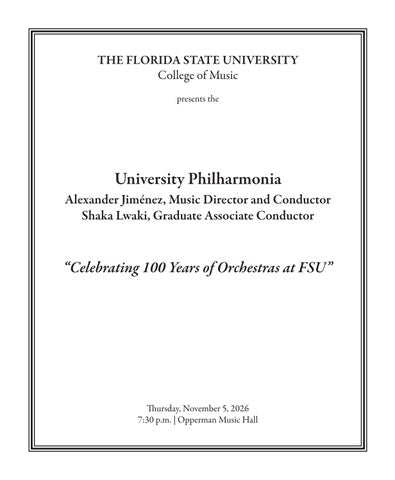
THE FLORIDA STATE UNIVERSITY College of Music presents the
University Philharmonia Alexander Jiménez, Music Director and Conductor Shaka Lwaki, Graduate Associate Conductor
“Celebrating 100 Years of Orchestras at FSU”
Thursday, November 5, 2026 7:30 p.m. | Opperman Music Hall
PROGRAM An Outdoor Overture
Aaron Copland (1900–1990)
St Paul’s Suite in C major, Op. 29, No. 2 Jig: Vivace Ostinato: Presto Intermezzo: Andante con moto Finale (The Dargason): Allegro
Gustav Holst (1874–1934)
INTERMISSION Symphony No. 6 in D major, Op. 60, B. 112 Allegro non tanto Adagio Scherzo (Furiant). Presto Finale. Allegro con spirito
Antonín Dvořák (1841–1904)
To Ensure An Enjoyable Concert Experience For All… Please refrain from talking, entering, or exiting during performances. Food and drink are prohibited in all concert halls. Recording or broadcasting of the concert by any means, including the use of digital cameras, cell phones, or other devices is expressly forbidden. Please deactivate all portable electronic devices including watches, cell phones, pagers, hand-held gaming devices or other electronic equipment that may distract the audience or performers. Recording Notice: This performance may be recorded. Please note that members of the audience may at times be included in this process. By attending this performance you consent to have your image or likeness appear in any live or recorded video or other transmission or reproduction made in conjunction to the performance. Florida State University provides accommodations for persons with disabilities. Please notify the College of Music at (850) 644-3424 at least five working days prior to a musical event to request accommodation for disability or alternative program format.
NOTES ON THE PROGRAM Copland: An Outdoor Overture By his very nature Copland was completely dedicated to the cause of the creation and encouragement of an indigenous American music—in every manifestation of the idea. So it came to pass that relatively early in his stylistic move to a more “accessible” musical style that explored American indigenous elements, he composed An Outdoor Overture. The title is a bit misleading, for it played nothing in the creation, nor is it reflective of anything specific in the music itself. In 1938 he was urged by the head of the music department of the High School of Music and Art in New York City to compose a work for the school’s orchestra to more or less kick off a campaign promulgating “American Music for American Youth.” Always a supporter of music education, Copland interrupted his scoring of “Billy the Kid” to write a concert overture for the school, one that was “optimistic” and which would appeal to the youth of the country. When it was finished, it was suggested that the work had an “open-air” quality to it, and so it was named. In Copland’s best, straightforward, simple and angular style of the time, the overture begins with a stentorian musical motif that would see much use. It is soon transformed into a formidable, cantabile solo for trumpet over a kind of string vamp–a signature of the piece. A more vigorous, rhythmic section ensues in a kind of march style that eventually dissipates and yields to a quiet, lyrical solo in the flute, then clarinet, and finally strings. Another theme is introduced—also a march, but in a different mood from the other—to round off all of the important materials of the work. All of these ideas undergo some recapitulation, varied of course, before the composer brings them all back in combination to end in dramatic fashion. The overture was warmly received and has been in the standard repertoire since. It went on to be transcribed for concert band by the composer and is played just about everywhere in our country by orchestras and bands, alike. – Wm. E. Runyan Centennial Connection: In 1979, Aaron Copland spent a week on campus working with students through concerts and masterclasses. The residency culminated with Mr. Copland conducting the University Symphony Orchestra in a performance of his “Appalachian Spring.”
Gustav Holst – St. Paul’s Suite for String Orchestra Best known for his extraordinary orchestral suite The Planets, British composer Gustav Holst composed an impressive opus of high quality works ranging from choral pieces to suites for military band. His romantic writing style drew on many influences, but his later music increasingly gravitated to folk song. His life’s work, however, was teaching music whereas composing occurred in his spare time. One of his longest held posts was at the St. Paul’s School for Girls in Hammersmith, England, and his utterly charming St. Paul’s Suite was written between 1912 and 1913 for his student orchestra there. Immediately, we hear Holst’s love of British folk song. The first movement begins with a robust “jig” in alternating 6/8 and 9/8 time. Holst then introduces a contrasting theme, then skillfully develops and blends the two. The “ostinato,” marked presto, opens with a figure played by the second violins which continues throughout the movement. Then a solo viola introduces a principal theme. In the “Intermezzo” a solo violin introduces the theme over pizzicato chords, and the solo viola joins the violin in a duet. After an animated section the original melody is again heard, now performed by a quartet of soloists. Finally, the
folksong “Dargason” is introduced very softly, and the cellos enter playing the beautiful “Greensleeves.” The two folksongs are played together to end the suite. – Max Derrickson
Antonín Dvořák - Symphony No. 6 in D major, Op. 63 In 1879 Hans Richter conducted the first performance of Antonín Dvořák’s Third Slavonic Rhapsody with the Vienna Philharmonic Orchestra. It seems that Dvořák was among an invited audience at the dress rehearsal because he wrote a letter describing the rapturous reception that his music had received. The truth was somewhat different. The rehearsal may have been successful but, according to reliable reports, the work was received with muted acclaim at the concert. There was a reason for this. The Habsburg empire was prospering, partly on account of a military alliance recently sealed between Berlin and Vienna. Enthusiasm for the notion of ‘Empire’ was widespread. Musically, three currents flowed: one promoted the German classical tradition of W.A. Mozart and Ludwig van Beethoven, personified in the works of Johannes Brahms; a second promoted the equally German ‘new’ music of Franz Liszt and Richard Wagner; the third comprised riches available to every composer, namely the folk music that reflected and endorsed national identity and aspirations. The problem was clear at the time. National music (or folk music) encouraged political Nationalism which, in turn, encouraged Separatism and Independence, inimical to the concept of ‘Empire’. Richter challenged a growing Viennese hostility towards Nationalism by commissioning a new work from Dvořák, notwithstanding the equivocal reaction to his Third Slavonic Rhapsody. The Sixth Symphony was the result, completed in 1880. Having been so bold at the outset, Richter now found excuses for not performing it, and the orchestral members also balked at promoting Czech Separatism, as they saw it. The première eventually took place in Prague the following year, performed by the Czech Philharmonic Orchestra. The Vienna Philharmonic played it for the first time 61 years later, in 1942. If Dvořák had not written popular symphonies later on, this one would surely attract more favor than it enjoys currently. Sir Donald Tovey pointed out that Dvořák’s patina of naiveté that gives the Sixth Symphony so much of its charm is a characteristic that sometimes appears forced in his later works, the ‘New World Symphony’ in particular. In his Sixth Symphony, Dvořák struck a balance between the three musical currents, mentioned above. The influence of Brahms, his Second Symphony in particular, is discernible, and some of the more intricate moments in Dvořák’s symphony are clearly influenced by Wagner and Liszt. Dvořák had met Wagner in Prague and was much impressed by his way of composing. Perhaps above and beyond these influences is that of Czech folk music with its characteristic rhythms and melodic twists. The scherzo is described as a ‘Furiant’ which is a Czech dance. That unmistakable nod in the direction of ‘Nationalism’ was enough to cause consternation among the Viennese in 1880, but it was also enough to attract a large body of admirers a few years later, some of the most enthusiastic being English concert-goers who held Dvořák’s music in the highest regard. The ‘naiveté’ of which Tovey wrote is far removed from simple-mindedness. It disguises astute musical judgment and assured formal awareness, binding the work together. The first movement provides symphonic proportions and argument couched within a jolly, almost lumbering pulse. It’s a strange mix, but the sense of forward movement sweeps us along with ease and goodwill. The song-like second movement is described as ‘improvisatory’ by Tovey. He used that word as a compliment, noting that the episodes appear as ‘ruminating digressions’ on the main theme, supplementing a clear sense of direction and expressive impact. The Scherzo, or ‘Furiant’, is terrific fun, offering catchy cross-rhythms and an almost rustic rawness. The two statements of the ‘Furiant’ are separated by a more reflective
section that serves to underscore, through contrast, the tremendous energy of the main theme. It also offers an exciting night out for the piccolo, which is not used anywhere else in the symphony. The brisk pace and amiability of the finale captivate the audience and exhaust the players. The work ends magnificently for sure, but free from bombast. It conveys high spirits, reminiscent of spirited finales by Joseph Haydn, with a touch of Brahms here and there to provide gravitas. – William Salaman
University Philharmonia Personnel Alexander Jiménez, Music Director Shaka Lwaki, Graduate Associate Conductor Violin 1 Ellie Millette‡ Olivia Leichter Emma Biesack Joel Alexander Lucia Marti Garro Anaise Jones Ajay Balkaran Garrett Groff Leah Tryzmel Olivia Castellanos Valencia Violin 2 Sasha Richardson* Chloe Gullo Lindsay Cunningham Shane Markey Violet Lorish Isaiah Dorn Samantha Pirona Emma Colehower Elise Knepp Viola Joseilys Quinones* Andrew Eckstein Justin Tran Caiden Graham Corinne Williams-Hough Keanna Goliat Brenden Brewer Amare Jones
Jorge Batista Saven Burgos Aniyah Crawford Jacqueline Wang Cello Brandon Bonmarte* Tyler Benko Chloe Kolenc Ashley Gessner Liam Davidson Matthew Pooler Miroslav Beck Myles Owens-Walker Sophia Anderson Bass Jean-Phillip Montas* Charles DeBay Garrett Gilley Gavin Smith Ryan Schaefer Daniel Martinez Annabelle Cutshaw Flute Ian Guerrero Mundaray* Brianna Williams Salma Oviedo
Piccolo Brianna Williams Oboe Sarah Ward* Jordan Miller* Emma Druggan Abigail Saltares Clarinet Dawson Huynh* Joseph Eckhardt* Rachael Malawey
Trombone Allen Wroten* Caden Ragsdale Bass Trombone Jacob Zussy Tuba Devin Walmsley Percussion Aidan Lenski Cole Martin Aidan Pippin
Bassoon Benjamin Kiely* Piano/Celesta Susanna Campbell* Bryden Reeves Alex Rameau Sebastián Andrade-Rondón Orchestra Manager Steven Stamer Horn Andrew Keller* Stage Manager Davis Craddock* Gavin Smith Coen Taylor** Thiago Costa Orchestra Librarians Aiden Curry Misaki Hall Shaka Lwaki Trumpet Nathan Reid* Library Assistant Tyler Bennett** Keren Garcia Rodriguez
‡ Concertmaster * Principal / Co-Principal