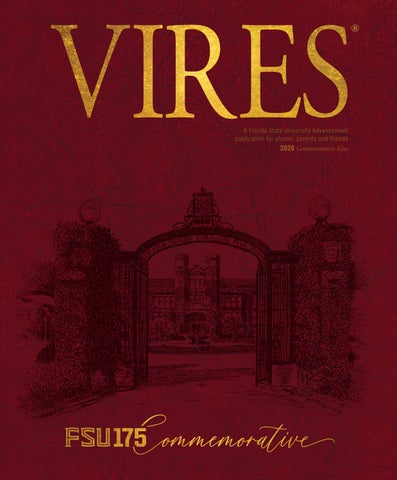
A Florida State University Advancement publication for alumni, parents and friends 2026 Commemorative Issue
The Moment
→ In this composite aerial photograph of campus from 1928, the new Montgomery Gym appears in the top right, somewhat askew, illustrating how the university began to expand its physical footprint.
In 2026, what is now proudly known as Florida State University celebrates 175 years of higher learning. This anniversary marks nearly two centuries of innovation, growth and dedication to our mission. While we reflect on our rich history and those who shaped it, we look ahead with renewed commitment to excellence and service to our community.
VIRES
1 4 8 12
FSU’S 175TH ANNIVERSARY COMMEMORATIVE ISSUE 2026 Volume 18, Issue 1
EDITOR-IN-CHIEF Beth N. Pannell DESIGNER Lindsey Masterson CONTRIBUTORS Hannah Akin (M.A. ’22) Scott Atwell (M.S. ’15) Laura Bradley (B.A. ’13) David Heller Kenta Joseph (B.S. ’08) FSU Communications staff members
Then & Now Catching Up With
32 44 48 52 56 58
Popular Traditions
63 68 71 76
Seminoles Forever
PHOTOGRAPHY Bill Lax (B.S. ’90) Matthew McConnell Ryan Register (B.S. ’08) Florida State Athletics Florida State University Archives State Archives of Florida
Advertise alumni.fsu.edu/sponsorship Contact Us vires@alumni.fsu.edu Submit a Class Note alumni.fsu.edu/submit-class-notes Stay Connected alumni.fsu.edu/stay-connected
FALL 2025 Volume 17, Issue 2
2 | alumni.fsu.edu
From the President
175 YEARS
An award-winning biannual publication from the Florida State Division of University Advancement, which includes the Alumni Association and FSU Foundation. Named after the first torch in the university seal, VIRES represents strength of all kinds: physical, mental and moral.
ON THE COVER: The cover draws on recognizable elements from Florida State and its predecessor institutions, blending historical ephemera with a modern aesthetic that complements the 175th anniversary logo. The garnet texture is sourced from a scanned Flastacowo yearbook, and the Westcott illustration is adapted from an early Florida State College for Women commencement program. Cover artwork by Jessica Rosenthal (B.S. ’01).
The Moment
A Florida State University Advancement publication for alumni, parents and friends 2026 Commemorative Issue
Seminole Tribe International Programs Campus Housing The Ringling Commencement
Traveling Noles Honors & Awards Final Frame
← Built in the 1960s, the Bim Stults Aquatic Center was once the heart of FSU’s aquatic life. The Olympic-size 50-meter pool hosted swim classes, social events, and the early days of FSU swimming and diving before it closed in 2003 and was replaced by the HCB classroom building.
FEATURES From 1851 to Today PAGE 14
This timeline traces the defining moments, leaders and milestones behind 175 years of progress and purpose.
Where History Won’t Sit Still: 175 Years of FSU PAGE 24
From frontier seminary to preeminent public university, a reflection on how Florida State continues to redefine itself. By Scott Atwell (M.S. ’15)
Built With Courage and Grit: 175 Years of Seminole Athletics PAGE 36
More than victories and trophies, Seminole athletics tells the story of perseverance, mentorship and lives changed through sport. By David Heller
175 COMMEMORATIVE | VIRES | 3
FSU at 175
STRONG AND FOCUSED ON THE FUTURE
F
lorida State University turns 175 this year. As the nation marks its 250th birthday, we are reminded that FSU has been part of the American story for most of it. For generations, this university has helped shape citizens, leaders, artists, scientists and public servants. That history matters. But what matters most is what we choose to build next. Florida State is a university on the rise. We have achieved the highest national ranking in our history: No. 51 among all universities and No. 21 among public universities, according to U.S. News & World Report. Niche ranks us No. 11 among public universities in America. Princeton Review ranks us No. 2 in the nation for student experience. And TIME recently named FSU No. 1 in Florida for innovation and economic impact. These recognitions reflect steady progress and a university confident in its direction. Student success sits at the center of that work. Our freshman retention rate is a record 97%, among the very best in the nation. Our four-year graduation rate stands at 78%, with a six-year rate of 86%, both records. Transfer students are graduating at an 80% rate, the highest in the history of the State University System of Florida. Demand for Florida State has never been stronger. We received nearly 100,000 applications for about 6,000 freshman spots this year. Applicants came from all 67 Florida counties and every state in
4 | alumni.fsu.edu
the nation. The academic profile of our incoming class continues to rise. We take great pride in leading in social and economic mobility, with nearly one in four of our students the first in their family to attend college. At the center of that work is the Center for Academic Retention and Enhancement, or CARE, which has supported first-generation students at Florida State for decades. Today, CARE serves more than 3,500 students through advising, scholarships and a strong sense of community. We have expanded that reach significantly, increasing participation by nearly 50% and launching programs like QUEST Scholars and Illuminate to close equity gaps and open more doors. Initiatives like the Unconquered Scholars Program provide targeted support for students who have experienced foster care or homelessness, helping them persist and graduate. This work reflects a simple belief: Talent is everywhere, and with the right support, students succeed. We are also investing in our highestachieving students through the Honors Program and the Presidential Scholars Program. Our Honors Program is ranked No. 1 in Florida and No. 17 in the nation.
We have increased funding and expanded both programs to serve more students while strengthening what they offer. Students benefit from small, interdisciplinary courses, dedicated advising and opportunities for research and global learning. These investments help us recruit and retain outstanding students and give them the support they need to thrive. Our academic strength runs deep. Programs across the university are recognized among the nation’s best, from film, music, dance and interior design to criminal justice, law, business, education and hospitality. Many continue to rise in national standing. Florida State is what I often call a left-brain, right-brain university: equally strong in the sciences, medicine and engineering and in the arts and humanities. That balance defines who we are and what sets us apart. The Herbert Wertheim College of Business reflects that ambition. The new Herbert Wertheim Center for Business Excellence, arguably the most beautiful business building in the United States and the largest academic facility in our history, stands as a symbol of our momentum and the belief others have in our future. It was
From the President From the President
made possible by a transformational $65 next-generation technologies. Continued million gift from Dr. Herbert Wertheim investment is essential to maintaining that includes the largest philanthropic that leadership. A proposed $70.5 million endowment gift ever for Florida reinvestment will modernize facilities, State University. magnets and infrastructure while supporting Research growth tells the same story. core operations and talent. The MagLab In 2021, our research expenditures were shows what sustained focus can achieve $325 million. Today, they stand at a record and keeps Florida State at the forefront of $488 million, a 50% increase. Our faculty research and innovation. submitted $1.22 billion in grant proposals Across every discipline, we are also last year. investing in artificial intelligence and data We are aligning that growth around science. From medicine to engineering to clear priorities: improving health across the humanities, the ability to harness data Florida, advancing materials and quantum and develop new technologies will shape technologies, strengthening national security discovery and prepare our students for a and building a more resilient future. changing world. herecelebrated is not two his past fall, FloridaInnovation State University extraordinary milestones that core mission Through FSU Health — launched with just about technology. It’s reflect aboutour people — our commitment to education, innovation a $125 million appropriation from the and improving lives in the communitiesand making an impact on our community. These events, Florida Legislature — we are expanding we serve. along with other stories in this issue of VIRES, highlight access to care and accelerating breakthroughsthe vibrantOur excellence extends beyond the we life of our university and the momentum in genomics, precision medicine and classroom. continue to build. Florida State is among the The nation’s first milestone a historic moment for FSU. We pediatric rare disease research. The FSU elitewas athletic programs, supporting proudly renamed the College of Education, Health, Health Research Facility in Tallahassee will more than 500 student-athletes acrossand 21 Human Sciences in honor of an exceptional alumna, Anne open in the fall of 2026 and will transform Spencersports. joining the shaping ACC, we have Daves. Since Anne spent 30 years young minds as Tallahassee Memorial Hospital into a full a fourth-grade won 20teacher, national and and championships her extraordinary gift willmore bolster scholarships that future generations willbuilt have on academic health center. than and 140ensure conference titles, a record access to the highest quality education incurring The National High Magnetic Field consistency, discipline andwithout a commitment substantial debt. Laboratory, headquartered at Florida State, The to excellence. Anne Spencer Daves College of Education, Health, remains a global leader in discovery. It is and Human None of this happens Sciences marks a first foralone. FSU: It’s the first home to the world’s most powerful magnets,college named Moreafter than 430,000 alumni around an alumna. This recognition is a Anne’scarry extraordinary andthem. devotion enabling breakthroughs in materials, energy,testament thetoworld Floridagenerosity State with to her field and her alma mater. During the renaming medicine and quantum science. The lab’s They mentor our students. They invest ceremony, I reflected on how Anne’s gift comes at a pivotal work supports advances in areas such as ininscholarships research. They create moment the history ofand the College of Education, Health, medical imaging, critical materials and opportunity. not sustain and Human Sciences. ItWe wascould recently ranked sixththis among
T
all public universities in the United States by U.S. News & World Report. With Anne’s support, I’m confident that we will continue our rise as a national leader. In October, we hosted Discovery Days, our second annual celebration of research, creativity and collaboration at FSU. This weeklong event engaged nearly 2,500 participants, both in Tallahassee and online, and showcased the entrepreneurial drive of our students and faculty. Florida State’s innovative spirit was evident through groundbreaking research for pediatric rare disease therapies, student-led sustainable energy projects, and startups and discoveries that tackle real-world challenges. The energy
THE FSU ALUMNI ASSOCIATION THANKS ITS CORPORATE PARTNERS 4 | alumni.fsu.edu
momentum without their generosity and belief in this university. We are equally grateful for the demonstrated during the week reflected the passion that propels our partnership of the university every day.Florida Legislature, milestonesand — the dedication Anne’s College, as we’re Gov.These Rontwo DeSantis, federal, state ofand calling it, and the success of Discovery Days — FSU’s community leaders who continue to investunderscore in mission to inspire and empower individuals to make a difference in higher education and in Florida State. Their their communities and the world. support strengthens This issue of VIRESour also research highlightsenterprise, other exciting developments at expands student opportunity and helps us as the new director FSU. We’re pleased to welcome Kevin Maynard for Opening Nights, our premier performing arts series that brings serve the public good. world-class artists our campus andfar community and features At 175, we are toproud of how we outstanding talent from FSU. Kevin’s leadership marks the start of a have comechapter — from a small Nights. seminary to a dynamic for Opening distinguished women’s to a top- events and the You’ll also find coveragecollege, of our Homecoming cherished traditions that celebrate thewith spirit and unity of the FSU ranked public research university family. From the parade to the alumni awards and the football game, global reach. Homecoming is a time when the positive energy and pride of our And we are just getting started. community are on full display. We will continue to invest student In addition, I encourage you toinread the feature on FSU Panama success. We willthan grow research that delivers City. For more 40 years, this campus has served the residents of Northwest Florida We by offering transformative sustainable impact. will expand FSU educational opportunities. Health. We will strengthen both the sciences At FSU, tradition and progress intersect. We honor our history and thestriving arts. And we will and build programs while for excellence innovation. Anne’s College embodie and position State ourpartnerships heritage while that looking toward Florida the future. Discovery Days research that are shaping tomorrow. Opening forhighlights the nextideas era and of discovery. Nights and Homecoming capture the And enduring sense of connection The next 175 years begin now. and pride that unites our FSU family and the community. I believe the very best of Florida State Thank you for being part of this remarkable journey. Your University is — stillwhether ahead.as alumni, parents or friends — makes all involvement
of this possible. Together, we will continue to shape an even brighter future for Florida State University. Go Noles! Go Noles!
Richard McCullough Richard McCullough President, Florida State University President, Florida State University
THE FSU ALUMNI ASSOCIATION THANKS THEIR CORPORATE PARTNERS
CONNECT WITH US facebook.com/fsualumniassociation @fsualumni linkedin.com/company/fsualumni @FSUAlumni YouTube.com/FSUAlumni vires@alumni.fsu.edu
175 COMMEMORATIVE | VIRES | 5
We customize. You could save over $950.
1
Florida State University Alumni Association has partnered with Liberty Mutual to bring you customized insurance so you only pay for what you need. You’ll enjoy valuable savings on auto and home insurance along with many other great benefits.
Exceptional service 95% of customers are satisfied with Liberty Mutual. 2 Whether you’re in an accident or just need some advice, know we’ll always be on call for you.
Benefits you’ll love Forgiveness3
4
, and Better Car Replacement™5.
Visit us online
or visit www.libertymutual.com/fsuaa Client #6803
Average savings based on a countrywide survey of new customers who reported savings when they switched to Liberty Mutual between 05/2023 and 04/2024. Savings will vary. Comparison does not apply in MA. . 2ACCIDENT FORGIVENESS NOT AVAILABLE IN CA. Terms and conditions apply. 3Coverage is provided on the optional Towing & Labor Coverage endorsement. May vary by state. Applies to mechanical breakdowns and disablements only, and may be subject to limits. 4Optional coverage in some states. Availability varies by state. Eligibility rules apply. Coverage provided and underwritten by Liberty Mutual Insurance and its affiliates, 175 Berkeley Street, Boston, MA 02116 USA. Equal Housing Insurer. ©2025 Liberty Mutual Insurance This organization receives financial support for offering this auto benefits program. ANP686950-03 FL 2025/01
1
auto | home | renters | umbrella | motorcycle | condo | watercraft
6 | alumni.fsu.edu
HIGHLIGHTS AT 175 RANKINGS & REPUTATION
NO. 51
OVERALL NATIONALLY (U.S. News & World Report, 2026) — Best ranking in FSU history
NO. 21
AMONG PUBLIC UNIVERSITIES (U.S. News & World Report, 2026)
NO. 11
AMONG PUBLIC UNIVERSITIES (Niche, 2026)
ACADEMIC & STUDENT SUCCESS RANKED NO. 2
NATIONALLY FOR BEST STUDENT EXPERIENCE (The Princeton Review, 2026)
97%
FRESHMAN RETENTION RATE Best in FSU history
78%
2025–26 DEGREES CONFERRED*
9,663
538
BACHELOR
DOCTORAL
3,440
148
JURIS DOCTOR
MASTER
86
SPECIALIST
FOUR-YEAR GRADUATION RATE Best in FSU history
80%
TRANSFER STUDENT GRADUATION RATE Best in the State University System
25%
OF STUDENTS ARE FIRST-GENERATION COLLEGE STUDENTS A national leader in social mobility, due in large part to the CARE program and Horizons Unlimited Conference
FSU'S GREAT GIVE 2026
$1,547,926 RAISED
121
MEDICAL DOCTOR *As of June 1, 2026
IN THE HISTORY OF FSU AND ITS PREDECESSORS,
OVER 500,000 DEGREES
HAVE BEEN CONFERRED, AND WE CURRENTLY HAVE MORE THAN
430,000 LIVING ALUMNI.
THE MAIN CAMPUS HAS GROWN TO
FSU HAD A RECORD ENROLLMENT IN FALL 2025 OF 46,184. Its first year after returning to a coeducational institution in 1947, the enrollment was 4,015. The last enrollment at the Florida State College for Women in 1946 was 2,583. That was up from 204 in its first year as a female college in 1905.
216 BUILDINGS ON 487 ACRES OF LAND. 175 COMMEMORATIVE | VIRES | 7
Then & Now NOW THEN ↑ STUDENT UNION
Florida State University’s Student Union has long been the heart of campus life. Its roots trace back to 1940, when the Rowena Longmire Student Alumnae Building opened as a gathering place for students and faculty. As enrollment grew, the Student Center opened in 1952, offering dining, music and social space, and was expanded in 1964 into the University Union. Further additions created the Oglesby Union Complex, which served generations of Seminoles for decades. With enrollment surpassing 40,000, the original structures were ultimately replaced. In September 2022, FSU opened the new, 300,000-square-foot Student Union — a modern hub designed for today’s students while honoring a legacy of community, involvement and connection.
8 | alumni.fsu.edu
Then & Now
↓ DODD HALL
THEN
Built in 1923, Dodd Hall served as the university library until Strozier Library was built in 1956. It was named for William H. George Dodd, who joined the Florida State College for Women faculty in 1910. After the library relocated, the building housed the WFSU studio and later the Claude and Mildred Pepper Library before undergoing renovations in 1991. The former library space reopened as the Werkmeister Humanities Reading Room, named for William H. and Lucyle T. Werkmeister, and remains a quiet study space for students. In 1997, the focal-point Werkmeister Window — designed by Ivan Johnson, a professor of art education and constructive design, and crafted by Bob (BFA ’72) and Jo Ann Bischoff (B.S. ’73) — was installed. Composed of more than 10,000 pieces, it set the stage for the continued creation of commemorative leaded glass windows by the FSU Master Craftsman Studio.
NOW
175 COMMEMORATIVE | VIRES | 9
→ FSU LAKEFRONT PARK
Now known as FSU’s Lakefront Park & Retreat Center, the area formerly called Camp Flastacowo has been a beloved gathering place for students since the 1920s. Established in 1923 on the shores of Lake Bradford by FSCW Dean of the College Home Sarah “Tissie” Landrum Cawthon, Camp Flastacowo was created to introduce students to recreational activities and quickly became a hub for swimming, boating and campus celebrations. Expanded throughout the 1920s and 1930s, the property was renamed the FSU Reservation, or “the Rez,” in 1954 and today spans 73 acres bordering the Apalachicola National Forest. Just four miles from FSU’s main campus, the Lakefront Park continues that tradition of connection and recreation, offering kayaking, paddleboarding, sailing, swimming, rock climbing, ropes courses, sand volleyball, picnicking and more for students and the Tallahassee community.
THEN NOW
10 | alumni.fsu.edu
Then & Now
NOW THEN ↑ SUWANNEE DINING ROOM
The Suwannee Room was constructed in 1913 for the Florida State College for Women and had its own garden for fresh vegetables on the west side. Many students paid for their room and board by working as “Dining Hall Girls,” serving meals to their peers. Closed in the late 1960s after a Westcott fire displaced offices into the building, Suwannee was fully restored to its original purpose and reopened in 2006, revealing its soaring vaulted ceilings and Gothic arches. A major 2018 renovation modernized the 10,000-square-foot space while preserving its historic character, expanding food stations and emphasizing fresh offerings. Today, Suwannee serves thousands of students daily with all-you-care-to-eat dining in multiple stations, including homestyle, pasta & pizzas, deli & grill, soup & salad and a vegan station.
175 COMMEMORATIVE | VIRES | 11
Jai Vartikar, Ph.D.,
First Lady of Florida State University By Hannah Akin (M.A. ’22)
W
hen Jai Vartikar arrived at FSU in 2021, she was struck by the family atmosphere and warmth of everyone she encountered. Nearly five years later, that first impression has endured. The many wonderful people in the FSU community and the care they show one another have influenced the sense of purpose she feels in her role as first lady. Vartikar has touched many aspects of campus, and she is a true champion for FSU. This year, in addition to her
12 | alumni.fsu.edu
many initiatives, she is spearheading the university’s 175th anniversary celebrations. Vartikar initially envisioned the first lady role as a largely traditional one, made up primarily of hosting and attending events in Tallahassee and across the country in support of President McCullough’s work. Her vision for the position quickly evolved. Today, her work includes advancing initiatives for first-generation students, serving as the university’s ambassador for
the arts, mentoring students and leading strategic engagement efforts alongside university leadership. She also engages with prospective students and families, alumni, faculty, donors, community leaders and students at the university’s laboratory K-12 school, Florida State University School. “I care deeply about FSU and especially love promoting our remarkable students and faculty,” Vartikar said, adding that she enjoys talking about FSU everywhere she goes. The first lady’s relationships and conversations with students, alumni and families have also shaped how she views this milestone year. She sees the 175th anniversary as an opportunity to reflect on and honor the university’s history while celebrating the many people
Catching Up With
→ Top Row: Historical images of the World War II-era Victory Garden and the dining hall bakery. Bottom Row (L-R): Horizons Unlimited Conference participants engage with fellow first-generation students, alumni, faculty and university leaders. First Lady Vartikar connects with a student at FSU Day at the Capitol.
who have helped it become what it is today. FSU began as a small seminary, then became a military institute and finally was the Florida State College for Women before becoming Florida State University. “In 1947, with the GI Bill, we evolved into a co-ed university so the servicemen could get a college education here,” Vartikar said. “We expanded the education opportunities, and we have not stopped climbing since.” While preparing to lead the anniversary celebrations, Vartikar spent time learning about the university’s past. She visited Strozier Library’s special archives to explore decades of student life and traditions documented in photographs. “I didn’t know all of the history of Florida State University,” she said. “So, seeing it in pictures was incredible — the men making bread, the women from the FSCW gardening in high heels, the protests of the 1960s and 70s, Kitty Blood Hoffman’s (B.S. ’36) family paying for her tuition with a truckload of oranges. Plus, all the various sports teams, including water dancing, the evolution of the campus, and of course, all the notable people and championships.” As she learned more about the university’s history, Vartikar said those stories reinforced what the 175th celebration should be about — honoring the people who built FSU. The 175th anniversary arrives at a time of extraordinary momentum for Florida State. Over time, the university has expanded access to education while excelling in research and quality of instruction. Today, FSU is a major R1 research university, with scientific advances and the acquisition of the National High Magnetic Field Laboratory
helping to establish FSU as a national research powerhouse. Athletics have also played an important role in shaping the university’s profile, with Bobby Bowden’s legacy making FSU a household name. More recently, the university has seen a “meteoric rise in academic and student success,” Vartikar said. As the university marks its 175th year, she emphasized that FSU’s impact extends far beyond campus. “We have been educating people for 175 years,” she said. “Our alumni contribute to the local, state and national economy. They make a difference in all sectors of life. We like to say we change the lives that change the world.” As the anniversary year continues, Vartikar hopes alumni, parents, students and friends around the world feel proud of FSU’s progress. Plans for the milestone year include a mix of traditional events planned with a 175th theme and special one‑time events. “For example,” Vartikar said, “events where we bring people together to talk about our history in
athletics and academics, highlight and tour special buildings on campus, have special concerts, parties, seminars, panel discussions, teas and a very special signature Homecoming celebration.” Vartikar has also enjoyed seeing colleges, schools and student organizations mark the occasion with their own celebrations. The first lady, also known on campus as Dr. Jai, hopes those who participate in the anniversary celebrations will learn something new about FSU’s history, reconnect with the values that define the university and fall in love with FSU all over again. “Our motto — Vires, Artes, Mores — speaks to our ideals of strength, skill and character to educate well-rounded individuals,” she said. “I hope our alumni are proud of this special university as they reflect on who we are, what we do and how far we have come since 1851.” LEARN MORE about the 175th anniversary celebrations at 175.fsu.edu. 175 COMMEMORATIVE | VIRES | 13
FROM 1851 TO TODAY For 175 years, Florida State University has been shaped by pivotal moments and the people behind them. This timeline highlights the defining milestones, achievements and leaders that have guided the university since its founding. From early beginnings to growth as a major research university, these milestones reflect FSU’s lasting commitment to academic excellence and public service.
1800s FOUNDATION
JAN. 24, 1851 The General Assembly of Florida passes an act to open two seminaries of learning, one to be located east of the Suwannee River and the other to the west of it. Tallahassee leaders work diligently to be selected as the site for the school, laying the groundwork for what will eventually become Florida State University.
SEMINARY ESTABLISHED
JAN. 1, 1857 The Florida Legislature accepts Tallahassee’s proposal and passes a bill making Tallahassee the official site of the Seminary West of the Suwannee River. That same year, the institution known as the West Florida Seminary begins offering postsecondary instruction to male students where the Westcott Fountain and Plaza now stand.
SHIFT TO COEDUCATION
1858 The school opens on a 10acre site in 1857, but does not initially admit women. In 1858, after incorporating the Tallahassee Female Academy, the administration begins allowing women to attend.
CIVIL WAR TRANSFORMATION
1863 The school operates as the Florida Collegiate and Military Institute starting in 1863. In 1865, cadets from the school join in the Battle of Natural Bridge, just south of the city, and prevent Union soldiers from capturing Tallahassee.
GEORGE EDGAR BECOMES FIRST PRESIDENT
1887 George Edgar serves as the first president of the Seminary West of the Suwannee River from 1887 to 1892. Earlier school leaders held the title of principal.
14 | alumni.fsu.edu
ALVIN LEWIS BECOMES SECOND PRESIDENT 1892 Alvin Lewis serves as president of the seminary west of the Suwannee River from 1892 to 1897.
ALBERT A. MURPHREE BECOMES THIRD PRESIDENT 1897 Albert Alexander Murphree, a mathematician who joined the faculty of the seminary west of the Suwannee River from 1892 to 1897.
A watercolor rendering of the notyet-built Westcott Building by the firm William Augustus Edwards.
1900s THE ERA OF FLORIDA STATE COLLEGE
1901 Under the leadership of Albert A. Murphree, the school becomes Florida State College, a four-year institution. The four original colleges of FSC are Arts and Sciences, Education, Home Economics and Music.
TRANSFORMATION TO WOMEN’S COLLEGE
JUNE 5, 1905 The Buckman Act transforms Florida State College into Florida Female College, later renamed Florida State College for Women in 1909. This shift establishes the institution as a leading center for women’s higher education in the South. 175 COMMEMORATIVE | VIRES | 15
↑ Above: Built in 1907, Bryan Hall is the oldest building on campus. → Right: President Campbell with students.
EDWARD CONRADI BECOMES FOURTH PRESIDENT
1909 Edward Conradi serves as president from 1909 to 1941.
CONSTRUCTION OF WESTCOTT BUILDING
1910 Built in 1910 as the Administration Building, the Westcott Building was renamed in 1936 for Florida jurist James D. Westcott, who bequeathed his entire estate to the school in 1887. Today, it serves as the architectural centerpiece and administrative hub of the FSU campus.
SOCIAL CHANGE AND CAMPUS EXPANSION
1929 The “Roaring 20s” bring to campus new social concepts that are taking hold across the nation. During this period, a more liberated and independent student body emerges at the Florida State College for Women. By the end of the 1920s, FSCW expands to 300 acres, with nearly all present-day structures east of Woodward Avenue built, including Jennie Murphree Hall, Gilchrist Hall and Dodd Hall.
16 | alumni.fsu.edu
FSCW NAVIGATES THE GREAT DEPRESSION
1938 During the 1930s, Florida State College for Women experiences rapid growth under President Edward Conradi, becoming the third largest women’s college in the nation despite the Great Depression. In 1938, the Florida Legislature approves the construction of Landis Hall to address housing shortages.
DOAK S. CAMPBELL BECOMES FIFTH PRESIDENT
JULY 1, 1941 Doak Sheridan Campbell becomes university president, confronting severe overcrowding and the pressures of World War II. By 1942, troops stationed in the region for defense are a regular presence on campus, leading the university to organize supervised social activities for students and soldiers.
FLORIDA STATE UNIVERSITY EMERGES
MAY 15, 1947 Governor Millard Caldwell signs a legislative act that returns the Florida State College for Women to coeducational status, putting an end to the first and only state-supported
women’s college in Florida. The governor’s signature officially changes the institution’s name to Florida State University.
SCHOOL OF HOSPITALITY IS ESTABLISHED
1947 Florida State University establishes the School of Hospitality, making it the second-oldest hospitality management program of its kind at a public university in the United States. In 2020, the program is recognized as the Dedman College of Hospitality, preparing leaders for careers across hospitality and service industries.
FSU ADOPTS THE SEMINOLES NAME
OCTOBER 1947 Florida State University students choose “Seminoles” as the name for the university’s athletics teams, in tribute to the Seminole Tribe of Florida. In the decades that follow, the university works closely with the Tribe, whose guidance helps shape the respectful and appropriate use of Seminole names, symbols and regalia as part of an enduring tradition.
THE FLYING HIGH CIRCUS LAUNCHES
1947 The Flying High Circus is founded to help integrate men and women at the newly coeducational university and remains a vibrant tradition.
PRESIDENT AND FIRST LADY LIVE IN OFFICIAL PRESIDENT’S HOUSE 1948 In 1948, when the McIntosh house was moved from downtown Tallahassee to the campus, President Doak Campbell and his wife Edna Simmons Campbell became the first couple to live in an official Florida State University president’s house (now the Pearl Tyner Alumni Welcome Center).
are in what was then the U.S. Army Fort Clayton. to the state’s growing need for business and professional leadership. The program steadily expands in academic offerings, earning formal recognition as the College of Business in 1974.
WFSU FIRST RADIO BROADCAST
JANUARY 21, 1949 In May 1948, the concept of WFSU radio began when the new Men’s Government Association allocated funds for a campus radio station. On January 21, 1949, WFSU aired its first program as WFSU 660 (AM). A revamped station, WFSU-FM 91.5, broadcast in 1954 and FSU-TV began operations in 1960.
COLLEGE OF NURSING IS ESTABLISHED
1949 FSU formally establishes the College of Nursing as the first nationally accredited baccalaureate nursing program in the state of Florida, setting a statewide standard for nursing education and professional training.
SCHOOL OF BUSINESS IS ESTABLISHED
1950 FSU establishes the School of Business in 1950, responding
ATHLETICS RISE IN POPULARITY AND NEW TRADITIONS BEGIN
1950 Athletics emerge as a central part of campus life as a new football stadium is built in honor of President Doak Campbell. During this period, the FSU fight song debuts, and the university band officially adopts the name Marching Chiefs, establishing traditions that continue to define Seminole spirit.
FSU ESTABLISHES FLORIDA STATE UNIVERSITY SCHOOL
1954 Florida State University School, known as Florida High, connects K–12 education with hands-on teacher training and research beyond campus.
BRANCH CAMPUS IN THE REPUBLIC OF PANAMA IS ESTABLISHED
JANUARY 1957 The United States Army invites FSU to establish a center in what was then the Panama Canal Zone. Offices
ROBERT M. STROZIER BECOMES SIXTH PRESIDENT
SEPTEMBER 1, 1957 Robert M. Strozier becomes president of FSU after 28 years of college teaching and administration in three Georgia institutions. Students appreciate him for his ready wit, and he establishes a great rapport with FSU faculty. The university’s main library is later named in his honor.
GORDON W. BLACKWELL BECOMES SEVENTH PRESIDENT
1960 Gordon W. Blackwell serves as president from 1960 to 1965.
JOHN E. CHAMPION BECOMES EIGHTH PRESIDENT
1965 John E. Champion serves as president from 1965 to 1969. Champion was hired as an accounting professor in 1956, rose to assistant dean and later Florida State University’s first vice president of administration before being tapped as president. After his presidency, he returned to the classroom as a professor in the College of Business, retiring as professor emeritus in 1985.
COLLEGE OF LAW IS ESTABLISHED
1966 FSU forms the College of Law in 1966, marking a major expansion into legal education and preparing future leaders for careers in law, government and public service.
MAXWELL COURTNEY ENROLLS AS FSU’S FIRST BLACK UNDERGRADUATE STUDENT 1962 Maxwell Courtney (B.A. ’65), a Tallahassee native, becomes the first Black undergraduate to enroll at Florida State University. He graduates cum laude with a degree in mathematics and minors in English and French, later pursuing a career in Washington, D.C., where he serves as a systems management consultant to the Smithsonian Institution.
175 COMMEMORATIVE | VIRES | 17
INTERNATIONAL STUDY CENTER OPENS IN FLORENCE, ITALY FALL 1966
SCHOOL OF COMMUNICATION IS ESTABLISHED
1967 FSU establishes the School of Communication in 1967. In 2009, it merges with the School of Information to form the College of Communication and Information, bringing communication, media and information disciplines together within a single academic unit.
STANLEY MARSHALL BECOMES NINTH PRESIDENT
FEBRUARY 1969 J. Stanley Marshall becomes president in 1969, with his leadership most notable for navigating significant student activism and advancing racial integration.
INTERNATIONAL STUDY CENTRE OPENS IN LONDON, ENGLAND 1971
PAUL DIRAC JOINS THE FACULTY, SHAPING FSU’S QUANTUM LEGACY
FEBRUARY 1972 Renowned physicist Paul Dirac, a contemporary of Albert Einstein and a founding figure of quantum physics, joins the faculty in 1972. Widely regarded as the father of quantum mechanics, Dirac helps establish a strong foundation for theoretical physics at FSU. Today, the university continues to build on that legacy through significant investments in quantum science, research and education.
ACADEMIC REORGANIZATION FORMS NEW COLLEGES
FEBRUARY 1973 In 1973–1974, Florida State
18 | alumni.fsu.edu
University undergoes a university-wide academic reorganization that establishes the College of Social Sciences and the College of Criminology, while also restructuring programs in visual arts, theatre and social work, laying the groundwork for several others.
BOBBY BOWDEN BECOMES HEAD FOOTBALL COACH
JANUARY 1976 Florida State University appoints Bobby Bowden as head football coach. His leadership marks the beginning of a new era for the program and sets the stage for decades of national prominence.
BERNIE SLIGER BECOMES 10TH PRESIDENT
FEBRUARY 1977 Bernard F. Sliger, a highly regarded economist, begins serving as president of Florida State University in 1977, as enrollment surpasses 20,000. Sliger provides forwardthinking leadership during a long period of unprecedented growth for the university.
FAMU-FSU COLLEGE OF ENGINEERING IS ESTABLISHED
1982 Established by the Florida Legislature, the FAMU–FSU College of Engineering is created as an academic partnership between Florida A&M University and Florida State University. It remains the nation’s only shared college
of engineering, combining resources, faculty and students from both universities within a single engineering school.
UNIVERSITY ASSUMES AUTHORITY OF PANAMA CITY CAMPUS
JULY 1982 Previously operated by the University of West Florida, the Panama City campus comes under Florida State University’s leadership in July 1982. Over time, the campus expands, later adding on-campus housing, a K–12 laboratory charter school serving military and local families, and the College of Applied Sciences in 2010.
WVFS LAUNCHES
1987 WVFS Tallahassee 89.7 FM, known as “The Voice of Florida State” or simply “V89,” is an affiliated project of the FSU Student Government
Association and the College of Communication and Information, and operates as a non-commercial, educational, public radio station.
COLLEGE OF MOTION PICTURE ARTS IS ESTABLISHED
1989 FSU establishes the College of Motion Picture Arts, one of only seven universitybased film conservatories in the nation. In a short time, the college earns national recognition as an outstanding motion picture production program.
MAGLAB MOVES TO FSU
AUGUST 1990 Following a stringent peerreview competition, the National High Magnetic Field Laboratory is awarded to Florida State University in August 1990. The selection brings the world’s most
powerful magnet laboratory to campus and establishes FSU as a leader in cutting-edge magnetic field research. It is the only national laboratory in the state of Florida.
DALE W. LICK BECOMES 11TH PRESIDENT 1991 Dale W. Lick serves as president from 1991 to 1993.
FSU CHEMIST DEVELOPS TAXOL 1993 FSU chemist Robert A. Holton (M.S. ’70, Ph.D. ’71) wins the international race to achieve the first total synthesis of the cancerfighting drug Taxol, saving and extending countless lives and creating over $83M in royalties and global recognition.
FIRST FOOTBALL NATIONAL CHAMPIONSHIP VICTORY
JANUARY 1, 1994 The Seminole football team wins its first national championship behind quarterback Charlie Ward (B.S. ’93), the school’s first Heisman Trophy winner. The Seminoles also win football championships in 1999 and 2013.
excellence, intellectual freedom, and heritage and historic preservation.
INTERNATIONAL STUDY CENTER OPENS IN SPAIN
1997 The FSU Spain program starts in Madrid during the summer of 1997. From 1997 to 2000, the program operates in Torremolinos during fall and spring and in Madrid during the summer. In May 2001, the FSU Spain program permanently moves to Valencia.
FSU WOMEN’S SOCCER BEGINS INTERCOLLEGIATE COMPETITION
1998 FSU women’s soccer begins intercollegiate play in 1998 and quickly establishes itself as a national powerhouse. Over the next three decades, the program claims five NCAA national championships through the 2025 season, solidifying its place among the most successful programs in collegiate soccer.
SANDY D’ALEMBERTE BECOMES 12TH PRESIDENT
JANUARY 1994 Talbot “Sandy” D’Alemberte begins serving as FSU president during a period of growth, with enrollment exceeding 30,000. His tenure is marked by a strong commitment to academic 175 COMMEMORATIVE | VIRES | 19
2000s COLLEGE OF MEDICINE IS ESTABLISHED
JUNE 2000 The FSU College of Medicine opens in June 2000 with a mission centered on community-based clinical training. From its founding, the program emphasizes early clinical experiences, teamwork, group study and patientcentered care.
FSU ACQUIRES THE RINGLING MUSEUM
JULY 2000 The Florida legislature transfers stewardship of The John and Mable Ringling Museum of Art to Florida State University. FSU establishes The Ringling Center for the Cultural Arts, expanding the university’s reach in arts education. Today, The Ringling is thriving as one of America’s finest art museums.
T.K. WETHERELL BECOMES 13TH PRESIDENT
JANUARY 2003 During the tenure of T.K. Wetherell (B.S. ’67, M.S. ’68, Ph.D. ’74), the first alumnus to become president, FSU sets new records for research dollars and experiences a boom in campus construction. Projects include new research facilities, new residence halls, dining halls, parking garages, a general classroom building, the Alumni Center, a privately funded President’s House and renovation of Ruby Diamond Auditorium.
FSU RECOGNIZES COLLEGE OF SOCIAL WORK AND COLLEGE OF FINE ARTS
2005 FSU formally recognizes the social work program as the College of Social Work, continuing the evolution of a program rooted in the university’s early history. That same year, the College of Fine Arts is created by
20 | alumni.fsu.edu
combining the former School of Visual Arts and Dance with the School of Theatre.
NEW PRESIDENT’S HOUSE OPENS ITS DOORS
2007 The president’s house had deteriorated over the years, paving the way for its renovation as the Pearl Tyner Alumni Welcome Center and the construction of a new privately funded president’s house.
ERIC J. BARRON BECOMES 14TH PRESIDENT
FEBRUARY 2010 During Eric J. Barron’s (B.S. ’73) tenure as president, he strengthens FSU’s ties to the broader community through collaboration with city, county and chamber leaders and by serving on the Imagine Tallahassee steering committee, helping shape priorities for the region’s future.
FSU ACQUIRES DONALD L. TUCKER CIVIC CENTER
JUNE 2012 FSU acquires the Tallahassee– Leon County Civic Center and commits to revitalizing the arena and convention space. The venue allows the university to host major athletic events, concerts and conventions, boosting the local economy and entertainment scene.
FSU GAINS PREEMINENT STATUS IN FLORIDA JUNE 2013 The Florida Legislature
grants FSU preeminent status, driving major state investment in faculty hiring and research initiatives. The designation positions FSU for continued growth as a leading public university.
JOHN THRASHER BECOMES 15TH PRESIDENT
NOVEMBER 2014 Two-time alumnus John Thrasher (B.S. ’65, J.D. ’72) becomes president and focuses his efforts on elevating FSU’s reputation as a preeminent research institution. He leads the university to recognition as one of the nation’s Top 20 public universities. In addition, he presides over a $1 billion fundraising campaign to fund scholarships, facilities and faculty research.
FSU RECEIVES $100M GIFT TO CREATE THE JIM MORAN SCHOOL OF ENTREPRENEURSHIP DECEMBER 2015 FSU receives a historic $100 million gift from Jan Moran and The Jim Moran Foundation, honoring the legacy of entrepreneur and philanthropist Jim Moran, to create the Jim Moran School of Entrepreneurship. The gift leads to the establishment of the Jim Moran College of Entrepreneurship in 2017, the first and only stand-alone college of entrepreneurship in the United States.
FSU BREAKS INTO THE TOP 25
2019 FSU enters the Top 25 national public universities in the 2019 U.S. News and World Report
rankings, beginning a sevenyear streak among the nation’s top public institutions.
FSU CUTS RIBBON ON EARTH, OCEAN AND ATMOSPHERIC SCIENCE BUILDING FEBRUARY 2020 FSU opens a new Earth, Ocean and Atmospheric Science Building to consolidate research and teaching space for environmental science, geology, meteorology and oceanography.
RICHARD MCCULLOUGH BECOMES 16TH PRESIDENT
AUGUST 2021 Richard McCullough becomes the 16th president of Florida State University, bringing more than three decades of academic leadership experience to the role. As president, he works to strengthen FSU’s foundation as one of the nation’s top public universities by investing in student and faculty success as well as academic and research excellence.
JAWOLE WILLA JO ZOLLAR BECOMES MACARTHUR FELLOW SEPTEMBER 2021 Jawole Willa Jo Zollar (MFA ’79), a professor in the FSU School of Dance and founder of Urban Bush Women dance company, receives a 2021 MacArthur Fellowship. She becomes the first FSU faculty member to earn the award, which recognizes individuals for exceptional originality and dedication to their creative work.
FSU LAUNCHES FSU HEALTH
MARCH 2022 FSU partners with Tallahassee Memorial HealthCare to build a new academic research building, aiming to transform healthcare in North Florida. The initiative is backed by a $125 million investment from the State of Florida, awarded in 2022 to support the project’s development.
FSU OPENS TRANSFORMATIVE NEW STUDENT UNION SEPTEMBER 23, 2022 President McCullough opens the doors of the new, 300,000-square-foot Student Union with a ribbon-cutting celebration. The building includes space for recreation, dining, studying and student groups. The new facility plays a key role in elevating the college experience and bringing the FSU community closer together.
THE NATIVE AMERICAN AND INDIGENOUS STUDIES CENTER OPENS
NOVEMBER 2023 The Native American and Indigenous Studies Center
launches, strengthening the university’s academic dedication to Indigenous history and its relationship with the Seminole Tribe of Florida. The center creates a dedicated space for research and community engagement, supporting new programs, cultural initiatives and partnerships that deepen understanding of Indigenous experiences across Florida and beyond.
FSU RECEIVES $98 MILLION FOR INSPIRE
NOVEMBER 2023 A $98 million investment moves Florida State University’s InSPIRE initiative forward, supporting new aerospace and advanced manufacturing facilities in Bay County and creating new opportunities for workforce training and research across Northwest Florida.
FSU DEDICATES ANNE SPENCER DAVES COLLEGE OF EDUCATION, HEALTH, AND HUMAN SCIENCES
NOVEMBER 2024 Florida State University alumna Anne Spencer Daves, who spent 30 years as a fourth-grade educator
in Central Florida, makes a transformative gift to the College of Education, Health, and Human Sciences. Her support helps shape the future of FSU’s next generation of educators.
FSU SETS NEW BENCHMARKS IN RESEARCH
2025 FSU faculty submit $1.22 billion in research proposals and total $487 million in research expenditures, marking a nearly 50% increase since 2021 and reinforcing FSU’s standing as a leading research institution.
advanced technologies and research to improve healthcare in Northwest Florida.
FLORIDA STATE UNIVERSITY CELEBRATES 175 YEARS OF SERVICE TO THE PEOPLE OF FLORIDA! 2026
FSU RECEIVES $10M GIFT TO REVOLUTIONIZE NURSING EDUCATION
SEPTEMBER 2025 Bruce and Tracey Berkowitz and the Fairholme Foundation make a landmark $10 million gift to the College of Nursing — the largest in the college’s history — to expand nursing innovation and bring the undergraduate nursing program to FSU’s Panama City campus. This investment addresses the region’s critical nursing shortage and supports scholarships, 175 COMMEMORATIVE | VIRES | 21
THE HISTORY OF OUR SEAL As the institution has transformed, so has its seal. The seal of the West Florida Seminary displays an owl representing wisdom. The seal of Florida State College features an owl flanked by two torches, symbolizing the college’s role as an illuminator of knowledge. The seal of the Florida State College for Women was designed by art student Agnes Granberry (B.A. 1912) and includes the first appearance of three torches, representing the ideals of Vires, Artes and Mores — Strength, Skill and Character. The three torches are still at the forefront of the Florida State University seal.
1851 STATE SEMINARY WEST OF THE SUWANNEE RIVER
1901 THE HERBERT WERTHEIM CENTER FOR BUSINESS EXCELLENCE OPENS WITH $65 MILLION GIFT
JANUARY 6, 2026 The Herbert Wertheim Center for Business Excellence opens as the largest academic building on campus and the new home of the Herbert Wertheim College of Business. Its opening marks a major milestone and celebrates a $65 million gift from Dr. Herbert Wertheim — a significant investment in the future of business education at FSU. His investment is the largest philanthropic endowment gift in FSU’s history and the secondlargest philanthropic gift FSU has ever received. “My belief in the transformative power of education and healthcare inspires me every day, and I am truly excited to partner with Florida State University to
22 | alumni.fsu.edu
help lift the College of Business to new heights,” Wertheim said. “Together, we will empower students and future leaders to drive meaningful progress, advance innovation in healthcare and business, and create lasting opportunities that benefit our communities and the world.” In addition to naming the building and the college, Dr. Wertheim’s philanthropic investment creates several endowed funds to support various initiatives within the college, including faculty development, Horatio Alger scholarships, student professional development opportunities, preeminence and emerging trends, and a new Wertheim Business of Healthcare Initiative. The next issue of VIRES will take an in-depth look at the Herbert Wertheim College of Business and the impact of this transformative gift.
FLORIDA STATE COLLEGE
1909 FLORIDA STATE COLLEGE FOR WOMEN
1947 FLORIDA STATE UNIVERSITY
The Florida State University Alumni Association Customized Cash Rewards credit card Get a $200 cash back bonus if you make at least $1,000 in purchases in the first 90 days of account opening.*
$200
cash back bonus offer*
Earn 6% cash back for the first year in the category of your choice: gas and EV charging stations; online shopping, including cable, internet, phone plans and streaming; dining; travel; drug stores and pharmacies; or home improvement and furnishings. After the first year from account opening, you’ll earn 3% on purchases in your choice category.1 Carry the only card that helps support the Florida State University Alumni Association This offer is unique to this solicitation. Our credit card offers may vary, and this offer may not be available elsewhere. You can take advantage of this offer when you apply now. To apply, please visit: go.bofa.com/fsua For information about the rates, fees, other costs and benefits associated with the use of this card or to apply, please visit go.bofa.com/fsua Residents of the U.S. and its territories only. See full disclosure for details. * Bonus Cash Rewards Offer. You will qualify for $200 bonus cash rewards if you use your new credit card account to make any combination of purchase transactions totaling at least $1,000 (excluding any fees) that post to your account within 90 days of the account open date. Returns, credits, and adjustments to this card will be deducted from purchases, even if this card was not the original payment method. Cash Advances and Balance Transfers are not considered purchases and do not apply for purposes of this offer. Limit 1 bonus cash rewards offer per new account. This one-time promotion is limited to customers opening a new account in response to this offer and will not apply to requests to convert existing accounts. Your account must be open with active charging privileges in order to receive this offer. Other advertised promotional bonus cash rewards offers can vary from this promotion and may not be substituted. Once you qualify, you will receive your cash rewards within your next 1–2 billing cycles. The value of this reward may constitute taxable income to you. You may be issued an Internal Revenue Service Form 1099 (or other appropriate form) that reflects the value of such reward. Please consult your tax advisor, as neither we, nor our affiliates, provide tax advice. 1 Customized Cash Rewards Additional Earn Choice Category Bonus Offer. Earn an additional 3% cash rewards bonus (equal to $0.03 for every $1) on Net Purchases in the Choice Category you have selected that are made with the card each billing cycle and post to your account within 365 days of the account open date. This offer is in addition to the 3% cash rewards you will earn in the Choice Category you have selected for a total of 6% cash rewards. This offer is subject to the $2,500 quarterly limit for Bonus Categories in which eligible Net Purchases made in both the 2% and 3% Bonus Categories earn bonus cash rewards on the first $2,500 of combined Net Purchases posted to the account each calendar quarter. Once the $2,500 quarterly limit is reached, additional Net Purchases will not earn the additional 3% cash rewards earn offer until the first day of the next calendar quarter; instead, they will earn the standard 1% base cash rewards for that period. Cash Advances and Balance Transfers are not considered purchases and do not apply for purposes of this offer. Limit 1 bonus cash rewards offer per new account. This one-time promotion is limited to customers opening a new account in response to this offer and will not apply to requests to convert existing accounts. Your account must be open with active charging privileges in order to receive this offer. This offer will not apply to any customer bonus or account opening bonus, nor will you receive any Bank of America Preferred Rewards® bonus on the additional cash rewards earned from this offer. The value of this reward may constitute taxable income to you. You may be issued an Internal Revenue Service Form 1099 (or other appropriate form) that reflects the value of such reward. Please consult your tax advisor, as neither we, nor our affiliates, provide tax advice. This credit card program is issued and administered by Bank of America, N.A. Visa and Visa Signature are registered trademarks of Visa International Service Association, and are used by the issuer pursuant to license from Visa U.S.A. Inc. Bank of America and the Bank of America logo are registered trademarks of Bank of America Corporation. The Contactless Symbol and Contactless Indicator are trademarks owned by and used with permission of EMVCo, LLC. ©2025 Bank of America Corporation MAP8025078 AD-02-25-0383.B
WHERE HISTORY WON’T SIT STILL 175 YEARS OF FSU By Scott Atwell (M.S. ’15)
There is no perfect way to tell the Florida State University story — not in a single article, not in a hundred. History resists containment. It spills, it loops, it lingers where it pleases. If the university is to be understood at all — 175 years of learning rooted in the longest continuous site of higher education in Florida — it is best imagined as a long walk across a three-century span, a journey where, every so often, one steps off the trail and takes in the view. One of the earliest photographs of the campus site dates to the 1880s: four men and a child gathered on the wooden steps of a modest, two-story building. The structure is gone now, replaced by Westcott’s familiar silhouette, but the moment remains. What, one wonders, would they say if they could return to that same spot today? The institution they knew was called a seminary, though not in the
24 | alumni.fsu.edu
ecclesiastical sense. The name comes from the Latin seminarium — a seed plot, a place for cultivation. In the 19th century, the designation marked a shift away from the looser idea of an academy toward something more deliberate, more rigorous: a bridge between secondary schooling and higher education. That threshold, between what is known and what is possible, is where Florida State began.
↑ Clockwise from top left: Working in chemistry lab around 1960; Rhodes B. Holliman (Ph.D. ’60) studies a clam; The longest continuous site of higher education in Florida, near where the Westcott Building now stands; A freshman chemistry class in 1951; Two men pose for a drawing class around 1960; Studying in the new Strozier Library.
175 COMMEMORATIVE | VIRES | 25
UNDETERRED BY THE SNUB
A.A. Murphree arrived in Tallahassee as a mathematics professor at the Seminary West of the Suwannee River. Within two years, he was president. Under his leadership, the institution transformed itself — quietly but decisively — into the state’s first true liberal arts college. By 1901, Florida State College had taken shape: arts and sciences, education, human sciences, music. Graduate degrees followed. A Rhodes Scholar soon after. It was, by any measure, a place on the rise. In 1905, when Florida’s Buckman Act divided higher education along gender lines, Murphree believed he was the natural choice to lead the state’s new men’s university in Gainesville. His confidence was not misplaced, yet the call never came. “He was extremely disappointed and annoyed,” said Robin Sellers (M.A. ’90, Ph.D. ’95), author of “Femina Perfecta,”
26 | alumni.fsu.edu
the history of Florida State College for Women. “He felt he had earned it. And if he wasn’t going to be president there, then he would make this place its equal.” What followed was not retreat, but resolve. Murphree kept his strongest faculty and shed finishing-school personnel. He built quickly, yet deliberately — adding a College of Fine Arts and sharpening the institution’s academic spine. “Had it not been for him resenting the fact that he was not appointed president of the University of Florida, we wouldn’t have had the start we had,” Sellers said. She later wrote: “Murphree intended to be president not of a women’s college, but of a modern institution of higher learning whose students happened to be female.” When Murphree was finally summoned to Gainesville in 1909, what he had set in motion in Tallahassee did not stall. It deepened. It expanded. At times, it outpaced its counterpart.
↑ This 1905 graduating class was the last coed class until FSU was established in 1947 and the first class to wear caps and gowns. Standing (L-R): Ruby Diamond, Burton Belcher, Arthur Shutan, David Cook, William Byrd and Bershe Meginniss; Seated (L-R): Clare Bowen, Robert McCord, Grace Cramer, Frank Gammon and Agnes Apthorp.
In 1934, Phi Beta Kappa installed its first chapter in Florida at FSCW, a quiet but unmistakable rebuke of the men. By then, it had become the third-largest women’s college in the nation. Murphree remained UF president until his death in 1927, but he is buried in Tallahassee alongside his wife. What he set in motion endures still, not only in structure but in temperament: an insistence that the arts matter, that culture is not accessory but essential. It remains part of the university’s DNA.
A UNIVERSITY IS BORN
The end of World War II brought returning soldiers and a surge of enrollment fueled by the GI Bill. In 1947, the women’s college became a coeducational university. The demand for faculty was immediate. In 1949, FSU hired more than 120 professors — many newly minted Ph.D.s — who would become known as the “49ers.” “They were fresh out of places like Stanford and Johns Hopkins, Princeton and Harvard,” recalled Steve Edwards (B.S. ’52, M.S. ’54), the late dean of faculties. “They made their reputations here, and they stayed.” By the time Kirby Kemper arrived in 1968 as a postdoctoral student, FSU’s nuclear physics program “was considered one of the best in the world,” he said. “Not the country — the world.” Then came Paul Dirac. A Nobel laureate. A founder of quantum mechanics. A man so synonymous with his discipline that, as one FSU colleague put it, “Dirac isn’t a person, he’s an equation.” Dirac arrived in 1970, first as a visitor, then as something more permanent. And with him came gravity — not metaphorical, but intellectual. Kemper, tasked with recruiting visiting lecturers, discovered a simple truth: anyone would come if the invitation included lunch with Dirac.
David Kirby
Robert Holton
“We’re off the beaten path,” said Kemper, who later served as vice president for research. “If we want to be known, we have to bring people here. And when they leave, they say, ‘Wow. This is a nice place. We didn’t realize it was this big or this good.’” Upon his death in 1984, Dirac could have been buried next to Isaac Newton at Westminster Abbey. Instead, he rests in Tallahassee, where visitors still leave coins on his granite headstone, a quiet tribute to a mind that reshaped the physical world. As the university grew, so did its professional programs: law in 1966, engineering in 1982, medicine in 2000. But perhaps no addition resonated more across academia than the 1990 relocation of the National High Magnetic Field Laboratory. It was, in the language of academia, improbable. Long anchored at MIT, the lab’s move to Florida recast the Sunshine State not as an outpost, but as a frontier. “This is an amazing story,” said U.S. Vice President Al Gore during the lab’s formal dedication. “The story of how people working together can create the world’s preeminent magnetic laboratory, where a few short years before, there was nothing. It’s the story of the triumph of vision and faith over cynicism.”
That same spirit is present in the applied sciences. Chemistry professor Robert Holton (M.S. ’70, Ph.D. ’71), in 1989, developed a synthetic pathway for Taxol, a cancer drug derived from a rare natural compound. The discovery would generate hundreds of millions in royalties for FSU and save untold lives — an intersection of research and human consequence that continues to echo, as royalty investment income underwrites distinguished faculty awards for top-tier researchers and experts.
STUDENTS AT THE CORE
Over 175 years, Florida State has awarded more than 500,000 degrees, according to the Registrar’s Office. Each one carries a story. Some are predictable. Others hinge on something small — a moment, a memory, a voice on the radio. “I had a kid who got a perfect score on his SAT,” recalled David Kirby, the Robert O. Lawton distinguished professor of English, “I said, ‘Michael, you could have gone to an Ivy League school. What are you doing at FSU?’ And he said, ‘Fred Biletnikoff.’ He remembered the Seminole football star and wanted to see him in person. So he came here.” It’s easy to dismiss such things as incidental. They are not. Universities are ecosystems — athletics, academics
175 COMMEMORATIVE | VIRES | 27
↑ Above: In 1981, students wait in long lines to pick up their course schedules. → Middle: WFSU-TV studio when it was located on campus in Dodd Hall. The station went on the air in 1960. Right: President John Thrasher congratulates former President Sandy D’Alemberte when his statue was relocated to the College of Law in 2018.
and culture do not compete as much as converge. Montego Glover (BFA ’96), received a Bachelor of Fine Arts studying music, dance and acting — three distinct disciplines that earned her a Tony Award nomination on Broadway. “Being trained in those areas means fusing them so they can be used all at once or separated and used at will,” she said. Davis Gaines (B.A. ’76), who starred in The Phantom of the Opera for more than 2,000 performances, came through the same music theatre program but added a degree in art history after six months at FSU’s study center in Florence. “As a person from Orlando who didn’t know much about anything, I was exposed to so many amazing opportunities and experiences that changed my life,” he said. The study abroad program began in the
28 | alumni.fsu.edu
Republic of Panama and later expanded to London, Spain and Italy. The university also operates the Asolo Conservatory for Actor Training in Sarasota, alongside Florida’s official state art museum, The Ringling. Meanwhile, between 2006 and 2009, FSU produced three U.S. Rhodes Scholars — more than any other state university in the country during that span. None of this happened by accident. Larry Abele (B.S. ’68, M.S. ’70), who served 16 years as the university’s chief academic officer, described progress in simple terms: “Getting better every year.” That energy accelerated under President Talbot “Sandy” D’Alemberte. “He drove us crazy,” Abele said, “but he was right. Sandy was totally focused on improving the institution in every way possible — the physical layout, the academics, tenure and faculty quality.”
D’Alemberte turned on its head the adage “if everything is important, then nothing is important,” even dispatching Abele to study the placement of trash bins across campus. The philosophy was simple: details matter. “It’s the whole,” Abele said. “What does this place look like? Do they care for it? Are they looking out for it?” Abele then created an enrollment management team to help students graduate on time, a critical measure of a university’s success. The decision was informed by his own FSU undergraduate experience in the 1960s, when courses were not offered in a logical sequence. The cross-campus enrollment management task force identified barriers to student progress and implemented datadriven, targeted solutions. The results were unmistakable: four-year graduation rates
surged from 40% in 1994 to 78% today, placing FSU among the top 10 public universities, alongside a 97% freshman retention rate — another key metric. In 2010, President Eric Barron (B.S. ’73) set an ambitious goal: an overall top 25 ranking among public universities. At the time, FSU stood at No. 48. “It’ll never happen,” scoffed Charlie Reed, the feisty former chancellor of both the Florida and California state systems of higher education. “Do you know who FSU will have to jump over to get there? How hard that is?” Reed died before the university proved him wrong, reaching No. 18 in 2020. FSU has now been in the top 25 for seven consecutive years. People invest in success. During President John Thrasher’s (B.S. ’65, J.D. ’72) tenure, Jan Moran and The Jim
Moran Foundation committed $100 million — the university’s largest single gift — to establish FSU’s distinctive College of Entrepreneurship. After the arrival of President Richard McCullough, Dr. Herbert Wertheim contributed $65 million in 2025 to name the College of Business and create the Herbert Wertheim Center for Business Excellence, the largest academic building on campus. Neither Wertheim nor Moran attended FSU, yet both see it as a place where their investments can foster innovation and empower future leaders to drive meaningful progress. McCullough frames it in a single word: momentum — a modern, forward-leaning ambition not unlike Murphree’s more than a century earlier. “We’re trying to take advantage of a moment when others are slowing down,”
he said. “We’re in a position to accelerate, and that’s exactly what we intend to do.” And it has. The university launched FSU Health and acquired Tallahassee’s cityowned hospital to establish an academic health center aimed at improving outcomes across the Florida Panhandle. Meanwhile, faculty research expenditures reached nearly half a billion dollars last year, up 50% since 2021.
THE HUMAN EQUATION
Statistics tell one story. People tell another. “I’ve lived in a lot of different cities, I’ve been to a lot of different campuses, and it’s a perfect blend of high achievement and friendliness,” said Kirby, who recently completed his 56th year in the English department. Kirby recalls a faculty event in the 1970s, where President Stanley Marshall told the story of a large donation the university had just received. It came from a man who had intended to give to the University of Miami, but upon arriving at its Coral Gables campus, he was met by a less-thankind parking attendant who threatened to have his car towed. The donor turned around and gave his money to FSU. “When you walk across campus, people look you in the eye,” Kirby said.
175 COMMEMORATIVE | VIRES | 29
“A martian could tell I’m a professor, and they’ll say, ‘How you doing, sir?’ Or they hold a door open for you. It’s just a great place to be.” It is, in its own way, a philosophy. Not written but practiced. That child in the 1880s photograph — sitting quietly on those wooden steps — may have lived long enough to see the institution change, expand and reimagine itself. Long enough, perhaps, to answer the question we still ask: What would they say? Somewhere on campus today, another image is being made. Another student, caught in a moment that will one day feel distant and improbable. And years from now, someone will look back at that photograph and ask the same question again.
As CEO of the FSU Alumni Association, Scott Atwell published the inaugural edition of VIRES magazine in 2009. He also produced a video history on the first 50 years of FSU in 1997 as a member of the University Communications team.
Students on campus in 1989.
30 | alumni.fsu.edu
FOUNDER’S DAY By Scott Atwell (M.S. ’15)
The numbers were impossible to miss. Cast in bronze and set beneath the familiar sweep of Westcott’s arches, 1857 marked the year the first classes convened at Florida State University. To most who passed beneath, the numerals read as scenery — another fixed detail among red brick and mossdraped oaks. For Sandy D’Alemberte, they never felt settled. For seven years, on his daily walk into the president’s office, he moved beneath that date. An attorney by training and a former state legislator, D’Alemberte had learned to look backward before moving forward — to locate meaning in origins, to examine intent before accepting tradition. The façade, he believed, told a convenient story, not the full one. Florida itself was barely formed when its second governor, Thomas Brown, signed legislation creating two seminaries — one east and one west of the Suwannee River. Dated Jan. 24, 1851, the measure laid the groundwork for what would become the University of Florida and Florida State University. The law came first and the classrooms followed. In D’Alemberte’s mind, that distinction mattered. Universities often anchor themselves to the moment of inception rather than occupation. Harvard traces its founding to 1636, though students did not arrive until two years later. History, after all, is less about the day the doors opened than the day the idea took hold. So D’Alemberte made a consequential decision: he moved the clock back six years, allowing Florida State to celebrate its sesquicentennial in 2001 — 150 years not from its first lectures, but from the legislative spark that made them inevitable. That choice positioned FSU for its 175th anniversary in 2026, a milestone made possible by a president willing to reconsider what counts as a beginning. The adjustment was neither instantaneous nor purely symbolic. Across campus, the imperfect numerals had to be hunted down and replaced — etched into stationery, affixed to façades and tucked into architectural recesses where time tends to settle undisturbed. The last to yield was the tower clock at University Center when its face was quietly corrected. Today, the recalibrated date rarely draws comment. It has seeped into the institutional bloodstream, accepted as fact — except, perhaps, in Gainesville, where the University of Florida can claim the same legislative birth year but still bears 1853 on its seal. And somewhere, Sandy D’Alemberte is smiling.
POPULAR TRADITIONS FLORIDA STATE UNIVERSITY IS RICH WITH HISTORY AND LONGSTANDING TRADITIONS THAT BUILD COMMUNITY AND SEMINOLE PRIDE. HERE ARE SOME OF THE MOST ICONIC:
WESTCOTT FOUNTAIN TRADITIONS
Westcott Fountain, the most frequently photographed location on campus, is where milestones are celebrated. For generations, it's provided a backdrop for graduation photos. And each semester at the FSU Ring Ceremony, students dip their class rings into the fountain at precisely 6:51 p.m. — 18:51 in military time — to honor FSU’s founding year of 1851. For many Noles, Westcott Fountain is a place where personal milestones are celebrated and lasting memories are made. It’s never too late to commemorate your FSU journey with an official class ring. Learn more at balfour.com/fsu
HOMECOMING WEEK
Homecoming Weekend has united the FSU community in celebration of treasured memories, tradition and Seminole spirit for more than seven decades. What began in 1948 with just a few events — including a banquet, breakfast in the East Campus Dining Hall and the crowning of FSU’s first Homecoming queen, Clara Moffitt Howell McKay Moorman (B.S. ’50) — has grown into one of the university’s most cherished annual traditions. Today, Spirit Night, the Odds and Evens game, Homecoming Live and the longstanding Friday afternoon parade are just a few of the ways campus comes to life during the week of Homecoming. Throughout the weekend, alumni and friends of FSU enjoy an Alumni Awards celebration, class reunions, a Homecoming breakfast and various tailgates. The weekend culminates with the Homecoming football game, where generations of Noles come together to cheer on the Garnet and Gold and the Homecoming chief and princess are crowned. Learn more about this year’s festivities at alumni.fsu.edu/homecoming
LEGACY WALK
Legacy Walk is a path that guides visitors through the history of campus, highlighting the university’s history, architecture, artworks and green spaces. A campus improvement project launched in 1989 by FSU President Bernie Sliger, 32 | alumni.fsu.edu
↑ Top: 1960 Homecoming float. Above: This stop on the Legacy Walk commemorates 50 years of campus integration. On April 19, 2012, FSU celebrated by passing plaques hand-to-hand in long human lines from the Integration Statue to their permanent place in three commemorative pylons.
its original purpose was to allow the university community and campus visitors to reflect on FSU’s history and the successes of its first 150 years. Twenty-five years later, the walk features even more milestones and additional bricks engraved with the names of alumni, families and friends. True to its name, Legacy Walk celebrates the enduring legacy and remarkable achievements of the FSU community.
PRESIDENT’S ICE CREAM SOCIAL
Started in 1980 by President Bernard Sliger and originally held at the president's house, the President’s Ice Cream Social has been a popular annual tradition ever since. Typically hosted during the spring semester, the university president, first lady and other administrators distribute ice cream treats to students, faculty and staff on Landis Green. The event also features entertainment and games for the campus community.
FSU FLYING HIGH CIRCUS
Founded in 1947 by Jack Haskin, a former Ringling Bros. performer, the FSU Flying High Circus is a unique hallmark of Florida State University. Established to foster community and school spirit in the postwar years, the circus quickly became a fixture of campus life. Entirely run and performed by students, the Flying High Circus is one of only two collegiate circuses in the U.S. It has staged hundreds of performances — featuring aerial and stage acts — that have delighted generations of audiences under the circus’s iconic big top tent.
President T.K. Wetherell
MARCHING CHIEFS AND HYMN TO THE GARNET AND GOLD
The Marching Chiefs’ rich history dates back to the late 1930s when the first formal band was organized at the Florida State College for Women. With fewer than 20 students, the band made its first performance at the Odds and Evens intramural football game 175 COMMEMORATIVE | VIRES | 33
→ What began in 1998 as an impromptu display of Seminole spirit by two members of the Baptist Collegiate Ministry — who covered themselves in paint and glitter — has become a highly anticipated part of each football game. Since then, two Garnet and Gold Guys have been chosen from BCM each year, and since 2010, the Student Alumni Association has helped fund the tradition.
on Thanksgiving Day 1939. In 1946, marching band was first offered as a course for credit, and in 1949, after a newspaper survey sponsored by the University Student Government Association, the band officially adopted the name Marching Chiefs. J. Dayton Smith’s “The Hymn to the Garnet and the Gold” was arranged for band by Charlie Carter and made its first appearance at Homecoming in 1958. It has been a feature of the band’s performances ever since. Today, the more than 400 members of the Marching Chiefs are made up of around 70% non-music majors and continue to uphold the longstanding tradition of musical excellence.
OSCEOLA AND RENEGADE
One of the most recognized spectacles in college football unfolds moments before kickoff at Doak S. Campbell Stadium when Osceola charges down the field aboard Renegade, a beautiful Appaloosa, and plants a flaming spear at midfield before each home game. Learn more about this longstanding tradition on p. 44.
SOD CEMETERY
Just outside Florida State’s football practice fields lies a small cemetery marked with individual headstones. Beneath the markers are pieces of turf from fields where the Seminoles celebrated memorable victories. The tradition dates to 1962, when before a game against Georgia, Coyle E. Moore —
34 | alumni.fsu.edu
a long-time professor, dean of the School of Social Welfare and member of FSU’s athletic board — challenged the underdog Florida State team to “bring back some sod from between the hedges.” Since then, before road games in which FSU is the underdog, all games at the University of Florida, and all ACC championship and postseason contests, team captains gather their teammates to explain the significance of the tradition.
FSU FIGHT SONG
While the “War Chant” is a familiar tune at FSU events, the Florida State fight song remains the defining sound of Seminole athletics. Frustrated that the band relied on “On Wisconsin” and the “Notre Dame Victory March,” School of Music faculty member Tommie Wright composed the music and paired it with a poem by FSU
alumnus Doug Alley (B.S. ’50, M.S. ’53, Ph.D. ’67). The song debuted during the home football game against Sewanee on Oct. 28, 1950.
HISTORY OF THE GARNET AND GOLD
Florida State’s school colors of garnet and gold trace their origins to Florida State College’s football teams from 1902 to 1904, which wore purple and gold uniforms. When Florida State College became Florida Female College, the FFC student body selected crimson as the official school color of 1905. The administration took crimson and combined it with the recognizable purple of the championship football team to achieve the color garnet. Another account traces the origins of garnet and gold to the Odds and Evens teams at Florida State
College for Women. The Odds wore red, white and purple, while the Evens wore green and gold. This account credits the “Florida Flambeau” for shortening the colors and becoming the first publication to document the phrasing “garnet and gold.” The now-famous garnet and gold colors first appeared on an official FSU uniform during a football game against Stetson on Oct. 18, 1947.
WAR CHANT
Florida State’s “war chant” emerged during a 1984 game against Auburn. In the 1960s, the Marching Chiefs would chant the melody of a popular FSU cheer. In a sense, that chant was the long version of FSU’s current “war chant.” During the Auburn game, the Marching Chiefs revived the melody and students behind the band continued the chant even after the music had stopped. Most agree the chant came from the fraternity section, but many spirited Seminole fans
added the now-famous hand motion. The chant spread throughout the student body during the 1985 season and, by the 1986 season, became a stadium-wide phenomenon. Over time, the Marching Chiefs refined the chant and added their signature accompaniment to create the version heard today.
GOAL POSTS SALUTE BILL PETERSON
The era of head football coach Bill Peterson was marked by great offensive innovation and many firsts for the upstart Seminole program, including the team’s first win over the Gators in Gainesville, its first All-American in Fred Biletnikoff and the recruitment of James “J.T.” Thomas Jr. (B.S. ’73), the first Black football player to play at FSU. One tradition of the Peterson era was entering the field through the goal posts. In tribute to the players and coaches and
their many firsts, “H”-style goal posts replaced the modern single-base design at Doak Campbell Stadium before the 2002 season and remain known as “Pete’s Posts.”
LIGHTING THE UNCONQUERED STATUE
Dedicated Oct. 10, 2003, Fritz White’s bronze statue “Unconquered” stands before Doak Campbell Stadium, symbolizing the pride and resilience of the Seminole spirit. Fueled by the garnet and gold traditions and the Seminole Tribe of Florida’s support, the 31-foot statue prevails as an iconic and instantly recognizable emblem of FSU. At sunset the night before each home game, the spear is ignited and burns until sunrise the morning after the game. The statue was dedicated 10 years after the concept was inspired by FSU alumnus Stephen Reilly’s (B.A. ’72, J.D. ’75) trip to Notre Dame for an FSU football game.
BUILT WITH COURAGE AND GRIT
36 | alumni.fsu.edu
← Left: 2025 women’s soccer national champions. Below: 1904 Florida State College football champions.
175 YEARS OF SEMINOLE ATHLETICS BY DAVID HELLER
As we celebrate FSU’s 175th anniversary, we recognize what athletics makes possible — scholarships, mentorship, leadership and service that ripple far beyond the scoreboard alone. The story is bigger than any one season: it’s a 175-year tradition of showing up, rising together and giving others a chance to do the same. More than a century ago, a group of football players suited up in the purple and gold of Florida State College and went on to win a state championship in 1904. Fast forward to a modern dynasty. FSU women’s soccer is a perennial powerhouse that has won five national championships (2014, 2018, 2021, 2023, 2025) — a reminder, in our 175th year, of what happens when talent meets belief, support and opportunity.
175 COMMEMORATIVE | VIRES | 37
LESSONS BEYOND THE GAME
In wins and losses, joy and heartbreak, student-athletes learn what lasts: discipline, resilience, leadership and how to respond when the going gets tough. It’s the sense of belonging that comes from being part of a team — and the chance to contribute to something meaningful that’s larger than yourself. Confidence grows the honest way. By putting in the work, trusting the process and getting better. “Getting better” is what it has always been about for Hugh Durham (B.S. ’59, M.S. ’61), an FSU basketball player who later served as head coach of the team. In January 1957, Durham scored 43 points against Stetson University, which remains among the top singlegame scoring marks in FSU history. “To be successful, you learn how to outwork people because you want the competition,” Durham said. “You’re competing, and you have to produce. You learn about making decisions, and as you go through life, you find the direction to your life’s calling.” As head coach from 1966 to 1978, Durham went 230-95 and led the team to the national title game in 1972. So it was no surprise he was inducted into the Florida State Athletics Hall of Fame in 1980.
1851–1901
THE SEMINARY ERA
The Florida Legislature authorized the all-male Seminary West of the Suwannee in 1851, classes started in 1857, and the school became fully coeducational by the 1880s. School archives contain little information about athletics during the Seminary Era, though intramural competition is believed to have existed informally. The school’s yearbook, “The Argo,” is 38 | alumni.fsu.edu
↑ Inset: Coach Hugh Durham. Above: 1903 women’s basketball team. → Top right: Florida State College for Women baseball team. Inset: Coach Don Veller. Bottom: 1954–1955 men’s volleyball championship team.
preserved in FSU’s Special Collections & Archives as a lens to past sports programs at West Florida Seminary. The school had a football team, baseball team and track team team — F. Winthrop (B.A. 1903) is cited as running the fastest quarter mile in a time of 1:47.
1901–1905
INTERCOLLEGIATE COMPETITION BEGINS
During the Florida State College era, intercollegiate competition began. The 1903 yearbook includes the names of athletes in football, baseball, track and field, and women’s basketball, as well as golf and tennis clubs. The football team, led by head coach W. W. Hughes, began intercollegiate play in 1902. The “FSC Eleven” is credited with winning a state championship in 1904, defeating both the University of Florida at Lake City
and Stetson University that year. Soon after, the Buckman Act turned Florida State College into Florida Female College, later renamed Florida State College for Women, and men’s sports were discontinued.
1905–1947
FLORIDA STATE COLLEGE FOR WOMEN
During this era, organized women’s athletics flourished in a different format. The institution focused on intramural competition, where the main goal was to produce strong, confident and socially connected women. That was a progressive approach for the time because many colleges discouraged vigorous physical activity for women. FSCW supported it. Starting around 1907, the women of FSCW launched a new kind of competition called Odds & Evens.
“Let no one think because our college is a College for Women or because we do not have intercollegiate athletics, that we do not take an interest in athletics. We try to live up to our College Motto, ‘Femina perfecta vires artes mores,’ in every respect. We believe that God has given us muscle as well as neurons which He intended us to develop and use.” — FSU STUDENT, “FLASTACOWO” YEARBOOK (1912)
Incoming students were assigned to a side based on whether their class year was odd or even. For many students, it shaped their four-year identity, friendships and the campus culture. And there’s nothing wrong with a good rivalry. Odds & Evens began to face off as opposing teams in sporting events! Odds wore red, white and purple, while Evens dressed in green and gold. It’s said today’s “Garnet” and “Gold” may be traced back to the original colors worn by the Odds & Evens. The Thanksgiving Day basketball game became the highlight of the year, and
this can be seen as representing the moment we started what many fans know as a “lead up” to big games today. Students began organizing parades, hosting pajama parties, celebrating around bonfires and displaying their team colors.
1947–1959
A NEW IDENTITY IN GARNET & GOLD
In 1947, with thousands of male veterans returning from World War II, Florida’s university system needed to expand to handle the surge of enrollment under the GI Bill. The Florida Legislature voted to make Florida State College for Women coeducational and renamed it Florida State University. Football was back. The 1947 team was organized by Coach Ed Williamson (M.S. ’50), who also served as athletic director. Intercollegiate competition resumed, but Williamson faced challenges such as little-to-no funding, no scholarships and no stadium. But fans, athletes and the local community were thrilled to welcome football back to campus after a long hiatus. On Oct. 18, 1947, FSU kicked off its first football season since 1904. More than
7,000 fans turned out for the game against Stetson University at Centennial Field (now Cascades Park). After the game (Stetson 14, FSU 6), the student body selected “Seminoles” as the official name for our athletic teams. It won against runner-up “Statesmen.” FSU now had a football team competing under NCAA rules, and the school embraced its new Seminole identity along with its new colors: garnet and gold. In 1948, FSU hired Don Veller as head football coach, and he transformed the program. In his first three seasons, the team won 24 of 26 games, making the Seminoles a small-college powerhouse in the Dixie Conference. In 1950, newly constructed Doak S. Campbell Stadium, named for the university’s president, marked a turning point for FSU athletics. The wood and steel stadium was built fast. Over the summer, some football players helped paint the bleachers and railings to get the stadium ready for its first game. With a capacity of 15,000 seats, the stadium was an exciting symbol of a new era for FSU sports. Doak Campbell Stadium soon welcomed fans to the first game in the venue, and it was a community 175 COMMEMORATIVE | VIRES | 39
↑ Above: 1950 men’s gymnastics champions. → Top right: Burt Reynolds, actor and former FSU football player (1954-57), chats with Coach Bobby Bowden. Inset: Ron Sellers. Bottom right: MVP Peter Warrick and Coach Bowden at the championship game Jan. 4, 2000.
celebration. Families arrived early with picnic baskets and local businesses decorated storefronts in garnet and gold. Nearly 10,000 fans turned out, setting a new attendance record as FSU faced Randolph-Macon College. The team delivered an exciting victory, scoring six touchdowns on its way to a dominant 40-7 win. The Seminoles went undefeated in 1950 with an 8-0 record. Over five seasons, Veller’s teams posted a record of 31-12-1. He was inducted into the Florida State Athletics Hall of Fame in 1984.
1950S–1975
BUILDING NATIONAL CREDIBILITY
In the 1950s, Florida State athletics embraced a new identity as an up-andcoming force. The university’s first national championship came in men’s gymnastics in 1951, repeating in 1952. Men’s volleyball also won two national championships. The team won the United States Volleyball Association (USVBA) national championship in 1955 and 1957. These early championships in non-football sports helped FSU build its athletic identity. FSU baseball became a dominant power, building on the university’s 40 | alumni.fsu.edu
national credibility in athletics. FSU basketball was laying a foundation for the future with improved facilities and recruiting. The university made larger investments in track and field, golf, swimming and tennis. Football continued to build momentum and enthusiasm. The program was winning, drawing crowds and gaining confidence. In the 1960s, football’s growing success brought national recognition as head coach Bill Peterson transformed the maturing program. His staff included future football legends, including Bobby Bowden (wide receivers coach, 1963– 1965) and Joe Gibbs (offensive line coach, 1967–1968). The team played bowl games in 1964, 1965 and 1967. Ron Sellers (B.S. ’69) starred in Coach Peterson’s offense and became one of the best receivers in college football history. He still holds the FSU record for most 200-yard receiving games. Sellers was inducted into the Florida State Athletics Hall of Fame in 1977 and the College Football Hall of Fame in 1988. “When you go to Florida State,” Sellers said, “you feel like you’re part of the family. And that’s not the way it is at many other colleges. Sometimes it’s
more like dog-eat-dog. Not at Florida State. It’s really like people helping each other, lifting each other up and trying to be a great citizen and a great friend.”
1976–2009
THE BOWDEN DYNASTY
When Bobby Bowden returned to Tallahassee as head coach in 1976, football was struggling. The team had posted a 4-29 record over the previous three seasons, including a winless season in 1973. Bowden immediately turned the program around. By 1977, the team went 10-2. Bowden transformed FSU football into a dynasty, winning national championships in 1993 and 1999 and coaching two Heisman Trophy winners: Charlie Ward (B.S. ’93) and Chris Weinke (B.S. ’00). He led the program through one of the most dominant runs in college football history, thanks to his focus on creating a culture of
→ Right: FSU’s first national championship in women’s sports was achieved by the 1981 golf team, just preceding that of the softball team. Inset: Coach Mike Martin. ↓ Below: 2013 Heisman winner Jameis Winston rushes during the national title win over Auburn. Inset: Chris Weinke.
consistency, character and excellence. “Character is an action word,” Bowden wrote in his book, “The Bowden Way: 50 Years of Leadership Wisdom.”“We have good character only to the extent that we demonstrate good character.” Quarterback Chris Weinke, who led the Seminoles to their second national championship in 1999, says Coach Bowden was the reason he returned to FSU to play football at the age of 25. Weinke originally attended Florida State in 1990 and then left to play professional baseball for six seasons. “And what it came down to was, I wanted to go play for a man I trusted, a man that I knew would have success and would put me in a position to not only be a better player, but a better man,” said Weinke. “It was more than football for him. I know he touched a
lot of kids’ lives, but the impact he’s had on so many people and the reason a lot of guys that played for him have had success is because of the way he treated us and the things he taught us on a daily basis.” Now Weinke carries on that same Bowden-coaching approach at Georgia Tech, where he’s a quarterbacks coach, co-offensive coordinator and assistant head coach. “There’s no doubt, the reason I’m a coach is because of Coach Bowden and Coach (Mark) Richt,” Weinke said. “Those guys helped shape my life and helped me become successful. And I wanted to pay back and hopefully help develop other young men to have the opportunities I was granted.”
1980–PRESENT
THE MARTIN BASEBALL ERA (1980–2019)
Mike Martin (B.S. ’66) became the winningest coach in NCAA Division I baseball history with 2,029 wins. He led FSU baseball to 40 consecutive winning seasons, 40 straight NCAA tournament appearances, 17 College World Series and 19 conference championships, and he did it with humility and humor. Beloved by fans and players, Martin created a culture of consistency based on discipline and respect that produced a pipeline of elite baseball players, including nearly 200 Major League Baseball draft picks.
THE RISE OF WOMEN’S ATHLETICS
The 1980s marked the rise of women’s athletics at FSU and a series of national championships. • 1981: Women’s golf national championship • 1981 & 1982: Softball national championships • 1984 & 1985: Outdoor and indoor track and field national championships
THE MODERN ERA
The 2000s and beyond represented a multi-sport era of excellence, anchored by a phenomenal run by the women’s soccer team. • 2006 & 2008: Men’s outdoor track and field national championship • 2013: Football national championship • 2018: Softball national championship • 2014, 2018, 2021, 2023, 2025: Women’s soccer national championships Lacey Waldrop (B.A. ’15), one of the greatest collegiate softball pitchers and a member of the FSU Athletics Hall of Fame with a record 109 career wins from 2012 to 2015, remembers lots of thrilling moments like the “Miracle in Mobile” in 2013. 175 COMMEMORATIVE | VIRES | 41
← Top to bottom: The 2018 softball team revels in its national championship victory; Lacey Waldrop; Coach Mike Norvell celebrates with the undefeated 2023 ACC champions.
“Down six runs in the 7th inning vs. South Alabama in the final game of the regional championship, we came back to tie the game with two outs on a grand slam from Kelly Hensley (B.S. ’14, M.D. ’18), who had just been moved up to the leadoff spot for that particular game,” Waldrop recalled. “Her home run hit the scoreboard and 1000s of bugs flew out of the scoreboard, which was wild to see, but we were ecstatic from the home run regardless.” “Through all of the ups and downs, I certainly learned a lot about perseverance and grit plus how far my coaches and teammates would go her challenges delivered lasting lessons. “Through all of the ups and downs, I certainly learned a lot about perseverance and grit plus how far my coaches and teammates would go to support me through a very challenging season (in 2015),” Waldrop said. “I think overall my time at FSU had a huge impact on my outlook in life. I’ve always been a positive person, but I truly learned that there’s something you can take away from every situation good or bad, and there’s always a way to help others by sharing your story and experience.”
175 YEARS IN THE MAKING
A century after students at Florida State College for Women declared they would strive to develop and use their “muscle and neurons,” Kimberly Williams (B.S. ’12) was fulfilling those words on the track and in the classroom at FSU. As a triple jumper from 2008 to 2011, Williams won five individual NCAA titles — the most ever in women’s track and field — and 12 individual ACC gold medals. After graduating, she competed in the 2012, 2016, 2020 and 2024 Olympics. Williams truly stood on the shoulders of those 1912 Florida State College for Women students. They built the foundation for future women athletes like Williams with their determination to develop their athletic skills and gain confidence from those experiences, at a time when women didn’t have the right to vote and very few had the opportunity for a higher education. “I was one of the first people in my family to go to college, so I knew when I got to FSU, I had to 42 | alumni.fsu.edu
BREAKING BARRIERS
FIRSTS IN FSU ATHLETICS INTEGRATION AND THE COURAGE THAT MADE IT POSSIBLE Florida State was among the first universities in the Deep South to integrate intercollegiate athletics — progress powered by students, coaches and teammates willing to step into the unknown and move a community forward.
BASEBALL
1965
Fred Flowers (B.A. ’69, M.S. ’73) broke the racial barrier for the Seminoles when he appeared in a baseball game — an early step that signaled change was possible.
MEN’S BASKETBALL
↑ Above: Kimberly Williams. → Top to bottom: Fred Flowers, FSU's first Black athlete, and his sister Doby Flowers, FSU's first Black Homecoming queen (1970), in front of the Integration statue; Lenny Hall; J.T. Thomas; Vickie Smith.
work hard to make them and the university proud,” Williams said. “Being part of a program where those before me had competed on Olympic and World Championship teams inspired me to work harder and set higher goals. FSU has a standard of excellence, and I knew I had to put my best foot forward every time I put on the garnet and gold uniform. “Track and field instilled in me a mindset of perseverance, grit and balance. Dealing with multiple injuries and still accomplishing everything I did at FSU made me realize that a single hiccup cannot stop me. I have to keep pushing. My time at Florida State helped me to grow into a confident, resilient young woman ready to take on any challenge, both on and off the track.” 175 years of grit, sacrifice and Seminole pride have produced something far greater than trophies alone — a generations-long legacy of leaders who go on to change lives, strengthen communities and inspire the next generation to do the same.
1966
Lenny Hall became the first Black basketball player at FSU. “There had not been Black basketball players signed whether it was the SEC or ACC,” said head coach Hugh Durham (B.S. ’59, M.S. ’61). “We broke a barrier there.”
FOOTBALL
1968–1970
In 1968, Calvin Patterson was the first Black student-athlete to sign a football scholarship. James “J.T.” Thomas Jr. (B.S. ’73) became the first Black player to take the field for FSU when he started at defensive back in the 1970 season opener against Louisville. Classmates Eddie McMillan and Charlie Hunt also played in the game. Thomas later became FSU’s first Black football AllAmerican and the first Black football player to graduate from the university.
EARLY 1970S
Shot putter Vickie Smith (B.S. ’77) was among the earliest Black women to compete in intercollegiate athletics at FSU. In the 1976–77 school year, she became the first documented Black female student-athlete to receive a partial athletic scholarship, helping to widen the path for those who followed.
WOMEN’S TRACK & FIELD
175 COMMEMORATIVE | VIRES | 43
Honoring the Name
INSIDE FSU’S PARTNERSHIP WITH THE SEMINOLE TRIBE OF FLORIDA By Jenny Ralph (B.S. ’21, M.S. ’22)
As Florida State marks its 175th anniversary, its decades-long partnership with the Seminole Tribe of Florida stands as a model for collaboration built on respect and shared values.
F
or more than 75 years, Florida State University has been proudly connected to the Seminole name. The relationship has evolved far beyond athletics into a decadeslong collaborative partnership with the Seminole Tribe of Florida, built on consultation and mutual respect. “Florida State University’s most cherished relationship is with the Seminole Tribe of Florida,” said President Richard McCullough. “Built on friendship, mutual respect and support for one another, this partnership has grown stronger and deeper over the years as we continue to explore new ways to work
44 | alumni.fsu.edu
together for the benefit of the university and Tribe, as well as our state and nation.” As Florida State University celebrates its 175th anniversary, this relationship remains central to the university’s identity and responsibilities. “This is a wonderful opportunity to celebrate our longstanding relationship with the Seminole Tribe of Florida,” said FSU First Lady Jai Vartikar, who is leading the yearlong anniversary celebration. “We are honored to call ourselves Florida State Seminoles, a responsibility that is shared by our entire university community to represent the name with dignity and respect. This revered tradition is an important part of our history.”
↑ The Seminole Tribe of Florida's leadership with the Marching Chiefs at the 2026 Brighton Field Days Festival.
ORIGINS
After FSU became coeducational in 1947, students selected the name “Seminoles.” At the time, the decision was made without consultation or permission from the Seminole Tribe of Florida. Over the past 80 years, however, the relationship has developed into one of the university’s most significant partnerships. Realizing the need for input from those being represented, the university moved toward formal consultation with the Seminole Tribe of Florida in the 1970s. Seminoles attended Homecoming festivities as official representatives for the first time in 1972. By 1978, at the direction of the Tribe, FSU replaced feathered headdresses with traditional Seminole turbans for its Homecoming court. For several decades, the Tribe’s own Miss Florida Seminole and Jr. Miss Florida Seminole have graciously participated in the university’s Homecoming festivities. They crown the court with turbans created by Seminole women and present them with wood carvings that are also created by Tribal members. This era also saw the 1978 debut of the beloved Osceola and Renegade tradition, which was developed in direct
175 Years: Seminole Tribe
← Left: Seminole Tribe of Florida Chairman Marcellus W. Osceola Jr. ↑ Above: Seminole Heritage turquoise.
consultation with Tribe Chairman Howard Tommie and FSU alumnus Bill Durham (B.S. ’65). Durham pitched the idea to head football coach Bobby Bowden in the mid 1970s and was met with great enthusiasm. He then met with Howard Tommie, then chairman of the Seminole Tribe of Florida, who did more than just sanction the tradition. Tommie arranged to have tribal members design the clothing worn by the FSU student depicting Osceola and created the parameters that control how and where Osceola and Renegade can appear today. Today, Seminole women still design and produce the clothing to approximate what Osceola wore in a 19th-century portrait, including the long shirt, color scheme, metal gorgets and headwear. Other parts of Osceola’s portrayal carry little connection to the life of Seminole people or Osceola the warrior. These alterations occur with Seminole approval, and the Durham family continues to independently direct this program. “Those little differences don’t bother us,” Jim Shore, citizen and legal counsel for the Seminole Tribe of Florida, said in 2005. “An (actual) Seminole warrior of the 1800s couldn’t be depicted in modern time. But this character has a great resemblance to what he should be. It’s modernized, not theatrical. The school has checked with
us, over and over again. And we have no objections to how he’s portrayed. It’s always respectful.”
A DEFINING MOMENT
Throughout the 1980s and 1990s, the Seminole Tribe of Florida publicly voiced its support for Florida State University’s use of the Seminole name, reflecting a growing sense of pride and partnership. The relationship reached a pivotal turning point in 2005, when the NCAA instituted a policy restricting the use of Native American names and imagery in collegiate athletics. In response, the Seminole Tribe exercised its sovereign authority by passing a formal resolution endorsing FSU’s continued use of the Seminole name. This endorsement not only affirmed the Tribe’s approval but also set FSU apart as a rare exception within the NCAA — grounded in explicit tribal consent rather than mere tradition. FSU does not designate a mascot; instead, it upholds a symbol that is both respected and honored. In 2014, the collaboration expanded to the redesign of FSU’s athletic uniforms, incorporating monochromatic replicas of three distinctive Seminole patchwork symbols: arrow, man on horse and fire. Football players began wearing stickers featuring the Tribe’s official seal on their
helmets, a visible sign of mutual respect and cooperation. Building on this foundation, FSU Athletics began hosting annual Seminole Heritage games in 2023. During these events, teams honor the Tribe by wearing turquoise — a color symbolizing harmony, friendship and fellowship in Native American culture. Merchandise from the games supports the Native American and Indigenous Studies Center, benefiting Indigenous youth at FSU and furthering public education about the Tribe. FSU is among a select group of institutions that regularly wear Nike’s turquoise N7 basketball jerseys, supporting sports and physical activity programs for Native American and Indigenous youth. These initiatives reflect the broader evolution of FSU’s partnership with the Seminole Tribe of Florida. As FSU continues to work with the Tribe, outdated imagery is replaced with symbols and practices that honor the true history and values of the Seminole people.
COLLABORATION BEYOND ATHLETICS
In recent years, the partnership between Florida State University and the Seminole Tribe of Florida has expanded beyond athletics, embedding itself within the academic and cultural fabric of the 175 COMMEMORATIVE | VIRES | 45
← Left (L-R): Miss Florida Seminole Durante Blais-Billie, 2019 FSU Homecoming Chief Caleb Dawkins and Princess Olivia Hopkins, and Jr. Miss Florida Seminole Aubee Billie. ↑ Above: Seminole artist Erica Deitz with her mural inside the Student Union.
university. The ongoing relationship is reflected at the FSU Student Union, which, since 2022, features “Osceola’s Vision,” a striking 24-by16-foot mural by Seminole artist Erica Deitz. Prominently displayed at the center of campus, the mural stands as a tribute to the Tribe and a visual reminder of the importance of honoring the Seminole name and legacy. Furthering these efforts, FSU launched the Native American and Indigenous Studies Center in 2023, dedicating its permanent home near the Westcott Building in November 2024. The NAIS Center serves as a hub for Native American and Indigenous research, artistic practice and educational initiatives. Through collaborative scholarship, the center fosters ongoing partnerships with tribal nations and community leaders, ensuring that the expertise and perspectives of the Seminole Tribe are central to academic conversations and projects. “The NAIS Center is continually trying to flip the script and allow the 46 | alumni.fsu.edu
expertise of the Seminole Tribe to be at the forefront of our conversations,” said Andrew Frank, the center’s director. “By treating the Seminoles as real partners who have deep knowledge on a host of issues, we can identify spaces where we can work as peers rather than as subjects to be studied. I am really excited to see where this relationship can take us.” FSU’s commitment to cultural exchange is also evident through experiential learning opportunities. The NAIS Center, in collaboration with FSU’s Center for Leadership and Service, sends student volunteers annually to the American Indigenous Arts Celebration at the Big Cypress Seminole Reservation. Hosted by the Tribe’s Ah-Tah-Thi-Ki Museum, the event offers students immersive experiences in Seminole and Indigenous art, music, dance and cuisine. Celebrating identity and achievement, FSU offers the “V-rak-ke-ce-tv” Cultural Graduation Ceremony — named for the Seminole Creek phrase meaning
“to honor” — which recognizes graduates, their families and the significance of being a Seminole. Individual stories further highlight the ongoing connection, such as that of Bailey Marie Latchford, Miss Florida Seminole 2025–2026 and a current FSU student. Her academic journey symbolizes the personal and educational ties that continue to grow between the university and the Tribe. FSU also maintains a longstanding tradition of participating in annual celebrations such as the Brighton Field Day, which showcases Seminole culture and history, offering students, faculty and the broader community opportunities to learn from and engage with the Tribe outside the classroom. As FSU commemorates its 175th anniversary, the university continues to invite all members of the campus community to participate in and honor this historic partnership — one that extends beyond athletics and reflects an ongoing commitment to consultation, collaboration, respect and education.
VALENCIA STUDENTS
Around the World With International Programs By Kelsey Klopfenstein (B.A ’18, M.A. ’25)
Florida State University International Programs offers study abroad opportunities in locations around the world, including study centers in London, England; Florence, Italy and Valencia, Spain; a branch campus in Panama City, the Republic of Panama, as well as faculty-led programs in more than 10 other locations in 2026. FSU is ranked No. 1 among public universities and No. 4 overall for long-term study abroad enrollments in the Institute for International Education’s 2025 Open Doors Report. FSU also ranked No. 10 among public universities and No. 12 overall for the number of students studying abroad, with 2,702 students participating in programs in the 2023–24 academic year. 48 | alumni.fsu.edu
Through their First Year Abroad and First Semester Abroad programs, incoming first-year students at FSU have the opportunity to spend either their first semester or first year of college abroad at FSU’s study centers in Florence, London and Valencia or its branch campus in Panama City, Republic of Panama. The programs celebrated nearly 3,000 alumni during their 20th anniversary in the fall of 2025.
175 Years: International Programs
FSU PANAMA BRANCH CAMPUS EST. 1957 FSU established a presence in the Republic of Panama in 1957 through a contract with the U.S. Department of Defense to provide undergraduate education to military personnel and their families stationed in the Panama Canal Zone. Initially, the program offered a limited selection of courses, with students completing their degrees in Tallahassee. Early operations were based at Fort Clayton before relocating to Albrook Air Force Station in 1965. In 1967, the Panama Canal Zone Branch became a degreegranting campus, offering majors in fields such as English, international affairs and social sciences. That same year, the program opened enrollment to non-U.S. students, fostering greater connection between Panamanians and U.S. citizens. In 1977, the U.S. signed the Torrijos-Carter Treaties to give the Republic of Panama control of the Canal after 1999. On Dec. 31, 1999, the U.S. relinquished control of the Panama Canal and all areas in the former Canal Zone. When the U.S. reverted control of the Panama Canal to the Republic of Panama, FSU decided to maintain operations without the contract. In 2001, the university launched its “2+2” scholarship
THE REPUBLIC OF PANAMA
program, allowing students from Latin America and the Caribbean to begin their studies at FSU Panama and complete their degrees in Tallahassee at the rate of in-state tuition. The transfer of U.S. military land helped transform the former U.S. Army base Fort Clayton into the City of Knowledge, a hub for research, education and innovation. As a founding member, FSU Panama moved to this site in 2009. Today, FSU Panama serves around 500 students from more than 30 countries, offering undergraduate degree programs and a master’s degree program in a globally connected academic environment.
FSU FLORENCE STUDY CENTER EST. 1966 While accompanying the FSU Flying High Circus on tour throughout Europe in 1964, Roscoe “Ross” Oglesby, Dean of Students at the time, envisioned a Florida State campus in Italy while visiting the Ancient Roman Theater in Fiesole, just outside Florence. That vision became reality two years later. In 1966, Eugene Tanzy, an FSU English professor and the program’s first director, established the Hotel Capri as the university’s first home in Florence, welcoming the inaugural cohort of students and faculty. Just weeks after their arrival, disaster struck. In November 1966, the Arno River flooded Florence with as much as 22 feet of water, devastating the historic city. Rather than disbanding and returning home, all 120 FSU students and faculty chose to stay, assisting in recovery efforts and earning the enduring nickname “Mud Angels.” In 1973, FSU began excavations at Cetamura del Chianti, an archaeological site once settled by Etruscans, Romans and Italians of the Middle Ages. Originally part of the FSU Florence curriculum, the Cetamura Field School was established in 1978 and is now known as the Archaeology in Tuscany program. Decades of research and excavations culminated in the 2023 opening of the Civic Museum at the Origins of Chianti, featuring
VIRES, ARTES, MORES STATUES IN FLORENCE
archaeological discoveries from 50 years of excavations at Cetamura by FSU. As it continued to grow, FSU Florence relocated in 1981 to the Alessandri Palace in the city’s historic center. In 2021, FSU Florence moved into its permanent home at the 37,000-square-foot Palazzo Bagnesi Falconeri, a restored Renaissance palace. Today, the study center serves as a hub for experiential learning for more than 600 students annually, featuring classrooms, labs, student lounges, a café and a Tuscanstyle kitchen, all just steps away from famous sites like the Ponte Vecchio, Uffizi Gallery and Piazza della Signoria. 175 COMMEMORATIVE | VIRES | 49
LONDON STUDY CENTRE
FSU LONDON STUDY CENTRE EST. 1971 FSU students arrived in London in 1971 under the leadership of William Brueckheimer, chair of the Geography Department, for a six-month study abroad program based in the Monarch Hotel in the Earl’s Court district. The program expanded throughout the early 1980s, relocating to the Queensbury Hotel in South Kensington and shifting to a four-month program offered twice a year. During this time, Charles Wellborn, a professor in the Department of Religion, was appointed as the first permanent director. FSU also began incorporating local London faculty alongside professors from Tallahassee, strengthening the program’s academic depth and connection to the city. As enrollment grew, the need for a permanent home became clear. In 1992, FSU purchased property on Great Russell Street. Located in the Bloomsbury district, an area famous for its cultural and educational history, the four 17th-century townhouses were renovated and refurbished into a suite of offices, classrooms and student accommodations. The first students took up residence in 1993. In 1997, following further purchases and subsequent remodeling, the FSU London Study Centre expanded into the neighboring buildings, creating a cohesive academic and residential complex. In 2007, Theatre Academy London was established to offer students the opportunity to study alongside leading professionals in one of the world’s most renowned theatre communities. Today, FSU London offers classrooms, a lecture theatre, library, computer labs and student gathering spaces, all within blocks from some of London’s most famous landmarks, including the British Museum, Trafalgar Square and the West End Theatre District. In 2021, FSU London celebrated its golden jubilee with a series of online events throughout the year. 50 | alumni.fsu.edu
LONDON STUDY CENTRE
175 Years: International Programs
FSU VALENCIA STUDY CENTER EST. 1997
VALENCIA STUDY CENTER
VALENCIA STUDY CENTER
FSU’s first study abroad program in Spain took place in Madrid during the summer of 1997, under the direction of Robert L. Smith (DME ’72), a professor in the College of Music. For several years the program continued to operate in Madrid during the summer and in Torremolinos, a coastal city about five hours south of Madrid, during the fall and spring semesters. During the summer of 1999, program participants visited Valencia, a vibrant Mediterranean city, for the first time and fell in love with the city. That next summer, the program relocated to Valencia, and in 2001, the FSU Spain program started operating year-round in the city, offering FSU students the opportunity to immerse themselves in the Spanish language and culture. Local staff improved the immersion process, and the Garnet Study Center building was purchased in 2004. After renovations, the Garnet Study Center and apartment building was inaugurated by Jim Pitts, director of International Programs at the time, and FSU President T.K. Wetherell (B.S. ’67, M.S. ’68, Ph.D. ’74) in 2007. The center is located in the heart of the city’s historic district just behind the iconic Torres de Serranos. In 2013, International Programs acquired a second building in the historic city, and the Gold FSU Valencia building welcomed its first cohort of students in 2014. The buildings bring history to life, preserving an exposed 10thcentury Moorish wall and incorporating glass floors revealing 14th-century leather-tanning tanks. Centuries of history are showcased alongside modern classrooms, study spaces, offices and a computer lab. FSU Valencia celebrated its 25th anniversary in 2022, with around 15,000 students and faculty who have studied and taught abroad with FSU International Programs in Spain.
STUDENTS TOUR FLORENCE
175 COMMEMORATIVE | VIRES | 51
At Home at FSU By Beth N. Pannell
For generations of Seminoles, residence halls have been much more than a place to sleep. They are where friendships take root, traditions begin and lifelong memories are made. Over the years, campus housing has evolved alongside its students, from communal living and shared hall bathrooms to modern, suite-style spaces designed for today’s campus life. Some halls have been lost to time, others thoughtfully rebuilt and a few of the oldest still stand — renovated, reimagined and still serving students. FORMER RESIDENCE HALLS
Deviney Hall, 1952–2015 111 S. WOODWARD AVE.
Magnolia Hall, 1944–1979 MAGNOLIA WAY
Originally opened as Florida Hall, the building had seven stories and communal bathrooms. It was renamed Deviney Hall in 1965, following the death of Ezda May Deviney, a longtime faculty member at the Florida State College for Women who served 33 years, including 15 years as head of the zoology department. A newly constructed Deviney Hall replaced it in 2015.
After an emergency exemption from the War Production Board, Magnolia Hall was built in 1944 to house 154 students for an unusually large freshmen class. Constructed of concrete blocks, it was the most fire-resistant building on campus. Although originally considered temporary, it remained in use until July 1979.
DEGRAFF HALL
DeGraff Hall, 1950–2005 808 W. TENNESSEE ST. Originally named Senior Hall, the twostory, L-shaped building was FSU’s first on-campus residence hall for men. In 1961, it was dedicated to Mark H. DeGraff, a professor of education. With large windows and patios, it was considered luxurious compared to other dormitories at the time. 52 | alumni.fsu.edu
Smith Hall, 1952–2017 78 CHIEFTAN WAY When Smith Hall opened as West Hall in 1952, it was heralded as “the tallest building between Jacksonville and Pensacola,” according to published accounts. The 10-story building was among the first men’s residence halls on campus. In 1961, it was named for Elmer Riggs Smith, who headed the mathematics department for 39 years. Former FSU presidents T.K. Wetherell (B.S. ’67, M.S. ’68, Ph.D. ’74) and Eric Barron (B.S. ’73) lived in Smith Hall as students. Dorman Hall, 1959–2015 101 S. WOODWARD AVE. Named for Olivia Dorman, dean of students and a classics professor at the FSCW for 25 years, the eight-story hall had 125 rooms with communal bathrooms. It was demolished in 2015.
ALUMNI VILLAGE
Kellum Hall, 1959–2016 74 CHIEFTAN WAY Kellum Hall was 10 stories tall and had 282 rooms with communal bathrooms. It was named for John Gabriel Kellum, FSCW business manager from 1907 to 1945. Kellum and Smith were built with federal bond money that covered construction but not furniture. As a result, bunk beds were built into the walls as part of construction. Alumni Memorial Village, 1960–2015 157 HERLONG DR. Alumni Village was an 80-acre development of 96 buildings and nearly 800 apartments southwest of campus near Innovation Park. Created for older returning students, married couples and international students, the complex included child care, playgrounds, tennis courts and picnic areas. Officially named Alumni Memorial Village, the street names honored recently deceased FSU graduates. Burt Reynolds Hall, 1968–2025 215 HAYDEN RD. Constructed in 1968 as college apartments, the three-building complex across from Doak S. Campbell Stadium was purchased by Seminole Boosters as a residence hall for the football team. They named the building in honor of Burt Reynolds at its dedication in 1987, and it served as football housing from 1987 until a 1995 NCAA rule ended athletesonly dormitories. The building was demolished in September 2025.
175 Years: Campus Housing
BRYAN HALL
BRYAN HALL
CURRENT RESIDENCE HALLS Bryan Hall, 1907, renovated 1997 182 CONVOCATION WAY Bryan Hall is the oldest building on campus. Built in 1907 and named for U.S. Senator William James Bryan, the three-story, fortress-like structure features battlements along the roof’s edge and twin squared towers. The building served as a residence hall until 1969, when a fire in the Westcott Building displaced administrators into Bryan Hall. Today, it houses first-year students in the Exploration and Discovery Learning Community, designed to support first-year students as they adjust to university life. Reynolds Hall, 1913, renovated 1996 134 CONVOCATION WAY Reynolds Hall opened in 1913 and was named for Melissa E. Cochrane Reynolds, who served as lady principal of Florida Female College from 1905 to 1909. The four-story building is home to the Health Professions Living-Learning Community. Broward Hall, 1917, renovated 1998 668 UNIVERSITY WAY Four-story Broward Hall was built for the Florida State College for Women and named after Napoleon Bonaparte Broward, who served as Florida governor from 1905 to 1909. Arcades connected Broward Hall to existing buildings so that women could remain indoors when traveling to the dining hall (now the William Johnston Building).
LANDIS HALL
Jennie Murphree Hall, 1921, renovated 1993 126 CONVOCATION WAY Jennie Murphree was the wife of Albert A. Murphree, the first president of Florida Female College. Jennie Murphree Hall is steeped in tradition and was a women’s hall until fall 2015. The five-story building retains its Jacobean Revival architectural style while the interior now features modern, suite-style rooms. Gilchrist Hall, 1925, renovated 1998 702 UNIVERSITY WAY Gilchrist Hall named in honor of Brig. Gen. Albert Waller Gilchrist, who served in the Florida militia during the Spanish-American War and as Florida governor from 1909 to 1913. The fivestory building was completed as a women’s residence hall and connects to all the original halls through a series of arcades.
BROWARD HALL
LANDIS HALL
Landis Hall, 1939, renovated 2006 714 UNIVERSITY WAY Landis Hall was completed in 1939 and originally designated as Seniors Hall. Residents had later curfews than underclassmen and the special privilege of a smoking parlor, the only one on campus. The building later became coed and a freshmenonly facility. Today, it is home to the University Honors Community. Landis Hall is named for Cary D. Landis, a two-term Florida attorney general. 175 COMMEMORATIVE | VIRES | 53
Cawthon Hall, 1949, renovated 2001 119 HONORS WAY Sarah Lundrum Cawthon served as dean of the college home for 15 years. Cawthon Hall is home to the Music Living-Learning Community and the Women in Math, Science and Engineering (WIMSE) LivingLearning Community. The five-story building features suite-style rooms.
CAWTHON HALL
Salley Hall, 1964, renovated 2000 1106 W. CALL ST. Nathaniel Moss Salley served on the faculty of the Florida State College for Women for 35 years and as dean of the School of Education from 1917 to 1937. Salley Hall was built in 1964 and housed the FSU football team. It was the first residence hall on campus to become coed. Rogers Hall, 1965 1147 ACADEMIC WAY William Hudson Rogers taught in the English department from 1922 to 1957 and was Florida State University’s first distinguished professor. Originally designed for married students, Rogers Hall is now home exclusively to upperclassmen. The building features apartment-style living, with one-bedroom, one-bath apartments shared by two students.
CAWTHON HALL
McCollum Hall, 1975, renovated 2005–2011 1165 ACADEMIC WAY Edith McCollum served as the director of housing at the FSCW and FSU from 1941 to 1970. McCollum Hall was completed and occupied before receiving its name, simply known as "Hall X" until given its namesake. McCollum offers apartment-style housing, including townhouse and efficiency options. 54 | alumni.fsu.edu
MCCOLLUM HALL
MCCOLLUM HALL
175 Years: Campus Housing
DEVINEY HALL
DEVINEY HALL
Ragans Hall, 2003 Building A: 923 LEARNING WAY Building B: 921 LEARNING WAY Building C: 930 W. JEFFERSON ST. Building D: 916 W. JEFFERSON ST. Sherrill Williams Ragans retired in 2003 after more than 40 years at Florida State University, where she served as a residence counselor, director of University Housing, and ultimately, associate vice president for student affairs. Originally named New Hall, the complex was rededicated as S.W. Ragans Hall in November 2006. The community features apartmentstyle living and 100% single rooms, housing three to four students per apartment with two bathrooms. DeGraff Hall, 2007 East Building: 808 W. TENNESSEE ST. West Building: 810 W. TENNESSEE ST. The rebuilt DeGraff Hall is a five-story, suite-style residence hall home to the Global and Public Affairs LivingLearning Community.
Wildwood Hall, 2007 Building 1: 938 W. JEFFERSON ST. Building 2: 202 VARSITY DR. Wildwood Hall was named after Wildwood Drive, which once ran through the area. From the building’s location you can hear the Marching Chiefs practicing in the fall, and some have views of the circus tent or Doak S. Campbell Stadium. The fivestory building features suitestyle housing and is home to the Nursing Living-Learning Community. Traditions Hall, 2012 945 LEARNING WAY Traditions Hall was opened in July 2012 to expand upperclassmen housing. The apartment-style complex includes two-bedroom, one-bath units and is located near the Bobby E. Leach Student Recreation Center, with some views of Doak S. Campbell Stadium.
Deviney Hall, 2015 111 S. WOODWARD AVE. The rebuilt Deviney Hall is a sixstory, suite-style residence hall featuring double rooms with shared or private baths. Dorman Hall, 2015 101 S. WOODWARD AVE. The rebuilt Dorman Hall is six stories tall and features suite-style rooms. Azalea Hall, 2017 824 W. JEFFERSON ST. Azalea Hall opened in June 2017. The name reflects the beautiful foliage around campus. The dining venue 1851 occupies the ground floor, and the six-story building offers suite-style doubles with shared or private baths. Magnolia Hall, 2017 802 UNIVERSITY WAY Magnolia Hall opened in fall 2017, re-establishing the name of a former residence hall once located nearby. 175 COMMEMORATIVE | VIRES | 55
FSU and The Ringling PRESERVING A LEGACY, INSPIRING THE FUTURE By Kenta Joseph (B.S. ’08)
56 | alumni.fsu.edu
I
n a year when Florida State University reflects on 175 years of history, its partnership with The John and Mable Ringling Museum of Art — now more than 25 years strong — stands as a testament to how institutions evolve by honoring a unique origin story while imagining a future. The Florida Legislature transferred stewardship of The Ringling to FSU in 2000, intent on preserving Florida’s official state art museum while expanding its reach and relevance. That legislation produced one of the state’s most impactful cultural collaborations, uniting a preeminent research university nationally regarded for its strengths in the fine and performing arts with a world-class museum complex in Sarasota. Situated on 66 acres of stunning bayfront property, The Ringling is unlike any other university-affiliated campus. Its palatial Ca’ d’Zan
175 Years: The Ringling
mansion, renowned art museum, Circus Museum, Historic Asolo Theater, conservation laboratory, arboretum and expansive research library create a living environment for discovery. Over the past quarter-century, the campus has undergone a remarkable renewal — from beautifully restored facilities to an expanded focus on Asian and contemporary art, along with innovative programs designed to engage diverse audiences. Rooted in the legacy of circus impresario John Ringling and his wife, Mable, the partnership reflects a shared commitment to preserving that history while expanding its reach for future generations.
“When FSU assumed stewardship of The Ringling, we embraced the responsibility to preserve and elevate one of Florida’s cultural crown jewels,” said FSU President Richard McCullough. “FSU is here to stay. We have invested millions to restore, maintain, preserve and expand this campus — and we will continue to do so, ensuring that The Ringling remains a national treasure.” That commitment is evident throughout the museum’s growth. With FSU’s support, The Ringling has added more than 12,500 works of art — more than were acquired in the previous five decades combined — and grown its endowment from $4 million to $65 million. Since 2000, over $100 million
in capital improvements have preserved historic architecture while expanding exhibition, research and educational spaces. Signature projects include a $15 million restoration of Ca’ d’Zan and the construction of the Ting Tsung and Wei Fong Chao Center for Asian Art, the Ulla R. and Arthur F. Searing Wing, and the Tibbals Learning Center. “We are grateful for the steadfast stewardship of The Ringling by Florida State University these past 25 years,” said Steven High, executive director of The Ringling. “Our partnership with Florida State University has allowed us to flourish and advance our mission to serve as the legacy of John and Mable Ringling while inspiring, educating and entertaining nearly 400,000 visitors each year.” Education remains a central pillar of the partnership. The JohnsonBlalock Education Center houses one of the largest art research libraries in the Southeast, with more than 70,000 items, including rare books and the personal library of John and Mable Ringling. Its adjacent Conservation Laboratory supports hands-on research and preservation, reinforcing the museum’s role as a center for scholarship. For FSU students, The Ringling is also an unexpected classroom. Academic programs in museum and cultural heritage studies, museum education and visitor-centered curation, and interior design and architecture immerse students in real-world learning alongside museum educators, archivists, curators, and conservators. These experiences build on a remarkable legacy that includes the FSU/Asolo Conservatory for Actor Training — now in its 52nd year — and the early roots of the FSU College of Motion Picture Arts. This partnership is good for The Ringling, good for FSU and good for Florida — together, we can captivate and inspire the world. 175 COMMEMORATIVE | VIRES | 57
Commencement Connects Generations at Florida State By Patty Cox
A
s Florida State University celebrates its 175th anniversary, commencement remains one of its most enduring traditions — a moment of joy, reflection and possibility that links today’s graduates to generations of students who walked the same paths, studied under the same live oaks, carrying their hopes into the world with a diploma in hand. The story of commencement at Florida State begins well before the university took its modern name. In 1857, the West Florida Seminary held classes for the first time on the hill where the Westcott Building now stands. Those early ceremonies were small, but the purpose was clear: Education could change lives. On June 24, 1880, Eugenia “Jeannie” Tatum was awarded Diploma No. 1. Tatum studied English and became the first graduate of the institution. By the 1880s and 1890s, as the seminary evolved into Florida State College, commencement became more formal. Class sizes were small, but the institution was growing into its role as a center of learning in Florida. Early ceremonies often centered on the Westcott grounds, a gathering place that remains one of the symbolic hearts of campus today.
THE WOMEN’S COLLEGE ERA
The Buckman Act of 1905 reshaped higher education in Florida and transformed the Tallahassee campus into Florida State College for Women. The Class of 1905 marked a turning point 58 | alumni.fsu.edu
↑ Above: The FSCW class of 1930. → Right: Graduates walk down the Westcott steps holding candles.
in commencement history. It was the last coeducational graduating class until Florida State University was established in 1947, and it was the first class to wear caps and gowns. For more than four decades, FSCW celebrated commencements that reflected the strength of one of the nation’s leading women’s colleges. Many of the ceremonial elements familiar today — the academic procession,
175 Years: Commencement
← Left: Outdoor commencement celebration. ↑ Above: President John E. Champion presents a diploma to Maxwell Courtney in 1965.
faculty regalia and formal program of exercises — took shape during those years. By the 1930s, commencement had grown into a major campus event, and the college earned its Phi Beta Kappa chapter in 1935, signaling national academic distinction.
A MODERN UNIVERSITY EMERGES
Another turning point came in 1947, when FSCW became Florida State University and opened its doors to men just as thousands of veterans sought degrees under the GI Bill. The graduating senior women of that year held a unique distinction: They were the only class to receive diplomas bearing the names of both institutions: Florida State College for Women and Florida State University. In August 1965, then-FSU President John Champion presented a diploma to Maxwell Courtney, the first Black student to earn an undergraduate degree at Florida State University. As Florida State expanded in the 1970s and 1980s, commencement ceremonies grew as well, welcoming thousands of graduates each year and
drawing nationally known speakers and alumni back to campus. During these years, ceremonies also began featuring members of the Seminole Tribe of Florida serving as honor guard, reflecting the respected relationship between the university and the Tribe.
VOICES FROM THE COMMENCEMENT STAGE
One of the most memorable moments came in 1981 when alumnus Burt Reynolds, the Hollywood actor and former Seminole football player, returned to campus to speak at commencement and receive an honorary doctorate from Florida State University. Florida State commencements have also featured leaders from government, science and public life. In 1994, the university awarded an honorary degree to Rosa Parks in recognition of her lifelong leadership in the civil rights movement. Madeleine Albright, then U.S. ambassador to the United Nations, addressed graduates in 1995. Two years later, Albright became the first woman to serve as U.S. secretary of state. Alumna Sylvia Earle (B.S. ’55) — the renowned marine biologist, ocean explorer and environmental advocate —
returned in 2000 as a commencement speaker. A former chief scientist of the National Oceanic and Atmospheric Administration and founder of Mission Blue, a nonprofit dedicated to protecting ocean ecosystems, Earle reflected the university’s growing emphasis on science, research and environmental stewardship. The 2004 ceremony featured Dick Cheney, then vice president of the United States. Cheney recalled that during the 2000 presidential campaign he had been asked by George W. Bush to lead the search for a running mate, a search that ultimately ended with Bush selecting him. “If you’re ever asked to head up an important search committee,” Cheney told graduates, “say yes.” Graduates also heard from accomplished alumni in the years that followed. In 2011, Hall of Fame baseball manager and FSU College of Law graduate Tony La Russa (J.D. ’78) spoke about responsibility and the opportunities that come after college, telling students: “You’re only as good as your next success.” A year later, longtime ESPN analyst and former Seminole football player and coach Lee Corso (B.S. ’57, M.S. 175 COMMEMORATIVE | VIRES | 59
175 Years: Commencement
→ Right: Sara Blakely addresses graduates at FSU’s spring 2026 commencement. ↓ Below: Former FSU quarterback and Heisman Trophy winner Charlie Ward speaks to graduates at a 2024 commencement ceremony.
’58) addressed the Class of 2012, emphasizing character, integrity and relationships. The university awarded him an honorary doctorate. Another beloved figure returned to the stage in 2014 when legendary Seminoles football coach Bobby Bowden received an honorary doctorate from the university. Speaking to graduates, he reminded them that success begins with the choices they make and the character they carry. “Your character is much more important than your reputation,” Bowden said. “Your reputation is what people think about you. Your character is what you really are.” That same year, Florida State recognized Louise Jones Gopher, a member of the Seminole Tribe of Florida, with an honorary Doctor of Humane Letters. Gopher was honored for her work in advancing education, preserving tribal culture and strengthening the relationship between the university and the Tribe. The following year, in 2015, retired U.S. Marine Corps Gen. John F. Kelly, former commander of U.S. Southern Command, addressed graduates. Kelly later served as White House chief of staff from 2017 to 2019. 60 | alumni.fsu.edu
More recently, in 2024, former Seminoles quarterback, Heisman Trophy winner and NBA player Charlie Ward (B.S. ’93) returned to campus to address summer graduates, encouraging them to approach life with discipline, preparation and thoughtful decision-making. During this spring’s commencement ceremonies, Florida State alumna and entrepreneur Sara Blakely (B.S. ’93), founder of Spanx, returned to campus to receive an honorary Doctor of Humane Letters, recognizing her impact as a business leader and one of Florida State’s most prominent alumni. In recent years, Florida State has also welcomed current members of its Board of Trustees to the commencement stage, including Chair Peter Collins (B.S. ’92, MBA ’97), Vice Chair Vivian de las Cuevas-Diaz (B.S. ’97), Brian Murphy (B.S. ’00, B.S. ’00) and Jim Henderson (B.S. ’69).
A TRADITION THAT CONTINUES
Commencement ceremonies today are major university events, held at the Donald L. Tucker Civic Center. Doctoral hooding ceremonies have grown alongside FSU’s expanding research mission. For decades, Florida State has also invited its Robert O. Lawton
Distinguished Professor — recipient of the university’s highest faculty honor — to address graduates. Modern commencements conclude with graduates, families and faculty standing together to sing the Hymn to the Garnet and Gold, a moment that has become the emotional centerpiece of the event. The COVID-19 pandemic brought unexpected changes in 2020, when FSU moved to virtual ceremonies. In 2021, in-person commencements returned as 11 smaller, socially distanced events held over two weekends, followed by three ceremonies a month later to honor the Class of 2020. FSU has set multiple graduation records in the past decade. In spring 2025, the university conferred 8,926 degrees, the largest graduating class in its history. By fall 2025, the university had surpassed 420,000 alumni worldwide. From Diploma No. 1 in 1880 to thousands of graduates each year today, commencement has kept its meaning. For generations, it has honored those who came before and sent a new generation of Seminoles into the future. For a list of FSU honorary degree recipients, see p. 73. FOR INFORMATION ABOUT FSU’s Commencement, visit commencement.fsu.edu.
Homecoming Weekend 2026
SAVE THE DATE NOVEMBER 19–22 Plan to join us in Tallahassee for a special Homecoming celebrating FSU’s 175th anniversary. Mark your calendars for Thursday, Nov. 19, through Sunday, Nov. 22, and return to campus for all of our Homecoming festivities. From alumni awards receptions and the Homecoming parade to tailgates, football and the Emeriti Alumni Society induction ceremony, there is something for everyone!
LEARN MORE at alumni.fsu.edu/homecoming and find details about all the university’s 175th anniversary events at 175.fsu.edu/events.
Elevate your engagement with FSU today! JOIN THE PARENT & FAMILY ADVANCEMENT COUNCIL— a group of dedicated philanthropic families committed to student success.
FOR MORE INFORMATION EMAIL parentsandfamilies@advance.fsu.edu VISIT gonol.es/PFCouncil SCAN
PARENT & FAMILY ADVANCEMENT COUNCIL DIVISION OF UNIVERSITY ADVANCEMENT
Seminoles Forever
Your investment in Florida State University turns potential into purpose, idea into impact and a student today into a changemaker tomorrow. Philanthropy doesn’t just support us, it defines what we’re capable of becoming.
MARLA A. VICKERS, ’00, ED.D., CFRE Vice President for University Advancement President of the FSU Foundation Florida State University
give.fsu.edu 175 COMMEMORATIVE | VIRES | 63
away to college. If they can have one less worry and have enough nourishment in their body, then I am so thrilled and grateful that we can help.”
Food for Thought, Security for Students AS FSU CELEBRATES 175 YEARS OF CARING FOR ITS STUDENTS, KATHRYN AND BRIAN BALLARD’S PHILANTHROPIC INVESTMENT IN THE CAMPUS FOOD PANTRY ARRIVES JUST IN TIME By Laura Bradley (B.A. ’13)
F
or many students, college is an era of new beginnings: uncharted surroundings, expanding responsibilities and eye-opening friendships. But as exciting as these milestones can be, thousands of enrollees also struggle with financial strains each year, including food insecurity — an overwhelming burden as they work to build their futures. That’s why FSU created the Food for Thought Pantry in 2009, and why FSU Board of Trustees member Kathryn
64 | alumni.fsu.edu
Ballard (B.S. ’87) and her husband, Brian Ballard, have chosen to contribute $1 million toward its expansion. It’s the largest single philanthropic investment in FSU’s Division of Student Affairs to date, and to the Ballards, who met and raised their children in Tallahassee, it’s more than worth it. Students already face so much pressure, Kathryn Ballard says, from venturing out on their own to worrying about their grades. “A lot of times,” she adds, “they’re the first generation going
A PANTRY WITH PURPOSE Since its inception in 1851, FSU has built its community around student well-being. The Food for Thought Pantry, established by Associate Dean of Students Robin Leach and Darren McFarlene, a case manager, is a vital part of that support system. Currently housed in offices surrounding Doak S. Campbell Stadium, the facility provides grab-and-go snacks and lunch items, non-perishables, nutrition education, along with recipes and samples to students in need. Through the years, Food for Thought has grown in both size and scope, including adding amenities like a refrigerator and freezer to hold a wider variety of products. In 2025 alone, 4,019 students accessed the pantry, and total visits increased more than 35% over the previous year. Through their investment, the Ballards will help grow the pantry into a state-of-the-art facility with more products and operational flexibility. For example, Kathryn Ballard explains, the pantry cannot currently accept sizable donations because it cannot divide bulk items into more manageable portions for students. “You can’t sell a 20-pound bag of rice,” she says, “but we don’t have the means and the sanitary conditions to divide that up.” Once upgrades are complete, she hopes the pantry’s success can serve as a model for other universities. MEETING RISING NEED WITH TRANSFORMATIONAL SUPPORT FSU Vice President for Student Affairs Amy Hecht (B.S. ’01) confirms that the Ballards’ philanthropic investment will significantly increase the food pantry’s ability to meet both immediate and long-term student needs.
Seminoles Forever
“Ultimately,” Hecht says, “this investment helps ensure that students can focus on learning, belonging and thriving, not worrying about where their next meal will come from. The scale of this impact touches student retention, persistence and student well-being across the university.” With this support, the pantry will be able to expand, store and refrigerate additional food, and serve more students more consistently with a wider variety of products. That includes a greater range of fresh foods, culturally relevant items, allergy-friendly options and essential personal care products. More robust staffing and volunteer capacity will allow for extended service hours, more individualized student support, stronger partnerships across the university, and improved data tracking to better understand and address student food insecurity trends. INSPIRING A CULTURE OF COMMUNITY SUPPORT This gift is just the latest in a long tradition of philanthropic support from the Ballards. In 2016, the couple donated a building valued at $1.1 million in downtown Tallahassee to house what is now the Jim Moran College of Entrepreneurship and Jim Moran Institute for Global Entrepreneurship. A few years later, in 2020, Brian Ballard’s firm, Ballard Partners, launched a scholarship fund within the FSU College of Music to commemorate Gregory Turbeville (B.A. ’93, M.S. ’03), a music lover and former lobbying partner who passed away at 49. Brian Ballard has been especially touched by receiving letters from scholarship recipients over the
years. “I get at least a couple dozen letters a year, and it speaks well of the university,” he says. “They don’t have to write.” When choosing philanthropic projects, the Ballards tend to prioritize local efforts where their involvement can incubate progress and inspire others to give back. By investing in the food pantry, for example, they hope to encourage others to join in to fully fund the project. “We want to be part of that and help folks locally,” Brian Ballard says. “To me, it was a very easy choice.” For Kathryn Ballard, who grew up in Tallahassee raised by two Noles, there’s a special sense of pride in seeing both the school and the city “grow acre after acre, building after building.” To Hecht, the Ballards continued involvement with the university has been nothing short of inspiring. She especially appreciates how their philanthropy has elevated conversations around basic needs, student wellbeing and holistic success, all of which have become increasingly critical in higher education. “By investing consistently and thoughtfully,” Hecht says, the Ballards “help create momentum that encourages additional community investment and partnership.” That momentum is something the Ballards hope more alumni, FSU parents and friends will feel called to join. For those who feel motivated, the Ballards have some helpful advice to offer. For starters, the couple advises finding ways to channel one’s passion into deeper involvement with the university. That might start with contacting the
FSU Alumni Association, Seminole Boosters or, for alumni, the college they graduated from, or for FSU parents, the degree home of their child. To make a real impact, Brian Ballard suggests bringing help as close to the students as possible. “Get out of the bureaucracy of charitable giving,” he says, “and get to where you can be the closest to change somebody’s life.” Kathryn Ballard agrees. Everyone has different interests, and FSU has no shortage of exciting and deeply worthy projects to support across its many colleges, schools and units. Whatever one might choose, she says, the giving becomes its own reward. “It makes me cry,” she says. “But when you’re blessed, you want to give back.”
175 COMMEMORATIVE | VIRES | 65
Framing Memories The Knights and Florida State’s Living History By Beth N. Pannell
L
ong before smartphones and social media, before digital albums and instant uploads, Bob Knight Photo was there, cameras in hand, to preserve milestone moments that mark the beginning of life as FSU alumni. Images captured by Bob Knight Photo, owned and operated by alumni Bob (B.S. ’81) and Gail Knight (B.S. ’82), have become part of the personal history of tens of thousands of Florida State Seminoles. ROOTED IN FLORIDA STATE For Gail Knight, a fourth-generation Nole, Florida State University was her heritage. “My mother went to FSU, my grandmother went to FSU, my great aunt went to FSU,” she said. “I was always going to come.” Their son Tommy Knight (B.A. ’19) became the fifth generation.
66 | alumni.fsu.edu
Bob Knight’s story unfolded differently. Raised in Miami, Bob lived in Washington, D.C., during his junior year of high school and worked as a page for then-House Minority Leader Gerald Ford, just before Ford’s vicepresidential nomination. The experience matured him and set him on a path to FSU that he thought would lead to law school and a possible political career. The experience also contributed to his confidence, the self-ssurance to start Bob Knight Photo while a student at age 19. The Knights’ story as a couple began in 1978. FSU was the backdrop. Gail, then a member of Alpha Gamma Delta, served as her sorority’s “picture rep” and was the scheduling and financial contact for Bob Knight Photo. Almost every sorority at the time had contracted with the company for event photography. Gail was majoring in accounting at the
College of Business, and as they got to know each other, Bob asked Gail to come work for him. Bob first intended Bob Knight Photo to be a side-hustle of sorts — to simply help put him through school. But the business grew rapidly. By the time he graduated in 1981 — “I was on the sixyear plan,” he joked — it was a sizable operation. “In 1982, we were doing a million dollars in sales annually.” THE KNIGHTS AS KEEPERS OF FSU MEMORIES The couple, who had started dating years earlier, married in 1984 and made the leap to go all-in on Bob Knight Photo, both working for the company full-time in 1985. Gail, with her FSU business training and now a licensed CPA, brought the financial discipline that helped scale the company’s growth. Bob complemented with his communications and interpersonal skills honed at the College of Communication. In 1985, Gail secured a contract with Walt Disney World that lasted for the next 15 years, photographing Grad Night™ and Mickey’s Very Merry Christmas Party™. “We were shooting up to 17,000 pictures a night, and we had to mail them out within three days,
Seminoles Forever
so that process was huge,” said Bob. “I think that was a singular monumental pivot in our company, from a party pic company to something greater.” Together, Gail and Bob built a company that, over the next 40 years, would grow into a $100 million national firm, photographing commencements and other major events across the country. Bob Knight Photo was known for their consistently good product and exceptional customer service. Over the years, they hired an estimated 15,000 FSU students, including photographers, office staff and seasonal workers who helped the business thrive. Still, Gail insisted they have a longterm exit plan to secure their retirement and their sons’ futures, something Bob says most entrepreneurs don’t consider. Gail’s business acumen shined when she negotiated a deal with an equity partner in 2007, reinvested in the new firm and then sold their stake about 10 years later. At its peak, Bob Knight Photo, which later became Iconic Group featuring GradImages, photographed 4 million high school and college graduates throughout the U.S. and Canada annually. THEIR PHILANTHROPY COMES FULL CIRCLE As their business grew, so did their appreciation for the university that made it possible. “If not for FSU, we don’t meet,” said Gail. “If it’s not for FSU, Bob doesn’t start Bob Knight Photo.” When they sold their company in 2018 — a story they’ve documented in their book, “Married to It,” — the Knights knew they wanted to direct their philanthropy to Florida State. They began conversations with their colleges to explore how they could make the greatest impact. Through these discussions, the Knights learned about endowed professorships — an effective way to recruit and retain topranked faculty to elevate the educational experience for all. The Knights now have endowed professorships in two areas especially meaningful to them.
Their $1 million philanthropic investment included $500,000 to establish the Gail and Bob Knight Distinguished Professor of Accounting at the Herbert Wertheim College of Business, where Gail earned her degree. The gift also included $500,000 to establish the Bob and Gail Knight Distinguished Professor of Audiology in the FSU College of Communication and Information, where Bob earned his degree. Their gift to the School of Communication Science and Disorders supports a program close to their hearts, given their family’s history of hearing loss. In addition to the endowed professorship, they are also funding an enhanced sound system for Ruby Diamond Concert Hall, which will be installed soon. It will use emerging technology and allow audience members with hearing impairments to stream audio for a play or concert directly through hearing aids and earbuds. The Knights’ philanthropy also extends to the student experience. The Gail and Bob Knight Auditorium now stands in the Herbert Wertheim Center for Business Excellence — the new home of the Herbert Wertheim College of Business. It’s a tribute to their decades spent photographing commencements in similar spaces. “We spent a lot of time in auditoriums and arenas photographing commencements. It just felt right,” said Gail. “I can’t wait to go and teach a class in the auditorium at some point soon.” Bob is especially excited that the auditorium features additional enhancements, including the secondlargest screen on campus next to the one at Doak Campbell Stadium.
The Knights also generously give their time to FSU through service — Bob as a trustee on the FSU Foundation Board of Trustees and Gail as a member of the Herbert Wertheim College of Business Board of Governors Executive Committee. Bob has also been instrumental in bringing a distinctive levitating sculpture to the MagLab, headquartered at FSU. The sculpture, nicknamed “Maggie,” honors the partnership between FSU and the City of Tallahassee and further establishes Tallahassee as the Magnetic Capital of the World. As Florida State celebrates its 175th anniversary, the Knights’ story feels especially fitting. They are part of the university’s past, present and future. Their photographs have documented generations of Seminoles, and their philanthropy will help ensure future generations have the same opportunities they did. The Knights didn’t just photograph FSU history, they became a part of it. Together, they leave an indelible mark on FSU that will last for generations.
SCAN THE QR CODE or visit advance.fsu.edu/knights to hear the Knights talk more about engaging with and giving back to FSU.
175 COMMEMORATIVE | VIRES | 67
A nt a r c t i
Aloha Hawaii
ca Disco
very
Discover the World
with Fellow Noles
Spotlight on Washington, D.C.
Embark on unforgettable journeys with the FSU Alumni Association as we invite you to explore culturally rich destinations designed exclusively for Florida State alumni and friends. Our trusted travel partners take care of every detail, from planning to logistics, so you can focus on what matters most: relaxing, connecting and experiencing the world. Each handpicked itinerary features world-class guided tours, iconic landmarks, authentic cuisine and immersive cultural experiences. Best of all, you'll experience these moments with fellow Noles who share your spirit of adventure. Join us and make memories that last a lifetime. Explore the full 2027 Traveling Noles schedule! VISIT
68 | alumni.fsu.edu
gonol.es/travelingnoles
Traveling Noles
TRAVEL SCHEDULE
Mackina c
Bordeaux to Lisbon Ponant Cruise October 1–12, 2026
Island
Iceland's Magical Northern Lights October 12–18, 2026 Cruise Spain, Portugal & Morocco October 16–25, 2026 Wonders of Thailand November 5–20, 2026 Antarctica Discovery January 11–22, 2027 Australia & New Zealand February 13–March 3, 2027
to Lisbon Bordeaux Cruise t Ponan
Aloha Hawaii March 17–25, 2027 Spotlight on Washington, D.C. April 1–6, 2027 Mackinac Island April 28–May 6, 2027 Village Life in the Cotswolds May 2–10, 2027 Alpine Lakes & Scenic Trains June 5–14, 2027
The Charm of th e Amalfi Coast
Cruise the Norwegian Fjords in the Path of the Vikings June 7–16, 2027 British Landscapes June 20–29, 2027
d British Lan
Kenya Safari: The Big Five July 7–16, 2027
s c a p es
The Charm of the Amalfi Coast August 18–26, 2027
TRAVEL INSURANCE
Cruis Portuga e Spain, l & Mo r o cco
The FSU Alumni Association, in partnership with Meyer and Associates, offers a range of travel insurance plans tailored to fit a wide range of needs and budgets. Learn More: gonol.es/protectyourtrip Questions? gonol.es/travelingnoles 850.644.2761 | travel@alumni.fsu.edu
175 COMMEMORATIVE | VIRES | 69
Want a way to SHOW YOUR SEMINOLE PRIDE and SUPPORT FSU STUDENTS at the same time? Join the nearly 70,000 NOLES who have ordered an FSU license plate! FSU tag orders translated into $1.68M IN SCHOLARSHIPS awarded during the 2024–25 ACADEMIC YEAR!
To learn how to ORDER A NEW TAG and find out if you qualify for a ONE-TIME $25 REBATE, visit
mytag.fsu.edu FSU license plates are available in Florida, Alabama, Georgia, Maryland, North Carolina, South Carolina, Tennessee, Texas and Virginia.
70 | alumni.fsu.edu
Almanac 175 Years: Honorees
Honors & Awards The following pages highlight some of Florida State University’s most distinguished honorees. They include faculty, students and alumni, as well as individuals recognized by the university for their achievements and historical significance. Complete lists, including additional honors and awards, are available at gonol.es/HonoreeLists.
Faculty Honorees NOBEL LAUREATES Nobel Prize in Chemistry Robert Mulliken, 1966 Harold W. Kroto, 1996
Nobel Prize in Economic Sciences James M. Buchanan, 1986
Nobel Prize in Physiology or Medicine Konrad Bloch, 1964
Nobel Prizes in Physics Paul Dirac, 1933 J. Robert Schrieffer, 1972
NATIONAL ACADEMIES OF SCIENCES, ENGINEERING, AND MEDICINE MEMBERS National Academy of Sciences Paul Dirac, 1949 Michael Kasha, 1971 J. Robert Schrieffer, 1971 Lloyd Beidler, 1974 Abba Ptachya Lerner, 1974 J. Herbert Taylor, 1977 Donald Caspar, 1994 Steven Mitchell Stanley, 1994 Melvin E. Stern, 1998 Lev P. Gorkov, 2005 Laura H. Greene, 2006 Harold W. Kroto, 2006 Alexander Stewart Fotheringham, 2013 Patrick John Stover, 2016 Gregory S. Boebinger, 2021
National Academy of Engineering David C. Larbalestier, 2003 Manoj Shah, 2022 Longya Xu, 2023
National Academy of Medicine Barbara Culliton, 1989 Phyllis M. Wise, 2008 Jill B. Quadagno, 2010 Susan Beth Hassmiller, 2013 Norman Bruce Anderson, 2017 Regan Kolene Bailey, 2020
AMERICAN ACADEMY OF ARTS AND SCIENCES MEMBERS Michael Kasha, 1963 J. Robert Schrieffer, 1970 Donald Caspar, 1972 Lloyd M. Beidler, 1975 Melvin E. Stern, 1975 Lev P. Gorkov, 1991 Laura H. Greene, 1997 Frances C. James, 2001 Ellen Taaffe Zwilich, 2004 Alan G. Marshall, 2013 Phyllis M. Wise, 2013 Roy F. Baumeister, 2015 Joseph A. Travis, 2015 Gregory S. Boebinger, 2017
MACARTHUR FELLOW Jawole Willa Jo Zollar, 2021
GUGGENHEIM FELLOWS Michael Kasha, 1950 Raymond Sheline, 1955, 1956, 1964 Melvin E. Stern, 1970 Ellen Taaffe Zwilich, 1980 Michael E. Ruse, 1983 Robert Olen Butler, 1993 Donald Caspar, 1994 Jill B. Quadagno, 1994 Donna Uchizono, 1998 Kathleen M. Erndl, 2000 Richard Greaves, 2000 John E. Kelsay, 2002 Gary Lynn Taylor, 2002 Thomas E. Joiner, 2003 David K. Kirby, 2003 Dale A. Olsen, 2005 Mark L. Wingate, 2005 Laura H. Greene, 2009 Jawole Willa Jo Zollar, 2009
Barbara L. Hamby, 2010 Ladislav Kubik, 2010 Bryan J. Cuevas, 2013 James H. Kimbrell, 2016 Antonio Méndez Esparza, 2017 Lilian Garcia Roig, 2021 Martin Munro, 2024 Gwen Mary Welliver, 2025 nia love, 2026
PULITZER PRIZE WINNERS Pulitzer Prize for Fiction Robert Olen Butler, 1993
Pulitzer Prize for Music Ellen Taaffe Zwilich, 1983
FULBRIGHT SCHOLARS (Past 25 Years)
Richard Chackerian, 2001–2002 Michael Uzendoski, 2002–2003 Randy Dumm, 2003–2004 Charles Figley, 2003–2004 Jayaram Sethuraman, 2004–2005 Danuta Leszczynska, 2004–2005 Carol Darling, 2004–2005 Richard Feiock, 2005–2006 Tomi Gomory, 2005–2006 Lisa Wakamiya, 2005–2006 Elizabeth Goldsmith, 2005–2006 Ralph Brower, 2006–2007 Jeffrey Milligan, 2006–2007 Hee Min Kim, 2006–2007 James Cobbe, 2007–2008 Patricia Martin, 2007–2008 Jeffrey Brooks, 2007–2008 Daniel Klooster, 2007–2008 Tarek Abichou, 2007–2008 Marcia Rosal, 2008–2009 Doris Gray, 2008–2009 Joseph Hellweg, 2008–2009 Marjaneh Fooladi, 2009–2010 Amitabh Rai, 2009–2010 Frances Berry, 2009–2010 Brian Inouye, 2010–2011 David Whalley, 2011–2012 Ashok Srinivasan, 2011–2012 Lauren Weingarden, 2011–2012 Marcia Porter, 2011–2012
Kristen Hagen, 2011–2012 Suzanne Sinke, 2012–2013 John Corrigan, 2014–2015 Edward Gray, 2014–2015 Jonathan Adams, 2014–2015 Anuj Srivastava, 2014–2015 Giray Okten, 2015–2016 Piyush Kumar, 2015–2016 Ann Carol Weissert, 2015–2016 Owen Mundy, 2015–2016 Jean Munn, 2015–2016 Rodney Roberts, 2015–2016 Margaret Wright-Cleveland, 2015–2016 Rebecca Miles, 2016–2017 Joelle Dietrick, 2016–2017 Frederick Davis, 2016–2017 Anke Meyer-Baese, 2016–2017 Iain Quinn, 2016–2017 Pui Wan Lee, 2016–2017 Bruce Locke, 2017–2018 Bruce Lamont, 2017–2018 Valliere Richard Auzenne, 2017–2018 Machelle Thompson, 2017–2018 Ming Cui, 2017–2018 Miles Taylor, 2018–2019 Anne Barrett, 2018–2019 Joseph Schlenoff, 2018–2019 Igor Alabugin, 2018–2019 Iris Junglas, 2018–2019 Jacob Newberry, 2018–2019 Micah Vandegrift, 2018–2019 Katarzyna Bugaj, 2018–2019 Christopher Coutts, 2018–2019 Ziad Musslimani, 2019–2020 Sharon Nicholson, 2019–2020 Fernando Teson, 2019–2020 James Howell, 2019–2020 Samantha Paustian-Underdahl, 2019–2020 Andrew Opel, 2019–2020 Nancy Everhart, 2019–2020 Mary Stewart, 2019–2020 Jessica Wendorf Muhamad, 2020–2021 Antonio Terracciano, 2020–2021 Evan Cresswell-Clay, 2020–2021 David Johnson, 2020–2021 Lori Gooding, 2020–2021 Charles Hinnant, 2020–2021 Patricia Villeneuve, 2020–2021 Woo Gon Kim, 2020–2021
175 COMMEMORATIVE | VIRES | 71
Kurtis Johnson, 2020–2021 Frank Gunderson, 2021–2022 Carl Schmertmann, 2022–2023 Jasminka Ilich, 2022–2023 Jennifer Atkins, 2022–2023 Tatjana Soldat-Jaffe, 2023–2024 Christine Mokher, 2023–2024 James Howell, 2023–2024 Pui Wan Lee, 2023–2024 Besiki Stvilia, 2023–2024 Vincent Salters, 2024–2025 Diana Lopez, 2024–2025 Shuyuan Metcalfe, 2024–2025 Daekwan Kim, 2024–2025 Gang Wang, 2024–2025 Nora Underwood, 2024–2025 Mainak Mookherjee, 2024–2025 Kristin Dowell, 2025–2026 Vasubandhu Misra, 2025–2026 Ying (Mai) Kung, 2025–2026 For the complete list of FSU faculty Fulbright Scholars, visit gonol.es/ HonoreeLists.
ROBERT O. LAWTON DISTINGUISHED PROFESSORS The Robert O. Lawton Distinguished Professor award is the highest honor faculty can bestow on a colleague. First presented in 1957–58, the award was known as the Distinguished Professor award until 1981 when it was renamed in honor of the late Vice President for Academic Affairs Robert O. Lawton. At that time, past recipients were also designated Lawton Distinguished Professors. William Hudson Rogers, 1957–1958 Marian Doris Irish, 1958–1959 Anna Forbes Liddell, 1959–1960 Ernest Max Grunwald, 1960–1961 Wiley L. Housewright, 1961–1962 Michael Kasha, 1962–1963 Raymond Sheline, 1966–1967 Richard Rubenstein, 1977–1978 Harry M. Walborsky, 1980–1981 Leo Mandelkern, 1984–1985 Tiruvalam N. Krishnamurti, 1985–1986 Daniel S. Simberloff, 1986–1987 Werner Herz, 1987–1988 Clifford K. Madsen, 1988–1989 Richard Greaves, 1989–1990 Emerich Imre Friedmann, 1991–1992 James Calvin Smith Jr., 1992–1993 Jayaram Sethuraman, 1993–1994 Kurt G. Hofer, 1994–1995
72 | alumni.fsu.edu
Joseph A. Travis, 1996–1997 De Witt L. Sumners, 1997–1998 Myles Hollander, 1998–1999 Christopher K. Tam, 2000–2001 Nancy H. Marcus, 2001–2002 Kirby W. Kemper, 2002–2003 David K. Kirby, 2003–2004 Jayne M. Standley, 2005–2006 Alan G. Marshall, 2006–2007 Walter R. Tschinkel, 2007–2008 Stanley E. Gontarski, 2008–2009 Richard K. Wagner, 2009–2010 Thomas E. Joiner, 2010–2011 Jawole Willa Jo Zollar, 2011–2012 Nar S. Dalal, 2012–2013 Shridhar K. Sathe, 2013–2014 Mark A. Riley, 2014–2015 Max D. Gunzburger, 2015–2016 Joseph B. Schlenoff, 2016–2017 Jeffrey P. Chanton, 2017–2018 Pamela L. Perrewé, 2018–2019 Timothy A. Cross, 2019–2020 Sharon E. Nicholson, 2020–2021 Jorge Piekarewicz, 2021–2022 Gary Lynn Taylor, 2021–2022 Maxine L. Montgomery, 2022–2023 Lilian Garcia Roig, 2023–2024 Harrison B. Prosper, 2024–2025 Pamela K. Keel, 2025–2026 Laura Reina, 2026–2027 Brad Schmidt, 2026–2027
Student Honorees RHODES SCHOLARS
Frederick William Buchholtz, 1905 Caroline Alexander, 1976 Garrett Johnson, 2006 Joe O’Shea, 2008 Myron Rolle, 2009
FULBRIGHT RECIPIENTS (Past 25 Years)
Kevin Mason, 2001 Kimberley Leahy, 2005 Joana Carlson, 2006 Adam Coogle, 2006 Shani Henderson, 2006 Terence Milstead, 2006 Natasha Spencer, 2006 Natalie Binder, 2007 Daniel Carlson, 2007 Jamal Grimes, 2007 Megan Hewitt, 2007 Katherine Hodges, 2007 Timothy Lorton, 2007 Matthew Phipps, 2007 Natasha Rocas, 2007
Nathan Timpano, 2007 Michael Douma, 2009 Jennifer Ervin, 2009 Jason Hobratschk, 2009 Victoria Penziner, 2009 Travis Smith, 2009 Lulio Vargas-Cohen, 2009 Heather Wakefield, 2009 Richard Benson, 2010 Rose Bunch, 2010 Georgia Christakis, 2010 Kerry Gilmore, 2010 Shaina Hyder, 2010 Michal Leger, 2010 Enoch Stanfill, 2010 Julie Walker, 2010 William Boyce, 2011 Jacob Newberry, 2011 Alexis Baxter, 2012 Dana Boebinger, 2012 Elizabeth Bryant, 2012 Cameron Cankaya, 2012 Stephen Collins-Elliott, 2012 Marian Crotty, 2012 Ariel Giumarelli, 2012 Christine Helfrich, 2012 Armando Mendez, 2012 Sandy Noel, 2012 Bessie Reina, 2012 Kevin Uhler, 2012 Taylor Adams, 2013 Jacob Gibbons, 2013 Natalia Melendez, 2013 Esther Milanzi, 2013 Brenda Peynado, 2013 Alicia Richardson, 2013 Caitlin Strawder, 2013 Randy Tarnowski, 2013 Daniel Taylor, 2013 Rachel Van Middlesworth, 2013 Jacqueline Allegra, 2014 Rosalia Contreras, 2014 Daniel Davy, 2014 Lauren Gillespie, 2014 Emily Mann, 2014 Carolina Alarcon, 2015 Charles Beckerman, 2015 Alexis Cherry, 2015 Nia Dickens, 2015 Frances Falling, 2015 Erica Fedor, 2015 Lacy Goode, 2015 Robert Haley, 2015 Kendra Mitchell, 2015 Daniel Ruiz, 2015 Debbie Alfred, 2016 Carson Bay, 2016 Carolina Echeverri, 2016 Kelly Hill, 2016 Caroline Miranda, 2016 Laura O'Connor, 2016 Jacqueline Rojas, 2016 David A. Skelton, 2016
Jesse Smith-Appelson, 2016 Daniel Bell, 2017 Chelsea Elzinga, 2017 Noah Gomez, 2017 Mia Hartley, 2017 Jesse Marks, 2017 Brendan Rempert, 2017 Christina Klein-Tross, 2018 Brian Menard, 2018 Jan-Ruth Mills, 2018 Caroline Pryor, 2018 Joshua Scriven, 2018 Mackenzie Teek, 2018 William Wyant, 2018 Roberto Flores, 2019 Lacy Gillette, 2019 Kayla Hanvey, 2019 Allison Lang, 2019 Cristian Mercado, 2019 Jesse Miller, 2019 Rita Mookerjee, 2019 Amanda Propst, 2019 Kelly Ramirez, 2019 Tatum Shannon, 2019 Rachel Carlisle, 2020 Kristie Dick, 2020 Schyler Ellsworth, 2020 Joseph Guidubaldi, 2020 Pamela Knoll, 2020 Jacob Mason, 2020 Sebastian Mejia, 2020 Charlotte Puopolo, 2020 Beatrice Dain, 2021 Marah Litchford, 2021 Michael Rivera, 2021 Alexandra Artiles, 2022 Emily Eubanks, 2022 Emely Galan, 2022 Julia Kershaw, 2022 Lauren Kuhlman, 2022 Elaine Melgarejo, 2022 Abigail Rehard, 2022 Alexa Scalchunes, 2022 Rachel Blankenship, 2023 Denisha Campbell, 2023 Miguel Gonzalez, 2023 Arria Hauldin, 2023 Mia Hernandez, 2023 Caitlin Mims, 2023 Rachel Neale, 2023 Michelle Perez, 2023 Tessa Santner, 2023 Sydney Cole, 2024 Nella Delva, 2024 Samuel Granoff, 2024 Vashalice Kaaba, 2024 Korrin Sheahan, 2024 JiaQi Trescott, 2024 Danielle Wirsansky, 2024 Rania Chehaitli, 2025 Isabella DiGiorgio, 2025 Seth Kehr, 2025 Amelia Rivers, 2025
Almanac 175 Years: Honorees
↑ Above Left: FSU Marie Krafft Distinguished Professor and Pulitzer Prize-winning composer Ellen Taaffe Zwilich (B.M. ’60, M.M. ’62) was the first woman ever to be awarded the Pulitzer Prize for Music. Middle: Former Florida Governor Reubin O’D. Askew (B.S. ’51) served as FSU student body president and as a member of the Florida Legislature, U.S. trade representative and former candidate for president of the United States. Right: FSU football All-American and Rhodes Scholar Myron Rolle (B.S. ’08, M.D. ’17), pictured in 2017 with his “match letter” for the Harvard Medical School neurosurgery program, is now a pediatric neurosurgeon with Nemours Children’s Health in Orlando.
University Honorees
1962 Leonard J. Brass, Science Thomas B. Swann, Business/Public Service
HONORARY DEGREE RECIPIENTS & FIELDS OF DISTINCTION
1963 Pablo Casals, Music Luther H. Hodges, Public Service/Business Karl Zerbe, Art
1912 Rowena Longmire, Education 1935 Ruth Bryan Owen Rhode, Public Service 1950 Henri Bonnet, International Affairs Mark Frederick Boyd, Medicine 1952 Wouter Bleeker, Science 1955 William Morrison Robinson Jr., History 1956 Millard Fillmore Caldwell, Public Service LeRoy Collins, Public Service William George Dodd, Education Spessard Lindsey Holland, Public Service Philip Wylie, Literature 1957 Doak S. Campbell, Education Ernst von Dohnanyi, Music George A. Smathers, Public Service 1959 J. Velma Keen, Business 1960 Cyril O. Houle, Education 1961 Glen T. Seaborg, Science Vivian Ahlsweh Williams, Literature
1964 Cecil Farris Bryant, Public Service Edwin A. Menninger, Science Dorothy Barclay Thompson, Journalism 1965 Arthur Statan Adams, Science/Public Service/Education J.J. Daniel, Law/Business Robert J. Van de Graaff, Science 1968 Michael E. DeBakey, Medicine Lamar Dodd, Art/Education Robert L. Shaw, Music 1969 Lucius D. Battle, Public Service Andres Segovia, Music 1970 Alan S. Boyd, Public Service Audrey Wood Liebling, Literature Gregor Piatigorsky, Music Nelson Poynter, Public Service Paul M. Rudolph, Architecture 1971 Ed V. Komarek, Science 1972 Wilbur J. Cohen, Education John MacKay Shaw, Poetry 1973 Karl Dietrich Bracher, History William D. McElroy, Science
Allen Morris, Public Service Julia V. Morton, Science
1985 Claude Pepper, Public Service
1975 Philip Handler, Science Helen Hayes MacArthur, Theatre King Hussein I (Hashemite-Jordan), Public Service
1986 Don Fuqua, Public Service/Science Daisy Parker Flory, Public Service Joseph Papp, Theatre
1976 Chester H. Ferguson, Education/Public Service Stephen C. O'Connell, Education/Law 1977 Mae Knight Clark, Education Lee Strasberg, Theatre Herbert Spencer Zim, Science/Education 1978 Lillian Gordy Carter, Public Service Michael Butler Yeats, International Affairs William H. Werkmeister, Philosophy 1979 Rev. Charles K. Steele Sr., Public Service William Styron, Literature 1980 B.K. Roberts, Public Service/Law 1981 Burt Reynolds, Theatre 1982 Roger L. Stevens, Theatre 1983 Ricardo De la Espriella, Public Service Beth Walton Moor, Public Service William C. Norris, Business/Public Service 1984 Rafael Caldera, Public Service/Education John P. McGovern, Medicine
1988 Reubin O’D. Askew, Public Service Toshiaki Ogasawara, Public Service 1989 George R. Langford Sr., Business/Public Service G. William Miller, Finance/Public Service 1990 D. Burke Kibler, Business/Public Service 1991 Gunther Schuller, Music Gus A. Stavros, Business/Public Service Robert Edward Turner III, Business/Public Service Marguerite Neel Williams, Public Service Ada Belle Winthrop-King, Modern Languages 1992 Louise Ireland Humphrey, Public Service Oscar Arias Sanchez, Public Service 1993 Walter Lanier "Red" Barber, Public Broadcasting D. Allan Bromley, Public Service 1994 Betty Mae Jumper, Public Service Simon Ostrach, Space Science/Engineering Rosa L. Parks, Civil Rights 1995 C. DuBose Ausley, Public Service
175 COMMEMORATIVE | VIRES | 73
1996 William R. Mote, Marine Science James Lighthill, Mathematics
Louise Jones Gopher, Public Service
1997 Russell V. Ewald, Public Service Louis J. Hector, Public Service Ben Weider, Public Service James M. Moran, Business Richard W. Ervin, Public Service Charles B. Reed, Education
2016 Christopher Still, Art Grace Dansby, Philanthropy/Public Service
FLORIDA STATE ATHLETICS HALL OF FAME INDUCTEES
2019 Allan Bense, Public Service
2000 Derrick Brooks, Football Joe Camps, Moore-Stone Award Marvin Jones, Football Susan Painter, Softball Paul Wilson, Baseball
1998 Rod M. Brim Sr., Business John Paul Stevens, U.S. Supreme Court Godfrey Smith, Business 1999 Mart Pierson Hill, Public Service Carl A. DeSantis, Business Thomas F. Petway III, Business 2000 Jim Smith, Public Service 2001 Ann Reinking, Dance/Theatre/Film Reid B. Hughes, Business/Public Service 2002 Charlotte Edwards Maguire, Medicine/Public Service 2003 Herbert F. Morgan, Public Service 2005 DeVoe L. Moore, Business/Public Service Carlisle Floyd, Music/Opera Jim Shore, Business/Public Service 2006 Tom Brokaw, Broadcasting & Journalism 2007 Mary Lou Norwood, Public Service Albert J. Dunlap, Business Mark S. Wrighton, Chemistry Katherine Blood Hoffman, Chemistry Edward W. Rabin, Business 2008 Ernest Cook, Medicine Charles A. Smith, Business 2009 Paul Kagame, Public Service 2012 Lee Corso, Media & Communication Edward O. Wilson, Evolutionary Biology Judith A. Dunlap, Philanthropy Tommie Wright, Music 2013 Margaret "Maggie" Allesee, Choreography 2014 Robert "Bobby" Bowden, Athletics/Public Service
74 | alumni.fsu.edu
2015 Lucy Ho, Public Service
2021 William T. Hold, Business 2026 Sara Blakely, Business
BERNARD F. SLIGER AWARD HONOREES Named for the 10th president of Florida State University, the Bernard F. Sliger Award is the single highest honor given by the FSU Alumni Association. This award recognizes a member of the university community who has made a major contribution toward the fulfillment of the mission of Florida State University. Bernard F. Sliger, 1993 Robert "Bobby" Bowden, 1994 Daisy Parker Flory, 1995 Katherine Blood Hoffman, 1996 Reubin O’D. Askew, 1997 W. Godfrey Smith Sr., 1998 Burt Reynolds, 1999 George R. Langford Sr., 2000 John E. Champion Sr., 2001 John Thrasher, 2002 Jim Smith, 2003 Mike Martin Sr., 2004 James E. Joanos, 2005 J. Stanley Marshall, 2006 Robert A. “Andy” Miller Sr., 2007 Talbot “Sandy” D’Alemberte, 2008 William M. Durham Jr., 2009 Lawrence G. Abele, 2010 Leslie Pantin Jr., 2011 James E. Pitts, 2012 Wm. Andrew "Andy" Haggard, 2013 T.K. Wetherell, 2014 Betty Lou Joanos, 2015 William Proctor, 2016 Charles Ehrhardt, 2017 Mart Pierson Hill, 2018 Melvin Stith Sr., 2019 Freddie Groomes-McLendon, 2020 Edward E. "Ed" Burr, 2021 Sally Karioth, 2022
Peter Collins, 2023 Gene Deckerhoff Jr., 2024 Guy Spearman, 2025
(Past 25 Years)
2001 LeRoy Butler, Football Bob Clem, Baseball Bill Durham, Moore-Stone Award Clay Shiver, Football Angela Wright, Track & Field 2002 Gene Deckerhoff Jr., Moore-Stone Award Warrick Dunn, Football Leander McKenzie, Track & Field Doug Mientkiewicz, Baseball Shamalene Wilson-Broner, Softball 2003 Terrell Buckley, Football J.D. Drew, Baseball Jim King, Moore-Stone Award Lori Sowell, Tennis Bob Sura, Basketball John Thrasher, Moore-Stone Award 2004 Peter Boulware, Football Sam Cassell, Basketball Brendon Dedekind, Swimming Holly Kelly, Track & Field Jim Smith, Moore-Stone Award Andre Wadsworth, Football 2005 Edgar Bennett, Football Lisa Davidson, Softball Terry Long, Track & Field Kez McCorvey, Football Seminole Tribe of Florida, Moore-Stone Award Ken Suarez, Baseball 2006 Wanda Burns, Basketball Rhett Dawson, Football Jonathan Johnson, Baseball Gary Pajcic, Moore-Stone Award Billy Smith, Moore-Stone Award Herb Wills, Track & Field Ed “Skip” Young, Basketball 2007 Derrick Alexander, Football Audra Brannon, Tennis
Brenda Cliette, Track & Field Charles W. Ehrhardt, Coaches & Administration Bernie McCann, Volleyball Larry Pendleton, Coaches & Administration Chris Roberts, Baseball Jack Shinholser, Football 2008 Clifton Abraham, Football Doug Edwards, Basketball Andy Haggard, Moore-Stone Award John Poston, Track & Field Jan Sikes, Softball Nadia Ste-Marie, Golf Buddy Teagle, Baseball Claude Thigpen, Coaches & Administration 2009 Mike Augustine, Baseball Dennis Boyle, Moore-Stone Award Jeff Bray, Track & Field Danielle Cox, Softball Cecile Reynaud, Coaches & Administration Bob Shave, Golf Reinard Wilson, Football 2010 Mickey Andrews, Coaches & Administration Tonya Carter, Track & Field Bobby Cochran, Golf Tom Haney, Moore-Stone Award Doug Henderson, Moore-Stone Award Karyn Palgut, Volleyball Corey Simon, Football Peter Warrick, Football 2011 Tonja Brown, Track & Field Sam Cowart, Football Marshall McDougall, Baseball Andy Miller, Moore-Stone Award Stephen Parry, Swimming & Diving Chris Weinke, Football Brooke Wyckoff, Basketball 2012 Bobby Bowden, Coaches & Administration Bev Burnett, Basketball John Ford Griffin, Baseball Sue Hall, Moore-Stone Award Danny Kanell, Football DeVoe Moore, Moore-Stone Award Christian Raynor, Golf 2013 Matt Diaz, Baseball JoAnne Graf, Coaches & Administration Sebastian Janikowski, Football Douglas Mannheimer, Moore-Stone Award
Almanac
Jamal Reynolds, Football Cindy Schofield, Soccer Sammie Smith, Football Karen Stupples, Golf 2014 Jessica van der Linden Boulware, Softball Aaron Carter, Football Harlien Johnson, Coaches & Administration Amp Lee, Football Sara Linke, Swimming & Diving Russ Morcom, Moore-Stone Award Jeremy Morris, Baseball 2015 Pat Carter, Football Tay Cody, Football Frank Fazzini, Football Esmeralda Garcia, Track & Field Vicky Gill, Cross Country Jim & Betty Lou Joanos, Moore-Stone Award Hal Schaus, Tennis Brandi Stuart, Softball 2016 Charlie Barnes, Moore-Stone Award Alex Barron, Football Mat Cloer, Tennis Verlyn Giles, Coaches & Administration Lacy Janson, Track & Field Garrett Johnson, Track & Field Shane Robinson, Baseball Ernie Stock, Swimming & Diving Sally Summer, Volleyball 2017 Rafeeq Curry, Track & Field William Floyd, Football Greg Grady, Basketball Pat Kennedy, Basketball Tony Thomas, Basketball India Trotter, Soccer Larry Strom, Moore-Stone Award 2018 Teresa Bundy, Track & Field Walter Dix, Track & Field Jim Gladden, Coaches & Administration Odell Haggins, Football Bob Perrone, Moore-Stone Award Buster Posey, Baseball Al Thornton, Basketball Veronica Wootson, Softball Mami Yamaguchi, Soccer 2019 Mickey Dillard, Basketball Susan Kuijken, Track & Field Mike Martin Sr., Coaches & Administration Dick Nichols, Baseball Rick Stockstill, Football Caroline Westrup, Golf
2020 Induction ceremony postponed. 2021 Brianna Berry, Volleyball Jonas Blixt, Golf Toney Douglas, Basketball Becky Edwards, Soccer Graham Gano, Football Leonard Hamilton, Coaches & Administration Ngoni Makusha, Track & Field Randy Oravetz, Coaches & Administration Kimberly Williams, Track & Field 2022 Jean Yves Aubone, Tennis Amanda DaCosta, Soccer Emma Dutton, Swimming & Diving E.G. Green, Football Brooks Koepka, Golf Lawton & Beth Langford, Moore-Stone Award Marvin “Snoop” Minnis, Football Tim Pickett, Basketball Toni Pressley, Soccer James Ramsey, Baseball Jekaterina Stepanova, Volleyball 2023 Ricardo Chambers, Track & Field Pedro Grifol, Baseball Rodney Hudson, Football Leslie Malerich, Softball Tiffany McCarty, Soccer Eduardo Perez, Baseball Kelly Rowland, Soccer Sue Semrau, Coaches & Administration 2024 Ryan Barthelemy, Baseball Anquan Boldin, Football Casey Hunter, Softball Lamarcus Joyner, Football Phillip Riley, Track & Field Katie Rybakova, Tennis Bernie Waxman, Coaches & Administration 2025 Bob Braman, Coaches & Administration Rashad Greene, Football Bryan Henry, Baseball Terry Horner, Swimming & Diving Colleen Quigley, Track & Field/Cross Country Lacey Waldrop, Softball Jameis Winston, Football For the complete list of FSU Athletics Hall of Fame inductees, gonol.es/HonoreeLists and for their bios visit gonol.es/HallofFame.
↑ Edward Conradi was the institution’s longest-serving president.
LEADING THE UNIVERSITY Presidents of the University* GEORGE EDGAR, 1887–1892 ALVIN LEWIS, 1892–1897 ALBERT A. MURPHREE, 1897–1909 EDWARD CONRADI, 1909–1941 DOAK S. CAMPBELL, 1941–1957 ALBERT B. MARTIN, (acting) 1957 ROBERT M. STROZIER, 1957–1960 MILTON W. CAROTHERS, (acting) 1960 GORDON W. BLACKWELL, 1960–1965 JOHN E. CHAMPION SR., (acting) 1965, 1965–1969 J. STANLEY MARSHALL, (acting) 1969, 1969–1976 BERNARD F. SLIGER, (interim) 1976–1977, 1977–1991, (interim) 1993 DALE W. LICK, 1991–1993 TALBOT “SANDY” D’ALEMBERTE, 1994–2002 T.K. WETHERELL, 2003–2010 ERIC J. BARRON, 2010–2014 GARNETT S. STOKES, (interim) 2014 JOHN THRASHER, 2014–2021 RICHARD MCCULLOUGH, 2021–present * Since 1887 — Prior to 1887, the school’s executive officer was called the principal.
Board of Trustees Chairs JOHN THRASHER, 2001–2005 JIM SMITH, 2005–2010 WM. ANDREW "ANDY" HAGGARD, 2010–2012 ALLAN BENSE, 2012–2015 EDWARD E. "ED" BURR, 2015–2021 PETER COLLINS, 2021–present 175 COMMEMORATIVE | VIRES | 75
Final Frame
Launched in February 1999 under President Sandy D’Alemberte, the Seven Days of Opening Nights performing arts festival marked a new chapter for the arts at FSU. Now known simply as Opening Nights, it has grown into a celebrated series from fall to spring, bringing a curated roster of acclaimed artists to campus while strengthening arts education and cultural engagement throughout the community. On March 5, 2026, that ongoing commitment took center stage during the First Lady’s Salon Concert: An Evening with Sheryl Crow — part of a year-long series of events commemorating Florida State’s 175th anniversary. During an intimate concert on the lawn of the president’s house, legendary singer-songwriter Sheryl Crow and long-time collaborator Tim Smith served as a living testament to Florida State’s championing of the arts, bridging history with the present as we look toward our next 175 years. LEARN MORE openingnights.fsu.edu and 175.fsu.edu
76 | alumni.fsu.edu
Class Notes
175 COMMEMORATIVE | VIRES | 77
Florida State University Alumni Association Division of University Advancement 1030 West Tennessee Street Tallahassee, FL 32304-7719 alumni.fsu.edu