ALUMNI NEWSLETTER Fall 2026
From the Chair
P
erhaps you are familiar with the saying (or the song), “A lot can happen in a year.” That sentiment is definitely applicable to the faculty, staff, and students in the Department of Sport Management. In Fall 2025 we were fortunate to hire a new Senior Administrative Specialist (i.e., Department Manager), Katherine Maddox. Katherine has brought excellent HR experience to the department, and in a very short time has become an integral part of our operations. As the 2025-2026 academic year ended, we said “So long” to some folks, with three faculty members and one staff member departing for other positions.
As the 2026-2027 academic year is underway, I am pleased to share that we have new folks in the department. Dr. Chan Hyeon Hur came to us in an Assistant Professor position, bolstering our Sport Finance, Economics, and Analytics areas. Dr. Justin Wartella started as an Associate Teaching Professor, bringing some additional expertise for Sport Marketing, Facility and Event Management, and extensive experience with online course delivery. Dae Stanford accepted the position of Academic Program Specialist, and brings experience in working with students and course building to the department. As some move on, new friends come in and help us grow and adapt. Staying with the idea of growth, I am pleased to note we have an active search for a tenure-track Assistant Professor. We are seeking a colleague with expertise in one of the business content areas (e.g., management, marketing, finance) to further strengthen our ability to deliver foundational sport business content. If you have a recommendation for us, or if someone is interested in applying, please contact Dr. James Du, chair of the search committee. Another aspect of growth is adding to our program options. We are nearing the launch of a fully online master’s degree program. We are awaiting university approval, then will submit all materials for review by the Board of Governors. Dr. Wartella will have a key role in the administration of the online program, and many of the faculty members will be involved in delivering the online content. In Summer 2026, I had the opportunity to participate in the Global Sport Management program in London (be sure to read the story in the newsletter about the program). It was a bit ironic that London (the United Kingdom, really) experienced a heat wave during the program window. The temperatures were hot, something we are of course used to in Florida. The big difference was the lack of air conditioning. It was, however, still a great program with a lot of fantastic experiences. Even though I have taught abroad in the past, I too had new experiences. I learned there is something special about dressing up and going to Ascot Racecourse, and also that I still have enough energy to play kickball with the students. The department continues moving forward, and I am very pleased to be part of the journey. I am entering my 24th year at FSU, and my 18th year as department chair. It has been a privilege being part of the department’s growth and contributing to our field. I am planning on finishing out 20262027, and then heading into retirement. I look forward to seeing what comes next for the faculty, staff, and students. Please enjoy reading about what has been going on, and please follow up and let us know how you are doing. Regards, Jeff D. James, Ph.D. Sport Management Department Chair Anne Spencer Daves College of Education, Health, and Human Sciences Florida State University
2
FSU SPORT MANAGEMENT
Contents
COLLEGIATE SPORTS SALES CHAMPIONSHIP 04 NATIONAL Q&A with NCSSC student finalists
08 STUDENT NETWORKING TRIPS
Atlanta, Charlotte, College Football Playoff, Shriners Children’s Clearwater Invitational, SEC Softball Championship, Women’s College World Series
22 STUDY ABROAD
Florence, Italy; London, England; Valencia, Spain
28 NASSM CONFERENCE San Juan, Puerto Rico
29 JEFF JAMES RECEIVES CAREER ACHIEVEMENT AWARD The Ohio State University honors James as an alumnus
30 ALUMNI SPOTLIGHT Dr. Susmit Gulavani
32 CLASS SPOTLIGHT
Inside sport facility management
33 FACULTY SPOTLIGHT Dr. Chan Hyeon Hur
34 DEPARTMENT HIGHLIGHTS
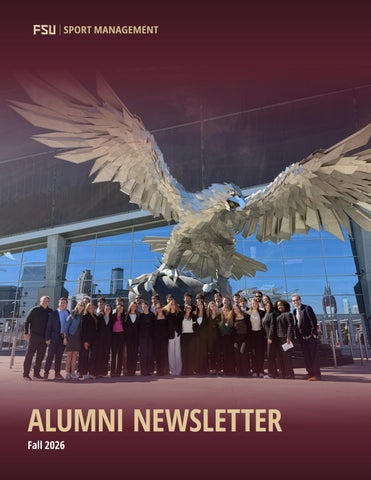
On the cover: Student trip to Atlanta, Fall 2025; Photo taken at “The Falcon” outside Mercedes-Benz Stadium (pg. 8).
FALL 2026 NEWSLETTER
3
FSU earns top spot in National Collegiate Sports Sales Championship ALL THREE OF FSU’S SPORT MANAGEMENT STUDENT COMPETITORS ADVANCE TO THE FINAL FOUR IN THEIR RESPECTIVE DIVISIONS; FSU EARNS NO. 1 TEAM RANKING
Callie Spelman
Sport Management B.S. Student Corporate Partnership Division at NCSSC Can you briefly introduce yourself and describe your role on the team at the National Collegiate Sports Sales Competition? I completed the Sport Sales Initiative (SSI) at Florida State University, which helped prepare me for the National Collegiate Sport Sales Competition. I was first introduced to SSI in my Sport Management orientation, where Dr. James briefly spoke about the program. I immediately became interested and decided to sign up, without any knowledge of sport sales. Looking back, that decision set me up for a level of success I never anticipated. The opportunity both excited and challenged me, pushing me to grow personally and academically.
4
FSU SPORT MANAGEMENT
Leading up to the competition, my professors selected me to represent FSU in the Corporate Partnership Division at NCSSC. I competed against over 60 students in this division and was proud to contribute to the team’s overall success alongside my peers, Julia and Olivia, who competed in the Ticket Sales Division. What does it mean to you personally to be part of the team that earned FSU the No. 1 ranking in the country for sports sales? Personally, earning first place as a team is a true reflection of the strength and reputation of Florida State’s Sport Management program. It represents more than just the classes we’ve
NCSSC taken or the knowledge we’ve gained, it highlights the level of support, mentorship, and investment the program provides to its students. When I came to FSU, I always knew I wanted to be part of the Sport Management program. However, looking back, I could have never anticipated the level of growth I would experience, not only in the classroom, but through my involvement across campus. Our success was not the result of any one individual, but rather the collective effort, time, and dedication poured into us by the program. Every class, every interaction, and every mentorship opportunity has shaped me and my peers into who we are today. This achievement is a direct reflection of that foundation and the culture of excellence that defines FSU Sport Management. What did your preparation process look like leading up to the competition?
What was the biggest challenge you faced, and how did you overcome it? One of the biggest challenges I faced was managing my nerves, especially at the beginning of the competition. I found myself rushing through the sales process because I was so focused on performing well. However, as I settled in, I realized that success wasn’t about speeding through a pitch, it was about building a genuine connection. Once I slowed down and approached each roleplay as a conversation rather than a performance, everything started to click. I became more present, listened more effectively, and was able to respond more thoughtfully to the buyer’s needs. Is there a faculty member, mentor, or teammate you would like to recognize for their support along the way?
I believe that all three of the SSI classes played a significant role in preparing me for the competition. These sales courses not only strengthened my understanding of the sales process but also gave me confidence in my abilities. Once I learned that I would be competing in the Corporate Partnership Division, my preparation became much more intentional.
My experience as an intern with Seminole Boosters over the past year and a half has been one of the most transformative parts of my college journey. Being surrounded by mentors and professionals who share a deep passion for FSU Athletics many of whom were once in my position as sport management students learning sales, has had a lasting impact on both my academic and professional growth.
I was fortunate to be part of a program with such a strong reputation at this competition, and to have access to former students who had previously found success. They played a key role in guiding me and my peers throughout the process. We spent extensive time practicing sales scenarios, refining our pitches, and improving how we handled objections.
The team at Seminole Boosters, including Kaylee Smith, Josh Govans, Connor Evora, and Andrew Pope, played an instrumental role in my development. Whether it was listening to my roleplays, helping me generate ideas, or providing thoughtful feedback, their support made a significant difference in my preparation.
I also participated in mock roleplays with classmates and mentors, which helped me build confidence and gain valuable feedback. Beyond that, I focused on strengthening my ability to build relationships and truly understand the client’s needs, putting myself in the mindset of helping them achieve the goals outlined in our case scenario. Was there a particular moment during the competition that stood out to you or a memory you will never forget? One moment I will never forget from the competition was simply walking into the room for the first time and feeling an overwhelming sense of nerves. Sitting among so many talented students who shared the same passion for sports sales was both intimidating and motivating. I remember noticing a row of judges seated behind us, and the thought of turning around to introduce myself felt like one of the scariest moments of the entire experience. But what stands out to me now is how that fear came full circle. Later that same day, I found myself confidently engaging in conversation with those very judges, conversations that ultimately led to an interview opportunity with their organization. That initial moment of nervousness will always stay with me, not because of the fear itself, but because of how much I grew from it. It serves as a reminder of the difference between who I was walking into that room and who I became by the end of the competition. More than anything, it reinforced the importance of being authentically yourself will lead you to the right rooms, and confidence in who you are will take you even further.
I was also fortunate to learn from two incredible professors, Dr. James and Mark Cameron, who went above and beyond both inside and outside the classroom. Their dedication and willingness to invest in their students’ success truly set them apart. Lastly, I am incredibly grateful for the former students of this program, especially Jaden Jones, who placed first in the competition in 2024. He took the time to work with me one-on-one, helping me refine and elevate my roleplay skills. This strong support system played a key role not only in my personal growth, but also in contributing to our team’s overall success representing Florida State University. How has your experience in the sport management program at FSU contributed to your success in this competition? What advice would you give to current/future FSU sport management students who are interested in competing or pursuing a career in sports sales? I’m especially grateful that I took the step to participate in FSU’s Sports Sales Initiative. Taking that first step can be the hardest part, but it’s also the most important. Putting yourself out there, whether it’s signing up for a class, competing, or pursuing an opportunity shows you just how rewarding it can be to believe in yourself. My advice to current and future students is to embrace discomfort and take advantage of every opportunity the program offers. Get involved, practice consistently, and don’t be afraid to challenge yourself. Growth happens when you step outside of what feels familiar, and those experiences are what will ultimately prepare you for success in sports sales and beyond.
FALL 2026 NEWSLETTER
5
different backgrounds, having various levels of experience, and getting to share a room with all these talented individuals was really exciting. What was the biggest challenge you faced, and how did you overcome it? The biggest challenge I personally faced was just remembering that we prepared for that moment and prepared to be there, so to not be overly nervous. Competing in a March Madness style bracket, against one individual could be very nerve-wracking at some points, so just remembering how much we put into this and how prepared we were, there was no need to be nervous, you just had to go in and put your best foot forward. Is there a faculty member, mentor, or teammate you would like to recognize for their support along the way?
Olivia Nicholson
Sport Management & Criminology B.S. Student Ticket Membership Sales Division at NCSSC What does it mean to you personally to be part of the team that earned FSU the No. 1 ranking in the country for sports sales? Our team is making an impact and leaving a legacy. I always said stepping foot on campus at FSU that I wanted to leave a lasting impact somehow, little did I know it would be a much larger outcome than I expected. To be a part of such an amazing team, and represent such a successful program means the world to me, and I could not have done it without the amazing faculty we have at FSU supporting us as students. What did your preparation process look like leading up to the competition? It was a combination of three semesters of sales classes, on top of outside of class case info preparation. To help get a better idea of what sales in general is, we have the Sport Sales Institute under Sport Management at FSU, that is a series of three one semester classes, to teach you the ropes of sales. In your last class, you really focus on sports sales specifically, and begin to really prepare for Atlanta. About two weeks out from the competition, you are given your specific case scenario that you will be competing with, and from there you hit the ground running with your presentation and roleplays. Was there a particular moment during the competition that stood out to you or a memory you will never forget? One particular moment that really stood out to me during competition was during the networking night at the Hawks game. All the competitors were in a suite watching the Hawks game together, and all just getting to know one another. This really stood out to me, because it was super interesting to hear about everyone’s different experiences learning about sales, and getting ready for the competition. We all come from
6
FSU SPORT MANAGEMENT
The two faculty members I would like to recognize for their support are Dr. James, and Mark Cameron. These were our professors for our sports sales, last semester class, and the two people who really shaped my future career path. I want to thank them for the time and effort they poured into us going into this competition, willing to meet and prepare with us whenever we needed it, or just being a helping hand along the way of navigating our futures from here. I cannot thank them enough for what they have done, and we would not be the No. 1 team without them! How has your experience in the sport management program at FSU contributed to your success in this competition? What advice would you give to current/future FSU sport management students who are interested in competing or pursuing a career in sports sales? My experience in the sport management program at FSU greatly contributed to my success in the competition by singlehandedly preparing me to do well. Through our program here, I was able to understand not only the sales side of sport, but also the importance of networking and how to properly do so in these spaces. Sport is a very network heavy industry, and without the immense amout of real advice we get in the Sport Management department at FSU, I would not have been as successful as I was, at using these skills to my advantage to talk to recruiters and grow my opportunities for the future. One piece of advice that I would give to a current/future FSU sport management student who is interested in competing or pursuing a career in sports sales is to go for it, and don’t hold back. I didn’t even know sport sales was an option for a career until I saw the advertisement to join the SSI, and on a whim I joined. I can confidently say it was the best spontaneous decision I have ever made. So, I would tell them, to put themselves out there, and no matter if you don’t feel ready, just go for it!
NCSSC Julia Rossi
I didn’t expect to learn so much about what I was looking for in an organization during my time at NCSSC, and it ultimately helped me gain a clearer sense of the type of culture, growth opportunities, and environment where I see myself succeeding.
What does it mean to you personally to be part of the team that earned FSU the No. 1 ranking in the country for sports sales?
What was the biggest challenge you faced, and how did you overcome it?
Sport Management & Marketing B.S. Student Ticket Sales Division at NCSSC
On a personal level, it’s something that I take a lot of pride in because it shows that I’ve been learning in an environment that values accountability, coachability, and continuous improvement. Our professors put so much work into preparing us, so being able to take what we learned and perform well in the competition reflects the commitment and work ethic that everyone in the program brings. Being a part of a top-ranked program means representing that reputation in every interaction, and it also pushes me to keep developing my skills so I can contribute to that success at the next level. What did your preparation process look like leading up to the competition? During my sophomore year at FSU, I had the opportunity to join the Sport Sales Initiative, which included two sales courses in the College of Business followed by a smaller, more specialized sport sales class. Our instructors, Dr. James and Mark Cameron, did an amazing job preparing us throughout the semester by teaching us about the industry, leading role play practices, and bringing in guest speakers who are actively working in sport sales. Once we figured out who was attending the competition, both Mark and Dr. James met with each of us individually to help us prepare. Olivia, Callie, and I also practiced with one another. Was there a particular moment during the competition that stood out to you or a memory you will never forget? I don’t know that there was a particular moment during the competition that stood out to me specifically, but I remember being really impressed by how many recruiters were in attendance and what a great opportunity it was. While we were there, we got to speak with so many professionals across the industry, and it was an experience that I am very grateful for.
The biggest challenge I faced was managing my nerves going into the first round. I wanted to perform well, and I remember feeling a bit uneasy before walking into the room. To overcome it, I reminded myself of all the preparation I had put in and trusted that I was ready. Once I got started, my nerves settled, and I was able to focus and feel more confident. Is there a faculty member, mentor, or teammate you would like to recognize for their support along the way? I would love to recognize everyone who supported us along the way, especially Mark and Dr. James for the time and effort they put into preparing us. Their guidance, not only for the competition, but also through the career advice they shared, was incredibly valuable, and I’m very grateful for their support. I’d also like to recognize Callie and Olivia, they put in so much work and performed so well. I learned so much from each of them, and I’m really excited to see all that they accomplish in their careers. How has your experience in the sport management program at FSU contributed to your success in this competition? What advice would you give to current/future FSU sport management students who are interested in competing or pursuing a career in sports sales? My experience in the sport management program at FSU contributed to our success in so many ways. The program is outstanding from top to bottom, and I’m constantly inspired by both my professors and my peers. It provides countless opportunities to network, gain hands-on experience, and push yourself outside of your comfort zone. My biggest piece of advice to current sport management students would be to take full advantage of those opportunities and use the resources available to you in every way you can. Attending the NCSSC was a great experience for me as someone pursuing a career in sport sales, and I learned lessons that I’ll carry with me throughout my career.
FALL 2026 NEWSLETTER
7
Networking in Atlanta, GA FALL 2025
By Joseph Morris, SMSA President We began our trip to Atlanta by leaving Tully with 32 students, ranging from freshmen to graduate students, as well as our faculty advisers, the O’Daniels, who were a tremendous help throughout the trip. We arrived at Truist Park to meet with representatives from the Atlanta Braves. All of the students wore business-professional attire for our tour and networking session with Brad Jones, vice president of partnership services, and Dan Eanes, senior director of business development. Both are FSU graduates. Afterward, we checked into the hotel and walked to State Farm Arena to watch the Atlanta Hawks’ home opener. The Hawks took on former FSU star Scottie Barnes and the Toronto Raptors, and the night included a special halftime performance by Quavo. The following morning, we walked to Mercedes-Benz Stadium, where we met with FSU graduates working for AMB Sports and Entertainment, Atlanta United and the Atlanta Falcons. The group included Rami El Shammas, major events coordinator at Mercedes-Benz Stadium; Heather Sautter, vice president of corporate and marketing communications; Lauren Fisher, senior director of service and retention; Greg Urbano, senior director of digital experience; Kurt Wisenbaugh, senior director of live events and entertainment; Ashley Cyb, director of premium sales for AMB Sports and Entertainment; Holly Duque, business operations manager; Mitchell Martin, Atlanta United team photographer; Nick Sanchez, Atlanta United performance marketing specialist; and Amani Commodore, Atlanta Falcons digital operations coordinator. We had an amazing tour of the stadium, followed by an extensive question-and-answer session and dedicated time to network. Afterward, the students had about an hour to explore the city before our meeting with the Atlanta Dream. We met in the
8
FSU SPORT MANAGEMENT
Dream’s offices, where the organization provided a buffet while we listened to a panel of staff members. Traci Messier, vice president of communications and external affairs, helped organize the visit, including a networking hour following the panel and question-and-answer session. We finished the night with a group dinner at Margaritaville, giving all 32 students a chance to make friends and network within our organization. The following day began with a visit to the Atlanta Hawks’ offices for another panel discussion and question-and-answer session, as well as a tour of the offices. Emily Hanover, senior manager of group experiences and Jr. Hawks, helped organize the meeting, which also included time for networking. After meeting with the Hawks, we drove to Gas South Arena for our final professional visit of the trip with the Georgia Swarm. Allison Schneider, digital media coordinator for the professional lacrosse team, led us on a tour and participated in a question-and-answer session that showed us a different side of the sports industry. We ended the day with a group outing at the Georgia Aquarium, which brought the students together as a more cohesive group. The next day, we boarded the bus and returned to Tully, where our trip concluded. This was one of my favorite trips we have ever taken. In their feedback, our students and faculty members said it was our most productive trip yet and that it offered a strong balance between professional networking and time to socialize within the organization. Wearing professional attire to each meeting helped our organization make a strong impression while showcasing our students as capable professionals and potential future employees in the sports industry.
Student Trips
FALL 2026 NEWSLETTER
9
Networking in Charlotte, NC SPRING 2026
By Joseph Morris and Sam Stevens, SMSA Executive Board In the spring of 2026, the Sports Management Student Association (SMSA) took its networking trip to Charlotte, North Carolina. Charlotte is home to three major league sports teams, minor league teams, and many other industry-related companies that provide many opportunities for the members of the organization to network with industry professionals and get a better understanding of what it takes to get into the sport industry, as well as how to thrive once they have entered it. The members of SMSA met with MKTG and Bespoke Sports and Entertainment to gather a better understanding of the marketing and activation strategies in this segment of the sport industry. The students also had the opportunity to meet with the Charlotte Hornets, Carolina Panthers, and Charlotte FC. The opportunity to meet and network with these major sports organizations are crucial learning experiences for the students and key opportunities to expand their network. SMSA had the chance to get a tour of the ACC headquarters located in Charlotte, as well as participate in a panel of select employees, including the Florida State alumnus Ben Tario who serves as the COO of the ACC, to gather more industry knowledge. Although networking with industry professionals was the main focus of the trip, the members of SMSA also made sure to network with each other by attending a Charlotte Knights game and a Charlotte Hornets game! SMSA is the bridge between what we learn in class and what we experience in life after college. It is preached to us that networking is the most important thing we can be doing to advance our career and with good reason.
10
FSU SPORT MANAGEMENT
As the Executive Board of SMSA, we were overwhelmingly proud of our students for their effort and thoughtfulness on our trip to Charlotte. After every stop, we were taken to the side and told how surprised our hosts were for what unfolded through our visit. SMSA began a new policy where these networking meetings held a professional dress code and a unified front walking in the door showed how serious we were developing and networking. We were told how well dressed our members were and how that made an impact for every person who spoke with us. Another interesting note that was given to us was how every member was engaged and asked meaningful, important questions that were responded with intriguing and helpful answers. For every organization and company we met with, as an Executive Board, we knew that FSU and the Sport Management Program were highly regarded as one of the best in the country. We are grateful and thankful for everyone who helped us make this trip a success. Our incredible members for taking it seriously and using this trip as a tool to help them in the future. Our amazing faculty, Dr. James Du and Dr. Hanhan Xue graciously gave us their time and took what they teach in the classrooms out into the field. Finally, Dr. Jeffrey James, Dr. Jason Pappas, and Dr. Kylee O’Daniel for being a rock throughout the entire process and always helping us to bring SMSA to its complete potential. We are very excited to see how SMSA will continue to grow and evolve through the coming years and we are even more excited to see how our members will take these experiences on these networking trips to develop their careers.
Student Trips
FALL 2026 NEWSLETTER
11
College Football Playoff MIAMI, FLORIDA, JANUARY 2026 By Sam Stevens From January 15 to January 20, a group of eight students, both graduate and undergraduate students, and two faculty members traveled to Miami, Florida, to work the College Football National Championship Tailgate. The group worked with ETZEL, a marketing agency, to set up the tailgate footprint and create spaces for sponsoring companies to set up activation zones.
competing for the trophy. During the band performances, the students and faculty played a pivotal role in controlling the crowd to ensure the safety of the band members who were performing. Once the tailgate ended, the students and faculty assisted the employees of ETZEL in breaking down the footprint and ensuring that all items were stored in their rightful places.
Before the day of the National Championship game, it was all hands on deck for event set-up. Following the instructions of event organizers, students and faculty completed tasks such as setting up barricades, lining fences with windscreen, creating directional signage, and more. One of the key lessons the group learned from this part of the experience is that, to be successful in the world of sports, you must be adaptable. Throughout the set up process, many unexpected events occurred. With the help of members of ETZEL, the group was able to learn ways to think on their feet and work through real-world situations.
Throughout their time at the event, the group had many opportunities to expand their network by connecting with industry professionals. The CEO of ETZEL, Tom Etzel, took time out of his day to connect with the group and offered personal experiences from his career to inspire and assist the students through their journey in the sports industry. Brad Terada, ETZEL’s Vice President, also took time to offer valuable insights into the world of marketing and activation and answered questions the group had related to the industry.
The day of the National Championship game brought a new set of learning opportunities for both the students and the faculty members. The day began with the group making sure that all barricades were in place and lined as needed. Before the tailgate opened, the students and faculty were tasked with doing a final walkthrough before the gates opened to the public. The day of the game was full of festivities such as live performances from the likes of Pitbull and Kat Luna, to the bands of each team
12
FSU SPORT MANAGEMENT
The experience provided an amazing opportunity for the group to gain hands-on experience in the sports industry. It also offered a way for the students to learn more about one of the many branches of sport management, marketing and activation. This immersive experience not only deepened the group’s understanding of sports marketing and activation but also prepared them to confidently pursue future opportunities within the sport industry.
Student Trips
FALL 2026 NEWSLETTER
13
Shriners Children’s Clearwater Softball Invitational CLEARWATER, FLORIDA, FEBRUARY 2026 By Leah Vrabec I had the opportunity to work with ESPN as a runner at the 2026 Shriners Clearwater Softball Invitational in Clearwater, Florida. Being involved behind the scenes provided invaluable insight into the coordination, preparation, and execution required for live event production and game-day operations at the highest level. Throughout the tournament, my primary role was to support ESPN’s production team. My responsibilities included delivering real-time statistics, assisting camera operations, and helping wherever needed to ensure smooth communication and workflow across the production crew.
14
FSU SPORT MANAGEMENT
As a runner, I learned how critical efficiency, adaptability, and clear communication are in a fast-paced live broadcast environment, where every detail matters and timing is essential. One of the biggest takeaways from this experience was gaining a deeper understanding of how much preparation and coordination goes into live broadcast production. Working behind the scenes highlighted how essential communication, timing, and teamwork are to ensuring a smooth and successful game-day broadcast.
Student Trips
FALL 2026 NEWSLETTER
15
SEC Softball Championship LEXINGTON, KENTUCKY, MAY 2026 By Leah Vrabec Working as a runner for ESPN during the SEC Softball Championship gave me firsthand experience in the fast-paced environment of live sports broadcasting. Throughout the tournament, I assisted producers and production staff by creating and delivering softball lineups, transporting updated stats and game information, and helping ensure communication flowed smoothly between different areas of production. I also worked closely with ESPN softball analysts, assisting with anything they needed throughout the broadcast process and helping support preparation leading up to games.
16
FSU SPORT MANAGEMENT
I supported behind-the-scenes operations that helped broadcasts run efficiently while learning how live television coverage comes together under pressure. This experience strengthened my ability to stay organized, work quickly in high-energy situations, and contribute as part of a professional sports media team.
Student Trips
FALL 2026 NEWSLETTER
17
Women’s College World Series OKLAHOMA CITY, OKLAHOMA, MAY - JUNE 2026 By Maddie Valachovic and Bella Steigerwalt Our trip to Oklahoma showed us many different sides of the sports industry and now we have a better understanding of what it takes to operate successful sports organizations. Throughout this experience we could see that these sports organizations are about the people. From professional sports to college athletics, to Triple-A, each organization highlighted the significance of developing a positive experience for fans, athletes, and the community. On the first day, our group visited the Paycom Center and met with staff members of the Oklahoma City Thunder. These staff members shared their experiences working in community engagement, corporate partnerships, and fan development. An interesting takeaway from this meeting was how much they emphasized the importance of serving the fans and community. Thunder staff explained that their success relies on building meaningful relationships with the people of Oklahoma City, not just generating revenue. They discussed events they host for the community, how they connect with local organizations, and how they design details that help create memorable experiences for the fans. This visit showed that successful sports organizations focus on long-term relationships rather than short-term profits. On the second day, we visited Chickasaw Bricktown Ballpark and met with members of the Oklahoma City Comets Executive Leadership Team. Similar to the Thunder, the Comets stressed the importance of fan experience and community engagement. As a Triple-A baseball organization, they face unique challenges in attracting and retaining fans. The staff discussed how sales, event operations, and promotions work together to create an enjoyable atmosphere that encour-
18
FSU SPORT MANAGEMENT
ages families and community members to attend games. There are many details in game-day operations that contribute to the overall fan experience. Later that day, we toured the Prentice Gautt Academic Center and the Barry Switzer Center at the University of Oklahoma. We learned about academic support services, tutoring programs, study spaces, nutrition resources, strength and conditioning facilities, and sports medicine services. The tour demonstrated how universities invest in the development of student-athletes both on and off the field. This highlights how athletic success is closely connected to academic achievement, personal development, and overall well-being. The final portion of the trip involved working at the Women’s College World Series where we gained firsthand experience supporting one of the premier events in collegiate athletics. Working the event allowed us to observe the significant coordination required to host a national championship. We saw how event staff, volunteers, vendors, security personnel, and NCAA representatives worked together to ensure a positive experience for athletes and fans. Overall, this trip expanded our understanding of the sports industry and the many career opportunities available within it. The experiences showed that successful organizations prioritize service, relationships, and community impact. Whether at the professional or collegiate level, the organizations we visited demonstrated that sports are about much more than competition. They are about creating meaningful experiences that bring people together.
Student Trips
We had the opportunity to visit the Paycom Center, tour the Oklahoma City Thunder business offices, and hear from industry professionals about their individual paths into the sport industry.
We explored OKC on the night of Game 6 and truly experience firsthand the culture and passion the city has for its teams.
We toured the OKC Comets stadium, the Triple-A affiliate of the Los Angeles Dodgers, and got a firsthand look at the unique culture of Minor League Baseball while hearing from team professionals. FALL 2026 NEWSLETTER
19
Women’s College World Series OKLAHOMA CITY, OKLAHOMA, MAY - JUNE 2026
Group photos from working the WCWS Fan Fest.
One of the stations at the Fan fest a few of us got to work at was the poster-making booth, where fans were able to make posters to cheer on their favorite players and teams, adding to the energy and excitement of the game. We got to connect with local volunteers who have been working the event for over a decade, seeing the passion and dedication the WCWS brings to the community.
20
FSU SPORT MANAGEMENT
Student Trips
A few students worked at the Fan Fest waiver station, checking fans in so they could participate in the fun games and activities at the fan fest!
Three students even went to Game 7 of the 2026 NBA Playoffs at the Paycom Center, experiencing the electric atmosphere of the Oklahoma City Thunder at home!
FALL 2026 NEWSLETTER
21
Studying Abroad in Florence FLORENCE, ITALY, SPRING 2026 By Mason Chernau Being part of FSU Sport Management’s first spring break trip through the “Culture & Business of Italian Sport” class changed how I see the sports industry and my own place in it. This was my first time traveling to Europe on my own, and although I was excited, I was nervous about spending the week halfway across the world with people I barely knew. Every speaker, destination, and conversation brought a different perspective. The thought that went into planning the week showed in the opportunities we had to ask questions, share our own ideas, and build relationships with professionals doing the work we hope to pursue. I left with a broader understanding of the industry and a clearer sense of the opportunities I want to explore. One of the most eye-opening parts of the trip was visiting Rondinella and ACF Fiorentina. Both clubs made us feel welcome and gave us different perspectives on the business of soccer. Visiting clubs at such different levels allowed us to compare how they operate, approach sponsorships, and divide responsibilities within their organizations. What stayed with me most, though, was how much they wanted us to feel part of the experience. One of my favorite memories was at Rondinella, when they brought out soccer balls and let us play outside. It was a simple moment, but seeing their staff enjoy watching us have fun made it feel like more than a class visit. We had spent time learning about their club, and now we were connecting over the sport itself. As the week went on, I began to see that we could contribute to these conversations, too. That became especially clear when Veronica Angeloni and Gabriele Marchi spoke with us about Savino Del Bene Volley and the challenges of growing the team’s following in Italy. As they shared their experiences, we were able to contribute examples of how smaller teams in America have 22
FSU SPORT MANAGEMENT
built their audiences and connected with fans. What made the conversation special was how interested they were in our ideas and how naturally it became an exchange where we were learning from each other. Later that week, they wrote to our group expressing their appreciation for our time together, which made the experience even more meaningful. It was exciting to realize that, even as students, we had a perspective to offer professionals in the industry, and both groups walked away with something valuable. Another speaker who stood out to me was Antonio De Luca, who shared his experience working as an agent and consultant for some of soccer’s most notable players. Antonio was easy to talk to and made a real effort to get to know us, even staying afterward to take photos and connect with us on social media. I especially enjoyed hearing how he built his career and positioned himself as a consultant, including what went into marketing himself and finding opportunities in the industry. Learning about the differences between the European and American markets gave me a new perspective on the role of agents and consultants. It also made me think more critically about how we approach the sports business back home and what we could learn from how things are done in Europe. Hearing how professionals like Antonio had built their careers made me curious about where my own path could lead, and meeting Edoardo Martelli during our tour of Viola Park, ACF Fiorentina’s training complex, helped me picture that more clearly. The club’s American ownership made the visit especially interesting to me, as I could see that influence throughout the facility. Seeing someone young trusted with significant responsibility made it easier to picture myself taking on a meaningful
Study Abroad role in the industry. Edoardo took a real interest in my questions and shared advice that felt personal and relevant to what I hope to pursue. That connection made the visit especially memorable, and I left feeling more confident about my own career path. By the end of the week, I felt more confident about my future in sports and more comfortable with the people sharing this experience with me. Both feelings came together when we visited the private rowing club where Lucrezia Fossi, our professor and student affairs coordinator for FSU Florence, grew up and learned to row. As we sat together by the river, Lucrezia shared how she became involved in sports, the struggles she faced, and what that experience meant to her. I asked whether, knowing the impact she could have on future athletes, she would go through those struggles again. She paused before giving an emotional response that has stayed with me ever since. Her willingness to open up helped the rest of us let our guards down and share experiences that brought us closer together. Less than a week earlier, we had been strangers. Now, sitting by the water, I felt at peace, accepted, and connected to everyone around me.
All the nerves I had about traveling across the world with people I didn’t know felt worth it. I had come on the trip hoping to learn about the sports industry, but that moment showed me how much I was also learning about myself and how meaningful the relationships we had built had become. I returned to Tallahassee with new perspectives and a clearer understanding of the opportunities in sports. The hands-on experiences and personal conversations helped me recognize how my strengths in building relationships, asking questions, and learning from others could translate into a career. I am especially grateful to Dr. Jason Pappas for inviting me into the class and to Lucrezia Fossi and Alex Patterson for their support throughout the experience. This trip showed me what can happen when I step outside my comfort zone, put myself out there, and stay present. I came home with renewed confidence, a stronger sense of purpose, and a deeper belief that I have a meaningful place in the sports industry.
This was during our visit to Rondinella, right after we were all connecting over the game of soccer. This photo is very special to our group. FALL 2026 NEWSLETTER
23
Global Sport Management in London LONDON, ENGLAND, SUMMER 2026 By Palmer Rue Florida State University’s Global Sport Management program returned to London in summer 2026, giving students the opportunity to experience the international sports industry beyond the classroom. Throughout the program, students attended major sporting events, toured some of England’s most recognizable venues, met with industry professionals, and experienced the traditions and culture that make British sport unique. The program began with one of the most recognizable sporting events in the world: Wimbledon. Experiencing the tournament in person allowed students to observe much more than elite tennis. From crowd movement and hospitality to branding and the preservation of tradition, Wimbledon provided an early example of how a global sporting event can maintain its identity while welcoming spectators from around the world. Students were also able to experience professional football from several different perspectives. The group toured Tottenham Hotspur Stadium, Anfield, and Stamford Bridge, providing opportunities to compare historic football grounds with newer, technologically advanced facilities. Each stadium demonstrated a different approach to venue management and the fan experience. The visit to Anfield was especially valuable in showing the relationship between a professional sports organization and its surrounding community. Liverpool FC’s history is visible throughout the stadium, and the connection between the club and its supporters demonstrates how deeply a sports organization can become tied to the identity of a city. Tottenham Hotspur Stadium offered a different perspective, demonstrating how a modern facility can be designed for multiple sports and entertainment events while creating additional revenue opportunities throughout the year. Stamford Bridge provided another opportunity to examine the business and history surrounding one of England’s major football clubs.
24
FSU SPORT MANAGEMENT
The program also took students outside London for an overnight trip that combined football with one of golf’s most important events. Students attended The Open Championship at Royal Birkdale, where they experienced firsthand the scale and atmosphere of a major international golf tournament. The event provided an opportunity to observe tournament operations, spectator movement, hospitality, merchandising, and the challenges involved in managing thousands of fans across a large outdoor venue. Later in the program, students experienced another major British sporting tradition at King George Friday at Royal Ascot. The racecourse provided a completely different event environment from football, tennis, or golf. Formal dress, hospitality, horse racing traditions, and the widespread availability of betting all contributed to the experience. The event demonstrated how successful sport organizations can build their identity around traditions rather than attempting to make every event feel the same. From an event management perspective, students were also able to observe how Ascot handled concessions, betting operations, crowd movement, security, and guest services throughout the racecourse. Venue visits continued at Queen Elizabeth Olympic Park and Lord’s Cricket Ground. Olympic Park gave students an opportunity to consider the long-term effects of hosting a global sporting event and how facilities originally developed for the Olympic Games can continue serving a city years later. At Lord’s, students were introduced to a sport and sporting culture that many had limited experience with before arriving in England. Together, these visits demonstrated the variety of facilities, organizations, and operational approaches found within the British sports industry. An important part of the Global Sport Management program was the opportunity to learn directly from professionals working throughout the industry. Paul Deakin, an NFL senior team opera-
Study Abroad tions manager, spoke with students about his professional experiences and the operational side of the NFL. Students also met with Andy Gray from England Golf and Nick Robinson of International Sports Consulting. These conversations allowed students to ask questions about career development, international sport business, athlete representation, and the skills needed to build a career in the industry.
Throughout the program, concepts previously discussed in Sport Management courses became much more tangible. Venue management could be studied while walking through Premier League stadiums. Event operations could be observed while attending Wimbledon, The Open, and Royal Ascot. Fan engagement could be understood by experiencing the atmosphere surrounding Liverpool FC, and international sport business could While sport remained at the center of the program, studying be discussed directly with professionals working in the field. abroad also provided opportunities to experience London and By the conclusion of the program, students returned with more British culture outside of sporting venues. Students participated than memories of attending famous sporting events. They in a panoramic tour of London, spent time at Regent’s Park, and returned with a broader understanding of the global sports concluded the program with a group farewell and a performance industry and a new perspective on the range of careers available of Wicked. Living and studying in another country encouraged within it. The combination of academic learning, professional students to become more independent while experiencing a networking, venue visits, live events, and cultural experiences culture different from their own. demonstrated the value of taking sport management education One of the most valuable aspects of the program was the oppor- beyond the traditional classroom. tunity to compare the British and American sports industries. Students saw how history, community identity, international audiences, and long-standing traditions influence sport organizations in the United Kingdom. These experiences also demonstrated that organizations on both sides of the Atlantic face similar challenges involving revenue generation, facility management, marketing, sustainability, security, and creating meaningful experiences for fans.
For FSU Sport Management students, London became a classroom of its own. Whether standing inside an iconic stadium, observing the operations of an international sporting event, or speaking with an industry professional, each experience offered another opportunity to understand how sport is managed on a global scale. The 2026 Global Sport Management program provided students with experiences, perspectives, and memories that will continue to influence their education and future careers long after returning to Tallahassee.
FALL 2026 NEWSLETTER
25
Studying Abroad in Valencia VALENCIA, SPAIN, SUMMER 2026 By Emily Manzano As a Global Sport Management (GSM) student, learning happens not just in the classroom, but through direct immersion in the world of global sport. Participating in Florida State University’s GSM Program in Valencia provided a perspective that a traditional classroom simply cannot replicate. Throughout the experience, we were challenged to understand Spain’s sport industry through the lens of its people, traditions, and culture, all of which play a significant role in shaping the industry. Beyond the sport curriculum, one of the most valuable parts of studying abroad was the cultural immersion built into the program. We were able to experience Spanish traditions firsthand while studying abroad in Valencia. One of my favorite cultural experiences was participating in the paella cooking class. Paella originated from Valencia and remains a dish that is heavily ingrained into Spanish culture. Preparing the dish ourselves gave us a chance to experience something deeply connected to the identity of the region as well as the country. Instead of simply consuming the cuisine or learning the background, we were able to fully participate in the tradition ourselves. The immersion continued outside of Valencia, as well. We attended a flamenco performance in Madrid and explored several Spanish cities beyond their sport venues. Experiencing these destinations through their culture, history, and daily life gave us a broader understanding of Spain and its people. These experiences complemented the sport management curriculum. Sport organizations do not operate in isolation from their surroundings. The traditions and people behind the teams give these organizations their identity. The values of their communities influence everything from how the teams present themselves to the fan experience. Experiencing Spanish culture firsthand gave us the context to understand why sports look, feel, and operate differently abroad. 26
FSU SPORT MANAGEMENT
Our site visits made that connection especially clear for me. One of the biggest takeaways I had came from Levante UD. As the smaller LaLiga football team in Valencia, Levante cannot depend on the global recognition that other teams in its league (Real Madrid and FC Barcelona) enjoy. Instead, the club puts tremendous value on its local community/fanbase and the history the club has within the Valencia community. Visiting Levante changed how I measured success in sport. Success is not always defined by championships or international recognition. For an organization like Levante, building a strong local identity and creating generations of loyal fans can be equally important to the team’s long-term success. Having played collegiate basketball with aspirations to play overseas, Valencia Basket (Roig Arena) and L’Alqueria del Basket offered a completely different lesson that I totally loved. What stood out most was their commitment to youth development. Their investment in nurturing talent from within illustrated how long-term success can be built through patience, development, and organizational culture rather than outsourcing talent. Seeing the facilities and even participating in a training session with EuroProBasket helped me understand how they develop athletes over the years, creating both a pathway for players and a sustainable pipeline for an organization. GSM also took us beyond Valencia, allowing us to visit some of the world’s most recognized teams in Madrid and Barcelona. One of the biggest lessons I took away from these experiences is that there is no single formula for success among high-performing organizations. Each club has developed its own unique competitive advantage and approach to achieving excellence. Atletico Madrid’s continued investment in Riyadh Metropolitano Stadium and the surrounding areas demonstrates how infrastructure can become a competitive advantage. On the other hand, the
Study Abroad neighboring team Real Madrid takes advantage of its established and prestigious global brand. FC Barcelona uses its identity to connect to supporters all around the world, way beyond their campus and their home stadium, Camp Nou. Before the GSM program, I primarily viewed the sport industry from the perspectives most familiar to me (NCAA, NBA, etc.). The GSM program challenged me to examine the business decisions, strategies, systems, and communities that are crucial to the success of these international sport organizations. Being able to study abroad in Spain also carried a special significance for me because of my family’s Spanish heritage. Entering the program, I hoped that living in Spain would allow me to further connect with my roots as well as show me a preview of what my life would look like as I pursue a professional career there in the future. Beyond hope, it became my reality. Studying in Valencia allowed me to develop a connection with Spain that was distinctly my own, separate from my familial ties. Through the GSM program, I was able to deepen my appreciation for a culture that has always been close to my heart while simultaneously studying an industry in which I hope to build my career. I left Valencia with more than just happy memories from a summer abroad. I returned with a greater appreciation for my connections to Spain, a broader understanding of the global sport industry, and experiences that will continue to influence the way I approach my future in the sport industry. FSU’s Global Sport Management program allowed me to bridge my personal heritage with my professional aspirations, connecting where I come from with where I aspire to go next in my career.
FALL 2026 NEWSLETTER
27
NASSM Conference
NASSM 2026 in San Juan
FSU SPORT MANAGEMENT SHINES THROUGH RESEARCH, REUNION, AND RECOGNITION By Yeeun Jeong The 2026 North American Society for Sport Management conference convened in San Juan, Puerto Rico, from Tuesday, May 26, through Friday, May 29. Florida State’s Department of Sport Management maintained a strong presence, with faculty, doctoral students, and alumni contributing more than 22 posters, panels, and presentations throughout the event. A wide range of topics were covered, including fan behavior, sport consumer trends, environmental justice, the geopolitics of soccer, sport media and technology, physical activity and well-being, and the NIL era. These works reflected sustained research effort and collaboration across the program, offering attendees a window into the ongoing growth and direction of FSU’s Sport Management field. Notably, this year’s Earle F. Zeigler Lecture Award, the most prestigious honor bestowed by NASSM, was presented to Dr. Bob Heere of the University of North Texas, a proud alumnus of Florida State’s own doctoral program (Ph.D. ‘05). The award may only be bestowed on an individual once over the course of their career and recognizes sustained and significant contributions to the field of sport management through scholarship, research, and leadership. Dr. Bob Heere delivered the Zeigler Lecture, titled “Halfway There: Size, Structure, and Diversity of Thought in a Liminal
28
FSU SPORT MANAGEMENT
Community,” offering reflections on the path forward for the academic community, and was later honored at the Founders’ Night Dinner & Awards. The department’s annual social also brought the community together at NASSM 2026, with more than 40 current students, faculty, and alumni in attendance. The event was held on Wednesday, May 27, at Arena Medalla, T-Mobile District in San Juan, Puerto Rico, providing a welcoming setting for students, faculty, and graduates to reconnect and build new professional relationships. The gathering also offered Dean Andrew and Dr. James the opportunity to provide updates on the continued growth and direction of the Sport Management Department and the College. As always, the social served as a meaningful reminder of the enduring connections that unite the department’s students and alumni across generations and geographic distance. As a whole, NASSM 2026 offered another valuable opportunity for the FSU Department of Sport Management to showcase its scholarship and leadership on a global stage. The conference reinforced the department’s collaborative spirit, connecting students, faculty, and alumni across generations, and reaffirmed our shared commitment to advancing the field of sport management for years to come.
Faculty Award
Department Chair Jeffrey James Receives Career Achievement Award from The Ohio State University
JAMES WAS HONORED THIS OCTOBER BY OSU’S COLLEGE OF EDUCATION & HUMAN ECOLOGY By Melissa Powell Jeffrey D. James, Mode L. Stone Distinguished Professor and Chair of the Department of Sport Management at Anne’s College, has been honored with the 2026 Career Achievement Award from The Ohio State University’s College of Education and Human Ecology. The award recognizes James’ distinguished career in sport management research, leadership, teaching and mentorship. James earned his Ph.D. in sport management from Ohio State in 1997. A nationally recognized scholar, James studies the psychological connections people form with sports teams, including how those relationships develop and influence attitudes and behaviors. Throughout his career, James has published more than 90 peer-reviewed journal articles, co-authored three books and delivered more than 100 presentations at national and international conferences. He also previously served as editor-in-chief of the Journal of Sport Management, a leading publication in the field. His contributions to sport management research have earned him numerous distinctions, including recognition as a Research Fellow of the North American Society for Sport Management (2008), the Sport Marketing Association (2020) and the National Academy of Kinesiology (2023). In 2017, he received the Earle F. Zeigler Award, the North American Society for Sport Management’s highest honor. Beyond his research, James has made a lasting impact through his leadership and mentorship at FSU since joining the faculty in 2003. A longtime chair of the Department of Sport Management, he has guided 44 doctoral students through the successful completion of their dissertations, including three recipients of the North American Society for Sport Management’s Student Research Competition award. James was recognized during Ohio State’s 2026 EHE Hall of Fame and Alumni Awards Reception on October 8. Also in attendance to celebrate were James’s family, Anne’s College Dean Damon Andrew, and Professor Amy Chan Hyung Kim.
FALL 2026 NEWSLETTER
29
Alumni Spotlight Susmit Gulavani is an assistant professor in the University of South Carolina’s David and Nicole Tepper Department of Sport and Entertainment Management. His expertise lies in the transformative sport research paradigm, where he uses advanced data science tools to explore the intersection of sport, consumer behavior and technology. His scholarship integrates artificial intelligence, machine learning and natural language processing to investigate the psychological and emotional dimensions of sport and the societal impacts of emerging sport technologies. Gulavani earned his Ph.D. and M.S. in Sport Management from FSU, where his dissertation applied machine learning to reexamine the Psychological Continuum Model. What factors influenced your decision to pursue your doctoral studies at Florida State University?
ALUMNI SPOTLIGHT
Dr. Susmit Gulavani
Ph.D. Florida State University, 2024 M.S. Florida State University, 2019 Assistant Professor, University of South Carolina
I have always been curious about how a team or athlete playing hundreds of miles away in a sport stadium can influence how fans feel, eat, and sleep while watching them on television. Sport fans are deeply passionate; they follow traditions and rituals, and I wanted to understand ‘why’. My master’s experience at FSU was incredibly valuable and sparked my interest in research, which led me to connect with Dr. James Du. Given FSU’s strong reputation in sport management, the opportunity to continue working with Dr. Du, and the program’s rich tradition of sport consumer behavior research, there was no better place for me to pursue my Ph.D. Would you please describe your dissertation research and discuss how it has informed and shaped your current scholarly work, as well as your teaching and service activities, if applicable? My dissertation grew out of my passion for understanding the attitudes and behaviors of sport fans. It focused on sport market segmentation, using unsupervised machine learning techniques to identify distinct groups of fans who differ in their psychological connection to sport. The research was guided by the Psychological Continuum Model developed by Dr. Jeffrey James and Dr. Daniel Funk. My current scholarly work builds directly on that foundation. I use advanced artificial intelligence procedures to examine sport consumption attitudes and behaviors. For example, in one recent project, I examine how AI can be leveraged to understand the ticketing decisions of season ticket holders. Using machine learning, I developed a predictive model that identifies which season ticket holders are likely to renew and which are at greater risk of churning. Insights like these can help sport organizations intervene early and strengthen fan retention. This work also shapes my teaching. At the University of South Carolina, I developed a course on generative AI in sport and entertainment management, where students learn about recent AI advances in the sport industry, how to prepare for this transformation, how different AI procedures can be used to analyze large consumer datasets, and how human–AI partnership can advance the sport industry.
30
FSU SPORT MANAGEMENT
Alumni Spotlight How would you characterize your teaching philosophy and area of focus? My teaching philosophy centers on fostering a growth mindset, rooted in the belief that intelligence and abilities can be developed through dedication, strategic effort, and resilience. In today’s rapidly evolving educational landscape, AI literacy is a powerful catalyst for this mindset. When students learn to navigate AI, they don’t just acquire technical skills; they learn to view technology as a partner in problem-solving. Working with AI tools requires students to continually refine their thinking. Through this process, students can understand that both human capabilities and technological tools are not static, but dynamic systems that grow stronger through curiosity, adaptability, and continuous learning. Could you describe your responsibilities for the SEVT conference at the University of South Carolina, or any other current role you are involved in? I currently serve as academic chair for the SEVT Conference. My responsibilities include distributing the call for papers, soliciting cutting-edge research presentations, reviewing submissions, and organizing the academic sessions to ensure high-quality knowledge dissemination at the conference. My goal is for every attendee to leave knowing more than they did when they arrived, and for presenters to feel comfortable and supported in sharing their research with the audience. Ultimately, I envision the sport management academic community growing as a family and reaching new heights, with the insights shared at the conference being implemented collaboratively by industry practitioners. I also hope the conference becomes a space where practitioners can bring forward the challenges they face and work alongside academics to solve them. What guidance or suggestions would you offer to current and prospective doctoral students in our program? Pursue your passion. Research gives you the freedom to explore the questions you care about most, and as sport management scholars, we are naturally curious about and connected to sport. Use your doctoral training to build skills and competencies that allow you to explore that passion across a variety of topics. I have always been fascinated by athletes and how they shape the broader fabric of society, and I have leveraged advanced psychometric and AI techniques to study that phenomenon. Similarly, identify what you are passionate about, then seek out the mentors, methods, and resources that will help you pursue it.
FALL 2026 NEWSLETTER
31
Class Spotlight
From Groundbreaking to Gameday INSIDE SPORT FACILITY MANAGEMENT By Timothy Kellison Every stadium tells a story, from the first sketch on the back of an architect’s napkin to the roar of a sold-out crowd on opening night. In the department’s undergraduate and graduate Facility Management courses, students learn to read that story from start to finish. In different ways, SPM 4104 (Facility and Event Management) and SPM 5106 (Facility Management in Sport) trace the full life cycle of a sport venue: conceptualization, design, financing, construction, operations, and, ultimately, event delivery. Along the way, students don’t just study facilities—they walk through them, and they learn directly from the people who run them. Each semester, graduate students leave the friendly confines of Tully Gym to visit some of Tallahassee’s other storied venues. Doak Campbell Stadium has been a recurring stop, and returning to it year after year has given students a rare vantage point: a front-row seat to the stadium’s massive, multi-year renovation. What one cohort saw as a construction site full of cranes, exposed steel, and a stadium deep in transformation, a later cohort saw taking shape as finished premium spaces and reimagined back-of-house areas. Few courses can offer students a live, multi-year case study in real time, but that’s exactly what watching Doak Campbell evolve has provided. Along the way, longtime Seminole staffer Dr. Charles Morris has shared decades of institutional memory about how the stadium has changed over his career. Students have also made repeat trips to the Donald L. Tucker Civic Center, where Oak View Group’s Ryan Zornes has become something of an honorary guest lecturer. A program alumnus himself, Zornes has walked multiple classes through the arena’s seating bowl, locker rooms, and mechanical systems—boilers, chillers, and all—while reflecting on his own path from student to Assistant General Manager. Both the undergraduate and graduate sections benefit from a steady rotation of guest speakers. Recent classes have heard from: FSU alumni Adam Hamm (Columbus Crew), Justin Casserly (Las Vegas Raiders), Tim Trefzer (Honeycomb Strategies), and Kelsey Smith (Seattle Mariners) shared how their FSU experience shaped their career paths. Malcolm Perry, Manager of Planning, Projects, and Facility Operations for the Houston Rockets and Toyota Center, walked students through the overnight conversion process and plans for its $300-million renovation. Sherri Privitera, Senior Principal at Populous, spoke about human-centered design and what it means to design facilities for the whole athlete.
32
FSU SPORT MANAGEMENT
Jennifer Roche, Director of Communication and Legacy for the FIFA World Cup 2026 Miami Host Committee, offered an inside look at the planning behind a mega event. Diana Trujillo of the Atlanta Sports Council discussed bidding for events like the Super Bowl and NCAA Final Four. Kristen Fulmer of Oak View Group talked about addressing sustainability as a core business strategy rather than an afterthought. By the time students complete the course, they’ve developed a working knowledge of facility design, financing, safety and risk management, and event logistics. Just as importantly, they’ve had the opportunity to establish real relationships with professionals across the industry, from architecture firms to professional franchises to civic tourism authorities. Several guest speakers sat in those same Tully Gym seats not long ago, proof that the relationships built in this course tend to outlast it.
Faculty Spotlight
FACULTY SPOTLIGHT
Dr. Chan Hyeon Hur Assistant Professor of Sport Economics Department of Sport Management
Chan Hyeon Hur recently joined the Department of Sport Management as an Assistant Professor of Sport Economics. His work sits at the intersection of sport management, economics, and public finance, with recent projects spanning economic and social impact analysis, sport management online education and digital learning, and public budgeting in collegiate athletics. Research Since joining FSU, Dr. Hur has had three papers accepted for publication. He has an article forthcoming in the Journal of Sport Management, “When the Games Leave: An Economic and Spatial Analysis of Low-income Populations in the 2018 Winter Olympic Games,” with Grace Yan, Nicholas M. Watanabe, and Hanhan Xue. Using administrative data from Gangneung, South Korea, host city of the 2018 Winter Olympics, from 2015 to 2020, the study applies two-way fixed effects regressions and GIS hot spot analyses to track how low-income populations shifted around the Games. The findings show a short-term decline in low-income populations immediately following the event, but no sustained long-term effect, with GIS results pointing to temporary geographic shifts during the Olympic period. The article was supported by Anne’s College Open Access Publishing Fund award. He also has a paper forthcoming in the Journal of Computer Assisted Learning, “Learning dynamics in asynchronous online higher education: Instructional design, self-regulated learning supports, and academic performance,” with Tena B. Crews and Samuel López-Carril. Drawing on data from 742 undergraduates across six semesters of an asynchronous online course, the study finds that earning digital badges, resubmitting capstone projects, and receiving automated feedback are linked to stronger academic performance, while unlimited assignment attempts and end-of-course deadlines are linked to weaker performance. The findings point to structured pacing, targeted feedback, and performance-linked incentives as ways to strengthen digital competence and learning outcomes in higher education.
A third project, published online in Public Performance and Management Review with Sun Gue (Susan) Yang and Carla Flink (with print publication to follow), examines gender-responsive budgeting in collegiate athletics student aid, digging into how Title IX proportionality standards play out in athletic aid budgeting across NCAA Division I institutions. The study found that private institutions allocate more per-person funding to female student-athletes than their public counterparts, while meaningful gaps remain elsewhere, and explores the theoretical reasons behind these budgeting patterns. Dr. Hur also recently received the Janet B. Parks NASSM Research Grant from the North American Society for Sport Management, bringing research capital to the department as he continues pursuing further grant opportunities. Teaching Dr. Hur teaches SPM 4505, Sport Finance. His teaching philosophy centers on self-directed and experiential learning: “Give a person a fish, and the person eats for a day. Teach the person how to fish, and the person eats for a lifetime” is an adage he sees as core to his approach, regardless of a course’s format, size, or level. Rather than expecting students to learn entirely on their own, he fosters learning through discussion questions that encourage student involvement and build critical thinking skills. Given how quickly the sport industry changes, Dr. Hur believes self-learning must be paired with experiential learning, so students apply classroom knowledge to real-world problems as they learn it, rather than treating the two as separate steps. Service Dr. Hur serves as Managing Editor of the Journal of Global Sport Management and sits on the editorial boards of Sport, Business and Management: An International Journal and the Sport Economics Research.
FALL 2026 NEWSLETTER
33
Department Highlights
Dr. Kris White won Anne’s College Graduate Teaching Award. This is his second such honor; he previously won Anne’s College Undergraduate Teaching Award in 2023.
Dr. Tim Kellison and Dr. Amy Kim were promoted to full professor, effective the fall 2026 semester.
Dr. Scott White (Ph.D. ‘26) won the Best Paper Award from the Journal of Legal Aspects of Sport. He and Dr. Ryan Rodenberg co-authored “Blank Checks: The Ivy League Scholarship Rule and the Consolidation of Conference Power,” which examines how courts have struggled to apply antitrust law to conference-level restraints, a pattern likely to result in greater power being consolidated in the hands of conference commissioners.
34
FSU SPORT MANAGEMENT
Dr. David Pifer was promoted to Associate Professor, with tenure, effective the fall 2026 semester.
Department Highlights
Three new faculty members joined the Department of Sport Management this fall, including Dr. Chan Hyeon Hur (Assistant Professor), Dr. Justin Wartella (Associate Teaching Professor) and Dr. Erik Smith (Visiting Assistant Professor).
Dr. Damon Andrew, dean of Anne’s College and professor, now serves as president of the American Kinesiology Association for the 202627 term after serving as president-elect in 2025-26 and on AKA’s Board of Directors since 2022.
Dr. Mark DiDonato and alumnus Dr. Tom Raffin co-authored “Market forces behind Super Bowl Pricing: A three-year comparison,” published in the Sports Business Journal.
FALL 2026 NEWSLETTER
35
Department Highlights
In the Media Dr. Amy Kim: FSU sport management professor discusses how pickleball builds social connections in older adults.
Dr. Kris White: FSU Athletics branding expert offers viewpoint on influencers at sporting events.
Dr. Mark DiDonato: FSU expert explains how FIFA World Cup will be another turning point for sports economics.
36
FSU SPORT MANAGEMENT
FSU175
FALL 2026 NEWSLETTER
37
139 Chieftan Way Tallahassee, FL 32306
FOLLOW US @fsusport @fsusport @fsusportmgmt
LEARN MORE annescollege.fsu.edu/sport-management