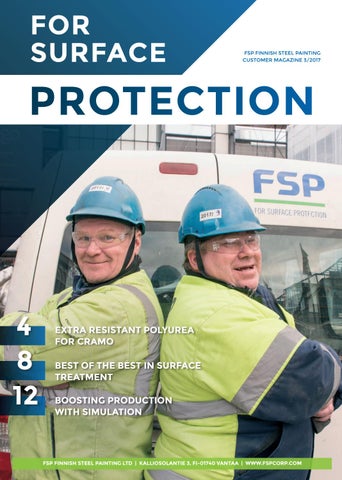
FOR SURFACE
FSP FINNISH STEEL PAINTING CUSTOMER MAGAZINE 3/2017
PROTECTION
4 8 12
EXTRA RESISTANT POLYUREA FOR CRAMO BEST OF THE BEST IN SURFACE TREATMENT BOOSTING PRODUCTION WITH SIMULATION
FSP FINNISH STEEL PAINTING LTD | KALLIOSOLANTIE 3, FI-01740 VANTAA | WWW.FSPCORP.COM
4
EXTRA RESISTANT POLYUREA FOR CRAMO
12
BEST OF THE BEST IN SURFACE TREATMENT
BOOSTING PRODUCTION WITH SIMULATION
FOR SURFACE
PROTECTION
2
8
FSP Finnish Steel Painting Oy is one of the leading industrial surface treatment and value-added service providers in Northern Europe. Instead of the traditional surface treatment work, our future focus areas will be more on developing our production and services and offering new techniques and technology. As a result, our customers gain advantages such as improved competitiveness required in market leadership. We strictly adhere to quality, occupational safety, health and environmental (QHSE) requirements. FSP employs over 220 professionals in about 20 surface treatment facilities in Finland, Poland and Estonia, and has a turnover of around €23 million.
For Surface Protection is the stakeholder magazine of FSP Finnish Steel Painting Oy, published three times a year. Content and visual design Viestintätoimisto VCA Oy. Printing house: Savion Kirjapaino Oy Cover photo: Kai Filppula Headquarters Kalliosolantie 3 FI-01740 Vantaa www.fspcorp.com
➤ FOR SURFACE PROTECTION
A year of development behind and ahead This year, FSP has focused its efforts on the development of operations and working methods, and on the well-being of employees. For this reason, I am extremely pleased to say that we have moved forward with new innovations. I will highlight three of them here. On pages 12–13, we introduce a completely new production simulation program, which enables us to detect the strengths and bottlenecks in surface treatment production processes. The objective is to choose the best of the provided alternatives and optimise production. This year, we have seen a trend emerging, in which orders have come in with a short response time, and projects have consisted of customised short series with a short delivery time. Now we have an even more reliable way of showing our customers how production could be developed and lead-times reduced. Changes in the industry shift the surface treatment process towards evermore specialised solutions and products. We have a professional staff, extensive experience and strong expertise in the field of surface treatment, and we also have the ability to offer secure document management for more specialised procedures and technologies. On page 6, we present how we executed an impact resistant polyurea floor for Cramo, and how we utilised ARC coatings on pressure filters at our surface treatment plant in Lappeenranta. On page 7, we share our stealth and camouflage coatings, which we have been doing since the 1970’s in surface treatment plants and at shipyards. We have been using the TellUs application since 2013 to gather development ideas and safety observations. Our goal is to systematically create a culture in which every employee can make observations and submit suggestions on how FSP could operate in a smarter way and serve our customers even better. This year, we received already over a thousand suggestions. We have implemented most of the ideas, which have benefited both our staff and our customers. During the upcoming year, we will continue to focus on researching and offering new procedures and technologies. In addition, we will intensify on-the-job learning to maintain even more extensive expertise and to accumulate specialised skills. Consequently, we can secure our customer’s competitiveness in the future, as top players in their fields. Dear reader, now turn the page and take your time to explore our latest company news and case stories. I want to thank our customers for their faith in our work, and our professional staff for their work in achieving our goals. This year, we, together, have created excellent conditions for working in line with our strategy, also in the future. Wishing you all a peaceful Christmas and a successful year 2018.
Pentti Virtanen CEO, FSP Finnish Steel Painting Oy
Follow up on our company news on Facebook and Linkedin, as well. Click the link on the fspcorp.com main page or directly on Facebook and Linkedin.
FOR SURFACE PROTECTION ➤
3
Extra resistant polyurea for Cramo CASE
Photo: FSP
IN THE FALL OF 2017, EUROPE’S LEADING EQUIPMENT RENTAL PROVIDER CRAMO WANTED TO IMPROVE THE IMPACT RESISTANCE OF CONCRETE FLOORS IN THE COMPANY’S CENTRAL WORKSHOP IN TUUSULA. CRAMO FINLAND OY CHOSE FSP AS THE CONTRACTOR, WHO RECOMMENDED COATING THE FLOOR WITH HIGHLY DURABLE POLYUREA. So far, Cramo Finland Oy’s Service Manager Tuomas Niinisalo has been pleased with the coating project, which covered a part of the concrete floor area in the central workshop facility in Tuusula. The Tuusula facilities also include Cramo's largest depot, which supplies machines and serves over fifty facilities all over Finland. “This was a pilot project, but if our experiences are positive, we will choose the polyurea coating for the other Cramo facilities in Finland, as well. We wanted to find a hard and flexible coating for concrete floors, which would endure heavy wear and tear and extreme mechanical stress,” explains Niinisalo. The surface was completed with an anti-slip coating to improve occupational safety. A profiled floor surface reduces the risk of slipping, in case there is, for example, oil on the floor. Besides occupational safety, the aim is to reduce the amount of maintenance and reparations a concrete floor requires. The whole project started when Niinisalo
4
➤ FOR SURFACE PROTECTION
saw a video of the durability of polyurea. On the video, someone took a heavy sledge hammer and used it to hit a polyurea-coated wall built of concrete blocks. The blocks shattered into pieces, but the polyurea on their surface remained as an undamaged sheet. In the end, this convinced Niinisalo to test the material in concrete floors.
Durability as the goal “Our objective is to prevent the concrete floor from wearing, because at the workshop we are moving excavation machines that run on metal tracks and wheel loaders with studded tyres. The construction machines on metal tracks can weigh up to 30 tons. They cause a massive amount of stress on the concrete floor surface and increase the need for maintenance,” Niinisalo explains. “We also wanted to utilise new surface treatment techniques and coatings, because creating innovations
is one of the main themes incorporated in Cramo’s new strategy. In addition, using polyurea was a quick and easily implemented surface treatment solution.” The project was started with cleaning and grinding phases, during which oil and other impurities where removed from the floor before applying the actual polyurea. Other strong points of polyurea include resistance to water and corrosion. In addition, it does not contain volatile organic compounds, and is therefore an environmentally friendly option. During the fall of 2017, FSP has also performed other polyurea coating projects in facilities all over Finland. For example, in Iisalmi FSP is studying the suitability of polyurea for different purposes, such as the floors of person hoists and booms of concrete injection units. “The purpose of coating the floor of a person hoist with polyurea is creating an anti-slip surface. Polyurea is a more durable and easily installed solution than rubber coating,” sums up FSP's Business Director Jarno Huttunen.
Cramo • Full-service rental solutions provider that rents modular spaces in addition to construction machinery and equipment, and also offers its customers support services for construction, renovation and maintenance • Leader in its field in the Nordic Countries and in Central and Eastern Europe • Operates in 14 countries with approximately 320 offices • Approximately 2,500 employees, of which around 500 in Finland in over 50 facilities • Turnover of € 712 million in 2016 • Cramo Finland Oy is part of Cramo Group
FOR SURFACE PROTECTION ➤
5
ARC coating for Outotec pressure filters in Lappeenranta During this fall, FSP Finland’s Lappeenranta surface treatment plant has performed several ARC coating projects for the Filters unit of Outotec. The targets have been pressure filters Outotec exports for the mining and chemical industries. The total weight of the coated parts goes up to as much as 60 tons. Mikko Tykkyläinen, Production Manager of Outotec’s Filters unit, is satisfied with the ARC coating work. The surface treatment project became more demanding by the chamber structure and the size and weight of individual parts. “FSP is a good and flexible partner. The top-quality results have met our customers’ expectations for our product quality. Co-operation has been smooth, as our production facilities are located in the same place.” “Pressure filters used in the mining industry and the processes of the chemical industry face extreme wear and tear, a high risk of corrosion, and acid spillage and liquids, which is why they need an ARC coating,” explains Tykkyläinen. In his view, an ARC coating’s best features are a durable surface that is resistant to e.g. sulphuric acid, and impact resistance, which means that the coating is not easily damaged. In addition, the coating is highly adhesive and offers a long lifespan, which extends the maintenance intervals. “In the future, we want to improve and develop our co-operation with FSP at the Lappeenranta surface treatment plant. We appreciate FSP’s surface treatment expertise and flexibility.” An ARC coating is also a safe and environmentally friendly solution. The majority of the coatings are completely solvent-free, so they do not cause any harmful VOC emissions.
6
➤ FOR SURFACE PROTECTION
Photo: FSP
CASE
Pressure filters are used for instance in the mining industry to filter sludge. In the filtering phase, liquids and solids are separated from the sludge in line with the requirements of the customer’s process.
EXTENSIVE EXPERIENCE OF STEALTH AND CAMOUFLAGE COATINGS CASE
Since the 1970's, FSP has performed stealth and camouflage coating projects in its surface treatment plants and at shipyards. FSP has worked globally for the defence equipment industries, where the requirements for surface treatment quality are high. “For stealth and camouflage coatings, FSP has a professional staff, extensive experience, strong expertise in surface treatment, and the ability to offer secure document management,” says Pentti Virtanen, CEO of FSP Finnish Steel Painting Oy. According to Virtanen, work security is also promoted by safety assessments, which are carried out to ensure the integrity of each and every FSP employee participating in the project. Stealth and camouflage coatings are special coatings, with which the products are given operational features in addition to visual properties.
Target becomes invisible to radar “The goal is to make the target invisible to radars, i.e., make the coated target absorb radar waves. The aim is then to conceal the target from actively operating search and tracking systems, such as radars and echo location devices.” Thanks to stealth coatings, a target is only detectable as background noise via radar and heat signals. Stealth technology is nowadays applied to all weapon systems, from aeroplanes to ships and tanks. Submarines are coated to make them as difficult to detect by listening and echo location as possible.
formed stealth and camouflage coating projects for the defence equipment industry, where the land and naval forces have had a vast variety of coating needs.” The purpose of camouflage coatings is to conceal the target visually, and make it as difficult to spot from the surroundings as possible. For this reason, for example tanks, personnel carriers and naval vessels are coated with camouflage paints. A camouflage colouring makes the target blend in the surroundings. Camouflage coatings utilise the reflection of different wavelengths in the flora of a specific country. In other words, camouflage coatings are optimised for e.g. forest conditions or, if necessary, for urban and sea conditions. Camouflage colours can include, among others, matte green or matte beige, according to the customer’s specs. Camouflage coatings are usually adapted according to the viewing distance. The camouflage patterns on vehicles are relatively large, whereas the patterns on a fighter’s outfit are small, because for them the greatest threat comes from a short distance.
h
:S
to
o Ph
Consultation when necessary “Usually the stealth and camouflage coating specs come from the customer, but if need be, we will consult the customer on the coating selections. We have per-
FOR SURFACE PROTECTION ➤
7
ck
to
rs
te ut
BEST OF THE BEST
IN SURFACE TREATMENT CASE
THIS NOVEMBER AT SHOPPING CENTRE ITIS’ TALLINNANAUKIO SQUARE, THERE WERE FAMILIAR FACES ON THE SURFACE TREATMENT SITE. IN ATTENDANCE ARE BROTHERS ARI AND KAI KUUSISTO, KEIJO NORDLING, JARI JUHOLA AND, AS SUPERVISOR, KARRI LEMPINEN. The surface treatment work proceeds quickly, yet with great care. “We graduated from vocational school in Rauma only a year apart from each other, me in 1985 and Kai in 1986. We were eager to work, and at the time shipyards in Rauma and Pori were building various large vessels, which meant an abundance of work,” Ari Kuusisto remembers. In the 1980’s, surface treatment workers learned the job simply by doing it. Many started out as auxiliary workers at shipyards or in Mäntyluonto oil rig projects, and learned surface treatment procedures along the way. The company then known as Rauma-Repola, and its engineering school, were also involved in training new professionals for the field, and Kai Kuusisto is one of them. “When we were younger, we used to work a lot in section paintshops. There we did surface treatment work on massive ship sections, and the job was physically demanding. Sometimes we had to crawl into extremely small spaces,” explains Ari Kuusisto. The two brothers have been working together for over 30 years. At times, strong words may fly at the work site, but they always reach a mutual understanding. Ari says that nowadays it is Kai who has a shorter temper, whereas in the past it used to be Ari who raised his voice first. “We pride ourselves in doing our job as well as possible. If one of us is struggling at work, the other will help him out. Together, we are a pretty efficient duo,” says Kai, who gets praise from Ari for seeing even long projects as entities. Ari feels that he himself is most comfortable with sand blasting tasks.
8
➤ FOR SURFACE PROTECTION
Photo: Kai Filppula
A travel job works with the right attitude Of all the FSP members working in Itis, the most experienced is Keijo “Kepu” Nordling with 37 years of experience. He, too, has worked at the shipyards of Rauma-Repola and Hollming, and Mäntyluoto is also a familiar work environment. “The largest project I have been involved in so far was most definitely the surface treatment work we did on the Höga Kusten bridge in Sweden. There we surface treated 50,000 square metres of steel. I started out my career as an auxiliary worker and by doing paintbrush jobs, and later moved on to spray painting and sand blasting. The latter I still love doing. It is an independent job that requires a steady and calm approach, and you also have time for your own thoughts,” says Nordling. Jari Juhola started his career in 1999, also in Pori. After a painter program in vocational school, he started working at shipyards, and his first employer was YIT. Along with the other professionals in this project, Juhola was also transferred from YIT to FSP with their current employment conditions in 2001. “I drove a forklift at the shipyard, and progressed gradually to coating and spray painting works. There has always been work for me, even though the shipyard business came to an end a few years ago. It is important to have enough work, a flexible employer and great colleagues, and for these reasons I have always enjoyed working at FSP,” Juhola says. The others agree that having a reliable and steady employer is crucial. The job description has of course changed since the beginning of their careers: the more experienced and skilled a surface treatment worker is, the more extensive is also his working environment. In practice, this means that these five men are almost constantly on the road. “Especially now, a travel job is a worthwhile alternative. Our employer ensures that we have decent accommodations for the week – unlike the steel barracks of the past – and clear schedules for each day. We work overtime whenever it is required, and there is flexibility on both sides. Neither party keeps checking the clock when a job must be completed up to a certain point,” says Ari Kuusisto
Occupational safety at the core Things at worksites are not slowed down by unnecessary hierarchy, either. The Kuusisto brothers explain that sometimes “we just watch and Lempinen does the work, in complete and mutual understanding.” Karri Lempinen has as much as 17 working years at FSP under his belt. In that time, changes have taken place also in occupational safety. In the 1980’s, the use of personal protective equipment was rather loose, but nowadays there is no chance of even visiting a worksite without safety goggles, protective footwear, cut-resistant gloves and a helmet, or getting up on the scaffolding without a harness. “We prefer it this way,” the men say in unison. In addition to Mäntyluoto, one of the biggest projects in Ari and Kai Kuusisto’s and Keijo Nordling’s careers has been the 135-metre-long M/S Oslofjord, which was given a general overhaul at the Rauma shipyard in the spring of 2014. The old paint coat was removed all the way from the masts to waterline, and the vessel was cleaned and given a new coating. At the same time, new cabins were built on the vessel. The vessel was transferred by sea from Rauma to Denmark, where it used to operate as a cruiser. The job was made challenging by the tight schedule and the fact that the entire surface treatment project was more extensive than originally planned. Kai Kuusisto’s son has also worked as a summer employee at FSP. FSP would have gladly extended the contract, but Kuusisto’s son had to enter military service. Kai Kuusisto does not want to start guessing, whether or not his son will follow in his father’s footsteps. “Studies first, then worklife,” he concludes.
Brothers Kai (left) and Ari Kuusisto have been working for FSP for a total of over 60 years. FOR SURFACE PROTECTION ➤
9
Shopping centre façade gets a fresh look One of the biggest shopping malls in Finland, Shopping Centre Itis, has given a face lift to its facade on the Tallinnanaukio Square. The facade lighting will also be partially renewed during the surface treatment project. FSP was in charge of the surface treatment of the facade steel structures in November. The project commissioner was Shopping Centre Itis. The project aimed at creating a visually consistent look for the facade. The surface treated facade on Tallinnanaukio Square was 120 metres long and ten metres high. The project started with the erection of scaffolding and placement of covers to protect the surroundings. The protective covers were necessary, as large numbers of shopping centre customers pass through Tallinnanaukio Square each day. Over 17 million customers visit Itis each year. The square offers direct access to Shopping Centre Itis, and it is also the location of one of the two Eastern entrances to Itäkeskus metro station, which offers passengers a good connection to the city centre. The surface treatment project had three phases: cleaning, roughening and coating. Inside the covers, surface treatment conditions were maintained with heating equipment. “We were already familiar with FSP as an industrial surface treatment company,” says Ramboll Construction Consultant Jari Jouppi.
10
➤ FOR SURFACE PROTECTION
Kai Kuusisto (left), Jari Juhola, Keijo Nordling and Ari Kuusisto say that when it comes to work-life balance, flexibility is key for both employer and employee.
FOR SURFACE PROTECTION ➤
11
Boosting production with simulations CASE
FSP HAS ADOPTED A COMPUTER-ASSISTED SIMULATION PROGRAM, WHICH CAN BE USED TO DETECT THE STRENGTHS AND BOTTLENECKS OF PRODUCTION PROCESSES WITHOUT DISTURBING THE ACTUAL PRODUCTION. The simulation program, Tecnomatix, is supplied by Ideal PLM. The program has been commissioned, for example, at the FSP surface treatment plant in Kangasniemi, Finland, where it was the key in finding a solution that will double the production volumes. To put it simply, the idea is to create a realistic model of the production process, and then test the options received as a result of the modelling process. Consequently, it is possible to choose the best alternatives, i.e., optimise the production.
operational capacity to a level that is ideal, both for the customers’ needs and the working pace of the surface treatment workers,” Rikkonen says. According to Tehomet Production Manager Tomi Pasanen, the simulation and the related analyses support the plans to invest in a new oven. The final decision is made and schedules drafted later in 2018. Tehomet is part of the American Valmont Industries group, and it is the Nordic countries' largest manufacturer of custom steel and wooden lighting poles, brackets and high masts.
“We started running simulations with our partner, Ideal PLM, in early 2017, and we have executed simulations in Poland and in two Finnish facilities, in Raisio and Kangasniemi. Production processes contain an immense number of variables and multiplier effects that simply cannot be counted 'with pen and paper'. In essence, the best part of using a simulation program is the fact that decisions aimed at process improvement can then be based on mathematical data instead of ‘gut feeling’,” says FSP's Development Manager Juli-Ann Rikkonen. The Kangasniemi surface treatment plant is a long-term partner of its neighbour, Tehomet Oy. Head of Unit Lauri Leppänen had made assessments implying that adding another powder coating oven to the production line might double the production volume. The simulation corroborated this assessment, which provided the Tehomet investment planning team with support for making further decisions. “The simulation also verified that adding another oven would not cause multiplier effects which would require extending the facilities or recruiting more staff members. In fact, Kangasniemi is now able to lift its
12
➤ FOR SURFACE PROTECTION
Photo: Jarmo Manninen
Getting rid of 'gut feelings'
Tomi Pasanen (left), Production Director at Tehomet together with FSP’s Jaakko Lahikainen. The process simulation carried out in Kangasniemi provided support for Tehomet’s investment decisions.
Valuable tool for boosting customer’s production Rikkonen is in charge of simulations and the related implementations at FSP. Work distribution between FSP and Ideal dictates that FSP defines a problem and determines the objectives, and consequently gathers initial data from production. The data then goes to Ideal PLM for modelling, simulation runs, analysis and result documentation. The arrangement works well, because the collection of initial data – e.g. work phases of a product in production, work phase specific processing times for products, personnel numbers and capacity – require the skills of the local management, as well as the reports they collect from production. “How much time it takes to simulate a production facility’s operation depends on the production volumes, operated lines, and the number of different products in production. In addition, the requested level of simulation accuracy affects the duration. It is not even reasonable to strive for 100 % accuracy, because observing all the possible and even unlikely variables would take too much time in relation to the gained benefit. The normal accuracy is approximately 90–95 per cent, but often we do get close to 100 per cent,” says Mikko Vehviläinen, Business Development Manager at Ideal PLM. Rikkonen is very happy with the co-operation with Ideal PLM. The abbreviation PLM comes from the words Product Lifecycle Management. “FSP now has a customised simulation program which offers us an even more reliable tool for showing our customers different ways to develop their production.”
Production is mathematics “Using simulations saves both time and money. The production facility’s performance is improved, production bottlenecks are removed, and the facilities and machinery can be operated with full capacity,” Vehviläinen lists. In addition, the security of production planning is improved, and the total sum of investments can be reduced by 5–20 per cent. “The simulation executed in Kangasniemi showed that adding a new powder coating oven to the production line would increase product lead times up to 60 pieces per hour, which is 50 per cent more than currently.” Did the Kangasniemi simulation provide any surprising results? “Actually, a simulation should never result in any total surprises. The purpose of a simulation is to confirm an assessment into authenticated data that can be used to calculate the factors that are promoting or hindering production,” points out Vehviläinen. At the moment, the most labour-consuming simulation phase is the collection of initial data, which is carried out by utilising e.g. different accounting and calculation programs. “Even this has not been a problem. In fact, the work distribution is ideal: we collected the initial data that might be difficult for outsiders to grasp, and the simulation was then executed quickly by professionals,” Rikkonen adds. The entire simulation process in Kangasniemi took only a few days. “It is completely possible to use different identifiers, data collection methods and programs to identify and monitor the pieces in production. In such case, the phase times are automatically entered into a specific program, and the data can then be accessed without manual monitoring. Then again, the automatisation of data collection is usually more profitable in larger production facilities than Kangasniemi,” sums up Vehviläinen.
FOR SURFACE PROTECTION ➤
13
Surface treatment inside a molasses container NEWS
In the late autumn of 2017, Suomen Sokeri (Finnsugar) utilised FSP’s extensive surface treatment expertise in the Porkkala sugar refinery in Kantvik, Kirkkonummi. The surface treatment contract comprised the inner surface of a molasses container, and presented FSP with a demanding challenge, as the work had to be done inside the container. The container has a capacity of 5,000 cubic metres. Suomen Sokeri’s Maintenance Manager Jyri Lehtonen has been pleased with the final results of the surface treatment project. “We chose FSP as our partner, because they are a major name in the field. We were confident that FSP would be prepared to provide us with top-quality surface treatment results quickly, according to the agreed schedule. You can count on FSP," Lehtonen says. The two partners have co-operated closely on previous projects, as well. Three years ago, FSP did surface treatment work on another molasses container at the Kantvik sugar refinery. The partnership was strengthened by FSP’s specialised skills in the surface treatment of containers, and strong expertise in the importance of coating specifications approved for food industry use. According to Lehtonen, the project had two main objectives: to update the surface coating to comply with FDA (Food and Drug Administration) regulations, and to extend the container's lifecycle.
Coating recommendations
14
“The challenge was to stop corrosion and to prevent possible damages to the container. FSP solved the matter and recommended a coating approved for food industru. Now we have a concept ready for future maintenance projects,” explains Lehtonen. The project progressed in stages. Before the project was started, the container was emptied of the molasses solution, which is formed during the sugar refining process. The molasses solution is pumped into the container and moved from the sugar refinery to be used as raw material in the feed industry. After the scaffolding had been erected and the surface washed and sand-blasted, it was given three paint coats.
➤ FOR SURFACE PROTECTION
“The entire project went smoothly all the way to quality control. Another positive feature was the documentation of the different work phases and inspections.”
Suomen Sokeri Oy • manufactures, sells and markets sugar products to the food industry and retail trade • approximately 180 employees • turnover of € 150 million • part of the German-based Nordzucker Group, the second largest sugar producer in Europe • houses Finland’s only sugar refinery in Porkkala, and a beet sugar facility in Säkylä Jyri Lehtonen at Suomen Sokeri is pleased with FSP’s quick, high-quality way of working.
Shopping mall Tripla places a big order NEWS
NEWS
In early October, FSP gave Oiltanking Finland’s raw turpentine container a new inner surface coating. The container is 16 metres high and its diameter is 11 metres. The demanding project was carried out in the Mussalo Container Terminal in Southern Finland, and the FSP project staff included Supervisor Karri Lempinen and surface treatment veterans Ari and Kai Kuusisto. “Raw turpentine is a very strong chemical, and the container had to be ventilated for four weeks before starting surface treatment work on the inner surface. Scaffoldings were build inside the container, and then the surface was sand blasted and cleaned. After the customer inspected and approved the pre-treatment work, we gave the container a zinc silicate coating,” explains Lempinen. Industrial containers are given a new surface coating every 5–10 years to maintain adequate corrosion resistance and tightness. Zinc silicate is well suited for containers that are used to store extremely corrosive materials. Its properties include, among others, resistance to high temperatures – even 600 degrees Celsius – and resistance to abrasion and solvents.
Photo: Kai Filppula
Due to be the largest shopping centre in Finland, Mall of Tripla chose FSP to perform surface treatment work on the shopping centre’s large steel frame structures during the autumn. The key factor in this project was the ability to give the customer a quick, flexible and secure response, because the order was made with a short response time – which FSP’s Porvoo surface treatment plant was able to meet according to the customer’s wishes. The project encompassed a large entity constructed of modules, and there were thousands of square metres to be coated. The circular columns were also given a new surface coating. In addition to pre-treatment, the surface treatment project included priming the surfaces for a fireproof coating. The treated steel structures are for a building that will be located in the shopping centre’s service yard. Mall of Tripla will be built in Central Pasila, Helsinki, and it is going to be a massive entity of three blocks, including a shopping centre, a parking facility, a public transport station, apartments, a hotel, and office spaces. In total, Tripla will have a floor area of 183,000 square metres. Tripla will be completed in stages during the years 2019–2020. During the autumn, FSP also completed another particularly large surface treatment project at the Porvoo treatment plant. The project comprised approximately seven kilometres of pipelines running inside the power plant under construction in Kilpilahti. According to estimates, the power plant will be operational in 2018.
INNER SURFACE COATING FOR OILTANKING FINLAND'S CONTAINER
FOR SURFACE PROTECTION ➤
15
© VASTAVALO.FI
FOR SURFACE PROTECTION
VERSATILE SERVICES IN A CUSTOMER-ORIENTED MANNER FSP implements industrial surface treatment services in a customer-oriented, environmentally friendly and innovative manner. With our skilled staff and turnkey service, you can focus on your core business – just like us. As one of the biggest players in Northern Europe, we want to be the most advanced, most versatile, most respected and trusted partner for your business now and in the future.
We use non-polluting working methods, we recycle and we practise safe storage techniques. We follow quality, environmental, occupational safety and health standards ISO 9001, ISO 14001 and OHSAS 18001.
FSP FINNISH STEEL PAINTING LTD | KALLIOSOLANTIE 3, FI-01740 VANTAA | WWW.FSPCORP.COM