THE REGENT’S PARK, LONDON
Three Takes on Robert Ryman In Dialogue: Nara Roesler and Márcia Fortes
01_FWL26_COVER_06.indd 1
14–18 OCTOBER 20 26
Kira Freije: In Every Work A Secret Ten Years of CAS Acquisitions
Theo Triantafyllidis Goes Feral Carol Yinghua Lu: The Code Universe
29/09/2026 22:28
pol taburet visual artist “In painting, there is a permanent search. It is about not staying too reliant on a habit or gesture, not becoming a gimmick. It must always be alive, like a fire.”
Pol Taburet Visual Artist
Ambrose Akinmusire Musician & Composer
Emeka Ogboh Visual Artist
Pan Daijing Artist & Composer
THAT’S THAT NEEDLE GUY!, 2025 ACRYLICS, ALCOHOL-BASED PAINT AND OIL PASTEL ON CANVAS, 220 X 220 CM COURTESY OF THE ARTIST AND MENDES WOOD DM SÃO PAULO, BRUSSELS, PARIS, NEW YORK
Andrea Peña Choreographer & Artist
Payal Kapadia Filmmaker
Ayoung Kim multidisciplinary Artist
Bárbara Sánchez-Kane Artist & Designer
Álvaro Urbano Visual Artist
Marco da Silva Ferreira Dancer & Choreographer
UK_FRIEZE WEEK LONDON 542,45x358,775_CRUISE27_D1_14OCT.indd 1
15/09/2026 12:30
© Claude Monet, LACMA, gift of A. Jerrold Perenchio. UK_FRIEZE WEEK LONDON 542,45x358,775_CRUISE27_D1_14OCT.indd 2
15/09/2026 12:30
FR IE ZE WE E K LOND ON
14–18 OCTO B E R 2 0 2 6
13
DIRECTOR’S LETTER
This year marks 50 years since Nara Roesler put on her first exhibition in Recife and 25 years since Márcia Fortes established her own gallery in São Paulo. In this issue of Frieze Week, these two pioneering Brazilian gallerists have a wideranging and insightful conversation about the commitment that it takes to show art for decades (p.20). ‘Collaboration is key,’ says Fortes. It’s a sentiment echoed across Frieze London 2026, and it’s the reason we bring galleries from across the world together every year for our flagship fair. Take this year’s commission for the Frieze Artist Award, a collaboration for the first time with Google Arts & Culture. Athens-based artist Theo Triantafyllidis is presenting a new work, The Feral Metaverse (Spider) – a giant sculptural arachnid that visitors can climb and explore, while working together in an online game. Or Artist-to-Artist, which returns to the fair for its fourth edition supported by Official Partner Tiffany & Co. Seven established names, including Firelei Báez, Jeffrey Gibson and Otobong Nkanga, have each chosen an emerging artist to champion in a compelling display of intergenerational respect. ‘Art should go beyond stylistic canons and be considered as an overall practice,’ says curator Carol Yinghua Lu, interviewed by Victor Wang (p.18). ‘An undertaking in humanism that combines artistic and intellectual creativity.’ Ahead of co-curating the 2027 Istanbul Biennial, Lu is directing The Code Universe at Frieze London 2026. Featuring artists from around the world, from Indonesia to Ukraine to the US, the presentation is another example of how shared influences and the global creative commons are at the heart of what we do. Offering the next generation of artists the opportunity to participate in this is very important to me. In this issue, we celebrate ten years of the Contemporary Art Society’s Collection Fund, which for the last decade has acquired works from the fair by emerging artists and placed them in UK regional museums (p.34). I’m also delighted that we have two new acquisition funds this year: The Dasha Shenkman Focus Fund will select a work by an artist in the Focus section, while the Women’s Art Collection and the Female Artists of the Mougins Museum are collaborating to acquire a work by a woman artist who is not yet included in a UK public collection. Frieze London 2026 is more than just the best art from across the world flowing through the capital (though it most definitely is that): it is a vital sampling of global ideas and trains of thought, new perspectives, visions of the future and limitless creativity. But, most importantly, it is all of those things experienced collectively: collaboration is key. I’m so glad that you can join us and be part of it. Frieze Fairs
Director, Frieze EMEA Head of VIP, Frieze EMEA Deputy Director, Frieze EMEA Fair Programme Manager, Frieze EMEA Executive Director CEO Founders
Eva Langret Leonie Mir Katy Green Chloe Borich Kristell Chadé Simon Fox Amanda Sharp & Matthew Slotover
Frieze Week
Left Portrait of Eva Langret, 2025. Photo: Philip White Studio
Eva Langret Director, Frieze EMEA
Editor & Creative Director, Frieze Studios Senior Editor Project Editor Project Manager Art Director Designer Content Operations Manager Image Researcher
Matthew McLean Chris Waywell Sara Harrison Rebeka Eleki Olena Slyesarenko Christopher Lacy Rosalind Furness Elettra Gotti
friezeofficial friezeofficial friezeofficial info@frieze.com www.frieze.com
02_FWL26_DIRECTORS_LETTER_02.indd 13
Chief Commercial Officer Director of Partnerships Director of Frieze Studios Publisher
Emily Glazebrook Asya Capes-Bachelis Francesca Girelli Lisa Gersdorf
To advertise in Frieze Week, please contact: morenike.graham-douglas@frieze.com (Brands) rose.crosthwaite@frieze.com (UK/EMEA/APAC) kate.fox@frieze.com (Americas)
29/09/2026 22:29
FR IE ZE WE E K LOND ON
14–18 OCTO B E R 2 0 2 6
17 The Front Line How to make an entrance at Frieze
36 What’s Going On? Exhibitors’ highs and lows of 2026
15
CONTENTS 24
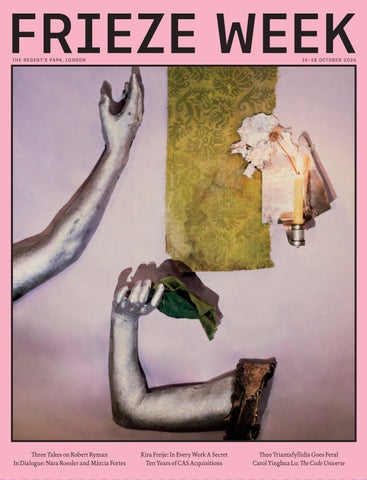
On the Cover Works by Kira Freije in her studio, London, 2026. Arranged for photography by the artist. Courtesy: the artist and The Approach, London. Photography: Chieska Fortune Smith
18 Vital Signs 38 Georgia on Curator Carol My Mind Art in the Yinghua Lu deciphers Caucasus The Code Universe 40 Collector Profile 20 It’s About Alexa Waley-Cohen Passion Marcía Fortes and Nara 46 Bloomberg Roesler discuss the Connects Brazilian art scene 48 KAMS 24 Stay Feral Frieze Artist 50 Three Versions Award winner Theo of Robert Ryman The Triantafyllidis minimalist’s legacy 27 Deutsche Bank
52 Five to See
28 Artist-to-Artist Firelei Báez nominates Eilen Itzel do Espírito Santo
54 Pop a Cork Frieze’s London gallery turns five
32 What to Eat 34 Lasting Impression Ten years of the CAS Collection Fund
Global lead partner
03_FWL26_CONTENTS_06.indd 15
All listings correct at time of printing.
28
Frieze Week is printed in St Albans by The Manson Group and published by Frieze Publishing Ltd © 2026
40
56 Devlin the Details A milestone year for the designer
56
58 Coming Up 66 Needing the Secret Cover artist Kira Freije
Global partners
The views expressed in Frieze Week are not necessarily those of the publishers. Unauthorized reproduction of any material is strictly prohibited.
Official partner of Focus
Official partner of Artist-to-Artist
Frieze London partners
Global media partner
29/09/2026 22:32
FR IE ZE WE E K LOND ON
14–18 OCTO B E R 2 02 6
17
FAIR GALLERIES
Since 2024, all galleries have had the opportunity to be located in the entrance stands, so long as their presentations ‘catch the eye’ and ‘twist the brain’. Naomi Rea reports
ON THE FRONT LINE
Forget Mayfair. For one week each October, the entrance stands at Frieze become London’s most desirable real estate. The artists who show in these in-demand spots get to greet top collectors and curators as they enter the fair, excited, fresh and ready to discover. Traditionally allocated to bigger and more established galleries, in 2024, these stands were turned over to ambitious solo presentations by younger galleries in a shake-up to the fair’s floor plan by Frieze director Eva Langret. Last
04_FWL26_ENTRANCE_STAND_03.indd 17
year, the approach was refined further, and fair organizers opened up applications for two of the main entrance stands to all exhibitors, aiming to ‘give every gallery an opportunity to be located in one of these prime spots’, as Langret explained. All galleries applying for a small or medium-sized stand with a solo presentation are considered, and a selection committee of esteemed gallerists and curators agrees on their favourites. ‘The decision
comes down purely to artistic merit and curatorial excellence,’ said Langret, ‘not a gallery’s profile or track record.’ This year, the process has put artists Márcia Falcão and Agata Ingarden on the front line. Falcão is showing with São Paulo- and Rio de Janeiro-based gallery Fortes d’Aloia & Gabriel, which celebrates its 25th birthday this year, while Ingarden’s work will be on display with the 15-year-old Berthold Pott gallery from Cologne. Frieze committee member Cédric Fauq, curator of contemporary international art at Moderna Museet, Stockholm, said the selection reflects the fair’s international scope and showcases artists who have been gathering steam at major institutions and biennials. ‘It’s important that Frieze echoes what’s happening in the broader contemporary art landscape beyond the market,’ Fauq explained in our recent email exchange. For entrance stand hopefuls, the curator advises that, in addition to proposals being timely, they’re after pieces that ‘challenge the eye’ and ‘twist the brain’. He added, ‘Ultimately, it’s about leaving a mark.’ Soft Opening, an eight-year-old London gallery known for its adventurous programming, won one of these coveted slots in 2025. The committee chose its moving solo presentation of BritishNigerian artist Ebun Sodipo, which included bronze sculptures fusing casts of the hands of women in the Black trans community. For the gallery’s founder Antonia Marsh, the impact of this positioning was ‘very tangible’. With Frieze being its first fair of the autumn, ‘it gave us the strong start we needed to carry us through the rest of the season’, she said. In 2026, fresh from her inclusion in the prestigious Bienal de São Paulo, the Rio de Janeiro-based Falcão is showing earthy paintings from a new series that centres marginalized bodies fighting to reclaim space. The title of the presentation, ‘Camuflada’, alludes to ‘dazzle’ camouflage – high-contrast patterns originally painted on WWI British warships to confuse the enemy about their speed and direction. Falcão’s brushwork renders her protagonists’ body parts at once
visible and inscrutable, offering a visceral answer to the question: ‘How do we stay standing without this visibility making us easy targets?’ German gallerist Berthold Pott is bringing Polish artist Agata Ingarden to Frieze London at a pivotal moment in her career – the 32 year old has had solo shows at five European institutions in the past two years. Her entrance stand pairs enchanting sculptural works and hanging light installations from two series. In ‘Hours of the Dog’ (2021–ongoing), glowing miniature dwellings made from oyster shells and pieces of concrete float over dangling window blinds. These are shown alongside a new body of eerie architectural sculptures, ‘Hermits’ (2025–26), which incorporate rubble from a demolished residential complex in Athens. Hermit crabs took shelter in these porous fragments after they were swept into the sea, leaving marks of nature’s adaptability amid human destruction. Pott said he sees the works as speaking to a yearning for stability within precarious surroundings. ‘They reflect on the transformation of contemporary capital cities,’ he explained, ‘and the ways rapid urban change can erode established notions of home and belonging.’ For Pott, Frieze’s decision to platform a younger artist shown by a mid-sized gallery in such a prominent location at an art fair has been heartening, and evidence that artistic quality remains paramount. ‘Some of the most compelling artistic positions today are not defined by scale or market power,’ he said, ‘but by the strength of their ideas and the conviction with which they are presented.’
Left Agata Ingarden, Wall Hermit 1, 2026. Courtesy: the artist, Berthold Pott, Cologne and Museum Collection Lambert, Avignon. Photo: Aurélien Mole
At the entrance stands of Frieze London 2026, Fortes d’Aloia & Gabriel presents Márcia Falcão (Stand A15) and Bethold Pott presents Agata Ingarden (A16). Naomi Rea is an arts and culture journalist who has contributed to publications including The Financial Times, The Guardian and TIME. She is the former editor-in-chief of Artnet News. She lives in London, UK.
29/09/2026 22:33
FR I E ZE WE E K LOND ON
14–18 OCTOBE R 2 0 2 6
18
CURATED SECTIONS
Ahead of co-curating the 2027 Istanbul Biennial, Carol Yinghua Lu’s section at Frieze London explores the impact of semiotics on global art practice. In conversation with Victor Wang, she explains The Code Universe
VITAL SIGNS VICTOR WANG When we spoke in Sydney recently, we discussed the 8th Yokohama Triennale, which you described as beginning from a sense of hopelessness. Most curators would avoid that word, but you described hopelessness not as surrender, but as a necessary condition for imagining something new. Could you talk a little more about what you meant? CAROL YINGHUA LU Over the last two decades, I have collaborated with Liu Ding, and in the middle of the COVID-19 pandemic we were invited to curate the triennial in Yokohama. It was a time when many of us experienced fear, frustration, isolation and powerlessness. The pandemic exposed and worsened the fragility of human existence, but also the limitations of 20th-century political and social institutions. These changes and disruptions had a severe impact and urged us to think more actively about our individual relationships with society and politics. Pivotal to the project was the life and early work of [Chinese writer] Lu Xun; it resonated for us with the challenges of our time. He wrote Wild Grass between 1924 and 1926, during a turbulent period in China’s history. Alongside the uncertainty of the moment, he faced dramatic changes in his personal life, and he established desperation, not hope, as his way of working and thinking. While he fully accepted that there would be no more hope or ambition, only darkness, he nonetheless still sought an exit from this predicament. His approach of beginning with despair instead of blind optimism can serve as a great inspiration for us today, allowing us to maintain confidence in our own agency even in challenging situations. In the triennial, we revisited historical moments, events, figures and trends of thought from throughout the 20th century, through the works of participating artists, and juxtaposed them with works that address the present, thereby blurring the boundaries of time and enabling the historical and the present to mirror each other. VW I also remember you describing museums, artworks and biennials as potentially becoming ‘forms without a purpose’. Having both spent years leading institutions in Beijing, that phrase immediately resonated with me. What did you mean by it?
05_FWL26_CURATED_SECTION_03.indd 18
CYL ‘Forms without a purpose’ can mean many things, such as artistic forms, thoughts or institutions that just perpetuate themselves without the intellectual impetus that originally gave birth to them. I have seen that a bureaucratic and utilitarian way of thinking and operating permeates many parts of the art world; this can lead to mistaking the means as the end. In China, where I mostly work, some art institutions are driven by the ego and self-promotion of the founder, the financial survival of the institution itself and so on – anything other than art. By losing sight of the initial motivation over the course of time, institutions can lose the intensity and relevance of their being. The problem is not the form itself, but this loss of purpose; as such, they have the potential to be reinvented with new-found purpose and energy. VW One thing I’ve always admired about your work is that you’re constantly complicating how we understand Chinese contemporary art. Your exhi bition at Buxton Contemporary in Australia, ‘Poetry goes no further than language’, does exactly that. Instead of beginning in the 1990s, as many international accounts still do, you go back to the 1980s, to a moment of conceptual experimentation, linguistic inquiry and intellectual openness. Why is it important to revisit that par ticular period now? CYL The lack of a nuanced historical understanding of contemporary art in China is one of the challenges we all face as practitioners: how to properly access our own artistic processes and legacies, as well as contemporary practices. Noting the discrepancy between the existing perception of contemporary art in China and its actual historical realities has propelled Liu Ding and I to explore the connection between artistic practices and their conceptual impetus, as opposed to an oversimplified understanding of artistic evolution from a stylistic point of view. We have identified conceptualism as a critical undercurrent that propelled the direction of contemporary Chinese art from the late 1980s to the 1990s, including the emergence of the New Measurement Group, Qian Weikang and others. VW The section you are curating at this year’s Frieze London is titled ‘The Code Universe’. It’s an intriguing title. What exactly is the ‘code’? Is it
language? Mass media? Technology? Capitalism? Or is it something even broader? CYL ‘The Code Universe’ grows out of our consistent interests in both art history and contemporary global art. The rise of semiotics, which views works of art as a system of signs, radically transformed the ways in which art was created, interpreted and critiqued in the 20th century. It broke free from the limitations of traditional art, which focused on aesthetics and technique, and shifted the focus of art-making and the analysis of art toward the generation and interpretation of meaning. Semiotics draws attention to the fact that artistic forms such as lines, colours and composition are themselves a system of symbolic codes, each carrying specific social and cultural connotations. It spread and evolved alongside the global revolutions of the 20th century, and profoundly shaped the artistic landscape across the world. The project at Frieze London brings together eight artists from different generations and diverse cultural and political contexts. Together, they constitute a sample of artistic expressions embedded in this semiotic turn after the 1968 revolution of world culture, and represent Japan in the 1970s, Indonesia in the 1990s through to current practices in Ukraine, USA, Spain, Bosnia, Indonesia and China. This cross-cultural study considers the continuous global reverberations of this fundamental shift in art, especially manifested through the encounter between pop art and conceptual art in the late 1950s and 1960s. VW When I looked at the artists you’ve selected, I noticed they all seem deeply suspicious of images. Rather than producing more images, they’re constantly asking how images circulate, how meaning is produced and how value gets constructed. Was that an important thread for you? CYL Ultimately, art should go beyond stylistic canons and be considered as an overall practice – an undertaking in humanism that combines artistic and intellectual creativity. The world has ceased to be a truth awaiting discovery and instead become a system of appearances that is continuously encrypting and being decrypted. Art has played an active role in recoding the human world into a readable visual grammar; at the same time, it actively questions and
exposes the system of highly effective encryption that controls our understanding of the world. As such, it has the possibility to foster a critical appreciation for the multiplicity of meanings in our world of codes. VW We’ve talked a lot about systems and structures. But I have a feeling that what really drives your work isn’t systems at all. CYL There is no system or structure without people, so, no; systems and structures are the least of my concern. I am always keen to explore the agency of individuals and the agency of thinking in relation to their relevant contexts. The extremely turbulent and challenging political and social conditions of the moment require us to re-access many approaches and ideas that emerged in the 20th century. VW You’re now turning your attention to the 2027 Istanbul Biennial. What are you beginning to imagine there? CYL As one of the most forward-looking biennial platforms, the unique location of the city as well as all the exceptional past editions have provided us with the impetus to experiment with new exhibition models. Our ambition is to compose a complex novel with innovative narrative structures and profound intellectual connotations. Right now, we are thinking of unfolding many mini-stories simultaneously throughout the biennial, across vast spans of time and geography, with the goal of detecting and capturing the multiple parallel movements, commotions and realities to be found in the air right now. It’s a bit like setting up a great many spider nets in a dense jungle.
Right Shinro Ohtake, Retina/ Yellow RAM 2, 2025. Courtesy: the artist, Take Ninagawa, Tokyo, and greengrassi, London
At Frieze London 2026, The Code Universe, curated by Carol Yinghua Lu, features acb Gallery (Stand S07), greengrassi / Take Ninagawa (S01), Nonfrasa (S06), Spurs Gallery (S04), TINA (S02), Trautwein Herleth (S03), Valentine (S08) and Voloshyn Gallery (S05). The 19th Istanbul Biennial will take place 18 September – 14 November 2027. Carol Yinghua Lu is a curator, writer and director of Inside-Out Art Museum, Beijing. She lives in Beijing, China. Victor Wang is executive director of Artspace on Gadigal Country/Sydney and is adjunct curator at the Mori Art Museum, Tokyo. He lives in Sydney, Australia.
29/09/2026 22:34
05_FWL26_CURATED_SECTION_03.indd 19
29/09/2026 22:34
FR I E ZE WE E K LOND ON
14–18 OCTOBE R 2 0 2 6
20
FAIR GALLERIES
50 years since Nara Roesler staged her first exhibition in Recife, and 25 years since Márcia Fortes founded her gallery in São Paulo, the two gallerists discuss the evolution of the Brazilian art market, having courage and the need for collaboration
IT’S ABOUT PASSION JACOPO CRIVELLI VISCONTI Nara, you opened your first gallery in Recife in 1976, in a context that I imagine was very different from the São Paulo of today; Márcia, you took over Marcantonio Vilaca’s project in the early 2000s to keep it from folding. Your journeys have been very different, but I am curious to hear about the moment for both of you when you decided you really wanted to open a gallery. NARA ROESLER In my case, I met an artist from Pernam buco, José Cláudio; I started working with him, fell in love with his work and his way of thinking. I started display ing his work in my own home, and then I decided to take it to the next level: I rented a space and made it a professional endeavour. I enjoy bridging the gap between the artist and the public, it’s what I am good at. I put on very serious exhibitions and, even back then, I tried to bring the different parts of Brazil closer together. I represented Siron [Franco], Iberê Camargo. There was no market, none at all, and especially not for contemporary
06_FWL26_NARA_ROESLER_&_MARCIA_FORTES_10.indd 20
art. But I stayed there for ten years. I invited critics from São Paulo to teach courses on contemporary art at the gallery. So, when I came to live in São Paulo, I knew absolutely nothing about the art market here, but I already had contact with artists, several curators and some journalists. JCV How about you, Márcia? MÁRCIA FORTES Well, it certainly wasn’t the case that I woke up one day and decided I wanted to be a gallerist. I’d been living in New York for 12 years, working as a freelance writer, translator and curator, and enjoying it. But these are life’s twists and turns. I had a close personal relationship with Marcantônio Vilaça in the 1990s. When he came to New York, I’d take him to emerging artists’ studios and introduce him to friends of mine who ran young galleries. I was also friends with many of the artists he worked with at his gallery in São Paulo, Camargo Vilaça; I wrote texts for their publications, reviewed their shows for magazines like frieze and others. Ernesto Neto has been my friend since I was 14 years old; Beatriz Milhazes
would sublet my apartment in New York whenever she came; I had interviewed Jac Leiner for Jornal do Brasil when I was a correspondent for the paper, and so on. So, when Marcantônio suddenly died in January 2000, aged 37, I felt a respon sibility toward his project and his artists. NR They were really left on their own. You saved them. MF Karla Camargo, Marcantônio’s partner, really pushed me. It was a deci sion driven very much by these emotional ties and a sense of professional challenge. These artists were just starting to be recog nized and needed that work to continue. Camargo Vilaça had only been going seven years and Marcantônio had a clear ambition to bring Brazilian art to the international world – a Herculean task. NR He was like a Harlem Globetrotters player. MF He would travel with CDs by Maria Bethânia and Brazilian roll cakes. There are so many great stories, like the time he saw a prominent American gallerist sitting in front of him on a flight to the Venice Biennale; he walked over to her, introduced himself and gave her
a CD by Bethânia. To this day, that gallery doesn’t represent a single Brazilian artist! Anyway, it was a huge challenge. I had never worked in an art gallery before; I hadn’t actually lived in Brazil for 12 years; and, being from Rio, I barely knew São Paulo. Alessandra joined around the same time, since she was married to Marcantônio’s brother at the time. So, in 2001, Alessandra and I founded Fortes Vilaça, which is now celebrating its 25th anniversary. JCV I think it’s wonderful that both of you see the beginning of your journeys as being about standing by artists and help ing them. NR Exactly. It’s about passion and taking care of them, about creating a platform so they can thrive. MF I think Nara was incredibly brave to open a space in New York. NR Well, we’d been attending art fairs for many, many years, including in Asia, and we felt the need to establish a base in New York so we could take advantage of all the contacts we had made at these fairs. We’d already built up a roster of artists who were well known abroad.
Opposite page, clockwise from top left Nara Roesler at home, 2016. Photo: Gui Gomes/Folhapress. Courtesy: Folha de S.Paulo Márcia Fortes, 2025. Photo: Bob Wolfenson Lynda Benglis, Erika Verzutti and Jesse Wine, ‘Opening Night’, installation view at Carpintaria, Rio de Janeiro, 2018. Photo: Eduardo Ortega. Courtesy: Fortes D’Aloia & Gabriel, São Paulo and Rio de Janeiro
29/09/2026 22:35
FR IE ZE WE E K LOND ON
14–18 OCTO B E R 2 02 6
21
FAIR GALLERIES
06_FWL26_NARA_ROESLER_&_MARCIA_FORTES_10.indd 21
29/09/2026 22:35
FR I E ZE WE E K LOND ON
14–18 OCTOBE R 2 0 2 6
22
FAIR GALLERIES
It started as an office, but the artists all wanted to show there. MF We, on the other hand, invest in our Brazilian identity. We want to be here to be close to the artists and in the studios. I’d say 80 percent of our artists are Brazilian. NR It’s the same for us, but we are trying to open up this market for them. We don’t work with any artists from New York, for example; that would be much easier. So, we take care of the artists here; the entire operation is managed from Brazil, and New York is the spearhead. JCV Haven’t you ever thought about moving, Márcia? MF That’s not our business model. Our motto is to be a Brazilian gallery per forming globally. But that global presence comes through our participation in art fairs and occasional popups. It’s a really demanding job, isn’t it, Nara? You have to be on a plane at least once a month, just to attend art fairs or to accompany artists to an institutional opening. NR It’s true; it’s crazy. I was looking at the numbers and saw that our artists made 132 appearances at institutional events this semester. Can you believe it?
06_FWL26_NARA_ROESLER_&_MARCIA_FORTES_10.indd 22
We couldn’t be at all of them and when we weren’t there, they got upset. MF These past years, it has felt as if the only valid principle in the art gallery circuit is expansion. That’s maybe starting to change now. I don’t even want to think about the overheads involved in a megagallery. I’m not saying I’m against it; it’s just not our model. I don’t want the pressure of overheads to then put pres sure on the artists to produce more work for collectors. I want them to create their work at the pace the work demands. NR We decided to open a space in Rio with a programme that’s totally different from São Paulo’s. The city kind of shapes what will be shown. MF I agree. Rio for us is like a ventila tion project: you can let your own programme breathe. NR Be more experimental … MF We can invite artists who aren’t part of our programme. I’m proud of the dialogues we’ve put together in Rio: Iran do Espírito Santo and Fred Sandback; Adriana Varejão and Paula Rego; Lynda Benglis, Erika Verzutti and Jesse Wine. NR Like the project we did together
pairing Julio Le Parc with OSGEMEOS. It was a very special dialogue between artists from very different backgrounds. JCV Marcia, you have talked about not wanting to expand. How do you see the way forward in the current climate? MF Fundamental to me is that we don’t increase the value of work based on demand. There might be a queue of people wanting to buy, but that’s not enough of a reason to raise prices. Is the artist going to participate in the São Paulo or Venice Biennials? Then we can raise the value a little. Were they invited to exhibit at the Pompidou? Then we can increase prices a little. Building the artists’ CV is an asset. Also, collaboration is key; my friend Tanya Bonakdar has corepresented Ernesto Neto and Rivane Neuenschwan der with us since we started; we have shared Beatriz Milhazes and Marina Rheingantz with White Cube for a good many years; Janaina Tschäpe is also with Sean Kelly and Max Hetzler; Lucia Laguna with Sadie Coles; and so on. Partnerships aren’t easy, not everyone is interested either, but that’s how we see the way forward.
NR I have to admit, 50 years ago, I was afraid of these partnerships. I thought we might get swallowed up by a bigger gallery. That was a totally wrong way of thinking. Now we’re starting to collabo rate more. MF As you mentioned earlier, Jacopo, today’s landscape is very different from what it was 30 or 40 years ago. The Brazil ian scene was still in its infancy back then, and it was every man for himself. NR Now we have to stay closer. I think the Brazilian market still has a lot of room to grow. Let’s meet up, Márcia; we need to join forces!
Above ‘Julio Le Parc & Osgemeos’, installation view at Carpintaria, 2019. Courtesy: the artists; Nara Roesler, São Paolo, Rio de Janeiro, New York; Fortes D’Aloia & Gabriel, São Paulo and Rio de Janeiro
At Frieze London, Fortes D’Aloia & Gabriel presents new works by Márcia Falcão (Stand A15); Nara Roesler presents works by Brígida Baltar, Carlos Bunga, Jonathas de Andrade, Julio Le Parc, Asuka Anastacia Ogawa and Amélia Toledo (D10). Other Brazilian galleries at Frieze London are Casa Triângulo (D06), Galeria Jaqueline Martins (AA7) and Simões de Assis (A04); and at Frieze Masters, Danielian (G10) and Galeria MaPa (S20). Jacopo Crivelli Visconti is an independent critic and curator. He lives in São Paulo, Brazil.
29/09/2026 22:35
07_FWL26_FRIEZE_ARTIST_AWARD_03.indd 24
29/09/2026 22:37
FR IE ZE WE E K LOND ON
14–18 OCTO B E R 2 0 2 6
25
FRIEZE LONDON ARTIST AWARD
In his Frieze London Artist Award commission, Theo Triantafyllidis brings together advanced technology, gameplay and a giant spider sculpture to explore social behaviour in anarchic landscapes. Portrait by Marco Agüello
STAY FERAL What’s a myth without a spider? The creature appears in numerous tales across history and cultures. In West Africa and Caribbean folklore, Anansi – a spider, or spider-like character – is a cunning trickster whose power lies in his ability to concoct stories. In ancient Greek mythology, Arachne is a talented weaver who is turned into a spider by the goddess Athena. For Greek artist and 2026 Frieze London Artist Award winner Theo Triantafyllidis, the spider symbolizes strangeness, discomfort and fear, but also intelligence and tenderness. These themes also underpin Triantafyllidis’s wider practice. Over the last decade, he has used fantasy, video games, live simulations, performances and installations to create what he recently described to me as ‘volatile arrangements presented as darkly playful procedural worlds’. Inspired by Louise Bourgeois and Anna Uddenberg, as well as the worldbuilding of sci-fi writer Octavia Butler, Triantafyllidis’s works seek to provoke moments of intimacy, surrender, horror and dread. His interactive commission at this year’s Frieze London, titled Feral Metaverse (Spider) (2026), takes the shape of a looming, six-legged arachnid; but, instead of creating a sense of threat or repulsion, the spider is tactile and invites visitors to climb on to it as they might a horse. However, since other visitors can also climb on to it at the same time, they are forced into close proximity with one another, prompting both awkwardness and intimacy. Once seated on a spider leg, they take part in a game in which the figure of the spider is now an antagonist that employs various tactics to prevent players from collaborating to reach a shared goal. The idea for Feral Metaverse originated in 2023 for Triantafyllidis as an imagined scenario to test moral, behavioural and ethical boundaries in relation to internet communities. From that
07_FWL26_FRIEZE_ARTIST_AWARD_03.indd 25
starting point, it became an inquiry into shared digital spaces and metaverses. What might these look like if they were structured around cooperation, vulnerability and caring? There are mounting questions surrounding the ethics of metaverses as unregulated environments that can give free rein to the worst aspects of human conduct. There have been reports of sexual assault and hate speech in immersive virtual-reality technologies. In one case, reported by the BBC in January 2024, a young girl’s digital avatar is said to have been sexually attacked by a gang of men. Triantafyllidis’s unstable environments employ the potential for such violence and precarity as fundamental materials. The goal is to provide a place for visitors to explore the deepest and darkest parts of themselves in unfamiliar surroundings: not so much a sadistic playground as a social experiment. Visceral feelings and ideas relating to sexuality, isolation and violent impulses are merged with technological systems. A ‘mismatch’ is how Triantafyllidis describes it, but this juxtaposition is led by a sense of curiosity. In Feral Metaverse (Spider), players are assigned an avatar that might be entirely naked, wearing an assemblage of torn clothing or, in one case, a bomber jacket and nothing else. On assuming an avatar, players are encouraged to act in unconstrained ways, such as spasmodic crawling movements that might suggest the throes of an exorcism. The spider tries to thwart the participants’ progress as they crawl on to each other’s shoulders in a towering human ladder that rocks and sways with the weight of the bodies. Frieze’s creative producer Sherie Sitauze, who has worked closely with Triantafyllidis on the project, says that her experience of playing the game meant ‘letting go’ and surrendering to the process. ‘It was both exciting and
frustrating,’ she says. ‘Every time our human-body ladder came close to the top, the spider would find a way to knock us down. The experience felt a bit like an oxymoron: we were working towards a shared goal by building the ladder, but doing the same thing over and over felt death-drive-adjacent. I wonder how it would have felt if we’d been able to reach the top.’ The sharing of an experience that is at the heart of Feral Metaverse (Spider) is also embedded in its construction. Triantafyllidis worked with an extensive team of collaborators who handled the metalwork, clay-sculpting, foam-casting and textile layers of the physical spider. The artist also uses generative outputs in his creations, though he considers AI a material rather than a tool: ‘I am trying to understand what the material wants to do,’ he says, ‘what it resists, and how to give it form without pretending it is neutral.’ He feeds initial pencil sketches into prompts, which generate photorealistic renderings, which in turn become handsculpted clay prototypes before being fed back into digital generative systems. Eliciting emotional, moral and even hormonal responses is central to Triantafyllidis’s work. His weird, derelict and anarchic landscapes result in unpredictable and organic responses that act as disruptors to the highly produced (and often highly competitive) metaverses people typically frequent. The sensitivities and stimulations one experiences when encountering them are as much part of the work as its materials. An early version of Feral Metaverse was shown in the 2023 exhibition ‘Group Hug’ by Onassis ONX and Water Street Projects in New York, where it was presented as an eight-player gaming rig based on a full-size medieval catapult. The work interrogates the ways in which people socially engage with one another in online gaming spaces such as Fortnite and Roblox, with Triantafyllidis
leaning into a sense of absurdity and the uncanny to create hybrid realities that inspired players to communicate and cooperate to discover and survive unfamiliar worlds. Triantafyllidis’s art is driven by speculation and a need to understand how disturbing and unpredictable environments and situations influence decision-making. By blending the digital with material realities through installation and gaming, he illuminates the agency – and perhaps the ethical gap – between programmed responses, primal instincts and conscious choices. In early works such as the 2017 animation Prometheus, he explores these ideas more overtly: here an infinity-shaped pretzel is doomed to eternal punishment by a bird, all of which is caught on a handheld camera. Triantafyllidis asks: who is responsible for the endless torture? The bird, the human or the computer? While Feral Metaverse (Spider) takes a more subtle approach to self-reflection, it hangs on similar themes of action, accountability and absurdity. ‘I’m fascinated by the tension between our domesticated, hyper-connected lives,’ Triantafyllidis says, ‘and the primal instincts that still drive so much of our behaviour.’
Left Theo Triantafyllidis in his Athens studio with Feral Metaverse (Spider), 2026. Photo: Marco Argüello. Courtesy: the artist and The Breeder, Athens
Theo Triantafyllidis is represented by The Breeder (Stand B29). His Frieze London Artist Award commission, Feral Metaverse (Spider) (2026), is on display at Frieze London (P1). The Frieze London Artist Award 2026 is co-commissioned and co-produced with Forma in collaboration with Google Arts & Culture. For 2026, the award invited an artist to explore advanced technologies, including AI, as a tool and collaborator in the development of the artwork. Kadish Morris is a critic at The Observer. She also writes about art and books for publications including The New York Times, the Guardian and ArtReview. She lives in London, UK.
29/09/2026 22:37
Wealth Management
Supporting you with a shared passion for art. Whether itÕ s helping you unlock the value of your collection or planning for its future, our expertise has been shaped by a shared passion for art spanning over four decades. Find out how our dedicated art lending team can help you release liquidity without selling the work you love and support your collecting ambitions.
With deep dedication.
wealth.db.com In Europe, Middle East and Africa as well as in Asia Pacific this material may be considered marketing material, but this is not the case in the U.S. The value of an investment can fall as well as rise and you might not get back the amount originally invested. The services described in this advertisement are provided by Deutsche Bank AG or by its subsidiaries and/or affiliates in accordance with appropriate local legislation and regulation. Deutsche Bank AG is subject to comprehensive supervision by the European Central Bank (“ECB”), by Germany’s Federal Financial Supervisory Authority (BaFin) and by Germany’s central bank (“Deutsche Bundesbank”). Brokerage services in the United States are offered through Deutsche Bank Securities Inc., a broker-dealer and registered investment adviser, which conducts investment banking and securities activities in the United States. Deutsche Bank Securities Inc. is a member of FINRA, NYSE and SIPC. Lending and banking services in the United States are offered through Deutsche Bank Trust Company Americas, member FDIC, and other members of the Deutsche Bank Group. The products, services, information and/or materials referred to within this advertisement may not be available for residents of certain jurisdictions. © 2026 Deutsche Bank AG and/or its subsidiaries. All rights reserved. This advertisement may not be used, reproduced, copied or modified without the written consent of Deutsche Bank AG. 057631 020926
FR IE ZE WE E K LOND ON
14–18 OCTO B E R 2 02 6
27
FRIEZE PARTNER: DEUTSCHE BANK
Holding Pattern In the Deutsche Bank lounge, artist Studio Lenca reflects on the precarity of undocumented migration
There is a magic in the work of Studio Lenca. When the London- and Margatebased artist first told me about his plan to suspend 30 huge volcanic boulders in hammocks from the ceiling of the Deutsche Bank lounge at Frieze London, I immediately envisioned a VIP or gallery director wedged beneath a giant rock, legs sticking out, Wizard of Oz-style. Themes of displacement, migration, violence and the precariousness of belonging are fundamental to Studio Lenca’s work; they are approached through
08_FWL26_FRIEZE_DB_SPON_CON_03.indd 27
play, colour and an irrepressible sense of joy. The weight is always there, but so too is the possibility of making something from it. Across the work, histories are reassembled, communities formed and new possibilities for belonging imagined. World-building becomes both playful and necessary. The Frieze commission follows a run of international projects, including a solo exhibition at LagoAlgo in Mexico City and presentations at MAC Panamá and Museo Nacional Centro de Arte
Reina Sofía, Madrid, Spain. Yet the scale of Ojalá (2026), occupying the Deutsche Bank lounge at Frieze London, marks a significant shift. Ojalá is a term in Spanish that means ‘God willing’, carrying something of hope, resignation, faith and uncertainty all at once. Related to the Arabic inshallah, the word acknowledges that what happens next may be beyond our control. The hammocks in the installation are structures for bodies at rest. Fibres are woven together to create a surface that cradles. In Ojalá, Studio Lenca replaces that body with something cold, hard and potentially catastrophic. The volcanic boulders are scanned replicas of rocks from the artist’s home country, El Salvador: pieces of one landscape transported to another, uprooted, suspended and stateless. The installation feels like a freezeframe. Something is about to happen, but disaster has been paused and put on hold. As a young child, Studio Lenca (who is also known as José Campos), fled civil war and travelled overland with his mother to the United States, where he grew up without documents in California. Together they cleaned the homes of wealthy San Franciscans. Officially they were not there, and yet their labour remained silently evidenced in the caredfor spaces they left behind. This relationship between presence and absence, holding and being held, reappears across his work. His ‘Historiante’ paintings (2020–ongoing), presented in the lounges at both London and Masters, draw upon the dancers of El Salvador bearing the same name, who re-enact tales of colonization. They carry history across generations, but for Studio Lenca these become entangled with his own: personal memory, anecdote and documented/undocumented histories that blur together. The artist’s distance from El Salvador has produced new ways of remembering; histories spill beyond the frame, refusing to be resolved. In the ‘Monuments’ series (2024– ongoing), immigration paperwork and bureaucratic waste are shredded, pulped
and reformed by the artist’s hand, or those of communities he collaborates with. Shaped into vessels resembling imagined historical objects or relics, there is something volcanic in this process, too. The original has been ruptured but not erased. Its material survives in another state. The vessel should be capable of holding something, yet it is porous and fragile. An effort has been made to contain, but it would struggle to hold anything at all. The contradiction feels important. Across Studio Lenca’s practice, histories are recovered in fragments and reassembled from what survives. In Ojalá, individual threads, fragile on their own, become capable through their interdependence and the structure they make together of supporting an extraordinary weight. This coming together echoes an integral strand of the artist’s wider practice: close collaboration with communities, including his longstanding work with Kent Refugee Action Network. Ojalá, like much of Studio Lenca’s practice, creates its own kind of holding pattern. Having known the artist and his family for 20 years, I can imagine his mother looking up at one of these improbable rocks being hoisted into place and giving me a wry smile: ‘Ojalá it holds, Oliver. Ojalá.’ Perhaps that is the condition running through Studio Lenca’s work: the need to hold, alongside the knowledge that the structures holding us can fail. History and belonging are assembled and maintained over time. And if they fail, ojalá. Another way can be found.
Left Studio Lenca, Ojalá, 2026. Courtesy: the artist and Carl Freedman Gallery, Margate
Studio Lenca is represented by Carl Freedman Gallery (Stand A28). To watch a video interview with Studio Lenca about the Deutsche Bank project and his practice, visit: frieze.com. Oliver Herbert is a curator, educator and writer. He lives in London, UK.
29/09/2026 22:37
FR I E ZE WE E K LOND ON
09_FWL26_TIFFANY_SPON_CON_03.indd 28
14–18 OCTOBE R 2 0 2 6
28
29/09/2026 22:38
FR IE ZE WE E K LOND ON
14–18 OCTO B E R 2 0 2 6
29
FRIEZE PARTNER: TIFFANY & CO.
Supported by Tiffany & Co., Artist-to-Artist once again invites influential artists to nominate their peers to present at the fair. Billie Muraben surveys this year’s selection, including Dominican-American artist Eilen Itzel do Espírito Santo, nominated by Firelei Baez. Portrait by Adama Jalloh
SHARING THE ZEITGEIST ‘Artists are the ones who tend to have the most interesting things to say about other artists’ work,’ says Eva Langret, director of Frieze London, ‘[theirs are] some of the most perceptive and honest conversations about art I’ve heard.’ For Langret, it seemed only natural to bring this spirit of exchange to Frieze London with Artist-to-Artist. Now in its fourth edition, the section focuses on championing emerging voices, with established artists nominating practitioners who they believe to be making great work which they would like to see in a solo presentation. ‘Artist-to-Artist has also helped us reconsider how we think about selection more broadly,’ she says. ‘It’s an organic way to bring in diverse voices when deciding who is visible at an art fair.’ For the 2026 edition, Tiffany & Co. returns as brand partner for Artist-toArtist. The relationship is grounded in the House’s long-established support for the arts. Indeed, Tiffany & Co. has recognized the importance of artists in
09_FWL26_TIFFANY_SPON_CON_03.indd 29
shaping its vision right from the very start. On founding the company in 1837, Charles Lewis Tiffany saw his role as that of a patron, engaging practitioners in jewellery design, engraving and window installations. In the latter half of the 20th century, designer and window dresser Gene Moore dreamed up the creative window displays for which the house is renowned, often working with up-andcoming contemporary artists. Robert Rauschenberg and Jasper Johns collaborated on a series of custom displays in the late 1950s, under the commercial pseudonym of Matson Jones, creating surreal still-life compositions and miniature landscapes with leaves, flowers, fruit, soil and sand. Christopher Young, vice president and creative director of creative visual merchandising and The Tiffany Archives, says: ‘Moore believed Tiffany & Co.’s role was not to showcase established names, but to identify emerging talent – an ethos we continue to uphold today.’ This embedded desire to give artists
the space to create and show work in a prominent setting is encapsulated today through Tiffany & Co.’s support of earlycareer artists at Frieze London. Through Artist-to-Artist, emerging practitioners are able to stage solo presentations during prime time. It also offers an opportunity to build communities and further personal development, foregrounding the importance of connection between peers as well as with established figures. This year, the section presentations include a series of works that interrogate how human societies relate to ongoing planetary cycles by Jota Mombaça; abstract sculptural pieces that reimagine architecture and position organic systems as models for building by Unathi Mkonto; a series of drawings reflecting on Indigenous histories, material knowledge and processes of image-making by Jorge González Santos; a body of work reflecting on community and gratitude as an act of resistance by Caroline Monnet; a series of pieces
on dreams and the relationship between the body and its surrounding infrastructure by Eusung Lee; and paintings that evoke the ephemeral nature of memory, real and imagined moments, and the human experience by Paul Robas. The nominating artists come to the work of those they select through various forms of connection, some professional, some more personal. Speaking to Eilen Itzel do Espírito Santo about her nomination by Firelei Báez she recalls their first meeting at the latter’s exhibition opening at South London Gallery: ‘I thought: “She’ll probably be there and, even if she’s not, I want to see her work.”’ Itzel do Espírito Santo met Báez, her sister and her nephew, ‘and we really connected’, she says. ‘We spoke about life – she’s from the same country as my family – she was asking me about living in London, and we were talking about her exhibition.’ During Itzel do Espírito Santo’s degree show at the Slade School of Art, a visiting artist brought up Báez’s practice while
Opposite Eilen Itzel do Espírito Santo at Studio Voltaire, London, 2026. Jewellery: Tiffany Hardware, Tiffany & Co. Photo: Adama Jalloh
29/09/2026 22:38
FR I E ZE WE E K LOND ON
14–18 OCTOBE R 2 0 2 6
30
FRIEZE PARTNER: TIFFANY & CO.
they were chatting, unaware of Itzel do Espírito Santo’s high regard for the Dominican artist, or her sense of their common ground. Both artists work across various mediums, drawing upon Afrodiasporic histories; they reflect on community, ancestry and colonialism, challenging historical tropes to reimagine new possibilities for the self and society. Reflecting on Báez’s decision to put her forward for Artist-to-Artist, Itzel do Espírito Santo says: ‘It made me feel good, because I felt like we connected, so to hear the nomination, I thought “Oh, she sees that in me, too.” I hadn’t even been talking about my work, and when we were speaking about her practice, it was more conceptual or spiritual. Not about art per se, but about the energy in which she makes the work – it was a really good conversation about creation.’ The theme of creation continues into Itzel do Espírito Santo’s presentation, which connects to her long-held spiritual practice of Ifá, an ancient Yoruba tradition and divination system. A few weeks after she was selected for Artist-to-Artist, she found out she was pregnant. ‘I had this weird artist’s block until the end of my first trimester,’ she says. ‘I took some pressure off myself to be productive, and got back into it when I had my energy back. It’s taught me a lot about where we pull creation from as artists, especially women artists.’ For Frieze London, Itzel do Espírito Santo has produced a series of drawings in soft pastels, balancing symbolism, abstraction and figuration. ‘People talk about working at the kitchen table postpartum,’ she says, ‘and I feel that returning to drawing is a quicker way to engage [with making]; it’s also so intimate.’ The drawings will be shown alongside a series of paintings addressing different expressions of the theme of creation: one that ‘encapsulates aspects of divination and rites of passage’, another that represents ‘what is being created out of the spiritual components of my life’ and one that is ‘an abstract version of what happens within our bodies’. Itzel do Espírito Santo is representing the physical, spiritual and creative channels of creation. She finds herself most drawn to abstraction, explaining, ‘I think that’s where creation happens, not only for yourself as an artist, but also for the viewer, because they’re creating the images they see and choosing how they react to them.’ Conceived as a whole, with the drawings presented alongside a series of paintings and sculptural pieces, the consideration of context and display is integral to Itzel do Espírito Santo’s practice. ‘I want it to be a felt experience when people walk into the stand,’ she says. ‘There is a lot of variety of scale in the work, and I have considered how the materiality of the walls, the floor and the furniture ties in with that, and how the body interacts with the space.’ Her mother was an architect, and Itzel do Espírito Santo minored in urban planning: ‘I think a lot about space-making, theoretically, spiritually and physically.’ She has also considered the placement of the stand within the fair: ‘Artist-to-Artist is one of the first encounters people will have on their way in, so I’m thinking about what it means to welcome people.’ The dynamic between Itzel do Espírito Santo and Báez is at once particular to them as individuals, and representative
09_FWL26_TIFFANY_SPON_CON_03.indd 30
of the way artists can connect with each other through their practice, and what drives their work. ‘I am endlessly impressed by Eilen’s unwavering commitment to joy,’ says Báez about her nomination. ‘Not the kind that sits back and savours the soft afternoon air, but the rebellious kind – the kind that finds a reason to laugh even as you watch the boat, metaphorically, take on water. Her installations, paintings and drawings embody a rigorous, unapologetic freedom, fully in the lineage of luminaries like Jean-Michel Basquiat, Joan Mitchell and Sonia Sanchez. Her fierce works recall Oyá, goddess of storms, of endings and new beginnings. A polite or hesitant mark would be too afraid to look Eilen in the face, let alone show up in her studio.’ Of Artist-to-Artist, Baez says: ‘It’s such a vital programme precisely for its capacity to foreground and spotlight artists like Eilen, whose work carries the kind of freshness and freedom that the contemporary art world so badly needs.’ Langret also reiterates the importance of artists supporting their peers: ‘It’s been incredible to see the growing enthusiasm from artists to participate in the section,’ she says, ‘and a number of them have gone on to real success; there is a genuine track record of opportunities for the artists involved.’ Ayoung Kim, selected by Haegue Yang in 2023, had her work acquired through the Frieze Tate Fund; Vanessa Raw, chosen by Tracey Emin the same year, was acquired by the Arts Council Collection; T. Venkanna and Katherine Hubbard, nominated in 2025 by Bharti Kher and Nicole Eisenman respectively, both went on to have exhibitions at Studio Voltaire in London. Hubbard’s ‘The Great Room’ is on view during this Frieze Week. When I ask Itzel do Espírito Santo about what Artist-to-Artist means to her, and why these relationships and initiatives are so important, she tells me of a conversation she once had with a university professor: ‘He advised me to look at the development of artists who are five to ten years older than me,’ she recalls. ‘He said: “I understand the desire as a young artist to look up to people who are way older than you, who have these expansive careers. They’re already established and you want to see how they did it. But it doesn’t make sense because we’re not in their zeitgeist.”’ Considering this principle in relation to Artist-toArtist, Itzel do Espírito Santo concludes: ‘Being nominated by someone who I share a zeitgeist with feels affirming and realistic. Everybody’s trajectory is different, but we’re in a similar energetic space of thinking, of interacting with the world, of history.’
Katherine Hubbard, ‘The Great Room’ is at Studio Voltaire until 10 January 2027. Billie Muraben is a writer and curator and the editor of interiors magazine TON. She lives in London, UK.
29/09/2026 22:38
FR IE ZE WE E K LOND ON
14–18 OCTO B E R 2 0 2 6
31
FRIEZE PARTNER: TIFFANY & CO.
Above Eilen Itzel do Espírito Santo, works in progress, 2026. Jewellery: Tiffany Hardware, Tiffany & Co. Photo: Adama Jalloh Opposite, from top: Paul Robas, work in progress, 2026. Courtesy: the artist and Alice Amati, London Unathi Mkonto, If Joburg Had a Beach Who Would Go?, 2026. Courtesy: the artist and Goodman Gallery, Cape Town, Johannesburg, London and New York Caroline Monnet, Piece the Ground Back Together, 2026. Courtesy: the artist and Blouin Division, Montreal and Toronto. Photo: Chantier Monnet
Artist-to-Artist Presentations 2026 Jota Mombaça nominated by Otobong Nkanga | Martins&Montero (AA7) Like her nominator, Brazilian travesti artist Jota Mombaça challenges dominant systems of knowledge through a material language as richly poetic as it is politically charged. a prelude to no ending ( for the rare earths) (2026) decentres the human perspective and attempts to work from the point of view of nature itself, bringing together bamboo trellis, coal and sound in a kind of memorial to the abused elements of the planet – instituting mourning for that which was formerly deemed ‘ungrievable’. Unathi Mkonto nominated by Yinka Shonibare CBE RA | Goodman Gallery (AA6) Unathi Mkonto’s self-taught practice sits at the juncture of art and architecture, bringing the idea of habitation and the habitable to bear on a landscape historically shaped by South African apartheid. Like his nominator’s 2024 Sanctuary City installation, Mkonto’s sculptures in
09_FWL26_TIFFANY_SPON_CON_03.indd 31
fine-grained beechwood presented here take the language of the built environment as a departure point to head into a space of adaptability and possibility. Jorge González Santos nominated by Gala Porras-Kim | Embajada (AA3) Jorge González Santos’s works echo his nominator’s interest in recuperating Indigenous objects, reintroducing into their histories understandings of ownership and display that have been lost or suppressed. In Artist-to-Artist, González Santos presents a new series of drawings made in lampblack, its gentle grain evoking photographic techniques used in early archaeology, to both reference and subvert historical modes of documentation and interpretation. Abounding with forms and symbols connected to Taíno culture, the works offer an alternative response to the past – one that is both restorative and deeply personal. Caroline Monnet nominated by Jeffrey Gibson | Blouin Division (AA4) Based in Montreal and of Anishinaabe and French heritage, Caroline Monnet
is one of the most prominent of a new generation of Canadian artists engaging with indigeneity. ‘We Carry What Remains’ (2026) is a new body of work produced for Artist-to-Artist that transforms industrial materials into textiles, honouring centuries-old inherited traditions and the generations of makers who have passed them on. Like her nominator, Monnet weds the ancestral to the contemporary, creating an aesthetic all of her own; in this new work, she argues for a more deep-rooted way of thinking about value. Eusung Lee nominated by Ayoung Kim Cylinder (AA1) Nominated by Haegue Yang for the first edition of Artist-to-Artist in 2023, Ayoung Kim returns in 2026 as a nominating artist, choosing 37-year-old Eusung Lee. Lee’s Kore (2026) refer to a figure type in ancient Greek sculpture, providing an ‘update’ on its use of positive and negative space; meanwhile, the ‘Symbolon’ series (2021– ongoing) combines elements of the body with dreamlike motifs. Taken together, these works probe the relationship between
human physicality and the technological world around it, moving from a clear distinction between mind and matter into a state of friction and dream. Paul Robas nominated by Louise Giovanelli | Alice Amati (AA2) Born in Romania in 1989, the year the communist regime of Nicolae Ceaușescu was overthrown, Paul Robas is concerned with the fleetingness of history and memory. Using a personal archive of found images of anonymous subjects, Robas manipulates his source material digitally and then on canvas, creating paintings that have the blurred and glitchy quality of an old VHS tape that has deteriorated through endless replaying. This year, he participated in the Apollo Painting School, a nonprofit summer programme offering professional training, which was cofounded by nominating artist Louise Giovanelli. (MM)
29/09/2026 22:38
FR I E ZE WE E K LOND ON
14–18 OCTOBE R 2 0 2 6
32
FOOD AT THE FAIRS
Some of London’s best restaurants are on site at Frieze London and Frieze Masters. Chris Waywell presents his guide to what’s on offer across the two fairs
WHAT TO EAT Nobu With his trademark hybrid of Japanese and Peruvian flavours, Nobu Matsuhisa has taken his eponymous restaurant across the world. Back in 1997, London was its third location after Los Angeles and New York, a testament to the UK capital’s diverse palate and endless influences, and, after nearly three decades here, Nobu is a fixture on the city’s menu. What to order: the (literally) world-famous black cod with miso Find it at: Frieze Masters Ham Yard The Ham Yard Hotel is located at the more chichi western end of Soho, just behind Piccadilly Circus, and its restaurant manages to offer up a similar combination of urban bustle and retro London glamour, running the whole gamut from breakfast to light lunch to afternoon tea to dinner with consistent aplomb. What to order: afternoon tea with a glass of English rosé fizz Find it at: Frieze Masters Trullo When it opened in 2010, Trullo brought new brio to London’s Italian dining scene. It’s spawned many imitators but the original continues to do its rustic-elegant
10_FWL26_FOOD_02.indd 32
thing, turning out what some claim is London’s best pasta as well as impressive mains from the grill using top-notch British and Italian produce. What to order: fettuccine with fennel sausage, chilli and black peppercorns Find it at: Frieze Masters Jikoni Just off Marylebone High Street, ‘No Borders Kitchen’ Jikoni combines influences from Asia, East Africa, the Middle East and the UK. The result is some of the best vegetarian and vegan food in the capital. You’ll never look at a humble pakora in the same way again. What to order: Crispy aubergine with Sichuan caramel and sticky garlic rice Find it at: Frieze London Maison François You’d be forgiven for imagining that Maison François must have been on Duke Street in St James’s back when Oscar Wilde was ordering rotisserie chickens, but actually this supercharged brasserie only opened in 2020 with Masterchef finalist Matthew Ryle at the stove. French classics done with love and gusto. What to order: rump steak, sauce Bordelaise, frites Find it at: Frieze London
Sessions Arts Club Sessions Arts Club’s Clerkenwell restaurant might be the last word in shabby chic, with its artfully peeling walls and tousled foliage, but its cooking is lasersharp. Under chef Abigail Hill’s direction, the kitchen treats top-quality ingredients with respect and imagination, with fish and seafood always highlights. What to order: anything with fish in it. Find it at: Frieze London
What to order: a classic braised-pork bao, obviously Find it at: Frieze London
Rita’s You can’t really go wrong with Rita’s combination of European bistro classics flecked with Tex-Mex influences. Plus, it puts sustainability and organic provenance front and centre, so you can enjoy your jalapeño popper gildas or corn ajo blanco with Câr-y-Môr crab succotash guilt-free. What to order: fried chicken Caesar salad Find it at: Frieze London
Pophams Used to a discerning and well-heeled clientele across Islington, Dalston and Victoria Park, Pophams brings its distinctly east London take on classic Viennoiserie to Frieze Masters this year for the first time, with sandwiches, baked goods and hot drinks. What to order: Marmite, Schlossberger and spring onion pastry Find it at: Frieze Masters
Bao Hard to believe, but there once was a London without bao (or Bao). The fluffy Chinese buns have become a street-food staple, and arguably no one does them as well as this Taiwanese chain. Tuck into the classics or try the vegan daikon croquette bao for a change.
To Drink At Frieze London, east London social enterprise Company Drinks offers cordials, artisanal cola and cocktails. For a glass of wine, stop off at Yalumba, a 175-yearold family business from Australia. Or, if you need a boost, grab a matcha from resident tea expert Sayuri.
Above Illustration: Helen Bullock, 2026
WatchHouse Perfect for a restorative pitstop before you move on to more gallery stands, WatchHouse offers sandwiches, brunch classics, pastries and excellent coffee. What to order: Tiramisu French toast Find it at: Frieze London
29/09/2026 22:38
FR I E ZE WE E K LOND ON
14–18 OCTOBE R 2 0 2 6
34
ACQUISITIONS
For ten years, the Contemporary Art Society (CAS) Collections Fund has acquired 37 works from Frieze London galleries for UK museums. As CAS launches the Dasha Shenkman Focus Fund, Stephanie Brady Cummings reviews a decade of impact – on institutions and artists alike.
LASTING IMPRESSION Since 2016, the Contemporary Art Society (CAS) has spent more than £700,000 at Frieze London. Through its Collections Fund, 37 works by 17 artists from 14 galleries have been purchased, and nine regional museums, spanning the country from Middlesbrough to Plymouth, have been the beneficiaries. For most of them, the fund was the only way the works could have entered their collections. ‘We have no dedicated acquisitions budget,’ says Eleanor Clayton, head of collection and exhibitions at The Hepworth Wakefield, the 2024 recipient of the award. After what she describes as an ‘exceptionally turbulent’ decade, Caroline Douglas, director of CAS, tells me: ‘Vanishingly few museums have any acquisitions budget of their own anymore.’ Each year, one regional museum is chosen from among CAS’s 78 member institutions. Its curators spend an intense summer researching potential acquisitions alongside a committee of CAS patrons, who
11_FWL26_CAS_03.indd 34
visit the awardee early on, Douglas says, ‘to get a sense of the communities that they serve’. Both parties come together in The Regent’s Park in October ready to buy. This year, £100,000 has been raised towards the purchase. The prize, though, is more than just money. ‘What makes this particular model distinctive is the time it affords for research and discussion,’ Clayton says. Several dedicated months to think about a collection’s long-term needs, with the curators’ research costs covered by CAS, are priceless. And the benefit is also felt beyond the booths: that research, Douglas says, ‘feeds into [CAS’s] work throughout the year when we are buying for other member museums’. For a public institution to buy a work, research, committee sign-off and fundraising must often click successively into place. As such, the pace of an art fair doesn’t normally suit museum acquisitions. The CAS fund, however, offers
institutions the rare opportunity to frontload that process. Curators arrive with everything they need to act fast, leaving it down to Frieze London to supply what cannot be experienced in advance: the thrill of the fair and the actual work in the room. This unique framework often leads, Douglas says, ‘to artworks that we might not have arrived at in another context’. As an incidental benefit, the scheme encourages diversification of the kind of works galleries present and has enabled sales of time-based and installation work that can be risky propositions to bring to a fair. In the partnership’s first year, MIMA in Middlesbrough acquired John Akomfrah’s 2012 video work Peripeteia, which imagines the lives of two of the first Black sitters in Western art, featured in Albrecht Dürer’s 16th-century drawings. That year also saw the purchase of Kader Attia’s multi-channel installation Dispossession (2013). Now centrepieces of MIMA’s collection, the works address
colonization and migration in a town that has one of the highest concentrations of asylum seekers relative to population size in the country. At the Hepworth, a hanging sculpture covered in bells by Haegue Yang and a large-scale textile piece by Nour Jaouda have prompted conversations around ‘home, displacement, cultural identity and community’, says Clayton. For Norwich Castle Museum & Art Gallery in 2022, the fund bought eight Ibrahim Mahama photographs detailing forearms tattooed with family names and birthplaces in Ghana (where birth certificates recording the same information are scarce), laid over maps from the British colonial era. The prize also makes a lasting impression on those artists whose work is acquired. Eleven portraits from ‘Faces and Phases’ (2008–13), Zanele Muholi’s photographic archive of Black lesbian, trans and gender non-conforming South
Above John Akomfrah, Peripeteia, 2012. Courtesy: Smoking Dogs Films and Lisson Gallery, London, New York, Shanghai and Los Angeles
29/09/2026 22:38
FR IE ZE WE E K LOND ON
14–18 OCTO B E R 2 0 2 6
35
ACQUISITIONS
Africans, went to the Art Gallery at Nottingham Castle in 2019, a year before their first Tate show. Announcing the award, Douglas called it ‘the most significant acquisition of Muholi’s work in the UK to date’. In February, she and a group of CAS patrons met the artist in Cape Town. ‘It was lovely to know that [Muholi] was as proud of that as we are,’ she says. Last year, the Walker Art Gallery in Liverpool received Michael Landy’s MultiSaint (2013) – four and a half metres of fibreglass, bicycle wheels and scrap metal that judders into life at the press of a foot pedal – as well as Shaqúelle Whyte’s painting In an embroiled fashion (2025). Whyte, born in 2000, is the youngest artist to have had work acquired during the fund’s decade at the fair. What does such institutional recognition give an early-career artist? The possibility of longevity, according to Whyte. ‘There’s fast money, and then there’s the slow work,’ he says. Having
11_FWL26_CAS_03.indd 35
a piece in a museum ‘underpins your ability to do it past the point at which you’re existing now. It means you’re not on the hamster wheel – make, sell, make, sell.’ Visits to regional museums shaped him, ‘I grew up going to Wolverhampton Art Gallery and Birmingham Art Museum.’ After years of cuts, Whyte argues, ‘working-class children don’t have access to the arts in the way they did ten or 15 years ago’. Set against that, he sees CAS buying work and placing it in regional institutions as ‘people putting their money where their mouths are’. This October, the fund will mark its tenth anniversary with an acquisition for The Whitworth, Manchester. ‘Luck was on our side,’ says Valentin Diakonov, its curator of modern and contemporary art. Again, The Whitworth has no acquisitions budget, and shares with most non-London institutions ‘continent-sized gaps that need filling if a museum wants to reflect
the contemporary understanding of the practices that make up art now’. CAS encourages a focus on artists whose work speaks vividly to the times. For Diakonov, that means ‘voices that represent the communities beyond the system of art production that has formed in Western institutions’. After a shortlist is agreed, there comes what Diakonov calls ‘the art of the possible’ – talking to galleries to find out whether works by those artists will even be on their Frieze stands. ‘Price is, of course, a factor. Some significant artists are beyond our capabilities, but the choice is still incredibly diverse and interesting.’ He is looking for work to build on – work that could become a solo show someday. CAS’s acquisitions are announced each year on the opening Wednesday of the fair. This year brings additional excitement. The Dasha Shenkman Focus Fund will make its inaugural purchase for Abbot Hall in Kendal from the Focus
section of the fair, which is dedicated to younger galleries and emerging talent. ‘A new acquisition can alter the whole demeanour of a museum,’ says Douglas, ‘and hopefully make audiences feel that their realities are reflected there in some way.’ These are big decisions, made at speed, and some things will only be revealed in time. ‘Will the artist we choose contribute to the expanded understanding of art history in the future?’ asks Diakonov. ‘No one can be sure, but we’ll bet on it.’
Above left Zanele Muholi, Bongiwe “Twana” Kunene, Kwanele South, Katlehong, Johannesburg, 2012. Courtesy: the artist Above right Haegue Yang, Sonic Gym – Milky Coiffured Cosmic Compression, 2019. Courtesy: the artist and Kukje Gallery, Seoul and Busan
The 2026 acquisitions by the Contemporary Art Society Collections Fund and the Dasha Shenkman Focus Fund are announced on 14 October. For full details, and a list of all the CAS acquisitions since 2016, visit: frieze.com Including the Zanele Muholi works acquired through the Collections Fund, ‘New Era: Collecting Art Photography since the 1980s’ is at Nottingham Castle Museum & Art Gallery until 10 January 2027. Stephanie Brady Cummings is an art and culture writer. She lives in London, UK.
29/09/2026 22:38
FR I E ZE WE E K LOND ON
14–18 OCTOBE R 2 0 2 6
36
FAIR GALLERIES
How has the Year of the Fire Horse been treating the art world? Six Frieze London exhibitors reflect on the events and trends of 2026, from collecting shifts, new models and relocations to anniversaries and knock-out exhibitions
WHAT’S GOING ON? JORDAN BARSE Founder and director, Theta, New York My highpoint of 2026 so far has been: Co-publishing our first artist book on the work of Molly Rose Lieberman in the same month that David L. Johnson debuted his most ambitious project to date at the Whitney Biennial. What has stressed me out the most in 2026 is: Real estate. A memorable moment of 2026 was: ‘Marcel Duchamp’ at MoMA – especially attending the opening night with his most dapper devotee, Paul Etienne Lincoln. A trend I am tired of is: Goopy, drippy things. Anything that looks like it has ever seeped or oozed into its current form upsets me on a visceral level. What the art world in general needs to start doing more of is: Subsidizing shipping for small galleries doing big fairs. What the art world should stop doing is: The art world is absolutely perfect and doing NOTHING wrong. Why would you ask this? My prediction for the art world in the next 12 months is: Great art will be greatly appreciated. At Frieze London, Theta presents Maya Hewitt in the Focus section (F09).
12_FWL26_GALLERISTS_Q&A_04.indd 36
LERATO BERENG Partner, Stevenson, Cape Town and Amsterdam Looking back on 2026 so far, the most significant thing I have learnt has been: This Fire Horse year has, so far, been about surrendering, becoming water, adapting, rolling with the punches and learning to trust. It has been about love, informal structures and embracing impermanence. I’ve learnt to build shelter from whatever is available to me in the moment. Penny Siopis had a devastatingly beautiful exhibition earlier this year called ‘Love in a Turning World’. That phrase sums up my feelings about 2026. The most memorable show I’ve seen so far in 2026 is: The New Museum’s ‘New Humans: Memories of the Future’. I saw it while I was in New York for Frieze in May, and it was arguably the most captivating group exhibition I had encountered in years. It spoke so powerfully to the human condition and to the particular anxieties of our time. My prediction for the art world in the next 12 months is: A smarter, more thoughtful approach to collecting. There has been a recent shift towards introspection: Why do we do what we do? How are we doing it with
honour and conviction? Collectors are asking the same questions: Why collect? How to do it with meaning? Once the dust settles from the reset currently underway, I believe we’ll emerge with a healthier, more considered art ecosystem. Maybe I’m a dreamer. At Frieze London, Stevenson presents a group show of its artists (D16). GISELA CAPITAIN Founder, Galerie Gisela Capitain, Cologne and Naples Looking back on 2026 so far, the most significant thing I have learnt has been: ‘Don’t panic.’ My highpoint of 2026 so far has been: We celebrated the 40th anniversary of the gallery with a big party and two exhibitions at Zweigstelle Capitain in Naples: an archival show with all the artists we have worked with over the last four decades and an exhibition of work by Martin Kippenberger called ‘Per Pasta ad Astra’. A memorable moment of 2026 was: The installation of Sigmar Polke’s ‘The Axial Age’ (2005–07) in the exhibition ‘Clair-obscur’ at the Bourse de Commerce – Pinault Collection in Paris.
A trend I am tired of is: Application deadlines for art fairs 11 months in advance. Something I am truly looking forward to in the next 12 months is: Isabella Ducrot’s retrospective at MADRE in Naples this autumn and the Martin Kippenberger solo exhibition at Louisiana in Copenhagen opening in February 2027. At Frieze London, Galerie Gisela Capitain presents work by Karla Black, Kristi Cavataro, Isabella Ducrot, Günther Förg, Ximena Garrido-Lecca, Yann Gerstberger, Liza Lacroix, Marcel Odenbach and Lukas Quietzsch (B16). RODRIGO EDITORE Partner, Casa Triângulo, São Paulo Looking back on 2026 so far, the most significant thing I have learnt has been: Over the course of the year, everyone has quietly admitted that the old growth model doesn’t actually work, and there are murmurings of ‘corrections’ and ‘restructuring’. Funnily enough, the solution on offer keeps turning out to be the same: a dealer who actually knows their artists. Back to the future, apparently. The most memorable show I’ve seen so far in 2026 is: The Holy See pavilion at this year’s
29/09/2026 22:39
FR IE ZE WE E K LOND ON
14–18 OCTO B E R 2 0 2 6
37
FAIR GALLERIES
Venice Biennale – walking through that hidden monastic garden in Venice, headphones on, suddenly hearing and watching the place breathe: wind, insects, something moving in the plants themselves. And, over in the Arsenale, Matías Duville, representing Argentina this year, turned the whole room into an apocalyptic drawing made of charcoal and salt, mountains dissolving under your feet, its soundscape pulled straight from the air of Venice. Somewhere between the two, you end up seeing more than your eyes ever could on their own. A trend I am tired of is: Lists: ‘best-of ’, ‘must-see’, ‘most-influential’ – all of it just sorting people and ideas into hierarchies. My prediction for the art world in the next 12 months is: Hard to say – if history’s any guide, whatever actually happens will be the one thing nobody saw coming. But if a prediction can simply be a hope for the future: I think AI can fake almost anything except an actual experience, and that real experience is about to matter more in art than it has in years. At Frieze London, Casa Triângulo presents Fernanda Galvão on a shared stand with Foundry Seoul (D06).
12_FWL26_GALLERISTS_Q&A_04.indd 37
ATYAAN JUNGALWALA Founder, Chemould CoLab, Mumbai
When it comes to the global stage, South Asian Art is here to stay.
My highpoint of 2026 so far has been: Getting to take the gallery to an international platform for the first time: Focus at this year’s Frieze London. What has stressed me out the most in 2026 is: Shipping. Something I am truly looking forward to in the next 12 months is: We turn five in March and I’m really excited about the group show we’re planning to mark the occasion. Some of the artists have begun sharing their preliminary ideas with me, and I can’t wait to put it all together. The most memorable show I’ve seen so far in 2026 is: ‘The Party Is Elsewhere’ – a show of a private collection at an abandoned nightclub, The Radial, in Delhi. A trend I am tired of is: Overhyping the technical skill of artists. The next big trend will be: Galleries hosting open studios. What the art world needs to start doing more of is: People need to start buying more contemporary art from galleries, not from auction houses. My predictions for the art world in the next 12 months are:
At Frieze London, Chemould CoLab presents Jayeeta Chatterjee in the Focus section (F01). PAULINE SEGUIN Founder, Heidi, London My highpoint of 2026 so far has been: Moving the gallery to London. What has stressed me out the most in 2026 is: Moving the gallery to London. What the art world in general needs to start doing more of is: Putting artists first again. What the art world should stop doing is: Meaningless shows. In a challenging market and an oversaturated art world, we need compelling exhibitions that stand out. Something I am truly looking forward to in the next 12 months is: What I love most is organizing exhibitions and putting shows together. The gallery has been without a physical space for the past seven months, so I’m really looking forward to doing that again. The London venue will be the complete opposite of the Berlin one. A space is always something you need
to work with, and I’m excited to see what the new premises will have to say, and to explore these new parameters. My prediction for the art market in the next 12 months is: It’s obvious and already in motion, but I predict that galleries will continue to downscale. My hope is that this is enough and there’s no need for anyone else to close.
Above Installation view: ‘New Humans: Memories of the Future’, New Museum, 2026. Photo: Dario Lasagni. Courtesy: New Museum, New York
At Frieze London, Heidi presents Benjamin Lallier in the Focus section (F21).
29/09/2026 22:39
FR I E ZE WE E K LOND ON
14–18 OCTOBE R 2 0 2 6
38
ART MARKET
With acclaimed artists, respected galleries and a new private foundation opening next month, the embattled Caucasus country’s art scene continues to punch well above its weight
GEORGIA ON MY MIND
Scrolling Instagram over the last 18 months, it has sometimes seemed like everyone is in Tbilisi: there was curator and art consultant Hervé Mikaeloff attending a breakfast in the mirrored halls of the State Academy of Arts; Cardigan Knitwear designer and collector Alexander Lewis on a tour with Tate Young Patrons; and Frieze Masters Talks curator, Arturo Galansino of Fondazione Palazzo Strozzi, celebrating his wedding on a rooftop overlooking the city … Though excellent food, stylish new hotels and a stunning, heritage-filled landscape all play their part, some
13_FWL26_SCENE_REPORT_03.indd 38
of Georgia’s allure to such visitors is undoubtedly the wave of agenda-setting artists who have sprung from the country in recent years, from rising video artist Zauri Matikashvili to the multifaceted Tolia Astakhishvili, whose current exhibition ‘Figure of the Child’ was the first at mumok, Vienna, under new director Fatima Hellberg. Alongside more established figures like Andro Wekua and Thea Djordjadze, this is national representation of an extraordinary calibre – no mean feat for a country that is smaller in population than Panama, and whose oldest extant commercial gallery, Vanda
(first opened as ‘Hobby’ in 1996 by Vanda Mujiri), is barely 30 years old. Among the youngest cohort of Georgian artists is Nika Kutateladze, who had his first overseas solo show in London in 2023. This summer, he returned to the city for a residency at Alex Petalas’s The Perimeter, which culminated in an exhibition of paintings and sculpture in The Blue Lion, a disused pub adjoining the gallery. This crumbling space provided the ideal setting for ‘LILI’, which reflected on the depopulation of rural Georgian villages, with Kutateladze’s haunting portraits of unidentified men creating an atmosphere of sad and sometimes violent abandonment. The artist is represented by Bukia Vakhania, the Tbilisi-founded gallery which, until 2025, was known as Art Beat. ‘We wanted to bring more of our own identity, and something of our country’s identity, with us’, the gallery’s cofounders, Natia Bukia and Salome Vakhania, explain to me. Flying the Georgian flag was especially important as they launched their first outpost in Berlin in 2025. An exhibitor in Frieze London’s Focus section since 2024, this year’s domestically flavoured presentation sees lamps by the Georgian designer Lado Lomitashvili light up the abstractions of Tbilisi-born, Brooklyn-based self-taught painter Tamo Jugeli (a fragment of whose work is also sampled on the fair’s entrance sign this year). The gallery launched in 2017, at a time when, the founders say, ‘sustained professional representation for contemporary Georgian artists was almost non-existent’. But a sudden wave of activity broke: 2018 saw the opening of roving non-profit Kunsthalle Tbilisi, emerging artist-focused gallery Why Not, and LC Queisser. Set up by the GermanGeorgian husband-and-wife team of Lisa Offermann and Nika Lelashvili, LC Queisser participates in Frieze London this year as part of the gallery collective Valentine. Previously, they split a stand at Frieze New York with Emalin, with whom they share representation of Astakhishvili. (‘a wound on my plate’
at Emalin’s Shoreditch townhouse space last year was the artist’s first commercial exhibition outside her home country.) According to Bukia and Vakhania, the last decade has been driven by ‘passionate individuals – through private galleries, independent curators, artistrun spaces and international partners’ – leading to a Georgian art scene that is ‘much more professional, internationally connected and networked’. But, while it has developed quickly, they explain that, ‘the local market remains relatively small, meaningful public funding is almost non-existent, and access to the limited state support has become increasingly politicized’. This sentiment is shared by LC Queisser’s founders, who cite ‘political shifts’ in Georgia as one of their motivations for opening a space in Cologne in 2025. With 20 percent of the country’s territory occupied by Russia and a growing underground economy fuelled by ‘grey zone’ trade with the country, the contested ‘Georgian Dream’ government has been increasingly pro-Russian, suspending EU negotiations and clamping down on dissent. This October, the Kvareli Foundation for Contemporary Art arrives in the famous wine region of Kakheti. Its opening survey, ‘Georgian Contemporary Art: Origins and Continuities’, will feature legendary artist Karlo Kacharava, whose estate Modern Art has represented since 2021. While Bukia and Vakhania say that the opening is a cause for hope and celebration, Georgia’s independent cultural sector remains in a ‘vulnerable financial and institutional position’. A fine motivation to support these galleries and their artists this Frieze Week.
Left Nika Kutateladze, Untitled, 2026. Installation view at The Perimeter, London. Courtesy: the artist and Bukia Vakhania, Tblisi. Photo: Stephen James
At Frieze London 2026, Bukia Vakhania is presenting Tamo Jugeli in the Focus section (Stand F26); LC Queisser participates as part of Valentine (S08). ‘Tolia Astakhishvili: Figure of the Child’ is at mumok, Vienna, until 1 November 2026. Kvareli Foundation for Contemporary Art opens 2 November 2026. kvarelifoundation.com Matthew McLean is editor of Frieze Week and creative director of Frieze Studios. He lives in London, UK.
29/09/2026 22:40
OPENS 27 JANUARY 2027
GETTING HERE KING’S CROSS
BOOK NOW LIGHTROOM.UK
FR I E ZE WE E K LOND ON
14–18 OCTOBE R 2 0 2 6
40
PATRONAGE
Appointed as chair of south London institution Gasworks last year, Alexa Waley-Cohen continues a legacy of generous support for early-career artists. Ben Broome visits her and her collection at home. Portraits and photography by Ella Pavlides
PLANTING A SEED A chalky blue-grey castle peeks out above a dense canopy of trees in Ravelle Pillay’s 2023 painting Airs, watching over the kitchen table of its custodian. Alexa Waley-Cohen met Pillay while the artist was in residence at Gasworks, the south London art institution that, as of 2025, Waley-Cohen chairs. The fortified building – European in style – is almost swallowed by the surrounding forest, save for a single lit window and its crenellations which luminesce against a sludgy green sky. ‘Her family were brought into indentured servitude in South Africa from India,’ Waley-Cohen tells me of Pillay’s background. ‘Her paintings are beautiful, drawing you in with a warm, tropical feeling, but underneath is a dark history. This home in Durban [the castle], where her Indian family lived, was lost under apartheid … you can feel that her family were somewhere else. That’s where the discomfort is, that tension, in this striking blue.’ Waley-Cohen’s discerning eye is uniquely her own but her proclivity to collect – particularly works by lesserknown and emerging artists – runs in both sides of her family. Her uncle, Dick Enthoven – the South African businessman behind the global restaurant group Nando’s – began to amass a collection of South African art back in the 1980s;
14_FWL26_COLLECTOR_04.indd 40
the country’s artists had long been excluded from the Western canon. ‘My uncle was in the South African parliament under apartheid but was expelled for his radical anti-apartheid views,’ she says. ‘For him, contemporary art was exciting because it spoke to resistance; he believed artists spoke to their time.’ Enthoven’s interest in South African contemporary art led to the peri-peri chicken chain becoming one of the country’s most significant supporters of visual artists and designers, with a collection of around 60,000 works accumulated over the last 20 years, mostly for the walls of Nando’s restaurants worldwide. Beyond the instinct to collect, WaleyCohen professes that she also inherited her uncle’s understanding of the importance of supporting new generations. It’s this idea that forms the guiding principle for her work as a patron and explains why, of all the institutions that would have welcomed her patronage, she chose to focus her attention on Triangle Network and its London hub, Gasworks. Based since 1994 in an unassuming building next to The Oval cricket ground in Kennington, Gasworks has supported more than 750 artists from over a hundred countries through a programme of exhibitions and residencies. Director Robert Leckie and curator Rosa Tyhurst, backed
by a small staff whose contribution is no less vital for going unnamed, work tirelessly to support international emerging artists. Among them will be art stars of the future, if those contemporary artists who once called Gasworks home are anything to go by – Lisa Brice, Subodh Gupta, Diego Marcon, Chris Ofili, Yinka Shonibare, Lynette Yiadom-Boakye and Sin Wai Kin, to name but a handful. Gasworks is a main hub of the Triangle Network: an international web of grassroots arts organizations, most of which are based in the Global South. Founded by sculptor Sir Anthony Caro and collector and philanthropist Robert Loder, its inaugural workshop took place in upstate New York in 1982; since then, Triangle has gone on to develop and facilitate artist residencies, workshops and institutional partnerships across the world. From the beginning, its workshops emphasized peer support and learning, and the original participating countries – US, UK and Canada (the triangle) – soon invited artists from South Africa on board, forming strong ties with a country that would lead to the establishment of their first long-term space in Johannesburg in 1990. While supporting some of London’s better-known monolithic institutions might bring more cultural cachet to their patrons, the tangible
transformative power that Gasworks and Triangle Network offer to a younger generation of artists is precisely the reason that Waley-Cohen accepted the position of chair. On the other side of her family, an equally prestigious art-world standing has informed Waley-Cohen’s patronage as well as the works adorning her walls. Her mother-in-law, Felicity Waley-Cohen CBE, was chair of Tate’s Patrons of New Art programme in the 1980s, ran her eponymous London gallery between 1972 and 1982, and, to this day, is co-vice chair of the Serpentine Galleries. As Waley-Cohen talks me through her collection – moving no more than a few feet before encountering another striking work to speak about – she points out pieces passed down from her motherin-law, whose taste adds a few sanctified artists from European and American circles to her walls. Climbing the stairs, Henry Moore’s Wall Relief: Maquette No.2 (1955) stands out. The cast bronze panel depicting six totemic columns feels complementary to the rest of her collection in its reflection of Moore’s keen interest in Indigenous carving – particularly from African and South American cultures. Ascending further, I’m taken by a framed work (also inherited), by the Swiss artist Dieter Roth whose work
Opposite Alexa Waley-Cohen at her London home, 2026. On the wall: Ravelle Pillay, Airs, 2023. Photography: Ella Pavlides
29/09/2026 22:40
14_FWL26_COLLECTOR_04.indd 41
29/09/2026 22:40
FR I E ZE WE E K LOND ON
14–18 OCTOBE R 2 0 2 6
42
PATRONAGE
Clockwise from top left On wall from left: Kemang Wa Lehulere, Untitled, 2018; Asemahle Ntlonti, Ntaba Zihlangene II, 2023; William Kentridge, Untitled (36), 2014 Hylton Nel, Heaven round earth square, 17 August 2023, 2023 Foreground: William Kentridge, Drawing from ‘Tide Table’: Soho with Binoculars, 2003 William Kentridge, Skirt, 2022
14_FWL26_COLLECTOR_04.indd 42
29/09/2026 22:40
FR IE ZE WE E K LOND ON
14–18 OCTO B E R 2 0 2 6
43
PATRONAGE
is perhaps best defined by the diversity of its mediums, from intentionally rotting panels coated in dairy products to editioned sculptures made from rabbit faeces. Waley-Cohen’s exemplar is somewhat more conventional, albeit still food-related: a rendering of a chocolate bar, stark against a powdery pink ground, wrestles with a slew of diagrammatic, almost nautical, arrows and lines in the 1971 zincography-on-vellum work Wrapper. A particularly compelling aspect of Waley-Cohen’s collection is the absence of hierarchy. A museum-worthy William Kentridge charcoal drawing from his animated film Tide Table (2003) hangs a few feet from a canvas by Asemahle Ntlonti, an artist still early in her career. Ntlonti’s concentric near-topographical rings, built up by layering and stripping back paper, speak to the geographical displacement experienced by Black communities in South Africa. It’s a conscious pairing: ‘Kentridge, the icon,’ she says, ‘and then Ntlonti and Pillay, a new generation.’ Traditional hierarchies of medium are also disregarded. I’m charmed by a group of painted plates, scattered around the house, by Hylton Nel, whose eccentric line drawings are fired into various ceramic wares. Waley-Cohen points out a plate painted with the words heaven round earth sqare square. ‘I love that this one has a spelling mistake. I have a son who struggles with reading, so I like pointing out that even artists make mistakes!’ While the works shown in her home are restricted, in both scale and medium, by the dynamics of domestic life with young children, a separate collection in Johannesburg allows for more room to manoeuvre. The Southern Collection comprises works that Waley-Cohen and her family have been buying independently of the Nando’s collection, affording the opportunity to collect and preserve larger and more difficult pieces than her home in London allows. One such work is Gasworks alumni Kemang Wa Lehulere’s Conference of the Birds (2017–21): an installation of wooden birdhouses constructed from school desks and surrounded by music stands and black porcelain dogs – an ornament common in Black South African households. The precise count of 16 birdhouses, used by the artist as a symbol of unfulfilled promises of education, references South Africa’s 1993 Gatherings Act, under which 15 protesters could assemble but a 16th would render the gathering illegal. With no plans to open a dedicated museum for the Southern Collection, Waley-Cohen, as its curator, and her family are left with a different question: ‘How do we give as much access as possible to South Africans, and support the next generation of writers and curators using this collection?’ They see greater value in establishing a model whereby the works can be loaned domestically and internationally, allowing for the collection to be accessed and enjoyed by broader audiences. In keeping with her approach to patronage, Waley-Cohen is keen for the works to also be loaned to smaller arts organizations and curators as a way of nurturing South Africa’s curatorial talent as well as its artists, and allowing these important works to exist outside rigid institutional structures. As Waley-Cohen explains, the loan itself can become a catalyst to achieving these wider goals: ‘Whenever we’re approached for loans,
14_FWL26_COLLECTOR_04.indd 43
we say: Of course, happy to loan the work – but we’d also love to talk to you about this next generation of South African artists … Sometimes it’s just planting a seed; sometimes it’s led directly to the loan of another artist’s work.’ Her work to ensure the future sustainability of the Southern Collection is precisely what’s required in her role as chair of Gasworks in London. ‘They’ve done a wonderful job,’ she says. ‘They’re in a strong position in that they own both their buildings outright – the residency house, and their studio and exhibition space in Vauxhall. Not many institutions can say that. So, the question becomes: how do we protect this institution, without overstretching it, while preserving all the incredible work they’re doing?’ Both Gasworks and Triangle Network are dedicated to global exchange among artists, collectors and institutions, but with far-right rhetoric on the rise across the Global North, certainty around the future of such spaces shouldn’t be taken for granted. The role of chair therefore carries extra weight: ‘Getting people to support the institution just to keep it running day to day is the hard part,’ WaleyCohen tells me. ‘Right now, part of that is covered by the Arts Council, but you can’t rely on that continuing … If Reform came to power, Gasworks is exactly the sort of thing they’d hate.’ In that sense, Gasworks and Triangle Network occupy a precarious position: institutions whose immeasurable influence on a generation of artists is propped up by rare patrons who understand the sometimes unglamorous and yet essential role they can play in simply keeping the lights on. From an afternoon spent discussing the art world and admiring the works in Waley-Cohen’s home, it’s clear that her collecting and patronage are symbiotic. She buys not for the prestige of owning important works by blue-chip artists, nor for the kudos of investing in a lesserknown artist pre-fame, but simply because the act of collecting is an act of support. Of course, it allows her to live alongside artworks she cherishes, but this is a welcome by-product of Waley-Cohen’s north star: the nurturing of ecosystems that allow artists to make and show work with the space, financial security and guidance to do so unencumbered. Her steadfast belief in a globalized, not so Western-centric, art world is a driving force behind the Southern Collection and her role as chair at Gasworks and Triangle Network – a term that runs for three cycles of three years. ‘I think in nine years you can genuinely change the landscape of an institution,’ WaleyCohen tells me. Her uncle’s legacy lives on, as she matches his ambition, conviction and dedication in supporting artists. ‘Very few organizations can claim the same kind of international impact,’ she says of Gasworks and Triangle Network. ‘That’s what I love.’
Right Dieter Roth, Wrapper, 1971 Below Moshekwa Langa, Simion Pierrot, 2015 Overleaf Alexa Waley-Cohen at her London home, 2026
‘Paloma Contreras Lomas: Disco Inferno’ is at Gasworks, London, until 13 December 2026. gasworks.org.uk / trianglenetwork.org Ben Broome is an independent curator, writer and artist. He lives in London, UK.
29/09/2026 22:40
FR I E ZE WE E K LOND ON
14–18 OCTOBE R 2 0 2 6
44
PATRONAGE
14_FWL26_COLLECTOR_04.indd 44
29/09/2026 22:40
FR I E ZE WE E K LOND ON
14–18 OCTOBE R 2 0 2 6
46
FRIEZE PARTNER: BLOOMBERG CONNECTS
Doing It for the Kids Frieze Sculpture Gets Family-Friendly with Bloomberg Connects
Of all the anxiety-inducing places to take small children, indoor art galleries must top the list. Second, possibly, only to china shops, given that the average toddler is more destructive than the proverbial bull. Perhaps it’s no wonder that a survey published this summer by the Art Fund found that two thirds of parents were ‘too embarrassed’ to take their children to museums during the holidays. But imagine that there’s an exhibition you’re absolutely desperate to see. Just to do something for you, if only to resurrect some long-dead fragment of your former
15_FWL26_BLOOMBERG_SPON_CON_04.indd 46
self. So, you go for it. But now you’re there and the gallery assistant’s lingering sideeye has become a point-blank, petrified stare. Your buggy-bound toddler wants out, and she’s not afraid to let everyone know. In fact, her screams are so piercing, it’s not beyond the realms of plausibility that they might shatter the priceless sculptures. And if you do free her from the buggy? Well, then she will absolutely shatter the priceless sculptures. Outdoor art galleries, on the other hand? Now you’re on to something. The first time I encountered an outdoor
sculpture park with my then-toddler daughter, it was as though 18 months of what was probably undiagnosed postnatal depression had lifted. It was 2017 and the first year that Frieze Sculpture was running as a multi-week exhibition (rather than a five-day pop-up) in The Regent’s Park’s English Gardens. We’d wandered further than usual since my daughter seemed unusually energetic, almost as though she knew there was a six-metre KAWS colossus hiding behind the trees, arms outstretched as if playing some secret game of hide and seek. ‘YOU FOUND ME!’ it seemed to say. She lumbered over to its cartoonish foot, delighted with her find. I smiled through moist eyes. My kids are older now, and while buggy breakouts and smashed masterpieces are less of a concern, I still much prefer taking them to outdoor exhibitions over indoor ones. (The fresh air. The scenery. The lack of judgement.) Last month it was to Kew Gardens – not to let them frolic in its delightful Children’s Garden, but with the goal of getting them excited about Henry Moore. A tall order, you might say, but I had a couple of tricks up my sleeve. The first was Kew’s own Henry Moore: Monumental Nature Family Trail, a gorgeously illustrated map and worksheet centred around ten sculptures chosen for their child-friendly subject matter. As well as collecting the letters displayed close to each of the sculptures to spell out a word (spoiler: that word is ‘sculptures’), the trail had them feeling Moore’s favourite materials by way of mystery boxes and spinning handles to listen to more about the artist. The second – and of greater value to me, a parent who claims to have a history of art degree but regularly stumbles when my kids ask me art-related questions – was the Bloomberg Connects app. Like having an unusually succinct Andrew Graham-Dixon in your pocket, this digital guide offers easy-to-use maps, engaging audio guides and jargon-free write-ups of artworks across more than 1,600 global cultural hotspots. While ‘Henry Moore: Monumental Nature’ only runs until January, Bloomberg Connects has helpfully taken the liberty of creating not one,
but three trail maps of varying lengths at Kew, as well as lively descriptions of every work in the gardens. Moore’s penchant for depicting mother-and-child pairs definitely worked in our favour, but so did having easily digestible explanations at our fingertips: ‘A small form in relation to a big form, the big form protecting the small one.’ As I echoed Moore’s words beside Reclining Mother and Child (1975–76), my children, silently and uninstructed, mimicked the sculpture, the older one sprawling on her back and hoisting the other one up like a baby, despite her being 135 cm. ‘The sheep in Moore’s fields rubbed up against the sculpture so much that you can visibly see the difference in the bronze colour where the animals have come into contact with the sculpture,’ I said, quoting the app again, and the kids wasting no time in rubbing themselves up against Sheep Piece (1971–72), despite the ‘do not touch’ signs, which I spotted too late. Still, I can’t imagine Moore minding too much. Frieze Sculpture returns to The Regent’s Park this year, with a dedicated Family Guide available for the first time ever via Bloomberg Connects. The annual sculpture park has long been a favourite of art-loving parents who are too terrified to take their kids to the fair itself. It’s beyond brilliant to see Frieze not only recognizing that, but collaborating with Bloomberg Connects and actually amplifying its family-friendliness – particularly when the upshot is kids connecting with art (and their parents with their former selves).
Left Henry Moore, Family Group, 1948–49. Photo: Ines Stuart-Davidson
Bloomberg Connects is the Official Digital Guide for Frieze Sculpture. A free digital guide to cultural organizations around the world, Bloomberg Connects makes it easy to access and engage with over 1,600 participating arts and culture spaces from mobile devices, anytime, anywhere. As Official Digital Guide for Frieze Sculpture, the Bloomberg Connects offers unique content including interviews with exhibiting artists, an interactive map and an exclusive audio tour by Fatoş Üstek, Frieze Sculpture curator. Bloomberg Connects is free to download via the Apple Store or Google Play. To access the Official Digital Guide and the new Family Guide to Frieze Sculpture 2026, scan the QR code below:
Frieze Sculpture is in The Regent’s Park until 1 November 2026. ‘Henry Moore: Monumental Nature’ is at Kew Gardens until 31 January 2027. Emmy Watts is a freelance writer. The second edition of her book, An Opinionated Guide to Kids’ London, is published this autumn. She lives in London, UK.
29/09/2026 22:42
FR I E ZE WE E K LOND ON
14–18 OCTOBE R 2 0 2 6
48
FRIEZE PARTNER: KOREA ARTS MANAGEMENT SERVICE (KAMS)
Resisting, Persisting For KAMS: Platform Korea, Hwang Sueyon’s installation embodies material contradictions
One of Hwang Sueyon’s earliest memories of making art is creating a lotus-shaped ashtray from paper clay. It was a gift for her father, who at the time smoked. ‘It couldn’t really function as an ashtray,’ she says. ‘Because of the nature of the material itself, it couldn’t properly do what it was made to do.’ For Hwang, material is always the main character. Like the protagonist in a classic heroic odyssey, it goes on an arduous journey that results in profound transformation. ‘What happens to a material and what happens to a body are not so far apart,’ says the Korean sculptor, who pushes matter to its limit: hitting it, tearing it, pressing it, attaching things to test how far it will change and how much it can resist. ‘Weight and pressure, balance and collapse, the coming together and coming apart – these are movements that materials undergo, but they are also things we repeatedly experience through our bodies.’ The artist sees materials as her collaborators – simultaneously exchanging, destroying, generating and interacting with each other. ‘If I try to solidify sand,
16_FWL26_KAMS_SPON_CON_03.indd 48
I have to suppress its tendency to flow,’ she says. ‘If I try to make paper stand, I have to keep working against gravity and its inherent fragility. As the material and I keep testing each other’s limits, a form gradually begins to emerge.’ The charged bonds between body and material are at the forefront of her forthcoming presentation, ‘We Are Old Weight, Still Tender’, with the Korea Arts Management Service at Frieze London this year. Consisting of solidified sand forms submerged in tanks of water, the project is an extension of Hwang’s well-known series of works using sand, which was born, among many memories relating to sand, from the way she used to feel returning home after working many different part-time jobs. ‘It went beyond being tired,’ she says. ‘I became very aware that the body always has to carry its own weight when it moves. We tend to think of ourselves as moving freely through the air but, in reality, we are held down by gravity.’ Replicating this sensation, Hwang harnesses sand’s fluid yet earthy, sinkable tendencies. To create the solid busts
bearing warped, sometimes worn-down, faces, she mixes sand with resin in a chemical reaction that yields a solid mass. Her actions mimic and compress the lengthy geological process through which sand itself is created through the breakdown of rocks. The busts are then submerged – partially or wholly – into tanks of water. Evocative of collapse and symbolic of descent, Hwang’s sculptures such as Heavier Brown Bread (2024), Heavier Sugar Face (2024) and Ever Heavier (2025) embody conflicting sentiments humans experience on a visceral level while navigating social systems. Hwang’s art reveals the resilience of both materials and humans: resisting, adapting and persisting all at once. She is interested in representing contrasts built into materials – strong or weak, heavy or light – and process, likening the resulting tension to a feeling somewhere between affection and a love-hate relationship. ‘When I take a material [like sand] that scatters and moves over time,’ she says, ‘and force it into a single form, I feel that the gesture contains both care and violence, attachment and
restraint.’ It’s through such play with materiality that she tries to understand what it means to live in a body. ‘We are always living under certain conditions,’ Hwang says. ‘Carrying weight and pressure, forging relationships with other beings, failing, changing, yet somehow continuing.’ The same paradoxes that are inherent in the sculptures – material composition and existence, and the capacity to withstand conflicting elements – ultimately define Hwang’s work.
Above Hwang Sueyon, Heavier Brown Bread, 2024. Courtesy: the artist and G Gallery, Seoul
At Frieze London 2026, Hwang Sueyon’s work is presented at KAMS: Platform Korea (P3). She is represented by G Gallery (C11). KAMS is affiliated with the Ministry of Culture, Sports and Tourism of the Republic of Korea. Learn more about their activities in the free publication Frieze Presents: Korea Focus 2026, distributed across the fair. Aaina Bhargava is an arts and culture writer and editor. She lives in Hong Kong.
29/09/2026 22:43
FR I E ZE WE E K LOND ON
14–18 OCTOBE R 2 0 2 6
50
EXHIBITIONS
Coinciding with the first major UK exhibition of the US minimalist in 30 years, a trio of London-based artists exhibiting at the fair respond to his singular exploration of painting
THREE VERSIONS OF ROBERT RYMAN
I keep a pile of packages in the corner of my bedroom – small boxes, wrapped artworks and unopened mail that I need to organize. One item stands out from the rest: a bright-pink shoebox with bold, black lettering on its side, which sits sandwiched between layers of lightbrown paper, cardboard and bubble wrap. Without the buffer of a more neutral hue to separate the high-contrast colours, the combination of fluorescent pink and deep black creates a humming effect – also known as a colour vibration. When this box catches my eye, my gaze rapidly flits between its colours. My eyes are caught in a loop of visual confusion as I repeatedly attempt to identify the dominant colour within the pair, their edges slowly pulsating. Robert Ryman devoted his practice to an intensely focused study of surface, and all the material and visual possibilities this exploration could unlock. Recently, I’ve been thinking about his ‘Versions’ from the early 1990s – delicate composites of waxed paper and fibreglass, over which he applied thick, cloud-
17_FWL26_EXHIBITION_DEEP_DIVE_06.indd 50
like daubs of white oil paint. Versions XII (1991) is treated with an undercoat of opalescent interference primer, which, upon catching the light, gives its yellowed fibreglass support a pale blue, iridescent sheen. His paintings respond directly to both the environmental conditions of the spaces in which they are shown and the bodies of those experiencing his works. They absorb and reflect light to varying degrees, the effects of which are electrified, altered or hidden depending on the angle of viewing. I am always struck by Ryman’s ability to make his paintings extend beyond their physical edges. I think this happens because his surfaces and materials are highly affective, suggesting weightlessness and fluidity. His works are charged with a magnetism that pulls us in. Their surfaces, not unlike my shoebox, hum with movement and possibility, animated by surprises that reveal themselves to us the longer we look. Laila Majid is an artist. Her work is presented in Focus by Niru Ratnam (Stand F29). She lives in London, UK.
Above Robert Ryman in his studio, c.1972. Photo: Timm Rautert. Courtesy: Archive Timm Rautert, Museum Folkwang, Essen
‘Robert Ryman: The Real Thing’ is at Barbican, London, until 28 February 2027. The Estate of Robert Ryman is represented by David Zwirner (Stand D15) and Xavier Hufkens (B15).
The artist says, ‘Open your eyes.’ Brush marks contain a type of truth. A surface holding several thousand, or only a few, may point to something, and behind that something, perhaps nothing. Between this, the cosmos. The hum of all creation. ‘Background music’ the artist adds in parenthesis to an untitled painting from 1962. A blizzard of white layered over and over, obscuring what came before, but only just. What to do with the coming silence? The devastating loss of love’s shape and form? A square is an answer, one of many. The certainty of right angles, each side equal to the other. Empty stages for leaving a trace. I am here, the artist writes in an unknown script, a cascade of white falling into blue. All this life flowing, travelling nowhere. Where does it go? A grid within a grid and further indecipherable shapes and lines arranged like a geological survey. The fleck of a pencil, an echo of something primordial, both the beginning and the end repeating through time. The refractory beauty
of daylight, its full spectrum of colours, used with such restraint that we might finally see. I think now that these paintings are doorways. I’ve been trying to get through to the other room. The artist says, You have to try another door, mine are closed. I opened them and closed them behind me, but I’ve left you the clues to others. This is my life’s work. I am briefly in the painting. The trace of something else. An interrupting presence. The hair in the gesso, the frayed edge of torn linen. Is it art that’s abstract or the human heart? I am at risk of being lost without these observations to guide me. Attentive to the vast emptiness of his canvas, another door opens.
Richard Porter is an artist. He is represented by Amanda Wilkinson (B03). He lives in London, UK.
29/09/2026 22:44
FR IE ZE WE E K LOND ON
14–18 OCTO B E R 2 0 2 6
51
EXHIBITIONS
Clockwise from top left Richard Porter, 2.11, 2025. Courtesy: the artist and Amanda Wilkinson, London Tomoya Matsuzaki, Bascule (midnight), 2026. Courtesy: the artist and Adams and Ollman, London Laila Majid, Chaser 01, 2025. Courtesy: the artist and Niru Ratnam, London
In 2003, I had just finished my undergraduate degree and was preparing to begin postgraduate studies at Chelsea College of Arts in London, when I encountered Robert Ryman’s work in person for the first time. Entering Haunch of Venison via a cul-de-sac off busy New Bond Street, I found myself alone with works often described as austere monochromes. I found them to be anything but that. I spent so long looking that a staff member eventually asked me if I was all right. At first, the paintings did indeed appear quiet and restrained. A few elements recurred: the beige of the canvas, red and yellow ochre, light and deep green, pale pink, with nebulous white brushstrokes. I wasn’t sure how to take them in. The most subdued pink began to hold my attention, showing through white brushstrokes of varying thickness, creating a subtle rhythm and a momentary sense of lightness. As I came closer, the colours separated, along with the brushstrokes and canvas surface, each element becoming equally present.
17_FWL26_EXHIBITION_DEEP_DIVE_06.indd 51
The canvases did not need to be covered all the way to their edges. The exposed, unprimed ground made me aware of paint as a substance resting on an object’s surface. One was painted on a steel panel, with four square tabs projecting from its corners, each secured to the wall with a fastener. Seeing how it was attached to the wall made me consider how a painting begins and ends. These seemingly minimal gestures conjured up a sense of material presence. This question has found its way into my practice over the years through plastercast supports, openings in the picture surface and different installation methods. Even now, I remain attuned to the edges of my paintings and rarely cover them completely. But perhaps what has stayed with me from this early encounter is the possibility of a painting holding a momentary sense of lightness.
Tomoya Matsuzaki is an artist. His work is included in the presentation by Adams and Ollman (Stand B05). He lives in Tokyo, Japan, and London, UK.
29/09/2026 22:44
FR I E ZE WE E K LOND ON
14–18 OCTOBE R 2 0 2 6
52
EXHIBITIONS
Unmissable shows during Frieze Week, from Tarek Atoui’s new commission for the Turbine Hall at Tate Modern to Cecilia Vicuña’s first major UK exhibition at Whitechapel Gallery
FIVE TO SEE structurally anonymous and everyday architectural elements can become imbued with sinister or historical associations. As part of South London Gallery’s 135th anniversary year, this major show spanning the Main Gallery and two floors of the SLG’s Fire Station, will present the full breadth of Sosnowska’s sculptural work.
Tarek Atoui | Tate Modern | 13 October 2026 – 11 April 2027 Paris-based Lebanese artist Tarek Atoui becomes the latest to tackle the Tate Modern Turbine Hall Hyundai Commission, which has previously seen Olafur Eliasson’s mist-shrouded sun, Carsten Höller’s giant slides and Doris Salcedo’s unnerving, cracked floor fill the vast space. A background in electronic music composition remains key to Atoui’s practice, which uses sound in performances and installations to recontextualize his surroundings, often through improvisation and the new, sculptural instruments he invents. His decade-long project ‘I/E (Infinite Ears)’ (2015–ongoing) uses recordings made on coastlines around
18_FWL26_FIVE_TO_SEE_03.indd 52
the world from Athens to Abu Dhabi, making his work feel like a good fit for a former turbine hall. Monika Sosnowska, ‘Weight of Matter’ | South London Gallery | Until 22 November 2026 When does art become architecture, and vice versa? This is one of the questions posed by Polish artist Monika Sosnowska. Her practice often features distortions of metal staircases, masts and towers – twisted like pasta but otherwise apparently undamaged – and disconcerting spaces such as her transformation in 2005 of the Serpentine South Gallery into a blankly confusing maze. Sosnowska’s work also reflects the way in which otherwise
Cecilia Vicuña | Whitechapel Gallery | Until 14 February 2027 Chilean poet and artist Cecilia Vicuña is a towering figure in 20th-century Latin American culture, not just for her visual art and poetry, but for her feminist and environmental activism. Born in Santiago, Vicuña exiled herself to London in the early 1970s, in a painful removal that focused her art on the Indigenous culture of her homeland. A key formal expression for Vicuña is the quipu, a historical recording and calculating system of knotted cords used by the Incas and other Andean civilizations. Vicuña made her first one in 1966, later explaining: ‘The fluid, multi-dimensional quality of these works allowed them to exist in many media and languages at once.’ This exhibition, spanning six decades of work, features Quipu Menstrual (2006–24), a dense installation of raw red and brown wool, as well as Prayer for the Rebirth of Peace in All Lands (2024), from another series begun in the 1960s that combines natural elements such as feathers, shells and human-made detritus. ‘Renoir and Love’ | National Gallery | Until 31 January 2027 Organized in partnership with the Musée d’Orsay, Paris, and Boston’s Museum of Fine Arts, this major survey of the French impressionist is the first in the UK since 2007. Notable for significant loans from around the world, his famous Bal au Moulin de la Galette (1876) travels from the Musée d’Orsay to the UK for the first time, while other works come from the Nationalmuseum, Stockholm; the J. Paul Getty Museum, Los Angeles; the Norton Simon Art Foundation, Pasadena; and the National Gallery of Art, Washington DC. Confronting Renoir’s seeming frivolity
head-on, co-curator Christopher Riopelle says: ‘More than any of his contemporaries, Renoir was committed to chronicling love and friendship and their informal manifestations as keys to modern life.’ His scenes of people socializing, dancing or in intimate tête-à-têtes suggest an emerging world of greater individual freedom and self-expression, alongside the era’s technological advances that so fascinated his peers.
Left Cecilia Vicuña, Llaverito (Blue Lady) / Ladilla, Crab, 2019, after the lost original 1979 work. Photo: Matthew Herrmann. Courtesy: the artist and Lehmann Maupin, New York, Seoul and London
Amar Kanwar | Serpentine North Gallery | Until 31 January 2027 The highlight of this Serpentine show of Indian artist and filmmaker Amar Kanwar is the premiere of a new sevenscreen moving-image installation, The Charcoal Man (2026). Kanwar’s approach to filmmaking is poetic and contemplative, using the medium’s dimension of time to confront history, both personal and political. In particular, his works reflect the ongoing legacy of violence in the wake of colonialism and the 1947 partition of India and Pakistan. His ability to shift between the micro and the macro, from intimate stories to world (even celestial) events, is at the heart of his work, from Night of Prophecy (2002), which pictures the dreams of a blind man, to The Lightning Testimonies (2007), a collection of first-hand accounts of abductions and rapes during partition. The 2017 feature-length work Such a Morning (included in the Serpentine show with another multi-screen installation, 2023’s The Peacock’s Graveyard), is the fictional story of an academic who responds to an eclipse by sequestering himself in a forest and screening out all light – a potent symbol of even the finest mind being unable to cope with events beyond its control.
For more exhibitions on in London during Frieze Week and a Critic’s Guide, visit: frieze.com Chris Waywell is senior editor of Frieze Studios. He lives in London, UK.
29/09/2026 22:46
The travel club for hotel lovers
mrandmrssmith.com
LA MAMOUNIA PHOTOGRAPHED BY STANISLAS MOTZ-NEIDHART
FR I E ZE WE E K LOND ON
14–18 OCTOBE R 2 0 2 6
54
AROUND TOWN
Frieze’s permanent London exhibition space, No. 9 Cork Street, is celebrating its fifth birthday this year. Director Selvi May looks back on highlights from the last half-decade, and previews the Frieze Week shows by Lehmann Maupin, The Third Line and P·P·O·W
POP A CORK presented an exhibition of artists whose work explores techniques and histories of weaving. It would be remiss of me not to mention the legendary Cork Street Carnival too. As part of Westminster City Council’s ‘Inside Out’ programme, we closed the street for a one-day Afro-Cuban celebration with live music and dancing.
How did Frieze No. 9 Cork Street come about and what was the vision for it? When No. 9 Cork Street launched in October 2021, we wanted to create a space where galleries could present ambitious exhibitions and programmes throughout the year, not just during Frieze Week London. For international galleries, it’s a chance to introduce artists to London audiences without the commitment of opening a permanent space. For galleries already based here, it offers the freedom to try something different. We’ve hosted galleries from all over the world, from Australia to Greece, Georgia to Taiwan. What are some of the exhibitions that have stuck in your mind as important moments for No. 9? We’ve been lucky to host so many brilliant exhibitions, but one that will always stay with me is Guatemalan gallery Proyectos Ultravioleta’s exhibition of mother-and-daughter artists Elisabeth Wild and Vivian Suter. It was one of our earliest shows, and seeing Suter’s colourful unstretched canvases suspended from the ceiling alongside Wild’s intricate collages made from magazine cut-outs was really unforgettable. Another favourite was ‘The North American Pavilion’, our first designfocused exhibition, curated by Alex Tieghi-Walker, the founder of New York’s TIWA Select. It brought together eight young galleries from across the US, Mexico and Canada, all working at the intersection of art, design and craft. And I have to mention Dastan Gallery, who have exhibited with us several times. Their group exhibition ‘Soft Edge of the Blade’, bringing together contemporary Iranian artists, was a real highlight for me. Who are your visitors? We’re located right in the heart of Mayfair, surrounded by incredible neighbouring galleries and just next door to the Royal Academy. Being so central means there’s always a steady stream of visitors and you never quite know who will walk through the doors. One week you’ll welcome
19_FWL26_CORK_STREET_04.indd 54
Any places in the neighbourhood you’ve come to rely on? One place I always try to visit is Sadie Coles’s The Shop, the small space beneath its Kingly Street gallery where Sam Will curates a programme of pop-ups. I bought almost all my Christmas presents at last year’s Troy Town pottery pop-up. Another gem is Maggs Bros on Curzon Street, a treasure trove of rare books and manuscripts. And for lunch, it has to be the Fortnum & Mason salad bar – Mayfair’s best-kept secret. How does No. 9 relate to Frieze House Seoul? Frieze House Seoul is partly a testament to the success of No. 9 Cork Street. It’s been exciting to see the initiative expand to a city with such a dynamic art scene. We’ve hosted so many Korean galleries at No. 9 over the years and with Frieze Seoul now firmly established on the international art calendar, a year-round presence in the Korean capital felt like the natural next step.
Cecilia Alemani, the next Thurston Moore. One particular highlight for Jason, our gallery manager, and me was Jimmy Page’s visit to Adam Rouhana’s exhibition last year. As well as gallery exhibitions, what else takes place at No. 9? Community and collaboration are at the heart of everything we do. From the very beginning, we wanted the space
to be somewhere people could come together, so alongside exhibitions we programme a wide range of events throughout the year. We’ve welcomed trans* and nonbinary reading series TISSUE, staged a one-night-only exhibition of drawings by the band Bar Italia, and hosted numerous talks, performances and panel discussions. We’ve also partnered with brands, including Georg Jensen, who
Above Leyly Matine-Daftary, Untitled, 1966. From the exhibition ‘Perfect Strangers’, 2024, curated by Negar Azimi, at No.9 Cork Street, London. Photo: Guzel Photography Services. Courtesy: Dastan Gallery, Tehran and Toronto
What’s on at No. 9 during Frieze Week 2026? We’ll host our resident gallery Lehmann Maupin’s exhibition by Teresa Solar Abboud, the first-ever UK exhibition of American painter Robin F. Williams with iconic New York gallery P·P·O·W, and Palestinian-American artist Jordan Nassar, whose poignant textile and mosaic works will be presented by Dubai gallery The Third Line. During Frieze Week, No. 9 Cork Street is showing Lehmann Maupin with Teresa Solar Abboud, ‘Atlantic Ridge Multiplicity’; The Third Line with Jordan Nassar, ‘No History of Shapes’; and P·P·O·W with Robin F. Williams. All exhibitions are open until 24 October 2026. frieze.com/no9-cork-street
29/09/2026 22:47
Official VIP Chauffeur Partner of Frieze London and Frieze Masters
FR I E ZE WE E K LOND ON
14–18 OCTOBE R 2 0 2 6
56
AROUND TOWN
London designer and artist Es Devlin has worked with some of the biggest stars in the world, but her most abiding collaborator remains her audience. As Devlin’s major retrospective opens at the Design Museum, she talks to Debika Ray, and shares her London go-tos. Portrait by Luke & Nik
DEVLIN THE DETAILS Es Devlin has spent the better part of a decade contemplating her career so far. It began in 2017, with her monograph An Atlas of Es Devlin, which culminated in a 2023 survey exhibition at the Cooper Hewitt in New York. When we meet at her home in south London in July, she has a solo show – her largest to date – running in São Paulo, with others coming up in Seoul, Sydney and London. The last, at the Design Museum, is a full retrospective, which – like the Cooper Hewitt show – will open with a life-sized replica of her studio. In the real one – across the lawn from where we sit and talk – the desk is strewn with newly photographed maquettes and the floor is a sea of folders with intriguing labels such as ‘baby sketches’ and ‘Beyoncé’. The exhibition will present thousands of models and works on paper that take you chronologically from the first marks Devlin made as a child to her most recent art pieces. You will learn about her expansive practice, which spans drawings and installations, to set design for theatre productions such as The Lehman Trilogy (2018) and Dear England (2023), the 2012 London Olympics opening ceremony and stadium tours for the likes of Adele and Lady Gaga. Devlin will also exhibit the latest iteration of her revolving library series, in which shelves of books from her collection slowly rotate to the sound of her voice reading extracts from the texts. The process of self-analysis that a retrospective demands is one she recommends highly. ‘It’s been emotional and medicinal – nine years of looking back while striding forward,’ she says. ‘Once you understand the junctions between your projects, they become coherent and
20_FWL26_ES_DEVLIN_PROFILE_03.indd 56
you’re relieved to know it was always you, there was always an intention.’ So, looking back, what’s the thread that ties her career together? ‘If I had to put it in a nutshell,’ she says, ‘it’s seeking to explore the boundaries between self and other: human and human, but also human and more than human, or other than human and planet. My 30-year practice is expressive of someone who is constantly learning.’ It’s an unsurprisingly broad answer for someone who has never wanted to limit themselves. At 18, Devlin was drawn equally to music, painting, drawing and literature. She decided to study English for her undergraduate degree before discovering set design during an art foundation course at Central Saint Martins. Since then, her work been defined by its relationship to others – the books she reads voraciously, the people who commission her and the audiences that bring her work to life. She has only recently found a word for it: ‘everythingism’ – used by Russian avant-garde artist Natalia Goncharova to describe herself. It inspired the title of a new work at the V&A Storehouse that responds to Goncharova’s painted backcloth for a 1926 Ballets Russes performance of The Firebird: a 3D illuminated mural comprising drawings of dancing figures and the sound of Devlin’s voice reading texts about art, technology and centaurs (a metaphor for a person assisted by a machine), over Igor Stravinsky’s original score. Other artists she names as influences are equally unbounded by genre – the likes of Robert Hooke and Christopher Wren, who were ‘looking through micro-
Right Es Devlin, 2026. Photography: Luke & Nik
scopes at fleas and through telescopes at the cosmos’, while rebuilding London after the Great Fire. ‘We may look back at the past 500 years of ever-greater specialization as something we needed to go through,’ says Devlin, ‘but can emerge from into greater plurality, perhaps with the help of AI.’ Artificial intelligence is something she’s actively embracing. For another recent work, A National Portrait for the National Portrait Gallery (2026), which she developed in collaboration with Google Arts & Culture Lab, she uses AI to create an everchanging series of digital sketches, drawn from photos submitted by people across the UK. ‘It keeps redrawing itself,’ she explains, ‘analogous to our country, which redraws itself every time someone new is born or arrives.’ In contrast, as artistic director of the recent Venetian craft biennial Homo Faber, she championed more analogue practices. ‘The show was a way to draw people’s attention to the agency we have with the materials of the planet,’ she says. ‘To weave a seat, cast a brick, sand wood, make ceramics. I was keen for people to recognize the time, work and conditions that went into making those objects.’ Devlin’s role was less curator than designer, she says: she created installations that clustered objects together based on their visual synergies (white, colourful, wooden). Her role as artistic director of this autumn’s British Museum Ball demands a similar aesthetic sensibility – it’s themed around the colour red. This skill for distilling a vast subject matter into a clearly legible form comes from Devlin’s focus on the audience as her central collaborator; she describes
them as a ‘temporary society’. Whether its 75 people in a theatre above a pub or 100,000 people in a stadium, it’s the power of the shared experience that interests her, something that is becoming rarer as we retreat into our digital silos. Some may call her work ‘immersive’, but she dismisses the term. ‘It just means an artwork is working,’ she says. ‘A Monet painting or a Rothko are immersive, a piece of music is immersive. Everything exists in relation to the audience.’ For all Devlin’s interdisciplinary zeal, the word it has taken her longest to embrace is ‘artist’ – ironically, the one that offers the most freedom. Having built a career on high-profile collaborations and the roar of millions of spectators, she’s now increasingly turning toward the opposite: the uncertainty of the blank canvas. ‘I admire artists who go into the studio each day not knowing what they will produce,’ she says. ‘They’re not commissioned and there isn’t a defined outcome, but they go in with the faith that their creativity is worth putting out into the world. That’s the next step: I wasn’t brave enough to do it when I left school, but I feel ready now.’ The stage awaits…
Es Devlin takes part in Frieze Masters Talks on Wednesday 14 October, with Tim Marlow, moderated by Arturo Galansino. ‘Es Devlin, Other Worlds’ is at the Design Museum, London, until 4 April 2027. The 2026 British Museum Ball takes place on Saturday 17 October 2026. Debika Ray is a writer, editor and consultant specialising in the arts. She lives in London, UK.
29/09/2026 22:47
FR IE ZE WE E K LOND ON
14–18 OCTO B E R 2 0 2 6
57
AROUND TOWN
Es Devlin’s London Essentials Drink Redemption Roasters is a small chain of coffee shops that trains former prisoners to become baristas, emabling them to develop the skills they need to find employment. There’s a branch near where I live in Dulwich, south London, but there are several across the city.
20_FWL26_ES_DEVLIN_PROFILE_03.indd 57
Food The Begging Bowl in Peckham is such a good Thai restaurant. One of their dishes involves diners wrapping ingredients in betel leaves – like origami food. I also really like Frank’s Café, which runs between May and September on the rooftop at Bold Tendencies, also in Peckham. When I’m in central London, I like to go to Toklas.
Culture Dulwich Picture Gallery, in south London, is such an extraordinary space. They held an exhibition of Helen Frankenthaler’s prints a few years ago that completely changed my understanding of her relationship to printmaking. The outside space is beautiful, too, with a gorgeous sculpture garden. I’m also a regular at South London Gallery.
Shopping Village Books is a tiny bookshop in Dulwich Village that always has a display of the latest fiction and non-fiction. So if you go in there and pick something up, you know you’ll be reading what’s just out.
29/09/2026 22:47
FR I E ZE WE E K LOND ON
14–18 OCTOBE R 2 0 2 6
58
DIARY
COMING UP
Clockwise from left Amanda Ross-Ho, Untitled Orbit (MANUAL MODE), 2026. Courtesy: the artist and Art Production Fund, Frieze Los Angeles 2026
21_FWL26_COMING_UP_05.indd 58
Frieze Abu Dhabi 18–22 November 2026 The first fair presented by Frieze in the region, the inaugural Frieze Abu Dhabi brings 84 galleries from nearly 40 countries, offering a global reach shaped by the art, history and institutions of West Asia, North Africa and South Asia. The programme includes sections and displays curated by Dirwaza Curatorial Lab, Tarini Malik and Marika Sardar, exploring themes such as intergenerational connections in Emirati art, future-facing global practices and the history of objects traded across the Indian Ocean – plus a monumental commission by Dala Nasser for the Frieze Abu Dhabi Artist Award. A series of talks explores art-making, collecting and institutions with international guest speakers, while an ambitious presentation of Frieze sculpture is woven into the cityscape. Stay: A magnet for visitors and locals alike, the Abu Dhabi Edition is elegantly understated and sustainability-forward. Eat: The Edition is also home to the first outpost of Dubai’s 3Fils, where Filipino chef Jhovani Manalo won a Bib Gourmand for his rich, comforting take on Asian fusion cuisine. See: The monumental sweeping form of the Guggenheim Abu Dhabi ahead of the museum’s opening in December; a survey of rising star of Emirati sculpture, Shaikha Al Mazrou, at the Cultural Foundation, fresh from her participation in the Aichi Triennale.
Architectural rendering of Guggenheim Abu Dhabi, 2026. Courtesy: Guggenheim Abu Dhabi Felipe Baeza, Beyond the Vessel, 2024. Courtesy: the artist; Maureen Paley, London and Hove; kurimanzutto, Mexico City and New York
Frieze Los Angeles 25–28 February 2027 With the long-awaited opening of the epic, Peter Zumthor-designed David Geffen Galleries at LACMA, with its bold new curatorial strategy of organizing the collection around four bodies of water, Los Angeles’s world-class cultural offering has a renewed place in the spotlight. Returning to Santa Monica for its eighth edition, Frieze Los Angeles again unites galleries within this unique art community with their peers from across the Americas and beyond, while Frieze Projects, curated by Art Production Fund, activates the fair’s setting with a programme of public commissions. If you haven’t been yet, what’s keeping you? Stay: Nestled above Santa Monica Boulevard, the bougainvillea-covered Petit Hermitage is an easy drive to LACMA, Beverly Hills and the beach. Eat: In the first few months after Phil Rosenthal and Nancy Silverton’s oldschool diner, Max & Helen’s, opened in Larchmont, even Steven Spielberg had to wait in line. Now that the queues have become reasonable, find out why the waffles were worth the wait. See: New York-based Mexican artist Felipe Baeza painted the haunting eyes featured on the poster for Cecilia Alemani’s 2022 Venice Biennale: at the Hammer Museum, his first survey in LA explores the multiple technical layers and political convictions from which his defiant, fugitive figures spring. (MM)
29/09/2026 22:48
An initiative by Degussa Goldhandel with Monopol At Frieze London, the Degussa Lounge presents the 2027 shortlist of the Young Generation Art Award alongside an immersive solo presentation by this year’s winner, Ken Nwadiogbu. KEN NWADIOGBU I Know the Shadows Will Always Be There Degussa Lounge · Frieze London · 14–18 October 2026
DEG ad YGAA 2026 Frieze Week print.indd 1
14.09.26 16:05
CULTIVATE HARMONY
official partner of
Drink champagne responsibly
A WORLD OF CULTURE Discover the world with the airline that flies to more countries than any other
VIETNAM
Subscribe to frieze magazine now and save 15% with code FWFLFM26
house ad frieze-FW26-v1-1.indd 1
frieze.com
28.09.26 17:33
FR I E ZE WE E K LOND ON
14–18 OCTOBE R 2 02 6
66
COVER ARTIST
Kira Freije, whose enigmatic sculptures are featured on the cover of this issue, tells curator Stella Bottai how she lets materiality be led by feeling – and what she sees in the Mask of Agamemnon
NEEDING THE SECRET
STELLA BOTTAI In her catalogue essay for your exhibition at The Hepworth Wakefield in 2025–26, psychoanalyst Jamieson Webster writes that your work doesn’t want to be part of a specific historical epoch. Equally, in critics’ texts, art historical references, from William Blake to Giorgio de Chirico, frequently appear and ground your practice in the past. For me, there is something sci-fi-esque in your metal figures which makes me think of speculative dimensions – closer to the otherworldliness of someone like Liliane Lijn. KIRA FREIJE I think it’s reassuring for people to rely on a pinboard. And, quite literally, if someone is in my studio, they’ll see my pinboard, which acts as a grounding point for me; it’s things that I’ve accumulated over a decade or so. I change them, but not frequently. It’s old friends there. For my exhibition at The Hepworth, my sphere of references was pretty much non-existent. I relied more on materiality leading the feeling and emotion. The associations with Blake or Renaissance works are not untrue; those are influences I love. But equally, Lijn or Marisa Merz, or the way Phyllida Barlow worked, is more vital in a way. SB So far, I think all your sculptures have developed out of a cast of someone
22_FWL26_BACK_PAGE_(COVER_TIE-IN)_04.indd 66
you know, a friend or family member. Whilst I agree with readings that frame this in terms of intimacy or biography, I wonder if this choice is more motivated by practicalities. After all, it is challenging to ask someone you don’t know to take the time to sit for you. Have you ever thought about working with people you don’t know? KF There is something interesting to me about my impulse to ask someone I know, and what’s drawn me to ask that person in particular. It’s true that familiarity might enable me to ask someone to perform or hold an emotion or description of a state, but there’s also something I like about the connection. There is always a feeling around the person which makes me want to involve them. They aren’t portraits. I think of the faces, in a way, as another material. It’s helpful for me to think of everything I do as collecting and preparing materials that will become part of a sculpture. In every work there’s a secret, and you let that go the moment the work is done. It’s almost as if that’s what provides the impulse to make the work. And sometimes the work is finished when you know that the secret has been told in your way. It’s not important for anyone to ever know the secret. SB There is a hyperrealistic moulding of facial expressions in your work;
these are from your casts of other people, whilst the limbs are generally your own. I am fascinated by the persistent trait of the eyes being closed: for me, this conjures an enigmatic energy like the ancient funerary Mask of Agamemnon. KF Yes! I like that association! How the eyes of the Mask of Agamemnon are both open and closed at once. I have the feeling that the figures embody a place between awake and asleep, completely present and internalized at once. SB Does the idea of the cast as a trace, rather than a truth, resonate with you? KF Yes. I have been thinking about absence in the sculptures and how it is as important as the solid and what’s actually there. It is really nice to think of the casts being a record of fleeting flesh. SB Some of your sculptural clusters feel cinematic to me – almost like a freeze-frame of companionship. I’m interested in the idea of staging in relation to your work. As I moved around your show at The Hepworth Wakefield, I was almost trying to find a storyline connecting all these characters. KF It’s the formation of the group that excites me the most. It’s a rarer opportunity to bring them together and create these larger groupings, and it’s the thing I cannot and won’t predict. So a lot of the drive comes from trusting in the unconscious outcome.
SB You don’t make exhibition models, do you? KF No, never. I don’t really even draw now. Sometimes I’ll write or describe something, just so I don’t forget it, but it’s so loose that it would definitely have the ability to transform. Maybe it’s the idea of the secret again: you know what the secret is, so you won’t forget it, and that’s what holds each piece together. The larger grouping is the unknown that forms out of all of these parts combining. I don’t know how they will perform together. I’ve resisted the word theatricality, but I’m not sure why. SB If you were to imagine your dream two-person show, who would you want to be showing with? KF Dead or alive? SB Either. KF Hmm, I might have to come back to that one. Maybe Marisa Merz.
Above Kira Freije, ‘Unspeak the Chorus’, 2025. Installation view at The Hepworth, Wakefield. Courtesy: the artist and The Approach, London. Photo: Lewis Ronald
At Frieze London, Kira Freije is part of the presentation of The Approach (Stand B07). As one of the artists shortlisted for the Turner Prize 2026, her work is on display at MIMA, Middlesbrough, until 29 March 2027. ‘Kira Freije: Between Sunlight’ is at KINDL – Centre for Contemporary Art, Berlin, until 21 February 2027. Kira Freije is an artist. In 2026, ‘Kira Freije: Unspeak the Chorus’ toured from The Hepworth, Wakefield, to Modern Art Oxford, and her work was included in ‘Like Music in the Blood’ at Thaddaeus Ropac. She lives in London, UK. Stella Bottai is senior curator at large at Aspen Art Museum. She lives in London, UK.
29/09/2026 22:48